WO2007096791A1 - Process for the preparation of beta-gamma ene carbonyl derivatives - Google Patents

Process for the preparation of beta-gamma ene carbonyl derivatives Download PDF

Info

Publication number
WO2007096791A1
WO2007096791A1 PCT/IB2007/050341 IB2007050341W WO2007096791A1 WO 2007096791 A1 WO2007096791 A1 WO 2007096791A1 IB 2007050341 W IB2007050341 W IB 2007050341W WO 2007096791 A1 WO2007096791 A1 WO 2007096791A1
Authority
WO
WIPO (PCT)
Prior art keywords
group
compound
formula
optionally
oxygen
Prior art date
Legal status (The legal status is an assumption and is not a legal conclusion. Google has not performed a legal analysis and makes no representation as to the accuracy of the status listed.)
Ceased
Application number
PCT/IB2007/050341
Other languages
French (fr)
Inventor
Hubert Mimoun
Serge Bonnaudet
Current Assignee (The listed assignees may be inaccurate. Google has not performed a legal analysis and makes no representation or warranty as to the accuracy of the list.)
Firmenich SA
Original Assignee
Firmenich SA
Priority date (The priority date is an assumption and is not a legal conclusion. Google has not performed a legal analysis and makes no representation as to the accuracy of the date listed.)
Filing date
Publication date
Application filed by Firmenich SA filed Critical Firmenich SA
Priority to US12/278,938 priority Critical patent/US7932418B2/en
Priority to ES07705763.6T priority patent/ES2672170T3/en
Priority to CN2007800061893A priority patent/CN101389589B/en
Priority to EP07705763.6A priority patent/EP1989170B1/en
Priority to JP2008555905A priority patent/JP5424647B2/en
Publication of WO2007096791A1 publication Critical patent/WO2007096791A1/en
Anticipated expiration legal-status Critical
Ceased legal-status Critical Current

Links

Classifications

    • CCHEMISTRY; METALLURGY
    • C07ORGANIC CHEMISTRY
    • C07CACYCLIC OR CARBOCYCLIC COMPOUNDS
    • C07C67/00Preparation of carboxylic acid esters
    • C07C67/30Preparation of carboxylic acid esters by modifying the acid moiety of the ester, such modification not being an introduction of an ester group
    • C07C67/317Preparation of carboxylic acid esters by modifying the acid moiety of the ester, such modification not being an introduction of an ester group by splitting-off hydrogen or functional groups; by hydrogenolysis of functional groups
    • C07C67/32Decarboxylation
    • CCHEMISTRY; METALLURGY
    • C07ORGANIC CHEMISTRY
    • C07CACYCLIC OR CARBOCYCLIC COMPOUNDS
    • C07C2601/00Systems containing only non-condensed rings
    • C07C2601/12Systems containing only non-condensed rings with a six-membered ring
    • C07C2601/16Systems containing only non-condensed rings with a six-membered ring the ring being unsaturated

Definitions

  • the present invention relates to the field of organic chemistry and, more particularly, to the preparation of ⁇ - ⁇ ene carbonyl derivatives, which may also have particular requirement on the configuration of the carbon-carbon double bond.
  • ⁇ - ⁇ unsaturated ketones or esters can be useful intermediates in the preparation of important chemicals, there is still a need for a new or alternative process which allows their preparation with a good selectivity and therefore an increased yield. Furthermore, it is also important to prepare the desired ⁇ - ⁇ unsaturated ketones or esters with a good selectivity in the configuration of the double bond, as it is sometime desired to obtain a product with a high content of the (E)- ⁇ - ⁇ isomer.
  • the present invention relates to processes for the preparation of a compound of formula (I)
  • dotted lines indicate that the compound is in the form of a mixture of the corresponding ⁇ - ⁇ or ⁇ - ⁇ unsaturated derivatives, the molar ratio ⁇ - ⁇ / ⁇ - ⁇ being at least 3;
  • Y represent, independently of each other, a OR 4 or R 4 group, R 4 representing a Q-Cg hydrocarbon group, optionally comprising 1 to 3 heteroatoms selected from the group consisting of oxygen, sulfur and nitrogen;
  • R 1 represents a C 1 -C 15 hydrocarbon group, optionally comprising 1 to 3 heteroatoms selected from the group consisting of oxygen, sulfur and nitrogen
  • R 2 represents a C 1 -C 5 hydrocarbon group, optionally comprising 1 to 3 heteroatoms selected from the group consisting of oxygen, sulfur and nitrogen
  • R 3 represents a hydrogen atom or a C 1 -C 5 hydrocarbon group
  • Ri and R 2 , and/or Ri and R 3 taken together may form a C 4 -Ci 2 hydrocarbon group optionally comprising 1 to 3 heteroatoms selected from the group consisting of oxygen, sulfur and nitrogen; said method comprising the step of reacting, at a temperature comprised between 100 0 C and 23O 0 C, a compound of formula
  • Y, R 1 , R 2 and R 3 are defined as in formula (I); with at least one compound from the group i) and at least one compound from the group ii), said groups consisting respectively of: i) the salts of formula MX 2 , M"X 3 or M'X, wherein M is an alkali-earth cation and M' an alkali cation or Co-Ci 2 ammonium cation and M" is a lanthanide cation, and X is a halide or an anion of an acid HX having a pK a comprised between 0 and 6; ii) the carboxylic acids of formula R 5 COOH, wherein R 5 represents a C 1 -C 18 hydrocarbon group optionally comprising one or two oxygen atoms; and optionally in the presence of a polar aprotic solvent having a boiling point of above 100 0 C.
  • the process concerns the preparation of a compound (I), starting from the corresponding compound (II), wherein : the dotted lines indicate that the compound is in the form of a mixture of the corresponding ⁇ - ⁇ or ⁇ - ⁇ unsaturated derivatives, the molar ratio ⁇ - ⁇ / ⁇ - ⁇ being at least 3;
  • Y represent, independently of each other, a OR 4 or R 4 group, R 4 representing a C 1 -C 6 alkyl group a phenyl group or a benzyl group;
  • R 1 represents a C 2 -Ci 2 hydrocarbon atom, optionally comprising 1 to 3 functional hetero atoms selected from the group consisting of oxygen, sulfur and nitrogen;
  • R 2 represents a Ci-C 3 alkyl atom;
  • R 3 represents a hydrogen atom or a Ci-C 3 alkyl group; and optionally said Ri and R 2 , and/or Ri and R 3 , taken together may form a C 5 -Ci 2 hydrocarbon atom optionally comprising 1 to 3 heteroatoms selected from the group consisting of oxygen, sulfur and nitrogen.
  • the compound of formula (I) is of formula
  • the dotted lines indicate that the compound is in the form of a mixture of the corresponding ⁇ - ⁇ or ⁇ - ⁇ unsaturated derivatives, the molar ratio ⁇ - ⁇ / ⁇ - ⁇ being at least 3;
  • Y represent, independently of each other, a OR 4 or R 4 group, R 4 representing a C 1 -C 6 alkyl group or a C ⁇ -Cio phenyl or benzyl group optionally comprising 1 to 3 oxygen or nitrogen atoms; R 1 represents a C 2 -Cn hydrocarbon atom, optionally comprising 1 to 3 functional oxygen or nitrogen atoms;
  • R represents a C 1 -C 3 alkyl group; optionally said Ri and R 2 , taken together may form a C 4 -Cn hydrocarbon group optionally comprising 1 to 3 oxygen or nitrogen atoms.
  • Said compound of formula (III) are obtainable by the method according the invention by reacting, under the described condition, a compound of formula
  • the invention's process can be particularly useful when using compounds (II) wherein at least one Y is a OR 4 group, or even the two Y are OR 4 groups.
  • said hydrocarbon group is in the form of an alkyl, alkenyl, alkandienyl, aryl group or a mixture thereof, and said hydrocarbon group can be a linear, branched, cyclic group or a mixture thereof (e.g. comprises a linear alkyl, a (poly)cyclic alkenyl and an aryl moiety).
  • said compound (I) is obtained in the form of a mixture of the corresponding ⁇ - ⁇ or ⁇ - ⁇ unsaturated derivatives wherein the molar ratio between ⁇ - ⁇ derivative and the ⁇ - ⁇ derivative (i.e. ⁇ - ⁇ / ⁇ - ⁇ ) is at least 4 or even at least 6. Of particular interest are the processes wherein said ratio is above 8 or even above 15.
  • said compound (I) is obtained in the form of a mixture of the corresponding ⁇ - ⁇ or ⁇ - ⁇ unsaturated derivatives as mentioned above and wherein the molar ratio of the isomers E and Z of the ⁇ - ⁇ unsaturated derivatives ((E)- ⁇ - ⁇ )/((Z)- ⁇ - ⁇ ) is above 1, or even above 2. Furthermore, said ratio (E)/(Z) of the ⁇ - ⁇ unsaturated derivative of formula (I) can be above 3 or even 4, and in some cases can be increased in order to be above 5.
  • the compound of formula (I) is obtained in the form of a mixture of the corresponding ⁇ - ⁇ or ⁇ - ⁇ unsaturated derivatives wherein ⁇ - ⁇ / ⁇ - ⁇ is at least 5.5, or even 15, and the ratio of the isomers ((E)- ⁇ - ⁇ )/((Z)- ⁇ - ⁇ ) is above 3.5.
  • Non-limiting examples of compound of formula (I) are compounds of formula
  • R 6 represents a methyl or ethyl group or a OMe or OEt group
  • R 7 represents
  • Cio- 12 hydrocarbon group such as a 2-(2,6,6-trimethyl-cyclohex-l-enyl)-ethyl group; - a phenyl group optionally substituted with 1 or 2 C 1 -C 3 alkoxy or amino groups; or
  • R is as defined in formula (V) and the R are taken together to form a C 4 -Cn hydrocarbon group, such as: - a CH 2 (CH 2 )nCH 2 n representing 2, 3, 4 or 9; - an unsaturated C 5 -C 9 hydrocarbon group.
  • the process is particularly useful for the compounds of formula (I) which are esters or alternatively ketones.
  • the invention's process can be particularly useful when using as starting material the corresponding compounds of formula (II) wherein at least one R 6 is a OMe or OEt group, or even the two R 6 are both OMe or OEt groups.
  • the invention's process is run in the presence of at least one compound from the group i) and at least one compound from the group ii), said groups consisting respectively of: i) the salts of formula MX 2 , M"X 3 or M'X, wherein M is an alkali-earth cation and M' an alkali cation or Co-Ci 2 ammonium cation and M" is a lanthanide cation, and X is a halide or an anion of an acid HX having a pK a comprised between 0 and 6; ii) the carboxylic acids of formula R 5 COOH, wherein R 5 represents a C 1 -C 18 hydrocarbon group optionally comprising one or two oxygen atoms; and optionally in the presence of a polar aprotic solvent having a boiling point of above 100 0 C.
  • the reaction is carried out in the presence of at least one compound from the group i) and at least one compound from the group ii): i) the salts of formula MX 2 or M"X 3 , wherein M is an alkali-earth cation and M' an alkali cation or Co-Ci 2 ammonium cation and M" is a lanthanide cation, and X is a halide or an anion of an acid HX having a pK a comprised between 0 and 6; and ii) an acid R 5 COOH, wherein R 5 represents a C 1 -C 18 hydrocarbon group optionally comprising one or two oxygen atoms.
  • the compounds of group i) can be a magnesium, calcium, cerium, lithium, sodium or potassium salt of chloride, fluoride, iodine, or of a carboxylate of formula R 9 COO " , R 9 representing a C 1 -C 18 hydrocarbon group optionally comprising one or two oxygen atoms.
  • chloride and the carboxylates salts are NaCl, NaF, NaI, Mg(R 9 COO) 2 , R 9 COONa, R 9 COOK, KF, CeCl 3 , Ce(R 9 COO) 3 , CaCl 2 and CaF 2 .
  • This salt can be formed in situ, prior to its use, by reacting together the metal oxide or hydroxide with the required amount of the acid HX.
  • R 9 represents a C 2 -Cg alkyl, alkenyl, phenyl or benzyl group.
  • the compounds of group ii) can be a carboxylic acid R 9 COOH, wherein R 9 is as defined above.
  • the polar aprotic solvent can be a solvent having a boiling point of above 12O 0 C.
  • a C 2 -C 6 dialkyl sulfoxide a C 2 -C 6 dialkyl sulfone, a C 3 -C 7 amide or lactam, a C 3 -C 8 urea or pyrimidone derivative, C 6 -Ci 2 phosphoramide or phosphino- amino derivative, a C 3 -C 8 nitriles, a C 4 -C 8 mono or diethylene glycol di-ether, and triethanolamine.
  • DMSO dimethyl pyrrolidone
  • NMP N-methyl pyrrolidone
  • DMF dimethyl pyrrolidone
  • HMPA hydroxy-3-methyl pyrrolidone
  • DMPU diglyme
  • the various compounds of the groups i) to iii) can be added to the reaction medium in a large range of concentrations.
  • group i) concentration ranging from 0.5 % to 200%, relative to the molar amount of the compound (II).
  • group i) concentration will be comprised between 1 % to
  • group ii) concentration ranging from 0.0 % to 300%, relative to the molar amount of the compound (II).
  • group ii) concentration will be comprised between 60 % to 220%.
  • group iii) concentration ranging from 0.0% to 500%, relative to the weight of the compound (II).
  • group iii) concentration will be comprised between 0.0 % to 300%.
  • the temperature at which the hydrogenation can be carried out is comprised between 100 0 C and 23O 0 C, more preferably in the range of between 12O 0 C and 190° C.
  • the starting compounds (II) can be prepared according the standard method known by the person skilled in the art, and as also described in the examples. They may also be prepared in situ, also as described in the examples.
  • the starting compound (II) (obtained according to the literature) (0.24 mol) (see Table 4) was heated at 16O 0 C for 10- 9h, in the presence of Mg(2-ethyl hexanate) (0.045moles) and 2-ethyl hexanoic acid (0.24 mol).After cooling at 5O 0 C, the mixture is washed with 1Og H 2 SO 4 20%, and distilled in vacuo to give the unsaturated esters. Table 4 gives the yields and the various isomers of compound (I). Table 4

Landscapes

  • Chemical & Material Sciences (AREA)
  • Organic Chemistry (AREA)
  • Organic Low-Molecular-Weight Compounds And Preparation Thereof (AREA)
  • Low-Molecular Organic Synthesis Reactions Using Catalysts (AREA)

Abstract

The present invention relates to a preparation of β-Ϝ ene carboxylic or ketone derivatives, which may also have particular requirement on the configuration of the carbon-carbon double bond. The method requires a thermal treatment of α-β unsaturated malonate or acetylacetonate derivatives in the presents of at least one carboxylic acid and at least one alkaline, alkaline-earth or lanthanide halide or carboxylates.

Description

PROCESS FOR THE PREPARATION OF β-y ENE CARBONYL
DERIVATIVES
Technical field The present invention relates to the field of organic chemistry and, more particularly, to the preparation of β-γ ene carbonyl derivatives, which may also have particular requirement on the configuration of the carbon-carbon double bond.
Prior Art The preparation of tri- or tetra substituted β-γ unsaturated ester or ketone derivatives by elimination on an acyl or carboxylic esters of an α-β unsaturated geminal dicarbonyl derivative is reported only in one reference (see V.Venkateswaran et al. in Tetrahedron Letters, 1979, 553.
In this article the authors report a reaction according to the following scheme:
Figure imgf000002_0001
however, with this methodology the authors in two cases obtain a product wherein the major isomer is the α-β unsaturated derivative, to the contrary of the present invention, and in one case obtain a product wherein the major isomer is the β-γ unsaturated derivative, however with a poor selectivity.
In Helv.Chem-Acta, 1992, 759, by K. Schulte-Elte et al., there is disclosed a synthesis of 5,6-dimethylhept-4-en-2-one (with a β-γ/α-β ratio of about 13 and a β-γ E/Z ratio of about 2.2) by the demethoxycarbonylation of the corresponding alkylidene acetoacetate in the presence of DMSO, water and LiCl. Although the selectivities provided by this method are higher than the ones reported above, there is still an interested or need in improving them.
Indeed β-γ unsaturated ketones or esters can be useful intermediates in the preparation of important chemicals, there is still a need for a new or alternative process which allows their preparation with a good selectivity and therefore an increased yield. Furthermore, it is also important to prepare the desired β-γ unsaturated ketones or esters with a good selectivity in the configuration of the double bond, as it is sometime desired to obtain a product with a high content of the (E)- β-γ isomer.
Description of the invention
In order to overcome the problems aforementioned, the present invention relates to processes for the preparation of a compound of formula (I)
Figure imgf000003_0001
wherein the dotted lines indicate that the compound is in the form of a mixture of the corresponding β-γ or α-β unsaturated derivatives, the molar ratio β-γ/α-β being at least 3; Y represent, independently of each other, a OR4 or R4 group, R4 representing a Q-Cg hydrocarbon group, optionally comprising 1 to 3 heteroatoms selected from the group consisting of oxygen, sulfur and nitrogen;
R1 represents a C1-C15 hydrocarbon group, optionally comprising 1 to 3 heteroatoms selected from the group consisting of oxygen, sulfur and nitrogen; R2 represents a C1-C5 hydrocarbon group, optionally comprising 1 to 3 heteroatoms selected from the group consisting of oxygen, sulfur and nitrogen; R3 represents a hydrogen atom or a C1-C5 hydrocarbon group; and optionally said Ri and R2, and/or Ri and R3, taken together may form a C4-Ci2 hydrocarbon group optionally comprising 1 to 3 heteroatoms selected from the group consisting of oxygen, sulfur and nitrogen; said method comprising the step of reacting, at a temperature comprised between 1000C and 23O0C, a compound of formula
Figure imgf000004_0001
wherein Y, R1, R2 and R3 are defined as in formula (I); with at least one compound from the group i) and at least one compound from the group ii), said groups consisting respectively of: i) the salts of formula MX2, M"X3 or M'X, wherein M is an alkali-earth cation and M' an alkali cation or Co-Ci2 ammonium cation and M" is a lanthanide cation, and X is a halide or an anion of an acid HX having a pKa comprised between 0 and 6; ii) the carboxylic acids of formula R5COOH, wherein R5 represents a C1-C18 hydrocarbon group optionally comprising one or two oxygen atoms; and optionally in the presence of a polar aprotic solvent having a boiling point of above 1000C.
According to an embodiment of the invention, the process concerns the preparation of a compound (I), starting from the corresponding compound (II), wherein : the dotted lines indicate that the compound is in the form of a mixture of the corresponding β-γ or α-β unsaturated derivatives, the molar ratio β-γ/α-β being at least 3;
Y represent, independently of each other, a OR4 or R4 group, R4 representing a C1-C6 alkyl group a phenyl group or a benzyl group;
R1 represents a C2-Ci2 hydrocarbon atom, optionally comprising 1 to 3 functional hetero atoms selected from the group consisting of oxygen, sulfur and nitrogen; R2 represents a Ci-C3 alkyl atom;
R3 represents a hydrogen atom or a Ci-C3 alkyl group; and optionally said Ri and R2, and/or Ri and R3, taken together may form a C5-Ci2 hydrocarbon atom optionally comprising 1 to 3 heteroatoms selected from the group consisting of oxygen, sulfur and nitrogen.
According to another embodiment of the invention, the compound of formula (I) is of formula
Figure imgf000005_0001
the dotted lines indicate that the compound is in the form of a mixture of the corresponding β-γ or α-β unsaturated derivatives, the molar ratio β-γ/α-β being at least 3;
Y represent, independently of each other, a OR4 or R4 group, R4 representing a C1-C6 alkyl group or a Cβ-Cio phenyl or benzyl group optionally comprising 1 to 3 oxygen or nitrogen atoms; R1 represents a C2-Cn hydrocarbon atom, optionally comprising 1 to 3 functional oxygen or nitrogen atoms;
R represents a C1-C3 alkyl group; optionally said Ri and R2, taken together may form a C4-Cn hydrocarbon group optionally comprising 1 to 3 oxygen or nitrogen atoms. Said compound of formula (III) are obtainable by the method according the invention by reacting, under the described condition, a compound of formula
Figure imgf000005_0002
wherein Y, R1, R2 and R4 are defined as in formula (III).
According to any of the above-mentioned embodiments of the invention, the invention's process can be particularly useful when using compounds (II) wherein at least one Y is a OR4 group, or even the two Y are OR4 groups.
According to any of the above-mentioned embodiments of the invention, said hydrocarbon group is in the form of an alkyl, alkenyl, alkandienyl, aryl group or a mixture thereof, and said hydrocarbon group can be a linear, branched, cyclic group or a mixture thereof (e.g. comprises a linear alkyl, a (poly)cyclic alkenyl and an aryl moiety). Furthermore, according to any of the above-mentioned embodiments of the invention, said compound (I) is obtained in the form of a mixture of the corresponding β-γ or α-β unsaturated derivatives wherein the molar ratio between β-γ derivative and the α-β derivative (i.e. β-γ/α-β) is at least 4 or even at least 6. Of particular interest are the processes wherein said ratio is above 8 or even above 15.
Simultaneously or alternatively to the above-mentioned selectivity of the β-γ/α-β ratio, according to any of the above-mentioned embodiments of the invention, said compound (I) is obtained in the form of a mixture of the corresponding β-γ or α-β unsaturated derivatives as mentioned above and wherein the molar ratio of the isomers E and Z of the β-γ unsaturated derivatives ((E)- β-γ)/((Z)-β-γ) is above 1, or even above 2. Furthermore, said ratio (E)/(Z) of the β-γ unsaturated derivative of formula (I) can be above 3 or even 4, and in some cases can be increased in order to be above 5.
In particular one may cite an embodiment wherein the compound of formula (I) is obtained in the form of a mixture of the corresponding β-γ or α-β unsaturated derivatives wherein β-γ/α-β is at least 5.5, or even 15, and the ratio of the isomers ((E)- β-γ)/((Z)-β-γ) is above 3.5.
Non-limiting examples of compound of formula (I) are compounds of formula
Figure imgf000006_0001
wherein R6 represents a methyl or ethyl group or a OMe or OEt group; and
R7 represents
- a Cio-12 hydrocarbon group, such as a 2-(2,6,6-trimethyl-cyclohex-l-enyl)-ethyl group; - a phenyl group optionally substituted with 1 or 2 C1-C3 alkoxy or amino groups; or
- a C3-CO alkyl or alkenyl group.
Other examples of compound of formula (I) are
Figure imgf000007_0001
wherein R is as defined in formula (V) and the R are taken together to form a C4-Cn hydrocarbon group, such as: - a CH2(CH2)nCH2 n representing 2, 3, 4 or 9; - an unsaturated C5-C9 hydrocarbon group.
According to alternative embodiments of the invention, the process is particularly useful for the compounds of formula (I) which are esters or alternatively ketones. According to an embodiment of the formulae (V) or (VI), the invention's process can be particularly useful when using as starting material the corresponding compounds of formula (II) wherein at least one R6 is a OMe or OEt group, or even the two R6 are both OMe or OEt groups.
As mentioned above, the invention's process is run in the presence of at least one compound from the group i) and at least one compound from the group ii), said groups consisting respectively of: i) the salts of formula MX2, M"X3 or M'X, wherein M is an alkali-earth cation and M' an alkali cation or Co-Ci2 ammonium cation and M" is a lanthanide cation, and X is a halide or an anion of an acid HX having a pKa comprised between 0 and 6; ii) the carboxylic acids of formula R5COOH, wherein R5 represents a C1-C18 hydrocarbon group optionally comprising one or two oxygen atoms; and optionally in the presence of a polar aprotic solvent having a boiling point of above 1000C.
According to an embodiment of the invention, the reaction is carried out in the presence of at least one compound from the group i) and at least one compound from the group ii): i) the salts of formula MX2 or M"X3, wherein M is an alkali-earth cation and M' an alkali cation or Co-Ci2 ammonium cation and M" is a lanthanide cation, and X is a halide or an anion of an acid HX having a pKa comprised between 0 and 6; and ii) an acid R5COOH, wherein R5 represents a C1-C18 hydrocarbon group optionally comprising one or two oxygen atoms.
According to another embodiment of the invention, the compounds of group i) can be a magnesium, calcium, cerium, lithium, sodium or potassium salt of chloride, fluoride, iodine, or of a carboxylate of formula R9COO", R9 representing a C1-C18 hydrocarbon group optionally comprising one or two oxygen atoms.
In particular one may cite the chloride and the carboxylates salts. Non-limiting examples of such salts are NaCl, NaF, NaI, Mg(R9COO)2, R9COONa, R9COOK, KF, CeCl3, Ce(R9COO)3, CaCl2 and CaF2. This salt can be formed in situ, prior to its use, by reacting together the metal oxide or hydroxide with the required amount of the acid HX.
According to a particular embodiment of the invention, R9 represents a C2-Cg alkyl, alkenyl, phenyl or benzyl group. In particular one may cite groups such as pent-2- yl, hept-3yl, propyl, isopropyl, isobutyl, tertbutyl, isopentyl, cyclohexyl, benzyl or (Me)2(CH2)3C(Me)=CH.
In the case wherein the compound of formula (I) is an ester, the corresponding carboxylate can also be used.
According to an embodiment of the invention, the compounds of group ii) can be a carboxylic acid R9COOH, wherein R9 is as defined above. According to an embodiment of the invention, the polar aprotic solvent can be a solvent having a boiling point of above 12O0C. Furthermore it can be selected from the group consisting of a C2-C6 dialkyl sulfoxide, a C2-C6 dialkyl sulfone, a C3-C7 amide or lactam, a C3-C8 urea or pyrimidone derivative, C6-Ci2 phosphoramide or phosphino- amino derivative, a C3-C8 nitriles, a C4-C8 mono or diethylene glycol di-ether, and triethanolamine.
In particular one may cite the following: DMSO, NMP (N-methyl pyrrolidone), DMF, HMPA, DMPU or diglyme.
The various compounds of the groups i) to iii) can be added to the reaction medium in a large range of concentrations. As non-limiting examples, one can cite as group i) concentration ranging from 0.5 % to 200%, relative to the molar amount of the compound (II). Preferably, the group i) concentration will be comprised between 1 % to
30%. As non-limiting examples, one can cite as group ii) concentration ranging from 0.0 % to 300%, relative to the molar amount of the compound (II). Preferably, the group ii) concentration will be comprised between 60 % to 220%.
As non-limiting examples, one can cite as group iii) concentration ranging from 0.0% to 500%, relative to the weight of the compound (II). Preferably, the group iii) concentration will be comprised between 0.0 % to 300%.
It goes without saying that the optimum concentrations of each compound of the various list will depend on the nature of the latter and of the compound (II).
The temperature at which the hydrogenation can be carried out is comprised between 1000C and 23O0C, more preferably in the range of between 12O0C and 190° C.
Of course, a person skilled in the art is also able to select the preferred temperature as a function of the melting and boiling point of the starting and final products and of the desired speed of reaction.
The starting compounds (II) can be prepared according the standard method known by the person skilled in the art, and as also described in the examples. They may also be prepared in situ, also as described in the examples.
The invention will now be described in further detail by way of the following examples, wherein the temperatures are indicated in degrees centigrade and the abbreviations have the usual meaning in the art.
Examples
All the procedures described hereafter have been carried out under an inert atmosphere unless stated otherwise. All substrates and solvents were distilled from appropriate drying agents under Ar.
Example 1
A) General procedure
The starting compound (II) (obtained according to the literature) (0.24 mol) (see Table 4) was heated at 16O0C for 10- 9h, in the presence of Mg(2-ethyl hexanate) (0.045moles) and 2-ethyl hexanoic acid (0.24 mol).After cooling at 5O0C, the mixture is washed with 1Og H2SO4 20%, and distilled in vacuo to give the unsaturated esters. Table 4 gives the yields and the various isomers of compound (I). Table 4
Figure imgf000010_0001
B) General procedure
Same experimental procedure as above, using as starting compound dimethyl [2-methyl-4-(2,6,6-trimethyl-l-cyclohexen-l-yl)butylidene]malonate and varying the catalyst. Results showed in Table 5.
Table 5 : 2-EH = 2-ethyl hexanoate
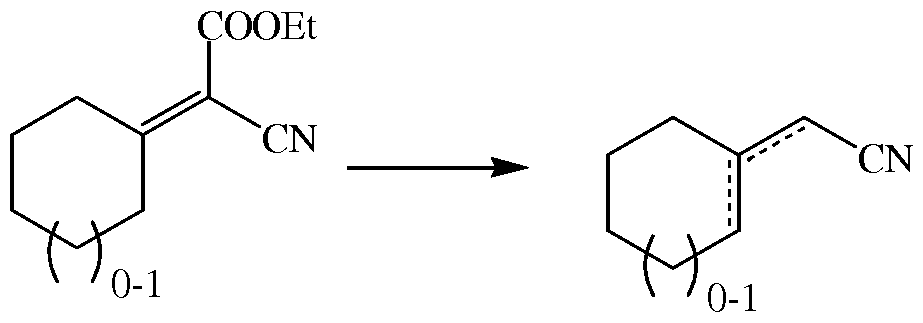
Figure imgf000010_0002

Claims

Claims
1. A process for the preparation of a compound of formula (I)
Figure imgf000011_0001
wherein the dotted lines indicate that the compound is in the form of a mixture of the corresponding β-γ or α-β unsaturated derivatives, the molar ratio β-γ/α-β being at least 3; Y represent, independently of each other, a OR4 or R4 group, R4 representing a Ci-Cs hydrocarbon group, optionally comprising 1 to 3 heteroatoms selected from the group consisting of oxygen, sulfur and nitrogen;
R1 represents a C1-C15 hydrocarbon group, optionally comprising 1 to 3 heteroatoms selected from the group consisting of oxygen, sulfur and nitrogen; R2 represents a C1-C5 hydrocarbon group, optionally comprising 1 to 3 heteroatoms selected from the group consisting of oxygen, sulfur and nitrogen; R3 represents a hydrogen atom or a C1-C5 hydrocarbon group; and optionally said Ri and R2, and/or Ri and R3, taken together may form a C4-Ci2 hydrocarbon group optionally comprising 1 to 3 heteroatoms selected from the group consisting of oxygen, sulfur and nitrogen; said method comprising the step of reacting, at a temperature comprised between 1000C and 23O0C, a compound of formula
Figure imgf000011_0002
wherein Y, R1, R2 and R3 are defined as in formula (I); with at least one compound from the group i) and at least one compound from the group ii), said groups consisting respectively of: i) the salts of formula MX2, M"X3 or M'X, wherein M is an alkali-earth cation and M' an alkali cation or Co-Ci2 ammonium cation and M" is a lanthanide cation, and X is a halide or an anion of an acid HX having a pKa comprised between 0 and 6; ii) the carboxylic acids of formula R5COOH, wherein R5 represents a C1-C18 hydrocarbon group optionally comprising one or two oxygen atoms; and optionally in the presence of a polar aprotic solvent having a boiling point of above 1000C.
2. A process according to claim 1, characterised in that the compound of formula (I) is of formula
Figure imgf000012_0001
the dotted lines indicate that the compound is in the form of a mixture of the corresponding β-γ or α-β unsaturated derivatives, the molar ratio β-γ/α-β being at least 3;
Y represent, independently of each other, a OR4 or R4 group, R4 representing a C1-C6 alkyl group or a Cβ-Cio phenyl or benzyl group optionally comprising 1 to 3 oxygen or nitrogen atoms;
R1 represents a C2-Ci2 hydrocarbon atom, optionally comprising 1 to 3 functional oxygen or nitrogen atoms;
R represents a Ci-C3 alkyl group; optionally said Ri and R2, taken together may form a C4-Cn hydrocarbon group optionally comprising 1 to 3 oxygen or nitrogen atoms.
3. A process according to claim 1, characterised in that said compound (I) is obtained in the form of a mixture of the corresponding β-γ or α-β unsaturated derivatives and wherein the ratio β-γ/α-β is at least 6; and/or the molar ratio of the isomers E and Z of the β-γ unsaturated derivatives, (E)- β-γ)/((Z)-β-γ, is above 3.
4. A process according to claim 1, characterised in that the compounds of formula (I) are compounds of formula
Figure imgf000013_0001
wherein R6 represents a methyl or ethyl group or a OMe or OEt group; and R7 represents
- a C1O-12 hydrocarbon group;
- a phenyl group optionally substituted with 1 or 2 C1-C3 alkoxy or amino groups; or
- a C3-CO alkyl or alkenyl group.
5. A process according to claim 1, characterised in that the compound of formula (II) is reacted with in the presence of at least one compound from the group i) and at least one compound from the group ii): i) the salts of formula MX2, M"X3 or M'X, wherein M is an alkali-earth cation and M' an alkali cation or Co-C12 ammonium cation and M" is a lanthanide cation, and X is a halide or an anion of an acid HX having a pKa comprised between 0 and 6, in particular a MX2 or M"X3 salt; and ii) an acid R5COOH, wherein R5 represents a C1-C18 hydrocarbon group optionally comprising one or two oxygen atoms.
6. A process according to claim 5, characterised in that the compounds of group i) are the salts of formula MX2 or M"X3, wherein M, M" and X are as defined in claim 5.
7. A process according to claim 5, characterised in that the compound of group i) is a magnesium, calcium, cerium, lithium, sodium or potassium salt of chloride, fluoride, iodine, or of a carboxylate of formula R9COO", R9 representing a C1-C18 hydrocarbon group optionally comprising one or two oxygen atoms.
8. A process according to claim 7 characterised in that the salt is NaCl, NaF, NaI, Mg(R9COO)2, R9COONa, R9COOK, KF, CeCl3, Ce(R9COO)3, CaCl2 or CaF2, R9 being defined as in claim 7.
9. A process according to claim 1, characterised in that the compound of group ii) is a carboxylic acid R9COOH, wherein R9 is a C2-Cg alkyl, alkenyl, phenyl or benzyl group.
10. A process according to claim 9, characterised in that R9 represents a pent-2-yl, hept-3yl, propyl, isopropyl, isobutyl, tertbutyl, isopentyl, cyclohexyl, benzyl or (Me)2(CH2)3C(Me)=CH group.
PCT/IB2007/050341 2006-02-23 2007-02-01 Process for the preparation of beta-gamma ene carbonyl derivatives Ceased WO2007096791A1 (en)

Priority Applications (5)

Application Number Priority Date Filing Date Title
US12/278,938 US7932418B2 (en) 2006-02-23 2007-02-01 Process for the preparation of β-γ ene carbonyl derivatives
ES07705763.6T ES2672170T3 (en) 2006-02-23 2007-02-01 Preparation procedure for beta-gamma eno carbonyl derivatives
CN2007800061893A CN101389589B (en) 2006-02-23 2007-02-01 Process for the preparation of beta-gamma ene carbonyl derivatives
EP07705763.6A EP1989170B1 (en) 2006-02-23 2007-02-01 Process for the preparation of beta-gamma ene carbonyl derivatives
JP2008555905A JP5424647B2 (en) 2006-02-23 2007-02-01 Process for producing beta-gammaenecarbonyl derivative

Applications Claiming Priority (2)

Application Number Priority Date Filing Date Title
EP06110344.6 2006-02-23
EP06110344 2006-02-23

Publications (1)

Publication Number Publication Date
WO2007096791A1 true WO2007096791A1 (en) 2007-08-30

Family

ID=36648388

Family Applications (1)

Application Number Title Priority Date Filing Date
PCT/IB2007/050341 Ceased WO2007096791A1 (en) 2006-02-23 2007-02-01 Process for the preparation of beta-gamma ene carbonyl derivatives

Country Status (6)

Country Link
US (1) US7932418B2 (en)
EP (1) EP1989170B1 (en)
JP (1) JP5424647B2 (en)
CN (1) CN101389589B (en)
ES (1) ES2672170T3 (en)
WO (1) WO2007096791A1 (en)

Cited By (2)

* Cited by examiner, † Cited by third party
Publication number Priority date Publication date Assignee Title
WO2011073387A1 (en) 2009-12-18 2011-06-23 Givaudan Sa Organic compounds
WO2012085056A1 (en) 2010-12-21 2012-06-28 Givaudan Sa 2-(alkoxy or aryloxy carbonyl)-4-methyl-6-(2,6,6-trimethylcyclohex-1-enyl)hex-2-enoic acid compounds, its preparation and use

Families Citing this family (2)

* Cited by examiner, † Cited by third party
Publication number Priority date Publication date Assignee Title
CN104557543B (en) 2013-10-21 2017-04-12 芬芳香精香料有限公司 Processes for the preparation of unsaturated esters
WO2016145288A1 (en) 2015-03-11 2016-09-15 International Flavors & Fragrances Inc. Processes for the preparation of unsaturated malonates

Family Cites Families (1)

* Cited by examiner, † Cited by third party
Publication number Priority date Publication date Assignee Title
EP0623575B1 (en) * 1993-04-27 1998-11-11 Solvay Fluor und Derivate GmbH Process for the preparation of ketones

Non-Patent Citations (6)

* Cited by examiner, † Cited by third party
Title
A. H. DICKINS ET AL.: "The Chemistry of Three-carbon System. Part XX. cyclo-Pentylideneacetone and cyclo-Pentylidenemethyl Ethyl Ketone.", JOURNAL OF THE CHEMICAL SOCIETY., 1929, GBCHEMICAL SOCIETY. LETCHWORTH., pages 571 - 580, XP008067320 *
A. P. KRAPCHO ET AL.: "Synthetic Applications and Mechanism Studies of the Decarboxylations of Geminal Diesters and Related Systems Effected in Me2SO by Water and/or by Water with Added Salts", JOURNAL OF ORGANIC CHEMISTRY., vol. 43, no. 1, 1978, AMERICAN CHEMICAL SOCIETY. EASTON., US, pages 138 - 146, XP002393152 *
KRAPCHO A P: "SYNTHETIC APPLICATIONS OF DEALKOXYCARBONYLATIONS OF MALONATE ESTERS, BETA-KETO ESTERS, ALPHA-CYANO ESTERS AND RELATED COMPOUNDS IN DIPOLAR APROTIC MEDIA - PART I", SYNTHESIS, GEORG THIEME VERLAG, STUTTGART, DE, October 1982 (1982-10-01), pages 805 - 822, XP000999104, ISSN: 0039-7881 *
KRAPCHO A P: "SYNTHETIC APPLICATIONS OF DEALKOXYCARBONYLATIONS OF MALONATE ESTERS, BETA-KETO ESTERS, ALPHA-CYANO ESTERS AND RELATED COMPOUNDS IN DIPOLAR APROTIC MEDIA - PART II", SYNTHESIS, GEORG THIEME VERLAG, STUTTGART, DE, November 1982 (1982-11-01), pages 893 - 914, XP000999105, ISSN: 0039-7881 *
RAGOUSSIS ET AL: "Palladium catalyzed reductive decarboxylation of allyl alpha-alkenyl-beta-ketoesters. A new synthesis of (E)-3-alkenones", TETRAHEDRON LETTERS, ELSEVIER, AMSTERDAM, NL, vol. 47, no. 5, 30 January 2006 (2006-01-30), pages 683 - 687, XP005222409, ISSN: 0040-4039 *
SCHULTE-ELTE, KARL H.; PAMINGLE, HERVE; UIJTTEWAAL, ARNOLD P.; SNOWDEN, ROGER L.: "An alternative access to (.+-.)-.alpha.- irones and (.+-.)-.beta.-irone via acid-mediated cyclization.", HELVETICA CHIMICA ACTA., vol. 75, 1992, VERLAG HELVETICA CHIMICA ACTA, BASEL., CH, pages 759 - 765, XP002393151 *

Cited By (9)

* Cited by examiner, † Cited by third party
Publication number Priority date Publication date Assignee Title
WO2011073387A1 (en) 2009-12-18 2011-06-23 Givaudan Sa Organic compounds
EP2513030B1 (en) 2009-12-18 2015-05-06 Givaudan SA Beta-gamma unsaturated esters and process of production of beta-gamma unsaturated esters.
WO2012085056A1 (en) 2010-12-21 2012-06-28 Givaudan Sa 2-(alkoxy or aryloxy carbonyl)-4-methyl-6-(2,6,6-trimethylcyclohex-1-enyl)hex-2-enoic acid compounds, its preparation and use
CN103298783A (en) * 2010-12-21 2013-09-11 奇华顿股份有限公司 2-(alkoxy or aryloxy carbonyl)-4-methyl-6-(2,6,6-trimethylcyclohex-1-enyl)hex-2-enoic acid compounds, its preparation and use
US8933253B2 (en) 2010-12-21 2015-01-13 Givaudan S.A. 2-(Alkoxy or aryloxy carbonyl)-4-methyl-6-(2,6,6-trimethylcyclohex-1-enyl)hex-2-enoic acid compunds, its preparation and use
US9163000B2 (en) 2010-12-21 2015-10-20 Givaudan S.A. 2-(alkoxy or aryloxy carbonyl)-4-methyl-6-(2,6.6-trimethylcyclohex-1- enyl)hex-2-enoic acid compounds, its preparation and use
CN103298783B (en) * 2010-12-21 2016-05-11 奇华顿股份有限公司 2-(alkoxyl or alkoxy carbonyl group)-4-methyl-6-(2,6,6-3-methyl cyclohexanol-1-thiazolinyl) oneself-2-olefin(e) acid compound, Preparation Method And The Use
US9732056B2 (en) 2010-12-21 2017-08-15 Givaudan, S.A. 2-(alkoxy or aryloxy carbonyl)-4-methyl-6-(2,6,6-trimethylcyclohex-1-enyl)hex-2-enoic acid compounds, its preparation and use
US10081613B2 (en) 2010-12-21 2018-09-25 Givaudan, S.A. 2-(alkoxy or aryloxy carbonyl)-4-methyl-6-(2,6,6-trimethylcyclohex-1-enyl)hex-2-enoic acid compounds, its preparation and use

Also Published As

Publication number Publication date
JP5424647B2 (en) 2014-02-26
EP1989170B1 (en) 2018-04-11
CN101389589A (en) 2009-03-18
CN101389589B (en) 2013-05-01
US20100168462A1 (en) 2010-07-01
EP1989170A1 (en) 2008-11-12
ES2672170T3 (en) 2018-06-12
JP2009527545A (en) 2009-07-30
US7932418B2 (en) 2011-04-26

Similar Documents

Publication Publication Date Title
JP3004466B2 (en) Process for producing monoester-monoamide, monoacid-monoamide and bis-amide of malonic acid substituted once and twice, and compounds produced by this method
EP2334645A1 (en) Process for the synthesis of halogenated cyclic compounds
JP4376061B2 (en) Alkenone production
EP1989170B1 (en) Process for the preparation of beta-gamma ene carbonyl derivatives
AU2003277230B2 (en) Process for the preparation of dioxane acetic acid esters
US20120136154A1 (en) Processes for the preparation of substituted tetrahydro beta-carbolines
US20180002260A1 (en) Intermediate compounds for producing perfuming ingredients
EP0525506B1 (en) A process for the alpha-monoalkylation of arylacetonitriles, arylacetoesters and arylacetic acids
EP2513030B1 (en) Beta-gamma unsaturated esters and process of production of beta-gamma unsaturated esters.
JP3773534B2 (en) Method for producing 2-cyan-3,3-diarylacrylic acid ester
US5886209A (en) Preparation of 2-(4-hydroxyphenoxy) propionates
JP2009523716A (en) Method for producing bisabolol which does not contain farnesol or has a small content of farnesol
IL211613A (en) Method for producing optically active cyclopropane carboxylic acid ester compound, asymmetric copper complex and optically active salicylideneaminoalcohol compound
JP6801930B2 (en) Process for the preparation of diaminobutane
CA2751017A1 (en) Compositions of esters of fluorosubstituted alcanoic acids
US5179230A (en) Process for the preparation of 2,3,4,5-tetrafluorobenzoic acid
US7498459B2 (en) Method for producing (1-alkenyl)cyclopropane compound
JP4308155B2 (en) Process for producing δ-iminomalonic acid derivative and catalyst therefor
EP1948584B1 (en) Process for the preparation of cyclopentanone derivatives
JP2001206883A (en) Process for producing 3,4-methylenedioxymandelic acid
US6180801B1 (en) Method for manufacturing 3-isochromanone
JP3814943B2 (en) Production method of dialkyl carbonate
CN1303845A (en) Process for synthetizing 2,2-demethyl-3-(1-propenyl) cyclopropane carboxylic ester
US20010044554A1 (en) Process for the preparation of 2-methyl-1,3-dicarboxylates
JPH09235273A (en) Production of n-alkenylazole

Legal Events

Date Code Title Description
121 Ep: the epo has been informed by wipo that ep was designated in this application
WWE Wipo information: entry into national phase

Ref document number: 3059/KOLNP/2008

Country of ref document: IN

WWE Wipo information: entry into national phase

Ref document number: 2007705763

Country of ref document: EP

WWE Wipo information: entry into national phase

Ref document number: 12278938

Country of ref document: US

WWE Wipo information: entry into national phase

Ref document number: 200780006189.3

Country of ref document: CN

WWE Wipo information: entry into national phase

Ref document number: 2008555905

Country of ref document: JP

NENP Non-entry into the national phase

Ref country code: DE