WO2006099313A2 - Phosphate conjugates of prenylation inhibitors - Google Patents
Phosphate conjugates of prenylation inhibitors Download PDFInfo
- Publication number
- WO2006099313A2 WO2006099313A2 PCT/US2006/008934 US2006008934W WO2006099313A2 WO 2006099313 A2 WO2006099313 A2 WO 2006099313A2 US 2006008934 W US2006008934 W US 2006008934W WO 2006099313 A2 WO2006099313 A2 WO 2006099313A2
- Authority
- WO
- WIPO (PCT)
- Prior art keywords
- compound
- group
- drug
- alkyl
- independently selected
- Prior art date
- Legal status (The legal status is an assumption and is not a legal conclusion. Google has not performed a legal analysis and makes no representation as to the accuracy of the status listed.)
- Ceased
Links
Classifications
-
- A—HUMAN NECESSITIES
- A61—MEDICAL OR VETERINARY SCIENCE; HYGIENE
- A61K—PREPARATIONS FOR MEDICAL, DENTAL OR TOILETRY PURPOSES
- A61K47/00—Medicinal preparations characterised by the non-active ingredients used, e.g. carriers or inert additives; Targeting or modifying agents chemically bound to the active ingredient
- A61K47/50—Medicinal preparations characterised by the non-active ingredients used, e.g. carriers or inert additives; Targeting or modifying agents chemically bound to the active ingredient the non-active ingredient being chemically bound to the active ingredient, e.g. polymer-drug conjugates
- A61K47/51—Medicinal preparations characterised by the non-active ingredients used, e.g. carriers or inert additives; Targeting or modifying agents chemically bound to the active ingredient the non-active ingredient being chemically bound to the active ingredient, e.g. polymer-drug conjugates the non-active ingredient being a modifying agent
- A61K47/54—Medicinal preparations characterised by the non-active ingredients used, e.g. carriers or inert additives; Targeting or modifying agents chemically bound to the active ingredient the non-active ingredient being chemically bound to the active ingredient, e.g. polymer-drug conjugates the non-active ingredient being a modifying agent the modifying agent being an organic compound
- A61K47/548—Phosphates or phosphonates, e.g. bone-seeking
-
- A—HUMAN NECESSITIES
- A61—MEDICAL OR VETERINARY SCIENCE; HYGIENE
- A61P—SPECIFIC THERAPEUTIC ACTIVITY OF CHEMICAL COMPOUNDS OR MEDICINAL PREPARATIONS
- A61P35/00—Antineoplastic agents
Definitions
- This invention relates to intracellular delivery of phosphate-substituted therapeutic compounds and analogs thereof. More particularly, this invention relates to prodrugs of phosphorus-containing inhibitors of farnesyl transferase, and prodrugs of drug-phosphate conjugates and analogs of drug-phosphate conjugates.
- Prenylation the introduction of a farnesyl moiety onto the sulfhydryl group of certain proteins, is an important post-translational modification central to many cellular processes.
- the enzyme responsible for this prenylation is the protein farnesyltransferase (FTase).
- FTase protein farnesyltransferase
- Prenylation may be required to give a protein sufficient hydrophobicity for translocation to the plasma membrane.
- Many proteins that undergo prenylation are critical to signal transduction pathways, and therefore cell membrane localization is essential for these proteins to operate properly (see, for example, Hurwitz, H.I.; Casey, PJ.
- Prenylation of CaaX-type proteins Basic principles through clinical applications, in Curr. Top. Membr.
- Ras membrane localization is to inhibit FTase, the enzyme responsible for farnesylating Ras (see, for example, Ayllon, V.; Rebollo, A. Ras-induced Cellular Events (Review), in MoI. Mem. Biol. 2000, 17, 65- 73).
- the pyrophosphates of 3-allylfarnesol and 3-t-butylfarnesol have been shown to be nanomolar inhibitors of FTase, and the pyrophosphate of 3-(3,3-dimethylaHyl)farnesol is a novel protein- selective inhibitor of this enzyme.
- These phosphate-substituted compounds are highly charged, however, and it is unlikely that they will be capable of traversing the cell membrane and entering the cell.
- a strategy to deliver intracellularly the monophosphates of such inhibitors could provide an effective therapeutic approach. Described herein are two such mechanisms for intracellular delivery.
- the pyrophosphates are generated intracellularly by phosphorylation of the monophosphates; thus, the intracellular monophosphate of an FTase inhibitor may be converted to the pyrophosphate within the target cell.
- the monophosphates may themselves serve as effective inhibitors of FTase.
- the invention described herein is directed to neutral prodrugs of phosphorus-containing inhibitors of farnesyl transferase that include one or more phosphate fragments or analogs of phosphate fragments.
- Analogs of phosphate fragments include various linkers other than oxygen connecting the phosphate fragment to the remaining portion of the drug, such as but not limited to linkers forming phosphoramidates, phosphonates, difluorophosphonates, oxophosphonates, thiophosphonates, and the like.
- the neutral prodrug is thought to enter the cell by passive diffusion, and then intracellular activation of the prodrug generates an intermediate that spontaneously releases the corresponding phosphate-containing drug, or analog thereof, within the cell.
- the invention described herein is also directed to drugs that are phosphorylated after delivery. It is appreciated that those drugs that are phosphorylated after delivery may only become active as drugs following phosphorylation.
- the invention described herein is also directed to analogs of drugs that are phosphorylated after delivery.
- Analogs of drugs that are phosphorylated after delivery include phosphorylated drugs where the linker connecting the phosphate fragment to the drug fragment is other than oxygen, such as, but not limited to linkers forming phosphorarmdates, phosphonates, difluorophosphonates, oxophosphonates, thiophosphonates, and the like.
- prodrugs of each of these drugs, drug-phosphate conjugates, and phosphate analogs thereof may enhance their efficacy and specificity, hi one embodiment, prodrugs of drugs that include a phosphate fragment or phosphate fragment analog are described, hi another embodiment, prodrugs of drugs that are phosphorylated after delivery are described, hi this latter embodiment of prodrugs of drugs that are phosphorylated after delivery, the prodrugs may be derived from phosphorylated versions of the drug and/or from analogs of phosphorylated versions of the drug, including but not limited to phosphoramidates, phosphonates, difluorophosphonates, oxophosphonates, thiophosphonates, and the like.
- prodrugs of drugs that are phosphorylated after delivery is to be understood to include any in vitro, in vivo, or other in situ situation where the drug is introduced to a condition or set of conditions under which it is phosphorylated.
- drug will refer both to compounds that include a phosphate fragment or phosphate fragment analog, as well as to compounds that are phosphorylated after delivery.
- the general strategy for the intracellular delivery of phosphate- containing compounds utilized in the present invention is outlined in Scheme 1. -A-
- the phosphate-substituted compound to be delivered intracellularly is synthesized to include a delivery group and a masking group.
- the masking group is illustratively a (substituted alkyl) amine or bis(substituted alkyl)amine moiety that may be modified intracellularly.
- modification of the masking group occurs while retaining the delivery group.
- the delivery group is removed before modification of the masking group occurs.
- the masking group undergoes intramolecular cyclization and subsequent cleavage by hydrolysis.
- intramolecular cyclization occurs contemporaneously, or even simultaneously in a concerted or anchimerically- assisted process, with hydrolysis of the masking group.
- the masking group is generally stable as long as the delivery group remains attached to the phosphorus atom.
- the delivery group is generally a group that is subject to intracellular hydrolysis, such as a biologically labile ester-forming group, or an ester that is readily hydrolyzed intracellularly.
- the delivery group includes nitrofuryl groups, perhydrooxazines, and the like.
- a mechanism of prodrug release of drug-phosphate, optionally substituted drug-phosphoramidate, or optionally substituted drug-phosphonate conjugates described herein is outlined in Scheme 2
- the (substituted alkyl)amine or bis(substituted alkyl)amine is a substituted ethylamine or bis(substituted ethyl)amine, such as a ethyl substituted with a leaving group including halo, alkoxy, acyloxy, sulfonyloxy, and the like.
- the leaving group is understood to be any electrophilic group capable of being nucleophilically displaced from the carbon atom to which it is bound intermolecularly or intramolecularly. It is appreciated that such nucleophilic lability can be exploited in a controlled fashion to facilitate the unmasking of the prodrug and ultimate release of the drug phosphate conjugate or analog thereof.
- substituted ethylamine or bis(substituted ethyl)amine may also be irreversible inhibitors leading to irreversible adducts such as formation of cross-linked structures with nucleic acids like DNA and RNA, enzymes, and the like.
- the (substituted alkyl)amine or bis(substituted alkyl)amine includes a longer chain (substituted alkyl)amine, such as a substituted butyl and/or substituted pentyl group.
- the inhibitors may be reversible inhibitors.
- substitutions include leaving groups such as halo, alkoxy, acyloxy, sulfonyloxy, and the like. It is appreciated that in each of the illustrative examples the alkyl may have branching substituents, including additional alkyl groups, spiro-ring fusions, and the like. In one illustrative aspect, such branching substituents are not leaving groups.
- the prodrugs of phosphorus- containing inhibitors of FTase described herein may be formed from farnesol and geraniol and a wide variety of farnesol and geraniol analogs, such as a- and ⁇ - farnesene, farnesylfarnesol, farnesylgeraniol, geranylgeraniol, and the like.
- farnesol, 3-allylfarnesol, 3-t-butylfarnesol, and 3-(3,3- dimethylallyl)farnesol are described.
- prodrugs of other farnesol analogs may be synthesized as described herein.
- the prodrugs described herein are formed from drugs, including farnesol monophosphate analogs, that are phosphorylated in vivo after delivery or administration to a patient, hi one aspect, the drug is more active, or activated only, after phosphorylation by a biological pathway present in the patient. It is appreciated that the efficacy of the drug lacking any of the delivery and masking groups described herein may be hampered by the dependence upon that additional endogenous functionalization pathway.
- the necessary pathway is compromised, further minimizing the efficacy of the drug.
- the prodrugs described herein include the necessary or desirable phosphorus-containing fragment at dosing to the patient being treated, and therefore do not require additional in vivo modification or activation.
- the prodrugs described herein are illustratively prepared to mask the negative charge, or double negative charge of the phosphorus-containing fragment. It is appreciated that highly charged molecules often suffer from poor absorption and/or transport to the relevant tissues of cells that are the object of treatment.
- the prodrugs described herein are resistant to phosphatases, including intracellular phosphatases that may cleave the phosphorus-containing fragment from the prodrug conjugate or conjugate after the prodrug is converted into the phosphorus-containing drug or drug-conjugate analog.
- phosphatases including intracellular phosphatases that may cleave the phosphorus-containing fragment from the prodrug conjugate or conjugate after the prodrug is converted into the phosphorus-containing drug or drug-conjugate analog.
- the efficacy of many drugs are aided by or dependent upon phosphorylation.
- prodrugs described herein include embodiments that are resistant to metabolic degradation and therefore have increased half-lives in the patient being treated. It is appreciated that in certain disease states and/or for certain patients, phosphatases may be particularly abundant and their presence may hamper treatment efforts using compounds that are susceptible to phosphatase degradation.
- the prodrugs described herein are formed from drugs, including farnesol monophosphate analogs, and are resistant to degradation by phosphatases or other enzymes that cleave phosphorus-oxygen bonds, including nucleotidases, endonucleases, exonucleases, and the like.
- Such degradation resistance may be accomplished by the replacement of the oxygen atom linker that connects the phosphorus fragment with the rest of the drug or drug-phosphate conjugate with a sulfur atom, an optionally substituted nitrogen atom, and/or with one or more carbon atoms, each of which may be substituted, such as with hydrogen, allcyl, and fiuoro substituents, and the like, alone or in combination.
- R 1 is alkyl, including C 1 -C 6 alkyl, or -(CR 2 ) n X; n is an integer from 2 to about 5; R 2 is -(CR 2 ) m X; m is an integer from 2 to about 5; R is in each instance an independently selected substituent, including hydrogen, alkyl, fiuoro, and the like; or any geminal pair of such groups R can be taken together with the attached carbon to form a ring, including a carbocyclic ring, or heterocyclic ring; X is a nucleophilically labile group, including halo, alkoxy, phenoxy, acyloxy, sulfonyloxy, and the like; R 3 is a biologically labile ester forming group; and Drug is farnesyl, a farnesyl analog, or derivative thereof.
- R 1 is alkyl, including C 1 -C 6 alkyl, or -(CR 2 ) n X; n is an integer from 2 to about 5; R 2 is -(CR 2 ) m X; m is an integer from 2 to about 5; R is in each instance an independently selected substituent, including hydrogen, alkyl, fiuoro, and the like; or any geminal pair of such groups R can be taken together with the attached carbon to form a ring, including a carbocyclic ring, or heterocyclic ring; X is a nucleophilically labile group, including halo, alkoxy, phenoxy, acyloxy, sulfonyloxy, and the like; R 3 is a biologically labile ester forming group; Drug is farnesyl, a farnesyl analog, or derivative thereof; and A and B are each independently selected substituents, including hydrogen, alkyl, fluoro, and the like; or A and B are taken together to
- R 1 is alkyl, including C 1 -C 6 alkyl, or -(CR. 2 ) n X; n is an integer from 2 to about 5; R is -(CR 2 ) m X; m is an integer from 2 to about 5; R is in each instance an independently selected substituent, including hydrogen, alkyl, fluoro, and the like; or any geminal pair of such groups R can be taken together with the attached carbon to form a ring, including a carbocyclic ring, or heterocyclic ring; X is a nucleophilically labile group, including halo, alkoxy, phenoxy, acyloxy, sulfonyloxy, and the like; R 3 is a biologically labile ester forming group; Drug is farnesyl, a farnesyl analog, or derivative thereof; and R 4 is hydrogen, alkyl, acyl, and the like.
- R 1 is alkyl, including C 1 -C 6 alkyl, or -(CR 2 ) n X; n is an integer from 2 to about 5; R 2 is -(CR 2 ) m X; m is an integer from 2 to about 5; R is in each instance an independently selected substiruent, including hydrogen, alkyl, fluoro, and the like; or any geminal pair of such groups R can be taken together with the attached carbon to form a ring, including a carbocyclic ring, or heterocyclic ring; X is a nucleophilically labile group, including halo, alkoxy, phenoxy, acyloxy, sulfonyloxy, and the like; R 3 is a biologically labile ester forming group; and Drug is farnesyl, a farnesyl analog, or derivative thereof.
- farnesol or analogs thereof may be modified as is necessary to provide a derivative where a suitable linking atom or atoms allow for conjugation with the phosphoras-containing portion of the prodrug conjugate.
- the phosphorus-containing portion may be attached to a farnesyl moiety or analogs thereof through a linker, such as methylene, difluoromethylene, carbonyl, and the like.
- farnesol or analogs thereof may be derivatized with for example a suitable heteroatom, such as thio or optionally substituted amino, and the farnesyl moiety or analogs thereof then attached directly to the phosphorus- containing portion via the heteroatom or through an optional linker.
- a suitable heteroatom such as thio or optionally substituted amino
- nitrogen may be directly attached to the phosphorus to form a prodrug including a phosphordiamidate.
- R 1 in the above formulae is methyl and the integer m is 4.
- R 1 is -
- each R is hydrogen.
- X is halogen, such as chloro.
- both A and B are hydrogen or both A and B are fluoro.
- R 3 is heteroarylalkyloxy, optionally substituted with an electron withdrawing group, such as nitro, alkylsulfonyl, cyano, halo, and the like.
- R 3 is optionally substituted arylalkyloxy, such as optionally substituted benzyloxy.
- R 3 is optionally substituted 1,3- heterocycloalkyloxy, such as an optionally substituted tetrahydro-l,3-oxazine alkyloxy.
- R 3 is [2-(4,4,6-trimethyltetrahydro-l,3-oxazin-2-yl)ethyl]oxy.
- Prodrugs that include R 3 as [2-(4,4,6-trimethyltetrahydro-l,3-oxazin-2-yl)ethyl]oxy may be prepared by conventional methods. Illustratively, and as described by Borch et al. in U.S. Patent No.
- R 3 is nitrofurylmethyloxy.
- Prodrugs described herein include R 3 as nitrofuryhnethyloxy.
- the prodrugs described herein may be prepared to increase cell permeability of the drug or drug-phosphate conjugate or analog thereof, by selective activation.
- R 3 is optionally substituted heteroarylalkyloxy
- one variation includes nitrofuryhnethyloxy.
- the prodrug activation may be initiated by bioreductive elimination of the delivery group followed by spontaneous liberation of the masking group, as generally described by Meyers, C.L.F.; Hong, L.; Joswig, C; and Borch, R.F. in J Med. Chem. 2000, 43:4313-4318, the disclosure of which is incorporated herein by reference.
- the drugs described herein include a phosphonate linkage between the phosphorus and the farnesol analogs or derivatives thereof.
- the prodrugs described herein include a difluorophosphonate linkage between the phosphorus and the farnesol analogs or derivatives thereof.
- the prodrugs described herein include a phosphoester linkage between the phosphorus and farnesol or analogs thereof.
- the prodrugs described herein include a phosphoramidate linkage between the phosphorous and the farnesol analogs or derivatives thereof.
- drugs that are ultimately delivered to the cell following removal of the masking and delivery groups include
- Drag is farnesyl, or a farnesyl analog, or a derivative thereof, and where the corresponding FTase inhibitory activity of which may be increased after subsequent phosphorylation to yield a Drug-pyrophosphate or analog thereof.
- Fig. 1 shows the inhibition of prenylation of RhoB resulting from in vitro treatment of human neurofibrosarcoma STS-26T cells with prodrug compound 2.
- an effective amount of the prodrug compound with respect to the treatment of cancer refers to an amount of the compound capable of interfering with the spread of the cancer.
- such interference may be manifested in slowing, stopping, or reversing the spread of the cancer; slowing, stopping, or reversing the growth or proliferation of cancer or malignant cells; or slowing, stopping, or reversing the growth of a solid tumor, and the like,
- effective amounts of compounds used in the methods described herein may be derived, or determined from data gathered by screening such compounds on the NCI panel of human tumor cell lines, the effective amount being related to that which inhibits growth and/or proliferation of tumor cells and/or kills malignant cells as a direct or indirect result of FTase inhibition.
- the effective amount to be administered to a patient may be based on body surface area, patient weight, and/or patient condition.
- body surface area may be approximately determined from patient height and weight (see, for example, Scientific Tables, Geigy Pharmaceuticals, Ardley, New York, pages 537-538 (1970)).
- An effective amount of the prodrug compounds for use in treating cancer can range from about 0.05 mg/kg to about 100 mg/kg, about 0.25 mg/kg to about 50 mg/kg, and illustratively about 0.1 to about 10 mg/kg per dose. Effective doses may also vary dependent on route of administration, excipient usage, and/or the possibility of co-usage with other therapeutic treatments, including other chemotherapeutic agents, and radiation therapy. However, it is to be understood that dosages may be ultimately determined by the treating physician.
- compositions of the prodrugs described herein may be administered via any route, including a parenteral route, including subcutaneously, intraperitoneally, intramuscularly, and intravenously.
- parenteral dosage forms include aqueous solutions or suspensions of the active agent in isotonic saline, 5% glucose, or other pharmaceutically acceptable liquid carrier, hi one aspect of the pharmaceutical compositions described herein, the compound is dissolved in a saline solution containing 5% of dimethyl sulfoxide and about 10% CremophorTM EL (Sigma Chemical Company).
- solubilizing agents such as cyclodextrins, which can form more soluble complexes with the present compounds, or other solubilizing agents can be utilized as pharmaceutical excipients for delivery of the present compounds for cancer therapy.
- the present compounds can be formulated into dosage forms for other routes of administration utilizing conventional methods.
- the pharmaceutical compositions can be formulated, for example, in dosage forms for oral administration in a capsule, a gel seal, or a tablet.
- Capsules may comprise any pharmaceutically acceptable material such as gelatin or cellulose derivatives. Tablets may be formulated in accordance with conventional procedure by compressing mixtures of the active prodrugs and solid carriers and lubricants. Examples of solid carriers include starch, sugar, and bentonite.
- the compounds described herein can also be administered in a form of a hard shell tablet or capsule containing, for example, lactose or mannitol as a binder and conventional fillers and tableting agents. With regard to illustrative formulae:
- the electrophilic group X which may be included in R and is included in R , is illustratively halo, such as chloro, bromo, or iodo.
- halo such as chloro, bromo, or iodo.
- the nature of that group is flexible provided that it can serve as a leaving group to enable activation and/or cyclization and concomitant quaternization of the phosphorous-bound nitrogen atom in vivo following administration of the phosphoramidate prodrugs to a patient.
- electrophilic leaving groups such as acetoxy, haloacetoxy, alkyl and arylsulfonyloxy, each of which may be optionally substituted, such as methane sulfonyloxy, trifluoromethane sulfonyloxy, tosyloxy, brosyloxy, nosyloxy, and the like may also be used.
- biologically labile ester forming group refers to those ester forming groups derived from alcohols that form ester derivatives that are stable under drug manufacture and storage conditions but are subject to hydrolysis when exposed to biological conditions in vivo.
- the ester forming groups used herein exhibit minimal susceptibility to hydrolysis in the body fluids in the extracellular space but exhibit susceptibility to hydrolysis in the intracellular space illustratively where ester-degrading reductive conditions are prominent.
- the biologically labile ester forming group on the prodrugs described herein are those ester forming groups that are susceptible to hydrolysis under mild reductive conditions, including, but not limited to, nitroaryl, including nitrofuryl, nitrothienyl, nitropyrroyl, nitroimidazoyl, and the like, indanyl, napthoquinolyl, perhydrooxazinyl, and the like.
- ester forming group R 3 is not critical provided that the group exhibits susceptibility to hydrolysis under intracellular conditions, such as biological conditions that exhibit reductive potential.
- the compounds that can be utilized as described herein to form prodrugs include farnesol, and analogs of farnesol and derivatives thereof, that can exhibit biological activity as their corresponding phosphates, or, alternatively, their phosphonate analogs, or phosphoramidate analogs. It is understood that for drugs that already include a phosphate radical or analog thereof, such as farnesol monophosphate, the drug fragment excluding the phosphate radical or analog thereof is used as described herein in preparing prodrugs.
- drug fragments that are converted to prodrugs as described herein are farnesol, 3-allylfarnesol, 3-t- butylfarnesol, and 3-(3,3-dimethylallyl)farnesol, and other farnesol analogs where the hydrocarbon portion may be represented as R a , where:
- R 5 is a C 1 -Cg alkyl, allyl, dimethylallyl, alkenyl, alkynyl, aryl, or heteroaryl group, and wherein p is 1, 2, or 3.
- prodrugs formed from drug fragments that include farnesol, farnesol analogs, and derivatives thereof, the hydrocarbon portion of which can be represented as R b , R c , R d , R e , R f , and R g , where:
- R and R are each independently selected from a C 1 -C 5 linear or branched- chain alkyl or alkenyl group, such as a methyl group, and wherein p is 1 or 2;
- R 5 is a C 1 -Cg alkyl, allyl, dimethylallyl, alkenyl, alkynyl, aryl, or heteroaryl group, such as a methyl group, and n is an integer from 1 to about 10;
- R 6 is a C 1 -C 5 linear or branched-chain alkyl or alkenyl group, such as a 3,3- dimethylallyl group
- R 8 is a cyclohexyl, phenyl, naphthyl, para- or ortho- biphenyl group, where each group may be optionally substituted with one or more halo groups, such as fluoro;
- R and R are each independently selected from a C 1 -C 5 linear or branched- chain alkyl or alkenyl group, such as an allyl, homoallyl, methyl, or 3,3-dimethylallyl group, and wherein p is 1, 2, or 3;
- R 6 and R 7 are each independently selected from a C 1 -C 5 linear or branched- chain alkyl or alkenyl group, such as a methyl group, and wherein p is 1, 2, or 3;
- R 6 is a C 1 -C 5 linear or branched-chain alkyl group, such as a methyl group, or an alkenyl group, and wherein p is 1, 2, or 3.
- any farnesol analog or derivative thereof may be utilized to prepare a prodrug, a drug-phosphate conjugate or analog thereof, and/or a prodrug of a drug-phosphate conjugate or analog thereof as described herein.
- the double bond between carbon atoms 2 and 3 has a trans configuration when the double bond between carbons atoms 6 and 7 has a cis configuration, and has a cis configuration when the double bond between carbon atoms 6 and 7 has a trans configuration.
- the prodrug is a phosphoramidate compound of formula (I):
- R is alkyl, alkenyl, and the like, such as methyl (Compound 1), allyl (Compound 2), 3,3-dimethylallyl (Compound 3), and tert-butyl (Compound 4), and p is 1, 2, or 3.
- analogs of the prodrugs of formula I are contemplated based on farnesol analogs and derivatives thereof, the hydrocarbon portion of which is as set forth above for R a , R b , R c , R d , R e , R f , and R s .
- one or more chiral centers may be included, and that both possible optical isomers at each chiral center are contemplated to be included in the invention described herein. Further, it is also to be understood that various mixtures, including racemic mixtures, or other diastereomeric mixtures of the various optical isomers may be used in one or more embodiments described herein. It is further appreciated that various geometric isomers may be used in one or more embodiments described herein.
- Prodrug compounds of formula (I) are prepared from nitrofuryl alcohol, 7V-methyl-iV-(4-chlorobutyl)amine hydrochloride, and farnesol or the corresponding farnesol analog via the one-pot phosphorous (IH) route shown in Scheme 3 (see, Meyers et al. inJ Med. Chem. 2000, 43:4313-4318, the disclosure of which is incorporated by reference) for related syntheses of nucleoside phosphoramidates.
- R is in each instance an independently selected substituent selected from the group consisting of hydrogen, alkyl, and fluoro, and any two groups R can be optionally taken together with the attached carbons to form a carbocyclic ring
- X is in each instance an independently selected nucleophilically labile group.
- n is 2, 4, or 5.
- m is 2, 4, or 5.
- both n and m are 2, 4, or 5.
- both n and m are 2, 4, or 5, and n and m are the same.
- the process illustrated in Scheme 3 may be performed without isolating one or more of, or alternatively any of, the intermediate compounds formed from steps (a), (b), or (c).
- prodrug compounds of formula (I) are prepared from a drug fragment described herein that includes a farnesol analog where the hydrocarbon portion is as set forth above for R a where R 5 is 3,3- dimethylallyl.
- This analog, compound C is prepared according to the general synthesis shown in Scheme 4, and subsequently used to prepare compounds of formula (I) as described in Scheme 3.
- prodrug compounds of formula (I) are prepared from a drug fragment described herein that includes a farnesol analog where the hydrocarbon portion is as set forth above for R c where R 5 is methyl.
- This analog, compound F is prepared according to the general synthesis shown in Scheme 5, and subsequently used to prepare compounds of formula (I) described in Scheme 3.
- Scheme 5 (a) CuCN, Et 2 O; (b) DiBAH, PIiMe. It is appreciated that the above synthesis may be modified to allow the preparation of various analogs of the compound exemplified in Scheme 5, including, for example, other drug fragments described herein the hydrocarbon portion of which is as set forth above for R°. For example, farnesol analogs with shorter or longer alkyl and alkenyl chains may be prepared by replacing the decyl-MgBr with other alkyl and alkenyl organometallic reagents.
- prodrug compounds of formula (I) are prepared from a drug fragment described herein that includes a farnesol analog where the hydrocarbon portion is as set forth above for R d where R 6 is 3,3- dimethylallyl and R 8 is para-biphenyl.
- This analog, compound J is prepared according to the general synthesis shown in Scheme 6, and subsequently used to prepare compounds of formula (I) as described in Scheme 3.
- prodrug compounds of formula (I) are prepared from a drug fragment described herein includes a farnesol analog where the hydrocarbon portion is as set forth above for R e where R 6 is homoallyl and R 7 is methyl.
- This analog, compound L is prepared according to the general synthesis shown in Scheme 7, and subsequently used to prepare compounds of formula (T) as described in Scheme 3.
- prodrug compounds of formula (I) are prepared from a drug fragment described herein that includes a farnesol analog where the hydrocarbon portion is as set forth above for R where R is methyl, R is 3,3-dimethylallyl, and p is 2.
- This analog, compound Q is prepared according to the general synthesis shown in Scheme 8, and subsequently used to prepare compounds of formula (I) as described in Scheme 3.
- prodrug compounds of formula (I) are prepared from a drag fragment described herein that includes a famesol analog where the hydrocarbon portion is as set forth above for R s where R 6 is methyl.
- This analog, compound T is prepared according to the general synthesis shown in Scheme 9, and subsequently used to prepare compounds of formula (I) as described in Scheme 3.
- prodrug compounds of formula (I) are prepared from a drug fragment described herein that includes a farnesol analog where the hydrocarbon portion is as set forth above for R where R is methyl, R is 3,3-dimethylallyl, and p is 1.
- This analog, compound BB is prepared according to the general synthesis shown in Scheme 10, and subsequently used to prepare compounds of formula (I) as described in Scheme 3.
- the prodrug is a phosphoramidate compound of formula (II):
- R is alkyl, alkenyl, and the like, such as methyl, allyl, 3,3-dimethylallyl, and tert-hvLtyl, and p is 1, 2, or 3.
- analogs of the prodrugs of formula (II) are contemplated based on farnesol analogs and derivatives thereof, the hydrocarbon portion of which is as set forth above for R a , R b , R c , R d , R e , R f , and R g .
- one or more chiral centers may be included, and that both possible optical isomers at each chiral center are contemplated to be included in the invention described herein. Further, it is also to be understood that various mixtures, including racemic mixtures, or other diastereomeric mixtures of the various optical isomers may be used in one or more embodiments described herein. It is further appreciated that various geometric isomers may be used in one or more embodiments described herein.
- the prodrugs described herein may be used in methods for treating various cancers. Evaluation of the prodrugs described herein useful for treating cancer may involve in vitro studies that measure cytotoxicity of the prodrugs against various cancer cell lines.
- the cancer cell is an STS-26T human neurofibrosarcoma cell.
- Farnesol analogs described herein may be synthesized by conventional methods.
- Farnesol analogs wliich contain aryl, including naphthyl, or biphenyl groups as depicted above were synthesized as described herein following the method described by Zhou, et al., in Bioorg. Med. Chem. Lett. 2002, 12, 1417-1420, the disclosure of which is incorporated herein by reference.
- the allyl- and homoallyl-containing farnesol analogs and related compounds were synthesized as described herein following the method described by Gibbs, et al., in J. Med. Chem. 1999, 42, 3800-3808, the disclosure of which is incorporated herein by reference.
- Compound 1 was prepared by a modification of a procedure described by Meyers et al. in J. Med. Chem., 2000, 43 :4313-4318. Nitrofurfuryl alcohol (200 mg, 1.4 mmol) and N-methyl-N-(4-chlorobutyl)amme hydrochloride (221 mg, 1.4 mmol) were coevaporated three times with 15 mL of anhydrous acetonitrile. Nitrofurfuryl alcohol was then dissolved in 5 mL of dry CH 2 Cl 2 and cooled to -78 0 C. PCl 3 (0.7 mL, 2.0 M in CH 2 Cl 2 ) was added followed by the dropwise addition of TEA (0.43 mL, 3.15 mmol).
- Compound 2 was prepared from 5-nitrofurfuryl alcohol (240 mg, 1.68 mmol), phosphorous trichloride (0.84 mL, 2.0 M in CH 2 Cl 2 ), N-methyl-JV-(4- chlorobutyl)amine hydrochloride (266 mg, 1.68 mmol), (2Z,6E,10)-3-allyl-7,l 1- dimethyldodeca-2,6,10-trien-l-ol (209 mg, 0.84 mmol) and tert-butylhydroperoxide (0.34 mL, 5.0-6.0 M in decane) as described above for 1.
- the ice bath was removed and stirring continued at room temperature for 1 hour.
- the reaction mixture was cooled to O 0 C and pyridine (0.15 mL, 1.83 mmol) was added followed by sodium periodate (2.4 mL, 0.5 M in H 2 O).
- the reaction mixture stirred for 5 minutes at O 0 C and the ice bath was removed. Stirring was continued for 1 hour at room temperature.
- the reaction mixture was diluted with 30 mL of EtOAc and poured into 20 mL of saturated sodium sulfite.
- the sodium sulfite layer was extracted with (2 x 30 mL) of EtOAc.
- the combined organic layers were dried over sodium sulfate and the solvent was removed under reduced pressure to yield a yellow oil.
- the white powdery residue was dissolved in 8-10 mL of ion exchange buffer (2:48 v/v isopropyl alcohol: 25 mM NH 4 HCO 3 ) and passed through a column containing 50 mL of cation exchange resin (DOWEX AG 50W-X8, NH 4 + form). The column was eluted with two column volumes of ion exchange buffer at a flow rate of 5 mL/min. The eluent was dried by lyophilization to give 3-t- butylfarnesyl monophosphate as a white fluffy solid (58 mg, 25%).
- 3-Allylfarnesyl monophosphate was prepared from bis(2-cyanoethyl)- N,N-diisopropyl phosphoramidite (225 mg, 0.83 mmol), (2Z,6E,10)-3-allyl-7,l 1- dimethyldodeca-2,6,10-trien-l-ol (130 mg, 0.52 mmol), sublimed tetrazole IH- tetrazole (4.62 mL, 0.45 M in CH 3 CN), pyridine (0.13 mL, 1.56 mmol), sodium periodate (2.08 mL, 0.5 M in H 2 O), and sodium methoxide (3.5 mL, 0.5 M in MeOH) by the procedure described above for 3-t-butylfarnesyl monophosphate.
- 3-(3,3-Dimethylallyl)farnesyl monophosphate was prepared from bis(2-cyanoethyl)-N,N-diisopropyl phosphoramidite (68 mg, 0.25 mmol), (2Z,6E,10)- 3-(3-methylbut-2-enyl)-7,ll-dimethyldodeca-2,6,10-trien-l-ol (72 mg, 0.25 mmol), sublimed tetrazole lH-tetrazole (2.22 mL, 0.45 M in CH 3 CN), pyridine (0.06 mL, 0.75 mmol), sodium periodate (1.0 mL, 0.5 M in H 2 O), and sodium methoxide (1.70 mL, 0.5 M in MeOH) by the procedure described above for 3-t-butylfarnesyl monophosphate.
- EXAMPLE 8 Biological Activity of Farnesylated Monophosphates, hi order to demonstrate proof of principle that farnesylated monophosphates can serve as potent inhibitors of FTase, 3-allylfarnesyl monophosphate, 3-(3,3-dimethylallyl)farnesyl monophosphate, and 3-t-butylfarnesyl monophosphate were evaluated in vitro for the ability to inhibit FTase. 3- Allylfarnesyl monophosphate and 3-t-butylfarnesyl monophosphate displayed potent, low nanomolar inhibition of FTase, exhibiting IC 50 values of ⁇ 11 nM and ⁇ 16 nM, respectively.
- 3-(3,3-dimethylallyl)farnesyl monophosphate was less potent, not showing 50% inhibition at the highest dose tested (10 uM), which is consistent with 3-(3,3-dimethylallyl)farnesyl pyrophosphate being a protein-selective inhibitor of FTase.
- EXAMPLE 9 Biological Activity of Prodrugs.
- Compounds 2, 3, and 4 were evaluated in the NCI panel of human tumor cell lines. All compounds showed growth inhibitory activity in the low micromolar range (GI 5 Q values: 2, 8.7 uM; 3, 5.2 uM; 4, 3.2 uM).
- GI 5 Q values 2, 8.7 uM; 3, 5.2 uM; 4, 3.2 uM.
- an in vitro experiment was carried out using compound 2 (designated MM4-9c in Figure 1); the results of which are summarized in Figure 1.
- STS-26T cells (a human neurofibrosarcoma cell line) were treated with the indicated concentrations of drug for 48 hours.
- RhoB The prenylation of RhoB was examined; inasmuch as significant evidence suggests that blocking the farnesylation of RhoB is associated with the cytostatic and cytotoxic effects of other FTase inhibitors.
- Cell lysates were prepared, separated by SDS-PAGE, and prenylated and unprenylated RhoB were detected by Western Blot. There are 2 bands indicated by arrows. The lower band, which is predominant in the absence of drug treatment, is the mature, processed (i.e., farnesylated and/or geranylgeranylated) RhoB.
- the upper band which is predominant in the absence of drug treatment, is the mature, processed (i.e., farnesylated and/or geranylgeranylated) RhoB.
- the upper band The lower band, which is predominant in the absence of drug treatment, is the mature, processed (i.e., farnesylated and/or geranylgeranylated) RhoB.
- RhoB* is presumably the unprenylated precursor form of RhoB.
- Compound 2 alone showed minimal inhibitory activity at 3 uM.
- Lovastain which inhibits synthesis of the competing substrates farnesyl pyrophosphate and geranylgeranyl pyrophosphate, complete inhibition of prenylation is achieved.
- EXAMPLE 10 Ethyl 3-(3-methyl-l-but-2-enyl)-7,ll- dimethyldodeca-2Z,6E,10-trienoate (Compound B): Ph 3 As (18.5 mg, 0.06 mmol), Pd(II) (12.8 mg, 0.033 mmol), and CuO (5.28 mg, 0.06 mmol) were charged in a round bottom flask. To this dry mixture was added 1.0 mL of NMP, and the resulting suspension was stirred at room temperature for 5 min under argon atmosphere. Then a solution of triflate A (200 mg, 0.604 mmol) in 0.5 mL NMP was added dropwise.
- EXAMPLE 14 (2Z,6E,10)-3-allyl-7,ll-dimethyldodeca-2,6,10-trien- l-ol was synthesized following the method described by Gibbs et al. in J Med. Chem. 1999, 42, 3800-3808, the disclosure of which is hereby incorporated by reference.
- EXAMPLE 18 Ethyl 3-(trifluoromethylsulfonyl)-but-2E-enoate (Triflate D): Dissolve sodium ethyl acetoacetate (1.0 rnmol) in DMF and cool to O 0 C. Once cool, add potassium bis(trimethylsilyl)amide (KHMDS, 1.1 mmol) dropwise. After five minutes has elapsed, the 2-[N,N-bis(trifluoromethylsulfonyl)amino]-5- chloropyridine (1.2 mmol) was added. The reaction was warmed to room temperature over 12 hours. The solution is diluted with ether and the reaction was quenched with 10% aqueous citric acid solution.
- KHMDS potassium bis(trimethylsilyl)amide
- EXAMPLE 19 Ethyl 3-methyltridec-2E-enoate (Compound E): Decyl magnesium bromide (2.4 mL of a 2.0 M soln in ether, 4.8 mmol) CuCN (221 mg, 2.49 mmol) were suspended in anhydrous ether and cooled to -78°C. The mixture was warmed to O 0 C for 5 minutes and cooled to -78°C. The triflate D (220 mg, 0.83 mmol) was dissolved in anhydrous ether and added to the decyl magnesium and CuCN solution dropwise. The mixture was stirred vigorously for 2.5 hours. The solution was then warmed to O 0 C and quenched with a 10% aqueous ammonium chloride solution.
- EXAMPLE 21 Ethyl 3-(But-3-methyl-2-en- 1 -yl)-5-(4- phenyl)phenylpent-2E-enoate (Compound H): Triflate G (350 mg, 0.78 mmol), CuO (620 mg, 7.8 mmol), Ph 3 -As (23 mg, 0.078 mmol), and bis(benzonitrile)-palladium (II) chloride (16.5mg, 0.0429 mmol) were placed in an argon-flushed flask and dissolved in NMP (6 mL).
- the mixture was immersed in an oil bath maintained at a temperature of 100-104°C, (3-methylbut-2-enyl)tributyltin (0.393 mL, 1.17 mmol) was added, and the reaction mixture was stirred for 12 h. It was then cooled, taken up in ethyl acetate (25 mL), and washed with aqueous KF (2.20 mL) and H 2 O (2x20 mL). The aqueous layers were back extracted with ethyl acetate (30 mL), and the combined organic layers were dried (MgSO 4 ), filtered and concentrated.
- EXAMPLE 25 l-Bromo-3-(but-3-methyl-2-en-l-yl)-7,ll- dimethyldodeca-2Z,6E,10-triene (Compound M): A solution of alcohol C (830 mg, 3.1 mmol), carbon tetrabromide (1.71, 5.8 mmol), and triphenyl phosphine (1.21 g., 3.8 mmol) was made in anhydrous dichloromethane and cooled to 0°C. The mixture was warmed to room temperature over an hour. The solution was concentrated and then resuspended in hexanes and filtered. It was then dried with MgSO 4 and concentrated.
- EXAMPLE 26 Ethyl 3-Oxo-7-(but-3-methyl-2-en-l-yl)-ll,15- dimethylhexadeca-6Z,10E,14-trienoate (Compound N): Sodium ethyl acetoacetate (1.43 g, 9.4 mmol) was dissolved in anhydrous THF and cooled to 0°C. The dianion was then generated by the dropwise addition of a 2.0 M n-BuLi solution (4.7 mL, 9.4 mmols). The reaction was allowed to proceed for 30 minutes, and then bromide M (900 mg, 2.7 mmol) was added. After 45 minutes the reaction was quenched with 10% aqueous citric acid.
- Compound N Sodium ethyl acetoacetate (1.43 g, 9.4 mmol) was dissolved in anhydrous THF and cooled to 0°C. The dianion was then generated by the dropwise addition of a 2.0 M n
- Beta-ketoester N (328 mg, 0.85 mmol) was dissolved in 10 mL THF and cooled to - 78°C. Potassium bis(trimethylsilyl)amide (KHMDS, 0.5 M in toluene, 2.05 mL, 1.1 mmol) was added dropwise. After five minutes has elapsed, the 2-[N 5 N- bis(trifluoromethylsulfonyl)amino]-5-chloropyridine (433 mg, 1.1 mmol) was added. The reaction was warmed to room temperature over 12 hours. The solution is diluted with ether and the reaction was quenched with 10% aqueous citric acid solution. The aqueous layer was extracted with ether (3x15 mL).
- EXAMPLE 28 Ethyl 7-(But-3-methyl-2-en-l-yl)-3,l 1,15- trimethylhexadeca-2E,6Z,10E,14-tetraenoate (Compound P): Copper (I) cyam ' de (100 mg, 1.15 mmol) was suspended in ether and chilled to -78°C. Then a solution of methyl magnesium bromide (3.0 M in ether; 0.25 mL, 0.76 mmol) reagent was added and the mixture was warmed to 0°C for five minutes. The mixture was again chilled to -78 0 C and triflate O (200 mg, 0.38 mmol) was added to the reaction slowly.
- Copper (I) cyam ' de 100 mg, 1.15 mmol
- a solution of methyl magnesium bromide (3.0 M in ether; 0.25 mL, 0.76 mmol) reagent was added and the mixture was warmed to 0°C for five minutes
- EXAMPLE 29 7-(But-3-methyl-2-en-l-yl)-3, 11,15- trimethylhexadeca-2E,6Z, 1 OE, 14-tetraen- 1 -ol (Compound Q) : Compound P (200 mg, 0.52 mmol) was dissolved in anhydrous toluene (3 mL) and chilled to -78 0 C. DBBAL-H (1.48 mL of a IM solution, 1.48 mmol) was added dropwise. The solution reacted for 1 hour and was warmed slightly. The reaction was quenched with 10% aqueous sodium potassium tartarate.
- Ethyl 7,11, 15-Trimethylhexadeca-6E,10E,14-trien-2- ynoate (Compound S): Triflate R, CuI (55.3 mg, 0.29 mmol), Ph 3 As (89 mg., 0.29 mmol), and bis(benzonitrile)-palladium (II) chloride (61 mg., 0.16 mmol) were placed in an argon-flushed flask and dissolved in NMP (6 mL). The mixture was immersed in an oil bath maintained at a temperature of 100-105°C, (3-methyl-but-2-en-l- yl)tributyltin (1.54 g, 1.4 mmol) was added, and the reaction mixture was stirred for 12 h.
- EXAMPLE 32 Ethyl 3-(3-methyl-2-butenyl)-7-methylocta-2E,6- dienoate (Compound V): Trifiate U (1.8.g., 5.41 mmol), CuO (430 mg, 5.4 mmol), Ph 3 As (165 mg, 0.54 mmol), and bis(benzonitrile)-palladium (II) chloride (114 mg. 0.29 mmol) were placed in an argon-flushed flask and dissolved in NMP (6 mL).
- the mixture was immersed in an oil bath maintained at a temperature of 100-105°C, (3- methylbut-2-enyl)tributyltin (8.2 mmol) was added, and the reaction mixture was stirred for 12 h. It was then cooled, taken up in ethyl acetate (25 mL), and washed with aqueous KF (2x20 mL) and H 2 O (2x20 mL). 'The aqueous layers were back extracted with ethyl acetate (30 mL), and the combined organic layers were dried (MgSO 4 ), filtered, and concentrated.
- the dianion was then generated by the dropwise addition of a 2.0 M n-BuLi solution (5.2 mL, 10.45 mmol). The reaction was allowed to proceed for 30 minutes, and then bromide X (800 mg, 2.98 mmol) was added. After 45 minutes the reaction was quenched with 10% aqueous citric acid. The aqueous layer was extracted with ether (3x15 mL). The organic layers were combined, washed with brine (30 mL), dried with MgSO 4 , filtered and concentrated. The compound was purified by flash chromatography (hexanes/ethyl acetate 99: 1) and gave Y in 70% yield (668 mg).
- EXAMPLE 36 Ethyl-3-(trifluoromethylsulfonyl)-7-(but-3-methyl-2- en-l-yl)-l l-methyldodeca-2E,6E,10-trienoate (Compound Z): /3-Ketoester Y (240 mg, 0.75 mmol) was dissolved in 10 mL of THF and cooled to -78°C. Potassium bis(trimethylsilyl)amide (KHMDS; 2 mL of a 0.5 M solution, 098 mmol) was added dropwise.
- KHMDS Potassium bis(trimethylsilyl)amide
- EXAMPLE 37 Ethyl 7-(But-3-methyl-2-en-l-yl)-3,ll- dimethyldodeca-2E,6E,10-trienoate (Compound AA): Copper (I) cyanide (104 mg, 1.17 mmol) was suspended in ether and chilled to -78°C. The methyl magnesium bromide (0.25 mL of a 3M solution, 0.78 mmol) reagent was added and the mixture was warmed to 0°C for five minutes. The mixture was again chilled to -78 0 C and triflate Z was added to the reaction slowly as a solution in ether. After 90 minutes the reaction was quenched with 10% aq. ammonium chloride.
- EXAMPLE 38 7-(But-3-methyl-2-en-l-yl)-3,ll-dimethyldodeca- 2E,6E,10-triene-ol (Compound BB): Compound AA (165 mg, 0.52 mmol) was dissolved in anhydrous toluene (3 mL) and chilled to -78°C. A IM solution of DEBAL-H. (1.46 mL, 1.46 mmol) was added dropwise. The solution reacted for 1 hour and was warmed slightly. The reaction was quenched with 10% aqueous sodium potassium tartarate. The layers were separated and the aqueous layer was extracted (3x20 mL) with ethyl acetate.
Landscapes
- Health & Medical Sciences (AREA)
- Life Sciences & Earth Sciences (AREA)
- Animal Behavior & Ethology (AREA)
- Chemical & Material Sciences (AREA)
- Veterinary Medicine (AREA)
- Public Health (AREA)
- Medicinal Chemistry (AREA)
- General Health & Medical Sciences (AREA)
- Pharmacology & Pharmacy (AREA)
- Nuclear Medicine, Radiotherapy & Molecular Imaging (AREA)
- Organic Chemistry (AREA)
- General Chemical & Material Sciences (AREA)
- Chemical Kinetics & Catalysis (AREA)
- Biophysics (AREA)
- Molecular Biology (AREA)
- Engineering & Computer Science (AREA)
- Bioinformatics & Cheminformatics (AREA)
- Epidemiology (AREA)
- Pharmaceuticals Containing Other Organic And Inorganic Compounds (AREA)
- Medicines That Contain Protein Lipid Enzymes And Other Medicines (AREA)
Abstract
Described herein are neutral prodrugs of phosphorus-containing inhibitors of farnesyl transferase that include one or more phosphate fragments or analogs of phosphate fragments. Analogs of phosphate fragments include various linkers other than oxygen connecting the phosphate fragment to the remaining portion of the drug, such as but not limited to linkers forming phosphoramidates, phosphonates, difluorophosphonates, phosphordiamidates, and the like.
Description
PRODRUGS AND CONJUGATES OF PRENYLATION INHIBITORS
CROSS REFERENCE TO RELATED APPLICATION
This application claims the benefit under 35 U.S.C. § 119(e) of U.S. Provisional Application Serial No. 60/661,391, filed March 14, 2005, the disclosure of which is hereby incorporated by reference.
FIELD OF INVENTION
This invention relates to intracellular delivery of phosphate-substituted therapeutic compounds and analogs thereof. More particularly, this invention relates to prodrugs of phosphorus-containing inhibitors of farnesyl transferase, and prodrugs of drug-phosphate conjugates and analogs of drug-phosphate conjugates.
BACKGROUND Prenylation, the introduction of a farnesyl moiety onto the sulfhydryl group of certain proteins, is an important post-translational modification central to many cellular processes. The enzyme responsible for this prenylation is the protein farnesyltransferase (FTase). Prenylation may be required to give a protein sufficient hydrophobicity for translocation to the plasma membrane. Many proteins that undergo prenylation are critical to signal transduction pathways, and therefore cell membrane localization is essential for these proteins to operate properly (see, for example, Hurwitz, H.I.; Casey, PJ. Prenylation of CaaX-type proteins: Basic principles through clinical applications, in Curr. Top. Membr. 2002, 52, 531-550; and Gibbs, R.A.; Zahn, TJ.; Sebolt-Leopold, J.S. Non-peptidic prenyltransferase inhibitors: Diverse structural classes and surprising anti-cancer mechanisms, in Curr. Med. Chem. 2001, 8, 1437-1465). One such signal transduction protein that requires farnesylation in order to function properly is Ras (see, Jackson, J.H.; Cochrane, C. G.; Bourne, J.R.; Solski, P.A.; Buss, J.E.; Der, CJ. Farnesol modification of kirsten-ras exon 4B protein is essential for transformation, in Proc. Natl. Acad. ScL 1990, 87, 3042-3046). Because mutated Ras proteins that are constitutively activated are seen in a significant number of cancers, there is a great deal of interest in preventing Ras membrane localization. One way to prevent Ras membrane localization is to inhibit FTase, the enzyme responsible for farnesylating Ras (see, for example, Ayllon, V.;
Rebollo, A. Ras-induced Cellular Events (Review), in MoI. Mem. Biol. 2000, 17, 65- 73). Significant research efforts have been directed towards developing FTase inhibitors that mimic farnesyl pyrophosphate, which is the natural substrate for the enzyme (see, Gibbs, R.A.; Zahn, TJ.; Sebolt-Leopold, J.S. Non-peptidic prenyltransferase inhibitors: Diverse structural classes and surprising anti-cancer mechanisms, in Curr. Med. Chem. 2001, 8, 1437-1465). Indeed, the pyrophosphates of 3-allylfarnesol and 3-t-butylfarnesol have been shown to be nanomolar inhibitors of FTase, and the pyrophosphate of 3-(3,3-dimethylaHyl)farnesol is a novel protein- selective inhibitor of this enzyme. These phosphate-substituted compounds are highly charged, however, and it is unlikely that they will be capable of traversing the cell membrane and entering the cell. A strategy to deliver intracellularly the monophosphates of such inhibitors could provide an effective therapeutic approach. Described herein are two such mechanisms for intracellular delivery. First, the pyrophosphates are generated intracellularly by phosphorylation of the monophosphates; thus, the intracellular monophosphate of an FTase inhibitor may be converted to the pyrophosphate within the target cell. Second, the monophosphates may themselves serve as effective inhibitors of FTase.
SUMMARY OF INVENTION The invention described herein is directed to neutral prodrugs of phosphorus-containing inhibitors of farnesyl transferase that include one or more phosphate fragments or analogs of phosphate fragments. Analogs of phosphate fragments include various linkers other than oxygen connecting the phosphate fragment to the remaining portion of the drug, such as but not limited to linkers forming phosphoramidates, phosphonates, difluorophosphonates, oxophosphonates, thiophosphonates, and the like. Without being bound to theory, the neutral prodrug is thought to enter the cell by passive diffusion, and then intracellular activation of the prodrug generates an intermediate that spontaneously releases the corresponding phosphate-containing drug, or analog thereof, within the cell. The invention described herein is also directed to drugs that are phosphorylated after delivery. It is appreciated that those drugs that are phosphorylated after delivery may only become active as drugs following phosphorylation. The invention described herein is also directed to analogs of drugs that are phosphorylated after delivery. Analogs of drugs
that are phosphorylated after delivery include phosphorylated drugs where the linker connecting the phosphate fragment to the drug fragment is other than oxygen, such as, but not limited to linkers forming phosphorarmdates, phosphonates, difluorophosphonates, oxophosphonates, thiophosphonates, and the like. The formation of prodrugs of each of these drugs, drug-phosphate conjugates, and phosphate analogs thereof may enhance their efficacy and specificity, hi one embodiment, prodrugs of drugs that include a phosphate fragment or phosphate fragment analog are described, hi another embodiment, prodrugs of drugs that are phosphorylated after delivery are described, hi this latter embodiment of prodrugs of drugs that are phosphorylated after delivery, the prodrugs may be derived from phosphorylated versions of the drug and/or from analogs of phosphorylated versions of the drug, including but not limited to phosphoramidates, phosphonates, difluorophosphonates, oxophosphonates, thiophosphonates, and the like. Also in this latter embodiment of prodrugs of drugs that are phosphorylated after delivery, "delivery" is to be understood to include any in vitro, in vivo, or other in situ situation where the drug is introduced to a condition or set of conditions under which it is phosphorylated. As used throughout, the term "drug" will refer both to compounds that include a phosphate fragment or phosphate fragment analog, as well as to compounds that are phosphorylated after delivery. For example, the term "drug" as used herein when referring to certain FTase inhibitors accordingly includes farnesol monophosphate analogs, i.e., those that include farnesol or analogs thereof and a phosphate fragment or analog thereof, and to farnesol monophosphate analogs that are phosphorylated after delivery. It will be understood by the context in which the term "drug" is used whether the term is intended to apply to drugs already including a phosphate fragment or to drug-phosphate conjugates. It is also to be understood that the term "drug" includes derivatives of farnesol that may be prepared to include additional atoms or functional groups that are used for attaching the phosphorous- containing portion of the prodrug. Such additional atoms or functional groups may be referred to as linkers. The general strategy for the intracellular delivery of phosphate- containing compounds utilized in the present invention is outlined in Scheme 1.
-A-
O DRUG O DRUG O DRUG
DELIVERY— P-Q7 >- O— P— Q *- "O— P— Q/
MASK MASK O"
Scheme 1
In Scheme 1, Delivery is a delivery group, Mask is a masking group, Drug is the drug or drug fragment, and Q is an optional linker forming the conjugate. Briefly, the phosphate-substituted compound to be delivered intracellularly is synthesized to include a delivery group and a masking group. In one embodiment, the masking group is illustratively a (substituted alkyl) amine or bis(substituted alkyl)amine moiety that may be modified intracellularly. In one aspect, modification of the masking group occurs while retaining the delivery group. In another aspect, the delivery group is removed before modification of the masking group occurs. In another aspect, the masking group undergoes intramolecular cyclization and subsequent cleavage by hydrolysis. In another aspect, intramolecular cyclization occurs contemporaneously, or even simultaneously in a concerted or anchimerically- assisted process, with hydrolysis of the masking group. The masking group is generally stable as long as the delivery group remains attached to the phosphorus atom. The delivery group is generally a group that is subject to intracellular hydrolysis, such as a biologically labile ester-forming group, or an ester that is readily hydrolyzed intracellularly. Illustratively, the delivery group includes nitrofuryl groups, perhydrooxazines, and the like. In one illustrative embodiment, a mechanism of prodrug release of drug-phosphate, optionally substituted drug-phosphoramidate, or optionally substituted drug-phosphonate conjugates described herein is outlined in Scheme 2
→ ~ 849-cf DRUG

Scheme 2 where the delivery group is illustratively a nitrofurylmethyloxy group (X = O) that has been bioreduced, and the masking group is illustratively a chlorobutylmethylamine. Upon intracellular activation of the delivery group by bioreduction, and subsequent removal, the masking group undergoes intramolecular cyclization and P-N bond cleavage (i.e., spontaneous or via hydrolysis) in the
intracellular environment, thus releasing the desired phosphate-containing compound. It is appreciated that the sequence of steps leading to release of the drug or drug- conjugate free of both the masking and delivery groups may occur in a different order. For example, removal of the delivery group may precede any intracellular modification of the masking group, as shown in Scheme 2. Alternatively, cyclization of the masking group may be followed by immediate P-N bond cleavage prior to removal of the delivery group. It is to be understood that further variation of the mechanisms of release of the drug or drug-conjugate are contemplated.
In one aspect, the (substituted alkyl)amine or bis(substituted alkyl)amine is a substituted ethylamine or bis(substituted ethyl)amine, such as a ethyl substituted with a leaving group including halo, alkoxy, acyloxy, sulfonyloxy, and the like. The leaving group is understood to be any electrophilic group capable of being nucleophilically displaced from the carbon atom to which it is bound intermolecularly or intramolecularly. It is appreciated that such nucleophilic lability can be exploited in a controlled fashion to facilitate the unmasking of the prodrug and ultimate release of the drug phosphate conjugate or analog thereof. It is further appreciated that the substituted ethylamine or bis(substituted ethyl)amine, including the haloethylamine or bis(haloethyl)amine derivatives, may also be irreversible inhibitors leading to irreversible adducts such as formation of cross-linked structures with nucleic acids like DNA and RNA, enzymes, and the like. In another aspect, the (substituted alkyl)amine or bis(substituted alkyl)amine includes a longer chain (substituted alkyl)amine, such as a substituted butyl and/or substituted pentyl group. In this aspect, the inhibitors may be reversible inhibitors. Similarly, the substitutions include leaving groups such as halo, alkoxy, acyloxy, sulfonyloxy, and the like. It is appreciated that in each of the illustrative examples the alkyl may have branching substituents, including additional alkyl groups, spiro-ring fusions, and the like. In one illustrative aspect, such branching substituents are not leaving groups.
In another illustrative embodiment, the prodrugs of phosphorus- containing inhibitors of FTase described herein may be formed from farnesol and geraniol and a wide variety of farnesol and geraniol analogs, such as a- and β- farnesene, farnesylfarnesol, farnesylgeraniol, geranylgeraniol, and the like. Illustratively, prodrugs of farnesol, 3-allylfarnesol, 3-t-butylfarnesol, and 3-(3,3- dimethylallyl)farnesol are described. Further, prodrugs of other farnesol analogs may
be synthesized as described herein. Synthesis of these variants may be accomplished by conventional methods, and/or in a manner similar to the syntheses described herein for the 3-allyl, 3-t-butyl, and 3-(3,3-dimethyl)allyl analogs, which maybe correspondingly adapted and optimized. In another illustrative embodiment, the prodrugs described herein are formed from drugs, including farnesol monophosphate analogs, that are phosphorylated in vivo after delivery or administration to a patient, hi one aspect, the drug is more active, or activated only, after phosphorylation by a biological pathway present in the patient. It is appreciated that the efficacy of the drug lacking any of the delivery and masking groups described herein may be hampered by the dependence upon that additional endogenous functionalization pathway. Further, in some disease states, the necessary pathway is compromised, further minimizing the efficacy of the drug. In some aspects, the prodrugs described herein include the necessary or desirable phosphorus-containing fragment at dosing to the patient being treated, and therefore do not require additional in vivo modification or activation. In additional aspects, the prodrugs described herein are illustratively prepared to mask the negative charge, or double negative charge of the phosphorus-containing fragment. It is appreciated that highly charged molecules often suffer from poor absorption and/or transport to the relevant tissues of cells that are the object of treatment. In another illustrative embodiment, the prodrugs described herein are resistant to phosphatases, including intracellular phosphatases that may cleave the phosphorus-containing fragment from the prodrug conjugate or conjugate after the prodrug is converted into the phosphorus-containing drug or drug-conjugate analog. As stated herein, the efficacy of many drugs are aided by or dependent upon phosphorylation. Thus, prodrugs described herein include embodiments that are resistant to metabolic degradation and therefore have increased half-lives in the patient being treated. It is appreciated that in certain disease states and/or for certain patients, phosphatases may be particularly abundant and their presence may hamper treatment efforts using compounds that are susceptible to phosphatase degradation. Li one aspect, the prodrugs described herein are formed from drugs, including farnesol monophosphate analogs, and are resistant to degradation by phosphatases or other enzymes that cleave phosphorus-oxygen bonds, including nucleotidases, endonucleases, exonucleases, and the like. Such degradation resistance
may be accomplished by the replacement of the oxygen atom linker that connects the phosphorus fragment with the rest of the drug or drug-phosphate conjugate with a sulfur atom, an optionally substituted nitrogen atom, and/or with one or more carbon atoms, each of which may be substituted, such as with hydrogen, allcyl, and fiuoro substituents, and the like, alone or in combination. hi another illustrative embodiment, a compound of formula


In another illustrative embodiment, a compound of formula


In one illustrative aspect of these embodiments, R1 in the above formulae is methyl and the integer m is 4. hi another illustrative aspect, R1 is -
(CR2)nX, and the integers n and m are each 4 or 5. In another illustrative aspect, each R is hydrogen. In another illustrative aspect, X is halogen, such as chloro. In another illustrative aspect, both A and B are hydrogen or both A and B are fluoro. In another illustrative aspect, R3 is heteroarylalkyloxy, optionally substituted with an electron withdrawing group, such as nitro, alkylsulfonyl, cyano, halo, and the like. In another illustrative aspect, R3 is optionally substituted arylalkyloxy, such as optionally substituted benzyloxy. In another illustrative aspect, R3 is optionally substituted 1,3- heterocycloalkyloxy, such as an optionally substituted tetrahydro-l,3-oxazine alkyloxy. hi one aspect where R3 is optionally substituted 1,3- heterocycloalkyloxy, R3 is [2-(4,4,6-trimethyltetrahydro-l,3-oxazin-2-yl)ethyl]oxy. Prodrugs that include R3 as [2-(4,4,6-trimethyltetrahydro-l,3-oxazin-2-yl)ethyl]oxy may be prepared by conventional methods. Illustratively, and as described by Borch et al. in U.S. Patent No. 5,233,031 the synthetic methods of which are incorporated herein by reference, heating a [2-(2,2-dimethyl-l,3-dioxalane-4-yl)ethyl]oxy- contaming phosphoramidate in 80% aqueous acetic acid at 80 0C for 30 minutes, with subsequent neutralization with NaOH affords the corresponding vicinal diol. Subsequent oxidation of the vicinal diol, with NaIO4 in THF containing pH 5 acetate
buffer, to the corresponding aldehyde followed by treatment with 4-methyl-4-amino- 2-pentanol in CH2Cl2 over molecular sieves yields R3 as [2-(4,4,6- trimethyltetrahydro-l,3-oxazin-2-yl)ethyl]oxy. In another aspect where R3 is optionally substituted heteroarylalkyloxy, R3 is nitrofurylmethyloxy. Prodrugs described herein include R3 as nitrofuryhnethyloxy.
The prodrugs described herein may be prepared to increase cell permeability of the drug or drug-phosphate conjugate or analog thereof, by selective activation. In the illustrative aspect where R3 is optionally substituted heteroarylalkyloxy, one variation includes nitrofuryhnethyloxy. It is appreciated that the prodrug activation may be initiated by bioreductive elimination of the delivery group followed by spontaneous liberation of the masking group, as generally described by Meyers, C.L.F.; Hong, L.; Joswig, C; and Borch, R.F. in J Med. Chem. 2000, 43:4313-4318, the disclosure of which is incorporated herein by reference. The presence of a reducing environment in solid tumors has been established by Borch, R.F.; Liu, J.; Schmidt, J.P.; Marakovits, J.T.; Joswig, C; Gipp, JJ.; Mulcahy, R.T. in J. Med. Chem. 2000, 43:2258-2268, the disclosure of which is incorporated herein by reference, which allows a bioreductive activation prodrug strategy to achieve selectivity in tumor cells, as described herein.
In one aspect, the drugs described herein include a phosphonate linkage between the phosphorus and the farnesol analogs or derivatives thereof. In another aspect, the prodrugs described herein include a difluorophosphonate linkage between the phosphorus and the farnesol analogs or derivatives thereof. In yet another aspect, the prodrugs described herein include a phosphoester linkage between the phosphorus and farnesol or analogs thereof. In still another aspect, the prodrugs described herein include a phosphoramidate linkage between the phosphorous and the farnesol analogs or derivatives thereof.
Illustrative examples of the drugs that are ultimately delivered to the cell following removal of the masking and delivery groups include
O DRUG O DRUG ° DRUG
Il / Il /
O— P-DRUG O "— P "" — (C. ■O-P I P-H
O" O- H ό" F 7t> tf O DRUG O DRUG O DRUG
-0-P-O— DRUG O-P-/ O-P-N O-P-N
O- o- O σ H o- CH3
where Drag is farnesyl, or a farnesyl analog, or a derivative thereof, and where the corresponding FTase inhibitory activity of which may be increased after subsequent phosphorylation to yield a Drug-pyrophosphate or analog thereof.
BRIEF DESCRIPTION OF THE DRAWING
Fig. 1 shows the inhibition of prenylation of RhoB resulting from in vitro treatment of human neurofibrosarcoma STS-26T cells with prodrug compound 2.
DETAILED DESCRIPTION
In one illustrative embodiment, pharmaceutical formulations comprising an effective amount of prodrug compounds for inhibition of FTase and concomitant treatment of cancers are described. As used herein, an effective amount of the prodrug compound with respect to the treatment of cancer refers to an amount of the compound capable of interfering with the spread of the cancer. For example, such interference may be manifested in slowing, stopping, or reversing the spread of the cancer; slowing, stopping, or reversing the growth or proliferation of cancer or malignant cells; or slowing, stopping, or reversing the growth of a solid tumor, and the like, hi one aspect, effective amounts of compounds used in the methods described herein may be derived, or determined from data gathered by screening such compounds on the NCI panel of human tumor cell lines, the effective amount being related to that which inhibits growth and/or proliferation of tumor cells and/or kills malignant cells as a direct or indirect result of FTase inhibition.
The effective amount to be administered to a patient may be based on body surface area, patient weight, and/or patient condition. The interrelationship of dosages for animals and humans (based on milligrams per meter squared of body surface) is described by Freireich, E.J., et al., in Cancer Chemother. Rep. 1966, 50 (4): 219. Body surface area may be approximately determined from patient height and weight (see, for example, Scientific Tables, Geigy Pharmaceuticals, Ardley, New York, pages 537-538 (1970)). An effective amount of the prodrug compounds for use in treating cancer, can range from about 0.05 mg/kg to about 100 mg/kg, about 0.25 mg/kg to about 50 mg/kg, and illustratively about 0.1 to about 10 mg/kg per dose. Effective doses may also vary dependent on route of administration, excipient usage,
and/or the possibility of co-usage with other therapeutic treatments, including other chemotherapeutic agents, and radiation therapy. However, it is to be understood that dosages may be ultimately determined by the treating physician.
Pharmaceutical formulations of the prodrugs described herein may be administered via any route, including a parenteral route, including subcutaneously, intraperitoneally, intramuscularly, and intravenously. Examples of parenteral dosage forms include aqueous solutions or suspensions of the active agent in isotonic saline, 5% glucose, or other pharmaceutically acceptable liquid carrier, hi one aspect of the pharmaceutical compositions described herein, the compound is dissolved in a saline solution containing 5% of dimethyl sulfoxide and about 10% Cremophor™ EL (Sigma Chemical Company). Additional solubilizing agents such as cyclodextrins, which can form more soluble complexes with the present compounds, or other solubilizing agents can be utilized as pharmaceutical excipients for delivery of the present compounds for cancer therapy. Alternatively, the present compounds can be formulated into dosage forms for other routes of administration utilizing conventional methods. The pharmaceutical compositions can be formulated, for example, in dosage forms for oral administration in a capsule, a gel seal, or a tablet. Capsules may comprise any pharmaceutically acceptable material such as gelatin or cellulose derivatives. Tablets may be formulated in accordance with conventional procedure by compressing mixtures of the active prodrugs and solid carriers and lubricants. Examples of solid carriers include starch, sugar, and bentonite. The compounds described herein can also be administered in a form of a hard shell tablet or capsule containing, for example, lactose or mannitol as a binder and conventional fillers and tableting agents. With regard to illustrative formulae:
DRUG
 where R1, R2, R3, R4, A, B, and Drug are as defined herein, the electrophilic group X, which may be included in R and is included in R , is illustratively halo, such as chloro, bromo, or iodo. However, the nature of that group is flexible provided that it can serve as a leaving group to enable activation and/or cyclization and concomitant quaternization of the phosphorous-bound nitrogen atom in vivo following
administration of the phosphoramidate prodrugs to a patient. Other electrophilic leaving groups such as acetoxy, haloacetoxy, alkyl and arylsulfonyloxy, each of which may be optionally substituted, such as methane sulfonyloxy, trifluoromethane sulfonyloxy, tosyloxy, brosyloxy, nosyloxy, and the like may also be used. The term "biologically labile ester forming group," as used herein to describe R3, refers to those ester forming groups derived from alcohols that form ester derivatives that are stable under drug manufacture and storage conditions but are subject to hydrolysis when exposed to biological conditions in vivo. Illustratively, the ester forming groups used herein exhibit minimal susceptibility to hydrolysis in the body fluids in the extracellular space but exhibit susceptibility to hydrolysis in the intracellular space illustratively where ester-degrading reductive conditions are prominent. Thus, in one embodiment, the biologically labile ester forming group on the prodrugs described herein are those ester forming groups that are susceptible to hydrolysis under mild reductive conditions, including, but not limited to, nitroaryl, including nitrofuryl, nitrothienyl, nitropyrroyl, nitroimidazoyl, and the like, indanyl, napthoquinolyl, perhydrooxazinyl, and the like. The nature of the ester forming group R3 is not critical provided that the group exhibits susceptibility to hydrolysis under intracellular conditions, such as biological conditions that exhibit reductive potential. The compounds that can be utilized as described herein to form prodrugs include farnesol, and analogs of farnesol and derivatives thereof, that can exhibit biological activity as their corresponding phosphates, or, alternatively, their phosphonate analogs, or phosphoramidate analogs. It is understood that for drugs that already include a phosphate radical or analog thereof, such as farnesol monophosphate, the drug fragment excluding the phosphate radical or analog thereof is used as described herein in preparing prodrugs. Illustratively, drug fragments that are converted to prodrugs as described herein are farnesol, 3-allylfarnesol, 3-t- butylfarnesol, and 3-(3,3-dimethylallyl)farnesol, and other farnesol analogs where the hydrocarbon portion may be represented as Ra, where:
where R1, R2, R3, R4, A, B, and Drug are as defined herein, the electrophilic group X, which may be included in R and is included in R , is illustratively halo, such as chloro, bromo, or iodo. However, the nature of that group is flexible provided that it can serve as a leaving group to enable activation and/or cyclization and concomitant quaternization of the phosphorous-bound nitrogen atom in vivo following
administration of the phosphoramidate prodrugs to a patient. Other electrophilic leaving groups such as acetoxy, haloacetoxy, alkyl and arylsulfonyloxy, each of which may be optionally substituted, such as methane sulfonyloxy, trifluoromethane sulfonyloxy, tosyloxy, brosyloxy, nosyloxy, and the like may also be used. The term "biologically labile ester forming group," as used herein to describe R3, refers to those ester forming groups derived from alcohols that form ester derivatives that are stable under drug manufacture and storage conditions but are subject to hydrolysis when exposed to biological conditions in vivo. Illustratively, the ester forming groups used herein exhibit minimal susceptibility to hydrolysis in the body fluids in the extracellular space but exhibit susceptibility to hydrolysis in the intracellular space illustratively where ester-degrading reductive conditions are prominent. Thus, in one embodiment, the biologically labile ester forming group on the prodrugs described herein are those ester forming groups that are susceptible to hydrolysis under mild reductive conditions, including, but not limited to, nitroaryl, including nitrofuryl, nitrothienyl, nitropyrroyl, nitroimidazoyl, and the like, indanyl, napthoquinolyl, perhydrooxazinyl, and the like. The nature of the ester forming group R3 is not critical provided that the group exhibits susceptibility to hydrolysis under intracellular conditions, such as biological conditions that exhibit reductive potential. The compounds that can be utilized as described herein to form prodrugs include farnesol, and analogs of farnesol and derivatives thereof, that can exhibit biological activity as their corresponding phosphates, or, alternatively, their phosphonate analogs, or phosphoramidate analogs. It is understood that for drugs that already include a phosphate radical or analog thereof, such as farnesol monophosphate, the drug fragment excluding the phosphate radical or analog thereof is used as described herein in preparing prodrugs. Illustratively, drug fragments that are converted to prodrugs as described herein are farnesol, 3-allylfarnesol, 3-t- butylfarnesol, and 3-(3,3-dimethylallyl)farnesol, and other farnesol analogs where the hydrocarbon portion may be represented as Ra, where:


(I) wherein R is alkyl, alkenyl, and the like, such as methyl (Compound 1), allyl (Compound 2), 3,3-dimethylallyl (Compound 3), and tert-butyl (Compound 4), and p is 1, 2, or 3. Further, analogs of the prodrugs of formula I are contemplated based on farnesol analogs and derivatives thereof, the hydrocarbon portion of which is as set forth above for Ra, Rb, Rc, Rd, Re, Rf, and Rs. It is appreciated that in each of these illustrative embodiments, one or more chiral centers may be included, and that both possible optical isomers at each chiral center are contemplated to be included in the invention described herein. Further, it is also to be understood that various mixtures, including racemic mixtures, or other diastereomeric mixtures of the various optical isomers may be used in one or more embodiments described herein. It is further appreciated that various geometric isomers may be used in one or more embodiments described herein.
Prodrug compounds of formula (I) are prepared from nitrofuryl alcohol, 7V-methyl-iV-(4-chlorobutyl)amine hydrochloride, and farnesol or the corresponding farnesol analog via the one-pot phosphorous (IH) route shown in Scheme 3 (see, Meyers et al. inJ Med. Chem. 2000, 43:4313-4318, the disclosure of which is incorporated by reference) for related syntheses of nucleoside phosphoramidates.

Scheme 3
(a) base, CH2Cl2 -78 0C; (b) base, Cl(CH2)4N(Me)H-HCl, -78 to -60 0C; (c) base, farnesol or farnesol analog, -40 0C; (d) oxidizing agent, -40 to 0 0C.
It is appreciated that other compounds of formula (I) may be similarly prepared by the process illustrated in Scheme 3 from other compounds of the formula R^R^NH in step (b), where R1 is alkyl, such as methyl, and the like, or -(CR2)nX, R^ is -(CR2)mX, where n and m are each independently selected integers from 2 to about 5,
R is in each instance an independently selected substituent selected from the group consisting of hydrogen, alkyl, and fluoro, and any two groups R can be optionally taken together with the attached carbons to form a carbocyclic ring, and X is in each instance an independently selected nucleophilically labile group. In one variation, n is 2, 4, or 5. In another variation, m is 2, 4, or 5. In another variation, both n and m are 2, 4, or 5. In another variation, both n and m are 2, 4, or 5, and n and m are the same. The process illustrated in Scheme 3 may be performed without isolating one or more of, or alternatively any of, the intermediate compounds formed from steps (a), (b), or (c). In another illustrative embodiment, prodrug compounds of formula (I) are prepared from a drug fragment described herein that includes a farnesol analog
where the hydrocarbon portion is as set forth above for Ra where R5 is 3,3- dimethylallyl. This analog, compound C, is prepared according to the general synthesis shown in Scheme 4, and subsequently used to prepare compounds of formula (I) as described in Scheme 3.

Scheme 4 (a) (PI13AS tøPd, CuO, N-methylpyrrolidinone; (b) DiBAH, PhMe.
It is appreciated that the above synthesis may be modified to allow the preparation of various analogs of the compound exemplified in Scheme 4, including, for example, other drug fragments described herein the hydrocarbon portion of which is as set forth above for Ra. For example, various alkyl and alkenyl tin reagents may be included in the synthesis of Scheme 4 to prepare the corresponding farnesol analogs.
In another illustrative embodiment, prodrug compounds of formula (I) are prepared from a drug fragment described herein that includes a farnesol analog where the hydrocarbon portion is as set forth above for Rc where R5 is methyl. This analog, compound F, is prepared according to the general synthesis shown in Scheme 5, and subsequently used to prepare compounds of formula (I) described in Scheme 3.

Scheme 5 (a) CuCN, Et2O; (b) DiBAH, PIiMe.
It is appreciated that the above synthesis may be modified to allow the preparation of various analogs of the compound exemplified in Scheme 5, including, for example, other drug fragments described herein the hydrocarbon portion of which is as set forth above for R°. For example, farnesol analogs with shorter or longer alkyl and alkenyl chains may be prepared by replacing the decyl-MgBr with other alkyl and alkenyl organometallic reagents.
In another illustrative embodiment, prodrug compounds of formula (I) are prepared from a drug fragment described herein that includes a farnesol analog where the hydrocarbon portion is as set forth above for Rd where R6 is 3,3- dimethylallyl and R8 is para-biphenyl. This analog, compound J, is prepared according to the general synthesis shown in Scheme 6, and subsequently used to prepare compounds of formula (I) as described in Scheme 3.

(a) (PI13AS )2Pd, CuO, N-methylpyrrolidinone; (b) DiBAH, PhMe.
It is appreciated that the above synthesis may be modified to allow the preparation of various analogs of the compound exemplified in Scheme 6, including, for example, other drug fragments described herein the hydrocarbon portion of which is as set forth above for Rd. For example, various alkyl and alkenyl tin reagents may be included in the synthesis of Scheme 6 to prepare the corresponding farnesol analogs.
In another illustrative embodiment, prodrug compounds of formula (I) are prepared from a drug fragment described herein includes a farnesol analog where the hydrocarbon portion is as set forth above for Re where R6 is homoallyl and R7 is
methyl. This analog, compound L, is prepared according to the general synthesis shown in Scheme 7, and subsequently used to prepare compounds of formula (T) as described in Scheme 3.

(a) CuCN, Et2O; (b) DiBAH, PhMe.
It is appreciated that the above synthesis may be modified to allow the preparation of various analogs of the compound exemplified in Scheme 7, including, for example, other drug fragments described herein the hydrocarbon portion of which is as set forth above for Re. For example, farnesol analogs with shorter or longer alkyl and alkenyl chains may be prepared by replacing the homoallyl-MgBr with other alkyl and alkenyl organometallic reagents.
In another illustrative embodiment, prodrug compounds of formula (I) are prepared from a drug fragment described herein that includes a farnesol analog where the hydrocarbon portion is as set forth above for R where R is methyl, R is 3,3-dimethylallyl, and p is 2. This analog, compound Q, is prepared according to the general synthesis shown in Scheme 8, and subsequently used to prepare compounds of formula (I) as described in Scheme 3.

P Q
Scheme 8
(a) CBr4, Ph3P, CH2Cl2; (b) THF, 0 °C to ambient; (c) 1. KHMDS, THF, 2. 6- chloropyridin-2-yl-N(SO2CF3)2; (d) CH3MgBr, CuCN, Et2O; (e) DiBAH, PhMe.
It is appreciated that the above synthesis may be modified to allow the preparation of various analogs of the compound exemplified in Scheme 8, including, for example, other drug fragments described herein the hydrocarbon portion of which is as set forth above for Rf. For example, farnesol analogs with longer alkyl and alkenyl chains may be prepared by replacing the methyl-MgBr with other alkyl and alkenyl organometallic reagents.
In another illustrative embodiment, prodrug compounds of formula (I) are prepared from a drag fragment described herein that includes a famesol analog where the hydrocarbon portion is as set forth above for Rs where R6 is methyl. This analog, compound T, is prepared according to the general synthesis shown in Scheme 9, and subsequently used to prepare compounds of formula (I) as described in Scheme 3.


Scheme 9 (a) (FbgAs )2Pd, CuI, N-methylpyrrolidinone; (b) DiBAH, PhMe.
It is appreciated that the above synthesis may be modified to allow the preparation of various analogs of the compound exemplified in Scheme 9, including, for example, other drug fragments described herein the hydrocarbon portion of which is as set forth above for Rg. For example, various alkyl and alkenyl tin reagents may be included in the synthesis of Scheme 9 to prepare the corresponding farnesol analogs. In another illustrative embodiment, prodrug compounds of formula (I) are prepared from a drug fragment described herein that includes a farnesol analog where the hydrocarbon portion is as set forth above for R where R is methyl, R is 3,3-dimethylallyl, and p is 1. This analog, compound BB, is prepared according to the general synthesis shown in Scheme 10, and subsequently used to prepare compounds of formula (I) as described in Scheme 3.

AA BB
Scheme 10
(a) (Ph3As )2Pd, CuO, N-methylpyrrolidinone; (b) DiBAH, PhMe; (c) CBr4, Ph3P,
CH2Cl2; (d) THF, 0 0C to ambient; (e) 1. KHMDS, THF, 2. 6-chloropyridin-2-yl- N(SO2CF3)2; (f) CH3MgBr, CuCN, Et2O; (g) DiBAH, PhMe.
It is appreciated that the above synthesis may be modified to allow the preparation of various analogs of the compound exemplified in Scheme 10, including, for example, other drug fragments described herein the hydrocarbon portion of which is as set forth above for Rf. For example, farnesol analogs with longer alkyl and alkenyl chains may be prepared by replacing the methyl-MgBr with other alkyl and alkenyl organometallic reagents. hi another illustrative embodiment where the drug is as farnesol monophosphate analog, including but not limited to farnesol monophosphate, 3- allylfamesol monophosphate, 3-(3,3-dimethylallyl)farnesol monophosphate, 3-t- butylfarnesol monophosphate, and the like, the prodrug is a phosphoramidate compound of formula (II):

(II) wherein R is alkyl, alkenyl, and the like, such as methyl, allyl, 3,3-dimethylallyl, and tert-hvLtyl, and p is 1, 2, or 3. Further, analogs of the prodrugs of formula (II) are contemplated based on farnesol analogs and derivatives thereof, the hydrocarbon portion of which is as set forth above for Ra, Rb, Rc, Rd, Re, Rf, and Rg. It is appreciated that in each of these illustrative embodiments, one or more chiral centers may be included, and that both possible optical isomers at each chiral center are contemplated to be included in the invention described herein. Further, it is also to be understood that various mixtures, including racemic mixtures, or other diastereomeric mixtures of the various optical isomers may be used in one or more embodiments described herein. It is further appreciated that various geometric isomers may be used in one or more embodiments described herein.
Compounds of formula (II) may be prepared according to Scheme 11, where DRUG is a farnesol monophosphate analog:

Scheme 11
(a) BrCdCF2P(O)(OEt)2, DMF, CuCl; (b) 1. TMSBr, 2. oxalyl chloride, 3. DMF (cat);
(c) CH3NH(CH2)qCl HCl, DIEA, CH2Cl2. where q is an integer from about 1 to about 2; and R is an electron withdrawing group, such as nitro, cyano, halo, sulfonyl, and the like. It is understood that the above synthesis may be modified to allow the preparation of various analogs of the compounds exemplified in Scheme 11, including the faπiesyl analogs described herein for the DRUG.
Compounds of formula (IT) may also be prepared according to Scheme
12, where DRUG is a farnesol monophosphate analog:

Scheme 12 (a) 1.P(0Et)3, 0 0C to rt, 2. DAST; (b) 1. SOCl2, DMF (cat), or 1. TMSBr 2. oxalyl chloride, 3. DMF (cat); (c) 3. CH3NH(CH2)qCl HCl, DIEA, CH2Cl2. where q is an integer from about 1 to about 2; and RA is an electron withdrawing group, such as nitro, cyano, halo, sulfonyl, and the like. It is understood that the above synthesis may be modified to allow the preparation of various analogs of the compounds exemplified in Scheme 12, including the farnesyl analogs described herein for the DRUG.
In another illustrative embodiment, the prodrugs described herein may be used in methods for treating various cancers. Evaluation of the prodrugs described herein useful for treating cancer may involve in vitro studies that measure cytotoxicity of the prodrugs against various cancer cell lines. In one illustrative aspect, the cancer cell is an STS-26T human neurofibrosarcoma cell.
EXAMPLES The following examples are intended to further illustrate the compounds described herein as prodrugs, and the synthesis and biological activity thereof, and should not be interpreted, considered, or understood to limit the invention in anyway. Illustratively, modifications of the following examples are contemplated, including modifications of the drug or drug analog, or fragment of a drug-phosphate conjugate or analog thereof. Such other drugs may be prepared as pro-drugs based on the examples described herein. Examples of chemical transformations that may be used in the synthesis of additional illustrative prodrugs of the invention are also described. When included in the following examples, the disclosures of the citations are incorporated herein by reference for all they describe regarding the chemical transformation that is the subject of the example. Other farnesol analogs described
herein may be synthesized by conventional methods. Farnesol analogs wliich contain aryl, including naphthyl, or biphenyl groups as depicted above were synthesized as described herein following the method described by Zhou, et al., in Bioorg. Med. Chem. Lett. 2002, 12, 1417-1420, the disclosure of which is incorporated herein by reference. The allyl- and homoallyl-containing farnesol analogs and related compounds were synthesized as described herein following the method described by Gibbs, et al., in J. Med. Chem. 1999, 42, 3800-3808, the disclosure of which is incorporated herein by reference. The synthesis of many of the other compounds described herein occurred with only minor modification of the synthesis described by Xie, et al., in J Org. Chem. 2000, 65, 8552-8563, the disclosure of which is incorporated herein by reference.
EXAMPLE 1. trans, tm?w-Famesyl-5-nitrofurfuryl N-methyl-7V'-(4- chlorobutyl)phosphoramidate (1):
Compound 1 was prepared by a modification of a procedure described by Meyers et al. in J. Med. Chem., 2000, 43 :4313-4318. Nitrofurfuryl alcohol (200 mg, 1.4 mmol) and N-methyl-N-(4-chlorobutyl)amme hydrochloride (221 mg, 1.4 mmol) were coevaporated three times with 15 mL of anhydrous acetonitrile. Nitrofurfuryl alcohol was then dissolved in 5 mL of dry CH2Cl2 and cooled to -780C. PCl3 (0.7 mL, 2.0 M in CH2Cl2) was added followed by the dropwise addition of TEA (0.43 mL, 3.15 mmol). Stirring was continued at -780C for 20 minutes, and N- methyl-iV-(4-chlorobutyl)amine hydrochloride in 5 mL CH2Cl2 was added via cannula followed by dropwise addition of TEA (0.87 mL, 6.3 mmol). The reaction mixture was stirred for 15 minutes while allowing the temperature to rise from -780C to -6O0C, and the reaction mixture was cannulated to a flask containing trans, trans-ϊamssol (0.14 mL, 0.93 mmol) dissolved in 5 mL Of CH2Cl2 at -4O0C. TEA (0.43 mL, 3.15 mmol) was then added dropwise. The reaction proceeded at -4O0C for an additional 20 minutes. Tert-Butylhydroperoxide was added (0.28 mL, 5.0-6.0 M in decane) dropwise, and the temperature was raised slowly over 20 minutes to -2O0C. The reaction mixture was quenched by the addition of 15 mL of saturated NH4Cl and extracted with 2 x 20 mL of CH2Cl2. Column chromatography (1 : 1 Hexanes:EtOAc) was performed to yield 1 as a dark yellow oil (227 mg, 46 %). Rf = 0.3 (1:1 Hexanes:EtOAc). 1H NMR (CDCl3): δ 1.57 (m, 14 H), 1.68 (m, 5H), 2.02 (m, 6 H), 2.63 (d, J = 10 Hz, 3H), 3.04 (m, 2H), 3.55 (m, 2H), 4.49 (t, J = 7.2 Hz, 2H), 4.96 (d,
J = 8.8 Hz, 2H), 5.08 (m, 2H), 5.36 (m, IH), 6.63 (d, J = 3.2 Hz, IH), 7.27 (s, IH). 31P MvIR (CDCl3): δ -14.2. HPLC 6.18 min, 90.0% (85:15 CH3CN:0.1% aqueous TFA). ESI HRMS Calcd. for C25H40ClN2O6P m/z 553.2210 (M+Na)+; Found: 553.2211. Elemental Analysis Calcd. For C25H40ClN2O6P: C, 56.55; H, 7.59; N, 5.28; Cl, 6.68; Found: C, 56.16; H, 7.83; N, 5.23; Cl, 6.75.
EXAMPLE 2. (2Z,6E,10)-3-allyl-7,ll-dimethyldodeca-2,6,10-trien-l- yl 5-ni1xofurfuryl N-methyl-iV-(4-chlorobutyl)phosph.oramidate (2):
Compound 2 was prepared from 5-nitrofurfuryl alcohol (240 mg, 1.68 mmol), phosphorous trichloride (0.84 mL, 2.0 M in CH2Cl2), N-methyl-JV-(4- chlorobutyl)amine hydrochloride (266 mg, 1.68 mmol), (2Z,6E,10)-3-allyl-7,l 1- dimethyldodeca-2,6,10-trien-l-ol (209 mg, 0.84 mmol) and tert-butylhydroperoxide (0.34 mL, 5.0-6.0 M in decane) as described above for 1. Column chromatography (2:1 Hexanes:EtOAc) of the crude product afforded 2 (251 mg, 54%) as a dark yellow oil. Rf= 0.30 (2:1 Hexanes:EtOAc). 1H ΝMR (CDCl3): δ 1.57 (m, 6 H), 1.68 (m, 6H), 2.02 (m, 6H), 2.62 (d, J = 10.6 Hz, 3H)5 2.83 (d, J = 6.6 Hz, 2H), 3.04 (m, 2H), 3.55 (m, 2H), 4.50 (t, J = 7.1 Hz, 2H), 4.96 (d, J = 8.8 Hz, 2H), 5.05 (m, 2H), 5.43 (m, IH), 5.71 (m, IH), 6.63 (d, J = 3.5 Hz, IH), 7.27 (s, IH). 31P ΝMR (CDCl3): δ -14.0. HPLC 8.75 min, 91% (85:15 CH3CΝ:0.1% aqueous TFA). ESI HRMS Calcd. for C27H42ClN2O6P m/z 557.2574 (M+H)+; Found: 557.2565. Elemental Analysis Calcd. For C27H42ClN2O6P: C, 58.21; H, 7.60; N, 5.03; Cl, 6.36; Found: C, 57.99; H, 7.69; N, 4.98; Cl, 6.34.
EXAMPLE 3. (2Z,6£,10)-3-(3-Methyl-l-but-2-enyl)-7,ll- dimethyldodeca-2,6,10-trien-l-yl 5-nitrofurfuryl N-methyl-./V-(4- chlorobutyi)phosphorarnidate (3): Compound 3 was prepared from 5-rήtrofurfuryl alcohol (175 mg, 1.22 mmol), phosphorous trichloride (0.61 mL, 2.0 M in CH2Cl2), N-methyl-iV-(4- chlorobutyl)amine hydrochloride (193 mg, 1.22 mmol), (2Z,6E,10)-3-(3-methyl-l- but-2-enyl)-7,ll-dimethyldodeca-2,6,10-trien-l-ol (179 mg, 0.61 mmol) and tert- butylhydroperoxide (0.24 mL, 5.0-6.0 M in decane) as described above for 1. Column chromatography (2:1 Hexanes:ΕtOAc) (p-anisaldehyde visualization) of the crude product afforded 3 (221 mg, 62%) as a dark yellow oil. Rf = 0.40 (2:1 Hexanes:EtOAc). 1H NMR (CDCl3): δ 1.57 (m, 14 H), 1.63 (s, 3H), 1.68 (m, 5H), 2.02 (m, 6H), 2.62 (d, J = 10 Hz, 3H), 2.76 (m, 2H), 3.04 (m 2H), 3.55 (m, 2H), 4.52
(t, J = 7.2 Hz, 2H), 4.96 (d, J = 8.8 Hz, 2H), 5.08 (m, 2H), 5.34 (m, IH), 6.63 (d, J = 3.2 Hz, IH), 7.27 (s, IH). 31P NMR (CDCl3): δ -14.1. HPLC 7.9 min, 92.6% (85:15 CH3CN:0.1% aqueous TFA). ESI HRMS Calcd. for C29H46ClN2O6P m/z 607.2680 (M+Na)+; Found: 607.2687. Elemental Analysis Calcd. For C29H46ClN2O6P: C, 59.53; H, 7.92; N, 4.79; Cl, 6.06; Found: C, 59.26; H, 8.09; N, 4.73; Cl3 5.85.
EXAMPLE 4. (2Z,6E,10)-3-t-butyl-7,ll-dimethyldodeca-2,6,10-trien- 1-yl 5-nitrofurfuryl N-methyl-N-(4-chlorobutyl)phosphoramidate (4):
Compound 4 was prepared from 5-nitrofurfuryl alcohol (252 mg, 1.76 mmol), phosphorous trichloride (0.88 mL, 2.0 M in CH2Cl2), iV-methyl-iV-(4- chlorobutyl)amine hydrochloride (278 mg, 1.76 mmol), (2Z,6E,10)-3-t-butyl-7,l 1- dimethyldodeca-2,6,10-trien-l-ol (233 mg, 0.88 mmol) and tert-butylhydroperoxide (0.35 mL, 5.0-6.0 M in decane) as described above for 1. Column chromatography (2:1 Hexanes:ΕtOAc) (p-anisaldehyde visualization) of the crude product afforded 4 (279 mg, 55%) as a dark yellow oil. Rf= 0.30 (2:1 Hexanes:EtOAc). 1H NMR (CDCl3): δ 1.12 (m, 9 H), 1.59 (s, 3H), 1.68 (s, 3H), 2.02 (m, 6H), 2.64 (d, J = IO Hz, 3H), 3.05 (m 2H), 3.55 (m, 2H), 4.72 (t, J = 6.9 Hz, 2H), 4.97 (d, J = 8.8 Hz, 2H), 5.08 (m, 2H), 5.19 (m, IH), 6.63 (d, J = 3.2 Hz, IH), 7.27 (s, IH). 31P NMR (CDCl3): δ -14.1. HPLC 11.9 min, 91% (85:15 CH3CN:0.1% aqueous TFA). ESI HRMS Calcd. for C28H46ClN2O6P m/z 595.2680 (M+Na)+; Found: 595.2692. Elemental Analysis Calcd. for C28H46ClN2O6P: C, 58.68; H, 8.09; N, 4.89; Cl, 6.19; Found: C, 58.83; H, 8.25; N, 4.84; Cl, 6.23.
EXAMPLE 5. (2Z,6E,10)-3-tert-Butyl-7,ll-dimethyldodeca-2,6,10- triene monophosphate (3-t-butylfarnesyl monophosphate):
Bis(2-cyanoethyl)-N,N-diisopropyl phosphoramidite (Toronto Research Chemicals Inc., Canada) (266 mg, 0.98 mmol) and (2Z,6E,10)~3-fert-butyl- 7,ll-dimethyldodeca-2,6,10-trien-l-ol (161 mg, 0.61 mmol) were dissolved in 2.8 mL of anhydrous THF and cooled to 0° C. Sublimed lH-tetrazole (Glen Research, Virginia) (5.2 mL, 0.45 M in acetonitrile) was added to the reaction mixture and stirred for 5 minutes at O0C. The ice bath was removed and stirring continued at room temperature for 1 hour. The reaction mixture was cooled to O0C and pyridine (0.15 mL, 1.83 mmol) was added followed by sodium periodate (2.4 mL, 0.5 M in H2O). The reaction mixture stirred for 5 minutes at O0C and the ice bath was removed. Stirring was continued for 1 hour at room temperature. The reaction mixture was
diluted with 30 mL of EtOAc and poured into 20 mL of saturated sodium sulfite. The sodium sulfite layer was extracted with (2 x 30 mL) of EtOAc. The combined organic layers were dried over sodium sulfate and the solvent was removed under reduced pressure to yield a yellow oil. Sodium methoxide (4.14 mL, 0.5 M in MeOH) was added to the oil at room temperature and stirring was continued for 2 days. The solvent was removed from the reaction mixture under reduced pressure to give a yellow residue. The residue was dissolved in a minimal amount of 25 mM NH4HCO3 and purified by reversed phase HPLC using a program of 100% A for 5 minutes followed by a linear gradient of 100% A to 100% B over 30 minutes (A: 25 mM aqueous NH4HCO3 B: CH3CN; Hamilton PRP-I 21.5 x 250 mm column, flow rate: 10.0 mL/minute; UV monitoring at 215 nm). The fractions were collected, combined, and dried by lyophilization. The white powdery residue was dissolved in 8-10 mL of ion exchange buffer (2:48 v/v isopropyl alcohol: 25 mM NH4HCO3) and passed through a column containing 50 mL of cation exchange resin (DOWEX AG 50W-X8, NH4 + form). The column was eluted with two column volumes of ion exchange buffer at a flow rate of 5 mL/min. The eluent was dried by lyophilization to give 3-t- butylfarnesyl monophosphate as a white fluffy solid (58 mg, 25%). 1H NMR (CD3OD): δ 1.12 (s, 9H), 1.59 (s, 6H), 1.65 (s, 3H), 2.08 (m, 8H), 4.63 (m, 2H), 5.11 (m, 2H), 5.30 (m, IH). 31P NMR (CD3OD): δ -23.3. HPLC 21.9 min, 90% (100% A for 5 minutes, 100% A to 100% B over 30 minutes). ESI HRMS Calcd. for Ci8H33O4P 345.2195 (MH-H)+; Found: 345.2198.
EXAMPLE 6. (2Z,6E, 10)-3-allyl-7, 11 -dimethyldodeca-2,6, 10-triene monophosphate (3-allylfarnesyl monophosphate):
3-Allylfarnesyl monophosphate was prepared from bis(2-cyanoethyl)- N,N-diisopropyl phosphoramidite (225 mg, 0.83 mmol), (2Z,6E,10)-3-allyl-7,l 1- dimethyldodeca-2,6,10-trien-l-ol (130 mg, 0.52 mmol), sublimed tetrazole IH- tetrazole (4.62 mL, 0.45 M in CH3CN), pyridine (0.13 mL, 1.56 mmol), sodium periodate (2.08 mL, 0.5 M in H2O), and sodium methoxide (3.5 mL, 0.5 M in MeOH) by the procedure described above for 3-t-butylfarnesyl monophosphate. Column chromatography as described above was performed to give 3-allylfarnesyl monophosphate as a white solid (68 mg, 36%). 1H NMR (CD3OD): δ 1.59 (s, 6H), 1.65 (s, 3H), 2.08 (m, 8H), 2.86 (d, J = 6.5 Hz, 2H), 4.44 (m, 2H), 5.06 (m, 4H), 5.49 (m, IH), 5.78 (m, IH). 31P NMR (CD3OD): δ -24.7. HPLC 20.4 min, 93.1% (100%
A for 5 minutes, 100% A to 100% B over 30 minutes). ESI HRMS Calcd. for C17H29O4P 351.1701 (M+Na)+; Found: 351.1705.
(EXAMPLE 7). (2Z,6E,10)-3-(3-Methylbut-2-enyl)-7,ll- dimethyldodeca-2,6,10-triene monophosphate (3-(3,3-dimethylallyl)farnesyl monophosphate):
3-(3,3-Dimethylallyl)farnesyl monophosphate was prepared from bis(2-cyanoethyl)-N,N-diisopropyl phosphoramidite (68 mg, 0.25 mmol), (2Z,6E,10)- 3-(3-methylbut-2-enyl)-7,ll-dimethyldodeca-2,6,10-trien-l-ol (72 mg, 0.25 mmol), sublimed tetrazole lH-tetrazole (2.22 mL, 0.45 M in CH3CN), pyridine (0.06 mL, 0.75 mmol), sodium periodate (1.0 mL, 0.5 M in H2O), and sodium methoxide (1.70 mL, 0.5 M in MeOH) by the procedure described above for 3-t-butylfarnesyl monophosphate. Column chromatographpy as described above was performed to give 3-(3,3-dimethylallyl)farnesyl monophosphate as a white solid (29 mg, 28% yield). 1H NMR (CD3OD): δ 1.59 (s, 6H), 1.66 (s, 9H), 2.02 (m, 8H), 2.80 (d, J = 7.1 Hz, 2H), 4.46 (m, 2H), 5.07 (m, 3H), 5.40 (m, IH). 31P NMR (CD3OD): δ -23.0.
HPLC 21.3 min, 93.8% (100% A for 5 minutes, 100% A to 100% B over 30 minutes). ΕSI HRMS Calcd. for C19H33O4P 379.2014 (M+Na)+; Found: 379.2017
EXAMPLE 8. Biological Activity of Farnesylated Monophosphates, hi order to demonstrate proof of principle that farnesylated monophosphates can serve as potent inhibitors of FTase, 3-allylfarnesyl monophosphate, 3-(3,3-dimethylallyl)farnesyl monophosphate, and 3-t-butylfarnesyl monophosphate were evaluated in vitro for the ability to inhibit FTase. 3- Allylfarnesyl monophosphate and 3-t-butylfarnesyl monophosphate displayed potent, low nanomolar inhibition of FTase, exhibiting IC50 values of ~11 nM and ~16 nM, respectively. However, 3-(3,3-dimethylallyl)farnesyl monophosphate was less potent, not showing 50% inhibition at the highest dose tested (10 uM), which is consistent with 3-(3,3-dimethylallyl)farnesyl pyrophosphate being a protein-selective inhibitor of FTase.
EXAMPLE 9. Biological Activity of Prodrugs. Compounds 2, 3, and 4 were evaluated in the NCI panel of human tumor cell lines. All compounds showed growth inhibitory activity in the low micromolar range (GI5Q values: 2, 8.7 uM; 3, 5.2 uM; 4, 3.2 uM). In order to confirm that the prodrugs were releasing the monophosphate and targeting the farnesyl
transferase enzyme, an in vitro experiment was carried out using compound 2 (designated MM4-9c in Figure 1); the results of which are summarized in Figure 1. STS-26T cells (a human neurofibrosarcoma cell line) were treated with the indicated concentrations of drug for 48 hours. The prenylation of RhoB was examined; inasmuch as significant evidence suggests that blocking the farnesylation of RhoB is associated with the cytostatic and cytotoxic effects of other FTase inhibitors. Cell lysates were prepared, separated by SDS-PAGE, and prenylated and unprenylated RhoB were detected by Western Blot. There are 2 bands indicated by arrows. The lower band, which is predominant in the absence of drug treatment, is the mature, processed (i.e., farnesylated and/or geranylgeranylated) RhoB. The upper band
(RhoB*) is presumably the unprenylated precursor form of RhoB. Compound 2 alone showed minimal inhibitory activity at 3 uM. In combination with a low concentration of Lovastain, which inhibits synthesis of the competing substrates farnesyl pyrophosphate and geranylgeranyl pyrophosphate, complete inhibition of prenylation is achieved.
EXAMPLE 10. Ethyl 3-(3-methyl-l-but-2-enyl)-7,ll- dimethyldodeca-2Z,6E,10-trienoate (Compound B): Ph3As (18.5 mg, 0.06 mmol), Pd(II) (12.8 mg, 0.033 mmol), and CuO (5.28 mg, 0.06 mmol) were charged in a round bottom flask. To this dry mixture was added 1.0 mL of NMP, and the resulting suspension was stirred at room temperature for 5 min under argon atmosphere. Then a solution of triflate A (200 mg, 0.604 mmol) in 0.5 mL NMP was added dropwise. After 5 min at rt, tributyl(3-methyl-2-butenyl)tin (282 mg, 0.79 mmol) was added, the reaction mixture was heated to 110 0C and stirred at that temperature for 12 hr. It was then cooled, taken up in ethyl acetate (25 mL), and washed with aqueous KF (2 x 20 mL) and H2O (2 x 20 mL). The aqueous layers were back extracted with ethyl acetate (30 mL), and the combined organic layers were dried (MgSO4), filtered, and concentrated. Purification by flash chromatography (hexane/ethyl acetate 98:2) gave B, in a 78% yield. 1H NMR(CDCl3): δl.19 (t, J = 14.1 Hz, 3H, CH2CH3), 1.51 (s, 6H, 2CH3), 1.56-1.62 (s, 9H, 3CH3), 1.89-2.06 (m, 8H, 3CH2), 3.29 (d, J = 7.5 Hz, 2H, CH2), 4.07 (q, J = 21.3 Hz, 2H, OCH2), 5.03 (m, 3H, 3CH), 5.56 (s, IH, CH). 13C NMR (CDCl3): δl4.27, 15.95, 17.62, 17.95, 25.62, 25.71, 26.09, 26.6, 30.92, 37.84, 39.62, 59.45, 115.18, 120.98, 123.05, 124.19, 128.59, 133.66, 135.93, 162.59, 166.56.
GC-MS (Ret. Time: 8.884 min). CI (m/z): 319 (Mf'+H). Anal. Calcd. for C21H34O2: C 79.20, H 10.77; found: C 79.59, H 10.93.
EXAMPLE 11. 3-(3-methyl-l-but-2-enyl)-7,ll-dimethyldodeca- 2Z,6E,10-trien-l-ol (Compound C): A solution of the ester B (1 equivalent) in toluene (6 mL/mmol; HPLC grade dried over 4 A sieves) was treated at -78 0C under argon with diisobutylaluminum hydride (3 equivalents; 1.0 M in toluene). After the addition, the mixture was stirred for 1 h at -78 0C. The reaction was quenched by adding the solution to saturated aqueous potassium sodium tartrate (40 mL), the organic phase was separated, and the aqueous phase was extracted with ethyl acetate (3 x 30 mL). The combined organic layers were washed with water (20 mL) and brine (20 mL) and dried by MgSO4. Filtration and concentration followed by flash chromatography (hexane/ethyl acetate 9:1) gave C, in yields of 75-90%. This compound was characterized by 1H (proton) and 13C (carbon-13) NMR, and by MS.
EXAMPLE 12. cis, trαrø-Farnesol was synthesized following the method described be Xie et al. in J. Org. Chem. 2000, 65, 8552-8563, the disclosure of which is hereby incorporated by reference.
EXAMPLE 13. trans, czs-Farnesol was synthesized following the method described by Xie et al. in J Org. Chem. 2000, 65, 8552-8563.
EXAMPLE 14. (2Z,6E,10)-3-allyl-7,ll-dimethyldodeca-2,6,10-trien- l-ol was synthesized following the method described by Gibbs et al. in J Med. Chem. 1999, 42, 3800-3808, the disclosure of which is hereby incorporated by reference.
EXAMPLE 15. (2Z,6E,10)-3-t-butyl-7,ll-dimethyldodeca-2,6,10- trien-1-ol was synthesized following the method described by Mu et al. in J. Org. Chem. 1996, 61, 8010-8015, the disclosure of which is hereby incorporated by reference.
EXAMPLE 16. 3-Methyl-5-(4-phenyl)phenylpent-2-en- l-ol was synthesized following the method described by Zhou et al. in Bioorg. Med. Chem. Lett. 2002, 12, 1417-1420, the disclosure of which is hereby incorporated by reference.
EXAMPLE 17. 3-(3-Methyl-l-but-2-enyl)-7,ll,15- trimethylhexadeca-2Z,6E,10E,14-tetraen-l-ol was synthesized from known ethyl 3- (trifluoromethylsulfonyl)-7, 11 , 15-trimethylhexadeca-2Z,6E, 1 OE, 14-tetraenoate (see,
Mu et al. in Bioorg. Med. Chem. 2002, 10, 1207-1219, the disclosure of which is hereby incorporated by reference) using exactly the same procedures described above for the synthesis of compound C.
EXAMPLE 18. Ethyl 3-(trifluoromethylsulfonyl)-but-2E-enoate (Triflate D): Dissolve sodium ethyl acetoacetate (1.0 rnmol) in DMF and cool to O0C. Once cool, add potassium bis(trimethylsilyl)amide (KHMDS, 1.1 mmol) dropwise. After five minutes has elapsed, the 2-[N,N-bis(trifluoromethylsulfonyl)amino]-5- chloropyridine (1.2 mmol) was added. The reaction was warmed to room temperature over 12 hours. The solution is diluted with ether and the reaction was quenched with 10% aqueous citric acid solution. The aqueous layer was extracted with ether (3x15 mL). The organic layers were combined, washed with brine (30 mL), dried with MgSO4, filtered and concentrated. The crude mixture was purified by flash chromatography (hexanes/ethyl acetate 99:1) to give triflate ϊ) in a 61% yield (161 mg). 1H NMR (300 MHz, CDCl3): δ 0.8 (t, 3H), 1.3 (s, 3H), 4.2 (q, 2H) and 5.9 (s, IH).
EXAMPLE 19. Ethyl 3-methyltridec-2E-enoate (Compound E): Decyl magnesium bromide (2.4 mL of a 2.0 M soln in ether, 4.8 mmol) CuCN (221 mg, 2.49 mmol) were suspended in anhydrous ether and cooled to -78°C. The mixture was warmed to O0C for 5 minutes and cooled to -78°C. The triflate D (220 mg, 0.83 mmol) was dissolved in anhydrous ether and added to the decyl magnesium and CuCN solution dropwise. The mixture was stirred vigorously for 2.5 hours. The solution was then warmed to O0C and quenched with a 10% aqueous ammonium chloride solution. The layers were separated, and the aqueous layer was extracted with ethyl acetate (3x10 mL). The organic layers were combined, dried (MgSO4), filtered and concentrated. Purification by flash chromatography (19:1 hexane/ethyl acetate) gave E in a yield of 75% (150 mg). 1H NMR (300 MHz, CDCl3): δ 0.8 (t, 3H), 1.25 (narrow m, 20H), 1.4 (s, 3H), 1.6 (2H), 3.6 (t, 3H), 4.2 (q, 2H) and 5.9 (s, IH).
EXAMPLE 20. 3-Methyl-tridec-2E-en-l-ol (Compound F): Compound E (0.19 mmol) was dissolved in anhydrous toluene (3 mL) and chilled to - 780C. DIBAL-H (0.585 mmol, 2.0 M in toluene) was added dropwise. The solution reacted for 45 minutes and was warmed slightly. The reaction was quenched with 10% aqueous sodium potassium tartrate. The layers were separated and the aqueous
layer was extracted (3x20 mL) with ethyl acetate. The organic layers were combined, washed with brine (10 mL), dried, filtered and concentrated. Purification by flash chromatography (9:1 hexane/ethyl acetate) gave F in yields of 85-90%. 1H NMR (300 MHz, CDCl3): δ 0.8 (t, 3H), 1.25 (narrow m, 20H), 1.5 (s, 3H), 1.8 (narrow m, 2H), 4.0 (d, 2H), and 5.4 (t, IH).
EXAMPLE 21. Ethyl 3-(But-3-methyl-2-en- 1 -yl)-5-(4- phenyl)phenylpent-2E-enoate (Compound H): Triflate G (350 mg, 0.78 mmol), CuO (620 mg, 7.8 mmol), Ph3-As (23 mg, 0.078 mmol), and bis(benzonitrile)-palladium (II) chloride (16.5mg, 0.0429 mmol) were placed in an argon-flushed flask and dissolved in NMP (6 mL). The mixture was immersed in an oil bath maintained at a temperature of 100-104°C, (3-methylbut-2-enyl)tributyltin (0.393 mL, 1.17 mmol) was added, and the reaction mixture was stirred for 12 h. It was then cooled, taken up in ethyl acetate (25 mL), and washed with aqueous KF (2.20 mL) and H2O (2x20 mL). The aqueous layers were back extracted with ethyl acetate (30 mL), and the combined organic layers were dried (MgSO4), filtered and concentrated. Purification by flash chromatography (hexane/ethyl acetate 98:2) gave H in an 83% yield (230 mg). 1H NMR (300 MHz, CDCl3): δ 1.3 (t, 3H), 1.8 (t, 6H), 2.5 (t, 2H), 2.9 (t, 2H), 3.6 (d, 2H), 4.3 (q, 2H), 5.3 (t, IH), 5.8 (t, IH), 7.2 (t, 2H), 7.3 (t, IH), 7.35 (d, 2H), 7.45 (d, 2H), and 7.5 (d, 2H). EXAMPLE 22. 3-(But-3-methyl-2-en-l-yl)-5-(4-phenyl)phenylpent-
2-en-l-ol (Compound J): Compound H (230 mg, 0.65 mmol) was dissolved in anhydrous toluene (3 mL) and chilled to -78°C. A IM solution of DEBAL-H (1.83 mL, 1.83 mmol) was added dropwise. The solution reacted for 1 hour and was warmed slightly. The reaction was quenched with 10% aqueous sodium potassium tartarate. The layers were separated and the aqueous layer was extracted (3x20 ml) with ethyl acetate. The organic layers were combined, washed with brine (10 mL), dried, filtered and concentrated. Purification by flash chromatography (hexane/ethyl acetate 90:10) gave alcohol J, in a 76% yield (150 mg). 1H NMR (300 MHz, CDCl3): δ 1.8 (t, 6H), 2.5 (t, 2H), 2.9 (t, 2H), 3.6 (d, 2H), 4.1 (d, 2H), 5.3 (t, IH), 5.8 (t, IH), 7.2 (t, 2H), 7.3 (t, IH), 7.35 (d, 2H), 7.45 (d, 2H) and 7.5 (d, 2H).
EXAMPLE 23. 3-(But-3-en-l-yl)-7,ll-dimethyldodeca-2E,6E,10- trienoate ethyl ester (Compound K): Copper cyanide (325 mg, 3.66 mmol) was suspended in ether and chilled to -78°C. The homoallyl magnesium bromide reagent
(4.88 mL of a 0.5 M solution, 2.44 mmol) was added and the mixture was wanned to 00C for five minutes. The mixture was again chilled to -780C and triflate A (500 mg, 1.22 mmol) was added to the reaction slowly. After 90 minutes the reaction was warmed to 0°C and quenched with 10% aq. ammonium chloride. The organic layer and the aqueous layers were separated and the aqueous layer was extracted three times with ether. The organic layers were combined, dried with magnesium sulfate, filtered and concentrated under reduced pressure. The product was purified using flash chromatography with 1% ethyl acetate in hexanes to produce the ester K in an 84% yield (313 mg). 1H NMR (300 MHz, CDCl3): δ 1.1 (t, 3H), 1.45 (s, 3H), 1.55 (s, 3H), 1.9 (m, 6H), 2.1 (m, 6H), 2.55 (t, 3H), 4.05 (q, 2H), 4.8 (t, IH), 4.9 (d, 2H), 5.5 (t, IH), and 5.7 (m, 2H).
EXAMPLE 24. 3-(But-3-en-l-yl)-7,ll-dimethyldodeca-2E,6E,10- trien-1-ol (Compound L): Compound K (313 mg. 1.02 mmol) was dissolved in anhydrous toluene (3 mL) and chilled to -78°C. DIBAL-H (3 mL of a IM soln, 3.0 mmol) was added dropwise. The solution reacted for 1 hour and was warmed slightly. The reaction was quenched with 10% aqueous sodium potassium tartarate. The layers were separated and the aqueous layer was extracted (3x20 mL) with ethyl acetate. The organic layers were combined, washed with brine (10 mL), dried, filtered and concentrated. Purification was performed by flash chromatography (hexane/ethyl acetate 90:10) and gave L in 58% yield (150 mg). 1H NMR (300 MHz, CDCl3): δ 1.1 (t, 3H), 1.45 (s, 3H), 1.55 (s, 3H), 1.9 (m, 6H), 2.1 (m, 6H), 4.3 (d, 2H), 4.8 (t, IH), 4.9 (d, 2H), 5.6 (t, IH), and 5.7 (m, IH).
EXAMPLE 25. l-Bromo-3-(but-3-methyl-2-en-l-yl)-7,ll- dimethyldodeca-2Z,6E,10-triene (Compound M): A solution of alcohol C (830 mg, 3.1 mmol), carbon tetrabromide (1.71, 5.8 mmol), and triphenyl phosphine (1.21 g., 3.8 mmol) was made in anhydrous dichloromethane and cooled to 0°C. The mixture was warmed to room temperature over an hour. The solution was concentrated and then resuspended in hexanes and filtered. It was then dried with MgSO4 and concentrated. The product M was produced in 90% yield (924 mg) and was further elaborated without purification. 1H NMR (300 MHz, CDCl3): δ 1.8 (s, 3H), 2.0 (t, 12H), 2.2-2.3 (m, 8H), 3.1 (d, 2H), 4.3 (d, 2H), 5.4 (m, 3H), and 5.9 (t, IH).
EXAMPLE 26. Ethyl 3-Oxo-7-(but-3-methyl-2-en-l-yl)-ll,15- dimethylhexadeca-6Z,10E,14-trienoate (Compound N): Sodium ethyl acetoacetate
(1.43 g, 9.4 mmol) was dissolved in anhydrous THF and cooled to 0°C. The dianion was then generated by the dropwise addition of a 2.0 M n-BuLi solution (4.7 mL, 9.4 mmols). The reaction was allowed to proceed for 30 minutes, and then bromide M (900 mg, 2.7 mmol) was added. After 45 minutes the reaction was quenched with 10% aqueous citric acid. The aqueous layer was extracted with ether (3x15 mL). The organic layers were combined, washed with brine (30 mL), dried with MgSO4, filtered and concentrated. The compound was purified with flash chromatography (hexanes/ethyl acetate 99:1) and gave the product N in 70% yield (725 mg).
EXAMPLE 27. 3-(Trifluoromethylsulfonyl)-7-(but-3-methyl-2-en-l- yl)-l l,15-dimethyllhexadeca-2E,6Z,10E,14-tetraene ethyl ester (Compound O):
Beta-ketoester N (328 mg, 0.85 mmol) was dissolved in 10 mL THF and cooled to - 78°C. Potassium bis(trimethylsilyl)amide (KHMDS, 0.5 M in toluene, 2.05 mL, 1.1 mmol) was added dropwise. After five minutes has elapsed, the 2-[N5N- bis(trifluoromethylsulfonyl)amino]-5-chloropyridine (433 mg, 1.1 mmol) was added. The reaction was warmed to room temperature over 12 hours. The solution is diluted with ether and the reaction was quenched with 10% aqueous citric acid solution. The aqueous layer was extracted with ether (3x15 mL). The organic layers were combined, washed with brine (30 mL), dried with MgSO4, filtered and concentrated. The crude mixture was purified with flash chromatography (hexanes/ethyl acetate 99: 1) to give the triflate O in 58% yield (256 mg). 1H NMR (300 MHz, CDCl3): δ 1.0 (t, 3H), 1.3 (t, 3H), 1.6 (t, 3H), 1.8 (t, 9H), 2.3 (t, 4H), 2.4 (t, 4H), 2.7 (d, 2H), 4.2 (q, 2H), 5.1 (t, IH), 5.2 (t, 3H), and 5.8 (s, IH).
EXAMPLE 28. Ethyl 7-(But-3-methyl-2-en-l-yl)-3,l 1,15- trimethylhexadeca-2E,6Z,10E,14-tetraenoate (Compound P): Copper (I) cyam'de (100 mg, 1.15 mmol) was suspended in ether and chilled to -78°C. Then a solution of methyl magnesium bromide (3.0 M in ether; 0.25 mL, 0.76 mmol) reagent was added and the mixture was warmed to 0°C for five minutes. The mixture was again chilled to -780C and triflate O (200 mg, 0.38 mmol) was added to the reaction slowly. After 90 minutes the reaction was warmed to 0°C and quenched with 10% aqueous ammonium chloride. The organic layer and the aqueous layers were separated and the aqueous layer was extracted three times with ether. The organic layers were combined dried with magnesium sulfate, filtered and concentrated under reduced pressure. The compound was purified with flash chromatography (hexanes/ethyl
acetate 99:1) and gave P in a 95% yield (140 mg). 1H NMR (300 MHz, CDCl3): δ 1.1 (t, 3H), 1.3 (t, 3H), 1.4 (t, 12H), 1.8 (m, 2H), 1.9 (m, 2H), 2.5 (d, 2H), 3.9 (q, 2H), 4.8 (t, IH), 4.9 (t, 3H), and 5.4 (s, IH).
EXAMPLE 29. 7-(But-3-methyl-2-en-l-yl)-3, 11,15- trimethylhexadeca-2E,6Z, 1 OE, 14-tetraen- 1 -ol (Compound Q) : Compound P (200 mg, 0.52 mmol) was dissolved in anhydrous toluene (3 mL) and chilled to -78 0C. DBBAL-H (1.48 mL of a IM solution, 1.48 mmol) was added dropwise. The solution reacted for 1 hour and was warmed slightly. The reaction was quenched with 10% aqueous sodium potassium tartarate. The layers were separated and the aqueous layer was extracted (3x20 mL) with ethyl acetate. The organic layers were combined, washed with brine (10 mL), dried, filtered and concentrated. The reaction mixture was purified with flash chromatography (hexanes/ethyl acetate 90:10) to give alcohol Q in a 41% yield (70 mg). 1H NMR (300 MHz, CDCl3): δ 1.7 (t, 12H), 1.8 (m, 2H), 2.1-2.3 (m, 8H), 2.8 (d, 2H), 4.3 (d, 2H), 5.2 (t, IH), 5.3 (t, 3H), and 5.7 (t, IH). EXAMPLE 30. Ethyl 7,11, 15-Trimethylhexadeca-6E,10E,14-trien-2- ynoate (Compound S): Triflate R, CuI (55.3 mg, 0.29 mmol), Ph3As (89 mg., 0.29 mmol), and bis(benzonitrile)-palladium (II) chloride (61 mg., 0.16 mmol) were placed in an argon-flushed flask and dissolved in NMP (6 mL). The mixture was immersed in an oil bath maintained at a temperature of 100-105°C, (3-methyl-but-2-en-l- yl)tributyltin (1.54 g, 1.4 mmol) was added, and the reaction mixture was stirred for 12 h. It was then cooled, taken up in ethyl acetate (25 mL), and washed with aqueous KlF (2x20 mL) and H2O (2x20 mL). The aqueous layers were back extracted with ethyl acetate (30 mL) and the combined organic layers were dried (MgSO4), filtered and concentrated. Purification by flash chromatography (hexane/ethyl acetate 98:2) gave 559 mg of S, in a 61% yield %. 1H NMR (300 MHz, CDCl3): δ 1.3 (t, 3H), 1.6 (s, 9H), 1.7 (s, 3H), 2.0-2.2 (m, 12H), 2.4 (m, 4H), 4.3 (q, 2H), and 5.1-5.2 (m, 3H).
EXAMPLE 31. 7,ll,15-Trimethyl-hexadeca-6E,10E,14-trien-2-yn-l- ol (Compound T): Ester S (500 mg, 1.58 mmol) was dissolved in anhydrous toluene (3 mL) and chilled to -78°C. DD3AL-H (625 mg, 4.4 mmol) was added dropwise. The solution reacted for 1 hour and was warmed to 0°C. The reaction was quenched with 10% aqueous sodium potassium tartarate. The layers were separated and the aqueous layer was extracted (3x20 mL) with ethyl acetate. The organic layers were combined, washed with brine (10 mL), dried, filtered and concentrated. Purification
by flash chromatography (hexane/ethyl acetate 90:10) gave 150 mg of T, in a 29% yield. The structure of this compound was confirmed by 1H and 13C NMR.
EXAMPLE 32. Ethyl 3-(3-methyl-2-butenyl)-7-methylocta-2E,6- dienoate (Compound V): Trifiate U (1.8.g., 5.41 mmol), CuO (430 mg, 5.4 mmol), Ph3As (165 mg, 0.54 mmol), and bis(benzonitrile)-palladium (II) chloride (114 mg. 0.29 mmol) were placed in an argon-flushed flask and dissolved in NMP (6 mL). The mixture was immersed in an oil bath maintained at a temperature of 100-105°C, (3- methylbut-2-enyl)tributyltin (8.2 mmol) was added, and the reaction mixture was stirred for 12 h. It was then cooled, taken up in ethyl acetate (25 mL), and washed with aqueous KF (2x20 mL) and H2O (2x20 mL). 'The aqueous layers were back extracted with ethyl acetate (30 mL), and the combined organic layers were dried (MgSO4), filtered, and concentrated. Purification by flash chromatography (hexane/ethyl acetate 98:2) gave V in an 89% yield (1.2 g). 1H NMR (300 MHz, CDCl3): δ 1.4 (t, 12H), 1.7 (m, 4H), 2.7 (t, 3H), 3.35 (d, 2H), 4.2 (q, 2H), 5.3(t, 2H) and 5.5 (t, IH).
EXAMPLE 33. 3-(3-Methyl-2-butenyl)-7-methylocta-2E,6-diene-l-ol (Compound W): Compound V (1.2g, 4.84 mmol) was dissolved in anhydrous toluene (3 mL) and chilled to -78 0C. DIBAL-H (1.88 g, 13.55 mmol) was added dropwise. The solution reacted for 1 hour and was warmed slightly. The reaction was quenched with 10% aqueous sodium potassium tartarate. The layers were separated and the aqueous layer was extracted (3x20 mL) with ethyl acetate. The organic layers were combined, washed with brine (10 mL), dried, filtered and concentrated. Purification was performed by flash chromatography (hexane/ethyl acetate 90:10) and gave W in 70% yield (700 mg). The structure of this compound was confirmed by 1H NMR. EXAMPLE 34. l-Bromo-3-(3-methyl-2-butenyl)-7-methylocta-2E,6- diene (Compound X): A solution of the alcohol W (700 mg, 3.41 mmol), carbon tetrabromide (1.9 g, 5.8 mmol), and triphenyl phosphine (1.42 g, 4.26 mmol) was made in anhydrous dichloromethane (15 mL) and cooled to 0°C. The mixture was warmed to room temperature over an hour. The solution was concentrated and then resuspended in hexanes and filtered. It was then dried with MgSO4 and concentrated. The product X (800 mg, 87% yield) was used directly in the next step without purification. 1H NMR (300 MHz, CDCl3): δ 1.5 (t, 12H), 1.7 (m, 4H), 2.9 (d, 2H), 4.0 (d, 2H), 5.1 (m, 3H).
EXAMPLE 35. Ethyl 3-Oxo-7-(3-methyl-2-but-en-yl)-ll- methyldodeca-6E,10-dieonoate (Compound Y): Sodium ethyl acetoacetate (1.59 g, 10.45 mmol) was dissolved in anhydrous THF (25 mL) and cooled to 0°C. The dianion was then generated by the dropwise addition of a 2.0 M n-BuLi solution (5.2 mL, 10.45 mmol). The reaction was allowed to proceed for 30 minutes, and then bromide X (800 mg, 2.98 mmol) was added. After 45 minutes the reaction was quenched with 10% aqueous citric acid. The aqueous layer was extracted with ether (3x15 mL). The organic layers were combined, washed with brine (30 mL), dried with MgSO4, filtered and concentrated. The compound was purified by flash chromatography (hexanes/ethyl acetate 99: 1) and gave Y in 70% yield (668 mg). 1H NMR (300 MHz, CDCl3): δ 1.2 (t, 3H), 1.6 (t, 12H), 2.1 (m, 4H), 2.3 (q, 2H), 2.5 (t, 2H), 2.7 (d, H), 3.35 (s, 2H), 4.1 (q, 2H), and 5.0-5.1 (m, 3H).
EXAMPLE 36. Ethyl-3-(trifluoromethylsulfonyl)-7-(but-3-methyl-2- en-l-yl)-l l-methyldodeca-2E,6E,10-trienoate (Compound Z): /3-Ketoester Y (240 mg, 0.75 mmol) was dissolved in 10 mL of THF and cooled to -78°C. Potassium bis(trimethylsilyl)amide (KHMDS; 2 mL of a 0.5 M solution, 098 mmol) was added dropwise. After five minutes has elapsed, 2-[N5N- bis(trifluoromethylsulfonyl)amino]-5-chloropyridine (384 mg, 0.98 mmol) was added as a solid. The reaction was warmed to room temperature over 12 hours. The solution is diluted with ether and the reaction was quenched with 10% aqueous citric acid solution. The aqueous slayer was extracted with ether (3x15 mL). The organic layers were combined, washed with brine (30 mL), dried with MgSO4, filtered, and concentrated. The crude mixture was purified by flash chromatography (hexanes/ethyl acetate 99:1) and gave the triflate Z in 53% yield (180 mg). 1H NMR (300 MHz, CDCl3): δ 1.2 (t, 3H), 1.7 (t, 12H), 2.1 (m, 4H), 2.3 (t, 2H), 2.4 (t, 2H), 2.7 (d, 2H), 4.2 (q, 2H), 5.0 (t, IH), and 5.1 (t, 2H).
EXAMPLE 37. Ethyl 7-(But-3-methyl-2-en-l-yl)-3,ll- dimethyldodeca-2E,6E,10-trienoate (Compound AA): Copper (I) cyanide (104 mg, 1.17 mmol) was suspended in ether and chilled to -78°C. The methyl magnesium bromide (0.25 mL of a 3M solution, 0.78 mmol) reagent was added and the mixture was warmed to 0°C for five minutes. The mixture was again chilled to -780C and triflate Z was added to the reaction slowly as a solution in ether. After 90 minutes the reaction was quenched with 10% aq. ammonium chloride. The organic layer and the
aqueous layers were separated and the aqueous layer was extracted three times with ether. The organic layers were combined, dried with magnesium sulfate, filtered and concentrated under reduced pressure. The crude mixture was purified using flash chromatography with 1% ethyl acetate in hexanes and AA was obtained in a 90% yield (105 mg). 1H NMR (300 MHz, CDCl3): δ 1.2 (t, 2H), 1.7 (t, 12H), 1.8 (t, 2H), 1.9 (t, 2H), 2.1 (t, 3H), 2.7 (d, 2H), 4.2 (q, 2H), 5.0 (t, IH), and 5.1 (t, 2H).
EXAMPLE 38. 7-(But-3-methyl-2-en-l-yl)-3,ll-dimethyldodeca- 2E,6E,10-triene-ol (Compound BB): Compound AA (165 mg, 0.52 mmol) was dissolved in anhydrous toluene (3 mL) and chilled to -78°C. A IM solution of DEBAL-H. (1.46 mL, 1.46 mmol) was added dropwise. The solution reacted for 1 hour and was warmed slightly. The reaction was quenched with 10% aqueous sodium potassium tartarate. The layers were separated and the aqueous layer was extracted (3x20 mL) with ethyl acetate. The organic layers were combined, washed with brine (10 mL), dried, filtered and concentrated. Flash column purification (Hexanes/ethyl acetate 90: 10) afforded a 55% yield (80 mg) of alcohol BB. 1H NMR (300 MHz,
CDCl3): δ 1.7 (t, 12H), 1.8 (t, 2H), 1.9 (t, 2H), 2.1 (t, 3H), 2.7 (d, 2H), 4.1 (d, 2H), 5.0 (t, IH), and 5.1 (t, 2H).
Claims
1. A compound of the formula:

R1 is alkyl or -(CR2)nX; n is an integer from 2 to about 5;
R2 is -(CR2)mX; m is an integer from 2 to about 5;
R is in each instance an independently selected substituent selected from the group consisting of hydrogen, alkyl, and fluoro; and any two groups R can be optionally taken together with the attached carbons to form a carbocyclic ring;
X is in each instance an independently selected nucleophilically labile group;
R3 is a biologically labile ester forming group; and
Drug is farnesyl, a farnesyl analog, or a derivative thereof.
2. A compound of the formula:

R1 is alkyl or -(CR2)nX; n is an integer from 2 to about 5;
R2 is -(CR2)mX; m is an integer from 2 to about 5;
R is in each instance an independently selected substituent selected from the group consisting of hydrogen, alkyl, and fluoro; and any two groups R can be optionally taken together with the attached carbons to form a carbocyclic ring;
X is in each instance an independently selected nucleophilically labile group;
R3 is a biologically labile ester forming group;
Drug is farnesyl, a farnesyl analog, or a derivative thereof; and A and B are each independently selected from the group consisting of hydrogen, alkyl, and fluoro; or A and B are taken together to form a double bonded oxygen.
3. A compound of the formula:

R1 is alkyl or -(CR2)nX; n is an integer from 2 to about 5;
R2 is -(CR2)raX; m is an integer from 2 to about 5;
R is in each instance an independently selected substituent selected from the group consisting of hydrogen, alkyl, and fluoro; and any two groups R can be optionally taken together with the attached carbons to form a carbocyclic ring;
X is in each instance an independently selected nucleophilically labile group;
R3 is a biologically labile ester forming group;
Drug is famesyl, a farnesyl analog, or a derivative thereof; and
R4 is hydrogen, alkyl, or acyl.
4. A compound of the formula:

R1 is alkyl or -(CR2)nX; n is an integer from 2 to about 5;
R2 is -(CR2)mX; m is an integer from 2 to about 5;
R is in each instance an independently selected substituent selected from the group consisting of hydrogen, alkyl, and fluoro; and any two groups R can be optionally taken together with the attached carbons to form a carbocyclic ring; X is in each instance an independently selected micleophilically labile group;
R3 is a biologically labile ester forming group; and
Drag is farnesyl, a farnesyl analog, or a derivative thereof.
5. The compound of any one of claims 1 to 4 wherein R1 is C1-C6 alkyl.
6. The compound of any one of claims 1 to 4 wherein X is in each instance independently selected from the group consisting of halo, alkoxy, phenoxy, acyloxy, and sulfonyloxy.
7. The compound of any one of claims 1 to 4 wherein the integer n is 2.
8. The compound of any one of claims 1 to 4 wherein the integer m is 4 or 5.
9. The compound of any one of claims 1 to 4 wherein R is in each instance a hydrogen.
10. The compound of any one of claims 1 to 4 wherein X is in each instance a halo group.
11. The compound of claim 2 wherein both A and B are hydrogen.
12. The compound of claim 2 wherein both A and B are fluoro.
13. The compound of any one of claims 1 to 4 wherein R3 is heteroarylalkyloxy optionally substituted with an electron withdrawing group.
14. The compound of any one of claims 1 to 4 wherein Drag is selected from the group consisting of Ra, Rb, Rc, Rd, Re, Rf, and Rg, where:

wherein R >5 is a C1-Cg alkyl, allyl, dimethylallyl, alkenyl, alkynyl, aryl, or heteroaryl group, and wherein p is 1, 2, or 3;
R6 R7
Rb is wherein R and R7 are each independently selected from a C1-C5 linear or branched- chain alkyl or alkenyl group, and wherein p is 1 or 2;

wherein R5 is a C1-C9 alkyl, allyl, dimethylallyl, allcenyl, alkynyl, aryl, or heteroaryl group, and n is an integer from 1 to about 10;

wherein R6 is a C1-C5 linear or branched-chain alkyl or alkenyl group, and R8 is a cyclohexyl, phenyl, naphthyl, or para- or ortho-biphenyl group, where each of said groups is optionally substituted with one or more halogens;

wherein R6 and R7 are each independently selected from a C1-C5 linear or branched- chain alkyl or alkenyl group, and wherein p is 1, 2, or 3;
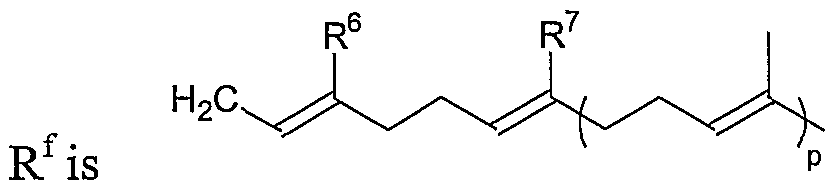

15. The compound of claim 14 wherein Drug is Ra.
16. The compound of claim 14 wherein Drug is Rb.
17. The compound of claim 14 wherein Drug is Rc.
18. The compound of claim 14 wherein Drug is Rd.
19. The compound of claim 14 wherein Drug is Re.
20. The compound of claim 14 wherein Drug is Rf.
21. The compound of claim 14 wherein Drug is R8.
22. The compound of claim 15 wherein R5 is a methyl group.
23. The compound of claim 15 wherein R5 is an allyl group.
24. The compound of claim 15 wherein R5 is a t-butyl group.
25. The compound of claim 15 wherein R5 is a 3,3-dimethylallyl group.
26. The compound of claim 16 wherein the double bond between carbon atoms 2 and 3 has a trans configuration when the double bond between carbon atoms 6 and 7 has a cis configuration, and has a cis configuration when the double bond between carbon atoms 6 and 7 has a trans configuration.
27. The compound of claim 17 wherein n = 9.
28. A pharmaceutical composition comprising a therapeutically effective amount of a compound of any one of claims 1 to 4 and a pharmaceutically acceptable carrier, diluent, or excipient therefor.
29. A method for treating a disease state arising from the dysfunction of an enzyme in a phosphate-dependent biological process in a mammal, said disease state being responsive to inhibition of said enzyme, the method comprising the step of administering to the mammal an inhibitory concentration of the compound of any one of claims 1 to 4, wherein Drug is an inhibitor of said enzyme.
30. The method of claim 29 wherein the enzyme is the protein farnesyl transferase.
Applications Claiming Priority (2)
| Application Number | Priority Date | Filing Date | Title |
|---|---|---|---|
| US66139105P | 2005-03-14 | 2005-03-14 | |
| US60/661,391 | 2005-03-14 |
Publications (2)
| Publication Number | Publication Date |
|---|---|
| WO2006099313A2 true WO2006099313A2 (en) | 2006-09-21 |
| WO2006099313A3 WO2006099313A3 (en) | 2007-06-07 |
Family
ID=36607275
Family Applications (1)
| Application Number | Title | Priority Date | Filing Date |
|---|---|---|---|
| PCT/US2006/008934 Ceased WO2006099313A2 (en) | 2005-03-14 | 2006-03-13 | Phosphate conjugates of prenylation inhibitors |
Country Status (1)
| Country | Link |
|---|---|
| WO (1) | WO2006099313A2 (en) |
Cited By (1)
| Publication number | Priority date | Publication date | Assignee | Title |
|---|---|---|---|---|
| WO2022268840A1 (en) * | 2021-06-23 | 2022-12-29 | Givaudan Sa | Process for making epoxide derivatives of farnesene and use thereof in further synthesis |
Family Cites Families (2)
| Publication number | Priority date | Publication date | Assignee | Title |
|---|---|---|---|---|
| US5233031A (en) * | 1991-09-23 | 1993-08-03 | University Of Rochester | Phosphoramidate analogs of 2'-deoxyuridine |
| JP2004538240A (en) * | 2000-03-31 | 2004-12-24 | パーデュー・リサーチ・ファウンデーション | Phosphoramidate and method therefor |
-
2006
- 2006-03-13 WO PCT/US2006/008934 patent/WO2006099313A2/en not_active Ceased
Cited By (2)
| Publication number | Priority date | Publication date | Assignee | Title |
|---|---|---|---|---|
| WO2022268840A1 (en) * | 2021-06-23 | 2022-12-29 | Givaudan Sa | Process for making epoxide derivatives of farnesene and use thereof in further synthesis |
| CN117597334A (en) * | 2021-06-23 | 2024-02-23 | 奇华顿股份有限公司 | Methods for preparing epoxide derivatives of farnesene and their use in further synthesis |
Also Published As
| Publication number | Publication date |
|---|---|
| WO2006099313A3 (en) | 2007-06-07 |
Similar Documents
| Publication | Publication Date | Title |
|---|---|---|
| JP6932227B2 (en) | Carbidopa and L-dopa prodrugs and how to use them | |
| US8324378B2 (en) | Prodrugs and conjugates of prenylation inhibitors | |
| KR102057751B1 (en) | Tenofovir prodrug and pharmaceutical uses thereof | |
| KR100858464B1 (en) | Combretastatin A-4 phosphate prodrug mono- and di-organamine salts, mono- and di-amino acid salts, and mono- and di-amino acid ester salts | |
| EP1802641B1 (en) | Bisphosphonate compounds and methods for bone resorption diseases, cancer, bone pain, immune disorders, and infectious diseases | |
| Recher et al. | Design, synthesis and biological evaluation of sulfur-containing 1, 1-bisphosphonic acids as antiparasitic agents | |
| CA2110443C (en) | Guanidinealkyl-1,1-bisphosphonic acid derivatives, process for their preparation and their use | |
| CN106188192B (en) | Nucleosides phosphoramidic acid/the phosphate derivatives and its medical usage of the amino-acid ester containing D- | |
| US8673882B2 (en) | Inhibitors of autotaxin | |
| CA3137835A1 (en) | Phosphoantigen prodrug compounds | |
| US20140171394A1 (en) | Cyclitols and their derivatives and their therapeutic applications | |
| WO2001074827A1 (en) | Phosphoramidate prodrugs | |
| JPH0240680B2 (en) | ||
| JP3883137B2 (en) | Therapeutic active agent comprising pyridyl bisphosphonate | |
| WO2006037090A2 (en) | Drug-phosphate conjugates as prodrugs | |
| JPWO2009008345A1 (en) | METAL COMPLEX COMPOUND, CANCER TREATMENT COMPOSITION CONTAINING THE SAME, AND INTERMEDIATE FOR THE METAL COMPLEX COMPOUND | |
| WO2006099313A2 (en) | Phosphate conjugates of prenylation inhibitors | |
| US8106186B2 (en) | Transition metal phosphine complex, method for producing same, and anticancer agent containing transition metal phospine complex | |
| CN104822695B (en) | therapeutic bisphosphonates | |
| CN1045207C (en) | Farnesyl: protein transferase inhibitors as anticancer agents | |
| JP2017513934A (en) | Phenanthroline phosphonic acid derivatives and their preparation and application | |
| US7462733B2 (en) | Preparation and use of α-keto phosphonates | |
| KR20210089017A (en) | Novel Bortezomib prodrug and the use thereof | |
| KR890004348B1 (en) | 1,1,2-triaryl-1-butene derivative | |
| JPH1180177A (en) | Boron-containing bisphosphonic acid compound, production method thereof, and pharmaceutical use thereof |
Legal Events
| Date | Code | Title | Description |
|---|---|---|---|
| 121 | Ep: the epo has been informed by wipo that ep was designated in this application | ||
| NENP | Non-entry into the national phase |
Ref country code: DE |
|
| NENP | Non-entry into the national phase |
Ref country code: RU |
|
| 122 | Ep: pct application non-entry in european phase |
Ref document number: 06738042 Country of ref document: EP Kind code of ref document: A2 |