WO2006087147A2 - Derivatives of aryl (or heteroaryl) azolylcarbinols for the treatment of fibromyalgia - Google Patents
Derivatives of aryl (or heteroaryl) azolylcarbinols for the treatment of fibromyalgia Download PDFInfo
- Publication number
- WO2006087147A2 WO2006087147A2 PCT/EP2006/001239 EP2006001239W WO2006087147A2 WO 2006087147 A2 WO2006087147 A2 WO 2006087147A2 EP 2006001239 W EP2006001239 W EP 2006001239W WO 2006087147 A2 WO2006087147 A2 WO 2006087147A2
- Authority
- WO
- WIPO (PCT)
- Prior art keywords
- methyl
- imidazole
- dimethylamino
- radical
- benzyl
- Prior art date
- Legal status (The legal status is an assumption and is not a legal conclusion. Google has not performed a legal analysis and makes no representation as to the accuracy of the status listed.)
- Ceased
Links
Classifications
-
- A—HUMAN NECESSITIES
- A61—MEDICAL OR VETERINARY SCIENCE; HYGIENE
- A61K—PREPARATIONS FOR MEDICAL, DENTAL OR TOILETRY PURPOSES
- A61K31/00—Medicinal preparations containing organic active ingredients
- A61K31/33—Heterocyclic compounds
- A61K31/395—Heterocyclic compounds having nitrogen as a ring hetero atom, e.g. guanethidine or rifamycins
- A61K31/41—Heterocyclic compounds having nitrogen as a ring hetero atom, e.g. guanethidine or rifamycins having five-membered rings with two or more ring hetero atoms, at least one of which being nitrogen, e.g. tetrazole
- A61K31/415—1,2-Diazoles
-
- A—HUMAN NECESSITIES
- A61—MEDICAL OR VETERINARY SCIENCE; HYGIENE
- A61K—PREPARATIONS FOR MEDICAL, DENTAL OR TOILETRY PURPOSES
- A61K31/00—Medicinal preparations containing organic active ingredients
- A61K31/33—Heterocyclic compounds
- A61K31/395—Heterocyclic compounds having nitrogen as a ring hetero atom, e.g. guanethidine or rifamycins
- A61K31/41—Heterocyclic compounds having nitrogen as a ring hetero atom, e.g. guanethidine or rifamycins having five-membered rings with two or more ring hetero atoms, at least one of which being nitrogen, e.g. tetrazole
- A61K31/415—1,2-Diazoles
- A61K31/4155—1,2-Diazoles non condensed and containing further heterocyclic rings
-
- A—HUMAN NECESSITIES
- A61—MEDICAL OR VETERINARY SCIENCE; HYGIENE
- A61P—SPECIFIC THERAPEUTIC ACTIVITY OF CHEMICAL COMPOUNDS OR MEDICINAL PREPARATIONS
- A61P29/00—Non-central analgesic, antipyretic or antiinflammatory agents, e.g. antirheumatic agents; Non-steroidal antiinflammatory drugs [NSAID]
Definitions
- the present invention refers to the use of derivatives of aryl (or heteroaryl) azolylcarbinols of general formula (I), and their physiologically acceptable salts, as medicinal products for human and/or animal therapeutics for the treatment of the symptoms of fibromyalgia, the prevention or the prophylaxis of the symptoms of fibromyalgia, as well as the prevention or the prophylaxis of the disease causing the symptoms which also include the "chronic fatigue syndrome".
- Fibromyalgia is a disease which although being considered a slightly less abundant disease has really grave effect on those suffering from it especially being highly painful even under total normal circumstances. Diagnosed by its symptoms and therefore counted mainly under "neuropathic pain" fibromyalgia is a disease showing a much broader range of effects unfortunately including i.a.signs related to depression. For the moment no approved treatment is existing because based on the complex nature of the disease existing treatments either to neuropathic pain or depression will not help in the broadness needed.
- neuropathic pain is not - or is at least not necessarily - able to treat other specific subtypes due to the highly diverse nature of this generalized symptom called neuropathic pain or even more so with the complex fibromyalgia.
- CFS Crohn's disease
- Fibromyalgia is not mentioned in any application or publication - as far as the applicant is aware - and it is quite surprising that general formula (I) compounds, and their physiologically acceptable salts, are especially useful for producing drugs, in human or veterinary therapeutics, to provide a relieve from fibromyalgia by causing on the one hand pain relief and on the other relief from the depressions observed while ameliorating also the sleeplessness nearly always observed and coming with fibromyalgia.
- the present invention refers to the use of a carbinol compounds of general formula (H)
- R 31 represents a hydrogen atom, a linear or branched alkyl radical, a linear or branched alkenyl radical, an optionally at least mono- substituted cycloaliphatic radical, which may contain at least one nitrogen atom as ring member, or a phenyl radical,
- R 32 represents a hydrogen atom, an optionally at least one nitrogen atom as ring member containing cycloaliphatic radical, which may be at least mono-substituted by a linear or branched alkyl radical and/or which may be bound via a linear or branched alkylene group, an NR 33 R 34 -moiety, which is bound via a linear or branched alkylene group, or an NR 35 R 36 -moiety, which is bound via a linear or branched alkylene group,
- R 33 and R 34 identical or different, represent hydrogen, a linear or branched alkyl radical or an unsubstituted benzyl radical,
- R 35 and R 36 together with the bridging nitrogen atom represent a saturated, unsubstituted, optionally at least one further heteroatom as ring member containing heterocyclic radical, .
- X represents an optionally at least mono-substituted phenyl radical or an optionally at least mono-substituted thienyl radical, wherein in each case the substituents may be independently selected from the group consisting of a linear or branched alkyl radical, a linear or branched alkoxy group, a linear or branched alkyl radical, which is at least partially halogenated and a halogen atom,
- Y represents a heteroaryl radical, which contains one or more nitrogen atoms as ring members and which is not substituted or at least mono- substituted by one or more substitutents independently from one another selected from the group consisting of a halogen atom, a linear or branched alkyl radical, a benzyl radical, a ciano group bound via a linear or branched C 1-4 -alkylene group, a carboxy group bound via a linear or branched C 1-4 -alkylene group, a methoxy carbonyl group bound via a linear or branched C 1-4 -alkylene group, a hydroxy group bound via a linear or branched C 1-4 -aIkylene group, an amino group bound via a linear or branched C 1-4 -alkylene group, a (Ci -4 ) dialkylamino group bound via a linear or branched Ci -4 -alkylene group, and a cycloaliphatic radical, which contains
- Treating” or “treatment” as used in this application are defined as covering treatment in a therapeutical sense including efforts to ameliorate and also to prevent and to deliver a prophylaxis. Therefore “treatment of fibromyalgia and/or chronic fatigue syndrome” is defined as including the treatment/amelioration of fibromyalgia and/or chronic fatigue syndrome, treatment/amelioration of the symptoms of fibromyalgia and/or chronic fatigue syndrome, as well as treatment/amelioration of the disease or disease consequences causing the symptoms; further the prevention or the prophylaxis of fibromyalgia and/or chronic fatigue syndrome, the prevention or the prophylaxis of the symptoms of fibromyalgia and/or chronic fatigue syndrome, as well as the prevention or the prophylaxis of the disease or disease consequences causing the symptoms.
- treatment of fibromyalgia and/or chronic fatigue syndrome is defined as including the treatment/amelioration of fibromyalgia and/or chronic fatigue syndrome and treatment/amelioration of the symptoms of fibromyalgia and/or chronic fatigue syndrome; further the prevention or the prophylaxis of fibromyalgia and/or chronic fatigue syndrome, and the prevention or the prophylaxis of the symptoms of fibromyalgia and/or chronic fatigue syndrome.
- treatment of fibromyalgia and/or chronic fatigue syndrome is defined as including the treatment/amelioration of fibromyalgia and/or chronic fatigue syndrome and treatment/amelioration of the symptoms of fibromyalgia and/or chronic fatigue syndrome; further the prevention or the prophylaxis of the symptoms of fibromyalgia and/or chronic fatigue syndrome.
- CFS Chronic fatigue syndrome
- alkyl and cycloalkyl radicals are understood as meaning saturated and unsaturated (but not aromatic), branched, unbranched and cyclic hydrocarbons, which can be unsubstituted or mono- or polysubstituted.
- C 1-2 -alkyl represents C1- or C2-alkyl
- d -3 -alkyl represents C1-, C2- or C3-alkyl
- C 1-4 -alkyl represents C1-, C2-, C3- or C4-alkyl
- C 1-5 -alkyl represents C1- , C2-, C3-, C4-, or C5-alkyl
- C 1-6 -alkyl represents C1-, C2-, C3-, C4-, C5- or C6- alkyl
- C 1-7 -alkyl represents C1-, C2-, C3-, C4-, C5-, C6- or C7-alkyl
- C 1-8 -alkyl represents C1-, C2-, C3-, C4-, C5-, C6-, C7- or C8-alkyl
- C 1-10 -alkyl represents C1-, C2-, C3-, C4-, C5-
- C 3-4 -cycloalkyl represents C3- or C4-cycloalkyl
- C 3- 5 -cycloalkyl represents C3-, C4- or C5-cycloalkyl
- C 3- 6-cycloalkyl represents C3-, C4-, C5- or C6-cycloalkyl
- C 3-7 -cycloalkyl represents C3-, C4-, C5-, C6- or C7- cycloalkyl
- C 3-8 -cycloalkyl represents C3-, C4-, C5-, C6-, C7- or C8-cycloalkyl
- C 4-5 - cycloalkyl represents C4- or C5-cycloalkyl
- C ⁇ -cycloalkyl represents C4-, C5- or
- C6-cycloalkyl C 4 _ 7 -cycloalkyl represents C4-, C5-, C6- or C7-cycloalkyl
- C5.6- cycloalkyl represents C5- or C6-cycloalkyl
- C 5-7 -cycloalkyl represents C5-, C6- or C7-cycloalkyl.
- cycloalkyl the term also includes saturated cycloalkyls in which one or 2 carbon atoms are replaced by a heteroatom, S, N or O.
- mono- or polyunsaturated, preferably monounsaturated, cycloalkyls without a heteroatom in the ring also in particular fall under the term cycloalkyl as long as the cycloalkyl is not an aromatic system.
- alkyl and cycloalkyl radicals are preferably methyl, ethyl, vinyl (ethenyl), propyl, allyl (2-propenyl), 1-propinyl, methylethyl, butyl, 1-methylpropyl, 2-methylpropyl, 1 ,1-dimethylethyl, pentyl, 1 ,1- dimethylpropyl, 1 ,2-dimethyipropyl, 2,2-dimethylpropyl, hexyl, 1-methylpentyl, cyclopropyl, 2-methylcyclopropyl, cyclopropylmethyl, cyclobutyl, cyclopentyl, cyclopentylmethyl, cyclohexyl, cycloheptyl, cyclooctyl, and also adamantyl, (if substituted also CHF 2 , CF 3 or CH 2 OH) as well as pyrazolinone, oxopyrazol
- substituted in the context of this invention is understood as meaning replacement of at least one hydrogen radical by F, Cl, Br, I, NH 2 , SH or OH
- Particularly preferred substituents here are F, Cl and OH.
- the hydrogen radical can also be replaced by OC 1-3 -alkyl or C 1-3 -alkyl (in each case mono- or polysubstituted or unsubstituted), in particular methyl, ethyl, n-propyl, i-propyl, CF 3 , methoxy or ethoxy.
- (CH 2 ) 3-6 is to be understood as meaning -CH 2 -CH 2 -CH 2 -, -CH 2 -CH 2 -CH 2 - CH 2 -, -CH 2 -CH 2 -CH 2 -CH 2 - and -CH 2 -CH 2 -CH 2 -CH 2 -CH 2 -, (CH 2 ) 1-4 is to be understood as meaning -CH 2 -, -CH 2 -CH 2 -, -CH 2 -CH 2 -CH 2 - and -CH 2 -CH 2 -CH 2 -CH 2 -CH 2 -, (CH 2 J 4-5 is to be understood as meaning -CH 2 -CH 2 -CH 2 -CH 2 - and -CH 2 -CH 2 -CH 2 - CH 2 -CH 2 -, etc.
- aryl radical is understood as meaning ring systems with at least one aromatic ring but without heteroatoms even in only one of the rings. Examples are phenyl, naphthyl, fluoranthenyl, fluorenyl, tetralinyl or indanyl, in particular 9H-fluorenyl or anthracenyl radicals, which can be unsubstituted or monosubstituted or polysubstituted.
- a heteroaryl radical is understood as meaning heterocyclic ring systems which have at least one unsaturated ring and can contain one or more heteroatoms from the group consisting of nitrogen, oxygen and/or sulfur and can also be mono- or polysubstituted.
- heteroaryls are furan, benzofuran, thiophene, benzothiophene, pyrrole, pyridine, pyrimidine, pyrazine, quinoline, isoquinoline, phthalazine, benzo-1 ,2,5-thiadiazole, benzothiazole, indole, benzotriazole, benzodioxolane, benzodioxane, carbazole and quinazoline.
- substituted is understood as meaning substitution of the aryl or heteroaryl by R, OR, a halogen, preferably F and/or Cl, a CF 3 , a CN, an NO 2 , an NRR, a Ci -6 -alkyl (saturated), a Ci -6- alkoxy, a C 3-8 - cycloalkoxy, a C 3-8 -cycloalkyl or a C 2-6 -alkylene.
- salt is to be understood as meaning any form of the active compound used according to the invention in which it assumes an ionic form or is charged and is coupled with a counter-ion (a cation or anion) or is in solution.
- a counter-ion a cation or anion
- complexes of the active compound with other molecules and ions in particular complexes which are complexed via ionic interactions.
- physiologically acceptable salt means in the context of this invention any salt that is physiologically tolerated (most of the time meaning not being toxic- especially not caused by the counter-ion) if used appropriately for a treatment especially if used on or applied to humans and/or mammals.
- physiologically acceptable salts can be formed with cations or bases and in the context of this invention is understood as meaning salts of at least one of the compounds used according to the invention - usually a (deprotonated) acid - as an anion with at least one, preferably inorganic, cation which is physiologically tolerated - especially if used on humans and/or mammals.
- the salts of the alkali metals and alkaline earth metals are particularly preferred, and also those with NH4, but in particular (mono)- or (di)sodium, (mono)- or (di)potassium, magnesium or calcium salts.
- physiologically acceptable salts can also be formed with anions or acids in the context of this invention is understood as meaning salts of at least one of the compounds used according to the invention - usually protonated, for example on the nitrogen - as the cation with at least one anion which are physiologically tolerated - especially if used on humans and/or mammals.
- the salt formed with a physiologically tolerated acid that is to say salts of the particular active compound with inorganic or organic acids which are physiologically tolerated - especially if used on humans and/or mammals.
- physiologically tolerated salts of particular acids are salts of: hydrochloric acid, hydrobromic acid, sulfuric acid, methanesulfonic acid, formic acid, acetic acid, oxalic acid, succinic acid, malic acid, tartaric acid, mandelic acid, fumaric acid, lactic acid or citric acid.
- solvate is to be understood as meaning any form of the active compound according to the invention in which this compound has attached to it via non-covalent binding another molecule (most likely a polar solvent) especially including hydrates and alcoholates, e.g. methanolate.
- a polar solvent especially including hydrates and alcoholates, e.g. methanolate.
- the compounds of general formula (II) (as well as I 1 Ia, Ib and Ic) can be synthesised according to the procedures described in patents EP 289380, US 5,017,596 or WO 99/52525.
- the compounds of general formula (II) (as well as I 1 Ia, Ib and Ic) have a stereogenic centre and the invention refers both to the use of a pure enantiomer and to the use of a mixture of enantiomers.
- the enantiomers can be prepared by any of the procedures described in our patents WO 97/20817 (US
- thienyl is for this invention one and the same as “thiophenyl” and shall also be treated and considered as absolutely identical to each other.
- R 31 represents a hydrogen atom, a linear or branched C 1-4 alkyl radical, a linear or branched C 2 . 4 alkenyl radical, a 5- or 6-membered cycloaliphatic radical, which may contain at least one nitrogen atom as .ring member and/or which may be at least mono-substituted by a linear or branched Ci-
- alkyl radical or a phenyl radical, preferably a hydrogen atom, a linear or branched C 1-4 alkyl radical, a vinyl group, a cyclohexyl radical, an N-Methyl-piperidyl radical or a phenyl radical.
- R 32 represents a hydrogen atom, an optionally at least one nitrogen atom as ring member containing, 5- or 6-membered cycloaliphatic radical, which may be at least mono-substituted by a linear or branched C 1-4 -alkyl radical and/or which may be bound via a linear or branched C 1-4 -alkylene group, a NR 33 R 34 -moiety, which is bound via a linear or branched Ci -4 alkylene group, or a NR 35 R 36 -moiety, which is bound via a linear or branched Ci -4 alkylene group, preferably a hydrogen atom, an optionally at least one nitrogen atom as ring member containing, 5- or 6-membered cycloaliphatic radical, which may be at least mono-substituted by a linear or branched Ci -4 -alkyl radical and/or which may be bound via a
- the compound according to formula Il used is characterized in that R 33 and R 34 , identical or different, independently from one another represent hydrogen; a linear or branched Ci -4 alkyl radical or an unsubstituted benzyl radical, preferably hydrogen or a linear or branched C 1-4 alkyl radical.
- the compound according to formula Il used is characterized in that R 35 and R 36 together with the bridging nitrogen atom represent a saturated, unsubstituted, optionally at least one oxygen atom as ring member containing, 5- or 6-membered heterocyclic radical.
- the compound according to formula Il used is characterized in. that X represents an optionally at least mono-substituted phenyl radical or an optionally at least mono-substituted thienyl radical, wherein in each case the substituents may be independently selected from the group consisting of a linear or branched Ci -4 alkyl radical, a linear or branched Ci -4 alkoxy radical, a linear or branched C 1-4 alkyl radical, which is at least partially fluorinated, a fluorine atom, a chlorine atom and a bromine atom, preferably represents an optionally at least mono-substituted phenyl radical or an optionally at least mono-substituted thienyl radical, wherein in each case the substituents may be independently selected from the group consisting of a methyl radical, a methoxy radical, a trifluoromethyl radical, a fluorine atom, a chlorine atom and a bromine
- R 37 represents a linear or branched C r12 alkyl radical, a benzyl radical or a radical of the type:
- n 1 or 2
- R 38 represents a hydrogen atom, a methyl radical or a halogen atom, preferably a hydrogen atom, a methyl radical, a bromine atom or a chlorine atom,
- R 39 represents a hydrogen atom, a C 1 - I2 alkyl radical, a benzyl radical, or a radical of the general formula (b1 ):
- At least one compound used according to the invention is a carbinol compound of general formula Il
- R 31 represents a hydrogen atom, a methyl radical, an ethyl radical, an n-propyl radical, an iso-propyl radical, a sec-butyl radical, a tert-butyl radical, an n-butyl radical, a vinyl radical, a cyclohexyl radical, an N-methyl-piperidinyl group, or a phenyl group,
- R 32 represents a hydrogen atom, a monomethylaminoethyl group, a dimethylaminoethyl group, an aminoethyl group, a pyrrol id i ny lethy I group, a piperidinylethyl group, a methyl-benzyl-aminoethyl group, a morpholinylethyl group, a diisopropylaminoethyl group, a dimethylaminopropyl group, a piperidinylpropyl group, a pyrrolidinylpropyl group, a morpholinylpropyl group, an N-methyl-2-piperidyl group, an N-ethyl-2-piperidyl group, an N- propyl-2-piperidyl group, an N-methyl-2-pyrrolidinyl group, an N-ethyl-2- pyrrolidinyl group, an N-propyl-2-pyrroli
- X represents a phenyl radical, a 2-methyl-phenyl radical, a 3-methyl-phenyl radical, a 4-methyl phenyl radical, a 2-chloro-phenyl radical, a 3-chloro-phenyl radical, a 4-chloro-phenyl radical, a 2-fluoro-phenyl radical, a 3-fluoro-phenyl radical, a 4-fluoro-phenyl radical, a 2-trifluoromethyl-phenyl radical, a 3- trifluoromethyl-phenyl radical, a 4-trifluoromethyl-phenyl radical, a 2-methoxy- phenyl radical, a 3-methoxy-phenyl radical, a 4-methoxy-phenyl radical, a 3,4,5-tris-methoxy phenyl radical, a 3,4-dichloro-phenyl radical, a 2,4-dichloro- phenylradical, a thien-2-yl radical, a
- Y represents an azole radical selected from the group consisting of
- R 37 represents a methyl radical, an ethyl radical, an n-propyl radical, an iso- propyl radical, an n-butyl radical, a sec-butyl radical or a tert-butyl radical,
- R 38 represents a hydrogen atom, a methyl radical, a bromine atom or a chlorine atom,
- R 39 represents a hydrogen atom, a methyl radical, an ethyl radical, an n- >yl radical, an iso-butyl radical, an n-butyl radical, a sec- butyl radical a tert-butyl radical, an n-pentyl radical, an n-hexyl radical, an n-heptyl radical, an n-octyl radical, an n-nonyl radical, an n-decyl radical, an n-undecyl radical an n-dodecyl radical, a benzyl radical, or a radical of the general formula (b1):
- n 2, 3 or 4 and R ,40 represents a piperidinyl radical, a phenyl radical, a cyano group, a hydroxyl radical, a carboxy radical, an amino group, a dimethylamino group, or a methyl ester group,
- At least one compound according to formula Il used is selected from the group consisting of
- the compound used for the manifacture of a medicament for the treatment of fibromyalgia
- Ar represents a phenyl radical or a thienyl radical, with no substitutions or optionally with 1 , 2 or 3 equal or different substituents, selected from a group consisting of fluoride, chloride, bromide, methyl, trifluoromethyl and methoxy;
- R 1 represents hydrogen or a lower alkyl group from C 1 to C 4 ;
- R 2 represents a dialkyl(C r C 4 )aminoalkyl (C 2 -C 3 ), a monoalkyl(CrC 4 )aminoalkyl (C 2 -C 3 ), an aminoalkyl (C 2 -C 3 ), or azaheterocyclylalkyl (C 2 -C 3 ) radical; and
- Het represents a five-armed nitrogenated aromatic heterocycle that contains one to three nitrogen atoms, without substitutions or optionally substituted by 1 or 2 equal or different substituents selected from a group consisting of fluoride, chloride, bromide and methyl;
- the compound according to formula I used is characterized in that R 1 is selected from hydrogen or from a group consisting of methyl, ethyl, propyl, isopropyl, butyl, isobutyl, sec-butyl and terf-butyl.
- the compound according to formula I used is characterized in that R 2 is selected from among a group consisting of dimethylaminoethyl, dimethylaminopropyl, diethylaminoethyl, diethylaminopropyl, methylaminoethyl, methylaminopropyl, aminoethyl, aminopropyl, piperidinylethyl, piperidinylpropyl, morpholinylpropyl, morpholinylethyl, pirrolidinylpropyl and pirrolidinylethyl;
- dimethylaminoethyl preferably dimethylaminoethyl, dimethylaminopropyl, diethylaminoethyl, piperidinylethyl, morpholinylpropyl, and pirrolidinylethyl.
- the compound according to formula I used is a compound of general formula (Ia)
- n 1 or 2;
- R 3 is selected from:
- R 4 is selected from hydrogen, fluoride, chloride, bromide and methyl
- R 5 and R 6 are independently selected from hydrogen, lower C( 1-4) -Alkyl or together with the Nitrogen form an azaheterocyclic ring
- R 7 is selected from the group consisting of hydrogen, fluoride, chloride, bromide, methyl, trifluoromethyl and methoxy;
- the compound according to formula Ia used is characterized in that R 7 is hydrogen.
- the compound according to formula Ia used is characterized in that R 4 is Methyl.
- the compound according to formula Ia used is characterized in that R 5 and R 6 are either hydrogen, CH 3 or C 2 H 5 or together with the Nitrogen form a piperidinyl, morpholinyl or pirrolidinyl ring.
- the compound according to formula Ia used is selected from among a group consisting of:
- the compound according to formula I and Ia used is a compound of general formula (Ib)
- R 8 is selected from hydrogen, fluoride, chloride, bromide and methyl
- R 9 and R 10 are independently selected from hydrogen, lower C (1-4) -Alkyl or together with the Nitrogen form an azaheterocyclic ring
- R 11 is selected from the group consisting of hydrogen, fluoride, chloride, bromide, methyl, trifluoromethyl and methoxy
- the compound according to formula Ib used is characterized in that R 11 is hydrogen.
- the compound according to formula Ib used is characterized in that R 8 is Methyl.
- the compound according to formula Ib used is characterized in that R 9 and R 10 are either hydrogen, CH 3 or C 2 H 5 or together with the Nitrogen form a piperidinyl, morpholinyl or pirrolidinyl ring;
- R 9 and R 10 are either hydrogen, CH 3 or C 2 H 5 ;
- R 9 and R 10 are equal and either CH 3 or C 2 H 5 ;
- R 9 and R 10 are both CH 3 .
- the compound according to formula Ib used is characterized in that m is 1.
- the compound according to formula Ib used is selected from among a group consisting of:
- the compound according to formula Ia used is a compound of general formula (Ic)
- R 12 is selected from hydrogen, fluoride, chloride, bromide and methyl
- R 13 and R 14 are independently selected from hydrogen, lower C( 1-4 )-Alkyl or together with the Nitrogen form an azaheterocyclic ring
- R 15 is selected from the group consisting of hydrogen, fluoride, chloride, bromide, methyl, trifluoromethyl and methoxy.
- the compound according to formula Ic used is characterized in that R 15 is hydrogen. In a preferred aspect of the invention the compound according to formula Ic used is characterized in that R 12 is Methyl.
- the compound according to formula Ic used is characterized in that R 13 and Ri 4 are either hydrogen, CH 3 or C 2 Hs or together with the Nitrogen form a piperidinyl, morpholinyl or pirrolidinyl ring;
- R 13 and Ri 4 are either CH 3 or C 2 H 5 ;
- Ri 3 and Ru are equal and either CH 3 or C 2 H 5 ;
- R 13 and R 14 are both CH 3 .
- the compound according to formula Ic used is characterized in that p is 1.
- the compound according to formula Ic used is selected from among a group consisting of:
- the compound of the invention are also meant to include compounds which differ only in the presence of one or more isotopically enriched atoms.
- compounds having the present structures except for the replacement of a hydrogen by a deuterium or tritium, or the replacement of a carbon by 13 C- or 14 C-enriched carbon or 15 N-enriched nitrogen are within the scope of this invention.
- a preferred use according to the invention is characterized in that the active compound is used in the medicament at a dose between 50 and 400 mg/day or between 200 and 600 mg/day.
- the complete salt - dose means the dose of the active compound without the salt (which means without the counter ion, for example the citrate ion).
- an effective administered amount of a compound used according to the invention will depend on the relative efficacy of the compound chosen, the severity of the disorder being treated and the weight of the sufferer.
- active compounds will typically be administered once or more times a day for example 1 , 2, 3 or 4 times daily, with typical total daily doses in the range of from 0.1 to
- Any formulation or pharmaceutical composition according to the invention contains the active ingredient as well as optionally at least one auxiliary material and/or additive.
- the auxiliary material and/or additive can be selected from carrier, excipient, support materials, glidants, fillers, solvents, diluents, colorants, taste conditioners like sugars, antioxidants and/or binders. In the case of a suppository this might involve waxes or fatty acid esters or conserving agents, emulsifiers and/or carriers for parenteral application.
- carrier excipient
- support materials gli
- composition according to the invention can be adapted for topical or systemical application, especially dermal, subcutaneous, intramuscular, intra-articular and/or intraperitoneal, pulmonal, buccal, sublingual, nasal, percutaneous, vaginal, oral or parenteral, pulmonal, nasal, rectal and/or intravenous application.
- Solid oral compositions (which are preferred as are liquid ones) may be prepared by conventional methods of blending, filling or tabletting. Repeated blending operations may be used to distribute the active agent throughout those compositions employing large quantities of fillers. Such operations are conventional in the art.
- the tablets may for example be prepared by wet or dry granulation and optionally coated according to the methods well known in normal pharmaceutical practice., in particular with an enteric coating.
- a preferred use according to the invention is characterized in that the medicament is for oral administration, especially in form of a tablet or capsule.
- Another use according to the invention is characterized in that the medicament is in form of an immediate release formulation.
- immediate release formulation means any formulation with a release profile from which measured according to a standard measurement (e.g. using the paddle method according to the Pharmacopeia) (e.g. in 0.1% NaCI solution) within 30 minutes more than 50 %, more preferably 60 %, or even more preferably 70 % of the active compound is released.
- a further preferred embodiment of the invention is a Use according to the invention in which the disease to be treated is fibromyalgia.
- a further preferred embodiment of the invention is a Use according to the invention in which the disease to be treated is chronic fatigue syndrome.
- Included in this invention are especially also methods of treatments of a patient or a mammal, including men, suffering from fibromyalgia or Chronic Fatigue
- Microcrystalline cellulose (Avicel PH-102) 146 mg Lactose monohydrate (Farmatose 200M) 158 mg
- Microcrystalline cellulose (Avicel PH-102) 246 mg
- Lactose monohydrate (Farmatose 200M) 258 mg
- Example 7 Neuropathic Pain - Dose-effect study of Example 1 Phase I (Bennet model):
- Rats were anaesthesized using Pentobarbital. Then the skin was incised. Following that a sciatic nerve ligature was placed and the incision was closed with silk thread.
- Figure 1 shows a clear dose-dependent effect of example 1 on vocalization threshold using a mechanical stimulus.
- Example 8 Neuropathic Pain - Dose-effect study of Example 1 Phase I (Bennet model): Unilateral ligature of the sciatic nerve (thermal response thresholds)
- Rats were anaesthesized using Pentobarbital. Then the skin was incised. Following that a sciatic nerve ligature was placed and the incision was closed with silk thread.
- Figure 2 shows a clear dose-dependent effect of example 1 on struggle latency in a low temperature thermal response threshold.
- mice were prepared according to the Model described by CJ. E. Niemegeers "Antagonism of Reserpine-like activity” in “Antidepressants”, Ed. by S. Fielding, Futura Publishing Co., New York 1975. Pags 73-98 and Garattini S. et al. "Antagonists of Reserpine-induced eyelid ptosis” Med. Exp. 3 : 315-320 (1960):
- the ED50 was 26.2 mg/kg p.o.
- mice were prepared according to the Model described by
- the inhibition shown by the compound according to example 1 was:
- the ED50 was 17.0 mg/kg, p.o.
Landscapes
- Health & Medical Sciences (AREA)
- Veterinary Medicine (AREA)
- Chemical & Material Sciences (AREA)
- Medicinal Chemistry (AREA)
- Pharmacology & Pharmacy (AREA)
- Life Sciences & Earth Sciences (AREA)
- Animal Behavior & Ethology (AREA)
- General Health & Medical Sciences (AREA)
- Public Health (AREA)
- Epidemiology (AREA)
- Pain & Pain Management (AREA)
- Rheumatology (AREA)
- Chemical Kinetics & Catalysis (AREA)
- General Chemical & Material Sciences (AREA)
- Nuclear Medicine, Radiotherapy & Molecular Imaging (AREA)
- Organic Chemistry (AREA)
- Pharmaceuticals Containing Other Organic And Inorganic Compounds (AREA)
Abstract
The present invention refers to the use of derivatives of aryl (or heteroaryl) azolylcarbinols of general formula (I), and their physiologically acceptable salts, as medicinal products for human and/or animal therapeutics for the treatment of the symptoms of fibromyalgia, the prevention or the prophylaxis of the symptoms of fibromyalgia, as well as the prevention or the prophylaxis of the disease causing the symptoms.
Description
DERIVATIVES OF ARYL(OR HETEROARYL) AZOLYLCARBINOLS FOR THE TREATMENT OF FIBROMYALGIA
Field of the invention
The present invention refers to the use of derivatives of aryl (or heteroaryl) azolylcarbinols of general formula (I), and their physiologically acceptable salts, as medicinal products for human and/or animal therapeutics for the treatment of the symptoms of fibromyalgia, the prevention or the prophylaxis of the symptoms of fibromyalgia, as well as the prevention or the prophylaxis of the disease causing the symptoms which also include the "chronic fatigue syndrome".

0)
Background of the invention
Fibromyalgia is a disease which although being considered a slightly less abundant disease has really grave effect on those suffering from it especially being highly painful even under total normal circumstances. Diagnosed by its symptoms and therefore counted mainly under "neuropathic pain" fibromyalgia is a disease showing a much broader range of effects unfortunately including i.a.signs related to depression. For the moment no approved treatment is existing because based on the complex nature of the disease existing treatments either to neuropathic pain or depression will not help in the broadness needed. This is especially true as in a majority of cases even a substance being able to treat one subtype of neuropathic pain is not - or is at least not necessarily - able to treat other specific subtypes due
to the highly diverse nature of this generalized symptom called neuropathic pain or even more so with the complex fibromyalgia.
Another aspect related to fibromyalgia is "chronic fatigue syndrome". "Chronic fatigue syndrome", or CFS, is (as defined on the web-site of the US government department of health and human services, on the CDC, the Centers for Disease Control and Prevention) "a debilitating and complex disorder characterized by profound fatigue that is not improved by bed rest and that may be worsened by physical or mental activity. Persons with CFS most often function at a substantially lower level of activity than they were capable of before the onset of illness. In addition to these key defining characteristics, patients report various nonspecific symptoms, including weakness, muscle pain, impaired memory and/or mental concentration, insomnia, and post-exertional fatigue lasting more than 24 hours. In some cases, CFS can persist for years. The cause or causes of CFS have not been identified and no specific diagnostic tests are available.
Accordingly there is an urgent need for an effective cure of fibromyalgia and chronic fatigue syndrome.
The patents EP 289380 B1 (US 5,017,596) and WO 99/52525 (US
6,410,582) describe derivatives of carbinols of general formula (I) with analgesic activity

In EP 289380 B1 (US 5,017,596) and WO 99/52525 (US 6,410,582) these compounds of general formula (I). Ar represents a benzene ring or a thiophene ring with or without substitutions, Ri represents a hydrogen atom or a lower alkyl group from C1 to C4; R2 represents a dialkylaminoalkyl or azaheterocyclylalkyl and Het
represents an azole with or without substitutions, and their physiologically acceptable salts.
In the patent applications WO 97/20817 (US 5,849,931), WO 99/02500 (US 6,187,930), WO 99/07684 (US 6,118,009) and WO 99/52525 (US 6,410,582) there are also described several procedures to prepare enantiomerically pure compounds with general formula (I).
Fibromyalgia is not mentioned in any application or publication - as far as the applicant is aware - and it is quite surprising that general formula (I) compounds, and their physiologically acceptable salts, are especially useful for producing drugs, in human or veterinary therapeutics, to provide a relieve from fibromyalgia by causing on the one hand pain relief and on the other relief from the depressions observed while ameliorating also the sleeplessness nearly always observed and coming with fibromyalgia.
Detailed description of the invention
The present invention refers to the use of a carbinol compounds of general formula (H)

wherein
R31 represents a hydrogen atom, a linear or branched alkyl radical, a linear or branched alkenyl radical, an optionally at least mono-
substituted cycloaliphatic radical, which may contain at least one nitrogen atom as ring member, or a phenyl radical,
R32 represents a hydrogen atom, an optionally at least one nitrogen atom as ring member containing cycloaliphatic radical, which may be at least mono-substituted by a linear or branched alkyl radical and/or which may be bound via a linear or branched alkylene group, an NR33R34-moiety, which is bound via a linear or branched alkylene group, or an NR35R36-moiety, which is bound via a linear or branched alkylene group,
R33 and R34, identical or different, represent hydrogen, a linear or branched alkyl radical or an unsubstituted benzyl radical,
R35 and R36 together with the bridging nitrogen atom represent a saturated, unsubstituted, optionally at least one further heteroatom as ring member containing heterocyclic radical, .
X represents an optionally at least mono-substituted phenyl radical or an optionally at least mono-substituted thienyl radical, wherein in each case the substituents may be independently selected from the group consisting of a linear or branched alkyl radical, a linear or branched alkoxy group, a linear or branched alkyl radical, which is at least partially halogenated and a halogen atom,
Y represents a heteroaryl radical, which contains one or more nitrogen atoms as ring members and which is not substituted or at least mono- substituted by one or more substitutents independently from one another selected from the group consisting of a halogen atom, a linear or branched alkyl radical, a benzyl radical, a ciano group bound via a linear or branched C1-4-alkylene group, a carboxy group bound via a linear or branched C1-4-alkylene group, a methoxy carbonyl group bound via a linear or branched C1-4-alkylene group, a hydroxy group
bound via a linear or branched C1-4-aIkylene group, an amino group bound via a linear or branched C1-4-alkylene group, a (Ci-4) dialkylamino group bound via a linear or branched Ci-4-alkylene group, and a cycloaliphatic radical, which contains at least one nitrogen atom as ring member and which is bound via a linear or branched C1-4-alkylene group, or Y represents an unsubstituted heteroaryl radical, which contains two nitrogen atoms as ring members and which is condensed with a saturated, one methyl-substituted nitrogen atom as ring member containing cycloaliphatic group,
optionally in form of one of its stereoisomers, preferably enantiomers or diastereomers, its racemate or in form of a mixture of at least two of its stereoisomers, preferably enantiomers and/or diastereomers, in any mixing ratio, or a corresponding salt thereof, or a corresponding solvate
for the manufacture of a medicament for the treatment of fibromyalgia and/or "chronic fatigue syndrome".
"Treating" or "treatment" as used in this application are defined as covering treatment in a therapeutical sense including efforts to ameliorate and also to prevent and to deliver a prophylaxis. Therefore "treatment of fibromyalgia and/or chronic fatigue syndrome" is defined as including the treatment/amelioration of fibromyalgia and/or chronic fatigue syndrome, treatment/amelioration of the symptoms of fibromyalgia and/or chronic fatigue syndrome, as well as treatment/amelioration of the disease or disease consequences causing the symptoms; further the prevention or the prophylaxis of fibromyalgia and/or chronic fatigue syndrome, the prevention or the prophylaxis of the symptoms of fibromyalgia and/or chronic fatigue syndrome, as well as the prevention or the prophylaxis of the disease or disease consequences causing the symptoms.
Preferably "treatment of fibromyalgia and/or chronic fatigue syndrome" is defined as including the treatment/amelioration of fibromyalgia and/or chronic fatigue syndrome and treatment/amelioration of the symptoms of fibromyalgia and/or
chronic fatigue syndrome; further the prevention or the prophylaxis of fibromyalgia and/or chronic fatigue syndrome, and the prevention or the prophylaxis of the symptoms of fibromyalgia and/or chronic fatigue syndrome. Most preferably "treatment of fibromyalgia and/or chronic fatigue syndrome" is defined as including the treatment/amelioration of fibromyalgia and/or chronic fatigue syndrome and treatment/amelioration of the symptoms of fibromyalgia and/or chronic fatigue syndrome; further the prevention or the prophylaxis of the symptoms of fibromyalgia and/or chronic fatigue syndrome.
A patient having "Chronic fatigue syndrome", or CFS, in the sense of this application is defined according to the suggestion below found on the the web-site of the US government department of health and human services, on the CDC, the Centers for Disease Control and Prevention as satisfying two criteria:
1 ) Have severe chronic fatigue of six months or longer duration with other known medical conditions excluded by clinical diagnosis; and 2) concurrently have four or more of the following symptoms: substantial impairment in short- term memory or concentration; sore throat; tender lymph nodes; muscle pain; multi-joint pain without swelling or redness; headaches of a new type, pattern or severity; unrefreshing sleep; and post-exertional malaise lasting more than
24 hours. The symptoms must have persisted or recurred during six or more consecutive months of illness and must not have predated the fatigue.
In the context of this invention, alkyl and cycloalkyl radicals are understood as meaning saturated and unsaturated (but not aromatic), branched, unbranched and cyclic hydrocarbons, which can be unsubstituted or mono- or polysubstituted. In these radicals, C1-2-alkyl represents C1- or C2-alkyl, d-3-alkyl represents C1-, C2- or C3-alkyl, C1-4-alkyl represents C1-, C2-, C3- or C4-alkyl, C1-5-alkyl represents C1- , C2-, C3-, C4-, or C5-alkyl, C1-6-alkyl represents C1-, C2-, C3-, C4-, C5- or C6- alkyl, C1-7-alkyl represents C1-, C2-, C3-, C4-, C5-, C6- or C7-alkyl, C1-8-alkyl represents C1-, C2-, C3-, C4-, C5-, C6-, C7- or C8-alkyl, C1-10-alkyl represents C1-, C2-, C3-, C4-, C5-, C6-, C7-, C8-, C9- or C10-alkyl and Ci-18-alkyl represents C1-, C2-, C3-, C4-, C5-, C6-, C7-, C8-, C9-, C10-, C11-, C12-, C13-, C14-, C15-, C16-,
C17- or C18-alkyl. Furthermore, C3-4-cycloalkyl represents C3- or C4-cycloalkyl, C3- 5-cycloalkyl represents C3-, C4- or C5-cycloalkyl, C3-6-cycloalkyl represents C3-, C4-, C5- or C6-cycloalkyl, C3-7-cycloalkyl represents C3-, C4-, C5-, C6- or C7- cycloalkyl, C3-8-cycloalkyl represents C3-, C4-, C5-, C6-, C7- or C8-cycloalkyl, C4-5- cycloalkyl represents C4- or C5-cycloalkyl, C^-cycloalkyl represents C4-, C5- or
C6-cycloalkyl, C4_7-cycloalkyl represents C4-, C5-, C6- or C7-cycloalkyl, C5.6- cycloalkyl represents C5- or C6-cycloalkyl and C5-7-cycloalkyl represents C5-, C6- or C7-cycloalkyl. In respect of cycloalkyl, the term also includes saturated cycloalkyls in which one or 2 carbon atoms are replaced by a heteroatom, S, N or O. However, mono- or polyunsaturated, preferably monounsaturated, cycloalkyls without a heteroatom in the ring also in particular fall under the term cycloalkyl as long as the cycloalkyl is not an aromatic system. The alkyl and cycloalkyl radicals are preferably methyl, ethyl, vinyl (ethenyl), propyl, allyl (2-propenyl), 1-propinyl, methylethyl, butyl, 1-methylpropyl, 2-methylpropyl, 1 ,1-dimethylethyl, pentyl, 1 ,1- dimethylpropyl, 1 ,2-dimethyipropyl, 2,2-dimethylpropyl, hexyl, 1-methylpentyl, cyclopropyl, 2-methylcyclopropyl, cyclopropylmethyl, cyclobutyl, cyclopentyl, cyclopentylmethyl, cyclohexyl, cycloheptyl, cyclooctyl, and also adamantyl, (if substituted also CHF2, CF3 or CH2OH) as well as pyrazolinone, oxopyrazolinone, [1 ,4]-dioxane or dioxolane.
Here, in connection with alkyl and cycloalkyl - unless expressly defined otherwise - the term substituted in the context of this invention is understood as meaning replacement of at least one hydrogen radical by F, Cl, Br, I, NH2, SH or OH, "polysubstituted" radicals being understood as meaning that the replacement takes effect both on different and on the same atoms several times with the same or different substituents, for example three times on the same C atom, as in the case of CF3, or at different places, as in the case of -CH(OH)-CH=CH-CHCI2. Particularly preferred substituents here are F, Cl and OH. In respect of cycloalkyl, the hydrogen radical can also be replaced by OC1-3-alkyl or C1-3-alkyl (in each case mono- or polysubstituted or unsubstituted), in particular methyl, ethyl, n-propyl, i-propyl, CF3, methoxy or ethoxy.
The term (CH2)3-6 is to be understood as meaning -CH2-CH2-CH2-, -CH2-CH2-CH2-
CH2-, -CH2-CH2-CH2-CH2-CH2- and -CH2-CH2-CH2-CH2-CH2-CH2-, (CH2)1-4 is to be understood as meaning -CH2-, -CH2-CH2-, -CH2-CH2-CH2- and -CH2-CH2-CH2-CH2-, (CH2J4-5 is to be understood as meaning -CH2-CH2-CH2-CH2- and -CH2-CH2-CH2- CH2-CH2-, etc.
An aryl radical is understood as meaning ring systems with at least one aromatic ring but without heteroatoms even in only one of the rings. Examples are phenyl, naphthyl, fluoranthenyl, fluorenyl, tetralinyl or indanyl, in particular 9H-fluorenyl or anthracenyl radicals, which can be unsubstituted or monosubstituted or polysubstituted.
A heteroaryl radical is understood as meaning heterocyclic ring systems which have at least one unsaturated ring and can contain one or more heteroatoms from the group consisting of nitrogen, oxygen and/or sulfur and can also be mono- or polysubstituted. Examples which may be mentioned from the group of heteroaryls are furan, benzofuran, thiophene, benzothiophene, pyrrole, pyridine, pyrimidine, pyrazine, quinoline, isoquinoline, phthalazine, benzo-1 ,2,5-thiadiazole, benzothiazole, indole, benzotriazole, benzodioxolane, benzodioxane, carbazole and quinazoline.
Here, in connection with aryl and heteroaryl, substituted is understood as meaning substitution of the aryl or heteroaryl by R, OR, a halogen, preferably F and/or Cl, a CF3, a CN, an NO2, an NRR, a Ci-6-alkyl (saturated), a Ci-6-alkoxy, a C3-8- cycloalkoxy, a C3-8-cycloalkyl or a C2-6-alkylene.
The term "salt" is to be understood as meaning any form of the active compound used according to the invention in which it assumes an ionic form or is charged and is coupled with a counter-ion (a cation or anion) or is in solution. By this are also to be understood complexes of the active compound with other molecules and ions, in particular complexes which are complexed via ionic interactions.
The term "physiologically acceptable salt" means in the context of this invention any salt that is physiologically tolerated (most of the time meaning not being toxic-
especially not caused by the counter-ion) if used appropriately for a treatment especially if used on or applied to humans and/or mammals.
These physiologically acceptable salts can be formed with cations or bases and in the context of this invention is understood as meaning salts of at least one of the compounds used according to the invention - usually a (deprotonated) acid - as an anion with at least one, preferably inorganic, cation which is physiologically tolerated - especially if used on humans and/or mammals. The salts of the alkali metals and alkaline earth metals are particularly preferred, and also those with NH4, but in particular (mono)- or (di)sodium, (mono)- or (di)potassium, magnesium or calcium salts.
These physiologically acceptable salts can also be formed with anions or acids in the context of this invention is understood as meaning salts of at least one of the compounds used according to the invention - usually protonated, for example on the nitrogen - as the cation with at least one anion which are physiologically tolerated - especially if used on humans and/or mammals. By this is understood in particular, in the context of this invention, the salt formed with a physiologically tolerated acid, that is to say salts of the particular active compound with inorganic or organic acids which are physiologically tolerated - especially if used on humans and/or mammals. Examples of physiologically tolerated salts of particular acids are salts of: hydrochloric acid, hydrobromic acid, sulfuric acid, methanesulfonic acid, formic acid, acetic acid, oxalic acid, succinic acid, malic acid, tartaric acid, mandelic acid, fumaric acid, lactic acid or citric acid.
The term "solvate" according to this invention is to be understood as meaning any form of the active compound according to the invention in which this compound has attached to it via non-covalent binding another molecule (most likely a polar solvent) especially including hydrates and alcoholates, e.g. methanolate.
The compounds of general formula (II) (as well as I1 Ia, Ib and Ic) can be synthesised according to the procedures described in patents EP 289380, US 5,017,596 or WO 99/52525. The compounds of general formula (II) (as well as I1 Ia,
Ib and Ic) have a stereogenic centre and the invention refers both to the use of a pure enantiomer and to the use of a mixture of enantiomers. The enantiomers can be prepared by any of the procedures described in our patents WO 97/20817 (US
5,849,931 ), WO 99/02500 (US 6,187,930), WO 99/07684 (US 6,1 18,009) and WO 99/52525 (US 6,410,582).
In the context of this invention the term "(dimethylamino)" shall be treated and considered absolutely identical to the term "(dimethylamine). The selection of the first term to describe compounds was only due a seeming more fitting chemical nomenclature. Also, for the sake of clarity it is stated here that the expression
"thienyl" is for this invention one and the same as "thiophenyl" and shall also be treated and considered as absolutely identical to each other.
In a preferred aspect of the invention the compound according to formula Il used is characterized in that R31 represents a hydrogen atom, a linear or branched C1-4 alkyl radical, a linear or branched C2.4 alkenyl radical, a 5- or 6-membered cycloaliphatic radical, which may contain at least one nitrogen atom as .ring member and/or which may be at least mono-substituted by a linear or branched Ci-
4 alkyl radical, or a phenyl radical, preferably a hydrogen atom, a linear or branched C1-4 alkyl radical, a vinyl group, a cyclohexyl radical, an N-Methyl-piperidyl radical or a phenyl radical.
In a preferred aspect of the invention the compound according to formula Il used is characterized in that R32 represents a hydrogen atom, an optionally at least one nitrogen atom as ring member containing, 5- or 6-membered cycloaliphatic radical, which may be at least mono-substituted by a linear or branched C1-4-alkyl radical and/or which may be bound via a linear or branched C1-4-alkylene group, a NR33R34-moiety, which is bound via a linear or branched Ci-4 alkylene group, or a NR35R36-moiety, which is bound via a linear or branched Ci-4 alkylene group, preferably a hydrogen atom, an optionally at least one nitrogen atom as ring member containing, 5- or 6-membered cycloaliphatic radical, which may be at least mono-substituted by a linear or branched Ci-4-alkyl radical and/or which may be bound via a linear or branched Ci-4-alkylene group, a NR33R34-moiety, which is
bound via a linear or branched C2-3 alkylene group, or a NR35R36-moiety, which is bound via a linear or branched C2-3 alkylene group.
In a preferred aspect of the invention the compound according to formula Il used is characterized in that R33 and R34, identical or different, independently from one another represent hydrogen; a linear or branched Ci-4 alkyl radical or an unsubstituted benzyl radical, preferably hydrogen or a linear or branched C1-4 alkyl radical.
In a preferred aspect of the invention the compound according to formula Il used is characterized in that R35 and R36 together with the bridging nitrogen atom represent a saturated, unsubstituted, optionally at least one oxygen atom as ring member containing, 5- or 6-membered heterocyclic radical.
In a preferred aspect of the invention the compound according to formula Il used is characterized in. that X represents an optionally at least mono-substituted phenyl radical or an optionally at least mono-substituted thienyl radical, wherein in each case the substituents may be independently selected from the group consisting of a linear or branched Ci-4 alkyl radical, a linear or branched Ci-4 alkoxy radical, a linear or branched C1-4 alkyl radical, which is at least partially fluorinated, a fluorine atom, a chlorine atom and a bromine atom, preferably represents an optionally at least mono-substituted phenyl radical or an optionally at least mono-substituted thienyl radical, wherein in each case the substituents may be independently selected from the group consisting of a methyl radical, a methoxy radical, a trifluoromethyl radical, a fluorine atom, a chlorine atom and a bromine atom.
In a preferred aspect of the invention the compound according to formula Il used is characterized in that Y represents an azole radical selected from the group consisting of
a) a pyrazole of the general formula (a):

(a)
in which R37 represents a linear or branched Cr12 alkyl radical, a benzyl radical or a radical of the type:

in which n = 1 or 2, and
R38 represents a hydrogen atom, a methyl radical or a halogen atom, preferably a hydrogen atom, a methyl radical, a bromine atom or a chlorine atom,
b) an imidazole of the general formula

in which R39 represents a hydrogen atom, a C1-I2 alkyl radical, a benzyl radical, or a radical of the general formula (b1 ):
■,40
R -(CH2Jn-
(b1)
in which n is 2, 3 or 4 and R ,4O represents a piperidinyl radical, a phenyl radical, a cyano group, a hydroxyl radical, a carboxy radical, an amino group, a dimethylamino group, or a methyl ester (CH3-O-C(=O)-) group,
and
(c) an imidazole of the following formula:

In a preferred aspect of the invention at least one compound used according to the invention is a carbinol compound of general formula Il

is present, wherein
R31 represents a hydrogen atom, a methyl radical, an ethyl radical, an n-propyl radical, an iso-propyl radical, a sec-butyl radical, a tert-butyl radical, an n-butyl radical, a vinyl radical, a cyclohexyl radical, an N-methyl-piperidinyl group, or a phenyl group,
R32 represents a hydrogen atom, a monomethylaminoethyl group, a dimethylaminoethyl group, an aminoethyl group, a pyrrol id i ny lethy I group, a piperidinylethyl group, a methyl-benzyl-aminoethyl group, a morpholinylethyl group, a diisopropylaminoethyl group, a dimethylaminopropyl group, a piperidinylpropyl group, a pyrrolidinylpropyl group, a morpholinylpropyl group, an N-methyl-2-piperidyl group, an N-ethyl-2-piperidyl group, an N- propyl-2-piperidyl group, an N-methyl-2-pyrrolidinyl group, an N-ethyl-2- pyrrolidinyl group, an N-propyl-2-pyrrolidinyl group, or a 2-dimethylaminoethyl- 1 -methyl group,
X represents a phenyl radical, a 2-methyl-phenyl radical, a 3-methyl-phenyl radical, a 4-methyl phenyl radical, a 2-chloro-phenyl radical, a 3-chloro-phenyl radical, a 4-chloro-phenyl radical, a 2-fluoro-phenyl radical, a 3-fluoro-phenyl radical, a 4-fluoro-phenyl radical, a 2-trifluoromethyl-phenyl radical, a 3- trifluoromethyl-phenyl radical, a 4-trifluoromethyl-phenyl radical, a 2-methoxy- phenyl radical, a 3-methoxy-phenyl radical, a 4-methoxy-phenyl radical, a 3,4,5-tris-methoxy phenyl radical, a 3,4-dichloro-phenyl radical, a 2,4-dichloro- phenylradical, a thien-2-yl radical, a thien-3-yl radical, a 3-methyl-thien-2-yl
radical, a 5-methyl-thien-2-ykadical, a 5-bromo-thien-2-yl radical or a 4- bromo-thien-2-yl-radical,
Y represents an azole radical selected from the group consisting of
a) a pyrazole of the general formula (a):

(a)
in which
R37 represents a methyl radical, an ethyl radical, an n-propyl radical, an iso- propyl radical, an n-butyl radical, a sec-butyl radical or a tert-butyl radical,
R38 represents a hydrogen atom, a methyl radical, a bromine atom or a chlorine atom,
b) an imidazole of the general formula

(b)
in which R39 represents a hydrogen atom, a methyl radical, an ethyl radical, an n- >yl radical, an iso-butyl radical, an n-butyl radical, a sec- butyl radical a tert-butyl radical, an n-pentyl radical, an n-hexyl radical, an n-heptyl radical, an n-octyl radical, an n-nonyl radical, an n-decyl radical, an n-undecyl radical an n-dodecyl radical, a benzyl radical, or a radical of the general formula (b1):
R40-(CH2)n-
(b1 )
in which n is 2, 3 or 4 and R ,40 represents a piperidinyl radical, a phenyl radical, a cyano group, a hydroxyl radical, a carboxy radical, an amino group, a dimethylamino group, or a methyl ester group,
and
(c) an imidazole of the following formula:

optionally in form of one of its stereoisomers, preferably enantiomers or diastereomers, its racemate or in form of a mixture of at least two of its stereoisomers, preferably enantiomers and/or diastereomers, in any mixing ratio, or a corresponding salt thereof, or a corresponding solvate.
In a preferred aspect of the invention at least one compound according to formula Il used is selected from the group consisting of
o 2-{α-[2-(dimethylamino)ethoxy]benzyl}-1-methyl-1 H-imidazole,
o 2-{4-chloro-α-[2-(dimethylamino)ethoxy]-α-methylbenzyl}-1 -methyl-
1 H- imidazole, o 2-{4-chloro-α-[2-(dimethylamino)ethoxy]benzyl}-1 -methyl-1 H-
imidazole, o 2-{3-chloro-α-[2-(dimethylamino)ethoxy]benzyl}-1-methyl-1H- imidazole, o 2-{4-chloro-α-[2-(dimethylamino)ethoxy]-α-methylbenzyl}-1-methyl-
1H- imidazole, o 2-{4-fluoro-α-[2-(dimethylamino)ethoxy]-α-methylbenzyl}-1-methyl-
1 H- imidazole, o 2-{α-[2-(dimethylamino)ethoxy]-α-methyl-3-(trifluoromethyl)benzyl}-1- methyl- 1 H-imidazole,
o 2-{3-chloro-α-[2-(dimethylamino)ethoxy]-α-methylbenzyl}-1-methyl-
1H- imidazole, o 2-{3-chloro-α-[2-(dimethylamino)ethoxy]-α-propylbenzyl}-1-methyl- 1 H- imidazole,
o 1-butyl-2-{4-chloro-α-[2-(dimethylamino)ethoxy]-α-methylbenzyl}-1H- imidazole, o 2-{α-[2-(dimethylamino)ethoxyj-α-methyl-4-methoxybenzyl}-1 -
methyl-1 H-imidazole,
o 2-{3-chloro-α-methyI-α-[2-(N-pyrrolidinyl)ethoxy]benzyl}-1-methyl-
1 /-/-imidazole, o 2-{α-[2-(dimethylamino)ethoxy]-α-propyl-3,4,5-trimethoxybenzyl}-1- dodecyl-1 H-imidazole,
o 1 -butyl-2-{α-[2-(dimethylamino)ethoxy]-4-(trifluoromethyl)benzyl}-1 H- imidazole, o 1-methyl-2-{α-methyl-α-[2-(N-piperidyl)ethoxy]-3-
(trifluoromethyl)benzyl}-1 //-imidazole,
o 2-{α-cyclohexyl-3,4-dichloro-α-[2-(dimethylamino)ethoxy]benzyl}-1- methyl-1 /-/-imidazole, o 2-{3,4-dichloro-α-[2-(dimethylamino)ethoxy]-α-propylbenzyl}-1- methyl-1 /-/-imidazole, o 2-{3,4-dichloro-α-[2-(dimethylamino)ethoxy]-α-methylbenzyl}-1- methyl-1 H-imidazole, o 2-{3,4-dichloro-α-[2-(dimethylamino)ethoxy]benzyl}-1-methyl-1 H- imidazole, o 2-{4-chloro-α-[2-(dimethylamino)ethoxy]-α-methylbenzyl}-1-[2-(N- piperidyl)ethyl]-1 H-imidazole,
o 2-{4-chloro-α-[2-(dimethylamino)ethoxy]-α-methylbenzyl}-1-[2-(N- piperidyl)propyl]-1 H-imidazole, o 1-(3-cyanopropyl)-2-{4-chloro-α-[2-(dimethylamino)ethoxy]benzyl}-
1 H-imidazole,
o 2-{4-chloro-α-[2-(dimethylamino)ethoxy]-α-(N-methyl-4- piperidyl)benzyl}-1 -methyl-1 /-/-imidazole,
o 1-benzyl-2-{α-[2-(N-benzyl-N-methylamino)ethoxy]-4-chlorobenzyl}-
1 H-imidazole, o 2-{4-ch loro-α-[2-(dimethyIam i no )ethoxy]-α-methy I be nzyl}-7-methy I-
6,7,8,9-tetrahydro-1/-/-imidazole[1 ,5-a][1 ,4]diazepine, o 2-{4-ch Io ro-α-[2-(d i methy Ia m i no )ethoxy] be nzy l}-7-methy I-6 ,7,8,9- tetrahydro-1 H-imidazole[1 ,5-a][1 ,4]diazepine, o 1 -butyl-5-{α-[2-(dimethylamino)ethoxy]benzyl}-1 H-pyrazole,
o 5-{α-(4-chlorophenyl)-α-[2-(dimethylamino)ethoxy]benzyl}-1-methyl-
1 H-pyrazole, o 1 -butyl-5-{α-[2-(dimethylamino)ethoxy]-3,4,5-trimethoxybenzyl}-1 H- pyrazole, o i-butyl-δ-^-chloro-α-β-CdimethylaminoJethoxyJ-α-methylbenzylJ-I H- pyrazole, o 5-{α-[2-(dimethylamino)ethoxy]benzyl}-1-methyl-1 H-pyrazole,
o 5-{α-[2-(dimethylamino)ethoxy]-α-methylbenzyl}-1-methyl-1 H- pyrazole, o 5-{α-[2-(dimethylamino)ethoxy]-3,4,5-trimethoxybenzyl}-1 -methyl-1 H- pyrazole, o 1-methyl-5-{α-[2-(N-pyrrolidinyl)ethoxy]benzyl}-1 H-pyrazole,
o 1 -methyl-5-{α-[2-(N-morpholinyl)ethoxy]benzyl}-1 H-pyrazole,
o 5-{α-[2-(dimethylamino)ethoxy]-α-methyl-3,4,5-trimethoxybenzyl}-1- methyl-1 H-pyrazole,
o 4-bromo-5-{α-[2-(dimethylamino)ethoxy]benzyl}-1-methyl-1 H- pyrazole,
o 1 ,3-dimethyl-5-{α-[2-(dimethylamino)ethoxy]-α-methylbenzyl}-1 H-
pyrazole, o 1 ,3-dimethyi-5-{α-[2-(dimethylamino)ethoxy]benzyl}-1 H-pyrazole,
o 5-{α-[2-(dimethylamino)ethoxy]-2-methylbenzyl}-1 -methyl-1 H- pyrazole, o 4-chloro-5-{4-chloro-α-[2-(dimethylamino)ethoxy]benzyl}-1-methyl-
1 H-pyrazole,
o 5-{4-chloro-α-[2-(dimethylamino)ethoxy]benzyl}-1 -methyl-1 H- pyrazole, o 5-{3-chloro-α-[2-(dimethylamino)ethoxy]benzyI}-1 -methyl-1 H- pyrazole, o 5-{α-[2-(dimethylamino)ethoxy]-4-methylbenzyl}-1 -methyl-1 H- pyrazole, o 5-{2-chloro-α-[2-(dimethylamino)ethoxy]benzyl}-1 -methyl-1 H- pyrazole, o 1 -methyl-5-{α-[2-(N-piperidyl)ethoxy]benzyl}-1 H-pyrazole,
o 1 -methyl-5-{α-[2-(N-propyl-2-piperidyl)ethoxy]benzyl}-1 H-pyrazole,
o 5-{α-[2-(N-ethyl-2-piperidyl)ethoxy]benzyl}-1-methyl-1 H-pyrazole,
o 1-methyl-5-{α-[2-(N-methyl-2-pyrrolidinyl)ethoxy]benzyl}-1 H- pyrazole,
o 5-{α-[2-(diisopropylamino)ethoxy]benzyl}-1 -methyl-1 H-pyrazole,
o 1-methyl-5-{α-[2-(N-methyl-2-piperidyl)ethoxy]benzyl}-1 H-pyrazole,
o 2-{4-chloro-α-[3-(dimethylamino)propoxy]-α-methylbenzyl}-1 -methyl- 1 H-imidazole,
b 2-{3-chloro-α-[3-(dimethylamino)propoxy]benzyl}-1-methyl-1 H- imidazole, o 2-{4-chloro-α-[3-(dimethylamino)propoxy]-α-ethylbenzyl}-1-methyl-
1 /-/-imidazole, o 2-{α-butyl-3-chloro-α-[3-(dimethylamino)propoxy]benzyl}-1-methyl-
1H-imidazole, o 2-{α-cyclohexyl-4-chloro-α-[3-(dimethylamino)propoxy]benzyl}-1- methyl-1 /-/-imidazole, o 2-{α-[3-(dimethylamino)propoxy]-4-fluoro-α~methylbenzyl}-1-methyl- 1 /-/-imidazole, o 2-{α-[3-(dimethylamino)propoxy]-α-methyl-3-(trifluoromethyl)benzyl}-
1 -methyl-1 /-/-imidazole, o 2-{2-chloro-α-[3-(dimethylamino)propoxy]-α-methylbenzyl}-1-methyl-
1 H-imidazole, o 2-{3-chloro-α-[3-(dimethylamino)propoxy]-α-methylbenzyl}-1 -methyl-
1H-imidazole, o 2-{α-[3-(dimethylamino)propoxy]-α-methyl-3,4,5-trimethoxybenzyl}-1- methyl-1 H-imidazole, o 2-{α-[3-(dimethylamino)propoxy]-α-methyl-4-methoxybenzyl}-1- methyl-1 /-/-imidazole, o 2-{4-chloro-α-[3-(dimethylamino)propoxy]benzyl}-1 -methyl-1 H- imidazole, o 2-{α-[3-(dimethylamino)propoxy]-3,4,5-trimethoxybenzyl}-1-methyl- 1 H-imidazole,
o 2-{α-[3-(dimethylamino)propoxy]-α-methyl-4- (trif Iuoromethyl)benzyl}-1 -methyi-1 H-imidazole, o 2-{α-[3-(dimethylamino)propoxy]-3-(trifluoromethyl)benzyl}-1-methyl-
1 /-/-imidazole, o 2-{α-[3-(dimethylamino)propoxy]-4-(trif luoromethyl)benzyl}-1 -methyl-
1 /-/-imidazole, o 2-{α-[3-(dimethylamino)propoxy]-4-methoxybenzyl}-1 -methyl-1 H-
imidazole, o 2-{α-butyl-α-[3-(dimethylamino)propoxy]-3-(trifluoromethyl)benzyl}-1-
methyl-1 /-/-imidazole, o 1-butyl-2-{4-chloro-α-[3-(dimethylamino)propoxy]-α-methylbenzyl}-
1 H-imidazole, o 1 -butyl-2-{α-butyl-α-[3-(dimethylamino)propoxy]-3,4,5- trimethoxybenzyl}-1 H-imidazole, o 1-butyl-2-{α-butyl-2-chloro-α-[3-(dimethylamino)propoxy]benzyl}-1 H- imidazole, o 1-butyl-2-{α-butyl-2,4-dichloro-α-[3-(dimethylamino)propoxy]benzyl}-
1 H-imidazole, o 1-butyl-2-{α-[3-(dimethylamino)propoxy]-4-(trifluoromethyl)benzyl}-
1 H-imidazole, o 2-{4-chloro-α-[3-(N-piperidyl)propoxy]benzyl}-1 -methyl-1 H-imidazole,
o 1 -methyl-2-{α-methyl-α-[3-(N-piperidyl)propoxy]-4- (trifluoromethyl)benzyl}-1 H-imidazole,
o 2-{α-butyl-2-chloro-α-[3-(dimethylamino)propoxy]benzyl}-1-methyl-
I H-imidazole, o 2-{α-butyl-3,4-dichloro-α-[3-(dimethylamino)propoxy]benzyl}-1- methyl-1 /-/-imidazole, o 2-{3,4-dichloro-α-[3-(dimethylamino)propoxy]-α-methylbenzyl}-1- methyl-1 /-/-imidazole,
o 2-{3,4-dichloro-α-[3-(dimethylamino)propoxy]benzyl}-1-methyl-1 /-/- imidazole, o 2-{α-cyclohexyl-3,4-dichloro-α-[3-(dimethylamino)propoxy]benzyl}-1- methyl-1 H-imidazole,
o 2-{4-chloro-α-[3-(dimethylamino)propoxy]-α-methylbenzyl}-α-[2-(N- piperidyl) ethyl]- 1 /-/-imidazole,
o 2-{4-chloro-α-[3-(dimethylamino)propoxy]-α-methylbenzyl}-1-[2-(N- piperidyl) propyl]-1 H-imidazole, o 2-{4-chloro-α-[3-(dimethylamino)propoxy]-α-(N-methyl-4- piperidyl)benzyl}-1 -methyl-1 /-/-imidazole,
o 1-butyi-5-{α-[3-(dimethylamino)propoxy]benzyl}-1 H-pyrazole,
o 1-butyl-5-{4-chloro-α-[3-(dimethylamino)propoxy]-α-methylbenzyl}-
1 H- pyrazole, o 5-{α-[3-(dimethylamino)propoxy]benzyl}-1 -methyl-1 H-pyrazole,
o 5-{α-[3-(dimethylamino)propoxy]-α-methylbenzyl}-1 -methyl-1 H-
pyrazole, o 1 ,3-dimethyl-5-{α-[3-(dimethylamino)propoxy]-α-methylbenzyl}-1 H-
pyrazole,
o 1 ,3-dimethyl-5-{α-[3-(dimethylamino)propoxy]benzyl}-1 H-pyrazole,
o 5-{α-[3-(dimethylamino)propoxy]-2-methylbenzyl}-1 -methyl-1 H-
pyrazole, o 5-chloro-5-{4-chloro-α-[3-(dimethylamino)propoxy]benzyl}-1-methyl- 1 H-pyrazole, o 1 -methyl-5-{α-[3-(N-piperidyl)propoxy]benzyl}-1 H-pyrazole,
o 1 -methyl-5-{α-[3-(N-pyrrolidinyl)propoxy]benzyl}-1 H-pyrazole,
o 4-{4-chloro-α-[2-(dimethylamino)ethoxy]benzyl}-1 -methyl-1 H-
pyrazole, o 4-{4-chloro-α-[2-(dimethylamino)ethoxy]-α-methylbenzyl}-1 -methyl-
1 H-pyrazole, o 4-{4-chloro-α-[2-(N-propyl-2-piperidyl)ethoxy]benzyl}-1 -methyl-1 H-
pyrazole, o 4-{4-chloro-α-[2-(N-methyl-2-piperidyl)ethoxy]benzyl}-1 -methyl-1 H- pyrazole, o 4-{4-chloro-α-[2-(N-ethyl-2-piperidyl)ethoxy]benzyl}-1 -methyl-1 H-
pyrazole, o 4-{4-chloro-α-[2-(diisopropylamino)ethoxy]benzyl}-1 -methyl-1 H- pyrazole, o 4-{4-chloro-α-[2-(N-methyl-2-pyrrolidinyl)ethoxy]benzyl}-1 -methyl-1 H- pyrazole, o 4-{α-[3-(dimethylamino)propoxy]benzyl}-1 -methyl-1 H-pyrazole,
o 4-{4-chloro-α-[3-(N-morpholinyl)propoxy]benzyl}-1 -methyl-1 H- pyrazole,
o 4-{4-chloro-α-[3-(N-pyrrolidinyl)propoxy]benzyl}-1 -methyl-1 H- pyrazole, o 2-(α-hydroxybenzyl)-1 H-imidazole,
o 2-(4-chloro-α-hydroxybenzyl)-1 H-imidazole,
o 2-(4-chloro-α-hydroxybenzyl)-1-methyl-1 H-imidazole,
o 2-(3-chloro-α-hydroxybenzyl)-1 -methyl-1 H-imidazole,
o 2-(4-fluoro-α-hydroxybenzyl)-1 -methyl-1 H-imidazole,
o 2-[α-hydroxy-3-(trifluoromethyl)benzyl]-1 -methyl-1 H-imidazole,
o 2-[α-hydroxy-4-(trifluoromethyl)benzyl]-1 -methyl-1 H-imidazole,
o 2-(α-hydroxy-3,4,5-trimethoxybenzyl)-1 -methyl-1 H-imidazole,
o 2-(3,4-dichloro-α-hydroxybenzyl)-1 -methyl-1 H-imidazole,
o 1-butyl-2-[α-hydroxy-4-(trifluoromethyl)benzyl]-1 H-imidazole,
o 1-butyl-2-(3,4-dichloro-α-hydroxybenzyl)-1 H-imidazole,
o 1 -butyl-2-(4-chloro-α-hydroxybenzyl)-1 H-imidazole,
o 1-butyl-2-(α-hydroxy-3,4,5-trimethoxybenzyl)-1 H-imidazole,
o 1 -dodecyl-2-(α-hydroxy-3,4,5-trimethoxybenzyl)-1 H-imidazole,
o 2-(α-butyl-3-chloro-α-hydroxybenzyl)-1 -methyl-1 H-imidazole,
o 2-(3-chloro-α-hydroxy-α-methylbenzyl)-1 -methyl-1 H-imidazole,
o 2-(4-chloro-α -hydroxy-α-methylbenzyl)-1 -methyl-1 H-imidazole,
o 2-[4-chloro-α-hydroxy-α-(N-methyl-4-piperidyl)benzyl]-1 -methyl-1 H- imidazole, o 2-(4-chloro-α-ethyl-α-hydroxybenzyl)-1 -methyl-1 H-imidazole,
o 2-(α-butyl-4-chloro-α-hydroxybenzyl)-1 -methyl-1 H-imidazole,
o 2-(α-cyclohexyl-4-chloro-α-hydroxybenzyl)-1-methyl-1 H-imidazole, o 2-(2-chloro-α-hydroxy-α-methylbenzyl)-1 -methyl-1 /-/-imidazole, o 2-(α -butyl-2-chloro-α-hydroxybenzyl)-1 -methyl-1 H-imidazole, o 2-[α-hydroxy-α-methyl-3-(trif luoromethyl)benzyl]-1 -methyl-1 H- imidazole, o 2-[α-butyl-α-hydroxy-3-(trifluoromethyl)benzyl]-1 -methyl-1 H- imidazole, o 2-[α-cyclohexyl-α-hydroxy-3-(trifluoromethyl)benzyl]-1 -methyl-1 H- imidazole, o 2-[α-hydroxy-α-methyl-4-(trifluoromethyl)benzyl]-1 -methyl-1 H- imidazole, o 2-(4-fluoro-α-hydroxy-α-methylbenzyl)-1 -methyl-1 /-/-imidazole, o 2-(α-hydroxy-α-methyl-4-methoxybenzyl)-1 -methyl-1 H-imidazole, o 2-(3,4-dichloro-α-hydroxy-α-methylbenzyl)-1 -methyl-1 H-imidazole, o 2-(α-butyl-3,4-dichloro-α-hydroxybenzyl)-1 -methyl-1 H-imidazole,
o 2-(α-cyclohexyl-3,4-dichIoro-α-hydroxybenzyl)-1 -methyl-1 H- imidazole, o 2-(α -hydroxy-α-methyl-3,4,5-trimethoxybenzyl)-1 -methyl-1 H- imidazole, o 1-butyl-2-(4-chloro-α-hydroxy-α-methylbenzyl)-1 H-imidazole, o 1 -butyl-2-(α-butyl-4-chloro-α-hydroxybenzyl]-1 H-imidazole, o 1 -butyl-2-[4-chloro-a-hydroxy-a-(N-methyl-4-piperidyl)benzyl]-1 H- imidazole, o 1 -butyl-2-(α-butyl-α-hydroxy-3,4,5-trimethoxybenzyl)-1 H-imidazole,
o 1-butyl-2-(α-butyl-2-chloro-α-hydroxybenzyl)-1 H-imidazole,
o 1 -butyl-2-[α-ethyl-α-hydroxy-3-(trifluoromethyl)benzyl]-1 H-imidazole, o 1 -butyl-2-(α-butyl-2,4-dichloro-α-hydroxybenzyl)-1 H-imidazole, o 2-(4-chloro-α-hydroxy-α-methylbenzyl)-1 -[2-(N-piperidyl)ethyl]-1 H- imidazole, o 2-(4-chloro-α-hydroxy-α-methylbenzyl)-1-(3-dimethylaminopropyl)-
1 H-imidazole, o 2-(α-butyl-α -hydroxy-3,4,5-trimethoxybenzyl)-1 -dodecyl-1 H- imidazole, o 1 -benzyl-2-[α-butyl-α-hydroxy-3-(trifluoromethyl)benzyl]-1 H- imidazole, o 1 -benzyl-2-(4-chloro-α-hydroxy-α-methylbenzyl)-1 H-imidazole, o 1 -(2-cyanoethyl)-2-(4-chloro-α-hydroxybenzyl)-1 H-imidazole,
o 1-(3-aminopropyl)-2-(4-chloro-α-hydroxybenzyl)-1 H-imidazole, o 3-[2-(3-chloro-α-hydroxybenzyl)-1H-imidazole-1-yl]propanoic acid, o 2-(4-chloro-α-hydroxybenzyl)-1 -(3-hydroxypropyl)-1 H-imidazole, o 3-[2-(3-chloro-α-hydroxybenzyl)-1 H-imidazole-1-yl]methyl- propanoate, o 2-(α-hydroxybenzyl)-1-(3-hydroxypropyl)-1 H-imidazole,
o 2-(α-hydroxy-4-methylbenzyl)-1-(3-hydroxypropyl)-1 H-imidazole, o 2-(α-hydroxy-4-methoxybenzyl)-1-(3-hydroxypropyl)-1 H-imidazole,
o 2-(3,4-dichloro-α-hydroxybenzyl)-1-(3-hydroxypropyl)-1 H-imidazole, o 3-{2-(α-hydroxybenzyl)-1H-imidazole-1-yll}-methyl propanoate,
o 2-(4-chloro-α-hydroxybenzyl)-1 -(4-hydroxybutyl)-1 H-imidazole,
o 1-(3-cyanopropyl)-2-(4-chloro-α-hydroxybenzyl)-1 /-/-imidazole, o 4-[2-(4-chloro-α-hydroxybenzyl)-1 H-imidazole-1-yl]butanoic acid, o 4-[2-(4-chloro-α-hydroxybenzyl)-1 H-imidazole-1 -yl]-methyl butanoate, o 1 -butyl-5-(α-hydroxybenzyl)-1 H-pyrazole,
o 5-(4-chloro-α-hydroxybenzyl)-1 -methyl-1 H-pyrazole,
o 5-(α-hydroxy-3,4,5-trimethoxybenzyl)-1 -methyl-1 H-pyrazole, o 1 -butyl-5-(α-hydroxy-3,4,5-trimethoxybenzyl)-1 H-pyrazole, o 4-bromo-5-(α-hydroxybenzyl)-1 -methyl-1 H-pyrazole, o 5-[α-(4-chlorophenyl)-α-hydroxybenzyl]-1 -methyl-1 H-pyrazole, o 1 -butyl-5-(4-chloro-α-hydroxy-α-methylbenzyl)-1 H-pyrazole,
o 5-(α-hydroxy-α-methylbenzyl)-1 -methyl-1 H-pyrazole, o 5-(α-hydroxy-α-methyl-3,4,5-trimethoxybenzyl)-1 -methyl-1 H- pyrazole, o 1 ,3-dimethyl-5-(α-hydroxy-α-methylbenzyl)-1 H-pyrazoie, o 1 -butyl-5-(α-hydroxy-α-vinylbenzyl)-1 H-pyrazole, o 1 -butyl-5-(4-chloro-α-hydroxy-α-vinylbenzyl)-1 H-pyrazole,
o 4-chloro-5-(α-hydroxybenzyl)-1 -methyl-1 H-pyrazole, o 5-(α-hydroxy-2-methylbenzyl)-1 -methyl-1 H-pyrazole,
o 5-(3-chloro-α-hydroxybenzyl)-1 -methyl-1 H-pyrazole,
o 5-(α-hydroxy-4-methylbenzyl)-1 -methyl-1 H-pyrazole, o 5-(2-chloro-α-hydroxybenzyl)-1 -methyl-1 H-pyrazole,
o 5-(α-hydroxy-4-methoxybenzyl)-1-methyl-1 H-pyrazole,
o 5-{α-[2-(dimethylamino)ethoxy]-2-thienylmethyl}-1-methyl-1 H- pyrazole, o 5-{α-[2-(dimethylamino)ethoxy]-2-thienylmethyl}-1-methyl-1 H- pyrazole citrate, o 5-{α-[2-(dimethylamino)ethoxy]-3-thienylmethyl}-1 -methyl-1 H- pyrazole, o 2-{α-[2-(dimethylamino)ethoxy]-2-thienylmethyl}-1 -methyl-1 H- imidazole, o 5-{α-[2-(dimethylamino)ethoxy]-3-methyl-2-thienylmethyl}-1-methyl-
1 H-pyrazole, o 5-{α-[2-(dimethylamino)ethoxy]-5-methyl-2-thienylmethyl}-1 -methyl-
1 H-pyrazole, o 5-{5-bromo-α-[2-(dimethylamino)ethoxy]-2-thienylmethyl}-1-methyl- 1 H-pyrazole,
o 5-{4-bromo-a-[2-(dimethylamino)ethoxy]-2-thienylmethyl}-1-methyl-
1 H-pyrazole, o 5-{α-[2-(dimethylamino)ethoxy]-α-methyl-2-thienylmethyl}-1-methyl-
1 H-pyrazole, o 5-{α-[2-(dimethylamino)ethoxy]benzyl}-1 -methyl-1 H-pyrazole citrate,
o (±)-5-{α-[2-(dimethylamino)-1-(methyl)ethoxy]benzyl}-1 -methyl-1 H- pyrazole, o (+)-5-{α-[2-(dimethylamino)-1-(methyl)ethoxy]benzyl}-1 -methyl-1 H- pyrazole,
o (+)-5-{α-[2-(dimethylamino)ethoxy]-2-thienylmethyl}-1-methyl-1H- pyrazole, o (-)-5-{α-[2-(dimethylamino)ethoxy]-2-thienylmethyl}-1 -methyl-1 H- pyrazole, o (+)-5-{α-[2-(dimethylamino)ethoxy]-2-thienylmethyl}-1 -methyl-1 H- pyrazole citrate,
o (-)-5-{α-[2-(dimethylamino)ethoxy]-2-thienylmethyl}-1 -methyl-1 H- pyrazole citrate, o (+)-5-{α-[2-(dimethylamino)ethoxy]-2-thienylmethyl}-1 -methyl-1 H- pyrazole-D-ditoluyltartrat, o (-)-5-{α-[2-(dimethylamino)ethoxy]-2-thienylmethyl}-1 -methyl-1 H- pyrazole D-ditoluyltartrat, o (+)-5-{α-[2-(dimethylamino)ethoxy]benzyl}-1 -methyl-1 H-pyrazole citrate, o (-)-5-{α-[2-(dimethylamino)ethoxy]benzyl}-1 -methyl-1 H-pyrazole citrate, o 5-(α-hydroxy-2-thienylmethyl)-1 -methyl-1 H-pyrazole, o 5-(α-hydroxy-3-methyl-2-thienylmethyl)-1 -methyl-1 H-pyrazole, o 5-(α-hydroxy-5-methyl-2-thienylmethyl)-1 -methyl-1 H-pyrazole, o 5-(5-bromo-α-hydroxy-2-thienylmethyl)-1 -methyl-1 H-pyrazole,
o . 5-(4-bromo-α-hydroxy-2-thienylmethyl)-1-methyl-1 H-pyrazole,
o 5-(α-hydroxy-α-methyl-2-thienylmethyl)-1 -methyl-1 H-pyrazole, o 2-((1 -methyl-1 H-pyrazol-5-y|)(thiophen-2-yl)methoxy)ethanamine,
o 2-((1-methyl-1 H-pyrazol-5-yl)(thiophen-2-yl)methoxy)-N- methylethanamine, o 2-((1 -methyl-1 H-pyrazol-5-yl)(phenyl)methoxy)ethanamine
o and
o 2-((1 -methyl-1 H-pyrazol-5-yl)(phenyl)methoxy)-N-methylethanamine.
In a highly preferred embodiment of the invention the compound used (for the manifacture of a medicament for the treatment of fibromyalgia) is of the general formula (I)

0)
in which
Ar represents a phenyl radical or a thienyl radical, with no substitutions or optionally with 1 , 2 or 3 equal or different substituents, selected from a group consisting of fluoride, chloride, bromide, methyl, trifluoromethyl and methoxy;
R1 represents hydrogen or a lower alkyl group from C1 to C4;
R2 represents a dialkyl(CrC4)aminoalkyl (C2-C3), a monoalkyl(CrC4)aminoalkyl (C2-C3), an aminoalkyl (C2-C3), or azaheterocyclylalkyl (C2-C3) radical; and
Het represents a five-armed nitrogenated aromatic heterocycle that contains one to three nitrogen atoms, without substitutions or optionally substituted by
1 or 2 equal or different substituents selected from a group consisting of fluoride, chloride, bromide and methyl;
optionally in the form of its racemate, pure stereoisomers, especially enantiomers or diastereomers or in the form of mixtures of stereoisomers, especially enantiomers or diastereomers, in any suitable ratio;
in the form shown or in form of the acid or base or in form of a salt, especially a physiologically acceptable salt, or in form of a solvate, especially a hydrate.
In a preferred aspect of the invention the compound according to formula I used is characterized in that R1 is selected from hydrogen or from a group consisting of methyl, ethyl, propyl, isopropyl, butyl, isobutyl, sec-butyl and terf-butyl.
In a preferred aspect of the invention the compound according to formula I used is characterized in that R2 is selected from among a group consisting of dimethylaminoethyl, dimethylaminopropyl, diethylaminoethyl, diethylaminopropyl, methylaminoethyl, methylaminopropyl, aminoethyl, aminopropyl, piperidinylethyl, piperidinylpropyl, morpholinylpropyl, morpholinylethyl, pirrolidinylpropyl and pirrolidinylethyl;
preferably dimethylaminoethyl, dimethylaminopropyl, diethylaminoethyl, piperidinylethyl, morpholinylpropyl, and pirrolidinylethyl.
In a preferred aspect of the invention the compound according to formula I used is a compound of general formula (Ia)

(Ia)
in which n is 1 or 2;
R3 is selected from:

R4 is selected from hydrogen, fluoride, chloride, bromide and methyl; R5 and R6 are independently selected from hydrogen, lower C(1-4)-Alkyl or together with the Nitrogen form an azaheterocyclic ring;
R7 is selected from the group consisting of hydrogen, fluoride, chloride, bromide, methyl, trifluoromethyl and methoxy;
in the form shown or in form of the acid or base or in form of a salt, especially a physiologically acceptable salt, or in form of a solvate, especially a hydrate.
In a preferred aspect of the invention the compound according to formula Ia used is characterized in that R7 is hydrogen.
In a preferred aspect of the invention the compound according to formula Ia used is characterized in that R4 is Methyl.
In a preferred aspect of the invention the compound according to formula Ia used is characterized in that R5 and R6 are either hydrogen, CH3 or C2H5 or together with the Nitrogen form a piperidinyl, morpholinyl or pirrolidinyl ring.
In a preferred aspect of the invention the compound according to formula Ia used is selected from among a group consisting of:
5-{α-[2-(dimethylamino)ethoxy]benzyl}-1 -methyl-1 H-pirazole, (+)-5-{α-[2-(dimethyIamino)ethoxy]benzyl}-1-methyl-1 H-pirazole, (+)-5-{α-[2-(dimethylamino)ethoxy]benzyl}-1 -methyl-1 H-pirazole, (-)-5-{α-[2-(dimethylamino)ethoxy]benzyl}-1-methyl-1 H-pirazole, 2-((1 -methyl-1 H-pyrazol-5-yl)(phenyl)methoxy)ethanamine, 2-((1 -methyl-1 H-pyrazol-5-yl)(phenyl)methoxy)-N-methylethanamine, 5-{α-[2-(dimethylamino)ethoxy]-2-thienylmethyl}-1-methyl-1 H-pirazole, (+)-5-{α-[2-(dimethylamino)ethoxy]-2-thienylmethyl}-1 -methyl-1 H-pirazole, (+)-5-{α-[2-(dimethylamino)ethoxy]-2-thienylmethyl}-1 -methyl-1 H-pirazole, (-)-5-{α-[2-(dimethylamino)ethoxy]-2-thienylmethyl}-1 -methyl-1 H-pirazole; 2-((1 -methyl-1 H-pyrazol-5-yl)(thiophen-2-yl)methoxy)ethanamine, 2-((1 -methyl-1 H-pyrazol-5-yl)(thiophen-2-yl)methoxy)-N-methylethanamine.
In a preferred aspect of the invention the compound according to formula I and Ia used is a compound of general formula (Ib)

(Ib)
in which
m is 1 or 2;
R8 is selected from hydrogen, fluoride, chloride, bromide and methyl; R9 and R10 are independently selected from hydrogen, lower C(1-4)-Alkyl or together with the Nitrogen form an azaheterocyclic ring; R11 is selected from the group consisting of hydrogen, fluoride, chloride, bromide, methyl, trifluoromethyl and methoxy;
in the form shown or in form of the acid or base or in form of a salt, especially a physiologically acceptable salt, or in form of a solvate, especially a hydrate.
In a preferred aspect of the invention the compound according to formula Ib used is characterized in that R11 is hydrogen.
In a preferred aspect of the invention the compound according to formula Ib used is characterized in that R8 is Methyl.
In a preferred aspect of the invention the compound according to formula Ib used is characterized in that R9 and R10 are either hydrogen, CH3 or C2H5 or together with the Nitrogen form a piperidinyl, morpholinyl or pirrolidinyl ring;
preferably in which R9 and R10 are either hydrogen, CH3 or C2H5;
especially in which R9 and R10 are equal and either CH3 or C2H5;
most preferably in which R9 and R10 are both CH3.
In a preferred aspect of the invention the compound according to formula Ib used is characterized in that m is 1.
In a preferred aspect of the invention the compound according to formula Ib used is selected from among a group consisting of:
5-{α-[2-(dimethylamino)ethoxy]benzyl}-1-methyl-1/-/-pirazole,
(±)-5-{ά-[2-(dimethylamino)ethoxy]benzyl}-1-methyl-1H-pirazole, (+ )-5-{α-[2-(d imethylamino )ethoxy] be nzy I}- 1 -methy I- 1 H-p i razo Ie , (-)-5-{α-[2-(dimethylamino)ethoxy]benzyl}-1-methyl-1H-pirazole; 2-((1-methyl-1H-pyrazol-5-yl)(phenyl)methoxy)-N-methylethanamine,
preferably
5-{α-[2-(dimethylamino)ethoxy]benzyl}-1-methyl-1/-/-pirazole,
especially the citrate.
In a preferred aspect of the invention the compound according to formula Ia used is a compound of general formula (Ic)

(Ic)
in which p is 1 or 2;
R12 is selected from hydrogen, fluoride, chloride, bromide and methyl; R13 and R14 are independently selected from hydrogen, lower C(1-4)-Alkyl or together with the Nitrogen form an azaheterocyclic ring;
R15 is selected from the group consisting of hydrogen, fluoride, chloride, bromide, methyl, trifluoromethyl and methoxy.
In a preferred aspect of the invention the compound according to formula Ic used is characterized in that R15 is hydrogen.
In a preferred aspect of the invention the compound according to formula Ic used is characterized in that R12 is Methyl.
In a preferred aspect of the invention the compound according to formula Ic used is characterized in that R13 and Ri4 are either hydrogen, CH3 or C2Hs or together with the Nitrogen form a piperidinyl, morpholinyl or pirrolidinyl ring;
preferably in which R13 and Ri4 are either CH3 or C2H5;
especially in which Ri3 and Ru are equal and either CH3 or C2H5;
most preferably in which R13 and R14 are both CH3.
In a preferred aspect of the invention the compound according to formula Ic used is characterized in that p is 1.
In a preferred aspect of the invention the compound according to formula Ic used is selected from among a group consisting of:
5-{α-[2-(dimethylamino)ethoxy]-2-thienylmethyl}-1-methyl-1H-pirazole, (+)-5-{α-[2-(dimethylamino)ethoxy]-2-thienylmethyl}-1-methyl-1/-/-pirazole, (+)-5-{α-[2-(dimethylamino)ethoxy]-2-thienylmethyl}-1-methyl-1H-pirazole, (-)-5-{α-[2-(dimethylamino)ethoxy]-2-thienylmethyl}-1-methyl-1/-/-pirazole; 2-((1 -methyl-1 H-pyrazol-5-yl)(thiophen-2-yl)methoxy)-N-methylethanamine.
preferably
5-{α-[2-(dimethylamino)ethoxy]-2-thienylmethyl}-1-methyl-1 /-/-pirazole,
especially the citrate.
Unless otherwise stated, the compound of the invention are also meant to include compounds which differ only in the presence of one or more isotopically enriched atoms. For example, compounds having the present structures except for the replacement of a hydrogen by a deuterium or tritium, or the replacement of a carbon by 13C- or 14C-enriched carbon or 15N-enriched nitrogen are within the scope of this invention.
A preferred use according to the invention is characterized in that the active compound is used in the medicament at a dose between 50 and 400 mg/day or between 200 and 600 mg/day.
In the context of this invention - if not clearly expressed as meaning the complete salt - dose means the dose of the active compound without the salt (which means without the counter ion, for example the citrate ion).
Generally an effective administered amount of a compound used according to the invention will depend on the relative efficacy of the compound chosen, the severity of the disorder being treated and the weight of the sufferer. However, active compounds will typically be administered once or more times a day for example 1 , 2, 3 or 4 times daily, with typical total daily doses in the range of from 0.1 to
1000/mg/kg/day.
Any formulation or pharmaceutical composition according to the invention contains the active ingredient as well as optionally at least one auxiliary material and/or additive.
The auxiliary material and/or additive can be selected from carrier, excipient, support materials, glidants, fillers, solvents, diluents, colorants, taste conditioners like sugars, antioxidants and/or binders. In the case of a suppository this might involve waxes or fatty acid esters or conserving agents, emulsifiers and/or carriers for parenteral application. The selection of these auxiliary materials and/or additives and of the amounts to be used depends upon how the pharmaceutical composition is to be applied.
Examples include here oral or parenteral like pulmonal, nasal, rectal and/or intravenous application. Therefore the pharmaceutical composition according to the invention can be adapted for topical or systemical application, especially dermal, subcutaneous, intramuscular, intra-articular and/or intraperitoneal, pulmonal, buccal, sublingual, nasal, percutaneous, vaginal, oral or parenteral, pulmonal, nasal, rectal and/or intravenous application.
For oral application preparations in the form of tablets, chewable tablets, dragees, capsules, granules, drops, juices and syrups are suitable. Solutions, suspensions, readily reconstitutable dry preparations and sprays are suitable i.a. for parenteral application. The compounds according to the invention as a deposit in a dissolved form or in a patch, optionally with the addition of agents which promote dermal penetration, are examples of suitable percutaneous forms of application. Dermal applications include i.a. an ointment, a gel, a cream, a lotion, a suspension, an emulsion whereas the preferred form for rectal application is a suppository.
Solid oral compositions (which are preferred as are liquid ones) may be prepared by conventional methods of blending, filling or tabletting. Repeated blending operations may be used to distribute the active agent throughout those compositions employing large quantities of fillers. Such operations are conventional in the art. The tablets may for example be prepared by wet or dry granulation and optionally coated according to the methods well known in normal pharmaceutical practice., in particular with an enteric coating.
The mentioned formulations will be prepared using standard methods such as those described or referred to in the Spanish and US Pharmacopeias and similar reference texts.
A preferred use according to the invention is characterized in that the medicament is for oral administration, especially in form of a tablet or capsule.
Another use according to the invention is characterized in that the medicament is in form of an immediate release formulation.
In the context of this invention "immediately release formulation" means any formulation with a release profile from which measured according to a standard measurement (e.g. using the paddle method according to the Pharmacopeia) (e.g. in 0.1% NaCI solution) within 30 minutes more than 50 %, more preferably 60 %, or even more preferably 70 % of the active compound is released.
Another use according to the invention is characterized in that the medicament is in form of a formulation comprising any of the following:
• sodium croscarmelose, • starch,
• colloidal silica dioxide,
• a salt with stearic acid, especially magnesium stearate,
• povidone,
• microcrystalline cellulose • lactose monohydrate
• polyethylene glycol.
A further preferred embodiment of the invention is a Use according to the invention in which the disease to be treated is fibromyalgia.
A further preferred embodiment of the invention is a Use according to the invention in which the disease to be treated is chronic fatigue syndrome.
Included in this invention are especially also methods of treatments of a patient or a mammal, including men, suffering from fibromyalgia or Chronic Fatigue
Syndrome using the compounds described as being used according to this invention.
The examples and figures in the following section describing pharmacological trials are merely illustrative and the invention cannot be considered in any way as being restricted to these applications.
Figures:
Examples:
Example 1
(±)-5-{α-[2-(dimethylamino)ethoxy]benzyl}-1-methyl-1 H-pirazole or (+)-5-{α-[2- (dimethylamino)ethoxy]benzyl}-1-methyl-1/-/-pirazole citrate of the formula

is already described in US 5,017,596 and EP 289 380 B1 including its synthesis and analgetic properties. This compound is also known as cizolirtine.
Example 2:
Example of formulation for an injectable (im/iv) solution:
Citrate of (±)-5-{α-[2-(dimethylamino )ethoxy]benzyl}-1-methyl-1 H-pirazole 50 mg
0.1 N Sodium hydroxide c.s. pH 6
Water for injection c.s. p. 1 ml
Example 3:
Example of a formulation (A) for a tablet
(±)-5-{α-[2-(dimethylamino)ethoxy]benzyl}-1-methyl-1H-pirazole citrate 400 mg Sodium croscarmelose (Ac-Di-SoI) 32 mg
Colloidal silica dioxide (Aerosyl 200) 8 mg
Magnesium stearate, NF 16 mg
Povidone K-30 40 mg
Microcrystalline cellulose (Avicel PH-102) 146 mg Lactose monohydrate (Farmatose 200M) 158 mg
Total 800 mg
Example 4:
Example of a formulation (B) for a tablet
(+)-5-{α-[2-(dimethylamino)ethoxy]benzyl}-1-methyl-1H-pirazole citrate 200 mg
Sodium croscarmelose (Ac-Di-SoI) 32 mg
Colloidal silica dioxide (Aerosyl 200) 8 mg
Magnesium stearate, NF 16 mg Povidone K-30 40 mg
Microcrystalline cellulose (Avicel PH-102) 246 mg
Lactose monohydrate (Farmatose 200M) 258 mg
Total 800 mg
Example 5:
Example of a formulation (C) for a tablet
(+)-5-{α-[2-(dimethylamino)ethoxy]benzyl}-1-methyl-1H-pirazole citrate 400 mg
Sodium croscarmelose (Ac-Di-SoI) 35 mg Colloidal silica dioxide (Aerosyl 200) 3 mg
Sodium stearic fumarate 12 mg
Polyethylene glycol 8000 30 mg
Microcrystalline cellulose (Avicel PH-102) 75 mg
Lactose monohydrate (Farmatose 200M) 45 mg
Total 600 mg
Example 6:
Example of a formulation of a capsule
(±)-5-{α-[2-(dimethylamino)ethoxy]benzyl}-1-methyl-1H-pirazole citrate 200.0 mg
Colloidal silica dioxide 0.8 mg Magnesium stearate 2.4 mg
Lactose 276.8 mg
Total 480 mg
Example 7: Neuropathic Pain - Dose-effect study of Example 1 Phase I (Bennet model):
Unilateral ligature of the sciatic nerve (mechanical response thresholds)
According to the Model described by Bennet (Bennet and Xie, Pain 1988, 33, 87- 107) a well established model for neuropathic pain, rats were operated with the following surgical procedure:
Rats were anaesthesized using Pentobarbital. Then the skin was incised. Following that a sciatic nerve ligature was placed and the incision was closed with silk thread.
In Sham-operated control animals the identical surgical procedures were followed, but the nerve was not ligatured.
Figure 1 shows a clear dose-dependent effect of example 1 on vocalization threshold using a mechanical stimulus.
Example 8:
Neuropathic Pain - Dose-effect study of Example 1 Phase I (Bennet model): Unilateral ligature of the sciatic nerve (thermal response thresholds)
According to the Model described by Bennet (Bennet and Xie, Pain 1988, 33, 87- 107) a well established model for neuropathic pain, rats were operated with the following surgical procedure:
Rats were anaesthesized using Pentobarbital. Then the skin was incised. Following that a sciatic nerve ligature was placed and the incision was closed with silk thread.
In Sham-operated control animals the identical surgical procedures were followed, but the nerve was not ligatured.
Figure 2 shows a clear dose-dependent effect of example 1 on struggle latency in a low temperature thermal response threshold.
Example 9:
Depression, Reserpine test
Mice were prepared according to the Model described by CJ. E. Niemegeers "Antagonism of Reserpine-like activity" in "Antidepressants", Ed. by S. Fielding, Futura Publishing Co., New York 1975. Pags 73-98 and Garattini S. et al. "Antagonists of Reserpine-induced eyelid ptosis" Med. Exp. 3 : 315-320 (1960):
The inhibition shown by the compound according to example 1 in ptosis by reserpine in mice was:

45

The ED50 was 26.2 mg/kg p.o.
Example 10:
Depression, Mice tail Suspension
Mice were prepared according to the Model described by
The inhibition shown by the compound according to example 1 was:

The ED50 was 17.0 mg/kg, p.o.
Claims
1. Use of a carbinol compound of general formula (II)

wherein
R31 represents a hydrogen atom, a linear or branched alkyl radical, a linear or branched alkenyl radical, an optionally at least mono- substituted cycloaliphatic radical, which may contain at least one nitrogen atom as ring member, or a phenyl radical,
R32 represents a hydrogen atom, an optionally at least one nitrogen atom as ring member containing cycloaliphatic radical, which may be at least mono-substituted by a linear or branched alkyl radical and/or which may be bound via a linear or branched alkylene group, an NR33R34-moiety, which is bound via a linear or branched alkylene group, or an NR35R36-moiety, which is bound via a linear or branched alkylene group,
R33 and R34, identical or different, represent hydrogen, a linear or branched alkyl radical or an unsubstituted benzyl radical,
R35 and R36 together with the bridging nitrogen atom represent a saturated, unsubstituted, optionally at least one further heteroatom as ring member containing heterocyclic radical,
X represents an optionally at least mono-substituted phenyl radical or an optionally at least mono-substituted thienyl radical, wherein in each case the substituents may be independently selected from the group consisting of a linear or branched alkyl radical, a linear or branched alkoxy group, a linear or branched alkyl radical, which is at least partially halogenated and a halogen atom,
Y represents a heteroaryl radical, which contains one or more nitrogen atoms as ring members and which is not substituted or at least mono- substituted by one or more substitutents independently from one another selected from the group consisting of a halogen atom, a linear or branched alkyl radical, a benzyl radical, a ciano group bound via a linear or branched Ci-4-alkylene group, a carboxy group bound via a linear or branched C1-4-alkylene group, a methoxy carbonyl group bound via a linear or branched C1-4-alkylene group, a hydroxy group bound via a linear or branched C1-4-alkylene group, an amino group bound via a linear or branched C1-4-alkylene group, a (C1-4) dialkylamino group bound via a linear or branched C1-4-alkylene group, and a cycloaliphatic radical, which contains at least one nitrogen atom as ring member and which is bound via a linear or branched C1-4-alkylene group, or Y represents an unsubstituted heteroaryl radical, which contains two nitrogen atoms as ring members and which is condensed with a saturated, one methyl-substituted nitrogen atom as ring member containing cycloaliphatic group,
optionally in form of one of its stereoisomers, preferably enantiomers or diastereomers, its racemate or in form of a mixture of at least two of its stereoisomers, preferably enantiomers and/or diastereomers, in any mixing ratio, or a corresponding salt thereof, or a corresponding solvate
for the manufacture of a medicament for the treatment of fibromyalgia and/or and chronic fatigue syndrome.
2. Use according to claim 1 , characterized in that R31 represents a hydrogen atom, a linear or branched Ci-4 alkyl radical, a linear or branched C2-4 alkenyl radical, a 5- or 6-membered cycloaliphatic radical, which may contain at least one nitrogen atom as ring member and/or which may be at least mono-substituted by a linear or branched C1-4 alkyl radical, or a phenyl radical, preferably a hydrogen atom, a linear or branched Ci-4 alkyl radical, a vinyl group, a cyclohexyl radical, an N-Methyl-piperidyl radical or a phenyl radical.
3. Use according to claim 1 or 2, characterized in that R32 represents a hydrogen atom, an optionally at least one nitrogen atom as ring member containing, 5- or 6-membered cycloaliphatic radical, which may be at least mono-substituted by a linear or branched Ci-4-alkyl radical and/or which may be bound via a linear or branched C1-4-alkylene group, a NR33R34- moiety, which is bound via a linear or branched C1-4 alkylene group, or a NR35R36-moiety, which is bound via a linear or branched C1-4 alkylene group, preferably a hydrogen atom, an optionally at least one nitrogen atom as ring member containing, 5- or 6-membered cycloaliphatic radical, which may be at least mono-substituted by a linear or branched C1-4-alkyl radical and/or which may be bound via a linear or branched C1-4-alkylene group, a NR33R34-moiety, which is bound via a linear or branched C2-3 alkylene group, or a NR35R36-moiety, which is bound via a linear or branched C2-3 alkylene group.
4. Use according to one or more of claims 1-3, characterized in that R33 and R34, identical or different, independently from one another represent hydrogen; a linear or branched C1-4 alkyl radical or an unsubstituted benzyl radical, preferably hydrogen or a linear or branched C1-4 alkyl radical.
5. Use according to one or more of claims 1-4, characterized in that R35 and R36 together with the bridging nitrogen atom represent a saturated, unsubstituted, optionally at least one oxygen atom as ring member containing, 5- or 6-membered heterocyclic radical.
6. Use according to one or more of claims 1-5, characterized in that X represents an optionally at least mono-substituted phenyl radical or an optionally at least mono-substituted thienyl radical, wherein in each case the substituents may be independently selected from the group consisting of a linear or branched C1-4 alkyl radical, a linear or branched Ci-4 alkoxy radical, a linear or branched Ci-4 alkyl radical, which is at least partially fluorinated, a fluorine atom, a chlorine atom and a bromine atom, preferably represents an optionally at least mono-substituted phenyl radical or an optionally at least mono-substituted thienyl radical, wherein in each case the substituents may be independently selected from the group consisting of a methyl radical, a methoxy radical, a trifluoromethyl radical, a fluorine atom, a chlorine atom and a bromine atom.
7. Use according to one or more of claims 1-6, characterized in that Y represents an azole radical selected from the group consisting of
a) a pyrazole of the general formula (a):

(a)
in which R37 represents a linear or branched Cn2 alkyl radical, a benzyl radical or a radical of the type:

in which n = 1 or 2, and
R38 represents a hydrogen atom, a methyl radical or a halogen atom, preferably a hydrogen atom, a methyl radical, a bromine atom or a chlorine atom,
b) an imidazole of the general formula

(b)
in which R39 represents a hydrogen atom, a Cri2 alkyl radical, a benzyl radical, or a radical of the general formula (b1 ):
R40-(CH2)n-
(b1 )
in h n is 2, 3 or 4 and R40 represents a piperidinyl radical, a phenyl radical, a cyano group, a hydroxyl radical, a carboxy radical, an amino group, a dimethyiamino group, or a methyl ester (CH3-O-C(=O)-) group,
and
(d) an imidazole of the following formula:

8. Use according to one or more of claims 1-7, characterized in that at least the one administered compound is a carbinol compound of general formula
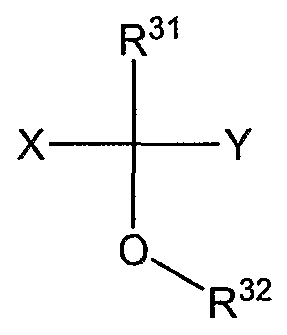
is present, wherein
R31 represents a hydrogen atom, a methyl radical, an ethyl radical, an n-propyl radical, an iso-propyl radical, a sec-butyl radical, a tert-butyl radical, an n-butyl
radica., _ .inyl radical, a cyclohexyl radical, an N-methyl-piperidinyl group, or a phenyl group,
R32 represents a hydrogen atom, a monomethylaminoethyl group, a dimethylaminoethyl group, an aminoethyl group, a pyrrolidinylethyl group, a piperidinylethyi group, a methyl-benzyl-aminoethyl group, a morpholinylethyl group, a diisopropylaminoethyl group, a dimethylaminopropyl group, a piperidinylpropyl group, a pyrrolidinylpropyl group, a morpholinylpropyl group, an N-methyl-2-piperidyl group, an N-ethyl-2-piperidyl group, an N- propyl-2-piperidyl group, an N-methyl-2-pyrrolidinyl group, an N-ethyl-2- pyrrolidinyl group, an N-propyl-2-pyrrolidinyl group, or a 2-dimethylaminoethyl-
1-methyl group,
X represents a phenyl radical, a 2-methyl-phenyl radical, a 3-methyl-phenyl radical, a 4-methyl phenyl radical, a 2-chloro-phenyl radical, a 3-chloro-phenyl radical, a 4-chloro-phenyl radical, a 2-fluoro-phenyl radical, a 3-fluoro-phenyl radical, a 4-fluoro-phenyl radical, a 2-trifluoromethyl-phenyl radical, a 3- trifluoromethyl-phenyl radical, a 4-trifluoromethyl-phenyl radical, a 2-methoxy- phenyl radical, a 3-methoxy-phenyl radical, a 4-methoxy-phenyl radical, a 3,4,5-tris-methoxy phenyl radical, a 3,4-dichloro-phenyl radical, a 2,4-dichloro- phenylradical, a thien-2-yl radical, a thien-3-yl radical, a 3-methyl-thien-2-yl radical, a 5-methyl-thien-2-yl-radical, a 5-bromo-thien-2-yl radical or a 4-bromo- thien-2-yl-radical,
Y represents an azole radical selected from the group consisting of
a) a pyrazole of the general formula (a):

(a)
in which
R37 represents a methyl radical, an ethyl radical, an n-propyl radical, an iso- propyl radical, an n-butyl radical, a sec-butyl radical or a tert-butyl radical,
R38 represents a hydrogen atom, a methyl radical, a bromine atom or a chlorine atom,
b) an imidazole of the general formula

(b)
in which R39 represents a hydrogen atom, a methyl radical, an ethyl radical, an n-propyl radical, an iso-butyl radical, an n-butyl radical, a sec- butyl radical a tert-butyl radical, an n-pentyl radical, an n-hexyl radical, an n-heptyl radical, an n-octyl radical, an n-nonyl radical, an n-decyl radical,
an rFundecyl radical an n-dodecyl radical, a benzyl radical, or a radical of the general formula (b1):
R40-(CH2)n-
(bi)
in which n is 2, 3 or 4 and R40 represents a piperidinyl radical, a phenyl radical, a cyano group, a hydroxyl radical, a carboxy radical, an amino group, a dimethylamino group, or a methyl ester group,
and
(c) an imidazole of the following formula:

optionally in form of one of its stereoisomers, preferably enantiomers or diastereomers, its racemate or in form of a mixture of at least two of its stereoisomers, preferably enantiomers and/or diastereomers, in any mixing ratio, or a corresponding salt thereof, or a corresponding solvate.
9. Use according to one or more of claims 1-8, characterised in that at least one administered component is selected from the group consisting of
• 2-{α-[2-(dimethylamino)ethoxy]benzyl}-1-methyl-1W-imidazole,
2-{4-chloro-α-[2-(dimethylamino)ethoxy]-α-methylbenzyl}-1-methyl- 1 H- imidazole,
• 2-{4-chloro-α-[2-(dimethylamino)ethoxy]benzyl}-1-methyl-1 H- imidazole, • 2-{3-chloro-α-[2-(dimethylamino)ethoxy]benzyl}-1-methyl-1H- imidazole,
• 2-{4-chloro-α-[2-(dimethylamino)ethoxy]-α-methylbenzyl}-1-methyl- 1H- imidazole,
• 2-{4-fluoro-α-[2-(dimethylamino)ethoxy]-α-methylbenzyl]-1-methyl- 1H- imidazole,
• 2-{α-[2-(dimethylamino)ethoxy]-α-methyl-3-(trifluoromethyl)benzyl}-1- methyl- 1H-imidazole,
• 2-{3-chloro-α-[2-(dimethylamino)ethoxy]-α-methylbenzyl}-1-methyl- 1H- imidazole, • 2-{3-chloro-α-[2-(dimethylamino)ethoxy]-α-propylbenzyl}-1 -methyl-
1H- imidazole,
• 1-butyl-2-{4-chloro-α-[2-(dimethylamino)ethoxy]-α-methylbenzyl}-1H- imidazole,
• 2-{α-[2-(dimethylamino)ethoxy]-α-methyl-4-methoxybenzyl}-1- methyl-1H-imidazole,
• 2-{3-chloro-α-methyl-α-[2-(N-pyrrolidinyl)ethoxy]benzyl}-1 -methyl-1 H- imidazole,
• 2-{α-[2-(dimethylamino)ethoxy]-α-propyl-3,4,5-trimethoxybenzyl}-1- dodecyl-1 H-imidazole,
1-butyl-2-{α-[2-(dimethylamino)ethoxy]-4-(trifluoromethyl)benzyl}- 1H-imidazole,
• 1 -methyl-2-{α-methyl-α-[2-(N-piperidyl)ethoxy]-3- (trifluoromethyl)benzyl}-W-imidazole, • 2-{α-cyclohexyl-3,4-dichloro-α-[2-(dimethylamino)ethoxy]benzyl}-1- methyl-1 H-imidazole,
• 2-{3,4-dichloro-α-[2-(dimethylamino)ethoxy]-α-propylbenzyl}-1 - methyMH-imidazole,
• 2-{3,4-dichloro-α-[2-(dimethylamino)ethoxy]-α-methylbenzyl}-1 - methyl-1/7-imidazole,
• 2-{3,4-dichloro-α-[2-(dimethylamino)ethoxy]benzyl}-1-methyl-1H- imidazole,
• 2-{4-chloro-α-[2-(dimethylamino)ethoxy]-α-methylbenzyl}-1-[2-(N- piperidyl)ethyl]-1 W-imidazole, • 2-{4-chloro-α-[2-(dimethylamino)ethoxy]-α-methylbenzyl}-1-[2-(N- piperidyl)propyl]-1 H-imidazole,
• 1-(3-cyanopropyl)-2-{4-chloro-α-[2-(dimethylamino)ethoxy]benzyl}- 1H-imidazole,
• 2-{4-chloro-α-[2-(dimethylamino)ethoxy]-α-(N-methyl-4- piperidyl)benzyl}-1-methyl-1H-imidazole,
• 1-benzyl-2-{α-[2-(N-benzy!-N-methylamino)ethoxy]-4-chlorobenzyl}- 1 /-/-imidazole,
• 2-{4-chloro-α-[2-(dimethylamino)ethoxy]-α-methylbenzyl}-7-methyl- 6,7,8,9-tetrahydro-1 W-imidazole[1 ,5-a][1 ,4]diazepine,
2-{4-chloro-α-[2-(dimethylamino)ethoxy]benzyl}-7-methyl-6,7,8,9- tetrahydro-1 H-imidazole[1 ,5-a][1 ,4]diazepine,
• 1-butyl-5-{α-[2-(dimethylamino)ethoxy]benzyl}-1H-pyrazole,
• 5-{α-(4-chlorophenyl)-α-[2-(dimethylamino)ethoxy]benzyl}-1-methyl- 1W-pyrazole,
• 1-butyl-5-{α-[2-{dimethylamino)ethoxy]-3,4,5-trimethoxybenzyl}-1W- pyrazole,
• 1-butyl-5-{4-chloro-a-[2-(dimethylamino)ethoxy]-a-methylbenzyl}-1W- pyrazole, • 5-{a-[2-(dimethylamino)ethoxy]benzyl}-1 -methyl-1 H-pyrazole,
• 5-{α-[2-(dimethylamino)ethoxy]-α-methylbenzyl}-1 -methyl-1 H- pyrazole,
• 5-{α-[2-(dimethylamino)ethoxy]-3,4,5-trimethoxybenzyl}-1-methyl-1H- pyrazole, « 1 -methyl-5-{α-[2-{N-pyrrolidinyl)ethoxy]benzyl}-1 H-pyrazole,
• 1-methyl-5-{α-[2-(N-moφholinyl)ethoxy]benzyl}-1H-pyrazole,
• 5-{α-[2-(dimethylamino)ethoxy]-α-methyl-3,4,5-trimethoxybenzyl}-1- methyl-1H-pyrazole,
• 4-bromo-5-{α-[2-(dimethylamino)ethoxy]benzyl}-1 -methyl-1 H- pyrazole,
• 1 ,3-dirnethyl-5-{α-[2-(dimethylamino)ethoxy]-α-methylbenzyl}-1W- pyrazole,
• 1 ,3-dimethyl-5-[α-[2-(dimethylamino)ethoxy]benzyl}-1H-pyrazole,
5-{α-[2-(dimethylamino)ethoxy]-2-methylbenzyl}-1 -methyl-1 H- pyrazole,
• 4-chloro-5-{4-chloro-α-[2-(dimethylamino)ethoxy]benzyl}-1-methyl- 1Λ/-pyrazole, • 5-{4-chloro-α-[2-(dimethylamino)ethoxy]benzyl}-1 -methyl-1 H- pyrazole,
• 5-{3-chloro-α-[2-(dimethylamino)ethoxy]benzyl}-1 -methyl-1 H- pyrazole,
• 5-{α-[2-(dimethylamino)ethoxy]-4-methylbenzyl}-1 -methyl-1 H- pyrazole,
• 5-{2-chloro-α-[2-(dimethylamino)ethoxy]benzyl}-1 -methyl-1 H- pyrazole,
• 1-methyl-5-{α-[2-(N-piperidyl)ethoxy]benzyl}-1W-pyrazole,
• 1 -methyl-5-{α-[2-(N-propyl-2-piperidyl)ethoxy]benzyl}-1 H-pyrazole, • 5-{α-[2-(N-ethyl-2-piperidyl)ethoxy]benzyl}-1-methyl-1W-pyrazole,
• 1 -methyl-5-{α-[2-(N-methyl-2-pyrrolidinyl)ethoxy]benzyl}-1 H- pyrazole,
• 5-{α-[2-(diisopropylamino)ethoxy]benzyl}-1 -methyl-1 W-pyrazole,
• 1-methyl-5-{α-[2-(N-methyl-2-piperidyl)ethoxy]benzyl}-1H-pyrazole, • 2-{4-chloro-α-[3-(dimethylamino)propoxy]-α-methylbenzyl}-1-methyl-
1W-imidazole,
• 2-{3-chloro-α-[3-(dimethylamino)propoxy]benzyl}-1-methyl-1 H- imidazole,
2-{4-chloro-α-[3-(dimethylamino)propoxy]-α-ethylbenzyl}-1-methyl- 1 /7-imidazole,
• 2-{α-butyl-3-chloro-α-[3-(dimethylamino)propoxy]benzyl}-1-methyl- 1H-imidazole, • 2-{α-cyclohexyi-4-chloro-α-[3-(dimethylamino)propoxy]benzyl}-1 - methyi-1 /-/-imidazole,
• 2-{α-[3-(dimethylamino)propoxy]-4-fluoro-α-methylbenzyl}-1-methyl- 1 /-/-imidazole,
• 2-{α-[3-(dimethylamino)propoxy]-α-methyl-3-(trifluoromethyl)benzyl}- 1 -methyl-1 H-imidazole,
• 2-{2-chloro-α-[3-(dimethylamino)propoxy]-α-methylbenzyl}-1-methyl- 1 H-imidazole,
• 2-{3-chloro-α-[3-(dimethylamino)propoxy]-α-methylbenzyl}-1-methyl- 1 H-imidazole, • 2-{α-[3-(dimethylamino)propoxy]-α-methyl-3,4,5-trimethoxybenzyl}-1 - methyl-1 H-imidazole,
• 2-{α-[3-(dimethylamino)propoxy]-α-methyl-4-methoxybenzyl}-1 - methyl-1 H-imidazole,
• 2-{4-chloro-α-[3-(dimethylamino)propoxy]benzyl}-1-methyl-1H- imidazole,
• 2-{α-[3-(dimethylamino)propoxy]-3,4,5-trimethoxybenzyl}-1-methyl- 1W-imidazole,
• 2-{α-[3-(dimethylamino)propoxy]-α-methyl-4-(trifluoromethyl)benzyl}- 1 -methyl-1 W-imidazole,
2-{α-[3-(dimethylamino)propoxy]-3-(trifluoromethyl)benzyl}-1- methyl-1 H-imidazole,
• 2-{α-[3-(dimethylannino)propoxy]-4-(trifluoromethyl)benzyl}-1-methyl- 1 /-/-imidazole, • 2-{α-[3-{dimethylamino)propoxy]-4-methoxybenzyl}-1-methyl-1/7- imidazole,
• 2-{α-butyl-α-[3-(dimethylamino)propoxy]-3-(trifluoromethyl)benzyl}-1- methyl-1 W-imidazole,
• 1-butyl-2-{4-chloro-α-[3-(dimethylamino)propoxy]-α-methylbenzyl}- IH-imidazole,
• 1-butyl-2-{α-butyl-α-[3-(dimethylamino)propoxy]-3,4,5- trimethoxybenzyl}-1 H-imidazole,
• 1 -butyl-2-{α-butyl-2-chloro-α-[3-(dimethylamino)propoxy]benzyl}-1 H- imidazole, • 1-butyl-2-{α-butyl-2,4-dichioro-α-[3-(dimethylamino)propoxy]benzyl}-
1H-imidazole,
• 1-butyl-2-{α-[3-(dimethylamino)propoxy]-4-(trifluoromethyl)benzyl}- 1H-imidazole,
• 2-{4-chloro-α-[3-(N-piperidyl)propoxy]benzyl}-1-methyl-1 /-/-imidazole, • 1-methyl-2-{α-methyl-α-[3-(N-piperidyl)propoxy]-4-
(trifluoromethyl)benzyl}-1 W-imidazole,
• 2-{α-butyl-2-chloro-α-[3-(dimethylamino)propoxy]benzyl}-1-methyl- 1 /-/-imidazole,
2-{α-butyl-3,4-dichloro-α-[3-(dimethylamino)propoxy]benzyl}-1- methyl-1 /-/-imidazole,
• 2-{3,4-dichloro-α-[3-(dimethylamino)propoxy]-α-methylbenzyl}-1 - methyl-1 H-imidazole, • 2-{3,4-dichloro-α-[3-(dimethylamino)propoxy]benzyl}-1 -methyl-1 H- imidazole,
• 2-{α-cyclohexyl-3,4-dichloro-α-[3-(dimethylamino)propoxy]benzyl}-1- methyl-1 H-imidazole,
• 2-{4-chloro-α-[3-(dimethylamino)propoxy]-α-methylbenzyl}-α-[2-(N- piperidyl) ethyl]-1 /-/-imidazole,
• 2-{4-chloro-α-[3-(dimethylamino)propoxy]-α-methylbenzyl}-1 -[2-(N- piperidyl) propyl]-1 /-/-imidazole,
• 2-{4-chloro-α-[3-(dimethylamino)propoxy]-α-(N-methyl-4- piperidyl)benzyl}-1 -methyl-1 H-imidazole, • 1-butyl-5-{α-[3-(dimethylamino)propoxy]benzyl}-1H-pyrazole,
• 1-butyl-5-{4-chloro-α-[3-(dimethylamino)propoxy]-α-methylbenzyl}- 1 H- pyrazole,
• 5-{α-[3-(dimethylamino)propoxy]benzyl}-1-methyl-1 /-/-pyrazole,
• 5-{α-[3-(dimethylamino)propoxy]-α-methylbenzyl}-1 -methyl-1 H- pyrazole,
• 1 ,3-dimethyl-5-{α-[3-(dimethylamino)propoxy]-α-methylbenzyl}-1/-/- pyrazole,
• 1 ,3-dimethyl-5-{α-[3-(dimethylamino)propoxy]benzyl}-1 H-pyrazole,
5-{α-[3-(dimethylamino)propoxy]-2-methylbenzyl}-1 -methyl-1 H- pyrazole,
• 5-chloro-5-{4-chloro-α-[3-(climethylamino)propoxy]benzyl}-1-methyl- 1H-pyrazole, • 1-methyl-5-{α-[3-(N-piperidyl)propoxy]benzyl}-1H-pyrazole,
• 1 -methyl-5-{α-[3-(N-pyrrolidinyl)propoxy]benzyl}-1 H-pyrazole,
• 4-{4-chloro-α-[2-(dimethylamino)ethoxy]benzyl}-1 -methyl-1 H- pyrazole,
• 4-{4-chloro-α-[2-(dimethylamino)ethoxy]-α-methylben2yl}-1-methyl- 1 H-pyrazole,
• 4-{4-chloro-α-[2-(N-propyl-2-piperidyl)ethoxy]benzyl}-1-methyl-1H- pyrazole,
• 4-{4-chloro-α-[2-(N-methyl-2-piperidyl)ethoxy]benzyl}-1 -methyl-1 H- pyrazole, • 4-{4-chloro-α-[2-(N-ethyl-2-piperidyl)ethoxy]benzyl}-1 -methyl-1 H- pyrazole,
• 4-{4-chloro-α-[2-(diisopropylamino)ethoxy]benzyl}-1 -methyl-1 H- pyrazole,
• 4-{4-chloro-α-[2-(N-methyl-2-pyrrolidinyl)ethoxy]benzyl}-1 -methyl-1 H- pyrazole,
• 4-{α-[3-(dimethylamino)propoxy]benzyl}-1 -methyl-1 H-pyrazole,
• 4-{4-chloro-α-[3-(N-morpholinyl)propoxy]benzyl}-1 -methyl-1 H- pyrazole,
" 4-{4-chloro-α-[3-(N-pyrrolidinyl)propoxy]benzyl}-1 -methyl-1 H- pyrazole,
• 2-(α-hydroxybenzyl)-1 /-/-imidazole,
• 2-(4-chloro-α-hydroxybenzyl)-1 H-imidazole, • 2-(4-chloro-α-hydroxybenzyl)-1 -methyl-1 H-imidazole,
• 2-(3-chloro-α-hydroxybenzyl)-1 -methyl-1 H-imidazole,
• 2-(4-fluoro-α-hydroxybenzyl)-1 -methyl-1 H-imidazole,
• 2-[α-hydroxy-3-(trifluoromethyl)benzyl]-1 -methyl-1 H-imidazole,
• 2-[α-hydroxy-4-(trifluoromethyl)benzyl]-1 -methyl-1 H-imidazole, • 2-(α-hydroxy-3,4,5-trimethoxybenzyl)-1-methyl-1H-imidazole,
• 2-(3,4-dichloro-α-hydroxybenzyl)-1-methyl-1H-imidazole,
• 1-butyl-2-[α-hydroxy-4-(trifluoramethyl)benzyl]-1 /-/-imidazole,
• 1-butyl-2-(3,4-dichloro-α-hydroxybenzyl)-1W-imidazole,
• 1-butyl-2-(4-chloro-α-hydroxybenzyl)-1 H-imidazole, • 1-butyl-2-(α-hydroxy-3,4,5-trimethoxybenzyl)-1H-imidazole,
• 1-dodecyl-2-(α-hydroxy-3,4,5-trimethoxybenzyl)-1H-imidazole,
• 2-(α-butyl-3-chloro-α-hydroxybenzyl)-1 -methyl-1 H-imidazole,
• 2-(3-chloro-α-hydroxy-α-methylbenzyl)-1 -methyl-1 H-imidazole,
• 2-(4-chloro-α -hydroxy-α-methylbenzyl)-1 -methyl-1 /-/-imidazole, • 2-[4-chloro-α-hydroxy-α-(N-methyl-4-piperidyl)benzyl]-1-methyl-1H- imidazole,
• 2-(4-chloro-α-ethyl-α-hydroxybenzyl)-1 -methyl-1 H-imidazole,
• 2-(α-butyl-4-chloro-α-hydroxybenzyl)-1 -methyl-1 H-imidazole,
2-(α-cyclohexyl-4-chloro-α-hydroxybenzyl)-1-methyl-1H-imidazole,
• 2-(2-chloro-α-hydroxy-α-methylbenzyl)-1 -methyl-1 H-imidazole,
• 2-(α -butyl-2-chloro-α-hydroxybenzyl)-1 -methyl-1 H-imidazole,
• 2-[α-hydroxy-α-methyl-3-(trifluoromethyl)benzyl]-1 -methyl-1 H- imidazole,
• 2-[α-butyl-α-hydroxy-3-(trifluoromethyl)benzyl]-1 -methyl-1 H- imidazole,
• 2-tα-cyclohexyl-α-hydroxy-3-(trifluoromethyl)benzyl]-1 -methyl-1 H- imidazole, • 2-[α-hydroxy-α-methyl-4-(trifluoromethyl)benzyl]-1-methyl-1H- imidazole,
• 2-(4-f luoro-α-hydroxy-α-methylbenzyl)-1 -methyl-1 H-imidazole,
• 2-(α-hydroxy-α-methyl-4-methoxybenzyl)-1 -methyl-1 H-imidazole,
• 2-(3,4-dichloro-α-hydroxy-α-methylbenzyl)-1-methyl-1 H-imidazole, • 2-(α-butyl-3,4-dichloro-α-hydroxybenzyl)-1 -methyl-1 H-imidazole,
• 2-(α-cyclohexyl-3,4-dichloro-α-hydroxybenzyl)-1 -methyl-1 H- imidazole,
• 2-(α -hydroxy-α-methyl-3,4,5-trimethoxybenzyl)-1 -methyl-1 H- imidazole, • 1-butyl-2-(4-chloro-α-hydroxy-α-methylbenzyl)-1 H-imidazole,
• 1-butyl-2-(α-butyl-4-chloro-α-hydroxybenzyl]-1 H-imidazole,
• 1-butyl-2-[4-chloro-α-hydroxy-α-(N-methyl-4-piperidyl)benzyl]-1H- imidazole,
• 1-butyl-2-(α-butyl-α-hydroxy-3,4,5-trimethoxybenzyl)-1 H-imidazole,
1 -butyl-2-(α-butyl-2-chloro-α-hydroxybenzyl)-1 H-imidazole,
• 1 -butyl-2-[α-ethyl-α-hydroxy-3-(trifluoromethyl)benzyl]-1 /-/-imidazole,
• 1 -butyl-2-(α-butyl-2,4-dichloro-α-hydroxybenzyl)-1 H-imidazole,
• 2-(4-chloro-α-hydroxy-α-methylbenzyl)-1 -[2-(N-piperidyl)ethyl]-1 H- imidazole,
• 2-(4-chloro-α-hydroxy-α-methylbenzyl)-1-(3-dimethylaminopropyl)- 1 W-imidazole,
• 2-(α-butyl-α -hydroxy-3,4,5-trimethoxybenzyl)-1-dodecyl-1H- imidazole, • 1-benzyl-2-[α-butyl-α-hydroxy-3-(trifluoromethyl)benzyl]-1H- imidazole,
• 1 -benzyl-2-(4-chloro-α-hydroxy-α-methylbenzyl)-1 H-imidazole,
• 1-(2-cyanoethyl)-2-(4-chloro-α-hydroxybenzyl)-1H-imidazole,
• 1-(3-aminopropyl)-2-(4-chloro-α-hydroxybenzyl)-1 /-/-imidazole, • 3-[2-(3-chloro-α-hydroxybenzyl)-1H-imidazole-1-yl]propanoic acid,
• 2-(4-chloro-α-hydroxybenzyl)-1 -(3-hydroxypropyl)-1 W-imidazole,
• 3-[2-(3-chloro-α-hydroxybenzyl)-1H-imidazole-1-yl]methyl- propanoate,
• 2-(α-hydroxybeπzyl)-1-(3-hydroxypropyl)-1 H-imidazole, • 2-(α-hydroxy-4-melhylbenzyl)-1-(3-hydroxypropyl)-1H-imidazole,
• 2-(α-hydroxy-4-methoxybenzyl)-1-(3-hydroxypropyl)-1 /-/-imidazole,
• 2-(3,4-dichloro-α-hydroxybenzyl)-1-(3-hydroxypropyl)-1H-imidazoie,
• 3-{2-(α-hydroxybenzyl)-1/-/-imidazole-1-yll}-methyl propanoate,
!-(4-chloro-α-hydroxybenzyl)-1 -(4-hydroxybutyl)-1 /-/-imidazole,
• 1-(3-cyanopropyl)-2-(4-chloro-α-hydroxybenzyl)-1 /-/-imidazole,
• 4-[2-(4-chloro-α-hydroxybenzyl)-1 H-imidazole-1 -yl]butanoic acid,
• 4-[2-(4-chloro-α-hydroxybenzyl)-1 H-imidazole-1 -yl]-methyl butanoate,
• 1 -butyl-5-(α-hydroxybenzyl)-1 H-pyrazole,
• 5-(4-chloro-α-hydroxybenzyl)-1-methyl-1H-pyrazole,
• 5-(α-hydroxy-3,4,5-trimethoxybenzyl)-1-methyl-1H-pyrazole,
• 1 -butyl-5-(α-hydroxy-3,4,5-trimethoxybenzyl)-1 H-pyrazole, • 4-bromo-5-(α-hydroxybenzyl)-1-methyl-1 H-pyrazole,
• 5-[α-(4-chlorophenyl)-α-hydroxybenzyl]-1 -methyl-1 H-pyrazole,
• 1 -butyl-5-(4-chloro-α-hydroxy-α-methylbenzyl)-1 H-pyrazole,
• 5-(α-hydroxy-α-methylbenzyl)-1 -methyl-1 H-pyrazole,
• 5-(α-hydroxy-α-methyl-3,4,5-trimethoxybenzyl)-1 -methyl-1 H- pyrazole,
• 1 ,3-dimethyl-5-(α-hydroxy-α-methylbenzyl)-1 H-pyrazole,
• 1 -butyl-5-(α-hydroxy-α-vinylbenzyl)-1 H-pyrazole,
• 1 -butyl-5-(4-chloro-α-hydroxy-α-vinylbenzyl)-1 H-pyrazole,
• 4-chloro-5-(α-hydroxybenzyl)-1 -methyl-1 H-pyrazole, • 5-(α-hydroxy-2-methylbenzyl)-1 -methyl-1 H-pyrazole,
• 5-(3-chloro-α-hydroxybenzyl)-1 -methyl-1 H-pyrazole,
• 5-(α-hydroxy-4-methylbenzyl)-1 -methyl-1 H-pyrazole,
• 5-(2-chloro-α-hydroxybenzyl)-1 -methyl-1 H-pyrazole,
ό-(α-hydroxy-4-methoxybenzyl)-1 -methyl-1 H-pyrazole,
• 5-{α-[2-(climethylamino)ethoxy]-2-thienylmethyl}-1 -methyl-1 H- pyrazole,
• 5-{α-[2-(dimethylamino)ethoxy]-2-thienylmethyl}-1 -methyl-1 H- pyrazole citrate,
• 5-{α-[2-{dimethylamino)ethoxy]-3-thienylmethyl}-1 -methyl-1 H- pyrazole,
• 2-{α-[2-(dimethylamino)ethoxy]-2-thienylmethyl}-1 -methyl-1 H- imidazole, • 5-{α-[2-(dimethylamino)ethoxy]-3-methyl-2-thienylmethyl}-1 -methyl-
1 H-pyrazole,
• 5-{α-[2-(dimethylamino)ethoxy]-5-methyl-2-thienylmethyl}-1-methyl- 1 /-/-pyrazole,
• 5-{5-bromo-α-[2-(dimethylamino)ethoxy]-2-thienylmethyl}-1-methyl- 1 H-pyrazole,
• 5-{4-bromo-α-[2-(dimethylamino)ethoxy]-2-thienylmethyl}-1-methyl- 1 H-pyrazole,
• 5-{α-[2-(dimethylamino)ethoxy]-α-methyl-2-thienylmethyl}-1-methyl- 1 H-pyrazole, • 5-{α-[2-(dimethylamino)ethoxy]benzyl}-1 -methyl-1 H-pyrazole citrate,
• (±)-5-{α-[2-(dimethylamino)-1-(methyl)ethoxy]benzyl}-1 -methyl-1 H- pyrazole,
• (±)-5-{α-[2-(dimethylamino)-1-(methyl)ethoxy]benzyl}-1 -methyl-1 H- pyrazole,
- v+)-5-{α-[2-(dimethylamino)ethoxy]-2-thienylmethyl}-1 -methyl-1 H- pyrazole,
• (-)-5-{α-[2-(dimethylamino)ethoxy]-2-thienylmethyl}-1 -methyl- 1 H- pyrazole, • (+)-5-{α-[2-(dimethylamino)ethoxy]-2-thienylmethyl}-1 -methyl-1 H- pyrazole citrate,
• (-)-5-{α-[2-(dimethylamino)ethoxy]-2-thienylmethyl)-1 -methyl-1 H- pyrazole citrate, • (+)-5-{α-[2-(dimethylamino)ethoxy]-2-thienylmethyl}-1 -methyl-1 H- pyrazole-D-ditoluyltartrat,
• (-)-5-{α-[2-(dimethylamino)ethoxy]-2-thienylmethyl}-1 -methyl-1 H- pyrazole D-ditoluyltartrat,
• (+)-5-{α-[2-(dimethylamino)ethoxy]benzyl}-1 -methyl-1 H-pyrazole citrate,
• (-)-5-{α-[2-(dimethylamino)ethoxy]benzyl}-1 -methyl-1 H-pyrazole citrate,
• 5-(α-hydroxy-2-thienylmethyl)-1 -methyl-1 H-pyrazole,
• 5-(α-hydroxy-3-methyl-2-thienylmethyl)-1 -methyl-1 H-pyrazole, • 5-(α-hydroxy-5-methyl-2-thienylmethyl)-1 -methyl-1 H-pyrazole,
• 5-(5-bromo-α-hydroxy-2-thienylmethyl)-1 -methyl-1 H-pyrazole,
• 5-(4-bromo-α-hydroxy-2-thienylmethyl)-1 -methyl-1 H-pyrazole,
• 5-(α-hydroxy-α-methyl-2-thienylmethyl)-1 -methyl-1 H-pyrazole, β 2-((1 -methyl-1 H-pyrazol-5-yl)(thiophen-2-yl)methoxy)ethanamine,
2-((1 -methyl-1 H-pyrazol-5-yl)(thiophen-2-yl)methoxy)-N- methylethanamine,
• 2-((1 -methyl-1 H-pyrazol-5-yl)(phenyl)methoxy)ethanamine
• and
• 2-((1 -methyl-1 H-pyrazol-5-yl)(phenyl)methoxy)-N-methylethanamine.
10. Use according to any of claims 1 to 9 characterized in that a compound of general formula (I) is used
R1
Ar Het
O-R2
(I)
in which
Ar represents a phenyl radical or a thienyl radical, with no substitutions or optionally with 1 , 2 or 3 equal or different substituents, selected from a group consisting of fluoride, chloride, bromide, methyl, trifluoromethyl and methoxy; R1 represents hydrogen or a lower alkyl group from Ci to C4;
R2 represents a dialkyl(C1-C4)aminoalkyl (C2-C3), a
 (C2-C3), an aminoalkyl (C2-C3), or azaheterocyclylalkyl (C2-C3) radical; and
Het represents a five-armed nitrogenated aromatic heterocycle that contains one to three nitrogen atoms, without substitutions or optionally substituted by 1 or 2 equal or different substituents selected from a group consisting of fluoride, chloride, bromide and methyl;
optionally in the form of its racemate, pure stereoisomers, especially enantiomers or diastereomers or in the form of mixtures of stereoisomers, especially enantiomers or diastereomers, in any suitable ratio;
in the form shown or in form of the acid or base or in form of a salt, especially a physiologically acceptable salt, or in form of a solvate, especially a hydrate.
11. Use according to Claim 10, characterized in that R1 is selected from hydrogen or from a group consisting of methyl, ethyl, propyl, isopropyl, butyl, isobutyl, sec- butyl and ferf-butyl.
12. Use according to Claim 10, characterized in that R2 is selected from among a group consisting of dimethylaminoethyl, dimethylaminopropyl, diethylaminoethyl, diethylaminopropyl, methylaminoethyl, methylaminopropyl, aminoethyl, aminopropyl, piperidinylethyl, piperidinylpropyl, morpholinylpropyl, morpholinylethyl, pirrolidinylpropyl and pirrolidinylethyl;
preferably dimethylaminoethyl, dimethylaminopropyl, diethylaminoethyl, piperidinylethyl, morpholinylpropyl, and pirrolidinylethyl.
13. Use according to Claim 10, characterized in that the compound used is a compound of general formula (Ia)

(Ia)
in which n is i or 2;
R3 is selected from:

5 R4 is selected from hydrogen, fluoride, chloride, bromide and methyl;
R5 and R6 are independently selected from hydrogen, lower C(mrAlkyl or together with the Nitrogen form an azaheterocyclic ring;
R7 is selected from the group consisting of hydrogen, fluoride, chloride, bromide, methyl, trifluoromethyl and methoxy; IO in the form shown or in form of the acid or base or in form of a salt, especially a physiologically acceptable salt, or in form of a solvate, especially a hydrate.
14. Use according to Claim 13, characterized in that R7 is hydrogen. I5
15. Use according to Claim 13, characterized in that R4 is Methyl.
16. Use according to Claim 13, characterized in that R5 and R6 are either hydrogen, CH3 or C2H5 or together with the Nitrogen form a piperidinyl, morpholinyl or
20 pirrolidinyl ring.
17. Use according to Claim 13, characterized in that the compound of general formula (Ia) used is selected from among a group consisting of:
5 5-{α-[2-(dimethylamino)ethoxy]benzyl}-1-methyl-1H-pirazole,
(±)-5-{α-[2-(dimethylamino)ethoxy]benzyl}-1-methyl-1/-/-pirazole, (+)-5-{α-[2-(dimethylamino)ethoxy]benzyl}-1-methyl-1H-pirazole, (-)-5-{α-[2-(dimethylamino)ethoxy]benzyl}-1-methyl-1/-/-pirazole,
2-((1-mσuιyι-1H-pyrazol-5-yl)(phenyl)methoxy)ethanannine, 2-((1-methyl-1 H-pyrazol-5-yl)(phenyl)methoxy)-N-methylethanamine, 5-{α-[2-(dimethylamino)ethoxy]-2-thieπylmethyl}-1-methyl-1H-pirazole, (±)-5-{α-[2-(dimethylamino)ethoxy]-2-thienylmethyl}-1-methyl-1W-pirazole, (+)-5-{α-[2-(dimethylamino)ethoxy]-2-thienylmethyl}-1 -methyl-1 H-pirazole,
(-)-5-{α-[2-(dimethylamino)ethoxy]-2-thienylmethyl}-1-methyl-1H-pirazole; 2-((1 -methyl-1 H-pyrazol-5-yl)(thiophen-2-yl)methoxy)ethanamine, 2-((1 -methyl-1 H-pyrazol-5-yl)(thiophen-2-yl)methoxy)-N-methylethaπamine.
18. Use according to Claim 13, characterized in that it the compound used is a compound of general formula (Ib)

(Ib)
in which m is 1 or 2;
R8 is selected from hydrogen, fluoride, chloride, bromide and methyl;
R9 and R10 are independently selected from hydrogen, lower C(1-4)-Afkyl or together with the Nitrogen form an azaheterocyclic ring; R11 is selected from the group consisting of hydrogen, fluoride, chloride, bromide, methyl, trifluoromethyl and methoxy;
in the form shown or in form of the acid or base or in form of a salt, especially a physiologically acceptable salt, or in form of a solvate, especially a hydrate.
19. Use according to Claim 18, characterized in that R11 is hydrogen.
20. Use according to Claim 18, characterized in that R8 is Methyl.
21. Use according to Claim 18, characterized in that R9 and R10 are either hydrogen, CH3 or C2H5 or together with the Nitrogen form a piperidinyl, morpholinyl or pirrolidinyl ring;
preferably in which R9 and R10 are either hydrogen, CH3 or C2H5;
especially in which R9 and R10 are equal and either CH3 or C2H5;
most preferably in which R9 and R10 are both CH3.
22. Use according to Claim 18, characterized in that m is 1.
23. Use according to Claim 18, characterized in that the compound of general formula (Ib) used is selected from among a group consisting of:
5-{α-[2-(dimethylamino)ethoxy]benzyl}-1 -methyl-1 H-pirazole, (±)-5-{α-[2-(dimethylamino)ethoxy]benzyl}-1 -methyl-1 H-pirazole,
(+)-5-{α-[2-(dimethylamino)ethoxy]benzyl}-1-methyl-1H-pirazole, (-)~5-{α-[2-(dimethylamino)ethoxy]benzyl}-1-methyl-1H-pirazole; 2-((1-methyl-1 H-pyrazol-5-yl)(phenyl)methoxy)-N-methylethanamine,
preferably
5-{α-[2-(dimethylamino)ethoxy]benzyl}-1 -methyl-1 W-pirazole,
especially the citrate.
24. Use according to Claim 13, characterized in that the compound used is a compound of general formula (Ic)

(Ic)
in which p is 1 or 2;
R12 is selected from hydrogen, fluoride, chloride, bromide and methyl; R13 and R14 are independently selected from hydrogen, lower C(M)-Alkyl or together with the Nitrogen form an azaheterocyclic ring; R15 is selected from the group consisting of hydrogen, fluoride, chloride, bromide, methyl, trifluoromethyl and methoxy.
25. Use according to Claim 24, characterized in that R15 is hydrogen.
26. Use according to Claim 24, characterized in that R12 is Methyl.
27. Use according to Claim 24, characterized in that R13 and R14 are either hydrogen, CH3 or C2H5 or together with the Nitrogen form a piperidinyl, morpholinyl or pirrolidinyl ring;
preferably in which R13 and R14 are either CH3 or C2H5;
especially in which Ri3 and Ri4 are equal and either CH3 or C2H5;
most preferably in which Ri3 and R14 are both CH3.
28. Use according to Claim 24, characterized in that p is 1.
29. Use according to Claim 24, characterized in that the compound of general formula (Ic) used id selected from among a group consisting of:
5-{α-[2-(dimethylamino)ethoxy]-2-thienylmethyl}-1-methyl-1H-pirazole, (+)-5-{α-[2-(dimethylamino)ethoxy]-2-thienylmethyl}-1 -methyl-1 /-/-pirazole,
(+)-5-{α-[2-(dimethylamino)ethoxy]-2-thienylmethyl}-1-methyl-1/-/-pirazole, (-)-5-{α-[2-(dimethylamino)ethoxy]-2-thienylmethyl}-1-methyl-1H-pirazole; 2-((1-methyl-1 H-pyrazol-5-yl)(thiophen-2-yl)methoxy)-N-methylethanamine.
preferably
5-{α-[2-(dimethylamino)ethoxy]-2-thienylmethyl}-1-methyl-1H-pirazole,
especially the citrate.
35. Use according to any of claims 1 to 34, characterized in that the active compound is used in the medicament at a dose between 50 and 400 mg/day or between 200 and 600 mg/day.
36. Use according to any of claims 1 to 35, characterized in that the medicament is for oral administration, especially in form of a tablet or capsule.
37. Use according to any of claims 1 to 36, characterized in that the medicament is in form of a formulation comprising any of the following:
• sodium croscarmelose,
• starch,
• colloidal silica dioxide,
• a salt with stearic acid, especially magnesium stearate, • povidone,
• microcrystalline cellulose
• lactose monohydrate
• polyethylene glycol.
38. Use according to any of claims 1 to 37, characterized in that the disease to be treated is fibromyalgia.
39. Use according to any of claims 1 to 37, characterized in that the disease to be treated is chronic fatigue syndrome.
Applications Claiming Priority (6)
| Application Number | Priority Date | Filing Date | Title |
|---|---|---|---|
| EP05003116A EP1690537A1 (en) | 2005-02-15 | 2005-02-15 | Derivatives of aryl(or heteroaryl) azolycarbinols for the treatment of fibromyalgia |
| EP05003116.0 | 2005-02-15 | ||
| EP05004328A EP1695704A1 (en) | 2005-02-28 | 2005-02-28 | Derivatives of aryl (or heteroaryl) azolylcarbinols for the treatment of fibromyalgia |
| EP05004328.0 | 2005-02-28 | ||
| ES200500793 | 2005-04-01 | ||
| ES200500793A ES2286920B1 (en) | 2005-02-15 | 2005-04-01 | DERIVATIVES OF ARIL (OR HETEROARIL) AZOLILCARBINOLES FOR THE TREATMENT OF FIBROMIALGIA. |
Publications (2)
| Publication Number | Publication Date |
|---|---|
| WO2006087147A2 true WO2006087147A2 (en) | 2006-08-24 |
| WO2006087147A3 WO2006087147A3 (en) | 2006-10-12 |
Family
ID=36693609
Family Applications (1)
| Application Number | Title | Priority Date | Filing Date |
|---|---|---|---|
| PCT/EP2006/001239 Ceased WO2006087147A2 (en) | 2005-02-15 | 2006-02-10 | Derivatives of aryl (or heteroaryl) azolylcarbinols for the treatment of fibromyalgia |
Country Status (1)
| Country | Link |
|---|---|
| WO (1) | WO2006087147A2 (en) |
Cited By (3)
| Publication number | Priority date | Publication date | Assignee | Title |
|---|---|---|---|---|
| WO2007017127A3 (en) * | 2005-07-29 | 2007-04-19 | Esteve Labor Dr | Controlled realease dosage form of pirazole compounds to treat urinary incontinence |
| US7517874B2 (en) | 2007-06-21 | 2009-04-14 | Cara Therapeutics, Inc. | Substituted imidazo[1,5-a][1,4]diazepines and imidazo[1,5-a]pyrazines as cannabinoid receptor agonists for the treatment of pain |
| US8859538B2 (en) | 2007-06-21 | 2014-10-14 | Cara Therapeutics, Inc. | Uses of substituted imidazoheterocycles |
Family Cites Families (3)
| Publication number | Priority date | Publication date | Assignee | Title |
|---|---|---|---|---|
| FR2613720B1 (en) * | 1987-04-10 | 1990-01-19 | Esteve Labor Dr | ARYL-HETEROARYL CARBINOL DERIVATIVES WITH ANALGESIC ACTIVITY |
| ES2150378B1 (en) * | 1998-08-07 | 2001-07-01 | Esteve Labor Dr | EMPLOYMENT OF ARIL (OR HETEROARIL) AZOLILCARBINOLES DERIVATIVES IN THE PREPARATION OF A MEDICINAL PRODUCT FOR THE TREATMENT OF DISORDERS MEDIATED BY AN EXCESS OF SUBSTANCE P. |
| DE10335566A1 (en) * | 2003-07-31 | 2005-02-24 | Grünenthal GmbH | Medicaments containing derivatives of aryl (or heteroaryl) azolylcarbinols |
-
2006
- 2006-02-10 WO PCT/EP2006/001239 patent/WO2006087147A2/en not_active Ceased
Cited By (4)
| Publication number | Priority date | Publication date | Assignee | Title |
|---|---|---|---|---|
| WO2007017127A3 (en) * | 2005-07-29 | 2007-04-19 | Esteve Labor Dr | Controlled realease dosage form of pirazole compounds to treat urinary incontinence |
| US7517874B2 (en) | 2007-06-21 | 2009-04-14 | Cara Therapeutics, Inc. | Substituted imidazo[1,5-a][1,4]diazepines and imidazo[1,5-a]pyrazines as cannabinoid receptor agonists for the treatment of pain |
| US8431565B2 (en) | 2007-06-21 | 2013-04-30 | Cara Therapeutics, Inc. | Substituted imidazoheterocycles |
| US8859538B2 (en) | 2007-06-21 | 2014-10-14 | Cara Therapeutics, Inc. | Uses of substituted imidazoheterocycles |
Also Published As
| Publication number | Publication date |
|---|---|
| WO2006087147A3 (en) | 2006-10-12 |
Similar Documents
| Publication | Publication Date | Title |
|---|---|---|
| EP1781272B1 (en) | Use of compounds active on the sigma receptor for the treatment of mechanical allodynia | |
| JP2002522359A (en) | Use of aryl (or heteroaryl) azolyl carbinol derivatives in the manufacture of a medicament for the treatment of disorders mediated by excess substance P | |
| DK1562567T3 (en) | Combination of selected analgesics with COX II inhibitors | |
| US20080200693A1 (en) | Derivatives of Aryl (or Heteroaryl) Azolylcarbinols (in Particular Cizolirtin Citrate) for the Treatment of Opioid Addiction | |
| US20070088024A1 (en) | Active substance combination comprising a carbinol combined to at least an NSAID | |
| DE10224107A1 (en) | Combination of selected opioids with other active substances for the treatment of urinary incontinence | |
| EP1642577A1 (en) | Derivatives of aryl (or heteroaryl) azolylcarbinols for the treatment of central neuropathic pain | |
| WO2007009701A2 (en) | Use of substituted pyrazole compounds and combinations thereof for the treatment of the metabolic syndrome | |
| EP1695704A1 (en) | Derivatives of aryl (or heteroaryl) azolylcarbinols for the treatment of fibromyalgia | |
| US20060040924A1 (en) | Derivatives of aryl (or heteroaryl) azolylcarbinols for the treatment of renal colic | |
| JP2007531784A (en) | Active substance combination | |
| EP1743637A1 (en) | Use of substituted pyrazole compounds and combinations thereof for the treatment of the metabolic syndrome | |
| EP1690537A1 (en) | Derivatives of aryl(or heteroaryl) azolycarbinols for the treatment of fibromyalgia | |
| DK2424514T3 (en) | Tapentadol for the treatment of rheumatoid arthritic pain | |
| EP1634598A1 (en) | Use of piperazine derivatives and analogues for the manufacture of a medicament for the prophylaxis and/or treatment of disorders of food ingestion | |
| US20060194860A1 (en) | Pharmaceutical compositions containing aryl or heteroaryl azolylcarbinol compounds | |
| ES2286920B1 (en) | DERIVATIVES OF ARIL (OR HETEROARIL) AZOLILCARBINOLES FOR THE TREATMENT OF FIBROMIALGIA. | |
| JP4271142B2 (en) | Of 1-dimethylamino-3- (3-methoxy-phenyl) -2-methyl-pentan-3-ol and 3- (3-dimethylamino-1-ethyl-1-hydroxy-2-methyl-propyl) -phenol Active substance salts and esters | |
| EP1784178A1 (en) | Aryl (or heteroaryl) azolylcarbinols | |
| JP2007531785A (en) | Active substance combination | |
| US20070021485A1 (en) | Aryl (or heteroaryl) azolylcarbinols | |
| DE10254785A1 (en) | Synergistic mixture of analgesic and inhibitor of cyclo-oxygenase II, useful for treatment of pain, effective at low doses and with reduced side effects | |
| WO2007009700A2 (en) | Use of substituted pyrazoline compounds for the treatment of the lipid parameters of the metabolic syndrome | |
| HK1161694B (en) | Tapentadol for treating rheumatoid arthritic pain | |
| HK1075205B (en) | Combination of selected opioids with muscarine antagonists for treating urinary incontinence |
Legal Events
| Date | Code | Title | Description |
|---|---|---|---|
| 121 | Ep: the epo has been informed by wipo that ep was designated in this application | ||
| NENP | Non-entry into the national phase |
Ref country code: DE |
|
| 122 | Ep: pct application non-entry in european phase |
Ref document number: 06706860 Country of ref document: EP Kind code of ref document: A2 |
|
| WWW | Wipo information: withdrawn in national office |
Ref document number: 6706860 Country of ref document: EP |