WO2006067162A2 - Liquid or low melting stabilizer formulations - Google Patents
Liquid or low melting stabilizer formulations Download PDFInfo
- Publication number
- WO2006067162A2 WO2006067162A2 PCT/EP2005/056998 EP2005056998W WO2006067162A2 WO 2006067162 A2 WO2006067162 A2 WO 2006067162A2 EP 2005056998 W EP2005056998 W EP 2005056998W WO 2006067162 A2 WO2006067162 A2 WO 2006067162A2
- Authority
- WO
- WIPO (PCT)
- Prior art keywords
- alkyl
- cycloalkyl
- alkoxy
- substituted
- formula
- Prior art date
- Legal status (The legal status is an assumption and is not a legal conclusion. Google has not performed a legal analysis and makes no representation as to the accuracy of the status listed.)
- Ceased
Links
- 0 CCC(*)(CC)OC(CCc(cc1C(C)(C)C)cc(C(C)(C)C)c1O)=O Chemical compound CCC(*)(CC)OC(CCc(cc1C(C)(C)C)cc(C(C)(C)C)c1O)=O 0.000 description 1
- USIUVYZYUHIAEV-UHFFFAOYSA-N c(cc1)ccc1Oc1ccccc1 Chemical compound c(cc1)ccc1Oc1ccccc1 USIUVYZYUHIAEV-UHFFFAOYSA-N 0.000 description 1
Classifications
-
- C—CHEMISTRY; METALLURGY
- C08—ORGANIC MACROMOLECULAR COMPOUNDS; THEIR PREPARATION OR CHEMICAL WORKING-UP; COMPOSITIONS BASED THEREON
- C08K—Use of inorganic or non-macromolecular organic substances as compounding ingredients
- C08K5/00—Use of organic ingredients
- C08K5/04—Oxygen-containing compounds
- C08K5/13—Phenols; Phenolates
- C08K5/134—Phenols containing ester groups
-
- C—CHEMISTRY; METALLURGY
- C08—ORGANIC MACROMOLECULAR COMPOUNDS; THEIR PREPARATION OR CHEMICAL WORKING-UP; COMPOSITIONS BASED THEREON
- C08K—Use of inorganic or non-macromolecular organic substances as compounding ingredients
- C08K5/00—Use of organic ingredients
- C08K5/49—Phosphorus-containing compounds
- C08K5/50—Phosphorus bound to carbon only
-
- C—CHEMISTRY; METALLURGY
- C08—ORGANIC MACROMOLECULAR COMPOUNDS; THEIR PREPARATION OR CHEMICAL WORKING-UP; COMPOSITIONS BASED THEREON
- C08K—Use of inorganic or non-macromolecular organic substances as compounding ingredients
- C08K5/00—Use of organic ingredients
- C08K5/04—Oxygen-containing compounds
- C08K5/13—Phenols; Phenolates
- C08K5/134—Phenols containing ester groups
- C08K5/1345—Carboxylic esters of phenolcarboxylic acids
-
- C—CHEMISTRY; METALLURGY
- C08—ORGANIC MACROMOLECULAR COMPOUNDS; THEIR PREPARATION OR CHEMICAL WORKING-UP; COMPOSITIONS BASED THEREON
- C08K—Use of inorganic or non-macromolecular organic substances as compounding ingredients
- C08K5/00—Use of organic ingredients
- C08K5/16—Nitrogen-containing compounds
- C08K5/34—Heterocyclic compounds having nitrogen in the ring
- C08K5/3467—Heterocyclic compounds having nitrogen in the ring having more than two nitrogen atoms in the ring
- C08K5/3477—Six-membered rings
- C08K5/3492—Triazines
Definitions
- the instant invention relates to liquid or low melting mixtures of phosphines with phenolic antioxidants as stabilizers for thermoplastic polymers. It further relates to amorphous compositions of phosphines with phenolic antioxidants and their use for stabilization of thermoplastic polymers.
- a stabilization package usually composed of primary antioxidants (sterically hindered phenols, AO) combined with secondary stabilizers (phosphorus based processing stabilizers, PS) to maintain the polymer properties.
- primary antioxidants sterically hindered phenols, AO
- secondary stabilizers phosphorus based processing stabilizers, PS
- phosphines as single component PS has recently been described, e.g. in WO-A-03/014213 or EP-A-I 462 478.
- US 5362783 discloses a polymer composition comprising a polycarbonate and an essentially epoxide-free stabilizer composition comprising a) a phosphine of the general formula
- R 1 , R 2 and R 3 independently from each other represent an alkyl, cycloalkyl, aryl or aryl-alkyl group or an aryl group which is substituted at the aromatic ring with one or more halogens and/or one or more alkyl or alkoxy groups and b) a hindered phenol.
- compositions are blended at room temperature.
- the examples don't give any further details about the mixing process.
- US-B-6369140 discloses a polymeric composition containing 100.0 parts 3rd generation polypropylene homopolymer, 0.05 parts oftetrakis(methylene-3,(3',5'-di- tert.butyl-4'-hydroxyphenyl)propionate) methane commercially available as Irganox 1010 (a trademark), 0.1 parts calcium stearate and 0.04 parts of tris(4-methyl- phenyl)phosphine.
- the composition disclosed in example 6 was mixed by dry blending.
- AO sterically hindered phenolic antioxidants
- AO sterically hindered phenolic antioxidants
- octadecyl (4-hydroxy,- 3,5-di-tert.-butyl-phenyl)-hydrocinnamate available e.g. under the trade name Hostanox ® O 16 from Clariant with a melting point of about 48-54°C.
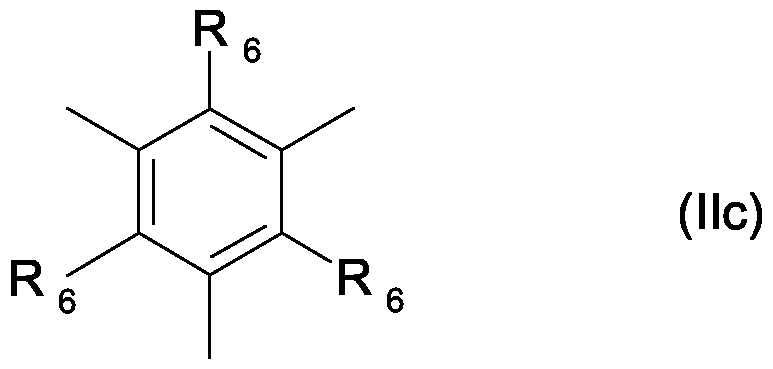
- mixtures of phosphines of the formulae (Ib) to (Id) with phenolic antioxidants of the formulae (Ha) to (Hd) can overcome the problems of the state of the art mixtures of liquid phosphites (TNPP) and phenolic AO.
- R 1 to R 4 independently of each other, are C ⁇ alkyl (linear or branched, optionally containing in the chain N, O, P, S ), C 5-30 cycloalkyl (optionally containing in the ring N, O, P, S), C 1-3O alkylaryl, C 6-24 aryl, C 5-24 heteroaryl, C 6-24 aryl (substituted with C 1-18 alkyl (linear or branched), C 5-1 2cycloalkyl or C 1-18 alkoxy), C 5- 2 4 heteroaryl (substituted with C 1-18 alkyl (linear or branched), C 5-12 cycloalkyl or C 1-18 alkoxy);
- D is a (q+l)-valent residue consisting of C 1-3O alkylen (linear or branched, optionally containing in the chain N, O, P, S), C 1-3O alkyliden (linear or branched, optionally containing in the chain N, O, P, S), C 5-12 cycloalkylen (linear or branched, optionally containing in the ring N, O, P, S), C 6-24 arylen, C 6-24 arylen (substituted by C 1-18 alkyl (linear or branched), C 5-1 2cycloalkyl or C 1-18 alkoxy), C 6- 2 4 heteroarylen (optionally substituted by C 1-18 alkyl (linear or branched), C 5-12 cycloalkyl or C 1-18 alkoxy);
- n is from 1 to 6
- C 5-24 heteroaryl C 6-24 aryl (substituted with C 1-18 alkyl (linear or branched), C 5-12 cycloalkyl or C 1-18 alkoxy), C 5-24 heteroaryl (substituted with C 1-18 alkyl (linear or branched), C 5-12 cycloalkyl or C 1-18 alkoxy); for n>l is C ⁇ alkylene, Ci ⁇ alkylene-S-Ci ⁇ alkylene, C 5-30 cycloalkylene, C 1-3O alkylarylene, C 6-24 arylene, C 5-24 heteroarylene, Ci- 2 - t alkylidene; or of formula (lib)
- R 6 is selected from the residues
- R 7 is hydrogen, C ⁇ alkyl (linear or branched), C ⁇ alkyloxy (linear or branched), and m is from O to 3;
- R 1 to R 4 independently of each other, are C 6- 2 4 alkyl (linear or branched),
- D is a (q+l)-valent residue consisting of Ci ⁇ alkylen (linear or branched), Ci- 2 - t alkyliden (linear or branched), C 5-8 cycloalkylen, C 6-18 arylen, C 6-18 heteroarylen, C 6-18 arylen (substituted by C 1-18 alkyl (linear or branched), C 6-8 cycloalkyl or C 1-18 alkoxy), C 6-18 heteroarylen (optionally substituted by C 1-18 alkyl (linear or branched), C 6-8 cycloalkyl or C 1-18 alkoxy);
- n 1 to 4
- C 5-18 heteroaryl C 6-18 aryl (substituted with Ci. ⁇ alkyl (linear or branched), C 6-8 cycloalkyl or Ci- ⁇ alkoxy), C 5-18 heteroaryl (substituted with Ci. ⁇ alkyl (linear or branched), C 6-8 cycloalkyl or Ci- ⁇ alkoxy), for n>l is C 1-18 alkylene, Ci-isalkylene-S-Ci-isalkylene, C 6-8 cycloalkylene, C 1-18 alkylarylene, C 6-18 arylene, C 5-18 heteroarylene, C 1-18 alkylidene;
- R 6 is selected from the residues
- R 7 is hydrogen, C 1-18 alkyl (linear or branched), C 1-18 alkyloxy (linear or branched), and m 0 to 2.
- mixtures comprising (A) one or more phosphine compound of formulae (Ib) to (Id), more preferred of formulae (Ib) and (Ic), even more preferred of formula (Ib), wherein
- R 1 to R 4 independently of each other, are C 6-18 alkyl (linear or branched),
- D is a (q+l)-valent residue consisting of C 1-18 alkylen, C 1-18 alkyliden,
- n 1 to 4
- C 5-12 heteroaryl C 6-12 aryl (substituted with C 1-8 alkyl (linear or branched), cyclohexyl or C 1-8 alkoxy), C 5-12 heteroaryl (substituted with C 1-8 alkyl (linear or branched), cyclohexyl or
- C 1-8 alkoxy for n>l is C 1-12 alkylene, C 1-12 alkylene-S-C 1-12 alkylene, cyclohexylene, C 1-12 alkylarylene, C 6-12 arylene, C 5-12 heteroarylene, C 1-12 alkylidene;
- R 6 is selected from the residues (* indicate the connection position to the residue)
- R 7 is hydrogen, Ci. ⁇ alkyl (linear or branched), Ci. ⁇ alkyloxy (linear or branched), and m is 0 or 1.
- the components (A) and/or (B) can be in an amorphous or in a crystalline state, or the inventive mixtures can be a mixture of amorphous and/or crystalline material of the components (A) and (B), wherein component (A) and component (B) are as defined above with all described preferred aspects of component (A) and component (B).
- the amorphous state of a solid is characterized by a non regular organization of the molecules, so that no regular lattice structure is formed.
- a well known example of that state is glass. According to that the amorphous state is also frequently called glassy state.
- the amorphous state can be determined X-ray powder diffraction.
- the powder pattern of a amorphous substance will no longer show the characteristic lines of the crystalline substance.
- a further method to characterize the amorphous state of a substance is the measurement of the thermal properties, preferably differential scanning calorimetry (DSC) measurement.
- DSC differential scanning calorimetry
- an endothermal melting peak is observe during the heating.
- the integral of this peak corresponds to the lattice energy which is necessary to break up the crystal lattice during the melting process.
- an amorphous substance will not show such a thermal effect as there is no lattice energy to overcome during the melting.
- the inventive mixtures comprising at least one component (A) and at least one component (B) contain at least 25% by weight, more preferably at least 50% by weight, even more preferably at least more than 75% by weight, especially preferably at least 90% by weight, and more especially preferably at least 95% by weight, based on the weight of the total mixture, of an amorphous mixture of the components (A) and (B); with components (A) and (B) represented also in all their preferred aspects as mentioned above.
- the remaining part of the inventive mixtures comprising at least one component (A) and at least one component (B) can be crystalline components (A) and/or (B); in this case, where no further substances are present, the amorphous and the crystalline material of components (A) and (B) add up to 100% by weight of the composition.
- the inventive mixtures can also consist of an amorphous mixture of at least one component (A) and at least one component (B) only.
- component (A) is preferably of formula (In).
- the invention relates further to amorphous compositions comprising one or more components (C) and one or more components (B), wherein the component (C) is a phosphine compound of formula (Ia)
- R 1 to R 3 independently of each other, are C ⁇ alkyl (linear or branched, optionally containing in the chain N, O, P, S ), C 5-30 cycloalkyl (optionally containing in the ring N, O, P, S), C 1-3O alkylaryl, C 6-24 aryl, C 5-24 heteroaryl, C 6-24 aryl (substituted with C 1-18 alkyl (linear or branched), C 5-1 2cycloalkyl or C 1-18 alkoxy), C 5- 2 4 heteroaryl (substituted with C 1-18 alkyl (linear or branched), C 5-12 cycloalkyl or C 1-18 alkoxy);
- component (B) is a phenolic antioxidant compound of formula (Ha)
- n is from 1 to 6;
- R 6 is selected from the residues
- R 7 is hydrogen, C ⁇ alkyl (linear or branched), C ⁇ alkyloxy (linear or branched), and m is from O to 3;
- the component (B) is a compound of formula (Ha) or (Hd), more preferably of formula (Ha).
- amorphous compositions comprising one or more components (C) and one or more components (B), wherein the component (C) is a compound of formula (Ia)
- R 1 to R 3 independently of each other, are C 6- 2 4 alkyl (linear or branched),
- Ci- ⁇ alkoxy C 5-18 heteroaryl (substituted with Ci. ⁇ alkyl (linear or branched), C 6-8 cycloalkyl or Ci- ⁇ alkoxy);
- component (B) is a compound of formulae (Ha) to (Hd), more preferred of formula (Ha), wherein
- n 1 to 4
- C 5-18 heteroaryl C 6-18 aryl (substituted with Ci. ⁇ alkyl (linear or branched), C 6-8 cycloalkyl or Ci- ⁇ alkoxy), C 5-18 heteroaryl
- n>l is C 1-18 alkylene, Ci-isalkylene-S-Q-isalkylene, C 6-8 cycloalkylene,
- R 6 is selected from the residues wherein * indicate the connection position to the residue
- R 7 is hydrogen, C 1-18 alkyl (linear or branched), C 1-18 alkyloxy (linear or branched), and m 0 to 2.
- compositions comprising one or more components (C) and one or more components (B), wherein the component (C) is a compound of formula (Ia),
- R 1 to R 3 independently of each other, are C 6-18 alkyl (linear or branched),
- C 1-8 alkoxy C 5-12 heteroaryl (substituted with C 1-8 alkyl (linear or branched), cyclohexyl or C 1-8 alkoxy);
- component (B) is a compound of formulae (Ha) to (Hd), more preferred of formula (Ha), wherein n is 1 to 4,
- C 5-12 heteroaryl C 6-12 aryl (substituted with C 1-8 alkyl (linear or branched), cyclohexyl or C 1-8 alkoxy), C 5-12 heteroaryl
- Ci. ⁇ alkylene (substituted with C 1-8 alkyl (linear or branched), cyclohexyl or C 1-8 alkoxy), for n>l is Ci. ⁇ alkylene, Ci-iialkylene-S-Ci- ⁇ alkylene, cyclohexylene, Ci- ⁇ alkylarylene, C 6-1 2arylene, C 5-1 2heteroarylene,
- R 6 is selected from the residues
- R 7 is hydrogen, Ci. ⁇ alkyl (linear or branched), Ci. ⁇ alkyloxy (linear or branched), and m is 0 or 1.
- compositions comprising one or more components
- component (C) is a compound of formulae (Ie) to (Ig)
- t is 1 to 5, preferably t is from 1 to 3 and more preferably t is 1 or 2, even more preferably t is 1 ;
- component (B) is a compound of formulae (He) to (Ilk).
- amorphous compositions comprising one or more components (C) and one or more components (B), wherein the component (C) is a compound of formulae Ie to Ig, preferably Ie or If, with t being 1 or 2, preferably 1, more preferably with the methyl groups in ortho- or para-position, even more preferably in the para-position, to the phosphorus atom; and wherein the component (B) is a compound of formulae He, Hf, Hg, Hh, Hi or Hj;
- amorphous compositions comprising one or more components (C) and one or more components (B), wherein the component (C) is a compound of formulae Ie, If or Ig, preferably Ie of If, with t being 1 or 2, preferably 1, more preferably with the methyl groups in ortho or para-position, even more preferably in the para-position, to the phosphorus atom; and wherein the component (B) is a compound of formulae He or Hf, preferably of the formula He;
- an amorphous composition comprising tetrakis(methylene-3,(3',5'-di-tert.butyl-4'-hydroxyphenyl)propionate) methane of formula (Hf) and tris(4-methyl-phenyl)phosphine of formula (If) with t being 1;
- an amorphous composition comprising triphenylphosphine of formula (Ie) and octadecyl-(4-hydroxy-3,5-di-tert.-butyl-phenyl)- hydrocinnamate of formula (He);
- an amorphous composition comprising triphenylphosphine of formula (Ie) and tetrakis(methylene-3,(3',5'-di-tert.butyl-4'- hydroxyphenyl)propionate) methane of formula (Hf);
- an amorphous composition comprising triphenylphosphine of formula (Ie) and bis[3,3-bis(4'-hydroxy-3'-tert-butyl- phenyl)butandioic acid] glycol ester of formula (Hg).
- the components (A), (B) and (C) are known substances.
- mixtures or compositions comprising component (A) or (C) and component (B) means mixtures of component (A) with (B), these mixtures can optionally contain a component (C), preferably they contain no component (C), and it means mixtures of component (C) with (B), these mixtures can optionally contain a component (A), preferably they contain no component (A); and further with components (A), (B) and (C) represented also in all their preferred aspects as mentioned above.
- inventive amorphous compositions comprising one or more components (C) and one or more components (B) are produced by cooling a liquid mixture comprising one or more components (C) and one or more components (B) below the solidification point.
- the liquid mixture comprising one or more components (C) and one or more components (B) is preferably prepared in a batch mixer or reactor or in continuous mixers or reactors.
- the cooling is done preferably by prilling, dropping onto a cooled surface, preferably onto a cooled conveyor belt, extrusion to a strand, granulation under water, fluidized bed granulation, tumbling, flaking or spraying (including spraying from solutions/emulsions in supercritical gases).
- the liquid mixture comprising one or more components (C) and one or more components (B) is preferably prepared by mixing the separately molten or liquid components (C) and (B) together, or by melting a mixture of the components (C) and
- liquid mixture comprising one or more components (C) and one or more components (B) is preferably prepared by adding a molten or liquid component (C), respectively (B), to a liquid or already molten component (B), respectively (C), or to a liquid or molten mixture comprising components (C) and (B), to obtain a liquid mixture of components (C) and (B).
- the inventive mixtures comprising at least one component (C) and at least one component (B) contain at least 25% by weight, more preferably at least 50% by weight, even more preferably at least more than 75% by weight, especially preferably at least 90% by weight, and more especially preferably at least 95% by weight, based on the weight of the total mixture, of an amorphous mixture of the components (C) and (B).
- the remaining part of the inventive mixtures comprising at least one component (C) and at least one component (B) can be crystalline components (C) and/or (B); in this case, where no further substances are present, the amorphous and the crystalline material of components (C) and (B) add up to 100% by weight of the composition.
- the inventive mixtures can also consist of an amorphous mixture of at least one component (C) and at least one component (B) only.
- the percentage of amorphous material is calculated by the ratio of the observed melting energy of the inventive mixtures measured by DSC in relation to the melting energy of the individual crystalline components from which the mixtures has been prepared, taking into account the weight ratios of the components in the mixture.
- inventive amorphous mixtures and compositions comprising component (C) or (A) and component (B) may also contain other substances, preferably additives, which are necessary to maintain, improve or change the properties of the polymer.
- the inventive amorphous compositions contain less than 50% by weight, more preferably less than 25% by weight, even more preferably less than 10% by weight, particularly less than 5% by weight of other substances, based on the total weight of the composition; especially preferably the inventive amorphous mixtures and compositions comprising component (C) or (A) and component (B) contain no other substances.
- inventive mixtures comprising at least one component (A) and at least one component (B) and the inventive amorphous compositions comprising at least one component (C) and at least one component (B) contain highly efficient phosphines as processing stabilizers, offering the advantages of low dosing as well an inherent stability to hydrolysis as no ester groups are present in this kind of products. This excludes the chemical interaction like transesterification or hydrolysis.
- the inventive mixtures consist of component (A) and component (B) they preferably contain from 1 to 99 % by weight of the phosphine component (A) and from 99 to 1 % by weight of the phenolic antioxidants (B), more preferably from 1 to 70 % by weight of the phosphine component (A) and from 99 to30 % by weight of the antioxidants (B), even more preferably from 1 to 50% by weight of the phosphine component (A) and from 99 to 50 % by weight of the antioxidants (B), especially from 1 to 40% by weight of the phosphine component (A) and from 99 to 60 % by weight of the antioxidants (B), based on the total weight of the mixture, and the amounts of component (A) and (B) add up to 100% by weight of the mixture.
- the relative weight ratio between component (C) and component (B) is preferably of from between 1 to 99 parts by weight of the component (C) and 99 to 1 parts by weight of the component (B), more preferably of from between 1 to 70 parts by weight of the component (C) and 99 to 30 parts by weight of the component (B), even more preferably of from between 1 to 50 parts by weight of the component (C) and 99 to 50 parts by weight of the component (B), especially of from between 1 to 40 parts by weight of the component (C) and 99 to 60 parts by weight of the component (B).
- the instant mixtures may easily be prepared by mixing compounds (A) and (B) into a homogenous blend, heating that blend above the melting temperature of the higher melting compound, resp. the molten individual compounds (A) and (B) are mixed in the molten state, and forming small particles by e.g. grinding, compacting, pelletizing, prilling that blend while or after cooling down to a solid.
- mixtures of component (A) and component (B) can be prepared by conventional mixing of component (A) with component (B), with component (A) and component (B) preferably being in solid state for the conventional mixing.
- the phosphines or the antioxidants can be applied as molten single compounds (two dosing lines) which are mixed online in the molten state, but also preferably as inventive mixtures consisting of one or more compounds of the individual product groups which can be fed by a single dosing line.
- the inventive mixtures or compositions comprising component (A) or (C) and component (B), more preferably the inventive mixtures or compositions containing at least 25 % by weight, based on the weight of the total mixture or composition, of an amorphous mixture of component (A) or (C) and component (B), are used in solid, liquid or molten state; by feeding the compositions by a single dosing line; especially the inventive mixtures or compositions comprising component (A) or (C) and component (B), more preferably the inventive mixtures or compositions containing at least 25 % by weight, based on the weight of the total mixture or composition, of an amorphous mixture of component (A) or (C) and component (B), are used in liquid or molten state by feeding the compositions by a single dosing line.
- inventive mixtures can also be prepared from solutions of (A) or (C) and (B) in nonreactive solvents by precipitation or evaporation of the solvent to receive either a homogeneous melt or a solid.
- inventive mixtures comprising one or more components (A) and one or more components (B) are further produced by cooling a liquid mixture comprising one or more components (A) and one or more components (B) below the solidification point.
- the liquid mixture comprising one or more components (A) and one or more components (B) is preferably prepared in a batch mixer or reactor or in continuous mixers or reactors.
- the cooling is done preferably by prilling, dropping onto a cooled surface (more preferably onto a cooled conveyor belt), extrusion to a strand, granulation under water, fluidized bed granulation, tumbling, flaking or spraying (including spraying from solutions/emulsions in supercritical gases).
- the liquid mixture comprising one or more components (A) and one or more components (B) is preferably prepared by mixing the separately molten or liquid components (A) and (B) together, or by melting a mixture of the components (A) and (B); more preferably it is done by melting a mixture of the components (A) and (B). Further the liquid mixture comprising one or more components (A) and one or more components (B) is preferably prepared by adding a liquid component (A), respectively (B), to a liquid or already molten component (B), respectively (A), or to a liquid or molten mixture comprising components (A) and (B), to obtain a liquid mixture of components (A) and (B).
- inventive blends and compositions comprising component (A) or (C) and component (B) provide melting points preferably below 120°C, more preferably below 100°C, even more preferably below 80°C yielding low viscosity, homogeneous melts that can be easily dosed by conventional equipment and especially that equipment used in current liquid dosing processes.
- the low melting point may allow feeding without double wall heating and intensive insulation and even in case of freezing due to longer interruptions of the production, the mixture can easily be made liquid by gentle warming (e.g. trace heating). In practice, a simple to install trace heating is preferred.
- a further subject of the invention is the use of the inventive mixtures and compositions for stabilizing polymers, wherein the mixtures and compositions are added in liquid form preferably with a temperature below 120°C, more preferably below 100°C, even more preferably below 80°C, to the polymer, preferably the addition is done by liquid dosing.
- inventive blends and compositions comprising component (A) or (C) and component (B) solidify when cooling from a liquid state frequently in an amorphous, glassy state during cooling.
- This effect gives the advantage of lower energy consumption for re-liquefying compared to a crystalline material, as the significant energy input for breaking up the crystal lattice is not necessary.
- This effect is observed especially in mixtures containing from 1 to 70 % by weight of the phosphine component (A) or (C) and from 99 to 30 % by weight of the phenolic antioxidants (B), based on the weight of the total mixtures; this effect is more pronounced in mixtures containing from 1 to 50 % by weight of the phosphine compounds (A) or (C) and from 99 to 50 % by weight of the phenolic antioxidants (B); the best effect is observed in mixtures containing from 1 to 40 % by weight of the phosphine compounds (A) or (C) and from 99 to 60 % by weight of the phenolic antioxidants (B), based on the total weight of the mixture.
- inventive mixtures and compositions comprising component (A) or (C) and component (B) are generally applicable as stabilizers in polymeric substrates, but preferably in polymers of olefins (ethylene, propylene, butane, hexane, octane, styrene and the like and copolymers thereof) summarized as polyolefins resp. polystyrenes. They are also suited to stabilize more polar so called engineering plastics, such as polyesters (e.g. polyethylene terephthalate (PET), polybutylene terephthalate (PBT)) or polyamides (e.g. polyamide 6, polyamide 6.6, polyamide 11, polyamide 12). Therefore a further subject of the invention is the use of the inventive mixtures and compositions for stabilizing polymers.
- olefins ethylene, propylene, butane, hexane, octane, styrene and the like and copolymers thereof
- a further subject of the invention is the use of a composition comprising one or more components (A) or (C) and one or more components (B) for stabilizing polycarbonate characterized in that the composition comprising one or more components (A) or (C) and one or more components (B) contains at least 25% by weight, based on the weight of the total composition, of an amorphous mixture of components (A) or (C) and (B).
- a further subject of the invention is the use of a composition comprising tris(4-methyl- phenyl)phosphine and tetrakis(methylene-3,(3',5'-di-tert.butyl-4'- hydroxyphenyl)propionate) methane for stabilizing polyolefin characterized in that the composition comprising tris(4-methyl-phenyl)phosphine and tetrakis(methylene- 3,(3',5'-di-tert.butyl-4'-hydroxyphenyl)propionate) methane contains at least 25% by weight, based on the weight of the total composition, of an amorphous mixture of tris(4- methyl-phenyl)phosphine and tetrakis(methylene- 3 , (3 ', 5 '-di-tert.butyl-4'- hydroxyphenyl)propionate) methane.
- a further subject of the invention is the use of a composition comprising one or more components (A) and one or more components (B) for stabilizing polymeric substrates, preferably polymers of olefins (ethylene, propylene, butane, hexane, octane, styrene and the like and copolymers thereof) summarized as polyolefins resp.
- olefins ethylene, propylene, butane, hexane, octane, styrene and the like and copolymers thereof
- polystyrene more polar so called engineering plastics, preferably polyolef ⁇ ns, polystyrenes, polyesters, polyamides; more preferably polyolef ⁇ ns and polystyrenes, even more preferably polyolefins; further more preferably polyesters and polyamides, even more preferably polyesters; especially polyethylene terephthalate (PET), polybutylene terephthalate (PBT), polyamide 6, polyamide 6.6, polyamide 11 and polyamide 12; more especially polyethylene terephthalate (PET) and polybutylene terephthalate
- composition comprising one or more components (A) and one or more components (B) contains at least 25% by weight, based on the weight of the total composition, of an amorphous mixture of components (A) and (B).
- inventive compositions and mixtures comprising components (A) or (C) and component (B) may also be used in other plastic materials known in the art, for example as described in WO 03/014213 Al from page 12 to page 17.
- additives may be present in the polymers, depending on the needs during processing or exposure during use of the polymeric article, such as described for example in EP 1 462 478 Al in paragraph [0013].
- Blends of l,3-Bis(diphenylphosphino)-2,2-dimethyl-propan (Pl) and octadecyl (4- hydroxy-3,5-di-tert. butyl-phenyl)hydrocinnamate (Hostanox ® O 16 or just O 16) are prepared in the weight ratio given in the table below by heating to slightly above the melting temperature with stirring. The colorless and transparent melts are poured out into an aluminum dish and grinded after solidification. The melting points have been determined in a B ⁇ chi melting point apparatus.
- Blends of l,3-Bis(diphenylphosphino)-2,2-dimethyl-propan (Pl) and tetrakis[methylene( (4-hydroxy-3,5-di-tert. butyl-phenyl)hydrocinnamate)]methane (Hostanox ® O 10 or just O 10) are prepared in the weight ratios given in the table below by heating to slightly above the melting temperature with stirring. The colorless and transparent melts are poured out into an aluminum dish and grinded after solidification. The melting points have been determined in a B ⁇ chi melting point apparatus.
- Blends of l,3-Bis(diphenylphosphino)-2,2-dimethyl-propan (Pl) and bis[3,3-bis-(4'- hydroxy-3'-tert-butylphenyl)butanoic acid]glycol ester (Hostanox ® O 3 or just O 3) are prepared in the weight ratios given in the table below by heating to slightly above the melting temperature with stirring. The colorless and transparent melts are poured out into an aluminum dish and grinded after solidification. The melting points have been determined in a B ⁇ chi melting point apparatus.
- melting end temperature of the mixtures are found being below the melting point of the crystalline individual products. It has to be mentioned that the melting point of pure crystalline Hostanox O 3 is 167- 171 °C, but on rapid cooling (as in this example) an amorphous product is obtained with a melting point of about 110°C as given above). The melting end points are always below that of the higher melting component and over a wide concentration range of Pl even below 80°C, allowing a liquid dosing of the melt.
- the appropriate weight ratios of the compounds (X) and (Y) are weighted and mixed in a suitable reactor under nitrogen and heated with stirring in an oil bath until a homogeneous melt is obtained. Then the molten blend is poured onto an aluminum dish or porcelain plate to solidify the blend.
- DSC measurements of representative samples of about 5 mg were performed (conditions: start temp. 25°C, end temp. 200°C, heating rate: 10°C*min "1 , nitrogen flow 50 ml/min). During the phase transitions (melting), heat is absorbed by the substance and made visible as endothermic peaks on the corresponding thermograms.
- the integration of these peaks yields the melting enthalpy ⁇ H in J/g.
- the enthalpies of the individual peaks are summed up for the calculation of the crystalline part.
- ⁇ H calc c(X)* ⁇ H meas (X) + C(Y)* ⁇ H meas (Y) ⁇ H meas (X) melting enthalpy of pure (X) in J/g ⁇ H meas (Y) melting enthalpy of pure (Y) in J/g.
Landscapes
- Chemical & Material Sciences (AREA)
- Health & Medical Sciences (AREA)
- Chemical Kinetics & Catalysis (AREA)
- Medicinal Chemistry (AREA)
- Polymers & Plastics (AREA)
- Organic Chemistry (AREA)
- Compositions Of Macromolecular Compounds (AREA)
- Anti-Oxidant Or Stabilizer Compositions (AREA)
Abstract
Description




Claims


Priority Applications (8)
| Application Number | Priority Date | Filing Date | Title |
|---|---|---|---|
| CA002580427A CA2580427A1 (en) | 2004-12-22 | 2005-12-21 | Liquid or low melting stabilizer formulations |
| MX2007003705A MX2007003705A (en) | 2004-12-22 | 2005-12-21 | Liquid or low melting stabilizer formulations. |
| EP05821512A EP1831299A2 (en) | 2004-12-22 | 2005-12-21 | Liquid or low melting stabilizer formulations |
| BRPI0515859-1A BRPI0515859A (en) | 2004-12-22 | 2005-12-21 | liquid or low fusion stabilizer formulations |
| JP2007547500A JP2008524419A (en) | 2004-12-22 | 2005-12-21 | Liquid or low melting point stabilizer formulation |
| US11/793,743 US20080125523A1 (en) | 2004-12-22 | 2005-12-21 | Liquid Or Low Melting Stabilizer Formulation |
| IL181924A IL181924A0 (en) | 2004-12-22 | 2007-03-14 | Liquid or low melting stabilizer formulations |
| NO20073153A NO20073153L (en) | 2004-12-22 | 2007-06-20 | Stabilizer formulations that are liquid or have low coco point |
Applications Claiming Priority (2)
| Application Number | Priority Date | Filing Date | Title |
|---|---|---|---|
| EP04106905.5 | 2004-12-22 | ||
| EP04106905 | 2004-12-22 |
Publications (2)
| Publication Number | Publication Date |
|---|---|
| WO2006067162A2 true WO2006067162A2 (en) | 2006-06-29 |
| WO2006067162A3 WO2006067162A3 (en) | 2006-08-24 |
Family
ID=34930134
Family Applications (1)
| Application Number | Title | Priority Date | Filing Date |
|---|---|---|---|
| PCT/EP2005/056998 Ceased WO2006067162A2 (en) | 2004-12-22 | 2005-12-21 | Liquid or low melting stabilizer formulations |
Country Status (15)
| Country | Link |
|---|---|
| US (1) | US20080125523A1 (en) |
| EP (1) | EP1831299A2 (en) |
| JP (1) | JP2008524419A (en) |
| KR (1) | KR20070089949A (en) |
| CN (1) | CN101087837A (en) |
| AR (1) | AR053319A1 (en) |
| BR (1) | BRPI0515859A (en) |
| CA (1) | CA2580427A1 (en) |
| IL (1) | IL181924A0 (en) |
| MX (1) | MX2007003705A (en) |
| NO (1) | NO20073153L (en) |
| RU (1) | RU2007123363A (en) |
| TW (1) | TW200628530A (en) |
| WO (1) | WO2006067162A2 (en) |
| ZA (1) | ZA200703171B (en) |
Families Citing this family (3)
| Publication number | Priority date | Publication date | Assignee | Title |
|---|---|---|---|---|
| DE102005013958A1 (en) * | 2005-03-26 | 2006-09-28 | Clariant Produkte (Deutschland) Gmbh | Use of stabilizers in phosphorus-containing thermally stabilized flame retardant agglomerates |
| US9458052B2 (en) | 2011-02-22 | 2016-10-04 | Guardian Industries Corp. | Coefficient of thermal expansion filler for vanadium-based frit materials and/or methods of making and/or using the same |
| BR112014008472A2 (en) * | 2011-10-10 | 2017-05-16 | Basf Se | process for forming a stable liquid mixture |
Family Cites Families (5)
| Publication number | Priority date | Publication date | Assignee | Title |
|---|---|---|---|---|
| GB2276387B (en) * | 1993-03-25 | 1996-10-02 | Sandoz Ltd | Stabilizing polyolefins with phosphorus compounds |
| US6369140B1 (en) * | 1993-03-25 | 2002-04-09 | Clariant Finance (Bvi) Limited | Phosphorus compounds |
| US5362783A (en) * | 1993-06-08 | 1994-11-08 | The Dow Chemical Company | Stabilizer composition |
| JP5237511B2 (en) * | 1999-10-19 | 2013-07-17 | 出光興産株式会社 | Polycarbonate resin composition |
| GB0119136D0 (en) * | 2001-08-06 | 2001-09-26 | Clariant Int Ltd | Phenolfree stabilizaton of polyolefins |
-
2005
- 2005-12-20 AR ARP050105352A patent/AR053319A1/en unknown
- 2005-12-20 TW TW094145370A patent/TW200628530A/en unknown
- 2005-12-21 BR BRPI0515859-1A patent/BRPI0515859A/en not_active Application Discontinuation
- 2005-12-21 US US11/793,743 patent/US20080125523A1/en not_active Abandoned
- 2005-12-21 EP EP05821512A patent/EP1831299A2/en not_active Withdrawn
- 2005-12-21 RU RU2007123363/04A patent/RU2007123363A/en not_active Application Discontinuation
- 2005-12-21 WO PCT/EP2005/056998 patent/WO2006067162A2/en not_active Ceased
- 2005-12-21 JP JP2007547500A patent/JP2008524419A/en not_active Withdrawn
- 2005-12-21 KR KR1020077014132A patent/KR20070089949A/en not_active Withdrawn
- 2005-12-21 CA CA002580427A patent/CA2580427A1/en not_active Abandoned
- 2005-12-21 MX MX2007003705A patent/MX2007003705A/en unknown
- 2005-12-21 CN CNA2005800442167A patent/CN101087837A/en active Pending
-
2007
- 2007-03-14 IL IL181924A patent/IL181924A0/en unknown
- 2007-04-17 ZA ZA200703171A patent/ZA200703171B/en unknown
- 2007-06-20 NO NO20073153A patent/NO20073153L/en not_active Application Discontinuation
Also Published As
| Publication number | Publication date |
|---|---|
| ZA200703171B (en) | 2008-06-25 |
| MX2007003705A (en) | 2007-05-21 |
| IL181924A0 (en) | 2007-07-04 |
| BRPI0515859A (en) | 2008-08-12 |
| TW200628530A (en) | 2006-08-16 |
| CN101087837A (en) | 2007-12-12 |
| WO2006067162A3 (en) | 2006-08-24 |
| NO20073153L (en) | 2007-08-21 |
| CA2580427A1 (en) | 2006-06-29 |
| AR053319A1 (en) | 2007-05-02 |
| KR20070089949A (en) | 2007-09-04 |
| EP1831299A2 (en) | 2007-09-12 |
| RU2007123363A (en) | 2008-12-27 |
| US20080125523A1 (en) | 2008-05-29 |
| JP2008524419A (en) | 2008-07-10 |
Similar Documents
| Publication | Publication Date | Title |
|---|---|---|
| CA2904201C (en) | Stabilized polymer compositions and methods of making same | |
| JP2544642B2 (en) | Stabilized composition and process for producing the same | |
| EP3585833B1 (en) | Efficient phosphorous stabilisers based on diphenylamine and heterocyclic diphenylamine derivatives | |
| CN101605848B (en) | Resin Additive Masterbatch | |
| DE10241374B3 (en) | Flame retardant powder based on organophosphorous compound, used in thermoplastic or thermosetting polymer molding composition or intumescent coating, contains dust-reducing metal or ammonium dialkyl (di)phosphinate | |
| CN100448838C (en) | Phenolic antioxidants in crystalline form | |
| TWI405768B (en) | Phosphite composition and method for producing the same | |
| JPS6163686A (en) | Tris-organophosphite composition having improved hydrolytic stability | |
| CN104428350B (en) | Mixed pellets | |
| US20050006627A1 (en) | Sterically hindered phenol antioxidant granules having balanced hardness | |
| US8030381B2 (en) | Granular additive composition | |
| EP1831299A2 (en) | Liquid or low melting stabilizer formulations | |
| KR102499495B1 (en) | Process for preparing a masterbatch of polymer additive | |
| JP3521538B2 (en) | Polyolefin resin composition | |
| US7498457B2 (en) | Process for preparing solid particles of phenolic antioxidants | |
| KR101160862B1 (en) | Master batch for resins | |
| JP3910260B2 (en) | New β crystals of phenolic compounds and their uses | |
| HK1115604A (en) | Liquid or low melting stabilizer formulations | |
| CN101193963A (en) | Aluminum pigment compound resin composition | |
| JP5272301B2 (en) | Granule production method | |
| KR20070058341A (en) | Manufacturing method of granular material | |
| EP0098109A2 (en) | Phosphorus-containing compounds, their production and their use as anti-oxidants | |
| JPH0447679B2 (en) | ||
| KR102140491B1 (en) | Antistatic master batch composition for fiber and antistatic resin composition containing the same | |
| TW474941B (en) | Method for improving hydrolysis resistance of pentaerythritol diphosphite and pentaerythritol diphosphite produced thereof |
Legal Events
| Date | Code | Title | Description |
|---|---|---|---|
| AK | Designated states |
Kind code of ref document: A2 Designated state(s): AE AG AL AM AT AU AZ BA BB BG BR BW BY BZ CA CH CN CO CR CU CZ DE DK DM DZ EC EE EG ES FI GB GD GE GH GM HR HU ID IL IN IS JP KE KG KM KN KP KR KZ LC LK LR LS LT LU LV LY MA MD MG MK MN MW MX MZ NA NG NI NO NZ OM PG PH PL PT RO RU SC SD SE SG SK SL SM SY TJ TM TN TR TT TZ UA UG US UZ VC VN YU ZA ZM ZW |
|
| AL | Designated countries for regional patents |
Kind code of ref document: A2 Designated state(s): BW GH GM KE LS MW MZ NA SD SL SZ TZ UG ZM ZW AM AZ BY KG KZ MD RU TJ TM AT BE BG CH CY CZ DE DK EE ES FI FR GB GR HU IE IS IT LT LU LV MC NL PL PT RO SE SI SK TR BF BJ CF CG CI CM GA GN GQ GW ML MR NE SN TD TG |
|
| 121 | Ep: the epo has been informed by wipo that ep was designated in this application | ||
| WWE | Wipo information: entry into national phase |
Ref document number: 2580427 Country of ref document: CA Ref document number: 181924 Country of ref document: IL |
|
| WWE | Wipo information: entry into national phase |
Ref document number: 2263/DELNP/2007 Country of ref document: IN |
|
| WWE | Wipo information: entry into national phase |
Ref document number: MX/a/2007/003705 Country of ref document: MX |
|
| WWE | Wipo information: entry into national phase |
Ref document number: 07035679 Country of ref document: CO |
|
| WWE | Wipo information: entry into national phase |
Ref document number: 2007/03171 Country of ref document: ZA |
|
| WWE | Wipo information: entry into national phase |
Ref document number: 2005821512 Country of ref document: EP |
|
| WWE | Wipo information: entry into national phase |
Ref document number: 2007547500 Country of ref document: JP |
|
| WWE | Wipo information: entry into national phase |
Ref document number: 12007501184 Country of ref document: PH |
|
| ENP | Entry into the national phase |
Ref document number: 2007123363 Country of ref document: RU Kind code of ref document: A |
|
| WWE | Wipo information: entry into national phase |
Ref document number: 200580044216.7 Country of ref document: CN Ref document number: 11793743 Country of ref document: US Ref document number: 1020077014132 Country of ref document: KR |
|
| NENP | Non-entry into the national phase |
Ref country code: DE |
|
| WWP | Wipo information: published in national office |
Ref document number: 2005821512 Country of ref document: EP |
|
| WWP | Wipo information: published in national office |
Ref document number: 11793743 Country of ref document: US |
|
| ENP | Entry into the national phase |
Ref document number: PI0515859 Country of ref document: BR |