WO2006066823A1 - Process for preparing pyrrole derivatives and intermediates - Google Patents

Process for preparing pyrrole derivatives and intermediates Download PDF

Info

Publication number
WO2006066823A1
WO2006066823A1 PCT/EP2005/013588 EP2005013588W WO2006066823A1 WO 2006066823 A1 WO2006066823 A1 WO 2006066823A1 EP 2005013588 W EP2005013588 W EP 2005013588W WO 2006066823 A1 WO2006066823 A1 WO 2006066823A1
Authority
WO
WIPO (PCT)
Prior art keywords
formula
compound
residues
hydrocarbon group
process according
Prior art date
Legal status (The legal status is an assumption and is not a legal conclusion. Google has not performed a legal analysis and makes no representation as to the accuracy of the status listed.)
Ceased
Application number
PCT/EP2005/013588
Other languages
French (fr)
Inventor
Pavel Bobal
Jaroslav Frantisek
Jiri Stohandl
Kane Denike
Armin BÖRNER
Vitali Tararov
Gerd König
Nicolas Jeker
Current Assignee (The listed assignees may be inaccurate. Google has not performed a legal analysis and makes no representation or warranty as to the accuracy of the list.)
Ratiopharm GmbH
Original Assignee
Ratiopharm GmbH
Priority date (The priority date is an assumption and is not a legal conclusion. Google has not performed a legal analysis and makes no representation as to the accuracy of the date listed.)
Filing date
Publication date
Application filed by Ratiopharm GmbH filed Critical Ratiopharm GmbH
Priority to US11/722,318 priority Critical patent/US7932403B2/en
Priority to CA002591603A priority patent/CA2591603A1/en
Publication of WO2006066823A1 publication Critical patent/WO2006066823A1/en
Anticipated expiration legal-status Critical
Ceased legal-status Critical Current

Links

Classifications

    • CCHEMISTRY; METALLURGY
    • C07ORGANIC CHEMISTRY
    • C07DHETEROCYCLIC COMPOUNDS
    • C07D207/00Heterocyclic compounds containing five-membered rings not condensed with other rings, with one nitrogen atom as the only ring hetero atom
    • C07D207/02Heterocyclic compounds containing five-membered rings not condensed with other rings, with one nitrogen atom as the only ring hetero atom with only hydrogen or carbon atoms directly attached to the ring nitrogen atom
    • C07D207/30Heterocyclic compounds containing five-membered rings not condensed with other rings, with one nitrogen atom as the only ring hetero atom with only hydrogen or carbon atoms directly attached to the ring nitrogen atom having two double bonds between ring members or between ring members and non-ring members
    • C07D207/34Heterocyclic compounds containing five-membered rings not condensed with other rings, with one nitrogen atom as the only ring hetero atom with only hydrogen or carbon atoms directly attached to the ring nitrogen atom having two double bonds between ring members or between ring members and non-ring members with hetero atoms or with carbon atoms having three bonds to hetero atoms with at the most one bond to halogen, e.g. ester or nitrile radicals, directly attached to ring carbon atoms
    • CCHEMISTRY; METALLURGY
    • C07ORGANIC CHEMISTRY
    • C07CACYCLIC OR CARBOCYCLIC COMPOUNDS
    • C07C69/00Esters of carboxylic acids; Esters of carbonic or haloformic acids
    • C07C69/66Esters of carboxylic acids having esterified carboxylic groups bound to acyclic carbon atoms and having any of the groups OH, O—metal, —CHO, keto, ether, acyloxy, groups, groups, or in the acid moiety
    • C07C69/73Esters of carboxylic acids having esterified carboxylic groups bound to acyclic carbon atoms and having any of the groups OH, O—metal, —CHO, keto, ether, acyloxy, groups, groups, or in the acid moiety of unsaturated acids
    • C07C69/738Esters of keto-carboxylic acids or aldehydo-carboxylic acids

Definitions

  • the present invention relates to a process for preparing pyrrole derivatives of a class that is effective at inhibiting the biosynthesis of cholesterol in humans, and more particularly to improved synthetic methods for preparing 3,5-dihydroxy-7-pyrrol-1-yl heptanoic acids from 1 ,4-diketo starting materials.
  • the invention further relates to intermediates in this process.
  • HMG-CoA 3-hydroxy-3-methyl-glutaryl-coenzyme A
  • the first HMG-CoA inhibitor to be described is compactin ([1 S- [1 ⁇ (R*), 7 ⁇ , 8 ⁇ (2S * , 4S*),8 ⁇ ]]-1,2,3,7,8a-hexahydro-7-methyl-8-[2-(tetrahydro-4-hydroxy-6- oxo-2H-pyran-2-yl)ethyl]-1-naphthalenyl 2-methylbutanoate), which was isolated from cultures of Penicillium in 1976.
  • lovastatin In contrast to compactin, lovastatin, simvastatin and pravastatin, , there is no known fermentation culture that produces atorvastatin. It, and other 3,5-dihydroxy-7-pyrrol-1-yl heptanoic acids, must be synthesized by traditional synthetic methods.
  • a number of processes for the synthesis of 3,5-thhydroxy-7-pyrrol-1-yl heptanoic acids and in particular atorvastatin are known. Some of the processes are concerned with the synthesis of the 3,5-dihydroxy heptanoic acid side chain of the pyrrole ring while others are concerned with the formation of the pyrrole ring.
  • EP-A-O 330 172 teaches that the pyrrole ring can be formed by the Paal-Knorr reaction between an 1 ,4-diketone and a primary amine being a precursor of the 3,5- dihydroxy heptanoic acid side chain.
  • the 1 ,4-diketone already bears those substituents required at the pyrrole ring of atorvastatin and in particular the (phenylamino)carbonyl group required at position 4 of the pyrrole ring.
  • WO 2004/046105 also discloses a process comprising the Paal-Knorr reaction between a ketal-protected 7-amino-3,5-dihydroxy-1-heptanol and an 1,4-diketone. Also this diketone already comprises the aminocarbonyl functionality required at position 4 of the pyrrole ring in atorvastatin.
  • an object of the present invention is to provide a further process for preparing pyrrole derivatives and in particular 3,5-dihydroxy-7-pyrrol-1-yl heptanoic acids.
  • the intermediates in the process should be obtainable in good yield and purity.
  • the process should be suitable for an industrial scale.
  • the process and the intermediates should provide the option to easily modify the side chain on the carbonyl substituent at position 4 of the pyrrole ring of atorvastatin to make the screening of compounds bearing different substituents easier.
  • R 1 is hydrogen or a straight or branched, saturated or unsaturated Ci -30 hydrocarbon group which may comprise 1-5 oxygen atoms, 1-5 nitrogen atoms, 1-2 sulfur atoms, 1 selenium atom and/or 1-5 -NR 6 - residues, which hydrocarbon group may be substituted with 1-5 optionally protected hydroxy groups, 1-5 -OR 7 residues, 1-5 -NR 8 R 9 residues, 1-5 halogen atoms and/or 1-5 optionally protected carboxy groups, in which hydrocarbon group 1-5 carbon atoms may form carbonyl groups and which hydrocarbon group or part of which hydrocarbon group may form one or more rings (such as lactones, lactames or oxazolidines),
  • R 2 is -OR 3 , -NR 4 R 5 , -NR 10 CONR 11 R 12 , -NR 13 OR 14 , -ONR 15 R 16 or halogen,
  • R 3 , R 4 , R 5 , R 6 , R 7 , R 8 , R 9 , R 10 , R 11 , R 12 , R 13 , R 14 , R 15 and R 16 are independently selected from hydrogen or a straight, branched and/or cyclic, saturated or unsaturated Ci -10 alkyl residue or aryl residue, both residues being optionally substituted with 1-3 optionally protected hydroxy or carboxy groups, 1-3 -OR 7 residues, 1-3 -NR 8 R 9 residues and/or 1-3 halogen atoms, the C 1-I0 alkyl residue optionally comprising 1-3 oxygen atoms, 1-3 nitrogen atoms and/or 1-3 -NR 6 - residues, the Ci. 10 alkyl residue further optionally comprising or being substituted with 1 or 2 aryl residues, or a salt thereof,
  • R 2 is defined as above, or a salt thereof with a compound of the formulae Ilia, IHb or IHc
  • R 17 and R 18 are independently selected from straight, branched and/or cyclic C 1-10 alkyl residues or aryl residues, and
  • R 19 is straight, branched and/or cyclic C 1-I0 alkyl residue, aryl residue or -NH-R 1 , and, if necessary, converting the obtained pyrrole derivative having the substituent R 1 into a pyrrole derivative having a different substituent R 1 , provided that if R 2 is -NR 4 R 5 the compound of the formula IHa is NH 3 .
  • the compound of the formula Ilia is not
  • X 1 , X 2 and X 3 are hydrogen or protecting groups, in particular if R 2 is -OR 3 (such as -OCH 2 CH 3 ).
  • One advantage of the process of the present invention is that if R 2 is -OR 3 or halogen the compound of the formula Il is easy to produce in good yield and purity.
  • a further advantage is that if R 2 is -OR 3 or halogen the intermediate compound of the formula Il provides the possibility of easy substitution of the R 2 residue, thereby providing higher flexibility for example for screening substituted pyrrole compounds for their pharmaceutical activity. This finding is particularly unexpected, since the corresponding known diketone anilide (2-[2-(4- fluorophenyl)-2-oxo-1-phenyl-ethyl]-4-methyl-3-oxo-pentanoic acid phenylamide) turned out to be stable to hydrolysis.
  • the yield of the ring-forming reaction is significantly higher compared to reactions with compounds of the formula Ilia, wherein R 1 is other than hydrogen.
  • a compound of the above formula Il is reacted with a compound of the above formulae Ilia, HIb or IHc.
  • R 1 is either hydrogen or a hydrocarbon group. If in the compound of formula HIa R 1 is hydrogen, liquid ammonia, aqueous ammonia or a solution of an ammonium salt such as NH 4 CI or CH 3 COONH 4 can be used.
  • NH 3 as one compound of the formula IHa also includes NH 4 + ions which will always be present in the reaction solution in dependence of the pH value of the solution.
  • the diketone of the formula Il is reacted with CH 3 COONH 4 .
  • the reaction can be carried out in any common inert solvent such as THF preferably at elevated temperatures, such as, for example, under reflux.
  • the reaction is conducted with ammonium acetate in refluxing THF for about 6 hours.
  • the yield of this reaction is considerably higher than the yield of the similar reaction with benzylamine instead of ammonium acetate.
  • a primary amine (formula MIa)
  • the substituent R 1 is not particularly limited and can be chosen among the hydrocarbon groups defined above for R 1 .
  • R 1 is a straight or branched, saturated or unsaturated C 1-2O hydrocarbon group, in particular C- ⁇ -2 o alkyl group, which may comprise 1-5 oxygen atoms, may be substituted with 1-5 optionally protected hydroxy groups, 1 or 2 -NR 8 R 9 residues (wherein R 8 and R 9 are defined as above) and/or 1 or 2 optionally protected carboxy groups, in which hydrocarbon group 1-5 carbon atoms may form carbonyl groups and which hydrocarbon group or part of which hydrocarbon group may form 1 or more rings.
  • R 1 is a residue of the formula X
  • Residues which can be converted into residues of the formula X are for example known from WO 2004/046105, WO 94/20492, WO 02/057274, WO 02/055519, EP-A-O 330 172, EP-A-O 179 559, EP-A-O 247 633 and EP-A-O 409 281. The disclosures of these documents are therefore incorporated by reference herein.
  • Preferred residues for R 1 are selected from the following residues:
  • R a is -OR b , -SR C , SeR d or -NR e R f ;
  • R b , R c and R d are independently selected from straight, branched and/or cyclic, saturated or unsaturated C 1 - I0 alkyl residue, aryl residue or arylalkyl residue;
  • R e and R f are independently selected from straight, branched and/or cyclic, saturated or unsaturated Ci -10 alkyl residue, aryl residue or arylalkyl residue or
  • R 9 is C 1-4 alkyl residue and A is O, S or NR h , wherein R h is hydrogen or C 1-4 alkyl residue; and each hydroxy group may independently be protected with a suitable protecting group whereby two hydroxy groups together with their protecting group may form a ring.
  • any of the residues R 1 can be, if possible, in its lactone or lactame form.
  • protecting groups for the optionally protected hydroxy groups and the optionally protected carboxy groups usual protecting groups known to the person skilled in the art may be used. Suitable protecting groups are exemplified in WO 03/044011 , which therefore is incorporated by reference herein.
  • R 2 may be -OR 3 , -NR 4 R 5 or halogen, preferably -OR 3 or halogen and most preferred -OR 3 .
  • R 3 , R 4 and R 5 are defined as above.
  • the alkyl residue is preferably a straight or branched, saturated or unsaturated C 1-6 alkyl residue or a cyclic C 3-6 alkyl residue, such as methyl, ethyl, n-propyl, iso-propyl, n-butyl, iso-butyl, tert- butyl, pentyl, n-hexyl or cyclohexyl.
  • Preferred aryl residues are phenyl and naphthyl, particularly preferred phenyl.
  • the aryl residue furthermore includes heteroaryl residues such as pyrrole or pyridine.
  • the preferred arylalkyl residue is benzyl.
  • the alkyl residue is preferably a straight or branched C 1-6 alkyl residue or a cyclic C 3-6 residue, such as methyl, ethyl, n-propyl, iso-propyl, n-butyl, iso-butyl, tert- butyl, pentyl, n-hexyl or cyclohexyl.
  • Preferred aryl residues are phenyl and naphthyl, particularly preferred phenyl.
  • the aryl residue furthermore includes heteroaryl residues such as pyrrole or pyridine.
  • halogen stands for fluoro, chloro, bromo or iodo, preferably chloro or bromo.
  • the primary amine of the formula Ilia or the amines of the formulae IHb or IMc are reacted with a diketone of the formula II.
  • This reaction can for example be carried out under the same conditions as described above for the reaction, wherein the compound of the formula HIa is NH 3 .
  • Further detailed reaction conditions can for example be found in WO 2004/046105, WO 94/20492 and EP-A-O 330 172.
  • the reaction can be conducted under heating with azeotropical water removed in an appropriate solvent or mixture of solvents catalyzed with an acid, such as, for example, pivalic acid.
  • an acid such as, for example, pivalic acid.
  • suitable solvents n-heptane, toluene and THF or mixtures thereof can be mentioned.
  • reaction can be conducted without any solvent (neat) under heating the reactants to for example about 12O 0 C to 140°C.
  • R 2 is -OR 3 or halogen
  • a compound of the formulae Ilia, MIb or IHc a by-product of the following formula IV
  • R 1 at both occurrences are identical and defined as above may be obtained.
  • the desired pyrrole derivative of the formula I may be separated from the reaction byproduct of the formula IV, and the reaction by-product can subsequently be converted into a pyrrole derivative of the formula I, wherein R 2 is -OR 3 , -NR 4 R 5 or halogen and R 3 , R 4 and R 5 are defined as above, provided that -NR 4 R 5 is different from -NHR 1 .
  • This reaction route is effective for recycling undesired by-products obtained in the reaction between the diketone of the formula Il and the amine of the formula III.
  • R 2 is defined as in claim 1 , with 4-fluorobenzaldehyde or
  • Hal is halogen, preferably bromo with a compound of the formula VII
  • R 2 is defined as in claim 1 and M + is selected from H + , Li + , Na + and K + , preferably Na + .
  • reaction route a) has the advantage that the compound of the formula V, wherein R 2 is -OR 3 can be easily purified by distillation.
  • this intermediate can be employed in the following reaction in a highly pure form.
  • reaction route b) has the advantage that the compound of the formula Vl can easily be obtained from the commercially available 2-[2-(4-fluorophenyl)-2-oxo-1-phenyl- ethyl]-4-methyl-3-oxo-pentanoic acid phenylamide by cleavage with hydrogen peroxide in the presence of a base such as NaOH.
  • a base such as NaOH.
  • Above reaction a) can for example be carried out under solvent-free conditions catalyzed by 2-(2-hydroxyethyl)-3-methyl-4-ethylthiazolium bromide in the presence of triethylamine under heating to for example to a temperature of about 6O 0 C to about 80 0 C.
  • reaction route a) the compound of the formula V can be obtained by reacting a compound of the formula IX
  • R 2 is defined as above with benzaldehyde.
  • This reaction can be carried out in the presence of a catalyst such as, for example, piperidine and glacial acetic acid, ethylene diamine and glacial acetic acid, ⁇ -alanine and glacial acetic acid, and the like in an inert solvent such as, for example, toluene, heptane, hexane, and the like for about 24 to about 36 hours at about 60 0 C to about 120 0 C with the removal of water to afford a compound of the formula V.
  • a catalyst such as, for example, piperidine and glacial acetic acid, ethylene diamine and glacial acetic acid, ⁇ -alanine and glacial acetic acid, and the like
  • an inert solvent such as, for example, toluene, heptane, hexane, and the like for about 24 to about 36 hours at about 60 0 C to about 120 0 C with the removal of water to afford
  • this compound is heat-stable and can be distilled as to separate the desired compound of the formula V from undesired by-products of the reaction.
  • the reaction between the compound of the formula IX and benzaldehyde is catalyzed with ⁇ - alanine in the presence of acetic acid, preferably glacial acetic acid, in toluene.
  • acetic acid preferably glacial acetic acid
  • the reaction mixture is heated under reflux with azeotropic removal of water for about 24 hours. After usual workup the product can be distilled under reduced pressure.
  • the compound of the formula Il is obtained by reacting the compounds of the formula Vl and VII with each other.
  • This addition reaction can be carried out in any suitable inert organic solvent, preferably anhydrous inert organic solvent, such as, for example, ethers, e.g. diethyl ether, 1 ,2-diethoxyethane, 1 ,2- dimethoxyethane, THF or mixtures thereof.
  • ethers e.g. diethyl ether, 1 ,2-diethoxyethane, 1 ,2- dimethoxyethane
  • THF dimethoxyethane
  • the reaction is carried out in THF.
  • the reaction temperature may be in the range of for example about O 0 C to about 4O 0 C, preferably from about 0°C to about room temperature.
  • the compound of the formula VII is prepared in situ.
  • the compound of the formula Vl can be obtained by halogenating the compound of the formula VII!
  • Halogenation, preferably bromination of the compound of the formula VIII can be carried out with for example bromine in an inert organic solvent, preferably an anhydrous inert organic solvent, such as, for example, halogenated lower alkane solvents, e.g. CCI 4 , CHCI 3 , 1 ,1- dichloroethane, 1 ,2-dichloroethane, methylene chloride, 1 ,1 ,2-trichloroethane or mixtures thereof.
  • a preferred solvent is CHCI 3 .
  • the reaction can be carried out for example at a temperature of about O 0 C to about 40°C.
  • the compound of the formula VIII can be obtained by cleavage of a compound of the formula II, wherein R 2 is -NR 4 R 5 , and R 4 and R 5 are defined as above, such as the commercially available 2-[2-(4-fluorophenyl)-2-oxo-1 -phenyl-ethyl]-4-methyl-3-oxo- pentanoic acid phenylamide.
  • the cleavage can be carried out for example with hydrogen peroxide in the presence of a base such as NaOH.
  • step 2 no need of reaction solvent in step 2 (environmental, economic); no need of recrystallization process in step 1 (environmental, economic), product is isolated by distillation; this is the shortest synthetic route (only 2 steps) in comparison with other known processes (3-5 steps required); in the process for the step 1 nontoxic catalyst ( ⁇ -alanine) is used
  • the present invention further relates to compounds of the formula I, Il and IV, wherein R 2 is -OR 3 or halogen and R 1 at both occurrences are identical and defined as above, respectively. These compounds are useful intermediates in the preparation of atorvastatin.

Landscapes

  • Chemical & Material Sciences (AREA)
  • Organic Chemistry (AREA)
  • Pyrrole Compounds (AREA)
  • Pharmaceuticals Containing Other Organic And Inorganic Compounds (AREA)

Abstract

The present invention relates to a process for preparing pyrrole derivatives of a class that is effective at inhibiting the biosynthesis of cholesterol in humans, and more particularly to improved synthetic methods for preparing 3,5-dihydroxy-7-pyrrol-1-yl heptanoic acids from 1,4-diketo starting materials. The invention further relates to intermediates in this process formula (I).

Description

Process for preparing pyrrole derivatives and intermediates
The present invention relates to a process for preparing pyrrole derivatives of a class that is effective at inhibiting the biosynthesis of cholesterol in humans, and more particularly to improved synthetic methods for preparing 3,5-dihydroxy-7-pyrrol-1-yl heptanoic acids from 1 ,4-diketo starting materials. The invention further relates to intermediates in this process.
It is known that certain 3,5-dihydroxy heptanoic acid derivatives are competitive inhibitors of the 3-hydroxy-3-methyl-glutaryl-coenzyme A ("HMG-CoA"). HMG-CoA is a key enzyme in the biosynthesis of cholesterol in humans. Its inhibition leads to a reduction in the rate of biosynthesis of cholesterol. The first HMG-CoA inhibitor to be described is compactin ([1 S- [1α(R*), 7β, 8β(2S*, 4S*),8αβ]]-1,2,3,7,8a-hexahydro-7-methyl-8-[2-(tetrahydro-4-hydroxy-6- oxo-2H-pyran-2-yl)ethyl]-1-naphthalenyl 2-methylbutanoate), which was isolated from cultures of Penicillium in 1976. In 1987,- lovastatin ([1S-[1α(R*),3α, 7β, 8β(2S*, 4S*),8αβ]]- 1 ,2,3,7,8,8a-hexahydro-3,7-dimethyl-8-[2-(tetrahydro-4-hydroxy-6-oxo-2H-pyran-2-yl)ethyl]- 1-naphthalenyl 2-methylbutanoiate) became the first HMG-CoA reductase inhibitor approved by the Food and Drug Administration (FDA) for treatment of hypercholesterolemia. Both compactin and lovastatin are derived from bacterial cultures. Two other naturally-derived HMG-CoA reductase inhibitors, simvastatin and pravastatin are structurally related to compactin and lovastatin.
In 1987, it was reported in U.S. patent No. 4,681 ,893 that compounds within a certain class of 3,5-dihydroxy-7-pyrrol-1-yl heptanoic acid (and the corresponding lactones) also were effective at inhibiting the HMG-CoA reductase enzyme. One such compound is [f?(f?*,R*)]- 2-(4-fluorophenyl)-β,δ-dihydroxy-5-(1-methylethyl)-3-phenyl-4-[(phenylamino)carbonyl]-1 H- pyrrole-1 -heptanoic acid ("atorvastatin"), which was said to provide surprising inhibition in U.S. patent No. 5,273,995. Atorvastatin later received FDA approval as an adjunct to a low cholesterol diet to reduce elevated levels of total cholesterol, low density lipoprotein cholesterol, apo B and triglycerides and to increase levels of high density lipoprotein cholesterol in patients with hyperlipidemia.
In contrast to compactin, lovastatin, simvastatin and pravastatin,, there is no known fermentation culture that produces atorvastatin. It, and other 3,5-dihydroxy-7-pyrrol-1-yl heptanoic acids, must be synthesized by traditional synthetic methods.
A number of processes for the synthesis of 3,5-thhydroxy-7-pyrrol-1-yl heptanoic acids and in particular atorvastatin are known. Some of the processes are concerned with the synthesis of the 3,5-dihydroxy heptanoic acid side chain of the pyrrole ring while others are concerned with the formation of the pyrrole ring.
For example, EP-A-O 330 172 teaches that the pyrrole ring can be formed by the Paal-Knorr reaction between an 1 ,4-diketone and a primary amine being a precursor of the 3,5- dihydroxy heptanoic acid side chain. The 1 ,4-diketone already bears those substituents required at the pyrrole ring of atorvastatin and in particular the (phenylamino)carbonyl group required at position 4 of the pyrrole ring.
WO 2004/046105 also discloses a process comprising the Paal-Knorr reaction between a ketal-protected 7-amino-3,5-dihydroxy-1-heptanol and an 1,4-diketone. Also this diketone already comprises the aminocarbonyl functionality required at position 4 of the pyrrole ring in atorvastatin.
Similar reactions are disclosed in EP-A-O 687 263, WO 02/057274 and WO 03/004457. All these synthesis routes have in common that the Paal-Knorr reaction is conducted with an 1 ,4-diketone comprising an amino carbonyl moiety and in particular (phenylamino)carbonyl at the position required to finally obtain atorvastatin.
It is, however, difficult to obtain the required 1 ,4-diketone comprising the amino carbonyl moiety in good yield and purity.. Moreover, even when starting from a commercially available 1 ,4-diketone precursor comprising the required (phenylamino)carbonyl side chain, it turned out to be difficult, if not impossible, to replace the phenylamino residue by other residues such as alkoxy or aryloxy residues without cleavage of the diketone. This limits the possible variation of the substituents and makes a screening for new compounds for inhibiting the biosynthesis of cholesterol in humans difficult.
Therefore, there is still a need for further methods of synthesizing pyrrole derivatives and in particular 3,5-dihydroxy-7-pyrrol-1-yl heptanoic acids having HMG-CoA inhibitory activity.
1,3-dipolar cycloaddition reactions of mesoionic munchnone (1 ,3-oxazolium~5-olate) with ethyl phenylpropiolate and N1 ,3-diphenyl-2-propynamide are described by P. S. Pandey et al., in Bioorganic & Medicinal Chemistry Letters 14 (2004) 129-131. The reaction of mesoionic munchnone with ethyl phenylpropiolate is found to be regioselective giving 1 :9 ratio of regioisomers 8a and 8b
Figure imgf000004_0001
8a 8b
This reaction is, however, said to be undesirable, because 8a is the desired isomer for preparing atorvastatin. The document therefore suggests to carry out the reaction of the mesoionic munchnone with N1 ,3-diphenyl-2-propionamide, because this reaction is not regioselective and, thus, gives a higher yield of the desired isomer.
Thus, an object of the present invention is to provide a further process for preparing pyrrole derivatives and in particular 3,5-dihydroxy-7-pyrrol-1-yl heptanoic acids. The intermediates in the process should be obtainable in good yield and purity. Moreover, the process should be suitable for an industrial scale. Furthermore, the process and the intermediates should provide the option to easily modify the side chain on the carbonyl substituent at position 4 of the pyrrole ring of atorvastatin to make the screening of compounds bearing different substituents easier.
It has now surprisingly been found that the above problems can be overcome by a process for preparing a pyrrole derivative of the formula I
Figure imgf000005_0001
wherein
R1 is hydrogen or a straight or branched, saturated or unsaturated Ci-30 hydrocarbon group which may comprise 1-5 oxygen atoms, 1-5 nitrogen atoms, 1-2 sulfur atoms, 1 selenium atom and/or 1-5 -NR6- residues, which hydrocarbon group may be substituted with 1-5 optionally protected hydroxy groups, 1-5 -OR7 residues, 1-5 -NR8R9 residues, 1-5 halogen atoms and/or 1-5 optionally protected carboxy groups, in which hydrocarbon group 1-5 carbon atoms may form carbonyl groups and which hydrocarbon group or part of which hydrocarbon group may form one or more rings (such as lactones, lactames or oxazolidines),
R2 is -OR3, -NR4R5, -NR10CONR11R12, -NR13OR14, -ONR15R16 or halogen,
R3, R4, R5, R6, R7, R8, R9, R10, R11, R12, R13, R14, R15 and R16 are independently selected from hydrogen or a straight, branched and/or cyclic, saturated or unsaturated Ci-10 alkyl residue or aryl residue, both residues being optionally substituted with 1-3 optionally protected hydroxy or carboxy groups, 1-3 -OR7 residues, 1-3 -NR8R9 residues and/or 1-3 halogen atoms, the C1-I0 alkyl residue optionally comprising 1-3 oxygen atoms, 1-3 nitrogen atoms and/or 1-3 -NR6- residues, the Ci.10 alkyl residue further optionally comprising or being substituted with 1 or 2 aryl residues, or a salt thereof,
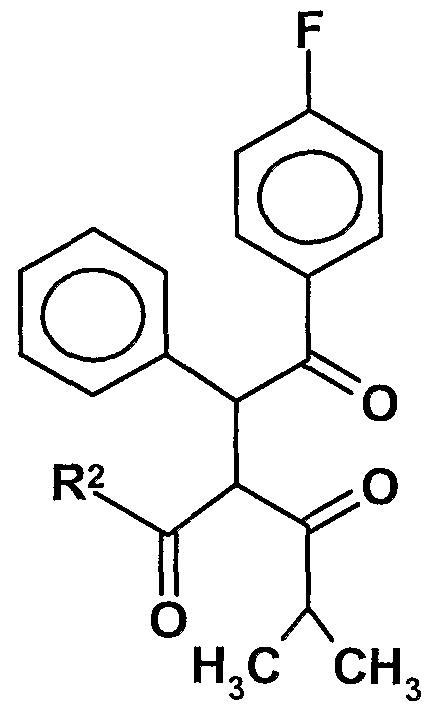
which process comprises the steps of reacting a compound of the formula Il
Figure imgf000006_0001
wherein R2 is defined as above, or a salt thereof with a compound of the formulae Ilia, IHb or IHc
R1-NH2 IHa,
R1-NH-COCT H3N+-R1 HIb,
R1-NH-SiR17R18R19 IHc,
or mixtures thereof, wherein R1 is defined as above,
R17 and R18 are independently selected from straight, branched and/or cyclic C1-10 alkyl residues or aryl residues, and
R19 is straight, branched and/or cyclic C1-I0 alkyl residue, aryl residue or -NH-R1, and, if necessary, converting the obtained pyrrole derivative having the substituent R1 into a pyrrole derivative having a different substituent R1, provided that if R2 is -NR4R5 the compound of the formula IHa is NH3.
Preferably the compound of the formula Ilia is not
Figure imgf000006_0002
or wherein X1, X2 and X3 are hydrogen or protecting groups, in particular if R2 is -OR3 (such as -OCH2CH3).
One advantage of the process of the present invention is that if R2 is -OR3 or halogen the compound of the formula Il is easy to produce in good yield and purity. A further advantage is that if R2 is -OR3 or halogen the intermediate compound of the formula Il provides the possibility of easy substitution of the R2 residue, thereby providing higher flexibility for example for screening substituted pyrrole compounds for their pharmaceutical activity. This finding is particularly unexpected, since the corresponding known diketone anilide (2-[2-(4- fluorophenyl)-2-oxo-1-phenyl-ethyl]-4-methyl-3-oxo-pentanoic acid phenylamide) turned out to be stable to hydrolysis. It reacts with base and hydrogen peroxide not to the expected acid but it breaks to 1-(4-fluorophenyl)-2-phenylethan-1-one (compound of formula VIII). This problem does not arise when using the corresponding diketone ester or acid halogenide (compound of the formula II).
Moreover, if using NH3 as the compound of the formula Ilia in the process of the present invention, the yield of the ring-forming reaction is significantly higher compared to reactions with compounds of the formula Ilia, wherein R1 is other than hydrogen.
In the process of the present invention a compound of the above formula Il is reacted with a compound of the above formulae Ilia, HIb or IHc. In the compound of the formulae HIa, HIb and IHc R1 is either hydrogen or a hydrocarbon group. If in the compound of formula HIa R1 is hydrogen, liquid ammonia, aqueous ammonia or a solution of an ammonium salt such as NH4CI or CH3COONH4 can be used. Thus, NH3 as one compound of the formula IHa also includes NH4 + ions which will always be present in the reaction solution in dependence of the pH value of the solution. Preferably the diketone of the formula Il is reacted with CH3COONH4. The reaction can be carried out in any common inert solvent such as THF preferably at elevated temperatures, such as, for example, under reflux.
In one embodiment the reaction is conducted with ammonium acetate in refluxing THF for about 6 hours. The yield of this reaction is considerably higher than the yield of the similar reaction with benzylamine instead of ammonium acetate. Instead of NH3 a primary amine (formula MIa), an amine derivative with carbon dioxide (formula lllb) or a silylated amine (formula IMc) can be employed in the process of the present invention. In this case the substituent R1 is not particularly limited and can be chosen among the hydrocarbon groups defined above for R1. Preferably R1 is a straight or branched, saturated or unsaturated C1-2O hydrocarbon group, in particular C-ι-2o alkyl group, which may comprise 1-5 oxygen atoms, may be substituted with 1-5 optionally protected hydroxy groups, 1 or 2 -NR8R9 residues (wherein R8 and R9 are defined as above) and/or 1 or 2 optionally protected carboxy groups, in which hydrocarbon group 1-5 carbon atoms may form carbonyl groups and which hydrocarbon group or part of which hydrocarbon group may form 1 or more rings.
In one embodiment of the process of the present invention R1 is a residue of the formula X
Figure imgf000008_0001
which may optionally be protected or is chosen such that it can easily be converted into a residue of the formula X. Residues which can be converted into residues of the formula X are for example known from WO 2004/046105, WO 94/20492, WO 02/057274, WO 02/055519, EP-A-O 330 172, EP-A-O 179 559, EP-A-O 247 633 and EP-A-O 409 281. The disclosures of these documents are therefore incorporated by reference herein.
Preferred residues for R1 are selected from the following residues:
Figure imgf000008_0002
Figure imgf000009_0001
wherein Ra is -ORb, -SRC, SeRd or -NReRf;
Rb, Rc and Rd are independently selected from straight, branched and/or cyclic, saturated or unsaturated C1-I0 alkyl residue, aryl residue or arylalkyl residue;
Re and Rf are independently selected from straight, branched and/or cyclic, saturated or unsaturated Ci-10 alkyl residue, aryl residue or arylalkyl residue or
Re and Rf taken together are
-(CH2J4-
-(CHz)5-
-(CH(R9)-CH2)3-
-(CH(R9)-CH2)4-
-(CH(R9HCHz)2-CH(R9))-
-(CH(R9)-(CH2)3-CH(R9))-
-CH2-CH2-A-CH2-CH2-
-CH(R9)-CH2-A-CH2-CH2-
-CH(R9)-CH2-A-CH2-CH(R9)-,
wherein R9 is C1-4 alkyl residue and A is O, S or NRh, wherein Rh is hydrogen or C1-4 alkyl residue; and each hydroxy group may independently be protected with a suitable protecting group whereby two hydroxy groups together with their protecting group may form a ring. It is understood that any of the residues R1 can be, if possible, in its lactone or lactame form. As protecting groups for the optionally protected hydroxy groups and the optionally protected carboxy groups usual protecting groups known to the person skilled in the art may be used. Suitable protecting groups are exemplified in WO 03/044011 , which therefore is incorporated by reference herein.
In the compound of the formula Il R2 may be -OR3, -NR4R5 or halogen, preferably -OR3 or halogen and most preferred -OR3. Herein R3, R4 and R5 are defined as above.
For R3, R4, R5, R6, R7, R8, R9, R10, R11, R12, R13, R14, R15, R16, Rb, Rc, Rd, Re and Rf the alkyl residue is preferably a straight or branched, saturated or unsaturated C1-6 alkyl residue or a cyclic C3-6 alkyl residue, such as methyl, ethyl, n-propyl, iso-propyl, n-butyl, iso-butyl, tert- butyl, pentyl, n-hexyl or cyclohexyl. Preferred aryl residues are phenyl and naphthyl, particularly preferred phenyl. The aryl residue furthermore includes heteroaryl residues such as pyrrole or pyridine. The preferred arylalkyl residue is benzyl.
For R17, R18 and R19 the alkyl residue is preferably a straight or branched C1-6 alkyl residue or a cyclic C3-6 residue, such as methyl, ethyl, n-propyl, iso-propyl, n-butyl, iso-butyl, tert- butyl, pentyl, n-hexyl or cyclohexyl. Preferred aryl residues are phenyl and naphthyl, particularly preferred phenyl. The aryl residue furthermore includes heteroaryl residues such as pyrrole or pyridine.
In the present application halogen stands for fluoro, chloro, bromo or iodo, preferably chloro or bromo.
The primary amine of the formula Ilia or the amines of the formulae IHb or IMc are reacted with a diketone of the formula II. This reaction can for example be carried out under the same conditions as described above for the reaction, wherein the compound of the formula HIa is NH3. Further detailed reaction conditions can for example be found in WO 2004/046105, WO 94/20492 and EP-A-O 330 172. For example, the reaction can be conducted under heating with azeotropical water removed in an appropriate solvent or mixture of solvents catalyzed with an acid, such as, for example, pivalic acid. As suitable solvents n-heptane, toluene and THF or mixtures thereof can be mentioned. Alternatively the reaction can be conducted without any solvent (neat) under heating the reactants to for example about 12O0C to 140°C. When reacting a compound of the formula M, wherein R2 is -OR3 or halogen with a compound of the formulae Ilia, MIb or IHc a by-product of the following formula IV
Figure imgf000011_0001
wherein R1 at both occurrences are identical and defined as above may be obtained. In this case the desired pyrrole derivative of the formula I may be separated from the reaction byproduct of the formula IV, and the reaction by-product can subsequently be converted into a pyrrole derivative of the formula I, wherein R2 is -OR3, -NR4R5 or halogen and R3, R4 and R5 are defined as above, provided that -NR4R5 is different from -NHR1. This reaction route is effective for recycling undesired by-products obtained in the reaction between the diketone of the formula Il and the amine of the formula III.
In a further embodiment of the process of the present invention the compound of the formula Il is obtained by
a) reacting a compound of the formula V
Figure imgf000011_0002
3 v wherein R2 is defined as in claim 1 , with 4-fluorobenzaldehyde or
b) reacting a compound of the formula Vl
Figure imgf000012_0001
wherein Hal is halogen, preferably bromo with a compound of the formula VII
Figure imgf000012_0002
VII,
wherein R2 is defined as in claim 1 and M+ is selected from H+, Li+, Na+ and K+, preferably Na+.
The above reaction route a) has the advantage that the compound of the formula V, wherein R2 is -OR3 can be easily purified by distillation. Thus, this intermediate can be employed in the following reaction in a highly pure form.
The above reaction route b) has the advantage that the compound of the formula Vl can easily be obtained from the commercially available 2-[2-(4-fluorophenyl)-2-oxo-1-phenyl- ethyl]-4-methyl-3-oxo-pentanoic acid phenylamide by cleavage with hydrogen peroxide in the presence of a base such as NaOH. Above reaction a) can for example be carried out under solvent-free conditions catalyzed by 2-(2-hydroxyethyl)-3-methyl-4-ethylthiazolium bromide in the presence of triethylamine under heating to for example to a temperature of about 6O0C to about 800C.
In reaction route a) the compound of the formula V can be obtained by reacting a compound of the formula IX
Figure imgf000013_0001
wherein R2 is defined as above with benzaldehyde. This reaction can be carried out in the presence of a catalyst such as, for example, piperidine and glacial acetic acid, ethylene diamine and glacial acetic acid, β-alanine and glacial acetic acid, and the like in an inert solvent such as, for example, toluene, heptane, hexane, and the like for about 24 to about 36 hours at about 600C to about 1200C with the removal of water to afford a compound of the formula V.
If in the compound of the formula V R2 is -OR3, this compound is heat-stable and can be distilled as to separate the desired compound of the formula V from undesired by-products of the reaction. In a preferred embodiment of the process of the present invention the reaction between the compound of the formula IX and benzaldehyde is catalyzed with β- alanine in the presence of acetic acid, preferably glacial acetic acid, in toluene. The reaction mixture is heated under reflux with azeotropic removal of water for about 24 hours. After usual workup the product can be distilled under reduced pressure.
In the alternative embodiment according to above route b) the compound of the formula Il is obtained by reacting the compounds of the formula Vl and VII with each other. This addition reaction can be carried out in any suitable inert organic solvent, preferably anhydrous inert organic solvent, such as, for example, ethers, e.g. diethyl ether, 1 ,2-diethoxyethane, 1 ,2- dimethoxyethane, THF or mixtures thereof. Preferably the reaction is carried out in THF. The reaction temperature may be in the range of for example about O0C to about 4O0C, preferably from about 0°C to about room temperature. In a preferred embodiment the compound of the formula VII is prepared in situ.
The compound of the formula Vl can be obtained by halogenating the compound of the formula VII!
Figure imgf000014_0001
Halogenation, preferably bromination of the compound of the formula VIII can be carried out with for example bromine in an inert organic solvent, preferably an anhydrous inert organic solvent, such as, for example, halogenated lower alkane solvents, e.g. CCI4, CHCI3, 1 ,1- dichloroethane, 1 ,2-dichloroethane, methylene chloride, 1 ,1 ,2-trichloroethane or mixtures thereof. A preferred solvent is CHCI3. The reaction can be carried out for example at a temperature of about O0C to about 40°C.
The compound of the formula VIII can be obtained by cleavage of a compound of the formula II, wherein R2 is -NR4R5, and R4 and R5 are defined as above, such as the commercially available 2-[2-(4-fluorophenyl)-2-oxo-1 -phenyl-ethyl]-4-methyl-3-oxo- pentanoic acid phenylamide. The cleavage can be carried out for example with hydrogen peroxide in the presence of a base such as NaOH.
A particularly advantageous route for the synthesis of a compound of the formula Il is shown in the following scheme:
COOEt
Figure imgf000014_0003
Figure imgf000014_0002
Figure imgf000015_0001
Advantages of the synthesis of diketone ethyl ester by this route are: no need of reaction solvent in step 2 (environmental, economic); no need of recrystallization process in step 1 (environmental, economic), product is isolated by distillation; this is the shortest synthetic route (only 2 steps) in comparison with other known processes (3-5 steps required); in the process for the step 1 nontoxic catalyst (β-alanine) is used
(environmental); no need of toxic a corrosive reagents (like bromine in alternative route); all starting materials are commercially available.
The present invention further relates to compounds of the formula I, Il and IV, wherein R2 is -OR3 or halogen and R1 at both occurrences are identical and defined as above, respectively. These compounds are useful intermediates in the preparation of atorvastatin.
The present invention will now be further illustrated by the following examples which are not intended to be limiting.
Examples
1. Synthesis of ethyl-2-benzylidene-4-methyl-3-oxopentanoate (compound of formula V)
A mixture of benzaldehyde (33.8 g, 319 mmol), ethyl isobutyrylacetate (50.4 g, 319 mmol), β-alanine (1.0 g) and acetic acid (10 ml) in 600 ml of toluene was stirred and heated under reflux with azeotropic removal of water (Dean-Stark adapter) until GC analysis showed no presence of starting material (24 h). The solution was cooled, poured into ethylacetate (400 ml), washed with 1 M HCI solution (2 x 100 ml), saturated NaHCO3 solution (2 x 100 ml) and brine (100 ml) and dried over anhydrous Na2SO4. The solvent was removed under reduced pressure to yield 76.3 g of brown oil which was further distilled under reduced pressure (bp 105 - 120°C/0.06 mm Hg) to afford 58.9 g (75%) of ethyl 2-benzylidene-4-methyl-3- oxopentanoate as a mixture of isomers (major ~ 70%).
2. Synthesis of ethyl 2-[2-(4-fluorophenyl)-2-oxo-1-phenyl-ethyl]-4-methyl-3- bxopentanoate (compound of formula II)
To a stirred mixture of ethyl 2-benzylidene-4-methyl-3-oxopentanoate (52.5 g, 0.213 mol), 4-fluorobenzaldehyde (39.7 g, 0.320 mol) and 2-(2-hydroxyethyl)-3-methyl-4-ethylthiazolium bromide (8.11 g, 0.032 mol) was added dropwise triethylamine (21.3 ml). The solution turned dark and precipitation of solid particles was observed. A mixture was then heated at 70°C until the reaction mixture did not contain starting ethyl 2-benzylidene-4-methyl-3- oxopentanoate (HPLC monitoring). After cooling to room temperature, the mixture was diluted with ethylacetate (500 ml) and water (100 ml). The organic phase was washed with 1 M HCI solution (2 x 100 ml), saturated NaHCO3 solution (2 x 100 ml) and brine (100 ml) and dried over anhydrous Na2SO4. The solvent was removed under reduced pressure to yield 100.2 g of impure oily product which was then dissolved in dichloromethane (400 ml) and silicagel (50 g) was added. The mixture was stirred for 10 minutes and the silicagel was filtered off and washed with dichloromethane (500 ml). Air was bubbled through the combined filtrates for 24 hours in order to oxidize remaining 4-fluorobenzaldehyde. Additional 200 ml of dichloromethane was added to the reaction mixture to compensate losses due to evaporation and the solution was washed with saturated NaHCO3 solution (2 x 100 ml) and water (100 ml) and dried over anhydrous Na2SO4. The solvent was removed under reduced pressure to yield 87 g yellow oily product which slowly solidified. The oily product contains 85% of ethyl 2-[2-(4-fluorophenyl)-2-oxo-1-phenyl-ethyl]-4-methyl-3- oxopentanoate and the calculated yield was then 94%.
3. Synthesis of ethyl 5-(4-fluorophenyl)-2-isopropyl-1-phenethyl-4-phenyl-1H- pyrrole-3-carboxylate (compound of the formula I)
Ethyl 2-[2-(4-fluorophenyl)-2-oxo-1-phenyl-ethyl]-4-methyl-3-oxopentanoate (reagent 1) was reacted with 2-phenylethylamine (reagent 2) under the conditions summarized in the following table 1. Table 1
Figure imgf000017_0001

Claims

Claims:
1. Process for preparing a pyrrole derivative of the formula I
Figure imgf000018_0001
wherein
R1 is hydrogen or a straight or branched, saturated or unsaturated Ci-30 hydrocarbon group which may comprise 1-5 oxygen atoms, 1-5 nitrogen atoms, 1-2 sulfur atoms, 1 selenium atom and/or 1-5 -NR6- residues, which hydrocarbon group may be substituted with 1-5 optionally protected hydroxy groups, 1-5 -OR7 residues, 1-5 -NR8R9 residues, 1-5 halogen atoms and/or 1-5 optionally protected carboxy groups, in which hydrocarbon group 1-5 carbon atoms may form carbonyl groups and which hydrocarbon group or part of which hydrocarbon group may form one or more rings,
R2 is -OR3, -NR4R5, -NR10CONR11R12, -NR13OR14, -ONR15R16 or halogen,
R3, R4, R5, R6, R7, R8, R9, R10, R11, R12, R13, R14, R15 and R16 are independently selected from hydrogen or a straight, branched and/or cyclic, saturated or unsaturated C1-10 alkyl residue or aryl residue, both residues being optionally substituted with 1-3 optionally protected hydroxy or carboxy groups, 1-3 -OR7 residues, 1-3 -NR8R9 residues and/or 1-3 halogen atoms, the Ci-10 alkyl residue optionally comprising 1-3 oxygen atoms, 1-3 nitrogen atoms and/or 1-3 -NR6- residues, the Ci-10 alkyl residue further optionally comprising or being substituted with 1 or 2 aryl residues, or a salt thereof, which process comprises the steps of reacting a compound of the formula Il
Figure imgf000019_0001
wherein R2 is defined as above, or a salt thereof with a compound of the formulae Ilia, HIb or IHc
R1-NH2 HIa,
R1-NH-COO" H3N+-R1 HIb
R1-NH-SiR17R18R19 IHc,
or mixtures thereof, wherein R1 is defined as above,
R17 and R18 are independently selected from straight, branched and/or cyclic C1-10 alkyl residue or aryl residue; and
R19 is straight, branched and/or cyclic C1--I0 alkyl residue, aryl residue or -NH-R1, and, if necessary, converting the obtained pyrrole derivative having the substituent R1 into a pyrrole derivative having a different substituent R1, provided that if R2 is -NR4R5 the compound of the formula Ilia is NH3.
2. Process according to claim 1 , wherein R2 is -OR3 or halogen.
3. Process according to claim 2, which comprises the additional step of separating the pyrrole derivative of the formula I from the reaction by-product of the formula IV
Figure imgf000020_0001
wherein R1 at both occurrences are identical and defined as in claim 1.
4. Process according to claim 3, which comprises the additional step of converting the separated reaction by-product of the formula IV into a pyrrole derivative of the formula I1 wherein R2 is -OR3, -NR4R5 or halogen and R3, R4 and R5 are defined as in claim 1 , provided that -NR4R5 is different from -NHR1.
5. Process according to any of the preceding claims, wherein the compound of formula Il is obtained by
a) reacting a compound of the formula V
Figure imgf000020_0002
wherein R2 is defined as in claim 1 , with 4-fluorobenzaldehyde or b) reacting a compound of the formula Vl
Figure imgf000021_0001
wherein Hal is halogen, with a compound of the formula VII
Figure imgf000021_0002
VII1
wherein R2 is defined as in claim 1 and M+ is selected from H+, Li+, Na+ and K+, preferably Na+.
6. Process according to claim 5, wherein the compound of the formula Vl is obtained by halogenating the compound of the formula VIII
Figure imgf000021_0003
7. Process according to claim 6, wherein the compound of the formula VIII is obtained by cleavage of a compound of the formula II, wherein R2 is -NR4R5, and R4 and R5 are defined as in claim 1.
8. Process according to claim 5, wherein the compound of the formula V is obtained by reacting a compound of the formula IX
Figure imgf000022_0001
wherein R2 is defined as in claim 1 with benzaldehyde.
9. Process according to any of the preceding claims, wherein R1 is a straight or branched, saturated or unsaturated C1-2O hydrocarbon group which may comprise 1-5 oxygen atoms, may be substituted with 1-5 optionally protected hydroxy groups, 1 or 2 -NR8R9 residues (wherein R8 and R9 are defined as in claim 1 ) and/or 1 or 2 optionally protected carboxy groups, in which hydrocarbon group 1-5 carbon atoms may form carbonyl groups and which hydrocarbon group or part of which hydrocarbon group may form one or more rings.
10. Process according to any of the preceding claims, wherein R3, R4, R5, R6, R7, R8 and R9 are independently selected from hydrogen, a straight or branched, saturated or unsaturated Ci-6 alkyl residue, a cyclic C3-6 alkyl residue or phenyl.
11. Process according to any of the preceding claims, wherein in the compound of the formula I R2 is or is converted to -NH-phenyl and R1 is or is converted to a residue of the formula X
Figure imgf000022_0002
which may optionally be protected.
12. Compound of the formula
Figure imgf000023_0001
wherein R2 is -OR3 or halogen and R1 and R3 are defined as in claim 1 , or a salt thereof, provided that if R3 is ethyl R1 is not -CH2-phenyl.
13. Compound of the formula Il
Figure imgf000023_0002
wherein R2 is -OR3 or halogen and R3 is defined as in claim 1 , or a salt thereof, provided that R3 is not ethyl.
14. Compound of the formula IV
Figure imgf000024_0001
wherein R1 at both occurrences are identical and defined as in claim 1 , or a salt thereof.
15. Use of a compound of the formula I as defined in claim 12 for the preparation of atorvastatin.
16. Use of a compound of the formula Il as defined in claim 13 for the preparation of atorvastatin.
17. Use of a compound of the formula IV as defined in claim 14 for the preparation of atorvastatin.
PCT/EP2005/013588 2004-12-20 2005-12-16 Process for preparing pyrrole derivatives and intermediates Ceased WO2006066823A1 (en)

Priority Applications (2)

Application Number Priority Date Filing Date Title
US11/722,318 US7932403B2 (en) 2004-12-20 2005-12-16 Process for preparing pyrrole derivatives and intermediates
CA002591603A CA2591603A1 (en) 2004-12-20 2005-12-16 Process for preparing pyrrole derivatives and intermediates

Applications Claiming Priority (2)

Application Number Priority Date Filing Date Title
EP04030159A EP1671947A1 (en) 2004-12-20 2004-12-20 Process for preparing pyrrole derivatives and intermediates
EP04030159.0 2004-12-20

Publications (1)

Publication Number Publication Date
WO2006066823A1 true WO2006066823A1 (en) 2006-06-29

Family

ID=34927866

Family Applications (1)

Application Number Title Priority Date Filing Date
PCT/EP2005/013588 Ceased WO2006066823A1 (en) 2004-12-20 2005-12-16 Process for preparing pyrrole derivatives and intermediates

Country Status (4)

Country Link
US (1) US7932403B2 (en)
EP (1) EP1671947A1 (en)
CA (1) CA2591603A1 (en)
WO (1) WO2006066823A1 (en)

Families Citing this family (1)

* Cited by examiner, † Cited by third party
Publication number Priority date Publication date Assignee Title
WO2015003310A1 (en) * 2013-07-09 2015-01-15 Hua Zhong University Of Science Technology Synchronized virtual trusted platform modules (vtpm) and virtual machine (vm) rollbacks

Citations (5)

* Cited by examiner, † Cited by third party
Publication number Priority date Publication date Assignee Title
WO2003004457A2 (en) * 2001-07-04 2003-01-16 Ciba Specialty Chemicals Holding Inc. Preparation process for atorvastatin and intermediates
WO2003044011A1 (en) * 2001-11-22 2003-05-30 Ciba Specialty Chemicals Holding Inc. Pyrrole synthesis
WO2004106299A2 (en) * 2003-05-30 2004-12-09 Ranbaxy Laboratories Limited Substituted pyrrole derivatives and their use as hmg-co inhibitors
WO2005012246A1 (en) * 2003-07-25 2005-02-10 Avecia Pharmaceuticals Limited Process and intermediate compounds useful in the preparation of statins, particularly atorvastatin
WO2005118536A1 (en) * 2004-05-31 2005-12-15 Ranbaxy Laboratories Limited Process for the preparation of atorvastatin

Family Cites Families (3)

* Cited by examiner, † Cited by third party
Publication number Priority date Publication date Assignee Title
GEP20002029B (en) * 1995-07-17 2000-04-10 Warner Lambert Company Us (54) Crystalline [R-(R*,R*,]–2-(4-Fluorophenyl)-Beta,Delta-Dihydroxy-5-(1-Methyl-Ethyl)-3-Phenyl–4-{Phenylamino) Carbonyl} - 1H - Pyrrole - 1 - Heptanoic Acid Hemi Calcium Salt (Atorvastatin)
WO2002057229A1 (en) * 2001-01-19 2002-07-25 Biocon India Limited FORM V CRYSTALLINE [R-(R*,R*)]-2-(4-FLUOROPHENYL)-ß,$G(D)-DIHYDROXY-5-(1-METHYLETHYL)-3-PHENYL-4-[(PHENYLAMINO)CARBONYL]-1H-PYRROLE-1- HEPTANOIC ACID HEMI CALCIUM SALT. (ATORVASTATIN)
WO2004103960A2 (en) * 2003-05-16 2004-12-02 Ambit Biosciences Corporation Compounds and uses thereof

Patent Citations (5)

* Cited by examiner, † Cited by third party
Publication number Priority date Publication date Assignee Title
WO2003004457A2 (en) * 2001-07-04 2003-01-16 Ciba Specialty Chemicals Holding Inc. Preparation process for atorvastatin and intermediates
WO2003044011A1 (en) * 2001-11-22 2003-05-30 Ciba Specialty Chemicals Holding Inc. Pyrrole synthesis
WO2004106299A2 (en) * 2003-05-30 2004-12-09 Ranbaxy Laboratories Limited Substituted pyrrole derivatives and their use as hmg-co inhibitors
WO2005012246A1 (en) * 2003-07-25 2005-02-10 Avecia Pharmaceuticals Limited Process and intermediate compounds useful in the preparation of statins, particularly atorvastatin
WO2005118536A1 (en) * 2004-05-31 2005-12-15 Ranbaxy Laboratories Limited Process for the preparation of atorvastatin

Non-Patent Citations (4)

* Cited by examiner, † Cited by third party
Title
GRAUL A ET AL: "ATORVASTATIN CALCIUM", DRUGS OF THE FUTURE, BARCELONA, ES, vol. 22, no. 9, 1997, pages 956 - 968, XP000904817, ISSN: 0377-8282 *
PANDEY P S, RAO T S: "An efficient synthesis of N3,4-diphenyl-5-(4-fluorophenyl)-2-isopropyl-1H-3-pyrrolecarboxamide, a key intermediate for atorvastatin synthesis", BIOORGANIC & MEDICINAL CHEMISTRY LETTERS, vol. 14, no. 1, 5 January 2004 (2004-01-05), pages 129 - 131, XP002328323 *
PROCOPIOU P A ET AL: "INHIBITORS OF CHOLESTEROL BIOSYNTHESIS. 2. 3,5-DIHYDROXY-7-(N-PYRROLY L)-6-HEPTENOATES, A NOVEL SERIES OF HMG-COA REDUCTASE INHIBITORS", JOURNAL OF MEDICINAL CHEMISTRY, AMERICAN CHEMICAL SOCIETY. WASHINGTON, US, vol. 36, no. 23, 1993, pages 3658 - 3662, XP002303229, ISSN: 0022-2623 *
ROTH B D ET AL: "INHIBITORS OF CHOLESTEROL BIOSYNTHESIS. 3. TETRAHYDRO-4-HYDROXY-6-(2- (1H-PYRROL-1-YL)ETHYL)-2H-PYRAN-2-ONE INHIBITORS OF HMG-COA REDUCTASE. 2. EFFECTS OF INTRODUCING SUBSTITUENTS AT POSITIONS THREE AND FOUR OF THE PYRROLE NUCLEUS", JOURNAL OF MEDICINAL CHEMISTRY, AMERICAN CHEMICAL SOCIETY. WASHINGTON, US, vol. 34, no. 1, January 1991 (1991-01-01), pages 357 - 366, XP002922115, ISSN: 0022-2623 *

Also Published As

Publication number Publication date
CA2591603A1 (en) 2006-06-29
EP1671947A1 (en) 2006-06-21
US20090012312A1 (en) 2009-01-08
US7932403B2 (en) 2011-04-26

Similar Documents

Publication Publication Date Title
EP0553213B1 (en) Process for the synthesis of (4r-cis)-1,1-dimethylethyl-6-cyanomethyl-2,2-dimethyl-1,3-dioxane-4-acetate
US5248793A (en) Process for the synthesis of (4R-cis)-1,1-dimethylethyl 6-iodomethyl or 6-(phenyl-substituted)sulfonyloxymethyl-2,2-dimethyl-1,3-dioxane-4-acetate
KR100877165B1 (en) Hydrolysis of [??*,?*]-2-4-fluorophenyl-?,?-dihydroxy-5-1-methylethyl-3-phenyl-4-[phenylaminocarbonyl]-1?-pyrrole-1-heptanoic acid esters with calcium hydroxide
HK1005026B (en) Process for the synthesis of (4r-cis)-1, 1-dimethylethyl-6-cyanomethyl-2, 2-dimethyl-1, 3-dioxane-4-acetate
EP0448552A1 (en) IMPROVED PROCESS FOR $i(TRANS)-6- 2-(SUBSTITUTED-PYRROL-1-YL)ALKYL]PYRAN-2-ONE INHIBITORS OF CHOLESTEROL SYNTHESIS
EP1351963A1 (en) A process for the synthesis of atorvastatin form v and phenylboronates as intermediate compounds
US7812179B2 (en) Process for the preparation of atorvastatin and intermediates
US6278001B1 (en) Method for preparing (+) compactin and (+) mevinolin analog compounds having a β-hydroxy-δ-lactone grouping
EP2319843B1 (en) Substituted pyrrole derivatives and their use as HMG-CO inhibitors
WO2007107276A2 (en) Process for preparing c7 intermediates and their use in the preparation of n-substituted pyrrole derivatives
WO2007096751A1 (en) Process for the preparation of atorvastatin calcium
WO2008103016A1 (en) Atorvastatin intermediates and method for producing the same
US7932403B2 (en) Process for preparing pyrrole derivatives and intermediates
WO2004046105A2 (en) Synthesis of 3,5-dihydroxy-7-pyrrol-1-yl heptanoic acids
JP2011236212A (en) Process for preparing statin
US20090081801A1 (en) Process for synthesis of pyrrole derivative, an intermediate for atorvastatin
EP1705175A1 (en) Process for preparing C5 products and their use for Atorvastatin synthesis
WO2007131528A1 (en) Process for preparing c5 intermediates and their use in the preparation of n-substituted pyrrole derivatives
KR100529703B1 (en) Chiral intermediate, process for the production thereof, and process for the production of atorvastatin
KR101249868B1 (en) Process for preparing a chiral intermediate for the prepartion of atorvastatin
WO2006059346A2 (en) An improved process for lactonization to produce highly pure statins
JPWO2003095446A1 (en) Process for producing 1- (4-pyridyl) -4-piperidone
AU3349689A (en) Improved process for trans-6-(2-(substituted-pyrrol-1-yl) alkyl)pyran-2-one inhibitors of cholesterol synthesis
GB2135996A (en) New isoxazoles and process for the preparation thereof
NO177423B (en) Improved Process for Preparation of Trans-6- [2- (Substituted-Pyrrol-Yl) alkyl] Pyran-2-one Inhibitors for Cholesterol Synthesis

Legal Events

Date Code Title Description
AK Designated states

Kind code of ref document: A1

Designated state(s): AE AG AL AM AT AU AZ BA BB BG BR BW BY BZ CA CH CN CO CR CU CZ DE DK DM DZ EC EE EG ES FI GB GD GE GH GM HR HU ID IL IN IS JP KE KG KM KN KP KR KZ LC LK LR LS LT LU LV LY MA MD MG MK MN MW MX MZ NA NG NI NO NZ OM PG PH PL PT RO RU SC SD SE SG SK SL SM SY TJ TM TN TR TT TZ UA UG US UZ VC VN YU ZA ZM ZW

AL Designated countries for regional patents

Kind code of ref document: A1

Designated state(s): GM KE LS MW MZ NA SD SL SZ TZ UG ZM ZW AM AZ BY KG KZ MD RU TJ TM AT BE BG CH CY CZ DE DK EE ES FI FR GB GR HU IE IS IT LT LU LV MC NL PL PT RO SE SI SK TR BF BJ CF CG CI CM GA GN GQ GW ML MR NE SN TD TG

121 Ep: the epo has been informed by wipo that ep was designated in this application
WWE Wipo information: entry into national phase

Ref document number: 2591603

Country of ref document: CA

NENP Non-entry into the national phase

Ref country code: DE

WWE Wipo information: entry into national phase

Ref document number: 11722318

Country of ref document: US

122 Ep: pct application non-entry in european phase

Ref document number: 05820440

Country of ref document: EP

Kind code of ref document: A1

WWW Wipo information: withdrawn in national office

Ref document number: 5820440

Country of ref document: EP