PROCESS FOR REMOVING MANGANESE FROM WATER BY TREATMENT WITH PERACETIC ACID
The present invention relates to a process for removing manganese from an aqueous liquid by treating the aqueous liquid with an oxidant and optionally with a coagulant.
Manganese is a common contaminant in natural water sources where it often occurs in association with other metal contaminants, such as iron, aluminium and/or naturally occurring colored compounds. In Finland, raw water is often colored, as turbid surface water may contain humus as well as iron and manganese. The raw water used by Finnish pulp and paper mills is surface water. Also a remarkable part of the domestic water in Finland is surface water.
The main requirements for water quality concern color or humic substances and iron and manganese concentrations. The adverse effect of soluble manganese in drinking water is related to discoloration. Also the growth of iron and manganese - oxidizing bacteria on water mains can lead to general deterioration of the quality of the water distributed. For these reasons standards have been established for maximum concentrations of soluble manganese in drinking water.
Manganese is conventionally removed from water by following scheme: aeration, coagulation, addition of alkali, clarification and sand filtration.
The removal of manganese usually requires oxidation of manganese (II) to higher oxidation states in which manganese precipitates as a solid compound. The most common oxidation state is (IV), but also exist (III) and an intermediate oxidation state between (III) and (II) can be as oxidation product. The chemical formulas are mainly manganese oxides or oxyhydrates. Several methods and chemicals are available for oxidation. In conventional water treatment, manganese removal is carried out for example by oxidising with chlorine, chlorine dioxide, ozone, hydrogen peroxide or potassium permanganate to form solid manganese compounds, which precipitate out of water. The precipitated, solid compounds are then removed from the solution by filtration. Some of these prior art methods will be discussed below.
DE-A1 -2408051 discloses a process for removing manganese from water. According to the process an oxidant and sodium aluminate are added to the water to be purified so as to precipitate manganese(IV)-oxyhydrate which can be separated by filtration. Disclosed oxidants are air and/or potassium permanganate.
DE-B-1517542 discloses a process for removing manganese from water. According to the process a water flow is divided into two parts one of which is oxidized with ozone for oxidizing Mn(II) to Mn(IV). The thus oxidized water flow is combined with the other flow resulting in an oxidation wherein Mn(VII) oxidizes Mn(II) to Mn(IV) which precipitates as manganese(IV)-oxyhydrat which can be separated by filtration.
DE-B-1642479 discloses a process comprising oxidizing raw water containing soluble iron and manganese and adding thereto prior to or after or during the oxidation iron(lll)-oxyhydrate and manganese(IV)-oxyhydrat. These added substances catalyze the flocculation process and act as a flocculant. The solid containing iron(lll)-oxyhydrate and manganese(IV)-oxyhydrate precipitate obtained in the flocculation is separated by filtration. A portion of the solid filter precipitate or sludge is recirculated. The oxidation can be carried out by using air, ozone, chlorine or potassium permanganate.
WO-A-97/34836 discloses the preparation of a coagulant by subjecting a concentrated aqueous solution of a water treatment chemical containing an iron and/or aluminium compound as the main component and soluble bivalent Mn(II) as an impurity to oxidation by means of an oxidant to convert the soluble Mn(II) to manganese dioxide or permanganate. Disclosed oxidants are ozone, hydrogen peroxide, chlorine, chlorine dioxide, chlorate, permanganate and ferrite. The coagulant can be used for removing manganese from raw water, the manganese being oxidized to manganese dioxide due to the presence of a surplus of oxidant in the coagulant.
JP-2003001272 discloses a process for removing manganese from raw water by adding hydrogen peroxide to the raw water in order to convert soluble manganese to insoluble manganese dioxide and removing the formed manganese dioxide particles by membrane filtration.
Some of the oxidants used in the prior art processes are harmful to the environment (chlorine compounds) or suffer from low efficiency or are expensive (potassium permanganate).
An object of the present invention is to provide a simple and efficient process for removing manganese from raw water or other aqueous liquids by using an oxidant which also acts as a biocide preventing the growth of bacteria on water mains.
According to the present invention there is provided a process for removing manganese from an aqueous liquid comprising treating the aqueous liquid with peracetic acid in order to oxidize soluble Mn(II) present in the aqueous liquid to an insoluble manganese compound and optionally with a coagulant, and separating the formed insoluble manganese compound from the treated raw water.
The soluble Mn(II) present in the aqueous liquid is oxidized to a higher oxidation state in which manganese precipitates as a solid compound. The oxidation state is preferably (IV), but can also be (III) or an intermediate oxidation state between (III) and (II). Also mixtures of insoluble manganese compounds can be formed during the oxidation. Preferred insoluble manganese compounds are manganese oxides and manganese oxyhydrates, and especially preferred are manganese(IV) dioxide and manganese(IV) oxyhydrate.
In one embodiment of the invention the aqueous liquid is treated with a coagulant before the treatment with the peracetic acid. This order of treatment results in good manganese removal. The flocculated substance including organic matter can be removed before the treatment with the peracetic acid.
In another embodiment of the invention the aqueous liquid is treated with a coagulant after the treatment with the peracetic acid.
Good results in respect of manganese removal are obtained when the retention time of the treatment with the peracetic acid is from 1 minute to 24 hours. This applies to both the case where the aqueous liquid is treated with the coagulant before the treatment with the peracetic acid and the case where the aqueous liquid is treated with the coagulant after the treatment with the peracetic acid.
The coagulant can be an inorganic coagulant, preferably an iron or aluminium compound. The iron compound can be a divalent or trivalent iron compound, preferably a trivalent iron compound, such as ferric sulphate or ferric chloride. A preferred aluminium compound is polyaluminiumchloride. Also other aluminium compounds can be used, such as alum (aluminium sulphate).
The precipitated manganese compound can be separated by filtration, such as sand filtration.
The peracetic acid can be equilibrium peracetic acid or distilled peracetic acid.
Equilibrium peracetic acid (ePAA) is an aqueous solution which preferably contains about 10% to 20% by weight peracetic acid, 13% to 16% by weight hydrogen peroxide and 21 % to 26 % by weight acetic acid. A typical ePAA contains about 13% by weight peracetic acid, 15% by weight hydrogen peroxide and 22% by weight acetic acid.
Distilled peracetic acid (dPAA) is an aqueous solution which preferably contains about 20% to 60% by weight peracetic acid, 0.5% to 1.5% by weight hydrogen peroxide and 1% to 3% by weight acetic acid. A typical dPAA contains about 40% by weight peracetic acid, 1 % by weight hydrogen peroxide and 2% by weight acetic acid.
The process of the present invention can be carried out at a pH between 5 and 11 , preferably between 7 and 9.
In the embodiment of the invention where the coagulation is carried out before the peracetic acid treatment, the pH of the aqueous liquid after coagulation and before the addition of peracetic acid can be adjusted to 7 or higher, preferably to 8 or higher. The pH after the addition of peracetic acid can be kept at 7 or higher, preferably at 8 or higher. Any suitable alkali can be used for the pH adjustment.
Correspondingly, in the embodiment of the invention where the coagulation is carried out after the peracetic acid treatment, the pH of the aqueous liquid before or during peracetic acid treatment can be adjusted to 7 or higher, preferably to 8 or higher. During the subsequent coagulation the pH is lower.
The peracetic acid is preferably added in an amount of from 0.1 mg/l to 100 mg/l, more preferably from 1 mg to 10 mg/l. The amount refers to the weight of peracetic acid.
The aqueous liquid is preferably raw water including surface water and ground water to be used after the removal of manganese as domestic water including drinking water or as process water for e.g. pulp and paper industry. The maximum concentration of manganese in the raw water to be purified according to the present invention is typically 1 mg/l. The aqueous liquid can also be industrial waste or recirculation water, for example from metal industry or textile industry, or municipal waste water.
In the following the invention will be illustrated by means of examples.
Example 1
The effect of oxidizing agents on the removal of manganese was tested. Tests were done in 1 I batches with miniflocculator. Mn was added to the water to achieve 0.15 mg/l level. The water was coagulated either with polyaluminium- chloride (PAX-18) or with ferric sulphate (PIX-322). Oxidants were added before or after the coagulant. The Mn concentration was analysed from the water after filtration. pHs of the tests were between 4.4-5.0 when ferric sulphate was used as coagulant and between 5.6-6.2 when polyaluminiumchloride was the coagulant. Detailed description of the test procedure is listed below.
The coagulation procedure when the oxidant was added before the coagulant was as follows:
■ Rapid mixing: 400 rpm, 30 s
1st rapid mixing → oxidant addition
2nd rapid mixing → pH adjustment so that after the addition of coagulant the pH is about 6.0, when polyaluminiumchloride (PAX-18) was used as coagulant, and about 4.5, when ferric sulphate (PIX-322) was used as coagulant 3rd rapid mixing → coagulant addition
■ Slow mixing: 30 rpm, 30 min
■ Sedimentation 30 min ■ Filtration
The coagulation procedure when the oxidant was added after the coagulant was as follows:
■ Rapid mixing: 400 rpm, 30 s
1st rapid mixing → pH adjustment so that after the addition of coagulant the pH is about 6.0, when polyaluminiumchloride (PAX-18) was used as coagulant, and about 4.5, when ferric sulphate (PIX-322) was used as coagulant 2nd rapid mixing → coagulant addition
■ Slow mixing: 30 rpm, 30 min
■ Sedimentation 30 min ■ Decantation (500 ml)
■ Oxidant addition to the supernatant
■ Sedimentation 15 min M Filtration
The results of the experiments are shown in Table I. 5 min delay time at high pH before the coagulant addition is used in one test point (dPAA*).
ePAA = equilibrium peracetic acid (aqueous solution containing about 13% by weight peracetic acid, 22% by weight acetic acid and 15% by weight hydrogen peroxide)
dPAA = distilled peracetic acid (aqueous solution containing about 40% by weight peracetic acid, 1% by weight hydrogen peroxide and 2% by weight acetic acid)
NaCIO = sodium hypochlorite (as a reference)
Table I Effect of oxidant (ePAA, dPAA, and NaCIO) on manganese removal. Ferric sulphate (PIX-322) and polyaluminumchloride (PAX-18) coagulants were used in the tests. Oxidant was added before or after the coagulation. "pH after 5 min" refers to coagulation pH registered 5 min after the beginning of slow mixing. The dose of ePAA or dPAA is calculated on the basis of active substance i.e. as 100% PAA.
* 5 min delay time before the coagulant was added
Initial manganese concentration of the tested water was 0.15 mg/l. After coagulation the concentration was 0.094 mg/l or 0.095 mg/l. Both ePAA and dPAA were able to oxide some of manganese when ferric sulphate was the coagulant. Both addition points also worked. Better results were achieved if ePAA/dPAA was added after the coagulation with ferric sulphate. Apparently more oxidant is consumed by other compounds if the oxidant is added before the coagulant. This leads to lower removal degree of manganese. Another explanation may be that residual iron accelerates the oxidation of manganese by per-products. Obviously, also the precipitation of the organic matrix "releases" Mn so as to be easier to be oxidized.
5 min delay time before ferric sulphate addition increased considerably the reduction of manganese. This is owing to longer oxidation time at higher pH.
ePAA was not able to oxidize manganese, when the coagulant (polyaluminium- chloride) was added after oxidant. A higher dose of dPAA was very effective in removing manganese if the addition point was before coagulant. NaCIO, if added before coagulant, was not able to remove manganese. If ePAA was added after coagulation with polyaluminumchloride it was able to remove manganese. A higher dose of dPAA was more affective also in this case. NaCIO was as effective as ePAA in this case.
Example 2
The effect of oxidants on manganese removal is shown in Table II. In these tests the oxidant is added straight to the water. pH was adjusted to 8.5 with 0.1 -M NaOH in tests 2-5. Oxidant was added after the pH adjustment in these tests. KMnO4 was used in test No. 5 (as a reference).
Table Il Effect of oxidants (dPAA and KMnO4) on manganese removal. pH was adjusted to 8.5 with 0.1 -M NaOH in the tests 2-5. Oxidant was added after pH adjustment. The dose of dPAA is calculated on the basis of active substance i.e. as 100% PAA.
Initial Mn concentration in O-test (test 1 ) was 0.28 mg/l. dPAA oxidized manganese very effectively at high pH. KMnO4 was also able to oxidize manganese.
Example 3
3.1 Raw water properties
Water sample was surface water taken from a river in western Finland. Because manganese content was enough high for detecting effect of different treatments it
was not needed to add any extra manganese. The composition of the water sample is set forth in Table III.
Table III
The influence of pH on Mn content was studied by changing pH to more acidic and more alkaline direction. The results of the experiments are shown in Table IV.
Table IV
Only a small decrease in Mn content can be detected. At weakly alkaline pH the Mn content was decreased to just below 0.30 mg/l.
3.2 Influence of pH on Mn content at various PAA dosages
The influence of pH on Mn content was studied at various PAA dosages. The results are shown in Tables V-VII. The dosages of dPAA relate to the weight of the PAA solution (the weight of the active substance can be calculated by multiplying the value by 0.4)
Table V
The results in Table V show that if PAA was added without any pH control to water, the Mn content was not changed at all.
Table Vl
Table VII
The results in Table Vl and VII show when pH was adjusted to 8 or higher before the addition of PAA, some decreasing in Mn content can be detected. The Mn level remains anyway rather high, too high for industrial usage or household tapwater.
3.3 Effect of iron coagulation on Mn content
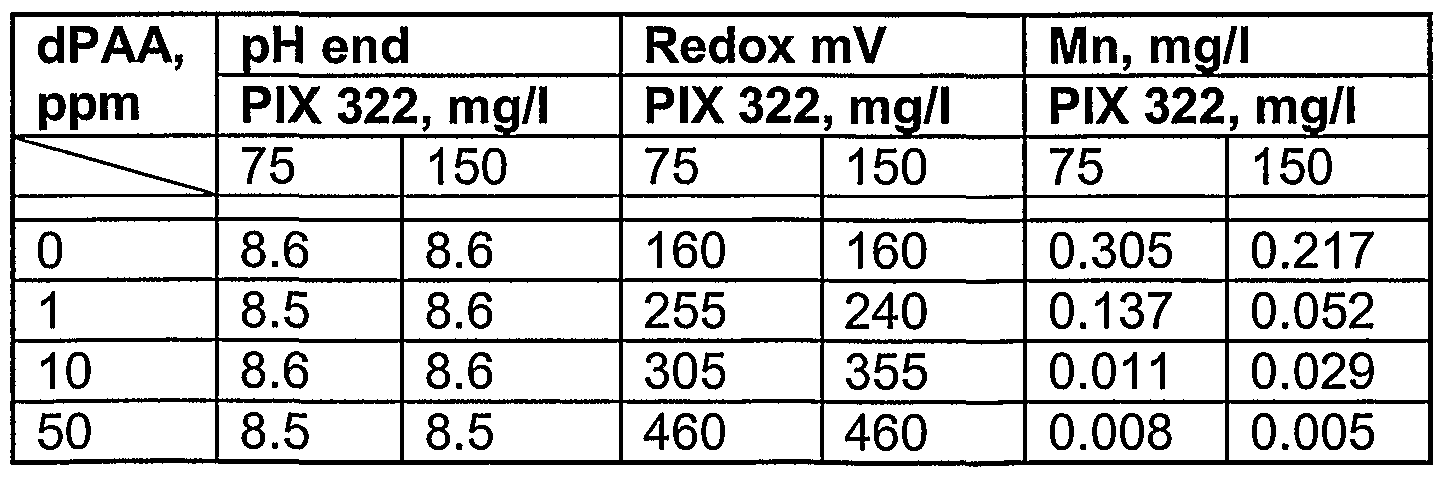
In a raw water treatment process the first phase is usually chemical precipitation with an inorganic coagulant. In the experiments ferric sulphate, trade name PIX 322, was chosen as the coagulant. After precipitation and separation of the precipitate, pH was adjusted to desired value, and thereafter PAA was dosed at various amounts with or without additional pH adjustment. The results are shown in Tables VIII-X. The dosages of dPAA relate to the weight of the PAA solution (the weight of the active substance can be calculated by multiplying the value by 0.40).
Table VIII
The results in Table VIII (PIX dosage was 75 mg/l) show that end-pH is affected by the dosed PAA amount. A clear reduction in the Mn content can be seen at dosage 10 ppm at pH 6.7.
Table IX
The results in Table IX show that if pH was kept at a constant value, 8.5 - 8.6, during the whole oxidation period, the Mn content was reduced significantly. A comparison of iron-coagulant amounts of 75 and 150 mg/l showed that a bigger coagulant dosage helps PAA to decrease Mn content.
For studying more detailed the pH effect, the pH was adjusted after coagulation to different levels. The used amount of coagulant PIX 322 was 75 mg/l. The results are shown in Table X.
Table X
The results are also shown graphically in enclosed Fig. 1. The results indicate clearly that the lower pH the lesser reduction of Mn content.
Example 4
Additional experiments were carried out as described in Example 3 for another raw water having the composition set forth in Table Xl.
Table Xl
PH 5.2
Mn mg/l 0.507
Fe mg/l 0.360
Permanganate mg/l 14 value
Conductivity μS/cm 186
Turbidity NTU 1.23
CODcr mg/l 17
4.1 Effect of iron coagulation on Mn content
The experiments were carried out as described under point 3.3 above. Ferric sulphate (PIX 322) was used as the coagulant. The results are shown in Tables XII- XIV.
Table XII
PIX 322, 20 mg/l
The results in Table XII show that the end-pH is affected by the dosed PAA amount and that if the pH is kept at a constant value, 8.5-8.6, during the whole oxidation period, the Mn content was reduced significantly. A clear reduction in the Mn content can be seen at dosage 5 ppm.
Table XIII
Table XIV
The results in Tables XIII and XIV show that also ePAA is effective in Mn reduction and that if the pH was kept at a constant value of about 8.5 during the whole oxidation time, the Mn content was reduced significantly at rather low iron- coagulant dosages.