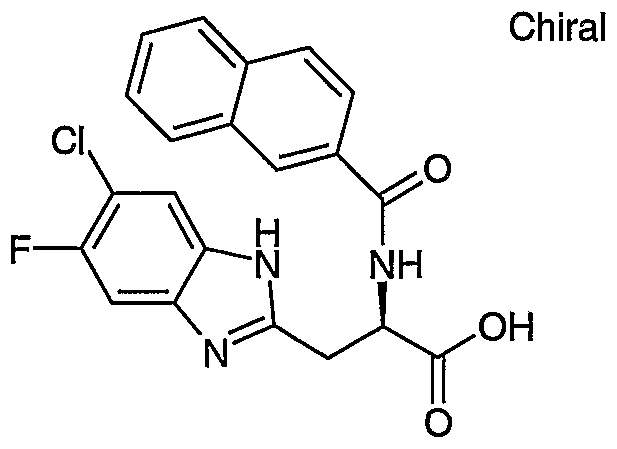
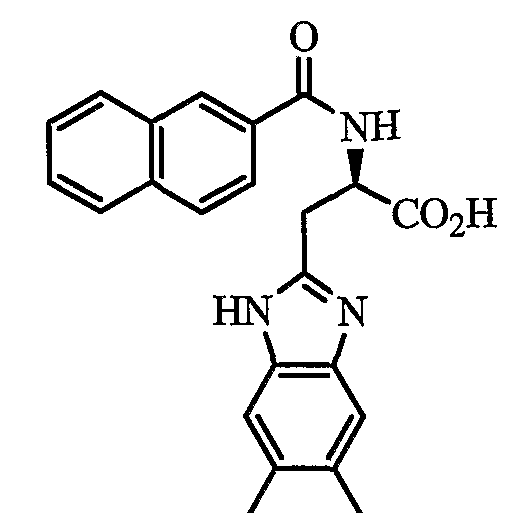
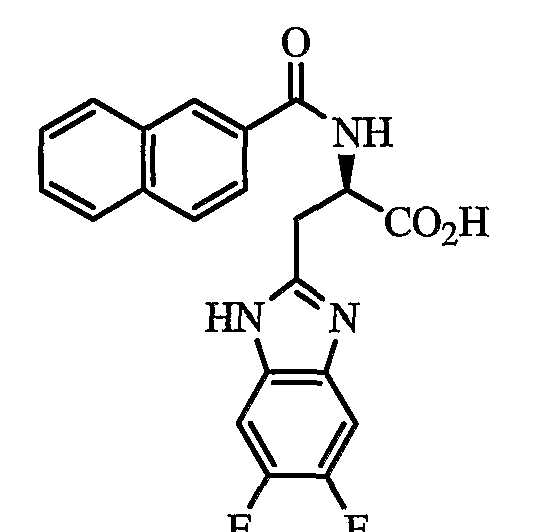
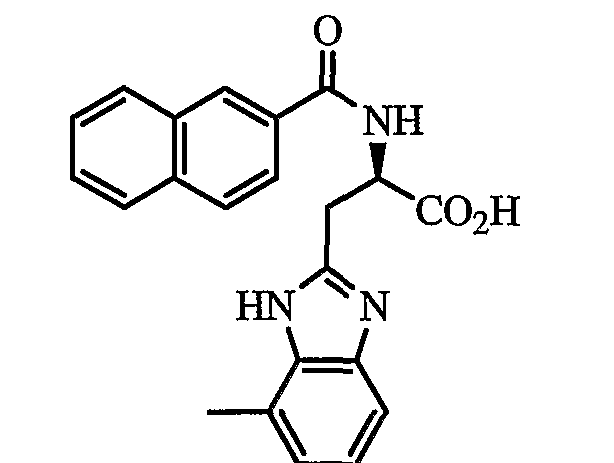
Benzimidazole or Indole Amides as Inhibitors of PIN1
Background of the Invention
This invention relates to carboxylic acids and tetrazoles that are useful in the treatment of abnormal cell growth, such as cancer, in mammals. This invention also relates to a method of using such compounds in the treatment of abnormal cell growth in mammals, especially humans, and to pharmaceutical compositions containing such compounds.
The cell cycle represents a series of ordered processes that ultimately results in the duplication of a cell. In general, somatic cell division consists of two sequential processes - DNA replication and chromosome separation. The cell spends most of its time preparing for these events in a growth cycle (interphase), which in turn consists of three subphases: initial gap (G1), synthesis (S), and secondary gap (G2). In G1 , the cell undergoes a high rate of biosynthesis. The S phase begins when DNA synthesis starts and ends when the DNA content of the nucleus has doubled. The cell then enters G2, which lasts until the cell enters the final phase of division, mitosis (M). The M phase begins with nuclear envelope breakdown, chromosome condensation, and the formation of two identical sets of chromosomes that are separated into two new nuclei. This is followed by cell division (cytokinesis), which results in two daughter cells, terminates the M phase, and marks the beginning of interphase for the new cells.
Entry into mitosis is a highly regulated event in normal cells. In eukaryotic cells studied to date, Cdc2/cyclin B, a Ser/Thr kinase, regulates entry into mitosis (Nurse, Nature, 344, 503-508 (1990)). To prevent inappropriate mitotic activity, the activity of Cdc2/cyclin B is tightly regulated, both positively and negatively, by phosphorylation. Cdc2/cyclin B, when activated by dephosphorylation by Cdc25, drives cells into mitosis.
One regulator of Cdc25 is PIN1 , a peptidyl-prolyl isomerase (PPIase). PIN1 , a member of the parvulin family of PPIases, is an enzyme that catalyzes the cis/trans isomerization of the peptidyl- prolyl peptide bond which can be the rate-limiting step in protein folding or assembly under some circumstances (Schmid, Curr. Biol., 5, 993-994 (1995)).
PIN1 has been identified in various eukaryotic organisms, including plants, yeasts, insects, and mammals (Hanes et al., Yeast, 5, 55-72 (1989); Lu et al., Nature, 380, 544-547 (1996); Maleszka et al., Proc. Natl. Acad. ScL USA, 93, 447-451 (1996); and U.S. Patent No. 5,952,467). It was first isolated through its interaction with the Ser/Thr kinase NIMA, a protein essential for cell cycle progression in Aspergillus nidulans (Osmani et al., Cell, 53, 237 (1988)). NIMA's phosphotransferase activity is regulated by Ser/Thr phosphorylation and thus, it has been surmised that NIMA kinase corresponds to its closest human ortholog nek2 which is activated downstream of Cdc2/cyclin B (Lu et al., Cell, 81 , 413-424 (1995)).
The full-length PIN1 mRNA and amino acid sequences are disclosed in U.S. Patent Nos. 5,952,467 and 5,972,697 and have been deposited in GenBank under accession numbers U49070 (mRNA) and S68520 (protein). The chromosomal locations of human PIN1 and the closely related PIN gene are 19p13 and 1 p31 , respectively (Campbell et al., Genomics, 44, 157-162 (1997)). Sequencing of the
P1N1 gene revealed a putative nuclear localization signal, an amino-terminal protein binding domain (WW motif), and a carboxy-terminal region with homology to other parvulin PPIases (Lu et al., Nature, 380, 544-547 (1996)). Studies have shown that PIN1 can behave either as two independent domains connected by a flexible linker or as a single intact domain with a certain amount of hinge bending motion depending on the sequence of the peptide that binds to PIN1 (Jacobs et al., J. Bio. Chem., 278, 26174-26182 (2003)).
Modulation of human P1N1 activity has been reported to cause dramatic changes in cellular phenotypes. For example, overexpression of PIN1 in HELA cells was reported to cause G2 arrest, whereas its depletion caused mitotic arrest (Lu et al., Nature, 380, 544-547 (1996); Crenshaw et al., EMBO J., 17, 1315-1327 (1998); Fujimori et al., Biochem. Biophys. Res. Commun., 265, 658-663 (1999)). Additionally, it has been reported that decreasing PIN1 expression via antisense technology causes cells to progress into mitosis prematurely, results in the presence of aberrant nuclei due to premature chromosome condensation, and induces apoptosis (Lu et al., Nature, 380, 544-547 (1996)); thus, confirming that PIN1 is a negative regulator of mitosis through its interaction with Cdc2/cyclin B (Thorpe et al., J. Histochem. & Cytochem., 49, 97-107 (2001); Gozes, J. Molecular Neuroscience, 19, 337-338 (2002); and Holzer et al., Acta Neuropathol., 104, 471-481 (2002)).
In addition to its role in mitosis and Cdc2/cyclin B regulation, PIN1 has a putative role in neurodegeneration in Alzheimer's disease (Holzer et al., Acta Neuropathol., 104, 471-481 (2002)). PIN1 levels have been shown to be elevated in patients afflicted with Alzheimer's disease as PIN1 can bind to the tau protein that has been shown to be a major component of the intracellular neurofibrillary tangles found in Alzheimer's disease brain lesions. More specifically, PIN1 binding is elevated in the neurofibrillary tangle-rich cytoplasm of Alzheimer's disease-affected neurons and thus, is thought to be involved in the vulnerability of certain neurons to neurofibrillary degeneration.
PIN1 has been shown to have a variety of other functions and interactions. For example, PIN1 can interact with other cell cycle regulators (Messenger et al., J. Bio. Chem., 277, 23054-23064 (2002)) and affect the proliferation of mammalian primordial germ cells and embryonic development (Atchison et al., Development, 130, 3579-3586 (2003)). Moreover, PIN1 knockout mice display developmental defects during pregnancy particularly with respect to mammary epithelial duct development and gland development (WuIf et al., Breast Cancer Research, 5, 76-82 (2003)). The possible role of PIN1 in mammary gland physiology is underscored by the observation that PIN1 is overexpressed in human breast cancer cells (WuIf et al., Breast Cancer Research, 5, 76-82 (2003)).
Cancer and other neoplastic cells, due to their inherent genetic instability, have lost many of the control mechanisms regulating cell division and therefore, are more susceptible to cell-cycle modulation or intervention as a means of inducing cell death. Further, because alterations in cell- cycle control are one of the differences between normal cells and cancer cells, proteins involved in cell-cycle control are attractive targets for developing agents effective for use in diagnosing and treating cancer and other cell proliferative disorders. One such target in PIN1. Thus, there is a need
in the art for tools useful in studying the role of PIN1 and PIN1 pathways involved in normal and abnormal cell growth.
Inhibitors of PIN1 have been described in the literature. For example, Hennig et al. {Biochemistry, 37, 5953-5960 (1998)) report that juglone (5-hydroxy-1 ,4-naphthoquinone) selectively inhibits several parvulins, including human PIN1. Noel et al. in U.S. Patent Application no. 20030096387, using data based on the crystal structure derived from full-length human PIN1 , suggest compounds postulated to be inhibitors of PIN1. Lu et al. in International Publication No. WO 99/12962 report inhibitors that mimic the phospho-Ser/Thr moiety of the phosphoserine or phosphothreonine-proline peptidyl prolyl isomerase substrate.
Given the important role that PIN1 plays in the regulation of the cell cycle, additional compounds that inhibit PIN1 are needed. These compounds, along with pharmaceutical compositions thereof, can serve as effective chemotherapeutic agents for the treatment of a variety of disorders characterized by inappropriate cell proliferation, including cancer, infectious diseases, and neurodegenerative brain disorders.
Summary of the Invention The present invention relates to compounds of the formula 1
and to pharmaceutically acceptable salts and solvates thereof, wherein:
Q, Q1, Q2, Q3 is independently selected from N, CH2 or CH and wherein not more than two of Q are
N;
T is CH, or N;
T1 is O, NH, or NCH3;
X is NH, O, -CH=, or NR' wherein R' can be alkyl or alkyl substituted with halogen, hydroxyl, amine, or carboxyl;
Y is -C(O)-, -CH2- or -C(O)NR2-, or N wherein R2 is H or C-, to C3 alkyl;
Z is H, alkyl, alkyl substituted with halogen, hydroxyl, amine, or carboxyl; or
X Y and Z can form a heterocyclic ring or
X and Y can form a heterocyclic ring;
R and V are independently H, halogen, alkyl, halogenated alkyl, alkoxy, hydroxyl, NH2 and nitrile;
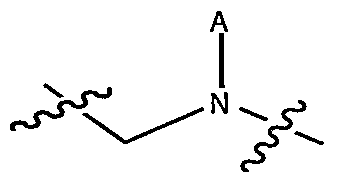
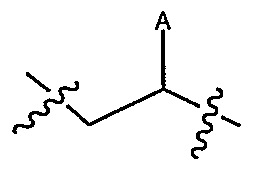
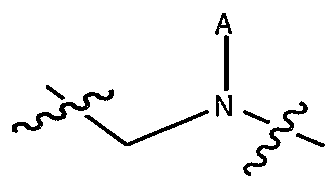
R is optionally substituted aryl, heteroaryl or -L-aryl wherein L is O, S, vinyl,
, -CH
2S- or -CH
2O- wherein A is H, aryl, substituted aryl or A and Ar can form a bicyclic or tricyclic ring or A and Ar can form a bicyclic or tricyclic heteroaryl ring; and R
3 is -COOH, tetrazole, CO
2CHR
4OCOR
4, -CONHR
5, OH wherein R
4 is independently selected from H or alkyl and R
5 is H, alkoxy, OH, -SO
2-alkyl Or -SO
2H.
The present invention includes the compounds of formula 1 wherein:
and to pharmaceutically acceptable salts and solvates thereof, wherein:
Q, Q1, Q2, Q3 is independently selected from N, CH2 or CH and wherein not more than two of Q are
N;
T is CH, or N;
T is O, NH, or NCH3;
X is NH, O, or NR' wherein R' can be alkyl or alkyl substituted with halogen, hydroxyl, amine, or carboxyl;
Y is -C(O)-, -CH2- or -C(O)NR2-, or N wherein R2 is H or C1 to C3 alkyl;
Z is H, alkyl, alkyl substituted with halogen, hydroxyl, amine, or carboxyl;
R and V are independently H, halogen, alkyl, halogenated alkyl, alkoxy, hydroxyl, NH2 and nitrile;
R is optionally substituted aryl, heteroaryl or -L-aryl wherein L is O, S, vinyl,
, -CH
2S- or -CH
2O- wherein A is H, aryl, substituted aryl or A and Ar can form a bicyclic or tricyclic ring or A and Ar can form a bicyclic or tricyclic heteroaryl ring; and
R
3 is -COOH, tetrazole, CO
2CHR
4OCOR
4, -CONHR
5, OH wherein R
4 is independently selected from H or alkyl and R
5 is H, alkoxy, OH, -SO
2-alkyl Or -SO
2H.
The present invention also includes the compounds of formula 2
and to pharmaceutically acceptable salts and solvates thereof, wherein:
X' and X" are independently selected from CR2 or N wherein R2 is H or C1-3 alkyl;
T is CH, or N;
T' is O, NH or NCH3;
Z is H, alkyl or alkyl substituted with halogen, hydroxyl, amine or carboxy;
R and V are independently H, halogen, alkyl, halogenated alkyl, alkoxy, hydroxyl, NH2 and nitrile
R
1 is optionally substituted aryl, heteroaryl or -L-aryl wherein L is O, S, vinyl,
, -CH
2S- or -CH
2O- wherein A is H, aryl, substituted aryl or A and Ar can form a bicyclic or tricyclic ring or A and Ar can form a bicyclic or tricyclic heteroaryl ring; and R
3 is -COOH, tetrazole, CO
2CHR
4OCOR
4, -CONHR
5, OH wherein R
4 is independently selected from H or alkyl and R
5 is H, alkoxy, OH, -SO
2-alkyl Or -SO
2H.
The present invention also includes the compounds of formula 3
and to pharmaceutically acceptable salts and solvates thereof, wherein:
X' and X" are independently selected from CR2 or N wherein R2 is H or C1-3 alkyl;
T is O, NCH3 or N;
T is CH or N;
Z is H, alkyl, alkyl substituted with halogen, hydroxyl, amine, or carboxyl;
R and V are independently H, halogen, alkyl, halogenated alkyl, alkoxy, hydroxyl, NH2 and nitrile
R
1 is optionally substituted aryl, heteroaryl or -L-aryl wherein L is O, S, vinyl,
, -CH
2S- or -CH
2O- wherein A is H, aryl, substituted aryl or A and Ar can form a bicyclic or tricyclic ring or A and Ar can form a bicyclic or tricyclic heteroaryl ring; and R
3 is -COOH, tetrazole, CO
2CHR
4OCOR
4, -CONHR
5, OH wherein R
4 is independently selected from H or alkyl and R
5 is H, alkoxy, OH, -SO
2-alkyl or -SO
2H.
The compounds of the invention further include compounds of formula 4 having the following structure
and the pharmaceutically active salts and solvates thereof wherein:
T' is O, NH or NCH3;
T is CH, or N;
E is selected from CH2, O, S, and NR' wherein R' can be H, alkyl or alkyl substituted with halogen, hydroxyl or nitrile;
R and V are independently H, halogen, alkyl, halogenated alkyl, alkoxy, hydroxyl, NH2 and nitrile
R
1 is optionally substituted aryl, heteroaryl or -L-aryl wherein L is O, S, vinyl,
, -CH
2S- or -CH
2O- wherein A is H, aryl, substituted aryl or A and Ar can form a bicyclic or tricyclic ring or A and Ar can form a bicyclic or tricyclic heteroaryl ring; and R
3 is -COOH, tetrazole, CO
2CHR
4OCOR
4, -CONHR
5, OH wherein R
4 is independently selected from H or alkyl and R
5 is H, alkoxy, OH, -SO
2-alkyl Or -SO
2H.
The compounds of the invention further include compounds of formula 5 having the following structure
and the pharmaceutically active salts and solvates thereof wherein
T is CH, or N;
T is O, NH or NCH3;
Z is H, alkyl, substituted alkyl;
M, M', G and G' are independently H, halogen or M and N together form a cycloalkyl or an aromatic ring or M and M" and G and G' form a cycloalkyl or aromatic ring;
J and J! are independently H or =0;
R and V are independently H, halogen, alkyl, halogenated alkyl, alkoxy, hydroxyl, NH2 and nitrile
1 is optionally substituted aryl, heteroaryl or -L-aryl wherein L is O, S, vinyl,
, -CH
2S- or -CH
2O- wherein A is H, aryl, substituted aryl or A and Ar can form a bicyclic or tricyclic ring or A and Ar can form a bicyclic or tricyclic heteroaryl ring; and R
3 is -COOH, tetrazole, CO
2CHR
4OCOR
4, -CONHR
5, OH wherein R
4 is independently selected from H or alkyl and R
5 is H, alkoxy, OH, -SO
2-alkyl Or -SO
2H.
The present invention also relates to the inhibition of PIN1 and the treatment of abnormal cell growth by the inhibition of PIN1.
In another embodiment, the invention provides a method of treating abnormal cell growth in a mammal, including a human, the method comprising administering to the mammal any of the pharmaceutical compositions of the invention.
In a specific embodiment of any of the inventive methods described herein, the abnormal cell growth is cancer, including, but not limited to, lung cancer, bone cancer, pancreatic cancer, skin cancer,
cancer of the head or neck, cutaneous or intraocular melanoma, uterine cancer, ovarian cancer, rectal cancer, cancer of the anal region, stomach cancer, colon cancer, breast cancer, uterine cancer, carcinoma of the fallopian tubes, carcinoma of the endometrium, carcinoma of the cervix, carcinoma of the vagina, carcinoma of the vulva, Hodgkin's Disease, cancer of the esophagus, cancer of the small intestine, cancer of the endocrine system, cancer of the thyroid gland, cancer of the parathyroid gland, cancer of the adrenal gland, sarcoma of soft tissue, cancer of the urethra, cancer of the penis, prostate cancer, chronic or acute leukemia, lymphocytic lymphomas, cancer of the bladder, cancer of the kidney or ureter, renal cell carcinoma, carcinoma of the renal pelvis, neoplasms of the central nervous system (CNS), primary CNS lymphoma, spinal axis tumors, brain stem glioma, pituitary adenoma, or a combination of one or more of the foregoing cancers. In another embodiment of said method, said abnormal cell growth is a benign proliferative disease, including, but not limited to, psoriasis, benign prostatic hypertrophy or restinosis.
In further specific embodiments of any of the inventive methods described herein, the method further comprises administering to the mammal an amount of one or more substances selected from anti-tumor agents, anti-angiogenesis agents, signal transduction inhibitors, and antiproliferative agents, which amounts are together effective in treating said abnormal cell growth with the compounds of the invention exemplified by formula 1 above.. Such substances include those disclosed in PCT Publication Nos. WO 00/38715, WO 00/38716, WO 00/38717, WO 00/38718, WO 00/38719, WO 00/38730, WO 00/38665, WO 00/37107 and WO 00/38786, the disclosures of which are incorporated herein by reference in their entireties.
Examples of anti-tumor agents include mitotic inhibitors, for example vinca alkaloid derivatives such as vinblastine vinorelbine, vindescine and vincristine; colchines allochochine, halichondrine, N- benzoyltrimethyl-methyl ether colchicinic acid, dolastatin 10, maystansine, rhizoxine, taxanes such as taxol (paclitaxel), docetaxel (Taxotere), 2'-N-[3-(dimethylamino)propyl]glutaramate (taxol derivative), thiocholchicine, trityl cysteine, teniposide, methotrexate, azathioprine, fluorouricil, cytocine arabinoside, 2'2'-difluorodeoxycytidine (gemcitabine), adriamycin and mitamycin. Alkylating agents, for example cis- platin, carboplatin oxiplatin, iproplatin, Ethyl ester of N-acetyl-DL-sarcosyl-L-leucine (Asaley or Asalex), 1 ,4-cyclohexadiene-1 ,4-dicarbamic acid, 2,5 -bis(1-azirdinyl)-3,6-dioxo-, diethyl ester (diaziquone), 1 ,4- bis(methanesulfonyloxy)butane (bisulfan or leucosulfan) chlorozotocin, clomesone, cyanomorpholinodoxorubicin, cyclodisone, dianhydroglactitol, fluorodopan, hepsulfam, mitomycin C, hycantheonemitomycin C, mitozolamide, 1-(2-chloroethyl)-4-(3-chloropropyl)-piperazine dihydrochloride, piperazinedione, pipobroman, porfiromycin, spirohydantoin mustard, teroxirone, tetrapiatin, thiotepa, triethylenemelamine, uracil nitrogen mustard, bis(3-mesyloxypropyl)amine hydrochloride, mitomycin, nitrosoureas agents such as cyclohexyl-chloroethylnitrosourea, methylcyclohexyl-chloroethylnitrosourea 1 -(2-chloroethyl)-3-(2,6-dioxo-3-piperidyl)-1 -nitroso-urea, bis(2-chloroethyl)nitrosourea, procarbazine, dacarbazine, nitrogen mustard-related compounds such as mechloroethamine, cyclophosphamide, ifosamide, melphalan, chlorambucil, estramustine sodium phosphate, strptozoin, and temozolamide.
DNA anti-metabolites, for example 5-fluorouracil, cytosine arabinoside, hydroxyurea, 2-[(3hydroxy-2- pyrinodinyl)methylene]-hydrazinecarbothioamide, deoxyfluorouridine, 5-hydroxy-2-formylpyridine thiosemicarbazone, alpha-2'-deoxy-6-thioguanosine, aphidicolin glycinate, 5-azadeoxycytidine, beta- thioguanine deoxyriboside, cyclocytidine, guanazole, inosine glycodialdehyde, macbecin II, pyrazolimidazole, cladribine, pentostatin, thioguanine, mercaptopurine, bleomycin, 2- chlorodeoxyadenosine, inhibitors of thymidylate synthase such as raltitrexed and pemetrexed disodium, clofarabine, floxuridine and fludarabine. DNA/RNA antimetabolites, for example, L-alanosine, 5- azacytidine, acivicin, aminopterin and derivatives thereof such as N-[2-chloro-5-[[(2, 4-diamino-5- methyl-6-quinazolinyl)methyl]amino]benzoyl]-L-aspartic acid, N-[4-[[(2, 4-diamino-5-ethyl-6- quinazolinyl)methyl]amino]benzoyl]-L-aspartic acid, N -[2-chloro-4-[[(2, 4- diaminopteridinyl)methyl]amino]benzoyl]-L-aspartic acid, soluble Baker's antifol, dichloroallyl lawsone, brequinar, ftoraf, dihydro-5-azacytidine, methotrexate, N-(phosphonoacetyl)-L-aspartic acid tetrasodium salt, pyrazofuran, trimetrexate, plicamycin, actinomycin D, cryptophycin, and analogs such as cryptophycin-52 or, for example, one of the preferred anti-metabolites disclosed in European Patent Application No. 239362 such as N-(5-[N-(3,4-dihydro-2-methyl-4-oxoquinazolin-6-ylmethyl)-N- methylamino]-2-thenoyl)-L-glutamic acid; growth factor inhibitors; cell cycle inhibitors; intercalating antibiotics, for example adriamycin and bleomycin; proteins, for example interferon; and anti-hormones, for example anti-estrogens such as NolvadexD (tamoxifen) or, for example anti-androgens such as Casodex™ (4'-cyano-3-(4-fluorophenylsulphonyl)-2-hydroxy-2-methyl-3'-(trifluoromethyl)propionanilide). Such conjoint treatment may be achieved by way of the simultaneous, sequential or separate dosing of the individual components of the treatment.
Anti-angiogenesis agents include MMP-2 (matrix-metalloprotienase 2) inhibitors, MMP-9 (matrix- metalloprotienase 9) inhibitors, and COX-Il (cyclooxygenase II) inhibitors. Examples of useful COX-II inhibitors include CELEBREX™ (alecoxib), valdecoxib, and rofecoxib. Examples of useful matrix metalloproteinase inhibitors are described in WO 96/33172 (published October 24, 1996), WO 96/27583 (published March 7, 1996), European Patent Application No. 97304971.1 (filed July 8, 1997), European Patent Application No. 99308617.2 (filed October 29, 1999), WO 98/07697 (published February 26, 1998), WO 98/03516 (published January 29, 1998), WO 98/34918 (published August 13, 1998), WO 98/34915 (published August 13, 1998), WO 98/33768 (published August 6, 1998), WO 98/30566 (published July 16, 1998), European Patent Publication 606,046 (published July 13, 1994), European Patent Publication 931 ,788 (published July 28, 1999), WO 90/05719 (published May 331 , 1990), WO 99/52910 (published October 21 , 1999), WO 99/52889 (published October 21 , 1999), WO 99/29667 (published June 17, 1999), PCT International Application No. PCT/IB98/01113 (filed July 21, 1998), European Patent Application No. 99302232.1 (filed March 25, 1999), Great Britain patent application number 9912961.1 (filed June 3, 1999), United States Provisional Application No. 60/148,464 (filed August 12, 1999), United States Patent 5,863,949 (issued January 26, 1999), United States Patent 5,861 ,510 (issued January 19, 1999), and European Patent Publication 780,386 (published June 25,
1997), all of which are herein incorporated by reference in their entirety. Preferred MMP-2 and MMP-9 inhibitors are those that have little or no activity inhibiting MMP-1. More preferred, are those that selectively inhibit MMP-2 and/or MMP-9 relative to the other matrix-metalloproteinases {i.e. MMP-1 , MMP-3, MMP-4, MMP-5, MMP-6, MMP-7, MMP-8, MMP-10, MMP-11 , MMP-12, and MMP-13).
Examples of MMP inhibitors include AG-3340, RO 32-3555, RS 13-0830, and the following compounds: 3-[[4-(4-fluoro-phenoxy)-benzenesulfonyl]-(1-hydroxycarbamoyl-cyclopentyl)-amino]- propionic acid; 3-exo-3-[4-(4-fluoro-phenoxy)-benzenesulfonylamino]-8-oxa-bicyclot3.2.1]octane-3- carboxylic acid hydroxyamide; (2R, 3R) 1-[4-(2-chloro-4-fluoro-benzyloxy)-benzenesulfonyl]-3- hydroxy-3-methyl-piperidine-2-carboxylic acid hydroxyamide; 4-[4-(4-fluoro-phenoxy)- benzenesulfonylamino]-tetrahydro-pyran-4-carboxylic acid hydroxyamide; 3-[[4-(4-fluoro-phenoxy)- benzenesulfonyl]-(1-hydroxycarbamoyl-cyclobutyl)-amino]-propionic acid; 4-[4-(4-chloro-phenoxy)- benzenesulfonylamino]-tetrahydro-pyran-4-carboxylic acid hydroxyamide; 3-[4-(4-chloro-phenoxy)- benzenesulfonylamino]-tetrahydro-pyran-3-carboxylic acid hydroxyamide; (2R, 3R) 1 -[4-(4-fluoro-2- methyl-benzyloxy)-benzenesulfonyl]-3-hydroxy-3-methyl-piperidine-2-carboxylic acid hydroxyamide; 3-[[4-(4-fluoro-phenoxy)-benzenesulfonyl]-(1 -hydroxycarbamoyl-1-methyl-ethyl)-amino]-propionic acid; 3-[[4-(4-fluoro-phenoxy)-benzenesulfonyl]-(4-hydroxycarbamoyl-tetrahydro-pyran-4-yl)-amino]- propionic acid; 3-exo-3-[4-(4-chloro-phenoxy)-benzenesulfonylamino]-8-oxa-bicycio[3.2.1]octane-3- carboxylic acid hydroxyamide; 3-endo-3-[4-(4-fluoro-phenoxy)-benzenesulfonylamino]-8-oxa- bicyclo[3.2.1]octane-3-carboxylic acid hydroxyamide; 3-[4-(4-fluoro-phenoxy)-benzenesulfonylamino]- tetrahydro-furan-3-carboxylic acid hydroxyamide; and pharmaceutically acceptable salts, solvates and hydrates thereof.
Examples of signal transduction inhibitors include agents that can inhibit EGFR (epidermal growth factor receptor) responses, such as EGFR antibodies, EGF antibodies, and molecules that are EGFR inhibitors; VEGF (vascular endothelial growth factor) inhibitors; and erbB2 receptor inhibitors, such as organic molecules or antibodies that bind to the erbB2 receptor, for example, HERCEPTIN™ (Genentech, Inc. of South San Francisco, California, USA).
EGFR inhibitors are described in, for example in WO 95/19970 (published July 27, 1995), WO 98/14451 (published April 9, 1998), WO 98/02434 (published January 22, 1998), and United States Patent 5,747,498 (issued May 5, 1998). EGFR-inhibiting agents include, but are not limited to, the monoclonal antibodies C225 and anti-EGFR 22Mab (ImClone Systems Incorporated of New York, New York, USA), the compounds ZD-1839 (AstraZeneca), BIBX-1382 (Boehringer Ingelheim), MDX-447 (Medarex Inc. of Annandale, New Jersey, USA), and OLX-103 (Merck & Co. of Whitehouse Station, New Jersey, USA), VRCTC-310 (Ventech Research) and EGF fusion toxin (Seragen Inc. of Hopkinton, Massachusettes).
VEGF inhibitors, for example SU-5416 and SU-6668 (Sugen Inc. of South San Francisco, California, USA), can also be combined or co-administered with the composition. VEGF inhibitors are described in, for example in WO 99/24440 (published May 20, 1999), PCT International Application PCT/IB99/00797 (filed May 3, 1999), in WO 95/21613 (published August 17, 1995), WO 99/61422
(published December 2, 1999), United States Patent 5,834,504 (issued November 10, 1998), WO 98/50356 (published November 12, 1998), United States Patent 5,883,113 (issued March 16, 1999), United States Patent 5,886,020 (issued March 23, 1999), United States Patent 5,792,783 (issued August 11 , 1998), WO 99/10349 (published March 4, 1999), WO 97/32856 (published September 12, 1997), WO 97/22596 (published June 26, 1997), WO 98/54093 (published December 3, 1998), WO 98/02438 (published January 22, 1998), WO 99/16755 (published April 8, 1999), and WO 98/02437 (published January 22, 1998), all of which are herein incorporated by reference in their entirety. Other examples of some specific VEGF inhibitors are IM862 (Cytran Inc. of Kirkland, Washington, USA); anti- VEGF monoclonal antibody bevacizumab (Genentech, Inc. of South San Francisco, California); and angiozyme, a synthetic ribozyme from Ribozyme (Boulder, Colorado) and Chiron (Emeryville, California).
ErbB2 receptor inhibitors, such as GW-282974 (Glaxo Wellcome pic), and the monoclonal antibodies AR-209 (Aronex Pharmaceuticals Inc. of The Woodlands, Texas, USA) and 2B-1 (Chiron), may be administered in combination with the composition. Such erbB2 inhibitors include those described in WO 98/02434 (published January 22, 1998), WO 99/35146 (published July 15, 1999), WO 99/35132 (published July 15, 1999), WO 98/02437 (published January 22, 1998), WO 97/13760 (published April 17, 1997), WO 95/19970 (published July 27, 1995), United States Patent 5,587,458 (issued December 24, 1996), and United States Patent 5,877,305 (issued March 2, 1999), each of which is herein incorporated by reference in its entirety. ErbB2 receptor inhibitors useful in the present invention are also described in United States Provisional Application No. 60/117,341 , filed January 27, 1999, and in United States Provisional Application No. 60/117,346, filed January 27, 1999, both of which are herein incorporated by reference in their entirety.
Other antiproliferative agents that may be used include inhibitors of the enzyme farnesyl protein transferase and inhibitors of the receptor tyrosine kinase PDGFr, including the compounds disclosed and claimed in the following United States patent applications: 09/221946 (filed December 28, 1998); 09/454058 (filed December 2, 1999); 09/501163 (filed February 9, 2000); 09/539930 (filed March 31 , 2000); 09/202796 (filed May 22, 1997); 09/384339 (filed August 26, 1999); and 09/383755 (filed August 26, 1999); and the compounds disclosed and claimed in the following United States provisional patent applications: 60/168207 (filed November 30, 1999); 60/170119 (filed December 10, 1999); 60/177718 (filed January 21, 2000); 60/168217 (filed November 30, 1999), and 60/200834 (filed May 1 , 2000). Each of the foregoing patent applications and provisional patent applications is herein incorporated by reference in their entirety.
Compositions of the invention can also be used with other agents useful in treating abnormal cell growth or cancer, including, but not limited to, agents capable of enhancing antitumor immune responses, such as CTLA4 (cytotoxic lymphocite antigen 4) antibodies, and other agents capable of blocking CTLA4; and anti-proliferative agents such as other farnesyl protein transferase inhibitors. Specific CTLA4 antibodies that can be used in the present invention include those described in
United States Provisional Application 60/113,647 (filed December 23, 1998) which is herein incorporated by reference in its entirety.
For purposes of the present invention, as described and claimed herein, the following terms are defined as follows:
As used herein, the terms "comprising" and "including" are used in their open, non-limiting sense.The term "treating", as used herein, unless otherwise indicated, means reversing, alleviating, inhibiting the progress of, or preventing the disorder or condition to which such term applies, or one or more symptoms of such disorder or condition. The term "treatment", as used herein, unless otherwise indicated, refers to the act of treating as "treating" is defined immediately above.
The term "halo", as used herein, unless otherwise indicated, means fluoro, chloro, bromo or iodo. Preferred halo groups are fluoro, chloro and bromo.
The term "alkyl", as used herein, unless otherwise indicated, includes saturated and unsaturated monovalent hydrocarbon radicals having straight or branched moieties.
The term "alkenyl", as used herein, unless otherwise indicated, includes alkyl moieties having at least one carbon-carbon double bond wherein alkyl is as defined above and including E and Z isomers of said alkenyl moiety.
The term "alkynyl", as used herein, unless otherwise indicated, includes alkyl moieties having at least one carbon-carbon triple bond wherein alkyl is as defined above.
The term "alkoxy", as used herein, unless otherwise indicated, includes O-alkyl groups wherein alkyl is as defined above.
The term "Me" means methyl, "Et" means ethyl, and "Ac" means acetyl.
The term "cycloalkyl", as used herein, unless otherwise indicated refers to a non-aromatic, saturated or partially saturated, monocyclic or fused, spiro or unfused bicyclic or tricyclic hydrocarbon referred to herein containing a total of from 3 to 10 carbon atoms, preferably 5-8 ring carbon atoms. Exemplary cycloalkyls include monocyclic rings having from 3-7, preferably 3-6, carbon atoms, such as cyclopropyl, cyclobutyl, cyclopentyl, cyclohexyl, cycloheptyl and the like. Illustrative examples of cycloalkyl are derived from, but not limited to, the following:
The term "aryl", as used herein, unless otherwise indicated, includes an organic radical derived from an aromatic hydrocarbon by removal of one hydrogen, such as phenyl or naphthyl.
The term "4 to 10 membered heterocyclic", as used herein, unless otherwise indicated, includes aromatic and non-aromatic heterocyclic groups containing one to four heteroatoms each selected from O, S and N, wherein each heterocyclic group has from 4 to 10 atoms in its ring system, and with the proviso that the ring of said group does not contain two adjacent O or S atoms. Non-aromatic heterocyclic groups include groups having only 4 atoms in their ring system, but aromatic heterocyclic groups must have at least 5 atoms in their ring system. The heterocyclic groups include benzo-fused ring systems. An example of a 4 membered heterocyclic group is azetidinyl (derived from azetidine). An example of a 5 membered heterocyclic group is thiazolyl and an example of a 10 membered heterocyclic group is quinolinyl. Examples of non-aromatic heterocyclic groups are pyrrolidinyl, tetrahydrofuranyl, dihydrofuranyl, tetrahydrothienyl, tetrahydropyranyl, dihydropyranyl, tetrahydrothiopyranyl, piperidino, morpholino, thiomorpholino, thioxanyl, piperazinyl, azetidinyl, oxetanyl, thietanyl, homopiperidinyl, oxepanyl, thiepanyl, oxazepinyl, diazepinyl, thiazepinyl, 1 ,2,3,6- tetrahydropyridinyl, 2-pyrrolinyl, 3-pyrrolinyl, indolinyl, 2H-pyranyl, 4H-pyranyl, dioxanyl, 1 ,3- dioxolanyl, pyrazolinyl, dithianyl, dithiolanyl, dihydropyranyl, dihydrothienyl, dihydrofuranyl, pyrazolidinyl, imidazolinyl, imidazolidinyl, 3-azabicyclo[3.1.0]hexanyl, 3-azabicyclo[4.1.0]heptanyl, 3H- indolyl and quinolizinyl. Examples of aromatic heterocyclic groups are pyridinyl, imidazolyl, pyrimidinyl, pyrazolyl, triazolyl, pyrazinyl, tetrazolyl, furyl, thienyl, isoxazolyl, thiazolyl, oxazolyl, isothiazolyl, pyrrolyl, quinolinyl, isoquinolinyl, indolyl, benzimidazolyl, benzofuranyl, cinnolinyl, indazolyl, indolizinyl, phthalazinyl, pyridazinyl, triazinyl, isoindolyl, pteridinyl, purinyl, oxadiazolyl, thiadiazolyl, furazanyl, benzofurazanyl, benzothiophenyl, benzothiazolyl, benzoxazolyl, quinazolinyl, quinoxalinyl, naphthyridinyl, and furopyridinyl. The foregoing groups, as derived from the groups listed above, may be C-attached or N-attached where such is possible. For instance, a group derived from pyrrole may be pyrrol-1-yl (N-attached) or pyrrol-3-yl (C-attached). Further, a group derived from imidazole may be imidazol-1 -yl (N-attached) or imidazol-3-yl (C-attached). The 4 to 10 membered heterocyclic may be optionally substituted on any ring carbon, sulfur, or nitrogen atom(s) by one to two oxo, per ring. An example of a heterocyclic group wherein 2 ring carbon atoms are substituted with oxo moieties is 1,1-dioxo-thiomorpholinyl. Other illustrative examples of 4 to 10 membered heterocyclic are derived from, but not limited to, the following:
Unless otherwise indicated, the term "oxo" refers to =0.
The phrase "pharmaceutically acceptable salt(s)", as used herein, unless otherwise indicated, includes salts of acidic or basic groups which may be present in the compounds of formula L The compounds of formula I that are basic in nature are capable of forming a wide variety of salts with various inorganic and organic acids. The acid's that may be used to prepare pharmaceutically acceptable acid addition salts of such basic compounds of formula I are those that form non-toxic acid addition salts, Le1, salts containing pharmacologically acceptable anions, such as the acetate, benzenesulfonate, benzoate, bicarbonate, bisulfate, bitartrate, borate, bromide, calcium edetate, camsylate, carbonate, chloride, clavulanate, citrate, dihydrochloride, edetate, edislyate, estolate, esylate, ethylsuccinate, fumarate, gluceptate, gluconate, glutamate, glycollylarsanilate, hexylresorcinate, hydrabamine, hydrobromide, hydrochloride, iodide, isothionate, lactate, lactobionate, laurate, malate, maleate, mandelate, mesylate, methylsulfate, mucate, napsylate, nitrate, oleate, oxalate, pamoate (embonate), palmitate, pantothenate, phospate/diphosphate, polygalacturonate, salicylate, stearate, subacetate, succinate, tannate, tartrate, teoclate, tosylate, triethiodode, and valerate salts.
Certain compounds of formula I may have asymmetric centers and therefore exist in different enantiomeric forms. All optical isomers and stereoisomers of the compounds of formula 1, and mixtures
thereof, are considered to be within the scope of the invention. With respect to the compounds of formula I, the invention includes the use of a racemate, one or more enantiomeric forms, one or more diastereomeric forms, or mixtures thereof. The compounds of formula I may also exist as tautomers. This invention relates to the use of all such tautomers and mixtures thereof.
Certain functional groups contained within the compounds of the present invention can be substituted for bioisosteric groups, that is, groups which have similar spatial or electronic requirements to the parent group, but exhibit differing or improved physicochemical or other properties. Suitable examples are well known to those of skill in the art, and include, but are not limited to moieties described in Patini et al., Chem. Rev, 1996, 96, 3147-3176 and references cited therein.
The subject invention also includes isotopically-labelled compounds, which are identical to those recited in Formula I, but for the fact that one or more atoms are replaced by an atom having an atomic mass or mass number different from the atomic mass or mass number usually found in nature. Examples of isotopes that can be incorporated into compounds of the invention include isotopes of hydrogen, carbon, nitrogen, oxygen, phosphorous, fluorine and chlorine, such as 2H, 3H, 13C, 14C, 15N, 18O, 17O, 31P, 32P, 35S, 18F, and 36CI, respectively. Compounds of the present invention, prodrugs thereof, and pharmaceutically acceptable salts of said compounds or of said prodrugs which contain the aforementioned isotopes and/or other isotopes of other atoms are within the scope of this invention. Certain isotopically-labelled compounds of the present invention, for example those into which radioactive isotopes such as 3H and 14C are incorporated, are useful in drug and/or substrate tissue distribution assays. Tritiated, i.e., 3H, and carbon-14, i.e., 14C, isotopes are particularly preferred for their ease of preparation and detectability. Further, substitution with heavier isotopes such as deuterium, i.e., 2H, can afford certain therapeutic advantages resulting from greater metabolic stability, for example increased in vivo half-life or reduced dosage requirements and, hence, may be preferred in some circumstances, lsotopically labelled compounds of Formula I of this invention and prodrugs thereof can generally be prepared by carrying out the procedures disclosed in the Schemes and/or in the Examples and Preparations below, by substituting a readily available isotopically labelled reagent for a non-isotopically labelled reagent.
This invention also encompasses pharmaceutical compositions containing and methods of treating abnormal cell growth through administering prodrugs of compounds of the formula I. Compounds of formula I having free amino, amido, hydroxy or carboxylic groups can be converted into prodrugs. Prodrugs include compounds wherein an amino acid residue, or a polypeptide chain of two or more (e.g., two, three or four) amino acid residues is covalently joined through an amide or ester bond to a free amino, hydroxy or carboxylic acid group of compounds of formula I. The amino acid residues include but are not limited to the 20 naturally occurring amino acids commonly designated by three letter symbols and also includes 4-hydroxyproline, hydroxylysine, demosine, isodemosine, 3- methylhistidine, norvalin, beta-alanine, gamma-aminobutyric acid, citrulline homocysteine, homoserine, ornithine and methionine sulfone. Additional types of prodrugs are also encompassed. For instance,
free carboxyl groups can be derivatized as amides or alkyl esters. Free hydroxy groups may be derivatized using groups including but not limited to hemisuccinates, phosphate esters, dimethylaminoacetates, and phosphoryloxymethyloxycarbonyls, as outlined in Advanced Drug Delivery Reviews, 1996, 19, 115. Carbamate prodrugs of hydroxy and amino groups are also included, as are carbonate prodrugs, sulfonate esters and sulfate esters of hydroxy groups. Derivatization of hydroxy groups as (acyloxy)methyl and (acyloxy)ethyl ethers wherein the acyl group may be an alkyl ester, optionally substituted with groups including but not limited to ether, amine and carboxylic acid functionalities, or where the acyl group is an amino acid ester as described above, are also encompassed. Prodrugs of this type are described in J. Med. Chem. 1996, 39, 10. Free amines can also be derivatized as amides, sulfonamides or phosphonamides. All of these prodrug moieties may incorporate groups including but not limited to ether, amine and carboxylic acid functionalities.
Compounds of the invention intended for pharmaceutical use may be administered as crystalline or amorphous products, or mixtures thereof. They may be obtained, for example, as solid plugs, powders, or films by methods such as precipitation, crystallization, freeze drying, spray drying, or evaporative drying. Microwave or radio frequency drying may be used for this purpose.
The compounds can be administered alone or in combination with one or more other compounds of the invention, or in combination with one or more other drugs (or as any combination thereof). Generally, they will be administered as a formulation in association with one or more pharmaceutically acceptable excipients. The term "excipient" is used herein to describe any ingredient other than the compound(s) of the invention. The choice of excipient will to a large extent depend on factors such as the particular mode of administration, the effect of the excipient on solubility and stability, and the nature of the dosage form.
Pharmaceutical compositions suitable for the delivery of compounds of the invention and methods for their preparation will be readily apparent to those skilled in the art. Such compositions and methods for their preparation can be found, for example, in 'Remington's Pharmaceutical Sciences', 19th Edition (Mack Publishing Company, 1995), the disclosure of which is incorporated herein by reference in its entirety. Oral Administration
The compounds of the invention may be administered orally. Oral administration may involve swallowing, so that the compound enters the gastrointestinal tract, or buccal or sublingual administration may be employed by which the compound enters the blood stream directly from the mouth.
Formulations suitable for oral administration include solid formulations such as tablets, capsules containing particulates, liquids, or powders, lozenges (including liquid-filled), chews, multi- and nano-particulates, gels, solid solution, liposome, films (including muco-adhesive), ovules, sprays and liquid formulations.
Liquid formulations include suspensions, solutions, syrups and elixirs. Such formulations may be used as fillers in soft or hard capsules and typically include a carrier, for example, water, ethanol, polyethylene glycol, propylene glycol, methylcellulose, or a suitable oil, and one or more emulsifying agents and/or suspending agents. Liquid formulations may also be prepared by the reconstitution of a solid, for example, from a sachet.
The compounds of the invention may also be used in fast-dissolving, fast-disintegrating dosage forms such as those described in Expert Opinion in Therapeutic Patents, H (6), 981-986 by Liang and Chen (2001), the disclosure of which is incorporated herein by reference in its entirety.
For tablet dosage forms, depending on dose, the drug may make up from 1 wt% to 80 wt% of the dosage form, more typically from 5 wt% to 60 wt% of the dosage form. In addition to the drug, tablets generally contain a disintegrant. Examples of disintegrants include sodium starch glycolate, sodium carboxymethyl cellulose, calcium carboxymethyl cellulose, croscarmellose sodium, crospovidone, polyvinylpyrrolidone, methyl cellulose, microcrystalline cellulose, lower alkyl-substituted hydroxypropyl cellulose, starch, pregelatinized starch and sodium alginate. Generally, the disintegrant will comprise from 1 wt% to 25 wt%, preferably from 5 wt% to 20 wt% of the dosage form.
Binders are generally used to impart cohesive qualities to a tablet formulation. Suitable binders include microcrystalline cellulose, gelatin, sugars, polyethylene glycol, natural and synthetic gums, polyvinylpyrrolidone, pregelatinized starch, hydroxypropyl cellulose and hydroxypropyl methylcellulose. Tablets may also contain diluents, such as lactose (monohydrate, spray-dried monohydrate, anhydrous and the like), mannitol, xylitol, dextrose, sucrose, sorbitol, microcrystalline cellulose, starch and dibasic calcium phosphate dihydrate.
Tablets may also optionally include surface active agents, such as sodium lauryl sulfate and polysorbate 80, and glidants such as silicon dioxide and talc. When present, surface active agents are typically in amounts of from 0.2 wt% to 5 wt% of the tablet, and glidants typically from 0.2 wt% to 1 wt% of the tablet.
Tablets also generally contain lubricants such as magnesium stearate, calcium stearate, zinc stearate, sodium stearyl fumarate, and mixtures of magnesium stearate with sodium lauryl sulphate. Lubricants generally are present in amounts from 0.25 wt% to 10 wt%, preferably from 0.5 wt% to 3 wt% of the tablet.
Other conventional ingredients include anti-oxidants, colorants, flavoring agents, preservatives and taste-masking agents.
Exemplary tablets contain up to about 80 wt% drug, from about 10 wt% to about 90 wt% binder, from about 0 wt% to about 85 wt% diluent, from about 2 wt% to about 10 wt% disintegrant, and from about 0.25 wt% to about 10 wt% lubricant.
Tablet blends may be compressed directly or by roller to form tablets. Tablet blends or portions of blends may alternatively be wet-, dry-, or melt-granulated, melt congealed, or extruded
before tabletting. The final formulation may include one or more layers and may be coated or uncoated; or encapsulated.
The formulation of tablets is discussed in detail in "Pharmaceutical Dosage Forms: Tablets, Vol. 1", by H. Lieberman and L Lachman, Marcel Dekker, N.Y., N.Y., 1980 (ISBN 0-8247-6918-X), the disclosure of which is incorporated herein by reference in its entirety.
Solid formulations for oral administration may be formulated to be immediate and/or modified release. Modified release formulations include delayed-, sustained-, pulsed-, controlled-, targeted and programmed release.
Suitable modified release formulations are described in U.S. Patent No. 6,106,864. Details of other suitable release technologies such as high energy dispersions and osmotic and coated particles can be found in Verma et al, Pharmaceutical Technology On-line, 25(2), 1-14 (2001). The use of chewing gum to achieve controlled release is described in WO 00/35298. The disclosures of these references are incorporated herein by reference in their entireties. Parenteral Administration
The compounds of the invention may also be administered directly into the blood stream, into muscle, or into an internal organ. Suitable means for parenteral administration include intravenous, intraarterial, intraperitoneal, intrathecal, intraventricular, intraurethral, intrasternal, intracranial, intramuscular and subcutaneous. Suitable devices for parenteral administration include needle (including microneedle) injectors, needle-free injectors and infusion techniques.
Parenteral formulations are typically aqueous solutions which may contain excipients such as salts, carbohydrates and buffering agents (preferably to a pH of from 3 to 9), but, for some applications, they may be more suitably formulated as a sterile non-aqueous solution or as a dried form to be used in conjunction with a suitable vehicle such as sterile, pyrogen-free water.
The preparation of parenteral formulations under sterile conditions, for example, by lyophilization, may readily be accomplished using standard pharmaceutical techniques well known to those skilled in the art.
The solubility of compounds of the invention used in the preparation of parenteral solutions may be increased by the use of appropriate formulation techniques, such as the incorporation of solubility-enhancing agents.
Formulations for parenteral administration may be formulated to be immediate and/or modified release. Modified release formulations include delayed-, sustained-, pulsed-, controlled-, targeted and programmed release. Thus compounds of the invention may be formulated as a solid, semi-solid, or thixotropic liquid for administration as an implanted depot providing modified release of the active compound. Examples of such formulations include drug-coated stents and PGLA microspheres. Topical Administration
The compounds of the invention may also be administered topically to the skin or mucosa, that is, dermally or transdermally. Typical formulations for this purpose include gels, hydrogels, lotions, solutions, creams, ointments, dusting powders, dressings, foams, films, skin patches, wafers, implants, sponges, fibers, bandages and microemulsions. Liposomes may also be used. Typical carriers include alcohol, water, mineral oil, liquid petrolatum, white petrolatum, glycerin, polyethylene glycol and propylene glycol. Penetration enhancers may be incorporated; see, for example, J Pharm Sci, 88 (10), 955-958 by Finnin and Morgan (October 1999). Other means of topical administration include delivery by electroporation, iontophoresis, phonophoresis, sonophoresis and microneedle or needle-free {e.g. Powderject™, Bioject™, etc.) injection. The disclosures of these references are incorporated herein by reference in their entireties.
Formulations for topical administration may be formulated to be immediate and/or modified release. Modified release formulations include delayed-, sustained-, pulsed-, controlled-, targeted and programmed release. Inhaled/lntranasal Administration
The compounds of the invention can also be administered intranasally or by inhalation, typically in the form of a dry powder (either alone, as a mixture, for example, in a dry blend with lactose, or as a mixed component particle, for example, mixed with phospholipids, such as phosphatidylcholine) from a dry powder inhaler or as an aerosol spray from a pressurized container, pump, spray, atomizer (preferably an atomizer using electrohydrodynamics to produce a fine mist), or nebulizer, with or without the use of a suitable propellant, such as 1,1,1 ,2-tetrafluoroethane or 1 ,1 ,1 ,2,3,3,3-heptafluoropropane. For intranasal use, the powder may include a bioadhesive agent, for example, chitosan or cyclodextrin.
The pressurized container, pump, spray, atomizer, or nebulizer contains a solution or suspension of the compound(s) of the invention comprising, for example, ethanol, aqueous ethanol, or a suitable alternative agent for dispersing, solubilizing, or extending release of the active, a propellant(s) as solvent and an optional surfactant, such as sorbitan trioleate, oleic acid, or an oligolactic acid.
Prior to use in a dry powder or suspension formulation, the drug product is micronized to a size suitable for delivery by inhalation (typically less than 5 microns). This may be achieved by any appropriate comminuting method, such as spiral jet milling, fluid bed jet milling, supercritical fluid processing to form nanoparticles, high pressure homogenisation, or spray drying.
Capsules (made, for example, from gelatin or HPMC), blisters and cartridges for use in an inhaler or insufflator may be formulated to contain a powder mix of the compound of the invention, a suitable powder base such as lactose or starch and a performance modifier such as /-leucine, mannitol, or magnesium stearate. The lactose may be anhydrous or in the form of the monohydrate, preferably the latter. Other suitable excipients include dextran, glucose, maltose, sorbitol, xylitol, fructose, sucrose and trehalose.
A suitable solution formulation for use in an atomizer using electrohydrodynamics to produce a fine mist may contain from 1 μg to 20mg of the compound of the invention per actuation and the actuation volume may vary from 1 μL to 100μL A typical formulation includes a compound of the invention, propylene glycol, sterile water, ethanol and sodium chloride. Alternative solvents which may be used instead of propylene glycol include glycerol and polyethylene glycol.
Suitable flavors, such as menthol and levomenthol, or sweeteners, such as saccharin or saccharin sodium, may be added to those formulations of the invention intended for inhaled/intranasal administration.
Formulations for inhaled/intranasal administration may be formulated to be immediate and/or modified release using, for example, poly(DL-lactic-coglycolic acid (PGLA). Modified release formulations include delayed-, sustained-, pulsed-, controlled-, targeted and programmed release.
In the case of dry powder inhalers and aerosols, the dosage unit is determined by means of a valve which delivers a metered amount. Units in accordance with the invention are typically arranged to administer a metered dose or "puff" containing a desired mount of the compound of the invention. The overall daily dose may be administered in a single dose or, more usually, as divided doses throughout the day. Rectal/lntravaginal Administration
Compounds of the invention may be administered rectally or vaginally, for example, in the form of a suppository, pessary, or enema. Cocoa butter is a traditional suppository base, but various alternatives may be used as appropriate.
Formulations for rectal/vaginal administration may be formulated to be immediate and/or modified release. Modified release formulations include delayed-, sustained-, pulsed-, controlled-, targeted and programmed release. Ocular Administration
Compounds of the invention may also be administered directly to the eye or ear, typically in the form of drops of a micronized suspension or solution in isotonic, pH-adjusted, sterile saline. Other formulations suitable for ocular and aural administration include ointments, biodegradable [e.g. absorbable gel sponges, collagen) and non-biodegradable (e.g. silicone) implants, wafers, lenses and particulate or vesicular systems, such as niosomes or liposomes. A polymer such as crossed-linked polyacrylic acid, polyvinylalcohol, hyaluronic acid, a cellulosic polymer, for example, hydroxypropylmethylcellulose, hydroxyethylcellulose, or methyl cellulose, or a heteropolysaccharide polymer, for example, gelan gum, may be incorporated together with a preservative, such as benzalkonium chloride. Such formulations may also be delivered by iontophoresis.
Formulations for ocular/aural administration may be formulated to be immediate and/or modified release. Modified release formulations include delayed-, sustained-, pulsed-, controlled-, targeted, or programmed release. Other Technologies
Compounds of the invention may be combined with soluble macromolecular entities, such as cyclodextrin and suitable derivatives thereof or polyethylene glycol-containing polymers, in order to improve their solubility, dissolution rate, taste-masking, bioavailability and/or stability for use in any of the aforementioned modes of administration.
Drug-cyclodextrin complexes, for example, are found to be generally useful for most dosage forms and administration routes. Both inclusion and non-inclusion complexes may be used. As an alternative to direct complexation with the drug, the cyclodextrin may be used as an auxiliary additive, i.e. as a carrier, diluent, or solubilizer. Most commonly used for these purposes are alpha-, beta- and gamma-cyclodextrins, examples of which may be found in PCT Publication Nos. WO 91/11172, WO 94/02518 and WO 98/55148, the disclosures of which are incorporated herein by reference in their entireties. Kit-of-Parts
Inasmuch as it may desirable to administer a combination of active compounds, for example, for the purpose of treating a particular disease or condition, it is within the scope of the present invention that two or more pharmaceutical compositions, at least one of which contains a compound in accordance with the invention, may conveniently be combined in the form of a kit suitable for coadministration of the compositions. Thus the kit of the invention includes two or more separate pharmaceutical compositions, at least one of which contains a compound of the invention, and means for separately retaining said compositions, such as a container, divided bottle, or divided foil packet. An example of such a kit is the familiar blister pack used for the packaging of tablets, capsules and the like.
The kit of the invention is particularly suitable for administering different dosage forms, for example, oral and parenteral, for administering the separate compositions at different dosage intervals, or for titrating the separate compositions against one another. To assist compliance, the kit typically includes directions for administration and may be provided with a memory aid.
Detailed Description of the Invention
The compounds of the invention can be synthesized by the following reaction schemes. Starting materials, the synthesis of which is not specifically described above, are either commercially available or can be prepared using methods well known to those of skill in the art.
In each of the reactions illustrated or described herein, pressure is not critical unless otherwise indicated. Pressures from about 0.5 atmospheres to about 5 atmospheres are generally acceptable and ambient pressure, i.e. about 1 atmosphere, is preferred as a matter od convienence. The examples and preparations provided below further illustrate and exemplify the compounds of the present invention and methods of preparing such compounds. It is to be understood that the scope of the present invention is not limited in any way by the scope of the following examples and preparations. In the following examples molecules with a single chiral center, unless otherwise noted,
exist as a racemic mixture. Those molecules with two or more chiral centers, unless otherwise noted, exist as a racemic mixture of diastereomers. Single enantiomers/diastereomers may be obtained by methods known to those skilled in the art.
Where HPLC chromatography is referred to in the preparations and examples below, the general conditions used, unless otherwise indicated, are as follows. The column used is a ZORBAX RXC18 column (manufactured by Hewlett Packard) of 150 mm distance and 4.6 mm interior diameter. The samples are run on a Hewlett Packard- 1100 systemA gradient solvent method is used running 100 percent ammonium acetate / acetic acid buffer (0.2 M) to 100 percent acetonitrile over 10 minutes. The system then proceeds on a wash cycle with 100 percent acetonitrile for 1.5 minutes and then 100 percent buffer solution for 3 minutes. The flow rate over this period is a constant 3 ml / minute.
In the following examples and preparations, "Et" means ethyl, "AC" means acetyl, "Me" means methyl, "ETOAC" or "ETOAc" means ethyl acetate, "THF" means tetrahydrofuran, and "Bu" means butyl. Unless otherwise indicated, X, Y, R1, R2, and R3 in the reaction schemes and experimental procedures that follow are as defined above.
Synthesis of Benzimidazoles:
Compound 1a:
To an aqueous HCI solution (5.5 N, 5OmL) was added O-Phenylenediamine dihydrochloride (9.05g, 0.05mol) and DL-aspartic acid (1Og, 0.075mol). The mixture was heated at reflux for 7Oh. After being cooled down to 25°C, the suspension was filtered. The pH of filtrate was adjusted to pH~2 by slow addition of Na
2CO
3 solid. The precipitate was collected by filtration, washed with water and dried in vacuum oven (60°C). A pale green powder (5g, 41.5%yield) was obtained.
1H NMR (CD
3OD): δ 7.75-7.65 (2H, m), 7.55-7.45 (2H, m), 4.64-4.58 (1 H, m), 3.8-3.72 (2H, m). LCMS (APCI): 206(M+H
+) (positive); 204 (M-H) (negative). Example 1 :
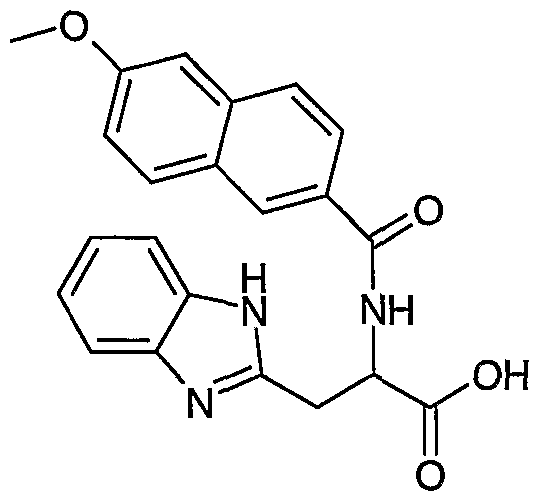
To a sodium carbonate solution (1 M, 5mL) was added the amino acid 1a (150mg, 0.621 mmol), 2-Naphthoyl chloride (142mg, 0.745mmol) and acetonitrile (5mL). The mixture was stirred at 25°C for 15h. lced-cooled 5% HCI solution was added to acidify the reaction solution (pH~1). The precipitate was collected by filtration, washed with water and dried in vacuum oven (60°C). A white solid (140mg, 63%yield) was obtained. 1H NMR (DMSO- d6): δ 12.58 (1 H, br s), 9.07 (1 H, d, J=7.9Hz), 8.38 (1 H, s), 8.0-7.8 (4H, m), 7.54 (2H, m), 7.45-7.4 (2H, m), 7.1-7.0 (2H, m), 5.00 (1 H, q, J=7.9Hz), 3.44 (1 H, dd, J=15.1 , 5.8Hz), 3.33 (1 H, dd, J=15.1 , 7.8Hz); LCMS (APCI): 358 (M- H) (negative); Elemental Analysis for (C21H17N3O3-O-ICF3COOH) calc: C 68.67, H 4.65, N 11.33; found: C 68.65, H 4.67, N 11.34. Example 2:
To an acetonitrile/water solution (4 mL /5 mL ) of aminoacid 1a (296 mg, 1.23 mmol) was added benzo[B]thiophene-2-carbonyl chloride (241 mg, 1.23 mmol) and sodium carbonate (456 mg, 4.31 mmol). The mixture was stirred at room temperature for overnight. It was then acidified with 1M HCI. Solids were filtered and washed with water (2x) and ethyl acetate (2x) to give the title compound in 76% yield. 1H NMR (DMSO-D6): δ 9.17 (1 H, d, J=7.72 Hz), 8.06 (1 H, s), 7.99-7.85 (2H, m), 7.47- 7.32 (4H, m), 7.10-7.00 (2H, m), 4.94 (1H, dd, J=13.94, 8.10 Hz), 3.46-3.23 (2H, m). LCMS (AP-ESI): 366.2 (M+H+). Elemental Analysis for (C19H15N3O3S●03.H2O) calc: C 61.54, H 4.24, N 11.33; found: C 61.57, H 4.23, N 11.21. Compound 3a:
To an ether solution (8 mL) of the phenylacetic acid (349 mg, 2.57 mmol) and pyridinv (0.7 mL) was slowly added phenylacetyl chloride (397 mg, 2.57 mmol) at 0°C. The mixture was stirred at room temperature for overnight. It was then diluted with ether (20 mL), washed with cold 1 M HCI (10 mL) and saturated sodium bicarbonate (10 mL). Evaporation of ether gave the title compound in 48% yield. 1H NMR (DMSO- d6): δ 7.35 (5H, m), 3.89 (2H, s). Example 3:
To an acetonitrile/water solution (4 ml_/5 ml_) of 1a (289 mg, 1.20 mmol) was added the 3a (304 mg, 1.20 mmol) and sodium carbonate (445 mg, 4.20 mmol). The mixture was stirred at room temperature for overnight. It was then acidified with 1 M HCI. Solid was collected by filtration and washed with water (2X) and ethyl acetate (2X) to give the title compound in 25% yield. 1H NMR (DMSO-D6): δ 8.47 (1 H, d, J=7.83 Hz), 7.44-7.37 (2H, m), 7.11-7.69 (7H, m), 4.72 (1 H, dd, J=13.90, 8.09 Hz), 3.36 (2H, dd, J=18.69, 14.14 Hz), 3.24 (1 H, dd, J=15.16, 5.81 Hz), 3.11 (1 H, dd, J=14.91 , 8.08 Hz). LCMS (APCl): 324.1 (M+H+). Elemental Analysis for (C18H17N3O3●0.15H2O) calc: C 66.30, H 5.35, N 12.89; found: C 66.20, H 5.29, N 12.85. Example 4:
To an acetonitrile/water solution (4 ml_/5 mL) of 1a (313 mg, 1.30 mmol) was added 1 -naphthyacetic anhydride (459 mg, 1.30 mmol) and sodium carbonate (482 mg, 4.55 mmol). The mixture was stirred at room temperature for overnight. It was then acidified with 1 M HCI. Solid was collected by filtration and washed with water (2x) and ethyl acetate (2x) to give the title compound in 78% yield. H NMR (DMSO-D6): δ 8.62 (1 H, d, J=8.08 Hz), 7.80 (2H, t, J=8.08 Hz), 7.69 (1 H, t, J=5.31 Hz), 7.44-7.39 (2H, m), 7.35 (1 H, t, J=7.07 Hz), 7.24-7.20 (2H, m), 7.19-7.13 (1 H, m), 7.11 -7.06 (2H, m), 4.76 (1 H, dd, J=16.17, 8.34 Hz), 3.84 (2H, s), 3.27 (1 H, dd, J=17.03, 7.95 Hz), 3.14 (1 H, dd, J=15.15, 8.33 Hz). LCMS (APCI): 374.1 (M+H+). Elemental Analysis for (C22H19N3O3●0.2H2O) calc: C 70.09, H 5.19, N 11.15; found: C 70.11 , H 5.15, N 10.95. Example 5:
To an acetonitrile/water solution (4 ml_/5 mL) of 1a (245 mg, 1.01 mmol) was added naphthalene-2- sulfonyl chloride (230 mg, 1.01 mmol) and sodium carbonate (375 mg, 3.54 mmol). The mixture was stirred at room temperature for overnight. It was then acidified with 1 M HCI. Acetonitrile was evaporated. The residue was extracted with ethyl acetate (3X). The combined ethyl acetate was concentrated and purified by prep. HPLC to give the title compound in 22% yield. 1H NMR (CD3OD): δ 8.22 (1 H, s), 7.85 (1 H, d, J=8.85 Hz), 7.73 (2H, dd, J=18.19, 7.58 Hz), 7.61-7.44 (5H, m), 7.40-7.33 (2H, m), 4.43 (1 H, dd, J=9.60, 4.54 Hz), 3.63 (1 H, dd, J=15.16, 4.80 Hz), 3.32 (1 H, dd, J=14.90, 9.85
Hz). LCMS (API-ES): 396.0 (M+H+). Elemental Analysis for (C2OH17N3O4SI -CF3COOH-O-SH2O) calc: C 51.32, H 3.64, N 8.16; found: C 51.45, H 3.86, N 7.94. Compound 6a:
To a dichloromethane solution (15 ml_) of 6-methoxy-naphthalene-2-carboxylic acid (497 mg, 2.46 mmol) was added oxalyl chloride (937 mg, 7.38 mmol) and 2 drops of N,N-dimethyl-formamide. The mixture was stirred at room temperature for 2 hours. Solvent was evaporated and dried under high vacuum to give the crude title compound in 100% yield. Example 6:
To an acetonitrile/water solution (4 mL/5 ml.) of 1a (241.5 mg, 1.00 mmol) was added 6a (221 mg, 1.00 mmol) and sodium carbonate (371 mg, 3.50 mmol). The mixture was stirred at room temperature for overnight. It was then acidified with 1 M HCI. Solid was collected by filtration and washed with water (2x) and ethyl acetate (2x) to give the title compound in 36% yield. 1H NMR (DMSO- d6 ): δ 9.08 (1 H, d, J=7.84 Hz), 8.43 (1 H, s), 7.98 (1 H, d, J=9.10 Hz), 7.93 (2H, s), 7.54 (2H, dd, J=5.81, 3.04 Hz), 7.43 (1H, d, J=2.02 Hz), 7.29 (1H, dd, J=8.85, 2.28 Hz), 7.18 (2H, dd, J=5.81 , 3.04 Hz), 5.10 (1 H, dd, J=13.64, 7.58 Hz), 3.85 (3H, s), 3.54 (1 H, dd, J=14.90, 5.81 Hz), 3.43 (1 H, dd, J=15.16, 8.09 Hz). LCMS (APCI): 390.1 (M+H+). Elemental Analysis for (C22H19N3O4●0.22H2O) calc: C 67.17, H 4.98, N 10.68; found: C 67.13, H 4.95, N 10.71. Compound 7a:
To a dichloromethane solution (15 mL) of 1 -bromo-2-naphthoic acid (650 mg, 2.59 mmol) was added oxalyl chloride (986 mg, 7.77 mmol) and 2 drops of N,N-dimethyl-formamide. The mixture was stirred at room temperature for 3 hours. Solvent was evaporated and dried under high vacuum to give the crude title compound in 100% yield. Example 7:
To an acetonitrile/water solution (5 mL/6 mL) of 1a (314 mg, 1.30 mmol) was added 7a (326 mg, 1.30 mmol) and sodium carbonate (482 mg, 4.55 mmol). The mixture was stirred at room temperature for
overnight. It was then acidified with 1 M HCI. Solids was collected by filtration and washed with water (2x) and ethyl acetate (2x). Purification by preparative HPLC gave the title compound in 14% yield. Η NMR (DMSO-D6): δ 9.05 (1 H, d, J=7.83 Hz), 8.14 (1 H, d, J=8.34 Hz), 7.99 (2H, d, J=8.34 Hz), 7.72-7.52 (4H, m), 7.35 (1 H, d, J=8.33 Hz), 7.24 (1 H, s), 5.08 (1 H, dd, J=14.90, 7.32 Hz), 3.54 (1 H, dd, J=15.66, 5.81 Hz), 3.45 (1H, dd, J=15.16, 8.85 Hz). LCMS (APCI): 439.0 (M+H+). Elemental Analysis for (C2IH16BrN3O3●0.35TFA●0.1 H2O) calc: C 54.30, H 3.48, N 8.75; found: C 54.37, H 3.54, N 8.79. Example 8:
To a methanol solution (5 mL) of 1 (60 mg, 0.167 mmol) was added thionyl chloride (0.5 mL, 6.85 mmol) at -30°C. The mixture was stirred at room temperature for overnight. Excess reagents were evaporated. The residue was purified by prep. HPLC to give the title compound in 36% yield. 1H NMR (CD3OD): δ 6.89 (1 H, s), 6.53-6.46 (3H, m), 6.36 (1 H, dd, J=8.59, 1.77 Hz), 6.29 (2H, dd, J=6.07, 3.03 Hz), 6.19-6.10 (4H, m), 3.76 (1 H, dd, J=7.58, 6.32 Hz), 2.47 (1 H, dd, J=15.16, 4.30 Hz), 2.37 (3H, s), 2.29 (1 H, dd, J=15.16, 7.83 Hz). LCMS (APCI): 374.1 (M+H+). Elemental Analysis for (C22H19N3O3●1TFA●1 H2O) calc: C 57.03, H 4.39, N 8.31 ; found: C 57.10, H 4.20, N 8.13. Example 9:
To a 5.5 N HCI solution (50 mL) of 1 ,2-phenylene diamine dihydrochloride (9.05 g, 50.0 mmol) was added L-aspartic acid (9.98 g, 75.0 mmol). The mixture was refluxed for 72h. It was filtered after cooling down to room temperature. The filtrate was adjusted to pH 1 with solid sodium carbonate. Solid was collected by filtration and recrystalized in 67% ethanol in water (50 mL) to give the title compound in 36% yield. 1H NMR (CD3OD): δ 6.20-6.13 (2H, m), 6.02-5.94 (2H, m), 3.06 (1 H, t, J=7.32 Hz), 2.20 (2H, d, J=7.58 Hz).
LCMS (APCI): 206.1 (M+H+). Elemental Analysis for (C10H11N3O2-I H2O) calc: C 49.70, H 5.01 , N 17.39; found: C 49.60, H 5.05, N 17.28. Example 10:
To an acetonitrile/water solution (4 ml_/5 mL) of 9 (265 mg, 1.10 mmol) was added 2-naphthoyl chloride (209 mg, 1.10 mmol) and sodium carbonate (408 mg, 3.85 mmol). The mixture was stirred at room temperature for overnight. It was then acidified with 1 M HCI. Solid was collected by filtration and washed with water (2X) and ethyl acetate (2X) to give the title compound in 74% yield. 1H NMR (DMSO- d6): δ 12.74 (1 H, brs), 9.27 (1 H, d, J=7.58 Hz), 8.59 (1 H, s), 8.14 (3H, dd, J=17.94, 9.09 Hz), 8.05 (1 H, d, J=8.84 Hz), 7.80-7.70 (2H, m), 7.63 (2H, dd, J=5.81 , 3.03 Hz), 7.26 (2H, dd, J=6.06, 3.28
Hz), 5.20 (1 H, dd, J=11.36, 8.08 Hz), 3.64 (1 H, dd, J=15.16, 5.81 Hz), 3.53 (1 H, dd, J=15.16, 8.09 Hz). LCMS (APCI): 360.1 (M+H+). Elemental Analysis for (C21H17N3O3●0.1 H2O) calc: C 69.83, H 4.80, N 11.63; found: C 69.64, H 4.80, N 11.70. Example 11 :
To an acetonitrile/water solution (4 ml_/5 ml_) of 9 (236 mg, 0.977 mmol) was added benzo[B]thiophene-2-carbonyl chloride (192 mg, 0.977 mmol) and sodium carbonate (362 mg, 3.42 mmol). The mixture was stirred at room temperature for overnight. It was then acidified with 1 M HCI. Solids was collected by filtration and washed with water (2X) and ethyl acetate (2X) to give the title compound in 81% yield. 1H NMR (DMSO- d6): δ 12.57 (1 H, brs), 9.16 (1 H, d, J=7.83 Hz), 8.06 (1 H, s), 7.95 (1 H, d, J=7.33 Hz), 7.89 (1 H, d, J=8.59 Hz), 7.45-7.33 (4H, m), 7.08-7.02 (2H, m), 4.93 (1 H, dd, J=15.92, 8.09 Hz), 3.41 (1 H, dd, J=15.41 , 6.06 Hz), 3.28 (1 H, dd, J=15.42, 8.34 Hz). LCMS (APCI): 366.1 (M+H+). Elemental Analysis for (C19H15N3O3S) calc: C 62.45, H 4.14, N 11.50; found: C 62.23, H 4.21 , N 11.48. Example 12:
To an acetonitrile/water solution (5 mL/6 mL) of 9 (301 mg, 1.25 mmol) was added cinnamoyl chloride (208 mg, 1.25 mmol) and sodium carbonate (464 mg, 4.38 mmol). The mixture was stirred at room temperature overnight. It was then acidified with 1 M HCI. Solid was collected by filtration and washed with water (2X) and ethyl acetate to give the title compound in 17% yield. 1H NMR (CD3OD): δ 7.58-7.51 (2H, m), 7.43-7.14 (8H, m), 6.46 (1 H, d, J=15.83 Hz), 4.91 (1 H, d, J=7.53 Hz), 3.62 (1 H, dd, J=15.07, 6.03 Hz), 3.41 (1 H, dd, J=15.07, 7.91 Hz). LCMS (APCI): 336.1 (M+H+). Elemental Analysis for (C19H17N3O3●0.3H2O) calc: C 66.97, H 5.21 , N 12.33; found: C 66.73, H 5.07, N 12.24. Compound 13a:
To a 5.5 N HCI solution (50 mL) of 1 ,2-phenylene diamine dihydrochloride (9.05 g, 50.0 mmol) was added H-D-Asp-OH (9.98 g, 75.0 mmol). The mixture was refluxed for 48h. It was filtered after cooling down to room temperature. The filtrate was adjusted to pH 1 with solid sodium carbonate. Solid was collected by filtration to give the title compound in 32% yield.
1H NMR (DMSO- d
6): δ 7.50- 7.45 (2H, m), 7.20-7.10 (2H, m), 4.45-4.38 (1H, m), 3.5-3.35 (2H, m). LCMS (APCI): 206.1 (M+H
+). Example 13:
To an acetonitrile/water solution (4 mL/5 mL) of 13a (231 mg, 0.957 mmol) was added 2-naphthoyl chloride (182 mg, 0.957 mmol) and sodium carbonate (355 mg, 3.35 mmol). The mixture was stirred at room temperature for overnight. It was then acidified with 1 M HCI. Solid was collected by filtration and washed with water (2X) and ethyl acetate (2X) to give the title compound in 54% yield. 1H NMR (DMSO- d6): δ 9.24 (1 H, d, J=7.83 Hz), 8.57 (1 H, s), 8.18-8.00 (4H, m), 7.77-7.69 (2H, m), 7.61 (2H, dd, J=5.81 , 3.03 Hz), 7.24 (2H, dd, J=6.06, 3.03 Hz), 5.18 (1 H, dd, J=13.90, 7.84 Hz), 3.61 (1 H, dd, J=15.16, 5.82 Hz), 3.50 (1 H, dd, J=15.16, 8.09 Hz). LCMS (APCl): 360.1 (M+H+). Elemental Analysis for (C21H17N3O3●0.2H2O) calc: C 69.49, H 4.83, N 11.58; found: C 69.38, H 4.90, N 11.74. Example 14:
To an acetonitrile/water solution (4 mL/5 mL) of 13a (213 mg, 0.882 mmol) was added benzo[B]thiophene-2-carbonyl chloride (173 mg, 0.882 mmol) and sodium carbonate (327 mg, 3.09 mmol). The mixture was stirred at room temperature overnight. It was then acidified with 1 M HCI. Solid was collected by filtration and washed with water (2X) and ethyl acetate (2X) to give the title compound in 84% yield. 1H NMR (DMSO-c/6): δ 9.38 (1 H, d, J=7.84 Hz), 8.29 (1 H, s), 8.17 (1 H, d, J=8.59 Hz), 8.12 (1 H, d, J=6.32 Hz), 7.68-7.56 (4H, m), 7.31 -7.24 (2H, m), 5.16 (1 H, dd, J=15.92, 8.09 Hz), 3.63 (1 H, dd, J=15.16, 5.81 Hz), 3.51 (1 H, dd, J=15.41 , 8.33 Hz). LCMS (APCI): 366.0 (M+H+). Elemental Analysis for (C19H15N3O3S) calc: C 62.45, H 4.14, N 11.50; found: C 62.30, H 4.32, N 11.50. Example 15:
To an acetonitrile/water solution (2 mL/2 mL) of 13a (67 mg, 0.279 mmol) was added N-succinimidyl 7-(diethylamino)coumarin-3-carboxylate (100 mg, 0.279 mmol) and sodium carbonate (74 mg, 0.698 mmol). The mixture was stirred at room temperature for overnight. It was then acidified with 1 M HCI. Purification by prep. HPLC gave the title compound in 48% yield. 1H NMR (CD3OD): δ 8.52 (1 H, s), 7.78-7.72 (2H, m), 7.63-7.57 (2H, m), 7.54 (1H, d, J=9.09 Hz), 6.86-6.81 (1H, m), 6.60 (1H, s), 5.20-
5.13 (1 H, m), 3.88 (1H, dd, J=14.65, 6.06 Hz), 3.67 (1H, dd, J=17.43, 10.61 Hz), 3.56 (4H, q, J=7.08 Hz), 1.25 (6H, t, J=7.07 Hz). LCMS (APCI): 449.1 (M+H+). Elemental Analysis for (C24H24N4O5●1.2TFA●0.4H2O) calc: C 53.51 , H 4.42, N 9.46; found: C 53.63, H 4.49, N 9.36. Compound 16a:
To a 5.5 N HCI solution (40 mL) of 4-fluoro-o-phenylene diamine (5.11 g, 40.5 mmol) was added L- aspartic acid (8.09 g, 60.8 mmol). The mixture was refluxed overnight. It was filtered after cooling down to room temperature. The filtrate was adjusted to pH 1 with solid sodium carbonate. Solid was collected by filtration and recrystalized with 67% ethanol in water (50 mL) to give the title compound in 12% yield. 1H NMR (DMSO- d6): δ 10.37 (1H, br s), 7.53 (1 H, dd, J=8.9, 4.9 Hz), 7.35 (1 H, dd, J=9.4, 2.2Hz), 7.10-7.00 (1 H, m), 4.46 (1 H, t, J=6Hz), 3.49 (1 H, dd, J=16.4, 5.4Hz), 3.40 (1 H, dd, J=16.8, 6.8Hz). LCMS (APCI): 224.1 (M+H+). Example 16:
To an acetonitrile/water solution (4 ml_/5 mL) of 16a (241 mg, 0.929 mmol) was added 2-naphthoyl chloride (177 mg, 0.929 mmol) and sodium carbonate (345 mg, 3.25 mmol). The mixture was stirred at room temperature overnight. It was then acidified with 1 M HCI. Solid was collected by filtration and washed with water (2X) and ethyl acetate (2X) to give the title compound in 57% yield. 1H NMR (DMSO-D6): δ 12.92 (1H, brs), 9.35 (1H, d, J=8.59 Hz), 8.69 (1H, s), 8.26 (3H, dd, J=18.69, 7.83 Hz), 8.16 (1 H, d, J=8.59 Hz), 7.90-7.81 (2H, m), 7.77-7.70 (1 H, m), 7.56 (1 H, d, J=9.35 Hz), 7.22 (1 H, dd, J=9.35 Hz), 5.30 (1 H, dd, J=14.66, 7.08 Hz), 3.78-3.56 (2H, m). LCMS (APCI): 378.1 (M+H+). Elemental Analysis for (C21H16FN3O3-O^H2O) calc: C 66.20, H 4.34, N 11.03; found: C 66.26, H 4.33, N 11.09. Example 17:
To an acetonitrile/water solution (3 ml_/4 mL) of 16a (223 mg, 0.859 mmol) was added benzo[B]thiophene-2-carbonyl chloride (169 mg, 0.859 mmol) and sodium carbonate (319 mg, 3.01 mmol). The mixture was stirred at room temperature overnight. It was then acidified with 1 M HCI. Solid was collected by filtration and washed with water (2X) and ethyl acetate (2X) to give the title compound in 85% yield. 1H NMR (DMSO-D6): δ 9.27-9.16 (1 H, m), 8.13 (1H, s), 8.06-7.93 (2H, m), 7.52-7.40 (3H, m), 7.36-7.27 (1H, m), 7.03-6.93 (1H, m), 5.04-4.96 (1 H, m), 3.52-3.31 (2H, m). LCMS (APCI): 384.0 (M+H+). Elemental Analysis for (C19H14FN3O3S) calc: C 59.52, H 3.68, N 10.96; found: C 59.57, H 3.83, N 10.86.
Compound 18a:
To an aqueous HCI solution (5.5 N, 87ml_) was added 4-Fluorobenzene-1 ,2-diamine (1 Og, 79.4mmol) and D-Aspartic acid (15.8g, 119mmol). The mixture was heated at reflux for 72h. The mixture was purified with preparative HPLC and recrystallization from EtOAc, affording the title compound (7.5g, 28% yield) as a pale tan solid. 1H NMR (CD3OD): δ 7.62 (1 H, dd, J=8.9, 4.8Hz), 7.36 (1 H, dd, J=8.9, 2.3Hz), 7.14 (1 H, td, J=9.6, 2.5 Hz), 4.53 (1 H, dd, J=7.4, 5.6Hz), 3.67 (1 H, dd, J=16.4, 5.8Hz), 3.54 (1 H, dd, J=16.2, 7.4Hz). LCMS (APCI): 224 (M+H) (positive). Example 18:
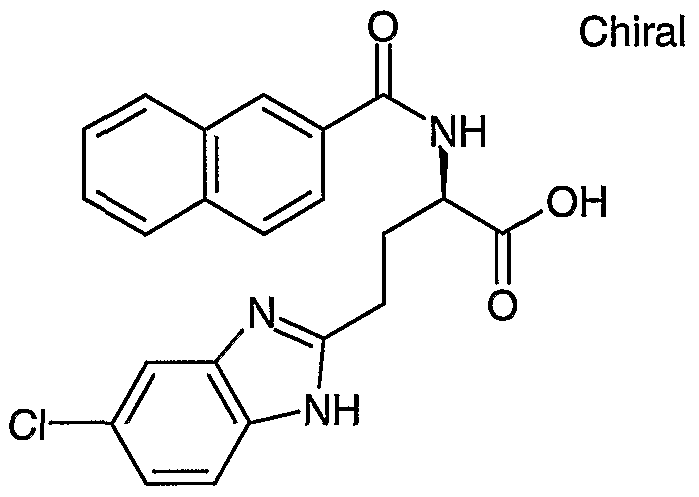
Chiral
To an acetonitrile/water solution (4 ml_/5 mL) of 18a (214 mg, 0.960 mmol) was added 2-naphthoyl chloride (183 mg, 0.960 mmol) and sodium carbonate (356 mg, 3.36 mmol). The mixture was stirred at room temperature overnight. It was then acidified with 1 M HCI. Solid was collected by filtration and washed with water (2X) and ethyl acetate (2X) to give the title compound in 69% yield. 1H NMR (DMSO-D6): δ 12.62 (1 H, br), 9.08 (1 H, d, J = 7.6 Hz), 8.43 (1 H, s), 8.03-7.96 (2H, m), 7.90 (1 H, dd, J = 8.6, 1.5 Hz), 7.63-7.56 (2H, m), 7.48-7.45 (1H, m), 7.31-7.28 (1 H, m), 6.99-6.93 (1H, m), 5.06- 5.01 (1 H, m), 3.47 (1 H, dd, J = 15.2, 6.1 Hz), 3.36 (1 H, dd, J = 15.2, 8.1 Hz). LCMS (APCI): 378.0 (M+H+). Elemental Analysis for (C21H16FN3O3●0.65H2O) calc: C 64.82, H 4.48, N 10.80; found: C 64.66, H 4.26, N 10.80. Example 19:
To an acetonitrile/water solution (5 ml_/6 mL) of 18a (391 mg, 1.75 mmol) was added benzo[B]thiophene-2-carbonyI chloride (345 mg, 1.75 mmol) and sodium carbonate (649 mg, 6.13 mmol). The mixture was stirred at room temperature for overnight. It was then acidified with 1 M HCI. Solid was collected by filtration and washed with water (2X) and ethyl acetate (2X) to give the title compound in 69% yield. 1H NMR (DMSO): δ 12.71 (1 H, br), 9.20 (1 H, d, J = 7.8 Hz), 8.11 (1 H, s), 8.02-8.00 (1 H, m), 7.96-7.94 (1 H, m), 7.48-7.40 (3H, m), 7.29 (1 H, dd, J = 9.6, 2.5 Hz), 6.99-6.93 (1 H, m), 5.00-4.93 (1 H, m), 3.45 (1 H, dd, J = 15.4, 5.8 Hz), 3.33 (1 H, dd, J = 15.4, 8.3 Hz). LCMS (APCI): 384.0 (M+H+). Elemental Analysis for (C19Hi4FN3O3S0.2H2O) calc: C 58.97, H 3.75, 10.86; found: C 58.94, H 3.72, N 10.87. Example 20:
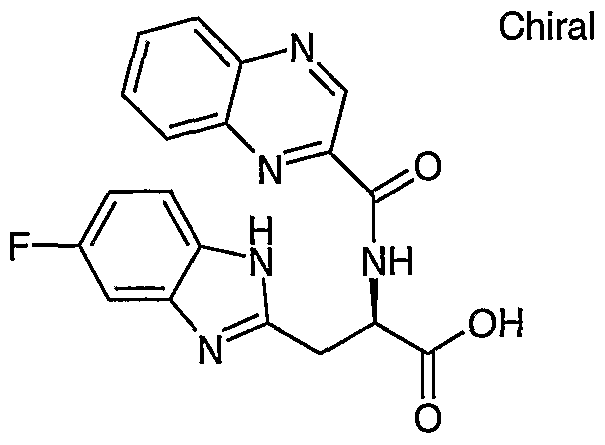
To a dichloromethane solution (20 mL) of 1 ,3-benzothiazole-2-carboxylic acid (563 mg, 3.14 mmol) were slowly added oxalyl chloride (1194 mg, 9.41 mmol) and 2 drops of N,N-dimethylformamide. It was stirred for 2 hours at room temperature. Evaporation of the solvent gave the crude 1 ,3- benzothiazole-2-carboxylic chloride. To an acetonitrile/water solution (10 ml_/10 mL) of 18a (700 mg, 3.14 mmol) was added the crude 1 ,3-benzothiazole-2-carboxylic chloride (3.14 mmol) and sodium carbonate (1165 mg, 11.0 mmol). The mixture was stirred at room temperature for two days. It was then acidified with 1 M HCI. Solid was collected by filtration and washed with water (2X) and ethyl acetate (2X) to give the title compound in 4% yield.
1H NMR (DMSO-D6): δ 9.52 (1H, d, J = 8.3 Hz), 8.23 (1 H, d, J = 8.8 Hz), 8.16 (1 H, d, J = 8.6 Hz), 7.66-7.56 (2H, m), 7.48 (1 H, dd, J = 8.9, 4.9 Hz), 7.33-7.29 (1 H, m), 7.01-6.94 (1 H, m), 5.11 -5.04 (1 H, m), 3.48-3.46 (2H, m). LCMS (APCI): 385.0 (M+H
+). Elemental Analysis for (C
18H
13FN
4O
3S●0.15H
2O) calc: C 55.85, H 3.46, 14.47; found: C 55.83, H 3.37, N 14.28. Example 21 : Chiral
To an ethanol solution (5 mL) of 19 (114 mg, 0.298 mmol) was added thionyl chloride (0.5 mL, 6.85 mmol) at -30°C. The mixture was stirred at room temperature for overnight. Excess reagents were evaporated. The residue was purified by prep. HPLC to give the title compound in 62% yield. 1H NMR (CD3OD): δ 7.86 (1 H, s), 7.82-7.79 (2H, m), 7.61 (1 H, dd, J = 9.1 , 4.3 Hz), 7.40-7.31 (3H, m), 7.26-7.20 (1H, m), 5.01-4.98 (1H, m), 4.14 (2H, q, J = 7.2 Hz), 3.76-3.71 (1 H, m), 3.57 (1H, dd, J = 15.2, 7.8 Hz), 1.11 (3H, t, J = 7.2 Hz). LCMS (APCI): 412.0 (M+H+). Elemental Analysis for (C21H18FN3O3SI ●TFA●0.6H2O) calc: C 51.51 , H 3.80, N 7.84; found: C 51.56, H 3.82, N 7.68. Example 22:
Into a methanol solution (2 mL) of 19 (36 mg, 0.0876 mmol) was bubbled ammonia at 0°C for 45 minutes. The mixture was stirred at room temperature for overnight. The crude product was purified by prep. HPLC to give the title compound in 36% yield. 1H NMR (CD3OD): δ 7.90 (1 H, s), 7.82-7.77 (2H, m), 7.62-7.59 (1H, m), 7.38-7.32 (3H, m), 7.24-7.18 (1H, m), 5.11-5.09 (1H, m), 3.72-3.66 (1 H, m), 3.48-3.42 (1 H, m). LCMS (APCl): 393.1 (M+H+). Example 23:
To an acetonitrile/water solution (6 mL/7 mL) of 18a (322 mg, 1.44 mmol) was added 2-quinoxaloyl chloride (278 mg, 1.44 mmol) and sodium carbonate (382 mg, 3.60 mmol). The mixture was stirred at room temperature for overnight. It was then diluted with ethyl acetate (10 mL) and acidified with 1 M HCI. Solid was collected by filtration and washed with water (2X) and ethyl acetate (2X) to give the title compound in 43% yield.
1H NMR (DMSO-D6): δ 9.67 (1 H, d, J = 8.6 Hz), 9.48 (1H, s), 8.25- 8.19 (2H, m), 8.02-7.99 (2H, m), 7.50 (1 H, dd, J = 8.7, 4.9 Hz), 7.33 (1 H, dd, J = 9.5, 2.4 Hz), 7.02- 6.96 (1 H, m), 5.17-5.12 (1 H, m), 3.50-3.49 (2H, m). LCMS (APCI): 380.1 (M+H
+). Elemental Analysis for (C
19H
14FN
5O
3●0.5H
2O) calc: C 58.76, H 3.89, 18.03; found: C 58.94, H 3.70, N 17.88. Example 24:
Chiral
To a t-butanol solution (5 mL) of 18 (218 mg, 0.578 mmol) was added thionyl chloride (0.6 mL, 8.22 mmol). The reaction mixture was stirred at room temperature for 45 minutes. Excess reagents were evaporated. The residue was purified by prep. HPLC to give the title compound in 52% yield. 1H NMR (DMSO-D6): δ 9.32 (1 H, d, J = 7.5 Hz), 8.42 (1 H, s), 8.02-7.97 (3H, m), 7.88 (1 H, dd, J = 8.5 Hz, 1.7 Hz), 7.73 (1 H, dd, J = 9.0, 4.6 Hz), 7.66-7.57 (3H, m), 7.31 -7.25 (1 H, m), 5.09 (1 H, q, J = 7.4 Hz), 4.08-4.00 (2H, m), 3.70 (1 H, dd, J = 15.3, 7.0 Hz), 3.56 (1 H, dd, J = 15.1 , 7.9 Hz), 1.44-1.35 (2H, m), 1.20-1.08 (2H, m), 0.72 (3H, 1, J = 7.4 Hz). LCMS (APCI): 434.1 (M+H+). Elemental Analysis for (C25H24FN3O3●1.45TFA●0.2H2O) calc: C 55.62, H 4.33, N 6.96; found: C 55.63, H 4.33, N 7.01. Example 25:
To a sodium carbonate solution (1 M, 2.5mL) was added the amino acid 18a (150mg, 0.445mmol), 1 -Naphthylacetic anhydride (284mg, 0.804mmol) and acetonitrile (2.5mL). The mixture was stirred at 25°C for 18h. Ice-cooled 5% HCI solution was added to acidify the reaction mixture (pH~2). The precipitate was collected by filtration and washed with EtOAc. Preparative HPLC purification provided 75mg of the title product (29% yield). 1H NMR (DMSO- d6): δ 8.52 (1 H, d, J=7.8Hz), 7.70 (2H, m), 7.58 (1 H, m), 7.33-7.23 (2H, m), 7.15-7.05 (4H, m), 6.85 (1 H, t, J=9Hz), 4.64 (1 H, m), 3.73 (3H, s), 3.15-3.0 (2H, m); LCMS (APCl): 392(M+H+) (positive); 390 (M-H) (negative); HRMS (MALDI) calc for C22H19N3O3F (M+H+) 392.1410; found 392.1407; Elemental Analysis for (C22H18N3O3F● 0.1 EtOAc) calc: C 67.22, H 4.74, N 10.50; found: C 67.36, H 4.57, N 10.24. Example 26:
To a sodium carbonate solution (1M, 5mL) was added the amino acid 18a (250mg, 0.742mmol), 2-Methylpropanoic anhydride (150mg, 0.948mmol) and acetonitrile (5mL). The mixture was stirred at 25°C for 15h. Ice-cooled 5% HCI solution was added to acidify the reaction mixture
(pH~2). The precipitate was collected by filtration and washed with EtOAc. Preparative HPLC purification provided 220mg of the title product (99% yield). 1H NMR (DMSO- d6): δ 8.43 (1 H, d, J=8.1 Hz), 7.77 (1 H, dd, J=8.8, 4.7Hz), 7.61 (1 H, dd, J=9.2, 2.4Hz), 7.31 (1 H, td, J=9.8, 2.4Hz), 4.95 (1 H, q, J=8.1 Hz), 3.58 (1 H, dd, J=14.9, 6.4Hz), 3.40 (1 H, dd, J=14.9, 8.1 Hz), 2.54 (1 H, hept, J=6.8Hz), 1.13 (3H, d, J=7Hz), 1.06 (3H, d, J=6.8Hz). LCMS (APCI positive): 294 (M+H+); Elemental Analysis for (C14H16N3O3F● 0.32CF3COOH) calc: C 53.32, H 4.99, N 12.74; found: C 53.29, H 5.06, N 12.73. Example 27:
To a sodium carbonate solution (1 M, 5mL) was added the amino acid 18a (230mg, 0.682mmol), Butanoic anhydride (150mg, 0.948mmol) and acetonitrile (5mL). The mixture was stirred at 25°C for 15h. Ice-cooled 5% HCI solution was added to acidify the reaction mixture (pH~2). The precipitate was collected by filtration and washed with EtOAc. Preparative HPLC purification provided 200mg of the title product (quantative). 1H NMR (DMSO- d6): δ 12.9 (1 H, s), 8.27 (1 H, d, J=8.1 Hz), 7.55 (1 H, dd, J=8.8, 4.7Hz), 7.39 (1 H, dd, J=9.2, 2.4Hz), 7.09 (1 H, td, J=9.8, 2.4Hz), 4.76 (1 H, m), 3.36 (1 H, dd, J=15, 6.2 Hz), 3.18 (1 H, dd, J=15.1 , 8.1 Hz), 2.01 (1 H, t, J=7.1 Hz), 1.40 (1 H, hex, J=7.3Hz), 0.72 (1 H, t, J=7.4 Hz). LCMS (APCI positive): 294 (M+H+); Elemental Analysis for (C14H16N3O3F●0.51 CF3COOH) calc: C 51.33, H 4.74, N 11.96; found: C 51.30, H 4.79, N 11.81. Example 28:
To a tetrahydrofuran solution (3 mL) of 24 (66 mg, 0.152 mmol) was added lithium borohydride (5 mg, 0.229 mmol) and stirred at room temperature for 3 hours. The reaction was quenched with saturated ammonium chloride and purified by prep. HPLC to give the title compound in 13% yield. 1H NMR (CD3OD): δ 8.18 (1 H, s), 7.84-7.76 (4H, m), 7.63-7.57 (2H, m), 7.47-7.36 (3H, m), 7.25-7.18 (1 H, m), 4.60-4.52 (1 H, m), 3.74-3.71 (2H, m), 3.51 (1 H, dd, J = 14.8, 4.6 Hz), 3.28 (1 H, dd, J = 14.8, 9.0 Hz), 2.85 (1 H, s), 2.72 (1 H, s). LCMS (APCl): 3641 (M+H+). HRMS (MALDI) calc for C21H19N3O 3F (M+H+) 364.1461 ; found 364.1458. Compound 29a:
To a methanol solution (25 mL) of 18 (1.03 g, 2.73 mmol) was added thionyl chloride (0.5 ml_, 6.85 mmol) at 0°C. The mixture was stirred at room temperature for overnight. Excess reagents were evaporated to give the crude methyl ester. LCMS (APCI): 392.1.1 (M+H
+). To a methanol solution (25 mL) of the crude methyl ester was bubbled ammonium at 0°C for 45 minutes. The mixture was stirred at room temperature for overweekend. Methanol was evaporated to give the title compound. LCMS (APCI): 377.1 (M+H
+). Compound 29b:
To a tetrahydrofuran solution (25 mL) of 29a (2.73 mmol) was added trifluoroacetic anhydride (1.29 g, 6.14 mmol) and triethylamine (1.03 g, 10.2 mmol). The mixture was stirred at room temperature for overnight. It was then evaporated to give the crude title compound. 1H NMR (DMSO-d6): δ 9.61 (1 H, d, J=7.6Hz), 8.47 (1 H, s), 8.07-7.88 (4H, m), 7.72-7.58 (3H, m), 7.52 (1 H, dd, J=9, 2.2Hz), 7.17 (1 H, td, J=9.1 , 1.9Hz), 5.61 (1 H, dd, =15.2, 7.7Hz), 3,76-3.57 (2H, m). LCMS (APCI): 359.1 (M+H+). Example 29:
To a 1-methyl-2-pyrrolidinone solution (5 mL) of 29b (70 mg, 0.196 mmol) were added triethylamine hydrochloride (40 mg, 0.294 mmol) and sodium azide (38 mg, 0.587 mmol). The mixture was stirred at 150°C for 3 hours. It was then purified by prep. HPLC to give the title compound in 6% yield. 1H NMR (CD3OD): δ 8.24 (1 H, s), 7.84-7.78 (3H, m), 7.71 (1 H, dd, J = 8.7, 1.5 Hz), 7.49-7.44 (2H, m), 7.38 (1 H, dd, J = 8.7, 4.6 Hz), 7.13 (1 H, dd, J = 9.0, 2.5 Hz), 6.95-6.88 (1 H, m), 6.01 (1 H, dd, J = 7.9, 6.4 Hz), 3.80-3.71 (1 H, m), 3.61 (1 H, dd, J = 14.9, 8.3 Hz). LCMS (APCI): 402.1 (M+H+). HRMS (MALDl) calc for C21H17N7O F (M+H+) 402.1479; found 402.1494. Example 30:
To a solution of the acid 18 (0.2516 g, 0.6684 mmol) and propan-2-ol (5.8 mL), at 0 °C under an nitrogen atmosphere, was added thionyl chloride (0.7 mL) dropwise. The reaction mixture was
allowed to warm to ambient temperature and stirred for 1 hour. The volatiles were removed in vacuo and the subsequent residue dissolved in ethyl acetate (25 mL) and saturated aq. sodium bicarbonate (25 mL). The layers were separated and the aqueous layer extracted with ethyl acetate (2 x 25 mL). The combined organic extracts were dried (anhydrous magnesium sulfate), filtered, and concentrated in vacuo to afford the crude product. This material was purified by preparative HPLC to yield the pure title compound as a colorless oil (0.0586 g, 21%). 1H NMR (CDCI3): δ 8.27 (bs, 1 H), 7.97 (d, J= 7.4 Hz, 1 H), 7.84-7.76 (m, 4H), 7.53-7.46 (m, 2H), 7.44-7.36 (m, 1 H), 7.17-7.14 (m, 1 H), 6.92-6.86 (m, 1H), 5.22-5.16 (m, 1H), 5.08-4.99 (m, 1H), 3.65-3.52 (m, 2H), 2.03 (s, 6H); LCMS 420 (M+H).
Synthesis of Examples 31-44 Amino ethyl ester 31a:
Amino acid 18a (1.25 g, 5.59 mmol) in ethanol (11 mL) was stirred for two hours at room temperature. Thionyl chloride (0.94 mL, 12.86 mmol) was added into the reaction mixture at 0°C. The reaction mixture was stirred for another two hours at 65°C. After cooling down to room temperature, excess thionyl chloride and solvent were removed in vacuo to give 0.94g (48%) of reddish brown residue. Crude amino ethyl ester 31a was used in the next step without aqueous work up and purification. 1H NMR (DMSOd6): δ 0.94 (dd, 3H, J=14.13, 7.16 Hz), 1.04 (dd, 2H, J=13.94, 6.97 Hz), 3.42 (t, 2H, J=6.97 Hz), 4.91 (d, 1 H, J=6.78 Hz), 7.37 (td, 1 H, J=2.45, 2.07 Hz), 7.66 (t, 1 H, J=2.26 Hz), 7.80 (t, 1 H, J=4.52 Hz). LCMS 252 (M-H). Example 31 :
To a reaction mixture of amino ethyl ester 31a (0.28 g, 1.12 mmol) and aryl carboxylic acid (0.20 g, 1.12 mmol) in DMF (3 mL), EDC (0.32 g, 2.68 mmol), DMAP (20.5 mg, 0.17 mmol) and triethyl amine (172 ?L, 1.23 mmol) were added. The reaction mixture was stirred for 16 hours at room temperature. Crude product was purified by prep-HPLC without work up (25_75_60min, 0.1% TFA in water and acetonitrile) given 0.13 g (29%) of oil 31. 1H NMR (DMSOd6): δ 1.06 (t, 3H, J-7.06 Hz), 3.44 (m, 2H), 3.91 (s, 3H), 4.07 (q, 2H, J=7.03 Hz), 4.99 (m, 1H), 6.98 (m, 1H), 7.09 (m, 2H), 7.38 (m, 4H), 7.64 (d, 1 H, J=8.10 Hz), 9.02 (dd, 1 H, J=7.54, 2.83 Hz). LCMS 409 (M+H). Example 32:
To a reaction mixture of amino ethyl ester 31a (0.29 g, 1.12 mmol) and aryl carboxylic acid (0.19 g, 1.12 mmol) in DMF (7.5 mL), EDC (2.41 g, 1.30 mmol), HATU (469.0 mg, 1.20 mmol) and triethyl amine (312 μL, 4.25 mmol) were added. The reaction mixture was stirred for 16 hours at room temperature. Crude product was purified by prep-HPLC without work up (20_55_60min, 0.1% TFA in water and acetonitrile) giving 0.16 g (38%) of oil 32. 1H NMR (DMSOd6): δ 1.07 (t, 3H, J=7.16 Hz),
3.58 (m, 2H), 4.11 (q, 2H), J=7.28 Hz), 5.10 (q, 1 H, 7.47 Hz), 7.34 (m, 1 H) 7.66 (dd, 2H, J=8.29, 4.33 Hz), 7.78 (dd, 1 H, J=8.85, 4.71 Hz), 8.13 (m, 2H), 8.53 (m, 2H), 9.03 (d, 1 H, J=4.33 Hz), 9.44 (d, 1 H, J=7.35 Hz). LCMS 407 (M+H). Example 33:
To a reaction mixture of amino ethyl ester 31a (98.4 m g, 0.39 mmol) and aryl carboxylic acid (68.2 mg, 0.39 mmol) in DMF (2 ml_), EDC (113.0 mg, 0.59 mmol), DMAP (7.2 mg, 0.06 mmol) and triethyl amine (60 μl_, 0.43 mmol) were added. The reaction mixture was stirred for 16 hours at room temperature. Crude product was purified by prep-HPLC without work up (25_75_60min, 0.1% TFA in water and acetonitrile) giving 66.8 m g (42%) of oil 33 with less than 85% purity. The ethyl ester was carried in the hydrolysis step without further purification. Example 34:
To a reaction mixture of amino ethyl ester 31a (0.31 g, 1.23 mmol) and aryl carboxylic acid (0.22 g, 1.23 mmol) in DMF (8.2 ml_), EDC (0.35 g, 1.8 mmol), DMAP (22.5 mg, 0.18 mmol) and triethyl amine (342 μl_, 2.5 mmol) were added. The reaction mixture was stirred for 16 hours at room temperature. Crude product was purified by prep-HPLC without work up (30_95_60min, 0.1% TFA in water and acetonitrile) giving 0.23 g (45%) of oil 34. 1H NMR (DMSO-d6): δ 1.04 (t, 3H, J=7.16 Hz), 1.73 (s, 4H), 2.73 (s, 4H), 3.51 (m, 2H), 4.07 (q, 2H, J=7.03 Hz), 5.00 (q, 1H, J=7.60 Hz), 7.13 (d, 1H, J=8.67 Hz), 7.28 (m, 1 H), 7.51 (d, 2H, J=6.22 Hz), 7.60 (d, 1 H, J=7.72 Hz), 7.72 (dd, 1 H, J=8.76, 4.43 Hz), 8.99 (d, 1 H, J=7.16 Hz). LCMS 410 (M+H). Example 35:
To a reaction mixture of amino ethyl ester 31a (0.31 g, 1.24 mmol) and aryl carboxylic acid (0.30 g, 1.24 mmol) in DMF (3 mL), EDC (0.37 g, 1.9 mmol), DMAP (25 mg, 0.19 mmol) and triethyl amine (345 μL, 2.5 mmol) were added. The reaction mixture was stirred for 16 hours at room temperature. Crude product was purified by prep-HPLC without work up (25_60_60min, 0.1 % TFA in water and acetonitrile) giving 0.24 g (41%) of oil 35. Example 36:
To a reaction mixture of amino ethyl ester 31a (0.31 g, 1.24 mmol) and aryl carboxylic acid (0.22 g, 1.24 mmol) in DMF (4 mL), EDC (0.36 g, 1.9 mmol), DMAP (25.0 mg, 0.28 mmol) and triethyl amine (345 μl_, 3.72 mmol) were added. The reaction mixture was stirred for 16 hours at room temperature. Crude product was purified by prep-HPLC without work up (10_50_60min, 0.1% TFA in water and acetonitrile) giving 0.30 g (59%) of oil 36.
1H NMR (DMSOd
6): δ 1.06 (t, 3H, J=7.06 Hz), 3.54 (s, 2H), 4.08 (dd, 3H, J=6.97, 1.13 Hz), 7.32 (dd, 1 H, J=9.04, 6.78 Hz), 7.65 (dd, 1 H, J=4.14, 0.94 Hz), 7.77 (m, 1 H, J=8.48, 7.16, 4.90, 4.90, 4.90 Hz), 7.94 (d, 1 H, J=8.48 Hz), 8.17 (d, 1 H, J=8.48 Hz), 8.63 (d, 1 H, J=1.70 Hz), 9.30 (d, 1 H, J=8.29 Hz), 9.55 (s, 1 H). LCMS 413 (M+H). Example 37:
To a reaction mixture of amino ethyl ester 31a (0.02 g, 0.28 mmol) and N-succinimidyl 7- (diethylamino) coumarin-3-carboxylate (0.10 g, 0.28 mmol) in DMF (1.4 mL), EDC (0.08 g, 0.42 mmol), and triethyl amine (78 μL, 0.56 mmol) were added. The reaction mixture was stirred for 16 hours at room temperature. Crude product was purified by prep-HPLC without work up (30_70_60min, 0.1% TFA in water and acetonitrile) giving 0.051 g (37%) of oil 37. 1H NMR (DMSO- d6): δ 1.11 (t, 6H, J=7.06 Hz), 3.48 (dd, 2H, J=21.29, 7.16 Hz), 4.11 (t, 4H, J=7.06 Hz), 5.06 (dd, 1 H, J=7.54, 4.90 Hz), 6.61 (d, 1 H, J=1.88 Hz), 6.80 (dd, 1 H, J=11.30, 9.04 Hz), 7.24 (dd, 1 H, J=16.20, 10.93 Hz), 7.55 (d, 1 H, J--9.04 Hz), 7.69 (d, 2H, J=7.35 Hz), 8.60 (s, 1 H), 9.31 (d, 1 H, J=7.54 Hz). LCMS 495 (M+H). Example 38:
To a solution of 31 (0.12g, 0.23 mmol) in methanol (1.5 mL), 5% NaOH (1.5mL, 1.6 mmol) was added. The reaction mixture was stirred for two and half hours at room temperature then neutralized with 5.5N HCI until pH~7. The solvents were removed in vacuo. The residue was dissolved in methanol, and the product was purified by prep-HPLC (20_60_30min with 0.1% AcOH as buffer in water and acetonitrile) to give 4.9 mg (6%) of solid 38. Η NMR (DMSO-d6): δ 3.91 (s, 5H), 4.99 (s, 1 H), 7.02 (ddd, 3H, J=29.58, 9.23, 8.85 Hz), 7.26 (dd, 2H, J=9.80, 8.29 Hz), 7.47 (dd, 2H, J=10.36, 7.54 Hz), 7.63 (d, 1 H, J=8.10 Hz), 8.92 (d, 1 H, J=7.35 Hz). LCMS 381 (M+H). Example 39:
To a solution of 32 (0.16g, 0.40 mmol) in methanol (1.5 mL), 5% NaOH (0.5mL, 0.8 mmol) was added. The reaction mixture was stirred for two and half hours at room temperature then neutralized with 5.5N HCI until pH~7. The solvents were removed in vacuo. The residue was dissolved in methanol, and the product was purified by prep-HPLC with 0.1% AcOH as buffer in water and acetonitrile to give 35.5 mg (24%) of solid 57. 1H NMR (DMSO-d6): δ 3.56 (m, 2H, J=7.72, 7.72. 6.03, 5.46 Hz), 5.07 (d, 1 H, J=6.59 Hz), 7.16 (t, 1 H, J=9.14 Hz), 7.49 (d, 1 H, J=8.48 Hz), 7.63 (m, 2H), 8.12 (dq, 2H, J=25.81 , 8.60 Hz), 8.50 (d, 2H, J=8.10 Hz), 9.01 (s, 1 H), 9.29 (d, 1 H, J=7.72 Hz). LCMS 379 (M+H). Example 40:
To a solution of 33 (0.067g, 0.16 mmol) in methanol (1.0 mL), 5% NaOH (0.5mL, 0.8 mmol) was added. The reaction mixture was stirred for two and half hours at room temperature then neutralized with 5.5N HCI until pH~7. The solvents were removed in vacuo. The residue was dissolved in methanol, and the product was purified by prep-HPLC with 0.1% TFA as buffer in water and acetonitrile to give 15.0 mg (24%) of solid 40. 1H NMR (DMSO-d6): δ 2.35 (s, 3H), 3.34 (d, 2H, J=3.77 Hz), 3.62 (s, 2H), 4.91 (dd, 1H, J=4.71, 3.77 Hz), 7.03 (dd, 1H, J=8.67, 8.29 Hz), 7.32 (d, 3H, J=6.97 Hz), 7.50 (dd, 3H, J=6.22, 4.52 Hz), 8.30 (d, 1 H, J=8.10 Hz). LCMS 380 (M+H). Example 41 :
To a solution of 34 (0.23g, 0.56 mmol) in methanol (1.0 mL), 5% NaOH (1.OmL, 1.6 mmol) was added. The reaction mixture was stirred for two and half hours at room temperature then neutralized with 5.5N HCI until pH~7. The solvents were removed in vacuo. The residue was dissolved in methanol, and the product was purified by prep-HPLC (20_60_30min with 0.1% AcOH as buffer in water and acetonitrile) to give 52.7 mg (25%) of solid 41.
1H NMR (DMSO-d
6): δ 1.73 (s, 4H), 2.73 (s, 4H), 3.42 (t, 2H, J=8.19 Hz), 3.60 (dd, 2H, J=6.97, 5.84 Hz), 4.99 (dd, 1 H, J=7.54, 5.46 Hz), 7.11 (d, 1 H, J=8.48 Hz), 7.22 (td, 1 H, J=2.26, 1.41 Hz), 7.52 (dd, 3H, J=6.59, 2.26 Hz), 7.66 (dd, 1H, J=4.71, 4.33 Hz), 8.88 (d,1 H, J=7.72 Hz). LCMS 382 (M+H). Example 42:
To a solution of 35 (0.24g, 0.51 mmol) in methanol (2.6 ml_), 5% NaOH (1.2ml_, 1.9 mmol) was added. The reaction mixture was stirred for two and half hours at room temperature then neutralized with 5.5N HCI until pH~7. The solvents were removed in vacuo. The residue was dissolved in methanol, and the product was purified by prep-HPLC (25_55_60min with 0.1% TFA as buffer in water and acetonitrile) to give 29.8 mg (13%) of solid 42. 1H NMR (DMSOd6): δ 3.59 (m, 2H, J=6.97, 6.03, 5.84, 4.90, 4.52, 4.71 Hz), 5.09 (t, 1 H, J=6.12 Hz), 7.34 (dd, 1 H, J=10.55, 1.32 Hz), 7.46 (m, 2H), 7.74 (m, 6H), 8.05 (d, 1 H, J=8.67 Hz), 8.37 (d, 1 H, J=8.10 Hz), 8.66 (s, 1 H), 9.40 (d, 1 H, J=8.67 Hz). LCMS 445 (M+H). Example 43:
To a solution of 36 (0.3Og, 0.73 mmol) in methanol (3.7 mL), 5% NaOH (1.8ml_, 2.8 mmol) was added. The reaction mixture was stirred for two and half hours at room temperature then neutralized with 5.5N HCI until pH~7. The solvents were removed in vacuo. The residue was dissolved in methanol, and the product was purified by prep-HPLC (25_55_60min with 0.1% AcOH as buffer in water and acetonitrile) to give 40.5 mg (14%) of solid 43. 1H NMR (DMSO-d6): δ 3.59 (m, 2H, J=34.66, 8.29, 7.91 , 4.90, 4.52, 2.64, 2.45 Hz), 5.09 (dd, 1H, J=12.06, 7.91 Hz), 7.38 (d, 1H, J=1.88 Hz), 7.71 (t, 1 H, J=2.45 Hz), 7.82 (t, 1 H, J=4.71 Hz), 7.96 (d, 1 H, J=8.48 Hz), 8.16 (d, 1 H, J=8.67 Hz), 8.64 (s, 1 H), 9.26 (d, 1 H, J=7.54 Hz), 9.54 (s, 1 H). LCMS 385 (M+H). Example 44:
To a solution of 37 (32.6 mg, 0.07 mmol) in methanol (0.5 mL), 5% NaOH (0.2mL, 0.32 mmol) was added. The reaction mixture was stirred for two and half hours at room temperature then neutralized with 5.5N HCI until pH~7. The solvents were removed in vacuo. The residue was dissolved in methanol, and the product was purified by prep-HPLC with 0.1% AcOH as buffer in water and acetonitrile to give 10.7 mg (35%) of solid 44. 1H NMR (DMSO-d6): δ 0.92 (t, 6H, J=6.88 Hz), 3.17 (d, 6H, J=6.59 Hz), 4.81 (d, 1 H, J=6.22 Hz), 6.41 (s, 1 H), 6.59 (dd, 1 H, J=6.03, 2.07 Hz), 6.84 (d, 1 H, J=7.54 Hz), 7.15 (d, 1 H, J-12.81 Hz), 7.32 (d, 1 H, J=3.96 Hz), 7.49 (d, 1H, J=8.48 Hz), 8.43 (s, 1H), 9.08 (d, 1 H, J=7.16 Hz). LCMS 467 (M+H). Example 45:
To a solution of the acid (0.25 g, 0.6642 mmol) in THF (8.7 mL) and DMF (0.7 mL) was added CDI (0.2154 g, 1.3284 mmol) and the resulting mixture was heated at 80 °C for 1 hour. The mixture was cooled to ambient temperature and hydroxylamine hydrochloride (0.1385 g, 1.9926 mmol) was added. The reaction mixture was then heated at 80 °C for a further 4 hours and once again allowed to cool to ambient temperature. The mixture was then partitioned between ethyl acetate (25 mL) and 3M aq. hydrochloric acid (25 mL). The layers were separated and the aqueous layer extracted with ethyl acetate (2 x 25 mL). The combined organic extracts were then dried (anhydrous magnesium sulfate), filtered, and concentrated in vacuoio afford the crude product. This material was then purified by preparative HPLC to afford the pure title compound as a white crystalline solid (0.1121 g, 43%). 1H NMR (d6-DMSO): δ 8.29 (bs, 1 H), 8.00 (d, J= 7.4 Hz, 1 H), 7.86-7.78 (m, 4H), 7.56-7.49 (m, 2H), 7.47-7.39 (m, 1 H), 7.19-7.16 (m, 1 H), 6.95-6.89 (m, 1 H), 5.25-5.19 (m, 1 H), 5.11 -5.02 (m, 1 H), 3.58-3.54 (m, 1 H); LCMS 393 (M+H). Compound 46a:
To a 5.5 N HCI solution (54 mL) of 4-chloro-1 ,2-phenylene diamine (7.74 g, 54.3 mmol) was added H- D-Asp-OH (10.8 g, 81.4 mmol). The mixture was refluxed for 72h. It was filtered after cooling down to room temperature. The filtrate was adjusted to pH 7 with solid sodium carbonate. Solid was collected by filtration and recrystalized with 67% ethanol (50 mL) to give the title compound in 23% yield. 1H NMR (DMSO- d6): δ 7.81 (1 H, d, J=1.8Hz), 7.75 (1 H, d, J=8.6Hz), 7.40 (1 H, dd, J=8.4, 2.1 Hz), 4.05- 3.90 (1 H, m), 3.64 (1 H, dd, J=16.4, 5.6Hz), 3.36 (1 H, dd, J=15.9, 7.4Hz). LCMS (APCI): 240.0 (M+H+). Example 46:
To an acetonitrile/water solution (4 ml_/5 mL) of 46a (210 mg, 0.877 mmol) was added 2-naphthoyl chloride (167 mg, 0.877 mmol) and sodium carbonate (325 mg, 3.07 mmol). The mixture was stirred at room temperature for overnight. It was then acidified with 1 M HCI. Solid was collected by filtration and washed with water (2X) and ethyl acetate (2X) to give the title compound in 12% yield. 1H NMR
(DMSO-D6): δ 12.73 (1 H, brs), 8.45 (1 H, s), 8.07-7.96 (3H, m), 7.95-7.88 (1 H, m), 7.67-7.48 (4H, m), 7.16 (1 H, dd, J=8.48, 1.89 Hz), 5.12-5.03 (1 H, m), 3.56-3.33 (2H, m). LCMS (APCI): 394.0 (M+H+). Elemental Analysis for (C21H16CIN3O3●0.7H2O) calc: C 62.06, H 4.32, N 10.34; found: C 61.82, H 4.06, N 10.27. Example 47:
To an acetonitrile/water solution (3 mL/4 mL) of 46a (170 mg, 0.710 mmol) wwas added benzo[B]thiophene-2-carbonyl chloride (140 mg, 0.710 mmol) and sodium carbonate (263 mg, 2.49 mmol). The mixture was stirred at room temperature for overnight. It was then acidified with 1 M HCI. Solid was collected by filtration and washed with water (2X) and ethyl acetate (2X) to give the title compound in 28% yield. 1H NMR (DMSO-d6): δ 12.78 (1 H, brs), 9.23 (1 H, d, J=7.92 Hz), 8.13 (1 H, s), 8.06-7.93 (2H, m), 7.59-7.41 (4H, m), 7.16 (1 H, dd, J=8.47, 1.88 Hz), 5.06-4.97 (1 H, m), 3.49 (1 H, dd, J=15.45, 6.03 Hz), 3.36 (1 H, dd, J=15.07, 8.10 Hz). LCMS (APCI): 400.0 (M+H+). Elemental Analysis for (C19H14CIN3O3S●0.3H2O) calc: C 56.31, H 3.63, N 10.37; found: C 56.35, H 3.66, N 10.34. Compound 48a:
To a 5.5 N HCI solution (50 mL) of 3,4-diamino toluene (6.11 g, 50.0 mmol) was added H-D-Asp-OH (9.98 g, 75.0 mmol). The mixture was refluxed for overnight. It was filtered after cooling down to room temperature. The filtrate was adjusted to pH 1 with solid sodium carbonate. Solid was collected by filtration and recrystalized with 67% ethanol to give the title compound in 30% yield. 1H NMR (DMSO- d6): δ 10.0 (1 H, br s), 7.62 (1 H, d, J=8.3Hz), 7.52 (1 H, s), 7.20 (1 H, d, J=9Hz), 4.33 (1 H, t, J=7Hz), 3.63 (1 H, dd, J=16.2, 5.1 Hz), 3.45 (1 H, dd, J=16.2, 7.3Hz), 2.61 (3H, s). LCMS (APCI): 220.0 (M+H+). Example 49:
To an acetonitrile/water solution (5 ml_/6 mL) of 48a (247 mg, 1.13 mmol) was added 2-naphthoyl chloride (215 mg, 1.13 mmol) and sodium carbonate (419 mg, 3.96 mmol). The mixture was stirred at room temperature for overnight. It was then acidified with 1 M HCI. Solid was collected by filtration
and washed with water (2X) and ethyl acetate (2X) to give the title compound in 7% yield. 1H NMR (DMSO-d6): δ 9.10 (1 H, d, J = 7.8 Hz), 8.43 (1 H, s), 8.03-7.96 (3H, m), 7.91-7.89 (1 H, m), 7.63-7.57 (2H, m), 7.36 (1 H, d, J = 8.1 Hz), 5.06-5.00 (1 H, m), 3.45 (1 H, dd, J = 15.2, 6.1 Hz), 3.32 (1 H, dd, J = 15.7, 8.0 Hz), 2.36 (3H, s). LCMS (APCI): 374.1 (M+H+). Elemental Analysis for (C22H19N3O30.7HCI) calc: C 66.23, H 4.98, N 10.53; found: C 66.24, H 4.92, N 10.57. Example 50:
To an acetonitrile/water solution (5 ml_/6 mL) of 48a (207 mg, 0.945 mmol) was added benzo[B]thiophene-2-carbonyl chloride (186 mg, 0.945 mmol) and sodium carbonate (351 mg, 3.31 mmol). The mixture was stirred at room temperature for overnight. It was then acidified with 1 M HCI. Solid was collected by filtration and washed with water (2X) and ethyl acetate (2X) to give the title compound in 19% yield. 1H NMR (DMSO-d6): δ 9.21 (1 H, d, J = 7.8 Hz), 8.11 (1 H, s), 8.02-8.00 (1 H, m), 7.96-7.94 (1 H, m), 7.47-7.40 (2H, m), 7.35 (1 H, d, J = 8.1 Hz), 7.26 (1 H, s), 6.92-6.94 (1 H, m), 4.99-4.95 (1 H, m), 3.43 (1 H, dd, J = 15.4, 6.1 Hz), 3.31 (1 H, dd, J = 15.4, 8.1 Hz), 2.36 (3H, s). LCMS (APCI): 380.0 (M+H+). Elemental Analysis for (C20H17N3O3S●0.6HCI) calc: C 59.86, H 4.42, 10.47; found: C 60.03, H 4.21 , N 10.60. Compound 51a:
To a 5.5 N HCI solution (30.7 mL) of 4-chloro-1 ,2-diamino-5-fluoro-benzene (4.93 g, 30.7 mmol) was added H-D-Asp-OH (6.12 g, 46.0 mmol). The mixture was refluxed for overnight. It was filtered after cooling down to room temperature. The filtrate was purified by prep. HPLC to give the title compound. 1H NMR (DMSO-d6): δ 7.60 (1 H, d, J=6.6Hz), 7.42 (1 H, d, J=9.4Hz), 3.73 (1 H, dd, J=8.9, 4.8Hz), 3.42-3.30 (2H, m). LCMS (APCI): 258.0 (M+H+). Example 51 :
To an acetonitrile/water solution (6 mL/7 mL) of 51a (460 mg, 1.79 mmol) was added 2-naphthoyl chloride (272 mg, 1.43 mmol) and sodium carbonate (378 mg, 3.57 mmol). The mixture was stirred at room temperature for overnight. It was then acidified with 1 M HCI. Solids was collected by
filtration and purified by prep. HPLC to give the title compound in 20% yield. 1H NMR (DMSO-d6): δ 12.73 (1 H, br), 9.08 (1 H, d, J = 8.1 Hz), 8.42 (1 H, s), 8.03-7.86 (4H, m), 7.71-7.53 (4H, m), 5.07-5.00 (1 H, m), 3.53-3.33 (2H, m). LCMS (APCI): 412.0 (M+H+). Elemental Analysis for (C21H15CIFN3O3●0.25H2O) calc: C 60.58, H 3.75, 10.09; found: C 60.60, H 3.81 , N 10.12. Example 52:
To an acetonitrile/water solution (10 mL/12 mL) of 51a (785 mg, 3.05 mmol) was added benzo[B]thiophene-2-carbonyl chloride (480 mg, 2.44 mmol) and sodium carbonate (647 mg, 6.10 mmol). The mixture was stirred at room temperature for overnight. It was then acidified with 1 M HCI. Solids was collected by filtration and purified by prep HPLC to give the title compound in 13% yield. 1H NMR (DMSO): δ 9.24 (1 H, d, J = 7.9 Hz), 8.10 (1 H, s), 8.02-7.93 (2H, m), 7.80 (1H, d, J = 6.6 Hz), 7.65 (1 H, d, J = 9.6 Hz), 7.48-7.40 (2H, m), 5.04-4.96 (1H, m), 3.56-3.49 (1 H, m), 3.42-3.34 (1 H, m). LCMS (APCI): 418.0 (M+H+). Elemental Analysis for (C19H13CIFN3O3S●0.3H2O) calc: C 53.92, H 3.24, 9.93; found: C 53.73, H 3.05, N 9.76. Compound 53a:
To a 5.5 N HCI solution (12.5 mL) of 1 ,2-diamino-3,4-difluoro-benzene (1.80 g, 12.5 mmol) was added H-D-Asp-OH (6.12 g, 46.0 mmol). The mixture was refluxed for overweekend. It was filtered after cooling down to room temperature. The filtrate was purified by prep. HPLC to give the title compound in 66% yield. LCMS (APCI): 242.1 (M+H+). Compound 53b:
To an ethanol solution (20 mL) of 53a (1.98 g, 8.22 mmol) was added thionyl chloride (2 mL) at 0°C. The mixture was stirred at 65°C for 2 hours. Excess reagents were evaporated. The residue was dissolved in ethyl acetate. The ethyl acetate solution was washed with cold 1 M sodium carbonate and brine. It was then dried over Na
2SO
4 and concentrated to give the title compound in 63% yield.
1H NMR (DMSO- d
6): δ 8.81 (1 H, br s), 7.38-7.15 (2H, m), 4.65 (1 H, m), 4.20-4.00 (2H, m), 3.52-3.48 (2H, m), 1.05 (3H, t, J=7.1 Hz). LCMS (API-ES): 270.2 (M+H
+). Compound 53c:
To a N, N-dimethyl-formamide solution (5 mL) of 53b (149 mg, 0.625 mmol) were added added 3- benzooxazol-2-yl-benzoic acid (149 mg, 0.625 mmol), EDC (179 mg, 0.983 mmol), triethylamine (70 mg, 0.688 mmol) and 4-(dimethylamino)pyridine (11 mg, 0.0938 mmol). The mixture was stirred at room temperature for overnight. It was then purified by prep. HPLC. The fractions containing the product were combined and evaporated. The residue was dissolved in ethyl acetate (20 mL). The ethyl acetate solution was washed with 1 M sodium carbonate (10 mL) and brine (10 mL), dried with Na2SO4 and concentrated to give the title compound in 12% yield. 1H NMR (DMSO- d6): δ 12.82 (1 H, br s), 9.41 (1 H, d, J=7.7Hz), 8.69 (1 H, s), 8.38 (1 H, d, J=7.7Hz), 8.09 (1 H, d, J=8.1 Hz), 7.9-7.8 (2H, m), 7.75 (1H, t, J=7.8Hz), 7.47 (2H, m), 7.32-7.25 (2H, m), 5.08 (1 H, q, J=6.2Hz), 4.11 (2H, q, J=6.6Hz), 3.55-3.40 (2H, m), 1.09 (3H, d, J=7.0Hz). LCMS (APCI): 491.1 (M+H+). Example 53:
To a methanol solution (1 mL) of 53c (33 mg, 0.0673 mmol) was added 5% sodium hydroxide (1 mL) at 0°C. The mixture was stirred at room temperature for 3 hours. It was then purified by prep. HPLC to give title compound in 68% yield.
1H NMR (DMSO-d6): δ 12.88 (1 H, br), 9.28 (1 H, d, J = 7.9 Hz), 8.67 (1 H, s), 8.35 (1 H, d, J = 7.9 Hz), 8.06 (1 H, d, J = 7.9 Hz), 7.85-7.80 (2H, m), 7.72 (1 H, t, J = 7.8 Hz), 7.50-7.43 (2H, m), 7.30-7.26 (1H, m), 7.22-7.15 (1H, m), 5.09-5.02 (1H, m), 3.55-3.48 (1 H, m), 3.38 (1 H, dd, J = 15.1 , 8.5 Hz). LCMS (APCI): 463.0 (M+H
+). Elemental Analysis for (C
24H
16F
2N
4O
4●0.35TFA) calc: C 59.06, H 3.28, N 11.15; found: C 59.22, H 3.47, N 11.02. Compound 54a:
To a N, N-dimethyl-formamide solution (5 mL) of 52b (198 mg, 0.736 mmol) was added 1- methylindole-2-carboxylic acid (129 mg, 0.736 mmol), EDC (210 mg, 1.10 mmol), triethylamine (82 mg, 0.810 mmol) and 4-(dimethylamino)pyridine (13 mg, 0.110 mmol). The mixture was stirred at room temperature for overnight. It was then purified by prep. HPLC. The fractions containing the product were combined and evaporated. The residue was triturated with water (10 mL) and filtered to give the title compound in 32% yield. 1H NMR (DMSO- d6): δ 12.79 (1 H, br s), 9.07 1 H, d, J=7.3Hz), 7.66 (1 H, d, J=7.9Hz), 7.40 (1H, d, J=8.7Hz), 7.30 (1H, td, J=6.9, 1.1Hz), 7.26-7.08 (3H, m), 5.04 (1H, q, J=8.3Hz), 4.10 (1 H, q, J=7Hz), 3.51-3.35 (2H, m), 3.93 (3H, s), 1.09 (3H, t, J=7.2Hz). LCMS (APCI): 427.1 (M+H+). Example 54:
To a methanol solution (2 mL) of 54a (64 mg, 0.150 mmol) was added 5% sodium hydroxide (2 mL) at 0°C. The mixture was stirred at room temperature for 2.5 hours. It was then purified by prep. HPLC to give title compound in 62% yield.
1H NMR (DMSO-d6): δ 12.78 (1H, s), 8.92 (1H, d, J = 7.8 Hz), 7.62 (1 H, d, J = 7.8 Hz), 7.50 (1 H, d, J = 8.3 Hz), 7.28-7.24 (2H, m), 7.20-7.13 (1 H, m), 7.10-7.07 (2H, m), 5.02-4.96 (1 H, m), 3.91 (3H, s), 3.50-3.45 (1 H, m), 3.36-3.33 (1 H, m). LCMS (APCI): 399.1 (M+H
+). Elemental Analysis for (C
20H
16F
2N
4O
3●0.5TFA) calc: C 55.39, H 3.65, N 12.30; found: C 55.09, H 3.79, N 12.25. Compound 55a:
To a N, N-dimethyl-formamide solution (5 ml_) of 52b (211 mg, 0.784 mmol) was added 3- methylindene-2-carboxylic acid (124 mg, 0.713 mmol), EDC (205 mg, 1.07 mmol), triethylamine (90 mg, 0.891 mmol) and 4-(dimethylamino)pyridine (13 mg, 0.107 mmol). The mixture was stirred at room temperature for overnight. It was then diluted with ethyl acetate (30 mL). The ethyl acetate solution was washed with water (2X20 mL) and brine (10 mL), dried with Na2SO4 and concentrated. After column chromatography (5% methanol in dichloromethane), the title compound was obtained in 36% yield. 1H NMR (DMSO-d6): δ 8.40 and 7.87 (1 H, m), 7.55-7.20 (6H, m), 5.46 and 5.34 (1 H, m), 4.38-3.60 (7H, m), 2.54 and 2.50 (3H, s), 1.29 and 1.26 (3H, t). LCMS (API-ES): 426.0 (M+H+). Example 55:
To a methanol solution (2 mL) of 55a (106 mg, 0.249 mmol) was added 5% sodium hydroxide (2 mL) at 0°C. The mixture was stirred at room temperature for 2 hours. It was then purified by prep. HPLC to give title compound in 56% yield. 1H NMR (DMSO-d6): δ 12.76 (1 H, br), 8.23 (1 H, d, J = 8.1 Hz), 7.49-7.47 (2H, m), 7.36-7.26 (3H, m), 7.21-7.14 (1 H, m), 4.94-4.89 (1H, m), 3.61 (2H, s), 3.44 (1H, dd, J = 15.2, 5.8 Hz), 3.30 (1 H, dd, J = 15.2, 8.1 Hz), 2.35-2.34 (3H, m). LCMS (APCI): 398.1 (M+H+). Elemental Analysis for (C21 H17F2N3O3●0.4H2O) calc: C 62.34, H 4.43, N 10.39; found: C 62.18, H 4.26, N 10.28. Compound 56a:
To a N, N-dimethyl-formamide solution (5 mL) of 52b (243 mg, 0.903 mmol) were added quinoline-6- carboxylic acid (142 mg, 0.821 mmol), EDC (236 mg, 1.23 mmol), triethylamine (104fng, 1.03 mmol) and 4-(dimethylamino)pyridine (15 mg, 0.123 mmol). The mixture was stirred at room temperature for overnight. It was then diluted with ethyl acetate (30 mL). The ethyl acetate solution was washed with 1 M sodium carbonate (20 mL), water (10 mL) and brine (10 mL), dried with Na
2SO
4 and concentrated. After column chromatography (100% ethyl acetate), the title compound was obtained in 31% yield.
1H NMR (DMSO-Cf
6): δ 12.80 (1 H, br s), 9.31 (1 H, d, J=7.6Hz), 9.00 (1 H, dd, J=4.3, 1.8Hz), 8.51 (1 H, d, J=1.8Hz), 8.48 (1 H, dd, J=8.3,1.2Hz), 8.15 (1 H, dd, J=7, 1.8Hz), 7.63 (1 H, dd, J=8.4, 4.3Hz), 7.26 (1 H, br m), 7.22-7.10 (1 H, m), 5.08 (1 H, q, J=7.3Hz), 4.12-4.05 (2H, m), 3.52 (1 H, dd, J=15.2, 6.9Hz), 3.41 (1 H, dd, J=15.2, 1.9Hz), 1.07 (3H, t, J=7.1 Hz). LCMS (API-ES): 425.1 (M+H
+). Example 56:
To a methanol solution (3 mL) of 56a (105 mg, 0.248 mmol) was added 5% sodium hydroxide (3 mL) at 0°C. The mixture was stirred at room temperature for 2 hours. It was then purified by prep. HPLC to give title compound in 62% yield. 1H NMR (DMSO-d6): δ 9.27 (1 H, d, J = 7.8 Hz), 9.07 (1 H, dd, J = 4.3, 1.5 Hz), 8.63 (1 H, d, J = 7.8 Hz), 8.56 (1 H, d, J = 1.8 Hz), 8.20 (1 H, dd, J = 8.8, 1.8 Hz), 8.12 (1H, d, J = 8.8 Hz), 7.72 (1 H, dd, J = 8.3, 4.6 Hz), 7.35-7.32 (1H, m), 7.28-7.21 (1 H, m), 5.10-5.05 (1 H, m), 3.59-3.54 (1 H, m), 3.42 (1 H, dd, J = 15.2, 8.3 Hz). LCMS (API-ES): 397.1 (M+H+). Elemental Analysis for (C20H14F2N4O3●2.7TFA●0.7H2O) calc: C 42.45, H 2.57, N 7.80; found: C 42.37, H 2.58, N 7.72. Compound 57:
Chiral
To a 5.5 N HCI solution (7.2 mL) of 1 ,2-diamino-3,5-difluorobenzene (1.04 g, 7.19 mmol) was added D-aspartic acid (1.44 g, 10.8 mmol). The mixture was refluxed for overnight. The reaction crude was purified by prep. HPLC to give the title compound as an acetic acid salt in 57% yield. 1H NMR (DMSO- d6): δ 7.22 (1 H, dd, J=8.6, 2Hz), 7.02 (1 H, td, J=10.6, 2Hz), 4.21 (1 H, t, J=6.3Hz), 3.44 (1 H, dd, J=16.2, 5.6Hz), 3.29 (1 H, dd, J=16.4, 7Hz). LCMS (API-ES): 242.1 (M+H+). Example 58:
To an acetonitrile/water solution (3 ml_/3 mL) of.57 (166 mg, 0.551 mmol) were added 2-naphthoyl chloride (131 mg, 0.689 mmol) and sodium carbonate (234 mg, 2.20 mmol). The mixture was stirred at room temperature for overnight. It was then acidified with 1 M HCI. Solid was collected by filtration and washed with water (2X) and ethyl acetate (2X). Further purification by prep. HPLC gave the title compound in 11% yield. 1H NMR (DMSO- d6): δ 12.75 (1 H, br s), 9.04 (1 H, d, J=7.9Hz), 8.38 (1 H, s), 7.98-7.85 (3H, m), 7.84 (1H, dd, J=8.61 , 1.8Hz), 7.54 (2H, m), 7.13 (1H, dd, J=8.9, 1.8Hz), 6.93 (1H, td, J=11.1 , 1.7Hz), 5.05-4.95 (1 H, m), 3.44 (1 H, dd, J=15.2, 6.1 Hz), 3.31 (1 H, dd, J=15.1 , 8.3Hz). LCMS (APCI): 396.1 (M+H+). Elemental Analysis for (C21H15F2N3O3●0.4H2O) calc: C 62.65, 3.96, N 10.44; found: C 62.95, H 3.97, N 10.21. Example 59:
To an acetonitrile/water solution (3 mL/3 mL) of 57 (154 mg, 0.512 mmol) was added benzo[B]thiophene-2-carbonyl chloride (126 mg, 0.640 mmol) and sodium carbonate (217 mg, 2.05 mmol). The mixture was stirred at room temperature for overnight. It was then acidified with 1 M HCI. Solid was collected by filtration and washed with water (2X) and ethyl acetate (2X). Further purification by prep. HPLC gave the title compound in 22% yield. 1H NMR (DMSO- d6): δ 12.99 (1 H, br s), 9.25 (1 H, d, J=7.8Hz), 8.20 (1H, s), 8.12-8.00 (2H, m), 7.52 (2H, m), 7.27 (1 H, dd, J=8.8, 1.8Hz), 7.06 (1 H, dd, J=10.4, 1.8Hz), 5.04 (1 H, dd, J=14.2, 7.9Hz), 3.55 (1 H, dd, J=15.2, 6.1 Hz), 3.55-3.40 (1 H, m). LCMS (APCI): 402.0 (M+H+). Elemental Analysis for (C19H13F2N3O3S●0.4H2O) calc: C 55.85, 3.40, N 10.28; found: C 55.87, H 3.28, N 10.16. Compound 60a: Chiral
To a 5.5 N HCI solution (9 mL) of 1 ,2-diamino-3-chloro-benzene (1.3 g, 9.12 mmol) was added H-D- Asp-OH (3.6 g, 27.4 mmol). The mixture was refluxed for 72h. It was filtered after cooling down to
room temperature. The filtrate was purified by prep. HPLC to give the title compound in 41% yield (0.9g). 1H NMR (DMSO-d6): δ 7.52 (1 H, dd, J=8.1 , 1 Hz), 7.28 (1 H, dd, J=7.8, 1 Hz), 7.20 (1 H, t, J=7.8Hz), 4.54 (1 H, t, J=6.8Hz), 3.49 (1 H, dd, J=16.4, 5.8Hz), 3.39 (1 H, dd, J=16.2, 7.1 Hz). LCMS (APCI): 240 (M+H+). Example 60:
To an acetonitrile/water solution (3 ml_/4 mL) of 60a (216 mg, 0.611 mmol) was added 2-naphthoyl chloride (116 mg, 0.611 mmol) and sodium carbonate (227 mg, 2.14 mmol). The mixture was stirred at room temperature for overnight. It was then acidified with 1 M HCI. Solid was collected by filtration and washed with water (2X) and ethyl acetate (2X) to give the title compound in 60% yield. 1H NMR (DMSO-d6): δ ?12.79 (1H, br), 9.19 (1H, d, J = 7.8 Hz), 8.44 (1H, s), 8.02-7.96 (3H, m), 7.92 (1 H, dd, J = 8.7, 1.6 Hz), 7.64-7.57 (2H, m), 7.45 (1 H, d,- J = 7.8 Hz), 7.21-7.19 (1 H, m), 7.13 (1 H, t, J = 7.8 Hz), 5.09-5.04 (1 H, m), 3.55-3.49 (1 H, m), 3.40 (1 H, dd, J = 15.2, 8.1 Hz). LCMS (API-ES): 394.1 (M+H+). Elemental Analysis for (C21H16CIN3O3●0.30H2O) calc: C 63.18, H 4.19, N 10.53; found: C 63.26, H 4.14, N 10.43. Example 61 :
To an acetonitrile/water solution (3 mL/4 mL) of 60a (216 mg, 0.611 mmol) was added benzo[B]thiophene-2-carbonyl chloride (120 mg, 0.611 mmol) and sodium carbonate (227 mg, 2.14 mmol). The mixture was stirred at room temperature for overnight. It was then acidified with 1 M HCI. Solid was collected by filtration and washed with water (2X) and ethyl acetate (2X) to give the title compound in 55% yield. 1H NMR (DMSO-d6): δ 12.80 (1 H, br), 9.23 (1 H, d, J = 7.8 Hz), 8.13 (1 H, s), 8.02-8.00 (1 H, m), 7.95-7.93 (1 H, m), 7.48-7.41 (3H, m), 7.21-7.19 (1 H, m), 7.12 (1 H, t, J = 7.8 Hz), 5.04-4.98 (1 H, m), 3.50 (1 H, dd, J = 15.2, 6.1 Hz), 3.37 (1 H, dd, J = 15.2, 8.3 Hz). LCMS (API-ES): 400.0 (M+H+). Elemental Analysis for (C19H14CIN3O3S) calc: C 57.07, H 3.53, 10.51 ; found: C 56.98, H 3.60, N 10.27.
Compounds 62a & 62b
A solution of 4-methoxy-o-phenylenediamine (5g, 36.1873 mmol), D-aspartic acid (3.211g, 24.1249 mmol), water (14.6 mL) and concentrated hydrochloric acid (10 ml_) was refluxed for 3 days and then allowed to cool to ambient temperature. The mixture was evaporated to dryness and the regioisomers partially separated by preparative HPLC. LCMS 236 (M+H). Compounds 63a & 63b:
Prepared as described in the synthesis of amino acids 62a & 62b. For synthesis of amino acids 63a & 63b, 4,5-dimethyl-1,2-phenylenediamine (5g, 36.7107 mmol), D-aspartic acid (3.2575g, 24.4738 mmol), water (14.8 mL) and concentrated hydrochloric acid (10.2 mL) were used. The mixture was evaporated to dryness and the regioisomers partially separated by preparative HPLC. LCMS 234 (M+H). Compound 64a
Prepared as described in the synthesis of 62a & 62b. For synthesis of 64a, 4,5-difluoro-1 ,2- phenylenediamine (5g, 34.6933 mmol), D-aspartic acid (3.0785g, 23.1289 mmol), water (14 mL) and concentrated hydrochloric acid (9.6 mL) were used. The mixture was evaporated to dryness and the regioisomers partially separated by preparative HPLC. LCMS 242 (M+H). Compounds 65a & 65b:
Prepared as described in the synthesis of 62a & 62b. For synthesis of 65a & 65b, 2,3- diaminotoluene (4.31 g, 35.2787 mmol), D-aspartic acid (3.1304g, 23.5191 mmol), water (14.2 mL) and concentrated hydrochloric acid (9.8 mL) were used. The mixture was evaporated to dryness and the regioisomers partially separated by preparative HPLC. LCMS 220 (M+H). Example 66:
Prepared as described in the synthesis of 60. For synthesis of 66, 62a (0.2g, 0.7360 mmol), 2- naphthoyl chloride (0.1754g, 0.9200 mmol), sodium bicarbonate (0.1855g, 2.208 mmol), water (3 mL), and acetonitrile (3 mL) were used. The crude material was purified by preparative HPLC to yield the pure title compound as a white crystalline solid (0.0602g, 21%).
1H NMR (d
4-methanol): δ 8.26 (s, 1 H), 7.87-7.83 (m, 3H), 7.73 (d, J = 8.7 Hz, 1 H), 7.53-7.47 (m, 3H), 7.09-7.04 (m, 2H), 5.12-5.07 (m, 1 H), 3.81-3.77 (m, 1 H), 3.62-3.54 (m, 1 H), 3.77 (s, 3H); LCMS 390 (M+H). Example 67:
Prepared as described in the synthesis of 60. For synthesis of 67, 62a (0.2g, 0.7360 mmol), benzo[B]thiophene-2-carbonyl chloride (0.1809g, 0.9200 mmol), sodium bicarbonate (0.1855g, 2.208 mmol), water (3 mL), and acetonitrile (3 mL) were used. The crude material was purified by preparative HPLC to yield the pure title compound as a white crystalline solid (0.1251g, 43%). 1H NMR (d4-methanol): δ 8.00 (s, 1 H), 7.93-7.90 (m, 2H), 7.63 (d, J= 8.9 Hz, 1 H), 7.50-7.42 (m, 2H), 7.21-7.17 (m, 2H), 5.17 (dd, J= 7.9, 3.4 Hz, 1 H), 3.93-3.86 (m, 1 H), 3.69 (dd, J= 15.2, 8.2 Hz, 1 H), 3.33 (s, 3H); LCMS 396 (M+H). Example 68:
Prepared as described in the synthesis of 60. For synthesis of 68, 63a (0.2g, 0.7414 mmol), 2- naphthoyl chloride (0.1767g, 0.9267 mmol), sodium bicarbonate (0.1869g, 2.242 mmol), water (3 mi), and acetonitrile (3 mL) were used. The crude material was purified by preparative HPLC to yield the pure title compound as a white crystalline solid (0.1838g, 64%). 1H NMR (d4-methanol): δ 8.36 (s, 1 H), 7.98-7.92 (m, 3H), 7.83 (dd, J = 8.7, 1.5 Hz, 1 H), 7.65-7.56 (m, 2H), 7.50 (s, 2H), 5.22 (dd, J = 8.0, 6.1 Hz, 1H), 3.92 (dd, J = 15.3, 6.2 Hz, 1H), 3.70 (dd, J= 15.1, 8.3 Hz, 1H), 2.44 (s, 6H); LCMS 388 (M+H). Example 69:
Prepared as described in the synthesis of 60. For synthesis of 69, 64a (0.25g, 0.9003 mmol), 2- naphthoyl chloride (0.2145g, 1.1253 mmol), sodium bicarbonate (0.2269g, 2.7009 mmol), water (4 mL), and acetonitrile (4 mL) were used. The crude material was purified by preparative HPLC to yield the pure title compound as a white crystalline solid (0.2064g, 58%).
1H NMR (d4-methanol): δ 8.38 (s, 1 H), 8.00-7.95 (m, 3H), 7.85 (dd, J= 8.9, 1.8 Hz, 1 H), 7.68-7.58
(m, 2H), 7.52 (s, 2H), 5.25 (dd, J = 8.2, 6.4 Hz, 1 H), 3.94 (dd, J= 15.2, 6.4 Hz, 1 H), 3.73 (dd, J =
15.2, 8.0 Hz, 1 H); LCMS 396 (M+H).
Example 70:
Prepared as described in the synthesis of 60. For synthesis of 70, 65a (0.25g, 0.9775 mmol), 2- naphthoyl chloride (0.2329g, 1.2219 mmol), sodium bicarbonate (0.2464g, 2.9325 mmol), water (4 mL), and acetonitrile (4 mL) were used. The crude material was purified by preparative HPLC to yield the pure title compound as a white crystalline solid (0.1496g, 41%).
1H NMR (d4-methanol): δ 8.28 (s, 1 H), 7.89-7.85 (m, 3H), 7.76 (d, J = 8.7 Hz, 1 H), 7.56-7.50 (m, 3H), 7.11 -7.06 (m, 2H), 5.14-5.09 (m, 1 H), 3.84-3.80 (m, 1 H), 3.65-3.56 (m, 1 H), 2.40 (s, 3H); LCMS 374 (M+H).
Synthesis of Example 75
Example 72
To a solution of the acid (5.0 g, 17.2813 mmol) and triethylamine (2.41 mL , 17.2813 mmol) in THF (17.3 mL ), at -5 °C under an atmosphere of nitrogen, was added a solution of ethyl chloroformate (1.73 mL , 18.1454 mmol) in THF (17.3 ml.) over a period of 10 minutes. The resulting suspension was stirred at ambient temperature for 30 mins and the resulting mixture filtered and washed with THF (15 mL). The filtrate was added dropwise over 30 minutes to an ice-cold solution of sodium borohydride (1.3620 g, 36.0027 mmol) in water (8.6 mL). The mixture was stirred at ambient temperature for 4 hours and then acidified to pH 2 with 1 Naq. hydrochloric acid. The organic layer was separated and the aqueous layer extracted with ethyl acetate (3 x 30 mL). The combined organic extracts were then washed with 1 M aq. sodium bicarbonate (2 x 50 mL), brine (50 mL), dried (anhydrous magnesium sulfate), filtered, and concentrated in vacuo to afford the crude product as a colorless oil (4.5079 g, 95%), which was used without any subsequent purification. LCMS 276 (M+H). Example 73
To a solution of the alcohol 72 (4.5079 g, 16.3715 mmol) in CH2CI2 (185 mL), was added pyridine (3.99 mL, 49.1 145 mmol) and DMP (10.4160 g, 24.5573 mmol). The resulting solution was allowed to stir at ambient temperature for 2 hours and then diluted with diethyl ether (100 mL). The volatiles were then partially removed on the rotary evaporator and the residue taken up in diethyl ether (100 mL). This was then washed with 1 :1 10% aq. sodium thiosulfate:satd. aq. sodium bicarbonate (100 mL), followed by water (50 mL), and satd. aq. sodium chloride (50 mL). The aqueous washings were then back-extracted with diethyl ether (2 x 50 mL) and the combined organic extracts dried (anhydrous magnesium sulfate), filtered, and concentrated in vacuo to afford the crude product (4.1119 g, 92%) as a white crystalline solid that was used immediately. LCMS 274 (M+H). Example 74
To a solution of the aldehyde 73 (0.9444 g, 3.4537 mmol) and 1 ,2-cyclohexanedione (0.3873 g, 3.457 mmol) in ethyl alcohol (35 mL) was added ammonium acetate (1.5973 g, 20.7222 mmol). The resulting solution was refluxed for 2 hours and then allowed to cool to ambient temperature. The reaction mixture was added to ethyl acetate (50 mL) and washed with satd. aq. sodium chloride (50 mL). The aqueous layer was then extracted with ethyl acetate (2 x 50 mL) and the combined organic extracts dried (anhydrous magnesium sulfate), filtered, and concentrated in vacuo to afford the crude product (0.9057 g, 72%) as a yellow waxy solid. LCMS 366 (M+H). A solution of the crude ester (0.9057 g, 2.4782 mmol) in CH2CI2 (11.2 mL) was treated with trifluoroacetic acid (5.7 mL) dropwise. The resulting mixture was allowed to stir at ambient temperature for 16 hours and was then evaporated to dryness. The crude product was isolated as a brown crystalline solid (0.8001 g, 100%) and was used without further purification. LCMS 210 (M+H). Example 75:
A solution of the amino acid 74 (0.8001 g, 2.4748 mmol), 2-naphthoyl chloride (0.7077g, 3.7122 mmol), sodium bicarbonate (1.0395g, 12.3740 mmol), water (10.5 mL), and acetonitrile (10.5 mL) was stirred at ambient temperature for 3 hrs. The solution was washed with ethyl acetate (100 mL), which was discarded, and then acidified with 1 M aq. hydrochloric acid and further extracted with ethyl acetate (3 x 100 mL). The combined organic extracts were then dried (anhydrous magnesium sulfate), filtered, and concentrated in vacuo to afford the crude product. The crude material was then purified by preparative HPLC to yield the pure title compound as a cream colored solid (0.157Og, 18%). 1H NMR (DMSO- d6): δ 8.26 (s, 1 H), 7.87-7.83 (m, 1 H), 7.74 (d, J = 8.9 Hz, 1 H), 7.54-7.48 (m, 2H), 7.09-7.04 (m, 2H), 5.12-5.07 (m, 1 H), 3.82-3.78 (m, 1 H), 3.63-3.54 (m, 1 H), 1.87 (d, J = 12.6 Hz, 2H), 1.55-1.48 (m, 3H), 1.31-1.13 (m, 3H); LCMS 364 (M+H). Compound 76a:
To a 5.5 N HCI solution (11 mL) of 4-fluoro-1 ,2-phenylene diamine (1.32 g, 10.9 mmol) was added N- methyl-D-aspartic acid (2.00 g, 13.6 mmol). The mixture was refluxed for overnight. It was filtered after cooling down to room temperature. The filtrate was washed with ethyl acetate (10 mL) and
concentrated to give the title compound. 1H NMR (CD3OD): δ 7.88 (1 H, dd, J=9.1 , 4.3Hz), 7.65 (1 H, dd, J=8.1 , 2.5Hz), 7.47 (1 H, td, 'J=9.4, 4.3Hz), 4.74 (1 H, dd, J=10.5, 4.5Hz), 4.09 (1 H, dd, J=15.3, 4.4Hz), 3.81 (1H, dd, J=15.2, 10.5Hz), 2.98 (3H, s). LCMS (APCI): 238.1 (M+H+). Example 76:
To an acetonitrile/water solution (4 mL/5 mL) of 76a (277 mg, 1.01 mmol) were added 2-naphthoyl chloride (193 mg, 1.01 mmol) and sodium carbonate (375 mg, 3.54 mmol). The mixture was stirred at room temperature for overweekend. It was then acidified with 1 M HCI and diluted with ethyl acetate. The water phase was purified by prep. HPLC to give the title compound in 4% yield. 1H NMR (CD3OD): δ 7.84-7.77 (3H, m), 7.70-7.66 (2H, m), 7.50-7.40 (3H, m), 7.28-7.24 (2H, m), 5.18- 5.14 (1 H, m), 3.91 -3.86 (1 H, m), 3.68-3.62 (1 H, m), 3.04 (3H, s).
LCMS (APCI): 392.1 (M+H+). HRMS (MALDI) calc for C22H19N3O3F (M+H+) 392.1410; found 392.1402. Example 77:
To an acetonitrile/water solution (4 mL/5 mL) of 76a (288 mg, 1.05 mmol) were added benzo(b)thiophene-2-carbonyl (207 mg, 1.05 mmol) and sodium carbonate (390 mg, 3.68 mmol). The mixture was stirred at room temperature for overweekend. It was then acidified with 1 M HCI and diluted with ethyl acetate. The water phase was purified by prep. HPLC to give the title compound in 4% yield. 1H NMR (CD3OD): δ 7.81-7.76 (2H, m), 7.63-7.58 (2H, m), 7.38-7.32 (3H, m), 7.24-7.18 (1H, m), 5.15-5.12 (1 H, m), 3.85-3.78 (1 H, m), 3.63-3.56 (1H, m), 3.33 (3H, s). LCMS (APCI): 398.0 (M+H+). HRMS (MALDI) calc for C20H17N3O 3FS (M+H+) 398.0975; found 398.0962. Compound 78a:
Chiral
To a 5.5 N HCI solution (41.1 mL) of 4-chloro-1 ,2-phenylene diamine (5.86 g, 41.1 mmol) was added D-glutamic acid (9.07 g, 61.6 mmol). The mixture was refluxed for 72h. A small portion of the reaction mixture was purified by prep. HPLC to give the title compound. 1H NMR (DMSO-cfe): δ 7.76
(1 H, J=1.8Hz), 7.68 (1 H, d, J=8.7Hz), 7.38 (1 H, dd, J=1.9Hz), 4.13 (1 H, t, J=6.4Hz), 3.25-3.13 (2H, m), 2.42-2.30 (2H, m). LCMS (APCI): 254.0 (M+H+). Example 78:
To an acetonitrile/water solution (3 mL/4 ml_) of 78a (145 mg, 0.572 mmol) was added benzo[B]thiophene-2-carbonyl chloride (113 mg, 0.572 mmol) and sodium carbonate (212 mg, 2.00 mmol). The mixture was stirred at room temperature for overweekend. It was then acidified with 1 M HCI. Solid was collected by filtration and washed with water (2X) and ethyl acetate (2X) to give the title compound in 30% yield. 1H NMR (CD3OD): δ 7.80-7.72 (3H, m), 7.38-7.27 (4H, m), 7.04 (1 H, dd, J = 8.7, 2.1 Hz), 4.56 (1 H, dd, J = 9.2, 4.7 Hz), 3.00 (2H, t, J = 7.5 Hz), 2.55-2.44 (1 H, m), 2.35- 2.22 (1 H, m). LCMS (APCI): 414.0 (M+H+). Elemental Analysis for (C2OH16CIN3O3S●1 H2O) calc: C 55.62, H 4.20, 9.73; found: C 55.48, H 4.21 , N 9.60. Example 79:
To an acetonitrile/water solution (3 mL/4 mL) of 78a (173 mg, 0.682 mmol) was added 2-naphthoyl chloride (130 mg, 0.682 mmol) and sodium carbonate (253 mg, 2.39 mmol). The mixture was stirred at room temperature for overweekend. It was then diluted with ethyl acetate and acidified with 1 M HCI. Solid was collected by filtration and purified by prep. HPLC to give the title compound in 14% yield. 1H NMR (DMSO-d6): δ 9.01 (1 H, d, J = 7.6 Hz), 8.44 (1 H, s), 8.00-7.92 (4H, m), 7.66-7.57 (4H, m), 7.27 (1 H, dd, J = 8.5, 1.6 Hz), 4.58-4.53 (1 H, m), 3.13-3.09 (2H, m), 2.53-2.49 (1 H, m), 2.39- 2.32 (1 H, m). LCMS (APCI): 408.1 (M+H+). HRMS (MALDI) calc for C22H19N3O 3CI (M+H+) 408.1115; found 408.1087. Compound 80a:
To an aqueous HCI solution (5.5 N, 5mL) was added 4-Fluorobenzene-1 ,2-diamine hydrochloride (0.572g, 4.53mmol) and 3-Aminopentanoic acid (1g, 6.8mmol). The mixture was heated at reflux for 2Oh. After being cooled down to 25°C, the mixture was purified by preparative HPLC to afford 0.8g of the title compound (50% yield). LCMS (APCI positive): 238 (M+H
+). Example 80:
To a sodium carbonate solution (1M, 1.5ml_) was added the amino acid 80a (112mg, 0.319mmol), 2- Naphthoyl chloride (90mg, 0.473mmol) and acetonitrile (1.5mL). The mixture was stirred at 25°C for 15h. Preparative HPLC purification provided 30mg of the title product (24% yield). 1H NMR (DMSO- d6): δ 12.5 (1 H, br s), 8.89 (1 H, d, J=8.1 Hz), 8.10 (1 H, s), 8.09-8.06 (1 H, m), 8.04-8.0 (1 H, m), 7.77 (1 H, dd, J=8.3, 4.3Hz), 7.65 (1 H, d, J=7.3Hz), 7.5 (2H, m), 7.34 (1 H, t, J=9Hz), 4.85 (1 H, m), 3.48-3.3 (2H, m), 2.82 (2H, m). LCMS (APCI positive): 392 (M+H+); Elemental Analysis for (C22H18N3O3F●1.26CF3COOH●0.28H2O) calc: C 54.52, H 3.70, N 7.78; found: C 54.58, H 3.73, N 7.70. Example 81
To a sodium carbonate solution (1 M, 1.5mL) was added the amino acid 80a (112mg, 0.319mmol), 1- Benzothiophene-2-carbonyl chloride (93mg, 0.48mmol) and acetonitrile (1.5ml_). The mixture was stirred at 25°C for 15h. Preparative HPLC purification provided 35mg of the title product (27% yield). 1H NMR (DMSO-Of6): δ 8.58 (1 H, d, J=8.1 Hz), 8.21 (1 H, s), 7.9-7.83 (3H, m), 7.68 (1 H, dd, J=8.6, 1.5Hz), 7.59 (1 H, dd, J=8.8, 4.3Hz), 7.48 (2H, m), 7.16 (1 H, t, J=9Hz), 4.75 (1H, m), 3.3-3.1 (2H, m), 2.65 (2H, d, J=7.0Hz). LCMS (APCI positive): 398 (M+H+); Elemental Analysis for (C2OH16N3O3FS●1.81CF3COOH●0.3H2O) calc: C 49.97, H 3.34, N 7.82; found: C 50.00, H 3.39, N 7.78. Example 82
Λ/,O-bis(trimethylsilyl)acetamide (0.135 g; 0.66 mmole) was added to a solution of 3-(6-f luoro-1 H- benzimidazol-2-yl)-D-alanine 18a (0.074 g; 0.33 mmole) in DMA (LO mL). The mixture was allowed to stir at RT for 6h. 2-(bromomethyl)naphthalene (0.074 g; 0.33 mmole) and N,N- diisopropylethylamine (0.216 g; 1.7 mmole) were added. The reaction was stirred at room temperature for 3h and then heated at 60 °C overnight. Water was added, and the solvents were removed. The residues were purified by HPLC to afford a solid. 1H NMR (DMSO- d6): D 2.75-3.75 region obscured by water peak, 4.43 (m, overlap, 3H), 6.53 (br s, 1 H), 7.05 (m, 1 H), 7.36 (dd, J= 10 Hz, 3 Hz, 1 H), 7.52-7.57 (m, overlap, 3H), 7.61 (d, J = 8 Hz, 1H), 7.89-7.98 (m, overlap, 4H) LC/MS: 364 (M + H).
Example 83
Ethyl 3-(6-fluoro-1 H-benzimidazol-2-yl)-D-alanine (0.04 g; 0.16 mmole) was dissolved in THF, and 1 ,2-di(chloromethyl)-4,5-dimethylbenzene (0.033 g; 0.16 mmole) and sodium carbonate (0.034 g; 0.32 mmole) were added. The reaction was allowed to stir at 60 °C overnight. After the solvent was removed, DMSO and TFA were added (8 mL volume), and the precipitate was collected. The precipitate was dissolved in DMSO (3 mL) and LiOH (60 mg; 2.5 mmole) was added. After stirring, the precipitate was collected, and purification by HPLC provided a white solid. LC/MS: 353 (M + H).
Example 84
To a solution of ethyl 3-(6-fluoro-1 H-benzimidazol-2-yl)-D-alanine 18b (0.125 g; 0.5 mmole) dissolved in THF (4 mL) was added 2,3-b/s(bromomethyl)naphthalene (0.157 g; 0.5 mmole) in THF (2 mL). Sodium carbonate (0.105 mg; 1.0 mmole) was added, and the reaction was allowed to stir at 60 °C overnight. Water (10 mL) was added, and the residue was triturated. Acetonitrile was added, and the solvents were removed. HCI (1.0 N ; 4 mL) was added, and the aqueous layer was extracted with EtOAc. The aqueous layer was collected and lyophilized to afford the crude as the hydrochloride salt (0.172 g; 79%). Purification by HPLC provided a white solid as a TFA salt (0.079 g; 31%). 1H NMR (DMSO- d6): D 1.10 (t, J= 7.1 Hz, 3H), 3.62 (d, J= 7.5 Hz, 2H), 4.15 (q, J= 7.1 Hz, 2H), 4.39 (d, J = 13.2 Hz, 2H), 4.51 (d, J = 13.2 Hz, 2H), 4.55 (t, J = 7.5 Hz, 1 H), 7.25 (dt, J= 9.1 , 2.4, 1 H), 7.46 (dd, J = 6.2, 3.2 Hz, 2H), 7.56 (dd, J = 9.0 Hz, 2.4 Hz, 1 H), 7.71 (dd, J = 9.1 , 4.6, 1 H), 7.78, (s, 2H), 7.87 (dd, J= 6.2, 3.3, 2H). Anal CaICd- FOr C26H23F4N3O5 H2O: C, 58.31 ; H, 4.67; N, 7.85. Found: C, 58.30; H, 4.34; N, 7.69. LC/MS: 404 (M + H).
Example 85
2-(1 ,3-Dihydro-benzo[f]isoindol-2-yl)-3-(6-fluoro-1 H-benzoimidazol-2-yl)-propionic acid ethyl ester; compound with trifluoro-acetic acid (0.05 ; 0.097 mmole) was dissolved in DMF (1 mL), and aqueous LiOH (4 M, 0.25 mL, 1.0 mmole) was added. After stirring, aqueous HCI (4 M, 0.25 mL; 1.0 mmole) was added, and the precipitate was collected. Purification by HPLC provided a white solid. 1H NMR (DMSO- d6): D 3.53 (m, overlap with water peak), 4.50 (d, J= 12 Hz, overlap with m, combined 3H), 4.60 (d, J= 12 Hz, 2H), 7.15 (m, 1 H), 7.47 (m, overlap, 3H), 7.61 (dd, J= 8 Hz, 4 Hz, 1 H), 7.79 (s, 2H), 7.86 (m, 2H). Anal. Calcd. For C24H19F4N3O41.5H2O: C, 55.81 ; H, 4.26; N, 8.14. Found: C, 55.76; H, 4.19; N, 8.14. LC/MS: 376 (M + H).
Example 86:
Ethyl 3-(6-fluoro-1 H-benzimidazol-2-yl)-D-alanine hydrochloride 18b (0.0861 g; 0.3 mmole) was dissolved in THF (1 mL), and 1 ,2-bis(bromomethyl)naphthalene (0.0942 g; 0.3 mmole) and sodium carbonate (0.100 mg; 0.95 mmole) were added. The reaction was allowed to stir at 60 °C overnight. After the solvent was removed, the residue was dissolved in DMF (1 mL), and LiOH (0.03Og, 1.25 mmole) was added. Purification by HPLC provided a solid. Anal. Calcd. For C22H18FN3O2.1 .2CF3CO2H 1.5H2O: C, 55.26; H, 4.00; N, 7.92. Found: C, 55.16; H, 3.88; N, 7.69. LC/MS: 376 (M + H).
Example 87:
2-(1 ,3-Dioxo-1 ,3-dihydro-benzo[f]isoindol-2-yl)-3-(6-fluoro-1 H-benzoimidazol-2-yl)-propionic acid (0.025 g; 0.06 mmole) was dissolved in AcOH (2 mL), and zinc dust (0.06 g; 0.923 mmole) was added. The mixture was heated to 85 °C. The solvent was removed by evaporation. DMSO (4 mL) was added, and the solution was filtered. The reaction mixture was lyophilized to afford the desired product, and the product was purified by HPLC.
1H NMR (DMSO-c/
6): D 3.54 (dd, J = 14 Hz, J= 10 Hz, 1 H), 3.66 (dd, J = 14 Hz, 6 Hz, 1 H), 4.66 (d, J = 18 Hz, 1 H), 4.84 (d, J = 18 Hz, 1 H), 5.43 (dd, J = 10 Hz, 6 Hz, 1H), 6.95 (m, 1 H), 7.27 (d, J = 8 Hz, 1 H), 7.45 (dd, J = 10 Hz, 6 Hz, 1 H), 7.56 (t, J= 8 Hz, 1 H), 7.62 (t, J= 8 Hz, 1 H), 8.02 (d, J = 8 Hz, 1 H), 8.10 (s, d overlap, 2H), 8.27 (s, 1 H). Anal. Calcd. For C
24H
17F
4N
3O
50.5H
2O: C, 56.21 ; H, 3.44; N, 8.20. Found: C, 56.72; H, 3.37; N, 8.25. LC/MS: 390 (M + H). Example 88:
N,O-bis(trimethylsilyl)acetamide (0.223 g; 1.0 mmole) was added to a solution of amino acid 18a (0.112 g; 0.5 mmole) in NMP (1.0 mL), and the mixture was allowed to stir at room temperature overnight. Maleic anhydride (0.05 g; 0.51 mmole) was added, and the reaction was allowed to stir at room temperature. An aqueous HCI solution (5.0 equiv) was added, and the mixture was allowed to stir. The solvents were removed to afford a white solid (0.15 g; 98 %). LC/MS: 304 (M + H).
Example 89:
2-Amino-3-(6-fluoro-1H-benzoimidazol-2-yl)-propionic acid 18a (0.263 g; 0.93 mmole) was dissolved in water (10 mL), and sodium carbonate (0.17 g; 1.60 mmole) and 1 ,3-dioxo-1 ,3-dihydro- benzo[f]isoindole-2-carboxylic acid ethyl ester (0.275 g; 1.02 mmole; prepared from the reaction of 2,3-naphthalenedicarboximide with ethyl chloroformate) were added. The reaction was briefly heated with a heat gun and then allowed to stir at room temperature overnight. The precipitate was removed by filtration, and the filtrate was made acidic by the addition of aqueous HCI (4 N; 0.6 mL). The precipitate was collected, washed with water, and lyophilized to afford the product (0.306 g; 75%; based on HCI salt). Anal. Calcd. For C22H14FN3O40.5H2O: C, 64.03; H, 3.64; N, 10.18. Found: C, 64.63; H, 3.52; N, 10.18. LC/MS: 404 (M + H).
Synthesis of Examples 90 and 91
To a toluene solution (6OmL) of i-Benzofuran-2-carbaldehyde (2g, 13.7mmol) and Ethyl nitroacetate (2.19g, 16.4mmol) was added KF (119mg, 2.06mmol) and Dimethylamine hydrochloride (2.23g, 27.4mmol). The mixture was heated at reflux with a Dean-Stork trap to remove water. After being heated for 18h, the solution was cooled down and concentrated. The residue was re-dissolved in methylene chloride (5OmL). The resulted solution was washed with water (3x25mL), dried (MgSO4) and evaporated in vacuo to dryness. The yellow syrup (90a, 3.9g) was dissolved in a co-solvent of chloroform (150mL) and isopropanol (45mL). With stirring, silica gel powder (3Og) was added, followed by slow addition of NaBH4 (2.59g, 68.5mmol). The slurry was stirred for 2h, acetic acid (3mL) was then added drop-wise. All solid was filtered off. The filtrate was washed with water (3x50mL), dried (Na2SO4) and concentrated. The residue was purified with silica gel flash column chromatography (30% EtOAc in hexanes), affording the title compound (90b, 3g, 83% yield) as an oil. 1H NMR (CDCI3): δ 7.55-7.40 (4H, m), 6.57 (1 H, s), 5.58 (1 H, dd, J=9.3, 5.5Hz), 4.32 (2H, q, J=7.1Hz), 3.80 (1H, dd, J=15.8, 9.4Hz), 3.67 (1 H, dd, J=15.7, 5.5Hz), 1.30 (3H, t, J=7.4Hz). Compound 90c:
To an ethanol solution (8mL) of the nitroester (90b, 680mg, 2.59mmol) was added Raney Nickel (0.6g, 50%). The suspension was kept under hydrogen atmosphere (1 atm) for 6h at 25°C. The catalyst was then removed by filtration. The filtrate was evaporated in vacuo to dryness, affording 650mg (quantitative) of the title compound as an oil. LCMS (APCl positive): 234 (M+H
+). Example 90:
90
To a sodium carbonate solution (1 M, 5ml_) was added the amino ester 90c (150mg, 0.643mmol), 2-Naphthoyl chloride (147mg, 0.773mmol) and acetonitrile (5mL). The mixture was stirred at 25°C for 12h. Preparative HPLC purification provided 90mg of the title product (39% yield). 1H NMR (DMSO- d6): δ 12.85 (1 H, br s), 8.93 (1 H, d, J=7.8Hz), 8.34 (1 H, s), 7.93-7.85 (3H, m), 7.80 (1 H, dd, J=8.6, 6.8Hz), 7.50 (2H, m), 7.45-7.36 (2H, m), 7.11 (1 H, td, J=7.3, 1.5Hz), 7.06 (1 H, td, J=7.4, 1.1 Hz), 6.60 (1 H, s), 4.83-4.75 (1 H, m), 3.35-3.25 (2H, m). LCMS (APCI positive): 360 (M+H+); Elemental Analysis for (C22H17NO4●0.3H2O) calc: C 72.44, H 4.86, N 3.84; found: C 72.36, H 4.79, N 3.92. Example 91 :
To a sodium carbonate solution (1 M, 5mL) was added the amino ester 90c (150mg, 0.643mmol), 1- Benzothiophene-2-carbonyl chloride (151.7mg, 0.772mmol) and acetonitrile (5mL). The mixture was stirred at 25°C for 12h. Preparative HPLC purification provided 100mg of the title product (43% yield). 1H NMR (DMSO- d6): δ 13.1 (1 H, br s), 9.26 (1 H, d, J=8.0Hz), 8.24 (1 H, s), 8.12-8.03 (2H, m), 7.65- 7.56 (2H, m), 7.54 (2H, m), 7.31 (1 H, td, J=7.3, 1.5Hz), 7.25 (1 H, td, J=7.3, 1.2Hz), 6.78 (1 H, s), 4.95- 4.87 (1 H, m), 3.40-3.25 (2H, m). ). LCMS (APCI positive): 366 (M+H+); Elemental Analysis for (C20H15NO4S.0.26H2O) calc: C 64.91 , H 4.23, N 3.78, S 8.66; found: C 65.00, H 4.32, N 3.93, S 8.38. Compound 91b:
91a 91b
Prepared as described in the synthesis of 90b. For synthesis of 91a, 1 H-indole-2-carbaldehyde (0.5g, 3.45mmol), Ethyl nitroacetate (0.551 g, 4.14mmol), KF (30.1 mg, 0.518mmol), Dimethylamine hydrochloride (0.563g, 6.9mmol) and tolune (38mL) were used. For reduction of 91a, silica gel powder (7.5g), NaBH4 (0.65g, 17mmol), chloroform (2OmL) and isopropanol (6mL) were used. The residue was purified with column chromatography (30% EtOAc in hexanes), affording the title compound 111b (120mg, 13% yield) as an oil. 1H NMR (CDCI3): δ 7.7-7.15 (4H, m), 6.50 (1 H, s), 4.59-4.50 (3H, m), 3.77-3.74 (2H, m), 1.53 (3H, t, J=7Hz). Compound 91c:
91b 91c
Prepared as described in the synthesis of 90c using the nitroester 91b (120mg, 0.46mmol), Raney Nickel (15mg, 50%) and ethanol (2mL). The title compound (65mg, 52% yield) was obtained
as an oil. 1H NMR (CDCI3): δ 9.51 (1 H, s), 7.50-7.46 (1 H, m), 7.30-7.25 (1 H, m), 7.12-6.98 (2H, m), 6.24 (1H, s), 4.26 (1H, m), 4.12-4.05 (2H, m), 3.43-3.36 (2H, m), 1.22 (3H, t, J=7.1Hz). Example 91 :
Prepared as described in the synthesis of 90 using sodium carbonate solution (1 M, 5mL), the amino ester 90c (40mg, 0.172mmol), 2-Naphthoyl chloride (65.7mg, 0.345mmol) and acetonitrile (1mL). Preparative HPLC purification provided 35mg of the title product (57% yield). 1H NMR (DMSO- d6): δ 12.78 (1 H, br s), 11.02 (1 H, s), 8.89 (1 H, d, J=7.9Hz), 8.41 (1 H, s), 8.01-7.92 (3H, m), 7.88 (1 H, dd, J=8.6, 1.5Hz), 7.57 (2H, m), 7.36 (1 H, d, J=7.5Hz), 7.25 (1 H, d, J=8.1 Hz), 6.95 (1 H, d, J=7.5Hz), 6.86 (1 H, t, J=7.1 Hz), 6.23 (1 H, s), 4.88-4.80 (1H, m), 3.38-3.23 (2H, m). LCMS (APCl positive): 359 (M+H+). HRMS (MALDI) CaIC fOr C22H19N2O3 (M+H+) 359.1390; found 359.1400. Synthesis of Fluoroindoles:
Example 92:
To a triethylamine solution (22.5mL) of 5-fluoro-2-iodoaniline (401.3mg, 1.69mmol) was added the alkyne 92a (500mg, 1.69mmol), Pd(PPh3)2CI2 (24mg, 0.034mmol), CuI (6.45mg, 0.034mmol) and DMF (3mL). After stirred 15h at 25°C, the solution was concentrated in vacuo. The residue was purified with silica gel column chromatography (15-20% EtOAc in hexanes) giving the title compound (570mg, 83% yield) as a solid. 1H NMR (CDCI3): δ 8.36 (1 H, s), 7.94-7.85 (4H, m),
7.56 (1 H, m), 7.19-7.12 (2H, m), 6.36-6.31 (2H, m), 5.10 (1 H, m), 4.41 (2H, br s), 4.34-4.28 (2H, m), 3.25 (1 H, dd, J=17.2, 4.9Hz), 3.13 (1 H, dd, J=17.2, 4.6Hz), 1.35 (3H, t, J=7.2Hz). LCMS (APCI positive): 405 (M+H+). Example 93:
92 93
To a DMF solution (18ml_) of ethylene glycol (3.5g) was added 92 (250mg, 0.619mmol) and CuI (117.8mg, 0.619mmol). The mixture was degassed in vacuo, flushed with nitrogen and heated at refluxed for 2h. The solution was concentrated in vacuo. Silica gel column chromatography purification (20% EtOAc in hexanes) provided the title compound (220mg, 88% yield) as a solid. 1H NMR (CDCI3): δ 9.18 (1 H, s), 7.81-7.69 (4H, m), 7.55-7.40 (3H, m), 7.09 (1 H, d, J=7.3Hz), 6.99 (1 H, dd, J=9.6Hz), 6.87-6.80 (1 H, m), 6.26 (1 H, d, J=1.2Hz), 5.14 (1 H, dd, J=12.6, 4.5Hz), 4.23 (2H, m), 3.5-3.35 (2H, m), 1.24 (3H, t, J=7.3Hz). LCMS (APCI positive): 405 (M+H+). Example 94:
93 94
To a methanol solution (3mL) of the ester 93 (215mg, 0.532mmol) was added 10% NaOH solution (3mL). After stirred at 25°C for 15h, the solution was acidified (pH~3) with ice-cooled 10% HCI solution. The suspension was extracted with EtOAc (3x15mL). The combined organic layers were washed (brine, 1x25mL), dried (MgSO4) and concentrated. The residue was purified with column chromatography (50-100% EtOAc in hexanes) and by recrystallization from methylene chloride (8mL), affording the title compound (155mg, 77% yield) as pale tan solid. 1H NMR (DMSO- d6): δ 12.65 (1 H, br s), 11.01 (1 H, s), 8.78 (1 H, d, J=8.1 Hz), 8.30 (1 H, s), 7.89-7.81 (3H, m), 7.76 (1 H, dd, J=8.6, 1.5Hz), 7.46 (2H, m), 7.23 (1 H, dd, J=8.6, 5.6Hz), 6.93 (1 H, dd, J=10.1 , 2.3Hz), 6.61 (1H, m), 6.13 (1H, s), 4.72 (1H, m), 3.25-3.10 (2H, m). LCMS (APCl positive): 376 (M+H+). Elemental Analysis for (C22H17FN2O3●0.3H2O) calc: C 69.21 , H 4.65, N 7.34; found: C 69.19, H 4.68, N 7.26. Example 95:
94 95
To an acetonitrile solution (1 mL) of 94 (50mg, 0.123mmol) was added Diisopropylethylamine (DIEA, 0.3mL), Chloromethyl pivalate (100μL) and Tetrabutylammonium iodide (TBAI, 5mg) at 0°C. The mixture was stirred at 25°C for 15h and concentrated in vacuo. The residue was purified with column chromatography (20% EtOAc in hexanes) affording the title compound (2mg, 3.3% yield) as
an oil. 1H NMR (DMSO- d6): δ 8.19 (1H, s), 7.85-7.78 (3H, m), 7.70 (1H, dd, J=8.6, 1.8Hz), 7.52-7.43 (2H, m), 7.27 (1 H, dd, J=8.5, 5.3 Hz), 6.89 (1 H, dd, J=9.6, 2.0Hz), 6.64 (1 H, dd, J=8.6, 2.3Hz), 6.62 (1 H, dd, J=8.5, 2.2Hz), 6.21 (1 H, s), 5.77 (1 H, d, J=5.5Hz), 5.72 (1 H, d, J=5.5Hz), 4.94 (1 H, dd, J=9.4, 5.9Hz), 3.35 (1 H, dd, J=15.5, 5.9Hz), 3.26 (1 H, dd, J=14.9, 9.3Hz), 1.05 (9H, s). LCMS (APCI positive): 392(M+H+); HRMS (MALDl) calc for C28H28N2O5F (M+H+) 491.1976; found 491.1982. Example 96:
94 96
To a methylene chloride solution (2mL) of 94 (50mg, 0.123mmol) was added Methanesulfonamide (63mg, 0.665mmol), EDC (76.7mg, 0.4mmol) and N,N-Dimethyl-4- aminopyridine (DMAP, 20mg). The mixture was stirred at 25°C for 18h and diluted with EtOAc (25mL). The solution was washed with brine (2x20mL), dried over Na2SO4 and concentrated in vacuo. The residue was purified with HPLC affording the title compound (5mg, 8% yield) as a solid. 1H NMR (CD3OD): δ 10.37 (1H, br s), 8.25 (1 H, s), 7.83 (2H, m), 7.76 (1 H, dd, J=8.6, 1.8Hz), 7.55- 7.40 (2H, m), 7.33-7.25 (1 H, m), 6.93 (1 H, dd, J=10.9, 2.1 Hz), 6.67 (1 H, m), 6.26 (1 H, s), 4.84 (1 H, m), 3.35-3.25 (2H, m), 3.11 (3H, s). HRMS (MALDI) calc for C23H21N3O4FS (M+H+) 454.1237; found 454.1234. Example 97:
To a DMF solution (6.3mL) of 6-fluoro-2-bromoaniline (247mg, 1.3mmol) was added the alkyne 92a (350mg, 1.19mmol), Pd(PPh3)2CI2 (33mg, 0.047mmol), CuI (17.8mg, 0.09mmol) and i- Pr2NH (2.1 mL). The mixture was degassed in vacuo, flushed with nitrogen and heated at 90°C for 30min. The resulted solution was concentrated in vacuo. The residue was purified with silica gel column chromatography (15% EtOAc in hexanes) giving the title compound (300mg, 62% yield) as a solid. 1H NMR (CDCI3): δ 9.18 (1 H, s), 8.37 (1 H, s), 7.95-7.86 (4H, m), 7.56 (2H, m), 7.23 (1 H, d, J=7.6Hz), 7.00 (1H, d, J=7.8Hz), 6.97-6.90 (1 H, m), 6.59-6.52 (1H, m), 5.12 (1H, m), 4.39-4.30 (4H, m), 3.27 (1 H, dd, J=7.2, 4.8Hz), 1.31 (3H, t, J=7.1 Hz). LCMS (APCI positive): 405 (M+H+). Example 98:
97 98
To a DMF solution (18mL) of ethylene glycol (3.5g) was added 97 (300mg, 0.743mmol) and CuI (141 mg, 0.743mmol). The mixture was degassed in vacuo, flushed with nitrogen and heated at refluxed for 2h. The solution was concentrated in vacuo. Silica gel column chromatography
purification (20% EtOAc in hexanes) provided the title compound (220mg, 73% yield) as a solid. 1H NMR (CDCI3): δ 8.74 (1 H, br s), 8.28 (1 H, d, J=1.3 Hz), 7.92-7.84 (3H, m), 7.81 (1 H, dd, J=8.5, 1.7Hz), 7.60-7.50 (2H, m), 7.30 (1 H, d, J=7.8Hz), 7.01-6.95 (2H, m), 6.87 (1 H, dd, J=1 1.1 , 7.1 Hz), 6.34 (1 H, m), 5.2-5.14 (1 H, m), 4.35-4.25 (2H, m), 3.53-3.50 (2H, m), 1.31 (3H, t, J=7.3Hz). Example 99:
98 "
To a methanol solution (5mL) of the ester 98 (290mg, 0.72mmol) was added 10% NaOH solution (5mL). After stirred at 25°C for 6h, the solution was acidified (pH~3) with ice-cooled 10% HCI solution. The suspension was extracted with EtOAc (4x15mL). The combined organic layers were washed (brine, 1x25ml_), dried (MgSO4) and concentrated. The residue was triturated with warm hexanes (1OmL). The title compound (250mg, 92% yield) was obtained as pale tan solid. 1H NMR (DMSO-c/6): δ 12.63 (1 H, br s), 11.35 (1 H, s), 8.78 (1 H, d, J=8.1 Hz), 8.28 (1 H, s), 7.89-7.80 (3H, m), 7.75 (1H, dd, J=8.4, 1.5Hz), 7.45 (2H, m), 7.07 (1 H, d, J=7.5Hz), 6.75-6.63 (2H, m), 6.20 (1 H, m), 4.80-4.72 (1 H, m), 3.28-3.10 (2H, m). Elemental Analysis for (C22H17N2O3F.0.39H2O) calc: C 68.92, H 4.67, N 7.31 ; found: C 68.92, H 4.55, N 7.22. Example 100:
To a DMF solution (7ml_) of 4-fluoro-2-bromoaniline (258mg, 1.36mmol) was added the alkyne 92a (400mg, 1.36mmol), Pd(PPh3)2CI2 (38mg, 0.054mmol), CuI (20.6mg, O.H mmol) and i- Pr2NH (2 mL). The mixture was degassed in vacuo, flushed with nitrogen and heated at 90°C for 1 h. The resulted solution was diluted with EtOAc (3OmL), washed with brine (2x25mL), dried (MgSO4) and concentrated in vacuo. The residue was purified with silica gel column chromatography (15% EtOAc in hexanes) giving the title compound (320mg, 58% yield) as a solid. ). LCMS (APCI positive): 405 (M+H+). Example 101:
100 101
To a DMF solution (7.4mL) of 100 (300mg, 0.74mmol) was added CuI (141 mg, 0.74mmol). The mixture was degassed in vacuo, flushed with nitrogen and heated at refluxed for 3h. The solution was concentrated in vacuo. The residue was dissolved in EtOAc (5OmL). The resulted solution was washed with brine (2x25mL), dried with MgSO4 and concentrated. Silica gel column chromatography purification (15% EtOAc in hexanes) provided the title compound (220mg, 73%
yield) as a solid. 1H NMR (CDCI3): δ 8.71 (1 H, br s), 8.24 (1 H, s), 7.9-7.84 (3H, m), 7.79 (1 H, dd, J=8.5, 1.7Hz), 7.6-7.5 (2H, rή), 7.23 (1 H, dd, J=8.8, 4.5Hz), 7.18 (1 H, dd, J=9.6, 2.6Hz), 7.02 (1 H, d, J=7.1 Hz), 6.89 (1 H, td, J=9.4, 2.6Hz), 6.27 (1 H, d, J=1.3Hz), 5.14 (1 H, m), 4.29 (2H, m), 3.47 (2H, m), 1.30 (3H, t, J=7.1 Hz). LCMS (APCI positive): 405 (M+H+). Example 102:
101 102
To a methanol solution (5ml_) of the ester 101 (200mg, 0.495mmol) was added 10% NaOH solution (5mL). After stirred at 25°C for 15h, the solution was acidified (pH~3) with ice-cooled HCI. The suspension was extracted with EtOAc (3x20ml_). The combined organic layers were washed (brine, 1x25ml_), dried (MgSO4) and concentrated. Recrystallization from methylene chloride/hexanes (10:1) provided the title compound (150mg, 81% yield) as a brown solid. 1H NMR (DMSO- d6): δ 12.70 (1H, s), 11.09 (1 H, s), 8.86 (1 H, d, J=7.9Hz), 8.36 (1 H, s), 7.96-7.88 (3H, m), 7.83 (1 H, dd, J=8.6, 1.8Hz), 7.53 (2H, m), 7.19 (1 H, dd, J=8.9, 4.8Hz), 7.08 (1 H, dd, J=10.1 , 2.5Hz), 6.74 (1 H, td, J=9.4, 2.6Hz), 6.20 (1 H, s), 4.78 (1 H, m), 3.35-3.20 (2H, m). LCMS (APCI positive): 377 (M+H+). Elemental Analysis for (C22H17FN2O3●0.34H2O) calc: C 69.86, H 5.12, N 6.98; found: C 69.96, H 5.21 , N 6.90.
Compound 103a:
103a
To a dichloromethane solution (100 mL) of 174a (6.98 g, 39.3 mmol) was added di-t-butyldicarbonate (12.9 g, 59.0 mmol) and triethylamine (11.9 g, 118 mmol). The mixture was stirred at room temperature overnight. It was then washed with cold 1 M sodium bicarbonate (50 mL), water (50 mL) and brine (50 mL), dried with Na2SO4 and concentrated. After column chromatography (5-10% ethyl acetate in hexane), the title compound was obtained in 84% yield.
1H NMR (CDCI
3): δ 5.37 (1 H, br d, J=7.4Hz), 4.50-4.42 (1 H, m), 4.32-4.20 (2H, m), 2.82-2.70 (2H, m), 1.47 (9H, s), 1.32 (1 H, t, J=7Hz). Compound 103b:
103b
To a N, N-dimethyl-formamide solution (45 mL) of 103a (3.99 g, 16.1 mmol) was added 5-fluoro-2- iodoaniline (3.82 g, 16.1 mmol), diisopropylamine (15 mil), dichlorobis(triphenylphosphine)-palladium (II) (452 mg, 0.644 mmol) and CuI (246 mg, 1.29 mmol). The mixture was stirred at 90°C for 16 minutes after three circles of nitrogen/vacuum flush. DMF was removed in vacuo and the residue was diluted with dichloromethane (100 mL). It was then washed with water (50 mL) and brine (50 mL), dried with Na2SO4 and concentrated. After column chromatography (5-10% ethyl acetate in hexane), the title compound was obtained in 89% yield.
1H NMR (CDCI3): δ 7.5-7.3 (1 H, m), 6.9-6.7 (1 H, m), 6.58 (1 H, br m), 5.57 and 5.47 (1 H, m), 4.63 (1 H, m), 4.35-4.20 (2H, m), 3.08-3.04 (2H, m), 1.48 and 1.45 (9H, s), 1.31 and 1.28 (3H, t). LCMS (API-ES): 373.1 (M+Na+). Compound 103c:
103c
To a N, N-dimethyl-formamide solution (50 mL) of 103b (5.03 g, 14.4 mmol) was added CuI (2.74 g, 14.4 mmol). The mixture was stirred at 150°C for 4 hours after three circles of nitrogen/vacuum flush. It was filtered through a pad of celite. The filtrate was evaporated and the residue was diluted with dichloromethane (100 mL). It was then washed with water (2X50 mL) and brine (50 mL), dried with Na2SO4 and concentrated. After column chromatography (10-20% ethyl acetate in hexane), the title compound was obtained in 77% yield.
1H NMR (CDCI
3): δ 8.40 (1 H, br s), 7.45 (1H, dd, J=8.6, 5.3Hz), 7.02 (1H, dd, J=9.9, 2.3Hz), 6.92- 6.80 (1 H, m), 6.27 (1 H, s), 5.18 (1 H, br s), 4.63 (1 H, br s), 4.29-4.20 (2H, m), 3.30-3.26 (2H, m), 1.45 (9H, s), 1.27 (3H, t). LCMS (API-ES): 373.1 (M+Na
+). Compound 103d:
103d
To a dichloromethane solution (50 ml_) of 103c (3.89 g, 11.1 mmol) was added trifluoroacetic acid (15 ml_) at 0°C. The mixture was stirred at room temperature for 2 hours. It was then concentrated and the residue was diluted with ethyl acetate (100 ml_). It was then washed with cold 1 M sodium bicarbonate (2X50 mL) and brine (50 ml_), dried with Na2SO4 and concentrated. After column chromatography (3% methanol in dichloromethane), the title compound was obtained in 88% yield. 1H NMR (CD3OD): δ 7.39 (1 H, dd, J=8.8, 5.5Hz), 7.00 (1 H, dd, J=9.6, 2.3Hz), 6.82-6.70 (1 H, m), 6.23 (1H, s), 4.15 (2H, q, J=7.1Hz), 3.81 (1H, m), 3.17 (1H, dd, J=14.4, 6.1Hz), 3.05 (1 H, dd, J=14.7, 7.1 Hz), 1.18 (1 H, t, J=7Hz). LCMS (APCI): 251.1 (M+H+). Example 103:
Chiral
103
To a dichloromethane solution (5 mL) of 103d (175 mg, 0.699 mmol) were added N-succinimidyl 7- (diethylamino)coumarin-3-carboxylate (200 mg, 0.559 mmol), triethylamine (85 mg, 0.839 mmol) and 4-(dimethylamino)pyridine (10 mg, 0.0839 mmol). The mixture was stirred at room temperature overnight. It was then diluted with dichloromethane (20 mL) and washed with water (20 mL) and brine (20 mL), dried with Na2SO4 and concentrated. After column chromatography (30-50% ethyl acetate in hexane), the title compound was obtained in 92% yield.
1H NMR (CD3CI): δ 9.60-9.46 (1 H, m), 8.94-8.78 (1 H, m), 7.79-7.66 (1 H, m), 7.63-7.53 (1 H, m), 7.30- 6.96 (4H, m), 6.48 (1H, s), 5.23 (1 H, d, J=5.30 Hz), 4.45-4.32 (2H, m), 3.71-3.59 (4H, m), 3.58-4.48 (2H, m), 1.51-1.34 (9H, m). LCMS (API-ES): 494.1 (M+H+). HRMS (MALDI) calc for C27H29N3O 5F (M+H+) 494.2091; found 494.2104. Example 104:
104
To a methanol solution (2.5 mL) of 103 (224 mg, 0.454 mmol) was added 5% sodium hydroxide (2.5 mL ) at 0°C. The mixture was stirred at room temperature for 2 hours. It was then purified by prep. HPLC to give title compound in 6% yield. 1H NMR (DMSO-D6): δ 13.00 (1 H, s), 11.09 (1 H, d, J = 1.5 Hz), 9.07 (1 H, d, J = 7.3 Hz), 8.65 (1 H, s), 7.67 (1 H, d, J = 9.1 Hz), 7.38 (1 H, dd, J = 8.6, 5.6 Hz), 7.03 (1 H, dd, J = 10.0, 2.2 Hz), 6.81 -6.75 (2H, m), 6.61 (1 H, d, J = 2.2 Hz), 6.20 (1 H, s), 4.86-4.81 (1 H, m), 3.47 (4H, q, J = 7.1 Hz), 3.30-3.18 (2H, m), 1.12 (6H, t, J = 7.1 Hz). LCMS (APCI): 466.1 (M+H+). HRMS (MALDI) calc for C25H25N3O5F (M+H+) 466.1778; found 466.1776. Example 105:
105
To a N, N-dimethyl-formamide solution (15 mL) of 103d (482 mg, 1.93 mmol) were added 3- benzooxazol-2-yl-benzoic acid (691 mg, 2.89 mmol), EDC (920 mg, 4.83 mmol), triethylamine (780 mg, 7.72 mmol) and 4-(dimethylamino)pyridine (58 mg, 0.475 mmol). The mixture was stirred at room temperature for 48h. DMF was evaporated. The residue was dissolved in ethyl acetate (40 mL). The ethyl acetate solution was washed with water (40 mL) and brine (20 mL), dried with Na2SO4 and concentrated. After column chromatography (30-50% ethyl acetate in hexane) and prep. HPLC purification, the title compound was obtained in 4% yield.
1H NMR (DMSO-d6): δ 11.17 (1H, s), 9.22 (1 H, d, J = 7.3 Hz), 8.68 (1 H, s), 8.35 (1H, d, J = 7.8 Hz), 8.06 (1 H, d, J = 7.8 Hz), 7.85-7.81 (2H, m), 7.72 (1 H, t, J = 7.8 Hz), 7.49-7.36 (3H, m), 7.07 (1 H, dd, J = 10.1 , 2.0 Hz), 6.78-6.73 (1 H, m), 6.26 (1H, s), 4.90-4.84 (1 H, m), 4.11 (2H, q, J = 6.9 Hz), 3.32-3.30 (2H, m), 1.11 (3H, t, J = 7.1 Hz). LCMS (APCI): 472.1 (M+H
+). HRMS (MALDI) calc for C
27H
23N
3O
4F (M+H
+) 472.1673; found 472.1677. Example 106:
To a methanol solution (2 mL) of 105 (33 mg, 0.0701 mmol) was added 5% sodium hydroxide (1 ml_) at 0°C. The mixture was stirred at room temperature for 4 hours. It was then purified by prep. HPLC to give title compound in 45% yield. 1H NMR (DMSO-D6): δ 11.15 (1 H, br), 9.10 (1 H, d, J = 7.9 Hz), 8.67 (1 H, s), 8.34 (1 H, d, J = 7.7 Hz), 8.06 (1 H, d, J = 7.9 Hz), 7.86-7.81 (2H, m), 7.71 (1 H, t, J = 7.8 Hz), 7.49-7.35 (3H, m), 7.08-7.04 (1 H, m), 6.79-6.71 (1 H, m), 6.25 (1 H, s), 4.88-4.80 (1 H, m), 3.35- 3.26 (2H, m). LCMS (APCI): 444.1 (M+H+). HRMS (MALDI) calc for C25H19N3O4F (M+H+) 444.1360; found 444.1350. Example 107:
107
To an acetonitrile/water solution (3 mL/3 mL) of 103d (143 mg, 0.572 mmol) were added 1- naphthylacetic anhydride (303 mg, 0.855 mmol), and sodium hydroxide (92 mg, 2.29 mmol). The mixture was stirred at room temperature for 48h. It was acidified with 1 M HCI and diluted with ethyl acetate (40 mL). The ethyl acetate solution was washed with water (40 mL) and brine (20 mL), dried with Na2SO4 and concentrated. After column chromatography (50-100% ethyl acetate in hexane) and prep. HPLC purification, the title compound was obtained in 22% yield. 1H NMR (DMSO-d6): δ 12.81 (1 H, br), 11.07 (1 H, s), 8.62 (1 H, d, J = 8.1 Hz), 7.90-7.85 (2H, m), 7 '.76-7..7 '4 (1 H, m), 7.45-7.38 (2H, m), 7.31-7.22 (3H, m), 7.05 (1H, dd, J = 9.9, 2.0 Hz), 6.83-6.78 (1H, m), 6.19 (1H, s), 4.63-4.57 (1H, m), 3.90 (2H, s), 3.23-3.18 (1 H, m), 3.05 (1 H, dd, J = 14.9, 9.9 Hz). LCMS (APCI): 391.1 (M+H+). Elemental Analysis for (C23H19FN2O3) calc: C 70.76, H 4.91 , N 7.18; found: C 70.75, H 4.80, N 7.31. Example 108
To an acetonitrile/water solution (3 mL/3 ml_) of 103d (187 mg, 0.748 mmol) were added benzo[B]thiophene-2-carbonyl chloride (162 mg, 0.823 mmol), and sodium hydroxide (120 mg, 2.99 mmol). The mixture was stirred at room temperature for 4 hours. It was acidified with 1 M HCI and diluted with ethyl acetate (40 ml_). The ethyl acetate solution was washed with water (40 mL) and brine (20 mL), dried with Na2SO4 and concentrated. After column chromatography (50-100% ethyl acetate in hexane) and prep. HPLC purification, the title compound was obtained in 59% yield. 1H NMR (DMSO-d6): δ 12.88 (1 H, br), 11.14 (1 H, s), 9.07 (1 H, d, J = 8.1 Hz), 8.15 (1 H, s), 8.01-7.93 (2H, m), 7.46-7.35 (3H, m), 7.05 (1 H, dd, J = 10.1 , 1.8 Hz), 6.77-6.72 (1 H, m), 6.25 (1 H, s), 4.80-4.74 (1 H, m), 3.30-3.20 (2H, m). LCMS (APCI): 383.0 (M+H+). Elemental Analysis for (C20H15FN2O3S^O.1 H2O) calc: C 62.52, H 3.99, N 7.29; found: C 62.15, H 3.94, N 7.65. Example 109:
109
To a N, N-dimethyl-formamide solution (8 mL) of 103d (210 mg, 0.84 mmol) was added (1 - naphthoxy)acetic acid (332 mg, 1.64 mmol), EDC (470 mg, 2.45 mmol), triethylamine (347 mg, 3.44 mmol) and 4-(dimethylamino)pyridine (17 mg, 0.17 mmol). The mixture was stirred at room temperature for 72h. DMF was evaporated. The residue was dissolved in ethyl acetate (40 mL). The ethyl acetate solution was washed with water (40 mL), cold 1 M HCI (20 mL), cold 5% sodium bicarbonate (20 mL) and brine (20 mL), dried with Na
2SO
4 and concentrated. After column chromatography (30-40% ethyl acetate in hexane), the title compound was obtained in 37% yield.
1H NMR (DMSO- d
6): δ 11.14 (1 H, br s), 8.58 (1 H, d, J=7.8Hz), 8.21 (1 H, d, J=8.1 Hz), 7.88 (1 H, d, J=8.3Hz), 7.60-7.45 (3H, m), 7.42 (1 H, dd, J=8.6, 5.3Hz), 7.25 (1 H, t, J=7.8Hz), 7.07 (1 H, dd, J=10.1 , 2.3Hz), 6.84-6.75 (2H, m), 6.25 (1 H, s), 4.82-4.68 (1 H, m), 4.71 (1 H, AB), 4.12 (1 H, q, J=7.3Hz), 3.30-3.20 (2H, m), 1.15 (3H, t, J=7.1 Hz). LCMS (APCI): 435.1 (M+H
+). Example 110:
110
To a methanol solution (2 ml_) of 109 (132 mg, 0.304 mmol) was added 5% sodium hydroxide (2 ml_) at 0°C. The mixture was stirred at room temperature for 4 hours. It was then purified by prep. HPLC to give title compound in 73% yield. 1H NMR (DMSO-D6): δ 12.91 (1 H, br), 11.10 (1 H, s), 8.41 (1 H, d, J = 7.8 Hz), 8.18 (1 H, d, J = 7.8 Hz), 7.85 (1 H, d, J = 8.3 Hz), 7.54-7.50 (1 H, m), 7.48-7.44 (2H, m), 7.39 (1 H, dd, J = 8.6, 5.6 Hz), 7.21 (1 H, t, J = 8.1 Hz), 7.04 (1 H, dd, J = 10.2, 2.2 Hz), 6.81-6.76 (2H, m), 6.23 (1 H, s), 4.75-4.63 (3H, m), 3.30-3.16 (2H, m). LCMS (APCI): 407.1 (M+H+). Elemental Analysis for (C23H19FN2O4●0.1H2O) calc: C 65.09, H 4.99, N 6.60; found: C 65.32, H 4.87, N 6.54. Example 111 :
To a N, N-dimethyl-formamide solution (8 mL) of 103d (216 mg, 0.864 mmol) was added 6-CI-2-H-1- benzopyran-3-carboxylic acid (364 mg, 1.73 mmol), EDC (414 mg, 2.16 mmol), triethylamine (436 mg, 4.32 mmol) and 4-(dimethylamino)pyridine (26 mg, 0.22 mmol). The mixture was stirred at room temperature overnight. DMF was evaporated. The residue was dissolved in ethyl acetate (40 mL). The ethyl acetate solution was washed with water (40 mL), cold 1 M HCI (20 mL), cold 5% sodium bicarbonate (20 mL) and brine (20 mL), dried with Na
2SO
4 and concentrated. After column chromatography (10-20% ethyl acetate in hexane), the title compound was obtained in 65% yield.
1H NMR (CDCI
3): δ 8.50 (1 H, br s), 7.46 (1 H, dd, J=8.6, 5.3Hz), 7.18 (1 H, dd, J=8.6, 2.5Hz), 7.10-7.00 (2H, m), 6.92-6.85 (2H, m), 6.80 (1 H, d, J=8.5Hz), 6.54 (1 H, d, J=6.8Hz), 6.27 (1 H, br s), 5.08-4.90 (3H, m), 4.36-4.27 (2H, m), 3.38 (2H, d, J=5.3Hz), 1.34-1.25 (3H, m). LCMS (APCI): 443.0 (M+H
+). Example 112:
112
To a methanol solution (3 mL) of 111 (250 mg, 0.565 mmol) was added 5% sodium hydroxide (3 ml_) at 0°C. The mixture was stirred at room temperature for 4 hours. It was then purified by prep. HPLC to give title compound in 68% yield. 1H NMR (DMSO-d6): δ 12.80 (1 H, br), 11.09 (1H, s), 8.56 (1 H, d, J = 7.8 Hz), 7.38 (1 H, dd, J = 8.6, 5.6 Hz), 7.30 (1 H, d, J = 2.5 Hz), 7.26-7.23 (2H, m), 7.07-7.04 (1 H, m), 6.86 (1 H, d, J = 8.6 Hz), 6.79-6.74 (1 H, m), 6.22 (1 H, s), 4.86 (2H, s), 4.69-4.64 (1 H, m), 3.26 (1 H, dd, J = 15.0, 4.7 Hz), 3.18-3.12 (1 H, m).
LCMS (APCI): 415.0 (M+H+). Elemental Analysis for (C21H16CIFN2O4●0.5H2O) caic: C 59.51 , H 4.04, N 6.61 ; found: C 59.35, H 4.17, N 6.46. Example 113:
113
To a N, N-dimethyl-formamide solution (7 mL) of 113d (166 mg, 0.664 mmol) were added 5- benzimidazolecarboxylic acid (215 mg, 1.33 mmol), EDC (318 mg, 1.66 mmol), triethylamine (335 mg, 3.32 mmol) and 4-(dimethylamino)pyridine (20 mg, 0.17 mmol). The mixture was stirred at room temperature overnight. DMF was evaporated. The residue was dissolved in ethyl acetate (40 mL). The ethyl acetate solution was washed with water (40 mL), cold saturated ammonium chloride (20 mL), cold 5% sodium bicarbonate (20 mL) and brine (20 mL), dried with Na
2SO
4 and concentrated. After column chromatography (5-10% methanol in dichloromethane), the title compound was obtained in 29% yield.
1H NMR (DMSO- d
6): δ 12.69 (1 H, d, J=7.3Hz), 11.16 (1 H, br s), 8.82 (1 H, br s), 8.32 (1 H, s), 7.70 (1 H, m), 7.38 (1 H, dd, J=8.9, 5.6Hz), 7.06 (1 H, dd, J=9.9, 1.8Hz), 6.79-6.70 (1 H, m), 6.26 (1 H, s), 4.81 (1 H, q, J=7.6Hz), 4.09 (2H, q, J=6.3Hz), 3.30-3.25 (2H, m), 1.10 (3H, t, J=7.1 Hz). LCMS (APCI): 395.1 (M+H
+). Example 114:
To a methanol solution (3 ml_) of 113 (73 mg, 0.185 mmol) was added 5% sodium hydroxide (2 ml_) at 0°C. The mixture was stirred at room temperature for 2 hours. It was then purified by prep. HPLC to give title compound in 82% yield. 1H NMR (DMSO-c/6): δ 12.5 (1 H, br s), 10.98 (1 H, s), 8.90 (1 H, br s), 8.74 (1 H, d, J=7.8Hz), 8.05 (1 H, s), 7.72 (1 H, d, J=8.5Hz), 7.61 (1 H, d, J=8.6Hz), 7.19 (1 H, dd, J=8.6, 5.6Hz), 6.88 (1 H, dd, J=10.1 , 2.7Hz), 6.58 (1 H, m), 6.08 (1 H, s), 4.68-4.60 (1 H, m), 3.20-3.06 (2H, m). LCMS (APCl): 367.1 (M+H+). Elemental Analysis for
(C19H15FN4O3●I TFA.0.75H2O●0.2ether) calc: C 51.41 , H 3.86, N 11.01 ; found: C 51.71 , H 3.88, N 10.83. Example 115:
115
To a N, N-dimethyl-formamide solution (7 imL) of 103d (184 mg, 0.736 mmol) were added 1 ,2,3,4- tetrahydro-2-naphthoid acid (259 mg, 1.47 mmol), EDC (353 mg, 1.84 mmol), triethylamine (372 mg, 3.68 mmol) and 4-(dimethylamino)pyridine (22 mg, 0.184 mmol). The mixture was stirred at room temperature for overnight. DMF was evaporated. The residue was dissolved in ethyl acetate (40 mL). The ethyl acetate solution was washed with water (40 mL), cold 1M HCI (20 mL), cold 5% sodium bicarbonate (20 mL) and brine (20 mL), dried with Na2SO4 and concentrated. After column chromatography (20% ethyl acetate in hexane) and, the title compound was obtained in 83% yield. 1H NMR (CDCI3): δ 8.50 (1 H, br s), 7.41 (1 H, dd, J=8.6, 5.3Hz), 7.12-6.95 (4H, m), 6.84 (1H, m), 6.23 (1 H, br d), 4.92 (1 H, m), 4.30-4.18 (2H, m), 3.30-3.25 (2H, m), 2.98-2.80 (4H, m), 2.54 (1 H, m), 1.26 (3H, m). LCMS (APCI): 409.1 (M+H+). Example 116:
To a methanol solution (4 ml_) of 115 (242 mg, 0.593 mmol) was added 5% sodium hydroxide (3 mL) at 0°C. The mixture was stirred at room temperature for 4 hours. It was then purified by prep. HPLC to give title compound in 67% yield. 1H NMR (DMSO- d6): δ 12.76 (1 H, br s), 1 1.10 (1 H, s), 8.30 (1 H, m), 7.50-7.42 (1 H, m), 7.14-6.92 (5H, m), 6.88-6.78 (1 H, m), 6.26 (1 H, s), 4.68-4.62 (1 H, m), 3.25- 3.08 (2H, m), 2.76-2.65 (3H, m), 1.96-1.82 (1 H, m), 1.65 (1 H, m). LCMS (APCI): 381.1 (M+H+). Elemental Analysis for (C22H21 FN2O3.0.4H2O) calc: C 68.17, H 5.67, N 7.23; found: C 67.93, H 5.61 , N 7.45. Example 117:
117
To a N, N-dimethyl-formamide solution (8 mL) of 103d (203 mg, 0.812 mmol) was added 2H- chromene-3-carboxylic acid (429 mg, 2.44 mmol), EDC (583 mg, 3.05 mmol), triethylamine (615 mg, 6.09 mmol) and 4-(dimethylamino)pyridine (37 mg, 0.305 mmol). The mixture was stirred at room temperature overnight. DMF was evaporated. The residue was dissolved in ethyl acetate (40 mL). The ethyl acetate solution was washed with water (40 mL), cold 1 M HCI (20 mL), cold 5% sodium bicarbonate (20 mL) and brine (20 mL), dried with Na2SO4 and concentrated. After column chromatography (10-20% ethyl acetate in hexane) and, the title compound was obtained in 60% yield. 1H NMR (CDCI3): δ 8.49 (1 H, br s), 7.43 (1 H, dd, J=8.9, 5.5Hz), 7.20 (1 H, m), 7.05 (1 H, dd, J=7.8, 1.7Hz), 7.01 (1 H, dd, J=7.2, 2.3Hz), 7.0-6.8 (4H, m), 6.53 (1 H, d, J=7.2Hz), 6.24 (1 H, br s), 5.01 -4.90 (3H, m), 4.30-4.21 (2H, m), 3.35 (1 H, d, J=5.3Hz), 1.28 (3H, m). LCMS (APCI): 409.1 (M+H+). Example 118:
To a methanol solution (4 mL) of 117 (198 mg, 0.485 mmol) was added 5% sodium hydroxide (3 ml_) at 0°C. The mixture was stirred at room temperature overnight. It was then purified by prep. HPLC to give title compound in 82% yield. 1H NMR (DDMSO-)d:6 δ 12.79 (1 H, br s), 11.11 (1 H, s), 8.55 (1 H, d, J=7.9Hz), 7.40 (1H, dd, J=8.6, 5.4Hz), 7.31 (1 H, s), 7.29-7.19 (2H, m), 7.10-7.04 91 H, m), 6.96 (1H, t, J=14.9, 7.2Hz), 6.84 (1 H, d, J=7.7Hz), 6.78 (1H, dd, J=H -I , 12.5Hz), 6.23 (1 H, s), 4.85 (2H, s), 4.70- 4.63 (1 H, m), 3.28-3.10 (2H, m). LCMS (APCI): 381.1 (M+H+). Elemental Analysis for (C21H17FN2O4●0.6H2O) calc: C 64.48, H 4.69, N 7.16; found: C 64.80, H 4.74, N 6.93. Example 119:
119
To a N, N-dimethyl-formamide solution (8 mL) of 103d (198 mg, 0.792 mmol) were added 6-methoxy- 2H-chromene-3-carboxylic acid (492 mg, 2.38 mmol), EDC (569 mg, 2.97 mmol), triethylamine (600 mg, 5.94 mmol) and 4-(dimethylamino)pyridine (36 mg, 0.30 mmol). The mixture was stirred at room temperature overnight. DMF was evaporated. The residue was dissolved in ethyl acetate (40 mL). The ethyl acetate solution was washed with water (40 mL), cold 1 M HCI (20 mL), cold 5% sodium bicarbonate (20 mL) and brine (20 mL), dried with Na2SO4 and concentrated. After column chromatography (10-30% ethyl acetate in hexane), the title compound was obtained in 95% yield. 1H NMR (CDCI3): δ 8.49 (1 H, br s), 7.43 (1 H, dd, J=8.7, 5.3Hz), 7.01 (1 H, dd, J=9.8, 2.2Hz), 6.89 (1 H, m), 6.85 (1 H, m), 6.78 (2H, m), 6.60 (1 H, m), 6.51 (1 H, d, J=6.6Hz), 6.23 (1 H, br s), 5.00-4.89 (3H, m), 4.32-4.20 (2H, m), 3.80-3.72 (3H, s), 3.35 (2H, d, J=5.3Hz), 1.28 (3H, m). LCMS (APCI): 439.1 (M+H+). Example 120:
120
To a methanol solution (6 mL) of 119 (325 mg, 0.742 mmol) was added 5% sodium hydroxide (5 mL) at 0°C. The mixture was stirred at room temperature for 4 hours. It was then purified by prep. HPLC to give title compound in 72% yield. 1H NMR (DMSO-D6): δ 12.83 (1H, brs), 11.15 (1 H, s), 8.56 (1H, d, J = 7.93 Hz), 7.45 (1 H, dd, J = 8.50, 5.48 Hz), 7.32 (1 H, s), 7.12 (1 H, dd, J = 10.20, 2.27 Hz), 6.93- 6.79 (4H, m), 6.28 (1 H, s), 4,83 (2H, s), 4.75-4.71 (1 H, m), 3.76 (3H, s), 3.47-3.17 (2H, m). LCMS (APCI): 411.1 (M+H+). Elemental Analysis for (C22H19FN2O5●0.5H2O) calc: C 63.00, H 4.81 , N 6.68; found: C 63.26, H 4.90, N 6.40. Example 121 :
To a N, N-dimethyl-formamide solution (10 mL ) of 103d (198 mg, 0.792 mmol) were added 3-(3,4- dihydro-2H -quinolin-1-yl)-propionic acid hydrochloride (479 mg, 1.98 mmol), EDC (455 mg, 2.38 mmol), triethylamine (719 mg, 7.13 mmol) and 4-(dimethylamino)pyridine (24 mg, 0.20 mmol). The mixture was stirred at room temperature overnight. DMF was evaporated. The residue was dissolved in ethyl acetate (40 mL ). The ethyl acetate solution was washed with water (40 mL ), cold 1 M HCI (20 mL ), cold 5% sodium bicarbonate (20 mL) and brine (20 mL ), dried with Na2SO4 and concentrated. After column chromatography (20-30% ethyl acetate in hexane), the title compound was obtained in 77% yield. LCMS (APCI): 438.2 (M+H+). Example 122:
122
To a methanol solution (5 mL) of 121 (260 mg, 0.595 mmol) was added 5% sodium hydroxide (4 mL) at 0°C. The mixture was stirred at room temperature for 1.5 hours. It was then purified by prep. HPLC to give title compound in 86% yield. 1H NMR (DMSO-d6): δ 10.86 (1 H, s), 8.15 (1 H, d, J =
8.08 Hz), 7.18 (1 H, dd, J = 8.59, 5.56 Hz), 6.86 (1 H, dd, J = 10.23, 2.15 Hz), 6.78-6.71 (1 H, m), 6.64 (1 H, d, J=6.82 Hz), 6.62-6.56 (1 H, m), 6.33 (1 H, d, J=8.34 Hz), 6.26 (1 H, t, J = 7.33 Hz), 5.99 (1 H, d, J=1.01 Hz), 4.45-4.37 (1 H, m), 3.20 (2H, q, J=6.00 Hz), 3.01-2.76 (4H, m), 2.34-2.24 (2H, m), 2.16-
2.09 (2H, m), 1.56-1.45 (2H, m). LCMS (APCI): 410.1 (M+H
+). Elemental Analysis for (C
23H
24FN
3O
3●06.TFA●0.5H
2O) calc: C 59.70, H 5.30, N 8.61 ; found: C 59.98, H 5.39, N 8.47. Example 123:
123
To a N, N-dimethyl-formamide solution (6 ml_) of 103d (133 mg, 0.532 mmol) was added (9H-fluoren- 9-yl)-acetic acid (149 mg, 0.665 mmol), EDC (255 mg, 1.33 mmol), triethylamine (322 mg, 3.19 mmol) and 4-(dimethylamino)pyridine (16 mg, 0.13 mmol). The mixture was stirred at room temperature overnight. DMF was evaporated. The residue was dissolved in ethyl acetate (40 ml_). The ethyl acetate solution was washed with water (20 ml_), cold 1 M HCI (20 ml_), cold saturated sodium bicarbonate (20 ml_) and brine (20 ml_), dried with Na2SO4 and concentrated. After column chromatography (10-30% ethyl acetate in hexane), the title compound was obtained in 36% yield. 1H NMR (DMSO- d6): δ 11.16 (1 H, s), 8.56 (1 H, s), 7.82 (1 H, t, J=6.8Hz), 7.49 (1 H, d, J=7.3Hz), 7.40 (1 H, dd, J=8.6, 5.5Hz), 7.36-7.26 (3H, m), 7.21 (1 H, t, J=7.6Hz), 7.09 (1 H, dd, J=10.1 , 2.3Hz), 6.98 (1 H, t, J=7.3Hz), 6.22 (1 H, s), 4.88-4.80 (1 H, m), 4.32-4.29 (1 H, m), 4.13 (2H, q, J=7.1 Hz), 3.20 (1 H, dd, J=15.1 , 5.5Hz), 3.07 (1 H, dd, J=14.6, 9.6Hz), 2.53 (2H, d, J=7.3Hz), 1.15 (3H, t, J=7.1Hz). LCMS (APCI): 457.1 (M+H+). Example 124:
To a methanol solution (2 ml_) of 123 (84 mg, 0.184 mmol) was added 5% sodium hydroxide (1 mL) at 0°C. The mixture was stirred at room temperature overnight. It was then purified by prep. HPLC to give title compound in 53% yield. 1H NMR (DMSO-c/6): δ 12.86 (1 H, br s), 1 1.14 (1 H, s), 8.45 (1H, d, J=7.8Hz), 7.82 (1 H, t, J=7.3Hz), 7.54 (1 H, d, J=7.4Hz), 7.41 (1 H, dd, J=8.6, 5.5Hz), 7.35 (1 H, t,
J=7.3Hz), 7.33-7.25 (2H, m), 7.21 (1H, t, J=7.5Hz), 7.10 (1 H, dd, J=10.3, 2.3Hz), 6.94 (1 H, t, J=7.6Hz), 6.85-6.78 (1 H, m), 6.24 (1 H, s), 4.88-4.78 (1 H, m), 4.32 (1 H, d, J=7.6Hz), 3.26 (1 H, dd, J=15.2, 4.5Hz), 3.06 (1 H, dd, J=15.1 , 10.3Hz), 2.54 (2H, m). LCMS (APCI): 429.1 (M+H+). Elemental Analysis for (C26H21FN2O3●0.3H2O) calc: C 71.97, H 5.02, N 6.46; found: C 72.04, H 5.01 , N 6.45. Example 125: ral
125
To a N, N-dimethyl-formamide solution (3 mL) of 103d (58 mg, 0.232 mmol) was added 3-(2,6- dichloro-phenyl)-propionic acid (76 mg, 0.348 mmol), EDC (133 mg, 0.696 mmol), triethylamine (164 mg, 1.62 mmol) and 4-(dimethylamino)pyridine (7 mg, 0.058 mmol). The mixture was stirred at room temperature overnight. DMF was evaporated. The residue was dissolved in ethyl acetate (30 mL). The ethyl acetate solution was washed with water (20 mL) and brine (20 mL), dried with Na2SO4 and concentrated. After column chromatography (10-30% ethyl acetate in hexane), the title compound was obtained in 78% yield. 1H NMR (DMSO- d6): δ 11.08 (1 H, s), 8.43 (1 H, d, J=7.6Hz), 7.42 (2H, d, J=8.3Hz), 7.38 (1 H, dd, J=8.6, 5.6Hz), 7.28-7.22 (1H, m), 7.05 (1 H, dd, J=9.8, 2.3Hz), 6.82-6.72 (1 H, m), 6.16 (1 H, d, J=I Hz), 4.64-4.56 (1 H, m), 4.09-4.00 (2H, m), 3.18-2.96 (4H, m), 2.40-2.25 (2H, m), 1.07 (3H, t, J=7.1 Hz). LCMS (APCI): 451.0 (M+H+). Example 126:
126
To a methanol solution (2 mL) of 125 (79 mg, 0.175 mmol) was added 5% sodium hydroxide (1 mL) at 0°C. The mixture was stirred at room temperature overnight. It was then acidified with 1 M HCI and extracted with ethyl acetate (3X20mL). The ethyl acetate extract was concentrated and purified by prep. HPLC to give title compound in 81% yield. 1H NMR (DMSO-c/6): δ 12.73 (1 H, s), 11.06 (1 H, s), 8.32 (1H, d, J=7.8Hz), 7.44 (1 H, s), 7.42 (1H, s), 7.42 (1H, s), 7.39 (1H, dd, J=8.6, 5.5Hz), 7.06 (1 H,
dd, J=10.1 , 2.2Hz), 6.82-6.72 (1H, m), 6.20 (1 H, d, J=IHz), 4.62-4.55 (1H, m), 3.18 (1H, dd, J=14.7,
5.1 Hz), 3.08-2.95 (3J, m), 2.35-2.28 (2H, m). LCMS (APCI): 423.0 (M+H+).
Elemental Analysis for (C2OH17CI2FN2O3●0.3H2O●0.15CH3CN) calc: C 56.30, H 4.16, N 6.95; found: C
56.17, H 3.96, N 6.94.
Example 127:
127
To a N, N-dimethyl-formamide solution (3 ml_) of 103d (67 mg, 0.268 mmol) was added 3341 -055 (115 mg, 0.653 mmol), EDC (231 mg, 1.21 mmol), triethylamine (271 mg, 2.68 mmol) and A- (dimethylamino)pyridine (8 mg, 0.067 mmol). The mixture was stirred at room temperature overnight. DMF was evaporated. The residue was dissolved in ethyl acetate (30 mL). The ethyl acetate solution was washed with water (20 mL) and brine (20 mL), dried with Na2SO4 and concentrated. After column chromatography (10-30% ethyl acetate in hexane), the title compound was obtained in 57% yield. 1H NMR (DMSOd6): δ 11.10 (1 H, d, J=8.3Hz), 8.44 (1H, d, J=7.8Hz), 7.39 (1H, dd, J=8.3, 5.5Hz), 7.18-7.02 (3H, m), 6.81 -6.72 (1 H, m), 6.20 (1 H, s), 4.69 (1H, m), 4.11-4.05 (2H, m), 3.40-3.34 (1H, m), 3.17 (1H, dd, J=14.9, 5.5Hz), 3.04 (1H, dd, J=14.9, 9.6Hz), 2.80-2.50 (3H, m), 2.20-2.13 (1H, m), 2.10-1.90 (1 H, m), 1.62-1.40 (1 H, m), 1.11 (3H, t, J=7Hz). LCMS (APCI): 409.1 (M+H+). Example 128:
128
To a methanol solution (3 mL) of 127 (60 mg, 0.147 mmol) was added 5% sodium hydroxide (1 mL) at 0°C. The mixture was stirred at room temperature overnight. It was then purified by prep. HPLC to give title compound in 46% yield. 1H NMR (DMSO- d6): δ 12.83 (1 H, s), 11.17 (1 H, s), 8.39 (1 H, d, J=8.1Hz), 7.48 (1H, dd, J=8.6, 5.6Hz), 7.28-7.10 (4H, m), 7.00-6.80 (3H, m), 6.30 (1H, s), 4.82-4.70
(1 H, m), 3.30 (1 H, dd, J=14.9, 5Hz), 3.12 (1 H, dd, J=15, 9.9Hz), 2.95-2.70 (2H, m), 2.67-2.60 (1 H, m), 2.18-2.00 (1 H, m), 1.70-1.45 (1 H, m). LCMS (APCI): 381.1 (M+H+). HRMS (MALDI) calc for C22H22N2O3F(M+H+) 381.1614; found 381.1612. Example 129:
To a sodium carbonate solution (1 M, 1.5mL) was added the amino ester 103d (53mg, 0.212mmol), 3,4-Dimethoxybenzoyl chloride (50mg, 0.25mmol) and acetonitrile (1.5mL). The mixture was stirred at 25°C for 12h. Preparative HPLC purification provided 30mg of the title product (37% yield). 1H NMR (DMSO-d6): δ 12.81 (1 H, br s), 11.18 (1 H, s), 8.66 (1 H, d, J=7.9Hz), 7.53 (1 H, dd, J=8.4, 2Hz), 7.47-7.40 (2H, m), 7.16-7.09 (1 H, m), 7.07 (1 H, d, J=8.3Hz), 6.82 (1 H, m), 6.31 (1 H, s), 4.87-4.82 (1 H, m), 3.86 (3H, s), 3.84 (3H, s), 3.40-3.27 (2H, m). LCMS (APCI negative): 386 (M-H). HRMS (MALDI) calc for C20H19N2FO5 (M+H+) 387.1351 ; found 387.1359. Examples 130 and 131:
To a DMF solution (1 mL) of the Aminoester 103d (75mg, 0.3mmol) was added (2E)-3-(2,6- Dichlorophenyl)prop-2-enoic acid (65.1 mg, 0.3mmol), diisopropylethylamine (DIEA, 116mg, 0.9mmol) and HATU (114.1 mg, 0.3mmol) at 0°C. After 2h at 0°C, the mixture was diluted with EtOAc (25mL). The solution was washed with ice-cooled concentrated potassium carbonate solution (1x25mL) and 5% HCI solution (1x25mL), dried over MgSO4 and concentrated. The residue was dissolved in MeOH (1.5mL). At 0°C, 10% NaOH solution was added. After stirred at 25°C for 12h, the mixture was acidified with ice-cooled 10% HCI solution (pH~2). The suspension was extracted with EtOAc (2x20mL). Combined organic layers were washed with water (1x40mL), dried (MgSO4) and concentrated. Preparative HPLC purification provided 94mg (74% yield) of 131. H NMR (DMSO- d6): δ 11.04 (1 H, s), 8.69 (1 H, d, J=7.9Hz), 7.49 (1 H, s), 7.47 (1 H, s), 7.43-7.28 (2H, m), 7.00 (1 H, dd, J=10.1 , 2.1 Hz), 6.75-6.68 (2H, m), 6.16 (1 H, s), 4.69-4.63 (1 H, m), 3.17 (1 H, dd, J=14.9, 5.1 Hz), 3.04 (1 H, dd, J=15.2, 9.1 Hz). LCMS (APCI positive): 421 (M+H+). Elemental Analysis for (C2OH15CI2FN2O3●1.55H2 O●0.06EtOAc) calc: C 53.49, H 4.12, N 6.10, Cl 15.60; found: C 53.68, H 3.77, N 6.06; Cl 5.24.
Example 132: Ethyl (2S)-2-[(6-fluoro-1H-indol-2-yl)methyl]-5-(6-methoxy-3-oxo-2,3-dihydro-1H- inden-1 -yl)-4-oxopentanoate
132
Following a similar procedure as example 131, 132 was synthesized from amine 103d (0.08g, 0.34 mmol) and 5-methoxy-1 -indanone-3-acetic acid (0.08g, 0.34 mmol) to give 0.10g (68%) of an off- white amorphous solid:
1H NMR (DMSO- d
6) mixture of diastereomers δ 11.10-11.09 (1 H, m), 8.48- 8.46 (1 H, m), 7.53-7.50 (1 H, m), 7.40-7.36 (1 H, m), 7.15-7.13 (1 H, m), 7.07-7.04 (1 H, m), 6.95 (1 H, d, J = 8.4 Hz), 6.80-6.75 (1 H, m), 6.17 (1 H, s), 4.66-4.63 (1 H, m), 4.09-4.03 (2H, m), 3.80, 3.82 diastereomers (3H, s), 3.65-3.55 (1 H, m), 3.17-3.12 (1 H, m), 3.07-3.03 (1 H, m), 2.76-2.61 (2H, m), 2.35-2.18 (2H, m), 1.12-1.06 (3H, m). MS 453 (M+H).
Example 133: (2S)-2-[(6-Fluoro-1 H-indol-2-yl)methyl]-5-(6-methoxy-3-oxo-2,3-dihydro-1 H- inden-1-yl)-4-oxopentanoic acid
Following a similar procedure as example 131 , 133 was synthesized from 112 (0.10g, 0.22 mmol) to give 0.078g (83%) of a tan solid: mp = >100 °C (dec); 1H NMR (DMSO- d6) mixture of diastereomers: δ 12.69 (1 H, br), 11.07, 11.05 (diast., 1 H, s), 8.34 (1 H, J = 7.8 Hz), 7.52-7.49 (1 H, m), 7.40-7.35 (1 H, m), 7.14 (1 H, s), 7.06-7.03 (1 H, m), 6.96-6.92 (1 H, m), 6.80-6.75 (1 H, m), 6.18 (1 H, s), 4.64-4.61 (1 H, m), 3.82, 3.79 (diast, 3H, s), 3.60-3.57 (1 H, m), 3.21-3.14 (1 H, m), 3.05-2.97 (1 H, m), 2.74-2.59 (2H, m), 2.34-2.18 (2H, m). HRMS calcd for C23H22N2O5F 425.1507 (M+H), found 425.1503. Elemental Analysis for (C23H21 N2O5F●0.5H2O) calc: C 63.73, H 5.12, N 6.46; found: C 63.82, H 5.14, N 6.16. Example 134:
134
To a dichloromethane solution (10 ml.) of 1 ,2,3,4-tetrahydro-isoquinoline (160 mg, 1.20 mmol) at - 70°C was added phosgene (20% in toluene, 1.40 mmol) and triethylamine (202 mg, 2.00 mmol). The mixture was slowly warmed to room temperature and stirred for 1 hour. To the reaction mixture were added 103d (250 mg, 1.00 mmol), triethylamine (149 mg, 1.50 mmol) and 4-(dimethylamino)pyridine (18 mg, 0.15 mmol). The mixture was stirred at room temperature overnight. It was then diluted with dichloromethane (20 ml.) and washed with cold 1 M HCI (20 mL), cold 1 M sodium bicarbonate (20 ml.) and brine (20 mL), dried with Na
2SO
4 and concentrated. After column chromatography (30-50% ethyl acetate in hexane), the title compound was obtained in 73% yield.
1H NMR (CDCI
3): δ 7.43 (1 H, dd, J=8.6, 5.3Hz), 7.28-7.10 (4H, m), 7.01 (1 H, dd, J=9.9, 2.6Hz), 6.90-6.80 (1 H, m), 4.91 (1 H, m), 4.60-4.50 (2H,m), 4.30-4.20 (2H, m), 3.68-3.56 (2H, m), 3.40-3.30 (2H, m), 2.88 (2H, m), 1.28 (3H, t, J=7Hz). LCMS (APCI): 410.1 (M+H
+). Example 135:
To a methanol solution (4 ml_) of 134 (290 mg, 0.709 mmol) was added 5% sodium hydroxide (4 ml.) at 0°C. The mixture was stirred at room temperature for 3 hours. Methanol was evaporated and the residue was extracted with ethyl acetate (3 X 20 ml_). The combined ethyl acetate extract was washed with brine (20 ml_), dried with Na2SO4 and concentrated. After column chromatography (5 to 10% methanol in dichloromthane) and prep. HPLC purification, the title compound was obtained in 44% yield. 1H NMR (DMSO-d6): δ 12.51 (1 H, br), 11.04 (1 H, s), 7.35 (1 H, dd, J = 8.5, 5.7 Hz), 7.15- 7.09 (4H, m), 7.03 (1 H, dd, J = 10.0, 1.9 Hz), 6.79-6.73 (2H, m), 6.19 (1 H, s), 4.45-4.40 (3H, m), 3.56- 3.49 (2H, m), 3.19-3.06 (2H, m), 2.76-2.64 (2H, m). LCMS (APCI): 382.1 (M+H+). Elemental Analysis for (C21H2OFN3O3●0.55H2O) calc: C 64.45, H 5.44, N 10.74; found: C 64.67, H 5.35, N 10.74. Example 136:
To a methanol solution (4 mL) of 135 (290 mg, 0.709 mmol) was added 5% sodium hydroxide (4 mL) at 0°C. The mixture was stirred at room temperature for 3 hours. Methanol was evaporated and the residue was extracted with ethyl acetate (3 X 20 mL). The combined ethyl acetate extract was washed with brine (20 mL), dried with Na
2SO
4 and concentrated. After column chromatography (5 to 10% methanol in dichloromthane) and prep. HPLC purification, the title compound was obtained in 44% yield.
1H NMR (DMSO-d6): δ 12.51 (1 H, br), 11.04 (1 H, s), 7.35 (1 H, dd, J = 8.5, 5.7 Hz), 7.15- 7.09 (4H, m), 7.03 (1 H, dd, J = 10.0, 1.9 Hz), 6.79-6.73 (2H, m), 6.19 (1H, s), 4.45-4.40 (3H, m), 3.56- 3.49 (2H, m), 3.19-3.06 (2H, m), 2.76-2.64 (2H, m). LCMS (APCI): 382.1 (M+H
+). Elemental Analysis for (C
21H
20FN
3O
3●0.55H
2O) calc: C 64.45, H 5.44, N 10.74; found: C 64.67, H 5.35, N 10.74. Example 137:
137
To a dichloromethane solution (8 ml.) of phosgene (769 uL, 20% in toluene, 1.45 mmol) at -70°C was added triethylamine (234 mg, 2.32 mmol) and isoindoline (138 mg, 1.16 mmol). The mixture was slowly warmed to room temperature and stirred for 1 hour. To the reaction mixture were added 103d (245 mg, 0.980 mmol), triethylamine (147 mg, 1.45 mmol) and 4-(dimethylamino)pyridine (18 mg, 0.15 mmol). The mixture was stirred at room temperature for 72h. It was then diluted with ethyl acetate (30 ml_) and washed with cold 1 M HCI (20 ml_), cold 1 M sodium bicarbonate (20 mL) and brine (20 mL), dried with Na2SO4 and concentrated. After column chromatography (20-40% ethyl acetate in hexane), the title compound was obtained in 57% yield. 1H NMR (CDCI3): δ 7.44 (1H, dd, J=8.6, 5.3Hz), 7.4-7.2 (4H, m), 7.03 (1 H, dd, J=9.8, 2.2Hz), 6.86 (1 H, m), 4.98 (1 H, m), 4.71 (4H, m), 4.25 (2H, m), 3.37 (2H, m), 1.28 (3H, t, J=7Hz). LCMS (APCI): 396.1 (M+H+). Example 138:
To a methanol solution (3 mL) of 137 (217 mg, 0.549 mmol) was added 5% sodium hydroxide (3 mL) at 0°C. The mixture was stirred at room temperature overnight. Methanol was evaporated and the residue was extracted with ethyl acetate (3 X 20 mL). The combined ethyl acetate extract was washed with brine (20 mL), dried with Na
2SO
4 and concentrated. After column chromatography (5 to 10% methanol in dichloromethane) and prep. HPLC purification, the title compound was obtained in 35% yield.
1H NMR (DMSO-d6): δ 12.59 (1H, br), 11.05 (1 H, s), 7.37 (1H, dd, J = 8.6, 5.6 Hz), 7.33- 7.25 (4H, m), 7.05 (1 H, dd, J = 10.0, 2.1 Hz), 6.79-6.72 (1 H, m), 6.56 (1 H, d, J = 8.1 Hz), 6.23 (1 H, s), 4.63-4.45 (5H, m), 3.24-3.13 (2H, m). LCMS (APCl): 368.1 (M+H
+). Elemental Analysis for (C
20H
18FN
3O
3●0.3H
2O) calc: C 64.44, H 5.03, N 11.27; found: C 64.23, H 4.87, N 11.22. Example 139:
139
To a dichloromethane solution (10 ml_) of triethylamine (202 mg, 2.00 mmol) at -70°C was added phosgene (740 uL, 20% in toluene, 1.40 mmol) and N-ethylbenzylamine (162 mg, 1.20 mmol). The mixture was slowly warmed to room temperature and stirred for 1 hour. To the reaction mixture were added 103d (200 mg, 0.800 mmol), triethylamine (162 mg, 1.60 mmol) and 4-(dimethylamino)pyridine (20 mg, 0.16 mmol). The mixture was stirred at room temperature for 72h. It was then diluted with dichloromethane (30 ml.) and washed with cold 1 M HCI (20 ml_), cold 1 M sodium bicarbonate (20 mL) and brine (20 ml_), dried with Na2SO4 and concentrated. After column chromatography (20-30% ethyl acetate in hexane), the title compound was obtained in 70% yield. 1H NMR (CDCI3): δ 7.37 (1H, dd, J=8.6, 5.6Hz), 7.30-7.20 (4H, m), 7.17 (1 H, dd, J=7.1 , 3.3Hz), 6.94 (1 H, dd, J=9.8, 2.3Hz), 6.81 (1 H, m), 4.86 (1 H, m), 4.42 (2H, s), 4.22-4.12 (2H, m), 3.36-3.18 (4H, m), 1.25 (3H, m). LCMS (APCI): 412.1 (M+H+). Example 140:
To a methanol solution (4 mL) of 139 (242 mg, 0.593 mmol) was added 5% sodium hydroxide (3 mL) at 0°C. The mixture was stirred at room temperature for 3 hours. It was then purified by prep. HPLC to give title compound in 72% yield.
1H NMR (DMSO- d
6): δ 12.62 (1 H, br s), 11.09 (1 H, s), 7.44 (1 H, dd, J=8.3, 5.5Hz), 7.27-7.10 (7H, m), 6.88-6.80 (1 H, m), 6.61 (1 H, d, J=8.3Hz), 6.24 (1 H, s), 4.60- 4.50 (1 H, m), 4.43 (2H, s), 3.26-3.13 (4H, m), 0.95 (3H, t, J=6.8Hz). LCMS (APCI): 384.1 (M+ H
+). Elemental Analysis for (C
21H
22FN
3O
3●0.5H
2O) calc: C 64.27, H 5.91 , N 10.71 ; found: C 64.16, H 5.78, N 10.44. Example 141 :
To a N, N-dimethyl-formamide solution (55 mL) of 103a (4.82 g, 20 mmol) was added 4-fluoro-2- bromoaniline (4.18 g, 22 mmol), diisopropylamine (18 mL), dichlorobis(triphenylphosphine)-palladium (II) (618 mg, 0.88 mmol) and Cut (334 mg, 1.76 mmol). The mixture was stirred at 90°C for 2h after three circles of nitrogen/vacuum flush. DMF was removed by vacuum and the residue was diluted with dichloromethane (100 mL). It was then washed with water (50 mL) and brine (50 mL), dried with Na2SO4 and concentrated. After column chromatography (5-10% ethyl acetate in hexane), the title compound was obtained in 26% yield (1.8g). 1H NMR (CDCI3): (a mixture of rotamers) δ 7.18-7.10 (1 H, m), 6.40-6.30 (2H, m), 4.6-4.5 (1 H, m), 4.38 (2H, br s), 4.30-4.18 (2H, m), 2.97 (2H, d, J=4.8Hz), 1.44 and 1.42 (9H, s), 1.29 (3H, t, J=7.1 Hz). Example 142:
142
To a N, N-dimethyl-formamide solution (10 mL) of 141 (1.6 g, 4.57 mmol) was added CuI (0.869 g, 4.57 mmol). The mixture was stirred at 150°C for 3.5 hours after three circles of nitrogen/vacuum flush. It was filtered through a pad of celite. The filtrate was evaporated and the residue was diluted with dichloromethane (100 mL). It was then washed with water (2X50 mL) and brine (50 mL), dried with Na2SO4 and concentrated. After column chromatography (10-20% ethyl acetate in hexane), the title compound was obtained in 44% yield (0.7g). 1H NMR (CDCI3): δ 8.38 (1H, br s), 7.21 (1 H, dd, J=8.8, 4.5Hz), 7.17 (1 H, dd, J=9.6, 2.3Hz), 6.87 (1 H, td, J=9.1 , 2.6Hz), 6.23 (1 H, br s), 5.15 (1 H, br s), 4.61 (1 H, m), 4.26-4.16 (2H, m), 3.26 (2H, br d, J=5.3Hz), 1.56 (9H, s), 1.24 (3H, t, J=7.3Hz). Example 143:
143
To a dichloromethane solution (8 mL) of 142 (660 mg, 1.89 mmol) was added trifluoroacetic acid (4 ml_) at 0°C. The mixture was stirred at room temperature for 1 hour. It was then concentrated and the residue was diluted with ethyl acetate (40 mL). It was washed with cold 1 M sodium bicarbonate (2X30 mL) and brine (30 mL), dried with Na2SO4 and concentrated. After column chromatography (3% methanol in dichloromethane), the title compound was obtained in 66% yield. 1H NMR (DMSO- d6): δ 11.01 (1 H, br s), 7.27 (1 H, dd, J=8.9, 4.9Hz), 7.16 (1 H, dd, J=10.2, 2.5Hz), 6.83 (1 H, td, J=9.4, 2.7Hz), 6.15 (1H, s), 4.05 (2H, q, J=7Hz), 3.69 (1H, t, J=7.3Hz), 3.30 (1H, dd, J=14.5, 6.2Hz), 2.90 (1 H, dd, J=14.5, 7.3Hz), 1.11 (3H, t, J=7.2Hz). LCMS (APCI): 251.1 (M+H+). Example 144:
144
To a N, N-dimethyl-formamide solution (6 mL) of 143 (167 mg, 0.668 mmol) was added 6-CI-2-H-1- benzopyran-3-carboxylic acid (281 mg, 1.34 mmol), EDC (320 mg, 1.67 mmol), triethylamine (338 mg, 3.34 mmol) and 4-(dimethylamino)pyridine (20 mg, 0.17 mmol). The mixture was stirred at room temperature overnight. DMF was evaporated. The residue was dissolved in ethyl acetate (40 mL). The ethyl acetate solution was washed with water (40 mL), cold 1 M HCI (20 mL), cold 5% sodium bicarbonate (20 mL) and brine (20 mL), dried with Na2SO4 and concentrated. After column chromatography (10-20% ethyl acetate in hexane), the title compound was obtained in 71% yield. 1H NMR (DMSO- d6): δ 11.24 (1H, br s), 8.83 (1H, d, J=7.3Hz), 7.43 (1H, d, J=2.6Hz), 7.41 -7.33 (3H, m), 7.29 (1 H, dd, J=10.2, 2.6Hz), 6.98 (1 H, d, J=8.5Hz), 6.95 (1 H, td, J=9.6, 2.5Hz), 6.63 (1 H, s), 4.98 (2H, s), 4.80 (2H, br q), 4.19 (2H, q, J=5.8Hz), 3.50-3.30 (3H, t, J=7Hz). LCMS (API-ES): 443.0 (M+H+). Example 145:
145
To a methanol solution (4 mL) of 144 (210 mg, 0.474 mmol) was added 5% sodium hydroxide (3 mL) at 0°C. The mixture was stirred at room temperature for 3 hours. It was then purified by prep. HPLC to give title compound in 30% yield. 1H NMR (DMSO- d6): δ 12.84 (1 H, br s), 11.12 (1 H, s), 8.60 (1 H, d, J=7.9Hz), 7.33 (1 H, d, J=2.6Hz), 7.30-7.24 (4H, m), 7.19 (1 H, dd, J=10.1 , 2.5Hz), 6.88 (1 H, d, J=8.6Hz), 6.84 (1 H, td, J=9.3, 2.5Hz), 6.23 (1 H, d, J=1.2Hz), 4.88 (2H, s), 4.73-4.65 (1 H, m), 3.29 (1H, dd, J=14.9, 4.8Hz), 3.19 (1H, dd, J=15.1 , 10.1Hz). LCMS (APCI): 415.0 (Mn-H+). Elemental Analysis for (C21H16CIFN2O4●0.85H2O) calc: C 58.64, H 4.15, N 6.51 ; found: C 58.93, H 4.18, N 6.19. Example 146:
146
To a dichloromethane solution (5 mL) of 143 (145 mg, 0.580 mmol) was added benzo[B]thiophene-2- carbonyl chloride (171 mg, 0.870 mmol), triethylamine (176 mg, 1.74 mmol) and 4- (dimethylamino)pyridine (7 mg, 0.058 mmol). The mixture was stirred at room temperature for 3.5 hours. It was then evaporated. The residue was dissolved in ethyl acetate (30 mL). The ethyl acetate solution was washed with water (20 mL), cold 1 M HCI (20 mL), cold 5% sodium bicarbonate (20 mL) and brine (20 mL), dried with Na2SO4 and concentrated. After column chromatography (10-20% ethyl acetate in hexane), the title compound was obtained in 94% yield.
1H NMR (CDCI3): δ 7.66-7.56 (3H, m), 7.26-7.15 (1 H, m), 7.03-6.95 (1 H, m), 6.72-6.61 (2H, m), 4.89- 4.80 (1 H, m), 4.14-3.99 (2H, m), 3.27-3.18 (2H, m), 1.13-1.01 (3H, m). LCMS (API-ES): 411.1 (M+H+). Example 147:
147
To a methanol solution (3 mL) of 146 (76 mg, 0.185 mmol) was added 5% sodium hydroxide (2 mL) at 0°C. The mixture was stirred at room temperature for 2 hours. It was then purified by prep. HPLC to give title compound in 30% yield. 1H NMR (DMSO-d6): δ 11.21 (1 H, br s), 8.46 (1 H, br s), 8.01 (1H, s), 7.9-7.85 (1 H, m), 7.80 (1 H, d, J=6.9Hz), 7.30 (2H, m), 7.14 (1 H, dd, J=8.6, 4.7Hz), 7.00 (1 H, dd, J=10.1 , 2.3Hz), 6.65 (1 H, td, J=9.1 , 2.2Hz), 6.10 (1 H, s), 4.42 (1 H, br s), 3.4-3.2 (2H, m). LCMS (APCI): 383.0 (M+H+). HRMS (MALDI) calc for C20H16N2O3FS(M+ H+) 383.0866; found 383.0874. Example 148:
148
To a N, N-dimethyl-formamide solution (10 mL) of ethyl (3R)-3-[(tert-butoxycarbonyl)amino]hex-5- ynoate (1.26 g, 4.94 mmol) was added 4-fluoro-2-iodoaniline (1.29 g, 5.44 mmol), diisopropylamine (15 mL), dichlorobis(triphenylphosphine)-palladium (II) (76 mg, 0.109 mmol) and CuI (31 mg, 0.163 mmol). The mixture was stirred at 25°C for 15h after three circles of nitrogen/vacuum flush. DMF was removed by vacuum and the residue was diluted with EtOAc (75 mL). It was then washed with NH4CI solution (1x50 mL) and brine (2x50 mL), dried with Na2SO4 and concentrated. After column chromatography (12% ethyl acetate in hexane), the title compound was obtained in 88% yield (1.58g). 1H NMR (CDCI3): δ 6.95 (1 H, m), 6.84 (1 H, m), 6.64 (1 H, m), 5.26 (1 H, br s), 4.22-4.10 (3H, m), 2.82-2.60 (4H, m), 1.44 (9H, s), 1.27 (3H, t, J=7.1 Hz). Example 149:
149
To a N, N-dimethyl-formamide solution (10 mL) of 148 (1.4 g, 3.85 mmol) was added CuI (0.877 g, 4.61 mmol). The mixture was stirred at 150°C for 2 hours after three circles of nitrogen/vacuum flush. It was filtered through a pad of celite. The filtrate was evaporated and the residue was diluted with dichloromethane (100 mL). It was then washed with water (2X50 mL) and brine (50 mL), dried with Na2SO4 and concentrated. After column chromatography (10-20% ethyl acetate in hexane), the title compound was obtained in 56% yield (0.788g). 1H NMR (CDCI3): δ 8.67 (1 H, br s), 7.21 (1 H, dd, J=8.8, 4.5Hz), 7.16 (1 H, dd, J=9.6, 2.5Hz), 6.87 (1 H, td, J=9.3, 2.5Hz), 6.24 (1 H, s), 5.10 (1 H, br s), 4.23 (1 H, m), 4.18 (2H, q, J=7.1 Hz), 3.10-2.95 (2H, m), 2.60-2.45 (2H, m), 1.41 (9H, s), 1.28 (3H, t, J=7.1 Hz). Compound 150a:
150a
To a dichloromethane solution (16 mL) of 149 (780 mg, 2.14 mmol) was added trifluoroacetic acid (4 mL) at 0°C. The mixture was stirred at room temperature for 1 hour and 45 minutes. It was then concentrated and the residue was diluted with ethyl acetate (40 mL). It was then washed with cold 1 M sodium bicarbonate (2X50 mL) and brine (50 mL), dried with Na2SO4 and concentrated to give the crude title compound in 92% yield. 1H NMR (CD3OD): δ 11.05 (1 H, s), 7.27 (1 H, dd, J=8.8, 4.8Hz), 7.16 (1 H, dd, J=10.1 , 2.5Hz), 6.82 (1 H, td, J=9.6, 2.5Hz), 6.17 (1 H, s), 4.01 (2H, q, J=7.1 Hz), 3.49- 3.45 (1 H, m), 2.79 (2H, d, J=6.8Hz), 2.43 (1 H, dd, J=15.7, 4.8Hz), 2.29 (1 H, dd, J=15.5, 8.1 Hz), 1.14 (3H, t, J=7.1 Hz). Example 151 :
To a N, N-dimethyl-formamide solution (5 mL) of 150a (130 mg, 0.492 mmol) was added 6-CI-2-H-1- benzopyran-3-carboxylic acid (207 mg, 0.985 mmol), EDC (236 mg, 1.23 mmol), triethylamine (248 mg, 2.46 mmol) and 4-(dimethylamino)pyridine (15 mg, 0.12 mmol). The mixture was stirred at room temperature for 72h. DMF was evaporated. The residue was dissolved in ethyl acetate (40 mL). The ethyl acetate solution was washed with water (40 mL), cold 1 M HCI (20 mL), cold 5% sodium bicarbonate (20 mL) and brine (20 mL), dried with Na2SO4 and concentrated. After column chromatography (15-30% ethyl acetate in hexane), the title compound was obtained in 60% yield. 1H NMR (CD3OD): δ 10.99 (1 H, br s), 8.15 (1 H, d, J=8.1 Hz), 7.23-7.13 (3H, m), 7.08 (1 H, dd, J=10.2, 2.6Hz), 7.04 (1 H, s), 6.77 (1 H, d, J=8.6Hz), 6.73 (1 H, td, J=9.4, 2.5Hz), 6.09 (1 H, d, J=I Hz), 4.46 (1 H, q, J=7Hz), 3.94-3.87 (2H, m), 2.90 (1 H, dd, J=14.6, 7.1 Hz), 2.82 (1 H, dd, J=14.7, 6.6Hz), 2.45 (1 H, d, J=7.1 Hz), 2.40 (6H, m), 1.03 (3H, t, J=7.1 Hz). LCMS (APCI): 457.1 (M+H+). Example 152:
152
To a methanol solution (3 mL) of 151 (130 mg, 0.285 mmol) was added 5% sodium hydroxide (3 mL). The mixture was stirred at room temperature for 2 hours. It was then acidified with 1 M HCI. Methanol was evaporated and the water phase was extracted with ethyl acetate (3 X 10 mL). The combined ethyl acetate extract was washed with brine (20 mL), dried with Na
2SO
4 and concentrated. After column chromatography (5% methanol in dichloromethane), the title compound was obtained in 82% yield.
1H NMR (DMSO- d
6): δ 11.23 (1 H, s), 8.44 (1 H, d, J=7.5 Hz), 7.30-7.13 (4H, m), 7.15-7.05 (2H, m), 6.80 (1 H, s), 6.78 (1 H, s), 6.74 (1 H, td, J=9.5, 2.5Hz), 6.10 (1 H, s), 4.83 (2H, s), 4.43 (1 H, q, J=7Hz), 2.92 (2H, m), 2.29 (2H, m). LCMS (APCI): 429.0 (M+H
+). Elemental Analysis for (C
22H
18CIFN
2O
4●1.2H
2O●0.2EtOAc) calc: C 58.50, 4.74, N 5.98; found: C 58.78, H 4.51 , N 5.69. Example 153:
153
To an acetonitrile/water solution (2.5 mL/2.5 mL) of 150a (130 mg, 0.492 mmol) were added 2- naphthoyl chloride (117 mg, 0.616 mmol) and sodium carbonate (261 mg, 2.46 mmol). The mixture was stirred at room temperature for 72h. It was then acidified with 1 M HCI. Acetonitrile was evaporated and the water phase was extracted with ethyl acetate (3 X 10 mL). The combined ethyl acetate extract was washed with brine (20 mL), dried with Na2SO4 and concentrated. After column chromatography purification (15-30% ethyl acetate in hexane), the title compound was obtained in 90% yield. 1H NMR (DMSO- d6): δ 11.13 (1 H, br s), 8.60 (1 H, m), 8.36 (1 H, s), 8.14-7.90 (4H, m), 7.86 (1 H, dd, J=8.6, 1.7Hz), 7.70-7.50 (3H, m), 7.26 (1 H, dd, J=8.7, 4.7Hz), 7.15 (1 H, dd, J=10, 2.5Hz), 6.81 (1 H, td, J=9.4, 2.4Hz), 6.22 (1 H, d, J=1.1 Hz), 4.74 (1 H, q, J=6.4Hz), 3.99 (1 H, q, J=7.1 Hz), 3.11 (1 H, dd, J=14.8, 7.7Hz), 2.99 (1 H, dd, J=14.5, 6.4 Hz), 2.71-2.57 (2H, m), 1.09 (3H, t, J=7.2Hz). LCMS (APCI): 419.1 (M+H+). Example 154:
154
To a methanol solution (4 mL) of 153 (180 mg, 0.431 mmol) was added 5% sodium hydroxide (3 mL). The mixture was stirred at room temperature for 48h. It was then acidified with 1 M HCI. Methanol was evaporated and the water phase was extracted with ethyl acetate (3 X 10 mL). The combined ethyl acetate extract was washed with brine (20 mL), dried with Na2SO4 and concentrated. After column chromatography (5% methanol in dichloromethane), the title compound was obtained in 52% yield. 1H NMR (DMSO- d6): δ 12.11 (1 H, br s), 11.13 (1 H, s), 8.58 (1 H, d, J=8.3Hz), 8.39 (1 H, s), 8.05-7.92 (3H, m), 7.89 (1 H, dd, J=8.5, 1.5Hz), 7.60 (2H, m), 7.27 (1 H, dd, J=8.6, 4.5Hz), 7.16 (1 H, dd, J=10.2, 2.5Hz), 6.82 (1 H, td, J=9.4, 2.7Hz), 6.23 (1 H, dd, J=1.1 Hz), 4.72 (1 H, m), 3.19-2.97 (2H, m), 2.69-2.50 (2H, m). LCMS (APCI): 391.1 (M+H+).
Elemental Analysis for (C
23H
19FN
2O
3●0.4H
2O●0.1 EtOAc) calc: C 69.15, 5.11 , N 6.89; found: C 9.38, H 5.26, N 6.89. Synthesis of Examples 155-191
%ifi
*
Compound 155a: Ethyl 1-ethyl-1H-indole-2-carboxylate
155a
Sodium hydride (60%, 0.12g, 2.93 mmol) was placed in the flask, washed with hexane, and dried. Dimethylformamide (9.0 ml.) was added, and the flask placed in an ice bath. Ethyl indole-2- carboxylate (0.5Og, 2.66 mmol) dissolved in DMF (6.0 ml_) was added, and the reaction stirred at room temperature for 30 minutes, lodoethane (0.30 ml_, 3.73 mmol) dissolved in DMF (1.0 mL) was added, and the reaction heated to 100°C for one hour. The reaction was poured into ice water, and the product was extracted with diethyl ether. The organic phase was separated, washed with water and brine, dried (MgSO4), and concentrated to give 0.53g (92%) of a clear oil: Rf = 0.31 (10% EtOAc/hexane); 1H NMR (CDCI3): 7.67 (1 H, d, J = 8.1 Hz), 7.40 (1 H, d, J = 7.6 Hz), 7.35-7.31 (1 H, m), 7.30 (1 H, s), 7.15-7.11 (1 H, m), 4.62 (2H, q, J = 7.0 Hz), 4.37 (2H, q, J = 7.0 Hz), 1.42-1.37 (6H, m). See J. Med. Chem. 31 , 944 (1988). Compound 155b: i-Ethyl-IH-indole-2-carboxylic acid
155b
Ester 155a (0.53g, 2.42 mmol) was refluxed in 10% NaOH (4.0 mL) and ethanol (8.0 mL) for one hour. The ethanol was removed in vacuo, and the water acidified to pH = 2 with 10% HCI. The resulting solids were filtered, washed with water, and dried to give 0.41 g (90%) of a white solid: 1H
NMR (CDCI3): δ 7.71 (1 H, d, J = 8.1 Hz), 7.47 (1 H, s), 7.43-7.35 (2H, m), 7.18-7.14 (1 H, m), 4.64 (2H, q, J = 7.1 Hz), 1.42 (3H, t, J = 7.1 Hz). See Tetrahedron 45, 3351 (1989). Compound 155c: Ethyl 1 -ally 1-1 H-indole-2-carboxylate
Following the procedure for making 155a, 155c was synthesized from ethyl indole-2-carboxylate (0.51 g, 2.71 mmol) and aliyl iodide. The product was purified by flash silica gel chromatography (3% EtOAc/hexane) to remove the unreacted starting material to afford 1.03g (74%) of a clear oil: Rf = 0.13 (3% EtOAc/hexane); 1H NMR (CDCI3): δ 7.68 (1 H, d, J = 8.1 Hz), 7.37-7.30 (3H, m), 7.16-7.12 (1 H, m), 6.05-5.95 (1 H, m), 5.23-5.21 (2H, m), 5.09 (1 H, dd, J = 10.4, 1.3 Hz), 4.89 (1 H, dd, J = 17.1 , 1.5 Hz), 4.36 (2H, q, J = 7.1 Hz), 1.39 (3H, t, J = 7.1 Hz). See J. Org .Chem. 59, 1418 (1994). Compound 155d: 1-AIIyM H-indole-2-carboxylic acid
Ester 155c (1.02g, 4.48 mmol) was refluxed in 10% NaOH (7.0 ml_) and ethanol (14.0 mL) for one hour. The ethanol was removed in vacuo, and the water acidified to pH = 2 with 10% HCI. The resulting solids were filtered, washed with water, and dried to give 0.82g (91%) of a white solid: 1H NMR (CDCI3): 5 7.71 (1 H, d, J = 8.1 Hz), 7.49 (1 H, s), 7.39-7.34 (2H, m), 7.19-7.15 (1 H, m), 6.06- 5.96 (1 H, m), 5.24-5.22 (2H, m), 5.11 (1 H, dd, J = 10.4, 1.3 Hz), 4.91 (1 H, dd, J = 17.1 , 1.3 Hz). See J. Org . Chem. 59, 1418 (1994). Compound 155e: Ethyl 1-isopropyl-1H-indole-2-carboxylate
173e
Following the procedure for making 155a, 155e was synthesized from ethyl indole-2-carboxylate (0.51 g, 2.71 mmol) and 2-iodopropane. The product was purified by flash silica gel chromatography (3% EtOAc/hexane) to remove the unreacted starting material to afford 0.13g (20%) of a brown oil: Rf = 0.16 (3% EtOAc/hexane); 1H NMR (CDCI3): δ 7.66 (1H, d, J = 8.1 Hz), 7.61 (1 H, d, J = 8.6 Hz), 7.29-7.24 (2H, m), 7.13-7.09 (1 H, m), 5.80 (1 H, hept, J = 7.1 Hz), 4.35 (2H, q, J = 7.1 Hz), 1.64 (6H, d, J = 7.0 Hz), 1.40 (3H, t, J = 7.1 Hz). Compound 155f: 1-lsopropyl-1 H-indole-2-carboxylic acid
Ester 155e (0.12g, 0.53 mmol) was refluxed in 10% NaOH (1.0 mL) and ethanol (2.0 mL) for one hour. The ethanol was removed in vacuo, and the water acidified to pH = 2 with 10% HCI. The product was extracted into EtOAc in two portions. The organic layers were combined, washed successively with water and brine, dried (MgSO4), and concentrated to give 0.10g (94%) of a white amorphous solid: mp = 117 °C ; 1H NMR (CDCI3): 5 7.70 (1 H, d, J = 7.9 Hz), 7.63 (1 H, d, J = 8.6
Hz), 7.44 (1 H, s), 7.33-7.29 (1 H, m), 7.15-7.11 (1 H, m), 5.82 (1 H, hept, J = 7.1 Hz), 1.66 (6H, d, J =
7.1 Hz). MS 204 (M+H). See Chem. Pharm.Bull (Japan) 47, 1538 (1999).
Example 155: Ethyl N-[(1-ethyl-1H-indol-2-yl)carbonyl]-3-(6-fluoro-1 H-indol-2-yl)-D-alaninate
155
The amine 103d (0.10g, 0.41 mmol) and acid 155b (0.078g, 0.41 mmol) were dissolved in DMF (1.5 mL ). Diisopropylamine (0.14 mL , 0.82 mmol) was added, and the reaction cooled to 0°C. HATU (0.16g, 0.41 mmol) was added, and the reaction stirred at 0°C two hours, then warmed to ambient temperature. The DMF was removed in vacuo, and the residue was dissolved in EtOAc/ sat. NaHCO3. The organic layer was separated, washed successively with water and brine, dried (MgSO4), and concentrated. The product was purified by flash silica gel chromatography (5-15% EtOAc/hexane) to afford 0.16g (90%) as a tan solid: mp = 128-130 °C; Rf = 0.18 (30% EtOAc/hexane); 1H NMR (DMSO-d6): δ 11.15 (1 H, s), 8.89 (1H, d, J = 7.8 Hz), 7.63 (1H, d, J = 8.0 Hz), 7.52 (1 H, d, J = 8.3 Hz), 7.40-7.36 (1 H, m), 7.26-7.23 (1 H, m), 7.09-7.05 (3H, m), 6.78-6.73 (1 H, m), 6.26 (1 H, s), 4.83-4.77 (1 H, m), 4.46 (2H, q, J = 7.1 Hz), 4.14-4.08 (2H, m), 3.30-3.24 (2H, m), 1.16-1.10 (6H, m). MS 422 (M+H); Elemental Analysis for (C24H24N3O3F) calc: C 68.39, H 5.74, N 9.97; found: C 68.16, H 5.81 , N 9.84. Example 156: N-[(1-Ethyl-1H-indol-2-yl)carbonyl]-3-(6-fluoro-1H-indol-2-yl)-D-alanine
156
Following the procedure to make 170, 156 was synthesized from 155 (0.11g, 0.27 mmol) to give 0.096 g (90%) of a white solid: mp = >120 °C (dec); 1H NMR (DMSO- d6): δ 11.16 (1 H, s), 8.69 (1 H, d, J = 7.5 Hz), 7.62 (1H, J = 7.8 Hz), 7.50 (1 H, d, J = 8.4 Hz), 7.38-7.34 (1 H, m), 7.25-7.21 (1 H, m), 7.08-7.04 (3H, m), 6.77-6.72 (1 H, m), 6.24 (1 H, s), 4.75-4.69 (1 H, m), 4.48-4.43 (2H, m), 3.29-3.18 (2H, m), 1.14 (3H, t, J = 7.0 Hz). HRMS calcd for C22H21N3O3F 394.1562 (M+H), found 394.1567. Elemental Analysis for (C22H20N3O3F●1.9H2O) calc: C 61.79, H 5.61 , N 9.83; found: C 61.79, H 5.27, N 9.74. Example 157: Ethyl N-[(1-allyl-1H-indol-2-yl)carbonyl]-3-(6-fluoro-1H-indol-2-yl)-D-alaninate
Following the procedure used to make 155, 176 was synthesized using amine 103d (0.098g, 0.39 mmol) and acid 173d (0.079g, 0.39 mmol) to give 0.14g (83%) of a white flaky solid: mp = 108-110 °C; Rf = 0.18 (30% EtOAc/hexane); 1H NMR (DMSO- d6): δ 11.14 (1 H, s), 8.91 (1 H, d, J = 7.9 Hz), 7.65 (1 H, d, J = 8.1 Hz), 7.47 (1 H, d, J = 8.4 Hz), 7.39-7.36 (1 H, m), 7.26-7.22 (1 H, m), 7.13 (1 H, s), 7.05-7.10 (2H, m), 6.78-6.73 (1H, m), 6.25 (1H, s), 5.87-5.77 (1H, m), 5.12-5.11 (2H, m), 4.94-4.91 (1 H, m), 4.81-4.76 (2H, m), 4.13-4.07 (2H, m), 3.30-3.20 (2H, m). MS 434 (M+H). Elemental Analysis for (C25H24N3O3F) calc: C 69.27, H 5.58, N 9.69; found: C 69.23, H 5.57, N 9.63. Example 158: N-[(1-Allyl-1 H-indol-2-yl)carbonyl]-3-(6-fIuoro-1 H-indol-2-yl)-D-alanine
158
Following the procedure to make 170, 158 was synthesized from 157 (0.097g, 0.22 mmol) to give 0.081 g (90%) of a white solid: mp = >150 °C (dec); 1H NMR (DMSO- d6): δ 12.73 (1 H, br), 11.12 (1 H, s), 8.79 (1 H, d, J = 8.1 Hz), 7.64 (1 H, J = 7.8 Hz), 7.46 (1 H, d, J = 8.4 Hz), 7.38-7.34 (1 H, m), 7.25-7.21 (1 H, m), 7.13 (1 H, s), 7.10-7.04 (2H, m), 6.77-6.72 (1 H, m), 6.24 (1 H, s), 5.85-5.76 (1 H, m), 5.11-5.10 (2H, m), 4.93-4.83 (2H, m), 4.79-4.73 (1 H, m), 3.29-3.18 (2H, m). HRMS calcd for C23H2-IN3O3F 406.1562 (M+H), found 406.1557. Elemental Analysis for (C23H20N3O3F) calc: C 66.65, H 5.11 , N 10.14; found: C 66.49, H 5.02, N 10.02.
Example 159: Ethyl 3-(6-fluoro-1H-indol-2-yl)-Λ/-[(1-isopropyl-1H-indol-2-yl)carbonyl]-D- alaninate
178
Following the procedure used to make 155, 178 was synthesized using amine 103d (0.074g, 0.30 mmol) and acid 173f (0.06g, 0.30 mmol) to give 0.11 g (85%) of a white amorphous solid: mp = 70-74 °C; R
f = 0.18 (30% EtOAc/hexane);
1H NMR (DMSO- d
6): δ 11.14 (1 H, s), 8.93 (1 H, d, J = 7.9 Hz), 7.64-7.60 (2H, m), 7.41-7.38 (1H, m), 7.20-7.16 (1H, m), 7.09-7.03 (2H, m), 6.82 (1H, s), 6.79-6.74 (1 H, m), 6.26 (1 H, s), 5.22-5.19 (1 H, m), 4.82-4.76 (1 H, m), 4.15-4.09 (2H, m), 3.32-3.19 (2H, m), 1.46-1.43 (6H, m), 1.14 (3H, t, J = 7.1 Hz). MS 436 (M+H). Elemental Analysis for (C
25H
24N
3O
3F) calc: C 68.95, H 6.02, N 9.65; found: C 68.85, H 6.10, N 9.52. Example 160: 3-(6-Fluoro-1 H-indol-2-yl)-N-[(1-isopropyl-1 H-indol-2-yl)carbonyl]-D-alanine
179
Following the procedure to make 170, 160 was synthesized from 159 (0.1 Og, 0.22 mmol) to give 0.091 g (quant) of a white amorphous solid: mp = >70 °C (dec); 1H NMR (DMSO- d6): δ 11.12 (1 H, s), 8.78 (1 H, d, J = 8.1 Hz), 7.63-7.59 (2H, m), 7.40-7.36 (1H, m), 7.19-7.15 (1 H, m), 7.08-7.02 (2H, m), 6.81 (1 H, s), 6.78-6.73 (1 H, m), 6.25 (1 H, s), 5.20 (1 H, hept, J = 7.1 Hz), 4.80-4.73 (1 H, m), 3.32- 3.16 (2H, m), 1.43 (6H, d, J = 7.1 Hz). HRMS calcd for C23H23N3O3F 408.1718 (M+H), found 408.1710. Elemental Analysis for (C23H22N3O3F●0.15H2O●0.3Et2O) calc: C 67.22, H 5.90, N 9.72; found: C 67.28, H 5.87, N 9.55. Compound 161a:
161a
To an ethanol solution (50 mL ) of 6-hydroxy-naphthalene-2-carboxylic acid (5.29 g, 28.0 mmol) was added thionyl chloride (6 mL ) at 0°C. The mixture was stirred at room temperature for 72h. Excess reagents were evaporated. The residue was dissolved in ethyl acetate (100 mL ). The ethyl acetate solution was washed with water (80 ml_), cold 1 M sodium bicarbonate (80 ml.) and brine (80 mL ). It was dried over Na2SO4 and concentrated to give the crude title compound in 99% yield. 1H NMR (CDCI3): δ 8.53 (1 H, br s), 8.01 (1 H, dd, J=8.5, 1.7Hz), 7.86 (1 H, d, J=8.5Hz), 7.20-7.13 (2H, m), 4.43 (2H, q, J=7.3Hz), 1.43 (3H, t, J=7.1 Hz). LCMS (APCl): 217.1 (M+H+). Compound 162b:
162b
To a toluene solution (70 mL ) of 161a (2.01 g, 9.30 mmol) were added N,N-dimethylaminoethanol (4.14 g, 46.7 mmol), triphenylphosphine (9.75 g, 37.3 mmol) and diisopropylazodicarboxlate (7.54 g, 37.3 mmol). The mixture was stirred at room temperature overnight. It was then diluted with ether (70 ml_), washed with saturated ammonium chloride (100 ml_) and brine (100 ml_), dried with Na2SO4 and concentrated. After column chromatography (5% methanol in dichloromethane), the title compound was obtained in 38% yield. 1H NMR (CDCI3): δ 8.52 (1H, s), 8.06-8.00 (1H, m), 7.83 (1H, d, J=8.5Hz), 7.75 (1 H, d, J=8.7Hz), 7.25-7.15 (2H, m), 4.48-4.35 (4H, m), 3.17 (2H, m), 2.65 (6H, s), 1.42 (3H, t, J=7.1 Hz). LCMS (APCI): 288.1 (M+H+). Compound 162c:
To a methanol solution (15 mL) of 162b (984 mg, 3.43 mmol) was added 5% sodium hydroxide (10 mL) at 0°C. The mixture was stirred at room temperature for 2 hours. Methanol was evaporated. The residue was acidified with 1 M HCI to pH 6. The solids were filtered and washed with water (20 mL) to give the title compound in 55% yield. 1H NMR (DMSO- d6): δ 8.49 (1 H, s), 7.99 (1 H, d, J=9.1 Hz), 7.92 (1 H, dd, J=8.5, 1.5Hz), 7.84 (1 H, d, J=8.6Hz), 7.41 (1 H, d, J=2.2Hz), 7.22 (1H, dd, J=8.9, 2.3Hz), 4.20 (2H, t, J=5.8Hz), 2.71 (2H, d, J=5.8Hz), 2.25 (6H, s). LCMS (APCI): 260.1 (M+H+). Example 162: Ethyl (2 R)-5-(2-amino-5-chlorophenyl)-2-[(terf-butoxycarbonyl)amino]pent-4- ynoate
96%
162
Following the procedure used to make 92, 162 was synthesized from alkyne 174e (6.27g, 26.0 mmol) and 4-Chloro-2-iodoaniline (7.25g, 28.6 mmol) to give 9.90 g (96%) of a brown oil: Rf = 0.21 (1% MeOH/CHCI3); 1H NMR (DMSO-e/6): δ 7.50 (1 H, d, J = 7.7 Hz), 7.05-7.01 (2H, m), 6.65 (1 H, d, J = 8.7 Hz), 5.51 (2H, s), 4.30-4.19 (1H, m), 4.15-4.05 (2H, m), 2.85-2.82 (2H, m), 1.38 (9H, s), 1.20-1.14 (3H, m). MS 267 (M+H-Boc). Example 163:
163
To a N, N-dimethyl-formamide solution (10 mL) of 162 (9.5 g, 25.7 mmol) was added CuI (4.92 g, 25.9 mmol). The mixture was stirred at 150°C for 2h after three circles of nitrogen/vacuum flush. It was filtered through a pad of celite. The filtrate was evaporated and the residue was diluted with dichloromethane (150 mL). It was then washed with water (2X100 mL) and brine (100 mL), dried with Na2SO4 and concentrated. After column chromatography (10-20% ethyl acetate in hexane), the title compound was obtained in 47% yield (4.5g). 1H NMR (CDCI3): δ 8.47 (1 H, br s), 7.49 (1 H, d, J=2Hz), 7.22 (1 H, d, J=8.6Hz), 7.09 (1 H, dd, J=8.6, 2Hz), 6.22 (1 H, s), 5.18 (1 H, d, J=8.1 Hz), 4.61 (1 H, br s), 4.26-4.18 (2H, m), 3.30-3.24 (2H, m), 1.43 (9H, s), 1.25 (3H, t, J=7Hz).
Example 164:
To a dichloromethane solution (25 mL) of 163 (4.5g, 12.3 mmol) was added trifluoroacetic acid (5 ml_) at 0°C. The mixture was stirred at room temperature for 1 hour. It was then concentrated and the residue was diluted with ethyl acetate (100 mL). It was washed with brine (50 mL), dried with Na2SO4 and concentrated. The residue was triturated with warm hexanes to afford 4.2g (71% yield) of the title compound as a solid. 1H NMR (DMSO- d6): δ 11.28 (1 H, br s), 8.46 (3H, br s), 7.51 (1 H, s), 7.34 (1 H, d, J=8.6Hz), 7.04 (1H, dd, J=8.6, 2Hz), 6.28 (1H, d, J=1.3Hz), 4.36 (1H, t, J=7Hz), 4.18-4.09 (2H, m), 3.25 (2H, d, J=6.8Hz), 1.07 (3H, t, J=7.1 Hz). Example 165: Ethyl 3-(5-chloro-1H-indol-2-yl)-N-2-naphthoyl-D-alaninate
Following the procedure used to make 155, 165 was synthesized from amine 164 (0.15g, 0.39 mmol) to give 0.14g (89%) of an off-white solid: mp = 188-190 °C; R, = 0.13 (30% EtOAc/hexane); 1H NMR (DMSO- d6): δ 11.30 (1 H, s), 9.06 (1 H, d, J = 7.7 Hz), 8.43 (1 H, s), 8.02-7.95 (3H, m), 7.89 (1 H, dd, J = 8.7, 1.5 Hz), 7.64-7.56 (2H, m), 7.45 (1 H, d, J = 1.9 Hz), 7.30 (1 H, d, J = 8.7 Hz), 6.98 (1 H, dd, J = 8.7, 1.9 Hz), 6.27 (1 H, s), 4.91 -4.84 (1 H, m), 4.10 (2H, q, J = 7.0 Hz), 3.36-3.30 (2H, m), 1.10 (3H, t, J = 7.0 Hz). MS 421 (M+H). Elemental Analysis for (C24H21N2O3CI●0.4H2O) calc: C 67.33, H 5.13, N 6.54; found: C 67.51 , H 4.88, N 6.46. Example 166: Ethyl N-(1-benzothien-2-ylcarbonyl)-3-(5-chloro-1H-indol-2-yl)-D-alaninate
Following the procedure used to make 155, 166 was synthesized from amine 164 (0.16g, 0.41 mmol) and thianapthene-2-carboxylic acid to give 0.11 g (63%) of a white solid: mp = 178-180 °C; R
f = 0.11 (30% EtOAc/hexane);
1H NMR (DMSO-d
6): δ 11.28 (1 H, s), 9.20 (1 H, d, J = 7.6 Hz), 8.15 (1 H, s), 8.01-7.95 (2H, m), 7.48-7.41 (3H, m), 7.29 (1 H, d, J = 8.6 Hz), 6.98 (1 H, dd, J = 8.6, 2.0 Hz), 6.25 (1H, s), 4.85-4.79 (1 H, m), 4.12-4.07 (2H, m), 3.30-3.24 (2H, m), 1.10 (3H, t, J = 7.1 Hz). MS 427 (M+H). Elemental Analysis for (C
22H
19N
2O
3SCI) calc: C 61.89, H 4.49, N 6.56; found: C 61.82, H 4.37, N 6.61. Example 167: 3-(5-Chloro-1H-indol-2-yl)-N-2-naphthoyl-D-alanine
Ester 165 (0.10g, 0.25 mmol) was dissolved in THF (1.0 mL) and water (0.5 mL). Solid LiOH (0.024g, 1.00 mmol) was added, and the reaction stirred at ambient temperature overnight. The solvent was removed in vacuo, and the residuewas diluted with water and acidified to pH = 2 with 10% HCI. The resulting precipitated solids were filtered and washed with water before drying to afford 0.058g (59%) of a white solid: mp = >110 °C (dec); 1H NMR (DMSO-Cf6): δ 11.39 (1 H, s), 8.72 (1 H, d, J = 7.7 Hz), 8.41 (1 H, s), 8.02-7.94 (3H, m), 7.88 (1 H, dd, J = 8.6, 1.5 Hz), 7.62-7.55 (2H, m), 7.42 (1 H, d, J = 2.0 Hz), 7.28 (1 H, d, J = 8.6 Hz), 6.95 (1 H, dd, J = 8.6, 2.0 Hz), 6.23 (1 H, s), 4.73-4.70 (1H, m), 3.33-3.24 (2H, m). HRMS calcd for C22H18N2O3CI 393.1001 (M+H), found 393.1009. Elemental Analysis for (C22H17N2O3Cl●0.4H2O) calc: C 66.05, H 4.49, N 7.00; found: C 66.08, H 4.27, N 6.91. Example 168: N-(1-Benzothien-2-ylcarbonyl)-3-(5-chloro-1 N-indol-2-yl)-D-alanine
Following the procedure used to make 155, 168 was synthesized from ester 166 (0.097g, 0.23 mmol) to give 0.088g (97%) of a white solid: mp = >200 °C (dec); 1H NMR (DMSO-c/6): δ 11.48 (1 H, s), 8.73 (1 H, br), 8.10 (1 H, s), 7.99-7.97 (1 H, m), 7.93-7.91 (1 H, m), 7.45-7.38 (3H, m), 7.27 (1 H, d, J = 8.6 Hz), 6.93 (1 H, dd, J = 8.6, 2.0 Hz), 6.19 (1 H, s), 4.52-4.45 (1 H, m), 3.31-3.18 (2H, m). HRMS calcd for C20H16N2O3SCI 399.0565 (M+H), found 399.0561. Elemental Analysis for (C20Hi5N2O3SCl●0.8H2O) calc: C 58.12, H 4.05, N 6.78; found: C 58.08, H 4.11 , N 6.64. Example 169:
187
To a N, N-dimethyl-formamide solution (5 mL) of 162c (140 mg, 0.474 mmol) was added 164 (180 mg, 0.474 mmol), EDC (272 mg, 1.42 mmol), triethylamine (431 mg, 4.27 mmol) and 4- (dimethylamino)pyridine (14 mg, 0.12 mmol). The mixture was stirred at room temperature overnight. DMF was evaporated. The residue was dissolved in ethyl acetate (40 mL). The ethyl acetate solution was washed with water (40 mL), cold saturated ammonium chloride (20 mL), cold 5% sodium bicarbonate (20 mL) and brine (20 mL), dried with Na2SO4 and concentrated. After column chromatography (5% methanol in dichloromethane), the title compound was obtained in 38% yield. 1H NMR (CDCI3): δ 12.59 (1 H, br s), 9.52 (1 H, s), 8.11 (1 H, s), 7.68 (1 H, dd, J=8.6, 1.5Hz), 7.61 (1 H, d, J=9.1Hz), 7.53-7.48 (2H, m), 7.30-7.25 (2H, m), 7.09-6.98 (2H, m), 6.93 (1H, s), 6.26 (1H, s), 5.09
(1 H, q, J=6Hz), 4.46 (2H, m), 4.30-4.20 (2H, m), 3.55-3.43 (4H, m), 2.94-2.89 (6H, m), 12.8 (3H, t, J=7.1 Hz). LCMS (APCI): 508.1 (M+H+). Example 170:
170
To a methanol solution (2 mL) of 169 (87 mg, 0.171 mmol) was added 5% sodium hydroxide (2 mL) at 0°C. The mixture was stirred at room temperature for 2 hours. It was then purified by prep. HPLC to give title compound in 40% yield. 1H NMR (DMSO-Of6): δ 11.38 (1 H, s), 8.95 (1 H, d, J=8Hz), 8.48 91 H, s), 8.06 (1 H, d, J=8.9Hz), 7.97 (2H, m), 7.53 (2H, m), 7.41-7.34 (1 H, m), 7.07 (1H, dd, J=8.6, 2.1 Hz), 6.36 (1 H, s), 4.95 (1 H, m), 4.52 (2H, m), 3.57 (2H, br s), 2.90 (6H, s). LCMS (APCI): 480.1 (M+H+). Elemental Analysis for (C26H26CIN3O4●1TFA●0.5H2O) calc: C 55.77, H 4.68, N 6.97; found: C 55.82, H 4.66, N 6.87. Example 171 :
To a N, N-dimethyl-formamide solution (5 mL) of 162c (130 mg, 0.440 mmol) was added 103d (110 mg, 0.440 mmol), EDC (253 mg, 1.32 mmol), triethylamine (400 mg, 3.96 mmol) and 4- (dimethylamino)pyridine (13 mg, 0.11 mmol). The mixture was stirred at room temperature overnight. DMF was evaporated. The residue was dissolved in ethyl acetate (40 mL). The ethyl acetate solution was washed with water (40 mL), cold saturated ammonium chloride (20 mL), cold 5% sodium bicarbonate (20 mL) and brine (20 mL), dried with Na2SO4 and concentrated. After column chromatography (5% methanol in dichloromethane), the title compound was obtained in 17% yield. 1H NMR (CD3OD): δ 8.14 (1 H, s), 7.74 (1 H, d, J=9.3Hz), 7.73-7.65 (2H, m), 7.26 (1 H, dd, J=8.6, 5.6Hz), 7.21 (1 H, d, J=2.3Hz), 7.13 (1 H, dd, J=8.8, 2.5Hz), 6.88 (1 H, dd, J=9.8, 2Hz), 6.65-6.58 (1 H, m), 6.17 (1H, s), 4.93-4.80 (1H, m), 4.17-4.13 (2H, m), 4.09 (2H, q, J=7.2Hz), 3.35-3.22 (2H, m), 2.76 (2H, t, J=5.3Hz), 2.28 (6H, s), 1.09 (3H, t, J=7.4Hz). LCMS (APCI): 492.2 (M+H+). Example 172:
172
To a methanol solution (2 mL) of 171 (34 mg, 0.0692 mmol) was added 5% sodium hydroxide (1 ml_). The mixture was stirred at room temperature overnight. It was then adjusted to pH 6 with 1 M HCI. Solids were filtered and purified by prep HPLC to give the title compound in 13% yield. 1H NMR (DMSO- d6): δ 11.28 (1 H, s), 8.94 (1 H, d, J=7.6Hz), 8.50 (1 H, s), 8.10-7.95 (3H, m), 7.55 (1 H, s), 7.50 (1 H, dd, J=8.3, 5.5Hz), 7.38 (1 H, d, J=9Hz), 7.19 (1 H, d, J=8.5Hz), 6.88 (1 H, t, J=8.5Hz), 6.39 (1 H, S), 4.96 (1 H, m), 4.47 (2H, m), 2.74 (6H, s). HRMS (MALDI) calc for C26H27N3O4F(M+H+) 464.1986; found 464.2005. Example 173:
Chiral
173
To a N, N-dimethyl-formamide solution (5 mL) of 162c (192 mg, 0.515 mmol) were added 103d (129 mg, 0.515 mmol), EDC (247 mg, 1.29 mmol), triethylamine (312 mg, 3.09 mmol) and 4- (dimethylamino)pyridine (16 mg, 0.129 mmol). The mixture was stirred at room temperature overnight. DMF was evaporated. The residue was dissolved in ethyl acetate (40 mL). The ethyl acetate solution was washed with water (20 mL), saturated ammonium chloride (20 mL), saturated cold sodium carbonate (20 mL) and brine (20 mL), dried with Na2SO4 and concentrated. After column chromatography (5% methanol in dichloromethane), the title compound was obtained in 25% yield. 1H NMR (CD3OD): δ 8.21 (1 H, s), 7.84-7.70 (3H, m), 7.33 (1 H, dd, J=8.6, 5.3Hz), 7.28 (1 H, d, J=2.3Hz), 7.20 (1 H, dd, J=8.8, 2.5Hz), 6.95 (1 H, dd, J=9.9, 2Hz), 6.74-6.65 (1 H, m), 6.25 (1 H, s), 4.96 (1 H, dd, J=8.8, 6.1 Hz), 4.22 (2H, t, J=5.4Hz), 4.16 (1 H, q, J=7.1 Hz), 3.46-3.25 (2H, m), 2.83 (2H, t, J=5.3Hz), 2.35 (6H, s), 1.16 (3H, t, J=7.1 Hz). LCMS (APCI): 492.2 (M+H+). HRMS (MALDI) calc for C28H31 N3O4F(M+H+) 492.2299; found 492.2291.
Compound 174b: 6-Methoxy-2H-chromene-3-carbonyl chloride
6-Methoxy-2H-chromene-3-carboxylic acid (2.82g, 13.70 mmol) was dissolved in CH2CI2 (70 mL ). Oxalyl chloride (1.35 mL , 15.07 mmol) was added followed by a drop of DMF. The reaction stirred overnight at room temperature, and the solvent was removed in vacuo to give 3.08g (quant.) of a yellow solid: 1H NMR (CDCI3): δ 7.75 (1 H, s), 6.91 (1 H, dd, J = 9.0, 3.0 Hz), 6.83 (1 H, d, J = 9.0 Hz), 6.77 (1 H, d, J = 3.0 Hz), 4.95 (1 H, s), 3.78 (3H, s).
Compound 174c: N-[(1 R)-1-(Aminocarbonyl)but-3-ynyl]-6-methoxy-2h chromene-3- carboxamide
Amine salt 174a (2.03g, 11.42 mmol) was dissolved in MeOH (30 mL) and cooled to 0°C. Dry ammonia gas was bubbled through the solution for 1 hour. The flask was capped with a rubber suba- seal septa and secured with copper wire. The reaction warmed to room temperature and stirred overnight. A second charge of ammonia gas was performed as before, and the reaction stirred an additional 2 days. The solvent was removed in vacuo, and the material used without further purification. The resulting amide was suspended in CH2CI2 (75 mL) and treated with triethylamine (1.91 mL, 13.70 mmol) and 174b (6-methoxy-2H-chromene-3-carbonyl chloride, 3.08g, 13.70 mmol), stirring overnight. The reaction was poured into saturated NaHCO3 solution, and the organic phase was separated, washed successively with water and brine, dried (MgSO4), and concentrated. The product was purified by flash silica gel chromatography (10-75% EtOAc/hexane) to give 2.43g (71%) of a yellow solid: mp = 158-159 °C (dec); Rf = 0.08 (50% EtOAc/hexane); 1H NMR (DMSO- d6): δ 8.30 (1 H, d, J = 8.1 Hz), 7.49 (1H, s), 7.32 (1H, s), 7.19 (1 H, s), 6.83-6.78 (3H, m), 4.82 (2H, s), 4.46- 4.41 (1 H, m), 3.71 (3H, s), 2.84 (1 H, s), 2.68-2.62 (1 H, m), 2.57-2.52 (1 H, m). MS 299 (M-H). Elemental Analysis for (C16H16N2O4) calc: C 63.99, H 5.37, N 9.33; found: C 63.99, H 5.35, N 9.40. Compound 174d: N-[(1R)-1-Cyanobut-3-ynyl]-6-methoxy-2H-chromene-3-carboxamide
Amide 174c (2.35g, 7.84 mmol) was dissolved in THF (75 mL) and triethylamine (2.41 mL, 17.26 mmol) and cooled in an ice bath. Trifluoroacetic anhydride (1.22 mL, 8.63 mmol) was added slowly dropwise, and the ice bath was removed. The reaction warmed to room temperature and stirred 3 hours. The solvent was removed in vacuo, and the residue subjected to flash silica gel chromatography (10-30% EtOAc/hexane) to give 1.88g (85%) of a yellow amorphous solid: mp = 98- 100 °C; R, = 0.16 (30% EtOAc/hexane); 1H NMR (DMSO-d6): δ 9.08 (1 H, d, J = 7.7 Hz), 7.33 (1 H, s), 6.86-6.80 (3H, m), 5.01-4.95 (1 H, m), 4.82 (2H, s), 3.71 (3H, s), 3.14-3.12 (1 H, m), 2.83-2.79 (2H, m). MS 283 (M+H). Elemental Analysis for (C16H14N2O3) calc: C 68.07, H 5.00, N 9.92; found: C 67.86, H 5.18, N 9.80.
Compound 174e: N-[(1R)-4-(2-Amino-5-fluorophenyl)-1-cyanobut-3-ynyI]-6-methoxy-2H- chromene-3-carboxamide
Following the procedure used to make 162, 174e was synthesized from alkyne 174d (0.26g, 0.92 mmol) and 4-fluoro-2-iodoaniline to give 0.29g (79%) of an olive-colored solid: mp = >150 °C (dec);
Rf = 0.08 (30% EtOAc/hexane); 1H NMR (DMSO- d6): δ 9.16 (1 H, d, J = 7.6 Hz), 7.34 (1 H, s), 6.94-
6.89 (2H, m), 6.85-6.79 (3H, m), 6.66-6.63 (1 H, m), 5.31 (2H, s), 5.19 (1 H, q, J = 7.4 Hz), 4.84 (2H, s), 3.71 (3H, s), 3.16-3.03 (2H, m). MS 392 (M+H).
Compound 174f : N-[(1 R)-1 -Cyano-2-(5-f luoro-1 H indoI-2-yl)ethyl]-6-methoxy-2H-chromene-3- carboxamide
Aniline 174e (0.24g, 0.62 mmol) was dissolved in DMF (6.0 ml_). Copper(l)iodide (0.12g, 0.62 mmol) was added. The reaction was degassed and placed under an argon atmosphere, then placed in a preheated 150 °C oil bath for 2.5 hours. The DMF was removed in vacuo, and the residue was dissolved in EtOAc/water. The organic phase was separated, washed successively with water and brine, dried (MgSO4), and concentrated. The product was purified by flash silica gel chromatography (10-20% EtOAc/hexane) to give 0.16g (64%) of a yellow solid: mp = 192-193 °C; R, = 0.16 (30% EtOAc/hexane); 1H NMR (DMSO- d6): δ 11.20 (1 H, s), 9.09 (1 H, d, J = 7.6 Hz), 7.33-7.32 (1 H, m), 7.30 (1 H, s), 7.23 (1 H, dd, J = 10.1 , 2.5 Hz), 6.90-6.79 (4H, m), 6.35 (1 H, s), 5.23 (1 H, q, J = 7.8 Hz), 4.82 (2H, s), 3.71 (3H, s), 3.37-3.27 (2H, m). MS 392 (M+H). Elemental Analysis for (C22H18N3O3F●0.1H2O) calc: C 67.2, H 4.67, N 10.69; found: C 67.10, H 4.69, N 10.57. Example 174: N-[(1 fl)-2-(5-Fluoro-1 H-indol-2-yl)-1-(1 H-tetrazol-5-yl)ethyl]-6-methoxy-2H- chromene-3-carboxamide
Nitrile 174f (0.12g, 0.31 mmol), sodium azide (0.06g, 0.93 mmol), and triethylamine hydrochloride (0.064g, 0.47 mmol) were suspended in N-methylpyrrolidinone and heated to 150 °C for 5 hours. A few drops of cone. HCI were added to the reaction, and the solvent evacuated to dryness. The crude product was purified by preparative HPLC (acetonitrile/water). The oily material was then triturated with Et2O to produce 0.058g (44%) of a brown amorphous solid: mp = >100 °C (dec); 1H NMR (DMSO- d6): δ 11.16 (1 H, s), 8.95 (1 H, d, J = 7.8 Hz), 7.29-7.25 (2H, m), 7.18-7.14 (1 H, m), 6.85-6.77 (4H, m), 6.15 (1 H, s), 5.68-5.66 (1 H, m), 4.77 (2H, s), 3.70 (3H, s), 3.57-3.36 (2H, m). HRMS calcd for C22H20N6O3F 435.1576 (M+H), found 435.1575. Elemental Analysis for
(C
22H
19N
6O
3F●0.3H
2O●0.35EtOAc) calc: C 59.71 , H 4.80, N 17.86; found: C 59.75, H 4.84, N 17.66. Example 175:
To an acetonitrile solution (30 mL) of 103d (245 mg, 0.980 mmol) were added 1 ,2- bis(bromomethyl)naphthalene (282 mg, 0.898 mmol) and potassium bicarbonate (245 mg, 2.45 mmol). The mixture was refluxed for 6 hours. It was then filtered and the filtrate was concentrated. After column chromatography (30% ethyl acetate in hexane), the title compound was obtained in 48% yield. 1H NMR (DMSO- d6): δ 10.92 (1 H, s), 7.74 (1H, d, J=8.1Hz), 7.61 (1 H, d, J=8.0Hz), 7.53 (1 H, d, J=7.9Hz), 7.34 (1 H, t, J=6.8Hz), 7.29 (1 H, t, J=7Hz), 7.23 (1 H, d, J=8.4Hz), 7.18 (1 H, dd, J=8.6, 5.6Hz), 6.87 (1 H, dd, J=9.9, 1.8Hz), 6.07 (1H, s), 4.35 (2H, q, J=10.1 Hz), 4.15 (2H, m), 3.90 (1 H, q, J=9.1Hz), 3.06 (2H, m), 0.85 (3H, t, 7.1Hz). LCMS (APCI): 403.1 (M+H+). HRMS (MALDI) calc for C25H24N2O2F(M+H+) 403.1822; found 403.1834. Example 176:
To a methanol solution (6 mL) of 175 (152 mg, 0.387 mmol) was added 5% sodium hydroxide (2 mL). The mixture was stirred at room temperature overnight. It was then diluted with ethyl acetate (10 mL) and adjusted to pH 6 with 1 M HCI. Solid was collected by filtration and washed with water (2X10 mL) and ethyl acetate (2X10 mL) to give the title compound in 71% yield. 1H NMR (DMSO-d6): δ 12.5 (1 H, br s), 7.88 (1 H, d, J=7.8Hz), 7.75 (1 H, d, J=8.3Hz), 7.67 (1 H, d, J=7.8Hz), 7.51-7.40 (2H, m), 7.37 (1 H, d, J=8.3Hz), 7.31 (1H, dd, J=8.6, 5.6Hz), 7.00 (1H, dd, J=10.1 , 2.1 Hz), 6.75-6.65 (1 H, m), 6.23 (1 H, s), 4.51 (2H, m), 4.31 (2H, m), 3.97 (1 H, t, J=8.1 Hz), 3.25-3.10 (2H, m). LCMS (APCI): 375.1 (M+H+). Elemental Analysis for (C23H19FN2O2●0.3H2O) calc: C 72.73, H 5.20, N 7.38; found: C 72.66, H 5.14, N 7.31. Example 177:
Chiral
177
To an acetonitrile solution (25 mL ) of 103d (187 mg, 0.748 mmol) was added 2,3- bis(bromomethyl)naphthalene (235 mg, 0.748 mmol) and potassium bicarbonate (187 mg, 1.87 mmol). The mixture was refluxed for 6 hours. It was then filtered and the filtrate was concentrated. After column chromatography (15% ethyl acetate in hexane), the title compound was obtained in 39% yield. 1H NMR (DMSO- d6): δ 11.04 (1 H, s), 7.80-7.75 (2H, m), 7.68 (2H, s), 7.42-7.35 (2H, m), 7.31 (1H, dd, J=8.6, 5.6Hz), 7.00 (1H, dd, J=10.1, 2.3Hz), 6.75-6.65 (1 H, m), 6.17 (1 H, s), 4.18 (4H, m), 4.05-3.92 (3H, m), 3.20-3.14 (2H, m), 1.01 (3H, t, J=7.1 Hz). LCMS (APCI): 403.1 (M+H+). HRMS (MALDI) calc for C25H24N2O2F(M+H+) 403.1822; found 403.1810. Example 178:
178
To a methanol solution (5 mL) of 177 (59 mg, 0.147 mmol) was added 5% sodium hydroxide (2 mL). The mixture was stirred at room temperature for overweekend. It was then diluted with ethyl acetate (10 mL) and adjusted to pH 1.5 with 1 M HCI. Solids were filtered and washed with water (2X10 mL) and ethyl acetate (2X10 mL) to give the title compound in 55% yield.
1H NMR (DMSO-d
6): δ 11.06 (1 H, s), 7.85-7.75 (2H, m), 7.71 (2H, s), 7.45-7.35 (2H, m), 7.33 (1 H, dd, J=8.35, 5.3Hz), 7.01 (1 H, dd, J=10.1 , 1.7Hz), 6.76-6.66 (1 H, m), 6.21 (1 H, s), 4.30 (4H, br s), 3.98 (1 H, s), 3.21 (2H, m). LCMS (APCI): 375.1 (M+H
+). Elemental Analysis for (C
23H
19FN
2O
2●0.4HCI●0.2H
2O) calc: C 70.36, H 5.08, N 7.14; found: C 70.63, H 5.10, N 7.05. Example 179:
179
To an acetonitrile solution (17 ml.) of 103d (125 nrig, 0.500 mmol) was added 9,10-bis-chloromethyl- 1 , 2,3,4,5, 6,7,8-octahydro-phenanthrene (142 mg, 0.500 mmol) and sodium bicarbonate (125 mg, 1.25 mmol). The mixture was refluxed overnight. It was filtered and the filtrate was concentrated. After column chromatography (5-10% ethyl acetate in hexane), the title compound was obtained in 39% yield. 1H NMR (DMSO- d6): δ 11.05 (1 H, s), 7.37 (1 H, dd, J=8.5, 5.5Hz), 7.05 (1 H, dd, J=9.9, 2Hz), 6.80-6.72 (1 H, m), 6.21 (1 H, d, J=I Hz), 4.09-3.90 (6H, m), 3.21-3.10 (2H, m), 2.55-2.48 (8H, m), 2.47 (2H, m), 1.72-1.63 (8H, m), 1.06 (3H, t, J=7.1 Hz). LCMS (APCI): 461.2 (M+H+). Example 180:
Chiral
180
To a methanol solution (2 mL) of 179 (87 mg, 0.189 mmol) was added 5% sodium hydroxide (1 ml_). The mixture was stirred at 80°C for 3 hours. It was then diluted with ethyl acetate (10 mL) and acidified with 1 M HCI. Solid was collected by filtration and washed with water (2X10 mL) and ethyl acetate (2X10 mL) to give the title compound in 55% yield.
1H NMR (DMSO- d
6): δ 11.23 (1 H, s), 7.55 (1 H, dd, J=8.3, 5.5Hz), 7.24 (1 H, dd, J=10.1 , 2Hz), 6.98-6.90 (1 H, m), 6.41 (1 H, s), 4.26 (4H, s), 4.11 (1 H, br s), 3.39 (1 H, dd, J=14.7, 6.8Hz), 3.29 (1 H, dd, J=15.1 , 8Hz), 2.64 (8H, m), 1.95-1.80 (8H, m). LCMS (APCI): 433.2 (M+H
+). Elemental Analysis for (C
23H
19FN
2O
2●0.4HCl●0.2H
2O) calc: C 71.95, H 6.66, N 6.22; found: C 72.18, H 6.79, N 6.14. Example 181:
181
To an ethanol solution (3m L) of triethylamine (0.2mL) was added the amino ester 181a (93mg, 0.372mmol) and 2,4-Dichloro-6,7-dimethoxyquinazoline (97mg, 0.375mmol). The mixture was heated at reflux for 15h. The resulted solution was concentrated. The residue was dissolved in EtOAc (30mL). The solution was then washed with ice-cooled 5% HCI (2x15ml_) and water (1x20mL ), dried (MgSO4) and concentrated. The crude solid (180mg) was re-dissolved in MeOH (5mL ). At 0°C, 10% NaOH solution (5mL) was added. After stirred at 25°C for 1.5h, the solution was concentrated and acidified by addition of ice-cooled 5% HCI solution (pH~2). The precipitate was collected by filtration. After being dried in vacuo, the title compound (160mg, 97% yield) was obtained as a yellow solid. 1H NMR (DMSO-d6): δ 13.0 (1 H, br s), 11.24 (1 H, s), 8.61 (1 H, d, J=7.8Hz), 7.75 (1 H, s), 7.38 (1 H, dd, J=8.6, 5.6Hz), 7.10 (1 H, s), 7.07 (1 H, dd, J=10.1 , 2Hz), 6.8-6.73 (1 H, m), 6.28 (1 H, s), 5.09-5.02 (1 H, m), 3.92 (3H, s), 3.90 (3H, s), 3.44-3.40 (2H, m). LCMS (APCI positive): 445 (M+H+). Elemental Analysis for (C21 H18N4O4CI●2.05H2O●1.04HCI) calc: C 48.50, H 4.49, N 10.77, Cl 13.98; found: C 48.36, H 4.30, N 10.57, Cl 13.72. Example 182:
181 182
To a THF solution (1.5mL) of dimethylamine (0.2mL) in a sealed tube was added the chloride 181 (75.5mg, 0.17mmol). The solution heated at 140°C for 15min. Preparative HPLC purification provided 50mg (65% yield) of the title compound as a solid. 1H NMR (DMSO- d6): δ 12.99 (1 H, br s), 11.42 (1 H, s), 11.07 (1 H, s), 9.19 (1 H, d, J=7.6Hz), 7.64 (1 H, s), 7.25 (1 H, dd, J=8.4, 5.1 Hz), 7.13 (1 H, s), 6.95 (1 H, m), 6.65 (1 H, m), 6.13 (1 H, s), 4.92-4.88 (1 H, m), 3.78 (3H, s), 3.75 (3H, s), 3.33 (2H, m), 3.09 (6H, s). Elemental Analysis for (C23H24FN5O4●0.85H2O●1.25CF3COOH) calc: C 50.10, H 4.44, N 11.46; found: C 50.13, H 4.42, N 11.35.
Example 183
3-(6-fluoro-1 H-benzimidazol-2-yl)-D-alanine trifluoroacetate 18a was dissolved in anhydrous NMP, and Λ/,O-bis(trimethylsilyl)acetamide (2.2 equivalents) and diisopropylethylamine were added. The reaction mixture was allowed to stir for 16h at room temperature. 4,5-Dichlorophthalic anhydride was added, and the reaction was allowed to stir at room temperature. Water (20 ml_) and aqueous HCI solution (4.0 M, 40PDL) were added. The reaction was filtered, and the crude material was dried in a vacuum oven.
1H NMR (300 MHz, DMSO- d
6) δ ppm 3.47 (dd, J=15.30, 8.88 Hz, 1 H) 3.70 (dd, J =I 5.49, 6.04 Hz, 1 H) 5.38 (dd, J=8.88, 5.85 Hz, 1 H) 6.89 - 7.01 (m, 1 H) 7.22 (dd, J=9.44, 2.64 Hz, 1 H) 7.39 (dd, J=8.88, 4.72 Hz, 1 H) 8.23 (s, 2 H) 13.08 (none, 1 H). Anal. Calcd. For C
18H
10CI
2FN
3O
4: C, 51.21 ; H, 2.39; N, 9.95. Found: C, 51.35; H, 2.42; N, 9.73. LC/MS: 423 (M + H).
Compound 184a:
184a
To a dichloroethane/water solution (2 mL/2 mL ) of 103d (110 mg, 0.383 mmol) was added 2,5- dimethoxytetrahydrofuran (118 mg, 0.893 mmol). The mixture was stirred vigorously at 80°C for 45 minutes. It was diluted with dichloromethane (30 mL), washed with cold saturated sodium bicarbonate (20 mL) and brine (20 mL), dried with Na2SO4 and concentrated. After column chromatography (30% ethyl acetate in hexane), the title compound was obtained in 44% yield. 1H NMR (CDCI3): δ 7.52-7.40 (1 H, m), 7.26-7.20 (1 H, m), 7.00-6.90 (1 H, m), 6.61 (2H, m), 5.81 (2H, m), 5.75 (1 H, m), 4.05-3.85 (4H, m), 0.89 (1 H, t, J=7Hz). LCMS (APCI): 302.1 (M+H+). Example 184:
184
To a methanol solution (1 mL) of 184a (49 mg, 0.163 mmol) was added 5% sodium hydroxide (1 mL) at 0°C. The mixture was stirred at room temperature for overnight. It was then purified by prep. HPLC to give title compound in 68% yield. 1H NMR (CD3OD): δ 7.55 (1 H, dd, J=8.97, 4.42 Hz), 7.32 (1H, dd, J=8.34, 2.27 Hz), 7.21 -7.15 (1 H, m), 6.61 (2H, t, J=2.02 Hz), 5.95 (2H, t, J=2.15 Hz), 5.24 (1H, dd, J=9.09, 6.32 Hz), 3.87-3.79 (1 H, m), 3.65 (1 H, dd, J=15.28, 9.22 Hz), 3.39 (1 H, q, J=6.99 Hz). LCMS (APCI): 274.1 (M+H+). HRMS (MALDI) calc for C14H13N3O 2F(M+H+) 274.0992; found 274.0995. Compound 185a:
185a
To a N, N-dimethyl-formamide/dioxane solution (12 ml_/48 mL) of (6-Fluoro-1 H-indol-2-yl)-methanol (4.00 g, 17.2 mmol) were added tetrahydro-2-(2-propynyloxy)-2H-pyran (4.83 g, 34.5 mmol), 1 ,1 ,3,3- tetramethylguanidine (19.8 g, 172 mmol), dichlorobis(triphenylphosphine)-palladium (II) (605 mg, 0.862 mmol) and CuI (164 mg, 0.862 mmol). The mixture was stirred at 90°C for 16 hours after three circles of nitrogen/vacuum flush. CuI (3.28 g, 17.2 mmol) was introduced to the reaction mixture and stirred at 90°C for 18 hours. DMF was removed by vacuum and the residue was diluted with ethyl acetate (100 mL). It was then washed with water (50 mL) cold 1 M HCI (50 mL), cold saturated sodium bicarbonate (50 mL) and brine (50 mL), dried with Na2SO4 and concentrated. After column chromatography (5-10% ethyl acetate in hexane), the title compound was obtained in 71% yield. 1H NMR (DMSO- d6): δ 8.53 (1 H, br s), 7.46 (1 H, dd, J=8.6, 5.3Hz), 7.03 (1 H, dt, J=9.9, 2.5Hz), 6.87-6.80 (1 H, m), 6.39 (1 H, s), 4.88-4.78 (2H, m), 4.22-4.65 (1 H, m), 4.00-3.90 (1 H, m), 3.62-3.50 (1 H, m), 1.90-1.50 (6H, m). Compound 185b:
185b
To a tetrahydrofuran solution (40 mL) of 185a (3.04 g, 12.2 mmol) at 0°C was added sodium hydride (364 mg, 14.4 mmol). The mixture was stirred at 0°C for 40 minutes. Benzenesulfonyl chloride (2.26 g, 12.8 mmol) was introduced to the reaction mixture and stirred at room temperature for overnight. THF was removed by vacuum and the residue was diluted with ethyl acetate (100 mL). It was then washed with water (50 mL), saturated ammonium chloride (50 mL), saturated sodium bicarbonate (50 mL) and brine (50 mL), dried with Na2SO4 and concentrated. After column chromatography (5-10% ethyl acetate in hexane), the title compound was obtained in 85% yield. 1H NMR (DMSO-c/6): δ 8.10- 8.05 (2H, m), 7.82 (1 H, dd, J=10.3, 2.3Hz), 7.70 (1 H, t, J=7.3Hz), 7.58 (2H, t, J=8.4Hz), 7.43 (1 H, dd, J=8.6, 4.6Hz), 7.27 (1 H, td, J=9.1 , 2.5Hz), 5.11 (1 H, d, J=2.1 Hz), 4.88 (1 H, d, J=12.1 Hz), 4.75 (1 H, t, J=3Hz), 3.93-3.86 (1 H, m), 3.57-3.50 (1 H, m), 1.60-1.38 (6H, m). LCMS (API-ES): 412.1 (M+Na+). Compound 185c:
185c
To a methanol solution (40 ml_) of 185b (1.75 g, 4.50 mmol) was added toluene-4-sulfonic acid (4.76 g, 25.0 mmol). The mixture was stirred for 15 minutes. Sodium bicarbonate (4.95 g, 59.0 mmol) was introduced to the reaction mixture and stirred at room temperature for 15 minutes. Methanol was removed by vacuum and the residue was diluted with dichloromethane (40 ml_). It was then filtered. The filtrate was dried with Na2SO4 and concentrated. After column chromatography (10-20% ethyl acetate in hexane), the title compound was obtained in 63% yield. 1H NMR (DMSOd6): δ 8.00-7.95 (2H, m), 7.76 (1 H, dd, J=9.1 , 2.3Hz), 7.70 (1 H, t, J=7.4Hz), 7.65-7.50 (3H, m), 7.12 (1 H, td, J=9.4, 2.3Hz), 6.75 (1 H, s), 5.55 (1 H, t, J=5.8Hz), 4.83 (2H, d, J=5.6Hz). LCMS (API-ES): 328.1 (Mn-Na+). Compound 185d: 6-Fluoro-1-(phenylsulfonyl)-1 H-indole
185d
Powdered NaOH (18.92g, 473 mmol) was suspended in CH2CI2 (250 ml.) and cooled to 0°C. Tetrabutylammonium hydrogensulfate (1.6Og, 4.73 mmol) was added to the flask followed by the addition of solid 6-fluoroindole (21.31g, 157.7 mmol). Benzenesulfonyl chloride (25.16 ml_, 197 mmol) dissolved in CH2CI2 (115 mL) was added via an addition funnel at a rate such that the reaction temperature was maintained below 20°C. The mixture was stirred vigorously at room temperature for three hours. The reaction was filtered through filter paper and concentrated. The resulting solids were recrystallized with MeOH to give 41.02g (94%) of a white crystalline solid: mp = 100-101°C; ); Rf = 0.66 (CHCI3); 1H NMR (DMSO- d6): δ 8.02 (2H, d, J = 8.3 Hz), 7.83 (1 H, d, J = 3.8 Hz), 7.72- 7.69 (2H, m), 7.64-7.58 (3H, m), 7.17-7.12 (1 H, m), 6.85-6.84 (1 H, m). Compound 185e:
185e n-Butyllithium (2.87M/hexane, 41.44 mL, 119 mmol) was added to a solution of diisopropylamine (17.95 mL, 128 mmol) in THF (150 mL) at 0°C, and the reaction was stirred at 0°C for 30 minutes. The flask was then cooled to -30°C, and indole 185d (25.18g, 91.48 mmol) dissolved in THF (75 mL) was added dropwise. The reaction was warmed to 0°C over 1 hour and stirred at that temperature for an additional 4.5 hours. The reaction was again cooled to -30°C, and solid paraformaldehyde (8.25g, 274 mmol) which had been dried under vacuum (> 0.5 mm Hg) was added in one portion. The reaction was warmed to room temperature and stirred overnight. The reaction was quenched with 10% NaHCO3 (10 mL), and the solvent removed in vacuo. The residue was dissolved in EtOAc/10%
NaHCO3. The organic phase was separated, washed sequentially with water and brine, dried (MgSO4), and the solvent removed. The product was purified by flash silica gel chromatography (3- 20% EtOAc/hexane) to give 16.12g (58%) of an off-white solid: Rf = 0.11 (30% EtOAc/hexane); 1H NMR (DMSO- d6): δ 7.98-7.96 (2H, m), 7.77-7.74 (1 H, m), 7.72-7.68 (1 H, m), 7.61 -7.55 (3H, m), 7.15- 7.09 (1 H, m), 6.75 (1 H, s), 5.53 (1 H, t, J = 5.8 Hz), 4.83 (2H, d, J = 5.3 Hz). Compound 185f:
185f
To a dichloromethane solution (28 mL) of triphenylphosphine (polymer-supported, 3 mmol/g, 1.46 g, 4.37 mmol) was added I2 (1.11 g, 4.37 mmol). The mixture was stirred for 15 minutes. Imidazole (320 mg, 4.98 mmol) was introduced and stirred gently at room temperature for another 15 minutes. 185c (606 mg, 1.99 mmole) was also introduced into the reaction mixture and refluxed for 1 hour. It was filtered through a pad of celite. The filtrate was diluted with dichloromethane (30 mL), washed with saturated Na2S2O3 (30 mL), water (30 mL) and brine (30 mL), dried with Na2SO4 and concentrated to give the crude title compound in 71% yield. 1H NMR (DMSO- d6): δ 8.05-7.55 (7H, m), 7.11 (1 H, s), 7.25-7.20 (1 H, m), 5.07 (2H, m). LCMS (APCI): 415.9 (M+H+). Compound 185g:
To a tetrahydrofuran/methanol solution (5 mL/5 mL) of tetrahydrofuran derivative (avaibable from BASF, Ludwigscheifen, Germany, 1.00 g, 3.82 mmol) were added naphthalen-2-ylamine (273 mg, 1.91 mmol) and 1 M HCI (2.1 mL, 0.55 mmol). The mixture was refluxed for 45 minutes. It was then evaporated. The residue was dissolved in ethyl acetate (40 mL). The ethyl acetate solution was washed with water (30 mL) and brine (30 mL), dried with Na2SO4 and concentrated. After column chromatography (5-10% ethyl acetate in hexane), the title compound was obtained in 44% yield. 1H NMR (DMSO- d6): δ 8.09 (1 H, d, J=2Hz), 8.04 (1 H, d, J=8.9Hz), 7.96 (1 H, d, J=8.6Hz), 7.80 (1 H, dd, J=8.9, 2.3Hz), 7.65-7.46 (4H, m),.7.28 (1 H, td, J=6.8, 1.3Hz), 7.09 (1 H, m), 6.94 (1 H, dd, J=8.6, 2.1 Hz), 6.82 (1 H, d, J=2Hz), 6.34 (2H, m), 5.38 (1 H, br s), 3.71 (6H, s), 3.70-3.65 (2H, m). LCMS (APCI): 324.1 (M+H+). Compound 185h:
185h
To a N, N-dimethyl-formamide solution (5 mL) of 185g (263 mg, 0.814 mmol) at 0°C was added sodium hydride (49 mg, 60% dispersion in mineral oil, 1.22 mmol). The mixture was stirred at room temperature for 1 hour. 2-(Bromomethyl)-1-(phenylsulfonyl)-1 H indole (356 mg, 1.02 mmol) was introduced and stirred for overnight. DMF was evaporated. The residue was dissolved in ethyl acetate (40 mL). The ethyl acetate solution was washed with water (30 mL) and brine (30 mL), dried with Na2SO4 and concentrated. After column chromatography (5-15% ethyl acetate in hexane), the title compound was obtained in 39% yield. 1H NMR (CDCI3): δ 8.26 (1 H, d, J=8.4Hz), 8.00-7.15 (9H, m), 6.38 (2H, m), 4.28 (2H, s), 3.80 (6H, s). LCMS (APCI): 593.1 (M+H+). Example 185:
185
To a methanol solution (5 mL) of 185h (183 mg, 0.309 mmol) was added 5% sodium hydroxide (5 mL). The mixture was refluxed for overnight. It was then acidified with 1 M HCI. Methanol was evaporated and the water phase was extracted with ethyl acetate (3 X 10 mL). The combined ethyl acetate extract was washed with brine (20 mL), dried with Na2SO4 and concentrated. After column chromatography (5% methanol in dichloromethane) and further purification by prep. HPLC, the title compound was obtained in 21% yield. 1H NMR (DMSO- d6): δ 12.23 (1 H, br s), 10.98 (1 H, s), 8.06 (1 H, d, J=2.1 Hz), 8.02 (1 H, d, J=8.7Hz), 7.95 (1 H, s0, 7.92 (1 H, s), 7.80 (1 H, dd, J=9.1 , 2.3Hz), 7.59- 7.44 (4H, m), 7.40 (1 H, d, J=7.1 Hz), 7.28 (1 H, d, J=8.1 Hz), 6.99 (1 H, td, J=7.2, 1.2Hz), 6.91 (1 H, m), 6.33 (1 H, t, J=2.1 Hz), 6.18 (1 H, s), 4.00 (1 H, dd, J=8, 9.6Hz), 3.47-3.35 (1 H, m), 3.24 (1 H, dd, J=15.1 , 6.6Hz). LCMS (APCI): 381.1 (M+H+). Elemental Analysis for
(C
25H
2oN
20
2●0.4H
2O●0.5CH
3CN) calc: C 76.51 , 5.51 , N 8.58; found: C 76.44, H 5.38, N 8.67. Compound 186a:
186a
To a tetrahydrofuran/methanol solution (30 mL/30 mL) of tetrahydrofuran derivative (avaibable from BASF, Ludwigscheifen, Germany, 8.00 g, 30.56 mmol) were added naphthalen-1-ylamine (2.18 g, 15.3 mmol) and 1 M HCI (15 mL). The mixture was refluxed for 50 minutes. It was then evaporated. The residue was dissolved in ethyl acetate (150 mL). The ethyl acetate solution was washed with brine (2x80 mL), dried with Na2SO4 and concentrated. After column chromatography (15-25% EtOAc in hexane), the title compound was obtained as an oil in 50% yield (2.5g). LCMS (APCI): 324 (M+H+). Compound 186b:
To a N, N-dimethyl-formamide solution (4 mL) of 186a (199 mg, 0.616 mmol) at 0°C was added sodium hydride (20 mg, 0.77 mmol). The mixture was stirred at 0°C for 1.5 hour. 3484-179 (128 mg, 0.308 mmol) was introduced and stirred for 2 hours. DMF was evaporated. The residue was dissolved in ethyl acetate (40 mL). The ethyl acetate solution was washed with water (30 mL) and brine (30 mL), dried with Na2SO4 and concentrated. After column chromatography (10-20% ethyl acetate in hexane), the title compound was obtained in 46% yield. 1H NMR (DMSO-d6): δ 8.00 (1 H, dd, J=12.7, 8.1 Hz), 7.81 -7.72 (2H, m), 7.58-7.50 (3H, m), 7.48-7.42 (2H, m), 7.33 (1 H, d, J=8.3Hz), 7.28-7.23 (1 H, m), 7.13 (1 H, td, J=9.3, 2.5Hz), 7.01 (1 H, t, J=2.5Hz), 6.92 (1 H, d, J=2Hz), 6.35 (1 H, s), 6.30 (1 H, dd, J=2.8, 1.8Hz), 3.68 (2H, s), 3.32 (6H, s). LCMS (APCI): 611.1 (M+H+). Example 186:
186
To a methanol solution (3 ml.) of 186b (84 mg, 0.138 mmol) was added 5% sodium hydroxide (1 ml_). The mixture was refluxed for overnight. It was then diluted with ethyl acetate and acidified with 1 M HCI. The ethyl acetate phase was separated and concentrated. After column chromatography (30- 50% ethyl acetate in hexane), the title compound was obtained in 55% yield. 1H NMR (DMSO- d6): δ 12.4 (1 H, br s), 11.21 (1 H, s), 8.18 (1 H, d, J=8.4Hz), 8.13 (1 H, d, J=8Hz), 7.76-7.70 (2H, m), 7.65 (1H, s), 7.63 (1H, s), 7.61-7.54 (2H, m), 7.21 (1H, dd, J=9.8, 2Hz), 7.20-7.10 (2H, m), 6.70-6.85 (1 H, m), 6.47 (1 H, t, J=2.3Hz), 6.33 (1 H, s), 4.14 (1 H, m), 3.54 (1 H, m), 3.28 (1 H, dd, J=6.3Hz). LCMS (APCI): 399.1 (M+H+). HRMS (MALDI) calc for C25H20N2O2F(M+H+) 399.1509; found 399.1523. Compound 187a:
To a N, N-dimethyl-formamide solution (4 mL) of 185g (149 mg, 0.462 mmol) at 0°C was added sodium hydride (14 mg, 0.54 mmol). The mixture was stirred at 0°C for 1.5 hour. 3484-179 (128 mg, 0.308 mmol) was introduced and stirred for 2 hours. DMF was evaporated. The residue was dissolved in ethyl acetate (40 mL). The ethyl acetate solution was washed with water (30 mL) and brine (30 mL), dried with Na2SO4 and concentrated. After column chromatography (10-20% ethyl acetate in hexane), the title compound was obtained in 57% yield. 1H NMR (DMSO- d6): δ 8.1-7.4 (10H, m), 7.08-7.03 (2H, m), 6.30 (2H, s), 4.10 (2H, s), 3.64 (6H, s). LCMS (APCI): 611.1 (M+H+). Example 187:
To a methanol solution (4 mL) of 187a (101 mg, 0.166 mmol) was added 5% sodium hydroxide (3 ml_). The mixture was refluxed for overnight. Methanol was evaporated. The residue was then diluted with ethyl acetate and acidified with 1 M HCI. The ethyl acetate phase was separated and concentrated. After column chromatography (20-30% ethyl acetate in hexane), the title compound was obtained in 50% yield. 1H NMR (DMSO- d6): δ 12.09 (1 H, br s), 10.93 (1 H, s), 7.92 91 H, d, J=2.0Hz), 7.87 (1 H, d, J=8.9Hz), 7.80 (1 H, s), 7.65 (1 H, dd, J=8.9, 2.3Hz), 7.40 (1 H, t, J=7.3Hz), 7.38-7.30 (3H, m), 7.24 (1 H, dd, J=8.3, 5.3Hz), 6.91 (1 H, dd, J=10.1 , 2.3Hz), 6.68-6.58 (1 H, m), 6.17 (1 H, t, J=2.3Hz), 6.04 (1 H, s), 3.84 (1 H, dd, J=9.3, 6.3Hz), 3.24 91 H, dd, J=15.1 , 9.3Hz), 2.98 (1 H, dd, J=14.9, 6.3Hz). LCMS (APCI): 399.1 (M+H+). Elemental Analysis for
(C25H19FN2O2●0.35H2O●0.15EtOAc) calc: C 73.57, H 5.04, N 6.70; found: C 73.84, H 5.18, N 6.46. Compound 188a:
To a tetrahydrofuran/methanol solution (10 mL/10 mL) of tetrahydrofuran derivative (avaibable from BASF, Ludwigscheifen, Germany, 1.50 g, 5.71 mmol) were added 1 ,5,6-trimethyl-1 H-benzoimidazol- 4-ylamine (500 mg, 2.86 mmol) and 1 M HCI (2.89 mL, 2.89 mmol). The mixture was refluxed for overnight. It was then evaporated. The residue was dissolved in ethyl acetate (40 mL). The ethyl acetate solution was washed with cold saturated sodium bicarbonate (30 mL) and brine (30 mL), dried with Na2SO4 and concentrated. After column chromatography (75-100% ethyl acetate in hexane), the title compound was obtained in 17% yield. 1H NMR (DMSO- d6): δ 8.04 (1 H, s), 7.44 (1 H, s), 6.90 (1 H, t, J=2.1 Hz), 6.87 (1 H, t, J=2.5Hz), 6.23 (1 H, m), 4.84 (1 H, s), 3.81 (3H, s), 3.68 (6H, s), 2.40 (3H, s), 2.04 (3H, s). LCMS (APCI): 356.1 (M+H+). Compound 188b:
To a N, N-dimethyl-formamide solution (5 mL) of 188a (170 mg, 0.479 mmol) at 0°C was added sodium hydride (18 mg, 0.72 mmol). The mixture was stirred at 0°C for 1.5 hour. 185b (248 mg, 0.599 mmol) was introduced and stirred for 3 hours. DMF was evaporated. The residue was dissolved in ethyl acetate (40 mL). The ethyl acetate solution was washed with water (30 mL) and brine (30 mL), dried with Na2SO4 and concentrated. After column chromatography (50-100% ethyl acetate in hexane), the title compound was obtained in 78% yield. 1H NMR (DMSOd6): δ 8.04 (1 H, s), 7.82-7.75 (2H, m), 7.62-7.50 (2H, m), 7.48-7.40 (2H, m), 7.09 (1 H, td, J=9.1 , 2.3Hz), 6.88 (1 H, t, J=1.7Hz), 6.80 (1 H, t, J=2.2Hz), 6.33 (1 H, s), 6.20 (1 H, m), 4.1-4.0 (2H, m), 3.80 (3H, s), 3.65 (6H, s), 2.36 (3H, s), 1.98 (3H, s). LCMS (APCI): 643.1 (M+H+). Example 189:
To a methanol solution (3 mL) of 189b (235 mg, 0.366 mmol) was added 5% sodium hydroxide (2 mL). The mixture was stirred at 65°C overnight. It was then purified by prep. HPLC to give the title compound in 31% yield. 1H NMR (DMSO- d6): δ 12.0 (1 H, br s), 11.01 (1 H, s), 8.8 (1 H, br s), 7.66 (1 H, S), 7.35 (1 H, dd, J=8.6, 5.6Hz), 7.02 (1H, dd, J=10.1 , 2.2Hz), 6.85-6.80 (2H, m), 6.78-6.70 (1 H, m), 6.29 (1 H, br t, J=2.2Hz), 6.13 (1 H, s), 3.95 (1 H, s), 3.95 (1 H, dd, J=9.4,6.1 Hz), 3.91 (3H, s), 3.34 (1 H, dd, J=14.9, 9.6Hz), 3.07 (1 H, dd, J=14.9, 6.0Hz), 2.40 (3H, s), 1.93 (3H, s). LCMS (APCI): 431.1 (M+H+). Elemental Analysis for (C25H23FN4O2●0.7H2O●1TFA) calc: C 58.21 , H 4.60, N 10.06; found: C 58.19, H 4.60, N 10.08.
Synthesis of Spiro-thiazoline and Spiro-oxazoline:
Z=O or S Compound 190a:
190a
At 0°C, dry HCI gas was bubbled through an ethanol solution (28mL) of 2-Naphthonitrile (3.8g, 24.8mmol) for 1 h. The solution was stirred at 25°C for 1Oh. The precipitate was collected by filtration (2.9g). The filtrate was evaporated in vacuo to dryness giving 2.9g of an oil. Both crops were confirmed to be the title compound. Compound 190b:
190a 190b
To a methylene chloride suspension (15ml_) of Ethyl L-cysteinate hydrochloride (3.07g, 16.5mmol) at 0°C was added triethylamine (1.7mL, 12.2mmol) and the imidate 190c (2.9g, 12.3mmol). After stirred at 25°C for 12h, the mixture was diluted with methylene chloride (2OmL), washed with brined (2x30mL), dried (MgSO4) and concentrated. The residue was purified with column chromatography (15-30% EtOAc in hexanes) affording the title compound (3g, 86% yield) as a white solid. 1H NMR (CDCI3): δ 8.31 (1 H, s), 8.03 (1 H, dd, J=8.6, 1.8Hz), 7.93-7.83 (3H, m), 7.58-7.50 (2H, m), 5.32 (1 H, t, J=9.4Hz), 4.32 (2H, q, J=7.1 Hz), 3.76 (1 H, dd, J=11.1 , 8.8Hz), 3.68 (1 H, dd, J=11.1 , 9.3Hz), 1.35 (3H, t, J=7.3Hz). LCMS (APCI positive): 286 (M+H+). Compound 207c:
190a 190c
To a methylene chloride suspension (15mL) of methyl D-serinate hydrochloride (2.56g, 16.5mmol) at 0°C was added triethylamine (1 ,7mL, 12.2mmol) and the imidate 190a (2.9g, 12.3mmol). After stirred at 25°C for 12h, the mixture was diluted with methylene chloride (2OmL), washed with brined (2x30mL), dried (MgSO4) and concentrated. The residue was purified with column chromatography (20-40% EtOAc in hexanes) affording the title compound (2g, 64% yield) as a white solid. LCMS (APCI positive): 256 (M+H+). Example 190:
To a THF solution (1.5mL) of diisopropylamine (0.13ml_, 0.941 mmol) at 0°C was added n-BuLi (2.5M, 0.38ml_, 0.941 mmol). The solution was stirred for 15min at 0°C and then cooled to -78°C. A THF solution (1 ml_ ) of the oxazoline 190c (200mg, 0.784mmol) was added. The solution turned dark red and was stirred for 25min at -78°C. 2-(Bromomethyl)-1-(phenylsulfonyl)-1 H -indole (329mg, 0.941 mmol) was added in one portion. The mixture was stirred at 25°C for 2h. The resulted suspension was added MeOH (1 mL) and 10% NaOH solution (1 mL), heated at reflux for 12h. Ice- cooled 5% HCI was adjusted the pH to 5-6. The mixture was extracted with EtOAc (3x25mL). Combined organic layers were washed with brine (1x20mL), dried (Na2SO4) and concentrated. The residue was purified with column chromatography (EtOAc) to give the title compound (40mg, 13% yield) as a pale tan solid. 1H NMR (CD3OD): δ 10.11 (1 H, br s), 8.32 (1 H, s), 7.91 (1 H, d, J=8.9Hz), 7.83-7.77 (3H, m), 7.45 (2H, m), 7.27 (1 H, d, J=7.8Hz), 7.14 (1 H, d, J=8Hz), 6.88 (1 H, td, J=8.1 , 1 Hz), 6.80 (1 H, m), 6.16 (1 H, s), 4.79 (1 H, d), 4.47 (1 H, d, J=9.1 Hz), 3.42 (1 H, d, J=14.6Hz), 3.28 (1 H, d, J=14.6Hz). Elemental Analysis for (C23H18N2O3●0.75H2O) calc: C 71.95, H 5.12, N 7.30; found: C 71.96, H 4.96, N 7.24. Example 191:
To a THF solution (1.5mL) of diisopropylamine (0.089mL, 0.63mmol) at 0°C was added n-BuLi (2.5M, 0.25mL, 0.63mmol). The solution was stirred for 15min at 0°C and then cooled to -78°C. A THF solution (1 mL ) of the thiazoline 190b (150mg, 0.526mmol) was added. The solution turned dark red and was stirred for 25min at -78°C. 2-(Bromomethyl)-1 -(phenylsulfonyl)-1 H-indole (220mg, 0.63mmol) was added in one portion. The mixture was stirred at 25°C for 2h. The resulted suspension was added MeOH (1 mL) and 10% NaOH solution (1mL), heated at reflux for 12h. Ice- cooled 5% HCI was adjusted the pH to 5-6. The mixture was extracted with EtOAc (3x25mL). Combined organic layers were washed with brine (1x20mL), dried (Na
2SO
4) and concentrated. The residue was purified with column chromatography (EtOAc to 1% MeOH in EtOAc) to give the title compound (6mg, 3% yield) as a pale tan solid.
1H NMR (CD
3OD): δ 8.23 (1 H, br s), 7.95-7.80 (4H, m), 7.46 (2H, m), 7.30 (1 H, d, J=7.5Hz), 7.17 (1 H, d, J=7.9Hz), 6.90 (1 H, t, J=7.1 Hz), 6.82 (1 H, t, J=7.6Hz), 6.20 (1 H, s), 3.88 (1H, br s), 3.55-3.35 (3H, br s). (poor resolution due to low solubility); LCMS (APCI positive): 387 (M+H
+). HRMS (MALDI) calc for C
23H
19N
2O
2S (M+H
+) 387.1167; found 387.1165. Example 192:
To a THF solution (1 ml_) of diisopropylamine (0.059mL, 0.42mmol) at 0°C was added n-BuLi (2.5M, 0.17mL, 0.42mmol). The solution was stirred for 15min at 0°C and then cooled to -78°C. A THF solution (1 mL ) of the thiazoline 190b (100mg, 0.351 mmol) was added. The solution turned dark red and was stirred for 25min at -78°C. 192a (174mg, 0.42mmol) was added in one portion. The mixture was stirred at 25°C for 2h. The resulted suspension was added MeOH (1 mL) and 10% NaOH solution (1 mL), heated at reflux for 12h. Ice-cooled 5% HCI was adjusted the pH to 5-6. The mixture was extracted with EtOAc (3x25mL). Combined organic layers were washed with brine (1x20mL), dried (Na2SO4) and concentrated. The residue was purified with column chromatography (EtOAc to 1% MeOH in EtOAc) to give the title compound (60mg, 42% yield) as a pale tan solid. 1H NMR (CD3OD): δ 8.12 (1 H, s), 7.86 (1 H, dd, J=8.6, 1.5Hz), 7.8-7.73 (3H, m), 7.43 (2H, m), 7.19 (1 H, dd, J=8.6, 5.3Hz), 6.86 (1 H, dd, J=10.1 , 2.3Hz), 6.6-6.54 (1 H, m), 6.14 (1 H, s), 3.86 (1 H, d, J=11.1 Hz), 3.41 (1 H, d, J=11.2Hz), 3.39-3.24 (2H, m). LCMS (APCI positive): 405 (M+H+). Elemental Analysis for (C23H17FN2O2S●0.3H2O.0.55MeOH.0.4CH2CI2) calc: C 62.33, H 4.50, N 6.07, S 6.95; found: C 62.48, H 4.42, N 6.20, S 6.56. Compound 193a:
193a
A suspension of 4-Fluoro-benzene-1 ,2-diamine (2.52g, 20mmol) and Chloroacetic acid (2.27g, 24mmol) in 4N HCI solution (2OmL) was heated at reflux for 2h. The solution was cooled to 25°C and neutralized by addition of Na2CO3. The resulted precipitate (3.3g, 90% yield) was collected by filtration, washed with water and dried in vacumm oven. LCMS: 185 (M+H+). Compound 193b:
193b
To an acetone solution (90 mL) of 193a (3.30 g, 17.9 mmol) at 0°C was added Kl (2.97 g, 17.9 mmol). The mixture was refluxed for 1.5 hour. It was then filtered and the filtrate was concentrated. After column chromatography (30-50% ethyl acetate in hexane), the title compound was obtained in 51%
yield. 1H NMR (DMSO- d6): δ 12.79 (1 H, br s), 7.50 (1 H, dd, J=8.6, 4.8Hz), 7.30 (1 H, dd, J=9.6, 2.6Hz), 7.07-7.00 (1 H, m), 4.59 (2H, s). LCMS (APCI): 276.9 (M+H+). Example 193:
193
To a tetrahydrofuran solution (1.5 mL) of diisopropylamine (89 mg, 0.877 mmol) at 0°C was added n- butyllithium (0.28 mL, 2.5 M in hexane, 0.80 mmol) dropwise. The mixture was stirred at 0°C for 15 minutes. A tetrahydrofuran solution (2 mL) of 203b (242 mg, 0.731 mmol) was introduced at -78°C and stirred at -78°C for 30 minutes. Iodide 193b (242 mg, 0.732 mmol) was added at -78°C and stirred at room temperature for 2 hours. The reaction was quenched with cold saturated ammonium chloride. Tetrahydrofuran was evaporated. The residue was extracted with ethyl acetate (2X10 mL). The ethyl acetate solution was washed with brine (10 mL), dried with Na2SO4 and concentrated. After column chromatography (30-50% ethyl acetate in hexane), the title compound was obtained in 83% yield. LCMS (APCI): 480.0 (M+H+). Example 194:
194
To a methanol solution (4 mL) of 193 (292 mg, 0.608 mmol) was added 5% sodium hydroxide (2 mL).
The mixture was stirred at room temperature for 4 hours. It was then purified by prep. HPLC to give the title compound in 7% yield. 1H NMR (DMSO- d6): δ 12.7 (1 H, br s), 7.59-7.45 (3H, m), 7.33 (2H, m), 7.07-7.0 (1 H, m), 3.92 (2H, m), 3.14-3.08 (2H, m), 2.7-2.6 (4H, m).
LCMS (APCI): 452.0 (M+H+). Elemental Analysis for (C20H16CI2FN3O2S●0.7H2O-O.4TFA) calc: C
48.93, H 3.51 , N 8.23; found: C 48.88, H 3.42, N 8.42.
195
To a tetrahydrofuran solution (1.5 mL ) of diisopropylamine (92 mg, 0.907 mmol) at 0°C was added n- butyllithium (0.29 mL, 2.5 M in hexane, 0.83 mmol) dropwise. The mixture was stirred at 0°C for 15 minutes. A tetrahydrofuran solution (2 mL) of 190b (215 mg, 0.755 mmol) was introduced at -78°C and stirred at -78°C for 30 minutes. 2-(BROMOMETHYL)-1-METHYL-1H-BENZIMIDAZOLE (MFCD05664649, 150 mg, 0.831 mmol) was added at -78°C and stirred at room temperature for 2 hours. The reaction was quenched with cold saturated ammonium chloride. Tetrahydrofuran was evaporated. The residue was extracted with ethyl acetate (2X10 mL). The ethyl acetate solution was washed with brine (10 mL), dried with Na2SO4 and concentrated. After column chromatography (20- 30% ethyl acetate in hexane), the title compound was obtained in 60% yield. 1H NMR (CDCI3): δ 8.18 (1 H, s), 7.97 (1 H, dd, J=8.6, 1.5Hz), 7.89-7.80 (3H, m), 7.75-7.70 (1 H, m), 7.58-7.49 (2H, m), 7.26- 7.20 (2H, m), 4.31 -4.23 (3H, m), 4.12 (1 H, d, J=11.9Hz), 3.77 (3H, s), 3.70 (2H, s), 1.25 (3H, t, J=7.1 Hz). LCMS (APCI): 430.1 (M+H+). Example 196:
196
To a methanol solution (4 mL) of 195 (175 mg, 0.408 mmol) was added 5% sodium hydroxide (3 mL). The mixture was stirred at room temperature for 3.5 hours. Methanol was evaporated. The residue was neutralized with saturated ammonium chloride. It was then extracted with ethyl acetate (3X10 mL). The ethyl acetate solution was concentrated and the solids were washed with ethyl ether (2X10 mL) to give the title compound in 100% yield.
1H NMR (DMSO- d
6): δ 8.31 (1 H, s), 8.18 (1 H, d, J=7.6Hz), 8.12-8.04 (3H, m), 7.76-7.64 (4H, m), 7.54-7.50 (1 H, m), 7.28-7.20 (2H, m), 3.91 (3H, s), 3.65 (1 H, d, J=14.4Hz), 3.59 (1 H, d, J=14.7Hz), 3.51 (2H, AB). LCMS (APCI): 402.0 (M+H
+). Elemental Analysis for (C
23H
19N
3O
2S●0.7NH
3●2.3H
2O●0.1 EtOAc) calc: C 60.62, H 5.76, N 11.18; found: C 60.58, H 5.60, N 11.16. Example 197:
To a THF solution (2mL) of diisopropylamine (0.16mL, 1.16 mmol) at 0°C was added n-BuLi (2.87M, 0.4OmL, 0.1.16mmol). The solution was stirred for 15min at 0°C and then cooled to -78°C. A THF solution (1 mL ) of the thiazoline 190b (300mg, 1.0δmmol) was added. The solution turned dark red and was stirred for 25min at -78°C. Iodide 193b (δOOrng, 1.81 mmol) was added in one portion. The mixture was stirred at 25°C for 15h. A concentrated ammonium chloride solution (2.5ml_) was added. The aqueous solution was extracted with EtOAc (3x20mL). Combined organic layers were washed with brine (1x50mL), dried over Na2SO4 and concentrated in vacuo. The residue was purified with column chromatography (30-40% EtOAc in hexanes) to give the title compound (400mg, 88% yield) as a solid. 1H NMR (DMSO-d6): δ 10.12 (1 H, br s), 8.31 (1 H, s), 8.03 (1 H, dd, J=8.6, 1.8Hz), 7.97- 7.88 (3H, m), 7.66-7.52 (3H, m), 7.42-7.30 (1 H, m), 6.98 (1H, tt, J=9.4, 2.5Hz), 4.24-4.17 (2H, m), 3.97 (1 H, d, J=11.6Hz), 3.74-3.58 (3H, m), 1.15 (3H, t, J=7.1 Hz). LCMS (APCI positive): 454 (M+H+). Example 198:
To a methanol solution (4mL) of the ester 197 (400mg, 0.923mmol) was added 10% NaOH solution (2mL). After stirred at 25°C for 15h, the solution was concentrated and added ammonium chloride solution (5mL). The suspension was extracted with EtOAc (3x15mL). The combined organic layers were washed (brine, 1x25mL), dried (Na2SO4) and concentrated. The residue was triturated with warm ether and dried in vacuum oven, affording the title compound (280mg, 75% yield) as pale yellow solid. 1H NMR (DMSO-c/6): δ 12.94 (1 H, br s), 8.39 (1 H, s), 8.25-8.21 (1 H, m), 8.15-8.04 (3H, m), 7.76 (2H, m), 7.64 (1 H, dd, J=8.8, 5.0Hz), 7.46 (1 H, dd, J=9.8, 2.5Hz), 7.12-7.05 (1 H, m), 4.17 (1H, d, J=10.7Hz), 3.68-3.61 (2H, m), 3.34 (1H, d, J=13.9Hz). LCMS (APCI positive): 406 (M+H+). Elemental Analysis for (C22H16FN3O2S«0.20H2O●0.85HCI) calc: C 60.00, H 3.96, N 9.54, S 7.28; found: C 60.37, H 4.16, N 9.40, S 6.90. Compound 199b:
199a 199b
To a methylene chloride suspension (10OmL) of polymer-supported PPh3 (6.66g, 20mmol) was added iodine (5.07g, 20mmol). After 15min, imidazole was added (1.7g, 25mmol) and the mixture was stirred for another 15min. 2-Naphthalen-1 -yl-ethanol (1.72, lOmmol) was added. The suspension was heated at reflux for 30min, cooled to 25°C and filtered. The filtrate was washed with sat'd
Na2S2O3 solution (2x25mL ) and water (1x30mL ), dried (MgSO4) and evaporated in vacuo to dryness. The resulted iodide 199a (2.3g) was dissolved in DMSO (2OmL). Sodium cyanide (0.735g, 15mmol) was added. The solution was heated at 55°C for 2.5h and then concentrated in vacuo. The residue was re-dissolved in a co-solvent EtOAc/CH2CI2/Et2O (10mL/10mL/10mL). The solution was washed with brine (4x20mL), dried (MgSO4) and evaporated in vacuo to dryness. The title compound (1.7g) was obtained as an oil. 199a: 1H NMR (CDCI3): δ 7.97 (1 H, d, J=8.5Hz), 7.98-7.85 (1 H, m), 7.79 (1 H, d, J=8.1 Hz), 7.58-7.46 (2H, m), 7.42 (1 H, t, J=7Hz), 7.36 (1 H, d, J=6.1 Hz), 3.65 (2H, t, J=7.8Hz), 3.47 (2H, t, J=8.4Hz). 199b: 1H NMR (CDCI3): δ 7.92 -7.86 (2H, m), 7.78 (1 H, d, J=8.1 Hz), 7.58-7.36 (4H, m), 3.41 (2H, t, J=7.3Hz), 2.73 (2H, t, J=7.5Hz) Compound 199c:
At 0°C, dry HCI gas was bubbled through an ethanol solution (14mL) of the nitrile 199b (1.1 g) for 1 h. The solution was stirred at 25°C for 1Oh. The solution was concentrated in vacuo. The residue was triturated with Et2O. The title compound 199c (1.4g) was obtained as an off-white solid. 1H NMR (DMSO- d6): δ 8.16 (1 H, d, J=8.3Hz), 7.99 (1H, m), 7.87 (1 H, d, J=8Hz), 7.68-7.55 (2H, m), 7.50 (1H, t, J=7Hz), 7.44 (1 H, d, J=6.3Hz), 4.40 (2H, q, J=7.1 Hz), 3.05 (2H, t, J=8.4Hz), 1.33 (3H, t, J=6.8Hz). Compound 199d:
199c 199d
To a methylene chloride suspension (15mL) of Ethyl L-cysteinate hydrochloride (1.5g, 8.1 mmol) at 0°C was added triethylamine (1.5mL) and the imidate 199c (1.4g, 5.32mmol). After stirred at 25°C for 12h, the mixture was diluted with methylene chloride (2OmL), washed with brined (2x30mL), dried (MgSO4) and concentrated. The residue was purified with column chromatography (15-30% EtOAc in hexanes) affording the title compound (1.4g, 84% yield) as a white solid. 1H NMR (DMSO-d6): δ 8.11 (1 H, d, J=8.4Hz), 8.01 (1 H, m), 7.87 (1 H, t, J=4.3Hz), 7.69-7.55 (2H, m), 7.53-7.48 (2H, m), 5.19 (1 H, t, J=8.3Hz), 4.28-4.29 (2H, m), 3.68 (1 H, dd, J=11.3, 9.8Hz), 3.56 (1 H, dd, J=11.1 , 8.3Hz), 3.48- 3.40 (2H, m), 2.98 (2H, m), 1.30 (3H, t, J=7.1 Hz). Example 199:
199d 199
To a THF solution (1.5ml_) of diisopropylamine (0.11 ml_, 0.767mmol) at O C was added n-BuLi (2.5M, 0.31 mL, 0.767mmol). The solution was stirred for 15min at 0°C and then cooled to -78°C. A THF solution (1mL) of the thiazoline 199d (200mg, 0.639mmol) was added. The solution turned brown and was stirred for 25min at -78°C. 192a (317.6mg, 0.767mmol) was added in one portion. The mixture was stirred at 25°C for 2h and added sat'd ammonium chloride solution (5mL). The suspension was extracted with EtOAc (2x15ml_). The combined organic layers were washed brine (2x20mL), dried and concentrated. The residue was purified with column chromatography (20-30% EtOAc in hexanes) providing the title compound (225.8mg, 59% yield) as an oil. 1H NMR (CDCI3): δ 8.2-7.2 (9H, m), 6.96 (1 H, td, J=8.8, 2.3Hz), 6.48 (1 H, s), 4.27-4.16 (2H, m), 3.88-3.80 (2H, m), 3.67- 3.53 (2H, m), 3.41 (2H, t, J=8.1 Hz), 3.03-2.92 (2H, m), 1.18 (3H, t, J=7Hz). LCMS (ESI positive): 601 (M+H+), 6.23 (M+Na+). Example 200:
To a MeOH solution (1.5mL) of 199 (70mg, 0.117mmol) was added 10% NaOH solution (1.5mL). The mixture was heated at reflux for 14h. Preparative HPLC purification provided the title compound (13.5mg, 27% yield) as a brown solid. 1H NMR (CD3OD): δ 7.94 (1 H, d, J=8.6Hz), 7.76-7.70 (2H, m), 7.63-7.59 (2H, m), 7.54 (1 H, dd, J=8.5, 4.8Hz), 7.20-7.14 (2H, m), 6.94 (1 H, td, J=9.4, 2.3Hz), 6.83 (1 H, dd, J=10.1 , 2.6Hz), 6.67-6.60 (1 H, m), 6.11 (1 H, s), 3.77-3.31 (4H, m), 3.0-2.86 (4H, m). LCMS (ESI positive): 433 (M+H+). HRMS (MALDI) calc for C21H15N2CI2FO2S (M+H+) 433.1381 ; found 433.1390. Compound 201b:
201a 201b
To a methylene chloride suspension (2OmL) of 3-(2,6-Dichloro-phenyl)-acrylic acid (1.5g, 6.91 mmol) at 0°C was added oxalyl chloride (0.9mL, 10.4mmol) and DMF (1 drop). The solution was stirred at 25°C for 2h and evaporated in vacuo to dryness. The solid 201a was dissolved in methylene chloride (2OmL) and cooled to 0°C. The solution was added diethylamine (3mL). After stirred at 25°C for 2h, the mixture was diluted with methylene chloride (3OmL), washed with NaHCO
3 solution (2x25mL), dried and concentrated in vacuo to dryness. The title compound (1.75g, 93% yield) was obtained as a solid.
1H NMR (CDCI
3): δ 7.73 (1 H, d, J=15.9Hz), 7.35 (2H, d, J=8.1 Hz), 7.16 (1 H, t, J=8.3Hz), 6.97 (1 H, d, J=15.7Hz), 3.55-3.40 (4H, m), 1.28-1.18 (6H, m). Compound 201c:
201b 201c
To a methylene chloride solution (3OmL) of the amide 201b (500mg, 1.84mmol) at -78°C was added pyridine (1.49ml_, 18.4mmol) and Tf2O (0.55ml_, 3.31 mmol). The mixture was slowly warmed to 0°C over a 3h period and then cooled to -78°C. Ethyl L-cysteinate hydrochloride (1.03g, 5.5mmol) was added. The mixture was stirred for 18h at 25°C and diluted with methylene chloride (25ml_). The solution was washed with ice-cooled 5% HCI solution (1x20ml_), sat'd NaHCO3 solution (1x20mL) and brine (1x20ml_), dried and concentrated. The residue was purified with column chromatography (15- 25% EtOAc in hexanes) providing the title compound (46mg, 7.6% yield) as a white solid. H NMR (CDCI3): δ 7.35 (2H, J=8.1 Hz), 7.24 (2H, s), 7.18 (1 H, t, J=8.6Hz), 5.21 (1 H, t, J=9.4Hz), 4.35-4.26 (2H, m), 3.66 (1 H, dd, J=11.2, 9.6Hz), 3.60 (1 H, dd, J=11.1 , 9.3Hz), 1.35 (3H, t, J=7.4Hz). LCMS (APCI positive): 330 (M+H+) Example 201 :
201c 201
To a THF solution (1.5mL) of diisopropylamine (0.039mL, 0.277mmol) at 0°C was added n-BuLi (2.5M, 0.11 mL, 0.277mmol). The solution was stirred for 15min at 0°C and then cooled to -78°C. A THF solution (1 mL ) of the thiazoline 201c (76mg, 0.231 mmol) was added. The solution turned deep purple and was stirred for 25min at -78°C. 192a (143mg, 0.346mmol) was added in one portion. The mixture was stirred at 25°C for 12h and added sat'd ammonium chloride solution (5mL). The suspension was extracted with EtOAc (2x15mL). The combined organic layers were washed brine (2x20mL), dried and concentrated. The residue was purified with column chromatography (15-20% EtOAc in hexanes) providing the title compound (68mg, 48% yield) as an oil .
1H NMR (CDCI
3): δ 7.93 (1 H, dd, J=10.3, 2.3Hz), 7.75-7.1 (11 H, m), 6.97 (1 H, td, J=8.8, 2.3Hz), 6.54 (1 H, s), 4.26 (2H, m), 3.94 (1 H, d, J=15.9Hz), 3.92 (1 H, d, J=11.6Hz), 3.69 (1 H, d, J=15.9Hz), 3.64 (1 H, d, J=11.6Hz), 1.21 (3H, t, J=7.1 Hz).. LCMS (APCI positive): 617 (M+H
+). Example 202:
201
To a MeOH solution (1.5ml_) of 201 (68mg, 0.11 mmol) was added 10% NaOH solution (1.5mL). The mixture was heated at reflux for 14h. Preparative HPLC purification provided the title compound (2.5mg, 5% yield) as a brown solid. 1H NMR (CD3OD): δ 7.89 (1 H, s), 7.39 (1 H, s), 7.37 (1 H, s), 7.30-7.21 (2H, m), 7.17 (1 H, s), 7.12 (1 H, s), 6.90 (1 H, dd, J=10.1 , 2.6Hz), 6.68-6.6 (1 H, m), 6.19 (1 H, s), 3.82 (1 H, d, J=11.6Hz), 3.50 (1 H, d, J=11.6Hz), 3.35-3.32 (2H, m). LCMS (APCI negative): 447 (M-H); HRMS (MALDI) calc for C2IH16N2CI2FO2S (M+H+) 449.0288; found 449.0292.
Compound 203a':
The ice bath was 3-(2,6- refluxed for
three hours. The solvent was removed in vacuo to give 5.51 g (99 %) of a clear liquid:
1H NMR (CDCI
3) δ 7.28-7.25 (2H, m), 7.10-7.06 (m, 1 H), 3.71 (s, 3H), 3.27-3.24 (2H, m), 2.59-2.55 (2H, m).
Compound 203b'
Ester 203a' (5.51 g, 23.65 mmol) was dissolved in MeOH (60 mL) and cooled to 0°C. Dry ammonia gas was bubbled into the solution for 1 hour. The reaction flask was wired shut with a rubber suba- seal septum. The reaction was allowed to warm to room temperature and stirred three days. The solvent was removed in vacuo to give 5.11 g (quant.) of a white crystalline solid which was used without further purification: 1H NMR (CDCI3) □ 7.29-7.27 (2H, m), 7.11 -7.07 (1 H, m), 5.38 (2H, br), 3.30-3.24 (2H, m), 2.50-2.46 (2H, m). The amide was dissolved in THF (100 mL) and triethylamine (7.25 mL, 52.04 mmol) and cooled to 0°C. Trifluoroacetic anhydride (3.67 mL, 26.02 mmol) was added dropwise. The reaction was warmed to room temperature and stirred for four hours. The solvent was removed, and the crude product was subjected to flash silica gel chromatrography (3% EtOAc/hexane) to give 3.99g (84%) of a clear oil: 1H NMR (CDCI3) δ 7.32 (2H, d, J = 7.8 Hz), 7.17- 7.14 (1H, m), 3.35-3.31 (2H, m), 2.66-2.62 (2H, m).
203a
Into an ethanol solution (40 mL) of 203b' (1.72 g, 8.6 mmol) at 0°C was bubbled HCl gas for 1.5 hours. The mixture was stirred at room temperature for overnight. It was then concentrated to give the crude title compound as a HCl salt in 100% yield. 1H NMR (DMSO- d6 ): δ 7.50 (2H, d, J=8.3Hz), 7.33 (1 H, t, J=7.8Hz), 4.36 (2H, q, J=7.1 Hz), 3.23 (1 H, t, J=7.3Hz), 2.85 (1 H, t, J=7.6Hz), 1 .30 (3H, t, J=7Hz). LCMS (APCI): 246.0 (M+H+). Compound 203b:
203b
To a dichloromethane solution (30 mL) of L-cysteine ethyl ester hydrochloride (2.15 g, 11.6 mmol) at 0°C was added triethylamine (1.55 g, 11.6 mmol). The mixture was stirred at 0°C for 20 minutes. 203a (2.46 g, 8.71 mmol) was introduced at 0°C and stirred for overnight. It was diluted with dichloromethane (40 mL). The dichloromethane solution was washed with water (50 mL) and brine (50 mL), dried with Na2SO4 and concentrated. After column chromatography (5-10% ethyl acetate in hexane), the title compound was obtained in 83% yield. 1H NMR (DMSO- d6): δ 7.46 (2H, d, J=8Hz), 7.29 (1 H, dd, J=8.6, 7.6Hz), 5.12 (1 H, m), 4.20-4.10 (2H, m), 3.62 (1 H, dd, J=11.1 , 9.6Hz), 3.50 (1 H, dd, J=11.4. 8.6Hz), 3.17 (2H, t, J=7.8Hz), 2.71-2.64 (2H, m), 1.22 (3H, t, J=7.4Hz). LCMS (APCI): 332.0 (M+H+). Compound 203c:
To a tetrahydrofuran solution (2 mL) of diisopropylamine (88 mg, 0.868 mmol) at 0°C was added n- butyllithium (0.318 mL, 2.5 M in hexane, 0.795 mmol) dropwise. The mixture was stirred at 0°C for 15 minutes. A tetrahydrofuran solution (2 mL) of 203b (239 mg, 0.723 mmol) was introduced at -78°C and stirred at -78°C for 30 minutes. 192a (300 mg, 0.723 mmol) was added at -78°C and stirred at room temperature for 2 hours. The reaction was quenched with cold saturated ammonium chloride.
Tetrahydrofuran was evaporated. The residue was extracted with ethyl acetate (2X10 ml_). The ethyl acetate solution was washed with brine (10 ml_), dried with Na2SO4 and concentrated. After column chromatography (10-20% ethyl acetate in hexane), the title compound was obtained in 71% yield. 1H NMR (DMSO- d6): δ 7.85-7.75 (3H, m), 7.68 (1 H, t, J=7.3Hz), 7.60-7.50 (3H, m), 7.43 (2H, d, J=8Hz), 7.25 (1 H, t, J=7.6Hz), 7.12 (1 H, td, J=9.4, 2.3Hz), 6.65 (1 H, s), 4.09 (2H, q, J=6.1 Hz), 3.81 (1 H, d, J=11.6Hz), 3.75 (1H, d, J=16.2Hz), 3.61 (2H, br d), 3.14 (2H, t, J=8.8Hz), 2.72-2.64 (2H, m), 1.03 (3H, t, J=7.1 Hz). LCMS (APCI): 619.0 (M+H+). Example 203:
203
To a methanol solution (6 ml_) of 203c (310 mg, 0.502 mmol) was added 5% sodium hydroxide (3 ml_). The mixture was stirred at 70°C for overnight. It was then purified by prep. HPLC. Further purification by column chromatography (5% methanol in dichloromethane) gave the title compound in 4% yield. 1H NMR (DMSO- d6): δ 10.95 (1H, s), 7.48 (1 H, s), 7.46 (1H, s), 7.37 (1 H, dd, J=8.6, 5.5Hz), 7.29 (1 H, t, J=8.1 Hz), 7.12 (1 H, br d, J=2Hz), 7.80-7.72 (1 H, m), 6.21 (1 H, s), 3.81 (1 H, d, J=11.1 Hz), 3.12 (2H, m), 2.70-2.58 (2H, m). LCMS (APCI): 451.0 (M+H+). HRMS (MALDI) calc for C2i H18N2O 2FSCI2(M+H+) 451.0450; found 451.0462. Compound 204a:
204a
To a dichloromethane solution (35 imL) of triphenylphosphine (polymer-supported, 3 mmol/g, 1.87 g, 5.61 mmol) was added I2 (1.42 g, 5.61 mmol). The mixture was stirred for 15 minutes. Imidazole (410 mg, 6.38 mmol) was introduced and stirred gently at room temperature for another 15 minutes. 9- Fluorenyl methanol (500 mg, 2.55 mmole) was then introduced into the reaction mixture and refluxed for 30 minutes. It was filtered through a pad of celite. The filtrate was diluted with dichloromethane (30 mL), washed with saturated Na2S2O3 (30 mL), water (30 mL) and brine (30 nriL), dried with Na2SO4 and concentrated to give the title compound in 100% yield. 1H NMR (DMSO- d6): δ 7.88 (2H, d, J=7.3Hz), 7.83 (2H, d, J=7.6Hz), 7.41 (2H, td, J=7.6, 1.1 Hz), 7.33 (2H, td, J=7.6, 1.3Hz), 6.27 (2H, s). LCMS (APCI): 179.0 (M+H+). Compound 204b:
To a methanol solution (15 ml.) of 204a (400 mg, 3.60 mmol) was added sodium cyanide (220 mg, 4.49 mmol). The mixture was stirred at 0°C for 20 minutes. 204a (2.46 g, 8.71 mmol) was introduced and refluxed for 2 days. Methanol was evaporated. The residue was dissolved in ethyl acetate (50 ml_). The ethyl acetate solution was washed with water (30 ml.) and brine (30 ml_), dried with Na
2SO
4 and concentrated. After column chromatography (5% ethyl acetate in hexane), the title compound was obtained in 46% yield.
1H NMR (CDCI
3): δ 7.77 (2H, d, J=7.5Hz), 7.67 (2H, d, J=7.6Hz), 7.43 (2H, t, J=7.5Hz), 7.35 (2H, t, J=7.6Hz), 4.17 (1 H, t, J=7.4Hz), 2.81 (2H, d, J=7.1 Hz). LCMS (APCI): 206.1 (M+H
+). Compound 204c:
204c
Into an ethanol solution (30 ml_) of 204b (800 mg, 3.90 mmol) at 0°C was bubbled HCI gas for 1.5 hours. The mixture was stirred at room temperature for overnight. It was then concentrated to give the crude title compound as a HCI salt in 100% yield. 1H NMR (DMSO- d6): δ 7.90 (2H, d, J=7.6Hz), 7.59 (2H, d, J=7.3Hz), 7.43 (2H, t, J=7.3Hz), 7.36 (2H, td, J=7.4, 0.8Hz), 4.41 (1 H, t, J=6.5Hz), 4.26 (2H, q, J=6.8Hz), 3.27 (2H, d, J=6.6Hz), 1.07 (3H, t, J=6.8Hz). LCMS (APCI): 252.1 (M+H+). Compound 204d:
To a dichloromethane solution (20 mL) of L-cysteine ethyl ester hydrochloride (1.44 g, 7.76 mmol) at 0°C was added triethylamine (784 mg, 7.76 mmol). The mixture was stirred at 0°C for 20 minutes. 204c (2.23 g, 7.76 mmol) was introduced at 0°C and stirred for overnight. It was diluted with dichloromethane (30 mL). The dichloromethane solution was washed with water (40 mL) and brine (40 mL), dried with Na
2SO
4 and concentrated. After column chromatography (10-20% ethyl acetate in hexane), the title compound was obtained in 59% yield.
1H NMR (CDCI
3): δ 7.78-7.63 (4H, m), 7.43- 7.25 (4H, m), 5.05 (1 H, m), 4.45 (1 H, t, J=5.8Hz), 4.28-4.18 (2H, m), 3.55-3.45 (4H, m), 1.32 (3H, t, J=7Hz). LCMS (APCI): 338.1 (M+H
+). Compound 204e:
204e
To a tetrahydrofuran solution (1.5 mL) of diisopropylamine (111 mg, 1.10 mmol) at 0°C was added n- butyllithium (0.403 mL, 2.5 M in hexane, 1.01 mmol) dropwise. The mixture was stirred at 0°C for 15 minutes. A tetrahydrofuran solution (2 mL) of 204d (154 mg, 0.458 mmol) was introduced at -78°C and stirred at -78°C for 30 minutes. 192a (190 mg, 0.458 mmol) was added at -78°C and stirred at room temperature for 2 hours. The reaction was quenched with cold saturated ammonium chloride. Tetrahydrofuran was evaporated. The residue was extracted with ethyl acetate (2X10 mL). The ethyl acetate solution was washed with brine (10 mL), dried with Na2SO4 and concentrated. After column chromatography (10-20% ethyl acetate in hexane), the title compound was obtained in 58% yield. 1H NMR (DMSO- d6): δ 7.86-7.76 (5H, m), 7.73-7.66 (2H, m), 7.63-7.50 (4H, m), 7.37 (1 H, t, J=7.3Hz), 7.32 (1 H, t, J=7.6Hz), 7.26 (1 H, td, J=7.6, 1.1 Hz), 7.18-7.07 (2H, m), 6.65 (1 H, s), 4.39 (1 H, t, J=6.6Hz), 4.08 (2H, q, J=7.1 Hz), 3.78 (1 H, d, J=11.9Hz), 3.59-3.50 (3H, m), 3.12 (1 H, dd, J=15.7, 6.3Hz), 3.02 (1 H, dd, J=15.7, 7.3Hz), 1.00 (3H, t, J=7.1 Hz). LCMS (APCI): 625.1 (M+H+). Example 205:
To a methanol solution (3 mL) of 204e (162 mg, 0.260 mmol) was added 5% sodium hydroxide (2 mL). The mixture was stirred at 70°C for overnight. It was then acidified with 1 M HCI. Methanol was evaporated. The residue was extracted with ethyl acetate (2X10 mL). The ethyl acetate extract was concentrated and purified by column chromatography (5% methanol in dichloromethane) to give the title compound in 47% yield. 1H NMR (DMSO- d6): δ 11.19 (1 H, s), 8.09 (1 H, d, J=7.6Hz), 8.03 (1 H, s), 8.01 (1 H, s), 7.91 (1 H, d, J=7.3Hz), 7.86 (1 H, m), 7.75 (1 H, d, J=6.3Hz), 7.62 (1 H, t, J=7.3Hz), 7.58-7.48 (3H, m), 7.43-7.28 (3H, m), 6.94 (1 H, t, J=8.1 Hz), 4.56 (1 H, s), 4.02 (1 H, d, J=IOHz), 3.42 (1 H, d, J=11.1 Hz), 3.21-3.00 (3H, m). LCMS (APCI): 457.1 (M+H+). Elemental Analysis for (C27H21FN2O2S●0.65H2O●0.3CH2CI2) calc: C 66.41 , H 4.68, N 5.67; found: C 66.36, H 4.57, N 5.76.
Compound 207
6-Fluoro-2-methylbenzoxazole (6.01 g, 39.8 mmol), N-bromosuccimide (14.17g, 79.6 mmol), and benzoyl peroxide (0.19g, 0.8 mmol) were refluxed overnight in CCI4 (50 ml_). The succinimide was filtered off and washed with CH2CI2, and the filtrate was evaporated to dryness to give 11.6g of crude liquid. Approximately 1 gram of the crude was purified by flash silica gel chromatography (EtOAc/hexane) to yield 0.41 g of 2-(bromomethyl)-6-fluoro-1 ,3-benzoxazole 206: Rf = 0.18 (10% EtOAc/hexane); 1H NMR (DMSO- d6) D 7.81-7.77 (2H, m), 7.32-7.27 (1 H, m), 4.91 (2H, s). Diisopropylamine (0.25 mL , 1.82 mmol) was dissolved in THF (5mL) at 0°C. n-Butyllithium (2.87M/hexane, 0.61 mL , 1.74 mmol) was added dropwise, and the reaction was stirred for 20 minutes. The reaction was then cooled to -78°C, and thiazoline 190b (0.41 g, 1.45 mmol) was added as a THF (3 ml.) solution. The reaction was stirred at -78°C for 30 minutes producing a deep red color. The bromide (0.40g, 1.74 mmol) dissolved in THF (2 mL ) was added. The ice bath was removed, and the reaction was warmed to room temperature overnight. A solution of saturated ammonium chloride (1 ml.) was added to quench the reaction, and the solvent was removed in vacuo. The residue was dissolved in EtOAc/water. The organic phase was separated, washed sequentially with water and brine, and dried (MgSO4). The crude product was purified by flash silica gel chromatography (3-12% EtOAc/hexane) to give 0.36g (57%) of the title compound as an off-white solid: Rf = 0.18 (20% EtOAc/hexane); 1H NMR (DMSO- d6) δ 8.31 (1 H, s), 8.11 (1 H, d, J = 7.5 Hz), 8.01-7.97 (2H, m), 7.90-7.88 (1H, m), 7.74-7.58 (4H, m), 7.24-7.19 (1 H, m), 4.24-4.15 (2H, m), 4.08 (1 H, d, J = 11.9 Hz), 3.91 (1 H, d, J = 11.9 Hz), 3.69 (1 H, d, J = 15.4 Hz), 3.66 (1 H, d, J = 15.4 Hz), 1.13 (3H, 1, J = 7.1 Hz). MS 435 (M+H).
Example 208:
Ester 207(0.32g, 0.728 mmol) was dissolved in THF (2.0 ml_) and water (1.0 ml_). Solid LiOH (0.07g, 2.91 mmol) was added, and the reaction stirred at room temperature for 5 hours. The solvent was removed in vacuo, and the residue treated with saturated ammonium chloride solution. The product was extracted into EtOAc, and the organic phase separated and washed with brine. After drying (MgSO4) the solvent was evaporated to give 0.29g (97%) of a white solid: 1H NMR (DMSO- d6) δ 8.18 (1 H, s), 8.02-8.01 (1 H, m), 7.94-7.88 (3H, m), 7.66-7.47 (4H, m), 7.15-7.10 (1 H, m), 3.99-3.96 (1 H, m), 3.74-3.72 (1 H, m). MS 407 (M+H). Elemental Analysis for (C22H15N2O3SF●0.55CI) calc:C 61.95, H 3.68, N 6.57; found: C 65.02, H 3.51 , 6.36.
Example 209
3-(6-fluoro-1 H-benzimidazol-2-yl)-D-alaniπe trifluoroacetate 18a was dissolved in anhydrous NMP, and /V,O-bis(trimethylsilyl)acetamide (2.2 equivalents) and diisopropylethylamine were added. The reaction mixture was allowed to stir for 16h at room temperature. 1 ,2-Naphthalic anhydride was added, and the reaction was allowed to stir at room temperature. Water (20 mL) and aqueous HCI solution (4.0 M, 40PDL) were added. The reaction was filtered, and the crude material was dried in a vacuum oven. 1H NMR (300 MHz, DMSO-Ci6) δ ppm 3.57 (dd, J=15.11 , 9.07 Hz, 1 H) 3.76 (dd, J=15.11 , 6.04 Hz, 1 H) 5.44 (dd, J=8.69, 6.04 Hz, 1 H) 6.87 - 6.98 (m, 1 H) 7.21 (dd, J=9.44, 2.27 Hz, 1 H) 7.38 (dd, J=8.69, 4.91 Hz, 1 H) 7.73 - 7.86 (m, 2 H) 7.89 (d, J=8.31 Hz, 1 H) 8.18 (d, J=7.93 Hz, 1 H) 8.42 (d, J=8.31 Hz, 1 H) 8.74 (d, J=7.93 Hz, 1 H) 12.65 - 13.39 (m, 1 H). Anal. Calcd. For C22H14FN3O40.5H2O: C, 64.02; H, 3.64; N, 10.18. Found: C, 63.93; H, 3.48; N, 9.96. LC/MS: 404 (M + H).
Example 210
3-(6-Fluoro-1 H-benzoimidazol-2-yl)-2-(5-fluoro-1 ,3-dioxo-1 ,3-dihydro-isoindol-2-yl)-propionic acid; compound with trifluoro-acetic acid (0.049 ; 0.099 mmole) was dissolved in NMP, and isoindoline (0.017 g; 0.14 mmole) and triethylamine (0.03 g; 0.30 mmole) were added. The reaction mixture was heated in an oven (65-70 °C) for three days. Purification by HPLC provided the desired product. Anal. Calcd. For C28H20F4N4O6: C, 57.5; H, 3.42; N, 9.58. Found: C, 58.13; H, 3.77; N, 9.18. LC/MS: 471 (M + H).
Example 211
3-(6-fluoro-1H-benzimidazol-2-yl)-D-alanine trifluoroacetate 18a (0.084g; 0.25 mmole) was dissolved in anhydrous NMP (1 ml_), and Λ/,O-bis(trimethylsilyl)acetamide (0.111 g; 0.55 mmole) and diisopropylethylamine (0.032 g; 0.25 mmole) were added. The reaction mixture was allowed to stir for 16h at room temperature. Diphenylmaleic anhydride (0.063 g; 0.25 mmole) was added. Purification by HPLC afforded the final product. 1H NMR (300 MHz, DMSO- d6) δ ppm 3.60 (dd, J=15.11 , 8.31 Hz, 1 H) 3.82 (dd, J=15.30, 6.61 Hz, 1 H) 5.39 (t, J=7.18 Hz, 1 H) 7.19 (td, J=9.25, 2.27 Hz, 1 H) 7.32 - 7.46 (m, 11 H) 7.51 (dd, J=9.07, 2.27 Hz, 1 H) 7.65 (dd, J=8.88, 4.72 Hz, 1 H). Anal. CaICd. For C22H14FN3O4 CF3CO2H: C, 59.0; H, 3.33; N, 7.38. Found: C, 59.61 ; H, 3.62; N, 7.19. LC/MS: 456 (M + H).
Example 212
3-(6-fluoro-1 H-benzimidazol-2-yl)-D-alanine trifluoroacetate 18a (0.085g; 0.25 mmole) was dissolved in anhydrous NMP (1 mL ), and Λ/,O-bis(trimethylsilyl)acetamide (0.134 g; 0.66 mmole) and diisopropylethylamine (0.039 g; 0.30 mole) were added. The reaction mixture was allowed to stir for 6h at room temperature. 3-Hydroxy-1 ,8-naphthalic anhydride (0.064g; 0.30 mmole) was added. Purification by HPLC afforded the final product. 1H NMR (300 MHz, DMSO- d6) δ ppm 3.60 (dd, J=15.30, 7.74 Hz, 1 H) 3.99 (dd, J=15.30, 5.85 Hz, 1 H) 6.10 (t, J=6.61 Hz, 1 H) 7.20 (td, J=9.35, 2.46 Hz, 1 H) 7.50 (dd, J=9.07, 2.27 Hz, 1 H) 7.63 (dd, J=8.69, 4.53 Hz, 1 H) 7.74 (none, 2 H) 7.99 (d, J=2.64 Hz, 1 H) 8.21 - 8.32 (m, 2 H) 10.62 (none, 1 H). Anal. Calcd. For
C22H14FN3O40.75CF3CO2H0.5H2O: C, 54.91 ; H, 3.07; N, 8.18. Found: C, 54.60; H, 3.64; N, 8.26. LC/MS: 420 (M + H).
Example 213
3-Amino-3-(5-chloro-1 H-benzoimidazol-2-yl)-propionic acid 46a was dissolved in water (10 ml_), and sodium carbonate and 1 ,3-dioxo-1 ,3-dihydro-benzo[f]isoindole-2-carboxylic acid ethyl ester (prepared from the reaction of 2,3-naphthalenedicarboximide with ethyl chloroformate) were added. The reaction was briefly heated with a heat gun and then allowed to stir at room temperature overnight. The precipitate was removed by filtration, and the filtrate was made acidic by the addition of aqueous HCI (4 N; 0.6 ml_). The precipitate was collected, washed with water, and lyophilized to afford the product as a gel. 1H NMR (300 MHz, DMSO-Cl6) δ ppm 3.54 (dd, J=15.11 , 8.69 Hz, 1 H) 3.75 (dd, J=15.11 , 5.67 Hz, 1 H) 5.39 - 5.52 (m, 1 H) 7.08 (d, J=8.31 Hz, 1 H) 7.40 (d, J=8.31 Hz, 1 H) 7.46 (s, 1 H) 7.79 (dd, J=5.67, 3.02 Hz, 2 H) 8.26 (dd, J=5.29, 3.02 Hz, 2 H) 8.54 (s, 2 H) 13.03 (s, 1 H). Anal. CaICd- FOr C22H14CIN3O41.5H2O: C, 59.08; H, 3.80; N, 9.40. Found: C, 59.01 ; H, 3.65; N, 9.04. LC/MS: 421 (M + H).
The following tables describe compound libraries.
The compounds in the library of Table 1 were made by the following general procedure General Procedure for the Alkylation of Thiols with Mesylates Followed by Deprotection and Saponification for Table 1 :
The appropriate thiol solution (0.5 M in DMF, 20 μL , 0.01 mmole) was placed in the appropriate well of a 96-well plate, and the mesylate solution (0.25 M in methylene chloride, 40 μL , 0.01 mmole) and triethylamine (1.0 M in DMF, 15 μL , 0.015 mmole) were added to each well. The plate was sealed and heated at 50 °C for 16 h. The reactions were allowed to cool, and potassium t-butoxide (1.0 M in THF, 70 μL , 0.07 mmole) was added to each well. An additional 100 μL of THF was added to each well, and the reactions were allowed to stir for 4 h at RT. DMF (100 μL ) was added to each well, and the reactions were allowed to stir for another 4 h. Aqueous ammonium chloride solution (1.0 M, 80 μL , 0.08 mmole) was added, and the reactions were stirred for 5 minutes. The solvents were removed, and the residues were reconstituted in DMSO.
The compounds in Table 2 were made by the following general procedure. General Procedure for the Alkylation of Phenols with Alcohols followed by Deprotection and Saponification:
The appropriate alcohol solution (0.4 M in THF, 25 μl_, 0.01 mmole) was placed in a 1.5 mL sample vial, and DIAD (1.3 M in THF, 10 μl_, 0.013 mmole), the appropriate phenol solution (0.4 M in THF, 25 μl_, 0.01 mmole), and PPh3 (1.3 M in THF, 10 μl_, 0.013 mmole) were added to each vial. The vials were capped and heated to 55 °C for 16 h. The reactions were allowed to cool, and potassium t- butoxide (1.0 M in THF, 70 μl_, 0.07 mmole) was added to each well. The reactions were allowed to stir for 2 h at RT. Aqueous ammonium chloride solution (1.0 M, 80 μL, 0.08 mmole) was added, and the reactions were stirred for 5 minutes. The solvents were removed, and the residues were reconstituted in DMSO.
Table 2
The compounds of Table 3 were made by the following general procedure. General Procedure for Alkylation of Amino Acids with Alkyl Halides:
In a glovebox, each aminoacid (10 mmole) was placed into a labeled 50 ml. reaction tube of a J- KEM Shaker, and 10 mL of anhydrous acetonitrile was added. Hexamethyldisilazane (5.0 mL , 23 mmole) was added to each tube, and the reaction mixtures were allowed to reflux under nitrogen until the amino acids dissolved. The appropriate silylated amino acid solution (0.5 M, 160 μL , 0.08 mmole) was added to the corresponding wells of a 96-well plate, and the appropriate solution of the alkyl halide in DMA (0.4 M, 200 μL , 0.08 mmole) was added. Neat N, N-diisopropylethylamine (70 μL , 0.4 mmole) was added to each well. The reaction was removed from the glovebox and heated at 50
°C overnight. Water (16 μL ) was added to each well, and the reaction mixtures were agitated for 15 minutes. The solvents were removed, and the residues were reconstituted in DMSO.
Table 3
General Procedure for Acylation of Amino Acids with Carboxylic Acids:
1O
In a glovebox, each aminoacid (10 mmole) was placed into a labeled 50 mL reaction vial, and 30 mL of anhydrous DMF was added. Λ/,O-bis(trimethylsilyl)acetamide (5.4 mL, 22 mmole) was added to each vial, and the reaction mixtures were allowed to stir for 16-24 h at room temperature in the glove box. A solution of the appropriate carboxylic acid in DMF (0.2 M, 400 μL, 0.08 mmole), a solution of HATU in DMF (0.5 M, 160 μL, 0.08 mmole), and a solution of TEA (0.5 M, 160 μL, 0.08 mmole) were combined in the appropriate test tubes, and the prepared silylated amino acid solutions (0.2 M, 400 μL 0.08 mmole) were added. The reactions were allowed to stir at room temperature overnight. The reactions were removed from the glovebox, and an aqueous NaOH solution (2M, 160 μL, 0.32 mmole) was added to each tube. The reaction mixtures were agitated for 1 h, and the solvents were removed. An aqueous HCI solution (2.0 M, 200 μL, 0.4 mmole) was added to the residues, and the mixtures were allowed to stir for 60 min. The solvents were removed, and the residues were reconstituted in DMSO.
Table 4
Table 5
General Procedure for the Formation of lmides from Cyclic Anhydrides and Amino Acids:
In a glovebox, each aminoacid (10 mmole) was placed into a labeled 50 mL reaction vial, and 30 ml_ of anhydrous NMP was added. Λ/,O-bis(trimethylsilyl)acetamide (5.4 mL, 22 mmole) was added to each vial, and the reaction mixtures were allowed to stir for 16-24 h at room temperature in the glove box. The cyclic anhydrides in NMP (0.5 M, 160 μl_, 0.08 mmole) were placed in the appropriate test tube, and the appropriate silylated amino acid solutions (0.2 M, 400 μl_, 0.08 mmole) were added. The capped reaction mixtures were allowed to stir at room temperature for 72 h. The reactions were removed from the glovebox and heated to 80 0C for 48 h. Aqueous HCI solution (2.0 M, 200 μl_, 0.4 mmole) was added to each tube, and the mixture was allowed to stir for 2 h. The solvents were removed, and the residues were reconstituted in DMSO.
The compounds of Table 6 were made by the following general procedure:
General Procedure for Amide Bond Formation with Aminoesters followed by Saponification:
In a glovebox, a solution of the appropriate amine in DMF (0.2 M, 50 μl_, 0.01 mmole), a solution of the appropriate carboxylic acid solution (0.2 M, 50 μl_, 0.01 mmole), a solution of TEA (0.5 M, 20 μl_, 0.01 mmole), and a solution of HATU in DMF (0.5 M, 20 μl_, 0.01 mmole) were combined in a test tube, and the reactions were allowed to stir for 50 °C for 4 h. An aqueous LiOH solution (2.0 M, 50 μL, 0.10 mmole) was added to each tube, and the reactions were agitated at room temperature for 24 h. An aqueous HCI solution (1.0 M, 100 μL, 0.10 mmole) was added to each tube, and the reaction mixtures were briefly agitated. The solvents were removed, and the residues were reconstituted in DMSO.
Table 6
The above specification, examples, and data provide a complete description of the manufacture and use of the invention. Unless otherwise specified, all patent and non-patent references cited are hereby incorporated by reference. Since many embodiments of the invention can be made without departing from the spirit and scope of the invention, the invention resides in the claims hereinafter appended.