WO2006038440A1 - グリコシド誘導体の製造方法 - Google Patents

グリコシド誘導体の製造方法 Download PDF

Info

Publication number
WO2006038440A1
WO2006038440A1 PCT/JP2005/016850 JP2005016850W WO2006038440A1 WO 2006038440 A1 WO2006038440 A1 WO 2006038440A1 JP 2005016850 W JP2005016850 W JP 2005016850W WO 2006038440 A1 WO2006038440 A1 WO 2006038440A1
Authority
WO
WIPO (PCT)
Prior art keywords
general formula
derivative
compound
represented
group
Prior art date
Legal status (The legal status is an assumption and is not a legal conclusion. Google has not performed a legal analysis and makes no representation as to the accuracy of the status listed.)
Ceased
Application number
PCT/JP2005/016850
Other languages
English (en)
French (fr)
Inventor
Shinichiro Shoda
Atsushi Kobayashi
Satoshi Takahashi
Current Assignee (The listed assignees may be inaccurate. Google has not performed a legal analysis and makes no representation or warranty as to the accuracy of the list.)
Tohoku University NUC
Original Assignee
Tohoku University NUC
Priority date (The priority date is an assumption and is not a legal conclusion. Google has not performed a legal analysis and makes no representation as to the accuracy of the date listed.)
Filing date
Publication date
Application filed by Tohoku University NUC filed Critical Tohoku University NUC
Publication of WO2006038440A1 publication Critical patent/WO2006038440A1/ja
Anticipated expiration legal-status Critical
Ceased legal-status Critical Current

Links

Classifications

    • CCHEMISTRY; METALLURGY
    • C07ORGANIC CHEMISTRY
    • C07HSUGARS; DERIVATIVES THEREOF; NUCLEOSIDES; NUCLEOTIDES; NUCLEIC ACIDS
    • C07H15/00Compounds containing hydrocarbon or substituted hydrocarbon radicals directly attached to hetero atoms of saccharide radicals
    • C07H15/20Carbocyclic rings
    • C07H15/203Monocyclic carbocyclic rings other than cyclohexane rings; Bicyclic carbocyclic ring systems
    • YGENERAL TAGGING OF NEW TECHNOLOGICAL DEVELOPMENTS; GENERAL TAGGING OF CROSS-SECTIONAL TECHNOLOGIES SPANNING OVER SEVERAL SECTIONS OF THE IPC; TECHNICAL SUBJECTS COVERED BY FORMER USPC CROSS-REFERENCE ART COLLECTIONS [XRACs] AND DIGESTS
    • Y02TECHNOLOGIES OR APPLICATIONS FOR MITIGATION OR ADAPTATION AGAINST CLIMATE CHANGE
    • Y02PCLIMATE CHANGE MITIGATION TECHNOLOGIES IN THE PRODUCTION OR PROCESSING OF GOODS
    • Y02P20/00Technologies relating to chemical industry
    • Y02P20/50Improvements relating to the production of bulk chemicals
    • Y02P20/55Design of synthesis routes, e.g. reducing the use of auxiliary or protecting groups

Definitions

  • the present invention relates to a method for producing a phenol glycoside derivative, which is a key compound extremely important in sugar chain engineering.
  • a sugar glycoside derivative having an oligosaccharide chain can be prepared by the action of a glycosyltransferase or a sugar hydrolase (non-glycoside derivative).
  • Patent Documents 1 and 2 In particular, by acting an endo-type sugar hydrolase, higher-order oligosaccharide chains composed of 8 to 10 sugars at a time can be transferred to a phenyldaricoside derivative. This higher-order oligosaccharide chain is known to have important functions such as cell recognition in vivo (Non-Patent Documents 3 to 5).
  • Non-patent Documents 1 and 2 phenol glycoside derivatives are also efficient sugar donors in enzyme reactions.
  • Non-patent Documents 1 and 2 phenol glycoside derivatives are also efficient sugar donors in enzyme reactions.
  • phenyldaricoside derivatives there is a strong demand for a process for producing an industrially feasible and simple phenyldaricoside derivative that can supply the phenyldaricoside derivative at low cost.
  • the sugar has a plurality of hydroxy groups. They are classified into three types, namely, the 1-position (anomer position) hydroxy group, the primary hydroxy group, and the secondary hydroxy group, because of the difference in reactivity.
  • position 1 It is necessary to activate only the hydroxy group.
  • the activation method a method of once substituting the hydroxy group with a bromine atom or a method of directly activating the hydroxy group by utilizing the Mitsunobu reaction is known. Needless to say, other hydroxy groups (primary hydroxy groups and secondary hydroxy groups) must not be activated. Because, if other hydroxy groups are activated, other than position 1 (anomer position)
  • FIG. 1 A specific example is shown in Fig. 1. After protecting the hydroxy group as an acetate ester, and subsequently activating the 1-position carbon (anomer carbon) with a bromine atom, etc., a phenol moiety was introduced, and finally A method of producing phenyldaricoside through a four-step reaction of deprotection is known. However, this method requires protection and deprotection of the hydroxy group and requires hydrogen bromide for the activity of the anomeric carbon atom. In addition, the introduction of nitrophenol requires a heavy metal reagent such as a silver salt, and complicated purification techniques are required to efficiently obtain nitrophenyldaricoside.
  • a heavy metal reagent such as a silver salt
  • the Mitsunobu reagent activates the 1-position hydroxy group of the protected sugar, introduces a phenyl moiety, and finally performs deprotection.
  • the two-step reaction is also known. However, also in this reaction, protection and deprotection of the hydroxy group are indispensable, and it was necessary to use unstable organic reagents and strong bases for this purpose.
  • Patent Document 1 describes a method in which trophenol is reacted with a derivative in which all hydroxy groups of sugars are acetates in methylene chloride in the presence of tin (IV) chloride.
  • tin (IV) chloride a strong Lewis acid.
  • Non-Patent Document 6 is a method in which a sugar acetate is converted to a corresponding bromide with phosphorus tribromide and then reacted with P-nitrophenol in the presence of a silver salt.
  • the disadvantage is the use of protecting groups, toxic organic solvents and heavy metals.
  • the method disclosed in Non-Patent Document 8 is a method in which a sugar acetate is converted to the corresponding bromide with trimethylsilyl bromide and then reacted with ⁇ -nitrophenol in the presence of a silver salt. Organic solvents and heavy metals must be used.
  • Non-Patent Documents 7, 9, and 10 is a force in which a sugar acetate is treated with ⁇ -nitrophenol in the presence of a protonic acid or a Lewis acid.
  • a protonic acid or a Lewis acid it is necessary to protect the hydroxy group and to use harmful organic solvents such as methylene chloride and benzene.
  • Non-Patent Documents 11 to 17 are examples in which the corresponding phenyldaricoside derivative was synthesized from the protected 1-hydroxy sugar that is the starting material in one step using the Mitsunobu reaction. . In this case, however, protection of the 2,3,4,6-position hydroxy group is essential.
  • 1-hydroxy sugars protected with methyl, acetyl, benzoyl, etc. as starting materials must be prepared from free sugars through a multi-step process, which is very cumbersome for the entire synthesis. It must be said that it is a miscellaneous method.
  • the conventional method for producing a full glycoside derivative has problems in industrial fields such as complicated processes, the use of harmful organic solvents, and the use of heavy metals.
  • a polymer compound having a sugar chain is a material having an excellent function because the sugar chain has a biological recognition function and the structure of the polymer compound can be freely designed. It is eyed. For example, it is expected to be applied to cell culture substrates, pharmaceuticals, and sugar chain chips. Therefore, there is a demand for a method that can easily introduce sugar chains into the main chain and side chains of a polymer.
  • Patent Document 1 JP-A-5-301885
  • Non-patent literature l Trends in Glycoscience and Glycotechnology, 12 (65), 161-174, 2000
  • Non-patent literature 2 Biosci. Biotech. Biochem., 61 (7), 1059-1066, 1997
  • Non-Patent Document 3 Carbohydrate Research, 339, 2633-2635, 2004
  • Non-Patent Document 4 Carbohydrate Research, 339, 1403-1406, 2004
  • Non-Patent Document 6 Chemical & Pharmaceutical Bulltin, 38 (1), 13-18 (1990)
  • Non-Patent Document 7 Zhurnal Obshchei Khimii, 56 (1), 181-187 (1986)
  • Non-Patent Document 8 Farmaco, 56 (4), 319-324 (2001)
  • Non-Special Reference 9 Russian Journal of General nemistry (Translation of Zhurnal Obshcn ei Khimii), 72 (5), 806-811 (2002)
  • Non-Patent Document 10 Journal of Carbohydrate Chemistry, 20 (6), 503-506 (2001)
  • Non-Patent Document 11 Carbohydrate Research, 73, 313-314 (1979)
  • Non-Patent Document 12 Synthesis, 1005-1007 (1988)
  • Non-patent literature 13 Journal of Organometalic Chemistry, 388, 117-121 (1990)
  • Non-patent literature 14 Journal of Organic Chemistry, 56, 2974-2983 (1991)
  • Non-Patent Document 15 Journal of Organic Chemistry, 56, 5740-5742 (1991)
  • Non-Patent Document 16 Carbohydrate Research, 228, 191-203 (1992)
  • Non-Patent Document 17 Journal of Carbohydrate Chemistry, 11 (2), 159-169 (1992) Disclosure of Invention
  • the present invention produces a phenyldaricoside derivative in one step, and does not involve the introduction or removal of a protecting group.
  • the purpose is to provide a safe manufacturing method!
  • an unprotected sugar is reacted with a compound having a phenolic hydroxyl group.
  • a method for producing a phenyldaricoside derivative in one step is provided.
  • the reaction is performed using a Mitsunobu reagent.
  • R 9 (Y is ⁇ or ⁇ or S, R 9 is a residue of a monosaccharide or oligosaccharide), and at least one of R 1 and R 2 , at least one of R 3 and R 4 And at least one of R 5 and R 6 is H)
  • R 10 , R U , R 12 , R 13 and R 14 are each independently H, NO, NH, N, 0H, F, Cl,
  • Mitsunobu reagent used in the Mits 5unobu reaction for example, cyanomethylene trialkylphosphorane, or dehydration condensing agent that has tertiary phosphine power with azodicarboxylate compound And a method for producing a phenyldaricoside derivative.
  • the general formula (4 O) CUH for example, the general formula (4 O) CUH:
  • R 15 and R 16 may be the same or different and are independently derived from an alkoxy group, an aryloxy group, a dialkylamino group, a polymethyleneimino group having at least a 5-membered ring, and a hydroxy group-containing polymer.
  • R 15 and R 16 together are a ⁇ , ⁇ , -dialkyl-substituted alkylene diamine group) and a general formula (Five):
  • R 17 and R 18 may be the same or different and independently from an alkyl group, aryl group, nitrogen-containing heterocyclic group, dialkylamino-substituted aryl group, and polystyrene force-derived residue. Selected
  • a method for producing a phenyldaricoside derivative characterized in that a dehydrating condensing agent (Mitsunobu reagent) such as a tertiary phosphine catalyst shown in FIG.
  • a dehydrating condensing agent such as a tertiary phosphine catalyst shown in FIG.
  • the present invention provides the following modes.
  • [1] A method for producing a phenyldaricoside derivative, comprising reacting an unprotected sugar with a compound having a phenolic hydroxyl group using a Mitsunobu reagent.
  • the unprotected sugar is an unprotected sugar represented by the general formula (1), and the compound having a phenolic hydroxyl group is a compound represented by the general formula (2),
  • the Mitsunobu reagent is a dehydration condensing agent having a cyanomethylene trialkylphosphorane or an azodicarboxylate compound and a tertiary phosphine compound, and the azodicarboxylate compound is represented by the above general formula ( (1) or (2), wherein the tertiary phosphate is a tri-substituted phosphine represented by the general formula (5). Manufacturing method.
  • R 17 and R 18 are ethyl, phenol, ⁇ -butyl, cyclohexyl, ⁇ -hexyl, ⁇ -octyl, 2-pyridyl, 4- The method according to [3] above, wherein dimethylaminophenol and polystyrene residue force are selected.
  • OH is an unprotected sugar represented by the general formula (1)
  • OH is an unprotected sugar represented by the general formula (1)
  • R 7 OH is an unprotected sugar represented by the general formula (1)
  • the compound having a phenolic hydroxyl group is para-trophenol, ortho-trophenol, 4-methyl umbelliferone, or a polymer compound having a phenolic hydroxyl group in the main chain or side chain.
  • the reaction solvent is acetonitrile (C H CN), dimethyl sulfoxide (DMSO), ⁇ , ⁇ -dimethylformamide (DMF), tetrahydro
  • the reaction conditions are 1: 1 to 1: 1.5 for the ratio of the unprotected sugar and the compound having a phenolic hydroxyl group, and the ratio of the unprotected sugar to the Mitsunobu reagent.
  • 1: 1 to 1: 1.3 the reaction temperature is selected from the greenhouse temperature to the boiling point of the solvent, and the reaction time is selected from one or more of 1 to 4 hours.
  • the present invention can produce a vinyl daricoside derivative in one step, the present invention provides a safe production method in the use of a solvent or heavy metal with high efficiency without introducing or removing a protective group. be able to.
  • the obtained phenyldaricoside derivatives are synthesized for compounds including sugar donors, sugar acceptors, enzyme substrates such as substrates for measuring enzyme activity, additives for diagnostic agents, pharmaceuticals, foods, cosmetics, etc. It can be expected to be useful as an intermediate, and this production method is industrially feasible, and can be expected to be a cheaper and simpler method. If the method of the present invention is used, addition to the environment can be reduced, and a phenol glycoside derivative can be synthesized at a lower cost than the conventional method.
  • FIG. 1 A method for producing a conventional darlicoside derivative.
  • FIG. 2 This is a method for producing a conventional arylicoside derivative.
  • a conventional method for producing a phenyldaricoside derivative involves firstly protecting a hydroxy group of a sugar chain, followed by steps of introduction reaction, coupling reaction, and deprotection.
  • the present invention can complete the process in one step of only the dehydration condensation step even in the reaction step without the protection and deprotection steps.
  • a phenyldaricoside derivative is obtained by dehydrating condensation of a compound having an unprotected sugar and a phenolic hydroxyl group.
  • the unprotected saccharide includes those known in the art, including monosaccharides, disaccharides and oligosaccharides, which are obtained by degradation of natural polysaccharides, genetically engineered animal cells.
  • those synthesized by microorganisms are included, and are not limited by the origin or origin of the substance.
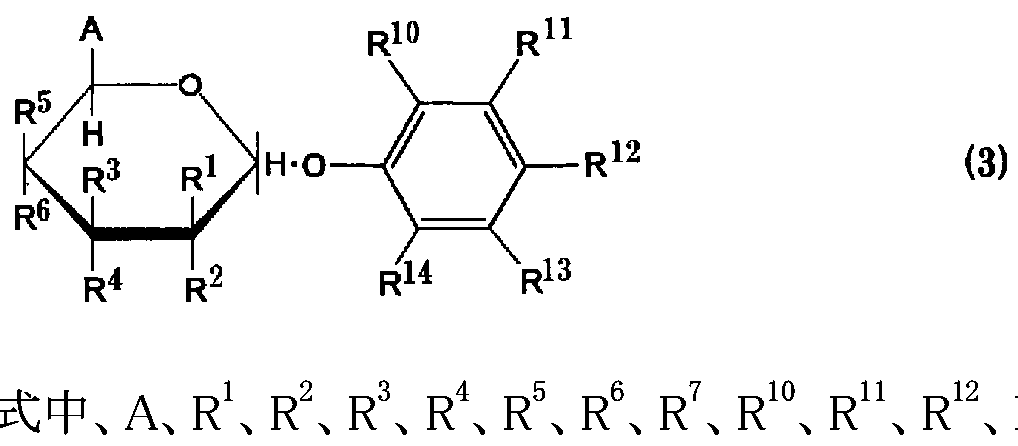
  • Typical unprotected sugars are those represented by the above formula (1), and therefore, typical dandalicoside derivatives are those represented by the above formula (3).
  • the unprotected saccharide represented by the general formula (1) is not limited by the origin and origin of the substance, but is obtained by degradation of a natural polysaccharide, or genetically synthesized by animal cells, microorganisms, or the like. Can be used.
  • A is H or CH
  • R 6 and R 7 are each independently H, OH, NH
  • S and R 9 is a residue of a mono- or oligosaccharide).
  • at least one of R 1 and R 2 , at least one of R 3 and R 4 , and at least one of R 5 and R 6 are H.
  • residue of a monosaccharide or oligosaccharide of R 9 are those made generally the residue at the 1-position of the reducing end of the 1- or oligosaccharide monosaccharide.
  • the sugar chain may be a straight chain or a branched chain.
  • the constituent sugars of monosaccharides and oligosaccharides may be amino sugars, sugar acids or their derivatives.
  • Examples of monosaccharides include D-glucose, D-mannose, D-galactose, D-xylose, N-acetyl-D-darcosamine, N-acetyl-D-galactosamine, N-acetyl-D-mannosamine and the like.
  • Oligosaccharides preferred by derivatives of (1) are disaccharides or oligosaccharides in which the sugar residue at the reducing end has the structure of the monosaccharide described in the above general formula (1), (2) cellobiose, chitobi An oligosaccharide in which the same monosaccharide represented by aose is polymerized; (3) a hexose selected from monosaccharides whose sugar residues are described in the above general formula (1); and Derivatives having a repeating structure of disaccharide units to which hexose is linked, selected from the monosaccharides described in the above general formula (1), which is different from xose, (4) N-linked glycoproteins And (5) the derivatives 1) to 4) above are preferred.
  • the above-mentioned derivative means that the NH group or OH group of a saccharide constituting monosaccharide or oligosaccharide is acetyl.
  • an oligosaccharide is an oligosaccharide in a normal meaning, and is 2-20 sugar normally.
  • Preferable examples of the unprotected sugar used in the present invention include the following.
  • Unprotected sugar represented by 1), ie N-acetyl-D-galactosamine
  • Unprotected sugar represented by 1) that is, N-acetyl-D-mannosamine
  • 0H is an unprotected sugar represented by the general formula (1)
  • 0H is an unprotected sugar represented by the general formula (1)
  • R 7 0H, unprotected sugar represented by general formula (1)
  • the compound having a phenolic hydroxyl group can be selected from those used in the field of glycoscience, which includes a polymer compound having a phenolic hydroxyl group in the main chain or side chain.
  • a polymer compound having a phenolic hydroxyl group in the main chain or side chain For example, para-trophenol, ortho-trophenol, 4-methylumbelliferone, derivatives thereof, or those having the substituents described below may also be included.
  • a typical compound having a phenolic hydroxyl group a compound having a phenolic hydroxyl group represented by the general formula (2) can be given.
  • Preferable examples of the compound having a phenolic hydroxyl group used in the present invention include the following.
  • the compound having a phenolic hydroxyl group can be selected from those known in the chemical field, and includes monomers such as flavonoids, chlorogenic acid, gallic acid, ellagic acid, porcine anthocyanins, oligos.
  • Polyphenols such as condensed tannins such as merlic proanthocyanins, hydrolyzed tannins such as gallotannins and ellagitannins, phenolic polymers, 0-taresol and Z or P-cresol, resornol, catechol and lignin Examples thereof include lignophenol, phenol resin, polyester having phenolic hydroxyl groups, polystyrene having phenolic hydroxyl groups, polyimide having phenolic hydroxyl groups, and other polymers having phenolic hydroxyl groups.
  • the dehydration condensation reaction can be conveniently performed using a dehydration condensation agent, and a Mitsunobu reagent is used as the dehydration condensation agent.
  • Mitsunobu reagent means Mitsunobu reaction (0. Mitsunobu, M. Yamada, Bull. Chem. Soc.
  • Mitsunobu reaction which is a reagent used in the reaction known as Mitsunobu reaction, which is defined as jetylazodicarboxylate (DEAD)
  • DEAD jetylazodicarboxylate
  • TPP triphenylphosphine
  • the Mitsunobu reagent is generally a dehydrating condensing agent that also has an azodicarboxylate compound and a tertiary phosphine power. Recently, for example, cyanomethylenetributylphosphorane or cyanomethylenetrimethylphosphorane. Cyanomethylenetrialkylphosphoranes have also been reported.
  • Representative Mitsunobu reagents include an azodicarboxylate compound represented by the general formula (4) and a dehydrating condensing agent having a tertiary phosphine power represented by the general formula (5). It is.
  • alkyl group is either linear or branched Saturated or unsaturated, and even cyclic, such as C alkyl (e.g., methyl, ethyl, pro
  • Pill isopropyl, butyl, isobutyl, sec-butyl, tert-butyl, pentyl, isopentyl, tert-pentyl, hexyl, heptyl, octyl, nonyl, de-force, hexade-force, eicosal, etc. ), C alkell (e.g., bur, aryl, isopropyl,
  • alkaryl group may include those mentioned as the unsaturated alkyl group described above.
  • the "aryl group” includes, for example, C aryl (for example, phenol, 1-naphthyl, 2-naphthyl).
  • alkoxy group is a group as described in the above “alkyl group”, and includes, for example, C alkoxy (eg, methoxy, ethoxy, propoxy, isopropoxy,
  • Examples of the "aryl moiety" in the “aryl alkoxy group” include the groups described above for the “aryl group”, and the “alkoxy moiety” Examples are those in which the force is induced as described in “Lucoxy group”.
  • the "at least 5-membered polymethyleneimino group” includes, for example, a pyrrolidino group, piperidino group, hexamethyleneimino group, and piperazino group which may include a 5- to 7-membered polymethyleneimino group.
  • a pyrrolidino group for example, a pyrrolidino group, piperidino group, hexamethyleneimino group, and piperazino group which may include a 5- to 7-membered polymethyleneimino group.
  • nitrogen-containing heterocyclic group in addition to the carbon atom, the nitrogen atom is 1 as a heteroatom and includes 4 or 5 or 14 members (preferably 5 or 10 members) (Monocyclic or bicyclic) is a heterocyclic group.
  • Aromatic heterocyclic groups such as 1-pyrrolidyl, 2-pyrrolidinyl, 3-pyrrolidinyl, 2-imidazolinyl, 4-imidazolinyl, 2- virazolidinyl, 3- virazolidinyl, 4-virazolidinyl, piperidino, 2-piperidyl, 3-piperidyl
  • Non-aromatic heterocyclic groups such as 4-piperidyl, 1-piperadyl, 2-piperadyl, morpholine-containing thiomorpholino, and the like. Preferred are 2-pyridyl, 3-pyridyl, 4-pyridyl, 2-quinolyl and the like.
  • the "alkyl part” (including the alkyl part in alkoxy), the “alkylene part”, the “aryl moiety”, and the “heterocyclic part” are optionally
  • the substituent may be substituted with one or more substituents, as described below.
  • substituent in the case of “having a substituent may be” is the same as described below.
  • substituted for example, oxo, thixo, an imine-containing halogen atom (eg, fluorine, chlorine, bromine, iodine, etc.) which may have a substituent, c-anoxylenoxy (eg, methylenedioxy) , Ethylenedioxy, etc.), two
  • C reels eg, ferrules, 1-naphthyl, 2-naphthyl, 2-biphenyl, 3-biff
  • Ether 4-biphenyl, 2 -anthryl, etc.
  • c alkoxy C alkoxy -carbo-
  • Ru-C alkoxy eg, ethoxycarboromethyloxy
  • hydroxy C ally
  • C cycloalkyl carbo yl eg cyclopropyl carbo
  • C aryl carbole e.g., benzoyl, 1-naphthoyl, 2-naphthol
  • C aralkyl carbole eg, ferrulectil, 3-farpropio
  • 6-14 7-16 Kiloxy-carbol eg, benzyloxycarbol, phenethyloxycarbol, etc.
  • 5- or 6-membered heterocyclic carborole eg, nicotinol, iso-cotinoyl, tenol
  • Furoyl morpholinocarbonyl, thiomorpholinocarbonyl, piperazine-1-ylcarbol, pyrrolidine-1-ylcarbol, etc.
  • rubamoyl, thiocarbamoyl, mono-C alkyl-force rubamoyl eg, methylcarbamoyl, Ethylcarbamoyl
  • C aryl-force rubamoyl eg, ferrulecarbamoyl, 1-
  • Naphthylcarbamoyl, 2-naphthylcarbamoyl, etc.), 5- or 6-membered heterocyclic strength ruvamois eg, 2-pyridylcarbamoyl, 3-pyridylcarbamoyl, 4-pyridylcarbamoyl,
  • Luminos eg, methoxycarbonylamino-containing ethoxycarbonylami-containing propoxycarbonyl luamino, butoxycarbo-lumino, etc.
  • C alkylsulfonylamino eg, methylsulfamine
  • Kill-force ruberamoyloxy eg, methylcarbamoyloxy, ethylcarbamoyloxy, etc.
  • di-c alkyl-force rumomoyloxy eg, dimethylcarbamoyloxy, di-
  • azodicarboxylate represented by the general formula (6) constituting a part of the Mitsunobu reagent used in the production method of the present invention! /,
  • cyanomethylene tributylphosphorane such as nomethylenetrimethylphosphorane, dimethylazodicarboxylate, ⁇ , ⁇ , ⁇ ', ⁇ , -tetraisopropylazodicarboxamide ( ⁇ ), 1,6-dimethyl -1,5,7-Hexahydro-1,4,6,7-tetrazocine-2,5-dione (DHTD), hydroxymethylpolystyrene with phosgene and then carbazate After the reaction, there may be mentioned those in which a diazodicarboxylate functional group is bonded to the benzyl moiety present in the polystyrene resin obtained by acidification, and the following.
  • R 15 OEt
  • R 16 OEt is a azodicarboxylate constituting a part of the Mitsunobu reagent represented by the general formula (6), that is, jetylazodicarboxylate (DEAD)
  • the constituent azodicarboxylate i.e. diisopropyl azodicarboxylate
  • the azodicarboxylate that forms part of the reagent ie 1,1,-(Diazodicarbol) dipiperidine (ADDP)
  • the tertiary phosphine represented by the general formula (7) constituting a part of the Mitsunobu reagent used in the production method of the present invention is preferred.
  • a polystyrene diphenyl having a styrene resin supported on a styrene resin examples include phosphine and the following.
  • the compound having an unprotected sugar and a phenolic hydroxyl group used in the present invention is the Mitsunobu reagent. If a phenol glycoside derivative is produced by reacting as a condensing agent, it is not particularly limited and can be appropriately set by those skilled in the art.
  • the solvent for the reaction is not limited as long as it does not adversely affect the reaction, and can be appropriately selected from those known in the art. It is not particularly limited as long as it can dissolve the unprotected sugar, the phenolic hydroxyl group-containing compound and Mitsunobu reagent used without reacting with the hydroxyl group-containing compound and Mitsunobu reagent, but for example, acetonitrile (CH CN), benzonitrile, etc. Nitriles, dimethyl
  • Sulfoxides such as sulfoxide (DMSO), sulfolane, formamide, amides such as ⁇ , ⁇ -dimethylformamide (DMF), ⁇ , ⁇ -dimethylacetamide, jetyl ether, isopropyl ether, isoamyl ether, tetrahydrofuran ( (THF), dioxane, cyclohexyl methyl ether, methyl cetosolve, cellosolve, butinorecerosonoleb, methinore tert-butanol, etc. ethers, aromatic hydrocarbons such as benzene, toluene, xylene, ethylbenzene, and tane.
  • DMSO sulfoxide
  • DMF ⁇ -dimethylformamide
  • ⁇ -dimethylacetamide jetyl ether
  • isopropyl ether isoamyl ether, tetrahydrofuran (
  • Solvent naphtha petroleum ether, rig in, 2-methylbutane, n-hexane, isohexane, n-heptane, octane, nonane, decane, 2-methylpentane, 2,2-dimethylbutane, 2, 3 -Dimethylbutane, 2,2,3-trimethylheptane, cyclopentane, methylcyclope Tan, cyclohexane, methylcyclohexane, saturated hydrocarbons or aliphatic hydrocarbons such as Dekahidoronafuta phosphorus, acetone, methyl E chill ketone, off Examples thereof include ketones such as rufural, methyl isobutyl ketone, mesityloxide, and cyclohexanone.
  • Solvents include, for example, CH CN, DMSO, DMF, dimethyl ether
  • Renonitrile (DMEU), THF, toluene, acetonitrile, ionic liquid, etc. are preferred.
  • Acetonitrile is particularly preferred, even though DMF is more preferred.
  • the amount of the compound having a phenolic hydroxyl group, the amount of the Mitsunobu reagent used, the reaction temperature and the reaction time are appropriately set depending on the type of unprotected sugar used.
  • the molar ratio of the compound having the above is preferably 1: 1 to 1: 1.5, more preferably 1: 2 to 1: 3, and the molar ratio of the unprotected sugar and Mitsunobu reagent is preferably 1:
  • reaction temperature is preferably room temperature to the boiling point of the solvent, more preferably 25 to 50 ° C.
  • the reaction time is 1 to 24 hours. preferable.
  • a reflux condenser or the like can be used.
  • the reaction between the unprotected sugar represented by the general formula (1) or (2) and the compound having a phenolic hydroxyl group is a gas containing no water such as argon or nitrogen in order to avoid a reaction with water. It is preferable to carry out in the atmosphere. It is also possible to use a desiccant such as calcium hydroxide or magnesium sulfate in the reaction solution.
  • a commonly used purification method can be appropriately selected and used. Concentration, vacuum concentration, distillation, fractional distillation, Isolation and purification by solvent extraction, liquid conversion, phase transfer, chromatography such as high performance liquid chromatography (HPLC), thin layer chromatography (TLC), column chromatography, crystallization, recrystallization, etc. For example, there can be mentioned a method of purification from the reaction solution by reprecipitation with toluene.
  • the ferrulecoside derivative obtained by the production method of the present invention can be used as a sugar donor utilizing the ability to remove unsubstituted or substituted furyl groups.
  • the -tropeglycoside derivative obtained in the present invention was transparent in the solution before the reaction, but this property was used because the daricoside bond was colored yellow with high sensitivity when hydrolyzed. It is important for quantitative detection analysis of various carbohydrate hydrolase activities.
  • Unverif Phenylglycoside derivatives, including erlyglycoside derivatives are compound compounds including sugar donors, sugar acceptors, enzyme substrates such as enzyme activity measurement substrates, additives such as diagnostic agents, pharmaceuticals, foods, and cosmetics. It is useful as a useful synthetic intermediate.
  • the effect of the present invention ⁇ Technical advantage is that a phenyldaricoside derivative, which is a key compound important in glycoengineering, can be directly synthesized from an unprotected sugar in one step.
  • the compound having a phenolic hydroxyl group may be a polymer compound having a phenolic hydroxyl group such as a solid surface having a phenolic hydroxyl group.
  • the present invention is applicable to various materials such as a material having a solid surface into which a sugar chain has been introduced. A sugar chain polymer material can be provided.
  • the immobilization of sugar chains, which is important for the practical application of sugar chain chips, can be achieved by the present invention, and therefore sugar chain chips can be supplied inexpensively and easily.
  • the phenyldaricoside derivative is useful as a compound including an enzyme substrate such as a sugar donor, a sugar acceptor, and a substrate for measuring enzyme activity, an additive such as a diagnostic agent, pharmaceutical, food, and cosmetics. It can be used as a synthetic intermediate for various applications.

Landscapes

  • Chemical & Material Sciences (AREA)
  • Organic Chemistry (AREA)
  • Health & Medical Sciences (AREA)
  • Life Sciences & Earth Sciences (AREA)
  • Engineering & Computer Science (AREA)
  • Biochemistry (AREA)
  • Biotechnology (AREA)
  • General Health & Medical Sciences (AREA)
  • Genetics & Genomics (AREA)
  • Molecular Biology (AREA)
  • Saccharide Compounds (AREA)

Abstract

 本発明は、無保護糖を出発原料とし、これにフェノール性水酸基を有する化合物を作用させることによるフェニルグリコシド誘導体の新規な製造方法に関するものである。フェニルグリコシド誘導体は、酵素活性測定基質、診断薬、有用合成中間体として注目されており、工業化可能で、且つ、安価でより簡便な製造方法が強く求められている。  そこで、本発明者は、出発原料の無保護糖から1段階で対応するフェニルグリコシド誘導体を得る製造方法に関し、光延(Mitsunobu)試薬を活用することにより、1段階の脱水縮合反応により、フェニルグリコシド誘導体を得るものである。本プロセスによれば、従来のようなヒドロキシ基の保護ならびに脱保護は全く必要としない。

Description

明 細 書
グリコシド誘導体の製造方法
技術分野
[0001] 本発明は糖鎖工学において極めて重要な鍵ィ匕合物であるフエ-ルグリコシド誘導 体の製造方法に関する。
背景技術
[0002] 糖鎖は、核酸、タンパク質に続く第三の鎖として注目されており、エネルギーの貯蔵 物質や植物細胞壁の構成成分として存在していることが知られている。さら〖こ、 1970 年代から生体内において細胞認識'接着、病原菌の感染や癌の発症などの生命現 象に深く関与していることが明らかになつてきた。様々な機能をもつ糖鎖について更 に研究するため、また糖鎖をもつ材料開発のために、糖鎖やその誘導体の供給、ま た安価 ·容易な合成手法の確立が求められている。
[0003] 近年、糖鎖工学の分野にお!ヽて、フエ-ルグリコシド誘導体が糖供与体や糖受容 体、酵素基質、診断薬、合成中間体などとして注目されている。
[0004] フエ-ルグリコシド誘導体を糖受容体として用いれば、糖転移酵素または糖加水分 解酵素を作用させることで、オリゴ糖鎖をもつフエ-ルグリコシド誘導体を調製するこ とが可能である(非特許文献 1及び 2)。特に、エンド型の糖加水分解酵素を作用させ ることで、一度に 8糖〜 10糖で構成される高次のオリゴ糖鎖をフエニルダリコシド誘導 体に転移可能である。この高次オリゴ糖鎖は、生体内において細胞認識などの重要 な機能をもつことが知られている(非特許文献 3〜5)。一方で、フエ-ルグリコシド誘 導体は、酵素反応における効率の良い糖供与体でもある(非特許文献 1及び 2)。こ のようなフエニルダリコシド誘導体に対する需要の高まりとともに、フエニルダリコシド 誘導体を安価に供給することのできる工業化可能で、簡便なフエニルダリコシド誘導 体の製造方法が強く求められている。
[0005] 糖は複数のヒドロキシ基を有して 、る。それらは、反応性の違!、から、 1位 (ァノマー 位)ヒドロキシ基、第一級ヒドロキシ基、第二級ヒドロキシ基の三種類に分類される。一 般に、単糖あるいはオリゴ糖から、対応するフエ-ルグリコシドを合成するには、 1位( ァノマー位)ヒドロキシ基のみを活性ィ匕することが必要である。活性化の方法としては 、ヒドロキシ基を一旦臭素原子で置換する方法あるいは光延反応を利用することによ りヒドロキシ基を直接活性ィ匕する方法などが知られている。言うまでもなぐこの際他 のヒドロキシ基 (第一級ヒドロキシ基および第二級ヒドロキシ基)は、活性化されてはな らない。なぜなら、他のヒドロキシ基が活性ィ匕されてしまうと 1位 (ァノマー位)以外にも
、フエ-ル基が導入されたィ匕合物が副生成物として得られてしまうからである。
[0006] そこで、このような配糖ィ匕反応にぉ 、ては、他のヒドロキシ基 (第一級ヒドロキシ基お よび第二級ヒドロキシ基)が反応に関与しないように、これらのヒドロキシ基を保護する 必要があった。また、反応後には保護基の除去も必要であった。このように、フエニル グリコシド誘導体の合成には、少なくとも出発原料であるフリーの糖 (無保護糖)から 複数のプロセスを経ねばならなかった。
[0007] 具体例を図 1に示すが、ヒドロキシ基を酢酸エステルとして保護し、引き続き 1位炭 素 (ァノマー炭素)を臭素原子などで活性化した後、フエ-ル部分を導入し、最後に 脱保護を行うという、 4工程の反応を経てフエニルダリコシドを製造する方法が知られ ている。しかし、当該方法は、ヒドロキシ基の保護及び脱保護が必要であり、ァノマー 炭素原子の活性ィ匕に臭化水素を必要とする。また、ニトロフエノールの導入には銀塩 などの重金属試薬を必要とし、ニトロフエニルダリコシドを効率よく得るには、煩雑な 精製技術が必要である。
[0008] また、図 2に示したように、光延試薬で、保護された糖の 1位ヒドロキシ基を活性ィ匕し た後フエ-ル部分を導入し、最後に脱保護を行う t ヽぅ 2工程の反応も知られて 、る。 しかし、この反応においても、ヒドロキシ基の保護及び脱保護は必須であり、そのため には、不安定な有機試薬や強塩基などを用いる必要があった。
[0009] 上述した技術は、例えば特許文献 1や非特許文献 6〜17に開示されて 、る。特許 文献 1には、糖のすべてのヒドロキシ基を酢酸エステルとした誘導体に、塩化メチレン 中、塩化スズ (IV)の存在下、 トロフエノールを反応させる方法が記載されている。 しかし、プロセスが長くなれば、当然中間体の精製に多量の有機溶媒が必要となり、 環境面からも問題点が残されていた。例えばこの特許文献 1の方法では、フリーの糖 を、まず、対応する酢酸エステルに誘導する必要があること、有害な有機溶媒を用い る必要があること、強ルイス酸として塩化スズ (IV)を用いる必要があること、等の問題 点がある。
[0010] 非特許文献 6に開示された方法は、糖酢酸エステルを三臭化リンで対応する臭化 物とした後、銀塩の存在下、 P-ニトロフエノールを反応させる方法であるが、保護基、 有害な有機溶媒、重金属を用いるという欠点がある。非特許文献 8に開示された方法 は、糖酢酸エステルを臭化トリメチルシリルで対応する臭化物とした後、銀塩の存在 下、 ρ-ニトロフエノールを反応させる方法であるが、同様に保護基、有害な有機溶媒 、重金属を用いる必要がある。
[0011] また、非特許文献 7, 9, 10に開示された方法は、糖酢酸エステルを、プロトン酸、あ るいはルイス酸の存在下、 ρ-ニトロフエノールで処理する方法である力 この場合も、 ヒドロキシ基の保護が必要であり、塩化メチレンやベンゼンなどの有害な有機溶媒を 使用する必要がある。
[0012] 非特許文献 11〜17に開示された方法は、出発物質である保護された 1-ヒドロキシ 糖から 1工程で、光延反応を用いて対応するフエニルダリコシド誘導体を合成した例 である。しかし、この場合も 2,3,4,6位ヒドロキシ基の保護は必須である。また、出発原 料となるメチル基、ァセチル基、ベンゾィル基等で保護された 1-ヒドロキシ糖は、フリ 一の糖から多段階のステップを経て調製する必要があり、合成全体を見ると大変煩 雑な方法と言わざるを得な 、。
[0013] このように、従来のフ -ルグリコシド誘導体の製造方法は、工程が複雑であること 、有害な有機溶媒を用いること、重金属を用いることなど工業ィ匕において課題を持つ ている。
[0014] さらにまた、糖鎖をもつ高分子化合物 (糖鎖高分子)は、糖鎖が生物認識機能をも ち、高分子化合物は構造を自由に設計できることから優れた機能をもつ材料として注 目されている。例えば細胞培養基材'医薬品 ·糖鎖チップなどへの応用が期待される 。そのため高分子の主鎖 ·側鎖に糖鎖を容易に導入できる方法が求められている。
[0015] 特許文献 1 :特開平 5— 301885号公報
非特許文献 l : Trends in Glycoscience and Glycotechnology, 12 (65), 161-174, 2000 非特許文献 2 : Biosci. Biotech. Biochem., 61 (7), 1059-1066, 1997 非特許文献 3 : Carbohydrate Research, 339, 2633-2635, 2004
非特許文献 4 : Carbohydrate Research, 339, 1403-1406, 2004
特干文献 5: Biochemical and Biophysical Research Communications, 282, 678-682 , 2001
非特許文献 6 : Chemical & Pharmaceutical Bulltin, 38 (1), 13-18 (1990)
非特許文献 7 : Zhurnal Obshchei Khimii, 56 (1), 181-187 (1986)
非特許文献 8 : Farmaco, 56 (4), 319-324 (2001)
非特干文献 9: Russian Journal of Generalし nemistry (Translation of Zhurnal Obshcn ei Khimii), 72 (5), 806—811 (2002)
非特許文献 10 Journal of Carbohydrate Chemistry, 20 (6), 503-506 (2001) 非特許文献 11 : Carbohydrate Research, 73, 313-314 (1979)
非特許文献 12 Synthesis, 1005-1007 (1988)
非特許文献 13 Journal of Organometalic Chemistry, 388, 117-121 (1990) 非特許文献 14 Journal of Organic Chemistry, 56, 2974-2983 (1991)
非特許文献 15 Journal of Organic Chemistry, 56, 5740-5742 (1991)
非特許文献 16 : Carbohydrate Research, 228, 191-203 (1992)
非特許文献 17 Journal of Carbohydrate Chemistry, 11 (2), 159-169 (1992) 発明の開示
課題を解決するための手段
[0016] 本発明は、このような従来の問題点を解決するために、一段階でフエニルダリコシド 誘導体を製造し、保護基の導入や除去を伴わない為効率が良ぐ溶媒や重金属使 用にお 、て安全な製造方法を提供することを目的として!/、る。
[0017] 本発明によれば、無保護糖と、フエノール性水酸基を有する化合物とを反応させて
、一工程のみで、フエニルダリコシド誘導体を製造する方法が提供される。該方法で は、光延試薬を用いてその反応を行う。
[0018] 本発明の具体的な態様では、下記一般式 (1):
[数 1] ( R5、 R6及び R7は、それぞれ独
Figure imgf000006_0001
立に、 H、 OH、 NHCOR8 (R8は、 H及び (CH ) - CH (n=0〜5)から選択される)、及び Y-
2 η 3
R9 (Yは Ο又は ΝΗ又は Sであり、 R9は単糖又はオリゴ糖の残基である)から選択され、伹 し、 R1と R2の少なくとも一方、 R3と R4の少なくとも一方、及び R5と R6の少なくとも一方は H である)
で示される無保護糖と、下記一般式 (2):
[数 2]
Figure imgf000006_0002
(式中、 R10、 RU、 R12、 R13及び R14は、それぞれ独立に、 H、 NO、 NH、 N、 0H、 F、 Cl、
2 2 3
I、 CH0、 COOH,アルキル基、ァルケ-ル基、高分子化合物残基等から選択される 力 あるいは隣接する二つの置換基は一緒にラタトン環となり、該置換基の結合する フエ-ル環と一緒になつて置換されて 、てもよ 、クマリン骨格を形成して 、てもよ 、) で示されるフエノール性水酸基を有する化合物とを反応させる一工程のみで、下記 一般式 (3):
[数 3]
Figure imgf000006_0003
(式中、 Αゝ
Figure imgf000006_0004
R10、 RU、 R12、 R13及び R"は、前記と同様である) で示されるフエ-ルグリコシド誘導体を得ることのできるというフエ-ルグリコシド誘導 体製造方法が提供される。
[0019] また、本発明によれば、前記のフエ-ルグリコシド誘導体の製造方法にぉ 、て、光
R
1
延 (Mits 5unobu)反応で使用される光延試薬、例えば、シァノメチレントリアルキルホスホ ラン、あるいは Νァゾジカルボキシレートイ匕合物と第三級ホスフィン力もなる脱水縮合剤 を使用することを特徴とするフエニルダリコシド誘導体製造方法を提供する。例えば、 本発明では、一般式 (4 O)CUH:
Rl6 (
(式中、 R15及び R16は、同一又は異なってよぐ独立に、アルコキシ基、ァリールアルコ キシ基、ジアルキルアミノ基、少なくとも 5員環のポリメチレンイミノ基、及びヒドロキシ 基含有高分子から誘導された高分子アルコキシ基から選択されるか、あるいは R15及 び R16は、一緒になつて Ν,Ν,-ジアルキル置換アルキレンジァミノ基である) で示されるァゾジカルボキシレート及び一般式 (5):
[数 5]
PR^R18 <5)
(式中、 R17及び R18は、同一又は異なってよぐ独立に、アルキル基、ァリール基、窒 素含有複素環式基、ジアルキルアミノ置換ァリール基、及びポリスチレン力 誘導さ れた残基から選択される)
で示される第三級ホスフィンカゝらなる脱水縮合剤 (光延試薬)を使用することを特徴と するフエニルダリコシド誘導体製造方法を提供する。
[0020] また、本発明によれば、前記製造方法で製造されたことを特徴とするフエニルダリコ シド誘導体を提供する。
[0021] 力べして本発明では、次なる態様が提供されている。 〔1〕 無保護糖とフエノール性水酸基を有する化合物を、光延試薬を用いて反応させ ることを特徴とするフエニルダリコシド誘導体の製造方法。
〔2〕 該無保護糖が、上記一般式 (1)で示される無保護糖であり、該フ ノール性水酸 基を有する化合物が、上記一般式 (2)で示される化合物であり、該フ ニルダリコシド 誘導体が、上記一般式 (3)で示されるフ ニルダリコシド誘導体であることを特徴とす る上記〔1〕に記載の製造方法。
〔3〕 該光延試薬が、シァノメチレントリアルキルホスホラン、あるいはァゾジカルボキ シレートイ匕合物と第三級ホスフィン力 なる脱水縮合剤であり、該ァゾジカルボキシレ ート化合物が、上記一般式 (4)で示されるァゾジカルボキシレートであり、該第三級ホ スフインが、上記一般式 (5)で示されるトリ置換ホスフィンであることを特徴とする上記〔 1〕又は〔2〕に記載の製造方法。
〔4〕 該ァゾジカルボキシレートイ匕合物力 上記一般式 (4)で示されるァゾジカルボキ シレート(式中、 R15及び R16は、 OEt、ピぺリジン (N(CH ) ),ジメチルァミノ (N(CH ) ),ベ
2 5 3 2 ンジルォキシ (OCH C H )、イソプロポキシ (OCH(CH ) )、及びヒドロキシメチルポリス
2 6 5 3 2
チレンより誘導されたアルコキシ基力 選択される力、 R15と R16とが一緒になり、 Ν,Ν' - ジメチル置換エチレンジァミノ基を形成している)であり、該第三級ホスフィン力 上記 一般式 (5)で示されるトリ置換ホスフィン(式中、 R17及び R18は、ェチル,フエ-ル, η- ブチル,シクロへキシル、 η-へキシル、 η-ォクチル、 2-ピリジル、 4-ジメチルァミノフエ -ル、及びポリスチレン残基力 選択される)であることを特徴とする上記〔3〕に記載 の製造方法。
〔5〕 上記〔2〕記載の無保護糖の R9における単糖及びオリゴ糖の構成糖が、アミノ糖 、糖酸又はそれらの誘導体であることを特徴とする上記〔2〕〜〔4〕の 、ずれか一記載 のフエ-ルグリコシド誘導体の製造方法。
〔6〕 還元末端の糖残基が上記一般式 (1)として記載されて!ヽる単糖の構造である二 糖又はオリゴ糖であることを特徴とする上記〔2〕〜〔5〕の ヽずれか一記載のフエ-ル グリコシド誘導体の製造方法。
〔7〕 上記〔2〕記載の無保護糖の R9における単糖が、 D-グルコース、 D-マンノース、 D-ガラクトース、 Ν-ァセチル- D -ダルコサミン、 Ν-ァセチル- D-ガラクトサミン、 Ν-ァセ Η〇:ΑΗ — ^^-α-^-0:9Η 'H:S 'Η^Η 'Η〇:εΗ 'Η〇: 'Η:^ ' fi HD-V (6) Η〇:^ ' 一 c / - α- »-〇:9 'H:S 'Η〇:εΗ 'Η〇:^ 'Η:^ ' Li HD-V (8) Η〇:^ ' 一 c / - α- gf-〇:9 'H:S 'Η〇:εΗ 'Η〇:^ 'Η:^ ' Li HD-V (Ζ)
2 Η〇:ΑΗ 'Η〇:9Η 'H:S 'Η: 'Η〇:εΗ 'Η: ' HDODHN^H ' Li HD-V (9) : Η〇:ΑΗ 'Η:9Η 'H〇:S 'Η: Η 'Η〇:εΗ つ 0つ ΗΝ: 'Η:^ ' fi HD-V (S) : Η〇:ΑΗ 'Η〇:9Η 'H:S 'H: 'Η〇:εΗ つ Oつ HN: 'Η^Η ' fi HD-V (f) (ΐ)^¾ — 9 ^ Η〇:ΑΗ 'Η:9Η 'H〇:S 'Η^Η 'Η〇:εΗ 'Η〇: 'Η:^ ' fi HD-V (S) (ΐ)^¾ — 9 ^ ΗΟ:ΑΗ 'ΗΟ:9Η 'H:S 'Η^Η 'ΗΟ:εΗ 'Η: 'ΗΟ^Η ' fi HD-V (Ζ) (ΐ)^¾ — 9 ^ Η〇:ΑΗ 'Η〇:9Η 'H:S 'Η^Η 'Η〇:εΗ 'Η〇: 'Η:^ ' fi HD-V (ΐ)
: ( )〜(1)¾止 »¾〔s〕g r [6]
Figure imgf000009_0001
a)〜〔s〕 SIT¾ -?¾ ¾
;:2 :#黧纏 "( ¾ ίί^2 ^*^葛 ベ H面 ^- Ν(ε) φ} 邈べ ΰΗ, - α、 ¾ — - α 一 べ^ に / - α - /
Figure imgf000009_0002
\Q)〔9〕〜〔s〕 s暴 : #黧纏 ) ¾α¥ベ ^ ,ベム- a- ^
0S89T0/S00Zdf/X3d 8 o eo/90oz OAV (10) A:CH R7, R^H, R2:NHCOCH , R3:OH, R4:H, R5:H, R6:0- j8 - D-ガラクトース, R7
2 3
:OHである一般式 (1)で示される無保護糖
(11) A:CH R7, R^H, R2:NHC0CH , R3:0- j8 - D-ガラクトース, R4:H, R5:OH, R6:H, R7
2 3
:OHである一般式 (1)で示される無保護糖
(12) A:CH R7, R^H, R2:NHC0CH , R3:0H, R4:H, R5:H, R6:0- j8 - N-ァセチル- D-グ
2 3
ルコサミン, R7:OHである一般式 (1)で示される無保護糖
(13) A:CH R7, R H, R2:NHC0CH , R3:0H, R':H, R5:H, R6:0- j8 - D-マンノース (3位
2 3
及び 6位がひマンノシル化), R7:OHである一般式 (1)で示される無保護糖
(14) A:H, R H, R2: OH, R3:0H, R4:H, R5:H, R6:0Hである一般式 (1)で示される無保 の 1つであることを特徴とする上記〔2〕〜〔8〕の 、ずれか一記載のフエニルダリコシド 誘導体の製造方法。
〔10〕 フエノール性水酸基を有する化合物が、パラ-トロフエノール、オルト-トロフエ ノール、 4-メチルゥンベリフエロン、又は主鎖あるいは側鎖にフエノール性水酸基を有 する高分子化合物であることを特徴とする上記〔1〕〜〔9〕の 、ずれか一記載のフエ- ルグリコシド誘導体の製造方法。
〔11〕 上記〔2〕記載のフ ノール性水酸基を有する化合物が、下記 (15)〜(18):
(15) R10:H, RU:H, R12:NO , R13:H, R":Hであるフエノール性水酸基を有する化合物
2
(16) R10:H, RU:NO 、 R12:H, R13:H, R":Hであるフエノール性水酸基を有する化合物
2
(17) R10:NO , RU:H、 R12:H, R13:H, R14:Hであるフエノール性水酸基を有する化合物
2
(18) R10::H, RU+R12:— 0— C(C=0)— CH=C(CH ) -, R13:H, R":Hであるゥンベリフエロン
3
誘導体
の 1つであることを特徴とする上記〔2〕〜〔10〕の 、ずれか一記載のフエニルダリコシド 誘導体の製造方法。
[12] 上記〔2〕記載のァゾジカルボキシレートが、下記 (19)〜(23):
(19) R15:OEt、 R16:OEtである一般式 (4)で示される光延試薬の一部を構成するァゾジ カルボキシレート
(20) R15:0CH C H 、 R16:0CH C Hである一般式 (4)で示される光延試薬の一部を構 成するァゾジカルボキシレート
(21) R15:OCH(CH )、 R16:OCH(CH )である一般式 (4)で示される光延試薬の一部を
3 2 3 2
構成するァゾジカルボキシレート
(22) R15:ピぺリジン (N(CH ) ), R16:ピぺリジン (N(CH ) )である一般式 (4)で示される光延
2 5 2 5
試薬の一部を構成するァゾジカルボキシレート
(23) R15:ジメチルァミノ (N(CH ) ), R16:ジメチルァミノ (N(CH ) )である一般式 (4)で示さ
3 2 3 2
れる光延試薬の一部を構成するァゾジカルボキシレート
の 1つであることを特徴とする上記〔2〕〜〔11〕のいずれか一記載のフエニルダリコシド 誘導体の製造方法。
〔13〕 上記〔2〕記載の第三級ホスフィン力 下記 (24)〜(32):
(24) R17:シクロへキシル、 R18:フエ-ルである一般式 (5)で示される光延試薬の一部を 構成する第三級ホスフィン
(25) R":Et、 R18:フエニルである一般式 (5)で示される光延試薬の一部を構成する第三 級ホスフィン
(26) R":4-ジメチルァミノフエ-ル、 R18:フエ-ルである一般式 (5)で示される光延試薬 の一部を構成する第三級ホスフィン
(27) R17:フエ-ル、 R18:2-ピリジルである一般式 (5)で示される光延試薬の一部を構成 する第三級ホスフィン
(28) R17:n-プチル、 R18:n-ブチルである一般式 (5)で示される光延試薬の一部を構成 する第三級ホスフィン
(29) R17:シクロへキシル、 R18:シクロへキシルである一般式 (5)で示される光延試薬の 一部を構成する第三級ホスフィン
(30) R17:n-へキシル、 R18:n-へキシルである一般式 (5)で示される光延試薬の一部を 構成する第三級ホスフィン
(31) R17:n-ォクチル、 R18:n-オタチルである一般式 (5)で示される光延試薬の一部を構 成する第三級ホスフィン
(32) R17:フエ-ル、 R18:フエ-ルである一般式 (5)で示される光延試薬の一部を構成す る第三級ホスフィン の 1つであることを特徴とする上記〔2〕〜〔12〕の 、ずれか一記載のフエニルダリコシド 誘導体の製造方法。
[14] フ -ルグリコシド誘導体の製造方法において、反応溶媒が、ァセトニトリル (C H CN)、ジメチルスルホキシド (DMSO)、 Ν,Ν-ジメチルホルムアミド (DMF)、テトラヒドロ
3
フラン (THF)、トルエン、イオン性液体の内の 1つであることを特徴とする上記〔1〕〜〔1 3〕の ヽずれか一記載のフエニルダリコシド誘導体の製造方法。
〔15〕 フ -ルグリコシド誘導体の製造方法において、反応条件が、無保護糖とフエ ノール性水酸基を有する化合物のモルヒ比を 1: 1〜1: 1.5、無保護糖と光延試薬のモ ルヒ比を 1: 1〜1: 1.3、反応温度を温室〜溶媒の沸点、反応時間を 1〜4時間の内一 つあるいは複数を選び設定することを特徴とする上記〔1〕〜〔14〕の 、ずれか一記載 のフエ-ルグリコシド誘導体の製造方法。
〔16〕 フエ-ルグリコシド誘導体の製造方法において、無保護糖とフエノール性水酸 基を有する化合物との反応をアルゴンあるいは窒素雰囲気下にて行うことを特徴とす る上記〔1〕〜〔15〕の ヽずれか一記載のフエニルダリコシド誘導体の製造方法。
[17] 上記〔1〕〜〔16〕の ヽずれか一に記載された製造方法で製造されたことを特徴 とするフエニルダリコシド誘導体。
発明の効果
[0022] 本発明は一段階でフ ニルダリコシド誘導体を製造できる為、本発明によれば、保 護基の導入や除去を伴わず、効率が良ぐ溶媒や重金属使用において安全な製造 方法を提供することができる。得られたフエニルダリコシド誘導体は、糖供与体、糖受 容体、酵素活性測定基質などの酵素基質、診断薬、医薬品、食品、化粧品などの添 加剤などを含めたィ匕合物用合成中間体として有用と期待でき、本製造法は工業ィ匕可 能で、且つ、安価でより簡便な方法と期待できる。本発明方法を用いれば、環境への 付加を低減できる上に、従来法に比べ低コストでフエ-ルグリコシド誘導体を合成す ることがでさる。
[0023] 本発明のその他の目的、特徴、優秀性及びその有する観点は、以下の記載より当 業者にとっては明白であろう。し力しながら、以下の記載及び具体的な実施例等の記 載を含めた本件明細書の記載は本発明の好ましい態様を示すものであり、説明のた めにのみ示されて 、るものであることを理解された!、。本明細書に開示した本発明の 意図及び範囲内で、種々の変化及び Z又は改変(あるいは修飾)をなすことは、以 下の記載及び本明細書のその他の部分からの知識により、当業者には容易に明ら かであろう。本明細書で引用されている全ての特許文献及び参考文献は、説明の目 的で引用されているもので、それらは本明細書の一部としてその内容は本明細書の 開示に含めて解釈されるべきものである。
図面の簡単な説明
[0024] [図 1]従来技術のフ ニルダリコシド誘導体を製造する方法である。
[図 2]従来技術のフ ニルダリコシド誘導体を製造する方法である。
発明を実施するための最良の形態
[0025] 以下、本発明の実施の形態について説明する。
[0026] 従来のフエニルダリコシド誘導体製造方法は、まず糖鎖のヒドロキシ基の保護作業 を行った後、導入反応、結合反応、脱保護を行う工程を経るものである。それに対し 本発明は、上記保護、脱保護工程がなぐ反応工程においても脱水縮合工程のみの 1工程で工程を完了できるものである。
[0027] 本発明の製造方法においては、無保護糖とフエノール性水酸基を有する化合物を 脱水縮合しフエニルダリコシド誘導体を得る。ここで、無保護糖は、当該分野で知られ ているものが挙げられ、単糖、二糖及びオリゴ糖が包含され、天然多糖の分解によつ て得られるもの、遺伝子工学的に動物細胞、微生物などにより合成されたものが包含 され、当該物質の起源、由来によって限定されない。代表的な無保護糖としては、上 記式 (1)で表されるものであり、したがって、代表的なフ ニルダリコシド誘導体は上記 式 (3)で表されるものである。
[0028] 上記一般式 (1)で示される無保護糖は、当該物質の起源、由来によって限定されず 、天然多糖の分解によって得られるもの、遺伝子工学的に動物細胞、微生物などに より合成されたものを用いることが可能である。
[0029] 次に、式 (1)について説明を行う。
[0030] Aは H又は CH R6及び R7は、各々独立に、 H、 OH、 NH
Figure imgf000013_0001
COR8 (R8は、 H及び (CH ) - CH (n=0〜5)から選択される)、及び Y-R9 (Yは O又は NH
2 n 3 又は Sであり、 R9は単糖又はオリゴ糖の残基である)から選択可能である。但し、 R1と R2 の少なくとも一方、 R3と R4の少なくとも一方、及び R5と R6の少なくとも一方は Hである。
[0031] 上記残基について更に詳しく述べる。
[0032] R9の単糖又はオリゴ糖の残基は、通常、単糖の 1位又はオリゴ糖の還元末端の 1位 で残基となっているものである。糖鎖は、直鎖状のものであてもよぐ分岐鎖状のもの であってもよい。単糖及びオリゴ糖の構成糖は、アミノ糖、糖酸又はそれらの誘導体 であってもよい。
[0033] 単糖としては、 D-グルコース、 D-マンノース、 D-ガラクトース、 D-キシロース、 N-ァ セチル -D -ダルコサミン、 N-ァセチル- D-ガラクトサミン、 N-ァセチル- D-マンノサミン 及びそれらの誘導体が好ましぐオリゴ糖としては、(1)還元末端の糖残基が上記一般 式 (1)で記載されている単糖の構造である 2糖又はオリゴ糖、(2)セロビオース、キトビ オースに代表される同じ単糖が重合しているオリゴ糖、(3)糖残基が上記一般式 (1)で 記載されて ヽる単糖から選択されるへキソースと、また選択されたへキソースとは異な る上記一般式 (1)で記載されている単糖から選択されるへキソースが結合した 2糖単 位の繰り返し構造を基本骨格とする誘導体、(4)N-結合型糖タンパク質を構成するォ リゴ糖及び (5)上記 1)〜4)の誘導体が好ま 、。
[0034] なお、上記の誘導体とは、単糖又はオリゴ糖の構成糖の NH基や OH基をァセチル
2
化したものや、 OH基をメチルイ匕したもの、 OH基を硫酸ィ匕したものが挙げられる。又、 本発明において、オリゴ糖とは通常の意味でのオリゴ糖であり、通常 2〜20糖である。 次に無保護糖、フエノール性水酸基を有する化合物の好ましい例について説明を行
[0035] 本発明に用いる無保護糖の好ましい例としては、下記が挙げられる。
(1) A:CH R7, R'lH, R2:OH, R3:OH, R4:H, R5:H, R6:OH, R7:OHである一般式 (1)で示
2
される無保護糖、すなわち、 D-グルコース
(2) A:CH R7, R'lOH, R2:H, R3:OH, R4:H, R5:H, R6:OH, R7:OHである一般式 (1)で示
2
される無保護糖、すなわち、 D-マンノース
(3) A:CH R7, R H, R2:OH, R3:OH, R4:H, R5:OH, R6:H, R7:OHである一般式 (1)で示
2
される無保護糖、すなわち、 D-ガラクトース (4) A:CH R7, R^H, R2:NHCOCH , R3:OH, R4:H, R5:H, R6:OH, R7:OHである一般式(
2 3
1)で示される無保護糖、すなわち、 N-ァセチル- D -ダルコサミン
(5) A:CH R7, R^H, R2:NHCOCH , R3:OH, R4:H, R5:OH, R6:H, R7:OHである一般式(
2 3
1)で示される無保護糖、すなわち、 N-ァセチル- D-ガラクトサミン
(6) A:CH R7, R^NHCOCH , R2:H, R3:0H, R4:H, R5:H, R6:0H, R7:0Hである一般式(
2 3
1)で示される無保護糖、すなわち、 N-ァセチル- D-マンノサミン
(7) A:CH R7, R H, R2:0H, R3:0H, R4:H, R5:H, R6:0- J8 -D-グルコース, R7:0Hであ
2
る一般式 (1)で示される無保護糖、すなわち、セロビオース
(8) A:CH R7, R H, R2:0H, R3:0H, R4:H, R5:H, R6:0- a - D-グルコース, R7:0Hであ
2
る一般式 (1)で示される無保護糖、すなわち、マルトース
(9) A:CH R7, R H, R2:0H, R3:0H, R4:H, R5:H, R6:0- J8 - D-ガラクトース, R7:0Hであ
2
る一般式 (1)で示される無保護糖、すなわち、ラ外ース
(10) A:CH R7, R H, R2:NHC0CH , R3:0H, R4:H, R5:H, R6:0- j8 - D-ガラクトース, R7
2 3
:0Hである一般式 (1)で示される無保護糖
(11) A:CH R7, R H, R2:NHC0CH , R3:0- j8 - D-ガラクトース, R4:H, R5:0H, R6:H, R7
2 3
:0Hである一般式 (1)で示される無保護糖
(12) A:CH R7, R H, R2:NHC0CH , R3:0H, R4:H, R5:H, R6:0- j8 - N-ァセチル- D-グ
2 3
ルコサミン, R7:0Hである一般式 (1)で示される無保護糖
(13) A:CH R7, R H, R2:NHC0CH , R3:0H, R':H, R5:H, R6:0- j8 - D-マンノース (3位
2 3
及び 6位が aマンノシル化), R7:0Hである一般式 (1)で示される無保護糖
(14) A:H, R'lH, R2: OH, R3:0H, R4:H, R5:H, R6:0Hである一般式 (1)で示される無保 護糖、すなわち、 D-キシロース
フエノール性水酸基を有する化合物としては、糖ィ匕学の分野で利用されるものから 選択されることができ、それは主鎖あるいは側鎖にフ ノール性水酸基を有する高分 子化合物を包含していてよぐ例えば、パラ-トロフエノール、オルト-トロフエノール、 4-メチルゥンベリフエロン、それらの誘導体あるいは下記で説明する置換基を有する ものも包含されてよい。代表的なフエノール性水酸基を有する化合物としては、上記 一般式 (2)で示されるフ ノール性水酸基を有する化合物が挙げられる。 [0037] 本発明に用いられるフ ノール性水酸基を有する化合物の好ましい例としては、下 記が挙げられる。
(15) R10:H, RU:H, R12:NO , R13:H, R":Hであるフエノール性水酸基を有する化合物
2
(16) R10:H, RU:NO、 R12:H, R13:H, R":Hであるフエノール性水酸基を有する化合物
2
(17) R10:NO , RU:H、 R12:H, R13:H, R14:Hであるフエノール性水酸基を有する化合物
2
(18) R10::H, Rn+R12:-0-C(C=0)-CH=C(CH ) -, R13:H, R":Hであるゥンベリフエロン
3
誘導体
[0038] フ ノール性水酸基を有する化合物としては、化学の分野で知られたものから選択 されることができ、フラボノイド、クロロゲン酸、没食子酸、エラグ酸などのモノマー、プ 口アントシァ-ジン、オリゴメリックプロアントシァ-ジンなどの縮合型タンニン、ガロタ ンニン、ェラグタンニンなどの加水分解型タンニンといったポリフエノール類、フエノー ル系ポリマー、 0-タレゾール及び Z又は P-クレゾール、レゾルノール、カテコールとリ グニンとより形成されるリグノフヱノール、フエノール榭脂、フ ノール性水酸基を有す るポリエステル、フエノール性水酸基を有するポリスチレン、フエノール性水酸基を有 するポリイミド、その他のフエノール性水酸基を有するポリマーが挙げられる。
[0039] 本発明においては、上記脱水縮合反応は、脱水縮合剤を使用して便利に行うこと ができるが、その脱水縮合剤としては、光延試薬を用いる。
[0040] 光延試薬とは、光延 (Mitsunobu)反応 (0. Mitsunobu, M. Yamada, Bull. Chem. Soc.
Jpn., 40, 2380 (1967); O. Mitsunobu, Synthesis, 1981. 1)として知られた反応におい て使用される試薬であり、該光延反応とは、ジェチルァゾジカルボキシレート (DEAD) とトリフ -ルホスフィン (TPP)の存在下アルコールと活性プロトンを有する多種多様な 求核剤とを脱水的に縮合させる反応として報告された反応である。このように光延反 応は、 TPPの強い酸素親和力と DEADの水素親和力とにより、アルコールや酸などか ら水分子を引き抜く脱水縮合反応ということができる。したがって、光延試薬は、脱水 縮合剤である。光延試薬としては、一般的には、ァゾジカルボキシレートイ匕合物と第 三級ホスフィン力もなる脱水縮合剤である力 最近では、シァノメチレントリブチルホス ホランゃシァノメチレントリメチルホスホランなどのシァノメチレントリアルキルホスホラ ンも報告されている。 [0041] 代表的な光延試薬としては、上記一般式 (4)で表されるァゾジカルボキシレートイ匕合 物及び上記一般式 (5)で表される第三級ホスフィン力 なる脱水縮合剤である。
[0042] 上記式 (2)、式 (3)、式 (4)及び式 (5)に関連して、本明細書中、「アルキル基」としては 、直鎖又は分岐鎖のいずれであってもよぐ飽和又は不飽和のものであってよぐさら には環状のものであってもよぐ例えば C アルキル (例えば、メチル、ェチル、プロ
1-22
ピル、イソプロピル、ブチル、イソブチル、 sec-ブチル、 tert-ブチル、ペンチル、イソぺ ンチル、 tert-ペンチル、へキシル、ヘプチル、ォクチル、ノニル、デ力-ル、へキサデ 力-ル、エイコサ-ル等)、 C ァルケ-ル(例えば、ビュル、ァリル、イソプロべ-ル、
2-24
1-ブテニル、 2-ブテニル、 3-ブテニル、 2-メチル -2-プロぺニル、 1-メチル -2-プロぺ -ル、 2-メチル -1-プロべ-ル等)、 C アルキ-ル(例えば、ェチニル、プロパルギル
2-6
、 1-ブチュル、 2-ブチュル、 3-ブチュル、 1-へキシュル等)、 C シクロアルキル(例
3-8
えば、シクロプロピル、シクロブチル、シクロペンチル、 2-シクロペンテン- 1-ィル、シク 口へキシル、 1,3-シクロへキサジェ -ル、シクロへプチル、スピロ [4.5]デ力-ル、ビシ クロ [2.2.1]ヘプテュル (ノルボネニル)等)等が挙げられ、好ましくは、 C アルキル(
1-6
例えば、メチル、ェチル、プロピル、イソプロピル、ブチル、 tert-ブチル等)が挙げら れる。「ァルケ-ル基」としては、上記した不飽和のアルキル基として挙げられたもの を包含していてよい。
[0043] 「ァリール基」としては、例えば C ァリール(例えば、フエ-ル、 1-ナフチル、 2-ナフ
6-14
チル、 2-ビフエ-リル、 3-ビフエ-リル、 4-ビフエ-リル、 2-アンスリル、 3-インデュル、 5-フルォレニル等)等が挙げられる。
[0044] 「アルコキシ基」の「アルキル部分」は、上記「アルキル基」で説明したような基であり 、例えば、 C アルコキシ(例えば、メトキシ、エトキシ、プロポキシ、イソプロポキシ、ブ
1-6
トキシ、イソブチロキシ、 sec-ブチルォキシ、 tert-ブトキシ、ペンチルォキシ、イソペン チルォキシ、 tert-ペンチ口キシ、へキシロキシ等)等が挙げられる。
[0045] 「ァリールアルコキシ基」 (又は「ァラルキルォキシ基」)の「ァリール部分」としては、上 記「ァリール基」で説明したような基が挙げられ、「アルコキシ部分」としては、上記「ァ ルコキシ基」で説明したような基力 誘導されるようなものが挙げられる。
[0046] 「ジアルキルアミノ基」及び「N,N,-ジアルキル置換アルキレンジァミノ基」の「アルキ ル部分」は、上記「アルキル基」で説明したような基が挙げられ、「アルキレン部分」と しては、上記「アルキル基」で説明したような基から誘導されるようなものが挙げられる
[0047] 「少なくとも 5員環のポリメチレンイミノ基」としては、例えば、 5〜7員環のポリメチレン ィミノ基が包含されてよぐピロリジノ基、ピペリジノ基、へキサメチレンイミノ基、さらに は、ピペラジノ基、モルホリノ基、メチルビペリジノ基などであってよいが、好ましくはピ ペリジノ基である。
[0048] 「窒素含有複素環式基」としては、炭素原子以外に窒素原子をへテロ原子として 1 な!、し 4個含む 5な 、し 14員(好ましくは 5な 、し 10員)の(単環又は 2環式)複素環基 である。具体的には 2-ピリジル、 3-ピリジル、 4-ピリジル、 2-キノリル、 3-キノリル、 4-キ ノリル、 5-キノリル、 8-キノリル、 1-イソキノリル、 3-イソキノリル、 4-イソキノリル、 5-イソ キノリル、ピラジニル、 2-ピリミジニル、 4-ピリミジニル、 5-ピリミジニル、 3-ピロリル、 2- イミダゾリル、 4-イミダゾリル、 3-ピリダジ -ル、 1-インドリル、 2-インドリル、 3-インドリル 等の芳香族複素環基、例えば 1-ピロリジ -ル、 2-ピロリジニル、 3-ピロリジニル、 2-ィ ミダゾリニル、 4-イミダゾリニル、 2-ビラゾリジニル、 3-ビラゾリジニル、 4-ビラゾリジニル 、ピペリジノ、 2-ピペリジル、 3-ピペリジル、 4-ピペリジル、 1-ピペラジ -ル、 2-ピぺラジ -ル、モルホリ入チオモルホリノ等の非芳香族複素環基等である。好ましくは 2-ピリ ジル、 3-ピリジル、 4-ピリジル、 2-キノリルなどが挙げられる。
[0049] ここに挙げられた置換基にお!、て「アルキル部」(アルコキシ中のアルキル部を含む )、 「アルキレン部」、「ァリール部」、及び「複素環部」は、任意に、 1個又はそれ以上 の置換基で置換されていてもよぐその場合の置換基としては下記で説明するような ものであってよ 、。下記「置換基」の説明で「置換基を有して 、てもよ 、」場合の置換 基は、同様に、下記で説明したような基である。当該「置換基」としては、例えばォキソ 、チォキソ、置換基を有していてもよいイミ入ハロゲン原子 (例、フッ素、塩素、臭素、 ヨウ素等)、 c ァノレキレンジォキシ(例、メチレンジォキシ、エチレンジォキシ等)、二
1-3
トロ、シァノ、 C アルキル、 C ァルケ-ル、カルボキシ C ァルケ-ル(例、 2-カルボ
1-6 2-6 2-6
キシェテュル、 2-カルボキシ -2-メチルェテュル等)、 C アルキ -ル、 C シクロアル
2-6 3-6 キル、 C ァリール(例、フエ-ル、 1-ナフチル、 2-ナフチル、 2-ビフエ-リル、 3-ビフ ェ-リル、 4-ビフエ-リル、 2—アンスリル等)、 c アルコキシ、 C アルコキシ -カルボ-
1-8 1-6
ル- C アルコキシ(例、エトキシカルボ-ルメチルォキシ等)、ヒドロキシ、 C ァリー
1-6 6-14 ルォキシ(例、フエ-ルォキシ、 1-ナフチルォキシ、 2-ナフチルォキシ等)、 C ァラ
7-16 ルキルォキシ(例えば、ベンジルォキシ、フエネチルォキシ等)、メルカプト、 C アル
1-6 キルチオ、 C ァリールチオ(例、フ -ルチオ、 1-ナフチルチオ、 2-ナフチルチオ等
6- 14
)、 C ァラルキルチオ (例えば、ベンジルチオ、フエネチルチオ等)、アミ入モノ- C
7-16 1- アルキルアミノ(例、メチルアミ入ェチルァミノ等)、モノ- C ァリールァミノ(例、フエ
6 6-14
-ルァミノ、 1-ナフチルァミノ、 2-ナフチルァミノ等)、ジ- C アルキルアミノ(例、ジメ
1-6
チルァミノ、ジェチルアミ入ェチルメチルァミノ等)、ジ- C ァリールァミノ(例、ジフ
6-14
ェ-ルァミノ等)、ホルミル、カルボキシ、 C アルキル—カルボ-ル(例、ァセチル、プ
1-6
口ピオ-ル等)、 C シクロアルキル カルボ-ル(例、シクロプロピルカルボ-ル、シ
3-6
クロペンチルカルボ-ル、シクロへキシルカルボ-ル等)、 C アルコキシ カルボ-
1-6
ル(例、メトキシカルボニル、エトキシカルボニル、プロポキシカルボニル、 tert-ブトキ シカルボ-ル等)、 C ァリール カルボ-ル(例、ベンゾィル、 1-ナフトイル、 2-ナフ
6-14
トイル等)、 C ァラルキル カルボ-ル(例、フエ-ルァセチル、 3-フエ-ルプロピオ
7- 16
-ル等)、 c ァリールォキシ -カルボ-ル(例、フエノキシカルボ-ル等)、 C ァラル
6-14 7-16 キルォキシ -カルボ-ル(例、ベンジルォキシカルボ-ル、フエネチルォキシカルボ- ル等)、 5又は 6員複素環カルボ-ル(例、ニコチノィル、イソ-コチノィル、テノィル、 フロイル、モルホリノカルボニル、チオモルホリノカルボニル、ピぺラジン- 1-ィルカル ボ -ル、ピロリジン- 1-ィルカルボ-ル等)、力ルバモイル、チォカルバモイル、モノ- C アルキル-力ルバモイル(例、メチルカルバモイル、ェチルカルバモイル等)、ジ- C
1- 6 1- アルキル-力ルバモイル(例、ジメチルカルバモイル、ジェチルカルバモイル、ェチル
6
メチルカルバモイル等)、 C ァリール-力ルバモイル(例、フエ-ルカルバモイル、 1-
6-14
ナフチルカルバモイル、 2-ナフチルカルバモイル等)、 5又は 6員複素環力ルバモイ ル(例、 2-ピリジルカルバモイル、 3-ピリジルカルバモイル、 4-ピリジルカルバモイル、
2-チェ-ルカルバモイル、 3-チェ-ルカルバモイル等)、 C アルキルスルホ-ル(例
1-6
、メチノレスノレホ-ノレ、ェチノレスノレホ-ノレ等)、 C ァリーノレスノレホニノレ(例、フエ-ノレス
6-14
ルホニル、 1-ナフチルスルホ -ル、 2-ナフチルスルホ-ル等)、 C アルキルスルフィ -ル(例、メチルスルフィエル、ェチルスルフィ-ル等)、 C ァリールスルフィエル(例
6-14
、フエ-ルスルフィ -ル、 1-ナフチルスルフィエル、 2-ナフチルスルフィエル等)、ホル ミルァミノ、 C アルキル カルボ-ルァミノ(例、ァセチルァミノ等)、 C ァリール-力
1-6 6-14 ルポ-ルァミノ(例、ベンゾィルアミ入ナフトイルァミノ等)、 C アルコキシ—カルボ-
1-6
ルァミノ(例、メトキシカルボニルアミ入エトキシカルボニルアミ入プロポキシカルボ二 ルァミノ、ブトキシカルボ-ルァミノ等)、 C アルキルスルホニルァミノ(例、メチルスル
1-6
ホ-ルァミノ、ェチルスルホ -ルァミノ等)、 C ァリールスルホ -ルァミノ(例、フエ-
6-14
ルスルホニルァミノ、 2-ナフチルスルホ-ルアミ入 1—ナフチルスルホ -ルァミノ等)、 C アルキル カルボ-ルォキシ(例、ァセトキシ、プロピオ-ルォキシ等)、 C ァリ
1-6 6-14 一ルーカルボ-ルォキシ(例、ベンゾィルォキシ、ナフチルカルボ-ルォキシ等)、 C
1 アルコキシ カルボ-ルォキシ(例、メトキシカルボ-ルォキシ、エトキシカルボニル
- 6
ォキシ、プロポキシカルボ-ルォキシ、ブトキシカルボ-ルォキシ等)、モノ- C アル
1-6 キル-力ルバモイルォキシ(例、メチルカルバモイルォキシ、ェチルカルバモイルォキ シ等)、ジ- c アルキル-力ルバモイルォキシ(例、ジメチルカルバモイルォキシ、ジ
1-6
ェチルカルバモイルォキシ等)、 C ァリール-力ルバモイルォキシ(例、フエ-ルカ
6-14
ルバモイルォキシ、ナフチルカルバモイルォキシ等)、ニコチノィルォキシ、置換基を 有していてもよい 5ないし 7員飽和環状アミ入 5ないし 10員芳香族複素環基 (例、 2- チェニル、 3-チェニル、 2-ピリジル、 3-ピリジル、 4-ピリジル、 2-キノリル、 3-キノリル、 4-キノリル、 5-キノリル、 8-キノリル、 1-イソキノリル、 3-イソキノリル、 4-イソキノリル、 5- イソキノリル、 1-インドリル、 2-インドリル、 3-インドリル、 2-ベンゾチアゾリル、 2-ベンゾ[ b]チェ-ル、 3-ベンゾ [b]チェ-ル、 2-ベンゾ [b]フラ -ル、 3-ベンゾ [b]フラ-ル等)、 スルホ、スルファモイル、スルフイナモイル、スルフエナモイル等が挙げられる。
また、本発明の製造方法に用いられる光延試薬の一部を構成する一般式 (6)で示さ れるァゾジカルボキシレートの好まし!/、例としては、シァノメチレントリブチルホスホラ ンゃシァノメチレントリメチルホスホランなどのシァノメチレントリアルキルホスホランな どの他、ジメチルァゾジカルボキシレート、 Ν,Ν,Ν' ,Ν,-テトライソプロピルァゾジカル ボキサミド (ΤΙΡΑ)、 1,6-ジメチル -1,5, 7-へキサヒドロ- 1,4,6,7-テトラゾシン- 2,5-ジオン (DHTD)、ヒドロキシメチルポリスチレンにホスゲン、次いでカルバジン酸エステルを反 応させた後、酸ィ匕して得られたポリスチレン榭脂に存在するべンジル部にジァゾジカ ルポキシラート官能基の結合したもの、そして下記のものなどが挙げられる。
(19) R15:OEt、 R16:OEtである一般式 (6)で示される光延試薬の一部を構成するァゾジ カルボキシレート、すなわち、ジェチルァゾジカルボキシレート (DEAD)
(20) R15:OCH C H、 R16:OCH C Hである一般式 (6)で示される光延試薬の一部を構
2 6 5 2 6 5
成するァゾジカルボキシレート、すなわち、ジベンジルァゾジカルボキシレート
(21) R15:OCH(CH )、 R16:OCH(CH )である一般式 (6)で示される光延試薬の一部を
3 2 3 2
構成するァゾジカルボキシレート、すなわち、ジイソプロピルァゾジカルボキシレート(
DIAD)
(22) R15:ピぺリジン (N(CH ) ), R16:ピぺリジン (N(CH ) )である一般式 (6)で示される光延
2 5 2 5
試薬の一部を構成するァゾジカルボキシレート、すなわち、 1,1,- (ジァゾジカルボ- ル)ジピペリジン (ADDP)
(23) R15:ジメチルァミノ (N(CH ) ), R16:ジメチルァミノ (N(CH ) )である一般式 (6)で示さ
3 2 3 2
れる光延試薬の一部を構成するァゾジカルボキシレート、すなわち、 Ν,Ν,Ν' ,Ν' -テト ラメチルァゾジカルボキサミド (TMAD)
また、本発明の製造方法に用いられる光延試薬の一部を構成する一般式 (7)で示さ れる第三級ホスフィンの好ま 、例としては、 ΤΡΡをスチレン榭脂に担持させたポリス チリルジフエ-ルホスフィン、そして下記のものなどが挙げられる。
(24) R17:シクロへキシル、 R18:フエ-ルである一般式 (7)で示される光延試薬の一部を 構成する第三級ホスフィン、すなわち、ジシクロへキシルフェ-ルホスフィン
(25) R":Et、 R18:フエニルである一般式 (7)で示される光延試薬の一部を構成する第三 級ホスフィン、すなわち、ジェチルフエ-ルホスフィン
(26) R17:4-ジメチルァミノフエ-ル、 R18:フエ-ルである一般式 (7)で示される光延試薬 の一部を構成する第三級ホスフィン、すなわち、(4-ジメチルァミノフエ-ル)ジフエ- ノレホスフィン
(27) R17:フエ-ル、 R18:2-ピリジルである一般式 (7)で示される光延試薬の一部を構成 する第三級ホスフィン、すなわち、ジフエニル (2-ピリジル)ホスフィン
(28) R17:n-プチル、 R18:n-ブチルである一般式 (7)で示される光延試薬の一部を構成 する第三級ホスフィン、すなわち、トリ- n-ブチルホスフィン
(29) R17:シクロへキシル、 R18:シクロへキシルである一般式 (7)で示される光延試薬の 一部を構成する第三級ホスフィン、すなわち、トリシクロへキシルホスフィン
(30) R17:n-へキシル、 R18:n-へキシルである一般式 (7)で示される光延試薬の一部を 構成する第三級ホスフィン、すなわち、トリ- n-へキシルホスフィン
(31) R17:n-ォクチル、 R18:n-オタチルである一般式 (7)で示される光延試薬の一部を構 成する第三級ホスフィン、すなわち、トリ- n-ォクチルホスフィン
(32) R17:フエ-ル、 R18:フエ-ルである一般式 (7)で示される光延試薬の一部を構成す る第三級ホスフィン、すなわち、トリフエ二ノレホスフィン
[0052] 一般式 (1)で示される無保護糖とフエノール性水酸基を有する化合物との反応条件 につ 、ては、本発明に用いられる無保護糖とフエノール性水酸基を有する化合物が 、光延試薬を縮合剤として反応し、フエ-ルグリコシド誘導体が生成すれば、特に限 定されることはなく、当業者が適宜設定することができる。
[0053] 反応の溶媒としては、反応に悪影響を与えないものである限り限定されることなぐ 当該分野で知られているものの中から適宜選択して使用でき、また、用いる無保護糖 、フエノール性水酸基を有する化合物及び光延試薬と反応せず、用いる無保護糖、 フ ノール性水酸基を有する化合物及び光延試薬を溶解することができれば特に限 定されないが、例えば、ァセトニトリル (CH CN)、ベンゾニトリル等の二トリル類、ジメチ
3
ルスルホキシド (DMSO)、スルホラン等のスルホキシド類、ホルムアミド、 Ν,Ν-ジメチル ホルムアミド (DMF)、 Ν,Ν-ジメチルァセトアミド等のアミド類、ジェチルエーテル、イソ プロピルエーテル、イソアミルエーテル、テトラヒドロフラン (THF)、ジォキサン、シクロ へキシルメチルエーテル、メチルセ口ソルブ、セロソルブ、ブチノレセロソノレブ、メチノレ t ert-ブタノール等のエーテル類、ベンゼン、トルエン、キシレン、ェチルベンゼン、タメ ン等の芳香族炭化水素類、ソルベントナフサ、石油エーテル、リグ口イン、 2-メチルブ タン、 n-へキサン、イソへキサン、 n-ヘプタン、オクタン、ノナン、デカン、 2-メチルペン タン、 2,2-ジメチルブタン、 2, 3-ジメチルブタン、 2,2,3-トリメチルヘプタン、シクロペン タン、メチルシクロペンタン、シクロへキサン、メチルシクロへキサン、デカヒドロナフタ リン等の飽和炭化水素類又は脂肪族炭化水素類、アセトン、メチルェチルケトン、フ ルフラール、メチルイソブチルケトン、メシチルォキシド、シクロへキサノン等のケトン 類などを挙げることができる。溶媒は、例えば、 CH CN、 DMSO、 DMF、ジメチルェチ
3
レンウレァ (DMEU)、 THF、トルエン、イオン性液体等が好ましぐァセトニトリル、 DMS
0、 DMFがより好ましぐ中でもァセトニトリルが特に好ましい。
[0054] フエノール性水酸基を有する化合物の使用量、光延試薬の使用量、反応温度及び 反応時間などの反応条件は、用いる無保護糖種類により適宜設定されるが、当該無 保護糖とフエノール性水酸基を有する化合物のモル比は、好ましくは 1: 1〜1: 1.5、 より好ましくは 1: 2〜1: 3であり、当該無保護糖と光延試薬のモル比は、好ましくは 1:
1、ょり好ましくは1 : 2〜1 : 3でぁり、反応温度は、好ましくは室温〜溶媒の沸点、より 好ましくは 25〜50°Cであり、反応時間としては、 1〜24時間が好ましい。なお、使用す る溶媒の沸点にて反応を行う場合は、還流冷却器などの利用が可能である。
[0055] 反応条件の設定の際には、反応の終了を確認することが好ましぐ反応の終了を確 認する方法の具体例としては、薄層クロマトグラフィーが挙げられる。
[0056] 一般式 (1)又は (2)で示される無保護糖とフ ノール性水酸基を有する化合物との反 応は、水との反応を避けるため、アルゴンや窒素など、水を含まない気体の雰囲気下 において、行うことが好ましい。また、反応溶液中に、水酸化カルシウムや硫酸マグネ シゥムなどの乾燥剤を用いることも可能である。
[0057] 反応終了液から目的物質であるフエニルダリコシド誘導体を精製する方法としては 、通常行われている精製方法を適宜選択し用いることが可能で、濃縮、減圧濃縮、 蒸留、分留、溶媒抽出、液性変換、転溶、例えば、高速液体クロマトグラフィー (HPLC )、薄層クロマトグラフィー (TLC)、カラムクロマトグラフィーなどのクロマトグラフィー、結 晶化、再結晶等により、単離精製することができるが、例えば、反応終了液からトルェ ンによる再沈殿により精製する方法が挙げられる。
[0058] 本発明の製造方法により得られるフエ-ルダルコシド誘導体は、無置換あるいは置 換フ 二ル基の脱離能を利用した糖供与体としての利用が考えられる。特に、本発 明で得られる-トロフエ-ルグリコシド誘導体は、反応前は溶液が透明であるが、ダリ コシド結合が加水分解されると高感度で黄色に発色することから、この性質を利用し た各種糖質加水分解酵素活性の定量的な検出分析に重要なものである。ゥンベリフ エリルグリコシド誘導体などを含めたフエ-ルグリコシド誘導体は、糖供与体、糖受容 体、酵素活性測定基質などの酵素基質、診断薬、医薬品、食品、化粧品などの添加 剤などを含めたィ匕合物の有用合成中間体として有用である。
[0059] 以下に実施例を掲げ、本発明を具体的に説明するが、この実施例は単に本発明の 説明のため、その具体的な態様の参考のために提供されているものである。これらの 例示は本発明の特定の具体的な態様を説明するためのものであるが、本願で開示 する発明の範囲を限定したり、あるいは制限することを表すものではない。本発明で は、本明細書の思想に基づく様々な実施形態が可能であることは理解されるべきで ある。全ての実施例は、他に詳細に記載するもの以外は、標準的な技術を用いて実 施したもの、又は実施することのできるものであり、これは当業者にとり周知で慣用的 なものである。
[0060] 実施例 1
アルゴン雰囲気下、 D-グルコース 0.045 g (0.25 mmol)、 p--トロフエノール 0.104 g ( 0.75 mmol)、ジェチルァゾジカルボキシレート 0.1 mL (0.5 mmol)、トリフエニルホスフィ ン 0.131 g (0.5 mmol)をァセトニトリル (0.5 mL)溶液中、室温で 5時間反応させた。薄層 クロマトグラフィーにより反応終了を確認後、反応液を一定量採取し、 JH NMR測定を 行った。その結果、主生成物として p_-トロフエ-ル D -ダルコビラノシドを確認し、そ のプロトンの積分値から収率を求めた(収率 50%)。
[0061] ¾細12
無保護糖として D-マンノース 0.045 g (0.25 mmol)、溶媒としてァセトニトリル (0.5 mL) を用い、実施例 1と同様に反応させた。その結果、 ρ-ニトロフエ-ル D-マンノビラノシ ド (収率 63%)を得た。
[0062] 実施例 3
無保護糖として D-ガラクトース 0.045 g (0.25mmol)、溶媒としてァセトニトリル (0.5mL) を用い、実施例 1と同様に反応させた。その結果、 ρ-ニトロフエ-ル D-ガラタトピラノ シド (収率 69%)を得た。
[0063] 実施例 4
無保護糖として N-ァセチル- D -ダルコサミン 0.055 g (0.25 mmol)、溶媒としてァセト 二トリル (0.5 mL)を用い、実施例 1と同様に反応させた。その結果、 トロフエ-ル N-ァセチル- D -ダルコサミニド (収率 28%)を得た。
[0064] 実施例 5
無保護糖としてラタトース 0.086 g (0.25 mmol),溶媒としてァセトニトリル (0.5 mL)を 用い、実施例 1と同様に反応させた。その結果、 トロフエ二ルラクトシド (収率 52%) を得た。
[0065] 実施例 6
アルゴン雰囲気下、 D-グルコース 0.045g(0.25mmol)、 p-二トロフエノール 0.070g(0.5 0 mmol),ジイソプロピルァゾジカルボキシレート 0.1 mL(0.5mmol)、トリフエニルホスフ イン 0.131g(0.5 mmol)をジメチルエチレンゥレア (0.5 mL,以下 DMEUと略す)溶液中、 室温で 5時間反応させた。薄層クロマトグラフィーにより反応終了を確認後、反応液を 一定量採取し、 JH NMR測定を行った。その結果、主生成物として ρ-ニトロフエニル D -ダルコビラノシドを確認し、そのプロトンの積分値力 収率を求めた (収率 53%, a: ι8 = 1 : 3)。
次に反応液にトルエンを滴下し、生じた沈殿をガラスフィルターで濾別し、シリカゲ ルフラッシュカラムクロマトグラフィー(Gel: Merck社 Silica gel 60, particle size 0.063— 0.200 mm,展開溶媒:酢酸ェチル /メタノール = 100/1)を用いることで、 ρ-ニトロフエ -ル a - D -ダルコビラノシドおよび ρ-ニトロフエ-ル j8 -D -ダルコビラノシドを単離精 製した。
[0066] 実施例 7
無保護糖として D-マンノース 0.045 g (0.25 mmol),溶媒として DMEU (0.5 mL)を用 い、実施例 6と同様に反応させた。その結果、 トロフエニル D-マンノピラノシド(収 率 43%, a: β =2 : 1)を得た。
[0067] 実施例 8
無保護糖として D-ガラクトース 0.045 g (0.25 mmol),溶媒として DMEU (0.5 mL)を用 い、実施例 6と同様に反応させた。その結果、 ρ-ニトロフエニル D-ガラクトピラノシド( 収率 44%, ひ: j8 = 1 : 2)を得た。
[0068] 実施例 9 無保護糖として D-キシロース 0.038 g (0.25 mmol)、溶媒として DMEU (0.5 mL)を用 い、実施例 6と同様に反応させた。その結果、 トロフエ-ル D-キシロシド (収率 52% , α: j8 = 1 : 2.5)を得た。
[0069] 実施例 10
無保護糖としてラタトース 0.086 g (0.25 mmol)、溶媒として DMEU (0.5 mL)を用い、 実施例 6と同様に反応させた。その結果、 ρ-ニトロフエ二ルラクトシド (収率 22%, a: β = 1 : 2)を得た。
[0070] 実施例 11
アルゴン雰囲気下、 D-グルコース 0.045g(0.25mmol)、 4-メチルゥンベリフエロン 0.17 6g (1.0mmol)、ジイソプロピルァゾジカルボキシレート 0.1mL(0.5mmol)、トリフエ-ルホ スフイン 0.131g(0.5mmol)を DMEU (0.5mL)溶液中、室温で 5時間反応させた。薄層ク 口マトグラフィ一により反応終了を確認後、反応液を一定量採取し、 JH NMR測定を行 つた。その結果、主生成物として 4_メチルゥンベリフェリル D-ダルコビラノシドを確認 し、そのプロトンの積分値から収率を求めた (収率 56%, a: β = 1 : 4)。
次に反応液にトルエンを滴下し、生じた沈殿をガラスフィルターで濾別し、シリカゲ ルフラッシュカラムクロマトグラフィー(Gel: Merck社 Silica gel 60, particle size 0.063— 0.200 mm,展開溶媒:酢酸ェチル /メタノール = 50/1)を用いることで、 4-メチルゥン ベリフェリル α -D -ダルコビラノシドおよび 4-メチルゥンベリフェリル j8 - D -ダルコビラ ノシドを単離精製した。
[0071] 実施例 12
無保護糖として D-マンノース 0.045 g (0.25mmol)、溶媒として DMEU (0.5mL)を用い 、実施例 11と同様に反応させた。その結果、 4-メチルゥンベリフェリル D—マンノビラノ シド (収率 30%, α: j8 = 2 : 1)を得た。
[0072] 実施例 13
無保護糖として D-ガラクトース 0.045 g (0.25mmol)、溶媒として DMEU (0.5mL)を用 い、実施例 11と同様に反応させた。その結果、 4-メチルゥンベリフェリル D-ガラクトビ ラノシド (収率 37%, α : β = 1 : 1.5)を得た。
[0073] 実施例 14 無保護糖として D-キシロース 0.038 g (0.25mmol)、溶媒として DMEU (0.5mL)を用い 、実施例 11と同様に反応させた。その結果、 4-メチルゥンベリフェリル D-キシロシド( 収率 50%, ひ: j8 = 1 : 3)を得た。
[0074] 実施例 15
無保護糖としてラタトース 0.086 g (0.25mmol)、溶媒として DMEU (0.5mL)を用い、実 施例 11と同様に反応させた。その結果、 4-メチルゥンベリフェリルラタトシド (収率 25%, a: β = 1 : 3)を得た。
産業上の利用可能性
[0075] 本発明の効果 ·技術的優位性は、糖鎖工学において極めて重要な鍵ィ匕合物である フエニルダリコシド誘導体を無保護糖から 1段階で直接合成できる点にある。さらにフ ノール性水酸基を有する化合物は、フエノール性水酸基を有する固体表面などの フエノール性水酸基を持つ高分子化合物であっても良ぐ本発明は糖鎖を導入した 固体表面をもつ材料などの様々な糖鎖高分子材料を与えることができる。糖鎖チッ プの実用化のために重要である糖鎖の固定化が、本発明により達成でき、よって糖 鎖チップを安価 '容易に供給することができる。また、当該フエニルダリコシド誘導体 は、糖供与体、糖受容体、酵素活性測定基質などの酵素基質、診断薬、医薬品、食 品、化粧品などの添加剤などを含めたィ匕合物の有用合成中間体として各種用途'製 品に利用できる。
[0076] 本発明は、前述の説明及び実施例に特に記載した以外も、実行できることは明らか である。上述の教示に鑑みて、本発明の多くの改変及び変形が可能であり、従って それらも本件添付の請求の範囲の範囲内のものである。

Claims

請求の範囲
[1] 無保護糖とフ ノール性水酸基を有する化合物を、光延試薬を用いて反応させること を特徴とするフエ-ルグリコシド誘導体の製造方法。
[2] 該無保護糖が、下記一般式 (1):
[数 1]
( R6及び R7は、それぞれ独
Figure imgf000028_0001
立に、 H、 OH、 NHCOR8 (R8は、 H及び (CH ) - CH (n=0〜5)から選択される)、及び Y-
2 η 3
R9 (Yは Ο又は ΝΗ又は Sであり、 R9は単糖又はオリゴ糖の残基である)から選択され、伹 し、 R1と R2の少なくとも一方、 R3と R4の少なくとも一方、及び R5と R6の少なくとも一方は H である)
で示される無保護糖であり、該フ ノール性水酸基を有する化合物が、下記一般式( 2):
[数 2]
Figure imgf000028_0002
(式中、 R10、 RU、 R12、 R13及び R14は、それぞれ独立に、 H、 NO、 NH、 N、 0H、 F、 Cl、
2 2 3
I、 CH0、 COOH,アルキル基、ァルケ-ル基、高分子化合物残基等から選択される 力 あるいは隣接する二つの置換基は一緒にラタトン環となり、該置換基の結合する フエ-ル環と一緒になつて置換されて 、てもよ 、クマリン骨格を形成して 、てもよ 、) で示される化合物であり、該フ ニルダリコシド誘導体力 下記一般式 (3):
[数 3] (式
Figure imgf000029_0001
中、 Aゝ R2、 R3、 R4、 R5、 R6、 R7、 R10、 RU、 R12、 R13及び R"は、前記と同様である) で示されるフエ-ルグリコシド誘導体であることを特徴とする請求項 1に記載の製造方 法。
該光延試薬が、シァノメチレントリアルキルホスホラン、あるいはァゾジカルボキシレー トイ匕合物と第三級ホスフィン力 なる脱水縮合剤であり、該ァゾジカルボキシレートイ匕 合物が、一般式 (4):
Figure imgf000029_0002
(式中、 R15及び R16は、同一又は異なってよぐ独立に、アルコキシ基、ァリールアルコ キシ基、ジアルキルアミノ基、少なくとも 5員環のポリメチレンイミノ基、及びヒドロキシ 基含有高分子から誘導された高分子アルコキシ基から選択されるか、あるいは R15及 び R16は、一緒になつて Ν,Ν,-ジアルキル置換アルキレンジァミノ基である) で示されるァゾジカルボキシレートであり、該第三級ホスフィン力 一般式 (5):
[数 5]
PR^R18
(式中、 R17及び R18は、同一又は異なってよぐ独立に、アルキル基、ァリール基、窒 素含有複素環式基、ジアルキルアミノ置換ァリール基、及びポリスチレン力 誘導さ れた残基から選択される)
で示されるトリ置換ホスフィンであることを特徴とする請求項 1又は 2に記載の製造方 法。
[4] 該ァゾジカルボキシレートイ匕合物力 一般式 (4)で示されるァゾジカルボキシレート( 式中、 R15及び R16は、 OEt、ピぺリジン (N(CH ) )、ジメチルァミノ (N(CH ) )、ベンジルォ
2 5 3 2
キシ (OCH C H )、イソプロポキシ (OCH(CH ) )、及びヒドロキシメチルポリスチレンより
2 6 5 3 2
誘導されたアルコキシ基から選択されるか、 R15と R16とが一緒になり、 Ν,Ν,-ジメチル 置換エチレンジァミノ基を形成している)であり、該第三級ホスフィンが、一般式 (5)で 示されるトリ置換ホスフィン(式中、 R17及び R18は、ェチル,フエ-ル, η-ブチル,シクロ へキシル、 η-へキシル、 η-ォクチル、 2-ピリジル、 4-ジメチルァミノフエ-ル、及びポリ スチレン残基から選択される)であることを特徴とする請求項 3に記載の製造方法。
[5] 請求項 2記載の無保護糖の R9における単糖及びオリゴ糖の構成糖が、アミノ糖、糖酸 又はそれらの誘導体であることを特徴とする請求項 2〜4のいずれか一記載のフエ- ルグリコシド誘導体の製造方法。
[6] 還元末端の糖残基が上記一般式 (1)として記載されて!ヽる単糖の構造である二糖又 はオリゴ糖であることを特徴とする請求項 2〜5のいずれか一記載のフエ-ルグリコシ ド誘導体の製造方法。
[7] 請求項 2記載の無保護糖の R9における単糖力 D-グルコース、 D-マンノース、 D-ガ ラタトース、 Ν-ァセチル- D -ダルコサミン、 Ν-ァセチル- D-ガラクトサミン、 Ν-ァセチル -D-マンノサミン及びそれらの誘導体であることを特徴とする請求項 2〜6のいずれか 一記載のフエニルダリコシド誘導体の製造方法。
[8] 請求項 2記載の無保護糖の R9におけるオリゴ糖が、(1)セロビオース、キトビオースに 代表される同じ単糖が重合して 、るオリゴ糖や、(2)D-グルコース及び Ν-ァセチル- D -ダルコサミン力 選択されるへキソースと、 D-ガラクトース及び D-グルクロン酸力 選 択されるへキソースとからなる二糖単位の繰り返し構造を基本骨格とする誘導体、(3) N-結合型糖タンパク質を構成するオリゴ糖及び (4)それらの誘導体であることを特徴と する請求項 2〜7のいずれか一記載のフエニルダリコシド誘導体の製造方法。
[9] 請求項 2記載の無保護糖が、下記 (1)〜(14):
(1) A:CH R7, R H, R2:OH, R3:OH, R4:H, R5:H, R6:OH, R7:OHである一般式 (1)で示
2
される無保護糖
Figure imgf000031_0001
mm
^S^^I^ (ΐ)^¾ — : H〇:9 'H:S 'Η〇:εΗ 'HO: Ή^Η 'H:V (W)
¾ 一,ベム— α— 〇:9 'H:S 'H: 'Η〇:εΗ つ Oつ HN: 'Η:ΤΗ ',Η Ηつ: V (ST)
Figure imgf000031_0002
- a- ^^ - Ν- 〇:9 'H:S Ή^Η 'Η〇:εΗ つ Οつ ΗΝ: 'Η:^ ',Η Ηつ: V (Ζ\) 'Η:9Η 'H〇:S 'Η: Η — ^^-α-^-0:εΗ つ Οつ ΗΝ: 'Η:^ H :V (Π) ^ — ^^-α-^-0:9Η 'H:S 'Η: Η 'Η〇:εΗ つ Οつ ΗΝ: 'Η:^ H :V (Οΐ) ^Η — ^^-α-^-0:9Η 'H:S 'Η^Η 'Η〇:εΗ 'Η〇: 'Η:^ H :V (6) Η〇:^ ' 一 c / - a- »-〇:9 'H:S 'Η: Η 'Η〇:εΗ 'Η〇:^ 'Η:^ '^¾3:¥ (8) Η〇:^ ' 一 c / - a- gf-〇:9 'H:S Ή^Η 'Η〇:εΗ 'Η〇:^ 'Η:^ ' Li HD-V (Ζ) : Η〇:ΑΗ 'Η〇:9Η 'H:S 'H: 'Η〇:εΗ 'H: ' HDODHN^H ' fi HD-V (9) )^^—^ ^HO-fi 'H:9 'H〇:S 'H: 'Η〇:εΗ つ Oつ HN: 'Η^Η ' fi HD-V (S) ¾¾^Η0:,Η 'Η〇:9Η 'H:S 'H: 'Η〇:εΗ つ Oつ HN: 'Η^Η ' ^HD-V (f) (ΐ)^¾ — 9 ^ Η〇:^ Ή 'H〇:S 'Η〇:εΗ 'Η〇: 'Η:^ ' ^HD-V (S) (ΐ)^¾ — 9 ^ Η〇:^ 'Η〇:9Η 'H:S 'Η〇:εΗ 'Η: 'ΗΟ^Η ' H :V (Ζ)
0S89T0/S00Zdf/X3d οε o eo/90oz OAV [10] フエノール性水酸基を有する化合物が、パラ-トロフエノール、オルト-トロフエノール 、 4-メチルゥンベリフエロン、又は主鎖あるいは側鎖にフエノール性水酸基を有する 高分子化合物であることを特徴とする請求項 1〜9のいずれか一記載のフエ-ルグリ コシド誘導体の製造方法。
[11] 請求項 2記載のフ ノール性水酸基を有する化合物が、下記 (15)〜(18):
(15) R10:H, Rn:H, R12:NO , R13:H, R":Hであるフエノール性水酸基を有する化合物
2
(16) R10:H, RU:NO、 R12:H, R13:H, R":Hであるフエノール性水酸基を有する化合物
2
(17) R10:NO , RU:H、 R12:H, R13:H, RW:Hであるフエノール性水酸基を有する化合物
2
(18) R10::H, RU+R12:— 0— C(C=0)— CH=C(CH ) -, R13:H, R":Hであるゥンベリフエロン
3
誘導体
の 1つであることを特徴とする請求項 2〜10のいずれか一記載のフエニルダリコシド誘 導体の製造方法。
[12] 請求項 2記載のァゾジカルボキシレートが、下記 (19)〜(23):
(19) R15:OEt、 R16:OEtである一般式 (4)で示される光延試薬の一部を構成するァゾジ カルボキシレート
(20) R15:OCH C H、 R16:OCH C Hである一般式 (4)で示される光延試薬の一部を構
2 6 5 2 6 5
成するァゾジカルボキシレート
(21) R15:OCH(CH )、 R16:OCH(CH )である一般式 (4)で示される光延試薬の一部を
3 2 3 2
構成するァゾジカルボキシレート
(22) R15:ピぺリジン (N(CH ) ), R16:ピぺリジン (N(CH ) )である一般式 (4)で示される光延
2 5 2 5
試薬の一部を構成するァゾジカルボキシレート
(23) R15:ジメチルァミノ (N(CH ) ), R16:ジメチルァミノ (N(CH ) )である一般式 (4)で示さ
3 2 3 2
れる光延試薬の一部を構成するァゾジカルボキシレート
の 1つであることを特徴とする請求項 2〜11のいずれか一記載のフエニルダリコシド誘 導体の製造方法。
[13] 請求項 2記載の第三級ホスフィン力 下記 (24)〜(32):
(24) R17:シクロへキシル、 R18:フエ-ルである一般式 (5)で示される光延試薬の一部を 構成する第三級ホスフィン (25) R :Et、 R18:フエニルである一般式 (5)で示される光延試薬の一部を構成する第三 級ホスフィン
(26) R17:4-ジメチルァミノフエ-ル、 R18:フエ-ルである一般式 (5)で示される光延試薬 の一部を構成する第三級ホスフィン
(27) R17:フエ-ル、 R18:2-ピリジルである一般式 (5)で示される光延試薬の一部を構成 する第三級ホスフィン
(28) R17:n-プチル、 R18:n-ブチルである一般式 (5)で示される光延試薬の一部を構成 する第三級ホスフィン
(29) R17:シクロへキシル、 R18:シクロへキシルである一般式 (5)で示される光延試薬の 一部を構成する第三級ホスフィン
(30) R17:n-へキシル、 R18:n-へキシルである一般式 (5)で示される光延試薬の一部を 構成する第三級ホスフィン
(31) R17:n-ォクチル、 R18:n-オタチルである一般式 (5)で示される光延試薬の一部を構 成する第三級ホスフィン
(32) R17:フエ-ル、 R18:フエ-ルである一般式 (5)で示される光延試薬の一部を構成す る第三級ホスフィン
の 1つであることを特徴とする請求項 2〜12のいずれか一記載のフエニルダリコシド誘 導体の製造方法。
請求項 1〜13のいずれか一に記載された製造方法で製造されたことを特徴とするフ ェニルダリコシド誘導体。
PCT/JP2005/016850 2004-10-07 2005-09-13 グリコシド誘導体の製造方法 Ceased WO2006038440A1 (ja)

Applications Claiming Priority (2)

Application Number Priority Date Filing Date Title
JP2004294570A JP2007332029A (ja) 2004-10-07 2004-10-07 グリコシド誘導体の製造方法
JP2004-294570 2004-10-07

Publications (1)

Publication Number Publication Date
WO2006038440A1 true WO2006038440A1 (ja) 2006-04-13

Family

ID=36142520

Family Applications (1)

Application Number Title Priority Date Filing Date
PCT/JP2005/016850 Ceased WO2006038440A1 (ja) 2004-10-07 2005-09-13 グリコシド誘導体の製造方法

Country Status (2)

Country Link
JP (1) JP2007332029A (ja)
WO (1) WO2006038440A1 (ja)

Cited By (3)

* Cited by examiner, † Cited by third party
Publication number Priority date Publication date Assignee Title
CN103897001A (zh) * 2014-03-20 2014-07-02 广东省微生物研究所 一种4-甲基伞形酮基-β-D-吡喃半乳糖苷的制备方法
CN106543007A (zh) * 2016-11-04 2017-03-29 山东铂源药业有限公司 一种3‑氯‑4‑(3‑氟苄氧基)硝基苯的合成方法
US11058698B2 (en) 2018-06-05 2021-07-13 Flagship Pioneering Innovations V, Inc. Acylated active agents and methods of their use for the treatment of autoimmune disorders

Non-Patent Citations (8)

* Cited by examiner, † Cited by third party
Title
ABBOTT B.J. ET AL: "Glucosylation of Mycophenolic Acid by Streptomyces Aureofaciens", THE JOURNAL OF ANTIBIOTICS, vol. 33, no. 5, May 1980 (1980-05-01), pages 506 - 509, XP002993095 *
BADMAN G.T. ET AL: "A novel synthesis of beta-phenylglucuronides using the Mitsunobu reaction; an application of phenolic chromium tricarbonyl complexes", JOURNAL OF ORGANOMETALLIC CHEMISTRY, vol. 388, no. 1-2, 1990, pages 117 - 121, XP002993097 *
BOUALI A. ET AL: "Derivatisation of 1,3,4,6-tetra-0-benzoyl-alpha-d-fructofuranose at the anomeric site: O-Alkylation, 0-Acylation, O-Arylation, Amination and Selenation Reactions", JOURNAL OF CARBOHYDRATE CHEMISTRY, vol. 11, no. 2, 1992, pages 159 - 169, XP002993100 *
CHIBA N. ET AL: "Total Synthesis of Antibiotic Hygromycin A", THE JOURNAL OF ORGANIC CHEMISTRY, vol. 56, no. 9, 1991, pages 2976 - 2983, XP002993099 *
KIESLICH K. ET AL: "Mikrobiologische Umwandlungen nichtsteroider Strukturen, VII, Mikrobielle Glucosiderung einer phenolischen Hydroxylgruppe", CHEMISCHE BERICHTE, vol. 109, no. 6, 1976, pages 2259 - 2265, XP002993096 *
KOMETANI T. ET AL: "Boron Trifluoride Catalyzed Rearrangement of 2-Aryloxytetrahydropyrans: A New Entry to C-Arylglycosidation", SYNTHESIS, no. 12, December 1988 (1988-12-01), pages 1005 - 1007, XP002993601 *
ROUSH W.R. AND LIN X.-F.: "A Highly Stereoselective Synthesis of Aryl 2-Deoxy-beta-glycosides via the Mitsunobu Reaction", THE JOURNAL OF ORGANIC CHEMISTRY, vol. 56, no. 20, 1991, pages 5740 - 5742, XP002993098 *
TOKUTAKE S. ET AL: "Glycosides Having Chromophores as Substrates for Sensitive Enzyme Analysis. I. Synthesis of Phenolindophenyl-beta-D-glucopyranosides as Substrates for beta-Glucosidase", CHEMICAL & PHARMACEUTICAL BULLETIN, vol. 38, no. 1, 1990, pages 13 - 18, XP002137365 *

Cited By (6)

* Cited by examiner, † Cited by third party
Publication number Priority date Publication date Assignee Title
CN103897001A (zh) * 2014-03-20 2014-07-02 广东省微生物研究所 一种4-甲基伞形酮基-β-D-吡喃半乳糖苷的制备方法
CN103897001B (zh) * 2014-03-20 2016-05-25 广东省微生物研究所 一种4-甲基伞形酮基-β-D-吡喃半乳糖苷的制备方法
CN106543007A (zh) * 2016-11-04 2017-03-29 山东铂源药业有限公司 一种3‑氯‑4‑(3‑氟苄氧基)硝基苯的合成方法
CN106543007B (zh) * 2016-11-04 2019-04-09 山东铂源药业有限公司 一种3-氯-4-(3-氟苄氧基)硝基苯的合成方法
US11058698B2 (en) 2018-06-05 2021-07-13 Flagship Pioneering Innovations V, Inc. Acylated active agents and methods of their use for the treatment of autoimmune disorders
US12115178B2 (en) 2018-06-05 2024-10-15 Flagship Pioneering Innovations V, Inc. Acylated active agents and methods of their use for the treatment of autoimmune disorders

Also Published As

Publication number Publication date
JP2007332029A (ja) 2007-12-27

Similar Documents

Publication Publication Date Title
Simpson et al. A comprehensive approach to the synthesis of sulfate esters
Yin et al. Arabinofuranosides from mycobacteria: synthesis of a highly branched hexasaccharide and related fragments containing β-arabinofuranosyl residues
Vlahov et al. Regioselective synthesis of sucrose monoesters as surfactants
Siegbahn et al. Exploration of the active site of β4GalT7: modifications of the aglycon of aromatic xylosides
Tiruchinapally et al. Divergent heparin oligosaccharide synthesis with preinstalled sulfate esters
Hansen et al. Reactivity–stereoselectivity mapping for the assembly of Mycobacterium marinum lipooligosaccharides
Traboni et al. Solvent-free approaches in carbohydrate synthetic chemistry: Role of catalysis in reactivity and selectivity
Gavard et al. Efficient preparation of three building blocks for the synthesis of heparan sulfate fragments: Towards the combinatorial synthesis of oligosaccharides from hypervariable regions
Patel et al. A modular approach for the synthesis of oligosaccharide mimetics
KR20090117805A (ko) 당 옥사졸린 유도체의 제조방법
Traboni et al. Three solvent‐free catalytic approaches to the acetal functionalization of carbohydrates and their applicability to one‐pot generation of orthogonally protected building blocks
Verkhnyatskaya et al. Pyranoside‐into‐Furanoside Rearrangement of 4‐Pentenyl Glycosides in the Synthesis of a Tetrasaccharide‐Related to Galactan I of Klebsiella pneumoniae
García‐Oliva et al. Efficient synthesis of muramic and glucuronic acid glycodendrimers as Dengue virus antagonists
Wei et al. FeCl3-catalyzed α-glycosidation of glycosamine pentaacetates
Rahaman Molla et al. C2‐Cyanomethyl (CNMe) Ether‐Protected Glycosyl Trichloroacetimidate Donors for Stereoselective β‐O‐Glycosylations
Yan et al. Sequential Dy (OTf) 3‐Catalyzed Solvent‐Free Per‐O‐Acetylation and Regioselective Anomeric De‐O‐Acetylation of Carbohydrates
WO2006038440A1 (ja) グリコシド誘導体の製造方法
Baumann et al. Synthesis of fluorinated Leishmania cap trisaccharides for diagnostic tool and vaccine development
Chang et al. A straightforward α-selective aromatic glycosylation and its application for stereospecific synthesis of 4-methylumbelliferyl α-T-antigen
Henry et al. Efficient stereoselective synthesis of 1-thio-β-mannopyranosides
US9187513B2 (en) N-substituted mannosamine derivatives, process for their preparation and their use
Schroven et al. Transsialidase from Trypanosoma cruzi for regio‐and stereoselective synthesis of n‐acyl‐modified sialylated oligosaccharides and measurement of transfer rates
Egusa et al. Solid‐Phase Synthesis of a Phytoalexin Elicitor Pentasaccharide Using a 4‐Azido‐3‐chlorobenzyl Group as the Key for Temporary Protection and Catch‐and‐Release Purification
Palmier et al. A highly selective route to β-C-glycosides via nonselective samarium iodide induced coupling reactions
Lu et al. 2-O-N-Benzylcarbamoyl as a Protecting Group To Promote β-Selective Glycosylation and Its Applications in the Stereoselective Synthesis of Oligosaccharides

Legal Events

Date Code Title Description
AK Designated states

Kind code of ref document: A1

Designated state(s): AE AG AL AM AT AU AZ BA BB BG BR BW BY BZ CA CH CN CO CR CU CZ DE DK DM DZ EC EE EG ES FI GB GD GE GH GM HR HU ID IL IN IS JP KE KG KM KP KR KZ LC LK LR LS LT LU LV MA MD MG MK MN MW MX MZ NA NG NI NO NZ OM PG PH PL PT RO RU SC SD SE SG SK SL SM SY TJ TM TN TR TT TZ UA UG US UZ VC VN YU ZA ZM ZW

AL Designated countries for regional patents

Kind code of ref document: A1

Designated state(s): BW GH GM KE LS MW MZ NA SD SL SZ TZ UG ZM ZW AM AZ BY KG KZ MD RU TJ TM AT BE BG CH CY CZ DE DK EE ES FI FR GB GR HU IE IS IT LT LU LV MC NL PL PT RO SE SI SK TR BF BJ CF CG CI CM GA GN GQ GW ML MR NE SN TD TG

121 Ep: the epo has been informed by wipo that ep was designated in this application
NENP Non-entry into the national phase

Ref country code: DE

122 Ep: pct application non-entry in european phase

Ref document number: 05783472

Country of ref document: EP

Kind code of ref document: A1

NENP Non-entry into the national phase

Ref country code: JP