POLYHALOGENATED PROPENE BENZOQUINONE DIOXIME DERIVATIVES AND ITS USE AS PESTICIDES
The present invention relates to novel dihalogenopropene derivatives, to processes for their preparation and to their use as insecticides.
It is already known that certain kinds of dihalogenopropene derivatives can be used as insecticides (for example, WO 96/15093, WO 01/44154
WO 03/42147, Japanese Laid-open Patent Application No. 338668/1998, Japanese Laid-open Patent Application No. 2001-335550, WO 2003/042147 Al).
Now, novel dihalogenopropene derivatives of the formula (I)
in which
G represents one of the groupings -CH2-CH=CCl2, -CH2-CH=CBr2, -CH2-CH=CClF, -CH2-CF=CCl2, -(CHz)2-CH=CF2, -CH2-CH=CBrCl, -CH2-CH=CBrF, -CF=CH-CH=CH2, -CH2-CF=CF-CH=CH2, -CH2-CH=CClCF3, -(CH2)2-C(halogen)3, -(CH2)2-CH(halogen)2, -CH2-CH(halogen)-CH(halogen)2 and -CH2-CH=CClCH3, and in which
A2-X is a bridging element. The bridging element
in which the radicals R21 and R22 independently of one another represent hydrogen, nitro, hydroxy, amino, cyano, cyanato, thiocyanato, formyl or halogen, or represent alkyl, alkoxy, alkylthio, alkylsulphinyl, alkylsulphonyl, alkylamino, dialkylamino or alkyl- carbonylamino, each of which has 1 to 4 carbon atoms in the alkyl group and is optionally substituted by cyano, halogen or CrCδ-alkoxy, or represent Ci-C4-alkylcarbonyl, Ci-C4-
alkoxycarbonyl, Ci-C4-alkoximinoformyl or Ci-C^alkoximinoacetyl, or represent C2-C4- alkenyl or C2-C4-alkinyl,
is optionally present between X and Q.
A2-X represents either a direct bond or straight-chain or branched or cyclic alkanediyl or alkenediyl each having up to 8 carbon atoms and containing, optionally attached to the carbon chain, an oxygen atom, a sulphur atom or a grouping selected from the group comprising SO, SO2, NH and N(CrC4-alkyl).
A2-X also represents
-(CrC4-alkyl)-(CO)-O-, (CrC4-alkyl)-(CO)-(NH)-, -(C,-C4-alkyl)-(CO)-[N-(Ci-C4-alkyl)]-, -(CrC4-alkyl)-(CO)-S-, -(CrC4-alkyl)-O-(CO)-, -(CrC4-alkyl)-(NH)-(CO)-? -(CrC4-alkyl)-
[N-(CrC4-alkyl)3-(CO)-, ~(CrC4-alkyl)-S-(CO)-, -(C2-C8-alkenyl)-(CO)-O-, -(C2-C8- alkenyl)-(CO)-(NH)-, -(C2-C8-alkenyl)-(CO)-[N-(CrC4-alkyl)]-, -(C2-C8-alkenyl)-(CO>S-,
-(C2-C8-alkenyl)-O-(CO)-(C2-C8-alkenyl)-(NH)-(CO-)-5 -(Ci-C4-alkyl)-[N-(CrC4-alkyl)]-
(CO)-, -(C2-C8-alkenyl)-S-(CO)-, -(CrC4-alkyl)-[N-(Ci-C4-alkyl)]-(CO)-, -(C2-C8-alkenyl)- S-(CO)-, -(CrC4-alkyl)-(SO2)-(NH)-, -(C2-C8-alkenyl)-(CO)-S-, -(C2-C8-alkenyl)-(SO2)-
(NH)-, -(CrC4-alkyl)-O-N=C(R9)- or -(CrC8-alkenyl)-O-N=C(R9)-,
R9 represents Ci-C4-alkyl or aryl,
A2-X also represents a carbocyclic, optionally mono- or polyunsaturated 5- 6- or 7-membered ring system or an optionally mono- or polyunsaturated 7- to 10-membered bicyclic ring system, which can optionally be interrupted in one or more positions by oxygen, sulphur, sulphonyl, sulphoxyl, carbonyl, NO or optionally alkyl-substituted nitrogen and can be optionally mono- or polysubstituted. The attachment of these ring systems to the oxime oxygen atom is always via carbon. The attachment to the radical Q can be via carbon or a hetero atom (nitrogen or sulphur).
R1 represents hydrogen, halogen, alkyl, aralkyl, alkoxy, haloalkyl or haloalkoxy,
R2 represents hydrogen, halogen or alkyl,
R3 represents hydrogen or alkyl, and
R4 represents hydrogen, halogen, alkyl or alkoxy.
Q represents an alkenyl grouping or an alkinyl grouping with in each case 2 to 6 carbon atoms or a cycloalkenyl grouping with 4 to 6 carbon atoms which is optionally substituted by at least one substituent from the group comprising nitro, cyano, carboxy, carbamoyl, hydroxy, carbonyl (C=O), hydroximino (C=N-OH), Ci-C6-alkoxy, Ci-Cβ-alkoxy-carbonyl, C1-C6-alkylammo, di-(Ci-C6-alkyl)-amino, Ci-Cό-alkylamino-carbonyl, Ci-Cg-alkoxy- carbonylamino, Ci-C6-alkoxy-CrC6-alkoxy, CrCβ-alkoxyimino, C3-C6-alkenyloxy, C3-CO- alkinyloxy, Cs-Cβ-alkenyloxy-carbonyl, Cs-Cβ-alkinyloxy-carbonyl, C3-C6-alkenyloxy- imino, C3-C6-alkinyloxyimino, C3-C6-cycloalkyl, fiiryl, benzofuryl, thienyl, benzothienyl, isoxazolyl, benzisoxazolyl, pyrazolyl, pyridinyl, pyrimidinyl, pyrazinyl and pyridazinyl.
Q also represents a grouping -A3-Z, wherein
A3 represents a single bond or straight-chain or branched alkanediyl which has 1 to 6 carbon atoms and is optionally substituted by halogen or C3-C6-cycloalkyl and
Z represents aryl or monocyclic or bicyclic heteroaryl which has up to 10 carbon atoms and at least one heteroatom from the series comprising N (nitrogen, 1 to 5 N atoms), O (oxygen, 1 or 2 O atoms) and sulphur (1 or 2 S atoms) and optionally alternatively or additionally a SO or SO2 grouping and optionally additionally a carbonyl grouping (C=O) and/or a thiocarbonyl grouping (C=S) as a component of the heterocycle, the aryl or monocyclic or bicyclic heteroaryl radicals being optionally substituted by nitro, hydroxy, mercapto, amino, formyl, cyano, carboxy, carbamoyl, halogen, Q-Cβ-alkyl, CrCδ-hydroxyalkyl, CrCβ-halogenoalkyl, C1-Ce- alkyl-carbonyl, CrCe-halogenoalkyl-carbonyl, Ci-Cβ-alkoxy, CrC6-hydroxyalkoxy, CrC6-halogenoalkoxy, Ci-Cβ-alkoxy-carbonyl, Ci-Cβ-halogenoalkoxy-carbonyl, C1- Cs-alkoxy-CrCβ-alkyl, Ci~C6-halogenoalkoxy-Ci-C6-alkyl, C]-C2-alkylenedioxy, C1- C2-haloalkylenedioxy, CrCδ-alkoxyimino-CrCβ-alkyl, C2-C6-alkenyl, C2-C6-alkenyl- carbonyl, C2-C6-halogenoalkenyl, C2-C6-halogenoalkenyl-carbonyl, C2-C6-alkenyl- oxy-CrCδ-alkyl, C2-C6-halogenoalkenyloxy-C1-C6-alkyl, C2-C6-alkinyl, C2-C6- halogenoalkinyl, C2-C6-alkenyloxy, CrCβ-alkenyloxy-carbonyl, C2-C6-halogeno- alkenyloxy, CrCe-halogenoalkenyloxy-carbonyl, C2-C6-alkinyloxy, C2-C6-alkinyl- oxy-carbonyl, C2-C6-halogenoalkinyloxy, C2-C6-halogenoaIkinyloxy-carbonyl, C2- Cή-alkinyloxy-Ci-Cβ-alkyl, C2-C6-halogenoalkinyloxy-Ci-C6-alkyl, C3-C8-cycloalkyl,
C3-C8-cycloalkyl-carbonyI, Q-Cg-cycloalkyl-Ci-Cβ-alkyl, Cs-Cg-cycloalkyl-CrCβ- alkyl-carbonyl, C3-C8-cycloalkyloxy, C3-C8-cycloalkyloxy-carbonyl, C3-C8-cyclo- aIkyl-CrC6-alkoxy, Cs-Cs-cycloalkyl-CrCβ-alkoxy-carbonyl, C3-C8-cycloalkyloxy- Ci-Cβ-alkyl, C3-C8-cyclόalkyloxy-Ci-C6-alkoxy, Cs-Cg-cycloalkyl-Ci-Ce-alkoxy-Cr
Q-alkyl, CrC6-alkyl-carbonyl-CrC6-alkyl, CrC6-alkoxy-carbonyl-CrC6-alkyl, Cr Ce-alkylthio, CrC6-halogenoalkylthio, CrC6-alkyIsuIphinyl, CrC6-halόgenoalkyl- sulphinyl, CrC6-alkylsulphonyl, CrC6-halogenoalkylsulphonyl, C2-C6-alkenyltliio, C2-C6-halogenalkenylthio, C2-C6-alkinyIthio, C3-C6-cycloalkylthio, C3-C6-cycloalkyl- CrC6-alkylthio, Ci-C6-alkylamino, CrCe-alkylamino-carbonyl, di-(CrC6-alkyl)- amino, di-(Ci-C6-alkyl)-amino-carbonyl, CrCe-alkyl-carbonylammo, CrCβ- halogenoalkyl-carbonylamino, Cx-Ce-alkoxy-carbonylamino or Ci-C6-alkyl-amino- carbonylamino, or by phenyl, phenyloxy, benzyl, benzyloxy, phenylamino or benzyl- amino (the phenyl groups being in each case optionally substituted by nitro, hydroxy, mercapto, amino, cyano, Ci-C6-alkyl, Cj-Cβ-halogenoalkyl, Ci-C6-alkyl- carbonyl, C2-C6-aIkenyl, C2-C6-halogenoalkenyl, C2-C6-alkinyl, C2-C6-halogeno- alkinyl, Cj-Cβ-alkoxy, CrCβ-halogenoalkoxy, C2-C6-alkenyloxy3 C2-C6-haIόgeno- alkenyloxy, C2-C6-alkinyloxy, d-Cβ-alkylthio, CrCg-alkylsulphinyl, CrC6-alkyl- sulphonyl or Ci-Cβ-alkoxy-carbonyl).
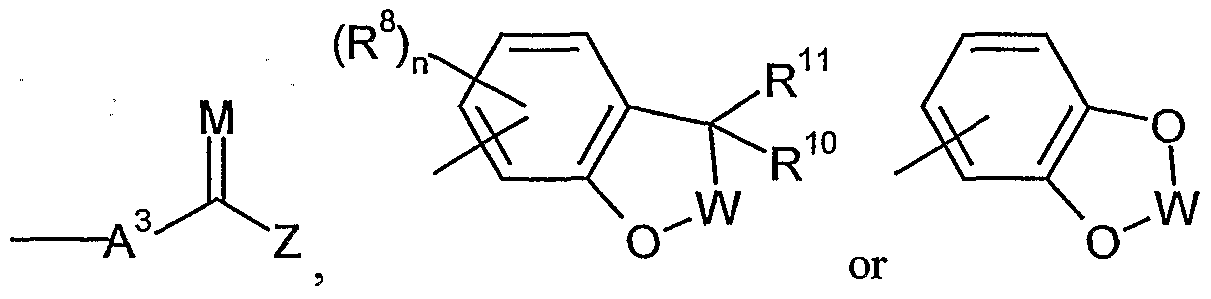
Q also represents one of the following groupings:
A3 represents a bond or a C1-C6 alkylene bridge which is optionally mono- or polysub- stituted by halogen or C3-C8 cycloalkyl.
M represents oxygen or NOR7.
R7 represents hydrogen, Ci-C12-alkyl, C3~C8-cycloalkyl, CrC6-alkylcarbonyl, C2-Ce- alkenyl, C2-C6-alkynyl, aryl, heterocyclyl or benzyl, wherein the alkyl, cycloalkyl, alkenyl and alkynyl radicals are unsubstituted or optionally mono- to pentasubstituted by a radical from the following group: halogen,-N3, CN, NO2, OH, SH, Cj-Cδ-alkoxy, Ci-Cό-haloalkoxy, C2-C6-alkenyloxy, C2-C6-haloalkenyloxy, C3-C6-alkynyloxy, C3-Ce- haloalkynyloxy, C3-Cg-cycloalkyl-Ci-C6-alkoxy, Cj-Ce-alkylcarbonyl, Ci-C6-haloalkyl- carbonyl, Ci-Ce-alkoxycarbonyl, CrC6-alkylcarbonyl-CrC6-alkyl, CrCe-alkoxy- carbonyl-Ci-Ce-alkyl, CrC6-alkylthio, C2-C6-alkylthio, C3-C6-alkynylthio, C3-C6-cyclo- alkyl- CrC6-alkylthio5 C3-C6-haloalkynyl, C2-C6-haloalkenylthio, CrC6-haloalkylthio, Ci-Ce-alkoxy-Ci-Ce-alkyl, CrC6-haloalkoxy-CrC6-alkyl5 C2-C6-alkenyloxy-CrC6-alkylJ C2-C6-haloalkenyloxy-CrC6-alkyl, Cs-Ce-alkynyloxy-d-Ce-alkyl, NH2, NHC2-C6-
alkenyl, C2-C6-haloalkenyl, C3-C6-alkynyl, C3-C8-cycloalkyl, C3-C3-cycloalkyl-CrC6- alkyl, Ci-Cβ-alkoxy, Q-Cβ-haloalkoxy, C2-C6-alkenyloxy, C2-C6-haloalkenyloxy, C3-C6- alkynyloxy, C3-C6-haloalkynyloxy, CrCs-cycloalkyl-Q-Ce-alkoxy, CrCδ-alkyl- carbonyl, Q-Cβ-haloalkyl- carbonyl, Ci-Ce-alkoxycarbonyl, CrC6-alkylcarbonyl-Ci-C6- alkyl, CrCe-alkoxycarbonyl- CrC6-alkyl, CrC6-alkylthio, C2-C6-alkenylthio, C3-C6-al- kynylthio, C3-C6-cycloalkyl-Ci-C6-alkylthio, C3-C6-haloalkynyl, C2-C6-haloalkenylthio, Ci-Ce-haloalkylthio, CrC6-alkoxy-CrC6-alkyl, Cj-Ce-haloalkoxy-CrCβ-alkyl, C2-C6-al- kenyloxy-CrC6-alkyl, C2-C6-haloalkenyloxy-Ci-C6-alkyl, C3-C6-alkynyloxy-CrC6-alkyl or N(C1-C6-alkyl)2, it being possible for the two alkyl groups, independently of one another, to be CrCβ-alkylcarbonylammo, Ci-Cβ-haloalkylcarbonylamino, CrCβ-alkoxy- carbonylamino and Ci-Cβ-alkylaminocarbonylamino.
W represents *C(R32R33) or *C(R32R33)C(R34R35), wherein the asterisk "*" denotes the attachment to oxygen and wherein R32 to R35 in each case independently of one another represent halogen, Ci-C4-alkyl, Cj-C4-alkoxy(Ci-C4)alkyl or halo(Ci-C4)alkyl.
n can have values of 0 to 3,
the R8's in each case independently of one another represent hydrogen, halogen, halo(Cr C4) alkyl, C3-C6-cycloalkyl, C2-C5-alkenyl, C2-C5-alkynyl, CrC4-haloalkyl, CrC4-alkoxy, Ci-C4-haloalkoxy, Ci-C4-alkylthio, Ci-C4-haloalkylthio, CrC4-alkylsulphonyl, CrC4- haloalkylsulphonyl, nitro, cyano, aryl, alkylcarbonylamino, arylcarbonylamino and C1-C4- alkoxycarbonylamino.
R10 and R11 in each case independently of one another represent hydrogen, halogen, hydroxy, (Cr C4)-alkyl, halo(CrC4)-alkyl or (CrC4)-alkoxy or
together represent carbonyl, or represent -O-CH2-CH2-O-, S-CH2-CH2-S, ketal, thioketal or form an oxime in the form of NOR12, wherein
R12 represents (CrC3)-alkyl, (CrC3)-alkoxy(Ci-C3)-alkyl, aryl-(CrC3)-alkyl, C2-C4-alkenyl- (CrC3)-alkyl, halo(C2-C4)-alkenyl-(Cl-C3)-alkyl, di(CrC3)-alkylphosphonate, formyl, (C1- C3)-alkylcarbonyl,
ImIo(C1- C3)alkylcarbonyl, (C]-C3)alkoxy(Ci-C3)alkylcarbonyl, arylcarbonyl
and (Ci-C3)-alkylsulphonyl.
Preferred substituents or preferred scopes for the radicals contained in the formulae cited above and hereinbelow are defined in the following.
G preferably represents one of the following groupings:
-CH2-CH=CCl2, -CH2-CH=CBr2, -CH2-CH=CClF, -CH2-CH=CBrCl or -CH2-CH=CBrF.
G particularly preferably represents one of the following groupings:
-CH2-CH=CCl2, -CH2-CH=CBr2 or -CH2-CH=CBrCl.
G very particularly preferably represents the grouping -CH2-CH=CCl2.
A2-X preferably represents straight-chain or branched alkanediyl or alkenediyl each having up to 8 carbon atoms and optionally containing within the carbon chain an oxygen atom, a sulphur atom or a grouping selected from the group comprising SO, SO2, NH and N(Ci-C4- alkyl) and represents
-(C1-C4-alkyl)-(CO)-O-, -(CrC4~alkyl)-(CO)-(NH)-, -(C,-C4-alkyl)-(CO)-[N-(Ci-C4- alkyl)]-, -(CrC4-alkyl)-(CO)-S-, (C2-C8-alkenyl)-(CO)-O-, -(C2-C8-alkenyl)-(CO)-(NH)-, -(C2-C8-alkenyl)-(CO)-[N-(Ci-C4-alkyl)]-, -(C2-C8-alkenyl)-(CO)-S, piperidyl or pipera- zinyl, -(CrC4-alkyl>O-N=C(R9)- or -(CrC6-alkenyl)-O-N=C(R9)-, wherein
R9 preferably represents methyl or aryl.
A2-X particularly preferably represents straight-chain or branched alkanediyl oder alkenediyl each having up to 8 carbon atoms and optionally containing an oxygen atom within the carbon chain, and represents
-(CrC4-alkyl)-(CO)-O-, -(C!-C4-alkyl)-(CO)-(NH)-, -(CrC4-alkyl)-(CO)-[N-(CrC4- alkyl)]-, -(CrC4-alkyl)-(CO)-S-, (C2-C8-alkenyl)-(CO)-O-, -(C2-C8-alkenyl)-(CO)-(NH)-, -(C2-C8-alkenyl)-(CO)-[N-(C,-C4-alkyl)]-, -(C2-C8-alkenyl)-(CO)-S, piperidyl or pipera- zinyl, -(CrC4-alkyl)-O-N=C(R9)- or -(CrC6-alkenyl)-O-N=C(R9)-, wherein
R9 particularly preferably represents methyl.
A2-X very particulary preferably represents straight-chain or branched alkanediyl having up to 8 carbon atoms and optionally containing an oxygen atom within the carbon chain, and represents -(CrC4-alkyl)-(CO)-O-, -(CrC4-alkyl)-(CO)-(NH)- or piperidyl.
Within the abovementioned definition of the optional bridge
the following meanings for the radicals R.21 and R^^ are preferred or particularly preferred:
R21 and R22 independently of one another preferably represent hydrogen, nitro, hydroxy, amino, cyano, cyanato, thiocyanato, formyl, halogen or methyl,
R21 and R22 particularly preferably represent hydrogen.
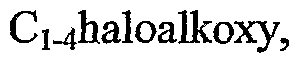
R1 preferably represents hydrogen, halogen, C1-4alkyl, C7-ioaralkyl, C1-4alkoxy, C1- 4haloalkyl or Q^haloalkoxy.
R1 particulary preferably represents hydrogen, fluorine, chlorine, bromine, iodine, methyl, ethyl, isopropyl, benzyl, methoxy, trifluoromethyl or trifluoromethoxy.
R2 preferably represents hydrogen, halogen or CI-4alkyl.
R2 particulary preferably represents hydrogen, chlorine or methyl.
R
3 preferably represents hydrogen or
R3 particulary preferably represents hydrogen or methyl.
R4 preferably represents hydrogen, halogen, C^alkyl or Ci^alkoxy.
R4 particulary preferably represents hydrogen, fluorine, chlorine, methyl or methoxy.
Q preferably represents an alkenyl grouping or an alkinyl grouping with in each case 2 to 6 carbon atoms or a cycloalkenyl group with 4 to 6 carbon atoms, which is optionally sub¬ stituted by at least one substituent from the group comprising nitro, cyano, carboxyl, carbamoyl, hydroxy, carbonyl (C=O), hydroximino (C=N-OH), Ci-C
4-alkoxy, C
1-C
4- alkoxy-carbonyl, C
rC
4-alkylamino, di-(CrC
4-alkyl)-amino,
C1-C4-alkoxy-carbonylamino, Ci-C4-alkoxy-Ci-C6-alkoxy, CrC4-alkoxyimmo, C3-C4- alkenyloxy, C3-C4-alkinyloxy, C3-C4-alkenyloxy-carbonyl, C3-C4-alkinyloxy-carbonyl, C3- C4-alkenyloxyimino, C3-C4-alkinyloxyimino, C3-C6-cycloalkyl, furyl, benzofuryl, thienyl, benzothienyl, isoxazolyl, benzisoxazolyl, pyrazolyl, pyridinyl, pyrimidinyl, pyrazinyl and pyridazinyl.
The abovementioned alternatives in the definition of Q in which the radicals A3, Z, M, R7, W5 n, R8, R10 and R11 have the following preferred or particularly preferred meanings, are also preferred or particularly preferred.
A3 preferably represents a single bond or straight-chain or branched alkanediyl having 1 to 6 carbon atoms and being optionally substituted by halogen or C3-C6-cycloalkyl,
A3 particularly preferably represents a single bond or in each case optionally fluorine-, chlorine-, bromine-, cyclopropyl-, cyclobutyl-, cyclopentyl- or cyclohexyl-substituted methylene, ethane- 1,1-diyl (ethylidene), ethane-l,2-diyl (dimethylene), propane-l,l-diyl
(propylidene), propane- 1,2-diyl, propane-l,3-diyl (trimethylene), butane- 1,1-diyl (butylidene) or butane- 1,4-diyl (tetramethylene),
A3 very particularly preferably represents a single bond or methylene,
Z preferably represents monocyclic heteroaryl, which has up to 5 carbon atoms and at least one hetero atom from the group comprising N (nitrogen, 1 to 4 N atoms), O (oxygen, 1 O atom) and sulphur (I S atom) and optionally alternatively or additionally a SO or SO2 grouping and optionally additionally a carbonyl grouping (C=O) and/or a thiocarbonyl grouping (C=S) as a component of the heterocycle and is in each case optionally sub¬ stituted by nitro, hydroxy, amino, formyl, cyano, carboxy, carbamoyl, fluorine, chlorine, bromine, methyl, ethyl, n- or i-propyl, n-, i-, s- or t-butyl, fluoromethyl, chloromethyl, difluoromethyl, dichloromethyl, trifluoromethyl, trichloromethyl, fluoroethyl, chloroethyl, difluoroethyl, dichloroethyl, chlorofluoroethyl, trifluoroethyl, trichloroethyl, chlorodi- fluoroethyl, fluoropropyl, chloropropyl, difluoropropyl, dichloropropyl, trifluoropropyl, fluoro-i-propyl, difluoro-i-propyl, trifluoro-i-propyl, tetrafluoro-i-propyl, pentafluoro-i- propyl, methoxy, ethoxy, n- or i-propoxy, fluoromethoxy, difluoromethoxy, trifluoro- methoxy, fluorodichloromethoxy, chlorodifluoromethoxy, fluoroethoxy, chloroethoxy, di- fluoroethoxy, dichloroethoxy, trifluoroethoxy, fluoropropoxy, methoxycarbonyl, ethoxy- carbonyl, fluoroethoxycarbonyl, chloroethoxycarbonyl, methoxymethyl, ethoxymethyl, n- or i-propoxymethyl, methoxyethyl, ethoxyethyl, n- or i-propoxyethyl, ethenyl, propenyl, butenyl, fluoroethenyl, chloroethenyl, difluoroethenyl, dichloroethenyl, trifluoroethenyl, trichloroethenyl, propenyloxymethyl, butenyloxymethyl, propenyloxyethyl, butenyloxy- ethyl, ethinyl, propinyl, butinyl, propenyloxy, butenyloxy, fluoropropenyloxy, chloropro- penyloxy, fiuorobutenyloxy, chlorobutenyloxy, propenyloxycarbonyl, butenyloxycarbonyl, propinyloxy, butinyloxy, propinyloxycarbonyl, butinyloxycarbonyl, propinyloxymethyl, butinyloxymethyl, propinyloxyethyl, butinyloxyethyl, cyclopropyl, cyclobutyl, cyclo¬ pentyl, cyclopropylcarbonyl, cyclobutylcarbonyl, cyclopentylcarbonyl, cyclopropylmethyl,
cyclobutylmethyl, cyclopentylmethyl, cyclohexylmethyl, cyclopropylmethylcarbonyl, cyclobutylmethylcarbonyl, cyclopentylmethylcarbonyl, cyclopropyloxy, . cyclobutyloxy, cyclopentyloxy, cyclohexyloxy, cyclopropyloxycarbonyl, cyclobutyloxycarbonyl, cyclo- pentyloxycarbonyl, cyclohexyloxycarbonyl, cyclopropylmethoxy, cyclobutylmethoxy, cyclopentylmethoxy, cyclohexylmethoxy, cyclopropylmethoxycarbonyl, cyclobutyl- methoxycarbonyl, cyclopentylmethoxycarbonyl, cyclohexylmethoxycarbonyl, cyclopropyl- methoxymethyl, cyclobutylmethoxymethyl, cyclopentylmethoxymethyl, cyclopropyl- oxymethoxy, cyclobutyloxymethoxy, cyclopentyloxymethoxy, acetylmethyl, propionyl- methyl, n- or i-butyroylmethyl, acetylethyl, propionylethyl, methoxycarbonylmethtyl, ethoxycarbonylmethyl, n- or i-propoxycarbonylmethyl, methoxycarbonylethyl, ethoxy- carbonylethyl, n- or i-propoxycarbonylethyl, methylthio, ethylthio, n- or i-propylthio, di- fluormethylthio, trifluormethylthio, chlorodifluormethylthio, methylsulphinyl, ethyl- sulphinyl, trifluoromethylsulfinyl, methylsulphonyl, ethylsulphonyl, trifluoro- methylsulphonyl, propenylthio, butenylthio, fluoropropenylthio, chloropropenylthio, fluorobutenylthio, chlorobutenylthio, propinylthio, butinylthio, cyclopropylthio, cyclό- butylthio, cyclopentylthio, cyclohexylthio, cyclopropylmethylthio, cyclobutylmethylthio, cyclopentylmethylthio, meihylamino, ethylamino, n- or i-propylamino, methylamino- carbonyl, ethylaminocarbonyl, n- or i-propylaminocarbonyl, dimethylamino, diethylamino, dimethylaminocarbonyl, diethylaminocarbonyl, acetylamino, propionylamino, n- or i- butyroylamino, methoxycarbonylamino, ethoxycarbonylamino, n- or i-propoxycarbonyl- amino, methylaminocarbonylamino, ethylaminocarbonylamino or n- or i-propylamino- carbonylamino, or by phenyl, phenyloxy, benzyl, benzyloxy, phenylamino, benzylamino (the phenyl groups being in each case optionally substituted by nitro, hydroxy, mercapto, amino, cyano, methyl, ethyl, n- or i-propyl, n-, i-, s- or t-butyl, trifluoromethyl, methoxy, ethoxy, n- or i-propoxy, difluoromethoxy, trifluoromethoxy, fluoroethoxy, difluoroethoxy, trifluoroethoxy, propenyloxy, butenyloxy, propinyloxy, butinyloxy, propinylthio, butinyl- thio, methylsulphinyl, ethylsulphinyl, methylsulphonyl, ethylsulphonyl, methoxycarbonyl, ethoxycarbonyl or n- or i-propoxycarbonyl), the heteroaryl groupings which may be mentioned being particularly pyrrolyl, pyrazolyl, imidazolyl, triazolyl, tetrazolyl, furyl, thienyl, oxazolyl, isoxazolyl, thiazolyl, isothiazolyl, oxadiazolyl, thiadiazolyl, pyridinyl, pyrimidinyl, pyridazinyl and pyrazinyl, and very particularly tetrazolyl,
M preferably represents oxygen,
R7 preferably represents hydrogen; Ci-Cβ-alkyl, Cs-Cβ-cycloalkyl, Ci-C4-allcylcarbonyl, C2-C4- alkenyl, C2-C4-alkynyl, aryl, heterocyclyl or benzyl, the alkyl, cycloalkyl, alkenyl and alkynyl radicals being unsubstituted or optionally mono- to pentasubstituted by a radical
from the following group: halogen, -N3, CN, NO2, OH, SH, Ci-C4-alkoxy, CrC4-halo- alkoxy, C2-C4-alkenyloxy, C2-C4-haloalkenyloxy, C3-C4-alkynyloxy, C3-C4-haloalkynyloxy, C3-C6-cycloalkyl-Ci-C4-alkoxy, Ci-C4-a]kylcarbonyL, CrC4-haloalkylcarbonyl, Ci-C4- alkoxycarbonyl, Ci-C4-alkylcarbonyl-Ci-C4-alkyl, Ci-Q-alkoxycarbonyl-Ci-Gf-alkyl, Cr C4-alkylthio, C2-C4-alkylthio, C3-C4-alkynylthio5 C3-C4-cycloalkyl- C1-C4-alkylthio, C3-C4- haloalkynyl, C2-C4-haloalkenyltliio, Ci-C4-haloalkylthio, Ci-C4-alkoxy-Ci-C4-alkyl, Ci-C4- haloalkoxy-C]-C4-alkyl, C2-C4-alkenyloxy-C1-C4-alkyl, C2-C4-haloalkenyIoxy-Ci-C4-alkyl, C3-C4-alkynyloxy-CrC4-alkyl, NH2, NHC2-C4-alkenyl, C2-C4-haloalkenyl, C3-C6-alkynyl, C3-C6-cycloalkyl5 C3-C6-cycloalkyl-Ci-C4-alkyl, CrCa-alkoxy, CrC4-haloalkoxy, C2-C4- alkenyloxy, C2-C4-haloalkenyloxy, C3-C4-alkynyloxy, C3-C4-haloalkynyloxy, C3-Cβ- cycloalkyl-Ci-C4-alkoxy, Ci-C4-alkylcarbonyl, Ci~C4-haloalkyl- carbonyl, Ci-C4-alkoxy- carbonyl, Ci-C4-alkylcarbonyl-Ci-C4-alkyl, Ci-Gt-alkoxycarbonyl- Ci-C4-alkyl, Ci-C4- alkylthio, C2-C4-alkenylthio, C3-C4-alkynylthio, C3-C6-cycloalkyl-Ci-C4-alkylthio, C3-C4- haloalkynyl, C2-C4-haloalkenylthio, Ci-C4-haloalkylthio, Ci-C4-alkoxy-CrC6-alkyl, C1-C4- haloalkoxy-Ci-C4-alkyl, C2-C4-alkenyloxy-C1-C4-alkyl, C2-C4-haloalkenyloxy-Ci-C4-alkyl,
C3-C4-alkynyloxy-CrC4-alkyl or N(Ci-C4-alkyl)2, it being possible for the two alkyl groups in each case independently of one another to be Ci-C4-alkylcarbonylamino, Ci-C4- haloalkylcarbonylamino, Ci-Ci-alkoxycarbonylaniino and Ci-C4-alkylamino- carbonylamino.
W preferably represents *C(R32R33) and *C(R32R33)C(R34R35), wherein the asterisk "*"
denotes the attachment to O and wherein R32 to R35 independently in each case represent halogen, CrC3-alkyl, Ci-C3-alkoxy(CrC3)-alkyl or halo(CrC3)-alkyl,
W particularly preferably represents C(R32R33), wherein R32R33 represents halogen or Ci-C4- alkyl.
W very particularly preferably represents C(R32R33), wherein R32R33 represents halogen or methyl.
n preferably has values from 0 to 2.
n particularly preferably represents 0.
the R8's preferably in each case independently of one another represent hydrogen, halogen, halo(CrC4)-alkyl or nitro.
R8 particularly preferably represents hydrogen.
R10 and R11 preferably jointly represent =0 or hydrogen.
The compounds of the formula (I) can also optionally, depending on the type of substituents concerned, be present as stereoisomers, i.e. as geometric and/or optical isomers or isomer mixtures in variable combinations. The present invention relates both to the pure stereoisomers and to any desired mixtures of these isomers, even though reference is generally made herein merely to compounds of the formula (T).
The present invention also relates to the salt-type derivatives formed from compounds of the formula (I) by reacting them with basic or acidic compounds.
Preferred substituents or preferred scopes for the radicals contained in the formulae cited above and hereinbelow are defined in the following.
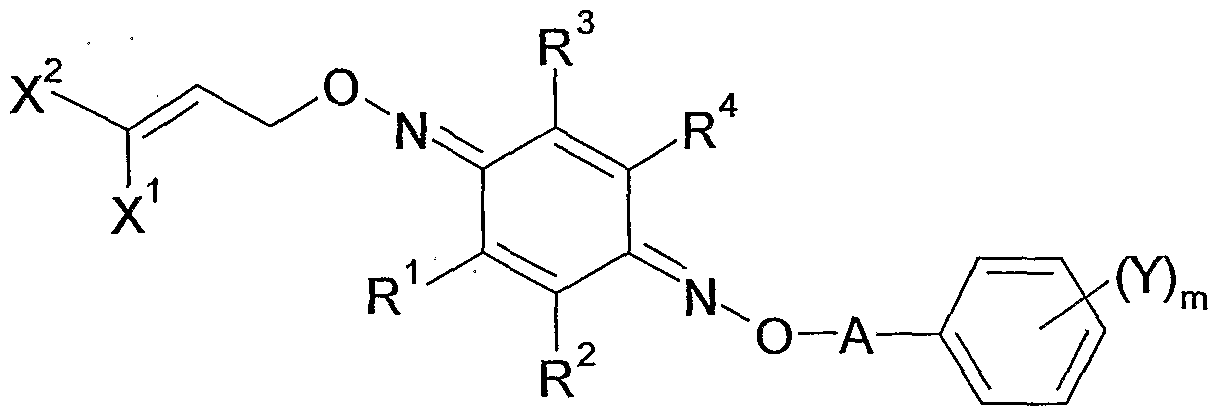
Other particularly preferred embodiements of the invention are compounds of the formula (Ia),
wherein the variables A, Q, R1, R2, R3, R4, and X have the following meanings.
Q represents a phenyl group that may be optionally substituted or a heterocyclic group that may be optionally substituted,
A represents alkylene, alkylidene, alkyleneoxy or alkyleneoxyalkylene
The two X' s each independently represent halogen,
R1 represents hydrogen, halogen, alkyl, aralkyl, alkoxy, haloalkyl or haloalkoxy,
R2 represents hydrogen, halogen or alkyl,
R3 represents hydrogen or alkyl, and
R4 represents hydrogen, halogen, alkyl or alkoxy.
In the compounds of the aforementioned formula (Ia), preferably
Q represents a phenyl group that may be optionally substituted with one or two groups selected from the group consisting of halogen, C
1-4alkyl,
and cyano, or 5- or 6-membered heterocyclic group containing 1 to 3 nitrogen atoms that may be optionally substituted with one or two groups selected from the group consisting of halogen, C^alkyl and C
1-4haloalkyl,
A represents C
2-7alkylene,
C
2-7alkyleneoxy or C
2-7alkyleneoxyC
2-7alkylene,
Two X's each independently represent fluorine, chlorine or bromine,
R
1 represents hydrogen, halogen,
or
R
2 represents hydrogen, halogen or
R
3 represents hydrogen or
and
R4 represents hydrogen, halogen, C^alkyl or C1-4alkoxy.
In the compounds of the aforementioned formula (Ia), particularly preferably
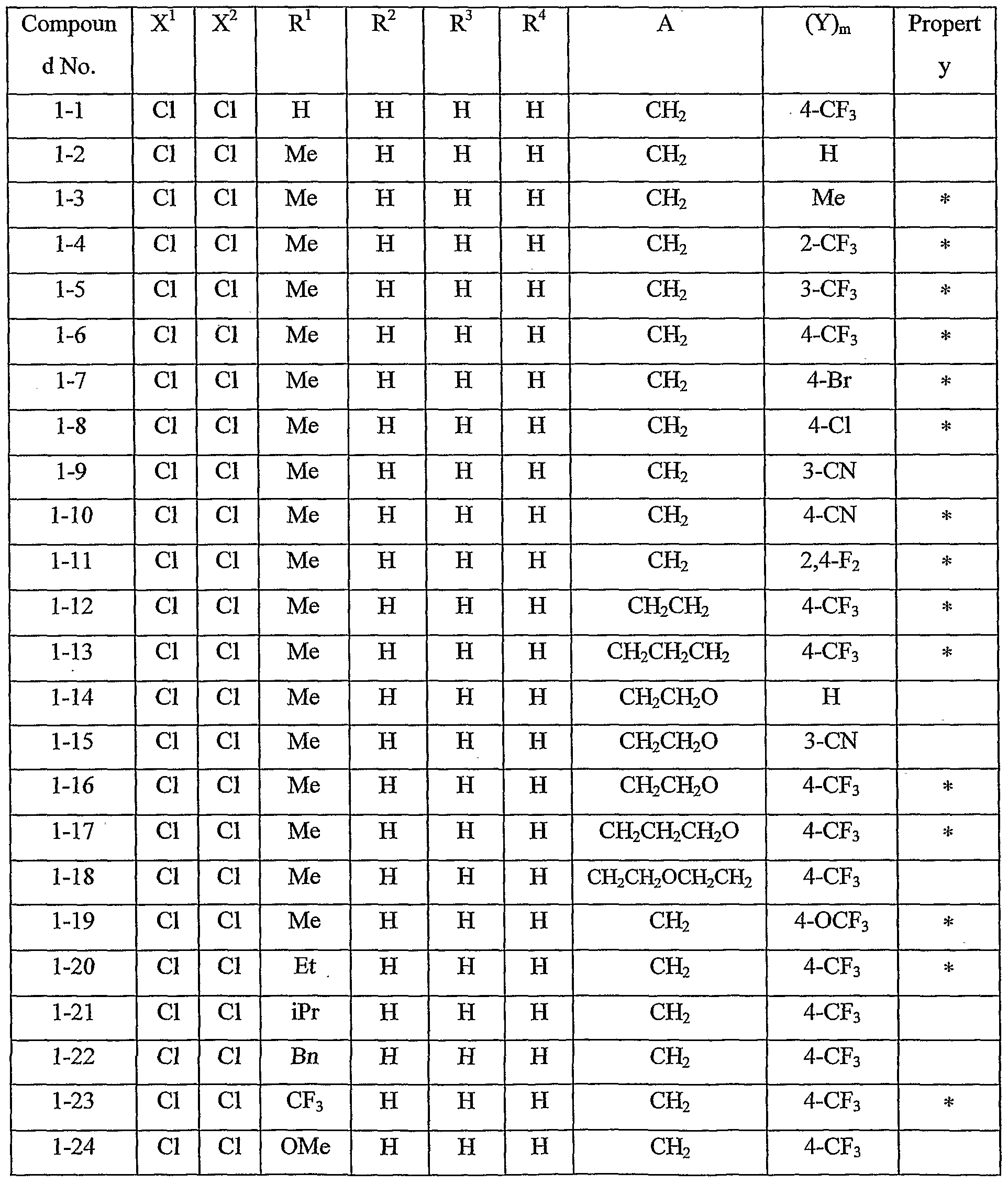
Q represents a phenyl group that may be optionally substituted with one or two groups selected from the group consisting of fluorine, chlorine, bromine, methyl, trifluoromethyl, trifluoromethoxy and cyano, or pyrazolyl, triazolyl, pyridyl or pyrimidinyl that may be optionally substituted with one or two groups selected from the group consisting of chlorine, methyl and trifluoromethyl,
A represents ethylene, trimethylene, methylene, ethylidene, ethyleneoxy, trimethyleneoxy or ethyleneoxyethylene,
Two X's represent each independently chlorine or bromine,
R1 represents hydrogen, fluorine, chlorine, bromine, iodine, methyl, ethyl, isopropyl, benzyl, methoxy, trifluoromethyl or trifluoromethoxy,
R2 represents hydrogen, chlorine or methyl,
R3 represents hydrogen or methyl, and
R4 represents hydrogen, fluorine, chlorine, methyl or methoxy.
Compounds of formula (I) can be prepared according to the following scheme:
LG = leaving group, e.g. halogen or methane sulfonyloxy (MeSO2-O-)
Wherein A , G, Q, R > 1 , τ R>2 , n R3 , r R>4 , and X have the aforementioned meanings.
The compounds of the formula (I) and preferably the compounds of formula (Ia)5 according to the invention, can be obtained by a process in which
a) compounds of the formula (U)
wherein
X, R1, R2, R3 and R4 have the same definitions as aforementioned,
are reacted with compounds of the formula (IH)
H2NO-A-Q (HI)
wherein
A and Q have the same definitions as aforementioned,
in the presence of inert solvents, and if appropriate, in the presence of an acid catalyst,
or
b) compounds of the formula (IV)
X, R1, R2, R3 and R4 have the same definitions as aforementioned,
are reacted with compounds of the formula (V)
HaI-A-Q (V)
wherein
A and Q have the same definitions as aforementioned, and
Hal represents halogen,
in the presence of inert solvents, and if appropriate, in the presence of an acid binder,
or
c) compounds of the formula (VT)
A, Q, R > 1 , τ R>2 , τ R>3 and 1 r R>4 have the same definitions as aforementioned,
with compounds of the formula (VII)
X has the same definition as aforementioned,
in the presence of inert solvents, and if appropriate, in the presence of an acid catalyst,
or
d) in case that Q represents a heterocyclic group that may be optionally substituted:
compounds of the formula (VET)
wherein
A, X, R1, R2, R3 and R4 have the same definitions as aforementioned, and
Hal represents halogen,
are reacted with compounds of the formula (IX)
H-Qd (K)
wherein
Qd represents a heterocyclic group that may be optionally substituted,
in the presence of inert solvents, and if appropriate, in the presence of an acid binder.
In the present specification:
"Halogen" includes fluorine, chlorine, bromine and iodine.
"Alkyl" is a straight or branched chain and can be, for example,
and there can be specifically mentioned methyl, ethyl, n- or iso-propyl, n-, iso-, sec- or tert-butyl, etc.
"Alkoxy" is a group alkyl-O-, whose alkyl part has the above-mentioned meaning and can be, for example, C^alkoxy, and there can be specifically mentioned, for example, methoxy, ethoxy, n- or iso-propoxy, n-, iso-, sec- or tert-butoxy, etc.
"Haloalkyl" represents a straight or branched chain alkyl, in which at least one hydrogen is substituted by halogen. There can be mentioned, for example, C^alkyl substituted withl to 6 atoms of fluorine, chlorine and/or bromine, and as their specific examples there can be mentioned fluoromethyl, chloromethyl, dichloromethyl, bromomethyl, difluoromethyl, trifluoromethyl, chlorodifluoromethyl, dichloromethyl, trichloromethyl, 2,2,2-trifluoroethyl, 2-chloro-l,l,2-tri- fluoroethyl, 3-fluoropropyl5 3-chloroproρyl, 2,2,3,3,3-pentafluoropropyl, 1,2,2,3 ,3,3 -hexafluoro- propyl, etc.
"Haloalkoxy" is a group haloalkyl-O-, whose haloalkoxy part has the above-mentioned meaning and can be, for example, Q^haloalkoxy, and there can be specifically mentioned, for example, difluoromethoxy, trifluoromethoxy, chlorodifluoromethoxy, dichloromethoxy, 2-fluoroethoxy, 2- chloroethoxy, 2,2,2-trifluoroethoxy, 3-chloropropoxy, etc.
"Aralkyl" is an aryl-substituted alkyl and there can be specifically mentioned, for example, benzyl, 1-phenylethyl, phenethyl, 1-phenylpropyl, 2-phenylpropyl, 3-phenylpropyl, etc.
"Alkylene" is a straight or branched chain and can be, for example, C2-7alkylene, and there can be specifically mentioned, for example, ethylene, trimethylene, methylethylene (propylene), tetramethylene, ethylethylene, pentamethylene, hexamethylene, etc.
"Alkylidene" is a straight or branched chain and can be, for example, C1-6alkylidene, and there can be specifically mentioned, for example, methylene, ethylidene, propylidene, isopropylidene, etc.
"Alkyleneoxy" is a group alkylene-O, whose alkylene part has the above-mentioned meaning and there can be specifically mentioned, for example, ethyleneoxy, propyleneoxy, etc.
"Alkyleneoxyalkylene" is an alkylene-O-alkylene, whose alkylene part has the above-mentioned meaning and there can be specifically mentioned, for example, ethyleneoxyethylene, propylene- oxypropylene, etc.
"Heterocyclic group" is a monocyclic or polycyclic group containing at least one hetero atom selected from the group consisting of nitrogen, oxygen and sulfur as ring member, and can be, for example, 5- or 6-membered heterocyclic group containing 1 to 3 nitrogen atoms.
As "5- or 6-membered heterocyclic group containing 1 to 3 nitrogen atoms" there can be mentioned, for example, pyrrolyl, pyrazolyl, imidazolyl, triazolyl, pyridyl, pyridazinyl, pyrimidinyl, pyrazinyl, etc.
The aforementioned preparation process (a) can be illustrated by the following reaction scheme in case that, for example, 2-methyl-[l,4]benzoquinone l-[0-(3,3-dichlorpropenyl)]oxime and O-[4- (trifluoromethoxy)benzyl] hydroxylamine are used as starting materials.
The aforementioned preparation process (b) can be illustrated by the following reaction scheme in case that, for example, 2-methyl-[l,4]benzoquinone l-[O-(3,3-dichlorpropenyl)oxime] 4-oxime and 4-(trifluoromethyl)benzyl bromide are used as starting materials.
The aforementioned preparation process (c) can be illustrated by the following reaction scheme in case that, for example, 3-chloro-[l,4]benzoquinone l-[O-[4-(trifluoromethyl)ben2yl]]oxime and O- (3,3-dichlorpropenyl)hydroxylamine are used as starting materials.
HΛ
Z)-CF
3 + acid catalyst
The aforementioned preparation process (d) can be illustrated by the following reaction scheme in case that, for example, 2-methyl-[l,4-benzoquinone l-[O-(3,3-dichloroproρenyl)oxime] 4-[O-(2-bromoethyl)]oxime and 3,5-bis(trifluorometliyl)-pyrazole are used as starting materials.
+ acid binder
The compounds of the formula QI), used as the starting materials in the above-mentioned preparation process (a), are novel compounds that are not described in the existing literature yet. The compounds of formula (It) can be easily prepared, for example, by reacting compounds of the formula (X)
wherein
R > 15 rR>25 τR,3 and R have the same definition as aforementioned,
with per se known compounds of the formula (XI)
wherein
X and Hal have the same definitions as aforementioned,
according to the process described in the literature, for example, Journal of the Chemical Society, Vol.69, ρ.73, 1896 etc.
The compounds of the above-mentioned formula (X), a part of which are novel compounds, that are not described in the existing literature yet.
The compounds of formula (X) can be easily prepared, for example, by reacting compounds of the formula (XII)
R1, R2, R3 and R4 have the same definitions as aforementioned,
with a nitrite in the presence of an acid, according to the process described in the literature, for example, Japanese Laid-open Patent Application No.160325/1979;
Journal of the American Chemical Society, Vol.66, p.1330-1331, 1944; Journal of Medicinal Chemistry, Vol.30, No.5, p.906-911, 1987, etc.
The compounds of the above-mentioned formula (XII) are per se known.
The compounds of the formula (JJI), used as the starting materials in the above-mentioned preparation process (a), a part of which are novel compounds, that are not described in the existing literature yet. And, the compounds can be easily prepared, for example, from compounds of the formula (XIH)
Za-A-Q (XJH)
wherein
Q and A have the same definition as aforementioned, and
Za represents hydroxy or halogen,
according to the process described in Journal of Medicinal Chemistry, Vol.40, No.15, p.2363- 2373, 1997; Agricultural and Biological Chemistry, Vol.49, No.11, p.3197-3202, 1985, etc.
The compounds of the above-mentioned formula (XIH) are per se known.
As specific examples of the compounds of the formula (H), used as the starting materials in the above-mentioned preparation process (a), there can be mentioned as follows:
2-methyl-[l,4]benzoquinone l-[0-(3,3-dichloropropenyl)]oxime,
2,5-dimethyl-[l,4]benzoquinone l-[0-(3,3-dichloropropenyl)]oxime,
2,6-dimethyl-[l,4]benzoquinone l-[0-(3,3-dichloropropenyl)]oxime,
3-chloro-[l,4]benzoquinone l-[O-(3,3-dichloropropenyl)]oxime,
2-bromo-[l,4]benzoquinone l-[O-(3,3-dichloropropenyl)]oxime,
2-iodo-[l,4]benzoquinone l-[O-(3,3-dichloropropenyl)]oxime,
2-methyl-5-chloro-[l,4]benzoquinone l-[0-(3,3-dichloropropenyl)]oxime,
2-methyl-5-fluoro-[l,4]benzoquinone l-[O-(3,3-dichloropropenyl)]oxime,
2-methoxy-[l,4]benzoquinone l-[O-(3,3-dichIoropropenyl)]oxime, and so on.
As specific examples of the compounds of the formula (DI), used as the starting materials in the above-mentioned preparation process (a), there can be mentioned as follows:
O-phenylhydroxylamine,
O-benzylhydroxylamine,
0-(4-trifluoromethyl)benzylhydroxylamine,
0-(4-trifluoromethoxy)benzylhydroxylamine,
O-(2-phenylethyl)hydroxylamine,
O-[2-(4-fluorophenyl)ethyl]hydroxylamine,
O-[2-(4-trifluorophenyl)ethyl]hydroxylamine,
O-[2-(4-trifluorophenyloxy)ethyl]hydroxylamine5
0-[2-(4-bromophenyloxy)ethyl]hydroxylamine,
O-( 1 -methyl-2-phenylethyl)hydroxylarnine.,
O-(2-phenoxylpropyl)hydroxylamine,
O-(2-phenyl-2-propyl)hydroxylamine,
O-(3 -phenylpropyl)hydroxylamine,
O-[3-(4-fluorophenyl)propyl]hydroxylamine,
O-[3-(4-trifluoromethylphenyl)propyl]hydroxylamine,
O-[3-(4-fluorophenyloxy)propyl]hydroxylamine,
0-[3-(4-trifluoromethylρhenyloxy)propyl]hydroxylamine,
0-[3-(5-trifluoromethylpyridin-2-yloxy)propyl]hydroxylamine,
O-[3-(5-trifluoromethylpyridin-2-yloxy)butyl]hydroxylamine, and so on.
The compounds of the formula (TV), used as the starting materials in the above-mentioned preparation process (b), are novel compounds that are not described in the existing literature yet. The compounds of formula (TV) can be easily prepared, for example, by reacting compounds of the formula (XTV)
wherein
R1, R2, R3 and R4 have the same definition as aforementioned,
with a compound of the aforementioned formula (VII) according to the process described in the literature, for example, Chemical and Pharmaceutical Bulletin, Vol.31, No.8, p.2601-2606, 1983; Chemische Berichte, Vol.63, p.2476,2483, 1930, etc.
The compounds of the above-mentioned formula (XIV), a part of which are novel compounds, that are not described in the existing literature yet. The compounds of formula (XIV) can be easily prepared, for example, by reacting compounds of the formula (XV).
wherein
R1, R2, R3 and R4 have the same definition as aforementioned,
with a nitrite in the presence of an acid, according to the process described in the literature, for example, Japanese Laid-open Patent Publication No.160325/1979; Journal of the American Chemical Society, Vol.66, p.1330-1331, 1944; Journal of Medicinal Chemistry, Vol.30, No.5, p.906-911, 1987, etc.
The compounds of the above-mentioned formulae (XV) and (V) per se known.
As specific examples of the compounds of the formula (W), used as the starting materials in the above-mentioned preparation process (b), there can be mentioned as follows:
[l,4]-benzoquinone l-[(3,3-dichloropropenyl)oxime] 4-oxime,
2-methyl-[l,4]-benzoquinone l-[(3,3-dichloropropenyl)oxime] 4-oxime,
2-chloro-[l,4]-benzoquinone l-[(3,3-dichloropropenyl)oxime] 4-oxime
2-bromo-[l,4]-benzoquinone l-[(3,3-dichloropropenyl)oxime] 4-oxime,
3-methoxy-[l,4]-benzoquinone l-[(3,3-dichloroρropenyl)oxime] 4-oxime, and so on.
As specific examples of the compounds of the formula (V), used as the starting materials in the above-mentioned preparation process (b), there can be mentioned as follows:
benzyl bromide,
2-fluorobenzyl bromide,
3-fluorobenzyl bromide,
4-fluorobenzyl bromide,
2-chlorobenzyl bromide,
3-chloroben2yl bromide,
4-chlorobenzyl bromide,
2-bromobenzyl bromide,
3-bromobenzyl bromide,
4-bromobenzyl bromide,
2-trifluoromethylbenzyl bromide,
3-trifluoromethylbenzyl bromide,
4-trifluoromethylbenzyl bromide,
2-methanesulfonyl-5-trifluoromethylpyridine,
3-chloro-2-methanesulfonyl-5-trifϊuoromethylpyridine,
2-(bromomethyl)pyridine, and so on.
The compounds of the formula (VI), used as the starting materials in the above-mentioned preparation process (c), are novel compounds, that are not described in the existing literature yet. The compounds of formula (VI) can be easily prepared, for example, by reacting a compound of the aforementioned formula (XTV) with a compound of the aforementioned formula (V), according to the process described in the literature, for example, Journal of the Chemical Society, Vol.69, p.73, 1896 etc.
Further, the compounds of the above-mentioned formula (VI) can be easily prepared, for example, by reacting compounds of the formula (XVI)
R1, R2, R3 and R4 have the same definition as aforementioned,
with a compound of the aforementioned formula (DI), according to the process described in the literature, for example, Chemical and Pharmaceutical Bulletin, Vol.31, No.8, p.2601-2606, 1983; Chemische Berichte, Vol.63, p.2476,2483, 1930, etc.
The compounds of the above-mentioned formula (XVI) are per se known.
As specific examples of the compounds of the formula (VT), used as the starting materials in the above-mentioned preparation process (c), there can be mentioned as follows:
3-methyl-[l,4]benzoquinone l-[O-(4-(trifluoromethyI)benzyl)]oxime,
2-methyl~[l,4]benzoquinone l-[O~(4-(trifluoromethyl)benzyl)]oxime,
3-chloro-[l,4]benzoquinone l-fO-(4-(trifluoromethyl)benzyl)]oxime,
3-bromo-[l,4]benzoquinone l-[O-(4-(trifluoromethyl)benzyl)]oxime,
2-methyl-5-chloro-[l,4]benzoquinone l-[0-(4-(trifluoromethyl)benzyl)]oxime,
3-(trifluoromethyl)-[l,4]benzoquinone l-[O-(4-(trifluoromethyl)benzyl)]oxime,
3-methoxy-[l,4]benzoquinone l-[0-(4-(trifluoromethyl)benzyl)]oxime,
2,5-dimethyl-[l,4]benzoquinone l-[O-(4-(trifluoromethyl)benzyl)]oxime, and
so on.
The compounds of the formula (VII), used as the starting materials in the above-mentioned preparation process (c), are per se known, for example, described in the literature, Japanese Laid- open Patent Application No. 338668/1998, and as their specific examples there can be mentioned as follows:
O-(3 ,3 -difluoropropenyl)hydroxylamine,
O-(3 ,3 -dichloropropenyl)hydroxylamine,
O-(3,3-dibromopropenyl)hydroxylamine, and so on
The compounds of the formula (VTfl), used as the starting materials in the above-mentioned preparation process (d), are novel compounds that are not described in the existing literature yet. The compounds of formula (VDI) can be easily prepared, for example, by reacting compounds of the formula (XVD)
wherein
A, X, R1, R2, R3 and R4 have the same definition as aforementioned,
according to the process described in the literature, for example, Journal of Organic Chemistry, Vol.42, p.353-355, 1977 etc.
The compounds of the above-mentioned formula (XVII) are novel and can be easily prepared, for example, by reacting a compound of the aforementioned formula (II) with compounds of the formula (XVUI)
H2NO-A-OH (XVm)
wherein
A has the same definition as aforementioned,
according to the process described in the literature, for example, Chemical and Pharmaceutical Bulletin, Vol.31, N0.8, p.2601-2606, 1983 etc.
The compounds of the above-mentioned formula (XVHI) are novel and can be easily prepared, for example, by reacting from compounds of the formula (XIX)
HO-A-OH (XIX)
wherein
A has the same definition as aforementioned,
according to the process described in the literature, for example, Journal of Medicinal Chemistry, Vol.13, No.3, p.398-403, 1970 etc.
The compounds of the above-mentioned formula (XIX) are per se known.
As specific examples of the compounds of the formula (VIII), used as the starting materials in the above-mentioned preparation process (d), there can be mentioned as follows:
2-methyl-[l,4]benzoquinone l-[(353-dichloroproρenyl)oxime] 4-[2-bromoethyl]oxime],
2-methyl-[ 1 ,4]benzoquinone 1 -[(3 ,3 -dichloroρroρenyl)oxime] 4-[3 -bromopropyljoxime],
2-methyl-[l ,4]benzoquinone l-[(3,3-dichloropropenyl)oxime] 4-[4-bromobutyl]oxime]3
2-chloro-[l,4]benzoquinone l-[(3,3-dichloropropenyl)oxime] 4-[2-bromoethyl]oxime],
2-chloro-5-methyl-[l,4]benzoquinone l-[(3,3-dichloropropenyl)oxime] 4-[2-bromoethyl]όxime], and so on.
The compounds of the formula (IX), used as the starting materials in the above-mentioned preparation process (d), are per se known. Specific examples for compounds of formula (TX) are:
3-(trifluoromethyl)pyrazole,
5-(trifluoromethyl)pyrazole,
3,5-bis(trifluoromethyl)pyrazole,
5-(trifluoromethyl)-l,2,4-triazole,
3,5~bis(trifluoromethyl)-l,2,4-triazole, and so on.
The reaction of the above-mentioned preparation process (a) can be conducted in an adequate diluent. Suitable diluents are aliphatic, alicyclic and optionally chlorinated aromatic hydrocarbons such as, for example, pentane, hexane, cyclohexane, petroleumether, ligroine, benzene, toluene, xylene, dichloromethane, chloroform, carbon tetrachloride, 1,2-dichloroethane, chlorobenzene, dichlorobenzene; ethers, such as, for example, ethyl ether, methyl ethyl ether, isopropyl ether, butyl ether, dioxane, dimethoxyethane (DME), tetrahydrofuran (THF), diethylene glycol dimethyl ether (DGM); nitriles, such as, for example, acetonitrile, propionitrile, acrylonitrile; alcohols, such as, for example, methanol, ethanol, isopropanol, butanol, ethylene glycol; esters, such as, for example, ethyl acetate, amyl acetate; acid amides, such as, for example, dimethylformamide (DMF), dimethylacetamide (DMA), N-methylpyrrolidone, l,3-dimethyl-2-imidazolidinone, hexamethyl phosphoric triamide (HMPA).
The preparation process (a) can be conducted in the presence of an acid catalyst. Examples of such an acid catalyst are mineral acids, such as, for example, hydrochloric acid, sulfuric acid, nitric acid, hydrobromic acid, sodium hydrogen sulfite; organic amine hydrochlorides, such as, for example, pyridine hydrochloride, triethylamine hydrochloride; amine sulfonates, such as, for example, pyridine p-toluenesulfonate, triethylamine p-toluenesulfonate.
Though the preparation process (a) can be conducted in. a substantially a wide range of temperatures, temperatures of generally about -50 to about 2000C, preferably about 0 to about 1500C are adequate.
Though, said reaction is conducted desirably under normal pressure, it can be operated optionally also under elevated pressure or under reduced pressure.
In conducting the preparation process (a), the aimed compounds can be obtained, for example, by reacting 0.5 to 2 moles of the compounds of the formula (IH) to 1 mole of the compounds of the formula (H) in a diluent, for example, ethanol, in the presence or non-presence of pyridinium p- toluenesulfonate.
The reaction of the above-mentioned preparation process (b) can be conducted in an adequate diluent. Diluents for this reactions can be aliphatic, alicyclic and optionally chlorinated aromatic hydrocarbons, such as, for example, pentane, hexane, cyclohexane, petroleum ether, ligroine, benzene, toluene, xylene, dichloromethane, chloroform, carbon tetrachloride, 1,2-dichloroethane, chlorobenzene, dichlorobenzene; ethers, such as, for example, ethyl ether, methyl ethyl ether, isopropyl ether, butyl ether, dioxane, dimethoxyethane (DME), tetrahydrofuran (THF), diethylene glycol dimethyl ether (DGM); ketones, such as, for example, acetone, methyl ethyl ketone (MEK), methyl isopropyl ketone, methyl isobutyl ketone (MEBK); nitriles, such as, for example, acetonitrile, propionitrile, acrylonitrile; esters, such as, for example, ethyl acetate, amyl acetate; acid amides, such as, for example, dimethylformamide (DMF), dimethylacetamide (DMA), N- methylpyrrolidone, l,3-dimethyl-2-imidazolidinone, hexamethyl phosphoric triamide (HMPA); sulfones, sulfoxides, such as, for example, dimethyl sulfoxide (DMSO), sulfolane.
The preparation process (b) can be conducted in the presence of an acid binder acid binder to be used in the reaction are inorganic bases, hydrides, hydroxides, carbonates or bicarbonates of alkali metals or alkaline earth metals, such as, for example, sodium hydride, lithium hydride, sodium hydrogen carbonate, potassium hydrogen carbonate, sodium carbonate, potassium carbonate, lithium hydroxide, sodium hydroxide, potassium hydroxide, calcium hydroxide; inorganic alkali metal amides, such as, for example, lithium amide, sodium amide, potassium amide; organic bases, alcoholates, tertiary amines, dialkylaminoanilines or pyridines, such as, for example, triethylamine, 1,1,4,4-tetramethylethylenediamine (TMEDA), N,N-dimethylaniline, N,N-diethylaniline, pyridine, 4-dimethylaminopyridine (DMAP), l,4-diazabicyclo[2,2,2]octane (DABCO) and 1,8- diazabicyclo[5,4,0]undec-7-ene (DBU); organolithium compounds, such as, for example, methyl lithium, n-butyl lithium, sec-butyl lithium, tert-butyl lithium, phenyl lithium, dimethyl copper lithium, lithium diisopropyl amide, lithium cyclohexyl isopropyl amide, lithium dicyclohexyl amide, n-butyl lithium-DABCO, n-butyl lithium-DBU, n-butyl lithium-TMEDA.
Though, the preparation process (b) can be conducted in a substantially wide range of temperature, the temperatures of generally about -50 to about 2000C, preferably about 0 to about 15O0C are adequate.
And though said reaction is conducted desirably under normal pressure, it can be operated optionally also under elevated pressure or under reduced pressure.
In conducting the preparation process (b), the aimed compounds can be obtained, for example, by reacting 0.1 to 10 moles of the compounds of the formula (V) to 1 mole of the compounds of the formula (TV) in a diluent, for example, acetonitrile, in the presence of potassium carbonate.
The reaction of the above-mentioned preparation process (c) can be conducted in an adequate diluent. Suitable diluents to be used in that case are alicyclic and optionally chlorinated aromatic hydrocarbons, such as, for example, pentane, hexane, cyclohexane, petroleum ether, ligroine, benzene, toluene, xylene, dichloromethane, chloroform, carbon tetrachloride, 1,2-dichloroethane, chlorobenzene, dichlorobenzene; ethers, such as, for example, ethyl ether, methyl ethyl ether, isopropyl ether, butyl ether, dioxane, dimethoxyethane (DME), tetrahydrofuran (THF), diethylene glycol dimethyl ether (DGM); nitrites, such as, for example, acetonitrile, propionitrile, acrylonitrile; alcohols, such as, for example, methanol, ethanol, isopropanol, butanol, ethylene glycol; esters, such as, for example, ethyl acetate, amyl acetate; acid amides, such as, for example, dimethylformamide (DMF), dimethylacetamide (DMA), N-methylpyrrolidone, l,3-dimethyl-2- imidazolidinone, hexamethyl phosphoric triamide (HMPA).
The preparation process (c) can be conducted in the presence of an acid catalyst. Suitable acid catalysts are mineral acids, such as, for example, hydrochloric acid, sulfuric acid, nitric acid, hydrobromic acid, sodium hydrogen sulfite; organic amine hydrochlorides, such as, for example, pyridine hydrochloride, triethylamine hydrochloride; amine sulfonates, such as, for example, pyridine p-toluenesulfonate, triethylamine p-toluenesulfonate.
Though the preparation process (c) can be conducted in a substantially wide range of temperatures, temperatures of generally about -50 to about 2000C, preferably about 0 to about 1500C are adequate.
And though said reaction is conducted desirably under normal pressure, it can be operated optionally also under elevated pressure or under reduced pressure.
In conducting the preparation process (c), the aimed compounds can be obtained, for example, by reacting 0.5 to 2 moles of the compounds of the formula (VII) to 1 mole of the compounds of the
foπnula (VI) in a diluent, for example, ethanol, in the presence or non-presence of pyridinium p- toluenesulfonate.
The reaction of the above-mentioned preparation process (d) can be conducted in an adequate diluent. Suitable diluents for this process are optionally chlorinated aliphatic, alicyclic or aromatic hydrocarbons, such as, for example, pentane, hexane, cyclohexane, petroleum ether, ligroine, benzene, toluene, xylene, dichloromethane, chloroform, carbon tetrachloride, 1,2-dichloroethane, chlorobenzene, dichlorobenzene, etc.; ethers, for example, ethyl ether, methyl ethyl ether, isopropyl ether, butyl ether, dioxane, dimethoxyethane (DME), tetrahydrofuran (THF), diethylene glycol dimethyl ether (DGM); ketones, such as, for example, acetone, methyl ethyl ketone (MEK), methyl isopropyl ketone, methyl isobutyl ketone (MIBK); nitriles, such as, for example, acetonitrile, propionitrile, acrylonitrile; esters, such as, for example, ethyl acetate, amyl acetate; acid amides, such as, for example, dimethylformamide (DMF), dimethylacetamide (DMA), N- methylpyrrolidone, l,3-dimethyl-2-imidazolidinone, hexamethyl phosphoric triamide (HMPA); sulfones, sulfoxides, such as, for example, dimethyl sulfoxide (DMSO), sulfolane.
The preparation process (d) can be conducted in the presence of an acid binder. Suitable acid binders are inorganic bases, hydrides, hydroxides, carbonates or bicarbonates of alkali metals or alkaline earth metals, such as, for example, sodium hydride, lithium hydride, sodium hydrogen carbonate, potassium hydrogen carbonate, sodium carbonate, potassium carbonate, lithium hydroxide, sodium hydroxide, potassium hydroxide, calcium hydroxide, etc.; inorganic alkali metal amides, such as, for example, lithium amide, sodium amide, potassium amide; organic bases, alcoholates, tertiary amines, dialkylaminoanilines and pyridines, such as, for example, triethyl- amine, 1,1,4,4-tetramethylethylenediamine (TMEDA), N,N-dimethylaniline, N,N-diethyIaniline, pyridine, 4-dimethylaminopyridine (DMAP), l,4-diazabicyclo[2,2,2]octane (DABCO) and 1,8- diazabicyclo[5,4,0]undec-7-ene (DBU); organolithium compounds, such as, for example, methyl lithium, n-butyl lithium, sec-butyl lithium, tert-butyl lithium, phenyl lithium, dimethyl copper lithium, lithium diisopropyl amide, lithium cyclohexyl isopropyl amide, lithium dicyclohexyl amide, n-bulyl lithium-DABCO, n-butyl lithium-DBU, n-buτyl lithium-TMEDA.
Though the preparation process (d) can be conducted in a substantially wide range of temperatures, temperatures of generally about -50 to about 2000C, preferably about 0 to about 1500C are adequate.
And though said reaction is conducted desirably under normal pressure, it can be operated optionally also under elevated pressure or under reduced pressure.
In conducting the preparation process (d)^ the aimed compounds can be obtained, for example, by reacting lto 3 moles of the compounds of the formula (IX) to 1 mole of the compounds of the formula (VDI) in a diluent, for example, acetonitrile, in the presence of potassium carbonate.
The active substances according to the invention are suitable for good botanical compatibility, more favourable endotherm toxicity and good environmental compatibility for the protection of plants and plant organs, for the increase of crop yields, improving the quality of the harvested goods and for combating animal pests, in particular insects, arachnids and nematodes that appear in agriculture, in forestry, in gardens and leisure facilities, in inventory and material protection as well as in the hygiene sector. The can preferably be used as botanical protection agents. They are effective against normally sensitive and resistant types as well as against all or individual development stages. To the pests mentioned above belong:
From the order of Isopoda i.e. Oniscus asellus, Armadillidium vulgare, Porcellio scaber. From the order of the Diplopoda i.e. Blaniulus guttulatus. From the order of the Chilopoda i.e. Geophilus carpophagus, Scutigera spp.. From the order of the Symphyla i.e. ScutigereIIa immaculata. From the order of the Thysanura i.e. Lepisma saccharina. From the order of the Collembola i.e. Onychiurus armatus. From the order of the Orthoptera i.e. Acheta domesticus, Gryllotalpa spp., Locusta migratoria migratorioides, Melanoplus spp., Schistocerca gregaria. From the order of the Blattaria i.e. Blatta orientalis, Periplaneta americana, Leucophaea maderae, Blattella germanica. From the order of the Dermaptera i.e. Forficula auricularia. From the order of the Isoptera i.e. Reticulitermes spp.. From the order of the Phthiraptera i.e. Pediculus humanus corporis, Haematopinus spp., Linognathus spp., Trichodectes spp., Damalinia spp.. From the order of the Thysanoptera i.e. Hercinothrips femoralis, Thrips tabaci, Thrips palmi, Frankliniella accidentalis. From the order of the Heteroptera i.e. Eurygaster spp., Dysdercus intermedius, Piesma quadrata, Cimex lectularius, Rhodnius prolixus, Triatoma spp. From the order of the Homoptera i.e. Aleurodes brassicae, Bemisia tabaci, Trialeurodes vaporariorum, Aphis gossypii, Brevicoryne brassicae, Cryptomyzus ribis, Aphis fabae, Aphis pomi, Eriosoma lanigerum, Hyalopterus arundinis, Phylloxera vastatrix, Pemphigus spp., Macrosiphum avenae, Myzus spp., Phorodon humuli, Rhopalosiphum padi, Empoasca spp., Euscelis bilobatus, Nephotettix cincticeps, Lecanium corni, Saissetia oleae, Laodelphax striatellus, Nilaparvata lugens, Aonidiella aurantii, Aspidiotus hederae, Pseudococcus spp., Psylla spp. From the order of the Lepidoptera i.e. Pectinophora gossypiella, Bupalus piniarius, Cheimatobia brumata, Lithocolletis blancardella, Hyponomeuta padella, Plutella xylostella, Malacosoma neustria, Euproctis chrysorrhoea, Lymantria spp., Bucculatrix thurberiella, Phyllocnistis citrella, Agrotis spp., Euxoa spp., Feltia spp., Earias insulana, Heliothis spp., Mamestra brassicae, Panolis flammea, Spodoptera spp., Trichoplusia ni, Carpocapsa pomonella, Pieris spp., Chilo spp., Pyrausta nubilalis, Ephestia
kuehniella, Galleria mellonella, Tineola bisselliella, Tinea pellionella, Hofinannophila pseudospretella, Cacoecia podana, Capua reticulana, Choristoneura fumiferana, Clysia ambiguella, Homoria magnanima, Tortrix viridana, Cnaphalocerus spp., Oulema oryzae. From the order of the Coleoptera i.e. Anobium punctatum, Rhizopertha dominica, Bruchidius obtectus, Acanthoscelides obtectus, Hylotrupes bajulus, Agelastica aim", Leptinotarsa decemlineata, Phaedon cochleariae, Diabrotica spp., Psylliodes chrysocephala, Epilachna varivestis, Atomaria spp., Oryzaephilus surinamensis, Aαthonomus spp., Sitophilus spp., Otiorrhynchus sulcatus, Cosmopolites sordidus, Ceuthorrhynchus assimilis, Hypera postica, Dermestes spp., Trogoderma spp., Anthrenus spp., Attagenus spp., Lyctus spp., Meligethes aeneus, Ptinus spp., Niptus hololeucus, Gibbium psylloides, Tribolium spp., Tenebrio molitor, Agriotes spp., Conoderus spp., Melolontha melolontha, Amphimallon solstitialis, Costelytra zealandica, Lissorhoptrus oryzophilus. From the order of the Hymenoptera i.e. Diprion spp., Hoplocampa spp., Lasius spp., Monomorium pharaonis, Vespa spp. From the order of the Diptera i.e. Aedes spp., Anopheles spp., Culex spp., Drosophila melanogaster, Musca spp., Fannia spp., Calliphora erythrocephala, Lucilia spp., Chrysomyia spp., Cuterebra spp., Gastrophilus spp., Hyppobosca spp., Stomoxys spp., Oestrus spp., Hypoderma spp., Tabanus spp., Tannia spp., Bibio hortulanus, Oscinella fiϊt, Phorbia spp., Pegomyia hyoscyami, Ceratitis capitata, Dacus oleae, Tipula paludosa, Hylemyia spp., Liriomyza spp.. Aus der Ordnung der Siphonaptera i.e. Xenopsylla cheopis, Ceratophyllus spp.. Aus der Klasse der Arachnida i.e. Scorpio maurus, Latrodectus mactans, Acarus siro, Argas spp., Ornithodoros spp., Dermanyssus gallinae, Eriophyes ribis, Phyllocoptruta oleivora, Boophilus spp., Rhipicephalus spp., Amblyomma spp., Hyalomma spp., Ixodes spp., Psoroptes spp., Chorioptes spp., Sarcoptes spp., Tarsonemus spp., Bryobia praetiosa, Panonychus spp., Tetranychus spp., Hemitarsonemus spp., Brevipalpus spp..
To the plant parasite nematodes belong, for example, Pratylenchus spp., Radopholus similis, Ditylenchus dipsaci, Tylenchulus semipenetrans, Heterodera spp., Globodera spp., Meloidogyne spp., Aphelenchoides spp., Longidorus spp., Xiphinema spp., Trichodorus spp., Bursaphelenchus spp..
The compounds according to the invention can optionally also be used at designated concentrations or application rates as herbicides and microbicides, for example as fungicides, antimycotics and bactericides. The can also optionally be used as intermediate or primary products for the synthesis of additional active substances.
All plants and plant parts can be treated according to the invention. In this respect, all plants and plant populations are included under plants, such as desired and undesired wild plants or crops (including naturally occuring crops). Crops can be plants that can be obtained through
conventional breeding and optimisation methods or through methods of biotechnology and genetic technology or combinations of these methods, including the transgenic plants and including the plant species protectable or not protectable by species intellectual property rights. AU above- ground and below-ground parts and organs of the plants, such as sprouts, foliage, blooms and roots are included under plants parts, whereby leaves, needles, stalks, stems, blooms, fruit bodies, fruits and seeds as well as roots, bulbs and rhizomes are listed exemplarily. Also included under plant parts are harvested goods as well as vegetative and generative propagation material, for example cuttings, bulbs, rhizomes, scions and seeds.
The treatment according to the invention of the plants and plant parts with the active substances takes place directly or through exposure to their environment, habitat or storage area according to the traditional treatment methods, i.e. by immersion, spraying, vaporising, atomising, scattering, spreading, injecting and for propagation material, in particular for seeds, furthermore by single- or multi-layer envelopment.
The active substances can be transferred in the traditional formulations, such as solutions, emulsions, sprayable powders, suspensions, powders, dusting agents, pastes, soluble powders, granulates, suspension-emulsion concentrates, natural and synthetic materials impregnated with active substance, as well as microencapsulations in polymeric materials.
The formulations are produced in known ways, i.e by mixing the active substances with extenders as liquid solvents and/or solid carrier substances, optionally using surface-active agents as emulsifiers and/or dispersants and/or foaming agents.
In the case that water is used as an extender, organic solvents can also be used as an auxiliary solvent, for example. In essense, suitable as liquid solvents are: Aromates, such as xylol, toluene, or alkylnaphthalines, chlorinated aromates and chlorinated aliphatic hydrocarbons, such as chloro- benzenes, chloroethylenes or methylene chloride, aliphatic hydrocarbons, such as cyclohexane or paraffins, i.e. crude oil fractions, mineral and vegetable oils, alcohols, such as butanol or glycol as well as their ethers and esters, ketones such as acetone, methyl ethyl ketone, methylisobutylketone or cyclohexanone, strong polar solvents, such as dimethylformamide and dimethylsulphoxide, as well as water.
Suitable as solid carrier substances are:
i.e. Ammonium salts and natural rock flours, such as kaolinite, clays, talcum, chalk, quarz, attapulgite, montmorillonite or diatomaceous earth and synthetic rock flours, such as highly dilute silicon dioxide, aluminium oxide and silicates; suitable as solid substances for granulates are: i.e.
broken and fractured natural stones such as calcite, marble, pumice, sepiolite, dolomite as well as synthetic granulates from inorganic and organic flours such as granulates from organic material such as saw dust, coconut shells, corn cobs and tobacco stalks; suitable as emulsifying and/or foaming agents are: i.e. non-ionisable and anionic emulsifiers, such as polyoxyethylene fatty acid esters, polyoxyethylene fatty alcohol ethers, i.e. alkylaryl polyglycol ether, alkyl sulphonates, alkyl sulphates, aryl sulphonates such as egg white hydrolysate; suitable as dispersants are: i.e. lignin sulphite waste liquors and methyl cellulose.
Adhesives such as carboxymethylcellulose, natural and synthetic powdered, granular or polymers in the form of latex such as gum arabic, polyvinyl alcohol, polyvinyl acetate, as well as natural phospholipids such as cephaline and lecithin and synthetic phospholipids can be used in the formulations. Additional additives can be mineral and vegetable oils.
Dyestuffs such as inorganic pigments, i.e. iron oxide, titanium oxide, ferrocyan blue and organic dyestuffs such as alizarin-, azo- and metal phthalocyanine dyestuffs and trace nutrients such as salts of iron, manganese, boron, copper, cobalt, molybdenum and zinc can be used.
The formulations generally contain between 0.1 and 95% by weight of active substance, preferably between 0.5 and 90%.
The active substance according to the invention can be present in its traditional commercial formulation as well as in the application forms prepared from these formulations in mixture with other active substances, such as insecticides, attractants, sterilants, bactericides, acaricides, nematicides, fungicides, growth-regulating materials or herbicides. Included with the insecticides are, for example, phosphoric acid esters, carbamates, carboxylic acid esters, chlorinated hydrocarbons, phenylurea, materials produced by microorganisms and others. Particularly favourable mixture partners are the following, for example:
Fungicides:
2-phenylphenol; 8-hydroxyquinoline sulfate; acibenzolar-S-methyl; aldimorph; amidoflumet; ampropylfos; ampropylfos potassium; andoprim; anilazine; azaconazole; azoxystrobin; benalaxyl; benodanil; benomyl; benthiavalicarb-isopropyl; benzamacril; benzamacril-isobutyl; bilanafos; binapacryl; biphenyl; bitertanol; blasticidin-S; bromuconazole; bupirimate; buthiobate; butylamine; calcium polysulfϊde; capsimycin; captafol; captan; carbendazim; carboxin; carpropamid; carvone; chinomethionate; chlobenthiazone; chlorfenazole; chloroneb; chloro- thalonil; chlozolinate; clozylacon; cyazofamid; cyflufenamid; cymoxanil; cyproconazole; cyprodinil; cyprofuram; Dagger G; debacarb; dichlofluanid; dichlone; dichlorophen; diclocymet;
diclomezine; dicloran; diethofencarb; difenoconazole; diflumetorim; dimetliirimol; dimethomorph; dimoxystrobin; diniconazole; diniconazole-M; dinocap; diphenylamine; dipyrithione; ditalimfbs; dithianon; dodine; drazoxolon; edifenphos; epoxiconazole; ethaboxam; ethirimol; etridiazole; famoxadone; fenamidone; fenapanil; fenarimol; fenbuconazole; fenfuram; fenhexamid; fenitropan; fenoxanil; fenpiclonil; fenpropidin; fenpropimorph; ferbam; fluazinam; flubenzimine; fludioxonil; flumetover; flumorph; fluoromide; fluoxastrobin; fluquinconazole; flurprimidol; flusilazole; flusulfamide; flutolanil; flutriafol; folpet; foseryl-Al; fosetyl-sodium; fuberidazole; furalaxyl; furametpyr; furcarbanil; furmecyclox; guazatine; hexachlorobenzene; hexaconazole; hymexazol; imazalil; imibenconazole; irήinoctadine triacetate; iminoctadine tris(albesilate); iodocarb; ipconazole; iprobenfos; iprodione; iprovalicarb; irumamycin; isoprothiolane; isovaledione; kasugamycin; kresoxim-methyl; mancozeb; maneb; meferimzone; mepanipyrim; mepronil; metalaxyl; metalaxyl-M; metcojiazole; methasulfocarb; methfuroxam; metiram; metominostrobin; metsulfovax; mildiomycin; myclobutanil; myclozolin; natamycin; nicobifen; nitrothal-isopropyl; noviflumuron; nuarimol; ofurace; orysastrobin; oxadixyl; oxolinic acid; oxpoconazole; Oxycarboxin; oxyfenthiin; paclobutrazol; pefurazoate; penconazole; pencycuron; phosdiphen; phthalide; picoxystrobin; piperalin; polyoxins; polyoxorim; probenazole; prochloraz; pro- cymidone; propamocarb; propanosine-sodium; propiconazole; propineb; proquinazid; prothioconazole; pyraclostrobin; pyrazophos; pyrifenox; pyrimethanil; pyroquilon; pyroxyfur; pyrrolnitrine; quinconazole; quinoxyfen; quintozene; simeconazole; spiroxamine; sulphur; tebuconazole; tecloftalam; tecnazene; tetcyclacis; tetraconazole; thiabendazole; thicyofen; thifluzamide; thiophanate-methyl; thiram; tioxymid; tolclofos-methyl; tolylfluanid; triadimefon; triadimenol; triazbutil; triazoxide; tricyclamide; tricyclazole; tridemorph; trifloxystrobin; tri- flumizole; triforine; triticonazole; uniconazole; validamycin A; vinclozolin; zineb; ziram; zoxamide; (2S)-N-[2-[4-[[3-(4-chlorophenyl)-2-propynyl]oxy]-3-methoxyphenyl]ethyl]-3-methyl- 2-[(metliylsulfonyl)amino]-butanamide; l-(l-naphthalenyl)-lH-pyrrole-2,5-dione; 2,3,5,6- tetrachloro-4-(methylsulfonyl)-pyridine; 2-amino-4-methyl-N-ρhenyl-5-thiazolecarboxamide; 2- chloro-N^^-dihydro-lJ^-trimethyl-lH-inden^-yl^-pyridincarboxamide; 3,4,5-trichloro-2,6- pyridinedicarbonitrile; Actinovate; cis-1 -(4-chlorophenyl)-2-(lH- 1 ,2,4-triazole- 1 -yl)- cycloheptanol; methyl 1 -(2,3-dihydro-2,2-dimethyl-lH-inden-l-yl)-lH-imidazole-5-carboxylate; monopotassium carbonate; N-(6-methoxy-3-pyridinyl)-cyclopropanecarboxamide; N-butyl-8-(l,l- dimethylethyl)-l-oxaspiro[4.5]decan-3-amine; sodium tetrathiocarbonate as well as copper salts and prepaVations, such as Bordeaux mixture; copper hydroxide; copper naphthenate; copper oxychloride; copper sulfate; cufraneb; cuprous oxide; mancopper; oxine-copper.
Bactericides:
Bronopol, dichlorophen, nitrapyrin, nickel dimethyldithiocarbamate, kasugamycin, octhilinon, furancarboxylic acid, oxytetracycline, probenazole, streptomycin, tecloftalam, copper sulphate and other copper preparations.
Insecticides / acaricides / nematicides:
Abamectin, ABG-9008, acephate, acequinocyl, acetamiprid, acetoprole, acrinathrin, AKD-1022, AKD-3059, AKD-3088, alanycarb, aldicarb, aldoxycarb, allethrin, allethrin lR-isomers, alpha- cypermethrin (alphamethrin), amidoflumet, aminocafb, amitraz, avermectin, AZ-60541, aza- dirachtin, azamethiphos, azinphos-methyl, azinphos-ethyl, azocyclotin, Bacillus popilliae, Bacillus sphaericus, Bacillus subtilis, Bacillus thuringiensis, Bacillus thύringiensis strain EG-2348, Bacillus thuringiensis strain GC-91, Bacillus thuringiensis strain NCTC-11821, Baculovirus, Beauveria bassiana, Beauveria tenella, bendiocarb, benfuracarb, bensultap, benzoximate, beta-cy- fluthrin, beta-cypermethrin, bifenazate, bifenthrin, binapacryl, bioallethrin, bioallethrin-S-cyclo- pentyl-isomer, bioethanomethrin, biopermethrin, bioresmethrin, bistrifluron, BPMC, brofenprox, bromophos-ethyl, bromopropylate, bromfenvinfos (-methyl), BTG-504, BTG-505, bufencarb, bu- profezin, butathiofos, butocarboxim, butoxycarboxim, butylpyridaben, cadusafos, camphechlor, carbaryl, carbofuran, carbophenothion, carbosulphan, cartap, CGA-50439, chinomethionat, chlor- dane, chlordimeform, chloethocarb, chlorethoxyfos, chlorfenapyr, chlorfenvinphos, chlorfluaz- uron, chlormephos, chlorobenzilate, chloropicrin, chlorproxyfen, chlorpyrifos-methyl, chlorpyrifos (-ethyl), chlovaporthrin, chromafenozide, cis-cypermethrin, cis-resmethrin, cis-permethrin, clo- cythrin, cloethocarb, clofentezine, clothianidin, clothiazoben, codlemone, coumaphos, cyanofen- phos, cyanophos, cycloprene, cycloprothrin, Cydia pomonella, cyfluthrin, cyhalothrin, cyhexatin, cypermethrin, cyphenothrin (lR-trans-isomer), cyromazine, DDT, deltamethrin, demeton-S- methyl, demeton-S-methylsulphon, diafenthiuron, dialifos, diazinon, dichlofentliion, dichlorvos, dicofol, dicrotophos, dicyclanil, diflubenzuron, dimethoate, dimethylvinphos, dinobuton, dinocap, dinetofuran, diofenolan, disulphoton, docusate sodium, dofenapyn, DOWCO-439, eflusilanate, emamectin, emamectin benzoate, empentlirin (lR-isomer), endosulphan, Entomopthora spp., EPN, esfenvalerate, ethiofencarb, ethiprole, ethion, ethoprophos, etofenprox, etoxazole, etrimfos, famphur, fenamiphos, fenazaquin, fenbutatin oxide, fenfluthrin, fenitrothion, fenobucarb, fenothio- carb, fenoxacrim, fenoxycarb, fenpropathrin, fenpyrad, fenpyrithrin, fenpyroximate, fensulfothion, fenthion, fentrifanil, fenvalerate, fipronil, flonicamid, fluacrypyrim, fluazuron, flubenzimine, flu- brocythrinate, flucycloxuron, flucythrinate, flufenerim, flufenoxuron, flufenprox, flumethrin, flu- pyrazofos, flutenzin (flufenzine), fluvalinate, fonofos, formetanate, formothion, fosmethilan, fos- thiazate, fubfenprox (fluproxyfen), furathiocarb, gamma-HCH, gossyplure, grandlure, Granulose virus, halfenprox, halofenozide, HCH, HCN-801, heptenophos, hexaflumuron, hexythiazox, hydra- methyhione, hydroprene, IKA-2002, imidacloprid, imiprothrin, indoxacarb, iodofenphos, iproben-
fos, isazofos, isofenphos, isoprocarb, isόxathion, ivermectin, japonilure, kadethrin, nuclear polyhedrosis viruses, kinoprene, lambda-cyhalothrin, lindane, lufenuron, malathion, mecarbam, mesulfenfos, metaldehyde, metam-sodium, methacrifos, methamidophos, metharhizium anisopliae, metharhizium flavoviride, methidathion, methiocarb, methomyl, methoprene, methoxychlor, methoxyfenozide, metolcarb, metoxadiazone, mevinphos, milbemectin, milbemycin, MKI-245, MON-45700, monocrotophos, moxidectin, MTI-800, naled, NC-104, NC-170, NC-184, NC-194, NC-196, niclosamide, nicotine, nitenpyram, nithiazine, NNI-0001, NNI-OlOl, NNI-0250, NNI- 9768, novaluron, noviflumuron, OK-5101, OK-5201, OK-9601, OK-9602, OK-9701, OK-9802, omethoate, oxamyl, oxydemeton-methyl, Paecilomyces fumosoroseus, parathion-methyl, parathion (-ethyl), permethrin (cis-, trans-), petroleum, PH-6045, phenothrin (lR-trans isomer), phenthoate, phorate, phosalone, phosmet, phosphamidon, phosphocarb, phoxim, piperonyl butoxide, pirimi- carb, pirimiphos-methyl, pirimiphos-ethyl, prallethrin, profenofos, promecarb, propaphos, pro- pargite, propetamphos, propoxur, prothiofos, prothoate, protrifenbute, pymetrozine, pyraclofos, pyresmethrin, pyrethrum, pyridaben, pyridalyl, pyridaphenthion, pyridathion, pyrimidifen, pyri- proxyfen, quinalphos, resmethrin, RH-5849, ribavirin, RU-12457, RU-15525, S-421, S-1833, salithion, sebufos, SI-0009, silafluofen, spinosad, spirodiclofen, spiromesifen, sulfluramid, sulpho- tep, sulprofos, SZI- 121, tau-fluvalinate, tebufenozide, tebufenpyrad, tebupirimfos, teflubenzuron, tefluthrin, temephos, temivinphos, terbam, terbufos, tetrachlorvinphos, tetradifon, tetramethrin, tetramethrin (lR-isomer), tetrasul, theta-cypermethrin, thiacloprid, thiamethoxam, thiapronil, thia- triphos, thiocyclam hydrogen oxalate, thiodicarb, thiofanox, thiometon, thiosultap-sodium, thuringiensin, tolfenpyrad, tralocythrin, tralomethrin, transfluthrin, triarathene, triazamate, tri- azophos, triazuron, trichlophenidine, trichlorfon, triflumuron, trimethacarb, vamidothion, vaniliprole, verbutin, Verticillium lecanii, WL-108477, WL-40027, YI-5201, YI-5301, YI-5302, XMC, xylylcarb, ZA-3274, zeta-cypermethrin, zolaprofos, ZXI-8901, the compound 3-methyl- phenyl-propylcarbamate (tsumacide Z), the compound 3-(5-chlor-3-pyridinyl)-8-(2,2,2- trifluorethyl)-8-azabicyclo[3.2.1]octan-3-carbonitrile (CAS-Reg.-No. 185982-80-3) and the corresponding 3-endo-isomers (CAS-Reg.-No. 185984-60-5) (compare WO-96/37494, WO- 98/25923) as well as preparations which contain insecticidally-effective plant extracts, nematodes, fungi or viruses.
A mixture with other known active substances, such as herbicides, fertilisers, growth regulators, safeners or semiochemicals is also possible.
The active substances according to the invention can also be present in mixture with synergists during use as insecticides in their traditional commercial formulations as well as in the application forms prepared from these formulations. Synergists are compounds through which the action of the active substances are enhanced without the added synergist itself being required to be active.
The active substances according to the invention can also be present in mixtures with inhibitors during use as insecticides in their traditional commercial formulations as well as in the application forms prepared from these formulations, which inhibit a degradation of the active substance after application to the environment of the plant, on the surface of plant parts or in plant tissues.
The active substance concentration of the application forms prepared from the traditional commercial formulations can vary in wide ranges. The active substance concentration for the application forms can lie between 0.0000001 up to 95 % by weight of active substance, preferably between 0.0001 und 1 % by weight.
The application occurs in one of the application forms adjusted in the traditional manner.
The active substance is characterised by an excellent residual effect on wood and clay as well as by good alkaline stability on calcareous substrates during use against hygenic and inventory pests.
As already mentioned above, all plants and their parts can be treated according to the invention. Plant species and plant breeds occuring in the wild or obtained through conventional biological breeding methods such as crossing or protoplastic infusion, as well as their parts, are treated in a preferred embodiment. Transgenic plants and plant species that were obtained by means of genetic technology methods optionally in combination with conventional methods (Genetically Modified Organisms) and their parts are treated in an additional preferred embodiment. The term "parts" and "parts of plants" or "plant parts" were explained above.
The respective traditional commercial plant species or those in use are particularly preferably treated according to the invention. Under plant species are included plants with novel characteristics ("traits") that have been bred both through conventional breeding and by mutagenesis or through recombinant DNA techniques. These can be species, bio and genotypes.
Depending on plant species or plant breeds, their location and growth conditions (soil, climate vegetation period, nutrition), additive ("synergistic") effects can appear through the treatment according to the invention. Thus possible, for example, are reduced application rates and/or extensions of the spectrum of action and/or a strengthening of the action of the substances and agents that are usable according to the invention, better plant development, increased tolerance to high or low temperatures, increased tolerance to dryness or to water and soil salt content, increased blossom yield, simpler harvest, acceleration of maturation, higher crop yields, higher quality and/or higher nutritional value of the harvested products, greater storability and/or processibility of the harvested products, which exceed the actual effects to be expected.
AIl plants obtained through genetic modification of genetic material, which imparts particularly favourable useful characteristics ("traits") to these plants, are included in the transgenic plants and plant species to be treated preferably according to the invention. Examples of such characteristics are better plant growth, increased tolerance to high or low temperatures, increased tolerance to dryness or to water and soil salt content, increased blossom yield, simpler harvest, acceleration of maturation, higher crop yields, higher quality and/or higher nutritional value of the harvested products, greater storability and/or processibility of the harvested products. Additional and particularly emphasised examples for such characteristics are an increased defense by the plants against animal and microbial pests, such as against insects, mites, plant pathogenic fungi, bacteria and/or viruses, as well as an increased tolerance by the plants against particular herbicidal active substances. The important crops such as grains (wheat, rice), maize, soy, potatoes, cotton, tobacco, rapeseed and fruit plants (with the fruits apple, pears, citrus fruits and grapes) are mentioned as examples of transgenic plants, whereby maize, soy, potatoes, cotton, tobacco and rapeseed are particularly emphasised. The increased defense by the plants against insects, arachnids, nematodes and snails by means of toxins originating from the plants, in particular those that are produced in the plants from the genetic material from Bacillus thυringiensis (for example through the genes CryΙA(a), CryIA(b), CryΙA(c), CryllA, CrylUA, CryIHB2, Cry9c Cry2Ab, Cry3Bb and CryEF as well as their combinations) are particularly emphasised as characteristics ("traits"). The increased defense by the plants against fungi, bacteria and viruses by means of systematically acquired resistance (SAR), systemin, phytoalexines, elicitors and resistance genes and correpondingly expressed proteins and toxins are also particularly emphasised as characteristics ("traits"). Furthermore, the increased tolerance of the plants against particular herbicidal active substances, for example imidazolinones, sulphonylurea, glyphosate or phosphinotricin (i.e. "PAT" gene) are particuarly emphasised as characteristics ("traits"). The genes imparting the desired characteristics ("traits") in each case can also occur in combinations with one another in the transgenic plants. Maize species, cotton species, soy species and potato species that are distributed under the trade names YIELD GARD® (i.e. maize, cotton, soy), KnockOut® (i.e maize), StarLink® (i.e. maize), Bollgard® (cotton), Nucotn® (cotton) and NewLeaf® (potato) are mentioned as examples of "Bt plants". Maize species, cotton species and soy speices that are distributed under the trade names Roundup Ready® (tolerance against glyphosate, i.e. M maize, cotton, soy), LibertyLink® (tolerance against phosphinotricin, i.e. rapeseed), IMI® (tolerance against imidazolinone) and STS® (tolerance against sulphonylurea i.e. maize). The species distributed under the name Clearfield® (i.e. maize) are also mentioned as herbicide-resistant (conventionally bred for herbicide tolerance) plants. Naturally these statements also apply for plant species developed in the future or coming onto the market in the future with these genetic characteristics ("traits"), or with genetic characteristics ("traits") developed in the future.
The listed plants can be treated particularly favourably according to the invention with the compounds of the general formula I and the active substance mixtures according to the invention. The preferred areas provided above for the active substances and mixtures also apply for the treatment of these plants. Particularly emphasised is the treatment of plants with the compounds and mixtures listed specifically in the preceding text.
The active substances according to the invention are not only effective against plant-, hygienic- and inventory pests, but also in the veterinary medicine sector against animal parasites (ectoparasites) such as hard ticks, soft ticks, scabies mites, harvest mites, flies (stinging and licking), parasitic fly larvae, lice, biting lice, feather lice and fleas. To these parasites belong:
From the order of the Anoplurida z.B. Haematopinus spp., Linognathus spp., Pediculus spp., Phtirus spp., Solenopotes spp. From the order of the Mallophagida and of the suborder Amblycerina and Ischnocerina i.e. Trimenopon spp., Menopon spp., Trinoton spp., Bovicola spp., Werneckiella spp., Lepikentron spp., From the order Diptera and the suborder Nematocerina and Brachycerina i.e. Aedes spp., Anopheles spp., Culex spp., Simulium spp., Eusimulium spp., Phlebotomus spp., Lutzomyia spp., Culicoides spp., Chrysops spp., Hybomitra spp., Atylotus spp., Tabanus spp., Haematopota spp., Philipomyia spp., Braula spp., Musca spp., Hydrotaea spp., Stomoxys spp., Haematobia spp., Morellia spp., Fannia spp., Glossina spp., Calliphora spp., Lucilia spp., Chrysomyia spp., Wohlfahrtia spp., Sarcophaga spp., Oestrus spp., Hypoderma spp., Gasterophilus spp., Hippobosca spp., Lipoptena spp., Melophagus spp. From the order of the Siphonapterida i.e. Pulex spp., Ctenocephalides spp., Xenopsylla spp., Ceratophyllus spp. From the order of the Heteropterida i.e. Cimex spp., Triatoma spp., Rhodnius spp., Panstrongylus spp. From the order of the Blattarida i.e. Blatta orientalis, Periplaneta americana, Blattela germanica, Supella spp. From the subclass of the Acari (Acarina) and of the orders of the Meta- and Mesostigmata i.e. Argas spp., Ornithodorus spp., Otobius spp., Ixodes spp., Amblyomma spp., Boophilus spp., Dermacentor spp., Haemophysalis spp., Hyalomma spp., Rhipicephalus spp., Dermanyssus spp., Raillietia spp., Pneumonyssus spp., Sternostoma spp., Varroa spp. From the order of the Actinedida (Prostigmata) and Acaridida (Astigmata) i.e. Acarapis spp., Cheyletiella spp., Ornithocheyletia spp., Myobia spp., Psorergates spp., Demodex spp., Trombicula spp., Listrophorus spp., Acarus spp., Tyrophagus spp., Caloglyphus spp., Hypodectes spp., Pterolichus spp., Psoroptes spp., Chorioptes spp., Otodectes spp., Sarcoptes spp., Notoedres spp., Knemidocoptes spp., Cytodites spp., Laminosioptes spp.
The active substances according to the invention of the formula (Ia) are also suitable for combating arthropods that afflict agricultural livestock such as, for example, cattle, sheep, goats, horses, pigs, donkeys, camel, buffalo, rabbits, chickens, turkeys, ducks, geese, bees, other pets such as, for
example, dogs, cats, domesticated birds, aquarium fish as well as so-called research animals such as, for example, hamsters, guinea pigs, rats and mice. By combating these arthropods, cases of death and performance losses (for meat, milk, wool, skins, eggs, honey and so forth) are minimised such that more economical and simpler animal husbandry is possible through the use of the active substances according to the invention.
The use of the active substances according to the invention occurs in the veterinary sector hi known ways, for example, by means of enteral application in the form of tablets, capsules, drinks, drenches, granulates, pastes, boli, of the feed-through method, of suppositories, through parenteral administration such as, for example, through injections (intramuscular, subcutaneous, intravenous, intraperitoneal and others), implants, through nasal application, through dermal use in the form of immersion or bath (dips), for example, spray, infusion, of wash, of dusting as well as with the aid of molded paddings that contain active substances such as collars, ear markers, tail markers, limb bands, halters, marking devices and so forth.
For the use with livestock, poultry, pets etc., one can apply the active substances of the formula (Ia) as formulations (for example powders, emulsions, flowing agents) that contain the active substances in an amount from 1 to 80% by weight, directly or after dilution 100 to 10,000 times, or use them as a chemical bath.
Furthermore, it was found that the compounds according to the invention show a good insecticidal action against insects that destroy technical materials.
Exemplarily and preferably - however without limitation - the following insects are identified:
Beetles such as Hylotrupes bajulus, Chlorophorus pilosis, Anobium punctatum, Xestobium rufovillosum, Ptilinus pecticornis, Dendrobium pertinex, Ernobius mollis, Priobium carpini, Lyctus brunneus, Lyctus africanus, Lyctus planicollis, Lyctus linearis, Lyctus pubescens, Trogoxylon aequale, Minthes rugicollis, Xyleborus spec. Tryptodendron spec. Apate monachus, Bostrychus capucins, Heterobostrychus brunneus, Sinoxylon spec. Dinoderus minutus; Hymenoptera such as Sirex juvencus, Urocerus gigas, Urocerus gigas taignus, Urocerus augur; Termites such as Kalotermes fiavicollis, Cryptotermes brevis, Heterotermes indicola, Reticulitermes fiavipes, Reticulitermes santonensis, Reticulitermes lucifugus, Mastotermes darwiniensis, Zootermopsis nevadensis, Coptotermes formosanus; Silverfish such as Lepisma saccharina.
Non-living materials to be included under technical materials in the preceding context are preferably those such as plastics, adhesives, glues, papers and cartons, leather, wood, wood¬ working products and coating materials.
The material to be protected prior to insect infestation very particulary preferably involves wood and wood-working products.
Included under wood and wood-working products, which can be protected by the agent according to the invention or mixtures containing it, are exemplarily:
Lumber, wooden beams, railroad ties, bridge parts, boat moorings, wooden vehicles, boxes, pallets, containers, telephone poles, wood paneling, wood windows and doors, plywood, particle board, carpentry work or wood products that are generally found in use for house construction or carpentry.
The active substances can be applied as such in the form of concentrates or generally customary formulations such as powders, granulates, solutions, suspensions, emulsions or pastes.
The formulations identified can be produced in a known manner, i.e. by mixing the active substances with at least one solvent or diluent, emulsifier, dispersing and/or binding or fixing agent, water repellant, optionally siccatives and UV stabilisers and optionally dyestuffs and pigments as well as other treatment resources.
The insecticial agent or concentrate used for the protection of wood and wood- working materials contains the active substance according to the invention in a concentration from 0.0001 to 95% by weight, in particular 0.001 to 60% by weight.
The amount of agent or concentrate used is dependent on the type and on the appearance of the insects and on the medium. The optimal amount to use for the application can be determined through the use of test rows in each case. However, in general it is sufficient to use 0.0001 to 20% by weight, preferably 0.001 to 10% by weight of the active substance, in terms of the material to be protected.
An organic chemical solvent or solvent mixture and/or an oily or oil-like organic chemical solvent with low volatility or solvent mixture and/or a polar organic chemical solvent or solvent mixture and/or water and optionally an emulsifier and/or wetting agent serve as a solvent or diluent.
Oily or oil-like solvents with an evaporation number over 35 and a flame point over 300C, preferably over 450C, are preferably used as organic chemcial solvents. Corresponding mineral oils or their aromatic fractions or solvent mixtures containing mineral oils, preferably petroleum
spirit, petroleum and/or alkyl benzene are used as water-insoluble, oily and oil-like solvents that are not easily volatised.
Mineral oils with a boiling range of from 170 to 2200C, petroleum spirit with a boiling range from 170 to 22O0C, spindle oil with a boiling range from 250 to 3500C, petroleum or aromates of a boiling range from 160 to 2800C, turpentine oil and similar items are used advantageously.
Liquid aliphatic hydrocarbons with a boiling range from 180 to 2100C or high-boiling mixtures of aromatic and aliphatic hydrocarbons with a boiling range from 180 to 2200C and/or spindle oil and/or monochloro naphthaline, preferably α-monochloro naphthaline are used a preferred embodiment.
The oily or oil-like organic solvents with an evaporation number over 35 and a flame point above 300C, preferably above 450C, that are not easily volatised can be partially replaced by organic chemical solvents of high or intermediate volatility, with the condition that the solvent mixture also has an evaporation number and a flame point above 300C, preferably above 45°C, and that the insecticide-fungicide mixture is soluble or emulsifiable in this solvent mixture.
According to a preferred embodiment, a portion of the organic chemical solvent or solvent mixture or an aliphatic polar organic chemcial solvent or solvent mixture is replaced. Hydroxyl- and/or ester- and/or ether groups containing aliphatic organic chemical solvents such as, for example, glycol ethers, esters or similar are preferably used.
In the context of the present invention, the synthetic resins and/or bonded dried oils, in particular binding agents consisting of or containing an acrylic resin, a vinyl resin, i.e. polyvinyl acetate, polyester resin, polycondensation- or polyaddition resin, polyurethane resin, alkyd resin or modified alkyd resin, phenol resin, hydrocarbon resin such as indene-coumarone resin, silicon resin, dried vegetable and/or dried oils and/or physically dried binding agents on the basis of a natural and/or artificial resin are used as organic chemical binding agents.
The synthetic resin used as a binding agent can be used in the form of an emulsion, disperson or solution. Bitumen or bituminous substances can be used as binding agents up to 10% by weight. In addition, known dyestuffs, pigments, water-repellent agents, scent markers and inhibitors and corrosion prevention agents and similar items can be be used.
According to the invention, at least one alkyd resin or modified alkyd resin and/or a dried vegetable oil is preferably included in the agent or in the concentrate. According to the invention, alkyd resins with an oil content of more than 45% by weight, preferably 50 to 68% by weight, are preferably used.
The binding agent mentioned can be used in whole or in part by means of a fixing agent (mixture) or a plasticiser (mixture). These additives should prevent a volatilisation of the active substances as well as a crystallisation or precipitation. They preferably replace 0.01 to 30% of the binding agent (in terms of 100% of the binding agent used).
The plasticisers originate from the chemical classes of the phthalic acid esters such as dibutyl-, dioctyl- or benzyl buytl phthalate, phosphoric acid esters such as tributyl phosphate, adipic acid esters such as di-(2-ethylhexyl)-adipate, stearates such as butyl stearate or amyl stearate, oleates such as butyloleate, glycerin ethers or high molecular glycol ether, glycerine esters and p-toluene sulphonic acid ester.
Fixing agents are chemically based on polyvinyl alkyl ethers such as, for example, polyvinyl methyl ether or ketones such as benzophenone, ethylene benzophenone.
Water is especially suitable as a solvent or diluent, optionally in mixture with one or more of the organic chemical solvents, diluents, emulsifiers and dispersants mentioned above.
A particularly effective protection of wood is achieved by means of industrial impregnation processes, i.e. vacuum, double vacuum or pressure processes.
The agents that are ready for use can optionally contain yet additional insecticides and optionally yet one or more fungicides.
The insecticides and fungicides mentioned in WO 94/29 268 are preferred suitable mixture partners. The compounds mentioned in this document are an express element of the present application.
Insecticides such as chlorpyriphos, phoxim, silafluofin, alphamethrin, cyfluthrin, dypermethrin, deltamethrin, permethrin, imidacloprid, NI-25, flufenoxuron, hexaflumuron, transfluthrin, thia- cloprid, methoxyfenozide, triflumuron, clothianidin, spinosad, tefluthrin and fungicides such as epoxyconazole, hexaconazole, azaconazole, propiconazole, tebuconazole, cyproconazole, metconazole, imazalil, dichlorfluanid, tolylfluanid, 3-iodine-2-propinyl-butylcarbamate, N-octyl- isothiazolin-3-one and 4,5-dichloro-N-octylisothiazolin-3-one, can be very particularly preferred mixture partners.
At the same time, the compounds according to the invention can be used for the prevention of fouling of objects, in particular of ship hulls, sieves, nets, structures, wharf installations and signaling installations, which come into contact with seawater or brackish water.
Fouling by sessile oligochaetes such as tubificid worms as well as by mussels and species of the group Ledamorpha (goose barnacles), such as various Lepas and Scalpellum species, or by species from the group balanomorpha (sea pox), such as Balanus or Pollicipes species, increases the friction resistance of ships and as a consequence leads to increased energy consumption and furthermore to a clear increase in operating costs through frequent dry-dock layovers.
Alongside the fouling by algaes, for example Ectocarpus sp. and Ceramium sp., of particular importance is the fouling by sessile Entomostraca groups, which are summarised under the name Cirripedia (river crabs).
It was surprisingly found that the compounds according to the invention have an excellent antifouling effect, alone or in combination with other active substances.
Through the use of compounds according to the invention alone or in combination with other active substances, the use of heavy metals such as, for example bis(trialkyltin) sulphides, tri-#- butyl tin laurate, tri-π-butyltin chloride, copper(I) oxide, triethyltin chloride, tri-«~butyl(2-phenyl- 4-chlorophenoxy) tin, tributyl tin oxide, molybdenum disulphide, antimony oxide, polymeric butyl titanium, phenyl-(bispyridine) bismuth chloride, tri-w-butyltin fluoride, manganese ethylene - bisthiocarbamate, zinc dimethyl dithiocarbamate, zinc ethylene bisthiocarbamate, zinc- and copper salts of 2-pyridinethiol-l -oxide, bisdimethyldithiocarbamoyl zinc ethylene bisthiocarbamate, zinc oxide, copper(I) ethylene bisdithiocarbamate, copper thiocyanate, copper naphthenate and tributyl- tin halogenides can be avoided, or the concentration of these compounds can be decidedly reduced.
The antifouling paints that are ready for use can optionally contain yet other active substances, preferably algicides, fungicides, herbicides, molluscicides and other antifouling active substances.
Suitable as combination partners for the antifouling agents according to the invention are preferably:
Algicides such as 2-te/*/.-butylamino-4-cyclopropylamino-6-methylthio-l,3,5-triazine, dichloro- phen, diuron, endothal, fentin acetat, isoproturon, methabenzthiazuron, oxyfluorfen, quinoclamine and terbutryn; fungicides such as benzo[&]thiophene carboxylic acid cyclohexylamide-S,S-dioxide, dichlofluanid, fluorfolpet, 3-iodine-2-propinyl-butylcarbamate, tolylfluanid and azoles such as azaconazole, cyproconazole, epoxyconazole, hexaconazole, metconazole, propiconazole and tebu- conazole; molluscicides such as fentin acetate, metaldehyde, methiocarb, niclosamide, thiodicarb and trimethacarb, Fe-chelate, or conventional antifouling active substances such as 4,5-dichloro-2- ocfyl-4-isothiazolin-3-one, diiodine methylparatryl sulphone, 2-(N,N-dimethylthiocarbamoylthio)-
5-nitrothiazyl, potassium-, copper-, sodium- and zinc salts of 2-pyridinthiol-l -oxide, pyridine tri-
phenylborane, tetrabutyldistannoxane, 2,3,5,6-tetrachloro-4-(methylsulphonyl)-pyridine, 2,4,5,6- tetrachloroisophthalonitrile, tetramethylthiuramdisulphide and 2,4,6-trichlorphenylmaleinimide.
The antifouling agents used contain the active substances according to the invention in a concentration of 0.001 to 50% by weight, in particular from 0.01 to 20% by weight.
In addition, the antifouling agents according to the invention contain traditional components such as described for example, in Ungerer, Chem. Ind. 1985, 37, 730-732 and Williams, Antifouling Marine Coatings, Noyes, Park Ridge, 1973.
Alongside the algicides, fungicides, molluscicides and insecticidal active substances according to the invention, antifouling coating materials contain binding agents in particular.
Examples of approved binding agents are polyvinyl chloride in a solvent system, chlorinated rubber in a solvent system, acrylic resin in a solvent system, in particular in an aqueous system, vinyl chloride/vinyl acetate copolymer systesms in the form of aqueous dispersions or in the form of organic solvent systems, butadiene/styrene/acryl nitrile rubbers, dried oils such as flaxseed oil, resin esters or modified solid resins in combination with tar or bitumen, asphalts such as epoxy compounds, limited amounts of chlorinated rubber, chlorinated polypropylene and vinyl resin.
Coating materials also optionally contain inorganic pigments, organic pigments or dyestuffs, which preferably are insoluble in sea water. In addition, coating materials can contain materials such as colophonium, in order to make a controlled release of the active substances possible. In addition, the coatings can be plasticisers that contain modification agents that affect rheological characteristics as well as other traditional components. The compounds according to the invention or the mixture mentioned above can also incorporated into self-polishing antifouling systems.
The active substances are also suitable for combating animal pests, in particular insects, arachnids and mites that occur in closed areas, for example apartments, factories, offices, vehicle cabins and others. They can be used for combating these pests alone or in combination with other active substances and auxiliary materials in household insecticide products. They are effective against sensitive and resistent species as well as against all development stages. To these pests belong:
From the order of the Scorpionidea i.e. Buthus occitanus. From the order of the Acarina i.e. Argas persicus, Argas reflexus, Bryobia ssp., Dermanyssus gallinae, Glyciphagus domesticus, Ornithodorus moubat, Rhipicephalus sanguineus, Trombicula alfreddugesi, Neutrombicula autumnalis, Dermatophagoides pteronissimus, Dermatophagoides forinae. From the order of the Araneae i.e. Aviculariidae, Araneidae. From the order of the Opiliones i.e. Pseudoscorpiones chelifer, Pseudoscorpiones cheiridium, Opiliones phalangium. From the order of the Isopoda i.e.
Oniscus asellus, Porcellio scaber. From the order of the Diplopoda i.e. Blaniulus guttulatus, Polydesmus spp. From the order of the Chilopoda i.e. Geophilus spp.. From the order of the Zygentoma i.e. Ctenolepisma spp., Lepisma saccharina, Lepismodes inquilinus. From the order of the Blattaria i.e. Blatta orientalies, Blattella germanica, Blattella asahinai, Leucophaea maderae, Panchlora spp., Parcoblatta spp., Periplaneta australasiae, Periplaneta americana, Periplaneta brunnea, Periplaneta fuliginosa, Supella longipalpa. From the order of the Saltatoria i.e. Acheta domesticus. From the order of the Dermaptera i.e. Forficula auricularia. From the order of the Isoptera i.e. Kalotermes spp., Reticulitermes spp. From the order of the Psocoptera i.e. Lepinatus spp., Liposcelis spp. From the order of the Coleoptera i.e. Anthrenus spp., Attagenus spp., Dermestes spp., Latheticus oryzae, Necrobia spp., Ptinus spp., Rhizopertha dominica, Sitophilus granarius, Sitophilus oryzae, Sitophilus zeamais, Stegobium paniceum. From the order of the Diptera i.e. Aedes aegypti, Aedes albopictus, Aedes taeniorhynchus, Anopheles spp., Calliphora erythrocephala, Chrysozona pluvialis, Culex quinquefasciatus, Culex pipiens, Culex tarsalis, Drosophila spp., Fannia canicularis, Musca domestica, Phlebotomus spp., Sarcophaga carnaria, Simulium spp., Stomoxys calcitrans, Tipula paludosa. From the order of the Lepidoptera i.e. Achroia grisella, Galleria mellonella, Plodia interpunctella, Tinea cloaeella, Tinea pellionella, Tineola bisselliella. From the order of the Siphonaptera i.e. Ctenocephalides canis, Ctenocephalides felis, Pulex irritans, Tunga penetrans, Xenopsylla cheopis. From the order of the Hymenoptera i.e. Camponotus herculeanus, Lasius fuliginosus, Lasius niger, Lasius umbratus, Monomorium pharaonis, Paravespula spp., Tetramorium caespitum. From the order of the Anoplura i.e. Pediculus humanus capitis, Pediculus humanus corporis, Phthirus pubis. From the order of the Heteroptera i.e. Cimex hemipterus, Cimex lectularius, Rhodinus prolixus, Triatoma infestans.
The application in the area of household insecticides takes place alone or in combination with other suitable active substances such as phosphoric acid esters, carbamates, pyrethroids, neonicotinoids, growth regulators or active substances from other known insecticide classes.
The application takes place in aerosols, unpressurised spray devices, i.e. pump and atomising sprays, misting machines, foggers, foaming, gelling, vaporiser products with vaporising dies of cellulose or plastic, fluid vaporisers, gel and membrane vaporisers, propeller-driven vaporisers, no- power or passive vaporising systems, moth papers, moth sacks and moth gels, as granulates or dust, in straw lures or lure stations.
Synthesis Example 1 (Process a)
2-Methyl-[l,4]ben/oquinone l-[O-(3,3-dichloroproρenyl)]oxime (0.15O g, 0.610 mmol), O-[4- (trifluoromethoxy)ben2yl]hydroxylamine (0.162 g, 0.731 mmol) and pyridinium 4-toluene- sulfonate (0.015 g, 0.061 mmol) were mixed in ethanol and the mixture was refluxed for 12 hours. After distilling off the solvent under reduced pressure, the residue was purified by column chromatography to obtain
2-methyl-[l,4]benzoquinone l-[O-(3,3-dichloropropenyl)oxime] 4-[O-(4-(trifluoromethoxy)- benzyl)oxime] (0.253 g, 92 %).
1H-NMR (CDCl3) δ: 7.49-7.36 (2H, m), 1.25-1 Al (2H, m),
7.13 (IH, d, J = 10.1 Hz), 7.03 (IH, s), 6.63 (IH, d, J = 10.1 Hz),
6.17 (IH, t, J = 6.6 Hz), 5.24 (2H5 s), 4.83 (2H, d, J = 6.6 Hz),
2.07 (3H, s).
Synthesis Example 2 (Process b)
2-Methyl-[l,4]benzoquinone l-[O-(3,3-dichloropropenyl)]oxime 4-oxime (0.21 g, 0.80 mmol), 4- (trifluoromethyl)benzyl bromide (0.23 g, 0.971 mmol) and potassium carbonate (0.17 g, 1.21 mmol) were mixed in acetonitrile and the mixture was refluxed for 6 hours. After removing the inorganic solid by filtration, the solvent was distilled off under reduced pressure and the residue was purified by column chromatography to obtain 2-methyl-[l,4]benzoquinone l-[O-(3,3- dichloropropenyl)oxime] 4-[O-(4-(trifluoromethylbenzyl)oxime] (0.15 g, 45 %).
1H-NMR (CDCl3) δ: 7.62 (2H, d, J = 8.1 Hz), 7.48 (2H, d, J = 8.1 Hz),
7.13 (IH, d, J = 10.1 Hz)5 7.04 (IH, s), 6.62 (IH, d, J = 10.1 Hz),
6.17 (IH, d, J = 6.8 Hz), 5.29 (2H, d, J = 3.7 Hz), 4.83 (2H, d, J = 6.8 Hz), 2.12 (3H, s).
Synthesis Example 3 (Process c)
3-Chloro-[l,4]benzoquinone l-[O-[4-(trifIuoromethyl)benzyl]]oxime (0.30 g, 0.95 mmol), O-(3,3- dichloropropenyl)hydroxylamine (0.14 g, 0.95 mmol) and pyridinium 4-toluenesulfonate (0.024 g, 0.095 mmol) were mixed in ethanol and the mixture was refluxed for 12 hours. After distilling off the solvent under reduced pressure, the residue was purified by column chromatography to obtain
2-chloro-[l,4]benzoquinone l-[O-(3,3-dichloropropenyl)oxime] 4-[O-(4-(trifluoromethylbenzyl)- oxime) (0.36 g, 85 %).
1H-NMR (CDCl3) δ: 7.63 (2H, d, J = 8.3 Hz), 7.48 (2H, d, J = 8.3 Hz),
7.40 (IH, d, J = 1.8 Hz), 7.16 (IH, d, J = 10.1 Hz),
6.68 (IH, dd, J = 10.1, 1.8 Hz), 6.19 (IH, t, J = 6.4 Hz), 5.32 (2H, s),
4.91 (2H5 d, J = 6.4 Hz).
Synthesis Example 4 (Process d)
2-Methyl-[l,4]benzoquinone l-[O-(3,3-dichloropropenyi)]oxime 4~[O-(2-bromoethyl)]oxime (0.2O g, 0.54 mmol), 3,5-bis(trifluoromethyl)-pyrazole (0.13 g, 0.651 mmol) and potassium carbonate (0.098g, 0.71mmol) were mixed in acetonitrile and the mixture was refluxed for 6 hours. Water was added to the reaction mixture and extracted with ether. The organic layer was purified by column chromatography to obtain 2-methyl-[l,4]benzoquinone l-[O-(3,3-dichloropropenyl)- oxime] 4-[0-(2-(3,5-bis(trifluoromethyl)pyrazol-l-yl)ethyl)oxime] (0.12 g, 45 %).
1H-NMR (CDCl3)δ: 7.13 (IH, d, J= 10.3 Hz), 6.93-6.86 (2H, m),
6.56 (IH, dd5 J= 10.2, 1.9 Hz), 6.17 (IH, t, J= 6.6 Hz),
4.83 (2H, d, J= 6.6 Hz), 4.71-4.55 (4H, m), 2.08 (3H, s).
The compounds obtained in a same manner to the above-mentioned Synthesis Examples 1 to 4 are shown, together with the compounds synthesized in the Synthesis Examples 1 to 4, in the following Tables 1 and 2.
In Tables 1 and 2, Me represents methyl, Et represents ethyl, iPr represents isopropyl, Bn represents benzyl, and OMe represents methoxy.
Further, relating to the compounds marked with asterisk in the property column, NMR values are collectively shown in Table 3, separated from Tables 1 and 2.
Table 1
Table 3
3
Compound Property 1H-NMR (CDCl3) δ: No.
1-30 7.63 (2H5 d, J = 8.3 Hz), 7.48 (2H, d5 J = 8.3 Hz), 7.40 (IH, d, J = 1.8 Hz), 7.16 (IH, d, J = 10.1 Hz), 6.68 (IH, dd, J = 10.1, 1.8 Hz), 6.19 (IH, t, J = 6.4 Hz), 5.32 (2H, s), 4.91 (2H, d, J = 6.4 Hz).
1-32 7.54 (2H, d, J =-8.4 Hz), 7.36 (IH, d, J - 1.5 Hz), 7.16 (IH, d, J = 10.0 Hz), 6.97 (2H, d, J = 8.4 Hz), 6.67 (IH, dd, J = 10.1, 1.5 Hz), 6.18 (IH, t, J = 6.6 Hz), 4.90 (2H5 d, J = 6.6 Hz), 4.59 (2H, t, J = 4.6 Hz), 4.30 (2H, t, J = 4.6 Hz).
1-35 7.56 (2H, d, J = 8.1 Hz)5 7.37-7.28 (3H5 m), 7.17 (IH, d, J = 10.1 Hz), 6.69 (IH5 dd, J = 10.I5 1.8 Hz), 6.20 (IH, t, J = 6.6 Hz)5 4.92 (2H5 d, J = 6.6 Hz),
4.47 (2H, t, J = 6.8 Hz)5 3.11 (2H5 1, J = 6.8 Hz).
1-36 7.55 (2H, d, J = 7.9 Hz)5 7.37-7.24 (2H5 m), 7.16 (IH5 d5 J = 10.1 Hz)5 6.69 (IH5 dd5 J = 10.1, 1.8 Hz), 6.21 (IH515 J = 6.6 Hz), 4.92 (2H5 S d5 J = 6.6 Hz)5
4.28 (2H51, J = 6.3 Hz), 2.79 (2H, t, J = 7.7 Hz)5 2.22-2.00 (2H5 m).
1-37 7.45-7.35 (3H, m), 7.25-7.13 (3H5 m), 6.69 (IH5 dd, J = 10.1, 1.8 Hz), 6.20 (IH, t, J = 6.6 Hz)5 5.26 (2H5 s), 4.91 (2H, d, J = 6.6 Hz).
1-39 7.71-7.59 (3H5 m)5 7.48 (2H5 d, J = 8.4 Hz), 7.15 (IH, d, J = 10.1 Hz), 6.70 (IH, dd, J = 10.1, 1.8 Hz)5 6.20 (IH51, J = 6.6 Hz), 5.32 (2H5 s),
4.92 (2H, d, J = 6.6 Hz).
Compound Property 1H-NMR (CDCl3) δ: No.
2.34 (3H, s), 2.06 (3H, s).
1-53 7.62 (2H5 d, J = 8.1 Hz), 7.49 (2H, d, J = 8.1 Hz), 7.02 (IH, d, J = 1.3 Hz), 6.95 (IH, d, J = 1.3 Hz), 6.17 (IH, t, J = 6.5 Hz), 5.30 (2H, s),
4.81 (2H, d, J = 6.4 Hz), 2.08 (6H, s).
1-54 7.73-7.57 (3H, m), 7.52-7.43 (IH5 m), 7.04-6.93 (2H, m), 6.17 (IH, t, J = 6.4 Hz), 5.26 (2H, s), 4.81 (2H, d, J = 6.4 Hz), 2.09 (3H, s), 2.06 (3H, s).
1-57 7.55 (2H, d, J = 9.0 Hz), 7.07-6.92 (4H, m), 6.18 (IH, t, J = 6.5 Hz)5 4.82 (2H, d, J = 6.4 Hz), 4.58 (3H, t, J = 4.8 Hz), 4.33 (3H, t, J = 4.9 Hz), 2.10 (3H, s), 2.07 (3H, s).
1-60 7.64 (2H3 d, J = 8.1 Hz)3 7.50 (2H3 d3 J = 8.1 Hz)3 6.98 (IH3 d3 J = 7.5 Hz)3 6.82 (IH3 d3 J = 13.2 Hz)3 6.16 (IH31, J = 6.6 Hz)3 5.37 (2H3 s),
4.84 (2H3 t, J = 3.3 Hz), 2.11 (3H, s).
1-65 7.47-7.30 (6H3 m), 7.04 (IH3 s), 6.16 (IH31, J = 6.6 Hz)3 5.34 (2H3 s), 4.83 (2H3 d, J = 6.6 Hz)3 2.07 (3H, s).
1-66 7.63 (2H3 d3 J = 8.1 Hz)3 7.51 (2H3 d, J = 8.1 Hz)3 7.33 (IH3 s), 7.04 (IH3 s), 6.16 (IH3 1, J = 6.6 Hz)3 5.38 (2H3 s), 4.84 (2H3 d3 J = 6.6 Hz)3
2.10 (3H3 d3 J = 1.3 Hz).
1-67 7.73-7.58 (3H3 m), 7.54-7.44 (IH3 m), 7.33 (IH3 s), 7.02 (IH, s), 6.16 (IH3 1, J = 6.6 Hz)3 5.34 (2H3 s), 4.84 (2H3 d, J = 6.6 Hz)3 2.11 (3H3
P-N
Compound Property 1H-NMR (CDCl3) δ:
No.
6.11 r (lH t, J = 6.6 Hz)5 4.82 (2H, d, J = 6.6 Hz), 4.68 (2H, t, J = 4 2 Hz), 4.56 (2H51, J = 4.2 Hz), 2.07 (3H5 s).
2-5 7.13 (IH5 d5 J = 10.3 Hz), 6.93-6.86 (2H, m), 6.56 (IH5 dd, J = 10.2 , 1.9 Hz)5 6. 17 (IH, t, J = 6.6 Hz), 4.83 (2H5 d5 J = 6.6 Hz), 4.71-4.55 (4H5 m),
2.08 (3H, S).
2-8 8.42 (IH5 s), 7.78 (IH, d5 J = 8.7 Hz), 7.36 (IH5 d5 J = 1.8 Hz), 7.16 (lH, d, J = 10 .1 Hz)5 6.88-6.85 (IH5 m), 6.69 (IH5 dd, J = 10.1, 1.8 Hz),
6.20 (IH, t, J r = 6.6 Hz)5 4.91 (2H5 d, J = 6.6 Hz)5 4.71-4.57 (4H5 m)
Synthesis Example 5 (Preparation of an intermediate)
2-Methyl-[l,4]-benzoquinone 1-oxime (6.72 g, 49.0 mmol), 1,1,3-trichloropropene and potassium carbonate (9.48 g, 68.6 mmol) were mixed in acetonitrile and the mixture was stirred at about 700C for 8 hours. After spontaneous cooling the solid matter was removed by filtration and the solvent was distilled off under reduced pressure. The residue was purified by column chromatography to obtain 2-methyl-[l,4]-benzoquinone l-[0-(3,3-dichloropropenyl)]oxime (6.40 g, 53 %).
1H-NMR (CDCl3)δ: 7.60 (IH, d, J= 10.1 Hz),
6.39 (IH, dd, J= 10.1, 2.0 Hz), 633-6.29 (IH5 m),
6.18 (IH, t, J= 6.7 Hz), 4.95 (2H, d, J= 6.6 Hz), 2.20 (3H, s).
Synthesis Example 6(Preparation of an intermediate)
To a mixed solution of water (75 ml) and acetic acid (2 ml), sodium nitrite (17.9 g, 259 mmol) was dissolved and the solution was stirred under ice cooling. To the solution both diluted sulfuric acid (10.8 g of concentrated sulfuric acid was diluted to 20 ml) and 3-cresol (20 g of cresol was diluted with 3 ml of acetic acid) were slowly added simultaneously. The addition took about 5 hours. After the addition, the suspension was stirred at room temperature for 1 hour. The solid matter was filtered by Kiriyama funnel, washed with water and ether, and dried to obtain 2-methyl-[ls4]- benzoquinone 1-oxime (19.1 g, 75 %).
1H-NMR (CDCl3)S: 7.76 (IH, d, J= 10.3 Hz),
6.43 (IH, dd, J= 10.3, 2.0 Hz), 6.34 (IH, d, J= 2.0 Hz), 2.21 (3H, s).
Svnthesis Example 7 (Preparation of an intermediate)
3-Methyl-[l,4]-benzoquinone 1-oxime (0.30O g, 2.188mmol), 0-(3,3-dichloropropenyl)- hydroxylamine (0.373 g, 2.625 mmol) and pyridinium 4-toluenesulfonate (0.055 g, 0.22 mmol) were mixed in ethanol and the mixture was refluxed for 8 hours. After distilling off the solvent under reduced pressure, the residue was purified by column chromatography to obtain 2-methyl- [l,4]-benzoquinone l-[0-(3,3-dichloropropenyl)oxime] 4-oxime (0.49 g, 86 %).
1H-NMR (CDCl3)δ: 7.14 (IH, d, J= 10.1 Hz), 7.09-7.08 (IH, m),
6.64 (LH, dd, J= 10.1, 2.0 Hz), 6.17 (IH, t, J= 6.5 Hz),
4.82 (2H, d, J= 6.6 Hz), 2.12 (3H, s).
Synthesis Example 8 (Preparation of an intermediate)
2-Chloro-[l,4]-benzoquinone (l.O g, 7.0 mmol), 0-[4-(trifluoromethyl)benzyl]hydroxylamine (1.3 g, 7.0 mmol) and pyridinium 4-toluenesulfonate (0.17 g, 0.70 mmol) were mixed in ethanol and the mixture was refluxed for 12 hours. After distilling off the solvent under reduced pressure, the residue was purified by column chromatography to obtain 3-chloro-[l,4]-benzoquinone 1-[O- [4-(trifluoromethyl)benzyl]]oxime (0.74 g, 33 %).
1H-NMR (CDCl3)δ: 7.88 (IH, d, J= 2.6 Hz), 7.66 (2H, d, J= 7.8 Hz),
7.50 (2H, d, J= 7.8 Hz), 7.20 (IH, dd, J= 9.9, 2.6 Hz),
6.61 (IH, d, J= 9.9 Hz), 5.45 (2H, s).
Biological Test Example 1: Test against larva of Spodoptera litura
Preparation of test solution:
Solvent: Dimethylformamide 3 parts by weight
Emulsifϊer: Polyoxyethylene alkyl phenyl ether 1 part by weight
In order to make an appropriate formulation of an active compound, 1 part by weight of the active compound was mixed with the above-mentioned amount of solvent containing the above- mentioned amount of emulsifϊer and the mixture was diluted with water to a prescribed concentration.
Test method:
Leaves of sweet potato were soaked in the test solution diluted to a prescribed concentration with water, dried in the air and put in a dish of 9 cm diameter. 10 larvae of Spodoptera litura at the third instar were placed thereon and kept in a room at the constant temperature of 25°C. After 2 and 4 days further leaves of sweet potato were added and after 7 days the number of dead larvae was counted and the rate of death was calculated.
In this test the results of 2 dishes at 1 section were averaged.
Test results
As specific examples the compounds of the compound No. 1-3, 1-4, 1-5, 1-6, 1-7, 1-8, 1-10, 1-11, 1-12, 1-13, 1-16, 1-17, 1-19, 1-20, 1-23, 1-27, 1-30, 1-32, 1-35, 1-36, 1-37, 1-39, 1-44, 1-46, 1-47, 1-49,1-50, 1-51, 1-53, 1-54, 1-57, 1-60, 1-65, 1-66, 1-67, 1-68, 1-69, 1-73, 2-1, 2-2, 2-3, 2-5 and 2- 8 showed 100% of rate of death at lOOppm concentration of the active component.
Formulation Examples
Formulation Example 1 (Granule)
To a mixture of the compound of the present invention No. 1-46 (10 parts), bentonite (montmorillonite) (30 parts), talc (58 parts) and ligninsulfonate salt (2 parts), water (25 parts) was added, well kneaded, made into granules of 10 to 40 mesh by an extrusion granulator and dried at 40 to 500C to obtain granules.
Formulation Example 2 (Granules)
Clay mineral particles having particle diameter distribution in the range of 0.2-2mm (95 parts) are put in a rotary mixer. While rotating it, the compound of the present invention No.1-46 (5 parts) is sprayed together with a liquid diluent, wetted uniformly and dried at 40 to 500C to obtain granules.
Formulation Example 3 (Emulsifiable concentrate)
The compound of the present invention No.1-46 (30 parts), xylene (55 parts), polyoxyethylene alkyl phenyl ether (8 parts) and calcium alkylbenzenesulfonate (7 parts) are mixed and stirred to obtain an emulsifiable concentrate.
Formulation Example 4 (Wettable powder)
The compound of the present invention No.1-46 (15 parts), a mixture of white carbon (hydrous amorphous silicon oxide fine powders) and powder clay (1:5) (80 parts), sodium alkylbenzenesulfonate (2 parts) and sodium alkylnaphthalenesulfonate-formalin-polycondensate (3 parts) are mixed in powder form to make a wettable powder.
Formulation Example 5 (Water dispersible granule)
The compound of the present invention No.1-46 (20 parts), sodium ligninsulfonate (30 parts), bentonite (15 parts) and calcined diatomaceous earth powder (35 parts) are well mixed, added with water, extruded with 0.3mm screen and dried to obtain water dispersible granules.