WO2006026875A1 - Anti-bacterial compounds - Google Patents
Anti-bacterial compounds Download PDFInfo
- Publication number
- WO2006026875A1 WO2006026875A1 PCT/CH2005/000501 CH2005000501W WO2006026875A1 WO 2006026875 A1 WO2006026875 A1 WO 2006026875A1 CH 2005000501 W CH2005000501 W CH 2005000501W WO 2006026875 A1 WO2006026875 A1 WO 2006026875A1
- Authority
- WO
- WIPO (PCT)
- Prior art keywords
- compound
- products
- compounds
- composition according
- acetic acid
- Prior art date
- Legal status (The legal status is an assumption and is not a legal conclusion. Google has not performed a legal analysis and makes no representation as to the accuracy of the status listed.)
- Ceased
Links
Classifications
-
- A—HUMAN NECESSITIES
- A61—MEDICAL OR VETERINARY SCIENCE; HYGIENE
- A61K—PREPARATIONS FOR MEDICAL, DENTAL OR TOILETRY PURPOSES
- A61K31/00—Medicinal preparations containing organic active ingredients
- A61K31/185—Acids; Anhydrides, halides or salts thereof, e.g. sulfur acids, imidic, hydrazonic or hydroximic acids
- A61K31/19—Carboxylic acids, e.g. valproic acid
-
- A—HUMAN NECESSITIES
- A61—MEDICAL OR VETERINARY SCIENCE; HYGIENE
- A61Q—SPECIFIC USE OF COSMETICS OR SIMILAR TOILETRY PREPARATIONS
- A61Q17/00—Barrier preparations; Preparations brought into direct contact with the skin for affording protection against external influences, e.g. sunlight, X-rays or other harmful rays, corrosive materials, bacteria or insect stings
- A61Q17/005—Antimicrobial preparations
-
- A—HUMAN NECESSITIES
- A61—MEDICAL OR VETERINARY SCIENCE; HYGIENE
- A61K—PREPARATIONS FOR MEDICAL, DENTAL OR TOILETRY PURPOSES
- A61K8/00—Cosmetics or similar toiletry preparations
- A61K8/18—Cosmetics or similar toiletry preparations characterised by the composition
- A61K8/30—Cosmetics or similar toiletry preparations characterised by the composition containing organic compounds
- A61K8/33—Cosmetics or similar toiletry preparations characterised by the composition containing organic compounds containing oxygen
- A61K8/36—Carboxylic acids; Salts or anhydrides thereof
-
- A—HUMAN NECESSITIES
- A61—MEDICAL OR VETERINARY SCIENCE; HYGIENE
- A61K—PREPARATIONS FOR MEDICAL, DENTAL OR TOILETRY PURPOSES
- A61K8/00—Cosmetics or similar toiletry preparations
- A61K8/18—Cosmetics or similar toiletry preparations characterised by the composition
- A61K8/30—Cosmetics or similar toiletry preparations characterised by the composition containing organic compounds
- A61K8/33—Cosmetics or similar toiletry preparations characterised by the composition containing organic compounds containing oxygen
- A61K8/37—Esters of carboxylic acids
-
- A—HUMAN NECESSITIES
- A61—MEDICAL OR VETERINARY SCIENCE; HYGIENE
- A61K—PREPARATIONS FOR MEDICAL, DENTAL OR TOILETRY PURPOSES
- A61K8/00—Cosmetics or similar toiletry preparations
- A61K8/18—Cosmetics or similar toiletry preparations characterised by the composition
- A61K8/30—Cosmetics or similar toiletry preparations characterised by the composition containing organic compounds
- A61K8/40—Cosmetics or similar toiletry preparations characterised by the composition containing organic compounds containing nitrogen
- A61K8/44—Aminocarboxylic acids or derivatives thereof, e.g. aminocarboxylic acids containing sulfur; Salts; Esters or N-acylated derivatives thereof
-
- A—HUMAN NECESSITIES
- A61—MEDICAL OR VETERINARY SCIENCE; HYGIENE
- A61P—SPECIFIC THERAPEUTIC ACTIVITY OF CHEMICAL COMPOUNDS OR MEDICINAL PREPARATIONS
- A61P43/00—Drugs for specific purposes, not provided for in groups A61P1/00-A61P41/00
-
- A—HUMAN NECESSITIES
- A61—MEDICAL OR VETERINARY SCIENCE; HYGIENE
- A61Q—SPECIFIC USE OF COSMETICS OR SIMILAR TOILETRY PREPARATIONS
- A61Q15/00—Anti-perspirants or body deodorants
-
- C—CHEMISTRY; METALLURGY
- C07—ORGANIC CHEMISTRY
- C07C—ACYCLIC OR CARBOCYCLIC COMPOUNDS
- C07C233/00—Carboxylic acid amides
- C07C233/01—Carboxylic acid amides having carbon atoms of carboxamide groups bound to hydrogen atoms or to acyclic carbon atoms
- C07C233/45—Carboxylic acid amides having carbon atoms of carboxamide groups bound to hydrogen atoms or to acyclic carbon atoms having the nitrogen atom of at least one of the carboxamide groups bound to a carbon atom of a hydrocarbon radical substituted by carboxyl groups
- C07C233/46—Carboxylic acid amides having carbon atoms of carboxamide groups bound to hydrogen atoms or to acyclic carbon atoms having the nitrogen atom of at least one of the carboxamide groups bound to a carbon atom of a hydrocarbon radical substituted by carboxyl groups with the substituted hydrocarbon radical bound to the nitrogen atom of the carboxamide group by an acyclic carbon atom
- C07C233/47—Carboxylic acid amides having carbon atoms of carboxamide groups bound to hydrogen atoms or to acyclic carbon atoms having the nitrogen atom of at least one of the carboxamide groups bound to a carbon atom of a hydrocarbon radical substituted by carboxyl groups with the substituted hydrocarbon radical bound to the nitrogen atom of the carboxamide group by an acyclic carbon atom having the carbon atom of the carboxamide group bound to a hydrogen atom or to a carbon atom of an acyclic saturated carbon skeleton
-
- C—CHEMISTRY; METALLURGY
- C07—ORGANIC CHEMISTRY
- C07C—ACYCLIC OR CARBOCYCLIC COMPOUNDS
- C07C59/00—Compounds having carboxyl groups bound to acyclic carbon atoms and containing any of the groups OH, O—metal, —CHO, keto, ether, groups, groups, or groups
- C07C59/125—Saturated compounds having only one carboxyl group and containing ether groups, groups, groups, or groups
-
- C—CHEMISTRY; METALLURGY
- C07—ORGANIC CHEMISTRY
- C07C—ACYCLIC OR CARBOCYCLIC COMPOUNDS
- C07C59/00—Compounds having carboxyl groups bound to acyclic carbon atoms and containing any of the groups OH, O—metal, —CHO, keto, ether, groups, groups, or groups
- C07C59/40—Unsaturated compounds
- C07C59/58—Unsaturated compounds containing ether groups, groups, groups, or groups
- C07C59/64—Unsaturated compounds containing ether groups, groups, groups, or groups containing six-membered aromatic rings
- C07C59/66—Unsaturated compounds containing ether groups, groups, groups, or groups containing six-membered aromatic rings the non-carboxylic part of the ether containing six-membered aromatic rings
-
- C—CHEMISTRY; METALLURGY
- C07—ORGANIC CHEMISTRY
- C07C—ACYCLIC OR CARBOCYCLIC COMPOUNDS
- C07C69/00—Esters of carboxylic acids; Esters of carbonic or haloformic acids
- C07C69/02—Esters of acyclic saturated monocarboxylic acids having the carboxyl group bound to an acyclic carbon atom or to hydrogen
- C07C69/22—Esters of acyclic saturated monocarboxylic acids having the carboxyl group bound to an acyclic carbon atom or to hydrogen having three or more carbon atoms in the acid moiety
- C07C69/24—Esters of acyclic saturated monocarboxylic acids having the carboxyl group bound to an acyclic carbon atom or to hydrogen having three or more carbon atoms in the acid moiety esterified with monohydroxylic compounds
-
- C—CHEMISTRY; METALLURGY
- C07—ORGANIC CHEMISTRY
- C07C—ACYCLIC OR CARBOCYCLIC COMPOUNDS
- C07C69/00—Esters of carboxylic acids; Esters of carbonic or haloformic acids
- C07C69/66—Esters of carboxylic acids having esterified carboxylic groups bound to acyclic carbon atoms and having any of the groups OH, O—metal, —CHO, keto, ether, acyloxy, groups, groups, or in the acid moiety
- C07C69/67—Esters of carboxylic acids having esterified carboxylic groups bound to acyclic carbon atoms and having any of the groups OH, O—metal, —CHO, keto, ether, acyloxy, groups, groups, or in the acid moiety of saturated acids
-
- C—CHEMISTRY; METALLURGY
- C11—ANIMAL OR VEGETABLE OILS, FATS, FATTY SUBSTANCES OR WAXES; FATTY ACIDS THEREFROM; DETERGENTS; CANDLES
- C11D—DETERGENT COMPOSITIONS; USE OF SINGLE SUBSTANCES AS DETERGENTS; SOAP OR SOAP-MAKING; RESIN SOAPS; RECOVERY OF GLYCEROL
- C11D3/00—Other compounding ingredients of detergent compositions covered in group C11D1/00
- C11D3/16—Organic compounds
- C11D3/20—Organic compounds containing oxygen
- C11D3/2075—Carboxylic acids-salts thereof
-
- C—CHEMISTRY; METALLURGY
- C11—ANIMAL OR VEGETABLE OILS, FATS, FATTY SUBSTANCES OR WAXES; FATTY ACIDS THEREFROM; DETERGENTS; CANDLES
- C11D—DETERGENT COMPOSITIONS; USE OF SINGLE SUBSTANCES AS DETERGENTS; SOAP OR SOAP-MAKING; RESIN SOAPS; RECOVERY OF GLYCEROL
- C11D3/00—Other compounding ingredients of detergent compositions covered in group C11D1/00
- C11D3/16—Organic compounds
- C11D3/26—Organic compounds containing nitrogen
- C11D3/33—Amino carboxylic acids
-
- C—CHEMISTRY; METALLURGY
- C11—ANIMAL OR VEGETABLE OILS, FATS, FATTY SUBSTANCES OR WAXES; FATTY ACIDS THEREFROM; DETERGENTS; CANDLES
- C11D—DETERGENT COMPOSITIONS; USE OF SINGLE SUBSTANCES AS DETERGENTS; SOAP OR SOAP-MAKING; RESIN SOAPS; RECOVERY OF GLYCEROL
- C11D3/00—Other compounding ingredients of detergent compositions covered in group C11D1/00
- C11D3/48—Medical, disinfecting agents, disinfecting, antibacterial, germicidal or antimicrobial compositions
-
- C—CHEMISTRY; METALLURGY
- C11—ANIMAL OR VEGETABLE OILS, FATS, FATTY SUBSTANCES OR WAXES; FATTY ACIDS THEREFROM; DETERGENTS; CANDLES
- C11D—DETERGENT COMPOSITIONS; USE OF SINGLE SUBSTANCES AS DETERGENTS; SOAP OR SOAP-MAKING; RESIN SOAPS; RECOVERY OF GLYCEROL
- C11D7/00—Compositions of detergents based essentially on non-surface-active compounds
- C11D7/22—Organic compounds
- C11D7/26—Organic compounds containing oxygen
- C11D7/265—Carboxylic acids or salts thereof
-
- C—CHEMISTRY; METALLURGY
- C11—ANIMAL OR VEGETABLE OILS, FATS, FATTY SUBSTANCES OR WAXES; FATTY ACIDS THEREFROM; DETERGENTS; CANDLES
- C11D—DETERGENT COMPOSITIONS; USE OF SINGLE SUBSTANCES AS DETERGENTS; SOAP OR SOAP-MAKING; RESIN SOAPS; RECOVERY OF GLYCEROL
- C11D7/00—Compositions of detergents based essentially on non-surface-active compounds
- C11D7/22—Organic compounds
- C11D7/32—Organic compounds containing nitrogen
- C11D7/3245—Aminoacids
Definitions
- the present invention relates to antibacterial compounds, their use in consumer products and methods of making the same.
- anti-bacterial used in connection with a compound of the present invention is intended to refer to a compound that displays bacteriostatic or bactericidal properties, or both, depending on the condition to be prevented or treated and the concentration of compound or compounds employed.
- Body malodour such as axillary malodour and foot odour, and acne.
- Body malodour is formed when certain compounds contained in fresh perspiration, which are essentially odourless, are catabolised by bacteria such as Staphylococci and Corynebacteria, both of which genera belong to the class of gram-positive Eubacteriaceae.
- foot malodour a major cause of this condition is the presence of Brevibacteria under high humidity and low aeration conditions.
- Acne is another skin manifestation attributed to a bacterial origin. The microorganism thought to be responsible is Propionibacterium acnes.
- Anti-bacterial agents are used in consumer products to prevent or treat these conditions.
- Anti-bacterial compositions generally incorporate active agents that reduce such bacterial flora on the skin or in the household.
- active agents that reduce such bacterial flora on the skin or in the household.
- a problem with many known anti-bacterial agents is that they may affect the entire microbial flora and not just the targeted micro-organism.
- Triclosan is an anti-bacterial agent used in many products including household and personal care products. However', being a chlorinated product, its use is questioned by consumer protection organisations. Further, it has especially high activity against low odour-forming Staphylococci bacteria, and as such may create favourable conditions in which the more problematic Corynebacteria may thrive.
- perfume ingredients that have anti-bacterial properties.
- One such natural fragrance compound is Farnesol.
- perfume ingredients as anti-bacterial agents are that, to obtain anti-bacterial effects, they must generally be employed at higher levels than one would customarily wish to use in fragrance applications. Further, even if such materials could be used to achieve an anti-bacterial effect at low levels suitable for perfumers, their volatility is often so high that they will only be effective for a short period of time before they evaporate and leave the skin.
- Non-perfume compounds have been employed as anti-bacterial agents in household and consumer products including personal care products and products to be applied to the skin.
- the use of monolaurin-glycerol and other glycerol esters or glycerol mono- ethers have been described in the art.
- Applicant has now found a new class of compounds that are odourless and that have a reasonable residence time on the skin of a user, thereby to exert a desirable anti-bacterial effect.
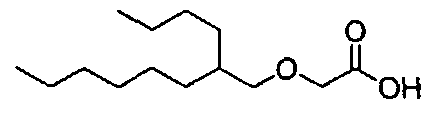
- Y is selected from 0 and NH
- X is selected from CO and CH 2
- R 2 is a branched saturated or unsaturated hydrocarbon moiety selected from C 7 -C 15 according to formula II
- R 3 and R 4 are independently selected from methyl, ethyl, propyl, butyl, pentyl, hexyl, heptyl and octyl, nonyl, decyl, undecyl and dodecyl, and a monocyclic aralkyl residue optionally substituted with a C 1 , C 2 , C 3 , C 4 or C 5 alkyl; with the proviso that the following compounds are excluded: (2- Ethyl-hexyloxy) -acetic acid, 2-Hexyl-decanoic acid carboxymethylester, 2- (2-ethylhexylamino) acetic acid, 2- (2- propylpentanamido)acetic acid, 2- (2-propylpent-2-enamido
- C 7 -C 15 speci fically include C 7 , C 8 , C 9 , Ci 0 , C 11 , Ci 2 , C 13 , C 14 and
- Branched hydrocarbons moieties of R 2 are meant to include aliphatic residues, alicyclic residues optionally substituted with C 1 to C 5 alkyl, and monocyclic aralkyl residues optionally substituted with C 1 to C 5 alkyl.
- compounds according to formula I wherein R 2 is aliphatic are preferred.
- a preferred anti-bacterial effect is an effect against human skin bacteria, including typical malodour-forming bacteria present in the human axilla (including Corynebacterium and Staphylococcus) , and typical malodour forming bacteria present on the human foot (including Brevibacteria) .
- a compound according to the present invention exerts good anti ⁇ microbial activity when used in consumer products, products applied in the household or on the human body, particularly when applied to the skin or scalp, for example as part of personal care product, as a part of a shampoo composition for application to the scalp, or as part of a composition for application to the feet of a person in need of treatment.
- bacteriostatic agents for example Triclosan, glycerol esters, such as monolaurin-glycerol, known glycerol ethers, or known fragrance oils.
- the bacteriostatic Minimal Inhibitory Concentration (MIC) of the compounds may range from 0.0004% to greater than 0.5% (weight/volume) depending on the micro ⁇ organism treated. These values, including the values for many of the common bacteria, and in particular the Corynebacteria, compare favourably with known glycerol mono-esters or mono- ethers, Triclosan, and a known antibacterial fragrance compound, Farnesol. Further details as to how the MIC test data are generated are provided in Example 14 below.
- MBC Anti-bacterial Minimal Bactericidal Concentration
- the present invention provides in another of its aspects the use of at least one compound as hereinabove described as an active agent in compositions such as consumer products for the prevention or treatment of bacterial conditions, and/or for the elimination or suppression of malodour, particularly conditions or malodour resulting from the presence of malodour-forming bacteria on the human skin (for example, axillary malodour, foot malodour, and acne) .
- the invention provides a method of making a product that has at least one of an antibacterial, and malodour- counteracting effect by admixing an effective amount of an antibacterial or malodour-counteracting compound according to the present invention into a product, preferably a consumer product.
- Consumer products include household products, cosmetic and personal care products, products for use on the human body, products applied to the human skin, and perfumed consumer goods.
- Cosmetic and personal care products include soaps, sticks, roll-ons, sprays, pump-sprays, aerosols, deodorant soaps, soap bars, powders, solutions, gels, creams, balms and lotions, eau de Cologne, and eau de toilet, deodorant soaps, shampoos, bath salt, salves, lotions, creams, and ointments.
- Perfumed consumer goods include sprays, detergents and solid fragranced products such as powders, soaps, detergent powders, tissues, fabrics, room deodorizers, room deodorizing gels, and candles.
- a compound employed in such a composition will depend upon the nature of the product and the condition to be treated. However, in the case of products that are applied to and left on the skin, it is preferred that a compound or mixtures of compounds be present in said compositions in an amount of about 0.1 to about 2.0% by weight, preferably about 0.1 to 1% by weight of the total composition.
- a compound or a mixture of compounds is to be used in a composition intended to be applied to, and subsequently rinsed off, the skin or scalp, e.g. a shampoo composition, then it is preferred to use the compound or mixture of compounds in higher amount, for example from about 1.0 to 5.0% by weight of the total composition.
- compounds of the present invention may also be combined with art-recognised quantities of other excipients commonly employed in these products; useful selections may be found in « CTFA Cosmetic Ingredient Handbook » J.M. Nikitakis (ed.), 1st ed., The Cosmetic, Toiletry and Fragrance Association, Inc., Washington, 1988, which is hereby incorporated by reference.
- excipients may for example, include colorants, fragrances, solvents, surfactants, colorants, opacifiers, buffers, antioxidants, vitamins, emulsifiers, UV absorbers, silicones and the like. All products can also be buffered to the desired pH using commonly-available excipients in a known manner.
- Excipients in deodorant cologne may comprise ethanol and fragrance. Fragrance may be present from 1 to 10% and the ethanol may be present to make up the mass to 100% by weight.
- a typical ethanol-free deodorant stick may comprise polyols, such as propylene glycol; derivatives thereof, such as propylene-glycol-3-myristyl ether (for example Witconol® APM) ; water; a surfactant such as sodium stearate; and a fragrance.
- the polyol may be present to the extent of 30 to 40% by weight; the derivatives of the polyol likewise may be present to the extent of 30 to 40% by weight; water may be present to to the extent of 10 to 20% by weight; the surfactant may be present to the extent of 5 to 10% by weight; and the fragrance may be present to the extent of as mentioned above.
- a typical antiperspirant stick may comprise excipients such as Ethylene Glycol Monostearate (e.g. from 5 to 10%); Shea butter (e.g. from 3 to 5%); Caprylic/Capric Triglyceride such as Neobee® 1053 (PVO International) (e.g. from about 12 to 15%); phytosterols such as Generol® 122 (Henkel) (e.g. from about 3 to 7%); Dimethicone (DC 345) (e.g. from 30 to 40%); aluminium sesquichlorohydrate (for example from about 15 to 20%); and a fragrance, for example from 1 to 10%.
- excipients such as Ethylene Glycol Monostearate (e.g. from 5 to 10%); Shea butter (e.g. from 3 to 5%); Caprylic/Capric Triglyceride such as Neobee® 1053 (PVO International) (e.g. from about 12 to 15%); phytosterols such as Generol® 122 (Henkel
- An antiperspirant aerosol may contain as excipients ethanol, typically to the extent of 10 to 15%; zirconium aluminium tetrachlorohydrate, for example from 3 to 5%; Bentone 38, for example from 1 to 2%; fragrance in an amount aforementioned; and a hydrocarbon propellant, such as S-31 , for example up to 100%.
- An antiperspirant pump composition may contain as excipients aluminium sesquichlorohydrate, for example from 15 to 25%; water, for example from 50 to 60%; an octylphenol ethoxylate non-ionic surfactant such as Triton X-102 (Union carbide) , for example from 1 to 3%; dimethyl Isosorbide (ICI), for example from 15 to 25 %; and a fragrance in an amount as aforementioned. All percentages mentioned above are in wt %.
- the compound or mixtures thereof may of use as the sole active agent, or it may be used in conjunction with other active agents such as Triclosan (CAS 3380-34-5) or other commercially-available anti ⁇ bacterial or anti-fungal agents, or with known fragrance oils having anti-bacterial or anti-fungal properties.
- active agents such as Triclosan (CAS 3380-34-5) or other commercially-available anti ⁇ bacterial or anti-fungal agents, or with known fragrance oils having anti-bacterial or anti-fungal properties.
- IR v ma ⁇ . cm 4 , ATR: 3100brw, 2929m, 28759w, 1734s, 114Os 1 1113m, 728w.
- IR v ma ⁇ , cm “1 , ATR: 3100brw, 2925s, 2856m, 1735s, 1459w, 1150s, 724w.
- the bacteriostatic effects of the compounds of the present invention are compared with those of known anti-bacterial agents against human skin bacteria.
- Typical bacteria Corynebacterium and Staphylococcus strains isolated from the human axilla and commercially available strains are used. The results are shown below in Table 1.
- the different axilla bacteria are isolated from the human axilla according to techniques known in the art, in particular according to standard microbiological practice. They are taxonomically identified by cell morphology, gram-reaction and biochemical tests included in the Api coryne test kit (BioMerieux, France) . Strain Staphylococcus epidermidis Ax25 is identified by fatty acid methyl ester analysis (FAME; German type strain collection DSMZ, Germany) . Escherichia coli DSM 682, Staphylococcus aureus DSM 799, and Corynebacterium xerosis DSM 20170 are obtained from the German-type strain collection.
- the strains are maintained on Tryptic soy broth plates, this standard medium being supplemented with 5 g per Litre of Polyoxyethylene Sorbitan Monooleate (TweenTM 80) . Plates are incubated at 36° C for a period of 48 hours. The bacteria are then swabbed from the plates and suspended in 4 ml of M ⁇ ller- Hinton broth supplemented with 100 mg of TweenTM 80 per Litre (MH-Tween) and incubated again at 36°C for 16 hours. Following incubation the bacterial suspensions are diluted in MH-Tween to obtain a final cell density of 10 7 colony forming units per ml.
- TweenTM 80 Polyoxyethylene Sorbitan Monooleate
- diluted suspensions of the different test organisms are distributed to different columns of a microtiter plate, 100 ⁇ l per well.
- the test compounds are dissolved in dimethylsulfoxide (DMSO) at various test concentrations and 2.5 ⁇ l of these different DMSO solutions are added to the different wells of the test plates.
- DMSO dimethylsulfoxide
- the plates are covered with plastic films and incubated for 24 h at 36°C with shaking at 250 rpm.
- the turbidity developing in the microtiter platesi then examined after 24 h to determine microbial growth.
- the minimal concentration of test compounds inhibiting the growth of an organism by at least 80% is determined as the minimal inhibitory concentration (MIC) .
- MIC minimal inhibitory concentration
- C2 a commercial glycerol mono-ether: 3- (2-Ethyl-hexyloxy) - propane-1,2-diol,
- Ax 25 is identified as Staphylococcus epidermidis by FAME analysis.
- Ax 7 is identified as Corynebacterium group G and Ax 15 as Corynebacterium jeikeium with the Api Coryne test kit. The latter two strains are isolated from the axilla of human volunteers and are able to generate axilla malodour when incubated in vitro with human axilla secretions.
- the bacteria are grown, harvested and diluted under the same conditions as described in the example above and added to microtiter plates (100 ⁇ l per well), each well containing 2.5 ⁇ l of the different DMSO solutions as described above. After 60 min incubation, 0.5 ⁇ l of the bacterial culture from each well (corresponding to 5 x 10 3 cfu in the control treatment) is transferred to a fresh microtiter plate which contained 100 ⁇ l per well of fresh medium. The plates are covered with plastic films and incubated for 24 h at 36°C with shaking at 250 rpm. The turbidity developing in the microtiter plates is then examined after 24 h to determine microbial growth. The minimal concentration of test compounds which completely killed the bacterial inoculum is determined as the minimal bactericidal concentration (MBC) .
- MBC minimal bactericidal concentration
- Table 2 Shows the MBC for human skin bacteria and standard bacterial reference strains of compounds of the invention. Data are expressed in % (weight/ volume) .
- the mixed liquid phase is filled with a mixture of propane- butane (2:7) in proportion of 39:61 in a spray can
Landscapes
- Chemical & Material Sciences (AREA)
- Organic Chemistry (AREA)
- Health & Medical Sciences (AREA)
- Life Sciences & Earth Sciences (AREA)
- Public Health (AREA)
- General Health & Medical Sciences (AREA)
- Animal Behavior & Ethology (AREA)
- Veterinary Medicine (AREA)
- Chemical Kinetics & Catalysis (AREA)
- Engineering & Computer Science (AREA)
- Oil, Petroleum & Natural Gas (AREA)
- Wood Science & Technology (AREA)
- Emergency Medicine (AREA)
- Epidemiology (AREA)
- Birds (AREA)
- Pharmacology & Pharmacy (AREA)
- Medicinal Chemistry (AREA)
- Dermatology (AREA)
- Nuclear Medicine, Radiotherapy & Molecular Imaging (AREA)
- General Chemical & Material Sciences (AREA)
- Bioinformatics & Cheminformatics (AREA)
- Acyclic And Carbocyclic Compounds In Medicinal Compositions (AREA)
- Cosmetics (AREA)
- Organic Low-Molecular-Weight Compounds And Preparation Thereof (AREA)
- Agricultural Chemicals And Associated Chemicals (AREA)
- Pharmaceuticals Containing Other Organic And Inorganic Compounds (AREA)
Abstract
Description




Claims


Priority Applications (6)
| Application Number | Priority Date | Filing Date | Title |
|---|---|---|---|
| JP2007529309A JP2008512361A (en) | 2004-09-06 | 2005-08-26 | Antibacterial compounds |
| US11/661,852 US20070276045A1 (en) | 2004-09-06 | 2005-08-26 | Anti-Bacterial Compounds |
| EP05773767.8A EP1786381B1 (en) | 2004-09-06 | 2005-08-26 | Anti-bacterial compounds |
| BRPI0514944-4A BRPI0514944A (en) | 2004-09-06 | 2005-08-26 | antibacterial compounds |
| CN2005800298109A CN101018538B (en) | 2004-09-06 | 2005-08-26 | antibacterial compound |
| MX2007002478A MX2007002478A (en) | 2004-09-06 | 2005-08-26 | ANTIBACTERIAL COMPOUNDS. |
Applications Claiming Priority (2)
| Application Number | Priority Date | Filing Date | Title |
|---|---|---|---|
| GB0419693.7 | 2004-09-06 | ||
| GBGB0419693.7A GB0419693D0 (en) | 2004-09-06 | 2004-09-06 | Anti-bacterial compounds |
Publications (1)
| Publication Number | Publication Date |
|---|---|
| WO2006026875A1 true WO2006026875A1 (en) | 2006-03-16 |
Family
ID=33156042
Family Applications (1)
| Application Number | Title | Priority Date | Filing Date |
|---|---|---|---|
| PCT/CH2005/000501 Ceased WO2006026875A1 (en) | 2004-09-06 | 2005-08-26 | Anti-bacterial compounds |
Country Status (10)
| Country | Link |
|---|---|
| US (1) | US20070276045A1 (en) |
| EP (1) | EP1786381B1 (en) |
| JP (1) | JP2008512361A (en) |
| KR (1) | KR20070049650A (en) |
| CN (1) | CN101018538B (en) |
| BR (1) | BRPI0514944A (en) |
| GB (1) | GB0419693D0 (en) |
| MX (1) | MX2007002478A (en) |
| TW (1) | TW200626541A (en) |
| WO (1) | WO2006026875A1 (en) |
Cited By (4)
| Publication number | Priority date | Publication date | Assignee | Title |
|---|---|---|---|---|
| WO2008137632A1 (en) * | 2007-05-04 | 2008-11-13 | The Procter & Gamble Company | Antimicrobial compositions, products, and methods of use |
| WO2012007412A1 (en) * | 2010-07-12 | 2012-01-19 | Unilever Plc | Preservative system and composition based on glycinate and dihydroxypropyl quaternary ammonium salt combination |
| WO2012007391A1 (en) * | 2010-07-12 | 2012-01-19 | Unilever Plc | Preservative system and composition based on glycinate and hydroxyethyl sulfonate salt combination |
| US8501808B2 (en) | 2010-07-12 | 2013-08-06 | Conopco, Inc. | Foam enhancement of fatty acyl glycinate surfactants |
Families Citing this family (1)
| Publication number | Priority date | Publication date | Assignee | Title |
|---|---|---|---|---|
| CN114539091B (en) * | 2022-03-11 | 2024-11-05 | 佛山奕安赛医药科技有限公司 | Isopalmitoyl amino acid compounds and preparation methods and applications thereof |
Citations (12)
| Publication number | Priority date | Publication date | Assignee | Title |
|---|---|---|---|---|
| US2068905A (en) * | 1936-01-06 | 1937-01-26 | Resinous Prod & Chemical Co | Process for preparing ether acids |
| DE2241862A1 (en) * | 1972-08-25 | 1974-04-04 | Schuelke & Mayr Gmbh | Anti-microbial compsns contg. glyoxylates - pref. n-hexyl-, benzyl- and beta-phenethyl glyoxylate, having a higher activity than free glyoxylic acid |
| US4204879A (en) * | 1976-12-09 | 1980-05-27 | Williams (Hounslow) Limited | Amino acid salts of anionic dyestuffs which have high solubility in organic solvents |
| US4767768A (en) * | 1982-12-31 | 1988-08-30 | Fujisawa Pharmaceutical Co., Ltd. | Nitro aliphatic compounds, process for preparation thereof and use thereof |
| EP0400610A1 (en) * | 1989-05-30 | 1990-12-05 | Ube Industries, Ltd. | 5-Fluorouracil derivatives |
| EP0432039A2 (en) * | 1989-12-05 | 1991-06-12 | NIPPON OILS & FATS CO., LTD. | Antipsychotic drug comprising an acylaminoacid |
| EP0887336A1 (en) * | 1997-06-23 | 1998-12-30 | Givaudan-Roure (International) Sa | Precursor Compounds |
| US5879469A (en) * | 1997-01-06 | 1999-03-09 | Deeay Technologies Ltd. | Dishwashing method and detergent composition therefor |
| WO2001059067A2 (en) * | 2000-02-07 | 2001-08-16 | Zhenhua Yang | A group of anti-cancer compounds with specific structure and their production method |
| US20010033854A1 (en) * | 2000-01-18 | 2001-10-25 | Johnson Paula Ann | Anti-microbial compositions |
| CN1084574C (en) * | 1995-08-10 | 2002-05-08 | 株式会社日立制作所 | CDMA mobile communication system, communication method, wireless terminal and base station |
| JP2002316968A (en) * | 2001-04-19 | 2002-10-31 | Fuji Photo Film Co Ltd | Method for producing acyloxyacetic acid |
Family Cites Families (12)
| Publication number | Priority date | Publication date | Assignee | Title |
|---|---|---|---|---|
| US1920137A (en) * | 1932-09-28 | 1933-07-25 | Resinous Prod & Chemical Co | Alkoxyacetic acids |
| US2010154A (en) * | 1933-06-27 | 1935-08-06 | Herbert S Kreighbaum | Ether acid ester of polyhydric alcohols |
| FR1273862A (en) * | 1957-12-16 | 1961-10-20 | Process for the preparation of new acylaminocarboxylic acids | |
| DE1567221A1 (en) * | 1965-06-01 | 1970-04-16 | Berlin Chemie Veb | Systemic fungicides |
| JPS53148598A (en) * | 1977-05-28 | 1978-12-25 | Takasago Corp | Improvement of smoking taste of tobacco |
| US4684660A (en) * | 1979-04-02 | 1987-08-04 | E. R. Squibb & Sons, Inc. | Mercaptoacyldepeptides |
| JPH032193A (en) * | 1989-05-30 | 1991-01-08 | Ube Ind Ltd | 5-fluorouridine and 2'-deoxy-5-fluorouridine derivatives |
| CN1034818C (en) * | 1993-07-23 | 1997-05-07 | 中国科学院上海有机化学研究所 | Extractant for separating rare-earth metal |
| US5875469A (en) * | 1996-08-26 | 1999-02-23 | International Business Machines Corporation | Apparatus and method of snooping processors and look-aside caches |
| US6149924A (en) * | 1998-07-20 | 2000-11-21 | Biomed Research & Technologies, Inc. | Composition for enhancing lipid production, barrier function, hydrogen peroxide neutralization, and moisturization of the skin |
| JP2001131129A (en) * | 1999-10-29 | 2001-05-15 | Asahi Kasei Corp | N-long chain acyl amino acid salt aqueous solution |
| DE10214675A1 (en) * | 2002-04-03 | 2003-10-16 | Haarmann & Reimer Gmbh | New alicyclic esters with a musky smell |
-
2004
- 2004-09-06 GB GBGB0419693.7A patent/GB0419693D0/en not_active Ceased
-
2005
- 2005-08-26 WO PCT/CH2005/000501 patent/WO2006026875A1/en not_active Ceased
- 2005-08-26 BR BRPI0514944-4A patent/BRPI0514944A/en not_active IP Right Cessation
- 2005-08-26 US US11/661,852 patent/US20070276045A1/en not_active Abandoned
- 2005-08-26 JP JP2007529309A patent/JP2008512361A/en active Pending
- 2005-08-26 EP EP05773767.8A patent/EP1786381B1/en not_active Expired - Lifetime
- 2005-08-26 KR KR1020077005224A patent/KR20070049650A/en not_active Ceased
- 2005-08-26 CN CN2005800298109A patent/CN101018538B/en not_active Expired - Fee Related
- 2005-08-26 MX MX2007002478A patent/MX2007002478A/en not_active Application Discontinuation
- 2005-09-02 TW TW094130092A patent/TW200626541A/en unknown
Patent Citations (12)
| Publication number | Priority date | Publication date | Assignee | Title |
|---|---|---|---|---|
| US2068905A (en) * | 1936-01-06 | 1937-01-26 | Resinous Prod & Chemical Co | Process for preparing ether acids |
| DE2241862A1 (en) * | 1972-08-25 | 1974-04-04 | Schuelke & Mayr Gmbh | Anti-microbial compsns contg. glyoxylates - pref. n-hexyl-, benzyl- and beta-phenethyl glyoxylate, having a higher activity than free glyoxylic acid |
| US4204879A (en) * | 1976-12-09 | 1980-05-27 | Williams (Hounslow) Limited | Amino acid salts of anionic dyestuffs which have high solubility in organic solvents |
| US4767768A (en) * | 1982-12-31 | 1988-08-30 | Fujisawa Pharmaceutical Co., Ltd. | Nitro aliphatic compounds, process for preparation thereof and use thereof |
| EP0400610A1 (en) * | 1989-05-30 | 1990-12-05 | Ube Industries, Ltd. | 5-Fluorouracil derivatives |
| EP0432039A2 (en) * | 1989-12-05 | 1991-06-12 | NIPPON OILS & FATS CO., LTD. | Antipsychotic drug comprising an acylaminoacid |
| CN1084574C (en) * | 1995-08-10 | 2002-05-08 | 株式会社日立制作所 | CDMA mobile communication system, communication method, wireless terminal and base station |
| US5879469A (en) * | 1997-01-06 | 1999-03-09 | Deeay Technologies Ltd. | Dishwashing method and detergent composition therefor |
| EP0887336A1 (en) * | 1997-06-23 | 1998-12-30 | Givaudan-Roure (International) Sa | Precursor Compounds |
| US20010033854A1 (en) * | 2000-01-18 | 2001-10-25 | Johnson Paula Ann | Anti-microbial compositions |
| WO2001059067A2 (en) * | 2000-02-07 | 2001-08-16 | Zhenhua Yang | A group of anti-cancer compounds with specific structure and their production method |
| JP2002316968A (en) * | 2001-04-19 | 2002-10-31 | Fuji Photo Film Co Ltd | Method for producing acyloxyacetic acid |
Non-Patent Citations (13)
| Title |
|---|
| BIOPHARMACEUTICS & DRUG DISPOSITION , 17(7), 565-575 CODEN: BDDID8; ISSN: 0142-2782, 1996 * |
| DATABASE CA [online] CHEMICAL ABSTRACTS SERVICE, COLUMBUS, OHIO, US; BIALER, MEIR ET AL: "Pharmacokinetic and pharmacodynamic analysis of (E)-2-ene valproyl derivatives of glycine and valproyl derivatives of nipecotic acid", XP002352691, retrieved from STN Database accession no. 1996:610664 * |
| DATABASE CA [online] CHEMICAL ABSTRACTS SERVICE, COLUMBUS, OHIO, US; YE, WEIZHEN ET AL: "Extractant for separation of rare-earth metals", XP002352690, retrieved from STN Database accession no. 1995:677337 * |
| DATABASE REGISTRY [online] 16 November 1984 (1984-11-16), XP002352682, retrieved from STN Database accession no. RN64219-54-1 * |
| DATABASE REGISTRY [online] 16 November 1984 (1984-11-16), XP002352683, retrieved from STM Database accession no. RN77927-88-9 * |
| DATABASE REGISTRY [online] 16 November 1984 (1984-11-16), XP002352684, retrieved from STN Database accession no. RN86240-15-5 * |
| DATABASE REGISTRY [online] 17 March 2004 (2004-03-17), XP002352689, retrieved from STN Database accession no. RN663923-52-2 * |
| DATABASE REGISTRY [online] 25 March 1998 (1998-03-25), XP002352686, retrieved from STN Database accession no. RN203120-80-3 * |
| DATABASE REGISTRY [online] 27 July 1999 (1999-07-27), XP002352688, retrieved from STN Database accession no. RN229026-30-6 * |
| DATABASE REGISTRY [online] 8 May 2002 (2002-05-08), XP002352687, retrieved from STN Database accession no. RN412271-04-6 * |
| DATABASE REGISTRY [online] 9 June 1985 (1985-06-09), XP002352685, retrieved from STN Database accession no. RN96655-13-9 * |
| GRANNEMAN G R, WNAG S I, MACHINIST J M, KESTERSON J W: "Aspects of the metabolism of valproic-acid", XENOBIOTICA, vol. 14, no. 5, 1984, pages 375 - 388, XP009056581 * |
| HADAD S, BIALER M: "Pharmacokinetic analysis and antiepileptic acitivity of two new isomers of N-valproyl glycinamide", BIOPHARMACEUTICS AND DRUG DISPOSITION, vol. 18, no. 7, 1997, pages 557 - 566, XP009056582 * |
Cited By (5)
| Publication number | Priority date | Publication date | Assignee | Title |
|---|---|---|---|---|
| WO2008137632A1 (en) * | 2007-05-04 | 2008-11-13 | The Procter & Gamble Company | Antimicrobial compositions, products, and methods of use |
| WO2012007412A1 (en) * | 2010-07-12 | 2012-01-19 | Unilever Plc | Preservative system and composition based on glycinate and dihydroxypropyl quaternary ammonium salt combination |
| WO2012007391A1 (en) * | 2010-07-12 | 2012-01-19 | Unilever Plc | Preservative system and composition based on glycinate and hydroxyethyl sulfonate salt combination |
| US8470883B2 (en) | 2010-07-12 | 2013-06-25 | Conopco, Inc. | Preservative system and composition based on glycinate and hydroxyethyl sulfonate salt combination |
| US8501808B2 (en) | 2010-07-12 | 2013-08-06 | Conopco, Inc. | Foam enhancement of fatty acyl glycinate surfactants |
Also Published As
| Publication number | Publication date |
|---|---|
| TW200626541A (en) | 2006-08-01 |
| JP2008512361A (en) | 2008-04-24 |
| MX2007002478A (en) | 2007-05-04 |
| CN101018538A (en) | 2007-08-15 |
| BRPI0514944A (en) | 2008-07-01 |
| CN101018538B (en) | 2011-05-04 |
| EP1786381B1 (en) | 2014-12-03 |
| GB0419693D0 (en) | 2004-10-06 |
| US20070276045A1 (en) | 2007-11-29 |
| KR20070049650A (en) | 2007-05-11 |
| EP1786381A1 (en) | 2007-05-23 |
Similar Documents
| Publication | Publication Date | Title |
|---|---|---|
| US7459581B2 (en) | Anti-bacterial compounds | |
| US8911715B2 (en) | L-menthyl-N-(2-hydroxyphenyl)carbamate | |
| JP2008120811A (en) | Antibacterial composition | |
| CN112661622A (en) | Improvements in or relating to organic compounds | |
| EP1786381B1 (en) | Anti-bacterial compounds | |
| EP0980863B1 (en) | Oxime carboxylic acid derivatives | |
| US6730655B2 (en) | Biphenyl diquaternary ammonium compounds | |
| US20050124579A1 (en) | Benzyl alcohol derivatives | |
| JP2007500683A (en) | Use of substituted 2,4-bis (alkylamino) pyrimidines or -quinazolines as antibacterial agents | |
| GB2422780A (en) | Deodorant compositions | |
| US6376522B1 (en) | 4-hydroxyisothiazole compounds | |
| GB2401865A (en) | Antibacterial and antifungal glycerol monocarbonates | |
| JP5718065B2 (en) | Antibacterial agent and external preparation for skin containing the same | |
| KR20050025625A (en) | Pyridyl-triazine derivatives as microbicidal active substances | |
| JP5718064B2 (en) | Antifungal | |
| US20070196407A1 (en) | Alkoxyphenylcarboxylic acid derivatives | |
| EP1053680B1 (en) | 4-Hydroxyisothiazole compounds | |
| WO2005012235A1 (en) | 3-aryl-2-cyano-3-hydroxy-acrylic acid derivatives | |
| US6743940B2 (en) | 4-aminobut-2-ynecarboxylic acid derivatives | |
| JP2004099499A (en) | Antimicrobial agent | |
| MXPA06001069A (en) | 3-aryl-2-cyano-3-hydroxy-acrylic acid derivatives |
Legal Events
| Date | Code | Title | Description |
|---|---|---|---|
| AK | Designated states |
Kind code of ref document: A1 Designated state(s): AE AG AL AM AT AU AZ BA BB BG BR BW BY BZ CA CH CN CO CR CU CZ DE DK DM DZ EC EE EG ES FI GB GD GE GH GM HR HU ID IL IN IS JP KE KG KM KP KR KZ LC LK LR LS LT LU LV MA MD MG MK MN MW MX MZ NA NG NI NO NZ OM PG PH PL PT RO RU SC SD SE SG SK SL SM SY TJ TM TN TR TT TZ UA UG US UZ VC VN YU ZA ZM ZW |
|
| AL | Designated countries for regional patents |
Kind code of ref document: A1 Designated state(s): BW GH GM KE LS MW MZ NA SD SL SZ TZ UG ZM ZW AM AZ BY KG KZ MD RU TJ TM AT BE BG CH CY CZ DE DK EE ES FI FR GB GR HU IE IS IT LT LU LV MC NL PL PT RO SE SI SK TR BF BJ CF CG CI CM GA GN GQ GW ML MR NE SN TD TG |
|
| 121 | Ep: the epo has been informed by wipo that ep was designated in this application | ||
| WWE | Wipo information: entry into national phase |
Ref document number: 2005773767 Country of ref document: EP |
|
| WWE | Wipo information: entry into national phase |
Ref document number: MX/a/2007/002478 Country of ref document: MX |
|
| WWE | Wipo information: entry into national phase |
Ref document number: 2007529309 Country of ref document: JP Ref document number: 1020077005224 Country of ref document: KR |
|
| WWE | Wipo information: entry into national phase |
Ref document number: 200580029810.9 Country of ref document: CN Ref document number: 952/CHENP/2007 Country of ref document: IN |
|
| NENP | Non-entry into the national phase |
Ref country code: DE |
|
| WWE | Wipo information: entry into national phase |
Ref document number: 11661852 Country of ref document: US |
|
| WWP | Wipo information: published in national office |
Ref document number: 2005773767 Country of ref document: EP |
|
| WWP | Wipo information: published in national office |
Ref document number: 11661852 Country of ref document: US |
|
| ENP | Entry into the national phase |
Ref document number: PI0514944 Country of ref document: BR |