WO2006014483A2 - Epoxidized esters of vegetable oil fatty acids as reactive diluents - Google Patents
Epoxidized esters of vegetable oil fatty acids as reactive diluents Download PDFInfo
- Publication number
- WO2006014483A2 WO2006014483A2 PCT/US2005/023971 US2005023971W WO2006014483A2 WO 2006014483 A2 WO2006014483 A2 WO 2006014483A2 US 2005023971 W US2005023971 W US 2005023971W WO 2006014483 A2 WO2006014483 A2 WO 2006014483A2
- Authority
- WO
- WIPO (PCT)
- Prior art keywords
- ester
- oil
- alkyl
- fatty acid
- epoxy resin
- Prior art date
- Legal status (The legal status is an assumption and is not a legal conclusion. Google has not performed a legal analysis and makes no representation as to the accuracy of the status listed.)
- Ceased
Links
- 0 CCC1OC(CO*)CC1 Chemical compound CCC1OC(CO*)CC1 0.000 description 7
Classifications
-
- C—CHEMISTRY; METALLURGY
- C09—DYES; PAINTS; POLISHES; NATURAL RESINS; ADHESIVES; COMPOSITIONS NOT OTHERWISE PROVIDED FOR; APPLICATIONS OF MATERIALS NOT OTHERWISE PROVIDED FOR
- C09D—COATING COMPOSITIONS, e.g. PAINTS, VARNISHES OR LACQUERS; FILLING PASTES; CHEMICAL PAINT OR INK REMOVERS; INKS; CORRECTING FLUIDS; WOODSTAINS; PASTES OR SOLIDS FOR COLOURING OR PRINTING; USE OF MATERIALS THEREFOR
- C09D7/00—Features of coating compositions, not provided for in group C09D5/00; Processes for incorporating ingredients in coating compositions
- C09D7/20—Diluents or solvents
-
- C—CHEMISTRY; METALLURGY
- C07—ORGANIC CHEMISTRY
- C07D—HETEROCYCLIC COMPOUNDS
- C07D303/00—Compounds containing three-membered rings having one oxygen atom as the only ring hetero atom
- C07D303/02—Compounds containing oxirane rings
- C07D303/38—Compounds containing oxirane rings with hydrocarbon radicals, substituted by carbon atoms having three bonds to hetero atoms with at the most one bond to halogen, e.g. ester or nitrile radicals
- C07D303/40—Compounds containing oxirane rings with hydrocarbon radicals, substituted by carbon atoms having three bonds to hetero atoms with at the most one bond to halogen, e.g. ester or nitrile radicals by ester radicals
- C07D303/42—Acyclic compounds having a chain of seven or more carbon atoms, e.g. epoxidised fats
-
- C—CHEMISTRY; METALLURGY
- C07—ORGANIC CHEMISTRY
- C07D—HETEROCYCLIC COMPOUNDS
- C07D405/00—Heterocyclic compounds containing both one or more hetero rings having oxygen atoms as the only ring hetero atoms, and one or more rings having nitrogen as the only ring hetero atom
- C07D405/02—Heterocyclic compounds containing both one or more hetero rings having oxygen atoms as the only ring hetero atoms, and one or more rings having nitrogen as the only ring hetero atom containing two hetero rings
- C07D405/12—Heterocyclic compounds containing both one or more hetero rings having oxygen atoms as the only ring hetero atoms, and one or more rings having nitrogen as the only ring hetero atom containing two hetero rings linked by a chain containing hetero atoms as chain links
-
- C—CHEMISTRY; METALLURGY
- C07—ORGANIC CHEMISTRY
- C07D—HETEROCYCLIC COMPOUNDS
- C07D407/00—Heterocyclic compounds containing two or more hetero rings, at least one ring having oxygen atoms as the only ring hetero atoms, not provided for by group C07D405/00
- C07D407/14—Heterocyclic compounds containing two or more hetero rings, at least one ring having oxygen atoms as the only ring hetero atoms, not provided for by group C07D405/00 containing three or more hetero rings
-
- C—CHEMISTRY; METALLURGY
- C07—ORGANIC CHEMISTRY
- C07D—HETEROCYCLIC COMPOUNDS
- C07D493/00—Heterocyclic compounds containing oxygen atoms as the only ring hetero atoms in the condensed system
- C07D493/02—Heterocyclic compounds containing oxygen atoms as the only ring hetero atoms in the condensed system in which the condensed system contains two hetero rings
- C07D493/04—Ortho-condensed systems
-
- C—CHEMISTRY; METALLURGY
- C08—ORGANIC MACROMOLECULAR COMPOUNDS; THEIR PREPARATION OR CHEMICAL WORKING-UP; COMPOSITIONS BASED THEREON
- C08K—Use of inorganic or non-macromolecular organic substances as compounding ingredients
- C08K5/00—Use of organic ingredients
- C08K5/04—Oxygen-containing compounds
- C08K5/10—Esters; Ether-esters
- C08K5/101—Esters; Ether-esters of monocarboxylic acids
-
- C—CHEMISTRY; METALLURGY
- C08—ORGANIC MACROMOLECULAR COMPOUNDS; THEIR PREPARATION OR CHEMICAL WORKING-UP; COMPOSITIONS BASED THEREON
- C08K—Use of inorganic or non-macromolecular organic substances as compounding ingredients
- C08K5/00—Use of organic ingredients
- C08K5/04—Oxygen-containing compounds
- C08K5/15—Heterocyclic compounds having oxygen in the ring
-
- C—CHEMISTRY; METALLURGY
- C08—ORGANIC MACROMOLECULAR COMPOUNDS; THEIR PREPARATION OR CHEMICAL WORKING-UP; COMPOSITIONS BASED THEREON
- C08K—Use of inorganic or non-macromolecular organic substances as compounding ingredients
- C08K5/00—Use of organic ingredients
- C08K5/04—Oxygen-containing compounds
- C08K5/15—Heterocyclic compounds having oxygen in the ring
- C08K5/151—Heterocyclic compounds having oxygen in the ring having one oxygen atom in the ring
- C08K5/1515—Three-membered rings
-
- C—CHEMISTRY; METALLURGY
- C08—ORGANIC MACROMOLECULAR COMPOUNDS; THEIR PREPARATION OR CHEMICAL WORKING-UP; COMPOSITIONS BASED THEREON
- C08L—COMPOSITIONS OF MACROMOLECULAR COMPOUNDS
- C08L27/00—Compositions of homopolymers or copolymers of compounds having one or more unsaturated aliphatic radicals, each having only one carbon-to-carbon double bond, and at least one being terminated by a halogen; Compositions of derivatives of such polymers
- C08L27/02—Compositions of homopolymers or copolymers of compounds having one or more unsaturated aliphatic radicals, each having only one carbon-to-carbon double bond, and at least one being terminated by a halogen; Compositions of derivatives of such polymers not modified by chemical after-treatment
- C08L27/04—Compositions of homopolymers or copolymers of compounds having one or more unsaturated aliphatic radicals, each having only one carbon-to-carbon double bond, and at least one being terminated by a halogen; Compositions of derivatives of such polymers not modified by chemical after-treatment containing chlorine atoms
- C08L27/06—Homopolymers or copolymers of vinyl chloride
-
- C—CHEMISTRY; METALLURGY
- C08—ORGANIC MACROMOLECULAR COMPOUNDS; THEIR PREPARATION OR CHEMICAL WORKING-UP; COMPOSITIONS BASED THEREON
- C08L—COMPOSITIONS OF MACROMOLECULAR COMPOUNDS
- C08L63/00—Compositions of epoxy resins; Compositions of derivatives of epoxy resins
-
- C—CHEMISTRY; METALLURGY
- C09—DYES; PAINTS; POLISHES; NATURAL RESINS; ADHESIVES; COMPOSITIONS NOT OTHERWISE PROVIDED FOR; APPLICATIONS OF MATERIALS NOT OTHERWISE PROVIDED FOR
- C09D—COATING COMPOSITIONS, e.g. PAINTS, VARNISHES OR LACQUERS; FILLING PASTES; CHEMICAL PAINT OR INK REMOVERS; INKS; CORRECTING FLUIDS; WOODSTAINS; PASTES OR SOLIDS FOR COLOURING OR PRINTING; USE OF MATERIALS THEREFOR
- C09D121/00—Coating compositions based on unspecified rubbers
- C09D121/02—Latex
-
- C—CHEMISTRY; METALLURGY
- C09—DYES; PAINTS; POLISHES; NATURAL RESINS; ADHESIVES; COMPOSITIONS NOT OTHERWISE PROVIDED FOR; APPLICATIONS OF MATERIALS NOT OTHERWISE PROVIDED FOR
- C09D—COATING COMPOSITIONS, e.g. PAINTS, VARNISHES OR LACQUERS; FILLING PASTES; CHEMICAL PAINT OR INK REMOVERS; INKS; CORRECTING FLUIDS; WOODSTAINS; PASTES OR SOLIDS FOR COLOURING OR PRINTING; USE OF MATERIALS THEREFOR
- C09D133/00—Coating compositions based on homopolymers or copolymers of compounds having one or more unsaturated aliphatic radicals, each having only one carbon-to-carbon double bond, and at least one being terminated by only one carboxyl radical, or of salts, anhydrides, esters, amides, imides, or nitriles thereof; Coating compositions based on derivatives of such polymers
- C09D133/04—Homopolymers or copolymers of esters
- C09D133/06—Homopolymers or copolymers of esters of esters containing only carbon, hydrogen and oxygen, the oxygen atom being present only as part of the carboxyl radical
-
- C—CHEMISTRY; METALLURGY
- C09—DYES; PAINTS; POLISHES; NATURAL RESINS; ADHESIVES; COMPOSITIONS NOT OTHERWISE PROVIDED FOR; APPLICATIONS OF MATERIALS NOT OTHERWISE PROVIDED FOR
- C09D—COATING COMPOSITIONS, e.g. PAINTS, VARNISHES OR LACQUERS; FILLING PASTES; CHEMICAL PAINT OR INK REMOVERS; INKS; CORRECTING FLUIDS; WOODSTAINS; PASTES OR SOLIDS FOR COLOURING OR PRINTING; USE OF MATERIALS THEREFOR
- C09D157/00—Coating compositions based on unspecified polymers obtained by reactions only involving carbon-to-carbon unsaturated bonds
-
- C—CHEMISTRY; METALLURGY
- C09—DYES; PAINTS; POLISHES; NATURAL RESINS; ADHESIVES; COMPOSITIONS NOT OTHERWISE PROVIDED FOR; APPLICATIONS OF MATERIALS NOT OTHERWISE PROVIDED FOR
- C09D—COATING COMPOSITIONS, e.g. PAINTS, VARNISHES OR LACQUERS; FILLING PASTES; CHEMICAL PAINT OR INK REMOVERS; INKS; CORRECTING FLUIDS; WOODSTAINS; PASTES OR SOLIDS FOR COLOURING OR PRINTING; USE OF MATERIALS THEREFOR
- C09D7/00—Features of coating compositions, not provided for in group C09D5/00; Processes for incorporating ingredients in coating compositions
- C09D7/40—Additives
- C09D7/60—Additives non-macromolecular
- C09D7/63—Additives non-macromolecular organic
Definitions
- compositions comprising epoxidized esters of vegetable oil fatty acids and methods of preparing such compositions.
- Such compositions include latex coating compositions, epoxy resin compositions, thermoset plastic compositions and polyvinyl chloride compositions.
- Epoxidation of soybean and linseed oils is well known in the art and is performed on a commercial scale. Epoxidized oils have desirable light and heat stabilizing properties. They are used as plasticizers and stabilizers in certain polymers. For example, epoxidized oils are used in polyvinyl chloride polymers.
- Common fatty acid epoxidation employs a strong catalyst (e.g. sulfuric acid), oxidant (e.g. H 2 O 2 ), and a carboxylic acid. Adequate agitation and temperature control of the reaction vessel is preferred for conducting an epoxidation reaction. See Chapter 10 in Recent Developments in the Synthesis of Fatty Acid Derivatives, Eds. G. Knothe and J. Derksen, AOCS Press, Champaign, IL, 1999, pp. 157-159.
- Common reactive diluents for epoxy resins include butyl glycide ether,
- Reactive diluents are added to epoxy resins for a number of reasons such as: cost reduction; decrease resin viscosity; and modification of cured resin properties. Reactive diluents often permit higher filler loading and better wetting of pigments. In addition, reactive diluents are important to achieve good bonding/surface wetting during impregnation of composite resins with fillers. The diluents contribute substantial reduction in viscosity and have similar reaction rates as the epoxy resins.
- Propylene glycol monoesters are effective coalescing aids in latex paints. PGMEs help reduce the volatile organic compound (VOC) levels in latex paint by replacing VOC coalescing solvents.
- VOC volatile organic compound
- Nonvolatile fatty acid esters for use in coatings are described in Van de Mark et al. (US Patent Application Publication No. 20040039095).
- Conventional coalescents aid film formation of latex paints by acting as a plasticizer to reduced the glass transition temperature (Tg) of the latex polymer. The polymer particles can then flow together to form a continuous film. After film formation, the coalescent will evaporate slowly from the coating. After evaporation, the Tg of the polymer increases and the coating hardens. Unsaturated fatty acid ester coalescents do not evaporate from the coating. Instead, they undergo oxidative curing and have the ability to react with other components in the coating system.
- the present invention is directed to compositions containing epoxidized esters of vegetable oil fatty acids, and to methods of making such compositions.
- the esters are C 1-6 alkyl or C 2-6 alkenyl, monoglycerol or diglycerol, C 4-6 polyol or glycol esters of a vegetable oil fatty acid.
- the compositions include latex coating compositions comprising the epoxidized esters; epoxy resin compositions comprising the epoxidized esters; thermoset plastic compositions comprising the epoxidized esters; and PVC compositions comprising the epoxidized esters.
- the invention is directed to epoxidized monoglycerides or diglycerides, and expoxidized C 4-6 polyol esters of vegetable oil fatty acids.
- esters for coating compositions are glycol mono or di esters, C 1-6 alkyl or C 2-6 alkenyl esters, monoglycerides and diglycerides, and C 4-6 polyol esters of vegetable oil fatty acids. Methods for preparing suitable esters are well known in the art.
- glycols from which a suitable ester can be derived include, but are not limited to, propylene glycol, dipropylene glycol, ethylene glycol and diethylene glycol.
- Examples of preferred C 1-6 alkyl esters of epoxidized vegetable oil fatty acids include methyl, ethyl, propyl or butyl esters.
- Preferred C 2-6 alkenyl esters include allylic and vinylic esters of epoxidized vegetable oil fatty acids.
- the double bond present in these groups can optionally also be epoxidized in the final product.
- Vegetable oil fatty acids are derived from vegetable oils.
- Preferred vegetable oils include, but are not limited to, soybean oil, linseed oil, sunflower oil, castor oil, corn oil, canola oil, rapeseed oil, palm kernel oil, cottonseed oil, peanut oil, coconut oil, palm oil, tung oil, safflower oil and derivatives, conjugated derivatives, genetically-modified derivatives and mixtures thereof.
- a reference to a vegetable oil includes all its derivatives as outlined above. For instance, the use of the term "linseed oil” includes all derivatives including conjugated linseed oil.
- the vegetable oils can be saturated or unsaturated.
- Fatty acids derived from vegetable oils include fatty acids containing carbon chains of about 2 to about 24 carbons. More preferably, the carbon chain contains about 12 to about 24 carbons. Most preferably, the number of carbons is about 16 to about 18.
- the fatty acid is unsaturated.
- the sites of unsaturation can be epoxidized by methods that are known in the art.
- the fatty acid chains can have one or more oxirane rings. Thus, a fatty acid that has multiple sites of unsaturation can be epoxidized to a greater extent. However, not all double bonds of the fatty acid chain must be epoxidized.
- a fatty acid chain containing one oxirane ring formed between two adjacent carbons of the carbon chain is a fatty acid from which a suitable ester can be derived.
- Fatty acids with multiple sites of unsaturation can have one or more double bonds so long as at least one oxirane ring is embedded in adjacent carbons as described above. Li a most preferred embodiment, the fatty acid chain will have no more than two sites of unsaturation.
- Preferred fatty acids include, but are not limited to, palmitoleic acid, oleic acid, linoleic acid, linolenic acid, eleostearic acid, ricinoleic acid, arachidonic acid, cetoleic acid or erucic acid.
- the ester is a C 2-6 alkenyl ester of a vegetable oil fatty acid
- the alkenyl moiety provides a double bond site suitable for epoxidation.
- a suitable alkenyl ester will contain at least one oxirane ring formed between adjacent carbons in the carbon chain of the fatty acid portion, and optionally can contain an oxirane ring in the alkenyl moiety.
- alkenyl moieties are preferably allylic and vinylic forms of epoxidized vegetable fatty acid esters.
- the vegetable oil is soy, sunflower, corn or linseed oil. Most preferably, the vegetable oil is soy oil.
- the epoxidized vegetable ester as described herein can be present in any amount that results in a final coating composition having the desired rheologic properties as described herein.
- the amount of epoxidized ester will vary according to the specific type of latex resin blended with the ester. In many useful compositions the amount of ester relative to latex resin will not exceed 70 percent by weight of the resin.
- the epoxidized vegetable ester is present in an amount between about 1 percent and about 70 percent by weight of the latex resin.
- the vegetable ester is present in an amount between about 5 percent and about 40 percent. Most preferably, the vegetable ester is present in an amount between about 10 percent and about 20 percent.
- the present invention is also directed to a method of preparing a coating composition
- a coating composition comprising combining a latex resin and a C 1-6 alkyl or C 2-6 alkenyl, monoglycerol or diglycerol, C 4-6 polyol or glycol ester of a vegetable oil fatty acid, wherein the ester has at least one oxirane ring formed between two adjacent carbons in the carbon chain of the fatty acid, wherein a coating composition is prepared.
- the present invention is directed to an epoxy resin composition
- an epoxy resin composition comprising an epoxy resin and a C 1-6 alkyl or C 2-6 alkenyl, monoglycerol or diglycerol, C 4-6 polyol or glycol ester of a vegetable oil fatty acid, wherein the ester has at least one oxirane ring formed between two adjacent carbons in the carbon chain of the fatty acid.
- Any epoxy resin suitable as a component in an epoxy resin composition can be used in the present invention.
- Such epoxy resins are commercially available and well known in the art.
- Suitable epoxy resins include, but are not limited to, Bisphenol A and F, Novolac, epoxy acrylate, epoxy vinyl ester resins, glycol epoxy and brominated epoxy resins.
- the ester is a C 2-6 alkenyl ester of a vegetable oil fatty acid
- the alkenyl moiety provides a double bond site suitable for epoxidation.
- a suitable C 2-6 alkenyl ester will contain at least one oxirane ring formed between adjacent carbons in the carbon chain of the fatty acid portion, and optionally can contain an oxirane ring in the alkenyl moiety.
- the ester is an epoxidized allyl ester of oleic acid.
- the vegetable ester as described herein is present in an amount between about 1 percent and about 70 percent by weight of the epoxy resin.
- the vegetable ester is present in an amount between about 5 percent and about 40 percent.
- the vegetable ester is present in an amount between about 10 percent and about 20 percent.
- the present invention is also directed to a method of preparing the epoxy resin composition described above comprising combining an epoxy resin and a C 1-6 alkyl or C 2-6 alkenyl, monoglycerol or diglycerol, C 4-6 polyol or glycol ester of a vegetable oil fatty acid, wherein the ester has at least one oxirane ring formed between two adjacent carbons in the carbon chain of the fatty acid, wherein an epoxy resin composition is prepared.
- the present invention is directed to a thermoset plastic composition
- a thermoset plastic composition comprising an epoxy resin composition as described herein and an amine.
- the one or more oxirane rings contained in the fatty acid portions of the ester component of the composition can react with an amine to form a urethane.
- Any amine capable of combining with an oxirane to form a urethane linkage is a suitable amine.
- the amine is a diamine or triamine that is capable of reacting with multiple oxirane moieties thereby creating a crosslinked urethane thermoset plastic upon curing.
- Preferred amines include aliphatic and aromatic amines which may or may not contain two or more primary or secondary amines. Additional examples include, but are not limited to, ethylene diamine, methylene dianiline diethylene triamine, polyamides, imidazoles and anhydrides such as pyromellitic acid dianhydride.
- the present invention is also directed to a method of preparing a thermoset plastic comprising combining: (a) an epoxy resin comprising a C 1-6 alkyl or C 2-6 alkenyl, monoglycerol or diglycerol, C 4-6 polyol or glycol ester of a vegetable oil fatty acid, wherein the ester has at least one oxirane ring formed between two adjacent carbons in the carbon chain of the fatty acid, and (b) an amine.
- the amine is a diamine or triamine that is capable of reacting with multiple oxirane moieties thereby creating a crosslinked urethane thermoset plastic upon curing. Any amine capable of combining with an oxirane to form a urethane linkage is a suitable amine.
- Preferred amines include those listed above.
- the present invention is directed to a polymer composition
- a polymer composition comprising polyvinyl chloride (PVC) and a C 1-6 alkyl or C 2-6 alkenyl, C 4-6 polyol or glycol ester of a vegetable oil fatty acid, wherein the ester has at least one oxirane ring formed between two adjacent carbons in the carbon chain of the fatty acid.
- PVC polyvinyl chloride
- suitable epoxidized esters of vegetable oil fatty acids include monoesters and polyol esters of vegetable oil fatty acids.
- preferred esters are glycol monoesters, C 4-6 polyol esters and allyl esters of vegetable oil fatty acids.
- esters from which an ester can be derived are as described above.
- the ester is a propylene glycol monoester.
- Other preferred esters for use in PVC compositions will contain the C 4-6 residual moiety exemplified in structures A- F below. Structures A-E are also commonly called isosorbide, sorbitan, tetrahydrofuran dimethanol, furan dimethanol, and sorbitol respectively.
- Vegetable oil fatty acids are derived from vegetable oils. Preferred vegetable oils are as described above. In PVC polymer compositions, it is more preferable that the vegetable oil is soy, sunflower, corn or linseed oil. Most preferably, the vegetable oil is soy oil. In a most preferred embodiment, the ester is an epoxidized propylene glycol monoester of a fatty acid derived from soy oil.
- Vegetable oil fatty acids are as described above.
- the present invention is also directed to monoglycerides, diglycerides, and C 4-6 polyol esters of epoxidized vegetable oil fatty acids.
- Such compounds include monoglycerides and diglycerides of the vegetable oil fatty acids described herein, wherein at least one oxirane ring is formed between two adjacent carbons in the carbon chain of the fatty acid.
- a diglyceride can be a 1,2 diglyceride or a 1,3 diglyceride.
- the compounds of the present invention include esters formed by esterification of monosaccharides and vegetable oil fatty acids wherein at least one oxirane ring is formed between two adjacent carbons in the carbon chain of the fatty acid.
- preferred compounds include epoxidized sorbitol esters of vegetable oil fatty acids, and derivatives thereof. Also included in the compounds of the present invention are epoxidized sorbitan esters and isosorbide esters.
- substituents added for the above purposes include esters, alcohols, amides, amines, ketones, epoxides, carboxylic acids, alkenes, alkynes, azides, hydrazides, imines, oximes, etc. More preferred substituents will be aliphatic alcohols (branched or straight chain) and aliphatic amines. The addition of these aliphatic groups can disrupt chain packing to prevent crystallization.
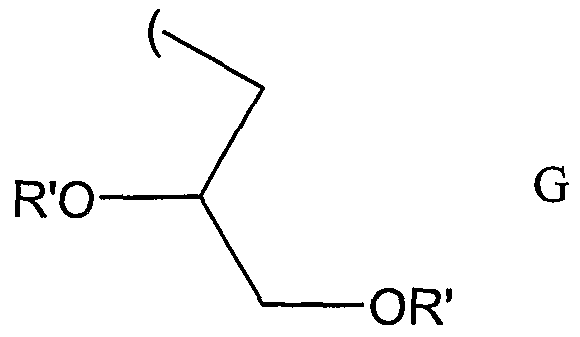
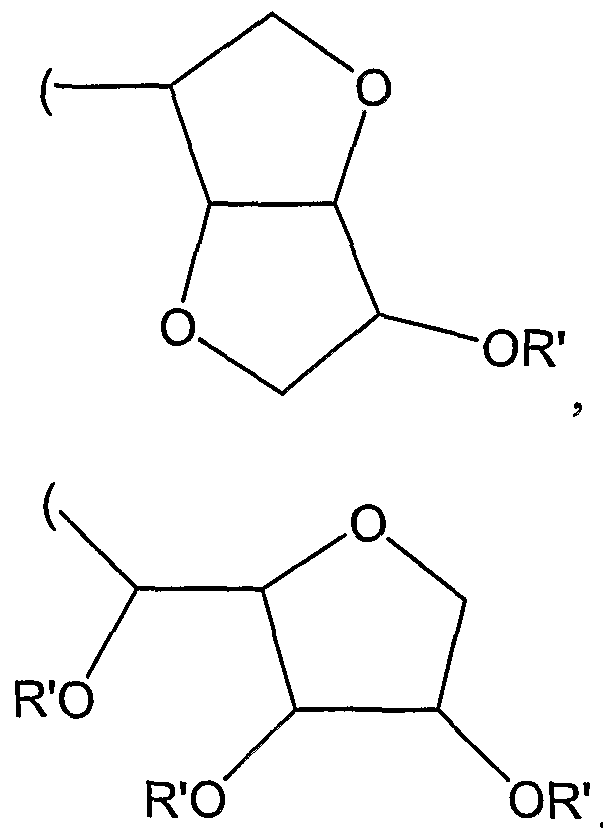
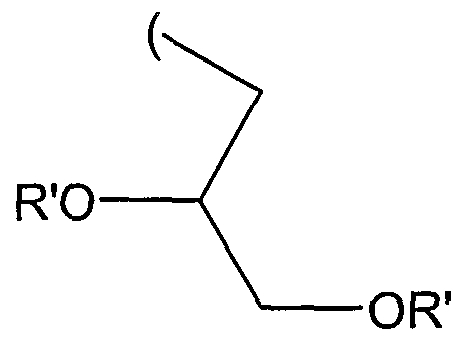
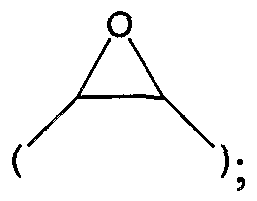
- Compounds of the present invention include compounds of the formula:
- a and B are selected from the group consisting of:
- R' is in each instance independently selected from the group consisting of hydrogen, carboxyallylic, carboxyCC ⁇ alkyl, C 1-5 alkyl and wherein R 5 A, B, m and n are as described above.
- Useful compounds include those compounds where R is as described above.
- Preferred compounds include those compounds where R in each instance is independently hydrogen, hydroxy(C 1-10 )alkyl, or arnino(C 1-10 )alkyl. hi all embodiments, R in each instance is independently selected from other instances of R on the same molecule.
- m is an integer between about 2 and about 5.
- n include integers between about 4 and about 7.
- Useful compounds are those where Z is defined as above.
- y is determined by the size of the PGE (polyglycerol ester) used.
- PGEs are well known in the art. Examples of useful PGEs include decaglycerol monooleate, decaglycerol decaoleate, decaglycerol monostearate, triglycerol monooleate, triglycerol monostearate, and the like.
- useful values of y include are integers between about 2 and about 50.
- the value of y is between about 2 and about 30. More preferably, the value of y is between about 2 and about 20.
- the value of y is based on the size of the polymer. Thus, it is intended only to identify the PGE that can be incorporated into the compound, and is not a precise value for the number of monomers in the PGE.
- R 1 can be a fatty acid moiety as depicted above as structure ⁇ .
- the other of R' is hydrogen, carboxyallylic, carboxy(C 1-5 )alkyl or C 1-5 alkyl, which is not a fatty acid. [0054] In all preferred embodiments, R' is hydrogen regardless of the value of
- the compounds are also useful as stabilizers.
- the compounds are capable of scavenging H + ions that may form in the polymer over time. This is particularly useful in PVC compositions.
- the amount of compound necessary to stabilize a composition can be less than that required to lower the Tg by not less than about 2 0 C. Any amount of compound present can act to neutralize H + thereby providing a stabilizing effect.
- alkenyl represents any branched or unbranched, substituted or unsubstituted carbon chain containing at least one site of unsaturation.
- An example is an “allyl” ester, which is an ester of a vegetable oil fatty acid formed by esterif ⁇ cation of a fatty acid with allyl alcohol or transesterification of an oleate with allyl alcohol.
- alkyl as employed herein by itself or as part of another group refers to both straight and branched chain radicals of up to 10 carbons, preferably 6 carbons, more preferably 4 carbons, such as methyl, ethyl, propyl, isopropyl, butyl, t-butyl, and isobutyl.
- aryl refers to monocyclic or bicyclic aromatic groups containing from 6 to 12 carbons in the ring portion, preferably 6-10 carbons in the ring portion, such as the carbocyclic groups phenyl, naphthyl or tetrahydronaphthyl.
- aryl can represent carbocyclic aryl groups, such as phenyl, naphthyl or tetrahydronaphthyl, as well as heterocyclic aryl (“heteroaryl”) groups, such as pyridyl, pyrimidinyl, pyridazinyl, furyl, and pyranyl.
- heteroaryl refers to groups having 5 to 14 ring atoms; 6, 10 or 14 ⁇ -electrons shared in a cyclic array; and containing carbon atoms and 1, 2 or 3 oxygen, nitrogen or sulfur heteroatoms.
- heteroaryl groups include 1,2,3- triazole, 1,2,4-triazole, 5-amino-l,2,4-triazole, imidazole, oxazole, isoxazole, 1,2,3-oxadiazole, 1,2,4-oxadiazole, 3-amino-l,2,4-oxadiazole, 1,2,5- oxadiazole, 1,3,4-oxadiazole, pyridine, and 2-aminopyridine.
- cycloalkyl as used herein by itself or as part of another group refers to cycloalkyl groups containing 3 to 9 carbon atoms, more preferably, 3 to 8 carbon atoms. Typical examples are cyclopropyl, cyclobutyl, cyclopentyl, cyclohexyl, cycloheptyl, cyclooctyl and cyclononyl.
- phenylCC ⁇ alkyl refers to C 1-4 alkyl groups as referred to above having an phenyl substituent and includes benzyl.
- carboxy as used herein describes a carbon double bonded to an oxygen.
- the carbon may be additionally substituted.
- carboxyallylic as used herein describes a carbon double bonded to an oxygen wherein the carbon is further substituted with an allylic group.
- carboxy(C 1-5 )alkyl as used herein describes a carbon double bonded to an oxygen wherein the carbon is further substituted with a C 1-5 alkyl group.
- Scheme 1 depicts a general reaction scheme for synthesis of epoxidized fatty acid derivatives.
- Fatty acids of alkyl esters preferably methyl or ethyl
- Esterification/transesterification can be catalyzed by lipase enzymes.
- the chemical pathway usually employs formic acid or the combination of acetic acid and a strong mineral acid.
- Enzymes capable of facilitating epoxidation include lipase from Candida antartica such as Novozyme 435 (Novozymes).
- R 1 OH alcohol or polyol Catalyst, Heat (20-250C) 1 or Enzymatic
- Scheme 2 depicts a synthetic route for preparing dianhydrohexitol (isosorbide) esters of epoxidized fatty acid derivatives.
- Scheme 3 depicts a synthetic route for preparing a PGE ester of an epoxidized fatty acid derivative.
- Scheme 4 depicts a synthetic route for preparing a THF-glycol ester of an epoxidized fatty acid ester derivative.
- Double bonds in the fatty acid chains are known to be reactive sites for oxidation and tend to contribute to yellowing of a dried film over time.
- Epoxide groups will not undergo the same air oxidation as double bonds.
- Epoxidized vegetable esters as described herein can be incorporated in plastics to modify polymer properties, such as a reduction of the glass transition temperature.
- the epoxide group is a reactive site in a polymeric system.
- incorporating the epoxides into the coatings and polymers described herein can impact characteristics such as flexibility, hardness, solvent resistance, melt-viscosity, cure rate and gel point.
- epoxides act as stabilizers by scavenging HCl which is liberated during PVC decomposition.
- Epoxidized Propylene Glycol Monoester of Soybean Oil Fatty Acids Distilled soy PGME 150g was added to a round bottom flask along with aqueous hydrogen peroxide (100 mL, 50%), formic acid (10 mL, 98%) and Tween 20 (0.1 g). The mixture was stirred vigorously at room temperature for 24 hours. The reaction mixture was extracted in a separatory funnel with hexanes/ethyl acetate and washed with an aqueous sodium sulfite solution. The organic layer was washed several more times with deionized water and then dried over magnesium sulfate (anhydrous), filtered and then solvents were removed using a rotary evaporator.
- Epoxidized Allyl Oleate - Epoxy Resin Thermoset Plastic Bisphenol A diglycide ether resin (DER331, Dow Chemical), diethylene triamine (DETA) and epoxidized allyl oleate were combined to form an epoxy thermoset plastic.
- the epoxide equivalent weight (EEW) of DER331 was 185.4.
- the amine equivalent of DETA was 20.6.
- EEW m ix — 6Og mix/[12g EAO/177.26) + (48b DER331/185.4)] 183.7.
- thermoset plastic was produced by mixing 50 g of the EAO/DER331 mixture with 5.6 grams of DETA. The mixture was mixed thoroughly in a plastic hexagonal weighing boat and allowed to cure overnight.
- Epoxidized Soya PGME as a Plasticizer for Polyvinyl chloride (PVC) [0083] A. High molecular weight PVC (10.0 g) and epoxidized soya
- PGME (7.0 g) was added to a glass jar and mixed well to disperse liquid PGME over the PVC particles. The mixture was allowed to sit for 2 hours in a 100 0 C oven. The material was a free-flowing powder. A sample of the material was added to a differential scanning calorimeter (DSC) pan. The DSC was scanned from -4O 0 C to 12O 0 C. A very broad low temperature transition from ⁇ -10 to 20 0 C was recorded during the test. The PVC removed from the DSC pan was a soft, rubbery, clear solid at room temperature. The unplasticized glass transition temperature (Tg) of PVC was 87 0 C. [0084] B. High molecular weight PVC (10.0 g) and epoxidized soya
- PGME 1.0 g was added to a glass jar and mixed well to disperse liquid PGME over the PVC particles. The mixture was allowed to sit for 2 hours in a 100 0 C oven. The material was a free- flowing powder. A sample of the material was added to a differential scanning calorimeter (DSC) pan. The DSC was scanned from -4O 0 C to 12O 0 C. A glass transition temperature of 64.8 0 C was recorded during the test. The PVC removed from the DSC pan was a soft, rubbery, clear solid at room temperature. The unplasticized glass transition temperature (Tg) of PVC was 87 0 C.
- DSC differential scanning calorimeter
- Latex emulsion resins UCAR 379G (vinyl acrylic, Dow Chemical) and
- Epoxidized PGME was prepared as described in Example 1 above. Epoxidized PGME was added to UCAR 379G at 12% by weight of latex solids. The samples were mixed thoroughly. After mixing, films were cast of neat UCAR 379G (no added epoxidized PGME) and UCAR 379G containing 12% epoxidized PGME. [0086] The samples were allowed to dry at room temperature for five days.
- UCAR 379G (neat) had a glass transition temperature of 15.6 0 C.
- UCAR 379G containing 12% epoxidized PGME had a glass transition temperature of 7.4 0 C.
- the test was repeated using SG30 (neat) and SG30 containing 6% epoxidized PGME.
- SG30 (neat) had a glass transition temperature of 19.9 0 C.
Landscapes
- Chemical & Material Sciences (AREA)
- Organic Chemistry (AREA)
- Chemical Kinetics & Catalysis (AREA)
- Polymers & Plastics (AREA)
- Health & Medical Sciences (AREA)
- Medicinal Chemistry (AREA)
- Materials Engineering (AREA)
- Wood Science & Technology (AREA)
- Engineering & Computer Science (AREA)
- Life Sciences & Earth Sciences (AREA)
- Compositions Of Macromolecular Compounds (AREA)
- Epoxy Compounds (AREA)
- Epoxy Resins (AREA)
- Paints Or Removers (AREA)
Abstract
Description




Claims








Priority Applications (6)
| Application Number | Priority Date | Filing Date | Title |
|---|---|---|---|
| CA002577882A CA2577882A1 (en) | 2004-07-08 | 2005-07-08 | Epoxidized esters of vegetable oil fatty acids as reactive diluents |
| BRPI0513151-0A BRPI0513151A (en) | 2004-07-08 | 2005-07-08 | Epoxidized esters of fatty acids from vegetable oils as reactive diluents |
| DE112005001607T DE112005001607T5 (en) | 2004-07-08 | 2005-07-08 | Epoxidized esters of vegetable oil fatty acids as reactive diluents |
| AU2005269945A AU2005269945A1 (en) | 2004-07-08 | 2005-07-08 | Epoxidized esters of vegetable oil fatty acids as reactive diluents |
| JP2007520470A JP2008506016A (en) | 2004-07-08 | 2005-07-08 | Epoxidized esters of vegetable oil fatty acids as reactive diluents |
| GB0702267A GB2431160A (en) | 2004-07-08 | 2007-02-06 | Epoxidized esters of vegetable oil fatty acids as reactive diluents |
Applications Claiming Priority (2)
| Application Number | Priority Date | Filing Date | Title |
|---|---|---|---|
| US58588804P | 2004-07-08 | 2004-07-08 | |
| US60/585,888 | 2004-07-08 |
Publications (2)
| Publication Number | Publication Date |
|---|---|
| WO2006014483A2 true WO2006014483A2 (en) | 2006-02-09 |
| WO2006014483A3 WO2006014483A3 (en) | 2006-10-05 |
Family
ID=35787618
Family Applications (1)
| Application Number | Title | Priority Date | Filing Date |
|---|---|---|---|
| PCT/US2005/023971 Ceased WO2006014483A2 (en) | 2004-07-08 | 2005-07-08 | Epoxidized esters of vegetable oil fatty acids as reactive diluents |
Country Status (7)
| Country | Link |
|---|---|
| US (2) | US20060020062A1 (en) |
| JP (1) | JP2008506016A (en) |
| AU (1) | AU2005269945A1 (en) |
| CA (1) | CA2577882A1 (en) |
| DE (1) | DE112005001607T5 (en) |
| GB (1) | GB2431160A (en) |
| WO (1) | WO2006014483A2 (en) |
Cited By (5)
| Publication number | Priority date | Publication date | Assignee | Title |
|---|---|---|---|---|
| WO2008079901A3 (en) * | 2006-12-20 | 2008-08-14 | Us Agriculture | Method of making fatty acid ester derivatives |
| US7582777B2 (en) | 2004-10-15 | 2009-09-01 | Archer-Daniels-Midland Company | Long chain (C22-C50) polyunsaturated hydrocarbons, derivatives, synthesis and uses thereof |
| WO2011090812A2 (en) | 2010-01-22 | 2011-07-28 | Archer Daniels Midland Company | Processes for making high purity renewable source-based plasticizers and products made therefrom |
| US10266749B2 (en) | 2014-12-09 | 2019-04-23 | Halliburton Energy Services, Inc. | Composition including a glycerol ester including at least two epoxides for treatment of subterranean formations |
| US11377581B2 (en) | 2018-11-07 | 2022-07-05 | Halliburton Energy Services, Inc. | Compositions and methods for controlling migration of particulates |
Families Citing this family (66)
| Publication number | Priority date | Publication date | Assignee | Title |
|---|---|---|---|---|
| US8352400B2 (en) | 1991-12-23 | 2013-01-08 | Hoffberg Steven M | Adaptive pattern recognition based controller apparatus and method and human-factored interface therefore |
| US7966078B2 (en) | 1999-02-01 | 2011-06-21 | Steven Hoffberg | Network media appliance system and method |
| PL1625716T3 (en) | 2003-05-06 | 2008-05-30 | Apple Inc | Method of modifying a message, store-and-forward network system and data messaging system |
| US7551346B2 (en) | 2003-11-05 | 2009-06-23 | E Ink Corporation | Electro-optic displays, and materials for use therein |
| US20110164301A1 (en) | 2003-11-05 | 2011-07-07 | E Ink Corporation | Electro-optic displays, and materials for use therein |
| ATE547507T1 (en) * | 2004-03-24 | 2012-03-15 | Archer Daniels Midland Co | PLANT-BASED DIOXANONE DERIVATIVES, SYNTHESIS AND USE THEREOF |
| DE112005001607T5 (en) * | 2004-07-08 | 2007-05-24 | Archer-Daniels-Midland Co., Decatur | Epoxidized esters of vegetable oil fatty acids as reactive diluents |
| US7693887B2 (en) * | 2005-02-01 | 2010-04-06 | Strands, Inc. | Dynamic identification of a new set of media items responsive to an input mediaset |
| WO2006084102A2 (en) * | 2005-02-03 | 2006-08-10 | Musicstrands, Inc. | Recommender system for identifying a new set of media items responsive to an input set of media items and knowledge base metrics |
| US7797321B2 (en) | 2005-02-04 | 2010-09-14 | Strands, Inc. | System for browsing through a music catalog using correlation metrics of a knowledge base of mediasets |
| US7553919B2 (en) * | 2005-05-06 | 2009-06-30 | Board Of Trustees Of Michigan State University | Starch-vegetable oil graft copolymers and their biofiber composites, and a process for their manufacture |
| US7877387B2 (en) | 2005-09-30 | 2011-01-25 | Strands, Inc. | Systems and methods for promotional media item selection and promotional program unit generation |
| JP4955690B2 (en) * | 2005-10-04 | 2012-06-20 | アップル インコーポレイテッド | Method and apparatus for visualizing a music library |
| EP1963957A4 (en) | 2005-12-19 | 2009-05-06 | Strands Inc | SYSTEM FOR RECOMMENDING USERS TO OTHER USERS |
| US20070162546A1 (en) * | 2005-12-22 | 2007-07-12 | Musicstrands, Inc. | Sharing tags among individual user media libraries |
| US20070244880A1 (en) | 2006-02-03 | 2007-10-18 | Francisco Martin | Mediaset generation system |
| WO2007095272A2 (en) | 2006-02-10 | 2007-08-23 | Strands, Inc. | Systems and methods for prioritizing mobile media player files |
| WO2007092053A1 (en) | 2006-02-10 | 2007-08-16 | Strands, Inc. | Dynamic interactive entertainment |
| US8521611B2 (en) * | 2006-03-06 | 2013-08-27 | Apple Inc. | Article trading among members of a community |
| PT2049317E (en) * | 2006-08-09 | 2011-07-26 | Inxel Trademark & Patents Sagl | Process for preparing granules of pigments by means of double extrusion |
| KR20090077073A (en) * | 2006-10-20 | 2009-07-14 | 스트랜즈, 아이엔씨. | Personal Music Recommendation Mapping |
| US20080183000A1 (en) * | 2007-01-30 | 2008-07-31 | Thames Shelby F | Glycerol ester-free functionalized vegetable oil derivatives and their latex compositions |
| US8671000B2 (en) * | 2007-04-24 | 2014-03-11 | Apple Inc. | Method and arrangement for providing content to multimedia devices |
| US20090004394A1 (en) * | 2007-06-29 | 2009-01-01 | Anne Denise Koller | Aqueous polymeric composition |
| WO2009151814A1 (en) * | 2008-04-30 | 2009-12-17 | Strands, Inc. | Scaleable system and method for distributed prediction markets |
| US20090299945A1 (en) * | 2008-06-03 | 2009-12-03 | Strands, Inc. | Profile modeling for sharing individual user preferences |
| WO2010040082A1 (en) | 2008-10-02 | 2010-04-08 | Strands, Inc. | Real-time visualization of user consumption of media items |
| US7906571B2 (en) * | 2008-10-28 | 2011-03-15 | Archer Daniels Midland Company | Waterborne film-forming compositions containing reactive surfactants and/or humectants |
| DE102009018634A1 (en) | 2009-04-15 | 2010-10-21 | Dracowo Forschungs- Und Entwicklungs Gmbh | Polyether-based paint and coating material, useful e.g. as binder for photochemically initiated printing ink and for open-porous system, comprises a binder and a reactive diluent from epoxide native oil |
| US20110029928A1 (en) * | 2009-07-31 | 2011-02-03 | Apple Inc. | System and method for displaying interactive cluster-based media playlists |
| CN101624386B (en) * | 2009-08-13 | 2011-02-09 | 江苏卡特新能源有限公司 | Method for preparing epoxy fatty acid ethylester plasticizer |
| US20110060738A1 (en) * | 2009-09-08 | 2011-03-10 | Apple Inc. | Media item clustering based on similarity data |
| FR2950051B1 (en) * | 2009-09-11 | 2012-08-03 | Centre Nat Rech Scient | NOVEL PROCESS FOR THE PREPARATION OF POLYOLS AND PRODUCTS SUCH AS OBTAINED |
| WO2015070018A1 (en) | 2013-11-07 | 2015-05-14 | Ndsu Research Foundation | Bio-based resins with high content of ethylenically unsaturated functional groups and thermosets thereof |
| WO2011097484A1 (en) | 2010-02-06 | 2011-08-11 | Ndsu Research Foundation | Highly functional epoxidized resins and coatings |
| CN101928628B (en) * | 2010-06-10 | 2012-12-05 | 武汉永正科技发展有限公司 | Alkyl oxide modified colza oil lubricant additive, lubricant and preparation method thereof |
| CN101875879B (en) * | 2010-06-10 | 2012-12-05 | 武汉永正科技发展有限公司 | Antirust water base lubricating additive, preparation method thereof and lubricating oil |
| CN103180286B (en) | 2010-08-24 | 2015-12-16 | 阿彻丹尼尔斯米德兰德公司 | For the manufacture of the method based on the citrate of renewable origin and the citrate of acidylate |
| WO2012173666A1 (en) | 2011-06-17 | 2012-12-20 | Lubrigreen Biosynthetics, Llc | Epoxidized estolides, sulfurized estolides, and methods of making the same |
| WO2013002913A1 (en) * | 2011-06-27 | 2013-01-03 | Archer Daniels Midland Company | Reduced color epoxidized esters from epoxidized natural fats and oils |
| US8772390B1 (en) * | 2011-07-13 | 2014-07-08 | Oxifree Holdings Corp | Sprayable polymeric coating system for the protection of complex metal structures against corrosion |
| US8829216B2 (en) | 2011-08-31 | 2014-09-09 | Biosynthetic Technologies, Llc | Hydroxy estolides, poly-capped estolides, and methods of making the same |
| US8983905B2 (en) | 2011-10-03 | 2015-03-17 | Apple Inc. | Merging playlists from multiple sources |
| BR112014014480A2 (en) * | 2011-12-16 | 2017-06-13 | 3M Innovative Properties Co | bisirhydrohexitol derivatives containing oxirane and uses thereof |
| US20150232691A1 (en) | 2012-09-17 | 2015-08-20 | Ndsu Research Foundation | Blocked bio-based carboxylic acids and their use in thermosetting materials |
| BR112015010689B1 (en) * | 2012-11-12 | 2022-01-25 | Dow Global Technologies Llc | Process for producing epoxidized fatty acid alkyl esters, plasticizer and polymer composition |
| US9580574B2 (en) * | 2012-12-12 | 2017-02-28 | Galata Chemicals Llc | Bio-based biocide compositions and methods of preserving therewith |
| US9834626B2 (en) | 2013-01-15 | 2017-12-05 | Ndsu Research Foundation | Plant oil-based materials |
| WO2014197327A1 (en) | 2013-06-03 | 2014-12-11 | Regents Of The University Of Minnesota | Epoxy estolide fatty acid alkyl esters useful as biorenewable plasticizers |
| DE102013226714A1 (en) * | 2013-12-19 | 2015-06-25 | Tesa Se | Process for the preparation of crosslinked polymers |
| CA2937376A1 (en) | 2014-02-26 | 2015-09-03 | Elevance Renewable Sciences, Inc. | Low-voc compositions and methods of making and using the same |
| EP3146005B8 (en) * | 2014-05-21 | 2021-03-10 | Stopaq B.V. | Sprayable polymeric coating system for the protection of complex metal structures against corrosion |
| WO2016028845A1 (en) * | 2014-08-19 | 2016-02-25 | Archer Daniels Midland Company | Synthesis of non-ionic surfactants from 5-hydroxymethyl-2-furfural, furan-2,5-dimethanol and bis-2,5-dihydroxymethyltetrahydrofurans |
| FR3024981B1 (en) * | 2014-08-22 | 2016-09-09 | Univ Montpellier 2 Sciences Et Techniques | POLYESTER DERIVATIVES OF FATTY ACIDS OF POLYGLYCOSIDES |
| FR3026106B1 (en) * | 2014-09-23 | 2017-07-14 | Roquette Freres | ISOSORBIDE EPOXIDE DIESTERS AND THEIR USE AS A PLASTICIZER IN PVC-BASED COMPOSITIONS |
| US10144812B2 (en) * | 2015-10-05 | 2018-12-04 | Regents Of The University Of Minnesota | Multi-functional fatty acid ester derivatives useful as biorenewable plasticizers |
| WO2017123576A1 (en) * | 2016-01-13 | 2017-07-20 | Arkema Inc. | Methods of producing epoxidized fatty acid alkyl esters useful as plasticizers |
| CN106543789A (en) * | 2016-11-25 | 2017-03-29 | 安徽钰锦生态木材料有限公司 | A kind of dirt-resisting dustproof exterior coating |
| CN106543815A (en) * | 2016-11-25 | 2017-03-29 | 安徽钰锦生态木材料有限公司 | A kind of wood plastic decorative construction material |
| US20210108024A1 (en) * | 2017-04-05 | 2021-04-15 | Archer Daniels Midland Company | Use of epoxidized soy fatty acid esters as reactive diluents and modifiers in epoxy coatings and resins |
| US10936653B2 (en) | 2017-06-02 | 2021-03-02 | Apple Inc. | Automatically predicting relevant contexts for media items |
| CA3091374A1 (en) * | 2018-02-19 | 2019-08-22 | Arkema Inc. | Coalescing agents for waterborne coatings |
| US20200004495A1 (en) | 2018-06-27 | 2020-01-02 | Apple Inc. | Generating a Customized Social-Driven Playlist |
| CN109748907B (en) * | 2018-12-28 | 2022-04-12 | 中国林业科学研究院林产化学工业研究所 | Tung oil source imide glycidyl ester and preparation method and application thereof |
| CN111154071B (en) * | 2019-12-30 | 2021-03-26 | 华南农业大学 | Multifunctional epoxy vegetable oil-based UV curing prepolymer and preparation method and application thereof |
| US11485898B2 (en) | 2020-10-21 | 2022-11-01 | Saudi Arabian Oil Company | Environmentally friendly epoxidized vegetable oil based fatty acid esters to prevent loss circulation |
Family Cites Families (31)
| Publication number | Priority date | Publication date | Assignee | Title |
|---|---|---|---|---|
| NL266400A (en) * | 1955-02-24 | |||
| US2900342A (en) * | 1956-12-18 | 1959-08-18 | Pure Oil Co | Lubricants |
| US3377304A (en) * | 1959-04-22 | 1968-04-09 | Swift & Co | High oxirane fatty esters |
| US3252929A (en) * | 1961-12-28 | 1966-05-24 | Monsanto Co | Heat and light stable halogen-containing resins stabilized by trialkyl tin propiolates |
| NL296556A (en) * | 1962-08-28 | |||
| US4040994A (en) * | 1976-11-26 | 1977-08-09 | Unitech Chemical Inc. | Cured epoxy resins |
| US4244829A (en) * | 1978-03-07 | 1981-01-13 | Exxon Research & Engineering Co. | Hydrocarbon-soluble epoxidized fatty acid esters as lubricity modifiers for lubricating oils |
| US4419502A (en) * | 1982-09-29 | 1983-12-06 | The B. F. Goodrich Company | Polymerization process for carboxyl containing polymers |
| US4694033A (en) * | 1984-08-09 | 1987-09-15 | Dsm Resins B.V. | Resin composition and process for the preparation of this resin composition |
| US5030511A (en) * | 1989-06-09 | 1991-07-09 | W. R. Grace & Co.-Conn. | Extruded vinylidene chloride copolymer flexible packaging film |
| DE3922363A1 (en) * | 1989-07-07 | 1991-01-17 | Basf Lacke & Farben | METHOD FOR PRODUCING A MULTILAYER LACQUERING AND BASE LACQUER FOR PRODUCING THE BASE LAYER OF A MULTILAYER LACQUERING |
| US4962179A (en) * | 1989-08-31 | 1990-10-09 | Shell Oil Company | Epoxidized fatty acid ester compositions |
| US5324846A (en) * | 1992-01-30 | 1994-06-28 | Elf Atochem North America, Inc. | Partial esters of epoxy containing compounds |
| US5368776A (en) * | 1992-02-27 | 1994-11-29 | Rhein Chemie Rheinau Gmbh | Corrosion protection additives based on epoxides |
| TW312701B (en) * | 1992-12-01 | 1997-08-11 | Dsm Nv | |
| CA2229216A1 (en) * | 1995-08-11 | 1997-02-27 | Henkel Kommanditgesellschaft Auf Aktien | Polystyrene binders |
| DE19646424A1 (en) * | 1996-11-11 | 1998-05-14 | Henkel Kgaa | Use of polyols for isocyanate casting resins and coating compositions |
| EP1058711B1 (en) * | 1998-03-04 | 2003-04-09 | Ato B.V. | Bicyclooctane derivatives as plasticisers |
| US7160945B1 (en) * | 1999-03-22 | 2007-01-09 | The Curators Of The University Of Missouri | Water borne film-forming compositions |
| GB9913170D0 (en) * | 1999-06-08 | 1999-08-04 | Humphries Martyn | Emulsions |
| DE10003940A1 (en) * | 2000-01-29 | 2001-08-02 | Cognis Deutschland Gmbh | Preparation of a radically crosslinked polymer, comprises reacting the reaction product of epoxidized fatty acid esters or triglycerides with (meth)acrylic acid with isocyanates and crosslinking |
| DE10010768A1 (en) * | 2000-03-04 | 2001-09-06 | Clariant Gmbh | Aqueous or aqueous-alcoholic body cleanser containing sorbitol ester |
| CA2303648A1 (en) * | 2000-03-31 | 2001-09-30 | Paulhus, Gerald J. | Percussion tool |
| NL1015119C2 (en) * | 2000-05-04 | 2001-11-06 | Inst Agrotechnologisch Onderzoek Ato Dlo | Improved synthesis of anhydroglycitol esters with improved color. |
| US6797753B2 (en) * | 2000-06-20 | 2004-09-28 | Battelle Memorial Institute | Plasticizers derived from vegetable oils |
| MXPA00011394A (en) * | 2000-11-21 | 2003-03-12 | Resinas Y Materiales S A De C | Improved process for obtaining oleochemical polyoles. |
| US6723863B2 (en) * | 2001-08-09 | 2004-04-20 | Archer-Daniels-Midland Company | Methods for the preparation of propylene glycol fatty acid esters |
| EP1461392B2 (en) * | 2002-01-03 | 2013-08-07 | Archer-Daniels-Midland Company | Polyunsaturated fatty acids as part of reactive structures for latex paints: thickeners, surfactants and dispersants |
| US7238744B2 (en) * | 2002-04-12 | 2007-07-03 | Daramic, Inc. | Ultrahigh molecular weight polyethylene articles and method of manufacture |
| ATE547507T1 (en) * | 2004-03-24 | 2012-03-15 | Archer Daniels Midland Co | PLANT-BASED DIOXANONE DERIVATIVES, SYNTHESIS AND USE THEREOF |
| DE112005001607T5 (en) * | 2004-07-08 | 2007-05-24 | Archer-Daniels-Midland Co., Decatur | Epoxidized esters of vegetable oil fatty acids as reactive diluents |
-
2005
- 2005-07-08 DE DE112005001607T patent/DE112005001607T5/en not_active Ceased
- 2005-07-08 US US11/176,633 patent/US20060020062A1/en not_active Abandoned
- 2005-07-08 WO PCT/US2005/023971 patent/WO2006014483A2/en not_active Ceased
- 2005-07-08 AU AU2005269945A patent/AU2005269945A1/en not_active Abandoned
- 2005-07-08 JP JP2007520470A patent/JP2008506016A/en not_active Withdrawn
- 2005-07-08 CA CA002577882A patent/CA2577882A1/en not_active Abandoned
-
2007
- 2007-02-06 GB GB0702267A patent/GB2431160A/en active Pending
-
2008
- 2008-08-20 US US12/194,736 patent/US20090005508A1/en not_active Abandoned
Cited By (6)
| Publication number | Priority date | Publication date | Assignee | Title |
|---|---|---|---|---|
| US7582777B2 (en) | 2004-10-15 | 2009-09-01 | Archer-Daniels-Midland Company | Long chain (C22-C50) polyunsaturated hydrocarbons, derivatives, synthesis and uses thereof |
| WO2008079901A3 (en) * | 2006-12-20 | 2008-08-14 | Us Agriculture | Method of making fatty acid ester derivatives |
| US8173825B2 (en) * | 2006-12-20 | 2012-05-08 | The United States Of America, As Represented By The Secretary Of Agriculture | Method of making fatty acid ester derivatives |
| WO2011090812A2 (en) | 2010-01-22 | 2011-07-28 | Archer Daniels Midland Company | Processes for making high purity renewable source-based plasticizers and products made therefrom |
| US10266749B2 (en) | 2014-12-09 | 2019-04-23 | Halliburton Energy Services, Inc. | Composition including a glycerol ester including at least two epoxides for treatment of subterranean formations |
| US11377581B2 (en) | 2018-11-07 | 2022-07-05 | Halliburton Energy Services, Inc. | Compositions and methods for controlling migration of particulates |
Also Published As
| Publication number | Publication date |
|---|---|
| GB0702267D0 (en) | 2007-03-14 |
| GB2431160A (en) | 2007-04-18 |
| DE112005001607T5 (en) | 2007-05-24 |
| US20090005508A1 (en) | 2009-01-01 |
| AU2005269945A1 (en) | 2006-02-09 |
| JP2008506016A (en) | 2008-02-28 |
| WO2006014483A3 (en) | 2006-10-05 |
| AU2005269945A2 (en) | 2008-07-31 |
| CA2577882A1 (en) | 2006-02-09 |
| US20060020062A1 (en) | 2006-01-26 |
Similar Documents
| Publication | Publication Date | Title |
|---|---|---|
| US20060020062A1 (en) | Epoxidized esters of vegetable oil fatty acids as reactive diluents | |
| CA2412369C (en) | Plasticizers derived from vegetable oils | |
| US20130233204A1 (en) | Adducts of levulinic derivatives with epoxidized fatty acid esters and uses thereof | |
| CA2852091C (en) | Making epoxidized esters from epoxidized natural fats and oils | |
| EP1727883B1 (en) | Vegetable based dioxanone derivatives, synthesis and uses thereof | |
| WO2014072986A1 (en) | Methods for making epoxidized fatty acid alkyl esters | |
| US7582777B2 (en) | Long chain (C22-C50) polyunsaturated hydrocarbons, derivatives, synthesis and uses thereof | |
| US10144812B2 (en) | Multi-functional fatty acid ester derivatives useful as biorenewable plasticizers | |
| EP2723706B1 (en) | Reduced color epoxidized esters from epoxidized natural fats and oils | |
| US3179615A (en) | Diesteramide plasticizers | |
| US3361771A (en) | Diesteramide plasticizers | |
| AU2012202244B2 (en) | Adducts of Levulinic Derivatives With Epoxidized Fatty Acid Esters and Uses Thereof | |
| US3226403A (en) | Diesteramide plasticizers | |
| US3384607A (en) | Vinyl chloride resins and nitrile rubbers plasticized with diesteramides | |
| WO2018012962A1 (en) | Epoxidized palm-based methyl oleate plasticizers | |
| HK1127052B (en) | Adducts of levulinic derivatives with epoxidized fatty acid esters and uses thereof |
Legal Events
| Date | Code | Title | Description |
|---|---|---|---|
| AK | Designated states |
Kind code of ref document: A2 Designated state(s): AE AG AL AM AT AU AZ BA BB BG BR BW BY BZ CA CH CN CO CR CU CZ DE DK DM DZ EC EE EG ES FI GB GD GE GH GM HR HU ID IL IN IS JP KE KG KM KP KR KZ LC LK LR LS LT LU LV MA MD MG MK MN MW MX MZ NA NG NI NO NZ OM PG PH PL PT RO RU SC SD SE SG SK SL SM SY TJ TM TN TR TT TZ UA UG US UZ VC VN YU ZA ZM ZW |
|
| AL | Designated countries for regional patents |
Kind code of ref document: A2 Designated state(s): GM KE LS MW MZ NA SD SL SZ TZ UG ZM ZW AM AZ BY KG KZ MD RU TJ TM AT BE BG CH CY CZ DE DK EE ES FI FR GB GR HU IE IS IT LT LU LV MC NL PL PT RO SE SI SK TR BF BJ CF CG CI CM GA GN GQ GW ML MR NE SN TD TG |
|
| 121 | Ep: the epo has been informed by wipo that ep was designated in this application | ||
| WWE | Wipo information: entry into national phase |
Ref document number: 2005269945 Country of ref document: AU |
|
| WWE | Wipo information: entry into national phase |
Ref document number: 2577882 Country of ref document: CA |
|
| WWE | Wipo information: entry into national phase |
Ref document number: 2007520470 Country of ref document: JP |
|
| WWE | Wipo information: entry into national phase |
Ref document number: 1120050016072 Country of ref document: DE |
|
| ENP | Entry into the national phase |
Ref document number: 2005269945 Country of ref document: AU Date of ref document: 20050708 Kind code of ref document: A |
|
| WWP | Wipo information: published in national office |
Ref document number: 2005269945 Country of ref document: AU |
|
| WWE | Wipo information: entry into national phase |
Ref document number: 0702267.6 Country of ref document: GB Ref document number: 0702267 Country of ref document: GB |
|
| RET | De translation (de og part 6b) |
Ref document number: 112005001607 Country of ref document: DE Date of ref document: 20070524 Kind code of ref document: P |
|
| 122 | Ep: pct application non-entry in european phase | ||
| ENP | Entry into the national phase |
Ref document number: PI0513151 Country of ref document: BR |
|
| REG | Reference to national code |
Ref country code: DE Ref legal event code: 8607 |