P-CHIRAL PHOSPHOLANES AND PHOSPHOCYCLIC COMPOUNDS AND THEIR USE IN ASYMMETRIC CATALYTIC REACTIONS
BACKGROUND OF THE INVENTION
1. FIELD OF THE INVENTION
The present invention relates to novel chiral ligands derived from P- chiral phospholanes and P-chiral phosphocyclic compounds and catalysts for applications in asymmetric catalysis. More particularly, the present invention relates to transition metal complexes of these chiral phosphine ligands, which are useful as catalysts in asymmetric reactions, such as, hydrogenation, hydride transfer, hydrocarboxylation, hydrosilylation, hydroboration, hydrovinylation, hydroformylation, allylic alkylation, olefin metathesis, isomerization, cyclopropanation, Diels-Alder reaction, Heck reaction, Aldol reaction, Michael addition, epoxidation, kinetic resolution and [m+n] cycloaddition.
DESCRIPTION OF THE PRIOR ART
Molecular chirality plays an important role in science and technology. The biological activities of many pharmaceuticals, fragrances, food additives and agrochemicals are often associated with their absolute molecular configuration. A growing demand in pharmaceutical and fine chemical industries is to develop cost-effective processes for the manufacture of single-enantiomeric products. To meet
this challenge, chemists have explored many approaches for acquiring enantiomerically pure compounds ranging from optical resolution and structural modification of naturally occurring chiral substances to asymmetric catalysis using synthetic chiral catalysts and enzymes. Among these methods, asymmetric catalysis is perhaps the most efficient because a small amount of a chiral catalyst can be used to produce a large quantity of a chiral target molecule [Book, Ojima, I., Ed. Catalytic Asymmetric Synthesis, VCH, New York, 1993 and Noyori, R. Asymmetric Catalysis In Organic Synthesis, John Wiley & Sons, Inc., New York, 1994].
Asymmetric hydrogenation accounts for major part of all asymmetric synthesis on a commercial scale. Some dramatic examples of industrial applications of asymmetric synthesis include Monsanto's L- DOPA synthesis (asymmetric hydrogenation of a dehydroamino acid, 94 % ee, 20,000 turnovers with a Rh-DIPAMP complex) [Knowles, W. S. Ace. Chem. Res. 1983, 16, 106], Takasago's L-menthol synthesis (asymmetric isomerization, 98 %ee, 300,000 turnovers with a Rh-BINAP complex) [Noyori, R.; Takaya, H. Ace. Chem. Res. 1990, 23, 345] and Norvatis' (S)- Metolachlor synthesis (asymmetric hydrogenation of an imine, 80 % ee, 1 ,000,000 turnovers with an Ir-ferrocenyl phosphine complex) [Spindler, F.; Pugin, B.; Jalett, H.-P., Buser, H.-P.; Pittelkow, U.; Blaser, H,-U., Altanta, 1996; Chem. Ind. (Dekker), 1996, 63 and Tongni, A. Angew. Chem. Int. Ed. Engl. 1996, 356, 14575].
Invention of chiral ligands for transition metal-catalyzed reactions plays a critical role in asymmetric catalysis. Not only the enantioselectivity depends on the framework of chiral ligands, reactivities can often be altered by changing the steric and electronic structure of the ligands.
Since small changes in the ligand can influence the (delta)(delta)G of the rate-determining step, it is very hard to predict which ligand can be effective for any particular reaction or substrate. Accordingly, discovery of new chiral ligands sets the foundation of highly enantioselective transition metal-catalyzed reactions.
In recent years, a large number of chiral ligands have been developed for use in asymmetric catalysis reactions. Despite this, only few chiral ligands have been found to be suitable for use in industry for the production of chiral molecules that require high selectivity.
One of the earliest P-chiral phosphine ligands is DIPAMP, which was developed by Knowles, J. Am. Chem. Soc, 99, 5946 (1977). The Rh(l)-DIPAMP complex has been used in the synthesis of L-DOPA.
There are continuing efforts from many groups to develop strategies for making P-chiral ligands for asymmetric catalysis, including, for example, the following: I. Ojima, Ed., Catalytic Asymmetric Synthesis, 2nd ed., VCH publishers, Wheinheim, 2000. Juge and Genet, Tetrahedron Lett., 30, 6357 (1989), who have developed a method for making P-chiral phosphines. E. J. Corey, J. Am. Chem. Soc, 115, 11000 (1993), who has developed a method for preparing P-chiral phosphines and diphosphines. An enantioselective deprotonation as a method for the synthesis of P- chiral phosphines has been applied by Evans, J. Am. Chem. Soc, 117, 9075 (1995). Typically, phosphine-borane, phosphine sulfides have been used. Enantioselective deprotonation of these compounds and Cu- mediated coupling reactions can produce a number of diphosphines. A Cu-mediated coupling reaction was reported by Mislow, J. Am. Chem. Soc, 95, 5839 (1973). Formation of phosphine-borane and removal of borane have been reported by Imamoto, J. Am. Chem. Soc, 112, 5244 (1990), Yamago, J. Chem. Soc, Chem. Commun., 2093 (1994) and
ivinghouse, Tetrahedron Lett., 35, 9319 (1994). Desulfurization of phosphine sulfides is reported by Mislow, J. Am. Chem., Soc, 91 , 7023 (1969). More recently, Imamoto has successfully used these strategies to make a number of P-chiral phosphines such as BisP*, J. Am. Chem. Soc, 123, 5268 (2001), MiniPhos, J. Org. Chem., 64, 2988 (1999) and other mixed P-chiral ligands, Org. Lett., 3, 373 (2001).
These ligands have been used effectively in many asymmetric -reactions, especially in asymmetric hydrogenation reactions, such as those described in Adv. Synth. Catal., 343, 118 (2001).
Some of these ligands are depicted below:
1-naphthyl K owles Corey Evans
Me rv„ Me — ' R R Me R Me — f R"
R = Bu R' = l- Ad, R" = tBu R = tBu R = Et3C R' = l-Ad, R" = Cy R= iPr R = 1-adamantyl R = Ph R= C-C5H9 R= c-C6H11 R = c-C6H11 BisP* MiniPhos Imamoto Imamoto
Despite the wide variation in the substituted groups in the above ligands, the majority of these ligands are derivatives of the DIPAMP ligand. A possible drawback of these ligands is that ligands having a
DIPAMP structure are conformationally flexible and, as a result, enantioselectivity is difficult to optimize.
In contrast to the ligands of the prior art, the present invention provides a phospholane and phosphocyclic structure to restrict the conformational flexibility such that a high enantioselectivity can be achieved in the transition metal catalysts prepared from these ligands.
Thus, from a stereochemical point of view, additional stereogenic centers (e.g. four or more stereogenic centers) are typically created to make the novel ligands of the present invention substantially more selective in asymmetric catalytic reactions than, for example, the DIPAMP and BisP* ligands, which have only two stereogenic centers.
SUMMARY OF THE INVENTION
The present invention provides a chiral ligand represented by the following formula or its enantiomer:
wherein X is can be Z, Z-(CR4R5) n, (CR4R5) n-Z-(CR4R5) „, (CR4R5) n, CH2CH(OR')CH(OR'), CH2CH(OH)CH(OH), CH2CH(OCR'2O)CH, CH2CH(OalkylO)CH, CH2CH(OCHR'O)CH, CH2(C6H4), CH2(Ar),
CH2(hetereoaryl), CH2(alkenyl), arylene, substituted arylene, CH2(biaryl), CH2(ferrocene), divalent aryl, 1 ,2-divalent phenyl (ortho-phenylene), 2,2'-
divalent-1 ,1 '-biphenyl, 2,2'-divalent-1 ,1'-binaphthyl, divalent hetereoaryl, divalent ferrocene, SiR'2, PR', NR6 and group represented by the formula:
wherein each n is independently an integer from 1 to 6; wherein Z can be O, S, -COO-, -CO-, O-(CR4R5) π-0, CH2(C6H4), CH2 (Ar), CH2(hetereoaryl), alkenyl, CH2(alkenyl), C5H3N, divalent aryl, 1 ,2-divalent phenyl (ortho-phenylene), 2, 2'-divalent-1 ,1 '-biphenyl, 2,2'- divalent-1 ,1 '-binaphthyl, divalent hetereoaryl, divalent ferrocene, SiR'2, PR' and NR6 wherein each of R1 and R6 is independently can be hydrogen, alkyl, substituted alkyl, aryl, substituted aryl, hydroxy, alkoxy, aryloxy, acyl and alkoxycarbonyl; wherein E can be PR'2, PR'R", o-substituted pyridine, oxazoline, chiral oxazoline, CH2(chiral oxazoline), CR'2(chiral oxazoline), CH2PR'2, CH2(o-substituted pyridine), SiR'3, CR'2OH and a group represented by the formula:
wherein Y can be a bond, (CR
4R
5)
m, Z, Z-(CR
4R
5)
m and (CR
4R
5)
m-
Z-(CR4R5) m; wherein each m is independently an integer from 0 to 3;
wherein each R, R', R" R"1, R4 and R5 is independently hydrogen, linear, branched or cyclic alkyl, substituted alkyl, aryl, substituted aryl, hetereoaryl, ferrocenyl, halogen, hydroxy, alkoxy, aryloxy, alkylthio, arylthio and amido; and wherein X and Z are have the same meaning as above.
More particularly, the present invention provides a chiral ligand represented by the formula and its enantiomer:
wherein R can be CH3, Et, i-Pr, t-Bu, Et3C, 2-ethylhexyl, 1- adamantyl, cyclopentyl, cyclohexyl, phenyl, naphthyl, ortho-anisyl, 3,5- dimethylphenyl, 3,5-di-t-butyl phenyl, p-tolyl and ferrocene.
The present invention further provides a catalyst prepared by a process including: contacting a transition metal salt, or a complex thereof, and a chiral ligand according to the present invention as described herein above.
The present invention still further provides a process for preparation of an asymmetric compound including: contacting a substrate capable of forming an asymmetric product by an asymmetric reaction and a catalyst prepared by a process including: contacting a transition metal salt, or a complex thereof, and a chiral ligand according to the present invention as described herein above.
The present invention still further provides a process for preparing (1R, 1R', 2R, 2R 1 ,1'-di-alkyl -[2,2']-diphospholanyl-1 ,1 '-disulfide including the steps of: asymmetrically deprotonating a 1-alkyl-phospholane-1-sulfide with n-butyllithium/(-)-sparteine in a solvent to produce an anion of the 1-alkyl- phospholane-1-sulfide; and contacting the anion of the 1-alkyl-phospholane-1-sulfide and CuCI2 to oxidatively couple the anion of the 1-alkyl-phospholane-1-sulfide and produce a reaction mixture including the (1R, 1R', 2R, 2f? 1 ,1'-di- alkyl-[2,2']-diphosρholanyl-1 ,1 '-disulfide.
Further still, the present invention provides a process for preparing
(1S, 1S', 2R, 2R 1 ,1'-di-alkyl-[2,2']-diphospholanyl including the steps of: asymmetrically deprotonating a 1-alkyl-phospholane-1-sulfide with n-butylIithium/(-)-sparteine in a solvent to produce an anion of the 1-alkyl- phospholane-1 -sulfide; contacting the anion of the 1-alkyl-phospholane-1 -sulfide and CuCI2 to oxidatively couple the anion of the 1-alkyl-phospholane-1 -sulfide and produce a reaction mixture including (1R, 1R', 2R, 2 )-1 ,1'-di-alkyl- [2,2']-diphospholanyl-1 ,1 '-disulfide; recrystallizing the (1R, 1R', 2R, 2ft>1 ,1'-di-alkyl-[2,2']- diphospholanyl-1 ,1 '-disulfide from the reaction mixture; and contacting the (1R, 1R 2R, 2R 1 ,1'-di-alkyl-[2,2']-diphospholanyl- 1 ,1 '-disulfide and hexachlorodisilane in a solvent to produce (1S, 1S', 2R, 2 1 , 1 '-di-aIkyl-[2,2']-diphospholanyl.
Additionally, the present invention provides processes for preparing a chiral cyclic phosphine oxide intermediate, represented by the formula:
The first process includes the steps of: contacting, an alkyl or aryl phosphine represented by the formula ArPH2 and an alkyl lithium to deprotonate said alkyl or aryl phosphine and produce a lithium salt thereof; contacting said deprotonated alkyl or aryl phosphine and a cyclic sulfate represented by the formula:
to produce a cyclic phosphine represented by the formula:
and contacting said cyclic phosphine and an oxidizing agent to produce the chiral phosphine oxide;
wherein each R, R', R" can independently be hydrogen, linear, branched or cyclic alkyl, substituted alkyl, aryl, substituted aryl, alkoxy, aryloxy, alkylthio, and arylthio groups. The second process includes the steps of: contacting a 1 ,2-bis-(halomethyl)arene represented by the formula:
and an alkyl lithium or magnesium metal to produce a lithium salt or Grignard Reagent thereof; contacting said lithium salt or Grignard Reagent and RP(W)2 to produce a cyclic phosphine represented by the formula:
and contacting said cyclic phosphine and an oxidizing agent to produce the chiral phosphine oxide; wherein W is a halogen; and wherein each R, R', R" can independently be hydrogen, linear, branched or cyclic alkyl, substituted alkyl, aryl, substituted aryl, alkoxy, aryloxy, alkylthio, and arylthio groups.
The presence of additional stereogenic centers (e.g. four or more stereogenic centers) in the novel ligands of the present invention makes them substantially more selective in asymmetric catalytic reactions than, for example, the DIPAMP and BisP* ligands, which have only two stereogenic centers.
DETAILED DESCRIPTION OF THE INVENTION
The present invention provides novel P-chiral phospholane and phosphocyclic compounds and described their use in asymmetric catalysis.
Introduction of cyclic structures can restrict the rotation of substituents adjacent to the phosphines and control of orientations of these groups around phosphine can lead effective chiral induction for asymmetric reactions. Metal complexes of these phosphines, and related none C2 symmetric ligands are useful for many asymmetric reactions.
Tunability of ligand chiral environment is crucial for achieving high enantioselectivity. The steric and electronic structure of the conformationally rigid cyclic phosphines can be fine-tuned by variation of ring size and substituents.
Several new chiral phosphines are developed for asymmetric catalytic reactions. A variety of asymmetric reactions, such as, hydrogenation, hydride transfer, allylic alkylation, hydrosilylation, hydroboration, hydrovinylation, hydroformylation, olefin metathesis, hydrocarboxylation, isomerization, cyclopropanation, Diels-Alder reaction, Heck reaction, isomerization, Aldol reaction, Michael addition, epoxidation, kinetic resolution and [m+n] cycloaddition were developed with these chiral ligands systems.
The ligands of the present invention can be a racemic mixture of enantiomers. Preferably, the ligand is a non-racemic mixture of enantiomers, and more preferably, the ligand is one of the enantiomers. Preferably, the ligand has an optical purity of at least 85% ee, and more preferably, the ligand has an optical purity of at least 95% ee.
Representative examples of chiral ligands of the current invention are shown below. A number of chiral ligands with desired structures according to the present invention can be made and used in the preparation of the catalysts described in the present invention.
X = (CH
2)
n, n = 1. 2, 3, 4, 5, 6. CH
2OCH
2, CH
2NHCH
2,, CH
2CH(R')CH(R'), CH
2CH(OR)CH(OR'), CH
2CH(OH)CH(OH), CH
2CH(OCR'
20)CH, CH
2CH(OalkylO)CH, CH
2CH(OCH .O)CH, CH
2NR'CH
2, CHjCHaNR'CHa, CH
2CH
2OCH
2, CH
2(C
6H
4), CH
2(Ar), CH
2 (hetereoaryl), CH
2(alkenyl), alkyi substituted alkyl, aryl, substituted aryl, CH
2(biaryl), CH
2 (ferrocene). R = alkyl, aryl, substituted alkyl, substituted aryl, hetereoaryl, ferrocene E = PR'
2, PR'R", o-substituted pyridine, oxazoline, chiral oxazoline, CH
2 (chiral oxazoline), CR'
2(chiral oxazoline), CH
2PR'
2, CH
2( o-substituted pyridine), SiR ,, CR'
2OH or E =
erι l gands are:
Y = (CH2)n, n= 0, 1, 2, 3, CH2NHCH2, CR'2, CO, SiR'2) C5H3N, C6H4, alkyl, substituted alkyl, divalent aryl, 2,2'divalent-l,l 'biphenyl, substitued aiyl, hetereoaryl, ferrocene
R' = alkyl, aryl, substituted alkyl, aryl, alkylaryl, H.
In these ligands, the bridge group X for the phosphocyclic compounds are (CH2)n, n = 1, 2, 3, 4, 5, 6. CH20CH2, CH2NHCH2,, CH2CH(R')CH(R,)1 CH2CH(OR')CH(OR'), CH2CH(OH)CH(OH),
CH2CH(OCR'2O)CH, CH2CH(OalkylO)CH, CH2CH(OCHR'O)CH, CH2NRCH2, CH2CH2NR'CH2, CH2CH2OCH2, CH2(C6H4), CH2(Ar), CH2(hetereoaryl), CH2(alkenyl), alkyl, substituted alkyl, aryl, substituted aryl, CH2(biaryl), CH2(ferrocene). R is alkyl, aryl, substituted alkyl, substituted aryl, hetereoaryl, ferrocene. E is PR'2, PR'R", o-substituted pyridine, oxazoline, chiral oxazoline, CH2(chiral oxazoline), CR'2(chiral oxazoline), CH2PR2, CH2(o-substituted pyridine), SiR'3, CR'2OH.
Y can be (CH2)n, n = 0, 1 , 2, 3, CH2NHCH2, CH2SCH2, CH2PR'CH2, CR'2, CO, SiR'2, C5H3N, C6H4, alkyl, substituted alkyl, divalent aryl, 2, 2'divalent-1 ,1 'biphenyl, substituted aryl, hetereoaryl, ferrocene. R' = alkyl, aryl, substituted alkyl, aryl, alkylaryl, H.
In a preferred embodiment, the ligand of the present invention includes compounds represented by the formulas wherein: X can be (CH2) n wherein n is from 1 to 6, CH2OCH2, CH2NHCH2,
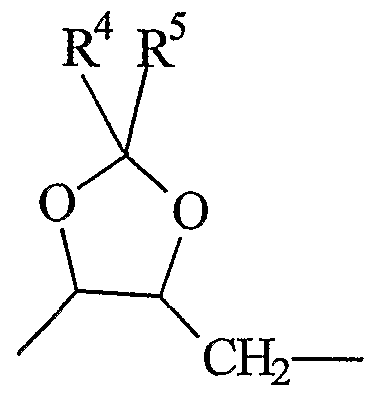
CH2CH(R')CH(R'), CH2CH(OR')CH(OR'), CH2NR'CH2, CH2CH(OH)CH(OH), CH2CH2NR,CH2, CH2CH2OCH2 and a group represented by the formula:
wherein each R and R5 can independently be hydrogen, alkyl, aryl, substituted alkyl and substituted aryl; and wherein: Y can be (CH2)n wherein n is from 0 to 3, CH2NHCH2, CH2SCH2,
CH2PR'CH2, CR'2, CO, SiR'2, C5H3N, C6H4, alkylene, substituted alkylene, 1 ,2-divalent arylene, 2,2'-divalent-1 ,1 '-biphenyl, substituted aryl, hetereoaryl and ferrocene. More particularly, the chiral ligand can be represented by the formula and its enantiomer:
wherein R can be alkyl, aryl, substituted alkyl, substituted aryl, hetereoaryl, ferrocenyl, alkoxy and aryloxy; and wherein n is from 0 to 2; R can be CH
3, Et, iPr, t-Bu, 1 -adamantyl, Et
3C, cyclo-C
5H
9, cyclo- C
6Hn, phenyl, p-tolyl, 3,5-dimethylphenyl, 3,5-di-t-butyl phenyl, ortho- anisyl and naphthyl.
Examples of such ligands include a ligand represented by the formula and its enantiomer:
and a ligand represented by the formula and its enantiomer:
Other preferred ligands include:
(1) chiral ligands represented by the formula:
wherein X is CH2(C6H4) to produce a five-membered ring wherein the CH2 group of the CH2(C6H4) is attached to the phosphorus atom and the aromatic carbon ortho- to the CH2 group of the CH2(C6H4) is attached to the chiralcarbon atom bonded to P, H, and the group E; and
(2) chiral ligand of claim 1 , represented by the formula:
wherein X is CH2(C6H4) to produce a five-membered ring wherein wherein the CH2 group of the CH2(C6H4) is attached to the chiral carbon atom that is bonded to P, H, and the group E, and the aromatic carbon ortho- to the CH2 group of the CH2(C6H4) is attached to the phosphorus atom.
In these two classes of ligands, R is preferably,CH3, Et, i-Pr, t-Bu, Et3C, 2-ethylhexyl, 1 -adamantyl, cyclopentyl, cyclohexyl, phenyl, naphthyl, ortho-anisyl, 3,5-dimethylphenyl, 3,5-di-t-butyl phenyl, p-tolyl or ferrocene.
The above two classes of ligands illustrate that when group X is unsymmetric, two different ring compounds can be formed depending on the points of attachment of an unsymmetric, such as, CH2(C6H4) represented by the formula:
to the group:
-P-CHE- I R
Accordingly, whenever two different compounds can result from combining the component groups in a chemical formula of the ligands, for example, by reversing the points of attachments of one of the component groups, the present application contemplates ligands that result from both approaches.
Other preferred chiral ligands include ligands represented by the following formulas or their enantiomers:
(1)
wherein R can be CH
3, Et, i-Pr, t-Bu, Et
3C, 2-ethylhexyl, 1- adamantyl, cyclopentyl, cyclohexyl, phenyl, naphthyl, ortho-anisyl, 3,5- dimethylphenyl, 3,5-di-t-butyl phenyl, p-tolyl and ferrocene;
(2) ligand represented by formula L9 or its enantiomer:
L9
(3) ligand is represented by formula L16 or its enantiomer:
(4) a ligand represented by the formula or its enantiomer:
wherein the R group on the phosphorus is cis- or trans- isomer with respect to the group PR'R"; and
(5) a ligand represented by the formula or its enantiomer:
L26 and
(6) a ligand is represented by the formula or its enantiomer:
wherein R can be CH3, Et, i-Pr, t-Bu, Et3C, 2-ethylhexyl, 1- adamantyl, cyclopentyl, cyclohexyl, phenyl, naphthyl, ortho-anisyl, 3,5- dimethylphenyl, 3,5-di-t-butyl phenyl, p-tolyl and ferrocene; and wherein X is a divalent group selected from CH2(C6H4), CH2(Ar), CH2(hetereoaryl), CδH3N, arylene, substituted arylene, CH2(biaryl), CH2(ferrocene), divalent aryl, 1 ,2-divalent phenyl (ortho-phenylene), 2,2'- divalent-1 ,1 '-biphenyl, and 2,2'-divalent-1 ,1'-binaphthyl.
Selective examples of specific chiral ligands are listed below to illustrate the new P-chiral phospholanes and P-chiral phosphocyclic compounds (L1 to L35).
For each ligand, the corresponding enantiomer is also contemplated. These compounds can be prepared from corresponding phosphine-boranes, phosphine sulfides and phosphine oxides.
L50 L51 L52
Since Ir-catalyzed asymmetric hydrogenation is still highly substrate-dependent, development of new efficient chiral ligands for Ir- catalyzed hydrogenation is a continuing challenge. After development of phosphinooxazoline ligands for Ir-catalyzed asymmetric hydrogenation, Pfaltz and others have continued their efforts for the search of new efficient P, N ligands (A. Lightfoot, P. Schnider, A. Pfaltz, Angew. Chem. Int. Ed. 1998, 37, 2897-2899). Various P, N ligands such as TADDOL-phosphite-oxazoline,
PyrPHOX, and phosphinite-oxazoline were subsequently developed by Pfaltz and coworkers (J. Blankenstein, A. Pfaltz, Angew. Chem. Int. Ed. 2001, 40, 4445-4447). Burgess also reported JM-Phos and imidazolylidene-oxazoline (D.-R. Hou, J. H. Reibenspies, K. Burgess, J. Org. Chem. 2001, 66, 206-215; M. T. Powell, D.-R. Hou, M. C. Perry, X. Cui, K. Burgess, J. Am. Chem. Soc. 2001 , 123, 8878-8879).
In this invention, we also report a new class of chiral P, N ligands, the phospholane-oxazolines, for Ir-catalyzed asymmetric hydrogenation. Excellent enantioselecitivities have been obtained in hydrogenation of methylstilbenes and methylcinammic esters.
After the discovery of TangPhos (1) as a highly electron-donating P-chiral 1 ,2-bisphosphine ligand, our efforts continued to identify other members of this general class of compounds which have similarly superior enantioselectivity and reactivity profile.
TangPhos (1) has superior enantioselectivity and reactivity profile particularly in the Rh-catalyzed hydrogenation of a wide variety of olefins to produce chiral α, or β amino acids, amines, alcohols and carboxylic acid derivatives ((a) Tang, W.; Zhang, X. Angew. Chem., Int. Ed. 2002,
41, 1612. (b) Tang, W.; Zhang, X. Org. Lett. 2002, 4, 4159. (c) Tang, W.; Liu, D.; Zhang, X. Org. Lett. 2003, 5, 205).
However, one of the difficulties encountered in the synthesis of TangPhos (1) was that only one enantiomer of 1, (1S,1S',2R,2R'-
TangPhos (see below) was readily accessible using (-)-sparteine, which is available as a chiral induction base only in one enantiomeric form.
Separation of the racemic sulfide-protected TangPhos precursor by preparative HPLC is the only current way to obtain the other enantiomer of TangPhos. An attempt to resolve the corresponding phosphine oxide intermediate of racemic TangPhos did not offer much promise because of the highly hygroscopic nature of that intermediate. As a result, the high cost of the other enantiomer has so far limited the potential applications of TangPhos in asymmetric syntheses.
Herein, we also report a concise synthesis of a new P-chiral bisphosphine ligand 20, named DuanPhos (see below) in both enantiomeric forms and the highly enantioselective hydrogenation of a series of functionalized olefins using a Rh-20 complex as the catalyst.
The superior results obtained using DuanPhos in a variety applications makes it a new benchmark ligand in asymmetric catalytic reactions.
1 (1 S,1S',2R,2R')-TangPhos 20 DuanPhos
The synthetic route to both enantiomers of DuanPhos (20) is shown herein below as Scheme 1 in which resolution of a bisphosphine oxide intermediate is a key step.
Scheme 1. Synthesis of Ligand 20 DuanPhos
(-)-60 (1 S,1 S',2R,2R')-20
From commercially available diol 30, cyclic sulfate 40 was formed in high yield according to the literature procedure ((a ) Gao, Y.; Sharpless, K. B. J. Am. Chem. Soc. 1988, 110, 7538. (b) Kim, B. M.; Sharpless, K. B. Tetrohydron Lett. 1989, 30, 655). Treatment of 40 with ferf-butylphosphine (ferf-Butylphosphine was prepared on lab scale by reduction of commercially available tert- butyldichlorophosphine with LAH. It can also be prepared on industrial scale from phosphine and isobutene) in the presence of π-BuLi, followed by in situ oxidation with H2O2, provided phosphine oxide 50 in excellent
yield. CuCI2 mediated homo-coupling of 50 in the presence of LDA gave racemic bisphosphine oxide 60.
It is noteworthy that the meso diastereomer of 60 was not formed in an appreciable amount, probably due to steric hindrance in the coupling step.
Racemic 60 can be easily resolved with inexpensive (L)-DBT H2O (DBT = dibenzoyl tartaric acid) to afford enantiomerically pure (+)-60 (>99% ee with one resolution, no further recrystallization needed) in 15% yield.
The remainder of 60 was treated with (D)-DBTΗ2O to give (-)-60 (>99% ee) in 17% yield. Thus, the overall yield of the coupling and resolution steps was 32%.
The absolute configurations of both enantiomers of 20 were determined by comparison with the single crystal X-ray crystallography of the complex of (-)-60 and (D)-DBT.
In order to examine the catalytic properties of DuanPhos (20), complex {Rh(NBD)[(1R,1r?,2S,2S')-20]}SbF6 70 (NBD = norbornadiene) was prepared and used as the catalyst precursor in the hydrogenation of various prochiral olefins.
Some preliminary results are summarized in Table 1 below.
Table 1. Asymmetric Hydrogenation of Olefins with Rh-DuanPhos Complex 70
Entry* Substrate Conversion ee (%) confq0
COOMe 1" 80a R = H 100% >99 R 2 80b R = Ph 100% >99 R NHAc 3 NHAc 90a R = Me, R' = Et (£) 100% >99 R 4 90b R = Me, R' = Et (2) 100% 97 R COOR' 5 R 90c R = p-MeO-Ph, R'=Me(Z) 100% 92 S 6 90d R = p-CI-Ph, R' = Me (Z) 100% 92 S 7 R 100a Ar = Ph, R = H 100% >99 R 8 100b Ar = Ph, R = /-Pr 100% 97 R 9 Ar NHAc T00c Ar = p-MeO-Ph, R = Me 100% 99 R 10 100d Ar = p-CF3-Ph, R = Me 100% 99 R
aThe hydrogenations were carried out at room temperature in solvent (MeOH for substrates 80, 90 and 100 or THF for substrates 110 and 120) under 20 psi of hydrogen pressure with 7 (1 mol % ) as the catalyst precursor. 6The ee values were determined by chiral GC or chiral HPLC. For separation conditions, see ref. 7. cThe absolute configurations of the products were determined by comparing the retension times of two enantiomers with reported data. dThis reaction was run with S/C = 10,000:1.
Methyl α-acetaminoacrylate 80a and Methyl α-(acetamino)-2- phenylacrylate 80b, two widely studied α-dehydroamino acid substrates in literature (an attempt to resolve the corresponding phosphine oxide intermediate of racemic TangPhos failed due to the highly hygroscopic nature of that intermediate) were hydrogenated with 70 under very mild conditions (methanol as solvent, room temperature, 20 psi of H2 pressure) in 100% conversions and above 99% enantioselectivities.
It is noteworthy that high turnover numbers (10,000) were achieved with substrate 80a, which indicate the high catalytic activity of 70. β-Amino
acids are of great importance as building blocks in combinatorial chemistry and drug discovery ((a) Hoekstra, W. J., Ed. The Chemistry and Biology of /3-Amino Acids. Curr. Med. Chem. 1999, 6, 905. (b) Enantioselective Synthesis of β-Amino Acids; Juaristi, E., Ed.; Wiley-VCH: New York, 1997. (c) Guenard, D.; Guritte-Voegelein, R.; Potier, P. Ace. Chem. Res. 1993, 26, 160). However, asymmetric hydrogenation of β- dehydroamino acid derivatives, one of the simplest and most efficient ways to obtain chiral β-amino acids, remains much less successful compared to hydrogenation of their α-analogues.
Few catalysts can provide high enantioselectivities for both E and Z isomers of β-(acylamino)acrylate derivatives ((a) Drexler, H.-J.; You, J.; Zhang, S.; Fischer, C; Baumann, W.; Spannenberg, A.; Heller, D. Org. Process Res. Dev. 2003, 7, 355 and references cited therein), which are formed simultaneously in most synthetic protocols. As shown in entries 3 and 4, both (E) and (Z)-ethyl-3-acetamino-2-butenoate (90a and 90b) were hydrogenated with 70 in very high enantioselectivities.
For more challenging β-aryl substituted substrates 90c and 90d, high ee values were also obtained (entry 5 and 6). Enantioselective hydrogenation of α-arylenamides 100 has also been investigated with many phosphine ligands (an attempt to resolve the corresponding phosphine oxide intermediate of racemic TangPhos failed due to the highly hygroscopic nature of that intermediate).
As shown in entries 7-10, Rh-DuanPhos complex 70 provided excellent enantioselectivities for the hydrogenation of enamides 100 regardless of the EIZ mixture of tri-substituted substrates or the substituents on the phenyl ring. These results are comparable to the best reported to date.
To demonstrate further the versatile utility of Rh-DuanPhos in asymmetric hydrogenation, another two types of functionalized olefins, enol acetates 110 and itanonic acid derivatives 120, were briefly explored with complex 70 as the catalyst precursor. The ee values were excellent and compared favorably to those obtained with Rh-TangPhos.
The present invention further provides a catalyst prepared by a process including: contacting a transition metal salt, or a complex thereof, and a chiral ligand according to the present invention as described herein above.
Suitable transition metals for the preparation of the catalyst include Ag, Pt, Pd, Rh, Ru, lr, Cu, Ni, Mo, Ti, V, Re and Mn.
As mentioned above, the catalyst can be prepared by contacting a transition metal salt or its complex and a ligand according to the present invention. Suitable transition metal salts or complexes include the following:
AgX; Ag(OTf); Ag(OTf)2; AgOAc; PtCI2; H2PtCI4; Pd2(DBA)3;
Pd(OAc)2; PdCI2(RCN)2; (Pd(allyl)CI)2; Pd(PR3)4; (Rh(NBD)2)X; (Rh
(NBD)CI)2; (Rh(COD)CI)2; (Rh(COD)2)X; Rh(acac)(CO)2; Rh(ethylene)2(acac); (Rh(ethylene)2CI) 2; RhCI(PPh3) 3; Rh(CO)2CI2;
RuHX(L)2(diphosphine); RuX2(L)2 (diphosphine); Ru(aryl group)X2;
Ru(arene)X2(diphosphine); Ru(RCOO)2(diphosphine); Ru(COD)(COT);
Ru(methallyl)2(diphosphine); Ru(aryl group)X2(PPh3) 3; Ru(COD)(COT)X;
RuX2(cymen); Ru(COD)n; RuCI2(COD); (Ru(COD)2)X; Ru(aryl group)X2(diphosphine); RuX2(diphosphine); RuCI2(=CHR)(PR'3) ;
Ru(ArH)CI2; Ru(COD)(methallyl)2; (lr (NBD)2CI)2; (lr(NBD)2)X;
(lr(COD)2CI)2; (lr(COD)2)X; CuX (NCCH3)4; Cu(OTf); Cu(OTf)2; Cu(Ar)X;
CuX; Ni(acac)2; NiX2; (Ni(allyl)X)2; Ni(COD)2; MoO2(acac)2; Ti(OiPr)4;
VO(acac)2; MeReO3; MnX2 and Mn(acac)2. Each R and R' in these is independently selected from alkyl or aryl; Ar is an aryl group; and X is a counteranion. In the above transition metal salts and complexes, L is a solvent and the counteranion X can be halogen, BF4, B(Ar)4 wherein Ar is fluorophenyl or 3,5-di-trifluoromethyl-l -phenyl- CIO4, SbF6, PF6,
CF3SO3, RCOO or a mixture thereof •
In another aspect, the present invention includes a process for preparation of an asymmetric compound using the catalysts described above. The process includes the step of contacting a substrate capable of forming an asymmetric product by an asymmetric reaction and a catalyst according to the present invention prepared by contacting a transition metal salt, or a complex thereof, and a ligand according to the present invention.
Suitable asymmetric reactions include asymmetric hydrogenation, hydride transfer, allylic alkylation, hydrosilylation, hydroboration, hydrovinylation, hydroformylation, olefin metathesis, hydrocarboxylation, isomerization, cyclopropanation, Diels-Alder reaction, Heck reaction, isomerization, Aldol reaction, Michael addition; epoxidation, kinetic resolution and [m+n] cycloaddition wherein m = 3 to 6 and n = 2.
Preferably, the asymmetric reaction is hydrogenation and the substrate to be hydrogenated is an ethylenically unsaturated compound, imine, ketone, enamine, enamide, and vinyl ester.
The present invention still further includes a process for preparation of an asymmetric compound including: contacting a substrate capable of forming an asymmetric product by an asymmetric reaction and a catalyst prepared by a process including: contacting a transition metal salt, or a complex thereof, and a chiral ligand according to the present invention as described herein above.
The present invention still further includes a process for preparing (1R, 1R 2R, 2r? 1 ,1'-di-alkyl -[2,2']-diphospholanyl-1 ,1 '-disulfide including the steps of: asymmetrically deprotonating a 1-alkyl-phospholane-1 -sulfide with n-butyllithium/(-)-sparteine in a solvent to produce an anion of the 1-alkyl- phospholane-1 -sulfide; and contacting the anion of the 1-alkyl-phospholane-1 -sulfide and CuCI2 to oxidatively couple the anion of the 1-alkyl-phospholane-1 -sulfide and produce a reaction mixture including the (1R, 1R', 2R, 2R 1 ,1 '-di- alkyl-[2,2']-diphospholanyl-1 ,1 '-disulfide.
Further still, the present invention includes a process for preparing (1S, 1S 2R, 2R 1 ,1'-di-alkyl-[2,2']-diphospholanyl.
The process includes the steps of: asymmetrically deprotonating a 1-alkyl-phospholane-1 -sulfide with n-butyllithium/(-)-sparteine in a solvent to produce an anion of the 1-alkyl- phospholane-1 -sulfide; contacting the anion of the 1-alkyl-phospholane-1 -sulfide and CuCI2 to oxidatively couple the anion of the 1-alkyl-phospholane-1 -sulfide and produce a reaction mixture including (1R, 1R', 2R, 2R 1 ,1 '-di-alkyl- [2,2']-diphospholanyl-1 , 1 '-disulfide; recrystallizing the (1R, 1R 2R, 2f? 1 ,1 '-di-alkyl-[2,2']- diphospholanyl-1 ,1 '-disulfide from the reaction mixture; and
contacting the (1R, 1R', 2R, 2R 1 ,1'-di-alkyl-[2,2']-diphospholanyl- 1 ,1'-disulfide and hexachlorodisilane in a solvent to produce (1S, 1S', 2R, 2R 1 , 1 '-di-alkyl-[2,2']-diphospholanyl. Preferably, (1S, 1S', 2R, 2ft>1 ,1'-di-alkyl-[2,2']-diphospholanyl is
(1S, 1S', 2R, 2R 1 ,1'-di-fetf-butyl-[2,2']-diphospholanyl, which is prepared from suitable ferf-butyl group containing starting materials.
The present invention also provides a process for making chiral phosphine oxide intermediates using the following methods:
(1 ) The di-lithium salt of an alkyl or aryl phosphine such as RPH
2 is allowed to react with a cyclic sulfate having an aromatic backbone, such as, the cyclic sulfate derived from an ortho- arylenedimethanol or the cyclic sulfate derived from a diol such as HOCH
2XCH
2OH, to produce a cyclic phosphine. Upon oxidation of the cyclic phosphine, the corresponding phosphine oxide is obtained. An example of the ortho-arylenedimethanol is ortho-phenylenedimethanol. However, any ortho-arylenedimethanol can be used.
(2) a bis-Grignard or a di-lithium reagent derived from an ortho- bis-dichloromethylarylene or a bis-Grignard or a di-lithium reagent derived from CICH2XCH2CI, i.e., CIMgCH2XCH2MgCI and LiCH2XCH2Li, respectively, is allowed to react with an aryldichlorophosphine (ArPCI2) to produce a cyclic phosphine. Upon oxidation of the cyclic phosphine, the corresponding phosphine oxide is obtained. An example of the ortho-bis- dichloromethylarylene is ortho-bis-dichloromethylbenzene. However, any ortho-bis-dichloromethylarylene can be used. In the above starting materials, X can be a divalent group, such as, an alkylene, arylene, CH2(C6H4), CH2(Ar), CH2(hetereoaryl), CH2(alkenyl), arylene, substituted arylene, CH2(biaryl), CH2(ferrocene), divalent aryl, 1 ,2-divalent phenyl (ortho-phenylene), 2,2'-divalent-1 ,1'- biphenyl, 2,2'-divalent-1 ,1'-binaphthyl, divalent hetereoaryl, divalent ferrocene, and the like.
The R group can be hydrogen, linear, branched or cyclic alkyl, substituted alkyl, aryl, substituted aryl, hetereoaryl, ferrocenyl, and the like. Preferably, the R group is can be CH3, Et, i-Pr, t-Bu, Et3C, 2- ethylhexyl, 1 -adamantyl, cyclopentyl, cyclohexyl, phenyl, naphthyl, ortho- anisyl, 3,5-dimethylphenyl, 3,5-di-t-butyl phenyl, p-tolyl and ferrocene.
Several suitable procedures to prepare the chiral ligands according the present invention are described herein below.
(a) Synthesis of TangPhos using asymmetric deprotonation
(b) Synthesis of TangPhos through chiral separation
Separated by chiral HPLC or α Separa
+ted J 1 by S
CΛM
roB *
"
(c) Synthesis of TangPhos ligands through utilization of backbone chirality
(d) Synthesis of TangPhos Ligands through a chiral pool method
hexachlorosilane benzene
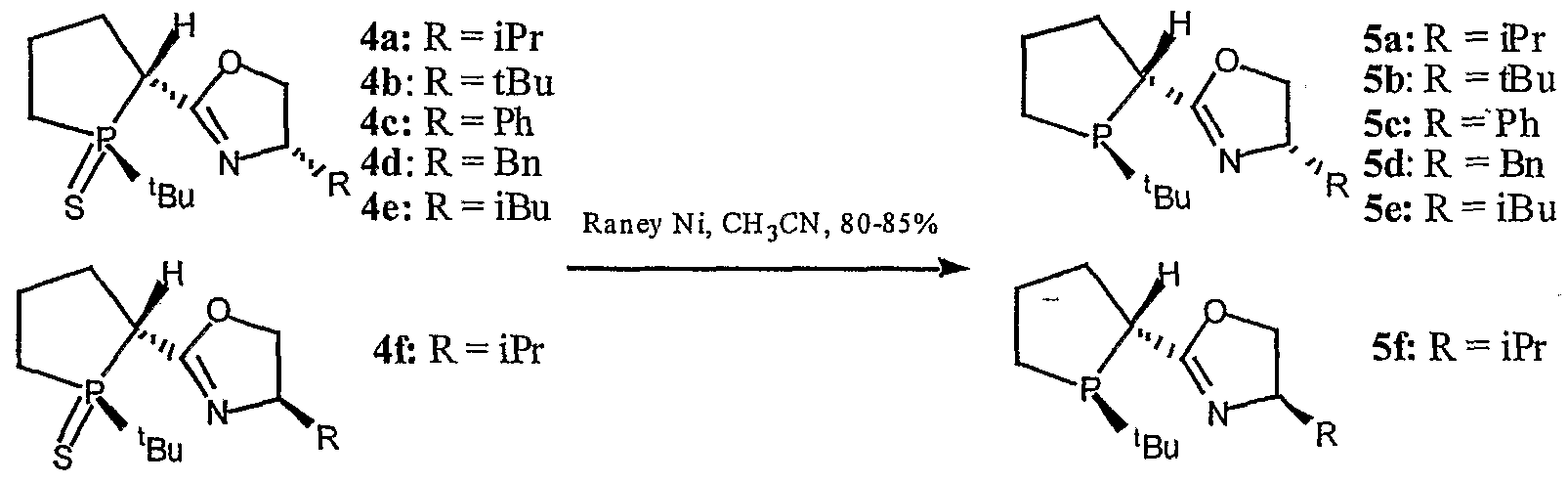
(e) Synthesis of PN ligands for asymmetric catalysis
(a) nBuLi, Sparteine, CO2; (b) amino alcohol, EDC, HOBT, DMF, then MsCI; (c) Raney Ni
General procedures
All reactions and manipulations were performed in a nitrogen-filled glovebox or using standard Schlenk techniques. THF and toluene were dried and distilled from sodium-benzophenone ketyl under nitrogen. Methylene chloride was distilled from CaH2. Methanol was distilled from Mg under nitrogen. (R, R)-BDNPB was made a solution of 10mg/ml in toluene before use. Column chromatography was performed using EM silica gel 60 (230-400 mesh). 1H, 13C and 31 P NMR were recorded on Bruker WP-200, AM-300, and AMX-360 spectrometers. Chemical shifts were reported in ppm down field from tetramethylsilane with the solvent resonance as the internal standard. Optical rotation was obtained on a Perkin-Elmer 241 polarimeter. MS spectra were recorded on a KRATOS mass spectrometer MS 9/50 for LR-EI and HR-EI. GC analysis was carried on Helwett-Packard 6890 gas chromatography using chiral
capillary columns. HPLC analysis was carried on Waters™ 600 chromatography.
EXAMPLE 1 : Synthesis of TangPhos (1)
An efficient three-step synthetic of chiral C2 symmetric P-chiral bisphospholane route has been developed. ion of 1-terf-butyl-phospholane 1 -sulfide
Preparation of BrMgCH2(CH2)2CH2MgBr. To a dry Schlenk flask held with magnesium turning (7.92 g, 0.33 mol) in 300 ml dry THF was added dropwise 1 ,4-dibromobutane (23.7 g, 0.11 mol) in 50 mL of THF at room temperature. The reaction was very exothermic during the addition. After the addition was complete (within 1h), the resulting dark solution was kept at r.t. for 2 more hours. The whole solution was used directly for the following reaction.
To a solution of phosphorous trichloride (13.7 g, 0.10 mol) in THF (300 mL) was added dropwise a solution of f-BuMgCI in THF (100 mL, 1.0M) at -78°C. The addition was complete within 2 hrs. After the mixture was stand at -78°C for 1 h, a solution of BrMgCH2(CH)2CH2MgBr in THF (made above) was added dropwise. The addition was complete within 2 hrs. The mixture was then allowed to warm to r. t over 2 h and stirred overnight.
At room temperature, to the reaction mixture was added sulfur powder (4.8g, 0.15 mol) through one portion. The resulting solution was further stirred at r.t. for 2 h. Water (300 mL) was then added. To the THF layer was added 500 mL EtOAc. The organic layer was washed with water (300 mL) followed by brine (300 mL), dried over Na2S04, and concentrated. The resulting oil was passed through a silica gel column followed by recrystallization to give colorless crystalline product 1-fe/τ- butyl-phospholane 1 -sulfide 8g (45% yield).
Synthesis of {1R, 1R', 2R, 2RΗ, 1'-di-tert-butyl-[2,2']- diphospholanyl 1, 1 '-disulfide
meso At -78°C, to a solution of (-)-sparteine (7.83 mL, 34 mmol) in ether
(200 mL) was added n-butyllithium (21.3 mL, 34 mmol, 1.6M in hexane) dropwise. The resulting solution was kept at -78°C for 30 min. Then at this temperature, to the solution was added dropwise a solution of 1-ferf- butyl-phospholane 1 -sulfide (5.0 g, 28.4 mmol in ether (100 mL). The addition was complete within 1hr.
The resulting mixture was kept at -78°C and stirred for 8 more hrs. Then dry CuCI2 (5.73 g, 42.6 mmol) was added into the solution through one portion. The resulting suspension was vigorously stirred and allowed to warm to r. t. over 4hrs. 150ml of concentrated ammonia was added. The water layer was washed twice with EtOAc (2 x 100 mL). The combined organic phase was further washed in a sequence with 5%
ammonia (100 mL), 1N HCI (100 mL), water (100 mL), and brine (100 mL).
After drying over Na2SO , the solution was concentrated under reduced pressure to give an oily solid, which was subsequently purified by passing a silica gel column to give a solid mixture (4 g) of (1R, 1R', 2R, 2R 1 , 1'-di-ferf-butyl-[2,2']-diphospholanyl 1 , 1 '-disulfide (72% ee, 83%) and meso compound (1R, 1R\ 2S, 2S')-1 , 1'-di-ferf-butyl-[2,2']- diphospholanyl 1 , 1 '-disulfide (17%).
The mixture was recrystallized from ethyl acetate and ethanol to give 700mg of pure product (1R, 1 R', 2R, 2R')-1 , 1'-di-ferf-butyl-[2,2']- diphospholanyl 1 , 1'-disulfide (ee: >99% according to HPLC, total yield: 14%).
Synthesis of (1S, 1S', 2R, 2R')-i, 1'-di-tert-butyl-[2,2']-diphospholanyl TangPhos (1)
To a solution of (1R, 1R 2R, 2R>1 , 1'-di-fe/ -butyl-[2,2']- diphospholanyl 1 , 1 '-disulfide (440 mg, 1.26 mmol) in 25ml benzene was added hexachlorodisilane (3.25 mL, 5.08 g, 18.9 mmol). The mixture was stirred at reflux for 4 h. After the solution was cooled to r.t., 50 mL of degassed 30% (w/w) NaOH solution was carefully added to the reaction mixture with an ice-water bath.
The resulting mixture was then stirred at 60 °C until the aqueous layer became clear. The two phases were separated. The water phase was washed twice with degassed benzene (2 x 30 mL). The combined benzene was dried over Na2SO4and concentrated.
The solid residue was re-dissolved in a minimum amount of degassed dichloromethane, which was subsequently passed through a basic AI2O3 plug (eluent: Et2O:hexane=1:10) to give pure white product (1) 320 mg (88% yield),
EXAMPLE 2: Asymmetric Hydrogenation of Dehydroamino Acids General Procedure for Asymmetric Hydrogenation.
To a solution of [Rh(COD)2]BF4 (5.0 mg, 0.012 mmol) in THF (10 mL) in a glovebox was added a chiral phosphine ligand (TangPhos 0.15 mL of 0.1 M solution in toluene, 0.015 mmol). After stirring the mixture for 30 min, the dehydroamino acid (1.2 mmol) was added.
The hydrogenation was performed at rt under 20 psi of hydrogen for 24 h. The reaction mixture was treated with CH2N2, then concentrated in Vacuo. The residue was passed through a short silica gel column to remove the catalyst. The enantiomeric excesses were measured by GC using a Chirasil-VAL III FSOT column. The absolute configuration of products was determined by comparing the observed rotation with the reported value. All reactions went in quantitative yield with no by-products found by GC.
Asymmetric hydorgenation for making alpha amino acid derivatives using TangPhos (1) as the ligand is shown in the Table below:
Asymmetric Hydrogenation of Dehydroamino Acid Derivatives3
COOR [Rh(NBD)2]SbF6 (1mol%) + TangPhos (1 ,1mol%)f COOR + H, NHAc CH30H, 12h, rt NHAc (R)b' ° Entry Substrate ee" %) 1 Ar = Ph, R = H >99d 2 Ar = Ph, R =CH3 >99 3 Ar = p-F-Ph, R = H 99d 4 Ar = p-F-Ph, R = CH3 >99 5 Ar = p- eO-Ph, R = H >99d'e 6 Ar = p-MeO-Ph, R = CH3 >99 7 Ar = m-Br-Ph, R = H >99d 8 Ar = m-Br-Ph, R = CH3 >99 9 Ar = o-CI-Ph, R = H >99d 10 Ar = o-CI-Ph, R = CH3 >99 11 Ar = 2-thienyl, R = H >99d 12 Ar = 2-thienyl, R = CH3 >99 13 Ar = 2-naphthyl, R = H >99d 14 Ar = 2-naphthyl, R = CH3 >99 15 Ar = Ph, R = H, N-benzoyl >99d 16 Ar = Ph, R = CH3, N-benzoyl >99
a The reaction eas carried out at rt under 20psi of H 2 for 24h. THe catalyst was made in situ by sitirring a solution of [Rh(NBD)2]SbF6 and TangPhos in methanol (2m L) [substrate:[Rh]:TangPhos = 1 :0.01 :0.01 1]. The reaction went with 100% conversion. b The R absolute configuration was assigned by comparison of optical rotation with reported data. c Enantiomeric excesses were determined by chiral GC using a Chrialsil- VAL 111 FSOT column. d Determined on corresponding methyl ester. e The % ee was determined by HPLC using a Daicel Chiralcel OJ column.
EXAMPLE 3: Asymmetric Synthesis of Beta-Ami no Acid Derivatives Synthesis of Starting Material 3-Acetamido-3-Aryl-2-Propenoates and 3-Acetamido-3-hetero-Aryl-2-Propenoates
Typical procedure: The starting material methyl 3-acetamido-3- phenyl-2-propenoate can be conveniently synthesized from cheap acetophenone in three steps according to known literature procedure in good yields. The literatures are Zhu, G.; Zhen, Z.; Zhang, X. J. Org. Chem. 1999, 64, 6907-6910; Krapcho, A. P.; Diamanti, J. Org. Synth. 1973, 5, 198-201. 1H-NMR (CDCI3, 360 MHz) δ (Z isomer) 2.17 (s, 3H), 3.77 (s, 3H), 5.29 (s, 1 H), 7.37-7.45 (m, 5H); (E isomer) 2.38 (s, 3H), 3.77 (s, 3H), 6.65 (s, 1 H), 7.37-7.45 (m, 5H).
Hydrogenation for making beta amino acid derivatives with the Rh- TangPhos (1) system
•COORc [Rrι(TangPhos)nbd)] SbF6
rt, H2 (20 psi), 24 h, THF R NHAc entry
9 Ri R2 geo ee" config. m.
c 1 Me Et E 99.5 R 2 Me Et Z 97.3 R 3 Me /-Pr E 99.3 R 4 Et Me E 99.6 R 5 n-Pr Et E 99.6 R 6 /-Bu Me E 98.5 R 7 Ph Me EIZ 93.8 S 8 p-F-Ph Me EIZ 95.0 S 9 p-CI-Ph Me EIZ 92.3 S 10 p-Br-Ph Me EIZ 95.1 S 11 p-Me-Ph Me EIZ 94.0 S 12 p-MeO-Ph Me EIZ 98.5
α S 13 p-BnO-Ph Me EIZ 98.5 S 14 o-Me-Ph Me EIZ 74.3 S 15 o-MeO-Ph Me EIZ 83.1 S
aThe reactions were carried out under 20 psi of H
2 in THF at rt for 24h. Substrate/[Rh(TangPhos)nbd]SbF
6 = 200:1. The absolute configurations were determined by comparing the optical rotations with reported values.
b The ee (%) values were determined by chiral GC using a Chiralselect 1000 column. ° For the EIZ ratios of EIZ mixtures.
d The ee was determined by chiral HPLC using (s, s)-whelk-01 column
For general synthetic procedures of β-aryl β-acetamidoacrylate esters, see Zhou, Y.-G.; Tang, W.; Wang, W.-B.; Li, W.; Zhang, X. J. Am. Chem. Soc. 2002, 124, 4952-4953. For general synthetic procedure of β- alkyl β-acetamidoacrylate esters, see Zhu, G.; Chen, Z.; Zhang, X. J. Org. Chem. 1999, 64, 6907-6910. For analytical data of known substrates and products, please also refer to the two aforementioned papers.
Methyl 3-Acetamido-3-(4-benzyloxyphenyl)-2-propenoate:
Z/E = 9:1; 1H NMR (360 MHz, CDCI3) δ (Z isomer) 2.06 (s, 3H), 3.65 (s, 3H), 4.98 (s, 2H), 5.18 (s, 1H), 6.86 (d, J = 6.8 Hz, 2H), 7.28 (m, 7H), 10.46 (s, 1H); (E isomer) 2.27 (s, 3H), 3.65 (s, 3H), 4.98 (s, 2H), 6.44 (s, 1H), 6.86 (d, J = 6.8 Hz, 2H), 7.28 (m, 7H).
General procedure for asymmetric hydrogenation of β-alkyl or β-aryl β-acetamidoacrylic esters
To a solution of β-acetamidoacrylic ester (0.5 mmol) in 4 mL of degassed THF Rh[(TangPhos)nbd]SbF6 (2.5 μmol) was added in a glovebox filled with nitrogen. The whole solution was transferred into an autoclave.
The autoclave was then purged three times with hydrogen and filled with hydrogen with 20 psi pressure. The resulting reactor was stirred
at room temperature for 24 hr. After release of the hydrogen, the autoclave was opened and the reaction mixture was evaporated.
The residue was passed through a short silica gel plug to give hydrogenation product β-amino acid derivatives. A small amount of sample was subjected to chiral GC or HPLC analysis.
Methyl 3-acetamido-3-(4-benzyloxyphenyl)-propanoate: 98.5% ee, [ ]25 D = -79.5°; 1H NMR (300 MHz, CDCI3) δ 2.00 (s,
3H), 2.83 (dd, J = 15.7, 6.2 Hz, 1 H), 2.93 (dd, J = 15.6, 6.0 Hz, 1 H), 3.63 (s, 3H), 5.05 (s, 2H), 5.40 (m, 1H), 6.93 (d, 1H), 6.94 (dd, J = 6.7, 2.0 Hz, 2H), 7.23 (dd, J = 6.8, 1.8 Hz, 2H), 6.72 (m, 5H); 13C NMR (75 MHz, CDCI3) δ 23.8, 40.2, 49.5, 52.2, 115.4, 127.9, 128.0, 128.4, 129.0, 133.3, 137.3, 158.6, 169.7, 172.1 ; MS (ESI) m/z 328 (M++1); HRMS calculated for C19H22 4 3281549, found 328.1553. Chiral HPLC conditions ((s, s)- whelk-01): solvent hexane:isopropanol(1 :1); flow rate 1 mL/min; retention time 8.2 min (R), 13.1 min (S).
EXAMPLE 4: Asymmetric Hydrogenation of Enamides
Table. Rh-Catalyzed Asymmetric Hydrogenation of α-Arylenamides using TangPhos (1).
Entry Substrate Ar R ee [%] W 1 Ph H >99 2 m-Me-Ph H >99
3 p-CF3-Ph H >99 4 p-Cy-Ph H >99 5 p-Ph-Ph H 99 6 2-naphthyl H >99 7 Ph CH3 98 8 p-CF3-Ph CH3 98 9 p-MeO-Ph CH3 98 10 2-naphthyl CH3 99 11 Ph CH(CH3) 98 12 Ph CH2Ph 99 13 97 ^cό~
[a] Conditions: see Experimental Section for details. Enamides were prepared according to the literature method, [b] The R absolute configuration was assigned by comparison of optical rotation with reported data, ee's were determined by chiral GC using Supelco Chiral Select 1000 column or by chiral HPLC with a (R, ?)-Poly Whelk-01 column.
Example 5: High turnovers for asymmetric hydrogenation of enamides using Rh(TangPhos (1) catalyst
Asymmetric hydrogenation with [Rh(NBD)TangPhos(1)]+SbF6 ~ as the catalyst:
,COOMe [Rh(nbd)(1)]SbF
6 (0.001 mmol) NNHH>Ac CH
3OH (20 L), H
2 (40 psi)
10 mmol 8 h 99.8% ee 100% yield TON = 10,000 ) NHAc
99.3% ee 10 mmol TON = 10,000 100% yield
Procedure for hydrogenation of α-dehydro amino acid:
To a solution of methyl α-(acetylamino)-2-phenylacrylate (2.19 g, 10 mmol) in 20 mL of degassed methanol in glovebox was added [Rh(nbd)(1)]SbFβ (1 ml of 0.001 M solution in methanol, 0.001 mmol). The hydrogenation was performed at room temperature under 40 psi of H2 for 8 h. After carefully releasing the hydrogen, the reaction mixture was passed through a short silica gel column to remove the catalyst. The enantiomeric excesses of (R)-methyl 2-acetylamino-3-phenylpropionate were measured by chiral GC directly. (Conversion: 100%, ee: 99.8%, TON: 10,000)
Example 6: Asymmetric hydrogenation of itaconic acid derivatives with Rh(TangPhos) (1) catalyst
[a] Conditions: catalyst precursor = [Rh(TangPhos)(nbd)]SbF
6 (1 mol %), room temperature, 20 psi H
2> THF. The absolute configuration of product was determined by comparison with reported data, [b] Most substrates (except entry 1) employed as crude E/Z mixtures ranging from 2/1 to >10/1. [c] Determined on chiral GC or HPLC column after conversion of the hydrogenation product into dimethyl ester.
Example 7: Asymmetric hydrogenation of Arylenol Acetates with the [Rh(TangPhos (1)] catalyst
[Rh(TangPhos)nbd)]SbF
6 Ac
rt, H
2, EtOAc
[a] Conditions: catalyst precursor = [Rh(TangPhos)(nbd)]SbF6 (1 mol %), room temperature, 20 psi H2, EtOAc. The absolute configuration of product was determined by comparison with reported data, [b] Determined on a chiral GC column (chiral select 1000).
Example 8: Synthesis of Chiral PN ligands for asymmetric Catalysis
Since Ir-catalyzed asymmetric hydrogenation is still highly substrate-dependent, development of new efficient chiral ligands for Ir- catalyzed hydrogenation is a continuing challenge. A new class of chiral
P, N ligands, the phospholane-oxazolines have been developed as follows: n-BuLi, (-)-sparteine,C0
2,-78 C, recrystallization, 71% ee -> 100% ee
At -78°C, to a solution of (-)-sparteine (14.4 mL, 62.5 mmol) in ether (100 mL) was added dropwise n-BuLi (1.6M in hexane, 39 mL, 62.5 mmol). The mixture was stirred at -78°C for 30 min. A solution of 2 (10g, 56.8 mmol) in ether (150 mL) was added dropwise. The addition was complete in 1 h. The resulting reaction mixture was allowed to warm to rt and stirred overnight. The mixture was re-cooled to -78°C. Through the suspension was bubbled CO2 for 2 h. Then it was quenched with the addition of 1 N HCI (200 mL) followed by EtOAc (200 mL). The organic layer was washed sequentially with 1 N HCI (200 mL), H2O (200 mL), and brine (100 mL). The solution was dried over Na2SO4 and evaporated. The residue was treated with 2 N NaOH solution (300 mL). The resulting clear solution was neutralized by the addition of 2 N HCI. The precipitate was collected through vacuum filtration to give the product (8.0 g, 72% ee, 64% yield). The ee was determined by converting the product into its corresponding methyl ester by treatment with TMSCHN2 in THF/CH3OH solution (HPLC conditions for the methyl ester: Chiralpak AD column; hex:ipr = 95:5; 8.8 min, 11.3 min.) A sample of product (7.5 g) was recrystallized twice from ethanol to give 4.5 g of enantiomerically pure product 3 (>99.9% ee, 40% total yield).
3: [α]D 20 = 16.9° (c = 0.9, CHCI3); 1H NMR (360 MHz, CDCI3) δ 1.35 (d, 3JHP = 17.0 Hz, 9H), 1.71 (m, 1 H), 2.18 (m, 3H), 2.47 (m, 2H), 3.34 (m, 1H); 13C NMR (90 MHz, CD3OD) δ 25.4 (d, 2JCP = 1.7 Hz), 26.0 (d, 2JCp =
2.2 Hz), 31.3 (d, 2JCP = 7.3 Hz), 32.8 (d, JCP = 48.8 Hz), 36.1 (d, JCP = 44.1 Hz), 46.4 (d, JCP = 36.0), 172.9; 31P NMR (145 MHz, CD3OD) δ 89.3 (s); APCI MS 121 (M++H); HRMS calculated for C9Hι8PS02221.0765, found 221.0762.
The methyl ester of 3: [α]D 20 = 42.6° (c = 1 , CHCI3); 1H NMR (360 MHz, CDCI3) δ 1.21 (d, 3JHP = 16.8 Hz, 9H), 1.69 (m, 1 H), 1.92 (m, 2H), 2.30 (m, 3H), 3.23 (m, 1 H), 3.66 (s, 3H); 13C NMR (90 MHz, CDCI3) δ 25.2 (d, 2.7 Hz), 25.4 (d, 2JCp = 1.8 Hz), 29.9 (d, 2JCP = 7.4 Hz), 31.7 (d, JCP = 47.9 Hz), 35.3 (d, JCp = 43.5 Hz), 45.4 (d, JCp = 35.5 Hz), 52.7, 170.0; 31P NMR (145 MHz, CDCI3) δ 87.8; APCI MS 235 (M++H); HRMS calculated for CιoH20PSO2235.0922 found 235.0909.
A mixture of 3 (2.27 mmol), EDC.HCI (1.3 g, 6.82 mmol), HOBT.H2O (0.52 g, 3.41 mmol), chiral amino alcohol (3.41 mmol), triethylamine (1.9 mL, 13.6 mmol) in 10 mL of DMF was stirred at 70°C overnight. To the cooled mixture was added 30 mL of 2 N HCI solution. The resulting mixture was then extracted with ethyl acetate. The organic layer was washed with water and brine, dried over Na2S04. After removal of the solvent, the residue was purified by column chromatography to give condensation product in 70-80% yield.
To a mixture of condensation product (1.67 mmol), diisopropyl- ethylamine (1.98 mL, 6.68 mmol) and triethylamine (1.38 mL, 16.7 mmol) in 10 mL of CH2CI2 was added 258 μL (3.34 mmol) of methanesulfonyl chloride at 0°C. After addition, the resulting mixture was allowed to warm to room temperature and stirred overnight. The solvent was removed. The residue was redissolved in ethyl acetate, washed with water and brine, and dried over Na2SO4. After removal of solvent, the crude product was purified by column chromatography to give pure 4a-f in 70-80% yield.
4a: [α]20 D = -75.1° (c = 0.9, CHCI3), 1H NMR (360 MHz, CDCI3) δ 0.81 (d, 6.8 Hz, 3H), 0.89 (d, 6.8 Hz, 3H), 1.24 (d, 3JHP = 16.5 Hz, 9H), 1.58 (m, 1H), 1.71 (m, 1 H), 1.90 (m, 1H), 2.11 (m, 2H), 2.37 (m, 2H), 3.19 (m, 1 H), 3.86 (m, 1H), 3.94 (t, 7.9 Hz, 1H), 4.21 (t, 8.1 Hz, 1 H); 13C NMR (90 MHz, CDCI3) δ 18.7, 19.4, 25.4 (m), 30.6 (d, 2JCP = 7.9 Hz), 31.8 (d, JCP = 47.5 Hz), 32.0, 33.1 , 35.2 (d, JCP = 43.4 Hz), 38.8 (d, JCP = 39.5 Hz), 70.6, 72.4, 163.9; 31P NMR (145 MHz, CDCI3) δ 88.0; APCI MS 288 (M++H); HRMS calculated for C14H27NOPS 288.1551 found 288.1549. 4b: [α]20 D = -75.9° (c = 0.9, CHCI3), 1H NMR (360 MHz, CDCI3) δ
0.83 (s, 9H), 1.25 (d, 3JHP = 16.4 Hz, 9H), 1.56 (m, 1 H), 1.87 (m, 1 H), 2.14 (m, 2H), 2.38 (m, 2H), 3.21 (m, 1 H), 3.83 (m, 1 H), 4.01 (t, 8.4 Hz, 1 H), 4.16 (t, 8.5 Hz, 1 H); 13C NMR (90 MHz, CDCI3) δ 25.6 (d, 2JCP = 1.6 Hz), 26.5, 30.6 (d, 2JCp = 7.9 Hz), 31.9 (d, JCP = 47.2 Hz), 32.0, 33.8, 35.3 (d, JCP = 43.6 Hz), 38.9 (d, JCP = 40.0 Hz), 69.1 , 75.9, 163.9; 31P NMR (145 MHz, CDCI3) δ 87.3; ESI MS 302 (M++H); HRMS calculated for C15H29NOPS 302.1707 found 302.1716.
4c: [α]20 D = -98.9° (c = 1 , CHCI3), 1H NMR (360 MHz, CDCI3) δ 1.24 (d, 3JHP = 16.6 Hz, 9H), 1 .58 (m, 1 H), 1.91 (m, 1 H), 2.16 (m, 2H), 2.39 (m,
2H), 3.28 (m, 2H), 3.19 (t, 8.3 Hz, 1H), 4.58 (t, 8.3 Hz, 1H), 5.14 (m, 1H), 7.19 (m, 5H); 13C NMR (90 MHz, CDCI3) δ 25.0 (d, 2JCP = 1.1 Hz), 30.2 (d, 2JCP = 7.7 Hz), 31.3 (d, JCP = 47.3 Hz), 31.5, 34.8 (d, JCP = 43.4 Hz), 38.6 (d, JCP = 39.2 Hz), 69.6, 74.9, 127.3 (m), 142.3, 165.2 (d, 2JCP = 4.6 Hz); 31P NMR (145 MHz, CDCI3) δ 88.8; APCI MS 322 (M++H); HRMS calculated for C17H25NOPS 322.1395 found 322.1409.
4d: [α]20 D = -54.2° (c = 1 , CHCI3), 1H NMR (360 MHz, CDCI3) δ 1.17 (d, 3JHP = 16.5 Hz, 9H), 1.52 (m, 1 H), 1.84 (r , 1 H), 2.07 (m, 2H), 2.32 (m, 2H), 2.58 (dd, 8.2 Hz, 13.6 Hz, 1 H), 2.98 (dd, 5.5 Hz, 13.6 Hz,1 H), 3.06 (dd, 9.6 Hz, 17.3 Hz, 1 H), 3.88 (t, 7.3 Hz, 1 H), 4.09 (t, 8.5 Hz), 4.3 (m, 1 H), 7.13 (m, 5H); 13C NMR (90 MHz, CDCI3) δ 24.4, 24.6 (d, 2JCP = 1.2 Hz), 29.8 (d, 2JCP = 8.0 Hz), 30.9 (d, JCP = 47.4 Hz), 34.3 (d, JCP = 43.4 Hz), 37.8 (d, JCP = 39.1 Hz), 41.5, 66.8, 71.3, 125.8, 127.9, 128.8 (m), 163.7 (d, 2JCP = 4.7 Hz); 31P NMR (145 MHz, CDCI3) δ 88.5; APCI MS 336 (M++H); HRMS calculated for C18H27NOPS 336.1551 found 336.1542.
4e: [α]20 D = -83.9° (c = 1 , CHCI3), 1H NMR (360 MHz, CDCI3) δ 0.67 (t, 6.4 Hz, 6H), 1.04 (d, 3JHP = 16.4 Hz, 9H), 1.43 (m, 3H), 1.67 (m, 1 H), 1.94 (m, 2H), 2.19 (m, 2H), 3.00 (m, 1H), 3.60 (t, 7.4 Hz, 1 H), 3.91 (m, 1 H), 4.08 (m, 8.5 Hz, 1H); 13C NMR (90 MHz, CDCI3) δ 22.3, 22.5, 24.4, 24.6, 24.9, 29.8 (d, 2JCP = 7.9 Hz), 30.9 (d, JCP = 47.4 Hz), 31.4 Hz, 34.3 (d, JCP = 43.4 Hz), 37.9 (d, JCP = 39.4 Hz), 45.3, 64.1 , 72.6, 162.9 (d, 2JCP = 4.6 Hz); 31P NMR (145 MHz, CDCI3) δ 88.0; ESI MS 302 (M++H); HRMS calculated for Cι5H28NOPS 302.1708 found 302.1715.
4f: [α]20 D = +28.6° (c = 0.9, CHCI3), 1H NMR (360 MHz, CDCI3) δ 0.82 (d, 6.7 Hz, 3H), 0.94 (d, 6.7 Hz, 3H), 0.95 (d, 3JHP = 16.4 Hz, 9H), 1.58 (m, 1 H), 1.75 (m, 1 H), 1.89 (m, 1 H), 2.13 (m, 2H), 2.39 (m, 2H), 3.11 (m, 1 H), 3.81 (m, 1 H), 3.95 (t, 8.2 Hz, 1 H), 4.20 (t, 8.2 Hz); 13C NMR (90
MHz, CDCIs) δ 18.6, 20.0, 25.2, 25.4 (d, 2JCP = 1.4 Hz), 30.7 (d, 2JCP = 7.8 Hz), 32.8 (d, JCP = 47.6 Hz), 32.0, 33.2, 35.1 (d, JCP = 43.6 Hz), 38.7 (d, JCP = 39.8 Hz), 70.6, 72.8, 163.7 (d, 2JCP = 4.5 Hz); 31P NMR (145 MHz, CDCIs) δ 87.9; ESI MS 288 (M++H); HRMS calculated for Cι4H27NOPS 288.1551 found 288.1545.
General procedure:
To a N2-flushed Schlenk flask was loaded 5.0 g of Raney Ni 2800 slurry. The Raney Ni was washed sequentially with methanol (10 mL x 3), ether (10 mL x 3), and dried degassed CH3CN (10 mL x 3). To this flask was then transferred a solution of 4a-f (1.5 mmol) in CH3CN (20 mL) via cannula. The resulting mixture was stirred under N2 for 2 d. The mixture was then filtered under N2. The Raney Ni solid was washed with CH3CN (10 mL x 5). The combined CH3CN with filtrate was evaporated under N2 to give an oily residue. The residue was passed through an AI2O3 (basic) plug under N2 to give pure oily product 5a-f (80-95%). 5a: 1H NMR (400 MHz, CD2CI2) δ 0.88 (d, 6.8 Hz, 3H), 0.94 (d, 6.8
Hz, 6.8 Hz), 1.08 (d, 3JHP = 11.9 Hz, 9H), 1.72 (m, 4H), 2.01 (b, 3H), 2.81 (b, 1 H), 3.85 (b, 1 H), 3.95 (t, 7.6 Hz, 1 H), 4.20 (t, 7.6 Hz, 1 H); 13C NMR (100 MHz, CD2CI2) δ 18.3, 18.8, 23.3 (d, 2JCP = 17.5 Hz), 27.6 (d, 2JCP =
14.5 Hz), 29.0, 29.1 (d, JCP = 18.4 Hz), 33.2 (d, JCP = 19.9 Hz), 36.9 (d, JCP = 20.2 Hz), 70.2, 72.4, 169.1 (d, 2JCP = 15.9 Hz); 31P NMR (145 MHz, CD2CI2) δ 26.0; ESI MS 256 (M++H); HRMS calculated for C14H27NOP 256.1830 found 256.1820. 5b: 1H NMR (360 MHz, CDCI3) δ 0.71 (s, 9H), 0.90 (d, 3JHP = 11.9
Hz, 9H), 1.56 (m, 3H), 1.83 (m, 3H), 2.73 (b, 1 H), 3.65 (m), 3.92 (t, 7.6 Hz, 1 H), 3.99 (t, 9.3 Hz, 1 H); 13C NMR (90 MHz, CDCI3) δ 21.9 (d, 2JCP = 17.6 Hz), 24.8, 26.4 (d, 2JCP = 14.2 Hz), 27.7 (d, 2.84 Hz), 28.9 (d, JCP = 18.0 Hz), 32.4 (d, JCP = 70.0 Hz), 35.8 (d, JCP = 19.8 Hz), 67.7, 74.4, 168.9 (d, , 2JCP = 15.9 Hz); 31P NMR (145 MHz, CDCI3) δ 25.2; ESI MS 270 (M++H); HRMS calculated for Cι5H29NOP 270.1987 found 270.1972.
5c: 1H NMR (360 MHz, CD2CI2) δ 0.98 (d, 3JHP = 12.0 Hz, 9H), 1.66 (m, 3H), 1.92 (m, 3H), 2.80 (m, 1 H), 3.91 (t, 7.9 Hz, 1 H), 4.46 (dd, 8.3 Hz, 10.0 Hz, 1H), 5.01 (m, 1H), 7.17 (m, 5H); 13C NMR (90 MHz, CD2CI2) δ 23.5 (d, 2JCP = 17.6 Hz), 27.9 (d, 2JCP = 14.4 Hz), 29.2 (d, 2JCP = 2.1 Hz), 29.4 (d, JCP = 18.7 Hz), 33.4, 37.1 (d, JCP = 20.1 Hz), 70.1 , 75.3, 127.0-129.1 (m), 144.0, 172.0 (d, 2JCP = 15.8 Hz); 31P NMR (145 MHz, CD2CI2) δ 27.4; ESI MS 290 (M++H); HRMS calculated for Cι7H24NOP 290.1674 found 290.1663. 5d: 1H NMR (360 MHz, CD2CI2) δ 1.06 (d, 3JHP = 1 1.9 Hz, 9H), 1.74
(m, 3H), 2.01 (m, 3H), 2.67 (dd, 7.5 Hz, 13.6 Hz, 1 H), 2.74 (m, 1 H), 2.96 (dd, 6.1 Hz, 13.6 Hz, 1 H), 3.92 (dd, 7.0 Hz, 8.2 Hz, 1 H), 4.17 (t, 9.0 Hz, 1 H), 4.30 (m, 1 H), 7.28 (m, 5H); 13C NMR (90 MHz, CD2CI2) δ 23.4 (d, JCP = 17.9 Hz), 27.8 (d, 2JCP = 14.4 Hz), 29.1 (d, 2JCP = 2.2 Hz), 29.3 (d, JCP = 18.7 Hz), 33.4 (d, 2JCP = 1.2 Hz), 37.1 (d, JCP = 20.0 Hz), 42.5, 68.0, 72.2, 126.8, 128.9, 130.0, 139.2, 170.9 (d, 2JCP = 15.8 Hz); 31P NMR (145 MHz, CD2CI2) δ 26.7; ESI MS 304 (M++H); HRMS calculated for C18H27NOP 304.1830 found 304.1836.
5e: 1H NMR (360 MHz, CD2CI2) δ 0.86 (d, 4.3 Hz, 3H), 0.92 (d, 4.3 Hz, 3H), 1.03 (d, 3JHP = 11.9 Hz, 9H), 1.25 (m, 1 H), 1.49 (m, 1 H), 1.73 (m, 4H), 1.95 (m, 3H), 2.74 (m, 1 H), 3.75 (t, 7.7 Hz, 1 H), 4.03 (m, 1 H), 4.25 (dd, 8.0 Hz, 9.1 Hz, 1H); 13C NMR (90 MHz, CD2CI2) δ 23.1 , 23.3 (d, 2JCP = 17.7 Hz), 26.0, 27.8 (d, 2JCP = 14.4 Hz), 29.1 (d, 2JCP = 2.4 Hz), 29.2 (d, JCP = 18.7 Hz), 33.3 (d, 1.6 Hz), 37.1 (d, JCP = 19.9 Hz), 46.3, 65.2, 73.4, 169.9 (d, 2JCP = 15.8 Hz); 31P NMR (145 MHz, CD2CI2) δ 26.1 ; ESI MS 270 (M++H); HRMS calculated for C15H28NOP 270.1987 found 270.2042.
5f: 1H NMR (360 MHz, CDCI3) δ 0.73 (d, 6.8 Hz, 3H), 0.80 (d, 6.8 Hz, 3H), 0.93 (d, 3JHP = 12.0 Hz, 9H), 1.49 (m, 1H), 1.66 (m, 3H), 1.89 (m, 3H), 2.66 (m, 1H), 3.76 (m, 1H), 3.84 (t, 7.6 Hz, 1H), 4.07 (t, 8.8 Hz, 1H); 13C NMR (90 MHz, CDCI3) δ 16.6, 17.9, 21.8 (d, 2JCP = 17.4 Hz), 26.5 (d, 2 JCP = 14.3 Hz), 27.5 (d, 2JCP = 2.4 Hz), 27.8 (d, JCP = 18.0 Hz), 31.3, 31.9 (d, 1.1 Hz), 35.5 (d, JCP = 19.8 Hz), 68.5, 70.6, 169.0 (d, 2JCP = 15.5 Hz); 31P NMR (145 MHz, CDCI3) δ 25.9; ESI MS 256 (M++H); HRMS calculated for C14H27NOP 256.1830 found 256.1805.
Example 9 , Preparation of Ir-PN Compounds
To a Schlenk tube was added 5a-f (0.346 mmol), [lr(COD)CI]2 (116 mg, 0.173 mmol), and dried degassed CH2CI2 (4 mL). The deep red mixture was heated under N2 to reflux for 1 h, until in situ 31P NMR indicated that the starting material was consumed. After the reaction mixture was cooled to rt, Na[BARF ] (453 mg, 0.519 mmol) was added followed by degassed H2O (5 mL), and the resulting two-phase mixture was stirred vigorously for 30 min. The two layers were separated, and the ater layer was further washed with CH2CI2. The combined CH2CI2 solution was evaporated to give a brown residue, which was subsequently passed through an AI2O3 plug (eluent: hexane: CH2CI2 = 1 : 2) to give pure orange product 6a-f in 50-70% yield.
6a: 1H NMR (360 MHz, CD2CI2) δ 0.74 (d, 6.8 Hz, 3H), 0.91 (d, 7.0 Hz, 3H), 1.17 (d, 3JHP = 15.4 Hz, 9H), 1.58 (m, 2H), 1.83-2.40 (m, 13H), 3.09 (m, 1 H), 4.13 (m, 3H), 4.51 (t, 9.4 Hz, 1 H), 4,65 (dd, 3.8 Hz, 9.4 Hz, 1 H), 4.94 (m, 2H), 7.59 (s, 4H), 7.73 (s, 8H); 13C NMR (90 MHz, CD2CI2) δ 14.0, 19.0, 24.0 (d, 2JCP = 25.6 Hz), 27.1 (d, 2JCP = 3.5Hz), 27.8, 30.1 (d, 1.9 Hz), 31.1 , 32.2 (d, 1.9 Hz), 32.5 (d, JCP = 23.4 Hz), 33.9 (d, 2.1 Hz), 36.2 (d, 3.7 Hz), 37.8 (d, JCP = 30.0 Hz), 60.6, 63.1 , 70.0, 73.0, 90.3 (d, 11.8 Hz), 93.5 (d, 10.9 Hz), 118.0 (t), 120.7, 123.7, 126.7, 129.3 (dd, 28.4 Hz, 58.6 Hz), 135.4 (t, 92.9 Hz), 162.3 (q, 49.6 Hz), 190.1 (d, 2JCP = 19.7 Hz); 31P NMR (145 MHz, CD2CI2) δ 51.9; ESI+ MS: 556 (cation + 1); ESI- MS: 863 (anion); HRMS calculated for lrC22H39NOP 556.2320 found 556.2318; HRMS calculated for C32H12F24B 863.0649 found 863.0650. 6b: 1H NMR (360 MHz, CD2CI2) δ 0.88 (s, 9H), 1.15 (d, 3JHP = 15.4
Hz, 9H), 1.43 (b, 2H), 1.60-2.40 (m, 11H), 2.87 (d, 7.6 Hz, 1 H), 3.55 (m, 1 H), 3.80 (b, 1 H), 4.38 (m, 2H), 4.54 (m, 1 H), 4.73 (dd, 1.8 Hz, 9.8 Hz), 5.02 (b, 1 H), 7.48 (s, 4H), 7.64 (s, 8H); 13C NMR (90 MHz, CD2CI2) δ 23.7, 24.0, 25.5, 26.0, 25.5, 27.3 (d, 2JCP = 3.4 Hz), 29.4, 31.5 (d, JCP = 25.5
Hz), 34.0, 34.8, 35.7, 37.2 (d, JCP = 30.3 Hz), 37.7, 56.5, 65.2, 71.1 , 75.2, 86.0 (d, 16.5 Hz), 96.0 (d, 8.1 Hz), 111.8 (t), 120.7, 123.7, 126.7, 129.4 (dd, 28.5 Hz, 62.7 Hz), 135.4 (t), 162.3 (q, 49.4 Hz), 188.4 (d, 2JCP = 17.9 Hz); 31P NMR (145 MHz, CD2CI2) δ 42.4; ESI+ MS: 570 (cation + 1); HRMS calculated for lrC23H4ιNOP 570.2477 found 570.2437; HRMS calculated for C32Hι2F24B 863.0649 found 863.0633.
6c: 1H NMR (360 MHz, CD2CI2) δ 1.09 (d, 3JHP = 15.5 Hz, 9H), 1.25 (m, 1H), 1.46 (m, 2H), 1.80-2.40 (m, 11H), 3.19 (m, 1H), 3.78 (m, 2H), 4.00 (m, 1 H), 4.46 (dd, 5.2 Hz, 9.2 Hz, 1H), 4.81 (m, 1 H), 4.93 (dd, 9.4 Hz, 10.0 Hz, 1H), 5.23 (m, 1H), 7.01 (m, 2H), 7.34 (m, 3H), 7.48 (s, 4H), 6.65 (s, 8H); 13C NMR (100 MHz, CD2CI2) δ 23.1 (d, 2JCP = 26.5 Hz), 27.3, 27.6, 28.0, 28.5, 30.9, 31.4, 33.0 (d, JCP = 23.6 Hz), 33.9, 35.4, 37.1 (d, JCP = 29.9 Hz), 61.7, 62.6, 69.4, 81.3, 93.3 (d, 11.6 Hz), 94.2 (d, 13.9 Hz), 118.3, 121.3, 124.0, 126.5, 126.7, 129.6 (dd, 25.2 Hz, 67.1 Hz), 130.5 (m), 135.6, 139.2, 162.5 (q, 49.5 Hz), 191.3 (d, 2JCP = 19.8 Hz); 31P NMR (145 MHz, CD2CI2) δ 53.7; ESI+ MS: 590 (cation + 1); HRMS calculated for lrC25H37NOP 590.2164 found 570.2120.
6d: 1H NMR (360 MHz, CD2CI2) δ 1.18 (d, 3JHP = 15.5 Hz, 9H), 1.64 (m, 3H), 1.80-2.50 (m, 11H), 2.61 (dd, 9.8 Hz, 14.1 Hz, 1H), 3.06 (m, 2H), 4.08 (m, 1H), 4.29 (m, 2H), 4.49 (t, 9.0 Hz, 1H), 4.69 (dd, 2.7 Hz, 9.4 Hz), 4.98 (m, 1 H), 5.12 (b, 1 H), 7.20 (m, 2H), 7.35 (m, 3H), 7.57 (s, 4H), 7.73 (s, 8H); 13C NMR (100 MHz, CD2CI2) δ 23.7 (d, 2JCP = 24.6 Hz), 26.6, 27.0 (d, 2JCP = 3.7 Hz), 27.2, 30.0 (d, JCP = 15.4 Hz), 32.1 , 32.3 (d, 6.3 Hz), 33.4, 36.3 (d, 3.7 Hz), 36.7 (d, JCP = 30.1 Hz), 41.4, 60.4, 64.0, 65.2, 76.6, 88.9 (d, 12.6 Hz), 94.3 (d, 10.3 Hz), 117.8, 120.9, 123.6, 126.3, 128.3, 129.1 (m), 129.6, 134.5, 135.2, 162.0 (q, 49.5 Hz), 190.1 (d, 2JCP = 19.2 Hz); 31P NMR (145 MHz, CD2CI2) δ 52.0; ESI+ MS: 604 (cation + 1); HRMS calculated for lrC26H39NOP 604.2320 found 604.2322.
6e: 1H NMR (360 MHz, CD2CI2) δ 0.93 (d, 6.5 Hz, 3H), 0.97 (d, 6.5 Hz), 1.18 (d, 3JHP = 15.5 Hz, 9H), 1.39 (m, 2H), 1.60 (m, 4H), 1.80-2.50 (m, 11 H), 3.06 (d, 7.6 Hz), 3.98 (m, 2H), 4.21 (m, 1 H), 4.56 (m, 2H), 4.77 (m, 1 H), 5.01 (m, 1 H), 7.57 (s, 4H), 7.73 (s, 8H); 13C NMR (90 MHz, CD2CI2) δ 21.6, 23.8, 23.9 (d, 2JCP = 24.6 Hz), 25.8, 26.5, 27.1 (d, 2JCP = 3.7 Hz), 27.4, 30.2, 32.3 (d, JCP = 24.1 Hz), 32.5, 33.8, 36.4 (d, 3.8 Hz), 37.0 (d, JCP = 30.2 Hz), 45.0, 60.4, 63.3, 64.0, 77.6, 89.2 (d, 12.4 Hz), 64.6 (d, 40.9 Hz), 118.1 (t), 120.7, 123.7, 126.7, 129.5 (dd, 37.7 Hz, 76.2 Hz), 135.4 (t, 103.7 Hz), 162.4 (q, 49.7 Hz), 189,5 (d, 2JCP = 24.6 Hz); 31P NMR (145 MHz, CD2CI2) δ 51.3; ESI+ MS: 570 (cation + 1); HRMS calculated for lrC23H41NOP 570.2477 found 570.2423.
6f: 1H NMR (400 MHz, CD2CI2) δ 0.79 (d, 6.8 Hz, 3H), 1.00 (d, 7.1 Hz, 3H), 1.18 (d, 3JHP = 15.5 Hz, 9H), 1.80-2.30 (m, 12H), 2.40 (m, 2H), 3.55 (m, 1H), 4.18 (m, 1 H), 3.93 (m, 1 H), 4.46 (m, 1H), 4.52 (t, 9.4 Hz, 1 H), 4.58 (m, 1 H), 4.75 (dd, 3.6 Hz, 9.7 Hz, 1 H), 5.02 (m, 1 H), 7.61 (s, 4H), 7.77 (s, 8H); 13C NMR (100 MHz, CD2CI2) δ 14.3 (d, 9.6 Hz), 18.6 (d, 3.5 Hz), 22.6 (d, 2JCP = 29.7 Hz), 27.1 (d, 2JCP = 4.6 Hz), 27.6, 27.7, 31.5, 31.8, 32.5, 33.5 (d, JCP = 21.2 Hz), 35.1 , 36.4 (d, JCP = 30.4 Hz), 62.5 (d, 7.5 Hz), 65.4, 68.9, 73.3, 85.6 (d, 14.2 Hz), 94.9 (d, 8.7 Hz), 117.7, 120.9, 123.6, 126.3, 129.2 (dd, 37.2 Hz, 68.5 Hz), 135.2, 162.1 (q, 49.7 Hz), 187.0 (d, 2JCP = 20.9 Hz); 31P NMR (145 MHz, CD2CI2) δ 60.0; ESI+ MS: 556 (cation + 1); ESI- MS: 863 (anion); HRMS calculated for lrC22H39NOP 556.2320 found 556.2309; HRMS calculated for C32H12F24B 863.0649 found 863.0650.
Example 10: Asymmetric Reduction of Unfunctionalized Alkenes
General hydrogenation procedure:
To a solution of an olefin substrate (0.2 mmol) in CH2CI2 (2 mL) was added lr complex 6 (2 μmol, 1 mol %) under nitrogen. The solution
was then transferred into an autoclave. The hydrogenation was performed at room temperature under 50 bar of H2 for 12-48 h. After carefully releasing the hydrogen, the reaction mixture was evaporated. The residue was re-dissolved with ethyl acetate, which was subsequently passed through a short silica gel plug to remove the catalyst.
The resulting solution was directly used for chiral GC or HPLC to measure the enantiomeric excess.
Ir-catalyzed asymmetric hydrogenation of methylstilbenes
EntrylaJ Substrate R Cataly ee % Config, IcT st [b]
1 H 6a 91 R 2 H 6b 81 R 3 H 6c 95 R 4 H 6d 89 R 5 H 6e 75 R 6 H 6f 77 S 7 OMe 6c 91 R 8 CI 6c 90 R
[a] See Experimental Section for detailed conditions, [b] ee's were determined by Chiral HPLC (Chiralcel OJH). [c]The absolute configuration was assigned by comparison of optical rotation with reported data.
Ir-catalyzed asymmetric hydrogenation of β-methylcinnamic esters
EntrylaJ Substrate R Catalyst ee %lDJ Config.lcJ 1 7 Ph 6a 94 R 2 7 Ph 6b 91 R 3 7 Ph 6c 98 R 4 7 Ph 6d 92 R 5 7 Ph 6e 95 R 6 7 Ph 6f 93 S 7 8 p-F-Ph 6c 95 R 8 9 p-CI-Ph 6c 98 R 9 10 p-CH3-Ph 6c 97 R 10 11 p-OCF3-Ph 6c 97 R 11 12 p-OCHs-Ph 6c 97 R 12 13 m-CH3-Ph 6c 99 R 13 14 1-naphthyl 6c 98 R 14 15 2-naphthyl 6c 95 R 15 (Z)-9 p-CI-Ph 6c 80 S
[a] See Experimetal Section for detailed conditions, [b] ee's were determined by chiral HPLC (Chiralcel OJH) or Chiral GC (Chiralselect 1000). [c]The absolute configuration was assigned by comparison of optical rotation with reported data or by analogy.
A series of (£)- ,β-unsaturated esters were prepared via a Heck reaction according to a known procedure: Littke, A. F.; Fu, G. C. J. Am. Chem. Soc, 2001 , 123, 6989 -7000. To a Schlenk flask was added aryl halide (6.6 mmol), methyl crotonate (1.40 mL, 13.2 mmol), Pd2(dba)2 (151 mg, 165 μmol), Cy2NMe (1.55 mL, 7.26 mmol), degassed dried dioxane (20 mL), and then lBu3P (67 mg, 0.33 mmol). The whole mixture was stirred under N2 at rt overnight. At the conclusion of the reaction, the mixture was diluted with Et2O, filtered through a pad of silica gel with copious washing, concentrated, and purified through column chromatography to give product in 70-80% yield.
7: 1H NMR (300 MHz, CDCI3) δ 2.62 (d, 1.3 Hz, 3H), 3.78 (s, 3H), 6.17 (d, 1.2 Hz, 1 H), 7.40 (m, 3H), 7.51 (m, 2H); 13C NMR (90 MHz, CDCI3) δ 18.4, 51.5, 117.1 , 126.7, 128.9, 129.5, 142.6, 156.3, 167.7; APCI MS: 177 (M++1); HRMS calculated for CnHι3O2 177.0916 found 177.0906.
8: 1H NMR (360 MHz, CDCI3) δ 2.55 (d, 1.2 Hz, 3H), 3.74 (s, 3H), 6.09 (d, 1.2 Hz, 1 H), 7.05 (m, 2H), 7.45 (m, 2H); 13C NMR (90 MHz, CDCI3) δ 18.2, 51.3, 115.6 (d, 21.6 Hz), 116.8, 128.8 (d, 32.0 Hz), 138.4, 154.7, 162.1 , 164.8, 167.3; APCI MS: 195 (M++1); HRMS calculated for CnHι202F 195.0821 found 195.0824.
9: 1H NMR (300 MHz, CDCI3) δ 2.58 (d, 1.3 Hz, 3H), 3.78 (s, 3H), 6.14 (dd, 1.2 Hz, 2.4 Hz, 1 H), 7.38 (m, 4H); 13C NMR (75 MHz, CDCI3) δ 18.3, 51.6, 1 17.5, 128.0, 129.1 , 135.5, 140.9, 154.8, 167.5; APCI MS: 211 (M++1); HRMS calculated for CnH12O2CI 211.0526 found 21 1.0519. 10: 1H NMR (300 MHz, CDCI3) δ 2.40 (s, 3H), 2.61 (d, 1.2 Hz, 3H),
3.79 (s, 3H), 6.17 (d, 1.2 Hz, 1 H), 7.21 (d, 8.0 Hz, 2H), 7.42 (d, 8.0 Hz, 2H); 13C NMR (75 MHz, CDCI3) δ 18.3, 21.6, 51.5, 116.2, 126.7, 129.6,
139.6, 156.2, 167.8; APCI MS: 191 (M++1); HRMS calculated for C12Hι5O2 191.1072 found 191.1058.
11: 1H NMR (360 MHz, CDCI3) δ 2.59 (d, 1.2 Hz, 3H), 3.79 (s, 3H), 6.15 (d, 1.2 Hz, 1 H), 7.24 (d, 8.1 Hz, 2H), 2.55 (dd, 2.0 Hz, 7.9 Hz); 13C NMR (90 MHz, CDCI3) δ 18.1, 51.3, 117.7, 119.2, 121.0, 121.1 , 128.0, 140.9, 149.9, 154.3, 167.1;
12: 1H NMR (300 MHz, CDCI3) δ 2.58 (d, 1.2 Hz, 3H), 3.74 (s, 3H), 3.81 (s, 3H), 6.13 (dd, 1.1 Hz, 2.4 Hz, 1 H), 6.89 (dd, 2.1 Hz, 6.8 Hz, 2H), 7.45 (dd, 2.1 Hz, 6.8 Hz, 2H); 13C NMR (75 MHz, CDCI3) δ 18.0, 51.4, 55.7, 114.2, 115.2, 134.5, 155.6, 160.9, 167.8; APCI MS: 207 (M++1); HRMS calculated for C12H15O3207.1021 found 207.1023.
13: 1H NMR (360 MHz, CDCI3) δ 2.40 (s, 3H), 2.60 (d, 1.0 Hz, 3H), 3.78 (s, 3H), 6.16 (d, 1.0 Hz, 1 H), 7.21 (m, 1 H), 7.29 (m, 3H); 13C NMR (90 MHz, CDCI3) δ 18.2, 21.6, 51.2, 116.8, 123.6, 127.2, 128.6, 130.0, 138.3, 142.4, 156.3, 167.5; ESI MS: 191 (M++1); HRMS calculated for Cι2H1502 191.1072 found 191.1091.
14: 1H NMR (360 MHz, CDCI3) δ 2.68 (s, 3H), 3.83 (s, 3H), 6.04 (s, 1H), 7.32 (m, 1H), 7.53 (m, 3H), 7.90 (m, 3H); 13C NMR (90 MHz, CDCI3) δ 21.9, 51.3, 120.4, 124.4, 125.4, 126.2, 126.5, 128.4, 128.7, 130.3, 133.9, 142.2, 157.6, 167.2; ESI MS: 227 (M++1); HRMS calculated for Cι5H1502 227.1072 found 227.1066.
15: 1H NMR (300 MHz, CDCI3) δ 2.74 (s, 3H), 3.82 (s, 3H), 6.33 (s, 1 H), 7.56 (m, 3H), 7.90 (m, 4H); 13C NMR (75 MHz, CDCI3) δ 18.4, 51.6, 117.5, 124.4, 126.4, 127.0, 127.2, 128.0, 128.6, 128.9, 133.5, 133.9, 139.6, 156.1 , 167.7; APCI MS: 227 (M++1); HRMS calculated for C15Hι502 227.1072 found 227.1064.
Analytical data and GC or HPLC conditions for new hydrogenation products
Hydrogenation Product of 7:
98% ee; [α]20 D = -15.5° (c = 0.7, CHCI3); chiral HPLC: Chiralcel OJH, hex: /Pr = 95: 5, fe = 7.9 min (R), 9.0 min (S); 1H NMR (300 MHz, CDCI3) δ 1.33 (d, 7.0 Hz, 3H), 2.58 (dd, 8.2 Hz, 15.1 Hz, 1 H), 2.66 (dd, 6.9 Hz, 15.1 Hz, 1H), 3.30 (s, 3H), 7.31 (m, 5H); 13C NMR (75 MHz, CDCI3) δ 22.2, 36.9, 43.2, 51.9, 126.8, 127.1 , 128.9, 146.1 , 173.3; APCI MS: 196 (M++NH4 +); HRMS calculated for CnHι8NO2 196.1338 found 196.1335. Hydrogenation product of 8:
95% ee; [α]20 D = -1.9° (c = 0.5, CHCI3); chiral GC: Chiralselect 1000, 140°C, tR= 19.3 min (S), 19.9 (R); 1H NMR (400 MHz, CDCI3) δ 1.31 (d, 7.0 Hz, 3H), 2.60 (m, 2H), 3.30 (m, 1H), 3.64 (s, 3H), 7.16 (d, 8.0 Hz, 2H), 7.27 (m, 2H); 13C NMR (100 MHz, CDCI3) δ 22.2, 36.2, 43.0, 51.9, 121.4, 128.4, 144.7, 148.1, 172.9; APCI MS: 214 (M++NH4 +); HRMS calculated for CnHι7FNO2214.1243 found 214.1248.
Hydrogenation product of 9:
98% ee; [ ]20 D = -32.4° (c = 1.1 , CHCI3); chiral GC: Chiralselect 1000, 140°C, tR= 53.7 min (S), 55.5 min (R); 1H NMR (300 MHz, CDCI3) δ 1.29 (d, 7.0 Hz, 3H), 2.58 (m, 2H), 3.29 (m, 1 H), 3.63 (s, 3H), 7.17 (m, 2H), 7.27 (m, 2H); 13C NMR (75 MHz, CDCI3) δ 22.2, 36.3, 43.0, 52.0, 128.5, 129.0, 132.4, 144.5, 173.0; APCI MS: 230 (M++NH4 +); HRMS calculated for CnHι7CINO2 230.0948 found 230.0942.
Hydorgenation product of 10:
97% ee; [α]20 D = -2.4° (c = 0.3, CHCI3); chiral GC: Chiralselect 1000, 140°C, rR = 27.1 min (S), 27.7 min (R); 1H NMR (400 MHz, CDCIs) δ 1.31 (d, 7.0 Hz, 3H), 2.35 (s,3H), 2.56 (dd, 8.2 Hz, 15.1 Hz, 1H), 2.64 (dd, 7.0 Hz, 15.1 Hz, 1 H), 3.29 (m, 1H), 3.66 (s, 3H), 7.14 (s, 4H); 13C NMR (100 MHz, CDCI3) δ 21.4, 22.3, 36.4, 43.2, 51.9, 127.0, 129.6, 136.3, 143.1 , 173.3; ESI MS: 210 (M++NH4 +); HRMS calculated for C12H20NO2 210.1494 found 210.1479.
. Hydrogenation product of 11 :
97% ee; [α]20 D = -23.4° (c = 0.3, CHCI3); chiral GC: Chiralselect 1000, 140°C, rR = 20.0 min (S), 20.5 min (R); 1H NMR (400 MHz, CDCI3) δ
1.30 (d, 7.0 Hz, 3H), 2.58 (m, 2H), 3.29 (m, 1H), 3.66 (s, 3H), 6.99 (m, 2H), 7.20 (m, 2H); 13C NMR (100 MHz, CDCI3) δ 22.4, 36.2, 43.2, 51.9, 115.5, 128.5, 141.7, 160.6, 163.1 , 173.1; ESI MS: 280 (M++NH4 +); HRMS calculated for C12H17F3NO3280.1161 found 280.1173. Hydrogenation product of 12:
97% ee; [α]20 D = -23.8° (c = 0.7, CHCI3); chiral HPLC: Chiralcel OJH, hex: /Pr = 95: 5, fo= 12.1 min (R), 13.9 min (S); 1H NMR (360 MHz, CDCIs) δ 1.27 (d, 7.5 Hz, 3H), 2.52 (dd, 8.0 Hz, 15.0 Hz, 1 H), 2.59 (dd, 7.1 Hz, 15.0 Hz, 1H), 3.61 (s, 3H), 3.78 (s, 3H), 6.83 (m, 2H), 7.15 (m, 2H); 13C NMR (90 MHz, CDCI3) δ 22.1 , 35.9, 43.2, 51.6, 55.4, 114.1 , 127.8, 138.1 , 158.3, 173.1 ; ESI MS: 226 (M++NH4 +); HRMS calculated for C12H20NO3 226.1443 found 226.1425.
Hydrogenation product of 13:
99% ee; [α]20 D = -20.2° (c = 0.5, CHCI3); chiral GC: Chiralselect 1000, 140°C, tR = 47.0 min (S), 48.0 min (R); 1H NMR (360 MHz, CDCI3) δ
1.31 (d, 7.0 Hz, 3H), 2.35 (s, 3H), 2.52 (dd, 8.4 Hz, 15.2 Hz, 1 H), 2.64 (dd, 6.7 Hz, 15.1 Hz, 1 H), 3.25 (m, 1H), 3.65 (s, 3H), 7.04 (m, 3H), 7.21 (m,
1H); 13C NMR (90 MHz, CDCI3) δ 21.6, 22.0, 35.5, 36.5, 42.9, 51.6, 123.9,
127.4, 127.7, 128.6, 138.2, 145.9, 173.1; ESI MS: 210 (M++NH4 +); HRMS calculated for C12H20NO2 210.1494 found 210.1479.
Hydrogenation product of 14: 98% ee; [α]20 D = +1.8° (c = 0.72, CHCI3); chiral HPLC: Chiralcel
OJH, hex: /Pr = 99:1 , tR = 32.2 min (R), 36.5 min (S); 1H NMR (400 MHz, CDCIs) δ 1.48 (d, 6.9 Hz, 3H), 2.67 ( dd, 9.3 Hz, 15.3 Hz, 1H), 2.89 (dd, 5.3 Hz, 15.3 Hz, 1H), 3.70 (s, 3H), 4.21 (m, 1 H), 7.50 (m, 4H), 7.77 (d, 8.0 Hz, 1H), 7.90 (d, 8.0 Hz, 1H), 8.22 (d, 8.4 Hz, 1H); 13C NMR (100 MHz, CDCI3) δ 21.6, 31.2, 42.7, 51.9, 122.7, 123.4, 125.9, 126.5, 127.4, 129.4,
131.5, 134.4, 142.1 , 173.5; ESI MS: 246 (M++NH4 +); HRMS calculated for Cι5H20NO2246.1494 found 246.1497.
Hydrogenation product of 15:
95% ee; [α]20 D = -40.2° (c = 1.2, CHCI3); chiral HPLC: Chiralcel OJH, hex: /Pr = 99:1 , tR = 65.2 min (R), 70.9 min (S); 1H NMR (300 MHz, CDCI3) δ 1.43 (d, 7.0 Hz, 3H), 2.68 (dd, 8.1 Hz, 15.2 Hz, 1H), 2.78 (dd, 7.0 Hz, 15.2 Hz, 1 H), 3.49 (m, 1 H), 3.65 (s, 3H), 7.46 (m, 3H), 7.69 (s, 1 H), 7.83 (m, 2H); 13C NMR (75 MHz, CDCI3) δ 22.2, 37.0, 43.1 , 52.0, 125.4, 125.8, 125.9, 126.4, 128.0, 128.1 , 128.6, 132.8, 134.0, 143.6, 173.3; ESI MS: 246 (M++NH4 +); HRMS calculated for C15H20NO2 246.1494 found 246.1481.
Example 10: Synthesis and Structure of the following bisphosphine:
Synthesis and application of TangPhos type ligands
A chiral bisphosphine with the following structure was prepared by the procedure outlined above:
The X-ray structure of the corresponding bisphosphine sulfide was obtained and is shown below:
Further Applications
Rh-compound with this ligand is an effective catalyst for hydrogenation of enamides (e.g., E/Z mixture of PhCH(NHAc)CHCOOEt) to make beta amino acids (up to 99% ee has been achieved).
General Procedures:
All reactions and manipulations that follow were performed in a nitrogen-filled glovebox or using standard Schlenk techniques. THF was dried and distilled from sodium-benzophenone ketyl under nitrogen. Methylene chloride was dried over CaH2 and flushed with nitrogen. Methanol was distilled from Mg under nitrogen. Column chromatography was performed using EM silica gel 60 (230-400 mesh). 1H, 13C, and 31P were recorded on Bruker AM-300, AMX-360, and APX-400 spectrometers. Chemical shifts were reported in ppm up field to tetramethylsilane with the solvent resonance as the internal standard. MS spectra were recorded on a KRATOS mass spectrometer MS 9/50 for LR-ESI and HR-ESI or LR- APCI and HR-APCI. GC analysis was carried on Helwett-Packard 6890
gas chromatography using chiral capillary columns. HPLC analysis was carried on Waters™ 600 chromatography.
1,5-Dihydro-benzo[e][1,3,2]dioxathiepine 3,3-dioxide (40).
To a solution of 1 ,2-benzenedimethanol (2.00 g, 14.5 mmol) and triethylamine (8.08 mL, 58.0 mmol) in 50 mL of CH2CI2 was added thionyl chloride (1.59 mL, 21.7 mmol) dropwise at 0 °C. The resulting dark brown solution was stirred at 0 PC for 1 h. Then 30 mL of brine was added. The organic layer was separated and the aqueous layer was extracted with CH2CI2 (20 mL) once. The combined organic layers were dried with Na2S04 and evaporated. The residue was further dried on vacuum pump for 2 h to afford crude cyclic sulfite (2.48 g. 13.5 mmol). This crude cyclic sulfite was dissolved in a mixture of acetonenitrile, chloroform and water (20, 20, 30 mL respectively). NalO4 (4.33 g, 20.3 mmol) and RuCI2-xH20 (60 mg) were added at 0 °C. The resulting reaction mixture was vigorously stirred at 0 °C for 1 h. 30 mL of brine was added, followed by 60 mL of Et2O. The aqueous layer was extracted with Et2O (30 mLχ2). The combined organic layers were dried with Na2SO4 and evaporated. The resulting solid residue was purified by passing through a short silica gel plug (CH2CI2 as eluent) to give 40 as a white solid (2.55 g, 88%).
1H NMR (CDCIs, 360 MHz) δ 7.47-7.44 (m, 2H), 7.39-7.36 (m, 2H), 5.43 (s, 4H); 13C NMR (CDCI3, 90 MHz) δ 134.0, 130.1 , 129.6, 73.7; HRMS (M+ + 1) m/z calcd. for C8H904S 201.02161, found 201.02002.
2-tert-Butyl-1,3-dihydro-isophosphindole 2-oxide (50).
To a solution of fetf-butyl phosphine (1.40 mL, 11.5 mmol) in THF (40 mL) was added dropwise π-BuLi (11.5 mmol) at -78 °C. The resulting
yellow solution was allowed to warm to rt and stirred at rt for 1 h. A solution of 40 (2.29 g, 11.5 mmol) in THF (20 mL) was added at -78 °C via cannula. The resulting solution was allowed to warm to rt and stirred at rt for 5 h. After being cooled to -78 °C again, /7-BuLi (11.5 mmol) was added dropwise. The reaction mixture was warmed to rt and stirred overnight. 2.5 mL H2O2 (30% aq.) was added at 0 °C. After being stirred at 0 °C for 1 h, the reaction was quenched with saturated Na2SO3 solution (10 mL) at 0 °C for 1 h. After usual workup, the crude product was purified by recrystallization (CH2CI2 and hexane) to give 50 as white crystals (2.26 g, 94%).
1H NMR (CDCIs, 360 MHz) δ 7.13-7.07 (m, 4H), 3.23-3.02 (m, 4H), 1.07 (d, J = 14.7 Hz, 9H); 13C NMR (CDCI3, 90 MHz) δ 136.3 (d, J = 8.6 Hz), 127.5, 127.1 (d, J = 13.7 Hz), 32.1 (d, J = 64.9 Hz), 30.3 (d, J = 60.5 Hz), 23.9; 31P NMR (CDCI3, 145 Hz) δ 77.11 ; HRMS (M+ + 1) m/z calcd. for C12H18OP 209.10898, found 209.10703.
(+)-2,2,-Di-fe/f-butyl-1,3,1 3,-tetrahydro-[1,1']biisophosphindolyl 2,2,- dioxide (60).
To a suspension of 50 (2.95 g, 23.8 mmol) in THF (160 mL) was added dropwise LDA (26.2 mmol) at -78 °C. The resulting red solution was allowed to warm to rt and stirred at rt for 2 h. After being cooled to -78 °C, CuCI2 was added in one portion. The resulting brown suspension was slowly warmed to rt under vigorous stirring overnight. 50 mL of concentrated NH3 H20 was added. After 10 min, the dark blue aqueous layer was separated and extracted with CH2CI2 (30 mLχ3). The combined organic layers were dried with Na2S04 and evaporated. The residue was passed through a silica gel plug to give crude product 60 as a pale yellow solid (2.45 g), which was directly subject to resolution. 31 P-NMR showed
that this crude product involved starting material and some unidentified byproducts.
Resolution of (±)-2,2,-Di-teιt-but l-1,3,1',3,-tetrahydro- [1,1']biisophosphindolyl 2,2'-dioxide (60).
To a solution of the above crude 60 (2.45 g) in 25 mL of MeOH was added (L)-DBT-H2O (2.34 g). The resulting suspension was heated under refluxing for 4h. After being cooled to rt, the white precipitate was filtered and washed with small amount of MeOH. The precipitate was then treated with 4N NaOH solution (10 mL), extracted with CH2CI2, dried with Na2S04 and evaporated to afford pure (+)-60 (>99% ee) as a white solid (0.73 g, 30%). [α]20 D = 59.0 (c = 1.1 , CHCI3); 1H NMR (CDCI3, 360 MHz) δ 7.83-
7.81 (m, 2H), 7.04-6.92 (m, 6H), 4.26 (d, J = 3.5 Hz, 2H), 3.21-3.03 (m, 4H), 1.12 (d, J = 14.4 Hz, 18H);
13C NMR (CDCI
3, 90 MHz) δ 138.4 (t, J = 6.5 Hz), 136.1 (t, J = 5.1 Hz), 129.0 (t, J = 6.4 Hz), 128.1 , 127.5, 126.4 (t, J = 7.1 Hz), 38.9 (m), 32.7 (m), 30.0 (m), 23.9;
31P NMR (CDCI
3, 145 Hz) δ 75.31 ; HRMS (M
+ + 1) m/z calcd. for C
24H
330
2P
2415.19503, found 415.19285. The filtration was also evaporated. After being washed with 2N NaOH solution, extracted with CH
2Cl
2 and concentrated, the residue was treated with (D)-DBTΗ
2O in a similar way to afford the other enantiomer (-)-60 (>99% ee) as a white solid (0.81 g, 33%). [α]
20 D = -59.8
The X-ray structure of (-)-60 in its complex with (D)-DBT was obtained and is shown below:
X-ray structure of (-)-60 in its complex with (D)-DBT (D)-DBT has been omitted for clarity
(lR,lR\2S S 2,2'-Di-tert-butyl-2,Z,T,Z'-tetra ydro-,\H,V - [1,1']biisophosph-indolyl (20) (DuanPhos). To a suspension of (+)-60 (207 mg, 0.5 mmol) in dried toluene (8 mL) under N2 was added triethylamine (0.694 mL, 5.0 mmol) and HSiC (0.303 mL, 3.0 mmol). The resulting mixture was heated at 70 °C for 16 h. 5 mL of degassed NaOH solution (30% aq.) was added at 0 °C, the mixture was then heated at 60 °C for 1 h. The two layers were separated and the aqueous layer was extracted with Et2O (10 mLχ3). The combined organic layers were evaporated under vacuum. The solid residue was passed through a short silica gel plug under N2 (hexane:Et2O = 90:10 as eluent) to give (1/?,1f?',2S,2S')-20 as a white solid (170 mg, 89%). The other enantiomer (1 S,1 S',2R,2R')-20 was obtained from (-)-60 in a similar yield following the same procedure. 1H NMR (CDCI3, 300 MHz) δ 7.35-
7.32 (m, 2H), 7.19-7.05 (m, 6H), 3.71-3.62 (m, 2H), 3.31-3.18 (m, 2H), 2.73 (d, J = 17.6 Hz, 2H), 0.59 (t, J = 6.0 Hz, 18H); 13C NMR (CDCI3, 75 MHz) δ 146.0, 144.2, 126.7, 126.6, 126.2, 126.1 , 52.7 (t, J = 4.8 Hz), 29.4 (t, J = 6.1 Hz), 27.9 (t, J = 5.4 Hz), 26.9 (t, J = 7.3 Hz); 31P NMR (CDCI3, 145 Hz) δ 4.70; HRMS (M+ + 1) m/z calcd. for C24H33P2 383.20520, found 383.20528.
Preparation of {Rh(NBD)[(1/?,1R,,2S,2S,)-2]}SbF6 (70). To a solution of [Rh(NBD)2]SbF6 (91.3 mg, 0.175 mmol) in THF (1 mL) at -20 °C was added a suspension of C\R R',2S,2S')-20 (DuanPhos) (70 mg, 0.183 mmol) in THF (3 mL). The resulting red solution was allowed to warm to rt and stirred at rt for 15 min. The solution was concentrated to about 3 mL. Then 12 mL of Et2O was added under vigorous stirring, during which orange precipitate was formed. The precipitate was filtered and redissolved in 2 mL of THF. 10 mL of Et20 was then added under vigorous stirring. The precipitate was filtered and washed with Et2O (4 mLx2) to afford 70 as an orange solid (90 mg, 61%). 1H NMR (CDCI3, 360 MHz) δ 7.48-7.46 (m, 2H), 7.41-7.33 (m, 6H), 5.78 (d, J = 1.4 Hz, 4H), 4.27 (s, 3H), 4.19 (s, 1 H), 3.83 (s, 1 H), 3.78 (s, 1 H), 3.45-3.37 (dd, J = 10.5 Hz, J = 17.6 Hz, 2H), 1.90 (s, 2H), 0.81 (d, J = 14.6 Hz, 18H); 31P NMR (CDCI3, 145 Hz) δ 103.46; HRMS (cation) m/z calcd. for C3ιH40P2Rh 577.16548, found 577.16577; HRMS (anion) m/z calcd. for SbF6 234.89370, found 234.89467.
General Procedure for Asymmetric Hydrogenation.
To a solution of substrate (0.123 mmol) in 1 mL of degassed solvent (MeOH or THF) in glove-box was added {Rh(NBD)[(1 ?,1/ ,2S,2S')-20]}SbF6 70 (1 mg, 0.00123 mmol). This
resulting solution was then transferred into an autoclave and charged with 20 psi of hydrogen. The hydrogenation was performed at room temperature for 12 h. After carefully releasing the hydrogen, the reaction mixture was passed through a short silica gel column to remove the catalyst. The enantiomeric excesses were measured by chiral GC or HPLC directly.
The present invention has been described with particular reference to the preferred embodiments. It should be understood that the foregoing descriptions and examples are only illustrative of the invention. Various alternatives and modifications thereof can be devised by those skilled in the art without departing from the spirit and scope of the present invention. Accordingly, the present invention is intended to embrace all such alternatives, modifications, and variations that fall within the scope of the appended claims.