WO2005079735A1 - Keratin dyeing compounds, keratin dyeing compositions containing them, and use thereof - Google Patents

Keratin dyeing compounds, keratin dyeing compositions containing them, and use thereof Download PDF

Info

Publication number
WO2005079735A1
WO2005079735A1 PCT/US2005/004222 US2005004222W WO2005079735A1 WO 2005079735 A1 WO2005079735 A1 WO 2005079735A1 US 2005004222 W US2005004222 W US 2005004222W WO 2005079735 A1 WO2005079735 A1 WO 2005079735A1
Authority
WO
WIPO (PCT)
Prior art keywords
substituent
diamine
amino
group
benzene
Prior art date
Legal status (The legal status is an assumption and is not a legal conclusion. Google has not performed a legal analysis and makes no representation as to the accuracy of the status listed.)
Ceased
Application number
PCT/US2005/004222
Other languages
French (fr)
Inventor
Robert Wayne Glenn, Jr.
Mu'lll Lim
Charles Wayne Rees
Oleg Alekseevich Rakitin
William David Laidig
John David Shaffer
John Michael Gardlik
Bryan Patrick Murphy
Current Assignee (The listed assignees may be inaccurate. Google has not performed a legal analysis and makes no representation or warranty as to the accuracy of the list.)
Procter and Gamble Co
Original Assignee
Procter and Gamble Co
Priority date (The priority date is an assumption and is not a legal conclusion. Google has not performed a legal analysis and makes no representation as to the accuracy of the date listed.)
Filing date
Publication date
Application filed by Procter and Gamble Co filed Critical Procter and Gamble Co
Priority to DE602005011270T priority Critical patent/DE602005011270D1/en
Priority to BRPI0507616-1A priority patent/BRPI0507616A/en
Priority to JP2006553226A priority patent/JP2007522227A/en
Priority to EP05713271A priority patent/EP1744720B1/en
Priority to AU2005215497A priority patent/AU2005215497B2/en
Priority to MXPA06008636A priority patent/MXPA06008636A/en
Priority to CA002555085A priority patent/CA2555085A1/en
Publication of WO2005079735A1 publication Critical patent/WO2005079735A1/en
Anticipated expiration legal-status Critical
Ceased legal-status Critical Current

Links

Classifications

    • AHUMAN NECESSITIES
    • A61MEDICAL OR VETERINARY SCIENCE; HYGIENE
    • A61KPREPARATIONS FOR MEDICAL, DENTAL OR TOILETRY PURPOSES
    • A61K8/00Cosmetics or similar toiletry preparations
    • A61K8/18Cosmetics or similar toiletry preparations characterised by the composition
    • A61K8/30Cosmetics or similar toiletry preparations characterised by the composition containing organic compounds
    • A61K8/49Cosmetics or similar toiletry preparations characterised by the composition containing organic compounds containing heterocyclic compounds
    • AHUMAN NECESSITIES
    • A61MEDICAL OR VETERINARY SCIENCE; HYGIENE
    • A61QSPECIFIC USE OF COSMETICS OR SIMILAR TOILETRY PREPARATIONS
    • A61Q5/00Preparations for care of the hair
    • A61Q5/10Preparations for permanently dyeing the hair

Definitions

  • This invention relates to bicyclic 5-5 heteroaromatic compounds having a ring junction nitrogen and incorporating thia or oxa heteroatoms, compositions for the oxidative dyeing of keratin fibers (preferably hair) comprising such compounds, and use thereof.
  • Background of the Invention The most extensively used method currently employed to color hair is by an oxidative process that utilizes one or more oxidative hair coloring agents in combination with one or more oxidizing agents. Commonly, a peroxy oxidizing agent is used in combination with one or more developers or couplers, generally small molecules capable of diffusing into hair.
  • a peroxide material such as hydrogen peroxide
  • a wide variety of developers and couplers have been employed in such oxidative hair coloring systems and compositions.
  • additional keratin dyeing compounds that can act as both developers and couplers that safely provide color benefits.
  • This invention relates to bicyclic 5-5 heteroaromatic compounds having a ring junction nitrogen and incorporating thia or oxa heteroatoms heteroatoms according to the formulas defined herein.
  • This invention also relates to a composition for the oxidative dyeing of keratin fibers, comprising a medium suitable for dyeing and one or more bicyclic 5-5 heteroaromatic compounds having a ring junction nitrogen and incorporating thia or oxa heteroatoms heteroatoms.
  • This invention further relates to a method for oxidative dyeing of keratin fibers, comprising applying such compositions in the presence of an oxidizing agent, for a period sufficient to develop the desired coloration.
  • the keratin dyeing compounds of the present invention can act as a developer and/or a coupler. It is to be understood that within the scope of this invention, numerous potentially and actually tautomeric compounds are involved.
  • 2-mercaptopyridine (I) exists under known conditions in the pyridine-2-thione tautomer form (II):
  • the present invention relates to bicyclic 5-5 heteroaromatic compounds having a ring junction nitrogen and incorporating thia or oxa heteroatoms.
  • the compounds of the present invention can act as both developers and/or couplers that safely provide color benefits.
  • “comprising” means that other steps and other ingredients which do not affect the end result can be added.
  • compositions and methods/processes of the present invention can comprise, consist of, and consist essentially of the essential elements and limitations of the invention described herein, as well as any of the additional or optional ingredients, components, steps, or limitations described herein. All percentages, parts and ratios are based upon the total weight of the compositions of the present invention, unless otherwise specified. All such weights as they pertain to listed ingredients are based on the active level and, therefore, do not include solvents or by-products that may be included in commercially available materials, unless otherwise specified. The term “weight percent” may be denoted as "wt.%” herein.
  • keratin refers to a scleroprotein found in epidermal tissues and modified into hard structures such as horns, hair, and nails.
  • keratinous fibers refers to those found in hair, skin and nails and various animal body parts such as horns, hooves and feathers.
  • hair refers to keratinous fibers on a living, e.g. a person, or non-living body, e.g.
  • keratin dyeing compounds refers to compounds that may be used in the composition to act as developers, couplers, or both, in order to provide color to ketatinous fibers.
  • keratin dyeing composition refers to the composition containing one or more keratin dyeing compounds, including the compounds described herein.
  • Y is selected from the group consisting of S and O; wherein R 1 , R 2 , R 4 , R 5 , and R 6 are the same or different and are selected from the group consisting of: (a) C-linked monovalent substituents selected from the group consisting of: (i) substituted or unsubstituted, straight or branched, alkyl, mono- or poly- unsaturated alkyl, heteroalkyl, aliphatic, heteroaliphatic, or heteroolefmic systems, (ii) substituted or unsubstituted, mono- or poly-cyclic aliphatic, aryl, or heterocyclic systems, and (iii) substituted or unsubstituted, mono-, poly-, or per-fluoro alkyl systems; wherein said systems of (i), (ii) and (iii) comprise from about 1 to about 10 carbon atoms and from about 0 to about 5 heteroatoms selected from the group consisting of O, S, N, P, and Si
  • a 1 , A 2 , and A 3 are monovalent and are independently selected from the group consisting of: H; substituted or unsubstituted, straight or branched, alkyl, mono- or poly-unsaturated alkyl, heteroalkyl, aliphatic, heteroaliphatic, or heteroolefinic systems
  • R 1 , R 2 , R 4 , R 5 , and R 6 are selected from the group consisting of a hydrogen atom; a halogen atom such as chlorine, bromine or fluorine; an amino substituent, a hydroxyl substituent; a cyano substituent; a C ⁇ -C 4 alkyl substituent; a trifluoromethyl substituent, an alkylamino substituent (e.g., N,N-dimethylamino, N,N- diethylamino, N-methylamino, or N-ethylamino); a hydroxyalkylamino substituent (e.g., N-(hydroxyethyl)amino, N-hydroxymethylamino, N-hydroxypropylamino, N,N- bis(hydroxyethyl)amino, N-(2,3-dihydroxypropyl)amino or N,N- bis(hydroxypropyl)amino); an acetyla
  • R 1 , R 4 or R 6 is an amino group, with preferably at least one of the remaining R 1 , R 2 , R 4 , R 5 , and R 6 being selected from substituents selected from the group consisting of Amino, hydroxyl, a 3-, 4-, 5-, 6-, or 7- membered heterocycle having at least one nitrogen, oxygen or sulfur atom (e.g., pyridyl, quinolyl, morpholyl, furyl, tetrahydrofuryl, pyrazolyl, triazolyl, tetrazolyl, oxazolyl, imidazolyl, thiadiazolyl, pyroUidine, piperidine, morpholine, piperazine, indoline, hexahydroazepine, aziridine, and azetidine) and being optionally substituted, Alkylamino (linear, branched, or cyclic
  • preferred substituents are selected from the group consisting of Amino, Hydroxyl, Alkylamino (linear or branched C1-C5), Hydroxyalkylamino (linear or branched C1-C5), Arylamino or substituted arylamino (substituents are halogen, C1-C5 alkyl, C1-C5 alkoxy, trifluoromethyl, amino, C1-C5 alkylamino), Heteroarylamino or substituted heteroarylamino (substituents are halogen, C1-C5 alkyl, C1-C5 alkoxy, trifluoromethyl, amino, C1-C5 alkylamino), Arylmethylamino or substituted arylmethylamino (substituents are halogen, C1-C5 alkyl, C1-C5 alkoxy, trifluoromethyl, amino, C1-C5 alkylamino), Arylmethylamin
  • the developers and couplers of the present invention can also accommodate nucleofugic leaving groups selected from the group consisting of hydrogen, chlorine, cyano, alkoxy, phenoxy, methylsulfonyoxy, pyridone and pyridazone.
  • the couplers of the present invention are utilized in compositions together with suitable 5 -membered ring developers chosen from the following classes: thiophenes, pyrroles, furans, pyrazoles, imidazoles, thiazoles, oxazoles, isothiazoles, or isoxazoles.
  • the couplers of the present invention are utilized in compositions together with with developers that are pyrazoles.
  • the couplers of the present invention are utilized in compositions together with the following pyrazole developers: 1-methyl- 1 H-pyrazole-4,5-diamine, 2-(4,5-diamino- 1 H-pyrazol- 1 -yl)ethanol, 1 -isopropyl- 1 H- pyrazole-4,5-diamine, l-(4-methylbenzyl)-lH-pyrazole-4,5-diamine, 1 -(benzyl)- 1H- pyrazole-4,5-diamine, l-(4-chlorobenzyl)-lH-pyrazole-4,5-diamine and 1-Hydroxyethyl- 4,5-diaminopyrazole sulphate.
  • pyrazole developers 1-methyl- 1 H-pyrazole-4,5-diamine, 2-(4,5-diamino- 1 H-pyrazol- 1 -yl)ethanol, 1 -isopropyl- 1 H- pyrazole-
  • the couplers of the present invention are utilized in compositions together with l-methyl-lH-pyrazole-4,5-diamine; l-Hydroxyethyl-4,5-diaminopyrazole sulphate; and 2-(4,5-diamino-l H-pyrazol- 1- yl)ethanol. While not being bound to theory, such combinations enable the achievement of desired more hypsochromic colors (e.g., yellow) relative to conventional combinations of developers and couplers.
  • the couplers of the present invention have a computed apparent partition coefficient, Log D, at pH 10 of between -2.5 and 3.5, preferably between -1.5 and 3.0, more preferably between -0.5 and 2.5.
  • Log D takes into account the extent of ionisation and can be computed via ACD/Labs 6.0 software available from Advanced Chemistry Development Inc. Copyright ⁇ 1994-2002.
  • the inventive compounds may be substituted pyrrolo[2,l-b]thiazoles or pyrrolo[2,l-b]oxazoles, pyrrolo[5,l-b]thiazoles or pyrrolo[5,l-b]oxazoles, imidazo[5,l- bjthiazoles or imidazo[5,l-b]oxazoles, imidazo[2,l-b]thiazoles or imidazo[2,l- bjoxazoles, pyrrolo[2,l-b][l,3,4]thiadiazoles or pyrrolo[2,l-b][l,3,4]oxadiazoles, pyrrolo[l,2-d][l,2,4]thiadiazoles or pyrrolo[l,2-d][l,2,4]oxadiazoles,
  • Preferred developers and couplers include the following bicyclic heteroaromatic compounds having a ring junction nitrogen and incorporating thia or oxa heteroatoms: (I) Pyrrolo[2,l-blthiazoIes and Pyrrolof2,l-b1 oxazoles a.
  • Preferred Developers Preferred developers of formula I are selected from the group consisting of pyrrolo[2,l-b]thiazoles and pyrrolo [2, 1-b] oxazoles according to the following formulas:
  • Y is selected from the group consisting of S and O; wherein D 2 and D 5 are each independently selected from the group consisting of amino, hydroxyl, N,N-dimethylamino, N,N-diethylamino, N-methylamino, N- ethylamino, N-(hydroxyethyl)amino, N-hydroxymethylamino, N-hydroxypropylamino, N,N-bis(hydroxyethyl)amino, N-(2,3-dihydroxypropyl)amino, N,N- bis(hydroxypropyl)amino, N-phenyl, N-benzyl, methoxy, ethoxy, propyloxy, benzyloxy, methoxyethoxy, phenoxyethoxy, phenoxy, methylthio, ethylthio, propylthio, furyl, pyrazolyl, triazolyl, oxazoly
  • Especially preferred developers of the present invention according to formulas la, lb and Ic are selected from the group consisting of pyrrolo[2,l-b]thiazole-5,6-diamine, 5- aminopyrrolo[2,l-b]thiazol-6-ol, pyrrolo[2,l-b]thiazol-7-amine, pyrrolo[2,l-b]thiazole- 2,3-diamine, pyrrolo[2,l-b]thiazol-5-amine, 3-aminopyrrolo[2,l-b]thiazol-2-ol, pyrrolo[2,l-b]oxazole-5,6-diamine, 5-aminopyrrolo[2,l-b]oxazol-6-ol, pyrrolo[2,l- b]oxazol-7-amine, pyrrolo[2,l-b]oxazole-2,3-diamine, pyrrolo[2,l-b]oxazol-5-amine, and 3-aminopyrrol
  • Couplers of the present invention are selected from the group consisting of pyrrolo[2,l-b]thiazol-6-amine, pyrrolo[2, 1 -b]thiazol-6-ol, 6-methylpyrrolo[2, 1 -bjthiazole, pyrrolo[2, 1 -b]thiazole-3 ,6- diamine, pyrrolo[2,l-b]thiazole-6,7-diamine, pyrrolo[2,l-b]thiazol-2-amine, pyrrolo[2,l- b]thiazol-2-ol, pyrrolo[2,l-b]oxazol-6-amine, pyrrolo[2,l-b]oxazol-6-ol, 6- methylpyrrolo[2, 1 -bjoxazole,
  • Preferred Developers are selected from the group consisting of pyrazolo[5,l-b]thiazoles and pyrazolo[5,l-b]oxazoles according to the following formulas:
  • Especially preferred developers of the present invention according to formulas Ila and lib are selected from the group consisting of pyrazolo[5,l-b]thiazol-7-amine, 6- methyl-pyrazolo[5, 1 -b]thiazole-7-amine, pyrazolo[5 , 1 -b]thiazole-6,7-diamine, 7- aminopyrazolo[5,l-b]thiazol-6-ol, pyrazolo[5,l-b]thiazole-2,3-diamine, 3- aminopyrazolo [5,1 -b]thiazol-2-ol, pyrazolo [5 , 1 -b] oxazol-7-amine, pyrazolo [5,1- b]oxazole-6,7-diamine, 7-aminopyrazolo[5,l-b]oxa
  • Especially preferred couplers of the present invention according to formulas lie and lid are selected from the group consisting of pyrazolo[5,l-b]thiazol-6-amine, pyrazolo [5,1 -b]thiazol-6-ol, pyrazolo [5,1 -b]thiazole-3 ,6-diamine, pyrazolo [5,1- b]thiazole-6,7-diamine, pyrazolo[5,l-b]thiazol-2-amine, pyrazolo[5,l-b]thiazol-2-ol, pyrazolo[5,l-b]oxazol-6-amine, pyrazolo[5,l-b]oxazol-6-ol, pyrazolo[5,l-b]oxazole-3,6- diamine, pyrazolo[5,l-b]oxazole-6,7
  • Preferred developers of formula III are selected from the group consisting of imidazo[5,l-b]thiazoles and imidazo[5,l-b]oxazoles according to the following formulas:
  • Couplers of the present invention are selected from the group consisting of imidazo[5,l-b]thiazole-3,7- diamine, imidazo [5,1 -b]thiazole-3 ,7-diol, imidazo [5,1 -b]thiazole-3 ,5 -diamine, imidazo[5,l-b]thiazole-2,7-diamine, imidazo[5,l-b]thiazole-2-amine, imidazo[5,l- b]thiazole-2-amine, imidazo[5,l- b]thiazole-2-ol, imidazo [5 , 1 -b]oxazole-3 ,7-diamine, imidazo[5 , 1 -b]oxazole-3 ,7-diol, imidazo[5,l-b]ox
  • Especially preferred developers of the present invention according to formulas IVa and IVb are selected from the group consisting of imidazo[2,l-b]thiazole-5-amine, imidazo[2, l-b]thiazole-5,6-diamine, 5-amino imidazo[2,l-b]thiazole-6-ol, imidazo[2,l- b]thiazole-2,3-diamine, 3-amino imidazo[2,l-b]thiazole-2-ol, imidazo[2,l-b]oxazole-5- amine, imidazo[2,l-b]oxazole-5,6-diamine, 5-amino imidazo[2,l-b]oxazole-6-ol, imidazo[2,l-b]oxazole-2,3-diamine, and 3-amino imidazo[2,l-b]o
  • Especially preferred couplers of the present invention according to formulas IVc and IVd are selected from the group consisting of imidazo[2,l-b]thiazole-6-amine, imidazo[2,l-b]thiazole-6-ol, imidazo[2,l-b]thiazole-3,6-diamine, imidazo[2,l-b]thiazole- 5,6-diamine, imidazo[2,l-b]thiazole-2-amine, imidazo[2,l-b]thiazole-2-ol, imidazo[2,l- b]oxazole-6-amine, imidazo[2,l-b]oxazole-6-ol, imidazo[2,l-b]oxazole-6-ol, imidazo[2,l-b]oxazole-3,6-diamine, imidazo[2,l-b]oxazole-5,6-diamine, imidazo[2,l-b]oxazole-5,6-diamine, imidazo
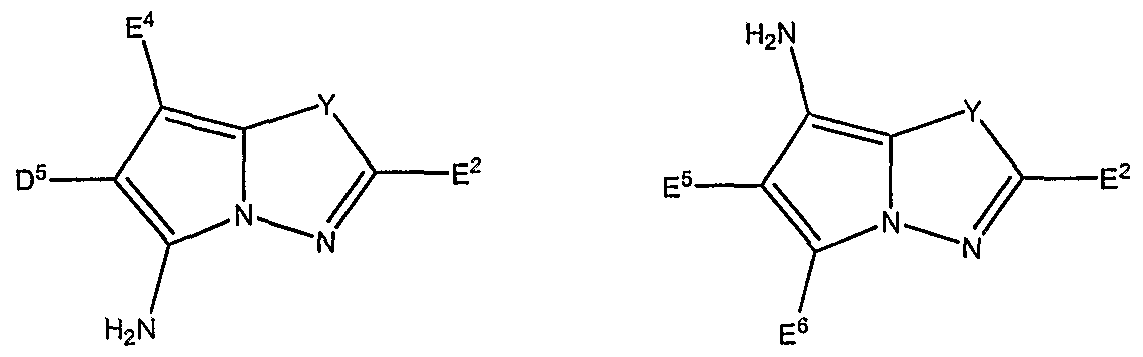
  • Preferred Developers Preferred developers of formula V are selected from the group consisting of pyrrolo[2,l-b][l,3,4]thiadiazoles and pyrrolo[2,l-b][l,3,4]oxadiazoles according to the following formulas:
  • Va (Vb) wherein Y, D 5 , E 2 , E 4 , E 5 , and E 6 are as defined above.
  • Especially preferred developers of the present invention according to formulas Va and Vb are selected from the group consisting of pyrrolo[2,l-b][l,3,4]thiadiazole-7- amine, pyrrolo[2, 1 -b] [ 1 ,3 ,4]thiadiazole-5-amine, pyrrolo[2, 1 -b] [ 1 ,3 ,4]thiadiazole-5 ,6- diamine, 5-aminopyrrolo[2,l-b][l,3,4]thiadiazole-6-ol, pyrrolo[2,l-b][l,3,4]thiadiazole- 6,7-diamine, 5-aminopyrrolo[2,l-b][l,3,4]thiadiazole-2-ol, pyrrolo[2,l- b][l,3,4]oxadiazole-7-
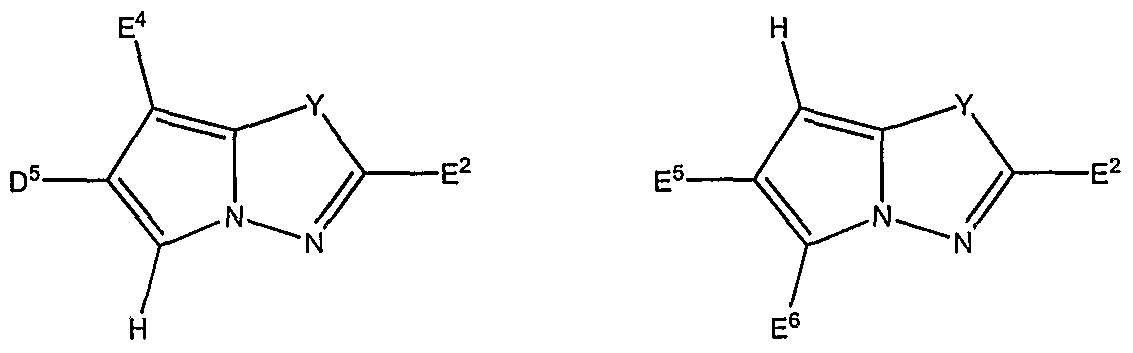
  • Preferred couplers of formula V are selected from the group consisting of pyrrolo[2,l-b][l,3,4]thiadiazoles and pyrrolo[2,l-b][l,3,4]oxadiazoles according to the following formulas:
  • Especially preferred couplers of the present invention according to formulas Vc and Vd are selected from the group consisting of pyrazolo[5,l-b]thiazol-6-amine, pyrazolo[5,l-b]thiazol-6-ol, pyrazolo[5,l-b]thiazole-2,6-diamine, pyrazolo[5,l- b]thiazole-2,6-diol, pyrazolo[5,l-b]thiazole-2,6-diol, pyrazolo[5,l-b]thiazol-2,7-diol, pyrazolo[5,l-b]oxazol-6-amine, pyrazolo[5,l-b]oxazol-6-ol, pyrazolo[5,l-b]oxazole-2,6-diamine, pyrazolo[5,l-b]oxazole- 2,6-diol
  • Especially preferred developers of the present invention according to formulas Via, VIb, and Vic are selected from the group consisting of pyrrolo[l,2- d][l ,2,4]thiadiazole-5,6-diamine, pyrrolo[l ,2-d][l ,2,4]thiadiazole-3,5,6-triamine, 5- aminopyrrolo[l ,2-d][l,2,4]thiadiazole-6-ol, pyrrolo[l,2-d][l,2,4]thiadiazole-7-amine, pyrrolo[l,2-d][l,2,4]thiadiazole-5-amine, pyrrolo[l,2-d][l,2,4]thiadiazole-6,7-diamine, 5- aminopyrrolo[l,2-d][l,2,4]thiadiazole-7
  • Preferred couplers of formula VI are selected from the group consisting of pyrrolo[l,2-d][l,2,4]thiadiazoles and pyrrolo[l,2-d][l,2,4]oxadiazoles according to the following formulas:
  • Couplers of the present invention are selected from the group consisting of pyrrolo[l,2-d][l,2,4]thiadiazole- 6,7-diamine, pyrrolo[l,2-d][l,2,4]thiadiazole-6,7-diol, pyrrolo[l,2-d][l,2,4]thiadiazole- 5,6-diamine, pyrrolo[l,2-d][l,2,4]thiadiazole-6-amine, pyrrolo[l,2-d][l,2,4]thiadiazole-6- ol, pyrrolo[l,2-d][l,2,4]oxadiazole-6,7-diamine, pyrrolo[l,2-d][l,2,4]o
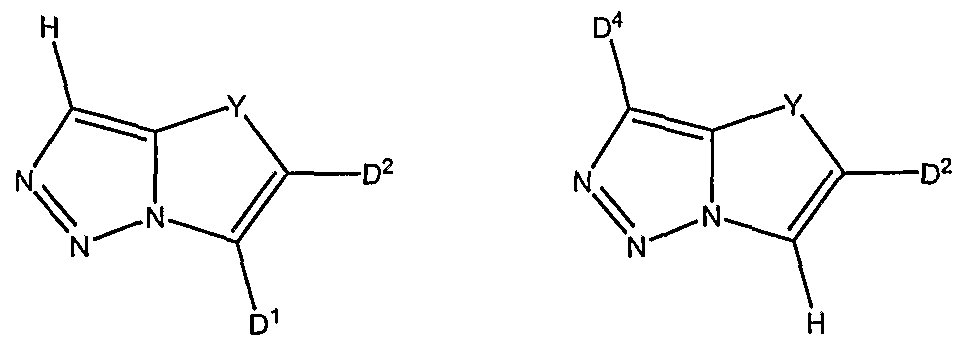
  • Especially preferred developers of the present invention according to formulas Vila and Vllb are selected from the group consisting of thiazolo[3,2-e][l,2,3]triazole-7- amine, thiazolo[3,2-e][l,2,3]triazole-2,3,7-triamine, 7-aminothiazolo[3,2- e][l,2,3]triazole-2,3-diol, 3,7-diaminothiazolo[3,2-e][l,2,3]triazole-2-ol, 2,3- diaminothiazolo[3,2-e][l ,2,3]triazole-7-ol, 3,7-triaminothiazolo[3,2-e][l ,2,3]triazole-2-ol, oxazolo[3,2-e][l,2,3]triazole-7-amine, oxazolo[3,2-e][l,2,3]triazole-7-amine, ox
  • Couplers Preferred couplers of formula VII are selected from the group consisting of thiazolo[3,2-e][l,2,3]triazoles and oxazolo[3,2-e][l,2,3]triazoles according to the following formulas:
  • Couplers of the present invention are selected from the group consisting of thiazolo[3,2-e][l,2,3]triazole-2,3- diamine, thiazolo[3,2-e][l,2,3]triazole-2,3-diol, thiazolo[3,2-e][l,2,3]triazole-2,7- diamine, 2-aminothiazolo[3 ,2-e] [1 ,2,3]triazole-7-ol, 7-aminothiazolo[3 ,2- e] [ 1 ,2 ,3 ]triazole-2-ol, oxazolo [3 ,2-e] [ 1 ,2 ,3 ]triazole-2 ,3 -diamine, oxazolo [3,2- e][l,
  • Especially preferred developers of the present invention according to formula Villa are selected from the group consisting of thiazolo[3,2-b][l,2,4]triazole-2,3,6- triamine, 3-aminothiazolo[3,2-b][l,2,4]triazole-2,6-diol, 2,3-diaminothiazolo[3,2- b][l,2,4]triazole-6-ol, oxazolo[3,2-b][l,2,4]triazole-2,3,6-triamine, 3-aminooxazolo[3,2- b][l,2,4]triazole-2,6-diol, and 2,3-diaminooxazolo[3,2-b][l,2,4]triazole-6-ol.
  • Couplers Preferred couplers of formula VIII are selected from the group consisting of thiazolo[3,2-b][l,2,4]triazoles and oxazolo [3 ,2-b][l,2,4]triazoles according to the following formula:
  • Especially preferred couplers of the present invention according to formula VHIb are selected from the group consisting of thiazolo[3,2-b][l,2,4]triazole-2,6-diamine, thiazolo[3,2-b][l ,2,4]triazole-2,6-diol, 2-aminothiazolo[3,2-b][l ,2,4]triazole-6-ol, 6- aminothiazolo[3,2-b][l,2,4]triazole-2-ol, oxazolo[3,2-b][l,2,4]triazole-2,6-diamine, oxazolo[3,2-b][l,2,4]triazole-2,6-diamine, oxazolo[3,2-b][l,2,4]triazole-2,6-diol, 2-aminooxazolo[3,2-b][l,2,4]triazole-6-ol, and 6- aminooxazolo
  • IXa (IXb) wherein Y, D 1 , D 2 , and D 6 are as defined above.
  • Especially preferred developers of the present invention according to formulas IXa and IXb are selected from the group consisting of thiazolo[2,3-c][l,2,4]triazole-5- amine, thiazolo[2,3-c][l,2,4]triazole-2,3,5-triamine, 3-aminothiazolo[2,3- c][l,2,4]triazole-2,5-diol, 2,5-diaminothiazolo[2,3-c][l,2,4]triazole-3-ol, 5- aminothiazolo[2,3-c][l,2,4]triazole-2,3-diol, 3,5-diaminothiazolo[2,3-c][l,2,4]triazole-2- ol, oxazolo[2,3-c][l,2,
  • Couplers Preferred couplers of formula IX are selected from the group consisting of thiazolo[2,3-c][l,2,4]triazoles and oxazolo[2,3-c][l,2,4]triazoles according to the following formulas: (IXc) (IXd) wherein Y, D , D , and D are as defined above.
  • Especially preferred couplers of the present invention according to formulas IXc and IXd are selected from the group consisting of thiazolo[2,3-c][l,2,4]triazole-2,3- diamine, thiazolo[2,3-c][l,2,4]triazole-2,3-diol, thiazolo[2,3-c][l,2,4]triazole-2,5-diol, thiazolo[2,3-c][l,2,4]triazole-2,5-diamine, oxazolo[2,3-c][l,2,4]triazole-2,3-diamine, oxazolo[2,3-c][l,2,4]triazole-2,3-diol, oxazolo[2,3-c][l,2,4]triazole-2,5-diol, and oxazolo[2,3-c][l,2,4]triazole-2
  • Especially preferred developers of the present invention according to formula Xa are selected from the group consisting of pyrazolo[5,l-b][l,3,4]thiadiazole-7-amine, pyrazolo[5,l-b][l,3,4]thiadiazole-2,6,7-triamine, 7-aminopyrazolo[5,l- b][l,3,4]thiadiazole-2,6-diol, 6,7-diaminopyrazolo[5,l-b][l,3,4]thiadiazole-2-ol, 2,7- diaminopyrazolo[5 , 1 -b] [ 1 ,3 ,4]thiadiazole-6-ol, pyrazolo[5 , 1 -b] [ 1 ,3 ,4]oxadiazole-7- amine, pyrazolo[5 , 1 -b] [ 1 ,3 ,4]oxadiazole-7- amine, pyrazolo[
  • Couplers Preferred couplers of formula X are selected from the group consisting of pyrazolo[5,l-b][l,3,4]thiadiazoles and pyrazolo[5,l-b][l,3,4]oxadiazoles according to the following formula:
  • Especially preferred couplers of the present invention according to formula Xb are selected from the group consisting of pyrazolo[5,l-b][l,3,4]thiadiazole-2,6-diamine, pyrazolo[5 , 1 -b] [ 1 ,3 ,4]thiadiazole-2,6-diol, 2-aminopyrazolo[5 , 1 -b] [ 1 ,3 ,4]thiadiazole-6-ol, 6-aminopyrazolo [5 , 1 -b] [ 1 ,3 ,4]thiadiazole-2-ol, pyrazolo [5 , 1 -b] [ 1 ,3 ,4] oxadiazole-2, 6- diamine, pyrazolo[5,l-b][l,3,4]oxadiazole-2,6-diol, 2-aminopyrazolo[5,l-
  • Especially preferred developers of the present invention according to formulas XIa and Xlb are selected from the group consisting of imidazo [5,1 -b][ 1,3, 4]thiadiazole-7- amine, imidazo[5,l-b][l,3,4]thiadiazole-2,5,7-triamine, 7-aminoimidazo[5,l- b][l,3,4]thiadiazole-2,5-diol, 2,7-diaminoimidazo[5,l-b][l,3,4]thiadiazole-5-ol, 5- aminoimidazo[5,l-b][l,3,4]thiadiazole-2,7-diol, 2,5-diaminoimidazo[5,l- b] [1 ,3 ,4]thiadiazole-7-ol, imidazo[5 , 1 -b] [ 1 ,3 ,4]thiadiazole-7-ol, imidazo[5 , 1 -b] [ 1 ,3
  • Couplers Preferred couplers of formula XI are selected from the group consisting of imidazo[5,l-b][l,3,4]thiadiazoles and imidazo[5,l-b][l,3,4]oxadiazoles according to the following formulas:
  • Especially preferred couplers of the present invention according to formulas XIc and Xld are selected from the group consisting of imidazo[5,l-b][l,3,4]thiadiazole-2,5- diamine, imidazo[5,l-b][l,3,4]thiadiazole-2,5-diol, 2-aminoimidazo[5,l- b][l,3,4]thiadiazole-5-ol, 5-aminoimidazo[5,l-b][l,3,4]thiadiazole-2-ol, imidazo[5,l- b] [ 1 ,3 ,4]thiadiazole-2,7-diamine, imidazo[5 , 1 -b] [ 1 ,3 ,4]thiadiazole-2,7-diol, 2- aminoimidazo[5 , 1 -b] [ 1 ,3 ,
  • Especially preferred developers of the present invention according to formula Xlla are selected from the group consisting of imidazo[2,l-b][l,3,4]thiadiazole-5-amine, imidazo[2,l-b][l,3,4]thiadiazole-2,5,6-triamine, 5,6-diaminoimidazo[2,l- b][l,3,4]thiadiazole-2-ol, 5-aminoimidazo[2,l-b][l,3,4]thiadiazole-2,6-diol, 2,5- diaminoimidazo[2, 1 -b] [ 1 ,3 ,4]thiadiazole-6-ol, imidazo[2, 1 -b] [ 1 ,3 ,4]oxadiazole-5-amine, imidazo[2,l-b][l,3,4]oxadiazole-2,5,6-triamine, 5,6-diaminoimidazo[2,l- b][
  • Couplers Preferred couplers of formula XII are selected from the group consisting of imidazo[2,l-b][l,3,4]thiadiazoles and imidazo [2, l-b][ 1,3 ,4] oxadiazoles according to the following formula:
  • Especially preferred couplers of the present invention according to formula Xllb are selected from the group consisting of imidazo[2,l-b][l,3,4]thiadiazole-2,6-diamine, imidazo[2,l-b][l,3,4]thiadiazole-2,6-diol, 2-aminoimidazo[2,l-b][l,3,4]thiadiazole-6-ol, 6-aminoimidazo[2, 1 -b] [ 1 ,3 ,4]thiadiazole-2-ol, imidazo[2, 1 -b] [ 1 ,3 ,4]oxadiazole-2,6- diamine, imidazo[2, 1 -b][ 1 ,3,4]oxadiazole-2,6-diol, 2-aminoimidazo[2, 1 - b] [ 1 ,3 ,4] oxadiazole-6-ol, and 6-aminoimidazo[2, 1 - b] [ 1 ,3 ,4]
  • Example D Imidazo[2,l-b][l,3]thiazole-5,6-diamine, obtainable from the following synthesis strategy: TN CICH 2 C0 2 H y- NH2 — ⁇ —
  • Example F Imidazo[5,l-b][l,3]thiazol-7-amine, obtainable from the following synthesis strategy:
  • Example G Imidazo[5,l-b][l,3]oxazol-7-amine, obtainable from the following synthesis strategy:
  • Example H Imidazo[2,l-b][l,3,4]thiadiazol-6-amine, obtainable from the following synthesis strategy:
  • Example K Imidazo[5,l-b]thiazole-7-amine 7, obtainable from the following synthesis strategy:
  • Example L 2-Methyl-imidazo[5,l-b]oxazol-7-amine 6, obtainable from the following synthesis strategy: Me-C(0)CH 2 CI
  • compositions for the oxidative dyeing of keratin fibers comprise the hair-dyeing compound described above in the hair-dyeing compounds section and a medium suitable for dyeing.
  • inventive compositions may further comprise additional components known, conventionally used, or otherwise effective for use in oxidative dye compositions, including but limited to: developer dye compounds; coupler dye compounds; direct dyes; oxidizing agents; thickeners; chelants; pH modifiers and buffering agents; carbonate ion sources and radical scavenger systems; anionic, cationic, nonionic, amphoteric or zwitterionic surfactants, or mixtures thereof; anionic, cationic, nonionic, amphoteric or zwitterionic polymers, or mixtures thereof; fragrances; buffers; dispersing agents; peroxide stabilizing agents; natural ingredients, e.g. proteins and protein derivatives, and plant materials (e.g.
  • the medium suitable for dyeing may be selected from water, or a mixture of water and at least one organic solvent to dissolve the compounds that would not typically be sufficiently soluble in water.
  • Suitable organic solvents for use herein include, but are not limited to: CI to C4 lower alkanols (e.g., ethanol, propanol, isopropanol), aromatic alcohols (e.g.
  • polyols and polyol ethers e.g., carbitols, 2-butoxyethanol, propylene glycol, propylene glycol monomethyl ether, diethylene glycol monoethyl ether, monomethyl ether, hexylene glycol, glycerol, ethoxy glycol), and propylene carbonate.
  • organic solvents are typically present in an amount ranging from 1% to 30%, by weight, of the composition.
  • Preferred solvents are water, ethanol, propanol, isopropanol, glycerol, 1,2-propylene glycol, hexylene glycol, ethoxy diglycol, and mixtures thereof.
  • Suitable developers for use in the compositions described herein include, but are not limited to p-phenylenediamine derivatives, e.g. benzene- 1,4-diamine (commonly known as p-phenylenediamine), 2 -methyl-benzene- 1,4-diamine, 2-chloro-benzene- 1,4- diamine, N-phenyl-benzene- 1,4-diamine, N-(2-ethoxyethyl)benzene- 1,4-diamine, 2-[(4- amino-phenyl)-(2-hydroxy-ethyl)-amino]-ethanol, (commonly known as N,N-bis(2- hydroxyethyl)-p-phenylenediamine) (2,5-diamino-phenyl)-methanol, 1 -(2'-
  • Additional developers are selected from the group consisting of N-(3- furylmethyl)benzene- 1 ,4-diamine; ⁇ -Thiophen-3 -ylmethyl-benzene- 1 ,4-diamine; N-(2- furylmethyl)benzene- 1 ,4-diamine; ⁇ -Thiophen-2 -ylmethyl-benzene- 1 ,4-diamine; 4- Hydroxy-benzoic acid (2,5-diamino-benzylidene)-hydrazide; 3-(2,5-Diamino-phenyl)-N- ethyl-acrylamide; 2- [3 -(3 -Amino-phenylamino)-propenyl]-benzene- 1,4-diamine; 2-[3-(4- Amino-phenylamino)-propenyl]-benzene- 1 ,4-diamine; 2-(6-Methyl-pyridin-2-yl)-
  • Phenylaminomethyl-benzene-l,3-diamine hydrochloride 5-(3-Amino- phenyl)aminomethyl-benzene- 1 ,3-diamine hydrochloride; 4-Thiophen-3-yl-benzene- 1 ,3- diamine; hydrochloride; 2',4'-Diamino-biphenyl-4-ol; hydrochloride; 5-Cyclobutylamino- 2-methyl-phenol; 5-Cyclobutylamino-2-methyl-phenol; 4-Amino-2-(pyridin-3- ylaminomethyl)-phenol; 5-(3-Amino-phenyl)aminomethyl-benzene-l,3-diamine hydrochloride; 5 -AUylaminomethyl-benzene- 1,3 -diamine hydrochloride; N-(4-Amino- benzyl)-benzene- 1 ,3-diamine hydrochloride; N
  • Preferred developers include but are not limited to: p-phenylenediamine derivatives such as: 2-methyl-benzene- 1,4-diamine; benzene- 1,4-diamine; l-(2,5- diamino-phenyl)-ethanol; 2-(2,5-diamino-phenyl)-ethanol; N-(2-methoxyethyl)benzene- 1,4-diamine; 2-[(4-amino-phenyl)-(2-hydroxy-ethyl)-amino]-ethanol; l-(2,5- diaminophenyl)ethane-l,2-diol; l-(2'-Hydroxyethyl)-2,5-diaminobenzene; l,3-Bis(N(2- Hydroxyethyl)-N-(4-amino-phenyl)amino)-2 -propanol; 2,2'-[ 1 ,2-Ethane
  • More preferred developers include: 2-methyl-benzene- 1,4-diamine; benzene- 1,4- diamine; N,N-Bis(2-hydroxyethyl)-p-phenylenediamine; 4-amino-phenol; 4- methylamino-phenol; 4-amino-3-methyl-phenol; l-Hydroxy-2,4-diaminobenzene; 2- amino-phenol; 2-amino-5-methyl-phenol; 2-amino-6-methyl-phenol; 1 -methyl- 1H- pyrazole-4,5-diamine; l-Hydroxyethyl-4,5-diaminopyrazole sulphate; 2-(4,5-diamino- 1 H-pyrazol- l-yl)ethanol; and mixtures thereof.
  • Suitable couplers for use in the compositions described herein include, but are not limited to: phenols, resorcinol and naphthol derivatives such as: naphthalene- 1 ,7-diol, benzene-l,3-diol, 4-chlorobenzene-l,3-diol, naphthalen-1-ol, 2-methyl-naphthalen-l-ol, naphthalene- 1,5-diol, naphthalene-2,7-diol, benzene- 1,4-diol, 2-methyl-benzene- 1,3-diol, 7-amino-4-hydroxy-naphthalene-2-sulfonic acid, 2-isopropyl-5-methylphenol, 1,2,3,4- tetrahydro-naphthalene- 1 ,5-diol, 2-chloro-benzene-l ,3-d
  • Additional couplers are selected from the group consisting of N-(3- furylmethyl)benzene- 1 ,4-diamine; ⁇ -Thiophen-3 -ylmethyl-benzene- 1 ,4-diamine; N-(2- furylmethyl)benzene- 1 ,4-diamine; ⁇ -Thiophen-2-ylmethyl-benzene- 1 ,4-diamine; 4- Hydroxy-benzoic acid (2,5-diamino-benzylidene)-hydrazide; 3-(2,5-Diamino-phenyl)-N- ethyl-acrylamide; 2-[3-(3-Amino-phenylamino)-propenyl]-benzene-l,4-diamine; 2-[3-(4- Amino-phenylamino)-propenyl]-benzene- 1 ,4-diamine; 2-(6-Methyl-pyridin-2-yl)-
  • Phenylaminomethyl-benzene- 1,3-diamine hydrochloride 5-(3-Amino- phenyl)aminomethyl-benzene- 1,3-diamine hydrochloride; 4-Thiophen-3-yl-benzene-l,3- diamine; hydrochloride; 2',4'-Diamino-biphenyl-4-ol; hydrochloride; 5-Cyclobutylamino- 2-methyl-phenol; 5-Cyclobutylamino-2-methyl-phenol; 4-Amino-2-(pyridin-3- ylaminomethyl)-phenol; 5-(3-Amino-phenyl)aminomethyl-benzene-l,3-diamine hydrochloride; 5-AUylaminomethyl-benzene-l,3-diamine hydrochloride; N-(4-Amino- benzyl)-benzene- 1 ,3-diamine hydrochloride; N-Benzyl-benz
  • Preferred couplers include but are not limited to: phenol, resorcinol, and naphthol derivatives such as: naphthalene- 1,7-diol, benzene-l,3-diol, 4-chlorobenzene- 1,3-diol, naphthalen-1-ol, 2-methyl-naphthalen-l-ol, naphthalene- 1,5-diol, naphthalene-2,7-diol, benzene- 1,4-diol, 2-methyl-benzene- 1,3-diol, and 2-isopropyl-5-methylphenol; 1,2,4- Trihydroxybenzene; l-Acetoxy-2-methylnaphthalene;and mixtures thereof; m- phenylenediamine derivatives such as: benzene- 1,3 -diamine, 2-(2,4-diamino-phenoxy)- ethanol, 4- ⁇ 3-[(2,4-
  • More preferred couplers include: benzene- 1,3-diol; 4-chlorobenzene- 1,3-diol; 2- methyl-benzene- 1,3-diol; benzene- 1,3 -diamine; 3-amino-phenol; 5-amino-2-methyl- phenol; 1 -Methyl-2-hydroxy-4-(2'-hydroxyethyl)aminobenzene; 4-methyl-2-phenyl-2,4- dihydro-3H-pyrazol-3-one; 2-aminopyridin-3-ol; l-phenyl-3-methylpyrazol-5-one; 1- Phenyl-3-methyl-5-pyrazolone-2,4-dihydro-5,2-phenyl-3H-pyrazole-3-one; and mixtures thereof.
  • Additional preferred developers and couplers include 5-methoxymethyl-2- aminophenol, 5-ethyl-2-aminophenol, 5-phenyl-2-aminophenol, and 5-cyanoethyl-2- aminophenol.
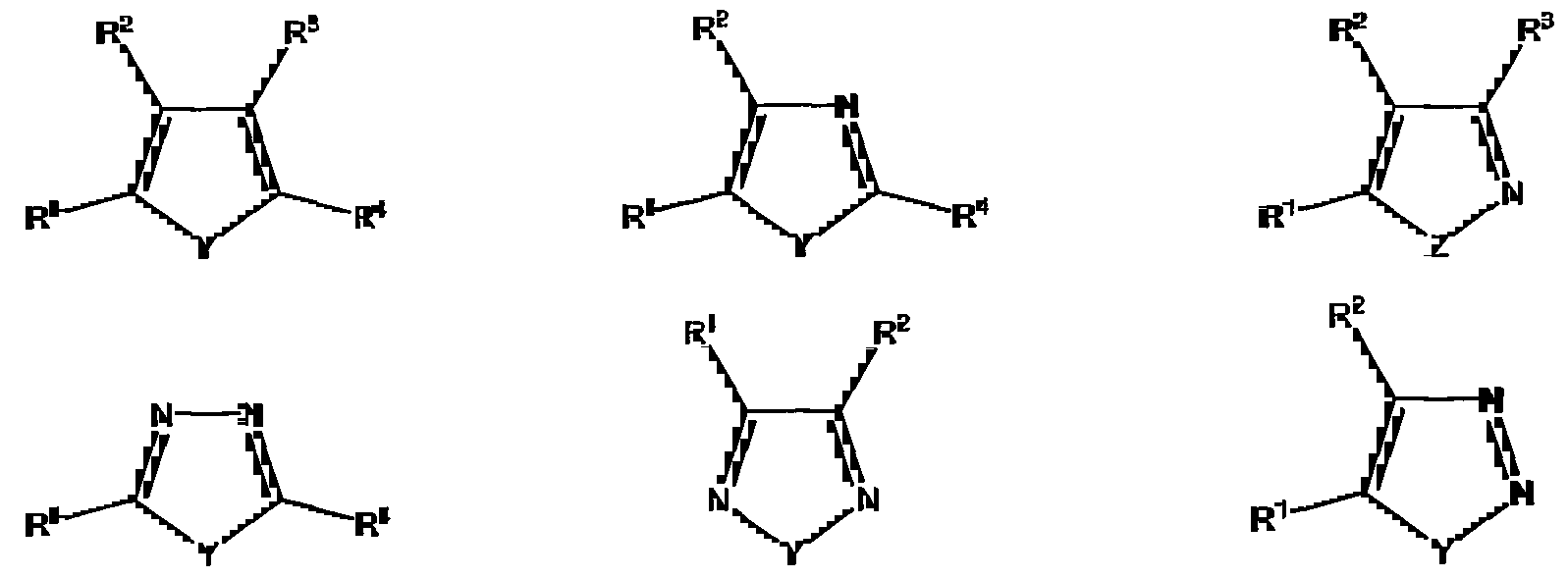
  • Further additional preferred developers and couplers include: 5-membered heteroaromatic keratin dyeing compounds with one, two, or three heteroatoms relating to the following compounds:
  • Z is selected from the group consisting of S and O; wherein Y is selected from the group consisting of NA 1 , S and O; Bicyclic fused 5-5 heteroaromatic keratin dyeing compounds with two or three heteroatoms relating to the following compounds:
  • Y and Z are independently selected from the group consisting of NA 1 , S and O; Tricyclic 5-6-5 heteroaromatic keratin dyeing compounds having two heteroatoms according to the following formulas:
  • Y and Z are selected from the group consisting of NA 1 , S, and O; Bicyclic 5-6 heteroaromatic keratin dyeing compounds with one ring junction nitrogen and one or two extra heteroatoms according to the following formulas:
  • Tricyclic fused 6-5-6 heteroaromatic keratin dyeing compounds having one heteroatom according to the following formula:
  • Y is independently selected from the group consisting of NA 1 , S and O; 5-membered aza heteroaromatic keratin dyeing compounds with an N-hydroxy or N- amino group and derivatives thereof, according to the following formulas:
  • Bi, B 2 , B 3 , and B 4 are selected from the group consisting of CH and N; wherein the corresponding R 1 , R 2 , R 3 ,and R 4 is absent when B is N; Bicyclic 5-6 systems of aza heteroaromatic keratin dyeing compounds wherein the 5- membered rings have one to three nitrogen atoms and an N-hydroxy or N-amino group and derivatives thereof, according to the following formulas: II wherein Bi and B 2 are independently selected from CH or N; wherein the corresponding R 1 and R 2 is absent when B is N;
  • Bicyclic fused 5-5-membered aza heteroaromatic keratin dyeing compounds having a ring junction nitrogen and an N-hydroxy or N-amino group and derivatives thereof, according to the following formulas:
  • Bicyclic fused 5-5-membered aza heteroaromatic keratin dyeing compounds having a ring junction nitrogen and an N-hydroxy or N-amino group and derivatives thereof, according to the following formulas:
  • a B wherein Bi, B 2 , B 3 , B 4 , and B 5 are selected from the group consisting of CH and N; wherein the corresponding R1,R2, R3, R4 , and R5 is absent when B is N; wherein all of the aforementioned R groups are the same or different and are selected from the group consisting of: (a) C-linked monovalent substituents selected from the group consisting of: (i) substituted or unsubstituted, straight or branched, alkyl, mono- or poly- unsaturated alkyl, heteroalkyl, aliphatic, heteroaliphatic, or heteroolefinic systems, (ii) substituted or unsubstituted, mono- or poly-cyclic aliphatic, aryl, or heterocyclic systems, and (iii) substituted or unsubstituted, mono-, poly-, or per-fluoro alkyl systems; wherein said systems of (i), (ii) and (iii) comprise from about 1 to about 10
  • a 2 O-linked monovalent substituents selected from the group consisting of OA 1 , and ONA ! A 2 ;
  • inventive compositions may also comprise compatible direct dyes, in an amount sufficient to provide additional coloring, particularly with regard to intensity. Typically, such an amount will range from 0.05% to 4%, by weight, of the composition.
  • Suitable direct dyes include but are not limited to: Acid Yellow 1, Acid Orange 3, Disperse Red 17, Basic Brown 17, Acid Black 52, Acid Black 1, Disperse Violet 4, 4- Nitro-o-Phenylenediamine, 2-Nitro-p-Phenylenediamine, Picramic Acid, HC Red No. 13, l,4-Bis-(2'-Hydroxyethyl)-amino-2-nitrobenzene, HC Yellow No. 5, HC Red No. 7, HC Blue No. 2, HC Yellow No.
  • HC Red No. 8 HC Green No. 1, HC Red No. 9, 2-Hydroxy-l,4-naphthoquinone, Acid Blue 199, Acid Blue 25, Acid Red 4, Henna Red, Indigo, Cochenille, HC Blue 14, Disperse Blue 23, Disperse Blue 3, Violet 2, Disperse Blue 377, Basic Red 51, Basic Orange 31, Basic Yellow 87, and mixtures thereof.
  • Preferred direct dyes include but are not limited to: Disperse Black 9, HC Yellow 2, HC Yellow 4, HC Yellow 15, 4-nitro-o- phenylenediamine, 2-amino-6-chloro-4-nitrophenol, HC Red 3, Disperse Violet 1, HC Blue 2, Disperse Blue 3, Disperse Blue 377, Basic Red 51, Basic Orange 31, Basic Yellow 87, and mixtures thereof.
  • the inventive compositions may comprise an oxidizing agent, present in an amount sufficient to bleach melanin pigment in hair and/or cause formation of dye chromophores from oxidative dye precursors (including developers and/or couplers when present).
  • Inorganic peroxygen materials capable of yielding hydrogen peroxide in an aqueous medium are preferred, and include but are not limited to: hydrogen peroxide; inorganic alkali metal peroxides (e.g. sodium periodate and sodium peroxide); organic peroxides (e.g. urea peroxide, melamine peroxide); inorganic perhydrate salt bleaching compounds (e.g.
  • compositions may comprise a thickener in an amount sufficient to provide the composition with a viscosity so that it can be readily applied to the hair without unduly dripping off the hair and causing mess. Typically, such an amount will be at least 0.1%, preferably at least 0.5%, more preferably, at least 1%, by weight, of the composition.
  • salt tolerant thickeners including but not limited to: xanthan, guar, hydroxypropyl guar, scleroglucan, methyl cellulose, ethyl cellulose (available as AQUACOTE (TM)), hydroxyethyl cellulose (NATROSOL (TM)), carboxymethyl cellulose, hydroxypropylmethyl cellulose, microcrystalline cellulose, hydroxybutylmethyl cellulose, hydroxypropyl cellulose (available as KLUCEL (TM)), hydroxyethyl ethyl cellulose, cetyl hydroxyethyl cellulose (available as NATROSOL (TM) Plus 330), N-vinylpyrollidone (available as POVIDONE (TM)), Acrylates/Ceteth- 20 Itaconate Copolymer (available as STRUCTURE (TM) 3001), hydroxypropyl starch phosphate (available as STRUCTURE (TM) ZEA), polyethoxylated
  • PEG-150/Decyl/SMDI copolymer available as ACULYN(TM) 44
  • PEG-150/Stearyl/SMDI copolymer available as ACULYN(TM) 46
  • trihydroxystearin available as THIXCIN(TM)
  • acrylates copolymer e.g. available as ACULYN(TM) 33
  • hydrophobically modified acrylate copolymers e.g.
  • the inventive compositions may comprise chelants in an amount sufficient to reduce the amount of metals available to interact with formulation components, particularly oxidizing agents, more particularly peroxides. Typically such an amount will range from at least 0.25%, preferably at least 0.5%, by weight, of the composition.
  • Suitable chelants for use herein include but are not limited to: diamine-N,N'-dipolyacid, monoamine monoamide-N,N'-dipolyacid, and N,N'-bis(2- hydroxybenzyl)ethylenediamine-N,N'-diacetic acid chelants (preferably EDDS (ethylenediaminedisuccinic acid)), carboxylic acids (preferably aminocarboxylic acids), phosphonic acids (preferably aminophosphonic acids) and polyphosphoric acids (in particular straight polyphosphoric acids), their salts and derivatives.
  • diamine-N,N'-dipolyacid preferably aminocarboxylic acids
  • phosphonic acids preferably aminophosphonic acids
  • polyphosphoric acids in particular straight polyphosphoric acids
  • the inventive compositions may further comprise a pH modifier and/or buffering agent in an amount that is sufficiently effective to adjust the pH of the composition to fall within a range from 3 to 13, preferably from 8 to 12, more preferably from 9 to 11.
  • Suitable pH modifiers and/or buffering agents for use herein include, but are not limited to: ammonia, alkanolamides such as monoethanolamine, diethanolamine, triethanolamine, monopropanolamine, dipropanolamine, tripropanolamine, tripropanolamine, 2-amino-2- methyl-1 -propanol, and 2-amino-2-hydroxymethyl-l,3,-propandiol and guanidium salts, alkali metal and ammonium hydroxides and carbonates, preferably sodium hydroxide and ammonium carbonate, and acidulents such as inorganic and inorganic acids, e.g., phosphoric acid, acetic acid, ascorbic acid, citric acid or tartaric acid, hydro
  • the inventive compositions may comprise a system comprising a source of carbonate ions, carbamate ions and or hydrocarbonate ions, and a radical scavenger, in a sufficient amount to reduce damage to the hair during the coloring process.
  • a source of carbonate ions, carbamate ions and or hydrocarbonate ions, and a radical scavenger in a sufficient amount to reduce damage to the hair during the coloring process.
  • such an amount will range from 0.1% to 15%, preferably 0.1% to 10%, more preferably 1% to 7%, by weight of the composition, of the carbonate ion, and from 0.1% to 10%, preferably from 1% to 7%, by weight of the composition, of radical scavenger.
  • the radical scavenger is present at an amount such that the ratio of radical scavenger to carbonate ion is from 1:1 to 1:4.
  • the radical scavenger is preferably selected such that it is not an identical species as the alkalizing agent.
  • Suitable sources for the ions include but are not limited to: sodium carbonate, sodium hydrogen carbonate, potassium carbonate, potassium hydrogen carbonate, guanidine carbonate, guanidine hydrogen carbonate, lithium carbonate, calcium carbonate, magnesium carbonate, barium carbonate, ammonium carbonate, ammonium hydrogen carbonate and mixtures thereof.
  • Preferred sources of carbonate ions are sodium hydrogen carbonate and potassium hydrogen carbonate. Also preferred are ammonium carbonate, and ammonium hydrogen carbonate.
  • the radical scavenger is a species that can react with a carbonate radical to convert the carbonate radical by a series of fast reactions to a less reactive species.
  • radical scavengers may be selected from the classes of alkanolamines, amino sugars, amino acids and mixtures thereof, and may include, but are not limited to: monoethanolamine, 3-amino- 1 -propanol, 4-amino-l- butanol,5-amino-l-pentanol, l-amino-2-propanol, l-amino-2-butanol, l-amino-2- pentanol, l-amino-3-pentanol, l-amino-4-pentanol, 3-amino-2-methylpropan-l-ol, 1- amino-2-methylpropan-2-ol, 3-aminopropane-l,2-diol, glucosamine, N- acetylglucosamine,
  • compositions of this invention may be obtained using conventional methods. A general description of how to make the compounds is provided above and specific examples are provided below.
  • the compositions of this invention may also be obtained using conventional methods.
  • the keratin dyeing compositions may be formed as solutions, preferably as aqueous or aqueous-alcohol solutions.
  • the hair dye product compositions may preferably be formed as thick liquids, creams, gels, or emulsions whose composition is a mixture of the dye compound and other dye ingredients with conventional cosmetic additive ingredients suitable for the particular preparation.
  • inventive keratin dyeing compositions may be used by admixing them with a suitable oxidant, which reacts with the oxidative dye precursors to develop the hair dye product composition.
  • the oxidant is usually provided in an aqueous composition, which normally is provided as a separate component of the finished keratin dyeing product system and present in a separate container.
  • the adjuvants are provided in the hair dye composition as it is applied to the hair to achieve desired product attributes, e.g., pH, viscosity, rheology, etc.
  • the keratin dyeing composition as it is applied to the hair, can be weakly acidic, neutral or alkaline according to their composition, typically having a pH from 6 to 11, preferably from 7 to 10, more preferably from 8 to 10.
  • the pH of the developer composition is typically acidic, and generally the pH is from 2.5 to 6.5, preferably from 3 to 5.
  • the pH of the hair compositions may be adjusted using a pH modifier as mentioned above.
  • the above-described compositions are mixed immediately prior to use and a sufficient amount of the mixture is applied to the hair, according to the hair abundance, generally from 60 to 200 grams. Upon such preparation the hair dye composition is applied to the hair to be dyed and remains in contact with the hair for an amount of time effective to dye the hair.
  • the hair dye composition is allowed to act on the hair for 2 to 60, preferably 15 to 45, more preferably, 30 minutes, at a temperature ranging from 15° to 50°C. Thereafter, the hair is rinsed with water, to remove the hair dye composition and dried. If necessary, the hair is washed with a shampoo and rinsed, e.g., with water or a weakly acidic solution, such as a citric acid or tartaric acid solution, and dried. Optionally, a separate conditioning product may also be provided. Together, components of the keratin dyeing composition form a system for dyeing hair. This system may be provided as a kit comprising in a single package separate containers of the keratin dyeing composition components or other hair treatment product, and instructions for use.
  • compositions of the present invention are non-limiting examples of the compositions of the present invention.
  • the examples are given solely for the purpose of illustration and are not to be construed as limitations of the present invention, as many variations thereof are possible without departing from the spirit and scope of the invention, which would be recognized by one of ordinary skill in the art.
  • all concentrations are listed as weight percent, unless otherwise specified.
  • minors refers to those optional components such as preservatives, viscosity modifiers, pH modifiers, fragrances, foam boosters, and the like. As is apparent to one of ordinary skill in the art, the selection of these minors will vary depending on the physical and chemical characteristics of the particular ingredients selected to make the present invention as described herein.
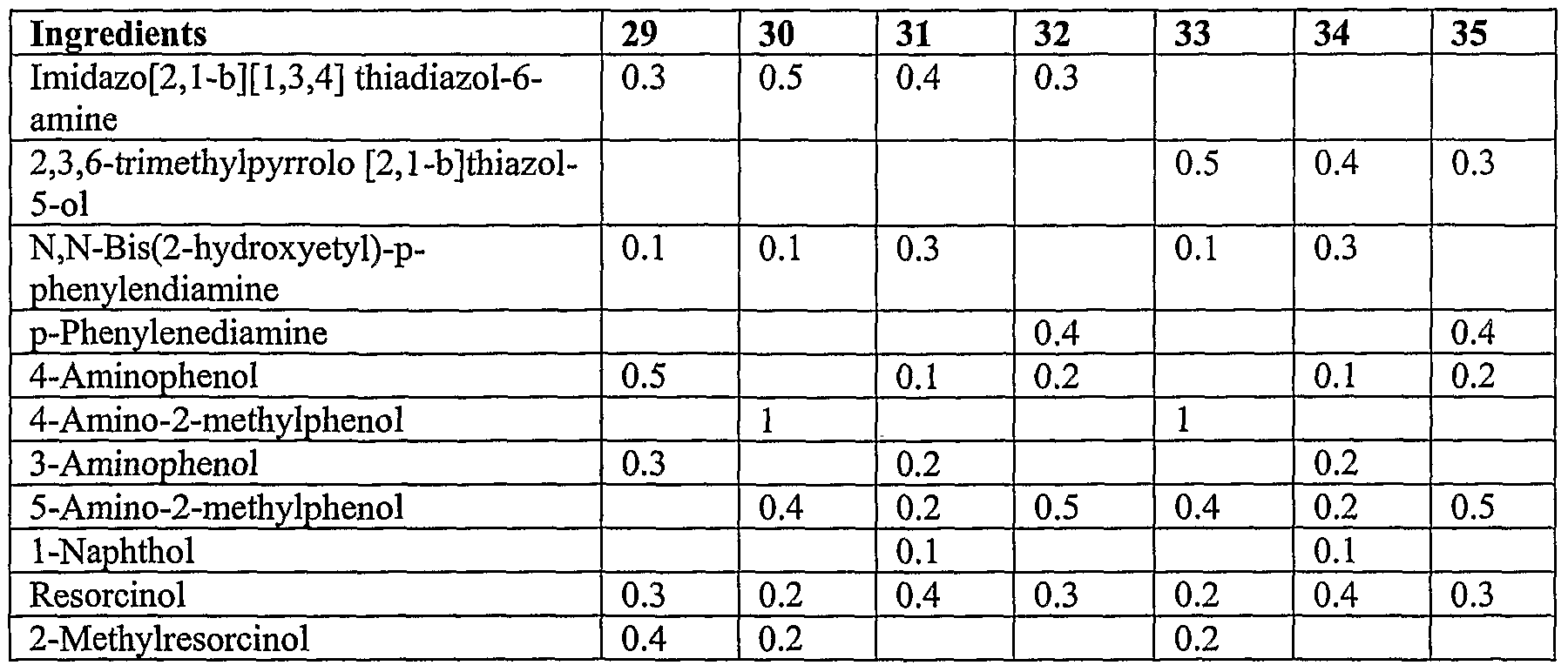
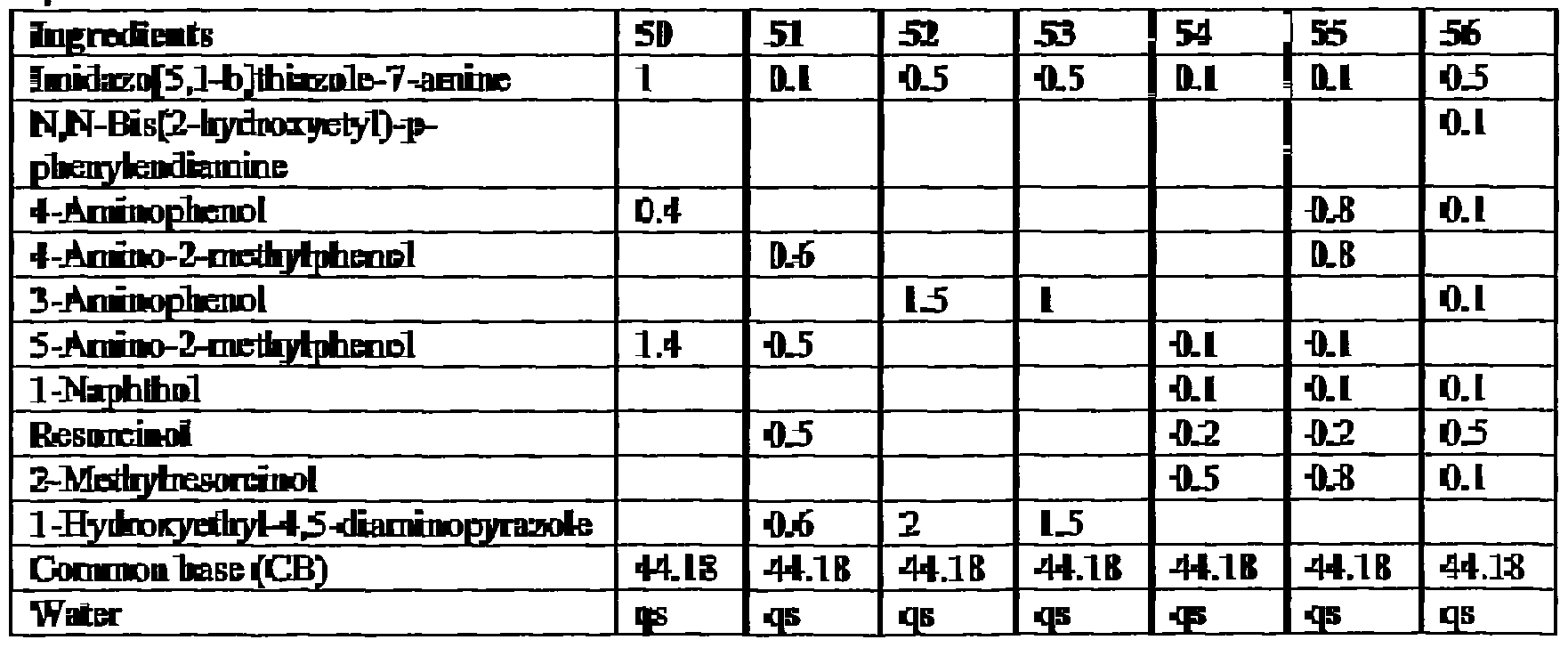
  • the following compositions can be used for dyeing hair.

Landscapes

  • Health & Medical Sciences (AREA)
  • Life Sciences & Earth Sciences (AREA)
  • Animal Behavior & Ethology (AREA)
  • General Health & Medical Sciences (AREA)
  • Public Health (AREA)
  • Veterinary Medicine (AREA)
  • Birds (AREA)
  • Epidemiology (AREA)
  • Nitrogen And Oxygen Or Sulfur-Condensed Heterocyclic Ring Systems (AREA)
  • Cosmetics (AREA)
  • Plural Heterocyclic Compounds (AREA)

Abstract

Compositions for the oxidative dyeing of keratin fibers, comprising a medium suitable for dyeing and one or more bicyclic 5-5 heteroaromatic compounds having a ring junction nitrogen and incorporating thia or oxa heteroatoms heteroatoms. A method for oxidative dyeing of keratin fibers, comprising applying such compositions in the presence of an oxidizing agent, for a period sufficient to develop the desired coloration.

Description

KERATIN DYEING COMPOUNDS, KERATIN DYEING COMPOSITIONS CONTAINING THEM, AND USE THEREOF
Field of Invention This invention relates to bicyclic 5-5 heteroaromatic compounds having a ring junction nitrogen and incorporating thia or oxa heteroatoms, compositions for the oxidative dyeing of keratin fibers (preferably hair) comprising such compounds, and use thereof. Background of the Invention The most extensively used method currently employed to color hair is by an oxidative process that utilizes one or more oxidative hair coloring agents in combination with one or more oxidizing agents. Commonly, a peroxy oxidizing agent is used in combination with one or more developers or couplers, generally small molecules capable of diffusing into hair. In this procedure, a peroxide material, such as hydrogen peroxide, activates the developers so that they react with the couplers to form larger sized compounds in the hair shaft to give a variety of shades and colors. A wide variety of developers and couplers have been employed in such oxidative hair coloring systems and compositions. However, there still exists a need for additional keratin dyeing compounds that can act as both developers and couplers that safely provide color benefits. Summary of the Invention This invention relates to bicyclic 5-5 heteroaromatic compounds having a ring junction nitrogen and incorporating thia or oxa heteroatoms heteroatoms according to the formulas defined herein. This invention also relates to a composition for the oxidative dyeing of keratin fibers, comprising a medium suitable for dyeing and one or more bicyclic 5-5 heteroaromatic compounds having a ring junction nitrogen and incorporating thia or oxa heteroatoms heteroatoms. This invention further relates to a method for oxidative dyeing of keratin fibers, comprising applying such compositions in the presence of an oxidizing agent, for a period sufficient to develop the desired coloration. The keratin dyeing compounds of the present invention can act as a developer and/or a coupler. It is to be understood that within the scope of this invention, numerous potentially and actually tautomeric compounds are involved. Thus, for example, 2-mercaptopyridine (I) exists under known conditions in the pyridine-2-thione tautomer form (II):
Figure imgf000003_0001
(I) (II)
It is to be understood that when this development refers to a particular structure, all of the reasonable additional tautomeric structures are included. In the art, tautomeric structures are frequently represented by one single structure and the present invention follows this general practice. Detailed Description of the Invention While the specification concludes with claims that particularly point out and distinctly claim the invention, it is believed the present invention will be better understood from the following description. The present invention relates to bicyclic 5-5 heteroaromatic compounds having a ring junction nitrogen and incorporating thia or oxa heteroatoms. The compounds of the present invention can act as both developers and/or couplers that safely provide color benefits. Herein, "comprising" means that other steps and other ingredients which do not affect the end result can be added. This term encompasses the terms "consisting of and "consisting essentially of. The compounds/compositions and methods/processes of the present invention can comprise, consist of, and consist essentially of the essential elements and limitations of the invention described herein, as well as any of the additional or optional ingredients, components, steps, or limitations described herein. All percentages, parts and ratios are based upon the total weight of the compositions of the present invention, unless otherwise specified. All such weights as they pertain to listed ingredients are based on the active level and, therefore, do not include solvents or by-products that may be included in commercially available materials, unless otherwise specified. The term "weight percent" may be denoted as "wt.%" herein. Except as otherwise noted, all amounts including part, percentages, and proportions are understood to be modified by the word "about", and amounts are not intended to indicate significant digits. Except as otherwise noted, the articles "a", "an", and "the" mean "one or more". As used herein, the term "keratin" refers to a scleroprotein found in epidermal tissues and modified into hard structures such as horns, hair, and nails. Thus, "keratinous fibers" refers to those found in hair, skin and nails and various animal body parts such as horns, hooves and feathers. As used herein, the term "hair" refers to keratinous fibers on a living, e.g. a person, or non-living body, e.g. in a wig, hairpiece, or other aggregation of non-living keratinous fibers. Mammalian, preferably human, hair is a preferred. Notably, hair, wool, fur, and other keratinous fibers are suitable substrates for coloring by the compounds and compositions described herein. As used herein, the term "keratin dyeing compounds" refers to compounds that may be used in the composition to act as developers, couplers, or both, in order to provide color to ketatinous fibers. As used herein, the term "keratin dyeing composition" refers to the composition containing one or more keratin dyeing compounds, including the compounds described herein. As used herein, "cosmetically acceptable" means that ingredients which the term describes are suitable for use in contact with the skin or hair of humans and lower animals without undue toxicity, incompatibility, instability, irritation, allergic response, and the like. Keratin Dyeing Compounds The inventive compounds are bicyclic 5-5 heteroaromatic compounds having a ring junction nitrogen according to the following formulas:
Figure imgf000004_0001
Figure imgf000005_0001
wherein Y is selected from the group consisting of S and O; wherein R1, R2, R4, R5, and R6 are the same or different and are selected from the group consisting of: (a) C-linked monovalent substituents selected from the group consisting of: (i) substituted or unsubstituted, straight or branched, alkyl, mono- or poly- unsaturated alkyl, heteroalkyl, aliphatic, heteroaliphatic, or heteroolefmic systems, (ii) substituted or unsubstituted, mono- or poly-cyclic aliphatic, aryl, or heterocyclic systems, and (iii) substituted or unsubstituted, mono-, poly-, or per-fluoro alkyl systems; wherein said systems of (i), (ii) and (iii) comprise from about 1 to about 10 carbon atoms and from about 0 to about 5 heteroatoms selected from the group consisting of O, S, N, P, and Si; wherein substituents of the substituted systems of the C-linked monovalent substituents are selected from the group consisting of amino, hydroxyl, alkylamino (linear or branched C1-C5), dialkylamino (linear or branched C1-C5), hydroxyalkylamino (linear or branched C1-C5), dihydroxyalkylamino (linear or branched C1-C5), arylamino or substituted arylamino (substituents are halogen, C1-C5 alkyl, C1-C5 alkoxy, trifluoromethyl, amino, C1-C5 alkylamino), heteroarylamino or substituted heteroarylamino (substituents are halogen, C1-C5 alkyl, C1-C5 alkoxy, trifluoromethyl, amino, C1-C5 alkylamino), arylmethylamino or substituted arylmethylamino (substituents are halogen, C1-C5 alkyl, Cl- C5 alkoxy, trifluoromethyl, amino, C1-C5 alkylamino), and heteroarylmethylamino or substituted heteroarylmethylamino (substituents are halogen, C1-C5 alkyl, C1-C5 alkoxy, trifluoromethyl, amino, C1-C5 alkylamino), (b) S-linked monovalent substituents selected from the group consisting of SA1, SO2A1, SO3A1, SSA1, SOA1, S02NA1A2, SNA1 A2, and SONA!A2; (c) O-linked monovalent substituents selected from the group consisting of OA1, and ONA'A2; (d) N-linked monovalent substituents selected from the group consisting of NA!A2, (NA!A2A3)+, NA'OA2, NA'SA2, NO2, N=NA1, N-NOA1, NA'CN, andNA'NA2A3; (e) monovalent substituents selected from the group consisting of COO A1, CONA'2, CONA'COA2, C(=NA')NA1A2, CN, and X; (f) fluoroalkyl monovalent substituents selected from the group consisting of mono-, poly-, and per-fluoro alkyl systems comprising from about 1 to about 12 carbon atoms and from about 0 to about 4 heteroatoms; and (g) hydrogen wherein A1, A2, and A3 are monovalent and are independently selected from the group consisting of: H; substituted or unsubstituted, straight or branched, alkyl, mono- or poly-unsaturated alkyl, heteroalkyl, aliphatic, heteroaliphatic, or heteroolefinic systems; substituted or unsubstituted, mono- or poly-cyclic aliphatic, aryl, or heterocyclic systems; 1 < and substituted or unsubstituted, mono-, poly-, or per-fluoro alkyl systems, or A and A together with nitrogen atom to which they are bound form a ring; wherein said systems comprise from about 1 to about 10 carbon atoms and from about 0 to about 5 heteroatoms selected from the group consisting of O, S, N, P, and Si; wherein X is a halogen selected from the group consisting of F, CI, Br, and I. In a preferred embodiment, R1, R2, R4, R5, and R6 are selected from the group consisting of a hydrogen atom; a halogen atom such as chlorine, bromine or fluorine; an amino substituent, a hydroxyl substituent; a cyano substituent; a Cι-C4 alkyl substituent; a trifluoromethyl substituent, an alkylamino substituent (e.g., N,N-dimethylamino, N,N- diethylamino, N-methylamino, or N-ethylamino); a hydroxyalkylamino substituent (e.g., N-(hydroxyethyl)amino, N-hydroxymethylamino, N-hydroxypropylamino, N,N- bis(hydroxyethyl)amino, N-(2,3-dihydroxypropyl)amino or N,N- bis(hydroxypropyl)amino); an acetylamido substituent; a carboxyl substituent or its esters; an alkoxy substituent (e.g., methoxy, ethoxy, propyloxy, benzyloxy, methoxyethoxy, phenoxyethoxy, 2-cyanoethoxy, phenethyloxy, phenoxy ethoxy, p- chlorobenzyloxy or methoxy ethylcarbamoylmethoxy); an alkoxyalkyl substituent (e.g., methoxymethyl, methoxyethyl, methoxypropyl, ethoxymethyl, ethoxyethyl or ethoxypropyl); a carbamoyl substituent; an alkylcarbamoyl substituent (e.g., methylcarbamoyl, ethylcarbamoyl, dimethylcarbamoyl, or diethylcarbamoyl); a hydroxyalkylcarbamoyl substituent (e.g., 2-hydroxyethylcarbamoyl, bis(2- hydroxyethyl)carbamoyl, hydroxymethylcarbamoyl, bis(hydroxymethyl)carbamoyl); an amido substituent; an alkylamido substituent (e.g., acetamido, propionamido, or butyramido); an alkylcarbonyl substituent (e.g., acetyl, butyryl, or propionyl), an alkoxycarbonyl substituent (e.g., methoxycarbonyl, ethoxycarbonyl, or propoxycarbonyl); an aryloxy substituent (e.g., phenoxy, 4-methoxyphenoxy, 4- nitrophenoxy, 4-cyanophenoxy, 4-methanesulfonamidophenoxy, 4- methanesulfonylphenoxy, 3-methylphenoxy or 1-naphthyloxy); an acyloxy substituent (e.g., acetoxy, propanoyloxy, benzolyloxy, 2,4-dichlorobenzolyloxy, ethoxyalkyloxy, pyruviloyloxy, cinnamoyloxy or myristoyloxy); an alkylthio substituent (e.g., methylthio, ethylthio, propylthio, butylthio, 2-cyanoethylthio, benzylthio, phenethylthio, 2-(diethylamino)ethylthio, ethoxyethylthio or phenoxy ethylthio); an arylthio substituent (e.g., phenylthio, 4-carboxyphenylthio, 2-ethoxy-5-tert-butylphenylthio, 2- carboxyphenylthio or 4-methanesulfonylphenylthio); a heteroarylthio substituent (e.g., 5- phenyl-2,3,4,5-tetrazolyloxy or 2-benzothiazolyloxy); a heteroaryloxy substituent (e.g., 5-phenyl-2,3,4,5-tetrazolyloxy or 2-benzothiazolyloxy); a 3-, 4-, 5-, 6-, or 7- membered heterocycle having at least one nitrogen, oxygen or sulfur atom (e.g., pyridyl, quinolyl, morpholyl, furyl, tetrahydrofuryl, pyrazolyl, triazolyl, tetrazolyl, oxazolyl, imidazolyl, thiadiazolyl, pyroUidine, piperidine, morpholine, piperazine, indoline, hexahydroazepine, aziridine, and azetidine) and being optionally substituted; an aryl substituent (e.g., phenyl or naphthyl) which is optionally substituted; a sulfonyl substituent; a sulfinyl substituent; a phosphonyl substituent; a sulfamoyl substituent; a siloxy substituent; an acyloxy substituent; a carbamoyloxy substituent; a sulphonamide substituent; an imide substituent; a ureido substituent; a sulfamoylamino substituent; an alkoxycarbonylamino substituent; an aryloxycarbonylamino substituent; an aryloxycarbonyl substituent; and a benzenesulfonamido substituent. If the compound of the present invention is utilized as a developer, at least one of R1, R4 or R6 is an amino group, with preferably at least one of the remaining R1, R2, R4, R5, and R6 being selected from substituents selected from the group consisting of Amino, hydroxyl, a 3-, 4-, 5-, 6-, or 7- membered heterocycle having at least one nitrogen, oxygen or sulfur atom (e.g., pyridyl, quinolyl, morpholyl, furyl, tetrahydrofuryl, pyrazolyl, triazolyl, tetrazolyl, oxazolyl, imidazolyl, thiadiazolyl, pyroUidine, piperidine, morpholine, piperazine, indoline, hexahydroazepine, aziridine, and azetidine) and being optionally substituted, Alkylamino (linear, branched, or cyclic C1-C5), Dialkylamino (linear, branched, or cyclic C1-C5), Hydroxyalkylamino (linear, branched, or cyclic Cl- C5), Dihydroxyalkylamino (linear, branched, or cyclic C1-C5), Arylamino or substituted arylamino (substituents are halogen, C1-C5 alkyl, C1-C5 alkoxy, trifluoromethyl, amino, C1-C5 alkylamino), Heteroarylamino or substituted heteroarylamino (substituents are halogen, C1-C5 alkyl, C1-C5 alkoxy, trifluoromethyl, amino, C1-C5 alkylamino), Arylmethylamino or substituted arylmethylamino (substituents are halogen, C1-C5 alkyl, C1-C5 alkoxy, trifluoromethyl, amino, C1-C5 alkylamino), and Heteroarylmethylamino or substituted heteroarylmethylamino (substituents are halogen, C1-C5 alkyl, C1-C5 alkoxy, trifluoromethyl, amino, C1-C5 alkylamino). If the compound of the present invention is utilized as a coupler, preferred substituents are selected from the group consisting of Amino, Hydroxyl, Alkylamino (linear or branched C1-C5), Hydroxyalkylamino (linear or branched C1-C5), Arylamino or substituted arylamino (substituents are halogen, C1-C5 alkyl, C1-C5 alkoxy, trifluoromethyl, amino, C1-C5 alkylamino), Heteroarylamino or substituted heteroarylamino (substituents are halogen, C1-C5 alkyl, C1-C5 alkoxy, trifluoromethyl, amino, C1-C5 alkylamino), Arylmethylamino or substituted arylmethylamino (substituents are halogen, C1-C5 alkyl, C1-C5 alkoxy, trifluoromethyl, amino, C1-C5 alkylamino), and Heteroarylmethylamino or substituted heteroarylmethylamino (substituents are halogen, C1-C5 alkyl, C1-C5 alkoxy, trifluoromethyl, amino, C1-C5 alkylamino). The developers and couplers of the present invention can also accommodate nucleofugic leaving groups selected from the group consisting of hydrogen, chlorine, cyano, alkoxy, phenoxy, methylsulfonyoxy, pyridone and pyridazone. In a preferred embodiment, the couplers of the present invention are utilized in compositions together with suitable 5 -membered ring developers chosen from the following classes: thiophenes, pyrroles, furans, pyrazoles, imidazoles, thiazoles, oxazoles, isothiazoles, or isoxazoles. In a more preferred embodiment, the couplers of the present invention are utilized in compositions together with with developers that are pyrazoles. In an even more preferred embodiment, the couplers of the present invention are utilized in compositions together with the following pyrazole developers: 1-methyl- 1 H-pyrazole-4,5-diamine, 2-(4,5-diamino- 1 H-pyrazol- 1 -yl)ethanol, 1 -isopropyl- 1 H- pyrazole-4,5-diamine, l-(4-methylbenzyl)-lH-pyrazole-4,5-diamine, 1 -(benzyl)- 1H- pyrazole-4,5-diamine, l-(4-chlorobenzyl)-lH-pyrazole-4,5-diamine and 1-Hydroxyethyl- 4,5-diaminopyrazole sulphate. Even more preferably, the couplers of the present invention are utilized in compositions together with l-methyl-lH-pyrazole-4,5-diamine; l-Hydroxyethyl-4,5-diaminopyrazole sulphate; and 2-(4,5-diamino-l H-pyrazol- 1- yl)ethanol. While not being bound to theory, such combinations enable the achievement of desired more hypsochromic colors (e.g., yellow) relative to conventional combinations of developers and couplers. In a further preferred embodiment, the couplers of the present invention have a computed apparent partition coefficient, Log D, at pH 10 of between -2.5 and 3.5, preferably between -1.5 and 3.0, more preferably between -0.5 and 2.5. Log D takes into account the extent of ionisation and can be computed via ACD/Labs 6.0 software available from Advanced Chemistry Development Inc. Copyright © 1994-2002. The inventive compounds may be substituted pyrrolo[2,l-b]thiazoles or pyrrolo[2,l-b]oxazoles, pyrrolo[5,l-b]thiazoles or pyrrolo[5,l-b]oxazoles, imidazo[5,l- bjthiazoles or imidazo[5,l-b]oxazoles, imidazo[2,l-b]thiazoles or imidazo[2,l- bjoxazoles, pyrrolo[2,l-b][l,3,4]thiadiazoles or pyrrolo[2,l-b][l,3,4]oxadiazoles, pyrrolo[l,2-d][l,2,4]thiadiazoles or pyrrolo[l,2-d][l,2,4]oxadiazoles, thiazolo[3,2- e][l,2,3]triazoles or oxazolo[3,2-e][l,2,3]triazoles, thiazolo[3,2-b][l,2,4]triazoles or oxazolo[3,2-b][l,2,4]triazoles, thiazolo[2,3-c][l,2,4]triazoles or oxazolo[2,3- c][l,2,4]triazoles, pyrazolo[5,l-b][l,3,4]thiadiazoles or pyrazolo[5,l- b][l,3,4]oxadiazoles, imidazo[5,l-b][l,3,4]thiadiazoles or imidazo[5,l- b][l,3,4]oxadiazoles, imidazo[2,l-b][l,3,4]thiadiazoles or imidazo[2,l- b][l,3,4]oxadiazoles, or one of the corresponding addition salts with an acid. Preferred developers and couplers include the following bicyclic heteroaromatic compounds having a ring junction nitrogen and incorporating thia or oxa heteroatoms: (I) Pyrrolo[2,l-blthiazoIes and Pyrrolof2,l-b1 oxazoles a. Preferred Developers Preferred developers of formula I are selected from the group consisting of pyrrolo[2,l-b]thiazoles and pyrrolo [2, 1-b] oxazoles according to the following formulas:
Figure imgf000010_0001
(la) (lb) (Ic) wherein Y is selected from the group consisting of S and O; wherein D2 and D5 are each independently selected from the group consisting of amino, hydroxyl, N,N-dimethylamino, N,N-diethylamino, N-methylamino, N- ethylamino, N-(hydroxyethyl)amino, N-hydroxymethylamino, N-hydroxypropylamino, N,N-bis(hydroxyethyl)amino, N-(2,3-dihydroxypropyl)amino, N,N- bis(hydroxypropyl)amino, N-phenyl, N-benzyl, methoxy, ethoxy, propyloxy, benzyloxy, methoxyethoxy, phenoxyethoxy, phenoxy, methylthio, ethylthio, propylthio, furyl, pyrazolyl, triazolyl, oxazolyl, imidazolyl and thiadiazolyl; and wherein E , E , E , E and E6 are each independently selected from the group consisting of hydrogen, chlorine, bromine, fluorine, amino, hydroxyl, cyano, methyl, ethyl, isopropyl, trifluoromethyl, N,N-dimethylamino, N,N-diethylanιino, N- methylamino, N-ethylamino, N-(hydroxyethyl)amino, N-hydroxymethylamino, N- hydroxypropylamino, N,N-bis(hydroxyethyl)amino, N-(2,3-dihydroxypropyl)amino, N,N-bis(hydroxypropyl)amino), carboxyl, methoxy, ethoxy, propyloxy, benzyloxy, methoxymethyl, methoxyethyl, methoxypropyl, ethoxymethyl, ethoxyethyl, ethoxypropyl, amido, acetamido, propionamido, butyramido, acetyl, butyryl, propionyl, phenoxy, methylthio, ethylthio, propylthio, butylthio, pyridyl, quinolyl, morpholyl, furyl, tetrahydrofuryl, pyrazolyl, triazolyl, tetrazolyl, triazolyl, oxazolyl, imidazolyl, thiadiazolyl, phenyl, sulfonyl, sulphonamido, and ureido. Especially preferred developers of the present invention according to formulas la, lb and Ic are selected from the group consisting of pyrrolo[2,l-b]thiazole-5,6-diamine, 5- aminopyrrolo[2,l-b]thiazol-6-ol, pyrrolo[2,l-b]thiazol-7-amine, pyrrolo[2,l-b]thiazole- 2,3-diamine, pyrrolo[2,l-b]thiazol-5-amine, 3-aminopyrrolo[2,l-b]thiazol-2-ol, pyrrolo[2,l-b]oxazole-5,6-diamine, 5-aminopyrrolo[2,l-b]oxazol-6-ol, pyrrolo[2,l- b]oxazol-7-amine, pyrrolo[2,l-b]oxazole-2,3-diamine, pyrrolo[2,l-b]oxazol-5-amine, and 3-aminopyrrolo[2,l-b]oxazol-2-ol. b. Preferred Couplers Preferred couplers of formula I are selected from the group consisting of pyrrolo[2,l-b]thiazoles and pyrrolo[2,l-b]oxazoles according to the following formulas:
Figure imgf000011_0001
(Id) (Ie) (If) wherein Y, D , D , E , E , E , E and E are as defined above. Especially preferred couplers of the present invention according to formulas Id, Ie, and If are selected from the group consisting of pyrrolo[2,l-b]thiazol-6-amine, pyrrolo[2, 1 -b]thiazol-6-ol, 6-methylpyrrolo[2, 1 -bjthiazole, pyrrolo[2, 1 -b]thiazole-3 ,6- diamine, pyrrolo[2,l-b]thiazole-6,7-diamine, pyrrolo[2,l-b]thiazol-2-amine, pyrrolo[2,l- b]thiazol-2-ol, pyrrolo[2,l-b]oxazol-6-amine, pyrrolo[2,l-b]oxazol-6-ol, 6- methylpyrrolo[2, 1 -bjoxazole, pyrrolo[2, 1 -b]oxazole-3,6-diamine, pyrrolo[2, 1 -bjoxazole- 6,7-diamine, pyrrolo[2,l-b]oxazol-2-amine, and pyrrolo[2,l-b]oxazol-2-ol. (II) Pyrazolo 5,l-b]thiazoles and Pyrazolo[5.1-bloxazoles a. Preferred Developers Preferred developers of formula II are selected from the group consisting of pyrazolo[5,l-b]thiazoles and pyrazolo[5,l-b]oxazoles according to the following formulas:
Figure imgf000012_0001
(Ha) (lib) wherein Y, D2, E1, E2, E4, and E5 are as defined above. Especially preferred developers of the present invention according to formulas Ila and lib are selected from the group consisting of pyrazolo[5,l-b]thiazol-7-amine, 6- methyl-pyrazolo[5, 1 -b]thiazole-7-amine, pyrazolo[5 , 1 -b]thiazole-6,7-diamine, 7- aminopyrazolo[5,l-b]thiazol-6-ol, pyrazolo[5,l-b]thiazole-2,3-diamine, 3- aminopyrazolo [5,1 -b]thiazol-2-ol, pyrazolo [5 , 1 -b] oxazol-7-amine, pyrazolo [5,1- b]oxazole-6,7-diamine, 7-aminopyrazolo[5,l-b]oxazol-6-ol, pyrazolo[5,l-b]oxazole-2,3- diamine, and 3-aminopyrazolo[5,l-b]oxazol-2-ol. b. Preferred Couplers Preferred couplers of formula II are selected from the group consisting of pyrazolo[5,l-b]thiazoles and pyrazolo[5,l-b]oxazoles according to the following formulas:
Figure imgf000012_0002
wherein Y, D2, E1, E2, E4, and E5 are as defined above. Especially preferred couplers of the present invention according to formulas lie and lid are selected from the group consisting of pyrazolo[5,l-b]thiazol-6-amine, pyrazolo [5,1 -b]thiazol-6-ol, pyrazolo [5,1 -b]thiazole-3 ,6-diamine, pyrazolo [5,1- b]thiazole-6,7-diamine, pyrazolo[5,l-b]thiazol-2-amine, pyrazolo[5,l-b]thiazol-2-ol, pyrazolo[5,l-b]oxazol-6-amine, pyrazolo[5,l-b]oxazol-6-ol, pyrazolo[5,l-b]oxazole-3,6- diamine, pyrazolo[5,l-b]oxazole-6,7-diamine, pyrazolo[5,l-b]oxazol-2-amine, and pyrazolo [5 , 1 -b] oxazol-2-ol. (Ill) Imidazo[5,l-b1thiazoles and Imidazo[5,l-b"|oxazoles a. Preferred Developers Preferred developers of formula III are selected from the group consisting of imidazo[5,l-b]thiazoles and imidazo[5,l-b]oxazoles according to the following formulas:
Figure imgf000013_0001
(Ilia) (mb) (IIIc) wherein Y, D2, E1, E2, E4, and E6 are as defined above. Especially preferred developers of the present invention according to formulas Ilia, Illb, and IIIc are selected from the group consisting of imidazo[5,l-b]thiazole-7- amine, imidazo[5,l-b]thiazole-5,7-diamine, imidazo[5,l-b]thiazole-3,5,7-triamine, 5- aminoimidazo [5,1 -b]thiazole-7-ol, imidazo [5,1 -b]thiazole-7-amine, imidazo [5 , 1 - b]thiazole-2,3 -diamine, imidazo [5,1 -b]thiazole-5 -amine, 3 -aminoimidazo [5,1 -b jthiazole- 2-ol, imidazo[5 , 1 -b]oxazole-5 ,7-diamine, 5-aminoimidazo[5 , 1 -b]oxazole-7-ol, imidazo [5 , 1 -b] oxazole-7-amine, 2-methy 1-imidazo [5 , 1 -b] oxazole-7-amine, imidazo [5 , 1 - b]oxazole-2,3-diamine, imidazo[5,l-b]oxazole-5-amine, and 3 -aminoimidazo [5,1- b]oxazole-2-ol. b. Preferred Couplers Preferred couplers of formula III are selected from the group consisting of imidazo[5,l-b]thiazoles and imidazo [5, l-b]oxazoles according to the following formulas:
Figure imgf000014_0001
(Hid) (Hie) (Illf) wherein Y, D2, E1, E2, E4, and E6 are as defined above. Especially preferred couplers of the present invention according to formulas Hid, Hie, and Illf are selected from the group consisting of imidazo[5,l-b]thiazole-3,7- diamine, imidazo [5,1 -b]thiazole-3 ,7-diol, imidazo [5,1 -b]thiazole-3 ,5 -diamine, imidazo[5,l-b]thiazole-2,7-diamine, imidazo[5,l-b]thiazole-2-amine, imidazo[5,l- b]thiazole-2-ol, imidazo [5 , 1 -b]oxazole-3 ,7-diamine, imidazo[5 , 1 -b]oxazole-3 ,7-diol, imidazo[5,l-b]oxazole-3,5-diamine, imidazo[5,l-b]oxazole-2,7-diamine, imidazo[5,l- b]oxazole-2-amine, and imidazo[5,l-b]oxazole-2-ol. (IV) Imidazo[2 -blthiazoles and Imidazo[2,l-b"|oxazoles a. Preferred Developers Preferred developers of formula IV are selected from the group consisting of imidazo[2,l-b]thiazoles and imidazo[2,l-b]oxazoles according to the following formulas:
Figure imgf000014_0002
wherein Y, D2, D5, E1, E2, E5, and E6 are as defined above. Especially preferred developers of the present invention according to formulas IVa and IVb are selected from the group consisting of imidazo[2,l-b]thiazole-5-amine, imidazo[2, l-b]thiazole-5,6-diamine, 5-amino imidazo[2,l-b]thiazole-6-ol, imidazo[2,l- b]thiazole-2,3-diamine, 3-amino imidazo[2,l-b]thiazole-2-ol, imidazo[2,l-b]oxazole-5- amine, imidazo[2,l-b]oxazole-5,6-diamine, 5-amino imidazo[2,l-b]oxazole-6-ol, imidazo[2,l-b]oxazole-2,3-diamine, and 3-amino imidazo[2,l-b]oxazole-2-ol. b. Preferred Couplers Preferred couplers of formula IV are selected from the group consisting of imidazo[2,l-b]thiazoles and imidazo[2,l-b]oxazoles according to the following formulas:
Figure imgf000015_0001
(IVc) (IVd) wherein Y, D2, D5, E1, E2, E5, and E6 are as defined above. Especially preferred couplers of the present invention according to formulas IVc and IVd are selected from the group consisting of imidazo[2,l-b]thiazole-6-amine, imidazo[2,l-b]thiazole-6-ol, imidazo[2,l-b]thiazole-3,6-diamine, imidazo[2,l-b]thiazole- 5,6-diamine, imidazo[2,l-b]thiazole-2-amine, imidazo[2,l-b]thiazole-2-ol, imidazo[2,l- b]oxazole-6-amine, imidazo[2,l-b]oxazole-6-ol, imidazo[2,l-b]oxazole-3,6-diamine, imidazo[2,l-b]oxazole-5,6-diamine, imidazo[2,l-b]oxazole-2-amine, and imidazo[2,l- b]oxazole-2-ol. (V) Pyrrolor2, 1-blfl ,3 ,41thiadiazoles and Pyrrolor2 ,1 -bl r 1 ,3 ,41oxadiazoles a. Preferred Developers Preferred developers of formula V are selected from the group consisting of pyrrolo[2,l-b][l,3,4]thiadiazoles and pyrrolo[2,l-b][l,3,4]oxadiazoles according to the following formulas:
Figure imgf000015_0002
(Va) (Vb) wherein Y, D5, E2, E4, E5, and E6 are as defined above. Especially preferred developers of the present invention according to formulas Va and Vb are selected from the group consisting of pyrrolo[2,l-b][l,3,4]thiadiazole-7- amine, pyrrolo[2, 1 -b] [ 1 ,3 ,4]thiadiazole-5-amine, pyrrolo[2, 1 -b] [ 1 ,3 ,4]thiadiazole-5 ,6- diamine, 5-aminopyrrolo[2,l-b][l,3,4]thiadiazole-6-ol, pyrrolo[2,l-b][l,3,4]thiadiazole- 6,7-diamine, 5-aminopyrrolo[2,l-b][l,3,4]thiadiazole-2-ol, pyrrolo[2,l- b][l,3,4]oxadiazole-7-amine, pyrrolo[2,l-b][l,3,4]oxadiazole-5-amine, pyrrolo[2,l- b][l,3,4]oxadiazole-5,6-diamine, 5-aminopyrrolo[2,l-b][l,3,4]oxadiazole-6-ol, pyrrolo[2,l-b][l,3,4]oxadiazole-6,7-diamine, and 5-aminopyrrolo[2,l- b] [ 1 ,3 ,4]oxadiazole-2-ol. b. Preferred Couplers Preferred couplers of formula V are selected from the group consisting of pyrrolo[2,l-b][l,3,4]thiadiazoles and pyrrolo[2,l-b][l,3,4]oxadiazoles according to the following formulas:
Figure imgf000016_0001
(Vc) (Vd) wherein Y, D5, E2, E4, E5, and E6 are as defined above. Especially preferred couplers of the present invention according to formulas Vc and Vd are selected from the group consisting of pyrazolo[5,l-b]thiazol-6-amine, pyrazolo[5,l-b]thiazol-6-ol, pyrazolo[5,l-b]thiazole-2,6-diamine, pyrazolo[5,l- b]thiazole-2,6-diol, pyrazolo[5,l-b]thiazol-2,7-diol, pyrazolo[5,l-b]oxazol-6-amine, pyrazolo[5,l-b]oxazol-6-ol, pyrazolo[5,l-b]oxazole-2,6-diamine, pyrazolo[5,l-b]oxazole- 2,6-diol, and pyrazolo[5,l-b]oxazol-2,7-diol. (VI) Pyrrolol" 1 ,2-dl \ 1 ,2.41thiadiazoles and Pyrrolor 1 ,2-dl [ 1 ,2,4"loxadiazoles a. Preferred Developers Preferred developers of formula VI are selected from the group consisting of pyrrolo[l,2-d][l,2,4]thiadiazoles and pyrrolo[l,2-d][l,2,4]oxadiazoles according to the following formulas:
Figure imgf000016_0002
(Via) (VIb) (Vic) wherein Y, D5, E1, E4, E5, and E6 are as defined above. Especially preferred developers of the present invention according to formulas Via, VIb, and Vic are selected from the group consisting of pyrrolo[l,2- d][l ,2,4]thiadiazole-5,6-diamine, pyrrolo[l ,2-d][l ,2,4]thiadiazole-3,5,6-triamine, 5- aminopyrrolo[l ,2-d][l,2,4]thiadiazole-6-ol, pyrrolo[l,2-d][l,2,4]thiadiazole-7-amine, pyrrolo[l,2-d][l,2,4]thiadiazole-5-amine, pyrrolo[l,2-d][l,2,4]thiadiazole-6,7-diamine, 5- aminopyrrolo[l,2-d][l,2,4]thiadiazole-7-ol, pyrrolo[l,2-d][l,2,4]thiadiazole-3,6,7-triol, pyrrolo[l,2-d][l,2,4]oxadiazole-5,6-diamine, pyrrolo[l,2-d][l,2,4]oxadiazole-3,5,6- triamine, 5-aminopyrrolo[l,2-d][l,2,4]oxadiazole-6-ol, pyrrolo[l,2-d][l,2,4]oxadiazole- 7-amine, pyrrolo[l,2-d][l,2,4]oxadiazole-5-amine, pyrrolo[l,2-d][l,2,4]oxadiazole-6,7- diamine, 5-aminopyrrolo[l,2-d][l,2,4]oxadiazole-7-ol, and pyrrolo[l,2- d][l,2,4]oxadiazole-3,6,7-triol. b. Preferred Couplers Preferred couplers of formula VI are selected from the group consisting of pyrrolo[l,2-d][l,2,4]thiadiazoles and pyrrolo[l,2-d][l,2,4]oxadiazoles according to the following formulas:
Figure imgf000017_0001
(VId) (Vie) (Vlf) wherein Y, D5, E1, E4, E5, and E6 are as defined above. Especially preferred couplers of the present invention according to formulas VId, Vie and Vlf are selected from the group consisting of pyrrolo[l,2-d][l,2,4]thiadiazole- 6,7-diamine, pyrrolo[l,2-d][l,2,4]thiadiazole-6,7-diol, pyrrolo[l,2-d][l,2,4]thiadiazole- 5,6-diamine, pyrrolo[l,2-d][l,2,4]thiadiazole-6-amine, pyrrolo[l,2-d][l,2,4]thiadiazole-6- ol, pyrrolo[l,2-d][l,2,4]oxadiazole-6,7-diamine, pyrrolo[l,2-d][l,2,4]oxadiazole-6,7-diol, pyrrolo[ 1 ,2-d] [ 1 ,2,4]oxadiazole-5 ,6-diamine, pyrrolo[ 1 ,2-d] [ 1 ,2,4]oxadiazole-6-amine, and pyrrolo[l,2-d][l,2,4]oxadiazole-6-ol, 2-ol. (VII) Thiazolo[3 ,2-e] [1 ,2,3]triazoles and Oxazolo[3 ,2-el [ 1 ,2,3]triazoles a. Preferred Developers Preferred developers of formula VII are selected from the group consisting of thiazolo[3,2-e][l,2,3]triazoles and oxazolo[3,2-e][l,2,3]triazoles relating according to the following formulas:
Figure imgf000018_0001
wherein Y, D1, D2, and D4 are as defined above. Especially preferred developers of the present invention according to formulas Vila and Vllb are selected from the group consisting of thiazolo[3,2-e][l,2,3]triazole-7- amine, thiazolo[3,2-e][l,2,3]triazole-2,3,7-triamine, 7-aminothiazolo[3,2- e][l,2,3]triazole-2,3-diol, 3,7-diaminothiazolo[3,2-e][l,2,3]triazole-2-ol, 2,3- diaminothiazolo[3,2-e][l ,2,3]triazole-7-ol, 3,7-triaminothiazolo[3,2-e][l ,2,3]triazole-2-ol, oxazolo[3,2-e][l,2,3]triazole-7-amine, oxazolo[3,2-e][l,2,3]triazole-2,3,7-triamine, 7- aminooxazolo[3,2-e][l,2,3]triazole-2,3-diol, 3,7-diaminooxazolo[3,2-e][l,2,3]triazole-2- ol, 2,3-diaminooxazolo[3,2-e][l,2,3]triazole-7-ol, and 3,7-triaminooxazolo[3,2- e][l,2,3]triazole-2-ol. c. Preferred Couplers Preferred couplers of formula VII are selected from the group consisting of thiazolo[3,2-e][l,2,3]triazoles and oxazolo[3,2-e][l,2,3]triazoles according to the following formulas:
Figure imgf000018_0002
(VIIc) (Vlld) wherein Y, D1, D2, and D4 are as defined above. Especially preferred couplers of the present invention according to formulas VIIc and Vlld are selected from the group consisting of thiazolo[3,2-e][l,2,3]triazole-2,3- diamine, thiazolo[3,2-e][l,2,3]triazole-2,3-diol, thiazolo[3,2-e][l,2,3]triazole-2,7- diamine, 2-aminothiazolo[3 ,2-e] [1 ,2,3]triazole-7-ol, 7-aminothiazolo[3 ,2- e] [ 1 ,2 ,3 ]triazole-2-ol, oxazolo [3 ,2-e] [ 1 ,2 ,3 ]triazole-2 ,3 -diamine, oxazolo [3,2- e][l,2,3]triazole-2,3-diol, oxazolo[3,2-e][l,2,3]triazole-2,7-diamine, 2-aminooxazolo[3,2- e][l,2,3]triazole-7-ol, and 7-aminooxazolo[3,2-e][l,2,3]triazole-2-ol. (VIII) ThiazoloB ,2-bl f 1 ,2,41triazoles and Oxazolo[3 ,2-bl r 1 ,2,4] triazoles a. Preferred Developers Preferred developers of formula VIII are selected from the group consisting of thiazolo[3,2-b][l,2,4]triazoles and oxazolo[3,2-b][l,2,4]triazoles according to the following formula:
Figure imgf000019_0001
(Villa) wherein Y, D2 and D5 are as defined above. Especially preferred developers of the present invention according to formula Villa are selected from the group consisting of thiazolo[3,2-b][l,2,4]triazole-2,3,6- triamine, 3-aminothiazolo[3,2-b][l,2,4]triazole-2,6-diol, 2,3-diaminothiazolo[3,2- b][l,2,4]triazole-6-ol, oxazolo[3,2-b][l,2,4]triazole-2,3,6-triamine, 3-aminooxazolo[3,2- b][l,2,4]triazole-2,6-diol, and 2,3-diaminooxazolo[3,2-b][l,2,4]triazole-6-ol. b. Preferred Couplers Preferred couplers of formula VIII are selected from the group consisting of thiazolo[3,2-b][l,2,4]triazoles and oxazolo [3 ,2-b][l,2,4]triazoles according to the following formula:
Figure imgf000019_0002
(VHIb) wherein Y, D2 and D5 are as defined above. Especially preferred couplers of the present invention according to formula VHIb are selected from the group consisting of thiazolo[3,2-b][l,2,4]triazole-2,6-diamine, thiazolo[3,2-b][l ,2,4]triazole-2,6-diol, 2-aminothiazolo[3,2-b][l ,2,4]triazole-6-ol, 6- aminothiazolo[3,2-b][l,2,4]triazole-2-ol, oxazolo[3,2-b][l,2,4]triazole-2,6-diamine, oxazolo[3,2-b][l,2,4]triazole-2,6-diol, 2-aminooxazolo[3,2-b][l,2,4]triazole-6-ol, and 6- aminooxazolo[3 ,2-b] [ 1 ,2,4]triazole-2-ol. (IX) Thiazolo[213-c][l,2,4]triazoles and Oxazolo[2,3-c][l,2,4]triazoles a. Preferred Developers Preferred developers of formula IX are selected from the group consisting of thiazolo[2,3-c][l,2,4]triazoles and oxazolo[2,3-c][l,2,4]triazoles according to the following formulas:
Figure imgf000020_0001
(IXa) (IXb) wherein Y, D1, D2, and D6 are as defined above. Especially preferred developers of the present invention according to formulas IXa and IXb are selected from the group consisting of thiazolo[2,3-c][l,2,4]triazole-5- amine, thiazolo[2,3-c][l,2,4]triazole-2,3,5-triamine, 3-aminothiazolo[2,3- c][l,2,4]triazole-2,5-diol, 2,5-diaminothiazolo[2,3-c][l,2,4]triazole-3-ol, 5- aminothiazolo[2,3-c][l,2,4]triazole-2,3-diol, 3,5-diaminothiazolo[2,3-c][l,2,4]triazole-2- ol, oxazolo[2,3-c][l,2,4]triazole-5-amine, oxazolo[2,3-c][l,2,4]triazole-2,3,5-triamine, 3- aminooxazolo[2,3-c][l,2,4]triazole-2,5-diol, 2,5-diaminooxazolo[2,3-c][l,2,4]triazole-3- ol, 5-aminooxazolo[2,3-c][l,2,4]triazole-2,3-diol, and 3,5-diaminooxazolo[2,3- c][l,2,4]tιiazole-2-ol. b. Preferred Couplers Preferred couplers of formula IX are selected from the group consisting of thiazolo[2,3-c][l,2,4]triazoles and oxazolo[2,3-c][l,2,4]triazoles according to the following formulas:
Figure imgf000021_0001
(IXc) (IXd) wherein Y, D , D , and D are as defined above. Especially preferred couplers of the present invention according to formulas IXc and IXd are selected from the group consisting of thiazolo[2,3-c][l,2,4]triazole-2,3- diamine, thiazolo[2,3-c][l,2,4]triazole-2,3-diol, thiazolo[2,3-c][l,2,4]triazole-2,5-diol, thiazolo[2,3-c][l,2,4]triazole-2,5-diamine, oxazolo[2,3-c][l,2,4]triazole-2,3-diamine, oxazolo[2,3-c][l,2,4]triazole-2,3-diol, oxazolo[2,3-c][l,2,4]triazole-2,5-diol, and oxazolo[2,3-c][l,2,4]triazole-2,5-diamine. (X) Pyrazolo[5 , 1 -b] [ 1 ,3 ,4]thiadiazoles and Pyrazolo[5 ,1 -b] [ 1 ,3 ,4] oxadiazoles a. Preferred Developers Preferred developers of formula X are selected from the group consisting of pyrazolo[5,l-b][l,3,4]thiadiazoles and pyrazolo [5, l-b][ 1,3 ,4] oxadiazoles according to the following formula:
Figure imgf000021_0002
(Xa) wherein Y, D2 and D5 are as defined above. Especially preferred developers of the present invention according to formula Xa are selected from the group consisting of pyrazolo[5,l-b][l,3,4]thiadiazole-7-amine, pyrazolo[5,l-b][l,3,4]thiadiazole-2,6,7-triamine, 7-aminopyrazolo[5,l- b][l,3,4]thiadiazole-2,6-diol, 6,7-diaminopyrazolo[5,l-b][l,3,4]thiadiazole-2-ol, 2,7- diaminopyrazolo[5 , 1 -b] [ 1 ,3 ,4]thiadiazole-6-ol, pyrazolo[5 , 1 -b] [ 1 ,3 ,4]oxadiazole-7- amine, pyrazolo[5 , 1 -b] [ 1 ,3 ,4]oxadiazole-2,6,7-triamine, 7-aminopyrazolo [5,1- b][l,3,4]oxadiazole-2,6-diol, 6,7-diaminopyrazolo[5,l-b][l,3,4]oxadiazole-2-ol, and 2,7- diaminopyrazolo[5,l-b][l,3,4]oxadiazole-6-ol. b. Preferred Couplers Preferred couplers of formula X are selected from the group consisting of pyrazolo[5,l-b][l,3,4]thiadiazoles and pyrazolo[5,l-b][l,3,4]oxadiazoles according to the following formula:
Figure imgf000022_0001
(Xb) wherein Y, D and DD are as defined above. Especially preferred couplers of the present invention according to formula Xb are selected from the group consisting of pyrazolo[5,l-b][l,3,4]thiadiazole-2,6-diamine, pyrazolo[5 , 1 -b] [ 1 ,3 ,4]thiadiazole-2,6-diol, 2-aminopyrazolo[5 , 1 -b] [ 1 ,3 ,4]thiadiazole-6-ol, 6-aminopyrazolo [5 , 1 -b] [ 1 ,3 ,4]thiadiazole-2-ol, pyrazolo [5 , 1 -b] [ 1 ,3 ,4] oxadiazole-2, 6- diamine, pyrazolo[5,l-b][l,3,4]oxadiazole-2,6-diol, 2-aminopyrazolo[5,l- b] [ 1 ,3 ,4]oxadiazole-6-ol, and 6-aminopyrazolo[5 , 1 -b] [ 1 ,3 ,4]oxadiazole-2-ol. (XI) Imidazo[5 , 1 -b] [ 1 ,3 ,4]thiadiazoles and Imidazo[5 , 1 -b] [ 1 ,3 ,4] oxadiazoles a. Preferred Developers Preferred developers of formula XI are selected from the group consisting of imidazo[5,l-b][l,3,4]thiadiazoles and imidazo[5,l-b][l,3,4]oxadiazoles according to the following formulas:
Figure imgf000022_0002
(XIa) (Xlb) wherein Y, D2, D4, and D6 are as defined above. Especially preferred developers of the present invention according to formulas XIa and Xlb are selected from the group consisting of imidazo [5,1 -b][ 1,3, 4]thiadiazole-7- amine, imidazo[5,l-b][l,3,4]thiadiazole-2,5,7-triamine, 7-aminoimidazo[5,l- b][l,3,4]thiadiazole-2,5-diol, 2,7-diaminoimidazo[5,l-b][l,3,4]thiadiazole-5-ol, 5- aminoimidazo[5,l-b][l,3,4]thiadiazole-2,7-diol, 2,5-diaminoimidazo[5,l- b] [1 ,3 ,4]thiadiazole-7-ol, imidazo[5 , 1 -b] [ 1 ,3 ,4]oxadiazole-7-amine, imidazo[5 , 1 - b][l,3,4]oxadiazole-2,5,7-triamine, 7-aminoimidazo[5,l-b][l,3,4]oxadiazole-2,5-diol, 2,7-diaminoimidazo[5,l-b][l,3,4]oxadiazole-5-ol, 5 -aminoimidazo [5,1- b][l,3,4]oxadiazole-2,7-diol, and 2,5-diaminoimidazo[5,l-b][l,3,4]oxadiazole-7-ol. b. Preferred Couplers Preferred couplers of formula XI are selected from the group consisting of imidazo[5,l-b][l,3,4]thiadiazoles and imidazo[5,l-b][l,3,4]oxadiazoles according to the following formulas:
Figure imgf000023_0001
(XIc) (Xld) wherein Y, D2, D4, and D6 are as defined above. Especially preferred couplers of the present invention according to formulas XIc and Xld are selected from the group consisting of imidazo[5,l-b][l,3,4]thiadiazole-2,5- diamine, imidazo[5,l-b][l,3,4]thiadiazole-2,5-diol, 2-aminoimidazo[5,l- b][l,3,4]thiadiazole-5-ol, 5-aminoimidazo[5,l-b][l,3,4]thiadiazole-2-ol, imidazo[5,l- b] [ 1 ,3 ,4]thiadiazole-2,7-diamine, imidazo[5 , 1 -b] [ 1 ,3 ,4]thiadiazole-2,7-diol, 2- aminoimidazo[5 , 1 -b] [ 1 ,3 ,4]thiadiazole-7-ol, 7-aminoimidazo[5 , 1 -b] [ 1 ,3 ,4]thiadiazole-2- ol, imidazo[5,l-b][l,3,4]oxadiazole-2,5-diamine, imidazo[5,l-b][l,3,4]oxadiazole-2,5- diol, 2-aminoimidazo[5,l-b][l,3,4]oxadiazole-5-ol, 5-aminoimidazo[5,l- b] [ 1 ,3,4]oxadiazole-2-ol, imidazo[5, 1 -b] [ 1 ,3 ,4]oxadiazole-2,7-diamine, imidazo[5, 1 - b][l,3,4]oxadiazole-2,7-diol, 2-aminoimidazo[5,l-b][l,3,4]oxadiazole-7-ol, and 7- aminoimidazo[5 , 1 -b] [ 1 ,3 ,4]oxadiazole-2-ol. (XII) Imidazo[2 -b][l,3,4]thiadiazoles and Imidazo[2,l-b][l.,3,4]oxadiazoles a. Preferred Developers Preferred developers of formula XII are selected from the group consisting of imidazo[2,l-b][l,3,4]thiadiazoles and imidazo[2,l-b][l,3,4]oxadiazoles according to the following formula:
Figure imgf000024_0001
wherein Y, D2 and D6 are as defined above. Especially preferred developers of the present invention according to formula Xlla are selected from the group consisting of imidazo[2,l-b][l,3,4]thiadiazole-5-amine, imidazo[2,l-b][l,3,4]thiadiazole-2,5,6-triamine, 5,6-diaminoimidazo[2,l- b][l,3,4]thiadiazole-2-ol, 5-aminoimidazo[2,l-b][l,3,4]thiadiazole-2,6-diol, 2,5- diaminoimidazo[2, 1 -b] [ 1 ,3 ,4]thiadiazole-6-ol, imidazo[2, 1 -b] [ 1 ,3 ,4]oxadiazole-5-amine, imidazo[2,l-b][l,3,4]oxadiazole-2,5,6-triamine, 5,6-diaminoimidazo[2,l- b][l,3,4]oxadiazole-2-ol, 5-aminoimidazo[2,l-b][l,3,4]oxadiazole-2,6-diol, and 2,5- diaminoimidazo[2,l-b][l,3,4]oxadiazole-6-ol. b. Preferred Couplers Preferred couplers of formula XII are selected from the group consisting of imidazo[2,l-b][l,3,4]thiadiazoles and imidazo [2, l-b][ 1,3 ,4] oxadiazoles according to the following formula:
Figure imgf000024_0002
(Xllb) wherein Y, D and D° are as defined above. Especially preferred couplers of the present invention according to formula Xllb are selected from the group consisting of imidazo[2,l-b][l,3,4]thiadiazole-2,6-diamine, imidazo[2,l-b][l,3,4]thiadiazole-2,6-diol, 2-aminoimidazo[2,l-b][l,3,4]thiadiazole-6-ol, 6-aminoimidazo[2, 1 -b] [ 1 ,3 ,4]thiadiazole-2-ol, imidazo[2, 1 -b] [ 1 ,3 ,4]oxadiazole-2,6- diamine, imidazo[2, 1 -b][ 1 ,3,4]oxadiazole-2,6-diol, 2-aminoimidazo[2, 1 - b] [ 1 ,3 ,4] oxadiazole-6-ol, and 6-aminoimidazo[2 , 1 -b] [ 1 ,3 ,4] oxadiazole-2-ol . Synthesis Examples The following are non-limiting synthesis examples of the present invention. Example A: Pyrrolo[2,l-b][l,3]thiazole-3,6-diamine, obtainable from the following synthesis strategy:
CSC NC-CH2-C02Et Etθ2C-CH2-NH2.HCI 2, E -*
Figure imgf000025_0001
Figure imgf000025_0002
Reaction of glycine ethyl ester hydrochloride (CAS 623-33-6) with thiophosgene (CAS 463-71-8) gives isothiocyanate 1 (J. Amer. Chem. Soc, 1916, 38, 1556). Condensation of isothiocyanate 1 with ethyl cyanoacetate (CAS 105-56-6) and sulfur leads to thiazolothione derivative 2 (Monatsch. Chem., 1981, 112, 1393). Further condensation of compound 2 with ethyl cyanoacetate (CAS 105-56-6) affords bicycle 3 (Monatsch. Chem., 1981, 112, 1393). Hydrolysis of tris ester 3 with hydrochloric acid gives tris acid 4. Decarboxylation of acid 4 leads to pyrrolo[2,l-b][l,3]thiazole-3,6-diamine 15A-4. Example B: Pyrrolo[2,l-b][l,3]thiazol-5-amine, obtainable from the following synthesis strategy:
Figure imgf000025_0003
Reaction of pyrrole (CAS 109-97-7) with 1,2-dichloroethylene (CAS 540-59-0) gives 1- ethynyl-lH-pyrrole 1 (Zh. Org. Khim., 1994, 30, 314). Reaction of 1-ethynyl-lH-pyrrole 1 with butyl lithium and sulfur gives pyrrolo[2,l-b][l,3]thiazole 2 (J. Organomet. Chem., 1995, 493, 271). Nitrosation of pyrrolo[2,l-b][l,3]thiazole 2 with sodium nitrite affords to nitroso compound 3 (see similar procedure inJ. Chem. Soc, C, 1966, 1908). Reduction of nitroso compound 3 with hydrogen and palladium leads to pyrrolo[2,l-b][l,3]thiazol- 5-amine 15A-5. Example C: Imidazo[2,l-b][l,3]thiazol-6-amine, obtainable from the following synthesis strategy:
Figure imgf000026_0001
3 15B-1
Condensation of 2-aminothiazole (CAS 96-50-4) with ethyl bromopyruvate (CAS 70-23-
5) gives bicycle 1 (Farmaco Ed. Sci., 1977, 32, 735). Hydrolysis of ester 1 with potassium hydroxide leads to corresponding acid 2 (Farmaco Ed. Sci., 1977, 32, 735).
Treatment of acid 2 with diphenylphosphoryl azide (CAS 26386-88-9) in the presence of tert-butanol gives carbamate 3 (J. Med. Chem., 1991, 34, 1594). Hydrolysis of carbamate
3 with hydrochloric acid provides imidazo[2,l-b][l,3]thiazol-6-amine 15B-1 (7etr. ett,
1999, 40, 721).
Example D: Imidazo[2,l-b][l,3]thiazole-5,6-diamine, obtainable from the following synthesis strategy: TN CICH2C02H y-NH2
Figure imgf000026_0002
02N H2N 4 15B-4
Reaction of 2-aminothiazole (CAS 96-50-4) with chloroacetic acid (CAS 79-11-8) gives compound 1 (see Interim Report for Protocols 2 and 5 from 6.11.03). Cyclization of compound 1 with phosphorus oxychloride (CAS 10025-87-3) gives bicycle 2 (see Interim Report for Protocols 2 and 5 from 6.11.03). Nitration of bicycle 2 with nitric acid and acetic anhydride leads to nitro derivative 3 (Pharm. Ada Helv., 1993, 68, 21). Substitution of activated chloro atom in compound 3 with 4-aminomethanesulfonanilide, pyridine affords amino compound 4 (Pharm. Ada Helv., 1993, 68, 21). Reduction of compound 4 with hydrogen and palladium gives imidazo[2,l-b][l,3]thiazole-5,6-diamine 15B-4. Example E: 5-aminoimidazo[2,l-b][l,3]thiazol-6-ol, obtainable from the following synthesis strategy:
Figure imgf000027_0001
Reaction of 2-aminothiazole (CAS 96-50-4) with chloroacetic acid (CAS 79-11-8) gives compound 1 (see Interim Report for Protocols 2 and 5 from 6.11.03). Cyclization of compound 1 with phosphorus oxychloride (CAS 10025-87-3) gives bicycle 2 (see Interim
Report for Protocols 2 and 5 from 6.11.03). Nitration of bicycle 2 with nitric acid and acetic anhydride leads to nitro derivative 3 (Pharm. Ada Helv., 1993, 68, 21).
Substitution of activated chloro atom in compound 3 with sodium hydroxide affords hydroxy compound 4. Reduction of compound 4 with hydrogen and palladium gives 5- aminoimidazo[2, l-b][l ,3]thiazol-6-ol 15B-5.
Example F: Imidazo[5,l-b][l,3]thiazol-7-amine, obtainable from the following synthesis strategy:
Figure imgf000027_0002
CI-CH2CHO
Figure imgf000027_0003
Bromination of imidazole (CAS 288-32-4) with bromine gives 4,5-dibromoimidazole 1 (J. Chem. Soc, 1922, 952). Reduction of compound 1 with sodium sulfite leads to 4- bromoimidazole 2 (J. Chem. Soc, 1922, 952). Nitration of compound 2 with a mixture of nitric and sulfuric acid affords compound 3 (J, Chem. Soc, 1922, 952). Reaction of compound 3 with a mixture of hydrogen sulfide and ammonia in water gives compound 4 (J. Amer. Chem. Soc, 1957, 79, 2188). Reaction of compound 4 with chloroacetaldehyde (CAS 107-20-0) leads to compound 5 (Khim. Geterotsikl. Soedin., 1965, 313). Cyclisation of this compound with phosphorus oxychloride affords compound 6 (Khim. Geterotsikl. Soedin., 1967, 93). Reduction of compound 6 with hydrogen under palladium affords imidazo[5,l-b][l,3]thiazol-7-amine 3-1-1.
Example G: Imidazo[5,l-b][l,3]oxazol-7-amine, obtainable from the following synthesis strategy:
Figure imgf000028_0001
Bromination of 2-methylimidazole (CAS 693-98-1) with bromine gives imidazole 1 (J. Chem. Soc, 1922, 2628). Reduction of compound 1 with sodium sulfite leads to imidazole 2 (J. Chem. Soc, 1922, 2628). Nitration of compound 2 with a mixture of nitric and sulfuric acid affords compound 3 (J. Chem. Soc, 1922, 2628). Reaction of compound 3 with chloroacetaldehyde (CAS 107-20-0) leads to compound 4 (see similar procedure in Khim. Geterotsikl. Soedin., 1981, 833). Cyclization of compound 4 with potassium tert- butoxide gives compound 5 (see similar procedure in Heterocycles, 1999, 50, 1081). Reduction of compound 6 with hydrogen under palladium affords compound imidazo[5,l-b][l,3]oxazol-7-amine 3-2-3.
Example H: Imidazo[2,l-b][l,3,4]thiadiazol-6-amine, obtainable from the following synthesis strategy:
Figure imgf000028_0002
3 12-1-4
Reaction of chloroacetyl chloride (CAS 79-04-9) with methyl carbamate (CAS 598-55-0) gives compound 1 (J. Chem. Soc, 1960, 983). Reaction of compound 1 with 2-amino- 1,3,4-thiadiazole (CAS 4005-51-0) leads to compound 2 (Farmaco Ed. Sci., 1985, 40, 34). Reaction of compound 2 with polyphosphoric acid affords compound 3 (Farmaco Ed. Sci., 1985, 40, 34). Hydrolysis of carbamate 3 with hydrochloric acid provides imidazo[2,l-b][l,3,4]thiadiazol-6-amine 12-1-4.
Example I: 2,3,6-trimethylpyrrolo[2,l-b]thiazol-5-ol, obtainable from the following synthesis strategy:
H2N-CH2-CN.HCI + PhC(θ)CI — - Ph-C(θ)NHCH2CN — Ph-C(0)NHCH2C(S)NH2 Me-C (Br)C(0)Me
Figure imgf000029_0001
Reaction of aminoacetonitrile hydrochloride (CAS 6011-14-9) with benzoyl chloride (CAS 98-88-4) gives compound 1 (J. Org. Chem., 1996, 61, 778). Reaction of compound 1 with hydrogen sulfide and ammonia leads to thioamide 2 (Am. Chem. J, 1912, 47, 239). Condensation of thioamide 2 with 3-bromo-2-butanone (CAS 814-75-5) affords thiazole 3 (Lieb. Ann., 1964, 676, 141). Cyclization of thiazole 3 with bromoacetone (can be obtained by bromination of acetone with bromine (Org. Synth., 1930, 10, 12)) gives bicycle 4 (Lieb. Ann., 1964, 676, 141). Hydrolysis of bicycle 4 with hydrochloric acid can produce hydroxy compound 15A-3 (see similar procedure in Lieb. Ann., 1964, 676, 141). Example J: 6-Methyl-pyrazolo[5,l-b]thiazole-7-amine 7, obtainable from the following synthesis strategy:
Figure imgf000029_0002
Treatment of 2-mesitylsulfonyl chloride (CAS 773-64-8) with tert-butyl N- hydroxycarbamate (CAS 36016-38-3) leads to compound 1 (Synthesis, 1972, 140). Hydrolysis of compound 1 with trifluoroacetic acid gives compound 2 (Synthesis, 1972, 140). Obtain compound 3 by the reaction of chloroacetaldehyde (CAS 107-20-0) with thioacetamide (CAS 62-55-5) (Lieb. Ann., 1889, 250, 269). Amination of compound 3 with compound 2 leads to salt 4 (Synthesis, 1974, 126). Condensation of compound 4 with acetic anhydride affords bicycle 5 (Chem. Pharm. Bull., 1974, 22, 482). Nitrosation of compound 5 with sodium nitrite and hydrochloric acid gives compound 6 (Chem. Pharm. Bull., 1974, 22, 482). Reduction of compound 6 with hydrogen under palladium affords 6-methylpyrazolo[5,l-b][l,3]thiazol-7-amine 7.
Example K: Imidazo[5,l-b]thiazole-7-amine 7, obtainable from the following synthesis strategy:
H2S/NH4OH "
Figure imgf000030_0001
Figure imgf000030_0002
CI-CH2CHO
Figure imgf000030_0003
Bromination of imidazole (CAS 288-32-4) with bromine gives 4,5-dibromoimidazole 1 (J. Chem. Soc, 1922, 952). Reduction of compound 1 with sodium sulfite leads to 4- bromoimidazole 2 (J. Chem. Soc, 1922, 952). Nitration of compound 2 with a mixture of nitric and sulfuric acid affords compound 3 (J. Chem. Soc, 1922, 952). Reaction of compound 3 with a mixture of hydrogen sulfide and ammonia in water gives compound 4 (J. Amer. Chem. Soc, 1957, 79, 2188). Reaction of compound 4 with chloroacetaldehyde (CAS 107-20-0) leads to compound 5 (Khim. Geterotsikl. Soedin., 1965, 313). Cyclisation of this compound with phosphorus oxychloride affords compound 6 (Khim. Geterotsikl. Soedin., 1967, 93). Reduction of compound 6 with hydrogen under palladium affords imidazo[5,l-b][l,3]thiazol-7-amine 7.
Example L: 2-Methyl-imidazo[5,l-b]oxazol-7-amine 6, obtainable from the following synthesis strategy: Me-C(0)CH2CI
Figure imgf000031_0001
Figure imgf000031_0002
Bromination of 2-methylimidazole (CAS 693-98-1) with bromine gives imidazole 1 (J. Chem. Soc, 1922, 2628). Reduction of compound 1 with sodium sulfite leads to imidazole 2 (J. Chem. Soc, 1922, 2628). Nitration of compound 2 with a mixture of nitric and sulfuric acid affords compound 3 (J. Chem. Soc, 1922, 2628). Reaction of compound 3 with chloroacetone (CAS 78-95-5) leads to compound 4 (see similar procedure in Khim. Geterotsikl. Soedin., 1981, 833). Cyclization of compound 4 with potassium tert-butoxide gives compound 5 (see similar procedure in Heterocycles, 1999, 50, 1081). Reduction of compound 5 with hydrogen under palladium affords compound 2-methylimidazo[5,l- b][l,3]oxazol-7-amine 6. Keratin Dyeing Composition Components The inventive compositions for the oxidative dyeing of keratin fibers comprise the hair-dyeing compound described above in the hair-dyeing compounds section and a medium suitable for dyeing. The inventive compositions may further comprise additional components known, conventionally used, or otherwise effective for use in oxidative dye compositions, including but limited to: developer dye compounds; coupler dye compounds; direct dyes; oxidizing agents; thickeners; chelants; pH modifiers and buffering agents; carbonate ion sources and radical scavenger systems; anionic, cationic, nonionic, amphoteric or zwitterionic surfactants, or mixtures thereof; anionic, cationic, nonionic, amphoteric or zwitterionic polymers, or mixtures thereof; fragrances; buffers; dispersing agents; peroxide stabilizing agents; natural ingredients, e.g. proteins and protein derivatives, and plant materials (e.g. aloe, chamomile and henna extracts); silicones (volatile or non-volatile, modified or non-modified), film-forming agents, ceramides, preserving agents; and opacifiers. Some adjuvants referred to above, but not specifically described below, which are suitable are listed in the International Cosmetics Ingredient Dictionary and Handbook, (8th ed.; The Cosmetics, Toiletry, and Fragrance Association). Particularly, vol. 2, sections 3 (Chemical Classes) and 4 (Functions) are useful in identifying specific adjuvants to achieve a particular purpose or multipurpose. A. Medium Suitable for Dyeing The medium suitable for dyeing may be selected from water, or a mixture of water and at least one organic solvent to dissolve the compounds that would not typically be sufficiently soluble in water. Suitable organic solvents for use herein include, but are not limited to: CI to C4 lower alkanols (e.g., ethanol, propanol, isopropanol), aromatic alcohols (e.g. benzyl alcohol and phenoxy ethanol); polyols and polyol ethers (e.g., carbitols, 2-butoxyethanol, propylene glycol, propylene glycol monomethyl ether, diethylene glycol monoethyl ether, monomethyl ether, hexylene glycol, glycerol, ethoxy glycol), and propylene carbonate. When present, organic solvents are typically present in an amount ranging from 1% to 30%, by weight, of the composition. Preferred solvents are water, ethanol, propanol, isopropanol, glycerol, 1,2-propylene glycol, hexylene glycol, ethoxy diglycol, and mixtures thereof. Additional mediums suitable for dyeing may include oxidizing agents as described below. B. Auxiliary Developers Suitable developers for use in the compositions described herein include, but are not limited to p-phenylenediamine derivatives, e.g. benzene- 1,4-diamine (commonly known as p-phenylenediamine), 2 -methyl-benzene- 1,4-diamine, 2-chloro-benzene- 1,4- diamine, N-phenyl-benzene- 1,4-diamine, N-(2-ethoxyethyl)benzene- 1,4-diamine, 2-[(4- amino-phenyl)-(2-hydroxy-ethyl)-amino]-ethanol, (commonly known as N,N-bis(2- hydroxyethyl)-p-phenylenediamine) (2,5-diamino-phenyl)-methanol, 1 -(2'-
Hydroxyethyl)-2,5-diaminobenzene, 2-(2,5-diamino-phenyl)-ethanol, N-(4- aminophenyl)benzene- 1 ,4-diamine, 2,6-dimethyl-benzene- 1 ,4-diamine, 2-isopropyl- benzene- 1 ,4-diamine, 1 - [(4-aminophenyl)amino]-propan-2-ol, 2-propyl-benzene- 1 ,4- diamine, 1 ,3-bis[(4-aminophenyl)(2-hydroxyethyl)amino]propan-2-ol, N4,N4,2- trimethylbenzene- 1 ,4-diamine, 2-methoxy-benzene- 1 ,4-diamine, 1 -(2,5- diaminophenyl)ethane- 1 ,2-diol, 2,3-dimethyl-benzene- 1 ,4-diamine, N-(4-amino-3 - hydroxy-phenyl)-acetamide, 2,6-diethylbenzene- 1 ,4-diamine, 2,5-dimethylbenzene- 1 ,4- diamine, 2-thien-2-ylbenzene- 1,4-diamine, 2-thien-3-ylbenzene- 1,4-diamine, 2-pyridin-3- ylbenzene- 1 ,4-diamine, 1 , 1 '-biphenyl-2,5-diamine, 2-(methoxymethyl)benzene- 1 ,4- diamine, 2-(aminomethyl)benzene- 1,4-diamine, 2-(2,5-diaminophenoxy)ethanol, N-[2- (2,5-diaminophenoxy)ethyl]-acetamide, N,N-dimethylbenzene- 1 ,4-diamine, N,N- diethylbenzene- 1 ,4-diamine, N,N-dipropylbenzene- 1 ,4-diamine, 2-[(4- aminophenyl)(ethyl)amino]ethanol, 2-[(4-amino-3-methyl-phenyl)-(2-hydroxy-ethyl)- amino] -ethanol, N-(2-methoxyethyl)-benzene- 1,4-diamine, 3-[(4- aminophenyl)amino]propan-l-ol, 3-[(4-aminophenyl)-amino]propane-l,2-diol, N-{4-[(4- aminophenyl)amino]butyl}benzene- 1 ,4-diamine, and 2-[2-(2- {2-[(2,5-diaminophenyl)- oxyjethoxy } ethoxy)ethoxy]benzene- 1 ,4-diamine; 1 ,3 -Bis(N(2-Hydroxyethyl)-N-(4- amino-phenyl)amino)-2-propanol; 2,2'-[ 1 ,2-Ethanediyl-bis-(oxy-2, 1 -ethanediyloxy)]-bis- benzene- 1 ,4-diamine; N,N-Bis(2-hydroxyethyl)-p-phenylinediamine; p-aminophenol derivatives such as: 4-amino-phenol (commonly known as p-aminophenol), 4- methylamino-phenol, 4-amino-3-methyl-phenol, 4-amino-2-hydroxymethyl-phenol, 4- amino-2-methyl-phenol, 4-amino- 1 -hydroxy-2-(2'-hydroxyethylaminomethyl)benzene, 4- amino-2-methoxymethyl-phenol, 5-amino-2-hydroxy-benzoic acid, l-(5-amino-2- hydroxy-phenyl)-ethane-l ,2-diol, 4-amino-2-(2-hydroxy-ethyl)-phenol, 4-amino-3- (hydroxymethyl)phenol, 4-amino-3-fluoro-phenol, 4-amino-2-(aminomethyl)-phenol, 4- amino-2-fluoro-phenol; 1 -Hydroxy-2,4-diaminobenzene; 1 -(2'-Hydroxyethyloxy)-2,4- diaminobenzene; 2,4-Diamino-5-methylphenetol; o-phenylenediamine derivatives such as: 3,4-Diaminobenzoic acid and salts thereof; o-aminophenol derivatives such as: 2- amino-phenol (commonly known as o-aminophenol), 2,4-diaminophenol, 2-amino-5- methyl-phenol, 2-amino-6-methyl-phenol, N-(4-amino-3-hydroxy-phenyl)-acetamide, and 2-amino-4-methyl-phenol; and heterocyclic derivatives such as: pyrimidine-2,4,5,6- tetramine (commonly known as 2,4,5,6-tetraaminopyridine), 1 -methyl- lH-pyrazole-4,5- diamine, 2-(4,5-diamino-lH-pyrazol-l-yl)ethanol, N2,N2-dimethyl-pyridine-2,5-diamine, 2-[(3-amino-6-methoxypyridin-2-yl)amino]ethanol, 6-methoxy-N2-methyl-pyridine-2,3- diamine, 2,5,6-triaminopyrimidin-4(lH)-one, pyridine-2,5-diamine, 1-isopropyl-lH- pyrazole-4,5-diamine, l-(4-methylbenzyl)-lH-pyrazole-4,5-diamine, 1 -(benzyl)- 1H- pyrazole-4,5-diamine, l-(4-chlorobenzyl)-lH-pyrazole-4,5-diamine, pyrazolo[l,5-a]- pyrimidine-3,7-diamine, 5,6,7-trimethylpyrazolo[l,5-a]pyrimidin-3-ylamine hydrochloride, 7-methylpyrazolo[l,5-a]pyrimidin-3-ylamine hydrochloride, 2,5,6,7- teramethyl-pyrazolo[l ,5-a]pyrimidin-3-ylamine hydrochloride, 5,7-di-tert- butylpyrazolo[l,5-a]pyrimidin-3-ylamine hydrochloride, 5,7-di-trifluoromethyl- pyrazolo[l ,5-a]pyrimidin-3-ylamine hydrochloride, 2-methylpyrazolo[l ,5-a]pyrimidin- 3,7-diamine hydrochloride; 4-Hydroxy-2,5,6-triaminopyrimidine; l-(2'hydroxyethyl)- amino-3,4-methylene dioxybenzene; and l-Hydroxyethyl-4,5-diaminopyrazole sulphate. Additional developers are selected from the group consisting of N-(3- furylmethyl)benzene- 1 ,4-diamine; Ν-Thiophen-3 -ylmethyl-benzene- 1 ,4-diamine; N-(2- furylmethyl)benzene- 1 ,4-diamine; Ν-Thiophen-2 -ylmethyl-benzene- 1 ,4-diamine; 4- Hydroxy-benzoic acid (2,5-diamino-benzylidene)-hydrazide; 3-(2,5-Diamino-phenyl)-N- ethyl-acrylamide; 2- [3 -(3 -Amino-phenylamino)-propenyl]-benzene- 1,4-diamine; 2-[3-(4- Amino-phenylamino)-propenyl]-benzene- 1 ,4-diamine; 2-(6-Methyl-pyridin-2-yl)- benzene- 1 ,4-diamine; 2-Pyridin-2-yl-benzene- 1 ,4-diamine; 2-[3-(4-Amino-phenylamino)- propenylj-benzene- 1,4-diamine; 2-[3-(3-Amino-phenylamino)-propenyl]-benzene-l,4- diamine; 3-(2,5-Diamino-phenyl)-N-ethyl-acrylamide; 2-Thiazol-2-yl-benzene- 1 ,4- diamine; 4-Hydroxy-benzoic acid (2,5-diamino-benzylidene)-hydrazide; 3'-Fluoro- biphenyl-2,5-diamine; 2-Propenyl-benzene- 1 ,4-diamine; 2'-Chloro-biphenyl-2,5-diamine; N-Thiophen-3 -ylmethyl-benzene- 1 ,4-diamine; N-(3 -furylmethyl)benzene- 1 ,4-diamine; 4'- Methoxy-biphenyl-2,5-diamine; Ν-(4-Amino-benzyl)-benzene-l ,4-diamine; 2-Methyl-5- [(l-H-pyrrol-2-ylmethyl)-amino]-phenol; 5-[(Furan~2-ylmethyl)-amino]-2-methyl- phenol; 5-Isopropylamino-2-methyl-phenol; Biphenyl-2,4,4'-triamine hydrochloride; 5- (4- Amino-phenyl)aminomethyl-benzene- 1,3 -diamine hydrochloride; 5-
Phenylaminomethyl-benzene-l,3-diamine hydrochloride; 2-[4-Amino-2-(3,5-diamino- benzylamino)-phenoxy ] -ethanol hydrochloride ; 5 -(3 - Amino-phenyl)aminomethyl- benzene- 1 ,3-diamine hydrochloride; N-(2-Amino-benzyl)-benzene- 1 ,3-diamine hydrochloride; N-Furan-2-ylmethyl-benzene- 1,3 -diamine hydrochloride; 2-[(3-Amino- phenylamino)-methyl]-phenol hydrochloride; 4-Amino-2-propylaminomethyl-phenol; hydrochloride; N-Benzo[l,3]dioxol-5-ylmethyl-benzene-l,3-diamine hydrochloride; N- [4- Amino-2-(2-hydroxy-ethyl)-2H-pyrazol-3 -yl]-3 -(5 -amino-2-hydroxy-phenyl)- acrylamide; hydrochloride; 4-Amino-2-(isopropylamino-methyl)-phenol; hydrochloride; 4-Thiophen-3-yl-benzene- 1,3 -diamine; hydrochloride hydrochloride; 5-
Phenylaminomethyl-benzene-l,3-diamine hydrochloride; 5-(3-Amino- phenyl)aminomethyl-benzene- 1 ,3-diamine hydrochloride; 4-Thiophen-3-yl-benzene- 1 ,3- diamine; hydrochloride; 2',4'-Diamino-biphenyl-4-ol; hydrochloride; 5-Cyclobutylamino- 2-methyl-phenol; 5-Cyclobutylamino-2-methyl-phenol; 4-Amino-2-(pyridin-3- ylaminomethyl)-phenol; 5-(3-Amino-phenyl)aminomethyl-benzene-l,3-diamine hydrochloride; 5 -AUylaminomethyl-benzene- 1,3 -diamine hydrochloride; N-(4-Amino- benzyl)-benzene- 1 ,3-diamine hydrochloride; N-Benzyl-benzene- 1 ,3-diamine hydrochloride; 3-[(3-Amino-phenylamino)-methyl]-phenol hydrochloride; N-(4- Methoxy-benzyl)-benzene- 1 ,3-diamine hydrochloride; N-Thiophen-2-ylmethyl-benzene- 1 ,3-diamine hydrochloride; 4-Amino-2-[(2-hydroxy-5-nitro-phenylamino)-methyl]- phenol; hydrochloride; 2',4'-Diamino-biphenyl-4-ol hydrochloride; Biphenyl-2,4,4'- triamine; 5-(4-Amino-phenyl)aminomethyl-benzene-l,3-diamine hydrochloride; 2-[4- Amino-2-(3,5-diamino-benzylamino)-phenoxy]-ethanol hydrochloride; 5-
Allylaminomethyl-benzene- 1,3 -diamine hydrochloride; 5-(3-Amino- phenyl)aminomethyl-benzene- 1 ,3-diamine hydrochloride; N-(4-Amino-benzyl)-benzene- 1,3-diamine hydrochloride; N-Benzyl-benzene- 1,3-diamine hydrochloride; 3-[(3-Amino- phenylamino)-methyl] -phenol hydrochloride; N-(2-Amino-benzyl)-benzene- 1,3 -diamine hydrochloride; N-(4-Methoxy-benzyl)-benzene- 1,3 -diamine hydrochloride; N-Furan-2- ylmethyl-benzene- 1 ,3-diamine hydrochloride; 2-[(3-Amino-phenylamino)-methyl]- phenol hydrochloride; N-Thiophen-2-ylmethyl-benzene- 1,3-diamine hydrochloride; N- Benzo[l,3]dioxol-5-ylmethyl-benzene-l,3-diamine hydrochloride; N-[4-Amino-2-(2- hydroxy-ethyl)-2H-pyrazol-3-yl]-3-(5-amino-2-hydroxy-phenyl)-acrylamide hydrochloride; 4-Amino-2-propylaminomethyl-phenol; hydrochloride; 4-Amino-2- (isopropylamino-methyl)-phenol hydrochloride; 4-Amino-2-[(2-hydroxy-5-nitro- phenylamino)-methyl] -phenol hydrochloride; 2-Methyl-5-[(l-H-pyrrol-2-ylmethyl)- amino]-phenol; 5-[(Furan-2-ylmethyl)-amino]-2 -methyl-phenol; 5-Isopropylamino-2- methyl-phenol; 5-Cyclobutylamino-2-methyl-phenol; 4-Amino-2-(pyridin-3- ylaminomethyl)-phenol; and 5-Cyclobutylamino-2-methyl-phenol. Preferred developers include but are not limited to: p-phenylenediamine derivatives such as: 2-methyl-benzene- 1,4-diamine; benzene- 1,4-diamine; l-(2,5- diamino-phenyl)-ethanol; 2-(2,5-diamino-phenyl)-ethanol; N-(2-methoxyethyl)benzene- 1,4-diamine; 2-[(4-amino-phenyl)-(2-hydroxy-ethyl)-amino]-ethanol; l-(2,5- diaminophenyl)ethane-l,2-diol; l-(2'-Hydroxyethyl)-2,5-diaminobenzene; l,3-Bis(N(2- Hydroxyethyl)-N-(4-amino-phenyl)amino)-2 -propanol; 2,2'-[ 1 ,2-Ethanediyl-bis-(oxy-2, 1 - ethanediyloxy)]-bis-benzene- 1 ,4-diamine; N,N-Bis(2-hydroxyethyl)-p-phenylinediamine; and mixtures thereof; p-aminophenol derivatives such as: 4-amino-phenol, 4- methylamino-phenol, 4-amino-3 -methyl-phenol, 4-amino-2-methoxymethyl-phenol; l-(5- amino-2-hydroxy-phenyl)-ethane-l,2-diol; l-Hydroxy-2,4-diaminobenzene; l-(2'- Hydroxyethyloxy)-2,4-diaminobenzene; 4-Amino-2-aminomethylphenol; 2,4-Diamino-5- methylphenetol; 4- Amino- 1 -hydroxy-2-(2'-hy droxyethylaminomethyl)benzene; 1 - methoxy-2-amino-4-(2'hydroxyethylamino)benzene; 5-aminosalicylic acid and salts thereof; and mixtures thereof; o-phenylenediamine derivatives such as: 3,4- Diaminobenzoic acid and salts thereof; o-aminophenol derivatives such as: 2-amino- phenol, 2-amino-5 -methyl-phenol, 2-amino-6-methyl-phenol, N-(4-amino-3-hydroxy- phenyl)-acetamide; 2-amino-4-methyl-phenol; and mixtures thereof; and heterocyclic derivatives such as: pyrimidine-2,4,5,6-tetramine; l-methyl-lH-pyrazole-4,5-diamine; 2- (4,5 -diamino- 1 H-pyrazol- 1 -yl)ethanol; 1 -(4-methylbenzyl)- 1 H-pyrazole-4,5-diamine; 1 - (benzyl)-lH-pyrazole-4,5-diamine; N2,N2-dimethyl-pyridine-2,5-diamine; 4-Hydroxy- 2,5,6-triaminopyrimidine; l-(2'hydroxyethyl)-amino-3,4-methylene dioxybenzene; and 1- Hydroxyethyl-4,5-diaminopyrazole sulphate; and mixtures thereof. More preferred developers include: 2-methyl-benzene- 1,4-diamine; benzene- 1,4- diamine; N,N-Bis(2-hydroxyethyl)-p-phenylenediamine; 4-amino-phenol; 4- methylamino-phenol; 4-amino-3-methyl-phenol; l-Hydroxy-2,4-diaminobenzene; 2- amino-phenol; 2-amino-5-methyl-phenol; 2-amino-6-methyl-phenol; 1 -methyl- 1H- pyrazole-4,5-diamine; l-Hydroxyethyl-4,5-diaminopyrazole sulphate; 2-(4,5-diamino- 1 H-pyrazol- l-yl)ethanol; and mixtures thereof. C. Auxiliary Couplers Suitable couplers for use in the compositions described herein include, but are not limited to: phenols, resorcinol and naphthol derivatives such as: naphthalene- 1 ,7-diol, benzene-l,3-diol, 4-chlorobenzene-l,3-diol, naphthalen-1-ol, 2-methyl-naphthalen-l-ol, naphthalene- 1,5-diol, naphthalene-2,7-diol, benzene- 1,4-diol, 2-methyl-benzene- 1,3-diol, 7-amino-4-hydroxy-naphthalene-2-sulfonic acid, 2-isopropyl-5-methylphenol, 1,2,3,4- tetrahydro-naphthalene- 1 ,5-diol, 2-chloro-benzene-l ,3-diol, 4-hydroxy-naphthalene- 1 - sulfonic acid, benzene- 1,2, 3 -triol, naphthalene-2,3-diol, 5-dichloro-2-methylbenzene- 1,3- diol, 4,6-dichlorobenzene- 1,3-diol, 2,3-dihydroxy-[l,4]naphthoquinone; and 1-Acetoxy- 2-methylnaphthalene; m-phenylenediamines such as: 2,4-diaminophenol, benzene-1,3- diamine, 2-(2,4-diamino-phenoxy)-ethanol, 2-[(3-amino-phenyl)-(2-hydroxy-ethyι)- amino]-ethanol, 2-mehyl-benzene-l,3-diamine, 2-[[2-(2,4-diamino-phenoxy)-ethyl]-(2- hydroxy-ethyl)-amino]-ethanol, 4- {3-[(2,4-diaminophenyl)oxy]propoxy }benzene- 1 ,3- diamine, 2-(2,4-diamino-phenyl)-ethanol, 2-(3-amino-4-methoxy-phenylamino)-ethanol, 4-(2-amino-ethoxy)-benzene- 1,3-diamine, (2,4-diamino-phenoxy)-acetic acid, 2-[2,4- diamino-5-(2-hydroxy-ethoxy)-phenoxy]-ethanol, 4-ethoxy-6-methyl-benzene- 1,3- diamine, 2-(2,4-diamino-5-methyl-phenoxy)-ethanol, 4,6-dimethoxy-benzene- 1 ,3- diamine, 2- [3 -(2-hydroxy-ethylamino)-2-methyl-phenylamino]-ethanol, 3 -(2,4-diamino- phenoxy)-propan-l-ol, N-[3-(dimethylamino)phenyl]urea, 4-methoxy-6-methylbenzene- 1 ,3-diamine, 4-fluoro-6-methylbenzene- 1 ,3 -diamine, 2-( { 3 - [(2-hydroxy ethyl)amino] -4,6- dimethoxyphenyl} -amino)ethanol, 3-(2,4-diaminophenoxy)-propane- 1 ,2-diol, 2-[2- amino-4-(methylamino)-phenoxy]ethanol, 2-[(5-amino-2-ethoxy-phenyl)-(2-hydroxy- ethyl)-amino]-ethanol, 2-[(3-aminophenyl)amino]ethanol, 2,4-Diamino-5-(2'- hydroxyethyloxy)toluene; N,N-Dimethyl-3-ureidoaniline; N-(2-aminoethyl)benzene- 1 ,3- diamine, 4- { [(2,4-diamino-phenyl)oxy]methoxy } -benzene- 1 ,3-diamine, l-methyl-2,6- bis(2-hydroxyethylamino)benzene; and 2,4-dimethoxybenzene- 1,3 -diamine; m- aminophenols such as: 3-amino-phenol, 2-(3-hydroxy-4-methyl-phenylamino)-acetamide, 2-(3-hydroxy-phenylamino)-acetamide, 5-amino-2-methyl-phenol, 5-(2-hydroxy- ethylamino)-2-methyl-phenol, 5-amino-2,4-dichloro-phenol, 3-amino-2-methyl-phenol, 3-amino-2-chloro-6-methyl-phenol, 5-amino-2-(2-hydroxy-ethoxy)-phenol, 2-chloro-5- (2,2,2-trifluoro-ethylamino)-phenol, 5-amino-4-chloro-2 -methyl-phenol, 3- cyclopentylamino-phenol, 5-[(2-hydroxyethyl)amino]-4-methoxy-2-methylphenol, 5- amino-4-methoxy-2-methylphenol, 3-(dimethylamino)phenol, 3-(diethylamino)phenol, 5- amino-4-fluoro-2-methylphenol, 5-amino-4-ethoxy-2-methylphenol, 3-amino-2,4- dichloro-phenol, 3-[(2-methoxyethyl)amino]phenol, 3-[(2-hydroxyethyl)amino]phenol, 5- amino-2-ethyl-phenol, 5-amino-2-methoxyphenol, 5-[(3-hydroxy-propyl)amino]-2- methylphenol, 3-[(3-hydroxy-2-methylphenyl)-amino]propane-l,2-diol, 3-[(2- hydroxyethyl)amino]-2-methylphenol; l-Methyl-2-hydroxy-4-(2'-hydroxyethyl)amino- benzene; l,3-Bis-(2,4-Diaminophenoxy)propane; l-Hydroxy-2-methyl-5-amino-6- chlorobenzene; and heterocyclic derivatives such as: 3,4-dihydro-2H-l,4-benzoxazin-6- ol, 4-methyl-2-phenyl-2,4-dihydro-3H-pyrazol-3-one, 6-methoxyquinolin-8-amine, 4- methylpyridine-2,6-diol, 2,3-dihydro-l,4-benzodioxin-5-ol, l,3-benzodioxol-5-ol, 2-(l,3- benzodioxol-5-ylamino)ethanol, 3,4-dimethylpyridine-2,6-diol, 5-chloropyridine-2,3-diol, 2,6-dimethoxypyridine-3,5-diamine, l,3-benzodioxol-5-amine, 2-{[3,5-diamino-6-(2- hydroxy-ethoxy)-pyridin-2-yl]oxy } -ethanol, lH-indol-4-ol, 5-amino-2,6- dimethoxypyridin-3-ol, lH-indole-5,6-diol, lH-indol-7-ol, lH-indol-5-ol, lH-indol-6-ol, 6-bromo-l,3-benzodioxol-5-ol, 2-aminopyridin-3-ol, pyridine-2,6-diamine, 3-[(3,5- diaminopyridin-2-yl)oxy]propane- 1 ,2-diol, 5-[(3 ,5-diaminopyridin-2-yl)oxy]pentane- 1 ,3- diol, lH-indole-2,3-dione, indoline-5,6-diol, 3,5-dimethoxypyridine-2,6-diamine, 6- methoxypyridine-2,3-diamine; 3,4-dihydro-2H-l,4-benzoxazin-6-amine; 4-hydroxy-N- methylindole, lH-5-methylpyrazol-5-one, l-phenyl-3-methylpyrazol-5-one, 2,6- dimethylpyrazolo[l ,5-b]- 1 ,2,4-triazole, 2,6-dimethyl[3 ,2-c]- 1 ,2,4-triazole, 6- methylpyrazolo-[l ,5-a]benzimidazole, 2,6-dihydroxypyridine, 2,6-dihydroxy-3,4- dimethylpyridine, 5-methylpyrazolo[5,l-e]-l ,2,3-triazole, 5-methyl-6-chloropyrazolo[5,l- e]-l,2,3,-triazole, 5-phenylpyrazolo[5,l-e]-l,2,3-triazole and its addition salts, lH-2,6- dimethylpyrazolo[l,5-b]-l,2,4-triazole tosylate, 7,8-dicyano-4-methylimidazolo-[3,2- a]imidazole, 2,7-dimethylpyrazolo[l,5-a]pyrimidin-5-one, 2,5-dimethylpyrazolo[l,5- a]pyrimidin-7-one, and 2-methyl-5-methoxymethyl-pyrazolo[l,5-a]pyrimidin-7-one; 6- Hydroxybenzomorpholine; and 3-Amino-2-methylamino-6-methoxypyridine; 1-Phenyl- 3-methyl-5-pyrazolone-2,4-dihydro-5,2-phenyl-3H-pyrazole-3-one. Additional couplers are selected from the group consisting of N-(3- furylmethyl)benzene- 1 ,4-diamine; Ν-Thiophen-3 -ylmethyl-benzene- 1 ,4-diamine; N-(2- furylmethyl)benzene- 1 ,4-diamine; Ν-Thiophen-2-ylmethyl-benzene- 1 ,4-diamine; 4- Hydroxy-benzoic acid (2,5-diamino-benzylidene)-hydrazide; 3-(2,5-Diamino-phenyl)-N- ethyl-acrylamide; 2-[3-(3-Amino-phenylamino)-propenyl]-benzene-l,4-diamine; 2-[3-(4- Amino-phenylamino)-propenyl]-benzene- 1 ,4-diamine; 2-(6-Methyl-pyridin-2-yl)- benzene- 1 ,4-diamine; 2-Pyridin-2-yl-benzene- 1 ,4-diamine; 2-[3 -(4- Amino-phenylamino)- propenyl] -benzene- 1 ,4-diamine; 2-[3-(3-Amino-phenylamino)-propenyl]-benzene- 1 ,4- diamine; 3-(2,5-Diamino-phenyl)-N-ethyl-acrylamide; 2-Thiazol-2-yl-benzene- 1,4- diamine; 4-Hydroxy-benzoic acid (2,5-diamino-benzylidene)-hydrazide; 3'-Fluoro- biphenyl-2,5-diamine; 2-Propenyl-benzene- 1,4-diamine; 2'-Chloro-biphenyl-2,5-diamine; N-Thiophen-3-ylmethyl-benzene-l,4-diamine; N-(3-furylmethyl)benzene-l,4-diamine; 4'- Methoxy-biphenyl-2,5-diamine; Ν-(4-Amino-benzyl)-benzene- 1 ,4-diamine; 2-Methyl-5- [(l-H-pyrrol-2-ylmethyl)-amino]-phenol; 5-[(Furan-2-ylmethyl)-amino]-2-methyl- phenol; 5-Isopropylamino-2-methyl-phenol; Biphenyl-2,4,4'-triamine hydrochloride; 5- (4- Amino-phenyl)aminomethyl-benzene- 1,3 -diamine hydrochloride; 5-
Phenylaminomethyl-benzene- 1 ,3-diamine hydrochloride; 2-[4-Amino-2-(3 ,5-diamino- benzylamino)-phenoxy]-ethanol hydrochloride; 5-(3-Amino-phenyl)aminomethyl- benzene- 1,3-diamine hydrochloride; N-(2-Amino-benzyl)-benzene- 1,3 -diamine hydrochloride; N-Furan-2-ylmethyl-benzene- 1,3 -diamine hydrochloride; 2-[(3-Amino- phenylamino)-methyl]-phenol hydrochloride; 4-Amino-2-propylaminomethyl-phenol; hydrochloride; N-Benzo[l,3]dioxol-5-ylmethyl-benzene- 1,3-diamine hydrochloride; N- [4-Amino-2-(2-hydroxy-ethyl)-2H-pyrazol-3-yl]-3-(5-amino-2-hydroxy-phenyl)- acrylamide; hydrochloride; 4-Amino-2-(isopropylamino-methyl)-phenol; hydrochloride; 4-Thiophen-3-yl-benzene-l,3-diamine; hydrochloride hydrochloride; 5-
Phenylaminomethyl-benzene- 1,3-diamine hydrochloride; 5-(3-Amino- phenyl)aminomethyl-benzene- 1,3-diamine hydrochloride; 4-Thiophen-3-yl-benzene-l,3- diamine; hydrochloride; 2',4'-Diamino-biphenyl-4-ol; hydrochloride; 5-Cyclobutylamino- 2-methyl-phenol; 5-Cyclobutylamino-2-methyl-phenol; 4-Amino-2-(pyridin-3- ylaminomethyl)-phenol; 5-(3-Amino-phenyl)aminomethyl-benzene-l,3-diamine hydrochloride; 5-AUylaminomethyl-benzene-l,3-diamine hydrochloride; N-(4-Amino- benzyl)-benzene- 1 ,3-diamine hydrochloride; N-Benzyl-benzene- 1 ,3-diamine hydrochloride; 3-[(3-Amino-phenylamino)-methyl]-phenol hydrochloride; N-(4- Methoxy-benzyl)-benzene-l,3-diamine hydrochloride; N-Thiophen-2-ylmethyl-benzene- 1 ,3-diamine hydrochloride; 4-Amino-2-[(2-hydroxy-5-nitro-phenylamino)-methyl]- phenol; hydrochloride; 2',4'-Diamino-biphenyl-4-ol hydrochloride; Biphenyl-2,4,4'- triamine; 5-(4-Amino-phenyl)aminomethyl-benzene- 1,3-diamine hydrochloride; 2-[4- Amino-2-(3,5-diamino-benzylamino)-phenoxy]-ethanol hydrochloride; 5-
Allylaminomethyl-benzene- 1,3 -diamine hydrochloride; 5-(3-Amino- phenyl)aminomethyl-benzene- 1 ,3-diamine hydrochloride; N-(4-Amino-benzyl)-benzene- 1,3-diamine hydrochloride; N-Benzyl-benzene- 1,3-diamine hydrochloride; 3-[(3-Amino- phenylamino)-methyl]-phenol hydrochloride; N-(2-Amino-benzyl)-benzene- 1 ,3-diamine hydrochloride; N-(4-Methoxy-benzyl)-benzene- 1,3-diamine hydrochloride; N-Furan-2- ylmethyl-benzene- 1,3 -diamine hydrochloride; 2-[(3-Amino-phenylamino)-methyl]- phenol hydrochloride; N-Thiophen-2-ylmethyl-benzene- 1,3-diamine hydrochloride; N- Benzo[l,3]dioxol-5-ylmethyl-benzene-l,3-diamine hydrochloride; N-[4-Amino-2-(2- hydroxy-ethyl)-2H-pyrazol-3-yl]-3-(5-amino-2-hydroxy-phenyl)-acrylamide hydrochloride; 4-Amino-2-propylaminomethyl-phenol; hydrochloride; 4-Amino-2- (isopropylamino-methyl)-phenol hydrochloride; 4-Amino-2-[(2-hydroxy-5-nitro- phenylamino)-methyl]-phenol hydrochloride; 2-Methyl-5-[(l-H-pyrrol-2-ylmethyl)- amino]-phenol; 5-[(Furan-2-ylmethyl)-amino]-2-methyl-phenol; 5-Isopropylamino-2- methyl-phenol; 5-Cyclobutylamino-2 -methyl-phenol; 4-Amino-2-(pyridin-3- ylaminomethyl)-phenol; and 5-Cyclobutylamino-2-methyl-phenol. Preferred couplers include but are not limited to: phenol, resorcinol, and naphthol derivatives such as: naphthalene- 1,7-diol, benzene-l,3-diol, 4-chlorobenzene- 1,3-diol, naphthalen-1-ol, 2-methyl-naphthalen-l-ol, naphthalene- 1,5-diol, naphthalene-2,7-diol, benzene- 1,4-diol, 2-methyl-benzene- 1,3-diol, and 2-isopropyl-5-methylphenol; 1,2,4- Trihydroxybenzene; l-Acetoxy-2-methylnaphthalene;and mixtures thereof; m- phenylenediamine derivatives such as: benzene- 1,3 -diamine, 2-(2,4-diamino-phenoxy)- ethanol, 4-{3-[(2,4-diaminophenyl)oxy]propoxy}benzene-l,3-diamine, 2-(3-amino-4- methoxy-phenylamino)-ethanol, 2-[2,4-diamino-5-(2-hydroxy-ethoxy)-phenoxy]- ethanol, and 3-(2,4-diamino-phenoxy)-propan-l-ol; 2,4-Diamino-5-(2'- hydroxyethyloxy)toluene; N,N-Dimethyl-3-ureidoaniline; 2,4-Diamino-5- fluorotoluenesulfatehydrate; 1 -methyl-2,6-bis(2-hydroxyethylamino)benzene; and mixtures thereof; m-aminophenol derivatives such as: 3-amino-phenol, 5-amino-2- methyl-phenol, 5-(2-hydroxy-ethylamino)-2-methyl-phenol, and 3-amino-2-methyl- phenol; l-Methyl-2-hydroxy-4-(2'-hydroxyethyl)aminobenzene; l-Hydroxy-3-amino-2,4- dichlorobenzene; 1 ,3-Bis-(2,4-Diaminophenoxy)propane; 1 -Hydroxy-2-methyl-5-amino- 6-chlorobenzene; 5-Amino-4-chloro-2-methylphenol; and mixtures thereof; and heterocyclic derivatives such as: 3,4-dihydro-2H-l,4-benzoxazin-6-ol, 4-methyl-2- phenyl-2,4-dihydro-3H-pyrazol-3-one, 1 ,3-benzodioxol-5-ol, 1 ,3-benzodioxol-5-amine, lH-indol-4-ol, lH-indole-5,6-diol, lH-indol-7-ol, lH-indol-5-ol, lH-indol-6-ol, 1H- indole-2,3-dione, pyridine-2,6-diamine, 2-aminopyridin-3-ol, 4-hydroxy-N-methylindole, lH-5-methylpyrazol-5-one, l-phenyl-3-methylpyrazol-5-one, 2,6-dimethylpyrazolo[l ,5- b]- 1 ,2,4-triazole, 2,6-dimethyl[3 ,2-c]- 1 ,2,4-triazole, 6-methylpyrazolo-[l ,5- a]benzimidazole; 2,6-dihydroxypyridine; 2,6-dihydroxy-3,4-dimethylpyridine; 6- Hydroxybenzomorpholine; 2,6-Dihydroxy-3 ,4-dimethylpyridine; 3 ,5-Diamino-2,6- dimethoxypyridine; 3-Amino-2-methylamino-6-methoxypyridine; l-Phenyl-3-methyl-5- pyrazolone-2,4-dihydro-5,2-phenyl-3H-pyrazole-3-one; and mixtures thereof. More preferred couplers include: benzene- 1,3-diol; 4-chlorobenzene- 1,3-diol; 2- methyl-benzene- 1,3-diol; benzene- 1,3 -diamine; 3-amino-phenol; 5-amino-2-methyl- phenol; 1 -Methyl-2-hydroxy-4-(2'-hydroxyethyl)aminobenzene; 4-methyl-2-phenyl-2,4- dihydro-3H-pyrazol-3-one; 2-aminopyridin-3-ol; l-phenyl-3-methylpyrazol-5-one; 1- Phenyl-3-methyl-5-pyrazolone-2,4-dihydro-5,2-phenyl-3H-pyrazole-3-one; and mixtures thereof. Additional preferred developers and couplers include 5-methoxymethyl-2- aminophenol, 5-ethyl-2-aminophenol, 5-phenyl-2-aminophenol, and 5-cyanoethyl-2- aminophenol. Further additional preferred developers and couplers include: 5-membered heteroaromatic keratin dyeing compounds with one, two, or three heteroatoms relating to the following compounds:
Figure imgf000041_0001
wherein Z is selected from the group consisting of S and O; wherein Y is selected from the group consisting of NA1, S and O; Bicyclic fused 5-5 heteroaromatic keratin dyeing compounds with two or three heteroatoms relating to the following compounds:
Figure imgf000041_0002
wherein Y and Z are independently selected from the group consisting of NA1, S and O; Tricyclic 5-6-5 heteroaromatic keratin dyeing compounds having two heteroatoms according to the following formulas:
Figure imgf000042_0001
(I) (II)
Figure imgf000042_0002
(HI) (IV) wherein Y and Z are selected from the group consisting of NA1, S, and O; Bicyclic 5-6 heteroaromatic keratin dyeing compounds with one ring junction nitrogen and one or two extra heteroatoms according to the following formulas:
Figure imgf000042_0003
Figure imgf000043_0001
(XVII) (XVIII)
Figure imgf000043_0002
Figure imgf000044_0001
Tricyclic fused 6-5-6 heteroaromatic keratin dyeing compounds having one heteroatom according to the following formula:
Figure imgf000044_0002
wherein Y is independently selected from the group consisting of NA1, S and O; 5-membered aza heteroaromatic keratin dyeing compounds with an N-hydroxy or N- amino group and derivatives thereof, according to the following formulas:
Figure imgf000044_0003
wherein Bi, B2, B3, and B4 are selected from the group consisting of CH and N; wherein the corresponding R1, R2, R3,and R4 is absent when B is N; Bicyclic 5-6 systems of aza heteroaromatic keratin dyeing compounds wherein the 5- membered rings have one to three nitrogen atoms and an N-hydroxy or N-amino group and derivatives thereof, according to the following formulas:
Figure imgf000045_0001
II wherein Bi and B2 are independently selected from CH or N; wherein the corresponding R1 and R2 is absent when B is N;
Bicyclic fused 5-5-membered aza heteroaromatic keratin dyeing compounds with an N- hydroxy or N-amino group and derivatives thereof, according to the following formulas:
Figure imgf000045_0002
Bicyclic fused 5-5-membered aza heteroaromatic keratin dyeing compounds having a ring junction nitrogen and an N-hydroxy or N-amino group and derivatives thereof, according to the following formulas:
Figure imgf000046_0001
IXa,c,e IXb,d,f Xa,c Xb,d
Figure imgf000046_0002
Figure imgf000047_0001
XVIa XVIb XVIIa XVIIb
Figure imgf000047_0002
XVIIIa XVIIIb
Bicyclic fused 5-5-membered aza heteroaromatic keratin dyeing compounds having a ring junction nitrogen and an N-hydroxy or N-amino group and derivatives thereof, according to the following formulas:
Figure imgf000047_0003
A B wherein Bi, B2, B3, B4, and B5 are selected from the group consisting of CH and N; wherein the corresponding R1,R2, R3, R4 , and R5 is absent when B is N; wherein all of the aforementioned R groups are the same or different and are selected from the group consisting of: (a) C-linked monovalent substituents selected from the group consisting of: (i) substituted or unsubstituted, straight or branched, alkyl, mono- or poly- unsaturated alkyl, heteroalkyl, aliphatic, heteroaliphatic, or heteroolefinic systems, (ii) substituted or unsubstituted, mono- or poly-cyclic aliphatic, aryl, or heterocyclic systems, and (iii) substituted or unsubstituted, mono-, poly-, or per-fluoro alkyl systems; wherein said systems of (i), (ii) and (iii) comprise from about 1 to about 10 carbon atoms and from about 0 to about 5 heteroatoms selected from the group consisting of O, S, N, P, and Si; wherein substituents of the substituted systems of the C-linked monovalent substituents are selected from the group consisting of amino, hydroxyl, alkylamino (linear or branched C1-C5), dialkylamino (linear or branched C1-C5), hydroxyalkylamino (linear or branched C1-C5), dihydroxyalkylamino (linear or branched C1-C5), arylamino or substituted arylamino (substituents are halogen, C1-C5 alkyl, C1-C5 alkoxy, trifluoromethyl, amino, C1-C5 alkylamino), heteroarylamino or substituted heteroarylamino (substituents are halogen, C1-C5 alkyl, C1-C5 alkoxy, trifluoromethyl, amino, C1-C5 alkylamino), arylmethylamino or substituted arylmethylamino (substituents are halogen, C1-C5 alkyl, Cl- C5 alkoxy, trifluoromethyl, amino, C1-C5 alkylamino), and heteroarylmethylamino or substituted heteroarylmethylamino (substituents are halogen, C1-C5 alkyl, C1-C5 alkoxy, trifluoromethyl, amino, C1-C5 alkylamino), (b) S-linked monovalent substituents selected from the group consisting of SA1, SOzA1,
Figure imgf000048_0001
SNA1 A2, and SONA!A2; (c) O-linked monovalent substituents selected from the group consisting of OA1, and ONA!A2; (d) N-linked monovalent substituents selected from the group consisting of
Figure imgf000048_0002
NA!CN, NA!NA2A3; (e) monovalent substituents selected from the group consisting of COOA1, CONA z, CONA'COA2, CC NA^NA'A2, CN, and X; (f) fluoroalkyl monovalent substituents selected from the group consisting of mono-, poly-, and per-fluoro alkyl systems comprising from about 1 to about 12 carbon atoms and from about 0 to about 4 heteroatoms; and (g) hydrogen, wherein A1, A2, and A3 are monovalent and are independently selected from the group consisting of: H; substituted or unsubstituted, straight or branched, alkyl, mono- or poly-unsaturated alkyl, heteroalkyl, aliphatic, heteroaliphatic, or heteroolefinic systems; substituted or unsubstituted, mono- or poly-cyclic aliphatic, aryl, or heterocyclic systems; 1 9 and substituted or unsubstituted, mono-, poly-, or per-fluoro alkyl systems, or A and A together with nitrogen atoms to which they are bound form a ring; wherein said systems comprise from about 1 to about 10 carbon atoms and from about 0 to about 5 heteroatoms selected from the group consisting of O, S, N, P, and Si; wherein X is a halogen selected from the group consisting of F, CI, Br, and I.
D. Direct Dyes The inventive compositions may also comprise compatible direct dyes, in an amount sufficient to provide additional coloring, particularly with regard to intensity. Typically, such an amount will range from 0.05% to 4%, by weight, of the composition. Suitable direct dyes include but are not limited to: Acid Yellow 1, Acid Orange 3, Disperse Red 17, Basic Brown 17, Acid Black 52, Acid Black 1, Disperse Violet 4, 4- Nitro-o-Phenylenediamine, 2-Nitro-p-Phenylenediamine, Picramic Acid, HC Red No. 13, l,4-Bis-(2'-Hydroxyethyl)-amino-2-nitrobenzene, HC Yellow No. 5, HC Red No. 7, HC Blue No. 2, HC Yellow No. 4, HC Yellow No. 2, HC Orange No. 1, HC Red No. 1, 2- Chloro-5-nitro-N-Hydroxyethyl-p-phenylenediamine, HC Red No. 3, 4-Amino-3- nitrophenol, 2-Hydroxyethylamino-5-nitroanisole, 3-nitro-p-Hydroxyethylaminophenol, 2-amino-3-nitrophenol, 6-nitro-o-toluidine, 3-methylamino-4-nitrophenoxyethanol, 2- nitro-5-glycerymethylanaline, HC Yellow No. 11, HC Violet No. 1, HC Orange No. 2, HC Orange No. 3, HC Yellow No. 9, 4-Nitrophenyl Aminoethylurea, HC Red No. 10, HC Red No. 11, 2-Hydroxyethyl picramic acid, HC Blue No. 12, HC Yellow No. 6, Hydroxyethyl-2-nitro-p-toluidine, HC Yellow No. 12, HC Blue No. 10, HC Yellow No. 7, HC Yellow No. 10, HC Blue No. 9, N-ethyl-3-nitro PABA, 4-amino-2-nitrophenyl- amine-2'-carboxylic acid, 2-chloro-6-ethylamino-4-nitrophenol, 6-Nitro-2,5- pyridinediamine, HC Violet No. 2, 2-amino-6-chloro-4-nitrophenol, 4- hydroxypropylamino-3-nitrophenol, HC Yellow No. 13, l,2,3,4-Tetrahydro-6- nitrochinoxalin, HC Red No. 14, HC Yellow No. 15, HC Yellow No. 14, 3-Amino-6- methylamino-2-nitropyridine, 2,6-diamino-3-((pyridine-3-yl)azo)pyridine, Basic Red No. 118, Basic Orange No. 69, N-(2-nitro-4-aminophenyl)-allylamine, 4-[(4-Amino-3- methylphenyl)(4-Imino-3-methyl-2,5-Cyclohexadien- 1 -ylidene) Methyl] -2-Methyl- benzeneamine-Hydrochloride, lH-Imidazolium,2-[[4-(dimethyl-amino)phenyl]azo]-l,3- dimethylchloride, Pyridinium, l-methyl-4-[(methylphenyl-hydrazono)methyl]-, methyl sulfate, lH-Imidazolium, 2-[(4-aminophenyl)azo]-l,3-dimethyl, chloride, Basic Red 22, Basic Red 76, Basic Brown 16, Basic Yellow 57, 7-(2',4'-Dimethyl-5'-sulfophenylazo)-5- sulfo-8-hydroxynaphthalene, Acid Orange 7, Acid Red 33, l-(3'-Nitro-5'-sulfo-6'- oxophenylazo)-oxo-naphthalene chromium complex, Acid Yellow 23, Acid Blue 9, Basic Violet 14, Basic Blue 7, Basic Blue 26, Sodium salt of mixture of mono- & disulfonic acids (mainly the latter) of quinophthlanone or 2-quinolylindandione, Basic Red 2, Basic Blue 99, Disperse Red 15, Acid Violet 43, Disperse Violet 1, Acid Blue 62, Pigment Blue 15, Acid Black 132, Basic Yellow 29, Disperse Black 9, l-(N-Methylmorpholinium- propylamino)-4-hydroxy-anthraquinone methylsulfate, HC Blue No. 8, HC Red No. 8, HC Green No. 1, HC Red No. 9, 2-Hydroxy-l,4-naphthoquinone, Acid Blue 199, Acid Blue 25, Acid Red 4, Henna Red, Indigo, Cochenille, HC Blue 14, Disperse Blue 23, Disperse Blue 3, Violet 2, Disperse Blue 377, Basic Red 51, Basic Orange 31, Basic Yellow 87, and mixtures thereof. Preferred direct dyes include but are not limited to: Disperse Black 9, HC Yellow 2, HC Yellow 4, HC Yellow 15, 4-nitro-o- phenylenediamine, 2-amino-6-chloro-4-nitrophenol, HC Red 3, Disperse Violet 1, HC Blue 2, Disperse Blue 3, Disperse Blue 377, Basic Red 51, Basic Orange 31, Basic Yellow 87, and mixtures thereof. E. Oxidizing Agent The inventive compositions may comprise an oxidizing agent, present in an amount sufficient to bleach melanin pigment in hair and/or cause formation of dye chromophores from oxidative dye precursors (including developers and/or couplers when present). Typically, such an amount ranges from 1% to 20%, preferably from 3% to 15%, more preferably from 6% to 12%, by weight, of the developer composition. Inorganic peroxygen materials capable of yielding hydrogen peroxide in an aqueous medium are preferred, and include but are not limited to: hydrogen peroxide; inorganic alkali metal peroxides (e.g. sodium periodate and sodium peroxide); organic peroxides (e.g. urea peroxide, melamine peroxide); inorganic perhydrate salt bleaching compounds (e.g. alkali metal salts of perborates, percarbonates, perphosphates, persilicates, and persulphates, preferably sodium salts thereof), which may be incorporated as monohydrates, tetrahydrates, etc.; alkali metal bromates; enzymes; and mixtures thereof. Preferred is hydrogen peroxide. F. Thickeners The inventive compositions may comprise a thickener in an amount sufficient to provide the composition with a viscosity so that it can be readily applied to the hair without unduly dripping off the hair and causing mess. Typically, such an amount will be at least 0.1%, preferably at least 0.5%, more preferably, at least 1%, by weight, of the composition. Preferred for use herein are salt tolerant thickeners, including but not limited to: xanthan, guar, hydroxypropyl guar, scleroglucan, methyl cellulose, ethyl cellulose (available as AQUACOTE (TM)), hydroxyethyl cellulose (NATROSOL (TM)), carboxymethyl cellulose, hydroxypropylmethyl cellulose, microcrystalline cellulose, hydroxybutylmethyl cellulose, hydroxypropyl cellulose (available as KLUCEL (TM)), hydroxyethyl ethyl cellulose, cetyl hydroxyethyl cellulose (available as NATROSOL (TM) Plus 330), N-vinylpyrollidone (available as POVIDONE (TM)), Acrylates/Ceteth- 20 Itaconate Copolymer (available as STRUCTURE (TM) 3001), hydroxypropyl starch phosphate (available as STRUCTURE (TM) ZEA), polyethoxylated urethanes or polycarbamyl polyglycol ester (e.g. PEG-150/Decyl/SMDI copolymer (available as ACULYN(TM) 44), PEG-150/Stearyl/SMDI copolymer available as ACULYN(TM) 46), trihydroxystearin (available as THIXCIN(TM)), acrylates copolymer (e.g. available as ACULYN(TM) 33) or hydrophobically modified acrylate copolymers (e.g. Acrylates / Steareth-20 Methacrylate Copolymer (available as ACULYN(TM) 22), non-ionic amphophilic polymers comprising at least one fatty chain and at least one hydrophilic unit selected from polyether urethanes comprising at least one fatty chain, and blends of Ceteth - 10 phosphate, Di-cetyl phosphate and Cetearyl alcohol (available as CRODAFOS(TM) CES). G. Chelants The inventive compositions may comprise chelants in an amount sufficient to reduce the amount of metals available to interact with formulation components, particularly oxidizing agents, more particularly peroxides. Typically such an amount will range from at least 0.25%, preferably at least 0.5%, by weight, of the composition. Suitable chelants for use herein include but are not limited to: diamine-N,N'-dipolyacid, monoamine monoamide-N,N'-dipolyacid, and N,N'-bis(2- hydroxybenzyl)ethylenediamine-N,N'-diacetic acid chelants (preferably EDDS (ethylenediaminedisuccinic acid)), carboxylic acids (preferably aminocarboxylic acids), phosphonic acids (preferably aminophosphonic acids) and polyphosphoric acids (in particular straight polyphosphoric acids), their salts and derivatives. H. pH Modifiers and Buffering agents The inventive compositions may further comprise a pH modifier and/or buffering agent in an amount that is sufficiently effective to adjust the pH of the composition to fall within a range from 3 to 13, preferably from 8 to 12, more preferably from 9 to 11. Suitable pH modifiers and/or buffering agents for use herein include, but are not limited to: ammonia, alkanolamides such as monoethanolamine, diethanolamine, triethanolamine, monopropanolamine, dipropanolamine, tripropanolamine, tripropanolamine, 2-amino-2- methyl-1 -propanol, and 2-amino-2-hydroxymethyl-l,3,-propandiol and guanidium salts, alkali metal and ammonium hydroxides and carbonates, preferably sodium hydroxide and ammonium carbonate, and acidulents such as inorganic and inorganic acids, e.g., phosphoric acid, acetic acid, ascorbic acid, citric acid or tartaric acid, hydrochloric acid, and mixtures thereof. I. Carbonate ion source and Radical Scavenger System The inventive compositions may comprise a system comprising a source of carbonate ions, carbamate ions and or hydrocarbonate ions, and a radical scavenger, in a sufficient amount to reduce damage to the hair during the coloring process. Typically, such an amount will range from 0.1% to 15%, preferably 0.1% to 10%, more preferably 1% to 7%, by weight of the composition, of the carbonate ion, and from 0.1% to 10%, preferably from 1% to 7%, by weight of the composition, of radical scavenger. Preferably, the radical scavenger is present at an amount such that the ratio of radical scavenger to carbonate ion is from 1:1 to 1:4. The radical scavenger is preferably selected such that it is not an identical species as the alkalizing agent. Suitable sources for the ions include but are not limited to: sodium carbonate, sodium hydrogen carbonate, potassium carbonate, potassium hydrogen carbonate, guanidine carbonate, guanidine hydrogen carbonate, lithium carbonate, calcium carbonate, magnesium carbonate, barium carbonate, ammonium carbonate, ammonium hydrogen carbonate and mixtures thereof. Preferred sources of carbonate ions are sodium hydrogen carbonate and potassium hydrogen carbonate. Also preferred are ammonium carbonate, and ammonium hydrogen carbonate. The radical scavenger is a species that can react with a carbonate radical to convert the carbonate radical by a series of fast reactions to a less reactive species. Preferably, when the radical scavenger comprises an N atom, it has a pKa > 7 to prevent the protonation of the nitrogen. Preferred radical scavengers may be selected from the classes of alkanolamines, amino sugars, amino acids and mixtures thereof, and may include, but are not limited to: monoethanolamine, 3-amino- 1 -propanol, 4-amino-l- butanol,5-amino-l-pentanol, l-amino-2-propanol, l-amino-2-butanol, l-amino-2- pentanol, l-amino-3-pentanol, l-amino-4-pentanol, 3-amino-2-methylpropan-l-ol, 1- amino-2-methylpropan-2-ol, 3-aminopropane-l,2-diol, glucosamine, N- acetylglucosamine, glycine, arginine, lysine, proline, glutamine, histidine, serine, tryptophan and potassium, sodium and ammonium salts of the above and mixtures thereof. Other preferred radical scavenger compounds include benzylamine, glutamic acid, imidazole, di-tert-butylhydroxytoluene, hydroquinone, catechol and mixtures thereof. Methods of Manufacture The compounds of this invention may be obtained using conventional methods. A general description of how to make the compounds is provided above and specific examples are provided below. The compositions of this invention may also be obtained using conventional methods. The keratin dyeing compositions may be formed as solutions, preferably as aqueous or aqueous-alcohol solutions. The hair dye product compositions may preferably be formed as thick liquids, creams, gels, or emulsions whose composition is a mixture of the dye compound and other dye ingredients with conventional cosmetic additive ingredients suitable for the particular preparation. Methods of Use The inventive keratin dyeing compositions may be used by admixing them with a suitable oxidant, which reacts with the oxidative dye precursors to develop the hair dye product composition. The oxidant is usually provided in an aqueous composition, which normally is provided as a separate component of the finished keratin dyeing product system and present in a separate container. Upon mixing the keratin dyeing composition, the adjuvants are provided in the hair dye composition as it is applied to the hair to achieve desired product attributes, e.g., pH, viscosity, rheology, etc. The keratin dyeing composition, as it is applied to the hair, can be weakly acidic, neutral or alkaline according to their composition, typically having a pH from 6 to 11, preferably from 7 to 10, more preferably from 8 to 10. The pH of the developer composition is typically acidic, and generally the pH is from 2.5 to 6.5, preferably from 3 to 5. The pH of the hair compositions may be adjusted using a pH modifier as mentioned above. In order to use the keratin dyeing composition, the above-described compositions are mixed immediately prior to use and a sufficient amount of the mixture is applied to the hair, according to the hair abundance, generally from 60 to 200 grams. Upon such preparation the hair dye composition is applied to the hair to be dyed and remains in contact with the hair for an amount of time effective to dye the hair. Typically, the hair dye composition is allowed to act on the hair for 2 to 60, preferably 15 to 45, more preferably, 30 minutes, at a temperature ranging from 15° to 50°C. Thereafter, the hair is rinsed with water, to remove the hair dye composition and dried. If necessary, the hair is washed with a shampoo and rinsed, e.g., with water or a weakly acidic solution, such as a citric acid or tartaric acid solution, and dried. Optionally, a separate conditioning product may also be provided. Together, components of the keratin dyeing composition form a system for dyeing hair. This system may be provided as a kit comprising in a single package separate containers of the keratin dyeing composition components or other hair treatment product, and instructions for use. Examples The following are non-limiting examples of the compositions of the present invention. The examples are given solely for the purpose of illustration and are not to be construed as limitations of the present invention, as many variations thereof are possible without departing from the spirit and scope of the invention, which would be recognized by one of ordinary skill in the art. In the examples, all concentrations are listed as weight percent, unless otherwise specified. As used herein, "minors" refers to those optional components such as preservatives, viscosity modifiers, pH modifiers, fragrances, foam boosters, and the like. As is apparent to one of ordinary skill in the art, the selection of these minors will vary depending on the physical and chemical characteristics of the particular ingredients selected to make the present invention as described herein. The following compositions can be used for dyeing hair. Mix the dyeing composition with an equal weight of a 20-volume hydrogen peroxide solution (6% by weight). Apply the resulting mixture to the hair and permit it to remain in contact with the hair for 30 minutes. Shampoo dyed hair and rinse with water and dry. Common base CB for d ein
Figure imgf000055_0001
Figure imgf000055_0002
Figure imgf000056_0001
Figure imgf000056_0002
Figure imgf000056_0003
Figure imgf000056_0004
Figure imgf000057_0001
Figure imgf000057_0002
Figure imgf000057_0003
Figure imgf000057_0004
While particular embodiments of the present invention have been illustrated and described, it would be obvious to those skilled in the art that various other changes and modifications can be made without departing from the spirit and scope of the invention. It is therefore intended to cover in the appended claims all such changes and modifications that are within the scope of this invention. All documents cited in the Background, Summary of the Invention, and Detailed Description of the Invention are, in relevant part, incorporated herein by reference; the citation of any document is not to be construed as an admission that it is prior art with respect to the present invention.

Claims

What is claimed is:
1. A keratin dyeing composition comprising: (A) a medium suitable for dyeing; and (B) one or more bicyclic 5-5 heteroaromatic compounds having a ring junction nitrogen according to the following formulas:
Figure imgf000059_0001
wherein Y is selected from the group consisting of S and O; wherein R1, R2, R4, R5, and R6 are the same or different and are selected from the group consisting of: (a) C-linked monovalent substituents selected from the group consisting of: (i) substituted or unsubstituted, straight or branched, alkyl, mono- or poly- unsaturated alkyl, heteroalkyl, aliphatic, heteroaliphatic, or heteroolefinic systems, (ii) substituted or unsubstituted, mono- or poly-cyclic aliphatic, aryl, or heterocyclic systems, and (iii) substituted or unsubstituted, mono-, poly-, or per-fluoro alkyl systems; wherein said systems of (i), (ii) and (iii) comprise from about 1 to about 10 carbon atoms and from about 0 to about 5 heteroatoms selected from the group consisting of O, S, N, P, and Si; (b) S-linked monovalent substituents selected from the group consisting of SA1, SO2A\ SO3A', SSA1, SOA1, SO2NA'A2, SNA'A2, and SONA'A2; (c) O-linked monovalent substituents selected from the group consisting of OA1, and ONA'A2; (d) N-linked monovalent substituents selected from the group consisting of NA'A2, (NA'A2A3)+, NA'OA2, NA'SA2, NO2, N=NA\ N=NOA', NA'CN, and NA'NA2A3; (e) monovalent substituents selected from the group consisting of COOA1, CONA'a, CONA'COA2, C(=NA1)NA1A2, CN, and X; (f) fluoroalkyl monovalent substituents selected from the group consisting of mono- , poly-, and per-fluoro alkyl systems comprising from 1 to 12 carbon atoms and from 0 to 4 heteroatoms; and (g) hydrogen; wherein A1, A2, and A3 are monovalent and are each independently selected from the group consisting of H; substituted or unsubstituted, straight or branched, alkyl, mono- or poly- unsaturated alkyl, heteroalkyl, aliphatic, heteroaliphatic, or heteroolefinic systems; substituted or unsubstituted, mono- or poly-cyclic aliphatic, aryl, or heterocyclic systems; and substituted or unsubstituted, mono-, poly-, or per-fluoro alkyl systems, or A1 and A2 together with nitrogen atom to which they are bound form a ring; wherein said systems comprise from 1 to 10 carbon atoms and from 0 to 5 heteroatoms selected from the group consisting of O, S, N, P, and Si; and wherein X is a halogen selected from the group consisting of F, CI, Br, and I.
2. The composition of claim 1 wherein said R1, R2, R4, R5, and R6 are independently selected from the group consisting of a hydrogen atom; a halogen atom; an amino substituent; a hydroxyl substituent; a cyano substituent; a Cι-C alkyl substituent; a trifluoromethyl substituent; an alkylamino substituent; a hydroxyalkylamino substituent; an acetylamido substituent; a carboxyl substituent or its esters; an alkoxy substituent; an alkoxyalkyl substituent; a carbamoyl substituent; an alkylcarbamoyl substituent; a hydroxyalkylcarbamoyl substituent; an amido substituent; an alkylamido substituent; an alkylcarbonyl substituent; an alkoxycarbonyl substituent; an aryloxy substituent; an acyloxy substituent; an alkylthio substituent; an arylthio substituent; a heteroarylthio substituent; a heteroaryloxy substituent; a thiocyano substituent; a 3-, 4-, 5-, 6-, or 7- membered heterocycle having at least one nitrogen, oxygen or sulfur atom; an aryl substituent which is optionally substituted; a sulfonyl substituent; a sulfmyl substituent; a phosphonyl substituent; a sulfamoyl substituent; a siloxy substituent; an acyloxy substituent; a carbamoyloxy substituent; a sulphonamide substituent; an imide substituent; a ureido substituent; a sulfamoylamino substituent; an alkoxycarbonylamino substituent; an aryloxycarbonylamino substituent; an aryloxycarbonyl substituent; and a benzenesulfonamido substituent.
3. The composition of any one of the preceding claims further comprising at least one five- membered ring developer selected from the group consisting of thiophenes, pyrroles, furans, pyrazoles, imidazoles, thiazoles, oxazoles, isothiazoles, and isoxazoles, preferably a pyrazole.
4. The composition of claim 3 wherein said five-membered ring developer is selected from the group consisting of 1 -methyl- lH-pyrazole-4,5-diamine, 2-(4,5-diamino-lH-pyrazol-l- yl)ethanol, 1 -isopropyl- 1 H-pyrazole-4,5-diamine, 1 -(4-methylbenzyl)- 1 H-pyrazole-4,5-diamine, 1 -(benzyl)- lH-pyrazole-4,5 -diamine, l-(4-chlorobenzyl)-lH-pyrazole-4,5-diamine, and 1- Hydroxyethyl-4,5-diaminopyrazole sulphate.
5. The composition of any one of the preceding claims wherein said bicyclic 5-5 heteroaromatic compound with a ring junction nitrogen and incorporating thia or oxa heteroatoms contains a nucleofugic leaving group selected from the group consisting of chlorine, cyano, alkoxy, phenoxy, methylsulfonyoxy, pyridine, and pyridazone.
6. The composition of any one of the preceding claims further comprising at least one additional component selected from auxiliary developers, auxiliary couplers, direct dyes, oxidizing agents, thickeners, chelants, pH modifiers, buffering agents, and carbonate ion source and radical scavenger systems.
7. A method of dyeing hair comprising the steps of: (a) applying the composition of any one of the preceding claims; and (b) rinsing the hair.
A kit comprising:
(a) the composition according to any one of claims 1 to 6;
(b) an oxidizing agent; and
(c) auxiliary couplers and/or auxiliary developers.
PCT/US2005/004222 2004-02-13 2005-02-09 Keratin dyeing compounds, keratin dyeing compositions containing them, and use thereof Ceased WO2005079735A1 (en)

Priority Applications (7)

Application Number Priority Date Filing Date Title
DE602005011270T DE602005011270D1 (en) 2004-02-13 2005-02-09 KERATIN STAINERS CONTAIN BICYCLIC 5-5 HETEROAROMATIC STAINING COMPONENTS
BRPI0507616-1A BRPI0507616A (en) 2004-02-13 2005-02-09 keratin dyeing compounds, keratin dyeing compositions comprising such compounds and use of such compositions
JP2006553226A JP2007522227A (en) 2004-02-13 2005-02-09 Keratin staining compounds, keratin staining compositions containing them, and uses thereof
EP05713271A EP1744720B1 (en) 2004-02-13 2005-02-09 KERATIN DYEING COMPOSITIONS CONTAINING bicyclic 5-5 heteroaromatic compounds
AU2005215497A AU2005215497B2 (en) 2004-02-13 2005-02-09 Keratin dyeing compounds, keratin dyeing compositions containing them, and use thereof
MXPA06008636A MXPA06008636A (en) 2004-02-13 2005-02-09 KERATIN COLORING COMPOUNDS, KERATIN COLORING COMPOSITIONS CONTAINING THE COMPOUNDS, AND USE OF THESE.
CA002555085A CA2555085A1 (en) 2004-02-13 2005-02-09 Keratin dyeing compounds, keratin dyeing compositions containing them, and use thereof

Applications Claiming Priority (2)

Application Number Priority Date Filing Date Title
US54493404P 2004-02-13 2004-02-13
US60/544,934 2004-02-13

Publications (1)

Publication Number Publication Date
WO2005079735A1 true WO2005079735A1 (en) 2005-09-01

Family

ID=34886095

Family Applications (1)

Application Number Title Priority Date Filing Date
PCT/US2005/004222 Ceased WO2005079735A1 (en) 2004-02-13 2005-02-09 Keratin dyeing compounds, keratin dyeing compositions containing them, and use thereof

Country Status (12)

Country Link
US (1) US7229480B2 (en)
EP (1) EP1744720B1 (en)
JP (1) JP2007522227A (en)
KR (1) KR20060108761A (en)
CN (1) CN1925833A (en)
AT (1) ATE415146T1 (en)
AU (1) AU2005215497B2 (en)
BR (1) BRPI0507616A (en)
CA (1) CA2555085A1 (en)
DE (1) DE602005011270D1 (en)
MX (1) MXPA06008636A (en)
WO (1) WO2005079735A1 (en)

Cited By (6)

* Cited by examiner, † Cited by third party
Publication number Priority date Publication date Assignee Title
JP2007137828A (en) * 2005-11-18 2007-06-07 Hoyu Co Ltd Oxidation hair dye
WO2008012571A1 (en) * 2006-07-24 2008-01-31 Merck Sharp & Dohme Limited Imidazothiazole derivatives as mark inhibitors
US8188083B2 (en) 2007-06-28 2012-05-29 Abbott Laboratories Triazolopyridazines
EP2682395A1 (en) 2012-07-04 2014-01-08 Laboratorios Del. Dr. Esteve, S.A. Imidazo[2,1-b]thiazole derivatives, their preparation and use as medicaments
WO2014191115A1 (en) * 2013-05-27 2014-12-04 Henkel Ag & Co. Kgaa Dyeing of keratin fibers by means of noble-metal compounds
US11952387B2 (en) 2018-08-21 2024-04-09 Kyorin Pharmaceutical Co., Ltd Bicyclic heteroaromatic ring derivative

Families Citing this family (4)

* Cited by examiner, † Cited by third party
Publication number Priority date Publication date Assignee Title
US20060024261A1 (en) * 2004-07-29 2006-02-02 Bebot Cecile Cosmetic compositions comprising a linear sulfonic polyester and a polyurethane, processes using these compositions and uses thereof
US20060156484A1 (en) * 2005-01-14 2006-07-20 The Procter & Gamble Company Keratin dyeing compounds, keratin dyeing compositions containing them, and use thereof
EP2655362A1 (en) 2010-12-22 2013-10-30 Abbvie Inc. Hepatitis c inhibitors and uses thereof
CN106543204A (en) * 2016-11-08 2017-03-29 清华大学 A kind of method of synthesis polysubstituted pyrrole simultaneously [1,2 c] thiazole

Citations (5)

* Cited by examiner, † Cited by third party
Publication number Priority date Publication date Assignee Title
US3804823A (en) * 1972-02-15 1974-04-16 Eastman Kodak Co Heterocyclic containing monoazo compounds
US4301071A (en) * 1979-12-05 1981-11-17 Eastman Kodak Company Azo dyes from aniline having 1 or 2 sulfated hydroxyalkoxycarbonyl or N-(hydroxyalkyl)carbamoyl groups on its ring
US4354970A (en) * 1980-03-07 1982-10-19 Eastman Kodak Company Indoline coupled isothiazole azo dyes
EP1002520A1 (en) * 1998-11-20 2000-05-24 L'oreal Composition for oxidative dying of keratinous fibres and dying process therewith
FR2845283A1 (en) * 2002-10-04 2004-04-09 Oreal Composition for dyeing keratinic fibers, e.g. hair, comprises a 2,3-diaminopyridine coupler and a heterocyclic developer

Family Cites Families (48)

* Cited by examiner, † Cited by third party
Publication number Priority date Publication date Assignee Title
US1751638A (en) * 1927-09-28 1930-03-25 Ward Love Pump Corp Strainer nozzle
DE730862C (en) * 1937-02-28 1943-01-28 Ig Farbenindustrie Ag Process for the preparation of substituted anthraquinones and the corresponding aroylbenzoic acids
US4013404A (en) * 1970-12-06 1977-03-22 American Cyanamid Company Method of dyeing hair with indolines, indoles and indazoles
GB1546575A (en) 1976-07-21 1979-05-23 Ici Ltd Monoazo dyestuffs
DE2715680A1 (en) 1977-04-07 1978-10-12 Henkel Kgaa Oxidn. hair-dyeing compsns. - contain carbazole or dibenzofuran deriv. couplers and esp. tetra:amino-pyrimidine developers
DE2719179A1 (en) 1977-04-29 1978-11-09 Henkel Kgaa Oxidn. dye-based hair dyeing compsns. - contain amino-benzimidazolone or amino-indazole deriv. coupler and pref. tetra:amino-pyrimidine developer
DE2833989A1 (en) * 1978-08-03 1980-02-21 Wella Ag MEDIUM FOR DYING HAIR
JPS5740559A (en) 1980-08-26 1982-03-06 Mitsubishi Chem Ind Ltd Monoazo dye for polyester fiber
DE3115648A1 (en) * 1981-04-18 1982-11-04 Agfa-Gevaert Ag, 5090 Leverkusen COLOR PHOTOGRAPHIC RECORDING MATERIAL
DE3334029A1 (en) * 1983-09-21 1985-04-04 Rütgerswerke AG, 6000 Frankfurt 2-AMINONITROPYRIDINE DERIVATIVES AND METHOD FOR THE PRODUCTION THEREOF
JPS6345282A (en) 1986-04-14 1988-02-26 Kanegafuchi Chem Ind Co Ltd Rifamycin derivative having both acyl group and substituted alkyl group
DE3622136A1 (en) * 1986-07-02 1988-01-07 Basf Ag THIENOTHIOPHENE DYES
DE3804221A1 (en) 1987-09-18 1989-03-30 Ruetgerswerke Ag HAIR DYE
DE3731395A1 (en) 1987-09-18 1989-04-06 Ruetgerswerke Ag Compositions for dyeing hair
JPH01295257A (en) * 1988-02-02 1989-11-28 Fuji Photo Film Co Ltd Silver halide color photographic sensitive material
US5019130A (en) * 1989-11-03 1991-05-28 Clairol Incorporated Substituted N-aryl pyrroles in oxidative hair dye compositions
DE4132074A1 (en) * 1991-09-26 1993-04-01 Basf Ag AZO DYES WITH A CHINOLINE SERIES CLUTCH COMPONENT
JP3258713B2 (en) 1992-08-31 2002-02-18 三洋電機株式会社 Method for manufacturing non-sintered electrode plate for cylindrical battery
JP3526060B2 (en) 1992-10-20 2004-05-10 富士写真フイルム株式会社 Nitrogen-containing heterocyclic compound, color developing agent, processing composition and color image forming method
FR2699816B1 (en) * 1992-12-30 1995-03-03 Oreal Dyeing compositions for keratin fibers based on paraphenylenediamines, metaphenylenediamines and benzimidazole derivatives, and dyeing process using them.
DE4314317A1 (en) * 1993-04-30 1994-11-03 Henkel Kgaa Agent containing isatin for dyeing keratin fibers
FR2752523B1 (en) * 1996-08-26 1998-10-02 Oreal KERATINIC FIBER DYEING COMPOSITIONS CONTAINING PYRAZOLO- (3,4-D) -THIAZOLES THEIR USE FOR DYEING AS COUPLERS, DYEING METHOD
FR2760010B1 (en) * 1997-02-27 2000-09-15 Oreal USE OF PYRROL DERIVATIVES OF 1,4-NAPHTOQUINONE AND 1,4-DIHYDROXYNAPHTALENE FOR DYEING KERATINIC MATERIALS, NEW COMPOUNDS AND COMPOSITIONS CONTAINING THEM
FR2767475A1 (en) * 1997-08-25 1999-02-26 Oreal DYE COMPOSITIONS OF KERATINIC FIBERS CONTAINING INDAZOLES DERIVATIVES AND PROCESS
FR2771631B1 (en) * 1997-12-03 2001-02-02 Oreal KERATINIC FIBER DYE COMPOSITIONS CONTAINING 3-AMINO PYRAZOLO- [1,5-A] -PYRIMIDINES, DYEING PROCESS, NEW 3-AMINO PYRAZOLO- [1,5-A] -PYRIMIDINES AND THE PROCESS FOR THE PREPARATION
FR2772267A1 (en) * 1997-12-16 1999-06-18 Oreal Oxidation hair dye compositions
GB2337530A (en) 1998-05-22 1999-11-24 Henkel Kgaa Direct hair-colouring compositions based on phenalenone derivatives
FR2782720B1 (en) * 1998-09-01 2001-10-12 Oreal USE IN HAIR DYEING OF CONDENSATES OF QUINOLINE-5,8-DIONES OR OF QUINOXALINE-5,8-DIONES AND OF PYRROLES, ANILINES OR SUBSTITUTED INDOLES
DE19856342A1 (en) 1998-12-07 2000-06-08 Wella Ag Composition for dyeing fibers, especially human hair, in wide range of shades under mild conditions, containing aromatic enamine and carbonyl compound
FR2791563A1 (en) 1999-03-29 2000-10-06 Oreal KERATIN FIBER OXIDATION DYEING COMPOSITION AND DYEING METHOD USING THE SAME
FR2794022B1 (en) * 1999-05-28 2001-07-20 Oreal KERATINIC FIBER OXIDATION DYE COMPOSITION AND DYEING METHOD USING THE SAME
FR2801308B1 (en) * 1999-11-19 2003-05-09 Oreal KERATINIC FIBER DYEING COMPOSITIONS CONTAINING 3-AMINO PYRAZOLO- [1, (- a] -PYRIDINES, DYEING PROCESS, NEWS 3-AMINO PYRAZOLO- [1,5-a] -PYRIDINES
DE10025672A1 (en) 2000-05-24 2001-11-29 Henkel Kgaa Agent for dyeing keratin fibers
JP2002012533A (en) * 2000-06-27 2002-01-15 Kao Corp Hair dye composition
DE10036748A1 (en) 2000-07-28 2002-02-07 Henkel Kgaa New 2-nitro-4-pyrrolyl-phenol and 4-nitro-6-chloro-2-pyrrolyl-phenol and known pyrrolyl-nitrophenols are used as direct dyes in colorants for keratin fibers etc., especially human hair
AU2002243606B2 (en) 2001-01-23 2005-07-28 P&G-Clairol, Inc. Primary intermediates for oxidative coloration of hair
FR2822696B1 (en) * 2001-04-02 2005-01-28 Oreal NEW TINCTORIAL COMPOSITION FOR DYING KERATINIC FIBERS INCLUDING A SPECIAL DIAZOIC DICATIONIC DYE
FR2822698B1 (en) * 2001-04-03 2006-04-21 Oreal NEW DYE COMPOSITION FOR DYEING KERATIN FIBERS COMPRISING A DICATIONIC MONOAZO DYE
DE20206274U1 (en) 2002-04-20 2002-08-14 Wella Ag, 64295 Darmstadt 2,3-diaminophenol derivatives and oxidation hair colorants containing these compounds
US7594936B2 (en) * 2002-07-05 2009-09-29 L'oreal S.A. Dye composition for keratin fibers containing an aldehyde precursor, enzyme and hydrazone, and method using this composition
FR2843022B1 (en) 2002-08-01 2006-01-21 Oreal USE OF DIAMINES COMPRISING AT LEAST ONE QUATERNIZED GROUP AND DIALDEHYDES FOR DYING KERATIN FIBERS.
US20050060815A1 (en) * 2002-10-04 2005-03-24 Sylvain Kravtchenko Novel heteroaromatic trinuclear black direct dyes
US7211117B2 (en) * 2002-12-30 2007-05-01 L'oreal S.A. Composition for dyeing keratin fibers comprising at least one dye chosen from monoheteroyldiarylmethane direct dyes and the leuco precursors thereof and dyeing method using it
US7211118B2 (en) * 2002-12-30 2007-05-01 L'oreal S.A. Composition for dyeing keratin fibers comprising a defined triheteroylmethane direct dye or leuco precursor of this dye and dyeing method using it
US7217297B2 (en) * 2002-12-30 2007-05-15 L'oreal S.A. Composition for dyeing keratin fibers comprising a defined diheteroylarylmethane direct dye or a leuco precursor of this dye and dyeing method using it
US7297168B2 (en) * 2004-02-02 2007-11-20 The Procter & Gamble Company Keratin dyeing compounds, keratin dyeing compositions containing them, and use thereof
US7303590B2 (en) * 2004-02-10 2007-12-04 The Procter & Gamble Company Keratin dyeing compounds, keratin dyeing compositions containing them, and use thereof
AU2005221648B2 (en) * 2004-03-04 2008-05-29 The Procter And Gamble Company Keratin dyeing compounds, keratin dyeing compositions containing them, and use thereof

Patent Citations (5)

* Cited by examiner, † Cited by third party
Publication number Priority date Publication date Assignee Title
US3804823A (en) * 1972-02-15 1974-04-16 Eastman Kodak Co Heterocyclic containing monoazo compounds
US4301071A (en) * 1979-12-05 1981-11-17 Eastman Kodak Company Azo dyes from aniline having 1 or 2 sulfated hydroxyalkoxycarbonyl or N-(hydroxyalkyl)carbamoyl groups on its ring
US4354970A (en) * 1980-03-07 1982-10-19 Eastman Kodak Company Indoline coupled isothiazole azo dyes
EP1002520A1 (en) * 1998-11-20 2000-05-24 L'oreal Composition for oxidative dying of keratinous fibres and dying process therewith
FR2845283A1 (en) * 2002-10-04 2004-04-09 Oreal Composition for dyeing keratinic fibers, e.g. hair, comprises a 2,3-diaminopyridine coupler and a heterocyclic developer

Cited By (7)

* Cited by examiner, † Cited by third party
Publication number Priority date Publication date Assignee Title
JP2007137828A (en) * 2005-11-18 2007-06-07 Hoyu Co Ltd Oxidation hair dye
WO2008012571A1 (en) * 2006-07-24 2008-01-31 Merck Sharp & Dohme Limited Imidazothiazole derivatives as mark inhibitors
US8188083B2 (en) 2007-06-28 2012-05-29 Abbott Laboratories Triazolopyridazines
EP2682395A1 (en) 2012-07-04 2014-01-08 Laboratorios Del. Dr. Esteve, S.A. Imidazo[2,1-b]thiazole derivatives, their preparation and use as medicaments
WO2014006130A1 (en) 2012-07-04 2014-01-09 Laboratorios Del Dr. Esteve, S.A. IMIDAZO[2,1-b]THIAZOLE DERIVATIVES, THEIR PREPARATION AND USE AS MEDICAMENTS
WO2014191115A1 (en) * 2013-05-27 2014-12-04 Henkel Ag & Co. Kgaa Dyeing of keratin fibers by means of noble-metal compounds
US11952387B2 (en) 2018-08-21 2024-04-09 Kyorin Pharmaceutical Co., Ltd Bicyclic heteroaromatic ring derivative

Also Published As

Publication number Publication date
KR20060108761A (en) 2006-10-18
DE602005011270D1 (en) 2009-01-08
CA2555085A1 (en) 2005-09-01
BRPI0507616A (en) 2007-07-03
CN1925833A (en) 2007-03-07
MXPA06008636A (en) 2006-09-04
JP2007522227A (en) 2007-08-09
ATE415146T1 (en) 2008-12-15
US7229480B2 (en) 2007-06-12
AU2005215497A1 (en) 2005-09-01
EP1744720A1 (en) 2007-01-24
EP1744720B1 (en) 2008-11-26
US20050188476A1 (en) 2005-09-01
AU2005215497B2 (en) 2008-07-31

Similar Documents

Publication Publication Date Title
US7297168B2 (en) Keratin dyeing compounds, keratin dyeing compositions containing them, and use thereof
EP1720615B1 (en) Cosmetic hair dyeing compositions containing them and use thereof
WO2005097052A1 (en) Keratin dyeing compositions bicyclic 5-6 heteroaromatic dyeing compounds with one ring nitrogen junction
US7303590B2 (en) Keratin dyeing compounds, keratin dyeing compositions containing them, and use thereof
WO2006026488A1 (en) Keratin dyeing compounds, keratin dyeing compositions containing them, and use thereof
US7229480B2 (en) Keratin dyeing compounds, keratin dyeing compositions containing them, and use thereof
MX2007002257A (en) Keratin dyeing compounds, keratin dyeing compositions containing them, and use thereof.
JP2008510833A (en) Keratin staining compounds, keratin staining compositions containing them, and uses thereof
WO2006026487A1 (en) Keratin dyeing compounds, keratin dyeing compositions containing them, and use thereof
MXPA06011309A (en) Keratin dyeing compounds, keratin dyeing compositions containing them, and use thereof

Legal Events

Date Code Title Description
AK Designated states

Kind code of ref document: A1

Designated state(s): AE AG AL AM AT AU AZ BA BB BG BR BW BY BZ CA CH CN CO CR CU CZ DE DK DM DZ EC EE EG ES FI GB GD GE GH GM HR HU ID IL IN IS JP KE KG KP KR KZ LC LK LR LS LT LU LV MA MD MG MK MN MW MX MZ NA NI NO NZ OM PG PH PL PT RO RU SC SD SE SG SK SL SY TJ TM TN TR TT TZ UA UG US UZ VC VN YU ZA ZM ZW

AL Designated countries for regional patents

Kind code of ref document: A1

Designated state(s): BW GH GM KE LS MW MZ NA SD SL SZ TZ UG ZM ZW AM AZ BY KG KZ MD RU TJ TM AT BE BG CH CY CZ DE DK EE ES FI FR GB GR HU IE IS IT LT LU MC NL PL PT RO SE SI SK TR BF BJ CF CG CI CM GA GN GQ GW ML MR NE SN TD TG

121 Ep: the epo has been informed by wipo that ep was designated in this application
WWE Wipo information: entry into national phase

Ref document number: 2005713271

Country of ref document: EP

WWE Wipo information: entry into national phase

Ref document number: PA/a/2006/008636

Country of ref document: MX

WWE Wipo information: entry into national phase

Ref document number: 1020067015662

Country of ref document: KR

Ref document number: 2555085

Country of ref document: CA

WWE Wipo information: entry into national phase

Ref document number: 2005215497

Country of ref document: AU

WWE Wipo information: entry into national phase

Ref document number: 2006553226

Country of ref document: JP

Ref document number: 200580004917.8

Country of ref document: CN

NENP Non-entry into the national phase

Ref country code: DE

WWW Wipo information: withdrawn in national office

Ref document number: DE

WWE Wipo information: entry into national phase

Ref document number: 4850/DELNP/2006

Country of ref document: IN

ENP Entry into the national phase

Ref document number: 2005215497

Country of ref document: AU

Date of ref document: 20050209

Kind code of ref document: A

WWP Wipo information: published in national office

Ref document number: 2005215497

Country of ref document: AU

WWP Wipo information: published in national office

Ref document number: 1020067015662

Country of ref document: KR

WWP Wipo information: published in national office

Ref document number: 2005713271

Country of ref document: EP

ENP Entry into the national phase

Ref document number: PI0507616

Country of ref document: BR