DESCRIPTION BI-ARYL COMPOUND HAVING IMMUNOSUPPRESSIVE ACTIVITY
TECHNICAL FIELD The invention is directed to a novel bi-aryl compound having a unique immunomodulating activity, a process for the preparation of the same, a pharmaceutical composition containing the same, and a method of preventing or treating disorders or diseases mediated by T lymphocytes by administering the compound to a subject in need of treatment. BACKGROUND ART In recent years, carcineurin inhibitors (e.g., cyclosporin A and FK506) have been used to suppress rejection in patients receiving transplanted organs. However, some carcineurin inhibitors, such as cyclosporin, can result in detrimental side effects, such as nephrotoxicity, hepatotoxicity, and neurotoxicity. Therefore, additional compounds are being developed for use in suppressing rejection in transplant patients. U.S. Patent No. 5,604,229, International Patent Application Publication WO 96/06068, and U.S. Patent No. 6,214,873 disclose 2-amino-l,3-propandiol compounds useful as suppressants of rejection in organ or bone manow transplantation (either acute or chronic), or as a therapeutic agent of various autoimmune diseases such as psoriasis, Behcet's disease, and the Uke, and rheumatic diseases. One of these compounds, 2-amino-2- [2-(4-octylphenyl)ethyl]propane-l,3-diol hydrochloride (hereinafter refened to as FTY720) is cunently being developed as a suppressant of rejection in renal transplantation. FTY720 exhibits its immunosuppressive activity by acting on mature lymphocytes, enhancing the responsiveness of the lymphocytes to homing chemokines, and inducing the sequestration of circulating mature lymphocytes into secondary lymphoid organs. FTY720 has been shown to convert into FTY720 phosphate [i.e., (±)2-amino-2- phosphoryloxymethyl-4-(4-octylphenyl)butanol, hereinafter refened as to FTY720-P] in vivo as disclosed in Mandala et al., Science, 296, 346-349 (2002). FTY720-P also has been shown to act on the sphingosine 1 -phosphate (hereinafter refened as to SIP) receptor(s) and enhance homing chemokine-induced lymphocyte migration.
Furthermore, WO 03/099192 discloses bisaromatic alkanols having an activity on
SIP receptor(s) for the treatment and/or prevention of diseases or disorders mediated by lymphocytes interactions. There remains a need for more effective and more tolerable compounds for use as immunomodulating agents. The invention provides such a compound, as well as a process of preparation thereof, pharmaceutical compositions comprising the compound, and a method of preventing or treating disorders or diseases mediated by T lymphocytes by administering the compound. These and other advantages of the invention, as well as additional inventive features, will be apparent from the description of the invention provided herein.
BRIEF SUMMARY OF THE INVENTION The invention provides a novel bi-aryl compound, solvates thereof, and pharmaceutically acceptable salts thereof, as well as a pharmaceutical composition comprising the compound, and a method of preventing or treating disorders or diseases mediated by T lymphocytes by administering the compound, a solvate thereof, or a pharmaceutically acceptable salt thereof.
DETAILED DESCRIPTION OF THE INVENTION The invention is directed to a novel bi-aryl compound of the formula (I):
(I) wherein n is an integer of 1 to 20, preferably 1 to 8, more preferably 1 to 5 and much more preferably 1, 4 or 5; R is a hydrogen atom or -P(=O)(OR')(OR"), wherein R' and R" are the same or different and each is a hydrogen atom or an alkyl group having 1 to 6 carbon atoms which may be substituted by one to three halogen atoms,
and preferably a hydrogen atom or -P(=O)(OH)(OH); R
1 is a hydrogen atom, an alkyl group having 1 to 20 carbon atoms, an alkenyl group having 2 to 20 carbon atoms, an alkynyl group having 2 to 20 carbon atoms, a phenyl group which may be substituted by a hydroxy group, -(CH
2)
mOH (wherein m is an integer of 1 to 3), or an alkyl group having 1 to 20 carbon atoms substituted by 1 to 3 substituents selected from the group consisting a halogen atom, an acyl group, a cycloalkyl group having 3 to 8 carbon atoms, and a phenyl group which can be substituted by a hydroxy group, preferably an alkyl group having 1 to 20 carbon atoms or -(CH
2)
mOH (wherein m is an integer of 1 to 3), and more preferably an alkyl group having 1 to 5 carbon atoms or -(CH
2)
mOH
(wherein m is an integer of 1 to 3); R2, R3, R4, R5, and R6 are the same or different and each is a hydrogen atom, a halogen atom, a hydroxy group, an alkyl group having 1 to 20 carbon atoms, an alkoxy group having 1 to 20 carbon atoms, an acyl group having 1 to 20 carbon atoms, an acyloxy group having 1 to 20 carbon atoms, an alkylthio group having 1 to 20 carbon atoms, an amino group, an alkylamino group having 1 to 20 carbon atoms inclusive of a monoalkylamino group and dialkylamino group, an acylamino group having 1 to 20 carbon atoms, a haloalkyl group having 1 to 20 carbon atoms, a thiol group, an alkenyl group having 2 to 20 carbon atoms, an alkyl group having 1 to 20 carbon atoms substituted by an aryl group which can be substituted by a halogen atom, an alkoxy group having 1 to 20 carbon atoms substituted by an aryl group which can be substituted by a halogen atom, an acyl group having 1 to 20 carbon atoms substituted by an aryl group which can be substituted by a halogen atom, or a heteroaryl ring (e.g., furan, thiophene, pynole, thiazole, oxazole, imidazole, pyridine, pyrimidine, benzofuran, benzothiophene, benzimidazole, quinoline, tetrahydroquinohne, naphthylidine, tetrazole or p razole), preferably a hydrogen atom, a halogen atom, an alkyl group having 1 to 12 carbon atoms, an alkoxy group having 1 to 12 carbon atoms, an acyl group having 1 to 12 carbon atoms, an alkylthio group having 1 to 12 carbon atoms, a thiol group, an alkenyl group having 2 to 12 carbon atoms, an alkyl group having 1 to 12 carbon atoms substituted by an aryl group which can be substituted by a halogen atom, an alkoxy group having 1 to 12 carbon atoms substituted by an aryl group which can be substituted by a halogen atom, an
acyl group having 1 to 12 carbon atoms substituted by an aryl group which can be substituted by a halogen atom,or a heteroaryl ring, more preferably hydrogen atom, a halogen atom, an alkyl group having 1 to 8 carbon atoms, an alkoxy group having 1 to 8 carbon atoms, an acyl group having 1 to 8 carbon atoms, an alkylthio group having 1 to 8 carbon atoms, a thiol group, an alkenyl group having 2 to 9 carbon atoms, an alkyl group having 1 to 8 carbon atoms substituted by a phenyl group which can be substituted by a halogen atom, an alkoxy group having 1 to 8 carbon atoms substituted by a phenyl group which can be substituted by a halogen atom, an acyl group having 1 to 8 carbon atoms substituted by an aryl group which can be substituted by a halogen atoπμor tetrazole, and much more preferably a halogen atom, an alkyl group having 1 to 8 carbon atoms, an alkoxy group having 1 to 8 carbon atoms, an acyl group having 1 to 8 carbon atoms, an alkylthio group having 1 to 8 carbon atoms, a thiol group, an alkenyl group having 2 to 9 carbon atoms, an alkyl group having 1 to 8 carbon atoms substituted by a phenyl group which can be substituted by a halogen atom, an alkoxy group having 1 to 8 carbon atoms substituted by a phenyl group which can be substituted by a halogen atom, an acyl group having 1 to 8 carbon atoms substituted by an aryl group which can be substituted by a halogen atoπμor tetrazole ; and A and B are the same or different and each is a benzene ring, a naphthalene ring or a hereroaryl ring, preferably a benzene ring, a naphthalene ring, thiophene, thiazole or imidazole, and more preferably (i) B is a naphthalene ring, thiophene, thiazole or pyrazole, (ii) -A-B is biphenyl-3-yl or (iii) -A-B is biphenyl-4-yl and B is substituted at o- or m- position. The groups represented by the respective symbols are described below. The "alkyl group having 1 to 6 carbon atoms which may be substituted by one to three halogen atoms" is exemplified by methyl, ethyl, isopropyl, propyl, butyl, tert-butyl, pentyl, hexyl, fluoromethyl, 2-fluoroethyl, chloromethyl, 2-chloroethyl, 2-bromoethyl, 2,2,2-trifluoroethyl, 3-fluoropropyl, 3,3,3-frifTuoropropyl, 4-fluorobutyl, 5-fluoropentyl, and 6-fluorohexyl. The "alkyl group having 1 to 20 carbon atoms" is exemplified by methyl, ethyl, propyl, isopropyl, butyl, isobutyl, tert-butyl, pentyl, isopentyl, hexyl, isohexyl, octyl, nonyl,
decyl, dodecyl, tetradecyl, hexadecyl, octadecyl, and icosyl. Prefened is an alkyl group having 1 to 12 carbon atoms, and more prefened is an alkyl group having 1 to 8 carbon atoms. The "alkenyl group having 2 to 20 carbon atoms" is exemplified by vinyl, allyl, 1- propenyl, 2-butenyl, 3-butenyl, 4-pentenyl, 5-hexenyl, octenyl, decenyl, tetradecenyl, hexadecenyl, octadecenyl, and icosenyl. Prefened is an alkenyl group having 2 or 12 carbon atoms, and more prefened is an alkenyl group having 1 to 8 carbon atoms. The "aikynyl group having 2 to 20 carbon atoms" is exemplified by propargyl, 2- butynyl, 3-butynyl, 4-pentynyl, 5-hexynyl, octynyl, decynyl, tetradecynyl, hexadecynyl, octadecynyl, and icosynyl. Prefened is an alkynyl group having 2 or 12 carbon atoms, and more prefened is an alkynyl group having 2 to 8 carbon atoms. The "phenyl group which may be substituted by a hydroxy group" is exemplified by phenyl, 4-hydroxyphenyl, 3-hydroxyphenyl, and 2-hydroxyphenyl. In the "alkyl group having 1 to 20 carbon atoms substituted by 1 to 3 substituents selected from the group consisting of a halogen atom, an acyl group, a cycloalkyl group having 3 to 8 carbon atoms, and a phenyl group which may be substituted by a hydroxy group," the halogen atom includes fluorine, chlorine, bromine, and iodine; the acyl group includes formyl, acetyl, propionyl, butyryl, pentanoyl, hexanoyl, octanoyl, decanoyl, tetradecanoyl, octadecanoyl, benzoyl, 2-chlorobenzoyl, 4-methylbenzoyl, 3-methoxybenzoyl, or 4-trifluoromethylbenzoyl; and the cycloalkyl group having 3 to 8 carbon atoms includes cyclopropyl, cyclobutyl, cyclopentyl, cyclohexyl, cycloheptyl, or cyclooctyl. Examples of the "alkyl group having 1 to 20 carbon atoms substituted by 1 to 3 substituents selected from the group consisting of a halogen atom, an acyl group, a cycloalkyl group having 3 to 8 carbon atoms, and a phenyl group which may be substituted by a hydroxy group" include fluoromethyl, 2-fluoroethyl, chloromethyl, 2-chloroethyl, 2-bromoethyl, 2,2,2-trifluoroethyl, 3-fluoropropyl, 3,3,3-trifluoropropyl, 4-fluorobutyl, 5-fluoropentyl, 6-fluorohexyl, acetylmethyl, 2-chlorobenzoylmethyl, cyclopropylmethyl, cyclobutylmethyl, cyclohexylmethyl, benzyl, 2-phenylethyl, 3-phenylpropyl, 4-hydroxybenzyl, 3,4- dihydroxybenzyl, and 3,4,5-trihydroxybenzyl. Prefened is an alkyl group having 1 to 12 carbon atoms substituted by 1 to 3 substituents selected from the group consisting of a halogen atom, an acyl group, a cycloalkyl group, and a phenyl group which may be
substituted by a hydroxy group. More prefened is an alkyl group having 1 to 8 carbon atoms which is substituted by 1 to 3 halogens. The "halogen atom" is exemplified by fluorine, chlorine, bromine, and iodine. The "alkoxy group having 1 to 20 carbon atoms" is exemplified by methoxy, ethoxy, propoxy, butoxy, pentyloxy, hexyloxy, heptyloxy, octyloxy, nonyloxy, decyloxy, undecyloxy, dodecyloxy, tridecyloxy, tetradecyloxy, pentadecyloxy, hexadecyloxy, heptadecyloxy, octadecyloxy, nonadecyloxy, and icosyloxy. Prefened is a straight-chain alkoxy having 1 to 12 carbon atoms. More prefened is a straight-chain alkoxy having 1 to 8 carbon atoms. The "acyl group having 1 to 20 carbon atoms" is exemplified by acetyl, propanoyl, butanoyl, pentanoyl, hexanoyl, heptanoyl, octanoyl, nonanoyl, decanoyl, undecanoyl, dodecanoyl, tridecanoyl, tetradecanoyl, pentadecanoyl, hexadecanoyl, heptadecanoyl, octadecanoyl, nonadecanoyl, and icosanoyl. Prefened is an acyl group having 1 to 12 carbon atoms, and more prefened is an acyl group having 1 to 8 carbon atoms. The "acyloxy group having 1 to 20 carbon atoms" is that where the acyl moiety is an alkanoyl having 1 to 20 carbon atoms and includes, for example, formyloxy, acetoxy, propionyloxy, butyryloxy, isobutyryloxy, pivaloyloxy; pentanoyloxy, hexanoyloxy, heptanoyloxy, octanoyloxy, nonanoyloxy, decanoyloxy, undecanoyloxy, dodecanoyloxy, tridecanoyloxy, tetradecanoyloxy, pentadecanoyloxy, hexadecanoyloxy, heptadecanoyloxy, octadecanoyloxy, nonadecanoyloxy, and icosanoyloxy. The "alkylthio group having 1 to 20 carbon atoms" is exemplified by methylthio, ethylthio, propylthio, isopropylthio, butylthio, isobutylthio, tert-butylthio, pentylthio, isopentylthio, hexylthio, isohexylthio, octylthio, nonylthio, decylthio, dodecylthio, tetradecylthio, hexadecylthio, octadecylthio, and icosylthio. Prefened is an alkylthio group having 1 to 12 carbon atoms, and more prefened is an alkylthio group having 1 to 8 carbon atoms. The "alkylamino group having 1 to 20 carbon atoms" is that where the alkyl moiety is an alkyl having 1 to 20 carbon atoms and includes, for example, methylamino, ethylamino, propylamino, isopropylamino, butylamino, isobutylamino, sec-butylamino, tert-butylamino, pentylamino, isopentylamino, tert-pentylamino, hexylamino, octylamino, decylamino, dodecylamino, tetradecylamino, hezadecylamino, and octadecylamino as the
monoalkylamino group, and dimethylamino, diethylamino, dipropylamino, di- isopropylamino, dibutylamino, di-isobutylamino, di-sec-butylamino, di-tert-butylamino, dipentylamino, dihexylamino, dioctylamino, and didecylamino as the dialkylamino group. The "acylamino group having 1 to 20 carbon atoms" is that where the acyl moiety is an alkanoyl group having 1 to 20 carbon atoms, an alkoxycarbonyl group having 1 to 20 carbon atoms, or an aralkoxycarbonyl group. This includes, for example, formylamino, acetylamino, propionylamino, butyrylamino, isobutyrylamino, pentanoylamino, pivaloylamino, hexanoylamino, heptanoylamino, octanoylamino, nonanoylamino, decanoylamino, undecanoylamino, dodecanoylamino, tridecanoylamino, tetradecanoylamino, pentadecanoylamino, hexadecanoylamino, heptadecanoylamino, octadecanoylamino, nonadecanoylamino, icosadecanoylamino, methoxycarbonylamino, ethoxycarbonylamino, propoxycarbonylamino, isopropoxycarbonylamino, butoxycarbonylamino, isobutoxycarbonylamino, tert-butoxycarbonylamino, and benzyloxycarbonylamino. The "haloalkyl group having 1 to 20 carbon atoms" is that where the alkyl moiety is an alkyl having 1 to 20 carbon atoms. This includes, for example, fluoromethyl, trifluoromethyl, chloromethyl, 2,2,2-trifluoroethyl, perfluoroethyl, 3-chloropropyl, 3- fluoropropyl, 4-chlorobutyl, 4-fluorobutyl, 5-chloropentyl, 6-chlorohexyl, 6-fluorohexyl, 8- bromooctyl, 10-chlorodecyl, 12-fluorododecyl, 14-fluorotetradecyl, 16-chlorohexadecyl, 18- fluorooctadecyl, and 20-fluoroicosyl. The "aryl group" is a monocyclic or fused bicyclic aromatic ring containing 6 to 10 ring carbon atoms. This includes a phenyl group or a naphtyl group. The invention is also directed to pharmaceutically acceptable salts of the compound of formula (I), solvates thereof, and optically active isomers thereof. Examples of the salts of the compound of formula (I) include salts with alkali metals, alkaline earth metals, inorganic acids, such as sodium salt, potassium salt, calcium salt, magnesium salt, hydrochloride, hydrobromide, sulfate and phosphate, salts with organic acid, such as acetate, fumarate, maleate, benzoate, citrate, succinate, malate, methanesulfonate, benzenesulfonate, and tartrate. When the salts of the compound of formula (I) are used as pharmaceuticals, prefened are these pharmaceutically acceptable salts. The invention also encompasses hydrates and solvates.
When the compound of formula (I) has one or more asymmetric centers in the molecules, various optical isomers are obtained. The invention also encompasses optical isomers, racemates, diastereomers, and the mixture thereof. Moreover, when the compound of formula (I) include geometric isomers, the invention encompasses cw-compounds, trans- compounds, and the mixture thereof. The compound of formula (I), pharmaceutically acceptable salts of the compound of formula (I), solvates thereof, and optically active isomers thereof are herein collectively refened to as the compound of the invention. The compound of the invention can be produced by, for example, the following methods (described in the schematic of Method A). Method A
In the above reaction scheme, X is a leaving group widely used in organic synthetic chemistry, such as a halogen atom (e.g., chlorine, bromine, or iodine) or a sulfonyloxy group (e.g., methanesulfonyloxy, ?-toluenesulfonyloxy, or frifluoromethanesulfonyloxy). Ra is an alkyl group having 1 to 19 carbon atoms which may be substituted, Ac is an acetyl group, and Et is an ethyl group. Other symbols are as defined above. Step 1 is a condensation reaction. A compound of formula (A-II) can be prepared by coupling a compound of formula (A-I) with diethyl acetamidomalonate. The base to be used for the condensation of compound (A-I) and diethyl acetamidomalonate can be any suitable base, for example, potassium carbonate, potassium bicarbonate, sodium carbonate, sodium bicarbonate, sodium hydroxide, sodium methoxide, sodium ethoxide, sodium hydride, potassium hydride, lithium diisopropylamide, butyl lithium, lithium
hexa ethyldisilazane, triethylamine, l,8-diazabicyclo[5.4.0]undeca-7-ene, pyridine, or 4- dimethylaminopyridine . The solvent to be used for the condensation can be any suitable solvent, for example, methanol, ethanol, 1-propanol, 2-propanol, tert-butyl alcohol, tetrahydrofuran, dioxane, diethyl ether, ethylene glycol dimethyl ether, benzene, dichloromethane, dichloroethane, chloroform, toluene, xylene, benzene, hexane, dimethylformamide, dimethyl sulfoxide, water, or a mixture thereof. The reaction temperature of the condensation is generally from about -80°C to about 150°C (e.g., about -60°C, about -40°C, about -20°C, about 0°C, about 20°C, about 40°C, about 60°C, about 80°C, about 100°C, about 120°C, about 140°C, and ranges thereof); however, a temperature above or below this range can be employed as necessary. The reaction time of the condensation is generally from about 30 minutes to about 2 days (e.g., about 1 hour, about 5 hours, about 10 hours, about 15 hours, about 20 hours, about 25 hours, about 30 hours, about 40 hours, about 45 hours, and ranges thereof); however, a time longer or shorter than this range can be employed as necessary. After condensation under the above-mentioned reaction conditions, a protecting group(s) is/are removed as necessary, after which compound of formula (A-II) can be purified by a method known in the field of organic synthetic chemistry, such as solvent extraction, recrystalhzation, chromatography, and/or a method using an ion exchange resin. Step 2 is a reduction and acetylation reaction. A compound of formula (A-III) can be prepared by reducing and acetylating a compound of formula (A-II). The reducing reagent to be used for the reduction reaction of the ethoxycarbonyl group in the compound of formula (A-II) can include, for example, metallic reducing reagent such as lithium aluminum hydride, sodium borohydride, lithium borohydride, or diborane. The solvent to be used for the reduction of the ethoxycarbonyl group can include, for example, tetrahydrofuran, dioxane, diethyl ether, methanol, ethanol, 1-propanol, 2- propanol, tert-butyl alcohol, ethylene glycol dimethyl ether, or a mixture thereof. The reaction temperature of the reduction of the ethoxycarbonyl group is generally from about -20°C to about 80°C (e.g., about -10°C, about 0°C, about 20°C, about 40°C, about 60°C, and ranges thereof); however, a temperature above or below this range can be employed as necessary.
The reaction time of the reduction of the ethoxycarbonyl group is generally from about 30 minutes to about 10 hours (e.g., about 1 hour, about 2 hours, about 4 hours, about 6 hours, about 8 hours, and ranges thereof); however a time longer or shorter than this range can be employed as necessary. In the acetylation reaction of the hydroxyl group, any suitable acetylating reagent may be used, for example, acetic acid, acetyl chloride, or acetic anhydride. The base to be used for the acetylation reaction of the hydroxyl group can be any suitable base, for example, potassium carbonate, potassium bicarbonate, sodium carbonate, sodium bicarbonate, sodium hydroxide, triethylamine, l,8-diazabicyclo[5.4.0]undeca-7-ene, pyridine, or 4-dimethylaminopyridine. The solvent to be used for the acetylation reaction can be any suitable solvent, for example, tetrahydrofuran, dioxane, diethyl ether, ethylene glycol dimethyl ether, benzene, dichloromethane, dichloroethane, chloroform, toluene, xylene, benzene, hexane, dimethylformamide, dimethyl sulfoxide, water, or a mixture thereof. The reaction temperature of the acetylation reaction is generally from about -80°C to about 150°C (e.g., about -60°C, about -40°C, about -20°C, about 0°C, about 20°C, about 40°C, about 60°C, about 80°C, about 100°C, about 120°C, about 140°C, and ranges thereof); however a temperature above or under this range can be employed as necessary. After each reaction under the above-mentioned reaction conditions, and where necessary, the removal of protecting group(s), the synthetic intermediate in each step and the objective compound can be purified by methods known in the field of organic synthetic chemistry, such as solvent extraction, recrystallization, chromatography, and/or methods using an ion exchange resin. Step 3 is a Friedel-Crafts reaction. A compound of formula (A-IV) can be prepared by reacting a compound of formula (A-ffl) with an acyl chloride. The acid catalyst used for Friedel-Crafts reaction of the compound of formula (A-ITJ) is, for example, aluminum chloride, aluminum bromide, titanium chloride, sulfuric acid, zinc chloride, iron chloride, hydrogen fluoride, or phosphoric acid. The solvent to be used for the Friedel-Crafts reaction can be any suitable solvent, for example, tetrahydrofuran, dioxane, diethyl ether, dichloromethane, dichloroethane,
chloroform, ethylene glycol dimethyl ether, acetonitrile, nitromethane, carbon disulfide, or a mixture thereof. Alternatively, a solvent may not be used. The reaction temperature of the Friedel-Crafts reaction is generally from about - 20°C to about 80°C (e.g., about -10°C, about 0°C, about 20°C, about 40°C, about 60°C, and ranges thereof); however, a temperature above or below this range can be employed as necessary. The reaction time of the Friedel-Crafts reaction is generally from about 30 minutes to about 24 hours (e.g., about 1 hour, about 2 hours, about 5 hours, about 10 hours, about 15 hours, about 20 hours, about 22 hours, and ranges thereof); however, a time longer or shorter than this range can be employed as necessary. After condensation under the above-mentioned reaction conditions, a protecting group(s) is/are removed as necessary, after which the compound of formula (A-IV) can be purified by a method known in the field of organic synthetic chemistry, such as solvent extraction, recrystallization, chromatography, and/or a method using an ion exchange resin. Step 4 is a reduction reaction. A compound of formula (A-V) can be prepared by reducing a compound of formula (A-IV). Any suitable solvent can be used for the reduction of the carbonyl group, for example, trifluoroacetic acid, tetrahydrofuran, dioxane, diethyl ether, dichloromethane, dichloroethane, chloroform, ethylene glycol dimethyl ether, acetonitrile, nitromethane, carbon disulfide, acetic acid, or a mixture thereof. Alternatively, a solvent may not be used. The reaction temperature of the reduction reaction of the carbonyl group is generally from about -20°C to about 80°C (e.g., about -10°C, about 0°C, about 20°C, about 40°C, about 60°C, and ranges thereof); however, a temperature above or below this range can be employed as necessary. The reaction time of the reduction reaction of the carbonyl group is generally from about 30 minutes to about 24 hours (e.g., about 1 hour, about 2 hours, about 5 hours, about 10 hours, about 15 hours, about 20 hours, about 22 hours, and ranges thereof); however, a time longer or shorter than this range can be employed as necessary. After reaction under the above-mentioned conditions, a protecting group(s) is/are removed as necessary, after which the compound of formula (A-V) can be purified by any
method known in the field of organic synthetic chemistry, such as solvent extraction, recrystallization, chromatography, and/or a method using an ion exchange resin. Step 5 is a hydrolysis reaction. A compound of formula (A- VI) can be prepared by subjecting a compound of formula (A-V) to hydrolysis. The hydrolysis reaction can be performed under both acidic conditions and basic conditions. When acidic conditions are employed, an inorganic acid and an organic are used as co-solvent. Any suitable inorganic acid can be used, for example, hydrochloric acid, sulfuric acid and the hke. Most preferably, the inorganic acid is a concentrated or diluted aqueous hydrochloric acid solution. Any suitable organic co-solvent can be used, for example, methanol, ethanol, 1-propanol, 2- propanol, tert-butyl alcohol, tetrahydrofuran, dioxane, diethyl ether, ethylene glycol dimethyl ether, dimethylformamide, dimethyl sulfoxide, acetonitrile, or a mixture thereof. When basic conditions are employed, the base to be used can be any suitable base. For example, the base can be sodium hydroxide, potassium hydroxide, hthium hydroxide, or barium hydroxide. The solvent used may be, for example, water, methanol, ethanol, 1- propanol, 2-propanol, tert-butyl alcohol, tetrahydrofuran, dimethylformamide, dimethyl sulfoxide, or a mixture thereof. The reaction temperature of the hydrolysis reaction is generally about -20°C to about 150°C (e.g., about -10°C, about 0°C, about 20°C, about 40°C, about 60°C, about 80°C, about 100°C, about 120°C, about 140°C, and ranges thereof); however, a temperature above or below this range can be employed as necessary. The reaction time of hydrolysis is generally from about 30 minutes to about 2 days (e.g., about 1 hour, about 5 hours, about 10 hours, about 15 hours, about 20 hours, about 25 hours, about 30 hours, about 40 hours, about 45 hours, and ranges thereof); however, a time longer or shorter than this range can be employed as necessary. After reaction under the above-mentioned conditions, a protecting group(s) is/are removed as necessary, after which compound of formula (A- VI) can be purified by any method known in the field of organic synthetic chemistry, such as solvent extraction, recrystallization, chromatography, and/or a method using an ion exchange resin. Alternatively, the compound of the invention can be produced by, for example, the following methods (described in the schematic of Method B).
Method B
(B-l) (B-ll) (B-lll) (B-IV)
(B-VcII)'
In the above scheme, X1, X2, and X3 are leaving groups widely used in organic synthetic chemistry, such as a halogen atom (e.g., chlorine, bromine, or iodine) or a sulfonyloxy group (e.g., methanesulf onyloxy, ?-toluenesulfonyloxy, or trifluoromethanesulf onyloxy). P and P are an amino-protecting groups, which may be the same or different, which are widely used in synthetic organic chemistry, such as acetyl, benzyloxycarbonyl, or tert-butyloxycarbonyl. P1 and P2 together with the adjacent nitrogen atom may form an imide group, such as phthalimido group. P is a hydroxy-protecting group widely used in synthetic organic chemistry, such as acetyl, benzyl, tert-butyl, trityl, trimethylsilyl, or tert-butyldimethylsilyl. R7 is a hydrogen atom, an alkyl group having 1 to 6 carbon atoms, an alkenyl group having 2 to 6 carbon atoms, an alkynyl group having 2 to
6 carbon atom, or a phenyl group which may be substituted. R is R , an alkyloxycarbonyl (alkyl group having 1 to 6 carbon atoms), an alkenyloxycarbonyl (alkenyl group having 2 to 6 carbon atoms), an alkynyloxycarbonyl (alkynyl group having 2 to 6 carbon atoms), a 1 phenyloxycarbonyl, or a carboxy group. M and M are functional groups, which may be the same or different, such as tributyltin, boronic acid, or boronic ester. Other symbols are
as defined above. When R1, R2, R3, R4, R5, and R6 have a functional group such as amino, hydroxy, and the hke, they may be protected as necessary. Step 1 is a conversion reaction of a hydroxy group to a leaving group. A compound of formula (B-1T) can be prepared by reacting a compound of formula (B-I). Any suitable reagent can be used, for example, methanesulfonyl chloride, ?-toluenesulfonyl chloride, or trifluoromethanesulfonyl chloride. The reaction is canied out in a suitable solvent such as a chlorinated alkane (e.g., dichloromethane, dichloroethane, or chloroform)or an ether (e.g., diethylether, tetrahydrofuran, or 1,4-dioxane) in the presence of the suitable base (e.g., triethylamine, diisopropylethylamine, pyridine, or 4-dimethylaminopyridine). The obtained sulfonate can be converted to a halide, which reaction is canied out in a suitable solvent (e.g., acetone or 2-butanone) in the presence of a suitable reagent (e.g., sodium iodide or potassium iodide). Step 2 is a condensation reaction. A compound of formula (B-IN) can be prepared by couphng a compound of formula (B-II) with a compound of formula (B-III). The reaction is canied out in a suitable solvent (e.g., dimethylformamide, dimethylsulfoxide, or tetrafydrofuran) in the presence of a suitable base (e.g., sodium hydride, sodium methoxide, or sodium ethoxide). Step 3 is a reduction reaction. A compound of formula (B-V) can be prepared by reducing a compound of formula (B-IV). When R is an alkyloxycarbonyl group, an alkenyloxycarbonyl group, an alkynyloxycarbonyl group, a phenyloxycarbonyl group, or a carboxy group, R8 can be reduced into a hydroxymethyl group at the same time to produce a diol. This reaction is canied out in a suitable solvent (e.g., diethylether or tetrahydrofuran) in the presence of a suitable reducing reagent (e.g., hthium aluminum hydride, sodium borohydride, or diborane). Step 4 is a protection reaction of a hydroxy group. A compound of formula (B-VI) can be prepared by reacting a compound of formula (B-V) with a hydroxy-protecting compound. The reaction is canied out in a suitable solvent (e.g. dichloromethane or chloroform) in the presence of hydroxy-protecting compound (e.g., acetic anhydride, acetyl chloride, benzyl bromide, or trityl chloride) and a suitable base (e.g., triethylamine, diisopropylethylamine, pyridine, or 4-dimethylaminopyridine).
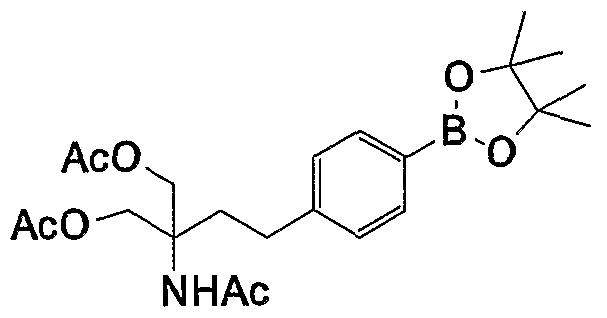
Step 5 is a couphng reaction. A compound of formula (B-X) can be prepared by couphng a compound of formula (B-VI) with a compound of formula (B-VII). The reaction is canied out in a suitable solvent (e.g. tetrahydrofuran or dimethoxyethane) in the presence of a suitable reagent (e.g., palladium diacetate or palladium dichloride), a suitable ligand (e.g., triphenylphosphine, di-tert-butylbiphenylphosphine, or dicyclohexylbiphenylphosphme), and a suitable inorganic salt (e.g., sodium carbonate, potassium fluoride, or cesium fluoride). A compound of formula (B-X) also can be prepared by couphng a compound of formula (B-Vffi) with a compound of formula (B-IX). The reaction is carried out in a suitable solvent (e.g. tetrahydrofuran or dimethoxyethane) in the presence of a suitable reagent (e.g., palladium diacetate or palladium dichloride), a suitable ligand (e.g., triphenylphosphine, di-tert-butylbiphenylphosphine, or dicyclohexylbiphenylphosphme) and a suitable inorganic salt (e.g., sodium carbonate, potassium fluoride, or cesium fluoride). A compound of formula (B-VIH) can be prepared by couphng a compound of formula (B-VI) with a suitable compound (e.g., bis(pinacolato)diboron). This reaction is canied out in a suitable solvent (e.g. dimethylformamide or dimethylsulfoxide) in the presence of a suitable catalyst (e.g., [l,r-bis(diphenylphosphino)fenocene]dichloropalladium), and a suitable base (e.g., potassium acetate). Step 6 is a deprotection reaction. A compound of formula (B-XI) can be prepared by subjecting a compound of formula (B-X) to a deprotection reaction. The reaction is carried out in a suitable solvent (e.g., methanol, ethanol, 1-propanol, 2-propanol, water, and a mixture thereof) in the presence of a suitable reagent (e.g., sodium hydroxide, potassium hydroxide, or hthium hydroxide). The compound of formula (I) wherein R is -P(=O)(OR')(OR") can be prepared by reacting a compound of formula (I), wherein R is a hydrogen atom, with a phosphating agent according to the methods described in International Patent Application Publications WO 02/18395 and WO 02/076995. The compound of the invention can be administered to a mammal in any suitable (e.g., conventional) manner. While it is possible for the compound to be administered as the raw chemical, it is preferably administered as a pharmaceutical composition. The pharmaceutical composition comprises the compound of the invention with one or more
additives, such as pharmaceutically acceptable earners or excipients and optionaUy other therapeutic agents and/or components. For example, the compound of the invention can be used together with known pharmaceutically acceptable diluents, extenders, disintegrators, stabilizers, preservatives, buffers, emulsifiers, aromatics, colorants, sweeteners, viscosity increasing agents, flavor improving agents, solubilizers, and other additives. These additives must be acceptable in the sense of being compatible with the other ingredients and not deleterious to the recipient thereof. When the compound of the invention is used as a medicament, the compound is admixed with a pharmaceutically acceptable canier (e.g., excipients, binders, disintegrators, conectives, conigents, emulsifiers, diluents, solubilizers, and the hke) to yield a pharmaceutical composition or a pharmaceutical preparation (tablets, pills, capsules, granules, powders, syrups, emulsions, elixirs, suspensions, solutions, injections, transfusions, or external preparations), which can be administered orally or parenterally. The pharmaceutical composition can be formulated into a pharmaceutical preparation by any suitable (e.g., conventional) method. The term "parenterally" includes subcutanous injection, intravenous injection, intramuscular injection, intraperitoneal injection, transfusion, and topical administration (administration through the skin, eye, lung, bronchus, nose, or rectum). The preparation for injection, such as a sterile aqueous or oily suspension for injection, can be prepared using a suitable dispersing agent or a wetting agent and a suspending agent, according to any suitable method as known in the pertinent field. The sterile preparation for injection may be a sterile injectable solution or suspension in a non- toxic diluent or solvent permitting parenteral administration, such as an aqueous solution. Examples of the vehicle and solvent that can be used include water, Ringer solution, isotonic saline, and the hke. In addition, sterile nonvolatile oil can be generally used as a solvent or a solvent for suspension. For this end, any nonvolatile oil or fatty acid can be used, inclusive of natural, synthetic, or semi- synthetic fatty oil or fatty acid, and natural, synthetic, or semi- synthetic mono-, di-, or tri-glycerides. The pharmaceutical composition preferably is formulated as a solid dosage form for oral administration. The solid dosage form includes the above-mentioned preparations, such as powders, granules, tablets, pills, capsules, and the like. In these dosage forms, the
compound of the invention is admixed with at least one additive such as sucrose, lactose, cellulose sugar, mannitol, maltitol, dextran, starches, agar, arginates, chitins, chitosans, pectins, tragacanth gums, gum arabic, gelatins, collagens, casein, albumin, synthetic or semi- synthetic polymers, and glycerides. In these dosage forms, routine additives can be added, which may be inert diluents, lubricants such as magnesium stearate, preservatives such as parabens and sorbic acid, antioxidants such as ascorbic acid, alpha-tocopherol, and cysteine, disintegrators, binders, tackifiers, buffers, sweeteners, flavors, perfumes, and the hke. An enteric coating may be applied to tablets and pills. The liquid agents for oral administration may be pharmaceutically acceptable emulsions, syrups, elixirs, suspensions, solutions, and the like, which may contain inert diluents (e.g., water), such as are generally used in the pertinent field. The external agent applicable to the compound of the invention can be, for example, an ointment, a paste, a liniment, a lotion, a plaster, a cataplasm, an eye drop, an eye ointment, a suppository, a fomentation, an inhalant, a spray, an aerosol, a paint, a nasal drop, a cream, a tape, a patch, and the hke. The external agent contains the compound of the invention in the form of a mixture with an organic or inorganic canier or excipient. The external agent can be used, for example, in the form of a solid, semi-solid, or liquid pharmaceutical preparation. The compound of the invention can be mixed with, for example, a non-toxic and pharmaceutically acceptable canier, which is usually employed for obtaining an external preparation for topical administration. A canier which can be used includes water, glucose, lactose, gum arabic, gelatin, mannitol, starch paste, magnesium trisilicate, talc, corn starch, keratin, colloid silica, potato starch, urea and other carriers which are suitable for preparing a solid, semi-solid, or solution composition. Further, an adjuvant, a stabilizer, a thickener, a coloring matter, or a flavoring agent can be added. The compound of the invention (as an active ingredient of the pharmaceutical composition) can be contained in an amount to exhibit the desired activity depending on the symptom or severity of the diseases. In the case of the treatment of the symptom and diseases induced by immune disorder, the compound of the invention can be administered by way of a topical administration, an aerosol, or a rectal administration in a form of a dosage unit composition, which contains a pharmaceutically acceptable and non-toxic
carrier, adjuvant, and/or excipient. In the treatment of reversible obstructive airways disease, the compound of the invention preferably is administered to lung by an aerosol in a form of a powder or a solution. The amount of the compound of the invention that can be mixed with a carrier can vary depending on the host to be treated and a specified dosage form. The specified dose of the specified patient should be determined depending on the various factors such as age, body weight, the whole condition of health, sex, meal, time for administration, administration route, rate of excretion, combination of drugs, and the severity of the specified diseases under treatment. When the compound of the invention is used in the form of an ointment, it is contained in an amount of about 0.01% to about 10% (w/w) in the ointment. Suitable ointment bases, include, for example, oleaginous bases (e.g., a natural wax such as white beeswax or carnauba wax, a petroleum wax such as hard paraffin or microcrystalhne wax, a hydrocarbon wax such as liquid paraffin, white petrolatum, or yellow petrolatum, plastibase, zelen 50W, silicone, a vegetable oil, lard, beef tallow, a simple ointment, or lead oleate plaster), emulsion type ointment bases (e.g., an oil in water type (O/W type) base such as a hydrophilic ointment or a vanishing cream, or a water in oil type (W/O type) base such as a hydrophilic petrolatum, a purified lanolin, aquaphor, eucelin, neoselin, an absorptive ointment, a hydrous lanolin, cold cream, or a hydrophilic plastibase), water-soluble bases (e.g., a macrogol ointment or solbase), suspension type ointment bases (e.g., a lyogel base or a hydrogel base such as a non-fat ointment, a gelbase, or lotion), and FAPG bases (e.g., a suspension of microparticles of an aliphatic alcohol such as stearyl alcohol or cetyl alcohol in propylene glycol). These ointment bases can be used alone or in a combination of two or more bases. Further, when used as an ointment, the compound of the invention is dissolved in a solubilizing and absorptive accelerating agent and added to the above-mentioned ointment base. The solubilizing and absorptive accelerating agent to be used is an agent in which the compound of the invention is soluble at a concentration of at least about 0.01% (w/w) and which desirably can accelerate the absorption of the compound from skin when formulated as an ointment. Suitable solubihzing and absorptive agents include, for example, lower alkanediols (e.g., ethylene glycol, propylene glycol or butylene glycol), alkylene carbonates
(e.g., propylene carbonate or ethylene carbonate), alkanedicarboxylic acid esters (e.g., dimethyl adipate, diethyl adipate, diisopropyl adipate, diethyl pimelate, diethyl sebacate or dipropyl sebacate), higher alkanoic acid glycerin esters (e.g., monolaurate, dilaurate or trilaurate), higher alkenoic acid glycerin esters (e.g., monooleate, dioleate, or trioleate), higher alkanoic acid alkyl esters (e.g., isopropyl myristate or ethyl myristate), higher unsaturated alcohols (e.g., geraniol or oleyl alcohol), and azacycloalkanes (e.g., 1- dodecylazacycloheptan-2-one). These solubilizing and absorptive accelerating agents can be used alone or in a mixture of not less than two agents, and can be added at a sufficient amount to dissolve the compound of the invention. The amount generally ranges from about 2 parts by weight to about 200 parts by weight per one part by weight of the compound of the invention. The upper amount is limited so as to not deteriorate the physicochemical properties of the ointment. The ointment which contains the compound of the invention can contain, in addition to the above-mentioned ointment base, other additives such as an emulsifier (e.g., polyoxyethylene hydrogenated castor oil, glycerol monostearate, sorbitan sesquioleate, or lauromacrogol); a suspending agent (e.g., polyethylene glycol, polyvinylpynolidone, or sodium carboxymelhylcellulose); an antioxidant (e.g., a phenol or a quinone); a preservative (e.g., paraoxybenzoic acid ester); a humectant (e.g., glycerin, D-sorbitol or propylene glycol); a favoring agent, a coloring matter; an antiseptic; a higher alkenoic acid (e.g., oleic acid), and other drugs or compounds which are useful for the treatment of a skin diseases. When the compound of the invention is used in an ointment, the ointment can be prepared by mixing a solution containing the compound of the invention with an ointment base in accordance with a conventional method. In the process of formulation, not less than one of the adjuvant or additive mentioned above can be simultaneously added to the ointment base. Furthermore, the ointment can be manufactured by dissolving the compound of the invention in the solubihzing and absorptive accelerating agent, admixing the obtained solution with the ointment base, stirring the obtained mixture while heating, and then cooling the resultant mixture. The ointment containing the compound of the invention can be used by applying the ointment to the affected part of the skin once to several times (e. g., once to four times) a day.
The paste or hniment containing the compound of the invention can be prepared by using the same base and according to the same method as the ointment as mentioned above. The lotion containing the compound of the invention is a preparation wherein the active ingredient (i.e., a compound of the invention such as the compound of formula (I)) is homogeneously dispersed or, in some cases, partially dissolved in a liquid medium, and an emulsifier is added thereto as necessary. In a case where the compound of the invention is formulated as a lotion, the content may be adjusted to about 0.01% to about 10% (w/w) of the lotion. The liquid medium to be used in the lotion containing the compound of the invention includes water, a lower alcohol, a glycol, glycerin, or a mixture thereof. Lower alcohols that do not decompose the active ingredient compound and are not an irritant to skin are suitable, including methanol, ethanol, isopropyl alcohol, propanol, and butanol. The glycol includes ethylene glycol, propylene glycol, butylene glycol, or mono lower ethers thereof. Among these liquid media, water, the lower alcohols, and mixtures thereof are most preferable because these media improve the absorption of the active ingredient compound to the skin. The amount of these liquid media preferably ranges from about 5 parts by weight to about 1000 parts by weight per one part by weight of the compound of the invention. A solubihzing and absorptive accelerating agent can be added to the lotion containing the compound of the invention in which the active ingredient is soluble at a concentration of at least about 0.01 % (w/w) and which can accelerate the absorption of the active ingredient compound from the skin when formulated into a lotion. The solubilizing and absorptive accelerating agent preferably is an alkanedicarboxylic acid ester (e.g., dimethyl adipate, diethyl adipate, diisopropyl adipate, diethyl pimelate, diethyl sebacate or dipropyl sebacate) or a higher alkanoic acid alkyl ester (e.g., isopropyl myristate or ethyl myristate). These solubihzing and absorptive accelerating agents can be used alone or in a mixture of two or more agents, and the amount generally ranges from about 5 parts by weight to about 5000 parts by weight per one part by weight of the compound of the invention. The content of the solubilizing and absorptive accelerating agent desirably ranges from about 1% to about 30% (w/w). The emulsifier for the lotion containing the compound of the invention is employed for the purpose of dispersing an insoluble medicine minutely and homogeneously in an
aqueous solution, and should be non- toxic to human beings. The emulsifier can be a pharmaceutically acceptable natural or synthetic emulsifier. Various emulsifiers, which are derived from animals and vegetables, can be used as the natural emulsifier. Such emulsifiers include egg yolk lecithin, soybean lecithin or a hydrogenated product thereof, phosphatidyl choline, sphingomyelin, gum arabic, and gelatin. Cationic, anionic, or nonionic surfactants can be used as the synthetic emulsifier, which preferably is a castor oil surfactant, especially an HCO (polyoxyethylene hydrogenated castor oil) such as HCO-60, HCO-50, HCO-40. Further, the emulsifier can be a polyoxyethylenesorbitan ahphatic acid ester such as polysorbate 80, a glycerin aliphatic acid ester such as glycerin monocaprylate, a polyethylene ahphatic acid ester such as polyoxyethylene 40 monostearate, a middle chain ahphatic acid mono (or di) glyceride (e.g., C6-C12 ahphatic acid mono (or di) glycerides such as caprylic acid diglyceride, capryhc acid monoglyceride, or caproic acid diglyceride), or a polyoxyethylated glyceride such as polyoxyethylated oleic acid glyceride. The above- mentioned emulsifiers can be used as the primary emulsifier, and, if necessary, in combination with an auxiliary emulsifier. The auxiliary emulsifier is a conventional emulsifier and non-toxic to humans, and such emulsifiers include cholesterol, agar, magnesium hydroxide, methylcellulose, and pectin. These primary emulsifiers and auxiliary emulsifiers can be used alone or in combinations of two or more emulsifiers. The emulsifier is present in the lotion containing the compound of the invention in an amount sufficient to emulsify the compound and other additives. The emulsifier preferably ranges from about 0.1 part by weight to about 10 parts by weight per one part by weight of the compound of the invention. In order to increase the viscosity, a viscosity-increasing agent can be added to the lotion that contains the compound of the invention. The viscosity-increasing agent can be any conventional agent which usually is added to increase viscosity of the liquid and is non- toxic to human beings, such as carboxypolymethylene. The viscosity-increasing agent is used when the lotion with a high viscosity is desired. When the viscosity-increasing agent is used, the content of the viscosity-increasing agent varies depending on the desired viscosity of the lotion to be used. Preferably, the viscocity-increasing agent is present in an amount ranging from about 0.01% to about 5% (w/w).
The lotion that contains the compound of the invention also can contain a solubilizer which is used for the stabilization of the active ingredient in an aqueous solution.
If necessary, the lotion can further contain other additives which commonly are used in lotions, such as a flavoring agent, a coloring matter, an antiseptic, a higher alkenoic acid such as oleic acid, and/or other drugs which are useful for the treatment of the skin diseases. The lotion that contains the compound of the invention can be prepared by any conventional method known in the art. The lotion that contains the compound of the invention can be used by applying the lotion to the affected part of the skin once to several times (e.g., once, twice, three times, or four times) a day. When the lotion has a low viscosity, it can be applied by filling a spray vessel with the composition of the lotion and spraying the lotion directly to the skin. In the case where the compound of the invention is used in the form of an eye drop or a nasal drop, the solvent to be employed includes sterile distilled water or, in particular, distilled water for injection. The concentration of the active compound usually ranges from about 0.01 % to about 2% (w/v), and may be increased or decreased depending on the aim of use. The eye drop or nasal drop that contains the compound of the invention also can contain various additives such as a buffer, an isotonic agent, a solubihzing agent, a preservative, a viscosity-increasing agent, a chelating agent, a pH adjustor, and/or an aromatic. Suitable buffers include, for example, phosphate buffers (e.g., sodium dihydrogen phosphate-disodium hydrogen phosphate or potassium dihydrogen phosphate-potassium hydroxide), borate buffers (e.g., boric acid-borax), citrate buffers (e.g., sodium citrate- sodium hydroxide), tartrate buffers (e.g., tartaric acid-sodium tartrate), acetate buffers (e.g., acetic acid-sodium acetate), carbonate buffers (e.g., sodium carbonate-citrate or sodium carbonate-boric acid), and amino acids (e.g., sodium glutamate or epsilon-aminocaproic acid). Suitable isotonic agents include, for example, saccharides such as sorbitol, glucose, or mannitol, polyhydric alcohols such as glycerin or propylene glycol, salts such as sodium chloride or borax, boric acid, and the hke. Suitable solubilizing agents include, for example, non-ionic surfactants such as polyoxyethylene sorbitan monooleate (polysorbate 80), polyoxyethylene mono stearate, polyethylene glycol, or polyoxyethylene hydrogenated
castor oil, and the like. Suitable preservatives include, for example, quaternary ammonium salts such as benzalkonium chloride, benzethonium chloride, or cetylpyridinium chloride, parahydroxybenzoic acid esters such as methyl parahydroxybenzoate, ethyl parahydroxybenzoate, propyl parahydroxybenzoate, or butyl parahydroxybenzoate, benzyl alcohol, phenethyl alcohol, sorbic acid or a salt thereof, thimerosal, chlorobutanol, and sodium dehydroacetate. Suitable viscosity-increasing agents include, for example, poiyvinylpyreolidone, hydroxyethylcellulose, hydroxypropylcellulose, methylcellulose, hydroxypropylmethylcellulose, carboxymethylcellulose, and salts thereof. Suitable chelating agents include, for example, sodium edetate, citric acid, and the hke. Suitable pH adjustors include, for example, hydrochloric acid, citric acid, phosphoric acid, acetic acid, tartaric acid, sodium hydroxide, potassium hydroxide, sodium carbonate, sodium bicarbonate, and the hke. Suitable aromatics include, for example, 1-menthol, borneol, camphors (e.g., dl-camphor), eucalyptus oil, and the like. When the compound of the invention is formulated as an eye drop, the pH of the formulation can be from about 4 to about 8.5 (e.g., about 5, about 6, about 7, about 7.5, about 8, and ranges thereof). When formulated as a nasal drop, the formulation comprising the compound of the invention can have a pH from about 4 to about 8.5. The eye drop and the nasal drop formulations that contain the compound of the invention can be prepared by any suitable (e.g., conventional) method. Additionally, when the compound of the invention is formulated as an eye drop, the eye drop formulation contains the compound in a sufficient amount to be able to effectively prevent eye inflammation, which varies depending on the symptom or the type of inflammation, and usually ranges from about 5 to about 1000 μg for one administration. The eye drop formulation can be administered once to several times (e.g., once to four times) a day. The aerosol-containing the compound of the invention is a pharmaceutical preparation that can be applied at the time of treatment by spraying a solution or a suspension of the active ingredient compound using a pressure of a liquefied gas or compressed gas filled in the same vessel or another vessel. The aerosol can be prepared by dissolving the compound of the invention in a purified water, and, if necessary, dissolving or
suspending a solubihzing and absorptive accelerating agent (as described above) in the solution, and, if necessary, adding an additive such as pH adjustor or antiseptic (as described above), and then sealing closely with a valve and compressing the propellant. Suitable propellants include dimethyl ether, liquefied natural gas, carbon dioxide, nitrogen gas, a substituted flon gas, and other conventional propellants. The aerosol that contains the compound of the invention also can contain a refrigerant, such as 1-menthol, a camphor, methyl salicylate, and the hke. The inhalant or spray that contains the compound of the invention can be prepared according to the same methods as those described for an aerosol, wherein a nebulizer or an inhaler can be used for an inhalant, and a spraying vessel can be used for a spray. When the compound of the invention is used as a suppository, the suppository can be prepared in a conventional manner using a conventional base for suppository. The active ingredient (i.e., the compound of the invention) is contained in the suppository in an amount sufficient to exhibit the pharmaceutical effect, which can vary depending on the age or symptom of the patient. Preferably, the active ingredient (i.e., the compound of the invention) is present in a range of from about 0.1 to about 60 mg (e.g., about 1 mg, about 10 mg, about 20 mg, about 30 mg, about 40 mg, about 50 mg, and ranges thereof). The base for the suppository of the invention desirable is a conventional base. Suitable bases include, for example, oil and fat from animal and vegetable (such as olive oil, corn oil, castor oil, cotton seed oil, wheat germ oil, cacao oil, beef tallow, lard, wool fat, turtle tallow, squalane, or a hydrogenated oil), oil and fat from mineral (such as petrolatum, white petrolatum, hard paraffin, liquid paraffin, anhydrous lanolin, or silicone oil), a wax such as jojoba oil, carnauba wax, yellow beeswax, or lanolin, partially synthetic or totally synthetic glycerin aliphatic acid esters such as mono-, di-, and tri-glycerides of a middle or higher ahphatic acid such as a straight-chain saturated aliphatic acid (e.g., lauric acid, myristic acid, palmitic acid, or stearic acid), and straight-chain unsaturated ahphatic acids (e.g., oleic acid, linoleic acid, or linolenic acid). The commercially available products are exemplified by Witepsol products (manufactured by Dynamitnobel Co.), which are mixtures of mono-, di-, and tri-glycerides of C12-C18 saturated ahphatic acids, such as, more specifically, Witepsol H series (e.g., Witepsol H5, H12, H19, H32, H35, H37, H39, H42, H175, or H185), Witepsol W series (e.g., Witepsol W25, W31, W35, or W45), Witepsol E
series (e.g., Witepsol E75, E76, E79, or E85), or Witepsol S series (e.g., Witepsol S52, S55, or S58); Pharmasol products (manufactured by Nippon Oils and Fats Co.); Isocacao products (manufactured by Kao Co.); SB products (manufactured by Kanegafuchi Chemical
Co. and Taiyo Yusi Co.), which are mixtures of mono-, di-, and tri-glycerides of C12-C18 saturated aliphatic acids, such as, more specifically, SB-H, SB-E, or SB-AM; Nopata products (manufactured by Henkel AG.); Sapoyer products (manufactured by Gattfords Co.), which are mixtures of mono-, di-, and tri-glycerides of C10-C18 saturated ahphatic acids, such as, more specifically, Sapoyer NA, Sapoyer OS, Sapoyer AS, Sapoyer BS, Sapoyer
BM, or Sapoyer DM); Masaesthalinum products (manufactured by Dynamitnobel Co.), which are mixtures of mono-, di-, and tri-glycerides of C10-C18 saturated ahphatic acids, such as, more specifically, Masaesthahnum A, AB, B, BB, BC, BCF, C, D, E, or BD and Masaesthalinum 299); and Migriol 810 or Migriol 812 (manufactured by Dynamitnobel Co.), which are mixtures of triglycerides of C8-C12 saturated ahphatic acids, wherein one or more of them may optionally be incorporated when a partially synthetic or totally synthetic glycerin ahphatic acid ester as mentioned above is incorporated). Further, other synthetic products such a polyethylene glycol or polyoxyethylene alcohol can be utilized. The bases are used in an amount of about 25% to about 99.9% by weight based on the total weight of the suppository. If necessary, a preservative, a stabilizer, a surfactant, an aromatic, a pH adjustor, or purified water can be added to the suppository. The suppository containing the compound of the invention can be in various forms, such as a rectal suppository which is solid at the normal temperature and melts at a body temperature; an ointment or liquid enema which can be prepared by dissolving or dispersing the compound of the invention in a liquid base; a soft capsule for rectal administration; or an injection for rectal administration. The suppository can be manufactured by any suitable (e.g., conventional) method. The dose for a certain patient is determined according to age, body weight, general health conditions, sex, diet, administration time, administration route, clearance rate, combination of drugs, degree of the state of the disease for which the patient is then undergoing treatments, and other factors. The compound of the invention shows low toxicity and can be used safely. While the daily dose varies depending on the condition and body weight of the patient, the kind of compound, the administration route, and the
hke, the daily dose is, for example, about 0.01-50 mg/person/day (e.g., about 0.5 mg/person/day, about 1 mg/person/day, about 5 mg/person/day, about 10 mg/person/day, about 15 mg/person/day, about 20 mg/person/day, about 25 mg/person/day, about 30 mg/person/day, about 35 mg/person/day, about 40 mg/person/day, about 45 mg/person/day, and ranges thereof) for parenteral administration by a subcutaneous, intravenous, or intramuscular route, or through the skin, eye, lung, bronchus, nose, or rectum. Preferably, the daily dose is about 0.01-20 mg/person/day, for parenteral administration by a subcutaneous, intravenous, or intramuscular route, or through the skin, eye, lung, bronchus, nose, or rectum. For oral administration, the daily dose is about 0.01-150 mg/person/day (e.g., about 0.5 mg/person/day, about 1 mg/person/day, about 5 mg/person/day, about 10 mg/person/day, about 15 mg/person/day, about 20 mg/person/day, about 25 mg/person/day, about 30 mg/person/day, about 35 mg/person/day, about 40 mg/person/day, about 45 mg/person/day, about 50 mg/person/day, about 60 mg/person/day, 70 mg/person/day, about 80 mg/person/day, about 90 mg/person/day, 100 mg/person/day, about 110 mg/person/day, about 120 mg/person/day, about 130 mg/person/day, about 140 mg/person/day, and ranges thereof), and preferably 0.1-100 mg/person/day. The compound of the invention can be used for the prevention and suppression of rejection caused by transplanting an organ (e.g., liver, heart, kidney, and the hke) or bone manow among the same kind or different kinds of mammals. Mammals include, but are not hmited to, humans, dogs, cats, pigs, monkeys, rats, mice, and the like. Additionally, the compound of the invention can be used for the prevention and treatment of various autoimmune diseases or various allergic diseases. Preferably, the compound of the invention has pharmacological activity such as immunosuppressive activity and, therefore, is useful for the prevention or treatment of resistance to transplantation, or transplantation rejection, of organs or tissues (such as heart, kidney, liver, lung, bone manow, cornea, pancreas, intestinum tenue, limb, muscle, nervus, fatty manow, duodenum, skin, pancreatic islet cell, etc., including xeno-transplantation, either acute or chronic), graft- versus-host diseases by bone manow transplantation, autoimmune diseases such as rheumatoid arthritis, systemic lupus erythematosus, nephrotic syndrome lupus, Hashimoto's thyroiditis, multiple sclerosis, myasthenia gravis, type I diabetes mellitus,
type TJ adult onset diabetes mellitus, uveitis, nephrotic syndrome, steroid-dependent and steroid-resistant nephrosis, palmoplantar pustulosis, encephalomyehtis, glomerulonepbritis, and infectious diseases caused by pathogenic microorganisms. The compound of the invention can be used to treat inflammatory, proliferative, and hyperproliferative skin diseases and cutaneous manifestations of immunologically- mediated illnesses such as psoriasis, psoriatic arthritis, atopic eczema (atopic dermatitis), contact dermatitis and further eczematous dermatitises, sebonheic dermatitis, lichen planus, pemphigus, bullous pemphigoid, epidermolysis bullosa, urticaria, angioedema, vasculitis, erythema, cutaneous eosinophilia, acne, alopecia areata, eosinophihc fasciitis, and atherosclerosis. The compound of the invention can be used in hair revitahzing, such as in the treatment of female or male pattern alopecia, or senile alopecia, by providing epilation prevention, hair germination, and/or a promotion of hair generation and hair growth. The compound of the invention can be used in the treatment of respiratory diseases, for example, sarcoidosis, fibroid lung, idiopathic interstitial pneumonia, COPD (chronic obstructive pulmonary disease), and reversible obstructive airways disease, including conditions such as asthma, including bronchial asthma, infantile asthma, allergic asthma, intrinsic asthma, extrinsic asthma, and dust asthma, particularly chronic or inveterate asthma (for example late asthma and airway hypenesponsiveness), bronchitis, and the hke. The compound of the invention can be used to treat hepatopathy associated with ischemia. The compound of the invention can be used for the freatment or prevention of certain eye diseases such as conjunctivitis, keratoconjunctivitis, keratitis, vernal conjunctivitis, uveitis associated with Behcet's disease, herpetic keratitis, conical cornea, dystorphia epithelialis corneae, keratoleukoma, ocular pemphigus, Mooren' s ulcer, scleritis, Graves' ophthalmopathy, severe intraocular inflammation, and the hke. The compound of the invention can be used for the treatment or prevention of inflammation of mucosa or blood vessels (such as leukotriene B4-mediated diseases, gastric ulcers, vascular damage caused by ischemic diseases and thrombosis, ischemic
bowel disease, irritable bowel disease (e.g., Crohn's disease and ulcerative cohtis), and necrotizing enterocolitis), or intestinal lesions associated with thermal burns. The compound of the invention is useful for treating or preventing renal diseases including interstitial nephritis, Goodpasture' s syndrome, hemolytic uremic syndrome, and diabetic nephropathy; nervous diseases including multiple myositis, Guillain-Bane syndrome, Meniere's disease, and radiculopathy; endocrine diseases including hyperthyroidism and Basedow's disease; hematic diseases including pure red cell aplasia, aplastic anemia, hypoplastic anemia, idiopathic thrombocytopenic purpura, autoimmune hemolytic anemia, agranulocytosis, and anerythroplasia; bone diseases including osteoporosis; respiratory diseases including sarcoidosis, fibroid lung, and idiopathic interstitial pneumonia; skin diseases including dermatomyositis, vitihgo vulgaris, ichthyosis vulgaris, photoallergic sensitivity, and cutaneous T cell lymphoma; circulatory diseases including arteriosclerosis, aortitis, polyarteritis nodosa, and myocardosis; collagen disease including scleroderma, Wegener's granuloma, and Sjδgren's syndrome; adiposis; eosinophilic fasciitis; periodontal disease; nephrotic syndrome; hemolytic uremic syndrome; and muscular dystrophy. The compound of the invention can be used in the treatment of intestinal inflammations or allergies such as Coeliac disease, proctitis, eusinophilic gastroenteritis, mastocytosis, Crohn's disease, or ulcerative cohtis. The compound of the invention can be used in the treatment of food related allergic diseases, which exhibit symptomatic manifestations remote from the gastrointestinal tract, for example, migraine, rhinitis, and eczema. The compound of the invention has liver regenerating activity and/or activity in promoting hypertrophy and hyperplasia of hepatocytes. Therefore, the compound of the invention is useful for the treatment and prevention of hepatic diseases such as immunogenic diseases (e.g. chronic autoimmune liver diseases including autoimmune hepatitis, primary biliary cinhosis, and sclerosing cholangitis), partial hver resection, acute liver necrosis (e.g. necrosis caused by toxins, viral hepatitis, shock, or anoxia), viral hepatitis type B, viral hepatitis type C, and cinhosis.
The compound of the invention can be used in the prevention or treatment of malignant rheumatoid arthritis, amyloidosis, fulminant hepatitis, Shy-Drager syndrome, pustular psoriasis, Behcet' s disease, systemic lupus erythematosus, endocrine opthalmopathy, progressive systemic sclerosis, mixed connective tissue disease, aortitis syndrome, Wegener' s gramulomatosis, active chronic hepatitis, Evans syndrome, polhnosis, idiopathic hypoparathyroidism, Addison disease (autoimmune adrenalitis), autoimmune orchitis, autoimmune oophoritis, cold hemagglutinin, paroxysmal cold hemoglobinuria, pernicious anemia, adult T cell leukemia, autoimmune atrophic gastritis, lupoid hepatitis, tubulointerstitial nephritis, membranous nephritis, amyotrophic lateral sclerosis, rheumatic fever, postmyocardial infarction syndrome, and sympathetic ophthalmitis. The compound of the invention can be used in combination with other immunosuppressant(s), steroid(s) (e.g., prednisolone, methylprednisolone, dexamethasone, or hydrocortisone), anti-rheumatoid agent(s) (e.g., methotrexate, leflunomide, a gold agent, penicillamine, buciUamine, lobenzarit, actarit, or salazosulfapyridme), and/or nonsteroidal acid anti-inflammatory agent(s). Preferably, the other immunosuppressant is selected from azathioprine, brequinar sodium, cyclophosphamide, cyclosporin, deoxysperguahn, everoUms, mizoribine, 2-morpholinoethyl mycophenolate, pimecrolimus, rapamycin, tacrohmus monohydrate, OKT-3, anti-TNF-α antibody, soluble TNF-α receptor, anti-IL-6 receptor antibody, anti-CD20 antibody, hCTLA4-Ig, anti-IL-2 receptor antibody, FTY720, FTY720-P, and analogues of FTY720 and FTY720-P. Preferably, the nonsteroidal acid anti-inflammatory agent is selected from aspirin, indomethacin, indomethacin farnesil, diclofenac sodium, alclofenac, alclofenac sodium, ibuprofen, ketoprofen, loxoprofen sodium, naproxen, pranoprofen, zaltoprofen, mefenamic acid, fufenamic acid, tolfenamic acid, phenylbutazone, satophenylbutazone, piroxicum, tenoxicum, ampiroxicum, celecoxib, rofecoxib, parecoxib, valdecoxib, and etoricoxib. The following examples further iUustrate the invention but, of course, should not be construed as in any way Umiting its scope.
EXAMPLE 1
This example demonstrates the preparation of 2-amino-2-[2-(4'-hexylbiphenyl- 4-yl)ethyl]-l, 3-propanediol hydrochloride 1/5 hydrate.
( 1 - 1 ) Preparation of 4- vinyl-biphenyl
A solution of rø-butyl lithium (1.6 mol/1) in hexane (52.7 ml) was added dropwise to a suspension of methyl phosphomum iodide (45 g) in tetrahydrofuran (100 ml) at 5°C under nitrogen atmosphere. After stirring at room temperature for 2 hours, a solution of biphenyl aldehyde (16.9 g) in tetrahydrofuran (50 ml) was added dropwise to the resultant mixture, and the whole mixture was stirred for 12 hours. Saturated aqueous ammonium chloride solution (100 ml) was added to the reaction mixture. The resultant mixture was extracted with ethyl acetate, washed with an aqueous saturated sodium chloride solution, and then dried over anhydrous sodium sulfate. After the solvent was distiUed off, the resultant residue was purified with sihca-gel column chromatography using hexane to give the title compound (8.04 g) as a colorless hquid. MS (El) : 180 [M
"*!
1H-NMR (400 MHz, CDC13) δ (ppm) : 5.25 (IH, d, / = 12.0 Hz), 5.77 (IH, d, / = 19.0 Hz), 6.74 (IH, dd, /= 11.0 and 12.0 Hz), 7.42-7.59 (9H, m). IR (neat) : 1579, 1487, 1400 cm"1.
(1-2) Preparation of 2-(biphenyl-4-yl)ethanol
A solution of 9-borabicyclo[3,3,l]nonane in tetrahydrofuran (0.5 mol 1 tetrahydrofuran, 120 ml, 60 mmol) was added dropwise to a solution of 4-vinylbiphenyl (5.41 g) in tetrahydrofuran (43 ml) at 5°C under nitrogen atmosphere. After stining at room temperature for 12 hours, water (10 ml) was added, and further stirred at room temperature for 12 hours. 3 M aqueous sodium hydroxide solution (30 ml) and 30% hydrogen peroxide solution (30 ml) were added dropwise to the reaction solution, which stood for 48 hours. After the solvent was distiUed off under reduced pressure, the residue was extracted with ethyl acetate, washed with an aqueous saturated saline solution, and then dried over anhydrous sodium sulfate. After the solvent was distiUed off under reduced pressure, the resultant residue was purified with sihca-gel column chromatography using a 1:1 mixture of hexane and ethyl acetate to give the title compound (5.53 g) as a colorless liquid. MS (El) : 198 [M"1"].
1H-NMR (400 MHz, CDC13) δ (ppm) : 1.40 (IH, t, / = 8.0 Hz), 2.90 (2H, t, / = 4.0 Hz), 3.89 (2H, dd, /= 4.0 and 8.0 Hz), 7.24-7.57 (9H, m). IR (neat) : 3267, 1487, 1406, 1051, 1012 cm"1.
(1-3) Preparation of 4-(2-iodoethyl)biphenyl
A solution of methanesulfonyl chloride (9.54 g) in tetrahydrofuran (150 ml) was added dropwise to a solution 2-(biphenyl-4-yl)ethanol (5.53 g) and triethylamine (10.18 g) in tetrahydrofuran (150 ml) at 5°C under nitrogen atmosphere. After stirring at room temperature for 6 hours, the precipitated crystals were collected by filtration. The filtrate was concentrated under reduced pressure and the resultant residue was purified with silica-gel column chromatography using a 1:1 mixture of hexane/ethyl acetate to give methanesulfonate of 2-(biphenyl-4-yl)ethanol as a colorless Uquid. Sodium iodide (6.23 g) was added to a solution of the methanesulfonate in 2-butanone (150 ml) and stirred at 70°C for 3 hours. The precipitate was filtered off and 5% aqueous sodium thiosulfate (30 ml) was added to the filtrate and extracted with ethyl acetate. The ethyl acetate layer was washed with an aqueous saturated saline solution and then dried over anhydrous sodium sulfate. The solvent was distilled off, and the resultant residue was purified with sihca-gel column chromatography using a 5:1 mixture of hexane and ethyl acetate to give the title compound (7.31 g) as a colorless liquid. MS (El) : 308 [M4].
1H-NMR (400 MHz, CDC13) δ (ppm) : 3.21 (2H, t, / = 8.0 Hz), 3.38 (2H, d, / = 4.0 Hz), 7.21-7.58 (9H, m). IR (neat) : 1599, 1518 cm 1.
(1-4) Preparation of (4) diethyl 2-acetylamino-2-[2-(biphenyl-4-yl)ethyl]malonate
A solution of diethyl acetamidomalonate (8.17 g) in dimethylformamide (50 ml) was added dropwise to a suspension of 60% sodium hydride (1.51 g) in dimethylformamide (20 ml) at 5°C. The reaction mixture was stirred at 40°C for 30 minutes, cooled to 5°C, and 4-(2-iodoethyl)biphenyl (7.31 g) in dimethylformamide (50 ml) was added dropwise thereto. The reaction mixture was stirred at room temperature for an hour, and the reaction mixture stood at room temperature for 12 hours. Water (20 ml) was added to stop the reaction, and the reaction mixture was extracted with ethyl acetate and washed with an aqueous saturated sahne solution. The ethyl acetate layer was dried over anhydrous sodium sulfate, the solvent was distilled off under reduced pressure, and the resultant residue was purified with siUca-gel column chromatography using a 1:1 mixture of hexane and ethyl acetate to give the title compound (6.64 g) as a colorless hquid. MS (El) : 397 [M4]. 1H-NMR (400 MHz, CDC13) δ (ppm) : 1.24 (6H, t, / = 6.0 Hz), 1.97 (3H, s), 2.52 (2H, m), 2.71 (2H, m), 4.18 (4H, q, /= 6.0 Hz), 7.19-7.55 (9H, m). IR (neat) : 3260, 1747, 1645, 1518, 1278, 1207 cm"1.
(1-5) Preparation of 2-acetamido-l ,3-bisacetoxy-2-[(2-biphenyl-4-yl)ethyl]propane
A solution of diethyl 2-acetylamino-2-[2-(biphenyl-4-yi)ethyl]malonate (6.46 g) in tetrahydrofuran (60 ml) was added dropwise to a suspension of lithium aluminum hydride (1.85 g) of tetrahydrofuran (90 ml) at 5°C under nitrogen atmosphere. After stining at room temperature for 2 hours, the reaction mixture was cooled to 5°C, and the reaction was stopped by the addition of a saturated sodium sulfate. The precipitate was filtered off by cehte, and the filtrate was extracted with ethyl acetate. The ethyl acetate layer was dried over anhydrous sodium sulfate, and the solvent was distiUed off under reduced pressure. Pyridine (80 ml) and acetic anhydride (14 ml) were added to the resultant residue. After standing at room temperature for 36 hours, the mixture was extracted with ethyl acetate, and the ethyl acetate layer was dried over anhydrous sodium sulfate. The solvent was distilled off, and the resultant residue was purified with sihca-gel column chromatography using a 5:1 mixture of hexane and ethyl acetate to give the title compound (4.57 g) as a colorless Uquid. MS (El) : 266 [M"*!
1H-NMR (400 MHz, CDC13) δ (ppm) : 1.92 (3H, s), 2.11 (6H, s), 2.24 (2H, m), 2.64 (2H, m), 4.35 (3H,s), 7.23-7.56 (9H, m).
IR (KBr) : 3312, 1738, 1651, 1489 cm"1.
(1-6) Preparation of 2-acetamido-l,3-bisacetoxy-2-[2-(4'-hexanoylbiphenyl-4- yl)ethyl] propane
A solution of 2-acetamido-l,3-bisacetoxy-2-[2-(biphenyl-4-yl)ethyl]propane (2.5 g) in dichloroethane (30 ml) was added dropwise to a suspension of aluminum chloride (6.75 g) and hexanoyl chloride (3.39 g) in dichloroethane (60 ml) under nitrogen atmosphere. After stining at 45 °C for 2.5 hours, the reaction solution was poured into ice- water (150 ml) and extracted with chloroform. The chloroform layer was dried over anhydrous sodium sulfate, and the solvent was distilled off under reduced pressure. The resultant residue was purified with sihca-gel column chromatography using a 1 :1 mixture of hexane and ethyl acetate to give the title compound (2.18 g) as a pale yellow crystal. Mp : 132-135°C. MS (El) : 495 [M
4].
1H-NMR (400 MHz, CDC13) δ (ppm) : 1.92 (3H, t, / = 6.8 Hz), 1.35-1.37 (4H, m), 1.74 (2H, m), 1.97 (3H, s), 2.08 (6H, s), 2.22-2.27 (2H, m), 2.63-2.67 (2H, m), 2.96 (2H, t, / = 7.4 Hz), 4.34 (4H, s), 5.67 (IH, br. s), 7.27 (2H, d, /= 8.3 Hz), 7.53 (2H, d, / = 8.3 Hz), 7.63 (2H, d, / = 8.4 Hz), 8.00 (2H, d, / = 8.3 Hz). IR (KBr) : 3315, 1749, 1680, 1655 cm"1.
(1-7) Preparation of 2-acetamido-l ,3-bisacetoxy-2-[2-(4'-hexylbiphenyl-4- yl)ethyl] propane
A solution of 2-acetamido-l, 3-bisacetoxy-2-[2-(4'-hexanoylbiphenyl-4- yl)ethyl]propane (2.18 g) and triethyl silane (1.53 g) in trifluoroacetic acid (50 ml) was stined at room temperature for 5 hours. After the solvent was distiUed off under reduced
pressure and extracted with ethyl acetate, the ethyl acetate layer was washed with an aqueous saturated sodium bicarbonate solution, and an aqueous saline solution and dried over anhydrous sodium sulfate. The solvent was distilled off under reduced pressure, and the resultant residue was purified with sihca-gel column chromatography using ethyl acetate to give the title compound (1.98 g) as a white crystal. Mp : 97-99°C. MS (El) : 481 [M*].
1H-NMR (400 MHz, CDC13) δ (ppm) : 1.92 (3H, t, / = 6.8 Hz), 1.35-1.37 (6H, m), 1.74 (2H, m), 1.97 (3H, s), 2.08 (6H, s), 2.22-2.27 (2H, m), 2.63-2.67 (2H, m), 2.96 (2H, t, / = 7.4 Hz), 4.34 (4H, s), 5.67 (IH, br s), 7.27 (2H, d, / = 8.3 Hz), 7.53 (2H, d, / = 8.3 Hz), 7.63 (2H, d, / = 8.4 Hz), 8.00 (2H, d, / = 8.3 Hz). IR (KBr) : 3306, 1736, 1651 cm"1.
(1-8) Preparation of 2-amino-2-[2-(4'-hexylbiphenyl-4-yl)ethyl]-l , 3-propanediol hydrochloride 1/5 hydrate
A solution of 2-acetamido-l,3-bisacetoxy-2-[2-(4'-hexylbiphenyl-4-yi)- ethyl] propane (1.98 g) in methanol (32 ml) and tetrahydrofuran (32 ml) was added to aqueous solution (24 ml) of Uthium hydroxide monohydrate (1.55 g), and the whole mixture was stirred at 60°C for 5 hours. After cooUng to room temperature, the mixture was extracted with ethyl acetate and dried over anhydrous sodium sulfate. The solvent was distiUed off under reduced pressure and lN-hydrochloric acid in diethyl ether (60 ml), tetrahydrofuran (20 ml), and methanol (20 ml) were added to the resultant residue. The solvent was distiUed off under reduced pressure, and the resultant residue was recrystalhzed from a mixture of ethyl acetate and methanol to give the title compound (1.0 g) as a white crystal.
Mp : 240°C with decomposition.
MS (El) : 355 [M+].
1H-NMR (400 MHz, DMSO-d6) δ (ppm) : 0.85 (3H, t, /= 7.3 Hz), 1.28 (6H, m), 1.56 (2H, m), 1.79 (2H, m), 2.49 (4H, m), 3.54 (4H, d, / = 3.4 Hz), 5.40 (2H, t, / = 4.8 Hz), 7.25 (2H, d, / = 8.4 Hz), 7.27 (2H, d, J = 8.3 Hz), 7.53 (2H, d, / = 8.3 Hz), 7.57 (2H, d, / = 8.3 Hz),
7.86 (3H, br s).
IR (KBr) : 3362, 2924, 1602, 1583, 1496, 1060 cm"1.
Anal. Calcd. for C23H33NO2-HCl l/5 H2O : C, 69.83; H, 8.77; N, 3.54. Found : C, 70.00; H,
8.76; N, 3.48.
EXAMPLE 2 This example demonstrates the preparation of 2-amino-2-[2-(biphenyl-4- yl)ethyl]-l , 3-propanediol hydrochloride.
2-Acetamido-l ,3 -bisacetoxy-2-[(2-biphenyl-4-yl)ethyl] propane obtained according to the process described in Example (1-5) was subjected to hydrolysis in a similar manner described in Example (1-8) to give the title compound as a white crystal. Mp : 226°C with decomposition. MS (El) : 271 [M l. 1H-NMR (400 MHz, DMSO-d
6) δ (ppm) : 1.80-1.84 (2H, m), 2.26-2.66 (2H, m), 3.54 (4H, d, / = 4.8 Hz), 5.41 (2H, t, / = 4.9 Hz), 7.28-7.31 (2H, d, J = 8.3 Hz), 7.33-7.35 (IH, m), 7.44 (2H, dd, /= 7.3 and 7.5 Hz), 7.58-7.64 (4H, m), 7.84 (3H, br s). IR (KBr) : 3369, 3028, 2930, 1591, 1502, 1489, 1060 cm
"1. Anal. Calcd. for C
17H
2,NO
2-HCl : C, 66.33; H, 7.20; N, 4.55. Found : C, 65.96; H, 7.26; N, 4.49.
EXAMPLE 3 This example demonstrates the preparation of 2-amino-2-[(2-(4'- propyιbiphenyl-4-yl)ethyl)]propane-l,3-diol hydrochloride 1/10 hydrate.
A Friedel-Crafts reaction of 2-acetamido-l , 3-bisacetoxy-2-[(2-biphenyl-4- yl)ethyl] -propane obtained according to the process described in Example (1-5) and propanoyl chloride was canied out in a similar manner to that described in Example (1-6). Similar reactions to those described in Examples (1-7) and (1-8) were canied out in that respective order to give the title compound as a white crystal. M : 181-184°C. MS (El) : 313 [M
+].
1H-NMR (400 MHz, DMSO-d6) δ (ppm) : 0.90 (3H, t, /= 7.3 Hz), 1.56-1.65 (2H, m), 1.79-1.84 (2H, m), 2.55 (2H, dd, / = 7.3 and 7.8Hz), 2.61-2.65 (2H, m), 3.53 (4H, d, / = 3.4 Hz), 5.40 (2H, s), 7.25 (2H, d, / = 8.3 Hz), 7.27 (2H, d, / = 8.8 Hz), 7.54 (2H, d, / = 10.7 Hz), 7.56 (2H, d, / = 10.7 Hz), 7.86 (3H, br s).
IR (KBr) : 3371, 3024, 2951, 1587, 1500, 1454, 1062, 1005 cm"1.
Anal. Calcd. for C20H27NO2 HCM/10 H2O : C, 68.65; H, 8.07; N, 4.00. Found : C, 68.21;
H, 8.20; N, 3.97. EXAMPLE 4 This example demonstrates the preparation of 2-amino-2-[(2-(4'-butylbiphenyl- 4-yl)ethyl)]propane-l,3-diol hydrochloride 1/5 hydrate.
A Friedel-Crafts reaction of 2-acetamido-l, 3-bisacetoxy-2-[(2-biphenyl-4-yι)- ethyljpropane obtained according to the process described in Example (1-5) and butanoyl chloride was carried out in a similar manner to that described in Example (1-6). Similar reactions to those described in Examples (1-7) and (1-8) were canied out in that respective order to give the title compound as a white crystal. Mp : 175-178°C. MS (El) : 327 [M
+].
JH-NMR (400 MHz, DMSO-d6) δ (ppm) : 0.90 (3H, t, /= 7.4 Hz), 1.27-1.36 (2H, m), 1.53-1.60 (2H, m), 1.79-1.83 (2H, m), 2.58-2.65 (4H, m), 3.54 (4H, d, /= 3.8 Hz), 5.40 (2H, br t), 7.24 (2H, d, / = 11.2 Hz), 7.27 (2H, d, / = 11.2 Hz), 7.53 (2H, d, / = 11.2 Hz), 7.56 (2H, d, / = 11.2 Hz), 7.84 (3H, br s). IR (KBr) : 3375, 3024, 2926, 1599, 1498, 1456, 1064, 808 cm"1.
Anal. Calcd. For C2ιH29NO2 HCM/5 H2O : C, 68.62; H, 8.33; N, 3.81. Found : C, 68.79; H, 8.41; N, 3.83.
EXAMPLE 5 This example demonstrates the preparation of 2-amino-2-[(2-(4'- pentylbiphenyl-4-yl)ethyl)] propane- 1,3 -diol hydrochloride 1/2 hydrate.
A Friedel-Crafts reaction of 2-acetamido-l ,3-bisacetoxy-2- [(2-biphenyl-4-yι)- ethyljpropane and pentanoyl chloride was canied out in a similar manner described in Example (1-6) and a similar reaction described in Example (1-7) and (1-8) in order was carried out to give the title compound as a white crystal. Mp : 142-145°C. MS (El) : 341 [M*|.
1H-NMR (400 MHz, DMSO-d
6) δ (ppm) : 0.86 (3H, t, /= 6.8 Hz), 1.26-1.33 (4H, m), 1.54-1.61 (2H, m), 1.80-1.84 (2H, m), 2.58 (2H, t, / = 7.8 Hz), 2.62-2.66 (2H, m), 3.54 (4H, d, / = 4.8 Hz), 5.41 (2H, t, /= 4.9 Hz), 7.26 (2H, d, /= 11.7 Hz), 7.28 (2H, d, / = 11.8 Hz), 7.54 (2H, d, / = 10.8 Hz), 7.55 (2H, d, / = 11.3 Hz), 7.90 (3H, br s). IR (KBr) : 3360, 2928, 1604, 1500, 1024, 806 cm
"1.
Anal. Calcd. for C22H3ιNO2 HCl l/2 H2O : C, 68.52; H, 8.70; N, 3.58. Found : C, 68.29; H, 8.60; N, 3.61.
EXAMPLE 6 This example demonstrates the preparation of 2-amino-2-[(2-(4'-octylbiphenyl-
4-yl)ethyl)]propane-l,3-diol hydrochloride 1/5 hydrate.
A Friedel-Crafts reaction of 2-acetamido-l, 3-bisacetoxy-2-[(2-biphenyl-4-yl)- ethyljpropane obtained according to the process described in Example (1-5) and octanoyl chloride was carried out in a similar manner to that described in Example (1-6). Similar reactions as those in Examples (1-7) and (1-8) were carried out in that respective order to give the title compound as a white crystal.
Mp : 223-225°C.
MS (El) : 383 [M+]. 1H-NMR (400 MHz, DMSO-d6) δ (ppm) : 0.84 (3H, t, / = 6.8 Hz), 1.24-1.28 (10H, m),
1.57 (2H, m), 1.79 (2H, m), 2.58 (2H, t, / = 7.8 Hz), 2.63-2.65 (2H, m), 3.53 (4H, d, / =
5.4 Hz), 5.39 (2H, t, / = 4.9 Hz), 7.25 (2H, d, / = 10.8 Hz), 7.27 (2H, d, / = 10.8 Hz), 7.53
(2H, d, / = 12.2 Hz), 7.56 (2H, d, / = 12.2 Hz), 7.84 (3H, br s).
IR (KBr) : 3362, 3026, 2924, 2852, 1602, 1583, 1496, 1469, 829, 800 cm"1. Anal. Calcd. for C2SH37Nθ2-HCM/5H2θ : C, 70.88; H, 9.14; N, 3.30. Found : C, 71.13; H,
9.18; N, 3.29.
EXAMPLE 7 This example demonstrates the preparation of 2-amino-2-[(biphenyl-4- yl)methyl]propane-l,3-diol hydrochloride monohydrate.
2-Acetamido-l ,3-bisacetoxy-2-[(biphenyl-4-yl)methyl]propane was subjected to hydrolysis according to the procedure described in Example (1-8) to give the title compound as a white crystal. Mp : 235 °C with decomposition.
MS (El) : 257 [M*].
1H-NMR (400 MHz, DMSO-d6) δ (ppm) : 2.92 (2H, s), 3.32-3.44 (4H, m), 5.48 (2H, br s),
7.73-7.47 (5H, m), 7.61 (4H, m), 7.90 (3H, br s).
IR (KBr) : 3443, 3030, 2895, 1641, 1572, 1510, 1489, 1471, 1060, 1039, 752 cm"1. Anal. Calcd. for C16Hi9NO2-HCl-H2O : C, 61.63; H, 7.11; N, 4.49. Found : C, 61.62; H,
7.04; N, 4.49.
EXAMPLE 8 This example demonstrates the preparation of 2-amino-2-[(4'-pentylbiphenyl-4- yl)methyl]propane-l,3-diol hydrochloride 1/5 hydrate.
A Friedel-Crafts reaction of 2-acetamido-l, 3-bisacetoxy-2-[(2-biphenyl-4-yl)- methyl] ropane and pentanoyl chloride was carried out in a similar manner described in Example (1-6). Similar reactions to those described in Examples (1-7) and (1-8) were canied out in that respective order to give the title compound as a white crystal. Mp : 138-140°C. MS (El) : 327 [M*].
1H-NMR (400 MHz, DMSO-d6) δ (ppm) : 0.86 (3H, t, / = 6.8 Hz), 1.26-1.33 (4H, m), 1.54-1.61 (2H, m), 2.49 (2H, s), 2.59 (2H, t, / = 8.0 Hz), 2.91 (2H, s), 3.31-3.44 (4H, m), 5.47 (2H, t, / = 4.0 Hz), 7.26 (2H, d, / = 8.0 Hz), 7.36 (2H, d, / = 8.0 Hz), 7.54 (2H, d, / = 8.0 Hz), 7.59 (2H, d, /= 8.0 Hz), 7.87 (3H, br s). IR (KBr) : 3420, 2926, 1564, 1500, 1467, 1059 cm"1.
Anal. Calcd. for C21H29NO2-HCl-l/5H2O : C, 68.35; H, 8.20; N, 3.77. Found : C, 68.62; H, 8.33; N, 3.81.
EXAMPLE 9 This example demonstrates the preparation of 2-amino-2-{[2'-(2H-tetrazol-5- yl)biphenyl-4-yl] methyl} propane- 1 ,3 -diol hydrochloride.
The reaction of acetamidomalonic acid and N-(triphenylmethyl)-5-[4'- (bromomethyl)-biphenyl-2-yl] tetrazole, prepared by the method described in /. Med. Chem., 24, 2525-2547 (1991) in accordance with a similar manner as described in Examples (1-4) and (1-5) gave 2-acetamido-l,3-bisacetoxy-2-{[2'-(2H-tetrazol-5- yl)biphenyl-4-yl]methyl}-propane. The triacetate was subjected to hydrolysis according to the procedure described in Example (1-8) to give the title compound as a pale yellow amorphous-like solid. MS (El) : 325 [M
4]. 1H-ΝMR (400 MHz, DMSO-d
6) δ (ppm) : 2.86 (2H, s), 3.32 (4H, m), 5.45 (2H, s), 7.04 (2H, d, / = 8.3Hz), 7.22 (2H, d, / = 8.3 Hz), 7.53-7.68 (4H, m), 7.86 (3H, br s). IR (KBr) : 3360, 2939, 1604, 1510, 1477, 1055, 748 cm
"1.
EXAMPLE 10 This example demonstrates the preparation of 2-amino-2-[2-(2',3',4'- frimethoxybiphenyl-4-yl)ethyl]-l, 3-propanediol hydrochloride.
(10-1) Preparation of 2-(4-bromophenyι)ethyl iodide
Methanesulfonylchloride (11.5 ml) was added to a solution of 2-(4- bromophenyl)ethylalcohol (25.0 g) and triethylamine (22.6 ml) in dichloromethane (250 ml) at 0° C. The resulting suspension was stirred at room temperature for 2 hours. The reaction mixture was washed with brine and dried over sodium sulfate and concentrated in vacuo to yield a red oil (39.1 g). Sodium iodide (18.6 g) was added to a solution of methanesulfonate in 2-butanone (400 ml), and the resulting suspension was heated under reflux for 4.5 hours. The reaction mixture was diluted with ethyl acetate and washed with water, 10% aqueous sodium thiosulfate, and brine. The organic layer was dried over sodium sulfate and concentrated in vacuo. Purification by silica-gel column
chromatography using hexane/ethyl acetate 30 : 1 gave the title compound (34.2 g) as a colorless oil.
1H-NMR (CDCIs) δ (ppm) : 3.13 (2H, t, /= 7.5 Hz), 3.32 (2H, t, /= 7.5 Hz), 7.07 (2H, d, / = 8.4 Hz), 7.44 (2H, d, J = 8.4 Hz). (10-2) Preparation of diethyl 2-acetamido-2-[2-(4-bromophenyl)ethyl]malonate
A solution of diethyl acetamidomalonate (28.7 g) in dimethylformamide (55 ml) was added dropwise to a suspension of 60% sodium hydride (5.72 g) in dimethylformamide (110 ml) at 0° C. After stining at room temperature for 45 minutes, 2- (4-bromophenyl)ethyl iodide (34.2 g) was added dropwise to the reaction mixture at 0° C. After stining at room temperature for an hour and an additional 2 hours at 60° C, the reaction mixture was poured into ice and water (200 ml). The reaction mixture was extracted with ethyl acetate and washed with brine. The organic layer was dried over sodium sulfate and concentrated in vacuo. Purification by sihca-gel column chromatography using hexane/ethyl acetate 2 : 1 gave the title compound (35.4 g) as a white solid.
1H-NMR (CDC13) δ (ppm) : 1.23 (6H, t, /= 7.2 Hz), 2.00 (3H, s), 2.44 (2H, dd, / = 9.0, 10.8 Hz), 3.32 (2H, dd, / = 9.0, 10.8 Hz), 4.16-4.25 (4H, m), 6.76 (IH, s), 7.02 (2H, d, / = 8.4 Hz), 7.38 (2H, d, /= 8.4 Hz).
(10-3) Preparation of 2-acetamido-l,3-bisacetoxy-2-[2-(4-bromophenyl)ethyl]propane

Sodium borohydride (13.4 g) was added poftionwise to a solution of diethyl 2- acetamido-2-[2-(4-bromophenyl)ethyl]malonate (35.4 g), calcium chloride (20.6 g) in water (55 ml), and ethanol (310 ml). After stirring at room temperature overnight, aqueous hydrochloric acid was added to the reaction mixture, and the mixture was extracted with ethyl acetate and washed with brine. The organic layer was dried over sodium sulfate and concentrated in vacuo. The resultant was dissolved in pyridine (300 ml). Acetic anhydride (25.0 ml) was added to this solution at 0° C. After stining at room temperature overnight, ice and water (300 ml) were added to the reaction mixture. The mixture was extracted with ethyl acetate and washed successively with water, 0.5M aqueous hydrochloride, saturated aqueous sodium bicarbonate, and brine. The organic layer was dried over sodium sulfate and concentrated in vacuo. To the resultant was added 1 : 1 mixture of hexane/ethyl acetate and precipitation occuned. Suction filtration gave the title compound (11.4 g) as a white sohd. The mother Uquor was concentrated in vacuo. Purification of the resultant by silica-gel column chromatography using hexane/ethyl acetate 1 : 1 to 0 : 1 gave another title compound (4.81 g) as a white sohd.
1H-NMR (CDC13) δ (ppm) : 1.99 (3H, s), 2.10 (6H, s), 2.16-2.22 (2H, m), 2.53-2.59 (2H, m), 4.32 (4H, s), 5.68 (IH, s), 7.06 (2H, d, J= 8.4 Hz), 7.40 (2H, d, / = 8.4 Hz).
(10-4) Preparation of 2-acetamide-l,3-bisacetoxy-2-[2-(2',3',4'-trimethoxybiphenyl-4- yl)ethyl]propane
A mixture of 2-acetamido-l, 3-bisacetoxy-2-[2-(4-bromophenyι)ethyι]propane (400 mg), 2,3,4-trimethoxyphenylboronic acid (318 mg), paUadium acetate (11 mg), di- tert-butyl biphenylphosphine (30 mg), and cesium fluoride (456 mg) in tetrahydrofuran (6 ml) was heated under reflux for 5 hours. Brine was added to the reaction mixture, and the resulting mixture was extracted with ethyl acetate. The organic layer was dried over
sodium sulfate and concentrated in vacuo. Purification by silica-gel column chromatography using hexane/ethyl acetate 1 : 3 gave the title compound (383 mg) as a pale yellow amorphous. 1H-NMR (CDC13) δ (ppm) : 1.97 (3H, s), 2.10 (6H, s), 2.23-2.29 (2H, m), 2.63-2.68 (2H, m), 3.67 (3H, s), 3.89 (3H, s), 3.92 (3H, s), 4.37 (4H, s), 5.67 (IH, s), 6.73 (2H, d, / = 8.4 Hz), 7.00 (2H, d, / = 8.4 Hz), 7.22 (2H, ά, J= 8.1 Hz), 7.42 (2H, d, / = 8.1 Hz).
(10-5) Preparation of 2-amino-2-[2-(2',3',4'-trimethoxybiphenyl-4-yl)ethyl]-l,3- propanediol hydrochloride
2-Acetamide-l ,3-bisacetoxy-2-[2-(2' ,3' ,4'-trimethoxybiphenyl-4- yl)ethyl]propane (383 mg) was subjected to hydrolysis in a similar manner as that described in Example (1-8) to give 231 mg of the title compound as a white crystal. Mp : 195° C. MS (El) m/z : 361 [M+H] . 1H-NMR (DMSO-de) δ (ppm) : 1.79-1.85 (2H, m), 2.59-2.65 (2H, m), 3.53 (4H, d, / = 4.8 Hz), 3.57 (3H, s), 3.77 (3H, s), 3.81 (3H, s), 5.38 (2H, t, /= 4.8 Hz), 6.86 (2H, d, / = 8.4 Hz), 7.00 (2H, d, / = 8.4 Hz), 7.23 (2H, d, / = 8.1 Hz), 7.37 (2H, d, / = 8.1 Hz), 7.78 (3H, br s). Anal. Calcd. for C20H27NO5ΗCI : C, 60.37; H/7.09; N, 3.52. Found : C, 60.21 ; H, 7.00; N, 3.47.
EXAMPLE 11 This example demonstrates the preparation of 2-amino-2-[2-(4'-heptylbiphenyl- 4-yl)ethyl]-l, 3-propanediol hydrochloride.
(11-1) Preparation of 4-heptylphenylboronic acid
1.57 M solution of n-butyl Uthium in hexane (13.1 ml) was added dropwise to a solution of l-(4-bromophenyl)heptane (4.38 g) in tetrahydrofuran (68 ml) at -78° C. After stirring at the same temperature for 20 minutes, trimethylborate (9.61 ml) was added to the reaction mixture, and the mixture was stined for an additional hour at room temperature. 6 M aqueous hydrochloride (100 ml) was added to the reaction mixture, and the mixture was stined for 30 minutes at room temperature. The reaction mixture was extracted with ethyl acetate and washed with water and brine. The organic layer was dried over sodium sulfate and concentrated in vacuo to give the title compound (3.56 g) as a pale brown oil. This compound was used in the next reaction without further purification.
(11-2) Preparation of 2-acetamide-l,3-bisacetoxy-2-[2-(4'-heptylbiphenyl-4- yl)ethyl]propane
The product of Example (10-3) (400 mg) and 4-heptylphenylboronic acid (330 mg) were reacted in a similar manner as that described in Example (10-4) to give 366 mg of the title compound as a white sohd.
1H-NMR (CDC13) δ (ppm) : 0.88 (3H, t, /= 6.9 Hz), 1.22-1.38 (8H, m), 1.58-1.68 (2H, m), 1.96 (3H, s), 2.10 (6H, s), 2.22-2.28 (2H, m), 2.61-2.68 (4H, m), 4.37 (4H, s), 5.65 (IH, s), 7.22-7.25 (4H, m), 7.46-7.51 (4H, m).
(11-3) Preparation of 2-amino-2-[2-(4'-heptylbiphenyl-4-yl)ethyl]-l , 3-propanediol hydrochloride
2-Acetamide-l ,3-bisacetoxy-2-[2-(4' -heptylbiphenyl-4-yl)ethyl]propane (609 mg) was subjected to hydrolysis in a similar manner described to that of Example (1-8) to give 380 mg of the title compound as a white crystal. Mp : 150° C.
MS (El) m/z : 370 [M+H].
1H-NMR (DMSO-de) δ (ppm) : 0.86 (3H, t, / = 7.1 Hz), 1.18-1.38 (8H, ), 1.50-1.64 (2H, m), 1.78-1.89 (2H, m), 2.56-2.70 (4H, m), 3.55 (4H, d, / = 5.0 Hz), 5.41 (2H, t, / = 5.0 Hz), 7.25-7.30 (4H, m), 7.53-7.59 (4H, m), 7.87 (3H, br s).
Anal. Calcd. for C24H35NO2-9/10 HCI : C, 71.64; H, 9.22; N, 3.48. Found : C, 71.63; H, 9.19; N, 3.43. EXAMPLE 12 This example demonstrates the preparation 2-amino-2-{2-[4-(5-acetylthiophen- 2-yl)phenyl]ethyl}-l, 3-propanediol hydrochloride hydrate.
(12-1) Preparation of 2-acetamide-l,3-bisacetoxy-2-{2-[4-(5-acetylthiophen-2- yl)phenyl] ethyl } propane
The product of Example (10-3) (2.00 g) and 5-acetylthiopheneboronic acid (1.28 g) were reacted in a similar manner described in Example (10-4) to give the title compound (680 mg) as a pale yeUow soUd.
Η-NMR (CDCIs) δ (ppm) : 1.99 (3H, s), 2.10 (6H, s), 2.21-2.27 (2H, m), 2.56 (3H, s), 2.61-2.67 (2H, m), 4.35 (4H, s), 5.70 (IH, s), 7.24 (2H, d, / = 8.1 Hz), 7.29 (IH, d, / = 3.9 Hz), 7.57 (2H, d, / = 8.1 Hz), 7.65 (IH, d, / = 3.9 Hz).
(12-2) Preparation of 2-amino-2-{2-[4-(5-acetylthioρhen-2-yl)phenyl]ethyl}-l,3- propanediol hydrochloride hydrate 10
2-Acetamide- 1 ,3-bisacetoxy-2-[2-(4' -heptylbiphenyl-4-yl)ethyl]propane (223 mg) was subjected to hydrolysis in a similar manner to that described in Example (1-8) to give 176 mg of the title compound as a Ught brown soUd.
Mp : 242° C.
MS (El) m/z : 320 [M+H] .
Η-NMR (DMSO-d6) δ (ppm) : 1.79-1.85 (2H, m), 2.54 (3H, s), 2.59-2.70 (2H, m), 3.54
(4H, d, /= 5.1 Hz), 5.39 (2H, t, / = 5.1 Hz), 7.31 (2H, d, /= 8.1 Hz), 7.61 (IH, d, / = 3.9 Hz), 7.71 (2H, d, /= 8.1 Hz), 7.84 (3H, br s), 7.93 (IH, d, / = 3.9 Hz).
Anal. Calcd. for C17H2ιNOsS-HCl-H2O : C, 54.61; H, 6.47; N, 3.75. Found : C, 54.75; H,
6.54; N, 3.64.
EXAMPLE 13 This example demonstrates the preparation of (±)2-amino-2-[2-(4'-hexylbiphenyl-
4-yl)ethyl]-l,3-propanediol-l-phosphate mono sodium salt.
(13-1) Preparation of [l-(Bisbenzyloxyphosphoryloxymethyl)-3-(4'-hexylbiphenyl-4-yl)- l-hydroxymethylpropyl]carbamic acid benzyl ester

To a mixture of 2-amino-2-[2-(4'-hexylbiphenyl-4-yl)ethyl]propane-l,3-diol hydrochloride 1/5 hydrate obtained in Example 1 (300 mg, 0.765 mmol) in ethyl acetate (8.0 mL) and 1 M potassium hydrogen carbonate (8.0 mL) was added benzyl chloroformate (0.12 mL, 0.842 mmol). The mixture was stirred at room temperature for 3 hours. After confirming the completion of reaction by TLC, the reaction mixture was extracted with ethyl acetate. The organic layer was dried over anhydrous sodium sulfate and filtered. The filtrate was concentrated to afford 2-benzyloxycarbonylamino-2-[2-(4'- hexylbiphenyl-4-yl)ethyl]propane-l,3-diol (375 mg). To a solution of the product (375 mg) in dichloromethane (7 mL), toluene (7 mL) and perfluorohexane (7 mL) were added at room temperature tetrabenzyl pyrophosphate (814 mg, 1.51 mmol), then silver (I) oxide (350 mg, 1.51 mmol). To the suspension was added tetrahexylammonium iodine (728 mg, 1.51 mmol), and the reaction mixture was stirred overnight at room temperature. After confirming the completion of reaction by TLC, the reaction mixture was filtered through a CeUte pad, dried over anhydrous sodium sulfate, and concentrated. The purification of the residue by HPLC gave 360 mg (63%) of the titled compound as colorless oil. 1H-NMR (CDCIs) δ (ppm): 0.89 (3H, t, / = 6.8 Hz), 1.29-1.40 (6H, ), 1.61-1.68 (2H, m), 1.78-1.86 (IH, m), 2.11-2.19 (IH, m), 2.47-2.59 (2H, m), 2.64 (2H, t, / = 7.6 Hz), 3.63 (2H, d, / = 7.2 Hz), 3.81 (IH, s), 4.06-4.18 (2H, m), 4.98-5.09 (7H, m), 7.16 (2H, d, /= 8.0 Hz), 7.23 (2H, d, / = 8.0 Hz), 7.27-7.37 (15H, m), 7.46-7.49 (4H, m).
(13-2) Preparation of phosphoric acid mono-[2-amino-4-(4'-hexylbiphenyl-4-yι)-2- hydroxymethylbutyl] ester
To a solution of the product (360 mg, 0.480 mmol) obtained in Example (13-1) in
methanol (80 mL) was added 10% Pd on carbon (120 ing) at room temperature, and the mixture was stined overnight under hydrogen. After confirming the completion of reaction by TLC, the reaction mixture was filtered through GL chromatodisk (GL Sciences Inc, 25P, 25 mm). The solvent was removed under reduced pressure to give 176 mg (84%) of the titled compound as a white solid, m.p. 205-210°C (dec). MS (ESI) m/z: 436 [M+H].
1H-NMR (CDsOD) δ (ppm): 0.90 (3H, brs), 1.26-1.40 (6H, m), 1.62-1.64 (2H, m), 1.98- 2.02 (2H, m), 2.63 (2H, t, 7 = 7.6 Hz), 2.70-2.76 (2H, m), 3.70-3.76 (2H, m), 3.98-4.02 (2H, m), 7.22 (2H, d, 7 = 8.0 Hz), 7.31 (2H, d, J = 8.0 Hz), 7.49 (2H, d, 7 = 8.4 Hz), 7.52 (2H, d, 7= 8.4 Hz).
(13-3) Preparation of (±)2-amino-2-[2-(4'-hexylbiphenyl-4-yl)ethyl]-l, 3-propanediol- 1- phosphate mono sodium salt.
To a solution of the product (5.0 mg, 0.011 mmol) obtained in Example (13-2) in methanol (10 mL) was added sulfonic acid resin Na form (AG MP-50 resin, Bio-Rad Laboratories; 50 mg) at room temperature, and the mixture was stirred overnight.
The reaction mixture was filtered through GL chromatodisk (GL Sciences Inc, 25P, 25 mm). The solvent was removed under reduced pressure to give 4.3 mg (81%) of the titled compound as a white solid. Mp: 196-199°C. 1H-NMR (CDsOD) δ (ppm): 0.90 (3H, t, 7 = 6.8 Hz), 1.29-1.40 (6H, m), 1.58-1.63 (2H, m), 2.02-2.04 (2H, m), 2.63 (2H, t, / = 7.6 Hz), 2.71 (2H, t, 7= 6.0 Hz), 3.70-3.77 (2H, m), 4.00-4.06 (2H, ), 7.23 (2H, d, 7 = 8.0 Hz), 7.31 (2H, d, / = 8.0 Hz), 7.49 (2H, d, 7 = 8.0 Hz), 7.52 (2H, d, 7 = 8.0 Hz).
31P-NMR (proton decoupled, CD3OD) (ppm): 1.09.
EXAMPLE 14 This example demonstrates the preparation of (±)2-amino-2-[2-(2'-ethylbiphenyl- 4-yl)ethyl]-l,3-propanediol-l-phosphate mono sodium salt.
1H-NMR (CDsOD) δ (ppm) : 1.04 (3H, t, 7 = 7.6 Hz), 2.00-2.02 (2H, m), 2.57 (2H, q, 7 = 7.6 Hz ), 2.67 (2H, t, 7 = 7.6 Hz), 3.73-3.85 (2H, m), 3.97-4.10 (2H, m), 7.08-7.34 (8H, m).
EXAMPLE 15 This example demonstrates the preparation of 2-amino-2-[2-(4'-hexyloxy-3'- methoxybiphenyl-4-yl)ethyl]propane-l ,3-diol hydrochloride. (15-1) Preparation of 2-acetamide-l,3-bisacetoxy-2-{2-[4-(4,4,5,5- tetramethyl[ 1 ,3 ,2] dioxaborolan-2-yl)phenyl] ethyl } propane
A mixture of 2-acetamido-l, 3-bisacetoxy-2-[2-(4-bromophenyl)ethyl]propane (5 g) obtained in Example (10-3), bis(pinacolato)diboron (3.49 g), potassium acetate (3.68 g) and bis(tricyclohexylphosphine)palladium dichloride (461 mg) in dioxane (50 ml) was heated at 100°C. After 9 hours, the mixture was allowed to cool to room temperature, and poured into water. The mixture was extracted with ethyl acetate and washed with brine. The organic layer was dried over sodium sulfate and concenfrated in vacuo. Purification by silica gel chromatography (hexane/ethyl acetate = 1/1) gave the title compound (5.13 g) as a white sohd.
1H-NMR (CDCIs) δ (ppm): 1.33 (12H, s), 1.96 (3H, s), 2.08 (6H, s), 2.18-2.22 (2H, m), 2.60-2.65 (2H, m), 4.35 (4H, s), 5.64 (IH, s), 7.19 (2H, d, 7 = 8.0 Hz), 7.73 (2H, d, 7 = 8.0 Hz).
(15-2) Preparation of 1 -bromo-4-hexyloxy-3-methoxybenzene
A mixture of 4-bromo-2-methoxyphenol (1.0 g), potassium carbonate (817 mg), and hexyl bromide (0.827 ml) in N,N-dimethylformamide (16 ml) was heated at 60°C.
After 4 hours, the mixture was aUowed to cool to room temperature, and poured into water. The mixture was extracted with ethyl acetate and washed with brine. The organic layer was dried over sodium sulfate and concentrated in vacuo. Purification by silica gel chromatography (hexane/ethyl acetate = 50/1) gave the title compound (1.40 g) as a white solid.
1H-NMR (CDC13) δ (ppm): 0.90 (3H, t, 7 = 7.2 Hz), 1.31-1.36 (4H, m), 1.43-1.46 (2H, m), 1.78-1.85 (2H, m), 3.85 (3H, s), 3.97 (2H, t, 7 = 6.4 Hz), 6.73 (IH, d, 7 = 8.4 Hz), 6.97- 7.01 (2H, m).
(15-3) Preparation of 2-acetamide-l,3-bisacetoxy-2-[2-(4'-hexyloxy-3'-methoxybiphenyl- 4-yl)ethyl] propane
The product of Example (15-1) (448 mg) and l-bromo-4-hexyloxy-3- methoxybenzene (374 mg) were reacted in a similar manner as that described in Example (10-4) to give 431 mg of the title compound as a white solid.
1H-NMR (CDC13) δ (ppm): 0.91 (3H, t, 7 = 6.8 Hz), 1.33-1.37 (4H, m), 1.46-1.48 (2H, m), 1.82-1.87 (2H, m), 1.97 (3H, s), 2.09 (6H, s), 2.22-2.27 (2H, m), 2.63-2.67 (2H, m), 3.92 (3H, s), 4.05 (2H, t, 7 = 7.2 Hz), 4.37 (4H, s), 5.64 (IH, s), 6.93 (IH, d, 7 = 8.8 Hz), 7.08- 7.10 (2H, m), 7.23 (2H, d, 7 = 8.0 Hz), 7.47 (2H, d, 7 = 8.0 Hz). MS (ESI) m/z: 528 [M+H].
(15-4) Preparation of 2-amino-2-[2-(4'-hexyloxy-3'-methoxybiphenyl-4-yl)ethyl]propane- 1,3-diol hydrochloride
2-Acetamide-l ,3-bisacetoxy-2-[2-(4' -hexyloxy-3 ' -methoxybiphenyl-4- yl)ethyl] propane (431 mg) was subjected to hydrolysis in a similar manner to that described in Example (1-8) to give 279 mg of the title compound as a white sohd. m.p. 145-147°C. MS (ESI) m/z: 402 [M+H]. 1H-NMR (DMSO-d6) δ (ppm): 0.89 (3H, t, 7= 6.8 Hz), 1.30-1.34 (4H, m), 1.41-1.44 (2H, m), 1.68-1.75 (2H, m), 1.80-1.84 (2H, m), 2.61-2.65 (2H, m), 3.54 (4H, d, 7 = 4.8 Hz), 3.83 (3H, s), 3.97 (2H, t, 7 = 6.4 Hz), 5.38 (2H, t, 7= 4.8 Hz), 7.01 (IH, d, 7= 8.4 Hz), 7.13-7.19 (2H, m), 7.26 (2H, d, 7 = 8.0 Hz), 7.57 (2H, d, 7 = 8.0 Hz), 7.80 (3H, br.s).
EXAMPLE 16 This example demonstrates the preparation of 2-amino-2-[2-(4'-hexyloxy-2'- methoxybiphenyι-4-yl)ethyl]propane-l,3-diol hydrochloride 1/2 hydrate. (16-1) Preparation of 4-benzyloxy- 1 -bromo-2-methoxybenzene
A mixture of 4-bromo-3-methoxyphenol (2.0 g), potassium carbonate (2.04 g) and benzyl chloride (1.31 g) in N,N-dimethylformamide (20 ml) was heated at 60°C. After 4.5 hours, the mixture was aUowed to cool to room temperature, and poured into water. The mixture was extracted with ethyl acetate and washed with brine. The organic layer was dried over sodium sulfate and concentrated in vacuo. Purification by silica gel chromatography (hexane/ethyl acetate = 10/1) gave the title compound (2.84 g) as a colorless oil. 1H-NMR (CDCIs) δ (ppm): 3.85 (3H, s), 5.04 (2H, s), 6.45-6.48 (IH, m), 6.57 (IH, d, 7 = 2.8 Hz), 7.33-7.43 (6H, m).
(16-2) Preparation of 4-benzyloxy-2-methoxyphenylboronic acid
A reaction of 4-benzyloxy-l-bromo-2-methoxybenzene (2.84 g) and trimethylborate was canied out in a similar manner to that described in Example (11-1) to give the title compound as a white solid.
1H-NMR (DMSO) δ (ppm): 3.80 (3H, s), 5.13 (2H, s), 6.59-6.72 (2H, m), 7.31-7.55 (8H, m).
(16-3) Preparation of 2-acetamide-l,3-bisacetoxy-2-[2-(4'-benzyloxy-2'-methoxybiphenyl- 4-yl)ethyl] propane
The product of Example (10-3) (400 mg) and 4-benzyloxy-2- methoxyphenylboronic acid (309 mg) were reacted in a similar manner to that described in Example (10-4) to give 420 mg of the title compound as a white solid.
1H-NMR (CDCIs) δ (ppm): 1.95 (3H, s), 2.09 (6H, s), 2.23-2.27 (2H, m), 2.62-2.66 (2H, m), 3.77 (3H, s), 4.37 (4H, s), 5.10 (2H, s), 5.61 (lH,s), 6.61-6.63 (2H, m), 7.19-7.26 (3H, m), 7.34-7.47 (7H, m).
(16-4) Preparation of 2-acetamide-l,3-bisacetoxy-2-[2-(4'-hydroxy-2'-methoxybiphenyl-4- yl)ethyl]propane
To a solution of the product of Example (16-3) (420 mg) in 8 ml of methanol was added 10% wet Pd on carbon (100 mg). The flask was replaced with hydrogen, and the mixture was stirred at room temperature. After 4 hours, the flask was replaced with nitrogen. Then the mixture was filtered through celite, and concentrated in vacuo to give the title compound (340 mg) as a pale brown amorphous. 1H-NMR (CDCIs) δ (ppm): 1.99 (3H, s), 2.10 (6H, s), 2.26-2.30 (2H, m), 2.61-2.66 (2H, m), 3.49 (IH, s), 3.74 (3H, s), 4.38 (4H, s), 5.74 (IH, s), 6.46-6.51 (2H, m), 7.11 (IH, d, 7 = 8.0 Hz), 7.18 (2H, d, 7= 8.0 Hz), 7.39 (2H, d, 7 = 8.0 Hz).
(16-5) Preparation of 2-acetamide-l,3-bisacetoxy-2-[2-(4'-hexyloxy-2'-methoxybiphenyl- 4-yl)ethyl] propane
An alkylation of 2-acetamide-l,3-bisacetoxy-2-[2-(4'-hydroxy-2'- methoxybiphenyl-4-yl)ethyl]propane (340 mg) obtained in Example (16-4) was canied out in a similar manner to that described in Example (15-2) to give the title compound (342 mg) as a white sohd.
1H-NMR (CDCIs) δ (ppm): 0.92 (3H, t, 7 = 6.8 Hz), 1.33-1.38 (4H, m), 1.46-1.50 (2H, m), 1.78-1.82 (2H, m), 1.95 (3H, s), 2.09 (6H, s), 2.22-2.27 (2H, m), 2.62-2.66 (2H, m), 3.78 (3H, s), 3.99 (2H, t, 7= 6.6 Hz), 4.37 (4H, s), 5.61 (IH, s), 6.52-6.55 (2H, m), 7.18-7.21 (3H, m), 7.41 (2H, d, 7= 8.4 Hz). MS (ESI) m/z: 528 [M+H].
(16-6) Preparation of 2-amino-2-[2-(4'-hexyloxy-2'-methoxybiphenyl-4-yl)ethyl]propane- 1,3 -diol hydrochloride 1/2 hydrate
2-Acetamide-l,3-bisacetoxy-2-[2-(4'-hexyloxy-2'-methoxybiphenyl-4- yl)ethyl]propane (342 mg) was subjected to hydrolysis in a similar manner to that described in Example (1-8) to give 248 mg of the title compound as a white sohd. m.p. 148-150°C. MS (ESI) m/z: 402 [M+H].
1H-NMR (DMSO-d6) δ (ppm): 0.89 (3H, t, 7 = 6.8 Hz), 1.31-1.35 (4H, m), 1.40-1.45 (2H, m), 1.69-1.76 (2H, m), 1.80-1.85 (2H, m), 2.60-2.64 (2H, m), 3.54 (4H, d, 7 = 5.2 Hz), 3.74 (3H, s), 4.00 (2H, t, 7= 6.4 Hz), 5.38 (2H, t, 7 = 5.2 Hz), 6.57-6.63 (2H, m), 7.15-7.21
(3H, m), 7.35 (2H, d, 7= 8.4 Hz), 7.84 (3H, brs).
Anal. Calcd. for C24H35NO4 HCI 1/2 hydrate: C, 64.49; H, 8.34; N, 3.13. Found: C, 64.26;
H, 8.10; N, 3.21.
EXAMPLE 17 This example demonstrates the preparation of 2-amino-2-[2-(4'-hexyloxy-3'- methoxybiphenyl-4-yl)ethyl]propane-l,3-diol-l-phosphate.
A phosphorylation of 2-ammo-2-[2-(4'-hexyloxy-3'-methoxybiphenyl-4- yl)ethyl]propane-l,3-diol hydrochloride obtained in Example (15-4) was canied out in a similar manner to that described in Example 13 to give the title compound as a white sohd. m.p. 187-190°C (dec). MS (ESI) m/z: 482 [M+H].
1H-NMR (CD3OD) δ (ppm): 0.93 (3H, t, 7 = 6.8 Hz), 1.36-1.39 (4H, m), 1.49-1.52 (2H, m), 1.76-1.82 (2H, m), 1.98-2.03 (2H, m), 2.69-2.76 (2H, m), 3.69-3.75 (2H, m), 3.89 (3H, s), 3.99-4.05 (4H, m), 6.99 (IH, d, 7 = 8.4 Hz), 7.11-7.16 (2H, m), 7.31 (2H, d, 7 = 8.0 Hz), 7.51 (2H, d, 7 = 8.0 Hz).
EXAMPLE 18 This example demonstrates the preparation of 2-amino-2-[2-(4'-hexyloxy-2'- methoxybiphenyl-4-yι)ethyι] propane- 1 ,3-diol- 1 -phosphate.
A phosphorylation of 2-amino-2-[2-(4'-hexyloxy-2'-methoxybiphenyl-4- yl)ethyl]propane-l,3-diol hydrochloride obtained in Example (16-6) was canied out in a similar manner to that described in Example 13 to give the title compound as a white soUd. .p. 182-185°C (dec). MS (ESI) m/z: 482 [M+H].
1H-NMR (CDsOD) δ (ppm): 0.94 (3H, t, 7 = 6.8 Hz), 1.37-1.39 (4H, m), 1.49-1.52 (2H, m), 1.75-1.80 (2H, m), 2.00-2.03 (2H, m), 2.68-2.74 (2H, m), 3.72-3.76 (5H, m), 3.97-4.04 (4H, m), 6.54-6.59 (2H, m), 7.15 (IH, d, 7= 8.4 Hz), 7.23 (2H, d, 7 = 8.0 Hz), 7.36 (2H, d, 7 = 8.0 Hz).
EXAMPLE 19 This example demonstrates the preparation of 2-amino-2-[2-(4'-butoxy-2'- methylbiphenyl-4-yl)ethyl] propane- 1 ,3-diol hydrochloride.
(19-1) Preparation of 1 -bromo-4-butoxy-2-methylbenzene
An alkylation reaction of 4-bromo-3-methylphenol (1.0 g) was canied out in a similar manner to that described in Example (15-2) to give the title compound (1.14 g) as a colorless oil.
1H-NMR (CDCIs) δ (ppm): 0.97 (3H, t, 7 = 7.6 Hz), 1.43-1.52 (2H, m), 1.71-1.78 (2H, m), 3.91 (2H, t, 7 = 6.4 Hz), 6.59-6.62 (IH, ), 6.78 (IH, d, 7 = 2.8 Hz), 7.38 (IH, d, 7 = 8.8 Hz).
(19-2) Preparation of 2-acetamide-l,3-bisacetoxy-2-[2-(4'-butoxy-2'-methylbiphenyl-4- yl)ethyl]propane.
A mixture of 2-acetamide-l,3-bisacetoxy-2-{2-[4-(4,4,5,5- tetramethyl[ 1,3, 2] dioxaborolan-2-yl)phenyl] ethyl} propane (448 mg) obtained in Example (15-1), l-bromo-4-butoxy-2-methylbenzene (365 mg), paUadium acetate (11 mg), 2- dicyclohexylphosphino-2',6'-dimethoxybiphenyl (41 mg), and tripotassium phosphate (425 mg) in toluene (3.3 ml) was heated at 100°C for 7 hours. Water was added to the reaction mixture, and the resulting mixture was extracted with ethyl acetate. The organic layer was dried over sodium sulfate and concentrated in vacuo. Purification by silica gel chromatography (hexane/ethyl acetate = 1/1) gave the title compound (346 mg) as a white sohd. 1H-NMR (CDC13) δ (ppm): 0.99 (3H, t, 7 = 7.4 Hz), 1.48-1.54 (2H, m), 1.74-1.80 (2H, m), 1.97 (3H, s), 2.10 (6H, s), 2.24 (3H, s), 2.26-2.29 (2H, m), 2.63-2.68 (2H, m), 3.98 (2H, t, 7 = 6.4 Hz), 4.37 (4H, s), 5.66 (IH, s), 6.75-6.81 (2H, m), 7.11 (IH, d, 7 = 8.4 Hz), 7.21 (4H, s).
(19-3) Preparation of 2-amino-2-[2-(4'-butoxy-2'-methylbiphenyl-4-yl)ethyl]propane-l,3- diol hydrochloride
2-Acetamide-l,3-bisacetoxy-2-[2-(4'-butoxy-2'-methylbiphenyl-4- yl) ethyl] propane (346 mg) was subjected to hydrolysis in a similar manner to that described in Example (1-8) to give 219 mg of the title compound as a white sohd. m.p. 136-138°C. MS (ESI) m/z: 358 [M+H].
1H-NMR (DMSO-d6) δ (ppm): 0.94 (3H, t, 7 = 7.6 Hz), 1.40-1.49 (2H, m), 1.67-1.74 (2H, m), 1.82-1.87 (2H, m), 2.20 (3H, s), 2.63-2.67 (2H, m), 3.55 (4H, d, 7= 5.2 Hz), 3.98 (2H, t, 7 = 6.4 Hz), 5.38 (2H, t, 7 = 5.2 Hz), 6.80 (IH, dd, 7 = 2.4, 8.4 Hz), 6.85 (IH, d, 7 = 2.4 Hz), 7.08 (IH, d, 7= 8.4 Hz), 7.21-7.26 (4H, m), 7.85 (3H, brs).
EXAMPLE 20 This example demonstrates the preparation of 2-amino-2-[2-(4'-butoxy-2'- fluorobiphenyl-4-yl)ethyl]propane-l ,3-diol hydrochloride.
(20-1) Preparation of l-bromo-4-butoxy-2-fluorobenzene
An alkylation of 4-bromo-3-fluorophenol (1.0 g) was carried out in a similar manner to that described in Example (15-2) to give the title compound (1.27 g) as a colorless oil.
1H-NMR (CDCIs) δ (ppm): 0.97 (3H, t, 7 = 7.2 Hz), 1.43-1.51 (2H, m), 1.72-1.79 (2H, m), 3.92 (2H, t, 7 = 6.6 Hz), 6.58-6.61 (IH, m), 6.66-6.70 (IH, m), 7.38 (IH, t, 7 = 8.2 Hz).
(20-2) Preparation of 2-acetamide-l,3-bisacetoxy-2-[2-(4'-butoxy-2'-fluorobiphenyl-4- yl)ethyl] propane
The product of Example (15-1) (448 mg) and l-bromo-4-butoxy-2-fluorobenzene
(371 mg) were reacted in a similar manner to that described in Example (19-2) to give 344 mg of the title compound as a white sohd.
1H-NMR (CDCI3) δ (ppm): 0.99 (3H, t, 7 = 7.6 Hz), 1.48-1.53 (2H, ), 1.75-1.82 (2H, m), 1.96 (3H, s), 2.09 (6H, s), 2.23-2.27 (2H, m), 2.63-2.67 (2H, m), 3.98 (2H, t, 7 = 6.4 Hz), 4.37 (4H, s), 5.64 (IH, s), 6.67-6.76 (2H, ), 7.24 (2H, d, 7 = 8.0 Hz), 7.30 (IH, t, 7 = 8.8 Hz), 7.42-7.44 (2H, m).
(20-3) Preparation of 2-amino-2-[2-(4'-butoxy-2'-fluorobiphenyl-4-yl)ethyl]propane-l,3- diol hydrochloride
2-Acetamide-l,3-bisacetoxy-2-[2-(4'-butoxy-2'-fluorobiphenyl-4- yl)ethyl]propane (344 mg) was subjected to hydrolysis in a similar manner to that described in Example (1-8) to give 239 mg of the title compound as a white sohd. m.p. 163-165°C. MS (ESI) m/z: 362 [M+H] .
1H-NMR (DMSO-d6) δ (ppm): 0.94 (3H, t, 7= 7.6 Hz), 1.42-1.47 (2H, m), 1.68-1.75 (2H, m), 1.81-1.85 (2H, m), 2.63-2.67 (2H, m), 3.55 (4H, d, 7= 4.8 Hz), 4.02 (2H, t, 7 = 6.8 Hz), 5.39 (2H, t, 7 = 4.8 Hz), 6.85-6.92 (2H, m), 7.29 (2H, d, 7 = 8.4 Hz), 7.38-7.44 (3H, m), 7.84 (3H, brs).
EXAMPLE 21 This example demonstrates the preparation of 2-amino-2-[2-(4'-hexyloxy-2',6'- dimethylbiphenyl-4-yl)ethyl]propane-l ,3-diol hydrochloride.
(21-1) Preparation of 1 -bromo-2,6-dimethyl-4-hexyloxybenzene
An alkylation of 4-bromo-3,5-dimethylphenol (1.0 g) was carried out in a similar manner to that described in Example (15-2) to give the title compound (1.12 g) as a colorless oil.
1H-NMR (CDCIs) δ (ppm): 0.89-0.92 (3H, m), 1.31-1.36 (4H, m), 1.42-1.46 (2H, m), 1.71- 1.78 (2H, m), 2.37 (6H, s), 3.90 (2H, t, 7= 6.6 Hz), 6.64 (2H, s).
(21-2) Preparation of 2-acetamide-l,3-bisacetoxy-2-[2-(4'-hexyloxy-2',6'- dimethylbiphenyl-4-yl)ethyl]propane
The product of Example (15-1) (448 mg) and l-bromo-2,6-dimethyl-4- hexyloxybenzene (428 mg) were reacted in a similar manner to that described in Example (19-2) to give 265 mg of the title compound as a white solid.
1H-NMR (CDC13) δ (ppm): 0.91 (3H, t, 7 = 7.6 Hz), 1.33-1.37 (4H, m), 1.45-1.51 (2H, m), 1.75-1.82 (2H, m), 1.99 (9H, s), 2.11 (6H, s), 2.26-2.31 (2H, m), 2.64-2.68 (2H, m), 3.96 (2H, t, 7 = 6.6 Hz), 4.38 (4H, s), 5.68 (IH, s), 6.65 (2H, s), 7.04 (2H, d, 7 = 8.0 Hz), 7.21 (2H, d, 7= 8.0 Hz).
(21-3) Preparation of 2-amino-2-[2-(4'-hexyloxy-2',6'-dimethylbiphenyl-4- yl)ethyl]propane-l ,3-diol hydrochloride
2-Acetamide-l,3-bisacetoxy-2-[2-(4'-hexyloxy-2',6'-dimethylbiphenyl-4-
yl)ethyl]propane (345 mg) was subjected to hydrolysis in a similar manner to that described in Example (1-8) to give 232 mg of the title compound as a white sohd. m.p. 139-141 °C. MS (ESI) m/z: 400 [M+H]. 1H-NMR (DMSO-d
6) δ (ppm): 0.91 (3H, t, 7 = 7.6 Hz), 1.30-1.34 (4H, m), 1.40-1.44 (2H, m), 1.67-1.72 (2H, m), 1.84-1.89 (2H, m), 1.92 (6H, s), 2.64-2.68 (2H, m), 3.55 (4H, d, 7 = 4.8 Hz), 3.95 (2H, t, 7 = 6.8 Hz), 5.38 (2H, t, 7 = 4.8 Hz), 6.67 (2H, s), 7.03 (2H, d, 7 = 7.6 Hz), 7.26 (2H, d, 7 = 7.6 Hz), 7.82 (3H, brs). EXAMPLE 22 This example demonstrates the preparation of 2-amino-2-[2-(4'-butoxy-3'- chlorobiphenyl-4-yl)ethyl] propane- 1,3 -diol hydrochloride 1/2 hydrate.
(22-1) Preparation of 2-acetamide-l,3-bisacetoxy-2-[2-(4'-butoxy-3'-chlorobiphenyl-4- yl)ethyl] propane
The product of Example (10-3) (600 mg) and 4-butoxy-3-chlorophenylboronic acid (514 mg) were reacted in a similar manner to that described in Example (10-4) to give the title compound as a yellow sohd.
1H-NMR (CDC13) δ (ppm): 1.01 (3H, t, 7 = 7.6 Hz), 1.52-1.58 (2H, m), 1.82-1.86 (2H, m), 1.97 (3H, s), 2.01 (6H, s), 2.22-2.26 (2H, m), 2.62-2.67 (2H, m), 4.07 (2H, t, 7 = 6.4 Hz), 4.36 (4H, s), 5.67 (IH, s), 6.97 (IH, d, 7= 8.4 Hz), 7.24 (2H, d, 7 = 8.0 Hz), 7.38-7.40 (IH, m), 7.44 (2H, d, 7 = 8.0 Hz), 7.57 (IH, d, 7 = 2.4 Hz).
(22-2) Preparation of 2-amino-2-[2-(4'-butoxy-3'-chlorobiphenyl-4-yl)ethyl]propane-l,3- diol hydrochloride 1/2 hydrate
2-Acetamide-l,3-bisacetoxy-2-[2-(4'-butoxy-3'-chlorobiphenyl-4- yl)ethyl] propane was subjected to hydrolysis in a similar manner to that described in Example (1-8) to give 276 mg of the title compound as a white sohd. m.p. 154-156°C. MS (ESI) m/z: 378 [M+H]. -
1H-NMR (DMSO-d6) δ (ppm): 0.95 (3H, t, 7 = 7.6 Hz), 1.45-1.51 (2H, m), 1.71-1.78 (2H, m), 1.80-1.85 (2H, m), 2.62-2.66 (2H, m), 3.54 (4H, d, 7 = 5.2 Hz), 4.10 (2H, t, 7= 6.4 Hz), 5.39 (2H, t, 7 = 5.2 Hz), 7.21 (IH, d, 7= 8.8 Hz), 7.28 (2H, d, 7= 8.4 Hz), 7.56-7.59 (3H, m), 7.69 (IH, d, 7 = 2.4 Hz), 7.85 (3H, brs).
Anal. Calcd. for C2iH28ClNO3 HCI 1/2 hydrate: C, 59.57; H, 7.14; N, 3.31. Found: C, 59.46; H, 7.01; N, 3.29.
EXAMPLE 23 This example demonstrates the preparation of 2-amino-2-[2-(4'-butoxy-3'- fluorobiphenyl-4-yl)ethyl]propane-l,3-diol hydrochloride 1/4 hydrate.
(23-1) Preparation of l-bromo-4-butoxy-3-fluorobenzene
An alkylation of 4-bromo-2-fluorophenol (2.0 g) was canied out in a similar manner to that described in Example (15-2) to give the title compound (2.55 g) as a colorless oil.
1H-NMR (CDCIs) δ (ppm) : 0.97 (3H, t, 7 = 7.4 Hz), 1.47-1.52 (2H, m), 1.75-1.82 (2H, m), 4.00 (2H, t, 7 = 6.4 Hz), 6.83 (IH, t, 7 = 8.8 Hz), 7.15-7.24 (2H, m).
(23-2) Preparation of 2-acetamide-l,3-bisacetoxy-2-[2-(4'-butoxy-3'-fluorobiphenyl-4- yl)ethyl]propane
The product of Example (15-1) (670 mg) and l-bromo-4-butoxy-3-fluorobenzene (555 mg) were reacted in a similar manner to that described in Example (10-4) to give the title compound (620 mg) as a pale yellow soUd.
1H-NMR (CDCIs) δ (ppm): 0.95 (3H, t, 7 = 7.6 Hz), 1.50-1.55 (2H, m), 1.79-1.86 (2H, m), 1.97 (3H, s), 2.10 (6H, s), 2.22-2.64 (2H, m), 2.62-2.67 (2H, m), 4.07 (2H, t, 7 = 6.4 Hz), 4.36 (4H, s), 5.67 (IH, s), 7.00 (IH, t, 7 = 8.6 Hz), 7.22-7.31 (4H, m), 7.44 (2H, d, 7 = 8.0 Hz).
(23-3) Preparation of 2-amino-2-[2-(4'-butoxy-3'-fluorobiphenyl-4-yl)ethyι]propane-l,3- diol hydrochloride 1/4 hydrate
2-Acetamide- 1 ,3-bisacetoxy-2-[2-(4' -butoxy-3 ' -fluorobiphenyl-4- yl)ethyl]propane (620 mg) was subjected to hydrolysis in a similar manner to that described in Example (1-8) to give 323 mg of the title compound as a white sohd m.p. 164-166°C.
MS (ESI) m/z: 362 [M+H].
1H-NMR (DMSO-d6) δ (ppm): 0.95 (3H, t, 7= 7.6 Hz), 1.43-1.48 (2H, m), 1.70-1.77 (2H, m), 1.80-1.84 (2H, ), 2.61-2.66 (2H, m), 3.54 (4H, d, 7 = 4.8 Hz), 4.08 (2H, t, 7= 6.4 Hz), 5.38 (2H, t, 7 = 4.8 Hz), 7.22 (IH, t, 7 = 8.8 Hz), 7.27 (2H, d, 7 = 8.0 Hz), 7.40-7.43 (IH, m), 7.50-7.53 (IH, m), 7.58 (2H, d, 7 = 8.0 Hz), 7.81 (3H, brs).
Anal. Calcd. for C21H28FNOs HCI 1/4 hydrate: C, 62.68; H, 7.39; N, 3.48. Found C, 62.46; H, 7.23; N, 3.42.
EXAMPLE 24 • This example demonstrates the preparation of 2-amino-2-[2-(4'-butoxy-3',5'- dimethylbiphenyl-4-yl)ethyl]propane-l,3-diol hydrochloride 1/4 hydrate.
(24-1) Preparation of 2-acetamide-l,3-bisacetoxy-2-[2-(4' -butoxy-3 ',5' -dimethylbiphenyl- 4-yl)ethyl] propane
The product of Example (10-3) (600 mg) and 4-butoxy-3,5- dimethylphenylboronic acid (499 mg) were reacted in a similar manner to that described in Example (10-4) to give the title compound (680 mg) as a yellow solid.
1H-NMR (CDCIs) δ (ppm): 0.96 (3H, t, 7 = 7.4 Hz), 1.53-1.58 (2H, m), 1.77-1.84 (2H, m), 1.96 (3H, s), 2.10 (6H, s), 2.22-2.26 (2H, m), 2.33 (6H, s), 2.62-2.66 (2H, m), 3.80 (2H, t, 7 = 6.4 Hz), 4.37 (4H, s), 5.66 (IH, s), 7.20-7.23 (4H, m), 7.46 (2H, d, 7 = 7.6 Hz).
(24-2) Preparation of 2-amino-2-[2-(4' -butoxy-3 ' ,5 ' -dimethylbiphenyl-4-yl)ethyι]propane- 1,3 -diol hydrochloride 1/4 hydrate
2-Acetamide-l,3-bisacetoxy-2-[2-(4'-butoxy-3',5'-dimethylbiphenyl-4- yl)ethyl] propane (680 mg) was subjected to hydrolysis in a similar manner to that described in Example (1-8) to give 454 mg of the title compound as a white sohd m.p. 141-144°C. MS (ESI) m/z: 372 [M+H].
1H-NMR (DMSO-d6) δ (ppm): 0.96 (3H, t, 7= 7.4 Hz), 1.49-1.54 (2H, m), 1.70-1.77 (2H, m), 1.80-1.85 (2H, m), 2.27 (6H, s), 2.61-2.65 (2H, m), 3.54 (4H, d, 7 = 4.0 Hz), 3.76 (2H, t, 7 = 6.4 Hz), 5.38 (2H, brs), 7.26 (2H, d, 7 = 8.0 Hz), 7.29 (2H, s), 7.54 (2H, d, 7 = 8.0 Hz), 7.84 (3H, brs).
Anal. Calcd. for C2sH3sNO3 HCI 1/4 hydrate: C, 66.97; H, 8.43; N, 3.40. Found C, 66.91; H, 8.24; N, 3.38. EXAMPLE 25 This example demonstrates the preparation of 2-amino-2-[2-(4'-butoxy-2',6'- dimethylbiphenyl-4-yι)ethyι]propane-l ,3-diol hydrochloride.
(25-1) Preparation of l-bromo-4-butoxy-2,6-dimethylbenzene
An alkylation of 4-bromo-3,5-dimethylphenol (2.0 g) was carried out in a similar manner to that described in Example (15-2) to give the title compound (2.11 g) as a colorless oil.
1H-NMR (CDCIs) δ (ppm): 0.97 (3H, t, 7 = 7.4 Hz), 1.45-1.50 (2H, m), 1.70-1.77 (2H, m),
2.37 (6H, s), 3.91 (2H, t, 7= 6.4 Hz), 6.64 (2H, s).
(25-2) Preparation of 2-acetamide-l,3-bisacetoxy-2-[2-(4'-butoxy-3',5'-dimethylbiphenyl- 4-yl)ethyl] propane
The product of Example (15-1) (670 mg) and l-bromo-4-butoxy-2,6- dimethylbenzene (579 mg) were reacted in a similar manner to that described in Example (19-2) to give the title compound as a white sohd.
1H-NMR (CDCIs) δ (ppm): 0.94 (3H, t, 7 = 7.6 Hz), 1.46-1.53 (2H, m), 1.75-1.81 (2H, m), 1.99 (6H, s), 2.09 (3H, s), 2.11 (6H, s), 2.26-2.60 (2H, m), 2.64-2.68 (2H, m), 3.97 (2H, t, 7 = 6.4 Hz), 4.38 (4H, s), 5.69 (IH, s), 6.65 (2H, s), 7.04 (2H, d, 7= 8.0 Hz), 7.21 (2H, d, 7 = 8.0 Hz).
(25-3) Preparation of 2-amino-2-[2-(4'-butoxy-2',6'-dimethylbiphenyl-4-yl)ethyl]propane- 1,3-diol hydrochloride
2-Acetamide- 1 ,3-bisacetoxy-2-[2-(4' -butoxy-2' ,6' -dimethylbiphenyl-4- yl)ethyl] propane was subjected to hydrolysis in a similar manner to that described in Example (1-8) to give 235 mg of the title compound as a white sohd. m.p. 184-186°C. MS (ESI) m/z: 372 [M+H]. 1H-NMR (DMSO-d6) δ (ppm): 0.94 (3H, t, 7 = 7.6 Hz), 1.41-1.47 (2H, m), 1.66-1.73 (2H,
m), 1.84-1.88 (2H, m), 1.92 (6H, s), 2.63-2.67 (2H, m), 3.55 (4H, d, 7 = 4.8 Hz), 3.95 (2H, t, 7 = 6.4 Hz), 5.38 (2H, t, 7 = 4.8 Hz), 6.67 (2H, s), 7.03 (2H, d, 7 = 8.0 Hz), 7.26 (2H, d, 7 = 8.0 Hz), 7.81 (3H, brs). EXAMPLE 26 This example demonstrates the preparation of 2-amino-2-{2-[4-(thiophen-3- yl)phenyl] ethyl} propane- 1 ,3 -diol hydrochloride.
(26-1) Preparation of 2-acetamide-l,3-bisacetoxy-2-{2-[4-(thiophen-3- yl)phenyl] ethyl} propane
The product of Example (10-3) (2.00 g) and 3-thiopheneboronic acid (960 mg) were reacted in a similar manner to that described in Example (10-4) to give the title compound (1.81 g) as a white sohd.
1H-NMR (CDC13) δ (ppm): 1.97 (3H, s), 2.10 (6H, s), 2.23-2.26 (2H, m), 2.61-2.66 (2H, m), 4.36 (4H, s), 5.67 (IH, s), 7.22 (2H, d, 7= 8.1 Hz), 7.36-7.42 (3H, ), 7.53 (2H, d, 7 = 8.1 Hz).
(26-2) Preparation of 2-amino-2-{2-[4-(thiophen-3-yl)phenyl]ethyl}propane-l,3-diol hydrochloride
2-Acetamide-l,3-bisacetoxy-2-{2-[4-(thiophen-3-yl)phenyl]ethyl}propane (202 mg) was subjected to hydrolysis in a similar manner to that described in Example (1-8) to give the title compound (65 mg) as a pale yellow crystal, m.p. 268°C. MS (ESI) m/z: 278 [M+H].
1H-NMR (DMSO-d6) δ (ppm): 1.79-1.85 (2H, m), 2.60-2.66 (2H, m), 3.54 (4H, d, 7 = 5.1 Hz), 5.40 (2H, t, 7= 5.1 Hz), 7.25 (2H, d, 7= 8.1 Hz), 7.53 (IH, dd, 7= 1.2, 5.1 Hz), 7.61- 7.66 (3H, m), 7.82 (IH, d, 7 = 1.2 Hz), 7.88 (3H, br s).
Anal. Calcd. for C15Hι9NO2S HCl: C, 57.40; H, 6.42; N, 4.46. Found: C, 57.42; H, 6.41; N, 4.40.
EXAMPLE 27 This example demonstrates the preparation of 2-amino-2-{2-[4-(2- hexanoylthiophen-4-yl)phenyl]ethyl}propane-l ,3-diol hydrochloride semihydrate.
A Friedel-Crafts reaction of 2-acetamide-l,3-bisacetoxy-2-{2-[4-(thiophen-3- yl)phenyl] ethyl} propane (251 mg) obtained according to the process described in Example (26-1) and hexanoyl chloride was canied out in a similar manner to that described in
Example (1-6). Similar reactions as those in Example (1-8) were canied out to give the title compound (158 mg) as pale orange crystals. m.p. 148°C.
MS (ESI) m/z: 376 [M+H]. 1H-NMR (DMSO-d6) δ (ppm): 0.88 (3H, t, 7 = 6.9 Hz), 1.28-1.38 (4H, m), 1.60-1.68 (2H, ), 1.78-1.89 (2H, m), 2.61-2.67 (2H, m), 3.02 (2H, d, 7 = 7.2 Hz), 3.55 (4H, d, 7 = 5.0
Hz), 5.39 (2H, t, 7 = 5.0 Hz), 7.29 (2H, d, 7 = 8.1 Hz), 7.74 (2H, d, 7 = 8.1 Hz), 7.85 (3H,
br s), 8.25 (IH, d, 7 = 1.2 Hz), 8.38 (IH, d, 7= 1.2 Hz).
Anal. Calcd. for C2ιH29NOsS HCl l/2H2O: C, 59.91; H, 7.42; N, 3.33. Found: C, 59.75; H,
7.67; N, 3.22. EXAMPLE 28 This example demonstrates the preparation of 2-amino-2-{2-[4-(5-(l- hexenyl)thiophen-2-yl)phenyl] ethyl} propane- 1,3 -diol hydrochloride 3/4 hydrate.
(28-1) Preparation of 2-acetamide-l,3-bisacetoxy-2-{2-[4-(5-formylthiophen-2- yl)phenyl] ethyl} propane
The product of Example (10-3) (1.59 g) and 5-formylthiophene-2-boronic acid (1.86 g) were reacted in a similar manner to that described in Example (10-4) to give the title compound (1.27 g) as a pale yellow solid.
1H-NMR (CDCIs) δ (ppm): 1.99 (3H, s), 2.10 (6H, s), 2.23-2.27 (2H, m), 2.62-2.68 (2H, m), 4.35 (4H, s), 5.72 (IH, s), 7.26 (2H, d, 7= 8.1 Hz), 7.37 (IH, d, 7 = 3.9 Hz), 7.59 (2H, d, 7 = 8.1 Hz), 7.73 (IH, d, 7 = 3.9 Hz), 9.88 (IH, s).
(28-2) Preparation of 2-acetamide-l,3-bisacetoxy-2-{2-[4-(5-(l-hydroxyhexyl)thiophen-2- yl)phenyl] ethyl } propane
To a solution of 2-acetamide-l,3-bisacetoxy-2-{2-[4-(5-formylthiophen-2- yl)phenyl] ethyl} propane (1.88 g) in tetrahydrofuran (45 mL) was added 1 M solution of pentylmagnesium bromide in THF (9.15 mL) at -8°C. After stining at the same temperature for 40 minutes, 1 M hydrochloric acid was added to the reaction mixture and extracted with ethyl acetate. The organic layer was washed with saturated sodium bicarbonate, water and brine, dried over anhydrous sodium sulfate, and concentrated under reduced pressure. The resultant residue was purified by silica gel column chromatography using a mixture of hexane and ethyl acetate (1:2 to 0:1) to give the title compound (1.71 g) as a pale yellow soUd.
1H-NMR (CDCIs) δ (ppm): 0.87-0.91 (3H, m), 1.28-1.51 (7H, m), 1.79-1.93 (2H, m), 1.97 (3H, s), 2.10 (6H, s), 2.19-2.25 (2H, m), 2.59-2.65 (2H, m), 4.35 (4H, s), 4.86-4.91 (IH, m), 5.66 (IH, s), 6.92 (IH, d, 7 = 3.6 Hz), 7.11 (IH, d, 7 = 3.6 Hz), 7.18 (2H, d, 7 = 8.1 Hz), 7.49 (lH, d, 7 = 8.1 Hz).
(28-3) Preparation of 2-acetamide-l,3-bisacetoxy-2-{2-[4-(5-(l-hexenyl)thiophen-2- yl)phenyl] ethyl } propane
To a solution of 2-acetamide-l,3-bisacetoxy-2-{2-[4-(5-(l- hydroxyhexyl)thiophen-2-yl)phenyl]ethyl}propane (1.36 g), p-toluenesulfonic acid hydrate (26 mg) and molecular sieves 4A in toluene (27 mL) was refluxed for an hour. The reaction mixture was diluted with ethyl acetate, washed with saturated sodium bicarbonate and brine, and dried over anhydrous sodium sulfate. The solvent was distilled off under reduced pressure. The resultant residue was purified by silica gel column chromatography
(hexane and ethyl acetate = 1 :2) to give the title compound (640 mg) as a pale yeUow sohd. 1H-NMR (CDCIs) δ (ppm): 0.93 (3H, t, 7 = 6.9 Hz), 1.34-1.50 (4H, m), 1.97 (3H, s), 2.10 (6H, s), 2.18-2.25 (2H, m), 2.59-2.64 (2H, m), 4.35 (4H, s), 5.66 (IH, s), 6.08 (IH, dt, 7 = 6.9, 15.9 Hz), 6.47 (IH, d, 7 = 15.9 Hz), 6.80 (IH, d, 7 = 3.6 Hz), 7.10 (IH, d, 7 = 3.6 Hz), 7.17 (2H, d, 7 = 8.1 Hz), 7.48 (2H, d, 7 = 8.1 Hz).
(28-4) Preparation of 2-amino-2-{2-[4-(5-(l-hexenyl)thiophen-2-yl)phenyl]ethyl}propane- 1,3 -diol hydrochloride 3/4 hydrate
2-Acetamide-l,3-bisacetoxy-2-{2-[4-(5-(l-hexenyl)thiophen-2- yl)phenyl] ethyl} propane (640 mg) was subjected to hydrolysis in a similar manner to that described in Example (1-8) to give the title compound (148 mg) as a yellow-green soUd. m.p. 144°C.
MS (ESI) m/z: 360 [M+H].
1H-NMR (DMSO-d6) δ (ppm): 0.90 (3H, t, 7= 6.9 Hz), 1.28-1.48 (4H, m), 1.78-1.84 (2H, m), 2.10-2.20 (2H, m), 2.59-2.65 (2H, m), 3.53 (4H, s), 5.39 (2H, br s), 6.04 (IH, dt, 7 = 6.9, 15.6 Hz), 6.56 (IH, d, 7 = 15.6 Hz), 6.96 (IH, d, 7 = 3.6 Hz), 7.24 (2H, d, 7 = 8.1 Hz), 7.33 (IH, d, 7 = 3.6 Hz), 7.56 (IH, d, 7 = 8.1 Hz), 7.86 (3H, br s).
Anal. Calcd. for C21H29NO2S-HCl-3/4H2O: C, 61.59; H, 7.75; N, 3.42. Found: C, 61.60; H, 7.60; N, 3.43.
EXAMPLE 29 This example demonstrates the preparation of 2-amino-2-{2-[4-(5-hexylthiophen-
2-yl)phenyl] ethyl} propane- 1 ,3-diol hydrochloride.
To a solution of 2-amino-2-{2-[4-(5-(l-hexenyl)thiophen-2- yl)phenyl]ethyl}propane-l,3-diol (180 mg) and 10% Pd on carbon (20 mg) in ethanol (2 mL) and tetrahydrofuran (8 mL) was stirred at room temperature for 10 hours under hydrogen atomosphere. The reaction mixture was filtered through cehte, and the celite was washed with ethanol. The solvent was distilled off under reduced pressure to give the white solid. After the soUd was dissolved in methanol and ethyl acetate, 4 M hydrogen chloride solution in ethyl acetate (0.2 mL) was added to the solution, and the solvent was removed under reduced pressure. RecrystaUization from methanol (1 L) and ethyl acetate (3 mL) gave the title compound (143 mg) as pale yellow crystals. m.p. 173°C.
MS (ESI) m/z: 362 [M+H].
1H-NMR (DMSO-d6) δ (ppm): 0.87 (3H, t, 7= 6.9 Hz), 1.23-1.38 (6H, ), 1.59-1.68 (2H, m), 1.76-1.84 (2H, m), 2.58-2.64 (2H, m), 2.78 (2H, d, 7= 7.5 Hz), 3.53 (4H, d, 7= 5.0
Hz), 5.38 (2H, t, 7 = 5.0 Hz), 6.82 (IH, d, 7 = 3.6 Hz), 7.21-7.26 (3H, m), 7.52 (IH, d, 7 =
8.1 Hz), 7.83 (3H, br s).
Anal. Calcd. for C2ιH31NO2S-HCl: C, 63.37; H, 8.10; N, 3.52. Found: C, 63.17; H, 8.05; N,
3.47.
EXAMPLE 30 This example demonstrates the preparation of 2-amino-2-{2-[4-(5-(3- phenylpropanoyl)thiophen-2-yι)phenyl] ethyl} propane- 1 ,3 -diol hydrochloride semihydrate. (30-1) Preparation of 2-acetamide-l ,3-bisacetoxy-2-{2-[4-(5-(l-hydroxy-3- phenylpropyl)thiophen-2-yl)phenyl] ethyl } propane
To a solution of 2-acetamide-l, 3-bisacetoxy-2-{2-[4-(5-formylthiophen- 2- yl)phenyl] ethyl} propane (600 mg) in. tetrahydrofuran (14 mL) was added 1 M solution of phenethylmagnesium chloride in tetrahydrofuran (2.92 mL) at -8°C. After stirring at the same temperature for an hour, 1 M hydrochloric acid was added to the reaction mixture and extracted with ethyl acetate. The organic layer was washed with saturated sodium bicarbonate, water and brine, dried over anhydrous sodium sulfate. The solvent was distiUed off under reduced pressure. The resultant residue was purified by sihca gel column chromatography using ethyl acetate to give the title compound (668 mg) as a brown oil. 1H-NMR (CDC13) δ (ppm): 1.97 (3H, s), 2.02-2.04 (IH, m), 2.10 (6H, s), 2.15-2.28 (4H, m), 2.59-2.65 (2H, m), 2.72-2.80 (2H, m), 4.35 (4H, s), 4.87-4.90 (IH, br s), 5.67 (IH, s), 6.93 (IH, d, 7 = 3.6 Hz), 7.12 (IH, d, 7 = 3.6 Hz), 7.17-7.33 (7H, m), 7.50 (2H, dd, 7 = 1.5, 6.6 Hz).
(30-2) Preparation of 2-acetamide-l, 3-bisacetoxy-2-{2-[4-(5-(3- phenylpropanoyl)thiophen-2-yl)phenyl]ethyl}propane
To a solution of 2-acetamide-l, 3-bisacetoxy-2-{2-[4-(5-(l-hydroxy-3- phenylpropyl)thiophen-2-yl)phenyl] ethyl} propane (668 mg), (o-tolyl)3BiCl2 (756 mg) and
DBU (0.204 mL) in dichloromethane (10 mL) was stirred at room temperature for 2 hours. The reaction mixture was diluted with chloroform, washed with brine, and dried over anhydrous sodium sulfate. The solvent was distiUed off under reduced pressure. The resultant residue was purified by sihca gel column chromatography (hexane:ethyl acetate = 1 :2) to give the title compound (549 mg) as a pale yeUow sohd.
1H-NMR (CDCIs) δ (ppm): 1.98 (3H, s), 2.10 (6H, s), 2.20-2.26 (2H, m), 2.61-2.67 (2H, m), 3.08-3.11 (2H, m), 3.20-3.24 (2H, m), 4.35 (4H, s), 5.69 (IH, s), 7.20-7.33 (8H, m), 7.56 (2H, d, 7 = 8.1 Hz), 7.63 (IH, d, 7 = 3.9 Hz).
(30-3) Preparation of 2-amino-2-{2-[4-(5-(3-phenylpropanoyl)thiophen-2- yl)phenyl]ethyl}propane-l,3-diol hydrochloride semihydrate
To a solution of 2-acetamide-l,3-bisacetoxy-2-{2-[4-(5-(3- phenylpropanoyl)thiophen-2-yl)phenyl] ethyl} propane (549 mg) was subjected to hydrolysis in a similar manner to that described in Example (1-8) to give the title compound (296 mg) as pale yellow crystals, m.p. 204°C. MS (ESI) m/z: 410 [M+H] .
1H-NMR (DMSO-d6) δ (ppm): 1.78-1.84 (2H, m), 2.61-2.68 (2H, m), 2.95 (2H, d, 7= 7.5 Hz), 3.30 (2H, d, 7 = 7.5 Hz), 3.53 (4H, d, 7 = 5.1 Hz), 5.41 (2H, t, 7 = 5.1 Hz), 7.17-7.32 (7H, m), 7.60 (IH, d, 7= 3.9 Hz), 7.71 (2H, d, 7= 8.4 Hz), 7.85 (3H, br s), 7.99 (IH, d, 7 = 3.9 Hz). Anal. Calcd. for Cs-tf^NOsS HCi HzO: C, 63.35; H, 6.42; N, 3.08. Found: C, 63.34; H, 6.70; N, 2.99.
EXAMPLE 31 This example demonstrates the preparation of phosphoric acid mono-(2-amino-2- hydroxymethyl-4-{4-[5-(3-phenylpropionyl)thiophen-2-yl]phenyl}butyl) ester.
(31-1) Preparation of (l-(dimethoxyphosphoryloxymethyl)-l-hydroxymethyl-3-{4-[5-(3- phenylpropionyl)thiophen-2-yl]phenyl}propyl)carbamic acid tert-butyl ester
A mixture of 2-amino-2-{2-[4-(5-(3-phenylpropanoyl)thiophen-2- yl)phenyl]ethyl}propane-l,3-diol hydrochloride semihydrate (10.8 mg, 0.026 mmol) obtained in Example 30 in ethyl acetate (0.5 mL) and 1 M potassium hydrogen carbonate (0.5 mL) and di-tert-butyl dicarbonate (8.6 mg, 0.0394 mmol) was stirred overnight at room temperature. After confirming the completion of reaction by TLC, the reaction mixture was extracted with ethyl acetate. The organic layer was dried over anhydrous sodium sulfate and filtered. The filtrate was concentrated to afford (1,1-bishydroxymethyl- 3-{4-[5-(3-phenylpropionyl)thiophen-2-yl]phenyl}propyl)carbamic acid tert-butyl ester. To a mixture of the crude product were added trimethyl phosphate (6.5 mg, 0.0524 mmol) and carbon tefrabromide (33.6 mg, 0.102 mmol) in pyridine (0.5 mL) under ice-coohng, and the whole mixture was aUowed to stir at room temperature. After confirming the completion of reaction by TLC, 1 M hydrochloric acid was added to the reaction solution, and the mixture was extracted with chloroform. The organic layer was dried over anhydrous sodium sulfate and filtered. The filtrate was concentrated. The purification of the residue by HPLC gave 4.3 mg (27%) of the titled compound as a colorless oil. MS (ESI) m/z: 640 [M+Na].
1H-NMR (CDCIs) δ (ppm): 1.45 (9H, s), 1.54 (9H, s), 1.85-1.93 (IH, m), 2.19-2.27 (IH, m), 2.60-2.70 (2H, m), 3.08 (2H, t, 7 = 8.0 Hz), 3.21 (2H, t, 7 = 8.4 Hz), 3.71 (IH, d, 7 = 7.6 Hz), 3.73 (IH, d, 7= 7.6 Hz), 4.17 (IH, dd, 7= 10.4, 8.4 Hz), 4.26 (IH, dd, 7 = 10.4, 8.4 Hz), 4.94 (IH, s), 7.19-7.32 (9H, m), 7.56 (2H, d, 7= 8.0 Hz), 7.63 (IH, d, 7 = 4.0 Hz). 31P-NMR (CDC13, decoupled) δ (ppm): 2.672.
(31-2) Preparation of phosphoric acid ono-(2-amino-2-hydroxymethyl-4-{4-[5-(3- phenylpropionyl)thiophen-2-yl] phenyl } butyl) ester
Bromotrimethylsilane (0.05 ml, 0.379 mmol) was added to a solution of the product (4.3 mg, 0.00697 mmol) obtained in Example (31-1) in dichloromethane (0.5 ml) under ice-coohng, and the mixture was aUowed to stir at room temperature. After stining 2 hours, reaction was quenched by methanol and then the mixture was concentrated. The lyophilization of the residue gave 3.5 mg of the titled compound as white solid. MS (ESI) m/z: 490 [M+H].
1H-NMR (CD3OD) δ (ppm): 2.01-2.05 (2H, m), 2.71-2.77 (2H, m), 3.03 (2H, t, 7 = 8.0 Hz), 3.27 (2H, t, 7= 7.6 Hz), 3.74 (2H, brs), 4.16 (2H, d, 7 = 4.8 Hz), 7.15-7.18 (IH, m), 7.24- 7.28 (4H, m), 7.33 (2H, d, 7 = 8.0 Hz), 7.42 (IH, d, 7 = 4.0 Hz), 7.66 (IH, d, 7 = 8.0 Hz), 7.80 (lH, d, 7 = 4.0 Hz). 31P-NMR (CD3OD, decoupled) δ (ppm): -0.174.
EXAMPLE 32 This example demonstrates the preparation of phosphoric acid mono-{2-amino-4-
[4-(5-hexanoylthiophen-3-yl)phenyl]-2-hydroxymethylbutyl} ester.
2- Amino-2- { 2- [4-(2-hexanoylthiophen-4-yl)phenyl] ethyl } propane- 1 ,3 -diol hydrochloride semihydrate obtained in Example 27 was subjected to phosphorylation in a similar manner to that described in Example 31 to give 10.9 mg of the title compound as a white sohd.
1H-NMR (CD3OD) δ (ppm): 0.93 (3H, t, 7 = 7.2 Hz), 1.36-1.41 (4H, m), 1.71-1.80 (2H, m), 2.03-2.07 (2H, m), 2.70-2.77 (2H, m), 3.00 (2H, t, 7 = 7.2 Hz), 3.76 (2H, brs), 4.17-4.21 (2H, m), 7.33 (2H, d, 7 = 8.0 Hz), 7.64 (2H, d, 7 = 8.0 Hz), 7.97 (IH, s), 8.16 (IH, s). 31P-NMR (CDsOD, decoupled) δ (ppm): -0.259.
EXAMPLE 33 This example demonstrates the preparation of phosphoric acid mono-{2-amino-4- [4-(5-hexen-l-ylthiophen-2-yl)phenyl]-2-hydroxymethylbutyl} ester.
2-Amino-2-{2-[4-(5-(l-hexenyl)thiophen-2-yl)phenyl]ethyl}propane-l,3-diol hydrochloride 3/4 hydrate obtained in Example 28 was subjected to phosphorylation in a similar manner to that described in Example 31 to give 2.0 mg of the title compound as a white sohd.
MS (ESI) m/z: 440 [M+H].
1H-NMR (CDsOD) δ (ppm): 0.97 (3H, t, 7 = 7.2 Hz), 1.29-1.46 (6H, m), 1.97-2.05 (2H, m), 2.66-2.74 (2H, m), 2.70-2.77 (2H, m), 3.73 (2H, brs), 4.16 (2H, brs), 6.83-6.93 (IH, m), 7.17-7.26 (4H, m), 7.48-7.56 (3H, m).
31P-NMR (CD3OD, decoupled) δ (ppm): -0.248.
EXAMPLE 34 This example demonstrates the preparation of phosphoric acid mono-{2-amino-4- [4-(5-hexylthiophen-2-yl)-phenyl]-2-hydroxymethylbutyl} ester.
2- Amino-2- {2-[4-(5 -hexylthiophen-2-yl)phenyl] ethyl } propane- 1 ,3 -diol hydrochloride obtained in Example 29 was subjected to phosphorylation in a similar manner to that described in Example 31 to give 6.2 mg of the title compound as a white sohd.
1H-NMR (CDsOD) δ (ppm): 0.91 (3H, brs), 1.29-1.45 (6H, m), 1.64-1.73 (2H, m), 1.98-
2.05 (2H, m), 2.70 (2H, brs), 2.81 (2H, t, 7 = 7.6 Hz), 3.74 (2H, brs), 4.15 (2H, brs), 6.74 (IH, brs), 7.12 (IH, brs), 7.24 (2H, d, 7 = 8.0 Hz), 7.50 (2H, d, 7 = 8.0 Hz).
31 P-NMR (CD3OD, decoupled) δ (ppm): -0.189.
EXAMPLE 35 This example demonstrates the preparation of 2-amino-2-(2-(3-(6- ethoxynaphthalen-2-yl)phenyl)ethyl)propane- 1 ,3-diol.
(35-1) Preparation of 2-acetamide-l, 3-bisacetoxy-2-(2-(3-(6-ethoxynaphthalen-2- yl)phenyl)ethyl)propane
The product of Example (41-3) (754 mg), 6-ethoxy-2-naphthaleneboronic acid (488 mg), tetrakisfriphenylphosphine palladium(O) (109 mg), and sodium bicarbonate (949 mg) were stirred in mixed solvent (water 3.7 ml and 1,2-dimethoxyethane 12 ml) at 60°C. After 2.5 hour, dimethoxyethane was removed under reduced pressure. The residue was extracted with ethyl acetate, and the organic layer was dried with sodium sulfate, and concentrated under reduced pressure. The crude extract was purified by sihca gel chromatography (n-hexane/ethyl acetate = 1/1) to give the title compound (633 mg) as a white sohd.
1H-NMR (CDCIs) δ (ppm): 1.51 (3H, t, 7 = 6.8 Hz), 1.97 (3H, s), 2.09 (6H, s), 2.27-2.31 (2H, m), 2.56 (3H, s), 2.69-2.73 (2H, m), 4.17 (q, 2H, 7 = 6.8 Hz), 4.38 (4H, s), 5.67 (IH, s), 7.15-7.19 (3H, m), 7.38 (IH, t, 7 = 7.6 Hz), 7.52 (IH, d, 7 = 5.2 Hz), 7.68 (2H, m,), 7.79 (2H, m), 7.95 (IH, d, 7= 0.8 Hz).
(35-2) Preparation of 2-amino-2-(2-(3-(6-ethoxynaphthalen-2-yl)phenyl)ethyl)propane-l,3- diol
2-Acetamide- 1 ,3-bisacetoxy-2-(2-(3-(6-ethoxynaphthalen-2- yl)phenyl)ethyl)propane was subjected to hydrolysis in a similar manner to that described in Example (1-8) to give 367 mg of the title compound as a white solid. m.p. 159°C.
MS (ESI) m/z: 366 [M+H].
1H-NMR (CDCIs) δ (ppm): 1.49 (3H, t, 7 = 7.2 Hz), 1.78-1.81 (2H, m), 2.73-2.77 (2H, m), 3.55 (4H, d, 7 = 10.8 Hz), 3.64 (2H, t, 7 = 10.8 Hz), 4.17 (2H, t, 7 = 6.8 Hz), 7.15-7.20 (3H, m), 7.39 (IH, t, 7 = 4.0 Hz), 7.52 (2H, s), 7.67-7.69 (3H, m), 7.94 (IH, s).
EXAMPLE 36
This example demonstrates the preparation of 2-amino-2-{2-[4-(6-ethoxy-2- naphthyl)phenyl] ethyl} propane- 1 ,3 -diol hydrochloride. (36-1) Preparation of 2-acetamide-l,3-bisacetoxy-2-{2-[4-(6-ethoxy-2- naphthyl)phenyl] ethyl } propane
The product of Example (10-3) (600 mg) and 6-ethoxy-2-naphthaleneboronic acid (486 mg) were reacted in a similar manner to that described in Example (10-4) to give the title compound (446 mg) as a pale yellow sohd.
1H-NMR (CDCIs) δ (ppm): 1.49 (3H, t, 7 = 6.8 Hz), 1.98 (3H, s), 2.10 (6H, s), 2.25-2.29 (2H, m), 2.66-2.70 (2H, m), 4.17 (2H, q, 7= 6.8 Hz), 4.38 (4H, s), 5.67 (IH, s), 7.15-7.19 (2H, m), 7.29 (2H, d, 7 = 8.0 Hz), 7.62 (2H, d, 7 = 8.0 Hz), 7.66-7.69 (IH, m), 7.76-7.82 (2H, m), 7.93 (lH, s).
(36-2) Preparation of 2-amino-2-{2-[4-(6-ethoxy-2-naphthyl)phenyl]ethyl}propane-l,3- diol hydrochloride
2-Acetamide-l,3-bisacetoxy-2-{2-[4-(6-ethoxy-2-naphthyl)phenyl]ethyl}propane was subjected to hydrolysis in a similar manner to that described in Example (1-8) to give 347 mg of the title compound as a white solid. m.p. 231-234°C.
MS (ESI) m/z: 366 [M+H].
1H-NMR (DMSO-d6) δ (ppm): 1.41 (3H, t, 7 = 7.2 Hz), 1.84-1.88 (2H, m), 2.65-2.70 (2H,
m), 3.56 (4H, d, 7 = 4.8 Hz), 4.16 (2H, q, 7 = 7.2 Hz), 5.40 (2H, t, 7 = 4.8 Hz), 7.18 (IH, dd, 7 = 2.4, 8.8 Hz), 7.33-7.35 (3H, m), 7.72 (2H, d, 7 = 8.4 Hz), 7.78 (IH, ), 7.86-7.94 (5H, m), 8.11 (lH, s). EXAMPLE 37 This example demonstrates the preparation of 2-amino-2-{2-[4-(2- mercaptothiazol-4-yl)phenyl]ethyl}propane-l,3-diol 1/5 hydrate.
(37-1) Preparation of 2-acetamide-l, 3-bisacetoxy-2-{2-[4-(2- chloroacetyl)phenyl] ethyl } propane
A Friedel-Crafts reaction of 2-acetamide-l, 3-bisacetoxy-2-(2-phenylethyl)propane (1.0 g) and chloroacetyl chloride was canied out in a similar manner to that described in Example (1-6) to give the title compound (1.21 g) as a pale yeUow sohd. 1H-NMR (CDC13) δ (ppm): 1.99 (3H, s), 2.10 (6H, s), 2.22-2.27 (2H, m), 2.66-2.71 (2H, m), 4.33 (4H, s), 4.67 (2H, s), 5.72 (IH, s), 7.31 (2H, d, 7 = 8.0 Hz), 7.88 (2H, d, 7 = 8.0 Hz).
(37-2) Preparation of 2-acetamide-l, 3-bisacetoxy-2-{2-[4-(2-mercaptothiazol-4- yl)phenyl] ethyl } propane
Dithiocarbamic acid ammonium salt (335 mg) was added to a solution of 2-
acetamide-l,3-bisacetoxy-2-{2-[4-(2-chloroacetyl)phenyl]ethyl}propane (1.21 g) in ethanol (10 ml) and tetrahydrofuran (5 ml). After stining at room temperature for 40 minutes, the reaction mixture was heated at reflux for 90 minutes. Then, the mixture was concentrated in vacuo, poured into water, and extracted with ethyl acetate. The organic layer was dried over sodium sulfate and concentrated in vacuo. Purification by sihca gel chromatography using ethyl acetate gave the title compound (1.30 g) as a white sohd. 1H-NMR (CDC13) δ (ppm): 2.01 (3H, s), 2.11 (6H, s), 2.21-2.27 (2H, m), 2.62-2.67 (2H, m), 4.34 (4H, s), 5.76 (IH, s), 6.64 (IH, s), 7.27 (2H, d, 7 = 8.0 Hz), 7.42 (2H, d, 7 = 8.0 Hz), 10.87 (IH, s).
(37-3) Preparation of 2-amino-2-{ 2- [4-(2-mercaptothiazol-4-yl)phenyl] ethyl} propane- 1,3- diol 1/5 hydrate
2-Acetamide- 1 ,3-bisacetoxy-2- { 2-[4-(2-mercaptothiazol-4- yl)phenyl] ethyl} propane was subjected to hydrolysis in a similar manner to that described in Example (1-8) to give the title compound as a white solid,
MS (ESI) m/z: 311 [M+H].
1H-NMR (DMSO-d6) δ (ppm): 1.75-1.79 (2H, m), 2.57-2.61 (2H, m), 3.48 (4H, s), 5.22 (2H, brs), 6.94 (IH, s), 7.18 (2H, d, 7= 8.0 Hz), 7.71 (2H, d, 7 = 8.0 Hz). Anal. Calcd. for C14H18N2O2S2 1/5 hydrate: C, 53.54; H, 5.91; N, 8.92. Found: C, 53.67; H, 5.94; N, 8.80.
EXAMPLE 38 This example demonstrates the preparation of 2-amino-2-{2-[4-(2- butylthiothiazol-4-yl)phenyl] ethyl } propane- 1 ,3 -diol.
(38-1) Preparation of 2-acetamide-l, 3 -bisacetoxy-2-{ 2- [4-(2-butylthiothiazol-4- yl)phenyl] ethyl } propane
An alkylation reaction of 2-acetamide-l,3-bisacetoxy-2-{2-[4-(2-mercaptothiazol- 4-yl)phenyl] ethyl} propane (437 mg) obtained in Example (37-2) was canied out in a similar manner to that described in Example (15-2) to give the title compound (433 mg) as a white sohd.
1H-NMR (CDCIs) δ (ppm): 0.96 (3H, t, 7 = 7.4 Hz), 1.47-1.53 (2H, m), 1.76-1.83 (2H, m), 1.97 (3H, s), 2.10 (6H, s), 2.21-2.25 (2H, m), 2.62-2.66 (2H, m), 3.27 (2H, t, 7 = 7.2 Hz), 4.36 (4H, s), 5.66 (IH, s), 7.22 (2H, d, 7= 8.0 Hz), 7.29 (IH, s), 7.80 (2H, d, 7= 8.0 Hz).
(38-2) Preparation of 2-amino-2-{2-[4-(2-butylthiothiazol-4-yl)phenyl]ethyl}propane-l ,3- diol
2- Acetamide- 1 ,3-bisacetoxy-2- { 2- [4-(2-butylthiothiazol-4- yl)phenyl] ethyl} propane was subjected to hydrolysis in a similar manner to that described in Example (1-8) to give the title compound as a white sohd. m.p. 111-113°C.
MS (ESD m/z: 367 [M+H].
1H-NMR (DMSO-d6) δ (ppm): 0.92 (3H, t, 7 = 7.2 Hz), 1.40-1.55 (6H, m), 1.70-1.77 (2H, ), 2.60-2.64 (2H, m), 3.21-3.29 (6H, m), 4.45 (2H, brs), 7.25 (2H, d, 7= 8.0 Hz), 7.81 (2H, d, 7 = 8.0 Hz), 7.92 (IH, s).
EXAMPLE 39 This example demonstrates the preparation of 2-amino-2-{2-[4-(2- pentylthiothiazol-4-yl)phenyl]ethyl}propane-l,3-diol.
(39-1) Preparation of 2-acetamide-l,3-bisacetoxy-2-{2-[4-(2-pentylthiothiazol-4- yl)phenyl] ethyl } propane
An alkylation of 2-acetamide-l,3-bisacetoxy-2-{2-[4-(2-mercaptothiazol-4- yl)phenyl] ethyl} propane (437 mg) obtained in Example (37-2) was canied out in a similar manner to that described in Example (15-2) to give the title compound (409 mg) as a white solid.
1H-NMR (CDC13) δ (ppm): 0.92 (3H, t, 7 = 7.4 Hz), 1.36-1.49 (4H, m), 1.78-1.85 (2H, m), 1.97 (3H, s), 2.09 (6H, s), 2.21-2.27 (2H, m), 2.62-2.66 (2H, m), 3.26 (2H, t, 7 = 7.4 Hz), 4.36 (4H, s), 5.66 (IH, s), 7.22 (2H, d, 7 = 8.0 Hz), 7.29 (IH, s), 7.80 (2H, d, 7= 8.0 Hz).
(39-2) Preparation of 2-amino-2-{2-[4-(2-pentylthiothiazol-4-yl)phenyl]ethyl}propane-l,3- diol
2- Acetamide- 1 ,3 -bisacetoxy-2- { 2- [4-(2-pentylthiothiazol-4- yl)phenyl] ethyl} propane was subjected to hydrolysis in a similar manner to that described in Example (1-8) to give the title compound as a white sohd. m.p. 116-118°C. MS (ESI) m/z: 381 [M+H].-
1H-NMR (DMSO-de) δ (ppm): 0.88 (3H, t, 7 = 7.0 Hz), 1.28-1.43 (6H, m), 1.50-1.55 (2H, m), 1.72-1.79 (2H, m), 2.60-2.64 (2H, m), 3.21-3.28 (6H, m), 4.43 (2H, t, 7= 5.2 Hz), 7.25 (2H, d, 7 = 8.0 Hz), 7.81 (2H, d, 7 = 8.0 Hz), 7.92 (IH, s).
EXAMPLE 40 This example demonstrates the preparation of 2-amino-2-[2-(2'-ethylbiphenyl-4- yl)ethyl] propane- 1 ,3-diol hydrochloride.
The product of Example (10-3) (2.00 g) and 2-ethylρhenylboronic acid (1.28 g) were reacted in a similar manner to that described in Example (35-1). Similar reactions as those in Example (1-8) were canied out to give the title compound (211 mg) as white crystals, m.p. 149°C. MS (ESI) m/z: 300 [M+H].
1H-NMR (DMSO-dg) δ (ppm): 1.02 (3H, t, 7= 7.5 Hz), 1.83-1.89 (2H, m), 2.54 (2H, q, 7 = 7.5 Hz), 2.64-2.70 (2H, m), 3.56 (2H, d, 7= 5.1 Hz), 5.41 (2H, t, 7= 5.1 Hz), 7.11-7.35 (8H, m), 7.90 (3H, br s).
Anal. Calcd. for C19H25NO2-HCl: C, 67.94; H, 7.80; N, 4.17. Found : C, 67.84; H, 7.72; N, 4.14.
EXAMPLE 41 This example demonstrates the preparation of 2-amino-2-[2-(4'-heptylbiphenyl-3- yl)ethyl]propane-l,3-diol hydrochloride 1/4 hydrate.
(41-1) Preparation of 2-(3-bromophenyl)ethyl iodide
2-(3-Bromophenyl)ethyl alcohol (2.0 g) and methanesulfonyl chloride (0.924 ml) were reacted in a similar manner to that described in Example (10-1) to yield a yellow oil (2.98 g). Further reaction with sodium iodide (1.49 g) was canied out in a similar manner to that described in Example (10-1) to give the title compound (2.45 g) as a colorless oil. 1H-NMR (CDCIs) δ (ppm): 3.14 (2H, t, 7 = 7.6 Hz), 3.33 (2H, t, 7 = 7.6 Hz), 7.12 (IH, d, J = 7.6 Hz), 7.17-7.21 (IH, m), 7.35 (IH, s), 7.39-7.41 (IH, m).
(41-2) Preparation of diethyl 2-acetamido-2-[2-(3-bromophenyl)ethyl]malonate
2-(3-Bromophenyl)ethyl iodide (2.45 g) and acetamidomalonate (2.05 g) were reacted in a similar manner to that described in Example (10-2) to give the title compound (2.66 g) as a white solid.
1H-NMR (CDCIs) δ (ppm): 1.24-1.27 (6H, m), 2.00 (3H, s), 2.44-2.48 (2H, m), 2.66-2.70 (2H, ), 4.17-4.26 (4H, m), 6.75 (IH, s), 7.07 (IH, d, 7= 7.6 Hz), 7.11-7.15 (IH, m), 7.30- 7.32 (2H, m).
(41-3) Preparation of 2-acetamide-l ,3-bisacetoxy-2-[2-(3-bromophenyl)ethyl]propane
A reduction and the foUowing protecting reaction of diethyl 2-acetamido-2-[2-(3- bromophenyl)ethyl]malonate (2.66 g) were canied out in a similar manner to that described in Example (10-3) to give the title compound (2.09 g) as a white sohd. 1H-NMR (CDCIs) δ (ppm): 1.98 (3H, s), 2.10 (6H, s), 2.18-2.23 (2H, m), 2.56-2.61 (2H, m), 4.33 (4H, m), 5.66 (IH, s), 7.10-7.15 (2H, m), 7.31-7.34 (2H, m).
(41-4) Preparation of 2-acetamide-l,3-bisacetoxy-2-[2-(4'-heptylbiphenyl-3- yl)ethyl] propane
The product of Example (41-3) (390 mg) and 4-heρtylρhenylboronic acid (429 mg) obtained in Example (11-1) were reacted in a similar manner to that described in Example (10-4) to give the title compound (342 mg) as a pale yellow sohd. 1H-NMR (CDCIs) δ (ppm): 0.88 (3H, t, 7= 6.8 Hz), 1.24-1.36 (8H, m), 1.63-1.66 (2H, m), 1.95 (3H, s), 2.09 (6H, s), 2.24-2.28 (2H, m), 2.62-2.70 (4H, m), 4.37 (4H, s), 5.63 (lH,s), 7.15 (IH, d, 7 = 7.2 Hz), 7.24 (2H, d, 7 = 8.0 Hz), 7.34 (IH, m), 7.39-7.42 (2H, m), 7.49 (2H, d, 7 = 8.0 Hz). MS (ESI) m/z: 496 [M+H].
(41-5) Preparation of 2-amino-2-[2-(4'-heptyl-biphenyl-3-yl)ethyl]propane-l,3-diol hydrochloride 1/4 hydrate
2-Acetamide-l,3-bisacetoxy-2-[2-(4'-heptylbiphenyl-3-yl)ethyl]propane (342 mg) was subjected to hydrolysis in a similar manner to that described in Example (1-8) to give the title compound (223 mg) as a white solid. m.p. 128-130°C (dec).
MS (ESI) m/z: 370 [M+H].
1H-NMR (DMSO-d6) δ (ppm): 0.86 (3H, t, 7= 6.8 Hz), 1.25-1.31 (8H, m), 1.58-1.61 (2H, m), 1.83-1.88 (2H, m), 2.61 (2H, t, 7= 7.6 Hz), 2.65-2.70 (2H, m), 3.55 (4H, s), 5.38 (2H, brs), 7.18 (IH, d, 7= 7.6 Hz), 7.28 (2H, d, 7 = 8.0 Hz), 7.37 (IH, ), 7.45-7.49 (2H, m), 7.54 (2H, d, 7 = 8.0 Hz) 7.84 (3H, brs).
Anal. Calcd. for C24H3SNO2 HCI 1/4 hydrate: C, 70.22; H, 8.96; N, 3.41. Found: C, 70.14; H, 8.82; N, 3.36.
EXAMPLE 42 This example demonstrates the preparation of 2-amino-2-[2-(4'-hexylbiphenyl-3- yl)ethyl]propane-l,3-diol hydrochloride 1/4 hydrate.
(42-1) Preparation of 4-hexylphenylboronic acid
A reaction of l-(4-bromophenyl)hexane (1.0 g) and trimethylborate (2.15 g) were
carried out in a similar manner to that described in Example (11-1) to give the title compound (829 mg) as a pale yeUow oil. This compound was used in the next reaction without further purification.
(42-2) Preparation of 2-acetamide-l , 3-bisacetoxy-2-[2-(4'-hexylbiphenyl-3- yl)ethyl] propane
The product of Example (41-3) (403 mg) and 4-hexylphenylboronic acid (415 mg) obtained in Example (42-1) were reacted in a similar manner to that described in Example (10-4) to give the title compound (336 mg) as a pale yellow soUd. 1H-NMR (CDCIs) δ (ppm): 0.89 (3H, m), 1.29-1.38 (6H, m), 1.61-1.66 (2H, m), 1.95 (3H, s), 2.09 (6H, s), 2.24-2.28 (2H, m), 2.62-2.70 (4H, ), 4.37 (4H, s), 5.63 (lH,s), 7.15 (IH, d, 7 = 7.2 Hz), 7.24 (2H, d, 7 = 8.0 Hz), 7.34 (IH, m), 7.39-7.42 (2H, m), 7.49 (2H, d, 7 = 8.0 Hz). MS (ESI) m/z: 482 [M+H].
(42-3) Preparation of 2-amino-2-[2-(4'-hexylbiphenyl-3-yl)ethyl]propane-l,3-diol hydrochloride 1/4 hydrate
2-Acetamide-l ,3-bisacetoxy-2-[2-(4' -hexylbiphenyl-3-yi)ethyl]propane (336 mg) was subjected to hydrolysis in a similar manner to that described in Example (1-8) to give the title compound (219 mg) as a white solid.
m.p. 120-122°C (dec). MS (ESI) m/z: 356 [M+H].
1H-NMR (DMSO-d6) δ (ppm): 0.86 (3H, t, 7= 6.8 Hz), 1.29 (6H, m), 1.57-1.61 (2H, m), 1.83-1.87 (2H, m), 2.61 (2H, t, 7 = 7.6 Hz), 2.65-2.69 (2H, m), 3.55 (4H, s), 5.38 (2H, brs), 7.18 (IH, d, 7 = 7.2 Hz), 7.28 (2H, d, 7 = 8.0 Hz), 7.37 (IH, m), 7.45-7.49 (2H, m), 7.54 (2H, d, 7 = 8.0 Hz) 7.84 (3H, brs).
Anal. Calcd. for C23H33NO2 HCI 1/4 hydrate: C, 69.67; H, 8.77; N, 3.53. Found: C, 69.66; H, 8.68; N, 3.51. EXAMPLE 43 This example demonstrates the preparation of 2-amino-2-[2-(4'-heptylbiphenyl-3- yl)ethyl]propane-l,3-diol-l-phosphate.
A phosphorylation of 2-amino-2-[2-(4'-heptylbiphenyl-3-yl)ethyl]propane-l,3- diol hydrochloride obtained in Example (41-5) was carried out in a similar manner to that described in Example 13 to give the title compound as a white solid, m.p. 192-195°C (dec). MS (ESI) m/z: 450 [M+H].
1H-NMR (CDsOD) δ (ppm): 0.90 (3H, t, 7 = 7.2 Hz), 1.31-1.35 (8H, m), 1.63-1.65 (2H, m), 2.00-2.06 (2H, m), 2.62-2.66 (2H, m), 2.72-2.79 (2H, m), 3.69-3.76 (2H, m), 3.97-4.06 (2H, m), 7.20-7.25 (3H, m), 7.32-7.36 (IH, m), 7.43 (IH, d, 7 = 7.6 Hz), 7.50-7.52 (3H, m). EXAMPLE 44 This example demonstrates the preparation of 2-amino-2-[2-(4'-hexylbiphenyl-3- yl)ethyl]propane-l,3-diol-l-phosphate.
A phosphorylation of 2-amino-2-[2-(4'-hexylbiphenyl-3-yl)ethyl]propane-l ,3-diol hydrochloride obtained in Example (42-3) was canied out in a similar manner to that described in Example 13 to give the title compound as a white solid, m.p. 190-193°C (dec). MS (ESI) m/z: 436 [M+H]. '
1H-NMR (CDsOD) δ (ppm): 0.90 (3H, t, 7 = 6.8 Hz), 1.34 (6H, m), 1.63-1.66 (2H, m), 2.00-2.05 (2H, m), 2.64 (2H, t, 7 = 7.6 Hz), 2.72-2.79 (2H, m), 3.72-3.72 (2H, m), 3.99- 4.03 (2H, m), 7.20-7.25 (3H, m), 7.33 (IH, m), 7.42 (IH, d, 7 = 7.6 Hz), 7.49-7.52 (3H, m).
EXAMPLE 45 This example demonstrates the preparation of 2-amino-2-[2-(3'-butoxybiphenyl- 4-yl)ethyl]propane-l,3-diol hydrochloride.
(45-1) Preparation of 2-acetamide-l, 3-bisacetoxy-2-[2-(3'-butoxybiphenyl-4- yl)ethyl]propane
The product of Example (10-3) (600 mg) and 3-butoxyphenylboronic acid (378 mg) were reacted in a similar manner to that described in Example (10-4) to give the title compound (559 mg) as a white sohd. 1H-NMR (CDCIs) δ (ppm): 0.99 (3H, t, 7 = 7.2 Hz), 1.49-1.55 (2H, m), 1.76-1.83 (2H, m),
1.97 (3H, s), 2.10 (6H, s), 2.23-2.27 (2H, m), 2.63-2.68 (2H, m), 4.02 (2H, t, 7 = 6.4 Hz), 4.37 (4H, s), 5.66 (IH, s), 6.85-6.88 (IH, m), 7.09-7.14 (2H, m), 7.25 (2H, d, 7 = 8.4 Hz), 7.30-7.34 (IH, m), 7.50 (2H, d, 7= 8.4 Hz).
(45-2) Preparation of 2-amino-2-[2-(3'-butoxybiphenyl-4-yl)ethyl]propane-l ,3-diol hydrochloride
2-Acetamide-l,3-bisacetoxy-2-[2-(3'-butoxybiphenyl-4-yl)ethyl]propane (559 mg) was subjected to hydrolysis in a similar manner to that described in Example (1-8) to give the title compound (329 mg) as a white sohd. m.p. 106-108°C. MS (ESI) m/z: 344 [M+H]. 1H-NMR (DMSO-d
6) δ (ppm): 0.95 (3H, t, 7 = 7.6 Hz), 1.43-1.49 (2H, m), 1.68-1.75 (2H, m), 1.81-1.85 (2H, m), 2.62-2.67 (2H, m), 3.54 (4H, d, 7 = 5.2 Hz), 4.03 (2H, t, 7 = 6.0 Hz), 5.38 (2H, t, 7 = 5.2 Hz), 6.91 (IH, dd, 7 = 2.0, 8.0 Hz), 7.14 (IH, d, 7 = 2.0 Hz), 7.19 (IH, d, 7 = 8.0 Hz), 7.29 (2H, d, 7 = 8.4 Hz), 7.34 (IH, m), 7.60 (2H, d, J = 8.4 Hz), 7.81 (3H, brs).
EXAMPLE 46 This example demonstrates the preparation of 2-amino-2-(2-(3-(4- butoxyphenyl)phenyl)ethyl)propane- 1 ,3-diol.
(46-1) Preparation of 2-acetamide-l ,3-bisacetoxy-2-(2-(3-hydroxyphenyl)ethyl)propane
To a solution of 2-acetamide-l, 3-bisacetoxy-2-(2-(3- benzyloxyphenyl)ethyl)propane (4.42 g), which was synthesized as a reported method (7. Med. Chem. 2000, 43, 2946-2961), in ethanol was added 10% Pd on carbon (440 mg). The solution was stined under hydrogen atmosphere. After 3 hours, the Pd on carbon was filtered off, and the filtrate was concentrated to give the title compound as a colorless oil (3.61 g).
1H-NMR (CDCIs) δ (ppm): 1.95 (3H, s), 2.09 (6H, s), 2.19-2.23 (2H, m), 2.54-2.58 (2H, m), 4.34 (4H, s), 5.72 (IH, s), 5.73 (IH, s), 6.67-6.74 (3H, m), 7.12-7.15 (IH, m).
(46-2) Preparation of 2-acetamide-l, 3-bisacetoxy-2-(2-(3- trifluoromethanesulfonyloxylphenyl)ethyl)propane.
Trifluoromethanesulfonyl anhydride (3.54 ml) was added dropwise into dichloromethane solution of 2-acetamide-l, 3-bisacetoxy-2-(2-(3- hydroxyphenyl)ethyl)propane (2.91 g) and pyridine (4.18 ml) at 0°C. After 1 hour, ice bath was removed. The reaction solution was stined over night. Dichloromethane was removed under reduced pressure, and water was added to the residue. Aqueous solution was extracted with ethyl acetate, and the organic layer was dried over sodium sulfate. After ethyl acetate was evaporated, the residue was purified by silica gel chromatography (n- hexane/ethyl acetate = 1/2) to give the title compound as a pale yeUow oil (3.29 g).
1H-NMR (CDCIs) δ (ppm): 1.98 (3H, s), 2.10 (6H, s), 2.20-2.28 (2H, m), 2.64-2.68 (2H, m), 4.32 (4H, s), 5.69 (IH, s), 7.09-7.11 (2H, m), 7.21-7.25 (IH, m), 7.34-7.37 (IH, m).
(46-3) Preparation of 2-acetamide-l,3-bisacetoxy-2-{2-[3-(4- butoxyphenyOphenyl] ethyl } propane
The product of Example (46-2) (539 mg) and 4-butoxyphenylboronic acid (268 mg) were reacted in a similar manner to that described in Example (35-1) to give the title compound (424 mg) as white amorphous. 1H-NMR (CDCIs) δ (ppm): 0.96 (3H, t, 7 = 7.2 Hz), 1.50-1.56 (2H, m), 1.75-1.82 (2H, m), 1.95 (3H, s), 2.09 (6H, s), 2.23-2.28 (2H, m), 2.65-2.69 (2H, m), 4.00 (2H, t, 7 = 5.1 Hz ), 4.37 (4H, s), 5.64 (IH, s), 6.96 (2H, d, 7= 8.4 Hz), 7.11-7.13 (IH, m), 7.32-7.38 (3H, m), 7.51 (2H, d, 7 = 8.4 Hz).
(46-4) Preparation of 2-amino-2-(2-(3-(4-butoxyphenyl)phenyl)ethyl)propane-l ,3-diol
2-Acetamide-l,3-bisacetoxy-2-{2-[3-(4-butoxyphenyl)phenyl]ethyl}propane (422 mg) was subjected to hydrolysis in a similar manner to that described in Example (1-8) to give 201 mg of the title compound as a white sohd. m.p. 128°C.
MS (ESI) m/z: 343 [M+H].
1H-NMR (DMSO-d6) δ (ppm): 0.92 (3H, t, 7 = 7.2 Hz) 1.38-1.44 (2H, m), 1.52-1.56 (2H, m), 1.70-1.77 (2H, m), 2.61-2.66 (2H, m), 3.21-3.26 (4H, m), 3.99 (2H, t, 7 = 6.0 Hz), 4.44
(IH, bs), 7.00 (2H, d, 7 = 8.8 Hz), 7.12 (IH, d, 7 = 8.0 Hz), 7.30 (IH, t, 7 = 7.6 Hz ), 7.37
(IH, d, 7 = 7.5 Hz), 7.41 (IH, s), 7.55 (2H, d, 7 = 8.8 Hz).
EXAMPLE 47 This example demonstrates the preparation of 2-amino-2-(2-(3-(3-chloro-4- butoxyphenyl)phenyl)ethyl)propane-l ,3-diol.
(47-1) Preparation of 2-acetamide-l,3-bisacetoxy-2-{2-[3-(3-chloro-4- butoxyphenyl)phenyl] ethyl } propane
The product of Example (46-2) (519 mg) and 3-chloro-4-butoxyphenylboronic acid (304 mg) were reacted in a similar manner to that described in Example (35-1) to give the title compound (519 mg) as white amorphous. 1H-NMR (CDC13) δ (ppm): 1.01 (3H, t, 7 = 7.2 Hz) 1.51-1.60 (2H, m), 1.84-1.92 (2H, m), 1.98 (3H, s), 2.09 (6H, s), 2.23-2.27 (2H, m), 2.65-2.69 (2H, m), 4.08 (2H, t, 7 = 6.0 Hz ), 4.36 (4H, s), 5.20 (2H, s), 5.67 (IH, s), 6.97 (IH, d, 7= 8.4 Hz), 7.13-7.15 (IH, m), 7.29- 7.33 (2H, m), 7.39-7.42 (2H, m), 7.59-7.61 (IH, m).
(47-2) Preparation of 2-amino-2-(2-(3-(3-chloro-4-butoxyphenyl)phenyl)ethyl)propane- 1,3 -diol
2-Acetamide-l,3-bisacetoxy-2-{2-[3-(3-chloro-4- butoxyphenyl)phenyl] ethyl} propane (517 mg) was subjected to hydrolysis in a similar
manner to that described in Example (1-8) to give 187 mg of the title compound as a white sohd. m.p. 132°C.
MS (ESI) m/z: 377 [M+H]. 1H-NMR (CDC13) δ (ppm): 1.00 (3H, t, 7 = 6.0 Hz) 1.74-1.76 (2H, m), 1.81-1.88 (2H, m), 2.69-2.73 (2H, m) 3.54 (2H,d, 7= 10.8 Hz), 3.63 (2H, d, 7= 10.8 Hz), 4.07 (2H, t, 7 = 6.0 Hz ), 6.97 (IH, d, 7 = 8.4 Hz), 7.14-7.16 (IH, m), 7.33-7.39 (3H, m), 7.59 (IH, d, 7 = 1.6 Hz). EXAMPLE 48 This example demonstrates the preparation of 2-amino-2-(2-(3-(2-methyl-4- butoxyphenyl)phenyl)ethyl)propane-l,3-diol.
(48-1) Preparation of 2-acetamide-l,3-bisacetoxy-2-{2-[3-(2-methyl-4- butoxyphenyl)phenyl] ethyl } propane
The product of Example (46-2) (528 mg) and 4-butoxy-2-methylphenylboronic acid (281 mg) were reacted in a similar manner to that described in Example (35-1) to give the title compound (545 mg) as white amorphous.
1H-NMR (CDCIs) δ (ppm): 1.01 (3H, t, 7 = 7.2 Hz) 1.51-1.60 (2H, m), 1.79-1.81 (2H, m), 1.98 (3H, s), 2.04 (6H, s), 2.22-2.26 (2H, m), 2.24 (3H, s), 2.63-2.67 (2H, m), 3.99 (2H, t, 7 = 6.4 Hz), 4.33 (4H, s), 5.64 (IH, s), 6.76-6.81 (2H, m), 7.11-7.14 (4H, m), 7.28-7.32 (IH, m).
(48-2) Preparation of 2-amino-2-(2-(3-(2-methyl-4-butoxyphenyl)phenyl)ethyl)propane- 1,3-diol
2-Acetamide-l,3-bisacetoxy-2-{2-[3-(3-methyl-4- butoxyphenyl)phenyl] ethyl} propane (543 mg) was subjected to hydrolysis in a similar manner to that described in Example (1-8) to give 180 mg of the title compound as a white sohd. m.p. 90°C.
MS (ESI) m/z: 357 [M+H].
1H-NMR (CDCIs) δ (ppm): 1.00 (3H, t, 7 = 7.2 Hz ) 1.46-1.55 (2H, m), 1.72-1.81(2H, m), 2.23 (3H, s), 2.66-2.70 (2H, m), 3.52 (2H,d, 7 = 10.4 Hz), 3.61 (2H, d, 7 = 10.4 Hz), 3.99 (2H, t, 7 = 6.4 Hz ), 6.78 (2H, m), 7.11-7.14 (2H, m), 7.27-7.31 (IH, m).
EXAMPLE 49 This example demonstrates the preparation of 2-amino-2-(2-(3-(4- isobutoxyphenyl)phenyl)ethyl)propane-l,3-diol.
(49-1) Preparation of 2-acetamide-l,3-bisacetoxy-2-{2-[3-(4- isobutoxyphenyl)phenyl]ethyl}propane
The product of Example (46-2) (504 mg) and 4-isobutoxyphenylboronic acid (348 mg) were reacted in a similar manner to that described in Example (35-1) to give the title compound (344 mg) as white amorphous. 1H-NMR (CDCIs) δ (ppm): 1.05 (6H, t, 7 = 6.8 Hz), 1.96 (3H, s), 2.10 (6H, s), 2.10-2.14
(2H, m), 2.23-2.27 (2H, m), 2.65-2.69 (2H, m), 3.76 (IH, d, 7= 6.8 Hz), 4.36 (4H, s), 5.67 (IH, s), 6.97 (IH, d, 7 = 8.8 Hz), 7.12 (IH, d, 7 = 7.6 Hz), 7.30-7.38 (3H, m), 7.50 (2H, d, 7 = 8.8 Hz).
(49-2) Preparation of 2-amino-2-(2-(3-(4-isobutoxyphenyl)phenyl)ethyl)propane- 1 ,3-diol
2-Acetamide-l,3-bisacetoxy-2-{2-[3-(4-isobutoxyphenyl)phenyl]ethyl}propane (344 mg) was subjected to hydrolysis in a similar manner to that described in Example (1-
8) to give 235 mg of the title compound as a white sohd. m.p. 165°C.
MS (ESI) m/z: 343 [M+H].
1H-NMR (CDC13) δ (ppm): 1.04 (6H, d, 7= 6.8 Hz) 1.74-1.77 (2H, m), 2.07-2.13 (IH, m), 2.68-2.72 (2H, m) 3.53 (2H,d, 7 = 11.2 Hz), 3.62 (2H, d, 7= 11.2 Hz), 3.76 (2H, d, 7= 6.4
Hz), 6.96 (IH, d, 7 = 8.8 Hz), 7.13 (IH, d, 7 = 7.2 Hz), 7.30-7.38 (3H, m), 7.49 (IH, d, 7 =
8.8 Hz).
EXAMPLE 50 This example demonstrates the preparation of 2-amino-2-(2-(3-(3- butoxyphenyl)phenyl)ethyl)propane-l,3-diol.
(50-1) Preparation of 2-acetamide-l, 3-bisacetoxy-2-{2-[3-(3- butoxyphenyl)phenyl] ethyl } propane
The product of Example (46-2) (519 mg) and 3-butoxyphenylboronic acid (258 mg) were reacted in a similar manner to that described in Example (35-1) to give the title compound (620 mg) as white amorphous. 1H-NMR (CDCIs) δ (ppm): 0.99 (3H, t, 7 = 7.2 Hz) 1.49-1.52 (2H, m), 1.74-1.80 (2H, m), 1.96 (3H, s), 2.10 (6H, s), 2.23-2.27 (2H, m), 2.64-2.70 (2H, m), 4.03 (2H, t, 7 = 6.4 Hz), 4.37 (4H, s), 5.67 (IH, s), 6.87 (IH, m), 7.10-7.23 (3H, m), 7.29-7.38 (3H, m), 7.44-7.46 (lH, m).
(50-2) Preparation of 2-amino-2-(2-(3-(3-butoxyphenyl)phenyl)ethyl)propane-l ,3-diol
2-Acetamide-l,3-bisacetoxy-2-{2-[3-(3-butoxyphenyl)phenyl]ethyl}propane (620 mg) was subjected to hydrolysis in a similar manner to that described in Example (1-8) to give 102 mg of the title compound as a white sohd. m.p. 93°C.
MS (ESI) m/z: 343 [M+H].
1H-NMR (DMSO-d6) δ (ppm): 0.95 (3H, t, 7 = 7.2 Hz ) 1.28 (2H, brs), 1.41-1.50 (2H, m), 1.52-1.57 (2H, m), 2.49 (2H, t, 7 = 1.8 Hz), 2.64-2.68 (2H, m), 3.23 (2H, dd, 7 = 10.4, 4.0
Hz), 3.28 (2H, dd, 7 = 10.4, 4.0Hz), 4.03 (2H, t, 7 = 6.4 Hz ), 4.44 (2H, s), 6.91(1H, dd, 7 =
8.2, 2.0 Hz), 7.13 (IH, t, 7= 2.0Hz), 7.18 (2H, d, 7 = 7.6 Hz), 7.31-7.36 (2H, m), 7.43 (IH, d, 7 = 7.6 Hz), 7.46 (IH, s). EXAMPLE 51 This example demonstrates the preparation of 2-amino-2-{2-[3-(3-chloro-4- benzyloxyphenyl)phenyl] ethyl } propane- 1 ,3-diol.
(51-1) Preparation of 2-acetamide-l,3-bisacetoxy-2-{2-[3-(3-chloro-4- benzyloxyphenyl)phenyl] ethyl } propane
The product of Example (41-3) (5.77 g) and 4-benzyloxy-3-chlorophenylboronic acid (4.54 g) were reacted in a similar manner to that described in Example (35-1) to give the title compound (5.79 g) as white amorphous.
1H-NMR (CDCIs) δ (ppm): 1.96 (3H, s), 2.09 (6H, s), 2.23-2.27 (2H, m), 2.64-2.68 (2H, m), 4.36 (4H, s), 5.20 (2H, s), 5.69 (IH, s), 7.02 (IH, d, 7 = 8.4 Hz), 7.15 (IH, d, 7 = 1.6 Hz), 7.31-7.51 (9H, m), 7.61 (lH, d, 7= 2.0 Hz).
(51-2) Preparation of 2-amino-2-(2-(3-(3-chloro-4-benzyloxyphenyl)phenyl)ethyl)propane- 1 ,3-diol
2-Acetamide-l,3-bisacetoxy-2-{2-[3-(3-chloro-4- benzyloxyphenyl)phenyl] ethyl} propane (556 mg) was subjected to hydrolysis in a similar manner to that described in Example (1-8) to give 349 mg of the title compound as a white soUd. m.p. 132°C.
MS (ESI) m/z: 411 [M+H]. 1H-NMR (CDCIs) δ (ppm): 1.72-1.77 (2H, m), 2.68-2.72 (2H, m) 3.53 (2H,d, 7 = 11.2 Hz),
3.62 (2H, d, 7 = 11.2 Hz), 5.20 (2H, s), 6.96 (IH, d, 7 = 8.8 Hz), 7.05 (IH, d, 7 = 8.8 Hz), 7.15-7.16 (IH, m), 7.30-7.42 (7H, m), 7.48 (IH, d, 7 = 7.6 Hz), 7.61 (IH, d, 7 = 2.0 Hz).
EXAMPLE 52 This example demonstrates the preparation of 2-amino-2-{2-[3-(4- butylphenyl)phenyl] ethyl } propane- 1 ,3 -diol.
(52-1) Preparation of 2-acetamide-l, 3-bisacetoxy-2-{2-[3-(4- butylphenyl)phenyl] ethyl } propane
The product of Example (41-3) (520 mg) and 4-butylphenylboronic acid (278 mg) were reacted in a similar manner to that described in Example (10-4) to give the title compound (138 mg) as colorless amorphous.
1H-NMR (CDC13) δ (ppm): 0.95 (3H, t, 7 = 5.7 Hz), 1.36-1.42 (2H, m), 1.60-1.67 (2H, m), 1.96 (3H, s), 2.09 (6H, s), 2.24-2.28 (2H, m), 2.63-2.70 (2H, m), 4.37 (4H, s), 5.67 (IH, s), 7.14 (IH, d, 7 = 5.4 Hz), 7.24 (2H, d, 7 = 6.3 Hz), 7.34 (IH, t, 7 = 5.4 Hz), 7.39-7.42 (2H, m), 7.49 (2H, d, 7= 5.4 Hz).
(52-2) Preparation of 2-amino-2-(2-(3-(4-butylphenyl)phenyl)ethyl)propane-l,3-diol
2- Acetamide- 1 ,3-bisacetoxy-2- { 2- [3-(4-butylphenyl)phenyl] ethyl } propane (137 mg) was subjected to hydrolysis in a similar manner to that described in Example (1-8) to
give 90 mg of the title compound as a white sohd. m.p. 113°C.
MS (ESI) m/z: 327 [M+H].
1H-NMR (CDC13) δ (ppm): 0.94 (3H, t, 7 = 5.4 Hz) 1.34-1.44 (2H, m), 1.65-1.67 (2H, m), 1.74-1.78 (2H, m) 2,62-2.69 (2H, m), 2,70-2.73 (2H, m), 3.53 (2H,d, 7 = 8.1 Hz), 3.62 (2H, d, 7 = 8.1 Hz), 7.15 (IH, d, 7 = 5.7 Hz), 7.24 (2H, d, 7 = 6.0 Hz), 7.32 (IH, d, 7 = 3.9 Hz), 7.34-7.41 (2H, m), 7.48 (2H, d, 7 = 6.0 Hz).
EXAMPLE 53 This example demonstrates the preparation of 2-amino-2-{2-[3-(2-butoxy-5- methylphenyι)phenyι] ethyl } propane- 1 ,3 -diol.
(53-1) Preparation of 2-acetamide-l, 3-bisacetoxy-2-{2-[3-(2-butoxy-5- methylphenyl)phenyl] ethyl } propane
The product of Example (41-3) (542 mg) and 2-butoxy-5-methylphenylboronic acid (338 mg) were reacted in a similar manner to that described in Example (35-1) to give the title compound (486 mg) as white amorphous.
1H-NMR (CDCIs) δ (ppm): 0.89 (3H, t, 7 = 7.2 Hz), 1.39-1.44 (2H, m), 1.64-1.71 (2H, m), 1.93 (3H, s), 2.08 (6H, s), 2.22-2.26 (2H, m), 2.33 (3H, s), 2.63-2.67 (2H, m), 3.92 (2H, t, 7 = 6.8 Hz), 4.37 (4H, s), 5.62 (IH, s), 6.87 (2H, d, 7= 8.4 Hz), 7.07-7.13 (3H, m), 7.30 (IH, t, 7 = 7.6 Hz), 7.33-7.38 (3H, m).
(53-2) Preparation of 2-amino-2-{2-[3-(2-butoxy-5-methylphenyl)phenyl]ethyl}propane- 1,3-diol
2-Acetamide-l,3-bisacetoxy-2-{2-[3-(2-butoxy-5- methylphenyl)phenyl] ethyl} propane (484 mg) was subjected to hydrolysis in a similar manner to that described in Example (1-8) to give 183 mg of the title compound as a white sohd. m.p. 68°C.
MS (ESI) m/z: 357 [M+H].'
1H-NMR (CDC ) δ (ppm): 0.89 (3H, t, 7 = 6.0 Hz), 1.34-1.43 (2H, m), 1.63-1.69 (2H, m), 1.74 (3H, t, 7= 8.4 Hz), 2.31 (3H, s), 2.67 (2H, t, 7= 8.4 Hz), 3.52 (2H, d, 7= 7.2 Hz), 3.91 (2H, t, 7 = 7.2 Hz), 3.90 (2H, t, 7 = 6.4Hz), 6.85 (IH, d, 7 = .8.4 Hz), 7.07 (IH, d, 7 = 8.4 Hz), 7.11-7.13 (2H, m), 7.26-7.36 (3H, m). EXAMPLE 54 This example demonstrates the preparation of 2-amino-2-{2-[3-(3-(2- chlorobenzyloxy)phenyl)phenyl] ethyl } propane- 1 ,3-diol.
(54-1) Preparation of 2-acetamide-l,3-bisacetoxy-2-{2-[3-(3-(2- chlorobenzyloxy)phenyl)phenyl] ethyl } propane
The product of Example (41-3) (548 mg) and 3-(2- chlorobenzyloxy)phenylboronic acid (467 mg) were reacted in a similar manner to that described in Example (35-1) to give the title compound (610 mg) as white amorphous.
1H-NMR (CDCIs) δ (ppm): 1.96 (3H, s), 2.09 (6H, s), 2.24-2.28 (2H, m), 2.68-2.70 (2H, m), 4.37 (4H, s), 5.24 (2H, s), 5.68 (IH, s), 6.97 (IH, m), 7.17-7.44 (7H, m).
(54-2) Preparation of 2-amino-2-{2-[3-(3-(2- chlorobenzyloxy)phenyl)phenyl] ethyl} propane- 1 ,3-diol
2-Acetamide-l,3-bisacetoxy-2-{2-[3-(3-(2- chlorobenzyloxy)phenyl)phenyl] ethyl} propane (610 mg) was subjected to hydrolysis in a similar manner to that described in Example (1-8) to give 237 mg of the title compound as a white solid. m.p. 119°C.
MS (ESI) m/z: 411 [M+H]. 1H-NMR (CDC13) δ (ppm): 1.76 (2H, m), 2.71 (2H, m), 3.54 (2H,d, 7 = 11.2 Hz), 3.63 (2H, d, 7= 11.2 Hz), 5.23 (2H, s), 6.97 (IH, dd, 7= 7.6, 2.0 Hz), 7.17-7.20 (3H, m), 7.26-7.30
(IH, m), 7.32-7.38 (3H, m), 7.40-7.42 (3H, m), 7.60 (IH, dd, 7= 7.6, 2.0 Hz).
EXAMPLE 55 This example demonstrates the preparation of 2-amino-2-{2-[3-(3-chloro-4- hexyloxyphenyl)phenyl] ethyl } propane- 1 ,3-diol.
(55-1) Preparation of 2-acetamide-l, 3-bisacetoxy-2-{2-[3-(3-chloro-4- hydroxyphenyl)phenyl] ethyl } propane
The product of Example (51-1) (3.08 g) and thioanisole (0.87 ml) was suspended in trifluoroacetic acid (17ml) and stirred at room temperature. After 3 days, frifluoroacetic acid was removed under reduced pressure. The residue was neutralized with saturated aqueous sodium bicarbonate, and extracted by ethyl acetate. The organic layer was dried over sodium sulfate, and concentrated in vacuo. Purification by silica gel chromatography (n-hexane/ethyl acetate = 1/3) to give the title compound as a colorless oil (1.54 g). 1H-NMR (CDCIs) δ (ppm): 1.95 (3H, s), 2.09 (6H, s), 2.24-2.28 (2H, m), 2.65-2.69 (2H, m), 4.37 (4H, s), 5.24 (2H, s), 5.70 (IH, s), 5.79 (IH, s), 7.07 (IH, d, 7 = 8.4 Hz), 7.15 (IH, m), 7.32-7.34 (3H, m), 7.39 (IH, dd, 7 = 8.4, 2.0), 7.54 (IH, d, 7 = 2.0).
(55-2) Preparation of 2-acetamide-l,3-bisacetoxy-2-{2-[3-(3-chloro-4- hexyloxyphenyl)phenyl] ethyl } propane
A mixture of 2-acetamide-l, 3-bisacetoxy-2-{2-[3-(3-chloro-4- hexyloxyphenyl)phenyl] ethyl} propane (478 mg), n-hexyl bromide (194 mg), and potassium carbonate (444 mg) in N,N-dimethylformamide was stirred at 50°C. After 4 hour, water was added. The mixture was exfracted with ethyl acetate, and the organic layer was dried over sodium sulfate, and concentrated under reduced pressure. The residue was purified by sihca gel chromatography (n-hexane/ethyl acetate = 1/1) to give the title compound as white amorphous (527 mg). 1H-NMR (CDCIs) δ (ppm): 0.95 (3H, t, 7 = 7.2 Hz), 1.34-1.39 (6H, m), 1.38-1.58 (2H, m), 1.84-1.89 (2H, m), 1.94 (3H, s), 2.12 (6H, s), 2.23-2.28 (2H, m), 2.65-2.69 (2H, m), 4.06 (2H, m), 4.36 (2H,m), 5.68 (IH, s), 6.97 (IH, d, 7= 8.4 Hz), 7.14-7.18 (IH, m), 7.31-7.36 (3H, m), 7.41 (IH, dd, 7 = 8.6, 2.0 Hz), 7.59 (IH, d, 7 = 2.0 Hz).
(55-3) Preparation of 2-amino-2-{2-[3-(3-chloro-4-hexyloxyphenyl)phenyl]ethyl}propane- 1,3-diol
2-Acetamide-l,3-bisacetoxy-2-{2-[3-(3-chloro-4- hexyloxyphenyl)phenyl] ethyl} ropane (527 mg) was subjected to hydrolysis in a similar manner to that described in Example (1-8) to give 379 mg of the title compound as a white solid. m.p. 112°C.
MS (ESI) m/z: 405 [M+H].
1H-NMR (DMSO-d6) δ (ppm): 0.87 (3H, t, 7= 7.2 Hz), 1.32 (6H, m), 1.46 (2H, m), 1.55 (2H, m), 1.75 (2H, m), 2.65 (2H, m), 3.23 (2H, d, 7= 10.4 Hz), 3.28 (2H, d, 7 = 10.4 Hz), 4.09 (2H, t, 6.4 Hz), 4.50 (2H, bs), 7.15 (IH, d, 7 = 7.6 Hz), 7.20 (IH, d, 7 = 7.6 Hz), 7.33 (IH, t, 7 = 7.6 Hz), 7.40-7.44 (3H, m), 7.57 (IH, dd, 7 = 8.6, 1.6 Hz), 7.68 (IH, d, 7 = 1.6 Hz).
EXAMPLE 56 This example demonstrates the preparation of 2-amino-2-{2-[3-(4-butoxy-3,5- dimethylphenyl)phenyl] ethyl} propane- 1 ,3-diol.
(56-1) Preparation of 2-acetamide-l,3-bisacetoxy-2-{2-[3-(4-butoxy-3,5- dimethylphenyl)phenyl] ethyl } propane
The product of Example (41-3) (520 mg) and 4-butoxy-3,5- dimethylphenylboronic acid (346 mg) were reacted in a similar manner to that described in Example (35-1) to give the title compound (521 mg) as white amorphous. 1H-NMR (CDCIs) δ (ppm): 1.00 (3H, t, 7 = 7.6 Hz), 1.53-1.58 (2H, m), 1.77-1.84 (2H, m), 1.95 (3H, s), 2.09 (6H, s), 2.23-2.27 (2H, ), 2.34 (6H, s), 2.65-2.69 (2H, m), 3.80 (2H, t, 7 = 6.4 Hz), 4.37 (4H, s), 5.64 (IH, s), 7.12 (IH, d, 7 = 7.2 Hz), 7.21 (2H, s), 7.29-7.38 (3H, m).
(56-2) Preparation of 2-amino-2-{2-[3-(4-butoxy-3,5- dimethylphenyl)phenyl] ethyl} propane- 1 ,3-diol
2-Acetamide- 1 ,3-bisacetoxy-2-{ 2-[3-(4-butoxy-3 ,5- dimethylphenyl)phenyl] ethyl} ropane (521 mg) was subjected to hydrolysis in a similar manner to that described in Example (1-8) to give 329 mg of the title compound as a white sohd. m.p. 127°C.
MS (ESD m/z: 371 [M+H]. 1H-NMR (CDCIs) δ (ppm): 0.99 (3H, t, 7 = 7.6 Hz), 1.73-1.84 (4H, m), 2.33 (6H, s), 2.68-
2.72 (2H, m), 3.53 (2H,d, 7 = 10.8 Hz), 3.62 (2H, d, 7= 10.8 Hz), 3.80 (2H, d, 7 = 6.4 Hz),
5.23 (2H, s ), 7.12 (IH, d, 7 = 7.2 Hz), 7.21 (2H, s), 7.29-7.37 (3H, m).
EXAMPLE 57 This example demonstrates the preparation of 2-amino-2-{2-[3-(3-chloro-4- pentoxyphenyl)phenyl] ethyl } propane- 1 ,3-diol.
(57-1) Preparation of 2-acetamide-l, 3-bisacetoxy-2-{2-[3-(3-chloro-4-
pentoxyphenyl)phenyl] ethyl } propane
The product of Example (55-1) (472 mg) and n-pentyUodide (321 mg) were reacted in a similar manner to that described in Example (55-2) to give the title compound (400 mg) as white amorphous.
1H-NMR (CDCIs) δ (ppm): 1.00 (3H, t, 7 = 7.6 Hz), 1.44-1.49 (2H, m), 1.51-1.54 (2H, m), 1.83-1.90 (2H, m), 1.97 (3H, s), 2.07 (6H, s), 2.23-2.27 (2H, m), 2.65-2.69 (2H, m), 4.06 (2H, t, 7 = 6.4 Hz), 5.66 (IH, s), 6.97 (IH, d, 7 = 8.8 Hz), 7.15 (IH, d, 6.4 Hz), 7.31-7.36 (3H, m), 7.41 (IH, dd, 7 = 8.6, 2.0 Hz), 7.59 (IH, d, 7 = 2.0 Hz).
(57-2) Preparation of 2-amino-2-{2-[3-(3-chloro-4-pentoxyphenyl)phenyl]ethyl}propane- 1,3 -diol
2-Acetamide- 1 ,3-bisacetoxy-2- { 2- [3 -(3 -chloro-4-pentoxy phenyl)phenyl]ethyl}propane (333 mg) was subjected to hydrolysis in a similar manner to that described in Example (1-8) to give 248 mg of the title compound as a white sohd. m.p. l36°C.
MS (ESD m/z: 391 [M+H].
1H-NMR (CDCIs) δ (ppm): 0.96 (3H, t, 7 = 7.6 Hz), 1.38-1.48 (2H, m), 1.49-1.53 (2H, m), 1.78-1.90 (2H, m), 2.68-2.72 (2H, m), 3.54 (2H, d, 7= 6.8 Hz), 3.63 (2H, d, 7 = 6.8 Hz), 4.06 (2H, d, 7 = 6.4 Hz), 6.96 (IH, d, 7 = 8.8 Hz), 7.15 (IH, d, 7 = 6.4 Hz), 7.25-7.34 (3H, m), 7.40 (IH, dd, 7 = 8.4, 2.0 Hz), 7.59 (IH, d, 7 = 2.0 Hz).
EXAMPLE 58 This example demonstrates the preparation of 2-amino-2-{2-[3-(4- pentoxyphenyl)phenyl] ethyl } propane- 1 ,3 -diol.
(58-1) Preparation of 2-acetamide-l,3-bisacetoxy-2-{2-[3-(4- hydroxyphenyl)phenyl] ethyl } propane
To a solution of the product of Example (51-1) (2.06 g) in ethanol was added 10% Pd on carbon (210 mg). The mixture was stined under hydrogen atmosphere for 2 days. The Pd on carbon was filtered off, and the filtrate was concentrated. Purification by sihca gel chromatography gave the title compound as a colorless oil (1.19 g). 1H-NMR (CDCU) δ (ppm): 1.96 (3H, s), 2.09 (6H, s), 2.23-2.27 (2H, m), 2.67-2.71 (2H, m), 4.35 (4H, s), 5.74 (IH, s), 5.97 (IH, bs), 7.04 (IH, d, 7 = 3.0Hz), 7.14-7.16 (IH, m), 7.31-7.39 (5H, m), 7.53 (IH, d, 7= 1.5 Hz).
(58-2) Preparation of 2-acetamide-l,3-bisacetoxy-2-{2-[3-(4- pentoxyphenyl)phenyl] ethyl } propane
2-Acetamide-l,3-bisacetoxy-2-{2-[3-(4-hydroxyphenyl)phenyl]ethyl}propane (610 mg), n-pentyliodide (321 mg) were reacted in a similar manner to that described in Example (55-2) to give the title compound (400 mg) as a white solid.
1H-NMR (CDCIs) δ (ppm): 0.93 (3H, t, 7 = 7.6 Hz), 1.32-1.51 (4H, m), 1.79-1.96 (2H, ), 1.96 (3H, s), 2.09 (6H, s), 2.23-2.27 (2H, m), 2.65-2.69 (2H, m), 4.06-4.09 (2H, m), 4.36 (4H, s), 5.66 (IH, s), 5.97 (IH, brs), 6.97 (2H, d, 7= 8.8 Hz), 7.11-7.13 (IH, m), 7.33-7.36 (3H, m), 7.40-7.42 (IH, m), 7.59 (IH, d, 7= 2.0 Hz).
(58-3) Preparation of 2-amino-2-(2-(3-(4-pentoxyphenyl)phenyl)ethyl)propane-l,3-diol
2-Acetamide-l,3-bisacetoxy-2-{2-[3-(4-pentoxyphenyl)phenyl]ethyl}propane (400 mg) was subjected to hydrolysis in a similar manner to that described in Example (1- 8) to give 25 mg of the title compound as a white sohd. m.p. 125°C.
MS (ESD m/z: 357 [M+H].
1H-NMR (DMSO-d6) δ (ppm): 0.89 (3H, t, 7 = 7.6 Hz), 1.38-1.44 (4H, m), 1.52-1.56 (2H, m), 1.69-1.76 (2H, m), 2.61-2.66 (2H, m), 3.22 (2H, d, 7 = 10.4 Hz), 3.27 (2H, d, 7= 10.4 Hz), 4.01 (2H, t, 7= 6.4 Hz), 4.43 (2H, bs), 7.00 (2H, d, 7= 8.8 Hz), 7.11 (IH, d, 7= 8.0 Hz), 7.30 (IH, t, 7 = 7.6 Hz), 7.37 (IH, d, 7 = 8.0 Hz), 7.41 (IH, s), 7.55 (2H, d, 7 = 8.8 Hz).
EXAMPLE 59 This example demonstrates the preparation of 2-amino-2-(4-(4- phenylphenyl)butyl)propane- 1 ,3-diol. (59-1) Preparation of 2-acetamido-2-acetoxymethyl-6-(4-phenylphenyl)hexyl acetate
This compound was synthesized from 4-(4-biphenylyl)butanol in a similar manner to that described in a literature (7. Med. Chem., 2000, 43, 2946-2961).
1H-NMR (CDCIs) δ (ppm): 1.30-1.38 (2H, m), 1.67 (2H, quint, 7 = 7.6 Hz), 1.91-1.95 (2H, m), 1.95 (3H, s), 2.07 (6H, s), 2.66 (2H, t, 7 = 7.6 Hz), 4.29 (4H, s), 5.60 (IH, br.s), 7.23 (2H, d, 7 = 8.4 Hz), 7.32 (IH, t, 7 = 7.4 Hz), 7.42 (2H, t, 7 = 7.4 Hz), 7.51 (2H, d, 7 = 8.4 Hz), 7.57 (2H, d, 7 = 8.8 Hz). MS (ESD m/z: 426 [M+H], 448 [M+Na].
(59-2) Preparation of 2-amino-2-(4-(4-phenylphenyl)butyl)propane-l,3-diol
A mixture of the product of Example (59-1) (200 mg), tetrahydrofuran (2 ml), methanol (3 ml), and 5 M KOH (2 ml) was refluxed for 7 hours. After adding water to the mixture, the yielded solid was coUected to afford the title compound (47 mg) as a pale brown sohd.
1H-NMR (CDCI3) δ (ppm): 1.34-1.47 (4H, m), 1.66 (2H, quint, 7 = 7.4 Hz), 1.84 (4H, br.s), 2.67 (2H, t, 7 = 7.6 Hz), 3.46 (2H, d, 7 = 10.8 Hz), 3.55 (2H, d, 7 = 10.8 Hz), 7.23 (2H, d, 7 = 8.0 Hz), 7.32 (IH, t, 7 = 7.4 Hz), 7.42 (2H, t, 7 = 7.6 Hz), 7.51 (2H, d, 7 = 7.6 Hz), 7.57 (2H, d, 7 = 7.2 Hz). MS (ESD m/z: 300 [M+H].
EXAMPLE 60 This example demonstrates the preparation of 2-amino-2-(4-(4-(4- hexylphenyl)phenyl)butyl)propane-l,3-diol.
(60-1) Preparation of 2-acetamido-2-acetoxymethyl-6-(4-(4-hexanoylphenyl)phenyl)hexyl acetate
To a suspension of aluminum chloride (2.83 g) in dichloroethane (30 ml) was added hexanoyl chloride (1.48 ml). After stirring for 20 minutes, the product of Example (59-1) (1.50 g) was added to the mixture at 0°C. The mixture was stined at room temperature for 15 hours. The reaction was quenched with ice and water, and exfracted with ethyl acetate. The organic layer was washed with brine, dried over magnesium sulfate, and concentrated in vacuo. CrystaUization in diethyl ether gave the title compound (1.61 g) as white powder.
1H-NMR (CDCIs) δ (ppm): 0.92 (3H, t, 7 = 7.0 Hz), 1.31-1.41 (6H, m), 1.67 (2H, quint, 7 = 7.6 Hz), 1.77 (2H, quint, 7= 7.3 Hz), 1.95 (3H, s), 1.92-1.96 (2H, m), 2.07 (6H, s), 2.67 (2H, t, 7 = 7.6 Hz), 2.98 (2H, t, 7 = 7.4 Hz), 4.28 (2H, d, 7 = 11.4 Hz), 4.29 (2H, d, 7 = 11.4 Hz), 5.61 (IH, br.s), 7.26 (2H, d, 7= 7.6 Hz), 7.55 (2H, d, 7= 7.6 Hz), 7.66 (2H, d, 7= 8.4 Hz), 8.02 (2H, d, 7 = 8.0 Hz). MS (ESD m/z: 524 [M+H], 546 [M+Na].
(60-2) Preparation of 2-acetamido-2-acetoxymethyl-6-(4-(4-hexylphenyl)phenyl)hexyl acetate
To a solution of the product of Example (60-1) (1.29 g) in dichloromethane (4 ml) and trifluoroacetic acid (5 ml) was added friethylsilane (1.18 ml). The solution was stirred for 1.5 hours, and concentrated in vacuo. After adding 1 M NaOH to the residue, the mixture was extracted with ethyl acetate. The organic layer was washed with brine, dried over magnesium sulfate, and concentrated in vacuo. Crystallization in diethyl ether gave the title compound (840 mg) as white crystalline powder.
1H-NMR (CDCIs) δ (ppm): 0.89 (3H, t, 7 = 6.8 Hz), 1.29-1.38 (8H, m), 1.60-1.70 (4H, m), 1.91-1.95 (2H, m), 1.95 (3H, s), 2.06 (6H, s), 2.61-2.65 (4H, m), 4.29 (4H, s), 5.59 (IH, br.s), 7.21 (2H, d, 7 = 8.0 Hz), 7.23 (2H, d, 7 = 8.0 Hz), 7.48 (2H, d, 7 = 8.4 Hz), 7.49 (2H, d, 7 = 8.4 Hz). MS (ESD m/z: 510 [M+H].
(60-3) Preparation of 2-amino-2-(4-(4-(4-hexylphenyl)phenyl)butyl)propane- 1 ,3-diol
This compound was synthesized from the product of Example (60-2) in a similar manner to that described in Example (59-2).
1H-NMR (CDCIs) δ (ppm): 0.89 (3H, t, 7 = 6.8 Hz), 1.29-1.45 (10H, ), 1.60-1.70 (4H, m), 1.69 (4H, br.s), 2.61-2.67 (4H, m), 3.45 (2H, d, 7 = 10.8 Hz), 3.54 (2H, d, 7 = 10.8 Hz), 7.21-7.24 (4H, m), 7.48 (2H, d, 7 = 8.0 Hz), 7.49 (2H, d, 7 = 8.0 Hz). MS (ESD m/z: 384 [M+H].
EXAMPLE 61 This example demonstrates the preparation of 2-amino-2-(4-(4-(4- octylphenyl)phenyl)butyl)propane- 1 ,3-diol.
This compound was synthesized from the product of Example (59-1) and octanoyl chloride in a similar manner to that described in Example 60.
1H-NMR (CDCIs) δ (ppm): 0.88 (3H, t, 7= 6.8 Hz), 1.28-1.45 (14H, m), 1.60-1.70 (4H, m), 1.69 (4H, br.s), 2.61-2.68 (4H, m), 3.45 (2H, d, 7 = 10.4 Hz), 3.54 (2H, d, 7 = 10.4 Hz), 7.22 (2H, d, 7 = 7.6 Hz), 7.23 (2H, d, 7 = 8.0 Hz), 7.48 (2H, d, 7 = 8.4 Hz), 7.49 (2H, d, 7 = 8.4 Hz). MS (ESD m/z: 412 [M+H].
EXAMPLE 62 This example demonstrates the preparation of 2-amino-2-(4-(4-(4- pentylphenyl)phenyl)butyl)propane-l,3-diol.
This compound was synthesized from the product of Example (59-1) and valeryl chloride in a similar manner to that described in Example 60. 1H-NMR (CDCU) δ (ppm): 0.90 (3H, t, 7 = 6.6 Hz), 1.33-1.44 (8H, m), 1.64-1.70 (4H, m),
1.69 (4H, br.s), 2.61-2.68 (4H, m), 3.45 (2H, d, 7= 10.8 Hz), 3.54 (2H, d, 7 = 10.8 Hz), 7.22 (2H, d, 7 = 8.0 Hz), 7.23 (2H, d, 7 = 7.2 Hz), 7.49 (2H, d, 7 = 8.0 Hz), 7.50 (2H, d, 7 = 8.0 Hz). MS (ESD m/z: 370 [M+H].
EXAMPLE 63 This example demonstrates the preparation of 2-amino-2-[5-(4'-butylbiphenyl-4- yl)pentyl] propane- 1 ,3-diol.
2-Acetamido-2-acetoxymethyl-7-(4'-butylbiphenyl-4-yl)heptyl acetate, which was synthesized from 5-(4-biphenylyl)pentanol and n-butyryl chloride in a similar manner to that described in Example (59-1) foUowed by Example (60-1) and (60-2), was subjected to hydrolysis in a similar manner to that described in Example (1-8) to give 389 mg of the title compound as a white solid. m.p. 80-81°C.
MS (ESD m/z: 370 [M+H].
Η-NMR (CDC13) δ (ppm): 0.94 (3H, t, 7 = 7.6 Hz), 1.32-1.43 (8H, m), 1.58-1.69 (4H, m), 2.04-2.25 (4H, m), 2.61-2.66 (4H, m), 3.45 (2H, t, 7 = 10.8 Hz), 3.55 (2H, t, 7 = 10.8 Hz),
7.21 (2H, d, 7 = 8.0 Hz), 7.23 (2H, d, 7 = 7.2 Hz), 7.25 (2H, d, 7 = 7.2 Hz), 7.49 (2H, d, 7 =
8.0 Hz).
13C-NMR (CDCIs) δ (ppm): 13.97, 22.42, 22.95, 31.30, 33.65, 35.30, 35.37, 35.52, 55.79,
67.67, 126.81, 126.86, 128.75, 128.79, 138.44, 138.66, 141.36, 141.79. Anal. Calcd. for C2 HS5NO2 I/2HCI: C, 74.33; H, 9.23; N, 3.61. Found: C, 74.08; H, 9.37;
N, 3.43.
EXAMPLE 64 This example demonstrates the preparation of l-[4'-(6-amino-7-hydroxy-6- hydroxymethylheptyl)biphenyl-4-yι] butan- 1 -one
2- Acetamido-2-acetoxymethyl-7-(4' -butyrylbiphenyl-4-yl)heptyl acetate, which was synthesized from 5-(4-biphenylyl)pentartol and n-butyryl chloride in a similar manner to that described in Example (59-1) foUowed by Example (60-1), was subjected to hydrolysis in a similar manner to that described in Example (1-8) to give 361 mg of the title compound as a light yellow sohd. m.p. 92-93°C.
MS (ESD m/z: 384 [M+H].
1H-NMR (CDC13) δ (ppm): 1.02 (3H, t, 7 = 7.6 Hz), 1.30-1.42 (6H, m), 1.62-1.71 (2H, m), 1.79 (2H, ddt, 7 = 7.6 Hz), 2.20-2.49 (4H, m), 2.65 (2H, t, 7 = 7.6 Hz), 3.45 (2H, d, 7 =
10.8 Hz), 3.56 (2H, d, 7 = 10.8 Hz), 7.25 (2H, d, 7 = 8.4 Hz), 7.54 (2H, d, 7 = 8.4 Hz), 7.65
(2H, d, 7 = 8.4 Hz),.8.01 (2H, d, 7 = 8.4 Hz).
13C-NMR (CDC13) δ (ppm): 13.94, 17.91, 22.96, 29.97, 31.25, 35.37, 35.56, 40.58, 55.80,
67.65, 126.97, 127.16, 128.66, 129.01, 135.64, 137.38, 142.83, 145.46, 200.06. Anal. Calcd. for Cz- ssNOs-l/SHCM^HzO: C, 71.23; H, 8.55; N, 3.46. Found: C, 71.29;
H, 8.25; N, 3.15.
EXAMPLE 65 This example demonstrates the preparation of phosphoric acid mono-[2-amino-7- (4'-butylbiphenyl-4-yl)-2-hydroxymethylheptyl] ester.
2-Amino-2-[5-(4' -butylbiphenyl-4-yl)pentyl] propane- 1 ,3-diol obtained in Example 63 was subjected to phosphorylation in a similar manner to that described in Example 70 to give 209 mg of the title compound as a white sohd. m.p. 90.5°C.
1H-NMR (CDsOD) δ (ppm): 0.88 (3H, t, 7 = 7.2 Hz), 1.27-1.37 (6H, m), 1.52-1.68 (6H, m), 2.57 (2H, t, 7= 8.0 Hz), 2.59 (2H, t, 7 = 8.4 Hz), 3.50-3.63 (2H, m), 3.93-4.01 (2H, m), 7.156 (2H, d, 7 = 8.0 Hz), 7.163 (2H, d, 7 = 8.0 Hz), 7.41 (2H, d, 7 = 8.0 Hz), 7.42 (2H, d, 7 = 8.0 Hz).
13C-NMR (CD3OD) δ (ppm): 14.27, 23.34, 23.47, 30.48, 32.27, 34.94, 36.22, 36.27, 61.15 (d, 7 = 7.7 Hz), 62.43, 62.51 (d, 7 = 8.9 Hz), 127.63, 127.69, 129.86, 129.89, 139.74, 139.97, 142.53, 142.94.
31P-NMR (CD3OD, decoupled) δ (ppm): 0.006.
Anal. Calcd. for C24H36NO5P-2/3HCM/2H2O: C, 59.70; H, 7.86; N, 2.90. Found: C, 59.89; H, 7.95; N, 2.85.
EXAMPLE 66 This example demonstrates the preparation of phosphoric acid mono-[2-amino-7- (4'-butyrylbiphenyl-4-yl)-2-hydroxymethylheptyl] ester.
1 - [4' -(6-amino-7-hydroxy-6-hydroxymethylheptyl)biphenyl-4-yl] butan- 1 -one obtained in Example 64 was subjected to phosphorylation in a similar manner to that
described in Example 70 to give 210 mg of the title compound as a white solid, m.p. 170-171 °C.
1H-NMR (CD3OD) δ (ppm): 0.99 (3H, t, 7 = 7.2 Hz), 1.33-1.43 (6H, m), 1.60-1.73 (4H, m), 2.66 (2H, t, 7= 7.6 Hz), 2.99 (3H, t, 7= 7.2 Hz), 3.53-3.62 (2H, m), 3.87-3.98 (2H, m), 7.27 (2H, d, 7 = 8.0 Hz), 7.57 (2H, d, 7 = 8.0 Hz), 7.70 (2H, d, 7 = 8.0 Hz), 8.02 (2H, d, 7 = 8.0 Hz).
13C-NMR (CDsOD) δ (ppm): 15.32, 20.21, 24.71, 24.82, 31.73, 33.41, 37.53, 42.62, 62.51 (d, 7 = 8.0 Hz), 63.26, 63.74 (d, 7 = 9.0 Hz), 129.14, 129.32, 131.05, 131.39, 138.06, 139.80, 145.37, 148.21, 203.62. 31P-NMR (CD3OD, decoupled) δ (ppm): 0.612.
Anal. Calcd. for C2 H34NO6p: C, 62.19; H, 7.39; N, 3.02. Found: 62.45; H, 7.45; N, 2.77.
EXAMPLE 67 This example demonstrates the preparation of 2-amino-2-phosphoryloxymethyl-6- (4-(4-hexylphenyl)phenyl)hexanol.
This compound was synthesized from the product of Example 60 in a similar manner to that described in Example 70.
1H-NMR (CDsOD) δ (ppm): 0.90 (3H, t, 7 = 6.8 Hz), 1.33-1.45 (8H, m), 1.61-1.76 (6H, m), 2.63 (2H, t, 7 = 7.6 Hz), 2.69 (2H, t, 7 = 7.4 Hz), 3.60 (IH, d, 7 = 11.6 Hz), 3.64 (IH, d, 7 = 11.6 Hz), 3.86 (IH, dd, 7= 11.6, 6.0 Hz), 3.93 (IH, dd, 7= 11.6, 6.0 Hz), 7.22 (2H, d, 7 = 7.6 Hz), 7.24 (2H, d, 7 = 7.6 Hz), 7.48 (2H, d, 7 = 7.2 Hz), 7.50 (2H, d, 7 = 7.6 Hz). MS (ESD m/z: 464 [M+H] .
EXAMPLE 68
This example demonstrates the preparation of 2-amino-2-phosphoryloxymethyl-6- (4~(4-octylphenyl)phenyl)hexanol.
This compound was synthesized from the product of Example 61 in a similar manner to that described in Example 70.
1H-NMR (CD3OD) δ (ppm): 0.89 (3H, t, 7= 7.2 Hz), 1.29-1.45 (12H, m), 1.62-1.74 (6H, m), 2.63 (2H, t, 7 = 7.6 Hz), 2.69 (2H, t, 7 = 7.2 Hz), 3.59 (IH, d, 7 = 11.6 Hz), 3.64 (IH, d, 7 = 11.6 Hz), 3.86 (IH, dd, 7 = 10.8, 6.0 Hz), 3.93 (IH, dd, 7= 10.8, 6.0 Hz), 7.21-7.26 (4H, m), 7.47-7.51 (4H, m). MS (ESD m/z: 492 [M+H].
EXAMPLE 69 This example demonstrates the preparation of phosphoric acid mono-[2-amino-2- hydroxymethyl-4-(4' -propylbiphenyl-4-yl)butyl] ester.
2-Amino-2-[(2-(4'-propylbiphenyl-4-yl)ethyl)]propane-l ,3-diol hydrochloride
1/10 hydrate obtained in Example 3 was subjected to phosphorylation in a similar manner to that described in Example 70 to give 141 mg of the title compound as a white sohd. 1H-NMR (CDsOD) δ (ppm): 0.96 (3H, t, 7= 7.6Hz), 1.64-1.70 (2H, m), 1.98-2.60 (2H, m), 2.62 (2H, t, 7= 7.6 Hz), 2.70-2.78 (2H, m), 3.71 (IH, d, 7 = 12.0 Hz), 3.74 (IH, d, 7 = 12.0
Hz), 3.97-4.06 (2H, m), 7.23 (2H, d, 7 = 8.0 Hz), 7.31 (2H, d, 7 = 8.0 Hz), 7.49 (2H, d, 7 = 8.0 Hz), 7.52 (2H, d, 7 = 8.0 Hz).
EXAMPLE 70 This example demonstrates the preparation of 2-amino-2-phosphoryloxymethyl-4-
(4-(4-octylphenyl)phenyl)butanol.
(70-1) Preparation of 4-hydroxymethyl-2-methyl-4-(2-(4-(4-octylphenyl)phenyl)ethyl)-2- oxazoline
A solution of the free base of Example 6 (750 mg), dusopropylethylamine (0.409 ml), and triethyl orthoacetate (0.430 ml) in DMF (8 ml) was heated at 120°C for 5 hours. The reaction mixture was poured into water and extracted with ethyl acetate. The organic layer was washed with brine, dried over magnesium sulfate, then concentrated in vacuo to afford the title compound (811 mg) as a brown oil.
1H-NMR (CDCIs) δ (ppm): 0.88 (3H, t, 7 = 6.8 Hz), 1.27-1.40 (10H, m), 1.64 (2H, quint, 7
= 7.4 Hz), 1.75-1.83 (IH, m), 1.90-1.98 (IH, m), 2.04 (3H, s), 2.56-2.70 (4H, m), 3.47 (IH, d, 7= 11.6 Hz), 3.71 (IH, d, 7= 11.2 Hz), 4.10 (IH, d, 7 = 8.4 Hz), 4.24 (IH, d, 7= 8.4
Hz), 7.23 (2H, d, 7 = 8.4 Hz), 7.24 (2H, d, 7 = 8.4 Hz), 7.48 (2H, d, 7 = 8.4 Hz), 7.49 (2H, d, 7= 8.0 Hz).
MS (ESD m/z: 408 [M+H].
(70-2) Preparation of 4-di-tert-butyloxyphosphoryloxymethyl-2-methyl-4-(2-(4-(4- octylphenyl)phenyl)ethyι)-2-oxazoline
To a solution of the product of Example (70-1) (811 mg) and lH-tetrazole (165 mg) in dichloromethane (15 ml) and acetonitrile (15 ml) was added di-tert-butyl diethylphosphoramidite (0.601 ml) at 0°C. After stining at 0°C for 2 hours, m- chloroperoxybenzoic acid (65% purity, 624 mg) was added to the mixture. The mixture was stined at 0°C for 30 minutes, poured into sodium bicarbonate solution, and extracted with ethyl acetate. The organic layer was washed with brine, dried over magnesium sulfate, and concenfrated in vacuo. Sihca gel chromatography (hexane/ethyl acetate) afforded the title compound (544 mg) as a pale yellow oil. l-NMR (CDC13) δ (ppm): 0.88 (3H, t, 7 = 6.6 Hz), 1.24-1.37 (10H, m), 1.48 (18H, d, 7 = 3.6 Hz), 1.60-1.68 (2H, m), 1.82-1.89 (IH, m), 2.02 (3H, s), 1.96-2.04 (lH, m), 2.63 (2H, t, 7 = 7.6 Hz), 2.69 (2H, t, 7 = 8.4 Hz), 3.89 (IH, dd, 7 = 10.2, 5.0 Hz), 3.97 (IH, dd, 7 = 10.2, 5.0 Hz), 4.02 (IH, d, 7 = 8.8 Hz), 4.35 (IH, d, 7 = 8.8 Hz), 7.23 (2H, d, 7 = 8.0 Hz), 7.24 (2H, d, 7 = 8.0 Hz), 7.48 (2H, d, 7 = 8.4 Hz), 7.49 (2H, d, 7 = 8.4 Hz). MS (ESD m/z: 600 [M+H].
(70-3) Preparation of 2-amino-2-phosphoryloxymethyl-4-(4-(4-octylphenyl)phenyl)butanol
A solution of the product of Example (70-2) (540 mg) in ethanol (15 ml) and
concentrated hydrochloric acid (3 ml) was heated at 65 °C for 20 minutes. After addition of water (60 ml), the yielded sohd was coUected, and washed with water to afford the title compound (289 mg) as white powder.
1H-NMR (CDsOD) δ (ppm): 0.89 (3H, t, 7 = 7.0 Hz), 1.26-1.37 (10H, m), 1.64 (2H, quint, 7 = 7.2 Hz), 1.99-2.05 (2H, m), 2.63 (2H, t, 7 = 7.6 Hz), 2.69-2.76 (2H, m), 3.72 (IH, d, 7 = 12.0 Hz), 3.74 (IH, d, 7 = 12.0 Hz), 3.98-4.05 (2H, m), 7.23 (2H, d, 7 = 8.0 Hz), 7.31 (2H, d, 7 = 8.0 Hz), 7.49 (2H, d, 7 = 8.0 Hz), 7.52 (2H, d, 7 = 8.0 Hz). MS (ESD m/z: 464 [M+H]. EXAMPLE 71 This example demonstrates the preparation of 2-amino-2-[2-(4'-pentylbiphenyl-4- yl)ethyl]propane-l,3-diol-l-phosphate.
(71-1) Preparation of 2-amino-2-[2-(4'-pentylbiphenyl-4-yl)ethyl]propane-l,3-diol-l- phosphate
A phosphorylation of 2-amino-2-[2-(4'-pentyl-biphenyl-4-yl)ethyl]propane-l ,3- diol hydrochloride obtained in Example 5 was canied out in a similar manner to that described in Example 13 to give the title compound as a white solid. m.p. 205-208°C (dec).
MS (ESD m/z: 422 [M+H].
1H-NMR (CDsOD) δ (ppm): 0.93 (3H, t, 7 = 6.8 Hz), 1.33-1.36 (4H, m), 1.61-1.67 (2H, m), 1.98-2.04 (2H, m), 2.61-2.65 (2H, m), 2.70-2.76 (2H, m), 3.69-3.75 (2H, m), 3.96-4.05
(2H, m), 7.23 (2H, d, 7= 8.0 Hz), 7.31 (2H, d, 7 = 8.0 Hz), 7.48-7.53 (4H, m).
Anal. Calcd. for C22HS2NO5P 3/4 hydrate: C, 60.75; H, 7.76; N, 3.22. Found C, 60.43; H,
7.38; N, 3.22.
EXAMPLE 72 This example demonstrates the preparation of 2-amino-2-[2-(4'-heptylbiphenyl-4- yl)ethyl] propane- 1 ,3-diol- 1 -phosphate.
A phosphorylation of 2-amino-2-[2-(4'-heptylbiphenyl-4-yl)ethyι]propane-l,3- diol hydrochloride (40 mg) obtained in Example 11 was carried out in a similar manner to that described in Example 13 to give the title compound (4 mg) as white powder. m.p. 205-206°C.
MS (ESD m/z: 450 [M+H].
1H-NMR (CDsOD) δ (ppm): 0.86-0.92 (3H, m), 1.27-1.36 (8H, m), 1.60-1.69 (2H, m), 1.98-2.05 (2H, m), 2.63 (2H, t, 7 = 7.6 Hz), 2.68-2.74 (2H, m), 3.70-3.73 (2H, m), 3.99-
4.04 (2H, m), 7.22 (2H, d, 7 = 8.0 Hz), 7.31 (2H, d, 7 = 8.0 Hz), 7.49 (2H, d, 7 = 8.0 Hz),
7.52 (2H, d, 7 = 8.0 Hz)
31P-NMR (proton decoupled, CD3OD) (ppm): 1.07. EXAMPLE 73 This example demonstrates the preparation of 2-amino-2-phosphoryloxymethyl-4- (4-(4-butylphenyl)phenyl)butanol.
This compound was synthesized from the product of Example 4 in a similar manner to that described in Example 70.
1H-NMR (CDsOD) δ (ppm): 0.95 (3H, t, 7 = 7.2 Hz), 1.38 (2H, sext, 7 = 7.4 Hz), 1.63 (2H, quint, 7 = 7.5 Hz), 1.99-2.04 (2H, m), 2.64 (2H, t, 7 = 7.6 Hz), 2.69-2.76 (2H, m), 3.72 (IH, d, 7= 11.8 Hz), 3.73 (IH, d, 7= 11.8 Hz), 3.97-4.06 (2H, m), 7.23 (2H, d, 7= 8.0 Hz), 7.31 (2H, d, 7 = 8.0 Hz), 7.49 (2H, d, 7 = 8.0 Hz), 7.52 (2H, d, 7 = 8.0 Hz). MS (ESD m/z: 408 [M+H]. EXAMPLE 74 This example demonstrates the preparation of 2-amino-2-ethyl-4-(4'- heptylbiphenyl-4-yl)butanol hydrochloride 1/2 hydrate
(74-1) Preparation of ethyl 4-(4-bromophenyl)-2-ethyl-2-methoxycarbonylaminobutyrate
The title compound was obtained from 2-(4-bromophenyl) ethyl iodide according to the procedure described by Kiuchi, M. et al. in 7. Med. Chem., 2000, 43, 2946-2961. MS (ESD m/z: 372 [M+H] .
1H-NMR (CDC13) δ (ppm) : 0.76 (3H, t, 7 = 7.4 Hz), 1.29 (3H, t, 7 = 7.2 Hz), 1.73-1.81 (IH, m), 2.01-2.08 (IH, m), 2.24-2.32 (IH, m), 2.35 (IH, m), 2.53-2.60 (IH, m), 2.69 (IH, m), 3.65 (3H, s), 4.12-4.23 (2H, m), 5.82 (IH, s), 7.01 (2H, d, 7 = 8.4 Hz), 7.37 (2H, d, 7 = 8.4 Hz).
(74-2) Preparation of 4-ethyl-4-[2-(4-bromophenyl)ethyl]oxazohdin-2-one
To a solution of ethyl 4-(4-bromophenyl)-2-ethyl-2- methoxycarbonylaminobutyrate (928 mg) in tetrahydrofuran (10 ml) and ethanol (10 ml) were added lithium chloride (528 mg) and sodium borohydride (472 mg). The reaction mixture was heated at reflux for 7 hours, then allowed to cool to 0°C. A diluted hydrochloric acid was added to the reaction mixture, and the mixture was extracted with ethyl acetate and washed with brine. The organic layer was dried over sodium sulfate and concentrated in vacuo. Purification by sihca-gel chromatography using ethyl acetate gave the title compound (415 mg) as a white solid.
1H-NMR (CDCIs) δ (ppm): 0.97 (3H, t, 7 = 7.6 Hz), 1.66-1.72 (2H, m), 1.84-1.89 (2H, m), 2.58-2.63 (2H, m), 4.15 (2H, s), 5.37 (IH, s), 7.05 (2H, d, 7= 8.4 Hz), 7.42 (2H, d, 7= 8.4 Hz).
(74-3) Preparation of 4-ethyl-4-[2-(4-heptylbiphenyl-4-yl)ethyl]oxazohdin-2-one
4-Ethyl-4-[2-(4-bromophenyl)βthyl]oxazolidin-2-one (220 mg) and 4- heptylphenylboronic acid (406 mg) obtained in Example (11-1) were reacted in a similar manner to that described in Example (10-4) to give the title compound as a pale yellow sohd. MS (ESD m/z: 394 [M+H].
(74-4) Preparation of 2-amino-2-ethyl-4-(4'-heptylbiphenyl-4-yl)-butanol hydrochloride 1/2 hydrate
To a solution of 4-ethyl-4-[2-(4-heptylbiphenyl-4-yl)ethyl]oxazohdin-2-one (248 mg) in methanol (2 ml), tetrahydrofuran (2 ml), and water (3 ml) was added potassium hydroxide (353 mg). The reaction mixture was refluxed for 33 hours. Then, the mixture was poured into water, extracted with ethyl acetate, and washed with brine. The organic layer was dried over sodium sulfate and concenfrated in vacuo. Purification by silica gel chromatography (chloroform/methanol = 10:1), and conversion to hydrochloride salt gave the title compound (69.0 mg) as a white sohd. m.p. 204°C.
MS (ESD m/z: 368 [M+H].
!H-NMR (CDCIs) δ (ppm): 0.88 (3H, t, 7= 6.8 Hz), 0.99 (3H, t, 7 = 7.6 Hz), 1.29-1.35 (8H, m), 1.63-1.65 (2H, m), 1.83-1.89 (2H, m), 1.98-2.06 (2H, ), 2.59-2.63 (2H, m), 2.72-2.79 (2H, m), 3.76 (2H, brs), 4.22 (IH, brs), 7.17 (2H, d, 7 = 8.0 Hz), 7.24 (2H, d, 7 = 8.0 Hz), 7.38-7.42 (4H, m), 8.23 (3H, brs).
Anal. Calcd. for C2 H35NO4 HCI 1/2 hydrate: C, 72.70; H, 9.52; N, 3.39. Found C, 72.64; H, 9.32; N, 3.37.
EXAMPLE 75 This example demonstrates the preparation of 2-amino-2-[2-(4'- isobutoxybiphenyl-4-yl)ethyl] ropane- 1 ,3-diol hydrochloride.
(75-1) Preparation of 2-acetamide-l, 3-bisacetoxy-2-[2-(4'-isobutoxybiphenyl-4- yl)ethyrj propane
The product of Example (10-3) (600 mg) and 4-isobutoxyphenylboronic acid (607 mg) were reacted in a similar manner to that described in Example (10-4) to give the title compound (587 mg) as a white sohd.
1H-NMR (CDCIs) δ (ppm): 1.04 (6H, d, 7= 6.4 Hz), 1.96 (3H, s), 2.10 (6H, s), 2.07-2.14 (IH, m), 2.22-2.27 (2H, m), 2.62-2.67 (2H, m), 3.76 (2H, d, 7 = 6.4 Hz), 4.37 (4H, s), 5.65 (IH, s), 6.94-6.97 (2H, m), 7.23 (2H, d, 7= 8.0 Hz), 7.46-7.50 (4H, m).
(75-2) Preparation of 2-amino-2-[2-(4'-isobutoxybiphenyl-4-yl)ethyl]propane-l ,3-diol hydrochloride
2-Acetamide- 1 ,3-bisacetoxy-2- [2-(4' -isobutoxybiphenyl-4-yl)ethyl] propane (587 mg) was subjected to hydrolysis in a similar manner to that described in Example (1-8) to give the title compound (371 mg) as a white sohd. m.p. 188-191°C.
MS (ESD m/z: 344 [M+H]. 1H-NMR (DMSO-dg) δ (ppm): 0.99 (6H, d, 7 = 6.4 Hz), 1.80-1.84 (2H, m), 1.99-2.06 (IH, m), 2.60-2.65 (2H, m), 3.54 (4H, d, 7 = 5.2 Hz), 3.78 (2H, d, 7 = 6.4 Hz), 5.38 (2H, t, 7 =
5.2 Hz), 7.00 (2H, d, 7= 8.4 Hz), 7.26 (2H, d, 7= 8.4 Hz), 7.53-7.57 (4H, m), 7.80 (3H, brs).
EXAMPLE 76 This example demonstrates the preparation of 2-amino-2-{2-[3-(4- pentylphenyl)phenyl]ethyl}propane-l,3-diol.
(76-1) Preparation of 2-acetamide-l,3-bisacetoxy-2-{2-[3-(4- pentylphenyl)phenyl] ethyl } propane
The product of Example (41-3) (549 mg) and 4-pentylphenylboronic acid (346 mg) were reacted in a similar manner to that described in Example (35-1) to give the title compound (209 mg) as a colorless solid.
1H-NMR (CDCIs) δ (ppm): 0.91 (3H, t, 7 = 6.8 Hz), 1.33-1.38 (4H, m), 1.61-1.69 (2H, m), 1.95 (3H, s), 2.09 (6H, s), 2.23-2.28 (2H, m), 2.34 (6H, s), 2.62-2.69 (4H, m), 4.37 (4H, s), 5.64 (IH, s), 7.15 (IH, d, 7 = 7.6 Hz), 7.25 (2H, d, 7 = 8.0 Hz), 7.34 (IH, t, 7 = 7.6 Hz), 7.39 (IH, s), 7.41 (IH, d, 7 = 7.6 Hz), 7.49 (2H, d, 7 = 8.0 Hz).
(76-2) Preparation of 2-amino-2-(2-(3-(4-pentylphenyl)phenyl)ethyl)propane-l,3-diol
2- Acetamide- 1 ,3 -bisacetoxy-2- { 2- [3 -(4-pentylphenyl)phenyl] ethyl } propane (208 mg) was subjected to hydrolysis in a similar manner to that described in Example (1-8) to give 141 mg of the title compound as a white sohd. m.p. 113°C. MS (ESD m/z: 341 [M+H].
1H-NMR (CDCIs) δ (ppm): 0.90 (3H, t, 7 = 6.8 Hz), 1.33-1.36 (4H, m), 1.61-1.68 (2H, m), 1.73-1.77 (2H, m), 2.62-2.68 (4H, m), 3.53 (2H, d, 10.4 Hz), 3.62 (2H, d, 10.4 Hz), 7.15 (IH, d, 7 = 7.6 Hz), 7.23 (2H, d, 7 = 8.0 Hz), 7.32 (IH, t, 7 = 8.0 Hz), 7.39-7.41 (2H, m), 7.49 (2H, d, 7= 8.0 Hz).
EXAMPLE 77 This example demonstrates the preparation of 2-amino-2-[2-(4'-butoxy-2,-fluoro- biphenyl-4-yl)-ethyl] propane- 1 ,3-diol-l -phosphate.
(77-1) Preparation of 2-amino-2-[2-(4'-butoxy-2'-fluorobiphenyl-4-yl)ethyl]propane-l,3- diol-1 -phosphate
A phosphorylation of 2-amino-2-[2-(4'-butoxy-2'-fluorobiphenyl-4- yl)ethyl]propane-l,3-diol hydrochloride obtained in Example 20 was canied out in a similar manner to that described in Example 70 to give the title compound as a white sohd. m.p. 220-223°C (dec). MS (ESD m/z: 442 [M+H]. 1H-NMR (CD
3OD) δ (ppm): 1.00 (3H, t, 7 = 7.2 Hz), 1.49-1.55 (2H, m), 1.74-1.81 (2H, m), 1.99-2.04 (2H, m), 2.70-2.76 (2H, m), 3.69-3.76 (2H, m), 3.97-4.06 (4H, m), 6.72-6.75 (IH, m), 6.78-6.81 (IH, m), 7.29-7.36 (3H, m), 7.41 (2H, d, 7 = 8.4 Hz).
EXAMPLE 78 This example demonstrates the preparation of 2-amino-2-{2-[4-(l-hexyl-lH- pyrazol-4-yl)phenyl] ethyl } propane- 1 ,3-diol.
(78-1) Preparation of 4-bromo- 1 -hexyl- lH-pyrazole
To a solution of 4-bromopyrazole (735 mg) in N,N-dimethylformamide (10 ml) was added sodium hydride (240 mg, 60% oil suspension) at 0°C. After stirring at room temperature for 30 minutes, hexyl bromide (0.84 ml) was added to the reaction mixture at 0°C. After stining at room temperature for 1 hour, the mixture was poured into water, extracted with ethyl acetate, and washed with brine. The organic layer was dried over sodium sulfate, and concentrated in vacuo. Purification by silica-gel chromatography (hexane/ethyl acetate = 10:1) gave the title compound (1.12 g) as a colorless oil. 1H-NMR (CDCIs) δ (ppm): 0.86-0.90 (3H, m), 1.26-1.33 (6H, m), 1.81-1.85 (2H, m), 4.08 (2H, t, 7 = 7.2 Hz), 7.38 (IH, s), 7.44 (IH, s).
(78-2) Preparation of 2-acetamide-l ,3-bisacetoxy-2-{ 2- [4-(l -hexyl- lH-pyrazol-4- yl)phenyl] ethyl } propane
The product of Example (15-1) (448 mg) and 4-bromo- 1 -hexyl- lH-pyrazole (347 mg) were reacted in a similar manner to that described in Example (10-4) to give the title compound (341 mg) as a pale yellow soUd.
Η-NMR (CDC13) δ (ppm): 0.88 (3H, t, 7 = 6.8 Hz), 1.32-1.35 (6H, m), 1.87-1.91 (2H, m), 1.96 (3H, s), 2.09 (6H, s), 2.20-2.24 (2H, m), 2.59-2.63 (2H, m), 4.13 (2H, t, 7 = 7.2 Hz),
4.36 (4H, s), 5.65 (IH, s), 7.17 (2H, d, 7= 8.0 Hz), 7.39 (2H, d, 7= 8.0 Hz), 7.59 (IH, s), 7.73 (IH, s).
(78-3) Preparation of 2-amino-2-{ 2-[4-(l -hexyl- lH-pyrazol-4-yl) phenyl] ethyl }propane- 1,3-diol
2- Acetamide- 1 ,3-bisacetoxy-2- { 2- [4-(l -hexyl- lH-pyrazol-4- yl)phenyl] ethyl} propane (341 mg) was subjected to hydrolysis in a similar manner to that described in Example (1-8) to give 220 mg of the title compound as a white sohd. m.p. 130-132°C.
MS (ESD m/z: 346 [M+H].
1H-NMR (DMSO-dg) δ (ppm): 0.85 (3H, t, 7= 6.8 Hz), 1.20-1.26 (8H, m), 1.48-1.52 (2H, m), 1.76-1.82 (2H, m), 2.54-2.59 (2H, m), 3.20-3.28 (4H, m), 4.08 (2H, t, 7= 7.0 Hz), 4.42
(2H, t, 7 = 5.2 Hz), 7.15 (2H, d, 7 = 8.0 Hz), 7.44 (2H, d, 7 = 8.0 Hz), 7.79 (IH, s), 8.09
(IH, s).
EXAMPLE 79 This example demonstrates the preparation of 2-amino-2-(2-{4-[l-(3- phenylpropyl)-lH-pyrazol-4-yl]phenyl}ethyl)propane-l,3-diol.
(79-1) Preparation of 4-bromo-l-(3-phenyl-propyl)-lH-pyrazole
4-Bromopyrazole (735 mg) and 3-phenylpropyl bromide (0.905 ml) were reacted in a similar manner to that described in Example (78-1) to give the title compound (1.12 g) as a colorless oil.
1H-NMR (CDCIs) δ (ppm): 2.15-2.23 (2H, m), 2.61 (2H, t, 7 = 7.6 Hz), 4.09 (2H, t, 7 = 7.2 Hz), 7.15-7.22 (3H, m), 7.27-7.31 (2H, m), 7.37 (IH, s), 7.46 (IH, s).
(79-2) Preparation of 2-acetamide-l,3-bisacetoxy-2-(2-{4-[l-(3-phenyl-propyl)-lH- pyrazol-4-yl] phenyl } ethyl)propane
The product of Example (15-1) (671 mg) and 4-bromo-l-(3-phenylpropyl)-lH- pyrazole (597 mg) were reacted in a similar manner to that described in Example (10-4) to give the title compound (576 mg) as a pale yeUow soUd.
1H-NMR (CDCIs) δ (ppm): 1.97 (3H, s), 2.09 (6H, s), 2.20-2.28 (4H, m), 2.59-2.67 (4H, m), 4.14 (2H, t, 7= 7.0 Hz), 4.36 (4H, s), 5.66 (IH, s), 7.17-7.22 (5H, m), 7.28-7.31 (2H, m), 7.39 (2H, d, 7= 8.0 Hz), 7.57 (IH, s), 7.76 (IH, s).
(79-3) Preparation of 2-amino-2-(2-{4-[l-(3-phenylpropyl)-lH-pyrazol-4- yl] phenyl } ethyl)propane- 1 ,3-diol
2- Acetamide- 1 ,3 -bisacetoxy-2-(2- { 4- [ 1 -(3-phenylpropyl)- lH-pyrazol-4- yl] phenyl }ethyl)propane (576 mg) was subjected to hydrolysis in a similar manner to that described in Example (1-8) to give 346 mg of the title compound as a white sohd. m.p. 128-130°C. MS (ESD m/z: 380 [M+H].
1H-NMR (DMSO-d6) δ (ppm): 1.25 (2H, s), 1.48-1.52 (2H, m), 2.10-2.13 (2H, m), 2.55- 2.59 (4H, m), 3.20-3.27 (4H, m), 4.11 (2H, t, 7 = 6.8 Hz), 4.42 (2H, t, 7 = 5.2 Hz), 7.15- 7.22 (5H, m), 7.27-7.31 (2H, m), 7.46 (2H, d, 7= 8.4 Hz), 7.82 (IH, s), 8.13 (IH, s).
EXAMPLE 80 his example demonstrates the preparation of 2-amino-2-[2-(4' -butoxy-3 '- fluorobiphenyl-4-yl)ethyl]propane-l,3-diol-l-phosphate.
A phosphorylation of 2-amino-2-[2-(4' -butoxy-3 ' -fluorobiphenyl-4- yl)ethyl]propane-l,3-diol hydrochloride obtained in Example 23 was canied out in a similar manner to that described in Example 70 to give the title compound as a white sohd. m.p. 224-227°C (dec). MS (ESD m/z: 442 [M+H]. 1H-NMR (CDsOD) δ (ppm): 1.00 (3H, t, 7= 7.2 Hz), 1.49-1.58 (2H, m), 1.76-1.83 (2H, m),
1.99-2.04 (2H, m), 2.69-2.76 (2H, m), 3.69-3.76 (2H, m), 3.97-4.04 (2H, m), 4.08 (2H, t, 7 = 6.4 Hz), 7.10-7.14 (IH, m), 7.30-7.35 (4H, m), 7.50 (2H, d, 7 = 8.0 Hz).
EXPERIMENTAL EXAMPLE 1 This example demonstrates the affinity of the compound of the invention for
SlPi, S1P2, S1P3, S1P4, and S1P5 receptors. [32P]S1P is synthesized enzymatically using [γ32P] adenosine friphosphate (ATP) (PerkinElmer), sphingosine (Sigma), and recombinant sphingosine kinase. CHO ceUs stably expressing SlPi., S1P2, S1P3, S1P4, or SIP5 receptors are washed twice with ice-cold binding buffer (20 mmol/1 Tris(hydroxymethyl)aminomethane-HCl, pH 7.5, 100 mmol/1 NaCl, 15 mmol/1 NaF, and 0.4% (W/V) fatty acid free bovine serum albumin) and incubated with the compound of the invention (0.1-10000 nmol/1) and 50 nmol/1 [32P]S1P in binding buffer. After incubation for 30 min at 4° C, the ceUs are lysed with extraction buffer (0.1% SDS, 0.4% NaOH, and 2% Na2CO3) and the amount of bound [32P]S1P is determined by scintillation counting. Binding of [32P]S1P is inhibited by the phosphorylated compounds of this invention, showing that the compound of the invention binds the SIP receptor at nmol/1 order. On the other hand, the non-phosphorylated compound of the invention does not bind SIP receptor at concentrations up to 1 μmol 1. The non-phosphorylated compound of the invention is readily phosphorylated by not only incubation with sphingosine kinase, but also culturing with splenocytes, lymphocytes, blood cells, Hela cells, 293 cells, and CHO ceUs. Also, the non-phosphorylated compound of the invention is converted extensively to the phosphorylated compound of the invention by in vivo administration. EXPERIMENTAL EXAMPLE 2 This example demonstrates the effects of the compound of the invention on extraceUular- signal related kinase (ERK) 1/2 activity in SIP receptor-fransfected ceUs. CHO cells stably expressing SlPi., SIP2, SIP3, S1P4, or SIP5 are grown on culture plates in Ham's F12 medium (Sigma) containing 10% fetal bovine serum (FBS: Sigma) to about 70-80% confluency. CeUs are serum-starved in Ham' s F12 medium
containing 0.1% (m/V) fatty-acid free bovine serum albumin (Sigma) for another 24 hours until used for the experiments. Serum-starved cells on 12-weU plates are stimulated with SIP (Avanti) and the compound of the invention at 37°C. After incubation for 3 min, the ceUs are washed with ice-cold phosphate buffered saline pH 7.4 (PBS), and are exfracted with lysis buffer (50 mmol/1
Tris(hydroxymethyl)aminomethane-HCl, pH 7.5, 500 mmol/1 NaCl, 0.1% sodium dodecyl sulfate (SDS), 0.5% sodium deoxycholate, 1% Triton X-100, 10 mmol/1 MgCl2, and protease inhibitors cocktail (Roche)). CeU lysate are solubilized in SDS-polyacrylamide gel electrophoresis (PAGE) sample buffer. These samples are then analyzed by Western blot using an anti-phosphorylated
ERK antibody (Santa Cruz), and quantified by densitometry with the Chemi-Imager (Alpha innotech.). The compound of the invention induces phosphorylation of ERK 1/2 in S lP-transfected ceUs. From these results, it is demonstrated that the compound of the invention bind to SIP receptor and act as an SIP agonist.
EXPERIMENTAL EXAMPLE 3 This example demonstrates the enhancing effect of the compound of the invention on CCL19, CCL21, CXCL12, or CXCL13-induced chemotaxis. RPMI 1640 (Sigma) supplemented with 10 mmol/14-(2- hydroxyethyl)piperazine-l -ethanesulfonic acid (HEPES), 100 U/ml peniciUin, 60 μg/ml kanamycin sulfonate, 50 μmol/12-mercaptoethanol, and 0.5% fatty-acid free bovine serum albumin (Sigma) is used for the assay. The compound of the invention is diluted with 80% ethanol. Lymphocytes from mesenteric lymph nodes of BALB/c mice (Japan Charles River) are prepared by mincing and passing through ceU strainer (100 μm, BD
Biosciences). To examine the effect on chemotaxis, ceU suspensions (5 x 10⁵ceUs / 100 μl) are pretreated for 3 hours with the compound of the invention (0.1-3000 nmol/1) at 37°C in 5% CO2. After incubation, ceUs are added to the Transwell culture inserts (6.5 mm diameter and 5.0 μm pore size, Corning Costar) in a final volume of 100 μl.
Chemokines (CCL21, CCL19, CXCL12, and CXCL13) are purchased from Genzyme Techne. Each chemokine (300 ng / ml) is diluted with assay medium and added to 24-well tissue culture plates (Corning Costar) in a final volume of 600 μl. FoUowing incubation for 90 min at 37°C in 5% CO2, the cells are stained with fluorescein isothiocyanate (FITC)-conjugated anti-mouse CD4 monoclonal antibody (mAb: L3T4) and CyChrome™-conjugated anti-mouse CD8a mAb (Ly-2), or FITC-conjugated anti-mouse CD3e mAb (145-2C11) and R-phycoerythrin-conjugated anti-mouse CD45R / B220 mAb (RA3-6B2), and then analyzed with a FACScan (Becton Dickinson). Monoclonal antibodies used in these experiments are purchased from BD Biosciences. The number of ceUs in the starting population and the migrated population is calculated using Flow-Count Fluorospheres (Coulter), and the percent of migration is determined from these values. The effect of the compound of the invention on chemotaxis is calculated by the foUowing formula. % of migration = 100 x (the ceU number of each subset in lower chamber ) / (the ceU number of each subset in input ceUs)
The compound of the invention enhances chemokine-induced chemotaxis of lymphocytes, B ceUs, T cells, CD4+ T cells and CD8+ T cells in a dose dependent manner. The compound of this invention acts as an S IP agonist and enhances migration of lymphocytes in the presence of homing chemokine.
EXPERIMENTAL EXAMPLE 4 This example demonstrates the effect of the compound of the invention on the number of lymphocytes, T cells and B ceUs in peripheral blood in mice. The compound of the invention dissolved in 20% 2-hydroxypropyl-β- cyclodextrine (Nihon Shokuhin Kako Co., Ltd.) was oraUy, infraperitoneaUy, or intravenously administered to 8-week old male BALB/c mice (Japan Charles River) at a dose of 0.01 to 10 mg/kg. At 24 hours after drug administration, approximately 0.3 ml of the peripheral blood was collected from the posterior vena cava using a heparinized
syringe. 0.1 ml of the blood was hemolyzed and fixed by using TQ-prep (Coulter Corp.) and counted for lymphocytes, T cells, and B ceUs by using a flow cytometer (EPICS XL- MCL, Coulter Corp.). The number of lymphocyte was calculated using Flow-Count Fluorospheres (Coulter) as the internal standard particle by lymphocytes gating method which employed forward and side scatters as the measures. T ceUs and B cells were counted by two-color flow cytometry after staining with FITC-conjugated anti-mouse CD3e monoclonal antibody (BD Biosciences) and PE-conjugated anti-mouse CD45R (B220) monoclonal antibody (BD Biosciences). Table 1 shows the ED50 value of the title compound of Examples (1), (6), (16), (20), (30) and (41) on the decreasing effect of lymphocyte number. Each compound decreased the number of peripheral blood lymphocytes, at ED50 value of 0.05, 0.12, 0.8, 0.06, 0.06 and 0.32 mg/kg, respectively.
Table 1
Decreasing effect of Example lymphocyte number, ED50 (mg/kg) 1 0.05 6 0.12 16 0.8 20 0.06 30 0.06 41 0.32
EXPERIMENTAL EXAMPLE 5 This example demonstrates the inhibitory effect of the compound of the invention on host versus graft reaction in mice. The compound of the invention is diluted in 20% 2-hydroxypropyl-β- cyclodextrin (Nihon Shokuhin Kako Co., Ltd). Splenocytes from BALB/c mice (H-2d, Japan Charles River) are prepared by mincing and passing through stainless- steel gauze. The red blood cells are lysed with hypotonic lysis buffer.
Host versus Graft Reaction (HvGR) is induced by immunization of BALB/c splenocytes (5 x IO6 ceUs/mice) into the left hind footpad of C57BL/6 (H-2 , Japan Charles River). The compound of the invention (0.001-10 mg/kg) is oraUy, intraperitoneaUy, or intravenously administered for 4 days after immunization of BALB/c splenocytes. HvGR is determined by popUteal lymph node (PLN) gain assay based on the enlargement of left PLN versus right PLN on day 4. The compound of the invention significantly inhibits HvGR in a dose dependent manner.
EXPERIMENTAL EXAMPLE 6 This example demonstrates the inhibitory effect of the compound of the invention on host versus graft reaction in rats. A spleen is removed from a male WKAH rat (RTlk) at 4 to 5 weeks of age and used to obtain a single ceU suspension of spleen cells using RPMI1640 medium (containing kanamycin sulfate at 60 μg/ml peniciUin G potassium at 100 units/ml, N-2- hydroxyethylpiperazine-N'-2-ethanesulfate at 10 mmol/1, 0.1% sodium bicarbonate, and L- glutamine at 2 mmol 1). After hemolysis treatment, the ceUs are washed three times with RPMI1640 medium and are adjusted at 5 x IO7 ceUs/ml with physiological sahne for immunization. By immunization of 100 μl of the spleen ceU suspension into the right hind foot pad of male LEW rats (RT11) at 4-5 weeks of age, HvGR is induced. On day 4 after immunization of the aUogenic ceUs, both of the right and left popliteal lymph nodes are removed and the weight of them is measured. The compound of the invention is assessed by the difference between the right pophteal lymph node weight and the left popliteal lymph node weight as an indicator of HvGR. In addition, on day 4 after immunization of the aUogeneic ceUs, blood is obtained from tail vein of the rats, and the number of peripheral white blood cells is measured using automatic hemocytometer for animal (MEK-5158, Nihon Kouden Co., Ltd.). The compound of the invention is oraUy, intraperitoneaUy, or intravenously administered daily for 4 days after immunization of the aUogeneic ceUs and the injection of the ceUs. The compound of the invention significantly inhibits HvGR in rats in a dose dependent manner.
EXPERIMENTAL EXAMPLE 7 This example demonstrates the prolonging effect of the compound of the invention on graft survival of aUogeneic cardiac graft in rats. The hearts from the male WKAH rats (RTlk) at 10 to 14 weeks of age are heterotopicaUy transplanted in subcutaneous locations at cervixes of male ACI N rats (RTlavl) at 10 to 14 weeks of age using vascular anastomosis. The transplanted hearts are judged to be rejected in the case of the cessation of heart beat, and then survival time is calculated. The compound of the invention is oraUy, intraperitoneaUy, or intravenously administered repeatedly for 14 days from the day of transplantation. The compound of the invention significantly prolongs the graft survival of WKAH heart fransplanted to ACI/N rats in a dose dependent manner. FORMULATION EXAMPLES (1) Tablets A tablet containing the compound of the invention and having the foUowing formulation was produced by standard tableting procedures:
Compound of the invention 1 mg
Lactose 90 mg
Crystalline ceUulose 25 mg
Magnesium stearate 4 mg (2) Soft capsules (per capsule) To produce the soft capsule, polyethylene glycol-300 and polysorbate 80 were added to the compound of the invention, and the mixture was packed in a soft capsule. The following formulation is exemplary:
Compound of the invention 30 mg
Polyethylene glycol-300 300 mg Polysorbate 80 20 mg
(3) Injections (per 10 ml in an ampoule) Ethanol and polyethylene glycol-300 were added to the compound of the invention, and injectable distiUed water was added to reach the total volume. An injection containing 30 mg of the compound of the invention in an ampoule (10 ml) of the foUowing formulation was thus obtained:
Compound of the invention 0.3% Polyethylene glycol-300 20 % Ethanol 60 % Injectable distiUed water amount to make the total 10 ml (4) 5% Ointment (a) The compound of the invention (1 g) was dissolved in 19 g of hydrophiUc petrolatum under heating at 60°C, and the mixture was cooled with stirring to prepare an ointment containing 5% of the compound of the invention, with the foUowing formulation:
Compound of the invention l g HydrophiUc petrolatum 19 g
(5) 5% Ointment (b) The compound of the invention (1 g) was mixed weU with 19 g of plastibase (hydrocarbon gel) in a mortar for 30 minutes to prepare an ointment containing 5% of the compound of the invention, with the foUowing formulation:
Compound of the invention l g Plastibase 19 g
(6) Suppository Witepsol H15 (72.47 g) was melted at 40°C, and the compound of the invention (30 mg) was added. The mixture was stirred to disperse the compound. The homogeneous mixture was fiUed in a container at a weight of 725 mg to prepare a suppository containing 0.3 mg of the compound of the invention in 725 mg of the suppository, having the following formulation:
Compound of the invention 30 mg
Witepsol HI 5 72.47 g
(7) Eye drop 0.2 g of polyvinyl alcohol was added to 70 ml of sterile purified water, and the mixture was dissolved by heating at 70°C with stining. 0.1 g of polyoxyethylene hydrogenated castor oil 60 was dispersed homogeneously in the solution, and the mixture was cooled to room temperature. 0.2 g of the compound of the invention, 0.5 g of disodium hydrogen phosphate, 0.1 g of sodium dihydrogen phosphate, 0.8 g of sodium chloride, and 0.007 g of benzethonium chloride were dissolved in the solution. Sterile purified water was added to the solution to make the total volume 100 ml, having the following formulation:
Compound of the invention 0.2 g
Polyvinyl alcohol 0.2 g
Polyoxyethylene hydrogenated castor oil 60 0.1 g
Disodium hydrogen phosphate 0.5 g Sodium dihydrogen phosphate 0.1 g
Sodium chloride 0.8 g
Benzethonium chloride 0.007 g
Sterile purified water amount to make the total 100 ml
(8) Nasal drop
0.4 g of the compound of the invention, 0.2 g of sodium citrate, 0.1 g of polysorbate 80, 2.6 g of glycerin, and 0.007 g of benzethonium chloride were dissolved in 70 ml of sterile purified water. Sterile purified water was added to the solution to make the total volume 100 ml, with the foUowing formulation:
Compound of the invention 0.4 g
Sodium citrate 0.2 g
Polysorbate 80 0.1 g
Glycerin 2.6 g Benzethonium chloride 0.007 g
Sterile purified water amount to make the total 100 ml
(9) 2% Lotion 1 ml of isopropyl myristate and 4 ml of ethanol were added to 100 mg of the compound of the invention to dissolve the compound at room temperature to prepare a lotion containing 2% of the compound of the invention, having the foUowing formulation:
Compound of the invention 100 mg
Isopropyl myristate 1 ml Ethanol 4 ml
AU references, including pubUcations, patent applications, and patents, cited herein are hereby incorporated by reference to the same extent as if each reference were individuaUy and specificaUy indicated to be incorporated by reference and were set forth in its entirety herein. The use of the terms "a" and "an" and "the" and similar referents in the context of describing the invention (especiaUy in the context of the foUowing claims) are to be construed to cover both the singular and the plural, unless otherwise indicated herein or clearly contradicted by context. The terms "comprising," "having," "including," and "containing" are to be construed as open-ended terms (i.e., meaning "including, but not
hmited to,") unless otherwise noted. Recitation of ranges of values herein are merely intended to serve as a shorthand method of refening individuaUy to each separate value falling within the range, unless otherwise indicated herein, and each separate value is incorporated into the specification as if it were individuaUy recited herein. AU methods described herein can be performed in any suitable order unless otherwise indicated herein or otherwise clearly contradicted by context. The use of any and aU examples, or exemplary language (e.g., "such as") provided herein, is intended merely to better iUuminate the invention and does not pose a limitation on the scope of the invention unless otherwise claimed. No language in the specification should be construed as indicating any non-claimed element as essential to the practice of the invention. Prefened embodiments of this invention are described herein, including the best mode known to the inventors for carrying out the invention. Variations of those prefened embodiments may become apparent to those of ordinary skill in the art upon reading the foregoing description. The inventors expect skiUed artisans to employ such variations as appropriate, and the inventors intend for the invention to be practiced otherwise than as specificaUy described herein. Accordingly, this invention includes aU modifications and equivalents of the subject matter recited in the claims appended hereto as permitted by applicable law. Moreover, any combination of the above-described elements in aU possible variations thereof is encompassed by the invention unless otherwise indicated herein or otherwise clearly contradicted by context.
This application is based on and claims the benefit of U. S. Provisional Patent Application No. 60/494,530 filed on August 12, 2003, and the contents of which are hereby incorporated by reference.