WO2005010057A1 - Production of vinyl alcohol copolymers - Google Patents
Production of vinyl alcohol copolymers Download PDFInfo
- Publication number
- WO2005010057A1 WO2005010057A1 PCT/US2004/019073 US2004019073W WO2005010057A1 WO 2005010057 A1 WO2005010057 A1 WO 2005010057A1 US 2004019073 W US2004019073 W US 2004019073W WO 2005010057 A1 WO2005010057 A1 WO 2005010057A1
- Authority
- WO
- WIPO (PCT)
- Prior art keywords
- reaction
- acrylamido
- copolymer
- amps
- monomer
- Prior art date
- Legal status (The legal status is an assumption and is not a legal conclusion. Google has not performed a legal analysis and makes no representation as to the accuracy of the status listed.)
- Ceased
Links
Classifications
-
- C—CHEMISTRY; METALLURGY
- C08—ORGANIC MACROMOLECULAR COMPOUNDS; THEIR PREPARATION OR CHEMICAL WORKING-UP; COMPOSITIONS BASED THEREON
- C08F—MACROMOLECULAR COMPOUNDS OBTAINED BY REACTIONS ONLY INVOLVING CARBON-TO-CARBON UNSATURATED BONDS
- C08F216/00—Copolymers of compounds having one or more unsaturated aliphatic radicals, each having only one carbon-to-carbon double bond, and at least one being terminated by an alcohol, ether, aldehydo, ketonic, acetal or ketal radical
- C08F216/02—Copolymers of compounds having one or more unsaturated aliphatic radicals, each having only one carbon-to-carbon double bond, and at least one being terminated by an alcohol, ether, aldehydo, ketonic, acetal or ketal radical by an alcohol radical
- C08F216/04—Acyclic compounds
- C08F216/06—Polyvinyl alcohol ; Vinyl alcohol
-
- C—CHEMISTRY; METALLURGY
- C08—ORGANIC MACROMOLECULAR COMPOUNDS; THEIR PREPARATION OR CHEMICAL WORKING-UP; COMPOSITIONS BASED THEREON
- C08F—MACROMOLECULAR COMPOUNDS OBTAINED BY REACTIONS ONLY INVOLVING CARBON-TO-CARBON UNSATURATED BONDS
- C08F2/00—Processes of polymerisation
- C08F2/38—Polymerisation using regulators, e.g. chain terminating agents, e.g. telomerisation
-
- C—CHEMISTRY; METALLURGY
- C08—ORGANIC MACROMOLECULAR COMPOUNDS; THEIR PREPARATION OR CHEMICAL WORKING-UP; COMPOSITIONS BASED THEREON
- C08F—MACROMOLECULAR COMPOUNDS OBTAINED BY REACTIONS ONLY INVOLVING CARBON-TO-CARBON UNSATURATED BONDS
- C08F218/00—Copolymers of compounds having one or more unsaturated aliphatic radicals, each having only one carbon-to-carbon double bond, and at least one being terminated by an acyloxy radical of a saturated carboxylic acid, of carbonic acid or of a haloformic acid
- C08F218/02—Esters of monocarboxylic acids
- C08F218/04—Vinyl esters
- C08F218/08—Vinyl acetate
-
- C—CHEMISTRY; METALLURGY
- C08—ORGANIC MACROMOLECULAR COMPOUNDS; THEIR PREPARATION OR CHEMICAL WORKING-UP; COMPOSITIONS BASED THEREON
- C08F—MACROMOLECULAR COMPOUNDS OBTAINED BY REACTIONS ONLY INVOLVING CARBON-TO-CARBON UNSATURATED BONDS
- C08F8/00—Chemical modification by after-treatment
- C08F8/12—Hydrolysis
-
- C—CHEMISTRY; METALLURGY
- C08—ORGANIC MACROMOLECULAR COMPOUNDS; THEIR PREPARATION OR CHEMICAL WORKING-UP; COMPOSITIONS BASED THEREON
- C08F—MACROMOLECULAR COMPOUNDS OBTAINED BY REACTIONS ONLY INVOLVING CARBON-TO-CARBON UNSATURATED BONDS
- C08F8/00—Chemical modification by after-treatment
- C08F8/48—Isomerisation; Cyclisation
-
- C—CHEMISTRY; METALLURGY
- C08—ORGANIC MACROMOLECULAR COMPOUNDS; THEIR PREPARATION OR CHEMICAL WORKING-UP; COMPOSITIONS BASED THEREON
- C08F—MACROMOLECULAR COMPOUNDS OBTAINED BY REACTIONS ONLY INVOLVING CARBON-TO-CARBON UNSATURATED BONDS
- C08F220/00—Copolymers of compounds having one or more unsaturated aliphatic radicals, each having only one carbon-to-carbon double bond, and only one being terminated by only one carboxyl radical or a salt, anhydride ester, amide, imide or nitrile thereof
- C08F220/02—Monocarboxylic acids having less than ten carbon atoms; Derivatives thereof
- C08F220/52—Amides or imides
- C08F220/54—Amides, e.g. N,N-dimethylacrylamide or N-isopropylacrylamide
- C08F220/58—Amides, e.g. N,N-dimethylacrylamide or N-isopropylacrylamide containing oxygen in addition to the carbonamido oxygen, e.g. N-methylolacrylamide, N-(meth)acryloylmorpholine
- C08F220/585—Amides, e.g. N,N-dimethylacrylamide or N-isopropylacrylamide containing oxygen in addition to the carbonamido oxygen, e.g. N-methylolacrylamide, N-(meth)acryloylmorpholine and containing other heteroatoms, e.g. 2-acrylamido-2-methylpropane sulfonic acid [AMPS]
-
- C—CHEMISTRY; METALLURGY
- C08—ORGANIC MACROMOLECULAR COMPOUNDS; THEIR PREPARATION OR CHEMICAL WORKING-UP; COMPOSITIONS BASED THEREON
- C08F—MACROMOLECULAR COMPOUNDS OBTAINED BY REACTIONS ONLY INVOLVING CARBON-TO-CARBON UNSATURATED BONDS
- C08F2800/00—Copolymer characterised by the proportions of the comonomers expressed
- C08F2800/20—Copolymer characterised by the proportions of the comonomers expressed as weight or mass percentages
Definitions
- Copolymers of vinyl alcohol (VOH) with a minor amount of 2-acrylamido-2-methyl propane sulfonic acid in free acid form or as a salt of the free acid (AMPS) are known in the art and are useful for various applications, e.g., the production of cold water soluble films which can be formed into containers for predetermined batches of soaps and detergents, temporary sizing for new garments prior to their first washing and oil drilling applications where these copolymers can serve for the temporary shoring up of concrete supports used to maintain the integrity of wells prior to the setting of the concrete.
- a problem with the production of these copolymers by prior art methods is that it is difficult to produce the copolymer with a sufficiently high content of polymerized AMPS while maintaining satisfactory levels of productivity and avoiding compositional drift, i.e., unacceptable variations in the content of AMPS in the copolymer from one batch to the next.
- any process which is capable of producing VOH/AMPS copolymers with satisfactory loading of polymerized AMPS, combined with relatively high productivity and low compositional drift, is much to be desired.
- a process for the production of a copolymer of vinyl alcohol (VOH) and 2-acrylamido-2-methyl propane sulfonic acid or a salt of such acid (AMPS) by steps including continuously feeding with agitation, vinyl acetate (VAM) and AMPS as comonomers, a free radical yielding polymerization initiator, and a solvent for said comonomers, initiator, and copolymer resulting from the copolymerization of said comonomers, maintaining the resulting reaction mass in said first reaction zone under polymerization conditions for a residence time sufficient for a major proportion of AMPS fed to said first reaction zone to polymerize, continuously feeding reaction mass from said first reaction zone with an additional supply of AMPS to a second reaction zone, maintaining the reaction mass in the second reaction zone for a residence time sufficient to polymerize a major proportion of the AMPS added to the second reaction zone, continuously withdrawing reaction mass from the second reaction zone, separating cop
- the comonomer with VAM may be the free acid form of AMPS or the sodium, potassium, or ammonium salt of such free acid form.
- the free radical yielding polymerization initiator utilized for the copolymerization of VAc and AMPS or salt of AMP may be, for example, 2-ethylhexyl peroxydicarbonate (Trigonox EHP), 2,2'-azobisisobutyronitrile (AIBN), t-butyl peroxyneodecanoate, bis(4-t- butylcyclohexyl)peroxydicarbonate, di-n-propyl peroxydicarbonate, di-n-butyl peroxydicarbonate, di-cetyl peroxydicarbonate, di-s-butyl peroxydicarbonate.
- acetaldehyde (AcH) as a chain transfer agent can be continuously fed to the first reaction zone with the other components.
- the amount of AcH may, for example, be up to about 0.2 wt. % based on the total of VAM and AcH being added.
- a solvent for the comonomers VAM and AMPS, the polymerization initiator and the copolymer being formed in the two reaction zones is generally employed in the process. Suitable solvents are, for example, methanol, ethanol, and propanol. The preferred solvent is methanol.
- the amount of AMPS continuously fed to both reaction zones is, for example, about 1 to about 20 wt.
- the "split" or ratio between the amounts of AMPS fed to the first and second reaction zones, respectively, may be, for example, from about 55:45 to about 80:20.
- the amount of polymerization initiator fed to the first reaction zone may be, for example, about 0.0001 to about 1 wt. % based on the weight of VAM being fed.
- the amount of solvent fed to the first reaction zone may be, for example, about 10 to about 40 wt. % based on the weight of VAM being fed.
- the polymerization initiator is preferably fed to the first reaction zone as a solution in the solvent at a concentration in the solvent of about 0.1 to about 10 wt. % based on the weight of the solution.
- the average residence time in the first reaction zone of the components fed to the first reaction zone may be, for example, in the range of about 30 to about 120 minutes, preferably about 45 to about 70 minutes.
- the reaction temperature in the first reaction zone is, for example, about 55 to about 85°C, preferably about 60 to about 80°C.
- the average residence time in the second reaction zone of the components in the effluent from the first reaction one and the additional AMPS fed to the second reaction zone may be, for example, in the range of about 30 to about 120 minutes, preferably about 45 to about 70 minutes, for any 12 hour period.
- the reaction temperature in the second reaction zone may be, for example, about 55 to about 85°C, preferably about 60 to about 80°C.
- the pressure in each reaction zone may be in the range, for example, of about 1 to about 30 psi, preferably about 3 to about 15 psi.
- the residence times and temperatures in the first and second reaction zones are generally sufficient to result in the polymerization of substantially all of the AMPS fed to the system although a small percentage of VAM added to the system may remain unpolymerized.
- the polymer solids content in the effluent from the second reaction zone may be, for example, in the range of about 40 to about 85%, preferably about 55 to about 75%, while the percent conversion calculated from actual polymer solids content and the theoretical polymer solids content equal to the amount of monomers added may be in the range of about 70 to about 99%o, preferably about 80 to about 98%.
- the molecular weight of the copolymer from the second reaction zone indicated by the viscosity of a 15 wt. % solution in methanol is in the range, for example, of about 4 to about 200 cps preferably about 7 to about 30 cps.
- the effluent from the second reaction zone may, for example, be fed to a stripping column to remove the more volatile components such as unreacted VAM from the copolymer of VAM and AMPS.
- the resulting "paste" is then mixed with an aqueous solution of a strong base such as sodium hydroxide, e.g., containing about 10 to about 50 wt. %> of sodium hydroxide to provide base at a caustic mole ratio (CMR, ratio of moles of base to moles of acetate in the copolymer) of about 0.01 to about 0.1.
- a strong base such as sodium hydroxide, e.g., containing about 10 to about 50 wt. %> of sodium hydroxide to provide base at a caustic mole ratio (CMR, ratio of moles of base to moles of acetate in the copolymer) of about 0.01 to about 0.1.
- an amount of a volatile alcohol e.g., methanol, is also added to reduce the solids content in the paste to about 30 to about 65 wt. %.
- the resulting mass is then allowed to react at a temperature from about room temperature (RT, about 22°C), to about 50°C for a period, e.g., about 5 minutes to about 24 hours to obtain a percent hydrolysis of the acetate groups in the copolymer to hydroxyl groups, e.g., in the range of about 70 to about 99+ %, preferably in the range of about 80 to about 95%.
- the saponified copolymer of VOH and AMPS may have, for example, about 1 to about 8 mol % of polymerized AMPS (poly AMPS), about 1 to about 20 mol % of polymerized VAM (PVAc) and about 75 to about 98 mol % of polymerized vinyl alcohol (PVOH), preferably about 2 to about 4 mol % of poly AMPS, about 5 to about 10 mol % of PVAc, and about 85 to about 95 mol % of PVOH, a degree of hydrolysis of , for example, about 70 to about 99+%, preferably about 80 to about 95% indicated by C 13 NMR and a relative molecular weight indicated by the viscosity of a 4% aqueous solution of the VOH copolymer of, for example, about 3 to about 30 cps, preferably about 7 to about 10 cps.
- poly AMPS polymerized AMPS
- PVAc polymerized VAM
- PVOH polymer
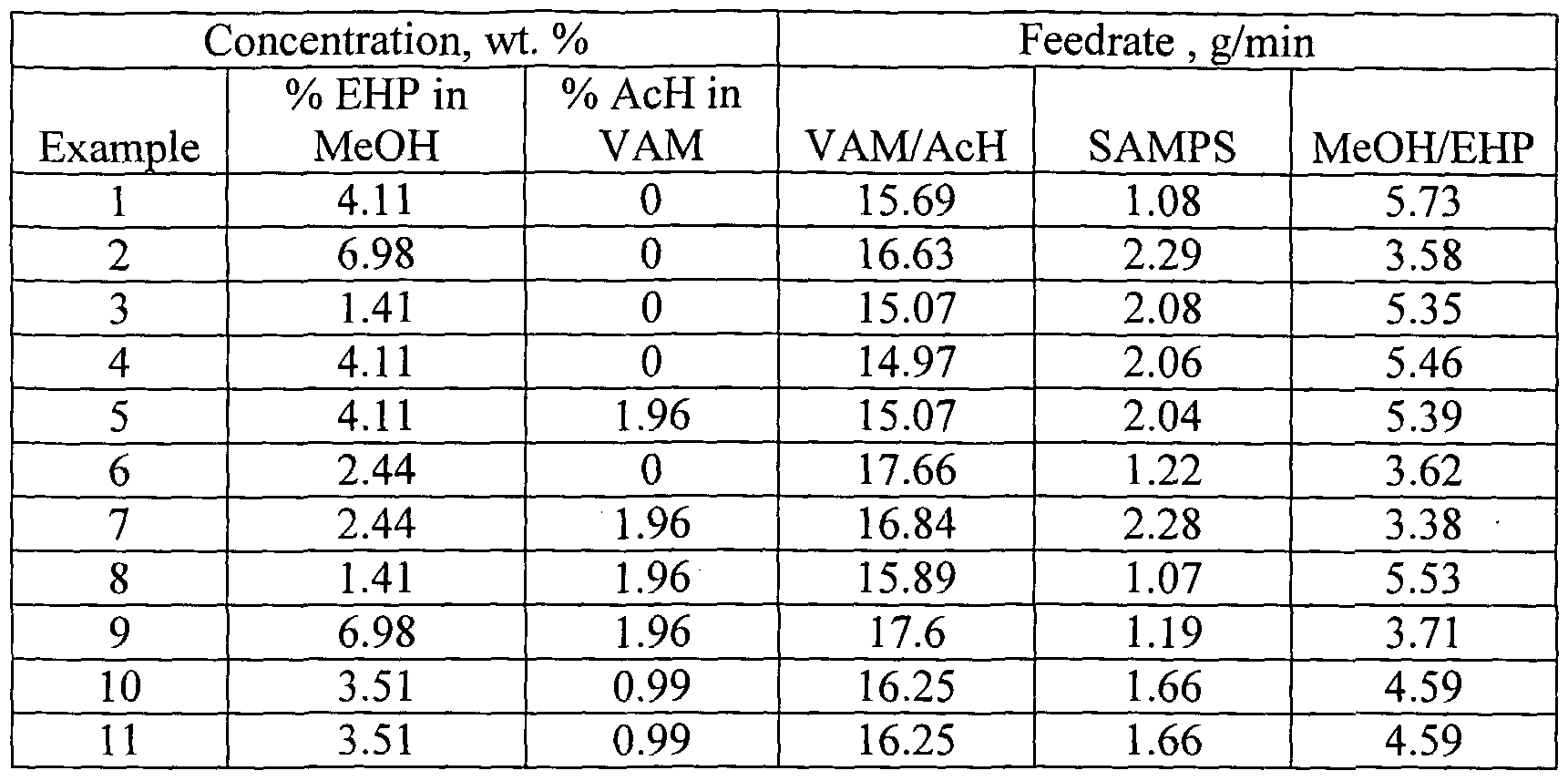
- Examples 1-11 describe the preparation of copolymers of VAM and the sodium salt of a copolymer of 2-acrylamido-2- methyl propane sulfonic propane sulfonic acid (SAMPS) by a continuous process under varying process conditions.
- Polymerizations were performed using two jacketed 2-L glass reactors in series fitted with reflux condensers, mechanical stirrers and feed lines.
- Reactor 1 was fed continuously with vinyl acetate (VAM), which, in some examples, contained acetaldehyde (AcH), methanol containing di(ethylhexyl) peroxy dicarbonate (EHP) initiator, and SAMPS, each as a separate feed line using metering pumps.
- VAM vinyl acetate
- AcH acetaldehyde
- EHP methanol containing di(ethylhexyl) peroxy dicarbonate
- SAMPS each as a separate feed line using metering pumps.
- each feed was placed on a balance and the feedrates checked by measuring the weight difference with time.
- SAMPS was also fed continuously to the second reactor to minimize compositional drift (the split between Reactor 1 and Reactor 2 was 75:25).
- Table 1 lists the feedrates and initiator and aldehyde concentrations for the runs.
- Reactor 1 temperature was 60°C and Reactor 2 temperature was 64°C.
- the residence time was 1 hour in each reactor.
- the polymer solution coming out of Reactor 2 was fed into an Oldershaw column to remove residual vinyl acetate using methanol vapors. Each run was 12 hours long to ensure the polymerization was lined-out.
- Table 2 indicates the results from the polymerization of SAMPS with vinyl acetate in the examples, including relative molecular weight of the polymer indicated by the viscosity of a 15% solution in methanol, the actual percentage of solids in Reactor 2 and the percent conversions (figures in parentheses) calculated from the actual percent solids and theoretical percent solids (figures not in parentheses).
- Table 2 shows the overall conversion of vinyl acetate and SAMPS into polymer. Based on these theoretical solids levels, which are directly related to the conversion of monomers to copolymer, the conversions range from 83% to 98%). No residual SAMPS were detected by C 13 NMR in any of the runs. Saponification of the VAM/SAMPS copolymers was accomplished by treating the paste obtained from the Oldershaw column used to strip VAM from the effluent from Reactor 2 with 50 wt. % aqueous NaOH at various values of caustic mole ratio (CMR) further diluted with methanol so that the solids content was 35 wt. %. Examples 12-17 illustrate the effect of varying conditions of saponification carried out on the VAM/SAMPS copolymer of Example 3, with the results shown in Table 3.
- CMR caustic mole ratio
- CMR Caustic mole ratio
- Table 4 shows the compositions and properties of the saponified polymers for each of the examples of Tables 1 and 2 including mol percents of polymerized SAMPS (SAMPS),polymerized VAM (PVAc) and polymerized vinyl alcohol (PVOH), degree of hydrolysis indicated by C NMR, relative molecular weight as indicated by the viscosity of a 4% solution in water and degree of hydrolysis indicated by titration.
- SAMPS polymerized SAMPS
- PVAc polymerized VAM
- PVOH polymerized vinyl alcohol
- the invention includes a continuous process for making vinyl acetate/acrylamide or acrylamide derivative copolymers.
- acrylamido comonomers and acrylamido copolymers are referred to herein as acrylamido comonomers and acrylamido copolymers, respectively, for purposes of convenience.
- a continuous process for making a vinyl acetate/acrylamido copolymer comprising: (a) continuously supplying a reaction mixture including vinyl acetate and a more reactive acrylamido comonomer to a reaction zone wherein the vinyl acetate and acrylamido comonomer are at least partially consumed to form an intermediate reaction mixture; (b) continuously supplying to the intermediate reaction mixture a stream enriched with respect to the more reactive acrylamido comonomer and copolymerizing the additional acrylamido comonomer with the intermediate reaction mixture to form a vinyl acetate/acrylamido copolymer product; and (c) continuously recovering the vinyl acetate/acrylamido copolymer product.
Landscapes
- Chemical & Material Sciences (AREA)
- Health & Medical Sciences (AREA)
- Chemical Kinetics & Catalysis (AREA)
- Medicinal Chemistry (AREA)
- Polymers & Plastics (AREA)
- Organic Chemistry (AREA)
- General Chemical & Material Sciences (AREA)
- Addition Polymer Or Copolymer, Post-Treatments, Or Chemical Modifications (AREA)
- Polymerisation Methods In General (AREA)
Abstract
Description


Claims
Priority Applications (3)
| Application Number | Priority Date | Filing Date | Title |
|---|---|---|---|
| JP2006520172A JP4810697B2 (en) | 2003-07-11 | 2004-06-15 | Production of vinyl alcohol copolymer |
| DE112004001233T DE112004001233T5 (en) | 2003-07-11 | 2004-06-15 | Preparation of vinyl alcohol copolymers |
| CN2004800199518A CN1856509B (en) | 2003-07-11 | 2004-06-15 | Production of vinyl alcohol copolymers |
Applications Claiming Priority (2)
| Application Number | Priority Date | Filing Date | Title |
|---|---|---|---|
| US10/618,248 | 2003-07-11 | ||
| US10/618,248 US6818709B1 (en) | 2003-07-11 | 2003-07-11 | Production of vinyl alcohol copolymers |
Publications (1)
| Publication Number | Publication Date |
|---|---|
| WO2005010057A1 true WO2005010057A1 (en) | 2005-02-03 |
Family
ID=33418761
Family Applications (1)
| Application Number | Title | Priority Date | Filing Date |
|---|---|---|---|
| PCT/US2004/019073 Ceased WO2005010057A1 (en) | 2003-07-11 | 2004-06-15 | Production of vinyl alcohol copolymers |
Country Status (8)
| Country | Link |
|---|---|
| US (3) | US6818709B1 (en) |
| JP (1) | JP4810697B2 (en) |
| KR (1) | KR20060056938A (en) |
| CN (1) | CN1856509B (en) |
| DE (1) | DE112004001233T5 (en) |
| ES (1) | ES2299395B2 (en) |
| TW (1) | TW200505951A (en) |
| WO (1) | WO2005010057A1 (en) |
Cited By (2)
| Publication number | Priority date | Publication date | Assignee | Title |
|---|---|---|---|---|
| WO2006132680A1 (en) * | 2005-06-07 | 2006-12-14 | Celanese International Corporation | Vinyl alcohol copolymers for use in aqueous dispersions and melt extruded articles |
| CN106029715A (en) * | 2013-12-25 | 2016-10-12 | 株式会社可乐丽 | Modified polyvinyl alcohol and water-soluble film containing same |
Families Citing this family (31)
| Publication number | Priority date | Publication date | Assignee | Title |
|---|---|---|---|---|
| US8466243B2 (en) * | 2003-07-11 | 2013-06-18 | Sekisui Specialty Chemicals America, Llc | Vinyl alcohol copolymers for use in aqueous dispersions and melt extruded articles |
| US6818709B1 (en) * | 2003-07-11 | 2004-11-16 | Celanese International Corporation | Production of vinyl alcohol copolymers |
| US7838597B2 (en) * | 2004-08-20 | 2010-11-23 | Sekisui Specialty Chemicals America, Llc | Fluid loss concentrate for hydraulic cement |
| EP1712677A1 (en) * | 2005-04-08 | 2006-10-18 | Clariant International Ltd. | Aqueous solutions of optical brighteners |
| DE102005022853A1 (en) * | 2005-05-18 | 2006-11-23 | Wacker Polymer Systems Gmbh & Co. Kg | Preparation of cationic poly vinylacetals, useful in printing inks and as binder for e.g. ceramics, comprises copolymerization of cationic monomer and vinyl ester, then saponification and acetalization |
| US20060275567A1 (en) * | 2005-06-07 | 2006-12-07 | Richard Vicari | Borate resistant films |
| ES2580152T3 (en) * | 2006-05-01 | 2016-08-19 | Monosol, Llc | Halogen resistant composition |
| US7745517B2 (en) * | 2006-05-02 | 2010-06-29 | Sekisui Specialty Chemicals America, Llc | Polyvinyl alcohol films with improved resistance to oxidizing chemicals |
| CN101460149A (en) * | 2006-06-07 | 2009-06-17 | 巴斯夫欧洲公司 | Utilization of vinyl acetate sulfonate copolymers as solubilizers for compounds with low solubility in water |
| DE102006047091A1 (en) * | 2006-10-05 | 2008-04-10 | Basf Construction Polymers Gmbh | New composition based on polyvinyl alcohol |
| US20110160336A1 (en) * | 2006-10-05 | 2011-06-30 | Roland Reichenbach-Klinke | Method of use of a polyvinyl alcohol-based composition |
| WO2009007328A2 (en) * | 2007-07-06 | 2009-01-15 | Basf Se | Use of homo- and copolymers for stabilizing active ingredient formulations |
| US8772220B2 (en) | 2007-08-24 | 2014-07-08 | Sekisui Specialty Chemicals America, Llc | Chemical delivery product and process for making the same |
| US9142835B2 (en) | 2007-11-20 | 2015-09-22 | Sekisui Specialty Chemicals America, Llc | Separator film for batteries including oxidation resistant vinyl alcohol copolymer |
| US7913759B2 (en) * | 2008-09-29 | 2011-03-29 | E. I. Du Pont De Nemours And Company | Method for enhanced recovery of oil from oil reservoirs |
| TWI412540B (en) * | 2010-09-02 | 2013-10-21 | Chang Chun Petrochemical Co | Method of manufacturing alkylsulfonate modified vinyl alcohol copolymers |
| ES2543044T3 (en) * | 2010-12-22 | 2015-08-14 | Sekisui Specialty Chemicals America, Llc | Cold water soluble polyvinyl alcohol / alkyl acrylate copolymers and films thereof |
| US9382664B2 (en) | 2011-01-05 | 2016-07-05 | Georgia-Pacific Consumer Products Lp | Creping adhesive compositions and methods of using those compositions |
| US9321953B1 (en) | 2013-11-22 | 2016-04-26 | Fritz Industries, Inc. | Well cementing |
| TWI676501B (en) | 2014-03-28 | 2019-11-11 | 英商辛色姆(英國)有限公司 | Secondary suspending agent for suspension polymerisation reaction |
| US10647793B2 (en) | 2014-03-28 | 2020-05-12 | Synthomer (Uk) Limited | Use of a sulphur or phosphorous-containing polymer as a processing aid in a polyvinyl chloride polymer composition |
| WO2016056570A1 (en) | 2014-10-09 | 2016-04-14 | 株式会社クラレ | Resin composition and film |
| FR3056217B1 (en) * | 2016-09-21 | 2020-06-19 | S.P.C.M. Sa | PROCESS FOR OBTAINING CATIONIC POLYMERS WITH REDUCED HALIDE CONTENT |
| WO2019163490A1 (en) * | 2018-02-22 | 2019-08-29 | デンカ株式会社 | Additive for oil well cement and cement slurry using said additive for oil well cement |
| CN114945522B (en) * | 2020-01-14 | 2024-08-09 | 株式会社爱赛璐 | Water-soluble film and drug encapsulation capsule material with the same function |
| CN114014969B (en) * | 2021-11-15 | 2023-08-11 | 上海华峰新材料研发科技有限公司 | A kind of water-soluble polymer and its preparation method and application |
| EP4463491A1 (en) | 2022-01-14 | 2024-11-20 | Sekisui Specialty Chemicals America, LLC | Modified polyvinyl alcohol resin with improved solubility in alcohol mixtures |
| CN120019089A (en) * | 2023-04-06 | 2025-05-16 | 积水化学工业株式会社 | Polyvinyl alcohol resin, film roll and polyvinyl acetal resin |
| EP4692136A1 (en) * | 2023-04-06 | 2026-02-11 | Sekisui Chemical Co., Ltd. | Poly(vinyl alcohol) resin, resin composition, ceramic green sheet, and ceramic capacitor |
| CN116790166B (en) * | 2023-06-13 | 2024-08-06 | 成都瑞波科材料科技有限公司 | Alignment film composition, alignment film, preparation method of alignment film and liquid crystal display panel |
| WO2024259318A1 (en) | 2023-06-15 | 2024-12-19 | Sekisui Specialty Chemicals America, Llc | Blocky polyvinyl alcohol polymers |
Citations (3)
| Publication number | Priority date | Publication date | Assignee | Title |
|---|---|---|---|---|
| JPS63270704A (en) * | 1988-03-23 | 1988-11-08 | Nippon Synthetic Chem Ind Co Ltd:The | Highly polymerized modified polyvinyl alcohol having sulfonic acid group, manufacture thereof and use thereof |
| EP0450317A1 (en) * | 1990-03-07 | 1991-10-09 | 3V Luxembourg S.A. | Vinyl acetate/vinyl alcohol copolymer, production process and use thereof |
| JPH0559244A (en) * | 1991-12-04 | 1993-03-09 | Nippon Synthetic Chem Ind Co Ltd:The | Resin composition |
Family Cites Families (12)
| Publication number | Priority date | Publication date | Assignee | Title |
|---|---|---|---|---|
| GB2056997B (en) * | 1979-07-12 | 1983-04-07 | Kuraray Co | Copolymers containing cationic groups |
| CH672851A5 (en) | 1985-08-02 | 1989-12-29 | Carrier Corp | Air conditioning system regulation |
| JPH0810328B2 (en) * | 1987-01-17 | 1996-01-31 | 日本ペイント株式会社 | Photosensitive resin composition |
| JPS6426602A (en) * | 1988-04-14 | 1989-01-27 | Kuraray Co | Continuous production of polyvinyl acetate having low polymerization degree and polyvinyl alcohol having low polymerization degree |
| CA2008617C (en) * | 1989-02-01 | 1994-11-15 | Joel Erwin Goldstein | Two stage polymerization of vinyl acetate emulsion copolymers containing incompatible monomers |
| JPH09272774A (en) | 1996-04-05 | 1997-10-21 | Kuraray Co Ltd | Water-soluble film for packaging acidic substances |
| JP3799136B2 (en) * | 1997-06-11 | 2006-07-19 | 日本合成化学工業株式会社 | Dispersion stabilizer |
| US5945457A (en) * | 1997-10-01 | 1999-08-31 | A.V. Topchiev Institute Of Petrochemical Synthesis, Russian Academy Of Science | Process for preparing biologically compatible polymers and their use in medical devices |
| JP3769380B2 (en) * | 1998-03-25 | 2006-04-26 | 日本酢ビ・ポバール株式会社 | Polyvinyl alcohol paper coating agent with excellent high-speed coating properties |
| US6564079B1 (en) * | 2000-07-27 | 2003-05-13 | Ckm Diagnostics, Inc. | Electrode array and skin attachment system for noninvasive nerve location and imaging device |
| US6818709B1 (en) * | 2003-07-11 | 2004-11-16 | Celanese International Corporation | Production of vinyl alcohol copolymers |
| US7786229B2 (en) * | 2003-07-11 | 2010-08-31 | Sekisui Specialty Chemicals America, Llc | Vinyl alcohol copolymers for use in aqueous dispersions and melt extruded articles |
-
2003
- 2003-07-11 US US10/618,248 patent/US6818709B1/en not_active Expired - Lifetime
-
2004
- 2004-05-03 TW TW093112426A patent/TW200505951A/en unknown
- 2004-06-15 DE DE112004001233T patent/DE112004001233T5/en active Pending
- 2004-06-15 ES ES200650002A patent/ES2299395B2/en not_active Expired - Fee Related
- 2004-06-15 WO PCT/US2004/019073 patent/WO2005010057A1/en not_active Ceased
- 2004-06-15 KR KR1020067000713A patent/KR20060056938A/en not_active Withdrawn
- 2004-06-15 CN CN2004800199518A patent/CN1856509B/en not_active Expired - Lifetime
- 2004-06-15 JP JP2006520172A patent/JP4810697B2/en not_active Expired - Lifetime
- 2004-09-21 US US10/946,970 patent/US7790815B2/en not_active Expired - Fee Related
-
2010
- 2010-08-13 US US12/806,482 patent/US7994265B2/en not_active Expired - Fee Related
Patent Citations (3)
| Publication number | Priority date | Publication date | Assignee | Title |
|---|---|---|---|---|
| JPS63270704A (en) * | 1988-03-23 | 1988-11-08 | Nippon Synthetic Chem Ind Co Ltd:The | Highly polymerized modified polyvinyl alcohol having sulfonic acid group, manufacture thereof and use thereof |
| EP0450317A1 (en) * | 1990-03-07 | 1991-10-09 | 3V Luxembourg S.A. | Vinyl acetate/vinyl alcohol copolymer, production process and use thereof |
| JPH0559244A (en) * | 1991-12-04 | 1993-03-09 | Nippon Synthetic Chem Ind Co Ltd:The | Resin composition |
Non-Patent Citations (2)
| Title |
|---|
| PATENT ABSTRACTS OF JAPAN vol. 0130, no. 84 (C - 572) 27 February 1989 (1989-02-27) * |
| PATENT ABSTRACTS OF JAPAN vol. 0173, no. 73 (C - 1083) 14 July 1993 (1993-07-14) * |
Cited By (7)
| Publication number | Priority date | Publication date | Assignee | Title |
|---|---|---|---|---|
| WO2006132680A1 (en) * | 2005-06-07 | 2006-12-14 | Celanese International Corporation | Vinyl alcohol copolymers for use in aqueous dispersions and melt extruded articles |
| JP2008542520A (en) * | 2005-06-07 | 2008-11-27 | セラニーズ・インターナショナル・コーポレーション | Vinyl alcohol copolymers for use in aqueous dispersions and melt-extruded articles |
| KR101190925B1 (en) | 2005-06-07 | 2012-10-12 | 셀라니즈 인터내셔날 코포레이션 | Vinyl alcohol copolymers for use in aqueous dispersions and melt extruded articles |
| JP2012229430A (en) * | 2005-06-07 | 2012-11-22 | Sekisui Specialty Chemicals America Llc | Vinyl alcohol copolymer for use in aqueous dispersion and melt extruded article |
| JP2015232137A (en) * | 2005-06-07 | 2015-12-24 | セキスイ・スペシャルティ・ケミカルズ・アメリカ・エルエルシー | Vinyl alcohol copolymers for use in aqueous dispersions and melt-extruded articles |
| CN101193955B (en) * | 2005-06-07 | 2016-03-30 | 积水精细化工美国有限公司 | Vinyl Alcohol Copolymer Resistant to Strong Chemicals |
| CN106029715A (en) * | 2013-12-25 | 2016-10-12 | 株式会社可乐丽 | Modified polyvinyl alcohol and water-soluble film containing same |
Also Published As
| Publication number | Publication date |
|---|---|
| US20050065272A1 (en) | 2005-03-24 |
| US7994265B2 (en) | 2011-08-09 |
| CN1856509B (en) | 2010-06-16 |
| US7790815B2 (en) | 2010-09-07 |
| US6818709B1 (en) | 2004-11-16 |
| CN1856509A (en) | 2006-11-01 |
| KR20060056938A (en) | 2006-05-25 |
| ES2299395A1 (en) | 2008-05-16 |
| JP2007520584A (en) | 2007-07-26 |
| JP4810697B2 (en) | 2011-11-09 |
| ES2299395B2 (en) | 2012-11-26 |
| TW200505951A (en) | 2005-02-16 |
| US20110054112A1 (en) | 2011-03-03 |
| DE112004001233T5 (en) | 2006-06-29 |
Similar Documents
| Publication | Publication Date | Title |
|---|---|---|
| US6818709B1 (en) | Production of vinyl alcohol copolymers | |
| US7932328B2 (en) | Vinyl alcohol copolymers for use in aqueous dispersions and melt extruded articles | |
| US10316124B2 (en) | Cold water soluble polyvinyl alcohol/alkyl acrylate copolymers and films thereof | |
| US4618648A (en) | Copolymers of vinyl alcohol and poly(alkyleneoxy)acrylates | |
| CA1242292A (en) | Process for the manufacture of aqueous copolymer dispersions and their use | |
| EP0461399A2 (en) | Amine functional polymers containing aminal groups | |
| EP0275081B1 (en) | Copolymers of vinyl alcohol and acrylates | |
| JP2008542520A5 (en) | ||
| US12570780B2 (en) | Modified polyvinyl alcohol resin with improved solubility in alcohol mixtures | |
| US4708999A (en) | Copolymers of vinyl acetate and poly(alkyleneoxy) acrylates | |
| WO2004101655A1 (en) | Method for the production of powder-type ethylene vinyl alcohol mixed polymers | |
| US4675360A (en) | Thermoplastically processed packaging articles comprising a copolymer of vinyl alcohol and poly(alkyleneoxy)acrylate | |
| CA1247778A (en) | Polymerization process for preparation of finely divided aqueous polymer dispersions | |
| JP4132467B2 (en) | Production method of vinyl alcohol polymer | |
| CN103906807A (en) | Alkyl-modified vinyl alcohol polymer solution | |
| CN115010844A (en) | Thermoplastic polyvinyl alcohol and preparation method and application thereof | |
| US20080027175A1 (en) | Novel Poly(Vinylester) Copolymers and Poly (Vinylalcohol) Copolymers and the Use Thereof | |
| US20240417498A1 (en) | Blocky polyvinyl alcohol polymers | |
| WO2010030372A2 (en) | Improved nvf copolymer process | |
| TW202511319A (en) | Modified polyvinyl alcohol polymers, water-soluble films, water-soluble fibers, and barrier packaging materials | |
| JP6888998B2 (en) | Method for producing vinyl alcohol-based copolymer | |
| HK1190741A (en) | Cold water soluble polyvinyl alcohol/alkyl acrylate copolymers and films thereof |
Legal Events
| Date | Code | Title | Description |
|---|---|---|---|
| WWE | Wipo information: entry into national phase |
Ref document number: 200480019951.8 Country of ref document: CN |
|
| AK | Designated states |
Kind code of ref document: A1 Designated state(s): AE AG AL AM AT AU AZ BA BB BG BR BW BY BZ CA CH CN CO CR CU CZ DE DK DM DZ EC EE EG ES FI GB GD GE GH GM HR HU ID IL IN IS JP KE KG KP KR KZ LC LK LR LS LT LU LV MA MD MG MK MN MW MX MZ NA NI NO NZ OM PG PH PL PT RO SC SD SE SG SK SL SY TJ TM TN TR TT TZ UA UG US UZ VC VN YU ZA ZM ZW |
|
| AL | Designated countries for regional patents |
Kind code of ref document: A1 Designated state(s): BW GH GM KE LS MW MZ NA SD SL SZ TZ UG ZM ZW AM AZ BY KG KZ MD RU TJ TM AT BE BG CH CY CZ DE DK EE ES FI FR GB GR HU IE IT LU MC NL PL PT RO SE SI SK TR BF BJ CF CG CI CM GA GN GQ GW ML MR NE SN TD TG |
|
| DPEN | Request for preliminary examination filed prior to expiration of 19th month from priority date (pct application filed from 20040101) | ||
| 121 | Ep: the epo has been informed by wipo that ep was designated in this application | ||
| ENP | Entry into the national phase |
Ref document number: 200650002 Country of ref document: ES Kind code of ref document: A |
|
| WWE | Wipo information: entry into national phase |
Ref document number: P200650002 Country of ref document: ES |
|
| WWE | Wipo information: entry into national phase |
Ref document number: 2006520172 Country of ref document: JP Ref document number: 1020067000713 Country of ref document: KR |
|
| 122 | Ep: pct application non-entry in european phase | ||
| WWP | Wipo information: published in national office |
Ref document number: 200650002 Country of ref document: ES Kind code of ref document: A |
|
| WWR | Wipo information: refused in national office |
Ref document number: 200650002 Country of ref document: ES Kind code of ref document: A |