ALPHA-AMINO ACID BENZOTHIAZOLYLTHIO ESTER AS INTERMEDIATES FOR MANUFACTURE OF ACE INHIBITORS AND PROCESS FOR PREPARATION THEREOF
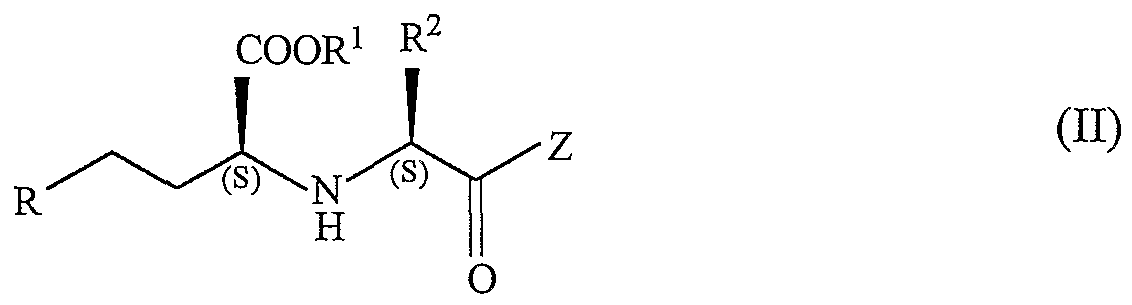
FIELD OF THE INVENTION The present invention relates to novel compounds of formula (I), being intermediates for the manufacture of ACE inhibitors of formula (II)
wherein R is a lower alkyl of 1-4 carbon atoms or phenyl, R1 is hydrogen or lower alkyl of 1-4 carbon atoms, and 15 R2 is lower alkyl of 1-4 carbon atoms or lower alkyl of 1-4 carbon atoms to which is attached an amino or substituted amino group, and Z is an amino acid or its derivative thereof .
This invention further provides novel method for preparation of compounds of formula 20 1 and formula II as well as the preparation of lisinopril in high diastereomeric selectivity.
BACKGROUND OF THE INVENTION Hypertension, since it shows few, if any symptoms has come to be regarded as the 25 "silent killer". It is a major risk factor for other cardiovascular diseases such as stroke, heart attacks, congestive heart failure, cardiac insufficiency etc. Hypertension is the
most prevalent of all cardiovascular diseases in the developed as well as developing countries, affecting 20-30% of the adult population.
Hypertension is currently treated in one of the five ways, viz. with (a) Diuretics, which increase the elimination of sodium;
(b) Alpha or Beta Blockers, which work through the involuntary nervous system to lower blood pressure;
(c) Calcium Channel Blockers or calcium antagonists, which reduce blood vessel constriction by interfering with the effects of calcium in the vessel wall; (d) Vasodilators, which dilate arteries to decrease overall pressure; and
(e) Angiotensin Converting Enzyme (ACE) Inhibitors, which reduce blood- pressure-raising hormones.
The last mentioned i. e. the Angiotensin Converting Enzyme (ACE) Inhibitors constitute an important class of compounds for treatment of hypertension. These class of compounds, excepting a few, possess close structural similarities and are commonly referred to as "Prils".
There are more than twenty "Prils" known and available in the market today for treatment of hypertension and other cardiovascular symptoms, out of which more than half have the following skeleton (III) in common in the respective molecule, wherein R is alkyl or phenyl, R, R1 and R2 have the same meanings as defined hereinbefore
Notable amongst such "Prils", which carry the fragment (III) are i. Delapril, as disclosed in US Patent No. 4,385,051; ii. Enalapril and Enalaprilat, as disclosed in US Patent No. 4,374,829; iii. Imidapril and Imidaprilat as disclosed in US Patent No. 4,508,727;
iv Lisinopril, as disclosed in US Patent No 4,374,829, v Moexipril and Moexiprilat, as disclosed in US Patent No 4,344,949, vi Perindopril and Perindoprilat, as disclosed in US Patent No 4,508,729, vii Quinapril and Quinaprilat, as disclosed in US Patent No 4,344,949, viii Ramipril, as disclosed in US Patent No 4,587,258, ix Spirapril and Spiraprilat, as disclosed in US Patent No 4,470,972, and x Trandolapril and Trandolaprilat, as disclosed in US Patent No 4,933,361
Because of the commercial importance the "Prils" occupy today in the cardiovascular segment there is a constant demand for new and improved methods for their manufacture The present invention is an attempt in this direction and thereby provides a novel method for manufacture of the aforesaid "Prils"
OBJECT OF THE INVENTION It is an object of the present invention to provide novel intermediates for manufacture of ACE inhibitors in a simple, cost-effective way and in high diastereomeric selectivity
The present inventors have found that the ACE inhibitors of formula (II) could be manufactured in high diastereomeric selectivity through a novel activated ester of the carboxylic acid fragment (III), viz 2'- benzothiazolylthio ester, which is simple and cost-effective in comparison to the known methods for synthesis of such ACE inhibitors
The inventors have further found that the novel 2'- benzothiazolylthio esters, in turn can be prepared from the respective carboxylic acid fragment (III) in a simple manner, utilizing cheap and readily available raw materials
SUMMARY OF THE INVENTION
Thus the present invention relates to novel compounds of formula (I),
wherein R is a lower alkyl of 1-4 carbon atoms or phenyl, R
1 is hydrogen or lower alkyl of 1-4 carbon atoms, and
R2 is lower alkyl of 1-4 carbon atoms or lower alkyl of 1-4 carbon atoms to which is attached an amino or substituted amino group.
According to another aspect of the present invention, there is provided a method for preparation of compounds of formula (I)
wherein R is a lower alkyl of 1-4 carbon atoms or phenyl, R1 is hydrogen or lower alkyl of 1-4 carbon atoms, and
R2 is lower alkyl of 1-4 carbon atoms or lower alkyl of 1-4 carbon atoms to which is attached an amino or substituted amino group comprising either,
(a) reaction of compound of formula (IV),
wherein Y is a hydroxy group (-OH), R is a lower alkyl of 1-4 carbon atoms or phenyl, R
1 is lower alkyl of 1-4 carbon atoms, and R
2 is lower alkyl of 1-4 carbon atoms or lower alkyl of 1-4 carbon atoms to which is attached an amino or substituted amino group with 2,2'-dithio bis[benzthiazol] of formula (V),
in the presence of a tri-(lower alkyl)- or tri(aryl) phosphine or phosphite and in the presence of an inert, non-hydroxy-containing organic solvent and optionally in the presence of a base at a temperature ranging between -30° C to +50° C to give compounds of formula (I), wherein R
1 is lower alkyl of 1-4 carbon atoms and optionally removal of the lower alkyl ester group to give compounds of formula (I), wherein R
1 is hydrogen, or
(b) reaction of compound of formula (IV),
wherein Y is halogen, R is a lower alkyl of 1-4 carbon atoms or phenyl, R
1 is lower alkyl of 1-4 carbon atoms, and
R
2 is lower alkyl of 1-4 carbon atoms or lower alkyl of 1-4 carbon atoms to which is attached an amino or substituted amino group with 2-mercaptobenzothiazole of formula (VI),
in the presence of a base and in the presence of an inert, non-hydroxy-containing organic solvent at a temperature ranging between -30° C to +50° C to give compounds of formula (I), wherein R
1 is lower alkyl of 1-4 carbon atoms and optionally removal of the lower alkyl ester group to give compounds of formula (I), wherein R
1 is hydrogen.
For ready reference the aforesaid reactions are shown in the Reaction Scheme I shown below
Scheme-I : Preparation of Novel Compounds of Formula (I) As Per The Present Invention
According to yet another aspect of the present invention, there is provided a process for preparation of ACE Inhibitors of formula (II) and pharmaceutically acceptable salts thereof,
wherein
R is a lower alkyl of 1-4 carbon atoms or phenyl,
R1 is hydrogen or lower alkyl of 1-4 carbon atoms,
R2 is lower alkyl of 1-4 carbon atoms or lower alkyl of 1-4 carbon atoms to which is attached an amino or substituted amino group, and
Z is an amino acid selected from those given in Chart-I
COOH
comprising reaction of the novel compounds of formula (I)
R is a lower alkyl of 1-4 carbon atoms or phenyl, R1 is hydrogen or lower alkyl of 1-4 carbon atoms, and
R2 is lower alkyl of 1-4 carbon atoms or lower alkyl of 1-4 carbon atoms to which is attached an amino or substituted amino group
with an amino acid derivative of formula (VII),
wherein Z has the same meaning as defined hereinabove and R3 is hydrogen or an easily removable carboxyl protective group in the presence of an inert, non-hydroxy- containing organic solvent and optionally in the presence of a base at a temperature ranging from -20° C to -5° C, with the proviso that when R3 is hydrogen compounds of formula (II) and their pharmaceutically acceptable salts thereof are obtained directly and when R3 is a carboxyl protective group, removal of the said protective group give compounds of formula (II) and their pharmaceutically acceptable salts thereof.
For ready reference the aforesaid reaction is shown in Reaction Scheme III below
(I) R
3 = Hydrogen or Protective Group Scheme-in : Novel Method For Synthesis of ACE Inhibitors of Formula (II) As Per The Present Invention
In a further aspect of the present invention, there is provided a novel method for preparation of the ACE Inhibitor, lisinopril of formula (II
2),
comprising the steps of
i) reaction of a L-lysine derivative of formula (IV6),
wherein R
4 and R
5 are either hydrogen or a amino and carboxyl protective group respectively; with a compound of formula (IN ),
wherein R6 is hydrogen or lower alkyl of 1-4 carbon atoms;
the asterik (*) on the carbon bearing the (-COOR6) group is either racemic having the (R/S) configuration or has the (Reconfiguration; and L is a leaving group, in the presence of a base and in the presence of an inert solvent at a temperature of between -80° C to +80° C to give a novel compound of formula (IN5), wherein R4 and R5 are a amino and carboxyl protective group respectively and R6 is hydrogen or lower alkyl of 1-4 carbon atoms and the asterik (*) on the carbon bearing the (-COOR6) group is either racemic having the (R/S) configuration or has the (S)-confιguration; and optionally removal of the protective group R5 to give compound of formula (IN ),
wherein R4 is an amino protective group and R5 is hydrogen, or through reductive amination of an α-keto compound of formula (IVs),
wherein R
6 is as defined hereinearlier, with the L-lysine derivative of formula (IN ), in aqueous solution in the presence of sodium cyanoborohydride or reduction of the intermediate Schiff s base in an inert organic solvent and in the presence of a hydrogenation catalyst and a hydrogenation agent to give a novel compound of formula (IN
5), wherein R
4 and R
5 are a amino and carboxyl protective group respectively and R
6 is hydrogen or lower alkyl of 1-4 carbon
atoms and the asterik (*) on the carbon bearing the (-COOR
6) group is either racemic having the (R/S) configuration or has the (S)-configuration; and optionally removal of the protective group R to give compound of formula (IN
5), wherein R
4 is an amino protective group and R is hydrogen, and
reacting compound of formula (IN ),
wherein R4 is an amino protective group and R5 is hydrogen; R is hydrogen or lower alkyl of 1-4 carbon atoms and the asterik (*) on the carbon bearing the (- COOR6) group is either racemic having the (R/S) configuration or has the (S)- configuration with
2,2'-dithio bis[benzthiazol] of formula (N),
in the presence of a tri-(lower alkyl)- or tri(aryl) phosphine or phosphite and in the presence of an inert, non-hydroxy-containing organic solvent and optionally in the presence of a base at a temperature ranging between -30° C to +50° C to give compound of formula (I
5),
wherein R4 is an amino protective group and R6 is hydrogen or lower alkyl of 1-4 carbon atoms and the asterik (*) on the carbon bearing the (-COOR6) group is either racemic having the (R/S) configuration or has the (S)-configuration or reaction of compound of formula (IN9),
wherein R4 is an amino protective group and R5 is halogen ; R6 is hydrogen or lower alkyl of 1-4 carbon atoms and the asterik (*) on the carbon bearing the (- COOR6) group is either racemic having the (R/S) configuration or has the (S)- configuration and X is a halogen atom, with
with 2-mercaptobenzothiazole of formula (NI),
in the presence of a base and in the presence of an inert, non-hydroxy-containing organic solvent at a temperature ranging between -30° C to +50° C to give compounds of formula (I5), and
iii) reacting compound of formula (I ),
wherein R4 is an amino protective group and R is hydrogen or lower alkyl of 1-4 carbon atoms and the asterik (*) on the carbon bearing the (-COOR6) group is either racemic having the (R/S) configuration or has the (S)-configuration, with a L-proline derivative of formula (VII1),
wherein E is a carboxyl protective group in the presence of a inert, non-hydroxy- containing organic solvent to give protected lisinopril of formula (II
3),
wherein R
4 is an amino protective group and R
6 is hydrogen or lower alkyl of 1-4 carbon atoms and the asterik (*) on the carbon bearing the (-COOR
6) group is either racemic having the (R/S) configuration or has the (S)-configuration, and iv) removal of protective groups from compound of formula (II
3), and optionally separating the diastereomers to give lisinopril of formula (II
2).
For ready reference the aforesaid reactions are shown in the Reaction Scheme II below
Scheme-II : Novel Method For Synthesis of Lisinopril (II
2) As Per The Present Invention
DETAILED DESCRIPTION OF THE INVENTION
Compounds of formula (I), wherein R is lower alkyl of 1-4 carbon atoms or is phenyl; R
1 is hydrogen or lower alkyl of 1-4 carbon atoms; R
2 is lower alkyl of 1-4 carbon atoms can be prepared by reaction of the peptide derivative of formula (IV
1),
which corresponds to compound of formula (IN), wherein
Y is hydroxyl;
R is lower alkyl of 1-4 carbon atoms or is phenyl;
R1 is hydrogen or lower alkyl of 1-4 carbon atoms; and
R2 is lower alkyl of 1-4 carbon atoms with 2,2'-dithio bis[benzthiazol] of formula (N),
The reaction is suitably effected in the presence of a tri-(lower alkyl)- or tri-(aryl)- phosphine or phosphite and in the presence of an inert, non-hydroxy-containing organic solvent and optionally in the presence of a base at a temperature ranging between -30° C to +50° C to give compounds of formula (I), wherein R1 is lower alkyl of 1-4 carbon atoms and optionally removal of the lower alkyl ester group to give compounds of formula (I), wherein R1 is hydrogen,
Suitable tri-(lower alkyl) phosphines include trimethyl phosphine, triethylphosphine, tri-n-propyl phosphine, triisopropyl phosphine, tri-n-butyl phosphine, tri-isobutyl phosphine, tri-t-butyl phosphine and the like.
Suitable tri-(lower alkyl) phosphites include trimethyl phosphite, triethylphosphite, tri- n-propyl phosphite, triisopropyl phosphite, tri-n-butyl phosphite and the like.
Suitable tri-(aryl) phosphines include triphenyl phosphine, tri (p-methoxyphenyl) phosphine, tri (o-chlorophenyl) phosphine, tri (p-chlorophenyl) phosphine, tri (m-tolyl) phosphine, tri (o-tolyl) phosphine, tri (p-tolyl) phosphine, tri (m-bromophenyl) phosphine, tri (p-bromophenyl) phosphine, tri (p-iodophenyl) phosphine, tri (p-n- propylphenyl) phosphine, tri (p-tert-butylphenyl) phosphine, tri (p-isopropoxyphenyl) phosphine and the like
Suitable tri-(aryl) phosphites include triphenyl phosphite, tri (p-methoxyphenyl) phosphite, tri (o-chlorophenyl) phosphite, tri (p-chlorophenyl) phosphite, tri (m-tolyl) phosphite, tri (o-tolyl) phosphite, tri (p-tolyl) phosphite, tri (m-bromophenyl) phosphite, tri (p-bromophenyl) phosphite, tri (p-iodophenyl) phosphite, tri (p-n-propylphenyl) phosphite, tπ (p-tert-butylphenyl) phosphite, tri (p-isopropoxyphenyl) phosphite and the like
Tri-(lower alkyl) phosphines and tri (aryl) phosphines are preferred over the tri-(lower alkyl) phosphites and tri (aryl) phosphates Among the tri (lower alkyl) phosphines and the tri (aryl) phosphines, the tri (aryl) phosphines are preferred Among the tri (aryl) phosphines, the more preferred is triphenyl phosphine, primarily because of commercial availability
The tri (lower alkyl) phosphines or phosphites and the tri (aryl) phosphines or phosphites are employed in molar proportions of 1 0 to 2 0 moles per mole of compound of formula (IN1), in particular 1 0 to 1 50 moles per mole of compound of formula (IN1), preferably 1 0 to 1 30 moles per mole of compound of formula (IN1)
The reaction can be carried out in the presence of or absence of an organic base There is no material difference in both sets of reactions and both give compounds of formula (I) possessing substantially identical purity in substantially identical yield
The organic bases that can be used are selected from triethylamine, pyridine, 2,3- diaminopyridine, 2,4-diaminopyridine, Ν-methyl morpholine and the like
Triethylamine is preferred, primarily because of its low cost and commercial availability.
Typically, the base is employed in molar proportions of 1.0 to 5.0 moles per mole of compound of formula (IN1), preferably in molar proportions of 1.0 to 3.0 moles per mole of compound of formula (IN1).
The reaction is suitably effected in an inert, non-hydroxy-containing organic solvent. The term, "a non-hydroxy-containing organic solvent" is meant to include and cover organic solvents, which do not contain a hydroxyl (-OH) group. Such non-hydroxy- containing organic solvents are further inert. By "inert organic solvent" is meant an organic solvent which, under the reaction conditions does not enter into any appreciable reaction with either the reactants or the products.
Thus, the inert, non-hydroxy-containing organic solvents that can be used for the reaction include hydrocarbons, both aliphatic and aromatic, including pentane, hexane, heptane, octane, cyclopentane, cyclohexane and cycloheptane, toluene, m-, o- or p- xylene, benzene, mesitylene and the like; ethers, cyclic and acyclic such as diethyl ether, butyl ethyl ether, diisopropyl ether, tetrahydrofuran, dioxane, 1,2- dimethoxyethane and the like; carboxylic acid esters such as ethyl acetate, methyl formate, methyl acetate, amyl acetate, n-butyl acetate, sec-butyl acetate, tert-butyl acetate, methyl propionate, methyl butyrate and the like; nitriles such as acetonitrile, propionitrile, butyronitrile and the like; halogenated hydrocarbons, both aromatic and aliphatic such as chloroform, methylene chloride, carbon tetrachloride, 1,2- dichloro ethane, lJ,2-trichloroethane, l,l-dibromo-2-chloroethane, 2-chloropropane, 1- chlorobutane, chlorobenzene, fluorobenzene, dichlorobenzene and the like; nitro compounds such as nitromethane, nitroethane, 1-or 2-nitropropane, nitrobenzene and the like; ketonic solvents such as acetone, methyl ethyl ketone, methyl iso-butyl ketone, cyclopentanone, cyclohexanone and the like; and polar aprotic solvents such as Ν,Ν- dimethyl formamide, N,N-dimethyl acetamide and the like.
The particular inert, non-hydroxy-containing organic solvent employed as a medium for the preparation of compounds of formula (I) or as a medium for their use in preparation of ACE inhibitors of formula (II) is not critical, however, such solvent properties like polarity, melting or boiling point, and ease of isolation of compounds of formula (I) may be considered in selecting a most suitable solvent.
Preferred solvents for the preparation of compounds of formula (I) as per the present process described hereinbelow are hydrocarbons, especially aromatic hydrocarbons; carboxylic acid esters, especially ethyl acetate; ether, especially tetrahydrofuran; and halogenated hydrocarbons, especially dichloromethane and 1,2-dichloroethane. The most preferred solvents are halogenated hydrocarbons, especially dichloromethane and 1,2-dichloroethane.
The reaction temperature may for example be from -30° C to +50° C, in particular -10° C to +30° C, preferably -5° C to + 20° C.
2,2'-dithio bis[benzthiazol] of formula (V), which is commercially available is employed in molar proportions of 1.0 to 2.0 moles per mole of compound of formula (IV1), in particular 1.0 to 1.50 moles per mole of compound of formula (IN1), preferably 1.0 to 1.30 moles per mole of compound of formula (IN1).
In a typical method, the tri (lower alkyl) phosphine/phosphite or the tri (aryl) phosphine/phosphite is dissolved in the inert, non-hydroxy-containing organic solvent, to which is added 2,2'-dithio bis[benzthiazol] of formula (N). The reaction mixture is agitated for 45 to 60 mns at a temperature of 20° C to 30° C. Thereafter, the reaction mixture is cooled to -10° C to + 10° C to which is added the carboxylic acid compound of formula (IN1), wherein R1 is hydrogen or lower alkyl of 1-4 carbon atoms; R2 is lower alkyl of 1-4 carbon atoms, followed by addition of the base. The reaction mixture is agitated at the same temperature for 45 to 60 mns and thereafter gradually increased to 20° C to 30° C and agitated at the same temperature for about 2 to 5 hrs. Evaporation of the solvent gives compound of formula (I), wherein R1 is lower alkyl of 1-4 carbon atoms; R is lower alkyl of 1-4 carbon atoms, which can be used as such for use in
preparation of ACE inhibitors of formula (II) or can be purified by conventional methods prior to use.
Alternatively, compound of formula (I) can be prepared as per the abovementioned method, but in the absence of a base. Compounds of formula (I), wherein R1 is hydrogen; R2 is lower alkyl of 1-4 carbon atoms can be prepared by removal of the lower alkyl ester groups of compounds of formula (I), wherein R1 is lower alkyl of 1-4 carbon atoms; R2 is lower alkyl of 1-4 carbon atoms. For instance, when the group R1 in compounds of formula (I) corresponds to methyl or ethyl, such groups can be removed under basic conditions to give the corresponding free carboxylic acid compound, whereas when the group R1 in compounds of formula (I) corresponds to tert- butyl, such group can be removed under acidic conditions to give the corresponding free carboxylic acid compound.
In particular, the present invention provides 2'-benzthiazolyl thioester of N-[1(S)- ethoxycarbonyl butyl]-(S)-alanine of formula [I1, corresponding to compound of formula (I), wherein R is methyl, R1 is ethyl; R2 is methyl] and a method of preparation thereof and 2'-benzthiazolyl thioester of N-[l(S)-ethoxycarbonyl-3-phenylpropyl]-(S)- alanine of formula [I , corresponding to compound of formula (I), wherein R is phenyl, R1 is ethyl; R2 is methyl] and a method of preparation thereof.
Compound (I1), corresponding to compound of formula (I), wherein R is methyl, R1 is ethyl and R2 is methyl is useful as an intermediate for preparation of the ACE inhibitor, Perindopril; whereas compound (I2), corresponding to compound of formula (I), wherein R is phenyl, R1 is ethyl and R2 is methyl is useful as an intermediate for
preparation of the ACE inhibitors such as Delapril, Enalapril, Imidapril., Moexipril, Quinapril, Ramipril, Spirapril, and Trandolapril.
In a specific embodiment, 2'-benzthiazolyl thioester of N-[l(S)-ethoxycarbonyl butyl]- (S)-alanine of formula (I1), corresponding to compound of formula (I), wherein R is methyl, R1 is ethyl; R2 is methyl can be prepared by dissolving triphenyl phosphine in an inert, non-hydroxy-containing organic solvent. To the solution is added 2,2'-dithio bis[benzthiazol] of formula (V). The reaction mixture is agitated for 45 to 60 mns at a temperature of 20° C to 30° C. Thereafter, the reaction mixture is cooled to -10° C to + 10° C to which is added N-[l(S)-ethoxycarbonyl butyl]-(S)-alanine (IN1), corresponding to compound of formula (IN), wherein R is methyl, R1 is ethyl; R2 is methyl followed by addition of the base. The reaction mixture is agitated at the same temperature for 45 to 60 mns and thereafter gradually increased to 20° C to 30° C and agitated at the same temperature for about 2 to 5 hrs. Evaporation of the solvent gives compound of formula (I1) as an oil.
The oil can be chromatographed over silica gel using a mixture of chloroform and petroleum ether (40-60° C) in a ratio of 3:7 as eluent to give a pure product, which exhibits the following spectral characteristics.
IR ^m"1) : 1728, 1666
1H ΝMR (CDC13, δ) : 1.00 (t, 3H); 1.30 (t, 3H); 1.45 (d, 3H); 1.50-1.90 (m, 5H); 3.40-
3.50 (m, 2H); 4.20 (q, 2H); 7.30-7.60 (m, 2H); 7.90 (dd, 1H); 8.05 (dd, 1H)
13C NMR ((CDC13, δ) : 15.09, 19.94, 20.88. 36.73. 61.85, 62.09, 63.79. 122.01, 123.62, 126.10, 126.98, 127.38, 131.00, 175.99, 203.76.
In another specific embodiment, 2 '-benzothiazolylthio ester of N-[l(S)-ethoxycarbonyl- 3-phenylpropyl]-(S)-alanine of formula [I2, corresponding to compound of formula (I), wherein R is phenyl, R1 is ethyl; R2 is methyl] can be prepared by dissolving triphenyl phosphine in an inert, non-hydroxy-containing organic solvent. To the solution is added 2,2'-dithio bis[benzthiazol] of formula (V). The reaction mixture is agitated for 45 to 60
mns at a temperature of 20° C to 30° C. Thereafter, the reaction mixture is cooled to - 10° C to + 10° C to which is added N-[l(S)-ethoxycarbonyl-3-phenylpropyl]-(S)-alanine (IV1), corresponding to compound of formula (IN), wherein R is phenyl, R1 is ethyl; R2 is methyl, followed by addition of the base. The reaction mixture is agitated at the same temperature for 45 to 60 mns and thereafter gradually increased to 20° C to 30° C and agitated at the same temperature for about 2 to 5 hrs. Evaporation of the solvent gives compound of formula (I2) as an oil.
The oil can be chromatographed over silica gel using a mixture of chloroform and petroleum ether (40-60° C) in a ratio of 3:7 as eluent to give a pure product, which exhibits the following spectral characteristics.
IR (cm_1) : 1732, 1600
1H ΝMR (CDC13, δ) : 1.30 (t, 3H); 1.50 (d, 3H); 1.90-2.30 (m, 3H); 2.70-3.10 (m, 2H); 3.40-3.70 (m, 2H); 4.20 (q, 2H); 7J0-7.60 (m, 7H); 7.90 (dd, 1H); 8.10 (dd, 1H)
13C NMR ((CDCI3, δ) : 14.74, 20.45, 27.42, 32.66, 35.93, 61.64, 63.57, 112.39, 121.66,
123.29, 124.63, 125.77, 126.54, 126.63, 127.27, 128.89, 141.57, 175.18, 203.04
The carboxylic acid compounds of formula (IN1) used for preparation of compounds of formula (I) are known and are commercially available or can be prepared by methods known in the art.
Compounds of formula (I) can also be suitably prepared by reaction of carboxylic acid halide of the peptide of formula (IN2),
which corresponds to compound of formula (IV), wherein Y is halogen;
R is lower alkyl of 1-4 carbon atoms or is phenyl; R1 is hydrogen or lower alkyl of 1-4 carbon atoms; and R2 is lower alkyl of 1-4 carbon atoms,
with 2-mercaptobenzothiazole of formula (VI),
in the presence of a base and in the presence of an inert, non-hydroxy-containing organic solvent at a temperature ranging between -30° C to +50° C to give compounds of formula (I), wherein R1 is lower alkyl of 1-4 carbon atoms and optionally removal of the lower alkyl ester group to give compounds of formula (I), wherein R1 is hydrogen.
The reaction is suitably effected in the presence of an inert, non-hydroxy-containing organic solvent and in the presence of a base.
In compound of formula (IN2) halogen refers to an halogen atom selected from chlorine, bromine or iodine.
The organic bases that can be used are selected from triethylamine, pyridine, 2,3- diaminopyridine, 2,4-diaminopyridine, Ν-methyl morpholine and the like. Triethylamine is preferred, primarily because of its low cost and commercial availability.
Typically, the base is employed in molar proportions of 1.0 to 5.0 moles per mole of compound of formula (IN2), preferably in molar proportions of 1.0 to 3.0 moles per mole of compound of formula (IN2).
The reaction is suitably effected in an inert, non-hydroxy-containing organic solvent The term, "a non-hydroxy-containing organic solvent" has been defined hereinearlier in Section 1(a) and the same "inert, non-hydroxy-containing organic solvents" referred to hereinbefore in Section 1(a) can also be used herein for preparation of compounds of formula (I) by reaction of the acid halide of formula (IN2) with 2- mercaptobenzothiazole of formula (NI)
The particular inert, non-hydroxy-containing organic solvent employed as a medium for the preparation of compounds of formula (I) or as a medium for their use in preparation of ACE inhibitors of formula (II) is not critical, however, such solvent properties like polarity, melting or boiling point, and ease of isolation of compounds of formula (I) may be considered in selecting a most suitable solvent
Preferred solvents for the preparation of compounds of formula (I) as per the present process described hereinbelow are hydrocarbons, especially aromatic hydrocarbons, carboxylic acid esters, especially ethyl acetate, ether, especially tetrahydrofuran, and halogenated hydrocarbons, especially dichloromethane and 1,2-dichloroethane
The most preferred solvents are halogenated hydrocarbons, especially dichloromethane and 1,2-dichloroethane
The reaction temperature may for example be from -30° C to +50° C, in particular -10° C to +30° C, preferably -5° C to + 20° C
2-mercaptobenzothiazole of formula (VI), which is commercially available is employed in molar proportions of 1 0 to 2 0 moles per mole of compound of formula (IN2), in particular 1 0 to 1 50 moles per mole of compound of formula (IN2), preferably 1 0 to 1 30 moles per mole of compound of formula (IN2)
In a typical method, to a solution of with 2-mercaptobenzothiazole of formula (NI), dissolved at a temperature of 20° C to 30° C in the inert, non-hydroxy-containing organic solvent containing the base and cooled to -10° C to + 10° C is added a solution
of the acid halide compound (IV2), wherein R1 is lower alkyl of 1-4 carbon atoms; R2 is lower alkyl of 1-4 carbon atoms, dissolved in a inert, non-hydroxy-containing organic solvent. The reaction mixture is agitated at the same temperature for 45 to 60 mns and thereafter gradually increased to 20° C to 30° C and agitated at the same temperature for about 2 to 5 hrs. Evaporation of the solvent gives compound of formula (I), wherein R1 is lower alkyl of 1-4 carbon atoms; R2 is lower alkyl of 1-4 carbon atoms, which can be used as such for use in preparation of ACE inhibitors of formula (II) or can be purified by conventional methods prior to use.
Compounds of formula (I), wherein R1 is hydrogen; R is lower alkyl of 1-4 carbon atoms can be prepared by removal of the lower alkyl ester groups of compounds of formula (I), wherein R1 is lower alkyl of 1-4 carbon atoms; R2 is lower alkyl of 1-4 carbon atoms. For instance, when the group R1 in compounds of formula (I) corresponds to methyl or ethyl, such groups can be removed under basic conditions to give the corresponding free carboxylic acid compound, whereas when the group R1 in compounds of formula (I) corresponds to tert-butyl. such group can be removed under acidic conditions to give the corresponding free carboxylic acid compound.
In a specific embodiment, 2'-benzthiazolyl thioester of N-[l(S)-ethoxycarbonyl butyl] - (S)-alanine of formula (I1), corresponding to compound of formula (I), wherein R is methyl, R1 is ethyl; R2 is methyl can be prepared by dissolving 2- mercaptobenzothiazole of formula (VI) in a inert, non-hydroxy-containing organic solvent and the base. The reaction mixture is agitated for 45 to 60 mns at a temperature of 20° C to 30° C. Thereafter, the reaction mixture is cooled to -10° C to + 10° C to which is added N-[l(S)-ethoxycarbonyl butyl] -(S)-alanine carboxylic acid halide [IV2, corresponding to compound of formula (IN), wherein R is phenyl, R1 is ethyl; R2 is methyl]. The reaction mixture is agitated at the same temperature for 45 to 60 mns and thereafter gradually increased to 20° C to 30° C and agitated at the same temperature for about 2 to 5 hrs. Evaporation of the solvent gives compound of formula (I1) as an oil.
The oil can be chromatographed over silica gel using a mixture of chloroform and petroleum ether (40-60° C) in a ratio of 3:7 as eluent to give a pure product, which exhibits the spectral characteristics given hereinbefore in Section 1(a).
In another specific embodiment, 2'-benzthiazolyl thioester of N-[l(S)-ethoxycarbonyl- 3-phenylpropyl]-(S)-alanine of formula (I2), corresponding to compound of formula (I), wherein R is phenyl, R1 is ethyl; R2 is methyl can be prepared by dissolving 2- mercaptobenzothiazole of formula (VI) in a inert, non-hydroxy-containing organic solvent and the base. The reaction mixture is agitated for 45 to 60 mns at a temperature of 20° C to 30° C. Thereafter, the reaction mixture is cooled to -10° C to + 10° C to which is added N-[l(S)-ethoxycarbonyl-3-phenylpropyl]-(S)-alanine carboxylic acid halide [IV2, corresponding to compound of formula (IV), wherein R is phenyl, R1 is ethyl; R2 is methyl]. The reaction mixture is agitated at the same temperature for 45 to 60 mns and thereafter gradually increased to 20° C to 30° C and agitated at the same temperature for about 2 to 5 hrs. Evaporation of the solvent gives compound of formula (I2) as an oil.
The oil can be chromatographed over silica gel using a mixture of chloroform and petroleum ether (40-60° C) in a ratio of 3:7 as eluent to give a pure product, which exhibits the spectral characteristics given hereinbefore in Section 1(a).
The starting carboxylic acid halide compounds of formula (IN2) used for preparation of compounds of formula (I) can be prepared by methods known in the art, particularly by the method disclosed in GB Patent No. 2,095,252 as well as by our pending PCT Application No. PCT/IN03/00042, dated February 28, 2003.
As mentioned herein earlier, the present invention provides a compound of formula (IV
5),
wherein R4 and R5 are either hydrogen or a amino and carboxyl protective group respectively;
R6 is hydrogen or lower alkyl of 1-4 carbon atoms; and the asterik (*) on the carbon bearing the (-COOR6) group is either racemic having the
(R/S) configuration or has the (S)-configuration as an useful intermediate for preparation of the novel compounds of formula (I), and thereby, in turn provides a novel method for preparation of the ACE inhibitor, lisinopril of formula(II2).
Compound of formula (IN5) is an useful intermediate for preparation of the novel compounds of formula (I), and thereby, in turn provides a novel method for preparation of the ACE inhibitor, lisinopril of formula (II2).
In compounds of formula (IN ) the amino protective group corresponding to group R that can be employed are those protective groups routinely practiced in the art, specially those routinely used in peptide synthesis. Suitable protective groups include but are not limited to a substituted benzyloxycarbonyl group such as a tertiary butoxycarbonyl group, benzyloxycarbonyl group, p-nitrobenzyloxy carbonyl group etc.; a urethane type protective group such as isobornyloxycarbonyl group etc.; an acyl type protective group such as trifluoroacetyl group, a formyl group, a phthaloyl group etc. Of these, in particular, trifluoroacetyl group is preferred, since it can be removed easily with alkali.
In compounds of formula (IN5) the carboxyl protective group corresponding to group R that can be employed are easily removable carboxyl protective groups routinely utilized in organic chemistry. These include inter alia,
those forming an alkyl ester e.g. methyl, ethyl, tert-butyl esters; halo-lower alkyl esters e.g. 2-chloroethyl, 2,2,2,-trichloroethyl esters; lower acyl-lower alkyl esters e.g. lower alkanoylmethyl, 2-acetyl ethyl, phenacyl, p- bromophenacyl, α-benzoylbenzyl esters; lower alkoxy-lower alkyl esters e.g. methoxymethyl ester; lower acyloxy-lower alkyl esters e.g. acetoxymethyl, pivaloyloxymethyl, N,N- dimethylglycyloxymethyl, benzoyloxymethyl esters; lower lJ-dicarbo-lower alkoxyalkyl esters e.g. dicarbomethoxymethyl, dicarbethoxymethyl esters; lower aryl esters e.g. phenyl, pyridyl esters optionally substituted by an inert group e.g. nitro, methoxy, or lower alkyl; aralkyl esters e.g. benzyl, benzhydryl, naphthylmethyl and pyridylmethyl esters optionally substituted by an inert group e.g. nitro, methoxy or lower alkyl; a trialkylsilyl group e.g. a tri (Cι- )alkyl silyl, e.g. trimethylsilyl; and other groups known to those skilled in the art.
Preferred carboxyl protective groups are trialkylsilyl, specially trimethylsilyl and aralkyl, specially benzyl esters.
The asterik (*) on the carbon bearing the (-COOR6) group is either racemic having the (R/S) configuration or has the preferred (S)-configuration, both of which falls within the scope of this invention.
Compound of formula (IN5) can be prepared by any of the following methods, viz.
In the first method, a lysine derivative (IN
6),
in which R
4 and R
5 have the same meaning defined hereinbefore is reacted with 4- phenyl-2-hydroxy-butyric acid derivative of formula (IN ),
wherein R6 is hydrogen or lower alkyl of 1-4 carbon atoms; the asterik (*) on the carbon bearing the (-COOR6) group is either racemic having the (R/S) configuration or has the (Reconfiguration; and L is a leaving group, in the presence of a base and in the presence of an inert solvent at a temperature between -80° C to +80° C to give compound of formula (IN5), followed by optionally removal of the amino and carboxyl protective groups R4 and R5 to give compound of formula (IN5), in which R4 and R5 are hydrogen.
Using the process, compound of formula (IN5) can be obtained in which the center of chirality (*) produced in the SΝ reaction is in the (S) or (R/S) configuration, depending on whether the center of chirality (*) in the starting material compound (IN7) is in the (Reconfiguration or is racemic i. e. (R/S)-configuration.
When the center of chirality (*) in the starting material compound (IN7) is in the (R)- configuration, the reaction takes an unambiguous stereochemical course in giving the
product (IN5), with complete inversion of configuration as the diastereomerically pure (S)-isomer.
When the center of chirality (*) in the starting material compound (IN7) is racemic i. e. in the (R/S)-configuration, the center of chirality (*) in the product obtained (IN5), is also racemic i. e. giving the product as a diastereomeric mixture of (R)- and (S)- isomers. The diastereomers can be separated by methods known in the art to give the desired product (IN5), as the diastereomerically pure (S)-isomer.
The leaving group L in compound of formula (IN7) are those groups amenable to easy nucleophilic displacement. Such leaving groups include a tosyloxy or , mesyloxy group disclosed in US Patent No. 4 350 704; a trifluoromethanesulfonyloxy group as disclosed in US Patent No. 4 525 301; or a phenyl sulfonyloxy group or a phenyl sulfonyloxy group, wherein the phenyl is substituted by halogen, or nitro group, as disclosed in US Patent No. 5 066 801.
Of the leaving groups, the trifluoromethanesulfonyloxy group and the phenyl sulfonyloxy group or a phenyl sulfonyloxy group, wherein the phenyl is substituted by halogen, or nitro group are the most preferred, since unlike the tosyloxy or mesyloxy leaving groups, they give the product, with little racemisation.
Compound of formula (IN7) is typically employed in equimolar or in slight excess of the equimolar quantity with respect to the lysine derivative of formula (IN6) used. Typically it is employed in a molar proportions of 1.0 to 1.20 moles per moles of compound of formula (IN6).
Suitable bases that can be used in the reaction include inorganic salts, such as carbonates like sodium carbonate, potassium carbonate, lithium carbonate and cesium carbonate and organic bases, such as, for example, triethylamine, pyridine, 2,3- diaminopyridine, 2,4-diaminopyridine, Ν-methyl morpholine and the like.
The base can be used in the stoichiometric amount or in excess. Typically, the base is employed in molar proportions of 1.0 to 5.0 moles per mole of compound of formula (IN6), preferably in molar proportions of 1.0 to 3.0 moles per mole of compound of formula (IN6).
Suitable inert solvents are those which cannot react with the leaving group L and can be selected from halogenated hydrocarbons such as dichloromethane, dichloroethane, chloroform, carbon tetrachloride etc.; hydrocarbons such as hexane, toluene etc.; alcohols such as methanol, ethanol, isopropanol etc.; nitriles such as acetonitrile, propionitrile etc.; ethers such as diethyl ether, dioxane, tetrahydrofuran etc.; and amides such as dimethylformamide, hexamethylphosphoramide etc. The reaction in dichloromethane, chloroform or carbon tetrachloride is particularly preferred.
In the second method, reductive amination of an α-keto compound of formula (IN8),
wherein R
6 has the same meaning as defined hereinearlier with a L-lysine derivative of formula (IN
6),
wherein R
4 and R
5 are either hydrogen or a amino and carboxyl protective group respectively, in aqueous solution in the presence of sodium cyanoborohydride or by reduction of the intermediate Schiff s base in an inert organic solvent and in the presence of a hydrogenation catalyst and a hydrogenation agent or gives compound of formula (IN
5).
The α-keto compound of formula (IN8) is reacted with the L-lysine derivative of formula (IN6) in aqueous solution or in a suitable inert organic solvent in the presence of sodium cyanoborohydride to give compound of formula (IN5), in which the center of chirality (*) is racemic i. e. giving the product as a diastereomeric mixture of (R)- and (S)-isomers. The diastereomers can be separated by methods known in the art to give the desired product (IN5), as the diastereomerically pure (S)-isomer.
Alternatively, the intermediate Schiff s base, enamine or aminol of the following formula formed in the reductive amination step,
may be catalytically reduced, for example, by hydrogenation in the presence of 10% palladium on carbon or Raney Nickel to yield compound of formula (IN5), in which the center of chirality (*) is racemic i. e. giving the product as a diastereomeric mixture of (R)- and (S)-isomers. The diastereomers can be separated by methods known in the art to give the desired product (IN5), as the diastereomerically pure (S)-isomer.
Suitable inert solvents are those selected from halogenated hydrocarbons such as dichloromethane, dichloroethane, chloroform, carbon tetrachloride etc.; hydrocarbons such as hexane, toluene etc.; alcohols such as methanol, ethanol, isopropanol etc.; nitriles such as acetonitrile, propionitrile etc.; ethers such as diethyl ether, dioxane, tetrahydrofuran etc.; and amides such as dimethylformamide, hexamethylphosphoramide etc. The reaction in dichloromethane, chloroform or carbon tetrachloride is particularly preferred.
The two methods of preparation of the novel compound of formula (IN5) has been summarized in Scheme-II.
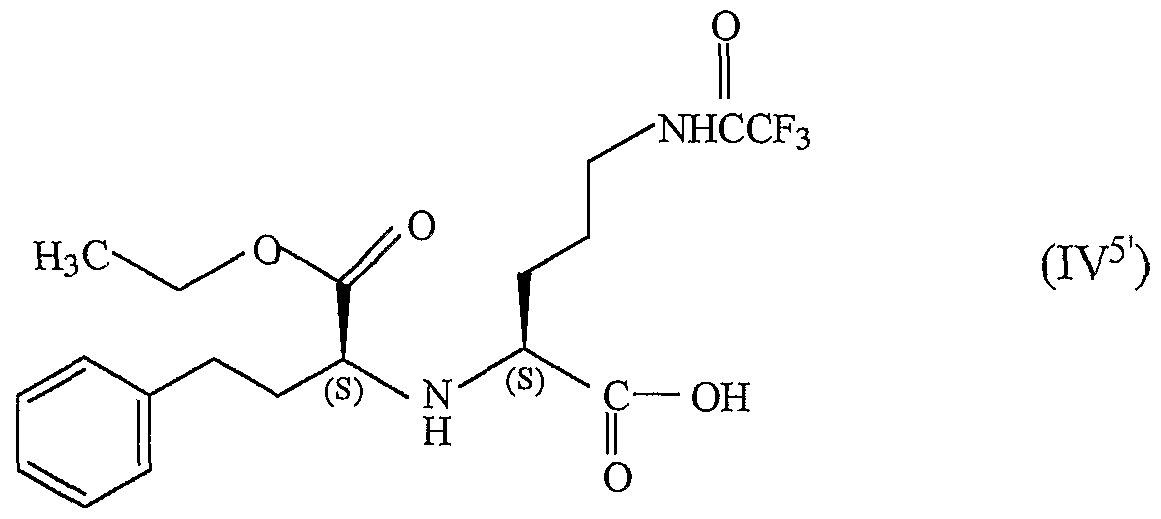
In a specific embodiment, Ν-[l(S)-l-ethoxycarbonyl-3-phenylpropyl]-Ν - trifluoroacetyl- L-lysine of formula (IN ) [corresponding to compound of formula (IN5), wherein R4 is trifluoroacetyl, R5 is hydrogen and R6 is ethyl] and Ν-[1(S)-1- ethoxycarbonyl-3-phenylpropyl]- L-lysine of formula (IN5 ) [corresponding to compound of formula (IN5), wherein R4 is hydrogen, R5 is hydrogen and R6 is ethyl] can be prepared by anyone of the methods enumerated hereinabove.
In one of the specific embodiments, compounds of formula (IN5 ) and (IN5") can be prepared the following way.
In the first step, N6-trifluoroacetyl-S-lysine benzyl ester of the following formula (IN6 '),
O
is dissolved in a suitable inert organic solvent and treated with a base at ambient temperature. To this is added a solution of (R)- [2 -trifluoromethanesulfonyloxy] -4- phenylbutyric acid ethyl ester of the following formula (IN7 ),
preferably in the same inert organic solvent and the reaction mixture agitated at 25-30° C for 18-20 hrs, till completion of reaction. The reaction mixture is quenched with water and after separation of the organic layer and evaporation of the solvent the Ν- [l(S)-ethoxycarbonyl-3-phenylpropyl]-Ν6-trifluoroacetyl-L-lysine of the following formula (IN10) is obtained as an oil.
O II
The oil can be purified by chromatography over silica gel using a mixture of ethyl acetate and hexane as eluent to give a pure product having the following spectral and physical characteristics.
Mass spectrum (m/e) : 523.5 amu
Specific rotation : -9.58° (C = 2, methanol at 25°C)
IR (cm ) : 2931,1720, 1651
1HΝMR (CDC13, δ) : 1.27 (t, 5H), 1.35-1.80 (m, 7H), 1.85-2.20 ( , 4H), 2.50-2,80 (m,
2H), 3.31 (t, 4H), 4.17 (dt, 2H), 5.15 (dd, 2H), 7.05-7.50 (m, 10H)
13C NMR (CDCI3, δ) : 14.62, 22.92, 28.31, 32.39, 32.98, 35.51, 39.90, 59.81, 60.03, 61.39, 67.12, 126.46, 128.83, 129.04, 136.02, 141.587, 174.89, 175.07
Removal of the benzyl protective group gives N-[l(S)-ethoxycarbonyl-3-phenylpropyl]- N6-trifluoroacetyl-(S)-lysine of formula (IV5 ).
Typically, the benzyl protective group is removed under catalytic hydrogenation conditions known in the art in the presence of Group NIII transition metal catalysts.
The catalysts are selected from palladium on carbon, palladium on alumina, palladium on barium carbonate, palladium on barium sulfate, palladium on calcium carbonate, palladium on kieselguhr (diatomaceous earth), palladium on silica-alumina, palladium on silica-gel, palladium on strontium carbonate, palladium on tin oxide, palladium on titania, palladium hydroxide on carbon, platinum on carbon, platinum dioxide, platinum on alumina, platinum on barium carbonate, platinum on barium sulfate, platinum on calcium carbonate, platinum on kieselguhr (diatomaceous earth), platinum on silica- alumina, platinum on silica-gel, platinum on strontium carbonate, platinum on tin oxide, platinum on titania, iridium on carbon, iridium on alumina powder, rhodium on carbon, rhodium hydroxide on carbon, rhodium on alumina, rhodium on kieselguhr (diatomaceous earth), rhodium on silica-alumina, rhodium on silica-gel, rhodium on titania, ruthenium on carbon, ruthenium on alumina, ruthenum on kieselguhr (diatomaceous earth), ruthenium on silica-alumina, ruthenium on silica-gel, rhodium on titania, rhenium on carbon, rhenium on alumina, rhenium on kieselguhr (diatomaceous earth), rhenium on silica-alumina, rhenium on silica-gel, rhenium on titania etc. The aforesaid Group NIII metal catalyst are employed either in the inactivated form or in the activated forms. In addition, suitable forms in which the catalysts are employed include powder, granules, extrudate, pellets and spheres.
The Ν-trifiuoroacetyl protective group can be removed by suitable methods to give the free amino compound (IN5 "),
The starting N
6-trifluoroacetyl-S-lysine benzyl ester is prepared by benzylation of N
6- trifluoroacetyl-S-lysine as per the conventional methods. The N
6-trifluoroacetyl-S- lysine can in turn be prepared by reaction of L-lysine hydrochloride and an alkyl trifluoroacetate as per the method described by T. J. Blacklock et. al, in /. Org. Chem., 1988, 53, 836-44.
In general, the novel compounds of formula (I) can be prepared by reacting a peptide derivative of formula (IN),
wherein R is a lower alkyl of 1-4 carbon atoms or phenyl; R1 is hydrogen or lower alkyl of 1-4 carbon atoms; R2 is lower alkyl of 1-4 carbon atoms to which is attached an amino or substituted amino group; Y is a hydroxy group (-OH)
with 2,2'-dithio bis[benzthiazol] of formula (V), or
the novel compounds of formula (I) can be prepared by reacting the peptide derivative of formula (IN),
wherein R is a lower alkyl of 1-4 carbon atoms or phenyl; R
1 is lower alkyl of 1-4 carbon atoms; R
2 is lower alkyl of 1-4 carbon atoms or lower alkyl of 1-4 carbon atoms to which is attached an amino or substituted amino group; Y is halogen
with 2-mercaptobenzothiazole of formula (VI),
The reaction is suitably effected in the presence of a tri-(lower alkyl)- or tri-(aryl)- phosphine or phosphite and in the presence of an inert, non-hydroxy-containing organic solvent and optionally in the presence of a base at a temperature ranging between -30° C to +50° C to give compounds of formula (I), wherein R1 is lower alkyl of 1-4 carbon atoms and optionally removal of the lower alkyl ester group to give compounds of formula (I), wherein R1 is hydrogen,
Suitable tri-(lower alkyl) phosphines include trimethyl phosphine, triethylphosphine, tri-n-propyl phosphine, triisopropyl phosphine, tri-n-butyl phosphine, tri-isobutyl phosphine, tri-t-butyl phosphine and the like.
Suitable tri-(lower alkyl) phosphites include trimethyl phosphite, triethylphosphite, tri- n-propyl phosphite, triisopropyl phosphite, tri-n-butyl phosphite and the like.
Suitable tri-(aryl) phosphines include triphenyl phosphine, tri (p-methoxyphenyl) phosphine, tri (o-chlorophenyl) phosphine, tri (p-chlorophenyl) phosphine, tri (m-tolyl) phosphine, tri (o-tolyl) phosphine, tri (p-tolyl) phosphine, tri (m-bromophenyl) phosphine, tri (p-bromophenyl) phosphine, tri (p-iodophenyl) phosphine, tri (p-n- propylphenyl) phosphine, tri (p-tert-butylphenyl) phosphine, tri (p-isopropoxyphenyl) phosphine and the like.
Suitable tri-(aryl) phosphites include triphenyl phosphite, tri (p-methoxyphenyl) phosphite, tri (o-chlorophenyl) phosphite, tri (p-chlorophenyl) phosphite, tri (m-tolyl) phosphite, tri (o-tolyl) phosphite, tri (p-tolyl) phosphite, tri (m-bromophenyl) phosphite, tri (p-bromophenyl) phosphite, tri (p-iodophenyl) phosphite, tri (p-n-propylphenyl) phosphite, tri (p-tert-butylphenyl) phosphite, tri (p-isopropoxyphenyl) phosphite and the like.
Tri-(lower alkyl) phosphines and tri (aryl) phosphines are preferred over the tri-(lower alkyl) phosphites and tri (aryl) phosphates. Among the tri (lower alkyl) phosphines and the tri (aryl) phosphines, the tri (aryl) phosphines are preferred. Among the tri (aryl) phosphines, the more preferred is triphenyl phosphine, primarily because of commercial availability.
The tri (lower alkyl) phosphines or phosphites and the tri (aryl) phosphines or phosphites are employed in molar proportions of 1.0 to 2.0 moles per mole of compound of formula (IV3), in particular 1.0 to 1.50 moles per mole of compound of formula (IV3), preferably 1.0 to 1.30 moles per mole of compound of formula (IN3).
The reaction can be carried out in the presence of or absence of an organic base. There is no material difference in both sets of reactions and both give compounds of formula (I) possessing substantially identical purity in substantially identical yield.
The organic bases that can be used are selected from triethylamine, pyridine, 2,3- diaminopyridine, 2,4-diaminopyridine, Ν-methyl morpholine and the like. Triethylamine is preferred, primarily because of its low cost and commercial availability.
Typically, the base is employed in molar proportions of 1.0 to 5.0 moles per mole of compound of formula (IN3), preferably in molar proportions of 1.0 to 3.0 moles per mole of compound of formula (IN3).
The reaction is suitably effected in an inert, non-hydroxy-containing organic solvent. The term, "a non-hydroxy-containing organic solvent" has been defined hereinearlier in Section 1(a) and 1(b) and the same "inert, non-hydroxy-containing organic solvents" referred to hereinbefore in Section 1(a) can also be used herein for preparation of compounds of formula (I) by reaction of the acid halide of formula (IN ) with 2- mercaptobenzothiazole of formula (NI).
The particular inert, non-hydroxy-containing organic solvent employed as a medium for the preparation of compounds of formula (I) or as a medium for their use in preparation of ACE inhibitors of formula (II) is not critical, however, such solvent properties like polarity, melting or boiling point, and ease of isolation of compounds of formula (I) may be considered in selecting a most suitable solvent.
Preferred solvents for the preparation of compounds of formula (I) as per the present process described hereinbelow are hydrocarbons, especially aromatic hydrocarbons; carboxylic acid esters, especially ethyl acetate; ether, especially tetrahydrofuran; and halogenated hydrocarbons, especially dichloromethane and 1,2-dichloroethane.
The most preferred solvents are halogenated hydrocarbons, especially dichloromethane and 1,2-dichloroethane.
The reaction temperature may for example be from -30° C to +50° C, in particular -10° C to +30° C, preferably -5° C to + 20° C. 2,2'-dithio bis[benzthiazol] of formula (N), which is commercially available is employed in molar proportions of 1.0 to 2.0 moles per rhole of compound of formula (IN3), in particular 1.0 to 1.50 moles per mole of compound of formula (IN3), preferably 1.0 to 1.30 moles per mole of compound of formula (IN3).
In a typical method, the tri (lower alkyl) phosphine/phosphite or the tri (aryl) phosphine/phosphite is dissolved in the inert, non-hydroxy-containing organic solvent, to which is added 2,2'-dithio bis[benzthiazol] of formula (N). The reaction mixture is
agitated for 45 to 60 mns at a temperature of 20° C to 30° C. Thereafter, the reaction mixture is cooled to -10° C to + 10° C to which is added the carboxylic acid compound of formula (IN3), wherein R1 is hydrogen or lower alkyl of 1-4 carbon atoms; R2 is lower alkyl of 1-4 carbon atoms to which is attached an amino or substituted amino group, followed by addition of the base. The reaction mixture is agitated at the same temperature for 45 to 60 mns and thereafter gradually increased to 20° C to 30° C and agitated at the same temperature for about 2 to 5 hrs. Evaporation of the solvent gives compound of formula (I), wherein R1 is lower alkyl of 1-4 carbon atoms; R2 is lower alkyl of 1-4 carbon atoms to which is attached an amino or substituted amino group , which can be used as such for use in preparation of ACE inhibitors of formula (II) or can be purified by conventional methods prior to use.
Alternatively, compound of formula (I) can be prepared as per the abovementioned method, but in the absence of a base.
Compounds of formula (I), wherein R1 is hydrogen; R2 is lower alkyl of 1-4 carbon atoms to which is attached an amino or substituted amino group can be prepared by removal of the lower alkyl ester groups of compounds of formula (I), wherein R1 is lower alkyl of 1-4 carbon atoms; R2 is lower alkyl of 1-4 carbon atoms to which is attached an amino or substituted amino group For instance, when the group R1 in compounds of formula (I) corresponds to methyl or ethyl, such groups can be removed under basic conditions to give the corresponding free carboxylic acid compound, whereas when the group R1 in compounds of formula (I) corresponds to tert-butyl, such group can be removed under acidic conditions to give the corresponding free carboxylic acid compound.
The compound of formula (IN3), which has the free amino function of group R2 can be used as such for reaction with 2,2'-dithio bis[benzthiazol] of formula (N), however, it is preferable to protect the amino function of the group R2 to give compound of formula (IN3), in which the amino function is protected prior to reaction with compound of formula (N). Removal of the amino protective groups by suitable methods would then give compounds of formula (I), in which the amino function is free.
Suitable amino protective groups that can be employed are those routinely practiced in the art, specially those routinely used in peptide synthesis. Suitable protective groups include but are not limited to a substituted benzyloxycarbonyl group such as a tertiary butoxy carbonyl group, benzyloxycarbonyl group, p-nitrobenzyloxycarbonyl group etc.; a urethane type protective group such as isobornyloxycarbonyl group etc.; an acyl type protective group such as trifluoroacetyl group, a formyl group, a phthaloyl group etc. Of these, in particular, trifluoroacetyl group is preferred, since it can be removed easily with alkali.
Compounds of formula (I) can also be suitably prepared by reaction of the carboxylic acid derivative of carboxylic acid halide of formula (IN ),
which corresponds to compound of formula (IN), wherein Y is halogen;
R is lower alkyl of 1-4 carbon atoms or is phenyl;
R1 is hydrogen or lower alkyl of 1-4 carbon atoms to which is attached an amino or substituted amino group; and
R2 is lower alkyl of 1-4 carbon atoms,
with 2-mercaptobenzothiazole of formula (NI),
in the presence of a base and in the presence of an inert, non-hydroxy-containing organic solvent at a temperature ranging between -30 C to +50 C to give compounds of formula (I), wherein R
1 is lower alkyl of 1-4 carbon atoms and optionally removal of the lower alkyl ester group to give compounds of formula (I), wherein R
1 is hydrogen
The reaction is suitably effected in the presence of an inert, non-hydroxy-containing organic solvent and in the presence of a base
In compound of formula (IN4) halogen refers to an halogen atom selected from chlorine, bromine or iodine
The organic bases that can be used are selected from triethylamine, pyridine, 2,3- diaminopyridine, 2,4-diaminopyridine, Ν-methyl morpholine and the like Triethylamine is preferred, primarily because of its low cost and commercial availability
Typically, the base is employed in molar proportions of 1 0 to 5 0 moles per mole of compound of formula (IV4), preferably in molar proportions of 1 0 to 3 0 moles per mole of compound of formula (IN4)
The reaction is suitably effected in an inert, non-hydroxy-containing organic solvent The term, "a non-hydroxy-containing organic solvent" has been defined hereinearlier in Section 1(a) and the same "inert, non-hydroxy-containing organic solvents" referred to hereinbefore in Section 1(a) and 1 (b) can also be used herein for preparation of compounds of formula (I) by reaction of the acid halide of formula (IN4) with 2- mercaptobenzothiazole of formula (NI)
The particular inert, non-hydroxy-containing organic solvent employed as a medium for the preparation of compounds of formula (I) or as a medium for their use in preparation of ACE inhibitors of formula (II) is not critical, however, such solvent properties like polarity, melting or boiling point, and ease of isolation of compounds of formula (I) may be considered in selecting a most suitable solvent
The most preferred solvents are halogenated hydrocarbons, especially dichloromethane and 1,2-dichloroethane.
The reaction temperature may for example be from -30° C to +50° C, in particular -10° C to +30° C, preferably -5° C to + 20° C.
2-mercaptobenzothiazole of formula (VI), which is commercially available is employed in molar proportions of 1.0 to 2.0 moles per mole of compound of formula (IV4), in particular 1.0 to 1.50 moles per mole of compound of formula (IV4), preferably 1.0 to 1J0 moles per mole of compound of formula (IV4).
In a typical method, to a solution of with 2-mercaptobenzothiazole of formula (VI), dissolved at a temperature of 20° C to 30° C in the inert, non-hydroxy-containing organic solvent containing the base and cooled to -10° C to + 10° C is added a solution of the acid halide compound (IV4), wherein R1 is lower alkyl of 1-4 carbon atoms; R2 is lower alkyl of 1-4 carbon atoms to which is attached an amino or substituted amino group, dissolved in a inert, non-hydroxy-containing organic solvent. The reaction mixture is agitated at the same temperature for 45 to 60 mns and thereafter gradually increased to 20° C to 30° C and agitated at the same temperature for about 2 to 5 hrs. Evaporation of the solvent gives compound of formula (I), wherein R1 is lower alkyl of 1-4 carbon atoms; R2 is lower alkyl of 1-4 carbon atoms to which is attached an amino or substituted amino group , which can be used as such for use in preparation of ACE inhibitors of formula (II) or can be purified by conventional methods prior to use.
Compounds of formula (I), wherein R1 is hydrogen; R2 is lower alkyl of 1-4 carbon atoms to which is attached an amino or substituted amino group can be prepared by removal of the lower alkyl ester groups of compounds of formula (I), wherein R1 is lower alkyl of 1-4 carbon atoms; R2 is lower alkyl of 1-4 carbon atoms to which is attached an amino or substituted amino group. For instance, when the group R1 in compounds of formula (I) corresponds to methyl or ethyl, such groups can be removed under basic conditions to give the corresponding free carboxylic acid compound,
whereas when the group R1 in compounds of formula (I) corresponds to tert-butyl, such group can be removed under acidic conditions to give the corresponding free carboxylic acid compound.
The compound of formula (IV4), which has the free amino function of group R2 can be used as such for reaction with 2,2'-dithio bis[benzthiazol] of formula (V)., however, it is preferable to protect the amino function of the group R2 to give compound of formula (IV4), in which the amino function is protected prior to reaction with compound of formula (V). Removal of the amino protective groups by suitable methods would then give compounds of formula ((I), in which the amino function is free.
Suitable amino protective groups that can be employed are those routinely practiced in the art, specially those routinely used in peptide synthesis. Suitable protective groups include but are not limited to a substituted benzyloxycarbonyl group such as a tertiary butoxycarbonyl group, benzyloxycarbonyl group, p-nitrobenzyloxycarbonyl group etc.; a urethane type protective group such as isobornyloxycarbonyl group etc.; an acyl type protective group such as trifluoroacetyl group, a formyl group, a phthaloyl group etc. Of these, in particular, trifluoroacetyl group is preferred, since it can be removed easily with alkali.
In a specific embodiment, the present invention provides 2'-benzthiazolyl thioester of N-[l(S)-ethoxycarbonyl-3-phenylpropyl]-N
6-trifluoroacetyl-L-Lysine of formula [I
3, corresponding to compound of formula (I), wherein R is phenyl, R
1 is ethyl; R
2 is N
6- trifluoroacetyl-L-Lysine] and a method of preparation thereof and 2'-benzthiazolyl thioester of N-[l(S)-ethoxycarbonyl-3-phenylpropyl]-L-Lysine of formula [I
4, corresponding to compound of formula (I), wherein R is phenyl, R
1 is ethyl; R
2 is lysine] and a method of preparation thereof.
(I
3) (I
4)
Compound (I3), and compound (I4) are useful as intermediates for preparation of the ACE inhibitor, lisinopril.
In a specific embodiment, 2 '-benzothiazolylthio ester of N-[l(S)-ethoxycarbonyl-3- phenylpropyl]-N6-trifluoroacetyl-L-lysine of formula [I3, corresponding to compound of formula (I), wherein R is phenyl, R1 is ethyl; R2 is N6-trifluoroacetyl-L-lysine] can be prepared by dissolving triphenyl phosphine in an inert, non-hydroxy-containing organic solvent. To the solution is added 2,2'-dithio bis[benzthiazol] of formula (V). The reaction mixture is agitated for 45 to 60 mns at a temperature of 20° C to 30° C. Thereafter, the reaction mixture is cooled to -10° C to + 10° C to which is added N- [l(S)-ethoxycarbonyl-3-phenylpropyl]- N6-trifluoroacetyl-L-lysine [IV5 , corresponding to compound of formula (IV5), wherein R4 is N6-trifluoroacetyl, R5 is hydrogen, and R4 is ethyl], followed by addition of the base. The reaction mixture is agitated at the same temperature for 45 to 60 mns and thereafter gradually increased to 20° C to 30° C and agitated at the same temperature for about 2 to 5 hrs. Evaporation of the solvent gives compound of formula (I3) as an oil.
The oil can be chromatographed over silica gel using a mixture of ethyl acetate and hexane as eluent 'to give a pure product, which exhibits the following spectral characteristics.
IR (cnι ) : 1732, 1600, 1454
1H MR (CDCI3, δ) : 1.30 (t, 3H), 1.55-1,89 (m, 6H), 2.05-2.35 (m, 4H), 2.70-2.95 (m, 2H), 3.30-3.60 (m, 4H), 4.20 (q, 2H), 7.00-7.60 (m, 7H), 7.90 (d, 2H).
13C NMR ((CDCI3, δ) : 14.05, 22.43, 28.10, 32,00, 33.80, 39,40, 51.39, 60.10, 60,30, 128.10, 128.20, 128.30, 140.40, 174.00, 175.10, 195.60
In another specific embodiment, 2'-benzthiazolyl thioester of N-[l(S)-ethoxycarbonyl- 3-phenylpropyl]-N6-trifluoroacetyl-L-lysine of formula [I3, corresponding to compound of formula (I), wherein R is phenyl, R is ethyl; R is N -trifluoroacetyl-L-lysine] can be prepared by dissolving 2-mercaptobenzothiazole of formula (VI) in a inert, non- hydroxy-containing organic solvent and the base. The reaction mixture is agitated for 45 to 60 mns at a temperature of 20° C to 30° C. Thereafter, the reaction mixture is cooled to -10° C to + 10° C to which is added N-[l(S)-ethoxycarbonyl-3-phenylpropyl]- N6 -trifluoroacetyl-L-lysine [IV5 , corresponding to compound of formula (IV5), wherein R4 is N6-Trifluoroacetyl, R5 is hydrogen, and R4 is ethyl]. The reaction mixture is agitated at the same temperature for 45 to 60 mns and thereafter gradually increased to 20° C to 30° C and agitated at the same temperature for about 2 to 5 hrs. Evaporation of the solvent gives compound of formula (I3) as an oil.
The oil can be chromatographed over silica gel using a mixture of ethyl acetate and hexane as eluent to give a pure product, which exhibits the following spectral characteristics.
IR Ccm"1) : 1732, 1600, 1454
1H NMR (CDC13, δ) : 1.30 (t, 3H), 1,55-1.89 (m, 6H), 2.05-2.35 (m, 4H), 2.70-2.95 (m, 2H), 3.30-3.60 (m, 4H), 4.20 (q, 2H), 7.00-7.60 (m, 7H), 7.90 (d, 2H).
13C NMR ((CDCI3, δ) : 14.05, 22.43, 28.10, 32.00, 33.80, 39.40, 51.39, 60.10, 60.30, 128,10, 128.20, 128.30, 140.40, 174.00, 175.10, 195.60
2'-benzthiazolyl thioester of N-[l(S)-ethoxycarbonyl-3-phenylpropyl]- L-lysine of formula [I4, corresponding to compound of formula (I), wherein R is phenyl, R1 is ethyl; R2 is L-lysine] can be prepared from N-[l(S)-ethoxycarbonyl-3-phenylpropyl]-N6- trifluoroacetyl-L-lysine of formula [I3, corresponding to compound of formula (I), wherein R is phenyl, R1 is ethyl; R2 is N6-trifluoroacetyl-L-lysine] by removal of the trifluoroacetyl group by hydrolysis with an alkali.
Advantases of compounds of formula (I) i) The compounds of formula (I), in particular 2'-benzothiazolyl thioester of N- [l(S)-ethoxycarbonyl butyl]-(S)-alanine of formula (I1), corresponding to compound of formula (I), wherein R is methyl, R1 is ethyl, R2 is methyl; 2'- benzothiazolyl thioester of N-[l(S)-ethoxycarbonyl-3-phenylpropyl]-(S)-alanine of formula (I2), corresponding to compound of formula (I), wherein R is phenyl, R1 is ethyl, R2 is methyl; 2'-benzthiazolyl thioester of N-[1(S)- ethoxycarbonyl-3-phenylpropyl]-N6-trifluoroacetyl-L-Lysine of formula (I3), corresponding to compound of formula (I), wherein R is phenyl, R1 is ethyl, R2 is N6-trifluoroacetyl-L-Lysine and 2'-benzthiazolyl thioester of N-[1(S)- ethoxycarbonyl-3-phenylpropyl]-L-Lysine of formula (I4), corresponding to compound of formula (I), wherein R is phenyl, R1 is ethyl; R2 is L-lysine
unlike the other routinely employed reactive derivatives of N-[1(S)- ethoxycarbonyl butyl]-(S)-alanine and N-[l(S)-ethoxycarbonyl-3- phenylpropyl]-(S)-alanine, specially the corresponding acid halides of formula (IV
2), as disclosed in GB Patent No. 2 095 252
exhibit good stability on storage at a temperature ranging between 2° C to 8° C, without any degradation, whereas, on the other hand, the acid halide derivatives of formula (IV
2) are found to degrade rapidly on storage at the same temperature. The acid halide derivatives of formula (IV
2) need to be prepared fresh every time and used without much delay, whereas utilization of compounds of formula (I) obviates the need for its preparation fresh every time, thereby rendering it as an useful intermediate for preparation of ACE inhibitors of formula (II) on commercial scale.
For instance, 2'-benzothiazolyl thioester of N-[l(S)-ethoxycarbonyl-3- phenylpropyl]-(S)-alanine of formula (I2), wherein R is phenyl, R1 is ethyl; R2 is methyl when freshly prepared and used and when used after storage at 2-8° C for 5 days for reaction with the benzyl ester of (S)-tetrahydroisoquinoline-3- carboxylic acid gave the corresponding benzyl ester of (3S)-2-[(2S)-2-[[(lS)-l-
(ethoxycarbonyl)butyl] amino] - 1 -oxopropyl] - 1,2,3 ,4-tetrahydro-3 - isoquinolinecarboxylic acid i. e. quinapril benzyl ester with no appreciable change in yields (ca. 73- 75%. On the other hand, there is a considerable drop in yield (ca. 56%) of quinapril benzyl ester, prepared using the acid chloride of formula (IV2), stored at 2-8° C for 5 days compared to that obtained using the freshly prepared and used compound (ca. 90%). Data indicative of the same is summarized in Table-I.
Table-I : Comparison of the yield of quinapril benzyl ester obtained on using compound of formula of formula (I2), wherein R is phenyl, R1 is ethyl; R2 is methyl and compound of formula (IV2), wherein halogen is chlorine, both freshly prepared and after storage at 2-8° Cfor 5 days
The preparation compounds of formula (I), in particular 2'-benzothiazolyl thioester of N-[l(S)-ethoxycarbonyl butyl] -(S)-alanine of formula (I
1), corresponding to compound of formula (I), wherein R is methyl, R
1 is ethyl, R
2 is methyl; 2'-benzothiazolyl thioester of N-[l(S)-ethoxycarbonyl-3- phenylpropyl]-(S)-alanine of formula (I
2), corresponding to compound of formula (I), wherein R is phenyl, R
1 is ethyl, R
2 is methyl; 2'-benzthiazolyl thioester of N-[ 1 (S)-ethoxycarbonyl-3 -phenylpropyl]-N
6 -trifluoroacetyl -L- Lysine of formula (I
3), corresponding to compound of formula (I), wherein R is phenyl, R
1 is ethyl, R
2 is N
6-trifluoroacetyl-L-Lysine and 2'-benzthiazolyl thioester of N-[l(S)-ethoxycarbonyl-3-phenylpropyl]-L-Lysine of formula (I
4), corresponding to compound of formula (I), wherein R is phenyl, R
1 is ethyl; R
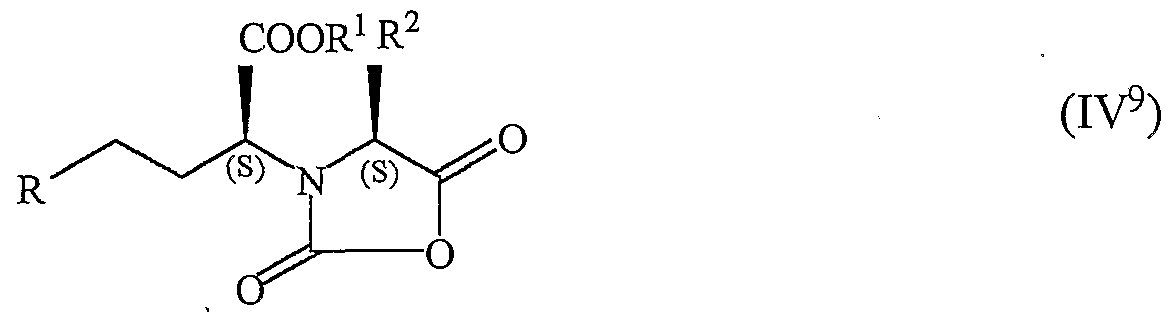
2 is L-lysine unlike the other routinely employed reactive derivatives of N-[1(S)- ethoxycarbonyl butyl]-(S)-alanine and N-[l(S)~ethoxycarbonyl-3- phenylpropyl]-(S)-alanine, specially the or the corresponding N-carboxy anhydrides of formula (IV
9), as disclosed in EP Patent No. 1 279 665, EP Patent No. 1 201 659, and PCT Appln. No. WO 01/87858
is achieved by use of less expensive, non-toxic and readily available raw materials of formula (V) and (VI), whereas the preparation of compounds of formula (IV
9) uses highly toxic and hazardous phosgene, which calls for capital investment in terms of creation of an isolated and dedicated plant, elaborate and stringent measures for safety of the operational personnel, environmental issues in use of phosgene etc., which collectively
' render the process commercially unattractive.
The novel compounds of formula (I) are therefore, useful as intermediates for preparation of ACE inhibitors of formula (II).
wherein R is a lower alkyl of 1-4 carbon atoms or phenyl,
R2 is lower alkyl of 1-4 carbon atoms or lower alkyl of 1-4 carbon atoms to which is attached an amino or substituted amino group, and
Z is an amino acid derivative selected from those given in Chart-I
COOH
Chart-I
In particular, compounds of formula (I) are useful and provide a novel method for manufacture of commercially valuable ACE inhibitors and their pharmaceutically acceptable salts thereof, hereingiven below. i. Delapril, as disclosed in US Patent No. 4,385,051; ii. Enalapril and Enalaprilat, as disclosed in US Patent No. 4,374,829; iii. Imidapril and Imidaprilat as disclosed in US Patent No. 4,508,727;
iv. Lisinopril, as disclosed in US Patent No. 4,374,829; v. Moexipril and Moexiprilat, as disclosed in US Patent No. 4,344,949; vi. Perindopril and Perindoprilat, as disclosed in US Patent No. 4,508,729; vii. Quinapril and Quinaprilat, as disclosed in US Patent ISto. 4,344,949; viii. Ramipril, as disclosed in US Patent No. 4,587,258; ix. Spirapril and Spiraprilat, as disclosed in US Patent No. 4,470,972; and x. Trandolapril and Trandolaprilat, as disclosed in US Patent No. 4,933,361.
The method of manufacture of compounds of formula (II), comprises reaction of compounds of formula (I) with an amino acid derivative of formula (VII), z R (VII)
wherein Z has the same meaning as defined hereinabove, and R3 is hydrogen or an easily removable carboxyl protective group in the presence of an inert, non-hydroxy- containing organic solvent and in the presence of a base, with the proviso that when R3 is hydrogen compounds of formula (II) and their pharmaceutically acceptable salts thereof are obtained directly and when R3 is a carboxyl protective group, removal of the said protective group give compounds of formula (II) and their pharmaceutically acceptable salts thereof.
Suitable easily removable carboxyl protective groups of the amino acid fragment Z, which fall under the scope of the group R3 are those protective groups routinely utilized in organic chemistry. These include inter alia, those forming an alkyl ester e.g. methyl, ethyl, tert-butyl esters; halo-lower alkyl esters e.g. 2-chloroethyl, 2,2,2,-trichloroethyl esters; lower acyl-lower alkyl esters e.g. lower alkanoylmethyl, 2-acetylethyl, phenacyl, p- bromophenacyl, -benzoylbenzyl esters; lower alkoxy-lower alkyl esters e.g. methoxymethyl ester; lower acyloxy-lower alkyl esters e.g. acetoxymethyl, pivaloyloxymethyl, N,N- dimethylglycyloxymethyl, benzoyloxymethyl esters;
lower 1,1-dicarbo-lower alkoxyalkyl esters e.g. dicarbomethoxymethyl, dicarbethoxymethyl esters; lower aryl esters e.g. phenyl, pyridyl esters optionally substituted by an inert group e.g. nitro, methoxy, or lower alkyl; aralkyl esters e.g. benzyl, benzhydryl, naphthylmethyl and pyridylmethyl esters optionally substituted by an inert group e.g. nitro, methoxy or lower alkyl; a trialkylsilyl group e.g. a tri (C1- )alkyl silyl, e.g. trimethylsilyl; and other groups known to those skilled in the art.
Preferred carboxyl protective groups are trialkylsilyl, specially trimethylsilyl and aralkyl, specially benzyl esters.
The method of preparation of ACE inhibitor compounds of formula (II) is further detailed hereinbelow. However, the details given below should not to be construed as limiting the scope of the invention only to those methods given is sub-sections 2(a), 2(b), 2(c) and 2(d) hereinbelow
In a typical experiment compound of formula (VII), wherein R
3 is hydrogen and Z is the amino acid derivative given in Chart-I is dissolved in an inert, non-hydroxy-containing organic solvent and in the presence of a base and the solution cooled to a temperature ranging from -20 to -5° C. To the cooled solution of compound (VII) is then added a solution of compound (I), R is a lower alkyl of 1-4 carbon atoms or phenyl; R
1 is hydrogen or lower alkyl of 1-4 carbon atoms; and R
2 is lower alkyl of 1-4 carbon atoms in an inert, non-hydroxy-containing organic solvent gradually over a period of 30-60 minutes. After the addition, the reaction temperature is raised to 25-30° C and agitated at this temperature for 12-24 hours till completion of reaction. Evaporation of the organic solvent gives the ACE inhibitor compounds of formula (II).
R
3 = Hydrogen
R = Lower alkyl of 1-4 carbon atoms or phenyl R1 = Hydrogen or lower alkyl of 1-4 carbon atoms R2 = Lower alkyl of 1-4 carbon atoms Z = Amino acid given in Chart-I
The bases that can be employed are preferably organic bases and are selected from diethylamine, pyridine, 2J-diaminopyridine, 2,4-diaminopyridme, N-methyl morpholine and the like. Triethylamine is preferred, primarily because of its low cost and commercial availability.
Typically, the base is employed in molar proportions of 1.0 to 5.0 moles per mole of compound of formula (VII), preferably in molar proportions of 1.0 to 3.0 moles per mole of compound of formula (VII).
The reaction is suitably effected in an inert, non-hydroxy-containing organic solvent. The term, "a non-hydroxy-containing organic solvent" has been defined hereinearlier in Section 1(a) and the same "inert, non-hydroxy-containing organic solvents" referred to hereinbefore in Section 1(a)- 1(c) can also be used herein for preparation of compounds of formula (I) by reaction of the acid halide of formula (IV2) with 2- mercaptobenzothiazole of formula (VI).
The particular inert, non-hydroxy-containing organic solvent employed as a medium for the preparation of compounds of formula (I) or as a medium for their use in preparation of ACE inhibitors of formula (II) is not critical, however, such solvent properties like
polarity, melting or boiling point, and ease of isolation of compounds of formula (I) may be considered in selecting a most suitable solvent.
Preferred solvents for the preparation of compounds of formula (II) as per the present process described hereinbelow are hydrocarbons, especially aromatic hydrocarbons; carboxylic acid esters, especially ethyl acetate; ether, especially tetrahydrofuran; and halogenated hydrocarbons, especially dichloromethane and 1,2-dichloroethane.
The most preferred solvents are halogenated hydrocarbons, especially dichloromethane and 1,2-dichloroethane.
The reaction temperature may for example be from -20° C to -5° C, preferably -5° C to - 10° C.
The compounds of formula (II) may further be purified by methods known in the art for obtaining the said compounds of high purity. For instance, the ACE inhibitor, Perindopril obtained as an oily residue after evaporation of the organic solvent is dissolved in a mixture of water and diisopropyl ether and the solution cooled to 0-5° C. The pH of the solution is adjusted to between 8.0 and 9.0 using a 10% aqueous solution of sodium hydroxide. The aqueous layer is separated from the organic phase and the pH of the solution made acidic in the range of 2.0 to 2.5 by addition of 6N hydrochloric acid. The aqueous layer is extracted with diisopropyl ether and the layers separated. The pH of the aqueous layer is adjusted to 3.5 to 4.0 using a 10% aqueous solution of sodium hydroxide and the product extracted into dichloromethane. Perindopril of high purity can be isolated by evaporation of dichloromethane or by precipitation by addition of an anti-solvent. Other ACE inhibitors, for e.g. Quinapril, Ramipril, Trandolapril and the like can be purified by methods suitable to the product.
In a typical experiment compound of formula (VII), wherein R3 is a trialkylsilyl group and Z is the amino acid derivative given in Chart-I is dissolved in an inert, non- hydroxy-containing organic solvent and in the presence of a base and the solution cooled to a temperature ranging from -20 to +30° C. To the cooled solution of
compound (VII) is then added a solution of compound (I), werein R is a lower alkyl of 1-4 carbon atoms or phenyl; R1 is hydrogen or lower alkyl of 1-4 carbon atoms; and R2 is lower alkyl of 1-4 carbon atoms in an inert, non-hydroxy-containing organic solvent gradually over a period of 30-60 minutes. After the addition, the reaction mixture is agitated at this temperature for 12-24 hours till completion of reaction. Evaporation of the organic solvent gives the ACE inhibitor compounds of formula (II), generally as an oil.
(J) R
3 = Trialkylsilyl group
R = Lower alkyl of 1-4 carbon atoms or phenyl R1 = Hydrogen or lower alkyl of 1-4 carbon atoms R2 = Lower alkyl of 1-4 carbon atoms Z = Amino acid given in Chart-I
The bases that can be employed are preferably organic bases and are selected from triethylamine, pyridine, 2,3-diaminopyridine, 2,4-diaminopyridine, N-methyl morpholine and the like. Triethylamine is preferred, primarily because of its low cost and commercial availability.
Typically, the base is employed in molar proportions of 1.0 to 5.0 moles per mole of compound of formula (VII), preferably in molar proportions of 1.0 to 3.0 moles per mole of compound of formula (VII).
The reaction is suitably effected in an inert, non-hydroxy-containing organic solvent. The term, "a non-hydroxy-containing organic solvent" has been defined hereinearlier in Section 1(a) and the same "inert, non-hydroxy-containing organic solvents" referred to hereinbefore in Section 1(a) can also be used herein for preparation of compounds of
formula (I) by reaction of the acid halide of formula (IV2) with 2- mercaptobenzothiazole of formula (VI).
The particular inert, non-hydroxy-containing organic solvent employed as a medium for the preparation of compounds of formula (I) or as a medium for their use in preparation of ACE inhibitors of formula (II) is not critical, however, such solvent properties like polarity, melting or boiling point, and ease of isolation of compounds of formula (I) may be considered in selecting a most suitable solvent.
Preferred solvents for the preparation of compounds of formula (II) as per the present process described hereinbelow are hydrocarbons, especially aromatic hydrocarbons; carboxylic acid esters, especially ethyl acetate; ether, especially tetrahydrofuran; and halogenated hydrocarbons, especially dichloromethane and 1,2-dichloroethane.
The most preferred solvents are halogenated hydrocarbons, especially dichloromethane and 1,2-dichloroethane.
The reaction temperature may for example be from -20° C to +30° C, in particular between 0° C to +30° C , preferably +20° C to + 25° C.
Compounds of formula (VII), wherein R »3 is a trialkylsilyl group and Z is the amino acid derivative given in Chart-I can be prepared by methods known in the art, in particular by the methods described in US Patent No. 6,541,635.
Compounds of formula (II), can also be prepared in one pot without isolation of compounds of formula (VII), wherein R3 is a trialkylsilyl group and Z is the amino acid derivative given in Chart-I. In a typical experiment, to a solution of compound of formula (VII), wherein R3 is hydrogen and Z is the amino acid derivative given in Chart-I dissolved in an inert, non-hydroxy-containing organic solvent is added a silylating reagent at ambient temperature and the reaction mixture heated to reflux for 3- 5 hrs. When the evolution of ammonia ceases, the reaction mixture is further cooled to a temperature ranging from -20° C to +30° C. To the cooled solution of compound
(VII) thus obtained, wherein R3 is a trialkylsilyl group and Z is the amino acid derivative given in Chart-I is then added a base, followed by addition of a solution of compound (I) in an inert, non-hydroxy-containing organic solvent gradually over a period of 30-60 mns. After the addition, the reaction mixture is agitated at this temperature for 12-24 hours till completion of reaction. Evaporation of the organic solvent gives the ACE inhibitor compounds of formula (II).
The bases, their molar proportions and the inert, non-hydroxy-containing organic solvent that can be employed are as defined hereinbefore.
The silylating reagents that can be employed in the method for preparing compounds of formula (VII), wherein R3 is a trialkylsilyl group and Z is the amino acid derivative given in Chart-I include, but are not restricted to hexamethyl disilazane,, bis silyl acetamide and trimethyl chlorosilane.
The silylating reagent is normally employed in molar proportions of 1.0 to 2.0 moles per mole of compounds of formula (VII), wherein R3 is hydrogen and Z is the amino acid derivative given in Chart-I, preferably in molar proportions of 1.0 to 1.5 moles.
The compounds of formula (II) may further be purified by methods known in the art for obtaining the said compounds of high purity.
In a typical experiment compound of formula (VII), wherein R3 is a benzyl protective group and Z is the amino acid derivative given in Chart-I is dissolved in an inert, non- hydroxy-containing organic solvent and in the presence of a base and the solution cooled to a temperature ranging from -20° C to -5° C. To the cooled solution of compound (VII) is then added a solution of compound (I), wherein R is a lower alkyl of 1-4 carbon atoms or phenyl; R1 is hydrogen or lower alkyl of 1-4 carbon atoms; and R2 is lower alkyl of 1-4 carbon atoms in an inert, non-hydroxy-containing organic solvent gradually over a period of 30-60 mns. After the addition, the reaction temperature is raised to 25 -30° C and agitated at this temperature for 12-24 hours till completion of reaction. Evaporation of the organic solvent gives the benzyl ester of the ACE inhibitor
compounds of formula (II). Further removal of the benzyl protective group gives the ACE inhibitor compounds of formula (II).
R = Lower alkyl of 1-4 carbon atoms or phenyl R1 = Hydrogen or lower alkyl of 1-4 carbon atoms R2 = Lower alkyl of 1-4 carbon atoms Z = Amino acid given in Chart-I
The bases that can be employed are preferably organic bases and are selected from triethylamine, pyridine, 2,3-diaminopyridine, 2,4-diaminopyridine, N-methyl morpholine and the like. Triethylamine is preferred, primarily because of its low cost and commercial availability.
Typically, the base is employed in molar proportions of 1.0 to 5.0 moles per mole of .compound of formula (VII), preferably in molar proportions of 1.0 to 3.0 moles per mole of compound of formula (VII).
The reaction is suitably effected in an inert, non-hydroxy-containing organic solvent. The term, "a non-hydroxy-containing organic solvent" has been defined hereinearlier in Section 1(a) and the same "inert, non-hydroxy-containing organic solvents" referred to hereinbefore in Section 1(a) can also be used herein for preparation of compounds of formula (I) by reaction of the acid halide of formula (IV2) with 2- mercaptobenzothiazole of formula (VI).
The particular inert, non-hydroxy-containing organic solvent employed as a medium for the preparation of compounds of formula (I) or as a medium for their use in preparation of ACE inhibitors of formula (II) is not critical, however, such solvent properties like polarity, melting or boiling point, and ease of isolation of compounds of formula (I) may be considered in selecting a most suitable solvent.
Preferred solvents for the preparation of compounds of formula (II) as per the present process described hereinbelow are hydrocarbons, especially aromatic hydrocarbons; carboxylic acid esters, especially ethyl acetate; ether, especially tetrahydrofuran; and halogenated hydrocarbons, especially dichloromethane and 1,2-dichloroethane.
The most preferred solvents are halogenated hydrocarbons, especially dichloromethane and 1,2-dichloroethane.
The reaction temperature may for example be from -20° C to -5° C, preferably -15° C to - -5° C.
Removal of the benzyl protective group from the benzyl ester compounds thus obtained can be carried out be conventional methods known in the art.
The compounds of formula (II) may further be purified by methods known in the art for obtaining the said compounds of high purity.
Typically, the ACE inhibitor compounds of formula (II), wherein R
2 is lower alkyl of 1- 4 carbon atoms to which is attached an amino or substituted amino group can also be prepared by the methods enumerated hereinearlier in sub-sections 2(a) to 2(c) comprising reaction of compound of formula (I), wherein R
2 is lower alkyl of 1-4 carbon atoms to which is attached an amino or substituted amino group and compound of formula (VII), wherein R
3 is hydrogen or a carboxyl protective group and Z is the amino acid derivative given in Chart-I.
R = Lower alkyl of 1-4 carbon atoms or phenyl R1 = Hydrogen or lower alkyl of 1-4 carbon atoms R2 = Lower alkyl of 1-4 carbon atoms to which is attached an amino or substituted amino group Z = Amino acid given in Chart-I
While compound of formula (I), in which the amino function of group R2 can be used as such for reaction with the amino acid fragment (VII), however, it is preferable to protect the amino function of the group R2 of compound of formula (I), prior to reaction with compound of formula (VII) to give compound of formula (II) in which the amino function of the group R2 of compound of formula (I) is protected. Removal of the amino protective groups by suitable methods would then give compounds of formula (I).
Suitable amino protective groups that can be employed are those routinely practiced in the art, specially those routinely used in peptide synthesis. Suitable protective groups include but are not limited to a substituted benzyloxycarbonyl group such as a tertiary butoxycarbonyl group, benzyloxycarbonyl group, p-nitrobenzyloxycarbonyl group etc.; a urethane type protective group such as isobornyloxycarbonyl group etc.; an acyl type protective group such as trifluoroacetyl group, a formyl group, a phthaloyl group etc. Of these, in particular, trifluoroacetyl group is preferred, since it can be removed easily with- alkali.
In a typical experiment compound of formula (VII), wherein R3 is hydrogen or a carboxyl protective group, and Z is the amino acid derivative given in Chart-I is dissolved in an inert, non-hydroxy-containing organic solvent and in the presence of a base and the solution cooled to a temperature ranging from -20° C to -5° C. To the
cooled solution of compound (VII) is then added a solution of compound (I), wherein R is a lower alkyl of 1-4 carbon atoms or phenyl; R1 is hydrogen or lower alkyl of 1-4 carbon atoms; and R2 is lower alkyl of 1-4 carbon atoms to which is attached an amino or substituted amino group in an inert, non-hydroxy-containing organic solvent gradually over a period of 30-60 minutes. After the addition, the reaction temperature is raised to 25°-30° C and agitated at this temperature for 12-24 hours till completion of reaction. Evaporation of the organic solvent gives the benzyl ester of the ACE inhibitor compounds of formula (II), wherein R2 is lower alkyl of 1-4 carbon atoms to which is an amino or a substituted amino group. Optional removal of the amino protective group of R2 and the carboxyl protective group of R3 gives the ACE inhibitor compounds of formula (II).
The bases that can be employed are preferably organic bases and are selected from triethylamine, pyridine, 2,3-diaminopyridine, 2,4-diaminopyridine, N-methyl morpholine and the like. Triethylamine is preferred, primarily because of its low cost and commercial availability.
Typically, the base is employed in molar proportions of 1.0 to 5.0 moles per mole of compound of formula (VII), preferably in molar proportions of 1.0 to 3.0 moles per mole of compound of formula (VII).
The reaction is suitably effected in an inert, non-hydroxy-containing organic solvent The term, "a non-hydroxy-containing organic solvent" has been defined hereinearlier in Section 1(a) and the same "inert, non-hydroxy-containing organic solvents" referred to hereinbefore in Section 1(a) can also be used herein for preparation of compounds of formula (I) by reaction of the acid halide of formula (IV2) with 2- mercaptobenzothiazole of formula (VI).
The particular inert, non-hydroxy-containing organic solvent employed as a medium for the preparation of compounds of formula (I) or as a medium for their use in preparation of ACE inhibitors of formula (II) is not critical, however, such solvent properties like
polarity, melting or boiling point, and ease of isolation of compounds of formula (I) may be considered in selecting a most suitable solvent.
Preferred solvents for the preparation of compounds of formula (II) as per the present process described hereinbelow are hydrocarbons, especially aromatic hydrocarbons; carboxylic acid esters, especially ethyl acetate; ether, especially tetrahydrofuran; and halogenated hydrocarbons, especially dichloromethane and 1,2-dichloroethane.
The most preferred solvents are halogenated hydrocarbons, especially dichloromethane and 1,2-dichloroethane.
The reaction temperature may for example be from -20° C to -5° C, preferably -15° C to - -5° C.
Removal of the amino protective group of R2 and the carboxyl protective group of R3 can be carried out be conventional methods known in the art.
The method mentioned hereinbefore in particular can be advantegeously used for preparation of the therapeutically valuable ACE inhibitor, lisinopril, which is given hereinbelow.
In a typical experiment, the thioester compound of formula (I5),
is dissolved in a suitable inert, non-hydroxy-containing organic solvent and in the presence of a base and the solution cooled to a temperature ranging from -20° C to -5°
C To the cooled solution of compound (I5) is then added a solution of L-proline carboxylic ester of formula (VII1),
wherein E is a carboxyl protective group in the presence of a inert, non-hydroxy- containing organic solvent to give protected lisinopril of formula (II3),
wherein R4 is an amino protective group and R6 is hydrogen or lower alkyl of 1-4 carbon atoms and the asterik (*) on the carbon bearing the (-COOR6) group is either racemic having the (R/S) configuration or has the (S)-confιguration, and removal of protective groups from compound of formula (II3), and optionally separating the diastereomers to give lisinopril of formula (II2).
Suitable carboxyl protective groups E that can be employed are selected from those easily removable carboxyl protective groups of the amino acid fragment Z, which fall under the scope of the group R
3 are those protective groups routinely utilized in organic chemistry. These include inter alia, those forming an alkyl ester e.g. methyl, ethyl, tert-butyl esters; halo-lower alkyl esters e.g. 2-chloroethyl, 2,2,2,-trichloroethyl esters; lower acyl-lower alkyl esters e.g. lower alkanoylmethyl, 2-acetyl ethyl, phenacyl, p- bromophenacyl, α-benzoylbenzyl esters; lower alkoxy-lower alkyl esters e.g. methoxymethyl ester; lower acyloxy-lower alkyl esters e.g. acetoxymethyl, pivaloyloxymethyl, N,N- dimethylglycyloxymethyl, benzoyloxymethyl esters; lower 1,1-dicarbo-lower alkoxyalkyl esters e.g. dicarbomethoxymethyl, dicarbethoxymethyl esters; lower aryl esters e.g. phenyl, pyridyl esters optionally substituted by an inert group e.g. nitro, methoxy, or lower alkyl; aralkyl esters e.g. benzyl, benzhydryl, naphthylmethyl and pyridylmethyl esters optionally substituted by an inert group e.g. nitro, methoxy or lower alkyl; a trialkylsilyl group e.g. a tri (Cι
-4)alkyl silyl, e.g. trimethylsilyl; and other groups known to those skilled in the art.
Preferred carboxyl protective groups are lower alkyl, trialkylsilyl, specially trimethylsilyl and aralkyl, specially benzyl esters. Of these, the lower alkyl esters, in particular ethyl ester is more preferred since this carboxyl protective group can be removed in simultaneously in one-pot along with the N6 -trifluoroacetyl group and the ethoxycarbonyl group attached to the carbon bearing the lysine fragment, which is an added advantage of the process, thereby rendering it commercially attractive.
In a specific embodiment, N-[l(S)-l-ethoxycarbonyl-3-phenylpropyl]-N6- trifluoroacetyl- L-lysine-2'-benzothiazolylthio ester of formula [I3, corresponding to compound of formula (I), wherein R is phenyl, R1 is ethyl and R2 is ^-trifluoroacetyl- L-lysine]
O
is dissolved in a suitable inert, non-hydroxy-containing organic solvent and in the presence of a base and the solution cooled to a temperature ranging from -20° C to -5° C To the cooled solution of compound (I3) is then added a solution of L-proline carboxylic ester of formula (VII1),
wherein E is a carboxyl protective group, in a suitable inert, non-hydroxy-contaming organic solvent gradually over a period of 30-60 minutes After the addition, the reaction temperature is raised to 25°-30° C and agitated at this temperature for 12-24 hours till completion of reaction Evaporation of the organic solvent gives protected Lisinopril i e N
6-trifluoroacetyl-L-Lysine-[l(S)-Ethoxycarbonyl-3-phenylpropyl]-L- proline ester of formula (II
1), wherein E is as defined as hereinbefore
O
Further removal of the, N6-trifluoroacetyl group, the ethoxycarbonyl group attached to the carbon bearing the lysine fragment and the carboxyl protective group E then gives lisinopril of formula (II2).
The invention is further illustrated by the following examples, which should not be construed as limiting the scope of the invention.
Example-1 Preparation ofN-[l(S)-ethoxycarbonyl butyl] ~(S)~alanine-2 '- benzothiazolylthio ester
Triphenyl phosphine (2.8 g, 0.011 moles) was dissolved in dichloromethane (30 ml) at a temperature of 25-30° C. 2,2'-Dithiobis(benzothiazole) (V, 3.5 g, 0.011 moles) was added to the solution under stirring at the same temperature. The reaction mixture was stirred for 45 min. to 1 hr and then cooled to 0-5° C. To this was added N-[1(S)- ethoxycarbonyl butyl]-(S)-alanine (1.92 g, 0.0088 moles) at the same temperature and the reaction mixture was stirred for 5-10 min. Triethyl amine (1.4 ml) was then added and the reaction mixture stirred for 30-45 min. The temperature was raised to 25-30° C and stirring was continued for 2-2.5 hrs. The reaction mixture was then concentrated at 35-40° C under reduced pressure to give an oily mass. The oil was chromatographed over silica gel using a mixture of chloroform and petroleum ether (40-60° C) as eluent (3:7) to give the pure title compound as an oil.
IR (cm J : 1728, 1666
1H NMR (CDC13, δ) : 1.00, t, 3H; 1.30, t, 3H; 1.45, d, 3H; 1.50-1.90, m, 5H;.3.40-3.50, m, 2H; 4.20, q, 2H; 7.30-7.60, m, 2H; 7.90, dd, 1H; 8.05, dd, 1H
13C NMR (CDCI3, δ) : 15.09, 19.94, 20.88, 36.73, 61.85, 62.09, 63.79, 122.01, 123.62, 126.10, 126.98, 127.38, 131.00, 175.99, 203.76
Example-2
Preparation of N-[1(S) -ethoxycarbonyl butyl] -(S)-alanine-2 '- benzothiazolylthio ester
Triphenyl phosphine (2.8 g, 0.011 moles) was dissolved in dichloromethane (30 ml) at a temperature of 25-30° C. 2,2'-Dithiobis(benzothiazole) (V, 3.5 g, 0.011 moles) was added to the solution under stirring at the same temperature. The reaction mixture was stirred for 45 min. to 1 hr and then cooled to 0-5° C. To this was added N-[1(S)-
ethoxycarbonyl butyl]-(S)-alanine (1.92 g, 0.0088 moles) at the same temperature and the reaction mixture was stirred for 30-45 min The temperature was raised to 25-30° C and stirring was continued for 2-2.5 hrs. The reaction mixture was then concentrated at 35-40° C under reduced pressure to give an oily mass. The oil was chromatographed over silica gel using a mixture of chloroform and petroleum ether (40-60° C) as eluent (3:7) to give the pure title compound as an oil.
'
IR (cm"1) 1728, 1666
1H NMR (CDC13, δ) : 1.00, t, 3H; 1.30, t, 3H; 1.45, d, 3H; 1.50-1.90, m, 5H; 3.40-3.50, m, 2H; 4.20, q, 2H; 7.30-7.60, m, 2H; 7.90, dd, 1H; 8.05, dd, 1H
13C NMR (CDCI3, δ) : 15.09, 19.94, 20.88, 36.73, 61.85, 62.09, 63.79, 122.01, 123.62, 126.10, 126.98, 127.38, 131.00, 175.99, 203.76
Example-3 Preparation ofN-[l(S)-e thoxycarbonyl butyl] -(S)-alanine-2 '- benzothiazolylthio ester
To a solution of N-[l(S)-ethoxycarbonyl butyl]-(S)-alanine (2g, 9.21 mmoles) in cyclohexane (15 ml) was added phosphorous pentachloride (2.4 g, 11.5 mmoles) with simultaneous bubbling of HCI gas at 25-30° C over a period of 1 hr. The reaction mixture containing the acid chloride hydrochloride of N-[l(S)-Ethoxycarbonyl butyl]- (S)-alanine thus obtained was filtered under an atmosphere of nitrogen . The filtered solid was slurried in dichloromethane (25 ml). The slurry was added to a solution of 2- mercaptobenzothiazole (VT, 1.25g, 7.48 mmoles) in dichloromethane (20 ml) containing triethylamine (3.9 ml, 28 mmoles) at 0 to -5° C After the addition was complete the
reaction mixture was stirred at 25-30° C for 1 hr, till completion of the reaction as indicated by TLC. The reaction mixture was then concentrated under reduced pressure to afford a viscous residue., which was chromatographed over silica gel using a mixture of chloroform and petroleum ether (40-60° C) as eluent (3:7) to give the pure title compound (1.5 g, 44%) as an oil.
IR (cm" ; : 1728, 1666
1H NMR (CDC13, δ) : 1.00, t, 3H; 1.30, t, 3H; 1.45, d, 3H; 1.50-1.90, m, 5H; 3.40-3.50, m, 2H; 4.20, q, 2H; 7.30-7.60, m, 2H; 7.90, dd, 1H; 8.05, dd, 1H
13 C MR (CDC13, δ) : 15.09, 19.94, 20.88, 36.73, 61.85, 62.09, 63.79, 122.01, 123.62, 126.10, 126.98, 127.38, 131.00, 175.99, 203.76
Example-4
Preparation ofN-[l(S)-ethoxycarbonyl-3-phenylpropyl]-(S)-alanine-2 ' benzothiazolylthio ester
Triphenyl phosphine (6.25 g, 0.023 moles) was dissolved in dichloromethane (60 ml) at a temperature of 25-30° C. 2,2'-Dithiobis(benzothiazole) (V, 7.9 g, 0.023 moles) was added to the solution under stirring at the same temperature. The reaction mixture was stirred for 45 min. to 1 hr and then cooled to 0-5° C. To this was added N-[1(S)- ethoxycarbonyl-3-phenylpropyl]-(S)-alanine (5.54 g, 0.0198 moles) at the same temperature and the reaction mixture was stirred for 5-10 min. Triethylamine (3 ml) was then added and the reaction mixture stirred for 30-45 min. The temperature was raised
to 25-30° C and stirring was continued for 2-2.5 hrs. The reaction mixture was then concentrated at 35-40° C under reduced pressure to give an oily mass. The oil was chromatographed over silica gel using a mixture of chloroform and petroleum ether (40-60° C) as eluent (3:7) to give the pure title compound as an oil.
IR ^m"1) : 1732, 1600
1H NMR (CDCI3, δ) : 1.30, t, 3H; 1.50, d, 3H; 1.90-2.30, m, 3H; 2.70-3.10, m, 2H; 3.40-3.70, m, 2H; 4.20, q, 2H; 7.10-7.60, m, 7H; 7.90, dd, 1H; 8.10, dd, 1H
13C NMR (CDCI3, δ) : 14.74, 20.45, 27.42, 32.66, 35.93, 61.64, 63.57, 112.39, 121.66, 123.29, 124.63, 125.77, 126.54, 126.63, 127.27, 128.89, 141.57, 175.18, 203.04
Example-5
Preparation ofN-[l(S)-ethoxycarbonyl-3-phenylpropyl]-(S)-alanine-2 '- benzothiazolylthio ester
To a solution of N-[l(S)-ethoxycarbonyl-3-phenylpropyl]-(S)-alanine (5g, 17.9 mmoles) in cyclohexane (15 ml) was added phosphorous pentachloride (4.7 g, 22.5 mmoles) with simultaneous bubbling of HCI gas at 25-30° C over a period of 1 hr. The reaction mixture containing the acid chloride hydrochloride of N-[l(S)-Ethoxycarbonyl- 3-phenylpropyl]-(S)-alanine thus obtained was filtered under an atmosphere of nitrogen . The filtered solid was slurried in dichloromethane (30 ml). The slurry was added to a solution of 2-mercaptobenzothiazole (VI, 2.7 g, 16.2 mmoles) in dichloromethane (20 ml) containing triethylamine (7.5 ml, 53.8 mmoles) at 0 to -5° C. After the addition was
complete the reaction mixture was stirred at 25-30° C for 1 hr, till completion of the reaction as indicated by TLC. The reaction mixture was then concentrated under reduced pressure to afford a viscous residue., which was chromatographed over silica gel using a mixture of chloroform and petroleum ether (40-60° C) as eluent (3:7) to give the pure title compound (3.0 g, 40%) as an oil.
IR ^m"1) : 1732, 1600
1H NMR (CDCI3, δ) : 1.30, t, 3H; 1.50, d, 3H; 1.90-2J0, m, 3H; 2.70-3J0, m, 2H; 3.40-3.70, m, 2H; 4.20, q, 2H; 7.10-7.60, m, 7H; 7.90, dd, 1H; 8.10, dd, 1H
13C NMR (CDCI3, δ) : 14.74, 20.45, 27.42, 32.66, 35.93, 61.64, 63,57, 112.39, 121.66, 123.29, 124.63, 125.77, 126.54, 126.63, 127.27, 128.89, 141.57, 175.18, 203.04 Example-6
Preparation of(2S, 3aS, 7aS)-l-[(2S)-2-[[(lS)-l-(ethoxycarbonyl)butyl]amino]-l- oxopropyl]octahydro-lH-indole-2-carboxylic acid (Perindopril)
To a suspension of (S,S,S)-Octahydroindole-2-carboxylic acid (1.5 g, 0.0088 moles) in dichloromethane (15 ml) at 25-30°C was added triethylamine (1.34 ml, 0.0096 moles) and the mixture stirred for 5-10 mns to get a clear solution. The solution was cooled to -10 to -15° C and to the cooled solution was added N-[l(S)-ethoxycarbonyl butyl]-(S)- alanine-2'- benzothiazolylthiol ester ( 3.5 g, 0.0106 moles, obtained from Examples 1 and 2), slowly over a period of 1 hr. After the addition was over the temperature was raised to of 25-30° C and the reaction mixture stirred at this temperature for 15-16 hrs.
The reaction mixture was then concentrated under reduced pressure at 30-35° C, to give an oily residue.
The oil was dissolved in a mixture of water (15 ml) and diisopropyl ether (50 ml). The solution was cooled to 0-5° C and pH of the solution adjusted to 8J-8.6 using 10% aqueous sodium hydroxide solution. The reaction mixture was stirred at this pH for 15- 20 mins, filtered and the organic layer was separated. The aqueous layer was again cooled to 0-5° C and the pH adjusted to 2.2-2.5 using 6N hydrochloric acid. The aqueous solution was extracted with diisopropyl ether (25 ml X 2). The layers were separated and the aqueous layer was cooled to 0-5° C and the pH adjusted to 3.5-3.8 using 10%) aqueous sodium hydroxide solution. Then it was extracted with dichloromethane (50 ml X 3). The dichloromethane layer was concentrated under reduced pressure to give : 0.4 g (20 %) of Perindopril as a viscous oil.
Example-7
Preparation of(2S, 3aS, 7aS)-J-f(2S)-2-f[(JS)-]-(ethoxycarbonyl)butyl]amino]-l- oxopropyl]octahydro-lH-indole-2-carboxylic acid (Perindopril)
A mixture of (S,S,S)-Octahydroindole-2-carboxylic acid ( 1.5 g, 0.0088 moles) in acetonitrile (15 ml) was stirred for 5 min. at 25-30°C. To this was added hexamethyl disilazane (1.8 g, 0.011 moles), followed by a few drops of chlorotrimethylsilane. The reaction mixture was heated to reflux for 3-3.5 hrs. When the evolution of ammonia gas evolved during the reaction ceased, the reaction mixture was cooled to 25-30°C. Dichloromethane (20 ml) was added and the mixture was further cooled to 0-5° C. Triethylamine (1.4 ml) was added to the cooled reaction mixture and stirred for 5-10
min and the mixture further cooled to -10 to -20° C. To the cooled reaction mixture was added N-[l(S)-ethoxycarbonyl butyl] -(S)-alanine-2'- benzothiazolylthiol ester (3.5 g, 0.0106 moles, obtained from Examples 1 and 2), slowly over a period of 1 hr. After the addition was over the temperature was raised to 25-30° C and the mixture stirred at this temperature for 15-16 hrs. The reaction mixture was then concentrated under reduced pressure at 30-35° C to give an oily residue.
The oil was dissolved in a mixture of water (15 ml) and diisopropyl ether (50 ml). The solution was cooled to 0-5° C and pH of the solution adjusted to 8.3-8.6 using 10% aqueous sodium hydroxide solution. The reaction mixture was stirred at this pH for 15- 20 mins, filtered and the organic layer was separated. The aqueous layer was again cooled to 0-5° C and the pH adjusted to 2.2-2.5 using 6N hydrochloric acid. The aqueous solution was extracted with diisopropyl ether (25 ml X 2). The layers were separated and the aqueous layer was cooled to 0-5° C and the pH adjusted to 3.5-3.8 using 10%) aqueous sodium hydroxide solution. Then it was extracted with dichloromethane (50 ml X 3). The dichloromethane layer was concentrated under reduced pressure to give 1.8 g (55 %) of Perindopril as a viscous oil .
Example-8
Preparation of(2S, 3aS, 7aS)-l-[(2S)-2-[[(lS)-l-(ethoxycarbonyl)butyl]amino]-l- oxopropyl]octahydro-lH-indole-2-carboxylic acid (Perindopril)
Step-1 : Preparation of Perindopril benzyl ester
To a suspension of benzyl-(S,S,S)-octahydroindole-2-carboxylate (2.07 g, 0.0079 moles) in dichloromethane (15 ml) at 25-30°C was added triethylamine (1J4 ml,
0.0096 moles) at the same temperature and the solution obtained was cooled to -10 to - 15° C. To the cooled solution was added N-[l(S)-ethoxycarbonyl butyl]-(S)-alanine-2'- benzothiazolylthio ester (3.2 g, 0.0095 moles, obtained in Examples land 2), slowly over a period of 1 hr. After the addition was over the temperature was raised to 25-30° C and the reaction mixture stirred at this temperature for 8-10 hrs. The reaction mixture was quenched with water (10 ml). The pH of the reaction mixture was adjusted to 8.3- 8.6 using 2% aqueous sodium hydroxide solution and stirred at this pH for 15-20 min. The organic layer was separated and washed with water (10 ml). The dichloromethane was concentrated under reduced pressure to give 2.92 g (80 %>) of Perindopril benzyl ester.
Step-2 : Preparation of Perindopril
The Perindopril benzyl ester (2.9 g, 6J3 mmoles), obtained in Step-1 was dissolved in ethyl alcohol (15 ml) hydrogenated using 10% Palladium on carbon (0.29 g), under 45- 50 psi hydrogen pressure for 2.5-3 hrs. The reaction was performed at 25-30°C. After completion of the reaction, the reaction mixture was filtered to remove the catalyst and the filtrate was concentrated under reduced pressure to afford Perindopril as a viscous oil.
Example-9
Preparation of (3S)-2-[(2S)-2-[[(lS)- 1 -(ethoxy carbonyl)butyl] amino]- 1-oxopropyl] - 1, 2, 3, 4-tetrahydro-3-isoqιtinolinecarboxylic acid hydrochloride (Quinapril hydrochloride)
Step-1 : Preparation of Quinapril benzyl ester
To a solution of benzyl ester of (S)-tetrahydroisoquinoline-3 -carboxylic acid (4.8 g, 0.0179 moles) in dichloromethane (48 ml) kept at 25-30° C was added triethylamine (6 ml, 0.043 moles) and the solution cooled to -5 to -10° C. To the cooled solution was added N-[l(S)-ethoxycarbonyl-3-phenylpropyl]-(S)-alanine-2' -benzothiazolylthiol ester (8.5 g, 0.0215 moles, obtained in Examples 3 and 4), slowly over a period of 1 h. After complete addition the reaction mixture was stirred at 25-30° C for 2 hrs. The reaction mixture was quenched by addition of water (25 ml). The pH of the reaction mixture was adjusted to 8.5-9.0 using 2% aqueous sodium hydroxide solution. The organic layer was separated and washed twice with water (25 ml) and concentrated under reduced pressure to give 8 g (75%) of Quinapril benzyl ester.
Step-2 : Preparation of Quinapril hydrochloride
Quinapril benzyl ester (5 g, 9.46 mmoles), obtained in Step-1 was dissolved in ethyl alcohol (25 ml). To the solution was added concentrated hydrochloric acid (1.5 ml) and the reaction mixture was hydrogenated in the presence of 10%> Palladium on carbon (0.5 g) under 45-50 psi hydrogen pressure at 25-30° C for 2.5-3 hrs. The reaction mixture was then filtered to remove the catalyst and the filtrate was concentrated under reduced pressure to afford Quinapril hydrochloride as a viscous oil.
The oil was crystallized from acetonitrile as per the method described in Example- 1 of US Patent No. 4,761,479 to give 2.25 g (50%) of the title compound as a white solid.
Example-10
Preparation of (2S, 3aS, 6aS)-l-[(2S)-2-[[(lS)-l-(ethoxycarbonyl)butyl]amino]-l- oxopropyl]octahydrocyclopenta[b]pyrrole-2-carboxylic acid (Ramipril)
COOH
To a stirred mixture of (2S, 3aS, 6aS)-octahydrocyclopenta[b]pyrrole-2-carboxylic acid (2.8 g, 0.018 moles) and acetonitrile (30 ml) at 25-30° C was added hexamethyl disilazane (3.6 g, 0.023 moles), followed by a few drops of chlorotrimethylsilane. The resultant reaction mixture was heated to reflux for 3-3.5 hrs. When the evolution of ammonia gas evolved during the reaction ceased, the reaction mixture was cooled to 25- 30°C. Dichloromethane (20 ml) was added and the mixture was further cooled to 0-5° C. Triethylamine (2.8 ml) was added to the cooled reaction mixture and stirred for 5-10 min and the mixture further cooled to -10 to -20° C. To the cooled reaction mixture was added N-[l(S)-ethoxycarbonyl butyl]-(S)-alanine-2'- benzothiazolylthiol ester (8.5 g, 0.0216 moles, obtained from Examples 1 and 2), slowly over a period of 1 hr. After the addition was over the temperature was raised to 25-30° C and the mixture stirred at this temperature for 15-16 hrs. The reaction mixture was then concentrated under reduced pressure at 30-35° C, to give an oily residue.
The oil was dissolved in a mixture of water (25 ml) and diisopropyl ether (50 ml). The solution was cooled to 0-5° C and pH of the solution adjusted to 8J-8.6 using 10% aqueous sodium hydroxide solution. The reaction mixture was stirred at this pH for 15- 20 mins, filtered and the organic layer was separated. The aqueous layer was again cooled to 0-5° C and the pH adjusted to 2.2-2.5 using 6N hydrochloric acid. The aqueous solution was extracted with diisopropyl ether (25 ml X 2). The layers were separated and the aqueous layer was cooled to 0-5° C and the pH adjusted to 3.5-3.8
using 10% aqueous sodium hydroxide solution. Then it was extracted with dichloromethane (50 ml X 3). The dichloromethane layer was concentrated under reduced pressure to give 2.5 g (35 %) of Ramipril as a white crystalline solid.
Example- 11
Preparation of(2S, 3aR, 7aS)-l-[(2S)-2-[-[(lS)-l-(ethoxycarbotϊyl)butylJamino]-l- oxopropyl]octahydro-lH-indole-2-carboxylic acid (Trandolapril)
To a stirred mixture of (2S, 3aR, 7aS)-octahydroindole-2-carboxylic acid (2.94 g, 0.017 moles) and acetonitrile (25 ml) at 25-30° C was added hexamethyl disilazane (3.52 g, 0.021 moles), followed by a few drops of chlorotrimethylsilane. The resultant reaction mixture was heated to reflux for 3-3.5 hrs. When the evolution of ammonia gas evolved during the reaction ceased, the reaction mixture was cooled to 25-30° C. Dichloromethane (20 ml) was added and the mixture was further cooled to 0-5° C. Triethylamine (2.75 ml) was added to the cooled reaction mixture and stirred for 5-10 min and the mixture further cooled to -10 to -20° C. To the cooled reaction mixture was added N-[l(S)-ethoxycarbonyl butyl]-(S)-alanine-2'- benzothiazolylthiol ester (5J9 g, 0.0136 moles, obtained from Examples 1 and 2), slowly over a period of 1 hr. After the addition was over the temperature was raised to 25-30° C and the mixture stirred at this temperature for 15-16 hrs. The reaction mixture was then concentrated under reduced pressure at 30-35° C, to give an oily residue.
The oil was dissolved in a mixture of water (25 ml) and diisopropyl ether (50 ml). The solution was cooled to 0-5° C and pH of the solution adjusted to 8J-8.6 using 10% aqueous sodium hydroxide solution. The reaction mixture was stirred at this pH for 15-
20 mins, filtered and the organic layer was separated. The aqueous layer was again cooled to 0-5° C and the pH adjusted to 2.2-2.5 using 6N hydrochloric acid. The aqueous solution was extracted with diisopropyl ether (25 ml X 2). The layers were separated and the aqueous layer was cooled to 0-5° C and the pH adjusted to 3.5-3.8 using 10%) aqueous sodium hydroxide solution. Then it was extracted with dichloromethane (50 ml X 3). The dichloromethane layer was concentrated under reduced pressure to give 2.93 g (40 %) of Trandolapril as a white crystalline solid.
Example-12 Preparation of (S) — l-[N2-(l-Carboxy-3-phenylpropyl)-L-lysyl]-L- proline dihydrate (Lisinopril dϊhydrate)
Step-1 : Preparation of if-trifluoroacetyl-S-lysine O
To a solution of L-lysine monohydrochloride (100 g, 0.560 moles) in water (260 g), cooled to 0-2° C was added a solution of sodium hydroxide (43.8 g, 1J0 moles) in water (140 ml). To the solution thus obtained is added isopropyl trifluoroacetate (94 g, 0.549 moles, as prepared by the method disclosed by T. J. Blacklock et. al. in J. Org. Chem., 1988, 53, 836-44 ) gradually over 10-15 mns at 0-2° C. After complete addition, the reaction mixture is agitated at the same temperature for further 30 mns. The reaction mixture is poured into saturated sodium chloride solution, and the pH adjusted to about 6.5 by addition of Cone. HCI. The filtered solid is filtered, washed with water and dried under vacuum at 50-55° C to give 120 g (72%) of the title compound.
Step-2 : Preparation ofl^-trifluoroacetyl-S-lysine-benzylester 0
Thionyl chloride (24 ml, 0J305 moles) was added in a drop wise manner to benzyl alcohol (76.8 ml, 0.7424 moles) at -5 to -10°C. Then N6-trifluoroacetyl-S-lysine (20 g, 0.0826 moles, as obtained in Step-1) was added to the above reaction mixture, under an atmosphere of nitrogen at -5 to -10° C, in five lots. After the addition was over, the temperature was brought to 25-30° C and further raised to 35-40° C and the reaction mixture was agitated at this temperature 6 hrs, till completion of reaction. The reaction mixture was then added into diisopropyl ether at 25-30° C, under vigorous stirring, wherein a solid separated out. The solid N6-trifluoroacetyl-S-lysine-benzylester hydrochloride was collected by filtration.
The solid hydrochloride salt was dissolved in a mixture of dichloromethane (150 ml) and water (50 ml). The pH of the solution was adjusted to 8.80 using a solution of aqueous ammonia. The layers are separated and the organic layer is evaporated under reduced pressure to give 16 g (58%) of the title compound as an oil.
Step-3 : Preparation ofN-[l(S)-ethoxycarbonyl-3-phenylpropylJ-N6-trifluoroacetyl-(S)- lysine benzyl ester
To a solution of N6-trifluoroacetyl-S-lysine-benzylester (10 g, 0.0301 moles, as obtained in Step-2) in chloroform was added N-methyl morpholine (9J4 g, 0.0903 moles) at 25° C. The reaction mixture was cooled to 0-5° C and a solution of (R)-[2- trifluoromethanesulfonyloxy]-4-phenylbutyric acid ethyl ester (12J g, 0.0361 moles) in chloroform (25 ml) was added to it drop wise, maintaining the temperature in the range of 0-5° C. The reaction mixture was then allowed to come to 25-30° C and stirred for 18 hrs, till the completion of reaction is indicated by TLC. The reaction mixture was quenched with water (25 ml). The organic layer was separated and concentrated to afford the title compound as a thick oil. The oil was passed through a column of silica gel using a mixture of ethyl acetate and hexane (1 :4) as the eluent to give 13 g (82.6%) of the title compound as an oil. Mass Spectrum (m e) : 523.5 amu Specific rotation : -9.58° (C = 2, methanol at 25°C) ER (cm_1) : 2931,1720, 1651 1H NMR (CDC13, δ) : 1.27 (t, 5H), 1.35-1.80 (m, 7H), 1.85-2.20 (m, 4H), 2.50-2.80 (m, 2H), 3.31 (t, 4H), 4.17 (dt, 2H), 5 15 (dd, 2H), 7.05-7.50 (m, 10H)
13C NMR (CDC13, δ) : 14.62, 22.92, 28.31, 32.39, 32.98, 35.51, 39.90, 59.81, 60.03, 61.39, 67.12, 126.46, 128.83, 129.04, 136.02, 141.587, 174.89, 175.07
Step-4 : Preparation ofN-[l(S)-ethoxycarbonyl-3-phenylpropyl]-N6-trifluoroacetyl-(S)- lysine
10% Palladium on carbon (1J g) was carefully weighed and transferred into a hydrogenation bottle. It was wetted with absolute alcohol (10 ml), under an atmosphere of nitrogen. To this was added a solution of N-[l(S)-ethoxycarbonyl-3-phenylpropyl]- N
6-trifluoroacetyl-(S)-lysine benzyl ester (11 g, 0.021 moles, as obtained in Step-3) in absolute ethanol (60 ml). The reaction mixture was hydrogenated at 25-30° C under a hydrogen pressure of 45-55 psi for 2.5 hrs, till TLC indicated completion of reaction. The reaction mixture was filtered to remove the catalyst and the filtrate was concentrated under reduced pressure at 40° C to afford 8J g (88.9%>) of the title compound as a white solid.
Melting point : 158° C
Mass spectrum (m/e) : 433.4 amu
IR spectrum (cm"1) : 3440, 1743, 1705, 1620
1H MR (CDCI3, δ) : 1.30 (t, 3H), 1.50-1.90 (m, 7H), 1.90-2.30 (m, 4H), 2.60-2.90 (m,
2H), 3.20-3.50 (m, 4H), 4.20 (q, 2H), 7.00-7.40 (m, 5H).
13 C NMR (CDCI3, δ) : 13.80, 22.10, 26.80, 27.80. 30.90, 31.70, 38.80, 62.80, 128.50, 139.40, 168.60, 171.70.
Step-5 : Preparation ofN-[l(S)-ethoxycarbonyl-3-phenylpropyl]-N6-trifluoroacetyl-(S)- lysine-2 'benzothiazolylthio ester o II
To a solution of triphenyl phosphine (3.65 g, 0.0138 moles) in dichloromethane (15 ml) at 27° C was added 2,2'-dithiobis(benzothiazole) (4.6 g, 0.0138 moles). The reaction mixture was stirred at an ambient temperature for 1 hr. and then cooled to 0-5° C. N- [l(S)-ethoxycarbonyl-3-phenylpropyl]-N6-trifluoroacetyl-(S)-lysine (5 g, 0.0023 moles, as obtained in Step-4) was added to it at 0-5°C. The reaction mixture was further stirred at the same temperature for 45 min. and then tri ethyl amine (2 g, 0.0197 moles) was added to it and stirred for another 15 min, till TLC indicated completion of the reaction. The reaction mixture was concentrated under reduced pressure at 40° C to afford a viscous oil. The oil was passed through a column of silica gel using a mixture of ethyl acetate and hexane as eluent to afford 4.5 g (66.9%) of the title compound as a pale yellow viscous mass.
IR^m"1): 1732, 1600, 1454
1H NMR (CDC13, δ) : 1.30 (t, 3H), 1.55-1.89 (m, 6H), 2.05-2.35 (m, 4H), 2.70-2.95 (m, 2H), 3.30-3.60 (m, 4H), 4.20 (q, 2H), 7.00-7.60 (m, 7H), 7.90 (d, 2H).
1 C NMR ((CDCI3, δ) : 14.05, 22.43, 28.10, 32.00, 33.80, 39.40, 51.39, 60.10, 60.30, 128.10, 128.20, 12830, 140.40, 174.00, 175.10, 195.60
Step-6 : Preparation of (S) — l-[Η6ti'ifluoroacetyl-(l-Carboxy-3-phenylpropyl)-L-lysyl]- L-proline ethyl ester (Protected Lisinopril)
To a solution of (S)-proline ethyl ester (0.5 g, 0.0034 moles) and triethyl amine (0J75 g, 0.0017 moles) in dichloromethane (5 ml) was added a solution of N-[1(S)- ethoxycarbonyl-3-phenylpropyl]-N6-trifluoroacetyl-(S)-lysine-2'benzothiazolylthio ester (2.43 g, 0.0041 moles, as obtained in Step-5) in dichloromethane (10 ml) at 10- 15°C, in a drop wise manner. The reaction mixture was stirred for 30 mns till TLC indicated completion of reaction. The reaction mixture was quenched with water (10 ml). The organic layer was separated and stirred with a solution of aqueous potassium hydroxide (10%>, 25 ml), till TLC indicated complete removal of the 2- mercaptobenzothiazole. The organic layer was separated and concentrated under reduced pressure to afford 1.75 g (89.8 %) of the title compound as an oil.
Step-7 : Preparation of (S) — l-[N2-(l-Carboxy-3-phenylpropyl)-L-lysyl]-L-proline dihydrate (Lisinopril dihydrate)
Sodium hydroxide (0.36 g, 0.009 moles) was dissolved in water (10 ml) and a solution of protected lisinopril (lg, 0.0017 moles, as obtained in Step-6) in methanol (2 ml) was added to it at 26° C. The reaction mixture was heated at 45-50°C for 2.5 hrs, till TLC indicated completion of reaction. The pH of the reaction mixture was made acidic using 10%) HCI and then extracted with dichloromethane (5 ml). The layers were separated and the aqueous layer was passed through a column of Indion resin (225 H). The column was then eluted with deionised water till the eluent showed a positive test for chloride ions. Then the column was eluted with 2%> aqueous ammonia. After complete elution, the eluent was concentrated at 40° C under reduced pressure to 25%> of the
original volume. The pH of the concentrated mass was adjusted to 5.2 with concentrated HCI and the aqueous solution thus obtained was then further concentrated at 40°C under 50-80 mm Hg pressure till the water content of the residual mass is ~ 55%. Then 2- propanol (15 ml) was charged into the mass and the mixture was stirred for 10 min. at 25° C. The precipitated solid was collected by filtration and recrystallized from ethyl alcohol to give 0.40 g (50.5%>) of lisinopril dihydrate.