WO2003103624A1 - Method and composition for improving sensory characteristics of semisolid predominantly anhydrous - Google Patents
Method and composition for improving sensory characteristics of semisolid predominantly anhydrous Download PDFInfo
- Publication number
- WO2003103624A1 WO2003103624A1 PCT/IB2003/001700 IB0301700W WO03103624A1 WO 2003103624 A1 WO2003103624 A1 WO 2003103624A1 IB 0301700 W IB0301700 W IB 0301700W WO 03103624 A1 WO03103624 A1 WO 03103624A1
- Authority
- WO
- WIPO (PCT)
- Prior art keywords
- composition
- amphiphobic
- particles
- halocarbon
- lipids
- Prior art date
- Legal status (The legal status is an assumption and is not a legal conclusion. Google has not performed a legal analysis and makes no representation as to the accuracy of the status listed.)
- Ceased
Links
Classifications
-
- A—HUMAN NECESSITIES
- A61—MEDICAL OR VETERINARY SCIENCE; HYGIENE
- A61K—PREPARATIONS FOR MEDICAL, DENTAL OR TOILETRY PURPOSES
- A61K8/00—Cosmetics or similar toiletry preparations
- A61K8/18—Cosmetics or similar toiletry preparations characterised by the composition
- A61K8/30—Cosmetics or similar toiletry preparations characterised by the composition containing organic compounds
- A61K8/33—Cosmetics or similar toiletry preparations characterised by the composition containing organic compounds containing oxygen
- A61K8/34—Alcohols
- A61K8/345—Alcohols containing more than one hydroxy group
-
- A—HUMAN NECESSITIES
- A61—MEDICAL OR VETERINARY SCIENCE; HYGIENE
- A61K—PREPARATIONS FOR MEDICAL, DENTAL OR TOILETRY PURPOSES
- A61K8/00—Cosmetics or similar toiletry preparations
- A61K8/18—Cosmetics or similar toiletry preparations characterised by the composition
- A61K8/30—Cosmetics or similar toiletry preparations characterised by the composition containing organic compounds
- A61K8/69—Cosmetics or similar toiletry preparations characterised by the composition containing organic compounds containing fluorine
- A61K8/70—Cosmetics or similar toiletry preparations characterised by the composition containing organic compounds containing fluorine containing perfluoro groups, e.g. perfluoroethers
-
- A—HUMAN NECESSITIES
- A61—MEDICAL OR VETERINARY SCIENCE; HYGIENE
- A61K—PREPARATIONS FOR MEDICAL, DENTAL OR TOILETRY PURPOSES
- A61K8/00—Cosmetics or similar toiletry preparations
- A61K8/18—Cosmetics or similar toiletry preparations characterised by the composition
- A61K8/72—Cosmetics or similar toiletry preparations characterised by the composition containing organic macromolecular compounds
- A61K8/81—Cosmetics or similar toiletry preparations characterised by the composition containing organic macromolecular compounds obtained by reactions involving only carbon-to-carbon unsaturated bonds
- A61K8/8123—Compositions of homopolymers or copolymers of compounds having one carbon-to-carbon double bond, and at least one being terminated by a halogen; Compositions of derivatives of such polymers, e.g. PVC, PTFE
-
- A—HUMAN NECESSITIES
- A61—MEDICAL OR VETERINARY SCIENCE; HYGIENE
- A61K—PREPARATIONS FOR MEDICAL, DENTAL OR TOILETRY PURPOSES
- A61K8/00—Cosmetics or similar toiletry preparations
- A61K8/18—Cosmetics or similar toiletry preparations characterised by the composition
- A61K8/72—Cosmetics or similar toiletry preparations characterised by the composition containing organic macromolecular compounds
- A61K8/84—Cosmetics or similar toiletry preparations characterised by the composition containing organic macromolecular compounds obtained by reactions otherwise than those involving only carbon-carbon unsaturated bonds
- A61K8/89—Polysiloxanes
- A61K8/891—Polysiloxanes saturated, e.g. dimethicone, phenyl trimethicone, C24-C28 methicone or stearyl dimethicone
-
- A—HUMAN NECESSITIES
- A61—MEDICAL OR VETERINARY SCIENCE; HYGIENE
- A61P—SPECIFIC THERAPEUTIC ACTIVITY OF CHEMICAL COMPOUNDS OR MEDICINAL PREPARATIONS
- A61P17/00—Drugs for dermatological disorders
- A61P17/16—Emollients or protectives, e.g. against radiation
-
- A—HUMAN NECESSITIES
- A61—MEDICAL OR VETERINARY SCIENCE; HYGIENE
- A61Q—SPECIFIC USE OF COSMETICS OR SIMILAR TOILETRY PREPARATIONS
- A61Q17/00—Barrier preparations; Preparations brought into direct contact with the skin for affording protection against external influences, e.g. sunlight, X-rays or other harmful rays, corrosive materials, bacteria or insect stings
- A61Q17/04—Topical preparations for affording protection against sunlight or other radiation; Topical sun tanning preparations
-
- A—HUMAN NECESSITIES
- A61—MEDICAL OR VETERINARY SCIENCE; HYGIENE
- A61Q—SPECIFIC USE OF COSMETICS OR SIMILAR TOILETRY PREPARATIONS
- A61Q19/00—Preparations for care of the skin
-
- A—HUMAN NECESSITIES
- A61—MEDICAL OR VETERINARY SCIENCE; HYGIENE
- A61Q—SPECIFIC USE OF COSMETICS OR SIMILAR TOILETRY PREPARATIONS
- A61Q19/00—Preparations for care of the skin
- A61Q19/004—Aftersun preparations
-
- A—HUMAN NECESSITIES
- A61—MEDICAL OR VETERINARY SCIENCE; HYGIENE
- A61K—PREPARATIONS FOR MEDICAL, DENTAL OR TOILETRY PURPOSES
- A61K2800/00—Properties of cosmetic compositions or active ingredients thereof or formulation aids used therein and process related aspects
- A61K2800/20—Chemical, physico-chemical or functional or structural properties of the composition as a whole
- A61K2800/30—Characterized by the absence of a particular group of ingredients
- A61K2800/31—Anhydrous
Definitions
- the present invention is directed to a method of improving the adhesion of semisolid predominantly anhydrous lipids to certain substrates. This method decreases oiliness, greasiness, stickiness, and tackiness and improves the adhesion of the lipids to a substrate.
- These lipids may be applied to surfaces, including, but not limited to hair, leather, paper, skins textiles and wood, where an impermeableness against water, but not water vapor, is desirable.
- the principal function of the skin is to keep water in and exogenous substances out. This is accomplished by a highly ordered barrier, located in the stratum corneum, the skin's outermost layer.
- the stratum corneum composed of comeocytes (or horny cells) embedded in lipid lamellae, composed mainly of ceramides, cholesterol and free fatty acids.
- the horny layer is incessantly exposed to an oxidative environment (including, but not limited to UN radiation, ozone, aerobic microorganisms, and metallic microparticles).
- the homy layer is defended by antioxidant tocopherols, which are contained in the sebum that is continually secreted by the sebaceous glands, and ascorbic acid, which is secreted by the eccrine glands.
- Anhydrous lipid-rich preparations such as petrolatum or lanolin, which are not easily washed-off, seem appealing but they are not used since they are lacking in cosmetic elegance. Therefore, less greasy skin creams are often applied.
- Such skin creams are often emulsions containing emulsifiers which are known to be potential skin irritants. Additionally, such emulsions contain a water phase which has to be preserved in order to avoid microbial contamination. Perfumes are often included in these formulations. Both the preservatives and perfumes frequently cause allergic reactions. In the formulation of dermatological vehicles, therapeutic efficacy is an important goal. Skin penetration of active ingredients are frequently more enhanced by anhydrous semisolid excipients than by creams (which are semisolid emulsions). Anhydrous semi-solid excipients based on hydrocarbons moisturize the skin by occlusion and enhance overall skin quality more readily than creams.
- anhydrous semi-solid hydrocarbon excipients do not degrade from bacterial lipases.
- creams are very often preferred to ointments, in the art, because they are more pleasant to use and therefor better accepted by patients.
- An amphiphilic product includes both hydrophilic and lipophilic groups.
- An amphiphobic product does not include either a hydrophilic or a lipophilic group.
- the greasier and stickier a moisturizer is, the less cosmetically acceptable it is. Increases in the lipid content of a moisturizer often increases the greasiness and stickiness of the moisturizer. For this reason, it is desirable to suppress the greasiness and stickiness of lipid-rich preparations (e.g. petrolatum or other formulations consisting mainly of hydrocarbons). As was recognized by Kligman twenty years ago, "A boon to all sufferers from dry skin would be a product with the efficacy of petrolatum and the hedonic-aesthetic properties of a light oil in water cream.” ( Kligman A.M.
- Water is the plasticiser of the skin. Lipid content is of major importance to the plasticity of the skin because the presence of lipids decreases transepidermal water loss and consequently increases moisture content of the stratum corneum. Therefore, lipid-rich formulations are effective in the treatment of dry skin.
- the present invention is quite unexpected.
- the sensory characteristics, the aesthetic appeal and thereby the user acceptance of anhydrous semisolid lipids can be greatly improved with the addition of a combination of amphiphobic micro or sub-micro particles of polymerized perhalogenoalkenes and at least one amphiphilic lipid containing at least two hydroxyl groups.
- semisolid lipids are mainly complex mixtures of hydrocarbons (e.g., without limitation, petrolatum) or combinations of liquid hydrocarbons (e.g., without limitation, paraffin oils or oligomers of monoolefins, e.g., without limitation, ethylene, propylene, butylene, isobutylene, and decene) with solid polymers of monoolefins, esters and combinations of liquid and /or solid esters
- waxes e.g., without limitation, waxes
- semisoft triglycerides or any combination thereof e.g., without limitation, lanolin or wool wax.
- a preferred embodiment is anhydrous lanolin, a water-free refined substance, which is a rather complex mixture of esters of alcohols (e.g., without limitation, monohydric, dihydric, sterols, and friterpenols) with straight or branched fatty acids.
- esters of alcohols e.g., without limitation, monohydric, dihydric, sterols, and friterpenols
- the lipids, used in this invention preferably contain minimal quantities of water.
- the amount depends on the chemical composition.
- cenfrifuged raw wool wax contains 1-5 % water. At 32°C (the approximate temperature of the skin surface), water is only very slightly soluble in liquid hydrocarbons (less than
- esters e.g., without limitation, dibutyladipat
- esters may contain up to 100 times more water.
- Lipids with high water content are less occlusive than lipids with low water content.
- hydrocarbons which have a low water content, excel in the treatment of dry skin by occlusion.
- Branched lipids e.g., without limitation, petrolatum
- bulky lipids e.g., without limitation, anhydrous lanolin
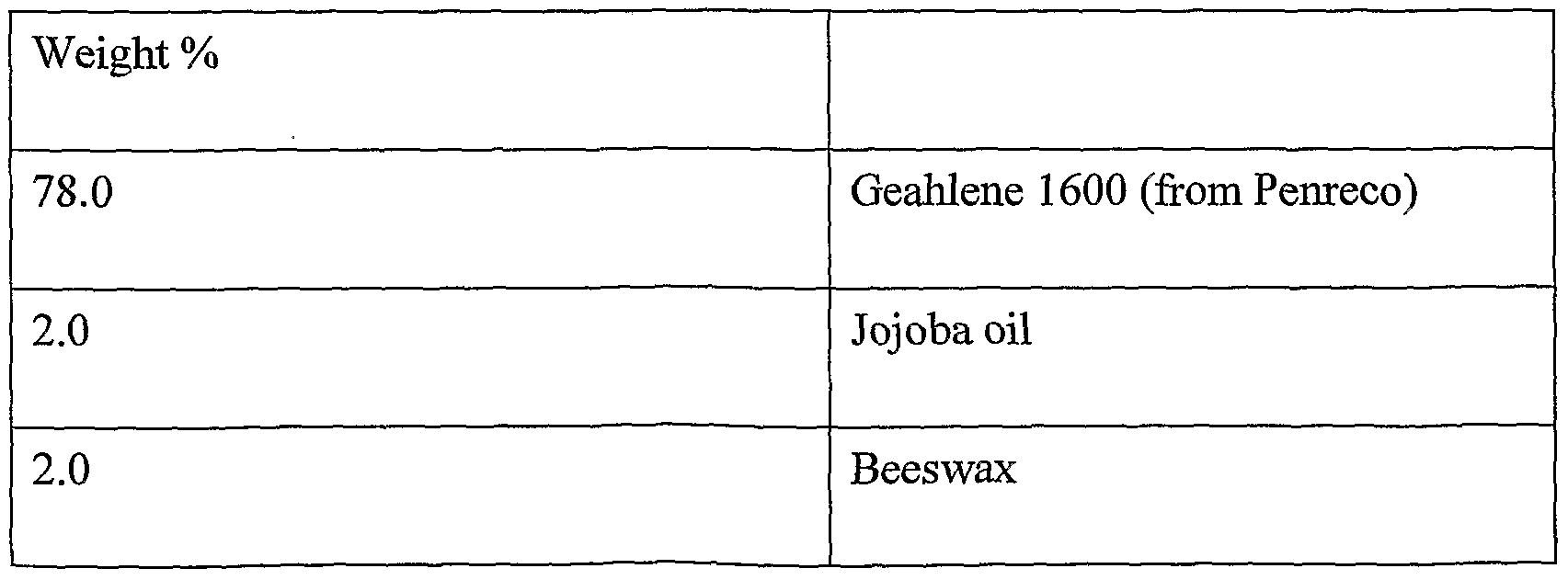
- straight waxes e.g., without limitation, jojoba oil or mixtures with other waxes, e.g., without limitation, beeswax, carnauba, or candelilla wax
- patient compliance may be improved by the present invention because the skin feel is further improved.
- the dry powders of such micro or sub-micro particles may be agglomerated.
- the particles have to be de-agglomerated in order to obtain an even distribution of the particles in the final composition. This can be accomplished by using volatile solvents which show some affinity to the halopolymer.
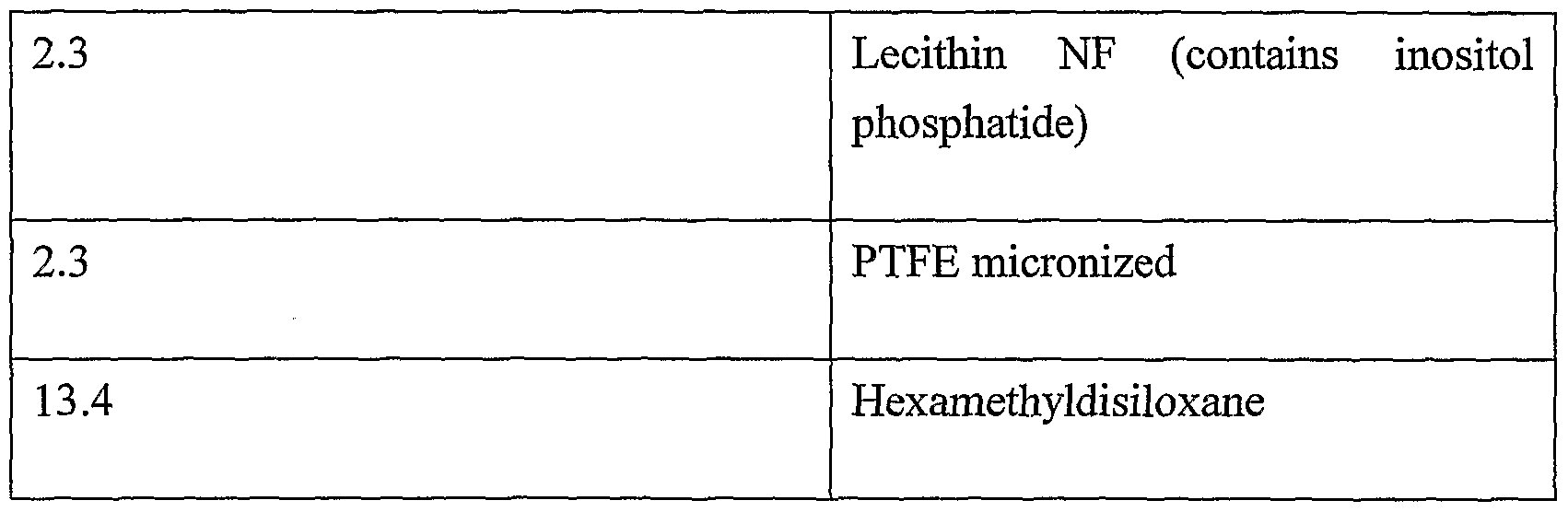
- Preferred solvents include, but are not limited to, volatile silicones, linear or cyclic, having from 2 to 7 silicon atoms and from 1 to 10 alkyl groups (e.g., without limitation, hexamethyldisiloxane, dimethicones, octamethylcyclotetrasiloxane, decamethylcyclopenta-siloxane, dimethicone siloxane, octamethyltrisiloxane and /or mixtures thereof).
- volatile silicones linear or cyclic, having from 2 to 7 silicon atoms and from 1 to 10 alkyl groups (e.g., without limitation, hexamethyldisiloxane, dimethicones, octamethylcyclotetrasiloxane, decamethylcyclopenta-siloxane, dimethicone siloxane, octamethyltrisiloxane and /or mixtures thereof).
- Perfluorobutyl ether and methylperfluoroisobutylether are preferred solvents.
- Other preferred solvents are C 8-9 to C] - 0 isoparaffins (e.g., without limitation, Isopar® from Exxon Corporation). The solvents may be used individually or in combination.
- the submicro or micro particles of the perhalogenopolymers may be dispersed in a convenient liquid.
- Micronised or submicronized perhalopolymers have been known in the art for more than a quarter of a century. However, until the present invention, they did not work as expected in the field of skin protectants and skin care because semisolid anhydrous preparations containing such particles lack cosmetic elegance. Therefore, the compliance of treatments with such preparations was unsatisfactory. Additionally, when the micronized or submicronized particles are used as a component of an emulsion, they lose a great part of their sensorial qualities (often from interactions with emulsifiers).
- glycerol would not be soluble at 3%.
- solubility parameters of cyclomethicones e.g., without limitation, wliite mineral oil and petrolatum are in the 5.77 to 7.33 range, whereas those of propylene glycol is 14.0 and glycerol is 16.26.
- a difference of smaller than 2 usually indicates mutual solubility (Vaughan CD., J. Soc. Cosmet. Chem. 36, 319-333, 1985).
- lipid-soluble molecules containing 2 or more hydroxyls including, but not limited to, dipropylene glycol, 2-ethylhexanediol, octanediol, panthenol, phytantriol, certain ceramides (6), and sphinganine.
- Lipoinsoluble polyols e.g., without limitation, inositol or glycerol
- the molecular weight of such components is below 1000 and the liposolubility has to be at least 0.2 %w/w.
- examples are, without limitation, glycerolisostearate, pentaerithityl mono- and distearate (which are emulsifiers). These example may interfere with the stratum corneum lipids. More preferable examples are sphingosine and (soy-) lecithin (which contains phosphatidyl inositol).
- Suitable halocarbon microparticles have diameters in the range of 0.1 (or smaller) to 50 micrometers, such as Algoflon HC® from Ausimont, FluoroPUREr from Shamrock Technologies, and Fluortress from DuPont. See, International Cosmetic Ingredients Dictionary and Handbook, 8th Ed 2000.
- the diameter of micro or sub-micro particles is preferably about 100 nanometers to about 50 microns.
- compositions of the present invention with their superior skin feel are ideal excipients for dermatological products since they adhere well to skin, and are not easily washed off. For these reasons, active ingredients, delivered by these excipients, remain in contact with the skin longer. In most cases, an increased occlusivity induces a higher moisturization of the skin, and as a consequence, an increased transdermal absorption of active ingredients. By varying the type and amount of amphiphilic bis/oligo hydroxylated lipids, the occlusive effect can be varied correspondingly.
- the amount of polyethylene may be reduced in order to obtain a viscous liquid.
- the nanoparticle size of the used PTFE induces practically no sedimentation.
Landscapes
- Health & Medical Sciences (AREA)
- Life Sciences & Earth Sciences (AREA)
- Animal Behavior & Ethology (AREA)
- General Health & Medical Sciences (AREA)
- Public Health (AREA)
- Veterinary Medicine (AREA)
- Birds (AREA)
- Epidemiology (AREA)
- Dermatology (AREA)
- Emergency Medicine (AREA)
- Engineering & Computer Science (AREA)
- Bioinformatics & Cheminformatics (AREA)
- Chemical & Material Sciences (AREA)
- Chemical Kinetics & Catalysis (AREA)
- General Chemical & Material Sciences (AREA)
- Medicinal Chemistry (AREA)
- Nuclear Medicine, Radiotherapy & Molecular Imaging (AREA)
- Organic Chemistry (AREA)
- Pharmacology & Pharmacy (AREA)
- Toxicology (AREA)
- Medicinal Preparation (AREA)
- Cosmetics (AREA)
- Compositions Of Macromolecular Compounds (AREA)
Abstract
Description



Claims
Priority Applications (4)
| Application Number | Priority Date | Filing Date | Title |
|---|---|---|---|
| JP2004510744A JP2005533044A (en) | 2002-06-06 | 2003-03-27 | Methods and compositions for improving the sensory properties of semi-solid, nearly anhydrous lipids |
| CA002487961A CA2487961A1 (en) | 2002-06-06 | 2003-03-27 | Method and composition for improving sensory characteristics of semisolid predominantly anhydrous |
| AU2003219445A AU2003219445A1 (en) | 2002-06-06 | 2003-03-27 | Method and composition for improving sensory characteristics of semisolid predominantly anhydrous |
| EP03715257A EP1519707A1 (en) | 2002-06-06 | 2003-03-27 | Method and composition for improving sensory characteristics of semisolid predominantly anhydrous lipids |
Applications Claiming Priority (2)
| Application Number | Priority Date | Filing Date | Title |
|---|---|---|---|
| US10/163,523 | 2002-06-06 | ||
| US10/163,523 US20030228335A1 (en) | 2002-06-06 | 2002-06-06 | Method for improving sensory characteristics of semisolid predominantly anhydrous lipids |
Publications (2)
| Publication Number | Publication Date |
|---|---|
| WO2003103624A1 true WO2003103624A1 (en) | 2003-12-18 |
| WO2003103624B1 WO2003103624B1 (en) | 2004-02-26 |
Family
ID=29709990
Family Applications (1)
| Application Number | Title | Priority Date | Filing Date |
|---|---|---|---|
| PCT/IB2003/001700 Ceased WO2003103624A1 (en) | 2002-06-06 | 2003-03-27 | Method and composition for improving sensory characteristics of semisolid predominantly anhydrous |
Country Status (8)
| Country | Link |
|---|---|
| US (1) | US20030228335A1 (en) |
| EP (1) | EP1519707A1 (en) |
| JP (1) | JP2005533044A (en) |
| CN (1) | CN1665476A (en) |
| AU (1) | AU2003219445A1 (en) |
| CA (1) | CA2487961A1 (en) |
| RU (1) | RU2004139107A (en) |
| WO (1) | WO2003103624A1 (en) |
Cited By (2)
| Publication number | Priority date | Publication date | Assignee | Title |
|---|---|---|---|---|
| WO2006106398A1 (en) * | 2005-04-05 | 2006-10-12 | Suess Hans R | Method for improving sensory characteristics of semisolid predominantly anhydrous lipids |
| EP1764076A3 (en) * | 2005-09-16 | 2007-07-25 | Betafarma S.p.A. | Hygienic and cosmetic compositions for treating atopical dermatitIs |
Families Citing this family (4)
| Publication number | Priority date | Publication date | Assignee | Title |
|---|---|---|---|---|
| US8206728B2 (en) | 2004-11-18 | 2012-06-26 | L'oréal | Sunscreen compositions containing fluorinated alkyl ethers |
| JP4546228B2 (en) * | 2004-12-02 | 2010-09-15 | 株式会社資生堂 | Oily skin external composition for promoting percutaneous absorption |
| JP2010501600A (en) * | 2006-08-28 | 2010-01-21 | スース,ハンス,アール. | Anhydrous, urea-containing skin or cosmetic preparations |
| JP7559497B2 (en) * | 2020-10-26 | 2024-10-02 | Agc株式会社 | Dispersion and method for producing laminate |
Citations (8)
| Publication number | Priority date | Publication date | Assignee | Title |
|---|---|---|---|---|
| GB1575201A (en) * | 1977-01-14 | 1980-09-17 | Scott H | Method of lubricating or softening the skin |
| EP0598412A2 (en) * | 1992-11-19 | 1994-05-25 | MEDICON GESELLSCHAFT FÜR UNTERNEHMENSBERATUNG IM BEREICH MEDIZIN UND GESUNDHEITSWESEN mbH | Skinprotection composition |
| WO1997030682A1 (en) * | 1996-02-22 | 1997-08-28 | L'oreal | Cosmetic fixative composition providing shine |
| EP0997134A1 (en) * | 1998-10-06 | 2000-05-03 | L'oreal | Use of a specific particulate phase in a cosmetic composition |
| WO2001003653A1 (en) * | 1999-07-08 | 2001-01-18 | L'oreal | Mascara comprising a polyurethane and fibres |
| US6309655B1 (en) * | 1999-04-30 | 2001-10-30 | The Andrew Jergens Company | Self-indicating cosmetic composition |
| WO2001089466A1 (en) * | 2000-05-23 | 2001-11-29 | The Procter & Gamble Company | Skin care moisturizing and sunscreen compositions comprising organic particulate material |
| WO2002003946A1 (en) * | 2000-07-12 | 2002-01-17 | L'oreal | Composition comprising a modified beeswax and a volatile silicone, cosmetic use thereof |
Family Cites Families (2)
| Publication number | Priority date | Publication date | Assignee | Title |
|---|---|---|---|---|
| US5019604A (en) * | 1989-04-26 | 1991-05-28 | Lemole Gerald M | Protective gel composition |
| US20030147830A1 (en) * | 2002-01-30 | 2003-08-07 | The Procter & Gamble Company | Topical skin and/or hair compositions containing protein |
-
2002
- 2002-06-06 US US10/163,523 patent/US20030228335A1/en not_active Abandoned
-
2003
- 2003-03-27 CA CA002487961A patent/CA2487961A1/en not_active Abandoned
- 2003-03-27 RU RU2004139107/15A patent/RU2004139107A/en not_active Application Discontinuation
- 2003-03-27 WO PCT/IB2003/001700 patent/WO2003103624A1/en not_active Ceased
- 2003-03-27 JP JP2004510744A patent/JP2005533044A/en active Pending
- 2003-03-27 AU AU2003219445A patent/AU2003219445A1/en not_active Abandoned
- 2003-03-27 EP EP03715257A patent/EP1519707A1/en not_active Withdrawn
- 2003-03-27 CN CN038151502A patent/CN1665476A/en active Pending
Patent Citations (8)
| Publication number | Priority date | Publication date | Assignee | Title |
|---|---|---|---|---|
| GB1575201A (en) * | 1977-01-14 | 1980-09-17 | Scott H | Method of lubricating or softening the skin |
| EP0598412A2 (en) * | 1992-11-19 | 1994-05-25 | MEDICON GESELLSCHAFT FÜR UNTERNEHMENSBERATUNG IM BEREICH MEDIZIN UND GESUNDHEITSWESEN mbH | Skinprotection composition |
| WO1997030682A1 (en) * | 1996-02-22 | 1997-08-28 | L'oreal | Cosmetic fixative composition providing shine |
| EP0997134A1 (en) * | 1998-10-06 | 2000-05-03 | L'oreal | Use of a specific particulate phase in a cosmetic composition |
| US6309655B1 (en) * | 1999-04-30 | 2001-10-30 | The Andrew Jergens Company | Self-indicating cosmetic composition |
| WO2001003653A1 (en) * | 1999-07-08 | 2001-01-18 | L'oreal | Mascara comprising a polyurethane and fibres |
| WO2001089466A1 (en) * | 2000-05-23 | 2001-11-29 | The Procter & Gamble Company | Skin care moisturizing and sunscreen compositions comprising organic particulate material |
| WO2002003946A1 (en) * | 2000-07-12 | 2002-01-17 | L'oreal | Composition comprising a modified beeswax and a volatile silicone, cosmetic use thereof |
Cited By (2)
| Publication number | Priority date | Publication date | Assignee | Title |
|---|---|---|---|---|
| WO2006106398A1 (en) * | 2005-04-05 | 2006-10-12 | Suess Hans R | Method for improving sensory characteristics of semisolid predominantly anhydrous lipids |
| EP1764076A3 (en) * | 2005-09-16 | 2007-07-25 | Betafarma S.p.A. | Hygienic and cosmetic compositions for treating atopical dermatitIs |
Also Published As
| Publication number | Publication date |
|---|---|
| CA2487961A1 (en) | 2003-12-18 |
| CN1665476A (en) | 2005-09-07 |
| RU2004139107A (en) | 2005-06-27 |
| AU2003219445A1 (en) | 2003-12-22 |
| JP2005533044A (en) | 2005-11-04 |
| EP1519707A1 (en) | 2005-04-06 |
| US20030228335A1 (en) | 2003-12-11 |
| WO2003103624B1 (en) | 2004-02-26 |
Similar Documents
| Publication | Publication Date | Title |
|---|---|---|
| JP7079827B2 (en) | External skin composition containing an oily moisturizer | |
| JP3993505B2 (en) | Water-in-oil emulsified cosmetic | |
| EP1097744B1 (en) | Polar solvent-in-oil emulsions and multiple emulsions | |
| FR2794998A1 (en) | ORGANOGELS AND THEIR USES, ESPECIALLY COSMETICS | |
| US20030228335A1 (en) | Method for improving sensory characteristics of semisolid predominantly anhydrous lipids | |
| KR102662132B1 (en) | Anhydrous Silky Cosmetics | |
| JPH07330544A (en) | Cosmetics | |
| CA2217039A1 (en) | Use of a liquid, non-ionic, amphiphilic lipid-based nanoemulsion for keratonic fibres | |
| JPH11263721A (en) | Oil-in-water type gommage (peeling) cosmetic | |
| JP5770490B2 (en) | Oil-in-water emulsified cosmetic | |
| US20050196365A1 (en) | Method for improving sensory characteristics of semisolid predominantly anhydrous lipids | |
| US9526682B2 (en) | Fine O/W emulsion | |
| JP7828723B2 (en) | Water-in-oil emulsion cosmetic | |
| JP3778584B2 (en) | Cosmetics | |
| JPH04312512A (en) | Water-in-oil type emulsion cosmetic | |
| EP1616554B1 (en) | Fine O/W-emulsion and its use in cosmetic fields | |
| US7875263B1 (en) | Polymeric structured gels | |
| FR2843541A1 (en) | TRANSPARENT CLEANSING COMPOSITION | |
| JP3130969B2 (en) | Skin cosmetics | |
| JP7086719B2 (en) | Skin cosmetics | |
| JPH05139932A (en) | Hair cosmetics | |
| JP3200242B2 (en) | Oily cosmetics | |
| JP4400215B2 (en) | Cosmetics and hair cosmetics containing novel polymeric surfactants | |
| JP2000007547A (en) | Cosmetic | |
| JP2004210662A (en) | Emulsified cosmetic |
Legal Events
| Date | Code | Title | Description |
|---|---|---|---|
| AK | Designated states |
Kind code of ref document: A1 Designated state(s): AE AG AL AM AT AU AZ BA BB BG BR BY BZ CA CH CN CO CR CU CZ DE DK DM DZ EC EE ES FI GB GD GE GH GM HR HU ID IL IN IS JP KE KG KP KR KZ LC LK LR LS LT LU LV MA MD MG MK MN MW MX MZ NO NZ OM PH PL PT RO RU SC SD SE SG SK SL TJ TM TN TR TT TZ UA UG UZ VC VN YU ZA ZM ZW |
|
| AL | Designated countries for regional patents |
Kind code of ref document: A1 Designated state(s): GH GM KE LS MW MZ SD SL SZ TZ UG ZM ZW AM AZ BY KG KZ MD RU TJ TM AT BE BG CH CY CZ DE DK EE ES FI FR GB GR HU IE IT LU MC NL PT RO SE SI SK TR BF BJ CF CG CI CM GA GN GQ GW ML MR NE SN TD TG |
|
| 121 | Ep: the epo has been informed by wipo that ep was designated in this application | ||
| B | Later publication of amended claims |
Effective date: 20031125 |
|
| WWE | Wipo information: entry into national phase |
Ref document number: 2487961 Country of ref document: CA |
|
| WWE | Wipo information: entry into national phase |
Ref document number: 2004510744 Country of ref document: JP |
|
| WWE | Wipo information: entry into national phase |
Ref document number: 20038151502 Country of ref document: CN |
|
| WWE | Wipo information: entry into national phase |
Ref document number: 00004/KOLNP/2005 Country of ref document: IN |
|
| WWE | Wipo information: entry into national phase |
Ref document number: 2003715257 Country of ref document: EP |
|
| ENP | Entry into the national phase |
Ref document number: 2004139107 Country of ref document: RU Kind code of ref document: A |
|
| WWP | Wipo information: published in national office |
Ref document number: 2003715257 Country of ref document: EP |
|
| WWW | Wipo information: withdrawn in national office |
Ref document number: 2003715257 Country of ref document: EP |