WO2002102764A2 - Verfahren zur herstellung von chiralen aminosäurederivaten - Google Patents

Verfahren zur herstellung von chiralen aminosäurederivaten Download PDF

Info

Publication number
WO2002102764A2
WO2002102764A2 PCT/EP2002/006205 EP0206205W WO02102764A2 WO 2002102764 A2 WO2002102764 A2 WO 2002102764A2 EP 0206205 W EP0206205 W EP 0206205W WO 02102764 A2 WO02102764 A2 WO 02102764A2
Authority
WO
WIPO (PCT)
Prior art keywords
hydrogen
alkyl
general formula
compounds
amino acid
Prior art date
Legal status (The legal status is an assumption and is not a legal conclusion. Google has not performed a legal analysis and makes no representation as to the accuracy of the status listed.)
Ceased
Application number
PCT/EP2002/006205
Other languages
English (en)
French (fr)
Other versions
WO2002102764A3 (de
Inventor
Joachim Rudolph
Frithjof Hannig
Current Assignee (The listed assignees may be inaccurate. Google has not performed a legal analysis and makes no representation or warranty as to the accuracy of the list.)
Bayer AG
Bayer Chemicals AG
Original Assignee
Bayer AG
Bayer Chemicals AG
Priority date (The priority date is an assumption and is not a legal conclusion. Google has not performed a legal analysis and makes no representation as to the accuracy of the date listed.)
Filing date
Publication date
Application filed by Bayer AG, Bayer Chemicals AG filed Critical Bayer AG
Priority to US10/481,499 priority Critical patent/US20040249187A1/en
Priority to JP2003505307A priority patent/JP2004529988A/ja
Priority to EP02743158A priority patent/EP1401803A2/de
Publication of WO2002102764A2 publication Critical patent/WO2002102764A2/de
Publication of WO2002102764A3 publication Critical patent/WO2002102764A3/de
Anticipated expiration legal-status Critical
Ceased legal-status Critical Current

Links

Classifications

    • CCHEMISTRY; METALLURGY
    • C07ORGANIC CHEMISTRY
    • C07KPEPTIDES
    • C07K5/00Peptides containing up to four amino acids in a fully defined sequence; Derivatives thereof
    • C07K5/04Peptides containing up to four amino acids in a fully defined sequence; Derivatives thereof containing only normal peptide links
    • C07K5/08Tripeptides
    • C07K5/0802Tripeptides with the first amino acid being neutral
    • C07K5/0812Tripeptides with the first amino acid being neutral and aromatic or cycloaliphatic
    • CCHEMISTRY; METALLURGY
    • C07ORGANIC CHEMISTRY
    • C07CACYCLIC OR CARBOCYCLIC COMPOUNDS
    • C07C227/00Preparation of compounds containing amino and carboxyl groups bound to the same carbon skeleton
    • C07C227/14Preparation of compounds containing amino and carboxyl groups bound to the same carbon skeleton from compounds containing already amino and carboxyl groups or derivatives thereof
    • C07C227/18Preparation of compounds containing amino and carboxyl groups bound to the same carbon skeleton from compounds containing already amino and carboxyl groups or derivatives thereof by reactions involving amino or carboxyl groups, e.g. hydrolysis of esters or amides, by formation of halides, salts or esters
    • C07C227/20Preparation of compounds containing amino and carboxyl groups bound to the same carbon skeleton from compounds containing already amino and carboxyl groups or derivatives thereof by reactions involving amino or carboxyl groups, e.g. hydrolysis of esters or amides, by formation of halides, salts or esters by hydrolysis of N-acylated amino-acids or derivatives thereof, e.g. hydrolysis of carbamates
    • CCHEMISTRY; METALLURGY
    • C07ORGANIC CHEMISTRY
    • C07CACYCLIC OR CARBOCYCLIC COMPOUNDS
    • C07C269/00Preparation of derivatives of carbamic acid, i.e. compounds containing any of the groups, the nitrogen atom not being part of nitro or nitroso groups
    • C07C269/06Preparation of derivatives of carbamic acid, i.e. compounds containing any of the groups, the nitrogen atom not being part of nitro or nitroso groups by reactions not involving the formation of carbamate groups
    • CCHEMISTRY; METALLURGY
    • C07ORGANIC CHEMISTRY
    • C07CACYCLIC OR CARBOCYCLIC COMPOUNDS
    • C07C271/00Derivatives of carbamic acids, i.e. compounds containing any of the groups, the nitrogen atom not being part of nitro or nitroso groups
    • C07C271/06Esters of carbamic acids
    • C07C271/08Esters of carbamic acids having oxygen atoms of carbamate groups bound to acyclic carbon atoms
    • C07C271/10Esters of carbamic acids having oxygen atoms of carbamate groups bound to acyclic carbon atoms with the nitrogen atoms of the carbamate groups bound to hydrogen atoms or to acyclic carbon atoms
    • C07C271/22Esters of carbamic acids having oxygen atoms of carbamate groups bound to acyclic carbon atoms with the nitrogen atoms of the carbamate groups bound to hydrogen atoms or to acyclic carbon atoms to carbon atoms of hydrocarbon radicals substituted by carboxyl groups

Definitions

  • the invention relates to a process for the preparation of chiral amino acid derivatives and new intermediates.
  • R is a protecting group
  • R 3 is hydrogen, (C 1 -C 12 ) alkyl, aryl having 6 to 10 carbon atoms, or C 7 -C 1 arylalkyl or
  • R 2 and R 3 together represent a 1,2-dimethylenearyl radical
  • R 4 for hydrogen
  • R 5 represents hydrogen, - alkyl, or C 7 -C 13 arylalkyl
  • A represents a substituted or unsubstituted C 1 -C 4 alkylene radical
  • R 1 , R 2 , R 3 and A have the meaning given above
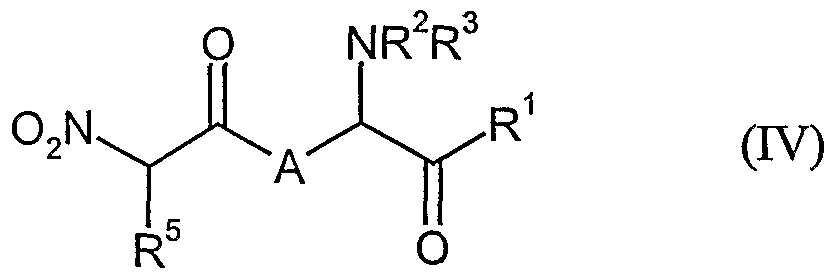
  • R 5 has the meaning given above, are converted to nitroketones of the general formula (IV),
  • R 1 , R 2 , R 3 , R 5 and A have the meaning given above,
  • R 1 , R 2 , R 3 , R 4 , R 5 and A have the meaning given above and
  • Ci-C ⁇ -alkoxy means a straight-chain or cyclic, branched or unbranched C-C 12 alkoxy radical such as methoxy, ethoxy, n-propoxy, iso-propoxy, n-butoxy, iso-butoxy, tert-butoxy, n-pentyloxy, isopentyloxy, 2,2-dimethylpentyloxy, cyclopentyloxy, cyclohexyloxy, adamantyloxy, D-methoxy or L-menthoxy.
  • -C ⁇ -Alkyl in the said contexts each independently represents a straight-chain or cyclic, branched or unbranched C Cn-alkyl radical such as, for example, methyl, ethyl, n-propyl, iso-propyl, n-butyl, iso-butyl, n -Hexyl or cyclohexyl.
  • N-terminal end of an end group-protected amino acid or of an end group-protected peptide means that R 1 is an amino acid bound via the nitrogen or a polymer of amino acids, the free functionalities of which, for example amino groups, carboxylic acid groups or hydroxyl groups, by derivatization in this way It is protected that secondary reactions to these functionalities are largely suppressed under conditions according to the invention.
  • Such measures are sufficiently known to the person skilled in the art, for example from TW Greene, PG Wuts, Protective Groups in Organic Synthesis, 3rd edition, Wiley ⁇ nterscience, 1999 and include, for amino and hydroxyl groups, for example acylations, carbamoylations and sulfonylations and for carboxylic acid groups Example esterifications or the conversion into amides.
  • protective groups in this context mean groups which can largely suppress a reaction of the amino group under the reaction conditions according to the invention and which can be split off selectively to a large extent.
  • Such protective groups are known to the person skilled in the art (TW Greene,
  • aryl having 6 to 10 carbon atoms means aromatic radicals such as, for example, phenyl or naphthyl, which can be substituted by none, one, two or three further substituents from the group - -alkyl or C 1 -C -alkoxy, such as o- Tolyl, m-tolyl, p-tolyl, o-anisyl, m-anisyl, p-anisyl or phenetyl.
  • -C ⁇ -arylalkyl in this context stands for radicals such as benzyl, 1-ethylphenyl, 2-ethylphenyl or p-xylyl.
  • 1,2-dimethylenearyl means, for example, 1,2-dimethylphenyl.
  • substituted or unsubstituted alkylene radicals mean, for example, methylene, 1,1-ethylene, 1,2-ethylene, 1,2-propylene, 1,3-propylene, 1,3-butylene, 1,4-butylene or 2,3-butylene.
  • the compounds of the general formula (IL) used as starting materials are either commercially available or can be prepared analogously to known literature. The same applies to the nitro compounds of the general formula (III).
  • R 1 is a sterically demanding C 3 -C 12 -alkoxy radical, such as, for example, isopropoxy, tert-butoxy, cyclopentyloxy, cyclohexyloxy, D-menthoxy, L-
  • R 2 tert-butyloxycarbonyl (t-boc), benzyloxycarbonyl (cbz); Fluorenyl-methyl-oxycarbonyl (Fmoc), allyloxycarbonyl (aoc) or benzyl
  • R 4 is hydrogen
  • R 5 is hydrogen or methyl
  • R tert-butoxy R 2 is tert-butyloxycarbonyl (t-boc), benzyloxycarbonyl (cbz) or fluorenylmethyloxycarbonyl (F-moc),
  • R 3 is hydrogen
  • R 5 is hydrogen
  • N- (tert-butyloxycarbonyl) -aspartic acid 1-tert-butyl ester is very particularly preferred to use N- (tert-butyloxycarbonyl) -aspartic acid 1-tert-butyl ester as the protected amino acid for the process according to the invention.
  • Nitromethane and nitroethane are preferably used as nitro compounds of the general formula (IJJ), and nitromethane is particularly preferred.
  • step a) The conversion of the free carboxylic acid group of the protected amino acid derivatives of the general formula (II), in which R, R, R and A have the most general meaning given above, into an activated acid derivative and the subsequent reaction with deprotomeric nitro compounds [step a)] can both in separate reaction steps with isolation of the intermediates and without isolation of the activated acid derivative or the deprotomeric nitro compound. It is preferred to carry out step a) without intermediate insulation.
  • imidazolides or phenyl esters can be used as activated acid derivatives; imidazolides are preferred.
  • the production of nitroketones from carboxylic acids by the preparation of acid imidazolides and their reaction with deprotomeric nitro compounds without isolation of intermediates is already known (see also: Baker, Pütt, Synthesis, 1978, p. 478; Yuasa, Tsuruta, Synthetic Communications, 1998, 28 (3), p. 395).
  • WO 96/01788 also discloses the production of nitroketones from the Cr terminus of amino acids.
  • the yields of the nitroketones are either low or strongly dependent on the choice of the substrate, the solvent, the temperature, the amount of the activating reagent used, and that for the deprotonation of the
  • the amount of carbonyldiimidazole in step 1) can be, for example, 1.0 to 1.5
  • step 1) and step 2) can be used as inert solvents for step 1) and step 2): ethers such as tetrahydrofuran, diethyl ether, methyl tert-butyl ether or dioxane, or polar aprotic solvents such as dimethylformamide, Dimethyl sulfoxide or N-methyl-pyrrolidone, a mixture of such solvents and the nitro compound used itself, provided that its melting point is above 0 ° C.
  • ethers such as tetrahydrofuran, diethyl ether, methyl tert-butyl ether or dioxane
  • polar aprotic solvents such as dimethylformamide, Dimethyl sulfoxide or N-methyl-pyrrolidone, a mixture of such solvents and the nitro compound used itself, provided that its melting point is above 0 ° C.
  • Water content of less than 1 wt .-% mean, preferably less than 0.03 wt .-%.
  • the amount of nitro compound in step 2) can, for example, be chosen so that it is 1.0 to 100 times based on the free carboxylic acid groups of the protected amino acid derivatives of the general formula (II). 1.2 to 20 equivalents are preferred. 2 to 10 equivalents are particularly preferred.
  • Alkali metal hydrides, hydroxides, carbonates, Q-C 6 alcoholates, amides, substituted amides or phosphazene bases can be used as the base, for example.
  • the -hydrides, -carbonates, -hydroxides, -methanolates, -ethanolates, -tert-butanolates, and -diisopropylamides of lithium, sodium and potassium are preferred. Potassium tert-butoxide is very particularly preferred.
  • the amount of base can be chosen, for example, so that it is 1.0 to 2.0 equivalents based on the free carboxylic acid groups of the protected amino acid derivatives of the general formula (II). 1.05 to 1.3 equivalents are preferred.
  • bases which are insoluble or only slightly soluble in the solvent a large excess (up to 500 equivalents) of base is generally not critical.
  • the base can be used in dissolved, solid or suspended form. It can be presented or added to dissolve the nitro compound.
  • the temperature during the production of the activated acid derivative in step 1) can be, for example, 0 to 80 ° C., 15 to 25 ° C. are preferred.
  • the reaction time in step 1) can be, for example, 30 minutes to 24 hours, 3 to 8 hours are preferred.
  • the temperature in the deprotonation of the nitro compound in step 2) can be, for example, from -20 ° C. to 25 ° C., preferably from -5 to 5 ° C.
  • the reaction time in step 2) can be, for example, 5 minutes to 24 hours, 30 minutes to 1 hour are preferred.
  • the temperature in the reaction of the activated acid derivative with the deprotomeric nitro compound in step 3) can be, for example, 0 to 80 ° C., 15 to 25 ° C. are preferred.
  • the reaction time in step 3) can be, for example, 4 h to 24 h, 8 to 16 h are preferred.
  • reaction of the activated acid derivative with the deprotomeric nitro compound can take place, for example, in such a way that the reaction mixture from step 1) leads to the
  • Reaction solution from step 2) is given or vice versa.
  • the addition of the activated acid derivative from step 1) to the deprotomeric nitro compound from step 2) is preferred.
  • the reaction mixture from step 3) can be worked up, for example, by adding water and an acid or an aqueous acid solution and then extracting it with an immiscible or only slightly water-miscible solvent and then removing the immiscible or only slightly water-miscible solvent. This can be done, for example, by distillation.
  • the amount of acid used should generally be chosen so that it corresponds to or exceeds the amount of base used in step 2).
  • Suitable acids or aqueous acid solutions are, for example, dilute mineral acids such as hydrochloric acid or sulfuric acid, carboxylic acids such as acetic acid or citric acid.
  • diluted means a molar concentration of 2 mol / 1 or less. 1 molar aqueous hydrochloric acid is preferably used.
  • Ethers such as diethyl ether, methyl tert-butyl ether, esters such as ethyl acetate, butyl acetate, chlorinated hydrocarbons such as chloroform or dichloromethane, aromatic solvents such as toluene or xylenes, hydrocarbons such as hexane or heptane and mixtures of such solvents.
  • nitro alcohols of the general formula (IV) are the boranes mentioned in the literature, such as, for example, borane, diisoamylborane, 9-borobicyclo [3.3.1] nonane, boranates such as sodium borohydride, lithium borohydride, Lithium triethyl borohydride and lithium tri- (sec-butyl) borohydride and aluminates such as lithium tri- (tert-butoxy) aluminum hydride, the use of which can be carried out according to conventional methods known to the person skilled in the art.
  • boranates such as sodium borohydride, lithium borohydride, Lithium triethyl borohydride and lithium tri- (sec-butyl) borohydride and aluminates such as lithium tri- (tert-butoxy) aluminum hydride, the use of which can be carried out according to conventional methods known to the person skilled in the art.
  • Step c) which includes the reduction of nitro alcohols to the corresponding amino alcohols of the general formula (I), can be carried out analogously to methods known from the literature, for example catalytically in the presence of a hydrogen source.
  • Suitable catalysts can be, for example:
  • Suitable hydrogen sources are, for example, hydrogen and hydride transfer reagents such as e.g. Formic acid, sodium formate and ammonium formate.
  • Steps b) and c) can be carried out not only sequentially but also simultaneously if conditions are used which can reduce both nitro groups and ketones.
  • Such conditions can be, for example
  • chiral amino acid derivatives are particularly suitable for further use, for example in a process for the preparation of antibiotics of the biphenomycin type, such as, for example, biphenomycin A and biphenomycin B.
  • the particular advantage of the process according to the invention is based on the fact that the preparation of derivatives and homologues of (2S, 4R) -4-hydroxy-ornithine now only requires 3 reaction stages starting from easily available, protected amino acids. These reaction stages take place in high yields and in good to very good overall optical yields.
  • the nitro alcohol from b) (5 g, 14.9 mmol) is dissolved in 50 ml of methanol.
  • the reaction mixture is cooled to -10 ° C. and palladium on carbon (10%, purissimum, Fluka) (2.5 g) and dry ammonium formate (9.43 g, 150 mmol, 10 eq) are added with stirring (reaction temperature at -10 ° C).
  • the catalyst is filtered off.
  • the solvent is removed and ethyl acetate and sat. NaHCO 3 solution are added (pH> 7). After phase separation and two additional washes with ethyl acetate, the combined organic phases are washed with sat.

Landscapes

  • Chemical & Material Sciences (AREA)
  • Organic Chemistry (AREA)
  • Chemical Kinetics & Catalysis (AREA)
  • Genetics & Genomics (AREA)
  • Biophysics (AREA)
  • General Health & Medical Sciences (AREA)
  • Health & Medical Sciences (AREA)
  • Medicinal Chemistry (AREA)
  • Molecular Biology (AREA)
  • Proteomics, Peptides & Aminoacids (AREA)
  • Biochemistry (AREA)
  • Life Sciences & Earth Sciences (AREA)
  • Organic Low-Molecular-Weight Compounds And Preparation Thereof (AREA)

Abstract

Die vorliegende Erfindung betrifft ein Verfahren zur Herstellung von chiralen Aminosäurederivaten, das dadurch gekennzeichnet ist, dass freie Carbonsäure-Gruppen in einem Aminosäurederivat zunächst in Nitroketone umgewandelt werden und diese durch Reduktion zu den entsprechenden Nitroalkoholen und Aminoalkoholen umgesetzt werden. Die als Zwischenprodukte auftretenden Nitroketone und Nitroalkohole sind ebenfalls Bestandteil der Erfindung.

Description

Verfahren zur Herstellung von chiralen Aminosäurederivaten
Die Erfindung betrifft ein Verfahren zur Herstellung von chiralen Aminosäurederi- vaten und neue Zwischenprodukte.
Derivate von nicht-proteinogenen Aminosäuren wie z.B. (2S,4R)-4-Hydroxy-ornithin und seinem Homologen (2S,5R)-5-Hydroxy-lysin sind Gegenstand zahlreicher Syntheseversuche gewesen. Erstere sind zum Beispiel als wichtige Bestandteile von hochwirksamen Antibiotika des Biphenomycin-Typs, letztere als wichtige Bestandteile des Kollagens, kommerziell vielversprechend.
Neben einigen, nicht stereospezifischen Synthesen, ist für (2S,4R)-4-Hydroxy- ornithin die Synthese von Schmidt et al. bekannt (siehe z.B. Synthesis, 1991, S. 409; J. Chem. Soc, Chem. Commun., 1991, S. 275; Synthesis, 1992, S. 1025), die ausgehend von enantiomerenreinem, geschütztem Glycerinaldehyd über 9 Stufen zu (2S,4R)-4-Hydroxy-ornithin verläuft. Für die technische Realisierung ist ein solches Verfahren aufgrund des teuren Edukts und der geringen Gesamtausbeute nicht geeignet. Auch das Verfahren von Jackson et al., J. Org. Chem., 1992, 57, S. 3397, das von L-Serin ausgeht, führt nur in sehr geringer Gesamtausbeute zum gewünschten Produkt. Ebenso sind für das Homologe (2S,5R)-5-Hydroxy-lysin zwar einige Synthesen bekannt (siehe zum Beispiel: Löhr et al., Synthesis, 1999, S. 1139), jedoch limitiert auch hier die Vielzahl der Reaktionsschritte und insbesondere die ungenügende Steuerung der Stereochemie die Anwendung auf den Labormaßstab.
Es bestand daher das Bedürfnis, ausgehend von günstigen Edukten einen allgemein anwendbaren Syntheseweg zur Herstellung von Derivaten und Homologen des 4- Hydroxy-ornithins zu entwickeln.
Es wurde nun ein Verfahren zur Herstellung von chiralen Aminosäurederivaten der allgemeinen Formel (I)
Figure imgf000003_0001
in der
R1 d-C12-Alkoxy-, (Cι-C12-Alkyl)2N-, (C!-C12-Alkyl)NH- oder das N-terminale Ende einer endgruppengeschützten Aminosäure oder eines endgruppenge- schützten Peptids,
R eine Schutzgruppe
R3 Wasserstoff, (C1-C12)-Alkyl, Aryl mit 6 bis 10 Gerüstkohlenstoffatomen, oder C7-C1 -Arylalkyl oder
R2 und R3 zusammen einen 1,2-Dimethylenaryl-Rest bedeuten und
R4 für Wasserstoff oder
R1 und R4 zusammen für eine chemische Bindung und
R5 für Wasserstoff, - rAlkyl, oder C7-C13- Arylalkyl und
A für einen substituierten oder unsubstituierten C1-C4-Alkylen-Rest steht,
gefunden, das dadurch gekennzeichnet ist, dass Verbindungen der allgemeinen For- mel (II)
Figure imgf000004_0001
in der
R1, R2, R3 und A oben genannte Bedeutung besitzen
a) in ein aktiviertes Säurederivat überführt werden und anschließend mit depro- tonierten Nitroverbindungen, die sich von der allgemeinen Formel (III) ableiten,
R5-CH2NO2 (III),
in der
R5 oben genannte Bedeutung besitzt, zu Nitroketonen der allgemeinen Formel (IV) umgesetzt werden,
Figure imgf000004_0002
in der
R1, R2, R3, R5 und A oben genannte Bedeutung besitzen,
b) diese Nitroketone zu Nitroalkoholen der allgemeinen Formel (V) reduziert werden,
Figure imgf000005_0001
in der
R1, R2, R3, R4, R5 und A oben genannte Bedeutung besitzen und
c) diese Nitroalkohole zu den chiralen Aminosäurederivaten der allgemeinen F Foorrmmeell ((II)) rreedduuzziieerrtt werden, in der R1, R2, R3, R4 , R5 und A oben genannte Bedeutung besitzen.
In diesem Zusammenhang bedeutet Ci-Cπ-Alkoxy einen geradkettigen oder cyc- lischen, verzweigten oder unverzweigten Cι-C12-Alkoxy-Rest wie zum Beispiel Methoxy, Ethoxy, n-Propoxy, iso-Propoxy, n-Butoxy, iso-Butoxy, tert.-Butoxy, n- Pentyloxy, iso-Pentyloxy, 2,2-Dimethylpentyloxy, Cyclopentyloxy, Cyclohexyloxy, Adamantyloxy, D-Methoxy oder L-Menthoxy.
-C^-Alkyl steht in den genannten Zusammenhängen jeweils unabhängig für einen geradkettigen oder cyclischen, verzweigten oder unverzweigten C Cn-Alkyl-Rest wie beispielsweise Methyl, Ethyl, n-Propyl, iso-Propyl, n-Butyl, iso-Butyl, n-Hexyl oder Cyclohexyl.
Das N-terminale Ende einer endgruppengeschützten Aminosäure oder eines endgrup- pengeschützten Peptids bedeutet in diesem Zusammenhang, dass R1 eine über den Stickstoff gebundene Aminosäure oder ein Polymer aus Aminosäuren ist, deren freie Funktionalitäten, wie zum Beispiel Aminogruppen, Carbonsäuregruppen oder Hydroxygruppen durch Derivatisierung derart geschützt ist, dass Nebenreaktionen unter erfmdungsgemäßen Bedingungen an diesen Funktionalitäten weitgehend unterdrückt werden. Solche Maßnahmen sind dem Fachmann hinreichend z.B. aus T.W. Greene, P.G. Wuts, Protective Groups in Organic Synthesis, 3. Auflage, Wiley ϊnterscience, 1999 bekannt und umfassen für Amino- und Hydroxy-Gruppen beispielsweise Acylierungen, Carbamoylierungen und Sulfonylierungen und für Carbonsäure- Gruppen zum Beispiel Veresterungen oder die Überführung in Amide.
Für R2 bedeuten in diesem Zusammenhang Schutzgruppen solche Gruppen, die unter den erfindungsgemäßen Reaktionsbedingungen eine Reaktion der Aminomnktion weitestgehend unterdrücken können und sich im in hohem Maße selektiv wieder ab- spalten lassen. Solche Schutzgruppen sind dem Fachmann bekannt (T.W. Greene,
P.G. Wuts, Protective Groups in Organic Synthesis, 3. Auflage, Wiley Interscience, 1999) und umfassen beispielsweise Schutzgruppen wie tert-Butyloxycarbonyl, Fluorenylmethyloxycarbonyl, Benzyloxycarbonyl oder Allyloxycarbonyl und Benzyl.
Für R3 bedeutet Aryl mit 6 bis 10 Gerüstkohlenstoffatomen aromatische Reste wie beispielsweise Phenyl oder Naphthyl, die mit keinem, einem, zwei oder drei weiteren Substituenten aus der Gruppe - -Alkyl oder C1-C -Alkoxy substituiert sein können wie zum Beispiel o-Tolyl, m-Tolyl, p-Tolyl, o-Anisyl, m-Anisyl, p-Anisyl oder Phenetyl.
-Cπ-Arylalkyl steht in diesem Zusammenhang für Reste wie zum Beispiel Benzyl, 1-Ethylphenyl, 2-Ethylphenyl oder p-Xylyl.
1,2-Dimethylenaryl bedeutet in diesem Zusammenhang beispielsweise 1,2-Di- methylenphenyl.
Für A bedeuten substituierte oder unsubstituierte - -Alkylen-Reste zum Beispiel Methylen, 1,1-Ethylen, 1,2-Ethylen, 1,2-Propylen, 1,3-Propylen, 1,3-Butylen, 1,4- Butylen oder 2,3-Butylen. Die als Ausgangsstoffe verwendeten Verbindungen der allgemeinen Formel (IL) sind entweder kommerziell verfügbar beziehungsweise nach bekannter Literatur oder analog dazu herstellbar. Gleiches trifft auf die Nitroverbmdungen der allgemeinen Formel (III) zu.
Für das erfindungsgemäße Verfahren werden als geschützte Aminosäuren der allgemeinen Formel (II) bevorzugt solche eingesetzt in denen
R1 einen sterisch anspruchsvollen C3-C12-Alkoxy-Rest wie beispielsweise iso- Propoxy, tert.-Butoxy, Cyclopentyloxy, Cyclohexyloxy, D-Menthoxy, L-
Menthoxy oder 1-Adamantoxy,
R2 tert.-Butyloxycarbonyl (t-boc), Benzyloxycarbonyl (cbz); Fluorenyl-methyl- oxycarbonyl (Fmoc), Allyloxycarbonyl (aoc) oder Benzyl steht
>3 Wasserstoff,
R4 Wasserstoff,
R5 Wasserstoff oder Methyl
A Methylen oder 1,2-Ethylen
bedeutet.
Für das erfindungsgemäße Verfahren werden als geschützte Aminosäuren der allgemeinen Formel (II) besonders bevorzugt solche eingesetzt in denen
R tert-Butoxy R2 tert.-Butyloxycarbonyl (t-boc), Benzyloxycarbonyl (cbz) oder Fluorenyl- methyloxycarbonyl (F-moc) steht,
R3 Wasserstoff,
R ,4 Wasserstoff,
R5 Wasserstoff und
A Methylen
bedeutet.
Ganz besonders bevorzugt wird für das erfϊndungsgemäße Verfahren als geschützte Aminosäure N-(tert.-Butyloxycarbonyl)-asparaginsäure- 1 -tert.-butylester eingesetzt.
Als Nitroverbmdungen der allgemeinen Formel (IJJ) werden bevorzugt Nitromethan und Nitroethan eingesetzt, besonders bevorzugt ist Nitromethan.
Die Überführung der freien Carbonsäuregruppe der geschützten Aminosäurederivate der allgemeinen Formel (II), in der R , R , R und A die oben genannte allgemeinste Bedeutung besitzen, in ein aktiviertes Säurederivat und die anschließende Umsetzung mit deprotomerten Nitroverbmdungen [Schritt a)] kann sowohl in separaten Reakti- onschritten mit Isolierung der Zwischenprodukte als auch ohne Isolierung des akti- vierten Säurederivats oder der deprotomerten Nitroverbmdung erfolgen. Bevorzugt ist die Durchführung des Schritts a) ohne Zwischenisolierung.
Als aktivierte Säurederivate können beispielsweise Imidazolide oder Phenylester eingesetzt werden, bevorzugt sind die Imidazolide. Die Herstellung von Nitroketonen aus Carbonsäuren durch Herstellung von Säure- imidazoliden und deren Umsetzung mit deprotomerten Nitroverbmdungen ohne Isolierung von Zwischenprodukten ist bereits bekannt (siehe auch: Baker, Pütt, Synthesis, 1978, S. 478; Yuasa, Tsuruta, Synthetic Communications, 1998, 28(3), S. 395). In der WO 96/01788 ist auch die Herstellung von Nitroketonen aus dem CrTerminus von Aminosäuren bekannt.
Allerdings sind in allen Fällen die Ausbeuten der Nitroketone entweder niedrig oder stark abhängig von der Wahl des Substrats, des Lösungsmittels, der Temperatur, der Menge des eingesetzten Aktivierungsreagenzes, und der für die Deprotonierung der
Nitroverbmdung eingesetzten Base.
Für die Durchführung des Schrittes a) des erfindungsgemäßen Verfahrens ist folgende Prozedur bevorzugt:
1) Umsetzung der geschützten Aminosäurederivate der allgemeinen Formel (II) mit Carbonyldiimidazol in einem im Wesentlichen wasserfreien, inerten Lösungsmittel.
2) Deprotonierung der Nitroverbmdung der allgemeinen Formel (IH) in einem im Wesentlichen wasserfreien, inerten Lösungsmittel mit einer Base.
3) Umsetzung des aktivierten Säurederivats aus Schritt 1) mit der deprotomerten Nitroverbmdung aus Schritt 2).
4) Aufarbeitung des Reaktionsgemischs.
Die Menge an Carbonyldiimidazol in Schritt 1) kann beispielsweise 1.0 bis 1.5
Äquivalente bezogen auf die freien Carbonsäuregruppen der geschützten Amino- säurederivate betragen. Bevorzugt sind 1.05 bis 1.2 Äquivalente.
Als inerte Lösungsmittel für Schritt 1) und Schritt 2) können beispielsweise eingesetzt werden: Ether wie Tetrahydrofuran, Diethy lether, Methyl-tert.-butylether oder Dioxan, oder polar aprotische Lösungsmittel wie Dimethylformamid, Dimethylsulfoxid oder N-Methyl-pyrrolidon, eine Mischung solcher Lösungsmittel sowie die eingesetzte Nitroverbmdung selbst sein, insofern ihr Schmelzpunkt über 0°C liegt.
Im Wesentlichen wasserfrei soll in diesem Zusammenhang beispielsweise einen
Wassergehalt von weniger als 1 Gew.-% bedeuten, bevorzugt weniger als 0.03 Gew.-%.
Die Menge an Nitroverbmdung in Schritt 2) kann beispielsweise so gewählt werden, dass sie das 1.0 bis 100-fache bezogen auf die freien Carbonsäuregruppen der geschützten Aminosäurederivate der allgemeinen Formel (II) beträgt. Bevorzugt sind 1.2 bis 20 Äquivalente. Besonders bevorzugt sind 2 bis 10 Äquivalente.
Als Base können beispielsweise Alkalimetall-hydride, -hydroxide, -carbonate, -Q- C6-Alkoholate, -amide, substituierte -amide oder Phosphazen-Basen eingesetzt werden. Bevorzugt sind die -hydride, -carbonate, -hydroxide, -methanolate, -ethanolate, -tert-butanolate, und -diisopropylamide von Lithium, Natrium und Kalium. Ganz besonders bevorzugt ist Kalium-tert.-butanolat.
Die Basenmenge kann zum Beispiel so gewählt werden, dass sie 1.0 bis 2.0 Äquivalente bezogen auf die freien Carbonsäuregruppen der geschützten Aminosäurederivate der allgemeinen Formel (II) beträgt. Bevorzugt sind 1.05 bis 1.3 Äquivalente. Bei im Lösungsmittel nicht oder nur wenig löslichen Basen ist auch ein großer Über- schuss (bis 500 Äquivalente) an Base im Allgemeinen unkritisch. Der Einsatz der Base kann in gelöster, fester oder suspendierter Form erfolgen. Sie kann vorgelegt oder zur Lösung der Nitroverbmdung dazugegeben werden.
Die Temperatur bei der Herstellung des aktivierten Säurederivats in Schritt 1) kann beispielsweise 0 bis 80°C betragen, bevorzugt sind 15 bis 25°C. Die Reaktionsdauer in Schritt 1) kann zum Beispiel 30 min bis 24 h betragen, 3 bis 8 h sind bevorzugt.
Die Temperatur bei der Deprotonierung der Nitroverbmdung in Schritt 2) kann bei- spielsweise -20°C bis 25°C betragen, bevorzugt sind -5 bis 5°C. Die Reaktionsdauer in Schritt 2) kann zum Beispiel 5 min bis 24 h betragen, 30 min bis 1 h sind bevorzugt.
Die Temperatur bei der Umsetzung des aktivierten Säurederivats mit der deprotomerten Nitro Verbindung in Schritt 3) kann beispielsweise 0 bis 80°C betragen, bevorzugt sind 15 bis 25 °C. Die Reaktionsdauer in Schritt 3) kann zum Beispiel 4 h bis 24 h betragen, 8 bis 16 h sind bevorzugt.
Die Umsetzung des aktivierten Säurederivats mit der deprotomerten Nitroverbmdung kann beispielsweise derart erfolgen, dass die Reaktionsmischung aus Schritt 1) zu der
Reaktionslösung aus Schritt 2) gegeben wird oder umgekehrt. Die Zugabe des aktivierten Säurederivats aus Schritt 1) zu der deprotomerten Nitroverbmdung aus Schritt 2) ist bevorzugt.
Die Aufarbeitung des Reaktionsgemischs aus Schritt 3) kann beispielsweise derart erfolgen, dass Wasser und eine Säure oder eine wässrige Säurelösung zugesetzt werden und anschließend mit einem nicht oder nur wenig wassermischbaren Lösungsmittel extrahiert wird und das nicht oder nur wenig wassermischbaren Lösungsmittel anschließend entfernt wird. Dies kann zum Beispiel destillativ erfolgen.
Die Menge der eingesetzten Säure sollte im Allgemeinen so gewählt werden, dass sie der Menge der in Schritt 2) eingesetzten Basenmenge entspricht oder sie übersteigt. Als Säuren oder wässrige Säurelösungen sind beispielsweise geeignet verdünnte Mineralsäuren wie Salzsäure oder Schwefelsäure, Carbonsäuren wie Essigsäure oder Zitronensäure. Verdünnt bedeutet in diesem Zusammenhang eine molare Konzentration von 2 mol/1 oder weniger. Bevorzugt wird 1 molare wässrige Salzsäure eingesetzt.
Als nicht oder nur wenig wassermischbare Lösungsmittel für die Extraktion sind beispielsweise geeignet:
Ether wie Diethylether, Methyl-tert.-Butylether, Ester wie Essigsäureethylester, Es- sigsäurebutylester, chlorierte Kohlenwasserstoffe wie Chloroform oder Dichlor- methan, aromatische Lösungsmittel wie Toluol oder Xylole, Kohlenwasserstoffe wie Hexan oder Heptan sowie Mischungen solcher Lösungsmittel.
Für die Reduktion von Nitroketonen zu den entsprechenden Nitroalkoholen sind Verfahren unter Verwendung von Bor- und Aluminiumwasserstoffverbindungen bekannt (siehe z.B. WO 96/01788).
Für den Schritt b), der Herstellung von Nitroalkoholen der allgemeinen Formel (IV) eignen sich ebenfalls die in der Literatur genannten Borane wie zum Beispiel Boran, Diisoamylboran, 9-bora-bicyclo[3.3.1]nonan, Boranate wie Natriumborhydrid, Lithiumborhydrid, Lithium-triethylborhydrid und Lithium-tri-(sek.-butyl)borhydrid und Aluminate wie Lithium-tri-(tert.-butoxy)alumimumhydrid, deren Einsatz nach dem Fachmann bekannten üblichen Verfahren erfolgen kann. Die diastereoselektive Reduktion von Nitroketonen ist bereits in der Literatur beschrieben (siehe z.B. Caille, J.-C; Bulliard, M.; Laboue, B.; Asymmetrie reduction of prochiral ketones, in Chirality Ind. II, Collins, A.N.; Sheldrake, G.N.; Crosby, J. (Eds.), Wiley, Chichester, UK 1997, S. 391-401).
Für eine in hohem Maße diastereoselektive Reduktion ist im erfindungsgemäßen Verfahren der Einsatz von Lithium-tri-(sek.-butyl)borhydrid oder einer Lösung davon bevorzugt. Die Reaktionstemperatur bei der Reduktion kann dabei beispielsweise -90 bis 0°C betragen, bevorzugt sind -80 bis -60°C. Schritt c), der die Reduktion von Nitroalkoholen zu den entsprechenden Aminoalko- holen der allgemeinen Formel (I) beinhaltet, kann analog zu literaturbekannten Methoden beispielsweise katalytisch in Gegenwart einer Wasserstoffquelle durchgeführt werden.
Geeignete Katalysatoren können beispielsweise sein:
Palladium/Kohlenstoff, Rhodium Kohlenstoff, Raney-Nickel oder Platinschwarz.
Geeignete Wasserstoffquellen sind beispielsweise Wasserstoff sowie Hydridüber- tragungsreagenzien wie z.B. Ameisensäure, Natriumformiat und Ammoniumformiat.
Bevorzugt ist die Reduktion an Palladium/Kohlenstoff in Gegenwart von Ammoniumformiat.
Auf erfindungsgemäße Weise erhält man chirale Aminosäurederivate der allgemeinen Formel (I).
Die Schritte b) und c) können nicht nur sequentiell sondern auch simultan durchgeführt werden, wenn Bedingungen angewendet werden, die sowohl Nitrogruppen als auch Ketone reduzieren können. Solche Bedingungen können zum Beispiel die
Hydrogenierung an Rutheniumkomplexen und/oder Palladiumkomplexen in Gegenwart von Wasserstoff sein (siehe z.B. auch Y. Yuasa et al., Synth. Commun. 1998, 28, S. 395).
Bevorzugt ist jedoch die sequentielle Reduktion.
Diese chiralen Aminosäurederivate sind insbesondere für die weitere Verwendung beispielsweise in einem Verfahren zur Herstellung von Antibiotika des Bipheno- mycin-Typs wie zum Beispiel Biphenomycin A und Biphenomycin B geeignet. Der besondere Vorteil des erfindungsgemäßen Verfahrens beruht auf der Tatsache, dass für die Herstellung von Derivaten und Homologen des (2S,4R)-4-Hydroxy-or- nithins nunmehr lediglich 3 Reaktionsstufen ausgehend von einfach erhältlichen, geschützten Aminosäuren erfordert. Diese Reaktionsstufen verlaufen in hohen Aus- beuten und in guten bis sehr guten optischen Gesamtausbeuten.
Beispiele
Beispiel 1
a) Herstellung von tert.-Butyl-N-(tert-butoxycarbonyl)-5-nitro-4-oxo-L-nor- valinat:
Zu einer Lösung von 0,59 g (3,63 mmol) 1,1 '-Carbonyldiimidazol in 50 ml wasserfreiem THF werden 1,0 g (3,46 mmol) N-(tert.-Butyloxycarbonyl)-asparaginsäure-l- tert.-butylester bei RT gegeben. Man lässt diese Mischung noch weitere 5 h rühren.
Parallel hierzu wird eine Lösung von 1,87 ml (34,6 mmol) Nitromethan in 20 ml wasserfreiem THF in eine Lösung von 0,43 g (3,80 mmol) t-BuOK in 50 ml trockenem THF bei 0°C getropft und für 1 h gerührt. Dann wird die Lösung mit der aktivierten Säure N-(tert.-Butyloxycarbonyl)-asparaginsäure-l-tert.-butylester tropfenweise zu dieser Lösung gegeben. Nach der Zugabe wird das Reaktionsgemisch für weitere 15 h gerührt. Anschließend wird die Lösung mit 1 M HC1 behandelt, mit Ethylacetat extrahiert (2x), mit gesättigter wässriger NaCl-Lösung gewaschen und dann über MgSÜ4 getrocknet. Das Lösungsmittel wird im Vakuum entfernt. Es ist kein weiterer Reinigungsschritt erforderlich.
Ausbeute: 1,10 g (96 %), weißer Feststoff.
Smp. = 78-82°C. *H-NMR (400 MHz, CDC13): δ = 5,35 (d, J = 6,6 Hz, 1H, NH), 5,23 (s, 2H, CH2NO2), 4,39 (m, 1H, CHNH), 3,03 (m, 2H, CH2), 1,38 (s, 18H, t-Bu). 13C-NMR (100 MHz, CDC13): δ = 194,3, 169,3, 155,5 (C=O), 83,3 (CH2-NO2), 83,0
+ 82,5 (t-Bu), 50,2 (CH-NH), 42,9 (CH2), 28,31, 28,27 (CH3). MS (ESI): m/z = 333.2 [M + H]+. FT-ICR-MS: m z ([M + Na]+) = 355,14757 (ber.), 355,14750 (gef.). [α]D25 = _16 (Ethanol: Wasser = 95:5 (v/v), c = 1). b) Herstellung von tert.-Butyl-(2S,4R)-2-[(tert.-butoxycarbonyl)amino]-4-hy- droxy-5-nitropentanoat:
0,67 mg (2,00 mmol) des Nitroketons aus a) werden in 30 ml wasserfreiem THF gelöst und aus -78°C gekühlt. Dann werden 2 ml einer 1 M Lösung von L-Selectrid in THF tropfenweise zugegeben und die Temperatur beibehalten. Das Ende der Reaktion wird per DC bestimmt (Laufmittel = Toluol:THF:Ethylacetat, 90:5:5). Nach ca. 3 h ist die Reaktion beendet und die Reaktionslösung wird mit gesättigter wässriger NEJ^Cl-Lösung gequencht. Die wässrige Phase wird mit Ethylacetat extrahiert (3 x). Das Rohprodukt zeigt ein Diastereomerenverhältnis von 85:15
(HPLC) zugunsten des gewünschten (2S,4R)-Isomers. Das Rohprodukt wird säulenchromatographisch an Kieselgel mit dem Laufmittel Toluol:THF:Ethylacetat (90:5:5) gereinigt (Rf = 0,18). Bei einer Diastereomerenanreicherung von >90:10 ist zur vollständigen Reinigung alternativ auch eine Umkristallisation aus Hexan möglich.
Ausbeute: 0,28 g (42 %), weißer Feststoff
Smp: = 132,5-134,5°C. -NMR (400 MHz, CDC13): δ = 5,43 (d, J = 7,5 Hz, 1H, NH), 4,59-4,25 (m, 4H, CH-OH, CH-NH, CH^-NO^, 3,38 (d, J = 3,7 Hz, 1H, OH),
2,09 (m, 1H, CH2), 1,89 (m, 1H, CH2), 1,47 (s, 9H, t-Bu), 1,46 (s, 9H, t-Bu). ^C- NMR (100 MHz, CDC13): δ = 171.0 (C = O), 83,0 (CH2-NO2), 80,6 + 80,1 (O-C(CH3)3), 66,1 (CH-OH), 51,3 (CH-NH), 36,9 (CH2), 28,3 + 28,1 (C(CH3)3. MS (ESI): m/z = 335 [M + H]+. FT-ICR-MS: m z ([M + Na]+) = 357,16322 (ber.), 357.16329 (gef.). [α]D 25 = -5,025 (Ethanol/Wasser = 95:5 (v/v), c = 1).
c) Herstellung von tert.-Butyl-(2S,4R)-Nα-(tert.-butoxycarbonyl)-4-hydroxy- ornithinat:
Der Nitroalkohol aus b) (5 g, 14,9 mmol) wird in 50 ml Methanol gelöst. Das Reaktionsgemisch wird auf -10°C gekühlt und Palladium auf Kohle (10 %, purissimum, Fluka) (2,5 g) und trockenes Ammoniumformiat (9,43 g, 150 mmol, 10 eq) werden unter Rühren dazugegeben (Reaktionstemperatur bei -10°C). Nach Rühren für 2 h wird der Katalysator abfiltriert. Das Lösungsmittel wird entfernt und Ethylacetat und ges. NaHCO3-Lösung werden zugegeben (pH > 7). Nach Phasentrennung und zwei zusätzlichen Waschungen mit Ethylacetat werden die vereinten organischen Phasen mit ges. NaCl-Lösung gewaschen, mit Na2Sθ4 getrocknet und das Lösungsmittel im Vakuum entfernt. Das Produkt wird als klares-leichtgelbliches Öl in einer Ausbeute von 4,55 g (100 %) erhalten. Aufgrund seiner Instabilität wird das Produkt 3 keinem weiteren Reinigungsschritt unterzogen und direkt zu Verbindung 4 umgesetzt.
1H-NMR (400 MHz, CDC13): δ = 7,94 (s (br), 2H, NH2), 5,56 (m, 1H, NH), 4,29 (m, 1H, CHOH), 4,25 (m, 1H, OH), 4,11 (m, 1H, CHNH), 3,02 (m, CH2-NH2), 2,85 (m, 1H, CH2-NH2), 1,92 (m, 1H, CH2), 1,85 (m, 1H, CH2), 1,46 (s, 9H, t-Bu), 1,44 (s, 9H, t-Bu). 13C-NMR (100.58 MHz, CDC13): δ = 66,5 (CHOH), 59,5 (CH?NH9), 52,7 (CHNH), 38,2 (CH2), 28,7 (CH3). MS (ESI): m/z = 305 [M + H]+. FT-ICR-MS: m/z ([M + H]+) = 305.20710 (ber.), 305.20709 (gef).
d) Herstellung von tert.-Butyl-(2S, 4R-)Nα-9tert.-butyloxycarbonyl)-Nδ-(benzyl- oxycarbonyl)-4-hydroxy-ornithinat
Der Aminoalkohol aus c) (4,55 g Rohprodukt, ~ 15 mmol) wird in 50 mL DMF gelöst und N,N-Diisoproρylamin (3,8 g, 30 mmol, 2 eq) und Benzyl-N- succinimidylcarbonagt (Z-OSu) (3,74 g, 15 mmol) werden zugegeben. Nach 16 h Reaktionsdauer wird das Lösungsmittel im Vakuum entfernt, der Rückstand in Dichlormethan aufgenommen und nacheinander mit 5 %iger wässriger Zitronensäure, Natriumhydrogencarbonatlösung und ges. Kochsalzlösung gewaschen. Nach Trocknen mit Natriumsulfat und Entfernung des Lösungsmittels im Vakuum wird das Produkt durch Kieselgelchromatographie mit Hexan/Ethylacetat (10:1 = >3:1) gereinigt.
Ausbeute (über zwei Stufen): 3,3 g (51 %), weißer Feststoff Smp: 79-81°C. *H-NMR (400 MHz, CDC13): δ = 7,32 (m, 5H, aromat), 5,49 (m, 2H, NH, OH), 5,09 (s, 2H, Ph-CH9), 4,22 (m, IH, CH-OH), 3,89 (m, IH, CH- NHBoc), 3,35 (m, IH, CH2N), 3,11 (m, IH, CH2N), 1,92 (m, IH, C-CH^-C), 1,45 (s, 9H, t-Bu), 1,42 (s, 9H, tBu). 13C-NMR (100.58 MHz, CDC13): δ = 172,1, 157,5, 156,2 (C=O), 136,8, 128,9, 128,7, 128,5 (ar.), 82,7, 80,5 (tBu), 69,1 (C-OH), 67,2 (CH2Ph), 52,5 (CHN), 47,2 (CH2N), 38,0 (C-CH2-C), 28,7, 28,3 (CH3). FT-ICR- MS: m/z ([M+H]+ = 4,39.24388 (ber.), 439.24427 (gef.).

Claims

Patentansprüche
1. Verfahren zur Herstellung von chiralen Aminosäurederivaten der allgemeinen Formel (I)
Figure imgf000019_0001
in der
R1 Ci-Cπ-Alkoxy-, (Cι-C12-Alkyl)2N-, (Cι-Cι2-Alkyl)NH- oder das N- terminale Ende einer endgruppengeschützten Aminosäure oder eines endgruppengeschützten Peptids,
R2 eine Schutzgruppe
R3 Wasserstoff,
Figure imgf000019_0002
Aryl mit 6 bis 10 Gerüstkohlenstoffatomen, oder Arylalkyl mit 7 bis 12 Kohlenstoffatomen oder
R2 und R3 zusammen einen 1,2-Dimethylenaryl-Rest bedeuten und
R4 für Wasserstoff oder
R1 und R4 zusammen für eine chemische Bindung und
R5 für Ci-Cw-Alky oder C7-C13-Arylalkyl und
A für einen weiter substituierten oder unsubstituierten Q-GrAlkylen- Rest steht, dadurch gekennzeichnet, dass Verbindungen der allgemeinen Formel (II)
Figure imgf000020_0001
in der
R1, R2 , R3 und A oben genannte Bedeutung besitzen
a) in ein aktiviertes Säurederivat überfuhrt werden und anschließend mit deprotomerten Nitroverbmdungen, die sich von der allgemeinen For- mel (III) ableiten,
R5-CH2NO2 (III),
in der
R5 oben genannte Bedeutung besitzt zu Nitroketonen der allgemeinen Formel (IV) umgesetzt werden,
Figure imgf000020_0002
in der
R , R , R , R und A oben genannte Bedeutung besitzen,
b) diese Nitroketone zu Nitroalkoholen der allgemeinen Formel (V) reduziert werden,
Figure imgf000021_0001
in der
R .1 , τ R>2 , R>3 , R.4 , π R5 und A oben genannte Bedeutung besitzen und
e) diese Nitroalkohole zu den chiralen Aminosäurederivaten der allgemeinen Formel (I) reduziert werden, in der R1, R2, R3, R4 , R5 und A oben genannte Bedeutung besitzen .
2. Verfahren nach Anspruch 1, dadurch gekennzeichnet, dass die Überführung in ein Nitroketon gemäß Schritt a) folgende Schritte umfasst:
1) Umsetzung der Verbindungen der allgemeinen Formel (II),
in der
R1 Cι-C12-Alkoxy-, (Q-Cn-Alkyl^N-, (Cι-Cι2-A]kyl)NH- oder das N-terminale Ende einer endgruppengeschützten Aminosäure oder eines endgruppengeschützten Peptids,
R2 eine Schutzgruppe
R3 Wasserstoff, (C1-C12)-Alkyl, Aryl mit 6 bis 10 Gerüstkohlenstoffatomen, oder Arylalkyl mit 7 bis 12 Koblenstoffatomen oder
R2 und R3 zusammen einen 1,2-Dimethylenaryl-Rest bedeuten und R für Wasserstoff oder
R1 und R4 zusammen für eine chemische Bindung und
R5 für d-Cn-Alkyl, oder C7-C13-Arylalkyl und
A für einen weiter substituierten oder unsubstituierten C1-C4-AI- kylen-Rest steht,
mit Carbonyldiimidazol in 1.0 bis 1.5 Äquivalenten bezogen auf freie Carbonsäuregruppen in einem Lösungsmittel.
2) Zumindest teilweise Deprotonierung von 1.0 bis 100 Äquivalenten einer Nitroverbmdung der allgemeinen Formel (III) in der R5 die in
Anspruch 1 genannte Bedeutung besitzt mit 1.0 bis 2.0 Äquivalenten einer Base, wobei sich die Mengenangaben auf die Menge der freien Carbonsäuregruppen der Verbindungen der allgemeinen Formel (H) in Schritt 1) bezieht.
3) Umsetzung der Reaktionsmischung aus 1) mit der Reaktionsmischung aus 2).
3. Verfahren nach Anspruch 2, dadurch gekennzeichnet, dass die Temperatur für Schritt 1) 0 bis 80°C beträgt.
4. Verfahren nach einem oder mehreren der Ansprüche 2 bis 3, dadurch gekennzeichnet, dass die Temperatur für Schritt 2) -20 bis 25°C beträgt.
5. Verfahren nach einem oder mehreren der Ansprüche 2 bis 4, dadurch gekennzeichnet, dass die Base für Schritt 2) ausgewählt ist aus der Gruppe der Hydride, Hydroxide, Carbonate, Q-Cö-Alkoholate, Amide und organischen Amide von Lithium, Natrium und Kalium.
6. Verfahren nach einem oder mehreren der Ansprüche 1 bis 5, dadurch gekenn- zeichnet, dass Verbindungen eingesetzt werden, in denen
R1 iso-Propoxy oder tert.-Butoxy
R2 tert.-Butyloxycarbonyl, Fluorenylmethyloxycarbonyl, Benzyloxy- carbonyl oder Allyloxycarbonyl
R3 Wasserstoff
R4 Wasserstoff
R5 Wasserstoff oder Methyl
A Methylen bedeutet.
7. Verfahren nach einem oder mehreren der Ansprüche 1 bis 6, dadurch gekennzeichnet, dass die Reduktion der Nitroketone gemäß Schritt b) diastereo- selektiv durchgeführt wird.
8. Verfahren nach einem oder mehreren der Ansprüche 1 bis 6, dadurch gekenn- zeichnet, dass die Reduktion der Nitroketone gemäß Schritt b) mit Litbium- tris(iso-butyl)borhydrid erfolgt.
9. Verfahren nach einem oder mehreren der Ansprüche 1 bis 8, dadurch gekennzeichnet, dass die Reduktion der Nitrogruppe gemäß Schritt c) durch kataly- tische Reduktion in Gegenwart einer Wasserstoffquelle ausgewählt aus der Gruppe Wasserstoff, Ameisensäure, Natriumformiat oder Ammoniumformiat erfolgt.
10. Verbindungen der allgemeinen Formel (IV)
Figure imgf000024_0001
in der
R1 Cι-Ci2-Alkoxy-, (d-Cπ-Alkyl)^-, (Cι-Cι2-Al yl)lSIH- oder das N- terminale Ende einer endgruppengeschützten Aminosäure oder eines endgruppengeschützten Peptids,
R eine Schutzgruppe
R3 Wasserstoff, (C1-C12)-Alkyl, Aryl mit 6 bis 10 Gerüstkohlenstoffatomen, oder Arylalkyl mit 7 bis 12 Kohlenstoffatomen oder
R und R zusammen einen 1,2-Dιmethylenaryl-Rest bedeuten und
R4 für Wasserstoff oder
R1 und R4 zusammen für eine chemische Bindung und
R5 für -Cπ-Alkyl, oder C7-C13-Arylalkyl und
A für einen substituierten oder unsubstituierten C1-C4-Alkylen-Rest steht.
11. tert.-Butyl-N-(tert.-butoxycarbonyl)-5-nitro-4-oxo-L-norvalinat.
12. Verbindungen der allgemeinen Formel (V)
Figure imgf000025_0001
in der
R1 -drAlkoxy-, (d-Cπ-Alkyl^N-, (Cι-Cι2-Alkyl)NH- oder das N- terminale Ende einer endgruppengeschützten Aminosäure oder eines endgruppengeschützten Peptids,
R2 eine Schutzgruppe
R3 Wasserstoff, (d-C12)-Alkyl, Aryl mit 6 bis 10 Gerüstkohlenstoffatomen, oder Arylalkyl mit 7 bis 12 Kohlenstoffatomen oder
R2 und R3 zusammen einen 1,2-Dimethylenaryl-Rest bedeuten und
R4 für Wasserstoff oder
R1 und R4 zusammen für eine chemische Bindung und
R5 für Cι-Ci2-AlkyL oder C7-C13-Arylalkyl und
A für einen weiter substituierten oder unsubstituierten C1-C4-Alkylen- Rest steht.
13. (2S,4R)-2-tert.-Butyl-[(tert.-Butyloxycarbonyl)ammo]-4-hydroxy-5-nitropen- tanoat.
14. Verwendung von Verbindungen gemäß Anspruch 10 in einem Verfahren zur Herstellung von 5-Hydroxylysin oder 4-Hydroxyornithin oder von Derivaten von 5-Hydroxylysin oder 4-Hydroxyornithin.
15. Verwendung von Verbindungen gemäß Anspruch 12 in einem Verfahren zur Herstellung von 5-Hydroxylysin oder 4-Hydroxyornithin oder von Derivaten von 5-Hydroxylysin oder 4-Hydroxyornithin.
16. Verwendung von Verbindungen gemäß Anspruch 10 in einem Verfahren zur Herstellung von Biphenomycinen.
17. Verwendung von Verbindungen gemäß Anspruch 12 in einem Verfahren zur
Herstellung von Biphenomycinen.
18. Biphenomycine, dadurch gekennzeichnet, dass sie durch ein Verfahren hergestellt werden, in dem Verbindungen gemäß den Ansprüchen 10 oder 12 einge- setzt werden.
PCT/EP2002/006205 2001-06-19 2002-06-06 Verfahren zur herstellung von chiralen aminosäurederivaten Ceased WO2002102764A2 (de)

Priority Applications (3)

Application Number Priority Date Filing Date Title
US10/481,499 US20040249187A1 (en) 2001-06-19 2002-06-06 Method for producing chiral amino acid derivatives
JP2003505307A JP2004529988A (ja) 2001-06-19 2002-06-06 キラルなアミノ酸誘導体の製造法
EP02743158A EP1401803A2 (de) 2001-06-19 2002-06-06 Verfahren zur herstellung von chiralen aminosäurederivaten

Applications Claiming Priority (2)

Application Number Priority Date Filing Date Title
DE10129510A DE10129510A1 (de) 2001-06-19 2001-06-19 Verfahren zur Herstellung von chiralen Aminosäurederivaten
DE10129510.3 2001-06-19

Publications (2)

Publication Number Publication Date
WO2002102764A2 true WO2002102764A2 (de) 2002-12-27
WO2002102764A3 WO2002102764A3 (de) 2003-09-18

Family

ID=7688682

Family Applications (1)

Application Number Title Priority Date Filing Date
PCT/EP2002/006205 Ceased WO2002102764A2 (de) 2001-06-19 2002-06-06 Verfahren zur herstellung von chiralen aminosäurederivaten

Country Status (5)

Country Link
US (1) US20040249187A1 (de)
EP (1) EP1401803A2 (de)
JP (1) JP2004529988A (de)
DE (1) DE10129510A1 (de)
WO (1) WO2002102764A2 (de)

Family Cites Families (2)

* Cited by examiner, † Cited by third party
Publication number Priority date Publication date Assignee Title
ATE201197T1 (de) * 1994-07-07 2001-06-15 Pharmeco Lab Inc Diarinopropanole abgeleitet von aminosäuren
US6399629B1 (en) * 1998-06-01 2002-06-04 Microcide Pharmaceuticals, Inc. Efflux pump inhibitors

Also Published As

Publication number Publication date
EP1401803A2 (de) 2004-03-31
WO2002102764A3 (de) 2003-09-18
US20040249187A1 (en) 2004-12-09
DE10129510A1 (de) 2003-01-23
JP2004529988A (ja) 2004-09-30

Similar Documents

Publication Publication Date Title
EP3909961B1 (de) L-glufosinat-zwischenprodukt und herstellungsverfahren für l-glufosinat
Avenoza et al. Enantioselective synthesis of (S)-and (R)-α-methylserines: application to the synthesis of (S)-and (R)-N-Boc-N, O-isopropylidene-α-methylserinals
KR101018983B1 (ko) 콤브레타스타틴의 제조방법 및 중간체
Andrés et al. Diastereoselective synthesis of enantiopure γ-amino-β-hydroxy acids by Reformatsky reaction of chiral α-dibenzylamino aldehydes
US8624024B2 (en) Phosphoramide compound, method for producing the same, ligand, complex, catalyst and method for producing optically active alcohol
Ueda et al. Zinc-mediated carbon radical addition to glyoxylic imines in aqueous media for the synthesis of α-amino acids
EP1607090B1 (de) Asimadolin für die Behandlung des Irritable Bowel Syndroms
EP1299342B1 (de) Verfahren zur herstellung von 3,3-diarylpropylaminen
EP1401803A2 (de) Verfahren zur herstellung von chiralen aminosäurederivaten
DE69932269T2 (de) Herstellung optisch aktiver Cyclohexylphenylglykolsäureester
US6919476B2 (en) T-butoxycarbonylaminoethylamine for the synthesis of PNA monomer units, amino acid derivatives, intermediates thereof, and processes for productions of them
US5426228A (en) General method for preparation of sphingosine bases and their analogues
DE60007894T2 (de) Verfahren für die herstellung und zwischenprodukte von tetrahydro-[1,8]-naphthyridin
WO2005049570A1 (de) Verfahren zur synthese optisch aktiver piperidine durch hydrierung optisch aktiver pyridine
DE4232505A1 (de) Verfahren zur Reduktion von Carbonsäuren oder Carbonsäurederivaten sowie neue Verbindungen
EP0798289B1 (de) Alpha-Iminocarbonsäurederivate
EP0811012A1 (de) Verfahren zur herstellung von l-aspartyl-d-alanin-n-(thietan-3-yl)-amiden
Yonezawa et al. Dehydrooligopeptides. IX. Syntheses and conversions of. ALPHA.-dehydroglutamine derivatives to N-carboxy-. ALPHA.-dehydroglutamine anhydride and. DELTA. 1-dehydroglutaminyldipeptides.
Nazih et al. Synthesis of (±)-4-Substituted Pipecolinic Acids from 4-Alkylpyridines
AT401931B (de) Verfahren zur herstellung von (s,s)-(n-(1- ethoxycarbonyl-3-oxo-3-phenylpropyl)-alanin)- (phenylmethyl)ester
KR101859586B1 (ko) 라코사마이드 또는 이의 유사체의 제조방법
DE102011088854B4 (de) Verfahren zur Herstellung von Sphingosin-1-phosphat
CH696238A5 (de) Verfahren zur Herstellung von Zimtaldehydverbindungen.
WO2005061469A1 (de) Verfahren zur herstellung von chiralen mercaptoaminosäuren
WO1995012574A1 (de) Verfahren zur herstellung n-geschützter n-alkylierter aminosäuren

Legal Events

Date Code Title Description
AK Designated states

Kind code of ref document: A2

Designated state(s): AE AG AL AM AT AU AZ BA BB BG BR BY BZ CA CH CN CO CR CU CZ DE DK DM DZ EC EE ES FI GB GD GE GH GM HR HU ID IL IN IS JP KE KG KP KR KZ LC LK LR LS LT LU LV MA MD MG MK MN MW MX MZ NO NZ OM PH PL PT RO RU SD SE SG SI SK SL TJ TM TN TR TT TZ UA UG US UZ VN YU ZA ZM ZW

AL Designated countries for regional patents

Kind code of ref document: A2

Designated state(s): GH GM KE LS MW MZ SD SL SZ TZ UG ZM ZW AM AZ BY KG KZ MD RU TJ TM AT BE CH CY DE DK ES FI FR GB GR IE IT LU MC NL PT SE TR BF BJ CF CG CI CM GA GN GQ GW ML MR NE SN TD TG

121 Ep: the epo has been informed by wipo that ep was designated in this application
DFPE Request for preliminary examination filed prior to expiration of 19th month from priority date (pct application filed before 20040101)
WWE Wipo information: entry into national phase

Ref document number: 2002743158

Country of ref document: EP

WWE Wipo information: entry into national phase

Ref document number: 2003505307

Country of ref document: JP

WWP Wipo information: published in national office

Ref document number: 2002743158

Country of ref document: EP

REG Reference to national code

Ref country code: DE

Ref legal event code: 8642

WWE Wipo information: entry into national phase

Ref document number: 10481499

Country of ref document: US

WWW Wipo information: withdrawn in national office

Ref document number: 2002743158

Country of ref document: EP