USRE50440E1 - Organic light emitting display device - Google Patents
Organic light emitting display device Download PDFInfo
- Publication number
- USRE50440E1 USRE50440E1 US18/195,864 US202318195864A USRE50440E US RE50440 E1 USRE50440 E1 US RE50440E1 US 202318195864 A US202318195864 A US 202318195864A US RE50440 E USRE50440 E US RE50440E
- Authority
- US
- United States
- Prior art keywords
- layer
- charge generation
- type charge
- hole transport
- light emitting
- Prior art date
- Legal status (The legal status is an assumption and is not a legal conclusion. Google has not performed a legal analysis and makes no representation as to the accuracy of the status listed.)
- Active, expires
Links
Images




Classifications
-
- H—ELECTRICITY
- H10—SEMICONDUCTOR DEVICES; ELECTRIC SOLID-STATE DEVICES NOT OTHERWISE PROVIDED FOR
- H10K—ORGANIC ELECTRIC SOLID-STATE DEVICES
- H10K50/00—Organic light-emitting devices
- H10K50/10—OLEDs or polymer light-emitting diodes [PLED]
- H10K50/11—OLEDs or polymer light-emitting diodes [PLED] characterised by the electroluminescent [EL] layers
- H10K50/125—OLEDs or polymer light-emitting diodes [PLED] characterised by the electroluminescent [EL] layers specially adapted for multicolour light emission, e.g. for emitting white light
- H10K50/13—OLEDs or polymer light-emitting diodes [PLED] characterised by the electroluminescent [EL] layers specially adapted for multicolour light emission, e.g. for emitting white light comprising stacked EL layers within one EL unit
- H10K50/131—OLEDs or polymer light-emitting diodes [PLED] characterised by the electroluminescent [EL] layers specially adapted for multicolour light emission, e.g. for emitting white light comprising stacked EL layers within one EL unit with spacer layers between the electroluminescent layers
-
- H—ELECTRICITY
- H10—SEMICONDUCTOR DEVICES; ELECTRIC SOLID-STATE DEVICES NOT OTHERWISE PROVIDED FOR
- H10K—ORGANIC ELECTRIC SOLID-STATE DEVICES
- H10K50/00—Organic light-emitting devices
- H10K50/10—OLEDs or polymer light-emitting diodes [PLED]
- H10K50/11—OLEDs or polymer light-emitting diodes [PLED] characterised by the electroluminescent [EL] layers
-
- H—ELECTRICITY
- H10—SEMICONDUCTOR DEVICES; ELECTRIC SOLID-STATE DEVICES NOT OTHERWISE PROVIDED FOR
- H10K—ORGANIC ELECTRIC SOLID-STATE DEVICES
- H10K50/00—Organic light-emitting devices
- H10K50/10—OLEDs or polymer light-emitting diodes [PLED]
- H10K50/19—Tandem OLEDs
-
- H—ELECTRICITY
- H10—SEMICONDUCTOR DEVICES; ELECTRIC SOLID-STATE DEVICES NOT OTHERWISE PROVIDED FOR
- H10K—ORGANIC ELECTRIC SOLID-STATE DEVICES
- H10K2101/00—Properties of the organic materials covered by group H10K85/00
- H10K2101/30—Highest occupied molecular orbital [HOMO], lowest unoccupied molecular orbital [LUMO] or Fermi energy values
-
- H—ELECTRICITY
- H10—SEMICONDUCTOR DEVICES; ELECTRIC SOLID-STATE DEVICES NOT OTHERWISE PROVIDED FOR
- H10K—ORGANIC ELECTRIC SOLID-STATE DEVICES
- H10K2101/00—Properties of the organic materials covered by group H10K85/00
- H10K2101/40—Interrelation of parameters between multiple constituent active layers or sublayers, e.g. HOMO values in adjacent layers
-
- H—ELECTRICITY
- H10—SEMICONDUCTOR DEVICES; ELECTRIC SOLID-STATE DEVICES NOT OTHERWISE PROVIDED FOR
- H10K—ORGANIC ELECTRIC SOLID-STATE DEVICES
- H10K30/00—Organic devices sensitive to infrared radiation, light, electromagnetic radiation of shorter wavelength or corpuscular radiation
- H10K30/80—Constructional details
- H10K30/865—Intermediate layers comprising a mixture of materials of the adjoining active layers
-
- H—ELECTRICITY
- H10—SEMICONDUCTOR DEVICES; ELECTRIC SOLID-STATE DEVICES NOT OTHERWISE PROVIDED FOR
- H10K—ORGANIC ELECTRIC SOLID-STATE DEVICES
- H10K59/00—Integrated devices, or assemblies of multiple devices, comprising at least one organic light-emitting element covered by group H10K50/00
- H10K59/30—Devices specially adapted for multicolour light emission
- H10K59/35—Devices specially adapted for multicolour light emission comprising red-green-blue [RGB] subpixels
- H10K59/351—Devices specially adapted for multicolour light emission comprising red-green-blue [RGB] subpixels comprising more than three subpixels, e.g. red-green-blue-white [RGBW]
Definitions
- the present disclosure relates to an organic light emitting display device, and more particularly, to an organic light emitting display device having reduced driving voltage and increased lifespan by doping a P-type charge generation layer with a hole transport material.
- Organic light emitting display devices that display an image by adjusting an amount of light emitted from an organic light emitting layer are recently receiving attention as flat panel display devices having reduced weight and volume, which are drawbacks of cathode ray tubes (CRTs).
- CRTs cathode ray tubes
- the organic light emitting device that is a self-emissive device fabricated by interposing a thin lighting emitting layer between electrodes may have a paper-like thin layered structure.
- the organic light emitting device includes an anode, a hole injection layer (HIL), a hole transport layer (HTL), a light emitting layer (EML), an electron transport layer (ETL), an electron injection layer (EIL), and a cathode.
- an organic light emitting device used in the organic light emitting display device generally has a single-stack structure.
- applications of a multi-stack structure continue to grow.
- the organic light emitting device having a multi-stack structure includes an anode, a cathode, and a first stack, a charge generation layer, and a second stack, which are sequentially stacked between the anode and the cathode.
- the first stack includes a hole transport layer, a light emitting layer, and an electron transport layer, which are disposed on the anode
- the second stack includes a hole transport layer, a light emitting layer, and an electron transport layer.
- the charge generation layer is disposed between the first and second stacks to control charge balance therebetween and includes an N-type charge generation layer and a P-type charge generation layer.
- the P-type charge generation layer generates holes and electrons, injects the electrons into the N-type charge generation layer, and injects the holes into the hole transport layer of the second stack.
- the P-type charge generation layer is formed of HAT(CN)6 alone.
- HAT(CN)6 has inefficient hole generation and hole injection, an organic light emitting device including the same may have increased driving voltage and decreased lifespan.
- An organic light emitting display device includes a first electrode and a second electrode disposed on a substrate opposite to each other, a first stack including a hole injection layer, a first hole transport layer, a first light emitting layer, and a first electron transport layer sequentially stacked on the first electrode, a second stack including a second hole transport layer, a second light emitting layer, and a second electron transport layer sequentially stacked between the first stack and the second electrode, and a charge generation layer disposed between the first stack and the second stack and including an N-type charge generation layer and a P-type charge generation layer to control charge balance between the first and second stacks.
- the P-type charge generation layer is doped with 1% to 20% of a hole transport material based on a volume of the P-type charge generation layer.
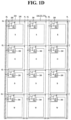
- FIGS. 1 A to 1 D are equivalent circuit diagrams illustrating R, G, B, and W sub-pixels of an organic light emitting display device according to a first embodiment of the present invention
- FIG. 2 is a cross-sectional view illustrating R, G, B, and W sub-pixels of the organic light emitting display device illustrated in FIGS. 1 A to 1 D ;
- FIG. 3 is a perspective view illustrating the white organic light emitting display device of FIG. 2 ;
- FIG. 4 is a band diagram of the white organic light emitting display device of FIG. 2 ;
- FIGS. 5 A and 5 B are graphs illustrating driving voltage and lifespan of a white organic light emitting device according to a comparative example and a white organic light emitting device including a P-type charge generation layer doped with a hole transport material according to Case A of the present invention;
- FIGS. 6 A and 6 B are graphs illustrating driving voltage and lifespan of a white organic light emitting device according to a comparative example and a white organic light emitting device including a P-type charge generation layer doped with a hole transport material according to Case B of the present invention;
- FIGS. 7 A and 7 B are graphs illustrating driving voltage and lifespan of a white organic light emitting device according to a comparative example and white organic light emitting devices each including a P-type charge generation layer doped with a hole transport material according to Case C of the present invention;
- FIGS. 8 A and 8 B are graphs illustrating driving voltage and lifespan of a white organic light emitting device according to a comparative example and a white organic light emitting device including a P-type charge generation layer doped with a hole transport material according to Case D of the present invention;
- FIGS. 9 A, 9 B, 9 C and 9 D are graphs illustrating driving voltage and lifespan of a white organic light emitting device according to a comparative example and white organic light emitting devices each including a P-type charge generation layer doped with NPB or TPD, as a hole transport material, according to the present invention
- FIGS. 10 A to 10 C are cross-sectional views illustrating a white organic light emitting device according to a second embodiment of the present invention.
- FIGS. 11 A and 11 B are graphs illustrating driving voltage and lifespan of a white organic light emitting device according to a comparative example and white organic light emitting devices according to the first and second embodiments of the present invention
- FIGS. 12 A and 12 B are graphs illustrating driving voltage and lifespan of a white organic light emitting device according to a comparative example and white organic light emitting devices according to the second embodiment of the present invention according to thickness of first and second P-type charge generation layers;
- FIG. 13 is a diagram for describing a first example of an apparatus for manufacturing the P-type charge generation layer according to the present invention illustrated in FIG. 10 B ;
- FIG. 14 is a diagram for describing a second example of an apparatus for manufacturing the P-type charge generation layer according to the present invention illustrated in FIG. 10 B ;
- FIG. 15 is a diagram for describing a example of an apparatus for manufacturing the P-type charge generation layer according to the second embodiment of the present invention illustrated in FIG. 100 ;
- FIGS. 16 A to 16 D are cross-sectional views illustrating a white organic light emitting device according to a third embodiment of the present invention.
- FIG. 17 is a cross-sectional view illustrating a white organic light emitting device according to a fourth embodiment of the present invention.
- FIGS. 1 A through 8 B embodiments of the present invention will be described in detail with reference to FIGS. 1 A through 8 B .
- FIGS. 1 A to 1 D are equivalent circuit diagrams illustrating R, G, B, and W sub-pixels of an organic light emitting display device according to a first embodiment of the present invention.
- FIG. 2 is a cross-sectional view illustrating R, G, B, and W sub-pixels of the organic light emitting display device illustrated in FIGS. 1 A to 1 D .
- FIG. 3 is a perspective view of the white organic light emitting display device of FIG. 2 .
- FIG. 4 is a band diagram of the white organic light emitting display device of FIG. 2 .
- the organic light emitting display device includes a substrate in which a display region is defined with a plurality of sub-pixel regions arranged in a matrix form and a sealing substrate or a thin-film encapsulation substrate for protecting sub-pixels formed on the substrate from moisture or oxygen.
- the plurality of sub-pixel regions includes an R sub-pixel region, a G sub-pixel region, a B sub-pixel region, and a W sub-pixel region, and the R, G, B, and W sub-pixel regions are arrayed in a matrix form so as to display an image.
- the R, G, B, and W sub-pixel region may be arrayed in a matrix with 1 row and 4 columns along the same line as a gate line as illustrated in FIG. 1 A or may be arranged in a matrix form with 4 rows and 1 column along the same line as a data line as illustrated in FIG. 1 B .
- the sub-pixel regions are arranged in the order of the R, G, B, and W sub-pixel regions, but may also be arranged in the order of the R, B, G, and W sub-pixel regions and the order of W, R, G, and B sub-pixel regions.
- the order of arrangement may be changed by a user without limitation.
- the R, B, G, and W sub-pixel regions may also be arrayed in a matrix with 2 rows and 2 columns as illustrated in FIGS. 1 B and 1 C .
- the R sub-pixel region may be formed at an intersection between a (2i ⁇ 1) th data line DL2i ⁇ 1 and a (2i ⁇ 1) th gate line GL2i ⁇ 1, in which i is a natural number of 1 or greater.
- the G sub-pixel region may be formed at an intersection between a 2i th data line DL2i and the (2i ⁇ 1) th gate line GL2i ⁇ 1.
- the B sub-pixel region may be formed at an intersection between the (2i ⁇ 1) th data line DL2i ⁇ 1 and the 2i th gate line GL2i.
- the W sub-pixel region may be formed between at an intersection between the 2i th data line DL2i and the 2i th gate line GL2i.
- the R sub-pixel region may be formed at an intersection between the (2i ⁇ 1) th data line DL2i ⁇ 1 and the (2i ⁇ 1) th gate line GL2i ⁇ 1.
- the B sub-pixel region may be formed at an intersection between the 2i th data line DL2i and the (2i ⁇ 1) th gate line GL2i ⁇ 1.
- the G sub-pixel region may be formed at an intersection between the (2i ⁇ 1) th data line DL2i ⁇ 1 and the 2i th gate line GL2i.
- the W sub-pixel region may be formed at an intersection between the 2i th data line DL2i and the 2i th gate line GL2i.
- Each of the R, G, B, and W sub-pixel regions includes a cell drive unit 200 and a white organic light emitting device connected to the cell drive unit 200 .
- the cell drive unit 200 includes a switching thin film transistor TS that is connected to the gate line GL and the data line DL, a driving thin film transistor TD that is connected to the switching thin film transistor TS and between a power line PL and a first electrode 242 of the white organic light emitting device, and a storage capacitor C that is connected between the power line PL and a drain electrode 110 of the switching thin film transistor TS.
- the sub-pixel regions may have a structure including a switching transistor, a driving transistor, a capacitor, and an organic light emitting device or a structure further including a transistor and a capacitor.
- the driving thin film transistor may be directly connected to the first electrode of the white organic light emitting device, or another thin film transistor may further be formed between the driving thin film transistor and the white organic light emitting device.
- the gate electrode of the switching thin film transistor TS is connected to the gate line G, the source electrode is connected to the data line DL, and the drain electrode is connected to the gate electrode of the driving thin film transistor TD and the storage capacitor C.
- the source electrode of the driving thin film transistor TD is connected to the power line PL, and the drain electrode 110 is connected to the first electrode 242 .
- the storage capacitor C is connected between the power line PL and the gate electrode of the driving thin film transistor TD.
- the switching thin film transistor TS is turned on when a scan pulse is supplied to the gate line GL to provide a data signal supplied to the data line DL to the storage capacitor C and the gate electrode of the driving thin film transistor TD.
- the driving thin film transistor TD controls current I supplied from the power line PL to the organic light emitting device in response to the data signal supplied to the gate electrode, thereby controlling the amount of light emitted by the organic light emitting device.
- the driving thin film transistor TD supplies a constant current I by a voltage charged in the storage capacitor c until a data signal of a subsequent frame is supplied thereto, so that emission of the organic light emitting device is maintained.
- the driving thin film transistor TD includes, as illustrated in FIG. 2 , a gate electrode 102 formed on a substrate 100 and connected to the gate line GL, a gate insulating layer 112 formed on the gate electrode 102 , an oxide semiconductor layer 114 formed to overlap the gate electrode 102 such that the gate insulating layer 112 is interposed therebetween, an etch stopper 106 formed on the oxide semiconductor layer 114 to prevent the oxide semiconductor layer 114 from being damaged by oxygen, a source electrode 108 connected to the data line DL, and a drain electrode 110 formed to face the source electrode 108 .
- a first passivation layer 118 is further formed on the driving thin film transistor TD.
- the oxide semiconductor layer 114 is formed of an oxide including at least one metal selected from the group consisting of Zn, Cd, Ga, In, Sn, IIf, and Zr.
- the thin film transistor including the oxide semiconductor layer 114 has higher charge mobility and lower leakage current characteristics, compared with a thin film transistor including a silicon semiconductor layer. Furthermore, since the silicon semiconductor layer-containing thin film transistor is fabricated via a high-temperature process by crystallizing the silicon semiconductor layer, uniformity decreases during the crystallization process as the area of the silicon semiconductor layer increases. On the other hand, the oxide semiconductor layer 114 -containing thin film transistor may be processed at a low temperature so as to be suitable to a large area.
- An R color filter 124 R, a G color filter 124 G, and a B color filter 124 B are formed on the first passivation layer 118 .
- the R color filter 124 R is formed on the first passivation layer 118 at the R sub-pixel region, and red light R is emitted as white light emitted from the white organic light emitting device passes through the R color filter 124 R.
- the G color filter 324 G is formed on the first passivation layer 318 at the G sub-pixel region, and green light G is emitted as white light emitted from the white organic light emitting device passes through the G color filter 324 G.
- the B color filter 324 B is formed on the first passivation layer 318 at the B sub-pixel region, and blue light B is emitted as white light emitted from the white organic light emitting device passes through the B color filter 324 B.
- a color filter is not formed on the first passivation layer 118 at the W sub-pixel region, and white light W is emitted therefrom.
- a second passivation layer 126 is formed on each of the R, G, and B color filters 124 R, 124 G, and 124 B.
- the white organic light emitting device has a multi-stack structure including a first electrode 242 connected to the drain electrode 110 of the driving thin film transistor TD, a second electrode opposite to the first electrode 242 , a bank insulating layer 130 having a bank hole exposing the first electrode 242 , and a first stack 210 , a charge generation layer 220 , and a second stack 230 , which are disposed between the first electrode 242 and the second electrode 244 .
- Such white organic light emitting device having a multi-stack structure includes at least two stacks respectively including light emitting layers emitting light of different colors. White light is produced as light of different colors emitted from the light emitting layers are mixed.
- the white organic light emitting device according to the first embodiment may also be manufactured as a top-emission type or both side-emission type, without being limited thereto.
- the first electrode 242 is a transparent conductive electrode formed of transparent conductive oxide (TCO) such as indium tin oxide (ITO) and indium zinc oxide (IZO).
- TCO transparent conductive oxide
- ITO indium tin oxide
- IZO indium zinc oxide
- the second electrode 244 is formed of a reflective metallic material such as aluminum (Al).
- the second electrode 244 may be formed of gold (Au), molybdenum (Mo), chromium (Cr), copper (Cu), LiF, or an alloy of aluminum and LiF.
- the first stack 210 is disposed between the first electrode 242 and the charge generation layer 220 and includes a hole injection layer (HIL) 214 , a first hole transport layer (HTL1) 216 , a first light emitting layer (EML1) 218 , and a first electron transport layer (ETL1) 212 , which are sequentially stacked.
- the first light emitting layer 218 is a light emitting layer including a fluorescent blue dopant and a host and emits blue light.
- a hole transport layer formed of a different material from the first hole transport layer 216 may further be disposed between the first hole transport layer 216 and the first light emitting layer 218
- an electron transport layer formed of a different material from the first electron transport layer 212 may further be disposed between the first electron transport layer 212 and an N-type charge generation layer 220 a.
- the second stack 230 is disposed between the second electrode 244 and the charge generation layer 220 and includes a second hole transport layer (HTL2) 232 , a second light emitting layer (EML2) 234 , and a second electron transport layer (ETL2) 236 , which are sequentially stacked.
- the second light emitting layer 234 is a light emitting layer including one or two hosts and a phosphorescent yellow-green dopant and emits yellow-green light.
- the second light emitting layer 234 may include one or two hosts and a phosphorescent red-green dopant.
- a hole transport layer formed of a different material from the second hole transport layer 232 may further be disposed between the second hole transport layer 232 and the second light emitting layer 234 , and an electron transport layer formed of a different material from the second electron transport layer 236 may further be disposed between the second electron transport layer 236 and the second electrode 244 .
- the first light emitting layer 218 of the first stack 210 may include a fluorescent blue dopant and a host
- the second light emitting layer 234 of the second stack 230 may include one or two hosts and a phosphorescent yellow-green dopant.
- the first light emitting layer 218 of the first stack 210 may include a fluorescent blue dopant and a host
- the second light emitting layer 234 of the second stack 230 may include one or two hosts, a phosphorescent red dopant, and a phosphorescent green dopant.
- the charge generation layer (CGL) 220 is disposed between the stacks to control charge balance therebetween.
- the charge generation layer 220 includes a P-type charge generation layer (P-CGL) 220 b that is disposed adjacent to the second stack 230 and performs generation and injection of electrons and holes and an N-type charge generation layer (N-CGL) 220 a that injects electrons into the first electron transport layer 212 of the first stack 210 .
- P-CGL P-type charge generation layer
- N-CGL N-type charge generation layer
- the P-type charge generation layer 220 b generates holes and electrons, injects the generated holes into the second hole transport layer 232 of the adjacent second stack 230 , and injects the generated electrons into the N-type charge generation layer 220 a.
- the P-type charge generation layer 220 b may be doped with 1% to 20% of a hole transport material to facilitate generation of holes and injection of the holes into the second hole transport layer 232 of the second stack 230 .
- the hole transport material doped in the P-type charge generation layer 220 b may have a mobility of 5.0 ⁇ 10 ⁇ 5 cm 2 /Vs to 1.0 ⁇ 10 ⁇ 2 cm 2 /Vs.
- the hole transport material doped in the P-type charge generation layer 220 b may have a highest occupied molecular orbital (HOMO) level of 5.0 eV to 6.0 eV and a lowest unoccupied molecular orbital (LUMO) level of 2.0 eV to 3.5 eV.
- HOMO highest occupied molecular orbital
- LUMO lowest unoccupied molecular orbital
- the hole transport material doped in the P-type charge generation layer 220 b may include at least one selected from the group consisting of N,N-dinaphthyl-N,N′-diphenylbenzidine (NPD), N,N′-bis-3-methylphenyl)-N,N′-bis-(phenyl)-benzidine) (TPD), s-TAD, and 4,4′,4′′-tris(N-3-methylphenyl-N-phenyl-amino)-triphenylamine (MTDATA).
- the P-type charge generation layer 220 b may be doped with one hole transport material or two or more hole transport materials to obtain the same effects.
- HAT(CN)6 is generally used to form the P-type charge generation layer 220 b.
- the P-type charge generation layer 220 b formed of HAT(CN)6 may have high driving voltage or reduced lifespan due to inefficient hole generation and hole injection.
- a white organic light emitting display device including a P-type charge generation layer 220 b formed of HAT(CN)6 doped with the hole transport material has a decreased driving voltage of 0.7 V to 0.9 V and an increased lifespan by 6% to 23% compared to a white organic light emitting display device including a P-type charge generation layer formed only of HAT(CN)6.
- the second hole transport layer 232 of the second stack 320 may be formed by co-depositing the P-type charge generation layer 220 b doped with the hole transport material and the second hole transport layer 232 of the second stack 230 .
- a buffer layer may further be disposed between the P-type charge generation layer 220 b doped with the hole transport material and the N-type charge generation layer 220 a.
- FIGS. 5 A and 5 B are graphs illustrating driving voltage and lifespan of a white organic light emitting device according to a comparative example and a white organic light emitting device including a P-type charge generation layer doped with a hole transport material according to Case A of the present invention.
- a first curve 10 of FIG. 5 A indicates driving voltage of the white organic light emitting device according to the comparative example.
- the white organic light emitting device according to the comparative example includes a first stack including a first light emitting layer, a charge generation layer including a P-type charge generation layer and an N-type charge generation layer, and a second stack including a second light emitting layer.
- the P-type charge generation layer is formed only of HAT(CN)6.
- a second curve 12 of FIG. 5 A indicates driving voltage of the white organic light emitting device including the P-type charge generation layer doped with the hole transport material according to Case A of the present invention.
- the white organic light emitting device including the P-type charge generation layer doped with the hole transport material according to Case A includes a first stack including a first light emitting layer, a charge generation layer including a P-type charge generation layer and an N-type charge generation layer, and a second stack including a second light emitting layer.
- the P-type charge generation layer includes HAT(CN)6 doped with the hole transport material of Case A.
- the hole transport material according to Case A has a mobility of 9.0 ⁇ 10 ⁇ 3 cm 2 /Vs, a LUMO level of 2.1 eV, and a HOMO level of 5.2 eV.
- the hole transport material according to Case A is doped in an amount of 3% based on the volume of the P-type charge generation layer.
- the driving voltage of the white organic light emitting device including the P-type charge generation layer formed of HAT(CN)6 doped with the hole transport material according to Case A is lower than the driving voltage of the white organic light emitting device including the P-type charge generation layer formed only of HAT(CN)6 according to the comparative example.
- a first curve 14 of FIG. 5 B indicates lifespan of the white organic light emitting device according to the comparative example
- a second curve 16 of FIG. 5 B indicates lifespan of the white organic light emitting device including the P-type charge generation layer doped with the hole transport material according to Case A of the present invention.
- the lifespan of the white organic light emitting device including the P-type charge generation layer formed of HAT(CN)6 doped with the hole transport material according to Case A of the present invention is longer than the lifespan of the white organic light emitting device including the P-type charge generation layer formed only of HAT(CN)6 according to the comparative example.
- the white organic light emitting device including the doped hole transport material according to Case A of the present invention has a lifespan of 81 hours.
- the T90 value of the lifespan refers to time for the device to reach a 90% of the lifespan. For example, it takes 81 hours for the white organic light emitting device including the doled hole transport material according to Case A according to the present invention to reach a 90% of the lifespan.
- FIGS. 6 A and 6 B are graphs illustrating driving voltage and lifespan of a white organic light emitting device according to a comparative example and a white organic light emitting device including a P-type charge generation layer doped with a hole transport material according to Case B of the present invention.
- a first curve 20 of FIG. 6 A indicates driving voltage of the white organic light emitting device according to the comparative example.
- the white organic light emitting device according to the comparative example includes a first stack including a first light emitting layer, a charge generation layer including a P-type charge generation layer and an N-type charge generation layer, and a second stack including a second light emitting layer.
- the P-type charge generation layer is formed only of HAT(CN)6.
- a second curve 22 of FIG. 6 A indicates driving voltage of the white organic light emitting device including the P-type charge generation layer doped with the hole transport material according to Case B of the present invention.
- the white organic light emitting device including the P-type charge generation layer doped with the hole transport material according to Case B includes a first stack including a first light emitting layer, a charge generation layer including a P-type charge generation layer and an N-type charge generation layer, and a second stack including a second light emitting layer.
- the P-type charge generation layer includes HAT(CN)6 doped with the hole transport material of Case B.
- the hole transport material according to Case B has a mobility of 1.0 ⁇ 10 ⁇ 4 cm 2 /Vs, a LUMO level of 2.2 eV, and a HOMO level of 5.5 eV.
- the hole transport material according to Case B is doped in an amount of 3% based on the volume of the P-type charge generation layer.
- the driving voltage of the white organic light emitting device including the P-type charge generation layer formed of HAT(CN)6 doped with the hole transport material according to Case B is lower than the driving voltage of the white organic light emitting device including the P-type charge generation layer formed only of HAT(CN)6 according to the comparative example.
- a first curve 24 of FIG. 6 B indicates lifespan of the white organic light emitting device according to the comparative example
- a second curve 26 of FIG. 6 B indicates lifespan of the white organic light emitting device including the P-type charge generation layer doped with the hole transport material according to Case B of the present invention.
- the lifespan of the white organic light emitting device including the P-type charge generation layer formed of HAT(CN)6 doped with the hole transport material according to Case B of the present invention is longer than the lifespan of the white organic light emitting device including the P-type charge generation layer formed only of HAT(CN)6 according to the comparative example.
- the T80 value of the lifespan of the white organic light emitting device according to the comparative example is 133 hours
- the T80 value of the lifespan of the white organic light emitting device including the doped hole transport material according to Case B is 164 hours.
- FIGS. 7 A and 7 B are graphs illustrating driving voltage and lifespan of a white organic light emitting device according to a comparative example and white organic light emitting devices each including a P-type charge generation layer doped with a hole transport material according to Case C of the present invention.
- the P-type charge generation layer is formed only of HAT(CN)6.
- FIG. 7 A illustrates driving voltage of the white organic light emitting device including the P-type charge generation layer formed only of HAT(CN)6.
- FIG. 7 A also illustrates driving voltage of white organic light emitting devices each including the P-type charge generation layer doped with the hole transport material according to Case C in different amounts.
- the P-type charge generation layer is formed of HAT(CN)6 doped with the hole transport material according to Case C.
- the hole transport material according to Case C has a mobility of 7.0 ⁇ 10 ⁇ 3 cm 2 /Vs, a LUMO level of 2.5 eV, and a HOMO level of 5.4 eV.
- the hole transport material according to Case C is doped in amounts of 1%, 3%, 5%, 10%, and 21%, respectively, based on the volume of the P-type charge generation layer.
- the driving voltage of the white organic light emitting device including the P-type charge generation layer formed of HAT(CN)6 doped with the hole transport material according to Case C is lower than the driving voltage of the white organic light emitting device including the P-type charge generation layer formed only of HAT(CN)6 according to the comparative example.
- the lifespan of most of the white organic light emitting devices each including the P-type charge generation layer doped with the hole transport material according to Case C of the present invention is longer than the lifespan of the white organic light emitting device according to the comparative example.
- the T95 values of the lifespan of the white organic light emitting device including the doped hole transport material according to Case C are in the range of 23 to 29 hours.
- the white organic light emitting device has higher driving voltage and shorter lifespan compared to that of the comparative example as shown in Table 3.
- the P-type charge generation layer 220 b may be doped with 1 to 20% of the hole transport material according to the present invention.
- FIGS. 8 A and 8 B are graphs illustrating driving voltage and lifespan of a white organic light emitting device according to a comparative example and a white organic light emitting device including a P-type charge generation layer doped with a hole transport material according to Case D of the present invention.
- a first curve 30 of FIG. 8 A indicates driving voltage of the white organic light emitting device according to the comparative example.
- the white organic light emitting device according to the comparative example includes a first stack including a first light emitting layer, a charge generation layer including a P-type charge generation layer and an N-type charge generation layer, and a second stack including a second light emitting layer.
- the P-type charge generation layer is formed only of HAT(CN)6.
- a second curve 32 of FIG. 8 A indicates driving voltage of the white organic light emitting device including the P-type charge generation layer doped with the hole transport material according to Case D of the present invention.
- the white organic light emitting device including the P-type charge generation layer doped with the hole transport material according to Case D includes a first stack including a first light emitting layer, a charge generation layer including a P-type charge generation layer and an N-type charge generation layer, and a second stack including a second light emitting layer.
- the P-type charge generation layer includes HAT(CN)6 doped with the hole transport material of Case D.
- the hole transport material according to Case D has a mobility of 6.0 ⁇ 10 ⁇ 4 cm 2 /Vs, a LUMO level of 2.3 eV, and a HOMO level of 5.6 eV.
- the hole transport material according to Case D is doped in an amount of 3% based on the volume of the P-type charge generation layer.
- the driving voltage of the white organic light emitting device including the P-type charge generation layer formed of HAT(CN)6 doped with the hole transport material according to Case D is lower than the driving voltage of the white organic light emitting device including the P-type charge generation layer formed only of HAT(CN)6 according to the comparative example.
- a first curve 34 of FIG. 8 B indicates lifespan of the white organic light emitting device according to the comparative example
- a second curve 36 of FIG. 8 B indicates lifespan of the white organic light emitting device including the P-type charge generation layer doped with the hole transport material according to Case D of the present invention.
- the lifespan of the white organic light emitting device including the P-type charge generation layer formed of HAT(CN)6 doped with the hole transport material according to Case D of the present invention is longer than the lifespan of the white organic light emitting device including the P-type charge generation layer formed only of HAT(CN)6 according to the comparative example.
- FIGS. 9 A and 9 B are graphs illustrating driving voltage and lifespan of a white organic light emitting device according to a comparative example and white organic light emitting devices each including a P-type charge generation layer doped with NPB or TPD, as a hole transport material, according to the present invention.
- the white organic light emitting devices including the P-type charge generation layers 220 b doped with 3% and 5% of NPB according to the present invention have lower driving voltage and longer lifespan compared to the white organic light emitting device according to the comparative example.
- the white organic light emitting device according to the comparative example has a driving voltage of 8.8 V
- the white organic light emitting devices including the P-type charge generation layers 220 b doped with 3% and 5% of NPB according to the present invention have a driving voltage of 8.4 V.
- the white organic light emitting device according to the comparative example has a T90 value of 82 hours
- the white organic light emitting devices including the P-type charge generation layers 220 b doped with 3% and 5% of NPB according to the present invention respectively have T90 values of 100 hours and 97 hours.
- lifespan of a white organic light emitting device including a P-type charge generation layer 220 doped with 5% of TPD has lower driving voltage and longer lifespan compared to the white organic light emitting device according to the comparative example.
- the white organic light emitting device according to the comparative example has a driving voltage of 9.8 V
- the white organic light emitting device including the P-type charge generation layer 220 b doped with 5% of TPD according to the present invention has a driving voltage of 9.2 V.
- the white organic light emitting device according to the comparative example has a T90 value of 48 hours
- the white organic light emitting device including the P-type charge generation layer 220 b doped with 5% of TPD according to the present invention has a T90 value of 56 hours.
- FIGS. 10 A to 100 are cross-sectional views illustrating an organic light emitting device according to a second embodiment of the present invention.
- the organic light emitting device illustrated in FIGS. 10 A to 100 has the same structure as that illustrated in FIGS. 3 and 5 , except that the P-type charge generation layer has a multi layer structure. Thus, a detailed description thereof will not be given.
- the P-type charge generation layer 220 b of FIGS. 10 A and 100 includes first and second P-type charge generation layers 120 a and 120 b.
- the first P-type charge generation layer 120 a is formed of HAT(CN)6, and the second P-type charge generation layer 120 b is formed by doping 1 to 20% of a hole transport material, as a dopant 240 , on HAT(CN)6, as a host.
- the dopant 240 that is a hole transport material may be the same material as the material used to form the first and second hole transport layers 216 and 236 of the first and second stacks 210 and 230 or may be a different material.
- the hole transporting dopant 240 may include at least one selected from the group consisting of N,N-dinaphthyl-N,N′-diphenyl benzidine (NPD), N,N′-bis-3-methylphenyl)-N,N′-bis-(phenyl)-benzidine) (TPD), s-TAD, and 4,4′,4′′-tris(N-3-methylphenyl-N-phenyl-amino)-triphenylamine (MTDATA).
- the first P-type charge generation layer 120 a may be doped with one dopant 240 or two or more dopants 240 to obtain the same effect.
- the second P-type charge generation layer 120 b may also be disposed at any position in the P-type charge generation layer 220 b.
- the second P-type charge generation layer 120 b may be disposed between the first P-type charge generation layer 120 a and the second hole transport layer 232 as illustrated in FIG. 10 A , between the N-type charge generation layer 220 a and the first P-type charge generation layer 120 a as illustrated in FIG. 10 B , or between the two layers of a double-layered first P-type charge generation layer 120 a as illustrated in FIG. 100 .
- FIGS. 11 A and 11 B are graphs illustrating driving voltage and lifespan of a white organic light emitting device according to a comparative example and white organic light emitting devices according to the first and second embodiments of the present invention.
- the white organic light emitting devices illustrated in FIGS. 9 A and 9 C according to the second embodiment have similar driving voltage and lifespan to the white organic light emitting device according to the first embodiment in which the hole transport material is doped over the entire region of the P-type charge generation layer illustrated in FIGS. 3 and 4 and lower driving voltage and longer lifespan when compared with the white organic light emitting device according to the comparative example.
- the white organic light emitting device according to the comparative example has a driving voltage of 10.1 V
- the organic light emitting devices according to the second embodiment of the present invention have a driving voltage of 9.1 V.
- the white organic light emitting device according to the comparative example has a T90 value of 32 hours
- the organic light emitting devices according to the second embodiment of the present invention have T90 values of 43 hours and 40 hours.
- the thickness of the second P-type charge generation layer 120 b is 10% or greater based on the total thickness of the P-type charge generation layer 220 b and may satisfy Expression 1 below. L ⁇ 0.1 ⁇ x ⁇ L [Expression 1]
- FIGS. 12 A and 12 B are graphs illustrating driving voltage and lifespan of a white organic light emitting device according to a comparative example and white organic light emitting devices according to the second embodiment of the present invention according to thickness of first and second P-type charge generation layers.
- the white organic light emitting device according to the second embodiment of the present invention has lower driving voltage and longer lifespan compared with the white organic light emitting device according to the comparative example.
- the white organic light emitting device according to the comparative example has a driving voltage of 10.2 V
- the organic light emitting devices according to the second embodiment of the present invention have driving voltages ranging from 9.3 V to 9.9 V.
- the white organic light emitting device according to the comparative example has a T90 value of 80 hours
- the organic light emitting devices according to the second embodiment of the present invention have T90 values ranging from 113 hours to 121 hours.
- FIG. 13 is a diagram for describing a first example of an apparatus for manufacturing the P-type charge generation layer according to the present invention illustrated in FIG. 10 B .
- the apparatus illustrated in FIG. 13 includes a guide rail 321 , a body 320 reciprocating along the guide rail 321 , and first to third deposition sources 322 , 323 , and 324 disposed in the body 320 .
- the first deposition source 322 ejects a dopant including a hole transport material toward a substrate 100 at a first ejection angle C1.
- the second and third deposition sources 323 and 324 eject a host including HAT(CN)6 toward the substrate 100 at a second ejection angle C2 overlapping the first ejection angle C1.
- the third deposition source 324 ejects the host including HAT(CN)6 toward the substrate 100 at a third ejection angle C3.
- the deposition sources 322 , 323 , and 324 move on the guide rail 321 from one end to the other end thereof. Accordingly, the second P-type charge generation layer 120 b formed of the dopant including the hole transport material ejected from the first deposition source 322 and the host including HAT(CN)6 ejected from the third deposition source 324 is disposed on the rear surface of the substrate 100 . Then, the host including HAT(CN)6 ejected from the second deposition source 323 is formed on the second P-type charge generation layer 120 b. As a result, a first P-type charge generation layer 120 a is formed.
- FIG. 14 is a diagram for describing a second example of an apparatus for manufacturing the P-type charge generation layer according to the present invention illustrated in FIG. 10 B .
- the apparatus illustrated in FIG. 14 includes a guide rail 321 , a body 320 reciprocating along the guide rail 321 , and first and second deposition sources 322 and 323 disposed in the body 320 .
- the first deposition source 322 ejects a dopant including a hole transport material toward a substrate 100 at a first ejection angle C1.
- the second and third deposition source 323 ejects a host including HAT(CN)6 toward the substrate 100 at a second ejection angle C2 partially overlapping the first ejection angle C1.
- a second P-type charge generation layer 120 b formed of the dopant including both the hole transport material ejected from the first deposition source 322 and the host including HAT(CN)6 ejected from the third deposition source 323 is disposed on the rear surface of the substrate 100 .
- the host including HAT(CN)6 ejected from the second deposition source 323 is formed on the second P-type charge generation layer 120 b. As a result, a first P-type charge generation layer 120 a is formed.
- FIG. 15 is a diagram for describing a example of an apparatus for manufacturing the P-type charge generation layer according to the second embodiment of the present invention illustrated in FIG. 10 C .
- the apparatus illustrated in FIG. 15 includes a guide rail 321 , a body 320 reciprocating along the guide rail 321 , and first to third deposition sources 322 , 323 , and 324 disposed in the body 320 .
- the first deposition source 322 ejects a dopant including a hole transport material toward a substrate 100 at a first ejection angle C1.
- the second deposition source 323 ejects a host including HAT(CN)6 toward the substrate 100 at a second ejection angle C2 partially overlapping the first ejection angle C1.
- the third deposition source 324 ejects the host including HAT(CN)6 toward the substrate 100 at a third ejection angle C3 partially overlapping the first ejection angle C1.
- a first P-type charge generation layer 120 a is formed of the host including HAT(CN)6 ejected from the second deposition source 324
- a second P-type charge generation layer 120 b is formed of the dopant including the hole transport material ejected from the first deposition source 322 and the host including HAT(CN)6 ejected from the second and third deposition sources 323 and 324 , sequentially on the rear surface of the substrate 100 .
- the host including HAT(CN)6 ejected from the third deposition source 324 is deposited thereon to form a first P-type charge generation layer 120 a.
- the white organic light emitting device including the single-layered second P-type charge generation layer according to the second embodiment of the present invention has been described.
- the P-type charge generation layer may have a multilayer structure.
- the second P-type charge generation layer 120 b has a double-layered structure such that two layers of the second P-type charge generation layer 120 b are disposed alternately with two layers of the first P-type charge generation layer 120 a in the P-type charge generation layer 220 b.
- the thickness of one first P-type charge generation layer 120 a disposed between the N-type charge generation layer 220 a and the second P-type charge generation layer 120 b closer to the N-type charge generation layer is greater than the other first P-type charge generation layer 120 a disposed in the P-type charge generation layer 220 b, as illustrated in FIG. 16 A .
- the thickness of one first P-type charge generation layer 120 a disposed between the second hole transport layer 232 and the second P-type charge generation layer 120 b disposed closer to the hole transport layer 232 may be greater than the thickness of the other first P-type charge generation layer 120 a disposed in the P-type charge generation layer 220 b as illustrated in FIG. 16 B .
- the second P-type charge generation layers 120 b are disposed at both surfaces of the first P-type charge generation layer 120 a.
- Three second P-type charge generation layers 120 b are disposed alternately with the first P-type charge generation layer 120 a in the P-type charge generation layer 220 b in FIG. 16 D .
- At least one second P-type charge generation layer 120 b among the plurality of second P-type charge generation layers 120 b illustrated in FIGS. 16 A to 16 D may be doped with the same dopant as the other second P-type charge generation layers 120 b or a different dopant including a different hole transport material.
- at least one second P-type charge generation layer 120 b among the plurality of the second P-type charge generation layers 120 b illustrated in FIGS. 16 A to 16 D may be doped at the same doping concentration as the other second P-type charge generation layers 120 b.
- the white organic light emitting device may further include an electron blocking layer 246 disposed between the second hole transport layer 246 and the second light emitting layer 234 .
- the electron blocking layer 246 is formed of a material having higher electron blocking capability than the hole blocking capability. Accordingly, the electron blocking layer 246 blocks electrons generated in the charge generation layer 220 from entering the second light emitting layer 234 .
- the same effect may also be obtained by doping the P-type charge generation layer 120 b with a material used to form the electron blocking layer 246 and the hole transport material without using the electron blocking layer 246 .
- the organic light emitting display device has a multi-stack structure including a first stack including a first light emitting layer, a charge generation layer including a P-type charge generation layer and an N-type charge generation layer, and a second stack including a second light emitting layer.
- a first stack including a first light emitting layer
- a charge generation layer including a P-type charge generation layer and an N-type charge generation layer
- a second stack including a second light emitting layer.
- 1 to 20% of a hole transport material is doped in the P-type charge generation layer based on the volume of the P-type charge generation layer.
Landscapes
- Physics & Mathematics (AREA)
- Optics & Photonics (AREA)
- Electroluminescent Light Sources (AREA)
Abstract
An organic light emitting display device includes a first electrode and a second electrode disposed on a substrate opposite to each other, a first stack including a hole injection layer, a first hole transport layer, a first light emitting layer, and a first electron transport layer sequentially stacked on the first electrode, a second stack including a second hole transport layer, a second light emitting layer, and a second electron transport layer sequentially stacked between the first stack and the second electrode, and a charge generation layer disposed between the first stack and the second stack and including an N-type charge generation layer and a P-type charge generation layer to control charge balance between the first and second stacks. The P-type charge generation layer is doped with 1% to 20% of a hole transport material based on a volume of the P-type charge generation layer.
Description
This application claims the benefit of priority to Korean Patent Applications No. 10-2012-0158195, filed on Dec. 31, 2012 and No. 10-2013-0062631, filed on May 31, 2013, which are hereby incorporated by reference as if fully set forth herein.
The present disclosure relates to an organic light emitting display device, and more particularly, to an organic light emitting display device having reduced driving voltage and increased lifespan by doping a P-type charge generation layer with a hole transport material.
There is continuous progress in the development of slim, lightweight, and portable devices with improved performance for an image display device, which displays a variety of information on a screen as a core technology in advanced information and communication. Organic light emitting display devices that display an image by adjusting an amount of light emitted from an organic light emitting layer are recently receiving attention as flat panel display devices having reduced weight and volume, which are drawbacks of cathode ray tubes (CRTs). Organic light emitting display devices are considered most competitive because they do not need a separate light source and realize a compact device design and vivid color reproduction.
In this regard, the organic light emitting device (OLED) that is a self-emissive device fabricated by interposing a thin lighting emitting layer between electrodes may have a paper-like thin layered structure. Particularly, the organic light emitting device includes an anode, a hole injection layer (HIL), a hole transport layer (HTL), a light emitting layer (EML), an electron transport layer (ETL), an electron injection layer (EIL), and a cathode.
As described above, an organic light emitting device used in the organic light emitting display device generally has a single-stack structure. However, applications of a multi-stack structure continue to grow.
The organic light emitting device having a multi-stack structure includes an anode, a cathode, and a first stack, a charge generation layer, and a second stack, which are sequentially stacked between the anode and the cathode.
Here, the first stack includes a hole transport layer, a light emitting layer, and an electron transport layer, which are disposed on the anode, and the second stack includes a hole transport layer, a light emitting layer, and an electron transport layer.
The charge generation layer is disposed between the first and second stacks to control charge balance therebetween and includes an N-type charge generation layer and a P-type charge generation layer.
Here, the P-type charge generation layer generates holes and electrons, injects the electrons into the N-type charge generation layer, and injects the holes into the hole transport layer of the second stack. Currently, the P-type charge generation layer is formed of HAT(CN)6 alone. However, since HAT(CN)6 has inefficient hole generation and hole injection, an organic light emitting device including the same may have increased driving voltage and decreased lifespan.
An organic light emitting display device includes a first electrode and a second electrode disposed on a substrate opposite to each other, a first stack including a hole injection layer, a first hole transport layer, a first light emitting layer, and a first electron transport layer sequentially stacked on the first electrode, a second stack including a second hole transport layer, a second light emitting layer, and a second electron transport layer sequentially stacked between the first stack and the second electrode, and a charge generation layer disposed between the first stack and the second stack and including an N-type charge generation layer and a P-type charge generation layer to control charge balance between the first and second stacks. The P-type charge generation layer is doped with 1% to 20% of a hole transport material based on a volume of the P-type charge generation layer.
The accompanying drawings, which are included to provide a further understanding of the invention and are incorporated in and constitute a part of this application, illustrate embodiment(s) of the invention and together with the description serve to explain the principle of the invention. In the drawings:
Reference will now be made in detail to the preferred embodiments of the present invention, examples of which are illustrated in the accompanying drawings. Wherever possible, the same reference numbers will be used throughout the drawings to refer to the same or like parts.
Hereinafter, embodiments of the present invention will be described in detail with reference to FIGS. 1A through 8B .
The organic light emitting display device according to the illustrated embodiment includes a substrate in which a display region is defined with a plurality of sub-pixel regions arranged in a matrix form and a sealing substrate or a thin-film encapsulation substrate for protecting sub-pixels formed on the substrate from moisture or oxygen.
The plurality of sub-pixel regions includes an R sub-pixel region, a G sub-pixel region, a B sub-pixel region, and a W sub-pixel region, and the R, G, B, and W sub-pixel regions are arrayed in a matrix form so as to display an image. The R, G, B, and W sub-pixel region may be arrayed in a matrix with 1 row and 4 columns along the same line as a gate line as illustrated in FIG. 1A or may be arranged in a matrix form with 4 rows and 1 column along the same line as a data line as illustrated in FIG. 1B . Here, the sub-pixel regions are arranged in the order of the R, G, B, and W sub-pixel regions, but may also be arranged in the order of the R, B, G, and W sub-pixel regions and the order of W, R, G, and B sub-pixel regions. The order of arrangement may be changed by a user without limitation.
The R, B, G, and W sub-pixel regions may also be arrayed in a matrix with 2 rows and 2 columns as illustrated in FIGS. 1B and 1C . For example, as illustrated in FIG. 1B , the R sub-pixel region may be formed at an intersection between a (2i−1)th data line DL2i−1 and a (2i−1)th gate line GL2i−1, in which i is a natural number of 1 or greater. The G sub-pixel region may be formed at an intersection between a 2ith data line DL2i and the (2i−1)th gate line GL2i− 1. The B sub-pixel region may be formed at an intersection between the (2i−1)th data line DL2i−1 and the 2ith gate line GL2i. The W sub-pixel region may be formed between at an intersection between the 2ith data line DL2i and the 2ith gate line GL2i.
In addition, as illustrated in FIG. 10 , the R sub-pixel region may be formed at an intersection between the (2i−1)th data line DL2i−1 and the (2i−1)th gate line GL2i− 1. The B sub-pixel region may be formed at an intersection between the 2ith data line DL2i and the (2i−1)th gate line GL2i− 1. The G sub-pixel region may be formed at an intersection between the (2i−1)th data line DL2i−1 and the 2ith gate line GL2i. The W sub-pixel region may be formed at an intersection between the 2ith data line DL2i and the 2ith gate line GL2i.
Each of the R, G, B, and W sub-pixel regions includes a cell drive unit 200 and a white organic light emitting device connected to the cell drive unit 200.
The cell drive unit 200 includes a switching thin film transistor TS that is connected to the gate line GL and the data line DL, a driving thin film transistor TD that is connected to the switching thin film transistor TS and between a power line PL and a first electrode 242 of the white organic light emitting device, and a storage capacitor C that is connected between the power line PL and a drain electrode 110 of the switching thin film transistor TS. The sub-pixel regions may have a structure including a switching transistor, a driving transistor, a capacitor, and an organic light emitting device or a structure further including a transistor and a capacitor. In addition, the driving thin film transistor may be directly connected to the first electrode of the white organic light emitting device, or another thin film transistor may further be formed between the driving thin film transistor and the white organic light emitting device.
The gate electrode of the switching thin film transistor TS is connected to the gate line G, the source electrode is connected to the data line DL, and the drain electrode is connected to the gate electrode of the driving thin film transistor TD and the storage capacitor C. The source electrode of the driving thin film transistor TD is connected to the power line PL, and the drain electrode 110 is connected to the first electrode 242. The storage capacitor C is connected between the power line PL and the gate electrode of the driving thin film transistor TD.
The switching thin film transistor TS is turned on when a scan pulse is supplied to the gate line GL to provide a data signal supplied to the data line DL to the storage capacitor C and the gate electrode of the driving thin film transistor TD. The driving thin film transistor TD controls current I supplied from the power line PL to the organic light emitting device in response to the data signal supplied to the gate electrode, thereby controlling the amount of light emitted by the organic light emitting device. In addition, even when the switching thin film transistor TS is turned off, the driving thin film transistor TD supplies a constant current I by a voltage charged in the storage capacitor c until a data signal of a subsequent frame is supplied thereto, so that emission of the organic light emitting device is maintained.
The driving thin film transistor TD includes, as illustrated in FIG. 2 , a gate electrode 102 formed on a substrate 100 and connected to the gate line GL, a gate insulating layer 112 formed on the gate electrode 102, an oxide semiconductor layer 114 formed to overlap the gate electrode 102 such that the gate insulating layer 112 is interposed therebetween, an etch stopper 106 formed on the oxide semiconductor layer 114 to prevent the oxide semiconductor layer 114 from being damaged by oxygen, a source electrode 108 connected to the data line DL, and a drain electrode 110 formed to face the source electrode 108. A first passivation layer 118 is further formed on the driving thin film transistor TD.
The oxide semiconductor layer 114 is formed of an oxide including at least one metal selected from the group consisting of Zn, Cd, Ga, In, Sn, IIf, and Zr. The thin film transistor including the oxide semiconductor layer 114 has higher charge mobility and lower leakage current characteristics, compared with a thin film transistor including a silicon semiconductor layer. Furthermore, since the silicon semiconductor layer-containing thin film transistor is fabricated via a high-temperature process by crystallizing the silicon semiconductor layer, uniformity decreases during the crystallization process as the area of the silicon semiconductor layer increases. On the other hand, the oxide semiconductor layer 114-containing thin film transistor may be processed at a low temperature so as to be suitable to a large area.
An R color filter 124R, a G color filter 124G, and a B color filter 124B are formed on the first passivation layer 118. The R color filter 124R is formed on the first passivation layer 118 at the R sub-pixel region, and red light R is emitted as white light emitted from the white organic light emitting device passes through the R color filter 124R. The G color filter 324G is formed on the first passivation layer 318 at the G sub-pixel region, and green light G is emitted as white light emitted from the white organic light emitting device passes through the G color filter 324G. The B color filter 324B is formed on the first passivation layer 318 at the B sub-pixel region, and blue light B is emitted as white light emitted from the white organic light emitting device passes through the B color filter 324B. A color filter is not formed on the first passivation layer 118 at the W sub-pixel region, and white light W is emitted therefrom. In addition, a second passivation layer 126 is formed on each of the R, G, and B color filters 124R, 124G, and 124B.
Referring to FIGS. 2 to 4 , the white organic light emitting device has a multi-stack structure including a first electrode 242 connected to the drain electrode 110 of the driving thin film transistor TD, a second electrode opposite to the first electrode 242, a bank insulating layer 130 having a bank hole exposing the first electrode 242, and a first stack 210, a charge generation layer 220, and a second stack 230, which are disposed between the first electrode 242 and the second electrode 244. Such white organic light emitting device having a multi-stack structure includes at least two stacks respectively including light emitting layers emitting light of different colors. White light is produced as light of different colors emitted from the light emitting layers are mixed. In addition, a bottom-emission type in which light emitted from first and second light emitting layers 218 and 234 is emitted toward the bottom side is illustrated in FIG. 3 . However, the white organic light emitting device according to the first embodiment may also be manufactured as a top-emission type or both side-emission type, without being limited thereto.
The first electrode 242, as an anode, is a transparent conductive electrode formed of transparent conductive oxide (TCO) such as indium tin oxide (ITO) and indium zinc oxide (IZO).
The second electrode 244, as a cathode, is formed of a reflective metallic material such as aluminum (Al). The second electrode 244 may be formed of gold (Au), molybdenum (Mo), chromium (Cr), copper (Cu), LiF, or an alloy of aluminum and LiF.
The first stack 210 is disposed between the first electrode 242 and the charge generation layer 220 and includes a hole injection layer (HIL) 214, a first hole transport layer (HTL1) 216, a first light emitting layer (EML1) 218, and a first electron transport layer (ETL1) 212, which are sequentially stacked. In this regard, the first light emitting layer 218 is a light emitting layer including a fluorescent blue dopant and a host and emits blue light. In addition, a hole transport layer formed of a different material from the first hole transport layer 216 may further be disposed between the first hole transport layer 216 and the first light emitting layer 218, and an electron transport layer formed of a different material from the first electron transport layer 212 may further be disposed between the first electron transport layer 212 and an N-type charge generation layer 220a.
The second stack 230 is disposed between the second electrode 244 and the charge generation layer 220 and includes a second hole transport layer (HTL2) 232, a second light emitting layer (EML2) 234, and a second electron transport layer (ETL2) 236, which are sequentially stacked. In this regard, the second light emitting layer 234 is a light emitting layer including one or two hosts and a phosphorescent yellow-green dopant and emits yellow-green light. Alternatively, the second light emitting layer 234 may include one or two hosts and a phosphorescent red-green dopant. A hole transport layer formed of a different material from the second hole transport layer 232 may further be disposed between the second hole transport layer 232 and the second light emitting layer 234, and an electron transport layer formed of a different material from the second electron transport layer 236 may further be disposed between the second electron transport layer 236 and the second electrode 244.
As described above, the first light emitting layer 218 of the first stack 210 may include a fluorescent blue dopant and a host, and the second light emitting layer 234 of the second stack 230 may include one or two hosts and a phosphorescent yellow-green dopant. Alternatively, the first light emitting layer 218 of the first stack 210 may include a fluorescent blue dopant and a host, and the second light emitting layer 234 of the second stack 230 may include one or two hosts, a phosphorescent red dopant, and a phosphorescent green dopant.
The charge generation layer (CGL) 220 is disposed between the stacks to control charge balance therebetween. The charge generation layer 220 includes a P-type charge generation layer (P-CGL) 220b that is disposed adjacent to the second stack 230 and performs generation and injection of electrons and holes and an N-type charge generation layer (N-CGL) 220a that injects electrons into the first electron transport layer 212 of the first stack 210.
In other words, the P-type charge generation layer 220b generates holes and electrons, injects the generated holes into the second hole transport layer 232 of the adjacent second stack 230, and injects the generated electrons into the N-type charge generation layer 220a. The P-type charge generation layer 220b may be doped with 1% to 20% of a hole transport material to facilitate generation of holes and injection of the holes into the second hole transport layer 232 of the second stack 230.
The hole transport material doped in the P-type charge generation layer 220b may have a mobility of 5.0×10⁻⁵ cm2/Vs to 1.0×10⁻² cm2/Vs. The hole transport material doped in the P-type charge generation layer 220b may have a highest occupied molecular orbital (HOMO) level of 5.0 eV to 6.0 eV and a lowest unoccupied molecular orbital (LUMO) level of 2.0 eV to 3.5 eV. For example, the hole transport material doped in the P-type charge generation layer 220b may include at least one selected from the group consisting of N,N-dinaphthyl-N,N′-diphenylbenzidine (NPD), N,N′-bis-3-methylphenyl)-N,N′-bis-(phenyl)-benzidine) (TPD), s-TAD, and 4,4′,4″-tris(N-3-methylphenyl-N-phenyl-amino)-triphenylamine (MTDATA). Meanwhile, the P-type charge generation layer 220b may be doped with one hole transport material or two or more hole transport materials to obtain the same effects.
HAT(CN)6 is generally used to form the P-type charge generation layer 220b. The P-type charge generation layer 220b formed of HAT(CN)6 may have high driving voltage or reduced lifespan due to inefficient hole generation and hole injection.
However, a white organic light emitting display device including a P-type charge generation layer 220b formed of HAT(CN)6 doped with the hole transport material has a decreased driving voltage of 0.7 V to 0.9 V and an increased lifespan by 6% to 23% compared to a white organic light emitting display device including a P-type charge generation layer formed only of HAT(CN)6.
As described above, when the P-type charge generation layer 220b is doped with the hole transport material, holes are efficiently injected into the second hole transport layer 232, thereby reducing driving voltage.
Meanwhile, the second hole transport layer 232 of the second stack 320 may be formed by co-depositing the P-type charge generation layer 220b doped with the hole transport material and the second hole transport layer 232 of the second stack 230.
In addition, a buffer layer may further be disposed between the P-type charge generation layer 220b doped with the hole transport material and the N-type charge generation layer 220a.
A first curve 10 of FIG. 5A indicates driving voltage of the white organic light emitting device according to the comparative example. The white organic light emitting device according to the comparative example includes a first stack including a first light emitting layer, a charge generation layer including a P-type charge generation layer and an N-type charge generation layer, and a second stack including a second light emitting layer. Here, the P-type charge generation layer is formed only of HAT(CN)6.
A second curve 12 of FIG. 5A indicates driving voltage of the white organic light emitting device including the P-type charge generation layer doped with the hole transport material according to Case A of the present invention. The white organic light emitting device including the P-type charge generation layer doped with the hole transport material according to Case A includes a first stack including a first light emitting layer, a charge generation layer including a P-type charge generation layer and an N-type charge generation layer, and a second stack including a second light emitting layer. Here, the P-type charge generation layer includes HAT(CN)6 doped with the hole transport material of Case A. The hole transport material according to Case A has a mobility of 9.0×10⁻³ cm2/Vs, a LUMO level of 2.1 eV, and a HOMO level of 5.2 eV. In this regard, the hole transport material according to Case A is doped in an amount of 3% based on the volume of the P-type charge generation layer.
As illustrated in the first and second curves 10 and 12 of FIG. 5A , the driving voltage of the white organic light emitting device including the P-type charge generation layer formed of HAT(CN)6 doped with the hole transport material according to Case A is lower than the driving voltage of the white organic light emitting device including the P-type charge generation layer formed only of HAT(CN)6 according to the comparative example.
A first curve 14 of FIG. 5B indicates lifespan of the white organic light emitting device according to the comparative example, and a second curve 16 of FIG. 5B indicates lifespan of the white organic light emitting device including the P-type charge generation layer doped with the hole transport material according to Case A of the present invention.
As illustrated in the first and second curves 14 and 16 of FIG. 5B , the lifespan of the white organic light emitting device including the P-type charge generation layer formed of HAT(CN)6 doped with the hole transport material according to Case A of the present invention is longer than the lifespan of the white organic light emitting device including the P-type charge generation layer formed only of HAT(CN)6 according to the comparative example.
| TABLE 1 | ||
| 10 mA/ |
50 mA/cm2 | |
| P-CGL | cd/A | T90 | Volt (V) | |
| Comparative | HAT(CN)6 | 86 | 69 | 10.0 |
| example | hours | |||
| Present | HAT(CN)6 + |
85 | 81 | 9.1 |
| invention | (Case A) | hours | ||
Based on the results shown in Table 1, while the white organic light emitting device according to the comparative example has a lifespan of 69 hours, the white organic light emitting device including the doped hole transport material according to Case A of the present invention has a lifespan of 81 hours. In this case, the T90 value of the lifespan refers to time for the device to reach a 90% of the lifespan. For example, it takes 81 hours for the white organic light emitting device including the doled hole transport material according to Case A according to the present invention to reach a 90% of the lifespan.
This indicates that doping of the hole transport material of Case A in the P-type charge generation layer facilitates hole injection, so that driving voltage decreases and lifespan increases.
A first curve 20 of FIG. 6A indicates driving voltage of the white organic light emitting device according to the comparative example. The white organic light emitting device according to the comparative example includes a first stack including a first light emitting layer, a charge generation layer including a P-type charge generation layer and an N-type charge generation layer, and a second stack including a second light emitting layer. Here, the P-type charge generation layer is formed only of HAT(CN)6.
A second curve 22 of FIG. 6A indicates driving voltage of the white organic light emitting device including the P-type charge generation layer doped with the hole transport material according to Case B of the present invention. The white organic light emitting device including the P-type charge generation layer doped with the hole transport material according to Case B includes a first stack including a first light emitting layer, a charge generation layer including a P-type charge generation layer and an N-type charge generation layer, and a second stack including a second light emitting layer. Here, the P-type charge generation layer includes HAT(CN)6 doped with the hole transport material of Case B. The hole transport material according to Case B has a mobility of 1.0×10⁻⁴ cm2/Vs, a LUMO level of 2.2 eV, and a HOMO level of 5.5 eV. In this regard, the hole transport material according to Case B is doped in an amount of 3% based on the volume of the P-type charge generation layer.
As illustrated in the first and second curves 20 and 22 of FIG. 6A , the driving voltage of the white organic light emitting device including the P-type charge generation layer formed of HAT(CN)6 doped with the hole transport material according to Case B is lower than the driving voltage of the white organic light emitting device including the P-type charge generation layer formed only of HAT(CN)6 according to the comparative example.
A first curve 24 of FIG. 6B indicates lifespan of the white organic light emitting device according to the comparative example, and a second curve 26 of FIG. 6B indicates lifespan of the white organic light emitting device including the P-type charge generation layer doped with the hole transport material according to Case B of the present invention.
As illustrated in the first and second curves 24 and 26 of FIG. 6B , the lifespan of the white organic light emitting device including the P-type charge generation layer formed of HAT(CN)6 doped with the hole transport material according to Case B of the present invention is longer than the lifespan of the white organic light emitting device including the P-type charge generation layer formed only of HAT(CN)6 according to the comparative example.
| TABLE 2 | ||
| 10 mA/ |
50 mA/cm2 | |
| P-CGL | cd/A | T80 | Volt (V) | |
| Comparative | HAT(CN)6 | 86 | 133 | 10.6 |
| example | hours | |||
| Present | HAT(CN)6 + |
85 | 164 | 9.8 |
| invention | (Case B) | hours | ||
Based on the results shown in Table 2, while the T80 value of the lifespan of the white organic light emitting device according to the comparative example is 133 hours, the T80 value of the lifespan of the white organic light emitting device including the doped hole transport material according to Case B is 164 hours.
This indicates that doping of the hole transport material of Case B in the P-type charge generation layer facilitates hole injection, so that driving voltage decreases and lifespan increases.
In the white organic light emitting device according to the comparative example of FIG. 7A , the P-type charge generation layer is formed only of HAT(CN)6. FIG. 7A illustrates driving voltage of the white organic light emitting device including the P-type charge generation layer formed only of HAT(CN)6.
As illustrated in FIG. 7A , the driving voltage of the white organic light emitting device including the P-type charge generation layer formed of HAT(CN)6 doped with the hole transport material according to Case C is lower than the driving voltage of the white organic light emitting device including the P-type charge generation layer formed only of HAT(CN)6 according to the comparative example.
As illustrated in FIG. 7B , the lifespan of most of the white organic light emitting devices each including the P-type charge generation layer doped with the hole transport material according to Case C of the present invention is longer than the lifespan of the white organic light emitting device according to the comparative example.
| TABLE 3 | ||
| 10 mA/ |
50 mA/cm2 | |
| P-CGL | cd/A | T95 | Volt (V) | |
| Comparative | HAT(CN)6 | 76.5 | 20 | 10.0 |
| example | hours | |||
| Present | HAT(CN)6 + HTL1% | 76.8 | 25 | 9.1 |
| invention | (Case C) | |||
| HAT(CN)6 + HTL3% | 76.3 | 23 | 9.3 | |
| (Case C) | ||||
| HAT(CN)6 + HTL5% | 76.3 | 29 | 9.2 | |
| (Case C) | ||||
| HAT(CN)6 + HTL10% | 76.3 | 24 | 9.7 | |
| (Case C) | ||||
| HAT(CN)6 + HTL21% | 76.7 | 18 | 12.4 | |
| (Case C) | ||||
Based on the results shown in Table 3, while the T95 value of the lifespan of the white organic light emitting device according to the comparative example is 20 hours, the T95 values of the lifespan of the white organic light emitting device including the doped hole transport material according to Case C are in the range of 23 to 29 hours.
This indicates that doping of the hole transport material of Case C in the P-type charge generation layer facilitates hole injection, so that driving voltage decreases and lifespan increases.
Meanwhile, when the P-type charge generation layer is doped with 21% of the hole transport material according to Case C, the white organic light emitting device has higher driving voltage and shorter lifespan compared to that of the comparative example as shown in Table 3. Thus, the P-type charge generation layer 220b may be doped with 1 to 20% of the hole transport material according to the present invention.
A first curve 30 of FIG. 8A indicates driving voltage of the white organic light emitting device according to the comparative example. The white organic light emitting device according to the comparative example includes a first stack including a first light emitting layer, a charge generation layer including a P-type charge generation layer and an N-type charge generation layer, and a second stack including a second light emitting layer. Here, the P-type charge generation layer is formed only of HAT(CN)6.
A second curve 32 of FIG. 8A indicates driving voltage of the white organic light emitting device including the P-type charge generation layer doped with the hole transport material according to Case D of the present invention. The white organic light emitting device including the P-type charge generation layer doped with the hole transport material according to Case D includes a first stack including a first light emitting layer, a charge generation layer including a P-type charge generation layer and an N-type charge generation layer, and a second stack including a second light emitting layer. Here, the P-type charge generation layer includes HAT(CN)6 doped with the hole transport material of Case D. The hole transport material according to Case D has a mobility of 6.0×10⁻⁴ cm2/Vs, a LUMO level of 2.3 eV, and a HOMO level of 5.6 eV. In this regard, the hole transport material according to Case D is doped in an amount of 3% based on the volume of the P-type charge generation layer.
As illustrated in the first and second curves 30 and 32 of FIG. 8A , the driving voltage of the white organic light emitting device including the P-type charge generation layer formed of HAT(CN)6 doped with the hole transport material according to Case D is lower than the driving voltage of the white organic light emitting device including the P-type charge generation layer formed only of HAT(CN)6 according to the comparative example.
A first curve 34 of FIG. 8B indicates lifespan of the white organic light emitting device according to the comparative example, and a second curve 36 of FIG. 8B indicates lifespan of the white organic light emitting device including the P-type charge generation layer doped with the hole transport material according to Case D of the present invention.
As illustrated in the first and second curves 34 and 36 of FIG. 8B , the lifespan of the white organic light emitting device including the P-type charge generation layer formed of HAT(CN)6 doped with the hole transport material according to Case D of the present invention is longer than the lifespan of the white organic light emitting device including the P-type charge generation layer formed only of HAT(CN)6 according to the comparative example.
| TABLE 4 | ||
| 10 mA/ |
50 mA/cm2 | |
| P-CGL | cd/A | T90 | Volt (V) | |
| Comparative | HAT(CN)6 | 78 | 54 | 9.2 |
| example | hours | |||
| Present | HAT(CN)6 + HTL3% | 78 | 62 | 8.9 |
| invention | (Case D) | hours | ||
Based on the results shown in Table 4, while the T90 value of the lifespan of the white organic light emitting device according to the comparative example is 54 hours, the T90 value of the lifespan of the white organic light emitting device including the doped hole transport material according to Case D is 62 hours.
As illustrated in FIGS. 9A and 9B , the white organic light emitting devices including the P-type charge generation layers 220b doped with 3% and 5% of NPB according to the present invention have lower driving voltage and longer lifespan compared to the white organic light emitting device according to the comparative example. In particular, referring to Table 5, while the white organic light emitting device according to the comparative example has a driving voltage of 8.8 V, and the white organic light emitting devices including the P-type charge generation layers 220b doped with 3% and 5% of NPB according to the present invention have a driving voltage of 8.4 V. While the white organic light emitting device according to the comparative example has a T90 value of 82 hours, the white organic light emitting devices including the P-type charge generation layers 220b doped with 3% and 5% of NPB according to the present invention respectively have T90 values of 100 hours and 97 hours.
| TABLE 5 | ||
| 10 mA/ |
50 mA/cm2 | |
| P-CGL | cd/A | T90 | Volt (V) | |
| Comparative | HAT(CN)6 | 79 | 82 | 8.8 |
| example | hours | |||
| Present | HAT(CN)6 + NPB3% | 78 | 100 | 8.4 |
| invention 3% | hours | |||
| Present | HAT(CN)6 + NPB5% | 78 | 97 | 8.4 |
| |
hours | |||
In addition, as illustrated in FIGS. 9C and 9D , lifespan of a white organic light emitting device including a P-type charge generation layer 220 doped with 5% of TPD has lower driving voltage and longer lifespan compared to the white organic light emitting device according to the comparative example.
| TABLE 6 | ||
| 10 mA/ |
50 mA/cm2 | |
| P-CGL | cd/A | T90 | Volt (V) | |
| Comparative | HAT(CN)6 | 80 | 48 | 9.8 |
| example | hours | |||
| Present invention | HAT(CN)6 + | 80 | 56 | 9.2 |
| 5% | TPD3% | hours | ||
In particular, referring to Table 6, while the white organic light emitting device according to the comparative example has a driving voltage of 9.8 V, the white organic light emitting device including the P-type charge generation layer 220b doped with 5% of TPD according to the present invention has a driving voltage of 9.2 V. While the white organic light emitting device according to the comparative example has a T90 value of 48 hours, the white organic light emitting device including the P-type charge generation layer 220b doped with 5% of TPD according to the present invention has a T90 value of 56 hours.
The P-type charge generation layer 220b of FIGS. 10A and 100 includes first and second P-type charge generation layers 120a and 120b.
The first P-type charge generation layer 120a is formed of HAT(CN)6, and the second P-type charge generation layer 120b is formed by doping 1 to 20% of a hole transport material, as a dopant 240, on HAT(CN)6, as a host. Here, the dopant 240 that is a hole transport material may be the same material as the material used to form the first and second hole transport layers 216 and 236 of the first and second stacks 210 and 230 or may be a different material. For example, the hole transporting dopant 240 may include at least one selected from the group consisting of N,N-dinaphthyl-N,N′-diphenyl benzidine (NPD), N,N′-bis-3-methylphenyl)-N,N′-bis-(phenyl)-benzidine) (TPD), s-TAD, and 4,4′,4″-tris(N-3-methylphenyl-N-phenyl-amino)-triphenylamine (MTDATA). Meanwhile, the first P-type charge generation layer 120a may be doped with one dopant 240 or two or more dopants 240 to obtain the same effect.
The second P-type charge generation layer 120b may also be disposed at any position in the P-type charge generation layer 220b. For example, the second P-type charge generation layer 120b may be disposed between the first P-type charge generation layer 120a and the second hole transport layer 232 as illustrated in FIG. 10A , between the N-type charge generation layer 220a and the first P-type charge generation layer 120a as illustrated in FIG. 10B , or between the two layers of a double-layered first P-type charge generation layer 120a as illustrated in FIG. 100 .
Referring to FIGS. 11A and 11B , the white organic light emitting devices illustrated in FIGS. 9A and 9C according to the second embodiment have similar driving voltage and lifespan to the white organic light emitting device according to the first embodiment in which the hole transport material is doped over the entire region of the P-type charge generation layer illustrated in FIGS. 3 and 4 and lower driving voltage and longer lifespan when compared with the white organic light emitting device according to the comparative example. In particular, based on the results shown in Table 7, the white organic light emitting device according to the comparative example has a driving voltage of 10.1 V, the organic light emitting devices according to the second embodiment of the present invention have a driving voltage of 9.1 V. While the white organic light emitting device according to the comparative example has a T90 value of 32 hours, the organic light emitting devices according to the second embodiment of the present invention have T90 values of 43 hours and 40 hours.
| TABLE 7 | |
| 50 mA/cm2 | |
| P- |
10 mA/cm2 | Volt | ||
| charge generation layer | Cd/A | T90 | (V) | |
| Comparative | HAT(CN)6 | 80 | 32 | 10.1 |
| example | hours | |||
| First | HAT(CN)6 + |
80 | 42 | 9.3 |
| embodiment | hours |
| Second | HAT(CN)6 | HAT(CN)6 + | HAT(CN)6 | 80 | 43 | 9.1 |
| embodiment | HTL5% | hours | ||||
| (FIG. 9C) | ||||||
| Second | HAT(CN)6 | HAT(CN)6 + | 81 | 40 | 9.1 | |
| embodiment | HTL5% | hours | ||||
| (FIG. 9A) | ||||||
In addition, when the second P-type charge generation layer 120b has a thickness of x and the P-type charge generation layer 220b has a thickness of L, the thickness of the second P-type charge generation layer 120b is 10% or greater based on the total thickness of the P-type charge generation layer 220b and may satisfy Expression 1 below.
L×0.1≤x≤L [Expression 1]
L×0.1≤x≤L [Expression 1]
Referring to FIGS. 12A and 12B , when the thickness of the second P-type charge generation layer 120b is greater than 10%, for example, 20 to 100 Å, than the total thickness, for example, 200 Å, of the P-type charge generation layer 220b, the white organic light emitting device according to the second embodiment of the present invention has lower driving voltage and longer lifespan compared with the white organic light emitting device according to the comparative example. Particularly, based on the results shown in Table 8, while the white organic light emitting device according to the comparative example has a driving voltage of 10.2 V, the organic light emitting devices according to the second embodiment of the present invention have driving voltages ranging from 9.3 V to 9.9 V. While the white organic light emitting device according to the comparative example has a T90 value of 80 hours, the organic light emitting devices according to the second embodiment of the present invention have T90 values ranging from 113 hours to 121 hours.
| TABLE 8 | |||
| P- |
10 mA/ |
50 mA/cm2 | |
| charge generation layer | Cd/A | T90 | Volt (V) | |
| Comparative | HAT(CN)6 (200□) | 81 | 80 | 10.2 |
| example | hours |
| Second | HAT(CN)6 | HAT(CN)6 + |
80 | 117 | 9.9 |
| embodiment A | (180□) | (20□) | hours | ||
| Second | HAT(CN)6 | HAT(CN)6 + |
80 | 113 | 9.4 |
| embodiment B | (150□) | (50□) | hours | ||
| Second | HAT(CN)6 | HAT(CN)6 + HTL5% | 82 | 121 | 9.3 |
| embodiment C | (100□) | (100□) | hours | ||
The apparatus illustrated in FIG. 13 includes a guide rail 321, a body 320 reciprocating along the guide rail 321, and first to third deposition sources 322, 323, and 324 disposed in the body 320. The first deposition source 322 ejects a dopant including a hole transport material toward a substrate 100 at a first ejection angle C1. The second and third deposition sources 323 and 324 eject a host including HAT(CN)6 toward the substrate 100 at a second ejection angle C2 overlapping the first ejection angle C1. The third deposition source 324 ejects the host including HAT(CN)6 toward the substrate 100 at a third ejection angle C3.
The deposition sources 322, 323, and 324 move on the guide rail 321 from one end to the other end thereof. Accordingly, the second P-type charge generation layer 120b formed of the dopant including the hole transport material ejected from the first deposition source 322 and the host including HAT(CN)6 ejected from the third deposition source 324 is disposed on the rear surface of the substrate 100. Then, the host including HAT(CN)6 ejected from the second deposition source 323 is formed on the second P-type charge generation layer 120b. As a result, a first P-type charge generation layer 120a is formed.
The apparatus illustrated in FIG. 14 includes a guide rail 321, a body 320 reciprocating along the guide rail 321, and first and second deposition sources 322 and 323 disposed in the body 320. The first deposition source 322 ejects a dopant including a hole transport material toward a substrate 100 at a first ejection angle C1. The second and third deposition source 323 ejects a host including HAT(CN)6 toward the substrate 100 at a second ejection angle C2 partially overlapping the first ejection angle C1.
A second P-type charge generation layer 120b formed of the dopant including both the hole transport material ejected from the first deposition source 322 and the host including HAT(CN)6 ejected from the third deposition source 323 is disposed on the rear surface of the substrate 100. The host including HAT(CN)6 ejected from the second deposition source 323 is formed on the second P-type charge generation layer 120b. As a result, a first P-type charge generation layer 120a is formed.
The apparatus illustrated in FIG. 15 includes a guide rail 321, a body 320 reciprocating along the guide rail 321, and first to third deposition sources 322, 323, and 324 disposed in the body 320. The first deposition source 322 ejects a dopant including a hole transport material toward a substrate 100 at a first ejection angle C1. The second deposition source 323 ejects a host including HAT(CN)6 toward the substrate 100 at a second ejection angle C2 partially overlapping the first ejection angle C1. The third deposition source 324 ejects the host including HAT(CN)6 toward the substrate 100 at a third ejection angle C3 partially overlapping the first ejection angle C1.
The deposition sources 322, 323, and 324 move on the guide rail 321 from one end to the other end thereof. Accordingly, a first P-type charge generation layer 120a is formed of the host including HAT(CN)6 ejected from the second deposition source 324, and then a second P-type charge generation layer 120b is formed of the dopant including the hole transport material ejected from the first deposition source 322 and the host including HAT(CN)6 ejected from the second and third deposition sources 323 and 324, sequentially on the rear surface of the substrate 100. Then, the host including HAT(CN)6 ejected from the third deposition source 324 is deposited thereon to form a first P-type charge generation layer 120a.
Meanwhile, the white organic light emitting device including the single-layered second P-type charge generation layer according to the second embodiment of the present invention has been described. However, as illustrated in FIGS. 16A to 16D , the P-type charge generation layer may have a multilayer structure.
Referring to FIGS. 16A and 16B , the second P-type charge generation layer 120b has a double-layered structure such that two layers of the second P-type charge generation layer 120b are disposed alternately with two layers of the first P-type charge generation layer 120a in the P-type charge generation layer 220b. Here, the thickness of one first P-type charge generation layer 120a disposed between the N-type charge generation layer 220a and the second P-type charge generation layer 120b closer to the N-type charge generation layer is greater than the other first P-type charge generation layer 120a disposed in the P-type charge generation layer 220b, as illustrated in FIG. 16A . Then, the thickness of one first P-type charge generation layer 120a disposed between the second hole transport layer 232 and the second P-type charge generation layer 120b disposed closer to the hole transport layer 232 may be greater than the thickness of the other first P-type charge generation layer 120a disposed in the P-type charge generation layer 220b as illustrated in FIG. 16B . In FIG. 16C , the second P-type charge generation layers 120b are disposed at both surfaces of the first P-type charge generation layer 120a. Three second P-type charge generation layers 120b are disposed alternately with the first P-type charge generation layer 120a in the P-type charge generation layer 220b in FIG. 16D . Meanwhile, at least one second P-type charge generation layer 120b among the plurality of second P-type charge generation layers 120b illustrated in FIGS. 16A to 16D may be doped with the same dopant as the other second P-type charge generation layers 120b or a different dopant including a different hole transport material. In addition, at least one second P-type charge generation layer 120b among the plurality of the second P-type charge generation layers 120b illustrated in FIGS. 16A to 16D may be doped at the same doping concentration as the other second P-type charge generation layers 120b.
Meanwhile, as illustrated in FIG. 17 , the white organic light emitting device according to the present invention may further include an electron blocking layer 246 disposed between the second hole transport layer 246 and the second light emitting layer 234. The electron blocking layer 246 is formed of a material having higher electron blocking capability than the hole blocking capability. Accordingly, the electron blocking layer 246 blocks electrons generated in the charge generation layer 220 from entering the second light emitting layer 234. The same effect may also be obtained by doping the P-type charge generation layer 120b with a material used to form the electron blocking layer 246 and the hole transport material without using the electron blocking layer 246.
As is apparent from the above description, the organic light emitting display device according to the present invention has a multi-stack structure including a first stack including a first light emitting layer, a charge generation layer including a P-type charge generation layer and an N-type charge generation layer, and a second stack including a second light emitting layer. In the P-type charge generation layer, 1 to 20% of a hole transport material is doped in the P-type charge generation layer based on the volume of the P-type charge generation layer. Thus, hole generation and hole injection are facilitated, and the organic light emitting display device may have decreased driving voltage and increased lifespan.
It will be apparent to those skilled in the art that various modifications and variations can be made in the present invention without departing from the spirit or scope of the inventions. Thus, it is intended that the present invention covers the modifications and variations of this invention provided they come within the scope of the appended claims and their equivalents.
Claims (33)
1. An organic light emitting display device comprising:
a first electrode and a second electrode disposed on a substrate opposite to spaced from each other;
a first stack comprising a hole injection layer, a first hole transport layer, a first light emitting layer, and a first electron transport layer sequentially stacked on the first electrode;
a second stack comprising a second hole transport layer, a second light emitting layer, and a second electron transport layer sequentially stacked between the first stack and the second electrode; and
a charge generation layer disposed between the first stack and the second stack and comprising an at least one N-type charge generation layer and at least one P-type charge generation layerto control charge balance between the first and second stacks,
wherein the at least one P-type charge generation layer is composed of HAT(CN)6 doped with 1% to 20% 10% of a hole transport material based on a volume of the at least one P-type charge generation layer, wherein the hole transport material has a highest occupied molecular orbital (HOMO) level of 5.0 eV to 6.0 eV; and
wherein a thickness of a region in which the hole transport material is doped satisfies Expression 1 below to be at least 10% or greater of a total thickness of the at least one P-type charge generation layer:
L×0.1≤X≤L, Expression 1
L×0.1≤X≤L, Expression 1
where L is a thickness of the at least one P-type charge generation layer, and X is a thickness of the region in which the hole transport material is doped.
2. The organic light emitting display device according to claim 1 , wherein the hole transport material doped in the at least one P-type charge generation layer has a mobility of 5.0×10⁻⁵ cm2/Vs to 1.0×10⁻² cm2/Vs.
3. The organic light emitting display device according to claim 1 , wherein the hole transport material doped in the at least one P-type charge generation layer has a lowest unoccupied molecular orbital (LUMO) level of 2.0 eV to 3.5 eV.
4. The organic light emitting display device according to claim 1 , wherein the hole transport material doped in the at least one P-type charge generation layer has a mobility of 9.0×10⁻³ cm2/Vs, a LUMO level of 2.1 eV, and a HOMO level of 5.2 eV.
5. The organic light emitting display device according to claim 1 , wherein the hole transport material doped in the at least one P-type charge generation layer has a mobility of 6.0×10⁻⁴ cm2/Vs, a LUMO level of 2.3 eV, and a HOMO level of 5.5 eV.
6. The organic light emitting display device according to claim 1 , wherein a thickness of a region in which the hole transport material is doped satisfies Expression 1 below to be a 10% or greater thickness of a total thickness of in the at least one P-type charge generation layer has a mobility of 6.0×10⁻⁴ cm2/Vs, a LUMO level of 2.3 eV, and a HOMO level of 5.6 eV.
7. The original light emitting display device according to claim 1 , further comprising a buffer layer between the at least one P-type charge generation layer doped with the hole transport layer and the N-type charge generation layer.
8. The organic light emitting display device according to claim 1 , wherein the second hole transport layer of the second stack is formed by co-depositing same material included in the at least one P-type charge generation layer doped with the hole transport layer and material is also included in the second hold hole transport layer of the second stack.
9. The organic light emitting display device according to claim 1 , wherein the at least one P-type charge generation layer comprises:
a first P-type charge generation layer; and
a second P-type charge generation layer comprising a host identical to the material used to form the first P-type charge generation layer and a dopant comprising the hole transport material, and
wherein the second P-type charge generation layer is included as a layer in the at least one P-type charge generation layer.
10. The organic light emitting display device according to claim 9 , wherein at least one layer of the second P-type charge generation layer is doped with a dopant comprising a hole transport material identical to a hole transport material of another layer of the second P-type charge generation layer.
11. The organic light emitting display device according to claim 9 , wherein at least one layer of the second P-type charge generation layer is doped with a dopant comprising a hole transport material different from a hole transport material of another layer of the second P-type charge generation layer.
12. The organic light emitting display device according to claim 9 , wherein at least one layer of the second P-type charge generation layer is doped at the same doping concentration from another layer of the second P-type charge generation layer.
13. The organic light emitting display device according to claim 9 , wherein at least one layer of the second P-type charge generation layer is doped at a different doping concentration from another layer of the second P-type charge generation layer.
14. The organic light emitting display device according to claim 1 , further comprising another hole transport layer comprising a different hole transport material from the material of the first hole transport layer, the another hole transport layer being positioned between the first hole transport layer and the first light emitting layer in the first stack.
15. The organic light emitting display device according to claim 1 , further comprising another hole transport layer comprising a different hole transport material from the material of the second hole transport layer, the another hole transport layer being positioned between the second hole transport layer and the second light emitting layer in the second stack.
16. The organic light emitting display device according to claim 1 , further comprising a third stack comprising a hole transport layer, a light emitting layer, and an electron transport layer stacked between the second stack and the second electrode.
17. An organic light emitting display device comprising:
a first electrode and a second electrode on a substrate and spaced from each other;
a first stack comprising a hole injection layer, a first hole transport layer, a first light emitting layer, and a first electron transport layer on the first electrode;
a second stack comprising a second hole transport layer, a second light emitting layer, and a second electron transport layer, the second stack being positioned between the first stack and the second electrode; and
a charge generation layer between the first stack and the second stack and comprising an N-type charge generation layer and at least one P-type charge generation layer positioned between the first and second stacks,
wherein the at least one P-type charge generation layer is composed of HAT(CN)6 doped with 1% to 10% of a hole transport material based on a volume of the at least one P-type charge generation layer,
wherein the hole transport material has a highest occupied molecular orbital (HOMO) level of 5.0 eV to 6.0 eV and a lowest unoccupied molecular orbital (LUMO) level of 2.0 eV to 3.5 eV; and
wherein the hole transport material doped in the at least one P-type charge generation layer has a thickness satisfying the expression of:
L×0.1≤X≤L,
L×0.1≤X≤L,
wherein L is a thickness of the at least one P-type charge generation layer, and X is a thickness of the hole transport material doped in the at least one P-type charge generation layer.
18. The organic light emitting display device according to claim 17 , wherein the hole transport material doped in the at least one P-type charge generation layer has a mobility within the range of 5.0×10⁻⁵ cm2/Vs to 1.0×10⁻² cm2/Vs.
19. The organic light emitting display device according to claim 17 , wherein the at least one P-type charge generation layer comprises a first P-type charge generation layer; and a second P-type charge generation layer having a host material that is the same material used to form the first P-type charge generation layer and a dopant.
20. The organic light emitting display device according to claim 17 , wherein the at least one P-type charge generation layer comprises a first P-type charge generation layer and a second P-type charge generation layer, the second P-type generation layer including a host having the same material used to form the first P-type charge generation layer and a dopant of the hole transport material,
wherein the second P-type charge generation layer is a layer in a multi-layer structure of the at least one P-type charge generation layer, and
wherein at least one layer among the multi-layer structure of the second P-type charge generation layer is doped with a dopant having a second hole transport material.
21. The organic light emitting display device according to claim 20 , wherein the second hole transport material is different from a third hole transport material of another layer among the multi-layer structure of the second P-type charge generation layer.
22. The organic light emitting display device according to claim 17 , wherein the at least one P-type charge generation layer comprises a first P-type charge generation layer and a second P-type charge generation comprising host identical to the material used to form the first P-type charge generation layer and a dopant of the hole transport material,
wherein the second P-type charge generation layer is included as a multi-layer structure in the at least one P-type charge generation layer, and
wherein at least one layer among the multi-layer structure of the second P-type charge generation layer is doped at a different doping concentration from another layer among the multi-layer structure of the second P-type charge generation layer.
23. The original light emitting display device according to claim 17 , further comprising a buffer layer between the at least one P-type charge generation layer doped with the hole transport material and the N-type charge generation layer.
24. The organic light emitting display device according to claim 17 , wherein at least one material constituting the at least one P-type charge generation layer is included in the second hole transport layer of the second stack.
25. The organic light emitting display device according to claim 17 , further comprising a third hole transport layer between the first hole transport layer and the first light emitting layer and a fourth hole transport layer between the second hole transport layer and the second light emitting layer, wherein the third hole transport layer has a different hole transport material from the first hole transport layer and the fourth hole transport layer has a different hole transport material from the second hole transport layer.
26. The organic light emitting display device according to claim 17 , further comprising a third stack having a hole transport layer, a light emitting layer, and an electron transport layer, third stack being positioned between the second stack and the second electrode.
27. An organic light emitting display device comprising:
a substrate;
a plurality of transistors positioned on the substrate;
a first electrode positioned on the substrate and above at least one transistor of the plurality of transistors;
a second electrode on a substrate and on the first electrode, the second electrode being spaced from the first electrode;
a first stack positioned between the first and second electrodes, the first stack comprising a hole injection layer, a first hole transport layer, a first light emitting layer, and a first electron transport layer; and
a charge generation multilayer positioned between the first and second electrodes, the charge generation multilayer layer including an N-type charge generation layer and a P-type charge generation layer,
wherein the P-type charge generation layer includes HAT(CN)6 doped with a hole transport material at a volume of 1% to 10% based on a volume of the at least one P-type charge generation layer,
wherein the hole transport material has a highest occupied molecular orbital (HOMO) level of 5.0 eV to 6.0 eV; and
wherein the hole transport material doped in the P-type charge generation layer has a thickness that is at least 10% or greater of a total thickness of the P-type charge generation layer.
28. The organic light emitting display device of claim 27 , wherein the charge generation multilayer is positioned between the first electrode and the first stack.
29. The organic light emitting display device of claim 27 , wherein the charge generation multilayer is positioned between the first stack and the second electrode.
30. The organic light emitting display device of claim 27 , further comprising a second stack and a third stack positioned between the first stack and the second electrode, the second stack comprising a second hole transport layer, a second light emitting layer, and a second electron transport layer, a third stack comprising a third hole transport layer, a third light emitting layer and a third electron transport layer.
31. The organic light emitting display device of claim 30 , wherein the charge generation multilayer is positioned at least one between the first stack and the second stack, and between the second stack and the third stack.
32. The organic light emitting display device according to claim 30 , wherein the P-type charge generation layer is in contact with the second hole transport layer and
wherein the hole transport material doped in the P-type charge generation layer has the same HOMO level as a HOMO level of the second hole transport layer and a same LUMO level as a LUMO level of the second hole transport layer.
33. The organic light emitting display device according to claim 27 , wherein the hole transport material doped in the P-type charge generation layer has a mobility of 5.0×10⁻⁵ cm2/Vs to 1.0×10⁻² cm2/Vs.
Priority Applications (1)
| Application Number | Priority Date | Filing Date | Title |
|---|---|---|---|
| US18/195,864 USRE50440E1 (en) | 2012-12-31 | 2023-05-10 | Organic light emitting display device |
Applications Claiming Priority (6)
| Application Number | Priority Date | Filing Date | Title |
|---|---|---|---|
| KR20120158195 | 2012-12-31 | ||
| KR10-2012-0158195 | 2012-12-31 | ||
| KR10-2013-0062631 | 2013-05-31 | ||
| KR1020130062631A KR102050445B1 (en) | 2012-12-31 | 2013-05-31 | Organic light emitting display device |
| US14/097,675 US11005061B2 (en) | 2012-12-31 | 2013-12-05 | Organic light emitting display device |
| US18/195,864 USRE50440E1 (en) | 2012-12-31 | 2023-05-10 | Organic light emitting display device |
Related Parent Applications (1)
| Application Number | Title | Priority Date | Filing Date |
|---|---|---|---|
| US14/097,675 Reissue US11005061B2 (en) | 2012-12-31 | 2013-12-05 | Organic light emitting display device |
Publications (1)
| Publication Number | Publication Date |
|---|---|
| USRE50440E1 true USRE50440E1 (en) | 2025-05-20 |
Family
ID=51016117
Family Applications (2)
| Application Number | Title | Priority Date | Filing Date |
|---|---|---|---|
| US14/097,675 Ceased US11005061B2 (en) | 2012-12-31 | 2013-12-05 | Organic light emitting display device |
| US18/195,864 Active 2035-01-15 USRE50440E1 (en) | 2012-12-31 | 2023-05-10 | Organic light emitting display device |
Family Applications Before (1)
| Application Number | Title | Priority Date | Filing Date |
|---|---|---|---|
| US14/097,675 Ceased US11005061B2 (en) | 2012-12-31 | 2013-12-05 | Organic light emitting display device |
Country Status (2)
| Country | Link |
|---|---|
| US (2) | US11005061B2 (en) |
| CN (1) | CN103915470B (en) |
Families Citing this family (23)
| Publication number | Priority date | Publication date | Assignee | Title |
|---|---|---|---|---|
| CN103715367B (en) * | 2013-12-24 | 2016-03-30 | 合肥京东方光电科技有限公司 | Organic light emitting diode and electronic equipment |
| KR102165234B1 (en) * | 2014-04-25 | 2020-10-14 | 엘지디스플레이 주식회사 | White organic light emitting device |
| KR102244071B1 (en) * | 2014-05-02 | 2021-04-26 | 삼성디스플레이 주식회사 | Organic light emitting device |
| KR102302850B1 (en) * | 2014-10-22 | 2021-09-23 | 삼성디스플레이 주식회사 | Light emitting device |
| KR102291895B1 (en) * | 2014-11-27 | 2021-08-20 | 엘지디스플레이 주식회사 | Indene carbonitrile composite and organic light emitting device comprising the same |
| KR102399414B1 (en) * | 2014-12-30 | 2022-05-18 | 엘지디스플레이 주식회사 | Organic Light Emitting Diode Display Having Multi-Layer Stack Structure |
| CN105161627B (en) | 2015-06-29 | 2016-08-17 | 京东方科技集团股份有限公司 | A kind of series type organic LED, array base palte and display device |
| KR102377466B1 (en) * | 2015-10-29 | 2022-03-21 | 엘지디스플레이 주식회사 | Organic light emitting display apparatus |
| US10374183B2 (en) | 2015-11-19 | 2019-08-06 | Lg Display Co., Ltd. | Organic light emitting display device having layer to control charge transfer |
| KR102574052B1 (en) | 2015-11-19 | 2023-09-04 | 엘지디스플레이 주식회사 | Organic light emitting display device |
| KR102620084B1 (en) * | 2016-07-29 | 2024-01-02 | 엘지디스플레이 주식회사 | Organic Light Emitting Element and Organic Light Emitting Display Device Using the Same |
| KR102761830B1 (en) | 2016-11-11 | 2025-02-03 | 엘지디스플레이 주식회사 | Organic Light Emitting Diode and Organic Light Emitting Diode Display Device Including The Same |
| WO2018187966A1 (en) * | 2017-04-12 | 2018-10-18 | Boe Technology Group Co., Ltd. | Stacked organic light emitting apparatus, organic light emitting diode display apparatus, and method of fabricating a stacked organic light emitting apparatus |
| CN109599413B (en) * | 2017-09-30 | 2021-04-27 | 上海和辉光电股份有限公司 | Display panel and display device |
| KR102690956B1 (en) * | 2018-11-20 | 2024-07-31 | 엘지디스플레이 주식회사 | Organic Light Emitting Diode Display Device |
| KR102668225B1 (en) | 2018-12-31 | 2024-05-23 | 엘지디스플레이 주식회사 | Display Device and Method for Manufacturing the Same |
| JP7500164B2 (en) | 2019-05-07 | 2024-06-17 | キヤノン株式会社 | Organic light-emitting device, display device having the same, imaging device, lighting device, and mobile object |
| CN110518136B (en) * | 2019-08-30 | 2021-12-14 | 京东方科技集团股份有限公司 | An organic electroluminescent device, display panel and display device |
| CN110690258A (en) * | 2019-09-02 | 2020-01-14 | 武汉华星光电半导体显示技术有限公司 | Display structure |
| CN113161495B (en) * | 2020-01-22 | 2024-09-06 | 京东方科技集团股份有限公司 | Organic light emitting diode and display device |
| KR102798044B1 (en) * | 2020-06-15 | 2025-04-22 | 삼성디스플레이 주식회사 | Organic light emitting device and electronic apparatus including the same |
| CN116096196A (en) * | 2023-01-16 | 2023-05-09 | 京东方科技集团股份有限公司 | Light emitting device, manufacturing method thereof, and panel |
| EP4654796A1 (en) * | 2024-05-24 | 2025-11-26 | Novaled GmbH | Organic electroluminescent device and a display device comprising the organic electroluminescent device |
Citations (24)
| Publication number | Priority date | Publication date | Assignee | Title |
|---|---|---|---|---|
| US20050067951A1 (en) * | 2002-01-28 | 2005-03-31 | Sensient Imaging Technologies Gmbh | Triarylamine derivatives and their use in organic electroluminescent and electrophotographic devices |
| KR20060120506A (en) | 2005-05-20 | 2006-11-27 | 엘지.필립스 엘시디 주식회사 | Laminated OLD Structure |
| US20070205411A1 (en) * | 2006-03-06 | 2007-09-06 | Fujifilm Corporation | Organic electroluminescence device |
| US20080297036A1 (en) * | 2007-05-31 | 2008-12-04 | Tae-Yong Noh | White organic light emitting device |
| US20090015150A1 (en) * | 2005-07-15 | 2009-01-15 | Lg Chem, Ltd. | Organic light emitting device and method for manufacturing the same |
| US20090184313A1 (en) * | 2006-06-02 | 2009-07-23 | Merck Patent Gmbh | Materials for organic electroluminescent devices |
| US20100301317A1 (en) * | 2009-05-29 | 2010-12-02 | Semiconductor Energy Laboratory Co., Ltd. | Light-emitting element, light-emitting device, electronic device, and lighting device |
| EP2309824A1 (en) | 2008-07-30 | 2011-04-13 | Panasonic Electric Works Co., Ltd. | Organic electroluminescence element and production method of same |
| US7994498B2 (en) * | 2008-12-01 | 2011-08-09 | Lg Display Co., Ltd. | White organic light emitting device and method for manufacturing the same |
| US20110215308A1 (en) | 2010-03-08 | 2011-09-08 | Samsung Mobile Display Co., Ltd. | Organic light-emitting device and method of manufacturing the same |
| KR20110125861A (en) | 2010-05-14 | 2011-11-22 | 삼성모바일디스플레이주식회사 | Organic light emitting device |
| US20120025180A1 (en) * | 2009-04-01 | 2012-02-02 | Ason Technology Co., Ltd. | Organic electroluminescent device |
| US20120098012A1 (en) | 2010-10-21 | 2012-04-26 | Changoh Kim | Organic light emitting diode device |
| KR20120072815A (en) | 2010-12-24 | 2012-07-04 | 엘지디스플레이 주식회사 | White organic emitting device |
| CN102546840A (en) | 2010-12-15 | 2012-07-04 | 中兴通讯股份有限公司 | Method, device and system for binding virtual serial port and physical serial port |
| US8350257B2 (en) * | 2009-09-29 | 2013-01-08 | Lg Display Co., Ltd. | White organic light emitting device |
| US8476624B1 (en) * | 2012-06-01 | 2013-07-02 | Au Optronics Corporation | Organic light emitting diode (OLED) device |
| US20130264551A1 (en) * | 2012-04-05 | 2013-10-10 | Lg Display Co., Ltd. | Tandem White Organic Light Emitting Device |
| US8933438B2 (en) * | 2011-10-31 | 2015-01-13 | Samsung Electronics Co., Ltd. | Photodiode |
| US20150207091A1 (en) * | 2012-06-27 | 2015-07-23 | Lumiotec Inc. | Organic electroluminescent element and lighting device |
| US9159957B2 (en) * | 2010-10-26 | 2015-10-13 | Lg Display Co., Ltd. | White organic light emitting device |
| US9224967B2 (en) * | 2012-12-18 | 2015-12-29 | Lg Display Co., Ltd. | White organic light emitting device |
| US9685624B2 (en) * | 2012-08-08 | 2017-06-20 | Osram Oled Gmbh | Optoelectronic component with organic and inorganic charge generating layers and method for producing an optoelectronic component |
| US9997739B2 (en) * | 2011-09-20 | 2018-06-12 | Lg Display Co., Ltd. | White organic light emitting device |
-
2013
- 2013-11-08 CN CN201310552954.9A patent/CN103915470B/en active Active
- 2013-12-05 US US14/097,675 patent/US11005061B2/en not_active Ceased
-
2023
- 2023-05-10 US US18/195,864 patent/USRE50440E1/en active Active
Patent Citations (30)
| Publication number | Priority date | Publication date | Assignee | Title |
|---|---|---|---|---|
| US20050067951A1 (en) * | 2002-01-28 | 2005-03-31 | Sensient Imaging Technologies Gmbh | Triarylamine derivatives and their use in organic electroluminescent and electrophotographic devices |
| KR20060120506A (en) | 2005-05-20 | 2006-11-27 | 엘지.필립스 엘시디 주식회사 | Laminated OLD Structure |
| US7750561B2 (en) | 2005-05-20 | 2010-07-06 | Lg Display Co., Ltd. | Stacked OLED structure |
| US20090015150A1 (en) * | 2005-07-15 | 2009-01-15 | Lg Chem, Ltd. | Organic light emitting device and method for manufacturing the same |
| US20070205411A1 (en) * | 2006-03-06 | 2007-09-06 | Fujifilm Corporation | Organic electroluminescence device |
| US20090184313A1 (en) * | 2006-06-02 | 2009-07-23 | Merck Patent Gmbh | Materials for organic electroluminescent devices |
| US20080297036A1 (en) * | 2007-05-31 | 2008-12-04 | Tae-Yong Noh | White organic light emitting device |
| EP2309824A1 (en) | 2008-07-30 | 2011-04-13 | Panasonic Electric Works Co., Ltd. | Organic electroluminescence element and production method of same |
| KR20110043722A (en) | 2008-07-30 | 2011-04-27 | 파나소닉 전공 주식회사 | Organic electroluminescent device and manufacturing method thereof |
| US20110127561A1 (en) * | 2008-07-30 | 2011-06-02 | Nobuhiro Ide | Organic electroluminescence device and method of fabricating the same |
| CN102113414A (en) | 2008-07-30 | 2011-06-29 | 松下电工株式会社 | Organic electroluminescence element and production method of same |
| US7994498B2 (en) * | 2008-12-01 | 2011-08-09 | Lg Display Co., Ltd. | White organic light emitting device and method for manufacturing the same |
| US20120025180A1 (en) * | 2009-04-01 | 2012-02-02 | Ason Technology Co., Ltd. | Organic electroluminescent device |
| US20100301317A1 (en) * | 2009-05-29 | 2010-12-02 | Semiconductor Energy Laboratory Co., Ltd. | Light-emitting element, light-emitting device, electronic device, and lighting device |
| US8350257B2 (en) * | 2009-09-29 | 2013-01-08 | Lg Display Co., Ltd. | White organic light emitting device |
| US20110215308A1 (en) | 2010-03-08 | 2011-09-08 | Samsung Mobile Display Co., Ltd. | Organic light-emitting device and method of manufacturing the same |
| KR20110125861A (en) | 2010-05-14 | 2011-11-22 | 삼성모바일디스플레이주식회사 | Organic light emitting device |
| US9136495B2 (en) | 2010-05-14 | 2015-09-15 | Samsung Display Co., Ltd. | Organic light-emitting device |
| US20120098012A1 (en) | 2010-10-21 | 2012-04-26 | Changoh Kim | Organic light emitting diode device |
| KR20120041460A (en) | 2010-10-21 | 2012-05-02 | 엘지디스플레이 주식회사 | Organic light emitting diode device |
| US9159957B2 (en) * | 2010-10-26 | 2015-10-13 | Lg Display Co., Ltd. | White organic light emitting device |
| CN102546840A (en) | 2010-12-15 | 2012-07-04 | 中兴通讯股份有限公司 | Method, device and system for binding virtual serial port and physical serial port |
| KR20120072815A (en) | 2010-12-24 | 2012-07-04 | 엘지디스플레이 주식회사 | White organic emitting device |
| US9997739B2 (en) * | 2011-09-20 | 2018-06-12 | Lg Display Co., Ltd. | White organic light emitting device |
| US8933438B2 (en) * | 2011-10-31 | 2015-01-13 | Samsung Electronics Co., Ltd. | Photodiode |
| US20130264551A1 (en) * | 2012-04-05 | 2013-10-10 | Lg Display Co., Ltd. | Tandem White Organic Light Emitting Device |
| US8476624B1 (en) * | 2012-06-01 | 2013-07-02 | Au Optronics Corporation | Organic light emitting diode (OLED) device |
| US20150207091A1 (en) * | 2012-06-27 | 2015-07-23 | Lumiotec Inc. | Organic electroluminescent element and lighting device |
| US9685624B2 (en) * | 2012-08-08 | 2017-06-20 | Osram Oled Gmbh | Optoelectronic component with organic and inorganic charge generating layers and method for producing an optoelectronic component |
| US9224967B2 (en) * | 2012-12-18 | 2015-12-29 | Lg Display Co., Ltd. | White organic light emitting device |
Non-Patent Citations (1)
| Title |
|---|
| Office Action dated Jan. 5, 2016 for corresponding Chinese Patent Application No. 201310552954.9, 13 pages. |
Also Published As
| Publication number | Publication date |
|---|---|
| CN103915470A (en) | 2014-07-09 |
| CN103915470B (en) | 2016-12-07 |
| US11005061B2 (en) | 2021-05-11 |
| US20140183475A1 (en) | 2014-07-03 |
Similar Documents
| Publication | Publication Date | Title |
|---|---|---|
| US11005061B2 (en) | Organic light emitting display device | |
| US9425422B2 (en) | Organic light emitting display device | |
| US10622411B2 (en) | Organic light-emitting device and organic light-emitting display device using the same | |
| US20220255032A1 (en) | Organic light-emitting diode, organic light-emitting display including the same, and method of manufacturing the same | |
| KR102050445B1 (en) | Organic light emitting display device | |
| US10862060B2 (en) | Organic light emitting device and method of fabricating the same | |
| KR101316752B1 (en) | White organic light emitting display | |
| US8878171B2 (en) | Organic light emitting display device | |
| CN109216416B (en) | Organic light emitting diode and display device including the same | |
| KR102422769B1 (en) | Organic light emitting display apparatus | |
| US10566562B2 (en) | Organic light-emitting device and organic light-emitting display using the same | |
| CN107665952A (en) | Organic light emitting apparatus and use its OLED | |
| KR20160066234A (en) | Organic light emitting display apparatus and manufacturing the same | |
| US10014357B2 (en) | Organic light-emitting device and organic light-emitting display device using the same | |
| US8969864B2 (en) | Organic light emitting device having a bulk layer comprising a first and second material | |
| WO2022160082A1 (en) | Organic light-emitting device and display apparatus | |
| US20190198794A1 (en) | Organic light-emitting diode, organic light-emitting display including the same, and method of manufacturing the same | |
| KR20110053568A (en) | Organic light emitting display device | |
| KR102567321B1 (en) | White organic light emitting diode and display device using the same | |
| US20250221152A1 (en) | Light-emitting device and light-emitting display device including the same | |
| US20250255096A1 (en) | Light emitting device and light emitting display device | |
| KR102900364B1 (en) | Light Emitting Element and Display Device Using the Same | |
| KR20260047409A (en) | Light emitting diode, and display apparatus including the same | |
| KR20250104980A (en) | Light Emitting Device and Light Emitting Display Device | |
| CN119836165A (en) | Display substrate and preparation method thereof |
Legal Events
| Date | Code | Title | Description |
|---|---|---|---|
| FEPP | Fee payment procedure |
Free format text: ENTITY STATUS SET TO UNDISCOUNTED (ORIGINAL EVENT CODE: BIG.); ENTITY STATUS OF PATENT OWNER: LARGE ENTITY |