USRE15744E - Pbocess of gaugilxg leather - Google Patents
Pbocess of gaugilxg leather Download PDFInfo
- Publication number
- USRE15744E USRE15744E US15744DE USRE15744E US RE15744 E USRE15744 E US RE15744E US 15744D E US15744D E US 15744DE US RE15744 E USRE15744 E US RE15744E
- Authority
- US
- United States
- Prior art keywords
- leather
- areas
- quality
- imperfections
- cutting
- Prior art date
- Legal status (The legal status is an assumption and is not a legal conclusion. Google has not performed a legal analysis and makes no representation as to the accuracy of the status listed.)
- Expired
Links
- 239000010985 leather Substances 0.000 title description 57
- 238000000034 method Methods 0.000 description 17
- 238000007689 inspection Methods 0.000 description 8
- 230000007547 defect Effects 0.000 description 2
- BSYNRYMUTXBXSQ-UHFFFAOYSA-N Aspirin Chemical compound CC(=O)OC1=CC=CC=C1C(O)=O BSYNRYMUTXBXSQ-UHFFFAOYSA-N 0.000 description 1
- 208000032544 Cicatrix Diseases 0.000 description 1
- 230000000135 prohibitive effect Effects 0.000 description 1
- NQLVQOSNDJXLKG-UHFFFAOYSA-N prosulfocarb Chemical compound CCCN(CCC)C(=O)SCC1=CC=CC=C1 NQLVQOSNDJXLKG-UHFFFAOYSA-N 0.000 description 1
- 231100000241 scar Toxicity 0.000 description 1
- 230000037387 scars Effects 0.000 description 1
Images
Classifications
-
- G—PHYSICS
- G01—MEASURING; TESTING
- G01N—INVESTIGATING OR ANALYSING MATERIALS BY DETERMINING THEIR CHEMICAL OR PHYSICAL PROPERTIES
- G01N21/00—Investigating or analysing materials by the use of optical means, i.e. using sub-millimetre waves, infrared, visible or ultraviolet light
- G01N21/84—Systems specially adapted for particular applications
- G01N21/88—Investigating the presence of flaws or contamination
- G01N21/8803—Visual inspection
Definitions
- This invention relates to measurin the cutting value of leather in advance 0 cutlo ting: More particularly, it relates to defi nitely' predetermining theefiect on the cutting value ofthe manyv'ar'iables that existsin leather, suchjas size of hide, shape of hide,
- the pr nclpalobject ofthis invention is to provide a convenient and economical process for definitely predetermining for any given supply of leather, for a given purpose, what its cutting value is compared to any; other given supply of leather, taking into account the above mentioned variables.
- Another object isjto provide a particular form of apparatus whereby this process may be advantageouslycarried out.
- the process consists of: indicating over the] surface of the leather regular-sized regularly-spaced areas;
- the leather to be gauged 1 is shown parratio of the. area represented-by this number of small areas to the total area of the leather they were obtained from, obtaining ameas Similar numerals tially intercepted between cylinder 2 and flexible perforated band 3. perforated with equal-sized holes at equal distances over its surface, as shown.
- the man doingthe grading stands at the front of cylinder 2 to inspect the varioussmall areas.
- the arrow 4 indicates his approxl mate angle of. vision.. After he hasinspected the areas he can conveniently see, he turns the twocylinders 2 and 5, together with band 3, and leather 1, by means of wheel 6, bring,-
- the cylinder 2. has a soft rubber exterior 7,which serves two purposes. In the first place, it causes leather 1 to be snugly. pressed against. band 3' at. every point, and in the: second placeit per-- mits bendingin the leather to aid in detecting. spongy portions.
- the quality number of the leather would be A/F.
- This quality number in order to be in preferred. form, would be varied slightly so as to always range between the extremes of. .00 and 1.00.. This will be the case if the total area F is expressed in units of the same size as the. area represented bythe holes in band 3. For example, if the band 3 contains one holeto every half square foot of surface, the total area of leather would have to be expressed in halfsquare feet-, and would be QXF. This would make the quality number A/QXF.
- This quality number may beobtained for an individual piece of leather. or fora pile of hides. Thelarger the amount of leather inspected the more; accurate this quality number will be, the errors balancing out according to the law of averages. For any considerable quantity of leather, the possible error isnegligible. .There will be no This: band is appreciable variation in quality number-sobtainedfrom successive gaugings on the same lot of leather.
- ity number of leather is to determine, with+ out actually cutting the leather, what' the utilization would. be if it were. cut UP'IIIQ- chanically under certain specific conditions,
- Holes in band 3 should preferably. be of a size comparable. with the size of the parts to be cut, although no very. close ratio need be adhered to. For example,- a ⁇ ; square foot. hole may be used to. gauge leather for; cutting. into 1 parts. which'are only-l; square. foot inarea withoutcausing? any large error.”
- the spacing be likewise according'to' rule.
Landscapes
- Physics & Mathematics (AREA)
- Health & Medical Sciences (AREA)
- Life Sciences & Earth Sciences (AREA)
- Chemical & Material Sciences (AREA)
- Analytical Chemistry (AREA)
- Biochemistry (AREA)
- General Health & Medical Sciences (AREA)
- General Physics & Mathematics (AREA)
- Immunology (AREA)
- Pathology (AREA)
- Treatment And Processing Of Natural Fur Or Leather (AREA)
- Treatment Of Fiber Materials (AREA)
Description
Reissued Jan. 8, 1924. I
"mna'rnv I1. BEYMOND, or men-amen, NEW YORK.
PROCESS or caverns LEATHER.
Original No. 1,437,683, dated December '5, 1922, Serial No. 491,633, filed August 11, 1921.
reissue flled' Febi-uary 15,1923. Serial 110. 619,286."
T all whom it concern:
Be it known that I, MART N H. REYMOND, a citizenof the United States, residing at Binghamton, in the county of Broome and.
State'of New York,-ha-ve invented acertain new and usefulProcess of Gauging Leather, of which the followingis' aspecification.
This invention relates to measurin the cutting value of leather in advance 0 cutlo ting: More particularly, it relates to defi nitely' predetermining theefiect on the cutting value ofthe manyv'ar'iables that existsin leather, suchjas size of hide, shape of hide,
raggedness of edge, tears, surface f marks,
n b and scars, grubs, cuts, creases, holes, 7 v
parative cutting quality, of any supply leather, without sorting, and Without need- 'ing any knowledge of the product to be out beyond knowing what imperfections, if any,
grain texture, body texture, thickness, grain imperfections, color imperfections, finish 1mperfections, etc.
The pr nclpalobject ofthis invention is to provide a convenient and economical process for definitely predetermining for any given supply of leather, for a given purpose, what its cutting value is compared to any; other given supply of leather, taking into account the above mentioned variables.
Another object isjto provide a particular form of apparatus whereby this process may be advantageouslycarried out. l
v It would of course be ,possi termine what a iven supply of leather I I ble to predethe product it intende'dto cut from-it.
man doing the layingout wouldgive varyingresults.
Previous to thisinvention, where any attempt has been made to predetermine the cutting quality of leather on a practical scale,'this has been done bya general appraisal and sorting process. consistsofclassifying each hide as grade No. 1, No. 2, No. 3, etc. by a glance over its surface, wh ereuponit isthrownupon a No. .1, No. 2, No. 3, etc..pile respectively. This gives very unreliable results. No two sorters will sort exactly alike,- the human equation being a large factor." fNor will the same sorter sort alike onditferent occasions. For
leather 'will usually be a poorer grade than when sorting better leather. Further, not only is such sorting unreliable, but the segre- This usually example, given poor leather to sort, hisN-o. 1
gation'of" good leather from poor leather Application for oftenresults in less economical cutting. For
. v I Re. l5,744 i ATE T owl-ca 1 example, in the cutting of shoes, the cutters sive amount'of leather, leaving a lot of available small part stock unutilized.
In contrast with the previousystate of the art such asudescribed, Iattain the object of my invention, the determination of the" commay 'satisfactorily appear in the finished productl' Further, the human equation is eliminatedin' the result, the process being governed throughout'by absolutely rigid conditions. 3 v
In general terms the process consists of: indicating over the] surface of the leather regular-sized regularly-spaced areas;
specting these areas in accordance with some 1 fixed standard: as to allowable'imperfections;
and, computing from the area of the leather:
and from thenumberofareasdeternuned as the 'result of such inspection an index number as to {the cutting quality. In preferred'for'mthe process consists 'of':-'
indicating over thesurface of the leather small equal-sized equally-spaced areas; in-
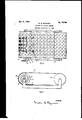
specting these small areas individually to determine"whetherthey contain in any portion of their scope-any imperfections such as previously --mentioned which are not allowable in the finished productycounting the number of such small areas which contain no such imperfections; and, from the ure of the cutting, quality of the leather, or what may be termed the quality number of theleatheni H The accompanying drawing illustrates a particular application of this process. Figure 1'is a plan view of the apparatus, and Figure 2 a side view. in the two views refer to similar parts.
- The leather to be gauged 1, is shown parratio of the. area represented-by this number of small areas to the total area of the leather they were obtained from, obtaining ameas Similar numerals tially intercepted between cylinder 2 and flexible perforated band 3. perforated with equal-sized holes at equal distances over its surface, as shown. The man doingthe grading stands at the front of cylinder 2 to inspect the varioussmall areas. The arrow 4 indicates his approxl mate angle of. vision.. After he hasinspected the areas he can conveniently see, he turns the twocylinders 2 and 5, together with band 3, and leather 1, by means of wheel 6, bring,-
ing the next region of small areas into con venient inspection position. The cylinder 2. has a soft rubber exterior 7,which serves two purposes. In the first place, it causes leather 1 to be snugly. pressed against. band 3' at. every point, and in the: second placeit per-- mits bendingin the leather to aid in detecting. spongy portions.
Assuming that upon inspection by this method, thefollowing observations were ob tained for the piece ofleather 1 Number of whole, areas containing no imperfectionsnot allowable inv thev product Q A Total! area of the'piece ofleather 1- sq. ft.
The quality number of the leather would be A/F.
This quality number, however, in order to be in preferred. form, would be varied slightly so as to always range between the extremes of. .00 and 1.00.. This will be the case if the total area F is expressed in units of the same size as the. area represented bythe holes in band 3. For example, if the band 3 contains one holeto every half square foot of surface, the total area of leather would have to be expressed in halfsquare feet-, and would be QXF. This would make the quality number A/QXF.
Ifthe area of the leather is not. otherwise available,,it may be obtained by counting the number. of imperfect circles and the:
number of partial circles as well as the number of perfect. circles. Thus: 7 i
Let number of perfect circles A. Let number of imperfect circles B; Let number of partial' circles:C;. I The: partial circles will average to half a circle each and, the quality number will be:
.L, A+B+C/2 I which will be -the same value asif determined. as described: in. the directly preced ing paragraph. I
This quality numbermay beobtained for an individual piece of leather. or fora pile of hides. Thelarger the amount of leather inspected the more; accurate this quality number will be, the errors balancing out according to the law of averages. For any considerable quantity of leather, the possible error isnegligible. .There will be no This: band is appreciable variation in quality number-sobtainedfrom successive gaugings on the same lot of leather.
ing. IlOgSllCh. imperfections. are sorted. into one pile, and. counted. Novwsuppose. the ratio oftthe total. area: of these parts to the total area of the original: leather is determined. This result will. be identical with the quality number previously obtained.
Thus, what i is. done; indetermining the qual:
ity number of leather is to determine, with+ out actually cutting the leather, what' the utilization would. be if it were. cut UP'IIIQ- chanically under certain specific conditions,
instead. of. intthe usual manner ofworking around imperfections. quality of the leather-as actually cut, i. e.
working around imperfections, does not. vary directly, with this quality number, itbears a certain relation to it This. relation.
may be determined by experiment for anygiven set of conditions, such assizeof holes} used in band 3, shape and size of pattern to.
be cut, kindv of leather to. be. cut, etc..
Holes in band 3 should preferably. be of a size comparable. with the size of the parts to be cut, although no very. close ratio need be adhered to. For example,- a}; square foot. hole may be used to. gauge leather for; cutting. into 1 parts. which'are only-l; square. foot inarea withoutcausing? any large error."
It-shculd be noted that considerable modificationsv are. possible in theround, equal sized,, equally-spaced small, areas shown my the drawing, Areas of diiferentshape and diflerentlyspaced might be .usedlf. Itwould While 7 the cutting also be possible to use more than one size of area; for example, alternate larger and smaller areas..might be used. Thefonliy}v basic requirements are, that where. such alternations in size existthey occur in ac cordance w th some definite. rule, and that.
the spacing be likewise according'to' rule.
Briefly stated such areas may be described. as regular-sized regularlyrspaced areas, as
is done inv this specification... use of. round areas of equal size and. equally spaced is, however, 'a' preferred .form..' In;
the. first place defects are 'more readily observed in a figure. containing no corners,.the
circle being-.the simplest figure of. that kind. In the, second place the spacing shown,
where only part of. the surface is. visible, is of advantagein. making eachv small area a segregated unitin as faras inspection is extension in prohibitive degree of a defect existing in one of these areas into the other." In the third place the inspection of only.
half of the surface reduces the-work of; in-
spection about. one half, at the same time.
giving sufiiciently accurate results for practical purposes. 'Inthe fourth place the inspection ofonly a part of the surface makes possible a simpler mechanical design .of apparatus for indicating the desired areas on the leather'than if the entire'surface had to be inspected.
A further use of this process exists, where parts oftwo difi'erentqualities are cut from the same leather, in indicating what proportion of first quality and second quality parts should be produced. For example, assume that two qualities of shoes, each with definite requirements from the standpoint of allowable imperfections of the many kinds mentioned in the early part of this specification, are to be cut from a iven supply of leather. Equal-sized, equal y-spaced areas are indicated over the surface. These areas are inspected as to whether they contain any imperfections not allowable in first quality shoes, and those which do are inspected as to whether they contain any imperfecinvention has more fully and concisely been embodied in the appended claims.
.I claim as my invention:
1." The process of determining the cutting quality of leather, consisting of, indicating over its surface regular-sized regularlyspaced areas, inspecting these areas in accordance with some fixed standard as to allowable imperfections, and, from the area of the leather and from the number of areas determined as the result of such inspection computing an index ting quality. 1
2. The process of determining the cutting quality'ofleather in the, form of an index number, consisting of, indicating over its number as to the cutv surface e ual-sized equally-spaced areas, in-
specting t ese areas in accordance with some fixed standard as to allowable imperfections, counting the number of areas coming up to such standard, and, computing the proportion of the area of said leather represented by said number of areas.
3. The process of determining the cutting number of areas.
surface round equal-sized equally-spaced areas, inspecting these areas in accordance .With some fixedstandard as to allowable imperfections, counting the number ,of areas comingup to such standard, and computing the proportion ofthe area of said leather. represented bysaid number of areas.
4. The process of determining the cutting quality of leather, consisting of, inserting it under a screen perforated with regular-sized regularly-spaced holes, inspecting the areas indicated thereby over the surface of the leather in accordance with some fixed standard as to allowable imperfections, and, from the area of the leather and from the number of areas determined as the result of such inspection computing an index number as to the cutting quality.
5. The process of determining the cutting quality of leather in the form of an index number, consisting of, inserting it under a screen perforated with equal-sized equallyspaced holes, inspecting the areas indicated thereby overthe surface of the leather in accordancewith some fixedstandard as to allowable imperfections, counting the number of areas coming up to such standard, and computing the proportion of the area of said leather represented by'said number of dicated thereby over the surface of the leather in accordance with some fixed standard as to allowable imperfections, counting the number of areas coming up to such standard, and, computing the proportion'of the area of said leather represented by said 7. The process of determining the cutting quality of leather of unknown area, consisting of, indicating over its surface regularsizedregularly-spaced areas, inspecting these areas in accordance with some fixed stand- ,ard asto allowable imperfections, counting quality of leather, consisting of, inserting itbetween an elastic surface and ascreen perforated with regular-sized regularly-spaced holes, inspecting the areas indicated thereby over the surface of the leather in accordance with some fixed standard as to allowable imperfections, and, from the area of the quality ofleather inthe form of an indexv .-number,-. ;consisting of,'indicating overv its leather and from the number of areas; do
termined as. the result,ofi-saidihspectiOm computing an index number: as to the eutting. quahty.
9. The process of? determining-in the form of an index number the neIRtiVe-propOntwitjn of products of twordifl'erent quality re'qnine ments to be cut from leather, consistingofi, indicating over the surface of'jthe leaflien regular-sized regular1y spacedlareas inspect ing these areas in accordance with two fixed standard s' as toallowable imperfections cor responding-t0; the two-qualities of product,
c0udting=bhe=. number ofi areasnoming up to H'MARIRIN REYMOND.
Publications (1)
| Publication Number | Publication Date |
|---|---|
| USRE15744E true USRE15744E (en) | 1924-01-08 |
Family
ID=2076788
Family Applications (1)
| Application Number | Title | Priority Date | Filing Date |
|---|---|---|---|
| US15744D Expired USRE15744E (en) | Pbocess of gaugilxg leather |
Country Status (1)
| Country | Link |
|---|---|
| US (1) | USRE15744E (en) |
Cited By (2)
| Publication number | Priority date | Publication date | Assignee | Title |
|---|---|---|---|---|
| US2623291A (en) * | 1949-11-15 | 1952-12-30 | Randall G Hay | Apparatus for gauging and grading leather |
| US2623292A (en) * | 1951-04-25 | 1952-12-30 | Randall G Hay | Apparatus for gauging and grading leather |
-
0
- US US15744D patent/USRE15744E/en not_active Expired
Cited By (2)
| Publication number | Priority date | Publication date | Assignee | Title |
|---|---|---|---|---|
| US2623291A (en) * | 1949-11-15 | 1952-12-30 | Randall G Hay | Apparatus for gauging and grading leather |
| US2623292A (en) * | 1951-04-25 | 1952-12-30 | Randall G Hay | Apparatus for gauging and grading leather |
Similar Documents
| Publication | Publication Date | Title |
|---|---|---|
| Ballance et al. | Consistency tests of alternative measures of comparative advantage | |
| Lach | Patents and productivity growth at the industry level: A first look | |
| DE102018202051B4 (en) | Device for automatically inspecting lenses and method for automatically inspecting a plurality of lenses | |
| Miller et al. | NIR-based sensing to measure soluble solids content of Florida citrus | |
| US2382439A (en) | Color grading apparatus and method | |
| USRE15744E (en) | Pbocess of gaugilxg leather | |
| Sumner | Linear and colorimetric measurements of small mammals | |
| GB2025041A (en) | Graininesssensor | |
| Piramli et al. | Rice grain grading classification based on perimeter using moore-neighbor tracing method | |
| US1664535A (en) | Method of testing taper holes | |
| US1437683A (en) | Process of gauging leather | |
| Stjernquist et al. | Party Cohesion and Party Cooperation in the Swedish Parliament in 1964 and 1966 | |
| US3222794A (en) | Wheel alinement indicator | |
| US2160603A (en) | Comparometer | |
| DE687405C (en) | Device for objective color measurement using photocells | |
| US1568183A (en) | Quality gauge for leather | |
| US277292A (en) | Wheat and flour scale | |
| US1294741A (en) | Method of grading pieces of material for variations in color. | |
| EP1602903A2 (en) | Method and device for colorimetric measurement of effect- and uni-lacquers | |
| Casey et al. | Application of the hypothesis analysis method using Cohen’s Kappa index to measure the agreement between leather sorters | |
| Chauhan et al. | Virtual Grader for Apple Quality Assessment using Fruit Size and Illumiation Features | |
| US2055234A (en) | Method of charting and cutting material | |
| Hurlbut Jr | Influence of twinning on the usability of quartz from various localities | |
| DE878720C (en) | Procedure for checking the surface quality | |
| US1540098A (en) | Process of producing color substances |