USRE1069E - Improvement in apparatus for hoistinx and storing ice - Google Patents
Improvement in apparatus for hoistinx and storing ice Download PDFInfo
- Publication number
- USRE1069E USRE1069E US RE1069 E USRE1069 E US RE1069E
- Authority
- US
- United States
- Prior art keywords
- ice
- improvement
- hoistinx
- bars
- chains
- Prior art date
Links
- 235000012970 cakes Nutrition 0.000 description 18
- 230000000875 corresponding Effects 0.000 description 6
- JVTAAEKCZFNVCJ-UHFFFAOYSA-N lactic acid Chemical compound CC(O)C(O)=O JVTAAEKCZFNVCJ-UHFFFAOYSA-N 0.000 description 6
- 230000003028 elevating Effects 0.000 description 4
- XEEYBQQBJWHFJM-UHFFFAOYSA-N iron Chemical compound [Fe] XEEYBQQBJWHFJM-UHFFFAOYSA-N 0.000 description 4
- XLYOFNOQVPJJNP-UHFFFAOYSA-N water Substances O XLYOFNOQVPJJNP-UHFFFAOYSA-N 0.000 description 4
- 241001077996 Foa Species 0.000 description 2
- 241000681094 Zingel asper Species 0.000 description 2
- 230000001174 ascending Effects 0.000 description 2
- 238000010276 construction Methods 0.000 description 2
- 238000010586 diagram Methods 0.000 description 2
- 229910052742 iron Inorganic materials 0.000 description 2
Images
Definitions
- Inclined planes for raising cakes of ice fromthe surface ofthe water to elevated places of storage have been long in use also, the employment of endless chains passing around sheaves at each end of the planes to transport the ice along thel planes is not new, but in such cases the cakes of icev 'have beenlaid upon the chains, and so carried up to the top of the planes and there delivered upon one of the-platforms of the houses; but in the use of such apparatus it is necessary to shift the upper end of the plane from story to story of the platforms, as they are filled in successiona matter occupying time and labor when every minute is of value in hurrying in the ice crop, and the incurring of a considerable' expense at each change of elevation.
- the machine is represented by Figure 1 in perspective. It is a timber frame, A A A A, having between its upper side timbers at each enda pair of shafts carryingsheaves or pulleys a It a., around which the endless chains B B revolve.
- the lower part of these timbers from m to a are formed, as is customary, into an apron (so called) hinged to lthe upper part so aste adapt it 'to various heights of water to make the deposit of ice upon it convenient.
- ABetween the upper and lower reaches of the chain extending across between the said tim- 'bers is a platform, (of slats,) ⁇ G C, having at intervalsopenings D D, corresponding to the platforms vattached to the dil'erent stories of the ice-house to which the machine belongs.
- bars E E extend at suitable intervals,
- Diagram Fig. 3 shows the way of arranging this part'otl the machinery.
- lt represents a vertical section of the machine.
Description
UNITED STATES HIEAM vAN sTEENBUEeH AND JOEL EGNOE, on eATsKiLL, NEW YORK,
ASSIGNORS T() THEMSELVES AND PETER BAURHYTE.v
IMPROVEMENT IN APPARATUS Foa Hors-HNE; AN-D sToalNG los.
S'pecillcation forming part of Letters Patent No. 22,210,'datcd November 30, 1858; Reissue No. 1,061), dated l October 23, 1860.
Inclined planes for raising cakes of ice fromthe surface ofthe water to elevated places of storage have been long in use also, the employment of endless chains passing around sheaves at each end of the planes to transport the ice along thel planes is not new, but in such cases the cakes of icev 'have beenlaid upon the chains, and so carried up to the top of the planes and there delivered upon one of the-platforms of the houses; but in the use of such apparatus it is necessary to shift the upper end of the plane from story to story of the platforms, as they are filled in successiona matter occupying time and labor when every minute is of value in hurrying in the ice crop, and the incurring of a considerable' expense at each change of elevation.
l'Our improvement has for its purpose the construction of a permanent elevator or plane of a height -to deliver over the upper end of its endless chain ice upon the highest platform or story of the ice-house, and adapted without disarran ging machinery, and with a very short delayili the working of the machine, to transfer the delivery of the cakes of ice to or from any of the stories of the house.
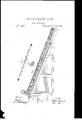
The machine is represented by Figure 1 in perspective. It is a timber frame, A A A A, having between its upper side timbers at each enda pair of shafts carryingsheaves or pulleys a It a., around which the endless chains B B revolve. The lower part of these timbers from m to a are formed, as is customary, into an apron (so called) hinged to lthe upper part so aste adapt it 'to various heights of water to make the deposit of ice upon it convenient. ABetween the upper and lower reaches of the chain extending across between the said tim- 'bers is a platform, (of slats,)`G C, having at intervalsopenings D D, corresponding to the platforms vattached to the dil'erent stories of the ice-house to which the machine belongs. Horizontally between the chains, and pivoted thereto, bars E E extend at suitable intervals,
whose oltice it is to propel the ice cakes before them,- sliding them up along the slats c c. For the purpose of holding the bars firmly against the ice iron points b b project from these bars. i
The operation of the machine is as follows: The cakes I I of ice being floated over tlre lower endot' the frame so as to lie in range between the chains, and the machine being started, they are caughtby the lowest bar,-
E, as it comes around with the chains from beneath the lowest sheave, and are carried up,- sliding along the slats c c until they reach the lower opening, -D, when they drop through upon an inclined plane, G, leading to the lowest platform and story of the icehouse. When it becomes desirable to carry7 the ice higher, a hatch (shown in Fig. 2)`
corresponding with theA slat-de'ck U is placed over the opening and secured there. Then the cakes of icepass over it and are carried up to the next opening above and are delivered to the next upper platform of the house,
which opening is closed, when needed, in a similar way, and any others in succession until the ice is delivered over the upper end of the chain into the upper story of the icc- Gare must be taken in arranging the position ot' the Ibars E that, in their passing, one on the lower reach ,of the chains in passing downward shall not obstruct the ice in its way through the openings in the slatdeck, which would not only stop the ice, but cause a break in the chain.
Diagram Fig. 3 shows the way of arranging this part'otl the machinery. lt represents a vertical section of the machine.
It having been determined what extent along the plane the ice to be carried up by any one bar, V, shall occupy, as from X to Y,
it can easily be determined where the `lower ba'r, W, shall be placed to avoid interruption. This beingsettled, the chain must be divided into equal parts, corresponding with the distance from V to a point opposite W on thc .upper chain, or when that vcannot be exactly done, then into the nearest series of equal distances that can be made by exceeding the l distance between V and'W. Thus, if the space between V andW must be eight feet 8 feet) and -the chain be onehundred and ninety-two Yfeet (192 feet) long, it could be divided into 'twenty-four (24) parts. of eight feet (S-feet) exactly; butif the cha-in should-be one huntwentythree (23) part-s of eight feet and three inches (8 feet, 3inches) each. f L
It isvery evident that nstea'd'of causing the endless chains, with'the pr0pelling-bars, to. return to their lowest point by passing beneath the inclined plane,l they may',without affecting the principle of this invention, be made to return to that lpoint by being raised above that plane sufficiently to be out of the way of the ascending-'blocks of ice. Y In that case no attention need be paid to the spacing ot the propelling'bars, n or to -the leaving of openings in the masses ot' ascending ice; but we prefer the arrangement hereinbefore set forth.
We are aware ot' the contrivance of Cornelius Wortendyke, patented November 13,
1855, by which he proposed to deliver cakes ot' ice at di'ent elevationsv in an icehouse by means of a sin gle endless chain with hooks ofA a particular kind attached to it at regular intervals'. To this we make no claim, and regard our contrivance as essentially diierent from it. Hisarrangement was only calculated to carry up one cake of ice at a. time, whereas, by using the two parallel endless chains suf- `iiciently far apart, with suitable bars between them at proper intervals, .he spaces thus leit mayr be almost entirely iilled with cakes ot' ice, and thus an almost continuons mass of ice may be kept moving up the inclined plane and be regularly distributedat the height the use of aninclined plane to be used in connection with-a single endless chain, however arranged, for the purpose'of elevating ice. Nor do we claim 'the use of an inclined plane combined with twoparallel endless chains When-so arranged that either the position of 'the plane or length or lnumber-of the endless chains requireto be changed' in orderto raise the ice to a new and different elevation but Y A 1. The method of transporting ice'upon inby carrying the ice up between parallel endless chains havin g-bars extended lbetween said planes Ato hold the ice and'to propel the same, the-"planes being pierced .with openings for the passage of the ice to the successive stories of the ic'ehouses, and the propelling=bars being so arranged that the `gd-e/scending tree-passageofice` the plane.
2. The use of 'inclined planes for elevating ice when 'each' is provided with two parallel rendless chains with suitable bars between them at proper distances apart to hold and propel the' ice, when the planes are provided with spaces which' can be left open when the ice is to be elevated to the height of those 'openings respectively, and which can be suc" cessively closed when the ice is to be elevated to a greater height, substantially in the manner herein set forth.
through the openings in 3. The use of the hatchesd'escribed tojclose i the openings in the plane in order to permit the ice to pass beyond a lower to an upper Stor-y ofthe ice'house, when used in combina. -tion with' two parallel endless chains,\substantially asherein described and set forth.
which is desired. Ve do not therefore claim `Hman van Swinnen-nea. l JOEL EGNOR. v
'itnesses l EDGAR RUSSELL, JOHN lF. SYLvns'rER.
bars shall not interfere with tbe
Family
ID=
Similar Documents
| Publication | Publication Date | Title |
|---|---|---|
| US4562918A (en) | En-mass conveyor for verticle or steep delivery of bulk material | |
| US1969122A (en) | Conveyer system | |
| USRE1069E (en) | Improvement in apparatus for hoistinx and storing ice | |
| FR2292646A1 (en) | Automatic equipment for circulating stores - rails for containers on two levels and lifts for moving containers between levels | |
| US2938638A (en) | Ship elevator | |
| DE825453C (en) | Double shaft drying oven | |
| US1829317A (en) | Loading and unloadng mechanism for elevators | |
| US1692970A (en) | Distributing system for brickyards and the like | |
| US2732084A (en) | Curing chambers | |
| US1491771A (en) | Loading and unloading apparatus | |
| DE813374C (en) | Storage arrangement with loading and unloading system | |
| US928183A (en) | Conveying system. | |
| US3422968A (en) | Piling mechanism | |
| SE428460B (en) | TRANSPORTATION PLANT FOR TRANSPORTING BUSINESS GROWTH OF GOODS | |
| US1984685A (en) | Conveyer mechanism | |
| US1062848A (en) | Magazine-loader. | |
| US1920981A (en) | Conveyer | |
| US1575339A (en) | Lumber piler | |
| US1332292A (en) | Cane-shifting apparatus | |
| US892543A (en) | Apparatus for use in construction of concrete buildings. | |
| US1546177A (en) | Coal-handling system | |
| US1292039A (en) | Ice-conveyer. | |
| US1085238A (en) | Charging and discharging conveyer system for brick-kilns. | |
| US707489A (en) | Apparatus for elevating or conveying and transferring ice, &c. | |
| US318373A (en) | Elevating mechanism for buildings |