USPP9609P - Hybrid tea rose plant named `Meibrinpay` - Google Patents

Hybrid tea rose plant named `Meibrinpay` Download PDF

Info

Publication number
USPP9609P
USPP9609P US08/491,716 US49171695V US9609P US PP9609 P USPP9609 P US PP9609P US 49171695 V US49171695 V US 49171695V US 9609 P US9609 P US 9609P
Authority
US
United States
Prior art keywords
orange
hybrid tea
tea rose
rose plant
green
Prior art date
Legal status (The legal status is an assumption and is not a legal conclusion. Google has not performed a legal analysis and makes no representation as to the accuracy of the status listed.)
Expired - Lifetime
Application number
US08/491,716
Inventor
Alain A. Meilland
Current Assignee (The listed assignees may be inaccurate. Google has not performed a legal analysis and makes no representation or warranty as to the accuracy of the list.)
SNC MEILLAND & CIE
CP (Delaware) Inc
Original Assignee
Conard Pyle Co
Priority date (The priority date is an assumption and is not a legal conclusion. Google has not performed a legal analysis and makes no representation as to the accuracy of the date listed.)
Filing date
Publication date
Application filed by Conard Pyle Co filed Critical Conard Pyle Co
Priority to US08/491,716 priority Critical patent/USPP9609P/en
Assigned to S.N.C. MEILLAND & CIE reassignment S.N.C. MEILLAND & CIE ASSIGNMENT OF ASSIGNORS INTEREST (SEE DOCUMENT FOR DETAILS). Assignors: MEILLAND, ALAIN A.
Assigned to CONARD-PYLE COMPANY, THE reassignment CONARD-PYLE COMPANY, THE ASSIGNMENT OF ASSIGNORS INTEREST (SEE DOCUMENT FOR DETAILS). Assignors: S.N.C. MEILLAND & CIE
Application granted granted Critical
Publication of USPP9609P publication Critical patent/USPP9609P/en
Assigned to MERCANTILE-SAFE DEPOSIT AND TRUST reassignment MERCANTILE-SAFE DEPOSIT AND TRUST SECURITY AGREEMENT Assignors: CP (DELAWARE), INC.
Assigned to CP (DELAWARE), INC. reassignment CP (DELAWARE), INC. ASSIGNMENT OF ASSIGNORS INTEREST (SEE DOCUMENT FOR DETAILS). Assignors: CONARD-PYLE COMPANY, THE
Assigned to CP (DELAWARE), INC. reassignment CP (DELAWARE), INC. RELEASE BY SECURED PARTY (SEE DOCUMENT FOR DETAILS). Assignors: PNC BANK, NATIONAL ASSOCIATION (SUCCESSOR BY MERGER TO MERCANTILE-SAFE DEPOSIT AND TRUST COMPANY)
Anticipated expiration legal-status Critical
Expired - Lifetime legal-status Critical Current

Links

Images

Classifications

    • AHUMAN NECESSITIES
    • A01AGRICULTURE; FORESTRY; ANIMAL HUSBANDRY; HUNTING; TRAPPING; FISHING
    • A01HNEW PLANTS OR NON-TRANSGENIC PROCESSES FOR OBTAINING THEM; PLANT REPRODUCTION BY TISSUE CULTURE TECHNIQUES
    • A01H6/00Angiosperms, i.e. flowering plants, characterised by their botanic taxonomy
    • A01H6/74Rosaceae, e.g. strawberry, apple, almonds, pear, rose, blackberries or raspberries
    • A01H6/749Rosa, i.e. roses

Definitions

  • the new variety of Hybrid Tea rose plant was created by artificial pollination wherein two parents were crossed which previously had been studied in the hope that they would contribute the desired characteristics.
  • the female parent (i.e., the seed parent) of the new variety was the ⁇ Just Joey ⁇ variety (non-patented in the United States).
  • the male parent (i.e., the pollen parent) was formed by the cross of the ⁇ Meirestif ⁇ variety (non-patented in the United States) and the ⁇ Meinarval ⁇ variety (non-patented in the United States).
  • the parentage of the new variety can be summarized as follows:
  • the new variety well meets the needs of the horticultural industry and is particularly well suited for use as an ornamental planting in the landscape.
  • the new variety has been found to undergo asexual propagation in France by a number of routes, including budding, grafting, and cuttage. Asexual propagation by the above-mentioned techniques in France has shown that the characteristics of the new variety are stable and are strictly transmissible by such asexual propagation from one generation to another.
  • the new variety has been named the ⁇ Meibrinpay ⁇ variety.
  • FIG. 1 illustrates a specimen of a young shoot
  • FIG. 2 illustrates a specimen of a floral bud before any substantial opening of the sepals
  • FIG. 3 illustrates a specimen of a floral bud at the opening of the sepals
  • FIG. 4 illustrates a specimen of a floral bud at the opening of the petals
  • FIG. 5 illustrates a specimen of a flower in the course of opening
  • FIG. 6 illustrates a specimen of an open flower--plan view--obverse
  • FIG. 7 illustrates a specimen of an open flower--plan view--reverse
  • FIG. 8 illustrates a specimen of a fully open flower--plan view--obverse
  • FIG. 9 illustrates a specimen of a fully open flower--plan view--reverse
  • FIG. 10 illustrates a specimen of a floral receptacle showing the arrangement of the stamens and pistils
  • FIG. 11 illustrates a specimen of a floral receptacle showing the arrangement of the pistils (stamens removed);
  • FIG. 12 illustrates a specimen of a flowering stem
  • FIG. 13 illustrates a specimen of a main branch
  • FIG. 14 illustrates specimens of two leaves with three leaflets each--plan view--under surface (left) and upper surface (right);
  • FIG. 15 illustrates a speciment of a leaf with five leaflets--plan view--upper surface.
  • the chart used in the identification of the colors is that of The Royal Horiticultural Society (R.H.S. Colour Chart). The description is based on the observation of two year-old plants while budded on Rosa froebelii understock and growing outdoors at Le Cannet des Maures, Var, France. The coloration in common terms precedes reference to the chart.
  • the stem length commonly is approximately 30 cm. on average.
  • Petioles.--Upper surface striped reddish on young foliage and medium green on adult foliage with more or less glandular edges. Under surface: light green with a few prickles.
  • Sepals.--Upper surface tomentose and light green on the inner surface and medium green on the outer surface.
  • Under surface medium green in coloration and commonly with a few extensions.
  • Buds.--Shape egg-shaped. Length: approximately 3 to 3.5 cm. on average. Size: medium. Color upon opening: Upper surface: Cadmium Orange, Yellow-Orange Group 23C, and widely suffused with Apricot Orange, Orange Group 24C. Under surface: Orange on external petals and some Nasturtium Red, Orange-Red Group 32C on inner petals.
  • Flower.--Shape cupped with a round center, and similar in configuration to old-fashioned roses. Diameter: approximately 10.5 cm. on average.
  • Color (when blooming) light orange commonly ranging from Yellow-Orange Group 23C to Orange Group 24C with some fading or lightening with age on the outer petals.
  • Petal drop good with the petals commonly becoming clearly detached when fully mature.
  • Stamen number approximately 188 to 195 on average.
  • Anthers normal ochre with a terminal insertion.
  • Filaments red-orange in coloration.
  • Pistils approximately 117 to 120 on average.
  • Stigmas yellowish in coloration.
  • Styles dark fuchsine in coloration, and more or less twisted.
  • Receptacle medium green, smooth, and in longitudinal section in the shape of a large pitcher. Hips: round-shaped hips and seeds commonly are formed.

Landscapes

  • Health & Medical Sciences (AREA)
  • Life Sciences & Earth Sciences (AREA)
  • Natural Medicines & Medicinal Plants (AREA)
  • Physiology (AREA)
  • Botany (AREA)
  • Developmental Biology & Embryology (AREA)
  • Environmental Sciences (AREA)
  • Breeding Of Plants And Reproduction By Means Of Culturing (AREA)

Abstract

A new and distinct variety of Hybrid Tea rose plant is provided which abundantly forms on a substantially continuous basis light orange blossoms. Such blossoms are long-lasting and are similar in configuration to old-fashioned roses. The plant exhibits a narrow and bushy growth habit and strong vegetation. The new variety exhibits very good disease resistance and is particularly well suited for use as attractive ornamentation in the landscape.

Description

SUMMARY OF THE INVENTION
The new variety of Hybrid Tea rose plant was created by artificial pollination wherein two parents were crossed which previously had been studied in the hope that they would contribute the desired characteristics. The female parent (i.e., the seed parent) of the new variety was the `Just Joey` variety (non-patented in the United States). The male parent (i.e., the pollen parent) was formed by the cross of the `Meirestif` variety (non-patented in the United States) and the `Meinarval` variety (non-patented in the United States). The parentage of the new variety can be summarized as follows:
`Just Joey`×(`Meirestif`×`Meinarval`).
The seeds resulting from the above pollination were sown and 98 small plants were obtained which were physically and biologically different from each other. Selective study resulted in the identification of a single plant of the new variety.
It was found that the new variety of Hybrid Tea rose plant of the present invention possesses the following combination of characteristics:
(a) forms in abundance on a substantially continuous basis light orange blossoms,
(b) is well suited for growing as attractive ornamentation in the landscape, and
(c) exhibits very good disease resistance.
The new variety well meets the needs of the horticultural industry and is particularly well suited for use as an ornamental planting in the landscape.
The new variety has been found to undergo asexual propagation in France by a number of routes, including budding, grafting, and cuttage. Asexual propagation by the above-mentioned techniques in France has shown that the characteristics of the new variety are stable and are strictly transmissible by such asexual propagation from one generation to another.
The new variety has been named the `Meibrinpay` variety.
BRIEF DESCRIPTION OF THE PHOTOGRAPH
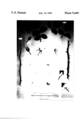
The accompanying photograph shows as nearly true as it is reasonably possible to make the same, in a color illustration of this character, typical specimens of the plant parts of the new variety. The rose plants of the new variety were two years of age and were observed during September while budded on Rosa froebelii understock and growing outdoors at Le Cannet des Maures, Var, France.
FIG. 1 illustrates a specimen of a young shoot;
FIG. 2 illustrates a specimen of a floral bud before any substantial opening of the sepals;
FIG. 3 illustrates a specimen of a floral bud at the opening of the sepals;
FIG. 4 illustrates a specimen of a floral bud at the opening of the petals;
FIG. 5 illustrates a specimen of a flower in the course of opening;
FIG. 6 illustrates a specimen of an open flower--plan view--obverse;
FIG. 7 illustrates a specimen of an open flower--plan view--reverse;
FIG. 8 illustrates a specimen of a fully open flower--plan view--obverse;
FIG. 9 illustrates a specimen of a fully open flower--plan view--reverse;
FIG. 10 illustrates a specimen of a floral receptacle showing the arrangement of the stamens and pistils;
FIG. 11 illustrates a specimen of a floral receptacle showing the arrangement of the pistils (stamens removed);
FIG. 12 illustrates a specimen of a flowering stem;
FIG. 13 illustrates a specimen of a main branch;
FIG. 14 illustrates specimens of two leaves with three leaflets each--plan view--under surface (left) and upper surface (right); and
FIG. 15 illustrates a speciment of a leaf with five leaflets--plan view--upper surface.
DETAILED DESCRIPTION
The chart used in the identification of the colors is that of The Royal Horiticultural Society (R.H.S. Colour Chart). The description is based on the observation of two year-old plants while budded on Rosa froebelii understock and growing outdoors at Le Cannet des Maures, Var, France. The coloration in common terms precedes reference to the chart.
Class: Hybrid Tea.
Plant:
Height.--Approximately 80 to 90 cm. on average at the end of the growing season. The stem length commonly is approximately 30 cm. on average.
Habit.--Narrow and bushy.
Branches:
Color.--Young stems: light green, Green Group 143C. Adult wood: medium green, Yellow-Green Group 146C.
Thorns.--Size: large. Quantity: numerous. Color: reddish on young stems and pinkish and greenish on adult wood.
Leaves:
Stipules.--Adnate, pectinate, large and linear.
Petioles.--Upper surface: striped reddish on young foliage and medium green on adult foliage with more or less glandular edges. Under surface: light green with a few prickles.
Leaflets.--Number: commonly 3 and 5. Shape: elliptic. Serration: single and regular. Texture: coriaceous. General appearance: dense. Color (young foliage): Upper surface: Lettuce Green, Yellow-Green Group 144A widely suffused with reddish coloration. Under surface: Lettuce Green, Yellow-Green Group 144A and widely suffused with reddish coloration. Color (adult foliage): Upper surface: dark green, Yellow-Green Group 147A. Under surface: light green, Green Group 137C.
Inflorescence:
Number of flowers.--Usually one per stem, and sometimes up to about 3 per stem. The flower productivity generally is average and approximates that of a typical hybrid tea rose variety.
Peduncle.--Light green and widely tinted with reddish brown. The length is approximately 3 cm. on average.
Sepals.--Upper surface: tomentose and light green on the inner surface and medium green on the outer surface. Under surface: medium green in coloration and commonly with a few extensions.
Buds.--Shape: egg-shaped. Length: approximately 3 to 3.5 cm. on average. Size: medium. Color upon opening: Upper surface: Cadmium Orange, Yellow-Orange Group 23C, and widely suffused with Apricot Orange, Orange Group 24C. Under surface: Orange on external petals and some Nasturtium Red, Orange-Red Group 32C on inner petals.
Flower.--Shape: cupped with a round center, and similar in configuration to old-fashioned roses. Diameter: approximately 10.5 cm. on average. Color (when opening begins): Upper surface: light orange, commonly ranging from Yellow-Orange Group 23C to Orange Group 24C with some fading or lightening with age on the outer petals. Color (when blooming): light orange commonly ranging from Yellow-Orange Group 23C to Orange Group 24C with some fading or lightening with age on the outer petals. Color (when blooming): light orange commonly ranging from Yellow-Orange Group 23C to Orange Group 24C with some fading or lightening with age on the outer petals. Under surface: light orange commonly ranging from Yellow-Orange Group 23C to Orange Group 24C with some fading or lightening with some fading or lightening with age on the outer petals. Color (at end of opening): Upper surface: light orange commonly ranging from Yellow-Orange Group 23C to Orange Group 24C with some fading or lightening with age on the outer petals. Under surface: light orange commonly ranging from Yellow-Orange Group 23C to Orange Group 24C with some fading or lightening with age on the outer petals. Fragrance: none. Lasting quality: very long. Petal number: approximately 25 to 31 on average. Petal shape: rounded. Lasting quality: the blossoms commonly last approximetely 5 to 7 days when cut and placed in a vase and approximately 7 to 9 days on the plant. The lives of such blossoms are greatly influenced by the season of the year and the environmental conditions that are encountered. Petal drop: good with the petals commonly becoming clearly detached when fully mature. Stamen number: approximately 188 to 195 on average. Anthers: normal ochre with a terminal insertion. Filaments: red-orange in coloration. Pistils: approximately 117 to 120 on average. Stigmas: yellowish in coloration. Styles: dark fuchsine in coloration, and more or less twisted. Receptacle: medium green, smooth, and in longitudinal section in the shape of a large pitcher. Hips: round-shaped hips and seeds commonly are formed.
Development:
Vegetation.--Strong.
Blooming.--Abundant and substantially continuous.
Aptitude to bear fruit.--Good.
Resistance to diseases.--Very good.

Claims (1)

I claim:
1. A new and distinct variety of Hybrid Tea rose plant characterized by the following combination of characteristics:
(a) forms in abundance on a substantially continuous basis light orange blossoms,
(b) is well suited for growing as attractive ornamentation in the landscape, and
(c) exhibits very good disease resistance;
US08/491,716 1995-06-19 1995-06-19 Hybrid tea rose plant named `Meibrinpay` Expired - Lifetime USPP9609P (en)

Priority Applications (1)

Application Number Priority Date Filing Date Title
US08/491,716 USPP9609P (en) 1995-06-19 1995-06-19 Hybrid tea rose plant named `Meibrinpay`

Applications Claiming Priority (1)

Application Number Priority Date Filing Date Title
US08/491,716 USPP9609P (en) 1995-06-19 1995-06-19 Hybrid tea rose plant named `Meibrinpay`

Publications (1)

Publication Number Publication Date
USPP9609P true USPP9609P (en) 1996-07-23

Family

ID=23953354

Family Applications (1)

Application Number Title Priority Date Filing Date
US08/491,716 Expired - Lifetime USPP9609P (en) 1995-06-19 1995-06-19 Hybrid tea rose plant named `Meibrinpay`

Country Status (1)

Country Link
US (1) USPP9609P (en)

Similar Documents

Publication Publication Date Title
USPP9652P (en) Miniature rose plant named `Meiferjac`
USPP11660P (en) Hybrid tea rose plant named `Meizincaro`
USPP9973P (en) Miniature rose plant named `Meikanrou`
USPP8242P (en) Miniature rose plant--Meinochot variety
USPP8496P (en) Hybrid tea rose plant named `Meironsse`
USPP9997P (en) Hybrid tea rose plant named `Meicofum`
USPP8839P (en) Rose plant -- Meipelta variety
USPP9609P (en) Hybrid tea rose plant named `Meibrinpay`
USPP8342P (en) Rose plant -- Meidalnu variety
USPP7718P (en) Rose plant--Meicauf variety
USPP9994P (en) Climber rose plant named `Meiroupis`
USPP10015P (en) Miniature rose plant named `Meishulo`
USPP7622P (en) Rose plant--Meipierar variety
USPP10004P (en) Hybrid Tea rose plant named `Meitebros`
USPP9998P (en) Floribunda rose plant named `Meioffic`
USPP9582P (en) Hybrid tea rose plant named `Meirevolt`
USPP9613P (en) Floribunda rose plant named `Meisocrat`
USPP8390P (en) Rose plant--Meinimo variety
USPP10014P (en) Miniature rose plant named `Meinipol`
USPP10477P (en) Rose plant named `Meiparnin`
USPP9223P (en) Hybrid tea rose plant named `Meigafor`
USPP9536P (en) Shrub rose plant named `Meichonar`
USPP10543P (en) Miniature rose plant named `Meidrepil`
USPP9777P (en) Floribunda rose plant named `Meipopul`
USPP9414P (en) Miniature rose plant named `Meigloyel`

Legal Events

Date Code Title Description
AS Assignment

Owner name: S.N.C. MEILLAND & CIE, FRANCE

Free format text: ASSIGNMENT OF ASSIGNORS INTEREST;ASSIGNOR:MEILLAND, ALAIN A.;REEL/FRAME:007585/0400

Effective date: 19950529

Owner name: CONARD-PYLE COMPANY, THE, PENNSYLVANIA

Free format text: ASSIGNMENT OF ASSIGNORS INTEREST;ASSIGNOR:S.N.C. MEILLAND & CIE;REEL/FRAME:007585/0414

Effective date: 19950529

AS Assignment

Owner name: MERCANTILE-SAFE DEPOSIT AND TRUST, MARYLAND

Free format text: SECURITY AGREEMENT;ASSIGNOR:CP (DELAWARE), INC.;REEL/FRAME:013949/0252

Effective date: 20030409

AS Assignment

Owner name: CP (DELAWARE), INC., DELAWARE

Free format text: ASSIGNMENT OF ASSIGNORS INTEREST;ASSIGNOR:CONARD-PYLE COMPANY, THE;REEL/FRAME:014074/0755

Effective date: 20030409

AS Assignment

Owner name: CP (DELAWARE), INC., DELAWARE

Free format text: RELEASE BY SECURED PARTY;ASSIGNOR:PNC BANK, NATIONAL ASSOCIATION (SUCCESSOR BY MERGER TO MERCANTILE-SAFE DEPOSIT AND TRUST COMPANY);REEL/FRAME:026541/0371

Effective date: 20110516