USPP8955P - "Early Rosa" plum tree - Google Patents
"Early Rosa" plum tree Download PDFInfo
- Publication number
- USPP8955P USPP8955P US08/148,971 US14897193V US8955P US PP8955 P USPP8955 P US PP8955P US 14897193 V US14897193 V US 14897193V US 8955 P US8955 P US 8955P
- Authority
- US
- United States
- Prior art keywords
- inches
- plum tree
- fruit
- color
- plum
- Prior art date
- Legal status (The legal status is an assumption and is not a legal conclusion. Google has not performed a legal analysis and makes no representation as to the accuracy of the status listed.)
- Expired - Lifetime
Links
- 235000011449 Rosa Nutrition 0.000 title claims abstract description 21
- 235000013399 edible fruits Nutrition 0.000 claims abstract description 19
- 241000167854 Bourreria succulenta Species 0.000 claims abstract description 6
- 235000019693 cherries Nutrition 0.000 claims abstract description 6
- 238000003306 harvesting Methods 0.000 claims abstract description 5
- 241000196324 Embryophyta Species 0.000 claims 1
- 239000000796 flavoring agent Substances 0.000 abstract description 6
- 235000019634 flavors Nutrition 0.000 abstract description 6
- 235000009508 confectionery Nutrition 0.000 abstract description 4
- 239000004575 stone Substances 0.000 description 9
- 210000004907 gland Anatomy 0.000 description 4
- 230000001788 irregular Effects 0.000 description 4
- 230000005070 ripening Effects 0.000 description 4
- 238000012935 Averaging Methods 0.000 description 2
- 241001164374 Calyx Species 0.000 description 2
- 239000000835 fiber Substances 0.000 description 2
- 239000002420 orchard Substances 0.000 description 2
- 239000010930 yellow gold Substances 0.000 description 2
- 229910001097 yellow gold Inorganic materials 0.000 description 2
- WNJSKZBEWNVKGU-UHFFFAOYSA-N 2,2-dimethoxyethylbenzene Chemical compound COC(OC)CC1=CC=CC=C1 WNJSKZBEWNVKGU-UHFFFAOYSA-N 0.000 description 1
- 240000001718 Elaeodendron orientale Species 0.000 description 1
- 235000006695 Elaeodendron orientale Nutrition 0.000 description 1
- 241000198945 Prunus domestica subsp. syriaca Species 0.000 description 1
- 240000005049 Prunus salicina Species 0.000 description 1
- 102000011842 Serrate-Jagged Proteins Human genes 0.000 description 1
- 108010036039 Serrate-Jagged Proteins Proteins 0.000 description 1
- 241000607479 Yersinia pestis Species 0.000 description 1
- 240000008042 Zea mays Species 0.000 description 1
- 235000007244 Zea mays Nutrition 0.000 description 1
- 230000002378 acidificating effect Effects 0.000 description 1
- 230000001154 acute effect Effects 0.000 description 1
- 125000003118 aryl group Chemical group 0.000 description 1
- 230000011681 asexual reproduction Effects 0.000 description 1
- 238000013465 asexual reproduction Methods 0.000 description 1
- 210000000078 claw Anatomy 0.000 description 1
- 235000019646 color tone Nutrition 0.000 description 1
- 229940089639 cornsilk Drugs 0.000 description 1
- 230000002542 deteriorative effect Effects 0.000 description 1
- 230000004720 fertilization Effects 0.000 description 1
- 230000005089 fruit drop Effects 0.000 description 1
- 235000011389 fruit/vegetable juice Nutrition 0.000 description 1
- 238000003973 irrigation Methods 0.000 description 1
- 230000002262 irrigation Effects 0.000 description 1
- 235000009018 li Nutrition 0.000 description 1
- 238000005259 measurement Methods 0.000 description 1
- 230000035772 mutation Effects 0.000 description 1
- 210000001672 ovary Anatomy 0.000 description 1
- 235000021018 plums Nutrition 0.000 description 1
- 230000010152 pollination Effects 0.000 description 1
- 238000013138 pruning Methods 0.000 description 1
- 229940085606 rembrandt Drugs 0.000 description 1
- 230000001932 seasonal effect Effects 0.000 description 1
- YEIGUXGHHKAURB-UHFFFAOYSA-N viridine Natural products O=C1C2=C3CCC(=O)C3=CC=C2C2(C)C(O)C(OC)C(=O)C3=COC1=C23 YEIGUXGHHKAURB-UHFFFAOYSA-N 0.000 description 1
- 239000002023 wood Substances 0.000 description 1
- 239000001231 zea mays silk Substances 0.000 description 1
Images
Classifications
-
- A—HUMAN NECESSITIES
- A01—AGRICULTURE; FORESTRY; ANIMAL HUSBANDRY; HUNTING; TRAPPING; FISHING
- A01H—NEW PLANTS OR NON-TRANSGENIC PROCESSES FOR OBTAINING THEM; PLANT REPRODUCTION BY TISSUE CULTURE TECHNIQUES
- A01H6/00—Angiosperms, i.e. flowering plants, characterised by their botanic taxonomy
- A01H6/74—Rosaceae, e.g. strawberry, apple, almonds, pear, rose, blackberries or raspberries
- A01H6/7427—Prunus, e.g. almonds
- A01H6/7472—Plums
-
- A—HUMAN NECESSITIES
- A01—AGRICULTURE; FORESTRY; ANIMAL HUSBANDRY; HUNTING; TRAPPING; FISHING
- A01H—NEW PLANTS OR NON-TRANSGENIC PROCESSES FOR OBTAINING THEM; PLANT REPRODUCTION BY TISSUE CULTURE TECHNIQUES
- A01H5/00—Angiosperms, i.e. flowering plants, characterised by their plant parts; Angiosperms characterised otherwise than by their botanic taxonomy
- A01H5/08—Fruits
Definitions
- the present invention relates to a new and distinct variety of plum tree which will hereinafter be denominated varietally as "Early Rosa" plum tree and, more particularly, to a plum tree which produces clingstone fruit, which are mature for commercial harvesting and shipment approximately June 14 to June 19 in the northern San Joaquin Valley of California, having a sweet, rich flavor, moderately firm flesh and bright cherry red to dark purple skin coloration.
- the "Santa Rosa” type plum has over a broad expanse of years developed a significant and seemingly permanent share of the fresh plum market. Due to its durability in the marketplace, there has been a well recognized and more or less continuous effort to develop new varieties of plum trees of the "Santa Rosa” type which bear fruit having enhanced, commercially appealing attributes including ripening dates which expand the market season for fresh "Santa Rosa” type plums beyond that which has previously been available. These efforts have not been consistently successful. The new variety of the present invention is believed to succeed admirably in these respects.
- the present variety of plum tree hereof was discovered in June, 1987 by the inventor in his orchard located near Le Grand in the northern San Joaquin Valley of California.
- the inventor discovered the new variety as a mutation of the "Late Santa Rosa” plum tree (unpatented).
- the inventor asexually reproduced the new variety in June, 1987 at Bright's Nursery in Le Grand, Calif., by placing leaf axillary buds on root stock using "T" grafts.
- the "Early Rosa” plum tree is characterized by producing a clingstone fruit which have a bright cherry red to a dark purple skin coloration and which are ripe for commercial harvesting and shipment approximately June 14 to June 19 in the northern San Joaquin Valley of California, or approximately seven to ten days prior to the "Santa Rosa” plum tree (unpatented).
- the new variety is most closely similar to the "Santa Rosa” plum tree, but is distinguished therefrom by the aforementioned ripening date as well as by other characteristics.
- the fruit is clingstone, having a sweet, rich flavor and a bright cherry red to dark purple skin coloration.
- the new variety has the potential for expanding the "Santa Rosa” type plum market by ripening earlier in the season than any commercially viable "Santa Rosa” type plum.
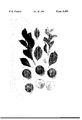
- the accompanying drawing is a color photograph showing fruit of the new variety including a first disposed to reveal the base end thereof; a second in side elevation showing the suture; a third showing the apex end thereof; a fourth in side elevation; and a fifth sectioned and laid open to display one section with the stone left in place and the other section with the pit cavity exposed; a stone of the new variety; and representative foliage thereof.
- Thickness Average.
- Leaf margin Slightly undulate.
- Thickness --1.0 mm (0.394 inches) to 1.5 mm (0.0591 inches).
- Pattern. usually present only at the base of the leaf margin. When more than one gland is present, the glands are variable in arrangement, but are most frequently opposite.
- Diameter.--Range from 18 mm (0.7087 inches) to 22 mm (0.8661 inches) when fully open.
- Pedicel Very finely pubescent, especially basally, with very short, fine, scattered pubescence.
- Thickness --Averaging 1.0 mm (0.0394 inches).
- the fruit of the "Early Rosa” plum tree requires approximately the same amount of thinning as the fruit of the "Santa Rosa” plum tree.
- the amount of thinning depends on weather conditions during the blooming period. Very little fruit drop has been observed.
- Average diameter transverse in the suture plane --51 mm (2.008 inches) to 58 mm (2.283 inches).
- Thickness --Relatively thick, averaging 2.0 mm (0.0787 inches).
- Pistil point Small with a small callous spot and variable but is most frequently slightly oblique.
- Blush color The skin is usually 100 percent blush colored at full maturity. Ranges from a bright cherry red (4-L-10 Holly Berry Red) to a dark purple (8-H-6 Granada). Numerous small light colored dots are present over the fruit surface, especially over the apical shoulders and laterally.
- Flesh color Flesh color.--At full maturity the interior flesh color is light red (1-F-11 Tiger Lily) to a light amber-yellow (10-J-7 Mirabelle Yellow) with much variation in shading occurring between fruit samples and also within an individual fruit.
- the flesh is more red (3-K-11 Flash Red) in color from 6 mm (0.2362 inches) to 7 mm (0.2756 inches) under the skin and within 5 mm (0.1969 inches) to 6 mm (0.2362 inches) around the stone. Many light colored medium length fibers are present throughout the flesh.
- the base is usually oblique to the stone axis.
- the lateral surfaces of the stone are slightly roughened with basal grooves and ridges converging basally.
- a moderately deep groove is present laterally, extending longitudinally from base to apex and roughly parallel to the ventral suture but from 3 mm (0.1181 inches) to 4 mm (0.1575 inches) below the suture edge.
- Ventral suture --Generally rounded and narrow with an irregular and slightly jagged edge. A prominent wing is at times evident basally.
- Dorsal edge --Medium in width with a deep groove from base to apex and wider basally.
- the groove narrows over the apical shoulder and at times is discontinuous in this area.
- the dorsal groove is suspended by two narrow, somewhat notched and jagged ridges.
- plum tree possesses the described characteristics noted above as a result of the growing conditions prevailing near Le Grand in the northern San Joaquin Valley of California, it is to be understood that variations of the usual magnitude and characteristics incident to changes in growing conditions, irrigation, fertilization, pruning, pest control, seasonal climatic variation and the like are to be expected.
Landscapes
- Life Sciences & Earth Sciences (AREA)
- Health & Medical Sciences (AREA)
- Physiology (AREA)
- Botany (AREA)
- Developmental Biology & Embryology (AREA)
- Environmental Sciences (AREA)
- Natural Medicines & Medicinal Plants (AREA)
- Breeding Of Plants And Reproduction By Means Of Culturing (AREA)
Abstract
A new and distinct variety of plum tree which is somewhat remotely similar to the "Santa Rosa"]plum tree (unpatented), but from which it is distinguished by producing fruit which are mature for harvesting and shipment approximately seven days to ten days prior to the fruit produced by the "Santa Rosa" plum tree and wherein the fruit is of an excellent quality having a sweet, rich flavor, a bright cherry red to dark purple skin coloration and a moderately firm clingstone flesh.
Description
The present invention relates to a new and distinct variety of plum tree which will hereinafter be denominated varietally as "Early Rosa" plum tree and, more particularly, to a plum tree which produces clingstone fruit, which are mature for commercial harvesting and shipment approximately June 14 to June 19 in the northern San Joaquin Valley of California, having a sweet, rich flavor, moderately firm flesh and bright cherry red to dark purple skin coloration.
The "Santa Rosa" type plum has over a broad expanse of years developed a significant and seemingly permanent share of the fresh plum market. Due to its durability in the marketplace, there has been a well recognized and more or less continuous effort to develop new varieties of plum trees of the "Santa Rosa" type which bear fruit having enhanced, commercially appealing attributes including ripening dates which expand the market season for fresh "Santa Rosa" type plums beyond that which has previously been available. These efforts have not been consistently successful. The new variety of the present invention is believed to succeed admirably in these respects.
The present variety of plum tree hereof was discovered in June, 1987 by the inventor in his orchard located near Le Grand in the northern San Joaquin Valley of California. The inventor discovered the new variety as a mutation of the "Late Santa Rosa" plum tree (unpatented). The inventor asexually reproduced the new variety in June, 1987 at Bright's Nursery in Le Grand, Calif., by placing leaf axillary buds on root stock using "T" grafts.
The "Early Rosa" plum tree is characterized by producing a clingstone fruit which have a bright cherry red to a dark purple skin coloration and which are ripe for commercial harvesting and shipment approximately June 14 to June 19 in the northern San Joaquin Valley of California, or approximately seven to ten days prior to the "Santa Rosa" plum tree (unpatented). The new variety is most closely similar to the "Santa Rosa" plum tree, but is distinguished therefrom by the aforementioned ripening date as well as by other characteristics. The fruit is clingstone, having a sweet, rich flavor and a bright cherry red to dark purple skin coloration. The new variety has the potential for expanding the "Santa Rosa" type plum market by ripening earlier in the season than any commercially viable "Santa Rosa" type plum.
The accompanying drawing is a color photograph showing fruit of the new variety including a first disposed to reveal the base end thereof; a second in side elevation showing the suture; a third showing the apex end thereof; a fourth in side elevation; and a fifth sectioned and laid open to display one section with the stone left in place and the other section with the pit cavity exposed; a stone of the new variety; and representative foliage thereof.
Referring more specifically to the pomological details of this new and distinct variety of plum tree, the following has been observed under the ecological conditions prevailing at the orchard of origin which is located near Le Grand in the northern San Joaquin Valley of California. All major color code designations are by reference to the Dictionary of Color, by Maerz and Paul, First Edition, 1930. Common color designations are also occasionally employed.
Generally: Hardy and productive with 91.44 cm (36 inches) to 121.92 cm (48 inches) of new growth in the upper portion of the asexually reproduced trees each season.
Vigor.--Vigorous.
Form.--Upright to upright-spreading.
Figure.--Trained to a standard vase shaped system.
Productivity.--Productive under climatic conditions typical for the San Joaquin Valley of California.
Regularity of bearing.--Regular.
Trunk:
Size.--Average thickness.
Surface texture.--Relatively rough with moderate scarfskin.
Color.--Medium grey-brown (8-H-9 Rembrandt Brown).
Lenticels.--Numbers -- Numerous. Size -- Large, wide and oval. From 6 mm (0.2362 inches) to 12 mm (0.4724 inches) in width.
Branches:
Size.--Medium thickness.
Surface texture.--Relatively smooth.
Color.--One year or older wood -- Medium brown (7-H-11 Casserole Brown) to a brown-green (15-E-10 Olive Wood Brown). Immature branches -- Medium green (20-I-7) with exposed branch surfaces often tinged with shades of red.
Size:
Generally.--Medium. Measurements have been taken from leaves growing on vigorous upright shoots of current season's growth.
Average length.--Ranges from 9.6 cm (3.780 inches) to 11.1 cm (4.370 inches) including the petiole.
Average width.--Ranges from 4.1 cm (1.614 inches) to 4.9 cm (1.929 inches).
Thickness: Average.
Form: Most frequently obovate, but can at times be nearly oval. The leaf apex is acute and is frequently twisted sideways.
Color:
Upwardly disposed surface.--Dark green (24-L-9).
Downwardly disposed surface.--Lighter grey-green (23-L-5 Cedar Green). Young shoot tips are a light green-yellow (18-K-5).
Marginal form:
Generally.--Crenate. The crenations are relatively large and coarse. Crenations are often double and at times triple especially near mid-margin.
Leaf margin: Slightly undulate.
Petiole:
Size.--Medium.
Length.--10 mm (0.3937 inches) to 11 mm (0.4330 inches).
Thickness.--1.0 mm (0.394 inches) to 1.5 mm (0.0591 inches).
Color.--Light green (18-I-5 Sky Green) to a lighter yellow-green (17-J-2). Reddish color tones are often present on and within the petiole groove.
Glands:
Size.--Medium.
Number.--From 0 to 2 glands are commonly present.
Form.--Somewhat intermediate in form, from oval to globose.
Position.--Usually borne on a short stalk.
Pattern.--Usually present only at the base of the leaf margin. When more than one gland is present, the glands are variable in arrangement, but are most frequently opposite.
Color.--Glossy light green (17-L-7 Viridine Green) when young, becoming darker and deteriorating with age.
Stipules: Most are early deciduous.
Size.--Small.
Length.--5 mm (0.1969 inches) to 6 mm (0.2392 inches).
Form.--Very narrow linear lanceolate with serrate margins.
Color.--Light green (17-I-4) when young, becoming darker with age.
Flower buds: Hardy under typical San Joaquin Valley climatic conditions.
Size.--Medium.
Form.--Plump and conic.
Position.--Slightly appressed to the shoot.
Scale surface.--Glabrous.
Color.--Dark brown (8-J-11 Montella Brown).
Date of bloom: Mar. 2, 1993. The date of bloom is not significantly different than that of the parent "Late Santa Rosa" plum tree. The bloom is mid-range in comparison with other common commercial Japanese plum varieties.
Bloom:
Quantity.--Abundant. Two to four flower buds are present per node, most frequently four.
Size:
Generally.--Medium.
Diameter.--Range from 18 mm (0.7087 inches) to 22 mm (0.8661 inches) when fully open.
Pedicel: Very finely pubescent, especially basally, with very short, fine, scattered pubescence.
Size.--Medium.
Length.--10 mm (0.3937 inches) to 11 mm (0.4331 inches).
Thickness.--Averaging 1.0 mm (0.0394 inches).
Color.--Light green (20-K-4).
Petals:
Color.--White (1-A-1).
Size.--Medium.
Length.--9.5 mm (0.3740 inches) to 11.5 mm (0.4528 inches).
Width.--9.0 mm (0.3543 inches) to 10.0 mm (0.3937 inches).
Form.--Broadly ovate.
Number.--Five.
Claw.--Form -- Truncate, relatively short and thick.
Margin.--Very undulate throughout and substantially cupped inwards, even at full maturity.
Apex.--Usually rounded.
Nectaries:
Color.--Brownish-orange (13-K-11 Martinique) when young, becoming slightly darker with age.
Calyx:
Color.--Greenish (20-K-4) basally and a brownish-green (13-K-3 Olive Sheen) over the upper calyx surface.
Surface.--Glabrous.
Sepals:
Size.--Moderately large.
Form.--Ovate.
Color.--Light green (19-J-7) with some brown shading present.
Margin.--Serrate and colored a light pink (2-A-8).
Anthers:
Size.--Medium.
Color.--Yellow-gold (9-L-2), both ventrally and dorsally.
Stamen:
Color.--White (1-A-1).
Length.--Varies from 6 mm (0.2362 inches) to 11 mm (0.4331 inches). The longest stamens are slightly longer than the pistil.
Pollination requirements: Self pollinating.
Pollen:
Quantity.--Moderate.
Color.--Yellow-gold (10-L-3).
Pistil:
Surface.--Glabrous.
Color.--Pale green (18-J-2).
Length.--Varies from 7 mm (0.2756 inches) to 8 mm (0.3150 inches), including the ovary.
Generally: The fruit of the "Early Rosa" plum tree requires approximately the same amount of thinning as the fruit of the "Santa Rosa" plum tree. The amount of thinning depends on weather conditions during the blooming period. Very little fruit drop has been observed.
Maturity when described: Ripe for commercial harvesting and shipment approximately June 14 to June 19 in 1992, or about seven to ten days before the "Santa Rosa" plum tree, near Le Grand in the northern San Joaquin Valley of California. Fruit as described herein is at an advanced stage of commercial maturity.
Size:
Generally.--Medium to large and quite uniform. The fruit of the "Early Rosa" plum tree are larger in size than the fruit of the "Santa Rosa" plum tree.
Average diameter in the axial plane.--53 mm (2.087 inches) to 58 mm (2.283 inches).
Average diameter transverse in the suture plane.--51 mm (2.008 inches) to 58 mm (2.283 inches).
Average diameter cheek plane.--52 mm (2.047 inches) to 57 mm (0.0884 inches).
Form:
Uniformity.--Ovate to cordate in lateral aspect. Globose in apical aspect.
Symmetry.--Usually slightly asymmetrical.
Suture:
Generally.--An inconspicuous thin line extends from base to apex. The suture is quite smooth and usually takes on the color of the surrounding blush coloration. At times, however, the suture can be slightly darker than the surrounding coloration.
Ventral surface:
Generally.--Somewhat variable. Usually this surface is quite smooth and rounded, but at times a small amount of lipping can be present.
Stem cavity:
Generally.--Small.
Width.--Ranges from 18 mm (0.7087 inches) to 20 mm (0.7874 inches).
Depth.--Moderately deep. 12 mm (0.4724 inches) to 13 mm (0.5118 inches).
Length.--18 mm (0.7087 inches) to 21 mm (0.8268 inches).
Form.--From globose to slightly oval.
Stem:
Length.--Medium. 13 mm (0.5118 inches) to 16 mm (0.6300 inches).
Thickness.--Relatively thick, averaging 2.0 mm (0.0787 inches).
Color.--Ranges from a medium green (20-K-6 Piquant Green) to a mixed green and brown (14-J-6).
Base:
Form.--Variable from generally rounded to very slightly truncate.
Angle.--Variable from slightly oblique to nearly at right angle to the fruit axis.
Apex:
Form.--Rounded to slightly raised.
Pistil point: Small with a small callous spot and variable but is most frequently slightly oblique.
Skin:
Thickness.--Medium. Tenacious to flesh at commercial maturity.
Texture.--Glabrous.
Tendency to crack.--No observed tendency to crack.
Flavor.--Acidic.
Blush color.--The skin is usually 100 percent blush colored at full maturity. Ranges from a bright cherry red (4-L-10 Holly Berry Red) to a dark purple (8-H-6 Granada). Numerous small light colored dots are present over the fruit surface, especially over the apical shoulders and laterally.
Ground color.--At full maturity, usually no ground coloration is visible.
Flesh color.--At full maturity the interior flesh color is light red (1-F-11 Tiger Lily) to a light amber-yellow (10-J-7 Mirabelle Yellow) with much variation in shading occurring between fruit samples and also within an individual fruit. The flesh is more red (3-K-11 Flash Red) in color from 6 mm (0.2362 inches) to 7 mm (0.2756 inches) under the skin and within 5 mm (0.1969 inches) to 6 mm (0.2362 inches) around the stone. Many light colored medium length fibers are present throughout the flesh.
Juice production.--Juicy.
Flavor.--Sweet, rich flavor. The skin and flesh area next to the stone are acidic.
Aroma.--Moderately aromatic with a pleasant, sweet aroma.
Texture.--Moderately firm at commercial maturity, becoming juicy with after-ripening.
Ripening.--Even.
Eating quality.--Excellent.
Stone:
Attachment.--Clingstone.
Fibers.--Numbers -- Many are attached to the stone, both laterally and along both dorsal and ventral sutures. Length -- Medium.
Size.--Medium. Length-- Ranges from 23 mm (0.9055 inches) to 25 mm (0.9843 inches). Width -- 17 mm (0.6693 inches) to 18 mm (0.7087 inches). Thickness -- 9 mm (0.3543 inches) to 10 mm (0.3937 inches).
Form.--Generally -- Somewhat irregular, from oval to ovate.
Apex.--Shape -- Slightly raised, irregular and slightly eroded.
Color.--Dry -- Light chamois-buff (10-G-3 Cornsilk).
Base.--Shape -- Variable in form, but most frequently truncate. The base is usually oblique to the stone axis.
Sides.--Generally -- Usually equal or nearly so.
Hilium.--Form -- Irregular oval. The hilium area is heavily eroded. Size -- Small.
Surface.--The lateral surfaces of the stone are slightly roughened with basal grooves and ridges converging basally. A moderately deep groove is present laterally, extending longitudinally from base to apex and roughly parallel to the ventral suture but from 3 mm (0.1181 inches) to 4 mm (0.1575 inches) below the suture edge.
Ventral suture.--Generally rounded and narrow with an irregular and slightly jagged edge. A prominent wing is at times evident basally.
Dorsal edge.--Medium in width with a deep groove from base to apex and wider basally. The groove narrows over the apical shoulder and at times is discontinuous in this area. The dorsal groove is suspended by two narrow, somewhat notched and jagged ridges.
Tendency to split.--No tendency of the stones to split has been observed.
Although the new variety of plum tree possesses the described characteristics noted above as a result of the growing conditions prevailing near Le Grand in the northern San Joaquin Valley of California, it is to be understood that variations of the usual magnitude and characteristics incident to changes in growing conditions, irrigation, fertilization, pruning, pest control, seasonal climatic variation and the like are to be expected.
Claims (1)
1. A new and distinct variety of plum tree substantially as illustrated and described which is somewhat remotely similar to the "Santa Rosa" plum tree (unpatented), but from which it is distinguished by producing fruit which are mature for commercial harvesting and shipment approximately June 14 to June 19, or about seven to ten days before the "Santa Rosa" plum tree, in the northern San Joaquin Valley of California and which has a bright cherry red to dark purple skin coloration.
Priority Applications (1)
| Application Number | Priority Date | Filing Date | Title |
|---|---|---|---|
| US08/148,971 USPP8955P (en) | 1993-11-02 | 1993-11-02 | "Early Rosa" plum tree |
Applications Claiming Priority (1)
| Application Number | Priority Date | Filing Date | Title |
|---|---|---|---|
| US08/148,971 USPP8955P (en) | 1993-11-02 | 1993-11-02 | "Early Rosa" plum tree |
Publications (1)
| Publication Number | Publication Date |
|---|---|
| USPP8955P true USPP8955P (en) | 1994-10-25 |
Family
ID=22528252
Family Applications (1)
| Application Number | Title | Priority Date | Filing Date |
|---|---|---|---|
| US08/148,971 Expired - Lifetime USPP8955P (en) | 1993-11-02 | 1993-11-02 | "Early Rosa" plum tree |
Country Status (1)
| Country | Link |
|---|---|
| US (1) | USPP8955P (en) |
-
1993
- 1993-11-02 US US08/148,971 patent/USPP8955P/en not_active Expired - Lifetime
Similar Documents
| Publication | Publication Date | Title |
|---|---|---|
| USPP11403P (en) | Marianna plum rootstock variety named `M40` | |
| USPP8597P (en) | "Special Red July" peach tree | |
| USPP8211P (en) | "Royal Lady" peach tree | |
| USPP6544P (en) | Nectarine tree, "Summer Lion -- Two" | |
| USPP10116P (en) | "7-B" plum tree | |
| USPP4436P (en) | Cherry tree | |
| USPP5251P (en) | Peach tree | |
| USPP9199P (en) | `Island King` peach tree | |
| USPP8534P (en) | "Sunny Red" nectarine tree | |
| USPP4431P (en) | Cherry tree | |
| USPP9548P (en) | `Bev's red` peach tree | |
| USPP9173P (en) | Apricot tree--Earli Sun cultivar | |
| USPP6230P (en) | Peach tree | |
| USPP8177P (en) | "Ruby" apricot tree | |
| USPP13792P3 (en) | Nectarine tree named ‘June Lion’ | |
| USPP10085P (en) | `Prima Gattie` peach tree | |
| USPP9102P (en) | "Madonna Sun" peach tree | |
| USPP10651P (en) | Apricot tree named `Louisa` | |
| USPP7169P (en) | Peach tree, "Early Elegant Lady" | |
| USPP5902P (en) | Plum tree, Ranch 9 Maroon | |
| USPP7505P (en) | Nectarine tree, "Late Red Jim II" | |
| USPP5865P (en) | Peach tree, Summer Lady | |
| USPP9053P (en) | "August Lion II" nectarine tree | |
| USPP9099P (en) | Nectarine tree--Crystal Red | |
| USPP9787P (en) | Cherry tree: `Red Crystal` |