USPP7679P - African violet plant named Candy - Google Patents
African violet plant named Candy Download PDFInfo
- Publication number
- USPP7679P USPP7679P US07/565,321 US56532190V US7679P US PP7679 P USPP7679 P US PP7679P US 56532190 V US56532190 V US 56532190V US 7679 P US7679 P US 7679P
- Authority
- US
- United States
- Prior art keywords
- candy
- flowers
- leaves
- flowering
- african violet
- Prior art date
- Legal status (The legal status is an assumption and is not a legal conclusion. Google has not performed a legal analysis and makes no representation as to the accuracy of the status listed.)
- Expired - Lifetime
Links
- 235000009508 confectionery Nutrition 0.000 title claims abstract description 11
- 241001671243 Streptocarpus ionanthus Species 0.000 title claims abstract description 7
- 230000017260 vegetative to reproductive phase transition of meristem Effects 0.000 claims abstract description 5
- 230000005923 long-lasting effect Effects 0.000 claims abstract description 4
- 238000004382 potting Methods 0.000 claims abstract description 4
- 241000196324 Embryophyta Species 0.000 description 4
- 230000001488 breeding effect Effects 0.000 description 3
- 239000002775 capsule Substances 0.000 description 3
- 230000011681 asexual reproduction Effects 0.000 description 2
- 238000013465 asexual reproduction Methods 0.000 description 2
- 239000003086 colorant Substances 0.000 description 2
- 238000005520 cutting process Methods 0.000 description 2
- 241001465180 Botrytis Species 0.000 description 1
- 241001164374 Calyx Species 0.000 description 1
- 208000035240 Disease Resistance Diseases 0.000 description 1
- 241000218922 Magnoliophyta Species 0.000 description 1
- 235000011449 Rosa Nutrition 0.000 description 1
- 244000172533 Viola sororia Species 0.000 description 1
- 238000009395 breeding Methods 0.000 description 1
- 201000010099 disease Diseases 0.000 description 1
- 208000037265 diseases, disorders, signs and symptoms Diseases 0.000 description 1
- 230000007613 environmental effect Effects 0.000 description 1
- 238000005259 measurement Methods 0.000 description 1
- 238000000034 method Methods 0.000 description 1
- 210000000056 organ Anatomy 0.000 description 1
- 210000001672 ovary Anatomy 0.000 description 1
- 230000001850 reproductive effect Effects 0.000 description 1
- 230000000717 retained effect Effects 0.000 description 1
- 210000003462 vein Anatomy 0.000 description 1
Images
Classifications
-
- A—HUMAN NECESSITIES
- A01—AGRICULTURE; FORESTRY; ANIMAL HUSBANDRY; HUNTING; TRAPPING; FISHING
- A01H—NEW PLANTS OR NON-TRANSGENIC PROCESSES FOR OBTAINING THEM; PLANT REPRODUCTION BY TISSUE CULTURE TECHNIQUES
- A01H6/00—Angiosperms, i.e. flowering plants, characterised by their botanic taxonomy
- A01H6/44—Gesneriaceae, e.g. African violet
- A01H6/444—Saintpaulia [African violet]
-
- A—HUMAN NECESSITIES
- A01—AGRICULTURE; FORESTRY; ANIMAL HUSBANDRY; HUNTING; TRAPPING; FISHING
- A01H—NEW PLANTS OR NON-TRANSGENIC PROCESSES FOR OBTAINING THEM; PLANT REPRODUCTION BY TISSUE CULTURE TECHNIQUES
- A01H5/00—Angiosperms, i.e. flowering plants, characterised by their plant parts; Angiosperms characterised otherwise than by their botanic taxonomy
- A01H5/02—Flowers
Definitions
- the present invention comprises a new and distinct cultivar of African violet plant, botanically known as Saintpaulia ionantha, and hereinafter referred to by the cultivar name Candy.
- the new cultivar was referred to during the breeding and selection process by the designation 247 rosa si. and is a product of a planned breeding program.
- the new cultivar was originated from a cross made by me in the controlled breeding program in Haffen, Federal Republic of Germany.
- the female, or seed parent was a cultivar designated 3 III.
- the male, or pollen parent was a cultivar designated 79/2/8.
- Each plant carries 7-9 and more upright flower stems each of which carries 10-14 and more flowers.
- Botanical classification Saintpaulia ionantha, Ramat., c.v. Candy.
- Propagation The new cultivar holds its distinguishing characteristics through successive propagations by leaf cuttings.
- Plant From 8 cm to 11 cm tall when grown in pots, and approximately 23-27 cm in diameter when fully grown.
- Veins.--Upperside well visible; underside: well pronounced, light green, sometimes purplish red touch, shiny.
- Anthers 2 composed of 4 anther cells, seed capsule pushes slightly through.
- Roots Normally developed, white when young, turning slightly brownish when older.
Landscapes
- Life Sciences & Earth Sciences (AREA)
- Health & Medical Sciences (AREA)
- Physiology (AREA)
- Botany (AREA)
- Developmental Biology & Embryology (AREA)
- Environmental Sciences (AREA)
- Natural Medicines & Medicinal Plants (AREA)
- Breeding Of Plants And Reproduction By Means Of Culturing (AREA)
Abstract
A new and distinct cultivar of African violet named Candy characterized by its single pink flowers with slightly wavy, white edges; strong, upright flower stems that curve slightly toward the center to form a compact bouquet above the leaves; medium green, oval leaves; profuse flowering, vigorous and compact growth habit, flowering 10-11 weeks after potting, and its long lasting and non-dropping flowers.
Description
The present invention comprises a new and distinct cultivar of African violet plant, botanically known as Saintpaulia ionantha, and hereinafter referred to by the cultivar name Candy.
The new cultivar was referred to during the breeding and selection process by the designation 247 rosa si. and is a product of a planned breeding program. The new cultivar was originated from a cross made by me in the controlled breeding program in Haffen, Federal Republic of Germany. The female, or seed parent was a cultivar designated 3 III. The male, or pollen parent was a cultivar designated 79/2/8.
Candy was discovered and selected by me as a flowering plant within the progeny of the stated cross in a controlled environment in Haffen, West Germany. Asexual reproduction of the new cultivar by leaf cuttings, as performed by me at Haffen, West Germany, has demonstrated that the combination of characteristics as herein disclosed for the new cultivar are firmly fixed and retained through successive generations of asexual reproduction.
Candy has not been observed under all possible environmental conditions. The phenotype may vary significantly with variations in environment such as temperature, light intensity and day length. The following observations, measurements and values describe the new cultivar as grown in a 10 cm pot in Haffen, West Germany and Nashville, Tenn. under greenhouse conditions which closely approximate those generally used in commercial practice.
The following traits have been repeatedly observed and are determined to be basic characteristics of Candy, which in combination distinguish this African violet as a new and distinct cultivar:
(1) Strong, upright flower stems curving slightly toward the center.
(2) Violet-shaped pink flowers with slightly wavy, white edges.
(3) Each plant carries 7-9 and more upright flower stems each of which carries 10-14 and more flowers.
(4) Long lasting, non-dropping flowers.
(5) Vigorous and compact grower.
(6) Plant saleable 10 to 11 weeks after potting.
(7) Seed capsules push slightly through.
(8) Medium green, oval leaves.
(9) After maturity the flowers dry off, and remain on the peduncle without becoming infected by botrytis.
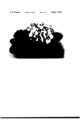
The accompanying color photographic drawing shows a typical specimen plant of the new cultivar. The colors appearing in the photograph are as true as possible with color illustrations of this type.
In the following description, color references are made to The Royal Horticultural Society Colour Chart (R.H.S.), except where general colors of ordinary significance are referred to. Color values were taken under natural sunlight conditions at approximately 12 a.m. in Nashville, Tenn.
Botanical classification: Saintpaulia ionantha, Ramat., c.v. Candy.
Parentage:
Male parent.--3 III.
Female parent.--79/2/8.
Propagation: The new cultivar holds its distinguishing characteristics through successive propagations by leaf cuttings.
Plant: From 8 cm to 11 cm tall when grown in pots, and approximately 23-27 cm in diameter when fully grown.
Leaves:
General form.--Oval.
Diameter.--65-70 mm wide and 70-80 mm long.
Texture.--Leatherlike.
Aspect.--Hairy, slightly shiny.
Veins.--Upperside: well visible; underside: well pronounced, light green, sometimes purplish red touch, shiny.
Color (upperside).--Yellow-Green Group 147 A.
Color (underside).--Greyed-Purple Group 186 between B and C with touches of Greyed-Green Group 194 D.
Petiole.--Strong upright, purplish brown, hairy.
Flowers:
Buds.--Bell-shaped, 7-9 mm just before opening, pinkish green.
Sepals.--Five (5). Color: Purplish brown.
Calyx.--Shape: Funnel-shaped. Aspect: Spear-shaped, hairy.
Peduncle.--Character: Strong upright, hairy. Color: Purplish brown.
Individual flowers:
Size.--37-42 mm.
Shape.--Single violet-shaped with slightly wavy edges.
Color (upperside).--Purple Group 78 D, darker parts are Red-Purple Group 74 C to D. White edges. Under cooler temperatures and more intensive lighting, the pink tends to intensify.
Color (underside).--Purple Group 75 B to C.
Borne.--Each flower stem carries 10-14 and more flowers on strong, upright peduncles that are free standing above the leaves, thereby forming a compact bouquet.
Flowering habit.--Flowers 10-11 weeks after potting.
Reproductive organs:
Stamens.--Two (2). Anthers: 2 composed of 4 anther cells, seed capsule pushes slightly through.
Filaments.--Yellowish green with pink touch, 3-4 mm long.
Pollen color.--Yellow Group 7 A.
Styles.--6-7 mm long, pink, base of ovary light green and hairy.
Roots: Normally developed, white when young, turning slightly brownish when older.
Disease resistance: Up to date, Candy has shown very good resistance to all major violet diseases.
General observations: Candy is very attractive due to its pink flowers with white edges. A tight bouquet of flowers free standing above the leaves develops after approximately 10-11 weeks. Each of the 8-10 and more strong flower stems carries 10-14 and more single violet-shaped flowers with slightly wavy edges. The flowers are long-lasting and non-dropping and the seed capsules push slightly through. Candy is a vigorous and compact grower with medium green, oval leaves.
Claims (1)
1. A new and distinct cultivar of African violet named Candy, as described and illustrated, and particularly characterized by its single pink flowers with slightly wavy, white edges; strong, upright flower stems that curve slightly toward the center to form a compact bouquet above the leaves; medium green, oval leaves; profuse flowering, vigorous and compact growth habit, flowering 10-11 weeks after potting, and its long lasting and non-dropping flowers.
Priority Applications (1)
| Application Number | Priority Date | Filing Date | Title |
|---|---|---|---|
| US07/565,321 USPP7679P (en) | 1990-08-10 | 1990-08-10 | African violet plant named Candy |
Applications Claiming Priority (1)
| Application Number | Priority Date | Filing Date | Title |
|---|---|---|---|
| US07/565,321 USPP7679P (en) | 1990-08-10 | 1990-08-10 | African violet plant named Candy |
Publications (1)
| Publication Number | Publication Date |
|---|---|
| USPP7679P true USPP7679P (en) | 1991-10-15 |
Family
ID=24258099
Family Applications (1)
| Application Number | Title | Priority Date | Filing Date |
|---|---|---|---|
| US07/565,321 Expired - Lifetime USPP7679P (en) | 1990-08-10 | 1990-08-10 | African violet plant named Candy |
Country Status (1)
| Country | Link |
|---|---|
| US (1) | USPP7679P (en) |
-
1990
- 1990-08-10 US US07/565,321 patent/USPP7679P/en not_active Expired - Lifetime
Similar Documents
| Publication | Publication Date | Title |
|---|---|---|
| USPP8144P (en) | African violet plant named Tokyo | |
| USPP8148P (en) | African violet plant named Carmen | |
| USPP7697P (en) | African violet plant named Loretta | |
| USPP8147P (en) | African violet plant named Rumiko | |
| USPP7696P (en) | African violet plant named Little Cherokee Girl | |
| USPP7705P (en) | African violet plant named Little Navajo Girl | |
| USPP7677P (en) | African violet plant named Grenada | |
| USPP8136P (en) | African violet plant named Berlin | |
| USPP7095P (en) | African violet plant named Little Kunzite | |
| USPP7676P (en) | African violet plant named Antigua | |
| USPP6998P (en) | African violet plant named Nancy | |
| USPP7678P (en) | African violet plant named Yellowstone | |
| USPP7695P (en) | African violet plant named Little Hopi Girl | |
| USPP7704P (en) | African violet plant named Little Blackfoot Girl | |
| USPP7780P (en) | African violet plant named Emilie | |
| USPP8206P (en) | African violet plant named Tama | |
| USPP7686P (en) | African violet plant named Improved Indiana | |
| USPP7664P (en) | African violet plant named Dominica | |
| USPP8190P (en) | African violet plant named Little Comanche Girl | |
| USPP7709P (en) | African violet plant named Little Apache Girl | |
| USPP7871P (en) | African violet plant named Maria Antonia | |
| USPP7663P (en) | African violet plant named Aruba | |
| USPP7698P (en) | African violet plant named Haiti | |
| USPP7109P (en) | African violet plant named Improved Texas | |
| USPP8120P (en) | African violet plant named Vienna |