USPP7204P - Dogwood tree--`Galaxy` - Google Patents
Dogwood tree--`Galaxy` Download PDFInfo
- Publication number
- USPP7204P USPP7204P US07/262,686 US26268688V US7204P US PP7204 P USPP7204 P US PP7204P US 26268688 V US26268688 V US 26268688V US 7204 P US7204 P US 7204P
- Authority
- US
- United States
- Prior art keywords
- kousa
- dogwood
- bracts
- plants
- hybrid
- Prior art date
- Legal status (The legal status is an assumption and is not a legal conclusion. Google has not performed a legal analysis and makes no representation as to the accuracy of the status listed.)
- Expired - Lifetime
Links
- 240000006766 Cornus mas Species 0.000 title 1
- 244000274051 Cornus kousa Species 0.000 claims abstract description 17
- 241000196324 Embryophyta Species 0.000 claims abstract description 17
- 241000209022 Cornus florida Species 0.000 claims abstract description 12
- 241000209020 Cornus Species 0.000 claims abstract description 8
- 241000766030 Synanthedon scitula Species 0.000 claims abstract description 4
- 230000007423 decrease Effects 0.000 claims abstract description 4
- 206010061217 Infestation Diseases 0.000 claims abstract description 3
- 230000017260 vegetative to reproductive phase transition of meristem Effects 0.000 claims description 3
- 241000894007 species Species 0.000 abstract description 2
- 230000001747 exhibiting effect Effects 0.000 abstract 1
- 235000013399 edible fruits Nutrition 0.000 description 3
- 241000142975 Cornaceae Species 0.000 description 1
- 235000017963 Cornus kousa Nutrition 0.000 description 1
- 208000035240 Disease Resistance Diseases 0.000 description 1
- 241000238631 Hexapoda Species 0.000 description 1
- 230000001154 acute effect Effects 0.000 description 1
- 230000015572 biosynthetic process Effects 0.000 description 1
- 230000034303 cell budding Effects 0.000 description 1
- 239000003086 colorant Substances 0.000 description 1
- 238000005520 cutting process Methods 0.000 description 1
- 238000003898 horticulture Methods 0.000 description 1
- 238000009403 interspecific hybridization Methods 0.000 description 1
- 238000000034 method Methods 0.000 description 1
- 239000011122 softwood Substances 0.000 description 1
Images


Definitions
- This invention is directed to dogwoods and particularly to a selection of a superior F 1 hybrid following interspecific hybridization of an unnamed plant of Cornus kousa Hance and an unnamed plant of Cornus florida L.
- my new hybrid as a large-bracted plant exhibits overlapping white bracts and is floriferous from about May 18 to about June 3, the display ending about the time C. kousa provides a display of white bracts.
- the new hybrid hereof is distinguished by identifying the same as ⁇ Rutdan ⁇ and as compared with others, this cultivar is upright in habit whereas one, Cornus ⁇ Rutfan ⁇ is low and spreading in form.
- ⁇ Rutfan ⁇ is similar to one of the others, Cornus ⁇ Rutcan ⁇ in plant form but differs in having rounded and somewhat overlapping bracts.
- ⁇ Rutdan ⁇ is like another hybrid of this program Cornus ⁇ Rutban ⁇ in plant form but differs by being less vigorous and the rounded bracts are less broad and the true flowers more exposed in the overwintering buds.
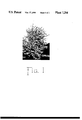
- FIG. 1 shows a tree of my new cultivar in bloom.
- FIG. 2 shows four floral bracts with subtended flower heads typical of my new cultivar.
- Tree Medium-small, vigorous; upright; dense; somewhat vase-shaped when young; becoming more dense and uniformly spreading with age; hardy; very productive, but highly sterile; regular bearer.
- the tree disclosed in FIG. 1 of the drawing is about 17 years old, is 5.63 meters tall and has a spread of 4.41 meters.
- Trunk Medium; smooth; when young, but becoming shaggy with age as then exhibitys exfoliating bark.
- Flower buds The true flowers are small and numerous and are borne in flower heads. Approximately 10-35% of the true flowers are naked or visible, in the overwintering flower buds, as the floral bracts do not completely enclose the true flowers overwinter.
- Size --Intermediate in size to those of typical plants of C. kousa and C. florida.
- the diameter of the inflorescence from tip to tip of the opposing inner bracts is about 116 mm; the diameter of the inflorescence as measured from tip to tip of the opposing outer bracts is about 100 mm.
- the average length of the inner bracts is approximately 57.4 mm; the average length of the outer bracts is approximately 48.5 mm.
- the shape of the bracts is described as sessile, nearly rounded to obovate with short, acute tip and base broadly tapering to the point of attachment.
- the margins of adjacent bracts in the involucre often touch or very tightly overlap.
- the inner bracts are longer and narrower than the outer or lower, bracts.
- the average width of the inner bracts at their widest point is 41.3 mm; the average width of the outer bracts at their widest point is 49.9 mm.
- Bract length and width will vary from year to year but the inner bracts will usually be longer and narrower than the outer bracts each year.
- Peduncle length Each flower head is borne on a peduncle, the average length being about 4.8 cm. at the time of flowering; whereas those of the C. kousa parent average about 7.3 cm in length and those of the C. florida parent average about 2.0 cm at the time of flowering.
- Period of floral display is intermediate to that of plants of the parent species; i.e., occurs in mid-May, commencing about one to two days after completion of the floral display (floral bracts) of most plants of C. florida and ending about the time the floral display of most plants of C. kousa begins.
Landscapes
- Breeding Of Plants And Reproduction By Means Of Culturing (AREA)
Abstract
An interspecific F1 hybrid of the species Cornus kousa and Cornus florida exhibiting large overlapping white bracts and floriferous in a period from about May 18 to about June 3, the floral display ending about the time plants of C. kousa begin their floral display, plants of this cultivar being similar to its seed parent, C. kousa, as regards its upright vase shaped habit when youngbut intermediate plants of the two parent species in the nature of the overwintering flower budds, together with freedom from infestation by dogwood borer and "dogwood decline".
Description
This invention is directed to dogwoods and particularly to a selection of a superior F1 hybrid following interspecific hybridization of an unnamed plant of Cornus kousa Hance and an unnamed plant of Cornus florida L.
I am not aware of any reported interspecific hybrids of C. kousa×C. florida and thus I believe the instant hybrid is entirely new to the horticultural world.
Further, my new hybrid as a large-bracted plant exhibits overlapping white bracts and is floriferous from about May 18 to about June 3, the display ending about the time C. kousa provides a display of white bracts.
Since this hybrid is the product of an extensive program, and the program has produced a number of other hybrids which also have outstanding characteristics, it is appropriate to compare my new cultivar with others in the program, none of which has been patented up to the present time.
Among the several cultivars which I have selected, the new hybrid hereof is distinguished by identifying the same as `Rutdan` and as compared with others, this cultivar is upright in habit whereas one, Cornus×`Rutfan` is low and spreading in form. `Rutfan` is similar to one of the others, Cornus×`Rutcan` in plant form but differs in having rounded and somewhat overlapping bracts.
`Rutdan` is like another hybrid of this program Cornus×`Rutban` in plant form but differs by being less vigorous and the rounded bracts are less broad and the true flowers more exposed in the overwintering buds.
While the bracts of `Rutdan` do not overlap as much as those of another plant in this program which I identify as `Rutgan`, the floral bracts of the latter are pink as contrasted with the white floral bracts of `Rutdan`.
It should be stated that I have caused the hybrid `Rutdan` to be asexually reproduced by budding, grafting or softwood stem cuttings and found the various characteristics noted as well as others not specifically set forth have come true in succeeding generations.
Among those characteristics of my new cultivar, is the freedom from infestation by the dogwood borer and it has not exhibited "dogwood decline" under the growing conditions to which it has been subjected.
In the drawings:
FIG. 1 shows a tree of my new cultivar in bloom.
FIG. 2 shows four floral bracts with subtended flower heads typical of my new cultivar.
Other details of the new hybrid `Galaxy` are set forth in the following detailed description and shown in the drawing which has been produced by photographic process and the colors compared with notations in The Royal Horticulture Colour Chart, where the same may be distinct or helpful in such identification.
Classification:
Botanic.--F1 Interspecific hybrid of C. kousa×C. florida.
Tree: Medium-small, vigorous; upright; dense; somewhat vase-shaped when young; becoming more dense and uniformly spreading with age; hardy; very productive, but highly sterile; regular bearer. The tree disclosed in FIG. 1 of the drawing is about 17 years old, is 5.63 meters tall and has a spread of 4.41 meters.
Trunk: Medium; smooth; when young, but becoming shaggy with age as then exhibitys exfoliating bark.
Branches: Medium; smooth.
Lenticels.--Numerous; medium size.
Leaves: Abundant; length 8.9 cm (average=11). width 4.8 cm-8.1 cm (average=6.1 cm). medium; elliptic with acuminate tips; base -- cuneate to slightly oblique. Medium thickness. Color-- Upper surface-- R.H.S. 139A (Green group). Lower surface-- R.H.S. 138B (Green group). Margin -- entire. Petiole -- short -- 10-23 mm (Average=16.2). medium thickness.
Flower buds: The true flowers are small and numerous and are borne in flower heads. Approximately 10-35% of the true flowers are naked or visible, in the overwintering flower buds, as the floral bracts do not completely enclose the true flowers overwinter.
Floral bracts:
Color.--Start of floral display -- Upper surface is 154 C and lower surface is 154D, both yellow-green group. Midseason floral display -- Upper surface is 150D and lower surface is 150D, both yellow-green group. Peak of floral display -- Upper surface is 157A and lower surface is 157B, both Green-white group.
Size.--Intermediate in size to those of typical plants of C. kousa and C. florida. When the floral bracts are fully expanded, the diameter of the inflorescence from tip to tip of the opposing inner bracts is about 116 mm; the diameter of the inflorescence as measured from tip to tip of the opposing outer bracts is about 100 mm.
The average length of the inner bracts is approximately 57.4 mm; the average length of the outer bracts is approximately 48.5 mm.
The shape of the bracts is described as sessile, nearly rounded to obovate with short, acute tip and base broadly tapering to the point of attachment. The margins of adjacent bracts in the involucre often touch or very tightly overlap. The inner bracts are longer and narrower than the outer or lower, bracts.
The average width of the inner bracts at their widest point is 41.3 mm; the average width of the outer bracts at their widest point is 49.9 mm.
Bract length and width will vary from year to year but the inner bracts will usually be longer and narrower than the outer bracts each year.
Peduncle length; Each flower head is borne on a peduncle, the average length being about 4.8 cm. at the time of flowering; whereas those of the C. kousa parent average about 7.3 cm in length and those of the C. florida parent average about 2.0 cm at the time of flowering.
While absolute peduncle length varies from year to year, the relative peduncle length among the two parents and the hybrid should remain consistent.
Tree:
Flowers.--Anthesis of the tiny, relatively inconspicuous true flowers generally commences a few days following the onset of the ornamental display of the large floral bracts. The average number of true flowers per flower head (40.5) in this new hybrid is intermediate to that for the C. kousa parent (average=49) and that for the C. florida parent (average -- 34.5).
Period of floral display (floral bracts) is intermediate to that of plants of the parent species; i.e., occurs in mid-May, commencing about one to two days after completion of the floral display (floral bracts) of most plants of C. florida and ending about the time the floral display of most plants of C. kousa begins.
Fruit.--Fully developed fruit have not been observed, as plants of this new F1 interspecific hybrid are highly sterile. However, some flower heads persist throughout the growing season and, occasionally, the fleshy portion of small parthenocarpic (seedless) fruit will develop, albeit incompletely. However, there is no formation of a syncarp as in C. kousa, as the flowers in this new hybrid are distinct and separate in the flower head, or on the receptacle.
Resistance to:
Insects.--Good. In field plantings with C. kousa and C. kousa, the Dogwood Borer has ravaged the plants of C. florida, but has not infested plants of my new F1 interspecific hybrid.
Disease resistance.--Good. In field plantings with C. florida and C. kousa, my new F1 interspecific hybrid has been free of the "dogwood decline" that has decimated cultivated and wild stands of C. florida in recent years.
Claims (1)
1. A new and distinct cultivar of dogwood tree, substantially as herein shown and described, characterized particularly as to novelty by the unique combination of its vigor and highly floriferous, small, flowering form and similar to its seed parent C. kousa as to its upright, vase-shaped habit when young but intermediate to plants of both parent species C. kousa and C. florida in the intermediate nature of the overwintering flower buds and the period of floral display, resistance to infestation by dogwood borer and does not exhibit "dogwood decline".
Priority Applications (1)
| Application Number | Priority Date | Filing Date | Title |
|---|---|---|---|
| US07/262,686 USPP7204P (en) | 1988-10-26 | 1988-10-26 | Dogwood tree--`Galaxy` |
Applications Claiming Priority (1)
| Application Number | Priority Date | Filing Date | Title |
|---|---|---|---|
| US07/262,686 USPP7204P (en) | 1988-10-26 | 1988-10-26 | Dogwood tree--`Galaxy` |
Publications (1)
| Publication Number | Publication Date |
|---|---|
| USPP7204P true USPP7204P (en) | 1990-03-27 |
Family
ID=22998565
Family Applications (1)
| Application Number | Title | Priority Date | Filing Date |
|---|---|---|---|
| US07/262,686 Expired - Lifetime USPP7204P (en) | 1988-10-26 | 1988-10-26 | Dogwood tree--`Galaxy` |
Country Status (1)
| Country | Link |
|---|---|
| US (1) | USPP7204P (en) |
Cited By (2)
| Publication number | Priority date | Publication date | Assignee | Title |
|---|---|---|---|---|
| USPP14537P3 (en) | 2002-03-21 | 2004-02-17 | John E. Elsley | Chinese angustata Dogwood named ‘Elsbry’ |
| US20110138509P1 (en) * | 2009-12-03 | 2011-06-09 | Jeff Jones | Flowering dogwood tree named 'nm1' |
-
1988
- 1988-10-26 US US07/262,686 patent/USPP7204P/en not_active Expired - Lifetime
Cited By (3)
| Publication number | Priority date | Publication date | Assignee | Title |
|---|---|---|---|---|
| USPP14537P3 (en) | 2002-03-21 | 2004-02-17 | John E. Elsley | Chinese angustata Dogwood named ‘Elsbry’ |
| US20110138509P1 (en) * | 2009-12-03 | 2011-06-09 | Jeff Jones | Flowering dogwood tree named 'nm1' |
| USPP22089P3 (en) | 2009-12-03 | 2011-08-23 | Jeff Jones | Flowering dogwood tree named ‘NM1’ |
Similar Documents
| Publication | Publication Date | Title |
|---|---|---|
| USPP7732P (en) | Dogwood tree- `Rutlan` | |
| USPP7205P (en) | Dogwood tree "Aurora" | |
| USPP7207P (en) | Dogwood tree -- `Stellar Pink` | |
| USPP7210P (en) | Dogwood tree `Constellation` | |
| USPP5718P (en) | Peony plant | |
| USPP7206P (en) | Dogwood tree `Rutfan` | |
| USPP8214P (en) | Dogwood tree -- named `D-376-15` | |
| USPP35635P2 (en) | Philadelphus plant named ‘W1’ | |
| USPP26305P3 (en) | Buddleia plant name ‘PIIBD-I’ | |
| USPP33223P2 (en) | Salvia plant named ‘SCABB15-1’ | |
| USPP32377P2 (en) | Delosperma plant named ‘DDLRE03-0’ | |
| USPP16594P3 (en) | Avocado tree named ‘Carla’ | |
| USPP20929P2 (en) | Salvia plant named ‘CATHEDRAL SKY BLUE’ | |
| USPP32846P2 (en) | Nemesia plant named ‘SUNJON81’ | |
| USPP15912P3 (en) | Hydrangea plant named ‘White Robe’ | |
| USPP31586P3 (en) | Crapemyrtle plant named ‘DJ 05-14’ | |
| USPP31417P2 (en) | Anthurium plant named ‘ANTHEUYK’ | |
| USPP18932P3 (en) | Veronica plant named ‘Glory’ | |
| USPP15219P3 (en) | Dogwood tree named ‘Rutnut’ | |
| USPP30988P2 (en) | Ruellia plant named ‘R15-24-17’ | |
| USPP17768P3 (en) | Interspecific hybrid Dogwood Tree designated ‘KF1-1’ | |
| USPP9471P (en) | Chrysanthemum plant named `Chasica` | |
| USPP22742P2 (en) | Punica granatum plant named ‘Orange Blossom Special’ | |
| USPP25319P3 (en) | Hydrangea quercifolia plant named ‘PIIHQ-I’ | |
| USPP28578P2 (en) | Portulaca plant named ‘SAKPOR009’ |
Legal Events
| Date | Code | Title | Description |
|---|---|---|---|
| AS | Assignment |
Owner name: RUTGERS UNIVERSITY, NEW BRUNSWICK, NEW JERSEY A PU Free format text: ASSIGNMENT OF ASSIGNORS INTEREST.;ASSIGNOR:ORTON, ELWIN R. JR.;REEL/FRAME:004965/0940 Effective date: 19881003 Owner name: RUTGERS UNIVERSITY, NEW JERSEY Free format text: ASSIGNMENT OF ASSIGNORS INTEREST;ASSIGNOR:ORTON, ELWIN R. JR.;REEL/FRAME:004965/0940 Effective date: 19881003 |