USPP663P - Kose plant - Google Patents
Kose plant Download PDFInfo
- Publication number
- USPP663P USPP663P US PP663 P USPP663 P US PP663P
- Authority
- US
- United States
- Prior art keywords
- plant
- kose
- blooms
- flowers
- petals
- Prior art date
Links
- 241000196324 Embryophyta Species 0.000 description 6
- 230000002493 climbing Effects 0.000 description 4
- 241000220317 Rosa Species 0.000 description 2
- 235000012730 carminic acid Nutrition 0.000 description 2
- 235000010295 hybrid musk rose Nutrition 0.000 description 2
- 241000209134 Arundinaria Species 0.000 description 1
- 241001503987 Clematis vitalba Species 0.000 description 1
- 206010027146 Melanoderma Diseases 0.000 description 1
- 150000001875 compounds Chemical class 0.000 description 1
- 201000010099 disease Diseases 0.000 description 1
- 239000003205 fragrance Substances 0.000 description 1
- 230000002045 lasting Effects 0.000 description 1
- 230000002062 proliferating Effects 0.000 description 1
- 239000000126 substance Substances 0.000 description 1
- 235000013616 tea Nutrition 0.000 description 1
Images
Definitions
- My present discovery relates to improvements in hybrid tea roses, specifically of the red everblooming type.
- the principal improvements lie in the climbing ability of my new variety and the profuse production of very large flowers even on one-year plants.
- My new variety originated as a sport of the bush Hearts Desire which is the subject of Plant Patent No. 501. In most respects it is identical with its parent, producing flowers even larger than the parent plant during the cool weather.
- the plant Growth Very vigorous climber, making tremendous growth. Hardy in temperate climates. Disease resistance: This variety has proved to be exceedingly free from mildew and blackspot. Blooming habit: Extremely prolific production of large flowers continuously throughout the season. Unlike other known climbing hybrid teas, flowers are profusely produced the first season on plants grown in the field. The profuseness of bloom is even more manifest during the third season. Stems: Long; strong; short internodes; sharp thorns irregularly spaced. Foliage: Abundant. Leaves compound with 3 to '7 leaflets.
Description
Dec. 11, 1945. HOWARD Plant Pat. 6 63 ROSE PLANT Filed Dec. 26, 1944 I/VVENTUR b ow L 2 M )1!- Patented Dec. 11, 1945 UNITED Plant Pat. 663
ROSE PLANT Frederick H. Howard, Montebello, CaliL, assignor to Howard & Smith, Montebello, Calif.
Application December 26, 1944, Serial No. 569,811
1 Claim.
My present discovery relates to improvements in hybrid tea roses, specifically of the red everblooming type. The principal improvements lie in the climbing ability of my new variety and the profuse production of very large flowers even on one-year plants.
My new variety originated as a sport of the bush Hearts Desire which is the subject of Plant Patent No. 501. In most respects it is identical with its parent, producing flowers even larger than the parent plant during the cool weather.
Flowers are produced profusely in the field the very first year by my new variety. Nearly all climbing sports of hybrid tea roses send out long vigorous canes the first season but I know ofno other climbing sport which produces flowers on the maiden plants. The varietys profuse blooming is even more manifest in the third year.
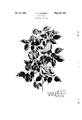
The illustrations which are a part of this specification show a branch of the new variety with three blooms in various stages of opening. In the original as Well as the reproduction, size is greatly reduced.
A detailed description of my new variety follows. Color plate references are to Ridgways Color Standards and Nomenclature.
The plant Growth: Very vigorous climber, making tremendous growth. Hardy in temperate climates. Disease resistance: This variety has proved to be exceedingly free from mildew and blackspot. Blooming habit: Extremely prolific production of large flowers continuously throughout the season. Unlike other known climbing hybrid teas, flowers are profusely produced the first season on plants grown in the field. The profuseness of bloom is even more manifest during the third season. Stems: Long; strong; short internodes; sharp thorns irregularly spaced. Foliage: Abundant. Leaves compound with 3 to '7 leaflets.
Shape.Leafiets ovate with acuminate apex. Edges.Finely serrated. Size-Small to medium. Color.--Approximately Forest Green (Plate XVII). Rachis.--Grooved above; smooth below. StipuZes.Narrow; medium in length. Peduncle: Short; sturdy.
' The bloom Bud:
Siza-Large. Just before unfurling, bud
measures 2 to 2 inches long.
Shape-Long; pointed, with wide base. In-
clined to urnshape when half open.
C'oZor.-Approximately Carmine (Plate 1) at first. As bud opens it becomes a clear beautiful crimson.
Flower:
Size.-Large, averaging approximately 4% inches in diameter. In 0001 fall months the flower is a little larger.
Form.Like its parent, the shape of the blooms differs with the seasons. Early in spring the blooms are high-centered, opening finally into cupshape. The hot weather blooms are much more globular in shape, with deep-cupped petals. All petals curl back very slightly at the edges.
Petalage.Double, with 25 to 30 petals. Al-
though the petalage is not great, the flower appears to be heavy because of its form.
Petals:
Size-Outer petals about 2 by 2% inches.-
Shapa-Almost circular. Sometimes with slight notch at top. Usually deep-cupped.
Substance.Heavy.
Color.Spring blooms are the same beautiful shade of bright crimson as the buds, without any traces of scarlet or maroon. Ridgways Color Standards does not show any color like it although it lies between Rose Red (Plate XII) and Carmine (Plate 1), which however is a wide range. Summer blooms lean slightly toward Tyrian Rose (Plate XII).
Longevity: Exceptionally good,
Fragrance: Intense and lasting,
FRED H. HOWARD.
Family
ID=
Similar Documents
| Publication | Publication Date | Title |
|---|---|---|
| USPP663P (en) | Kose plant | |
| USPP753P (en) | Kose plant | |
| USPP996P (en) | Kose plant | |
| USPP586P (en) | nicolas | |
| USPP2594P (en) | Rose plant | |
| USPP3402P (en) | White rose plant | |
| USPP737P (en) | Rose plant | |
| USPP2804P (en) | Perry | |
| USPP289P (en) | Rose plant | |
| USPP3615P (en) | Rose plant | |
| USPP427P (en) | Rose plant | |
| USPP1009P (en) | Rose plant | |
| USPP620P (en) | Rose plant | |
| USPP546P (en) | Rose plant | |
| USPP791P (en) | Rose plant | |
| USPP785P (en) | Rose plant | |
| USPP739P (en) | Rose plant | |
| USPP2333P (en) | Rose pl ant | |
| USPP3163P (en) | Rose plant | |
| USPP2831P (en) | Rose plant | |
| USPP1860P (en) | Rose plant | |
| USPP3098P (en) | Rosb plant | |
| USPP643P (en) | r rose plant | |
| USPP719P (en) | Hose plant | |
| USPP2342P (en) | Rose plant |