USPP4907P - Miniature carnation - Google Patents
Miniature carnation Download PDFInfo
- Publication number
- USPP4907P USPP4907P US06/232,893 US23289381V US4907P US PP4907 P USPP4907 P US PP4907P US 23289381 V US23289381 V US 23289381V US 4907 P US4907 P US 4907P
- Authority
- US
- United States
- Prior art keywords
- lcc
- color
- lavender
- average
- purple
- Prior art date
- Legal status (The legal status is an assumption and is not a legal conclusion. Google has not performed a legal analysis and makes no representation as to the accuracy of the status listed.)
- Expired - Lifetime
Links
- 240000006497 Dianthus caryophyllus Species 0.000 title claims abstract description 9
- 235000009355 Dianthus caryophyllus Nutrition 0.000 title abstract description 7
- 244000178870 Lavandula angustifolia Species 0.000 abstract description 16
- 235000010663 Lavandula angustifolia Nutrition 0.000 abstract description 16
- 239000001102 lavandula vera Substances 0.000 abstract description 16
- 235000018219 lavender Nutrition 0.000 abstract description 16
- 241001164374 Calyx Species 0.000 description 6
- 240000001140 Mimosa pudica Species 0.000 description 2
- 239000003086 colorant Substances 0.000 description 2
- 238000005520 cutting process Methods 0.000 description 2
- 239000000203 mixture Substances 0.000 description 2
- 210000001672 ovary Anatomy 0.000 description 2
- 239000007921 spray Substances 0.000 description 2
- 241000196324 Embryophyta Species 0.000 description 1
- 238000007688 edging Methods 0.000 description 1
- 230000007613 environmental effect Effects 0.000 description 1
- 239000003205 fragrance Substances 0.000 description 1
- 238000000034 method Methods 0.000 description 1
- 210000000056 organ Anatomy 0.000 description 1
- 230000001850 reproductive effect Effects 0.000 description 1
- 230000017260 vegetative to reproductive phase transition of meristem Effects 0.000 description 1
Images

Definitions
- This invention comprises a new and distinct miniature carnation variety that has its own set of characteristics that set it apart from all other varieties of miniature carnations.
- the newly discovered variety called "Rainbow,” originated as a sport of Petite Purple a patented variety, U.S. Plant Pat. No. 3,767.
- the botanical classification of the new variety is Dianthus caryophyllus longicaulis.
- the commercial classification is Miniature Carnation.
- the plant takes the form of a bush.
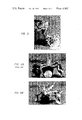
- FIG. 1 shows on the left a spray of the new variety "Rainbow,” and on the right a spray of the prior Petite Purple.
- FIG. 2 shows enlarged views of the flowers, Rainbow on the left and Petite Purple on the right.
- FIG. 3 shows another view of the new variety Rainbow flower.
- FIG. 4A is an enlarged view of the prior Petite Purple flower opened to expose the stamen and pistils.
- FIG. 4B is an enlarged view of the new variety Rainbow flower opened to expose the stamen and pistils.
- Length varies.--Longer at the bottom of stem, shorter at the top. Average at the middle of the stem 31/2 inches.
- Width varies.--Wider at the bottom of stem, shorter at the top. Average at the middle of the stem 3/8 inches.
- Leaf shape Very little curl with a long acuminating tip.
- Leaf texture Smooth and leathery.
- Leaf ribs One rib down the center from the base to the tip of the leaf.
- Leaf habit Very little curl.
- Stem color RHS Greengroup 139A with a whitish color over the green.
- Nodes Average; space between nodes 31/2 inch average at midstem.
- Bud color Top half of bud LCC H-21 L-13 . Bottom half blends into LCC H-22 L-9.
- Average number of flowering buds per stem 4 to 5.
- the bloom is a hot pink color (LCC H-40 L-6) with a light lavender that appears white, fringe (LCC H-48 L-1) and deep lavender blotches and stripes of varying size running from the base of the bloom to the outer edge (LCC H-43 L-14).
- Diameter of average bloom 21/4" to 3".
- Bloom shape Generally round with a high center and flat outer petals.
- Petal edge Medium to slight serration.
- Petal color (Note: interspersal of colors -- most petals are pink with varying amounts of lavender interspersed. However, some petals are mostly lavender with varying amounts of pink interspersed. Most but not all petals have a light lavender edging. The pink and lavender run into this light lavender. The bloom is a montage of these colors in blotches and stripes. The pink, lavender, and light lavender are random on the petal. There is no exact set pattern although there is a consistent one.
- Calyx color Top half LCC H-21 L-13, bottom half blends into LCC H-22 L-9, tips of leaves on the bottom of calyx LCC H-22 L-15.
- Stamen With anthers.
- Average length of stamen 1 inch.
- the background is LCC H-26 L-1 with varying shades of lavender specks about the color LCC H-44 L-8.
- Shape Approximately 80% have 2 styles, 10% have 1 style and 10% have 3 styles.
- Length from tip to ovary --Approximately 7/8 inch.
- the styles of the parent, Petite Purple have much more of the lavender color LCC H-43 L-14 than do the styles of Rainbow. The color is much more intense and covers more of the style in Petite Purple.
- the anthers of the parent, Petite Purple, are a very distinctly different color. They are much more lavender than Rainbow.
- the color of Petite Purple's anthers is LCC H-48 L-8.
- the color of Rainbow's anthers is LCC H-26 L-1 -- the background, and LCC H-44 L-8 -- the specks. Petite Purple's anthers do not have specks.
Landscapes
- Breeding Of Plants And Reproduction By Means Of Culturing (AREA)
Abstract
A miniature carnation sport of Rainbow having lavender and pink blooms.
Description
This invention comprises a new and distinct miniature carnation variety that has its own set of characteristics that set it apart from all other varieties of miniature carnations. The newly discovered variety, called "Rainbow," originated as a sport of Petite Purple a patented variety, U.S. Plant Pat. No. 3,767.
The botanical classification of the new variety is Dianthus caryophyllus longicaulis. The commercial classification is Miniature Carnation. The plant takes the form of a bush.
Asexual propagation of the newly discovered miniature carnation variety has been made at Siri Brothers Nursery, Inc. at East Palo Alto, Calif. by taking cuttings. The cuttings so taken and grown, have consistently produced flowers that have the new and distinct characteristics hereinafter described.
This new variety of miniature carnation plant is illustrated by the accompanying drawings which show the color characteristics of the flower as nearly true as it is reasonably possible to obtain through conventional photographic procedures.
FIG. 1 shows on the left a spray of the new variety "Rainbow," and on the right a spray of the prior Petite Purple.
FIG. 2 shows enlarged views of the flowers, Rainbow on the left and Petite Purple on the right.
FIG. 3 shows another view of the new variety Rainbow flower.
FIG. 4A is an enlarged view of the prior Petite Purple flower opened to expose the stamen and pistils.
FIG. 4B is an enlarged view of the new variety Rainbow flower opened to expose the stamen and pistils.
The following detailed description of the new variety is based on my detailed observations of the new cultivar which were made at Siri Brothers Nursery Inc. at 940 O'Connor St., East Palo Alto, Calif. The response time, blooming period, total vigor, and color may vary slightly with varying environmental conditions such as temperature, length of day, and light intensity. The color description is given by designation "H" for hue and "L" for lightness in color chart references designated "LCC" for Limit Color Cascade, Munsell Color, Baltimore Md. and "RHS" for Royal Horticultural Color Chart, Royal Horticultural Society, London, England.
Height: Short to medium.
Foliage: Average.
Speed of growth: Fast.
Root system: Average.
Leaf size:
Length varies.--Longer at the bottom of stem, shorter at the top. Average at the middle of the stem 31/2 inches.
Width varies.--Wider at the bottom of stem, shorter at the top. Average at the middle of the stem 3/8 inches.
Features.--There is a little mottling on the leaves.
Leaf shape: Very little curl with a long acuminating tip.
Leaf texture: Smooth and leathery.
Leaf color:
Upperside.--RHS Greengroup 139A with a whitish color over the green.
Underside.--Same as upperside.
Leaf ribs: One rib down the center from the base to the tip of the leaf.
Leaf habit: Very little curl.
Leaf density: Average.
Stem strength: Average.
Stem color: RHS Greengroup 139A with a whitish color over the green.
Nodes: Average; space between nodes 31/2 inch average at midstem.
Stem branching: Very good, wide gaps between the branches, not clubby.
Bud shape: Oval.
Bud color: Top half of bud LCC H-21 L-13 . Bottom half blends into LCC H-22 L-9.
Average number of flowering buds per stem: 4 to 5.
Uniformity of bud opening: Very uniform.
Bud splitting: Very seldom.
Number of sepals per calyx: 65% of calyxs have 5, 26% of calyxs have 6, and 9% of calyxs have 7.
Description of the color of the bloom: The bloom is a hot pink color (LCC H-40 L-6) with a light lavender that appears white, fringe (LCC H-48 L-1) and deep lavender blotches and stripes of varying size running from the base of the bloom to the outer edge (LCC H-43 L-14).
General tonality of the color: Bright.
Diameter of average bloom: 21/4" to 3".
Bloom shape: Generally round with a high center and flat outer petals.
Keeping quality: Average.
Fragrance: Slight.
Petal texture: Soft and velvety
Petal edge: Medium to slight serration.
Petal color: (Note: interspersal of colors -- most petals are pink with varying amounts of lavender interspersed. However, some petals are mostly lavender with varying amounts of pink interspersed. Most but not all petals have a light lavender edging. The pink and lavender run into this light lavender. The bloom is a montage of these colors in blotches and stripes. The pink, lavender, and light lavender are random on the petal. There is no exact set pattern although there is a consistent one.
Topside base of petal.--Pink LCC H-40 L-6, Lavender LCC H-43 L-14.
Topside middle of petal.--Pink LCC H-40 L-6, Lavender LCC H-43 L-14.
Topside outside of petal.--Light Lavender LCC H-48 L-1 and Lavender LCC H-43 L-4.
Underside base of petal.--Pink LCC H-40 L-5, Lavender LCC H-43 L-13.
Underside middle of petal.--Pink LCC H-40 L-5, Lavender LCC H-43 L-13.
Underside outside of petal.--Light Lavender LCC H-48 L-1 and Lavender LCC H-43 L-13.
Color stability: Excellent. There is approximately a 1% reversion to Petite Purple U.S. Plant Pat. No. 3,767.
Petal size:
Average length.--17/8 inches.
Average width.--At widest point 7/8 inches.
Calyx color: Top half LCC H-21 L-13, bottom half blends into LCC H-22 L-9, tips of leaves on the bottom of calyx LCC H-22 L-15.
Stamen: With anthers.
Average length of stamen: 1 inch.
Color of anthers: The background is LCC H-26 L-1 with varying shades of lavender specks about the color LCC H-44 L-8.
Color of filament: LCC H-39 L-1.
Pistils:
Shape.--Approximately 80% have 2 styles, 10% have 1 style and 10% have 3 styles.
Number.--One.
Length from tip to ovary.--Approximately 7/8 inch.
Stigma:
Shape.--Round.
Color.--White. It is located at the very tip of the style.
Style:
Color.--Bottom LCC H-25 L-1, toward tip LCC H-43 L-14.
Ovary:
Shape.--Ovid.
Color.--Top half LCC H-22 L-4, bottom half LCC H-23 L-2.
Length.--Approximately 3/8 inch.
Width.--Approximately 3/16 inch.
The most obvious distinguishing characteristic is the color of the bloom. It is pink with lavender stripes and a light lavender fringe. In contrast, Petite Purple, the parent, is a deep purple with light lavender fringe.
The styles of the parent, Petite Purple, have much more of the lavender color LCC H-43 L-14 than do the styles of Rainbow. The color is much more intense and covers more of the style in Petite Purple.
The anthers of the parent, Petite Purple, are a very distinctly different color. They are much more lavender than Rainbow. The color of Petite Purple's anthers is LCC H-48 L-8. The color of Rainbow's anthers is LCC H-26 L-1 -- the background, and LCC H-44 L-8 -- the specks. Petite Purple's anthers do not have specks.
All of the characteristics of both varieties are similar except for the distinguishing characteristics referred to above.
Claims (1)
1. A new and distinct variety of miniature carnation plant, substantially as herein shown and described.
Priority Applications (1)
| Application Number | Priority Date | Filing Date | Title |
|---|---|---|---|
| US06/232,893 USPP4907P (en) | 1981-02-09 | 1981-02-09 | Miniature carnation |
Applications Claiming Priority (1)
| Application Number | Priority Date | Filing Date | Title |
|---|---|---|---|
| US06/232,893 USPP4907P (en) | 1981-02-09 | 1981-02-09 | Miniature carnation |
Publications (1)
| Publication Number | Publication Date |
|---|---|
| USPP4907P true USPP4907P (en) | 1982-10-26 |
Family
ID=22875024
Family Applications (1)
| Application Number | Title | Priority Date | Filing Date |
|---|---|---|---|
| US06/232,893 Expired - Lifetime USPP4907P (en) | 1981-02-09 | 1981-02-09 | Miniature carnation |
Country Status (1)
| Country | Link |
|---|---|
| US (1) | USPP4907P (en) |
-
1981
- 1981-02-09 US US06/232,893 patent/USPP4907P/en not_active Expired - Lifetime
Similar Documents
| Publication | Publication Date | Title |
|---|---|---|
| USPP4907P (en) | Miniature carnation | |
| USPP5305P (en) | Miniature carnation | |
| USPP5216P (en) | Miniature carnation | |
| USPP4920P (en) | Miniature carnation | |
| USPP6123P (en) | Miniature carnation Sandy | |
| USPP5217P (en) | Miniature carnation | |
| USPP5186P (en) | Miniature carnation | |
| USPP5304P (en) | Miniature carnation | |
| USPP5218P (en) | Miniature carnation | |
| USPP5954P (en) | Miniature carnation--Rose | |
| USPP5731P (en) | Miniature carnation--Ballerina | |
| USPP29972P2 (en) | Dianthus plant named ‘Double Bubble’ | |
| USPP35073P2 (en) | Dianthus plant named ‘Lip Gloss’ | |
| USPP6875P (en) | Miniature rose named Devrosado | |
| USPP37213P3 (en) | Dianthus plant named ‘WP24 JAP01’ | |
| USPP6566P (en) | Miniature carnation--Donna | |
| USPP3743P (en) | Carnation plant | |
| USPP4536P (en) | African violet cultivar named Grace | |
| USPP5196P (en) | Lily named Fresco | |
| USPP14211P2 (en) | Antirrhinum plant named ‘Yahit’ | |
| USPP2227P (en) | Carnation | |
| USPP4605P (en) | Lily plant named Star Duster | |
| USPP6704P (en) | Miniature carnation named Klefitoni | |
| USPP6286P (en) | Geranium named `Gugino's Nell` | |
| USPP4604P (en) | Lily named Star Fire |