USPP27085P2 - Crapemyrtle plant named‘WHIT X’ - Google Patents
Crapemyrtle plant named‘WHIT X’ Download PDFInfo
- Publication number
- USPP27085P2 USPP27085P2 US14/544,429 US201514544429V USPP27085P2 US PP27085 P2 USPP27085 P2 US PP27085P2 US 201514544429 V US201514544429 V US 201514544429V US PP27085 P2 USPP27085 P2 US PP27085P2
- Authority
- US
- United States
- Prior art keywords
- plant
- flowers
- crapemyrtle
- new
- whit
- Prior art date
- Legal status (The legal status is an assumption and is not a legal conclusion. Google has not performed a legal analysis and makes no representation as to the accuracy of the status listed.)
- Active, expires
Links
- 240000000161 Lagerstroemia indica Species 0.000 title claims abstract description 35
- 241000196324 Embryophyta Species 0.000 abstract description 28
- 235000000283 Lagerstroemia parviflora Nutrition 0.000 abstract description 22
- 230000012010 growth Effects 0.000 abstract description 15
- 241001157813 Cercospora Species 0.000 abstract description 4
- 241000221785 Erysiphales Species 0.000 abstract description 4
- 230000017260 vegetative to reproductive phase transition of meristem Effects 0.000 description 10
- 238000005520 cutting process Methods 0.000 description 6
- 238000004519 manufacturing process Methods 0.000 description 4
- 230000000644 propagated effect Effects 0.000 description 4
- 230000001488 breeding effect Effects 0.000 description 3
- 239000011122 softwood Substances 0.000 description 3
- 240000001140 Mimosa pudica Species 0.000 description 2
- PXIPVTKHYLBLMZ-UHFFFAOYSA-N Sodium azide Chemical compound [Na+].[N-]=[N+]=[N-] PXIPVTKHYLBLMZ-UHFFFAOYSA-N 0.000 description 2
- 239000003086 colorant Substances 0.000 description 2
- 201000010099 disease Diseases 0.000 description 2
- 208000037265 diseases, disorders, signs and symptoms Diseases 0.000 description 2
- 230000007613 environmental effect Effects 0.000 description 2
- 230000001788 irregular Effects 0.000 description 2
- 239000003595 mist Substances 0.000 description 2
- 230000035772 mutation Effects 0.000 description 2
- 241000894007 species Species 0.000 description 2
- 239000000126 substance Substances 0.000 description 2
- 230000009105 vegetative growth Effects 0.000 description 2
- 244000153378 Crossandra infundibuliformis Species 0.000 description 1
- 208000035240 Disease Resistance Diseases 0.000 description 1
- 241001188864 Lagerstroemia fauriei Species 0.000 description 1
- 208000027418 Wounds and injury Diseases 0.000 description 1
- 241000607479 Yersinia pestis Species 0.000 description 1
- 230000001154 acute effect Effects 0.000 description 1
- 230000011681 asexual reproduction Effects 0.000 description 1
- 238000013465 asexual reproduction Methods 0.000 description 1
- 239000002775 capsule Substances 0.000 description 1
- 210000000078 claw Anatomy 0.000 description 1
- 150000001875 compounds Chemical class 0.000 description 1
- 230000001351 cycling effect Effects 0.000 description 1
- 230000006378 damage Effects 0.000 description 1
- 230000023753 dehiscence Effects 0.000 description 1
- 230000001419 dependent effect Effects 0.000 description 1
- 230000002068 genetic effect Effects 0.000 description 1
- 230000001939 inductive effect Effects 0.000 description 1
- 208000014674 injury Diseases 0.000 description 1
- 238000007689 inspection Methods 0.000 description 1
- 238000000034 method Methods 0.000 description 1
- 231100000350 mutagenesis Toxicity 0.000 description 1
- 230000002062 proliferating effect Effects 0.000 description 1
- 230000002035 prolonged effect Effects 0.000 description 1
- 230000000717 retained effect Effects 0.000 description 1
- 239000002689 soil Substances 0.000 description 1
Images




Classifications
-
- A—HUMAN NECESSITIES
- A01—AGRICULTURE; FORESTRY; ANIMAL HUSBANDRY; HUNTING; TRAPPING; FISHING
- A01H—NEW PLANTS OR NON-TRANSGENIC PROCESSES FOR OBTAINING THEM; PLANT REPRODUCTION BY TISSUE CULTURE TECHNIQUES
- A01H5/00—Angiosperms, i.e. flowering plants, characterised by their plant parts; Angiosperms characterised otherwise than by their botanic taxonomy
- A01H5/02—Flowers
-
- A—HUMAN NECESSITIES
- A01—AGRICULTURE; FORESTRY; ANIMAL HUSBANDRY; HUNTING; TRAPPING; FISHING
- A01H—NEW PLANTS OR NON-TRANSGENIC PROCESSES FOR OBTAINING THEM; PLANT REPRODUCTION BY TISSUE CULTURE TECHNIQUES
- A01H6/00—Angiosperms, i.e. flowering plants, characterised by their botanic taxonomy
Definitions
- the present invention relates to a new and distinct variety or cultivar of the ornamental shrub, Lagerstroemia indica , commonly known as crapemyrtle.
- Crapemyrtle is native to eastern China and was introduced into North America in the late 1700's. Since then this popular ornamental shrub has been grown extensive across the southern half of the continent. Over the years, seedlings of Lagerstroemia indica have been selected and introduced into the market with different growth habits and flower colors. In addition, hybrids between L. indica and L. fauriei have been selected to add additional features, particularly more striking bark color and resistance to powdery mildew. But, flower color of the hybrids were muted compared to seedlings of pure L. indica.
- U.S. Plant Pat. Nos. 6,365 and 6,383 disclose varieties of crapemyrtle derived from seedling treated with a mutation-inducing chemical. It is generally known that sodium azide, colchicines and other chemicals are capable of producing plant mutations. Since only one or more of the far distant grandparents of the new variety of crapemyrtle were treated with one of these compounds, it is highly unlikely that the present invention may be a chemically induced mutation.
- the new variety of crapemyrtle claimed herein, which has been given the cultivar name ‘WHIT X’ was selected from a block of about 12,000 seedlings planted in 2009. Parents of these 12,000 seedlings were 14, 15 or 16 generations removed from the original single seedling parent used to begin this crapemyrtle breeding program.
- the specific identity of the parent of the present invention was a seedling from generation 15 with only a few seed capsules and that showed high resistance to Cercospora leaf spot disease which is an increasing problem where crapemyrtle are grown.
- This new and distinct crapemyrtle was asexually reproduced by rooting softwood cuttings taken from the original ‘WHIT X’ plant near Stillwater, Okla.
- the asexually reproduced plants show all of the unique features that characterize this crapemyrtle including high disease resistance, thereby indicating that the unique features of this plant are stable through successive generations of asexual reproduction.
- Softwood cuttings taken from our new variety of crapemyrtle were successfully rooted under intermittent mist. Subsequent cuttings from plants produced from previous cuttings from the ‘WHIT X’ original parent have also been rooted. Growth, flowering, flower and foliage color and capacity to rebloom on old inflorescences with no seed production and high degree of resistance to both powdery mildew and Cercospora leaf spot remain consistent with the parent.
- the plant of the present invention is a new and distinct variety of crapemyrtle, Lagerstroemia indica which has been given the cultivar name ‘WHIT X’ and is characterized by a much branched growth habit with moderate vigor that may reach a height of 8 to 10 feet if left unpruned.
- the original ‘WHIT X’ now 6 years old, was killed to the ground in 2011, when temperatures dropped to an unprecedented ⁇ 19 F, but regrowth was vigorous and is now about 5 feet tall by 28 inches wide. Cuttings taken from the parent following the complete top kill, rooted and grew the same as plants propagated from before the severe cold, confirming that no genetic change occurred.
- Leaves of the plant emerge dark red-purple and remain dark purple-green. Mature leaves are typical in size and shape as the species. Twigs of current season growth emerge dark red-purple and remain of similar color until growth slows near the end of the growing season when they become light tan.
- Inflorescences are between about 12 to 14 inches long and between 6 to 12 inches wide in the upper part of the plant.
- Flower buds are crimson. Individual flowers are cardinal red in full sun and during temperatures above about 85 degrees F. However, flowers that open during cloudy days emerge lighter red, but with return of full sun and warm temperatures, flowers will change to cardinal red. In late summer and temperatures below about 80 degrees F. flowers open and remain light red. Flowers remain showy for 14 to 20 days in Oklahoma, do not blacken along the margins and drop cleanly. Flower petals typically fold over so that few stamens are visible, however, the few that are exposed are bright yellow.
- FIG. 1 is a full color photographic view of the new crapemyrtle plant ‘WHIT X’, showing its growth and flowering habit near Stillwater, Okla.
- FIG. 2 is a full color photographic view of an inflorescence with crimson flower buds ready to open in the center and another in full flower to the upper right.
- FIG. 3 is a full color photographic view of an inflorescence with most flowers open.
- FIG. 4 is a full color photographic view of a row of ‘WHIT X’ plants showing red-purple new growth and flowers partially dark red and partially light red, following cloudy days and rain.
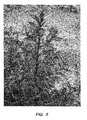
- FIG. 5 is a full color photographic view of red-purple new foliage and stems.
- FIG. 6 is a full color photographic view of mature leaves.
- FIG. 7 is a full color photographic view of an inflorescence and mature foliage near the end of the growing season.
- the crapemyrtle cultivar ‘WHIT X’ has not been observed under all possible environmental conditions. It is to be understood that the phenotype may vary significantly with variations in environment such as soils, temperature, light intensity and length of day without differences in the genotype of the plant.
- the following botanical characteristics and observations are taken from plants when grown under normal outdoor conditions in north central Oklahoma. Unless otherwise noted, the following description is of plants propagated from the original parent plant and are four years old, growing in a field near Stillwater, Okla., but is also consistent with plants ranging from a few months to 18 months growing in containers in north central Oklahoma.
Landscapes
- Life Sciences & Earth Sciences (AREA)
- Health & Medical Sciences (AREA)
- Physiology (AREA)
- Botany (AREA)
- Developmental Biology & Embryology (AREA)
- Environmental Sciences (AREA)
- Breeding Of Plants And Reproduction By Means Of Culturing (AREA)
Abstract
A new and distinct variety of crapemyrtle, Lagerstroemia indica, particularly distinguished by having a much branched upright growth habit, a near constant show of sterile, cardinal red flowers from bright crimson flower buds during the warm growing season, with lighter red flowers during rainy periods or cooler fall conditions. Because the plant is sterile, old flowers stay showy longer and new flower buds form in the same positions as flowers that age and fall away. Inflorescences are short around the base of the plant, but are 12 to 14 inches long and 6 to 12 inches wide in the upper parts of the plant. The plant is highly resistant to both powdery mildew and Cercospora leaf spot under north central Oklahoma conditions.
Description
Genus, species: Lagerstroemia indica.
Varietal denomination: ‘WHIT X’.
1. Field of the Invention
The present invention relates to a new and distinct variety or cultivar of the ornamental shrub, Lagerstroemia indica, commonly known as crapemyrtle.
2. Description of the Related Art
Crapemyrtle is native to eastern China and was introduced into North America in the late 1700's. Since then this popular ornamental shrub has been grown extensive across the southern half of the continent. Over the years, seedlings of Lagerstroemia indica have been selected and introduced into the market with different growth habits and flower colors. In addition, hybrids between L. indica and L. fauriei have been selected to add additional features, particularly more striking bark color and resistance to powdery mildew. But, flower color of the hybrids were muted compared to seedlings of pure L. indica.
An assortment of methods has been utilized to develop improved varieties of crapemyrtle and several of those varieties have had U.S. Plant Patents issued. For example, U.S. Plant Pat. Nos. 4,182, 4,183, 4,184 and 4,185 disclose and claim a series of four new varieties of Lagerstroemia indica produced by crossing previously known varieties. Each of those varieties was characterized as having a weeping growth habit at maturity.
U.S. Plant Pat. Nos. 6,365 and 6,383 disclose varieties of crapemyrtle derived from seedling treated with a mutation-inducing chemical. It is generally known that sodium azide, colchicines and other chemicals are capable of producing plant mutations. Since only one or more of the far distant grandparents of the new variety of crapemyrtle were treated with one of these compounds, it is highly unlikely that the present invention may be a chemically induced mutation.
The new variety of crapemyrtle claimed herein, which has been given the cultivar name ‘WHIT X’ was selected from a block of about 12,000 seedlings planted in 2009. Parents of these 12,000 seedlings were 14, 15 or 16 generations removed from the original single seedling parent used to begin this crapemyrtle breeding program.
The specific identity of the parent of the present invention was a seedling from generation 15 with only a few seed capsules and that showed high resistance to Cercospora leaf spot disease which is an increasing problem where crapemyrtle are grown.
This new and distinct crapemyrtle was asexually reproduced by rooting softwood cuttings taken from the original ‘WHIT X’ plant near Stillwater, Okla. The asexually reproduced plants show all of the unique features that characterize this crapemyrtle including high disease resistance, thereby indicating that the unique features of this plant are stable through successive generations of asexual reproduction. Softwood cuttings taken from our new variety of crapemyrtle were successfully rooted under intermittent mist. Subsequent cuttings from plants produced from previous cuttings from the ‘WHIT X’ original parent have also been rooted. Growth, flowering, flower and foliage color and capacity to rebloom on old inflorescences with no seed production and high degree of resistance to both powdery mildew and Cercospora leaf spot remain consistent with the parent.
The plant of the present invention is a new and distinct variety of crapemyrtle, Lagerstroemia indica which has been given the cultivar name ‘WHIT X’ and is characterized by a much branched growth habit with moderate vigor that may reach a height of 8 to 10 feet if left unpruned. The original ‘WHIT X’, now 6 years old, was killed to the ground in 2011, when temperatures dropped to an unprecedented −19 F, but regrowth was vigorous and is now about 5 feet tall by 28 inches wide. Cuttings taken from the parent following the complete top kill, rooted and grew the same as plants propagated from before the severe cold, confirming that no genetic change occurred.
Leaves of the plant emerge dark red-purple and remain dark purple-green. Mature leaves are typical in size and shape as the species. Twigs of current season growth emerge dark red-purple and remain of similar color until growth slows near the end of the growing season when they become light tan.
Inflorescences are between about 12 to 14 inches long and between 6 to 12 inches wide in the upper part of the plant. Flower buds are crimson. Individual flowers are cardinal red in full sun and during temperatures above about 85 degrees F. However, flowers that open during cloudy days emerge lighter red, but with return of full sun and warm temperatures, flowers will change to cardinal red. In late summer and temperatures below about 80 degrees F. flowers open and remain light red. Flowers remain showy for 14 to 20 days in Oklahoma, do not blacken along the margins and drop cleanly. Flower petals typically fold over so that few stamens are visible, however, the few that are exposed are bright yellow.
Flowers are sterile.
Each inflorescence typically produces a full flower show, then as the flowers age and fall, new flower buds quickly form in the locations of the previous flowers. In addition, production of new stems during the growing season and terminating in panicles of blooms also adds to and prolongs the flower show. Unless checked by severe drought or other environmental or cultural problem, flowering typically begins in late June in North Central Oklahoma and flowering continues until frost.
The following botanical description is of the new and distinct cultivar of crapemyrtle, Lagerstroemia indica, which has been given the cultivar name ‘WHIT X’. Specific color designations set forth by number designations are in accordance with The Royal Horticultural Society Colour Chart (1966). General color recitations are consistent with ordinary American color terminology.
The crapemyrtle cultivar ‘WHIT X’ has not been observed under all possible environmental conditions. It is to be understood that the phenotype may vary significantly with variations in environment such as soils, temperature, light intensity and length of day without differences in the genotype of the plant. The following botanical characteristics and observations are taken from plants when grown under normal outdoor conditions in north central Oklahoma. Unless otherwise noted, the following description is of plants propagated from the original parent plant and are four years old, growing in a field near Stillwater, Okla., but is also consistent with plants ranging from a few months to 18 months growing in containers in north central Oklahoma.
- The plant:
-
- Type.—Deciduous, upright, woody shrub with multiple stems and dense branching.
- Classification.—Crapemyrtle, Lagerstroemia indica.
- Growth habit.—The plant is a moderate grower with prolific branching. Vegetative growth is moderate in spring and continues into late summer. Flowering begins in late June in north central Oklahoma. Unlike other crapemyrtle varieties from this breeding program, such as crapemyrtle described in U.S. Plant Pat. Nos. 10,296 and 11,342 which produce little new growth once flowering begins, ‘WHIT X’ of the present invention typically produces some new vegetative growth adjacent to full flowering inflorescences as shown in FIG.1 and
FIG. 4 . - Origin.—An open pollinated cross in a crapemyrtle selection/breeding program near Stillwater, Okla.
- Propagation.—The plant is easy to propagate from softwood cutting under mist, with the distinguishing characteristics of the asexually propagated offspring remaining identical to the parent.
- Size and shape.—The original parent was killed to the ground in February 2011 due to unprecedented cold of —19 F. Plants propagated from new growth from the original parent average about 4 feet tall with a spread of 28 to 36 inches creating a broad, upright shrub at age four years in the field as shown in
FIG. 1 . Based on growth rate of the four year old plants in the field, it is estimated that ‘WHIT X’ may reach a height of 8 to 10 feet and spread of 5 to 7 feet. - Hardiness.—The new variety of crapemyrtle has withstood temperature of about 0 degrees F. in the field with no injury.
- Pests and disease.—The foliage has been very resistant to powdery mildew and Cercospora leaf spot.
-
- The flowers:
-
- Blooming period.—Blooming begins in late June and continues into October in north central Oklahoma. This flowering period is longer than most seedlings and cultivars of crapemyrtle known to me. Flowering continues during periods of intense and prolonged heat as long as moisture is available. Because the plant is sterile, flowers remain showy longer and after flowers age and fall from positions in the inflorescence, new flower buds are produced in the same location. Typically five or more sets of flowers are produced on each inflorescence or until late season cool weather stops the flower bud cycling as shown in
FIG. 7 . This unusual flower production sequence makes the flower show near continuous and removes peaks of flower show then seed production, as occurs with conventional crapemyrtle. Individual flowers typically remain attractive for 14 to 20 days unless moisture is severely limiting. - Petals.—Blades of individual newly opened petals (expanded apical portion) are cardinal red (53 A) when open with full sun and temperatures above 85 degrees F. during the day. With moderately cooler temperatures, for example 75 to 80 degrees and some cloud cover, flowers are typically lighter (53 B or C), however, when full sun and warmer conditions return, flowers will darken (53 A). With the arrival of early fall and temperatures in the range of 60 to 70 degrees F. during the day and cooler at night, flowers typically open light red (53 B, C or D) with only modest darkening with the return of warmer days and full sun (For example, flowers may open 53 C and then darken to 53 B or later in the season from 53 D to 53 C or B.) Overall the flower petal shape is more or less orbicular with an uneven and irregular undulating surface and about ½ to 1 inch across. The petal claw (the narrow stalk-like basal portion of the petal) is also cardinal red during the summer (53 B or C) and about ¼ inch long. The flower petals, typically 6, but occasionally 5 or 7, open only partially on most flowers creating a dense cluster of petals as shown in
FIG. 3 and obscure the stamens. Stamens range from 10 to 30 upon careful inspection but are only rarely exposed by the petals. When anthers are present they are about 1/16 inch long, yellow, approx 15 A. Filaments are approx. ⅛ inch long. Most flowers have no anthers, only an entangled mass of filaments. As flowers age, the entire perianth of petals and sepals typically fall cleanly as a unit from the inflorescence and without discoloring or becoming unattractive. - Inflorescences.—The inflorescences are panicles from about 4 inches long and 3 inches wide near the base of a plant to 12 to 14 inches long and from 6 to 12 inches wide in the upper portion and contain from 15 to 250 buds or flowers. The stocks of inflorescences (peduncle) exposed to full sun are purplish (187 A or B) mid-summer with max light intensity or lighter (187 B, C or D) later in the season when nights begin to cool. However, after being partially or mostly shaded by flowers for 14 to 20 days, stocks are lighter in color (187 C or D to 186 A or B). Because of the complex and irregular branching of the inflorescence in
FIGS. 2 and 3 , precise assignments of colors to structural parts is difficult. - Stamens.—An occasional flower has distinct yellow stamens (15 A), but more common are a complex of twisted and deformed stamens mostly retained in the flower bud.
- Sepals.—There are typically six sepals per bloom, each having the shape of one-sixth of a sphere and each about 5/16 to 7/16 long.
- Buds.—Unopened flower buds are round with six distinct lines of dehiscence where they split to allow flower petals to expand. Bud size increases with age to typically between 3/16 to 5/16 inch diameter. The unopened flower buds are typically dark crimson (187 A in direct sun to slightly lighter (187 B or C where buds are partially shaded as shown in
FIGS. 2 and 3 . - Seeds.—The plant it sterile.
- Blooming period.—Blooming begins in late June and continues into October in north central Oklahoma. This flowering period is longer than most seedlings and cultivars of crapemyrtle known to me. Flowering continues during periods of intense and prolonged heat as long as moisture is available. Because the plant is sterile, flowers remain showy longer and after flowers age and fall from positions in the inflorescence, new flower buds are produced in the same location. Typically five or more sets of flowers are produced on each inflorescence or until late season cool weather stops the flower bud cycling as shown in
-
- The foliage:
-
- Leaf shape.—The leaf shapes range from ovate and acute at the tip to broadly lanceolate as shown in
FIGS. 5 and 6 with a smooth margin. The leaf petiole is typically absent or very short and not distinct. - Leaf color.—The upper and lower surfaces, including midribs below of new leaves emerge glossy dark reddish-purple, grayed-purple group (187 A or B) and remain so for several weeks as shown in
FIGS. 1, 4 and 5 , slowly transitioning to 187 B, with slight increasing of green. Mature leaves have a dull purple cast with slight increase in green when heavily shaded (no color match among R.H.S. Colour Chart),FIG. 6 and finally, fully shaded old leaves become dull, dark mostly green with a touch of purple (147 A) but this is a poor match. The plant is typically still in full flowering mode with the arrival of first frost, such that there is no fall color. - Leaf texture.—Mature leaves are smooth on both upper and lower surfaces, becoming more thick and leathery with age.
- Leaf size.—Leaf size increases with age, reach a typical length of about 1½ to 2½ inches long and between about ¾ to 1¼ inches wide, with the widest point near the center.
- Leaf shape.—The leaf shapes range from ovate and acute at the tip to broadly lanceolate as shown in
-
- The branches and bark:
-
- Branch color.—The current seasons new growth exposed to direct light is red-purple (187 A, B or C),
FIGS. 1, 4 and 5 , transitioning to a lighter color with age and maturity (187 C or D), then becoming tan with a bit of purple tint, greyed-orange group (177 C or D) then gradually a more tan (166 B or C) and finally, dormant stems are darker tan (165 A),FIG. 7 . - Branch length.—Branch length is dependent on growing conditions of the plant, and typically range from between 3 to 4 inches at tips of lower branches, to 12 to 18 inches for upright branches as shown in
FIGS. 4 and 5 . - Branch diameter.—Diameter of a current season's growth ranges from between about ¼ to 7/16 inch.
- Bark.—The bark of mature stems and branches is a dark tan (165 A) as shown in
FIG. 7 . Unlike a typical crapemyrtle, the base of the oldest stems has yet to begin to exfoliate.
- Branch color.—The current seasons new growth exposed to direct light is red-purple (187 A, B or C),
-
Claims (1)
1. A new and distinct variety of crapemyrtle plant, substantially as illustrated and described.
Priority Applications (1)
| Application Number | Priority Date | Filing Date | Title |
|---|---|---|---|
| US14/544,429 USPP27085P2 (en) | 2015-03-12 | 2015-03-12 | Crapemyrtle plant named‘WHIT X’ |
Applications Claiming Priority (1)
| Application Number | Priority Date | Filing Date | Title |
|---|---|---|---|
| US14/544,429 USPP27085P2 (en) | 2015-03-12 | 2015-03-12 | Crapemyrtle plant named‘WHIT X’ |
Publications (1)
| Publication Number | Publication Date |
|---|---|
| USPP27085P2 true USPP27085P2 (en) | 2016-08-23 |
Family
ID=56684337
Family Applications (1)
| Application Number | Title | Priority Date | Filing Date |
|---|---|---|---|
| US14/544,429 Active 2035-03-31 USPP27085P2 (en) | 2015-03-12 | 2015-03-12 | Crapemyrtle plant named‘WHIT X’ |
Country Status (1)
| Country | Link |
|---|---|
| US (1) | USPP27085P2 (en) |
-
2015
- 2015-03-12 US US14/544,429 patent/USPP27085P2/en active Active
Similar Documents
| Publication | Publication Date | Title |
|---|---|---|
| USPP27085P2 (en) | Crapemyrtle plant named‘WHIT X’ | |
| USPP23559P3 (en) | Crapemyrtle plant named ‘WHIT IX’ | |
| USPP17291P2 (en) | Petunia plant named ‘Petlavve’ | |
| USPP30967P2 (en) | Anthurium plant named ‘ANTHGLYNT’ | |
| USPP29786P3 (en) | Portulaca plant named ‘LAZPRT1705’ | |
| USPP30053P3 (en) | Salvia plant named ‘DSALMAGWAN’ | |
| USPP28678P3 (en) | Vanda plant named ‘SPCDW1508’ | |
| USPP27527P3 (en) | Echeveria plant named ‘Cubic Frost’ | |
| USPP18720P2 (en) | Petunia plant named ‘Petpasyel’ | |
| USPP29954P3 (en) | Campanula plant named ‘PKM06’ | |
| USPP29416P3 (en) | Peperomia plant named ‘Napoli Nights’ | |
| USPP29250P2 (en) | Echeveria plant named ‘EC-ECH-01’ | |
| USPP23239P2 (en) | Petunia plant named ‘DLITT262’ | |
| USPP28392P3 (en) | Nemesia plant named ‘Fiangpeacimp’ | |
| USPP26316P2 (en) | Chamelaucium plant named ‘Sarah's Delight’ | |
| USPP28741P3 (en) | Dahlia plant named ‘Mystic Sparkler’ | |
| USPP26503P2 (en) | Anisodontea plant named ‘Oostanique’ | |
| USPP26409P2 (en) | Tillandsia hybrid plant named ‘Duraant’ | |
| USPP25525P3 (en) | Lavandula plant named ‘IBPR910-2’ | |
| USPP19227P3 (en) | Petunia plant named ‘Petlibluve’ | |
| USPP23932P2 (en) | Salvia plant named ‘Curling Waves’ | |
| USPP26186P3 (en) | Petunia plant named ‘Drama Queen’ | |
| USPP24523P3 (en) | Campanula plant named ‘PKM01’ | |
| USPP22298P3 (en) | Eastern redbud tree named ‘JN3’ | |
| USPP20581P2 (en) | Ilex plant named ‘Scarlet's Peak’ |