USPP26574P2 - Jacaranda tree named ‘Sakai01’ - Google Patents
Jacaranda tree named ‘Sakai01’ Download PDFInfo
- Publication number
- USPP26574P2 USPP26574P2 US14/120,549 US201414120549V USPP26574P2 US PP26574 P2 USPP26574 P2 US PP26574P2 US 201414120549 V US201414120549 V US 201414120549V US PP26574 P2 USPP26574 P2 US PP26574P2
- Authority
- US
- United States
- Prior art keywords
- sakai01
- average
- color
- jacaranda
- length
- Prior art date
- Legal status (The legal status is an assumption and is not a legal conclusion. Google has not performed a legal analysis and makes no representation as to the accuracy of the status listed.)
- Active, expires
Links
- 241001649169 Jacaranda Species 0.000 title claims description 5
- 241000196324 Embryophyta Species 0.000 abstract description 11
- 241001098109 Jacaranda mimosifolia Species 0.000 abstract description 7
- 241000607479 Yersinia pestis Species 0.000 description 2
- 230000034303 cell budding Effects 0.000 description 2
- 201000010099 disease Diseases 0.000 description 2
- 208000037265 diseases, disorders, signs and symptoms Diseases 0.000 description 2
- 235000013399 edible fruits Nutrition 0.000 description 2
- 230000007613 environmental effect Effects 0.000 description 2
- 230000017260 vegetative to reproductive phase transition of meristem Effects 0.000 description 2
- 241001164374 Calyx Species 0.000 description 1
- 230000001154 acute effect Effects 0.000 description 1
- 239000003086 colorant Substances 0.000 description 1
- 239000003205 fragrance Substances 0.000 description 1
- 238000000034 method Methods 0.000 description 1
- 239000000203 mixture Substances 0.000 description 1
- 210000000056 organ Anatomy 0.000 description 1
- 210000001672 ovary Anatomy 0.000 description 1
- 230000001850 reproductive effect Effects 0.000 description 1
- 102220274636 rs144712084 Human genes 0.000 description 1
- 239000007921 spray Substances 0.000 description 1
Images

Classifications
-
- A—HUMAN NECESSITIES
- A01—AGRICULTURE; FORESTRY; ANIMAL HUSBANDRY; HUNTING; TRAPPING; FISHING
- A01H—NEW PLANTS OR NON-TRANSGENIC PROCESSES FOR OBTAINING THEM; PLANT REPRODUCTION BY TISSUE CULTURE TECHNIQUES
- A01H5/00—Angiosperms, i.e. flowering plants, characterised by their plant parts; Angiosperms characterised otherwise than by their botanic taxonomy
- A01H5/02—Flowers
-
- A—HUMAN NECESSITIES
- A01—AGRICULTURE; FORESTRY; ANIMAL HUSBANDRY; HUNTING; TRAPPING; FISHING
- A01H—NEW PLANTS OR NON-TRANSGENIC PROCESSES FOR OBTAINING THEM; PLANT REPRODUCTION BY TISSUE CULTURE TECHNIQUES
- A01H6/00—Angiosperms, i.e. flowering plants, characterised by their botanic taxonomy
Definitions
- Botanical classification Jacaranda mimosifolia.
- the present invention relates to a new and distinct cultivar of Jacaranda mimosifolia and will be referred to hereafter by its cultivar name, ‘Sakai01’.
- ‘Sakai01’ represents a new sub-tropical tree grown for landscape use.
- Asexual propagation of the new cultivar was first accomplished by the Inventor by budding and grafting in Nichinan-shi, Miyazaki, Japan in May 1997. Asexual propagation by budding and grafting has determined that the characteristics of the new cultivar are stable and are reproduced true to type in successive generations.
- the parent plant of ‘Sakai01’ an unnamed Jacaranda mimosifolia plant, differs from ‘Sakai01’ in having a faster growth habit, a much taller plant height (reaching 8 to 15 meters in height), and in not flowering until the plants are ten years in age. There are no other cultivars of Jacaranda mimosifolia known to the Inventor.
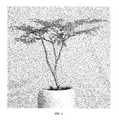
- FIG. 1 provides a side view of the plant habit of ‘Sakai01’.
- FIG. 2 provides a close-up view of an inflorescence of ‘Sakai01’.
- FIG. 3 provides a close-up view of foliage of ‘Sakai01’.
- the phenotype of the new cultivar may vary with variations in environmental, climatic, and cultural conditions, as it has not been tested under all possible environmental conditions. The color determination is in accordance with The 2007 R.H.S. Colour Chart of The Royal Horticultural Society, London, England, except where general color terms of ordinary dictionary significance are used.
Landscapes
- Life Sciences & Earth Sciences (AREA)
- Health & Medical Sciences (AREA)
- Physiology (AREA)
- Botany (AREA)
- Developmental Biology & Embryology (AREA)
- Environmental Sciences (AREA)
- Breeding Of Plants And Reproduction By Means Of Culturing (AREA)
Abstract
A new cultivar of Jacaranda mimosifolia,‘Sakai01’, that is characterized by its dwarf plant habit, its slow growth habit, its ability to flower on two year-old plants, and its flowers that are violet in color.
Description
Botanical classification: Jacaranda mimosifolia.
Varietal denomination: ‘Sakai01’.
The present invention relates to a new and distinct cultivar of Jacaranda mimosifolia and will be referred to hereafter by its cultivar name, ‘Sakai01’. ‘Sakai01’ represents a new sub-tropical tree grown for landscape use.
The Inventor discovered the new cultivar, ‘Sakai01’, as a chance seedling in his garden in Nichinan-shi, Miyazaki, Japan in May 1995. In comparison to other seedlings of Jacaranda mimosifolia he had observed, the new cultivar was dwarf in habit. Subsequent to grafting he made the additional observation that the new cultivar produced flowers only 2 years after grafting.
Asexual propagation of the new cultivar was first accomplished by the Inventor by budding and grafting in Nichinan-shi, Miyazaki, Japan in May 1997. Asexual propagation by budding and grafting has determined that the characteristics of the new cultivar are stable and are reproduced true to type in successive generations.
The following traits have been repeatedly observed and represent the characteristics of the new cultivar. These attributes in combination distinguish ‘Sakai01’, as a unique from all cultivar of Jacaranda mimosifolia.
-
- 1. ‘Sakai01’ exhibits a dwarf plant habit.
- 2. ‘Sakai01’ exhibits a slow growth habit.
- 3. ‘Sakai01’ exhibits flowering on two year-old plants.
- 4. ‘Sakai01’ exhibits flowers that are violet in color.
The parent plant of ‘Sakai01’, an unnamed Jacaranda mimosifolia plant, differs from ‘Sakai01’ in having a faster growth habit, a much taller plant height (reaching 8 to 15 meters in height), and in not flowering until the plants are ten years in age. There are no other cultivars of Jacaranda mimosifolia known to the Inventor.
The accompanying colored photographs illustrate the overall appearance and distinct characteristics of the new Jacaranda, ‘Sakai01’. The photographs were taken of a two year-old plant as grown outdoors in a 17-cm container in Boskoop, The Netherlands.
The photograph in FIG. 1 provides a side view of the plant habit of ‘Sakai01’.
The photograph in FIG. 2 provides a close-up view of an inflorescence of ‘Sakai01’.
The photograph in FIG. 3 provides a close-up view of foliage of ‘Sakai01’.
The colors in the photographs are as close as possible with the digital photography and printing techniques utilized and the color codes in the detailed botanical description accurately describe the new Jacaranda.
The following is a detailed description of the new cultivar taken from two year-old plants as grown outdoors in a 17-cm container in Boskoop, The Netherlands. The phenotype of the new cultivar may vary with variations in environmental, climatic, and cultural conditions, as it has not been tested under all possible environmental conditions. The color determination is in accordance with The 2007 R.H.S. Colour Chart of The Royal Horticultural Society, London, England, except where general color terms of ordinary dictionary significance are used.
- General description:
-
- Plant type.—Sub-tropical tree; can be deciduous to evergreen depending on climate.
- Growth habit.—Broad upright with domed crown.
- Height and spread.—An average of 45.5 cm in height and 56 cm in spread and matures to a height of 2 to 3 meters and 1 m in spread in the landscape.
- Cold hardiness.—U.S.D.A. Zones 9.
- Diseases and pests.—No susceptibility or resistance to pests or diseases has been observed.
- Root description.—Fine and fibrous.
- Growth rate.—Slow.
- Propagation.—Budding and grafting.
-
- Stem description:
-
- Shape.—Rounded.
- Stem size.—Up to 5 lateral branches; average of 5 mm in diameter and 5.1 cm in length, main stems are about 2 cm in width measured 3 cm from base.
- Stem surface.—Slightly glossy and smooth.
- Branching.—Moderate to freely branching.
- Stem strength.—Very Strong.
- Branch arrangement.—Opposite.
- Branch aspect.—Main stems upright, lateral stems held at an average angle of 70° from the main stems with flat sprays that spread upward and outward.
- Internode length.—Average of 1.4 cm.
- Stem color.—Immature branches are 144A, mature branches are 197C to 197D.
-
- Foliage description:
-
- Leaf arrangement.—Opposite.
- Leaf shape.—Oblong.
- Leaf division.—Bipinnate.
- Leaf base.—Attenuate.
- Leaf apex.—Short mucronate.
- Leaf venation.—Pinnate, color: upper side 143A, lower side 138C.
- Leaf margins.—Entire.
- Leaf surface.—Both surfaces dull.
- Leaf color.—Mature upper surface; 143A, mature lower surface; between 138B and 143B, mature lower surface: 143A; new growth upper surface; 143B, new growth lower surface; 144B in color.
- Leaf size.—An average of 21.3 cm in length and 12.5 cm in width.
- Leaf quantity.—About 6 per lateral branch (3 pairs).
- Leaflet shape.—Elliptic.
- Leaflet size.—An average of 1.3 cm in length and 6 mm in width.
- Leaflet quantity.—Average of 400 per leaf.
- Petiole.—Average length of leaf petiole (from base to lowest leaflet) is 3.4 cm, average length of rachis (from lowest leaflet to top of rachis) is 15.1 cm, average diameter of leaf petiole is 3 mm, average diameter of rachis (measured in the middle) is 2 mm, petiole color is 144A, rachis color is 144A to 144B, leaflets are sessile, smooth surface.
-
- Inflorescence description:
-
- Inflorescence type.—Axillary and terminal panicles.
- Inflorescence size.—Average of 10.8 cm in height and 7.9 cm in width.
- Flower buds.—Narrowly obovate in shape, an average of 2.6 cm in length and 8 mm in diameter, 90B to 90C in color.
- Flower fragrance.—None.
- Lastingness of flowers.—About 5 days.
- Flower aspect.—Outward.
- Flower quantity.—An average of 2 per lateral stem.
- Flower shape.—Tubular-campanulate, typical for Jacaranda.
- Flower type.—Single, tubular-campanulate.
- Flower size.—Average of 3.1 cm in didmeter and 4.5 cm in depth.
- Peduncles.—Average of 9.1 cm in length and 2.5 mm in diameter, strong, average angle of 0° to the lateral branch, strong in strength and 143A in color.
- Pedicels.—Average of 6 mm in length and 1 mm in diameter, held at 15°, moderately strong in strength and 144A in color.
- Calyx.—Rotate in shape, an average of 3 mm in length and 4 mm in diameter.
- Sepals.—5, ovate in shape, acute apex, broad cuneate base, entire margin, an average of 3 mm in length and 1 mm in width, rotate in arrangement, both surfaces smooth and dull, color: young and mature upper and lower surface; 144A.
- Petals.—6, lower 80% fused into tube, narrow oblong in shape, margin entire, apex obtuse, an average of 4.5 cm in length, 1.3 cm in width (measured at the base of the free part), overall appearance of the petal is smooth and dull and fused into a tubular-campanulate shape, when opening upper side; 90D with blotching of NN155D, when opening lower side; 91A, when fully opened upper side; 90D with a blotching of NN155D, when fully opened lower side; a blend of N88C, N88D and 91A.
-
- Reproductive organs:
-
- Gynoecium.—1 pistil, about 2.4 cm in length, style is an average of 2.2 cm in length, and 157D in color, stigma is club-shaped and plumose and 155C in color, ovary is N186D in color.
- Androcoecium.—5 stamens, anthers are basifixed and narrow oblong in shape, 3 mm in length and 173D in color, filaments are an average of 1.5 cm in length and 157D in color, pollen is very low in quantity and 155A in color.
- Fruit and seed.—No fruit or seed production has been observed to date.
-
Claims (1)
1. A new and distinct cultivar of Jacaranda plant named ‘Sakai01’ as herein illustrated and described.
Priority Applications (1)
| Application Number | Priority Date | Filing Date | Title |
|---|---|---|---|
| US14/120,549 USPP26574P2 (en) | 2014-06-02 | 2014-06-02 | Jacaranda tree named ‘Sakai01’ |
Applications Claiming Priority (1)
| Application Number | Priority Date | Filing Date | Title |
|---|---|---|---|
| US14/120,549 USPP26574P2 (en) | 2014-06-02 | 2014-06-02 | Jacaranda tree named ‘Sakai01’ |
Publications (1)
| Publication Number | Publication Date |
|---|---|
| USPP26574P2 true USPP26574P2 (en) | 2016-04-05 |
Family
ID=55589219
Family Applications (1)
| Application Number | Title | Priority Date | Filing Date |
|---|---|---|---|
| US14/120,549 Active 2034-10-24 USPP26574P2 (en) | 2014-06-02 | 2014-06-02 | Jacaranda tree named ‘Sakai01’ |
Country Status (1)
| Country | Link |
|---|---|
| US (1) | USPP26574P2 (en) |
-
2014
- 2014-06-02 US US14/120,549 patent/USPP26574P2/en active Active
Similar Documents
| Publication | Publication Date | Title |
|---|---|---|
| USPP29992P2 (en) | Japanese holly plant named ‘Annys5’ | |
| USPP25565P2 (en) | Philadelphus plant named ‘Icezam’ | |
| USPP36066P2 (en) | Vitex plant named ‘Bailtexfour’ | |
| USPP33362P2 (en) | Ternstroemia plant named ‘Carolina Sunset’ | |
| USPP21920P2 (en) | Weigela plant named ‘Wings of Fire’ | |
| USPP24756P2 (en) | Veronica plant named ‘Pink Bomb’ | |
| USPP32103P2 (en) | Delosperma plant named ‘Wow312’ | |
| USPP30852P2 (en) | Vitex plant named ‘Bailtextwo’ | |
| USPP30283P2 (en) | Vitex plant named ‘Bailtexone’ | |
| USPP31199P2 (en) | Tecomaria plant named ‘DWOY001’ | |
| USPP29780P2 (en) | Veronica plant named ‘Verspi’ | |
| USPP29556P2 (en) | Nepeta plant named ‘Bokratune’ | |
| USPP29744P2 (en) | Epimedium plant named ‘Ninja Stars’ | |
| USPP29448P2 (en) | Gardenia plant named ‘PIIGA-III’ | |
| USPP28393P3 (en) | Salvia plant named ‘ALKLF’ | |
| USPP30101P2 (en) | Hibiscus plant named ‘MINDOUR1’ | |
| USPP28530P2 (en) | Hibiscus plant named ‘Lanwabash’ | |
| USPP25600P2 (en) | Delosperma plant named ‘WOWDOY3’ | |
| USPP28777P3 (en) | Veronica plant named ‘Joca128’ | |
| USPP27119P2 (en) | Helleborus plant named ‘Amor’ | |
| USPP29968P2 (en) | Gymnocladus tree named ‘McKBranched’ | |
| USPP28876P2 (en) | Spiraea plant named ‘Matgold’ | |
| USPP29475P2 (en) | Cephalanthus plant named ‘Bailoptics’ | |
| USPP26605P2 (en) | Hemerocallis plant named ‘VER00213’ | |
| USPP26317P2 (en) | Chamelaucium plant named ‘Moonlight Delight’ |