USPP22304P2 - Polygonatum plant named ‘Prince Charming’ - Google Patents
Polygonatum plant named ‘Prince Charming’ Download PDFInfo
- Publication number
- USPP22304P2 USPP22304P2 US12/807,525 US80752510V USPP22304P2 US PP22304 P2 USPP22304 P2 US PP22304P2 US 80752510 V US80752510 V US 80752510V US PP22304 P2 USPP22304 P2 US PP22304P2
- Authority
- US
- United States
- Prior art keywords
- polygonatum
- color
- charming
- prince
- prince charming
- Prior art date
- Legal status (The legal status is an assumption and is not a legal conclusion. Google has not performed a legal analysis and makes no representation as to the accuracy of the status listed.)
- Active
Links
- 241000756042 Polygonatum Species 0.000 title claims abstract description 9
- 241000196324 Embryophyta Species 0.000 abstract description 12
- 240000005166 Polygonatum biflorum Species 0.000 description 6
- 235000008737 Polygonatum biflorum Nutrition 0.000 description 6
- 235000004506 Polygonatum multiflorum Nutrition 0.000 description 6
- 241001478683 Polygonatum humile Species 0.000 description 5
- 240000001140 Mimosa pudica Species 0.000 description 3
- 241000607479 Yersinia pestis Species 0.000 description 3
- 201000010099 disease Diseases 0.000 description 3
- 208000037265 diseases, disorders, signs and symptoms Diseases 0.000 description 3
- 235000013399 edible fruits Nutrition 0.000 description 3
- 230000011681 asexual reproduction Effects 0.000 description 2
- 238000013465 asexual reproduction Methods 0.000 description 2
- 235000021028 berry Nutrition 0.000 description 2
- 230000007613 environmental effect Effects 0.000 description 2
- PCHJSUWPFVWCPO-UHFFFAOYSA-N gold Chemical compound [Au] PCHJSUWPFVWCPO-UHFFFAOYSA-N 0.000 description 2
- 239000010931 gold Substances 0.000 description 2
- 229910052737 gold Inorganic materials 0.000 description 2
- 241000894007 species Species 0.000 description 2
- 240000003759 Erodium cicutarium Species 0.000 description 1
- 235000009967 Erodium cicutarium Nutrition 0.000 description 1
- 230000001154 acute effect Effects 0.000 description 1
- 239000003086 colorant Substances 0.000 description 1
- 235000009508 confectionery Nutrition 0.000 description 1
- 230000023753 dehiscence Effects 0.000 description 1
- 230000001747 exhibiting effect Effects 0.000 description 1
- 239000003205 fragrance Substances 0.000 description 1
- 238000000338 in vitro Methods 0.000 description 1
- 238000000034 method Methods 0.000 description 1
- 210000000056 organ Anatomy 0.000 description 1
- 210000001672 ovary Anatomy 0.000 description 1
- 230000010152 pollination Effects 0.000 description 1
- 230000001850 reproductive effect Effects 0.000 description 1
- 239000007787 solid Substances 0.000 description 1
- 230000017260 vegetative to reproductive phase transition of meristem Effects 0.000 description 1
Images

Classifications
-
- A—HUMAN NECESSITIES
- A01—AGRICULTURE; FORESTRY; ANIMAL HUSBANDRY; HUNTING; TRAPPING; FISHING
- A01H—NEW PLANTS OR NON-TRANSGENIC PROCESSES FOR OBTAINING THEM; PLANT REPRODUCTION BY TISSUE CULTURE TECHNIQUES
- A01H5/00—Angiosperms, i.e. flowering plants, characterised by their plant parts; Angiosperms characterised otherwise than by their botanic taxonomy
- A01H5/02—Flowers
-
- A—HUMAN NECESSITIES
- A01—AGRICULTURE; FORESTRY; ANIMAL HUSBANDRY; HUNTING; TRAPPING; FISHING
- A01H—NEW PLANTS OR NON-TRANSGENIC PROCESSES FOR OBTAINING THEM; PLANT REPRODUCTION BY TISSUE CULTURE TECHNIQUES
- A01H6/00—Angiosperms, i.e. flowering plants, characterised by their botanic taxonomy
- A01H6/12—Asparagaceae, e.g. Hosta
Definitions
- Genus and species Polygonatum biflorum ⁇ Polygonatum humile.
- the present invention relates to a new and distinct cultivar of Polygonatum biflorum ⁇ Polygonatum humile and will be referred to hereafter by its cultivar name, ‘Prince Charming’.
- ‘Prince Charming’ represents a new herbaceous perennial grown for use as a landscape plant.
- ‘Prince Charming’ arose as a selection from seed sown from open pollination of an unnamed plant of Polygonatum biflorum in a field plot of Polygonatum in Hebron, Ill.
- the exact parentage of ‘Prince Charming’ is unknown, however it is believed to be a hybrid between Polygonatum biflorum and Polygonatum humile based on its characteristics and the presence of Polygonatum humile in the growing area.
- the Inventor selected ‘Prince Charming’ as a single unique plant in 2003.
- ‘Prince Charming’ can be most closely compared to the parent plants. ‘Prince Charming’ differs from the female parent, an unnamed plant of Polygonatum biflorum, in being shorter in height ( Polygonatum biflorum is typically 2 to 4 feet in height), in having smaller foliage, in blooming earlier in the season (May versus June) with more blooms, in having shorter stem internodes, and in exhibiting a pronounced ligule at leaf attachment. ‘Prince Charming’ differs from the probable male parent, an unnamed plant of Polygonatum humile, in being taller in height, and in having leaves that are lighter in color, more round in shape, and larger in size.
- ‘Prince Charming’ can be compared to Polygonatum cultivars ‘Angel Wing’ (U.S. Plant Pat. No. 21,543), ‘Double Stuff’ (U.S. Plant Pat. No. 19,624), and ‘Kelli's Gold’ (U.S. Plant Pat. No. 15302).
- ‘Angel Wing’ differs from ‘Prince Charming’ in having variegated foliage.
- ‘Double Stuff’ differs from ‘Prince Charming’ in having variegated foliage and red stems.
- ‘Kekli's Gold’ differs from ‘Prince Charming’ in having golden colored foliage.
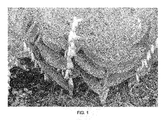
- FIG. 1 provides a view of ‘Prince Charming’ in bloom
- FIG. 2 provides a close-up view of the flowers of ‘Prince Charming’
- FIG. 3 provides a close-up view of the fruit (berries) of ‘Prince Charming’.
- the colors in the photographs are as close as possible with the digital photography and printing techniques utilized and the color codes in the detailed botanical description more accurately describe the new Polygonatum.
Landscapes
- Life Sciences & Earth Sciences (AREA)
- Health & Medical Sciences (AREA)
- Physiology (AREA)
- Botany (AREA)
- Developmental Biology & Embryology (AREA)
- Environmental Sciences (AREA)
- Natural Medicines & Medicinal Plants (AREA)
- Breeding Of Plants And Reproduction By Means Of Culturing (AREA)
Abstract
A new cultivar of Polygonatum named ‘Prince Charming’ characterized by its height of about 30 cm (12 inches), its heavy and early blooming habit, its ability to bloom as a young plant, and its pronounced ridge (ligule) at the point of stem attachment on the lower leaf surface
Description
Genus and species: Polygonatum biflorum×Polygonatum humile.
Cultivar: ‘Prince Charming’.
The present invention relates to a new and distinct cultivar of Polygonatum biflorum×Polygonatum humile and will be referred to hereafter by its cultivar name, ‘Prince Charming’. ‘Prince Charming’ represents a new herbaceous perennial grown for use as a landscape plant.
‘Prince Charming’ arose as a selection from seed sown from open pollination of an unnamed plant of Polygonatum biflorum in a field plot of Polygonatum in Hebron, Ill. The exact parentage of ‘Prince Charming’ is unknown, however it is believed to be a hybrid between Polygonatum biflorum and Polygonatum humile based on its characteristics and the presence of Polygonatum humile in the growing area. The Inventor selected ‘Prince Charming’ as a single unique plant in 2003.
Asexual reproduction of the new cultivar was first accomplished by division in Hebron, Ill. in 2004 by the Inventor. Asexual reproduction by division and in vitro propagation has determined that characteristics of this cultivar are stable and are reproduced true to type in successive generations.
The following traits have been repeatedly observed and represent the characteristics of the new cultivar. These attributes in combination distinguish ‘Prince Charming’ as unique from all other selections and forms of Polygonatum known to the Inventor.
-
- 1. ‘Prince Charming’ attains a height of about 30 cm (12 inches), intermediate in height between the parent species.
- 2. ‘Prince Charming’ blooms early in the season, commencing in May in Illinois.
- 3. ‘Prince Charming’ blooms reliably as a young plant.
- 4. ‘Prince Charming’ exhibits a pronounced ridge (ligule) at the point of stem attachment on the lower leaf surface.
‘Prince Charming’ can be most closely compared to the parent plants. ‘Prince Charming’ differs from the female parent, an unnamed plant of Polygonatum biflorum, in being shorter in height (Polygonatum biflorum is typically 2 to 4 feet in height), in having smaller foliage, in blooming earlier in the season (May versus June) with more blooms, in having shorter stem internodes, and in exhibiting a pronounced ligule at leaf attachment. ‘Prince Charming’ differs from the probable male parent, an unnamed plant of Polygonatum humile, in being taller in height, and in having leaves that are lighter in color, more round in shape, and larger in size. ‘Prince Charming’ can be compared to Polygonatum cultivars ‘Angel Wing’ (U.S. Plant Pat. No. 21,543), ‘Double Stuff’ (U.S. Plant Pat. No. 19,624), and ‘Kelli's Gold’ (U.S. Plant Pat. No. 15302). ‘Angel Wing’ differs from ‘Prince Charming’ in having variegated foliage. ‘Double Stuff’ differs from ‘Prince Charming’ in having variegated foliage and red stems. ‘Kekli's Gold’ differs from ‘Prince Charming’ in having golden colored foliage.
The accompanying colored photographs illustrate the overall appearance and distinct characteristics of the new Polygonatum, ‘Prince Charming’, as grown outdoors in a garden in Hebron, Ill. The plant is approximately three years in age from a single division.
The following is a detailed description of three year-old plants of ‘Prince Charming’ as grown outdoors in Hebron, Ill. The phenotype of the new cultivar may vary with variations in environmental, climatic, and cultural conditions, as it has not been tested under all possible environmental conditions. The color determination is in accordance with The 2007 R.H.S. Colour Chart of The Royal Horticultural Society, London, England, except where general color terms of ordinary dictionary significance are used.
- General description:
-
- Blooming period.—About 3 weeks in late spring.
- Plant habit.—Herbaceous, rhizomatous, clump-forming perennial, primarily upright with flowers secund.
- Height and spread.—About 30 cm in height and width.
- Hardiness.—At least to U.S.D.A. Zone 4.
- Diseases and pests.—No susceptibility to diseases or pests has been observed, plants of the genus Polygonatum typically do not have disease and pest problems.
- Root description.—Fleshy roots arising from knotty rhizomes; an average of 2.5 cm in length and 1 cm in diameter, dull and knobby surface texture, 161B in color.
-
- Growth and propagation:
-
- Propagation.—Rhizome division and tissue culture.
- Growth rate.—Vigorous.
-
- Stem description:
-
- Shape.—Round to slightly winged and ridged, solid.
- Stem color.—138C.
- Stem size.—Approximately 5 mm in diameter, up to about 30 cm in length.
- Stem surface.—Glabrous and glaucous.
- Branching.—Caulescent, un-branched stems emerge from rhizome.
- Internode length.—1 to 4 cm.
-
- Foliage description:
-
- Leaf shape.—Broadly elliptic.
- Leaf division.—Simple.
- Leaf base.—Leaf blade cuneate and base sheathed to stem.
- Leaf apex.—Acuminate.
- Leaf venation.—Parallel, slightly recessed on upper surface, prominently ridged on lower surface, 138B to 138C in color on upper and lower surface.
- Leaf margins.—Entire.
- Leaf attachment.—Sessile and sheathed.
- Leaf arrangement.—Alternate.
- Leaf surface.—Glabrous, slightly glaucous.
- Leaf color.—Immature and mature upper surface; 138A, immature and mature lower surface; 138B, fall foliage; 20B to 11C.
- Leaf size.—4.5 to 7.5 cm in length, 1.5 to 2.5 cm in width.
- Leaf quantity.—An average of 14 per stem.
-
- Flower description:
-
- Inflorescence type.—Pendent, cymose clusters of tubular flowers.
- Lastingness of inflorescence.—Determinate, blooms last approximately 2 weeks.
- Inflorescence size.—About 2.5 cm in depth and 1.5 cm in width.
- Flower fragrance.—Slightly sweet scented.
- Flower type.—Tubular, comprised of 6 fused tepals with distal 6 mm portion un-fused to create an aperture of about 6 mm when fully open.
- Flower aspect.—Downward on pendant peduncles.
- Flower size.—About 2.3 cm in depth and 7 mm in width.
- Flower number.—1 to 3 per internode, up to about 19 per flowering stem.
- Tepals.—About 2.5 cm in length and 4 mm in width, apex; acute, about 6 mm of distal region of tepals is unfused when flower is fully open, imbricate, base fused, margins entire on un-fused region, surface waxy, color on upper and lower surfaces 155C and 138C at apex.
- Flower buds.—Oblong in shape, color 155C and 138A towards apex, an average of 2.1 cm in length and up to 5 mm in width.
- Peduncle.—Arises from leaf node at center of leaf, about 8 mm in length and 1 mm in width, 138A in color, waxy surface, 1 per leaf node.
- Pedicels.—2 to 3 per peduncle, about 5 to 7 mm in length, about 1 mm in width, 138A in color, waxy surface.
-
- Reproductive organs:
-
- Gynoecium.—1 pistil, style; 2.1 cm in length, <1 mm in width, 155C in color, stigma; papillose, 155C in color, ovary; superior, 1-locular, 3 mm in length and 2 mm in width, 138D in color.
- Androcoecium.—6 stamens, filaments; adnate to tepals, 1.3 cm in length, <1 mm in width and 155C in color, anthers; dorsifixed, longitudinal dehiscence, 155A in color, pollen; sparse in quantity, very fine and 3D in color.
- Fruit.—Globose berry, present in mid summer, about 1 cm in diameter, color; emerging 136A with shades of 136B, maturing to 103A, glaucous surface, flesh 146C.
- Seeds.—18B in color, 8 to 12 per fruit, about 4 to 5 mm in diameter, basically round in shape with one side flattened.
-
Claims (1)
1. A new and distinct cultivar of Polygonatum plant named ‘Prince Charming’ substantially as herein illustrated and described.
Priority Applications (1)
| Application Number | Priority Date | Filing Date | Title |
|---|---|---|---|
| US12/807,525 USPP22304P2 (en) | 2010-09-08 | 2010-09-08 | Polygonatum plant named ‘Prince Charming’ |
Applications Claiming Priority (1)
| Application Number | Priority Date | Filing Date | Title |
|---|---|---|---|
| US12/807,525 USPP22304P2 (en) | 2010-09-08 | 2010-09-08 | Polygonatum plant named ‘Prince Charming’ |
Publications (1)
| Publication Number | Publication Date |
|---|---|
| USPP22304P2 true USPP22304P2 (en) | 2011-12-06 |
Family
ID=45034552
Family Applications (1)
| Application Number | Title | Priority Date | Filing Date |
|---|---|---|---|
| US12/807,525 Active USPP22304P2 (en) | 2010-09-08 | 2010-09-08 | Polygonatum plant named ‘Prince Charming’ |
Country Status (1)
| Country | Link |
|---|---|
| US (1) | USPP22304P2 (en) |
-
2010
- 2010-09-08 US US12/807,525 patent/USPP22304P2/en active Active
Similar Documents
| Publication | Publication Date | Title |
|---|---|---|
| USPP22304P2 (en) | Polygonatum plant named ‘Prince Charming’ | |
| USPP35142P2 (en) | Heuchera plant named ‘Toncka 380’ | |
| USPP35259P2 (en) | Vitex plant named ‘Bailtexthree’ | |
| USPP25723P3 (en) | ×Heucherella plant named ‘Twilight’ | |
| USPP33334P2 (en) | Phlox plant named ‘Verschercru’ | |
| USPP25565P2 (en) | Philadelphus plant named ‘Icezam’ | |
| USPP30932P2 (en) | Heuchera plant named ‘TNHEUGA’ | |
| USPP28477P2 (en) | Anthericum plant named ‘Starlight’ | |
| USPP18009P2 (en) | Heuchera plant named ‘Peppermint Spice’ | |
| USPP29632P2 (en) | Heuchera plant names ‘TNHEUNES’ | |
| USPP25988P2 (en) | Tradescantia plant named ‘Tough Love’ | |
| USPP29556P2 (en) | Nepeta plant named ‘Bokratune’ | |
| USPP27115P2 (en) | Hemerocallis plant named ‘VER00112’ | |
| USPP28144P2 (en) | Phlox plant named ‘Versred’ | |
| USPP27004P2 (en) | Hemerocallis plant named ‘VER00198’ | |
| USPP27529P2 (en) | Heuchera plant named ‘Van Gogh’ | |
| USPP24565P3 (en) | Heuchera plant named ‘Sugar Berry’ | |
| USPP26910P2 (en) | Phlox plant named ‘Goldmine Imp’ | |
| USPP28883P2 (en) | ×Heucherella plant named ‘Plum Cascade’ | |
| USPP23285P3 (en) | Heuchera plant named ‘Berry Marmalade’ | |
| USPP22960P2 (en) | Phlox plant named ‘Lord Clayton’ | |
| USPP26430P2 (en) | Astilbe plant named ‘Chocolate Shogun’ | |
| USPP27016P2 (en) | Gentiana plant named ‘Blue Star’ | |
| USPP22926P2 (en) | Phlox plant named ‘Party punch’ | |
| USPP22488P2 (en) | Dicentra plant named ‘Fire Island’ |