USPP2139P - Maple tree - Google Patents
Maple tree Download PDFInfo
- Publication number
- USPP2139P USPP2139P US PP2139 P USPP2139 P US PP2139P
- Authority
- US
- United States
- Prior art keywords
- tree
- leaf
- maple
- maple tree
- lobes
- Prior art date
Links
- 235000004422 Acer negundo Nutrition 0.000 title description 14
- 240000000516 Acer negundo Species 0.000 title description 12
- 240000002202 Acer saccharum Species 0.000 description 40
- 235000002629 Acer saccharinum Nutrition 0.000 description 38
- 235000010319 Acer grandidentatum Nutrition 0.000 description 34
- 235000010328 Acer nigrum Nutrition 0.000 description 34
- 235000010157 Acer saccharum subsp saccharum Nutrition 0.000 description 34
- 235000012069 sugar maple Nutrition 0.000 description 34
- 241000208140 Acer Species 0.000 description 6
- 235000004421 Acer saccharum Nutrition 0.000 description 6
- 240000005056 Acer macrophyllum Species 0.000 description 4
- 235000006799 Acer macrophyllum Nutrition 0.000 description 4
- 230000034303 cell budding Effects 0.000 description 4
- 235000007889 Osmunda cinnamomea Nutrition 0.000 description 2
- 240000003964 Plantago lanceolata Species 0.000 description 2
- 235000010503 Plantago lanceolata Nutrition 0.000 description 2
- 210000003462 Veins Anatomy 0.000 description 2
Images
Definitions
- the present invention relates to a new and distinct variety of maple tree, believed to be a variety of the sugar maple tree, acer saccharum.
- the primary distinguishing characteristics of my variety of maple tree is the form of its leaf which is strikingly more deeply lobed than the leaf of the sugar maple tree.
- the leaf differences can best be defined by comparison to leaves of other maple trees.
- maple tree My new variety of maple tree was found by me as a seedling in a nursery which is located near Gresham, Oregon and which contains many other trees and particularly sugar maple trees.
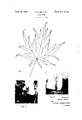
- FIG. 1 is an outline of a typical leaf of a tree of my invention, some of the major veins being shown, the stem being shortened for convenience;
- FIG. 2 is a color photograph of part of a tree of my invention.
- FIG. 3 is a color photograph of a two-year-old tree of my invention.
- FIG. 1 a typical leaf outline is shown. While it is apparent by comparing the leaf of FIGURE 1 with the leaf of a sugar maple tree, that the leaf of the tree of my invention is derived from the leaf of the sugar maple tree, my leaf is much more deeply cleft and the lobes are considerably narrower than the lobes of a leaf of the sugar maple tree.
- the side lobes on the main lobes of my leaf are better developed and defined by deeper clefts than those of the leaf of the sugar maple tree.
- the central main lobe has two definite side lobes, one on each side, and only the commencement of two other lobes in the form of bulges.
- the central main lobe has four well defined side lobes. This difference also exists between my leaf and that of the leaf of the Oregon maple, acer macrophyllum.
- the lea-f of my tree is also distinguished from other maple leaves, for instance, the silver maple tree, acer Plant Pat. 2,139 Patented Apr. 24, 1962 ice saccharinum, in that the marginal edges of the lobes of my leaf are relatively smooth (like the edges of the leaf of the sugar maple tree) whereas the margins of the lobes of the leaf of the silver maple tree are serrated. Also, the clefts of my leaf are deeper and the lobes better developed.
- the leaves of my tree approximate those of the sugar maple tree, although some of the larger leaves of my tree may have a lateral span of twelve or more inches.
- Trunk Similar in shape, form, coloration and appearance to that of the sugar maple tree.
- a new and distinct variety of sugar maple tree substantially as herein shown and described, characterized particularly as to novelty by having leaves similar to those of the sugar maple tree, but distinctly more deeply cleft and with narrower and better developed lobes.
Description
April 24, 1962 D BELCHER Plant Pat. 2,139
MAPLE TREE Filed Dec. 2, 1960 IN VENTOR.
Dorrold D. Belcher Buckhorn, Cheafham 8 Blore ATTORNEYS Uited States 2,139 MAPLE TREE Dar-mid D. Belcher, 210 SE. Vista Ave., Gresham, Greg. Filed Dec. 2, 1960, Ser. No. 73,467 1 Claim. (Cl. 47-59) The present invention relates to a new and distinct variety of maple tree, believed to be a variety of the sugar maple tree, acer saccharum.
The primary distinguishing characteristics of my variety of maple tree is the form of its leaf which is strikingly more deeply lobed than the leaf of the sugar maple tree. The leaf differences can best be defined by comparison to leaves of other maple trees.
My new variety of maple tree was found by me as a seedling in a nursery which is located near Gresham, Oregon and which contains many other trees and particularly sugar maple trees.
I have reproduced near Gresham, Oregon, the new variety asexually, specifically by removing buds from trees of my invention and budding themv onto regular sugar maple trees. After the budding has taken, the upper part of the stock tree is removed. The characteristics of my tree haveproved to be firmly fixed.
FIG. 1 is an outline of a typical leaf of a tree of my invention, some of the major veins being shown, the stem being shortened for convenience;
FIG. 2 is a color photograph of part of a tree of my invention; and
FIG. 3 is a color photograph of a two-year-old tree of my invention.
Referring to the drawings, a typical leaf outline is shown. While it is apparent by comparing the leaf of FIGURE 1 with the leaf of a sugar maple tree, that the leaf of the tree of my invention is derived from the leaf of the sugar maple tree, my leaf is much more deeply cleft and the lobes are considerably narrower than the lobes of a leaf of the sugar maple tree. The side lobes on the main lobes of my leaf are better developed and defined by deeper clefts than those of the leaf of the sugar maple tree. For instance, in the sugar maple leaf, the central main lobe has two definite side lobes, one on each side, and only the commencement of two other lobes in the form of bulges. In my leaf, the central main lobe has four well defined side lobes. This difference also exists between my leaf and that of the leaf of the Oregon maple, acer macrophyllum.
The lea-f of my tree is also distinguished from other maple leaves, for instance, the silver maple tree, acer Plant Pat. 2,139 Patented Apr. 24, 1962 ice saccharinum, in that the marginal edges of the lobes of my leaf are relatively smooth (like the edges of the leaf of the sugar maple tree) whereas the margins of the lobes of the leaf of the silver maple tree are serrated. Also, the clefts of my leaf are deeper and the lobes better developed.
The color of my leaves in the spring, summer and fall is substantially the same as that of the sugar maple tree in the same periods.
In overall size, the leaves of my tree approximate those of the sugar maple tree, although some of the larger leaves of my tree may have a lateral span of twelve or more inches.
Following is a brief description of my new variety:
Tree: Upright, healthy.
Growth: Rapid and vigorous, attaining a height of 6 to 10 feet at two years. Somewhat similar to the sugar maple tree, but in many instances more vigorous.
Trunk: Similar in shape, form, coloration and appearance to that of the sugar maple tree.
Foliage:
Size.Large. In first year trees budded on strong understock, the leaf size will be larger than on the same tree during its subsequent years of growth. For instance, on such a first year tree in September a smaller leaf will have a span of around 5 or 6 inches and a height from base to tip of around four inches, whereas the larger leaves vary from this size upward in excess of 12 inches in breadth and 8 or 9 inches and greater in height. The same tree, two or three years old, will have leaves of more normal size, around 3 A5 /2 inches in breadth.
Shape.--Palmately divided, very deeply cleft with narrow lobes. The ratio of theheight of the leaf from the base to the top tip in relation to the distance from the base to the level of the commencement of the main clefts for the central lobes varies roughly between a ratio of 5 to 1 and 8 to 1.
Color: Same as the sugar maple tree.
Having thus described my invention, I claim:
A new and distinct variety of sugar maple tree substantially as herein shown and described, characterized particularly as to novelty by having leaves similar to those of the sugar maple tree, but distinctly more deeply cleft and with narrower and better developed lobes.
No references cited.
Family
ID=
Similar Documents
| Publication | Publication Date | Title |
|---|---|---|
| USPP2139P (en) | Maple tree | |
| USPP2759P (en) | Norway maple tree | |
| Pardy | Notes on Indigenous Trees | |
| Mason et al. | GROWTH AND CORRELATION IN THE OIL‐PALM (ELAEIS GUINEENSIS) | |
| Fielding | Leans in Monterey pine (Pinus radiata) plantations | |
| Bassett | Thinning loblolly pine from above and below | |
| Mullin | Influence of depth and method of planting on white spruce | |
| Helmers | Effect of pruning on growth of western white pine | |
| USPP2075P (en) | Bougainvillea plant | |
| SU1662427A1 (en) | Method of tree plantation | |
| USPP281P (en) | Snapdragon | |
| USPP2397P (en) | Grapevine | |
| USPP4051P (en) | Peach tree | |
| USPP288P (en) | horvath | |
| Moore | Spraying and Dusting Experiments on the Control of Apple Scab (Venturia Inaequalis) and Apple Mildew (Podosphaera Leucotricha) at East Malling in 1931-1932 | |
| USPP8790P (en) | Aceraceae Dolorosa et Jeromus | |
| USPP1695P (en) | Pltjmtree | |
| USPP3796P (en) | Nectarine tree | |
| USPP3769P (en) | wandell p | |
| Cameron et al. | Effect of fertilization, ringing, blossoming and fruiting on the nitrogen content of avocado leaves | |
| USPP139P (en) | x x x xx | |
| USPP3722P (en) | bis jl | |
| Rehder | Notes on hybrids of Quercus ilicifolia | |
| USPP2743P (en) | Dogwood tree | |
| USPP73P (en) | simpson |