USPP20521P3 - Helichrysum plant named ‘Amber Cluster’ - Google Patents
Helichrysum plant named ‘Amber Cluster’ Download PDFInfo
- Publication number
- USPP20521P3 USPP20521P3 US12/148,871 US14887108V USPP20521P3 US PP20521 P3 USPP20521 P3 US PP20521P3 US 14887108 V US14887108 V US 14887108V US PP20521 P3 USPP20521 P3 US PP20521P3
- Authority
- US
- United States
- Prior art keywords
- rhs
- color
- amber
- cluster
- orange
- Prior art date
- Legal status (The legal status is an assumption and is not a legal conclusion. Google has not performed a legal analysis and makes no representation as to the accuracy of the status listed.)
- Active
Links
Images

Classifications
-
- A—HUMAN NECESSITIES
- A01—AGRICULTURE; FORESTRY; ANIMAL HUSBANDRY; HUNTING; TRAPPING; FISHING
- A01H—NEW PLANTS OR NON-TRANSGENIC PROCESSES FOR OBTAINING THEM; PLANT REPRODUCTION BY TISSUE CULTURE TECHNIQUES
- A01H6/00—Angiosperms, i.e. flowering plants, characterised by their botanic taxonomy
- A01H6/14—Asteraceae or Compositae, e.g. safflower, sunflower, artichoke or lettuce
-
- A—HUMAN NECESSITIES
- A01—AGRICULTURE; FORESTRY; ANIMAL HUSBANDRY; HUNTING; TRAPPING; FISHING
- A01H—NEW PLANTS OR NON-TRANSGENIC PROCESSES FOR OBTAINING THEM; PLANT REPRODUCTION BY TISSUE CULTURE TECHNIQUES
- A01H5/00—Angiosperms, i.e. flowering plants, characterised by their plant parts; Angiosperms characterised otherwise than by their botanic taxonomy
- A01H5/02—Flowers
Definitions
- the present invention comprises a new and distinct cultivar of Helichrysum , botanically known as Helichrysum ⁇ amorginum and hereinafter referred to by the cultivar name ‘Amber Cluster’.
- the new cultivar originated from an open pollination made in Derby, Chaddesden, United Kingdom in Spring 1999.
- the female parent was the Helichrysum plant ‘Ruby Cluster’ (unpatented) while the male parent was one of a range of Helichrysum amorginum hybrids.
- FIG. 1 shows overall plant habit including foliage and flower buds.
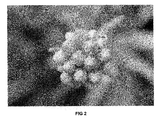
- FIG. 2 shows a close-up of a cluster of flower buds.
- ‘Amber Cluster’ differs from the female parent ‘Ruby Cluster’ (unpatented) in that ‘Amber Cluster’ has amber flower buds which fade to pale yellow with age while ‘Ruby Cluster’ has deep ruby-red flower buds which fade to pale pink and become almost white with age.
- ‘Amber Cluster’ differs from the possible male parent, one of a range of Helichrysum amorginum hybrids, in that ‘Amber Cluster’ has amber flower buds while the hybrids have yellow flower buds.
Landscapes
- Life Sciences & Earth Sciences (AREA)
- Health & Medical Sciences (AREA)
- Physiology (AREA)
- Botany (AREA)
- Developmental Biology & Embryology (AREA)
- Environmental Sciences (AREA)
- Natural Medicines & Medicinal Plants (AREA)
- Breeding Of Plants And Reproduction By Means Of Culturing (AREA)
Abstract
A new Helichrysum plant particularly distinguished by its amber flower buds and by its good tolerance to powdery mildews, is disclosed.
Description
Genus and species: Helichrysum×amorginum.
Variety denomination: ‘Amber Cluster’.
The present invention comprises a new and distinct cultivar of Helichrysum, botanically known as Helichrysum×amorginum and hereinafter referred to by the cultivar name ‘Amber Cluster’. The new cultivar originated from an open pollination made in Derby, Chaddesden, United Kingdom in Spring 1999. The female parent was the Helichrysum plant ‘Ruby Cluster’ (unpatented) while the male parent was one of a range of Helichrysum amorginum hybrids.
In Summer 2001 a single plant was selected for its amber flower buds. This selection was asexually propagated by vegetative cuttings and further evaluated in Derby, Chaddesden, United Kingdom to confirm the uniformity and stability of its characteristics. The present invention has been found to retain its distinctive characteristics through successive asexual propagations.
The following are the most outstanding and distinguishing characteristics of this new cultivar when grown under normal horticultural practices in Derby, Chaddesden, and Bressingham, United Kingdom.
-
- 1. Amber flower buds; and
- 2. Good tolerance to powdery mildews.
This new Helichrysum plant is illustrated by the accompanying photographs which show overall plant habit including foliage and flower buds; the colors shown are as true as can be reasonably obtained by conventional photographic procedures. The photographs are of one-year-old plants.
The following detailed descriptions set forth the distinctive characteristics of ‘Amber Cluster’. The data which define these characteristics were collected from asexual reproductions carried out in Bressingham, United Kingdom. The plant history was taken on one-year-old plants grown outdoors in a 3-liter container; no growth retardants were used. The range of daytime temperatures was 8° C. to 30° C. while the range of nighttime temperatures was 3° C. to 15° C. Color readings were taken outdoors under natural light. Color references are primarily to The R.H.S. Colour Chart of The Royal Horticultural Society of London (RHS) (2001 edition).
- Classification:
-
- Family.—Asteraceae.
- Botanical.—Helichrysum×amorginum.
- Common name.—Strawflower, Everlasting flower.
-
- Parentage:
-
- Female parent.—Helichrysum ‘Ruby Cluster’ (unpatented).
- Male parent.—An unnamed individual plant of Helichrysum amorginum (unpatented).
-
- Plant:
-
- Habit.—Perennial in USDA zones 8 to 10, annual in colder zones.
- Form.—Spreading.
- Height (from top of soil, excluding flowers).—20.0 cm to 26.0 cm.
- Width (horizontal plant diameter).—20.0 cm to 26.0 cm.
- Propagation.—Cuttings.
- Time to initiate and develop roots.—15 days in summer.
- Time to produce a rooted young plant.—70 days in summer.
- Time to produce a finished flowering plant.—215 days.
- Root description.—Thin, fibrous, dense, freely branching, RHS 161B (Greyed-yellow) in color.
- Keeping quality.—Flower buds, if cut when in full color, will retain this color when dried; on the plant the flowers retain their color for about 25 days before starting to change color.
- Temperature tolerance.—In the United Kingdom, the lowest temperature was −5° C. and the highest temperature was 30° C.
-
- Branches or stems:
-
- Type (lateral, rosette, etc.).—Rosette of stems arising from a woody center.
- Quantity per plant.—Many, dense.
- Length.—20.0 cm to 26.0 cm.
- Diameter.—0.4 cm.
- Internode length.—1.0 cm.
- Aspect.—Pendulous to upright.
- Strength.—Strong.
- Texture.—Soft and smooth, the effect given by the dense pubescence.
- Pubescense.—Dense, pannose.
- Color.—Upper: RHS 189B (Greyed-green) and RHS 189C (Greyed-green) Lower: RHS 189C (Greyed-green).
-
- Leaves:
-
- Arrangement.—Alternate.
- Shape.—Lanceolate.
- Color.—Immature leaf: Upper: RHS 189B (Greyed-green) and RHS 189C (Greyed-green). Lower: RHS 189C (Greyed-green). Mature leaf: Upper surface: RHS 189B (Greyed-green). Lower surface: RHS 189C (Greyed-green).
- Texture (both surfaces).—Pubescent.
- Length.—6.0 cm to 8.0 cm.
- Width.—1.5 cm.
- Apex.—Rounded.
- Base.—Acuminate.
- Margin.—Entire.
- Venation pattern.—Leaf pubescence covers both sides of leaf, no venation observed.
- Pubescence coverage of the leaf (both sides).—Densely covers the leaf.
- Pubescence color (both surfaces).—RHS 189D (Greyed-green).
- Petiole.—Absent, amplexicaul.
-
- Flower buds:
-
- Color.—Between RHS 24A (Orange) and RHS 24C (Orange) with a light flush at the tips of RHS 25A (Orange).
- Length or Height.—1.0 cm.
- Diameter.—0.5 cm.
- Shape.—Orbicular.
- Texture.—Paper-like.
-
- Inflorescence:
-
- Blooming habit (flowering season).—March to May.
- Form.—Compound umbel.
- Quantity of inflorescences on the plant.—30 to 50.
- Lastingness of inflorescences on the plant.—Long lasting, can be dried and will retain color as is when cut.
- Fragrance.—Absent.
- Diameter.—5.0 cm for entire umbel, 1.0 cm for single inflorescence.
- Depth (height).—4.0 cm for entire umbel, 1.0 cm for single inflorescence.
- Disc diameter.—0.05 cm.
- Receptacle diameter.—0.1 cm.
- Receptacle height.—0.5 cm.
-
- Involucral bracts or ray florets:
-
- Appearance.—Papery, smooth.
- Aspect.—Curved, upright.
- Shape.—Obovate.
- Length.—0.4 cm.
- Width.—0.1 cm.
- Apex.—Obtuse.
- Base.—Attenuate.
- Margin.—Entire.
- Texture.—Papery.
- Orientation or aspect.—Facing upward.
- Number per inflorescence.—25 to 45.
- Color (when opening).—Upper surface: RHS 25A (Orange) spreading down from tip to RHS 24C (Orange). Lower surface: RHS 24C (Orange).
- Color (when fully opened).—Upper surface: RHS 24A (Orange) spreading down to RHS 24D (Orange). Lower surface: RHS 24C (Orange). Fading to RHS 4A (Yellow) towards end of flowering period (both surfaces).
-
- Disc florets:
-
- Arrangement.—Clustered upright.
- Shape.—Linear.
- Apex.—Acute.
- Length.—0.1 cm.
- Width.—0.05 cm.
- Diameter of disc.—0.4 cm.
- Number or quantity per inflorescence.—80 to 100.
- Base.—Attenuate.
- Margin—Entire.
- Color.—Immature: RHS 150B (Yellow-green) Mature: RHS 21A (Yellow-orange) Apex: RHS 21A (Yellow-orange) Mid-section: RHS 21C (Yellow-orange) Base: RHS 150D (Yellow-green).
-
- Phyllaries:
-
- Quantity per inflorescence.—10 to 15.
- Length.—0.2 cm.
- Width.—0.2 cm.
- Shape.—Obovate.
- Apex.—Obtuse.
- Base.—Attenuate.
- Margin.—Entire.
- Texture (both surfaces).—Soft.
- Color (both surfaces).—RHS189C (Greyed-green).
-
- Peduncle:
-
- Length.—1.0 cm.
- Diameter.—0.1 cm.
- Strength.—Strong.
- Aspect.—Upright.
- Texture.—Soft.
- Color.—RHS 189C (Greyed-green).
-
- Pedicel:
-
- Length.—0.5 cm.
- Diameter.—0.1 cm.
- Color.—RHS 189D (Greyed-green).
-
- Reproductive organs:
-
- Androecium.—Only on disc florets. Filaments: Length: 0.2 cm. Diameter: 0.005 cm. Color: RHS 21A (Yellow-orange). Anthers: Shape: Cylindrical. Length: 0.1 cm. Diameter: 0.005 cm. Color: RHS 21A (Yellow-orange). Pollen: Amount: Sparse. Color: RHS 20D (Yellow-orange).
- Gynoecium.—Pistil length: 0.2 cm. Stigma: Shape: Simple. Length: 0.005 cm. Color: RHS 21A (Yellow-orange). Style: Length: 0.15 cm. Color: RHS 150D (Yellow-green). Ovary color: RHS 150D (Yellow-green).
-
- Seeds:
-
- Color.—RHS 173D (Greyed-orange).
- Shape.—Oval, slightly compressed, hairless.
- Length: 0.1 cm.
- Width: 0.1 cm.
- Quantity.—800 to 2,000, seed setting is variable from year to year.
-
- Disease and insect resistance: Good tolerance to powdery mildews; no pest problems observed.
‘Amber Cluster’ differs from the female parent ‘Ruby Cluster’ (unpatented) in that ‘Amber Cluster’ has amber flower buds which fade to pale yellow with age while ‘Ruby Cluster’ has deep ruby-red flower buds which fade to pale pink and become almost white with age.
‘Amber Cluster’ differs from the possible male parent, one of a range of Helichrysum amorginum hybrids, in that ‘Amber Cluster’ has amber flower buds while the hybrids have yellow flower buds.
Claims (1)
1. A new and distinct cultivar of Helichrysum plant as shown and described herein.
Priority Applications (1)
| Application Number | Priority Date | Filing Date | Title |
|---|---|---|---|
| US12/148,871 USPP20521P3 (en) | 2008-04-23 | 2008-04-23 | Helichrysum plant named ‘Amber Cluster’ |
Applications Claiming Priority (1)
| Application Number | Priority Date | Filing Date | Title |
|---|---|---|---|
| US12/148,871 USPP20521P3 (en) | 2008-04-23 | 2008-04-23 | Helichrysum plant named ‘Amber Cluster’ |
Publications (2)
| Publication Number | Publication Date |
|---|---|
| US20090271899P1 US20090271899P1 (en) | 2009-10-29 |
| USPP20521P3 true USPP20521P3 (en) | 2009-12-01 |
Family
ID=41216320
Family Applications (1)
| Application Number | Title | Priority Date | Filing Date |
|---|---|---|---|
| US12/148,871 Active USPP20521P3 (en) | 2008-04-23 | 2008-04-23 | Helichrysum plant named ‘Amber Cluster’ |
Country Status (1)
| Country | Link |
|---|---|
| US (1) | USPP20521P3 (en) |
-
2008
- 2008-04-23 US US12/148,871 patent/USPP20521P3/en active Active
Also Published As
| Publication number | Publication date |
|---|---|
| US20090271899P1 (en) | 2009-10-29 |
Similar Documents
| Publication | Publication Date | Title |
|---|---|---|
| USPP20521P3 (en) | Helichrysum plant named ‘Amber Cluster’ | |
| USPP18528P2 (en) | Redbud tree named ‘Cascading Hearts’ | |
| USPP20476P2 (en) | Helichrysum plant named ‘Pink Sapphire’ | |
| USPP21128P2 (en) | Lobelia plant named ‘KLELE08621’ | |
| USPP16045P2 (en) | Dahlia plant named ‘Cocos’ | |
| USPP23600P2 (en) | Helichrysum plant named ‘Ember Glow’ | |
| USPP19051P3 (en) | Curcuma plant named ‘Curtina’ | |
| US20130247266P1 (en) | Helleborus plant named 'ABCRD02' | |
| USPP16086P3 (en) | Dahlia plant named ‘Bounty’ | |
| USPP25716P3 (en) | Rhipsalidopsis plant named ‘PKMRhips07’ | |
| USPP21129P2 (en) | Lobelia plant named ‘KLELE08623’ | |
| USPP20716P2 (en) | Gaillardia plant named ‘KIEGALYEL’ | |
| USPP25846P3 (en) | Rhipsalidopsis plant named ‘PKMRhips08’ | |
| USPP17593P2 (en) | Osteospermum plant named ‘Balserdalav’ | |
| USPP25833P2 (en) | Distylium plant named ‘sPg-3-007’ | |
| USPP18985P2 (en) | Verbena plant named ‘Lan Upviot’ | |
| USPP19288P2 (en) | Dahlia plant named ‘Gallery La Tour’ | |
| USPP21088P2 (en) | Osteospermum plant named ‘KLEOE08149’ | |
| USPP20215P2 (en) | Lobelia plant named ‘KLELE07247’ | |
| USPP24781P3 (en) | Azalea plant named ‘RLH1-13P11’ | |
| USPP20718P2 (en) | Gaillardia plant named ‘KIEGALDAB’ | |
| USPP26353P3 (en) | Dahlia plant named ‘KLEDH13037’ | |
| USPP20112P2 (en) | Verbena plant named ‘KLEVP07360’ | |
| USPP26482P2 (en) | Argyranthemum plant named ‘SUN 350’ | |
| USPP22749P3 (en) | Phlox plant named ‘Barsixtyfive’ |