USPP196P - Freesia - Google Patents
Freesia Download PDFInfo
- Publication number
- USPP196P USPP196P US PP196 P USPP196 P US PP196P
- Authority
- US
- United States
- Prior art keywords
- plate
- freesia
- blossoms
- color
- red
- Prior art date
Links
- 241000597000 Freesia Species 0.000 title description 24
- 210000004369 Blood Anatomy 0.000 description 14
- 239000008280 blood Substances 0.000 description 14
- 210000000088 Lip Anatomy 0.000 description 10
- 240000002395 Euphorbia pulcherrima Species 0.000 description 4
- 241000950619 Geothlypis Species 0.000 description 4
- 235000019754 Grower Diet Nutrition 0.000 description 4
- 210000003800 Pharynx Anatomy 0.000 description 4
- CJOBVZJTOIVNNF-UHFFFAOYSA-N cadmium sulfide Chemical compound [Cd]=S CJOBVZJTOIVNNF-UHFFFAOYSA-N 0.000 description 4
- 238000004040 coloring Methods 0.000 description 4
- 230000017260 vegetative to reproductive phase transition of meristem Effects 0.000 description 4
- 241000196324 Embryophyta Species 0.000 description 2
- 240000007817 Olea europaea Species 0.000 description 2
- 210000001672 Ovary Anatomy 0.000 description 2
- 239000010975 amethyst Substances 0.000 description 2
- BDOSMKKIYDKNTQ-UHFFFAOYSA-N cadmium Chemical compound [Cd] BDOSMKKIYDKNTQ-UHFFFAOYSA-N 0.000 description 2
- 229910052793 cadmium Inorganic materials 0.000 description 2
- VYZAMTAEIAYCRO-UHFFFAOYSA-N chromium Chemical compound [Cr] VYZAMTAEIAYCRO-UHFFFAOYSA-N 0.000 description 2
- 239000003086 colorant Substances 0.000 description 2
- 235000009508 confectionery Nutrition 0.000 description 2
- 230000001788 irregular Effects 0.000 description 2
- 239000000203 mixture Substances 0.000 description 2
Images
Definitions
- This invention relates to freesias of the tinted or colored type.
- the object of this invention in general is to provide a more desirable coloring in the class known as red freesias, a larger number of blossoms of a deeper shade, stiff stems, with usually three or four long lateral spikes providing for as many successive cuttings, and other desirable and useful characteristics that will be hereinafter revealed.
- the plant is very upright in growth; an easy, vigorous grower; free flowering; clean foliage; and will produce under average greenhouse conditions spikes 33 inches long.
- blossoms are found on a single spike, although this may vary. They are borne upright along a rachis that is only slightly irregular and which is smoothly and gracefully bent at rightangles to the vertical stem or peduncle.
- the blossoms when fully open measure 1 to 1% inches across the top and average 2 inches in height.
- the perianth is tubular, long and gracefully slender.
- the six segments or lobes at the top of the perianth are broad and overlapping, slightly pointed, turning back very widely when fully opened to display all inside coloring,
- This variety of freesia has a sweet, pleasing odor.
- the general tonality of fully opened blossoms is blood red (Plate 3-L-11) or afghan red (Plate 5-L-6), the upper area of the petal lips being afghan red, and the middle portion blood red.
- the throat is lighter, being cadmium; yellow (Plate 9-L-8) becoming light chrome (Plate l0-L-4) at the base of the tube, both inside and outside.
- the upper area of the petal lips is blood red and the middle area poinsettia (Plate 2-L-9) which changes to the darker tones described above as the blossoms develop.
- the middle area poinsettia Platinum 2-L-9 which changes to the darker tones described above as the blossoms develop.
- On the inside of the petals one major and several fine median blood red stripes extend from the upper area of the petal lips down to the lower area of the tubes, while a number of short horizontal lines of poinsettia are to be found extending inwardly from the edge of the petal lips in the middle area on alternate lips. These stripes and markings are not visible on the outside of the tube.
- the color is Tyrian violet (Plate 44-K-5)
- the first color that appears in the buds is orchadee (Plate 42-H-4) changing to imperial purple (Plate 45-L-10) and Tyrian violet as the blood red of the blossoms begin to show.
- the sepals are 2 in number, piquant green (Plate 20-K-6) and loose fitting.
- Second Large number of blossoms produced on each spike with four or live commonly displayed at the same time.
Description
Sept. 29, 1936. A, FREY Plant Pat. 196
FREESIA Filed March 16, 1936 62 [ads We w YZ/QM Patented Sept. 29, 1936 v UNITED STATES Plant Pat. 196
PATENT OFFICE 1 Claim.
This invention relates to freesias of the tinted or colored type.
The object of this invention in general is to provide a more desirable coloring in the class known as red freesias, a larger number of blossoms of a deeper shade, stiff stems, with usually three or four long lateral spikes providing for as many successive cuttings, and other desirable and useful characteristics that will be hereinafter revealed.
To attain these objects repeated careful selections and crossings were made of various unnamed but numbered freesias of the type mentioned, until the results sought for were accomplished, and became known as #0.443.
The newness and distinctiveness of this new freesia were recognized by the Commercial Flower Growers of Chicago from observations made at Vaughans greenhouses at Western Springs, Illinois, where these freesias were also grown and displayed, and a certificate of merit was awarded at their regular meeting in February, 1936.
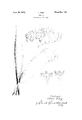
The accompanying illustration shows in approximately natural size and colors a branch of this new freesia with five fully opened flowers, several buds, and a lateral from the same general branch in a less mature stage. To further identify this new freesia, a typical blossom is split in two showing the inside of both halves, depicting the coloration and difference in markings in each set of lobes.
The following is a detailed description of this new variety of freesia, all references to color being based on Maerz & Paul's Dictionary of Color, edition of 1930.
The plant is very upright in growth; an easy, vigorous grower; free flowering; clean foliage; and will produce under average greenhouse conditions spikes 33 inches long. There are commonly 3 or 4 piquant green (Plate 20-K-6) sturdy laterals from 7 to 9 inches long from each bulb.
Usually 8 blossoms are found on a single spike, although this may vary. They are borne upright along a rachis that is only slightly irregular and which is smoothly and gracefully bent at rightangles to the vertical stem or peduncle.
The blossoms when fully open measure 1 to 1% inches across the top and average 2 inches in height. The perianth is tubular, long and gracefully slender. The six segments or lobes at the top of the perianth are broad and overlapping, slightly pointed, turning back very widely when fully opened to display all inside coloring,
but are not bent abruptly at a right angle to the tube or perianth as is usual with some varieties.
Four or five blossoms on a spike are commonly open at one time with one or more buds beginning to show color.
Three amethyst (Plate 45-J-8) anthers show prominently in the throat of the blossom, as well as the six-branched pale yellow pistil. The ovary is ovoid, three-celled.
This variety of freesia has a sweet, pleasing odor.
Color: The general tonality of fully opened blossoms is blood red (Plate 3-L-11) or afghan red (Plate 5-L-6), the upper area of the petal lips being afghan red, and the middle portion blood red. The throat is lighter, being cadmium; yellow (Plate 9-L-8) becoming light chrome (Plate l0-L-4) at the base of the tube, both inside and outside.
In newly opened blossoms, the upper area of the petal lips is blood red and the middle area poinsettia (Plate 2-L-9) which changes to the darker tones described above as the blossoms develop. On the inside of the petals one major and several fine median blood red stripes extend from the upper area of the petal lips down to the lower area of the tubes, while a number of short horizontal lines of poinsettia are to be found extending inwardly from the edge of the petal lips in the middle area on alternate lips. These stripes and markings are not visible on the outside of the tube.
On the outside upper area of most lobes, the color is Tyrian violet (Plate 44-K-5) The first color that appears in the buds is orchadee (Plate 42-H-4) changing to imperial purple (Plate 45-L-10) and Tyrian violet as the blood red of the blossoms begin to show.
The sepals are 2 in number, piquant green (Plate 20-K-6) and loose fitting.
On the stems close to the point of attachment of each blossom, there is a touch of olive dra (Plate -J-5).
The most important characteristics which in combination, I believe, distinguish my new variety from all other freesias are:
First: Distinctive afghan or blood color with cadmium yellow throat.
Second: Large number of blossoms produced on each spike with four or live commonly displayed at the same time.
Third: Its upright, vigorous growth with stiff stems and laterals.
Fourth: Its producing three to four long laterred by its distinctive afghan or blood red color with cadmium yellow throat, free flowering habit, easy and. vigorous growth, stiff stems, and having 3 to 4 long laterals, assuring as many successive cuttings.
ALOIS FREY.
Family
ID=
Similar Documents
| Publication | Publication Date | Title |
|---|---|---|
| USPP44P (en) | op babtley | |
| USPP227P (en) | Gladiolus | |
| USPP32P (en) | Freesia | |
| USPP701P (en) | Flowering quince plant | |
| USPP340P (en) | Rose plant | |
| USPP1510P (en) | Rose plant | |
| USPP1372P (en) | Rose plant | |
| USPP901P (en) | Dwarf polyantha rose plant | |
| USPP318P (en) | Kniphofia ok tritoma | |
| USPP302P (en) | Snapdragon | |
| USPP700P (en) | Flowering quince plant | |
| USPP555P (en) | Freesia plant | |
| USPP504P (en) | brownell | |
| USPP484P (en) | Kose plant | |
| USPP935P (en) | Rose plant | |
| USPP928P (en) | Rose plant | |
| USPP202P (en) | mallerin | |
| USPP68P (en) | Snap dragon | |
| USPP285P (en) | nicolas | |
| USPP115P (en) | Hybrid tea rose | |
| USPP263P (en) | brownell | |
| USPP406P (en) | Begonia | |
| USPP427P (en) | Rose plant | |
| USPP129P (en) | mallerin | |
| USPP1432P (en) | Rose plant |