USPP18459P3 - Avocado tree named ‘Wheeling’ - Google Patents

Avocado tree named ‘Wheeling’ Download PDF

Info

Publication number
USPP18459P3
USPP18459P3 US11/205,815 US20581505V USPP18459P3 US PP18459 P3 USPP18459 P3 US PP18459P3 US 20581505 V US20581505 V US 20581505V US PP18459 P3 USPP18459 P3 US PP18459P3
Authority
US
United States
Prior art keywords
fruit
wheeling
inches
avocado
avocado tree
Prior art date
Legal status (The legal status is an assumption and is not a legal conclusion. Google has not performed a legal analysis and makes no representation as to the accuracy of the status listed.)
Active, expires
Application number
US11/205,815
Other versions
US20070044183P1 (en
Inventor
Neal Palmer Brooks
Current Assignee (The listed assignees may be inaccurate. Google has not performed a legal analysis and makes no representation or warranty as to the accuracy of the list.)
BROOKS TROPICALS HOLDING Inc
Original Assignee
BROOKS TROPICALS Inc
BROOKS TROPICALS LLC
Priority date (The priority date is an assumption and is not a legal conclusion. Google has not performed a legal analysis and makes no representation as to the accuracy of the date listed.)
Filing date
Publication date
Assigned to BROOKS TROPICALS, INC. reassignment BROOKS TROPICALS, INC. ASSIGNMENT OF ASSIGNORS INTEREST (SEE DOCUMENT FOR DETAILS). Assignors: BROOKS, NEAL PALMER
Application filed by BROOKS TROPICALS Inc, BROOKS TROPICALS LLC filed Critical BROOKS TROPICALS Inc
Priority to US11/205,815 priority Critical patent/USPP18459P3/en
Publication of US20070044183P1 publication Critical patent/US20070044183P1/en
Assigned to BROOKS TROPICALS, LLC reassignment BROOKS TROPICALS, LLC ASSIGNMENT OF ASSIGNORS INTEREST (SEE DOCUMENT FOR DETAILS). Assignors: BROOKS TROPICALS HOLDING, INC. F/K/A BROOKS TROPICALS, INC.
Application granted granted Critical
Publication of USPP18459P3 publication Critical patent/USPP18459P3/en
Assigned to BROOKS TROPICALS HOLDING, INC. reassignment BROOKS TROPICALS HOLDING, INC. ASSIGNMENT OF ASSIGNORS INTEREST (SEE DOCUMENT FOR DETAILS). Assignors: BROOKS TROPICALS, LLC
Active legal-status Critical Current
Adjusted expiration legal-status Critical

Links

Images

Classifications

    • AHUMAN NECESSITIES
    • A01AGRICULTURE; FORESTRY; ANIMAL HUSBANDRY; HUNTING; TRAPPING; FISHING
    • A01HNEW PLANTS OR NON-TRANSGENIC PROCESSES FOR OBTAINING THEM; PLANT REPRODUCTION BY TISSUE CULTURE TECHNIQUES
    • A01H6/00Angiosperms, i.e. flowering plants, characterised by their botanic taxonomy
    • A01H6/52Lauraceae, e.g. avocado
    • AHUMAN NECESSITIES
    • A01AGRICULTURE; FORESTRY; ANIMAL HUSBANDRY; HUNTING; TRAPPING; FISHING
    • A01HNEW PLANTS OR NON-TRANSGENIC PROCESSES FOR OBTAINING THEM; PLANT REPRODUCTION BY TISSUE CULTURE TECHNIQUES
    • A01H5/00Angiosperms, i.e. flowering plants, characterised by their plant parts; Angiosperms characterised otherwise than by their botanic taxonomy
    • A01H5/08Fruits

Definitions

  • Cultivar ‘Monroe’ was used as male and ‘Brooks Late’ as female in 1999 in Immokalee, Fla.
  • Several hundred cross-pollinated fruits were harvested and the seeds were planted in a lime stone soil in 1999 in Homestead, Fla. From those seeds, plants that did not show healthy growth, or those which showed signs of being overly susceptible to the scap fungus disease were discarded. Of the remaining plants, only one plant of the ‘Wheeling’ variety not only showed tolerance to scab but also matured in February to early March, and shows promise for commercial development.
  • the tree is now five years old. It differs from other late varieties and its parents on the lateness of the maturity of the fruit. ‘Wheeling’ presents more resistance than other late varieties do to Cerospora purpurea and Colletotrichum gloeosporoides pathogens. This variety's tolerance to frost is stronger than other late cultivars such as ‘Monroe’.
  • FIG. 1 shows leaf detail and a portion of the trunk at a lower portion of the avocado tree.
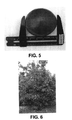
  • FIG. 5 shows the scale in inches of a typical fruit of the tree measured against a ruler.
  • FIG. 6 shows the sparse foliage near the upper portion of the avocado tree.
  • FIG. 7 shows the color and internal configuration of the fruit of FIG. 2 under marginally different lighting conditions.
  • FIG. 8 shows the dense foliage at the lower portion of the avocado tree.
  • the bark on the trunk and branches is light in color 2.5 Y (6/2).
  • One year old wood is somewhat darker at 7.5 YR (5/2).
  • New shoots average 0.5 inches in diameter and are greenish yellow 2.5GY (8/6).
  • FIG. 5 shows the outside of the fruit, which is an ovate berry that matures in in February to early March. It has a thick ( 1/16 inch) hard shelled exocarp, which is smooth textured, and dark green 5GY (4/6). The fruit weighs 12-16 ounces and averages 4.75 inches in length, as shown in FIG. 5 .
  • the seed is tight in the cavity, oblate, and is 1.75 to 2 inches long and is covered by a dark brown endocarp 5 YR (4/4).
  • the Cotyledons are textured and light brown in color 5 YR (6/8).

Landscapes

  • Life Sciences & Earth Sciences (AREA)
  • Health & Medical Sciences (AREA)
  • Physiology (AREA)
  • Botany (AREA)
  • Developmental Biology & Embryology (AREA)
  • Environmental Sciences (AREA)
  • Natural Medicines & Medicinal Plants (AREA)
  • Breeding Of Plants And Reproduction By Means Of Culturing (AREA)

Abstract

The Wheeling' avocado, which is a result of cross-pollination of the ‘Monroe’ and the ‘Brooks Late’ varieties, is of medium size, average 12-16 ounces and being about 4.75 inches in length, and has overall good eating qualities. The fruit matures and can be picked in February to early March. The fruit is an ovate berry that has a hard shelled, smooth textured, exocarp that is dark green.

Description

Scientific Name: Persea americana Mille var. ‘Wheeling’.
BACKGROUND OF THE INVENTION
During the decades of the ‘70’s, ‘80’s, and extending into the ‘90’s, attempts were made to grow avocado plants in an area of Southwest Florida near the town of Immokalee. Cold winter weather and repeated freezes eventually overcome most of the attempts by killing the trees or their fruit before they could reach maturity. Two varieties, however, were able to reach maturity. These were the ‘Monroe’, a type “B” flower, and the ‘Brooks Late’, a type “A” flower. Flowers on type “A” trees open as female in the morning of the first day and as male the afternoon of the following day. On type “B” trees the flowers open as female in the afternoon on the first day and as male on in the morning of the following day. Hence, the flower “types” are female: male complementary with respect to their periods of opening.
The ‘Monroe’ was larger, and could be used by customers who want large slices. The ‘Brooks Late’ was the latest maturing, but was too small for commercial sales. Cross pollination of these two varieties was attempted in an effort to produce an avocado having the best characteristics of each.
Cultivar ‘Monroe’ was used as male and ‘Brooks Late’ as female in 1999 in Immokalee, Fla. Several hundred cross-pollinated fruits were harvested and the seeds were planted in a lime stone soil in 1999 in Homestead, Fla. From those seeds, plants that did not show healthy growth, or those which showed signs of being overly susceptible to the scap fungus disease were discarded. Of the remaining plants, only one plant of the ‘Wheeling’ variety not only showed tolerance to scab but also matured in February to early March, and shows promise for commercial development.
BRIEF SUMMARY OF THE INVENTION
All color descriptions employ the Munsell Color Charts for Plant Tissues, Gretag Macbeth LLC, 617 Little Britain Road, New Windsor, N.Y. 12553-6148. The complete Munsell notation for any chromatic color is written: Hue (Value/Chroma).
Asexual propagation using branches was attained in 2002 in Homestead, Fla. when the plant was 3 years old.
The tree is now five years old. It differs from other late varieties and its parents on the lateness of the maturity of the fruit. ‘Wheeling’ presents more resistance than other late varieties do to Cerospora purpurea and Colletotrichum gloeosporoides pathogens. This variety's tolerance to frost is stronger than other late cultivars such as ‘Monroe’.
BRIEF DESCRIPTION OF THE DRAWINGS
FIG. 1 shows leaf detail and a portion of the trunk at a lower portion of the avocado tree.
FIG. 2 shows the color and internal configuration of the fruit and the seed.
FIG. 3 shows the middle and upper portion of the avocado tree.
FIG. 4 shows an alternative view of the middle and upper portions of the avocado tree.
FIG. 5 shows the scale in inches of a typical fruit of the tree measured against a ruler.
FIG. 6 shows the sparse foliage near the upper portion of the avocado tree.
FIG. 7 shows the color and internal configuration of the fruit of FIG. 2 under marginally different lighting conditions.
FIG. 8 shows the dense foliage at the lower portion of the avocado tree.
DETAILED BOTANICAL DESCRIPTION
The tree presents a vigorous upright growth with a spread of 13 feet and 20 feet high; as shown in FIGS. 1, 3, 4, 6 and 8. As included in FIG. 1, the diameter of the main trunk is 6-8 inches (obtained at 16 inches above the ground) tapering as it extends straight and upward to the pinnacle of the tree, pendant branches of 2-3 inches in diameter split off of the vertical trunk, these in turn giving way to smaller and smaller branches growing in pendant fashion. One year of wood averages one inch in diameter.
The bark on the trunk and branches is light in color 2.5 Y (6/2). One year old wood is somewhat darker at 7.5 YR (5/2). New shoots average 0.5 inches in diameter and are greenish yellow 2.5GY (8/6).
The foliage is of heavy density near the ground, becoming sparse toward the upper regions of the tree. Leaves are large and dark green, as appears in FIGS. 1, 3, 4, 6 and 8. The leaves are alternate, entire and, pinnately veined. They are elliptic, narrowly acute at the apex and acute at the base. The mature leaves are 7.25 to 12.2 inches in length and from 3.85 to 4.4 inches wide, the observed one in 9.2 inches long and 4.00 inches wide. Leaves are pubescent when young, becoming smooth and leathery when mature. The upper surface of the leaf exhibits a range of dark green from 7.5 CV (4/3 to 4/4). The underside of the leaf ranges from 5 GY (5/4 to 6/4). Leaf veins are a greenish yellow color of 2.5 GY (7/8). The petioles are 1.4 to 1.6 inches long and 0.125 inches in diameter; the observed one was 1.6 inches long and 0.125 inches wide. The petioles are 2.5 GY (7/6). The leaves are not fragrant when crushed.
Multiple flowers on axillary panicles are borne in a pseudoterminal position and the central axis of the inflorescence terminates in a shoot. Flowers are perfect, with 12 stamens, 9 of which are functional, each having 4 pollen chambers. The single pistil has one carpel with one ovule. The flowers are 0.375 to 0.5 inch in diameter. The lack petals but have 2 whorls of 3 perianth lobes, and are pubescent. The color of the lobes and the pistil is light green 2.5 GY (8/4), the sepals are darker at 2.5 GY (7/6), and the anthers are yellow 2.5 Y (8/10). The flowers are not fragrant. The tree blooms in April and the blooms are of the B type. Fruit matures and can be picked in March of the following year.
FIG. 5 shows the outside of the fruit, which is an ovate berry that matures in in February to early March. It has a thick ( 1/16 inch) hard shelled exocarp, which is smooth textured, and dark green 5GY (4/6). The fruit weighs 12-16 ounces and averages 4.75 inches in length, as shown in FIG. 5.
In FIGS. 2 and 7, the interior of the fruit is seen to have a mesocarp color that is green near the shell 5GY (7/8) and yellow near the seed cavity 5Y (8/10). Lenticels are numerous (100-200 per square inch) on the fruit and are light yellowish green in color 2.5 GY (7/10). The fruit also has an excellent flavor.
The seed is tight in the cavity, oblate, and is 1.75 to 2 inches long and is covered by a dark brown endocarp 5 YR (4/4). The Cotyledons are textured and light brown in color 5 YR (6/8).

Claims (1)

1. A new and distinct variety of avocado tree substantially as described and illustrated and characterized as to novelty by its overall good eating qualities, its medium size and its being ready to be picked in February to early March.
US11/205,815 2005-08-17 2005-08-17 Avocado tree named ‘Wheeling’ Active 2026-03-30 USPP18459P3 (en)

Priority Applications (1)

Application Number Priority Date Filing Date Title
US11/205,815 USPP18459P3 (en) 2005-08-17 2005-08-17 Avocado tree named ‘Wheeling’

Applications Claiming Priority (1)

Application Number Priority Date Filing Date Title
US11/205,815 USPP18459P3 (en) 2005-08-17 2005-08-17 Avocado tree named ‘Wheeling’

Publications (2)

Publication Number Publication Date
US20070044183P1 US20070044183P1 (en) 2007-02-22
USPP18459P3 true USPP18459P3 (en) 2008-01-22

Family

ID=37768656

Family Applications (1)

Application Number Title Priority Date Filing Date
US11/205,815 Active 2026-03-30 USPP18459P3 (en) 2005-08-17 2005-08-17 Avocado tree named ‘Wheeling’

Country Status (1)

Country Link
US (1) USPP18459P3 (en)

Cited By (1)

* Cited by examiner, † Cited by third party
Publication number Priority date Publication date Assignee Title
USPP23885P3 (en) 2011-12-27 2013-09-10 Julius Pflum Avocado tree named ‘Pflum's Best’

Cited By (1)

* Cited by examiner, † Cited by third party
Publication number Priority date Publication date Assignee Title
USPP23885P3 (en) 2011-12-27 2013-09-10 Julius Pflum Avocado tree named ‘Pflum's Best’

Also Published As

Publication number Publication date
US20070044183P1 (en) 2007-02-22

Similar Documents

Publication Publication Date Title
USPP11807P2 (en) Blueberry plant named ‘Jewel’
USPP25151P3 (en) Pummelo tree named ‘5-1-99-5’
USPP20027P3 (en) ‘Sweetcrisp’ southern highbush blueberry plant
USPP19381P2 (en) Southern highbrush blueberry plant named ‘FLX-2’
USPP18459P3 (en) Avocado tree named ‘Wheeling’
USPP27581P2 (en) Mandarin tree named ‘UFGlow’
USPP12439P2 (en) Avocado tree named ‘Alpha Krome’
USPP13931P2 (en) Blueberry plant called ‘Southern Belle’
US20070044184P1 (en) Neal avocado
USPP16594P3 (en) Avocado tree named ‘Carla’
USPP31232P2 (en) Crabapple tree named ‘JFS KW139MX’
USPP27276P3 (en) Citrus rootstock named ‘UFR-6’
US20150195975P1 (en) Citrus rootstock named 'ufr-16'
USPP16836P2 (en) Peach tree named ‘H28-52-96270’
USPP9827P (en) Asian pear tree named `Asio 2`
USPP16476P3 (en) Blueberry plant called ‘Abundance’
USPP14784P2 (en) Peach tree named ‘UFBeauty’
USPP21031P3 (en) Punica granatum plant named ‘PIIPG-I’
USPP24209P3 (en) Blueberry plant named ‘Perpetua’
US20090158478P1 (en) Apricot tree, 'MC5'
USPP19849P3 (en) Pear tree named ‘Todd’
USPP18639P2 (en) Apricot tree named ‘NJA150’
USPP14299P3 (en) Apple tree named ‘Irene’
USPP20167P2 (en) Crabapple tree named ‘Durleo’
USPP18224P3 (en) Peach tree named ‘NJ351’

Legal Events

Date Code Title Description
AS Assignment

Owner name: BROOKS TROPICALS, INC., FLORIDA

Free format text: ASSIGNMENT OF ASSIGNORS INTEREST;ASSIGNOR:BROOKS, NEAL PALMER;REEL/FRAME:016903/0441

Effective date: 20050502

AS Assignment

Owner name: BROOKS TROPICALS, LLC, FLORIDA

Free format text: ASSIGNMENT OF ASSIGNORS INTEREST;ASSIGNOR:BROOKS TROPICALS HOLDING, INC. F/K/A BROOKS TROPICALS, INC.;REEL/FRAME:019025/0166

Effective date: 20070301

AS Assignment

Owner name: BROOKS TROPICALS HOLDING, INC., FLORIDA

Free format text: ASSIGNMENT OF ASSIGNORS INTEREST;ASSIGNOR:BROOKS TROPICALS, LLC;REEL/FRAME:021138/0621

Effective date: 20080501