USPP15453P2 - Rose plant named ‘POULht003’ - Google Patents
Rose plant named ‘POULht003’ Download PDFInfo
- Publication number
- USPP15453P2 USPP15453P2 US10/812,739 US81273904V USPP15453P2 US PP15453 P2 USPP15453 P2 US PP15453P2 US 81273904 V US81273904 V US 81273904V US PP15453 P2 USPP15453 P2 US PP15453P2
- Authority
- US
- United States
- Prior art keywords
- group
- yellow
- color
- poulht003
- petals
- Prior art date
- Legal status (The legal status is an assumption and is not a legal conclusion. Google has not performed a legal analysis and makes no representation as to the accuracy of the status listed.)
- Expired - Lifetime
Links
- 241000220317 Rosa Species 0.000 title claims abstract description 10
- 244000018633 Prunus armeniaca Species 0.000 claims abstract description 3
- 235000009827 Prunus armeniaca Nutrition 0.000 claims abstract description 3
- 208000035240 Disease Resistance Diseases 0.000 claims description 3
- 235000010295 Rosa x kordesii Nutrition 0.000 claims description 2
- 244000269722 Thea sinensis Species 0.000 abstract description 2
- 241000196324 Embryophyta Species 0.000 description 9
- 229930002877 anthocyanin Natural products 0.000 description 6
- 235000010208 anthocyanin Nutrition 0.000 description 6
- 239000004410 anthocyanin Substances 0.000 description 6
- 150000004636 anthocyanins Chemical class 0.000 description 6
- 210000004907 gland Anatomy 0.000 description 4
- 230000000366 juvenile effect Effects 0.000 description 4
- 239000002023 wood Substances 0.000 description 4
- 238000009396 hybridization Methods 0.000 description 3
- 239000000049 pigment Substances 0.000 description 3
- 244000050053 Rosa multiflora Species 0.000 description 2
- 235000000656 Rosa multiflora Nutrition 0.000 description 2
- 150000001875 compounds Chemical class 0.000 description 2
- 230000001747 exhibiting effect Effects 0.000 description 2
- 230000012010 growth Effects 0.000 description 2
- 230000014759 maintenance of location Effects 0.000 description 2
- 241001465180 Botrytis Species 0.000 description 1
- 206010027146 Melanoderma Diseases 0.000 description 1
- 240000001140 Mimosa pudica Species 0.000 description 1
- 244000154511 Rosa hybrid cultivar Species 0.000 description 1
- 230000011681 asexual reproduction Effects 0.000 description 1
- 238000013465 asexual reproduction Methods 0.000 description 1
- 230000034303 cell budding Effects 0.000 description 1
- 238000005520 cutting process Methods 0.000 description 1
- 201000010099 disease Diseases 0.000 description 1
- 208000037265 diseases, disorders, signs and symptoms Diseases 0.000 description 1
- 238000011156 evaluation Methods 0.000 description 1
- 239000003205 fragrance Substances 0.000 description 1
- JEIPFZHSYJVQDO-UHFFFAOYSA-N iron(III) oxide Inorganic materials O=[Fe]O[Fe]=O JEIPFZHSYJVQDO-UHFFFAOYSA-N 0.000 description 1
- 210000000056 organ Anatomy 0.000 description 1
- 230000008635 plant growth Effects 0.000 description 1
- 230000000306 recurrent effect Effects 0.000 description 1
- 230000011514 reflex Effects 0.000 description 1
- 230000001850 reproductive effect Effects 0.000 description 1
Images


Classifications
-
- A—HUMAN NECESSITIES
- A01—AGRICULTURE; FORESTRY; ANIMAL HUSBANDRY; HUNTING; TRAPPING; FISHING
- A01H—NEW PLANTS OR NON-TRANSGENIC PROCESSES FOR OBTAINING THEM; PLANT REPRODUCTION BY TISSUE CULTURE TECHNIQUES
- A01H6/00—Angiosperms, i.e. flowering plants, characterised by their botanic taxonomy
- A01H6/74—Rosaceae, e.g. strawberry, apple, almonds, pear, rose, blackberries or raspberries
- A01H6/749—Rosa, i.e. roses
-
- A—HUMAN NECESSITIES
- A01—AGRICULTURE; FORESTRY; ANIMAL HUSBANDRY; HUNTING; TRAPPING; FISHING
- A01H—NEW PLANTS OR NON-TRANSGENIC PROCESSES FOR OBTAINING THEM; PLANT REPRODUCTION BY TISSUE CULTURE TECHNIQUES
- A01H5/00—Angiosperms, i.e. flowering plants, characterised by their plant parts; Angiosperms characterised otherwise than by their botanic taxonomy
- A01H5/02—Flowers
Definitions
- Botanical classification Rosa hybrid.
- the present invention constitutes a new and distinct variety of garden rose plant which originated from a controlled crossing between the female parent, an un-named seedling, and the male parent ‘POULduce’, described and illustrated in U.S. Plant patent application Ser. No. 09/277,239 (abandoned) dated Mar. 26, 1999. The two parents were crossed during the summer of 1994 and the resulting seeds were planted in a controlled environment in Fredensborg, Denmark. The new variety is named ‘POULht003’.
- the new variety may be distinguished from its pollen parent, ‘POULduce’ by the following combination of characteristics:
- flowers of the male pollen parent have a general tonality of Yellow Group 3C-4D
- flowers of ‘POULht002’ have a general tonality of Yellow-Orange Group 19C.
- ‘POULht003’ was selected in the spring 1995 by the inventors as a single plant from the progeny of the aforementioned hybridization.
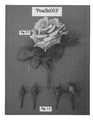
- FIG. 1 The accompanying color illustration shows as true as is reasonably possible to obtain in color photographs of this type, the typical characteristics of the buds, flowers, leaves, and stems, of ‘POULht003’. Specifically illustrated in FIG. 1 :
- FIG. 1.1 Stem showing open flower and the attachment of leaves, buds, and peduncles
- FIG. 1.2 Flower bud
- FIG. 2 Specifically illustrated in FIG. 2 :
- FIG. 2.1 Flower petals, detached
- FIG. 2.2 Sepals, receptacle, and peduncle
- FIG. 2.3 Mature leaf
- FIG. 2.4 Juvenile leaves exhibiting anthocyanin
- FIG. 2.5 Mature and juvenile stems exhibiting thorns.
- FIG. 3 Specifically illustrated in FIG. 3 :
- FIG. 3 Open flowers.
- Petal color Yellow-Orange Yellow-Orange upper surface Group 19C with Group 19C of outer intonations of petals Yellow Group 7D at basal zone. Color of Orange Group Yellow-Green flower petals 28C. Group 154C at as sepals base. Yellow- divide. Orange Group 22C towards the tip.
- Size 40 mm in length frombase of receptacle to the tip of the bud.
- Bud diameter is 20 mm.
- Bud form Long and pointed ovoid, broadening at the base.
- Bud color As sepals unfold, petals are Orange Group 28C. At 1 ⁇ 4 opening petals are Yellow Group 4B with intonations of Red Group 42B.
- Receptacle Surface: Smooth and glabrous. Shape: Urn-shaped. Size: 10 mm (h) ⁇ 10 mm (w). Color: Yellow-Green Group 145A. Anthocyanic pigments the color of Greyed-Red Group 181C observed.
- Peduncle .—Surface: Somewhat rough. Stipitate glands are very fragrant. Length: 30 to 35 mm. Color: Yellow-Green Group 145C. Anthocyanic pigments the color of Greyed-Red Group 181C. Strength: Strong.
- Fragrance . Light floral scent.
- the blooms have a duration on the plant of approximately 7 to 10 days. Petals fall cleanly away from plant after flowers have fully matured.
- Petalage On average 40 petals under normal conditions with 10 petaloids.
- petals Upon opening, petals:
- Outermost petals Outermost petals .—Outer side: Yellow-Orange Group 19C with strong intonations of Red Group 38B. Inner Side: Yellow-Orange Group 19C with intonations of Yellow Group 7D at basal zone.
- Innermost petals Outer side: Yellow-Orange Group 19C with strong intonations of Red Group 38B. Inner Side: Yellow-Orange Group 19C with intonations of Yellow Group 7D at basal zone.
- basal petal spots Upon opening, basal petal spots:
- Outermost petals Outer side: Yellow Group 5D. Inner Side: Yellow Group 5C to 5B.
- Outermost petals Outermost petals .—Outer side: Yellow-Orange Group 19C with strong intonations of Red Group 38B. Inner Side: Yellow-Orange Group 19C with intonations of Yellow Group 7D at basal zone.
- Innermost petals Outer side: Yellow-Orange Group 19C with strong intonations of Red Group 38B. Inner Side: Yellow-Orange Group 19C with intonations of Yellow Group 7D at basal zone.
- Outermost petals Outer side: Yellow Group 5D. Inner Side: Yellow Group 5C to 5B.
- Shape is slightly pointed to round. Base shape is rounded.
- Thickness Thick.
- Shape Acute base. Round apex.
- Stigmas Inferior relative to the length of the filaments and to the height of the anthers. Color: Yellow-Orange Group 18C.
- Plant growth Moderate, upright to bushy. When grown as a budded field grown plant on Rosa multiflora understock, the average height of the plant is 100 to 150 cm and the average width is 100 cm.
- Incidence 10 thorns per 10 cm of stem.
- Shape Deeply concave to concave.
- Plant foliage Normal number of leaflets on normal leaves in middle of the stem: 7 leaflets.
- Compound leaf size 185 mm (l) ⁇ 125 mm (w).
- Quantity Average to very.
- Plant leaves and leaflets Plant leaves and leaflets:
Landscapes
- Life Sciences & Earth Sciences (AREA)
- Health & Medical Sciences (AREA)
- Physiology (AREA)
- Botany (AREA)
- Developmental Biology & Embryology (AREA)
- Environmental Sciences (AREA)
- Natural Medicines & Medicinal Plants (AREA)
- Breeding Of Plants And Reproduction By Means Of Culturing (AREA)
Abstract
A new garden rose plant of the hybrid tea class which has abundant, apricot flowers and attractive foliage. This new and distinct variety has shown to be uniform and stable in the resulting generations from asexual propagation.
Description
Botanical classification: Rosa hybrid.
Variety denomination: ‘POULht003’.
The present invention constitutes a new and distinct variety of garden rose plant which originated from a controlled crossing between the female parent, an un-named seedling, and the male parent ‘POULduce’, described and illustrated in U.S. Plant patent application Ser. No. 09/277,239 (abandoned) dated Mar. 26, 1999. The two parents were crossed during the summer of 1994 and the resulting seeds were planted in a controlled environment in Fredensborg, Denmark. The new variety is named ‘POULht003’.
The new variety may be distinguished from its female seed parent by the following combination of characteristics:
1. While the seed parent has deep floral orange hues, flowers of ‘POULht003’ are lighter, orange-yellow in color.
2. ‘Poulht003’ is more disease resistant than the seed parent.
3. Flowers of the new variety, ‘POULht003’, have improved color retention than flowers of the seed parent.
The new variety may be distinguished from its pollen parent, ‘POULduce’ by the following combination of characteristics:
1. While flowers of the male pollen parent have a general tonality of Yellow Group 3C-4D, flowers of ‘POULht002’ have a general tonality of Yellow-Orange Group 19C.
2. While the male pollen parent has a flower petal count of 50-65 petals, ‘POULht003’ has 40 petals.
The objective of the hybridization of this rose variety was to create a new and distinct variety for garden use with unique qualities, such as:
1. Uniform and abundant apricot flowers with good color retention;
2. Vigorous, compact growth;
3. Disease resistance;
4. Classic rose flower form.
This combination of qualities is not present in previously available commercial cultivars of this type, known to the inventors, and distinguish ‘POULht003’ from all other varieties of which we are aware.
As part of their rose development program, L. Pernille Olesen and Mogens N. Olesen germinated the seeds from the aforementioned hybridization during winter of 1994 and conducted evaluations on the resulting seedlings in a controlled environment in Fredensborg, Denmark.
‘POULht003’ was selected in the spring 1995 by the inventors as a single plant from the progeny of the aforementioned hybridization.
Asexual reproduction of ‘POULht003’ by traditional budding and rooted cuttings was first done by L. Pernille and Mogens N. Olesen in their nursery in Fredensborg, Denmark in July, 1995. This initial and other subsequent asexual propagations conducted in controlled environments have demonstrated that the characteristics of ‘POULht003’ are true to type and are transmitted from one generation to the next.
The accompanying color illustration shows as true as is reasonably possible to obtain in color photographs of this type, the typical characteristics of the buds, flowers, leaves, and stems, of ‘POULht003’. Specifically illustrated in FIG. 1:
FIG. 1.1; Stem showing open flower and the attachment of leaves, buds, and peduncles;
FIG. 1.2; Flower bud;
Specifically illustrated in FIG. 2:
FIG. 2.1; Flower petals, detached;
FIG. 2.2; Sepals, receptacle, and peduncle;
FIG. 2.3; Mature leaf;
FIG. 2.4; Juvenile leaves exhibiting anthocyanin;
FIG. 2.5; Mature and juvenile stems exhibiting thorns.
Specifically illustrated in FIG. 3:
FIG. 3; Open flowers.
The following is a description of ‘POULht003’, as observed in its growth in a field nursery in Jackson County, Oreg. Observed plants are 3 years of age and were grown on Rosa multiflora rootstock. Color references are made using The Royal Horticultural Society (London, England) Colour Chart, 1995, except where common terms of color are used.
For a comparison, several physical characteristics of the rose variety ‘JACfehon’, a rose variety described and illustrated in U.S. Plant Pat. No. 11,617 issued Nov. 7, 2000, are compared to ‘POULht003’ in Chart 1.
| CHART 1 | ||||
| ‘Poulht003’ | ‘JACfehon’ | |||
| Petalage | 40 petals | 30 to 35 petals | ||
| Petal color: | Yellow-Orange | Yellow-Orange | ||
| upper surface | Group 19C with | Group 19C | ||
| of outer | intonations of | |||
| petals | Yellow Group 7D | |||
| at basal zone. | ||||
| Color of | Orange Group | Yellow-Green | ||
| flower petals | 28C. | Group 154C at | ||
| as sepals | base. Yellow- | |||
| divide. | Orange Group 22C | |||
| towards the tip. | ||||
Blooming habit: Recurrent.
Flower bud:
Size.—40 mm in length frombase of receptacle to the tip of the bud. Bud diameter is 20 mm.
Bud form.—Long and pointed ovoid, broadening at the base.
Bud color.—As sepals unfold, petals are Orange Group 28C. At ¼ opening petals are Yellow Group 4B with intonations of Red Group 42B.
Sepals.—Upper Surface: Color: Yellow-Green Group 145B with very weak anthocyanin Greyed-Red Group 182A. Surface: Strongly pubescent. Lower Surface: Color: Yellow-Green Group 145A. Anthocyanic pigments the color of Greyed-Red Group 182A. Sepal Shape: Sepal apex is cirrhose. Base is flat at union with receptacle. Sepal Margin: Margins have medium foliaceous appendages on three of the five sepals. Stipitate glands present in medium quantity. Size: 40 mm (l)×15 mm (w).
Receptacle.—Surface: Smooth and glabrous. Shape: Urn-shaped. Size: 10 mm (h)×10 mm (w). Color: Yellow-Green Group 145A. Anthocyanic pigments the color of Greyed-Red Group 181C observed.
Peduncle.—Surface: Somewhat rough. Stipitate glands are very fragrant. Length: 30 to 35 mm. Color: Yellow-Green Group 145C. Anthocyanic pigments the color of Greyed-Red Group 181C. Strength: Strong.
Borne.—In clusters of 1 to 4 flower buds per stem.
Flower bloom:
Fragrance.—Light floral scent.
Duration.—The blooms have a duration on the plant of approximately 7 to 10 days. Petals fall cleanly away from plant after flowers have fully matured.
Size.—Flower diameter is 115 mm when open. Flower depth is 60 m.
Form.—Classic hybrid tea shape with a tight center. Shape of flower when viewed from the side: Upon opening, upper part:Flat. Upon opening, lower part:Flattened convex. Open flower, upper part: Flat. Open flower, lower part: Convex.
Petalage: On average 40 petals under normal conditions with 10 petaloids.
Color: Upon opening, petals:
Outermost petals.—Outer side: Yellow-Orange Group 19C with strong intonations of Red Group 38B. Inner Side: Yellow-Orange Group 19C with intonations of Yellow Group 7D at basal zone.
Innermost petals.—Outer side: Yellow-Orange Group 19C with strong intonations of Red Group 38B. Inner Side: Yellow-Orange Group 19C with intonations of Yellow Group 7D at basal zone.
Upon opening, basal petal spots:
Outermost petals.—Outer side: Yellow Group 5D. Inner Side: Yellow Group 5C to 5B.
Innermost petals.—Outer side: Yellow Group 5D. Inner Side: Yellow Group 5C to 5B.
After opening, petals:
Outermost petals.—Outer side: Yellow-Orange Group 19C with strong intonations of Red Group 38B. Inner Side: Yellow-Orange Group 19C with intonations of Yellow Group 7D at basal zone.
Innermost petals.—Outer side: Yellow-Orange Group 19C with strong intonations of Red Group 38B. Inner Side: Yellow-Orange Group 19C with intonations of Yellow Group 7D at basal zone.
After opening, basal petal spots:
Outermost petals.—Outer side: Yellow Group 5D. Inner Side: Yellow Group 5C to 5B.
Innermost petals.—Outer side: Yellow Group 5D. Inner Side: Yellow Group 5C to 5B.
General tonality: On open flower Yellow-Orange Group 19C. No change in the general tonality at the end of the 7th day.
Petals:
Petal reflex.—Strongly.
Margin.—Entire and uniform. Very weak undulations of margin observed.
Shape.—Apex is slightly pointed to round. Base shape is rounded.
Size.—50 to 55 mm (l)×50 mm (w).
Texture.—Smooth.
Thickness.—Thick.
Arrangement.—Not Formal.
Petaloids:
Quantity.—8 to 10.
Color.—Orange Group 24C, Yellow Group 5A and Red Group 38B.
Size.—34 mm (l)×25 mm (w).
Shape.—Acute base. Round apex.
Reproductive organs:
Pistils.—Length: 5 mm. Quantity: 65 (actual count).
Pollen.—None observed.
Anthers.—Size: 3 mm long. Color: Yellow-Orange Group 14B. Quantity: 90 (actual count).
Filaments.—Color: Yellow-Orange Group 15B. Length: 9 to 14 mm.
Stigmas.—Inferior relative to the length of the filaments and to the height of the anthers. Color: Yellow-Orange Group 18C.
Styles.—Color: Orange-Red Group 34A to Orange-Red Group 33B.
Hips.—None observed in the field nursery in Jackson County Oreg.
Plant growth: Moderate, upright to bushy. When grown as a budded field grown plant on Rosa multiflora understock, the average height of the plant is 100 to 150 cm and the average width is 100 cm.
Stems:
Color.—Young wood: Yellow-Green Group 145A to 145B with anthocyanic intonations of Greyed-Red Group 181B. Older wood: Yellow-Green Group 144C.
Surface texture.—Young wood: Smooth. Older wood: Smooth.
Thorns:
Incidence.—10 thorns per 10 cm of stem.
Size.—Average length: 9 mm.
Color.—Greyed-Red Group 181A to 182A.
Shape.—Deeply concave to concave.
Plant foliage: Normal number of leaflets on normal leaves in middle of the stem: 7 leaflets.
Compound leaf size.—185 mm (l)×125 mm (w).
Quantity.—Average to very.
Color.—Mature Foliage: Upper surface: Green Group 137B. Lower surface: Green Group 138C. Juvenile foliage: Upper surface: Greyed-Purple Group 183A to 187A. Lower surface: Greyed-Purple Group 183A to 187A. Anthocyanin: Location: Juvenile foliage and new shoots. Color: Greyed-Purple Group 183C.
Plant leaves and leaflets:
Stipules.—Size: 25 to 30 mm in length. Shape: Linear with outward extending apecies. Quantity: 2 per compound leaf. Margins: Finely serrated with abundant stipitate glands. Color: Yellow-Green Group 144B to 144C. Anthocyanin observed at margins, Greyed-Purple Group 183C.
Petiole.—Length: 45 to 50 mm. Above: Color: Yellow-Green Group 144B. Anthocyanin the color of Greyed-Purple Group 185B. Underneath: Very fragrant stipitate glands present. Lightly pubescent margins.
Rachis.—Length: 45 to 50 mm. Above: Color: Yellow-Green Group 144B. Anthocyanin: Greyed-Purple Group 185B. Underneath: Very fragrant stipitate glands present with light pubescence.
Leaflet.—Edge: Serrated. Size: 42 to 65 m (l)×36 to 46 mm (w). Shape: Generally ovate. Leaflet base is rounded. Apex shape is Mucronate. Texture: Smooth. Thickness: Thin. Arrangement: Odd pinnate. Venation: Reticulate. Glossiness: Moderately glossy.
Disease resistance: Above average resistance to mildew, rust, black spot, and Botrytis under normal growing conditions in Jackson County, Oreg.
Cold hardiness: The variety ‘POULht003’ has been found to be cold tolerant to USDA Cold Hardiness Zone 6.
Claims (1)
1. A new and distinct variety of rose plant of the hybrid tea rose class named ‘POULht003’, substantially as herein illustrated and described as a distinct and novel rose variety due to its abundant apricot flowers, disease resistance, and extended period of bloom.
Priority Applications (1)
| Application Number | Priority Date | Filing Date | Title |
|---|---|---|---|
| US10/812,739 USPP15453P2 (en) | 2004-03-29 | 2004-03-29 | Rose plant named ‘POULht003’ |
Applications Claiming Priority (1)
| Application Number | Priority Date | Filing Date | Title |
|---|---|---|---|
| US10/812,739 USPP15453P2 (en) | 2004-03-29 | 2004-03-29 | Rose plant named ‘POULht003’ |
Publications (1)
| Publication Number | Publication Date |
|---|---|
| USPP15453P2 true USPP15453P2 (en) | 2004-12-21 |
Family
ID=33511991
Family Applications (1)
| Application Number | Title | Priority Date | Filing Date |
|---|---|---|---|
| US10/812,739 Expired - Lifetime USPP15453P2 (en) | 2004-03-29 | 2004-03-29 | Rose plant named ‘POULht003’ |
Country Status (1)
| Country | Link |
|---|---|
| US (1) | USPP15453P2 (en) |
-
2004
- 2004-03-29 US US10/812,739 patent/USPP15453P2/en not_active Expired - Lifetime
Similar Documents
| Publication | Publication Date | Title |
|---|---|---|
| USPP15453P2 (en) | Rose plant named ‘POULht003’ | |
| USPP15499P2 (en) | Rose plant named ‘POULac008’ | |
| USPP15600P2 (en) | Rose plant named ‘POULpm001’ | |
| USPP16544P2 (en) | Shrub rose plant named ‘Poulcot003’ | |
| USPP15385P2 (en) | Rose plant named ‘POULpm003’ | |
| USPP15895P2 (en) | Compact floribunda rose plant named ‘Poulac014’ | |
| USPP15388P2 (en) | Rose plant named ‘Poulen012’ | |
| USPP15411P2 (en) | Climbing rose plant named ‘POULyc009’ | |
| USPP15771P2 (en) | Climbing rose plant named ‘POULyc008’ | |
| USPP16033P2 (en) | Rose plant named ‘POULfl001’ | |
| USPP15620P2 (en) | Rose plant named ‘POULen010’ | |
| USPP15730P2 (en) | Rose plant named ‘POULen005’ | |
| USPP15383P2 (en) | Rose plant named ‘POULpm002’ | |
| USPP15859P2 (en) | Floribunda rose plant named ‘POULcs015’ | |
| USPP15831P2 (en) | Compact floribunda rose plant named ‘POULac010’ | |
| USPP15549P2 (en) | Rose plant named ‘POULcs014’ | |
| USPP15384P2 (en) | Rose plant named ‘POULhi014’ | |
| USPP15167P2 (en) | Rose plant named ‘POULen011’ | |
| USPP15230P2 (en) | Rose plant named ‘POULtw002’ | |
| USPP15887P2 (en) | Rose plant named ‘POULen009’ | |
| USPP16402P3 (en) | Hybrid Tea Rose plant named ‘POULht002’ | |
| USPP15810P2 (en) | Floribunda rose plant named ‘Poulcs017’ | |
| USPP16128P3 (en) | Rose plant name ‘POULtw003’ | |
| USPP15106P2 (en) | Rose planet named ‘POULyc003’ | |
| USPP15643P2 (en) | Rose plant named ‘POULcs006’ |
Legal Events
| Date | Code | Title | Description |
|---|---|---|---|
| AS | Assignment |
Owner name: POULSEN ROSER A/S, DENMARK Free format text: ASSIGNMENT OF ASSIGNORS INTEREST;ASSIGNORS:OLESEN, L. PERNILLE;OLESEN, MOGENS N.;REEL/FRAME:015172/0400 Effective date: 20040305 |