USPP14448P2 - Apple tree: ‘Smith Gala’ - Google Patents
Apple tree: ‘Smith Gala’ Download PDFInfo
- Publication number
- USPP14448P2 USPP14448P2 US09/939,283 US93928301V USPP14448P2 US PP14448 P2 USPP14448 P2 US PP14448P2 US 93928301 V US93928301 V US 93928301V US PP14448 P2 USPP14448 P2 US PP14448P2
- Authority
- US
- United States
- Prior art keywords
- gala
- tree
- new variety
- smith
- munsell
- Prior art date
- Legal status (The legal status is an assumption and is not a legal conclusion. Google has not performed a legal analysis and makes no representation as to the accuracy of the status listed.)
- Expired - Lifetime, expires
Links
- 244000141359 Malus pumila Species 0.000 title claims abstract description 15
- 235000011430 Malus pumila Nutrition 0.000 title claims abstract description 10
- 235000015103 Malus silvestris Nutrition 0.000 title claims abstract description 8
- 235000013399 edible fruits Nutrition 0.000 abstract description 18
- 240000001140 Mimosa pudica Species 0.000 abstract description 3
- 230000035772 mutation Effects 0.000 abstract description 3
- 235000021016 apples Nutrition 0.000 description 5
- 239000002420 orchard Substances 0.000 description 5
- 239000007787 solid Substances 0.000 description 4
- 229920002472 Starch Polymers 0.000 description 3
- 230000001154 acute effect Effects 0.000 description 3
- 238000003306 harvesting Methods 0.000 description 3
- 235000019698 starch Nutrition 0.000 description 3
- 239000008107 starch Substances 0.000 description 3
- BJEPYKJPYRNKOW-REOHCLBHSA-N (S)-malic acid Chemical compound OC(=O)[C@@H](O)CC(O)=O BJEPYKJPYRNKOW-REOHCLBHSA-N 0.000 description 2
- 241001164374 Calyx Species 0.000 description 2
- BJEPYKJPYRNKOW-UHFFFAOYSA-N alpha-hydroxysuccinic acid Natural products OC(=O)C(O)CC(O)=O BJEPYKJPYRNKOW-UHFFFAOYSA-N 0.000 description 2
- 230000011681 asexual reproduction Effects 0.000 description 2
- 238000013465 asexual reproduction Methods 0.000 description 2
- 235000011090 malic acid Nutrition 0.000 description 2
- 239000001630 malic acid Substances 0.000 description 2
- 238000003892 spreading Methods 0.000 description 2
- 238000003860 storage Methods 0.000 description 2
- 238000012935 Averaging Methods 0.000 description 1
- 241000238631 Hexapoda Species 0.000 description 1
- 102000011842 Serrate-Jagged Proteins Human genes 0.000 description 1
- 108010036039 Serrate-Jagged Proteins Proteins 0.000 description 1
- 210000004027 cell Anatomy 0.000 description 1
- 210000002421 cell wall Anatomy 0.000 description 1
- 235000009508 confectionery Nutrition 0.000 description 1
- 238000004320 controlled atmosphere Methods 0.000 description 1
- 238000005336 cracking Methods 0.000 description 1
- 235000021185 dessert Nutrition 0.000 description 1
- 201000010099 disease Diseases 0.000 description 1
- 208000037265 diseases, disorders, signs and symptoms Diseases 0.000 description 1
- 230000000694 effects Effects 0.000 description 1
- 239000000796 flavoring agent Substances 0.000 description 1
- 235000019634 flavors Nutrition 0.000 description 1
- 239000003205 fragrance Substances 0.000 description 1
- 238000004519 manufacturing process Methods 0.000 description 1
- 230000008018 melting Effects 0.000 description 1
- 238000002844 melting Methods 0.000 description 1
- 230000035807 sensation Effects 0.000 description 1
- 235000019615 sensations Nutrition 0.000 description 1
Images




Classifications
-
- A—HUMAN NECESSITIES
- A01—AGRICULTURE; FORESTRY; ANIMAL HUSBANDRY; HUNTING; TRAPPING; FISHING
- A01H—NEW PLANTS OR NON-TRANSGENIC PROCESSES FOR OBTAINING THEM; PLANT REPRODUCTION BY TISSUE CULTURE TECHNIQUES
- A01H6/00—Angiosperms, i.e. flowering plants, characterised by their botanic taxonomy
- A01H6/74—Rosaceae, e.g. strawberry, apple, almonds, pear, rose, blackberries or raspberries
- A01H6/7418—Malus domestica, i.e. apples
-
- A—HUMAN NECESSITIES
- A01—AGRICULTURE; FORESTRY; ANIMAL HUSBANDRY; HUNTING; TRAPPING; FISHING
- A01H—NEW PLANTS OR NON-TRANSGENIC PROCESSES FOR OBTAINING THEM; PLANT REPRODUCTION BY TISSUE CULTURE TECHNIQUES
- A01H5/00—Angiosperms, i.e. flowering plants, characterised by their plant parts; Angiosperms characterised otherwise than by their botanic taxonomy
- A01H5/08—Fruits
Definitions
- Botanical classification Malus domestica.
- the invention relates to a new and distinct variety of apple tree, Malus domestica, which originated as a branch mutation of the ‘Tenroy cultivar’ Royal Gala® apple tree (U.S. Plant Pat. No. 4,121).
- the new variety, denominated ‘Smith Gala,’ was discovered by Joe Smith at his orchard located at 13477 Locust Lane, Nampa, Id.
- the tree having the mutated branch was found in a cultivated block of Royal Gala® (‘Tenroy cultivar’) apple trees with appropriate pollinators.
- Mr. Smith was attracted to the tree by the single limb that had fruit noticeably larger than, but otherwise similar to, the remainder of the tree and neighboring trees.
- the new variety is up to 15% larger, 40% heavier, and with a more oblate shape (lower L/D ratios) than fruit of the parent Royal Gala®.
- the new variety has been observed to bloom approximately three days later than its parent Royal Gala® tree, and has a thicker stem than other known ‘Gala’ cultivars.
- Fruit from the new variety is identical to that of its parent in taste and texture.
- Asexual reproduction of the ‘Smith Gala’ tree was successfully accomplished in August 1995 when Mr. Smith budded one tree on Malling No. 7 rootstock at his home orchard. In August 1996, 3 trees were budded on Malling No.
- the new variety has been compared to the parent tree, Royal Gala®, ‘Tenroy cultivar’. These comparisons are from the second generation trees growing at the orchard of Van Well Nursery, Inc., in Wenatchee, Wash. Physical and internal characteristics of the new variety and the parent are shown in Table 1 for apples picked in September 1999, and in Table 2 for apples picked in September 2000. Average diameter of apples of the new variety is approximately 7% to approximately 15% greater than that of Royal Gala® fruit; the length is slightly less (approximately 1.4% to approximately 7.9% less); and the fruit weight as measured in 2000 was approximately 39% greater. The difference in diameter is equivalent to 3 box sizes (from 100's to 72's) larger for the new variety as compared to Royal Gala® fruit.
- FIG. 1 shows typical fruit of the new variety on the tree, as observed in September 1999 at East Wenatchee, Wash.
- FIG. 2 shows individual fruits of the new variety taken from the tree of FIG. 1, showing the general shape and appearance of the cavity and calyx, the fruit having been picked approximately 3 weeks after the photograph of FIG. 1 .
- FIG. 3 compares apples of the new variety (left) with apples of the parent (right), the fruit appearing substantially identical except for the larger size and more oblate shape of the new variety (photo taken on the same date as FIG. 2 ).
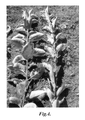
- FIG. 4 compares a new vegetative shoot of the new variety (left) with its parent (right), the leaves of the new variety appearing slightly larger, photograph taken a few days before the photograph of FIG. 1 .
- FIG. 5 compares a branch of the parent (bottom) in full bloom (April 2000) to a branch of the new variety (top) which reached an equivalent full bloom approximately 3 days later.
- FIG. 6 compares stem size for the new variety (left) with stem size of the parent (right), showing the larger diameter stems of the new variety.
- Tree Semi-dwarf size, between 9 and 10 feet tall and approximately 4 feet wide; High vigor, 70 to 100 cm annual new shoot growth in Wenatchee in 1999; General upright to globe shape; Round-topped; Hardy; Productive, production for trees in their 7th leaf averaged 3 boxes per tree; Regular bearer.
- Trunk Stocky; medium, 8 inches in circumference 1 foot above the ground; smooth when young, becoming rough as tree ages; gray to light brown (7.5 YR 6/2, Munsell Book of Color (hereinafter referred to as “Munsell”)).
- Pistil. Stigma medium length and branched at top into five elements, stiles medium (12 mm) fused at base.
- Buds. Small, short, conical-plump, approximately 10 mm long by approximately 5 mm wide, light pink (2.5 R 7/6 Munsell).
- Leaves Similar to ‘Tenroy cv.’; glossy on upper surface, finely pubescent on lower surface; medium size: average of 25 leaves sampled September 1999: 89 mm (65 to 100 mm) long, 50 mm (45 to 55 mm) wide; medium petiole, average 17 mm (15 to 20 mm), finely pubescent; finely serrate, acute to acuminate tip, acute base shape, 2 stipules averaging 10 mm in length, dark green (upper surface 5 GY 3/6 Munsell; lower surface 5 GY 6/4 Munsell).
- Stem cavity Medium width (35 mm), deep (22 mm), acute to acuminate.
- Basin cavity. Broad (35 mm), medium depth (10 mm), obtuse.
- Locules ( carpels ).—Small to medium size (average 25 mm), slightly open, 5 in number,; smooth skin with slight bloom, shiny but without greasiness, occasional flaring russett in stem cavity, medium thin, tendency to stem-end cracking as fruit becomes overmature; cream-colored (5 Y 9/4 Munsell) lenticels up to 1 mm in size, round, similar to ‘Tenroy cv.’;
- Flesh. Cream-color (5 Y 9/4 Munsell), very juicy, sweet, 12 to 15% soluble solids, non-astringent, sprightly flavor, low acidity (approximately 0.5% malic acid), medium to strong aroma (good apple aroma), 16.6 to 17.4 lbs. firmness at harvest, crisp, non-melting texture.
- Core. Bundle area round, 40 mm average width, 35 mm average length, core lines weakly defined, calyx tube closed, cell walls fairly thick (slow to break down in mouth, adding to the crunchy sensation).
- Seed Similar to ‘Tenroy cv.’, 2 per cell, obovate, dark brown (7.5 YR 9/2), 8 mm length ⁇ 4 mm width, loosely adhering to the carpel wall; keeping quality similar to ‘Tenroy cv.’: quality maintained up to 3 months in common storage (0° C.) and up to 5 months in controlled atmosphere storage, fruit remains firm and crisp at room temperature for at least one week.
Landscapes
- Life Sciences & Earth Sciences (AREA)
- Health & Medical Sciences (AREA)
- Physiology (AREA)
- Botany (AREA)
- Developmental Biology & Embryology (AREA)
- Environmental Sciences (AREA)
- Natural Medicines & Medicinal Plants (AREA)
- Breeding Of Plants And Reproduction By Means Of Culturing (AREA)
Abstract
A new and distinct variety of apple tree which originated as a branch mutation of ‘Tenroy cultivar’ Royal Gala® apple tree (U.S. Plant Pat. No. 4,121), characterized by larger fruit with thicker stem and later bloom time as compared to the parent.
Description
Botanical classification: Malus domestica.
The invention relates to a new and distinct variety of apple tree, Malus domestica, which originated as a branch mutation of the ‘Tenroy cultivar’ Royal Gala® apple tree (U.S. Plant Pat. No. 4,121).
The new variety, denominated ‘Smith Gala,’ was discovered by Joe Smith at his orchard located at 13477 Locust Lane, Nampa, Id. The tree having the mutated branch was found in a cultivated block of Royal Gala® (‘Tenroy cultivar’) apple trees with appropriate pollinators.
Mr. Smith was attracted to the tree by the single limb that had fruit noticeably larger than, but otherwise similar to, the remainder of the tree and neighboring trees. The new variety is up to 15% larger, 40% heavier, and with a more oblate shape (lower L/D ratios) than fruit of the parent Royal Gala®. The new variety has been observed to bloom approximately three days later than its parent Royal Gala® tree, and has a thicker stem than other known ‘Gala’ cultivars. Fruit from the new variety is identical to that of its parent in taste and texture. Asexual reproduction of the ‘Smith Gala’ tree was successfully accomplished in August 1995 when Mr. Smith budded one tree on Malling No. 7 rootstock at his home orchard. In August 1996, 3 trees were budded on Malling No. 26 rootstock in the test orchard of Van Well Nursery, Inc., located at 2821 Grant Road, Wenatchee, Wash., and 46 trees were budded on Malling 26 rootstock in the nursery of Van Well Nursery, Inc., at the same address. The nursery trees were planted in the spring of 1998. The test orchard trees (second generation) bore fruit in 1999 and 2000, and of the 46 nursery trees planted in the spring of 1998 (also second generation), approximately 30 bore fruit in 2000. Fruit of the second generation trees is identical to that of its parent.
The new variety has been compared to the parent tree, Royal Gala®, ‘Tenroy cultivar’. These comparisons are from the second generation trees growing at the orchard of Van Well Nursery, Inc., in Wenatchee, Wash. Physical and internal characteristics of the new variety and the parent are shown in Table 1 for apples picked in September 1999, and in Table 2 for apples picked in September 2000. Average diameter of apples of the new variety is approximately 7% to approximately 15% greater than that of Royal Gala® fruit; the length is slightly less (approximately 1.4% to approximately 7.9% less); and the fruit weight as measured in 2000 was approximately 39% greater. The difference in diameter is equivalent to 3 box sizes (from 100's to 72's) larger for the new variety as compared to Royal Gala® fruit. Samples of vegetative shoots were compared (see FIG. 4) and it appeared that the leaves of the new variety were slightly larger on average than those of Royal Gala®. At harvest time, the new variety exhibited a thicker stem (approximately 5 mm in diameter as compared to approximately 3 mm for other ‘Gala’ cultivars—see FIG. 6). In April 2000, it was observed that full bloom for the new variety was approximately 3 days later than for Royal Gala® trees.
| TABLE 1 |
| (1999) |
| ‘Smith cv.’ | ‘Tenroy cv.’ | ||
| Length (cm) | 6.86 | 6.96 | ||
| Diameter (cm) | 8.60 | 7.45 | ||
| L/D Ratio | 0.798 | 0.934 | ||
| Firmness (#) | 17.2 | 18.4 | ||
| Soluble Solids | 15.2% | 13.2% | ||
| Starch (1-6 scale) | 4.7 | 3.5 | ||
| TABLE 2 |
| (2000) |
| ‘Smith cv.’ | ‘Tenroy cv.’ | ||
| Weight (gm) | 2.84 | 2.04 | ||
| Length (cm) | 7.00 | 7.55 | ||
| Diameter (cm) | 8.57 | 8.02 | ||
| L/D Ratio | 0.817 | 0.941 | ||
| Firmness (#) | 16.7 | 16.8 | ||
| Soluble Solids (%) | 12.9 | 13.0 | ||
| Starch (1-6 scale) | 3.0 | 2.5 | ||
The accompanying photographs show the following characteristics of this new variety:
FIG. 1 shows typical fruit of the new variety on the tree, as observed in September 1999 at East Wenatchee, Wash.
FIG. 2 shows individual fruits of the new variety taken from the tree of FIG. 1, showing the general shape and appearance of the cavity and calyx, the fruit having been picked approximately 3 weeks after the photograph of FIG. 1.
FIG. 3 compares apples of the new variety (left) with apples of the parent (right), the fruit appearing substantially identical except for the larger size and more oblate shape of the new variety (photo taken on the same date as FIG. 2).
FIG. 4 compares a new vegetative shoot of the new variety (left) with its parent (right), the leaves of the new variety appearing slightly larger, photograph taken a few days before the photograph of FIG. 1.
FIG. 5 compares a branch of the parent (bottom) in full bloom (April 2000) to a branch of the new variety (top) which reached an equivalent full bloom approximately 3 days later.
FIG. 6 compares stem size for the new variety (left) with stem size of the parent (right), showing the larger diameter stems of the new variety.
Unless indicated otherwise, information is for a five-year old tree on its sixth leaf, grown in East Wenatchee, Wash., on M-26 rootstock. The tree was planted in 1996.
Parentage: Branch mutation of Royal Gala® ‘Tenroy cultivar’ (U.S. Plant Pat. No. 4,121) discovered at Nampa, Id., in cultivated Royal Gala® block by Joe Smith.
Maturity date: September 5 to 10 at Wenatchee, Wash.
Tree: Semi-dwarf size, between 9 and 10 feet tall and approximately 4 feet wide; High vigor, 70 to 100 cm annual new shoot growth in Wenatchee in 1999; General upright to globe shape; Round-topped; Hardy; Productive, production for trees in their 7th leaf averaged 3 boxes per tree; Regular bearer.
Susceptibility to insects.—Medium (similar to other ‘Gala’ varieties).
Susceptibility to diseases.—Medium (similar to other ‘Gala’ varieties).
Trunk: Stocky; medium, 8 inches in circumference 1 foot above the ground; smooth when young, becoming rough as tree ages; gray to light brown (7.5 YR 6/2, Munsell Book of Color (hereinafter referred to as “Munsell”)).
Branches: Medium thickness, lower scaffold branch at 4 feet above the ground and 7 inches from the central leader averaged 2.87 inches in circumference; upright to slightly spreading, becoming more spreading with age; gray (5 YR 4/2 Munsell) darkening with age (2.5 YR 3/2 Munsell); oval, sparse, tan lenticels (7.5 YR 8/2 Munsell) of medium size (about 1 mm) average length internodes (25 to 35 mm on 1-year shoots).
Pubescence.—Light gray (2.5 YR 7/2 Munsell).
Flowers: Similar in appearance to parent ‘Tenroy cv’; first bloom in mid-season on Apr. 18, 2000, full bloom in midseason on Apr. 27, 2000; 9 to 10 days bloom duration; opening flower is light pink (2.5R 7/6 Munsell) with large, showy blooms (55 mm) almost white, retaining a slight pink color at full bloom.
Petals.—Five in number, touching to overlapping; single row stamen, average 25 to 30 per blossom, bright yellow (2.5Y 8.5/12 Munsell) anthers.
Pistil.—Stigma medium length and branched at top into five elements, stiles medium (12 mm) fused at base.
Sepals.—Five in number, 12 mm long×5 mm wide at base, pale green (10GY 7/2 Munsell), pubescent; light fragrance.
Buds.—Small, short, conical-plump, approximately 10 mm long by approximately 5 mm wide, light pink (2.5 R 7/6 Munsell).
Leaves: Similar to ‘Tenroy cv.’; glossy on upper surface, finely pubescent on lower surface; medium size: average of 25 leaves sampled September 1999: 89 mm (65 to 100 mm) long, 50 mm (45 to 55 mm) wide; medium petiole, average 17 mm (15 to 20 mm), finely pubescent; finely serrate, acute to acuminate tip, acute base shape, 2 stipules averaging 10 mm in length, dark green (upper surface 5 GY 3/6 Munsell; lower surface 5 GY 6/4 Munsell).
Fruit: (average of 10 fruits in 1999): Mid-harvest maturity September 10; pressure average — 17.2 lbs.; soluble solids — 15.2%; starch rating — 4.7; 0.5% malic acid; large, 8.6 cm (box size 72).
Stem cavity.—Medium width (35 mm), deep (22 mm), acute to acuminate.
Basin cavity.—Broad (35 mm), medium depth (10 mm), obtuse.
Stem.—Medium to long (35 to 42 mm), thick (5 mm).
Locules (carpels).—Small to medium size (average 25 mm), slightly open, 5 in number,; smooth skin with slight bloom, shiny but without greasiness, occasional flaring russett in stem cavity, medium thin, tendency to stem-end cracking as fruit becomes overmature; cream-colored (5 Y 9/4 Munsell) lenticels up to 1 mm in size, round, similar to ‘Tenroy cv.’;
General color effect.—Bright pinkish red to red stripes over yellow ground color, similar to ‘Tenroy cv.’.
Ground color.—5 Y 9/6 Munsell.
Overcolor.—Red stripe (60-80% 5 R 3/10 Munsell).
Flesh.—Cream-color (5 Y 9/4 Munsell), very juicy, sweet, 12 to 15% soluble solids, non-astringent, sprightly flavor, low acidity (approximately 0.5% malic acid), medium to strong aroma (good apple aroma), 16.6 to 17.4 lbs. firmness at harvest, crisp, non-melting texture.
Core.—Bundle area round, 40 mm average width, 35 mm average length, core lines weakly defined, calyx tube closed, cell walls fairly thick (slow to break down in mouth, adding to the crunchy sensation).
Seed.—Similar to ‘Tenroy cv.’, 2 per cell, obovate, dark brown (7.5 YR 9/2), 8 mm length×4 mm width, loosely adhering to the carpel wall; keeping quality similar to ‘Tenroy cv.’: quality maintained up to 3 months in common storage (0° C.) and up to 5 months in controlled atmosphere storage, fruit remains firm and crisp at room temperature for at least one week.
Usage: Primarily fresh eating or dessert, identical to ‘Tenroy cv.’
Claims (1)
1. A new and distinct variety of apple tree substantially as herein shown and described.
Priority Applications (1)
| Application Number | Priority Date | Filing Date | Title |
|---|---|---|---|
| US09/939,283 USPP14448P2 (en) | 2001-08-23 | 2001-08-23 | Apple tree: ‘Smith Gala’ |
Applications Claiming Priority (1)
| Application Number | Priority Date | Filing Date | Title |
|---|---|---|---|
| US09/939,283 USPP14448P2 (en) | 2001-08-23 | 2001-08-23 | Apple tree: ‘Smith Gala’ |
Publications (1)
| Publication Number | Publication Date |
|---|---|
| USPP14448P2 true USPP14448P2 (en) | 2004-01-06 |
Family
ID=29737318
Family Applications (1)
| Application Number | Title | Priority Date | Filing Date |
|---|---|---|---|
| US09/939,283 Expired - Lifetime USPP14448P2 (en) | 2001-08-23 | 2001-08-23 | Apple tree: ‘Smith Gala’ |
Country Status (1)
| Country | Link |
|---|---|
| US (1) | USPP14448P2 (en) |
Citations (3)
| Publication number | Priority date | Publication date | Assignee | Title |
|---|---|---|---|---|
| USPP4121P (en) | 1976-07-28 | 1977-10-04 | Stark Brothers Nurseries & Orchards Company | Apple tree--Royal Gala variety |
| USPP11348P (en) * | 1998-01-08 | 2000-04-11 | Stark Bro's Wholesale Co. | Apple tree named `Caitlin` |
| USPP13753P2 (en) * | 2001-09-25 | 2003-04-29 | Robert Banning | Apple tree named ‘Banning Gala’ |
-
2001
- 2001-08-23 US US09/939,283 patent/USPP14448P2/en not_active Expired - Lifetime
Patent Citations (3)
| Publication number | Priority date | Publication date | Assignee | Title |
|---|---|---|---|---|
| USPP4121P (en) | 1976-07-28 | 1977-10-04 | Stark Brothers Nurseries & Orchards Company | Apple tree--Royal Gala variety |
| USPP11348P (en) * | 1998-01-08 | 2000-04-11 | Stark Bro's Wholesale Co. | Apple tree named `Caitlin` |
| USPP13753P2 (en) * | 2001-09-25 | 2003-04-29 | Robert Banning | Apple tree named ‘Banning Gala’ |
Similar Documents
| Publication | Publication Date | Title |
|---|---|---|
| USPP36417P2 (en) | Apple tree named ‘PremA019’ | |
| USPP36839P3 (en) | Apple tree named ‘PremA047’ | |
| USPP36058P2 (en) | Apple tree named ‘Howell TC11’ | |
| USPP36071P2 (en) | Apple tree named ‘MAIA-AM’ | |
| USPP34206P2 (en) | Apple tree named ‘SunSpark’ | |
| USPP37169P3 (en) | Apple tree named ‘MAIA-MITCHELL’ | |
| USPP34117P2 (en) | Cherry tree named ‘KSG 16 A’ | |
| USPP20190P2 (en) | Apple tree named ‘Fugachee’ | |
| USPP34621P2 (en) | Sweet cherry tree named ‘Prim 22’ | |
| USPP16624P2 (en) | Apple tree named ‘Banning Red Fuji’ | |
| USPP32391P2 (en) | Apple tree named ‘CIVM49’ | |
| USPP21381P3 (en) | Strawberry plant named ‘Eves Delight’ | |
| USPP11077P (en) | Apple tree names `Huaguan` | |
| USPP21578P2 (en) | Apple tree named ‘Burnett cultivar’ | |
| USPP11193P (en) | Apple tree named `Fiero` | |
| USPP7431P (en) | Plum-apricot hybrid tree (Royal Velvet Plum-Cot) | |
| USPP30703P3 (en) | Apple tree named ‘ZOUK 32’ | |
| USPP14314P3 (en) | Apple tree named ‘Lynn’ | |
| USPP30847P3 (en) | Apple tree named ‘UEB 43054’ | |
| USPP30576P2 (en) | Apple tree named ‘ZOUK G1’ | |
| USPP30659P3 (en) | Apple tree named ‘ZOUK 16’ | |
| USPP15963P2 (en) | Apple tree named ‘UEB 3264/2’ | |
| USPP7002P (en) | Apple tree named Pioneer Mac | |
| USPP12219P2 (en) | Apple tree named ‘Triple E’ Fuji | |
| USPP19615P3 (en) | Apple tree named ‘Milwa’ |