USPP11240P - Baccharis plant named `Starn` - Google Patents
Baccharis plant named `Starn` Download PDFInfo
- Publication number
- USPP11240P USPP11240P US09/012,523 US1252398V US11240P US PP11240 P USPP11240 P US PP11240P US 1252398 V US1252398 V US 1252398V US 11240 P US11240 P US 11240P
- Authority
- US
- United States
- Prior art keywords
- baccharis
- plant
- starn
- new variety
- new
- Prior art date
- Legal status (The legal status is an assumption and is not a legal conclusion. Google has not performed a legal analysis and makes no representation as to the accuracy of the status listed.)
- Expired - Lifetime
Links
- 241000132016 Baccharis Species 0.000 title claims abstract description 17
- 241000196324 Embryophyta Species 0.000 abstract description 15
- 230000012010 growth Effects 0.000 abstract description 7
- 241000904014 Pappus Species 0.000 abstract description 3
- 241000628997 Flos Species 0.000 abstract 1
- XLYOFNOQVPJJNP-UHFFFAOYSA-N water Substances O XLYOFNOQVPJJNP-UHFFFAOYSA-N 0.000 abstract 1
- 230000017260 vegetative to reproductive phase transition of meristem Effects 0.000 description 2
- 241000640783 Baccharis pilularis Species 0.000 description 1
- 241000282470 Canis latrans Species 0.000 description 1
- 244000007853 Sarothamnus scoparius Species 0.000 description 1
- 239000003086 colorant Substances 0.000 description 1
- 239000006071 cream Substances 0.000 description 1
- 238000005520 cutting process Methods 0.000 description 1
- 230000018109 developmental process Effects 0.000 description 1
- 230000002262 irrigation Effects 0.000 description 1
- 238000003973 irrigation Methods 0.000 description 1
- 238000000034 method Methods 0.000 description 1
- 230000008635 plant growth Effects 0.000 description 1
- 230000009105 vegetative growth Effects 0.000 description 1
Images
Classifications
-
- A—HUMAN NECESSITIES
- A01—AGRICULTURE; FORESTRY; ANIMAL HUSBANDRY; HUNTING; TRAPPING; FISHING
- A01H—NEW PLANTS OR NON-TRANSGENIC PROCESSES FOR OBTAINING THEM; PLANT REPRODUCTION BY TISSUE CULTURE TECHNIQUES
- A01H5/00—Angiosperms, i.e. flowering plants, characterised by their plant parts; Angiosperms characterised otherwise than by their botanic taxonomy
- A01H5/02—Flowers
-
- A—HUMAN NECESSITIES
- A01—AGRICULTURE; FORESTRY; ANIMAL HUSBANDRY; HUNTING; TRAPPING; FISHING
- A01H—NEW PLANTS OR NON-TRANSGENIC PROCESSES FOR OBTAINING THEM; PLANT REPRODUCTION BY TISSUE CULTURE TECHNIQUES
- A01H6/00—Angiosperms, i.e. flowering plants, characterised by their botanic taxonomy
- A01H6/14—Asteraceae or Compositae, e.g. safflower, sunflower, artichoke or lettuce
-
- D—TEXTILES; PAPER
- D05—SEWING; EMBROIDERING; TUFTING
- D05B—SEWING
- D05B35/00—Work-feeding or -handling elements not otherwise provided for
- D05B35/02—Work-feeding or -handling elements not otherwise provided for for facilitating seaming; Hem-turning elements; Hemmers
-
- Y—GENERAL TAGGING OF NEW TECHNOLOGICAL DEVELOPMENTS; GENERAL TAGGING OF CROSS-SECTIONAL TECHNOLOGIES SPANNING OVER SEVERAL SECTIONS OF THE IPC; TECHNICAL SUBJECTS COVERED BY FORMER USPC CROSS-REFERENCE ART COLLECTIONS [XRACs] AND DIGESTS
- Y02—TECHNOLOGIES OR APPLICATIONS FOR MITIGATION OR ADAPTATION AGAINST CLIMATE CHANGE
- Y02A—TECHNOLOGIES FOR ADAPTATION TO CLIMATE CHANGE
- Y02A40/00—Adaptation technologies in agriculture, forestry, livestock or agroalimentary production
- Y02A40/10—Adaptation technologies in agriculture, forestry, livestock or agroalimentary production in agriculture
- Y02A40/13—Abiotic stress
- Y02A40/132—Plants tolerant to drought
-
- Y—GENERAL TAGGING OF NEW TECHNOLOGICAL DEVELOPMENTS; GENERAL TAGGING OF CROSS-SECTIONAL TECHNOLOGIES SPANNING OVER SEVERAL SECTIONS OF THE IPC; TECHNICAL SUBJECTS COVERED BY FORMER USPC CROSS-REFERENCE ART COLLECTIONS [XRACs] AND DIGESTS
- Y02—TECHNOLOGIES OR APPLICATIONS FOR MITIGATION OR ADAPTATION AGAINST CLIMATE CHANGE
- Y02A—TECHNOLOGIES FOR ADAPTATION TO CLIMATE CHANGE
- Y02A40/00—Adaptation technologies in agriculture, forestry, livestock or agroalimentary production
- Y02A40/10—Adaptation technologies in agriculture, forestry, livestock or agroalimentary production in agriculture
- Y02A40/13—Abiotic stress
- Y02A40/138—Plants tolerant to heat
Definitions
- the present invention comprises a new and distinct variety of Baccharis and hereinafter is referred to by the variety name ⁇ Starn ⁇ .
- THOMPSON is a Trade Mark applied to the variety to indicate the source of origin thereof.
- the new ⁇ Starn ⁇ variety was selected by me as a single plant from a block of hybrid seedlings during the course of plant selection work conducted during the years 1985 and 1986.
- the hybrid seedlings were a result of a cross between the ⁇ Centennial ⁇ Baccharis Plant and an unnamed parent.
- the ⁇ Centennial ⁇ plant is an unpatented F1 hybrid resulting from crossing the Arizona native desert broom (Baccharis sarothroides) with the California native coyote bush (Baccharis pilularis) and was introduced by the University of Arizona, Arlington, Ariz. as reported in the article entitled "Development of Hybrid Baccharis Plants for Desert Landscaping" by A. E. Thompson et al., HortScience, Vol.
- the ⁇ Centennial ⁇ Baccharis is the female parent and an unnamed Baccharis sarothroides was the pollen parent in the backcross that yielded the seedling which is the Baccharis plant ⁇ Starn ⁇ , the subject of this application.
- Baccharis ⁇ Starn ⁇ is distinguishable from ⁇ Centennial ⁇ by producing only staminate (male) flowers while ⁇ Centennial ⁇ produces only pistillate (female) flowers.
- Baccharis ⁇ Starn ⁇ is distinguishable from the unnamed Baccharis sarothroides parent plant by distinctive vegetative growth.
- ⁇ Starn ⁇ is a low, mounding, evergreen shrub which branches heavily and is dense in habit. Young ⁇ Starn ⁇ plants under 12 inches tall have prostrate branches.
- the parent is a broom-like shrub from 6 to 12 feet in height with numerous erect, angled branches. As a seedling under 12 inches tall, the parent exhibits an erect, open growth habit.
- the seedlings were grown for about one year and a first selection was made based on low growth habit and fullness of branching structure. The selected seedlings were grown for three additional years and a superior growing staminate plant which had a desirable degree of procumbency and vigor was distinguished by these characteristics from the other seedlings.
- the selection of the staminate second generation Baccharis hybrid eliminates the generation of pappus and seeds further distinguishing this new plant from other Baccharis plants known to the inventor.
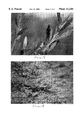
- FIG. 1 shows male capitula at tips of branches in a dried state as they appear January-February. It also shows the branches with the previous years after most leaves have gone deciduous.
- FIG. 2 shows the leaves and branches as growth begins in late February to early March.
- FIG. 3 shows a close-up view of the sparse teeth on the margin of the leaf sides.
- FIG. 4 shows the density of the procumbent shrub.
- the color chart used in the identification of colors described hereinafter is the R.H.S. Colour Chart of The Royal Horticultural Society, London, England (or Pantone Color Series). The plants described were grown during 1996 at Glendale, Ariz.
- Plant form Procumbent shrub.
- Plant growth habit Perennial.
- Leaf length --Early spring, leaves -- 5.3 centimeters long. Summer leaves 1.3-2.3 centimeter. Autumn leaves 0.4 centimeters.
- Leaf width --Early spring 1.5 centimeters wide. Summer 0.3-0.5 centimeters. Autumn 0.1 centimeters.
- Leaf blade color --Uniform on all surfaces and edges. The closest match with the R.H.S. Colour Chart was in the yellow-green group #147 B. This color showed the closest match in all seasons of the year.
- Leaf blade margin --Few teeth to entire
- Plants of the new variety have been found to grow at a rate of 12 inches during one year under landscape growing conditions with an irrigation system, the new variety reaches maturity in two to three years. At three years of age ⁇ Starn ⁇ is four feet in height and six feet in width when grown in Glendale, Ariz. During the blooming season, October through November in Glendale, Ariz., the staminate flowering new variety produces and disperses no pappus from the maturing capitula. In addition, the new variety produces no seeds to produce unwanted volunteer seedlings.
Landscapes
- Life Sciences & Earth Sciences (AREA)
- Health & Medical Sciences (AREA)
- Physiology (AREA)
- Botany (AREA)
- Developmental Biology & Embryology (AREA)
- Environmental Sciences (AREA)
- Natural Medicines & Medicinal Plants (AREA)
- Engineering & Computer Science (AREA)
- Textile Engineering (AREA)
- Cultivation Of Plants (AREA)
- Breeding Of Plants And Reproduction By Means Of Culturing (AREA)
Abstract
A new and distinct variety of the Baccharis plant named `Starn` is provided. The new variety was selected as a single plant from a block of hybrid seedlings. The new variety is a staminate plant that does not produce the white floss (pappus) and seed associated in large quantity with Baccharis plants. The new variety is heat tolerant, possesses drought resistance, exhibits procumbent growth habit and displays green foliage coloration. The characteristics of this new variety of plant make it particularly well-suited for growing as a ground cover in urban desert landscapes and regions with limited water supply.
Description
The present invention comprises a new and distinct variety of Baccharis and hereinafter is referred to by the variety name `Starn`. THOMPSON is a Trade Mark applied to the variety to indicate the source of origin thereof.
The new `Starn` variety was selected by me as a single plant from a block of hybrid seedlings during the course of plant selection work conducted during the years 1985 and 1986. The hybrid seedlings were a result of a cross between the `Centennial` Baccharis Plant and an unnamed parent. The `Centennial` plant is an unpatented F1 hybrid resulting from crossing the Arizona native desert broom (Baccharis sarothroides) with the California native coyote bush (Baccharis pilularis) and was introduced by the University of Arizona, Tucson, Ariz. as reported in the article entitled "Development of Hybrid Baccharis Plants for Desert Landscaping" by A. E. Thompson et al., HortScience, Vol. 30 (7), Dec., 1995, Page 1357. The `Centennial` Baccharis is the female parent and an unnamed Baccharis sarothroides was the pollen parent in the backcross that yielded the seedling which is the Baccharis plant `Starn`, the subject of this application.
Baccharis `Starn` is distinguishable from `Centennial` by producing only staminate (male) flowers while `Centennial` produces only pistillate (female) flowers. Baccharis `Starn` is distinguishable from the unnamed Baccharis sarothroides parent plant by distinctive vegetative growth. `Starn` is a low, mounding, evergreen shrub which branches heavily and is dense in habit. Young `Starn` plants under 12 inches tall have prostrate branches. In contrast, the parent is a broom-like shrub from 6 to 12 feet in height with numerous erect, angled branches. As a seedling under 12 inches tall, the parent exhibits an erect, open growth habit.
The seedlings were grown for about one year and a first selection was made based on low growth habit and fullness of branching structure. The selected seedlings were grown for three additional years and a superior growing staminate plant which had a desirable degree of procumbency and vigor was distinguished by these characteristics from the other seedlings. The selection of the staminate second generation Baccharis hybrid eliminates the generation of pappus and seeds further distinguishing this new plant from other Baccharis plants known to the inventor.
Asexual propagation of this new variety was carried out in Glendale, Ariz. by cuttings through several generations. The desirable characteristics remain fixed in each successive crop of cutting-grown plants.
The accompanying photographic drawings show typical specimens of plant parts of the new variety in color illustrations as nearly true as is reasonably possible to accomplish from conventional photographic procedures.
FIG. 1 shows male capitula at tips of branches in a dried state as they appear January-February. It also shows the branches with the previous years after most leaves have gone deciduous.
FIG. 2 shows the leaves and branches as growth begins in late February to early March.
FIG. 3 shows a close-up view of the sparse teeth on the margin of the leaf sides.
FIG. 4 shows the density of the procumbent shrub.
The color chart used in the identification of colors described hereinafter is the R.H.S. Colour Chart of The Royal Horticultural Society, London, England (or Pantone Color Series). The plants described were grown during 1996 at Glendale, Ariz.
Classification: Baccharis hybrid.
Plant form: Procumbent shrub.
Plant growth habit: Perennial.
Foliage:
Leaf arrangement.--Alternate.
Leaf shape.--Spathulate.
Leaf length.--Early spring, leaves -- 5.3 centimeters long. Summer leaves 1.3-2.3 centimeter. Autumn leaves 0.4 centimeters.
Leaf width.--Early spring 1.5 centimeters wide. Summer 0.3-0.5 centimeters. Autumn 0.1 centimeters.
Leaf blade color.--Uniform on all surfaces and edges. The closest match with the R.H.S. Colour Chart was in the yellow-green group #147 B. This color showed the closest match in all seasons of the year.
Leaf blade margin.--Few teeth to entire
Branches: Spring coloration of new growth is matched to R.H.S. #145A. Summer, autumn and winter coloration is match to R.H.S. #147C.
Inflorescence:
Male capitula.--Inflorescence length 0.6 centimeters. Inflorescence width 0.6 centimeters.
Flower number.--About 35 per capitula.
Flower shape.--Narrow, Tubular.
Flower coloration.--Matched to R.H.S. Greyed-Orange Group #163D.
Pollen coloration.--Cream. The remainder of the flower characteristics are typical of the Genus.
General appearance of entire plant:
Early spring.--Flush of growth produces relatively large leaves.
Summer.--Leaves are much reduced in size on new growth.
Autumn.--Many small, almost bract-like leaves along broom-like branches. Most large leaves being deciduous before or at flowering.
Plants of the new variety have been found to grow at a rate of 12 inches during one year under landscape growing conditions with an irrigation system, the new variety reaches maturity in two to three years. At three years of age `Starn` is four feet in height and six feet in width when grown in Glendale, Ariz. During the blooming season, October through November in Glendale, Ariz., the staminate flowering new variety produces and disperses no pappus from the maturing capitula. In addition, the new variety produces no seeds to produce unwanted volunteer seedlings.
Claims (1)
1. A new and distinct variety of Baccharis plant as herein illustrated and described.
Priority Applications (1)
| Application Number | Priority Date | Filing Date | Title |
|---|---|---|---|
| US09/012,523 USPP11240P (en) | 1998-01-23 | 1998-01-23 | Baccharis plant named `Starn` |
Applications Claiming Priority (1)
| Application Number | Priority Date | Filing Date | Title |
|---|---|---|---|
| US09/012,523 USPP11240P (en) | 1998-01-23 | 1998-01-23 | Baccharis plant named `Starn` |
Publications (1)
| Publication Number | Publication Date |
|---|---|
| USPP11240P true USPP11240P (en) | 2000-02-22 |
Family
ID=21755368
Family Applications (1)
| Application Number | Title | Priority Date | Filing Date |
|---|---|---|---|
| US09/012,523 Expired - Lifetime USPP11240P (en) | 1998-01-23 | 1998-01-23 | Baccharis plant named `Starn` |
Country Status (1)
| Country | Link |
|---|---|
| US (1) | USPP11240P (en) |
Cited By (3)
| Publication number | Priority date | Publication date | Assignee | Title |
|---|---|---|---|---|
| USPP13744P2 (en) * | 2002-05-31 | 2003-04-29 | Gebr. Kolster Bv | Baccharis plant named ‘Kolmmyst’ |
| USPP13770P2 (en) * | 2002-05-31 | 2003-05-06 | Gebr. Kolster Bv | Baccharis plant named ‘Kolmsil’ |
| USPP13895P2 (en) * | 2002-05-31 | 2003-06-17 | Gebr. Kolster B.V. | Baccharis plant named ‘Kolmstar’ |
-
1998
- 1998-01-23 US US09/012,523 patent/USPP11240P/en not_active Expired - Lifetime
Cited By (3)
| Publication number | Priority date | Publication date | Assignee | Title |
|---|---|---|---|---|
| USPP13744P2 (en) * | 2002-05-31 | 2003-04-29 | Gebr. Kolster Bv | Baccharis plant named ‘Kolmmyst’ |
| USPP13770P2 (en) * | 2002-05-31 | 2003-05-06 | Gebr. Kolster Bv | Baccharis plant named ‘Kolmsil’ |
| USPP13895P2 (en) * | 2002-05-31 | 2003-06-17 | Gebr. Kolster B.V. | Baccharis plant named ‘Kolmstar’ |
Similar Documents
| Publication | Publication Date | Title |
|---|---|---|
| USPP7539P (en) | Prairie buffalograss | |
| USPP11240P (en) | Baccharis plant named `Starn` | |
| USPP35206P3 (en) | Thuja plant named ‘RutThu3’ | |
| USPP32645P3 (en) | St. Augustinegrass plant named ‘FSA1602’ | |
| USPP10438P (en) | Azalea hybrid variety named `Conlea` | |
| USPP13431P2 (en) | Taxodium distichum plant named ‘Sofine’ | |
| USPP36934P2 (en) | Bermudagrass plant named ‘OSU2081’ | |
| USPP35349P2 (en) | Coleus plant named ‘UF20-140-2’ | |
| USPP35342P2 (en) | Coleus plant named ‘UF20-144-1’ | |
| USPP11217P (en) | X Cupressocyparis leylandii plant named `Grelive` | |
| USPP34899P2 (en) | Coleus plant named ‘UF19-79-2’ | |
| USPP33504P2 (en) | Indian grass plant named ‘Whit LXXI’ | |
| USPP10580P (en) | Azalea hybrid `Conlec` | |
| USPP10581P (en) | Azalea hybrid variety named `Conleb` | |
| USPP11202P (en) | Panicum plant named `Dallas Blues` | |
| USPP7822P (en) | Plumbago Auriculata cv. Monott | |
| USPP10703P (en) | Azalea plant named `Conlek` | |
| USPP31751P2 (en) | Hibiscus coccineus plant named ‘Whit XXII’ | |
| USPP10702P (en) | Azalea plant named `Conlei` | |
| USPP12420P2 (en) | Calibrachoa plant named ‘Liricashower Blush White’ | |
| USPP18865P3 (en) | Phormium tenax plant named ‘PHORD1’ | |
| USPP11612P (en) | Southern Magnolia tree named `TMGH` | |
| USPP10688P (en) | Azalea plant named `Conlej` | |
| USPP17814P3 (en) | Sweet Bay Magnolia named ‘Perry Paige’ | |
| USPP20799P2 (en) | Anigozanthos hybrid plant named ‘Ramboramp’ |