USH1246H - Buoyant cable tether - Google Patents
Buoyant cable tether Download PDFInfo
- Publication number
- USH1246H USH1246H US08/068,015 US6801593A USH1246H US H1246 H USH1246 H US H1246H US 6801593 A US6801593 A US 6801593A US H1246 H USH1246 H US H1246H
- Authority
- US
- United States
- Prior art keywords
- cable
- tether
- tension
- buoyancy tank
- link
- Prior art date
- Legal status (The legal status is an assumption and is not a legal conclusion. Google has not performed a legal analysis and makes no representation as to the accuracy of the status listed.)
- Abandoned
Links
- 238000003466 welding Methods 0.000 description 7
- 238000005304 joining Methods 0.000 description 4
- 230000004044 response Effects 0.000 description 4
- XLYOFNOQVPJJNP-UHFFFAOYSA-N water Substances O XLYOFNOQVPJJNP-UHFFFAOYSA-N 0.000 description 4
- 238000005452 bending Methods 0.000 description 3
- 230000007613 environmental effect Effects 0.000 description 3
- 238000009434 installation Methods 0.000 description 3
- 238000004519 manufacturing process Methods 0.000 description 3
- 230000007246 mechanism Effects 0.000 description 3
- 239000002184 metal Substances 0.000 description 2
- 229910052751 metal Inorganic materials 0.000 description 2
- 238000000034 method Methods 0.000 description 2
- 239000000203 mixture Substances 0.000 description 2
- 238000012986 modification Methods 0.000 description 2
- 230000004048 modification Effects 0.000 description 2
- 239000003208 petroleum Substances 0.000 description 2
- 239000007787 solid Substances 0.000 description 2
- HCHKCACWOHOZIP-UHFFFAOYSA-N Zinc Chemical compound [Zn] HCHKCACWOHOZIP-UHFFFAOYSA-N 0.000 description 1
- 230000004075 alteration Effects 0.000 description 1
- 125000004122 cyclic group Chemical group 0.000 description 1
- 239000000463 material Substances 0.000 description 1
- 230000000737 periodic effect Effects 0.000 description 1
- 239000011347 resin Substances 0.000 description 1
- 229920005989 resin Polymers 0.000 description 1
- 239000003643 water by type Substances 0.000 description 1
- 229910052725 zinc Inorganic materials 0.000 description 1
- 239000011701 zinc Substances 0.000 description 1
Images




Classifications
-
- B—PERFORMING OPERATIONS; TRANSPORTING
- B63—SHIPS OR OTHER WATERBORNE VESSELS; RELATED EQUIPMENT
- B63B—SHIPS OR OTHER WATERBORNE VESSELS; EQUIPMENT FOR SHIPPING
- B63B21/00—Tying-up; Shifting, towing, or pushing equipment; Anchoring
- B63B21/50—Anchoring arrangements or methods for special vessels, e.g. for floating drilling platforms or dredgers
- B63B21/502—Anchoring arrangements or methods for special vessels, e.g. for floating drilling platforms or dredgers by means of tension legs
Definitions
- the present invention relates generally to tethers for securing a tension leg platform to the ocean floor.
- the present invention pertains to a tether in which the primary tension element comprises one or more cables and includes a buoyancy means to offset at least a portion of the weight of the tether.
- TLP tension leg platform concept
- a TLP's main body, the "hull” is buoyant and floats on the water's surface.
- the hull is anchored to foundation units on the ocean floor by a set of substantially vertical tethers. The tethers maintain the hull in position above the subsea wells and partially restrain its response to the environmental forces.
- each tether is precisely determined to ensure that the hull floats at a somewhat deeper draft than if the TLP were unrestrained.
- the hull's buoyancy exerts an upward load on the tethers, thereby placing the tethers in tension.
- its compliant response affects its buoyancy, which in turn affects the tension in the tethers.
- the resulting cyclic variations in the tension and bending stresses in the tethers is an important consideration in TLP design.
- a typical TLP has one or more tethers, which are typically made of elongated tubing sections, at each corner of its hull. The sections are joined to each other by mechanical connectors or by welding. As offshore petroleum production operations progress into deeper waters, connecting adjacent sections of tubing becomes increasingly difficult. Therefore, optimum TLP design utilizes as few tethers as possible both to minimize tether cost and weight and to reduce installation complications. However, the use of fewer tethers necessitates tether designs with large diameters and thick walls, each of which tend to reduce tether fatigue life. Alternate tether designs are needed to lessen the TLP designers' constraints between cost, weight, and installation considerations on one hand and fatigue life on the other hand.
- Tether design is also sensitive to water depth. As water depth increases, longer tethers are required. With increasing length, tethers are exposed to more severe resonant loading, which is the response to a periodic driving force (e.g., waves and/or winds) which has a frequency approximately equal to the natural undamped frequency of the tether. That resonant response increases the risk of damage to or loss of the tether. Loss of a tether would increase loads on the remaining tethers, thereby posing a substantial risk of damage to the entire TLP. Alternate tether designs are needed to lessen or eliminate that risk.
- a periodic driving force e.g., waves and/or winds
- TLP tether which minimizes the necessity for connecting numerous segments of tubular piping, which reduces the fatigue life constraints placed on the designer by existing tether designs, and which reduces the overall weight of the tethers.
- the present invention is a TLP tether comprising one or more cables and a buoyancy tank designed to compensate for at least a portion of the weight of the tether.
- Top and bottom transitional pieces secure the tether to the TLP's buoyant hull and the foundation unit, respectively.
- the tether utilizes a single cable (which may comprise one or more cable segments connected end-to-end) attached to the buoyancy tank and to the bottom transitional piece.
- the tether has a plurality of substantially parallel cables, a buoyancy tank, and an attachment assembly. The plurality of cables is attached to the buoyancy tank and to the attachment assembly. The attachment assembly is connected to the bottom transitional piece, which is connected to the foundation unit.
- FIG. 1 is a perspective view of a typical TLP
- FIG. 2 illustrates the single cable embodiment of the present invention
- FIG. 3 illustrates a flex element used in connection with the present invention
- FIG. 4 illustrates the multiple cable embodiment of the present invention
- FIG. 5 is an elevation view, in partial section, of the buoyancy tank utilized with the multiple cable embodiment of the present invention.
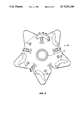
- FIG. 6 is a plan view of the buoyancy tank taken along line 6--6 of FIG. 5;
- FIG. 7 is an elevation view of an attachment assembly for the multiple cable embodiment of the present invention.
- FIG. 8 is a plan view of the attachment assembly of FIG. 7.
- FIG. 9 illustrates the tension link, link receptacle, and pull-in winch of the attachment assembly of FIG. 7.
- FIG. 10 illustrates a cable joining assembly that may be utilized in the present invention.
- the present invention is a buoyant cable tether, comprising a single cable or a plurality of substantially parallel cables, at least partially supported by a buoyancy tank.
- the invention is described and illustrated herein as an apparatus to secure a TLP to the ocean floor.
- the invention may encompass other embodiments and a variety of alternative uses. To the extent that the following detailed description is specific to a particular embodiment or a particular use, it is intended only as illustrative and is not intended to limit the invention.
- a typical TLP as indicated at 10 in FIG. 1, consists of a buoyant hull 12 which is secured to the seafloor and held in position above the subsea well template 16 by a plurality of tethers 14.
- the tethers 14 extend vertically downward to foundation units 18 which are secured to the sea floor.
- a first embodiment of the present invention utilizes a single cable, as shown in FIG. 2.
- the principle elements of the single cable tether 14 are a top transitional piece 24, one or more tubular pipe segments 26, a buoyancy tank 32, cable 38, and a bottom transitional piece 52.
- Cable 38 may be a single cable segment or a plurality of cable segments joined end-to-end, as more fully described below.
- the upper end of the top transitional piece 24 is connected to the buoyant hull 12 by conventional means such as top connector 30.
- the lower end of the top transitional piece 24 is joined to the upper end of a tubular pipe segment 26 by conventional means such as mechanical connectors 28 or welding. Additional tubular pipe segments 26, if any, are also joined end-to-end by conventional means such as mechanical connectors 28 or welding.
- the tubular pipe segments 26 extend substantially vertically downward as illustrated in FIG. 2.
- the tubular pipe segment 26 located farthest below the ocean's surface extends through the buoyancy tank 32 a sufficient distance below the lower end of the buoyancy tank 32 to permit the cable 38 to be connected to the tubular pipe segment 26 as further described below.
- the buoyancy tank 32 is connected to the tubular pipe segment 26 by such means as welding, bolting, or mechanical connectors.
- the buoyancy tank 32 compensates for at least a portion of the weight of the tether 14.
- the lower end of the tubular pipe segment 26 is joined to the upper end of cable 38 by a mechanical connector 28, a cable socket 34 and a flex element 36, as illustrated in FIG. 3 and explained below.
- the lower end of cable 38 (or of the bottom cable segment, as more fully described below) is joined to a bottom transitional piece 52 by a flex element 36, cable socket 34 and mechanical connector 28.
- Each end of cable 38 is terminated with a flex element 36 and a cable socket 34 as illustrated in FIG. 3.
- the purpose of flex element 36 is to ensure that the portion of cable 38 entering cable socket 34 does not encounter excessive bending stresses.
- the flex element 36 is also known as a "bend limiter".
- the flex element 36 may be a rubber section or a curved metal section (not illustrated) designed to reduce bending stress where a cable terminates at a cable socket 34.
- the cable socket 34 also known as a "cable terminator" provides a receptacle to terminate the cable 38. The end of a cable 38 is pushed into the cable socket 34 and the strands of cable 38 are spread as shown in FIG. 3.
- the cavity 35 between the cable socket 34 and the cable 38 is filled with a composition designed to harden and form a solid mass with the cable 8 strands inside the cavity 35.
- this material may be a resin or a moldable metal such as zinc.
- Other suitable hardening compositions will be known to those skilled in the art.
- a mechanical connector 28 is located on each end of cable 38. These mechanical connectors 28 are utilized to connect a first cable socket 34 to the tubular pipe segment 26 and a second cable socket 34 to the bottom transitional piece 52.
- a variety of mechanical connectors may be used in the present invention, as will be apparent to those skilled in the art. Mechanical connectors are connected to tubular sections by welding or may be threaded.
- One example is the Hunting Merlin connector manufactured by Hunting Oilfield Services Inc.
- Each tether 14 includes a buoyancy tank 54 with a plurality of tension adjustment rods 60 of approximately equal length, a plurality of substantially parallel cables 38 of approximately equal length, and an attachment assembly 74 with a plurality of tension links 76.
- the multiple cable embodiment also includes a top transitional piece 24, one or more tubular pipe segments 26, and a bottom transitional piece 52.
- the elevation view of the buoyancy tank 54 is illustrated in FIG. 5.
- the plurality of cables 38 are attached to the buoyancy tank 54 by a plurality of tension adjustment rods 60.
- Tension adjustment rods 60 extend through the buoyancy tank 54 via hawse pipes 62.
- Each tension adjustment rod 60 protrudes below the lower end of the buoyancy tank 54.
- both ends of each cable 38 are terminated using a flex element 36 and a cable socket 34 as illustrated in FIG. 3.
- Each cable socket 34 on each end of each cable 38 has a clevis 56.
- the lower end of each tension adjustment rod 60 has a padeye 58.
- Each tension adjustment rod 60 is connected to its respective cable 38 by connecting the padeye 58 to the clevis 56 with a pin 57.
- FIG. 6 is the plan view of the buoyancy tank 54 which illustrates the location of the hawse pipes 62.
- Each upper end of the plurality of tension adjustment rods 60 is connected to the buoyancy tank 54 by a tensioning mechanism located at the upper surface of the buoyancy tank 54.
- An example of a tensioning mechanism is a tension adjustment nut 64 for each tension adjustment rod 60 that runs down onto a load base 66 located on the upper surface of buoyancy tank 54 as shown in FIG. 5. Once each tension adjustment rod 60 is tensioned to the desired level, each tension adjustment nut 64 is tightened onto the load base 66.
- Radial bulkheads 68 see FIG.
- the plurality of cables 38 is attached to the attachment assembly 74 as illustrated in FIGS. 4 and 7.
- the attachment assembly has a plurality of tension links 76.
- the number of tension links 76 corresponds to the number of cables 38.
- the upper end of each tension link 76 has a padeye 58.
- the cable socket 34 located on the lower end of each cable 38 is joined to a clevis 56.
- Each cable segment 38 is attached to the attachment assembly 74 by connecting the clevis 5 to the padeye 58 with a pin 57 as best illustrated in FIGS. 7 and 9.
- a pull-in winch 77 is permanently attached to the attachment assembly 74 as shown in FIGS. 7 and 9.
- the pull-in winch 77 is a hydraulically operated subsea winch. Suitable subsea winches will be apparent to those skilled in the art.
- the pull-in winch 77 has a hook 84 attached to the end of line 82 as illustrated in FIG. 9. The hook 84 is used to connect each tension link 76 to the pull-in winch 77.
- the pull-in winch 77 provides the lateral force necessary to pull each tension link 76 into its respective link receptacle 78 from the side of the attachment assembly 74.
- FIG. 9 illustrates a tension link 76a prior to attaching the tension link 76a to the attachment assembly 74 and a tension link 76b that is attached to the attachment assembly 74.
- Each tension link 76 has an eyelet 86 and a lower end shaped like a bulb 80 as illustrated in FIG. 9.
- the bulb 80 is designed to fit inside the link receptacle 78.
- the tension link receptacles 78 provide a receptacle for each tension link 76.
- the upper portion of the link receptacle 78 is smaller than the bulb 80.
- the bulb 80 is held in place by the link receptacle 78 and the latch plate 79.
- the latch plate 79 prevents the tension link 76 from slipping out of the side of the link receptacle 78.
- each tension link 76 After each tension link 76 has been joined to its respective cable 38, each tension link is connected to its respective link receptacle 78.
- a remotely operated vehicle is used underwater to attach the hook 84 to the eyelet 86 on the tension link 76 as illustrated in FIG. 9.
- the pull-in winch 77 is activated, and laterally pulls the tension link 76 into the link receptacle 78.
- the tension link 76 is guided into the link receptacle 78 from the side of the attachment assembly 74 by the remotely operated vehicle. This procedure is repeated until each tension link 76 is in its respective link receptacle 78.
- each tension link 76 is pulled into its respective link receptacle 78, a crane vessel is used to pull each cable 38 vertically towards the ocean's surface until the bulb 80 is pulled into the link receptacle 78.
- the latch plate 79 secures each tension link 76 in its respective link receptacle 78.
- the latch plate 79 is closed around the tension link 76 with the bulb 80 located beneath the latch plate 79.
- the attachment assembly 74 is joined to the bottom transitional piece 52 by a mechanical connector 28, or welding.
- FIGS. 2 and 4 illustrate that each tether 14 is connected to the buoyant hull 12 and the foundation unit 18.
- the upper end of the top transitional piece 24 is connected to the buoyant hull 12 by a top connector 30.
- a top connector 30 For example, one method is to use a solid load nut that runs down onto the load carrying structure (not illustrated). Other top connectors will be apparent to those skilled in the art.
- the bottom transitional piece 52 is joined to the foundation unit 18 by a tether bottom connector 84 such as the one illustrated in U.S. Pat. No. 4,907,914. Other suitable bottom connectors will be apparent to those skilled in the art.
- the length of the cables 38 required may exceed current manufacturing capabilities with respect to the continuous length of a cable 38.
- two or more cable segments 38' may be joined from end to end by a cable joining assembly 40, as illustrated in FIG. 10.
- the cable joining assembly 40 includes two cable sockets 34, a mechanical connector 28 and two flex elements 36.
- a flex element 36 is connected to one end of each cable socket 34.
- a cable segment 38' passes through each flex element and is terminated within the cable socket 34.
- the cable sockets 34 are connected end-to-end by a mechanical connector as illustrated in FIG. 10.
- Other suitable cable joining mechanisms will be apparent to those skilled in the art.
- the present invention satisfies the need for a tether which minimizes the necessity for connecting numerous segments of tubular piping, reduces the loads exerted on the tether and reduces the overall weight of the tether.
- this invention should not be unduly limited to the foregoing which has been set forth solely for illustrative purposes. Various modifications and alterations of the invention will be apparent to those skilled in the art without departing from the true scope of the invention as defined in the following claims.
Landscapes
- Chemical & Material Sciences (AREA)
- Engineering & Computer Science (AREA)
- Combustion & Propulsion (AREA)
- Mechanical Engineering (AREA)
- Ocean & Marine Engineering (AREA)
- Laying Of Electric Cables Or Lines Outside (AREA)
Abstract
A tether for securing a buoyant structure to the ocean floor. The tether includes a cable or a plurality of cables whose weight is at least partially supported by a buoyancy tank.
Description
The present invention relates generally to tethers for securing a tension leg platform to the ocean floor. Specifically, but not by way of limitation, the present invention pertains to a tether in which the primary tension element comprises one or more cables and includes a buoyancy means to offset at least a portion of the weight of the tether.
Platforms used in offshore petroleum production have traditionally been designed to resist wind, wave, and current environmental forces in a rigid, generally immobile, manner. In contrast, the relatively new tension leg platform concept (hereinafter referred to as the "TLP") is an offshore structure designed to react to environmental forces in a compliant, responsive manner. Characteristically, a TLP's main body, the "hull", is buoyant and floats on the water's surface. The hull is anchored to foundation units on the ocean floor by a set of substantially vertical tethers. The tethers maintain the hull in position above the subsea wells and partially restrain its response to the environmental forces.
The length of each tether is precisely determined to ensure that the hull floats at a somewhat deeper draft than if the TLP were unrestrained. As a result, the hull's buoyancy exerts an upward load on the tethers, thereby placing the tethers in tension. When the hull is acted upon by the environment, its compliant response affects its buoyancy, which in turn affects the tension in the tethers. The resulting cyclic variations in the tension and bending stresses in the tethers is an important consideration in TLP design.
The key analytic issue which arises from these stress variations is tether fatigue life. Generally speaking, both larger amplitude stress cycles and frequent repetitions of cycles of all amplitudes lower the expected life of a tether. Optimum tether design focuses on minimizing these undesirable occurrences.
A typical TLP has one or more tethers, which are typically made of elongated tubing sections, at each corner of its hull. The sections are joined to each other by mechanical connectors or by welding. As offshore petroleum production operations progress into deeper waters, connecting adjacent sections of tubing becomes increasingly difficult. Therefore, optimum TLP design utilizes as few tethers as possible both to minimize tether cost and weight and to reduce installation complications. However, the use of fewer tethers necessitates tether designs with large diameters and thick walls, each of which tend to reduce tether fatigue life. Alternate tether designs are needed to lessen the TLP designers' constraints between cost, weight, and installation considerations on one hand and fatigue life on the other hand.
Tether design is also sensitive to water depth. As water depth increases, longer tethers are required. With increasing length, tethers are exposed to more severe resonant loading, which is the response to a periodic driving force (e.g., waves and/or winds) which has a frequency approximately equal to the natural undamped frequency of the tether. That resonant response increases the risk of damage to or loss of the tether. Loss of a tether would increase loads on the remaining tethers, thereby posing a substantial risk of damage to the entire TLP. Alternate tether designs are needed to lessen or eliminate that risk.
For these reasons, therefore, a need exists for a TLP tether which minimizes the necessity for connecting numerous segments of tubular piping, which reduces the fatigue life constraints placed on the designer by existing tether designs, and which reduces the overall weight of the tethers.
The present invention is a TLP tether comprising one or more cables and a buoyancy tank designed to compensate for at least a portion of the weight of the tether. Top and bottom transitional pieces secure the tether to the TLP's buoyant hull and the foundation unit, respectively.
In one embodiment of the present invention, the tether utilizes a single cable (which may comprise one or more cable segments connected end-to-end) attached to the buoyancy tank and to the bottom transitional piece. In another embodiment of the present invention, the tether has a plurality of substantially parallel cables, a buoyancy tank, and an attachment assembly. The plurality of cables is attached to the buoyancy tank and to the attachment assembly. The attachment assembly is connected to the bottom transitional piece, which is connected to the foundation unit.
The advantages of the present invention will be more easily understood by referring to the following detailed description and the attached drawings where:
FIG. 1 is a perspective view of a typical TLP;
FIG. 2 illustrates the single cable embodiment of the present invention;
FIG. 3 illustrates a flex element used in connection with the present invention;
FIG. 4 illustrates the multiple cable embodiment of the present invention;
FIG. 5 is an elevation view, in partial section, of the buoyancy tank utilized with the multiple cable embodiment of the present invention;
FIG. 6 is a plan view of the buoyancy tank taken along line 6--6 of FIG. 5;
FIG. 7 is an elevation view of an attachment assembly for the multiple cable embodiment of the present invention;
FIG. 8 is a plan view of the attachment assembly of FIG. 7.
FIG. 9 illustrates the tension link, link receptacle, and pull-in winch of the attachment assembly of FIG. 7.
FIG. 10 illustrates a cable joining assembly that may be utilized in the present invention.
Although the invention will be described according to its preferred embodiments, such descriptions shall not limit the invention. Accordingly, the invention is intended to encompass all alternatives, modifications, and equivalents which may be included within the spirit and scope of the invention, as defined in the appended claims.
The present invention is a buoyant cable tether, comprising a single cable or a plurality of substantially parallel cables, at least partially supported by a buoyancy tank.
The invention is described and illustrated herein as an apparatus to secure a TLP to the ocean floor. However, the invention may encompass other embodiments and a variety of alternative uses. To the extent that the following detailed description is specific to a particular embodiment or a particular use, it is intended only as illustrative and is not intended to limit the invention.
A typical TLP, as indicated at 10 in FIG. 1, consists of a buoyant hull 12 which is secured to the seafloor and held in position above the subsea well template 16 by a plurality of tethers 14. The tethers 14 extend vertically downward to foundation units 18 which are secured to the sea floor.
A first embodiment of the present invention utilizes a single cable, as shown in FIG. 2. The principle elements of the single cable tether 14 are a top transitional piece 24, one or more tubular pipe segments 26, a buoyancy tank 32, cable 38, and a bottom transitional piece 52. Cable 38 may be a single cable segment or a plurality of cable segments joined end-to-end, as more fully described below.
The upper end of the top transitional piece 24 is connected to the buoyant hull 12 by conventional means such as top connector 30. The lower end of the top transitional piece 24 is joined to the upper end of a tubular pipe segment 26 by conventional means such as mechanical connectors 28 or welding. Additional tubular pipe segments 26, if any, are also joined end-to-end by conventional means such as mechanical connectors 28 or welding. The tubular pipe segments 26 extend substantially vertically downward as illustrated in FIG. 2. The tubular pipe segment 26 located farthest below the ocean's surface extends through the buoyancy tank 32 a sufficient distance below the lower end of the buoyancy tank 32 to permit the cable 38 to be connected to the tubular pipe segment 26 as further described below. The buoyancy tank 32 is connected to the tubular pipe segment 26 by such means as welding, bolting, or mechanical connectors. The buoyancy tank 32 compensates for at least a portion of the weight of the tether 14.
The lower end of the tubular pipe segment 26 is joined to the upper end of cable 38 by a mechanical connector 28, a cable socket 34 and a flex element 36, as illustrated in FIG. 3 and explained below. Similarly, the lower end of cable 38 (or of the bottom cable segment, as more fully described below) is joined to a bottom transitional piece 52 by a flex element 36, cable socket 34 and mechanical connector 28.
Each end of cable 38 is terminated with a flex element 36 and a cable socket 34 as illustrated in FIG. 3. The purpose of flex element 36 is to ensure that the portion of cable 38 entering cable socket 34 does not encounter excessive bending stresses. The flex element 36 is also known as a "bend limiter". Typically, the flex element 36 may be a rubber section or a curved metal section (not illustrated) designed to reduce bending stress where a cable terminates at a cable socket 34. The cable socket 34, also known as a "cable terminator", provides a receptacle to terminate the cable 38. The end of a cable 38 is pushed into the cable socket 34 and the strands of cable 38 are spread as shown in FIG. 3. The cavity 35 between the cable socket 34 and the cable 38 is filled with a composition designed to harden and form a solid mass with the cable 8 strands inside the cavity 35. For example, this material may be a resin or a moldable metal such as zinc. Other suitable hardening compositions will be known to those skilled in the art.
As shown in FIG. 2, a mechanical connector 28 is located on each end of cable 38. These mechanical connectors 28 are utilized to connect a first cable socket 34 to the tubular pipe segment 26 and a second cable socket 34 to the bottom transitional piece 52. A variety of mechanical connectors may be used in the present invention, as will be apparent to those skilled in the art. Mechanical connectors are connected to tubular sections by welding or may be threaded. One example is the Hunting Merlin connector manufactured by Hunting Oilfield Services Inc.
A multiple cable embodiment of the present invention is illustrated in FIG. 4. Each tether 14 includes a buoyancy tank 54 with a plurality of tension adjustment rods 60 of approximately equal length, a plurality of substantially parallel cables 38 of approximately equal length, and an attachment assembly 74 with a plurality of tension links 76. As described above for the single cable embodiment, the multiple cable embodiment also includes a top transitional piece 24, one or more tubular pipe segments 26, and a bottom transitional piece 52.
The elevation view of the buoyancy tank 54 is illustrated in FIG. 5. The plurality of cables 38 are attached to the buoyancy tank 54 by a plurality of tension adjustment rods 60. Tension adjustment rods 60 extend through the buoyancy tank 54 via hawse pipes 62. Each tension adjustment rod 60 protrudes below the lower end of the buoyancy tank 54. As discussed above, both ends of each cable 38 are terminated using a flex element 36 and a cable socket 34 as illustrated in FIG. 3. Each cable socket 34 on each end of each cable 38 has a clevis 56. The lower end of each tension adjustment rod 60 has a padeye 58. Each tension adjustment rod 60 is connected to its respective cable 38 by connecting the padeye 58 to the clevis 56 with a pin 57.
FIG. 6 is the plan view of the buoyancy tank 54 which illustrates the location of the hawse pipes 62. Other arrangements will be obvious to persons skilled in the art. Each upper end of the plurality of tension adjustment rods 60 is connected to the buoyancy tank 54 by a tensioning mechanism located at the upper surface of the buoyancy tank 54. An example of a tensioning mechanism is a tension adjustment nut 64 for each tension adjustment rod 60 that runs down onto a load base 66 located on the upper surface of buoyancy tank 54 as shown in FIG. 5. Once each tension adjustment rod 60 is tensioned to the desired level, each tension adjustment nut 64 is tightened onto the load base 66. Radial bulkheads 68 (see FIG. 6) transfer cable loads from the hawse pipe 62 locations to a central tension member 70 of buoyancy tank 54. The central tension member 70 runs through the center of the buoyancy tank 54. The lowest tubular segment pipe 26 is joined to the central tension member 70 by such means as a mechanical connector 28, bolting or welding.
The plurality of cables 38 is attached to the attachment assembly 74 as illustrated in FIGS. 4 and 7. The attachment assembly has a plurality of tension links 76. The number of tension links 76 corresponds to the number of cables 38. The upper end of each tension link 76 has a padeye 58. The cable socket 34 located on the lower end of each cable 38 is joined to a clevis 56. Each cable segment 38 is attached to the attachment assembly 74 by connecting the clevis 5 to the padeye 58 with a pin 57 as best illustrated in FIGS. 7 and 9.
A pull-in winch 77 is permanently attached to the attachment assembly 74 as shown in FIGS. 7 and 9. The pull-in winch 77 is a hydraulically operated subsea winch. Suitable subsea winches will be apparent to those skilled in the art. The pull-in winch 77 has a hook 84 attached to the end of line 82 as illustrated in FIG. 9. The hook 84 is used to connect each tension link 76 to the pull-in winch 77. The pull-in winch 77 provides the lateral force necessary to pull each tension link 76 into its respective link receptacle 78 from the side of the attachment assembly 74.
FIG. 9 illustrates a tension link 76a prior to attaching the tension link 76a to the attachment assembly 74 and a tension link 76b that is attached to the attachment assembly 74. Each tension link 76 has an eyelet 86 and a lower end shaped like a bulb 80 as illustrated in FIG. 9. The bulb 80 is designed to fit inside the link receptacle 78. The tension link receptacles 78 provide a receptacle for each tension link 76.
As shown in FIG. 8, the upper portion of the link receptacle 78 is smaller than the bulb 80. When the cable segment 38 is in tension, the bulb 80 is held in place by the link receptacle 78 and the latch plate 79. The latch plate 79 prevents the tension link 76 from slipping out of the side of the link receptacle 78.
After each tension link 76 has been joined to its respective cable 38, each tension link is connected to its respective link receptacle 78. A remotely operated vehicle is used underwater to attach the hook 84 to the eyelet 86 on the tension link 76 as illustrated in FIG. 9. Thereafter, the pull-in winch 77 is activated, and laterally pulls the tension link 76 into the link receptacle 78. The tension link 76 is guided into the link receptacle 78 from the side of the attachment assembly 74 by the remotely operated vehicle. This procedure is repeated until each tension link 76 is in its respective link receptacle 78.
Once each tension link 76 is pulled into its respective link receptacle 78, a crane vessel is used to pull each cable 38 vertically towards the ocean's surface until the bulb 80 is pulled into the link receptacle 78. The latch plate 79 secures each tension link 76 in its respective link receptacle 78. The latch plate 79 is closed around the tension link 76 with the bulb 80 located beneath the latch plate 79. The attachment assembly 74 is joined to the bottom transitional piece 52 by a mechanical connector 28, or welding.
Except as explained above, the installation of the tethers 14 is by conventional means as known to those skilled in the art.
FIGS. 2 and 4 illustrate that each tether 14 is connected to the buoyant hull 12 and the foundation unit 18. The upper end of the top transitional piece 24 is connected to the buoyant hull 12 by a top connector 30. For example, one method is to use a solid load nut that runs down onto the load carrying structure (not illustrated). Other top connectors will be apparent to those skilled in the art. The bottom transitional piece 52 is joined to the foundation unit 18 by a tether bottom connector 84 such as the one illustrated in U.S. Pat. No. 4,907,914. Other suitable bottom connectors will be apparent to those skilled in the art.
In the case of either embodiment presented above, when a TLP 10 is planned for deep water operations, the length of the cables 38 required may exceed current manufacturing capabilities with respect to the continuous length of a cable 38. In this case, two or more cable segments 38' may be joined from end to end by a cable joining assembly 40, as illustrated in FIG. 10. The cable joining assembly 40 includes two cable sockets 34, a mechanical connector 28 and two flex elements 36. A flex element 36 is connected to one end of each cable socket 34. A cable segment 38' passes through each flex element and is terminated within the cable socket 34. The cable sockets 34 are connected end-to-end by a mechanical connector as illustrated in FIG. 10. Other suitable cable joining mechanisms will be apparent to those skilled in the art.
As described above, the present invention satisfies the need for a tether which minimizes the necessity for connecting numerous segments of tubular piping, reduces the loads exerted on the tether and reduces the overall weight of the tether. However, this invention should not be unduly limited to the foregoing which has been set forth solely for illustrative purposes. Various modifications and alterations of the invention will be apparent to those skilled in the art without departing from the true scope of the invention as defined in the following claims.
Claims (5)
1. An apparatus for securing a buoyant structure to a foundation unit on the ocean floor comprising:
a tether, said tether having
(a) an upper tubular section having an upper end, a lower end, and a buoyancy tank, said buoyancy tank compensating for at least a portion of the weight of said tether; and
(b) a cable having an upper end and a lower end; said upper end of said cable connected to said lower end of said upper tubular section;
means for attaching said upper end of said tether to said buoyant structure; and
means for attaching said lower end of said tether to said foundation unit.
2. The apparatus of claim 1, wherein said cable further comprises:
a plurality of cable segments; and
means for connecting said plurality of cable segments in end-to-end relationship.
3. The apparatus of claim 1, wherein said tether comprises:
an upper tubular section connected to said buoyancy tank;
a plurality of substantially parallel cables having substantially equal lengths; each said cable having an upper end and lower end; each upper end of each said cable connected to said buoyancy tank; and
an attachment assembly having a lower end and an upper end; said upper end of said attachment assembly connected to said lower end of each said cable.
4. The apparatus of claim 3, wherein said attachment assembly further comprises:
a plurality of tension links, each said tension link having an upper end and a lower end, each upper end of each said tension link connected to said lower end of one of said cables;
a plurality of link receptacles, where each said lower end of each said tension link is connected to one of each said link receptacles.
5. The apparatus of claim 3, wherein each cable of the plurality of substantially parallel cables comprises:
two or more cable segments; and
means for connecting said cable segments in end-to-end relationship.
Priority Applications (1)
| Application Number | Priority Date | Filing Date | Title |
|---|---|---|---|
| US08/068,015 USH1246H (en) | 1993-05-26 | 1993-05-26 | Buoyant cable tether |
Applications Claiming Priority (1)
| Application Number | Priority Date | Filing Date | Title |
|---|---|---|---|
| US08/068,015 USH1246H (en) | 1993-05-26 | 1993-05-26 | Buoyant cable tether |
Publications (1)
| Publication Number | Publication Date |
|---|---|
| USH1246H true USH1246H (en) | 1993-11-02 |
Family
ID=22079883
Family Applications (1)
| Application Number | Title | Priority Date | Filing Date |
|---|---|---|---|
| US08/068,015 Abandoned USH1246H (en) | 1993-05-26 | 1993-05-26 | Buoyant cable tether |
Country Status (1)
| Country | Link |
|---|---|
| US (1) | USH1246H (en) |
Cited By (7)
| Publication number | Priority date | Publication date | Assignee | Title |
|---|---|---|---|---|
| US20050200084A1 (en) * | 2002-05-31 | 2005-09-15 | Bell Michael Antoine Joseph C. | Seal assembly |
| US20050238439A1 (en) * | 2004-04-13 | 2005-10-27 | Deepwater Marine Technology L.L.C. | Stepped tendon with sealed bulkheads for offshore platform |
| US20050244231A1 (en) * | 2004-04-13 | 2005-11-03 | Deepwater Marine Technology L.L.C. | Hybrid composite steel tendon for offshore platform |
| US20090202306A1 (en) * | 2008-02-13 | 2009-08-13 | Yun Peng Huang | Anchoring cable with new structure and materials to buffer stress and restore elasticity |
| US20160075410A1 (en) * | 2014-09-12 | 2016-03-17 | Arcandra Tahar | Tension-Leg Platform Anchoring System |
| EP2905215B1 (en) | 2012-10-08 | 2017-02-01 | Iberdrola Ingeniería y Construcción, S.A.U. | Tension-leg floating platform that is particularly suitable for harnessing wind energy |
| US20170106945A1 (en) * | 2014-05-08 | 2017-04-20 | Arcandra Tahar | Tension-Leg Platform Anchoring System |
-
1993
- 1993-05-26 US US08/068,015 patent/USH1246H/en not_active Abandoned
Cited By (19)
| Publication number | Priority date | Publication date | Assignee | Title |
|---|---|---|---|---|
| US20050200084A1 (en) * | 2002-05-31 | 2005-09-15 | Bell Michael Antoine Joseph C. | Seal assembly |
| US7677579B2 (en) * | 2002-05-31 | 2010-03-16 | Technip France Sa | Seal assembly for dividing an annular space in a double-walled pipeline |
| WO2005100696A3 (en) * | 2004-04-13 | 2006-09-28 | Deepwater Marine Technology Llc | Stepped tendon with sealed bulkheads for offshore platform |
| NO338047B1 (en) * | 2004-04-13 | 2016-07-25 | Deepwater Marine Tech Llc | Device for securing an offshore platform for anchorage and apparatus for performing hydrocarbon extraction offshore with such a device |
| US20050244231A1 (en) * | 2004-04-13 | 2005-11-03 | Deepwater Marine Technology L.L.C. | Hybrid composite steel tendon for offshore platform |
| US7140807B2 (en) * | 2004-04-13 | 2006-11-28 | Deepwater Marine Technology L.L.C. | Hybrid composite steel tendon for offshore platform |
| US7163356B2 (en) * | 2004-04-13 | 2007-01-16 | Deepwater Marine Technology L.L.C. | Stepped tendon with sealed bulkheads for offshore platform |
| GB2429740A (en) * | 2004-04-13 | 2007-03-07 | Deepwater Marine Technology Llc | Hybrid composite steel tendon for offshore platform |
| GB2429740B (en) * | 2004-04-13 | 2008-03-05 | Deepwater Marine Technology Llc | Hybrid composite steel tendon for offshore platform |
| WO2005100697A3 (en) * | 2004-04-13 | 2006-09-08 | Deepwater Marine Technology Llc | Hybrid composite steel tendon for offshore platform |
| CN100575185C (en) * | 2004-04-13 | 2009-12-30 | 深海航运科技有限责任公司 | Grading lanyards with sealed bulkheads for offshore platforms |
| NO337986B1 (en) * | 2004-04-13 | 2016-07-18 | Deepwater Marine Tech Llc | Tension cable for offshore platform |
| US20050238439A1 (en) * | 2004-04-13 | 2005-10-27 | Deepwater Marine Technology L.L.C. | Stepped tendon with sealed bulkheads for offshore platform |
| US7651299B2 (en) * | 2008-02-13 | 2010-01-26 | Yun Peng Huang | Anchoring cable with new structure and materials to buffer stress and restore elasticity |
| US20090202306A1 (en) * | 2008-02-13 | 2009-08-13 | Yun Peng Huang | Anchoring cable with new structure and materials to buffer stress and restore elasticity |
| EP2905215B1 (en) | 2012-10-08 | 2017-02-01 | Iberdrola Ingeniería y Construcción, S.A.U. | Tension-leg floating platform that is particularly suitable for harnessing wind energy |
| US20170106945A1 (en) * | 2014-05-08 | 2017-04-20 | Arcandra Tahar | Tension-Leg Platform Anchoring System |
| US20160075410A1 (en) * | 2014-09-12 | 2016-03-17 | Arcandra Tahar | Tension-Leg Platform Anchoring System |
| US9567040B2 (en) * | 2014-09-12 | 2017-02-14 | Arcandra Tahar | Tension-leg platform anchoring system |
Similar Documents
| Publication | Publication Date | Title |
|---|---|---|
| US4784529A (en) | Mooring apparatus and method of installation for deep water tension leg platform | |
| CA2244273C (en) | A device for transferring fluid between equipment on the seabed and a surface unit | |
| AU2009312647B2 (en) | Method for assembling an operating rig for a fluid in a body of water and associated operating rig | |
| GB2295408A (en) | Marine steel catenary riser system | |
| US6170424B1 (en) | Production/platform mooring configuration | |
| US20050158126A1 (en) | Flexible riser system | |
| US20060056918A1 (en) | Riser system connecting two fixed underwater installations to a floating surface unit | |
| EP0094698B1 (en) | An articulated pipe discharge ramp and a method for laying a pipeline | |
| EP0441413B1 (en) | Method of installation for deep water tension leg platform | |
| EP0311397B1 (en) | Mooring apparatus for deep water tension leg platform | |
| US3742535A (en) | Open ocean shallow water moor | |
| EP0311398B1 (en) | Mooring apparatus for deep water tension leg platform | |
| US4941776A (en) | Catenary anchorage line for a floating vehicle and device and method for using this anchorage line | |
| US6106198A (en) | Method for installation of tension-leg platforms and flexible tendon | |
| EP2291577A1 (en) | Riser support | |
| FI121683B (en) | Liquid offshore construction to produce hydrocarbons | |
| US8882390B2 (en) | Method for installing an operating rig for a fluid in a body of water with a traction unit | |
| US6007275A (en) | Method and apparatus for employing stopper chain locking mechanism for tension-leg platform tendons | |
| US9139260B2 (en) | Tension leg connection system and method of installing | |
| AU2006339368B2 (en) | Lashing of a tender assist drilling unit to a floating production facility | |
| US7156583B2 (en) | Compensating suspension element configuration | |
| KR102625843B1 (en) | Installation of mooring lines for floating offshore structures | |
| WO2025120179A1 (en) | Short footprint mooring buoy and method for installing such a buoy | |
| WO2002047970A1 (en) | Low motion semisubmersible floating production system | |
| WO2026044377A1 (en) | Method for subsea connection of anchor lines under tension |
Legal Events
| Date | Code | Title | Description |
|---|---|---|---|
| AS | Assignment |
Owner name: EXXON PRODUCTION RESEARCH COMPANY, TEXAS Free format text: ASSIGNMENT OF ASSIGNORS INTEREST;ASSIGNORS:HUFFAKER, ROGER WELDON;LOKKEN, ROALD THORSON;NOLOP, NEIL CHRISTOPHER;REEL/FRAME:006563/0829;SIGNING DATES FROM 19930520 TO 19930525 |
|
| STCF | Information on status: patent grant |
Free format text: PATENTED CASE |