US9985018B2 - Embedded tungsten resistor - Google Patents
Embedded tungsten resistor Download PDFInfo
- Publication number
- US9985018B2 US9985018B2 US14/864,504 US201514864504A US9985018B2 US 9985018 B2 US9985018 B2 US 9985018B2 US 201514864504 A US201514864504 A US 201514864504A US 9985018 B2 US9985018 B2 US 9985018B2
- Authority
- US
- United States
- Prior art keywords
- resistor
- forming
- polysilicon
- dielectric layer
- tungsten
- Prior art date
- Legal status (The legal status is an assumption and is not a legal conclusion. Google has not performed a legal analysis and makes no representation as to the accuracy of the status listed.)
- Active, expires
Links
Images




Classifications
-
- H—ELECTRICITY
- H10—SEMICONDUCTOR DEVICES; ELECTRIC SOLID-STATE DEVICES NOT OTHERWISE PROVIDED FOR
- H10D—INORGANIC ELECTRIC SEMICONDUCTOR DEVICES
- H10D84/00—Integrated devices formed in or on semiconductor substrates that comprise only semiconducting layers, e.g. on Si wafers or on GaAs-on-Si wafers
- H10D84/201—Integrated devices formed in or on semiconductor substrates that comprise only semiconducting layers, e.g. on Si wafers or on GaAs-on-Si wafers characterised by the integration of only components covered by H10D1/00 or H10D8/00, e.g. RLC circuits
- H10D84/204—Integrated devices formed in or on semiconductor substrates that comprise only semiconducting layers, e.g. on Si wafers or on GaAs-on-Si wafers characterised by the integration of only components covered by H10D1/00 or H10D8/00, e.g. RLC circuits of combinations of diodes or capacitors or resistors
-
- H01L27/0676—
-
- H01L27/0629—
-
- H01L27/0802—
-
- H01L28/24—
-
- H01L29/66143—
-
- H01L29/8725—
-
- H—ELECTRICITY
- H10—SEMICONDUCTOR DEVICES; ELECTRIC SOLID-STATE DEVICES NOT OTHERWISE PROVIDED FOR
- H10D—INORGANIC ELECTRIC SEMICONDUCTOR DEVICES
- H10D1/00—Resistors, capacitors or inductors
- H10D1/01—Manufacture or treatment
-
- H—ELECTRICITY
- H10—SEMICONDUCTOR DEVICES; ELECTRIC SOLID-STATE DEVICES NOT OTHERWISE PROVIDED FOR
- H10D—INORGANIC ELECTRIC SEMICONDUCTOR DEVICES
- H10D1/00—Resistors, capacitors or inductors
- H10D1/40—Resistors
- H10D1/47—Resistors having no potential barriers
- H10D1/474—Resistors having no potential barriers comprising refractory metals, transition metals, noble metals, metal compounds or metal alloys, e.g. silicides
-
- H—ELECTRICITY
- H10—SEMICONDUCTOR DEVICES; ELECTRIC SOLID-STATE DEVICES NOT OTHERWISE PROVIDED FOR
- H10D—INORGANIC ELECTRIC SEMICONDUCTOR DEVICES
- H10D8/00—Diodes
- H10D8/01—Manufacture or treatment
- H10D8/051—Manufacture or treatment of Schottky diodes
-
- H—ELECTRICITY
- H10—SEMICONDUCTOR DEVICES; ELECTRIC SOLID-STATE DEVICES NOT OTHERWISE PROVIDED FOR
- H10D—INORGANIC ELECTRIC SEMICONDUCTOR DEVICES
- H10D8/00—Diodes
- H10D8/60—Schottky-barrier diodes
- H10D8/605—Schottky-barrier diodes of the trench conductor-insulator-semiconductor barrier type, e.g. trench MOS barrier Schottky rectifiers [TMBS]
-
- H—ELECTRICITY
- H10—SEMICONDUCTOR DEVICES; ELECTRIC SOLID-STATE DEVICES NOT OTHERWISE PROVIDED FOR
- H10D—INORGANIC ELECTRIC SEMICONDUCTOR DEVICES
- H10D84/00—Integrated devices formed in or on semiconductor substrates that comprise only semiconducting layers, e.g. on Si wafers or on GaAs-on-Si wafers
- H10D84/201—Integrated devices formed in or on semiconductor substrates that comprise only semiconducting layers, e.g. on Si wafers or on GaAs-on-Si wafers characterised by the integration of only components covered by H10D1/00 or H10D8/00, e.g. RLC circuits
- H10D84/204—Integrated devices formed in or on semiconductor substrates that comprise only semiconducting layers, e.g. on Si wafers or on GaAs-on-Si wafers characterised by the integration of only components covered by H10D1/00 or H10D8/00, e.g. RLC circuits of combinations of diodes or capacitors or resistors
- H10D84/209—Integrated devices formed in or on semiconductor substrates that comprise only semiconducting layers, e.g. on Si wafers or on GaAs-on-Si wafers characterised by the integration of only components covered by H10D1/00 or H10D8/00, e.g. RLC circuits of combinations of diodes or capacitors or resistors of only resistors
-
- H—ELECTRICITY
- H10—SEMICONDUCTOR DEVICES; ELECTRIC SOLID-STATE DEVICES NOT OTHERWISE PROVIDED FOR
- H10D—INORGANIC ELECTRIC SEMICONDUCTOR DEVICES
- H10D84/00—Integrated devices formed in or on semiconductor substrates that comprise only semiconducting layers, e.g. on Si wafers or on GaAs-on-Si wafers
- H10D84/80—Integrated devices formed in or on semiconductor substrates that comprise only semiconducting layers, e.g. on Si wafers or on GaAs-on-Si wafers characterised by the integration of at least one component covered by groups H10D12/00 or H10D30/00, e.g. integration of IGFETs
- H10D84/811—Combinations of field-effect devices and one or more diodes, capacitors or resistors
Definitions
- This invention relates to the field of integrated circuits. More particularly, this invention relates to forming resistors with a high temperature coefficient of resistance in integrated circuits.
- transistors In addition to transistors, other devices such as resistors, capacitors and diodes are formed during the manufacture of integrated circuits. These devices may be used to set voltage levels, pass or block signals, and form delay paths. In some cases these devices may be used to measure temperature.
- R TEMP R 0 +C 1 ⁇ T+C 2 ( ⁇ T ) 2
- R 0 is the resistance at a reference temperature such as room temperature
- C 1 is the linear temperature coefficient of resistance
- C 2 is the quadratic temperature coefficient of resistance
- ⁇ T is the difference between ambient temperature and the reference temperature.
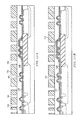
- FIGS. 1A-1E, 1F -A, 1 F-B, 1 G- 1 I, 1 J-A, 1 J-B, 1 K, 1 L-A, 1 L-B, 1 M-A and 1 M-B are illustrations of steps in the fabrication of integrated circuits formed according to principles of the invention.
- FIGS. 2A and 2B are cross sections of example embodiments of the invention.
- FIGS. 3A-3D are illustrations of steps in the fabrication of integrated circuits formed according to principles of the invention.
- a device such as a resistor
- R TEMP R 0 +C 1 ⁇ T+C 2 ( ⁇ T ) 2
- C 1 is the linear temperature coefficient of resistance
- C 2 is the quadratic temperature coefficient of resistance
- ⁇ T is the difference between ambient temperature and the reference temperature
- ⁇ is the resistivity of the material in ⁇ -cm
- t is the thickness of the resistor
- A is the cross sectional area of the resistor.
- metals such as aluminum and copper have a large C 1 but low ⁇ .
- a high TCR resistor specification for deviation from nominal resistance may be +/ ⁇ 100 ppm/° C. for the linear temperature coefficient of resistance and +/ ⁇ 10 ppm/C for the quadratic temperature coefficient of resistance. This high TCR resistor tolerance may enable a temperature sensor accuracy of +/ ⁇ 0.01%/ ⁇ ° C.
- Resistors that meet the requirements for an embedded resistor temperature sensor are illustrated in FIGS. 1M-A , 1 M-B, 2 A, 2 B and 3 D.
- the resistors 147 , 148 , 151 , 152 , 157 and 158 are formed using tungsten, a material commonly used in integrated circuits for contact plugs. These resistors may be formed at the same time as the contact plugs are formed and therefore add no additional processing steps and no additional processing cost.
- the resistors 222 and 224 are formed using tungsten, a material commonly used for via plugs in the manufacture of integrated circuits with non damascene or single damascene interconnect.
- the resistors 222 and 224 are formed at the same time as via plug 220 is formed and therefore add no additional processing steps and no additional processing cost.
- Tungsten resistors with a variety of resistor structures may be formed simultaneously with the formation of tungsten contact plugs. Formation of examples of these tungsten resistor structures is illustrated in FIGS. 1A through 1M -B.
- resistor structure 152 is formed from tungsten 136 deposited in a resistor trench over isolation dielectric 22 .
- resistor structure 151 is formed from tungsten 138 deposited in a resistor trench between two polysilicon leads over etch stop dielectric 139 .
- the depth of this trench is shallower than the trench for resistor 152 and therefore resistor 151 has a higher resistance per unit length and may occupy less area than resistor 152 .
- resistor structure 154 ( FIG. 1M-A and FIG. 2A ) tungsten 138 is deposited in a resistor trench on top of an unsilicided polysilicon platform 135 .
- the tungsten in this resistor is thinner and therefore has higher resistance per unit length than resistors 151 or 152 .
- Resistor structure 152 is formed in a resistor trench between two polysilicon leads over isolation dielectric 22 . Sidewall dielectric prevents the tungsten 136 from shorting to the polysilicon leads.
- the width and therefore the resistance of resistor 152 are largely independent of the exposure of the contact photo pattern and also upon the amount of contact over etch.
- the depth of resistor 152 depends upon how far down into the isolation dielectric the resistor trench is etched during contact over etch.
- resistor structure 151 is formed in a resistor trench between two polysilicon leads over isolation dielectric 22 . Sidewall dielectric prevents the tungsten 137 from shorting to the polysilicon leads.
- the width and therefore the resistance of resistor 151 is largely independent of the contact photo pattern exposure and also largely independent of contact over etch.
- the depth of resistor 151 trench is largely independent of contact over etch because of the remaining contact etch stop liner 139 at the bottom of the resistor 151 trench.
- resistor structure 146 is formed in a trench over nwell 26 . Implants such as source and drain extension implants and source and drain implants are blocked from regions of the nwell 26 where resistor structure 146 is to be formed. Silicide 94 forms a Schottky diode to the nwell 26 . When the nwell 26 is grounded, the Schottky diode is reverse biased and has a high resistance which prevents the nwell from shorting the resistor 146 . Because of the high selectivity of the contact etch to silicide, forming the resistor 146 over a silicided active area 94 enables the resistor height to be substantially independent of contact over etch. This may reduce resistor variability across the wafer and lot-to-lot.
- Resistor structure 148 is formed over active area to minimize resistor height variation due to contact over etch and is formed between polysilicon leads to minimize variation in width of the resistor due to contact pattern exposure and contact over etch.
- Resistor structures 156 and 158 are similar to resistor structures 146 and 148 except that they are formed over an isolated p-well 34 instead of over an nwell.
- a resistor may be formed on a Schottky diode on n-type or on p-type semiconductor material as long as the Schottky diode may be reverse biased into high resistance preventing underlying semiconductor material from shorting the resistor.
- FIGS. 1A through 1M -B A process for forming resistors in an integrated circuit simultaneously with forming tungsten contact plugs is described in FIGS. 1A through 1M -B.
- a variety of high TCR resistors are formed in the integrated circuit without adding processing steps or processing cost. It is understood that in a particular integrated circuit not all of the resistors may be formed. In a particular integrated circuit only one type of tungsten resistor may be formed or several may be formed, as desired.
- FIG. 1A shows a portion of an integrated circuit that is processed through shallow trench isolation (STI).
- STI geometries 22 are formed in a p-type semiconductor substrate 20 .
- an nwell photo resist pattern 24 is formed on the integrated circuit wafer with openings through which n-type dopant 25 is implanted to form nwells 26 and 28 .
- nwell photo resist pattern 24 is removed and pwell photo resist pattern 30 is formed on the surface of the integrated circuit wafer with openings through which p-type dopant 35 is implanted to form pwell 32 in the p-type substrate 20 and to form isolated pwell 34 in nwell 28 .
- a separate pwell pattern and implantation step may not be performed. Isolated pwells may not be formed in some integrated circuit manufacturing flows.
- Pwell photoresist pattern 30 is removed and a transistor gate dielectric and a layer of polysilicon 42 are deposited on the integrated circuit wafer as shown in FIG. 1D .
- Gate doping photo resist pattern 40 is formed on the polysilicon layer 42 with openings through which an n-type dopant 46 such as phosphorus or arsenic is implanted to set the work function in the NMOS transistor regions 142 .
- the dopant 46 is blocked from PMOS transistor areas 144 and from regions 44 where a resistor 154 is to be formed on polysilicon platform 64 .
- photoresist pattern 40 is removed and a transistor gate photo resist pattern is formed on the polysilicon layer 42 with geometries 50 and 52 to defined gates in NMOS transistor area 142 and PMOS transistor area 144 .
- Geometry 54 defines a polysilicon platform on which a resistor 154 is to be formed, and geometry 56 defines polysilicon lead pairs which may be used to define the width of resistors 148 , 152 , and 158 as is described below.
- FIG. 1F-A shows the integrated circuit after the polysilicon 42 is etched forming NMOS gate 60 , PMOS gate 62 , polysilicon platform 64 on which a resistor is to be formed, and pairs of polysilicon leads 66 which may be used to define the width of resistors.
- Dielectric sidewalls 68 are formed on the polysilicon leads by depositing a dielectric such as silicon nitride and performing an anisotropic etch. The dielectric sidewalls on the polysilicon lead pairs 66 prevent the tungsten resistor whose width is determined by the spacing between the two polysilicon leads from shorting to the polysilicon leads.
- FIG. 1F-B shows an alternate embodiment, which is identical to the embodiment of FIG. 1F-A with the exception that pairs of polysilicon leads 65 are formed in place pairs of polysilicon leads 66 of FIG. 1F-A . Pairs of polysilicon leads 65 are formed closer together than pairs of polysilicon leads 66 . As described below, a contact etch stop liner deposited between the closely spaced leads 65 may form thicker contact etch stop liner in this region that is not completely removed during contact etch. The contact etch stop liner remaining between leads 65 after contact etch limits the depth of the resistor trench and forms the bottom surface of the resistor trench. Stopping the resistor trench on etch stop dielectric rather than STI dielectric improves trench depth control and also forms a resistor with reduced height and increased resistance.
- an NSD photo resist pattern 74 is formed on the integrated circuit and n-type dopants 70 such as phosphorus and arsenic are implanted to form source and drain diffusions 72 on the NMOS transistor.
- the implant is blocked from PMOS transistor areas and from areas where resistors are to be formed.
- photoresist pattern 74 is removed and a PSD photo resist pattern 82 is formed on the integrated circuit and p-type dopants 84 such as boron and BF 2 are implanted to form source and drain diffusions 80 on the PMOS transistor.
- p-type dopants 84 such as boron and BF 2 are implanted to form source and drain diffusions 80 on the PMOS transistor.
- the implant is blocked from NMOS transistor areas and from areas where resistors are to be formed.
- silicide block dielectric layer 90 is deposited, patterned with a silicide block photo resist pattern, and etched. Silicide block dielectric 90 is left in regions of the wafer where it is desired to block silicide formation.
- One such silicide blocked region is the polysilicon platform 64 on which a resistor is to be formed.
- Silicide layer 96 is then formed on the gates 60 and 62 , source and drains 72 and 80 , of the NMOS 142 and PMOS 144 transistors, on the polysilicon pairs 66 not covered silicide block dielectric layer 90 , and on the lightly doped nwell 26 and isolated pwell 34 regions forming Schottky diodes where resistors 146 , 148 , 156 , and 158 are to be formed. Because source and drain extension dopants and source and drain dopants are blocked from the wells, 26 and 34 where the resistors are to be formed, these regions remain lightly doped. Silicide forms a Schottky junction to these lightly doped regions. The Schottky diode may be reverse biased into a very high resistance state.
- Resistors 146 , 148 , 156 , and 158 may be formed on reverse biased Schottky diodes without shorting to the underlying wells 26 and 34 . Because the selectivity of contact etch to silicide is very high, the height of resistors formed on silicided active regions in wells 26 and 34 is well controlled.
- Contact etch stop layers 100 and 101 and premetal dielectric (PMD) layer 108 are formed on the integrated circuit as shown in FIGS. 1J-A and 1 J-B.
- Contact photo resist pattern 110 is formed on the PMD layer 108 with openings 102 to form contacts to the NMOS transistor, openings 104 to form contacts to the PMOS transistor, and openings 106 to form resistors.
- the polysilicon leads in the polysilicon lead pairs are spaced closer together in FIG. 1J-B than in FIG. 1J-A so that the contact etch stop layer 101 forms a layer of contact etch stop liner 107 that is thicker than etch stop liner 105 in FIG. 1J-A .
- This thicker contact etch stop liner 107 is be completely removed during contact etch.
- the remaining contact etch stop layer in this region forms the bottom of the resistor trench.
- the spacing of the two polysilicon leads and the thickness of the contact etch stop liner may be optimized to leave the desired amount of contact etch stop liner remaining at the bottom of the resistor trench post contact etch.
- square contact openings 112 are formed to the NMOS transistors
- square contact openings 114 are formed to PMOS transistors
- rectangular trenches such as 116 and 118 are formed where resistors are to be formed.
- the length of the resistor trench depends upon the resistance desired.
- the resistor trench may have both horizontal and vertical segments to fit the required resistor length within a specific area.
- FIG. 1L-A The cross-section shown in FIG. 1L-A is taken along line 120 in FIG. 1K .
- FIG. 1L-B shows a cross-section that is identical to that in FIG. 1L-A with the exception that the resistor trench between the closer spaced polysilicon leads stops on remaining contact etch stop liner 101 whereas the resistor trench 105 shown in FIG. 1L-A between the wider spaced polysilicon leads stops on silicide layer 94 .
- FIG. 1M-A shows the integrated circuit after the contact holes 112 and 114 and the resistor trenches are filled with CVD tungsten. Filling the resistor trenches with CVD tungsten forms tungsten resistors 146 , 148 , 150 , 152 , 154 , 156 , and 158 .
- a thin barrier layer of TiN is deposited prior to filling the contacts and resistor trenches with CVD-W. CMP is then used to planarize the contact plugs and the resistors.
- Intermetal dielectric layer 142 and first layer interconnect 144 are then formed on the integrated circuit.
- the interconnect 144 may be a metal such as aluminum alloy which is deposited and etched or may be a metal such as copper which is formed in dielectric trenches etched using a damascene process.
- FIG. 1M-B is identical to FIG. 1M-A with the exception that resistors 147 , 151 , and 157 are formed on contact etch stop liner which remains between the closely space polysilicon leads after contact and resistor trench etch.
- the control of the height of resistor 151 in FIG. 1M-B is better than control of the height of resistor 152 in FIG. 1M-A .
- the height of resistor 152 in FIG. 1M-A is dependent upon how deeply the resistor trench etches into STI dielectric during contact over etch whereas the height of resistor 151 in FIG. 1M-B is independent of contact over etch because it stops on remaining contact etch stop liner.
- FIG. 2A illustrates how resistors 148 , 152 and 158 of FIG. 1M-A may look when cross sectioned through the resistors lengthwise.
- Resistor 148 is formed on the silicided region of nwell 26 .
- Contact etch has a high selectivity to active so the height of the resistor may be very well controlled across wafer and lot-to-lot.
- Interconnect geometries 160 and 162 form electrical contact to the heads of the resistor 148 .
- Resistor 152 is formed over isolation dielectric 22 . Because of low selectivity of STI dielectric to contact etch, the height of resistor 152 depends upon how deep the resistor 152 trench penetrates into the STI dielectric 22 during contact over etch. The height and therefore resistance of the resistor 152 depends upon contact etch.
- First layer of interconnect geometries 164 and 166 form electrical contact to the heads of resistor 152 . The interconnect geometries may overlap the resistor heads as on resistor 148 or may under lap the resistor heads as on resistor 152 .
- Resistor 154 is formed on a polysilicon platform 135 . Silicide is blocked from forming on polysilicon platform 135 .
- the polysilicon is high resistance.
- the depth of the resistor 154 trench is well controlled since the selectivity of polysilicon to the contact etch is very high. Because the height of the resistor 154 formed on the polysilicon platform 135 is significantly less than the height of the resistor 148 formed over nwell 26 and significantly less than the height of resistor 152 formed over STI dielectric 22 , the resistance per unit length of resistor 158 is significantly higher than that of resistors 148 and 152 . Because the resistance of resistor 158 is higher than that of resistors 148 and 152 , a resistor 158 with equivalent resistance to resistors 148 and 152 may be formed in smaller area.
- FIG. 2B illustrates resistors 147 , 151 and 157 of FIG. 1M-B when cross sectioned lengthwise. Because these resistors are formed over closely spaced polysilicon leads where a thicker layer of contact etch stop liner may form, the bottom of these resistors is formed on contact etch stop liner that remains after the contact and resistor trench etch. Because resistors 147 and 157 are formed on dielectric, there is no requirement for a reverse biased Shottky diode to be formed beneath the resistors 147 and 157 which are formed over active regions in nwell 26 or pwell 34 . Because resistor 151 is formed over contact etch stop liner 139 rather than STI dielectric, the height of resistor 151 is independent of contact over etch.
- Resistors formed simultaneously with the formation of tungsten via plugs are illustrated in FIGS. 3A through 3D .
- Resistor structures 222 and 224 are formed in trenches in the ILD dielectric 206 which are etched simultaneously with via 220 ( FIG. 3D ).
- an intermetal dielectric layer (IMD) 202 with interconnect geometries 204 , 210 , and 212 is formed on an integrated circuit 200 .
- Interconnect geometries 204 , 210 , and 212 may be formed with a first layer of interconnect or may be formed with a higher level of interconnect.
- Integrated circuit 200 may have one or more levels of interconnect.
- ILD layer 206 is formed on the integrated circuit over IMD layer 202 and over interconnect geometries 204 , 210 , and 212 .
- a via photo resist pattern 208 is formed on the integrated circuit with openings to etch via 214 ( FIG. 3B ) and with openings to etch trenches, 216 and 218 ( FIG. 3B ) in which resistors are to be formed.
- resistor trench 218 is formed over interconnect leads 210 and 212 which are spaced apart to form electrical contact to the heads of the resistor 224 .
- FIG. 3C shows the integrated circuit after the via opening 214 and resistor trenches 216 and 218 are filled with tungsten and planarized to form via plug 220 and resistors 222 and 224 . Underlying interconnect geometries 210 and 212 form electrical contact to the bottom side of the heads of resistor 224 .
- FIG. 3D shows the integrated circuit after intermetal dielectric layer 232 is deposited and interconnect geometries 230 and 234 are formed. Interconnect geometries 230 and 234 form top side electrical contact to the heads of resistor 222 .
- resistors 222 and 224 may be formed in a production integrated circuit.
- a resistor with one resistor head contacted from above and the other resistor head contacted from below may be formed.
- the high TCR resistors described above are formed simultaneously with via plugs and without adding additional process steps or additional cost to the integrated circuit manufacturing flow.
Landscapes
- Semiconductor Integrated Circuits (AREA)
- Internal Circuitry In Semiconductor Integrated Circuit Devices (AREA)
Abstract
A high TCR tungsten resistor on a reverse biased Schottky diode. A high TCR tungsten resistor on an unsilicided polysilicon platform geometry. A high TCR tungsten resistor between two parallel polysilicon leads on remaining contact etch stop dielectric. A high TCR tungsten resistor embedded in a intermetal dielectric layer above a lower interconnect layer and below an upper interconnect layer. A method of forming a high TCR tungsten resistor on a reverse biased Schottky diode. A method of forming high TCR tungsten resistor on an unsilicided polysilicon platform geometry. A method of forming high TCR tungsten resistor between two parallel polysilicon leads on remaining contact etch stop dielectric. A method of forming high TCR tungsten resistor embedded in a inter metal dielectric layer above a lower interconnect layer and below an upper interconnect layer.
Description
Under 35 U.S.C. § § 120, 121, this divisional application claims priority to and benefits of U.S. patent application Ser. No. 13/586,672, filed on Aug. 15, 2012, which also claims priority to U.S. Provisional Application No. 61/523,575, filed Aug. 15, 2011. The entirety of the above reference applications is herein incorporated by reference.
This invention relates to the field of integrated circuits. More particularly, this invention relates to forming resistors with a high temperature coefficient of resistance in integrated circuits.
In addition to transistors, other devices such as resistors, capacitors and diodes are formed during the manufacture of integrated circuits. These devices may be used to set voltage levels, pass or block signals, and form delay paths. In some cases these devices may be used to measure temperature.
The equation for the resistance of resistor material as a function of temperature is given by the equation
R TEMP =R 0 +C 1 ΔT+C 2(ΔT)2
Where R0 is the resistance at a reference temperature such as room temperature, C1 is the linear temperature coefficient of resistance, C2 is the quadratic temperature coefficient of resistance, and ΔT is the difference between ambient temperature and the reference temperature.
R TEMP =R 0 +C 1 ΔT+C 2(ΔT)2
Where R0 is the resistance at a reference temperature such as room temperature, C1 is the linear temperature coefficient of resistance, C2 is the quadratic temperature coefficient of resistance, and ΔT is the difference between ambient temperature and the reference temperature.
Because the resistance of metals commonly used in integrated circuits such as copper and aluminum has low resistance, when a temperature sensing resistor is needed, a high resistance metal such as nickel or molybdenum is added to the integrated circuit process flow to form the temperature sensing resistor. Addition of a new metal to the manufacturing flow adds cost by requiring additional deposition and etching manufacturing steps.
When a device, such as a resistor, is embedded in an integrated circuit and used to measure temperature, it is desirable to have a large linear change in resistance with temperature, C1, with a low standard deviation and low lot-to-lot variation. It is also desirable for the material to have high resistivity so that less resistor area is needed to develop the required voltage drop.
The equation for resistance of resistor material as a function of temperature is given by the equation
R TEMP =R 0 +C 1 ΔT+C 2(ΔT)2
Where R0=ρ*t/A is the resistance at a reference temperature such as room temperature, C1 is the linear temperature coefficient of resistance, C2 is the quadratic temperature coefficient of resistance, and ΔT is the difference between ambient temperature and the reference temperature. ρ is the resistivity of the material in μΩ-cm, t is the thickness of the resistor and A is the cross sectional area of the resistor.
R TEMP =R 0 +C 1 ΔT+C 2(ΔT)2
Where R0=ρ*t/A is the resistance at a reference temperature such as room temperature, C1 is the linear temperature coefficient of resistance, C2 is the quadratic temperature coefficient of resistance, and ΔT is the difference between ambient temperature and the reference temperature. ρ is the resistivity of the material in μΩ-cm, t is the thickness of the resistor and A is the cross sectional area of the resistor.
As shown in TABLE 1, metals such as aluminum and copper have a large C1 but low ρ.
| TABLE 1 | |||||
| MATERIAL | Element/Alloy | C1 ppm | ρ μΩ-cm | ||
| Aluminum | Element | 4,308 | 2.7 | ||
| Constantan | Alloy | 74 | 49 | ||
| Copper | Element | 4041 | 1.7 | ||
| Gold | Element | 3715 | 2.4 | ||
| Iron | Element | 5671 | 9.7 | ||
| Manganin | Alloy | 15 | 48 | ||
| Molybdenum | Element | 4579 | 5.6 | ||
| Nickel | Element | 5866 | 7 | ||
| Nichrome | Alloy | 17 | 108 | ||
| Platinum | Element | 3729 | 10.5 | ||
| Silver | Element | 3819 | 1.6 | ||
| Steel | Alloy | 3000 | 59 | ||
| Tungsten | Element | 4403 | 5.6 | ||
| Zinc | Element | 3847 | 5.9 | ||
A high TCR resistor specification for deviation from nominal resistance may be +/−100 ppm/° C. for the linear temperature coefficient of resistance and +/−10 ppm/C for the quadratic temperature coefficient of resistance. This high TCR resistor tolerance may enable a temperature sensor accuracy of +/−0.01%/Δ° C.
Resistors that meet the requirements for an embedded resistor temperature sensor are illustrated in FIGS. 1M-A , 1M-B, 2A, 2B and 3D. In FIGS. 2A and 2B , the resistors 147, 148, 151, 152, 157 and 158 are formed using tungsten, a material commonly used in integrated circuits for contact plugs. These resistors may be formed at the same time as the contact plugs are formed and therefore add no additional processing steps and no additional processing cost.
In FIG. 3D , the resistors 222 and 224 are formed using tungsten, a material commonly used for via plugs in the manufacture of integrated circuits with non damascene or single damascene interconnect. The resistors 222 and 224 are formed at the same time as via plug 220 is formed and therefore add no additional processing steps and no additional processing cost.
Tungsten resistors with a variety of resistor structures may be formed simultaneously with the formation of tungsten contact plugs. Formation of examples of these tungsten resistor structures is illustrated in FIGS. 1A through 1M -B.
In FIG. 1M-A and FIG. 2A , resistor structure 152 is formed from tungsten 136 deposited in a resistor trench over isolation dielectric 22.
In FIG. 1M-B and FIG. 2B , resistor structure 151 is formed from tungsten 138 deposited in a resistor trench between two polysilicon leads over etch stop dielectric 139. The depth of this trench is shallower than the trench for resistor 152 and therefore resistor 151 has a higher resistance per unit length and may occupy less area than resistor 152.
In resistor structure 154, (FIG. 1M-A and FIG. 2A ) tungsten 138 is deposited in a resistor trench on top of an unsilicided polysilicon platform 135. The tungsten in this resistor is thinner and therefore has higher resistance per unit length than resistors 151 or 152.
In FIG. 1M-B and FIG. 2B , resistor structure 151 is formed in a resistor trench between two polysilicon leads over isolation dielectric 22. Sidewall dielectric prevents the tungsten 137 from shorting to the polysilicon leads. The width and therefore the resistance of resistor 151 is largely independent of the contact photo pattern exposure and also largely independent of contact over etch. The depth of resistor 151 trench is largely independent of contact over etch because of the remaining contact etch stop liner 139 at the bottom of the resistor 151 trench.
In FIG. 1M-A , resistor structure 146 is formed in a trench over nwell 26. Implants such as source and drain extension implants and source and drain implants are blocked from regions of the nwell 26 where resistor structure 146 is to be formed. Silicide 94 forms a Schottky diode to the nwell 26. When the nwell 26 is grounded, the Schottky diode is reverse biased and has a high resistance which prevents the nwell from shorting the resistor 146. Because of the high selectivity of the contact etch to silicide, forming the resistor 146 over a silicided active area 94 enables the resistor height to be substantially independent of contact over etch. This may reduce resistor variability across the wafer and lot-to-lot.
A process for forming resistors in an integrated circuit simultaneously with forming tungsten contact plugs is described in FIGS. 1A through 1M -B. A variety of high TCR resistors are formed in the integrated circuit without adding processing steps or processing cost. It is understood that in a particular integrated circuit not all of the resistors may be formed. In a particular integrated circuit only one type of tungsten resistor may be formed or several may be formed, as desired.
Referring now to FIG. 1B an nwell photo resist pattern 24 is formed on the integrated circuit wafer with openings through which n-type dopant 25 is implanted to form nwells 26 and 28.
In FIG. 1C , nwell photo resist pattern 24 is removed and pwell photo resist pattern 30 is formed on the surface of the integrated circuit wafer with openings through which p-type dopant 35 is implanted to form pwell 32 in the p-type substrate 20 and to form isolated pwell 34 in nwell 28. In some integrated circuit process flows, a separate pwell pattern and implantation step may not be performed. Isolated pwells may not be formed in some integrated circuit manufacturing flows.
Pwell photoresist pattern 30 is removed and a transistor gate dielectric and a layer of polysilicon 42 are deposited on the integrated circuit wafer as shown in FIG. 1D . Gate doping photo resist pattern 40 is formed on the polysilicon layer 42 with openings through which an n-type dopant 46 such as phosphorus or arsenic is implanted to set the work function in the NMOS transistor regions 142. The dopant 46 is blocked from PMOS transistor areas 144 and from regions 44 where a resistor 154 is to be formed on polysilicon platform 64.
Referring now to FIG. 1E , photoresist pattern 40 is removed and a transistor gate photo resist pattern is formed on the polysilicon layer 42 with geometries 50 and 52 to defined gates in NMOS transistor area 142 and PMOS transistor area 144. Geometry 54 defines a polysilicon platform on which a resistor 154 is to be formed, and geometry 56 defines polysilicon lead pairs which may be used to define the width of resistors 148, 152, and 158 as is described below.
In FIG. 1G , an NSD photo resist pattern 74 is formed on the integrated circuit and n-type dopants 70 such as phosphorus and arsenic are implanted to form source and drain diffusions 72 on the NMOS transistor. The implant is blocked from PMOS transistor areas and from areas where resistors are to be formed.
In FIG. 1H , photoresist pattern 74 is removed and a PSD photo resist pattern 82 is formed on the integrated circuit and p-type dopants 84 such as boron and BF2 are implanted to form source and drain diffusions 80 on the PMOS transistor. The implant is blocked from NMOS transistor areas and from areas where resistors are to be formed.
Referring now to FIG. 1I , photoresist pattern 82 is removed and a silicide block dielectric layer 90 is deposited, patterned with a silicide block photo resist pattern, and etched. Silicide block dielectric 90 is left in regions of the wafer where it is desired to block silicide formation. One such silicide blocked region is the polysilicon platform 64 on which a resistor is to be formed.
Contact etch stop layers 100 and 101 and premetal dielectric (PMD) layer 108 are formed on the integrated circuit as shown in FIGS. 1J-A and 1J-B. Contact photo resist pattern 110 is formed on the PMD layer 108 with openings 102 to form contacts to the NMOS transistor, openings 104 to form contacts to the PMOS transistor, and openings 106 to form resistors.
The polysilicon leads in the polysilicon lead pairs are spaced closer together in FIG. 1J-B than in FIG. 1J-A so that the contact etch stop layer 101 forms a layer of contact etch stop liner 107 that is thicker than etch stop liner 105 in FIG. 1J-A . This thicker contact etch stop liner 107 is be completely removed during contact etch. The remaining contact etch stop layer in this region forms the bottom of the resistor trench. The spacing of the two polysilicon leads and the thickness of the contact etch stop liner may be optimized to leave the desired amount of contact etch stop liner remaining at the bottom of the resistor trench post contact etch.
As shown in the top down view of the integrated circuit of in FIG. 1K , square contact openings 112 are formed to the NMOS transistors, square contact openings 114 are formed to PMOS transistors, and rectangular trenches such as 116 and 118 are formed where resistors are to be formed. The length of the resistor trench depends upon the resistance desired. The resistor trench may have both horizontal and vertical segments to fit the required resistor length within a specific area.
The cross-section shown in FIG. 1L-A is taken along line 120 in FIG. 1K . FIG. 1L-B shows a cross-section that is identical to that in FIG. 1L-A with the exception that the resistor trench between the closer spaced polysilicon leads stops on remaining contact etch stop liner 101 whereas the resistor trench 105 shown in FIG. 1L-A between the wider spaced polysilicon leads stops on silicide layer 94.
Resistors formed simultaneously with the formation of tungsten via plugs are illustrated in FIGS. 3A through 3D . Resistor structures 222 and 224 (FIG. 3D ) are formed in trenches in the ILD dielectric 206 which are etched simultaneously with via 220 (FIG. 3D ).
As shown in FIG. 3A , an intermetal dielectric layer (IMD) 202 with interconnect geometries 204, 210, and 212 is formed on an integrated circuit 200. Interconnect geometries 204, 210, and 212 may be formed with a first layer of interconnect or may be formed with a higher level of interconnect. Integrated circuit 200 may have one or more levels of interconnect.
As shown in FIG. 3B , resistor trench 218 is formed over interconnect leads 210 and 212 which are spaced apart to form electrical contact to the heads of the resistor 224.
One or both types of resistors 222 and 224 may be formed in a production integrated circuit. In addition a resistor with one resistor head contacted from above and the other resistor head contacted from below may be formed. The high TCR resistors described above are formed simultaneously with via plugs and without adding additional process steps or additional cost to the integrated circuit manufacturing flow.
Those skilled in the art to which this invention relates will appreciate that many other embodiments and variations are possible within the scope of the claimed invention.
Claims (23)
1. A method for fabricating an integrated circuit, comprising:
forming a lead with a lead length on a semiconductor wafer;
forming dielectric sidewalls on the lead;
depositing a dielectric layer over the lead;
forming a photoresist pattern on the dielectric layer with a resistor trench opening adjacent to the lead;
etching the dielectric layer through the resistor trench opening to form a resistor trench;
filling the resistor trench with tungsten; and
planarizing the tungsten to form a tungsten resistor having a resistor length equal to or less than the lead length of the lead.
2. The method of claim 1 , further comprising:
forming a first interconnect geometry in electrical contact with a first head of the tungsten resistor; and
forming a second interconnect geometry in electrical contact with a second head of the tungsten resistor.
3. The method of claim 1 , further comprising:
forming a well in the semiconductor wafer;
forming an active geometry in the well;
blocking source and drain implants from the active geometry; and
forming silicide on the active geometry where the silicide active geometry forms a diode structure with the well.
4. The method of claim 3 , wherein the resistor trench opening is over the active geometry.
5. The method of claim 3 , wherein the silicide is disposed to form a bottom of the resistor trench.
6. The method of claim 3 , wherein:
the semiconductor wafer is p-type;
the well is an nwell; and
the silicide includes a material selected from a group consisting of titanium silicide, cobalt silicide, nickel silicide, and combinations thereof.
7. The method of claim 3 wherein:
the semiconductor wafer is p-type;
the well is an isolated pwell; and
the silicide includes a material selected from a group consisting of titanium silicide, cobalt silicide, nickel silicide, and combinations thereof.
8. The method of claim 1 , further comprising:
forming a shallow trench isolation dielectric layer on the semiconductor wafer;
wherein the resistor trench opening is over the shallow trench isolation dielectric layer such that the shallow trench isolation dielectric layer forms a bottom of the resistor trench.
9. The method of claim 1 , wherein forming the lead includes:
forming a first polysilicon lead and a second polysilicon lead in parallel such that:
the lead length of at least one of the first or second polysilicon lead is equal to or greater than the resistor length of the tungsten resistor; and
a spacing between the first and second polysilicon leads is less than a width of the resistor trench opening.
10. The method of claim 9 , wherein forming dielectric sidewalls includes:
depositing a sidewall dielectric layer conforming to the first and second polysilicon leads;
etching the sidewall dielectric layer to form dielectric sidewalls on vertical sides of the first and second polysilicon leads.
11. The method of claim 9 , wherein the tungsten resistor has a resistor width defined by the spacing between the first and second parallel polysilicon leads.
12. The method of claim 9 , further comprising:
forming an etch stop dielectric layer over the first and second polysilicon leads and over the dielectric sidewalls,
wherein the etch stop dielectric layer having a first thickness above and between the first and second polysilicon leads, and a second thickness directly above the first and second polysilicon leads, such that the first thickness is greater than the second thickness.
13. The method of claim 12 , further comprising:
while forming the resistor trench, etching a portion of the etch stop dielectric layer between the first and second polysilicon leads such that a remaining portion of the etch stop dielectric layer deposited between the first and second polysilicon leads to cover a bottom of the resistor trench.
14. A method for fabricating an integrated circuit, comprising:
forming a well in a substrate;
forming a MOS active region;
forming an active silicide geometry in the well and outside of the MOS active region;
forming a tungsten resistor above the active silicide geometry;
forming a first polysilicon lead above the substrate; and
forming a second polysilicon lead above the substrate and adjacent to the first polysilicon lead to define a resistor trench above the substrate;
wherein forming the tungsten resistor includes developing the tungsten resistor from within the resistor trench and extending above the first and second polysilicon leads.
15. The method of claim 14 , wherein forming the well in a substrate includes forming an nwell in the substrate.
16. The method of claim 14 , wherein forming the well in a substrate includes forming an isolated pwell in the substrate.
17. The method of claim 14 , further comprising:
forming an etch stop dielectric liner covering the first and second polysilicon leads while exposing the tungsten resistor above the first and second polysilicon leads.
18. The method of claim 14 , further comprising:
forming an etch stop dielectric liner formed in the resistor trench and on the silicide active geometry to interface between the tungsten resistor and the silicide active geometry.
19. A method for fabricating an integrated circuit, comprising:
forming a first well in a substrate;
forming a second well in a substrate;
forming an isolation dielectric layer onto the substrate to separate the first well from the second well;
forming a tungsten resistor above the isolation dielectric layer;
forming a first polysilicon lead above the isolation dielectric layer; and
forming a second polysilicon lead above the isolation dielectric layer and adjacent to the first polysilicon lead to define a resistor trench above the isolation dielectric layer;
wherein forming the tungsten resistor includes developing the tungsten resistor from within the resistor trench and extending above the first and second polysilicon leads.
20. The method of claim 19 , further comprising:
forming an etch stop dielectric liner covering the first and second polysilicon leads while exposing the tungsten resistor above the first and second polysilicon leads.
21. The method of claim 19 , further comprising:
forming an etch stop dielectric liner formed in the resistor trench and on the isolation dielectric layer to interface between the tungsten resistor and the isolation dielectric layer.
22. The method of claim 19 , further comprising:
forming an unsilicided polysilicon platform above the isolation dielectric layer to interface between the tungsten resistor and the isolation dielectric layer.
23. The method of claim 20 , further comprising:
forming an etch stop dielectric liner covering the unsilicided polysilicon platform while exposing the tungsten resistor.
Priority Applications (1)
| Application Number | Priority Date | Filing Date | Title |
|---|---|---|---|
| US14/864,504 US9985018B2 (en) | 2011-08-15 | 2015-09-24 | Embedded tungsten resistor |
Applications Claiming Priority (3)
| Application Number | Priority Date | Filing Date | Title |
|---|---|---|---|
| US201161523575P | 2011-08-15 | 2011-08-15 | |
| US13/586,672 US9184226B2 (en) | 2011-08-15 | 2012-08-15 | Embedded tungsten resistor |
| US14/864,504 US9985018B2 (en) | 2011-08-15 | 2015-09-24 | Embedded tungsten resistor |
Related Parent Applications (1)
| Application Number | Title | Priority Date | Filing Date |
|---|---|---|---|
| US13/586,672 Division US9184226B2 (en) | 2011-08-15 | 2012-08-15 | Embedded tungsten resistor |
Publications (2)
| Publication Number | Publication Date |
|---|---|
| US20160071838A1 US20160071838A1 (en) | 2016-03-10 |
| US9985018B2 true US9985018B2 (en) | 2018-05-29 |
Family
ID=48944930
Family Applications (3)
| Application Number | Title | Priority Date | Filing Date |
|---|---|---|---|
| US13/586,672 Active 2033-08-07 US9184226B2 (en) | 2011-08-15 | 2012-08-15 | Embedded tungsten resistor |
| US14/864,538 Active 2032-12-13 US10461075B2 (en) | 2011-08-15 | 2015-09-24 | Embedded tungsten resistor |
| US14/864,504 Active 2032-12-05 US9985018B2 (en) | 2011-08-15 | 2015-09-24 | Embedded tungsten resistor |
Family Applications Before (2)
| Application Number | Title | Priority Date | Filing Date |
|---|---|---|---|
| US13/586,672 Active 2033-08-07 US9184226B2 (en) | 2011-08-15 | 2012-08-15 | Embedded tungsten resistor |
| US14/864,538 Active 2032-12-13 US10461075B2 (en) | 2011-08-15 | 2015-09-24 | Embedded tungsten resistor |
Country Status (1)
| Country | Link |
|---|---|
| US (3) | US9184226B2 (en) |
Families Citing this family (10)
| Publication number | Priority date | Publication date | Assignee | Title |
|---|---|---|---|---|
| US9184226B2 (en) * | 2011-08-15 | 2015-11-10 | Texas Instruments Incorporated | Embedded tungsten resistor |
| KR101696539B1 (en) * | 2015-03-09 | 2017-01-16 | 한양대학교 산학협력단 | Thin film, method of fabricating the same, apparatus for fabricating the same |
| WO2017004242A1 (en) * | 2015-06-29 | 2017-01-05 | Component Re-Engineering Company, Inc. | Temperature sensing device and method for making same |
| US10263065B2 (en) | 2015-11-04 | 2019-04-16 | Globalfoundries Inc. | Metal resistor forming method using ion implantation |
| KR102491538B1 (en) | 2016-11-30 | 2023-01-20 | 삼성전자주식회사 | Semiconductor device and method for fabricating the same |
| US10651170B2 (en) | 2017-07-11 | 2020-05-12 | Taiwan Semiconductor Manufacturing Co., Ltd. | Isolated wells for resistor devices |
| US11227830B2 (en) * | 2018-10-31 | 2022-01-18 | Taiwan Semiconductor Manufacturing Company, Ltd. | Conductive features having varying resistance |
| US10797046B1 (en) * | 2019-03-29 | 2020-10-06 | GlobalFoundries, Inc. | Resistor structure for integrated circuit, and related methods |
| US11764111B2 (en) * | 2019-10-24 | 2023-09-19 | Texas Instruments Incorporated | Reducing cross-wafer variability for minimum width resistors |
| US12249603B2 (en) | 2021-10-29 | 2025-03-11 | Samsung Electronics Co., Ltd. | Resistor structures of integrated circuit devices including stacked transistors and methods of forming the same |
Citations (3)
| Publication number | Priority date | Publication date | Assignee | Title |
|---|---|---|---|---|
| US20040026762A1 (en) * | 2002-08-08 | 2004-02-12 | Renesas Technology Corp. | Semiconductor device |
| US20060118908A1 (en) * | 2004-12-06 | 2006-06-08 | Erickson Sean C | Reduced capacitance resistors |
| US20080284662A1 (en) | 2007-05-17 | 2008-11-20 | Casio Computer Co., Ltd. | Film antenna and electronic equipment |
Family Cites Families (8)
| Publication number | Priority date | Publication date | Assignee | Title |
|---|---|---|---|---|
| JP4142293B2 (en) * | 1999-07-08 | 2008-09-03 | 株式会社ルネサステクノロジ | Manufacturing method of semiconductor device |
| EP1231640A4 (en) * | 2000-06-27 | 2008-10-08 | Matsushita Electric Industrial Co Ltd | SEMICONDUCTOR DEVICE |
| US6984869B2 (en) * | 2003-12-08 | 2006-01-10 | Lsi Logic Corporation | High performance diode implanted voltage controlled p-type diffusion resistor |
| US20070284662A1 (en) * | 2006-06-09 | 2007-12-13 | International Business Machines Corporation | Microelectronic structure including high current density resistor |
| JP5085241B2 (en) * | 2007-09-06 | 2012-11-28 | ルネサスエレクトロニクス株式会社 | Semiconductor device and manufacturing method thereof |
| US9111779B2 (en) * | 2008-08-07 | 2015-08-18 | Texas Instruments Incorporated | IC resistor formed with integral heatsinking structure |
| US8436430B2 (en) * | 2011-04-08 | 2013-05-07 | Taiwan Semiconductor Manufacturing Company, Ltd. | Diodes with embedded dummy gate electrodes |
| US9184226B2 (en) * | 2011-08-15 | 2015-11-10 | Texas Instruments Incorporated | Embedded tungsten resistor |
-
2012
- 2012-08-15 US US13/586,672 patent/US9184226B2/en active Active
-
2015
- 2015-09-24 US US14/864,538 patent/US10461075B2/en active Active
- 2015-09-24 US US14/864,504 patent/US9985018B2/en active Active
Patent Citations (3)
| Publication number | Priority date | Publication date | Assignee | Title |
|---|---|---|---|---|
| US20040026762A1 (en) * | 2002-08-08 | 2004-02-12 | Renesas Technology Corp. | Semiconductor device |
| US20060118908A1 (en) * | 2004-12-06 | 2006-06-08 | Erickson Sean C | Reduced capacitance resistors |
| US20080284662A1 (en) | 2007-05-17 | 2008-11-20 | Casio Computer Co., Ltd. | Film antenna and electronic equipment |
Also Published As
| Publication number | Publication date |
|---|---|
| US20160071838A1 (en) | 2016-03-10 |
| US20160071839A1 (en) | 2016-03-10 |
| US20130207221A1 (en) | 2013-08-15 |
| US9184226B2 (en) | 2015-11-10 |
| US10461075B2 (en) | 2019-10-29 |
Similar Documents
| Publication | Publication Date | Title |
|---|---|---|
| US10461075B2 (en) | Embedded tungsten resistor | |
| US8089129B2 (en) | Isolated CMOS transistors | |
| US7939420B2 (en) | Processes for forming isolation structures for integrated circuit devices | |
| US7902630B2 (en) | Isolated bipolar transistor | |
| US7422938B2 (en) | Method of fabricating isolated semiconductor devices in epi-less substrate | |
| US8513087B2 (en) | Processes for forming isolation structures for integrated circuit devices | |
| US9991350B2 (en) | Low resistance sinker contact | |
| US10872925B2 (en) | Hall sensor with buried hall plate | |
| US6909189B2 (en) | Semiconductor device with dummy structure | |
| US7812403B2 (en) | Isolation structures for integrated circuit devices | |
| US9991120B2 (en) | Dilution doped integrated circuit resistors | |
| KR20110092222A (en) | An electronic device comprising a buried insulating layer and a vertically conductive structure extending therethrough and a process for forming the same | |
| US6835988B2 (en) | Semiconductor device having channel cut layers provided at different depths | |
| KR20110092223A (en) | An electronic device comprising a doped region disposed below the channel region and having a higher dopant concentration than the channel region and a process for forming the same | |
| KR20110092221A (en) | An electronic device comprising doped regions between channel and drain regions and a process for forming the same | |
| US20170069619A1 (en) | Gate-grounded metal oxide semiconductor device | |
| CN107924921B (en) | Low-cost flash memory manufacturing process based on metal gate process | |
| US9368488B2 (en) | Efficient integration of CMOS with poly resistor | |
| US9865718B1 (en) | Power MOSFET with metal filled deep sinker contact for CSP | |
| KR100983514B1 (en) | Semiconductor device manufacturing method | |
| US20150187957A1 (en) | Transistor with improved radiation hardness | |
| US12087809B2 (en) | Semiconductor device having capacitor and manufacturing method thereof |
Legal Events
| Date | Code | Title | Description |
|---|---|---|---|
| STCF | Information on status: patent grant |
Free format text: PATENTED CASE |
|
| MAFP | Maintenance fee payment |
Free format text: PAYMENT OF MAINTENANCE FEE, 4TH YEAR, LARGE ENTITY (ORIGINAL EVENT CODE: M1551); ENTITY STATUS OF PATENT OWNER: LARGE ENTITY Year of fee payment: 4 |
|
| MAFP | Maintenance fee payment |
Free format text: PAYMENT OF MAINTENANCE FEE, 8TH YEAR, LARGE ENTITY (ORIGINAL EVENT CODE: M1552); ENTITY STATUS OF PATENT OWNER: LARGE ENTITY Year of fee payment: 8 |