US9981928B2 - Aryl sulfide derivatives and aryl sulfoxide derivatives as acaricides and insecticides - Google Patents
Aryl sulfide derivatives and aryl sulfoxide derivatives as acaricides and insecticides Download PDFInfo
- Publication number
- US9981928B2 US9981928B2 US14/899,260 US201414899260A US9981928B2 US 9981928 B2 US9981928 B2 US 9981928B2 US 201414899260 A US201414899260 A US 201414899260A US 9981928 B2 US9981928 B2 US 9981928B2
- Authority
- US
- United States
- Prior art keywords
- alkyl
- optionally
- halo
- cycloalkyl
- represent
- Prior art date
- Legal status (The legal status is an assumption and is not a legal conclusion. Google has not performed a legal analysis and makes no representation as to the accuracy of the status listed.)
- Active, expires
Links
- 0 *N(C(B)=[V])C1=CC(S(=C)CC(F)(F)[W])=C([Y])C=C1C.CC Chemical compound *N(C(B)=[V])C1=CC(S(=C)CC(F)(F)[W])=C([Y])C=C1C.CC 0.000 description 72
- LQCILTHZYRTGJP-UHFFFAOYSA-N C=C1CC(=C)N(C(C)(C)C)C1 Chemical compound C=C1CC(=C)N(C(C)(C)C)C1 LQCILTHZYRTGJP-UHFFFAOYSA-N 0.000 description 2
- HWNOULJVXUWJTC-UHFFFAOYSA-N C=C1CC(=C)N(C(C)(C)C)C1=C Chemical compound C=C1CC(=C)N(C(C)(C)C)C1=C HWNOULJVXUWJTC-UHFFFAOYSA-N 0.000 description 2
- RNVXAJJSQVAFEA-UHFFFAOYSA-N C=C1CCC(=C)N1C(C)(C)C Chemical compound C=C1CCC(=C)N1C(C)(C)C RNVXAJJSQVAFEA-UHFFFAOYSA-N 0.000 description 2
- ZULBFOUBGZZEEO-UHFFFAOYSA-N C=S(CC(F)(F)[W])C1=C([Y])C=C(C)C(B(O)O)=C1.CC Chemical compound C=S(CC(F)(F)[W])C1=C([Y])C=C(C)C(B(O)O)=C1.CC ZULBFOUBGZZEEO-UHFFFAOYSA-N 0.000 description 2
- NCJVZFICXSHAOM-UHFFFAOYSA-N CC1=C(S(=O)CC(F)(F)F)C=C(N2C(=O)N(C)C(=O)C2(C)C)C(F)=C1 Chemical compound CC1=C(S(=O)CC(F)(F)F)C=C(N2C(=O)N(C)C(=O)C2(C)C)C(F)=C1 NCJVZFICXSHAOM-UHFFFAOYSA-N 0.000 description 2
- FBYKTDIOSFJJNE-UHFFFAOYSA-N CC1=C(S(=O)CC(F)(F)F)C=C(N2C(=O)N(C)C(C)(C)C2=O)C(F)=C1 Chemical compound CC1=C(S(=O)CC(F)(F)F)C=C(N2C(=O)N(C)C(C)(C)C2=O)C(F)=C1 FBYKTDIOSFJJNE-UHFFFAOYSA-N 0.000 description 2
- AXKPMABYWKCMNF-UHFFFAOYSA-N CC1=CC(F)=C(N2CC(C)OC2=O)C=C1S(=O)CC(F)(F)F Chemical compound CC1=CC(F)=C(N2CC(C)OC2=O)C=C1S(=O)CC(F)(F)F AXKPMABYWKCMNF-UHFFFAOYSA-N 0.000 description 2
- JHNHFIVQVMRXQP-UHFFFAOYSA-N FC1=CC(Cl)=C(SCC(F)(F)F)C=C1Br Chemical compound FC1=CC(Cl)=C(SCC(F)(F)F)C=C1Br JHNHFIVQVMRXQP-UHFFFAOYSA-N 0.000 description 2
- DDVOOTKOZAJXJD-UHFFFAOYSA-N NC1=CC(SCC(F)(F)F)=C(Cl)C=C1F Chemical compound NC1=CC(SCC(F)(F)F)=C(Cl)C=C1F DDVOOTKOZAJXJD-UHFFFAOYSA-N 0.000 description 2
- JDUFJZUIBNWWOR-UHFFFAOYSA-K C.C.CC.CC.CC.CC.CC.CC.CC.CC.CC.CC1=CC([Y])=C(S)C=C1N.CC1=CC([Y])=C(SCC(F)(F)[W])C=C1C.CC1=CC([Y])=CC=C1N.CCC(F)(F)[W].CCC(F)(F)[W].CCC1=CC(S(=O)(=O)Cl)=C([Y])C=C1C.CCC1=CC(SC(C)=O)=C([Y])C=C1C.CCC1=CC(SCC(F)(F)[W])=C([Y])C=C1C.CCC1=CC(SSC2=C([Y])C=C(C)C(NC)=C2)=C([Y])C=C1C.CCC1=CC=C([Y])C=C1C.CI.C[V].C[V].C[V](I)I.C[V]I.IC(I)I.ICI.[V]CI Chemical compound C.C.CC.CC.CC.CC.CC.CC.CC.CC.CC.CC1=CC([Y])=C(S)C=C1N.CC1=CC([Y])=C(SCC(F)(F)[W])C=C1C.CC1=CC([Y])=CC=C1N.CCC(F)(F)[W].CCC(F)(F)[W].CCC1=CC(S(=O)(=O)Cl)=C([Y])C=C1C.CCC1=CC(SC(C)=O)=C([Y])C=C1C.CCC1=CC(SCC(F)(F)[W])=C([Y])C=C1C.CCC1=CC(SSC2=C([Y])C=C(C)C(NC)=C2)=C([Y])C=C1C.CCC1=CC=C([Y])C=C1C.CI.C[V].C[V].C[V](I)I.C[V]I.IC(I)I.ICI.[V]CI JDUFJZUIBNWWOR-UHFFFAOYSA-K 0.000 description 1
- ZONKUHQOQFXPIY-UHFFFAOYSA-J C.CC.CC1=CC([Y])=C(S(=O)(=O)Cl)C=C1[N+](=O)[O-].CC1=CC([Y])=C(S)C=C1N.CC1=CC([Y])=C(SCC(F)(F)[W])C=C1C.CC1=CC([Y])=C(SSC2=C([Y])C=C(C)C(N)=C2)C=C1N.CC1=CC([Y])=C(SSC2=C([Y])C=C(C)C([N+](=O)[O-])=C2)C=C1[N+](=O)[O-].CC1=CC([Y])=CC=C1[N+](=O)[O-].CCC(F)(F)[W].CCI.CCI.C[V].C[V](I)(I)I.C[V]I Chemical compound C.CC.CC1=CC([Y])=C(S(=O)(=O)Cl)C=C1[N+](=O)[O-].CC1=CC([Y])=C(S)C=C1N.CC1=CC([Y])=C(SCC(F)(F)[W])C=C1C.CC1=CC([Y])=C(SSC2=C([Y])C=C(C)C(N)=C2)C=C1N.CC1=CC([Y])=C(SSC2=C([Y])C=C(C)C([N+](=O)[O-])=C2)C=C1[N+](=O)[O-].CC1=CC([Y])=CC=C1[N+](=O)[O-].CCC(F)(F)[W].CCI.CCI.C[V].C[V](I)(I)I.C[V]I ZONKUHQOQFXPIY-UHFFFAOYSA-J 0.000 description 1
- YZGFEKBPSPZFNU-UHFFFAOYSA-N C.CC1=C(SCC(F)(F)F)C=C(CC(=O)C(F)(F)F)C(F)=C1.CC1=C(SSC2=C(C)C=C(F)C(NC(=O)C(F)(F)F)=C2)C=C(CC(=O)C(F)(F)F)C(F)=C1.C[V-].FC(F)(F)CI Chemical compound C.CC1=C(SCC(F)(F)F)C=C(CC(=O)C(F)(F)F)C(F)=C1.CC1=C(SSC2=C(C)C=C(F)C(NC(=O)C(F)(F)F)=C2)C=C(CC(=O)C(F)(F)F)C(F)=C1.C[V-].FC(F)(F)CI YZGFEKBPSPZFNU-UHFFFAOYSA-N 0.000 description 1
- FMQNDVXJBSBDDL-UHFFFAOYSA-N C.CC1=C(SCC(F)(F)F)C=C(N)C=C1.C[V].FC(F)(F)CI.NC1=CC(S)=C(Cl)C=C1.NC1=CC(SSC2=C(Cl)C=CC(N)=C2)=C(Cl)C=C1 Chemical compound C.CC1=C(SCC(F)(F)F)C=C(N)C=C1.C[V].FC(F)(F)CI.NC1=CC(S)=C(Cl)C=C1.NC1=CC(SSC2=C(Cl)C=CC(N)=C2)=C(Cl)C=C1 FMQNDVXJBSBDDL-UHFFFAOYSA-N 0.000 description 1
- ISLPFUOJURCTAL-UHFFFAOYSA-N C=C1CC(=C)N(C2=CC(S(=C)CC(F)(F)[W])=C([Y])C=C2C)C1.CC Chemical compound C=C1CC(=C)N(C2=CC(S(=C)CC(F)(F)[W])=C([Y])C=C2C)C1.CC ISLPFUOJURCTAL-UHFFFAOYSA-N 0.000 description 1
- PBPXRMUENRQWCD-UHFFFAOYSA-N C=C1CC(=C)N(C2=CC(S(=C)CC(F)(F)[W])=C([Y])C=C2C)C1=C.CC Chemical compound C=C1CC(=C)N(C2=CC(S(=C)CC(F)(F)[W])=C([Y])C=C2C)C1=C.CC PBPXRMUENRQWCD-UHFFFAOYSA-N 0.000 description 1
- DCCZMHYTJWLAQX-UHFFFAOYSA-N C=C1CCC(=C)N1C1=CC(S(=C)CC(F)(F)[W])=C([Y])C=C1C.CC Chemical compound C=C1CCC(=C)N1C1=CC(S(=C)CC(F)(F)[W])=C([Y])C=C1C.CC DCCZMHYTJWLAQX-UHFFFAOYSA-N 0.000 description 1
- SIHRDAOQSQDLMH-UHFFFAOYSA-N C=CCOC(=O)NC1=C(F)C=C(C)C(SCC(F)(F)F)=C1 Chemical compound C=CCOC(=O)NC1=C(F)C=C(C)C(SCC(F)(F)F)=C1 SIHRDAOQSQDLMH-UHFFFAOYSA-N 0.000 description 1
- ZWKRGSADJDKYIG-UHFFFAOYSA-N C=S(CC(F)(F)[W])C1=C([Y])C=C(C)C(N)=C1.CC Chemical compound C=S(CC(F)(F)[W])C1=C([Y])C=C(C)C(N)=C1.CC ZWKRGSADJDKYIG-UHFFFAOYSA-N 0.000 description 1
- QLBYYTFYSDVETF-UHFFFAOYSA-N CC(=O)CC1=CC(S(=O)(=O)Cl)=C(C)C=C1F.CC(=O)CC1=CC(SC(C)=O)=C(C)C=C1F Chemical compound CC(=O)CC1=CC(S(=O)(=O)Cl)=C(C)C=C1F.CC(=O)CC1=CC(SC(C)=O)=C(C)C=C1F QLBYYTFYSDVETF-UHFFFAOYSA-N 0.000 description 1
- BAQLSICLOBBBAP-UHFFFAOYSA-N CC(=O)CC1=CC(SC(C)=O)=C(C)C=C1F.CC1=C(S)C=C(N)C(F)=C1 Chemical compound CC(=O)CC1=CC(SC(C)=O)=C(C)C=C1F.CC1=C(S)C=C(N)C(F)=C1 BAQLSICLOBBBAP-UHFFFAOYSA-N 0.000 description 1
- RPFLTPNQJPEMJB-UHFFFAOYSA-N CC(Nc1cc(S(Cl)(=O)=O)c(C)cc1F)=O Chemical compound CC(Nc1cc(S(Cl)(=O)=O)c(C)cc1F)=O RPFLTPNQJPEMJB-UHFFFAOYSA-N 0.000 description 1
- LAVKZJSUUXJBLQ-UHFFFAOYSA-N CC(Nc1cc(SC(C)=O)c(C)cc1F)=O Chemical compound CC(Nc1cc(SC(C)=O)c(C)cc1F)=O LAVKZJSUUXJBLQ-UHFFFAOYSA-N 0.000 description 1
- UIASTBFUGAOJQR-UHFFFAOYSA-N CC.CC.CC1=CC([Y])=C(SCC(F)(F)[W])C=C1N.CC1=CC([Y])=C(SCC(F)(F)[W])C=C1N=CC=O Chemical compound CC.CC.CC1=CC([Y])=C(SCC(F)(F)[W])C=C1N.CC1=CC([Y])=C(SCC(F)(F)[W])C=C1N=CC=O UIASTBFUGAOJQR-UHFFFAOYSA-N 0.000 description 1
- YPABRGOUEPRUQT-UHFFFAOYSA-N CC.CC1=CC([Y])=C(SCC(F)(F)F)C=C1I Chemical compound CC.CC1=CC([Y])=C(SCC(F)(F)F)C=C1I YPABRGOUEPRUQT-UHFFFAOYSA-N 0.000 description 1
- IUPHEENBQOEIDM-UHFFFAOYSA-N CC.CC1=CC([Y])=C(SCC(F)(F)[W])C=C1Br Chemical compound CC.CC1=CC([Y])=C(SCC(F)(F)[W])C=C1Br IUPHEENBQOEIDM-UHFFFAOYSA-N 0.000 description 1
- DNNJCXUOBIEIML-UHFFFAOYSA-N CC.CC1=CC([Y])=C(SCC(F)(F)[W])C=C1C Chemical compound CC.CC1=CC([Y])=C(SCC(F)(F)[W])C=C1C DNNJCXUOBIEIML-UHFFFAOYSA-N 0.000 description 1
- VYITWTFXJQKVFX-UHFFFAOYSA-N CC.CCI.O=[N+]([O-])C1=CC(S(=O)(=O)Cl)=C(Cl)C=C1.O=[N+]([O-])C1=CC(SSC2=C(Cl)C=CC([N+](=O)[O-])=C2)=C(Cl)C=C1 Chemical compound CC.CCI.O=[N+]([O-])C1=CC(S(=O)(=O)Cl)=C(Cl)C=C1.O=[N+]([O-])C1=CC(SSC2=C(Cl)C=CC([N+](=O)[O-])=C2)=C(Cl)C=C1 VYITWTFXJQKVFX-UHFFFAOYSA-N 0.000 description 1
- IBQMRARCIZLLJJ-UHFFFAOYSA-N CC1(C)OB(C2=CC(SCC(F)(F)F)=C(Cl)C=C2)OC1(C)C Chemical compound CC1(C)OB(C2=CC(SCC(F)(F)F)=C(Cl)C=C2)OC1(C)C IBQMRARCIZLLJJ-UHFFFAOYSA-N 0.000 description 1
- BSTNOFULWWDWFB-UHFFFAOYSA-N CC1(C)OB(C2=CC(SCC(F)(F)F)=C(Cl)C=C2Cl)OC1(C)C Chemical compound CC1(C)OB(C2=CC(SCC(F)(F)F)=C(Cl)C=C2Cl)OC1(C)C BSTNOFULWWDWFB-UHFFFAOYSA-N 0.000 description 1
- OYSAFEFFWRNQJF-UHFFFAOYSA-N CC1=C(S(=O)(=O)Cl)C=C(Br)C=C1 Chemical compound CC1=C(S(=O)(=O)Cl)C=C(Br)C=C1 OYSAFEFFWRNQJF-UHFFFAOYSA-N 0.000 description 1
- BEDMFPXSAWWEMU-UHFFFAOYSA-N CC1=C(S(=O)(=O)Cl)C=C(CC(=O)C(F)(F)F)C(F)=C1.CC1=C(SSC2=C(C)C=C(F)C(NC(=O)C(F)(F)F)=C2)C=C(CC(=O)C(F)(F)F)C(F)=C1 Chemical compound CC1=C(S(=O)(=O)Cl)C=C(CC(=O)C(F)(F)F)C(F)=C1.CC1=C(SSC2=C(C)C=C(F)C(NC(=O)C(F)(F)F)=C2)C=C(CC(=O)C(F)(F)F)C(F)=C1 BEDMFPXSAWWEMU-UHFFFAOYSA-N 0.000 description 1
- YLKINYNJPIPDSP-UHFFFAOYSA-N CC1=C(S(=O)(=O)Cl)C=C(CC(=O)C(F)(F)F)C(F)=C1.CC1=CC=C(CC(=O)C(F)(F)F)C(F)=C1.IC(I)[IH-].IC[IH-] Chemical compound CC1=C(S(=O)(=O)Cl)C=C(CC(=O)C(F)(F)F)C(F)=C1.CC1=CC=C(CC(=O)C(F)(F)F)C(F)=C1.IC(I)[IH-].IC[IH-] YLKINYNJPIPDSP-UHFFFAOYSA-N 0.000 description 1
- SMYFAJBEYJPSOV-UHFFFAOYSA-N CC1=C(S(=O)CC(F)(F)F)C=C(B(O)O)C(F)=C1 Chemical compound CC1=C(S(=O)CC(F)(F)F)C=C(B(O)O)C(F)=C1 SMYFAJBEYJPSOV-UHFFFAOYSA-N 0.000 description 1
- PNJBTMPCTJROIM-UHFFFAOYSA-N CC1=C(S(=O)CC(F)(F)F)C=C(B(O)O)C=C1.CC1=C(SCC(F)(F)F)C=C(B(O)O)C=C1 Chemical compound CC1=C(S(=O)CC(F)(F)F)C=C(B(O)O)C=C1.CC1=C(SCC(F)(F)F)C=C(B(O)O)C=C1 PNJBTMPCTJROIM-UHFFFAOYSA-N 0.000 description 1
- PWZRXECYEAMSRC-UHFFFAOYSA-N CC1=C(S(=O)CC(F)(F)F)C=C(N)C(F)=C1.CC1=C(SCC(F)(F)F)C=C(N)C(F)=C1 Chemical compound CC1=C(S(=O)CC(F)(F)F)C=C(N)C(F)=C1.CC1=C(SCC(F)(F)F)C=C(N)C(F)=C1 PWZRXECYEAMSRC-UHFFFAOYSA-N 0.000 description 1
- KGALBVATINMCBU-UHFFFAOYSA-N CC1=C(S(=O)CC(F)(F)F)C=C(N2C(=O)C(=O)N(C3CCCCC3)C2=O)C(F)=C1 Chemical compound CC1=C(S(=O)CC(F)(F)F)C=C(N2C(=O)C(=O)N(C3CCCCC3)C2=O)C(F)=C1 KGALBVATINMCBU-UHFFFAOYSA-N 0.000 description 1
- PAQAMZGENOTJNM-UHFFFAOYSA-N CC1=C(S(=O)CC(F)(F)F)C=C(N2C(=O)C(=O)N(CC(F)F)C2=O)C(F)=C1 Chemical compound CC1=C(S(=O)CC(F)(F)F)C=C(N2C(=O)C(=O)N(CC(F)F)C2=O)C(F)=C1 PAQAMZGENOTJNM-UHFFFAOYSA-N 0.000 description 1
- HPQUXZNMUQSCJB-UHFFFAOYSA-N CC1=C(S(=O)CC(F)(F)F)C=C(N2C(=O)C(C)(C)C(=O)N2C)C(F)=C1 Chemical compound CC1=C(S(=O)CC(F)(F)F)C=C(N2C(=O)C(C)(C)C(=O)N2C)C(F)=C1 HPQUXZNMUQSCJB-UHFFFAOYSA-N 0.000 description 1
- DEGPICWIIHMFMP-UHFFFAOYSA-N CC1=C(S(=O)CC(F)(F)F)C=C(N2C(=O)CSC2=NCC(F)(F)F)C(F)=C1.CC1=C(SCC(F)(F)F)C=C(N2C(=O)CSC2=NCC(F)(F)F)C(F)=C1 Chemical compound CC1=C(S(=O)CC(F)(F)F)C=C(N2C(=O)CSC2=NCC(F)(F)F)C(F)=C1.CC1=C(SCC(F)(F)F)C=C(N2C(=O)CSC2=NCC(F)(F)F)C(F)=C1 DEGPICWIIHMFMP-UHFFFAOYSA-N 0.000 description 1
- ADEPPQKUIWXHND-UHFFFAOYSA-N CC1=C(S(=O)CC(F)(F)F)C=C(N2C(=O)N(C)C(=O)N2C)C=C1 Chemical compound CC1=C(S(=O)CC(F)(F)F)C=C(N2C(=O)N(C)C(=O)N2C)C=C1 ADEPPQKUIWXHND-UHFFFAOYSA-N 0.000 description 1
- FICWDJYKSUIAOP-UHFFFAOYSA-N CC1=C(S(=O)CC(F)(F)F)C=C(N2C(=O)N(C)N(C)C2=O)C(F)=C1 Chemical compound CC1=C(S(=O)CC(F)(F)F)C=C(N2C(=O)N(C)N(C)C2=O)C(F)=C1 FICWDJYKSUIAOP-UHFFFAOYSA-N 0.000 description 1
- RURDKNZBASGFMC-UHFFFAOYSA-N CC1=C(S(=O)CC(F)(F)F)C=C(N2CCCC2=NCC(F)(F)F)C(F)=C1 Chemical compound CC1=C(S(=O)CC(F)(F)F)C=C(N2CCCC2=NCC(F)(F)F)C(F)=C1 RURDKNZBASGFMC-UHFFFAOYSA-N 0.000 description 1
- UUMBKCVJCRBIJK-UHFFFAOYSA-N CC1=C(SCC(F)(F)F)C=C(B(O)O)C(F)=C1 Chemical compound CC1=C(SCC(F)(F)F)C=C(B(O)O)C(F)=C1 UUMBKCVJCRBIJK-UHFFFAOYSA-N 0.000 description 1
- YICBYKOSOZKQHH-UHFFFAOYSA-N CC1=C(SCC(F)(F)F)C=C(B(O)O)C=C1 Chemical compound CC1=C(SCC(F)(F)F)C=C(B(O)O)C=C1 YICBYKOSOZKQHH-UHFFFAOYSA-N 0.000 description 1
- BFAPJIZOAJQYBQ-UHFFFAOYSA-N CC1=C(SCC(F)(F)F)C=C(B2OC(C)(C)C(C)(C)O2)C(F)=C1 Chemical compound CC1=C(SCC(F)(F)F)C=C(B2OC(C)(C)C(C)(C)O2)C(F)=C1 BFAPJIZOAJQYBQ-UHFFFAOYSA-N 0.000 description 1
- NMAAKNLSUQHLLM-UHFFFAOYSA-N CC1=C(SCC(F)(F)F)C=C(B2OC(C)(C)C(C)(C)O2)C=C1 Chemical compound CC1=C(SCC(F)(F)F)C=C(B2OC(C)(C)C(C)(C)O2)C=C1 NMAAKNLSUQHLLM-UHFFFAOYSA-N 0.000 description 1
- BJXYOCZUBZGOIZ-UHFFFAOYSA-N CC1=C(SCC(F)(F)F)C=C(Br)C(F)=C1 Chemical compound CC1=C(SCC(F)(F)F)C=C(Br)C(F)=C1 BJXYOCZUBZGOIZ-UHFFFAOYSA-N 0.000 description 1
- YIIIFMCTROVUTL-UHFFFAOYSA-N CC1=C(SCC(F)(F)F)C=C(Br)C=C1 Chemical compound CC1=C(SCC(F)(F)F)C=C(Br)C=C1 YIIIFMCTROVUTL-UHFFFAOYSA-N 0.000 description 1
- UDRGCNHMAYACOZ-UHFFFAOYSA-N CC1=C(SCC(F)(F)F)C=C(CC(=O)CCC(F)F)C(F)=C1 Chemical compound CC1=C(SCC(F)(F)F)C=C(CC(=O)CCC(F)F)C(F)=C1 UDRGCNHMAYACOZ-UHFFFAOYSA-N 0.000 description 1
- DBABPADOYZIZFS-UHFFFAOYSA-N CC1=C(SCC(F)(F)F)C=C(CC(=O)N(C)N)C(F)=C1 Chemical compound CC1=C(SCC(F)(F)F)C=C(CC(=O)N(C)N)C(F)=C1 DBABPADOYZIZFS-UHFFFAOYSA-N 0.000 description 1
- VQZAADXKTFOEKP-UHFFFAOYSA-N CC1=C(SCC(F)(F)F)C=C(I)C(F)=C1 Chemical compound CC1=C(SCC(F)(F)F)C=C(I)C(F)=C1 VQZAADXKTFOEKP-UHFFFAOYSA-N 0.000 description 1
- RAIMCJCERHADGZ-UHFFFAOYSA-N CC1=C(SCC(F)(F)F)C=C(I)C=C1 Chemical compound CC1=C(SCC(F)(F)F)C=C(I)C=C1 RAIMCJCERHADGZ-UHFFFAOYSA-N 0.000 description 1
- YLZFFYVAYNBDLP-UHFFFAOYSA-N CC1=C(SCC(F)(F)F)C=C(N2C(=O)C(=O)N(CC(F)F)C2=O)C(F)=C1 Chemical compound CC1=C(SCC(F)(F)F)C=C(N2C(=O)C(=O)N(CC(F)F)C2=O)C(F)=C1 YLZFFYVAYNBDLP-UHFFFAOYSA-N 0.000 description 1
- ABJMTMQJRILJPO-UHFFFAOYSA-N CC1=C(SCC(F)(F)F)C=C(N2C(=O)C(C)(C)C(=O)N2C)C(F)=C1 Chemical compound CC1=C(SCC(F)(F)F)C=C(N2C(=O)C(C)(C)C(=O)N2C)C(F)=C1 ABJMTMQJRILJPO-UHFFFAOYSA-N 0.000 description 1
- DIVJQYOOXIXLFA-UHFFFAOYSA-N CC1=C(SCC(F)(F)F)C=C(N2C(=O)CCC2=O)C(F)=C1 Chemical compound CC1=C(SCC(F)(F)F)C=C(N2C(=O)CCC2=O)C(F)=C1 DIVJQYOOXIXLFA-UHFFFAOYSA-N 0.000 description 1
- KNXUXUDCJWPFSG-UHFFFAOYSA-N CC1=C(SCC(F)(F)F)C=C(N2C(=O)CN(C)C2=O)C(F)=C1 Chemical compound CC1=C(SCC(F)(F)F)C=C(N2C(=O)CN(C)C2=O)C(F)=C1 KNXUXUDCJWPFSG-UHFFFAOYSA-N 0.000 description 1
- CAVDBPVKTGGLLY-UHFFFAOYSA-N CC1=C(SCC(F)(F)F)C=C(N2C(=O)CNC2=O)C(F)=C1 Chemical compound CC1=C(SCC(F)(F)F)C=C(N2C(=O)CNC2=O)C(F)=C1 CAVDBPVKTGGLLY-UHFFFAOYSA-N 0.000 description 1
- CECNMWFWVCCVJC-UHFFFAOYSA-N CC1=C(SCC(F)(F)F)C=C(N2C(=O)CSC2=NCC(F)(F)F)C(F)=C1 Chemical compound CC1=C(SCC(F)(F)F)C=C(N2C(=O)CSC2=NCC(F)(F)F)C(F)=C1 CECNMWFWVCCVJC-UHFFFAOYSA-N 0.000 description 1
- KTNDVLZDRCYUIH-UHFFFAOYSA-N CC1=C(SCC(F)(F)F)C=C(N2C(=O)N(C)C(=O)C2(C)C)C(F)=C1 Chemical compound CC1=C(SCC(F)(F)F)C=C(N2C(=O)N(C)C(=O)C2(C)C)C(F)=C1 KTNDVLZDRCYUIH-UHFFFAOYSA-N 0.000 description 1
- IFKAXDQHSZBJQZ-UHFFFAOYSA-N CC1=C(SCC(F)(F)F)C=C(N2C(=O)N(C)C(=O)N2C)C=C1 Chemical compound CC1=C(SCC(F)(F)F)C=C(N2C(=O)N(C)C(=O)N2C)C=C1 IFKAXDQHSZBJQZ-UHFFFAOYSA-N 0.000 description 1
- DGSCKRGLDDXIFO-UHFFFAOYSA-N CC1=C(SCC(F)(F)F)C=C(N2C(=O)N(C)C(C)(C)C2=O)C(F)=C1 Chemical compound CC1=C(SCC(F)(F)F)C=C(N2C(=O)N(C)C(C)(C)C2=O)C(F)=C1 DGSCKRGLDDXIFO-UHFFFAOYSA-N 0.000 description 1
- FCVQDKXVOCPLEU-UHFFFAOYSA-N CC1=C(SCC(F)(F)F)C=C(N2C(=O)N(C)N(C)C2=O)C(F)=C1 Chemical compound CC1=C(SCC(F)(F)F)C=C(N2C(=O)N(C)N(C)C2=O)C(F)=C1 FCVQDKXVOCPLEU-UHFFFAOYSA-N 0.000 description 1
- LYZNGDGJURXJRI-UHFFFAOYSA-N CC1=C(SCC(F)(F)F)C=C(N2C(=O)N(C3CC3)C(=S)N2C)C(F)=C1.CC1=C(SCC(F)(F)F)C=C(N2C(=S)N(C3CC3)C(=O)N2C)C(F)=C1.CC1=C(SCC(F)(F)F)C=C(N2C(=S)N(C3CC3)C(=S)N2C)C(F)=C1 Chemical compound CC1=C(SCC(F)(F)F)C=C(N2C(=O)N(C3CC3)C(=S)N2C)C(F)=C1.CC1=C(SCC(F)(F)F)C=C(N2C(=S)N(C3CC3)C(=O)N2C)C(F)=C1.CC1=C(SCC(F)(F)F)C=C(N2C(=S)N(C3CC3)C(=S)N2C)C(F)=C1 LYZNGDGJURXJRI-UHFFFAOYSA-N 0.000 description 1
- JFIQENRBQUEIMH-UHFFFAOYSA-N CC1=C(SCC(F)(F)F)C=C(N2CCCC2=NCC(F)(F)F)C(F)=C1 Chemical compound CC1=C(SCC(F)(F)F)C=C(N2CCCC2=NCC(F)(F)F)C(F)=C1 JFIQENRBQUEIMH-UHFFFAOYSA-N 0.000 description 1
- CZIGIODVBOMGQH-UHFFFAOYSA-N CC1=C(SCC(F)(F)F)C=C(N2CCNC2=O)C(F)=C1 Chemical compound CC1=C(SCC(F)(F)F)C=C(N2CCNC2=O)C(F)=C1 CZIGIODVBOMGQH-UHFFFAOYSA-N 0.000 description 1
- GKRKWQSSMHNYGW-UHFFFAOYSA-N CC1=C(SCC(F)(F)F)C=C(NC(=S)CCC(F)(F)F)C(F)=C1 Chemical compound CC1=C(SCC(F)(F)F)C=C(NC(=S)CCC(F)(F)F)C(F)=C1 GKRKWQSSMHNYGW-UHFFFAOYSA-N 0.000 description 1
- VAGQYHJIERXFDI-UHFFFAOYSA-N CC1=C(SSC2=C(C)C=CC(Br)=C2)C=C(Br)C=C1 Chemical compound CC1=C(SSC2=C(C)C=CC(Br)=C2)C=C(Br)C=C1 VAGQYHJIERXFDI-UHFFFAOYSA-N 0.000 description 1
- MDFOORBYQQEOAF-UHFFFAOYSA-N CC1=CC(C)=C(S(=O)CC(F)(F)F)C=C1B(O)O Chemical compound CC1=CC(C)=C(S(=O)CC(F)(F)F)C=C1B(O)O MDFOORBYQQEOAF-UHFFFAOYSA-N 0.000 description 1
- CFVXVBKJOYVHQL-UHFFFAOYSA-N CC1=CC(C)=C(S(=O)CC(F)(F)F)C=C1N1CCNC1=O Chemical compound CC1=CC(C)=C(S(=O)CC(F)(F)F)C=C1N1CCNC1=O CFVXVBKJOYVHQL-UHFFFAOYSA-N 0.000 description 1
- WRQPHSJCVWPVRO-UHFFFAOYSA-N CC1=CC(C)=C(SCC(F)(F)F)C=C1B(O)O Chemical compound CC1=CC(C)=C(SCC(F)(F)F)C=C1B(O)O WRQPHSJCVWPVRO-UHFFFAOYSA-N 0.000 description 1
- YONXIYUKUVPTQA-UHFFFAOYSA-N CC1=CC(C)=C(SCC(F)(F)F)C=C1B1OC(C)(C)C(C)(C)O1 Chemical compound CC1=CC(C)=C(SCC(F)(F)F)C=C1B1OC(C)(C)C(C)(C)O1 YONXIYUKUVPTQA-UHFFFAOYSA-N 0.000 description 1
- WFBLFZOHPNJHIH-UHFFFAOYSA-N CC1=CC(C)=C(SCC(F)(F)F)C=C1Br Chemical compound CC1=CC(C)=C(SCC(F)(F)F)C=C1Br WFBLFZOHPNJHIH-UHFFFAOYSA-N 0.000 description 1
- XTZDRDZEKZUSDY-UHFFFAOYSA-N CC1=CC(C)=C(SCC(F)(F)F)C=C1CC(=O)CCCCl.CC1=CC(C)=C(SCC(F)(F)F)C=C1N.O=C=NCCCl Chemical compound CC1=CC(C)=C(SCC(F)(F)F)C=C1CC(=O)CCCCl.CC1=CC(C)=C(SCC(F)(F)F)C=C1N.O=C=NCCCl XTZDRDZEKZUSDY-UHFFFAOYSA-N 0.000 description 1
- SGNMNQINQYQDEW-UHFFFAOYSA-N CC1=CC(C)=C(SCC(F)(F)F)C=C1CC(=O)CCCCl.[H]N1CCN(C2=CC(SCC(F)(F)F)=C(C)C=C2C)C1=O Chemical compound CC1=CC(C)=C(SCC(F)(F)F)C=C1CC(=O)CCCCl.[H]N1CCN(C2=CC(SCC(F)(F)F)=C(C)C=C2C)C1=O SGNMNQINQYQDEW-UHFFFAOYSA-N 0.000 description 1
- SGYTXZSNCGUXBS-UHFFFAOYSA-N CC1=CC(F)=C(CCC(C)O)C=C1SCC(F)(F)F Chemical compound CC1=CC(F)=C(CCC(C)O)C=C1SCC(F)(F)F SGYTXZSNCGUXBS-UHFFFAOYSA-N 0.000 description 1
- ZYHISNGDZRCDIZ-UHFFFAOYSA-N CC1=CC(F)=C(N2C(=O)OC(C)(C)C2=O)C=C1S(=O)CC(F)(F)F Chemical compound CC1=CC(F)=C(N2C(=O)OC(C)(C)C2=O)C=C1S(=O)CC(F)(F)F ZYHISNGDZRCDIZ-UHFFFAOYSA-N 0.000 description 1
- VUMJQNGQDBJGTE-UHFFFAOYSA-N CC1=CC(F)=C(N2C(=O)OC(C)(C)C2=O)C=C1SCC(F)(F)F Chemical compound CC1=CC(F)=C(N2C(=O)OC(C)(C)C2=O)C=C1SCC(F)(F)F VUMJQNGQDBJGTE-UHFFFAOYSA-N 0.000 description 1
- NHFNOICLIMHNRH-UHFFFAOYSA-N CC1=CC(F)=C(N2C(=O)OCC2C)C=C1S(=O)CC(F)(F)F Chemical compound CC1=CC(F)=C(N2C(=O)OCC2C)C=C1S(=O)CC(F)(F)F NHFNOICLIMHNRH-UHFFFAOYSA-N 0.000 description 1
- QSSNIZDSSPRJJE-UHFFFAOYSA-N CC1=CC(F)=C(N2C(=O)OCC2C)C=C1SCC(F)(F)F Chemical compound CC1=CC(F)=C(N2C(=O)OCC2C)C=C1SCC(F)(F)F QSSNIZDSSPRJJE-UHFFFAOYSA-N 0.000 description 1
- XVNGFGWCCQTXMG-UHFFFAOYSA-N CC1=CC(F)=C(N2CCOC2=O)C=C1S(=O)CC(F)(F)F Chemical compound CC1=CC(F)=C(N2CCOC2=O)C=C1S(=O)CC(F)(F)F XVNGFGWCCQTXMG-UHFFFAOYSA-N 0.000 description 1
- FPIMHQQIWHHNKE-UHFFFAOYSA-N CC1=CC(F)=C(N2CCOC2=O)C=C1SCC(F)(F)F Chemical compound CC1=CC(F)=C(N2CCOC2=O)C=C1SCC(F)(F)F FPIMHQQIWHHNKE-UHFFFAOYSA-N 0.000 description 1
- ROEBCGHYFZANNT-UHFFFAOYSA-N CC1=CC(F)=C(NC(=O)C(C)(C)O)C=C1SCC(F)(F)F Chemical compound CC1=CC(F)=C(NC(=O)C(C)(C)O)C=C1SCC(F)(F)F ROEBCGHYFZANNT-UHFFFAOYSA-N 0.000 description 1
- XTXSYUPBGCBSCO-UHFFFAOYSA-N CC1=CC(F)=C(NC(=O)OCCCl)C=C1SCC(F)(F)F Chemical compound CC1=CC(F)=C(NC(=O)OCCCl)C=C1SCC(F)(F)F XTXSYUPBGCBSCO-UHFFFAOYSA-N 0.000 description 1
- MGYYHTFUEWQEKZ-UHFFFAOYSA-N CC1=CC=C(CC(=O)C(F)(F)F)C(F)=C1.CC1=CC=C(N)C(F)=C1.IC(I)[IH-].O=C(OC(=O)C(F)(F)F)C(F)(F)F.[V-]CI Chemical compound CC1=CC=C(CC(=O)C(F)(F)F)C(F)=C1.CC1=CC=C(N)C(F)=C1.IC(I)[IH-].O=C(OC(=O)C(F)(F)F)C(F)(F)F.[V-]CI MGYYHTFUEWQEKZ-UHFFFAOYSA-N 0.000 description 1
- GWSNKLYHPROEHK-UHFFFAOYSA-N CC=CC=CC.CC=CC=NC.CC=CC=NC.CC=CCC.CC=CN=CC.CC=CNC.CC=COC.CC=COC.CC=CSC.CC=CSC.CC=NC=NC.CC=NC=NC.CC=NCC.CC=NNC.CCC=NC.CCN=NC.CN=CC=NC.CN=CN=NC.CN=CN=NC.CN=CNC.CN=COC.CN=COC.CN=CSC.CN=CSC.CN=NNC Chemical compound CC=CC=CC.CC=CC=NC.CC=CC=NC.CC=CCC.CC=CN=CC.CC=CNC.CC=COC.CC=COC.CC=CSC.CC=CSC.CC=NC=NC.CC=NC=NC.CC=NCC.CC=NNC.CCC=NC.CCN=NC.CN=CC=NC.CN=CN=NC.CN=CN=NC.CN=CNC.CN=COC.CN=COC.CN=CSC.CN=CSC.CN=NNC GWSNKLYHPROEHK-UHFFFAOYSA-N 0.000 description 1
- WYWQVKQQOPYBIY-UHFFFAOYSA-N CCC(=O)OC1=CC=C([N+](=O)O)C=C1 Chemical compound CCC(=O)OC1=CC=C([N+](=O)O)C=C1 WYWQVKQQOPYBIY-UHFFFAOYSA-N 0.000 description 1
- FSYXZLAAIPOCAJ-UHFFFAOYSA-N CCCCC.CCCCCC.CCCCCCC.CCCCOC.CCCOC.COCCOC.COCOC Chemical compound CCCCC.CCCCCC.CCCCCCC.CCCCOC.CCCOC.COCCOC.COCOC FSYXZLAAIPOCAJ-UHFFFAOYSA-N 0.000 description 1
- SNNQPNTUTIEIGV-UHFFFAOYSA-L CCI.C[V](I)(I)[IH-3].C[V][IH-3].NC1=CC(S)=C(Cl)C=C1.NC1=CC(SSC2=C(Cl)C=CC(N)=C2)=C(Cl)C=C1.O=[N+]([O-])C1=CC(SSC2=C(Cl)C=CC([N+](=O)[O-])=C2)=C(Cl)C=C1 Chemical compound CCI.C[V](I)(I)[IH-3].C[V][IH-3].NC1=CC(S)=C(Cl)C=C1.NC1=CC(SSC2=C(Cl)C=CC(N)=C2)=C(Cl)C=C1.O=[N+]([O-])C1=CC(SSC2=C(Cl)C=CC([N+](=O)[O-])=C2)=C(Cl)C=C1 SNNQPNTUTIEIGV-UHFFFAOYSA-L 0.000 description 1
- JTJHGXJPXLXUOA-UHFFFAOYSA-N CCN1C(=O)N(C2=CC(S(=O)CC(F)(F)F)=C(C)C=C2F)C(=O)N1CC Chemical compound CCN1C(=O)N(C2=CC(S(=O)CC(F)(F)F)=C(C)C=C2F)C(=O)N1CC JTJHGXJPXLXUOA-UHFFFAOYSA-N 0.000 description 1
- UAWWAAVPGXPUES-UHFFFAOYSA-N CCN1C(=O)N(C2=CC(SCC(F)(F)F)=C(C)C=C2F)C(=O)N1C Chemical compound CCN1C(=O)N(C2=CC(SCC(F)(F)F)=C(C)C=C2F)C(=O)N1C UAWWAAVPGXPUES-UHFFFAOYSA-N 0.000 description 1
- CVZNYFBYSKMMHK-UHFFFAOYSA-N CCN1C(=O)N(C2=CC(SCC(F)(F)F)=C(C)C=C2F)C(=O)N1CC Chemical compound CCN1C(=O)N(C2=CC(SCC(F)(F)F)=C(C)C=C2F)C(=O)N1CC CVZNYFBYSKMMHK-UHFFFAOYSA-N 0.000 description 1
- YLBATKIRBNKUTE-UHFFFAOYSA-N CCN1C(=O)N(C2=CC=CC=C2)C(=O)N1C1=CC(S(=O)CC(F)(F)F)=C(C)C=C1F Chemical compound CCN1C(=O)N(C2=CC=CC=C2)C(=O)N1C1=CC(S(=O)CC(F)(F)F)=C(C)C=C1F YLBATKIRBNKUTE-UHFFFAOYSA-N 0.000 description 1
- VBDBUGAMOYIGBK-UHFFFAOYSA-N CCN1C(=O)N(C2=CC=CC=C2)C(=O)N1C1=CC(SCC(F)(F)F)=C(C)C=C1F Chemical compound CCN1C(=O)N(C2=CC=CC=C2)C(=O)N1C1=CC(SCC(F)(F)F)=C(C)C=C1F VBDBUGAMOYIGBK-UHFFFAOYSA-N 0.000 description 1
- YFXCYECBKJCUPF-UHFFFAOYSA-N CCN1C(=O)N(CC)N(C2=CC(SCC(F)(F)F)=C(C)C=C2)C1=O Chemical compound CCN1C(=O)N(CC)N(C2=CC(SCC(F)(F)F)=C(C)C=C2)C1=O YFXCYECBKJCUPF-UHFFFAOYSA-N 0.000 description 1
- YITWNMPHWRUYOK-UHFFFAOYSA-N CCN1NC(=O)N(C2=CC=CC=C2)C1=O Chemical compound CCN1NC(=O)N(C2=CC=CC=C2)C1=O YITWNMPHWRUYOK-UHFFFAOYSA-N 0.000 description 1
- QXXBPMPDRSQMAN-UHFFFAOYSA-N CCN1NC(=O)N(CC)C1=O Chemical compound CCN1NC(=O)N(CC)C1=O QXXBPMPDRSQMAN-UHFFFAOYSA-N 0.000 description 1
- RITAHHIMFSRJRI-UHFFFAOYSA-N CCOC(=O)C(C)(C)CC1=CC(SCC(F)(F)F)=C(C)C=C1F Chemical compound CCOC(=O)C(C)(C)CC1=CC(SCC(F)(F)F)=C(C)C=C1F RITAHHIMFSRJRI-UHFFFAOYSA-N 0.000 description 1
- DORPOHNXXBMGDH-UHFFFAOYSA-N CCOC(=O)C(C)(C)N(C(=O)NC)C1=CC(SCC(F)(F)F)=C(C)C=C1F Chemical compound CCOC(=O)C(C)(C)N(C(=O)NC)C1=CC(SCC(F)(F)F)=C(C)C=C1F DORPOHNXXBMGDH-UHFFFAOYSA-N 0.000 description 1
- GUGJVPWWRKXIHL-UHFFFAOYSA-N CCOC(=O)NCC(=O)CC1=CC(SCC(F)(F)F)=C(C)C=C1F Chemical compound CCOC(=O)NCC(=O)CC1=CC(SCC(F)(F)F)=C(C)C=C1F GUGJVPWWRKXIHL-UHFFFAOYSA-N 0.000 description 1
- DFYWDGDZGLZOAV-UHFFFAOYSA-N CCOC(=O)NN(C)C(=O)CC1=CC(SCC(F)(F)F)=C(C)C=C1F Chemical compound CCOC(=O)NN(C)C(=O)CC1=CC(SCC(F)(F)F)=C(C)C=C1F DFYWDGDZGLZOAV-UHFFFAOYSA-N 0.000 description 1
- BIVKTUSBBVRRSE-UHFFFAOYSA-N COC1=C(S(=O)CC(F)(F)F)C=C(B(O)O)C=C1 Chemical compound COC1=C(S(=O)CC(F)(F)F)C=C(B(O)O)C=C1 BIVKTUSBBVRRSE-UHFFFAOYSA-N 0.000 description 1
- ZNJHWJUVMPRPEI-UHFFFAOYSA-N COC1=C(SCC(F)(F)F)C=C(B(O)O)C=C1 Chemical compound COC1=C(SCC(F)(F)F)C=C(B(O)O)C=C1 ZNJHWJUVMPRPEI-UHFFFAOYSA-N 0.000 description 1
- PXJAMUBECLONOW-UHFFFAOYSA-N COC1=C(SCC(F)(F)F)C=C(B2OC(C)(C)C(C)(C)O2)C=C1 Chemical compound COC1=C(SCC(F)(F)F)C=C(B2OC(C)(C)C(C)(C)O2)C=C1 PXJAMUBECLONOW-UHFFFAOYSA-N 0.000 description 1
- FJSGJBKQVWAVRO-UHFFFAOYSA-N COC1=C(SCC(F)(F)F)C=C(Br)C=C1 Chemical compound COC1=C(SCC(F)(F)F)C=C(Br)C=C1 FJSGJBKQVWAVRO-UHFFFAOYSA-N 0.000 description 1
- TVHDBJXKZNIURO-UUYOSTAYSA-N Cc(c(S(CC(F)(F)F)=O)c1)cc(F)c1N(C(CS1)=O)/C1=N/CC(F)(F)F Chemical compound Cc(c(S(CC(F)(F)F)=O)c1)cc(F)c1N(C(CS1)=O)/C1=N/CC(F)(F)F TVHDBJXKZNIURO-UUYOSTAYSA-N 0.000 description 1
- SEXSIWCAZORTKX-UHFFFAOYSA-N Cc(c(SCC(F)(F)F)c1)cc(F)c1N(C(C(N1C2CCCCC2)=O)=O)C1=O Chemical compound Cc(c(SCC(F)(F)F)c1)cc(F)c1N(C(C(N1C2CCCCC2)=O)=O)C1=O SEXSIWCAZORTKX-UHFFFAOYSA-N 0.000 description 1
- CVNMDVGAWOAXON-UHFFFAOYSA-N FC(F)(F)CSC1=C(Br)C=CC(Br)=C1 Chemical compound FC(F)(F)CSC1=C(Br)C=CC(Br)=C1 CVNMDVGAWOAXON-UHFFFAOYSA-N 0.000 description 1
- KJAMPNHPLXYBGG-UHFFFAOYSA-N FC(F)(F)CSC1=C(Br)C=CC(Cl)=C1.FC(F)(F)CSC1=C(Cl)C=CC(Br)=C1 Chemical compound FC(F)(F)CSC1=C(Br)C=CC(Cl)=C1.FC(F)(F)CSC1=C(Cl)C=CC(Br)=C1 KJAMPNHPLXYBGG-UHFFFAOYSA-N 0.000 description 1
- USQIWOWJNIKLJZ-UHFFFAOYSA-N FC(F)(F)CSC1=C(C(F)(F)F)C=CC(Br)=C1 Chemical compound FC(F)(F)CSC1=C(C(F)(F)F)C=CC(Br)=C1 USQIWOWJNIKLJZ-UHFFFAOYSA-N 0.000 description 1
- FGUQCBQAWBDXDM-UHFFFAOYSA-N FC(F)(F)CSC1=C(Cl)C=C(Cl)C(Br)=C1 Chemical compound FC(F)(F)CSC1=C(Cl)C=C(Cl)C(Br)=C1 FGUQCBQAWBDXDM-UHFFFAOYSA-N 0.000 description 1
- XWQPGKULQWFSEZ-UHFFFAOYSA-N FC1=CC(Br)=C(SCC(F)(F)F)C=C1Br Chemical compound FC1=CC(Br)=C(SCC(F)(F)F)C=C1Br XWQPGKULQWFSEZ-UHFFFAOYSA-N 0.000 description 1
- DAJMZICBIXNONW-UHFFFAOYSA-N FC1=CC(F)=C(SCC(F)(F)F)C=C1Br Chemical compound FC1=CC(F)=C(SCC(F)(F)F)C=C1Br DAJMZICBIXNONW-UHFFFAOYSA-N 0.000 description 1
- AMHKJJDAASEYAP-UHFFFAOYSA-N N#CC1=C(SCC(F)(F)F)C=C(Br)C=C1 Chemical compound N#CC1=C(SCC(F)(F)F)C=C(Br)C=C1 AMHKJJDAASEYAP-UHFFFAOYSA-N 0.000 description 1
- XDNGMQKIKYSJSJ-UHFFFAOYSA-N NC1=CC(SSC2=C(Cl)C=C(Cl)C(N)=C2)=C(Cl)C=C1Cl Chemical compound NC1=CC(SSC2=C(Cl)C=C(Cl)C(N)=C2)=C(Cl)C=C1Cl XDNGMQKIKYSJSJ-UHFFFAOYSA-N 0.000 description 1
- VKSYIRQWYIPJFF-UHFFFAOYSA-N O=C(NC1=CC(SCC(F)(F)F)=C(Cl)C=C1F)C(F)(F)F Chemical compound O=C(NC1=CC(SCC(F)(F)F)=C(Cl)C=C1F)C(F)(F)F VKSYIRQWYIPJFF-UHFFFAOYSA-N 0.000 description 1
- MDROSVIULZGCRD-UHFFFAOYSA-N O=C(NC1=CC(SSC2=C(Cl)C=C(F)C(NC(=O)C(F)(F)F)=C2)=C(Cl)C=C1F)C(F)(F)F Chemical compound O=C(NC1=CC(SSC2=C(Cl)C=C(F)C(NC(=O)C(F)(F)F)=C2)=C(Cl)C=C1F)C(F)(F)F MDROSVIULZGCRD-UHFFFAOYSA-N 0.000 description 1
- ZLNPNYUTGPCCJM-UHFFFAOYSA-N O=C(NC1=CC=C(Cl)C=C1F)C(F)(F)F Chemical compound O=C(NC1=CC=C(Cl)C=C1F)C(F)(F)F ZLNPNYUTGPCCJM-UHFFFAOYSA-N 0.000 description 1
- SHBIDEVRIIKADI-UHFFFAOYSA-N O=S(CC(F)(F)F)C1=C(Cl)C=C(Cl)C(B(O)O)=C1 Chemical compound O=S(CC(F)(F)F)C1=C(Cl)C=C(Cl)C(B(O)O)=C1 SHBIDEVRIIKADI-UHFFFAOYSA-N 0.000 description 1
- VRVBJRSKNQKNSE-UHFFFAOYSA-N O=S(CC(F)(F)F)C1=C(Cl)C=CC(B(O)O)=C1 Chemical compound O=S(CC(F)(F)F)C1=C(Cl)C=CC(B(O)O)=C1 VRVBJRSKNQKNSE-UHFFFAOYSA-N 0.000 description 1
- INUMPWXZYNIXLJ-UHFFFAOYSA-N O=[N+]([O-])C1=CC(SSC2=C(Cl)C=C(Cl)C([N+](=O)[O-])=C2)=C(Cl)C=C1Cl Chemical compound O=[N+]([O-])C1=CC(SSC2=C(Cl)C=C(Cl)C([N+](=O)[O-])=C2)=C(Cl)C=C1Cl INUMPWXZYNIXLJ-UHFFFAOYSA-N 0.000 description 1
- CQQIEVHZVRLXQB-UHFFFAOYSA-N OB(O)C1=CC(SCC(F)(F)F)=C(Cl)C=C1 Chemical compound OB(O)C1=CC(SCC(F)(F)F)=C(Cl)C=C1 CQQIEVHZVRLXQB-UHFFFAOYSA-N 0.000 description 1
- UMQFKOSQXILCLN-UHFFFAOYSA-N OB(O)C1=CC(SCC(F)(F)F)=C(Cl)C=C1Cl Chemical compound OB(O)C1=CC(SCC(F)(F)F)=C(Cl)C=C1Cl UMQFKOSQXILCLN-UHFFFAOYSA-N 0.000 description 1
Classifications
-
- C—CHEMISTRY; METALLURGY
- C07—ORGANIC CHEMISTRY
- C07D—HETEROCYCLIC COMPOUNDS
- C07D277/00—Heterocyclic compounds containing 1,3-thiazole or hydrogenated 1,3-thiazole rings
- C07D277/02—Heterocyclic compounds containing 1,3-thiazole or hydrogenated 1,3-thiazole rings not condensed with other rings
- C07D277/20—Heterocyclic compounds containing 1,3-thiazole or hydrogenated 1,3-thiazole rings not condensed with other rings having two or three double bonds between ring members or between ring members and non-ring members
- C07D277/32—Heterocyclic compounds containing 1,3-thiazole or hydrogenated 1,3-thiazole rings not condensed with other rings having two or three double bonds between ring members or between ring members and non-ring members with hetero atoms or with carbon atoms having three bonds to hetero atoms with at the most one bond to halogen, e.g. ester or nitrile radicals, directly attached to ring carbon atoms
- C07D277/54—Nitrogen and either oxygen or sulfur atoms
-
- A—HUMAN NECESSITIES
- A01—AGRICULTURE; FORESTRY; ANIMAL HUSBANDRY; HUNTING; TRAPPING; FISHING
- A01N—PRESERVATION OF BODIES OF HUMANS OR ANIMALS OR PLANTS OR PARTS THEREOF; BIOCIDES, e.g. AS DISINFECTANTS, AS PESTICIDES OR AS HERBICIDES; PEST REPELLANTS OR ATTRACTANTS; PLANT GROWTH REGULATORS
- A01N43/00—Biocides, pest repellants or attractants, or plant growth regulators containing heterocyclic compounds
- A01N43/34—Biocides, pest repellants or attractants, or plant growth regulators containing heterocyclic compounds having rings with one nitrogen atom as the only ring hetero atom
- A01N43/36—Biocides, pest repellants or attractants, or plant growth regulators containing heterocyclic compounds having rings with one nitrogen atom as the only ring hetero atom five-membered rings
-
- A—HUMAN NECESSITIES
- A01—AGRICULTURE; FORESTRY; ANIMAL HUSBANDRY; HUNTING; TRAPPING; FISHING
- A01N—PRESERVATION OF BODIES OF HUMANS OR ANIMALS OR PLANTS OR PARTS THEREOF; BIOCIDES, e.g. AS DISINFECTANTS, AS PESTICIDES OR AS HERBICIDES; PEST REPELLANTS OR ATTRACTANTS; PLANT GROWTH REGULATORS
- A01N43/00—Biocides, pest repellants or attractants, or plant growth regulators containing heterocyclic compounds
- A01N43/48—Biocides, pest repellants or attractants, or plant growth regulators containing heterocyclic compounds having rings with two nitrogen atoms as the only ring hetero atoms
- A01N43/50—1,3-Diazoles; Hydrogenated 1,3-diazoles
-
- A—HUMAN NECESSITIES
- A01—AGRICULTURE; FORESTRY; ANIMAL HUSBANDRY; HUNTING; TRAPPING; FISHING
- A01N—PRESERVATION OF BODIES OF HUMANS OR ANIMALS OR PLANTS OR PARTS THEREOF; BIOCIDES, e.g. AS DISINFECTANTS, AS PESTICIDES OR AS HERBICIDES; PEST REPELLANTS OR ATTRACTANTS; PLANT GROWTH REGULATORS
- A01N43/00—Biocides, pest repellants or attractants, or plant growth regulators containing heterocyclic compounds
- A01N43/48—Biocides, pest repellants or attractants, or plant growth regulators containing heterocyclic compounds having rings with two nitrogen atoms as the only ring hetero atoms
- A01N43/56—1,2-Diazoles; Hydrogenated 1,2-diazoles
-
- A—HUMAN NECESSITIES
- A01—AGRICULTURE; FORESTRY; ANIMAL HUSBANDRY; HUNTING; TRAPPING; FISHING
- A01N—PRESERVATION OF BODIES OF HUMANS OR ANIMALS OR PLANTS OR PARTS THEREOF; BIOCIDES, e.g. AS DISINFECTANTS, AS PESTICIDES OR AS HERBICIDES; PEST REPELLANTS OR ATTRACTANTS; PLANT GROWTH REGULATORS
- A01N43/00—Biocides, pest repellants or attractants, or plant growth regulators containing heterocyclic compounds
- A01N43/64—Biocides, pest repellants or attractants, or plant growth regulators containing heterocyclic compounds having rings with three nitrogen atoms as the only ring hetero atoms
- A01N43/647—Triazoles; Hydrogenated triazoles
- A01N43/653—1,2,4-Triazoles; Hydrogenated 1,2,4-triazoles
-
- A—HUMAN NECESSITIES
- A01—AGRICULTURE; FORESTRY; ANIMAL HUSBANDRY; HUNTING; TRAPPING; FISHING
- A01N—PRESERVATION OF BODIES OF HUMANS OR ANIMALS OR PLANTS OR PARTS THEREOF; BIOCIDES, e.g. AS DISINFECTANTS, AS PESTICIDES OR AS HERBICIDES; PEST REPELLANTS OR ATTRACTANTS; PLANT GROWTH REGULATORS
- A01N43/00—Biocides, pest repellants or attractants, or plant growth regulators containing heterocyclic compounds
- A01N43/72—Biocides, pest repellants or attractants, or plant growth regulators containing heterocyclic compounds having rings with nitrogen atoms and oxygen or sulfur atoms as ring hetero atoms
- A01N43/74—Biocides, pest repellants or attractants, or plant growth regulators containing heterocyclic compounds having rings with nitrogen atoms and oxygen or sulfur atoms as ring hetero atoms five-membered rings with one nitrogen atom and either one oxygen atom or one sulfur atom in positions 1,3
- A01N43/76—1,3-Oxazoles; Hydrogenated 1,3-oxazoles
-
- A—HUMAN NECESSITIES
- A01—AGRICULTURE; FORESTRY; ANIMAL HUSBANDRY; HUNTING; TRAPPING; FISHING
- A01N—PRESERVATION OF BODIES OF HUMANS OR ANIMALS OR PLANTS OR PARTS THEREOF; BIOCIDES, e.g. AS DISINFECTANTS, AS PESTICIDES OR AS HERBICIDES; PEST REPELLANTS OR ATTRACTANTS; PLANT GROWTH REGULATORS
- A01N43/00—Biocides, pest repellants or attractants, or plant growth regulators containing heterocyclic compounds
- A01N43/72—Biocides, pest repellants or attractants, or plant growth regulators containing heterocyclic compounds having rings with nitrogen atoms and oxygen or sulfur atoms as ring hetero atoms
- A01N43/74—Biocides, pest repellants or attractants, or plant growth regulators containing heterocyclic compounds having rings with nitrogen atoms and oxygen or sulfur atoms as ring hetero atoms five-membered rings with one nitrogen atom and either one oxygen atom or one sulfur atom in positions 1,3
- A01N43/78—1,3-Thiazoles; Hydrogenated 1,3-thiazoles
-
- A—HUMAN NECESSITIES
- A61—MEDICAL OR VETERINARY SCIENCE; HYGIENE
- A61P—SPECIFIC THERAPEUTIC ACTIVITY OF CHEMICAL COMPOUNDS OR MEDICINAL PREPARATIONS
- A61P33/00—Antiparasitic agents
- A61P33/14—Ectoparasiticides, e.g. scabicides
-
- A—HUMAN NECESSITIES
- A61—MEDICAL OR VETERINARY SCIENCE; HYGIENE
- A61P—SPECIFIC THERAPEUTIC ACTIVITY OF CHEMICAL COMPOUNDS OR MEDICINAL PREPARATIONS
- A61P43/00—Drugs for specific purposes, not provided for in groups A61P1/00-A61P41/00
-
- C—CHEMISTRY; METALLURGY
- C07—ORGANIC CHEMISTRY
- C07D—HETEROCYCLIC COMPOUNDS
- C07D207/00—Heterocyclic compounds containing five-membered rings not condensed with other rings, with one nitrogen atom as the only ring hetero atom
- C07D207/02—Heterocyclic compounds containing five-membered rings not condensed with other rings, with one nitrogen atom as the only ring hetero atom with only hydrogen or carbon atoms directly attached to the ring nitrogen atom
- C07D207/18—Heterocyclic compounds containing five-membered rings not condensed with other rings, with one nitrogen atom as the only ring hetero atom with only hydrogen or carbon atoms directly attached to the ring nitrogen atom having one double bond between ring members or between a ring member and a non-ring member
- C07D207/22—Heterocyclic compounds containing five-membered rings not condensed with other rings, with one nitrogen atom as the only ring hetero atom with only hydrogen or carbon atoms directly attached to the ring nitrogen atom having one double bond between ring members or between a ring member and a non-ring member with hetero atoms or with carbon atoms having three bonds to hetero atoms with at the most one bond to halogen, e.g. ester or nitrile radicals, directly attached to ring carbon atoms
-
- C—CHEMISTRY; METALLURGY
- C07—ORGANIC CHEMISTRY
- C07D—HETEROCYCLIC COMPOUNDS
- C07D207/00—Heterocyclic compounds containing five-membered rings not condensed with other rings, with one nitrogen atom as the only ring hetero atom
- C07D207/02—Heterocyclic compounds containing five-membered rings not condensed with other rings, with one nitrogen atom as the only ring hetero atom with only hydrogen or carbon atoms directly attached to the ring nitrogen atom
- C07D207/30—Heterocyclic compounds containing five-membered rings not condensed with other rings, with one nitrogen atom as the only ring hetero atom with only hydrogen or carbon atoms directly attached to the ring nitrogen atom having two double bonds between ring members or between ring members and non-ring members
- C07D207/34—Heterocyclic compounds containing five-membered rings not condensed with other rings, with one nitrogen atom as the only ring hetero atom with only hydrogen or carbon atoms directly attached to the ring nitrogen atom having two double bonds between ring members or between ring members and non-ring members with hetero atoms or with carbon atoms having three bonds to hetero atoms with at the most one bond to halogen, e.g. ester or nitrile radicals, directly attached to ring carbon atoms
- C07D207/36—Oxygen or sulfur atoms
- C07D207/40—2,5-Pyrrolidine-diones
- C07D207/404—2,5-Pyrrolidine-diones with only hydrogen atoms or radicals containing only hydrogen and carbon atoms directly attached to other ring carbon atoms, e.g. succinimide
-
- C—CHEMISTRY; METALLURGY
- C07—ORGANIC CHEMISTRY
- C07D—HETEROCYCLIC COMPOUNDS
- C07D231/00—Heterocyclic compounds containing 1,2-diazole or hydrogenated 1,2-diazole rings
- C07D231/02—Heterocyclic compounds containing 1,2-diazole or hydrogenated 1,2-diazole rings not condensed with other rings
- C07D231/10—Heterocyclic compounds containing 1,2-diazole or hydrogenated 1,2-diazole rings not condensed with other rings having two or three double bonds between ring members or between ring members and non-ring members
- C07D231/14—Heterocyclic compounds containing 1,2-diazole or hydrogenated 1,2-diazole rings not condensed with other rings having two or three double bonds between ring members or between ring members and non-ring members with hetero atoms or with carbon atoms having three bonds to hetero atoms with at the most one bond to halogen, e.g. ester or nitrile radicals, directly attached to ring carbon atoms
- C07D231/28—Two oxygen or sulfur atoms
- C07D231/30—Two oxygen or sulfur atoms attached in positions 3 and 5
- C07D231/32—Oxygen atoms
- C07D231/34—Oxygen atoms with only hydrogen atoms or radicals containing only hydrogen and carbon atoms, attached in position 4
-
- C—CHEMISTRY; METALLURGY
- C07—ORGANIC CHEMISTRY
- C07D—HETEROCYCLIC COMPOUNDS
- C07D233/00—Heterocyclic compounds containing 1,3-diazole or hydrogenated 1,3-diazole rings, not condensed with other rings
- C07D233/04—Heterocyclic compounds containing 1,3-diazole or hydrogenated 1,3-diazole rings, not condensed with other rings having one double bond between ring members or between a ring member and a non-ring member
- C07D233/28—Heterocyclic compounds containing 1,3-diazole or hydrogenated 1,3-diazole rings, not condensed with other rings having one double bond between ring members or between a ring member and a non-ring member with hetero atoms or with carbon atoms having three bonds to hetero atoms with at the most one bond to halogen, e.g. ester or nitrile radicals, directly attached to ring carbon atoms
- C07D233/30—Oxygen or sulfur atoms
- C07D233/32—One oxygen atom
-
- C—CHEMISTRY; METALLURGY
- C07—ORGANIC CHEMISTRY
- C07D—HETEROCYCLIC COMPOUNDS
- C07D233/00—Heterocyclic compounds containing 1,3-diazole or hydrogenated 1,3-diazole rings, not condensed with other rings
- C07D233/04—Heterocyclic compounds containing 1,3-diazole or hydrogenated 1,3-diazole rings, not condensed with other rings having one double bond between ring members or between a ring member and a non-ring member
- C07D233/28—Heterocyclic compounds containing 1,3-diazole or hydrogenated 1,3-diazole rings, not condensed with other rings having one double bond between ring members or between a ring member and a non-ring member with hetero atoms or with carbon atoms having three bonds to hetero atoms with at the most one bond to halogen, e.g. ester or nitrile radicals, directly attached to ring carbon atoms
- C07D233/30—Oxygen or sulfur atoms
- C07D233/32—One oxygen atom
- C07D233/34—Ethylene-urea
-
- C—CHEMISTRY; METALLURGY
- C07—ORGANIC CHEMISTRY
- C07D—HETEROCYCLIC COMPOUNDS
- C07D233/00—Heterocyclic compounds containing 1,3-diazole or hydrogenated 1,3-diazole rings, not condensed with other rings
- C07D233/54—Heterocyclic compounds containing 1,3-diazole or hydrogenated 1,3-diazole rings, not condensed with other rings having two double bonds between ring members or between ring members and non-ring members
- C07D233/66—Heterocyclic compounds containing 1,3-diazole or hydrogenated 1,3-diazole rings, not condensed with other rings having two double bonds between ring members or between ring members and non-ring members with hetero atoms or with carbon atoms having three bonds to hetero atoms with at the most one bond to halogen, e.g. ester or nitrile radicals, directly attached to ring carbon atoms
- C07D233/72—Two oxygen atoms, e.g. hydantoin
- C07D233/74—Two oxygen atoms, e.g. hydantoin with only hydrogen atoms or radicals containing only hydrogen and carbon atoms, attached to other ring members
-
- C—CHEMISTRY; METALLURGY
- C07—ORGANIC CHEMISTRY
- C07D—HETEROCYCLIC COMPOUNDS
- C07D233/00—Heterocyclic compounds containing 1,3-diazole or hydrogenated 1,3-diazole rings, not condensed with other rings
- C07D233/96—Heterocyclic compounds containing 1,3-diazole or hydrogenated 1,3-diazole rings, not condensed with other rings having three double bonds between ring members or between ring members and non-ring members
-
- C—CHEMISTRY; METALLURGY
- C07—ORGANIC CHEMISTRY
- C07D—HETEROCYCLIC COMPOUNDS
- C07D249/00—Heterocyclic compounds containing five-membered rings having three nitrogen atoms as the only ring hetero atoms
- C07D249/02—Heterocyclic compounds containing five-membered rings having three nitrogen atoms as the only ring hetero atoms not condensed with other rings
- C07D249/08—1,2,4-Triazoles; Hydrogenated 1,2,4-triazoles
- C07D249/10—1,2,4-Triazoles; Hydrogenated 1,2,4-triazoles with hetero atoms or with carbon atoms having three bonds to hetero atoms with at the most one bond to halogen, e.g. ester or nitrile radicals, directly attached to ring carbon atoms
- C07D249/12—Oxygen or sulfur atoms
-
- C—CHEMISTRY; METALLURGY
- C07—ORGANIC CHEMISTRY
- C07D—HETEROCYCLIC COMPOUNDS
- C07D263/00—Heterocyclic compounds containing 1,3-oxazole or hydrogenated 1,3-oxazole rings
- C07D263/02—Heterocyclic compounds containing 1,3-oxazole or hydrogenated 1,3-oxazole rings not condensed with other rings
- C07D263/08—Heterocyclic compounds containing 1,3-oxazole or hydrogenated 1,3-oxazole rings not condensed with other rings having one double bond between ring members or between a ring member and a non-ring member
- C07D263/16—Heterocyclic compounds containing 1,3-oxazole or hydrogenated 1,3-oxazole rings not condensed with other rings having one double bond between ring members or between a ring member and a non-ring member with hetero atoms or with carbon atoms having three bonds to hetero atoms with at the most one bond to halogen, e.g. ester or nitrile radicals, directly attached to ring carbon atoms
- C07D263/18—Oxygen atoms
- C07D263/20—Oxygen atoms attached in position 2
-
- C—CHEMISTRY; METALLURGY
- C07—ORGANIC CHEMISTRY
- C07D—HETEROCYCLIC COMPOUNDS
- C07D263/00—Heterocyclic compounds containing 1,3-oxazole or hydrogenated 1,3-oxazole rings
- C07D263/02—Heterocyclic compounds containing 1,3-oxazole or hydrogenated 1,3-oxazole rings not condensed with other rings
- C07D263/30—Heterocyclic compounds containing 1,3-oxazole or hydrogenated 1,3-oxazole rings not condensed with other rings having two or three double bonds between ring members or between ring members and non-ring members
- C07D263/34—Heterocyclic compounds containing 1,3-oxazole or hydrogenated 1,3-oxazole rings not condensed with other rings having two or three double bonds between ring members or between ring members and non-ring members with hetero atoms or with carbon atoms having three bonds to hetero atoms with at the most one bond to halogen, e.g. ester or nitrile radicals, directly attached to ring carbon atoms
- C07D263/44—Two oxygen atoms
Definitions
- the present invention relates to aryl sulfide, aryl sulfoxide and arylsulfone derivatives, to their use as acaricides and insecticides for controlling animal pests and to processes and intermediates for their preparation.
- the active compounds already known from the publications cited above have disadvantages on application, for example in that they may have only inadequate insecticidal and/or acaricidal activity, if any, against animal pests, especially at relatively low application rates.
- aryl sulfide, aryl sulfoxide and arylsulfone derivatives which can be employed as insecticides and/or acaricides with satisfactory insecticidal and/or acaricidal activity against animal pests, in particular at low application rates, with high selectivity and improved compatibility in crops of useful plants.
- the compounds of the formula (I) may be present in various polymorphic forms or as a mixture of various polymorphic forms. Both the pure polymorphs and the polymorph mixtures form part of the subject-matter of the invention and can be used in accordance with the invention.
- the compounds of the formula (I) include any diastereomers or enantiomers.
- the compounds have a structure of the general formula (I) in which
- the compounds have a structure of the general formula (I) in which
- the compounds have a structure of the general formula (I) in which
- the compounds according to the invention have a structure of the general formula (I) in which
- the substructure of the formula (I-A) represents a substructure which is selected from the group consisting of
- E and Z isomers of the exocyclic double bond to the nitrogen are included.
- these are preferably the salts formed by addition of haloacids. Very particularly preferably, these are hydrochlorides.
- the substructure of the formula (I-A) represents a substructure which is selected from the group consisting of
- these are preferably the salts formed by addition of haloacids. Very particularly preferably, these are hydrochlorides.
- the substructure of the formula (I-A) represents a substructure which is selected from the group consisting of
- the compounds according to the invention have a structure of the general formula (I) in which
- the substructure of the formula (I-B) represents a substructure which is selected from the group consisting of
- the substructure of the formula (I-B) is a substructure which is selected from the group consisting of
- the substructure of the formula (I-B) represents a substructure which is selected from the group consisting of
- the substructure of the formula (I-B) represents a substructure which is selected from the group consisting of
- the compounds according to the invention have a structure of the general formula (I) in which
- the substructure of the formula (I-C) represents a substructure which is selected from the group consisting of
- the substructure of the formula (I-C) represents the substructure (I-C-I)
- the substructure of the formula (I-C) represents a substructure which is selected from the group consisting of
- the compounds according to the invention have a structure of the general formula (I) in which
- the substructure of the formula (I-D) is a substructure which is selected from the group consisting of
- the substructure of the formula (I-D) represents the substructure (I-D-I)
- the substructure of the formula (I-D) represents a substructure which is selected from the group consisting of
- Saturated or unsaturated hydrocarbon radicals such as alkyl, alkanediyl or alkenyl
- alkyl, alkanediyl or alkenyl can in each case be straight-chain or branched as far as this is possible, including in combination with heteroatoms, such as, for example, in alkoxy.
- optionally substituted radicals may be mono- or polysubstituted, where the substituents in the case of polysubstitutions may be the same or different.
- halogen is fluorine, chlorine, bromine and iodine, more preferably fluorine, chlorine and bromine and most preferably fluorine and chlorine.
- alkyl is straight-chain or branched C 1 - to C 8 -alkyl, preferably straight-chain or branched C 1 - to C 6 -alkyl, further preferably straight-chain or branched C 1 - to C 4 -alkyl, especially methyl and ethyl.
- Alkoxy is straight-chain or branched C 1 - to C 8 -alkoxy, preferably straight-chain or branched C 1 - to C 6 -alkoxy, further preferably straight-chain or branched C 1 - to C 4 -alkoxy, in particular methoxy.
- Haloalkyl and haloalkoxy arise from substituted alkyl and alkoxy radicals in accordance with the above definition.
- Alkyl radicals in cycloalkyl, alkoxycarbonyl, alkylthioalkyl, alkylsulfinylalkyl, phenylalkyl, hetarylalkyl and alkylsulfonylalkyl likewise arise from the above definition of alkyl.
- Process P1 includes all the methods which—usually in a multistage process—enable formation of the 5-membered ring, especially proceeding from the anilines of the general formula (IVa), according to the following scheme:
- Process P1 can also be employed proceeding from sulfoxides of the general formula (IVb) to give the sulfoxides of the general formula (Ib).
- the sulfoxides of the formula (IVb) can be prepared from the sulfides (IVa) by methods known from the literature.
- Process P1 is especially suitable for preparation of embodiments I-A to I-D.
- X represents hydrogen or an electron-withdrawing group (especially nitro, chlorine, fluorine, cyano)
- Y represents electron-withdrawing substituents (especially nitro, chlorine, fluorine, cyano)
- LG 1 represents typical leaving groups in nucleophilic substitution reactions (especially fluoride, chloride)
- LG 2 may represent hydrogen or typical leaving groups in nucleophilic substitution reactions (especially fluoride, chloride).
- the compounds of the formula (XXIV′) can be converted in a multistage process to the compounds (Ia) according to the invention.
- the steps required include chlorosulfonation, reduction and alkylation with haloalkyl electrophiles of the formula (XV), all possible by methods known from the literature.
- the chlorosulfonation of the compounds (XXIV′) with chlorosulfonic acid gives the corresponding sulfonyl chlorides and these can be converted to their disulfides by methods known from the literature, for example iron in hydrochloric acid or iodide.
- the reaction of the disulfides with haloalkyl electrophiles of the formula (XV) gives the sulfides (Ia).
- LG 1 and LG 2 represent typical leaving groups in nucleophilic substitution reactions such as, for example, fluoride or chloride
- X and Y in Process P3 represent electron-withdrawing substituents such as, for example, nitro, chloride, fluoride, cyano.
- Process P2 is especially suitable for preparation of embodiments I-A to I-D in which X is hydrogen or represents electron-withdrawing substituents (especially nitro, chloride, fluoride, cyano) and Y represents electron-withdrawing substituents (especially nitro, chloride, fluoride, cyano).
- compounds of the general formula (Ia) can be prepared by methods known from the literature by reaction of aryl halides of the general formula (VIIa) with heterocyclic compounds of the general formula (XXII).
- the reaction preferably takes place through transition metal catalysis or mediation.
- Numerous illustrative sets of reaction conditions are known in the literature, for example in WO 2006/117657 A1, in US 2010/99725 A1, in WO 2010/47956 A1, in Chem. Pharm. Bull. 1997, Vol. 45, No. 4, 719-721, in J. Amer. Chem. Soc. 2003, Vol. 125, No. 37, 11253-11258 or else in Bull. Korean Chem. Soc. 2010, Vol. 31, No.
- copper or copper salts for example copper(I) iodide, copper(I) oxide, copper(I) triflate or copper(II) triflate, as catalyst, frequently in the presence of a ligand, for example diamine ligands such as N,N′-dimethylethylenediamine, N,N-dimethylethylenediamine or trans-N,N′-dimethyl-1,2-cyclohexanediamine.
- a ligand for example diamine ligands such as N,N′-dimethylethylenediamine, N,N-dimethylethylenediamine or trans-N,N′-dimethyl-1,2-cyclohexanediamine.
- 1,3-diketones for example 2,4-pentanedione, 2,2,6,6-tetramethyl-3,5-heptanedione or dibenzoylmethane, amino acids such as, for example, L-proline or glycine, or other compounds such as 8-hydroxyquinoline (Tetrahedron Lett. 2009, Vol. 50, 7293-7296), dibenzylidene acetone, bipyridine or phenanthroline.
- reaction is performed in the presence of a base, frequently carbonate or phosphate bases, for example potassium carbonate, sodium carbonate, cesium carbonate or potassium phosphate, in suitable solvents, for example dioxane, toluene, dimethyl sulfoxide or N,N-dimethylformamide. It is additionally possible to use other additives, for example potassium iodide, cesium fluoride or other salts.
- a base frequently carbonate or phosphate bases
- suitable solvents for example dioxane, toluene, dimethyl sulfoxide or N,N-dimethylformamide.
- solvents for example dioxane, toluene, dimethyl sulfoxide or N,N-dimethylformamide.
- other additives for example potassium iodide, cesium fluoride or other salts.
- catalysts for example palladium acetate, tetrakis(triphenylphosphine)palladium, bis(triphenylphosphine)palladium(II) chloride, tris(dibenzylideneacetone)dipalladium(0) in the presence of ligands, for example 2,2′-bis(diphenylphosphino)-1,1′-binaphthyl, 9,9-dimethyl-4,5-bis(diphenylphosphino)xanthene, 1,1′-bis(diphenylphosphino)ferrocene, and bases, for example potassium carbonate, sodium carbonate, cesium carbonate or potassium phosphate, in suitable solvents, for example dioxane, toluene, dimethyl sulfoxide or N,N-dimethylformamide.
- catalysts for example palladium acetate, tetrakis(triphenylphosphine)palladium, bis(triphenylpho
- Process P3 is particularly suitable for preparing embodiments I-A-1, I-A-2, I-A-3, I-A-4 and I-C-1.
- the reactions take place under catalysis or mediation by copper(II) salts, for example copper(II) acetate, copper(II) triflate, or else by copper(I) salts, for example copper(I) chloride, copper(I) acetate, under an air or oxygen atmosphere, frequently under dehydrating conditions (for example with molecular sieve).
- copper(II) salts for example copper(II) acetate, copper(II) triflate
- copper(I) salts for example copper(I) chloride, copper(I) acetate
- Bases used are, for example, triethylamine, N-ethyldiisopropylamine, pyridine, 2,6-lutidine, N-methylmorpholine or 1,8-diazabicycloundec-7-ene in suitable solvents, for example dichloromethane, dichloroethane, methanol, N,N-dimethylformamide, tetrahydrofuran, dioxane, acetonitrile, ethyl acetate or toluene.
- suitable solvents for example dichloromethane, dichloroethane, methanol, N,N-dimethylformamide, tetrahydrofuran, dioxane, acetonitrile, ethyl acetate or toluene.
- suitable solvents for example dichloromethane, dichloroethane, methanol, N,N-dimethylformamide, tetrahydrofuran, dioxane
- boronic acid instead of the boronic acid, it is also possible to use other boron compounds, for instance potassium trifluoroborate, boronic esters, etc., or else other organometallic compounds, for instance stannanes, silanes or bismuthanes.
- boron compounds for instance potassium trifluoroborate, boronic esters, etc.
- organometallic compounds for instance stannanes, silanes or bismuthanes.
- oxidation of the thioethers of the general formula (Ia) by methods known from the literature, it is possible to obtain the sulfoxides of the general formula (Ib).
- the oxidative transition metal-mediated carbon-nitrogen coupling to give aryl sulfoxides of the general formula (Ib) can be enabled proceeding from boronic sulfoxides of the general formula (VIIIb), which are obtainable by oxidation of the boronic acids (VIIIa), for example with sodium periodate, or analogous derivatives.
- Process P3′ is particularly suitable for preparing embodiments I-B-1, I-B-4, I-C-1 and I-C-2.
- Processes Pa1-Pa8 are suitable for preparation of embodiment I-A of the compounds of the formula (I).
- W, X, Y, Z and R 1 have the meaning given above and AG represents a leaving group such as, for example, chloride, bromide, iodide, triflate and mesylate.
- Anilines of the formula (IVa) can be converted by reaction with 2-chloroethyl isocyanate into the cyclic amidines of the general formula (XXVIa)—optionally with intermediate isolation of the ureas of the formula (IIa).
- 1,3-Oxazolidin-2-ylideneanilines of the general formula (XXVIa) are converted in the presence of bases into the 1-arylimidazolidin-2-ones of the general formula (I-A-1′a).
- thioethers (I-A-1′a) can then be converted by methods known from the literature into the compounds of the general formula (I-A-1a).
- Suitable alkylating agents are, for example, alkyl electrophiles of the formula R 1 -AG, where AG represents, for example, chloride, bromide, iodide, triflate and mesylate.
- N-Alkylations of 1-arylimidazolidin-2-ones and the preparation of 1-arylimidazolidin-2-ones by reaction of N-aryl-1,2-diamines in the presence of, for example, 1,1′-carbonyldiimidazole are described in Can. J. Chem. 2004, 82, 1649.
- Anilines of the formula (IVa) can be converted into the oxazolidinones of the formula (I-A-2a) by methods known from the literature, for example by reaction with 2-chloroethyl chloroformate, for example analogously to Molecules 2012, 17, 1233-1240.
- anilines of the formula (IVa) can react with an epoxide to give aminoalcohols of the formula (XXVIIa) which can be reacted with phosgene to give oxazolidinones of the formula (I-A-2a), for example analogously to Organic Process Research and Development 2010, 14, 1457-1463 and Journal of Heterocyclic Chemistry 1986, 23, 1427-1429.
- Q 1 represents oxygen or sulfur and Hal represents a halogen from the group consisting of Cl, Br and iodine.
- Anilines of the general formula (IVa) are converted by reaction of optionally substituted itaconic acids into the 5-oxo-1-arylpyrrolidine-3-carboxylic acids of the general formula (XXIX). Their decarboxylation affords the 1-arylpyrrolidin-2-ones of the general structure (I-A-4a).
- a further general preparation process for the 1-arylpyrrolidin-2-ones comprises the reaction of dihydrofuran-2(3H)-one with anilines. This process is described, for example, in WO 2004/037787 or in J. Het. Chem. 3, 311 (1966). Analogous reactions are known, for example from Tetrahedron Lett., 1990, 31 (21) 2991.
- Anilines of the formula (IVa) can be converted into arylcyanamides of the formula (XXXa) using halocyano compounds such as, for example, cyanogen bromide, according to the method described in US2007/27125.
- the anilines (IVa) can initially be converted by methods known from the literature into their thioureas, and these are then converted into arylcyanamides (XXXa), for example by transition metal-catalyzed reactions as described by S. K. Sahoo in Adv. Synth. and Catal. 2010, 352, 2538-2548.
- the arylcyanamides (XXXa) can react, for example, with suitable thiiranes, as in U.S. Pat. No.
- the 2-imino-1,3-thiazolidines (I-A-5) can be synthesized according to process Pa6.
- Anilines of the formula (IVa) can be converted, for example, with N-alkylthiocyanates into the products (XXXIa), for example in an alcohol as solvent and with hydrochloric acid as acidic medium, as described in U.S. Pat. No. 4,665,083.
- W, X, Y, Z, R 4 , R 5 , R 6 , R 7 and R 11 have the meanings given above and LG represents a leaving group (preferably halogen and alkoxy).
- Thioureas of the formula (II′) can be prepared from anilines (IV) by methods known from the literature, for example via thioureas (II) and suitable alkylating agents or via alkylated anilines and isothiocyanates, for example as in the U.S. Pat. No. 6,353,006.
- Subsequent cyclization to the thiazolidines (I-A-5) can be spontaneous or optionally with the aid of an activator.
- mesylates, tosylates or triflates may be formed as intermediates.
- the patent WO2003/97605 describes the reaction of an alcohol with mesyl chloride in the presence of triethylamine and dichloromethane as solvent.
- the order of the synthesis steps is variable, and it is therefore possible, for example using 1,2-dibromoethane (R 4 ⁇ R 5 ⁇ R 6 ⁇ R 7 ) according to H. G. Hoker in Synthesis 2009, 7, 1195-1203, to carry out the cyclizations to the thiazolidines (I-A-5) directly from the ureas (II), without isolation of the synthesis intermediates (II′).
- W, X, Y, Z and R 11 have the meaning given above and AG represents a leaving group such as chloride, bromide, iodide, triflate or tosylate.
- N-arylylpyrrolidin-2-ylidenethanamines of the general formula (I-A-6a) according to the invention are obtained by reacting anilines of the formula (IVa) with butanamides of the formula (XXXII) in the presence of phosphoryl chloride.
- Some of the butanamides of the formula (XXXII) are commercially available or can be prepared by known processes.
- Processes Pb1-Pb9 are suitable for preparing embodiment I-B of the compounds of the formula (I).
- imidazolidine-2,4-diones of the general formula (I-B-1a) can be prepared by process Pb1 by condensation of isocyanates of the formula (IIIa) with various ⁇ -amino esters or their surrogates, for example according to J. Med. Chem. 2012, 55, 8225-8235, Synth. Commun. 2010, 40, 1377-1390 or Tetrahedron Lett. 2012, 53, 5593-5596.
- ⁇ -amino esters can also be prepared and employed by reductive amination as described in J. Org. Chem. 1997, 62, 3230-3235.
- isocyanates of the formula (IIIa) can be prepared in situ by reaction with phosgene, diphosgene or triphosgene, as described, for example, in J. Med. Chem. 2012, 55, 8236-8247, in US2011/53947 A1 or in WO2005/103054 A2, and used directly.
- the imidazolidine-2,4-diones of the general formula (I-B-1a) can be prepared according to process Pb2 by condensation of isocyanates of the formula (IIIa) with chloroacetyl chloride and amines (R′—NH 2 ) using polymer supports and microwave irradiation according to Tetrahedron Lett. 2004, 45, 437-440.
- LG represents a leaving group such as, for example, chlorine, bromine, iodine, tosylate, mesylate or triflate and ALK represents a small alkyl group such as, for example, methyl or ethyl.
- Anilines of the formula (IVa) can be converted into the ⁇ -hydroxycarboxamides of the formula (XXXIII) by reaction with an ⁇ -hydroxycarboxylic acid using a chlorinating agent such as, for example, thionyl chloride and a base such as, for example triethylamine.
- a chlorinating agent such as, for example, thionyl chloride
- a base such as, for example triethylamine.
- ⁇ -Hydroxycarboxamides of the formula (XXXIII) can be converted by methods known from the literature into the oxazolidinediones of the formula (I-B-2a), for example by reaction with carbonyldiimidazole in the presence of a base, for example analogously to Bioorg. & Med. Chem 2002, 3267-3276.
- Anilines of the formula (IVa) can be converted into the carbamates of the formula (XXXIV) by reaction with an ⁇ -hydroxy ester with the aid of, for example, carbonyldiimidazole and a base such as, for example, triethylamine.
- Carbamates of the formula (XXXIV) can be converted into the oxazolidinediones of the formula (I-B-2a) by methods known from the literature, for example by reaction with a base such as sodium methoxide, for example analogously to Bioorg. & Med. Chem 2012, 3242-3254.
- Anilines of the formula (IVa) can be converted into the carboxamides of the formula (XXXV) by reaction with a coupling agent or a chlorinating agent.
- Carboxamides of the formula (XXXV) can be converted into the oxazolidinediones of the formula (I-B-2a) according to methods known from the literature, for example analogously to Tetrahedron 1999, 193-200, Tetrahedron Letters 2009, 50, 5123-5125 or Pharmazie 1992, 47, 340.
- LG represents a leaving group such as, for example, chlorine, bromine, iodine, tosylate, mesylate, triflate.
- Anilines of the formula (IV) can be converted into the carboxamides of the formula (XXXV) by reaction with a coupling agent or a chlorinating agent.
- Carboxamides of the formula (XXXV) can be converted into the thiocyanates of the formula (XXXVI) by reaction with potassium thiocyanate.
- Thiocyanates of the formula (XXXVI) can be converted into the thiazolidinediones of the formula (I-B-3a) according to methods known from the literature, for example analogously to Pharmazie 1992, 47, 340.
- R 8 represents an optionally substituted amino group.
- the preparation of the compounds of the general formula (I-B-4) is carried out by converting anilines of the formula (IV) with furan-2,5-diones according to Angewandte Makromolekulare Chemie (1988), 157, 59-78 or U.S. Pat. No. 3,853,912 into the N-arylmaleimides of the general formula (I-B-4a).
- N-arylpyrrolidine-2,5-diones of the general formula (I-B-4a) or (I-B-4b) according to the invention are obtained from N-arylmaleimides of the general formula (XXXVII) by reaction with amines of the formula (R 8 —H), optionally in the presence of an inert organic solvent.
- N-arylpyrrolidine-2,5-diones of the general formula (I-B-4) can be prepared by process Pb6
- N-arylpyrrolidine-2,5-diones of the general formula (I-B-4) according to the invention are obtained by reacting anilines of the general formula (IVa) with 5-hydroxyfuran-2(5H)-one in the presence of a solvent.
- I-B-5 and I-B-7 can be prepared, for example, according to process Pb7
- W, X, Y, z, R 1 and R 10 have the meaning given above and ALK and ALK′ represent a small alkyl group such as methyl or ethyl.
- 4-aryl-1,2,4-triazolidine-3,5-diones of the general formula (I-B-6′a) can be obtained according to process Pb8 by reacting the anilines (IVa) with chloroformic esters and semicarbazides as described, for example, in Synlett 2007, 8, 1255-1256 or in Synth. Commun. 2007, 37, 1927-1934.
- 4-aryl-1,2,4-triazolidine-3,5-diones of the general formula (I-B-6′a) can be prepared by condensation of the anilines (IVa) with diurea according to process Pb8, as described, for example, in Phamaceutical Bulletin 1954, 2, 403-411.
- 4-aryl-1,2,4-triazolidine-3,5-diones of the general formula (I-B-6′′a) can be prepared according to process Pb10 by cyclization of compounds of the general formula (XXXVIII′a) which for their part are accessible by reacting the anilines (IVa) with chloroformic esters, substituted hydrazines and another acylation with chloroformic esters.
- Processes Pc1-Pc11 are suitable for preparing embodiment I-C of the compounds of the formula (I).
- 2-aryl-1,2,4-triazolidine-3,5-diones of the general formula (I-C-1′′a) or (I-C-1a) can be prepared according to process Pc1 by condensation of hydrazines of the formula (Va) with ethyl isocyanatocarbonate, as described, for example, in Monatsh. Chem. 1999, 130, 2, 327-332.
- 2-aryl-1,2,4-triazolidine-3,5-diones of the general formula (I-C-1a) can alternatively be prepared by process Pc2.
- Condensation of hydrazines of the formula (Va) with chloroformic esters affords the corresponding ethyl phenylhydrazinecarboxylates (XXXIXa), which can then be reacted with isocyanates to give the corresponding substituted ethyl 2-(carbamoyl)-2-phenylhydrazinecarboxylates of the general formula (XLa) and then cyclized with strong bases such as, for example, potassium hydroxide to give the 2-aryl-1,2,4-triazolidine-3,5-diones of the general formula (I-C-1′a).
- 2-aryl-1,2,4-triazolidine-3,5-diones of the general formula (I-C-1a) can be prepared by process Pc3 by reacting aryl halides of the formula (VIIa) with triazolinones, where in this case R 1 may represent methyl, cycloalkylalkyl or substituted benzyl.
- the reaction is carried out using transition metal catalysis or mediation, for example using copper such as, for example, copper(I) iodide in the presence of ligands such as, for example, N,N′-dimethyl-1,2-cyclohexanediamine and a base such as potassium carbonate in suitable solvents such as dioxane or toluene.
- R 1 allyl
- 2-aryl-1,2,4-triazolidine-3,5-diones of the general formula (I-C-1a) can alternatively be prepared by process Pc4 by reacting boronic acids of the formula (VIII) with triazolinones.
- the reactions are carried out with catalysis or mediation by copper(II) salts such as, for example, copper(II) acetate, under air or oxygen atmosphere, under dehydrating conditions (using, for example, a molecular sieve).
- the bases used are, for example, triethylamine or pyridine in suitable solvents such as, for example, dichloromethane.
- pyrazole-3,5(2H,4H)-diones of the general formula (I-C-2a) can be prepared by process Pc5 by condensation of hydrazines of the formula (Va) with malonic acids or malonic diesters, as described, for example, in Helv. Chim. Acta 1953, 36, 75-81, Can. J. of Research, Section B 1950, 28, 720-725 or Tetrahedron Letters 2010, 51, 5328-5332.
- pyrazole-3,5(2H,4H)-diones of the general formula (I-C-2a) can be prepared by process Pc6 as described, for example, in Arch. Pharm. 1980, 313, 577-582.
- condensation of hydrazines of the formula (Va) with cyanoacetic acids using dicyclohexylcarbodiimide initially affords the respective 2-cyano-N′-arylacetohydrazides which are cyclized under acidic conditions such as, for example, dilute sulfuric acid to give the corresponding iminopyrazolidinones (XLIa).
- Hydrolysis with dilute base such as, for example, sodium hydroxide affords pyrazole-3,5(2H,4H)-diones of the general formula (I-C-2′a).
- n may represent 0 or 1
- Hal represents halogen (preferably chlorine and bromine) and LG and LG′ represent a leaving group (e.g. halogen, hydroxy, alkoxy).
- the alkylated anilines of the formula (XLIIa) can be converted with isocyanates or 4-nitrophenyl alkylcarbamates into the ureas of the formula (II′a), optionally with the aid of a base, as in US2012/277273.
- the cyclization can be carried out by treating the ureas (II′a) with neutral aluminum oxide, optionally in a solvent.
- imidazolidine-2,4-diones of the general formula (I) can also be prepared by Process Pc8, according to WO2006/124118.
- Anilines of the formula (IV) can be alkylated with adequate nitrile compounds to give the compounds (XLIIIa).
- the preparation of the alkylated anilines (XLIIIa) from the anilines (IVa) can be carried out by reaction with a cyanide source and a ketone using, for example, potassium cyanide and acetone in acetic acid as in Bull. Chem. Soc. Japan 1926, 1, 202.
- the alkylated anilines of the formula (XLIIIa) can be converted with isothiocyanates into the 3-aryl-5-iminoimidazolidinethiones of the formula (XLIVa), optionally with the aid of a base, in an inert organic solvent, as in US2012/277273.
- the imidazolidinethiones (XLIVa) can afford the imidazolidinones (XLVa) when treated with an acid (for example hydrochloric acid). By reaction with an oxidizing agent, the imidazolidinones (XLVa) can then be converted into the imidazolidinediones (I-C-3a).
- Imidazolidine-2,4-diones of the formula (I-C-3) where R 4 represents hydrogen can also be prepared by process Pc9.
- Anilines of the formula (IVa) can be converted into the 2-N-trichloroacetylaminoacetamides of the formula (XLVIa) using methods known from the literature, for example according to Tetrahedron 2012, 68, 2621-2629. To this end, the aniline (IVa) is added to the required aldehyde, for example in methanol at room temperature, and the resulting imine is reacted with an isocyanide and trichloroacetic acid.
- the 2-N-trichloroacetylaminoacetamides (XLVIa) can be used to prepare the imidazolidine-2,4-diones of the general formula (I-C-3a), for example by reaction with sodium ethoxide in methanol, as described in the article mentioned above.
- the semicarbazides of the formula (XLVII) are prepared by processes described, for example, in Rec. Trav. Chim. 52, 979 (1933) or in den Chem. Ber. 36, 1362 (1903).
- a further preparation process for 1-aryl-5-thioxo-1,2,4-triazolidin-3-ones consists in the selective conversion of a carbonyl group of corresponding 1-aryl-1,2,4-triazolin-3,5-diones into the thiocarbonyl group using suitable sulfurizing agents such as, for example, phosphorus pentasulfide or Lawesson's reagent in a suitable solvent, for example xylene or cumene.
- suitable sulfurizing agents such as, for example, phosphorus pentasulfide or Lawesson's reagent in a suitable solvent, for example xylene or cumene.
- thiosemicarbazides of the formula (XLVIII) are prepared by processes described, for example, in Rec. Trav. Chim. 55, 101 (1936), in J. Am. Chem. Soc. 1552 (1931) or in Chem. Ber. 34, 320 (1901).
- a further general preparation process for the 2-aryl-5-thioxo-1,2,4-triazolidin-3-ones and the 2-aryl-1,2,4-triazolidine-3,5-dithiones consists in the selective conversion of a carbonyl group of corresponding 1-aryl-1,2,4-triazolin-3,5-diones into the thiocarbonyl group using suitable sulfurizing agents such as, for example, phosphorus pentasulfide or Lawesson's reagent in a suitable solvent, for example xylene or cumene.
- suitable sulfurizing agents such as, for example, phosphorus pentasulfide or Lawesson's reagent in a suitable solvent, for example xylene or cumene.
- Processes Pd1-Pd3 are suitable for preparation of embodiment I-D of the compounds of the formula (I).
- 3-arylimidazolidine-2,4,5-triones are also commercially available, for example 1-[3 (methylsulfanyl)phenyl]imidazolidine-2,4,5-trione [CAS-RN: 1152595-83-9].
- W, X, Y, Z, R 8 and R 9 have the meanings given above and LG represents OH or halogen (in particular chlorine).
- Anilines of the formula (IV) can be reacted with carboxylic acids or carboxylic acid derivatives (in particular chlorides) to give the amides of the formula (XLIX), optionally in the presence of a base and optionally in the presence of an organic solvent as described, for example, by G. S. Skinner in J. Amer. Chem. Soc. 1950, 72, 5569-5573.
- the amides (XLIX) can be treated, for example, with oxalyl chloride or ethyl oxalate to afford the pyrrolidine-2,3,5-triones (I).
- the reaction can be carried out in an inert organic solvent such as toluene at 60° C.
- the amides (XLIX) can be converted with ethyl oxalate into oxazolidinediones which then re-arrange in an alcohol to give the desired pyrrolidinetriones of the formula (I-D-2). This was published by G. S. Skinner in J. Amer. Chem. Soc. 1956, 77, 4656-4659.
- W, X, Y, Z, A and R 10 are each as defined above.
- Anilines of the formula (IV) can be converted into the thioureas of the formula (II) by methods known from the literature, for example according to JP2011/042611, by treating them with isothiocyanates, optionally in the presence of a base and optionally in the presence of an organic solvent, or by converting them by generally known methods into their isothiocyanates and then reacting these with amines to give the thioureas.
- a further general process for preparing the compounds of the general formula (Ia) or (Ib) according to the invention in which V is sulfur involves the conversion of the carbonyl in corresponding precursors to the thiocarbonyl group with the aid of suitable thionating reagents, for example phosphorus pentasulfide or Lawesson's reagent in a suitable solvent, for example pyridine, xylene or cumene.
- suitable thionating reagents for example phosphorus pentasulfide or Lawesson's reagent in a suitable solvent, for example pyridine, xylene or cumene.
- Compounds of the general formula (Ib) can be prepared through oxidation by processes known from the literature from compounds of the general formula (Ia), for example by means of an oxidizing agent in a suitable solvent and diluent.
- Suitable oxidizing agents are, for example, dilute nitric acid, hydrogen peroxide and peroxycarboxylic acids, for example meta-chloroperbenzoic acid.
- Suitable solvents are inert organic solvents, typically acetonitrile and halogenated solvents such as dichloromethane, chloroform or dichloroethane.
- a large number of different methods are suitable for generating enantiomerically enriched sulfoxides, as described by A. R. Maguire in ARKIVOC, 2011(i), 1-110: metal-catalysed asymmetric oxidations of thioethers, for example with titanium and vanadium as the most frequently employed catalyst sources, in the form of Ti(O i Pr 4 ) and VO(acac) 2 , together with a chiral ligand and an oxidizing agent such as tert-butyl hydroperoxide (TBHP), 2-phenylpropan-2-yl hydroperoxide (CHP) or hydrogen peroxide; non-metal-catalysed asymmetric oxidations employing chiral oxidizing agents or chiral catalysts; electrochemical or biological asymmetric oxidations and also kinetic resolution of sulfoxides and nucleophilic shift (according to Andersen's method).
- TBHP tert-butyl hydroperoxide
- CHP 2-phen
- the enantiomers can also be obtained from the racemate, for example by separating them on a preparative scale by chiral HPLC.
- Anilines of the formula (IV), halides of the formula (VII), boronic acids of the formula (VIII), hydrazines of the formula (V) and isocyanates of the formula (III) are central building blocks for preparing the compounds of the formula (I).
- anilines of the formula (IVa) are known from the literature, for example from JP 2007/284356, or they can be synthesized by processes known from the literature, especially under the conditions specified in the preparation examples.
- the compounds of the formula (IVb) are novel and can be prepared by oxidation, especially under the conditions specified in the preparation examples.
- anilines of the general formula (IVa) can be prepared, for example, as in the scheme below;
- Anilines of the formula (XIV) are either commercially available or can be prepared by known methods. They can be protected with a suitable protective group, for example an acetyl group, to give compounds of the formula (XIII). In the presence of acids, acid anhydrides or acid chlorides, for example, the anilines (XIV) can be converted to the corresponding anilides (XIII). The chlorosulfonation of the protected anilines (XIII) with chlorosulfonic acid gives the corresponding sulfonyl chlorides (XII). The reduction of the sulfonyl chlorides (XII) to the disulfides (XI) is possible by methods known from the literature, for example iron in hydrochloric acid or iodide.
- the sulfonyl chloride (XII) can be reduced with a suitable reducing agent, for example iodine/phosphorus, to give the alkyl thioate (XVII), and then deprotected by a suitable method, for example the reaction with potassium hydroxide solution, to give thiols of the formula (XVI).
- a suitable reducing agent for example iodine/phosphorus
- a suitable method for example the reaction with potassium hydroxide solution
- thiols of the formula (XVI) Reaction of the thiols (XVI) with haloalkyl electrophiles of the formula (XV) where AG represents a leaving group such as, for example, chlorine, bromine, tosylate, mesylate or triflate affords the sulfides (IVa).
- thioethers of the formula (IVa) can alternatively be prepared according to the following scheme:
- X, Y, Z and W are as defined above and Hal is chlorine, bromine or iodine are known from the literature, from WO 2007/034755, JP 2007/081019, JP 2007/284385, JP 2008/260706, JP 2008/308448, JP 2009/023910 or WO 2012/176856, or can be synthesized by processes known from the literature, which may optionally be slightly modified, especially as described in the specific synthesis examples.
- Suitable starting materials for the synthesis of the iodides of the general formula (VIIa) are bromides having the same formula, for example in halogen exchange reactions according to methods known from the literature, if appropriate with metal catalysis (see H. Suzuki, Chem. Let. 1985, 3, 411-412; S. L. Buchwald, J. Amer. Chem. Soc. 2002, 124 (50), 14844-14845). Synthesis is likewise possible proceeding from anilines of the formula (IVa) under Sandmeyer reaction conditions, as described by E. B. Merkushev in Synthesis 1988, 12, 923-937.
- Some hydrazines of the general formula (Va) are known from the literature, for example from EP 1803712 A1 and WO 2006043635, or they can be synthesized by processes known from the literature, as described, for example, in J. Med. Chem. 2003, 46, 4405-4418.
- isocyanates of the general formula (IIIa) are known from the literature, for example from JP 2011/042611 A, or they can be synthesized by processes known from the literature, as described, for example, in EP 1183229 B1, in J. Amer. Chem. Soc. 1940, 62, 2965-2966, in Angew. Chem. 1995, 107, 2746-2749 or in US2010/160388 A1, in particular as described in the specific synthesis examples.
- a and B are as defined above are commercially available or known from the literature, or they can be synthesized by processes known from the literature.
- the different heterocyclic compounds are divided into and specified in their subclasses.
- Imidazolidine-2,4-ones of the general formula (XXII-B-1) are commercially available or known from the literature, or can be synthesized by processes known from the literature.
- One example is: 1,5,5-trimethylimidazolidine-2,4-dione (commercially available)
- Pyrrolidine-2,5-diones of the general formula (XXII-B-4) are commercially available or known from the literature, or can be synthesized by processes known from the literature.
- One example is: pyrrolidine-2,5-dione (commercially available)
- 1,2,4-Triazolidine-3,5-diones of the general formula (XXII-C-1) are commercially available or known from the literature, or can be synthesized by processes known from the literature. (see also the synthesis examples). Examples include: 4-methyl-1,2,4-triazolidine-3,5-dione, [16312-79-1](commercially available), 4-ethyl-1,2,4-triazolidine-3,5-dione (see, for example, Bioorg. Med. Chem. 2010, 18, 1573-1582), 1,4-diethyl-1,2,4-triazolidine-3,5-dione (see, for example, J. Org. Chem. 1986, 51, 1719-1723; J. Org. Chem.
- 2,4-Dihydro-3H-1,2,4-triazol-3-ones are commercially available or known from the literature, or they can be synthesized by processes known from the literature. Examples include: 4-allyl-5-methoxy-2,4-dihydro-3H-1,2,4-triazol-3-one (see, for example, U.S. Pat. No. 5,541,337 A1; EP 507171 A1), 4-cyclopropyl-5-methoxy-2,4-dihydro-3H-1,2,4-triazol-3-one (see, for example, U.S. Pat. No.
- the active compounds according to the invention in combination with good plant tolerance and favorable toxicity to warm-blooded animals and being tolerated well by the environment, are suitable for protecting plants and plant organs, for increasing the harvest yields, for improving the quality of the harvested material and for controlling animal pests, in particular insects, arachnids, helminths, nematodes and molluscs, which are encountered in agriculture, in horticulture, in animal husbandry, in forests, in gardens and leisure facilities, in the protection of stored products and of materials, and in the hygiene sector. They can preferably be used as crop protection agents. They are effective against normally sensitive and resistant species and against all or some stages of development.
- the abovementioned pests include:
- Anoplura for example, Damalinia spp., Haematopinus spp., Linognathus spp., Pediculus spp., Trichodectes spp.
- Acarus spp. Aceria sheldoni, Aculops spp., Aculus spp., Amblyomma spp., Amphitetranychus viennensis, Argas spp., Boophilus spp., Brevipalpus spp., Bryobia praetiosa, Chorioptes spp., Dermanyssus gallinae, Eotetranychus spp., Epitrimerus pyri, Eutetranychus spp., Eriophyes spp., Halotydeus destructor, Hemitarsonemus spp., Hyalomma spp., Ixodes spp., Latrodectus mactans, Metatetranychus spp., Nuphersa spp., Oligonychus spp., Ornithodoros spp.
- Aedes spp. From the order of the Diptera, for example, Aedes spp., Agromyza spp., Anastrepha spp., Anopheles spp., Asphondylia spp., Bactrocera spp., Bibio hortulanus, Calliphora erythrocephala, Ceratitis capitata, Chironomus spp., Chrysomyia spp., Cochliomyia spp., Contarinia spp., Cordylobia anthropophaga, Culex spp., Cuterebra spp., Dacus oleae, Dasyneura spp., Delia spp., Dermatobia hominis, Drosophila spp., Echinocnemus spp., Fannia spp., Gastrophilus spp., Hydrellia spp., Hylemyia
- Gastropoda From the class of the Gastropoda, for example, Arion spp., Biomphalaria spp., Bulinus spp., Deroceras spp., Galba spp., Lymnaea spp., Oncomelania spp., Pomacea spp., Succinea spp.
- helminths from the class of the helminths, for example, Ancylostoma duodenale, Ancylostoma ceylanicum, Acylostoma braziliensis, Ancylostoma spp., Ascaris lumbricoides, Ascaris spp., Brugia malayi, Brugia timori, Bunostomum spp., Chabertia spp., Clonorchis spp., Cooperia spp., Dicrocoelium spp., Dictyocaulus filaria, Diphyllobothrium latum, Dracunculus medinensis, Echinococcus granulosus, Echinococcus multilocularis, Enterobius vermicularis, Faciola spp., Haemonchus spp., Heterakis spp., Hymenolepis nana, Hyostrongulus spp.,
- Hymenoptera From the order of the Hymenoptera, for example, Athalia spp., Diprion spp., Hoplocampa spp., Lasius spp., Monomorium pharaonis, Vespa spp.
- Isopoda for example, Armadillidium vulgare, Oniscus asellus, Porcellio scaber.
- Orthoptera From the order of the Orthoptera, for example, Acheta domesticus, Blatta orientalis, Blattella germanica, Dichroplus spp., Gryllotalpa spp., Leucophaea maderae, Locusta spp., Melanoplus spp., Periplaneta americana, Schistocerca gregaria.
- Siphonaptera for example, Ceratophyllus spp., Xenopsylla cheopis.
- Thysanoptera From the order of the Thysanoptera, for example, Anaphothrips obscurus, Baliothrips biformis, Drepanothris reuteri, Enneothrips flavens, Frankliniella spp., Heliothrips spp., Hercinothrips femoralis, Rhipiphorothrips cruentatus, Scirtothrips spp., Taeniothrips cardamoni, Thrips spp.
- Thysanura for example, Lepisma saccharina.
- the phytoparasitic nematodes include, for example, Aphelenchoides spp., Bursaphelenchus spp., Ditylenchus spp., Globodera spp., Heterodera spp., Longidorus spp., Meloidogyne spp., Pratylenchus spp., Radopholus similis, Trichodorus spp., Tylenchulus semipenetrans, Xiphinema spp.
- the compounds according to the invention can, at certain concentrations or application rates, also be used as herbicides, safeners, growth regulators or agents to improve plant properties, or as microbicides, for example as fungicides, antimycotics, bactericides, viricides (including agents against viroids) or as agents against MLO ( mycoplasma -like organisms) and RLO ( rickettsia -like organisms). If appropriate, they can also be used as intermediates or precursors for the synthesis of other active compounds.
- the present invention further relates to formulations and use forms prepared therefrom as crop protection compositions and/or pesticides, for example drench, drip and spray liquors, comprising at least one of the inventive active ingredients.
- the use forms optionally comprise further crop protection agents and/or pesticides and/or action-improving adjuvants, such as penetrants, e.g.
- vegetable oils for example rapeseed oil, sunflower oil, mineral oils, for example paraffin oils, alkyl esters of vegetable fatty acids, for example rapeseed oil methyl ester or soybean oil methyl ester, or alkanol alkoxylates, and/or spreaders, for example alkylsiloxanes, and/or salts, for example organic or inorganic ammonium or phosphonium salts, for example ammonium sulfate or diammonium hydrogenphosphate, and/or retention promoters, for example dioctyl sulfosuccinate or hydroxypropyl guar polymers, and/or humectants, for example glycerol, and/or fertilizers, for example ammonium-, potassium- or phosphorus-containing fertilizers.
- mineral oils for example paraffin oils
- alkyl esters of vegetable fatty acids for example rapeseed oil methyl ester or soybean oil methyl ester
- alkanol alkoxylates
- Customary formulations are, for example, water-soluble liquids (SL), emulsion concentrates (EC), emulsions in water (EW), suspension concentrates (SC, SE, FS, OD), water-dispersible granules (WG), granules (GR) and capsule concentrates (CS); these and further possible formulation types are described, for example, by Crop Life International and in Pesticide Specifications, Manual on development and use of FAO and WHO specifications for pesticides, FAO Plant Production and Protection Papers—173, prepared by the FAO/WHO Joint Meeting on Pesticide Specifications, 2004, ISBN: 9251048576.
- the formulations in addition to one or more active compounds according to the invention, optionally comprise further agrochemical active compounds.
- formulations or use forms comprising auxiliaries, for example extenders, solvents, spontaneity promoters, carriers, emulsifiers, dispersants, frost protection agents, biocides, thickeners and/or further auxiliaries, for example adjuvants.
- auxiliaries for example extenders, solvents, spontaneity promoters, carriers, emulsifiers, dispersants, frost protection agents, biocides, thickeners and/or further auxiliaries, for example adjuvants.
- An adjuvant in this context is a component which improves the biological activity of the formulation without having biological activity itself.
- adjuvants are agents which promote retention, the spreading characteristics, adhesion to the leaf surface or penetration.
- formulations are produced in a known manner, for example by mixing the active compounds with auxiliaries, for example extenders, solvents and/or solid carriers and/or further auxiliaries, for example surfactants.
- auxiliaries for example extenders, solvents and/or solid carriers and/or further auxiliaries, for example surfactants.
- the formulations are produced either in suitable facilities or else before or during application.
- Auxiliaries used may be those substances which are suitable for imparting particular properties, such as particular physical, technical and/or biological properties, to the formulation of the active compound or to the use forms prepared from these formulations (for example ready-to-use crop protection compositions such as spray liquors or seed-dressing products).
- Suitable extenders are, for example, water, polar and nonpolar organic chemical liquids, for example from the classes of the aromatic and non-aromatic hydrocarbons (such as paraffins, alkylbenzenes, alkylnaphthalenes, chlorobenzenes), the alcohols and polyols (which, if appropriate, may also be substituted, etherified and/or esterified), the ketones (such as acetone, cyclohexanone), esters (including fats and oils) and (poly)ethers, the unsubstituted and substituted amines, amides, lactams (such as N-alkylpyrrolidones) and lactones, the sulfones and sulfoxides (such as dimethyl sulfoxide).
- aromatic and non-aromatic hydrocarbons such as paraffins, alkylbenzenes, alkylnaphthalenes, chlorobenzenes
- the alcohols and polyols
- Useful liquid solvents are essentially: aromatics such as xylene, toluene or alkylnaphthalenes, chlorinated aromatics or chlorinated aliphatic hydrocarbons such as chlorobenzenes, chloroethylenes or methylene chloride, aliphatic hydrocarbons such as cyclohexane or paraffins, for example mineral oil fractions, mineral and vegetable oils, alcohols such as butanol or glycol and their ethers and esters, ketones such as acetone, methyl ethyl ketone, methyl isobutyl ketone or cyclohexanone, strongly polar solvents such as dimethylformamide and dimethyl sulfoxide, and also water.
- aromatics such as xylene, toluene or alkylnaphthalenes
- chlorinated aromatics or chlorinated aliphatic hydrocarbons such as chlorobenzenes, chloroethylenes or methylene chloride
- suitable solvents are aromatic hydrocarbons such as xylene, toluene or alkylnaphthalenes, chlorinated aromatic or aliphatic hydrocarbons such as chlorobenzene, chloroethylene or methylene chloride, aliphatic hydrocarbons such as cyclohexane, paraffins, petroleum fractions, mineral and vegetable oils, alcohols such as methanol, ethanol, isopropanol, butanol or glycol and their ethers and esters, ketones such as acetone, methyl ethyl ketone, methyl isobutyl ketone or cyclohexanone, strongly polar solvents such as dimethyl sulfoxide, and water.
- aromatic hydrocarbons such as xylene, toluene or alkylnaphthalenes
- chlorinated aromatic or aliphatic hydrocarbons such as chlorobenzene, chloroethylene or methylene chloride
- aliphatic hydrocarbons such as cyclo
- Useful carriers especially include: for example ammonium salts and ground natural minerals such as kaolins, clays, talc, chalk, quartz, attapulgite, montmorillonite or diatomaceous earth, and ground synthetic minerals such as finely divided silica, alumina and natural or synthetic silicates, resins, waxes and/or solid fertilizers. Mixtures of such carriers can likewise be used.
- Useful carriers for granules include: for example crushed and fractionated natural rocks such as calcite, marble, pumice, sepiolite, dolomite, and synthetic granules of inorganic and organic meals, and also granules of organic material such as sawdust, paper, coconut shells, corn cobs and tobacco stalks.
- Liquefied gaseous extenders or solvents can also be used.
- extenders or carriers which are gaseous at standard temperature and under standard pressure, for example aerosol propellants such as halogenated hydrocarbons, and also butane, propane, nitrogen and carbon dioxide.
- emulsifiers and/or foam formers examples include salts of polyacrylic acid, salts of lignosulfonic acid, salts of phenolsulfonic acid or naphthalenesulfonic acid, polycondensates of ethylene oxide with fatty alcohols or with fatty acids or with fatty amines, with substituted phenols (preferably alkylphenols or arylphenols), salts of sulfosuccinic esters, taurine derivatives (preferably alkyl taurates), phosphoric esters of polyethoxylated alcohols or phenols, fatty acid esters of polyols, and derivatives of the compounds containing sulfates, sulfonates and phosphates, for example alkylaryl polyglycol ethers, alkyl sulfonates, alkyl sulfates, arylsulfon
- auxiliaries which may be present in the formulations and the use forms derived therefrom include dyes such as inorganic pigments, for example iron oxide, titanium oxide and Prussian Blue, and organic dyes such as alizarin dyes, azo dyes and metal phthalocyanine dyes, and nutrients and trace nutrients such as salts of iron, manganese, boron, copper, cobalt, molybdenum and zinc.
- dyes such as inorganic pigments, for example iron oxide, titanium oxide and Prussian Blue
- organic dyes such as alizarin dyes, azo dyes and metal phthalocyanine dyes
- nutrients and trace nutrients such as salts of iron, manganese, boron, copper, cobalt, molybdenum and zinc.
- Additional components may be stabilizers, such as cold stabilizers, preservatives, antioxidants, light stabilizers, or other agents which improve the chemical and/or physical stability.
- Foam generators or antifoams may also be present.
- formulations and the use forms derived therefrom may also comprise, as additional auxiliaries, stickers such as carboxymethylcellulose and natural and synthetic polymers in the form of powders, granules or latices, such as gum arabic, polyvinyl alcohol and polyvinyl acetate, or else natural phospholipids such as cephalins and lecithins and synthetic phospholipids.
- additional auxiliaries are mineral and vegetable oils.
- auxiliaries may be present in the formulations and the use forms derived therefrom.
- additives include fragrances, protective colloids, binders, adhesives, thickeners, thixotropic agents, penetrants, retention promoters, stabilizers, sequestrants, complexing agents, humectants, spreaders.
- the active compounds can be combined with any solid or liquid additive which is commonly used for formulation purposes.
- Useful retention promoters include all those substances which reduce dynamic surface tension, for example dioctyl sulfosuccinate, or increase viscoelasticity, for example hydroxypropylguar polymers.
- Useful penetrants in the present context are all those substances which are typically used to improve the penetration of agrochemically active compounds into plants.
- Penetrants are defined in this context by their ability to penetrate from the (generally aqueous) application liquor and/or from the spray coating into the cuticle of the plant and hence increase the mobility of the active compounds in the cuticle.
- the method described in the literature can be used for determining this property.
- Examples include alcohol alkoxylates, for example coconut fat ethoxylate (10) or isotridecyl ethoxylate (12), fatty acid esters, for example rapeseed oil methyl ester or soya oil methyl ester, fatty amine alkoxylates, for example tallowamine ethoxylate (15) or ammonium salts and/or phosphonium salts, for example ammonium sulfate or diammonium hydrogenphosphate.
- alcohol alkoxylates for example coconut fat ethoxylate (10) or isotridecyl ethoxylate (12)
- fatty acid esters for example rapeseed oil methyl ester or soya oil methyl ester
- fatty amine alkoxylates for example tallowamine ethoxylate (15) or ammonium salts and/or phosphonium salts, for example ammonium sulfate or diammonium hydrogenphosphate.
- fatty amine alkoxylates for
- the formulations contain preferably between 0.00000001% and 98% by weight of active compound or more preferably between 0.01% and 95% by weight of active compound, more preferably between 0.5% and 90% by weight of active compound, based on the weight of the formulation.
- the active compound content of the use forms (crop protection compositions) prepared from the formulations can vary within wide limits.
- the active compound concentration of the use forms may typically be between 0.00000001% and 95% by weight of active compound, preferably between 0.00001% and 1% by weight, based on the weight of the use form. Application is accomplished in a customary manner appropriate to the use forms.
- the active compounds according to the invention can be used as such or in formulations thereof, including in a mixture with one or more suitable fungicides, bactericides, acaricides, nematicides, insecticides, microbiologicals, fertilizers, attractants, phytotonics, sterilants, synergists, safeners, semiochemicals and/or plant growth regulators, in order thus, for example, to broaden the spectrum of action, to prolong the duration of action, to increase the rate of action, to prevent repulsion or prevent evolution of resistance.
- plant growth can be improved by those combinations which enhance tolerance to abiotic factors, for example high or low temperatures, to drought or to elevated water content or soil salinity.
- Acetylcholinesterase (AChE) inhibitors for example
- carbamates for example alanycarb, aldicarb, bendiocarb, benfuracarb, butocarboxim, butoxycarboxim, carbaryl, carbofuran, carbosulfan, ethiofencarb, fenobucarb, formetanate, furathiocarb, isoprocarb, methiocarb, methomyl, metolcarb, oxamyl, pirimicarb, propoxur, thiodicarb, thiofanox, triazamate, trimethacarb, XMC and xylylcarb; or organophosphates, for example acephate, azamethiphos, azinphos-ethyl, azinphos-methyl, cadusafos, chlorethoxyfos, chlorfenvinphos, chlormephos, chlorpyrifos, chlorpyrifos-methyl, coumaphos, cyanophos, demet
- GABA-gated chloride channel antagonists for example cyclodiene organochlorines, for example chlordane and endosulfan; or phenylpyrazoles (fiproles), for example ethiprole and fipronil.
- Sodium channel modulators/voltage-dependent sodium channel blockers for example pyrethroids, for example acrinathrin, allethrin, d-cis-trans allethrin, d-trans allethrin, bifenthrin, bioallethrin, bioallethrin S-cyclopentenyl isomer, bioresmethrin, cycloprothrin, cyfluthrin, beta-cyfluthrin, cyhalothrin, lambda-cyhalothrin, gamma-cyhalothrin, cypermethrin, alpha-cypermethrin, beta-cypermethrin, theta
- Nicotinergic acetylcholine receptor (nAChR) agonists for example neonicotinoids, for example acetamiprid, clothianidin, dinotefuran, imidacloprid, nitenpyram, thiacloprid and thiamethoxam; or nicotine.
- Nicotinergic acetylcholine receptor (nAChR) allosteric activators for example spinosyns, for example spinetoram and spinosad.
- Chloride channel activators for example avermectins/milbemycins, for example abamectin, emamectin benzoate, lepimectin and milbemectin.
- Juvenile hormone imitators for example juvenile hormone analogs, for example hydroprene, kinoprene and methoprene; or fenoxycarb; or pyriproxyfen.
- Active compounds having unknown or nonspecific mechanisms of action for example alkyl halides, for example methyl bromide and other alkyl halides; or chloropicrin; or sulfuryl fluoride; or borax; or tartar emetic.
- Selective antifeedants for example pymetrozine; or flonicamid.
- Mite growth inhibitors for example clofentezine, hexythiazox and diflovidazin; or etoxazole.
- Microbial disruptors of the insect gut membrane e.g. Bacillus thuringiensis subspecies israelensis, Bacillus sphaericus, Bacillus thuringiensis subspecies aizawai, Bacillus thuringiensis subspecies kurstaki, Bacillus thuringiensis subspecies tenebrionis , and BT plant proteins: Cry1Ab, Cry1Ac, Cry1Fa, Cry2Ab, mCry3A, Cry3Ab, Cry3Bb, Cry34/35Ab1.
- Oxidative phosphorylation decouplers that interrupt the H proton gradient for example chlorfenapyr, DNOC and sulfluramid.
- Nicotinergic acetylcholine receptor antagonists for example bensultap, cartap hydrochloride, thiocyclam, and thiosultap-sodium.
- Chitin biosynthesis inhibitors type 0, for example bistrifluron, chlorfluazuron, diflubenzuron, flucycloxuron, flufenoxuron, hexaflumuron, lufenuron, novaluron, noviflumuron, teflubenzuron and triflumuron.
- Chitin biosynthesis inhibitors type 1, for example buprofezin.
- Molting disruptors dipteran, for example cyromazine.
- Ecdysone receptor agonists for example chromafenozide, halofenozide, methoxyfenozide and tebufenozide.
- Octopaminergic agonists for example amitraz.
- Complex-III electron transport inhibitors for example hydramethylnon; or acequinocyl; or fluacrypyrim.
- Complex-I electron transport inhibitors for example METI acaricides, e.g. fenazaquin, fenpyroximate, pyrimidifen, pyridaben, tebufenpyrad and tolfenpyrad; or rotenone (Derris).
- Voltage-gated sodium channel blockers for example indoxacarb; or metaflumizone.
- Inhibitors of acetyl-CoA carboxylase for example tetronic and tetramic acid derivatives, e.g. spirodiclofen, spiromesifen and spirotetramat.
- Complex-IV electron transport inhibitors for example phosphines, for example aluminum phosphide, calcium phosphide, phosphine and zinc phosphide; or cyanide.
- Complex-II electron transport inhibitors for example cyenopyrafen.
- Ryanodine receptor effectors for example diamides, for example chlorantraniliprole and flubendiamide; further active compounds having an unknown mechanism of action, for example amidoflumet, azadirachtin, benclothiaz, benzoximate, bifenazate, bromopropylate, chinomethionat, cryolite, cyantraniliprole (Cyazypyr), cyflumetofen, dicofol, diflovidazin, fluensulfone, flufenerim, flufiprole, fluopyram, fufenozide, imidaclothiz, iprodione, meperfluthrin, pyridalyl, pyrifluquinazon, tetramethylfluthrin and iodomethane; and additionally preparations based on Bacillus firmus (particularly strain CNCM 1-1582, for example VOTiVOTM, BioNem), and the following
- Respiration inhibitors such as, for example, (2.1) bixafen (581809-46-3), (2.2) boscalid (188425-85-6), (2.3) carboxin (5234-68-4), (2.4) diflumetorim (130339-07-0), (2.5) fenfuram (24691-80-3), (2.6) fluopyram (658066-35-4), (2.7) flutolanil (66332-96-5), (2.8) fluxapyroxad (907204-31-3), (2.9) furametpyr (123572-88-3), (2.10) furmecyclox (60568-05-0), (2.11) isopyrazam mixture of the syn-epimeric racemate 1RS,4SR,9RS and the anti-epimeric racemate 1RS,4SR,9SR (881685-58-1), (2.12) isopyrazam (anti-epimeric racemate), (2.13) isopyrazam (anti-epimeric 58-1), (2.12) isopyr
- Respiration inhibitors acting on complex III of the respiratory chain such as, for example, (3.1) ametoctradin (865318-97-4), (3.2) amisulbrom (348635-87-0), (3.3) azoxystrobin (131860-33-8), (3.4) cyazofamid (120116-88-3), (3.5) coumethoxystrobin (850881-30-0), (3.6) coumoxystrobin (850881-70-8), (3.5) dimoxystrobin (141600-52-4), (3.6) enestroburin (238410-11-2) (known from WO 2004/058723), (3.9) famoxadone (131807-57-3) (known from WO 2004/058723), (3.10) fenamidone (161326-34-7) (known from WO 2004/058723), (3.11) fenoxystrobin (918162-02-4), (3.12) fluoxastrobin (361377-29-9) (
- Inhibitors of mitosis and cell division for example (4.1) benomyl (17804-35-2), (4.2) carbendazim (10605-21-7), (4.3) chlorfenazole (3574-96-7), (4.4) diethofencarb (87130-20-9), (4.5) ethaboxam (162650-77-3), (4.6) fluopicolid (239110-15-7), (4.7) fuberidazole (3878-19-1), (4.8) pencycuron (66063-05-6), (4.9) thiabendazole (148-79-8), (4.10) thiophanate-methyl (23564-05-8), (4.11) thiophanate (23564-06-9), (4.12) zoxamide (156052-68-5), (4.13) 5-chloro-7-(4-methylpiperidin-1-yl)-6-(2,4,6-trifluorophenyl)[1,2,4]triazolo[1,5-a]pyrimidine (214706-53-3) and (4.14) 3-
- Resistance inductors for example (6.1) acibenzolar-S-methyl (135158-54-2), (6.2) isotianil (224049-04-1), (6.3) probenazole (27605-76-1) and (6.4) tiadinil (223580-51-6).
- Inhibitors of amino acid and protein biosynthesis such as, for example, (7.1) andoprim (23951-85-1), (7.2) blasticidin-S (2079-00-7), (7.3) cyprodinil (121552-61-2), (7.4) kasugamycin (6980-18-3), (7.5) kasugamycin hydrochloride hydrate (19408-46-9), (7.6) mepanipyrim (110235-47-7), (7.7) pyrimethanil (53112-28-0) and (7.8) 3-(5-fluoro-3,3,4,4-tetramethyl-3,4-dihydroisoquinolin-1-yl)quinoline (861647-32-7) (known from WO2005070917).
- ATP production inhibitors for example (8.1) fentin acetate (900-95-8), (8.2) fentin chloride (639-58-7), (8.3) fentin hydroxide (76-87-9) and (8.4) silthiofam (175217-20-6).
- Inhibitors of cell wall synthesis for example (9.1) benthiavalicarb (177406-68-7), (9.2) dimethomorph (110488-70-5), (9.3) flumorph (211867-47-9), (9.4) iprovalicarb (140923-17-7), (9.5) mandipropamid (374726-62-2), (9.6) polyoxins (11113-80-7), (9.7) polyoxorim (22976-86-9), (9.8) validamycin A (37248-47-8) and (9.9) valifenalate (283159-94-4; 283159-90-0).
- Inhibitors of lipid and membrane synthesis for example (10.1) biphenyl (92-52-4), (10.2) chloroneb (2675-77-6), (10.3) dicloran (99-30-9), (10.4) edifenphos (17109-49-8), (10.5) etridiazole (2593-15-9), (10.6) iodocarb (55406-53-6), (10.7) iprobenfos (26087-47-8), (10.8) isoprothiolane (50512-35-1), (10.9) propamocarb (25606-41-1), (10.10) propamocarb hydrochloride (25606-41-1), (10.11) prothiocarb (19622-08-3), (10.12) pyrazophos (13457-18-6), (10.13) quintozene (82-68-8), (10.14) tecnazene (117-18-0) and (10.15) tolclofos-methyl (57018-04-9).
- Inhibitors of nucleic acid synthesis for example (12.1) benalaxyl (71626-11-4), (12.2) benalaxyl-M (kiralaxyl) (98243-83-5), (12.3) bupirimate (41483-43-6), (12.4) clozylacon (67932-85-8), (12.5) dimethirimol (5221-53-4), (12.6) ethirimol (23947-60-6), (12.7) furalaxyl (57646-30-7), (12.8) hymexazole (10004-44-1), (12.9) metalaxyl (57837-19-1), (12.10) metalaxyl-M (mefenoxam) (70630-17-0), (12.11) ofurace (58810-48-3), (12.12) oxadixyl (77732-09-3) and (12.13) oxolinic acid (14698-29-4).
- Decouplers for example (14.1) binapacryl (485-31-4), (14.2) dinocap (131-72-6), (14.3) ferimzone (89269-64-7), (14.4) fluazinam (79622-59-6) and (14.5) meptyldinocap (131-72-6).
- All the mixing partners mentioned in classes (1) to (16), as the case may be, may form salts with suitable bases or acids if they are capable of doing so on the basis of their functional groups.
- Another possibility is a mixture with other known active compounds, such as herbicides, fertilizers, growth regulators, safeners, semiochemicals, or else with agents for improving the plant properties.
- active compounds such as herbicides, fertilizers, growth regulators, safeners, semiochemicals, or else with agents for improving the plant properties.
- the active compounds according to the invention may also be present in their commercially available formulations and in the use forms, prepared from these formulations, in a mixture with synergists.
- Synergists are compounds which increase the action of the active compounds, without it being necessary for the synergist added to be active itself.
- the active compounds according to the invention can furthermore be present in their commercially available formulations and in the use forms, prepared from these formulations, in mixtures with inhibitors which reduce degradation of the active compound after use in the environment of the plant, on the surface of parts of plants or in plant tissues.
- Plants in this context are understood to include all plants and plant populations, such as desired and unwanted wild plants or crop plants (including naturally occurring crop plants).
- Crop plants may be plants which can be obtained by conventional breeding and optimization methods or by biotechnological and genetic engineering methods or combinations of these methods, including the transgenic plants and including the plant cultivars which are protectable or non-protectable by plant breeders' rights.
- Plant parts are to be understood as meaning all above-ground and below-ground parts and organs of plants, such as shoot, leaf, flower and root, examples which may be mentioned being leaves, needles, stems, trunks, flowers, fruit bodies, fruits and seeds and also roots, tubers and rhizomes. Parts of plants also include harvested material and vegetative and generative propagation material, for example cuttings, tubers, rhizomes, slips and seed.
- the treatment according to the invention of the plants and plant parts with the active compounds is carried out directly or by allowing them to act on the surroundings, habitat or storage space thereof by the customary treatment methods, for example by dipping, spraying, evaporating, fogging, scattering, painting on, injecting, and, in the case of propagation material, especially in the case of seeds, also by applying one or more coats.
- wild plant species and plant cultivars or those obtained by conventional biological breeding techniques, such as crossing or protoplast fusion, and parts thereof, are treated.
- transgenic plants and plant cultivars obtained by genetic engineering methods if appropriate in combination with conventional methods (genetically modified organisms), and parts thereof are treated.
- the terms “parts” and “parts of plants” or “plant parts” have been elucidated above.
- Plant cultivars are understood to mean plants having new properties (“traits”) and which have been obtained by conventional breeding, by mutagenesis or by recombinant DNA techniques. They may be cultivars, biotypes and genotypes.
- the treatment according to the invention may also result in superadditive (“synergistic”) effects.
- superadditive the following effects extending beyond the effects that are actually to be expected are possible: reduced application rates and/or broadening of the activity spectrum and/or an increase in the activity of the compounds and compositions usable in accordance with the invention, better plant growth, increased tolerance to high or low temperatures, increased tolerance to drought or to levels of water or soil salinity, enhanced flowering performance, easier harvesting, accelerated ripening, higher harvest yields, higher quality and/or higher nutritional value of the harvested products, increased storage life and/or processability of the harvested products.
- the preferred transgenic plants or plant cultivars which are to be treated in accordance with the invention include all plants which, through the genetic modification, received genetic material which imparts particular advantageous useful properties (“traits”) to these plants.
- traits are better plant growth, increased tolerance to high or low temperatures, increased tolerance to drought or to levels of water or soil salinity, enhanced flowering performance, easier harvesting, accelerated ripening, higher harvest yields, higher quality and/or higher nutritional value of the harvested products, better storage life and/or processability of the harvested products.
- transgenic plants include the important crop plants, such as cereals (wheat, rice), maize, soya, potatoes, sugarbeet, tomatoes, peas and other vegetable types, cotton, tobacco, oilseed rape, and also fruit plants (with the following fruits: apples, pears, citrus fruits and grapes), particular emphasis being given to maize, soya, potatoes, cotton, tobacco and oilseed rape.
- Bt plants Traits that are particularly emphasized are the improved defense of the plants against insects, arachnids, nematodes, slugs and snails by toxins formed in the plants, especially those formed in the plants by the genetic material from Bacillus thuringiensis (for example by the genes CryIA(a), CryIA(b), CryIA(c), CryIIA, CryIIA, CryIIIB2, Cry9c, Cry2Ab, Cry3Bb and CryIF, and also combinations thereof) (referred to hereinafter as “Bt plants”).
- Traits that are also particularly emphasized are the improved defense of plants against fungi, bacteria and viruses by systemic acquired resistance (SAR), systemin, phytoalexins, elicitors and also resistance genes and correspondingly expressed proteins and toxins. Traits that are additionally particularly emphasized are the increased tolerance of the plants to certain herbicidally active compounds, for example imidazolinones, sulfonylureas, glyphosate or phosphinothricin (for example the “PAT” gene).
- the genes which impart the desired traits in question may also be present in combinations with one another in the transgenic plants.
- Bt plants include maize varieties, cotton varieties, soya varieties and potato varieties which are sold under the trade names YIELD GARD® (for example maize, cotton, soya), KnockOut® (for example maize), StarLink® (for example maize), Bollgard® (cotton), Nucotn® (cotton) and NewLeaf® (potato).
- herbicide-tolerant plants include maize varieties, cotton varieties and soya varieties which are sold under the commercial names Roundup Ready® (tolerance to glyphosate e.g. maize, cotton, soya), Liberty Link® (tolerance to phosphinothricin, e.g.
- Herbicide-resistant plants (bred conventionally for herbicide tolerance) also include the varieties sold under the Clearfield® name (e.g. maize). Of course, these statements also apply to plant cultivars which have these genetic traits or genetic traits which are yet to be developed and will be developed and/or marketed in the future.
- the plants listed can be treated in accordance with the invention in a particularly advantageous manner with the compounds of the general formula I and/or the active compound mixtures according to the invention.
- the areas of preference stated above for the active compounds or mixtures also apply to the treatment of these plants. Particular emphasis is given to the treatment of plants with the compounds or mixtures specifically mentioned in the present text.
- the inventive active ingredients are not just active against plant pests, hygiene pests and stored product pests, but also in the veterinary medicine sector against animal parasites (ecto- and endoparasites), such as hard ticks, soft ticks, mange mites, leaf mites, flies (biting and licking), parasitic fly larvae, lice, hair lice, feather lice and fleas.
- animal parasites ecto- and endoparasites
- ecto- and endoparasites such as hard ticks, soft ticks, mange mites, leaf mites, flies (biting and licking), parasitic fly larvae, lice, hair lice, feather lice and fleas.
- parasites include:
- Anoplurida for example, Haematopinus spp., Linognathus spp., Pediculus spp., Phtirus spp. and Solenopotes spp.
- Nematocerina and Brachycerina for example, Aedes spp., Anopheles spp., Culex spp., Simulium spp., Eusimulium spp., Phlebotomus spp., Lutzomyia spp., Culicoides spp., Chrysops spp., Hybomitra spp., Atylotus spp., Tabanus spp., Haematopota spp., Philipomyia spp., Braula spp., Musca spp., Hydrotaea spp., Stomoxys spp., Haematobia spp., Morellia spp., Fannia spp., Glossina spp., Calliphora spp., Glossina spp., Chrysomyia s
- Actinedida Prostigmata
- Acaridida Acaridida
- Acarapis spp. Cheyletiella spp., Ornitrocheyletia spp., Myobia spp., Psorergates spp., Demodex spp., Trombicula spp., Listrophorus spp., Acarus spp., Tyrophagus spp., Caloglyphus spp., Hypodectes spp., Pterolichus spp., Psoroptes spp., Chorioptes spp., Otodectes spp., Sarcoptes spp., Notoedres spp., Knemidocoptes spp., Cytodites spp. and Laminosioptes spp.
- inventive active ingredients of the formula (I) are also suitable for controlling arthropods which attack agricultural livestock, for example cattle, sheep, goats, horses, pigs, donkeys, camels, buffaloes, rabbits, chickens, turkeys, ducks, geese, honey-bees, other domestic animals, for example dogs, cats, caged birds, aquarium fish, and experimental animals, for example hamsters, guinea pigs, rats and mice.
- the control of these arthropods is intended to reduce or prevent cases of deaths and reductions in performance (in the case of meat, milk, wool, hides, eggs, honey and the like), such that more economical and simpler animal husbandry is possible through the use of the inventive active ingredients.
- the application of the inventive active ingredients in the veterinary sector and in animal husbandry is accomplished in a known manner by enteral administration in the form of, for example, tablets, capsules, potions, drenches, granules, pastes, boluses, the feed-through method and suppositories, by parenteral administration, for example by injections (intramuscular, subcutaneous, intravenous, intraperitoneal and the like), implants, by nasal administration, by dermal use in the form, for example, of dipping or bathing, spraying, pouring-on and spotting-on, washing and powdering, and also with the aid of active ingredient-containing molded articles, such as collars, ear marks, tail marks, limb bands, halters, marking devices and the like.
- enteral administration in the form of, for example, tablets, capsules, potions, drenches, granules, pastes, boluses, the feed-through method and suppositories
- parenteral administration for example by injections
- the active ingredients of the formula (I) can be used as formulations (for example powders, emulsions, flowables) comprising the active ingredients in an amount of from 1 to 80% by weight, either directly or after 100 to 10 000-fold dilution, or they may be used as a chemical bath.
- the compounds according to the invention have strong insecticidal action against insects which destroy industrial materials.
- insects may be mentioned as examples and as preferred—but without limitation:
- Industrial materials in the present context are understood to mean inanimate materials, such as preferably plastics, adhesives, sizes, papers and cards, leather, wood, processed wood products and coating compositions.
- the ready-to-use compositions may optionally also comprise other insecticides, and optionally also one or more fungicides.
- the compounds according to the invention can be employed for protecting objects which come into contact with saltwater or brackish water, in particular hulls, screens, nets, buildings, moorings and signaling systems, against fouling.
- the compounds according to the invention can be used as antifouling compositions, alone or in combinations with other active compounds.
- the active compounds are also suitable for controlling animal pests in the domestic sector, in the hygiene sector and in the protection of stored products, in particular insects, arachnids and mites, which are found in enclosed spaces, for example homes, factory halls, offices, vehicle cabins and the like. They can be used to control these pests alone or in combination with other active compounds and auxiliaries in domestic insecticide products. They are effective against sensitive and resistant species, and against all developmental stages. These pests include:
- Acarina for example, Argas persicus, Argas reflexus, Bryobia spp., Dermanyssus gallinae, Glyciphagus domesticus, Ornithodorus moubat, Rhipicephalus sanguineus, Trombicula alfreddugesi, Neutrombicula autumnalis, Dermatophagoides pteronissimus, Dermatophagoides forinae.
- Opiliones From the order of the Opiliones, for example, Pseudoscorpiones chelifer, Pseudoscorpiones cheiridium, Opiliones phalangium.
- Saltatoria for example, Acheta domesticus.
- Anthrenus spp. From the order of the Coleoptera, for example, Anthrenus spp., Attagenus spp., Dermestes spp., Latheticus oryzae, Necrobia spp., Ptinus spp., Rhizopertha dominica, Sitophilus granarius, Sitophilus oryzae, Sitophilus zeamais, Stegobium paniceum.
- Aedes aegypti Aedes albopictus, Aedes taeniorhynchus, Anopheles spp., Calliphora erythrocephala, Chrysozona pluvialis, Culex quinquefasciatus, Culex pipiens, Culex tarsalis, Drosophila spp., Fannia canicularis, Musca domestica, Phlebotomus spp., Sarcophaga carnaria, Simulium spp., Stomoxys calcitrans, Tipula paludosa.
- Lepidoptera From the order of the Lepidoptera, for example, Achroia grisella, Galleria mellonella, Plodia interpunctella, Tinea cloacella, Tinea pellionella, Tineola bisselliella.
- Ctenocephalides canis Ctenocephalides felis, Pulex irritans, Tunga penetrans, Xenopsylla cheopis.
- Hymenoptera From the order of the Hymenoptera, for example, Camponotus herculeanus, Lasius fuliginosus, Lasius niger, Lasius umbratus, Monomorium pharaonis, Paravespula spp., Tetramorium caespitum.
- Pediculus humanus capitis for example, Pediculus humanus capitis, Pediculus humanus corporis, Pemphigus spp., Phylloera vastatrix, Phthirus pubis.
- Application is effected in aerosols, unpressurized spray products, for example pump and atomizer sprays, automatic fogging systems, foggers, foams, gels, evaporator products with evaporator tablets made of cellulose or plastic, liquid evaporators, gel and membrane evaporators, propeller-driven evaporators, energy-free, or passive, evaporation systems, moth papers, moth bags and moth gels, as granules or dusts, in baits for spreading or in bait stations.
- log P values were determined analogously to OECD Guideline 117 (EC Directive 92/69/EEC) by HPLC (high-performance liquid chromatography) using reversed-phase columns (C 18), by the following methods:
- Calibration is effected with solutions of a homologous series of unbranched alkan-2-ones (having 3 to 16 carbon atoms) with known log P values (log P values determined on the basis of the retention times by linear interpolation between two successive alkanones).
- the NMR spectra were measured with a Bruker II Avance 400 equipped with a 1.7 mm TCI probe head. In isolated cases, the NMR spectra were determined using a Bruker Avance II 600.
- NMR data for selected examples are listed in conventional form ( ⁇ values, multiplet splitting, number of hydrogen atoms).
- the splitting of the signals was described as follows: s (singlet), d (doublet), t (triplet), q (quartet), m (multiplet), broad (for broad signals).
- Solvents used were CD 3 CN, CDCl 3 or D6-DMSO, and tetramethylsilane (0.00 ppm) was used as reference.
- GC-MS spectra were determined using an Agilent 6890 GC, HP 5973 MSD on a dimethylsilicone phase, using a temperature gradient from 50° C. to 320° C.
- GC-MS indices are determined as Kovats indices using solutions of a homologous series of n-alkanes (having an even number of 8 to 38 carbon atoms).
- the enantiomers were obtained from the racemate by separating them preparatively by means of HPLC using a chiral column (ChiralCel OJ-H, e.g. 5 nm 250 ⁇ 4.6 mm) with heptane/methanol/ethanol (95:2.5:2.5) eluent.
- Step 3 5-Bromo-2-methylphenyl-2,2,2-trifluoroethyl sulfide (VIIa-7)
- reaction mixture is brought to room temperature overnight while stirring, 500 ml of water are added and the mixture is extracted with tert-butyl methyl ether.
- the combined organic phases are washed with water, saturated aqueous sodium bicarbonate solution and saturated aqueous sodium chloride solution, dried over magnesium sulfate, filtered and freed of the solvent under reduced pressure.
- Purification by column chromatography on silica gel by means of MPLC with cyclohexane/ethyl acetate as eluent gives 30.01 g (93% pure, 71% of theory) of the title compound as a colorless liquid.
- Step 1 4,4,5,5-Tetramethyl-2- ⁇ 4-methyl-3-[(2,2,2-trifluoroethyl)sulfanyl]phenyl ⁇ -1,3,2-dioxaborolane
- Step 2 ⁇ 4-Methyl-3-[(2,2,2-trifluoroethyl)sulfanyl]phenyl ⁇ boronic acid (VIIIa-7) and ⁇ 4-methyl-3-[(2,2,2-trifluoroethyl)sulfinyl]phenyl ⁇ boronic acid (VIIIb-7)
- the acidic aqueous phase is extracted with ethyl acetate, and the combined organic phases are washed successively with water and saturated aqueous sodium chloride solution, dried over magnesium sulfate, filtered and freed of the solvent under reduced pressure.
- Step 1 2,2,2-Trifluoro-N-(1-[2-fluoro-4-methyl-5-[(2,2,2-trifluoroethyl)sulfanyl]phenyl]pyrrolidin-2-ylidene)ethanamine (Ex. No. 6)
- Step 2 2,2,2-Trifluoro-N-(1-[2-fluoro-4-methyl-5-[(2,2,2-trifluoroethyl)sulfinyl]phenyl]pyrrolidin-2-ylidene)ethanamine (Ex. No. 3)
- Step 1 1-(2-Chloroethyl)-3- ⁇ 2,4-dimethyl-5-[(2,2,2-trifluoroethyl)sulfanyl]phenyl ⁇ urea
- Step 2 1- ⁇ 2,4-Dimethyl-5-[(2,2,2-trifluoroethyl)sulfanyl]phenyl ⁇ imidazolidin-2-one (Ex. No. 1)
- Step 3 1- ⁇ 2,4-Dimethyl-5-[(2,2,2-trifluoroethyl)sulfinyl]phenyl ⁇ imidazolidin-2-one (Ex. No. 4)
- Step 1 1- ⁇ 2-Fluoro-4-methyl-5-[(2,2,2-trifluoroethyl)sulfanyl]phenyl ⁇ -3-(2,2,2-trifluoroethyl)thiourea
- Step 2 3- ⁇ 2-Fluoro-4-methyl-5-[(2,2,2-trifluoroethyl)sulfanyl]phenyl ⁇ -2-[(2,2,2-trifluoroethyl)imino]-1,3-thiazolidin-4-one (Ex. No. 11)
- Step 3 3- ⁇ 2-Fluoro-4-methyl-5-[(2,2,2-trifluoroethyl)sulfinyl]phenyl ⁇ -2-[(2,2,2-trifluoroethyl)imino]-1,3-thiazolidin-4-one (Ex. No. 13)
- reaction mixture is adsorbed on kieselguhr and purified by column chromatography on silica gel by means of MPLC with cyclohexane/ethyl acetate as eluent. This gives 34 mg (99% pure, 9% of theory) of the title compound as a colorless oil.
- reaction mixture is adsorbed on kieselguhr and purified by column chromatography on silica gel by means of MPLC with cyclohexane/ethyl acetate as eluent. This gives 28 mg (100% pure, 9% of theory) of the title compound as a colorless oil.
- reaction mixture After cooling to room temperature, the reaction mixture is diluted with ethyl acetate and filtered through silica gel using ethyl acetate. Adsorption on kieselguhr and purification by column chromatography on silica gel by means of MPLC with cyclohexane/ethyl acetate as eluent gives 123 mg (90% pure, 27% of theory) of the title compound as a colorless oil.
- Step 2 1-Ethyl-2- ⁇ 2-fluoro-4-methyl-5-[(2,2,2-trifluoroethyl)sulfanyl]phenyl ⁇ -4-phenyl-1,2,4-triazolidine-3,5-dione (Ex. No. 87)
- reaction mixture is adsorbed on kieselguhr and purified by column chromatography on silica gel by means of MPLC with cyclohexane/ethyl acetate as eluent. This gives 160 mg (96% pure, 42% of theory) of the title compound as a colorless oil.
- reaction solution After cooling to room temperature, the reaction solution is acidified with semiconcentrated hydrochloric acid and extracted with dichloromethane. The combined organic phases are dried over magnesium sulphate, filtered and freed of the solvent under reduced pressure. After freeze-drying, 4.61 g (100% pure, 35% of theory) of the title compound are obtained as a colorless solid.
- Step 2 1,4-Diethyl-2- ⁇ 4-methyl-3-[(2,2,2-trifluoroethyl)sulfanyl]phenyl ⁇ -1,2,4-triazolidine-3,5-dione (Ex. No. 100)
- reaction mixture is adsorbed on kieselguhr and purified by column chromatography on silica gel by MPLC using the mobile phase cyclohexane/ethyl acetate and by column chromatography on RP(C-18) silica gel by MPLC using the mobile phase water/acetonitrile. This gives 177.0 mg (100% pure, 49% of theory) of the title compound as a colorless oil.
- Step 1 1-(2,2-Difluoroethyl)-3- ⁇ 2-fluoro-4-methyl-5-[(2,2,2-trifluoroethyl)sulfanyl]phenyl ⁇ urea
- Step 2 1-(2,2-Difluoroethyl)-3-[2-fluoro-4-methyl-5-[(2,2,2-trifluoroethyl)sulfanyl]phenyl]imidazolidine-2,4,5-trione (Ex. No. 101)
- Step 3 1-(2,2-Difluoroethyl)-3- ⁇ 2-fluoro-4-methyl-5-[(2,2,2-trifluoroethyl)sulfinyl]phenyl ⁇ imidazolidine-2,4,5-trione (Ex. No. 103)
- Step 1 2-Chloroethyl N-[2-fluoro-4-methyl-5-(2,2,2-trifluoroethylsulfanyl)phenyl]carbamate
- Step 2 3-[2-Fluoro-4-methyl-5-(2,2,2-trifluoroethylsulfanyl)phenyl]oxazolidin-2-one (Ex. No. 104)
- Step 3 3-[2-Fluoro-4-methyl-5-(2,2,2-trifluoroethylsulfinyl)phenyl]oxazolidin-2-one (Ex. No. 105)
- Step 1 1-[2-Fluoro-4-methyl-5-(2,2,2-trifluoroethylsulfanyl)aniline]propan-2-ol
- Step 2 3-[2-Fluoro-4-methyl-5-(2,2,2-trifluoroethylsulfanyl)phenyl]-5-methyloxazolidin-2-one (Ex. No. 106)
- Step 3 3-[2-Fluoro-4-methyl-5-(2,2,2-trifluoroethylsulfinyl)phenyl]-5-methyloxazolidin-2-one (Ex. No. 109)
- Step 2 3-[2-Fluoro-4-methyl-5-(2,2,2-trifluoroethylsulfanyl)phenyl]-4-methyloxazolidin-2-one (Ex. No. 108)
- Step 3 3-[2-Fluoro-4-methyl-5-(2,2,2-trifluoroethylsulfinyl)phenyl]-4-methyloxazolidin-2-one (Ex. No. 107)
- Step 1 N-[2-Fluoro-4-methyl-5-(2,2,2-trifluoroethylsulfanyl)phenyl]-2-hydroxy-2-methylpropanamide
- Step 2 3-[2-Fluoro-4-methyl-5-(2,2,2-trifluoroethylsulfanyl)phenyl]-5,5-dimethyloxazolidine-2,4-dione (Ex. No. 111)
- N-[2-Fluoro-4-methyl-5-(2,2,2-trifluoroethylsulfanyl)phenyl]-2-hydroxy-2-methylpropanamide 400 mg, 1.23 mmol
- phosgene 1.84 mmol, as a 20% strength solution in toluene
- diisopropylethylamine 418 ⁇ l, 2.36 mmol
- the mixture is stirred at room temperature for 16 h. Water is added to the solution and the mixture is extracted with ethyl acetate. The combined organic phases are washed with water and saturated sodium chloride solution and then dried over sodium sulfate. The solvent is removed on a rotary evaporator. Purification of the crude product by column chromatography (10% EtOAc/petroleum ether) gives 200 mg (0.57 mmol, 46% of theory) of the title compound.
- Step 3 3-[2-Fluoro-4-methyl-5-(2,2,2-trifluoroethylsulfinyl)phenyl]-5,5-dimethyloxazolidine-2,4-dione (Ex. No. 110)
- Step 1 Ethyl 2-( ⁇ 2-fluoro-4-methyl-5-[(2,2,2-trifluoroethyl)sulfanyl]phenyl ⁇ carbamoyl)hydrazinecarboxylate
- Step 2 4- ⁇ 2-Fluoro-4-methyl-5-[(2,2,2-trifluoroethyl)sulfanyl]phenyl ⁇ -1, 2,4-triazolidine-3,5-dione
- Step 3 1,2-Diethyl-4- ⁇ 2-fluoro-4-methyl-5-[(2,2,2-trifluoroethyl)sulfanyl]phenyl ⁇ -1,2,4-triazolidine-3,5-dione (Ex. No. 118)
- Step 1 N-[2-Fluoro-4-methyl-5-[(2,2,2-trifluoroethyl)sulfanyl]phenyl]-1-methylhydrazinecarboxamide
- Step 2 Ethyl 2-( ⁇ 2-fluoro-4-methyl-5-[(2,2,2-trifluoroethyl)sulfanyl]phenyl ⁇ carbamoyl)-2-methylhydrazinecarboxylate
- Step 3 4-[2-Fluoro-4-methyl-5-[(2,2,2-trifluoroethyl)sulfanyl]phenyl]-1-methyl-1,2,4-triazolidine-3,5-dione
- Step 4 1-Ethyl-4- ⁇ 2-fluoro-4-methyl-5-[(2,2,2-trifluoroethyl)sulfanyl]phenyl ⁇ -2-methyl-1,2,4-triazolidine-3,5-dione (Ex. No. 122)
- reaction mixture is adsorbed on kieselguhr and purified by column chromatography on silica gel by means of MPLC with cyclohexane/ethyl acetate as eluent. This gives 109 mg (99% pure, 30% of theory) of the title compound as a colorless oil.
- reaction mixture is adsorbed on kieselguhr and purified by column chromatography on silica gel by means of MPLC with cyclohexane/ethyl acetate as eluent. This gives 82 mg (96% pure, 19% of theory) of the title compound as a colorless oil.
- Step 1 Ethyl 2-[2-fluoro-4-methyl-5-(2,2,2-trifluoroethylsulfanyl)anilino]-2-methylpropanoate
- Step 3 Ethyl 2-[2-fluoro-4-methyl-N-(methylcarbamoyl)-5-(2,2,2-trifluoroethylsulfanyl)anilino]-2-methylpropanoate
- Step 4 1-[2-Fluoro-4-methyl-5-(2,2,2-trifluoroethylsulfanyl)phenyl]-3,5,5-trimethylimidazolidine-2,4-dione (Ex. No. 217)
Landscapes
- Organic Chemistry (AREA)
- Chemical & Material Sciences (AREA)
- Life Sciences & Earth Sciences (AREA)
- Health & Medical Sciences (AREA)
- General Health & Medical Sciences (AREA)
- Engineering & Computer Science (AREA)
- Plant Pathology (AREA)
- Pest Control & Pesticides (AREA)
- Dentistry (AREA)
- Agronomy & Crop Science (AREA)
- Wood Science & Technology (AREA)
- Zoology (AREA)
- Environmental Sciences (AREA)
- Veterinary Medicine (AREA)
- Chemical Kinetics & Catalysis (AREA)
- General Chemical & Material Sciences (AREA)
- Medicinal Chemistry (AREA)
- Nuclear Medicine, Radiotherapy & Molecular Imaging (AREA)
- Pharmacology & Pharmacy (AREA)
- Animal Behavior & Ethology (AREA)
- Public Health (AREA)
- Tropical Medicine & Parasitology (AREA)
- Bioinformatics & Cheminformatics (AREA)
- Pharmaceuticals Containing Other Organic And Inorganic Compounds (AREA)
- Agricultural Chemicals And Associated Chemicals (AREA)
- Organic Low-Molecular-Weight Compounds And Preparation Thereof (AREA)
- Plural Heterocyclic Compounds (AREA)
- Heterocyclic Carbon Compounds Containing A Hetero Ring Having Nitrogen And Oxygen As The Only Ring Hetero Atoms (AREA)
- Pyrrole Compounds (AREA)
- Medicines That Contain Protein Lipid Enzymes And Other Medicines (AREA)
Abstract

in which the respective radicals are as defined in the description.
Description

have now been found,
in which
- A and B together with the atoms to which they are attached represent an optionally substituted five-membered ring which may optionally be interrupted by a further carbonyl group, thiocarbonyl group, an optionally substituted imino group and/or by one or more heteroatoms;
- W represents hydrogen or halogen;
- V represents oxygen; sulfur, an optionally substituted nitrogen or salts of an optionally substituted nitrogen;
- X, Y and Z each independently of one another
- represent hydrogen, halogen, hydroxyl, amino, cyano, nitro, OCN, SCN, SF5; or
- represent trialkylsilyl, alkyl, haloalkyl, cyanoalkyl, hydroxyalkyl, alkoxycarbonylalkyl, alkoxyalkyl, alkenyl, haloalkenyl, cyanoalkenyl, alkynyl, haloalkynyl, cyanoalkynyl, alkoxy, haloalkoxy, cyanoalkoxy, hydroxycarbonylalkoxy, alkoxycarbonylalkoxy, alkoxyalkoxy, alkylhydroxyimino, alkoxyimino, alkylalkoxyimino, haloalkylalkoxyimino, alkylthio, haloalkylthio, alkoxyalkylthio, alkylthioalkyl, alkylsulfinyl, haloalkylsulfinyl, alkoxyalkylsulfinyl, alkylsulfinylalkyl, alkylsulfonyl, haloalkylsulfonyl, alkoxyalkylsulfonyl, alkylsulfonylalkyl, alkylsulfonyloxy, alkylcarbonyl, haloalkylcarbonyl, carboxyl, alkylcarbonyloxy, alkoxycarbonyl, haloalkoxycarbonyl, aminocarbonyl, alkylaminocarbonyl, dialkylaminocarbonyl, alkenylaminocarbonyl, dialkenylaminocarbonyl, cycloalkylaminocarbonyl, alkylsulfonylamino, aminosulfonyl, alkylaminosulfonyl, dialkylaminosulfonyl, alkylsulfoximino, aminothiocarbonyl, alkylaminothiocarbonyl or dialkylaminothiocarbonyl, where all the aforementioned radicals may optionally be substituted; or
- represent phenylalkyl, phenoxy, phenylalkyloxy, phenoxyalkyl, phenylthio, phenylthioalkyl, phenylsulfinyl, phenylsulfonyl, hetarylalkyl, hetaryloxy, hetarylalkyloxy, hetarylthio, hetarylsulfinyl or hetarylsulfonyl, where all the aforementioned radicals may optionally be substituted; or
- represent cycloalkylalkyl, cycloalkyloxy, cycloalkylalkoxy, cycloalkylthio, cycloalkylalkylthio, cycloalkylsulfinyl, cycloalkylalkylsulfinyl, cycloalkylsulfonyl, cycloalkylalkylsulfonyl or cycloalkenyl, where all the aforementioned radicals may each optionally be substituted; or
- represent NR′R″,
- where R′ and R″ each independently of one another
- represent hydrogen, cyano, alkyl, haloalkyl, cyanoalkyl, hydroxyalkyl, alkoxyalkyl, alkylthioalkyl, alkenyl, haloalkenyl, cyanoalkenyl, alkynyl, haloalkynyl, cyanoalkynyl, acyl or alkoxycarbonyl; or
- R′ and R″ together with the nitrogen atom to which they are attached may form an optionally substituted, saturated or unsaturated five- to eight-membered ring optionally interrupted by one or more heteroatoms which are selected independently from the group consisting of O, S and N; or
- represent a 3- to 6-membered saturated, partly saturated or aromatic ring which may optionally contain one to three heteroatoms which are selected independently from the group consisting of O, S and N, and which may optionally be substituted;
- or X and Z, or Y and Z, together with the carbon atoms to which they are attached, form a 5- or 6-membered ring which is optionally substituted and optionally interrupted by one or more heteroatoms which are selected independently from the group consisting of O, S, N and CO; and
- n represents the number 0, 1 or 2.
- A and B together with the atoms to which they are attached represent a substructure selected from the group consisting of

where
- V1, V2 and V3 each independently of one another
- represent oxygen; sulfur, an optionally substituted nitrogen or salts of an optionally substituted nitrogen;
- Q1 and Q2 each independently of one another
- represent oxygen, sulfur or an optionally substituted nitrogen; or
- represent an optionally substituted carbon atom; with the proviso, that Q1 does not represent an alkylcarbonylamino radical;
- R4, R5, R6 and R7 each independently of one another
- represent hydrogen, cyano, halogen or nitro; or
- represent alkyl, cycloalkylalkyl, haloalkyl, cyanoalkyl, hydroxyalkyl, alkoxyalkyl, aminoalkyl, alkoxycarbonylalkyl, alkylthioalkyl, haloalkylthioalkyl, alkoxyalkylthioalkyl, alkylsulfanylalkyl, alkylsulfinylalkyl, alkylsulfonylalkyl, haloalkylsulfanylalkyl, haloalkylsulfinylalkyl, haloalkylsulfonylalkyl, alkoxyalkylsulfanylalkyl, alkoxyalkylsulfinylalkyl, alkoxyalkylsulfonylalkyl, phenylalkyl, phenoxyalkyl, phenylsulfanylalkyl, phenylsulfinylalkyl, phenylsulfonylalkyl, hetarylalkyl, hetaryloxyalkyl or hetarylthioalkyl, where the aforementioned radicals may each be saturated or unsaturated and/or optionally substituted; or
- represent optionally substituted saturated or unsaturated cycloalkyl which may optionally be interrupted by one or more heteroatoms; or
- represent alkylcarbonyl, haloalkylcarbonyl, hydroxyalkylcarbonyl, alkoxyalkylcarbonyl, phenylcarbonyl, hetarylcarbonyl, alkoxycarbonyl, haloalkoxycarbonyl, aryloxycarbonyl, aminocarbonyl, alkylaminocarbonyl, dialkylaminocarbonyl, cycloalkylaminocarbonyl, dicycloalkylaminocarbonyl, cycloalkyl(alkyl)aminocarbonyl, arylaminocarbonyl, diarylaminocarbonyl, alkyl(aryl)aminocarbonyl, cycloalkyl(aryl)aminocarbonyl, alkylaminothiocarbonyl, dialkylaminothiocarbonyl or aminothiocarbonyl, where the aforementioned radicals may each be saturated or unsaturated and/or optionally substituted, or represent carbonyl or carboxyl; or
- represent optionally substituted phenyl or optionally substituted hetaryl;
- represent alkoxy, haloalkoxy, alkoxyalkoxy, aryloxy, arylalkyloxy, cycloalkyloxy, cycloalkylalkyloxy or carbonyloxy, where the aforementioned radicals may be saturated or unsaturated and/or optionally substituted, or represent hydroxyl; or
- represent alkylamino, dialkylamino, haloalkylamino, dihaloalkylamino, cycloalkylamino, dicycloalkylamino, cycloalkyl(alkyl)amino, arylamino, diarylamino, hetarylamino, dihetarylamino, alkyl(aryl)amino, cycloalkyl(aryl)amino, alkylcarbonylamino, arylcarbonylamino, alkoxycarbonylamino, aryloxycarbonylamino, alkylcarbamoylamino, arylcarbamoylamino, alkylsulfonylamino, or arylsulfonylamino, where the aforementioned radicals may each be saturated or unsaturated and/or optionally substituted, or represent amino; or
- represent alkylsulfanyl, alkylsulfinyl, alkylsulfonyl, haloalkylsulfanyl, haloalkylsulfinyl, haloalkylsulfonyl, cycloalkylsulfanyl, cycloalkylsulfinyl, cycloalkylsulfonyl, cycloalkylalkylsulfanyl, cycloalkylalkylsulfinyl, cycloalkylalkylsulfonyl, arylsulfanyl, arylsulfinyl, arylsulfonyl, arylalkylsulfanyl, arylalkylsulfinyl, arylalkylsulfonyl, aminosulfonyl, alkylaminosulfonyl, dialkylaminosulfonyl or arylaminosulfonyl, where the aforementioned radicals may each be saturated or unsaturated and/or optionally substituted, or represent sulfanyl; or
- R4 and R5 together with the atom to which they are attached may form an optionally substituted, saturated or unsaturated three- to eight-membered ring optionally interrupted by one or more heteroatoms which are selected independently from the group consisting of O, S and N; or
- R6 and R7 together with the atom to which they are attached may form an optionally substituted, saturated or unsaturated three- to eight-membered ring optionally interrupted by one or more heteroatoms which are selected independently from the group consisting of O, S and N;
- W represents hydrogen or halogen;
- X, Y and Z each and independently of one another have the meanings mentioned above; and
- n represents the number 0 or 1.
- A and B together with the atoms to which they are attached represent a substructure selected from the group consisting of (I-A) to (I-D),
where - V1, V2 and V3 each independently of one another
- represent oxygen; sulfur, NR11 or a salt of NR11;
- Q1 represents oxygen, sulfur, NR1 or CR2R;
- Q2 represents NR10 or CR8R9;
- R1 represents hydrogen, cyano or nitro; or
- represents alkyl, cycloalkylalkyl, haloalkyl, cyanoalkyl, hydroxyalkyl, alkoxyalkyl, aminoalkyl, alkoxycarbonylalkyl, alkylsulfanylalkyl, alkylsulfinylalkyl, alkylsulfonylalkyl, haloalkylsulfanylalkyl, haloalkylsulfinylalkyl, haloalkylsulfonylalkyl, alkoxyalkylsulfanylalkyl, alkoxyalkylsulfinylalkyl, alkoxyalkylsulfonylalkyl, phenylalkyl, phenoxyalkyl, phenylsulfanylalkyl, phenylsulfinylalkyl, phenylsulfonylalkyl, hetarylalkyl, hetaryloxyalkyl, hetarylthioalkyl, alkoxycarbonyl, aryloxycarbonyl, arylcarbamoyl, where the aforementioned radicals may each be saturated or unsaturated and/or optionally substituted; or
- represents optionally substituted saturated or unsaturated cycloalkyl which may optionally be interrupted by one or more heteroatoms; or
- represents haloalkylcarbonyl, hydroxyalkylcarbonyl, alkoxyalkylcarbonyl, phenylcarbonyl, hetarylcarbonyl, haloalkoxycarbonyl, aminocarbonyl, alkylaminocarbonyl, dialkylaminocarbonyl, cycloalkylaminocarbonyl, dicycloalkylaminocarbonyl, cycloalkyl(alkyl)aminocarbonyl, arylaminocarbonyl, diarylaminocarbonyl, alkyl(aryl)aminocarbonyl, cycloalkyl(aryl)aminocarbonyl, alkylaminothiocarbonyl, dialkylaminothiocarbonyl or aminothiocarbonyl, where the aforementioned radicals may each be saturated or unsaturated and/or optionally substituted, or represents carbonyl or carboxyl; or
- represents optionally substituted phenyl or optionally substituted hetaryl; or
- represents alkoxy, haloalkoxy, cycloalkyloxy, aryloxy, arylalkyloxy or carbonyloxy, where the aforementioned radicals may optionally be substituted, or represents hydroxyl; or
- represents alkylamino, haloalkylamino, dihaloalkylamino, dialkylamino, cycloalkylamino, dicycloalkylamino, cycloalkyl(alkyl)amino, arylamino, diarylamino, hetarylamino, dihetarylamino, alkyl(aryl)amino, cycloalkyl(aryl)amino, alkylcarbonylamino, arylcarbonylamino, alkoxycarbonylamino, aryloxycarbonylamino, alkylcarbamoylamino, arylcarbamoylamino, alkylsulfonylamino, or arylsulfonylamino, where the aforementioned radicals may each be saturated or unsaturated and/or optionally substituted, or represents amino; or
- represents alkylsulfanyl, alkylsulfinyl, alkylsulfonyl, haloalkylsulfanyl, haloalkylsulfinyl, haloalkylsulfanyl, cycloalkylsulfanyl, cycloalkylsulfinyl, cycloalkylsulfonyl, cycloalkylalkylsulfanyl, cycloalkylalkylsulfinyl, cycloalkylalkylsulfonyl, arylsulfanyl, arylsulfinyl, arylsulfonyl, arylalkylsulfanyl, arylalkylsulfinyl, arylalkylsulfonyl, aminosulfonyl, alkylaminosulfonyl, dialkylaminosulfonyl or arylaminosulfonyl, where the aforementioned radicals may each be saturated or unsaturated and/or optionally substituted, or represents sulfanyl; and
- R10 and R11 each independently of one another
- represent hydrogen, cyano or nitro; or
- represent alkyl, cycloalkylalkyl, haloalkyl, cyanoalkyl, hydroxyalkyl, alkoxyalkyl,
- aminoalkyl, alkoxycarbonylalkyl, alkylsulfanylalkyl, alkylsulfinylalkyl, alkylsulfonylalkyl, haloalkylsulfanylalkyl, haloalkylsulfinylalkyl, haloalkylsulfonylalkyl, alkoxyalkylsulfanylalkyl, alkoxyalkylsulfinylalkyl, alkoxyalkylsulfonylalkyl, phenylalkyl, phenoxyalkyl, phenylsulfanylalkyl, phenylsulfinylalkyl, phenylsulfonylalkyl, hetarylalkyl, hetaryloxyalkyl, hetarylthioalkyl, alkoxycarbonyl, aryloxycarbonyl, arylcarbamoyl, where the aforementioned radicals may each be saturated or unsaturated and/or optionally substituted; or
- represent optionally substituted saturated or unsaturated cycloalkyl which may optionally be interrupted by one or more heteroatoms; or
- represent alkylcarbonyl, haloalkylcarbonyl, hydroxyalkylcarbonyl, alkoxyalkylcarbonyl, phenylcarbonyl, hetarylcarbonyl, haloalkoxycarbonyl, aminocarbonyl, alkylaminocarbonyl, dialkylaminocarbonyl, cycloalkylaminocarbonyl, dicycloalkylaminocarbonyl, cycloalkyl(alkyl)aminocarbonyl, arylaminocarbonyl, diarylaminocarbonyl, alkyl(aryl)aminocarbonyl, cycloalkyl(aryl)aminocarbonyl, alkylaminothiocarbonyl, dialkylaminothiocarbonyl or aminothiocarbonyl, where the aforementioned radicals may each be saturated or unsaturated and/or optionally substituted, or represents carbonyl or carboxyl; or
- represent optionally substituted phenyl or optionally substituted hetaryl; or
- represent alkoxy, haloalkoxy, cycloalkyloxy, aryloxy, arylalkyloxy or carbonyloxy, where the aforementioned radicals may optionally be substituted, or represents hydroxyl; or
- represent alkylamino, haloalkylamino, dihaloalkylamino, dialkylamino, cycloalkylamino, dicycloalkylamino, cycloalkyl(alkyl)amino, arylamino, diarylamino, hetarylamino, dihetarylamino, alkyl(aryl)amino, cycloalkyl(aryl)amino, alkylcarbonylamino, arylcarbonylamino, alkoxycarbonylamino, aryloxycarbonylamino, alkylcarbamoylamino, arylcarbamoylamino, alkylsulfonylamino, or arylsulfonylamino, where the aforementioned radicals may each be saturated or unsaturated and/or optionally substituted, or represents amino; or
- represent alkylsulfanyl, alkylsulfinyl, alkylsulfonyl, haloalkylsulfanyl, haloalkylsulfinyl, haloalkylsulfanyl, cycloalkylsulfanyl, cycloalkylsulfinyl, cycloalkylsulfonyl, cycloalkylalkylsulfanyl, cycloalkylalkylsulfinyl, cycloalkylalkylsulfonyl, arylsulfanyl, arylsulfinyl, arylsulfonyl, arylalkylsulfanyl, arylalkylsulfinyl, arylalkylsulfonyl, aminosulfonyl, alkylaminosulfonyl, dialkylaminosulfonyl or arylaminosulfonyl, where the aforementioned radicals may each be saturated or unsaturated and/or optionally substituted, or represents sulfanyl; and
- R2, R3, R4, R5, R6, R7, R8 and R9 each independently of one another
- represent hydrogen, cyano, halogen or nitro; or
- represent alkyl, cycloalkylalkyl, haloalkyl, cyanoalkyl, hydroxyalkyl, alkoxyalkyl, aminoalkyl, alkoxycarbonylalkyl, alkylthioalkyl, haloalkylthioalkyl, alkoxyalkylthioalkyl, alkylsulfanylalkyl, alkylsulfinylalkyl, alkylsulfonylalkyl, haloalkylsulfanylalkyl, haloalkylsulfinylalkyl, haloalkylsulfonylalkyl, alkoxyalkylsulfanylalkyl, alkoxyalkylsulfinylalkyl, alkoxyalkylsulfonylalkyl, phenylalkyl, phenoxyalkyl, phenylsulfanylalkyl, phenylsulfinylalkyl, phenylsulfonylalkyl, hetarylalkyl, hetaryloxyalkyl or hetarylthioalkyl, where the aforementioned radicals may each be saturated or unsaturated and/or optionally substituted; or
- represent optionally substituted saturated or unsaturated cycloalkyl which may optionally be interrupted by one or more heteroatoms; or
- represent alkylcarbonyl, haloalkylcarbonyl, hydroxyalkylcarbonyl, alkoxyalkylcarbonyl, phenylcarbonyl, hetarylcarbonyl, alkoxycarbonyl, haloalkoxycarbonyl, aryloxycarbonyl, aminocarbonyl, alkylaminocarbonyl, dialkylaminocarbonyl, cycloalkylaminocarbonyl, dicycloalkylaminocarbonyl, cycloalkyl(alkyl)aminocarbonyl, arylaminocarbonyl, diarylaminocarbonyl, alkyl(aryl)aminocarbonyl, cycloalkyl(aryl)aminocarbonyl, alkylaminothiocarbonyl, dialkylaminothiocarbonyl or aminothiocarbonyl, where the aforementioned radicals may each be saturated or unsaturated and/or optionally substituted, or represent carbonyl or carboxyl; or
- represent optionally substituted phenyl or optionally substituted hetaryl;
- represent alkoxy, haloalkoxy, alkoxyalkoxy, aryloxy, arylalkyloxy, cycloalkyloxy, cycloalkylalkyloxy or carbonyloxy, where the aforementioned radicals may be saturated or unsaturated and/or optionally substituted, or represent hydroxyl; or
- represent alkylamino, dialkylamino, haloalkylamino, dihaloalkylamino, cycloalkylamino, dicycloalkylamino, cycloalkyl(alkyl)amino, arylamino, diarylamino, hetarylamino, dihetarylamino, alkyl(aryl)amino, cycloalkyl(aryl)amino, alkylcarbonylamino, arylcarbonylamino, alkoxycarbonylamino, aryloxycarbonylamino, alkylcarbamoylamino, arylcarbamoylamino, alkylsulfonylamino, or arylsulfonylamino, where the aforementioned radicals may each be saturated or unsaturated and/or optionally substituted, or represent amino; or
- represent alkylsulfanyl, alkylsulfinyl, alkylsulfonyl, haloalkylsulfanyl, haloalkylsulfinyl, haloalkylsulfonyl, cycloalkylsulfanyl, cycloalkylsulfinyl, cycloalkylsulfonyl, cycloalkylalkylsulfanyl, cycloalkylalkylsulfinyl, cycloalkylalkylsulfonyl, arylsulfanyl, arylsulfinyl, arylsulfonyl, arylalkylsulfanyl, arylalkylsulfinyl, arylalkylsulfonyl, aminosulfonyl, alkylaminosulfonyl, dialkylaminosulfonyl or arylaminosulfonyl, where the aforementioned radicals may each be saturated or unsaturated and/or optionally substituted, or represent sulfanyl; or
- R2 and R3 together with the atom to which they are attached may form an optionally substituted, saturated or unsaturated three- to eight-membered ring optionally interrupted by one or more heteroatoms which are selected independently from the group consisting of O, S and N; or
- R4 and R5 together with the atom to which they are attached may form an optionally substituted, saturated or unsaturated three- to eight-membered ring optionally interrupted by one or more heteroatoms which are selected independently from the group consisting of O, S and N; or
- R6 and R7 together with the atom to which they are attached may form an optionally substituted, saturated or unsaturated three- to eight-membered ring optionally interrupted by one or more heteroatoms which are selected independently from the group consisting of O, S and N; or
- R8 and R9 together with the atom to which they are attached may form an optionally substituted, saturated or unsaturated three- to eight-membered ring optionally interrupted by one or more heteroatoms which are selected independently from the group consisting of O, S and N;
- W represents hydrogen or halogen;
- X, Y and Z each and independently of one another have the meanings mentioned above; and
- n represents the number 0 or 1.
- A and B together with the atoms to which they are attached represent a substructure selected from the group consisting of (I-A) to (I-D),
where - V1, V2 and V3 each independently of one another
- represent oxygen; sulfur, NR11 or a salt of NR11;
- Q1 represents oxygen, sulfur, NR1 or CR2R3;
- Q2 represents NR10 or CR8R9;
- R1 represents hydrogen, cyano or nitro; or
- represents (C1-C6)alkyl, (C3-C6)cycloalkyl(C1-C6)alkyl, halo(C2-C6)alkyl, cyano(C1-C6)alkyl, hydroxy(C1-C6)alkyl, (C1-C6)alkoxy(C1-C6)alkyl, amino(C1-C6)alkyl, (C1-C6)alkoxycarbonyl(C1-C6)alkyl, (C1-C6)alkylsulfanyl(C1-C6)alkyl, (C1-C6)alkylsulfinyl(C1-C6)alkyl, (C1-C6)alkylsulfonyl(C1-C6)alkyl, halo(C1-C6)alkylsulfanyl(C1-C6)alkyl, halo(C1-C6)alkylsulfinyl(C1-C6)alkyl, halo(C1-C6)alkylsulfonyl(C1-C6)alkyl, (C1-C6)alkoxy(C1-C6)alkylsulfanyl(C1-C6)alkyl, (C1-C6)alkoxy(C1-C6)alkylsulfinyl(C1-C6)alkyl, (C1-C6)alkoxy(C1-C6)alkylsulfonyl(C1-C6)alkyl, phenyl(C1-C6)alkyl, phenoxy(C1-C6)alkyl, phenylsulfanyl(C1-C6)alkyl, phenylsulfinyl(C1-C6)alkyl, phenylsulfonyl(C1-C6)alkyl, hetaryl(C1-C6)alkyl, hetaryloxy(C1-C6)alkyl, hetarylsulfanyl(C1-C6)alkyl, hetarylsulfinyl(C1-C6)alkyl, hetarylsulfonyl(C1-C6)alkyl, (C1-C6)alkoxycarbonyl, aryloxycarbonyl, arylcarbamoyl, where the aforementioned radicals may each optionally be substituted and/or, under the condition that, in the case of an unsaturated radical, the defined minimum number of carbon atoms is 2, the radicals may be saturated or unsaturated; or
- represents optionally substituted saturated or unsaturated (C3-C6)cycloalkyl which may optionally be interrupted by one or more heteroatoms; or
- represents halo(C1-C6)alkylcarbonyl, hydroxy(C1-C6)alkylcarbonyl, (C1-C6)alkoxy(C1-C6)alkylcarbonyl, phenylcarbonyl, hetarylcarbonyl, halo(C1-C6)alkoxycarbonyl, aminocarbonyl, (C1-C6)alkylaminocarbonyl, di(C1-C6)alkylaminocarbonyl, (C3-C6)cycloalkylaminocarbonyl, di(C3-C6)cycloalkylaminocarbonyl, (C3-C6)cycloalkyl((C1-C6)alkyl)aminocarbonyl, arylaminocarbonyl, diarylaminocarbonyl, (C1-C6)alkyl(aryl)aminocarbonyl, (C3-C6)cycloalkyl(aryl)aminocarbonyl, (C1-C6)alkylaminothiocarbonyl, di(C1-C6)alkylaminothiocarbonyl or aminothiocarbonyl, where the aforementioned radicals may each optionally be substituted and/or, under the condition that, in the case of an unsaturated radical, the defined minimum number of carbon atoms is 2, the radicals may be saturated or unsaturated, or is carbonyl or carboxyl; or
- represents optionally substituted phenyl or optionally substituted hetaryl; or
- represents (C1-C6)alkoxy, halo(C1-C6)alkoxy, (C3-C6)cycloalkyloxy, aryloxy, aryl(C1-C6)alkyloxy or carbonyloxy, where the aforementioned radicals may each optionally be substituted, or represents hydroxyl; or
- represents (C1-C6)alkylamino, halo(C1-C6)alkylamino, dihalo(C1-C6)alkylamino, di(C1-C6)alkylamino, (C3-C6)cycloalkylamino, di(C3-C6)cycloalkylamino, (C3-C6)cycloalkyl(C1-C6)alkylamino, arylamino, diarylamino, hetarylamino, dihetarylamino, (C1-C6)alkyl(aryl)amino, (C3-C6)cycloalkyl(aryl)amino, (C1-C6)alkylcarbonylamino, arylcarbonylamino, (C1-C6)alkoxycarbonylamino, aryloxycarbonylamino, (C1-C6)alkylcarbamoylamino, arylcarbamoylamino, (C1-C6)alkylsulfonylamino, or arylsulfonylamino, where the aforementioned radicals may each optionally be substituted and/or, under the condition that, in the case of an unsaturated radical, the defined minimum number of carbon atoms is 2, the radicals may be saturated or unsaturated, or represent amino; or
- represents (C1-C6)alkylsulfanyl, (C1-C6)alkylsulfinyl, (C1-C6)alkylsulfonyl, halo(C1-C6)alkylsulfanyl, halo(C1-C6)alkylsulfinyl, halo(C1-C6)alkylsulfonyl, (C3-C6)cycloalkylsulfanyl, (C3-C6)cycloalkylsulfinyl, (C3-C6)cycloalkylsulfonyl, (C3-C6)cycloalkyl(C1-C6)alkylsulfanyl, (C3-C6)cycloalkyl(C1-C6)alkylsulfinyl, (C3-C6)cycloalkyl(C1-C6)alkylsulfonyl, arylsulfanyl, arylsulfinyl, arylsulfonyl, aryl(C1-C6)alkylsulfanyl, aryl(C1-C6)alkylsulfinyl, aryl(C1-C6)alkylsulfonyl, aminosulfonyl, (C1-C6)alkylaminosulfonyl, di(C1-C6)alkylaminosulfonyl or arylaminosulfonyl, where the aforementioned radicals may each optionally be substituted and/or, under the condition that, in the case of an unsaturated radical, the defined minimum number of carbon atoms is 2, the radicals may be saturated or unsaturated, or represent sulfanyl; and
- R10 and R11 each independently of one another
- represent hydrogen, cyano or nitro; or
- represent (C1-C6)alkyl, (C3-C6)cycloalkyl(C1-C6)alkyl, halo(C2-C6)alkyl, cyano(C1-C6)alkyl, hydroxy(C1-C6)alkyl, (C1-C6)alkoxy(C1-C6)alkyl, amino(C1-C6)alkyl, (C1-C6)alkoxycarbonyl(C1-C6)alkyl, (C1-C6)alkylsulfanyl(C1-C6)alkyl, (C1-C6)alkylsulfinyl(C1-C6)alkyl, (C1-C6)alkylsulfonyl(C1-C6)alkyl, halo(C1-C6)alkylsulfanyl(C1-C6)alkyl, halo(C1-C6)alkylsulfinyl(C1-C6)alkyl, halo(C1-C6)alkylsulfonyl(C1-C6)alkyl, (C1-C6)alkoxy(C1-C6)alkylsulfanyl(C1-C6)alkyl, (C1-C6)alkoxy(C1-C6)alkylsulfinyl(C1-C6)alkyl, (C1-C6)alkoxy(C1-C6)alkylsulfonyl(C1-C6)alkyl, phenyl(C1-C6)alkyl, phenoxy(C1-C6)alkyl, phenylsulfanyl(C1-C6)alkyl, phenylsulfinyl(C1-C6)alkyl, phenylsulfonyl(C1-C6)alkyl, hetaryl(C1-C6)alkyl, hetaryloxy(C1-C6)alkyl, hetarylsulfanyl(C1-C6)alkyl, hetarylsulfinyl(C1-C6)alkyl, hetarylsulfonyl(C1-C6)alkyl, (C1-C6)alkoxycarbonyl, aryloxycarbonyl, (C1-C6)alkylcarbonyl, arylcarbamoyl, where the aforementioned radicals may each optionally be substituted and/or, under the condition that, in the case of an unsaturated radical, the defined minimum number of carbon atoms is 2, the radicals may be saturated or unsaturated; or
- represent optionally substituted saturated or unsaturated (C3-C6)cycloalkyl which may optionally be interrupted by one or more heteroatoms; or
- represent halo(C1-C6)alkylcarbonyl, hydroxy(C1-C6)alkylcarbonyl, (C1-C6)alkoxy(C1-C6)alkylcarbonyl, phenylcarbonyl, hetarylcarbonyl, halo(C1-C6)alkoxycarbonyl, aminocarbonyl, (C1-C6)alkylaminocarbonyl, di(C1-C6)alkylaminocarbonyl, (C3-C6)cycloalkylaminocarbonyl, di(C3-C6)cycloalkylaminocarbonyl, (C3-C6)cycloalkyl((C1-C6)alkyl)aminocarbonyl, arylaminocarbonyl, diarylaminocarbonyl, (C1-C6)alkyl(aryl)aminocarbonyl, (C3-C6)cycloalkyl(aryl)aminocarbonyl, (C1-C6)alkylaminothiocarbonyl, di(C1-C6)alkylaminothiocarbonyl or aminothiocarbonyl, where the aforementioned radicals may each optionally be substituted and/or, under the condition that, in the case of an unsaturated radical, the defined minimum number of carbon atoms is 2, the radicals may be saturated or unsaturated, or is carbonyl or carboxyl; or
- represent optionally substituted phenyl or optionally substituted hetaryl; or
- represent (C1-C6)alkoxy, halo(C1-C6)alkoxy, (C3-C6)cycloalkyloxy, aryloxy, aryl(C1-C6)alkyloxy or carbonyloxy, where the aforementioned radicals may each optionally be substituted, or represents hydroxyl; or
- represent (C1-C6)alkylamino, halo(C1-C6)alkylamino, dihalo(C1-C6)alkylamino, di(C1-C6)alkylamino, (C3-C6)cycloalkylamino, di(C3-C6)cycloalkylamino, (C3-C6)cycloalkyl(C1-C6)alkylamino, arylamino, diarylamino, hetarylamino, dihetarylamino, (C1-C6)alkyl(aryl)amino, (C3-C6)cycloalkyl(aryl)amino, (C1-C6)alkylcarbonylamino, arylcarbonylamino, (C1-C6)alkoxycarbonylamino, aryloxycarbonylamino, (C1-C6)alkylcarbamoylamino, arylcarbamoylamino, (C1-C6)alkylsulfonylamino, or arylsulfonylamino, where the aforementioned radicals may each optionally be substituted and/or, under the condition that, in the case of an unsaturated radical, the defined minimum number of carbon atoms is 2, the radicals may be saturated or unsaturated, or represent amino; or
- represent (C1-C6)alkylsulfanyl, (C1-C6)alkylsulfinyl, (C1-C6)alkylsulfonyl, halo(C1-C6)alkylsulfanyl, halo(C1-C6)alkylsulfinyl, halo(C1-C6)alkylsulfonyl, (C3-C6)cycloalkylsulfanyl, (C3-C6)cycloalkylsulfinyl, (C3-C6)cycloalkylsulfonyl, (C3-C6)cycloalkyl(C1-C6)alkylsulfanyl, (C3-C6)cycloalkyl(C1-C6)alkylsulfinyl, (C3-C6)cycloalkyl(C1-C6)alkylsulfonyl, arylsulfanyl, arylsulfinyl, arylsulfonyl, aryl(C1-C6)alkylsulfanyl, aryl(C1-C6)alkylsulfinyl, aryl(C1-C6)alkylsulfonyl, aminosulfonyl, (C1-C6)alkylaminosulfonyl, di(C1-C6)alkylaminosulfonyl or arylaminosulfonyl, where the aforementioned radicals may each optionally be substituted and/or, under the condition that, in the case of an unsaturated radical, the defined minimum number of carbon atoms is 2, the radicals may be saturated or unsaturated, or represent sulfanyl; and
- R2, R3, R4, R5, R6, R7, R8 and R9 each independently of one another
- represent hydrogen, cyano, halogen or nitro; or
- represent (C1-C6)alkyl, (C3-C6)cycloalkyl(C1-C6)alkyl, halo(C1-C6)alkyl, cyano(C1-C6)alkyl, hydroxy(C1-C6)alkyl, (C1-C6)alkoxy(C1-C6)alkyl, amino(C1-C6)alkyl, (C1-C6)alkoxycarbonyl(C1-C6)alkyl, (C1-C6)alkylthio(C1-C6)alkyl, halo(C1-C6)alkylthio(C1-C6)alkyl, (C1-C6)alkoxy(C1-C6)alkylthioalkyl, (C1-C6)alkylsulfanyl(C1-C6)alkyl, (C1-C6)alkylsulfinyl(C1-C6)alkyl, (C1-C6)alkylsulfonyl(C1-C6)alkyl, halo(C1-C6)alkylsulfanyl(C1-C6)alkyl, halo(C1-C6)alkylsulfinyl(C1-C6)alkyl, halo(C1-C6)alkylsulfonyl(C1-C6)alkyl, (C1-C6)alkoxy(C1-C6)alkylsulfanyl(C1-C6)alkyl, (C1-C6)alkoxy(C1-C6)alkylsulfinyl(C1-C6)alkyl, (C1-C6)alkoxy(C1-C6)alkylsulfonyl(C1-C6)alkyl, phenyl(C1-C6)alkyl, phenoxy(C1-C6)alkyl, phenylsulfanyl(C1-C6)alkyl, phenylsulfinyl(C1-C6)alkyl, phenylsulfonyl(C1-C6)alkyl, hetaryl(C1-C6)alkyl, hetaryloxy(C1-C6)alkyl or hetarylthio(C1-C6)alkyl, where the aforementioned radicals may each be saturated or unsaturated and/or optionally be substituted; or
- represent optionally substituted saturated or unsaturated (C3-C6)cycloalkyl which may optionally be interrupted by one or more heteroatoms; or
- represent (C1-C6)alkylcarbonyl, halo(C1-C6)alkylcarbonyl, hydroxy(C1-C6)alkylcarbonyl, (C1-C6)alkoxy(C1-C6)alkylcarbonyl, phenylcarbonyl, hetarylcarbonyl, (C1-C6)alkoxycarbonyl, halo(C1-C6)alkoxycarbonyl, aryloxycarbonyl, aminocarbonyl, (C1-C6)alkylaminocarbonyl, di(C1-C6)alkylaminocarbonyl, (C3-C6)cycloalkylaminocarbonyl, di(C3-C6)cycloalkylaminocarbonyl, (C3-C6)cycloalkyl((C1-C6)alkyl)aminocarbonyl, arylaminocarbonyl, diarylaminocarbonyl, (C1-C6)alkyl(aryl)aminocarbonyl, (C3-C6)cycloalkyl(aryl)aminocarbonyl, (C1-C6)alkylaminothiocarbonyl, di(C1-C6)alkylaminothiocarbonyl or aminothiocarbonyl, where the aforementioned radicals may each optionally be substituted and/or, under the condition that, in the case of an unsaturated radical, the defined minimum number of carbon atoms is 2, the radicals may be saturated or unsaturated, or represent carbonyl or carboxyl; or
- represent optionally substituted phenyl or optionally substituted hetaryl;
- represent (C1-C6)alkoxy, halo(C1-C6)alkoxy, (C1-C6)alkoxy(C1-C6)alkoxy, aryloxy, aryl(C1-C6)alkyloxy, (C3-C6)cycloalkyloxy, (C3-C6)cycloalkyl(C1-C6)alkyloxy or carbonyloxy, where the aforementioned radicals may each optionally be substituted and/or, under the condition that, in the case of an unsaturated radical, the defined minimum number of carbon atoms is 2, the radicals may be saturated or unsaturated, or represent hydroxyl; or
- represent (C1-C6)alkylamino, di(C1-C6)alkylamino, halo(C1-C6)alkylamino, dihalo(C1-C6)alkylamino, (C3-C6)cycloalkylamino, di(C3-C6)cycloalkylamino, (C3-C6)cycloalkyl((C1-C6)alkyl)amino, arylamino, diarylamino, hetarylamino, dihetarylamino, (C1-C6)alkyl(aryl)amino, (C3-C6)cycloalkyl(aryl)amino, (C1-C6)alkylcarbonylamino, arylcarbonylamino, (C1-C6)alkoxycarbonylamino, aryloxycarbonylamino, (C1-C6)alkylcarbamoylamino, arylcarbamoylamino, (C1-C6)alkylsulfonylamino, or arylsulfonylamino, where the aforementioned radicals may each optionally be substituted and/or, under the condition that, in the case of an unsaturated radical, the defined minimum number of carbon atoms is 2, the radicals may be saturated or unsaturated, or represent amino; or
- represent (C1-C6)alkylsulfanyl, (C1-C6)alkylsulfinyl, (C1-C6)alkylsulfonyl, halo(C1-C6)alkylsulfanyl, halo(C1-C6)alkylsulfinyl, halo(C1-C6)alkylsulfonyl, (C3-C6)cycloalkylsulfanyl, (C3-C6)cycloalkylsulfinyl, (C3-C6)cycloalkylsulfonyl, (C3-C6)cycloalkyl(C1-C6)alkylsulfanyl, (C3-C6)cycloalkyl(C1-C6)alkylsulfinyl, (C3-C6)cycloalkyl(C1-C6)alkylsulfonyl, arylsulfanyl, arylsulfinyl, arylsulfonyl, aryl(C1-C6)alkylsulfanyl, aryl(C1-C6)alkylsulfinyl, aryl(C1-C6)alkylsulfonyl, aminosulfonyl, (C1-C6)alkylaminosulfonyl, di(C1-C6)alkylaminosulfonyl or arylaminosulfonyl, where the aforementioned radicals may each optionally be substituted and/or, under the condition that, in the case of an unsaturated radical, the defined minimum number of carbon atoms is 2, the radicals may be saturated or unsaturated, or represent sulfanyl; or
- R2 and R3 together with the atom to which they are attached may form a saturated or unsaturated three- to six-membered ring which is optionally substituted by identical or different substituents from the group consisting of halogen, cyano, nitro, hydroxy, amino, methyl, ethyl, trifluoromethyl, difluoromethyl, trifluoroethyl, difluoroethyl, methoxy, ethoxy, trifluoromethoxy, trifluoroethoxy and optionally methyl-, fluorine-, chlorine-, cyano-substituted (C3-C6)cycloalkyl and which is optionally interrupted by heteroatoms from the group consisting of O, S and N; or
- R4 and R5 together with the atom to which they are attached may form a saturated or unsaturated three- to six-membered ring which is optionally substituted by identical or different substituents from the group consisting of halogen, cyano, nitro, hydroxy, amino, methyl, ethyl, trifluoromethyl, difluoromethyl, trifluoroethyl, difluoroethyl, methoxy, ethoxy, trifluoromethoxy, trifluoroethoxy and optionally methyl-, fluorine-, chlorine-, cyano-substituted (C3-C6)cycloalkyl and which is optionally interrupted by heteroatoms from the group consisting of O, S and N; or
- R6 and R7 together with the atom to which they are attached may form a saturated or unsaturated three- to six-membered ring which is optionally substituted by identical or different substituents from the group consisting of halogen, cyano, nitro, hydroxy, amino, methyl, ethyl, trifluoromethyl, difluoromethyl, trifluoroethyl, difluoroethyl, methoxy, ethoxy, trifluoromethoxy, trifluoroethoxy and optionally methyl-, fluorine-, chlorine-, cyano-substituted (C3-C6)cycloalkyl and which is optionally interrupted by heteroatoms from the group consisting of O, S and N; or
- R8 and R9 together with the atom to which they are attached may form a saturated or unsaturated three- to six-membered ring which is optionally substituted by identical or different substituents from the group consisting of halogen, cyano, nitro, hydroxy, amino, methyl, ethyl, trifluoromethyl, difluoromethyl, trifluoroethyl, difluoroethyl, methoxy, ethoxy, trifluoromethoxy, trifluoroethoxy and optionally methyl-, fluorine-, chlorine-, cyano-substituted (C3-C6)cycloalkyl and which is optionally interrupted by heteroatoms from the group consisting of O, S and N;
- W represents hydrogen or halogen;
- X, Y and Z each and independently of one another have the meanings mentioned above; and
- n represents the number 0 or 1.
- X, Y and Z each independently of one another
- represent hydrogen, halogen, hydroxyl, amino, cyano, nitro, OCN, SCN, SF5; or
- represent tri(C1-C6)alkylsilyl, (C1-C6)alkyl, halo(C1-C6)alkyl, cyano(C1-C6)alkyl, hydroxy(C1-C6)alkyl, (C1-C6)alkoxycarbonyl(C1-C6)alkyl, (C1-C6)alkoxy(C1-C6)alkyl, (C2-C6)alkenyl, halo(C2-C6)alkenyl, cyano(C2-C6)alkenyl, (C2-C6)alkynyl, halo(C2-C6)alkynyl, cyano(C2-C6)alkynyl, (C1-C6)alkoxy, halo(C1-C6)alkoxy, cyano(C1-C6)alkoxy, hydroxycarbonyl(C1-C6)alkoxy, (C1-C6)alkoxycarbonyl(C1-C6)alkoxy, (C1-C6)alkoxy(C1-C6)alkoxy, (C1-C6)alkylhydroxyimino, (C1-C6)alkoxyimino, (C1-C6)alkyl(C1-C6)alkoxyimino, halo(C1-C6)alkyl(C1-C6)alkoxyimino, (C1-C6)alkylthio, halo(C1-C6)alkylthio, (C1-C6)alkoxy(C1-C6)alkylthio, (C1-C6)alkylthio(C1-C6)alkyl, (C1-C6)alkylsulfinyl, halo(C1-C6)alkylsulfinyl, (C1-C6)alkoxy(C1-C6)alkylsulfinyl, (C1-C6)alkylsulfinyl(C1-C6)alkyl, (C1-C6)alkylsulfonyl, halo(C1-C6)alkylsulfonyl, (C1-C6)alkoxy(C1-C6)alkylsulfonyl, (C1-C6)alkylsulfonyl(C1-C6)alkyl, (C1-C6)alkylsulfonyloxy, (C1-C6)alkylcarbonyl, halo(C1-C6)alkylcarbonyl, carboxyl, (C1-C6)alkylcarbonyloxy, (C1-C6)alkoxycarbonyl, halo(C1-C6)alkoxycarbonyl, aminocarbonyl, (C1-C6)alkylaminocarbonyl, di(C1-C6)alkylaminocarbonyl, (C2-C6)alkenylaminocarbonyl, di(C2-C6)alkenylaminocarbonyl, (C3-C6)cycloalkylaminocarbonyl, (C1-C6)alkylsulfonylamino, aminosulfonyl, (C1-C6)alkylaminosulfonyl, di(C1-C6)alkylaminosulfonyl, (C1-C6)alkylsulfoximino, aminothiocarbonyl, (C1-C6)alkylaminothiocarbonyl or di(C1-C6)alkylaminothiocarbonyl, where all the aforementioned radicals may optionally be substituted by halogen; or
- represent phenyl(C1-C3)alkyl, phenoxy, phenyl(C1-C3)alkyloxy, phenoxy(C1-C3)alkyl, phenylthio, phenylthio(C1-C3)alkyl, phenylsulfinyl, phenylsulfonyl, hetaryl(C1-C3)alkyl, hetaryloxy, hetaryl(C1-C3)alkyloxy, hetarylthio, hetarylsulfinyl or hetarylsulfonyl, where all the aforementioned radicals may optionally be mono- to trisubstituted by halogen, cyano, nitro, amino, hydroxyl, methyl, ethyl, trifluoromethyl, difluoromethyl, trifluoroethyl, difluoroethyl, methoxy, ethoxy, trifluoromethoxy, trifluoroethoxy or optionally methyl-, fluorine-, chlorine-, cyano-substituted cyclopropyl; or
- represent (C3-C6)cycloalkyl(C1-C3)alkyl, (C3-C6)cycloalkyloxy, (C3-C6)cycloalkyl(C1-C3)alkoxy, (C3-C6)cycloalkylthio, (C3-C6)cycloalkyl(C1-C3)alkylthio, (C3-C6)cycloalkylsulfinyl, (C3-C6)cycloalkyl(C1-C3)alkylsulfinyl, (C3-C6)cycloalkylsulfonyl, (C3-C6)cycloalkyl(C1-C3)alkylsulfonyl or (C3-C6)cycloalkenyl, where the aforementioned radicals may each optionally be mono- to trisubstituted by halogen, cyano, nitro, amino, hydroxyl, methyl, ethyl, trifluoromethyl, difluoromethyl, trifluoroethyl, difluoroethyl, methoxy, ethoxy, trifluoromethoxy, trifluoroethoxy or optionally methyl-, fluorine-, chlorine-, cyano-substituted cyclopropyl; or
- represent NR′R″,
- where R′ and R″ each independently of one another
- represent hydrogen, cyano, (C1-C6)alkyl, halo(C1-C6)alkyl, cyano(C1-C6)alkyl, hydroxy(C1-C6)alkyl, (C1-C6)alkoxy(C1-C6)alkyl, (C1-C6)alkylthio(C1-C6)alkyl, (C2-C6)alkenyl, halo(C2-C6)alkenyl, cyano(C2-C6)alkenyl, (C2-C6)alkynyl, halo(C2-C6)alkynyl, cyano(C2-C6)alkynyl, acyl or (C1-C6)alkoxycarbonyl; or
- R′ and R″ together with the nitrogen atom to which they are attached may form a saturated or unsaturated five- to seven-membered ring which is optionally substituted by identical or different substituents from the group consisting of halogen, cyano, nitro, hydroxy, amino, methyl, ethyl, trifluoromethyl, difluoromethyl, trifluoroethyl, difluoroethyl, methoxy, ethoxy, trifluoromethoxy, trifluoroethoxy and optionally methyl-, fluorine-, chlorine-, cyano-substituted cyclopropyl and which is optionally interrupted by heteroatoms from the group consisting of O, S and N; or
- represent (C3-C6)cycloalkyl, oxetanyl, oxolanyl, oxanyl, (C3-C6)cycloalkenyl, phenyl, pyridyl, pyrimidyl, pyridazinyl, pyrazinyl, triazinyl, thiazolyl, thiadiazolyl, oxazolyl, oxadiazolyl, pyrazolyl or triazolyl, which may optionally be mono- or polysubstituted by identical or different substituents S1 selected from the group consisting of halogen, cyano, nitro, hydroxyl, amino, methyl, ethyl, trifluoromethyl, difluoromethyl, trifluoroethyl, difluoroethyl, methoxy, ethoxy, trifluoromethoxy, trifluoroethoxy and optionally methyl-, fluorine-, chlorine-, cyano-substituted cyclopropyl;
- or X and Z, or Y and Z, may form the following 5 or 6-membered rings which are optionally substituted by identical or different substituents from the group consisting of hydrogen, halogen, cyano, nitro, hydroxyl, amino, methyl, ethyl, trifluoromethyl, difluoromethyl, trifluoroethyl, difluoroethyl, methoxy, ethoxy, trifluoromethoxy, trifluoroethoxy and optionally methyl-, fluorine-, chlorine-, cyano-substituted cyclopropyl:

-
- or X and Z, or Y and Z, may form the following fused rings which are optionally mono- or polysubstituted by identical or different substituents, where the substituents may each independently of one another be selected from hydrogen, halogen, cyano, nitro, hydroxyl, amino, methyl, ethyl, trifluoromethyl, difluoromethyl, trifluoroethyl, difluoroethyl, methoxy, ethoxy, trifluoromethoxy, trifluoroethoxy and optionally methyl-, fluorine-, chlorine-, cyano-substituted cyclopropyl:

- A and B together with the atoms to which they are attached represent a substructure of the formula (I-A)

where
- V1 represents oxygen, sulfur, NR11 or a salt of NR11;
- Q1 represents oxygen, sulfur, NR1 or CR2R3;
- R1 represents hydrogen, cyano or nitro; or
- represents (C1-C6)alkyl, (C3-C6)cycloalkyl(C1-C6)alkyl, halo(C2-C6)alkyl, cyano(C1-C6)alkyl, hydroxy(C1-C6)alkyl, (C1-C6)alkoxy(C1-C6)alkyl, amino(C1-C6)alkyl, (C1-C6)alkoxycarbonyl(C1-C6)alkyl, (C1-C6)alkylsulfanyl(C1-C6)alkyl, (C1-C6)alkylsulfinyl(C1-C6)alkyl, (C1-C6)alkylsulfonyl(C1-C6)alkyl, halo(C1-C6)alkylsulfanyl(C1-C6)alkyl, halo(C1-C6)alkylsulfinyl(C1-C6)alkyl, halo(C1-C6)alkylsulfonyl(C1-C6)alkyl, (C1-C6)alkoxy(C1-C6)alkylsulfanyl(C1-C6)alkyl, (C1-C6)alkoxy(C1-C6)alkylsulfinyl(C1-C6)alkyl, (C1-C6)alkoxy(C1-C6)alkylsulfonyl(C1-C6)alkyl, phenyl(C1-C6)alkyl, phenoxy(C1-C6)alkyl, phenylsulfanyl(C1-C6)alkyl, phenylsulfinyl(C1-C6)alkyl, phenylsulfonyl(C1-C6)alkyl, hetaryl(C1-C6)alkyl, hetaryloxy(C1-C6)alkyl, hetarylsulfanyl(C1-C6)alkyl, hetarylsulfinyl(C1-C6)alkyl, hetarylsulfonyl(C1-C6)alkyl, (C1-C6)alkoxycarbonyl, aryloxycarbonyl, arylcarbamoyl, where the aforementioned radicals may each optionally be substituted and/or, under the condition that, in the case of an unsaturated radical, the defined minimum number of carbon atoms is 2, the radicals may be saturated or unsaturated; or
- represents optionally substituted saturated or unsaturated (C3-C6)cycloalkyl which may optionally be interrupted by one or more heteroatoms; or
- represents halo(C1-C6)alkylcarbonyl, hydroxy(C1-C6)alkylcarbonyl, (C1-C6)alkoxy(C1-C6)alkylcarbonyl, phenylcarbonyl, hetarylcarbonyl, halo(C1-C6)alkoxycarbonyl, aminocarbonyl, (C1-C6)alkylaminocarbonyl, di(C1-C6)alkylaminocarbonyl, (C3-C6)cycloalkylaminocarbonyl, di(C3-C6)cycloalkylaminocarbonyl, (C3-C6)cycloalkyl((C1-C6)alkyl)aminocarbonyl, arylaminocarbonyl, diarylaminocarbonyl, (C1-C6)alkyl(aryl)aminocarbonyl, (C3-C6)cycloalkyl(aryl)aminocarbonyl, (C1-C6)alkylaminothiocarbonyl, di(C1-C6)alkylaminothiocarbonyl or aminothiocarbonyl, where the aforementioned radicals may each optionally be substituted and/or, under the condition that, in the case of an unsaturated radical, the defined minimum number of carbon atoms is 2, the radicals may be saturated or unsaturated, or is carbonyl or carboxyl; or
- represents optionally substituted phenyl or optionally substituted hetaryl; or
- represents (C1-C6)alkoxy, halo(C1-C6)alkoxy, (C3-C6)cycloalkyloxy, aryloxy, aryl(C1-C6)alkyloxy or carbonyloxy, where the aforementioned radicals may each optionally be substituted, or represents hydroxyl; or
- represents (C1-C6)alkylamino, halo(C1-C6)alkylamino, dihalo(C1-C6)alkylamino, di(C1-C6)alkylamino, (C3-C6)cycloalkylamino, di(C3-C6)cycloalkylamino, (C3-C6)cycloalkyl(C1-C6)alkylamino, arylamino, diarylamino, hetarylamino, dihetarylamino, (C1-C6)alkyl(aryl)amino, (C3-C6)cycloalkyl(aryl)amino, (C1-C6)alkylcarbonylamino, arylcarbonylamino, (C1-C6)alkoxycarbonylamino, aryloxycarbonylamino, (C1-C6)alkylcarbamoylamino, arylcarbamoylamino, (C1-C6)alkylsulfonylamino, or arylsulfonylamino, where the aforementioned radicals may each optionally be substituted and/or, under the condition that, in the case of an unsaturated radical, the defined minimum number of carbon atoms is 2, the radicals may be saturated or unsaturated, or represent amino; or
- represents (C1-C6)alkylsulfanyl, (C1-C6)alkylsulfinyl, (C1-C6)alkylsulfonyl, halo(C1-C6)alkylsulfanyl, halo(C1-C6)alkylsulfinyl, halo(C1-C6)alkylsulfonyl, (C3-C6)cycloalkylsulfanyl, (C3-C6)cycloalkylsulfinyl, (C3-C6)cycloalkylsulfonyl, (C3-C6)cycloalkyl(C1-C6)alkylsulfanyl, (C3-C6)cycloalkyl(C1-C6)alkylsulfinyl, (C3-C6)cycloalkyl(C1-C6)alkylsulfonyl, arylsulfanyl, arylsulfinyl, arylsulfonyl, aryl(C1-C6)alkylsulfanyl, aryl(C1-C6)alkylsulfinyl, aryl(C1-C6)alkylsulfonyl, aminosulfonyl, (C1-C6)alkylaminosulfonyl, di(C1-C6)alkylaminosulfonyl or arylaminosulfonyl, where the aforementioned radicals may each optionally be substituted and/or, under the condition that, in the case of an unsaturated radical, the defined minimum number of carbon atoms is 2, the radicals may be saturated or unsaturated, or represent sulfanyl; and
- R11 represents hydrogen, cyano or nitro; or
- represent (C1-C6)alkyl, (C3-C6)cycloalkyl(C1-C6)alkyl, halo(C2-C6)alkyl, cyano(C1-C6)alkyl, hydroxy(C1-C6)alkyl, (C1-C6)alkoxy(C1-C6)alkyl, amino(C1-C6)alkyl, (C1-C6)alkoxycarbonyl(C1-C6)alkyl, (C1-C6)alkylsulfanyl(C1-C6)alkyl, (C1-C6)alkylsulfinyl(C1-C6)alkyl, (C1-C6)alkylsulfonyl(C1-C6)alkyl, halo(C1-C6)alkylsulfanyl(C1-C6)alkyl, halo(C1-C6)alkylsulfinyl(C1-C6)alkyl, halo(C1-C6)alkylsulfonyl(C1-C6)alkyl, (C1-C6)alkoxy(C1-C6)alkylsulfanyl(C1-C6)alkyl, (C1-C6)alkoxy(C1-C6)alkylsulfinyl(C1-C6)alkyl, (C1-C6)alkoxy(C1-C6)alkylsulfonyl(C1-C6)alkyl, phenyl(C1-C6)alkyl, phenoxy(C1-C6)alkyl, phenylsulfanyl(C1-C6)alkyl, phenylsulfinyl(C1-C6)alkyl, phenylsulfonyl(C1-C6)alkyl, hetaryl(C1-C6)alkyl, hetaryloxy(C1-C6)alkyl, hetarylsulfanyl(C1-C6)alkyl, hetarylsulfinyl(C1-C6)alkyl, hetarylsulfonyl(C1-C6)alkyl, (C1-C6)alkoxycarbonyl, aryloxycarbonyl, (C1-C6)alkylcarbonyl, arylcarbamoyl, where the aforementioned radicals may each optionally be substituted and/or, under the condition that, in the case of an unsaturated radical, the defined minimum number of carbon atoms is 2, the radicals may be saturated or unsaturated; or
- represents optionally substituted saturated or unsaturated (C3-C6)cycloalkyl which may optionally be interrupted by one or more heteroatoms; or
- represents halo(C1-C6)alkylcarbonyl, hydroxy(C1-C6)alkylcarbonyl, (C1-C6)alkoxy(C1-C6)alkylcarbonyl, phenylcarbonyl, hetarylcarbonyl, halo(C1-C6)alkoxycarbonyl, aryloxycarbonyl, aminocarbonyl, (C1-C6)alkylaminocarbonyl, di(C1-C6)alkylaminocarbonyl, (C3-C6)cycloalkylaminocarbonyl, di(C3-C6)cycloalkylaminocarbonyl, (C3-C6)cycloalkyl((C1-C6)alkyl)aminocarbonyl, arylaminocarbonyl, diarylaminocarbonyl, (C1-C6)alkyl(aryl)aminocarbonyl, (C3-C6)cycloalkyl(aryl)aminocarbonyl, (C1-C6)alkylaminothiocarbonyl, di(C1-C6)alkylaminothiocarbonyl or aminothiocarbonyl, where the aforementioned radicals may each optionally be substituted and/or, under the condition that, in the case of an unsaturated radical, the defined minimum number of carbon atoms is 2, the radicals may be saturated or unsaturated, or is carbonyl or carboxyl; or
- represents optionally substituted phenyl or optionally substituted hetaryl; or
- represents (C1-C6)alkoxy, halo(C1-C6)alkoxy, (C3-C6)cycloalkyloxy, aryloxy, aryl(C1-C6)alkyloxy or carbonyloxy, where the aforementioned radicals may each optionally be substituted, or represents hydroxyl; or
- represents (C1-C6)alkylamino, halo(C1-C6)alkylamino, dihalo(C1-C6)alkylamino, di(C1-C6)alkylamino, (C3-C6)cycloalkylamino, di(C3-C6)cycloalkylamino, (C3-C6)cycloalkyl(C1-C6)alkylamino, arylamino, diarylamino, hetarylamino, dihetarylamino, (C1-C6)alkyl(aryl)amino, (C3-C6)cycloalkyl(aryl)amino, (C1-C6)alkylcarbonylamino, arylcarbonylamino, (C1-C6)alkoxycarbonylamino, aryloxycarbonylamino, (C1-C6)alkylcarbamoylamino, arylcarbamoylamino, (C1-C6)alkylsulfonylamino, or arylsulfonylamino, where the aforementioned radicals may each optionally be substituted and/or, under the condition that, in the case of an unsaturated radical, the defined minimum number of carbon atoms is 2, the radicals may be saturated or unsaturated, or represent amino; or
- represents (C1-C6)alkylsulfanyl, (C1-C6)alkylsulfinyl, (C1-C6)alkylsulfonyl, halo(C1-C6)alkylsulfanyl, halo(C1-C6)alkylsulfinyl, halo(C1-C6)alkylsulfonyl, (C3-C6)cycloalkylsulfanyl, (C3-C6)cycloalkylsulfinyl, (C3-C6)cycloalkylsulfonyl, (C3-C6)cycloalkyl(C1-C6)alkylsulfanyl, (C3-C6)cycloalkyl(C1-C6)alkylsulfinyl, (C3-C6)cycloalkyl(C1-C6)alkylsulfonyl, arylsulfanyl, arylsulfinyl, arylsulfonyl, aryl(C1-C6)alkylsulfanyl, aryl(C1-C6)alkylsulfinyl, aryl(C1-C6)alkylsulfonyl, aminosulfonyl, (C1-C6)alkylaminosulfonyl, di(C1-C6)alkylaminosulfonyl or arylaminosulfonyl, where the aforementioned radicals may each optionally be substituted and/or, under the condition that, in the case of an unsaturated radical, the defined minimum number of carbon atoms is 2, the radicals may be saturated or unsaturated, or represent sulfanyl; and
- R2, R3, R4, R5, R6 and R7 each independently of one another
- represent hydrogen, cyano, halogen or nitro; or
- represent (C1-C6)alkyl, (C3-C6)cycloalkyl(C1-C6)alkyl, halo(C1-C6)alkyl, cyano(C1-C6)alkyl, hydroxy(C1-C6)alkyl, (C1-C6)alkoxy(C1-C6)alkyl, amino(C1-C6)alkyl, (C1-C6)alkoxycarbonyl(C1-C6)alkyl, (C1-C6)alkylthio(C1-C6)alkyl, halo(C1-C6)alkylthio(C1-C6)alkyl, (C1-C6)alkoxy(C1-C6)alkylthioalkyl, (C1-C6)alkylsulfanyl(C1-C6)alkyl, (C1-C6)alkylsulfinyl(C1-C6)alkyl, (C1-C6)alkylsulfonyl(C1-C6)alkyl, halo(C1-C6)alkylsulfanyl(C1-C6)alkyl, halo(C1-C6)alkylsulfinyl(C1-C6)alkyl, halo(C1-C6)alkylsulfonyl(C1-C6)alkyl, (C1-C6)alkoxy(C1-C6)alkylsulfanyl(C1-C6)alkyl, (C1-C6)alkoxy(C1-C6)alkylsulfinyl(C1-C6)alkyl, (C1-C6)alkoxy(C1-C6)alkylsulfonyl(C1-C6)alkyl, phenyl(C1-C6)alkyl, phenoxy(C1-C6)alkyl, phenylsulfanyl(C1-C6)alkyl, phenylsulfinyl(C1-C6)alkyl, phenylsulfonyl(C1-C6)alkyl, hetaryl(C1-C6)alkyl, hetaryloxy(C1-C6)alkyl or hetarylthio(C1-C6)alkyl, where the aforementioned radicals may each be saturated or unsaturated and/or optionally be substituted; or
- represent optionally substituted saturated or unsaturated (C3-C6)cycloalkyl which may optionally be interrupted by one or more heteroatoms; or
- represent (C1-C6)alkylcarbonyl, halo(C1-C6)alkylcarbonyl, hydroxy(C1-C6)alkylcarbonyl, (C1-C6)alkoxy(C1-C6)alkylcarbonyl, phenylcarbonyl, hetarylcarbonyl, (C1-C6)alkoxycarbonyl, halo(C1-C6)alkoxycarbonyl, aryloxycarbonyl, aminocarbonyl, (C1-C6)alkylaminocarbonyl, di(C1-C6)alkylaminocarbonyl, (C3-C6)cycloalkylaminocarbonyl, di(C3-C6)cycloalkylaminocarbonyl, (C3-C6)cycloalkyl((C1-C6)alkyl)aminocarbonyl, arylaminocarbonyl, diarylaminocarbonyl, (C1-C6)alkyl(aryl)aminocarbonyl, (C3-C6)cycloalkyl(aryl)aminocarbonyl, (C1-C6)alkylaminothiocarbonyl, di(C1-C6)alkylaminothiocarbonyl or aminothiocarbonyl, where the aforementioned radicals may each optionally be substituted and/or, under the condition that, in the case of an unsaturated radical, the defined minimum number of carbon atoms is 2, the radicals may be saturated or unsaturated, or represent carbonyl or carboxyl; or
- represent optionally substituted phenyl or optionally substituted hetaryl;
- represent (C1-C6)alkoxy, halo(C1-C6)alkoxy, (C1-C6)alkoxy(C1-C6)alkoxy, aryloxy, aryl(C1-C6)alkyloxy, (C3-C6)cycloalkyloxy, (C3-C6)cycloalkyl(C1-C6)alkyloxy or carbonyloxy, where the aforementioned radicals may each optionally be substituted and/or, under the condition that, in the case of an unsaturated radical, the defined minimum number of carbon atoms is 2, the radicals may be saturated or unsaturated, or represent hydroxyl; or
- represent (C1-C6)alkylamino, di(C1-C6)alkylamino, halo(C1-C6)alkylamino, dihalo(C1-C6)alkylamino, (C3-C6)cycloalkylamino, di(C3-C6)cycloalkylamino, (C3-C6)cycloalkyl((C1-C6)alkyl)amino, arylamino, diarylamino, hetarylamino, dihetarylamino, (C1-C6)alkyl(aryl)amino, (C3-C6)cycloalkyl(aryl)amino, (C1-C6)alkylcarbonylamino, arylcarbonylamino, (C1-C6)alkoxycarbonylamino, aryloxycarbonylamino, (C1-C6)alkylcarbamoylamino, arylcarbamoylamino, (C1-C6)alkylsulfonylamino, or arylsulfonylamino, where the aforementioned radicals may each optionally be substituted and/or, under the condition that, in the case of an unsaturated radical, the defined minimum number of carbon atoms is 2, the radicals may be saturated or unsaturated, or represent amino; or
- represent (C1-C6)alkylsulfanyl, (C1-C6)alkylsulfinyl, (C1-C6)alkylsulfonyl, halo(C1-C6)alkylsulfanyl, halo(C1-C6)alkylsulfinyl, halo(C1-C6)alkylsulfonyl, (C3-C6)cycloalkylsulfanyl, (C3-C6)cycloalkylsulfinyl, (C3-C6)cycloalkylsulfonyl, (C3-C6)cycloalkyl(C1-C6)alkylsulfanyl, (C3-C6)cycloalkyl(C1-C6)alkylsulfinyl, (C3-C6)cycloalkyl(C1-C6)alkylsulfonyl, arylsulfanyl, arylsulfinyl, arylsulfonyl, aryl(C1-C6)alkylsulfanyl, aryl(C1-C6)alkylsulfinyl, aryl(C1-C6)alkylsulfonyl, aminosulfonyl, (C1-C6)alkylaminosulfonyl, di(C1-C6)alkylaminosulfonyl or arylaminosulfonyl, where the aforementioned radicals may each optionally be substituted and/or, under the condition that, in the case of an unsaturated radical, the defined minimum number of carbon atoms is 2, the radicals may be saturated or unsaturated, or represent sulfanyl; or
- R2 and R3 together with the atom to which they are attached may form a saturated or unsaturated three- to six-membered ring which is optionally substituted by identical or different substituents from the group consisting of halogen, cyano, nitro, hydroxy, amino, methyl, ethyl, trifluoromethyl, difluoromethyl, trifluoroethyl, difluoroethyl, methoxy, ethoxy, trifluoromethoxy, trifluoroethoxy and optionally methyl-, fluorine-, chlorine-, cyano-substituted (C3-C6)cycloalkyl and which is optionally interrupted by heteroatoms from the group consisting of O, S and N; or
- R4 and R5 together with the atom to which they are attached may form a saturated or unsaturated three- to six-membered ring which is optionally substituted by identical or different substituents from the group consisting of halogen, cyano, nitro, hydroxy, amino, methyl, ethyl, trifluoromethyl, difluoromethyl, trifluoroethyl, difluoroethyl, methoxy, ethoxy, trifluoromethoxy, trifluoroethoxy and optionally methyl-, fluorine-, chlorine-, cyano-substituted (C3-C6)cycloalkyl and which is optionally interrupted by heteroatoms from the group consisting of O, S and N; or
- R6 and R7 together with the atom to which they are attached may form a saturated or unsaturated three- to six-membered ring which is optionally substituted by identical or different substituents from the group consisting of halogen, cyano, nitro, hydroxy, amino, methyl, ethyl, trifluoromethyl, difluoromethyl, trifluoroethyl, difluoroethyl, methoxy, ethoxy, trifluoromethoxy, trifluoroethoxy and optionally methyl-, fluorine-, chlorine-, cyano-substituted (C3-C6)cycloalkyl and which is optionally interrupted by heteroatoms from the group consisting of O, S and N; or
- W represents hydrogen, fluorine or chlorine;
- X, Y and Z each independently of one another represent hydrogen, fluorine, chlorine, bromine, cyano, nitro, amino, hydroxyl, (C1-C4)alkyl, (C1-C4)haloalkyl, (C2-C4)alkenyl, (C2-C4)alkynyl, (C1-C4)alkoxy, (C1-C4)haloalkoxy or aminothiocarbonyl;
- or represent a benzyl, phenoxy, phenylthio, cyclopropylmethyl, cyclopropyloxy or cyclopropylthio, which is optionally mono- or polysubstituted by identical or different substituents from the group consisting of fluorine, chlorine, bromine, cyano, nitro, hydroxyl, amino, methyl, ethyl, trifluoromethyl, difluoromethyl, trifluoroethyl, difluoroethyl, methoxy, ethoxy, trifluoromethoxy, trifluoroethoxy and optionally methyl-, fluorine-, chlorine-, cyano-substituted cyclopropyl;
- or represent cyclopropyl, cyclobutyl, cyclopentyl, cyclohexyl or phenyl, which is optionally mono- or polysubstituted by identical or different substituents from the group consisting of fluorine, chlorine, bromine, cyano, nitro, hydroxyl, amino, methyl, ethyl, trifluoromethyl, difluoromethyl, trifluoroethyl, difluoroethyl, methoxy, ethoxy, trifluoromethoxy, trifluoroethoxy and optionally methyl-, fluorine-, chlorine-, cyano-substituted cyclopropyl; and
- n represents the number 0 or 1.

where
- R1 represents hydrogen; or
- represents (C1-C6)alkyl, (C3-C6)cycloalkyl(C1-C6)alkyl, halo(C2-C6)alkyl, cyano(C1-C6)alkyl, (C1-C6)alkoxy(C1-C6)alkyl, (C1-C6)alkoxycarbonyl(C1-C6)alkyl, phenyl(C1-C6)alkyl, hetaryl(C1-C6)alkyl, (C2-C6)alkenyl, halo(C2-C6)alkenyl, (C3-C6)cycloalkenyl(C1-C6)alkyl, (C2-C6)alkynyl, where the aforementioned radicals may optionally be substituted; or
- represents optionally substituted (C3-C6)cycloalkyl, (C3-C6)cycloalkenyl, which may optionally be interrupted by one or more heteroatoms from the group of O, S and N; or
- represents halo(C1-C6)alkylcarbonyl, (C1-C6)alkoxy(C1-C6)alkylcarbonyl, (C1-C6)alkoxycarbonyl, halo(C1-C6)alkoxycarbonyl, aminocarbonyl, (C1-C6)alkylaminocarbonyl, di(C1-C6)alkylaminocarbonyl, (C3-C6)cycloalkylaminocarbonyl, (C1-C6)alkylaminothiocarbonyl, di(C1-C6)alkylaminothiocarbonyl, (C2-C6)alkenylcarbonyl, (C3-C6)cycloalkenyl(C1-C6)alkylcarbonyl, (C2-C6)alkynylcarbonyl or aminothiocarbonyl, where the aforementioned radicals may each optionally be substituted, or are carbonyl or carboxyl; or
- represents optionally substituted phenyl or optionally substituted hetaryl; or
- represents (C1-C6)alkoxy, halo(C1-C6)alkoxy, (C3-C6)cycloalkyloxy, or carbonyloxy, where the aforementioned radicals may each optionally be substituted, or represents hydroxyl; or
- represents (C1-C6)alkylamino, halo(C1-C6)alkylamino, dihalo(C1-C6)alkylamino, di(C1-C6)alkylamino, (C3-C6)cycloalkylamino, di(C3-C6)cycloalkylamino, (C1-C6)alkylcarbonylamino, (C1-C6)alkoxycarbonylamino, (C1-C6)alkylcarbamoylamino, (C1-C6)alkylsulfonylamino, (C2-C6)alkenylamino, (C3-C6)cycloalkenyl(C1-C6)alkylamino, (C2-C6)alkynylamino, where the aforementioned radicals may each optionally be substituted, or represents amino; or
- represents (C1-C6)alkylsulfanyl, (C1-C6)alkylsulfinyl, (C1-C6)alkylsulfonyl, halo(C1-C6)alkylsulfanyl, halo(C1-C6)alkylsulfinyl, halo(C1-C6)alkylsulfanyl, (C3-C6)cycloalkyl(C1-C6)alkylsulfanyl, (C3-C6)cycloalkyl(C1-C6)alkylsulfinyl, (C3-C6)cycloalkyl(C1-C6)alkylsulfonyl, aminosulfonyl, (C1-C6)alkylaminosulfonyl, di(C1-C6)alkylaminosulfonyl or arylaminosulfonyl, where the aforementioned radicals may each optionally be substituted, or represents sulfanyl; and
- R11 represents hydrogen or
- represents (C1-C6)alkyl, (C3-C6)cycloalkyl(C1-C6)alkyl, halo(C2-C6)alkyl, cyano(C1-C6)alkyl, (C1-C6)alkoxy(C1-C6)alkyl, (C1-C6)alkoxycarbonyl(C1-C6)alkyl, phenyl(C1-C6)alkyl, hetaryl(C1-C6)alkyl, (C2-C6)alkenyl, halo(C2-C6)alkenyl, (C3-C6)cycloalkenyl(C1-C6)alkyl, (C2-C6)alkynyl, where the aforementioned radicals may optionally be substituted; or
- represents optionally substituted (C3-C6)cycloalkyl, (C3-C6)cycloalkenyl, which may optionally be interrupted by one or more heteroatoms from the group of O, S and N; or
- represents (C1-C6)alkylcarbonyl, halo(C1-C6)alkylcarbonyl, (C1-C6)alkoxy(C1-C6)alkylcarbonyl, (C1-C6)alkoxycarbonyl, halo(C1-C6)alkoxycarbonyl, aminocarbonyl, (C1-C6)alkylaminocarbonyl, di(C1-C6)alkylaminocarbonyl, (C3-C6)cycloalkylaminocarbonyl, (C1-C6)alkylaminothiocarbonyl, di(C1-C6)alkylaminothiocarbonyl, (C2-C6)alkenylcarbonyl, (C3-C6)cycloalkenyl(C1-C6)alkylcarbonyl, (C2-C6)alkynylcarbonyl or aminothiocarbonyl, where the aforementioned radicals may each optionally be substituted, or represent carbonyl or carboxyl; or
- represents optionally substituted phenyl or optionally substituted hetaryl; or
- represents (C1-C6)alkoxy, halo(C1-C6)alkoxy, (C3-C6)cycloalkyloxy, or carbonyloxy, where the aforementioned radicals may each optionally be substituted, or represents hydroxyl; or
- represents (C1-C6)alkylamino, halo(C1-C6)alkylamino, dihalo(C1-C6)alkylamino, di(C1-C6)alkylamino, (C3-C6)cycloalkylamino, di(C3-C6)cycloalkylamino, (C1-C6)alkylcarbonylamino, (C1-C6)alkoxycarbonylamino, (C1-C6)alkylcarbamoylamino, (C1-C6)alkylsulfonylamino, (C2-C6)alkenylamino, (C3-C6)cycloalkenyl(C1-C6)alkylamino, (C2-C6)alkynylamino, where the aforementioned radicals may each optionally be substituted, or represents amino; or
- represents (C1-C6)alkylsulfanyl, (C1-C6)alkylsulfinyl, (C1-C6)alkylsulfonyl, halo(C1-C6)alkylsulfanyl, halo(C1-C6)alkylsulfinyl, halo(C1-C6)alkylsulfanyl, (C3-C6)cycloalkyl(C1-C6)alkylsulfanyl, (C3-C6)cycloalkyl(C1-C6)alkylsulfinyl, (C3-C6)cycloalkyl(C1-C6)alkylsulfonyl, aminosulfonyl, (C1-C6)alkylaminosulfonyl, di(C1-C6)alkylaminosulfonyl or arylaminosulfonyl, where the aforementioned radicals may each optionally be substituted, or represents sulfanyl; and
- R2, R3, R4, R5, R6 and R7 each independently of one another
- represent hydrogen, cyano, halogen or nitro; or
- represent (C1-C6)alkyl, (C3-C6)cycloalkyl(C1-C6)alkyl, halo(C1-C6)alkyl, cyano(C1-C6)alkyl, (C1-C6)alkoxy(C1-C6)alkyl, (C1-C6)alkoxycarbonyl(C1-C6)alkyl, (C1-C6)alkylsulfanyl(C1-C6)alkyl, (C1-C6)alkylsulfinyl(C1-C6)alkyl, (C1-C6)alkylsulfonyl(C1-C6)alkyl, phenyl(C1-C6)alkyl, hetaryl(C1-C6)alkyl, (C2-C6)alkenyl, halo(C2-C6)alkenyl, (C3-C6)cycloalkenyl(C1-C6)alkyl, (C2-C6)alkynyl, where the aforementioned radicals may each optionally be substituted, or represent optionally substituted (C3-C6)cycloalkyl, (C3-C6)cycloalkenyl, which may optionally be interrupted by one or more heteroatoms from the group consisting of O, S and N; or
- represent (C1-C6)alkylcarbonyl, halo(C1-C6)alkylcarbonyl, (C1-C6)alkoxy(C1-C6)alkylcarbonyl, (C1-C6)alkoxycarbonyl, halo(C1-C6)alkoxycarbonyl, aminocarbonyl, (C1-C6)alkylaminocarbonyl, di(C1-C6)alkylaminocarbonyl, (C3-C6)cycloalkylaminocarbonyl, (C1-C6)alkylaminothiocarbonyl, di(C1-C6)alkylaminothiocarbonyl, (C2-C6)alkenylcarbonyl, (C3-C6)cycloalkenyl(C1-C6)alkylcarbonyl, (C2-C6)alkynylcarbonyl or aminothiocarbonyl, where the aforementioned radicals may each optionally be substituted, or represent carbonyl or carboxyl; or
- represent optionally substituted phenyl or optionally substituted hetaryl;
- represent (C1-C6)alkoxy, halo(C1-C6)alkoxy, (C1-C6)alkoxy(C1-C6)alkoxy, (C3-C6)cycloalkyloxy, (C3-C6)cycloalkyl(C1-C6)alkyloxy, (C2-C6)alkenyloxy, (C3-C6)cycloalkenyl(C1-C6)alkoxy, (C2-C6)alkynyloxy or carbonyloxy, where the aforementioned radicals may each optionally be substituted, or represent hydroxyl; or
- represent (C1-C6)alkylamino, halo(C1-C6)alkylamino, dihalo(C1-C6)alkylamino, di(C1-C6)alkylamino, (C3-C6)cycloalkylamino, di(C3-C6)cycloalkylamino, (C1-C6)alkylcarbonylamino, (C1-C6)alkoxycarbonylamino, (C1-C6)alkylcarbamoylamino, (C1-C6)alkylsulfonylamino, (C2-C6)alkenylamino, (C3-C6)cycloalkenyl(C1-C6)alkylamino, (C2-C6)alkynylamino, where the aforementioned radicals may each optionally be substituted, or represents amino; or
- represent (C1-C6)alkylsulfanyl, (C1-C6)alkylsulfinyl, (C1-C6)alkylsulfonyl, halo(C1-C6)alkylsulfanyl, halo(C1-C6)alkylsulfinyl, halo(C1-C6)alkylsulfanyl, (C3-C6)cycloalkyl(C1-C6)alkylsulfanyl, (C3-C6)cycloalkyl(C1-C6)alkylsulfinyl, (C3-C6)cycloalkyl(C1-C6)alkylsulfonyl, aminosulfonyl, (C1-C6)alkylaminosulfonyl, di(C1-C6)alkylaminosulfonyl or arylaminosulfonyl, where the aforementioned radicals may each optionally be substituted, or represent sulfanyl; or
- R2 and R3 together with the atom to which they are attached may form a saturated or unsaturated three- to six-membered ring which is optionally substituted by identical or different substituents from the group consisting of halogen, cyano, nitro, hydroxy, amino, methyl, ethyl, trifluoromethyl, difluoromethyl, trifluoroethyl, difluoroethyl, methoxy, ethoxy, trifluoromethoxy, trifluoroethoxy and optionally methyl-, fluorine-, chlorine-, cyano-substituted (C3-C6)cycloalkyl and which is optionally interrupted by heteroatoms from the group consisting of O, S and N; or
- R4 and R5 together with the atom to which they are attached may form a saturated or unsaturated three- to six-membered ring which is optionally substituted by identical or different substituents from the group consisting of halogen, cyano, nitro, hydroxy, amino, methyl, ethyl, trifluoromethyl, difluoromethyl, trifluoroethyl, difluoroethyl, methoxy, ethoxy, trifluoromethoxy, trifluoroethoxy and optionally methyl-, fluorine-, chlorine-, cyano-substituted (C3-C6)cycloalkyl and which is optionally interrupted by heteroatoms from the group consisting of O, S and N; or
- R6 and R7 together with the atom to which they are attached may form a saturated or unsaturated three- to six-membered ring which is optionally substituted by identical or different substituents from the group consisting of halogen, cyano, nitro, hydroxy, amino, methyl, ethyl, trifluoromethyl, difluoromethyl, trifluoroethyl, difluoroethyl, methoxy, ethoxy, trifluoromethoxy, trifluoroethoxy and optionally methyl-, fluorine-, chlorine-, cyano-substituted (C3-C6)cycloalkyl and which is optionally interrupted by heteroatoms from the group consisting of O, S and N; or
- W represents hydrogen or fluorine;
- X and Y independently of one another represent hydrogen, fluorine, chlorine, bromine, methyl, ethyl, trifluoromethyl, 2,2-difluoromethyl, difluoromethoxy, trifluoromethoxy, cyclopropyl, cyano, amino, hydroxyl or nitro;
- Z represents hydrogen; and
- n represents the number 0 or 1.
- R1 and R11 each independently of one another
- represent hydrogen; or
- represent (C1-C6)alkyl, (C3-C6)cycloalkyl(C1-C3)alkyl, (C2-C6)alkenyl, (C2-C6)alkynyl, halo(C2-C6)alkyl, (C1-C6)alkoxy(C1-C6)alkyl or phenyl(C1-C3)alkyl, where the aforementioned radicals may each optionally be substituted; or
- represent optionally substituted saturated or unsaturated (C3-C6)cycloalkyl or optionally substituted phenyl;
- R2, R3, R4, R5, R6 and R7 each independently of one another
- represent hydrogen;
- represent (C1-C6)alkyl, (C3-C6)cycloalkyl(C1-C3)alkyl, (C2-C6)alkenyl, (C2-C6)alkynyl, halo(C1-C6)alkyl, (C1-C6)alkoxy(C1-C6)alkyl or phenyl(C1-C3)alkyl, where the aforementioned radicals may each optionally be substituted; or
- represent optionally substituted saturated or unsaturated (C3-C6)cycloalkyl or optionally substituted phenyl; or
- W represents hydrogen or fluorine;
- X and Y independently of one another represent hydrogen, fluorine, chlorine, bromine, methyl, ethyl, trifluoromethyl, 2,2-difluoromethyl, difluoromethoxy, trifluoromethoxy, cyclopropyl, cyano, amino, hydroxyl or nitro;
- Z represents hydrogen; and
- n represents the number 0 or 1.

where
- R1 and R11 each independently of one another
- represent hydrogen, methyl, ethyl, propyl, isopropyl, cyclopropyl, cyclopropylmethyl, CH2CF3, CH2CHF2, CH(CH3)CF3, CH2CH2CF3, CH2CH2CHF2; or
- R2, R3, R4, R5, R6 and R7 each independently of one another represent hydrogen, methyl, trifluoromethyl or phenyl;
- W represents hydrogen or fluorine;
- X represents hydrogen, chlorine, fluorine or methyl;
- Y represents chlorine, bromine, cyano, methyl, trifluoromethyl, fluorine or methoxy;
- X and Y represent in particular the following (Y,X) combinations: (Me, F), (Me,H), (Me,Cl), (Me,Me), (Cl,Cl), (Cl,F), (CN,F), (MeO,F), (MeO,H), (Cl,H), (Me,H), (Br,H), (Br,F), (CN,H), (F,F), (CF3,H);
- Z represents hydrogen; and
- n represents the number 0 or 1.

where
- R1 and R11 each independently of one another
- represent hydrogen, methyl, ethyl, propyl, isopropyl, cyclopropyl, cyclopropylmethyl, CH2CF3, CH2CHF2, CH(CH3)CF3, CH2CH2CF3, CH2CH2CHF2; or
- R2, R3, R4, R5, R6 and R7 each independently of one another represent hydrogen, methyl, trifluoromethyl or phenyl;
- W represents hydrogen or fluorine;
- X represents hydrogen, chlorine, fluorine or methyl;
- Y represents chlorine, bromine, cyano, methyl, trifluoromethyl or fluorine;
- X and Y represent in particular the following (Y,X) combinations: (Me, F), (Me,H), (Me,Cl), (Me,Me), (Cl,Cl), (Cl,F), (CN,F), (Cl,H), (Br,H), (Br,F), (CN,H), (F,F), (CF3,H);
- Z represents hydrogen; and
- n represents the number 0 or 1.
- R1 represents hydrogen, methyl, ethyl, CH2CF3, cyclopropyl or cyclopropylmethyl;
- R4, R5, R6 and R7 each independently of one another represent hydrogen, methyl, trifluoromethyl or phenyl;
- W represents hydrogen or fluorine;
- X represents hydrogen, chlorine, fluorine or methyl;
- Y represents chlorine, bromine, cyano, methyl, trifluoromethyl, fluorine or methoxy;
- X and Y represent in particular the following (Y,X) combinations: (Me, F), (Me,H), (Me,Cl), (Me,Me), (Cl,Cl), (Cl,F), (CN,F), (MeO,F), (MeO,H), (Cl,H), (Me,H), (Br,H), (Br,F), (CN,H), (F,F), (CF3,H);
- Z represents hydrogen; and
- n represents the number 0 or 1.
- R1 represents hydrogen;
- R4, R5, R6 and R7 represent hydrogen;
- W represents fluorine;
- X represents methyl or fluorine;
- Y represents methyl;
- X and Y represent in particular the following (Y,X) combinations: (Me, F), (Me, Me)
- Z represents hydrogen; and
- n represents the number 0 or 1.
- R1 represents hydrogen, methyl, ethyl, CH2CF3, cyclopropyl or cyclopropylmethyl;
- R4, R5, R6 and R7 each independently of one another represent hydrogen, methyl, trifluoromethyl or phenyl;
- W represents hydrogen or fluorine;
- X represents hydrogen, chlorine, fluorine or methyl;
- Y represents chlorine, bromine, cyano, methyl, trifluoromethyl or fluorine;
- X and Y represent in particular the following (Y,X) combinations: (Me, F), (Me,H), (Me,Cl), (Me,Me), (Cl,Cl), (Cl,F), (CN,F), (Cl,H), (Br,H), (Br,F), (CN,H), (F,F), (CF3,H);
- Z represents hydrogen; and
- n represents the number 0 or 1.
- R1 represents hydrogen or methyl;
- R4, R5, R6 and R7 represent hydrogen;
- W represents fluorine;
- X represents methyl or fluorine;
- Y represents methyl;
- X and Y represent in particular the following (Y,X) combinations: (Me, F), (Me, Me)
- Z represents hydrogen; and
- n represents the number 0 or 1.
- R4, R5, R6 and R7 each independently of one another represent hydrogen, methyl, trifluoromethyl or phenyl;
- W represents hydrogen or fluorine;
- X represents hydrogen, chlorine, fluorine or methyl;
- Y represents chlorine, bromine, cyano, methyl, trifluoromethyl or fluorine;
- X and Y represent in particular the following (Y,X) combinations: (Me, F), (Me,H), (Me,Cl), (Me,Me), (Cl,Cl), (Cl,F), (CN,F), (Cl,H), (Br,H), (Br,F), (CN,H), (F,F), (CF3,H);
- Z represents hydrogen; and
- n represents the number 0 or 1.
- R4 represents hydrogen or methyl;
- R5 represents hydrogen;
- R6 represents hydrogen or methyl,
- R7 represents hydrogen;
- W represents fluorine;
- X represents fluorine;
- Y represents methyl;
- Z represents hydrogen; and
- n represents the number 0 or 1.
- R11 represents hydrogen, methyl, ethyl, CH2CF3, CH2CHF2, CH(CH3)CF3, CH2CH2CF3 or CH2CH2CHF2, cyclopropyl or cyclopropylmethyl;
- R2, R3, R4, R5, R6 and R7 each independently of one another represent hydrogen, methyl, trifluoromethyl or phenyl;
- W represents hydrogen or fluorine;
- X represents hydrogen, chlorine, fluorine or methyl;
- Y represents chlorine, bromine, cyano, methyl, trifluoromethyl, fluorine or methoxy;
- X and Y represent in particular the following (Y,X) combinations: (Me, F), (Me,H), (Me,Cl), (Me,Me), (Cl,Cl), (Cl,F), (CN,F), (MeO,F), (MeO,H), (Cl,H), (Me,H), (Br,H), (Br,F), (CN,H), (F,F), (CF3,H);
- Z represents hydrogen; and
- n represents the number 0 or 1,
where the nitrogen located at the exocyclic double bond may also be present as hydrohalide.
- R11 represents CH2CF3 or CH(CH3)CF3;
- R2, R3, R4, R5, R6 and R7 represent hydrogen;
- W represents fluorine;
- X represents methyl or fluorine;
- Y represents methyl;
- X and Y represent in particular the following (Y,X) combinations: (Me, F), (Me, Me)
- Z represents hydrogen; and
- n represents the number 0 or 1,
where the nitrogen located at the exocyclic double bond may also be present as hydrochloride.
- A and B together with the atoms to which they are attached represent a substructure of the formula (I-B)

where
- V1 and V2 each independently of one another
- represent oxygen; sulfur, NR11 or a salt of NR11;
- Q1 represents oxygen, sulfur, NR1 or CR2R3;
- Q2 represents NR10 or CR8R9;
- R1 represents hydrogen, cyano or nitro; or
- represents (C1-C6)alkyl, (C3-C6)cycloalkyl(C1-C6)alkyl, halo(C2-C6)alkyl, cyano(C1-C6)alkyl, hydroxy(C1-C6)alkyl, (C1-C6)alkoxy(C1-C6)alkyl, amino(C1-C6)alkyl, (C1-C6)alkoxycarbonyl(C1-C6)alkyl, (C1-C6)alkylsulfanyl(C1-C6)alkyl, (C1-C6)alkylsulfinyl(C1-C6)alkyl, (C1-C6)alkylsulfonyl(C1-C6)alkyl, halo(C1-C6)alkylsulfanyl(C1-C6)alkyl, halo(C1-C6)alkylsulfinyl(C1-C6)alkyl, halo(C1-C6)alkylsulfonyl(C1-C6)alkyl, (C1-C6)alkoxy(C1-C6)alkylsulfanyl(C1-C6)alkyl, (C1-C6)alkoxy(C1-C6)alkylsulfinyl(C1-C6)alkyl, (C1-C6)alkoxy(C1-C6)alkylsulfonyl(C1-C6)alkyl, phenyl(C1-C6)alkyl, phenoxy(C1-C6)alkyl, phenylsulfanyl(C1-C6)alkyl, phenylsulfinyl(C1-C6)alkyl, phenylsulfonyl(C1-C6)alkyl, hetaryl(C1-C6)alkyl, hetaryloxy(C1-C6)alkyl, hetarylsulfanyl(C1-C6)alkyl, hetarylsulfinyl(C1-C6)alkyl, hetarylsulfonyl(C1-C6)alkyl, (C1-C6)alkoxycarbonyl, aryloxycarbonyl, arylcarbamoyl, where the aforementioned radicals may each optionally be substituted and/or, under the condition that, in the case of an unsaturated radical, the defined minimum number of carbon atoms is 2, the radicals may be saturated or unsaturated; or
- represents optionally substituted saturated or unsaturated (C3-C6)cycloalkyl which may optionally be interrupted by one or more heteroatoms; or
- represents halo(C1-C6)alkylcarbonyl, hydroxy(C1-C6)alkylcarbonyl, (C1-C6)alkoxy(C1-C6)alkylcarbonyl, phenylcarbonyl, hetarylcarbonyl, halo(C1-C6)alkoxycarbonyl, aminocarbonyl, (C1-C6)alkylaminocarbonyl, di(C1-C6)alkylaminocarbonyl, (C3-C6)cycloalkylaminocarbonyl, di(C3-C6)cycloalkylaminocarbonyl, (C3-C6)cycloalkyl((C1-C6)alkyl)aminocarbonyl, arylaminocarbonyl, diarylaminocarbonyl, (C1-C6)alkyl(aryl)aminocarbonyl, (C3-C6)cycloalkyl(aryl)aminocarbonyl, (C1-C6)alkylaminothiocarbonyl, di(C1-C6)alkylaminothiocarbonyl or aminothiocarbonyl, where the aforementioned radicals may each optionally be substituted and/or, under the condition that, in the case of an unsaturated radical, the defined minimum number of carbon atoms is 2, the radicals may be saturated or unsaturated, or represents carbonyl or carboxyl; or
- represents optionally substituted phenyl or optionally substituted hetaryl; or
- represents (C1-C6)alkoxy, halo(C1-C6)alkoxy, (C3-C6)cycloalkyloxy, aryloxy, aryl(C1-C6)alkyloxy or carbonyloxy, where the aforementioned radicals may each optionally be substituted, or represents hydroxyl; or
- represents (C1-C6)alkylamino, halo(C1-C6)alkylamino, dihalo(C1-C6)alkylamino, di(C1-C6)alkylamino, (C3-C6)cycloalkylamino, di(C3-C6)cycloalkylamino, (C3-C6)cycloalkyl(C1-C6)alkylamino, arylamino, diarylamino, hetarylamino, dihetarylamino, (C1-C6)alkyl(aryl)amino, (C3-C6)cycloalkyl(aryl)amino, (C1-C6)alkylcarbonylamino, arylcarbonylamino, (C1-C6)alkoxycarbonylamino, aryloxycarbonylamino, (C1-C6)alkylcarbamoylamino, arylcarbamoylamino, (C1-C6)alkylsulfonylamino, or arylsulfonylamino, where the aforementioned radicals may each optionally be substituted and/or, under the condition that, in the case of an unsaturated radical, the defined minimum number of carbon atoms is 2, the radicals may be saturated or unsaturated, or represent amino; or
- represents (C1-C6)alkylsulfanyl, (C1-C6)alkylsulfinyl, (C1-C6)alkylsulfonyl, halo(C1-C6)alkylsulfanyl, halo(C1-C6)alkylsulfinyl, halo(C1-C6)alkylsulfonyl, (C3-C6)cycloalkylsulfanyl, (C3-C6)cycloalkylsulfinyl, (C3-C6)cycloalkylsulfonyl, (C3-C6)cycloalkyl(C1-C6)alkylsulfanyl, (C3-C6)cycloalkyl(C1-C6)alkylsulfinyl, (C3-C6)cycloalkyl(C1-C6)alkylsulfonyl, arylsulfanyl, arylsulfinyl, arylsulfonyl, aryl(C1-C6)alkylsulfanyl, aryl(C1-C6)alkylsulfinyl, aryl(C1-C6)alkylsulfonyl, aminosulfonyl, (C1-C6)alkylaminosulfonyl, di(C1-C6)alkylaminosulfonyl or arylaminosulfonyl, where the aforementioned radicals may each optionally be substituted and/or, under the condition that, in the case of an unsaturated radical, the defined minimum number of carbon atoms is 2, the radicals may be saturated or unsaturated, or represent sulfanyl; and
- R10 and R11 each independently of one another
- represent hydrogen, cyano or nitro; or
- represent (C1-C6)alkyl, (C3-C6)cycloalkyl(C1-C6)alkyl, halo(C2-C6)alkyl, cyano(C1-C6)alkyl, hydroxy(C1-C6)alkyl, (C1-C6)alkoxy(C1-C6)alkyl, amino(C1-C6)alkyl, (C1-C6)alkoxycarbonyl(C1-C6)alkyl, (C1-C6)alkylsulfanyl(C1-C6)alkyl, (C1-C6)alkylsulfinyl(C1-C6)alkyl, (C1-C6)alkylsulfonyl(C1-C6)alkyl, halo(C1-C6)alkylsulfanyl(C1-C6)alkyl, halo(C1-C6)alkylsulfinyl(C1-C6)alkyl, halo(C1-C6)alkylsulfonyl(C1-C6)alkyl, (C1-C6)alkoxy(C1-C6)alkylsulfanyl(C1-C6)alkyl, (C1-C6)alkoxy(C1-C6)alkylsulfinyl(C1-C6)alkyl, (C1-C6)alkoxy(C1-C6)alkylsulfonyl(C1-C6)alkyl, phenyl(C1-C6)alkyl, phenoxy(C1-C6)alkyl, phenylsulfanyl(C1-C6)alkyl, phenylsulfinyl(C1-C6)alkyl, phenylsulfonyl(C1-C6)alkyl, hetaryl(C1-C6)alkyl, hetaryloxy(C1-C6)alkyl, hetarylsulfanyl(C1-C6)alkyl, hetarylsulfinyl(C1-C6)alkyl, hetarylsulfonyl(C1-C6)alkyl, (C1-C6)alkoxycarbonyl, aryloxycarbonyl, (C1-C6)alkylcarbonyl, arylcarbamoyl, where the aforementioned radicals may each optionally be substituted and/or, under the condition that, in the case of an unsaturated radical, the defined minimum number of carbon atoms is 2, the radicals may be saturated or unsaturated; or
- represent optionally substituted saturated or unsaturated (C3-C6)cycloalkyl which may optionally be interrupted by one or more heteroatoms; or
- represent halo(C1-C6)alkylcarbonyl, hydroxy(C1-C6)alkylcarbonyl, (C1-C6)alkoxy(C1-C6)alkylcarbonyl, phenylcarbonyl, hetarylcarbonyl, halo(C1-C6)alkoxycarbonyl, aminocarbonyl, (C1-C6)alkylaminocarbonyl, di(C1-C6)alkylaminocarbonyl, (C3-C6)cycloalkylaminocarbonyl, di(C3-C6)cycloalkylaminocarbonyl, (C3-C6)cycloalkyl((C1-C6)alkyl)aminocarbonyl, arylaminocarbonyl, diarylaminocarbonyl, (C1-C6)alkyl(aryl)aminocarbonyl, (C3-C6)cycloalkyl(aryl)aminocarbonyl, (C1-C6)alkylaminothiocarbonyl, di(C1-C6)alkylaminothiocarbonyl or aminothiocarbonyl, where the aforementioned radicals may each optionally be substituted and/or, under the condition that, in the case of an unsaturated radical, the defined minimum number of carbon atoms is 2, the radicals may be saturated or unsaturated, or represents carbonyl or carboxyl; or
- represent optionally substituted phenyl or optionally substituted hetaryl; or
- represent (C1-C6)alkoxy, halo(C1-C6)alkoxy, (C3-C6)cycloalkyloxy, aryloxy, aryl(C1-C6)alkyloxy or carbonyloxy, where the aforementioned radicals may each optionally be substituted, or represents hydroxyl; or
- represent (C1-C6)alkylamino, halo(C1-C6)alkylamino, dihalo(C1-C6)alkylamino, di(C1-C6)alkylamino, (C3-C6)cycloalkylamino, di(C3-C6)cycloalkylamino, (C3-C6)cycloalkyl(C1-C6)alkylamino, arylamino, diarylamino, hetarylamino, dihetarylamino, (C1-C6)alkyl(aryl)amino, (C3-C6)cycloalkyl(aryl)amino, (C1-C6)alkylcarbonylamino, arylcarbonylamino, (C1-C6)alkoxycarbonylamino, aryloxycarbonylamino, (C1-C6)alkylcarbamoylamino, arylcarbamoylamino, (C1-C6)alkylsulfonylamino, or arylsulfonylamino, where the aforementioned radicals may each optionally be substituted and/or, under the condition that, in the case of an unsaturated radical, the defined minimum number of carbon atoms is 2, the radicals may be saturated or unsaturated, or represent amino; or
- represent (C1-C6)alkylsulfanyl, (C1-C6)alkylsulfinyl, (C1-C6)alkylsulfonyl, halo(C1-C6)alkylsulfanyl, halo(C1-C6)alkylsulfinyl, halo(C1-C6)alkylsulfonyl, (C3-C6)cycloalkylsulfanyl, (C3-C6)cycloalkylsulfinyl, (C3-C6)cycloalkylsulfonyl, (C3-C6)cycloalkyl(C1-C6)alkylsulfanyl, (C3-C6)cycloalkyl(C1-C6)alkylsulfinyl, (C3-C6)cycloalkyl(C1-C6)alkylsulfonyl, arylsulfanyl, arylsulfinyl, arylsulfonyl, aryl(C1-C6)alkylsulfanyl, aryl(C1-C6)alkylsulfinyl, aryl(C1-C6)alkylsulfonyl, aminosulfonyl, (C1-C6)alkylaminosulfonyl, di(C1-C6)alkylaminosulfonyl or arylaminosulfonyl, where the aforementioned radicals may each optionally be substituted and/or, under the condition that, in the case of an unsaturated radical, the defined minimum number of carbon atoms is 2, the radicals may be saturated or unsaturated, or represent sulfanyl; and
- R2, R3, R8 and R9 each independently of one another
- represent hydrogen, cyano, halogen or nitro; or
- represent (C1-C6)alkyl, (C3-C6)cycloalkyl(C1-C6)alkyl, halo(C1-C6)alkyl, cyano(C1-C6)alkyl, hydroxy(C1-C6)alkyl, (C1-C6)alkoxy(C1-C6)alkyl, amino(C1-C6)alkyl, (C1-C6)alkoxycarbonyl(C1-C6)alkyl, (C1-C6)alkylthio(C1-C6)alkyl, halo(C1-C6)alkylthio(C1-C6)alkyl, (C1-C6)alkoxy(C1-C6)alkylthioalkyl, (C1-C6)alkylsulfanyl(C1-C6)alkyl, (C1-C6)alkylsulfinyl(C1-C6)alkyl, (C1-C6)alkylsulfonyl(C1-C6)alkyl, halo(C1-C6)alkylsulfanyl(C1-C6)alkyl, halo(C1-C6)alkylsulfinyl(C1-C6)alkyl, halo(C1-C6)alkylsulfonyl(C1-C6)alkyl, (C1-C6)alkoxy(C1-C6)alkylsulfanyl(C1-C6)alkyl, (C1-C6)alkoxy(C1-C6)alkylsulfinyl(C1-C6)alkyl, (C1-C6)alkoxy(C1-C6)alkylsulfonyl(C1-C6)alkyl, phenyl(C1-C6)alkyl, phenoxy(C1-C6)alkyl, phenylsulfanyl(C1-C6)alkyl, phenylsulfinyl(C1-C6)alkyl, phenylsulfonyl(C1-C6)alkyl, hetaryl(C1-C6)alkyl, hetaryloxy(C1-C6)alkyl or hetarylthio(C1-C6)alkyl, where the aforementioned radicals may each be saturated or unsaturated and/or optionally be substituted; or
- represent optionally substituted saturated or unsaturated (C3-C6)cycloalkyl which may optionally be interrupted by one or more heteroatoms; or
- represent (C1-C6)alkylcarbonyl, halo(C1-C6)alkylcarbonyl, hydroxy(C1-C6)alkylcarbonyl, (C1-C6)alkoxy(C1-C6)alkylcarbonyl, phenylcarbonyl, hetarylcarbonyl, (C1-C6)alkoxycarbonyl, halo(C1-C6)alkoxycarbonyl, aryloxycarbonyl, aminocarbonyl, (C1-C6)alkylaminocarbonyl, di(C1-C6)alkylaminocarbonyl, (C3-C6)cycloalkylaminocarbonyl, di(C3-C6)cycloalkylaminocarbonyl, (C3-C6)cycloalkyl((C1-C6)alkyl)aminocarbonyl, arylaminocarbonyl, diarylaminocarbonyl, (C1-C6)alkyl(aryl)aminocarbonyl, (C3-C6)cycloalkyl(aryl)aminocarbonyl, (C1-C6)alkylaminothiocarbonyl, di(C1-C6)alkylaminothiocarbonyl or aminothiocarbonyl, where the aforementioned radicals may each optionally be substituted and/or, under the condition that, in the case of an unsaturated radical, the defined minimum number of carbon atoms is 2, the radicals may be saturated or unsaturated, or represent carbonyl or carboxyl; or
- represent optionally substituted phenyl or optionally substituted hetaryl;
- represent (C1-C6)alkoxy, halo(C1-C6)alkoxy, (C1-C6)alkoxy(C1-C6)alkoxy, aryloxy, aryl(C1-C6)alkyloxy, (C3-C6)cycloalkyloxy, (C3-C6)cycloalkyl(C1-C6)alkyloxy or carbonyloxy, where the aforementioned radicals may each optionally be substituted and/or, under the condition that, in the case of an unsaturated radical, the defined minimum number of carbon atoms is 2, the radicals may be saturated or unsaturated, or represent hydroxyl; or
- represent (C1-C6)alkylamino, di(C1-C6)alkylamino, halo(C1-C6)alkylamino, dihalo(C1-C6)alkylamino, (C3-C6)cycloalkylamino, di(C3-C6)cycloalkylamino, (C3-C6)cycloalkyl((C1-C6)alkyl)amino, arylamino, diarylamino, hetarylamino, dihetarylamino, (C1-C6)alkyl(aryl)amino, (C3-C6)cycloalkyl(aryl)amino, (C1-C6)alkylcarbonylamino, arylcarbonylamino, (C1-C6)alkoxycarbonylamino, aryloxycarbonylamino, (C1-C6)alkylcarbamoylamino, arylcarbamoylamino, (C1-C6)alkylsulfonylamino, or arylsulfonylamino, where the aforementioned radicals may each optionally be substituted and/or, under the condition that, in the case of an unsaturated radical, the defined minimum number of carbon atoms is 2, the radicals may be saturated or unsaturated, or represent amino; or
- represent (C1-C6)alkylsulfanyl, (C1-C6)alkylsulfinyl, (C1-C6)alkylsulfonyl, halo(C1-C6)alkylsulfanyl, halo(C1-C6)alkylsulfinyl, halo(C1-C6)alkylsulfonyl, (C3-C6)cycloalkylsulfanyl, (C3-C6)cycloalkylsulfinyl, (C3-C6)cycloalkylsulfonyl, (C3-C6)cycloalkyl(C1-C6)alkylsulfanyl, (C3-C6)cycloalkyl(C1-C6)alkylsulfinyl, (C3-C6)cycloalkyl(C1-C6)alkylsulfonyl, arylsulfanyl, arylsulfinyl, arylsulfonyl, aryl(C1-C6)alkylsulfanyl, aryl(C1-C6)alkylsulfinyl, aryl(C1-C6)alkylsulfonyl, aminosulfonyl, (C1-C6)alkylaminosulfonyl, di(C1-C6)alkylaminosulfonyl or arylaminosulfonyl, where the aforementioned radicals may each optionally be substituted and/or, under the condition that, in the case of an unsaturated radical, the defined minimum number of carbon atoms is 2, the radicals may be saturated or unsaturated, or represent sulfanyl; or
- R2 and R3 together with the atom to which they are attached may form a saturated or unsaturated three- to six-membered ring which is optionally substituted by identical or different substituents from the group consisting of halogen, cyano, nitro, hydroxy, amino, methyl, ethyl, trifluoromethyl, difluoromethyl, trifluoroethyl, difluoroethyl, methoxy, ethoxy, trifluoromethoxy, trifluoroethoxy and optionally methyl-, fluorine-, chlorine-, cyano-substituted (C3-C6)cycloalkyl and which is optionally interrupted by heteroatoms from the group consisting of O, S and N; or
- R8 and R9 together with the atom to which they are attached may form a saturated or unsaturated three- to six-membered ring which is optionally substituted by identical or different substituents from the group consisting of halogen, cyano, nitro, hydroxy, amino, methyl, ethyl, trifluoromethyl, difluoromethyl, trifluoroethyl, difluoroethyl, methoxy, ethoxy, trifluoromethoxy, trifluoroethoxy and optionally methyl-, fluorine-, chlorine-, cyano-substituted (C3-C6)cycloalkyl and which is optionally interrupted by heteroatoms from the group consisting of O, S and N;
- W represents hydrogen, fluorine or chlorine;
- X, Y and Z each independently of one another represent hydrogen, fluorine, chlorine, bromine, cyano, nitro, amino, hydroxyl, (C1-C4)alkyl, (C1-C4)haloalkyl, (C2-C4)alkenyl, (C2-C4)alkynyl, (C1-C4)alkoxy, (C1-C4)haloalkoxy or aminothiocarbonyl;
- or represent a benzyl, phenoxy, phenylthio, cyclopropylmethyl, cyclopropyloxy or cyclopropylthio, which is optionally mono- or polysubstituted by identical or different substituents from the group consisting of fluorine, chlorine, bromine, cyano, nitro, hydroxyl, amino, methyl, ethyl, trifluoromethyl, difluoromethyl, trifluoroethyl, difluoroethyl, methoxy, ethoxy, trifluoromethoxy, trifluoroethoxy and optionally methyl-, fluorine-, chlorine-, cyano-substituted cyclopropyl;
- or represent cyclopropyl, cyclobutyl, cyclopentyl, cyclohexyl or phenyl, which is optionally mono- or polysubstituted by identical or different substituents from the group consisting of fluorine, chlorine, bromine, cyano, nitro, hydroxyl, amino, methyl, ethyl, trifluoromethyl, difluoromethyl, trifluoroethyl, difluoroethyl, methoxy, ethoxy, trifluoromethoxy, trifluoroethoxy and optionally methyl-, fluorine-, chlorine-, cyano-substituted cyclopropyl; and
- n represents the number 0 or 1.

where
- R1 represents hydrogen or
- represents (C1-C6)alkyl, (C3-C6)cycloalkyl(C1-C6)alkyl, halo(C2-C6)alkyl, cyano(C1-C6)alkyl, (C1-C6)alkoxy(C1-C6)alkyl, (C1-C6)alkoxycarbonyl(C1-C6)alkyl, phenyl(C1-C6)alkyl, hetaryl(C1-C6)alkyl, (C2-C6)alkenyl, halo(C2-C6)alkenyl, (C3-C6)cycloalkenyl(C1-C6)alkyl, (C2-C6)alkynyl, where the aforementioned radicals may optionally be substituted; or
- represents optionally substituted (C3-C6)cycloalkyl, (C3-C6)cycloalkenyl, which may optionally be interrupted by one or more heteroatoms from the group of O, S and N; or
- represents halo(C1-C6)alkylcarbonyl, (C1-C6)alkoxy(C1-C6)alkylcarbonyl, (C1-C6)alkoxycarbonyl, halo(C1-C6)alkoxycarbonyl, aminocarbonyl, (C1-C6)alkylaminocarbonyl, di(C1-C6)alkylaminocarbonyl, (C3-C6)cycloalkylaminocarbonyl, (C1-C6)alkylaminothiocarbonyl, di(C1-C6)alkylaminothiocarbonyl, (C2-C6)alkenylcarbonyl, (C3-C6)cycloalkenyl(C1-C6)alkylcarbonyl, (C2-C6)alkynylcarbonyl or aminothiocarbonyl, where the aforementioned radicals may each optionally be substituted, or represents carbonyl or carboxyl; or
- represents optionally substituted phenyl or optionally substituted hetaryl; or
- represents (C1-C6)alkoxy, halo(C1-C6)alkoxy, (C3-C6)cycloalkyloxy, or carbonyloxy, where the aforementioned radicals may each optionally be substituted, or represents hydroxyl; or
- represents (C1-C6)alkylamino, halo(C1-C6)alkylamino, dihalo(C1-C6)alkylamino, di(C1-C6)alkylamino, (C3-C6)cycloalkylamino, di(C3-C6)cycloalkylamino, (C1-C6)alkylcarbonylamino, (C1-C6)alkoxycarbonylamino, (C1-C6)alkylcarbamoylamino, (C1-C6)alkylsulfonylamino, (C2-C6)alkenylamino, (C3-C6)cycloalkenyl(C1-C6)alkylamino, (C2-C6)alkynylamino, where the aforementioned radicals may each optionally be substituted, or represents amino; or
- represents (C1-C6)alkylsulfanyl, (C1-C6)alkylsulfinyl, (C1-C6)alkylsulfonyl, halo(C1-C6)alkylsulfanyl, halo(C1-C6)alkylsulfinyl, halo(C1-C6)alkylsulfanyl, (C3-C6)cycloalkyl(C1-C6)alkylsulfanyl, (C3-C6)cycloalkyl(C1-C6)alkylsulfinyl, (C3-C6)cycloalkyl(C1-C6)alkylsulfonyl, aminosulfonyl, (C1-C6)alkylaminosulfonyl, di(C1-C6)alkylaminosulfonyl or arylaminosulfonyl, where the aforementioned radicals may each optionally be substituted, or represents sulfanyl; and
- R10 and R11 each independently of one another
- represent hydrogen; or
- represent (C1-C6)alkyl, (C3-C6)cycloalkyl(C1-C6)alkyl, halo(C2-C6)alkyl, cyano(C1-C6)alkyl, (C1-C6)alkoxy(C1-C6)alkyl, (C1-C6)alkoxycarbonyl(C1-C6)alkyl, phenyl(C1-C6)alkyl, hetaryl(C1-C6)alkyl, (C2-C6)alkenyl, halo(C2-C6)alkenyl, (C3-C6)cycloalkenyl(C1-C6)alkyl, (C2-C6)alkynyl, where the aforementioned radicals may optionally be substituted; or
- represent optionally substituted (C3-C6)cycloalkyl, (C3-C6)cycloalkenyl, which may optionally be interrupted by one or more heteroatoms from the group of O, S and N; or
- represent (C1-C6)alkylcarbonyl, halo(C1-C6)alkylcarbonyl, (C1-C6)alkoxy(C1-C6)alkylcarbonyl, (C1-C6)alkoxycarbonyl, halo(C1-C6)alkoxycarbonyl, aminocarbonyl, (C1-C6)alkylaminocarbonyl, di(C1-C6)alkylaminocarbonyl, (C3-C6)cycloalkylaminocarbonyl, (C1-C6)alkylaminothiocarbonyl, di(C1-C6)alkylaminothiocarbonyl, (C2-C6)alkenylcarbonyl, (C3-C6)cycloalkenyl(C1-C6)alkylcarbonyl, (C2-C6)alkynylcarbonyl or aminothiocarbonyl, where the aforementioned radicals may each optionally be substituted, or represent carbonyl or carboxyl; or
- represent optionally substituted phenyl or optionally substituted hetaryl; or
- represent (C1-C6)alkoxy, halo(C1-C6)alkoxy, (C3-C6)cycloalkyloxy, or carbonyloxy, where the aforementioned radicals may each optionally be substituted, or represents hydroxyl; or
- represent (C1-C6)alkylamino, halo(C1-C6)alkylamino, dihalo(C1-C6)alkylamino, di(C1-C6)alkylamino, (C3-C6)cycloalkylamino, di(C3-C6)cycloalkylamino, (C1-C6)alkylcarbonylamino, (C1-C6)alkoxycarbonylamino, (C1-C6)alkylcarbamoylamino, (C1-C6)alkylsulfonylamino, (C2-C6)alkenylamino, (C3-C6)cycloalkenyl(C1-C6)alkylamino, (C2-C6)alkynylamino, where the aforementioned radicals may each optionally be substituted, or represents amino; or
- represents (C1-C6)alkylsulfanyl, (C1-C6)alkylsulfinyl, (C1-C6)alkylsulfonyl, halo(C1-C6)alkylsulfanyl, halo(C1-C6)alkylsulfinyl, halo(C1-C6)alkylsulfanyl, (C3-C6)cycloalkyl(C1-C6)alkylsulfanyl, (C3-C6)cycloalkyl(C1-C6)alkylsulfinyl, (C3-C6)cycloalkyl(C1-C6)alkylsulfonyl, aminosulfonyl, (C1-C6)alkylaminosulfonyl, di(C1-C6)alkylaminosulfonyl or arylaminosulfonyl, where the aforementioned radicals may each optionally be substituted, or represents sulfanyl; and
- R2, R3, R8 and R9 each independently of one another
- represent hydrogen, cyano, halogen or nitro; or
- represent (C1-C6)alkyl, (C3-C6)cycloalkyl(C1-C6)alkyl, halo(C1-C6)alkyl, cyano(C1-C6)alkyl, (C1-C6)alkoxy(C1-C6)alkyl, (C1-C6)alkoxycarbonyl(C1-C6)alkyl, (C1-C6)alkylsulfanyl(C1-C6)alkyl, (C1-C6)alkylsulfinyl(C1-C6)alkyl, phenyl(C1-C6)alkyl, hetaryl(C1-C6)alkyl, (C2-C6)alkenyl, halo(C2-C6)alkenyl, (C3-C6)cycloalkenyl(C1-C6)alkyl, (C2-C6)alkynyl, where the aforementioned radicals may each optionally be substituted; or
- represent optionally substituted (C3-C6)cycloalkyl, (C3-C6)cycloalkenyl, which may optionally be interrupted by one or more heteroatoms from the group of O, S and N; or
- represent (C1-C6)alkylcarbonyl, halo(C1-C6)alkylcarbonyl, (C1-C6)alkoxy(C1-C6)alkylcarbonyl, (C1-C6)alkoxycarbonyl, halo(C1-C6)alkoxycarbonyl, aminocarbonyl, (C1-C6)alkylaminocarbonyl, di(C1-C6)alkylaminocarbonyl, (C3-C6)cycloalkylaminocarbonyl, (C1-C6)alkylaminothiocarbonyl, di(C1-C6)alkylaminothiocarbonyl, (C2-C6)alkenylcarbonyl, (C3-C6)cycloalkenyl(C1-C6)alkylcarbonyl, (C2-C6)alkynylcarbonyl or aminothiocarbonyl,
- where the aforementioned radicals may each optionally be substituted, or represent carbonyl or carboxyl; or
- represent optionally substituted phenyl or optionally substituted hetaryl; or
- represent (C1-C6)alkoxy, halo(C1-C6)alkoxy, (C1-C6)alkoxy(C1-C6)alkoxy, (C3-C6)cycloalkyloxy, (C3-C6)cycloalkyl(C1-C6)alkyloxy, (C2-C6)alkenyloxy, (C3-C6)cycloalkenyl(C1-C6)alkoxy, (C2-C6)alkynyloxy or carbonyloxy, where the aforementioned radicals may each optionally be substituted, or represent hydroxyl; or
- represent (C1-C6)alkylamino, halo(C1-C6)alkylamino, dihalo(C1-C6)alkylamino, di(C1-C6)alkylamino, (C3-C6)cycloalkylamino, di(C3-C6)cycloalkylamino, (C1-C6)alkylcarbonylamino, (C1-C6)alkoxycarbonylamino, (C1-C6)alkylcarbamoylamino, (C1-C6)alkylsulfonylamino, (C2-C6)alkenylamino, (C3-C6)cycloalkenyl(C1-C6)alkylamino, (C2-C6)alkynylamino, where the aforementioned radicals may each optionally be substituted, or represent amino; or
- represent (C1-C6)alkylsulfanyl, (C1-C6)alkylsulfinyl, (C1-C6)alkylsulfonyl, halo(C1-C6)alkylsulfanyl, halo(C1-C6)alkylsulfinyl, halo(C1-C6)alkylsulfanyl, (C3-C6)cycloalkyl(C1-C6)alkylsulfanyl, (C3-C6)cycloalkyl(C1-C6)alkylsulfinyl, (C3-C6)cycloalkyl(C1-C6)alkylsulfonyl, aminosulfonyl, (C1-C6)alkylaminosulfonyl, di(C1-C6)alkylaminosulfonyl or arylaminosulfonyl, where the aforementioned radicals may each optionally be substituted, or represent sulfanyl; or
- R2 and R3 together with the atom to which they are attached may form a saturated or unsaturated three- to six-membered ring which is optionally substituted by identical or different substituents from the group consisting of halogen, cyano, nitro, hydroxy, amino, methyl, ethyl, trifluoromethyl, difluoromethyl, trifluoroethyl, difluoroethyl, methoxy, ethoxy, trifluoromethoxy, trifluoroethoxy and optionally methyl-, fluorine-, chlorine-, cyano-substituted (C3-C6)cycloalkyl and which is optionally interrupted by heteroatoms from the group consisting of O, S and N; or
- R8 and R9 together with the atom to which they are attached may form a saturated or unsaturated three- to six-membered ring which is optionally substituted by identical or different substituents from the group consisting of halogen, cyano, nitro, hydroxy, amino, methyl, ethyl, trifluoromethyl, difluoromethyl, trifluoroethyl, difluoroethyl, methoxy, ethoxy, trifluoromethoxy, trifluoroethoxy and optionally methyl-, fluorine-, chlorine-, cyano-substituted (C3-C6)cycloalkyl and which is optionally interrupted by heteroatoms from the group consisting of O, S and N;
- W represents hydrogen or fluorine;
- X and Y independently of one another represent hydrogen, fluorine, chlorine, bromine, methyl, ethyl, trifluoromethyl, 2,2-difluoromethyl, difluoromethoxy, trifluoromethoxy, cyclopropyl, cyano, amino, hydroxyl or nitro;
- Z represents hydrogen; and
- n represents the number 0 or 1.
- R1, R10 and R11 each independently of one another
- represent hydrogen; or
- represent (C1-C6)alkyl, (C3-C6)cycloalkyl(C1-C3)alkyl, (C2-C6)alkenyl, (C2-C6)alkynyl, halo(C2-C6)alkyl, (C1-C6)alkoxy(C1-C6)alkyl or phenyl(C1-C3)alkyl, where the aforementioned radicals may each optionally be substituted; or
- represent optionally substituted saturated or unsaturated (C3-C6)cycloalkyl or optionally substituted phenyl;
- R2, R3, R8 and R9 each independently of one another
- represent hydrogen; or
- represent (C1-C6)alkyl, (C3-C6)cycloalkyl(C1-C3)alkyl, (C2-C6)alkenyl, (C2-C6)alkynyl, halo(C1-C6)alkyl, (C1-C6)alkoxy(C1-C6)alkyl or phenyl(C1-C3)alkyl, where the aforementioned radicals may each optionally be substituted; or
- represent optionally substituted saturated or unsaturated (C3-C6)cycloalkyl or optionally substituted phenyl; or
- W represents hydrogen or fluorine;
- X and Y independently of one another represent hydrogen, fluorine, chlorine, bromine, methyl, ethyl, trifluoromethyl, 2,2-difluoromethyl, difluoromethoxy, trifluoromethoxy, cyclopropyl, cyano, amino, hydroxyl or nitro;
- Z represents hydrogen; and
- n represents the number 0 or 1.

where
- R1 and R11 each independently of one another
- represent hydrogen, methyl, ethyl, propyl, isopropyl, cyclopropyl, cyclopropylmethyl, CH2CF3, CH2CHF2, CH(CH3)CF3, CH2CH2CF3, CH2CH2CHF2; or
- R2, R3, R8 and R9 each independently of one another
- represent hydrogen, methyl, trifluoromethyl or phenyl;
- W represents hydrogen or halogen;
- X, Y and Z each independently of one another
- represent hydrogen, halogen, cyano or nitro; or
- represent (C1-C6)alkyl; (C1-C6)alkoxy; halo(C1-C6)alkyl; halo(C1-C6)alkoxy, where the aforementioned radicals may optionally be substituted; and
- n represents the number 0 or 1.

where
- R1, R10 and R11 each independently of one another
- represent hydrogen, methyl, ethyl, propyl, isopropyl, n-butyl, cyclopropyl, cyclopropylmethyl, CH2CF3, CH2CHF2, CH(CH3)CF3, CH2CH2CF3, CH2CH2CHF2, CH2C(CH3)3, CH2CH(CH3)2, CH2CH═CH2 (=allyl), CH2CCH (=vinyl) or benzyl;
- R2, R3, R8 and R9 each independently of one another
- represent hydrogen, methyl, trifluoromethyl or phenyl;
- W represents hydrogen or fluorine;
- X, Y and Z each independently of one another
- represent hydrogen; fluorine, bromine, chlorine, cyano or nitro; or
- represent (C1-C6)alkyl; (C1-C6)alkoxy; halo(C1-C6)alkyl; halo(C1-C6)alkoxy, where the aforementioned radicals may optionally be substituted; and
- n represents the number 0 or 1.

where
- R1, R10 and R11 each independently of one another
- represent hydrogen, methyl, ethyl, propyl, isopropyl, n-butyl, cyclopropyl, cyclopropylmethyl, CH2CF3, CH2CHF2, CH(CH3)CF3, CH2CH2CF3, CH2CH2CHF2, CH2C(CH3)3, CH2CH(CH3)2, CH2CH═CH2 (=allyl), CH2CCH (=vinyl) or benzyl;
- R2, R3, R8 and R9 each independently of one another
- represent hydrogen, methyl, trifluoromethyl or phenyl;
- W represents hydrogen or fluorine;
- X represents hydrogen, chlorine, fluorine or methyl;
- Y represents chlorine, bromine, cyano, methyl, trifluoromethyl or fluorine;
- X and Y represent in particular the following (Y,X) combinations: (Me, F), (Me,H), (Me,Cl), (Me,Me), (Cl,Cl), (Cl,F), (CN,F), (Cl,H), (Br,H), (Br,F), (CN,H), (F,F), (CF3,H);
- Z represents hydrogen; and
- n represents the number 0 or 1.
- R1 represents hydrogen, methyl, ethyl, propyl, isopropyl, CH2CF3, cyclopropyl or cyclopropylmethyl;
- R8 and R9 independently of one another represent hydrogen, methyl, trifluoromethyl or phenyl,
- W represents hydrogen or fluorine;
- X represents hydrogen, chlorine, fluorine or methyl;
- Y represents chlorine, bromine, cyano, methyl, trifluoromethyl, fluorine or methoxy;
- X and Y represent in particular the following (Y,X) combinations: (Me, F), (Me,H), (Me,Cl), (Me,Me), (Cl,Cl), (Cl,F), (CN,F), (MeO,F), (MeO,H), (Cl,H), (Me,H), (Br,H), (Br,F), (CN,H), (F,F), (CF3,H);
- Z represents hydrogen; and
- n represents the number 0 or 1.
- R1 represents methyl;
- R8 and R9 each represent methyl;
- W represents fluorine;
- X represents hydrogen or fluorine;
- Y represents methyl;
- Z represents hydrogen; and
- n represents the number 0 or 1.
- R1 represents hydrogen, methyl, ethyl, propyl, isopropyl, n-butyl, CH2CF3, CH2CH═CH2, cyclopropyl, cyclopropylmethyl or benzyl;
- R8 and R9 independently of one another represent hydrogen, methyl, trifluoromethyl or phenyl,
- W represents hydrogen or fluorine;
- X represents hydrogen, chlorine, fluorine or methyl;
- Y represents chlorine, bromine, cyano, methyl, trifluoromethyl or fluorine;
- X and Y represent in particular the following (Y,X) combinations: (Me, F), (Me,H), (Me,Cl), (Me,Me), (Cl,Cl), (Cl,F), (CN,F), (Cl,H), (Br,H), (Br,F), (CN,H), (F,F), (CF3,H);
- Z represents hydrogen; and
- n represents the number 0 or 1.
- R1 represents methyl, n-butyl, CH2CH═CH2 or benzyl;
- R8 and R9 each represent hydrogen or methyl;
- W represents fluorine;
- X represents hydrogen or fluorine;
- Y represents methyl;
- Z represents hydrogen; and
- n represents the number 0 or 1.
- R8 and R9 independently of one another represent hydrogen, methyl, trifluoromethyl or phenyl,
- W represents hydrogen or fluorine;
- X represents hydrogen, chlorine, fluorine or methyl;
- Y represents chlorine, bromine, cyano, methyl, trifluoromethyl or fluorine;
- X and Y represent in particular the following (Y,X) combinations: (Me, F), (Me,H), (Me,Cl), (Me,Me), (Cl,Cl), (Cl,F), (CN,F), (Cl,H), (Br,H), (Br,F), (CN,H), (F,F), (CF3,H);
- Z represents hydrogen; and
- n represents the number 0 or 1.
- R8 and R9 independently of one another represent hydrogen or methyl;
- W represents fluorine;
- X represents fluorine;
- Y represents methyl;
- Z represents hydrogen; and
- n represents the number 0 or 1.
- R2, R3, R8 and R9 each independently of one another independently of one another represent hydrogen, methyl, trifluoromethyl or phenyl;
- W represents hydrogen or fluorine;
- X represents hydrogen, chlorine, fluorine or methyl;
- Y represents chlorine, bromine, cyano, methyl, trifluoromethyl, fluorine or methoxy;
- X and Y represent in particular the following (Y,X) combinations: (Me, F), (Me,H), (Me,Cl), (Me,Me), (Cl,Cl), (Cl,F), (CN,F), (MeO,F), (MeO,H), (Cl,H), (Me,H), (Br,H), (Br,F), (CN,H), (F,F), (CF3,H);
- Z represents hydrogen; and
- n represents the number 0 or 1.
- R2, R3, R8 and R9 represent hydrogen;
- W represents fluorine;
- X represents fluorine;
- Y represents methyl;
- Z represents hydrogen; and
- n represents the number 0 or 1.
- R11 represents hydrogen, methyl, ethyl, propyl, isopropyl, cyclopropyl, cyclopropylmethyl, CH2CF3, CH2CHF2, CH(CH3)CF3, CH2CH2CF3, CH2CH2CHF2;
- R8 and R9 each independently of one another represent hydrogen, methyl, trifluoromethyl or phenyl;
- W represents hydrogen or fluorine;
- X represents hydrogen, chlorine, fluorine or methyl;
- Y represents chlorine, bromine, cyano, methyl, trifluoromethyl, fluorine or methoxy;
- X and Y represent in particular the following (Y,X) combinations: (Me, F), (Me,H), (Me,Cl), (Me,Me), (Cl,Cl), (Cl,F), (CN,F), (MeO,F), (MeO,H), (Cl,H), (Me,H), (Br,H), (Br,F), (CN,H), (F,F), (CF3,H);
- Z represents hydrogen; and
- n represents the number 0 or 1.
- R11 represents CH2CF3 or cyclopropyl;
- R8 and R9 each represent methyl;
- W represents fluorine;
- X represents methyl or fluorine;
- Y represents methyl;
- Z represents hydrogen; and
- n represents the number 0 or 1.
- R1 represents hydrogen, methyl, ethyl, propyl, isopropyl, CH2C(CH3)3, CH2CH(CH3)2, cyclopropyl, cyclopropylmethyl, CH2CF3, CH2CHF2, CH(CH3)CF3, CH2CH2CF3, CH2CH2CHF2;
- R8 and R9 each independently of one another represent hydrogen, methyl, trifluoromethyl or phenyl;
- W represents hydrogen or fluorine;
- X represents hydrogen, chlorine, fluorine or methyl;
- Y represents chlorine, bromine, cyano, methyl, trifluoromethyl or fluorine;
- X and Y represent in particular the following (Y,X) combinations: (Me, F), (Me,H), (Me,Cl), (Me,Me), (Cl,Cl), (Cl,F), (CN,F), (Cl,H), (Br,H), (Br,F), (CN,H), (F,F), (CF3,H);
- Z represents hydrogen; and
- n represents the number 0 or 1.
- R11 represents CH2C(CH3)3, CH2CH(CH3)2, CH2CF3 or cyclopropyl;
- R8 and R9 each represent methyl;
- W represents fluorine;
- X represents methyl or fluorine;
- Y represents methyl;
- Z represents hydrogen; and
- n represents the number 0 or 1.
- R1 and R10 each independently of one another represent hydrogen, methyl, ethyl, propyl, isopropyl, CH2CH═CH2, CH2CCH, CH2CF3, cyclopropyl or cyclopropylmethyl;
- W represents hydrogen or fluorine;
- X represents hydrogen, chlorine, fluorine or methyl;
- Y represents chlorine, bromine, cyano, methyl, trifluoromethyl or fluorine;
- X and Y represent in particular the following (Y,X) combinations: (Me, F), (Me,H), (Me,Cl), (Me,Me), (Cl,Cl), (Cl,F), (CN,F), (Cl,H), (Br,H), (Br,F), (CN,H), (F,F), (CF3,H);
- Z represents hydrogen; and
- n represents the number 0 or 1.
- R1 represents methyl, ethyl or CH2CH═CH2;
- R10 represents methyl, ethyl, isopropyl, CH2CH═CH2, CH2CCH or cyclopropylmethyl;
- W represents fluorine;
- X represents fluorine;
- Y represents methyl;
- Z represents hydrogen; and
- n represents the number 0 or 1.
- A and B together with the atoms to which they are attached represent a substructure of the formula (I-C)

where
- V1 and V2 each independently of one another
- represent oxygen; sulfur, NR11 or a salt of NR11;
- Q1 represents oxygen, sulfur, NR1 or CR2R3;
- Q2 represents NR10 or CR8R9;
- R1 represents hydrogen, cyano or nitro; or
- represents (C1-C6)alkyl, (C3-C6)cycloalkyl(C1-C6)alkyl, halo(C2-C6)alkyl, cyano(C1-C6)alkyl, hydroxy(C1-C6)alkyl, (C1-C6)alkoxy(C1-C6)alkyl, amino(C1-C6)alkyl, (C1-C6)alkoxycarbonyl(C1-C6)alkyl, (C1-C6)alkylsulfanyl(C1-C6)alkyl, (C1-C6)alkylsulfinyl(C1-C6)alkyl, (C1-C6)alkylsulfonyl(C1-C6)alkyl, halo(C1-C6)alkylsulfanyl(C1-C6)alkyl, halo(C1-C6)alkylsulfinyl(C1-C6)alkyl, halo(C1-C6)alkylsulfonyl(C1-C6)alkyl, (C1-C6)alkoxy(C1-C6)alkylsulfanyl(C1-C6)alkyl, (C1-C6)alkoxy(C1-C6)alkylsulfinyl(C1-C6)alkyl, (C1-C6)alkoxy(C1-C6)alkylsulfonyl(C1-C6)alkyl, phenyl(C1-C6)alkyl, phenoxy(C1-C6)alkyl, phenylsulfanyl(C1-C6)alkyl, phenylsulfinyl(C1-C6)alkyl, phenylsulfonyl(C1-C6)alkyl, hetaryl(C1-C6)alkyl, hetaryloxy(C1-C6)alkyl, hetarylsulfanyl(C1-C6)alkyl, hetarylsulfinyl(C1-C6)alkyl, hetarylsulfonyl(C1-C6)alkyl, (C1-C6)alkoxycarbonyl, aryloxycarbonyl, arylcarbamoyl, where the aforementioned radicals may each optionally be substituted and/or, under the condition that, in the case of an unsaturated radical, the defined minimum number of carbon atoms is 2, the radicals may be saturated or unsaturated; or
- represent optionally substituted saturated or unsaturated (C3-C6)cycloalkyl which may optionally be interrupted by one or more heteroatoms; or
- represents halo(C1-C6)alkylcarbonyl, hydroxy(C1-C6)alkylcarbonyl, (C1-C6)alkoxy(C1-C6)alkylcarbonyl, phenylcarbonyl, hetarylcarbonyl, halo(C1-C6)alkoxycarbonyl, aminocarbonyl, (C1-C6)alkylaminocarbonyl, di(C1-C6)alkylaminocarbonyl, (C3-C6)cycloalkylaminocarbonyl, di(C3-C6)cycloalkylaminocarbonyl, (C3-C6)cycloalkyl((C1-C6)alkyl)aminocarbonyl, arylaminocarbonyl, diarylaminocarbonyl, (C1-C6)alkyl(aryl)aminocarbonyl, (C3-C6)cycloalkyl(aryl)aminocarbonyl, (C1-C6)alkylaminothiocarbonyl, di(C1-C6)alkylaminothiocarbonyl or aminothiocarbonyl, where the aforementioned radicals may each optionally be substituted and/or, under the condition that, in the case of an unsaturated radical, the defined minimum number of carbon atoms is 2, the radicals may be saturated or unsaturated, or is carbonyl or carboxyl; or
- represent optionally substituted phenyl or optionally substituted hetaryl; or
- represents (C1-C6)alkoxy, halo(C1-C6)alkoxy, (C3-C6)cycloalkyloxy, aryloxy, aryl(C1-C6)alkyloxy or carbonyloxy, where the aforementioned radicals may each optionally be substituted, or represents hydroxyl; or
- represents (C1-C6)alkylamino, halo(C1-C6)alkylamino, dihalo(C1-C6)alkylamino, di(C1-C6)alkylamino, (C3-C6)cycloalkylamino, di(C3-C6)cycloalkylamino, (C3-C6)cycloalkyl(C1-C6)alkylamino, arylamino, diarylamino, hetarylamino, dihetarylamino, (C1-C6)alkyl(aryl)amino, (C3-C6)cycloalkyl(aryl)amino, (C1-C6)alkylcarbonylamino, arylcarbonylamino, (C1-C6)alkoxycarbonylamino, aryloxycarbonylamino, (C1-C6)alkylcarbamoylamino, arylcarbamoylamino, (C1-C6)alkylsulfonylamino, or arylsulfonylamino, where the aforementioned radicals may each optionally be substituted and/or, under the condition that, in the case of an unsaturated radical, the defined minimum number of carbon atoms is 2, the radicals may be saturated or unsaturated, or represent amino; or
- represents (C1-C6)alkylsulfanyl, (C1-C6)alkylsulfinyl, (C1-C6)alkylsulfonyl, halo(C1-C6)alkylsulfanyl, halo(C1-C6)alkylsulfinyl, halo(C1-C6)alkylsulfonyl, (C3-C6)cycloalkylsulfanyl, (C3-C6)cycloalkylsulfinyl, (C3-C6)cycloalkylsulfonyl, (C3-C6)cycloalkyl(C1-C6)alkylsulfanyl, (C3-C6)cycloalkyl(C1-C6)alkylsulfinyl, (C3-C6)cycloalkyl(C1-C6)alkylsulfonyl, arylsulfanyl, arylsulfinyl, arylsulfonyl, aryl(C1-C6)alkylsulfanyl, aryl(C1-C6)alkylsulfinyl, aryl(C1-C6)alkylsulfonyl, aminosulfonyl, (C1-C6)alkylaminosulfonyl, di(C1-C6)alkylaminosulfonyl or arylaminosulfonyl, where the aforementioned radicals may each optionally be substituted and/or, under the condition that, in the case of an unsaturated radical, the defined minimum number of carbon atoms is 2, the radicals may be saturated or unsaturated, or represent sulfanyl; and
- R10 and R11 each independently of one another
- represent hydrogen, cyano or nitro; or
- represent (C1-C6)alkyl, (C3-C6)cycloalkyl(C1-C6)alkyl, halo(C2-C6)alkyl, cyano(C1-C6)alkyl, hydroxy(C1-C6)alkyl, (C1-C6)alkoxy(C1-C6)alkyl, amino(C1-C6)alkyl, (C1-C6)alkoxycarbonyl(C1-C6)alkyl, (C1-C6)alkylsulfanyl(C1-C6)alkyl, (C1-C6)alkylsulfinyl(C1-C6)alkyl, (C1-C6)alkylsulfonyl(C1-C6)alkyl, halo(C1-C6)alkylsulfanyl(C1-C6)alkyl, halo(C1-C6)alkylsulfinyl(C1-C6)alkyl, halo(C1-C6)alkylsulfonyl(C1-C6)alkyl, (C1-C6)alkoxy(C1-C6)alkylsulfanyl(C1-C6)alkyl, (C1-C6)alkoxy(C1-C6)alkylsulfinyl(C1-C6)alkyl, (C1-C6)alkoxy(C1-C6)alkylsulfonyl(C1-C6)alkyl, phenyl(C1-C6)alkyl, phenoxy(C1-C6)alkyl, phenylsulfanyl(C1-C6)alkyl, phenylsulfinyl(C1-C6)alkyl, phenylsulfonyl(C1-C6)alkyl, hetaryl(C1-C6)alkyl, hetaryloxy(C1-C6)alkyl, hetarylsulfanyl(C1-C6)alkyl, hetarylsulfinyl(C1-C6)alkyl, hetarylsulfonyl(C1-C6)alkyl, (C1-C6)alkoxycarbonyl, aryloxycarbonyl, (C1-C6)alkylcarbonyl, arylcarbamoyl, where the aforementioned radicals may each optionally be substituted and/or, under the condition that, in the case of an unsaturated radical, the defined minimum number of carbon atoms is 2, the radicals may be saturated or unsaturated; or
- represent optionally substituted saturated or unsaturated (C3-C6)cycloalkyl which may optionally be interrupted by one or more heteroatoms; or
- represent halo(C1-C6)alkylcarbonyl, hydroxy(C1-C6)alkylcarbonyl, (C1-C6)alkoxy(C1-C6)alkylcarbonyl, phenylcarbonyl, hetarylcarbonyl, halo(C1-C6)alkoxycarbonyl, aminocarbonyl, (C1-C6)alkylaminocarbonyl, di(C1-C6)alkylaminocarbonyl, (C3-C6)cycloalkylaminocarbonyl, di(C3-C6)cycloalkylaminocarbonyl, (C3-C6)cycloalkyl((C1-C6)alkyl)aminocarbonyl, arylaminocarbonyl, diarylaminocarbonyl, (C1-C6)alkyl(aryl)aminocarbonyl, (C3-C6)cycloalkyl(aryl)aminocarbonyl, (C1-C6)alkylaminothiocarbonyl, di(C1-C6)alkylaminothiocarbonyl or aminothiocarbonyl, where the aforementioned radicals may each optionally be substituted and/or, under the condition that, in the case of an unsaturated radical, the defined minimum number of carbon atoms is 2, the radicals may be saturated or unsaturated, or is carbonyl or carboxyl; or
- represent optionally substituted phenyl or optionally substituted hetaryl; or
- represent (C1-C6)alkoxy, halo(C1-C6)alkoxy, (C3-C6)cycloalkyloxy, aryloxy, aryl(C1-C6)alkyloxy or carbonyloxy, where the aforementioned radicals may each optionally be substituted, or represents hydroxyl; or
- represent (C1-C6)alkylamino, halo(C1-C6)alkylamino, dihalo(C1-C6)alkylamino, di(C1-C6)alkylamino, (C3-C6)cycloalkylamino, di(C3-C6)cycloalkylamino, (C3-C6)cycloalkyl(C1-C6)alkylamino, arylamino, diarylamino, hetarylamino, dihetarylamino, (C1-C6)alkyl(aryl)amino, (C3-C6)cycloalkyl(aryl)amino, (C1-C6)alkylcarbonylamino, arylcarbonylamino, (C1-C6)alkoxycarbonylamino, aryloxycarbonylamino, (C1-C6)alkylcarbamoylamino, arylcarbamoylamino, (C1-C6)alkylsulfonylamino, or arylsulfonylamino, where the aforementioned radicals may each optionally be substituted and/or, under the condition that, in the case of an unsaturated radical, the defined minimum number of carbon atoms is 2, the radicals may be saturated or unsaturated, or represent amino; or
- represent (C1-C6)alkylsulfanyl, (C1-C6)alkylsulfinyl, (C1-C6)alkylsulfonyl, halo(C1-C6)alkylsulfanyl, halo(C1-C6)alkylsulfinyl, halo(C1-C6)alkylsulfonyl, (C3-C6)cycloalkylsulfanyl, (C3-C6)cycloalkylsulfinyl, (C3-C6)cycloalkylsulfonyl, (C3-C6)cycloalkyl(C1-C6)alkylsulfanyl, (C3-C6)cycloalkyl(C1-C6)alkylsulfinyl, (C3-C6)cycloalkyl(C1-C6)alkylsulfonyl, arylsulfanyl, arylsulfinyl, arylsulfonyl, aryl(C1-C6)alkylsulfanyl, aryl(C1-C6)alkylsulfinyl, aryl(C1-C6)alkylsulfonyl, aminosulfonyl, (C1-C6)alkylaminosulfonyl, di(C1-C6)alkylaminosulfonyl or arylaminosulfonyl, where the aforementioned radicals may each optionally be substituted and/or, under the condition that, in the case of an unsaturated radical, the defined minimum number of carbon atoms is 2, the radicals may be saturated or unsaturated, or represent sulfanyl; and
- R2, R3, R8 and R9 each independently of one another
- represent hydrogen, cyano, halogen or nitro; or
- represent (C1-C6)alkyl, (C3-C6)cycloalkyl(C1-C6)alkyl, halo(C1-C6)alkyl, cyano(C1-C6)alkyl, hydroxy(C1-C6)alkyl, (C1-C6)alkoxy(C1-C6)alkyl, amino(C1-C6)alkyl, (C1-C6)alkoxycarbonyl(C1-C6)alkyl, (C1-C6)alkylthio(C1-C6)alkyl, halo(C1-C6)alkylthio(C1-C6)alkyl, (C1-C6)alkoxy(C1-C6)alkylthioalkyl, (C1-C6)alkylsulfanyl(C1-C6)alkyl, (C1-C6)alkylsulfinyl(C1-C6)alkyl, (C1-C6)alkylsulfonyl(C1-C6)alkyl, halo(C1-C6)alkylsulfanyl(C1-C6)alkyl, halo(C1-C6)alkylsulfinyl(C1-C6)alkyl, halo(C1-C6)alkylsulfonyl(C1-C6)alkyl, (C1-C6)alkoxy(C1-C6)alkylsulfanyl(C1-C6)alkyl, (C1-C6)alkoxy(C1-C6)alkylsulfinyl(C1-C6)alkyl, (C1-C6)alkoxy(C1-C6)alkylsulfonyl(C1-C6)alkyl, phenyl(C1-C6)alkyl, phenoxy(C1-C6)alkyl, phenylsulfanyl(C1-C6)alkyl, phenylsulfinyl(C1-C6)alkyl, phenylsulfonyl(C1-C6)alkyl, hetaryl(C1-C6)alkyl, hetaryloxy(C1-C6)alkyl or hetarylthio(C1-C6)alkyl, where the aforementioned radicals may each be saturated or unsaturated and/or optionally be substituted; or
- represent optionally substituted saturated or unsaturated (C3-C6)cycloalkyl which may optionally be interrupted by one or more heteroatoms; or
- represent (C1-C6)alkylcarbonyl, halo(C1-C6)alkylcarbonyl, hydroxy(C1-C6)alkylcarbonyl, (C1-C6)alkoxy(C1-C6)alkylcarbonyl, phenylcarbonyl, hetarylcarbonyl, (C1-C6)alkoxycarbonyl, halo(C1-C6)alkoxycarbonyl, aryloxycarbonyl, aminocarbonyl, (C1-C6)alkylaminocarbonyl, di(C1-C6)alkylaminocarbonyl, (C3-C6)cycloalkylaminocarbonyl, di(C3-C6)cycloalkylaminocarbonyl, (C3-C6)cycloalkyl((C1-C6)alkyl)aminocarbonyl, arylaminocarbonyl, diarylaminocarbonyl, (C1-C6)alkyl(aryl)aminocarbonyl, (C3-C6)cycloalkyl(aryl)aminocarbonyl, (C1-C6)alkylaminothiocarbonyl, di(C1-C6)alkylaminothiocarbonyl or aminothiocarbonyl, where the aforementioned radicals may each optionally be substituted and/or, under the condition that, in the case of an unsaturated radical, the defined minimum number of carbon atoms is 2, the radicals may be saturated or unsaturated, or represent carbonyl or carboxyl; or
- represent optionally substituted phenyl or optionally substituted hetaryl;
- represent (C1-C6)alkoxy, halo(C1-C6)alkoxy, (C1-C6)alkoxy(C1-C6)alkoxy, aryloxy, aryl(C1-C6)alkyloxy, (C3-C6)cycloalkyloxy, (C3-C6)cycloalkyl(C1-C6)alkyloxy or carbonyloxy, where the aforementioned radicals may each optionally be substituted and/or, under the condition that, in the case of an unsaturated radical, the defined minimum number of carbon atoms is 2, the radicals may be saturated or unsaturated, or represent hydroxyl; or
- represent (C1-C6)alkylamino, di(C1-C6)alkylamino, halo(C1-C6)alkylamino, dihalo(C1-C6)alkylamino, (C3-C6)cycloalkylamino, di(C3-C6)cycloalkylamino, (C3-C6)cycloalkyl((C1-C6)alkyl)amino, arylamino, diarylamino, hetarylamino, dihetarylamino, (C1-C6)alkyl(aryl)amino, (C3-C6)cycloalkyl(aryl)amino, (C1-C6)alkylcarbonylamino, arylcarbonylamino, (C1-C6)alkoxycarbonylamino, aryloxycarbonylamino, (C1-C6)alkylcarbamoylamino, arylcarbamoylamino, (C1-C6)alkylsulfonylamino, or arylsulfonylamino, where the aforementioned radicals may each optionally be substituted and/or, under the condition that, in the case of an unsaturated radical, the defined minimum number of carbon atoms is 2, the radicals may be saturated or unsaturated, or represent amino; or
- represent (C1-C6)alkylsulfanyl, (C1-C6)alkylsulfinyl, (C1-C6)alkylsulfonyl, halo(C1-C6)alkylsulfanyl, halo(C1-C6)alkylsulfinyl, halo(C1-C6)alkylsulfonyl, (C3-C6)cycloalkylsulfanyl, (C3-C6)cycloalkylsulfinyl, (C3-C6)cycloalkylsulfonyl, (C3-C6)cycloalkyl(C1-C6)alkylsulfanyl, (C3-C6)cycloalkyl(C1-C6)alkylsulfinyl, (C3-C6)cycloalkyl(C1-C6)alkylsulfonyl, arylsulfanyl, arylsulfinyl, arylsulfonyl, aryl(C1-C6)alkylsulfanyl, aryl(C1-C6)alkylsulfinyl, aryl(C1-C6)alkylsulfonyl, aminosulfonyl, (C1-C6)alkylaminosulfonyl, di(C1-C6)alkylaminosulfonyl or arylaminosulfonyl, where the aforementioned radicals may each optionally be substituted and/or, under the condition that, in the case of an unsaturated radical, the defined minimum number of carbon atoms is 2, the radicals may be saturated or unsaturated, or represent sulfanyl; or
- R2 and R3 together with the atom to which they are attached may form a saturated or unsaturated three- to six-membered ring which is optionally substituted by identical or different substituents from the group consisting of halogen, cyano, nitro, hydroxy, amino, methyl, ethyl, trifluoromethyl, difluoromethyl, trifluoroethyl, difluoroethyl, methoxy, ethoxy, trifluoromethoxy, trifluoroethoxy and optionally methyl-, fluorine-, chlorine-, cyano-substituted (C3-C6)cycloalkyl and which is optionally interrupted by heteroatoms from the group consisting of O, S and N; or
- R8 and R9 together with the atom to which they are attached may form a saturated or unsaturated three- to six-membered ring which is optionally substituted by identical or different substituents from the group consisting of halogen, cyano, nitro, hydroxy, amino, methyl, ethyl, trifluoromethyl, difluoromethyl, trifluoroethyl, difluoroethyl, methoxy, ethoxy, trifluoromethoxy, trifluoroethoxy and optionally methyl-, fluorine-, chlorine-, cyano-substituted (C3-C6)cycloalkyl and which is optionally interrupted by heteroatoms from the group consisting of O, S and N;
- W represents hydrogen, fluorine or chlorine;
- X, Y and Z each independently of one another
- represent hydrogen, fluorine, chlorine, bromine, cyano, nitro, amino, hydroxyl, (C1-C4)alkyl, (C1-C4)haloalkyl, (C2-C4)alkenyl, (C2-C4)alkynyl, (C1-C4)alkoxy, (C1-C4)haloalkoxy or aminothiocarbonyl;
- or represent a benzyl, phenoxy, phenylthio, cyclopropylmethyl, cyclopropyloxy or cyclopropylthio, which is optionally mono- or polysubstituted by identical or different substituents from the group consisting of fluorine, chlorine, bromine, cyano, nitro, hydroxyl, amino, methyl, ethyl, trifluoromethyl, difluoromethyl, trifluoroethyl, difluoroethyl, methoxy, ethoxy, trifluoromethoxy, trifluoroethoxy and optionally methyl-, fluorine-, chlorine-, cyano-substituted cyclopropyl;
- or represent cyclopropyl, cyclobutyl, cyclopentyl, cyclohexyl or phenyl, which is optionally mono- or polysubstituted by identical or different substituents from the group consisting of fluorine, chlorine, bromine, cyano, nitro, hydroxyl, amino, methyl, ethyl, trifluoromethyl, difluoromethyl, trifluoroethyl, difluoroethyl, methoxy, ethoxy, trifluoromethoxy, trifluoroethoxy and optionally methyl-, fluorine-, chlorine-, cyano-substituted cyclopropyl; and
- n represents the number 0 or 1.

- R1 represents hydrogen or
- represents (C1-C6)alkyl, (C3-C6)cycloalkyl(C1-C6)alkyl, halo(C2-C6)alkyl, cyano(C1-C6)alkyl, (C1-C6)alkoxy(C1-C6)alkyl, (C1-C6)alkoxycarbonyl(C1-C6)alkyl, phenyl(C1-C6)alkyl, hetaryl(C1-C6)alkyl, (C2-C6)alkenyl, halo(C2-C6)alkenyl, (C3-C6)cycloalkenyl(C1-C6)alkyl, (C2-C6)alkynyl, where the aforementioned radicals may optionally be substituted; or
- represents optionally substituted (C3-C6)cycloalkyl, (C3-C6)cycloalkenyl, which may optionally be interrupted by one or more heteroatoms from the group of O, S and N; or
- represents halo(C1-C6)alkylcarbonyl, (C1-C6)alkoxy(C1-C6)alkylcarbonyl, (C1-C6)alkoxycarbonyl, halo(C1-C6)alkoxycarbonyl, aminocarbonyl, (C1-C6)alkylaminocarbonyl, di(C1-C6)alkylaminocarbonyl, (C3-C6)cycloalkylaminocarbonyl, (C1-C6)alkylaminothiocarbonyl, di(C1-C6)alkylaminothiocarbonyl, (C2-C6)alkenylcarbonyl, (C3-C6)cycloalkenyl(C1-C6)alkylcarbonyl, (C2-C6)alkynylcarbonyl or aminothiocarbonyl, where the aforementioned radicals may each optionally be substituted, or represents carbonyl or carboxyl; or
- represent optionally substituted phenyl or optionally substituted hetaryl; or
- represents (C1-C6)alkoxy, halo(C1-C6)alkoxy, (C3-C6)cycloalkyloxy, or carbonyloxy, where the aforementioned radicals may each optionally be substituted, or represents hydroxyl; or
- represent (C1-C6)alkylamino, halo(C1-C6)alkylamino, dihalo(C1-C6)alkylamino, di(C1-C6)alkylamino, (C3-C6)cycloalkylamino, di(C3-C6)cycloalkylamino, (C1-C6)alkylcarbonylamino, (C1-C6)alkoxycarbonylamino, (C1-C6)alkylcarbamoylamino, (C1-C6)alkylsulfonylamino, (C2-C6)alkenylamino, (C3-C6)cycloalkenyl(C1-C6)alkylamino, (C2-C6)alkynylamino, where the aforementioned radicals may each optionally be substituted, or represents amino; or
- represents (C1-C6)alkylsulfanyl, (C1-C6)alkylsulfinyl, (C1-C6)alkylsulfonyl, halo(C1-C6)alkylsulfanyl, halo(C1-C6)alkylsulfinyl, halo(C1-C6)alkylsulfanyl, (C3-C6)cycloalkyl(C1-C6)alkylsulfanyl, (C3-C6)cycloalkyl(C1-C6)alkylsulfinyl, (C3-C6)cycloalkyl(C1-C6)alkylsulfonyl, aminosulfonyl, (C1-C6)alkylaminosulfonyl, di(C1-C6)alkylaminosulfonyl or arylaminosulfonyl, where the aforementioned radicals may each optionally be substituted, or represents sulfanyl; and
- R10 represents hydrogen; or
- represents (C1-C6)alkyl, (C3-C6)cycloalkyl(C1-C6)alkyl, halo(C2-C6)alkyl, cyano(C1-C6)alkyl, (C1-C6)alkoxy(C1-C6)alkyl, (C1-C6)alkoxycarbonyl(C1-C6)alkyl, phenyl(C1-C6)alkyl, hetaryl(C1-C6)alkyl, (C2-C6)alkenyl, halo(C2-C6)alkenyl, (C3-C6)cycloalkenyl(C1-C6)alkyl, (C2-C6)alkynyl, where the aforementioned radicals may optionally be substituted; or
- represents optionally substituted (C3-C6)cycloalkyl, (C3-C6)cycloalkenyl, which may optionally be interrupted by one or more heteroatoms from the group of O, S and N; or
- represents (C1-C6)alkylcarbonyl, halo(C1-C6)alkylcarbonyl, (C1-C6)alkoxy(C1-C6)alkylcarbonyl, (C1-C6)alkoxycarbonyl, halo(C1-C6)alkoxycarbonyl, aminocarbonyl, (C1-C6)alkylaminocarbonyl, di(C1-C6)alkylaminocarbonyl, (C3-C6)cycloalkylaminocarbonyl, (C1-C6)alkylaminothiocarbonyl, di(C1-C6)alkylaminothiocarbonyl, (C2-C6)alkenylcarbonyl, (C3-C6)cycloalkenyl(C1-C6)alkylcarbonyl, (C2-C6)alkynylcarbonyl or aminothiocarbonyl, where the aforementioned radicals may each optionally be substituted, or represent carbonyl or carboxyl; or
- represent optionally substituted phenyl or optionally substituted hetaryl; or
- represents (C1-C6)alkoxy, halo(C1-C6)alkoxy, (C3-C6)cycloalkyloxy, or carbonyloxy, where the aforementioned radicals may each optionally be substituted, or represents hydroxyl; or
- represents (C1-C6)alkylamino, halo(C1-C6)alkylamino, dihalo(C1-C6)alkylamino, di(C1-C6)alkylamino, (C3-C6)cycloalkylamino, di(C3-C6)cycloalkylamino, (C1-C6)alkylcarbonylamino, (C1-C6)alkoxycarbonylamino, (C1-C6)alkylcarbamoylamino, (C1-C6)alkylsulfonylamino, (C2-C6)alkenylamino, (C3-C6)cycloalkenyl(C1-C6)alkylamino, (C2-C6)alkynylamino, where the aforementioned radicals may each optionally be substituted, or represents amino; or
- represents (C1-C6)alkylsulfanyl, (C1-C6)alkylsulfinyl, (C1-C6)alkylsulfonyl, halo(C1-C6)alkylsulfanyl, halo(C1-C6)alkylsulfinyl, halo(C1-C6)alkylsulfanyl, (C3-C6)cycloalkyl(C1-C6)alkylsulfanyl, (C3-C6)cycloalkyl(C1-C6)alkylsulfinyl, (C3-C6)cycloalkyl(C1-C6)alkylsulfonyl, aminosulfonyl, (C1-C6)alkylaminosulfonyl, di(C1-C6)alkylaminosulfonyl or arylaminosulfonyl, where the aforementioned radicals may each optionally be substituted, or represents sulfanyl; and
- R2, R3, R8 and R9 each independently of one another
- represent hydrogen, cyano, halogen or nitro; or
- represent (C1-C6)alkyl, (C3-C6)cycloalkyl(C1-C6)alkyl, halo(C1-C6)alkyl, cyano(C1-C6)alkyl, (C1-C6)alkoxy(C1-C6)alkyl, (C1-C6)alkoxycarbonyl(C1-C6)alkyl, (C1-C6)alkylsulfanyl(C1-C6)alkyl, (C1-C6)alkylsulfinyl(C1-C6)alkyl, phenyl(C1-C6)alkyl, hetaryl(C1-C6)alkyl, (C2-C6)alkenyl, halo(C2-C6)alkenyl, (C3-C6)cycloalkenyl(C1-C6)alkyl, (C2-C6)alkynyl, where the aforementioned radicals may each optionally be substituted; or
- represent optionally substituted (C3-C6)cycloalkyl, (C3-C6)cycloalkenyl, which may optionally be interrupted by one or more heteroatoms from the group of O, S and N; or
- represent (C1-C6)alkylcarbonyl, halo(C1-C6)alkylcarbonyl, (C1-C6)alkoxy(C1-C6)alkylcarbonyl, (C1-C6)alkoxycarbonyl, halo(C1-C6)alkoxycarbonyl, aminocarbonyl, (C1-C6)alkylaminocarbonyl, di(C1-C6)alkylaminocarbonyl, (C3-C6)cycloalkylaminocarbonyl, (C1-C6)alkylaminothiocarbonyl, di(C1-C6)alkylaminothiocarbonyl, (C2-C6)alkenylcarbonyl, (C3-C6)cycloalkenyl(C1-C6)alkylcarbonyl, (C2-C6)alkynylcarbonyl or aminothiocarbonyl, where the aforementioned radicals may each optionally be substituted, or represent carbonyl or carboxyl; or
- represent optionally substituted phenyl or optionally substituted hetaryl; or
- represent (C1-C6)alkoxy, halo(C1-C6)alkoxy, (C1-C6)alkoxy(C1-C6)alkoxy, (C3-C6)cycloalkyloxy, (C3-C6)cycloalkyl(C1-C6)alkyloxy, (C2-C6)alkenyloxy, (C3-C6)cycloalkenyl(C1-C6)alkoxy, (C2-C6)alkynyloxy or carbonyloxy, where the aforementioned radicals may each optionally be substituted, or represent hydroxyl; or
- represent (C1-C6)alkylamino, halo(C1-C6)alkylamino, dihalo(C1-C6)alkylamino, di(C1-C6)alkylamino, (C3-C6)cycloalkylamino, di(C3-C6)cycloalkylamino, (C1-C6)alkylcarbonylamino, (C1-C6)alkoxycarbonylamino, (C1-C6)alkylcarbamoylamino, (C1-C6)alkylsulfonylamino, (C2-C6)alkenylamino, (C3-C6)cycloalkenyl(C1-C6)alkylamino, (C2-C6)alkynylamino, where the aforementioned radicals may each optionally be substituted, or represent amino; or
- represent (C1-C6)alkylsulfanyl, (C1-C6)alkylsulfinyl, (C1-C6)alkylsulfonyl, halo(C1-C6)alkylsulfanyl, halo(C1-C6)alkylsulfinyl, halo(C1-C6)alkylsulfanyl, (C3-C6)cycloalkyl(C1-C6)alkylsulfanyl, (C3-C6)cycloalkyl(C1-C6)alkylsulfinyl, (C3-C6)cycloalkyl(C1-C6)alkylsulfonyl, aminosulfonyl, (C1-C6)alkylaminosulfonyl, di(C1-C6)alkylaminosulfonyl or arylaminosulfonyl, where the aforementioned radicals may each optionally be substituted, or represent sulfanyl; or
- R2 and R3 together with the atom to which they are attached may form a saturated or unsaturated three- to six-membered ring which is optionally substituted by identical or different substituents from the group consisting of halogen, cyano, nitro, hydroxy, amino, methyl, ethyl, trifluoromethyl, difluoromethyl, trifluoroethyl, difluoroethyl, methoxy, ethoxy, trifluoromethoxy, trifluoroethoxy and optionally methyl-, fluorine-, chlorine-, cyano-substituted (C3-C6)cycloalkyl and which is optionally interrupted by heteroatoms from the group consisting of O, S and N; or
- R8 and R9 together with the atom to which they are attached may form a saturated or unsaturated three- to six-membered ring which is optionally substituted by identical or different substituents from the group consisting of halogen, cyano, nitro, hydroxy, amino, methyl, ethyl, trifluoromethyl, difluoromethyl, trifluoroethyl, difluoroethyl, methoxy, ethoxy, trifluoromethoxy, trifluoroethoxy and optionally methyl-, fluorine-, chlorine-, cyano-substituted (C3-C6)cycloalkyl and which is optionally interrupted by heteroatoms from the group consisting of O, S and N;
- W represents hydrogen or fluorine;
- X and Y each independently of one another
- represent hydrogen, fluorine, chlorine, bromine, methyl, ethyl, trifluoromethyl, (2,2)-difluoromethyl, difluoromethoxy, trifluoromethoxy, cyclopropyl, cyano, amino, hydroxyl or nitro;
- Z represents hydrogen; and
- n represents the number 0 or 1.
- R1 and R10 each independently of one another
- represent hydrogen; or
- represent (C1-C6)alkyl, (C3-C6)cycloalkyl(C1-C3)alkyl, (C2-C6)alkenyl, (C2-C6)alkynyl, halo(C2-C6)alkyl, (C1-C6)alkoxy(C1-C6)alkyl or phenyl(C1-C3)alkyl, where the aforementioned radicals may each optionally be substituted; or
- represents optionally substituted saturated or unsaturated (C3-C6)cycloalkyl or optionally substituted phenyl;
- R2, R3, R8 and R9 each independently of one another
- represent hydrogen; or
- represent (C1-C6)alkyl, (C3-C6)cycloalkyl(C1-C3)alkyl, (C2-C6)alkenyl, (C2-C6)alkynyl, halo(C1-C6)alkyl, (C1-C6)alkoxy(C1-C6)alkyl or phenyl(C1-C3)alkyl, where the aforementioned radicals may each optionally be substituted; or
- represent optionally substituted saturated or unsaturated (C3-C6)cycloalkyl or optionally substituted phenyl; or
- W represents hydrogen or fluorine;
- X and Y each independently of one another
- represent hydrogen, fluorine, chlorine, bromine, methyl, ethyl, trifluoromethyl, (2,2)-difluoromethyl, difluoromethoxy, trifluoromethoxy, cyclopropyl, cyano, amino, hydroxyl or nitro;
- Z represents hydrogen; and
- n represents the number 0 or 1.

where
- R1 and R10 each independently of one another
- represent hydrogen, (C1-C4)alkyl, (C1-C4)haloalkyl or (C2-C4)alkenyl; or
- represent saturated or unsaturated (C3-C6)cycloalkyl, (C3-C6)cycloalkyl(C1-C2)alkyl, phenyl or phenyl(C1-C2)alkyl, where the aforementioned radicals may each be mono- or polysubstituted by halogen, cyano, nitro, amino, hydroxy, methyl, ethyl, trifluoromethyl, difluoromethyl, trifluoroethyl, difluoroethyl, methoxy, ethoxy, trifluoromethoxy, trifluoroethoxy, trifluoroethylsulfanyl or optionally methyl-, fluorine-, chlorine-, cyano-substituted cyclopropyl;
- W represents hydrogen or fluorine;
- X represents hydrogen, chlorine, fluorine or methyl;
- Y represents chlorine, bromine, cyano, methyl, trifluoromethyl, fluorine or methoxy;
- X and Y represent in particular the following (Y,X) combinations: (Me, F), (Me,H), (Me,Cl), (Me,Me), (Cl,Cl), (Cl,F), (CN,F), (MeO,F), (MeO,H), (Cl,H), (Me,H), (Br,H), (Br,F), (CN,H), (F,F), (CF3,H);
- Z represents hydrogen; and
- n represents the number 0 or 1.

where
- R1 and R10 each independently of one another
- represent hydrogen, (C1-C4)alkyl, (C2-C4)haloalkyl, (C1-C3)alkoxy(C1-C4)alkyl or (C2-C4)alkenyl; or
- represent saturated or unsaturated (C3-C6)cycloalkyl, (C3-C6)cycloalkyl(C1-C2)alkyl, phenyl or phenyl(C1-C2)alkyl, where the aforementioned radicals may each be mono- or polysubstituted by halogen, cyano, nitro, amino, hydroxy, methyl, ethyl, trifluoromethyl, difluoromethyl, trifluoroethyl, difluoroethyl, methoxy, ethoxy, trifluoromethoxy, trifluoroethoxy, trifluoroethylsulfanyl or optionally methyl-, fluorine-, chlorine-, cyano-substituted cyclopropyl;
- R2, R3, R8 and R9 each independently of one another
- represent hydrogen; or
- represent (C1-C6)alkyl, (C2-C6)alkenyl, (C2-C6)alkynyl, halo(C1-C6)alkyl or phenyl(C1-C3)alkyl, where the aforementioned radicals may each be mono- or polysubstituted by halogen, cyano, nitro, amino, hydroxy, methyl, ethyl, trifluoromethyl, difluoromethyl, trifluoroethyl, difluoroethyl, methoxy, ethoxy, trifluoromethoxy, trifluoroethoxy, trifluoroethylsulfanyl or optionally methyl-, fluorine-, chlorine-, cyano-substituted cyclopropyl;
- represent (C3-C6)cycloalkyl, or phenyl, where the aforementioned radicals may each be mono- or polysubstituted by halogen, cyano, nitro, amino, hydroxy, methyl, ethyl, trifluoromethyl, difluoromethyl, trifluoroethyl, difluoroethyl, methoxy, ethoxy, trifluoromethoxy, trifluoroethoxy, trifluoroethylsulfanyl or optionally methyl-, fluorine-, chlorine-, cyano-substituted cyclopropyl;
- R2 and R3 together with the atom to which they are attached may form a cyclopropyl, cyclobutyl, cyclopentyl or cyclohexyl ring which is optionally substituted by identical or different substituents from the group consisting of halogen, cyano, nitro, hydroxy, amino, methyl, ethyl, trifluoromethyl, difluoromethyl, trifluoroethyl, difluoroethyl, methoxy, ethoxy, trifluoromethoxy, trifluoroethoxy and optionally methyl-, fluorine-, chlorine-, cyano-substituted (C3-C6)cycloalkyl; or
- R8 and R9 together with the atom to which they are attached may form a cyclopropyl, cyclobutyl, cyclopentyl or cyclohexyl ring which is optionally substituted by identical or different substituents from the group consisting of halogen, cyano, nitro, hydroxy, amino, methyl, ethyl, trifluoromethyl, difluoromethyl, trifluoroethyl, difluoroethyl, methoxy, ethoxy, trifluoromethoxy, trifluoroethoxy and optionally methyl-, fluorine-, chlorine-, cyano-substituted (C3-C6)cycloalkyl;
- W represents hydrogen or fluorine;
- X represents hydrogen, chlorine, fluorine or methyl;
- Y represents chlorine, bromine, cyano, methyl, trifluoromethyl or fluorine;
- X and Y represent in particular the following (Y,X) combinations: (Me, F), (Me,H), (Me,Cl), (Me,Me), (Cl,Cl), (Cl,F), (CN,F), (Cl,H), (Me,H), (Br,H), (Br,F), (CN,H), (F,F), (CF3,H);
- Z represents hydrogen; and
- n represents the number 0 or 1.
- R1 represents hydrogen, methyl, ethyl, propyl, isopropyl, butyl, tert-butyl, isobutyl, 2-butyl, allyl, CH2CF3; or
- represents saturated or unsaturated cyclopropyl, cyclobutyl, cyclopentyl, cyclohexyl, cyclopentenyl, cyclohexenyl, cyclopropylmethyl, phenyl, benzyl, where the aforementioned radicals may each optionally be mono- or polysubstituted by halogen, methyl, ethyl, trifluoromethyl, difluoromethyl, trifluoroethyl, difluoroethyl, methoxy, ethoxy, trifluoromethoxy, trifluoroethoxy, trifluoroethylsulfanyl or optionally methyl-, fluorine-, chlorine-, cyano-substituted cyclopropyl;
- R10 represents methyl, ethyl, propyl, isopropyl, butyl, tert-butyl, isobutyl, 2-butyl, allyl, cyclopropyl, cyclopropylmethyl or phenyl which is optionally mono- or polysubstituted by halogen, methyl, trifluoromethyl, cyclopropyl, cyano;
- W represents hydrogen or fluorine;
- X represents hydrogen, chlorine, fluorine or methyl;
- Y represents chlorine, bromine, cyano, methyl, trifluoromethyl, fluorine or methoxy;
- X and Y represent in particular the following (Y,X) combinations: (Me, F), (Me,H), (Me,Cl), (Me,Me), (Cl,Cl), (Cl,F), (CN,F), (MeO,F), (MeO,H), (Cl,H), (Me,H), (Br,H), (Br,F), (CN,H), (F,F), (CF3,H);
- Z represents hydrogen; and
- n represents the number 0 or 1.
- R1 represents hydrogen, cyclopentyl, cyclohex-2-en-1-yl, methyl, ethyl, CH2CH(CH3)2, CH(CH3)CH2CH3, CH(CH3)2, CH2-cyclopropyl, CH2CH═CH2, benzyl, 4-cyano-2,5-difluorophenyl, 3-(2,2,2-trifluoroethylsulfinyl)-4-methylphenyl, 3-(2,2,2-trifluoroethylsulfanyl)-4-methylphenyl or (2-chlorophenyl)methyl;
- R10 represents methyl, ethyl, CH2CH═CH2, CH(CH3)2, C(CH3)3, cyclopropyl, phenyl or 3-(trifluoromethyl)phenyl;
- W represents fluorine;
- X represents hydrogen, fluorine or methyl;
- Y represents bromine, chlorine, fluorine, cyano, methyl, methoxy or CF3;
- Z represents hydrogen; and
- n represents the number 0 or 1.
- R1 represents hydrogen, methyl, ethyl, propyl, isopropyl, butyl, tert-butyl, isobutyl, 2-butyl, allyl, CH2CF3; or
- represents saturated or unsaturated cyclopropyl, cyclobutyl, cyclopentyl, cyclohexyl, cyclopentenyl, cyclohexenyl, cyclopropylmethyl, phenyl or benzyl, where the aforementioned radicals may each optionally be mono- or polysubstituted by cyano, halogen, methyl, ethyl, trifluoromethyl, difluoromethyl, trifluoroethyl, difluoroethyl, methoxy, ethoxy, trifluoromethoxy, trifluoroethoxy, trifluoroethylsulfanyl, trifluoroethylsulfinyl or optionally methyl-, fluorine-, chlorine-, cyano-substituted cyclopropyl;
- R10 represents methyl, ethyl, propyl, isopropyl, butyl, tert-butyl, isobutyl, 2-butyl, CH2CHF2, CH2CH2CH2OCH3, allyl, cyclopropyl, cyclohexyl, cyclopropylmethyl or phenyl which is optionally mono- or polysubstituted by halogen, methyl, trifluoromethyl, cyclopropyl, cyano;
- W represents hydrogen or fluorine;
- X represents hydrogen, chlorine, fluorine or methyl;
- Y represents chlorine, bromine, cyano, methyl, trifluoromethyl or fluorine;
- X and Y represent in particular the following (Y,X) combinations: (Me, F), (Me,H), (Me,Cl), (Me,Me), (Cl,Cl), (Cl,F), (CN,F), (Cl,H), (Br,H), (Br,F), (CN,H), (F,F), (CF3,H);
- Z represents hydrogen; and
- n represents the number 0 or 1.
- R1 represents hydrogen, cyclopentyl, cyclohex-2-en-1-yl, methyl, ethyl, propyl, CH2CH(CH3)2, CH(CH3)CH2CH3, CH(CH3)2, C(CH3)3, cyclopropylmethyl, CH2CH═CH2, CH2CF3, benzyl, 4-cyano-2,5-difluorophenyl, 3-(2,2,2-trifluoroethylsulfinyl)-4-methylphenyl, 3-(2,2,2-trifluoroethylsulfanyl)-4-methylphenyl or (2-chlorophenyl)methyl;
- R10 represents methyl, ethyl, propyl, CH2CH═CH2, CH(CH3)2, C(CH3)3, CH2CHF2, CH2CH2CH2OCH3, cyclopropyl, cyclohexyl, phenyl, 3-chlorophenyl or 3-(trifluoromethyl)phenyl;
- W represents fluorine;
- X represents hydrogen, fluorine or methyl;
- Y represents bromine, chlorine, fluorine, cyano, methyl or CF3;
- X and Y represent in particular the following (Y,X) combinations: (Me, F), (Me,H), (Me,Me), (Cl,F), (Cl,H), (Br,H), (Br,F), (CN,H), (F,F), (CF3,H);
- Z represents hydrogen; and
- n represents the number 0 or 1.
- R1 represents hydrogen, methyl, ethyl, propyl, isopropyl, butyl, tert-butyl, isobutyl, 2-butyl, allyl, CH2CF3; or
- represents saturated or unsaturated cyclopropyl, cyclobutyl, cyclopentyl, cyclohexyl, cyclopentenyl, cyclohexenyl, cyclopropylmethyl, phenyl, benzyl, where the aforementioned radicals may each optionally be mono- or polysubstituted by cyano, halogen, methyl, ethyl, trifluoromethyl, difluoromethyl, trifluoroethyl, difluoroethyl, methoxy, ethoxy, trifluoromethoxy, trifluoroethoxy, trifluoroethylsulfanyl or optionally methyl-, fluorine-, chlorine-, cyano-substituted cyclopropyl;
- R8 and R9 independently of one another represent hydrogen, methyl, ethyl, trifluoromethyl or phenyl; or
- form a cyclobutyl ring;
- W represents hydrogen or fluorine;
- X represents hydrogen, chlorine, fluorine or methyl;
- Y represents chlorine, bromine, cyano, methyl, trifluoromethyl or fluorine;
- X and Y represent in particular the following (Y,X) combinations: (Me, F), (Me,H), (Me,Cl), (Me,Me), (Cl,Cl), (Cl,F), (CN,F), (Cl,H), (Br,H), (Br,F), (CN,H), (F,F), (CF3,H);
- Z represents hydrogen; and
- n represents the number 0 or 1.
- R1 represents methyl, benzyl or phenyl;
- R8 and R9 each represent methyl or ethyl; or
- form a cyclobutyl ring;
- W represents fluorine;
- X represents hydrogen, fluorine or methyl;
- Y represents bromine, chlorine, fluorine, cyano, methyl or CF3;
- Z represents hydrogen; and
- n represents the number 0 or 1.
- R10 represents methyl, ethyl, propyl, isopropyl, butyl, tert-butyl, isobutyl, 2-butyl, CH2CHF2, CH2CH2CH2OCH3, allyl, cyclopropyl, cyclohexyl, cyclopropylmethyl or phenyl which is optionally mono- or polysubstituted by halogen, methyl, trifluoromethyl, cyclopropyl, cyano;
- R2 and R3 independently of one another represent hydrogen, methyl, ethyl, trifluoromethyl or phenyl; or
- form a cyclopropyl or a cyclobutyl ring;
- W represents hydrogen or fluorine;
- X represents hydrogen, chlorine, fluorine or methyl;
- Y represents chlorine, bromine, cyano, methyl, trifluoromethyl or fluorine;
- X and Y represent in particular the following (Y,X) combinations: (Me, F), (Me,H), (Me,Cl), (Me,Me), (Cl,Cl), (Cl,F), (CN,F), (Cl,H), (Br,H), (Br,F), (CN,H), (F,F), (CF3,H);
- Z represents hydrogen; and
- n represents the number 0 or 1.
- R10 represents methyl or cyclopropyl;
- R2 and R3 independently of one another represent hydrogen or methyl;
- W represents fluorine;
- X represents fluorine;
- Y represents methyl;
- Z represents hydrogen; and
- n represents the number 0 or 1.
- R1 represents hydrogen, methyl, ethyl, isopropyl, tert-butyl, isobutyl or trifluoromethyl; or
- represents cyclopropyl, cyclobutyl, cyclopropylmethyl, phenyl or benzyl, where the aforementioned radicals may each optionally be mono- or polysubstituted by cyano, halogen, methyl, ethyl, trifluoromethyl, difluoromethyl, trifluoroethyl, difluoroethyl, methoxy, ethoxy, trifluoromethoxy, trifluoroethoxy, trifluoroethylsulfanyl, trifluoroethylsulfinyl or cyclopropyl which is optionally monosubstituted by methyl, fluorine, chlorine or cyano;
- R10 represents hydrogen, methyl, ethyl, propyl, isopropyl, tert-butyl, isobutyl, trifluoromethyl or allyl; or
- represents saturated or unsaturated cyclopropyl, cyclobutyl, cyclopropylmethyl, phenyl or benzyl, where the aforementioned radicals may each optionally be mono- or polysubstituted by cyano, halogen, methyl, ethyl, trifluoromethyl, difluoromethyl, trifluoroethyl, difluoroethyl, methoxy, ethoxy, trifluoromethoxy, trifluoroethoxy, trifluoroethylsulfanyl, or optionally methyl-, fluorine-, chlorine-, cyano-substituted cyclopropyl;
- W represents hydrogen or fluorine;
- X represents hydrogen, chlorine, fluorine or methyl;
- Y represents chlorine, bromine, cyano, methyl, trifluoromethyl or fluorine;
- X and Y represent in particular the following (Y,X) combinations: (Me, F), (Me,H), (Me,Cl), (Me,Me), (Cl,Cl), (Cl,F), (CN,F), (Cl,H), (Br,H), (Br,F), (CN,H), (F,F), (CF3,H);
- Z represents hydrogen; and
- n represents the number 0 or 1.
- R1 represents methyl;
- R10 represents cyclopropyl;
- W represents fluorine;
- X represents fluorine;
- Y represents methyl;
- Z represents hydrogen; and
- n represents the number 0 or 1.
- R1 represents hydrogen, methyl, ethyl, isopropyl, tert-butyl, isobutyl or trifluoromethyl; or
- represents cyclopropyl, cyclobutyl, cyclopropylmethyl, phenyl or benzyl, where the aforementioned radicals may each optionally be mono- or polysubstituted by cyano, halogen, methyl, ethyl, trifluoromethyl, difluoromethyl, trifluoroethyl, difluoroethyl, methoxy, ethoxy, trifluoromethoxy, trifluoroethoxy, trifluoroethylsulfanyl, trifluoroethylsulfinyl or cyclopropyl which is optionally monosubstituted by methyl, fluorine, chlorine or cyano;
- R10 represents hydrogen, methyl, ethyl, propyl, isopropyl, tert-butyl, isobutyl, trifluoromethyl or allyl; or
- represents saturated or unsaturated cyclopropyl, cyclobutyl, cyclopropylmethyl, phenyl or benzyl, where the aforementioned radicals may each optionally be mono- or polysubstituted by cyano, halogen, methyl, ethyl, trifluoromethyl, difluoromethyl, trifluoroethyl, difluoroethyl, methoxy, ethoxy, trifluoromethoxy, trifluoroethoxy, trifluoroethylsulfanyl, or optionally methyl-, fluorine-, chlorine-, cyano-substituted cyclopropyl;
- W represents hydrogen or fluorine;
- X represents hydrogen, chlorine, fluorine or methyl;
- Y represents chlorine, bromine, cyano, methyl, trifluoromethyl or fluorine;
- X and Y represent in particular the following (Y,X) combinations: (Me, F), (Me,H), (Me,Cl), (Me,Me), (Cl,Cl), (Cl,F), (CN,F), (Cl,H), (Br,H), (Br,F), (CN,H), (F,F), (CF3,H);
- Z represents hydrogen; and
- n represents the number 0 or 1.
- R1 represents methyl;
- R10 represents cyclopropyl;
- W represents fluorine;
- X represents fluorine;
- Y represents methyl;
- Z represents hydrogen; and
- n represents the number 0 or 1.
- A and B together with the atoms to which they are attached represent a substructure of the formula (I-D)

where
- V1, V2 and V3 each independently of one another
- represent oxygen; sulfur, NR11 or a salt of NR11;
- Q2 represents NR10 or CR8R9;
- R10 represents hydrogen, cyano or nitro; or
- represents (C1-C6)alkyl, (C3-C6)cycloalkyl(C1-C6)alkyl, halo(C2-C6)alkyl, cyano(C1-C6)alkyl, hydroxy(C1-C6)alkyl, (C1-C6)alkoxy(C1-C6)alkyl, amino(C1-C6)alkyl, (C1-C6)alkoxycarbonyl(C1-C6)alkyl, (C1-C6)alkylsulfanyl(C1-C6)alkyl, (C1-C6)alkylsulfinyl(C1-C6)alkyl, (C1-C6)alkylsulfonyl(C1-C6)alkyl, halo(C1-C6)alkylsulfanyl(C1-C6)alkyl, halo(C1-C6)alkylsulfinyl(C1-C6)alkyl, halo(C1-C6)alkylsulfonyl(C1-C6)alkyl, (C1-C6)alkoxy(C1-C6)alkylsulfanyl(C1-C6)alkyl, (C1-C6)alkoxy(C1-C6)alkylsulfinyl(C1-C6)alkyl, (C1-C6)alkoxy(C1-C6)alkylsulfonyl(C1-C6)alkyl, phenyl(C1-C6)alkyl, phenoxy(C1-C6)alkyl, phenylsulfanyl(C1-C6)alkyl, phenylsulfinyl(C1-C6)alkyl, phenylsulfonyl(C1-C6)alkyl, hetaryl(C1-C6)alkyl, hetaryloxy(C1-C6)alkyl, hetarylsulfanyl(C1-C6)alkyl, hetarylsulfinyl(C1-C6)alkyl, hetarylsulfonyl(C1-C6)alkyl, (C1-C6)alkoxycarbonyl, aryloxycarbonyl, (C1-C6)alkylcarbonyl, arylcarbamoyl, where the aforementioned radicals may each optionally be substituted and/or, under the condition that, in the case of an unsaturated radical, the defined minimum number of carbon atoms is 2, the radicals may be saturated or unsaturated; or
- represents optionally substituted saturated or unsaturated (C3-C6)cycloalkyl which may optionally be interrupted by one or more heteroatoms; or
- represents halo(C1-C6)alkylcarbonyl, hydroxy(C1-C6)alkylcarbonyl, (C1-C6)alkoxy(C1-C6)alkylcarbonyl, phenylcarbonyl, hetarylcarbonyl, halo(C1-C6)alkoxycarbonyl, aryloxycarbonyl, aminocarbonyl, (C1-C6)alkylaminocarbonyl, di(C1-C6)alkylaminocarbonyl, (C3-C6)cycloalkylaminocarbonyl, di(C3-C6)cycloalkylaminocarbonyl, (C3-C6)cycloalkyl((C1-C6)alkyl)aminocarbonyl, arylaminocarbonyl, diarylaminocarbonyl, (C1-C6)alkyl(aryl)aminocarbonyl, (C3-C6)cycloalkyl(aryl)aminocarbonyl, (C1-C6)alkylaminothiocarbonyl, di(C1-C6)alkylaminothiocarbonyl or aminothiocarbonyl, where the aforementioned radicals may each optionally be substituted and/or, under the condition that, in the case of an unsaturated radical, the defined minimum number of carbon atoms is 2, the radicals may be saturated or unsaturated, or represents carbonyl or carboxyl; or
- represents optionally substituted phenyl or optionally substituted hetaryl; or
- represents (C1-C6)alkoxy, halo(C1-C6)alkoxy, (C3-C6)cycloalkyloxy, aryloxy, aryl(C1-C6)alkyloxy or carbonyloxy, where the aforementioned radicals may each optionally be substituted, or represents hydroxyl; or
- represents (C1-C6)alkylamino, halo(C1-C6)alkylamino, dihalo(C1-C6)alkylamino, di(C1-C6)alkylamino, (C3-C6)cycloalkylamino, di(C3-C6)cycloalkylamino, (C3-C6)cycloalkyl(C1-C6)alkylamino, arylamino, diarylamino, hetarylamino, dihetarylamino, (C1-C6)alkyl(aryl)amino, (C3-C6)cycloalkyl(aryl)amino, (C1-C6)alkylcarbonylamino, arylcarbonylamino, (C1-C6)alkoxycarbonylamino, aryloxycarbonylamino, (C1-C6)alkylcarbamoylamino, arylcarbamoylamino, (C1-C6)alkylsulfonylamino, or arylsulfonylamino, where the aforementioned radicals may each optionally be substituted and/or, under the condition that, in the case of an unsaturated radical, the defined minimum number of carbon atoms is 2, the radicals may be saturated or unsaturated, or represents amino; or
- represents (C1-C6)alkylsulfanyl, (C1-C6)alkylsulfinyl, (C1-C6)alkylsulfonyl, halo(C1-C6)alkylsulfanyl, halo(C1-C6)alkylsulfinyl, halo(C1-C6)alkylsulfonyl, (C3-C6)cycloalkylsulfanyl, (C3-C6)cycloalkylsulfinyl, (C3-C6)cycloalkylsulfonyl, (C3-C6)cycloalkyl(C1-C6)alkylsulfanyl, (C3-C6)cycloalkyl(C1-C6)alkylsulfinyl, (C3-C6)cycloalkyl(C1-C6)alkylsulfonyl, arylsulfanyl, arylsulfinyl, arylsulfonyl, aryl(C1-C6)alkylsulfanyl, aryl(C1-C6)alkylsulfinyl, aryl(C1-C6)alkylsulfonyl, aminosulfonyl, (C1-C6)alkylaminosulfonyl, di(C1-C6)alkylaminosulfonyl or arylaminosulfonyl, where the aforementioned radicals may each optionally be substituted and/or, under the condition that, in the case of an unsaturated radical, the defined minimum number of carbon atoms is 2, the radicals may be saturated or unsaturated, or represents sulfanyl; and
- R8 and R9 each independently of one another
- represent hydrogen, cyano, halogen or nitro; or
- represent (C1-C6)alkyl, (C3-C6)cycloalkyl(C1-C6)alkyl, halo(C1-C6)alkyl, cyano(C1-C6)alkyl, hydroxy(C1-C6)alkyl, (C1-C6)alkoxy(C1-C6)alkyl, amino(C1-C6)alkyl, (C1-C6)alkoxycarbonyl(C1-C6)alkyl, (C1-C6)alkylthio(C1-C6)alkyl, halo(C1-C6)alkylthio(C1-C6)alkyl, (C1-C6)alkoxy(C1-C6)alkylthioalkyl, (C1-C6)alkylsulfanyl(C1-C6)alkyl, (C1-C6)alkylsulfinyl(C1-C6)alkyl, (C1-C6)alkylsulfonyl(C1-C6)alkyl, halo(C1-C6)alkylsulfanyl(C1-C6)alkyl, halo(C1-C6)alkylsulfinyl(C1-C6)alkyl, halo(C1-C6)alkylsulfonyl(C1-C6)alkyl, (C1-C6)alkoxy(C1-C6)alkylsulfanyl(C1-C6)alkyl, (C1-C6)alkoxy(C1-C6)alkylsulfinyl(C1-C6)alkyl, (C1-C6)alkoxy(C1-C6)alkylsulfonyl(C1-C6)alkyl, phenyl(C1-C6)alkyl, phenoxy(C1-C6)alkyl, phenylsulfanyl(C1-C6)alkyl, phenylsulfinyl(C1-C6)alkyl, phenylsulfonyl(C1-C6)alkyl, hetaryl(C1-C6)alkyl, hetaryloxy(C1-C6)alkyl or hetarylthio(C1-C6)alkyl, where the aforementioned radicals may each be saturated or unsaturated and/or optionally be substituted; or
- represent optionally substituted saturated or unsaturated (C3-C6)cycloalkyl which may optionally be interrupted by one or more heteroatoms; or
- represent (C1-C6)alkylcarbonyl, halo(C1-C6)alkylcarbonyl, hydroxy(C1-C6)alkylcarbonyl, (C1-C6)alkoxy(C1-C6)alkylcarbonyl, phenylcarbonyl, hetarylcarbonyl, (C1-C6)alkoxycarbonyl, halo(C1-C6)alkoxycarbonyl, aryloxycarbonyl, aminocarbonyl, (C1-C6)alkylaminocarbonyl, di(C1-C6)alkylaminocarbonyl, (C3-C6)cycloalkylaminocarbonyl, di(C3-C6)cycloalkylaminocarbonyl, (C3-C6)cycloalkyl((C1-C6)alkyl)aminocarbonyl, arylaminocarbonyl, diarylaminocarbonyl, (C1-C6)alkyl(aryl)aminocarbonyl, (C3-C6)cycloalkyl(aryl)aminocarbonyl, (C1-C6)alkylaminothiocarbonyl, di(C1-C6)alkylaminothiocarbonyl or aminothiocarbonyl, where the aforementioned radicals may each optionally be substituted and/or, under the condition that, in the case of an unsaturated radical, the defined minimum number of carbon atoms is 2, the radicals may be saturated or unsaturated, or represent carbonyl or carboxyl; or
- represent optionally substituted phenyl or optionally substituted hetaryl;
- represent (C1-C6)alkoxy, halo(C1-C6)alkoxy, (C1-C6)alkoxy(C1-C6)alkoxy, aryloxy, aryl(C1-C6)alkyloxy, (C3-C6)cycloalkyloxy, (C3-C6)cycloalkyl(C1-C6)alkyloxy or carbonyloxy, where the aforementioned radicals may each optionally be substituted and/or, under the condition that, in the case of an unsaturated radical, the defined minimum number of carbon atoms is 2, the radicals may be saturated or unsaturated, or represent hydroxyl; or
- represent (C1-C6)alkylamino, di(C1-C6)alkylamino, halo(C1-C6)alkylamino, dihalo(C1-C6)alkylamino, (C3-C6)cycloalkylamino, di(C3-C6)cycloalkylamino, (C3-C6)cycloalkyl((C1-C6)alkyl)amino, arylamino, diarylamino, hetarylamino, dihetarylamino, (C1-C6)alkyl(aryl)amino, (C3-C6)cycloalkyl(aryl)amino, (C1-C6)alkylcarbonylamino, arylcarbonylamino, (C1-C6)alkoxycarbonylamino, aryloxycarbonylamino, (C1-C6)alkylcarbamoylamino, arylcarbamoylamino, (C1-C6)alkylsulfonylamino, or arylsulfonylamino, where the aforementioned radicals may each optionally be substituted and/or, under the condition that, in the case of an unsaturated radical, the defined minimum number of carbon atoms is 2, the radicals may be saturated or unsaturated, or represent amino; or
- represent (C1-C6)alkylsulfanyl, (C1-C6)alkylsulfinyl, (C1-C6)alkylsulfonyl, halo(C1-C6)alkylsulfanyl, halo(C1-C6)alkylsulfinyl, halo(C1-C6)alkylsulfonyl, (C3-C6)cycloalkylsulfanyl, (C3-C6)cycloalkylsulfinyl, (C3-C6)cycloalkylsulfonyl, (C3-C6)cycloalkyl(C1-C6)alkylsulfanyl, (C3-C6)cycloalkyl(C1-C6)alkylsulfinyl, (C3-C6)cycloalkyl(C1-C6)alkylsulfonyl, arylsulfanyl, arylsulfinyl, arylsulfonyl, aryl(C1-C6)alkylsulfanyl, aryl(C1-C6)alkylsulfinyl, aryl(C1-C6)alkylsulfonyl, aminosulfonyl, (C1-C6)alkylaminosulfonyl, di(C1-C6)alkylaminosulfonyl or arylaminosulfonyl, where the aforementioned radicals may each optionally be substituted and/or, under the condition that, in the case of an unsaturated radical, the defined minimum number of carbon atoms is 2, the radicals may be saturated or unsaturated, or represent sulfanyl; or
- R8 and R9 together with the atom to which they are attached may form a saturated or unsaturated three- to six-membered ring which is optionally substituted by identical or different substituents from the group consisting of halogen, cyano, nitro, hydroxy, amino, methyl, ethyl, trifluoromethyl, difluoromethyl, trifluoroethyl, difluoroethyl, methoxy, ethoxy, trifluoromethoxy, trifluoroethoxy and optionally methyl-, fluorine-, chlorine-, cyano-substituted (C3-C6)cycloalkyl and which is optionally interrupted by heteroatoms from the group consisting of O, S and N;
- W represents hydrogen, fluorine or chlorine;
- X, Y and Z each independently of one another
- represent hydrogen, fluorine, chlorine, bromine, cyano, nitro, amino, hydroxyl, (C1-C4)alkyl, (C1-C4)haloalkyl, (C2-C4)alkenyl, (C2-C4)alkynyl, (C1-C4)alkoxy, (C1-C4)haloalkoxy or aminothiocarbonyl;
- or represent a benzyl, phenoxy, phenylthio, cyclopropylmethyl, cyclopropyloxy or cyclopropylthio, which is optionally mono- or polysubstituted by identical or different substituents from the group consisting of fluorine, chlorine, bromine, cyano, nitro, hydroxyl, amino, methyl, ethyl, trifluoromethyl, difluoromethyl, trifluoroethyl, difluoroethyl, methoxy, ethoxy, trifluoromethoxy, trifluoroethoxy and optionally methyl-, fluorine-, chlorine-, cyano-substituted cyclopropyl;
- or represent cyclopropyl, cyclobutyl, cyclopentyl, cyclohexyl or phenyl, which is optionally mono- or polysubstituted by identical or different substituents from the group consisting of fluorine, chlorine, bromine, cyano, nitro, hydroxyl, amino, methyl, ethyl, trifluoromethyl, difluoromethyl, trifluoroethyl, difluoroethyl, methoxy, ethoxy, trifluoromethoxy, trifluoroethoxy and optionally methyl-, fluorine-, chlorine-, cyano-substituted cyclopropyl; and
- n represents the number 0 or 1.

where
- R10 represents hydrogen or
- represents (C1-C6)alkyl, (C3-C6)cycloalkyl(C1-C6)alkyl, halo(C2-C6)alkyl, cyano(C1-C6)alkyl, (C1-C6)alkoxy(C1-C6)alkyl, (C1-C6)alkoxycarbonyl(C1-C6)alkyl, phenyl(C1-C6)alkyl, hetaryl(C1-C6)alkyl, (C2-C6)alkenyl, halo(C2-C6)alkenyl, (C3-C6)cycloalkenyl(C1-C6)alkyl, (C2-C6)alkynyl, where the aforementioned radicals may optionally be substituted; or
- represents optionally substituted (C3-C6)cycloalkyl, (C3-C6)cycloalkenyl, which may optionally be interrupted by one or more heteroatoms from the group of O, S and N; or
- represents (C1-C6)alkylcarbonyl, halo(C1-C6)alkylcarbonyl, (C1-C6)alkoxy(C1-C6)alkylcarbonyl, (C1-C6)alkoxycarbonyl, halo(C1-C6)alkoxycarbonyl, aminocarbonyl, (C1-C6)alkylaminocarbonyl, di(C1-C6)alkylaminocarbonyl, (C3-C6)cycloalkylaminocarbonyl, (C1-C6)alkylaminothiocarbonyl, di(C1-C6)alkylaminothiocarbonyl, (C2-C6)alkenylcarbonyl, (C3-C6)cycloalkenyl(C1-C6)alkylcarbonyl, (C2-C6)alkynylcarbonyl or aminothiocarbonyl, where the aforementioned radicals may each optionally be substituted, or represents carbonyl or carboxyl; or
- represents optionally substituted phenyl or optionally substituted hetaryl; or
- represents (C1-C6)alkoxy, halo(C1-C6)alkoxy, (C3-C6)cycloalkyloxy, or carbonyloxy, where the aforementioned radicals may each optionally be substituted, or represents hydroxyl; or
- represent (C1-C6)alkylamino, halo(C1-C6)alkylamino, dihalo(C1-C6)alkylamino, di(C1-C6)alkylamino, (C3-C6)cycloalkylamino, di(C3-C6)cycloalkylamino, (C1-C6)alkylcarbonylamino, (C1-C6)alkoxycarbonylamino, (C1-C6)alkylcarbamoylamino, (C1-C6)alkylsulfonylamino, (C2-C6)alkenylamino, (C3-C6)cycloalkenyl(C1-C6)alkylamino, (C2-C6)alkynylamino, where the aforementioned radicals may each optionally be substituted, or represents amino; or
- represents (C1-C6)alkylsulfanyl, (C1-C6)alkylsulfinyl, (C1-C6)alkylsulfonyl, halo(C1-C6)alkylsulfanyl, halo(C1-C6)alkylsulfinyl, halo(C1-C6)alkylsulfanyl, (C3-C6)cycloalkyl(C1-C6)alkylsulfanyl, (C3-C6)cycloalkyl(C1-C6)alkylsulfinyl, (C3-C6)cycloalkyl(C1-C6)alkylsulfonyl, aminosulfonyl, (C1-C6)alkylaminosulfonyl, di(C1-C6)alkylaminosulfonyl or arylaminosulfonyl, where the aforementioned radicals may each optionally be substituted, or represents sulfanyl; and
- R8 and R9 each independently of one another
- represent hydrogen, cyano, halogen or nitro; or
- represent (C1-C6)alkyl, (C3-C6)cycloalkyl(C1-C6)alkyl, halo(C1-C6)alkyl, cyano(C1-C6)alkyl, (C1-C6)alkoxy(C1-C6)alkyl, (C1-C6)alkoxycarbonyl(C1-C6)alkyl, (C1-C6)alkylsulfanyl(C1-C6)alkyl, (C1-C6)alkylsulfinyl(C1-C6)alkyl, phenyl(C1-C6)alkyl, hetaryl(C1-C6)alkyl, (C2-C6)alkenyl, halo(C2-C6)alkenyl, (C3-C6)cycloalkenyl(C1-C6)alkyl, (C2-C6)alkynyl, where the aforementioned radicals may each optionally be substituted; or
- represent optionally substituted (C3-C6)cycloalkyl, (C3-C6)cycloalkenyl, which may optionally be interrupted by one or more heteroatoms from the group of O, S and N; or
- represent (C1-C6)alkylcarbonyl, halo(C1-C6)alkylcarbonyl, (C1-C6)alkoxy(C1-C6)alkylcarbonyl, (C1-C6)alkoxycarbonyl, halo(C1-C6)alkoxycarbonyl, aminocarbonyl, (C1-C6)alkylaminocarbonyl, di(C1-C6)alkylaminocarbonyl, (C3-C6)cycloalkylaminocarbonyl, (C1-C6)alkylaminothiocarbonyl, di(C1-C6)alkylaminothiocarbonyl, (C2-C6)alkenylcarbonyl, (C3-C6)cycloalkenyl(C1-C6)alkylcarbonyl, (C2-C6)alkynylcarbonyl or aminothiocarbonyl, where the aforementioned radicals may each optionally be substituted, or represent carbonyl or carboxyl; or
- represent optionally substituted phenyl or optionally substituted hetaryl; or
- represent (C1-C6)alkoxy, halo(C1-C6)alkoxy, (C1-C6)alkoxy(C1-C6)alkoxy, (C3-C6)cycloalkyloxy, (C3-C6)cycloalkyl(C1-C6)alkyloxy, (C2-C6)alkenyloxy, (C3-C6)cycloalkenyl(C1-C6)alkoxy, (C2-C6)alkynyloxy or carbonyloxy, where the aforementioned radicals may each optionally be substituted, or represent hydroxyl; or
- represent (C1-C6)alkylamino, halo(C1-C6)alkylamino, dihalo(C1-C6)alkylamino, di(C1-C6)alkylamino, (C3-C6)cycloalkylamino, di(C3-C6)cycloalkylamino, (C1-C6)alkylcarbonylamino, (C1-C6)alkoxycarbonylamino, (C1-C6)alkylcarbamoylamino, (C1-C6)alkylsulfonylamino, (C2-C6)alkenylamino, (C3-C6)cycloalkenyl(C1-C6)alkylamino, (C2-C6)alkynylamino, where the aforementioned radicals may each optionally be substituted, or represents amino; or
- represent (C1-C6)alkylsulfanyl, (C1-C6)alkylsulfinyl, (C1-C6)alkylsulfonyl, halo(C1-C6)alkylsulfanyl, halo(C1-C6)alkylsulfinyl, halo(C1-C6)alkylsulfanyl, (C3-C6)cycloalkyl(C1-C6)alkylsulfanyl, (C3-C6)cycloalkyl(C1-C6)alkylsulfinyl, (C3-C6)cycloalkyl(C1-C6)alkylsulfonyl, aminosulfonyl, (C1-C6)alkylaminosulfonyl, di(C1-C6)alkylaminosulfonyl or arylaminosulfonyl, where the aforementioned radicals may each optionally be substituted, or represent sulfanyl; or
- R8 and R9 together with the atom to which they are attached may form a saturated or unsaturated three- to six-membered ring which is optionally substituted by identical or different substituents from the group consisting of halogen, cyano, nitro, hydroxy, amino, methyl, ethyl, trifluoromethyl, difluoromethyl, trifluoroethyl, difluoroethyl, methoxy, ethoxy, trifluoromethoxy, trifluoroethoxy and optionally methyl-, fluorine-, chlorine-, cyano-substituted (C3-C6)cycloalkyl and which is optionally interrupted by heteroatoms from the group consisting of O, S and N;
- W represents hydrogen or fluorine;
- X and Y each independently of one another represent hydrogen, fluorine, chlorine, bromine, methyl, ethyl, trifluoromethyl, 2,2-difluoromethyl, difluoromethoxy, trifluoromethoxy, cyclopropyl, cyano, amino, hydroxyl or nitro;
- Z represents hydrogen; and
- n represents the number 0 or 1.
- R10 represents hydrogen; or
- represents (C1-C6)alkyl, (C3-C6)cycloalkyl(C1-C3)alkyl, (C2-C6)alkenyl, (C2-C6)alkynyl, halo(C2-C6)alkyl, (C1-C6)alkoxy(C1-C6)alkyl or phenyl(C1-C3)alkyl, where the aforementioned radicals may each optionally be substituted; or
- represents optionally substituted saturated or unsaturated (C3-C6)cycloalkyl or optionally substituted phenyl;
- R8 and R9 each independently of one another
- represent hydrogen; or
- represent (C1-C6)alkyl, (C3-C6)cycloalkyl(C1-C3)alkyl, (C2-C6)alkenyl, (C2-C6)alkynyl, halo(C1-C6)alkyl, (C1-C6)alkoxy(C1-C6)alkyl or phenyl(C1-C3)alkyl, where the aforementioned radicals may each optionally be substituted; or
- represent optionally substituted saturated or unsaturated (C3-C6)cycloalkyl or optionally substituted phenyl; or
- W represents hydrogen or fluorine;
- X and Y independently of one another represent hydrogen, fluorine, chlorine, bromine, methyl, ethyl, trifluoromethyl, 2,2-difluoromethyl, difluoromethoxy, trifluoromethoxy, cyclopropyl, cyano, amino, hydroxyl or nitro;
- Z represents hydrogen; and
- n represents the number 0 or 1.

where
- R10 represents hydrogen, methyl, ethyl, propyl, isopropyl, cyclopropylmethyl, CH2CF3, CH2CHF2, CH(CH3)CF3, CH2CH2CF3, CH2CH2CHF2 or optionally methyl-, fluorine-, chlorine-, cyano-substituted cyclopropyl;
- W represents hydrogen or fluorine;
- X represents hydrogen, chlorine, fluorine or methyl;
- Y represents chlorine, bromine, cyano, methyl, trifluoromethyl, fluorine or methoxy;
- X and Y represent in particular the following (Y,X) combinations: (Me, F), (Me,H), (Me,Cl), (Me,Me), (Cl,Cl), (Cl,F), (CN,F), (MeO,F), (MeO,H), (Cl,H), (Me,H), (Br,H), (Br,F), (CN,H), (F,F), (CF3,H);
- Z represents hydrogen; and
- n represents the number 0 or 1.

where
- R10 represents hydrogen, methyl, ethyl, propyl, isopropyl, tert-butyl, cyclopropylmethyl, CH2CH(CH3)2, CH2C(CH3)3, CH2CF3, CH2CHF2, CH(CH3)CF3, CH2CH2CF3, CH2CH2CHF2 or optionally methyl-, fluorine-, chlorine-, cyano-substituted cyclopropyl or optionally methyl-, fluorine-, chlorine-, cyano-substituted cyclohexyl or optionally methyl-, fluorine-, chlorine-, cyano-substituted cyclopropylmethyl;
- W represents hydrogen or fluorine;
- X represents hydrogen, chlorine, fluorine or methyl;
- Y represents chlorine, bromine, cyano, methyl, trifluoromethyl or fluorine;
- X and Y represent in particular the following (Y,X) combinations: (Me, F), (Me,H), (Me,Cl), (Me,Me), (Cl,Cl), (Cl,F), (CN,F), (Cl,H), (Me,H), (Br,H), (Br,F), (CN,H), (F,F), (CF3,H);
- Z represents hydrogen; and
- n represents the number 0 or 1.
- R10 represents hydrogen, methyl, ethyl, CH2CF3, CH2CHF2, CH(CH3)CF3, CH2CH2CF3, CH2CH2CHF2, cyclopropyl or cyclopropylmethyl;
- W represents hydrogen or fluorine;
- X represents hydrogen, chlorine, fluorine or methyl;
- Y represents chlorine, bromine, cyano, methyl, trifluoromethyl, fluorine or methoxy;
- X and Y represent in particular the following (Y,X) combinations: (Me, F), (Me,H), (Me,Cl), (Me,Me), (Cl,Cl), (Cl,F), (CN,F), (MeO,F), (MeO,H), (Cl,H), (Me,H), (Br,H), (Br,F), (CN,H), (F,F), (CF3,H);
- Z represents hydrogen;
- n represents the number 0 or 1.
- R10 represents CH2CHF2 or cyclopropyl;
- W represents fluorine;
- X represents hydrogen or fluorine;
- Y represents methyl;
- Z represents hydrogen; and
- n represents the number 0 or 1.
- R10 represents hydrogen, methyl, ethyl, CH2CF3, CH2CHF2, CH(CH3)CF3, CH2CH2CF3 or CH2CH2CHF2, cyclopropyl, cyclohexyl or cyclopropylmethyl;
- W represents hydrogen or fluorine;
- X represents hydrogen, chlorine, fluorine or methyl;
- Y represents chlorine, bromine, cyano, methyl, trifluoromethyl or fluorine;
- X and Y represent in particular the following (Y,X) combinations: (Me, F), (Me,H), (Me,Cl), (Me,Me), (Cl,Cl), (Cl,F), (CN,F), (Cl,H), (Br,H), (Br,F), (CN,H), (F,F), (CF3,H);
- Z represents hydrogen;
- n represents the number 0 or 1.
- R10 represents CH2CHF2, cyclopropyl or cyclohexyl;
- W represents fluorine;
- X represents hydrogen, methyl or fluorine;
- Y represents methyl;
- X and Y represent in particular the following (Y,X) combinations: (Me, F), (Me,H), (Me,Me);
- Z represents hydrogen; and
- n represents the number 0 or 1.
- R10 represents hydrogen, methyl, ethyl, tert-butyl, CH2CH(CH3)2, CH2C(CH3)3, CH2CF3, CH2CHF2, CH(CH3)CF3, CH2CH2CF3, CH2CH2CHF2, cyclopropyl or cyclopropylmethyl;
- W represents hydrogen or fluorine;
- X represents hydrogen, chlorine, fluorine or methyl;
- Y represents chlorine, bromine, cyano, methyl, trifluoromethyl or fluorine;
- X and Y represent in particular the following (Y,X) combinations: (Me, F), (Me,H), (Me,Cl), (Me,Me), (Cl,Cl), (Cl,F), (CN,F), (Cl,H), (Br,H), (Br,F), (CN,H), (F,F), (CF3,H);
- Z represents hydrogen;
- n represents the number 0 or 1.
- R10 represents tert-butyl, CH2CH(CH3)2, CH2C(CH3)3 or CH2CF3;
- W represents fluorine;
- X represents methyl or fluorine;
- Y represents methyl;
- X and Y represent in particular the following (Y,X) combinations: (Me,F), (Me,Me);
- Z represents hydrogen; and
- n represents the number 0 or 1.

where X, Y, Z, A, B and V are as defined above.

where Z, A, B, V and W are as defined above, X represents hydrogen or an electron-withdrawing group (especially nitro, chlorine, fluorine, cyano), Y represents electron-withdrawing substituents (especially nitro, chlorine, fluorine, cyano), LG1 represents typical leaving groups in nucleophilic substitution reactions (especially fluoride, chloride) and LG2 may represent hydrogen or typical leaving groups in nucleophilic substitution reactions (especially fluoride, chloride).

where X, Y, Z, W, A, B and V are as defined above and Hal is halogen (preferably chlorine, bromine, iodine).
Process P3

where W, X, Y, Z and R1 have the meaning given above and AG represents a leaving group such as, for example, chloride, bromide, iodide, triflate and mesylate.

where W, X, Y, z, R3, R4, R5 and R6 have the meaning given above.

where W, X, Y, z, R4, R5, R6 and R7 have the meaning given above, Q1 represents oxygen or sulfur and Hal represents a halogen from the group consisting of Cl, Br and iodine.

where W, X, Y, z, R2, R3, R5 and R6 have the meaning given above.

where W, X, Y, Z, R4, R5, R6, R7 and R11 have the meaning given above.


where W, X, Y, Z, R4, R5, R6, R7 and R11 have the meanings given above and LG represents a leaving group (preferably halogen and alkoxy).


where W, X, Y, Z and R11 have the meaning given above and AG represents a leaving group such as chloride, bromide, iodide, triflate or tosylate.

where W, X, Y, z, R1, R8 and R9 have the meaning given above.


where X, Y, z, R8 and R9 have the meaning given above, LG represents a leaving group such as, for example, chlorine, bromine, iodine, tosylate, mesylate or triflate and ALK represents a small alkyl group such as, for example, methyl or ethyl.

where X, Y, z, W, R3 and R4 each have the meaning given above and LG represents a leaving group such as, for example, chlorine, bromine, iodine, tosylate, mesylate, triflate.

where W, X, Y, z, R′ and R″ have the meaning given above and R8 represents an optionally substituted amino group.

where W, X, Y and Z have the meaning given above.

where W, X, Y, Z, A, R8, R9 and R11 each have the meanings given above.

where W, X, Y, z, R1 and R10 have the meaning given above and ALK and ALK′ represent a small alkyl group such as methyl or ethyl.


where W, X, Y, Z, R2, R3 and R10 have the meanings given above, n may represent 0 or 1, Hal represents halogen (preferably chlorine and bromine) and LG and LG′ represent a leaving group (e.g. halogen, hydroxy, alkoxy).
Process Pc7


where W, X, Z, z, R1 and R10 have the meaning given above.

where W, X, Z, z, R1 and R10 have the meaning given above.

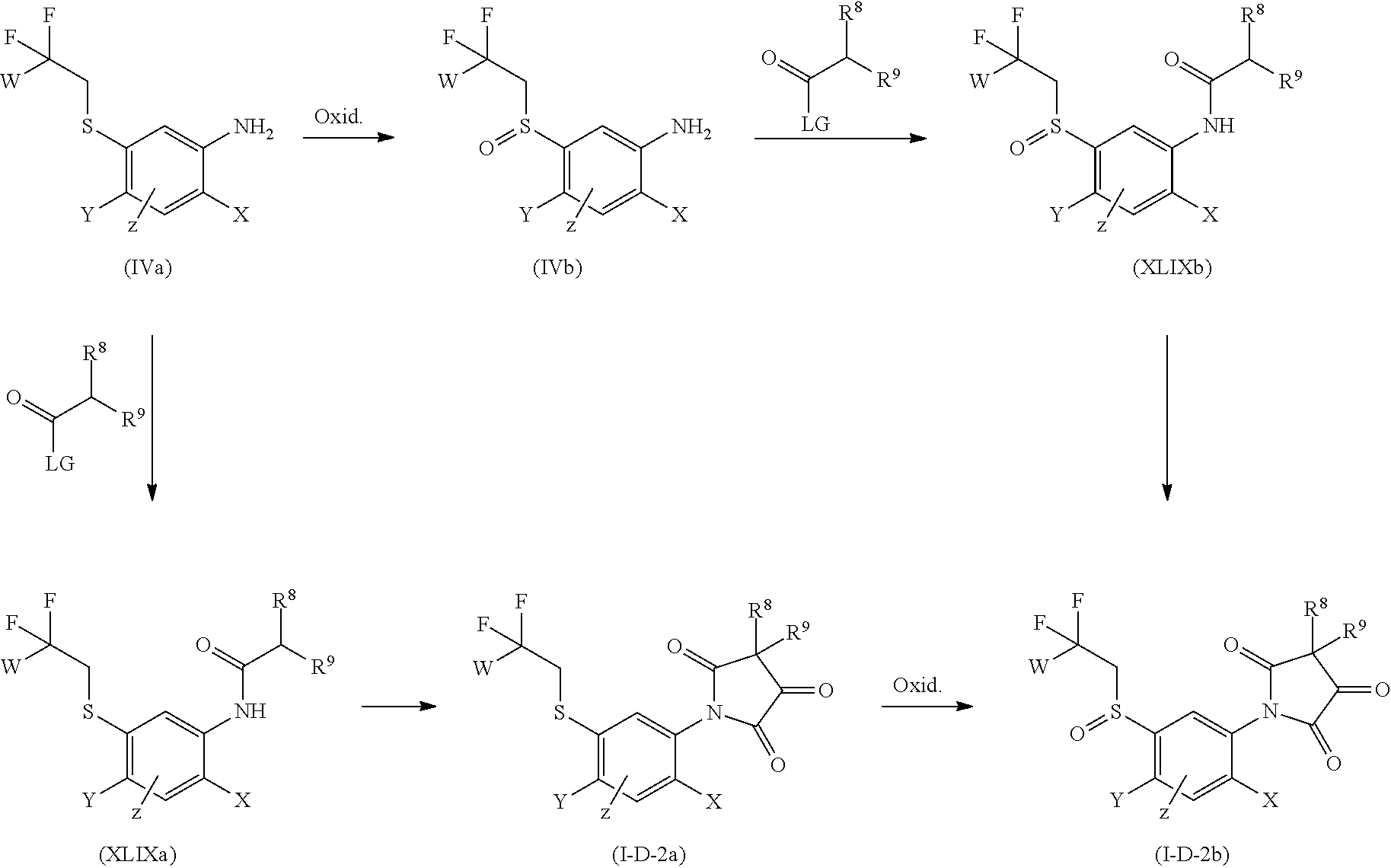
where W, X, Y, Z, R8 and R9 have the meanings given above and LG represents OH or halogen (in particular chlorine).

where W, X, Y, Z, A and R10 are each as defined above.


where X, Y, Z and W are as defined above, AG is a leaving group and PG is a protecting group.

where X, Y, Z and W are as defined above, AG is a leaving group and PG is a protecting group.

in which X, Y, Z and W are as defined above and Hal is chlorine, bromine or iodine are known from the literature, from WO 2007/034755, JP 2007/081019, JP 2007/284385, JP 2008/260706, JP 2008/308448, JP 2009/023910 or WO 2012/176856, or can be synthesized by processes known from the literature, which may optionally be slightly modified, especially as described in the specific synthesis examples.

in which X, Y, Z and W are as defined above are known from the literature, for example from WO2007/034755, JP2007/284385, JP2009/023910 and WO2012/176856, or can be synthesized by processes known from the literature, especially as in the specific synthesis examples.
Hydrazines of the General Formula (Va)


in which A and B are as defined above are commercially available or known from the literature, or they can be synthesized by processes known from the literature. As examples, the different heterocyclic compounds are divided into and specified in their subclasses.


organophosphates, for example acephate, azamethiphos, azinphos-ethyl, azinphos-methyl, cadusafos, chlorethoxyfos, chlorfenvinphos, chlormephos, chlorpyrifos, chlorpyrifos-methyl, coumaphos, cyanophos, demeton-S-methyl, diazinon, dichlorvos/DDVP, dicrotophos, dimethoate, dimethylvinphos, disulfoton, EPN, ethion, ethoprophos, famphur, fenamiphos, fenitrothion, fenthion, fosthiazate, heptenophos, imicyafos, isofenphos, isopropyl O-(methoxyaminothiophosphoryl)salicylate, isoxathion, malathion, mecarbam, methamidophos, methidathion, mevinphos, monocrotophos, naled, omethoate, oxydemeton-methyl, parathion, parathion-methyl, phenthoate, phorate, phosalone, phosmet, phosphamidon, phoxim, pirimiphos-methyl, profenofos, propetamphos, prothiofos, pyraclofos, pyridaphenthion, quinalphos, sulfotep, tebupirimfos, temephos, terbufos, tetrachlorvinphos, thiometon, triazophos, trichlorfon and vamidothion.
(2) GABA-gated chloride channel antagonists, for example
cyclodiene organochlorines, for example chlordane and endosulfan; or
phenylpyrazoles (fiproles), for example ethiprole and fipronil.
(3) Sodium channel modulators/voltage-dependent sodium channel blockers, for example
pyrethroids, for example acrinathrin, allethrin, d-cis-trans allethrin, d-trans allethrin, bifenthrin, bioallethrin, bioallethrin S-cyclopentenyl isomer, bioresmethrin, cycloprothrin, cyfluthrin, beta-cyfluthrin, cyhalothrin, lambda-cyhalothrin, gamma-cyhalothrin, cypermethrin, alpha-cypermethrin, beta-cypermethrin, theta-cypermethrin, zeta-cypermethrin, cyphenothrin [(1R)-trans isomers], deltamethrin, empenthrin [(EZ)-(1R) isomers], esfenvalerate, etofenprox, fenpropathrin, fenvalerate, flucythrinate, flumethrin, tau-fluvalinate, halfenprox, imiprothrin, kadethrin, permethrin, phenothrin [(1R)-trans isomer], prallethrin, pyrethrine (pyrethrum), resmethrin, silafluofen, tefluthrin, tetramethrin, tetramethrin [(1R) isomers], tralomethrin and transfluthrin; or
DDT; or methoxychlor.
(4) Nicotinergic acetylcholine receptor (nAChR) agonists, for example
neonicotinoids, for example acetamiprid, clothianidin, dinotefuran, imidacloprid, nitenpyram, thiacloprid and thiamethoxam; or
nicotine.
(5) Nicotinergic acetylcholine receptor (nAChR) allosteric activators, for example
spinosyns, for example spinetoram and spinosad.
(6) Chloride channel activators, for example
avermectins/milbemycins, for example abamectin, emamectin benzoate, lepimectin and milbemectin.
(7) Juvenile hormone imitators, for example
juvenile hormone analogs, for example hydroprene, kinoprene and methoprene; or
fenoxycarb; or pyriproxyfen.
(8) Active compounds having unknown or nonspecific mechanisms of action, for example
alkyl halides, for example methyl bromide and other alkyl halides; or
chloropicrin; or sulfuryl fluoride; or borax; or tartar emetic.
(9) Selective antifeedants, for example pymetrozine; or flonicamid.
(10) Mite growth inhibitors, for example clofentezine, hexythiazox and diflovidazin; or
etoxazole.
(11) Microbial disruptors of the insect gut membrane, e.g. Bacillus thuringiensis subspecies israelensis, Bacillus sphaericus, Bacillus thuringiensis subspecies aizawai, Bacillus thuringiensis subspecies kurstaki, Bacillus thuringiensis subspecies tenebrionis, and BT plant proteins: Cry1Ab, Cry1Ac, Cry1Fa, Cry2Ab, mCry3A, Cry3Ab, Cry3Bb, Cry34/35Ab1.
(12) Oxidative phosphorylation inhibitors, ATP disruptors, for example diafenthiuron; or
organotin compounds, e.g. azocyclotin, cyhexatin and fenbutatin oxide; or
propargite; or tetradifon.
(13) Oxidative phosphorylation decouplers that interrupt the H proton gradient, for example chlorfenapyr, DNOC and sulfluramid.
(14) Nicotinergic acetylcholine receptor antagonists, for example bensultap, cartap hydrochloride, thiocyclam, and thiosultap-sodium.
(15) Chitin biosynthesis inhibitors, type 0, for example bistrifluron, chlorfluazuron, diflubenzuron, flucycloxuron, flufenoxuron, hexaflumuron, lufenuron, novaluron, noviflumuron, teflubenzuron and triflumuron.
(16) Chitin biosynthesis inhibitors, type 1, for example buprofezin.
(17) Molting disruptors, dipteran, for example cyromazine.
(18) Ecdysone receptor agonists, for example chromafenozide, halofenozide, methoxyfenozide and tebufenozide.
(19) Octopaminergic agonists, for example amitraz.
(20) Complex-III electron transport inhibitors, for example hydramethylnon; or acequinocyl; or fluacrypyrim.
(21) Complex-I electron transport inhibitors, for example
METI acaricides, e.g. fenazaquin, fenpyroximate, pyrimidifen, pyridaben, tebufenpyrad and tolfenpyrad; or
rotenone (Derris).
(22) Voltage-gated sodium channel blockers, for example indoxacarb; or metaflumizone.
(23) Inhibitors of acetyl-CoA carboxylase, for example
tetronic and tetramic acid derivatives, e.g. spirodiclofen, spiromesifen and spirotetramat.
(24) Complex-IV electron transport inhibitors, for example
phosphines, for example aluminum phosphide, calcium phosphide, phosphine and zinc phosphide; or
cyanide.
(25) Complex-II electron transport inhibitors, for example cyenopyrafen.
(28) Ryanodine receptor effectors, for example
diamides, for example chlorantraniliprole and flubendiamide;
further active compounds having an unknown mechanism of action, for example amidoflumet, azadirachtin, benclothiaz, benzoximate, bifenazate, bromopropylate, chinomethionat, cryolite, cyantraniliprole (Cyazypyr), cyflumetofen, dicofol, diflovidazin, fluensulfone, flufenerim, flufiprole, fluopyram, fufenozide, imidaclothiz, iprodione, meperfluthrin, pyridalyl, pyrifluquinazon, tetramethylfluthrin and iodomethane; and additionally preparations based on Bacillus firmus (particularly strain CNCM 1-1582, for example VOTiVO™, BioNem), and the following known active compounds:
3-bromo-N-{2-bromo-4-chloro-6-[(1-cyclopropylethyl)carbamoyl]phenyl}-1-(3-chloropyridin-2-yl)-1H-pyrazole-5-carboxamide (known from WO2005/077934), 4-{[(6-bromopyrid-3-yl)methyl](2-fluoroethyl)amino}furan-2(5H)-one (known from WO2007/115644), 4-{[(6-fluoropyrid-3-yl)methyl](2,2-difluoroethyl)amino}furan-2(5H)-one (known from WO2007/115644), 4-{[(2-chloro-1,3-thiazol-5-yl)methyl](2-fluoroethyl)amino}furan-2(5H)-one (known from WO2007/115644), 4-{[(6-chloropyrid-3-yl)methyl](2-fluoroethyl)amino}furan-2(5H)-one (known from WO2007/115644), flupyradifurone, 4-{[(6-chloro-5-fluoropyrid-3-yl)methyl](methyl)amino}furan-2(5H)-one (known from WO2007/115643), 4-{[(5,6-dichloropyrid-3-yl)methyl](2-fluoroethyl)amino}furan-2(5H)-one (known from WO2007/115646), 4-{[(6-chloro-5-fluoropyrid-3-yl)methyl](cyclopropyl)amino}furan-2(5H)-one (known from WO2007/115643), 4-{[(6-chloropyrid-3-yl)methyl](cyclopropyl)amino}furan-2(5H)-one (known from EP-A-0 539 588), 4-{[(6-chloropyrid-3-yl)methyl](methyl)amino}furan-2(5H)-one (known from EP-A-0 539 588), {[1-(6-chloropyridin-3-yl)ethyl](methyl)oxido-λ4-sulfanylidene}cyanamide (known from WO2007/149134) and diastereomers thereof {[(1R)-1-(6-chloropyridin-3-yl)ethyl](methyl)oxido-λ4-sulfanylidene}cyanamide (A) and {[(1S)-1-(6-chloropyridin-3-yl)ethyl](methyl)oxido-λ4-sulfanylidene}cyanamide (B) (likewise known from WO2007/149134) and sulfoxaflor and diastereomers thereof [(R)-methyl(oxido){(1R)-1-[6-(trifluoromethyl)pyridin-3-yl]ethyl}-λ4-sulfanylidene]cyanamide (A1) and [(S)-methyl(oxido){(1S)-1-[6-(trifluoromethyl)pyridin-3-yl]ethyl}-λ4-sulfanylidene]cyanamide (A2), designated as diastereomer group A (known from WO 2010/074747, WO 2010/074751), [(R)-methyl(oxido) {(1S)-1-[6-(trifluoromethyl)pyridin-3-yl]ethyl}-λ4-sulfanylidene]cyanamide (B 1) and [(S)-methyl(oxido){(1R)-1-[6-(trifluoromethyl)pyridin-3-yl]ethyl}-λ4-sulfanylidene]cyanamide (B2), designated as diastereomer group B (likewise known from WO 2010/074747, WO 2010/074751) and 11-(4-chloro-2,6-dimethylphenyl)-12-hydroxy-1,4-dioxa-9-azadispiro[4.2.4.2]tetradec-11-en-10-one (known from WO2006/089633), 3-(4′-fluoro-2,4-dimethylbiphenyl-3-yl)-4-hydroxy-8-oxa-1-azaspiro[4.5]dec-3-en-2-one (known from WO2008/067911), 1-{2-fluoro-4-methyl-5-[(2,2,2-trifluoroethyl)sulfinyl]phenyl}-3-(trifluoromethyl)-1H-1,2,4-triazole-5-amine (known from WO2006/043635), [(3S,4aR,12R,12aS,12bS)-3-[(cyclopropylcarbonyl)oxy]-6,12-dihydroxy-4, 12b-dimethyl-11-oxo-9-(pyridin-3-yl)-1,3,4,4a,5,6,6a,12,12a, 12b-decahydro-2H,11H-benzo[f]pyrano[4,3-b]chromen-4-yl]methyl cyclopropanecarboxylate (known from WO2008/066153), 2-cyano-3-(difluoromethoxy)-N,N-dimethylbenzenesulfonamide (known from WO2006/056433), 2-cyano-3-(difluoromethoxy)-N-methylbenzenesulfonamide (known from WO2006/100288), 2-cyano-3-(difluoromethoxy)-N-ethylbenzenesulfonamide (known from WO2005/035486), 4-(difluoromethoxy)-N-ethyl-N-methyl-1,2-benzothiazol-3-amine 1,1-dioxide (known from WO2007/057407), N-[1-(2,3-dimethylphenyl)-2-(3,5-dimethylphenyl)ethyl]-4,5-dihydro-1,3-thiazole-2-amine (known from WO2008/104503), {1′-[(2E)-3-(4-chlorophenyl)prop-2-en-1-yl]-5-fluorospiro[indol-3,4′-piperidin]-1(2H)-yl}(2-chloropyridin-4-yl)methanone (known from WO2003/106457), 3-(2,5-dimethylphenyl)-4-hydroxy-8-methoxy-1,8-diazaspiro[4.5]dec-3-en-2-one (known from WO2009/049851), 3-(2,5-dimethylphenyl)-8-methoxy-2-oxo-1,8-diazaspiro[4.5]dec-3-en-4-yl ethyl carbonate (known from WO2009/049851), 4-(but-2-yn-1-yloxy)-6-(3,5-dimethylpiperidin-1-yl)-5-fluoropyrimidine (known from WO2004/099160), (2,2,3,3,4,4,5,5-octafluoropentyl)(3,3,3-trifluoropropyl)malononitrile (known from WO2005/063094), (2,2,3,3,4,4,5,5-octafluoropentyl)(3,3,4,4,4-pentafluorobutyl)malononitrile (known from WO2005/063094), 8-[2-(cyclopropylmethoxy)-4-(trifluoromethyl)phenoxy]-3-[6-(trifluoromethyl)pyridazin-3-yl]-3-azabicycyclo[3.2.1]octane (known from WO2007/040280), flometoquin, PF1364 (CAS Reg. No. 1204776-60-2) (known from JP2010/018586), 5-[5-(3,5-dichlorophenyl)-5-(trifluoromethyl)-4,5-dihydro-1,2-oxazol-3-yl]-2-(1H-1,2,4-triazol-1-yl)benzonitrile (known from WO2007/075459), 5-[5-(2-chloropyridin-4-yl)-5-(trifluoromethyl)-4,5-dihydro-1,2-oxazol-3-yl]-2-(1H-1,2,4-triazol-1-yl)benzonitrile (known from WO2007/075459), 4-[5-(3,5-dichlorophenyl)-5-(trifluoromethyl)-4,5-dihydro-1,2-oxazol-3-yl]-2-methyl-N-{2-oxo-2-[(2,2,2-trifluoroethyl)amino]ethyl}benzamide (known from WO2005/085216), 4-{[(6-chloropyridin-3-yl)methyl](cyclopropyl)amino}-1,3-oxazol-2(5H)-one, 4-{[(6-chloropyridin-3-yl)methyl](2,2-difluoroethyl)amino}-1,3-oxazol-2(5H)-one, 4-{[(6-chloropyridin-3-yl)methyl](ethyl)amino}-1,3-oxazol-2(5H)-one, 4-{[(6-chloropyridin-3-yl)methyl](methyl)amino}-1,3-oxazol-2(5H)-one (all known from WO2010/005692), NNI-0711 (known from WO2002/096882), 1-acetyl-N-[4-(1,1,1,3,3,3-hexafluoro-2-methoxypropan-2-yl)-3-isobutylphenyl]-N-isobutyryl-3,5-dimethyl-1H-pyrazole-4-carboxamide (known from WO2002/096882), methyl 2-[2-({[3-bromo-1-(3-chloropyridin-2-yl)-1H-pyrazol-5-yl]carbonyl}amino)-5-chloro-3-methylbenzoyl]-2-methylhydrazinecarboxylate (known from WO2005/085216), methyl 2-[2-({[3-bromo-1-(3-chloropyridin-2-yl)-1H-pyrazol-5-yl]carbonyl}amino)-5-cyano-3-methylbenzoyl]-2-ethylhydrazinecarboxylate (known from WO2005/085216), methyl 2-[2-({[3-bromo-1-(3-chloropyridin-2-yl)-1H-pyrazol-5-yl]carbonyl}amino)-5-cyano-3-methylbenzoyl]-2-methylhydrazinecarboxylate (known from WO2005/085216), methyl 2-[3,5-dibromo-2-({[3-bromo-1-(3-chloropyridin-2-yl)-1H-pyrazol-5-yl]carbonyl}amino)benzoyl]-1,2-diethylhydrazinecarboxylate (known from WO2005/085216), methyl 2-[3,5-dibromo-2-({[3-bromo-1-(3-chloropyridin-2-yl)-1H-pyrazol-5-yl]carbonyl}amino)benzoyl]-2-ethylhydrazinecarboxylate (known from WO2005/085216), (5RS,7RS;5RS,7SR)-1-(6-chloro-3-pyridylmethyl)-1,2,3,5,6,7-hexahydro-7-methyl-8-nitro-5-propoxyimidazo[1,2-a]pyridine (known from WO2007/101369), 2-{6-[2-(5-fluoropyridin-3-yl)-1,3-thiazol-5-yl]pyridin-2-yl}pyrimidine (known from WO2010/006713), 2-{6-[2-(pyridin-3-yl)-1,3-thiazol-5-yl]pyridin-2-yl}pyrimidine (known from WO2010/006713), 1-(3-chloropyridin-2-yl)-N-[4-cyano-2-methyl-6-(methylcarbamoyl)phenyl]-3-{[5-(trifluoromethyl)-1H-tetrazol-1-yl]methyl}-1H-pyrazole-5-carboxamide (known from WO2010/069502), 1-(3-chloropyridin-2-yl)-N-[4-cyano-2-methyl-6-(methylcarbamoyl)phenyl]-3-{[5-(trifluoromethyl)-2H-tetrazol-2-yl]methyl}-1H-pyrazole-5-carboxamide (known from WO2010/069502), N-[2-(tert-butylcarbamoyl)-4-cyano-6-methylphenyl]-1-(3-chloropyridin-2-yl)-3-{[5-(trifluoromethyl)-1H-tetrazol-1-yl]methyl}-1H-pyrazole-5-carboxamide (known from WO2010/069502), N-[2-(tert-butylcarbamoyl)-4-cyano-6-methylphenyl]-1-(3-chloropyridin-2-yl)-3-{[5-(trifluoromethyl)-2H-tetrazol-2-yl]methyl}-1H-pyrazole-5-carboxamide (known from WO2010/069502), (1E)-N-[(6-chloropyridin-3-yl)methyl]-N′-cyano-N-(2,2-difluoroethyl)ethanimidamide (known from WO2008/009360), N-[2-(5-amino-1,3,4-thiadiazol-2-yl)-4-chloro-6-methylphenyl]-3-bromo-1-(3-chloropyridin-2-yl)-1H-pyrazole-5-carboxamide (known from CN102057925) and methyl 2-[3,5-dibromo-2-({[3-bromo-1-(3-chloropyridin-2-yl)-1H-pyrazol-5-yl]carbonyl}amino)benzoyl]-2-ethyl-1-methylhydrazinecarboxylate (known from WO2011/049233),
Fungicides
(1) Inhibitors of ergosterol biosynthesis such as, for example, (1.1) aldimorph (1704-28-5), (1.2) azaconazole (60207-31-0), (1.3) bitertanol (55179-31-2), (1.4) bromuconazole (116255-48-2), (1.5) cyproconazole (113096-99-4), (1.6) diclobutrazole (75736-33-3), (1.7) difenoconazole (119446-68-3), (1.8) diniconazole (83657-24-3), (1.9) diniconazole-M (83657-18-5), (1.10) dodemorph (1593-77-7), (1.11) dodemorph acetate (31717-87-0), (1.12) epoxiconazole (106325-08-0), (1.13) etaconazole (60207-93-4), (1.14) fenarimol (60168-88-9), (1.15) fenbuconazole (114369-43-6), (1.16) fenhexamid (126833-17-8), (1.17) fenpropidin (67306-00-7), (1.18) fenpropimorph (67306-03-0), (1.19) fluquinconazole (136426-54-5), (1.20) flurprimidol (56425-91-3), (1.21) flusilazole (85509-19-9), (1.22) flutriafol (76674-21-0), (1.23) furconazole (112839-33-5), (1.24) furconazole-cis (112839-32-4), (1.25) hexaconazole (79983-71-4), (1.26) imazalil (60534-80-7), (1.27) imazalil sulfate (58594-72-2), (1.28) imibenconazole (86598-92-7), (1.29) ipconazole (125225-28-7), (1.30) metconazole (125116-23-6), (1.31) myclobutanil (88671-89-0), (1.32) naftifin (65472-88-0), (1.33) nuarimol (63284-71-9), (1.34) oxpoconazole (174212-12-5), (1.35) paclobutrazole (76738-62-0), (1.36) pefurazoate (101903-30-4), (1.37) penconazole (66246-88-6), (1.38) piperalin (3478-94-2), (1.39) prochloraz (67747-09-5), (1.40) propiconazole (60207-90-1), (1.41) prothioconazole (178928-70-6), (1.42) pyributicarb (88678-67-5), (1.43) pyrifenox (88283-41-4), (1.44) quinconazole (103970-75-8), (1.45) simeconazole (149508-90-7), (1.46) spiroxamine (118134-30-8), (1.47) tebuconazole (107534-96-3), (1.48) terbinafin (91161-71-6), (1.49) tetraconazole (112281-77-3), (1.50) triadimefon (43121-43-3), (1.51) triadimenol (89482-17-7), (1.52) tridemorph (81412-43-3), (1.53) triflumizole (68694-11-1), (1.54) triforine (26644-46-2), (1.55) triticonazole (131983-72-7), (1.56) uniconazole (83657-22-1), (1.57) uniconazole-p (83657-17-4), (1.58) viniconazole (77174-66-4), (1.59) voriconazole (137234-62-9), (1.60) 1-(4-chlorophenyl)-2-(1H-1,2,4-triazol-1-yl)cycloheptanol (129586-32-9), (1.61) methyl 1-(2,2-dimethyl-2,3-dihydro-1H-inden-1-yl)-1H-imidazole-5-carboxylate (110323-95-0), (1.62) N′-{5-(difluoromethyl)-2-methyl-4-[3-(trimethylsilyl)propoxy]phenyl}-N-ethyl-N-methylimidoformamide, (1.63) N-ethyl-N-methyl-N′-{2-methyl-5-(trifluoromethyl)-4-[3-(trimethylsilyl)propoxy]phenyl}imidoformamide and (1.64) 0-[1-(4-methoxyphenoxy)-3,3-dimethylbutan-2-yl]1H-imidazole-1-carbothioate (111226-71-2).
(2) Respiration inhibitors (respiratory chain inhibitors) such as, for example, (2.1) bixafen (581809-46-3), (2.2) boscalid (188425-85-6), (2.3) carboxin (5234-68-4), (2.4) diflumetorim (130339-07-0), (2.5) fenfuram (24691-80-3), (2.6) fluopyram (658066-35-4), (2.7) flutolanil (66332-96-5), (2.8) fluxapyroxad (907204-31-3), (2.9) furametpyr (123572-88-3), (2.10) furmecyclox (60568-05-0), (2.11) isopyrazam mixture of the syn-epimeric racemate 1RS,4SR,9RS and the anti-epimeric racemate 1RS,4SR,9SR (881685-58-1), (2.12) isopyrazam (anti-epimeric racemate), (2.13) isopyrazam (anti-epimeric enantiomer 1R,4S,9S), (2.14) isopyrazam (anti-epimeric enantiomer 1S,4R,9R), (2.15) isopyrazam (syn-epimeric racemate 1RS,4SR,9RS), (2.16) isopyrazam (syn-epimeric enantiomer 1R,4S,9R), (2.17) isopyrazam (syn-epimeric enantiomer 1S,4R,9S), (2.18) mepronil (55814-41-0), (2.19) oxycarboxin (5259-88-1), (2.20) penflufen (494793-67-8), (2.21) penthiopyrad (183675-82-3), (2.22) sedaxane (874967-67-6), (2.23) thifluzamid (130000-40-7), (2.24) 1-methyl-N-[2-(1,1,2,2-tetrafluoroethoxy)phenyl]-3-(trifluoromethyl)-1H-pyrazole-4-carboxamide, (2.25) 3-(difluoromethyl)-1-methyl-N-[2-(1,1,2,2-tetrafluoroethoxy)phenyl]-1H-pyrazole-4-carboxamide, (2.26) 3-(difluoromethyl)-N-[4-fluoro-2-(1,1,2,3,3,3-hexafluoropropoxy)phenyl]-1-methyl-1H-pyrazole-4-carboxamide, (2.27) N-[1-(2,4-dichlorophenyl)-1-methoxypropan-2-yl]-3-(difluoromethyl)-1-methyl-1H-pyrazole-4-carboxamide (1092400-95-7), (2.28) 5,8-difluoro-N-[2-(2-fluoro-4-{[4-(trifluoromethyl)pyridin-2-yl]oxy}phenyl)ethyl]quinazoline-4-amine (1210070-84-0) (known from WO2010025451), (2.29) N-[9-(dichloromethylene)-1,2,3,4-tetrahydro-1,4-methanonaphthalen-5-yl]-3-(difluoromethyl)-1-methyl-1H-pyrazole-4-carboxamide, (2.30) N-[(1S,4R)-9-(dichloromethylene)-1,2,3,4-tetrahydro-1,4-methanonaphthalen-5-yl]-3-(difluoromethyl)-1-methyl-1H-pyrazole-4-carboxamide and (2.31) N-[(1R,4S)-9-(dichloromethylene)-1,2,3,4-tetrahydro-1,4-methanonaphthalen-5-yl]-3-(difluoromethyl)-1-methyl-1H-pyrazole-4-carboxamide.
(3) Respiration inhibitors (respiratory chain inhibitors) acting on complex III of the respiratory chain such as, for example, (3.1) ametoctradin (865318-97-4), (3.2) amisulbrom (348635-87-0), (3.3) azoxystrobin (131860-33-8), (3.4) cyazofamid (120116-88-3), (3.5) coumethoxystrobin (850881-30-0), (3.6) coumoxystrobin (850881-70-8), (3.5) dimoxystrobin (141600-52-4), (3.6) enestroburin (238410-11-2) (known from WO 2004/058723), (3.9) famoxadone (131807-57-3) (known from WO 2004/058723), (3.10) fenamidone (161326-34-7) (known from WO 2004/058723), (3.11) fenoxystrobin (918162-02-4), (3.12) fluoxastrobin (361377-29-9) (known from WO 2004/058723), (3.13) kresoxim-methyl (143390-89-0) (known from WO 2004/058723), (3.14) metominostrobin (133408-50-1) (known from WO 2004/058723), (3.15) orysastrobin (189892-69-1) (known from WO 2004/058723), (3.16) picoxystrobin (117428-22-5) (known from WO 2004/058723), (3.17) pyraclostrobin (175013-18-0) (known from WO 2004/058723), (3.18) pyrametostrobin (915410-70-7) (known from WO 2004/058723), (3.19) pyraoxystrobin (862588-11-2) (known from WO 2004/058723), (3.20) pyribencarb (799247-52-2) (known from WO 2004/058723), (3.21) triclopyricarb (902760-40-1), (3.22) trifloxystrobin (141517-21-7) (known from WO 2004/058723), (3.23) (2E)-2-(2-{[6-(3-chloro-2-methylphenoxy)-5-fluoropyrimidin-4-yl]oxy}phenyl)-2-(methoxyimino)-N-methylethanamide (known from WO 2004/058723), (3.24) (2E)-2-(methoxyimino)-N-methyl-2-(2-{[({(1E)-1-[3-(trifluoromethyl)phenyl]ethylidene}amino)oxy]methyl}phenyl)ethanamide (known from WO 2004/058723), (3.25) (2E)-2-(methoxyimino)-N-methyl-2-{2-[(E)-({1-[3-(trifluoromethyl)phenyl]ethoxy}imino)methyl]phenyl}ethanamide (158169-73-4), (3.26) (2E)-2-{2-[({[(1E)-1-(3-{[(E)-1-fluoro-2-phenylethenyl]oxy}phenyl)ethylidene]amino}oxy)methyl]phenyl}-2-(methoxyimino)-N-methylethanamide (326896-28-0), (3.27) (2E)-2-{2-[({[(2E,3E)-4-(2,6-dichlorophenyl)but-3-en-2-ylidene]amino}oxy)methyl]phenyl}-2-(methoxyimino)-N-methylethanamide, (3.28) 2-chloro-N-(1,1,3-trimethyl-2,3-dihydro-1H-inden-4-yl)pyridine-3-carboxamide (119899-14-8), (3.29) 5-methoxy-2-methyl-4-(2-{[({(1E)-1-[3-(trifluoromethyl)phenyl]ethylidene}amino)oxy]methyl}phenyl)-2,4-dihydro-3H-1,2,4-triazol-3-one, (3.30) methyl (2E)-2-{2-[({cyclopropyl[(4-methoxyphenyl)imino]methyl}sulfanyl)methyl]phenyl}-3-methoxyprop-2-enoate (149601-03-6), (3.31) N-(3-ethyl-3,5,5-trimethylcyclohexyl)-3-(formylamino)-2-hydroxybenzamide (226551-21-9), (3.32) 2-{2-[(2,5-dimethylphenoxy)methyl]phenyl}-2-methoxy-N-methylacetamide (173662-97-0) and (3.33) (2R)-2-{2-[(2,5-dimethylphenoxy)methyl]phenyl}-2-methoxy-N-methylacetamide (394657-24-0).
(4) Inhibitors of mitosis and cell division, for example (4.1) benomyl (17804-35-2), (4.2) carbendazim (10605-21-7), (4.3) chlorfenazole (3574-96-7), (4.4) diethofencarb (87130-20-9), (4.5) ethaboxam (162650-77-3), (4.6) fluopicolid (239110-15-7), (4.7) fuberidazole (3878-19-1), (4.8) pencycuron (66063-05-6), (4.9) thiabendazole (148-79-8), (4.10) thiophanate-methyl (23564-05-8), (4.11) thiophanate (23564-06-9), (4.12) zoxamide (156052-68-5), (4.13) 5-chloro-7-(4-methylpiperidin-1-yl)-6-(2,4,6-trifluorophenyl)[1,2,4]triazolo[1,5-a]pyrimidine (214706-53-3) and (4.14) 3-chloro-5-(6-chloropyridin-3-yl)-6-methyl-4-(2,4,6-trifluorophenyl)pyridazine (1002756-87-7).
(5) Compounds having multisite activity, for example (5.1) Bordeaux mixture (8011-63-0), (5.2) captafol (2425-06-1), (5.3) captan (133-06-2) (known from WO 02/12172), (5.4)chlorothalonil (1897-45-6), (5.5) copper preparations such as copper hydroxide (20427-59-2), (5.6) copper naphthenate (1338-02-9), (5.7) copper oxide (1317-39-1), (5.8) copper oxychloride (1332-40-7), (5.9) copper sulfate (7758-98-7), (5.10) dichlofluanid (1085-98-9), (5.11) dithianon (3347-22-6), (5.12) dodine (2439-10-3), (5.13) dodine free base, (5.14) ferbam (14484-64-1), (5.15) fluorofolpet (719-96-0), (5.16) folpet (133-07-3), (5.17) guazatine (108173-90-6), (5.18) guazatine acetate, (5.19) iminoctadine (13516-27-3), (5.20) iminoctadine albesilate (169202-06-6), (5.21) iminoctadine triacetate (57520-17-9), (5.22) mancopper (53988-93-5), (5.23) mancozeb (8018-01-7), (5.24) maneb (12427-38-2), (5.25) metiram (9006-42-2), (5.26) zinc metiram (9006-42-2), (5.27) copper-oxine (10380-28-6), (5.28) propamidine (104-32-5), (5.29) propineb (12071-83-9), (5.30) sulfur and sulfur preparations, for example calcium polysulfide (7704-34-9), (5.31) thiram (137-26-8), (5.32) tolylfluanid (731-27-1), (5.33) zineb (12122-67-7) and (5.34) ziram (137-30-4).
(6) Resistance inductors, for example (6.1) acibenzolar-S-methyl (135158-54-2), (6.2) isotianil (224049-04-1), (6.3) probenazole (27605-76-1) and (6.4) tiadinil (223580-51-6).
(7) Inhibitors of amino acid and protein biosynthesis such as, for example, (7.1) andoprim (23951-85-1), (7.2) blasticidin-S (2079-00-7), (7.3) cyprodinil (121552-61-2), (7.4) kasugamycin (6980-18-3), (7.5) kasugamycin hydrochloride hydrate (19408-46-9), (7.6) mepanipyrim (110235-47-7), (7.7) pyrimethanil (53112-28-0) and (7.8) 3-(5-fluoro-3,3,4,4-tetramethyl-3,4-dihydroisoquinolin-1-yl)quinoline (861647-32-7) (known from WO2005070917).
(8) ATP production inhibitors, for example (8.1) fentin acetate (900-95-8), (8.2) fentin chloride (639-58-7), (8.3) fentin hydroxide (76-87-9) and (8.4) silthiofam (175217-20-6).
(9) Inhibitors of cell wall synthesis, for example (9.1) benthiavalicarb (177406-68-7), (9.2) dimethomorph (110488-70-5), (9.3) flumorph (211867-47-9), (9.4) iprovalicarb (140923-17-7), (9.5) mandipropamid (374726-62-2), (9.6) polyoxins (11113-80-7), (9.7) polyoxorim (22976-86-9), (9.8) validamycin A (37248-47-8) and (9.9) valifenalate (283159-94-4; 283159-90-0).
(10) Inhibitors of lipid and membrane synthesis, for example (10.1) biphenyl (92-52-4), (10.2) chloroneb (2675-77-6), (10.3) dicloran (99-30-9), (10.4) edifenphos (17109-49-8), (10.5) etridiazole (2593-15-9), (10.6) iodocarb (55406-53-6), (10.7) iprobenfos (26087-47-8), (10.8) isoprothiolane (50512-35-1), (10.9) propamocarb (25606-41-1), (10.10) propamocarb hydrochloride (25606-41-1), (10.11) prothiocarb (19622-08-3), (10.12) pyrazophos (13457-18-6), (10.13) quintozene (82-68-8), (10.14) tecnazene (117-18-0) and (10.15) tolclofos-methyl (57018-04-9).
(11) Melanin biosynthesis inhibitors such as, for example, (11.1) carpropamid (104030-54-8), (11.2) diclocymet (139920-32-4), (11.3) fenoxanil (115852-48-7), (11.4) fthalide (27355-22-2), (11.5) pyroquilon (57369-32-1), (11.6) tricyclazole (41814-78-2) and (11.7) 2,2,2-trifluoroethyl {3-methyl-1-[(4-methylbenzoyl)amino]butan-2-yl}carbamate (851524-22-6) (known from WO2005042474).
(12) Inhibitors of nucleic acid synthesis, for example (12.1) benalaxyl (71626-11-4), (12.2) benalaxyl-M (kiralaxyl) (98243-83-5), (12.3) bupirimate (41483-43-6), (12.4) clozylacon (67932-85-8), (12.5) dimethirimol (5221-53-4), (12.6) ethirimol (23947-60-6), (12.7) furalaxyl (57646-30-7), (12.8) hymexazole (10004-44-1), (12.9) metalaxyl (57837-19-1), (12.10) metalaxyl-M (mefenoxam) (70630-17-0), (12.11) ofurace (58810-48-3), (12.12) oxadixyl (77732-09-3) and (12.13) oxolinic acid (14698-29-4).
(13) Signal transduction inhibitors, for example (13.1) chlozolinate (84332-86-5), (13.2) fenpiclonil (74738-17-3), (13.3) fludioxonil (131341-86-1), (13.4) iprodione (36734-19-7), (13.5) procymidone (32809-16-8), (13.6) quinoxyfen (124495-18-7) and (13.7) vinclozolin (50471-44-8).
(14) Decouplers, for example (14.1) binapacryl (485-31-4), (14.2) dinocap (131-72-6), (14.3) ferimzone (89269-64-7), (14.4) fluazinam (79622-59-6) and (14.5) meptyldinocap (131-72-6).
(15) Further compounds such as, for example, (15.1) benthiazole (21564-17-0), (15.2) bethoxazine (163269-30-5), (15.3) capsimycin (70694-08-5), (15.4) carvone (99-49-0), (15.5) chinomethionat (2439-01-2), (15.6) pyriofenone (chlazafenone) (688046-61-9), (15.7) cufraneb (11096-18-7), (15.8) cyflufenamid (180409-60-3), (15.9) cymoxanil (57966-95-7), (15.10) cyprosulfamide (221667-31-8), (15.11) dazomet (533-74-4), (15.12) debacarb (62732-91-6), (15.13) dichlorophen (97-23-4), (15.14) diclomezine (62865-36-5), (15.15) difenzoquat (49866-87-7), (15.16) difenzoquat methylsulfate (43222-48-6), (15.17) diphenylamine (122-39-4), (15.18) EcoMate, (15.19) fenpyrazamine (473798-59-3), (15.20) flumetover (154025-04-4), (15.21) fluoromid (41205-21-4), (15.22) flusulfamide (106917-52-6), (15.23) flutianil (304900-25-2), (15.24) fosetyl-aluminum (39148-24-8), (15.25) fosetyl-calcium, (15.26) fosetyl-sodium (39148-16-8), (15.27) hexachlorobenzene (118-74-1), (15.28) irumamycin (81604-73-1), (15.29) methasulfocarb (66952-49-6), (15.30) methyl isothiocyanate (556-61-6), (15.31) metrafenone (220899-03-6), (15.32) mildiomycin (67527-71-3), (15.33) natamycin (7681-93-8), (15.34) nickel dimethyldithiocarbamate (15521-65-0), (15.35) nitrothal-isopropyl (10552-74-6), (15.36) octhilinone (26530-20-1), (15.37) oxamocarb (917242-12-7), (15.38) oxyfenthiin (34407-87-9), (15.39) pentachlorophenol and its salts (87-86-5), (15.40) phenothrin, (15.41) phosphoric acid and its salts (13598-36-2), (15.42) propamocarb-fosetylate, (15.43) propanosine-sodium (88498-02-6), (15.44) proquinazid (189278-12-4), (15.45) pyrimorph (868390-90-3), (15.45e) (2E)-3-(4-tert-butylphenyl)-3-(2-chloropyridin-4-yl)-1-(morpholin-4-yl)prop-2-en-1-one (1231776-28-5), (15.45z) (2Z)-3-(4-tert-butylphenyl)-3-(2-chloropyridin-4-yl)-1-(morpholin-4-yl)prop-2-en-1-one (1231776-29-6), (15.46) pyrrolnitrin (1018-71-9) (known from EP-A 1 559 320), (15.47) tebufloquin (376645-78-2), (15.48) tecloftalam (76280-91-6), (15.49) tolnifanide (304911-98-6), (15.50) triazoxide (72459-58-6), (15.51) trichlamide (70193-21-4), (15.52) zarilamid (84527-51-5), (15.53) (3S,6S,7R,8R)-8-benzyl-3-[({3-[(isobutyryloxy)methoxy]-4-methoxypyridin-2-yl}carbonyl)amino]-6-methyl-4,9-dioxo-1,5-dioxonan-7-yl 2-methylpropanoate (517875-34-2) (known from WO2003035617), (15.54) 1-(4-{4-[(5R)-5-(2,6-difluorophenyl)-4,5-dihydro-1,2-oxazol-3-yl]-1,3-thiazol-2-yl}piperidin-1-yl)-2-[5-methyl-3-(trifluoromethyl)-1H-pyrazol-1-yl]ethanone (1003319-79-6), (15.55) 1-(4-{4-[(5S)-5-(2,6-difluorophenyl)-4,5-dihydro-1,2-oxazol-3-yl]-1,3-thiazol-2-yl}piperidin-1-yl)-2-[5-methyl-3-(trifluoromethyl)-1H-pyrazol-1-yl]ethanone (1003319-80-9), (15.56) 1-(4-{4-[5-(2,6-difluorophenyl)-4,5-dihydro-1,2-oxazol-3-yl]-1,3-thiazol-2-yl}piperidin-1-yl)-2-[5-methyl-3-(trifluoromethyl)-1H-pyrazol-1-yl]ethanone (1003318-67-9), (15.57) 1-(4-methoxyphenoxy)-3,3-dimethylbutan-2-yl 1H-imidazole-1-carboxylate (111227-17-9), (15.58) 2,3,5,6-tetrachloro-4-(methylsulfonyl)pyridine (13108-52-6), (15.59) 2,3-dibutyl-6-chlorothieno[2,3-d]pyrimidin-4(3H)-one (221451-58-7), (15.60) 2,6-dimethyl-1H,5H-[1,4]dithiino[2,3-c:5,6-c′]dipyrrole-1,3,5,7(2H,6H)-tetrone, (15.61) 2-[5-methyl-3-(trifluoromethyl)-1H-pyrazol-1-yl]-1-(4-{4-[(5R)-5-phenyl-4,5-dihydro-1,2-oxazol-3-yl]-1,3-thiazol-2-yl}piperidin-1-yl)ethanone (1003316-53-7), (15.62) 2-[5-methyl-3-(trifluoromethyl)-1H-pyrazol-1-yl]-1-(4-{4-[(5S)-5-phenyl-4,5-dihydro-1,2-oxazol-3-yl]-1,3-thiazol-2-yl}piperidin-1-yl)ethanone (1003316-54-8), (15.63) 2-[5-methyl-3-(trifluoromethyl)-1H-pyrazol-1-yl]-1-{4-[4-(5-phenyl-4,5-dihydro-1,2-oxazol-3-yl)-1,3-thiazol-2-yl]piperidin-1-yl}ethanone (1003316-51-5), (15.64) 2-butoxy-6-iodo-3-propyl-4H-chromen-4-one, (15.65) 2-chloro-5-[2-chloro-1-(2,6-difluoro-4-methoxyphenyl)-4-methyl-1H-imidazol-5-yl]pyridine, (15.66) 2-phenylphenol and its salts (90-43-7), (15.67) 3-(4,4,5-trifluoro-3,3-dimethyl-3,4-dihydroisoquinolin-1-yl)quinoline (861647-85-0) (known from WO2005070917), (15.68) 3,4,5-trichloropyridine-2,6-dicarbonitrile (17824-85-0), (15.69) 3-[5-(4-chlorophenyl)-2,3-dimethyl-1,2-oxazolidin-3-yl]pyridine, (15.70) 3-chloro-5-(4-chlorophenyl)-4-(2,6-difluorophenyl)-6-methylpyridazine, (15.71) 4-(4-chlorophenyl)-5-(2,6-difluorophenyl)-3,6-dimethylpyridazine, (15.72) 5-amino-1,3,4-thiadiazole-2-thiole, (15.73) 5-chloro-N′-phenyl-N′-(prop-2-yn-1-yl)thiophene-2-sulfonohydrazide (134-31-6), (15.74) 5-fluoro-2-[(4-fluorobenzyl)oxy]pyrimidine-4-amine (1174376-11-4) (known from WO2009094442), (15.75) 5-fluoro-2-[(4-methylbenzyl)oxy]pyrimidine-4-amine (1174376-25-0) (known from WO2009094442), (15.76) 5-methyl-6-octyl[1,2,4]triazolo[1,5-a]pyrimidine-7-amine, (15.77) ethyl-(2Z)-3-amino-2-cyano-3-phenylprop-2-enoate, (15.78) N′-(4-{[3-(4-chlorobenzyl)-1,2,4-thiadiazol-5-yl]oxy}-2,5-dimethylphenyl)-N-ethyl-N-methylimidoformamide, (15.79) N-(4-chlorobenzyl)-3-[3-methoxy-4-(prop-2-yn-1-yloxy)phenyl]propanamide, (15.80) N-[(4-chlorophenyl)(cyano)methyl]-3-[3-methoxy-4-(prop-2-yn-1-yloxy)phenyl]propanamide, (15.81) N-[(5-bromo-3-chloropyridin-2-yl)methyl]-2,4-dichloropyridine-3-carboxamide, (15.82) N-[1-(5-bromo-3-chloropyridin-2-yl)ethyl]-2,4-dichloropyridine-3-carboxamide, (15.83) N-[1-(5-bromo-3-chloropyridin-2-yl)ethyl]-2-fluoro-4-iodopyridine-3-carboxamide, (15.84) N-{(E)-[(cyclopropylmethoxy)imino][6-(difluoromethoxy)-2,3-difluorophenyl]methyl}-2-phenylacetamide (221201-92-9), (15.85) N-{(Z)-[(cyclopropylmethoxy)imino][6-(difluoromethoxy)-2,3-difluorophenyl]methyl}-2-phenylacetamide (221201-92-9), (15.86) N′-{4-[(3-tert-butyl-4-cyano-1,2-thiazol-5-yl)oxy]-2-chloro-5-methylphenyl}-N-ethyl-N-methylimidoformamide, (15.87) N-methyl-2-(1-{[5-methyl-3-(trifluoromethyl)-1H-pyrazol-1-yl]acetyl}piperidin-4-yl)-N-(1,2,3,4-tetrahydronaphthalen-1-yl)-1,3-thiazole-4-carboxamide (922514-49-6), (15.88) N-methyl-2-(1-{[5-methyl-3-(trifluoromethyl)-1H-pyrazol-1-yl]acetyl}piperidin-4-yl)-N-[(1R)-1,2,3,4-tetrahydronaphthalen-1-yl]-1,3-thiazole-4-carboxamide (922514-07-6), (15.89) N-methyl-2-(1-{[5-methyl-3-(trifluoromethyl)-1H-pyrazol-1-yl]acetyl}piperidin-4-yl)-N-[(1S)-1,2,3,4-tetrahydronaphthalen-1-yl]-1,3-thiazole-4-carboxamide (922514-48-5), (15.90) pentyl-{6-[({[(1-methyl-1H-tetrazol-5-yl)(phenyl)methylidene]amino}oxy)methyl]pyridin-2-yl}carbamate, (15.91) phenazine-1-carboxylic acid, (15.92) quinolin-8-ol (134-31-6), (15.93) quinolin-8-ol sulfate (2:1) (134-31-6) and (15.94) tert-butyl {6-[({[(1-methyl-1H-tetrazol-5-yl)(phenyl)methylene]amino}oxy)methyl]pyridin-2-yl}carbamate.
(16) Further compounds such as, for example, (16.1) 1-methyl-3-(trifluoromethyl)-N-[2′-(trifluoromethyl)biphenyl-2-yl]-1H-pyrazole-4-carboxamide, (16.2) N-(4′-chlorobiphenyl-2-yl)-3-(difluoromethyl)-1-methyl-1H-pyrazole-4-carboxamide, (16.3) N-(2′,4′-dichlorobiphenyl-2-yl)-3-(difluoromethyl)-1-methyl-1H-pyrazole-4-carboxamide, (16.4) 3-(difluoromethyl)-1-methyl-N-[4′-(trifluoromethyl)biphenyl-2-yl]-1H-pyrazole-4-carboxamide, (16.5) N-(2′,5′-difluorobiphenyl-2-yl)-1-methyl-3-(trifluoromethyl)-1H-pyrazole-4-carboxamide, (16.6) 3-(difluoromethyl)-1-methyl-N-[4′-(prop-1-yn-1-yl)biphenyl-2-yl]-1H-pyrazole-4-carboxamide, (16.7) 5-fluoro-1,3-dimethyl-N-[4′-(prop-1-yn-1-yl)biphenyl-2-yl]-1H-pyrazole-4-carboxamide, (16.8) 2-chloro-N-[4′-(prop-1-yn-1-yl)biphenyl-2-yl]pyridine-3-carboxamide, (16.9) 3-(difluoromethyl)-N-[4′-(3,3-dimethylbut-1-yn-1-yl)biphenyl-2-yl]-1-methyl-1H-pyrazole-4-carboxamide, (16.10) N-[4′-(3,3-dimethylbut-1-yn-1-yl)biphenyl-2-yl]-5-fluoro-1,3-dimethyl-1H-pyrazole-4-carboxamide, (16.11) 3-(difluoromethyl)-N-(4′-ethynylbiphenyl-2-yl)-1-methyl-1H-pyrazole-4-carboxamide, (16.12) N-(4′-ethynylbiphenyl-2-yl)-5-fluoro-1,3-dimethyl-1H-pyrazole-4-carboxamide, (16.13) 2-chloro-N-(4′-ethynylbiphenyl-2-yl)pyridine-3-carboxamide, (16.14) 2-chloro-N-[4′-(3,3-dimethylbut-1-yn-1-yl)biphenyl-2-yl]pyridine-3-carboxamide (known from EP-A 1 559 320), (16.15) 4-(difluoromethyl)-2-methyl-N-[4′-(trifluoromethyl)biphenyl-2-yl]-1,3-thiazole-5-carboxamide, (16.16) 5-fluoro-N-[4′-(3-hydroxy-3-methylbut-1-yn-1-yl)biphenyl-2-yl]-1,3-dimethyl-1H-pyrazole-4-carboxamide, (16.17) 2-chloro-N-[4′-(3-hydroxy-3-methylbut-1-yn-1-yl)biphenyl-2-yl]pyridine-3-carboxamide, (16.18) 3-(difluoromethyl)-N-[4′-(3-methoxy-3-methylbut-1-yn-1-yl)biphenyl-2-yl]-1-methyl-1H-pyrazole-4-carboxamide, (16.19) 5-fluoro-N-[4′-(3-methoxy-3-methylbut-1-yn-1-yl)biphenyl-2-yl]-1,3-dimethyl-1H-pyrazole-4-carboxamide, (16.20) 2-chloro-N-[4′-(3-methoxy-3-methylbut-1-yn-1-yl)biphenyl-2-yl]pyridine-3-carboxamide, (16.21) (5-bromo-2-methoxy-4-methylpyridin-3-yl)(2,3,4-trimethoxy-6-methylphenyl)methanone, (16.22) N-[2-(4-{[3-(4-chlorophenyl)prop-2-yn-1-yl]oxy}-3-methoxyphenyl)ethyl]-N2-(methylsulfonyl)valinamide (220706-93-4), (16.23) 4-oxo-4-[(2-phenylethyl)amino]butanoic acid and (16.24) but-3-yn-1-yl {6-[({[(Z)-(1-methyl-1H-tetrazol-5-yl)(phenyl)methylene]amino}oxy)methyl]pyridin-2-yl}carbamate.
Dermapterans, such as Sirex juvencus, Urocerus gigas, Urocerus gigas taignus, Urocerus augur;
termites, such as Kalotermes flavicollis, Cryptotermes brevis, Heterotermes indicola, Reticulitermes flavipes, Reticulitermes santonensis, Reticulitermes lucifugus, Mastotermes darwiniensis, Zootermopsis nevadensis, Coptotermes formosanus;
bristletails, such as Lepisma saccharina.
[b] LC-MS determination in the neutral range was effected at pH 7.8 with 0.001 molar aqueous ammonium hydrogencarbonate solution and acetonitrile as eluents; linear gradient from 10% acetonitrile to 95% acetonitrile. log P[b] is also referred to as log P(neutral).


| logP | logP | M+ | GCMS | |||||
| R1 | R10 | [a] | [b] | [M + 1]+ | NMR | Solvent | (GCMS) | index |
| CH2CH(CH3)2 | cyclopropyl | 0.94 | n.d. | 198 | 10.36 (s, 1H), | D6- | 197 | 1651 |
| 3.17 (d, 2H), | DMSO | |||||||
| 2.60-2.56 (m, 1H), | ||||||||
| 1.96-1.89 (m, 1H), | ||||||||
| 0.85-0.78 (m, 10H) | ||||||||
| CH3 | C(CH3)3 | 0.83 | n.d. | 172 | 10.15 (s, 1H), | D6- | 171 | 1380 |
| 2.94 (s, 3H), | DMSO | |||||||
| 1.52 (s, 9H) | ||||||||
| CH2CH3 | C(CH3)3 | 1.15 | n.d. | 186 | 10.11 (s, 1H), | D6- | 185 | 1436 |
| 3.36 (q, 2H), | DMSO | |||||||
| 1.52 (s, 9H), | ||||||||
| 1.07 (t, 3H) | ||||||||
| cyclopentyl | CH3 | 0.78 | n.d. | 184 | 10.25 (s, 1H), | D6- | 183 | 1672 |
| 4.38-4.30 (m, 1H), | DMSO | |||||||
| 2.87 (s, 3H), | ||||||||
| 1.81-1.75 (m, 2H), | ||||||||
| 1.66-1.56 (m, 4H), | ||||||||
| 1.53-1.48 (m, 2H) | ||||||||
| CH2CH3 | CH(CH3)2 | 0.62 | n.d. | 172 | 10.27 (s, 1H), | D6- | 171 | 1392 |
| 4.14-4.07 (m, 1H), | DMSO | |||||||
| 3.39 (q, 2H), | ||||||||
| 1.32 (d, 6H), | ||||||||
| 1.08 (t, 3H) | ||||||||
| benzyl | cyclopropyl | 1.21 | n.d. | 232 | 10.39 (s, 1H), | D6- | 231 | 2054 |
| 7.38-7.28 (m, 3H), | DMSO | |||||||
| 7.25-7.23 (m, 2H), | ||||||||
| 4.56 (s, 2H), | ||||||||
| 2.63-2.59 (m, 1H), | ||||||||
| 0.84-0.81 (m, 4H) | ||||||||
| CH3 | CH(CH3)2 | 0.27 | n.d. | 158 | 10.31 (s, 1H), | D6- | 157 | 1341 |
| 4.14-4.07 (m, 1H), | DMSO | |||||||
| 2.98 (s, 3H), | ||||||||
| 1.32 (d, 6H) | ||||||||
| CH3 | 3- | 1.53 | n.d. | 260 | 7.86 (s, 1H), | CD3CN | 259 | 1826 |
| trifluoromethylphenyl | 7.82-7.80 (m, 1H), | |||||||
| 7.70-7.67 (m, 2H), | ||||||||
| 3.16 (s, 3H) | ||||||||
| CH(CH3)2 | cyclopropyl | 0.50 | n.d. | 184 | 7.53 (broad, 1 | CD3CN | 183 | 1557 |
| H), 4.20-4.09 (m, 1H), | ||||||||
| 2.58-2.50 (m, 1H), | ||||||||
| 1.14 (d, 6H), | ||||||||
| 0.89-0.83 (m, 4H) | ||||||||
| H | cyclopropyl | n.d. | n.d. | 142 | 9.90 (s, 2H), | D6- | 141 | 1563 |
| 2.61-2.52 (m, 1H), | DMSO | |||||||
| 0.86-0.76 (m, 4H) | ||||||||
| CH(CH3)2 | CH3 | 0.12 | n.d. | 158 | 10.20 (s, 1H), | D6- | 157 | 1359 |
| 4.16-4.08 (m, 1H), | DMSO | |||||||
| 2.87 (s, 3H), | ||||||||
| 1.11 (d, 6H) | ||||||||
| CH(CH3)CH2CH3 | cyclopropyl | 0.82 | n.d. | 198 | 7.53 (broad, 1 | CD3CN | 197 | 1634 |
| H), | ||||||||
| 3.96-3.88 (m, 1H), | ||||||||
| 2.59-2.51 (m, 1H), | ||||||||
| 1.61-1.46 (m, 2H), | ||||||||
| 1.11 (d, 3H), | ||||||||
| 0.91-0.86 (m, 7H) | ||||||||
| CH3 | CH2CH3 | n.d. | n.d. | 144 | 10.40 (s, 1H), | D6- | 143 | 1306 |
| 3.40 (q, 2H), | DMSO | |||||||
| 3.00 (s, 3H), | ||||||||
| 1.10 (t, 3H) | ||||||||

| logP | logP | M+ | GCMS | ||||
| R1 | R10 | [a] | [b] | NMR | Solvent | (GCMS) | index |
| CH3 | CH2CH═CH2 | 0.45 | 0.47 | 10.97(s, 1H), 5.87- | D6- | 155 | 1381 |
| 5.76(m, 1H), 5.15- | DMSO | ||||||
| 5.11(m, 1H), 5.03- | |||||||
| 4.97(m, 1H), 4.06- | |||||||
| 4.03(m, 2H), 3.87(s, 3H) | |||||||
| CH3 | cyclopropyl | 0.27 | 0.31 | 10.79(s, 1H), 3.86(s, 3H), | D6- | 155 | 1448 |
| 2.68-2.61(m, 1H), 0.85- | DMSO | ||||||
| 0.80(m, 1H) | |||||||
| CH2CH═CH2 | cyclopropyl | 1.00 | 1.03 | 8.67(s, 1H), 6.10- | CD3CN | 181 | 1588 |
| 6.00(m, 1H), 5.47- | |||||||
| 5.39(m, 1H), 5.33- | |||||||
| 5.28(m, 1H), 4.72- | |||||||
| 4.69(m, 2H), 2.65- | |||||||
| 2.58(m, 1H), 0.93- | |||||||
| 0.84(m, 4H) | |||||||
| CH2- | CH3 | 0.84 | 0.88 | 10.85(s, 1H), 4.04(d, 2H), | D6- | 169 | 1576 |
| cyclopropyl | 2.98(s, 3H), 1.28- | DMSO | |||||
| 1.22(m, 1H), 0.60- | |||||||
| 0.52(m, 2H), 0.39- | |||||||
| 0.30(m, 2H) | |||||||
| 2- | CH3 | 1.66 | 1.63 | 8.85(s, 1H), 7.58- | CD3CN | 239 | 2101 |
| chlorobenzyl | 7.55(m, 1H), 7.50- | ||||||
| 7.46(m, 1H), 7.42- | |||||||
| 7.35(m, 2H), 5.36(s, 2H), | |||||||
| 3.03(s, 3H) | |||||||


| Example No. | W | n | Y | X | V1 | Q1 | R4 | R5 | R6 | R7 |
| 1 | F | 0 | CH3 | CH3 | O | NH | H | H | H | H |
| 2 | F | 0 | CH3 | CH3 | (NCH(CH3)CF3)HCl | CH2 | H | H | H | H |
| 3 | F | 1 | CH3 | F | NCH2CF3 | CH2 | H | H | H | H |
| 4 | F | 1 | CH3 | CH3 | O | NH | H | H | H | H |
| 5 | F | 0 | CH3 | CH3 | (NCH2CF3)HCl | CH2 | H | H | H | H |
| 6 | F | 0 | CH3 | F | NCH2CF3 | CH2 | H | H | H | H |
| 7 | F | 1 | CH3 | F | O | NH | H | H | H | H |
| 8 | F | 0 | CH3 | F | NCH(CH3)CF3 | CH2 | H | H | H | H |
| 9 | F | 0 | CH3 | F | O | NH | H | H | H | H |
| 10 | F | 1 | CH3 | F | NCH(CH3)CF3 | CH2 | H | H | H | H |
| 104 | F | 0 | CH3 | F | O | O | H | H | H | H |
| 105 | F | 1 | CH3 | F | O | O | H | H | H | H |
| 106 | F | 0 | CH3 | F | O | O | CH3 | H | H | H |
| 107 | F | 1 | CH3 | F | O | O | H | H | CH3 | H |
| 108 | F | 0 | CH3 | F | O | O | H | H | CH3 | H |
| 109 | F | 1 | CH3 | F | O | O | CH3 | H | H | H |
| 198 | F | 0 | CH3 | F | O | NCH3 | H | H | H | H |
| 199 | F | 1 | CH3 | F | O | NCH3 | H | H | H | H |

| Example No. | W | n | Y | X | V2 | Q2 | V1 | Q1 |
| 11 | F | 0 | CH3 | F | O | CH2 | NCH2CF3 | S |
| 12 | F | 1 | CH3 | F | O | CH2 | N-cyclopropyl | S |
| 13 | F | 1 | CH3 | F | O | CH2 | NCH2CF3 | S |
| 14 | F | 0 | CH3 | CH3 | O | CH2 | N-cyclopropyl | S |
| 15 | F | 1 | CH3 | CH3 | O | CH2 | N-cyclopropyl | S |
| 16 | F | 1 | CH3 | H | O | NCH3 | O | C(CH3)2 |
| 17 | F | 1 | CH3 | F | O | NCH3 | O | C(CH3)2 |
| 18 | F | 0 | CH3 | F | O | NCH3 | O | C(CH3)2 |
| 19 | F | 0 | CH3 | F | O | CH2 | O | CH2 |
| 110 | F | 1 | CH3 | F | O | C(CH3)2 | O | O |
| 111 | F | 0 | CH3 | F | O | C(CH3)2 | O | O |
| 112 | F | 0 | CH3 | CH3 | O | CH2 | N-cyclopropyl | S |
| 113 | F | 0 | CH3 | F | O | CH2 | N-CH2C(CH3)3 | S |
| 114 | F | 1 | CH3 | F | O | CH2 | N-CH2C(CH3)3 | S |
| 115 | F | 0 | CH3 | F | O | CH2 | N-CH2CH(CH3)2 | S |
| 116 | F | 0 | CH3 | F | O | NCH3 | O | NCH3 |
| 117 | F | 1 | CH3 | F | O | NCH3 | O | NCH3 |
| 118 | F | 0 | CH3 | F | O | NCH2CH3 | O | NCH2CH3 |
| 119 | F | 1 | CH3 | F | O | NCH2CH3 | O | NCH2CH3 |
| 120 | F | 1 | CH3 | F | O | NCH2CH═CH2 | O | NCH2CH═CH2 |
| 121 | F | 0 | CH3 | F | O | NCH2CCH | O | NCH3 |
| 122 | F | 0 | CH3 | F | O | NCH2CH3 | O | NCH3 |
| 123 | F | 1 | CH3 | F | O | NCH2CCH | O | NCH3 |
| 124 | F | 1 | CH3 | F | O | NCH2CH═CH2 | O | NCH3 |
| 125 | F | 0 | CH3 | F | O | NCH2CH═CH2 | O | NCH3 |
| 126 | F | 0 | CH3 | F | O | NCH2-cyclopropyl | O | NCH3 |
| 200 | F | 0 | CH3 | F | O | CH2 | O | NCH3 |
| 201 | F | 1 | CH3 | F | O | CH2 | O | NCH2CH═CH2 |
| 202 | F | 0 | CH3 | F | O | CH2 | O | N-nbutyl |
| 203 | F | 1 | CH3 | F | O | CH2 | O | N-nbutyl |
| 204 | F | 0 | CH3 | F | O | CH2 | O | N-benzyl |
| 205 | F | 1 | CH3 | F | O | CH2 | O | N-benzyl |
| 206 | F | 1 | CH3 | F | O | CH(CH3) | O | O |

| Example | ||||||||
| No. | W | n | Y | X | V1 | Q1 | V2 | Q2 |
| 20 | F | 0 | CH3 | H | O | NCH3 | O | NCH3 |
| 21 | F | 1 | CH3 | H | O | NCH3 | O | NCH3 |
| 22 | F | 0 | CH3 | F | O | NCH3 | O | NCH3 |
| 23 | F | 1 | CH3 | F | O | NCH3 | O | NCH3 |
| 24 | F | 1 | Cl | H | O | NCH3 | O | NCH3 |
| 25 | F | 0 | CF3 | H | O | NCH3 | O | NCH3 |
| 26 | F | 1 | CF3 | H | O | NCH3 | O | NCH3 |
| 27 | F | 1 | CN | H | O | NCH3 | O | NCH3 |
| 28 | F | 0 | CN | H | O | NCH3 | O | NCH3 |
| 29 | F | 1 | Cl | F | O | NCH3 | O | NCH3 |
| 30 | F | 0 | Cl | F | O | NCH3 | O | NCH3 |
| 31 | F | 0 | Cl | H | O | NCH3 | O | NCH3 |
| 32 | F | 1 | OCH3 | H | O | NCH3 | O | NCH3 |
| 33 | F | 1 | CH3 | CH3 | O | NCH3 | O | NCH3 |
| 34 | F | 1 | CH3 | F | O | NCH3 | O | N-cyclopropyl |
| 35 | F | 0 | CH3 | F | O | NCH3 | O | N-cyclopropyl |
| 36 | F | 0 | CH3 | H | O | NCH3 | O | N-cyclopropyl |
| 37 | F | 1 | CH3 | H | O | NCH3 | O | N-cyclopropyl |
| 38 | F | 1 | Cl | F | O | NCH3 | O | N-cyclopropyl |
| 39 | F | 1 | Cl | H | O | NCH3 | O | N-cyclopropyl |
| 40 | F | 0 | Cl | H | O | NCH3 | O | N-cyclopropyl |
| 41 | F | 1 | OCH3 | H | O | NCH3 | O | N-cyclopropyl |
| 42 | F | 0 | OCH3 | H | O | NCH3 | O | N-cyclopropyl |
| 43 | F | 1 | CN | H | O | NCH3 | O | N-cyclopropyl |
| 44 | F | 0 | CN | H | O | NCH3 | O | N-cyclopropyl |
| 45 | F | 1 | Br | H | O | NCH3 | O | N-cyclopropyl |
| 46 | F | 0 | Br | H | O | NCH3 | O | N-cyclopropyl |
| 47 | F | 1 | CH3 | CH3 | O | NCH3 | O | N-cyclopropyl |
| 48 | F | 0 | CH3 | H | O | NCH2CH═CH2 | O | N-cyclopropyl |
| 49 | F | 1 | CH3 | H | O | NCH2CH═CH2 | O | N-cyclopropyl |
| 50 | F | 1 | CH3 | H | O | NCH2CH(CH3)2 | O | N-cyclopropyl |
| 51 | F | 0 | CH3 | H | O | NCH2CH3 | O | NCH3 |
| 52 | F | 0 | CH3 | H | O | NCH2-cyclopropyl | O | NCH3 |
| 53 | F | 0 | CF3 | H | O | NCH3 | O | N-cyclopropyl |
| 54 | F | 1 | CF3 | H | O | NCH3 | O | N-cyclopropyl |
| 55 | F | 0 | CH3 | F | O | NH | O | NCH3 |
| 56 | F | 0 | CH3 | H | O | N-(3-(2,2,2- | O | NCH3 |
| trifluoroethylsulfanyl)- | ||||||||
| 4- | ||||||||
| methylphenyl) | ||||||||
| 57 | F | 0 | CH3 | H | O | N-benzyl | O | NCH3 |
| 58 | F | 0 | CH3 | H | O | NCH2CH═CH2 | O | NCH3 |
| 59 | F | 1 | CH3 | H | O | NCH2CH═CH2 | O | NCH3 |
| 60 | F | 0 | CH3 | H | O | N-((2- | O | NCH3 |
| chlorophenyl) | ||||||||
| methyl) | ||||||||
| 61 | F | 0 | CH3 | H | O | NCH(CH3)2 | O | NCH3 |
| 62 | F | 0 | CH3 | F | O | NCH(CH3)2 | O | NCH3 |
| 63 | F | 0 | CH3 | H | O | NCH(CH3)2 | O | N-cyclopropyl |
| 64 | F | 1 | CH3 | F | O | NCH(CH3)2 | O | N-cyclopropyl |
| 65 | F | 0 | CH3 | F | O | NCH(CH3)2 | O | N-cyclopropyl |
| 66 | F | 0 | CH3 | F | O | NH | O | N-cyclopropyl |
| 67 | F | 1 | Br | H | O | NCH3 | O | NCH3 |
| 68 | F | 0 | Br | H | O | NCH3 | O | NCH3 |
| 69 | F | 1 | Br | F | O | NCH3 | O | NCH3 |
| 70 | F | 1 | F | F | O | NCH3 | O | NCH3 |
| 71 | F | 0 | F | F | O | NCH3 | O | N-cyclopropyl |
| 72 | F | 1 | Br | F | O | NCH3 | O | N-cyclopropyl |
| 73 | F | 0 | CH3 | F | O | NCH(CH3)CH2CH3 | O | N-cyclopropyl |
| 74 | F | 1 | CH3 | F | O | NCH3 | O | NCH2CH3 |
| 75 | F | 1 | CH3 | F | O | NCH(CH3)CH2CH3 | O | N-cyclopropyl |
| 76 | F | 0 | CH3 | F | O | NCH3 | O | N-((3- |
| (trifluoromethyl)phenyl) | ||||||||
| 77 | F | 1 | CH3 | F | O | NCH3 | O | N-((3- |
| (trifluoromethyl)phenyl) | ||||||||
| 78 | F | 0 | CH3 | F | O | N-(4-cyano-2,5- | O | NCH3 |
| difluorophenyl) | ||||||||
| 79 | F | 0 | CH3 | H | O | N-(3-(2,2,2- | O | NCH2CH═CH2 |
| trifluoroethylsulfanyl)- | ||||||||
| 4- | ||||||||
| methylphenyl) | ||||||||
| 80 | F | 1 | CH3 | F | O | NCH3 | O | NCH2CH═CH2 |
| 81 | F | 0 | CH3 | F | O | NCH3 | O | NCH2CH═CH2 |
| 82 | F | 1 | CH3 | H | O | N-(3-(2,2,2- | O | NCH3 |
| trifluoroethylsulfinyl)- | ||||||||
| 4- | ||||||||
| methylphenyl) | ||||||||
| 83 | F | 0 | CH3 | F | O | NCH3 | O | NCH2CH3 |
| 84 | F | 1 | CH3 | H | O | N-(3-(2,2,2- | O | NCH3 |
| trifluoroethylsulfanyl)- | ||||||||
| 4- | ||||||||
| methylphenyl) | ||||||||
| 85 | F | 0 | CH3 | F | O | NH | O | NCH2CH3 |
| 86 | F | 0 | CH3 | F | O | N-cyclopentyl | O | NCH3 |
| 87 | F | 0 | CH3 | F | O | NCH2CH3 | O | N-phenyl |
| 88 | F | 1 | CH3 | F | O | NCH2CH3 | O | N-phenyl |
| 89 | F | 1 | CH3 | H | O | NCH3 | O | NCH2CH3 |
| 90 | F | 0 | CH3 | H | O | N-benzyl | O | N-cyclopropyl |
| 91 | F | 0 | CH3 | F | O | NCH3 | O | NCH(CH3)2 |
| 92 | F | 1 | CH3 | F | O | NCH3 | O | NCH(CH3)2 |
| 93 | F | 1 | CH3 | F | O | NCH2CH3 | O | NCH(CH3)2 |
| 94 | F | 0 | CH3 | F | O | NCH3 | O | NC(CH3)3 |
| 95 | F | 1 | CH3 | F | O | NCH3 | O | NC(CH3)3 |
| 96 | F | 1 | CH3 | F | O | N-(cyclohex-2-en- | O | NCH3 |
| 1-yl) | ||||||||
| 97 | F | 0 | CH3 | F | O | NCH2CH3 | O | NCH3 |
| 98 | F | 1 | CH3 | F | O | NCH2CH3 | O | NCH3 |
| 99 | F | 0 | CH3 | F | O | NCH2CH3 | O | NC(CH3)3 |
| 100 | F | 0 | CH3 | H | O | NCH2CH3 | O | NCH2CH3 |
| 127 | F | 0 | CH3 | F | O | NCH2CH3 | O | N-cyclopropyl |
| 128 | F | 0 | CH3 | F | O | NCH3 | O | N-cyclopropyl |
| 129 | F | 0 | CH3 | F | O | NCH2CF3 | O | N-cyclopropyl |
| 130 | F | 0 | CH3 | F | O | NCH2CH═CH2 | O | N-cyclopropyl |
| 131 | F | 0 | CH3 | H | O | NCH3 | O | NCH2CH3 |
| 132 | F | 0 | CH3 | H | O | NCH3 | O | NCH(CH3)2 |
| 133 | F | 0 | CH3 | H | O | NCH2CH3 | O | NCH(CH3)2 |
| 134 | F | 0 | CH3 | H | O | NCH2CH3 | O | NC(CH3)3 |
| 135 | F | 0 | CH3 | H | O | NCH(CH3)2 | O | NC(CH3)3 |
| 136 | F | 0 | CH3 | F | O | NCH3 | O | N-cyclohexyl |
| 137 | F | 1 | CH3 | F | O | NCH2CH3 | O | NC(CH3)3 |
| 138 | F | 1 | CH3 | H | O | NCH2CH3 | O | NCH2CH3 |
| 139 | F | 1 | CH3 | H | O | NCH3 | O | NC(CH3)3 |
| 140 | F | 1 | CH3 | H | O | NCH(CH3)2 | O | NCH2CH3 |
| 141 | F | 1 | CH3 | H | O | NCH3 | O | NCH(CH3)2 |
| 142 | F | 0 | CH3 | F | O | NC(CH3)3 | O | NCH2CH3 |
| 143 | F | 0 | CH3 | F | O | NC(CH3)3 | O | NCH(CH3)2 |
| 144 | F | 0 | CH3 | F | O | NC(CH3)3 | O | N-cyclopropyl |
| 145 | F | 0 | CH3 | F | O | NCH2CF3 | O | NCH2CH3 |
| 146 | F | 0 | CH3 | F | O | NCH2CF3 | O | NCH(CH3)2 |
| 147 | F | 0 | CH3 | F | O | NCH2CF3 | O | NC(CH3)3 |
| 148 | F | 0 | CH3 | F | O | NCH2CH(CH3)2 | O | NCH2CH3 |
| 149 | F | 0 | CH3 | F | O | NCH2CH(CH3)2 | O | NCH(CH3)2 |
| 151 | F | 1 | CH3 | F | O | NCH3 | O | N-cyclopropyl |
| 152 | F | 1 | CH3 | F | O | NC(CH3)3 | O | NCH(CH3)2 |
| 153 | F | 1 | CH3 | F | O | NCH2CF3 | O | NCH(CH3)2 |
| 154 | F | 0 | CH3 | F | O | NCH2CF3 | O | NCH2CH═CH2 |
| 155 | F | 0 | CH3 | F | O | NCH2CF3 | O | N-Phenyl |
| 156 | F | 0 | CH3 | F | O | NCH2CF3 | O | NCH2CHF2 |
| 157 | F | 0 | CH3 | F | O | NH | O | N-(3-chlorophenyl) |
| 158 | F | 1 | CH3 | F | O | NH | O | N-(3- |
| trifluoromethylphenyl) | ||||||||
| 159 | F | 0 | CH3 | F | O | NCH3 | O | N(CH2)3OCH3 |
| 160 | F | 0 | CH3 | F | O | NCH3 | O | NCH2CH2CH3 |
| 161 | F | 0 | CH3 | F | O | NCH3 | O | NCH2CH(CH2)2 |
| 162 | F | 0 | CH3 | F | O | NCH3 | O | N-phenyl |
| 163 | F | 1 | CH3 | F | O | NCH3 | O | N-Phenyl |
| 164 | F | 1 | CH3 | F | O | NCH2CF3 | O | N-cyclopropyl |
| 165 | F | 1 | CH3 | F | O | NCH2CH═CH2 | O | N-cyclopropyl |
| 166 | F | 1 | CH3 | F | O | NCH2CF3 | O | NCH2CH═CH2 |
| 167 | F | 1 | CH3 | F | O | NCH2CF3 | O | N-phenyl |
| 168 | F | 1 | CH3 | F | O | NCH2CF3 | O | NCH2CHF2 |
| 169 | F | 1 | CH3 | F | O | NCH3 | O | NCH2CH(CH2)2 |
| 170 | F | 1 | CH3 | F | O | NCH3 | O | N(CH2)3OCH3 |
| 171 | F | 1 | CH3 | F | O | NCH2CH3 | O | N-cyclopropyl |
| 172 | F | 1 | CH3 | F | O | NCH2CH2CH3 | O | N-cyclopropyl |
| 173 | F | 0 | CH3 | F | O | N-phenyl | O | C(CH3)2 |
| 174 | F | 0 | CH3 | F | O | NCH3 | O | C(CH3)2 |
| 175 | F | 0 | CH3 | F | O | NCH3 | O | C(CH2CH3)2 |
| 176 | F | 1 | CH3 | F | O | NCH3 | O | C(CH2CH3)2 |
| 177 | F | 1 | CH3 | F | O | NCH3 | O | C(CH3)2 |
| 178 | F | 0 | CH3 | F | O | NCH2phenyl | O | C(CH3)2 |
| 179 | F | 0 | CH3 | F | O | NCH3 | O | C(CH2)3 |
| 180 | F | 1 | CH3 | F | O | NCH3 | O | C(CH2)3 |
| 181 | F | 0 | CH3 | F | O | NCH3 | S | N-cyclopropyl |
| 182 | F | 0 | CH3 | F | S | NCH3 | S | N-cyclopropyl |
| 197 | F | 1 | CH3 | F | O | NCH3 | O | N-cyclopropyl |
| 207 | F | 0 | CH3 | F | O | NH | O | N-cyclopropyl |
| 208 | F | 1 | CH3 | F | O | CH2 | O | N—CH3 |
| 209 | F | 1 | CH3 | F | O | CH2 | O | N-cyclopropyl |
| 210 | F | 0 | CH3 | F | O | CH2 | O | N-cyclopropyl |
| 211 | F | 0 | CH3 | F | O | CH2 | O | N—CH3 |
| 212 | F | 0 | CH3 | F | O | CH(CH3) | O | N—CH3 |
| 213 | F | 1 | CH3 | F | O | CH(CH3) | O | N—CH3 |
| 214 | F | 0 | CH3 | F | O | CH(CH3) | O | N-cyclopropyl |
| 215 | F | 1 | CH3 | F | O | CH(CH3) | O | N-cyclopropyl |
| 216 | F | 1 | CH3 | F | O | C(CH3)2 | O | N—CH3 |
| 217 | F | 0 | CH3 | F | O | C(CH3)2 | O | N—CH3 |

| Example No. | W | n | Y | X | V1 | V2 | Q2 | V3 |
| 101 | F | 0 | CH3 | H | O | O | NCH2CHF2 | O |
| 102 | F | 0 | CH3 | F | O | O | N-cyclopropyl | O |
| 103 | F | 1 | CH3 | F | O | O | NCH2CHF2 | O |
| 183 | F | 1 | CH3 | F | O | O | N-cyclopropyl | O |
| 184 | F | 1 | CH3 | CH3 | O | O | NCH2CHF2 | O |
| 185 | F | 0 | CH3 | F | O | O | N-cyclohexyl | O |
| 186 | F | 1 | CH3 | F | O | O | N-cyclohexyl | O |
| 187 | F | 0 | CH3 | CH3 | S | O | NCH2CF3 | O |
| 188 | F | 1 | CH3 | CH3 | S | O | NCH2CF3 | O |
| 189 | F | 0 | CH3 | F | S | O | NCH2CF3 | O |
| 190 | F | 1 | CH3 | F | S | O | NCH2CF3 | O |
| 191 | F | 0 | CH3 | F | S | O | NCH2CH(CH3)2 | O |
| 192 | F | 0 | CH3 | F | S | O | NCH2C(CH3)3 | O |
| 193 | F | 0 | CH3 | F | S | O | NC(CH3)3 | O |
| 194 | F | 1 | CH3 | F | S | O | NCH2CH(CH3)2 | O |
| 195 | F | 1 | CH3 | F | S | O | NCH2C(CH3)3 | O |
| 196 | F | 1 | CH3 | F | S | O | NC(CH3)3 | O |
[b] LC-MS determination in the neutral range was effected at pH 7.8 with 0.001 molar aqueous ammonium hydrogencarbonate solution and acetonitrile as eluents; linear gradient from 10% acetonitrile to 95% acetonitrile. log P[b] is also referred to as log P(neutral).
| Ex. | logP | logP | ||
| No. | (HCOOH) | (neutral) | NMR data | Solvent |
| 1 | 2.43 | 2.39 | 7.37(s, 1H), 7.14(s, 1H), 6.64(s, 1H), 3.92- | D6-DMSO |
| 3.87(q, 2H), 3.73-3.70(m, 2H), 3.42- | ||||
| 3.39(m, 2H), 2.33(s, 3H), 2.15(s, 3H) | ||||
| 2 | 2.42 | 9.32(m, 1H), 7.64(s, 1H), 7.37(s, 1H), | D6-DMSO | |
| 4.73(m, 1H), 3.99(m, 4H), 2.38(d, 3H), | ||||
| 2.30(m, 2H), 2.15(s, 3H), 2.09(s, 3H), | ||||
| 1.34(m, 2H) | ||||
| 3 | 1.02 | 2.88 | 7.99-7.97(m, 1H), 7.32-7.29(m, 1H), | D6-DMSO |
| 4.20-4.11(m, 1H), 3.90-3.64(m, 5H), | ||||
| 2.62(t, 2H), 2.37(s, 3H), 2.12-2.05(m, 2H) | ||||
| 4 | 1.51 | 1.52 | 7.67(s, 1H), 7.24(s, 1H), 6.77(broad, 1H), | D6-DMSO |
| 4.13-3.93(m, 2H), 3.78-3.71(m, 2H), | ||||
| 3.44(t, 2H), 2.33(s, 3H), 2.24(s, 3H) | ||||
| 5 | 1.50 | 4.38 | 9.46(t, 1H), 7.64(s, 1H), 7.37(s, 1H), 4.30- | D6-DMSO |
| 4.19(m, 2H), 4.05-3.95(m, 4H), 3.30- | ||||
| 3.26(m, 2H), 2.38(s, 3H), 2.34- | ||||
| 2.27(m, 2H), 2.12(s, 3H) | ||||
| 6 | 1.68 | 4.24 | 7.64-7.62(m, 1H), 7.29-7.26(m, 1H), | D6-DMSO |
| 4.30-3.87(m, 6H), 3.33(m, 2H), | ||||
| 2.38(s, 3H), 2.33(m, 2H) | ||||
| 7 | 1.47 | 1.43 | 7.99-7.97(m, 1H), 7.34-7.32(m, 1H), | D6-DMSO |
| 7.03(broad, 1H), 4.16-4.10(m, 1H), 3.99- | ||||
| 3.95(m, 1H), 3.91-3.80(m, 2H), | ||||
| 3.44(t, 2H), 2.35(s, 3H) | ||||
| 8 | 1.82 | 4.63 | 7.80(broad, 1H), 7.50(broad, 1H), | D6-DMSO |
| 4.75(broad, 1H), 4.10-3.90(m, 4H), | ||||
| 3.17(m, 2H), 2.42(s, 3H), 2.25(m, 2H), | ||||
| 1.35(broad, 3H) | ||||
| 9 | 2.36 | 2.31 | 7.67-7.65(m, 1H), 7.23-7.20(m, 1H), | D6-DMSO |
| 6.90(broad, 1H), 3.91-3.83(q, 2H), | ||||
| 3.80(t, 2H), 3.41(t, 2H), 2.37(s, 3H) | ||||
| 10 | 1.10 | 3.20 | 7.99-7.96(m, 1H), 7.32-7.29(m, 1H), | D6-DMSO |
| 4.21-3.59(m, 5H), 2.68-2.61(m, 2H), | ||||
| 2.37(s, 3H), 2.12-2.05(m, 2H), 1.11- | ||||
| 1.09(d, 3H) | ||||
| 11 | 3.60 | 3.50 | 7.62(d, 1H), 7.39(d, 1H), 4.39(d, 1H), | D6-DMSO |
| 4.26(d, 1H), 4.00-3.83(m, 4H), 2.43(s, 3H) | ||||
| 12 | 3.96 | 3.90 | 7.91(s, 1H), 7.80(s, 1H), 4.33(m, 1H), | D6-DMSO |
| 4.23-4.00(m, 3H), 2.68-2.65(m, 1H), | ||||
| 0.76-0.72(m, 2H), 0.41-0.37(m, 2H) | ||||
| 13 | 2.70 | 2.64 | 7.92(dd, 1H), 7.52(dd, 1H), 4.41- | D6-DMSO |
| 4.25(m, 3H), 4.06-3.69(m, 3H), | ||||
| 2.43(s, 3H) | ||||
| 14 | 2.68 | 3.00 | 7.34(s, 1H), 7.23(s, 1H), 4.25(d, 1H), | D6-DMSO |
| 4.14(d, 1H), 3.92-3.84(m, 2H), | ||||
| 2.95(s, 3H), 2.36(s, 3H), 2.00(s, 3H) | ||||
| 15 | 2.48 | 2.48 | D6-DMSO | |
| 16 | 1.96 | 1.91 | 7.91(d, 1H), 7.55-7.52(m, 1H), | D6-DMSO |
| 7.47(d, 1H), 4.24-4.18(m, 1H), 3.93- | ||||
| 3.87(m, 1H), 2.89(s, 3H), 2.40(s, 3H), | ||||
| 1.45(s, 3H), 1.43(s, 3H) | ||||
| 17 | 2.04 | 2.01 | 7.97(d, 1H), 7.51(d, 1H), 4.32- | D6-DMSO |
| 4.20(m, 1H), 4.00-3.89(m, 1H), | ||||
| 2.89(s, 3H), 2.43(s, 3H), 1.45(s, 3H), | ||||
| 1.44(s, 3H) | ||||
| 18 | 2.96 | 2.92 | 7.69(d, 1H), 7.39(d, 1H), 3.93(q, 2H), | D6-DMSO |
| 2.88(s, 3H), 2.43(s, 3H), 1.43(s, 6H) | ||||
| 19 | 2.52 | 2.45 | 7.56(d, 1H), 7.40(d, 1H), 3.87(q, 2H), | D6-DMSO |
| 2.86(broad, 4H), 2.44(s, 3H) | ||||
| 20 | 2.59 | 2.58 | 7.49(d, 1H), 7.38(d, 1H), 7.23- | D6-DMSO |
| 7.21(m, 1H), 4.03(q, 2H), 3.00(s, 3H), | ||||
| 2.99(s, 3H), 2.38(s, 3H) | ||||
| 21 | 1.63 | 1.63 | 7.79(d, 1H), 7.47-7.54(m, 2H), 4.12- | D6-DMSO |
| 4.22(m, 1H), 4.02-4.08(m, 1H), | ||||
| 3.04(s, 3H), 3.00(s, 3H), 2.38(s, 3H) | ||||
| 22 | 2.61 | 2.56 | 7.70(d, 1H), 7.43(d, 1H), 4.01(q, 2H), | D6-DMSO |
| 3.01(s, 3H), 2.95(s, 3H), 2.42(s, 3H) | ||||
| 23 | 1.64 | 1.63 | 7.92(d, 1H), 7.55(d, 1H), 4.26- | D6-DMSO |
| 4.11(m, 2H), 3.01(s, 3H), 2.99(s, 3H), | ||||
| 2.42(s, 3H) | ||||
| 24 | 1.97 | 1.95 | 7.81(d, 1H), 7.78(d, 1H), 7.67- | D6-DMSO |
| 7.64(m, 1H), 4.31-4.14(m, 2H), | ||||
| 3.07(s, 3H), 3.00(s, 3H) | ||||
| 25 | 3.04 | 2.97 | 7.89(d, 1H), 7.81(d, 1H), 7.51- | D6-DMSO |
| 7.48(m, 1H), 4.21(q, 2H), 3.07(s, 3H), | ||||
| 3.01(s, 3H) | ||||
| 26 | 2.37 | 2.31 | 8.18(d, 1H), 8.07(d, 1H), 7.85- | D6-DMSO |
| 7.82(m, 1H), 4.30-4.20(m, 2H), | ||||
| 3.12(s, 3H), 3.02(s, 3H) | ||||
| 27 | 1.67 | 1.64 | 8.19(d, 1H), 7.98(d, 1H), 7.80- | D6-DMSO |
| 7.77(m, 1H), 4.42-4.32(m, 2H), | ||||
| 3.11(s, 3H), 3.01(s, 3H) | ||||
| 28 | 2.18 | 2.19 | 7.99(d, 1H), 7.73(d, 1H), 7.51- | D6-DMSO |
| 7.47(m, 1H), 4.26(q, 2H), 3.07(s, 3H), | ||||
| 3.00(s, 3H) | ||||
| 29 | 1.93 | 1.91 | 8.03(d, 1H), 7.94(d, 1H), 4.34- | D6-DMSO |
| 4.19(m, 2H), 3.01(s, 6H) | ||||
| 30 | 2.71 | 2.67 | 7.86(d, 1H), 7.82(d, 1H), 4.18(q, 2H), | D6-DMSO |
| 3.01(s, 3H), 2.97(s, 3H) | ||||
| 31 | 2.72 | 2.69 | 8.14(d, 1H), 7.78-7.75(m, 1H), | D6-DMSO |
| 7.59(d, 1H), 4.05(s, 3H), 4.04(q, 2H), | ||||
| 3.09(s, 3H) | ||||
| 32 | 1.58 | 1.54 | 7.64-7.59(m, 2H), 7.33(d, 1H), 4.19- | D6-DMSO |
| 4.10(m, 1H), 4.00-3.94(m, 1H), | ||||
| 3.92(s, 3H), 3.00(s, 3H), 2.99(s, 3H) | ||||
| 33 | 1.75 | 1.70 | 7.77-7.74(m, 1H), 7.39(s, 1H), 4.19- | D6-DMSO |
| 4.00(m, 2H), 3.01(s, 3H), 2.97- | ||||
| 2.90(m, 3H), 2.37(s, 3H)m 2.34(s, 3H) | ||||
| 34 | 1.91 | 1.88 | 7.90(d, 1H), 7.53(d, 1H), 4.25- | D6-DMSO |
| 4.10(m, 2H), 2.95(s, 3H), 2.73- | ||||
| 2.67(m, 1H), 2.42(s, 3H), 0.93- | ||||
| 0.88(m, 4H) | ||||
| 35 | 2.83 | 2.81 | 7.68(d, 1H), 7.42(d, 1H), 4.00(q, 2H), | D6-DMSO |
| 2.91(s, 3H), 2.73-2.68(m, 1H), | ||||
| 2.42(s, 3H), 0.91-0.88(m, 4H) | ||||
| 36 | 2.89 | 2.87 | 7.46(d, 1H), 7.37(d, 1H), 7.21- | D6-DMSO |
| 7.19(m, 1H), 4.02(q, 2H), 2.96(s, 3H), | ||||
| 2.70-2.65(m, 1H), 2.37(s, 3H), 0.91- | ||||
| 0.87(m, 4H) | ||||
| 37 | 1.89 | 1.87 | 7.77(d, 1H), 7.52-7.46(m, 2H), 4.21- | D6-DMSO |
| 4.15(m, 1H), 4.06-4.00(m, 1H), | ||||
| 3.01(s, 3H), 2.71-2.66(m, 1H), | ||||
| 2.38(s, 3H), 0.92-0.87(m, 4H) | ||||
| 38 | 2.18 | 2.16 | 8.02(d, 1H), 7.92(d, 1H), 4.34- | D6-DMSO |
| 4.18(m, 2H), 2.97(s, 3H), 2.71- | ||||
| 2.67(m, 1H), 0.93-0.88(m, 4H) | ||||
| 39 | 2.20 | 2.17 | 7.80-7.76(m, 2H), 7.64-7.62(m, 1H), | D6-DMSO |
| 4.30-4.12(m, 2H), 3.03(s, 3H), 2.71- | ||||
| 2.66(m, 1H), 0.93-0.87(m, 4H) | ||||
| 40 | 3.04 | 2.98 | 7.63(d, 1H), 7.55(d, 1H), 7.30- | D6-DMSO |
| 7.27(m, 1H), 4.18(q, 2H), 2.98(s, 3H), | ||||
| 2.70-2.67(m, 1H), 0.92-0.87(m, 4H) | ||||
| 41 | 1.77 | 1.75 | 7.62-7.57(m, 2H), 7.32(d, 1H), 4.19- | D6-DMSO |
| 4.10(m, 1H), 4.06-3.95(m, 1H), | ||||
| 3.92(s, 3H), 2.97(s, 3H), 2.71- | ||||
| 2.66(m, 1H), 0.93-0.86(m, 4H) | ||||
| 42 | 2.51 | 2.46 | 7.42(d, 1H), 7.29-7.27(m, 1H), | D6-DMSO |
| 7.14(d, 1H), 3.97(q, 2H), 3.89(s, 3H), | ||||
| 2.91(s, 3H), 2.70-2.65(m, 1H), 0.91- | ||||
| 0.86(m, 4H) | ||||
| 43 | 1.93 | 1.90 | 8.18(d, 1H), 7.96(d, 1H), 7.77- | D6-DMSO |
| 7.74(m, 1H), 4.42-4.30(m, 2H), | ||||
| 3.08(s, 3H), 2.72-2.66(m, 1H), 0.91- | ||||
| 0.89(m, 4H) | ||||
| 44 | 2.53 | 2.45 | 7.98(d, 1H), 7.70(d, 1H), 7.48- | D6-DMSO |
| 7.45(m, 1H), 4.25(q, 2H), 3.03(s, 3H), | ||||
| 2.71-2.65(m, 1H), 0.91-0.88(m, 4H) | ||||
| 45 | 2.27 | 2.24 | 7.90(d, 1H), 7.78(d, 1H), 7.57- | D6-DMSO |
| 7.55(m, 1H), 4.26-4.10(m, 2H), | ||||
| 3.03(s, 3H), 2.71-2.66(m, 1H), 0.91- | ||||
| 0.87(m, 4H) | ||||
| 46 | 3.11 | 3.05 | 7.77(d, 1H), 7.51(d, 1H), 7.21- | D6-DMSO |
| 7.18(m, 1H), 4.19(q, 2H), 2.98(s, 3H), | ||||
| 2.70-2.66(m, 1H), 0.92-0.87(m, 4H) | ||||
| 47 | 1.98 | 1.93 | 7.76-7.72(m, 1H), 7.38(s, 1H), 4.19- | D6-DMSO |
| 3.97(m, 2H), 2.93-2.86(m, 3H), 2.73- | ||||
| 2.67(m, 1H), 2.49-2.32(m, 6H), 0.92- | ||||
| 0.87(m, 4H) | ||||
| 48 | 3.37 | 3.31 | 7.47(d, 1H), 7.36(d, 1H), 7.20- | D6-DMSO |
| 7.17(m, 1H), 5.75-5.67(m, 1H), 5.16- | ||||
| 5.13(m, 1H), 5.06-5.01(m, 1H), 4.05- | ||||
| 3.97(m, 4H), 2.74-2.67(m, 1H), | ||||
| 2.37(s, 3H), 0.90-0.84(m, 4H) | ||||
| 49 | 2.28 | 2.24 | 7.78(d, 1H), 7.51-7.46(m, 2H), 5.76- | D6-DMSO |
| 5.69(m, 1H), 5.18-5.15(m, 1H), 5.08- | ||||
| 5.04(m, 1H), 4.22-4.16(m, 1H), 4.07- | ||||
| 3.99(m, 3H), 2.74-2.70(m, 1H), | ||||
| 2.38(s, 3H), 0.90-0.88(m, 4H) | ||||
| 50 | 3.58 | 3.47 | 7.91(d, 1H), 7.73(d, 1H), 7.50- | D6-DMSO |
| 7.41(m, 1H), 4.15-3.96(m, 4H), 2.83- | ||||
| 2.78(m, 1H), 2.43(s, 3H), 2.12- | ||||
| 2.05(m, 1H), 1.03-0.92(m, 10H) | ||||
| 51 | 2.82 | 2.83 | 7.53(s, 1H), 7.26(d, 1H), 7.19- | D6-DMSO |
| 7.17(m, 1H), 4.32(q, 2H), 3.95(q, 2H), | ||||
| 3.09(s, 3H), 2.36(s, 3H), 1.36(q, 3H) | ||||
| 52 | 3.34 | 3.29 | 7.51(s, 1H), 7.38(d, 1H), 7.24- | D6-DMSO |
| 7.21(m, 1H), 4.01(q, 2H), 3.33(d, 2H), | ||||
| 3.02(s, 3H), 2.38(s, 3H), 0.90- | ||||
| 0.80(m, 1H), 0.41-0.32(m, 4H) | ||||
| 53 | 3.33 | 3.23 | 7.88(d, 1H), 7.78(d, 1H), 7.48- | D6-DMSO |
| 7.46(m, 1H), 4.20(q, 2H), 3.03(s, 3H), | ||||
| 2.70-2.66(m, 1H), 0.92-0.88(m, 4H) | ||||
| 54 | 2.63 | 2.58 | 8.15(d, 1H), 8.06(d, 1H), 7.82- | D6-DMSO |
| 7.80(m, 1H), 4.24-4.20(m, 2H), | ||||
| 3.08(s, 3H), 2.71-2.69(m, 1H), 0.93- | ||||
| 0.89(m, 4H) | ||||
| 55 | 2.09 | 0.60 | 10.98(s, 1H), 7.72(d, 1H), 7.39(d, 1H), | D6-DMSO |
| 3.95(q, 2H), 2.97(s, 3H), 2.41(s, 3H) | ||||
| 56 | 4.34 | 4.05 | 7.50(d, 2H), 7.25(d, 2H), 7.22- | D6-DMSO |
| 7.19(m, 2H), 3.86(q, 4H), 3.07(s, 3H), | ||||
| 2.28(s, 6H) | ||||
| 57 | 3.62 | 3.56 | 7.44(d, 1H), 7.37(d, 1H), 7.30- | D6-DMSO |
| 7.28(m, 3H), 7.14-7.12(m, 1H), 7.04- | ||||
| 7.02(m, 2H), 4.61(s, 2H), 3.97(q, 2H), | ||||
| 2.98(s, 3H), 2.39(s, 3H) | ||||
| 58 | 3.03 | 2.88 | 7.49(d, 1H), 7.37(d, 1H), 7.22- | D6-DMSO |
| 7.19(m, 1H), 5.75-5.68(m, 1H), 5.17- | ||||
| 5.14(m, 1H), 5.08-5.04(m, 1H), 4.06- | ||||
| 3.98(m, 4H), 3.00(s, 3H), 2.38(s, 3H) | ||||
| 59 | 2.03 | 2.00 | 7.80(d, 1H), 7.53-7.47(m, 2H), 5.77- | D6-DMSO |
| 5.71(m, 1H), 5.19-5.16(m, 1H), 5.11- | ||||
| 5.06(m, 1H), 4.22-4.13(m, 1H), 4.11- | ||||
| 4.01(m, 3H), 3.01(s, 3H), 2.39(s, 3H) | ||||
| 60 | 3.80 | 3.75 | 7.42-7.36(m, 2H), 7.31-7.26(m, 2H), | D6-DMSO |
| 7.24-7.16(m, 2H), 7.06-7.04(m, 1H), | ||||
| 4.78(s, 2H), 3.90(q, 2H), 3.02(s, 3H), | ||||
| 2.35(s, 3H) | ||||
| 61 | 3.33 | 3.27 | 7.55(d, 1H), 7.37(d, 1H), 7.25- | D6-DMSO |
| 7.23(m, 1H), 4.04(q, 2H), 3.79- | ||||
| 3.71(m, 1H), 3.97(s, 3H), 2.37(s, 3H), | ||||
| 1.17(d, 6H) | ||||
| 62 | 3.29 | 3.23 | 7.77(d, 1H), 7.41(d, 1H), 4.01(q, 2H), | D6-DMSO |
| 3.89-3.85(m, 1H), 2.99(s, 3H), 2.41(s, 3H) | ||||
| 63 | 3.65 | 3.57 | 7.53(d, 1H), 7.36(d, 1H), 7.24- | D6-DMSO |
| 7.21(m, 1H), 4.03(q, 2H), 3.75- | ||||
| 3.68(m, 1H), 2.71-2.66(m, 1H), | ||||
| 2.37(s, 3H), 1.15(d, 6H); 0.89-0.86(m, 4H) | ||||
| 64 | 2.51 | 2.45 | 8.01(d, 1H), 7.52(d, 1H), 4.27- | D6-DMSO |
| 4.18(m, 1H), 4.12-4.02(m, 1H), 3.92- | ||||
| 3.85(m, 1H), 2.75-2.69(m, 1H), | ||||
| 2.41(s, 3H), 1.12(d, 3H), 1.08(d, 3H), | ||||
| 0.90-0.88(m, 4H) | ||||
| 65 | 3.59 | 3.51 | 7.76(d, 1H), 7.40(d, 1H), 4.00(q, 2H), | D6-DMSO |
| 3.89-3.82(m, 1H), 2.74-2.67(m, 1H), | ||||
| 2.41(s, 3H), 1.09(d, 6H), 0.90-0.86(m, 4H) | ||||
| 66 | 2.30 | 0.69 | 10.86(s, 1H), 7.70(d, 1H), 7.37(d, 1H), | D6-DMSO |
| 3.94(q, 2H), 2.71-2.65(m, 1H), | ||||
| 2.41(s, 3H), 0.94-0.84(m, 4H) | ||||
| 67 | 2.05 | 2.02 | 7.91(d, 1H), 7.80(d, 1H), 7.60- | D6-DMSO |
| 7.57(m, 1H), 4.26-4.11(m, 2H), | ||||
| 3.07(s, 3H), 3.00(s, 3H) | ||||
| 68 | 2.83 | 2.78 | 7.77(d, 1H), 7.54(d, 1H), 7.23- | D6-DMSO |
| 7.20(m, 1H), 4.19(q, 2H), 3.02(s, 3H), | ||||
| 2.99(s, 3H) | ||||
| 69 | 2.01 | 1.98 | 8.14(d, 1H), 7.91(d, 1H), 4.29- | D6-DMSO |
| 4.16(m, 2H), 3.01(s, 3H), 3.00(s, 3H) | ||||
| 70 | 1.64 | 1.59 | 7.97(t, 1H), 7.88(d, 1H), 4.38(q, 2H), | D6-DMSO |
| 3.01(s, 3H) 3.00(s, 3H) | ||||
| 71 | 2.67 | 2.62 | 7.87(t, 1H), 7.69(t, 1H), 4.02(q, 2H), | D6-DMSO |
| 2.92(s, 3H), 2.73-2.68(m, 1H), 0.91- | ||||
| 0.88(m, 4H) | ||||
| 72 | 2.24 | 2.18 | 8.12(d, 1H), 7.90(d, 1H), 4.29- | D6-DMSO |
| 4.14(m, 2H), 2.97(s, 3H), 2.72- | ||||
| 2.67(m, 1H), 0.91-0.88(m, 4H) | ||||
| 73 | 3.86 | 3.72 | 7.80(d, 1H), 7.41(d, 1H), 4.00(q, 2H), | D6-DMSO |
| 3.64-3.58(m, 1H), 2.75-2.70(m, 1H), | ||||
| 2.42(s, 3H), 1.59-1.52(m, 1H), 1.43- | ||||
| 1.36(m, 1H), 1.07(d, 3H), 0.91- | ||||
| 0.89(m, 4H), 0.74(t, 3H) | ||||
| 74 | 1.93 | 1.91 | 7.92(d, 1H), 7.55(d, 1H), 4.26- | D6-DMSO |
| 4.13(m, 2H), 3.54(q, 2H), 2.99(s, 3H), | ||||
| 2.42(s, 3H), 1.19(t, 3H) | ||||
| 75 | 2.73 | 2.68 | 8.03-8.00(m, 1H), 7.52(d, 1H), 4.29- | D6-DMSO |
| 4.22(m, 1H), 4.06-4.02(m, 1H), 3.70- | ||||
| 3.55(m, 1H), 2.75-2.72(m, 1H), | ||||
| 2.42(s, 3H), 1.69-1.60(m, 1H), 1.55- | ||||
| 1.45(m, 1H), 1.40(s, 3H), 1.11- | ||||
| 1.06(m, 2H), 0.90(d, 3H), 0.80- | ||||
| 0.75(m, 2H) | ||||
| 76 | 4.09 | 3.94 | 7.96(s, 1H), 7.90-7.78(m, 4H), | D6-DMSO |
| 7.49(d, 1H), 4.02(q, 2H), 3.06(s, 3H), | ||||
| 2.45(s, 3H) | ||||
| 77 | 3.09 | 3.05 | 8.09(d, 1H), 7.97(s, 1H), 7.89(d, 1H), | D6-DMSO |
| 7.85-7.78(m, 2H), 7.59(d, 1H), 4.29- | ||||
| 4.23(m, 1H), 4.15-4.09(m, 1H), | ||||
| 3.10(s, 3H), 2.44(s, 3H) | ||||
| 78 | 3.40 | 3.29 | 8.20-8.16(m, 1H), 7.85-7.81(m, 2H), | D6-DMSO |
| 7.39(d, 1H), 3.93(q, 2H), 3.11(s, 3H), | ||||
| 2.34(s, 3H) | ||||
| 79 | 4.86 | 4.67 | 7.54(d, 2H), 7.28-7.22(m, 4H), 5.94- | D6-DMSO |
| 5.87(m, 1H), 5.26-5.20(m, 2H), | ||||
| 4.19(d, 2H), 3.898q, 4H), 2.26(s, 6H) | ||||
| 80 | 2.07 | 2.03 | 7.95(d, 1H), 7.56(d, 1H), 5.93- | D6-DMSO |
| 5.81(m, 1H), 5.21-5.17(m, 2H), 4.27- | ||||
| 4.14(m, 2H), 4.14-4.11(m, 2H), | ||||
| 3.01(s, 3H), 2.43(s, 3H) | ||||
| 81 | 3.05 | 3.01 | 7.73(d, 1H), 7.44(d, 1H), 5.90- | D6-DMSO |
| 5.82(m, 1H), 5.21-5.15(m, 2H), 4.13- | ||||
| 4.11(m, 2H) 4.03(q, 2H) 2.97(s, 3H) | ||||
| 2.43(s, 3H) | ||||
| 82 | 2.67 | 2.61 | 7.87(t, 2H), 7.55-7.50(m, 2H), | D6-DMSO |
| 7.38(d, 2H), 4.14-4.04(m, 2H), 3.92- | ||||
| 3.75(m, 2H), 3.08(d, 3H), 2.33- | ||||
| 2.30(m, 6H) | ||||
| 83 | 2.92 | 2.88 | 7.72-7.70(m, 1H), 7.43(d, 1H), 4.06- | D6-DMSO |
| 3.98(m, 2H), 3.53(q, 2H), 2.95(s, 3H), | ||||
| 2.43(s, 3H) | ||||
| 84 | 3.46 | 3.38 | 7.88(d, 1H), 7.53(d, 1H), 7.48- | D6-DMSO |
| 7.46(m, 1H), 7.39-7.33(m, 1H), 7.29- | ||||
| 7.23(m, 2H), 4.13-4.07(m, 1H), | ||||
| 3.91(q, 2H), 3.77-3.70(m, 1H), | ||||
| 3.07(s, 3H), 2.30(s, 3H), 2.28(s, 3H) | ||||
| 85 | 2.43 | 0.86 | 10.97(s, 1H), 7.72(d, 1H), 7.38(d, 1H), | D6-DMSO |
| 3.96(q, 2H), 3.50(q, 2H), 2.41(s, 3H), | ||||
| 1.17(t, 3H) | ||||
| 86 | 3.75 | 3.67 | 7.77(d, 1H), 7.41(d, 1H), 4.07- | D6-DMSO |
| 3.97(m, 3H), 2.99(s, 3H), 2.41(s, 3H), | ||||
| 1.75-1.69(m, 2H), 1.67-1.60(m, 2H), | ||||
| 1.56-1.48(m, 2H), 1.46-1.40(m, 2H) | ||||
| 87 | 3.71 | 3.69 | 7.87(d, 1H), 7.57-7.44(m, 6H), | D6-DMSO |
| 4.05(q, 2H), 3.49(q, 2H), 2.44(s, 3H), | ||||
| 1.08(t, 3H) | ||||
| 88 | 2.71 | 2.66 | 8.10(d, 1H), 7.59(d, 1H), 7.55- | D6-DMSO |
| 7.51(m, 4H), 7.48-7.44(m, 1H), 4.31- | ||||
| 4.09(m, 2H), 3.57-3.51(m, 2H), | ||||
| 2.44(s, 3H), 1.09(t, 3H) | ||||
| 89 | 1.96 | 1.91 | 7.91(d, 1H), 7.55-7.48(m, 2H), 4.22- | D6-DMSO |
| 4.15(m, 1H), 4.09-4.03(m, 1H), | ||||
| 3.53(q, 2H), 3.05(s, 3H), 2.33(s, 3H), | ||||
| 1.18(t, 3H) | ||||
| 90 | 3.81 | 3.71 | 7.58(d, 1H), 7.33(d, 1H), 7.28- | D6-DMSO |
| 7.24(m, 3H), 7.05-7.01(m, 2H), | ||||
| 4.56(s, 2H), 3.92(q, 2H), 2.77- | ||||
| 2.72(m, 1H), 2.39(s, 3H), 0.94- | ||||
| 0.85(m, 4H) | ||||
| 91 | 3.35 | 3.28 | 7.70(d, 1H), 7.43(d, 1H), 4.26- | D6-DMSO |
| 4.19(m, 1H), 4.03(q, 2H), 2.93(s, 3H), | ||||
| 2.42(s, 3H), 1.38(d, 6H) | ||||
| 92 | 2.27 | 2.22 | 7.91(d, 1H), 7.55(d, 1H), 4.27- | D6-DMSO |
| 4.15(m, 3H), 2.97(s, 3H), 2.42(s, 3H), | ||||
| 1.39(d, 6H) | ||||
| 93 | 2.58 | 2.54 | 7.93(d, 1H), 7.55(d, 1H), 4.27- | D6-DMSO |
| 4.14(m, 3H), 3.48-3.34(m, 2H), | ||||
| 2.42(s, 3H), 1.39(d, 6H), 1.00(t, 3H) | ||||
| 94 | 3.85 | 3.82 | 7.68(d, 1H), 7.42(d, 1H), 4.02(q, 2H), | D6-DMSO |
| 2.90(s, 3H), 2.42(s, 3H), 1.58(s, 9H) | ||||
| 95 | 2.69 | 2.65 | 7.89(d, 1H), 7.53(d, 1H), 4.26- | D6-DMSO |
| 4.12(m, 2H), 2.94(s, 3H), 2.42(s, 3H), | ||||
| 1.58(s, 9H) | ||||
| 96 | 2.66 | 2.61 | 8.05-7.99(m, 1H), 7.49(d, 1H), 5.67- | D6-DMSO |
| 5.63(m, 1H), 5.39-5.28(m, 1H), 4.55- | ||||
| 4.50(m, 1H), 4.27-4.16(m, 1H), 4.12- | ||||
| 3.95(m, 1H), 3.01(s, 3H), 2.41(s, 3H), | ||||
| 1.87-1.63(m, 5H), 1.54-1.43(m, 1H) | ||||
| 97 | 2.91 | 2.83 | 7.72(d, 1H), 7.44(d, 1H), 4.01(q, 2H), | D6-DMSO |
| 3.38(q, 2H), 3.01(s, 3H), 2.42(s, 3H), | ||||
| 0.99(t, 3H) | ||||
| 98 | 1.93 | 1.91 | 7.94(d, 1H), 7.55(d, 1H), 4.26- | D6-DMSO |
| 4.09(m, 2H), 3.50-3.38(m, 2H), | ||||
| 3.02(s, 3H), 2.42(s, 3H), 1.00(t, 3H) | ||||
| 99 | 4.21 | 4.16 | 7.70(d, 1H)m 7.42(d, 1H), 4.03(q, 2H), | D6-DMSO |
| 3.34(q, 2H), 2.42(s, 3H), 1.58(s, 9H), | ||||
| 0.97(t, 3H) | ||||
| 100 | 3.32 | 3.29 | 7.52(d, 1H), 7.38(d, 1H), 7.25- | D6-DMSO |
| 7.22(m, 1H), 4.05(q, 2H), 3.52(q, 2H), | ||||
| 3.46(q, 2H), 2.37(s, 3H), 1.17(t, 3H), | ||||
| 0.96(t, 3H) | ||||
| 101 | 3.22 | 1.73 | 7.70-7.68(m, 1H), 7.51-7.48(m, 1H), | D6-DMSO |
| 6.25(tt, 1H), 4.10-4.01(dt, 2H), 3.90- | ||||
| 3.82(q, 2H), 2.48(s, 3H) | ||||
| 102 | 3.24 | 7.64-7.62(m, 1H), 7.48-7.46(m, 1H), | D6-DMSO | |
| 3.88-3.81(q, 2H), 2.73-2.68(m, 1H), | ||||
| 2.47(s, 3H), 0.95-0.88(m, 4H) | ||||
| 103 | 2.32 | 0.87 | 8.04-8.03(m, 1H), 7.61-7.58(m, 1H), | D6-DMSO |
| 6.24(tt, 1H), 4.36-4.27(m, 1H), 4.10- | ||||
| 4.01(dt, 2H), 3.92-3.83(m, 1H), | ||||
| 2.43(s, 3H) | ||||
| 104 | 2.66 | 7.71 (d, 1H), 7.03 (d, 1H), 4.54-4.49 | D6-DMSO | |
| (m, 2H), 4.08-4.03 (m, 2H), 3.37-3.31 | ||||
| (m, 2H), 2.46 (s, 3H) | ||||
| 105 | 1.64 | 8.11 (d, 1H), 7.19 (d, 1H), 4.58-4.49 | CDCl3 | |
| (m, 2H), 4.18-4.10 (m, 1H), 4.04-3.96 | ||||
| (m, 1H), 3.59-3.33 (m, 2H), 2.41 (s, 3H) | ||||
| 106 | 2.98 | 7.74 (d, 1H), 7.31 (d, 1H), 4.87-4.80 | D6-DMSO | |
| (m, 1H), 4.10-4.04 (m, 1H), 3.98-3.88 | ||||
| (m, 2H), 3.64-3.59 (m, 1H), 2.39 (s, 3H), | ||||
| 1.43 (d, 3H) | ||||
| 107 | 1.79 | 7.98 (dd, 1H), 7.26-7.07 (m, 1H), 4.68- | CDCl3 | |
| 4.62 (m, 1H), 4.51-4.42 (m, 1H), 4.11- | ||||
| 4.02 (m, 1H), 3.53-3.39 (m, 2H), 2.41 | ||||
| (s, 3H), 1.26-1.23 (m, 3H). | ||||
| 108 | 2.92 | 7.56 (d, 1H), 7.06 (d, 1H), 4.65-4.60 | CDCl3 | |
| (m, 1H), 4.45-4.38 (m, 1H), 4.06-4.01 | ||||
| (m, 1H), 3.35 (q, 2H), 2.48 (s, 3H), 1.26- | ||||
| 1.22 (m, 3H) | ||||
| 109 | 1.93 | 1.89 | 8.11 (d, 1H), 7.08 (d, 1H), 4.90-4.81 | CDCl3 |
| (m, 1H), 4.20-4.01 (m, 1H), 3.76-3.37 | ||||
| (m, 3H), 2.40 (s, 3H), 1.57-1.54 (m, 3H) | ||||
| 110 | 2.38 | 7.99 (d, 1H), 7.24 (d, 1H), 3.52-3.41 | CDCl3 | |
| (m, 2H), 2.45 (s, 3H), 1.72 (s, 6H) | ||||
| 111 | 3.35 | 7.50 (d, 1H), 7.16 (d, 1H), 3.39-3.32 | CDCl3 | |
| (m, 2H), 2.53 (s, 3H), 1.71 (s, 6H) | ||||
| 112 | 3.65 | 3.65 | 7.14(s, 1H), 7.00(s, 1H), 3.92(s, 2H), | D6-DMSO |
| 3.82(q, 2H), 2.71(septet, 1H), 2.33(s, 3H), | ||||
| 2.06(s, 3H), 1.00-0.90(m, 4H) | ||||
| 113 | 4.84 | 4.73 | 7.63(d, 1H), 7.37(d, 1H), 4.30- | D6-DMSO |
| 4.15(m, 2H), 3.89-3.86(m, 2H), | ||||
| 2.90(d, 2H), 2.43(s, 3H), 0.78(s, 9H) | ||||
| 114 | 3.66 | 3.63 | 7.91-7.88(m, 1H), 7.49(d, 1H), 4.33- | D6-DMSO |
| 3.66(m, 4H), 2.97-2.87(m, 2H), | ||||
| 2.43(d, 3H), 0.81(d, 9H) | ||||
| 115 | 4.33 | 4.31 | 7.63(d, 1H), 7.38(d, 1H), 4.50- | D6-DMSO |
| 4.10(m, 2H), 3.89(q, 2H), 3.02- | ||||
| 3.00(m, 2H), 2.43(s, 3H), 1.77- | ||||
| 1.70(m, 1H), 0.82-0.80(m, 6H) | ||||
| 116 | 2.40 | 2.39 | 7.72(d, 1H), 7.42(d, 1H), 3.93(q, 2H), | D6-DMSO |
| 3.19(s, 6H), 2.44(s, 3H) | ||||
| 117 | 1.54 | 1.50 | 7.99(d, 1H), 7.54(d, 1H), 4.29- | D6-DMSO |
| 4.25(m, 1H), 3.96-3.89(m, 1H), | ||||
| 3.19(s, 6H), 2.50(s, 3H) | ||||
| 118 | 3.03 | 7.72(d, 1H), 7.40(d, 1H), 3.96(q, 2H), | D6-DMSO | |
| 3.61(q, 4H), 2.42(s, 3H), 1.10(t, 6H) | ||||
| 119 | 2.07 | 7.99(d, 1H), 7.55(d, 1H), 4.38- | D6-DMSO | |
| 4.18(m, 1H), 4.15-3.92(m, 1H), 3.80- | ||||
| 3.58(m, 4H), 2.44(s, 3H), 1.13(t, 6H) | ||||
| 120 | 2.46 | 8.02(d, 1H), 7.56(d, 1H), 5.92- | D6-DMSO | |
| 5.79(m, 2H), 5.41-5.28(m, 4H), 4.36- | ||||
| 4.20(m, 5H), 4.09-3.96(m, 1H), | ||||
| 2.44(s, 3H) | ||||
| 121 | 2.81 | 7.72(d, 1H), 7.44(d, 1H), 4.50(d, 2H), | D6-DMSO | |
| 3.95(q, 2H), 3.20(s, 3H), 2.45-2.40(m, 4H) | ||||
| 122 | 2.71 | 7.71(d, 1H), 7.40(d, 1H), 3.93(q, 2H), | D6-DMSO | |
| 3.66(q, 2H), 3.16(s, 3H), 2.42(s, 3H), | ||||
| 1.10(t, 3H) | ||||
| 123 | 1.96 | 8.02(d, 1H), 7.18(d, 1H), 4.41(d, 2H), | CDCl3 | |
| 3.54-3.38(m, 2H), 3.33(s, 3H), | ||||
| 2.44(s, 3H), 2.40(t, 1H) | ||||
| 124 | 2.00 | 8.00(d, 1H), 7.55(d, 1H), 5.92- | D6-DMSO | |
| 5.80(m, 1H), 5.41-5.28(m, 2H), 4.33- | ||||
| 4.20(m, 3H), 4.04-3.91(m, 1H), | ||||
| 3.17(s, 3H), 2.43(s, 3H) | ||||
| 125 | 2.91 | 7.74(d, 1H), 7.43(d, 1H), 5.90- | D6-DMSO | |
| 5.79(m, 1H), 5.41-5.28(m, 2H), | ||||
| 4.28(d, 2H), 3.94(q, 2H), 3.16(s, 3H), | ||||
| 2.44(s, 3H) | ||||
| 126 | 3.15 | 7.72(d, 1H), 7.43(d, 1H), 3.95(q, 2H), | D6-DMSO | |
| 3.54(d, 2H), 3.21(s, 3H), 2.44(s, 3H), | ||||
| 1.08-1.05(m, 1H), 0.54-0.47(m, 2H), | ||||
| 0.36-0.30(m, 2H) | ||||
| 127 | 3.19 | 3.17 | 7.71(d, 1H), 7.43(d, 1H), 4.01(q, 2H), | D6-DMSO |
| 3.35(q, 2H), 2.75-2.70(m, 1H), | ||||
| 2.42(s, 3H), 0.97(t, 3H), 0.91-0.87(m, 4H) | ||||
| 128 | 3.49 | 3.45 | 7.72(d, 1H), 7.43(d, 1H), 4.01(q, 2H), | D6-DMSO |
| 3.30(t, 2H), 2.76-2.70(m, 1H), 2.42(s, 3H), | ||||
| 1.42-1.34(m, 2H), 0.92-0.87(m, 4H), | ||||
| 0.72(t, 3H) | ||||
| 129 | 3.48 | 3.43 | 7.79(d, 1H), 7.42(d, 1H), 4.35(q, 2H), | D6-DMSO |
| 4.00(q, 2H), 2.81-2.73(m, 1H), | ||||
| 2.42(s, 3H), 0.98-0.88(m, 4H) | ||||
| 130 | 3.31 | 3.28 | 7.67(d, 1H), 7.40(d, 1H), 5.74- | D6-DMSO |
| 5.64(m, 1H), 5.13-5.10(m, 1H), 5.07- | ||||
| 5.02(m, 1H), 4.02-3.94(m, 4H), 2.76- | ||||
| 2.70(m, 1H), 2.42(s, 3H), 0.92- | ||||
| 0.89(m, 4H) | ||||
| 131 | 3.00 | 2.97 | 7.49(d, 1H), 7.38(d, 1H), 7.23- | D6-DMSO |
| 7.21(m, 1H), 4.04(q, 2H), 3.51(q, 2H), | ||||
| 3.00(s, 3H), 2.37(s, 3H), 1.17(t, 3H) | ||||
| 132 | 3.42 | 3.38 | 7.48(d, 1H), 7.38(d, 1H), 7.22- | D6-DMSO |
| 7.19(m, 1H), 4.25-4.18(m, 1H), | ||||
| 4.04(q, 2H), 2.98(s, 3H), 2.37(s, 3H), | ||||
| 1.37(d, 6H) | ||||
| 133 | 3.77 | 3.73 | 7.52(d, 1H), 7.38(d, 1H), 7.24- | D6-DMSO |
| 7.21(m, 1H), 4.26-4.19(m, 1H), | ||||
| 4.05(q, 2H), 3.44(q, 2H), 2.37(s, 3H), | ||||
| 1.38(d, 6H), 0.95(t, 3H) | ||||
| 134 | 4.32 | 4.27 | 7.49(d, 1H), 7.37(d, 1H), 7.22- | D6-DMSO |
| 7.20(m, 1H), 4.05(q, 2H), 3.40(q, 2H), | ||||
| 2.37(s, 3H), 1.58(s, 9H), 0.94(t, 3H) | ||||
| 135 | 4.77 | 4.70 | 7.52(d, 1H), 7.35(d, 1H), 7.23- | D6-DMSO |
| 7.21(m, 1H), 4.04(q, 2H), 3.74(m, 1H), | ||||
| 2.37(s, 3H), 1.56(s, 9H), 1.14(d, 6H) | ||||
| 136 | 4.17 | 4.13 | 7.71(d, 1H), 7.43(d, 1H), 4.03(q, 2H), | D6-DMSO |
| 3.87-3.78(m, 1H), 2.93(s, 3H), | ||||
| 2.42(s, 3H), 2.03-1.99(m, 2H), 1.81- | ||||
| 1.71(m, 4H), 1.64-1.61(m, 1H), 1.33- | ||||
| 1.25(m, 2H), 1.13(m, 1H) | ||||
| 137 | 3.02 | 2.96 | 7.90(d, 1H), 7.54(d, 1H), 4.22- | D6-DMSO |
| 4.18(m, 2H), 3.40-3.37(m, 2H), | ||||
| 2.42(s, 3H), 1.58(s, 9H), 0.98(t, 3H) | ||||
| 138 | 2.20 | 2.19 | 7.82(d, 1H), 7.58-7.55(m, 1H), | D6-DMSO |
| 7.49(d, 1H), 4.22-4.03(m, 2H), 3.59- | ||||
| 3.45(m, 4H), 2.39(s, 3H), 1.18(t, 3H), | ||||
| 0.98(t, 3H) | ||||
| 139 | 2.71 | 2.70 | 7.77(d, 1H), 7.50-7.48(m, 2H), 4.18- | D6-DMSO |
| 4.06(m, 2H), 3.00(s, 3H), 2.38(s, 3H), | ||||
| 1.58(s, 9H) | ||||
| 140 | 2.56 | 2.54 | 7.87(d, 1H), 7.57-7.55(m, 1H), | D6-DMSO |
| 7.48(d, 1H), 4.23-4.13(m, 1H), 4.07- | ||||
| 3.98(m, 1H), 3.80-3.74(m, 1H), | ||||
| 3.51(q, 2H), 2.38(s, 3H), 1.23(d, 3H), | ||||
| 1.21-1.15(m, 6H) | ||||
| 141 | 2.27 | 2.24 | 7.78(d, 1H), 7.53-7.47(m, 2H), 4.26- | D6-DMSO |
| 4.15(m, 2H), 4.09-4.02(m, 1H), | ||||
| 3.03(s, 3H), 2.38(s, 3H), 1.38(d, 6H) | ||||
| 142 | 4.19 | 4.13 | 7.74(d, 1H), 7.35(d, 1H), 4.12- | D6-DMSO |
| 3.86(broad, 2H), 3.52-3.41(broad, 2H), | ||||
| 2.39(s, 3H), 1.23(s, 9H), 1.14(t, 3H) | ||||
| 143 | 4.56 | 7.73(d, 1H), 7.35(d, 1H), 4.22- | D6-DMSO | |
| 4.15(m, 1H), 4.11-3.85(broad, 2H), | ||||
| 2.39(s, 3H), 1.35(d, 6H), 1.22(s, 9H) | ||||
| 144 | 4.08 | 4.07 | 7.73(d, 1H), 7.34(d, 1H), 4.10- | D6-DMSO |
| 3.85(broad, 2H), 2.70-2.64(m, 1H), | ||||
| 2.39(s, 3H), 1.20(s, 9H), 0.91-0.82(m, 4H) | ||||
| 145 | 3.54 | 3.49 | 7.81(d, 1H), 7.43(d, 1H), 4.41(q, 2H), | D6-DMSO |
| 4.02(q, 2H), 3.58(q, 2H), 2.43(s, 3H), | ||||
| 1.20(t, 3H) | ||||
| 146 | 3.85 | 3.90 | 7.80(d, 1H), 7.43(d, 1H), 4.39(q, 2H), | D6-DMSO |
| 4.30-4.23(m, 1H), 4.02(q, 2H), | ||||
| 2.43(s, 3H), 1.40(d, 6H) | ||||
| 147 | 4.34 | 4.28 | 7.78(d, 1H), 7.42(d, 1H), 4.35(q, 2H), | D6-DMSO |
| 4.02(q, 2H), 2.42(s, 3H), 1.59(s, 9H) | ||||
| 148 | 3.82 | 3.78 | 7.78(d, 1H), 7.44(d, 1H), 4.04(q, 2H), | D6-DMSO |
| 3.54(q, 2H), 3.24(d, 2H), 2.42(s, 3H), | ||||
| 1.75-1.65(m, 1H), 1.18(t, 3H), 0.73(d, 6H) | ||||
| 149 | 4.27 | 4.21 | 7.76(d, 1H), 7.43(d, 1H), 4.30- | D6-DMSO |
| 4.20(m, 1H), 4.04(q, 2H), 3.21(d, 2H), | ||||
| 2.42(s, 3H), 1.76-1.65(m, 1H), | ||||
| 1.38(d, 6H), 0.73(d, 6H) | ||||
| 151 | 1.98 | 1.88 | 7.90(d, 1H), 7.53(d, 1H), 4.25- | D6-DMSO |
| 4.10(m, 2H), 2.95(s, 3H), 2.73- | ||||
| 2.67(m, 1H), 2.42(s, 3H), 0.93- | ||||
| 0.88(m, 4H) | ||||
| 152 | 3.40 | 3.35 | 8.10-7.85(broad, 1H), 7.47(d, 1H), 4.30- | D6-DMSO |
| 4.10(m, 3H), 2.44(s, 3H), 1.35(d, 6H), | ||||
| 1.30-1.15(broad, 9H) | ||||
| 153 | 2.95 | 3.04 | 8.03(d, 1H), 7.55(d, 1H), 4.44(q, 2H), | D6-DMSO |
| 4.31-4.10(m, 3H), 2.44(s, 3H), 1.40(d, 6H) | ||||
| 154 | 3.62 | 3.64 | 7.82(d, 1H), 7.44(d, 1H), 5.94- | D6-DMSO |
| 5.82(m, 1H), 5.24-5.15(m, 2H), | ||||
| 4.44(q, 2H), 4.18-4.15(m, 2H), | ||||
| 4.03(q, 2H), 2.43(s, 3H) | ||||
| 155 | 3.93 | 3.90 | 7.94(d, 1H), 7.60-7.44(m, 6H), | D6-DMSO |
| 4.50(q, 2H), 4.04(q, 2H), 2.45(s, 3H) | ||||
| 156 | 3.44 | 3.51 | 7.83(d, 1H), 7.45(d, 1H), 6.46- | D6-DMSO |
| 6.14(m, 1H), 4.46(q, 2H), 4.07- | ||||
| 3.96(m, 4H), 2.43(s, 3H) | ||||
| 157 | 3.31 | 1.33 | 11.55(s, 1H), 7.84(d, 1H), 7.68(s, 1H), | D6-DMSO |
| 7.59-7.53(m, 2H), 7.52-7.50(m, 1H), | ||||
| 7.42(d, 1H), 3.96(q, 2H), 2.43(s, 3H) | ||||
| 158 | 2.69 | 1.10 | ||
| 159 | 2.96 | 2.95 | 7.70(d, 1H), 7.49(d, 1H), 4.02(q, 2H), | D6-DMSO |
| 3.56(t, 2H), 3.36(t, 2H), 3.21(s, 3H), | ||||
| 2.95(s, 3H), 2.43(s, 3H), 1.86-1.79(m, 2H) | ||||
| 160 | 3.28 | 3.22 | 7.72(d, 1H), 7.44(d, 1H), 4.03(q, 2H), | D6-DMSO |
| 3.46(t, 2H), 2.95(s, 3H), 2.43(s, 3H), | ||||
| 1.67-1.58(m, 2H), 0.88(t, 3H) | ||||
| 161 | 3.39 | 3.34 | 7.73(d, 1H), 7.44(d, 1H), 4.03(q, 2H), | D6-DMSO |
| 3.38(d, 2H), 2.97(s, 3H), 2.43(s, 3H), | ||||
| 1.16-1.08(m, 1H), 0.52-0.46(m, 2H), | ||||
| 0.35-0.29(m, 2H) | ||||
| 162 | 3.42 | 3.27 | 7.83(d, 1H), 7.56-7.44(m, 6H), | D6-DMSO |
| 4.04(q, 2H), 3.05(s, 3H), 2.45(s, 3H) | ||||
| 163 | 2.44 | 2.38 | 8.07(d, 1H), 7.58(d, 1H), 7.55- | D6-DMSO |
| 7.51(m, 4H), 7.48-7.41(m, 1H), 4.31- | ||||
| 4.10(m, 2H), 3.09(s, 3H), 2.44(s, 3H) | ||||
| 164 | 2.58 | 2.54 | 8.03(d, 1H), 7.53(d, 1H), 4.40(q, 2H), | D6-DMSO |
| 4.24-4.18(m, 1H), 4.15-4.04(m, 1H), | ||||
| 2.80-2.74(m, 1H), 2.43(s, 3H), 0.94- | ||||
| 0.92(m, 4H) | ||||
| 165 | 2.32 | 2.30 | 7.92(d, 1H), 7.51(d, 1H), 5.75- | D6-DMSO |
| 5.67(m, 1H), 5.16-5.14(m, 1H), 5.09- | ||||
| 5.05(m, 1H), 4.25-4.07(m, 2H), | ||||
| 4.00(d, 2H), 2.77-2.71(m, 1H), | ||||
| 2.41(s, 3H), 0.91-0.89(m, 4H) | ||||
| 166 | 2.72 | 2.89 | 8.05(d, 1H), 7.56(d, 1H), 5.94- | D6-DMSO |
| 5.84(m, 1H), 5.24-5.17(m, 2H), | ||||
| 4.48(q, 2H), 4.25-4.10(m, 4H), 2.44(s, 3H) | ||||
| 167 | 3.05 | 3.01 | 8.20(d, 1H), 7.60-7.47(m, 6H), | D6-DMSO |
| 4.55(q, 2H), 4.28-4.02(m, 2H), 2.45(s, 3H) | ||||
| 168 | 2.60 | 2.58 | 8.06(d, 1H), 7.57(d, 1H), 6.45- | D6-DMSO |
| 6.16(m, 1H), 4.51-4.46(m, 2H), 4.26- | ||||
| 3.96(m, 4H), 2.44(s, 3H) | ||||
| 169 | 2.30 | 2.33 | 7.93(d, 1H), 7.56(d, 1H), 4.28- | D6-DMSO |
| 4.11(m, 2H), 3.38(d, 2H), 3.01(s, 3H), | ||||
| 2.43(s, 3H), 1.15-1.05(m, 1H), 0.51- | ||||
| 0.45(m, 2H), 0.35-0.28(m, 2H) | ||||
| 170 | 1.97 | 1.98 | 7.92(d, 1H), 7.55(d, 1H), 4.23- | D6-DMSO |
| 4.15(m, 2H), 3.56(t, 2H), 3.36(t, 2H), | ||||
| 3.21(s, 3H), 2.99(s, 3H), 2.42(s, 3H), 1.87- | ||||
| 1.80(m, 2H) | ||||
| 171 | 2.18 | 2.15 | 7.93(d, 1H), 7.54(d, 1H), 4.25- | D6-DMSO |
| 4.09(m, 2H), 3.43-3.37(m, 2H), 2.76- | ||||
| 2.70(m, 1H), 2.42(s, 3H), 0.98(t, 3H), | ||||
| 0.91-0.87(m, 4H) | ||||
| 172 | 2.46 | 2.42 | 7.93(d, 1H), 7.54(d, 1H), 4.27- | D6-DMSO |
| 4.08(m, 2H), 3.40-3.35(m, 2H), 2.76- | ||||
| 2.71(m, 1H), 2.42(s, 3H), 1.45- | ||||
| 1.36(m, 2H), 0.91-0.88(m, 4H), | ||||
| 0.75(t, 3H) | ||||
| 173 | 3.64 | 3.58 | 7.74(d, 1H), 7.36-7.30(m, 5H), 7.27- | D6-DMSO |
| 7.23(m, 1H), 3.85(q, 2H), 2.30(s, 3H), | ||||
| 1.43(s, 6H) | ||||
| 174 | 2.84 | 2.79 | 7.76(d, 1H), 7.45(d, 1H), 4.04(q, 2H), | D6-DMSO |
| 2.93(s, 3H), 2.43(s, 3H), 1.30(s, 6H) | ||||
| 175 | 3.41 | 3.40 | 7.64(d, 1H), 7.46(d, 1H), 4.04(q, 2H), | D6-DMSO |
| 2.96(s, 3H), 2.38(s, 3H), 1.79- | ||||
| 1.66(m, 4H), 0.83(t, 6H) | ||||
| 176 | 2.37 | 2.31 | 7.87(d, 1H), 7.59(d, 1H), 4.27- | D6-DMSO |
| 4.18(m, 2H), 3.00(s, 3H), 2.44(s, 3H), | ||||
| 1.80-1.70(m, 4H), 0.84(q, 6H) | ||||
| 177 | 1.89 | 1.85 | 7.98(d, 1H), 7.57(d, 1H), 4.30- | D6-DMSO |
| 4.10(m, 2H), 2.98(s, 3H), 2.44(s, 3H), | ||||
| 1.32(s, 6H) | ||||
| 178 | 3.80 | 3.76 | 7.61(d, 1H), 7.31-7.23(m, 4H), 6.97- | D6-DMSO |
| 6.89(m, 2H), 4.65(broad, 2H), 3.96(q, 2H), | ||||
| 2.39(s, 3H), 1.30(s, 6H) | ||||
| 179 | 3.00 | 2.96 | 7.71(d, 1H), 7.43(d, 1H), 4.01(q, 2H), | D6-DMSO |
| 2.89(s, 3H), 2.43(s, 3H), 2.46- | ||||
| 2.33(m, 4H), 2.16-2.09(m, 2H) | ||||
| 180 | 1.99 | 1.97 | 7.92(d, 1H), 7.54(d, 1H), 4.30- | D6-DMSO |
| 4.08(m, 2H), 2.93(s, 3H), 2.48- | ||||
| 2.31(m, 7H), 2.19-2.05(m, 2H) | ||||
| 181 | 3.44 | 3.39 | 7.85(d, 1H), 7.50(d, 1H), 4.03(q, 2H), | D6-DMSO |
| 3.31(s, 3H), 2.92-2.87(m, 1H), | ||||
| 2.44(s, 3H), 1.04-0.97(m, 4H) | ||||
| 182 | 3.83 | 3.76 | 7.96(d, 1H), 7.55(d, 1H), 4.11- | D6-DMSO |
| 3.95(m, 2H), 3.39(s, 3H), 3.00- | ||||
| 2.91(m, 1H), 2.46(s, 3H), 1.25- | ||||
| 1.10(m, 4H) | ||||
| 183 | 2.31 | 7.98-7.96(m, 1H), 7.58-7.56(m, 1H), | D6-DMSO | |
| 4.35-4.26(m, 1H), 3.90-3.81(m, 1H), | ||||
| 2.73-2.67(m, 1H), 2.42(s, 3H), 0.98- | ||||
| 0.88(m, 4H) | ||||
| 184 | 2.44 | 7.91-7.90(m, 1H), 7.42(s, 1H), | D6-DMSO | |
| 6.22(tt, 1H), 4.30-4.22(m, 1H), 4.08- | ||||
| 3.99(m, 2H), 3.83-3.73(m, 1H), | ||||
| 2.38(s, 3H), 2.25(s, 3H) | ||||
| 185 | 4.32 | 4.27 | 7.67(d, 1H), 7.47(d, 1H), 4.00- | D6-DMSO |
| 3.90(m, 1H), 3.84(q, 2H), 2.47(s, 3H), | ||||
| 2.00-1.89(m, 2H), 1.86-1.75(m, 4H), | ||||
| 1.67-1.58(m, 1H), 1.39-1.25(m, 2H), | ||||
| 1.20-1.09(m, 1H) | ||||
| 186 | 3.36 | 3.33 | 8.03(d, 1H), 7.57(d, 1H), 4.35- | D6-DMSO |
| 4.26(m, 1H), 3.99-3.83(m, 2H), | ||||
| 2.43(s, 3H), 2.00-1.90(m, 2H), 1.86- | ||||
| 1.75(m, 3H), 1.69-1.60(m, 1H), 1.39- | ||||
| 1.22(m, 2H), 1.22-1.09(m, 2H) | ||||
| 187 | 4.21 | 7.54(s, 1H), 7.32(s, 1H), 4.84- | D6-DMSO | |
| 4.69(m, 2H), 3.83-3.76(q, 2H), | ||||
| 2.41(s, 3H), 2.13(s, 3H) | ||||
| 188 | 3.18 | 7.94(s, 1H), 7.41(s, 1H), 4.84- | D6-DMSO | |
| 4.68(m, 2H), 4.31-4.23(m, 1H), 3.81- | ||||
| 3.68(m, 1H), 2.39(s, 3H), 2.22(s, 3H) | ||||
| 189 | 3.95 | 7.70(d, 1H), 7.49(d, 1H), 4.87- | D6-DMSO | |
| 4.71(m, 2H), 3.84(q, 2H), 2.49(s, 3H) | ||||
| 190 | 3.03 | 8.08(d, 1H), 7.59(d, 1H), 4.87- | D6-DMSO | |
| 4.69(m, 2H), 4.38-3.80(m, 2H), | ||||
| 2.44(s, 3H) | ||||
| 191 | 4.62 | 4.54 | 7.70(d, 1H), 7.47(d, 1H), 3.83(q, 2H), | D6-DMSO |
| 3.75-3.66(m, 2H), 2.48(s, 3H), 2.18- | ||||
| 2.11(m, 1H), 0.96-0.91(m, 6H) | ||||
| 192 | 4.89 | 4.80 | 7.69(d, 1H), 7.47(d, 1H), 3.87- | D6-DMSO |
| 3.77(m, 4H), 2.48(s, 3H), 0.99(s, 9H) | ||||
| 193 | 4.50 | 4.42 | 7.64(d, 1H), 7.44(d, 1H), 3.82(q, 2H), | D6-DMSO |
| 2.47(s, 3H), 1.79(s, 9H) | ||||
| 194 | 3.56 | 3.53 | 8.09-8.06(m, 1H), 7.57(d, 1H), 4.38- | D6-DMSO |
| 3.64(m, 4H), 2.44(s, 3H), 2.17- | ||||
| 2.12(m, 1H), 0.95(d, 6H) | ||||
| 195 | 3.85 | 3.79 | 8.08-8.05(m, 1H), 7.57(d, 1H), 4.36- | D6-DMSO |
| 4.30(m, 1H), 3.89-3.71(m, 3H), | ||||
| 2.44(s, 3H), 1.00(d, 9H) | ||||
| 196 | 3.45 | 3.41 | 8.00(d, 1H), 7.54(d, 1H), 4.40- | D6-DMSO |
| 3.45(m, 2H), 2.43(d, 3H), 1.79(d, 9H) | ||||
| 197 | 1.97 | 1.89 | 7.90(d, 1H), 7.53(d, 1H), 4.25- | D6-DMSO |
| 4.10(m, 2H), 2.95(s, 3H), 2.73- | ||||
| 2.67(m, 1H), 2.42(s, 3H), 0.93- | ||||
| 0.88(m, 4H) | ||||
| 198 | 2.79 | 2.75 | 7.67-7.65(m, 1H), 7.25-7.21(m, 1H), | D6-DMSO |
| 3.91-3.83(q, 2H), 3.73(t, 2H), 3.44(t, 2H), | ||||
| 2.75(s, 3H), 2.37(s, 3H) | ||||
| 199 | 1.76 | 1.74 | 7.99-7.97(m, 1H), 7.35-7.32(m, 1H), | D6-DMSO |
| 4.18-4.09(m, 1H), 3.98-3.92(m, 1H), | ||||
| 3.83-3.81(d, 1H), 3.76-3.74(d, 1H), | ||||
| 3.48(t, 2H), 2.77(s, 3H), 2.35(s, 3H) | ||||
| 200 | 2.42 | 2.33 | 7.61(d, 1H), 7.39(d, 1H), 4.20(broad, 2H), | D6-DMSO |
| 3.90(q, 2H), 2.93(s, 3H), 2.43(s, 3H) | ||||
| 201 | 2.02 | 1.99 | 7.94(d, 1H), 7.51(d, 1H), 5.92- | D6-DMSO |
| 5.82(m, 1H), 5.37-5.31(m, 1H), 5.28- | ||||
| 5.21(m, 1H), 4.35-4.22(m, 1H), | ||||
| 4.17(s, 2H), 4.00(d, 2H), 3.98- | ||||
| 3.85(m, 1H), 2.42(s, 3H) | ||||
| 202 | 3.39 | 3.35 | 7.62(d, 1H), 7.39(d, 1H), 4.21(broad, 2H), | D6-DMSO |
| 3.90(q, 2H), 3.35(t, 2H), 2.44(s, 3H), 1.59- | ||||
| 1.50(m, 2H), 1.38-1.28(m, 2H), | ||||
| 0.91(t, 3H) | ||||
| 203 | 2.47 | 2.43 | 8.91(d, 1H), 7.50(d, 1H), 4.38- | D6-DMSO |
| 4.20(m, 1H), 4.22(s, 2H), 3.98- | ||||
| 3.88(m, 1H), 3.36(t, 2H), 2.42(s, 3H), | ||||
| 1.60-1.50(m, 2H), 1.39-1.30(m, 2H), | ||||
| 0.92(t, 3H) | ||||
| 204 | 3.49 | 3.48 | 7.69(d, 1H), 7.42-7.31(m, 6H), | D6-DMSO |
| 4.48(s, 2H), 4.14(broad, 2H), 3.91(q, 2H), | ||||
| 2.45(s, 3H) | ||||
| 205 | 2.60 | 2.52 | 7.99(d, 1H), 7.52(d, 1H), 7.42- | D6-DMSO |
| 7.31(m, 5H), 4.59(s, 2H), 4.38- | ||||
| 4.21(m, 1H), 4.15(s, 2H), 3.99- | ||||
| 3.85(m, 1H), 2.43(s, 3H) | ||||
| 206 | 2.08 | 7.99(dd, 1H), 7.21(d, 1H), 5.15- | CDCl3 | |
| 5.08(m, 1H), 3.52-3.41(m, 2H), | ||||
| 2.45(s, 3H), 1.76-1.73(m, 3H) | ||||
| 207 | 1.57 | −0.23 | 10.89(s, 1H), 7.99(d, 1H), 7.48(d, 1H), | D6-DMSO |
| 4.25-4.16(m, 1H), 4.06-3.97(m, 1H), | ||||
| 2.73-2.66(m, 1H), 2.40(s, 3H), 0.91- | ||||
| 0.87(m, 4H) | ||||
| 208 | 1.68 | 8.18(d, 1H), 7.11(d, 1H), 4.44(d, 1H), | CDCl3 | |
| 4.27(d, 1H), 3.54-3.38(m, 2H), | ||||
| 3.14(s, 3H), 2.42(s, 3H) | ||||
| 209 | 1.92 | 8.18(d, 1H), 7.10(d, 1H), 4.38(d, 1H), | CDCl3 | |
| 4.18(d, 1H), 3.55-3.39(m, 2H), 2.73- | ||||
| 2.67(m, 1H), 2.42(s, 3H), 1.05- | ||||
| 1.04(m, 4H) | ||||
| 210 | 2.91 | 7.76(d, 1H), 7.05(d, 1H), 4.26(s, 2H), | CDCl3 | |
| 3.35(q, 2H), 2.72-2.66(m, 1H), | ||||
| 2.48(s, 3H), 1.06-1.01(m, 4H) | ||||
| 211 | 2.66 | 7.76(d, 1H), 7.06(d, 1H), 4.44(s, 2H), | CDCl3 | |
| 3.34(q, 2H), 3.13(s, 3H), 2.48(s, 3H) | ||||
| 212 | 2.92 | 7.60(d, 1H), 7.08(d, 1H), 4.51(q, 1H), | CDCl3 | |
| 3.34(q, 2H), 3.12(s, 3H), 2.50(s, 3H), | ||||
| 1.37(d, 3H) | ||||
| 213 | 1.91 | 8.12-7.97(m, 1H), 7.16-7.10(m, 1H), | CDCl3 | |
| 4.62-4.49(m, 1H), 3.60-3.39(m, 2H), | ||||
| 3.13(s, 3H), 2.42(s, 3H), | ||||
| 1.40-1.37(m, 3H) -isomer mixture | ||||
| 214 | 3.12 | 7.61(d, 1H), 7.07(d, 1H), 4.42(q, 1H), | CDCl3 | |
| 3.32(q, 2H), 2.72-2.70(m, 1H), | ||||
| 2.49(s, 3H), 1.34(d, 3H), 1.06-0.97(m, 4H) | ||||
| 215 | 2.15 | 8.13-7.95(m, 1H), 7.15-7.09(m, 1H), | CDCl3 | |
| 4.55-4.40(m, 1H), 3.57-3.40(m, 2H), | ||||
| 2.72-2.69(m, 1H), 2.42(s, 3H), 1.37- | ||||
| 1.26(m, 3H), 1.05-1.01(m, 4H) | ||||
| 216 | 2.05 | 7.86(d, 1H), 7.17(d, 1H), 3.45(q, 2H), | CDCl3 | |
| 3.14(s, 3H), 2.44(s, 3H), 1.47(s, 3H), | ||||
| 1.41(s, 3H) | ||||
| 217 | 3.11 | 7.41(d, 1H), 7.14(d, 1H), 3.32(q, 2H), | CDCl3 | |
| 3.12(s, 3H), 1.41(s, 3H), 1.40(s, 3H) | ||||
| 151 | 88.7 in CHCl3 (c = 0.009) |
| 197 | −89.1 in CHCl3 (c = 0.009) |
-
- 1.5 parts by weight of dimethylformamide
Emulsifier: alkylaryl polyglycol ether
- 1.5 parts by weight of dimethylformamide
-
- 1.5 parts by weight of dimethylformamide
Emulsifier: alkylaryl polyglycol ether
- 1.5 parts by weight of dimethylformamide
-
- 1.5 parts by weight of dimethylformamide
Emulsifier: alkylaryl polyglycol ether
- 1.5 parts by weight of dimethylformamide
-
- 1.5 parts by weight of dimethylformamide
Emulsifier: alkylaryl polyglycol ether
- 1.5 parts by weight of dimethylformamide
Claims (20)


Applications Claiming Priority (4)
| Application Number | Priority Date | Filing Date | Title |
|---|---|---|---|
| EP13172993.1 | 2013-06-20 | ||
| EP13172993 | 2013-06-20 | ||
| EP13172993 | 2013-06-20 | ||
| PCT/EP2014/062510 WO2014202505A1 (en) | 2013-06-20 | 2014-06-16 | Aryl sulfide derivatives and aryl sulfoxide derivatives as acaricides and insecticides |
Publications (2)
| Publication Number | Publication Date |
|---|---|
| US20160130240A1 US20160130240A1 (en) | 2016-05-12 |
| US9981928B2 true US9981928B2 (en) | 2018-05-29 |
Family
ID=48651909
Family Applications (1)
| Application Number | Title | Priority Date | Filing Date |
|---|---|---|---|
| US14/899,260 Active 2034-08-03 US9981928B2 (en) | 2013-06-20 | 2014-06-16 | Aryl sulfide derivatives and aryl sulfoxide derivatives as acaricides and insecticides |
Country Status (7)
| Country | Link |
|---|---|
| US (1) | US9981928B2 (en) |
| EP (1) | EP3010889B1 (en) |
| JP (1) | JP2016526538A (en) |
| CN (1) | CN105722830B (en) |
| BR (1) | BR112015031155A2 (en) |
| ES (1) | ES2712211T3 (en) |
| WO (1) | WO2014202505A1 (en) |
Families Citing this family (17)
| Publication number | Priority date | Publication date | Assignee | Title |
|---|---|---|---|---|
| CN105473558B (en) * | 2013-06-20 | 2019-04-19 | 拜耳作物科学股份公司 | Aryl Sulfide Derivatives and Aryl Sulfur Oxide Derivatives as Acaricides and Insecticides |
| AR102942A1 (en) * | 2014-12-11 | 2017-04-05 | Bayer Cropscience Ag | DERIVATIVES OF ARILSULFIDE AND ARILSULPHOXIDE OF FIVE C-N-CONNECTED MEMBERS, AS PESTICIDES |
| JP2019522671A (en) | 2016-07-12 | 2019-08-15 | バイエル・クロップサイエンス・アクチェンゲゼルシャフト | Bicyclic compounds as insecticides |
| BR112020004295B1 (en) * | 2017-09-11 | 2024-01-30 | Sumitomo Chemical Company, Limited | TETRAZOLINONE COMPOUND, ITS USE, AGENT AND METHOD FOR CONTROLLING A PEST |
| CN111978225B (en) * | 2018-06-05 | 2022-03-04 | 沈阳化工大学 | A kind of trifluoroethyl sulfide (sulfoxide) substituted benzene compound and use thereof |
| CN111100049A (en) | 2018-10-25 | 2020-05-05 | 沈阳中化农药化工研发有限公司 | Preparation method of sulfur-containing biphenyl compound |
| WO2020113088A1 (en) | 2018-11-30 | 2020-06-04 | Nuvation Bio Inc. | Diarylhydantoin compounds and methods of use thereof |
| CA3121202A1 (en) | 2018-11-30 | 2020-06-04 | Nuvation Bio Inc. | Pyrrole and pyrazole compounds and methods of use thereof |
| CN112142646B (en) * | 2019-06-26 | 2022-08-09 | 沈阳中化农药化工研发有限公司 | Pyrrolo-aromatic ring compounds and application thereof |
| CN110879267A (en) * | 2019-12-24 | 2020-03-13 | 金华市农产品质量综合监督检测中心 | A kind of dynamic degradation analysis method of acephate and its metabolite methamidophos in leafy vegetables |
| CN111187188A (en) * | 2020-01-08 | 2020-05-22 | 普济生物科技(台州)有限公司 | Synthesis method of substituted thiophenol |
| CN113943238B (en) | 2020-07-17 | 2022-11-01 | 沈阳中化农药化工研发有限公司 | Substituted diphenyl sulfide compound and application thereof |
| IL310365A (en) | 2021-07-27 | 2024-03-01 | Bayer Ag | Process for preparing (2,2,2-trifluoroethyl)sulfanylaniline derivatives |
| CN117049997B (en) * | 2022-05-05 | 2025-12-05 | 帕潘纳(北京)科技有限公司 | A phenyltrifluoroethyl sulfide (sulfoxide) compound and its uses |
| CN116041232B (en) * | 2022-12-31 | 2025-02-14 | 浙江工业大学 | A method for preparing a trifluoroethyl sulfide acaricide intermediate |
| WO2024153573A1 (en) | 2023-01-19 | 2024-07-25 | Bayer Aktiengesellschaft | Process for the preparation of (2,2,2-trifluoroethyl)sulfanylaniline derivatives |
| CN120136787A (en) * | 2023-12-13 | 2025-06-13 | 青岛清原化合物有限公司 | A pyrazole-substituted aryl sulfide compound and its application |
Citations (7)
| Publication number | Priority date | Publication date | Assignee | Title |
|---|---|---|---|---|
| WO1997026248A1 (en) | 1996-01-18 | 1997-07-24 | Bayer Aktiengesellschaft | Substituted n-aryl nitrogen heterocyclic compounds and their use as herbicides |
| WO2006043635A1 (en) * | 2004-10-20 | 2006-04-27 | Kumiai Chemical Industry Co., Ltd. | 3-triazolylphenyl sulfide derivative and insecticide/acaricide/nematicide containing the same as active ingredient |
| JP2007284386A (en) | 2006-04-18 | 2007-11-01 | Kumiai Chem Ind Co Ltd | 3-Pyrazolylphenyl sulfide derivative and insecticide, acaricide, nematicide containing it as an active ingredient |
| WO2007131680A1 (en) | 2006-05-16 | 2007-11-22 | Bayer Cropscience Ag | Insecticidal benzamidines |
| EP2202226A1 (en) | 2007-10-18 | 2010-06-30 | Kumiai Chemical Industry CO., LTD. | 3-alkoxy-1-phenylpyrazole derivative and pest control agent |
| WO2010100189A1 (en) | 2009-03-04 | 2010-09-10 | Basf Se | 3-arylquinazolin-4-one compounds for combating invertebrate pests |
| JP2011042611A (en) | 2009-08-20 | 2011-03-03 | Nippon Soda Co Ltd | Acaricide and new urea compound |
Family Cites Families (102)
| Publication number | Priority date | Publication date | Assignee | Title |
|---|---|---|---|---|
| US3663564A (en) | 1958-06-19 | 1972-05-16 | Knoll Pharmaceutical Co | Urazoles and their production |
| US3007927A (en) | 1959-08-14 | 1961-11-07 | Hoffmann La Roche | Triazine derivatives |
| US3621099A (en) | 1969-03-05 | 1971-11-16 | Charles R Jacobson | Therapeutic compositions and methods for stimulating the central nervous system |
| DE1916932C3 (en) | 1969-04-02 | 1979-10-11 | Hoechst Ag, 6000 Frankfurt | Process for the preparation of N1N-substituted 2,4,5-triketo-imidazolidines |
| US3853912A (en) | 1972-11-17 | 1974-12-10 | Dow Chemical Co | N-(alkylthiophenyl) maleimides |
| AU503321B2 (en) | 1974-12-06 | 1979-08-30 | Mitsubishi Chemical Industries Limited | Fungicidal urazoles and thiourazoles |
| JPS5192865A (en) | 1975-02-12 | 1976-08-14 | SHASHUTSUSEIKEINYORUSUKASHIMOYOIRIGOSEIJUSHISEIYOKINO SEIHO | |
| CH618682A5 (en) | 1975-11-07 | 1980-08-15 | Ciba Geigy Ag | |
| JPS5353655A (en) | 1976-10-26 | 1978-05-16 | Nippon Soda Co Ltd | Urazol derivatives and insecticides for agricultural and horticultural uses |
| HU191408B (en) | 1984-04-25 | 1987-02-27 | Egis Gyogyszergyar,Hu | Process for preparing new imino-thiazolidine derivatives |
| DE4110795A1 (en) | 1991-04-04 | 1992-10-08 | Bayer Ag | SULFONYLAMINOCARBONYLTRIAZOLINONE WITH OXYGEN SUBSTITUTES |
| US5541337A (en) | 1989-04-13 | 1996-07-30 | Bayer Aktiengesellschaft | Substituted 5-alkoxy-1,2,4-triazol-3-(thi)ones |
| US5266701A (en) | 1988-07-01 | 1993-11-30 | Ici Americas Inc. | Process for production of 2-iminothiazolidines and oxazolidines |
| US6906006B1 (en) | 1988-11-23 | 2005-06-14 | Bayer Aktiengesellschaft | N-arly-substituted nitrogen-containing heterocycles, processes and novel intermediates for their preparation, and their use as herbicides and plant growth regulators |
| WO1992000964A1 (en) | 1990-07-05 | 1992-01-23 | Nippon Soda Co., Ltd. | Amine derivative |
| DE19500439A1 (en) | 1994-05-04 | 1995-11-09 | Bayer Ag | Substituted aromatic thiocarboxylic acid amides |
| DE4431218A1 (en) | 1994-09-02 | 1996-03-07 | Bayer Ag | Substituted pyrimidine (thi) one |
| DE19528305A1 (en) | 1995-08-02 | 1997-02-06 | Bayer Ag | Substituted phenyluracile |
| WO2000026194A1 (en) | 1998-11-02 | 2000-05-11 | Basf Aktiengesellschaft | Novel 1-aryl-4-thiouracils |
| US6353006B1 (en) | 1999-01-14 | 2002-03-05 | Bayer Corporation | Substituted 2-arylimino heterocycles and compositions containing them, for use as progesterone receptor binding agents |
| DE60023492T2 (en) | 1999-05-17 | 2006-07-20 | Novo Nordisk A/S | GLUCAGON ANTAGONISTS / INVERSE AGONISTS |
| US6303818B1 (en) | 2000-08-08 | 2001-10-16 | Dow Agrosciences Llc | Unsaturated oxime ethers and their use as fungicides |
| ATE536345T1 (en) | 2001-05-31 | 2011-12-15 | Nihon Nohyaku Co Ltd | SUBSTITUTED ANILIDE DERIVATIVES, THEIR INTERMEDIATE PRODUCTS, AGRICULTURAL AND HORTICULTURE CHEMICALS AND THEIR USE |
| AR037328A1 (en) | 2001-10-23 | 2004-11-03 | Dow Agrosciences Llc | COMPOSITE OF [7-BENCIL-2,6-DIOXO-1,5-DIOXONAN-3-IL] -4-METOXIPIRIDIN-2-CARBOXAMIDE, COMPOSITION THAT UNDERSTANDS AND METHOD THAT USES IT |
| US7135492B2 (en) | 2001-10-30 | 2006-11-14 | Wyeth | 1,3-disubstituted-2- thioxo-imidazolidine-4,5-dione derivatives useful in the treatment of atherosclerosis |
| US7115620B2 (en) | 2001-10-30 | 2006-10-03 | Wyeth | 1,3-disubstituted-2-thioxo-imidazolidine-4,5-diones as potassium channel openers |
| ES2270080T3 (en) | 2002-05-16 | 2007-04-01 | Bayer Cropscience Gmbh | DERIVED FROM PIRIDINCARBOXAMIDA PESTICIDES. |
| GB0213715D0 (en) | 2002-06-14 | 2002-07-24 | Syngenta Ltd | Chemical compounds |
| WO2004037787A1 (en) | 2002-10-18 | 2004-05-06 | Basf Aktiengesellschaft | 1-phenylpyrrolidine-2-one-3-carboxamides |
| US20060089390A1 (en) | 2002-10-31 | 2006-04-27 | Ishihara Sangyo Kaisha, Ltd. | 3-benzoyl-2,4,5-substituted pyridine derivatives or salts thereof and bactericides containing the same |
| GB0230155D0 (en) | 2002-12-24 | 2003-02-05 | Syngenta Participations Ag | Chemical compounds |
| TWI312272B (en) | 2003-05-12 | 2009-07-21 | Sumitomo Chemical Co | Pyrimidine compound and pests controlling composition containing the same |
| UA79404C2 (en) | 2003-10-02 | 2007-06-11 | Basf Ag | 2-cyanobenzenesulfonamide for controlling pests |
| AU2004284997B2 (en) | 2003-10-31 | 2008-10-16 | Mitsui Chemicals, Inc. | Diamine derivative, process for producing the same, and plant disease control agent containing the same as active ingredient |
| GB0329744D0 (en) | 2003-12-23 | 2004-01-28 | Koninkl Philips Electronics Nv | A beverage maker incorporating multiple beverage collection chambers |
| ES2449741T3 (en) | 2004-01-23 | 2014-03-21 | Mitsui Chemicals Agro, Inc. | 3- (Dihydro (tetrahydro) isoquinolin-1-yl) quinolines |
| HRP20110021T1 (en) | 2004-02-18 | 2011-03-31 | Ishihara Sangyo Kaisha | ANTRANYLAMIDES, THE PREPARATION OF THEIR PREPARATION AND THE CONTROLLERS OF THE DAMAGES CONTAINING THEM |
| AU2005219788B2 (en) | 2004-03-05 | 2010-06-03 | Nissan Chemical Corporation | Isoxazoline-substituted benzamide compound and noxious organism control agent |
| SI1751131T1 (en) | 2004-03-10 | 2009-04-30 | Janssen Pharmaceutica Nv | Mtp inhibiting aryl piperidines or piperazines substituted with 5-membered heterocycles |
| EP1735306A2 (en) | 2004-03-25 | 2006-12-27 | Memory Pharmaceuticals Corporation | Indazoles, benzothiazoles, benzoisothiazoles, benzisoxazoles, and preparation and uses thereof |
| GB0409236D0 (en) | 2004-04-26 | 2004-05-26 | Novartis Ag | Organic compounds |
| NZ551712A (en) | 2004-05-07 | 2010-07-30 | Memory Pharm Corp | 1H-indazoles, benzothiazoles, 1,2-benzoisoxazoles, 1,2-benzoisothiazoles, and chromones and preparations and uses thereof |
| CN101065353A (en) | 2004-11-26 | 2007-10-31 | 巴斯福股份公司 | Novel 2-cyano-3-(halo)alkoxy-benzenesulfonamide compounds for combating animal pests |
| DE102005008021A1 (en) | 2005-02-22 | 2006-08-24 | Bayer Cropscience Ag | New spiroketal-substituted cyclic ketoenol compounds used for combating animal parasites, undesired plant growth and/or undesired microorganisms |
| CA2601072A1 (en) | 2005-03-24 | 2006-09-28 | Basf Aktiengesellschaft | 2-cyanobenzenesulfonamide compounds for seed treatment |
| WO2006117657A1 (en) | 2005-05-03 | 2006-11-09 | Ranbaxy Laboratories Limited | Triazolone derivatives as anti-inflammatory agents |
| NZ564223A (en) | 2005-05-13 | 2011-03-31 | Univ California | Diarylhydantoin compounds for treating hormone refractory prostate cancer |
| PE20070182A1 (en) | 2005-07-29 | 2007-03-06 | Wyeth Corp | CYANOPYRROL-PHENYL AMIDE DERIVATIVES AS PROGESTERONE RECEPTOR MODULATORS |
| JP2007081019A (en) | 2005-09-13 | 2007-03-29 | Oki Electric Ind Co Ltd | Semiconductor device |
| JP4950894B2 (en) | 2005-09-21 | 2012-06-13 | クミアイ化学工業株式会社 | Biphenyl sulfide compounds and insecticide / acaricide |
| US7576110B2 (en) | 2005-09-22 | 2009-08-18 | Abbott Laboratories | Benzothiazole cyclobutyl amine derivatives |
| CN101312968A (en) | 2005-09-23 | 2008-11-26 | 记忆药物公司 | Indazole, benzothiazole, benzisothiazole, benzisoxazole, pyrazolopyridine, isothiazolopyridine, preparation and use thereof |
| MY141762A (en) | 2005-10-06 | 2010-06-30 | Nippon Soda Co | Cross-linked cyclic amine compounds and agents for pest control |
| EP1954138A2 (en) | 2005-11-21 | 2008-08-13 | Basf Se | Insecticidal methods using 3-amino-1,2-benzisothiazole derivatives |
| TW200803740A (en) | 2005-12-16 | 2008-01-16 | Du Pont | 5-aryl isoxazolines for controlling invertebrate pests |
| WO2007101369A1 (en) | 2006-03-09 | 2007-09-13 | East China University Of Science And Technology | Preparation method and use of compounds having high biocidal activities |
| DE102006015470A1 (en) | 2006-03-31 | 2007-10-04 | Bayer Cropscience Ag | New cyclic enamine ketone derivatives useful for controlling pests, especially insects |
| DE102006015467A1 (en) | 2006-03-31 | 2007-10-04 | Bayer Cropscience Ag | New cyclic enamine ketone derivatives useful for controlling pests, especially insects |
| DE102006015468A1 (en) | 2006-03-31 | 2007-10-04 | Bayer Cropscience Ag | New cyclic enamine ketone derivatives useful for controlling pests, especially insects |
| JP2007284356A (en) * | 2006-04-12 | 2007-11-01 | Kumiai Chem Ind Co Ltd | 3-Triazolylphenyl sulfide derivatives and agricultural and horticultural insecticides, acaricides, nematicides containing them as active ingredients |
| JP2007284388A (en) * | 2006-04-18 | 2007-11-01 | Kumiai Chem Ind Co Ltd | Phenylpyrazole derivatives and agricultural / horticultural insecticides, acaricides, nematicides |
| JP2007284385A (en) | 2006-04-18 | 2007-11-01 | Kumiai Chem Ind Co Ltd | 2-Phenylimidazole derivatives and insecticides, acaricides, nematicides containing them as active ingredients |
| JP2007284387A (en) * | 2006-04-18 | 2007-11-01 | Kumiai Chem Ind Co Ltd | 3-Pyrazolylphenyl sulfide derivative and insecticide, acaricide, nematicide containing it as an active ingredient |
| TWI381811B (en) | 2006-06-23 | 2013-01-11 | Dow Agrosciences Llc | A method to control insects resistant to common insecticides |
| DE102006033572A1 (en) | 2006-07-20 | 2008-01-24 | Bayer Cropscience Ag | N'-cyano-N-haloalkyl-imideamide derivatives |
| JP2010507674A (en) | 2006-10-27 | 2010-03-11 | ワイス エルエルシー | Tricyclic compounds as matrix metalloprotease inhibitors |
| KR20090085117A (en) | 2006-11-24 | 2009-08-06 | 다케다 야쿠힌 고교 가부시키가이샤 | Heteromonocyclic Compounds and Uses thereof |
| US8202890B2 (en) | 2006-11-30 | 2012-06-19 | Meiji Seika Pharma Co., Ltd. | Pest control agent |
| DE102006057036A1 (en) | 2006-12-04 | 2008-06-05 | Bayer Cropscience Ag | New biphenyl substituted spirocyclic ketoenol derivatives useful for the manufacture of herbicides and for combating parasites |
| US20130012485A1 (en) | 2006-12-22 | 2013-01-10 | Baeschlin Daniel Kaspar | Organic compounds |
| WO2008086226A2 (en) | 2007-01-05 | 2008-07-17 | Millennium Pharmaceuticals, Inc. | Factor xa inhibitors |
| EA200970793A1 (en) | 2007-02-23 | 2010-02-26 | Эли Лилли Энд Компани | MODULATORS OF RECEPTORS ACTIVATED BY PROLIFERATORS PEROXIS |
| CA2679254A1 (en) | 2007-03-01 | 2008-09-04 | Basf Se | Pesticidal active mixtures comprising aminothiazoline compounds |
| JP2008260706A (en) | 2007-04-11 | 2008-10-30 | Sankyo Agro Kk | N- (hetero) arylpyrazole compounds |
| JP2008308448A (en) | 2007-06-15 | 2008-12-25 | Sankyo Agro Kk | (3-Sulfur atom substituted phenyl) heteroaryl derivative |
| DE102007028320A1 (en) | 2007-06-20 | 2008-12-24 | Bayer Healthcare Ag | Substituted oxazolidinones and their use |
| EA016595B1 (en) | 2007-07-17 | 2012-06-29 | Бристол-Маерс Сквибб Компани | Method for modulating gpr119 g protein-coupled receptor and selected compounds |
| JP2009023910A (en) | 2007-07-17 | 2009-02-05 | Kumiai Chem Ind Co Ltd | Biphenyl sulfide compounds and insecticide / acaricide |
| GB0720126D0 (en) | 2007-10-15 | 2007-11-28 | Syngenta Participations Ag | Chemical compounds |
| EP2562163A1 (en) | 2008-01-22 | 2013-02-27 | Dow AgroSciences LLC | 5-fluoro pyrimidine derivatives as fungicides |
| WO2009097999A1 (en) | 2008-02-07 | 2009-08-13 | Sanofi-Aventis | Aryl-substituted imidazolidine-2,4-diones, method for the production thereof, medicaments containing said compounds and use thereof |
| WO2010005692A2 (en) | 2008-06-16 | 2010-01-14 | E. I. Du Pont De Nemours And Company | Insecticidal cyclic carbonyl amidines |
| JP5268461B2 (en) | 2008-07-14 | 2013-08-21 | Meiji Seikaファルマ株式会社 | PF1364 substance, its production method, production strain, and agricultural and horticultural insecticide containing the same as an active ingredient |
| EP2583556B1 (en) | 2008-07-17 | 2016-01-20 | Bayer CropScience AG | Heterocyclic compounds as pest controllers |
| US9379895B2 (en) | 2008-07-24 | 2016-06-28 | Zscaler, Inc. | HTTP authentication and authorization management |
| WO2010025451A2 (en) | 2008-08-29 | 2010-03-04 | Dow Agrosciences Llc | 5,8-difluoro-4-(2-(4-(heteroaryloxy)-phenyl)ethylamino)quinazolines and their use as agrochemicals |
| CN102272135A (en) | 2008-10-08 | 2011-12-07 | 百时美施贵宝公司 | Azolopyrrolone melanin concentrating hormone receptor-1 antagonists |
| DE102008060967A1 (en) | 2008-12-06 | 2010-06-10 | Bayer Schering Pharma Aktiengesellschaft | Substituted phenylsulfonyltriazolones and their use |
| MX2011006319A (en) | 2008-12-18 | 2011-06-24 | Bayer Cropscience Ag | Tetrazole substituted anthranilic acid amides as pesticides. |
| WO2010072599A1 (en) | 2008-12-23 | 2010-07-01 | F. Hoffmann-La Roche Ag | Dihydropyridone ureas as p2x7 modulators |
| WO2010074747A1 (en) | 2008-12-26 | 2010-07-01 | Dow Agrosciences, Llc | Stable insecticide compositions and methods for producing same |
| EP3120701B1 (en) | 2008-12-26 | 2019-08-28 | Dow AgroSciences LLC | Stable sulfoximine-insecticide compositions |
| WO2010149755A1 (en) | 2009-06-26 | 2010-12-29 | Novartis Ag | 1, 3-disubstituted imidazolidin-2-one derivatives as inhibitors of cyp 17 |
| WO2011049233A1 (en) | 2009-10-23 | 2011-04-28 | Sumitomo Chemical Company, Limited | Pest control composition |
| GB201002563D0 (en) | 2010-02-15 | 2010-03-31 | Cambridge Entpr Ltd | Compounds |
| WO2011110575A1 (en) | 2010-03-11 | 2011-09-15 | Glaxo Group Limited | Derivatives of 2-[2-(benzo- or pyrido-) thiazolylamino]-6-aminopyridine, useful in the treatment of respiratoric, allergic or inflammatory diseases |
| CN102057925B (en) | 2011-01-21 | 2013-04-10 | 陕西上格之路生物科学有限公司 | Insecticidal composition containing thiacloprid amide and biogenic insecticide |
| US9029399B2 (en) | 2011-04-28 | 2015-05-12 | Novartis Ag | 17α-hydroxylase/C17,20-lyase inhibitors |
| US8865750B2 (en) | 2011-04-28 | 2014-10-21 | The Regents Of The University Of Michigan | Small molecule inhibitors of RGS proteins |
| TW201311149A (en) | 2011-06-24 | 2013-03-16 | Ishihara Sangyo Kaisha | Pesticide |
| EP2604118A1 (en) * | 2011-12-15 | 2013-06-19 | Bayer CropScience AG | Active ingredient combinations having insecticidal and acaricidal properties |
| CN105473558B (en) * | 2013-06-20 | 2019-04-19 | 拜耳作物科学股份公司 | Aryl Sulfide Derivatives and Aryl Sulfur Oxide Derivatives as Acaricides and Insecticides |
-
2014
- 2014-06-16 ES ES14729923T patent/ES2712211T3/en active Active
- 2014-06-16 EP EP14729923.4A patent/EP3010889B1/en not_active Not-in-force
- 2014-06-16 US US14/899,260 patent/US9981928B2/en active Active
- 2014-06-16 CN CN201480045848.4A patent/CN105722830B/en not_active Expired - Fee Related
- 2014-06-16 BR BR112015031155A patent/BR112015031155A2/en not_active Application Discontinuation
- 2014-06-16 JP JP2016520406A patent/JP2016526538A/en not_active Ceased
- 2014-06-16 WO PCT/EP2014/062510 patent/WO2014202505A1/en not_active Ceased
Patent Citations (8)
| Publication number | Priority date | Publication date | Assignee | Title |
|---|---|---|---|---|
| WO1997026248A1 (en) | 1996-01-18 | 1997-07-24 | Bayer Aktiengesellschaft | Substituted n-aryl nitrogen heterocyclic compounds and their use as herbicides |
| WO2006043635A1 (en) * | 2004-10-20 | 2006-04-27 | Kumiai Chemical Industry Co., Ltd. | 3-triazolylphenyl sulfide derivative and insecticide/acaricide/nematicide containing the same as active ingredient |
| EP1803712A1 (en) | 2004-10-20 | 2007-07-04 | Kumiai Chemical Industry Co., Ltd. | 3-triazolylphenyl sulfide derivative and insecticide/acaricide/nematicide containing the same as active ingredient |
| JP2007284386A (en) | 2006-04-18 | 2007-11-01 | Kumiai Chem Ind Co Ltd | 3-Pyrazolylphenyl sulfide derivative and insecticide, acaricide, nematicide containing it as an active ingredient |
| WO2007131680A1 (en) | 2006-05-16 | 2007-11-22 | Bayer Cropscience Ag | Insecticidal benzamidines |
| EP2202226A1 (en) | 2007-10-18 | 2010-06-30 | Kumiai Chemical Industry CO., LTD. | 3-alkoxy-1-phenylpyrazole derivative and pest control agent |
| WO2010100189A1 (en) | 2009-03-04 | 2010-09-10 | Basf Se | 3-arylquinazolin-4-one compounds for combating invertebrate pests |
| JP2011042611A (en) | 2009-08-20 | 2011-03-03 | Nippon Soda Co Ltd | Acaricide and new urea compound |
Non-Patent Citations (1)
| Title |
|---|
| International Search Report from corresponding PCT/EP2014/062510, dated Jul. 17, 2014. |
Also Published As
| Publication number | Publication date |
|---|---|
| JP2016526538A (en) | 2016-09-05 |
| US20160130240A1 (en) | 2016-05-12 |
| CN105722830A (en) | 2016-06-29 |
| EP3010889B1 (en) | 2018-10-03 |
| EP3010889A1 (en) | 2016-04-27 |
| BR112015031155A2 (en) | 2017-07-25 |
| ES2712211T3 (en) | 2019-05-09 |
| WO2014202505A1 (en) | 2014-12-24 |
| CN105722830B (en) | 2019-06-04 |
Similar Documents
| Publication | Publication Date | Title |
|---|---|---|
| US10051861B2 (en) | N-arylamidine-substituted trifluoroethyl sulfide derivatives as acaricides and insecticides | |
| US9981928B2 (en) | Aryl sulfide derivatives and aryl sulfoxide derivatives as acaricides and insecticides | |
| US9981940B2 (en) | Aryl sulfide derivatives and aryl sulfoxide derivatives as acaricides and insecticides | |
| US9512128B2 (en) | Aryl sulfide derivatives and aryl sulfoxide derivatives as acaricides and insecticides | |
| WO2025124407A1 (en) | Pyrazole-substituted aryl sulfide compound and use thereof |
Legal Events
| Date | Code | Title | Description |
|---|---|---|---|
| AS | Assignment |
Owner name: BAYER CROPSCIENCE AKTIENGESELLSCHAFT, GERMANY Free format text: ASSIGNMENT OF ASSIGNORS INTEREST;ASSIGNORS:ALIG, BERND;CEREZO-GALVEZ, SILVIA;FISCHER, REINER;AND OTHERS;SIGNING DATES FROM 20171103 TO 20171121;REEL/FRAME:044458/0485 |
|
| STCF | Information on status: patent grant |
Free format text: PATENTED CASE |
|
| MAFP | Maintenance fee payment |
Free format text: PAYMENT OF MAINTENANCE FEE, 4TH YEAR, LARGE ENTITY (ORIGINAL EVENT CODE: M1551); ENTITY STATUS OF PATENT OWNER: LARGE ENTITY Year of fee payment: 4 |
|
| FEPP | Fee payment procedure |
Free format text: MAINTENANCE FEE REMINDER MAILED (ORIGINAL EVENT CODE: REM.); ENTITY STATUS OF PATENT OWNER: LARGE ENTITY |