US9933644B2 - Display module and multi-display device having the same - Google Patents

Display module and multi-display device having the same Download PDF

Info

Publication number
US9933644B2
US9933644B2 US14/547,693 US201414547693A US9933644B2 US 9933644 B2 US9933644 B2 US 9933644B2 US 201414547693 A US201414547693 A US 201414547693A US 9933644 B2 US9933644 B2 US 9933644B2
Authority
US
United States
Prior art keywords
array substrate
connectors
display
pcb
disposed
Prior art date
Legal status (The legal status is an assumption and is not a legal conclusion. Google has not performed a legal analysis and makes no representation as to the accuracy of the status listed.)
Active, expires
Application number
US14/547,693
Other versions
US20150370113A1 (en
Inventor
Jong Seong Kim
Sang II Kim
Tae Hwan Kim
Current Assignee (The listed assignees may be inaccurate. Google has not performed a legal analysis and makes no representation or warranty as to the accuracy of the list.)
Samsung Display Co Ltd
Original Assignee
Samsung Display Co Ltd
Priority date (The priority date is an assumption and is not a legal conclusion. Google has not performed a legal analysis and makes no representation as to the accuracy of the date listed.)
Filing date
Publication date
Application filed by Samsung Display Co Ltd filed Critical Samsung Display Co Ltd
Assigned to SAMSUNG DISPLAY CO., LTD. reassignment SAMSUNG DISPLAY CO., LTD. ASSIGNMENT OF ASSIGNORS INTEREST (SEE DOCUMENT FOR DETAILS). Assignors: KIM, SANG IL, KIM, TAE HWAN, KIM, JONG SEONG
Publication of US20150370113A1 publication Critical patent/US20150370113A1/en
Application granted granted Critical
Publication of US9933644B2 publication Critical patent/US9933644B2/en
Active legal-status Critical Current
Adjusted expiration legal-status Critical

Links

Images

Classifications

    • GPHYSICS
    • G02OPTICS
    • G02FOPTICAL DEVICES OR ARRANGEMENTS FOR THE CONTROL OF LIGHT BY MODIFICATION OF THE OPTICAL PROPERTIES OF THE MEDIA OF THE ELEMENTS INVOLVED THEREIN; NON-LINEAR OPTICS; FREQUENCY-CHANGING OF LIGHT; OPTICAL LOGIC ELEMENTS; OPTICAL ANALOGUE/DIGITAL CONVERTERS
    • G02F1/00Devices or arrangements for the control of the intensity, colour, phase, polarisation or direction of light arriving from an independent light source, e.g. switching, gating or modulating; Non-linear optics
    • G02F1/01Devices or arrangements for the control of the intensity, colour, phase, polarisation or direction of light arriving from an independent light source, e.g. switching, gating or modulating; Non-linear optics for the control of the intensity, phase, polarisation or colour 
    • G02F1/13Devices or arrangements for the control of the intensity, colour, phase, polarisation or direction of light arriving from an independent light source, e.g. switching, gating or modulating; Non-linear optics for the control of the intensity, phase, polarisation or colour  based on liquid crystals, e.g. single liquid crystal display cells
    • G02F1/133Constructional arrangements; Operation of liquid crystal cells; Circuit arrangements
    • G02F1/1333Constructional arrangements; Manufacturing methods
    • G02F1/13336Combining plural substrates to produce large-area displays, e.g. tiled displays
    • HELECTRICITY
    • H05ELECTRIC TECHNIQUES NOT OTHERWISE PROVIDED FOR
    • H05KPRINTED CIRCUITS; CASINGS OR CONSTRUCTIONAL DETAILS OF ELECTRIC APPARATUS; MANUFACTURE OF ASSEMBLAGES OF ELECTRICAL COMPONENTS
    • H05K1/00Printed circuits
    • H05K1/18Printed circuits structurally associated with non-printed electric components
    • H05K1/189Printed circuits structurally associated with non-printed electric components characterised by the use of a flexible or folded printed circuit
    • HELECTRICITY
    • H05ELECTRIC TECHNIQUES NOT OTHERWISE PROVIDED FOR
    • H05KPRINTED CIRCUITS; CASINGS OR CONSTRUCTIONAL DETAILS OF ELECTRIC APPARATUS; MANUFACTURE OF ASSEMBLAGES OF ELECTRICAL COMPONENTS
    • H05K2201/00Indexing scheme relating to printed circuits covered by H05K1/00
    • H05K2201/10Details of components or other objects attached to or integrated in a printed circuit board
    • H05K2201/10007Types of components
    • H05K2201/10128Display

Definitions

  • Exemplary embodiments relate to a display module and a multi-display device having the same.
  • An LCD device for example, includes glass substrates and a liquid crystal layer disposed between the glass substrates. In response to the LCD device being powered by power sources provided at the top and the bottom of the glass substrates, the LCD device transforms the power into light. As a result, the LCD device displays an image.
  • Exemplary embodiments provide a display module having a decreased size of a non-display region.
  • Exemplary embodiments of the invention provide a multi-display device having a decreased distance between display modules, and having an improved visibility because of a decreased dead space between the display modules.
  • a display module includes an array substrate, connectors disposed on the array substrate and configured to transmit signals for driving the array substrate, a printed circuit board (PCB) electrically connected to the connectors and configured to transmit signals to the connectors, and connecting members disposed to extend through the array substrate and configured to electrically connect the connectors and the PCB.
  • PCB printed circuit board
  • a multi-display device includes display modules arranged in a pattern; and a housing configured to fix the display modules, wherein each of the display modules includes an array substrate, connectors disposed on the array substrate and configured to transmit signals for driving the array substrate, a printed circuit board (PCB) electrically connected to the connectors and configured to transmit signals to the connectors, and connecting members disposed to extend through the array substrate and configured to electrically connect the connectors and the PCB.
  • PCB printed circuit board
  • a multi-display device includes a first array substrate, a second array substrate disposed adjacent to the first array substrate, first connectors disposed on the first array substrate and configured to transmit signals for driving the first array substrate, second connectors disposed on the second array substrate and configured to transmit signals for driving the second array substrate, a printed circuit board (PCB) configured to electrically connect and transmit signals to the first connectors and the second connectors, first connecting members disposed to extend through the first array substrate and configured to electrically connect the first connectors and the PCB, and second connecting members disposed to extend through the second array substrate and configured to electrically connect the second connectors and the PCB.
  • PCB printed circuit board
  • a multi-display device having a decreased distance between display modules, and having an improved visibility by having a decreased dead space between the display modules.
  • FIG. 1 is a perspective view of a display module according to exemplary embodiments of the invention.
  • FIG. 2 is a cross-sectional view taken along line A-A′ of FIG. 1 .
  • FIG. 3 is a cross-sectional view taken along line B-B′ of FIG. 1 .
  • FIG. 4 is a plan view of the display device illustrated in FIG. 1 .
  • FIG. 5 is a cross-sectional view of a display module according to exemplary embodiments of the invention.
  • FIG. 6 is a cross-sectional view of a display module according to exemplary embodiments of the invention.
  • FIG. 7 is a perspective view of a multi-display device according to exemplary embodiments of the invention.
  • FIG. 8 is a cross-sectional view taken along line C-C′ of FIG. 7 .
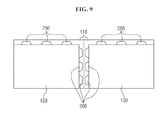
  • FIG. 9 is a plan view of the multi-display device illustrated in FIG. 7 .
  • FIG. 10 is a perspective view of a multi-display device according to exemplary embodiments of the invention.
  • FIG. 11 is a cross-sectional view taken along line D-D′ of FIG. 10 .
  • FIG. 12 is a plan view of a multi-display device according to exemplary embodiments of the invention.
  • FIG. 13 is a plan view of a multi-display device according to exemplary embodiments of the invention.
  • FIG. 14 is a plan view of a multi-display device according to exemplary embodiments of the invention.
  • an element or layer When an element or layer is referred to as being “on,” “connected to,” or “coupled to” another element or layer, it may be directly on, connected to, or coupled to the other element or layer or intervening elements or layers may be present. When, however, an element or layer is referred to as being “directly on,” “directly connected to,” or “directly coupled to” another element or layer, there are no intervening elements or layers present.
  • “at least one of X, Y, and Z” and “at least one selected from the group consisting of X, Y, and Z” may be construed as X only, Y only, Z only, or any combination of two or more of X, Y, and Z, such as, for instance, XYZ, XYY, YZ, and ZZ.
  • the term “and/or” includes any and all combinations of one or more of the associated listed items.
  • first, second, etc. may be used herein to describe various elements, components, regions, layers, and/or sections, these elements, components, regions, layers, and/or sections should not be limited by these terms. These terms are used to distinguish one element, component, region, layer, and/or section from another element, component, region, layer, and/or section. Thus, a first element, component, region, layer, and/or section discussed below could be termed a second element, component, region, layer, and/or section without departing from the teachings of the present disclosure.
  • Spatially relative terms such as “beneath,” “below,” “lower,” “above,” “upper,” and the like, may be used herein for descriptive purposes, and, thereby, to describe one element or feature's relationship to another element(s) or feature(s) as illustrated in the drawings.
  • Spatially relative terms are intended to encompass different orientations of an apparatus in use, operation, and/or manufacture in addition to the orientation depicted in the drawings. For example, if the apparatus in the drawings is turned over, elements described as “below” or “beneath” other elements or features would then be oriented “above” the other elements or features.
  • the exemplary term “below” can encompass both an orientation of above and below.
  • the apparatus may be otherwise oriented (e.g., rotated 90 degrees or at other orientations), and, as such, the spatially relative descriptors used herein interpreted accordingly.
  • exemplary embodiments are described herein with reference to sectional illustrations that are schematic illustrations of idealized exemplary embodiments and/or intermediate structures. As such, variations from the shapes of the illustrations as a result, for example, of manufacturing techniques and/or tolerances, are to be expected. Thus, exemplary embodiments disclosed herein should not be construed as limited to the particular illustrated shapes of regions, but are to include deviations in shapes that result from, for instance, manufacturing. For example, an implanted region illustrated as a rectangle will, typically, have rounded or curved features and/or a gradient of implant concentration at its edges rather than a binary change from implanted to non-implanted region.
  • a buried region formed by implantation may result in some implantation in the region between the buried region and the surface through which the implantation takes place.
  • the regions illustrated in the drawings are schematic in nature and their shapes are not intended to illustrate the actual shape of a region of a device and are not intended to be limiting.
  • FIG. 1 is a perspective view of a display module according to exemplary embodiments of the invention
  • FIG. 2 is a cross-sectional view taken along line A-A′ of FIG. 1
  • FIG. 3 is a cross-sectional view taken along line B-B′ of FIG. 1
  • FIG. 4 is a plan view of the display device illustrated in FIG. 1 .
  • a display module may include a first substrate 110 , connectors 200 , which are disposed on the first substrate 110 and transmit signals for driving the first substrate 110 , a printed circuit board (PCB) 400 , which is electrically connected to the connectors 200 and transmits signals to the connectors 200 , and connecting members 300 , which are provided to extend through the first substrate 110 and electrically connect the connectors 200 and the PCB 400 .
  • PCB printed circuit board
  • the display module may include the first substrate 110 and a second substrate 120 , and may also include a liquid crystal layer 10 filled or disposed between the first substrate 110 and the second substrate 120 .
  • the liquid crystal layer 10 may be sealed by a sealing member 20 , which is between the first substrate 110 and the second substrate 120 and along the edges of the first substrate 110 and the second substrate 120 .
  • the first substrate 110 may be an array substrate and include a thin-film transistor (TFT) layer, gate wiring, data wiring, a TFT array, and pixel electrodes, and a common electrode may be disposed on the second substrate 120 .
  • TFT thin-film transistor
  • the first substrate 110 may be referred to herein as the array substrate 110 .
  • the array substrate 110 may be divided into a display region and a non-display region surrounding the display region.
  • the connectors 200 and connectors 250 may be disposed in the non-display region.
  • the connectors 200 and the connectors 250 may include pads that extend from the data wiring or the gate wiring in the display region or terminals of the data wiring or the gate wiring.
  • the connectors 200 and the connectors 250 are illustrated in FIGS. 1 to 4 as being disposed on pairs of adjoining sides, respectively, of the array substrate 110 that are perpendicular to each other, but aspects are not limited thereto.
  • the connectors 200 and the connectors 250 may be data connectors and gate connectors, respectively, but aspects are not limited thereto. For convenience, only the connectors 200 will hereinafter be described in detail, and a description of the connectors 200 may be directly applicable to the connectors 250 .
  • the array substrate 110 may be formed of a rigid material, such as glass or a plastic material, such as a polycarbonate (PC) resin. Further, the array substrate 110 may be formed of a flexible material, such as a polyimide (PI) resin. However, the material of the array substrate 110 is not limited thereto such that the array substrate 110 may be formed of other suitable materials.
  • a rigid material such as glass or a plastic material, such as a polycarbonate (PC) resin.
  • the array substrate 110 may be formed of a flexible material, such as a polyimide (PI) resin.
  • PI polyimide
  • the material of the array substrate 110 is not limited thereto such that the array substrate 110 may be formed of other suitable materials.
  • the connectors 250 may be provided in the non-display region.
  • the gate wiring may extend from the connectors 250 into the display region.
  • the data wiring and the gate wiring may intersect each other, thereby defining pixels.
  • the PCB 400 may be provided on a bottom surface of the array substrate 110 . That is, the PCB 400 and the second substrate 120 may be provided on opposite surfaces of the array substrate 110 .
  • the second substrate 120 may be disposed on the top surface of the array substrate 110
  • the PCB 400 may be disposed on the bottom surface of the array substrate 110 .
  • the PCB 400 is provided on the bottom surface of the array substrate 110 , the area of the non-display region of the array substrate 110 may be decreased. As a result, the width of the bezel of a display device may be decreased.
  • the display module may also include a driver integrated circuit (IC) chip 500 mounted on the PCB 400 .
  • the driver IC chip 500 may be mounted on the PCB 400 and may apply driving signals to the array substrate 110 .
  • the driving signals applied by the driver IC chip 500 may be transmitted to the array substrate 110 via the connectors 200 , which are electrically connected to the PCB 400 , resulting in an image being displayed by the display module.
  • the PCB 400 may include a conductive layer (not illustrated) to transmit electric signals. Accordingly, the PCB 400 may transmit the driving signals applied by the driver IC chip 500 to the connectors 200 .
  • the PCB 400 may be a flexible PCB (FPCB), but aspects are not limited thereto. That is, the PCB 400 may be implemented as a rigid PCB or an FPCB.
  • FPCB flexible PCB
  • the PCB 400 and the connectors 200 may be electrically connected to each other by the connecting members 300 .
  • the connecting members 300 may be formed of a conductive material to provide the electrical connection.
  • the connecting members 300 may be electrically connected to the connectors 200 , which include wiring from the display region or pads extended from such wiring.
  • the connectors 200 may include pads (not illustrated), which extend through the array substrate 110 and are connected to the connectors 200 below the array substrate 110 . Accordingly, the pads of the connectors 200 may be electrically connected to the PCB 400 below the array substrate 110 .
  • the driver IC chip 500 may be provided on an opposite surface of the PCB 400 opposite to a surface of the PCB 400 that faces the array substrate 110 .
  • the array substrate 110 may include the display region and the non-display region surrounding the display region, and the connectors 200 may be provided in the non-display region.
  • the connectors 200 may be electrically connected to the PCB 400 via the connecting members 300 .
  • the array substrate 110 may include through holes. The through holes may be formed in the non-display region of the array substrate 110 .
  • the connecting members 300 may be formed or disposed in the through holes. Accordingly, the connectors 200 , the PCB 400 and the driver IC chip 500 may be electrically connected to one another in the display region of the array substrate 110 . Therefore, the electrical connections need not be provided in the non-display region of the array substrate 110 such that an area of the non-display region may be decreased.
  • the through holes may be formed in the non-display region of the array substrate 100 by using a laser device.
  • the connecting members 300 may be formed by injecting a metallic ink into the through holes or depositing a metal onto the through holes.
  • the through holes may be formed to have a diameter of about 10 ⁇ m to about 30 ⁇ m and a pitch of about 40 ⁇ m to about 50 ⁇ m.
  • the PCB 400 may include a fine conductive pattern and fine wiring may be properly connected to each other via the through holes.
  • the connecting members 300 which extend through the array substrate 110 through the through holes, may be bent to be parallel to the bottom surface of the array substrate 110 . That is, the connecting members 300 may extend through the array substrate 110 through the through holes, extending from the top surface of the array substrate 110 to the bottom surface of the array substrate 110 , and be bent at the bottom of the array substrate 110 to extend toward the center of the array substrate 110 parallel to the bottom surface of the array substrate 110 .
  • the connecting members 300 may be bent at the bottom of the array substrate 110 to extend toward the display region of the array substrate 110 , and as a result, the PCB 400 and the connecting members 300 may be connected inside the area of the rear surface of the array substrate 110 . Accordingly, a connection structure for applying signals to the display region of the array substrate 110 may all be implemented within the area of the array substrate 110 , thereby reducing the area required for the non-display region of the array substrate 110 .
  • the entirety of the PCB 400 may be included within an area (total area of a surface) of the array substrate 110 , and the PCB 400 may be provided on the rear surface of the array substrate 110 . Accordingly, an electrical connection structure may be provided within the area of the array substrate 110 , and, as a result, the area of the non-display region of the array substrate 110 may be decreased.
  • a backlight unit may be provided below the display module.
  • the backlight unit may include a light source unit (not illustrated), a light guide plate (not illustrated), a diffusion sheet (not illustrated), and a prism sheet (not illustrated).
  • the light source unit may use a point light source, such as a light-emitting diode (LED), or a line light source, such as an electroluminescent lamp (EL) or a cold cathode fluorescent lamp (CCFL), but aspects are not limited thereto.
  • a point light source such as a light-emitting diode (LED)
  • a line light source such as an electroluminescent lamp (EL) or a cold cathode fluorescent lamp (CCFL)
  • EL electroluminescent lamp
  • CCFL cold cathode fluorescent lamp
  • the light guide plate may reflect, refract, and diffuse light incident upon a side thereof, thereby obtaining planar light.
  • the light guide plate may guide the planar light to be emitted from the top thereof.
  • the light guide plate may allow uniform surface light to be incident upon the display module.
  • the light guide plate may be formed of, for example, a polymethyl methacrylate (PMMA) resin, a polycarbonate (PC) resin, an acrylonitrile-styrene-butadiene copolymer resin, a polystyrene resin, an acrylonitrile-styrene copolymer resin, a polyolefin resin, or a polymethacrylstyrene (MS) resin, which is a combination of polymethacrylate and polystyrene, but aspects are not limited thereto.
  • PMMA polymethyl methacrylate
  • PC polycarbonate
  • MS polymethacrylstyrene
  • the light guide plate may be wedge-shaped with a thickness gradually decreasing from one side thereof close to the light source unit to the other side thereof distant from the light source unit, or the light guide plate may be plate-shaped with a uniform thickness.
  • the shape of the light guide plate is not limited thereto.
  • one or more optical sheets such as a diffusion film, a prism film, and a protective film, may be provided on the light guide plate.
  • the diffusion film may diffuse light emitted from the light guide plate, and may provide the light to be supplied to the display module.
  • the prism film may collect light diffused by the diffusion film in a direction perpendicular to the surface of the display module.
  • a micro-lens array film and a lenticular lens film may be included in the optical sheets.
  • the structure and the arrangement of the optical sheets are not limited to those set forth herein, and may vary without departing from the scope of the invention.
  • a reflective sheet may be provided below the light guide plate.
  • the reflective sheet may direct light emitted from the bottom of the light guide plate toward a display panel above the light guide plate. Due to the presence of the reflective sheet, light emitted from the bottom of the light guide plate may be reflected and may then travel toward the display module.
  • a reflective pattern may be formed on the reflective sheet, and the density of the reflective pattern may gradually increase from one side of the reflective layer close to the light source unit to the other side of the reflective layer distant from the light source unit. The reflective pattern may allow light with uniform luminance to be supplied to the display module.
  • Various optical sheets, other than those set forth herein, may also be provided to improve the luminance of the display module or preventing the occurrence of a moiré phenomenon without departing from the scope of the invention.
  • a display device including the display module, may include a middle frame stacked above the optical sheets and a top chassis.
  • the display module may be disposed on the middle frame, and the top chassis may be disposed to cover part of the display module from above the display module.
  • the top chassis may have a window through which the display region of the array substrate 110 is exposed.
  • a polarizing plate may be provided at each of the top and the bottom of the display module.
  • FIG. 5 is a cross-sectional view of a display module according to exemplary embodiments of the invention.
  • a connecting member 310 may extend through an array substrate 110 from the top to the bottom of the array substrate through a through hole formed at the array substrate 110 and may be directly connected to a PCB 400 at the bottom of the array substrate 110 . That is, wiring extended from a display region of the array substrate 110 may be directly connected to the connecting member 300 at the top of the array substrate 110 , and the PCB 400 may be directly connected to the connecting member 300 at the bottom of the array substrate 110 .
  • the connecting member 310 may be formed to extend through the array substrate 110 and then to protrude from the bottom surface of the array substrate 110 , and a connecting pad may be provided at the protrusion of the connecting member 310 .
  • the connecting pad may be electrically connected to the PCB 400 .
  • the connecting pad and the PCB 400 may be electrically connected by an anisotropic conductive film (ACF) including an insulating adhesive with conductive particles.
  • ACF anisotropic conductive film
  • FIG. 6 is a cross-sectional view of a display module according to exemplary embodiments of the invention.
  • a driver IC chip 500 may be directly connected to a connecting member 300 at the bottom of an array substrate 110 .
  • the driver IC chip 500 may be electrically connected to the connecting member 300 by solder, a conductive adhesive, or another conductive material.
  • FIG. 7 is a perspective view of a multi-display device according to exemplary embodiments of the invention
  • FIG. 8 is a cross-sectional view taken along line C-C′ of FIG. 7
  • FIG. 9 is a plan view of the multi-display device illustrated in FIG. 7 .
  • a multi-display device may include display modules arranged adjacent to one another and a housing (not illustrated), which secures or holds the display modules.
  • Each of the display modules may include an array substrate 110 , connectors 200 , a PCB 400 , and connecting members 300 .
  • the connectors 200 may be disposed on the array substrate 110 to transmit signals for driving the array substrate 110 .
  • the PCB 400 is electrically connected to the connectors 200 and transmits signals to the connectors 200 .
  • the connecting members 300 extend through the array substrate 110 and electrically connect the connectors 200 and the PCB 400 .
  • the multi-display device may also include a driver IC chip 500 , which is disposed on the PCB 400 .
  • the driver IC chip 500 may be disposed on an opposite surface of the PCB 400 opposite to a surface of the PCB 400 that faces the array substrate 110 .
  • the array substrate 110 may include a display region and a non-display region surrounding the display region, and the connectors 200 may be provided in the non-display region.
  • the array substrate 110 may also include through holes, which are formed in the non-display region, and the connecting members 300 may be formed or disposed in the through holes.
  • the PCB 400 may be provided on a bottom surface of the array substrate 110 .
  • the PCB 400 may be disposed on an area of the bottom surface of the array substrate 110 that corresponds to or is within the display region or may be disposed closer to the center of the array substrate 110 than the through holes.
  • the display modules of the exemplary embodiment of FIGS. 7 to 9 are substantially similar to their counterparts of the exemplary embodiments of FIGS. 1 to 6 , and thus, a detailed description thereof will be omitted.
  • the display modules may be arranged side-by-side with each other such that the connectors 200 and the connecting members 300 of one display module may face the connectors 200 and the connecting members 300 of another display module, but aspects of the invention are not limited thereto. That is, the display modules may be arranged in various manners, other than as illustrated in FIGS. 7 to 9 .
  • the housing may secure or hold and accommodate the display modules therein and may form the exterior of the multi-display device.
  • an electrical connection may be provided between the top surface of the array substrate 110 and the PCB 400 at the bottom of the array substrate 110 through the through holes of the array substrate 110 . Accordingly, an entire electrical connection structure for transmitting electric signals from the driver IC chip 500 may be implemented within the area of the array substrate 110 may be provided.
  • a typical multi-display device with multiple display modules areas are formed near the edges of the display modules, and electrical connection structures for transmitting electric signals from the driver IC chips of the multiple display modules are formed in such areas. Due to the presence of these areas, there are provided non-display regions between display regions of the multiple display modules. However, the non-display regions between the multiple display modules form dead spaces where no images are displayed and, thus, lower the visibility of a display device.
  • an entire electrical connection structure may be provided within the area of the array substrate 110 of each of the display modules. Accordingly, the area of dead space may be effectively reduced, and the visibility of a display device may be improved.
  • FIG. 10 is a perspective view of a multi-display device according to exemplary embodiments of the invention
  • FIG. 11 is a cross-sectional view taken along line D-D′ of FIG. 10 .
  • a multi-display device includes a first array substrate 111 and a second array substrate 112 arranged side-by-side.
  • the multi-display device further includes first connectors 201 disposed on the first array substrate 111 that transmit signals for driving the first array substrate 111 and second connectors 202 disposed on the second array substrate 112 that transmit signals for driving the second array substrate 112 .
  • the multi-display includes a PCB 400 electrically connected to the first connectors 201 and the second connectors 202 , first connecting members 301 , which extend through the first array substrate 111 and electrically connect the first connectors 201 and the PCB 400 , and second connecting members 302 , which extend through the second array substrate 112 and electrically connect the second connectors 202 and the PCB 400 .
  • the display module having the first array substrate 111 also includes a first second substrate 121 and a liquid crystal layer 10 disposed between the first array substrate 111 and the first second substrate 121 .
  • the display module having the second array substrate 112 also includes a second second substrate 122 and a liquid crystal layer 10 disposed between the second array substrate 112 and the second second substrate 122 .
  • the display module having the first array substrate 111 and the display module having the second array substrate 112 may be connected to a single PCB, i.e., the PCB 400 , so as to form a multi-display device.
  • the multi-display device may also include a driver IC chip 500 , which is provided on the PCB 400 .
  • the driver IC chip 500 may realize an image by applying signals to the display region of the first array substrate 111 and the display region of the second array substrate 112 individually or at the same time.
  • the PCB 400 may be an FPCB. If the PCB 400 is implemented as an FPCB, the multi-display device may be freely bendable along the boundary between the display module having the first array substrate 111 and the display module having the second array substrate 112 . Accordingly, a flexible multi-display device may be provided.
  • first array substrate 111 and the second array substrate 112 may be formed of a flexible resin, such as a PI resin, thereby making the multi-display device flexible.
  • the first connectors 301 and the second connectors 302 may be on adjacent sides, respectively, of the first array substrate 111 and the second array substrate 112 so that the display module having the first array substrate 111 and the display module having the second array substrate 112 may be electrically connected to each other by a single PCB, i.e., the PCB 400 . That is, the PCB 400 may be disposed along or straddle the boundary between the first array substrate 111 and the second array substrate 112 .
  • FIGS. 12 through 14 are plan views of multi-display devices according to exemplary embodiments of the invention.
  • the display modules may be arranged in a pattern and need not be disposed directly adjacent to each other.
  • four display modules may be arranged in a row pattern or a column pattern in which the four display modules are arranged in straight lines. Further, more or fewer than four display modules may be arranged in patterns. And, edges of the display modules need not align and/or touch such that the pattern need not be a regular shape and spaces may be present between the display modules.
  • display modules may be arranged in a multi-display device in such a manner that they face the same direction.
  • the display modules may be secured by or disposed in a housing 600 .
  • each of four display modules may be arranged in such a manner that their connectors 200 , which are extensions of data wiring, are disposed in a same direction.
  • each of the four display modules may be arranged such that the connectors 250 of each display module are arranged in a same direction.
  • display modules may be arranged in a multi-display device in such a manner that a pair of vertically adjacent display modules is disposed to have their connectors 200 face the same direction, whereas a pair of horizontally adjacent display modules is disposed such that their connectors 200 face opposite directions.
  • the connectors 250 of the vertically adjacent display modules and the horizontally adjacent display modules may be disposed in same or opposite directions.
  • the horizontally adjacent display modules may be symmetrical with respect to each other.
  • display modules may be arranged in a multi-display device in such a manner that a pair of vertically adjacent display modules and a pair of horizontally adjacent display modules are symmetrical to each other.
  • the connectors 200 of the horizontally adjacent pairs may be disposed in same or opposite directions, and the connectors 200 of the vertically adjacent pairs may be disposed in the same direction.
  • the connectors 250 of the horizontally adjacent pairs may be disposed in the same direction while the connectors 250 of the vertically adjacent pairs may be disposed in same or opposite directions.
  • FIGS. 12 to 14 Various patterns of arrangement of display modules in a multi-display device have been described above with reference to FIGS. 12 to 14 , but aspects of the invention are not limited to the exemplary embodiments of FIGS. 12 to 14 . That is, the pattern of the arrangement of display modules in a multi-display device may vary without departing from the scope of the invention.

Landscapes

  • Physics & Mathematics (AREA)
  • Nonlinear Science (AREA)
  • General Physics & Mathematics (AREA)
  • Optics & Photonics (AREA)
  • Crystallography & Structural Chemistry (AREA)
  • Chemical & Material Sciences (AREA)
  • Mathematical Physics (AREA)
  • Devices For Indicating Variable Information By Combining Individual Elements (AREA)
  • Engineering & Computer Science (AREA)
  • Theoretical Computer Science (AREA)
  • Human Computer Interaction (AREA)
  • General Engineering & Computer Science (AREA)
  • Microelectronics & Electronic Packaging (AREA)

Abstract

A display module for a multi-display device includes an array substrate, connectors disposed on the array substrate and configured to transmit signals for driving the array substrate, a printed circuit board (PCB) electrically connected to the connectors and configured to transmit signals to the connectors, and connecting members that extend through the array substrate and configured to electrically connect the connectors and the PCB.

Description

CROSS-REFERENCE TO RELATED APPLICATION
This application claims priority from and the benefit of Korean Patent Application No. 10-2014-0075041, filed on Jun. 19, 2014, which is hereby incorporated by reference for all purposes as if fully set forth herein.
BACKGROUND
Field
Exemplary embodiments relate to a display module and a multi-display device having the same.
Discussion of the Background
In accordance with the progress and maturation of the modern information society, manufacturers have increasingly become faced with market demands for larger and thinner display devices that related-art cathode ray tube (CRT) devices cannot meet, and as a result, the demand for flat-panel display devices, such as a plasma display panel (PDP) device, a plasma address liquid crystal display panel (PALC) device, a liquid crystal display (LCD) device, and an organic light-emitting diode (OLED) display device, has grown.
An LCD device, for example, includes glass substrates and a liquid crystal layer disposed between the glass substrates. In response to the LCD device being powered by power sources provided at the top and the bottom of the glass substrates, the LCD device transforms the power into light. As a result, the LCD device displays an image.
In recent years, large-screen display devices have become more and more popular, directing public attention toward multi-display devices, which are display devices equipped with plural display modules.
The above information disclosed in this Background section is only for enhancement of understanding of the background of the inventive concept, and, therefore, it may contain information that does not form the prior art that is already known in this country to a person of ordinary skill in the art.
SUMMARY
Exemplary embodiments provide a display module having a decreased size of a non-display region.
Additional aspects will be set forth in the detailed description which follows, and, in part, will be apparent from the disclosure, or may be learned by practice of the inventive concept.
Exemplary embodiments of the invention provide a multi-display device having a decreased distance between display modules, and having an improved visibility because of a decreased dead space between the display modules.
However, exemplary embodiments of the invention are not restricted to those set forth herein. The above and other exemplary embodiments of the invention will become more apparent to one of ordinary skill in the art to which the invention pertains by referencing the detailed description of the illustrated embodiments given below.
According to exemplary embodiments of the invention, a display module includes an array substrate, connectors disposed on the array substrate and configured to transmit signals for driving the array substrate, a printed circuit board (PCB) electrically connected to the connectors and configured to transmit signals to the connectors, and connecting members disposed to extend through the array substrate and configured to electrically connect the connectors and the PCB.
According to exemplary embodiments of the present invention, a multi-display device includes display modules arranged in a pattern; and a housing configured to fix the display modules, wherein each of the display modules includes an array substrate, connectors disposed on the array substrate and configured to transmit signals for driving the array substrate, a printed circuit board (PCB) electrically connected to the connectors and configured to transmit signals to the connectors, and connecting members disposed to extend through the array substrate and configured to electrically connect the connectors and the PCB.
According to exemplary embodiments of the present invention, a multi-display device includes a first array substrate, a second array substrate disposed adjacent to the first array substrate, first connectors disposed on the first array substrate and configured to transmit signals for driving the first array substrate, second connectors disposed on the second array substrate and configured to transmit signals for driving the second array substrate, a printed circuit board (PCB) configured to electrically connect and transmit signals to the first connectors and the second connectors, first connecting members disposed to extend through the first array substrate and configured to electrically connect the first connectors and the PCB, and second connecting members disposed to extend through the second array substrate and configured to electrically connect the second connectors and the PCB.
According to the exemplary embodiments, it is possible to provide a display module having a decreased area of a non-display region.
According to the exemplary embodiments, it is possible to provide a multi-display device having a decreased distance between display modules, and having an improved visibility by having a decreased dead space between the display modules.
Other features and exemplary embodiments will be apparent from the following detailed description, the drawings, and the claims.
The foregoing general description and the following detailed description are exemplary and explanatory and are intended to provide further explanation of the claimed subject matter.
BRIEF DESCRIPTION OF THE DRAWINGS
The accompanying drawings, which are included to provide a further understanding of the inventive concept, and are incorporated in and constitute a part of this specification, illustrate exemplary embodiments of the inventive concept, and, together with the description, serve to explain principles of the inventive concept.
FIG. 1 is a perspective view of a display module according to exemplary embodiments of the invention.
FIG. 2 is a cross-sectional view taken along line A-A′ of FIG. 1.
FIG. 3 is a cross-sectional view taken along line B-B′ of FIG. 1.
FIG. 4 is a plan view of the display device illustrated in FIG. 1.
FIG. 5 is a cross-sectional view of a display module according to exemplary embodiments of the invention.
FIG. 6 is a cross-sectional view of a display module according to exemplary embodiments of the invention.
FIG. 7 is a perspective view of a multi-display device according to exemplary embodiments of the invention.
FIG. 8 is a cross-sectional view taken along line C-C′ of FIG. 7.
FIG. 9 is a plan view of the multi-display device illustrated in FIG. 7.
FIG. 10 is a perspective view of a multi-display device according to exemplary embodiments of the invention.
FIG. 11 is a cross-sectional view taken along line D-D′ of FIG. 10.
FIG. 12 is a plan view of a multi-display device according to exemplary embodiments of the invention.
FIG. 13 is a plan view of a multi-display device according to exemplary embodiments of the invention.
FIG. 14 is a plan view of a multi-display device according to exemplary embodiments of the invention.
DETAILED DESCRIPTION OF THE ILLUSTRATED EMBODIMENTS
In the following description, for the purposes of explanation, numerous specific details are set forth in order to provide a thorough understanding of various exemplary embodiments. It is apparent, however, that various exemplary embodiments may be practiced without these specific details or with one or more equivalent arrangements. In other instances, well-known structures and devices are shown in block diagram form in order to avoid unnecessarily obscuring various exemplary embodiments.
In the accompanying figures, the size and relative sizes of layers, films, panels, regions, etc., may be exaggerated for clarity and descriptive purposes. Also, like reference numerals denote like elements.
When an element or layer is referred to as being “on,” “connected to,” or “coupled to” another element or layer, it may be directly on, connected to, or coupled to the other element or layer or intervening elements or layers may be present. When, however, an element or layer is referred to as being “directly on,” “directly connected to,” or “directly coupled to” another element or layer, there are no intervening elements or layers present. For the purposes of this disclosure, “at least one of X, Y, and Z” and “at least one selected from the group consisting of X, Y, and Z” may be construed as X only, Y only, Z only, or any combination of two or more of X, Y, and Z, such as, for instance, XYZ, XYY, YZ, and ZZ. As used herein, the term “and/or” includes any and all combinations of one or more of the associated listed items.
Although the terms first, second, etc. may be used herein to describe various elements, components, regions, layers, and/or sections, these elements, components, regions, layers, and/or sections should not be limited by these terms. These terms are used to distinguish one element, component, region, layer, and/or section from another element, component, region, layer, and/or section. Thus, a first element, component, region, layer, and/or section discussed below could be termed a second element, component, region, layer, and/or section without departing from the teachings of the present disclosure.
Spatially relative terms, such as “beneath,” “below,” “lower,” “above,” “upper,” and the like, may be used herein for descriptive purposes, and, thereby, to describe one element or feature's relationship to another element(s) or feature(s) as illustrated in the drawings. Spatially relative terms are intended to encompass different orientations of an apparatus in use, operation, and/or manufacture in addition to the orientation depicted in the drawings. For example, if the apparatus in the drawings is turned over, elements described as “below” or “beneath” other elements or features would then be oriented “above” the other elements or features. Thus, the exemplary term “below” can encompass both an orientation of above and below. Furthermore, the apparatus may be otherwise oriented (e.g., rotated 90 degrees or at other orientations), and, as such, the spatially relative descriptors used herein interpreted accordingly.
The terminology used herein is for the purpose of describing particular embodiments and is not intended to be limiting. As used herein, the singular forms, “a,” “an,” and “the” are intended to include the plural forms as well, unless the context clearly indicates otherwise. Moreover, the terms “comprises,” comprising,” “includes,” and/or “including,” when used in this specification, specify the presence of stated features, integers, steps, operations, elements, components, and/or groups thereof, but do not preclude the presence or addition of one or more other features, integers, steps, operations, elements, components, and/or groups thereof.
Various exemplary embodiments are described herein with reference to sectional illustrations that are schematic illustrations of idealized exemplary embodiments and/or intermediate structures. As such, variations from the shapes of the illustrations as a result, for example, of manufacturing techniques and/or tolerances, are to be expected. Thus, exemplary embodiments disclosed herein should not be construed as limited to the particular illustrated shapes of regions, but are to include deviations in shapes that result from, for instance, manufacturing. For example, an implanted region illustrated as a rectangle will, typically, have rounded or curved features and/or a gradient of implant concentration at its edges rather than a binary change from implanted to non-implanted region. Likewise, a buried region formed by implantation may result in some implantation in the region between the buried region and the surface through which the implantation takes place. Thus, the regions illustrated in the drawings are schematic in nature and their shapes are not intended to illustrate the actual shape of a region of a device and are not intended to be limiting.
Unless otherwise defined, all terms (including technical and scientific terms) used herein have the same meaning as commonly understood by one of ordinary skill in the art to which this disclosure is a part. Terms, such as those defined in commonly used dictionaries, should be interpreted as having a meaning that is consistent with their meaning in the context of the relevant art and will not be interpreted in an idealized or overly formal sense, unless expressly so defined herein. Exemplary embodiments will hereinafter be described with reference to the accompanying drawings.
FIG. 1 is a perspective view of a display module according to exemplary embodiments of the invention, FIG. 2 is a cross-sectional view taken along line A-A′ of FIG. 1, FIG. 3 is a cross-sectional view taken along line B-B′ of FIG. 1, and FIG. 4 is a plan view of the display device illustrated in FIG. 1.
Referring to FIGS. 1 to 4, a display module may include a first substrate 110, connectors 200, which are disposed on the first substrate 110 and transmit signals for driving the first substrate 110, a printed circuit board (PCB) 400, which is electrically connected to the connectors 200 and transmits signals to the connectors 200, and connecting members 300, which are provided to extend through the first substrate 110 and electrically connect the connectors 200 and the PCB 400.
More specifically, the display module may include the first substrate 110 and a second substrate 120, and may also include a liquid crystal layer 10 filled or disposed between the first substrate 110 and the second substrate 120. The liquid crystal layer 10 may be sealed by a sealing member 20, which is between the first substrate 110 and the second substrate 120 and along the edges of the first substrate 110 and the second substrate 120. The first substrate 110 may be an array substrate and include a thin-film transistor (TFT) layer, gate wiring, data wiring, a TFT array, and pixel electrodes, and a common electrode may be disposed on the second substrate 120. The first substrate 110 may be referred to herein as the array substrate 110.
The array substrate 110 may be divided into a display region and a non-display region surrounding the display region. The connectors 200 and connectors 250 may be disposed in the non-display region. The connectors 200 and the connectors 250 may include pads that extend from the data wiring or the gate wiring in the display region or terminals of the data wiring or the gate wiring. The connectors 200 and the connectors 250 are illustrated in FIGS. 1 to 4 as being disposed on pairs of adjoining sides, respectively, of the array substrate 110 that are perpendicular to each other, but aspects are not limited thereto. The connectors 200 and the connectors 250 may be data connectors and gate connectors, respectively, but aspects are not limited thereto. For convenience, only the connectors 200 will hereinafter be described in detail, and a description of the connectors 200 may be directly applicable to the connectors 250.
The array substrate 110 may be formed of a rigid material, such as glass or a plastic material, such as a polycarbonate (PC) resin. Further, the array substrate 110 may be formed of a flexible material, such as a polyimide (PI) resin. However, the material of the array substrate 110 is not limited thereto such that the array substrate 110 may be formed of other suitable materials.
The connectors 250 may be provided in the non-display region. The gate wiring may extend from the connectors 250 into the display region. The data wiring and the gate wiring may intersect each other, thereby defining pixels.
The PCB 400 may be provided on a bottom surface of the array substrate 110. That is, the PCB 400 and the second substrate 120 may be provided on opposite surfaces of the array substrate 110. For example, the second substrate 120 may be disposed on the top surface of the array substrate 110, and the PCB 400 may be disposed on the bottom surface of the array substrate 110.
Since the PCB 400 is provided on the bottom surface of the array substrate 110, the area of the non-display region of the array substrate 110 may be decreased. As a result, the width of the bezel of a display device may be decreased.
The display module may also include a driver integrated circuit (IC) chip 500 mounted on the PCB 400. The driver IC chip 500 may be mounted on the PCB 400 and may apply driving signals to the array substrate 110. The driving signals applied by the driver IC chip 500 may be transmitted to the array substrate 110 via the connectors 200, which are electrically connected to the PCB 400, resulting in an image being displayed by the display module.
The PCB 400 may include a conductive layer (not illustrated) to transmit electric signals. Accordingly, the PCB 400 may transmit the driving signals applied by the driver IC chip 500 to the connectors 200.
The PCB 400 may be a flexible PCB (FPCB), but aspects are not limited thereto. That is, the PCB 400 may be implemented as a rigid PCB or an FPCB.
The PCB 400 and the connectors 200 may be electrically connected to each other by the connecting members 300. The connecting members 300 may be formed of a conductive material to provide the electrical connection. The connecting members 300 may be electrically connected to the connectors 200, which include wiring from the display region or pads extended from such wiring.
As the connectors 200 are connected to wiring from the display region, the connectors 200 may include pads (not illustrated), which extend through the array substrate 110 and are connected to the connectors 200 below the array substrate 110. Accordingly, the pads of the connectors 200 may be electrically connected to the PCB 400 below the array substrate 110.
The driver IC chip 500 may be provided on an opposite surface of the PCB 400 opposite to a surface of the PCB 400 that faces the array substrate 110.
The array substrate 110 may include the display region and the non-display region surrounding the display region, and the connectors 200 may be provided in the non-display region. The connectors 200 may be electrically connected to the PCB 400 via the connecting members 300. The array substrate 110 may include through holes. The through holes may be formed in the non-display region of the array substrate 110. The connecting members 300 may be formed or disposed in the through holes. Accordingly, the connectors 200, the PCB 400 and the driver IC chip 500 may be electrically connected to one another in the display region of the array substrate 110. Therefore, the electrical connections need not be provided in the non-display region of the array substrate 110 such that an area of the non-display region may be decreased.
The through holes may be formed in the non-display region of the array substrate 100 by using a laser device. The connecting members 300 may be formed by injecting a metallic ink into the through holes or depositing a metal onto the through holes.
The through holes may be formed to have a diameter of about 10 μm to about 30 μm and a pitch of about 40 μm to about 50 μm. The PCB 400 may include a fine conductive pattern and fine wiring may be properly connected to each other via the through holes.
The connecting members 300, which extend through the array substrate 110 through the through holes, may be bent to be parallel to the bottom surface of the array substrate 110. That is, the connecting members 300 may extend through the array substrate 110 through the through holes, extending from the top surface of the array substrate 110 to the bottom surface of the array substrate 110, and be bent at the bottom of the array substrate 110 to extend toward the center of the array substrate 110 parallel to the bottom surface of the array substrate 110.
That is, the connecting members 300 may be bent at the bottom of the array substrate 110 to extend toward the display region of the array substrate 110, and as a result, the PCB 400 and the connecting members 300 may be connected inside the area of the rear surface of the array substrate 110. Accordingly, a connection structure for applying signals to the display region of the array substrate 110 may all be implemented within the area of the array substrate 110, thereby reducing the area required for the non-display region of the array substrate 110.
The entirety of the PCB 400 may be included within an area (total area of a surface) of the array substrate 110, and the PCB 400 may be provided on the rear surface of the array substrate 110. Accordingly, an electrical connection structure may be provided within the area of the array substrate 110, and, as a result, the area of the non-display region of the array substrate 110 may be decreased.
A backlight unit (not illustrated) may be provided below the display module. The backlight unit may include a light source unit (not illustrated), a light guide plate (not illustrated), a diffusion sheet (not illustrated), and a prism sheet (not illustrated).
The light source unit may use a point light source, such as a light-emitting diode (LED), or a line light source, such as an electroluminescent lamp (EL) or a cold cathode fluorescent lamp (CCFL), but aspects are not limited thereto.
The light guide plate may reflect, refract, and diffuse light incident upon a side thereof, thereby obtaining planar light. The light guide plate may guide the planar light to be emitted from the top thereof. The light guide plate may allow uniform surface light to be incident upon the display module.
The light guide plate may be formed of, for example, a polymethyl methacrylate (PMMA) resin, a polycarbonate (PC) resin, an acrylonitrile-styrene-butadiene copolymer resin, a polystyrene resin, an acrylonitrile-styrene copolymer resin, a polyolefin resin, or a polymethacrylstyrene (MS) resin, which is a combination of polymethacrylate and polystyrene, but aspects are not limited thereto.
The light guide plate may be wedge-shaped with a thickness gradually decreasing from one side thereof close to the light source unit to the other side thereof distant from the light source unit, or the light guide plate may be plate-shaped with a uniform thickness. However, the shape of the light guide plate is not limited thereto.
For an improved optical performance of the display module, one or more optical sheets, such as a diffusion film, a prism film, and a protective film, may be provided on the light guide plate. The diffusion film may diffuse light emitted from the light guide plate, and may provide the light to be supplied to the display module. The prism film may collect light diffused by the diffusion film in a direction perpendicular to the surface of the display module. Further, a micro-lens array film and a lenticular lens film may be included in the optical sheets. The structure and the arrangement of the optical sheets are not limited to those set forth herein, and may vary without departing from the scope of the invention.
A reflective sheet may be provided below the light guide plate. The reflective sheet may direct light emitted from the bottom of the light guide plate toward a display panel above the light guide plate. Due to the presence of the reflective sheet, light emitted from the bottom of the light guide plate may be reflected and may then travel toward the display module. A reflective pattern may be formed on the reflective sheet, and the density of the reflective pattern may gradually increase from one side of the reflective layer close to the light source unit to the other side of the reflective layer distant from the light source unit. The reflective pattern may allow light with uniform luminance to be supplied to the display module. Various optical sheets, other than those set forth herein, may also be provided to improve the luminance of the display module or preventing the occurrence of a moiré phenomenon without departing from the scope of the invention.
A display device, including the display module, may include a middle frame stacked above the optical sheets and a top chassis. The display module may be disposed on the middle frame, and the top chassis may be disposed to cover part of the display module from above the display module. The top chassis may have a window through which the display region of the array substrate 110 is exposed. A polarizing plate may be provided at each of the top and the bottom of the display module. Various elements of the display device other than those set forth herein may already be well known in the art and thus will not be described herein in detail.
FIG. 5 is a cross-sectional view of a display module according to exemplary embodiments of the invention.
Referring to FIG. 5, a connecting member 310 may extend through an array substrate 110 from the top to the bottom of the array substrate through a through hole formed at the array substrate 110 and may be directly connected to a PCB 400 at the bottom of the array substrate 110. That is, wiring extended from a display region of the array substrate 110 may be directly connected to the connecting member 300 at the top of the array substrate 110, and the PCB 400 may be directly connected to the connecting member 300 at the bottom of the array substrate 110.
However, aspects of the invention are not limited thereto; for example, the connecting member 310 may be formed to extend through the array substrate 110 and then to protrude from the bottom surface of the array substrate 110, and a connecting pad may be provided at the protrusion of the connecting member 310. Here, the connecting pad may be electrically connected to the PCB 400.
More specifically, in a structure where the connecting pad and the PCB 400 connect to each other at the bottom of the array substrate 110, the connecting pad and the PCB 400 may be electrically connected by an anisotropic conductive film (ACF) including an insulating adhesive with conductive particles.
FIG. 6 is a cross-sectional view of a display module according to exemplary embodiments of the invention.
Referring to FIG. 6, a driver IC chip 500 may be directly connected to a connecting member 300 at the bottom of an array substrate 110. The driver IC chip 500 may be electrically connected to the connecting member 300 by solder, a conductive adhesive, or another conductive material.
FIG. 7 is a perspective view of a multi-display device according to exemplary embodiments of the invention, FIG. 8 is a cross-sectional view taken along line C-C′ of FIG. 7, and FIG. 9 is a plan view of the multi-display device illustrated in FIG. 7.
Referring to FIGS. 7 to 9, a multi-display device may include display modules arranged adjacent to one another and a housing (not illustrated), which secures or holds the display modules. Each of the display modules may include an array substrate 110, connectors 200, a PCB 400, and connecting members 300. Similar to above, the connectors 200 may be disposed on the array substrate 110 to transmit signals for driving the array substrate 110. The PCB 400 is electrically connected to the connectors 200 and transmits signals to the connectors 200. And, the connecting members 300 extend through the array substrate 110 and electrically connect the connectors 200 and the PCB 400. The multi-display device may also include a driver IC chip 500, which is disposed on the PCB 400.
The driver IC chip 500 may be disposed on an opposite surface of the PCB 400 opposite to a surface of the PCB 400 that faces the array substrate 110. The array substrate 110 may include a display region and a non-display region surrounding the display region, and the connectors 200 may be provided in the non-display region. The array substrate 110 may also include through holes, which are formed in the non-display region, and the connecting members 300 may be formed or disposed in the through holes. The PCB 400 may be provided on a bottom surface of the array substrate 110. The PCB 400 may be disposed on an area of the bottom surface of the array substrate 110 that corresponds to or is within the display region or may be disposed closer to the center of the array substrate 110 than the through holes.
The display modules of the exemplary embodiment of FIGS. 7 to 9 are substantially similar to their counterparts of the exemplary embodiments of FIGS. 1 to 6, and thus, a detailed description thereof will be omitted.
As shown in FIGS. 7 to 9, the display modules may be arranged side-by-side with each other such that the connectors 200 and the connecting members 300 of one display module may face the connectors 200 and the connecting members 300 of another display module, but aspects of the invention are not limited thereto. That is, the display modules may be arranged in various manners, other than as illustrated in FIGS. 7 to 9.
The housing may secure or hold and accommodate the display modules therein and may form the exterior of the multi-display device. In each of the display modules, an electrical connection may be provided between the top surface of the array substrate 110 and the PCB 400 at the bottom of the array substrate 110 through the through holes of the array substrate 110. Accordingly, an entire electrical connection structure for transmitting electric signals from the driver IC chip 500 may be implemented within the area of the array substrate 110 may be provided.
In a typical multi-display device with multiple display modules, areas are formed near the edges of the display modules, and electrical connection structures for transmitting electric signals from the driver IC chips of the multiple display modules are formed in such areas. Due to the presence of these areas, there are provided non-display regions between display regions of the multiple display modules. However, the non-display regions between the multiple display modules form dead spaces where no images are displayed and, thus, lower the visibility of a display device.
On the contrary, in the multi-display device of FIGS. 7 to 9, an entire electrical connection structure may be provided within the area of the array substrate 110 of each of the display modules. Accordingly, the area of dead space may be effectively reduced, and the visibility of a display device may be improved.
FIG. 10 is a perspective view of a multi-display device according to exemplary embodiments of the invention, and FIG. 11 is a cross-sectional view taken along line D-D′ of FIG. 10.
Referring to FIGS. 10 and 11, a multi-display device includes a first array substrate 111 and a second array substrate 112 arranged side-by-side. The multi-display device further includes first connectors 201 disposed on the first array substrate 111 that transmit signals for driving the first array substrate 111 and second connectors 202 disposed on the second array substrate 112 that transmit signals for driving the second array substrate 112. The multi-display includes a PCB 400 electrically connected to the first connectors 201 and the second connectors 202, first connecting members 301, which extend through the first array substrate 111 and electrically connect the first connectors 201 and the PCB 400, and second connecting members 302, which extend through the second array substrate 112 and electrically connect the second connectors 202 and the PCB 400. The display module having the first array substrate 111 also includes a first second substrate 121 and a liquid crystal layer 10 disposed between the first array substrate 111 and the first second substrate 121. The display module having the second array substrate 112 also includes a second second substrate 122 and a liquid crystal layer 10 disposed between the second array substrate 112 and the second second substrate 122.
The display module having the first array substrate 111 and the display module having the second array substrate 112 may be connected to a single PCB, i.e., the PCB 400, so as to form a multi-display device.
The multi-display device may also include a driver IC chip 500, which is provided on the PCB 400. The driver IC chip 500 may realize an image by applying signals to the display region of the first array substrate 111 and the display region of the second array substrate 112 individually or at the same time.
The PCB 400 may be an FPCB. If the PCB 400 is implemented as an FPCB, the multi-display device may be freely bendable along the boundary between the display module having the first array substrate 111 and the display module having the second array substrate 112. Accordingly, a flexible multi-display device may be provided.
Further, the first array substrate 111 and the second array substrate 112 may be formed of a flexible resin, such as a PI resin, thereby making the multi-display device flexible.
In As shown in FIGS. 10 and 11, the first connectors 301 and the second connectors 302 may be on adjacent sides, respectively, of the first array substrate 111 and the second array substrate 112 so that the display module having the first array substrate 111 and the display module having the second array substrate 112 may be electrically connected to each other by a single PCB, i.e., the PCB 400. That is, the PCB 400 may be disposed along or straddle the boundary between the first array substrate 111 and the second array substrate 112. However, aspects need not be limited thereto such that electrical connections or wirings may extend across the bottom surface of one or both of the first array substrate 111 and the second array substrate 112 to connect to a same or different PCBs 400.
FIGS. 12 through 14 are plan views of multi-display devices according to exemplary embodiments of the invention. Various examples of the arrangement of display modules in a multi-display device will hereinafter be described with reference to FIGS. 12 to 14. The display modules may be arranged in a pattern and need not be disposed directly adjacent to each other. For example, four display modules may be arranged in a row pattern or a column pattern in which the four display modules are arranged in straight lines. Further, more or fewer than four display modules may be arranged in patterns. And, edges of the display modules need not align and/or touch such that the pattern need not be a regular shape and spaces may be present between the display modules.
Referring to FIG. 12, display modules may be arranged in a multi-display device in such a manner that they face the same direction. The display modules may be secured by or disposed in a housing 600. For example, each of four display modules may be arranged in such a manner that their connectors 200, which are extensions of data wiring, are disposed in a same direction. Further, each of the four display modules may be arranged such that the connectors 250 of each display module are arranged in a same direction.
Referring to FIG. 13, display modules may be arranged in a multi-display device in such a manner that a pair of vertically adjacent display modules is disposed to have their connectors 200 face the same direction, whereas a pair of horizontally adjacent display modules is disposed such that their connectors 200 face opposite directions. The connectors 250 of the vertically adjacent display modules and the horizontally adjacent display modules may be disposed in same or opposite directions. The horizontally adjacent display modules may be symmetrical with respect to each other.
Referring to FIG. 14, display modules may be arranged in a multi-display device in such a manner that a pair of vertically adjacent display modules and a pair of horizontally adjacent display modules are symmetrical to each other. For example, the connectors 200 of the horizontally adjacent pairs may be disposed in same or opposite directions, and the connectors 200 of the vertically adjacent pairs may be disposed in the same direction. Further, the connectors 250 of the horizontally adjacent pairs may be disposed in the same direction while the connectors 250 of the vertically adjacent pairs may be disposed in same or opposite directions.
Various patterns of arrangement of display modules in a multi-display device have been described above with reference to FIGS. 12 to 14, but aspects of the invention are not limited to the exemplary embodiments of FIGS. 12 to 14. That is, the pattern of the arrangement of display modules in a multi-display device may vary without departing from the scope of the invention.
Although certain exemplary embodiments and implementations have been described herein, other embodiments and modifications will be apparent from this description. Accordingly, the inventive concept is not limited to such exemplary embodiments, but rather to the broader scope of the presented claims and various obvious modifications and equivalent arrangements.

Claims (4)

What is claimed is:
1. A multi-display device, comprising:
a first array substrate;
a second array substrate disposed adjacent to the first array substrate;
first connectors disposed on the first array substrate and configured to transmit signals for driving the first array substrate;
second connectors disposed on the second array substrate and configured to transmit signals for driving the second array substrate;
a printed circuit board (PCB) configured to electrically connect and transmit signals to the first connectors and the second connectors;
first connecting members penetrating through the first array substrate and configured to electrically connect the first connectors and the PCB; and
second connecting members penetrating through the second array substrate and configured to electrically connect the second connectors and the PCB,
wherein:
the first and second array substrates each comprises a display region and a non-display region surrounding the display region; and
the first and second connectors are disposed only in the non-display region of the first and second array substrates, respectively.
2. The multi-display device of claim 1, further comprising:
a driver IC chip disposed on the PCB.
3. The multi-display device of claim 1, wherein the first connectors and the second connectors are disposed on opposite sides, respectively, of the first array substrate and the second array substrate.
4. The multi-display device of claim 1, wherein the PCB is disposed along a boundary between the first array substrate and the second array substrate.
US14/547,693 2014-06-19 2014-11-19 Display module and multi-display device having the same Active 2035-07-28 US9933644B2 (en)

Applications Claiming Priority (2)

Application Number Priority Date Filing Date Title
KR10-2014-0075041 2014-06-19
KR1020140075041A KR102248785B1 (en) 2014-06-19 2014-06-19 Display module and multi desplay device comprising the same

Publications (2)

Publication Number Publication Date
US20150370113A1 US20150370113A1 (en) 2015-12-24
US9933644B2 true US9933644B2 (en) 2018-04-03

Family

ID=54869498

Family Applications (1)

Application Number Title Priority Date Filing Date
US14/547,693 Active 2035-07-28 US9933644B2 (en) 2014-06-19 2014-11-19 Display module and multi-display device having the same

Country Status (2)

Country Link
US (1) US9933644B2 (en)
KR (1) KR102248785B1 (en)

Cited By (5)

* Cited by examiner, † Cited by third party
Publication number Priority date Publication date Assignee Title
US11144094B2 (en) 2018-12-31 2021-10-12 Samsung Display Co., Ltd. Display device
US20220052146A1 (en) * 2020-08-13 2022-02-17 Samsung Display Co., Ltd. Display panel, a method for manufacturing the same, and a display device including the display panel
US11409335B2 (en) 2019-01-31 2022-08-09 Samsung Display Co., Ltd. Display device
US11522032B2 (en) 2018-12-31 2022-12-06 Samsung Display Co., Ltd. Display device
US11664359B2 (en) 2020-06-30 2023-05-30 Samsung Display Co., Ltd. Display apparatus

Families Citing this family (17)

* Cited by examiner, † Cited by third party
Publication number Priority date Publication date Assignee Title
KR102517336B1 (en) 2016-03-29 2023-04-04 삼성전자주식회사 Display panel and multi-vision apparatus
KR102564805B1 (en) * 2016-04-25 2023-08-10 에스케이하이닉스 주식회사 Image Sensors Having Outer and Inner Address Markers
CN106019663A (en) * 2016-07-29 2016-10-12 京东方科技集团股份有限公司 Integrated circuit device, manufacturing method, circuit board, display panel and display device
JP6809864B2 (en) * 2016-10-06 2021-01-06 株式会社Joled Circuit board module and flexible display device
KR102716739B1 (en) * 2016-12-23 2024-10-11 엘지디스플레이 주식회사 Electronic device and display device comprising the same
US10672685B2 (en) 2017-06-30 2020-06-02 Innolux Corporation Display device
KR20190049972A (en) 2017-10-31 2019-05-10 삼성디스플레이 주식회사 Display device and method of manufacturing the same
US10209597B1 (en) * 2018-01-04 2019-02-19 Didrew Technology (Bvi) Limited System and method of manufacturing frameless LCD display
US10674606B2 (en) * 2018-03-13 2020-06-02 Innolux Corporation Display panel and display device
KR102603697B1 (en) * 2018-09-14 2023-11-16 엘지디스플레이 주식회사 Tiling Display Device
KR102599722B1 (en) * 2018-12-28 2023-11-09 삼성디스플레이 주식회사 Display panel ad tiled display apparatus having the same
KR102813422B1 (en) 2019-09-06 2025-05-27 삼성디스플레이 주식회사 Display device and method of manufacturing the same
TWI713422B (en) * 2019-10-14 2020-12-11 達運精密工業股份有限公司 Display module
TWI766275B (en) * 2020-05-12 2022-06-01 台灣愛司帝科技股份有限公司 Image display and circuit carrying and controlling module thereof
CN111816088A (en) * 2020-07-21 2020-10-23 深圳市盛达思科技有限公司 Full-screen liquid crystal display module and installation method thereof
KR102879572B1 (en) * 2021-03-10 2025-10-31 삼성디스플레이 주식회사 Display device, method of manufacturing the same and tiled display device including the same
KR102660395B1 (en) * 2022-08-29 2024-04-24 주식회사 중우나라 Display module for tiling

Citations (13)

* Cited by examiner, † Cited by third party
Publication number Priority date Publication date Assignee Title
US5510915A (en) * 1994-08-02 1996-04-23 Ge; Shichao Out-Active-Matrix-LCD
US20070070027A1 (en) * 2005-09-03 2007-03-29 Samsung Electronics Co., Ltd. Array substrate, liquid crystal display panel having the array substrate and liquid crystal display device having the liquid crystal display panel
US20080137166A1 (en) * 2006-12-06 2008-06-12 Wen-Jyh Sah Pixel array module and flat display apparatus
US7570483B2 (en) 2005-06-01 2009-08-04 Kim Si-Han Portable display device
US20110260949A1 (en) * 2010-04-26 2011-10-27 Ahn Youngjoon Multi display device
KR20110138007A (en) 2010-06-18 2011-12-26 주식회사 오리온 Multi display device
KR20120054684A (en) 2010-11-20 2012-05-31 엘지디스플레이 주식회사 Array substrate for multi-vision and liquid crystal display device using the same
US20130201640A1 (en) * 2012-02-02 2013-08-08 Min Cheol Kim Display apparatus
US20130314883A1 (en) * 2012-04-13 2013-11-28 Shanghai Tianma Micro-electronics Co., Ltd. Connecting device, flat panel device, image sensor, display and touch apparatus
KR20140003995A (en) 2012-06-29 2014-01-10 엘지디스플레이 주식회사 Organic light emitting display device and method for manufacturing the same
US20140049522A1 (en) * 2012-08-17 2014-02-20 Dinesh C. Mathew Narrow Border Organic Light-Emitting Diode Display
US20140071657A1 (en) * 2012-03-26 2014-03-13 Dai Nippon Printing Co., Ltd. Array-type display apparatus
US20140184057A1 (en) * 2013-01-03 2014-07-03 Apple Inc Narrow Border Displays For Electronic Devices

Family Cites Families (2)

* Cited by examiner, † Cited by third party
Publication number Priority date Publication date Assignee Title
US5164853A (en) * 1989-04-06 1992-11-17 Ricoh Company, Ltd. Liquid crystal display panel with plural substrates
JP5381447B2 (en) * 2009-07-21 2014-01-08 セイコーエプソン株式会社 Electro-optic device

Patent Citations (15)

* Cited by examiner, † Cited by third party
Publication number Priority date Publication date Assignee Title
US5510915A (en) * 1994-08-02 1996-04-23 Ge; Shichao Out-Active-Matrix-LCD
US8213167B2 (en) 2005-06-01 2012-07-03 Kim Si-Han Portable display device
US7570483B2 (en) 2005-06-01 2009-08-04 Kim Si-Han Portable display device
US20090316344A1 (en) 2005-06-01 2009-12-24 Kim Si-Han Portable display device
US20070070027A1 (en) * 2005-09-03 2007-03-29 Samsung Electronics Co., Ltd. Array substrate, liquid crystal display panel having the array substrate and liquid crystal display device having the liquid crystal display panel
US20080137166A1 (en) * 2006-12-06 2008-06-12 Wen-Jyh Sah Pixel array module and flat display apparatus
US20110260949A1 (en) * 2010-04-26 2011-10-27 Ahn Youngjoon Multi display device
KR20110138007A (en) 2010-06-18 2011-12-26 주식회사 오리온 Multi display device
KR20120054684A (en) 2010-11-20 2012-05-31 엘지디스플레이 주식회사 Array substrate for multi-vision and liquid crystal display device using the same
US20130201640A1 (en) * 2012-02-02 2013-08-08 Min Cheol Kim Display apparatus
US20140071657A1 (en) * 2012-03-26 2014-03-13 Dai Nippon Printing Co., Ltd. Array-type display apparatus
US20130314883A1 (en) * 2012-04-13 2013-11-28 Shanghai Tianma Micro-electronics Co., Ltd. Connecting device, flat panel device, image sensor, display and touch apparatus
KR20140003995A (en) 2012-06-29 2014-01-10 엘지디스플레이 주식회사 Organic light emitting display device and method for manufacturing the same
US20140049522A1 (en) * 2012-08-17 2014-02-20 Dinesh C. Mathew Narrow Border Organic Light-Emitting Diode Display
US20140184057A1 (en) * 2013-01-03 2014-07-03 Apple Inc Narrow Border Displays For Electronic Devices

Non-Patent Citations (1)

* Cited by examiner, † Cited by third party
Title
Seiko Epson, JP 2011-22528 English translation. *

Cited By (8)

* Cited by examiner, † Cited by third party
Publication number Priority date Publication date Assignee Title
US11144094B2 (en) 2018-12-31 2021-10-12 Samsung Display Co., Ltd. Display device
US11522032B2 (en) 2018-12-31 2022-12-06 Samsung Display Co., Ltd. Display device
US11586252B2 (en) 2018-12-31 2023-02-21 Samsung Display Co., Ltd. Display device
US11409335B2 (en) 2019-01-31 2022-08-09 Samsung Display Co., Ltd. Display device
US11664359B2 (en) 2020-06-30 2023-05-30 Samsung Display Co., Ltd. Display apparatus
US20220052146A1 (en) * 2020-08-13 2022-02-17 Samsung Display Co., Ltd. Display panel, a method for manufacturing the same, and a display device including the display panel
US11849611B2 (en) * 2020-08-13 2023-12-19 Samsung Display Co., Ltd. Method for manufacturing display panel including forming through hole using upper mask and lower mask
US12238995B2 (en) 2020-08-13 2025-02-25 Samsung Display Co., Ltd. Display panel with substrate having a through hole including therein a conductive part and a resin part, a method for manufacturing the same, and a display device including the display panel

Also Published As

Publication number Publication date
KR20150145827A (en) 2015-12-31
US20150370113A1 (en) 2015-12-24
KR102248785B1 (en) 2021-05-10

Similar Documents

Publication Publication Date Title
US9933644B2 (en) Display module and multi-display device having the same
US8773614B2 (en) Two-way liquid crystal display device
CN103547109B (en) Bending-type framework and the bending-type display device with the bending-type framework
US9316864B2 (en) Liquid crystal display device
US10353138B2 (en) Display device and method for fabricating the same
US8134676B2 (en) Display apparatus having a main and sub FPC and a receiving container which receives the main and sub FPC
US9429701B2 (en) Light emitting diode assembly and liquid crystal display device including the same
US8264654B2 (en) Liquid crystal display and display apparatus set having the same
US11181762B2 (en) Display device
KR20130027335A (en) Liquid crystal display devece
US10209545B2 (en) Liquid crystal display device with mold frame having accommodation holes for housing height-constraint electronic components
US8547497B2 (en) Liquid crystal display module and liquid crystal display device having the same
CN100578311C (en) Backlight assembly with improved light guide plate, and display device
US9052421B2 (en) Backlight unit for display device and driving method thereof
KR101950831B1 (en) Liquid crystal display device module
US20160091746A1 (en) Display device and method for fabricating the same
US9322982B2 (en) Backlight module and liquid crystal display device using same
CN107664863B (en) Liquid crystal display device
US10281645B2 (en) Liquid crystal display device
KR20120126770A (en) Acf, fabricating method of display panel using the same, fpd module inculding the display panel
KR20130024163A (en) Liquid crystal display device including substrate having emitting device attached thereon
US20190196089A1 (en) Display apparatus with backlight unit and method of fabricating backlight unit
KR20170077903A (en) Display Device
KR101292569B1 (en) Liquid crystal display device
KR20150069145A (en) Liquid crystal display device

Legal Events

Date Code Title Description
AS Assignment

Owner name: SAMSUNG DISPLAY CO., LTD., KOREA, REPUBLIC OF

Free format text: ASSIGNMENT OF ASSIGNORS INTEREST;ASSIGNORS:KIM, JONG SEONG;KIM, SANG IL;KIM, TAE HWAN;SIGNING DATES FROM 20141027 TO 20141028;REEL/FRAME:034211/0422

STCF Information on status: patent grant

Free format text: PATENTED CASE

MAFP Maintenance fee payment

Free format text: PAYMENT OF MAINTENANCE FEE, 4TH YEAR, LARGE ENTITY (ORIGINAL EVENT CODE: M1551); ENTITY STATUS OF PATENT OWNER: LARGE ENTITY

Year of fee payment: 4

FEPP Fee payment procedure

Free format text: MAINTENANCE FEE REMINDER MAILED (ORIGINAL EVENT CODE: REM.); ENTITY STATUS OF PATENT OWNER: LARGE ENTITY