US9914696B2 - Clomiphene synthesis using a single solvent - Google Patents
Clomiphene synthesis using a single solvent Download PDFInfo
- Publication number
- US9914696B2 US9914696B2 US15/123,577 US201515123577A US9914696B2 US 9914696 B2 US9914696 B2 US 9914696B2 US 201515123577 A US201515123577 A US 201515123577A US 9914696 B2 US9914696 B2 US 9914696B2
- Authority
- US
- United States
- Prior art keywords
- clomiphene
- solvent
- solution
- trans
- diphenylvinyl
- Prior art date
- Legal status (The legal status is an assumption and is not a legal conclusion. Google has not performed a legal analysis and makes no representation as to the accuracy of the status listed.)
- Expired - Fee Related
Links
- 239000002904 solvent Substances 0.000 title claims abstract description 36
- 229960003608 clomifene Drugs 0.000 title claims abstract description 30
- GKIRPKYJQBWNGO-OCEACIFDSA-N clomifene Chemical compound C1=CC(OCCN(CC)CC)=CC=C1C(\C=1C=CC=CC=1)=C(\Cl)C1=CC=CC=C1 GKIRPKYJQBWNGO-OCEACIFDSA-N 0.000 title description 32
- 238000003786 synthesis reaction Methods 0.000 title description 6
- 230000015572 biosynthetic process Effects 0.000 title description 5
- YMWUJEATGCHHMB-UHFFFAOYSA-N Dichloromethane Chemical group ClCCl YMWUJEATGCHHMB-UHFFFAOYSA-N 0.000 claims abstract description 60
- GKIRPKYJQBWNGO-QPLCGJKRSA-N zuclomifene Chemical compound C1=CC(OCCN(CC)CC)=CC=C1C(\C=1C=CC=CC=1)=C(/Cl)C1=CC=CC=C1 GKIRPKYJQBWNGO-QPLCGJKRSA-N 0.000 claims abstract description 34
- 238000000034 method Methods 0.000 claims abstract description 33
- 239000000243 solution Substances 0.000 claims description 26
- JRNVZBWKYDBUCA-UHFFFAOYSA-N N-chlorosuccinimide Chemical compound ClN1C(=O)CCC1=O JRNVZBWKYDBUCA-UHFFFAOYSA-N 0.000 claims description 24
- QAOWNCQODCNURD-UHFFFAOYSA-N Sulfuric acid Chemical compound OS(O)(=O)=O QAOWNCQODCNURD-UHFFFAOYSA-N 0.000 claims description 20
- OKKJLVBELUTLKV-UHFFFAOYSA-N Methanol Chemical compound OC OKKJLVBELUTLKV-UHFFFAOYSA-N 0.000 claims description 15
- XEKOWRVHYACXOJ-UHFFFAOYSA-N Ethyl acetate Chemical compound CCOC(C)=O XEKOWRVHYACXOJ-UHFFFAOYSA-N 0.000 claims description 12
- ZHLXWJSSVXYFJC-UHFFFAOYSA-N 1-[4-[2-(diethylamino)ethoxy]phenyl]-1,2-diphenylethanol Chemical compound C1=CC(OCCN(CC)CC)=CC=C1C(O)(C=1C=CC=CC=1)CC1=CC=CC=C1 ZHLXWJSSVXYFJC-UHFFFAOYSA-N 0.000 claims description 10
- UIIMBOGNXHQVGW-UHFFFAOYSA-M Sodium bicarbonate Chemical compound [Na+].OC([O-])=O UIIMBOGNXHQVGW-UHFFFAOYSA-M 0.000 claims description 10
- RTZKZFJDLAIYFH-UHFFFAOYSA-N Diethyl ether Chemical compound CCOCC RTZKZFJDLAIYFH-UHFFFAOYSA-N 0.000 claims description 9
- KRKNYBCHXYNGOX-UHFFFAOYSA-N citric acid Chemical compound OC(=O)CC(O)(C(O)=O)CC(O)=O KRKNYBCHXYNGOX-UHFFFAOYSA-N 0.000 claims description 9
- NBIIXXVUZAFLBC-UHFFFAOYSA-N phosphoric acid Substances OP(O)(O)=O NBIIXXVUZAFLBC-UHFFFAOYSA-N 0.000 claims description 7
- 239000012458 free base Substances 0.000 claims description 6
- 229910000147 aluminium phosphate Inorganic materials 0.000 claims description 5
- 229920006395 saturated elastomer Polymers 0.000 claims description 5
- 235000017557 sodium bicarbonate Nutrition 0.000 claims description 5
- 229910000030 sodium bicarbonate Inorganic materials 0.000 claims description 5
- 239000012320 chlorinating reagent Substances 0.000 claims description 4
- 229940046989 clomiphene citrate Drugs 0.000 claims description 4
- YOKPBLYAKJJMQO-QLYXXIJNSA-N 2-[4-[(z)-1,2-diphenylethenyl]phenoxy]-n,n-diethylethanamine Chemical class C1=CC(OCCN(CC)CC)=CC=C1C(\C=1C=CC=CC=1)=C/C1=CC=CC=C1 YOKPBLYAKJJMQO-QLYXXIJNSA-N 0.000 claims description 2
- 125000000951 phenoxy group Chemical group [H]C1=C([H])C([H])=C(O*)C([H])=C1[H] 0.000 claims 3
- 239000007864 aqueous solution Substances 0.000 claims 2
- 239000002585 base Substances 0.000 claims 2
- GKIRPKYJQBWNGO-UHFFFAOYSA-N clomiphene Chemical compound C1=CC(OCCN(CC)CC)=CC=C1C(C=1C=CC=CC=1)=C(Cl)C1=CC=CC=C1 GKIRPKYJQBWNGO-UHFFFAOYSA-N 0.000 claims 1
- 125000001301 ethoxy group Chemical group [H]C([H])([H])C([H])([H])O* 0.000 claims 1
- 239000003960 organic solvent Substances 0.000 claims 1
- 125000001997 phenyl group Chemical group [H]C1=C([H])C([H])=C(*)C([H])=C1[H] 0.000 claims 1
- 239000000203 mixture Substances 0.000 abstract description 13
- 230000002194 synthesizing effect Effects 0.000 abstract description 5
- 238000005580 one pot reaction Methods 0.000 abstract description 2
- 238000006243 chemical reaction Methods 0.000 description 18
- 238000005660 chlorination reaction Methods 0.000 description 16
- 238000004128 high performance liquid chromatography Methods 0.000 description 16
- 238000006297 dehydration reaction Methods 0.000 description 15
- LFQSCWFLJHTTHZ-UHFFFAOYSA-N Ethanol Chemical compound CCO LFQSCWFLJHTTHZ-UHFFFAOYSA-N 0.000 description 12
- 230000018044 dehydration Effects 0.000 description 11
- XLYOFNOQVPJJNP-UHFFFAOYSA-N water Substances O XLYOFNOQVPJJNP-UHFFFAOYSA-N 0.000 description 9
- 239000002253 acid Substances 0.000 description 8
- VEXZGXHMUGYJMC-UHFFFAOYSA-N Hydrochloric acid Chemical compound Cl VEXZGXHMUGYJMC-UHFFFAOYSA-N 0.000 description 6
- 238000004587 chromatography analysis Methods 0.000 description 6
- 239000012071 phase Substances 0.000 description 5
- 238000003756 stirring Methods 0.000 description 5
- CSNNHWWHGAXBCP-UHFFFAOYSA-L Magnesium sulfate Chemical compound [Mg+2].[O-][S+2]([O-])([O-])[O-] CSNNHWWHGAXBCP-UHFFFAOYSA-L 0.000 description 4
- VPQKHXADDASFHZ-AURQPEIRSA-N [Cl-].C1=CC(OCC[NH+](CC)CC)=CC=C1C(\C=1C=CC=CC=1)=C/C1=CC=CC=C1 Chemical compound [Cl-].C1=CC(OCC[NH+](CC)CC)=CC=C1C(\C=1C=CC=CC=1)=C/C1=CC=CC=C1 VPQKHXADDASFHZ-AURQPEIRSA-N 0.000 description 4
- IXCSERBJSXMMFS-UHFFFAOYSA-N hydrogen chloride Substances Cl.Cl IXCSERBJSXMMFS-UHFFFAOYSA-N 0.000 description 4
- 229910000041 hydrogen chloride Inorganic materials 0.000 description 4
- 239000002244 precipitate Substances 0.000 description 4
- 238000002360 preparation method Methods 0.000 description 4
- 239000000523 sample Substances 0.000 description 4
- DYLIWHYUXAJDOJ-OWOJBTEDSA-N (e)-4-(6-aminopurin-9-yl)but-2-en-1-ol Chemical compound NC1=NC=NC2=C1N=CN2C\C=C\CO DYLIWHYUXAJDOJ-OWOJBTEDSA-N 0.000 description 3
- VJJZSZPTQBLCPF-AURQPEIRSA-N S(=O)(=O)(O)[O-].C1(=CC=CC=C1)/C(=C/C1=CC=CC=C1)/C1=CC=C(OCC[NH+](CC)CC)C=C1 Chemical compound S(=O)(=O)(O)[O-].C1(=CC=CC=C1)/C(=C/C1=CC=CC=C1)/C1=CC=C(OCC[NH+](CC)CC)C=C1 VJJZSZPTQBLCPF-AURQPEIRSA-N 0.000 description 3
- HEMHJVSKTPXQMS-UHFFFAOYSA-M Sodium hydroxide Chemical compound [OH-].[Na+] HEMHJVSKTPXQMS-UHFFFAOYSA-M 0.000 description 3
- ZMANZCXQSJIPKH-UHFFFAOYSA-N Triethylamine Chemical compound CCN(CC)CC ZMANZCXQSJIPKH-UHFFFAOYSA-N 0.000 description 3
- 239000012267 brine Substances 0.000 description 3
- 239000000543 intermediate Substances 0.000 description 3
- 230000014759 maintenance of location Effects 0.000 description 3
- 229940095743 selective estrogen receptor modulator Drugs 0.000 description 3
- 239000000333 selective estrogen receptor modulator Substances 0.000 description 3
- HPALAKNZSZLMCH-UHFFFAOYSA-M sodium;chloride;hydrate Chemical compound O.[Na+].[Cl-] HPALAKNZSZLMCH-UHFFFAOYSA-M 0.000 description 3
- QCQCHGYLTSGIGX-GHXANHINSA-N 4-[[(3ar,5ar,5br,7ar,9s,11ar,11br,13as)-5a,5b,8,8,11a-pentamethyl-3a-[(5-methylpyridine-3-carbonyl)amino]-2-oxo-1-propan-2-yl-4,5,6,7,7a,9,10,11,11b,12,13,13a-dodecahydro-3h-cyclopenta[a]chrysen-9-yl]oxy]-2,2-dimethyl-4-oxobutanoic acid Chemical compound N([C@@]12CC[C@@]3(C)[C@]4(C)CC[C@H]5C(C)(C)[C@@H](OC(=O)CC(C)(C)C(O)=O)CC[C@]5(C)[C@H]4CC[C@@H]3C1=C(C(C2)=O)C(C)C)C(=O)C1=CN=CC(C)=C1 QCQCHGYLTSGIGX-GHXANHINSA-N 0.000 description 2
- HEDRZPFGACZZDS-UHFFFAOYSA-N Chloroform Chemical compound ClC(Cl)Cl HEDRZPFGACZZDS-UHFFFAOYSA-N 0.000 description 2
- NKANXQFJJICGDU-QPLCGJKRSA-N Tamoxifen Chemical compound C=1C=CC=CC=1C(/CC)=C(C=1C=CC(OCCN(C)C)=CC=1)/C1=CC=CC=C1 NKANXQFJJICGDU-QPLCGJKRSA-N 0.000 description 2
- 150000007513 acids Chemical class 0.000 description 2
- 230000002939 deleterious effect Effects 0.000 description 2
- 238000001035 drying Methods 0.000 description 2
- 238000002347 injection Methods 0.000 description 2
- 239000007924 injection Substances 0.000 description 2
- 229910052500 inorganic mineral Inorganic materials 0.000 description 2
- 238000002955 isolation Methods 0.000 description 2
- 229910052943 magnesium sulfate Inorganic materials 0.000 description 2
- 239000011707 mineral Substances 0.000 description 2
- 235000010755 mineral Nutrition 0.000 description 2
- SYSQUGFVNFXIIT-UHFFFAOYSA-N n-[4-(1,3-benzoxazol-2-yl)phenyl]-4-nitrobenzenesulfonamide Chemical class C1=CC([N+](=O)[O-])=CC=C1S(=O)(=O)NC1=CC=C(C=2OC3=CC=CC=C3N=2)C=C1 SYSQUGFVNFXIIT-UHFFFAOYSA-N 0.000 description 2
- 239000012074 organic phase Substances 0.000 description 2
- 239000000047 product Substances 0.000 description 2
- 238000003860 storage Methods 0.000 description 2
- 239000000126 substance Substances 0.000 description 2
- JOXIMZWYDAKGHI-UHFFFAOYSA-N toluene-4-sulfonic acid Chemical compound CC1=CC=C(S(O)(=O)=O)C=C1 JOXIMZWYDAKGHI-UHFFFAOYSA-N 0.000 description 2
- ZWEHNKRNPOVVGH-UHFFFAOYSA-N 2-Butanone Chemical compound CCC(C)=O ZWEHNKRNPOVVGH-UHFFFAOYSA-N 0.000 description 1
- BMYNFMYTOJXKLE-UHFFFAOYSA-N 3-azaniumyl-2-hydroxypropanoate Chemical compound NCC(O)C(O)=O BMYNFMYTOJXKLE-UHFFFAOYSA-N 0.000 description 1
- BVKZGUZCCUSVTD-UHFFFAOYSA-M Bicarbonate Chemical compound OC([O-])=O BVKZGUZCCUSVTD-UHFFFAOYSA-M 0.000 description 1
- VYPSYNLAJGMNEJ-UHFFFAOYSA-N Silicium dioxide Chemical compound O=[Si]=O VYPSYNLAJGMNEJ-UHFFFAOYSA-N 0.000 description 1
- PMZURENOXWZQFD-UHFFFAOYSA-L Sodium Sulfate Chemical compound [Na+].[Na+].[O-]S([O-])(=O)=O PMZURENOXWZQFD-UHFFFAOYSA-L 0.000 description 1
- WEVYAHXRMPXWCK-UHFFFAOYSA-N acetonitrile Substances CC#N WEVYAHXRMPXWCK-UHFFFAOYSA-N 0.000 description 1
- 230000002513 anti-ovulatory effect Effects 0.000 description 1
- 239000003795 chemical substances by application Substances 0.000 description 1
- 150000003945 chlorohydrins Chemical class 0.000 description 1
- 238000013375 chromatographic separation Methods 0.000 description 1
- 150000001875 compounds Chemical class 0.000 description 1
- 238000005260 corrosion Methods 0.000 description 1
- 230000007797 corrosion Effects 0.000 description 1
- 230000000694 effects Effects 0.000 description 1
- 238000010828 elution Methods 0.000 description 1
- 125000004494 ethyl ester group Chemical group 0.000 description 1
- 230000002349 favourable effect Effects 0.000 description 1
- 230000002267 hypothalamic effect Effects 0.000 description 1
- 239000012535 impurity Substances 0.000 description 1
- 230000006698 induction Effects 0.000 description 1
- 238000011031 large-scale manufacturing process Methods 0.000 description 1
- 235000019341 magnesium sulphate Nutrition 0.000 description 1
- 239000002808 molecular sieve Substances 0.000 description 1
- 230000028892 negative regulation of gonadotropin secretion Effects 0.000 description 1
- 150000002894 organic compounds Chemical class 0.000 description 1
- 239000012044 organic layer Substances 0.000 description 1
- 230000016087 ovulation Effects 0.000 description 1
- 238000000746 purification Methods 0.000 description 1
- 239000011541 reaction mixture Substances 0.000 description 1
- 238000001953 recrystallisation Methods 0.000 description 1
- 238000009877 rendering Methods 0.000 description 1
- 230000000717 retained effect Effects 0.000 description 1
- 150000003839 salts Chemical class 0.000 description 1
- 238000000926 separation method Methods 0.000 description 1
- URGAHOPLAPQHLN-UHFFFAOYSA-N sodium aluminosilicate Chemical compound [Na+].[Al+3].[O-][Si]([O-])=O.[O-][Si]([O-])=O URGAHOPLAPQHLN-UHFFFAOYSA-N 0.000 description 1
- 229910052938 sodium sulfate Inorganic materials 0.000 description 1
- 235000011152 sodium sulphate Nutrition 0.000 description 1
- 239000007858 starting material Substances 0.000 description 1
- 150000003431 steroids Chemical class 0.000 description 1
- 229960001603 tamoxifen Drugs 0.000 description 1
- 238000005406 washing Methods 0.000 description 1
Images


Classifications
-
- C—CHEMISTRY; METALLURGY
- C07—ORGANIC CHEMISTRY
- C07C—ACYCLIC OR CARBOCYCLIC COMPOUNDS
- C07C213/00—Preparation of compounds containing amino and hydroxy, amino and etherified hydroxy or amino and esterified hydroxy groups bound to the same carbon skeleton
- C07C213/08—Preparation of compounds containing amino and hydroxy, amino and etherified hydroxy or amino and esterified hydroxy groups bound to the same carbon skeleton by reactions not involving the formation of amino groups, hydroxy groups or etherified or esterified hydroxy groups
-
- C—CHEMISTRY; METALLURGY
- C07—ORGANIC CHEMISTRY
- C07C—ACYCLIC OR CARBOCYCLIC COMPOUNDS
- C07C213/00—Preparation of compounds containing amino and hydroxy, amino and etherified hydroxy or amino and esterified hydroxy groups bound to the same carbon skeleton
- C07C213/10—Separation; Purification; Stabilisation; Use of additives
-
- C—CHEMISTRY; METALLURGY
- C07—ORGANIC CHEMISTRY
- C07C—ACYCLIC OR CARBOCYCLIC COMPOUNDS
- C07C217/00—Compounds containing amino and etherified hydroxy groups bound to the same carbon skeleton
- C07C217/02—Compounds containing amino and etherified hydroxy groups bound to the same carbon skeleton having etherified hydroxy groups and amino groups bound to acyclic carbon atoms of the same carbon skeleton
- C07C217/04—Compounds containing amino and etherified hydroxy groups bound to the same carbon skeleton having etherified hydroxy groups and amino groups bound to acyclic carbon atoms of the same carbon skeleton the carbon skeleton being acyclic and saturated
- C07C217/06—Compounds containing amino and etherified hydroxy groups bound to the same carbon skeleton having etherified hydroxy groups and amino groups bound to acyclic carbon atoms of the same carbon skeleton the carbon skeleton being acyclic and saturated having only one etherified hydroxy group and one amino group bound to the carbon skeleton, which is not further substituted
- C07C217/14—Compounds containing amino and etherified hydroxy groups bound to the same carbon skeleton having etherified hydroxy groups and amino groups bound to acyclic carbon atoms of the same carbon skeleton the carbon skeleton being acyclic and saturated having only one etherified hydroxy group and one amino group bound to the carbon skeleton, which is not further substituted the oxygen atom of the etherified hydroxy group being further bound to a carbon atom of a six-membered aromatic ring
- C07C217/18—Compounds containing amino and etherified hydroxy groups bound to the same carbon skeleton having etherified hydroxy groups and amino groups bound to acyclic carbon atoms of the same carbon skeleton the carbon skeleton being acyclic and saturated having only one etherified hydroxy group and one amino group bound to the carbon skeleton, which is not further substituted the oxygen atom of the etherified hydroxy group being further bound to a carbon atom of a six-membered aromatic ring the six-membered aromatic ring or condensed ring system containing that ring being further substituted
-
- C—CHEMISTRY; METALLURGY
- C07—ORGANIC CHEMISTRY
- C07C—ACYCLIC OR CARBOCYCLIC COMPOUNDS
- C07C51/00—Preparation of carboxylic acids or their salts, halides or anhydrides
- C07C51/41—Preparation of salts of carboxylic acids
- C07C51/412—Preparation of salts of carboxylic acids by conversion of the acids, their salts, esters or anhydrides with the same carboxylic acid part
-
- C—CHEMISTRY; METALLURGY
- C07—ORGANIC CHEMISTRY
- C07C—ACYCLIC OR CARBOCYCLIC COMPOUNDS
- C07C59/00—Compounds having carboxyl groups bound to acyclic carbon atoms and containing any of the groups OH, O—metal, —CHO, keto, ether, groups, groups, or groups
- C07C59/235—Saturated compounds containing more than one carboxyl group
- C07C59/245—Saturated compounds containing more than one carboxyl group containing hydroxy or O-metal groups
- C07C59/265—Citric acid
-
- C—CHEMISTRY; METALLURGY
- C07—ORGANIC CHEMISTRY
- C07B—GENERAL METHODS OF ORGANIC CHEMISTRY; APPARATUS THEREFOR
- C07B2200/00—Indexing scheme relating to specific properties of organic compounds
- C07B2200/09—Geometrical isomers
Definitions
- the present invention relates to methods for synthesizing clomiphene and purifying the trans-isomer of clomiphene.
- Clomiphene is a selective estrogen receptor modulator related to tamoxifen.
- Clomiphene is a mixture of two geometric isomers, cis-clomiphene (or zuclomiphene) and trans-clomiphene, (or enclomiphene).
- Clomiphene is currently approved as a mixture of both cis- and trans-isomers, the cis-isomer being present as about 30% to 50% (Merck Manual) for the induction of ovulation in anovulatory women.
- the present invention provides a one-pot method for synthesizing clomiphene (a mixture of the isomers cis-clomiphene and trans-clomiphene) utilizing a single solvent.
- the single solvent is dichloromethane (DCM, also known as methylene chloride).
- the method comprises dissolving 1- ⁇ 4-[2-(Diethylamino)ethoxy]phenyl ⁇ -1,2-diphenylethanol in a solvent (e.g.
- the reaction is preferably quenched with saturated aqueous sodium bicarbonate solution or the like, after which the phases are separated and the organic layer (containing clomiphene) retained for storage or further processing.
- Suitable solvents for the dehydration and chlorination steps are solvents in which 1- ⁇ 4-[2-(Diethylamino)ethoxy]phenyl ⁇ -1,2-diphenylethanol is soluble and which have little or no miscibility with water.
- Non-limiting examples of solvents for use according to the methods described herein include chloroform, diethyl ether, ethyl ester, ethyl acetate, dichloromethane and the like.
- the solvent is DCM.
- an acid that is compatible with the solvent is used for the dehydration step.
- suitable acids include without limitation mineral acids such as hydrochloric acid, hydrobromic acid, p-toluenesulfonic acid, phosphoric acid and sulfuric acid.
- the acid is sulfuric acid.
- the solvent is DCM and the acid is sulfuric acid.
- the water that is produced by the dehydration reaction should be removed prior to the chlorination step by any suitable method including without limitation, anhydrous salts such as magnesium sulfate, sodium sulfate or the like, molecular sieve, or washing with brine.
- anhydrous salts such as magnesium sulfate, sodium sulfate or the like, molecular sieve, or washing with brine.
- at least 80%, 90%, 95%, or 99% of the water produced by the dehydration reaction is removed prior to the chlorination step.
- Suitable chlorination agents include, without limitation, N-chlorosuccinimide (NCS).
- N-chlorosuccinimide When N-chlorosuccinimide is employed to effect the chlorination, an initial slight excess (e.g. ⁇ 1.05 equivalents) of NCS is added and the reaction is allowed to proceed for at least 12 hours after which the degree of completion of the reaction is assessed, for example by high performance liquid chromatography (HPLC). If necessary, additional NCS may be added and the reaction allowed to proceed for additional time (e.g. 4 hours) and the degree of reaction completion against tested by HPLC and so on.
- N-chlorosuccinimide N-chlorosuccinimide
- HPLC high performance liquid chromatography
- clomiphene produced according to the above-described procedure is converted to the free base (e.g. using NaOH, sodium bicarbonate and the like) and then loaded onto a chromatography column in the same solvent employed in the dehydration and chlorination steps in order to separate the cis- and trans-isomers.
- the free base e.g. using NaOH, sodium bicarbonate and the like
- batch high pressure chromatography or moving bed chromatographic methods are employed to separate the isomers.
- the chromatography column is eluted using a solvent suitable for crystallizing trans-clomiphene and recrystallizing the trans-clomiphene following elution from the column.
- clomiphene produced according to the above-described procedure is reacted with racemic binaphthyl-phosphoric acid (BPA) and the trans-clomiphene-BPA salt isolated.
- BPA racemic binaphthyl-phosphoric acid
- trans-clomiphene is thereafter converted to the free base form and treated with citric acid to form trans-clomiphene citrate.
- FIG. 1 shows a synthesis route to trans-clomiphene.
- FIG. 2 shows an alternate method for the dehydration step in FIG. 1 .
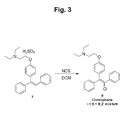
- FIG. 3 shows the chlorination step including the ratio of isomers obtained.
- any ranges, ratios and ranges of ratios that can be formed by any of the numbers or data present herein represent further embodiments of the present invention. This includes ranges that can be formed that do or do not include a finite upper and/or lower boundary. Accordingly, the skilled person will appreciate that many such ratios, ranges and ranges of ratios can be unambiguously derived from the data and numbers presented herein and all represent embodiments of the invention.
- dichloromethane (or methylene chloride) is an organic compound with the formula CH 2 Cl 2 .
- Trans-clomiphene refers to the trans-isomer of clomiphene with the chemical name trans-2-(p-(2-chloro-1,2-diphenylvinyl)phenoxy)triethylamine (or trans-2-[4-(2-chloro-1,2-diphenylethenyl)phenoxy]-N,N-diethylethanamine).
- Trans-clomiphene is a selective estrogen receptor modulator (SERM) which is believed to interfere at a hypothalamic level with steroid feedback inhibition of gonadotropin secretion thereby increasing the release of FSH and LH.
- SERM selective estrogen receptor modulator
- the hydrochloride salt (7) solution obtained above was treated with 1.05 equivalents of N-chlorosuccinimide and stirred at room temperature for about 20 hours. Completion of the reaction was confirmed by HPLC.
- the hydrochloride salt was converted to the free base by addition of saturated aqueous bicarbonate solution. The mixture was stirred at room temperature for 30 minutes after which the phases were separated and the organic phase was evaporated in vacuo.
- 2- ⁇ 4-[2-chloro-1,2-diphenylvinyl]phenoxy ⁇ -N,N-diethylethanamine (clomiphene ⁇ 1.8:1 E:Z mixture) (8) was obtained.
- Clomiphene (8) obtained above is dissolved in methanol and racemic binaphthyl-phosphoric acid (BPA) is added under stirring. When the precipitate begins separating from the solution, stirring is stopped and the mixture is allowed to settle at room temperature for 2 hours. The precipitate is filtered, washed with methanol and ether and dried. Trans-clomiphene-BPA salt (3) is obtained.
- the enclomiphene-BPA salt (3) obtained above is extracted with ethyl acetate and NH 3 solution. To the organic solution washed with water and dried, citric acid dissolved in ethanol is added. The solution is allowed to settle for about one hour at room temperature; the precipitate is then filtered and dried under vacuum. The obtained precipitate, trans-clomiphene citrate (1) is dissolved in 2-butanone for storage.
- Step 1 Dehydration of 1- ⁇ 4-[2-(Diethylamino)ethoxy]phenyl ⁇ -1,2-diphenylethanol to form 2- ⁇ 4-[(Z)-1,2-diphenylvinyl]phenoxy ⁇ -N,N-diethylethanaminium hydrogen sulfate (7)
- Example 1 The synthesis route described in Example 1 utilized HCl for the dehydration step and utilized ethanol at 50° C. as the solvent. Sulfuric acid was investigated as an alternative to HCl for the dehydration step (as described in Example 1) in part due to the more favorable corrosion profile of sulfuric acid. Dichloromethane (methylene chloride) was investigated as an alternative solvent for the dehydration step as this would render removal of the ethanol solvent prior to the chlorination step unnecessary.
- starting material has a retention time of 3.30 min and product has a retention time of 4.05 min.
- reaction was carefully quenched by slow addition of 66 mL (600 mmol) of saturated aqueous sodium bicarbonate solution and the quenched mixture was stirred for 30 minutes at room temperature—the reaction mixture pH should be about 8-9 after addition of saturated aqueous sodium bicarbonate solution.
- the reaction yielded 6.86 grams of 2- ⁇ 4-[2-chloro-1,2-diphenylvinyl]phenoxy ⁇ -N,N-diethylethanamine (8).
- the phases were separated and the organic phase was evaporated in vacuo.
- the resulting light brown oil was transferred to a tared amber bottle using a small volume of dichloromethane.
- the retention time of product is 15 minutes.
- Clomiphene (mixture of isomers) in free base form obtained by steps 1 and 2 is loaded onto a chromatographic column (e.g. batch high pressure chromatography or moving bed chromatography) using the same solvent as used in steps 1 and 2 (here DCM) in order to separate the cis- and trans-clomiphene isomers.
- Trans-clomiphene is preferably eluted using a solvent suitable for recrystallization.
Landscapes
- Chemical & Material Sciences (AREA)
- Organic Chemistry (AREA)
- Chemical Kinetics & Catalysis (AREA)
- Engineering & Computer Science (AREA)
- Oil, Petroleum & Natural Gas (AREA)
- Organic Low-Molecular-Weight Compounds And Preparation Thereof (AREA)
Abstract
The present invention provides a one-pot method for synthesizing clomiphene (a mixture of the isomers cis-clomiphene and trans-clomiphene) utilizing a single solvent. In a preferred embodiment, the single solvent is dichloromethane (DCM, also known as methylene chloride). The present invention provides an improved method for synthesizing clomiphene and purifying clomiphene isomers.
Description
This application claims the benefit of U.S. Provisional Application No. 61/951,316, filed Mar. 11, 2014, the contents of which are incorporated herein by reference.
The present invention relates to methods for synthesizing clomiphene and purifying the trans-isomer of clomiphene.
Clomiphene is a selective estrogen receptor modulator related to tamoxifen. Clomiphene is a mixture of two geometric isomers, cis-clomiphene (or zuclomiphene) and trans-clomiphene, (or enclomiphene). Clomiphene is currently approved as a mixture of both cis- and trans-isomers, the cis-isomer being present as about 30% to 50% (Merck Manual) for the induction of ovulation in anovulatory women.
Methods for synthesizing clomiphene are known in the art. For example, U.S. Pat. No. 2,914,563, the contents of which are hereby incorporated by reference, describes the preparation of clomiphene (see Example 3 in particular). U.S. Pat. No. 3,848,030, the contents of which are hereby incorporated by reference, describes a method to separate the cis- and trans-isomers of clomiphene (see Examples 31 and 32 in particular).
Current methods for preparing clomiphene require the isolation of intermediates and exchange of solvents making the process difficult to streamline. Large scale production of clomiphene and purification of the trans-isomer of clomiphene would be greatly improved if clomiphene synthesis could be accomplished using a single solvent and without the need to isolate intermediates.
The present invention provides a one-pot method for synthesizing clomiphene (a mixture of the isomers cis-clomiphene and trans-clomiphene) utilizing a single solvent. In a preferred embodiment, the single solvent is dichloromethane (DCM, also known as methylene chloride). In one aspect, the method comprises dissolving 1-{4-[2-(Diethylamino)ethoxy]phenyl}-1,2-diphenylethanol in a solvent (e.g. DCM) and (i) dehydrating 1-{4-[2-(Diethylamino)ethoxy]phenyl}-1,2-diphenylethanol using a mineral acid to produce a 2-{4-[(Z)-1,2-diphenylvinyl]plenoxy}-N,N-diethylethanaminium salt and thereafter (ii) chlorinating the 2-{4-[(Z)-1,2-diphenylvinyl]phenoxy}-N,N-diethylethanaminium salt with a chlorinating agent to form clomiphene, a mixture of trans- and cis-clomiphene isomers. Both steps are accomplished in a single solvent (e.g. dichloromethane), with no isolation of chemical intermediates or change of solvent required. Once the chlorination reaction has proceeded to completion, the reaction is preferably quenched with saturated aqueous sodium bicarbonate solution or the like, after which the phases are separated and the organic layer (containing clomiphene) retained for storage or further processing.
Suitable solvents for the dehydration and chlorination steps are solvents in which 1-{4-[2-(Diethylamino)ethoxy]phenyl}-1,2-diphenylethanol is soluble and which have little or no miscibility with water. Non-limiting examples of solvents for use according to the methods described herein include chloroform, diethyl ether, ethyl ester, ethyl acetate, dichloromethane and the like. In a particularly preferred embodiment, the solvent is DCM.
Once a solvent is chosen, an acid that is compatible with the solvent is used for the dehydration step. Non-limiting examples of suitable acids include without limitation mineral acids such as hydrochloric acid, hydrobromic acid, p-toluenesulfonic acid, phosphoric acid and sulfuric acid. In a preferred embodiment, the acid is sulfuric acid. In a particularly preferred embodiment, the solvent is DCM and the acid is sulfuric acid. When sulfuric acid is used for the dehydration step, the internal temperature of the solution is preferably maintained at about 0° C. during the addition of the acid after which the mixture is stirred for one hour at ambient temperature. The reaction is generally complete after about one hour.
The water that is produced by the dehydration reaction should be removed prior to the chlorination step by any suitable method including without limitation, anhydrous salts such as magnesium sulfate, sodium sulfate or the like, molecular sieve, or washing with brine. In a preferred embodiment, at least 80%, 90%, 95%, or 99% of the water produced by the dehydration reaction is removed prior to the chlorination step.
Suitable chlorination agents include, without limitation, N-chlorosuccinimide (NCS). When N-chlorosuccinimide is employed to effect the chlorination, an initial slight excess (e.g. ˜1.05 equivalents) of NCS is added and the reaction is allowed to proceed for at least 12 hours after which the degree of completion of the reaction is assessed, for example by high performance liquid chromatography (HPLC). If necessary, additional NCS may be added and the reaction allowed to proceed for additional time (e.g. 4 hours) and the degree of reaction completion against tested by HPLC and so on.
In a preferred embodiment, clomiphene produced according to the above-described procedure is converted to the free base (e.g. using NaOH, sodium bicarbonate and the like) and then loaded onto a chromatography column in the same solvent employed in the dehydration and chlorination steps in order to separate the cis- and trans-isomers. In embodiments, batch high pressure chromatography or moving bed chromatographic methods are employed to separate the isomers.
In a related aspect, the chromatography column is eluted using a solvent suitable for crystallizing trans-clomiphene and recrystallizing the trans-clomiphene following elution from the column.
In other embodiments, clomiphene produced according to the above-described procedure is reacted with racemic binaphthyl-phosphoric acid (BPA) and the trans-clomiphene-BPA salt isolated. In related embodiments, trans-clomiphene is thereafter converted to the free base form and treated with citric acid to form trans-clomiphene citrate.
While the present invention is capable of being embodied in various forms, the description below of several embodiments is made with the understanding that the present disclosure is to be considered as an exemplification of the invention, and is not intended to limit the invention to the specific embodiments illustrated. Headings are provided for convenience only and are not to be construed to limit the invention in any way. Embodiments illustrated under any heading may be combined with embodiments illustrated under any other heading.
It is to be understood that any ranges, ratios and ranges of ratios that can be formed by any of the numbers or data present herein represent further embodiments of the present invention. This includes ranges that can be formed that do or do not include a finite upper and/or lower boundary. Accordingly, the skilled person will appreciate that many such ratios, ranges and ranges of ratios can be unambiguously derived from the data and numbers presented herein and all represent embodiments of the invention.
Before the present compounds, compositions and methods are disclosed and described, it is to be understood that the terminology used herein is for the purpose of describing particular embodiments only and is not intended to be limiting. It must be noted that, as used in the present specification and the appended claims, the singular forms “a,” “an” and “the” include plural referents unless the context clearly dictates otherwise.
The term “dichloromethane” (or methylene chloride) is an organic compound with the formula CH2Cl2.
Trans-clomiphene refers to the trans-isomer of clomiphene with the chemical name trans-2-(p-(2-chloro-1,2-diphenylvinyl)phenoxy)triethylamine (or trans-2-[4-(2-chloro-1,2-diphenylethenyl)phenoxy]-N,N-diethylethanamine). Trans-clomiphene is a selective estrogen receptor modulator (SERM) which is believed to interfere at a hypothalamic level with steroid feedback inhibition of gonadotropin secretion thereby increasing the release of FSH and LH.
The following Examples are meant to be illustrative of the invention and are not intended to limit the scope of the invention as set out is the appended claims.
Dehydration
1-{4-[2-(Diethylamino)ethoxy]phenyl}-1,2-diphenylethanol (6) dissolved in ethanol containing an excess of hydrogen chloride was refluxed 3 hours at 50° C. The solvent and excess hydrogen chloride were removed under vacuum and the residue was dissolved in dichloromethane. 2-{4-[(Z)-1,2-diphenylvinyl]phenoxy}-N,N-diethylethanaminium hydrogen chloride (7) was obtained.
Chlorination
The hydrochloride salt (7) solution obtained above was treated with 1.05 equivalents of N-chlorosuccinimide and stirred at room temperature for about 20 hours. Completion of the reaction was confirmed by HPLC. The hydrochloride salt was converted to the free base by addition of saturated aqueous bicarbonate solution. The mixture was stirred at room temperature for 30 minutes after which the phases were separated and the organic phase was evaporated in vacuo. 2-{4-[2-chloro-1,2-diphenylvinyl]phenoxy}-N,N-diethylethanamine (clomiphene ˜1.8:1 E:Z mixture) (8) was obtained.
Separation of Clomiphene Isomers
Clomiphene (8) obtained above is dissolved in methanol and racemic binaphthyl-phosphoric acid (BPA) is added under stirring. When the precipitate begins separating from the solution, stirring is stopped and the mixture is allowed to settle at room temperature for 2 hours. The precipitate is filtered, washed with methanol and ether and dried. Trans-clomiphene-BPA salt (3) is obtained.
The enclomiphene-BPA salt (3) obtained above is extracted with ethyl acetate and NH3 solution. To the organic solution washed with water and dried, citric acid dissolved in ethanol is added. The solution is allowed to settle for about one hour at room temperature; the precipitate is then filtered and dried under vacuum. The obtained precipitate, trans-clomiphene citrate (1) is dissolved in 2-butanone for storage.
The synthesis route described in Example 1 utilized HCl for the dehydration step and utilized ethanol at 50° C. as the solvent. Sulfuric acid was investigated as an alternative to HCl for the dehydration step (as described in Example 1) in part due to the more favorable corrosion profile of sulfuric acid. Dichloromethane (methylene chloride) was investigated as an alternative solvent for the dehydration step as this would render removal of the ethanol solvent prior to the chlorination step unnecessary.
A 100 mL 3-neck round bottom flask, fitted with a temperature probe and a stir bar, was charged with 1-{4-[2-(Diethylamino)ethoxy]phenyl}-1,2-diphenylethanol (6) (6.60 g, 16.9 mmol) and 66 mL (1×10³ mmol) of methylene chloride to give a yellow solution which was cooled in an ice bath to 0° C. Concentrated sulfuric acid (H2SO4, 0.96 mL, 18.1 mmol) was added at a rate such that the internal temperature did not exceed 5° C. Upon completion of the addition, the mixture was allowed to stir one hour at ambient temperature. Completion of the reaction was confirmed by high performance liquid chromatography (HPLC). The reaction resulted in 7.96 grams of 2-{4-[(Z)-1,2-diphenylvinyl]phenoxy}-N,N-diethylethanaminium hydrogen sulfate (7), a yield of 100%. Thus, sulfuric acid was demonstrated to be a suitable acid for the dehydration step.
HPLC Conditions (Dehydration Step):
Sample preparation: Dissolve 1 mg/ml in methanol
Agilent 1100 HPLC
Zorbax Eclipse XDB-C18 50×4.6 mm 1.8 μm column
Solvent A—Water (0.1% TFA)
Solvent B—Acetonitrile (0.07% TFA)
Flow rate—1.50 mL/min
Injection volume—5 μL
Gradient—5 min 95% A to 95% B; 1 min hold; 1 min recycle; 30 sec hold
UV detection @ 210 and 254 nm with no reference
Using these HPLC conditions, starting material has a retention time of 3.30 min and product has a retention time of 4.05 min.
It was determined that removal of water produced by the dehydration reaction was important before performing the chlorination step. When ethanol is used as the solvent for this reaction, as in Example 1, the water is removed azeotropically upon removal of the ethanol. Several methods of drying the dichloromethane solution were attempted. Drying with MgSO4 had a deleterious effect on the subsequent chlorination step, rendering the chlorination process very messy with a number of new impurities observed following HPLC analysis which were determined to be the corresponding chlorohydrins. On the other hand, a wash with brine was sufficient to remove enough water and had no deleterious effect on the chlorination step. Accordingly, the solution was stirred vigorously with brine (66 ml) for 30 minutes and then the phases were separated prior to chlorination step.
The solution of 2-{4-[(Z)-1,2-diphenylvinyl]phenoxy}-N,N-diethylethanaminium hydrogen sulfate (7.94 grams) in methylene chloride obtained in step 1 is stirred at room temperature and treated with N-chlorosuccinimide (2.37 g, 17.7 mmol, 1.05 equivalents) in a single portion and left to stir at room temperature for 12 hours. The yellow solution became orange and then went back to yellow. After 12 hours, a sample was removed, concentrated and assayed by HPLC to confirm the extent of reaction. HPLC analysis revealed that the reaction had proceeded but not to completion. Accordingly, an additional 0.09 equivalents of N-chlorosuccinimide (203 mg, 1.52 mmol) was added and the solution stirred at room temperature for an additional 4 hours. The reaction was again assayed by HPLC which revealed that the reaction was near completion. Accordingly, an additional 0.09 equivalents of N-chlorosuccinimide (203 mg, 1.52 mmol) was added and the solution stirred for an additional 12 hours at room temperature. The reaction was again assayed by HPLC and an additional 0.058 equivalents of N-chlorosuccinimide (131 mg, 0.98 mmol) was added and the solution stirred for an additional 4 hours. HPLC indicated that the reaction was complete at that point. The reaction was carefully quenched by slow addition of 66 mL (600 mmol) of saturated aqueous sodium bicarbonate solution and the quenched mixture was stirred for 30 minutes at room temperature—the reaction mixture pH should be about 8-9 after addition of saturated aqueous sodium bicarbonate solution. The reaction yielded 6.86 grams of 2-{4-[2-chloro-1,2-diphenylvinyl]phenoxy}-N,N-diethylethanamine (8). The phases were separated and the organic phase was evaporated in vacuo. The resulting light brown oil was transferred to a tared amber bottle using a small volume of dichloromethane.
HPLC Conditions (Chlorination Step):
Sample preparation: Dissolve 1 mg/ml in mobile phase
Agilent 1100 HPLC
Phenomenex Jupiter-C4 250×4.6 mm 5 μm column
Solvent—54.85% Methanol, 44.85% Water, 0.3% triethylamine, pH adjusted to 2.5 by addition of 85% phosphoric acid
Flow rate—1.00 mL/min
Injection volume—10 μL
Gradient—30 min isocratic
UV detection @ 234 and 292 nm with no reference
Using these HPLC conditions, the retention time of product is 15 minutes.
Chromatographic Separation of Clomiphene Isomers
Clomiphene (mixture of isomers) in free base form obtained by steps 1 and 2 is loaded onto a chromatographic column (e.g. batch high pressure chromatography or moving bed chromatography) using the same solvent as used in steps 1 and 2 (here DCM) in order to separate the cis- and trans-clomiphene isomers. Trans-clomiphene is preferably eluted using a solvent suitable for recrystallization.
Claims (16)
1. A method for preparing clomiphene comprising dissolving a desired quantity of 1-{4-[2-(diethlamino)ethoxy]phenyl}-1,2-diphenylethanol in a suitable amount of a first solvent and therafter
(a) adding to the solution sulfuric acid in an amount effective to dehydrate the 1-{4-[2-(diethylamino)ethoxy]phenyl}-1,2-diphenylethanol thereby producing a 2-{4-[(Z)-1,2-diphenylvinyl]phenoxy}-N,N-diethylethanaminium salt; and therafter
(b) adding to the solution a chlorinating agent in an amount effective to chlorinate the diphenylvinyl]phenoxy}-N,N-diethylethanaminium salt thereby producing 2-{4-{2-chloro-1,2-1,2-diphenylvinyl]phenoxy}-N,N-diethlethanamine,
wherein the diphenylvinyl]phenoxy}-N,N-diethylethanaminium salt is not isolated prior to performing step (b).
2. The method of claim 1 , wherein the first solvent is dichloromethane.
3. The method of claim 1 , wherein the chlorinating agent in step (b) is N-chlorosuccinimide.
4. The method of claim 1 , wherein the solution is maintained at a temperature of about 0° C. during addition of the sulfuric acid in step (a).
5. The method of claim 1 , further comprising adding a suitable base to the clomiphene solution obtained in step (b) thereby converting clomiphene to the free base form.
6. The method of claim 5 , wherein the suitable base is saturated aqueous sodium bicarbonate solution).
7. The method of claim 5 , further comprising loading the solution comprising clomiphene free base onto a chromatographic column and eluting the column under conditions suitable for obtaining trans-clomiphene.
8. The method of claim 7 , further comprising recrystallizing the trans-clomiphene.
9. The method of claim 1 , further comprising
(c) dissolving the 2-{4-[2-chloro-1,2-diphenylvinyl]phenoxy}-N,N-diethyl ethanamine produced in step (b) in a suitable second solvent and an amount of racemic binaphthyl-phosphoric acid (BPA) effective to react with the 2-{4-[2-chloro-1,2-diphenylvinyl]phenoxy}-N,N-diethyl ethanamine thereby producing a trans-clomiphene-BPA salt.
10. The method of claim 9 , wherein the second solvent in step (c) is methanol.
11. The method of claim 9 , further comprising the steps of
(d) extracting the trans-clomiphene-BPA salt obtained in step (c) in a suitable third solvent and a basic aqueous solution to produce the trans-clomiphene free base; and
(e) adding to the solution obtained in step (d) an amount of citric acid effective to produce trans-clomiphene citrate.
12. The method of claim 11 , wherein the basic aqueous solution in step (d) is an NH3 solution.
13. The method of claim 9 , wherein the second solvent in step (c) is ethyl ether or ethyl acetate.
14. The method of claim 11 , wherein the second suitable organic solvent is ethyl ether or ethyl acetate.
15. The method of claim 9 , wherein the first solvent is dichloromethane.
16. The method of claim 9 , wherein the chlorinating agent in step (b) is N-chlorosuccinimide.
Priority Applications (1)
| Application Number | Priority Date | Filing Date | Title |
|---|---|---|---|
| US15/123,577 US9914696B2 (en) | 2014-03-11 | 2015-03-09 | Clomiphene synthesis using a single solvent |
Applications Claiming Priority (3)
| Application Number | Priority Date | Filing Date | Title |
|---|---|---|---|
| US201461951316P | 2014-03-11 | 2014-03-11 | |
| PCT/US2015/019493 WO2015138340A1 (en) | 2014-03-11 | 2015-03-09 | Clomiphene synthesis using a single solvent |
| US15/123,577 US9914696B2 (en) | 2014-03-11 | 2015-03-09 | Clomiphene synthesis using a single solvent |
Publications (2)
| Publication Number | Publication Date |
|---|---|
| US20170073302A1 US20170073302A1 (en) | 2017-03-16 |
| US9914696B2 true US9914696B2 (en) | 2018-03-13 |
Family
ID=54072298
Family Applications (1)
| Application Number | Title | Priority Date | Filing Date |
|---|---|---|---|
| US15/123,577 Expired - Fee Related US9914696B2 (en) | 2014-03-11 | 2015-03-09 | Clomiphene synthesis using a single solvent |
Country Status (9)
| Country | Link |
|---|---|
| US (1) | US9914696B2 (en) |
| EP (1) | EP3116488A4 (en) |
| JP (1) | JP2017507961A (en) |
| CN (1) | CN106068121A (en) |
| AU (1) | AU2015229742A1 (en) |
| CA (1) | CA2942301A1 (en) |
| IL (1) | IL247657A0 (en) |
| MX (1) | MX2016011567A (en) |
| WO (1) | WO2015138340A1 (en) |
Cited By (4)
| Publication number | Priority date | Publication date | Assignee | Title |
|---|---|---|---|---|
| US11046638B2 (en) | 2019-11-14 | 2021-06-29 | Apotex Inc. | Processes for the preparation of zuclomiphene and intermediates thereof |
| US11440871B2 (en) | 2019-11-14 | 2022-09-13 | Apotex Inc. | Zuclomiphene salts and crystalline forms thereof |
| US11578025B2 (en) | 2020-10-19 | 2023-02-14 | Apotex Inc. | Processes for the preparation of zuclomiphene intermediates |
| US11661396B2 (en) | 2020-01-22 | 2023-05-30 | Apotex Inc. | Crystalline forms of zuclomiphene citrate |
Families Citing this family (5)
| Publication number | Priority date | Publication date | Assignee | Title |
|---|---|---|---|---|
| CN107033013A (en) * | 2016-02-04 | 2017-08-11 | 上海度德医药科技有限公司 | A kind of preparation method of enclomifene |
| EP3368506B1 (en) * | 2016-04-22 | 2023-09-06 | F.I.S.- Fabbrica Italiana Sintetici S.p.A. | Process for the preparation of enclomiphene citrate having needle shaped crystal habit. |
| IL304863B2 (en) | 2017-09-11 | 2025-08-01 | Atossa Therapeutics Inc | Methods for preparing and using endoxifen |
| JP7662204B2 (en) | 2019-07-03 | 2025-04-15 | アトッサ・セラピューティクス・インコーポレイテッド | Sustained release compositions of endoxifen |
| EP3907213A1 (en) | 2020-05-04 | 2021-11-10 | Pcas | Processes for the production of isomerically pure or enriched cis-clomiphene |
Citations (4)
| Publication number | Priority date | Publication date | Assignee | Title |
|---|---|---|---|---|
| US2914563A (en) * | 1957-08-06 | 1959-11-24 | Wm S Merrell Co | Therapeutic composition |
| US3848030A (en) * | 1971-03-18 | 1974-11-12 | Richardson Merrell Spa | Optical isomers of binaphthyl-phosphoric acids |
| US5681863A (en) | 1992-09-15 | 1997-10-28 | Merrell Pharmaceuticals Inc. | Non-metabolizable clomiphene analogs for treatment of tamoxifen-resistant tumors |
| CN103351304A (en) * | 2013-07-01 | 2013-10-16 | 暨明医药科技(苏州)有限公司 | Synthesis method of clomiphene |
Family Cites Families (2)
| Publication number | Priority date | Publication date | Assignee | Title |
|---|---|---|---|---|
| CA2134772A1 (en) * | 1992-05-01 | 1993-11-11 | Btg International Limited | Substituted 1 , 1, 2 - triphenylbutenes and their use in the treatment and diagnosis of cancer |
| FI20030747A0 (en) * | 2003-05-19 | 2003-05-19 | Orion Corp | Crystallization method of toremifene |
-
2015
- 2015-03-09 MX MX2016011567A patent/MX2016011567A/en unknown
- 2015-03-09 US US15/123,577 patent/US9914696B2/en not_active Expired - Fee Related
- 2015-03-09 JP JP2016556731A patent/JP2017507961A/en active Pending
- 2015-03-09 AU AU2015229742A patent/AU2015229742A1/en not_active Abandoned
- 2015-03-09 WO PCT/US2015/019493 patent/WO2015138340A1/en not_active Ceased
- 2015-03-09 CA CA2942301A patent/CA2942301A1/en not_active Abandoned
- 2015-03-09 CN CN201580013002.7A patent/CN106068121A/en active Pending
- 2015-03-09 EP EP15761286.2A patent/EP3116488A4/en not_active Withdrawn
-
2016
- 2016-09-06 IL IL247657A patent/IL247657A0/en unknown
Patent Citations (4)
| Publication number | Priority date | Publication date | Assignee | Title |
|---|---|---|---|---|
| US2914563A (en) * | 1957-08-06 | 1959-11-24 | Wm S Merrell Co | Therapeutic composition |
| US3848030A (en) * | 1971-03-18 | 1974-11-12 | Richardson Merrell Spa | Optical isomers of binaphthyl-phosphoric acids |
| US5681863A (en) | 1992-09-15 | 1997-10-28 | Merrell Pharmaceuticals Inc. | Non-metabolizable clomiphene analogs for treatment of tamoxifen-resistant tumors |
| CN103351304A (en) * | 2013-07-01 | 2013-10-16 | 暨明医药科技(苏州)有限公司 | Synthesis method of clomiphene |
Non-Patent Citations (4)
| Title |
|---|
| CN103351304 Derwent Abstract 2013. * |
| International Search Report for PCT/US2015/019493 dated Jun. 3, 2015. |
| Rao et al., "Synthesis of carbon-14 labeled clomiphene", J Label Compd Radiopharm, vol. 22, pp. 245-255 (1985) (Abstract). |
| Written Opinion for PCT/US2015/019493 dated Jun. 3, 2015. |
Cited By (4)
| Publication number | Priority date | Publication date | Assignee | Title |
|---|---|---|---|---|
| US11046638B2 (en) | 2019-11-14 | 2021-06-29 | Apotex Inc. | Processes for the preparation of zuclomiphene and intermediates thereof |
| US11440871B2 (en) | 2019-11-14 | 2022-09-13 | Apotex Inc. | Zuclomiphene salts and crystalline forms thereof |
| US11661396B2 (en) | 2020-01-22 | 2023-05-30 | Apotex Inc. | Crystalline forms of zuclomiphene citrate |
| US11578025B2 (en) | 2020-10-19 | 2023-02-14 | Apotex Inc. | Processes for the preparation of zuclomiphene intermediates |
Also Published As
| Publication number | Publication date |
|---|---|
| US20170073302A1 (en) | 2017-03-16 |
| EP3116488A1 (en) | 2017-01-18 |
| MX2016011567A (en) | 2016-12-07 |
| EP3116488A4 (en) | 2018-04-25 |
| IL247657A0 (en) | 2016-11-30 |
| AU2015229742A1 (en) | 2016-10-06 |
| CA2942301A1 (en) | 2015-09-17 |
| JP2017507961A (en) | 2017-03-23 |
| CN106068121A (en) | 2016-11-02 |
| WO2015138340A1 (en) | 2015-09-17 |
Similar Documents
| Publication | Publication Date | Title |
|---|---|---|
| US9914696B2 (en) | Clomiphene synthesis using a single solvent | |
| JP5503670B2 (en) | Process for producing cinacalcet hydrochloride | |
| KR102718536B1 (en) | Process for preparing 2-(5-methoxyisochroman-1-yl)-4,5-dihydro-1H-imidazole and its hydrogen sulfate salt | |
| JP2005507900A (en) | Citalopram manufacturing method | |
| US10787420B2 (en) | Benzimidazole compound and preparation method thereof | |
| WO2017189339A1 (en) | Process for the preparation of n-[(5-pyrimidinyl)methyl]-2-pyridinamines | |
| EP3015453B1 (en) | Process for the preparation of Clomiphene | |
| JP6851149B2 (en) | Method for producing piperidine compound | |
| EP2563757B1 (en) | Method for preparing ritodrine hydrochloride | |
| US9108990B2 (en) | Cyclopropyl MIDA boronate | |
| US8779145B2 (en) | Process for the preparation of 2-(cyclohexylmethyl)-N-{2-[(2S)-1-methylpyrrolidin-2-yl]ethyl}-1,2,3,4-tetrahydroisoquinoline | |
| US20130331585A1 (en) | Cyclopropyl pida boronate | |
| JP2015526507A (en) | Method for purifying fluvoxamine free base and method for producing high purity fluvoxamine maleate using the same | |
| TWI855165B (en) | Process for preparing (r)-4-aminoindane and corresponding amides | |
| HK1230509A1 (en) | Clomiphene synthesis using a single solvent | |
| CN108276299A (en) | Synthetic method of the Dapoxetine hydrochloride in relation to substance | |
| KR20030068583A (en) | An improved process for preparing pure ondansetron hydrochloride dihydrate | |
| EP3015454A1 (en) | Stable solid form of trans-Clomiphene citrate | |
| US20020115707A1 (en) | Process for preparing pure ondansetron hydrochloride dihydrate | |
| DE102004033313A1 (en) | Process for the preparation of enantiomers 3-hydroxy-3-phenyl-propylamines | |
| EP3339300B1 (en) | Method for preparing thienyl alanine having optical activity | |
| US9000165B2 (en) | Process for the preparation of anhydrous aripiprazole crystal form II | |
| CN117088829A (en) | Synthesis method of 1-isopropyl-4-(p-methoxyphenyl)piperazine or its hydrohalide | |
| JP2020531585A (en) | Octenidin compounds |
Legal Events
| Date | Code | Title | Description |
|---|---|---|---|
| STCF | Information on status: patent grant |
Free format text: PATENTED CASE |
|
| FEPP | Fee payment procedure |
Free format text: MAINTENANCE FEE REMINDER MAILED (ORIGINAL EVENT CODE: REM.); ENTITY STATUS OF PATENT OWNER: SMALL ENTITY |
|
| LAPS | Lapse for failure to pay maintenance fees |
Free format text: PATENT EXPIRED FOR FAILURE TO PAY MAINTENANCE FEES (ORIGINAL EVENT CODE: EXP.); ENTITY STATUS OF PATENT OWNER: SMALL ENTITY |
|
| STCH | Information on status: patent discontinuation |
Free format text: PATENT EXPIRED DUE TO NONPAYMENT OF MAINTENANCE FEES UNDER 37 CFR 1.362 |
|
| FP | Lapsed due to failure to pay maintenance fee |
Effective date: 20220313 |