US9913769B2 - Item of seating furniture - Google Patents
Item of seating furniture Download PDFInfo
- Publication number
- US9913769B2 US9913769B2 US15/024,307 US201415024307A US9913769B2 US 9913769 B2 US9913769 B2 US 9913769B2 US 201415024307 A US201415024307 A US 201415024307A US 9913769 B2 US9913769 B2 US 9913769B2
- Authority
- US
- United States
- Prior art keywords
- item
- seating furniture
- sitting
- spring element
- furniture according
- Prior art date
- Legal status (The legal status is an assumption and is not a legal conclusion. Google has not performed a legal analysis and makes no representation as to the accuracy of the status listed.)
- Expired - Fee Related, expires
Links
- 230000003213 activating effect Effects 0.000 claims description 6
- 235000004443 Ricinus communis Nutrition 0.000 description 8
- 240000000528 Ricinus communis Species 0.000 description 8
- 230000009286 beneficial effect Effects 0.000 description 8
- 230000000903 blocking effect Effects 0.000 description 4
- 230000006835 compression Effects 0.000 description 4
- 238000007906 compression Methods 0.000 description 4
- 230000005540 biological transmission Effects 0.000 description 3
- 230000001771 impaired effect Effects 0.000 description 3
- 238000005096 rolling process Methods 0.000 description 2
- 230000001154 acute effect Effects 0.000 description 1
- 238000013016 damping Methods 0.000 description 1
- 230000001419 dependent effect Effects 0.000 description 1
Images




Classifications
-
- A—HUMAN NECESSITIES
- A61—MEDICAL OR VETERINARY SCIENCE; HYGIENE
- A61G—TRANSPORT, PERSONAL CONVEYANCES, OR ACCOMMODATION SPECIALLY ADAPTED FOR PATIENTS OR DISABLED PERSONS; OPERATING TABLES OR CHAIRS; CHAIRS FOR DENTISTRY; FUNERAL DEVICES
- A61G5/00—Chairs or personal conveyances specially adapted for patients or disabled persons, e.g. wheelchairs
- A61G5/10—Parts, details or accessories
- A61G5/14—Standing-up or sitting-down aids
-
- A—HUMAN NECESSITIES
- A47—FURNITURE; DOMESTIC ARTICLES OR APPLIANCES; COFFEE MILLS; SPICE MILLS; SUCTION CLEANERS IN GENERAL
- A47C—CHAIRS; SOFAS; BEDS
- A47C3/00—Chairs characterised by structural features; Chairs or stools with rotatable or vertically-adjustable seats
- A47C3/20—Chairs or stools with vertically-adjustable seats
- A47C3/22—Chairs or stools with vertically-adjustable seats with balancing device, e.g. by spring, by weight
-
- A—HUMAN NECESSITIES
- A61—MEDICAL OR VETERINARY SCIENCE; HYGIENE
- A61G—TRANSPORT, PERSONAL CONVEYANCES, OR ACCOMMODATION SPECIALLY ADAPTED FOR PATIENTS OR DISABLED PERSONS; OPERATING TABLES OR CHAIRS; CHAIRS FOR DENTISTRY; FUNERAL DEVICES
- A61G5/00—Chairs or personal conveyances specially adapted for patients or disabled persons, e.g. wheelchairs
- A61G5/10—Parts, details or accessories
- A61G5/1056—Arrangements for adjusting the seat
- A61G5/1059—Arrangements for adjusting the seat adjusting the height of the seat
Definitions
- the invention relates to an item of seating furniture with a sitting surface which is mounted on a frame structure and which can be lifted from a lower position to an upper position by means of a lifting device.
- This item of seating furniture has become well established in practice in order to make it possible for persons with restricted mobility to sit down and stand up by themselves.
- the aim of the present invention is to create a cost-effectively manufacturable item of seating furniture of the type described in the introduction, in which the natural course of movement during standing up or sitting down is supported with simply designed means.
- the lifting device has a scissors mechanism with at least two limb parts which can pivot relative to each other, wherein an actuator acts on at least one of the limb parts.
- the item of seating furniture for raising the sitting surface the item of seating furniture according to the invention comprises a scissors mechanism which has at least two limb parts which can be pivoted about a common pivot axis.
- the limb parts are arranged between the frame structure and the sitting surface so that the sitting surface can be moved between the lower position and the upper position by means of the limb parts.
- the scissors mechanism arranged preferably under the sitting surface is connected to an actuator so that the sitting surface is lifted with the aid of the actuator.
- the limb parts are arranged at a first smaller angle and in the upper position at a second, greater angle with regard to each other.
- the sitting surface is moved into the lower position.
- the lower position of the sitting surface is therefore set up as the sitting position, whereas the upper position of the sitting surface is designed as the getting on or getting off position.
- the aid of the scissors mechanism a simply designed aid for standing up and sitting down is created in an advantageous manner which has also proven to be particularly stable and reliable.
- the item of seating furniture can be produced at comparatively low cost through which the distribution of barrier-free seating furniture can be promoted.
- Envisaged as the actuator in accordance with a particularly preferred embodiment is a spring element, which is pre-stressed in the lower position and acts in the direction of the upper position.
- an electric motor more particularly a spindle motor can be envisaged as the actuator.
- the spring element can be arranged in at least two different angular positions. Accordingly the angle of contact between the spring element and the associated limb part can be changed through pivoting the spring element. In this way the force transmission onto the scissors mechanism can be advantageously adjusted.
- the spring element can be locked in the at least two angular positions.
- the pre-stressing of the spring element can be set in order to adjust the lifting force acting on the sitting surface.
- the pre-stressing of the spring element can, in particular, be adjusted by changing the compression of the spring element which compression is present in the lower position of the sitting surface.
- the pre-stressing of the spring element can be adjusted as a function of the weight of the user, through which the lifting force acting on the sitting surface can be influenced.
- the one end of the spring element is supported in a spring bearing connected to the limb part and the other end of the spring element is supported in a counter-bearing connected to the frame structure.
- the bearing positions of the spring element can be moved towards each other, through which the compression of the spring element and thereby the spring force can be set.
- the spring bearing is connected to the corresponding limb part of the scissors mechanism in an articulated manner so that the angular position of the spring element can be varied.
- the bearing positions of the spring element are moved closer or further away from each other during pivoting of the spring element so that the spring force of the spring element can be changed accordingly.
- a least one control element is arranged between the counter-bearing of the spring element and the frame structure wherein the length of the control element can be varied.
- the spring element is connected to at least one control element for adjusting the angular position of the spring element and for setting the lifting force.
- control element has at least two parts, which can be adjusted in the longitudinal direction in relation to each other, more particularly of a gas spring or of a threaded rod element.
- the parts of the control element can on the one hand be connected to each other via a thread.
- This embodiment has the advantage that the angular position of the spring element can be adjusted continuously.
- the control element can have a manually releasable snap connection between the parts, which has at least two snap positions at a distance from each other in the longitudinal direction.
- the control element can also be in the form of a gas spring.
- control element is arranged between the counter-bearing of the spring element and the frame structure.
- control element can be connected in an articulated manner to a connection arm which is connected in an articulated manner to the counter-bearing and the frame structure.
- the components of the lifting device are arranged in such a way that the lifting force between the lower and the upper position of the sitting surface is essentially constant, irrespective of the angular position of the spring element.
- the lifting force can be influenced by various parameters, which include, in particular, the point of contact of the spring element on the associated limb part, the length relationship between the limb parts, the arrangement of the pivot axis between the limb parts and the length of the spring element.
- the individual parameters can be coordinated with regard to each other through routine experimental work so that the essentially constant force is achieved independently of the angular position of the spring element.
- the spring element has a helical spring.
- the helical spring In the lower position of the sitting surface the helical spring is present in a compressed state.
- the compression of the helical spring can be adjusted by changing the angular position of the spring element in order to match the lifting force on the sitting surface to the weight of the user.
- the limb part attached thereto is pushed upwards so that the limb parts are pivoted with regard to each other in order to move the sitting surface into the upper position.
- the spring element is connected to a damper element, more particularly a gas pressure spring or an oil damper, wherein the damper element is preferably arranged inside the spring element.
- a damper element more particularly a gas pressure spring or an oil damper
- the damper element is preferably arranged inside the spring element.
- the damper element can be blocked for locking the sitting surface.
- the damper element can be blocked in any position of the sitting surface, but more particularly in the lower position of the sitting surface. This embodiment has the advantage that the sitting surface can also be fixed when no weight is acting on the sitting surface.
- the blockable damper element is connected via a connection, more particularly a tension cable, with an activating device, preferably in the area of an arm rest.
- the sitting surface is designed in one part, wherein in the upper position the sitting surface is arranged essentially horizontally or arranged to slope forwards.
- the one limb part engages on a front sitting area and the other limb part on a rear sitting area of the sitting surface, wherein the front and rear sitting area are connected to each other in an articulated manner.
- the front edge of the front sitting area of the sitting surface is rounded in design.
- front and rear sitting area in the lower position of the sitting surface are essentially arranged in one plane, wherein the front sitting area in the upper position of the sitting surface is inclined downwards towards the rear sitting area, sitting down and standing up can be facilitated further.
- the rear sitting area In the upper position the rear sitting area is preferably arranged horizontally or tilted slightly forward from the horizontal.
- At least one of the limb parts is preferably connected in an articulated manner to a crank lever which is mounted on the frame structure via an articulated joint. In this way blocking of the limb parts can be prevented in a particularly simple way.
- at least one of the limb parts could be borne in a guide connected with the frame structure.
- the scissors mechanism preferably on the opposite longitudinal sides of the sitting surface, has at least two pairs of limb parts that can be pivoted with regard to each other.
- chair legs with castors are provided which castors are each connected to a braking device for blocking the castors.
- the item of seating furniture can be moved in a particularly simple manner.
- the braking device the item of seating furniture can be fixed in its position, which is of particular advantage if the person wants to sit down in or wants to stand up from the item of seating furniture.
- the at least one braking device interacts with the height position of the sitting surface in such a way that the braking device is automatically brought into the blocked state as soon as the sitting surface has been raised a predetermined distance from the lower position.
- the item of seating furniture is fitted with a brake lever that can be operated by the user. On operating the lever a tension cable extending into the castors is activated and releases the braking device there.
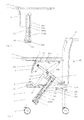
- FIG. 1 shows a side view in partial cross-section of an item of seating furniture in accordance with the invention, with a scissors mechanism to raise the sitting surface, wherein a spring element acting on the scissors mechanism is arranged in a first angular position corresponding to a first, lesser lifting force;
- FIG. 2 shows a view of the item of seating furniture in FIG. 1 from the front;
- FIG. 3 shows a side view of the item of seating furniture in accordance with FIG. 1, 2 with the sitting surface lowered;
- FIG. 4 shows a view of the item of seating furniture according to the invention corresponding to FIG. 1 with the sitting surface raised wherein to increase the lifting force acting on the sitting surface the spring element is pivoted into a second angular position corresponding to a second, greater lifting force.
- FIG. 5 shows a view of the seating furniture shown in FIG. 4 with the sitting surface lowered
- FIG. 6 shows a view of a preferred embodiment of the item of seating furniture in which the spring and/or damping element is connected via a tension cable to an activating device in the area of an arm rest of the item of seating furniture;
- FIGS. 7 to 11 show views of an item of seating furniture corresponding to FIGS. 1 to 5 in an alternative form of embodiment of the invention.
- an item of seating furniture 10 which comprises a frame structure 1 , a backrest 11 , arm rests 12 and a sitting surface 13 .
- the sitting surface 13 of the item of seating furniture 10 is arranged in a raised, or upper, position, which makes it easier for an impaired person to get up from the item of seating furniture 10 or to sit down in the item of seating furniture 10 .
- the sitting surface 13 of the item of seating furniture 10 is arranged in a lowered or lower position which corresponds to the essentially horizontal sitting position.
- the sitting surface 13 is connected to a lifting device with which the natural course of movement when standing up or sitting down is supported.
- a scissors mechanism 14 is provided as the lifting device and acts between the underside of the sitting surface 13 and the frame structure 1 .
- the scissors mechanism 14 has at least one pair of interacting limb parts 14 a , 14 b , wherein in the shown embodiment a further, identical, pair of limb parts 14 a ′, 14 b ′ is provided.
- the limb parts 14 a , 14 b and/or 14 a ′, 14 b ′ are hinged on opposite longitudinal sides of the sitting surface 13 .
- the limb parts 14 a , 14 b are arranged so that they can be pivoted with regard to each other.
- the limb parts 14 a , 14 b are pivotably arranged about a common axle 2 which is arranged approximately centrally on the limb parts 14 a , 14 b .
- the one limb part 14 a is connected via an articulated joint 2 ′ to a crank lever 14 c which, via an articulated joint 2 ′′, is mounted on the frame structure 1 .
- the limb part 14 b of the scissors mechanism 14 is connected with a spring element 16 a which in the lower position of the sitting surface 13 (cf. FIG. 3 ) is pre-stressed so that the sitting surface 13 can be moved from the lower position into the upper position (cf. FIG. 1, 2 ) with the support of the spring element 16 a .
- the spring element 16 a is in the form of a helical spring which will be decompressed during the movement of the sitting surface 13 into the upper position.
- the one end of the spring element 16 a is held in a spring bearing 22 connected to limb part 14 b , and the other end of the spring element 16 a is held in a counter-bearing 23 connected with the frame structure 1 .
- the spring element 16 a can be arranged in at least one first angular position (cf. FIGS. 1 to 3 ) and in a second angular position (cf. FIG. 4, 5 ) different to the first angular position.
- control element 15 is arranged which can be adjusted in length in order to adapt the angular position of the spring element 16 a and to set the lifting force.
- the control element 15 has two parts 15 a , 15 b which can be adjusted longitudinally with regard to each other, wherein the one part 15 b is connected in an articulated manner to the frame structure 1 and the other part 15 a is connected in an articulated manner to the counter-bearing 23 .
- the counter-bearing 23 is attached in an articulated manner to the frame structure 1 by means of a connection arm 15 ′.
- the spring element 16 a can be pivoted from the first, more obtuse angular position shown in FIGS. 1 to 3 , into the second, more acute, angular position shown in FIG. 4, 5 .
- the parts 15 a and 15 b of the control element 15 are manually pushed into each other.
- parts 15 a , 15 b form a gas spring.
- the resulting lifting force can be specifically set via the angular position of the spring element 16 a .
- the various components of the lifting device, more particularly the limb parts 14 a , 14 b , 14 a ′, 14 b ′ of the scissors mechanism 14 are arranged and connected to each other in such a way that the lifting force between the upper and the lower position of the sitting surface 13 is essentially constant—irrespective of the angular position of the spring element 16 a.
- the spring element 16 a interacts with a damper element 16 b which is preferably in the form of a gas pressure spring or oil damper.
- the damper element 16 b is arranged inside the spring element 16 a .
- the damper element 16 b has a cylinder 162 b within which a piston rod 162 a moves.
- the damper element 16 b in the shown embodiment can be blocked, so that if required the sitting surface 13 can be locked in a predetermined height position.
- the blockable damper element 16 b is connected via a connection 233 , for example a tension cable, extending within a chair leg 6 , to an activating device 231 , which in the shown example of embodiment is located in a front end area of the arm rest 12 .
- the movement of the activating device 231 is transmitted via the connection 233 to a lever 232 with articulated joint 234 .
- the lever 232 presses against a corresponding activating element of the damper element 16 b , through which the blocking of the piston rod 162 a relative to the cylinder 162 b is released.
- lifting of the sitting surface 13 can be advantageously prevented, if, for example, the person using the item of seating furniture 10 leans forwards to pick up an object from the floor and therefore takes the load off the sitting surface 13 .
- the one limb part 14 a is connected in an articulated manner via a profile part 3 to a front sitting area 13 a and the other limb part 14 b is connected in an articulated manner via a profile part 4 to a rear sitting area 13 b of the sitting surface 13 .
- the front 13 a and the rear sitting area 13 b are pivotably connected to each other via a joint 5 . Through this further relieving of impaired persons can be achieved when they are sitting down.
- the front sitting area 13 a has a front edge which is bent downwards. Additionally, the front sitting area 13 a is much narrower than the rear sitting area 13 b.
- the front 13 a and the rear sitting area 13 b are essentially arranged in one plane.
- Linking of the front 13 a and/or rear sitting area 13 b via the limb parts 14 a , 14 b takes place in that the front sitting area 13 a in the upper position of the sitting surface 13 is arranged inclined downwards with regard to the rear sitting area 13 b .
- the rear sitting area 13 b is also lightly tilted down with regard to the horizontal.
- the item of seating furniture 10 has four chair legs 6 , which are each provided with castors 17 a , 17 b for rolling the item of seating furniture 10 on a floor surface.
- the front castors 17 a are designed to be laterally pivotable, whereas the rear castors 17 b are not laterally pivotably, but, instead, are each provided with a braking device 18 .
- the braking device 18 is provided which can block or release the rear castors 17 b depending on the setting.
- a manually operated braking lever can be provided with which the braking device 18 can be locked or unlocked.
- the braking device 18 is automatically blocked when the sitting surface 13 is raised by a predetermined distance, for example 40 mm, from the lower sitting position. In this way the item of seating furniture 10 is secured against an unintentional (backwards) movement, whereas at the same time a movement forwards can take place without perceptible resistance.
- control element 15 also has parts 15 a , 15 b which can be adjusted with regard to each other, but which together form a threaded rod element.
- the threaded rod element can be adjusted with a hand wheel or an Allen key in order to match the angular position of the spring element 16 to the weight of the user.
Landscapes
- Health & Medical Sciences (AREA)
- Life Sciences & Earth Sciences (AREA)
- Animal Behavior & Ethology (AREA)
- General Health & Medical Sciences (AREA)
- Public Health (AREA)
- Veterinary Medicine (AREA)
- Chairs Characterized By Structure (AREA)
- Special Chairs (AREA)
- Rehabilitation Tools (AREA)
Abstract
An item of seating furniture having a sitting surface which is mounted on a frame structure and which can be lifted from a lower position to an upper position by means of a lifting device, said lifting device having a scissors mechanism that has at least two limb parts which can pivot relative to each other. At least one spring element which is prestressed in the lower position, acts in the direction of the upper position and can be arranged in at least two different angular positions engages with at least one of the limb parts which is mounted via an articulated joint to the frame structure.
Description
The invention relates to an item of seating furniture with a sitting surface which is mounted on a frame structure and which can be lifted from a lower position to an upper position by means of a lifting device.
In order to make it easier for older persons or persons with impaired mobility to sit down on an item of seating furniture or to get up from an item of seating furniture devices have become known in which the sitting surface of the item of seating furniture is adjustable in height.
From WO 2011/144507 A1 an item of seating furniture of this type with such an aid for standing up is known in which spring elements are arranged in the chair legs. When standing up the sitting surface is raised as a result of the spring force and tilted forwards which makes it easier to leave the item of seating furniture. Sitting down in the item of seating furniture is also made more comfortable.
This item of seating furniture has become well established in practice in order to make it possible for persons with restricted mobility to sit down and stand up by themselves.
Compared with this, the aim of the present invention is to create a cost-effectively manufacturable item of seating furniture of the type described in the introduction, in which the natural course of movement during standing up or sitting down is supported with simply designed means.
In accordance with the invention the lifting device has a scissors mechanism with at least two limb parts which can pivot relative to each other, wherein an actuator acts on at least one of the limb parts.
Accordingly, for raising the sitting surface the item of seating furniture according to the invention comprises a scissors mechanism which has at least two limb parts which can be pivoted about a common pivot axis. The limb parts are arranged between the frame structure and the sitting surface so that the sitting surface can be moved between the lower position and the upper position by means of the limb parts. To support the standing up movement, the scissors mechanism arranged preferably under the sitting surface is connected to an actuator so that the sitting surface is lifted with the aid of the actuator. In the lower position of the sitting surface the limb parts are arranged at a first smaller angle and in the upper position at a second, greater angle with regard to each other. With this the natural course of movement when standing up from the seating furniture can be advantageously supported. Furthermore, entry to the item of seating furniture is facilitated. If the user sits on the raised sitting surface and then displaces his/her weight backwards, the sitting surface is moved into the lower position. The lower position of the sitting surface is therefore set up as the sitting position, whereas the upper position of the sitting surface is designed as the getting on or getting off position. With the aid of the scissors mechanism a simply designed aid for standing up and sitting down is created in an advantageous manner which has also proven to be particularly stable and reliable. In addition, the item of seating furniture can be produced at comparatively low cost through which the distribution of barrier-free seating furniture can be promoted.
Envisaged as the actuator in accordance with a particularly preferred embodiment is a spring element, which is pre-stressed in the lower position and acts in the direction of the upper position. Alternatively, an electric motor, more particularly a spindle motor can be envisaged as the actuator.
In accordance with a particularly preferred embodiment the spring element can be arranged in at least two different angular positions. Accordingly the angle of contact between the spring element and the associated limb part can be changed through pivoting the spring element. In this way the force transmission onto the scissors mechanism can be advantageously adjusted. Preferably the spring element can be locked in the at least two angular positions.
In order to be able to adjust the lifting device to the weight of a user, it is of advantage if the pre-stressing of the spring element can be set in order to adjust the lifting force acting on the sitting surface. The pre-stressing of the spring element can, in particular, be adjusted by changing the compression of the spring element which compression is present in the lower position of the sitting surface. Hence, the pre-stressing of the spring element can be adjusted as a function of the weight of the user, through which the lifting force acting on the sitting surface can be influenced.
For force transmission between the spring element and the sitting surface it is beneficial if the one end of the spring element is supported in a spring bearing connected to the limb part and the other end of the spring element is supported in a counter-bearing connected to the frame structure. To adjust the spring force the bearing positions of the spring element can be moved towards each other, through which the compression of the spring element and thereby the spring force can be set. Particularly preferable is an embodiment in which the spring bearing is connected to the corresponding limb part of the scissors mechanism in an articulated manner so that the angular position of the spring element can be varied. Here, it is particularly beneficial if the bearing positions of the spring element are moved closer or further away from each other during pivoting of the spring element so that the spring force of the spring element can be changed accordingly.
To adjust the angular position of the spring element and to set the lifting force, it is of advantage if a least one control element is arranged between the counter-bearing of the spring element and the frame structure wherein the length of the control element can be varied. Through changing the length of the control element, the angular position of the spring element and the pre-stressing of the spring element can be adjusted in order to adapt the lifting force acting on the sitting surface during the standing up movement to the weight of the user.
To achieve the change in length of the control element it is beneficial if the spring element is connected to at least one control element for adjusting the angular position of the spring element and for setting the lifting force.
Here it is beneficial if the control element has at least two parts, which can be adjusted in the longitudinal direction in relation to each other, more particularly of a gas spring or of a threaded rod element. The parts of the control element can on the one hand be connected to each other via a thread. This embodiment has the advantage that the angular position of the spring element can be adjusted continuously. Alternatively the control element can have a manually releasable snap connection between the parts, which has at least two snap positions at a distance from each other in the longitudinal direction. The control element can also be in the form of a gas spring.
According to a preferred embodiment the control element is arranged between the counter-bearing of the spring element and the frame structure.
Alternatively the control element can be connected in an articulated manner to a connection arm which is connected in an articulated manner to the counter-bearing and the frame structure.
In order to simulate the natural course of movement when standing up or sitting down it is beneficial if the components of the lifting device, more particularly the limb parts of the scissors mechanism, are arranged in such a way that the lifting force between the lower and the upper position of the sitting surface is essentially constant, irrespective of the angular position of the spring element. Advantageously in this way, irrespective of the angular position of the spring element an essentially constantly acting force is achieved between the lower position and the upper position. Depending on the embodiment the lifting force can be influenced by various parameters, which include, in particular, the point of contact of the spring element on the associated limb part, the length relationship between the limb parts, the arrangement of the pivot axis between the limb parts and the length of the spring element. The individual parameters can be coordinated with regard to each other through routine experimental work so that the essentially constant force is achieved independently of the angular position of the spring element.
To transmit a lifting force to the sitting surface it is beneficial if the spring element has a helical spring. In the lower position of the sitting surface the helical spring is present in a compressed state. Preferably the compression of the helical spring can be adjusted by changing the angular position of the spring element in order to match the lifting force on the sitting surface to the weight of the user. Through releasing the helical spring the limb part attached thereto is pushed upwards so that the limb parts are pivoted with regard to each other in order to move the sitting surface into the upper position.
Preferably the spring element is connected to a damper element, more particularly a gas pressure spring or an oil damper, wherein the damper element is preferably arranged inside the spring element. With the aid of the damper element, in particular the lifting of the sitting surface is dampened, which reliably prevents the user being jolted out of the item of seating furniture. In this way, a particularly simple and safe design of the item of seating furniture can be achieved.
In order to fix the sitting surface in a predefined position, it is beneficial if the damper element can be blocked for locking the sitting surface. Preferably the damper element can be blocked in any position of the sitting surface, but more particularly in the lower position of the sitting surface. This embodiment has the advantage that the sitting surface can also be fixed when no weight is acting on the sitting surface.
For the manual blocking and release of the damper element it is beneficial if the blockable damper element is connected via a connection, more particularly a tension cable, with an activating device, preferably in the area of an arm rest.
In accordance with a preferred embodiment the sitting surface is designed in one part, wherein in the upper position the sitting surface is arranged essentially horizontally or arranged to slope forwards.
In accordance with a further preferred embodiment the one limb part engages on a front sitting area and the other limb part on a rear sitting area of the sitting surface, wherein the front and rear sitting area are connected to each other in an articulated manner. In this embodiment of the invention it is preferably envisaged that the front edge of the front sitting area of the sitting surface is rounded in design.
If the front and rear sitting area in the lower position of the sitting surface are essentially arranged in one plane, wherein the front sitting area in the upper position of the sitting surface is inclined downwards towards the rear sitting area, sitting down and standing up can be facilitated further. In the upper position the rear sitting area is preferably arranged horizontally or tilted slightly forward from the horizontal.
In order to allow for pivoting of the limb parts when lifting or lowering the sitting surface, at least one of the limb parts is preferably connected in an articulated manner to a crank lever which is mounted on the frame structure via an articulated joint. In this way blocking of the limb parts can be prevented in a particularly simple way. Alternatively, at least one of the limb parts could be borne in a guide connected with the frame structure.
To transfer particularly high lifting forces to the sitting surface it is advantageous if the scissors mechanism, preferably on the opposite longitudinal sides of the sitting surface, has at least two pairs of limb parts that can be pivoted with regard to each other.
In accordance with a particularly user-friendly embodiment, chair legs with castors are provided which castors are each connected to a braking device for blocking the castors. In this way the item of seating furniture can be moved in a particularly simple manner. With the aid of the braking device the item of seating furniture can be fixed in its position, which is of particular advantage if the person wants to sit down in or wants to stand up from the item of seating furniture. It is particularly preferable if the at least one braking device interacts with the height position of the sitting surface in such a way that the braking device is automatically brought into the blocked state as soon as the sitting surface has been raised a predetermined distance from the lower position. According to an alternative embodiment it is envisaged that the item of seating furniture is fitted with a brake lever that can be operated by the user. On operating the lever a tension cable extending into the castors is activated and releases the braking device there.
The invention will be described in more detail below by means of a preferred example of the embodiment shown in the drawings, to which, however, it is not restricted. In detail, in the drawings:
In FIGS. 1 to 3 an item of seating furniture 10 is shown which comprises a frame structure 1, a backrest 11, arm rests 12 and a sitting surface 13. According to FIGS. 1, 2 the sitting surface 13 of the item of seating furniture 10 is arranged in a raised, or upper, position, which makes it easier for an impaired person to get up from the item of seating furniture 10 or to sit down in the item of seating furniture 10. According to FIG. 3 the sitting surface 13 of the item of seating furniture 10 is arranged in a lowered or lower position which corresponds to the essentially horizontal sitting position. To move the sitting surface 13 between the lower position (cf. FIG. 3 ) and the upper position (cf. FIGS. 1, 2 ) the sitting surface 13 is connected to a lifting device with which the natural course of movement when standing up or sitting down is supported.
As can also be seen from FIGS. 1 to 3 , a scissors mechanism 14 is provided as the lifting device and acts between the underside of the sitting surface 13 and the frame structure 1. The scissors mechanism 14 has at least one pair of interacting limb parts 14 a, 14 b, wherein in the shown embodiment a further, identical, pair of limb parts 14 a′, 14 b′ is provided. The limb parts 14 a, 14 b and/or 14 a′, 14 b′ are hinged on opposite longitudinal sides of the sitting surface 13.
As can also be seen from FIGS. 1 to 3 , the limb parts 14 a, 14 b are arranged so that they can be pivoted with regard to each other. For this, the limb parts 14 a, 14 b are pivotably arranged about a common axle 2 which is arranged approximately centrally on the limb parts 14 a, 14 b. In order to allow the pivoting of the limb parts 14 a, 14 b during the raising and lowering of the sitting surface 13, the one limb part 14 a is connected via an articulated joint 2′ to a crank lever 14 c which, via an articulated joint 2″, is mounted on the frame structure 1.
As can also be seen from FIGS. 1 to 3 , the limb part 14 b of the scissors mechanism 14 is connected with a spring element 16 a which in the lower position of the sitting surface 13 (cf. FIG. 3 ) is pre-stressed so that the sitting surface 13 can be moved from the lower position into the upper position (cf. FIG. 1, 2 ) with the support of the spring element 16 a. In the shown embodiment the spring element 16 a is in the form of a helical spring which will be decompressed during the movement of the sitting surface 13 into the upper position. For force transmission to the limb part 14 b the one end of the spring element 16 a is held in a spring bearing 22 connected to limb part 14 b, and the other end of the spring element 16 a is held in a counter-bearing 23 connected with the frame structure 1.
As can also be seen from the drawing, the spring element 16 a can be arranged in at least one first angular position (cf. FIGS. 1 to 3 ) and in a second angular position (cf. FIG. 4, 5 ) different to the first angular position. By changing the angular position of the spring element 16 a, on the one hand the angle of contact of the spring element 15 a on the limb part 14 b, and also the pre-stressing of the spring element 16 a can be adjusted, through which the lifting force on the sitting surface 13 can be matched to the weight of the user. For this, between the counter-bearing 23 of the spring element 16 a and the frame structure 1 a control element 15 is arranged which can be adjusted in length in order to adapt the angular position of the spring element 16 a and to set the lifting force. In the shown embodiment the control element 15 has two parts 15 a, 15 b which can be adjusted longitudinally with regard to each other, wherein the one part 15 b is connected in an articulated manner to the frame structure 1 and the other part 15 a is connected in an articulated manner to the counter-bearing 23. In addition, the counter-bearing 23 is attached in an articulated manner to the frame structure 1 by means of a connection arm 15′.
As can also be seen from the drawing, the spring element 16 a can be pivoted from the first, more obtuse angular position shown in FIGS. 1 to 3 , into the second, more acute, angular position shown in FIG. 4, 5 . To pivot the spring element 16 a, the parts 15 a and 15 b of the control element 15 are manually pushed into each other. According to FIGS. 1 to 6 , parts 15 a, 15 b form a gas spring. By adjusting the control element 15 the distance, dependent on the length of the control element 15, between the spring bearing 22 and the counter-bearing 23 is shortened, through which the pre-stressing of the spring element 16 a and thus the lifting force acting on the sitting surface 13 is increased. In this way the resulting lifting force can be specifically set via the angular position of the spring element 16 a. The various components of the lifting device, more particularly the limb parts 14 a, 14 b, 14 a′, 14 b′ of the scissors mechanism 14 are arranged and connected to each other in such a way that the lifting force between the upper and the lower position of the sitting surface 13 is essentially constant—irrespective of the angular position of the spring element 16 a.
As can also be seen from FIGS. 1 to 5 , the spring element 16 a interacts with a damper element 16 b which is preferably in the form of a gas pressure spring or oil damper. The damper element 16 b is arranged inside the spring element 16 a. In the shown embodiment the damper element 16 b has a cylinder 162 b within which a piston rod 162 a moves.
As can be seen from FIG. 6 , the damper element 16 b in the shown embodiment can be blocked, so that if required the sitting surface 13 can be locked in a predetermined height position. For locking or releasing, the blockable damper element 16 b is connected via a connection 233, for example a tension cable, extending within a chair leg 6, to an activating device 231, which in the shown example of embodiment is located in a front end area of the arm rest 12. The movement of the activating device 231 is transmitted via the connection 233 to a lever 232 with articulated joint 234. The lever 232 presses against a corresponding activating element of the damper element 16 b, through which the blocking of the piston rod 162 a relative to the cylinder 162 b is released. In the blocked stated of the damper element 16 b, lifting of the sitting surface 13 can be advantageously prevented, if, for example, the person using the item of seating furniture 10 leans forwards to pick up an object from the floor and therefore takes the load off the sitting surface 13.
As can also be seen from FIGS. 1 to 5 , the one limb part 14 a is connected in an articulated manner via a profile part 3 to a front sitting area 13 a and the other limb part 14 b is connected in an articulated manner via a profile part 4 to a rear sitting area 13 b of the sitting surface 13. The front 13 a and the rear sitting area 13 b are pivotably connected to each other via a joint 5. Through this further relieving of impaired persons can be achieved when they are sitting down. In the shown embodiment the front sitting area 13 a has a front edge which is bent downwards. Additionally, the front sitting area 13 a is much narrower than the rear sitting area 13 b.
As can also be seen from FIGS. 1 to 5 , in the lower position of the sitting surface 13 the front 13 a and the rear sitting area 13 b are essentially arranged in one plane. Linking of the front 13 a and/or rear sitting area 13 b via the limb parts 14 a, 14 b takes place in that the front sitting area 13 a in the upper position of the sitting surface 13 is arranged inclined downwards with regard to the rear sitting area 13 b. In the upper position the rear sitting area 13 b is also lightly tilted down with regard to the horizontal.
As can also be seen from FIGS. 1 to 5 the item of seating furniture 10 has four chair legs 6, which are each provided with castors 17 a, 17 b for rolling the item of seating furniture 10 on a floor surface. Here it is envisaged that the front castors 17 a are designed to be laterally pivotable, whereas the rear castors 17 b are not laterally pivotably, but, instead, are each provided with a braking device 18. In order to prevent the item of seating furniture 10 rolling away backwards when a person is sitting down or standing up, the braking device 18 is provided which can block or release the rear castors 17 b depending on the setting. For this a manually operated braking lever can be provided with which the braking device 18 can be locked or unlocked.
In an alternative embodiment (not shown), it is envisaged that the braking device 18 is automatically blocked when the sitting surface 13 is raised by a predetermined distance, for example 40 mm, from the lower sitting position. In this way the item of seating furniture 10 is secured against an unintentional (backwards) movement, whereas at the same time a movement forwards can take place without perceptible resistance.
In FIGS. 7 to 11 an alternative embodiment of the invention is shown in which in the following only the differences with regard to the embodiment according to FIGS. 1 to 6 are described. In this embodiment the control element 15 also has parts 15 a, 15 b which can be adjusted with regard to each other, but which together form a threaded rod element. The threaded rod element can be adjusted with a hand wheel or an Allen key in order to match the angular position of the spring element 16 to the weight of the user.
Claims (18)
1. An item of seating furniture with a sitting surface mounted on a frame structure and which is liftable from a lower position to an upper position with a lifting device, wherein the lifting device has a scissors mechanism with at least two limb parts which pivot relative to each other, wherein an actuator, arranged in at least two different angular positions, acts on at least one of the limb parts; wherein the actuator is a spring element pre-stressed in the lower position and acts in a direction of the upper position, wherein one end of the spring element is held in a spring bearing connected to one of the limb parts and the other end of the spring element is held in a counter-bearing connected to the frame structure by a connecting member suspended at a first end of the connecting member relative to the frame structure and pivotally supporting the counter-bearing at a second end of the connecting member.
2. The item of seating furniture according to claim 1 , wherein the spring element is connected to at least one control element for adjusting an angular position and a lifting force of the spring element.
3. The item of seating furniture according to claim 2 , wherein the control element has at least two parts, adjustable relative to each other in a longitudinal direction.
4. The item of seating furniture according to claim 2 , wherein the control element is arranged between the counter-bearing of the spring element and the frame structure.
5. The item of seating furniture according to claim 2 , wherein the control element is connected in an articulated manner to a connection arm, wherein the connection arm is connected in an articulated manner to the counter-bearing of the spring element and the frame structure.
6. The item of seating furniture according to claim 2 , wherein the limb parts are arranged in such a way that the lifting force between the upper position and the lower position of the sitting surface is constant irrespective of the angular position of the spring element.
7. The item of seating furniture according to claim 1 , wherein the spring element is connected to a damper element arranged in an inside of the spring element.
8. The item of seating furniture according to claim 7 , wherein the damper element is blocked to lock the sitting surface.
9. The item of seating furniture according to claim 8 , wherein the damper element is connected via a connection to an activating device in an area of an arm rest, wherein the connection is a tension cable.
10. The item of seating furniture according to claim 1 , wherein one limb part of the at least two limb parts engages on a front sitting area and the other limb part of the at least two limb parts engages on a rear sitting area of the sitting surface, wherein the front sitting area and the rear sitting area are connected to each other in an articulated manner.
11. The item of seating furniture according to claim 10 , wherein the front sitting area and the rear sitting area in the lower position of the seating surface are arranged in one plane, wherein the front sitting area in the upper position of the sitting surface is arranged inclined downwards away from the rear sitting area.
12. The item of seating furniture according to claim 1 , wherein at least one of the limb parts is connected in an articulated manner to a crank lever.
13. The item of seating furniture according to claim 3 , wherein the control element is arranged between the counter-bearing of the spring element and the frame structure.
14. The item of seating furniture according to claim 5 , wherein the limb parts are arranged in such a way that the lifting force between the upper position and the lower position of the sitting surface is constant irrespective of the angular position of the spring element.
15. The item of seating furniture according to claim 9 , wherein one limb part of the at least two limb parts engages on a front sitting area and the other limb part of the at least two limb parts engages on a rear sitting area of the sitting surface, wherein the front sitting area and the rear sitting area are connected to each other in an articulated manner.
16. The item of seating furniture according to claim 11 , wherein at least one of the limb parts is connected in an articulated manner to a crank lever.
17. The item of seating furniture according to claim 3 , wherein the control element is a gas spring or a threaded rod element.
18. The item of seating furniture according to claim 7 , wherein the damper element is a gas pressure spring or an oil damper.
Applications Claiming Priority (3)
| Application Number | Priority Date | Filing Date | Title |
|---|---|---|---|
| ATA50606/2013A AT514846A1 (en) | 2013-09-23 | 2013-09-23 | seating |
| ATA50606/2013 | 2013-09-23 | ||
| PCT/EP2014/069666 WO2015040008A1 (en) | 2013-09-23 | 2014-09-16 | Item of seating furniture |
Publications (2)
| Publication Number | Publication Date |
|---|---|
| US20160310334A1 US20160310334A1 (en) | 2016-10-27 |
| US9913769B2 true US9913769B2 (en) | 2018-03-13 |
Family
ID=51703131
Family Applications (1)
| Application Number | Title | Priority Date | Filing Date |
|---|---|---|---|
| US15/024,307 Expired - Fee Related US9913769B2 (en) | 2013-09-23 | 2014-09-16 | Item of seating furniture |
Country Status (8)
| Country | Link |
|---|---|
| US (1) | US9913769B2 (en) |
| EP (1) | EP3049040B1 (en) |
| CN (1) | CN105682632B (en) |
| AT (1) | AT514846A1 (en) |
| CA (1) | CA2925025A1 (en) |
| DK (1) | DK3049040T3 (en) |
| ES (1) | ES2714854T3 (en) |
| WO (1) | WO2015040008A1 (en) |
Cited By (1)
| Publication number | Priority date | Publication date | Assignee | Title |
|---|---|---|---|---|
| US20200188202A1 (en) * | 2018-12-12 | 2020-06-18 | Ko-Po Chen | Stand Assist Device |
Families Citing this family (18)
| Publication number | Priority date | Publication date | Assignee | Title |
|---|---|---|---|---|
| US12350207B2 (en) * | 2014-07-14 | 2025-07-08 | Exokinetics, Inc. | Lifting mechanism and chairs |
| WO2020005350A1 (en) * | 2018-03-29 | 2020-01-02 | Exokinetics, Inc. | Lifting mechanism and chairs |
| US11602469B2 (en) | 2014-07-14 | 2023-03-14 | Exokinetics, Inc. | Lifting mechanism and chairs |
| CN107205593B (en) * | 2014-09-08 | 2018-11-06 | 斯普莱恩设计协会股份有限公司 | Seat auxiliary device |
| TWI629029B (en) * | 2016-09-26 | 2018-07-11 | 國立臺北科技大學 | Auxiliary seat |
| US12290482B2 (en) | 2016-11-10 | 2025-05-06 | Exokinetics, Inc. | Elevating walker chair and components |
| US10485346B2 (en) * | 2018-01-22 | 2019-11-26 | Knoll, Inc. | Chair tilt mechanism |
| GB2574461B (en) * | 2018-06-07 | 2021-02-17 | Conquering Horizons Ltd | Personal Lift Mechanism |
| IT201900006423A1 (en) * | 2019-04-29 | 2020-10-29 | Velio Macellari | Chair with seat in two adjustable sections and movable in position |
| CN110123538B (en) * | 2019-05-08 | 2020-06-05 | 广东中易彩技术研究有限公司 | Wheelchair for selling lottery without fixed point, and operation system and method thereof |
| CN110353903A (en) * | 2019-07-11 | 2019-10-22 | 东南大学 | The elderly's standing assist chair |
| WO2021087393A1 (en) * | 2019-10-30 | 2021-05-06 | Dignity Health | Apparatus for storage and transportation of an exoskeleton |
| CN111631868B (en) * | 2020-05-07 | 2022-10-28 | 翁鹏 | An orthopedic knee-injured patient slowly descending chair |
| CN216725159U (en) | 2020-05-19 | 2022-06-14 | 移动人生有限责任公司 | Rollable user support device |
| US11375816B1 (en) * | 2020-12-16 | 2022-07-05 | Shenzhen Microtouch Ergonomic Technology Inc. | Adjustable chair |
| US11357331B1 (en) * | 2021-02-08 | 2022-06-14 | Eustace Roger Lake | Adjustable angle chair seat |
| CN113143613B (en) * | 2021-04-19 | 2022-08-19 | 珠海科技学院 | Multifunctional wheelchair |
| CN117562745B (en) * | 2023-11-16 | 2024-06-04 | 上海交通大学医学院附属仁济医院 | A safe wheelchair |
Citations (24)
| Publication number | Priority date | Publication date | Assignee | Title |
|---|---|---|---|---|
| US974769A (en) | 1909-06-15 | 1910-11-01 | Edward J Hoff | Seat for chairs and the like. |
| US3774963A (en) * | 1971-08-07 | 1973-11-27 | Universal Oil Co | Suspension seats for vehicles |
| CH553561A (en) | 1972-07-12 | 1974-09-13 | Plop Ltd | TILTING DEVICE. |
| GB1406420A (en) | 1971-11-03 | 1975-09-17 | Lywood B W | Seat lifting mechanism |
| FR2519861A1 (en) | 1982-01-19 | 1983-07-22 | Fralch | Fluid cylinder operated invalid chair - has two vertical lifting cylinders between base and seat and seat tilting cylinder |
| US4637654A (en) * | 1984-01-05 | 1987-01-20 | Boardman Paul A | Armchair with tilting seat |
| US4856763A (en) * | 1988-05-19 | 1989-08-15 | Sears Manufacturing Company | Mechanical seat suspension with concentric cam surfaces |
| US4979726A (en) | 1989-02-23 | 1990-12-25 | Alexander Geraci | Chair having lift apparatus |
| US5011109A (en) * | 1989-03-18 | 1991-04-30 | Tachi-S Co., Ltd. | Suspension device for seat |
| CA1285860C (en) | 1988-07-25 | 1991-07-09 | Michael G. Cross | Chair |
| DE4201349A1 (en) | 1992-01-20 | 1993-07-22 | Casala Werke Carl Sasse Gmbh & | Multi-purpose chair for infirm and physically handicapped - has seat of adjustable height and backrest with adjustable angle of inclination |
| US5794911A (en) * | 1996-02-05 | 1998-08-18 | Milsco Manufacturing Company | Adjustable vehicle seat suspension |
| US5927679A (en) * | 1997-04-21 | 1999-07-27 | Milsco Manufacturing Company | Adjustable vehicle seat suspension |
| US6186467B1 (en) | 1999-05-06 | 2001-02-13 | Michigan Seat Company | Full seat adjustable suspension |
| CN101238933A (en) | 2007-01-05 | 2008-08-13 | Omp股份有限公司 | Sports coupling servo mechanism for a seat part, in particular of a chair |
| CN101365366A (en) | 2005-07-15 | 2009-02-11 | 西达克-米科贝尔股份有限公司 | Folding bed with scissor lift mechanism |
| US7810884B2 (en) * | 2007-06-29 | 2010-10-12 | Grammer Ag | Vehicle seat with slide valve |
| CN101868167A (en) | 2007-09-20 | 2010-10-20 | 赫尔曼米勒有限公司 | body support structure |
| US7891696B2 (en) * | 2008-06-17 | 2011-02-22 | Hanson Wayne H | Multifunctional foldable mobility base |
| WO2011144507A1 (en) | 2010-05-20 | 2011-11-24 | Camarg Og | Item of seating furniture |
| CN102309382A (en) | 2010-07-09 | 2012-01-11 | 栅木贞雄 | Folding wheel chair and stand-assist seat |
| CN202490113U (en) | 2012-03-07 | 2012-10-17 | 佛山市东方医疗设备厂有限公司 | Lifting foldable electrically-driven wheel chair |
| US9688173B2 (en) * | 2014-07-01 | 2017-06-27 | Grammer Ag | Suspension system for vehicles and method for fitting vehicle parts with suspension |
| US9789793B2 (en) * | 2012-12-28 | 2017-10-17 | Ts Tech Co., Ltd. | Vehicle seat |
Family Cites Families (1)
| Publication number | Priority date | Publication date | Assignee | Title |
|---|---|---|---|---|
| DE9318916U1 (en) * | 1993-01-11 | 1994-02-10 | Ferdinand Lusch Gmbh & Co Kg, 33649 Bielefeld | Armchair with stand-up aid |
-
2013
- 2013-09-23 AT ATA50606/2013A patent/AT514846A1/en not_active Application Discontinuation
-
2014
- 2014-09-16 DK DK14784007.8T patent/DK3049040T3/en active
- 2014-09-16 ES ES14784007T patent/ES2714854T3/en active Active
- 2014-09-16 WO PCT/EP2014/069666 patent/WO2015040008A1/en not_active Ceased
- 2014-09-16 EP EP14784007.8A patent/EP3049040B1/en not_active Not-in-force
- 2014-09-16 US US15/024,307 patent/US9913769B2/en not_active Expired - Fee Related
- 2014-09-16 CA CA2925025A patent/CA2925025A1/en not_active Abandoned
- 2014-09-16 CN CN201480059022.3A patent/CN105682632B/en not_active Expired - Fee Related
Patent Citations (24)
| Publication number | Priority date | Publication date | Assignee | Title |
|---|---|---|---|---|
| US974769A (en) | 1909-06-15 | 1910-11-01 | Edward J Hoff | Seat for chairs and the like. |
| US3774963A (en) * | 1971-08-07 | 1973-11-27 | Universal Oil Co | Suspension seats for vehicles |
| GB1406420A (en) | 1971-11-03 | 1975-09-17 | Lywood B W | Seat lifting mechanism |
| CH553561A (en) | 1972-07-12 | 1974-09-13 | Plop Ltd | TILTING DEVICE. |
| FR2519861A1 (en) | 1982-01-19 | 1983-07-22 | Fralch | Fluid cylinder operated invalid chair - has two vertical lifting cylinders between base and seat and seat tilting cylinder |
| US4637654A (en) * | 1984-01-05 | 1987-01-20 | Boardman Paul A | Armchair with tilting seat |
| US4856763A (en) * | 1988-05-19 | 1989-08-15 | Sears Manufacturing Company | Mechanical seat suspension with concentric cam surfaces |
| CA1285860C (en) | 1988-07-25 | 1991-07-09 | Michael G. Cross | Chair |
| US4979726A (en) | 1989-02-23 | 1990-12-25 | Alexander Geraci | Chair having lift apparatus |
| US5011109A (en) * | 1989-03-18 | 1991-04-30 | Tachi-S Co., Ltd. | Suspension device for seat |
| DE4201349A1 (en) | 1992-01-20 | 1993-07-22 | Casala Werke Carl Sasse Gmbh & | Multi-purpose chair for infirm and physically handicapped - has seat of adjustable height and backrest with adjustable angle of inclination |
| US5794911A (en) * | 1996-02-05 | 1998-08-18 | Milsco Manufacturing Company | Adjustable vehicle seat suspension |
| US5927679A (en) * | 1997-04-21 | 1999-07-27 | Milsco Manufacturing Company | Adjustable vehicle seat suspension |
| US6186467B1 (en) | 1999-05-06 | 2001-02-13 | Michigan Seat Company | Full seat adjustable suspension |
| CN101365366A (en) | 2005-07-15 | 2009-02-11 | 西达克-米科贝尔股份有限公司 | Folding bed with scissor lift mechanism |
| CN101238933A (en) | 2007-01-05 | 2008-08-13 | Omp股份有限公司 | Sports coupling servo mechanism for a seat part, in particular of a chair |
| US7810884B2 (en) * | 2007-06-29 | 2010-10-12 | Grammer Ag | Vehicle seat with slide valve |
| CN101868167A (en) | 2007-09-20 | 2010-10-20 | 赫尔曼米勒有限公司 | body support structure |
| US7891696B2 (en) * | 2008-06-17 | 2011-02-22 | Hanson Wayne H | Multifunctional foldable mobility base |
| WO2011144507A1 (en) | 2010-05-20 | 2011-11-24 | Camarg Og | Item of seating furniture |
| CN102309382A (en) | 2010-07-09 | 2012-01-11 | 栅木贞雄 | Folding wheel chair and stand-assist seat |
| CN202490113U (en) | 2012-03-07 | 2012-10-17 | 佛山市东方医疗设备厂有限公司 | Lifting foldable electrically-driven wheel chair |
| US9789793B2 (en) * | 2012-12-28 | 2017-10-17 | Ts Tech Co., Ltd. | Vehicle seat |
| US9688173B2 (en) * | 2014-07-01 | 2017-06-27 | Grammer Ag | Suspension system for vehicles and method for fitting vehicle parts with suspension |
Non-Patent Citations (2)
| Title |
|---|
| ISA European Patent Office, International Search Report Issued in PCT Application No. PCT/EP2014/069666, dated Dec. 18, 2014, WIPO, 6 pages. |
| State Intellectual Property Office of the Peoples Republic of China, Office Action and Search Report Issued in Application No. 201480059022.3, dated Mar. 30, 2017, 14 pages. (Submitted with Partial Translation). |
Cited By (1)
| Publication number | Priority date | Publication date | Assignee | Title |
|---|---|---|---|---|
| US20200188202A1 (en) * | 2018-12-12 | 2020-06-18 | Ko-Po Chen | Stand Assist Device |
Also Published As
| Publication number | Publication date |
|---|---|
| ES2714854T3 (en) | 2019-05-30 |
| EP3049040B1 (en) | 2018-12-12 |
| CA2925025A1 (en) | 2015-03-26 |
| DK3049040T3 (en) | 2019-04-01 |
| EP3049040A1 (en) | 2016-08-03 |
| AT514846A1 (en) | 2015-04-15 |
| US20160310334A1 (en) | 2016-10-27 |
| WO2015040008A1 (en) | 2015-03-26 |
| CN105682632B (en) | 2019-01-08 |
| CN105682632A (en) | 2016-06-15 |
Similar Documents
| Publication | Publication Date | Title |
|---|---|---|
| US9913769B2 (en) | Item of seating furniture | |
| US5312157A (en) | Lift seat | |
| US20180317662A1 (en) | Seat unit for wearable sitting posture assisting device | |
| US7988172B2 (en) | Power-supplemented manual height-adjusting wheelchair | |
| US9700138B2 (en) | Seating furniture product | |
| US20110248530A1 (en) | Seating Furniture with a Seat Which can be Pivoted into a Standing Up Assistance Position | |
| JP5654871B2 (en) | Chairs, especially dentist chairs with seats with tiltable legrests | |
| NO312491B1 (en) | Adjusting device for the support frame in reclining or seating furniture | |
| US7490902B2 (en) | Chair | |
| US20030075967A1 (en) | Raisable leg rest | |
| CA2601470A1 (en) | A height adjustable wheelchair | |
| KR20190024417A (en) | Chair with standing up aid | |
| US20060103221A1 (en) | Ergonomic chair | |
| US5383709A (en) | Orthopedic chair with forwardly and rearwardly inclined positions | |
| US7823976B2 (en) | Chair | |
| US20190029436A1 (en) | Chair With A Footrest Device | |
| GB2183150A (en) | Chair | |
| US3806194A (en) | Elevating chair for handicapped people | |
| CN110613389B (en) | Toilet seat auxiliary device | |
| EP2419069B1 (en) | Seating furniture facilitating rising | |
| US20110289680A1 (en) | Furniture for Adjustment into a Standing Up Assistance Position | |
| US10413073B2 (en) | Seating and support furniture | |
| KR100553414B1 (en) | Positioning chair | |
| CN215076922U (en) | Self-adaptive sliding support type chair | |
| WO2013187819A1 (en) | Lift chair for assisting user when moving between seated and standing positions |
Legal Events
| Date | Code | Title | Description |
|---|---|---|---|
| STCF | Information on status: patent grant |
Free format text: PATENTED CASE |
|
| FEPP | Fee payment procedure |
Free format text: MAINTENANCE FEE REMINDER MAILED (ORIGINAL EVENT CODE: REM.); ENTITY STATUS OF PATENT OWNER: SMALL ENTITY |
|
| LAPS | Lapse for failure to pay maintenance fees |
Free format text: PATENT EXPIRED FOR FAILURE TO PAY MAINTENANCE FEES (ORIGINAL EVENT CODE: EXP.); ENTITY STATUS OF PATENT OWNER: SMALL ENTITY |
|
| STCH | Information on status: patent discontinuation |
Free format text: PATENT EXPIRED DUE TO NONPAYMENT OF MAINTENANCE FEES UNDER 37 CFR 1.362 |
|
| FP | Lapsed due to failure to pay maintenance fee |
Effective date: 20220313 |