US9908862B2 - Methods of producing alkylfurans - Google Patents
Methods of producing alkylfurans Download PDFInfo
- Publication number
- US9908862B2 US9908862B2 US14/912,052 US201414912052A US9908862B2 US 9908862 B2 US9908862 B2 US 9908862B2 US 201414912052 A US201414912052 A US 201414912052A US 9908862 B2 US9908862 B2 US 9908862B2
- Authority
- US
- United States
- Prior art keywords
- formula
- compound
- methylfuran
- integer greater
- equal
- Prior art date
- Legal status (The legal status is an assumption and is not a legal conclusion. Google has not performed a legal analysis and makes no representation as to the accuracy of the status listed.)
- Active
Links
- 0 *C1=CC=C(*)O1 Chemical compound *C1=CC=C(*)O1 0.000 description 41
- AVQQQNCBBIEMEU-UHFFFAOYSA-N CN(C)C(=O)N(C)C Chemical compound CN(C)C(=O)N(C)C AVQQQNCBBIEMEU-UHFFFAOYSA-N 0.000 description 10
- FXHOOIRPVKKKFG-UHFFFAOYSA-N CC(=O)N(C)C Chemical compound CC(=O)N(C)C FXHOOIRPVKKKFG-UHFFFAOYSA-N 0.000 description 7
- CYSGHNMQYZDMIA-UHFFFAOYSA-N CN1CCN(C)C1=O Chemical compound CN1CCN(C)C1=O CYSGHNMQYZDMIA-UHFFFAOYSA-N 0.000 description 6
- FHFYUUFDWZNWNW-UHFFFAOYSA-N CCN(CC)C(=O)N(CC)CC.CN(C(=O)N(C)C1=CC=CC=C1)C1=CC=CC=C1.CN(C(=O)N(C)C1=CC=CC=C1)C1=CC=CC=C1.CN(C)C(=O)C1=CC=CC=C1.CN(C)C(=O)N(C)C.CN1CCCN(C)C1=O.CN1CCN(C)C1=O.O=C(N1CCCC1)N1CCCC1 Chemical compound CCN(CC)C(=O)N(CC)CC.CN(C(=O)N(C)C1=CC=CC=C1)C1=CC=CC=C1.CN(C(=O)N(C)C1=CC=CC=C1)C1=CC=CC=C1.CN(C)C(=O)C1=CC=CC=C1.CN(C)C(=O)N(C)C.CN1CCCN(C)C1=O.CN1CCN(C)C1=O.O=C(N1CCCC1)N1CCCC1 FHFYUUFDWZNWNW-UHFFFAOYSA-N 0.000 description 5
- ZMXDDKWLCZADIW-UHFFFAOYSA-N CN(C)C=O Chemical compound CN(C)C=O ZMXDDKWLCZADIW-UHFFFAOYSA-N 0.000 description 5
- ANJCEIDOZJTDPU-UHFFFAOYSA-N CC1=CC=C(C)O1.[H]C1=CC=C(C)O1 Chemical compound CC1=CC=C(C)O1.[H]C1=CC=C(C)O1 ANJCEIDOZJTDPU-UHFFFAOYSA-N 0.000 description 3
- NBXLPPVOZWYADY-UHFFFAOYSA-N CCC1=CC=C(C)O1 Chemical compound CCC1=CC=C(C)O1 NBXLPPVOZWYADY-UHFFFAOYSA-N 0.000 description 3
- GUVUOGQBMYCBQP-UHFFFAOYSA-N CN1CCCN(C)C1=O Chemical compound CN1CCCN(C)C1=O GUVUOGQBMYCBQP-UHFFFAOYSA-N 0.000 description 3
- HLPIHRDZBHXTFJ-UHFFFAOYSA-N [H]C1=CC=C(CC)O1 Chemical compound [H]C1=CC=C(CC)O1 HLPIHRDZBHXTFJ-UHFFFAOYSA-N 0.000 description 2
- ZDJZGTBTWJOUIG-UHFFFAOYSA-N C.CC(=O)C1=CC=C(C)O1.CC(=O)C1=CC=C(CCl)O1.CC1=CC=C(CCl)O1.CCC1=CC=C(C)O1 Chemical compound C.CC(=O)C1=CC=C(C)O1.CC(=O)C1=CC=C(CCl)O1.CC1=CC=C(CCl)O1.CCC1=CC=C(C)O1 ZDJZGTBTWJOUIG-UHFFFAOYSA-N 0.000 description 1
- UXAMPMOLNUTOHA-UHFFFAOYSA-N C.CC(=O)C1=CC=C(C)O1.CC(=O)C1=CC=C(C[Y])O1.CCC1=CC=C(C)O1.CCC1=CC=C(C)O1.[H]C(=O)C1=CC=C([H])O1.[H]C1=CC=C(CC)O1.[H]C1=CC=C(CC)O1 Chemical compound C.CC(=O)C1=CC=C(C)O1.CC(=O)C1=CC=C(C[Y])O1.CCC1=CC=C(C)O1.CCC1=CC=C(C)O1.[H]C(=O)C1=CC=C([H])O1.[H]C1=CC=C(CC)O1.[H]C1=CC=C(CC)O1 UXAMPMOLNUTOHA-UHFFFAOYSA-N 0.000 description 1
- LIOFGUPQBIJZPR-UHFFFAOYSA-N C.CC(=O)C1=CC=C(C)O1.CC(=O)C1=CC=C(C[Y])O1.CCC1=CC=C(C)O1.CCC1=CC=C(C)O1.[H]C1=CC=C(C(C)=O)O1.[H]C1=CC=C(CC)O1.[H]C1=CC=C(CC)O1 Chemical compound C.CC(=O)C1=CC=C(C)O1.CC(=O)C1=CC=C(C[Y])O1.CCC1=CC=C(C)O1.CCC1=CC=C(C)O1.[H]C1=CC=C(C(C)=O)O1.[H]C1=CC=C(CC)O1.[H]C1=CC=C(CC)O1 LIOFGUPQBIJZPR-UHFFFAOYSA-N 0.000 description 1
- LAPTUEZUVIYYKO-UHFFFAOYSA-N C.[H]C1=CC=C(C(C)=O)O1.[H]C1=CC=C(CC)O1.[H]C1=CC=C(CCl)O1 Chemical compound C.[H]C1=CC=C(C(C)=O)O1.[H]C1=CC=C(CC)O1.[H]C1=CC=C(CCl)O1 LAPTUEZUVIYYKO-UHFFFAOYSA-N 0.000 description 1
- KEFJLCGVTHRGAH-UHFFFAOYSA-N CC(=O)C1=CC=C(C)O1 Chemical compound CC(=O)C1=CC=C(C)O1 KEFJLCGVTHRGAH-UHFFFAOYSA-N 0.000 description 1
- SIZOUKAGVNNRKB-UHFFFAOYSA-N CC(=O)C1=CC=C(C)O1.CC(=O)C1=CC=C(C[Y])O1.CCC1=CC=C(C)O1.CCC1=CC=C(C)O1.[H]C1=CC=C(C(C)=O)O1.[H]C1=CC=C(CC)O1.[H]C1=CC=C(CC)O1 Chemical compound CC(=O)C1=CC=C(C)O1.CC(=O)C1=CC=C(C[Y])O1.CCC1=CC=C(C)O1.CCC1=CC=C(C)O1.[H]C1=CC=C(C(C)=O)O1.[H]C1=CC=C(CC)O1.[H]C1=CC=C(CC)O1 SIZOUKAGVNNRKB-UHFFFAOYSA-N 0.000 description 1
- PYZHSPNEESPLAE-UHFFFAOYSA-N CC(=O)C1=CC=C(C)O1.CCC1=CC=C(C)O1.CCC1=CC=C(C)O1 Chemical compound CC(=O)C1=CC=C(C)O1.CCC1=CC=C(C)O1.CCC1=CC=C(C)O1 PYZHSPNEESPLAE-UHFFFAOYSA-N 0.000 description 1
- RYYIIMYDDATLEH-UHFFFAOYSA-N CC(=O)C1=CC=C(C)O1.[H]C(=O)C1=CC=C(C[Y])O1.[H]C1=CC=C(C(C)=O)O1 Chemical compound CC(=O)C1=CC=C(C)O1.[H]C(=O)C1=CC=C(C[Y])O1.[H]C1=CC=C(C(C)=O)O1 RYYIIMYDDATLEH-UHFFFAOYSA-N 0.000 description 1
- HPGMSEWLXVLWPF-UHFFFAOYSA-N CC(=O)C1=CC=C(C[Y])O1 Chemical compound CC(=O)C1=CC=C(C[Y])O1 HPGMSEWLXVLWPF-UHFFFAOYSA-N 0.000 description 1
- TYYAUHWXKAUHCP-UHFFFAOYSA-N CC(=O)N(C)C.CCN(CC)C(=O)N(CC)CC.CN(C(=O)N(C)C1=CC=CC=C1)C1=CC=CC=C1.CN(C(=O)N(C)C1=CC=CC=C1)C1=CC=CC=C1.CN(C)C(=O)C1=CC=CC=C1.CN(C)C(=O)N(C)C.CN(C)C=O.CN1CCCN(C)C1=O.CN1CCN(C)C1=O.O=C(N1CCCC1)N1CCCC1 Chemical compound CC(=O)N(C)C.CCN(CC)C(=O)N(CC)CC.CN(C(=O)N(C)C1=CC=CC=C1)C1=CC=CC=C1.CN(C(=O)N(C)C1=CC=CC=C1)C1=CC=CC=C1.CN(C)C(=O)C1=CC=CC=C1.CN(C)C(=O)N(C)C.CN(C)C=O.CN1CCCN(C)C1=O.CN1CCN(C)C1=O.O=C(N1CCCC1)N1CCCC1 TYYAUHWXKAUHCP-UHFFFAOYSA-N 0.000 description 1
- WNNZTFDXCCKZAH-UHFFFAOYSA-N CC(=O)N(C)C.CN(C)C(=O)N(C)C.CN(C)C=O.CN1CCCN(C)C1=O.CN1CCN(C)C1=O Chemical compound CC(=O)N(C)C.CN(C)C(=O)N(C)C.CN(C)C=O.CN1CCCN(C)C1=O.CN1CCN(C)C1=O WNNZTFDXCCKZAH-UHFFFAOYSA-N 0.000 description 1
- GSNUFIFRDBKVIE-UHFFFAOYSA-N CC1=CC=C(C)O1 Chemical compound CC1=CC=C(C)O1 GSNUFIFRDBKVIE-UHFFFAOYSA-N 0.000 description 1
- LMFSAYXCWIDLKB-UHFFFAOYSA-N CC1=CC=C(C)O1.O=CC1=CC=C(CCl)O1 Chemical compound CC1=CC=C(C)O1.O=CC1=CC=C(CCl)O1 LMFSAYXCWIDLKB-UHFFFAOYSA-N 0.000 description 1
- PTXIAJUIYUYEGH-UHFFFAOYSA-N CC1=CC=C(C)O1.[H]C(=O)C1=CC=C(C)O1.[H]C(=O)N(C)C Chemical compound CC1=CC=C(C)O1.[H]C(=O)C1=CC=C(C)O1.[H]C(=O)N(C)C PTXIAJUIYUYEGH-UHFFFAOYSA-N 0.000 description 1
- XKYKJMUXFJUJLW-UHFFFAOYSA-N CC1=CC=C(C)O1.[H]C(=O)C1=CC=C(CCl)O1.[H]C(=O)N(C)C Chemical compound CC1=CC=C(C)O1.[H]C(=O)C1=CC=C(CCl)O1.[H]C(=O)N(C)C XKYKJMUXFJUJLW-UHFFFAOYSA-N 0.000 description 1
- IGFNYFUJRQLKDB-UHFFFAOYSA-N CC1=CC=C(CO)O1.[H]C1=CC=C(CC)O1 Chemical compound CC1=CC=C(CO)O1.[H]C1=CC=C(CC)O1 IGFNYFUJRQLKDB-UHFFFAOYSA-N 0.000 description 1
- IVBCNYCSBQVOPY-UHFFFAOYSA-N CCC1=CC=C(C)O1.[H]C1=CC=C(CC)O1 Chemical compound CCC1=CC=C(C)O1.[H]C1=CC=C(CC)O1 IVBCNYCSBQVOPY-UHFFFAOYSA-N 0.000 description 1
- XBWDZQOHEASMBQ-UHFFFAOYSA-N CN(C)C(=O)N(C)C.CN1CCCN(C)C1=O.CN1CCN(C)C1=O Chemical compound CN(C)C(=O)N(C)C.CN1CCCN(C)C1=O.CN1CCN(C)C1=O XBWDZQOHEASMBQ-UHFFFAOYSA-N 0.000 description 1
- OUDFNZMQXZILJD-UHFFFAOYSA-N Cc1ccc(C=O)[o]1 Chemical compound Cc1ccc(C=O)[o]1 OUDFNZMQXZILJD-UHFFFAOYSA-N 0.000 description 1
- VOZFDEJGHQWZHU-UHFFFAOYSA-N Cc1ccc(CO)[o]1 Chemical compound Cc1ccc(CO)[o]1 VOZFDEJGHQWZHU-UHFFFAOYSA-N 0.000 description 1
- WDKYYJPWLZADRJ-UHFFFAOYSA-N [H]C(=O)C1=CC=C(C)O1.[H]C(=O)C1=CC=C(CCl)O1.[H]C(=O)N(C)C Chemical compound [H]C(=O)C1=CC=C(C)O1.[H]C(=O)C1=CC=C(CCl)O1.[H]C(=O)N(C)C WDKYYJPWLZADRJ-UHFFFAOYSA-N 0.000 description 1
- PQIXNMSGKTXNDH-UHFFFAOYSA-N [H]C(=O)C1=CC=C(C[Y])O1 Chemical compound [H]C(=O)C1=CC=C(C[Y])O1 PQIXNMSGKTXNDH-UHFFFAOYSA-N 0.000 description 1
- HYBBIBNJHNGZAN-UHFFFAOYSA-N [H]C(=O)C1=CC=C([H])O1 Chemical compound [H]C(=O)C1=CC=C([H])O1 HYBBIBNJHNGZAN-UHFFFAOYSA-N 0.000 description 1
- VLVOASPHYHOXMK-UHFFFAOYSA-N [H]C1=CC=C(C(C)=O)O1.[H]C1=CC=C(CC)O1.[H]C1=CC=C(CC)O1 Chemical compound [H]C1=CC=C(C(C)=O)O1.[H]C1=CC=C(CC)O1.[H]C1=CC=C(CC)O1 VLVOASPHYHOXMK-UHFFFAOYSA-N 0.000 description 1
- VQKFNUFAXTZWDK-UHFFFAOYSA-N [H]C1=CC=C(C)O1 Chemical compound [H]C1=CC=C(C)O1 VQKFNUFAXTZWDK-UHFFFAOYSA-N 0.000 description 1
Images


Classifications
-
- C—CHEMISTRY; METALLURGY
- C07—ORGANIC CHEMISTRY
- C07D—HETEROCYCLIC COMPOUNDS
- C07D307/00—Heterocyclic compounds containing five-membered rings having one oxygen atom as the only ring hetero atom
- C07D307/02—Heterocyclic compounds containing five-membered rings having one oxygen atom as the only ring hetero atom not condensed with other rings
- C07D307/34—Heterocyclic compounds containing five-membered rings having one oxygen atom as the only ring hetero atom not condensed with other rings having two or three double bonds between ring members or between ring members and non-ring members
- C07D307/36—Heterocyclic compounds containing five-membered rings having one oxygen atom as the only ring hetero atom not condensed with other rings having two or three double bonds between ring members or between ring members and non-ring members with only hydrogen atoms or radicals containing only hydrogen and carbon atoms, directly attached to ring carbon atoms
-
- C—CHEMISTRY; METALLURGY
- C07—ORGANIC CHEMISTRY
- C07D—HETEROCYCLIC COMPOUNDS
- C07D307/00—Heterocyclic compounds containing five-membered rings having one oxygen atom as the only ring hetero atom
- C07D307/02—Heterocyclic compounds containing five-membered rings having one oxygen atom as the only ring hetero atom not condensed with other rings
- C07D307/34—Heterocyclic compounds containing five-membered rings having one oxygen atom as the only ring hetero atom not condensed with other rings having two or three double bonds between ring members or between ring members and non-ring members
Definitions
- the present disclosure relates generally to methods of producing dialkylfurans and other alkylfurans, and more specifically to methods of producing 2,5-dimethylfuran and 2-methylfuran.
- Dialkylfurans such as 2,5-dimethylfuran (DMF), and other alkylfurans have potential applications for use as biofuels.
- DMF 2,5-dimethylfuran
- Several methods are known in the art to produce DMF.
- Current methods known in the art to produce DMF from other furan compounds have been challenging with respect to minimizing the furan ring reduction.
- what is needed in the art are methods of selectively reducing furan compounds to produce DMF.
- the compound of formula (A) is reduced to produce the compound of formula (I′) in the presence of:
- the compound of formula (C) is reduced to produce the compound of formula (I′) in the presence of:
- the (5-methylfuran-2-yl)methanol is selectively reduced in the presence of hydrogen and a catalyst.
- the 2-(chloromethyl)-5-methylfuran is selectively reduced in the presence of hydrogen and a catalyst.
- the (5-methylfuran-2-yl)methanol is provided by:
- the (5-methylfuran-2-yl)methanol is provided by:
- the catalyst is a palladium catalyst.
- compositions that include any of the compounds of formula (A), catalysts, hydrogen, and amine or urea reagents described herein.
- the compositions may also include any of the acids and/or solvents described herein.
- FIGS. 1 and 2 depict exemplary reaction schemes to produce a dialkylfuran.
- FIGS. 3A-3E depict exemplary reaction schemes to convert 2-(chloromethyl)furfural to 2,5-dimethylfuran.
- FIGS. 4A and 4B depict exemplary reaction schemes to produce 5-(chloromethyl)furfural.
- FIGS. 5A-5D depict exemplary reaction schemes to produce 2,5-dimethylfuran
- FIGS. 5E-5G depict exemplary reaction schemes to produce 2-methylfuran.
- FIG. 6 depicts an exemplary reaction scheme to produce an alkylfuran having the structure of formula (I′) from a compound having the structure of formula (A).
- dialkylfurans such as 2,5-dialkylfurans
- other alkylfurans such as 2-alkylfurans
- process 100 is an exemplary reaction scheme for producing dialkylfurans 110 .
- R 1 is alkyl
- R 2 is —(CH 2 ) n , where n is an integer and at least 1.
- R 1 is methyl and R 2 is —(CH 2 ) n —, such that compound 102 is (5-methylfuran-2-yl)methanol and compound 110 is 2,5-dimethylfuran.
- Compound 102 may be selectively reduced in the presence of hydrogen and a catalyst, such as palladium (Pd) catalyst.
- (5-Methylfuran-2-yl)methanol may be converted into 2,5-dimethylfuran by selectively reducing the alcohol functional group of (5-methylfuran-2-yl)methanol without reducing, or by minimizing the reduction of, the furan ring.
- process 200 is another exemplary reaction scheme for producing dialkylfurans 210 .
- R 1 is alkyl
- R 2 is —(CH 2 ) n —, where n is an integer and at least 1.
- R 1 is methyl and R 2 is —(CH 2 ) n —, such that compound 202 is (5-methylfuran-2-yl)methanol, compound 204 is 2-(halomethyl)-5-methylfuran (wherein X is halo), and compound 210 is 2,5-dimethylfuran.
- (5-Methylfuran-2-yl)methanol may be converted under acidic conditions into 2-(halomethyl)-5-methylfuran, such as 2-(chloromethyl)-5-methylfuran.
- (5-methylfuran-2-yl)methanol may be reacted with hydrochloric acid and a salt (e.g., lithium chloride salt) to produce 2-(chloromethyl)-5-methylfuran.
- a salt e.g., lithium chloride salt
- 2-(halomethyl)-5-methylfuran such as 2-(chloromethyl)-5-methylfuran
- 2-(halomethyl)-5-methylfuran may subsequently be converted into 2,5-dimethylfuran by selectively reducing the halide functional group of 2-(halomethyl)-5-methylfuran without reducing, or by minimizing the reduction of, the furan ring.
- compounds 102 ( FIG. 1 ) and 202 ( FIG. 2 ) may be obtained from any commercially available sources or produced according to any suitable methods known in the art.
- 5-(chloromethyl)furfural 302 may be converted to 5-methylfuran-2-carbaldehyde 304 in the presence of hydrogen and a catalyst, such as a palladium (Pd) catalyst.
- a catalyst such as a palladium (Pd) catalyst.
- 5-methylfuran-2-carbaldehyde 304 may then be reacted with an acid, such as hydrochloric acid, in the presence of hydrogen and a metal catalyst, such as a palladium (Pd) catalyst, to produce (5-methylfuran-2-yl)methanol 306 , which may then be reduced to form 2,5-dimethylfuran 310 .
- 5-(chloromethyl)furfural 302 may be converted to 5-methylfuran-2-carbaldehyde 304 in the presence of hydrogen, a catalyst, such as a palladium (Pd) catalyst, and an amide or urea reagent as described herein.
- a catalyst such as a palladium (Pd) catalyst
- an amide or urea reagent as described herein.
- 5-methylfuran-2-carbaldehyde 304 may then be reacted with an acid, such as hydrochloric acid, in the presence of hydrogen, a metal catalyst, such as a palladium (Pd) catalyst, and an amide or urea reagent as described herein, to produce (5-methylfuran-2-yl)methanol 306 , which may then be reduced to form 2,5-dimethylfuran 310 .
- a metal catalyst such as a palladium (Pd) catalyst
- an amide or urea reagent as described herein to produce (5-methylfuran-2-yl)methanol 306 , which may then be reduced to form 2,5-dimethylfuran 310 .
- the catalyst used in FIGS. 3A and 3A ′ may be the same or different.
- the amide or urea reagent used in FIG. 3A ′ may be the same or different.
- 5-(chloromethyl)furfural 302 may be converted to 5-methylfuran-2-carbaldehyde 304 in the presence of hydrogen and a catalyst, such as a palladium (Pd) catalyst.
- a catalyst such as a palladium (Pd) catalyst.
- 5-Methylfuran-2-carbaldehyde 304 may then be reacted with an acid, such as hydrochloric acid, in the presence of hydrogen and a metal catalyst, such as a palladium (Pd) catalyst, to produce (5-methylfuran-2-yl)methanol 306 , which may then be converted to 2-(chloromethyl)-5-methylfuran 308 , and in turn reduced to form 2,5-dimethylfuran 310 .
- 5-(chloromethyl)furfural 302 may be converted to 5-methylfuran-2-carbaldehyde 304 in the presence of hydrogen, a catalyst, such as a palladium (Pd) catalyst, and an amide or urea reagent as described herein.
- a catalyst such as a palladium (Pd) catalyst
- an amide or urea reagent as described herein.
- 5-Methylfuran-2-carbaldehyde 304 may then be reacted with an acid, such as hydrochloric acid, in the presence of hydrogen and a metal catalyst, such as a palladium (Pd) catalyst, and an amide or urea reagent as described herein, to produce (5-methylfuran-2-yl)methanol 306 , which may then be converted to 2-(chloromethyl)-5-methylfuran 308 , and in turn reduced to form 2,5-dimethylfuran 310 .
- the catalyst used in FIGS. 3B and 3B ′ may be the same or different.
- the amide or urea reagent used in FIG. 3B ′ may be the same or different.
- the reaction may be performed as a “one pot” reaction, in the same reaction vessel and/or without isolating, for example, 5-methylfuran-2-carbaldehyde or (5-methylfuran-2-yl)methanol as depicted in FIGS. 3A, 3A ′, 3 B and 3 B′.
- 5-methylfuran-2-carbaldehyde may be isolated prior to conversion to (5-methylfuran-2-yl)methanol.
- FIG. 3C An example of a one pot reaction is provided in FIG. 3C .
- 5-(chloromethyl)furfural 302 may be converted to 2,5-dimethylfuran 310 in a one pot reaction.
- this conversion may be performed in the presence of hydrogen, a palladium catalyst, and an amide or urea reagent as described herein.
- this conversion may be performed in the further presence of an acid.
- this conversion may be performed with acid generated in situ, in the presence of a palladium catalyst, hydrogen and an amide or urea reagent as described herein.
- 5-(chloromethyl)furfural 302 may be converted to 5-methylfuran-2-carbaldehyde 304 in the presence of hydrogen and a catalyst, such as a palladium catalyst.
- 5-Methylfuran-2-carbaldehyde 304 may in turn be reduced to form 2,5-dimethylfuran 310 in the presence of acid, such as hydrochloric acid, hydrogen, a palladium catalyst (such as palladium on carbon), and an amide or urea reagent as described herein.
- this reduction may be performed with acid generated in situ, in the presence of hydrogen, a palladium catalyst (such as palladium chloride), activated carbon, and an amide or urea reagent as described herein.
- 5-(chloromethyl)furfural 302 may be converted to (5-methylfuran-2-yl)methanol 306 , which may then be reduced to form 2,5-dimethylfuran 310 in the presence of acid, such as hydrochloric acid, hydrogen, a palladium catalyst (such as palladium on carbon), and an amide or urea reagent as described herein.
- acid such as hydrochloric acid
- hydrogen hydrogen
- a palladium catalyst such as palladium on carbon
- an amide or urea reagent as described herein.
- this reduction may be performed with acid generated in situ, in the presence of hydrogen, a palladium catalyst (such as palladium chloride), activated carbon, and an amide or urea reagent as described herein.
- 5-(Halomethyl)furfural 302 used in the exemplary reaction schemes depicted in FIGS. 3A-3E may be obtained from any commercially available sources or produced by any suitable methods known in the art.
- 5-(halomethyl)furfural may be produced from 5-(hydroxymethyl)furfural, as depicted in the exemplary reactions of FIGS. 4A and 4B .
- 5-(hydroxymethyl)furfural may be converted into 5-(chloromethyl)furfural in the presence of an acid.
- 5-(hydroxymethyl)furfural may be reacted with 10N HCl at room temperature.
- 5-(hydroxymethyl)furfural may be reacted with 5N H + and 11N Cl ⁇ at room temperature.
- glucose may be converted to fructose in the presence of an acid and/or salt.
- glucose may be converted to fructose using 1N H + , 12N Cl ⁇ , 11N Li + , and toluene as a solvent at elevated temperatures (e.g., 110° C.).
- Fructose may then be converted to 5-(hydroxymethyl)furfural, which may in turn be converted to 5-(chloromethyl)furfural as described above.
- furan compounds may be used to produce 2,5-dimethylfuran as shown in the exemplary reaction schemes in FIGS. 5A-5D .
- Such furan compounds may include, for example, 5-(halomethyl)furfural (or also referred to as 5-(halomethyl)furan-2-carbaldehyde; FIG. 5A ; where Y is halo), 5-methylfuran-2-carbaldehyde ( FIG. 5B ), (5-methylfuran-2-yl)methanol ( FIG. 5C ), and 2-(halomethyl)-5-methylfuran ( FIG. 5D ; where X is halo).
- furan compounds may be used to produce 2-methylfuran as shown in the exemplary reaction schemes in FIGS. 5E-5G .
- Such furan compounds may including, for example, furfural (or also referred to as furan-2-carbaldehyde; FIG. 5E ), furan-2-ylmethanol ( FIG. 5F ), and 2-(halomethyl)furan ( FIG. 5G ; where X is halo).
- alkylfurans are compounds having the structure of formula (I′):
- R 1′ is C m alkyl, wherein m is an integer greater than or equal to 0, provided that when m is 0, R 1′ is H;
- R 2′ is C n alkyl, wherein n is an integer greater than or equal to 1.
- R 1a is C m alkyl, or —(CH 2 ) m Y, wherein m is as defined for formula (I′), provided that when m is 0, R 1a is H; and Y is halo; and
- R 2a is —(CH 2 ) n-1 CH(O), —(CH 2 ) n OH, or —(CH 2 ) n X, wherein n is as defined for formula (I′), and X is halo.
- the compound of formula (A) is reduced to produce the compound of formula (I′) in the presence of a catalyst, and hydrogen.
- the compound of formula (A) is reduced to produce the compound of formula (I′) in the presence of a catalyst, hydrogen, and one or more reagents having an amide or urea moiety.
- the compound of formula (A) is reduced to produce the compound of formula (I′) in the presence of a catalyst, hydrogen, one or more reagents having an amide or urea moiety, and solvent.
- alkylfurans e.g., the compounds of formula (I′)
- the furan compounds e.g., the compounds of formula (A)
- the catalysts the acids, the hydrogen, the amine or urea reagents and the solvents, as well as the reaction conditions to produce the compounds of formula (I′) are each described in further detail below.
- alkylfurans that are compounds having the structure of formula (I′):
- R 1′ is C m alkyl, wherein m is an integer greater than or equal to 0, provided that when m is 0, R 1′ is H;
- R 2′ is C n alkyl, wherein n is an integer greater than or equal to 1.
- the methods provided herein produce compounds having the structure of formula (I′), wherein m is 0, and thus R 1′ is H.
- Examples of such compounds include compounds of formula (I-a):
- R 2′ is C n alkyl, wherein n is an integer greater than or equal to 1.
- the methods provided herein produce compounds having the structure of formula (I′), wherein R 1′ is C m alkyl, wherein m is an integer greater than or equal to 1.
- R 1′ is C m alkyl, wherein m is an integer greater than or equal to 1.
- Examples of such compounds include compounds of formula (I-b):
- R 1′ is C m alkyl, wherein m is an integer greater than or equal to 1;
- R 2′ is C n alkyl, wherein n is an integer greater than or equal to 1.
- dialkylfurans having the structure of formula (I):
- R 1 is C m alkyl, wherein m is an integer greater than or equal to 1;
- R 2 is —(CH 2 ) n —, wherein n is an integer greater than or equal to 1.
- m is 0. In other variations of the compound of formula (I′), (I) or (I-b), m is between 1 and 50, between 1 and 25, between 1 and 20, between 1 and 15, between 1 and 10, or between 1 and 5. In certain variations, m is 1, 2, 3, 4, or 5. In one variation, m is 1.
- n is between 1 and 50, between 1 and 25, between 1 and 20, between 1 and 15, between 1 and 10, or between 1 and 5. In certain variations, n is 1, 2, 3, 4, or 5. In one variation, n is 1.
- any combinations of variables m and n described above can be used.
- m is between 1 and 50; and n is between 1 and 50.
- n is 2.
- m is 0, and n is 1.
- Variables m and n may, in certain embodiments, be the same integer or a different integer.
- the compound of formula (I′) or (I-a) may be an alkylfuran such as:
- the compound of formula (I′), (I) or (I-b) may be a dialkylfuran such as:
- the methods provided herein produce compounds of formula (I′) from compounds of formula (A):
- R 1a is C m alkyl, or —(CH 2 ) m Y, wherein:
- R 2a is —(CH 2 ) n-1 CH(O), —(CH 2 ) n OH, or —(CH 2 ) n X, wherein:
- the methods provided herein produce compounds having the structure of formula (I′), wherein m is 0, and thus R 1′ is H, from compounds of formula (A-i):
- R 2a is —(CH 2 ) n-1 CH(O), —(CH 2 ) n OH, or —(CH 2 ) n X, wherein n is as defined for formula (I′), and X is halo.
- the methods provided herein produce compounds having the structure of formula (I′), wherein R 1′ is C m alkyl, wherein m is an integer greater than or equal to 1.
- R 1′ is C m alkyl, wherein m is an integer greater than or equal to 1.
- Examples of such compounds include compounds of formula (A-ii):
- R 1a is C m alkyl, or —(CH 2 ) m Y, wherein:
- R 2a is —(CH 2 ) n-1 CH(O), —(CH 2 ) n OH, or —(CH 2 ) n X, wherein:
- R 1a is H.
- examples of such compounds include:
- R 1a is C m alkyl.
- R 1a is methyl (i.e., C 1 alkyl), ethyl (i.e., C 2 alkyl), or propyl (i.e., C 3 alkyl). Examples of such compounds include:
- R 1a is —(CH 2 ) m Y.
- R 1a is —CH 2 Y, —CH 2 CH 2 Y, or —CH 2 CH 2 CH 2 Y.
- Y is chloro.
- Y is bromo.
- Y is fluoro. Examples of such compounds include:
- R 2a is —(CH 2 ) n-1 CH(O). Examples of such compounds include:
- R 2a is —(CH 2 ) n OH. Examples of such compounds include:
- R 2a is —(CH 2 ) n X.
- X is chloro.
- X is bromo.
- X is fluoro. Examples of such compounds include:
- R 1a is —(CH 2 ) m Y, wherein:
- R 2a is —(CH 2 ) n-1 CH(O), wherein:
- n is an integer greater than or equal to 1.
- the compound of formula (A) is:
- R 1a is C m alkyl, wherein:
- R 2a is —(CH 2 ) n-1 CH(O), wherein:
- R 1a is C m alkyl, wherein:
- R 2a is —(CH 2 ) n OH, wherein:
- R 1a is C m alkyl, wherein:
- R 2a is —(CH 2 ) n X, wherein:
- R 1a is H
- R 2a is —(CH 2 ) n-1 CH(O), wherein:
- R 1a is H:
- R 2a is —(CH 2 ) n OH, wherein:
- R 1a is H:
- R 2a is —(CH 2 ) n X, wherein:
- m is 0. In some variations of the compound of formula (A), (A-i) or (A-ii), m is between 1 and 50, between 1 and 25, between 1 and 20, between 1 and 15, between 1 and 10, or between 1 and 5. In certain variations, m is 1, 2, 3, 4, or 5. In one variation, m is 1.
- n is between 1 and 50, between 1 and 25, between 1 and 20, between 1 and 15, between 1 and 10, or between 1 and 5. In certain variations, n is 1, 2, 3, 4, or 5. In one variation, n is 1.
- any combinations of variables m and n described above can be used.
- m is between 1 and 50; and n is between 1 and 50.
- n is 2.
- m is 0, and n is 1.
- Variables m and n may, in certain embodiments, be the same integer or a different integer.
- the compound of formula (A) or (A-i) may be:
- the compound of formula (A) or (A-ii) may be:
- the compounds of formula (A) may be reduced in the presence of a catalyst.
- the catalysts used herein may be obtained from any commercially available sources or prepared according to any suitable methods known in the art. Suitable catalysts include any catalysts that can improve selectivity of the formation of dialkylfurans and other alkylfurans, while minimizing the formation of other products.
- the catalyst includes palladium.
- Suitable catalysts may include, for example, palladium on carbon (Pd/C) or palladium chloride (PdCl 2 ).
- the catalyst further includes a solid support.
- the catalyst may be a solid supported catalyst.
- Suitable supports may include, for example, carbon, and alumina (Al 2 O 3 ).
- the catalyst includes palladium supported on carbon or alumina (Al 2 O 3 ).
- the catalyst is palladium on carbon (Pd/C) or palladium on alumina (Pd/alumina).
- the compounds of formula (A) may be reduced in the further presence of acid.
- Suitable acids may include acids having the formula H—X, where X is halo. In one variation where the acid is H—X, X is chloro. In another variation, X is bromo. In yet another variation, X is fluoro. In other variations, the acid is a solid acid.
- Such acid may be added to the reaction mixture or generated in situ from the catalysts described herein.
- hydrochloric acid may be generated in situ in the reaction mixture from 5-(chloromethyl)furfural in the presence of hydrogen.
- hydrochloric acid may be generated in situ in the reaction mixture from 5-(chloromethyl)furfural in the presence of a catalyst and/or carbon (e.g., activated carbon).
- the amounts of acid present in the reaction mixture may vary based on the compound of formula (A), the catalyst, the amount of hydrogen, and the amine or urea reagent. In certain variations, the amount of acid present in the reaction mixture does not exceed an amount that would decrease the activity of the catalyst.
- the amount of acid present in the reaction mixture is an amount that results in a yield of at least 10%, at least 15%, at least 20%, at least 25%, at least 30%, at least 35%, at least 40%, at least 45%, at least 50%, at least 55%, at least 60%, at least 65%, at least 70%, at least 75%, at least 80%, at least 85%, at least 90%, at least 95%, or at least 99%, with respect to the compound of formula (I), (I′), (I-a) or (I-b).
- the compounds of formula (A) may be reduced in the presence of a reagent that has an amide or urea moiety.
- the reagents described herein may, under certain conditions, also act as a solvent.
- the reagent is a compound of formula (i):
- each R a , R b and R c is independently H, aliphatic, aryl, or heteroaryl; or
- R a and R b are taken together with the nitrogen atoms to which they are connected to form a cyclic moiety having at least 3 ring atoms.
- each R a , R b and R c is independently H, alkyl, aryl, or heteroaryl. In certain variations, each R a and R b is independently alkyl. In one variation, each R a and R b is independently C 1-4 alkyl. In other variations, R c is H, alkyl, or aryl. In certain variations, R c is H, C 1-4 alkyl, or C 5-12 aryl. In one variation, R c is H, methyl, ethyl, or phenyl.
- R c is alkyl, aryl or heteroaryl.
- the reagent of formula (i) is other than N,N-dimethylformamide and N,N-dimethylacetamide.
- R c when R c is H or methyl, then one of R a and R b is other than methyl.
- the reagent is a compound of formula (ii):
- each R a , R b , R c and R d is independently H, aliphatic, aryl or heteroaryl; or
- R a and R b are taken together with the nitrogen atoms to which they are connected to form a cyclic moiety having at least 3 ring atoms; and each R c and R d is independently H, aliphatic, aryl or heteroaryl; or
- each R a and R b is independently H, aliphatic, aryl or heteroaryl; and R c and R d are taken together with the nitrogen atoms to which they are connected to form a cyclic moiety having at least 3 ring atoms; or
- R a and R b are taken together with the nitrogen atoms to which they are connected to form a cyclic moiety having at least 3 ring atoms; and R c and R d are taken together with the nitrogen atoms to which they are connected to form a cyclic moiety having at least 3 ring atoms; or
- each R a and R c is independently H, aliphatic, aryl or heteroaryl; and R b and R d are taken together with the nitrogen atoms to which they are connected to form a cyclic moiety having at least 5 ring atoms; or
- each R b and R d is independently H, aliphatic, aryl or heteroaryl; and R a and R c are taken together with the nitrogen atoms to which they are connected to form a cyclic moiety having at least 5 ring atoms.
- each R a , R b and R c is independently H, alkyl, aryl, or heteroaryl. In certain variations, each R a and R b is independently alkyl. In one variation, each R a and R b is independently C 1-4 alkyl. In other variations, R c is H, alkyl, or aryl. In certain variations, R c is H, C 1-4 alkyl, or C 5-12 aryl. In one variation, R c is H, methyl, ethyl, or phenyl.
- R a and R b are taken together with the nitrogen atoms to which they are connected to form a cyclic moiety having at least 4, or at least 5, or between 3 and 20, or between 3 and 15, or between 4 and 20, or between 4 and 15, or between 4 and 10, or between 4 and 8 ring atoms.
- R c and R d are taken together with the nitrogen atoms to which they are connected to form a cyclic moiety having at least 4, or at least 5, or between 3 and 20, or between 3 and 15, or between 4 and 20, or between 4 and 15, or between 4 and 10, or between 4 and 8 ring atoms.
- R b and R d are taken together with the nitrogen atoms to which they are connected to form a cyclic moiety having at least 6, or at least 7, or between 6 and 20, or between 6 and 15, or between 7 and 20, or between 7 and 15, or between 7 and 10 ring atoms.
- R a and R c are taken together with the nitrogen atoms to which they are connected to form a cyclic moiety having at least 6, or at least 7, or between 6 and 20, or between 6 and 15, or between 7 and 20, or between 7 and 15, or between 7 and 10 ring atoms.
- the reagent is a compound of formula (iii):
- each R a and R c is independently H, aliphatic, aryl or heteroaryl;
- t is an integer greater than or equal to 0,
- each R a and R c is independently H, alkyl, aryl, or heteroaryl.
- R a is alkyl.
- R a is C 1-4 alkyl.
- R c is H, alkyl, or aryl.
- R c is H, C 1-4 alkyl, or C 5-12 aryl.
- R c is H, methyl, ethyl, or phenyl.
- t is an integer greater than or equal to 1. In certain variations, t is an integer between 1 and 12, between 1 and 10, between 1 and 9, between 1 and 8, between 1 and 7, between 1 and 6, or 5, 4, 3, 2 or 1.
- exemplary amide or urea reagents suitable for use in the methods provided herein include:
- the reagent is N-(2-aminoethyl)-2-aminoethyl-N-(2-aminoethyl)-2-aminoethyl-N-(2-aminoethyl)-2-aminoethyl-N-(2-aminoethyl)-2-aminoethyl-N-(2-aminoethyl)-2-aminoethyl-N-(2-aminoethyl)-2-aminoethyl-N-(2-aminoethyl)-2-aminoethyl-N-(2-aminoethyl)-2-aminoethyl-N-(2-aminoethyl)-2-aminoethyl-N-(2-aminoethyl)-2-aminoethyl-N-(2-aminoethyl)-2-aminoethyl-N
- the reagent is:
- the reagent is:
- reagents described herein including the reagents having the formula (i), (ii) and (iii), and the specific examples of reagents described above, may also be used.
- the compound of formula (A) is reduced to produce the compound of formula (I′), (I), (I-a) or (I-b) in the presence of hydrogen.
- the hydrogen may be provided in the form of hydrogen gas or by transfer hydrogenation (e.g., by addition of cyclohexene or cyclohexadiene to the reaction mixture as the hydrogen source).
- the compound of formula (A) is reduced to produce the compound of formula (I′), (I), (I-a) or (I-b) in the presence of hydrogen gas.
- the compound of formula (A) is reduced at a pressure of at least 1 psi, or at least 10 psi; or between 1 psi and 1500 psi, between 1 psi and 1000 psi, between 500 psi to 1500 psi, between 1 psi and 50 psi, between 1 psi and 100 psi, between 1 psi and 80 psi, between 1 psi and 75 psi, or between 30 psi and 60 psi.
- the hydrogen gas may be dissolved, or at least partially dissolved, in the reagents and/or other solvents described herein.
- the compound of formula (A) is reduced to produce the compound of formula (I′), (I), (I-a) or (I-b) in the presence of solvent.
- solvents used may be obtained from any source, including any commercially available source.
- the solvent includes organic solvent. Suitable organic solvents may include, for example, aromatic solvents. In some variations, the solvent includes at least one mono-aryl compound, at least one di-aryl compound, or at least one tri-aryl compound, or any mixtures thereof. In one variation, the solvent includes toluene or para-xylene. Any combinations or mixture of the solvents described herein may also be used.
- the reagents of formula (i), (ii) and (iii), or any combinations thereof may act as a solvent.
- no additional solvent is added where the reagents of formula (i), (ii) and (iii), or any combinations thereof, are used.
- the compound of formula (A) is reduced to produce the compound of formula (I′), (I), (I-a) or (I-b) in the presence of a reagent of formula (i), (ii) or (iii), or any combinations thereof, and any of the other solvents described herein.
- the operating temperature refers to the average temperature of the reaction mixture in the vessel.
- the operating temperature may be at least 10° C., at least 15° C., at least 25° C., at least 100° C., or at least 150° C.; or between 0° C. and 250° C., between 0° C. and 200° C., between 0° C. and 150° C., between 0° C. and 100° C., between 5° C. and 80° C., or between 10° C. and 75° C., between 15° C. and 65° C., or between 130° C. and 250° C.
- the operating pressure refers to the average absolute internal pressure of the vessel.
- the operating pressure may be at least 1 psi, or at least 10 psi; or between 1 psi and 1500 psi, between 1 psi and 1000 psi, between 500 psi to 1500 psi, between 1 psi and 50 psi, between 1 psi and 100 psi, between 1 psi and 80 psi, between 1 psi and 75 psi, or between 30 psi and 60 psi.
- temperature may be expressed as degrees Celsius (° C.) or Kelvin (K).
- K Kelvin
- pressure may also be expressed as gauge pressure (barg), which refers to the pressure in bars above ambient or atmospheric pressure. Pressure may also be expressed as bar, atmosphere (atm), pascal (Pa) or pound-force per square inch (psi).
- barg gauge pressure
- Pa pascal
- psi pound-force per square inch
- the method (e.g., the reduction of the compound of formula (A) to the compound of formula (I)) may be performed with or without stirring.
- the method e.g., the reduction of the compound of formula (A) to the compound of formula (I′), (I), (I-a) and (I-b) is performed with stirring to increase conversion and/or selectivity.
- reaction time in a batch-wise process
- residence time in a continuous process
- the reaction time or residence time is determined by the rate of conversion of the starting material.
- the reaction mixture is reacted for 1 to 24 hours.
- the reaction mixture is reacted for 1 to 10 hours.
- the reaction mixture is reacted for 1 to 5 hours.
- the reaction mixture is reacted for 1 to 3 hours.
- the reaction mixture is reacted for less than 2 hours, less than 1 hour, less than 30 minutes, less than 10 minutes, or less than 5 minutes.
- the methods described herein may further include isolating and/or purifying the alkylfurans, e.g., the compounds of formula (I′), (I), (I-a) and (I-b), from the reaction mixture. Any methods known in the art may be employed to isolate and/or purify the alkylfurans.
- the alkylfurans e.g., the compounds of formula (I′), (I), (I-a) and (I-b
- alkylfurans e.g., the compounds of formula (I′), (I), (I-a) and (I-b)
- the isolated alkylfuran may be further purified by chromatography.
- the alkylfuran produced is not isolated and/or purified, and may be further used in one or more downstream reactions described herein (e.g., to produce para-xylene and/or terephthalic acid).
- the yield of a product takes into account the conversion of the starting materials into the product, and the selectivity for the product over other products that may be formed.
- reaction can be generalized as follows, where “A” represents the moles of the compound of formula (A); and “C” represents the moles of the compound of formula (I′), (I), (I-a) or (I-b); and “a” and “c” are stoichiometric coefficients. aA ⁇ cC
- the methods described herein have a yield of at least 10%, at least 15%, at least 20%, at least 30%, at least 40%, at least 50%, at least 60%, at least 70%, at least 75%, at least 80%, at least 85%, at least 90%, at least 95%, or at least 99% by weight.
- the yield is between 10% to 100%, between 10% to 90%, between 15% to 100%, between 15% to 90%, between 20% to 80%, between 30% to 80%, between 40% to 80%, between 50%-80%, or between 60%-80% by weight.
- the methods described herein have a selectivity of at least 10%, at least 20%, at least 30%, at least 40%, at least 50%, at least 60%, at least 70%, at least 80%, at least 90%, or at least 99%.
- the selectivity is between 40% to 99%, between 40% to 95%, between 40% to 90%, between 40% to 80%, between 50% to 99%, between 50% to 95%, between 50% to 90%, between 50% to 80%, between 60% to 99%, between 60% to 95%, between 60% to 90%, between 60% to 80%, between 70% to 99%, between 70% to 95%, between 70% to 90%, or between 70% to 80%.
- the compounds of formula (I′), (I), (I-a) and (I-b), such as 2,5-dimethylfuran and 2-methylfuran, produced according to the methods described herein may be suitable for manufacture of one or more plastics, fuels (e.g., transportation fuels) or other compounds.
- 2,5-dimethylfuran may be converted to para-xylene. See e.g., U.S. 2013/0245316.
- a method of producing terephthalic acid by: combining 2,5-dimethylfuran produced according to any of the methods described herein and ethylene to produce para-xylene; and oxidizing the para-xylene to terephthalic acid.
- a method of producing polyethylene terephthalate by: combining 2,5-dimethylfuran produced according to any of the methods described herein and ethylene to produce para-xylene; oxidizing the para-xylene to terephthalic acid; and polymerizing terephthalic acid with ethylene glycol to yield polyethylene terephthalate using any methods known in the art.
- reference to “between” two values or parameters herein includes (and describes) embodiments that include those two values or parameters per se.
- description referring to “between x and y” includes description of “x” and “y” per se.
- aliphatic refers to a monoradical unbranched or branched hydrocarbon chain that may be saturated (e.g., alkyl) or unsaturated (e.g., alkenyl or alkynyl).
- aliphatic as used herein, such as in reagents of formula (i), (ii) and (iii) has 1 to 20 carbon atoms (i.e., C 1-20 aliphatic), 1 to 8 carbon atoms (i.e., C 1-8 aliphatic), 1 to 6 carbon atoms (i.e., C 1-6 aliphatic), or 1 to 4 carbon atoms (i.e., C 1-4 aliphatic).
- alkyl refers to a monoradical unbranched or branched saturated hydrocarbon chain.
- alkyl as used herein such as in compounds of formula (I′) (including, for example, formula (I), formula (I-a) and formula (I-b)) and formula (A) (including, for example, formula (A-i) and (A-ii)), has 1 to 50 carbon atoms (i.e., C 1-50 alkyl), 1 to 20 carbon atoms (i.e., C 1-20 alkyl), 1 to 8 carbon atoms (i.e., C 1-8 alkyl), 1 to 6 carbon atoms (i.e., C 1-6 alkyl), or 1 to 4 carbon atoms (i.e., C 1-4 alkyl).
- alkyl groups include methyl, ethyl, propyl, isopropyl, n-butyl, sec-butyl, tert-butyl, pentyl, 2-pentyl, isopentyl, neopentyl, hexyl, 2-hexyl, 3-hexyl, and 3-methylpentyl.
- alkyl residue having a specific number of carbons all geometric isomers having that number of carbons may be encompassed; thus, for example, “butyl” can include n-butyl, sec-butyl, isobutyl and t-butyl; “propyl” can include n-propyl and isopropyl.
- Aryl refers to an aromatic carbocyclic group having a single ring (e.g., phenyl), multiple rings (e.g., biphenyl), or multiple fused rings (e.g., naphthyl, fluorenyl, and anthryl), in certain embodiments, aryl as used herein, such as in compounds of formula (A) (including, for example, formula (A-i) and (A-ii)), has 6 to 50 ring carbon atoms (i.e., C 6-50 aryl), 6 to 20 ring carbon atoms (i.e., C 6-20 aryl), or 6 to 12 carbon ring atoms (i.e., C 6-12 aryl).
- Aryl does not encompass or overlap in any way with heteroaryl, separately defined below. In certain embodiments, if one or more aryl groups are fused with a heteroaryl ring, the resulting ring system is heteroaryl.
- Heteroaryl refers to an aromatic group having a single ring, multiple rings, or multiple fused rings, with one or more ring heteroatoms independently selected from nitrogen, oxygen, and sulfur.
- heteroaryl is an aromatic, monocyclic or bicyclic ring containing one or more heteroatoms independently selected from nitrogen, oxygen and sulfur with the remaining ring atoms being carbon.
- heteroaryl as used herein such as in compounds of formula (A) (including, for example, formula (A-i) and (A-ii)), has 3 to 50 ring carbon atoms (i.e., C 3-50 heteroaryl), 3 to 20 ring carbon atoms (i.e., C 3-20 heteroaryl), 3 to 12 ring carbon atoms (i.e., C 3-12 heteroaryl), or 3 to 8 carbon ring atoms (i.e., C 3-8 heteroaryl); and 1 to 5 heteroatoms, 1 to 4 heteroatoms, 1 to 3 ring heteroatoms, 1 or 2 ring heteroatoms, or 1 ring heteroatom independently selected from nitrogen, oxygen, and sulfur.
- a heteroaryl has 3 to 8 ring carbon atoms, with 1 to 3 ring heteroatoms independently selected from nitrogen, oxygen and sulfur.
- heteroaryl groups include pyridyl, pyridazinyl, pyrimidinyl, benzothiazolyl, and pyrazolyl.
- Heteroaryl does not encompass or overlap with aryl as defined above.
- C 1-6 alkyl (which may also be referred to as 1-6C alkyl, C1-C6 alkyl, or C1-6 alkyl) is intended to encompass, C 1 , C 2 , C 3 , C 4 , C 5 , C 6 , C 1-6 , C 1-5 , C 1-4 , C 1-3 , C 1-2 , C 2-6 , C 2-5 , C 2-4 , C 2-3 , C 3-6 , C 3-5 , C 3-4 , C 4-6 , C 4-5 , and C 5-6 alkyl.
- a method of producing 2,5-dimethylfuran comprising:
- the reagent of formula (i) is other than N,N-dimethylformamide and N,N-dimethylacetamide; or
- the reagent is a reagent of formula (i), provided that when R c is H or methyl, then one of R a and R b is other than methyl.
- R 1′ is C m alkyl, wherein m is an integer greater than or equal to 1. 12. The method of embodiment 8, wherein the compound of formula (I′) is
- R 1a is —(CH 2 ) m Y, wherein:
- R 2a is —(CH 2 ) n-1 CH(O), wherein:
- R 1a is C m alkyl, wherein:
- R 2a is —(CH 2 ) n-1 CH(O), wherein:
- R 1a is C m alkyl, wherein:
- R 2a is —(CH 2 ) n OH, wherein:
- R 1a is H
- R 2a is —(CH 2 ) n-1 CH(O), wherein:
- R 1a is H:
- R 2a is —(CH 2 ) n OH, wherein:
- R 1a is H:
- R 2a is —(CH 2 ) n X, wherein:
- R 1a is C m alkyl, wherein:
- R 2a is —(CH 2 ) n X, wherein:
- the solvent comprises aromatic solvent.
- the solvent comprises at least one mono-aryl compound, at least one di-aryl compound, or at least one tri-aryl compound, or any mixtures thereof.
- the at least one mono-aryl compound is toluene or para-xylene. 50.
- a composition comprising:
- composition of embodiment 50, wherein the reagent of formula (i), (ii) or (iii) is selected from the group consisting of
- R 1a is —(CH 2 ) m Y, wherein:
- R 2a is —(CH 2 ) n-1 CH(O), wherein:
- R 1a is C m alkyl, wherein:
- R 2a is —(CH 2 ) n-1 CH(O), wherein:
- R 1a is C m alkyl, wherein:
- R 2a is —(CH 2 ) n OH, wherein:
- R 1a is H
- R 2a is —(CH 2 ) n-1 CH(O), wherein:
- R 1a is H:
- R 2a is —(CH 2 ) n OH, wherein:
- R 1a is H:
- R 2a is —(CH 2 ) n X, wherein:
- R 1a is C m alkyl, wherein:
- R 2a is —(CH 2 ) n X, wherein:
- a method of producing terephthalic acid comprising:
- a method of producing polyethylene terephthalate comprising:
- This Example demonstrates the production of 2,5-dimethylfuran (DMF) from 5-(chloromethyl)furfural (CMF) using various catalysts, solvents and other reagents.
- the flask was charged with hydrogen up to 50 psig (charged and purged 4 times to 20 psig). The flask was shaken to initiate the reaction, and the flask was refilled to 50 psig every time the pressure was observed to drop to about 40 psig. After 180 psig of hydrogen was consumed (2.96 eq of hydrogen), the Parr Shaker was stopped, and hydrogen was flushed out of the flask. The reaction mixture was then transferred into a 100 ml volumetric flask and diluted with acetone. An aliquot of the reaction mixture was taken, and products were quantitatively measured on GC.
- This Example demonstrates the synthesis of methylfuran from furfural.
- palladium (II) chloride (199.0 mg)
- Darco G-60 activated carbon 999.0 mg
- dimethylpropyleneurea 5 ml
- toluene 15 ml
- the flask was then sealed and placed into a Parr hydrogenation apparatus.
- the headspace was then purged 4 ⁇ with 10 psig of hydrogen.
- the flask was then pressurized with hydrogen to 20 psig and the bottle was shaken for 20 minutes.
- the flask was then depressurized from hydrogen and furfural (3.314 g, 34.492 mmol) was then added to the flask via pipette transfer using an additional 5 ml of toluene.
- the flask was then re-purged with hydrogen in a similar manner as described above, and the flask was filled with hydrogen to 50 psig, and the reduction was started.
- the reaction temperature and consumption of hydrogen over time were monitored, and the values are summarized in Table 2 below.
- This Example demonstrates the synthesis of DMF from CMF.
- CMF 5 g; 34 mmol.
- Dowtherm-G 10 ml was then added and the CMF was allowed to dissolve with light mixing under ambient conditions for a few minutes until a homogeneous solution was observed.
- dimethylformamide (2 ml) was then added to 5% Pd/Alumina (994.3 mg) and the resulting slurry was mixed under ambient conditions for about 30 seconds. The slurry was then pipetted into the reaction flask, and 3 mL of dimethylformamide was used to quantitatively transfer the catalyst.
- the yield of DMF was observed to be about 59%, and the selectivity of DMF was observed to be about 64%. 5-Methylfurfural was also observed to have been produced.
Landscapes
- Chemical & Material Sciences (AREA)
- Organic Chemistry (AREA)
- Low-Molecular Organic Synthesis Reactions Using Catalysts (AREA)
- Furan Compounds (AREA)
Abstract
Description

wherein:
-
- R1′ is Cm alkyl, wherein m is an integer greater than or equal to 0, provided that when m is 0, R1′ is H; and
- R2′ is Cn alkyl, wherein n is an integer greater than or equal to 1,
by reducing a compound of formula (A) to produce the compound of formula (I′), wherein the compound of formula (A) is:

-
- R1a is Cm alkyl, or —(CH2)mY, wherein:
- m is as defined for formula (I′), provided that when m is 0, R1a is H; and
- Y is halo; and
- R2a is —(CH2)n-1CH(O), —(CH2)nOH, or —(CH2)nX, wherein:
- n is as defined for formula (I′); and
- X is halo.
- R1a is Cm alkyl, or —(CH2)mY, wherein:

-
- wherein:
- each Ra, Rb and Rc is independently H, aliphatic, aryl, or heteroaryl; or
- Ra and Rb are taken together with the nitrogen atoms to which they are connected to form a cyclic moiety having at least 3 ring atoms; and
- wherein:

-
- wherein:
- (A) each Ra, Rb, Rc and Rd is independently H, aliphatic, aryl or heteroaryl; or
- (B) Ra and Rb are taken together with the nitrogen atoms to which they are connected to form a cyclic moiety having at least 3 ring atoms; and each Rc and Rd is independently H, aliphatic, aryl or heteroaryl; or
- (C) each Ra and Rb is independently H, aliphatic, aryl or heteroaryl; and Rc and Rd are taken together with the nitrogen atoms to which they are connected to form a cyclic moiety having at least 3 ring atoms; or
- (D) Ra and Rb are taken together with the nitrogen atoms to which they are connected to form a cyclic moiety having at least 3 ring atoms; and Rc and Rd are taken together with the nitrogen atoms to which they are connected to form a cyclic moiety having at least 3 ring atoms; or
- (E) each Ra and Rc is independently H, aliphatic, aryl or heteroaryl; and Rb and Rd are taken together with the nitrogen atoms to which they are connected to form a cyclic moiety having at least 5 ring atoms; or
- (F) each Rb and Rd is independently H, aliphatic, aryl or heteroaryl; and Ra and Rc are taken together with the nitrogen atoms to which they are connected to form a cyclic moiety having at least 5 ring atoms; and
- wherein:

-
- wherein:
- each Ra and Rc is independently H, aliphatic, aryl or heteroaryl; and
- t is an integer greater than or equal to 0.
- wherein:

-
- R1′ is Cm alkyl, wherein m is an integer greater than or equal to 0, provided that when m is 0, R1′ is H; and
- R2′ is Cn alkyl, wherein n is an integer greater than or equal to 1, by:

-
- wherein:
- R1 is Cm alkyl, wherein m is as defined for formula (I′); and
- R2 is —(CH2)n—, wherein n is as defined for formula (I′),
- wherein:

-
- wherein:
- R1 and R2 are as defined for formula (B); and
- X is halo; and
- wherein:
-
- a) providing (5-methylfuran-2-yl)methanol; and
- b) selectively reducing the (5-methylfuran-2-yl)methanol to produce 2,5-dimethylfuran.
-
- a) providing (5-methylfuran-2-yl)methanol;
- b) converting the (5-methylfuran-2-yl)methanol to 2-(chloromethyl)-5-methylfuran in the presence of an acid; and
- c) selectively reducing the 2-(chloromethyl)-5-methylfuran to produce 2,5-dimethylfuran.
-
- i) providing 5-methylfuran-2-carbaldehyde; and
- ii) converting the 5-methylfuran-2-carbaldehyde to (5-methylfuran-2-yl)methanol in the presence of acid, hydrogen and a catalyst.
-
- i) providing 5-(chloromethyl)furfural;
- ii) converting the 5-(chloromethyl)furfural to 5-methylfuran-2-carbaldehyde in the presence of hydrogen and a catalyst; and
- iii) converting the 5-methylfuran-2-carbaldehyde in the presence of acid, hydrogen and a catalyst.

wherein:

wherein:

wherein:

wherein:

wherein:

wherein:

(i.e., 2-methylfuran), wherein m is 0 and n is 1.

(i.e., 2,5-dimethylfuran), wherein m is 1, and n is 1; or

(i.e., 2-ethyl-5-methylfuran), wherein m is 2, and n is 1; or m is 1, and n is 2.

wherein:
-
- m is an integer greater than or equal to 0, provided that when m is 0, R1a is H; and
- Y is halo; and
-
- n is an integer greater than or equal to 1; and
- X is halo.

wherein:

wherein:
-
- m is an integer greater than or equal to 1; and
- Y is halo; and
-
- n is an integer greater than or equal to 1, and
- X is halo.

(wherein X is halo).

(wherein X is halo).
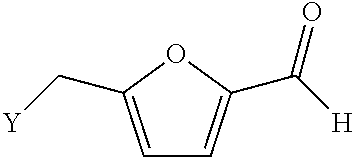
(wherein Y is halo).

(wherein Y is halo).


(wherein X is halo).

wherein:
-
- m is an integer greater than or equal to 1; and
- Y is halo; and


wherein:
-
- m is an integer greater than or equal to 1; and
-
- n is an integer greater than or equal to 1.
In one variation, the compound of formula (A) is:
- n is an integer greater than or equal to 1.


wherein:
-
- m is an integer greater than or equal to 1; and
-
- n is an integer greater than or equal to 1.
In one variation, the compound of formula (A) is:
- n is an integer greater than or equal to 1.


wherein:
-
- m is an integer greater than or equal to 1; and
-
- n is an integer greater than or equal to 1; and
- X is halo.
In one variation, the compound of formula (A) is:

(wherein X is halo).

wherein:
-
- n is an integer greater than or equal to 1.
In one variation, the compound of formula (A) is:
- n is an integer greater than or equal to 1.


wherein:
-
- n is an integer greater than or equal to 1.
In one variation, the compound of formula (A) is:
- n is an integer greater than or equal to 1.


wherein:
-
- n is an integer greater than or equal to 1; and
- X is halo.
In one variation, the compound of formula (A) is:

(wherein X is halo).

(wherein m is 0 and n is 1 in each instance).

(wherein m is 1 and n is 1 in each instance).
Catalysts

wherein:

wherein:

wherein:


aA→cC
where Ao is the initial number of moles of reactant A; and Af is the final number of moles of reactant A.
where Ao is the starting moles of reactant A; Af is the final number of moles of reactant A; and Cf is the number of moles of product C. In some embodiments where “a/c”=1, and the equation can be simplified to:
Yield (%)=Conversion (%)*Selectivity (%)
-
- a) providing (5-methylfuran-2-yl)methanol; and
- b) selectively reducing the (5-methylfuran-2-yl)methanol to produce 2,5-dimethylfuran.
2. The method ofembodiment 1, wherein the (5-methylfuran-2-yl)methanol is selectively reduced in the presence of hydrogen and a catalyst.
3. A method of producing 2,5-dimethylfuran, comprising: - a) providing (5-methylfuran-2-yl)methanol;
- b) converting the (5-methylfuran-2-yl)methanol to 2-(chloromethyl)-5-methylfuran in the presence of an acid; and
- c) selectively reducing the 2-(chloromethyl)-5-methylfuran to produce 2,5-dimethylfuran.
4. The method of embodiment 3, wherein the 2-(chloromethyl)-5-methylfuran is selectively reduced in the presence of hydrogen and a catalyst.
5. The method of any one ofembodiments 1 to 6, wherein the (5-methylfuran-2-yl)methanol is provided by: - i) providing 5-methylfuran-2-carbaldehyde; and
- ii) converting the 5-methylfuran-2-carbaldehyde to (5-methylfuran-2-yl)methanol in the presence of acid, hydrogen and a catalyst.
6. The method of any one ofembodiments 1 to 6, wherein the (5-methylfuran-2-yl)methanol is provided by: - i) providing 5-(chloromethyl)furfural;
- ii) converting the 5-(chloromethyl)furfural to 5-methylfuran-2-carbaldehyde in the presence of hydrogen and a catalyst; and
- iii) converting the 5-methylfuran-2-carbaldehyde in the presence of acid, hydrogen and a catalyst.
7. The method of embodiment 2, 4, 5 or 6, wherein the catalyst is a palladium catalyst.
8. A method of producing a compound of formula (I′):

wherein:
-
- R1′ is Cm alkyl, wherein m is an integer greater than or equal to 0, provided that when m is 0, R1′ is H; and
- R2′ is Cn alkyl, wherein n is an integer greater than or equal to 1,
the method comprising converting a compound of formula (A) to the compound of formula (I′) in the presence of hydrogen, a catalyst and a reagent of formula (i), (ii) or (iii), or any combination thereof,
wherein:

-
- wherein:
- R1a is Cm alkyl, or —(CH2)mY, wherein:
- m is as defined for formula (I′), provided that when m is 0, R1a is H; and
- Y is halo; and
- R2a is —(CH2)n-1CH(O), —(CH2)nOH, or —(CH2)nX, wherein:
- n is as defined for formula (I′); and
- X is halo; and
- R1a is Cm alkyl, or —(CH2)mY, wherein:
- wherein:

-
- wherein:
- each Ra, Rb and Rc is independently H, aliphatic, aryl, or heteroaryl; or
- Ra and Rb are taken together with the nitrogen atoms to which they are connected to form a cyclic moiety having at least 3 ring atoms; and
- wherein:

-
- wherein:
- (A) each Ra, Rb, Rc and Rd is independently H, aliphatic, aryl or heteroaryl; or
- (B) Ra and Rb are taken together with the nitrogen atoms to which they are connected to form a cyclic moiety having at least 3 ring atoms; and each Rc and Rd is independently H, aliphatic, aryl or heteroaryl; or
- (C) each Ra and Rb is independently H, aliphatic, aryl or heteroaryl;
- and Rc and Rd are taken together with the nitrogen atoms to which they are connected to form a cyclic moiety having at least 3 ring atoms; or
- (D) Ra and Rb are taken together with the nitrogen atoms to which they are connected to form a cyclic moiety having at least 3 ring atoms; and Rc and Rd are taken together with the nitrogen atoms to which they are connected to form a cyclic moiety having at least 3 ring atoms; or
- (E) each Ra and Rc is independently H, aliphatic, aryl or heteroaryl; and Rb and Rd are taken together with the nitrogen atoms to which they are connected to form a cyclic moiety having at least 5 ring atoms; or
- (F) each Rb and Rd is independently H, aliphatic, aryl or heteroaryl; and Ra and Rc are taken together with the nitrogen atoms to which they are connected to form a cyclic moiety having at least 5 ring atoms; and
- wherein:

-
- wherein:
- each Ra and Rc is independently H, aliphatic, aryl or heteroaryl; and
- t is an integer greater than or equal to 0.
9. The method of embodiment 8, wherein:
- wherein:

or any combinations thereof.
11. The method of any one of embodiments 8 to 10, wherein the compound of formula (I′) is a compound of formula (I-a) or (I-b):

wherein R1′ is Cm alkyl, wherein m is an integer greater than or equal to 1.
12. The method of embodiment 8, wherein the compound of formula (I′) is

13. The method of embodiment 8 or 9, wherein the compound of formula (A) is a compound of formula (A-i) or (A-ii):

wherein m is an integer greater than or equal to 1.
14. The method of any one of embodiments 8 to 11 and 13, wherein R1a is —(CH2)mY.
15. The method of any one of embodiments 8 to 13, wherein R2a is —(CH2)n-1CH(O).
16. The method of any one of embodiments 8 to 13, wherein R2a is —(CH2)nOH.
17. The method of any one of embodiments 8 to 13, wherein R2a is —(CH2)nX.
18. The method of any one of embodiments 8 to 11, wherein the compound of formula (A) is

19. The method of embodiment 8, wherein the compound of formula (A) is

wherein:
-
- m is an integer greater than or equal to 1; and
- Y is halo; and
-
- n is an integer greater than or equal to 1.
20. The method of embodiment 8, wherein the compound of formula (A) is:
- n is an integer greater than or equal to 1.

wherein:
-
- m is an integer greater than or equal to 1; and
-
- n is an integer greater than or equal to 1.
21. The method of embodiment 8, wherein the compound of formula (A) is:
- n is an integer greater than or equal to 1.

wherein:
-
- m is an integer greater than or equal to 1; and
-
- n is an integer greater than or equal to 1.
22. The method of embodiment 8, wherein the compound of formula (A) is:
- n is an integer greater than or equal to 1.

wherein:
-
- n is an integer greater than or equal to 1.
23. The method of embodiment 8, wherein the compound of formula (A) is:
- n is an integer greater than or equal to 1.

wherein:
-
- n is an integer greater than or equal to 1.
24. The method of embodiment 8, wherein the compound of formula (A) is:
- n is an integer greater than or equal to 1.

wherein:
-
- n is an integer greater than or equal to 1; and
- X is halo.
25. The method of embodiment 8, wherein the compound of formula (A) is:

wherein:
-
- m is an integer greater than or equal to 1; and
-
- n is an integer greater than or equal to 1; and
- X is halo.
26. The method of any one of embodiments 8 to 11, 13, 14, and 18 to 25, wherein Y is chloro.
27. The method of any one of embodiments 8 to 11, 13, 17, and 18 to 25, wherein X is chloro.
28. The method of any one ofembodiments 1 to 20, 22, and 24 to 27, wherein the catalyst comprises palladium.
29. The method of any one ofembodiments 1 to 20, 22, and 24 to 28, wherein the catalyst comprises palladium and a solid support.
30. The method of embodiment 29, wherein the solid support is carbon or alumina.
31. The method of any one of embodiments 8 to 30, wherein the catalyst is palladium on carbon, palladium chloride, or any combinations thereof.
32. The method of any one of embodiments 8 to 31, wherein the compound of formula (A) is converted to the compound of formula (I′) in the further presence of acid.
33. The method of any one of embodiments 8 to 32, wherein the compound of formula (A) is converted to the compound of formula (I′) in the further presence of solvent.
34. The method of embodiment 33, wherein the solvent comprises organic solvent.
35. The method of embodiment 33 or 34, wherein the solvent comprises aromatic solvent.
36. The method of any one of embodiments 33 to 35, wherein the solvent comprises at least one mono-aryl compound, at least one di-aryl compound, or at least one tri-aryl compound, or any mixtures thereof.
37. The method of embodiment 37, wherein the at least one mono-aryl compound is toluene or para-xylene.
38. A method of producing a compound of formula (I′):

-
- R1′ is Cm alkyl, wherein m is an integer greater than or equal to 0, provided that when m is 0, R1′ is H; and
- R2′ is Cn alkyl, wherein n is an integer greater than or equal to 1,
the method comprising:

-
- wherein:
- R1 is Cm alkyl, wherein m is as defined for formula (I′); and
- R2 is —(CH2)n—, wherein n is as defined for formula (I′),
- wherein:

-
- wherein:
- R1 and R2 are as defined for formula (B); and
- X is halo; and
- wherein:

-
- wherein:
- each Ra, Rb and Rc is independently H, aliphatic, aryl, or heteroaryl; or
- Ra and Rb are taken together with the nitrogen atoms to which they are connected to form a cyclic moiety having at least 3 ring atoms; and
- wherein:

-
- wherein:
- (A) each Ra, Rb, Rc and Rd is independently H, aliphatic, aryl or heteroaryl; or
- (B) Ra and Rb are taken together with the nitrogen atoms to which they are connected to form a cyclic moiety having at least 3 ring atoms; and each Rc and Rd is independently H, aliphatic, aryl or heteroaryl; or
- (C) each Ra and Rb is independently H, aliphatic, aryl or heteroaryl; and Rc and Rd are taken together with the nitrogen atoms to which they are connected to form a cyclic moiety having at least 3 ring atoms; or
- (D) Ra and Rb are taken together with the nitrogen atoms to which they are connected to form a cyclic moiety having at least 3 ring atoms; and Rc and Rd are taken together with the nitrogen atoms to which they are connected to form a cyclic moiety having at least 3 ring atoms; or
- (E) each Ra and Rc is independently H, aliphatic, aryl or heteroaryl; and Rb and Rd are taken together with the nitrogen atoms to which they are connected to form a cyclic moiety having at least 5 ring atoms; or
- (F) each Rb and Rd is independently H, aliphatic, aryl or heteroaryl; and Ra and Rc are taken together with the nitrogen atoms to which they are connected to form a cyclic moiety having at least 5 ring atoms; and
- wherein:

-
- wherein:
- each Ra and Rc is independently H, aliphatic, aryl or heteroaryl; and
- t is an integer greater than or equal to 0.
40. The method of embodiment 39, wherein the reagent of formula (i), (ii) or (iii) is selected from the group consisting of
- wherein:

or any combinations thereof.
41. The method of embodiment 39 or 40, wherein the catalyst comprises palladium and optionally a solid support.
42. The method of embodiment 41, wherein the solid support is carbon or alumina.
43. The method of any one of embodiments 39 to 42, wherein the catalyst is palladium on carbon, palladium chloride, or any combinations thereof.
44. The method of any one of embodiments 39 to 43, wherein the compound of formula (C) is reduced to produce the compound of formula (I′) in the further presence of acid.
45. The method of any one of embodiments 39 to 44, wherein the compound of formula (C) is reduced to produce the compound of formula (I′) in the further presence of solvent.
46. The method of embodiment 45, wherein the solvent comprises organic solvent.
47. The method of embodiment 45 or 46, wherein the solvent comprises aromatic solvent.
48. The method of any one of embodiments 45 to 47, wherein the solvent comprises at least one mono-aryl compound, at least one di-aryl compound, or at least one tri-aryl compound, or any mixtures thereof.
49. The method of embodiment 48, wherein the at least one mono-aryl compound is toluene or para-xylene.
50. A composition, comprising:

-
- wherein:
- R1a is Cm alkyl, or —(CH2)mY, wherein:
- m is an integer greater than or equal to 0, provided that when m is 0, R1′ is H; and
- Y is halo; and
- R2a is —(CH2)n-1CH(O), —(CH2)nOH, or —(CH2)nX, wherein:
- m is an integer greater than or equal to 1; and
- X is halo; and
- R1a is Cm alkyl, or —(CH2)mY, wherein:
- wherein:
-
- the reagent of formula (i) is:

-
-
- wherein:
- each Ra, Rb and Rc is independently H, aliphatic, aryl, or heteroaryl; or
- Ra and Rb are taken together with the nitrogen atoms to which they are connected to form a cyclic moiety having at least 3 ring atoms; and
- wherein:
- the reagent of formula (ii) is:
-

-
-
- wherein:
- (A) each Ra, Rb, Rc and Rd is independently H, aliphatic, aryl or heteroaryl; or
- (B) Ra and Rb are taken together with the nitrogen atoms to which they are connected to form a cyclic moiety having at least 3 ring atoms; and each Rc and Rd is independently H, aliphatic, aryl or heteroaryl; or
- (C) each Ra and Rb is independently H, aliphatic, aryl or heteroaryl; and Rc and Rd are taken together with the nitrogen atoms to which they are connected to form a cyclic moiety having at least 3 ring atoms; or
- (D) Ra and Rb are taken together with the nitrogen atoms to which they are connected to form a cyclic moiety having at least 3 ring atoms; and Rc and Rd are taken together with the nitrogen atoms to which they are connected to form a cyclic moiety having at least 3 ring atoms; or
- (E) each Ra and Rc is independently H, aliphatic, aryl or heteroaryl; and Rb and Rd are taken together with the nitrogen atoms to which they are connected to form a cyclic moiety having at least 5 ring atoms; or
- (F) each Rb and Rd is independently H, aliphatic, aryl or heteroaryl; and Ra and Rc are taken together with the nitrogen atoms to which they are connected to form a cyclic moiety having at least 5 ring atoms; and
- wherein:
- the reagent of formula (iii) is:
-

-
-
- wherein:
- each Ra and Rc is independently H, aliphatic, aryl or heteroaryl; and
- t is an integer greater than or equal to 0;
- wherein:
-

or any combinations thereof.
52. The composition of embodiment 50 or 51, further comprising a compound of formula (I′):

wherein R1′ and R2′ are as defined for formula (A).
53. The composition of embodiment 51, wherein the compound of formula (I′) is a compound of formula (I-a) or (I-b):

wherein R1′ is Cm alkyl, wherein m is an integer greater than or equal to 1.
54. The composition of embodiment 51, wherein the compound of formula (I′) is

55. The composition of any one of embodiments 50 to 52, wherein the compound of formula (A) is a compound of formula (A-i) or (A-ii):

wherein m is an integer greater than or equal to 1.
56. The composition of any one of embodiments 50 to 53 and 55, wherein R1a is —(CH2)mY.
57. The composition of any one of embodiments 50 to 55, wherein R2a is —(CH2)n-1CH(O).
58. The composition of any one of embodiments 50 to 55, wherein R2a is —(CH2)nOH.
59. The composition of any one of embodiments 50 to 55, wherein R2a is —(CH2)nX.
60. The composition of any one of embodiments 50 to 53, wherein the compound of formula (A) is

61. The composition of embodiment 50, wherein the compound of formula (A) is

wherein:
-
- m is an integer greater than or equal to 1; and
- Y is halo; and
-
- n is an integer greater than or equal to 1.
62. The composition of embodiment 50, wherein the compound of formula (A) is:
- n is an integer greater than or equal to 1.

wherein:
-
- m is an integer greater than or equal to 1; and
-
- n is an integer greater than or equal to 1.
63. The composition of embodiment 50, wherein the compound of formula (A) is:
- n is an integer greater than or equal to 1.

wherein:
-
- m is an integer greater than or equal to 1; and
-
- n is an integer greater than or equal to 1.
64. The composition of embodiment 50, wherein the compound of formula (A) is:
- n is an integer greater than or equal to 1.

wherein:
-
- n is an integer greater than or equal to 1.
65. The composition of embodiment 50, wherein the compound of formula (A) is:
- n is an integer greater than or equal to 1.

wherein:
-
- n is an integer greater than or equal to 1.
66. The composition of embodiment 50, wherein the compound of formula (A) is:
- n is an integer greater than or equal to 1.

wherein:
-
- n is an integer greater than or equal to 1; and
- X is halo.
67. The composition of embodiment 50, wherein the compound of formula (A) is:

wherein:
-
- m is an integer greater than or equal to 1; and
-
- n is an integer greater than or equal to 1; and
- X is halo.
68. The composition of any one of embodiments 50 to 53, 55, 56, and 60 to 67, wherein Y is chloro.
69. The composition of any one of embodiments 50 to 53, 55, 59, and 60 to 67, wherein X is chloro.
70. The composition of any one of embodiments 50 to 62, 64, and 66 to 69, wherein the catalyst comprises palladium.
71. The composition of any one of embodiments 50 to 62, 64, and 66 to 70, wherein the catalyst comprises palladium and a solid support.
72. The composition of embodiment 71, wherein the solid support is carbon or alumina.
73. The composition of any one of embodiments 50 to 72, wherein the catalyst is palladium on carbon, palladium chloride, or any combinations thereof.
74. The composition of any one of embodiments 50 to 73, wherein the compound of formula (A) is converted to the compound of formula (I′) in the further presence of acid.
75. The composition of any one of embodiments 50 to 74, wherein the compound of formula (A) is converted to the compound of formula (I′) in the further presence of solvent.
76. The composition of embodiment 75, wherein the solvent comprises organic solvent.
77. The composition of embodiment 75 or 76, wherein the solvent comprises aromatic solvent.
78. The composition of any one of embodiments 75 to 77, wherein the solvent comprises at least one mono-aryl compound, at least one di-aryl compound, or at least one tri-aryl compound, or any mixtures thereof.
79. The composition of embodiment 78, wherein the at least one mono-aryl compound is toluene or para-xylene.
80. The method of any one of embodiments 8 to 49, further comprising isolating the compound of formula (I′).
81. The method of any one of embodiments 8 to 49, further comprising purifying the compound of formula (I′).
82. A method of producing para-xylene, comprising:


| TABLE 1 |
| Summary of reactions and results |
| DMF | DMF | |||||
| CMF | Solvent A, | Reagent B, | Reaction | selectivity | yield | |
| Catalyst | loadinga | weight % | weight % | time | (%) | (%) |
| Pd/Al2O3 | 16% | Toluene, 77% |
 |
120 min | 82-84 | 82-84 |
| DMPU | ||||||
| 23% | ||||||
| Pd/Al2O3 | 16% | — |
 |
120 min | 17 | 15 |
| DMPU | ||||||
| 100% | ||||||
| Pd/Al2O3 | 16% | Toluene, 77% |
 |
70 min | 63 | 63 |
| DMI | ||||||
| 23% | ||||||
| Pd/Al2O3 | 16 | Toluene, 78% |
 |
186 min | 59 | 59 |
| TMU | ||||||
| 22% | ||||||
| Pd/Al2O3 | 16 | — |
 |
300 min | 61 | 61 |
| TMU | ||||||
| 100% | ||||||
| Pd/Al2O3 | 16 | — |
 |
86 min | 36 | 17 |
| |
||||||
| 100% | ||||||
| Pd/Al2O3 | 16 | — |
 |
120 min | 83 | 83 |
| DMFD | ||||||
| 100% | ||||||
| Pd/Al2O3 | 26 | — |
 |
120 min | 81 | 81 |
| DMFD | ||||||
| 100% | ||||||
| Pd/C | 16 | — |
 |
70 min | 82 | 82 |
| DMFD | ||||||
| 100% | ||||||
| Pd/C | 16 | Toluene, 48% |
 |
48 min | 82 | 82 |
| DMFD | ||||||
| 52% | ||||||
| Pd/Al2O3 | 16 | Dowtherm ™ G, 78% |
 |
222 min | 64 | 59 |
| DMFD | ||||||
| 18% | ||||||
| aCMF % loading = mass of CMF per total volume of reaction in solvent mix (Solvent A + Reagent B) | ||||||
| TABLE 2 | ||||
| Time (min) | Temperature Reaction | Total Hydrogen Consumed | ||
| continuous | (° C. ) | (mmol) | ||
| 3.7 | 27 to 29 | 6.63 | ||
| 7.5 | 30 | 12.16 | ||
| 11.3 | 31 | 17.69 | ||
| 15.2 | 33 | 23.22 | ||
| 19.3 | 33 | 29.85 | ||
| 23.5 | 34 | 35.38 | ||
| 28.3 | 34 | 40.91 | ||
| 33.9 | 33 | 46.43 | ||
| 41.5 | 32 | 51.95 | ||
| 52.8 | 30 | 57.47 | ||
| 72.4 | 29 | 62.98 | ||
| 105.6 | 28 | 68.49 | ||
| TABLE 3 | |||
| Time (min) continuous | Total Hydrogen Consumed (mmol) | ||
| 4.6 | 6.702 | ||
| 9.8 | 13.415 | ||
| 15.9 | 19.004 | ||
| 22.0 | 24.602 | ||
| 28.6 | 30.178 | ||
| 36.5 | 35.771 | ||
| 45.8 | 42.464 | ||
| 56.4 | 48.047 | ||
| 68.6 | 53.636 | ||
| 83.0 | 59.231 | ||
| 100.0 | 64.826 | ||
| 123.0 | 70.421 | ||
| 150.0 | 77.132 | ||
| 175.1 | 83.850 | ||
| 222 | 88.321 | ||
Claims (29)


Priority Applications (1)
| Application Number | Priority Date | Filing Date | Title |
|---|---|---|---|
| US14/912,052 US9908862B2 (en) | 2013-08-15 | 2014-08-15 | Methods of producing alkylfurans |
Applications Claiming Priority (3)
| Application Number | Priority Date | Filing Date | Title |
|---|---|---|---|
| US201361866491P | 2013-08-15 | 2013-08-15 | |
| US14/912,052 US9908862B2 (en) | 2013-08-15 | 2014-08-15 | Methods of producing alkylfurans |
| PCT/US2014/051209 WO2015023918A2 (en) | 2013-08-15 | 2014-08-15 | Methods of producing alkylfurans |
Related Parent Applications (1)
| Application Number | Title | Priority Date | Filing Date |
|---|---|---|---|
| PCT/US2014/051209 A-371-Of-International WO2015023918A2 (en) | 2013-08-15 | 2014-08-15 | Methods of producing alkylfurans |
Related Child Applications (1)
| Application Number | Title | Priority Date | Filing Date |
|---|---|---|---|
| US15/870,691 Continuation US10618880B2 (en) | 2013-08-15 | 2018-01-12 | Methods of producing alkylfurans |
Publications (2)
| Publication Number | Publication Date |
|---|---|
| US20160200700A1 US20160200700A1 (en) | 2016-07-14 |
| US9908862B2 true US9908862B2 (en) | 2018-03-06 |
Family
ID=52468815
Family Applications (2)
| Application Number | Title | Priority Date | Filing Date |
|---|---|---|---|
| US14/912,052 Active US9908862B2 (en) | 2013-08-15 | 2014-08-15 | Methods of producing alkylfurans |
| US15/870,691 Active US10618880B2 (en) | 2013-08-15 | 2018-01-12 | Methods of producing alkylfurans |
Family Applications After (1)
| Application Number | Title | Priority Date | Filing Date |
|---|---|---|---|
| US15/870,691 Active US10618880B2 (en) | 2013-08-15 | 2018-01-12 | Methods of producing alkylfurans |
Country Status (3)
| Country | Link |
|---|---|
| US (2) | US9908862B2 (en) |
| TW (1) | TW201527288A (en) |
| WO (1) | WO2015023918A2 (en) |
Cited By (2)
| Publication number | Priority date | Publication date | Assignee | Title |
|---|---|---|---|---|
| US10414742B2 (en) | 2014-08-15 | 2019-09-17 | Micromidas, Inc. | Methods of producing alkylfurans |
| US10618880B2 (en) | 2013-08-15 | 2020-04-14 | Micromidas, Inc. | Methods of producing alkylfurans |
Families Citing this family (6)
| Publication number | Priority date | Publication date | Assignee | Title |
|---|---|---|---|---|
| KR101822035B1 (en) | 2011-06-09 | 2018-01-25 | 마이크로마이다스, 인코포레이티드 | Utilizing a multiphase reactor for the conversion of biomass to produce substituted furans |
| SG11201507352YA (en) | 2013-03-14 | 2015-10-29 | Micromidas Inc | Methods for purifying 5-(halomethyl)furfural |
| KR102301973B1 (en) | 2013-03-14 | 2021-09-14 | 마이크로마이다스, 인코포레이티드 | Solid forms of 5-(halomethyl)furfural and methods for preparing thereof |
| BR112016005974B8 (en) | 2013-09-20 | 2022-12-06 | Micromidas Inc | METHODS FOR THE PRODUCTION OF 5-(HALOMETHYL) FURFURAL |
| WO2016149461A1 (en) * | 2015-03-18 | 2016-09-22 | Micromidas, Inc. | Methods for producing 5-(halomethyl)furfural |
| CN108473666A (en) | 2015-12-11 | 2018-08-31 | 埃维昂矿泉水有限公司 | Pet polymer with the resistive connection crystalline substance comonomer that can be biological source |
Citations (9)
| Publication number | Priority date | Publication date | Assignee | Title |
|---|---|---|---|---|
| US4335049A (en) | 1980-07-16 | 1982-06-15 | Sumitomo Chemical Company, Limited | Process for producing 5-methylfurfural |
| JPS6159633B2 (en) | 1981-07-14 | 1986-12-17 | Sumitomo Chemical Co | |
| CN101434588B (en) | 2007-11-14 | 2011-08-10 | 中国科学院大连化学物理研究所 | Method for preparing 2,5-dimethyl furan from 5-hydroxymethyl furfural |
| US20110263880A1 (en) * | 2010-04-23 | 2011-10-27 | The Board Of Trustees Of The University Of Illinois | Efficient method for preparing 2,5-dimethylfuran |
| EP2666540A1 (en) | 2012-05-22 | 2013-11-27 | Karlsruher Institut für Technologie | Process for catalytic hydrodesoxygenation of furane derivatives and/or pyrolysis oils, the catalyst and the process of making thereof. |
| US20140171699A1 (en) | 2012-12-18 | 2014-06-19 | Exxonmobil Research And Engineering Company | Process for making saturated hydrocarbons from renewable feeds |
| WO2015023918A2 (en) | 2013-08-15 | 2015-02-19 | Micromidas, Inc. | Methods of producing alkylfurans |
| WO2015031753A1 (en) | 2013-08-30 | 2015-03-05 | The Regents Of The University Of California | Synthesis of alkylfurans |
| WO2016025865A1 (en) | 2014-08-15 | 2016-02-18 | Micromidas, Inc. | Methods of producing alkylfurans |
Family Cites Families (1)
| Publication number | Priority date | Publication date | Assignee | Title |
|---|---|---|---|---|
| GB2511671B (en) | 2012-02-16 | 2015-06-03 | Karl A Seck | Method of making an alkane liquid fuel |
-
2014
- 2014-08-15 TW TW103128106A patent/TW201527288A/en unknown
- 2014-08-15 US US14/912,052 patent/US9908862B2/en active Active
- 2014-08-15 WO PCT/US2014/051209 patent/WO2015023918A2/en not_active Ceased
-
2018
- 2018-01-12 US US15/870,691 patent/US10618880B2/en active Active
Patent Citations (9)
| Publication number | Priority date | Publication date | Assignee | Title |
|---|---|---|---|---|
| US4335049A (en) | 1980-07-16 | 1982-06-15 | Sumitomo Chemical Company, Limited | Process for producing 5-methylfurfural |
| JPS6159633B2 (en) | 1981-07-14 | 1986-12-17 | Sumitomo Chemical Co | |
| CN101434588B (en) | 2007-11-14 | 2011-08-10 | 中国科学院大连化学物理研究所 | Method for preparing 2,5-dimethyl furan from 5-hydroxymethyl furfural |
| US20110263880A1 (en) * | 2010-04-23 | 2011-10-27 | The Board Of Trustees Of The University Of Illinois | Efficient method for preparing 2,5-dimethylfuran |
| EP2666540A1 (en) | 2012-05-22 | 2013-11-27 | Karlsruher Institut für Technologie | Process for catalytic hydrodesoxygenation of furane derivatives and/or pyrolysis oils, the catalyst and the process of making thereof. |
| US20140171699A1 (en) | 2012-12-18 | 2014-06-19 | Exxonmobil Research And Engineering Company | Process for making saturated hydrocarbons from renewable feeds |
| WO2015023918A2 (en) | 2013-08-15 | 2015-02-19 | Micromidas, Inc. | Methods of producing alkylfurans |
| WO2015031753A1 (en) | 2013-08-30 | 2015-03-05 | The Regents Of The University Of California | Synthesis of alkylfurans |
| WO2016025865A1 (en) | 2014-08-15 | 2016-02-18 | Micromidas, Inc. | Methods of producing alkylfurans |
Non-Patent Citations (51)
| Title |
|---|
| Albers et al., "Poisoning and Deactivation of Palladium Catalysts", Journal of Molecular Catalysis A: Chemical, vol. 173, 2001, pp. 275-286. |
| Binder et al., "Simple Chemical Transformation of Lignocellulosic Biomass into Furans for Fuels and Chemicals", Journal American Chemical Society, vol. 131, No. 5, 2009, pp. 1979-1985. |
| Boudart, M., "Turnover Rates in Heterogeneous Catalysis", Chemical Reviews, vol. 95, No. 3, 1995, pp. 661-666. |
| Boyer et al., "Mild Hydrogen-Transfer Reductions Using Sodium Hypophosphite", J. Org. Chem., vol. 50, No. 18, 1985, pp. 3408-3411. |
| Brunner, Erwin, "Solubility of Hydrogen in 10 Organic Solvents at 298.15, 323.15, and 373.15 K", Journal of Chemical and Engineering Data, vol. 30, No. 3, 1985, pp. 269-273. |
| Chatterjee et al., "Hydrogenation of 5-Hydroxymethylfurfural in Supercritical Carbon Dioxide-Water: a Tunable Approach to Dimethylfuran Selectivity", Green Chemistry, vol. 16, 2014, pp. 1543-1551. |
| Chatterjee et al., "Hydrogenation of 5-Hydroxymethylfurfural in Supercritical Carbon Dioxide—Water: a Tunable Approach to Dimethylfuran Selectivity", Green Chemistry, vol. 16, 2014, pp. 1543-1551. |
| Chen et al., "Immobilized Ru Clusters in Nanosized Mesoporous Zirconium Silica for the Aqueous Hydrogenation of Furan Derivatives at Room Temperature", ChemCatChem, vol. 5, 2013, pp. 2822-2826. |
| Chidambaram et al., "A Two-Step Approach for the Catalytic Conversion of Glucose to 2,5-Dimethylfuran in Ionic Liquids", Green Chemistry, vol. 12, 2010, pp. 1253-1262. |
| Delidovich et al., "Alternative Monomers Based on Lignocellulose and Their Use for Polymer Production", Chemical Reviews, vol. 116, 2016, pp. 1540-1599. |
| Deutsch et al., "Active Species of Copper Chromite Catalyst in C-O Hydrogenolysis of 5-Methylfurfuryl Alcohol", Journal of Catalysis, vol. 285, 2012, pp. 235-241. |
| Deutsch et al., "Active Species of Copper Chromite Catalyst in C—O Hydrogenolysis of 5-Methylfurfuryl Alcohol", Journal of Catalysis, vol. 285, 2012, pp. 235-241. |
| Dutta et al., "Novel Pathways to 2,5-Dimethylfuran via Biomass-Derived 5-(Chloromethyl) Furfural", Chemsuschem, vol. 7, 2014, pp. 3028-3030. |
| Extended European Search Report (includes Supplementary European Search Report and Search Opinion) received for European Patent Application No. 15832265.1, dated Jan. 2, 2018, 10 pages. |
| Hamada et al., "Novel Synthetic Route to 2,5-Disubstituted Furan Derivatives through Surface Active Agent-Catalyzed Dehydration of D-(−)-Fructose", J. Oleo Sci., vol. 50, No. 6, 2001, pp. 533-536. (English Abstract Submitted). |
| Harmon et al., "Hydrogenation of Organic Compounds Using Homogeneous Catalysts", Chemical Reviews, vol. 73, No. 1, 1973, pp. 21-52. |
| International Preliminary Report on Patentability received for PCT Patent Application No. PCT/US2014/051209, dated Feb. 25, 2016, 7 pages. |
| International Preliminary Report on Patentability received for PCT Patent Application No. PCT/US2015/045330, dated Mar. 2, 2017, 8 pages. |
| International Search Report & Written Opinion received for PCT Patent Application No. PCT/US2014/051209, dated Nov. 13, 2014, 9 pages. |
| International Search Report and Written Opinion received for PCT Application No. PCT/US2015/045330, dated Nov. 20, 2015, 11 pages. |
| Iqbal et al., "Conversion of Furfuryl Alcohol into 2-Methylfuran at Room Temperature using Pd/Ti02 Catalyst", Catalysis Science & Technology, vol. 4, 2014, pp. 2280-2286. |
| Kluso{hacek over (n)} et al., "Ru-Sn CATALYST-A New Promising System for Selective Hydrogenation of a Carbonyl Group", Chem. Listy, vol. 91, 1997, pp. 100-104. |
| Kluso{hacek over (n)} et al., "Ru-Sn CATALYST—A New Promising System for Selective Hydrogenation of a Carbonyl Group", Chem. Listy, vol. 91, 1997, pp. 100-104. |
| Kumalaputri et al., "Tunable and Selective Conversion of 5-HMF to 2,5-Furandimethanol and 2,5-Dimethylfuran over Copper-Doped-Porous Metal Oxides", ChemSusChem, vol. 7, 2014, pp. 2266-2275. |
| Kwon et al., "Electrocatalytic Hydrogenation of 5-Hydroxymethylfurfural in the Absence and Presence of Glucose", ChemSusChem, vol. 6, 2013, pp. 1659-1667. |
| Lange et al., "Furfural-A Promising Platform for Lignocellulosic Biofuels", ChemSusChem, vol. 5, 2012, pp. 150-166. |
| Lange et al., "Furfural—A Promising Platform for Lignocellulosic Biofuels", ChemSusChem, vol. 5, 2012, pp. 150-166. |
| Lessard et al., "High Yield Conversion of Residual Pentoses into Furfural via Zeolite Catalysis and Catalytic Hydrogenation of Furfural to 2-Methylfuran", Topics in Catalysis, vol. 53, Sep. 2010, pp. 1231-1234. |
| Liu et al., "One-Pot Conversion of Carbohydrates into Furan Derivatives via Furfural and 5-Hydroxylmethylfurfural as Intermediates", ChemSusChem, vol. 9, 2016, pp. 2015-2036. |
| Luijkx et al., "Ether Formation in the Hydrogenolysis of Hydroxymethylfurfural over Palladium Catalysts in Alcoholic Solution", Heterocycles, vol. 77, No. 2, 2009, pp. 1037-1044. |
| Lund et al., "Electrochemical Reduction of Foran Derivatives Derived from Biomass", Acta Chemica Scandinavica, vol. 39 B, No. 6, 1985, pp. 429-435. |
| Luo et al., "Mechanisms for High Selectivity in the Hydrodeoxygenation of 5-Hydroxymethylfurfural over PtCo Nanocrystals", ACS Catalysis, vol. 6, 2016, pp. 4095-4104. |
| Luttringhaus et al., "Tetramethylurea as a Solvent and Reagent", Angew. Chem. International Edition, vol. 3, No. 4, 1964, pp. 260-269. |
| Marques et al., "Facile Hydrodehalogenation with H2 and Pd/C Catalyst under Multiphase Conditions. 3. Selective Removal of Halogen from Functionalized Aryl Ketones. 4. Aryl Halide-Promoted Reduction of Benzyl Alcohols to Alkanes", J. Org. Chem. vol. 60, No. 8, 1995, pp. 2430-2435. |
| Mascal et al., "Direct, High-Yield Conversion of Cellulose into Biofuel", Angewandte Chemie International Edition, vol. 47, 2008, pp. 7924-7926. |
| Mitra et al., "Pd/C-Catalyzed Reactions of HMF: Decarbonylation, Hydrogenation, and Hydrogenolysis", Green Chemistry, 2014, 7 pages. |
| Nakagawa et al., "Catalytic Reduction of Biomass-Derived Furanic Compounds with Hydrogen", ACS Catalysis, vol. 3, 2013, pp. 2655-2668. |
| Nishimura et al., "Selective Hydrogenation of Biomass-Derived 5-Hydroxymethylfurfural (HMF) to 2,5-Dimethylfuran (DMF) under Atmospheric Hydrogen pressure over Carbon Supported PdAu Bimetallic Catalyst", Catalysis Today, 2013, pp. 1-10. |
| Notice of Allowance received for U.S. Appl. No. 15/503,681, dated Aug. 1, 2017, 7 pages. |
| Pittman et al., "Sequential Catalytic Condensation-Hydrogenation of Ketones", J. Org. Chem. vol. 45, No. 25, 1980, pp. 5048-5052. |
| Román-Leshkov et al., "Production of Dimethylfuran for Liquid Fuels from Biomass-Derived Carbohydrates", Nature, vol. 447, Jun. 21, 2007, pp. 982-985. |
| Rosatella et al., "5-Hydroxymethylfurfural (HMF) as a Building Block Platform: Biological Properties, Synthesis and Synthetic Applications", Green Chemistry, vol. 13, 2011, pp. 754-793. |
| Schniepp et al., "The Preparation of Acetopropyl Alcohol and 1,4-Pentanediol from Methylfuran", J. Am. Chem. Soc., vol. 69, Mar. 1947, pp. 672-674. |
| Smith, Patrick B., "Bio-Based Sources for Terephthalic Acid", Green Polymer Chemistry: Biobased Materials and Biocatalysis, Chapter 27, 2015, pp. 453-469. |
| Stakheev et al., "Specific Features of the Catalytic Behavior of Supported Palladium Nanoparticles in Heterogeneous Catalytic Reactions", Russian Journal of General Chemistry, vol. 80, No. 3, 2010, pp. 618-629. |
| Thananatthanachon et al., "Efficient Production of the Liquid Fuel 2,5-Dimethylfuran from Fructose using Formic Acid as a Reagent", Angewandte Chemie International Edition, vol. 49, 2010, pp. 6616-6618. |
| Wei et al., "One-Pot Production of 2,5-Dimethylfuran from Fructose over Ru/C and a Lewis-Brønsted Acid Mixture in N,N-Dimethylformamide", Catalysis Science & Technology, vol. 6, 2016, pp. 6217-6225. |
| Wei et al., "One-Pot Production of 2,5-Dimethylfuran from Fructose over Ru/C and a Lewis—Brønsted Acid Mixture in N,N-Dimethylformamide", Catalysis Science & Technology, vol. 6, 2016, pp. 6217-6225. |
| Yinghuai et al., "Ionic Liquids in Catalytic Biomass Transformation", Applications of Ionic Liquids in Science and Technology, 2011, pp. 3-27. |
| Yinghuai, Z. et al article in Applications of Ionic Liquids in Science and Technology, 2011, Handy, S. ed., pp. 3-27. * |
| Zhang et al., "Highly Active Polymer Anchored Palladium Catalyst for the Hydrodehalogenation of Organic Halides under Mild Conditions", Tetrahedron Letters, vol. 35. No. 26, 1994, pp. 4599-4602. |
Cited By (2)
| Publication number | Priority date | Publication date | Assignee | Title |
|---|---|---|---|---|
| US10618880B2 (en) | 2013-08-15 | 2020-04-14 | Micromidas, Inc. | Methods of producing alkylfurans |
| US10414742B2 (en) | 2014-08-15 | 2019-09-17 | Micromidas, Inc. | Methods of producing alkylfurans |
Also Published As
| Publication number | Publication date |
|---|---|
| US20180362484A1 (en) | 2018-12-20 |
| WO2015023918A2 (en) | 2015-02-19 |
| TW201527288A (en) | 2015-07-16 |
| US10618880B2 (en) | 2020-04-14 |
| US20160200700A1 (en) | 2016-07-14 |
| WO2015023918A3 (en) | 2015-10-15 |
Similar Documents
| Publication | Publication Date | Title |
|---|---|---|
| US10618880B2 (en) | Methods of producing alkylfurans | |
| US9556137B2 (en) | Methods for preparing alkylfurans | |
| US20160297785A1 (en) | Mono- and dialkyl ethers of furan-2,5-dimethanol and (tetra-hydrofuran-2,5-diyl)dimethanol and amphiphilic derivatives thereof | |
| US10414742B2 (en) | Methods of producing alkylfurans | |
| EP3008049B1 (en) | Process for the production of furanic compounds comprising at least one amine function | |
| KR20210091773A (en) | Continuous Flow Synthesis of Cannabidiol | |
| JP5412742B2 (en) | Process for producing 4-perfluoroisopropylanilines | |
| AU2014260269A1 (en) | 5-(hydroxymethyl) furan-2-carbaldehyde (HMF) sulfonates and process for synthesis thereof | |
| JP2010053087A (en) | 1,3-adamantanedimethanol monovinyl ether and 1,3-adamantanedimethanol divinyl ether and method for producing the same | |
| JP5827756B2 (en) | Process for producing polymethylene polyphenyl polycarbamate | |
| JP2016535084A (en) | Synthesis of diacids, dialdehydes, or diamines from THF-diol | |
| US10364210B2 (en) | Diamine compounds, dinitro compounds and other compounds, and methods of producing thereof and uses related thereof | |
| JP7733886B2 (en) | Method for producing 2,5-furandicarboxylic acid | |
| Takebayashi et al. | Noncatalytic mono-N-methylation of aniline in supercritical methanol: the kinetics and acid/base effect | |
| JP5574476B2 (en) | Method for producing carbonate ester | |
| FR2980197A1 (en) | PROCESS FOR THE PRODUCTION OF METHIONINE | |
| JP2012158599A (en) | Synthesis of pyrrole-2-carbonitrile | |
| JP2012236819A (en) | Method for producing tetrahydrofuran | |
| CN107556320B (en) | A kind of method for synthesizing 6H-isoindolo[2,1-a]indol-6-one derivatives | |
| KR20120101559A (en) | Novel method for producing 4-aminobut-2-enolides starting from 4-alkoxyfuran-2(5h)-on or 4-arylalkoxyfuran-2-(5h)-on | |
| JP2008174552A (en) | Method for producing 4-perfluoroisopropylanilines | |
| CN113677670A (en) | The synthetic method of 2,5-furandicarboxylic acid | |
| CN1938270A (en) | Synthesis of Pyrrole-2-carbonitrile | |
| KR20120059555A (en) | Novel method for producing 4-aminobut-2-enolides | |
| CN102617371A (en) | Preparation method of 4-phenylamino-3-pentenyl-2-ketone and derivatives thereof |
Legal Events
| Date | Code | Title | Description |
|---|---|---|---|
| AS | Assignment |
Owner name: MICHIGAN MOLECULAR INSTITUTE, MICHIGAN Free format text: ASSIGNMENT OF ASSIGNORS INTEREST;ASSIGNORS:HUCUL, DENNIS A.;HENTON, DANIEL R.;REEL/FRAME:044588/0577 Effective date: 20170329 Owner name: MICROMIDAS, INC., CALIFORNIA Free format text: ASSIGNMENT OF ASSIGNORS INTEREST;ASSIGNORS:HIRSCH-WEIL, DIMITRI A.;MASUNO, MAKOTO N.;BISSELL, JOHN;AND OTHERS;SIGNING DATES FROM 20170331 TO 20170407;REEL/FRAME:044588/0563 Owner name: MICROMIDAS, INC., CALIFORNIA Free format text: ASSIGNMENT OF ASSIGNORS INTEREST;ASSIGNOR:MICHIGAN MOLECULAR INSTITUTE;REEL/FRAME:044588/0536 Effective date: 20170329 |
|
| STCF | Information on status: patent grant |
Free format text: PATENTED CASE |
|
| AS | Assignment |
Owner name: PM OPERATING, LTD., TEXAS Free format text: SECURITY INTEREST;ASSIGNOR:MICROMIDAS, INC,;REEL/FRAME:050980/0661 Effective date: 20191108 |
|
| FEPP | Fee payment procedure |
Free format text: ENTITY STATUS SET TO UNDISCOUNTED (ORIGINAL EVENT CODE: BIG.); ENTITY STATUS OF PATENT OWNER: LARGE ENTITY |
|
| FEPP | Fee payment procedure |
Free format text: PETITION RELATED TO MAINTENANCE FEES GRANTED (ORIGINAL EVENT CODE: PTGR); ENTITY STATUS OF PATENT OWNER: LARGE ENTITY |
|
| MAFP | Maintenance fee payment |
Free format text: PAYMENT OF MAINTENANCE FEE, 4TH YEAR, LARGE ENTITY (ORIGINAL EVENT CODE: M1551); ENTITY STATUS OF PATENT OWNER: LARGE ENTITY Year of fee payment: 4 |
|
| AS | Assignment |
Owner name: ORIGIN MATERIALS OPERATING, INC., CALIFORNIA Free format text: CHANGE OF NAME;ASSIGNOR:MICROMIDAS, INC.;REEL/FRAME:059109/0403 Effective date: 20210924 |
|
| CC | Certificate of correction | ||
| FEPP | Fee payment procedure |
Free format text: MAINTENANCE FEE REMINDER MAILED (ORIGINAL EVENT CODE: REM.); ENTITY STATUS OF PATENT OWNER: LARGE ENTITY |
|
| FEPP | Fee payment procedure |
Free format text: 7.5 YR SURCHARGE - LATE PMT W/IN 6 MO, LARGE ENTITY (ORIGINAL EVENT CODE: M1555); ENTITY STATUS OF PATENT OWNER: LARGE ENTITY |
|
| MAFP | Maintenance fee payment |
Free format text: PAYMENT OF MAINTENANCE FEE, 8TH YEAR, LARGE ENTITY (ORIGINAL EVENT CODE: M1552); ENTITY STATUS OF PATENT OWNER: LARGE ENTITY Year of fee payment: 8 |