US9891184B2 - Dithienylpyrrole-based biosensors and methods for their preparation and use - Google Patents
Dithienylpyrrole-based biosensors and methods for their preparation and use Download PDFInfo
- Publication number
- US9891184B2 US9891184B2 US14/758,421 US201214758421A US9891184B2 US 9891184 B2 US9891184 B2 US 9891184B2 US 201214758421 A US201214758421 A US 201214758421A US 9891184 B2 US9891184 B2 US 9891184B2
- Authority
- US
- United States
- Prior art keywords
- dithienylpyrrole
- composition
- metal
- monomers
- organic solvent
- Prior art date
- Legal status (The legal status is an assumption and is not a legal conclusion. Google has not performed a legal analysis and makes no representation as to the accuracy of the status listed.)
- Expired - Fee Related, expires
Links
- 0 [1*]C1=CSC(C2=C([3*])C([4*])=C(C3=C([1*])C([2*])=CS3)N2C2=C([5*])C([8*])=C(CC(=O)O)C([7*])=C2[6*])=C1[2*] Chemical compound [1*]C1=CSC(C2=C([3*])C([4*])=C(C3=C([1*])C([2*])=CS3)N2C2=C([5*])C([8*])=C(CC(=O)O)C([7*])=C2[6*])=C1[2*] 0.000 description 47
- QFUSOYKIDBRREL-NSCUHMNNSA-N C/C=C/CN Chemical compound C/C=C/CN QFUSOYKIDBRREL-NSCUHMNNSA-N 0.000 description 3
Classifications
-
- G—PHYSICS
- G01—MEASURING; TESTING
- G01N—INVESTIGATING OR ANALYSING MATERIALS BY DETERMINING THEIR CHEMICAL OR PHYSICAL PROPERTIES
- G01N27/00—Investigating or analysing materials by the use of electric, electrochemical, or magnetic means
- G01N27/26—Investigating or analysing materials by the use of electric, electrochemical, or magnetic means by investigating electrochemical variables; by using electrolysis or electrophoresis
- G01N27/28—Electrolytic cell components
- G01N27/30—Electrodes, e.g. test electrodes; Half-cells
-
- C—CHEMISTRY; METALLURGY
- C07—ORGANIC CHEMISTRY
- C07D—HETEROCYCLIC COMPOUNDS
- C07D409/00—Heterocyclic compounds containing two or more hetero rings, at least one ring having sulfur atoms as the only ring hetero atoms
- C07D409/02—Heterocyclic compounds containing two or more hetero rings, at least one ring having sulfur atoms as the only ring hetero atoms containing two hetero rings
- C07D409/06—Heterocyclic compounds containing two or more hetero rings, at least one ring having sulfur atoms as the only ring hetero atoms containing two hetero rings linked by a carbon chain containing only aliphatic carbon atoms
-
- C—CHEMISTRY; METALLURGY
- C07—ORGANIC CHEMISTRY
- C07D—HETEROCYCLIC COMPOUNDS
- C07D409/00—Heterocyclic compounds containing two or more hetero rings, at least one ring having sulfur atoms as the only ring hetero atoms
- C07D409/14—Heterocyclic compounds containing two or more hetero rings, at least one ring having sulfur atoms as the only ring hetero atoms containing three or more hetero rings
-
- C—CHEMISTRY; METALLURGY
- C08—ORGANIC MACROMOLECULAR COMPOUNDS; THEIR PREPARATION OR CHEMICAL WORKING-UP; COMPOSITIONS BASED THEREON
- C08F—MACROMOLECULAR COMPOUNDS OBTAINED BY REACTIONS ONLY INVOLVING CARBON-TO-CARBON UNSATURATED BONDS
- C08F234/00—Copolymers of cyclic compounds having no unsaturated aliphatic radicals in a side chain and having one or more carbon-to-carbon double bonds in a heterocyclic ring
- C08F234/04—Copolymers of cyclic compounds having no unsaturated aliphatic radicals in a side chain and having one or more carbon-to-carbon double bonds in a heterocyclic ring in a ring containing sulfur
-
- C—CHEMISTRY; METALLURGY
- C08—ORGANIC MACROMOLECULAR COMPOUNDS; THEIR PREPARATION OR CHEMICAL WORKING-UP; COMPOSITIONS BASED THEREON
- C08G—MACROMOLECULAR COMPOUNDS OBTAINED OTHERWISE THAN BY REACTIONS ONLY INVOLVING UNSATURATED CARBON-TO-CARBON BONDS
- C08G75/00—Macromolecular compounds obtained by reactions forming a linkage containing sulfur with or without nitrogen, oxygen, or carbon in the main chain of the macromolecule
- C08G75/02—Polythioethers
- C08G75/06—Polythioethers from cyclic thioethers
-
- C—CHEMISTRY; METALLURGY
- C08—ORGANIC MACROMOLECULAR COMPOUNDS; THEIR PREPARATION OR CHEMICAL WORKING-UP; COMPOSITIONS BASED THEREON
- C08J—WORKING-UP; GENERAL PROCESSES OF COMPOUNDING; AFTER-TREATMENT NOT COVERED BY SUBCLASSES C08B, C08C, C08F, C08G or C08H
- C08J5/00—Manufacture of articles or shaped materials containing macromolecular substances
- C08J5/005—Reinforced macromolecular compounds with nanosized materials, e.g. nanoparticles, nanofibres, nanotubes, nanowires, nanorods or nanolayered materials
-
- C—CHEMISTRY; METALLURGY
- C08—ORGANIC MACROMOLECULAR COMPOUNDS; THEIR PREPARATION OR CHEMICAL WORKING-UP; COMPOSITIONS BASED THEREON
- C08K—Use of inorganic or non-macromolecular organic substances as compounding ingredients
- C08K3/00—Use of inorganic substances as compounding ingredients
- C08K3/02—Elements
- C08K3/08—Metals
-
- C—CHEMISTRY; METALLURGY
- C09—DYES; PAINTS; POLISHES; NATURAL RESINS; ADHESIVES; COMPOSITIONS NOT OTHERWISE PROVIDED FOR; APPLICATIONS OF MATERIALS NOT OTHERWISE PROVIDED FOR
- C09D—COATING COMPOSITIONS, e.g. PAINTS, VARNISHES OR LACQUERS; FILLING PASTES; CHEMICAL PAINT OR INK REMOVERS; INKS; CORRECTING FLUIDS; WOODSTAINS; PASTES OR SOLIDS FOR COLOURING OR PRINTING; USE OF MATERIALS THEREFOR
- C09D181/00—Coating compositions based on macromolecular compounds obtained by reactions forming in the main chain of the macromolecule a linkage containing sulfur, with or without nitrogen, oxygen, or carbon only; Coating compositions based on polysulfones; Coating compositions based on derivatives of such polymers
- C09D181/02—Polythioethers; Polythioether-ethers
-
- C—CHEMISTRY; METALLURGY
- C09—DYES; PAINTS; POLISHES; NATURAL RESINS; ADHESIVES; COMPOSITIONS NOT OTHERWISE PROVIDED FOR; APPLICATIONS OF MATERIALS NOT OTHERWISE PROVIDED FOR
- C09D—COATING COMPOSITIONS, e.g. PAINTS, VARNISHES OR LACQUERS; FILLING PASTES; CHEMICAL PAINT OR INK REMOVERS; INKS; CORRECTING FLUIDS; WOODSTAINS; PASTES OR SOLIDS FOR COLOURING OR PRINTING; USE OF MATERIALS THEREFOR
- C09D5/00—Coating compositions, e.g. paints, varnishes or lacquers, characterised by their physical nature or the effects produced; Filling pastes
- C09D5/24—Electrically-conducting paints
-
- C—CHEMISTRY; METALLURGY
- C25—ELECTROLYTIC OR ELECTROPHORETIC PROCESSES; APPARATUS THEREFOR
- C25D—PROCESSES FOR THE ELECTROLYTIC OR ELECTROPHORETIC PRODUCTION OF COATINGS; ELECTROFORMING; APPARATUS THEREFOR
- C25D9/00—Electrolytic coating other than with metals
- C25D9/02—Electrolytic coating other than with metals with organic materials
-
- G—PHYSICS
- G01—MEASURING; TESTING
- G01N—INVESTIGATING OR ANALYSING MATERIALS BY DETERMINING THEIR CHEMICAL OR PHYSICAL PROPERTIES
- G01N27/00—Investigating or analysing materials by the use of electric, electrochemical, or magnetic means
- G01N27/26—Investigating or analysing materials by the use of electric, electrochemical, or magnetic means by investigating electrochemical variables; by using electrolysis or electrophoresis
-
- G—PHYSICS
- G01—MEASURING; TESTING
- G01N—INVESTIGATING OR ANALYSING MATERIALS BY DETERMINING THEIR CHEMICAL OR PHYSICAL PROPERTIES
- G01N27/00—Investigating or analysing materials by the use of electric, electrochemical, or magnetic means
- G01N27/26—Investigating or analysing materials by the use of electric, electrochemical, or magnetic means by investigating electrochemical variables; by using electrolysis or electrophoresis
- G01N27/28—Electrolytic cell components
- G01N27/30—Electrodes, e.g. test electrodes; Half-cells
- G01N27/327—Biochemical electrodes, e.g. electrical or mechanical details for in vitro measurements
- G01N27/3275—Sensing specific biomolecules, e.g. nucleic acid strands, based on an electrode surface reaction
- G01N27/3277—Sensing specific biomolecules, e.g. nucleic acid strands, based on an electrode surface reaction being a redox reaction, e.g. detection by cyclic voltammetry
-
- C—CHEMISTRY; METALLURGY
- C08—ORGANIC MACROMOLECULAR COMPOUNDS; THEIR PREPARATION OR CHEMICAL WORKING-UP; COMPOSITIONS BASED THEREON
- C08G—MACROMOLECULAR COMPOUNDS OBTAINED OTHERWISE THAN BY REACTIONS ONLY INVOLVING UNSATURATED CARBON-TO-CARBON BONDS
- C08G2261/00—Macromolecular compounds obtained by reactions forming a carbon-to-carbon link in the main chain of the macromolecule
- C08G2261/10—Definition of the polymer structure
- C08G2261/14—Side-groups
- C08G2261/142—Side-chains containing oxygen
- C08G2261/1426—Side-chains containing oxygen containing carboxy groups (COOH) and/or -C(=O)O-moieties
-
- C—CHEMISTRY; METALLURGY
- C08—ORGANIC MACROMOLECULAR COMPOUNDS; THEIR PREPARATION OR CHEMICAL WORKING-UP; COMPOSITIONS BASED THEREON
- C08G—MACROMOLECULAR COMPOUNDS OBTAINED OTHERWISE THAN BY REACTIONS ONLY INVOLVING UNSATURATED CARBON-TO-CARBON BONDS
- C08G2261/00—Macromolecular compounds obtained by reactions forming a carbon-to-carbon link in the main chain of the macromolecule
- C08G2261/10—Definition of the polymer structure
- C08G2261/14—Side-groups
- C08G2261/148—Side-chains having aromatic units
-
- C—CHEMISTRY; METALLURGY
- C08—ORGANIC MACROMOLECULAR COMPOUNDS; THEIR PREPARATION OR CHEMICAL WORKING-UP; COMPOSITIONS BASED THEREON
- C08G—MACROMOLECULAR COMPOUNDS OBTAINED OTHERWISE THAN BY REACTIONS ONLY INVOLVING UNSATURATED CARBON-TO-CARBON BONDS
- C08G2261/00—Macromolecular compounds obtained by reactions forming a carbon-to-carbon link in the main chain of the macromolecule
- C08G2261/30—Monomer units or repeat units incorporating structural elements in the main chain
- C08G2261/32—Monomer units or repeat units incorporating structural elements in the main chain incorporating heteroaromatic structural elements in the main chain
- C08G2261/322—Monomer units or repeat units incorporating structural elements in the main chain incorporating heteroaromatic structural elements in the main chain non-condensed
- C08G2261/3221—Monomer units or repeat units incorporating structural elements in the main chain incorporating heteroaromatic structural elements in the main chain non-condensed containing one or more nitrogen atoms as the only heteroatom, e.g. pyrrole, pyridine or triazole
-
- C—CHEMISTRY; METALLURGY
- C08—ORGANIC MACROMOLECULAR COMPOUNDS; THEIR PREPARATION OR CHEMICAL WORKING-UP; COMPOSITIONS BASED THEREON
- C08G—MACROMOLECULAR COMPOUNDS OBTAINED OTHERWISE THAN BY REACTIONS ONLY INVOLVING UNSATURATED CARBON-TO-CARBON BONDS
- C08G2261/00—Macromolecular compounds obtained by reactions forming a carbon-to-carbon link in the main chain of the macromolecule
- C08G2261/30—Monomer units or repeat units incorporating structural elements in the main chain
- C08G2261/32—Monomer units or repeat units incorporating structural elements in the main chain incorporating heteroaromatic structural elements in the main chain
- C08G2261/322—Monomer units or repeat units incorporating structural elements in the main chain incorporating heteroaromatic structural elements in the main chain non-condensed
- C08G2261/3223—Monomer units or repeat units incorporating structural elements in the main chain incorporating heteroaromatic structural elements in the main chain non-condensed containing one or more sulfur atoms as the only heteroatom, e.g. thiophene
-
- C—CHEMISTRY; METALLURGY
- C08—ORGANIC MACROMOLECULAR COMPOUNDS; THEIR PREPARATION OR CHEMICAL WORKING-UP; COMPOSITIONS BASED THEREON
- C08G—MACROMOLECULAR COMPOUNDS OBTAINED OTHERWISE THAN BY REACTIONS ONLY INVOLVING UNSATURATED CARBON-TO-CARBON BONDS
- C08G2261/00—Macromolecular compounds obtained by reactions forming a carbon-to-carbon link in the main chain of the macromolecule
- C08G2261/40—Polymerisation processes
- C08G2261/44—Electrochemical polymerisation, i.e. oxidative or reductive coupling
-
- C—CHEMISTRY; METALLURGY
- C08—ORGANIC MACROMOLECULAR COMPOUNDS; THEIR PREPARATION OR CHEMICAL WORKING-UP; COMPOSITIONS BASED THEREON
- C08G—MACROMOLECULAR COMPOUNDS OBTAINED OTHERWISE THAN BY REACTIONS ONLY INVOLVING UNSATURATED CARBON-TO-CARBON BONDS
- C08G2261/00—Macromolecular compounds obtained by reactions forming a carbon-to-carbon link in the main chain of the macromolecule
- C08G2261/50—Physical properties
- C08G2261/51—Charge transport
- C08G2261/512—Hole transport
-
- C—CHEMISTRY; METALLURGY
- C08—ORGANIC MACROMOLECULAR COMPOUNDS; THEIR PREPARATION OR CHEMICAL WORKING-UP; COMPOSITIONS BASED THEREON
- C08G—MACROMOLECULAR COMPOUNDS OBTAINED OTHERWISE THAN BY REACTIONS ONLY INVOLVING UNSATURATED CARBON-TO-CARBON BONDS
- C08G2261/00—Macromolecular compounds obtained by reactions forming a carbon-to-carbon link in the main chain of the macromolecule
- C08G2261/90—Applications
- C08G2261/94—Applications in sensors, e.g. biosensors
-
- C—CHEMISTRY; METALLURGY
- C08—ORGANIC MACROMOLECULAR COMPOUNDS; THEIR PREPARATION OR CHEMICAL WORKING-UP; COMPOSITIONS BASED THEREON
- C08G—MACROMOLECULAR COMPOUNDS OBTAINED OTHERWISE THAN BY REACTIONS ONLY INVOLVING UNSATURATED CARBON-TO-CARBON BONDS
- C08G61/00—Macromolecular compounds obtained by reactions forming a carbon-to-carbon link in the main chain of the macromolecule
- C08G61/12—Macromolecular compounds containing atoms other than carbon in the main chain of the macromolecule
- C08G61/122—Macromolecular compounds containing atoms other than carbon in the main chain of the macromolecule derived from five- or six-membered heterocyclic compounds, other than imides
- C08G61/123—Macromolecular compounds containing atoms other than carbon in the main chain of the macromolecule derived from five- or six-membered heterocyclic compounds, other than imides derived from five-membered heterocyclic compounds
- C08G61/124—Macromolecular compounds containing atoms other than carbon in the main chain of the macromolecule derived from five- or six-membered heterocyclic compounds, other than imides derived from five-membered heterocyclic compounds with a five-membered ring containing one nitrogen atom in the ring
-
- C—CHEMISTRY; METALLURGY
- C08—ORGANIC MACROMOLECULAR COMPOUNDS; THEIR PREPARATION OR CHEMICAL WORKING-UP; COMPOSITIONS BASED THEREON
- C08G—MACROMOLECULAR COMPOUNDS OBTAINED OTHERWISE THAN BY REACTIONS ONLY INVOLVING UNSATURATED CARBON-TO-CARBON BONDS
- C08G61/00—Macromolecular compounds obtained by reactions forming a carbon-to-carbon link in the main chain of the macromolecule
- C08G61/12—Macromolecular compounds containing atoms other than carbon in the main chain of the macromolecule
- C08G61/122—Macromolecular compounds containing atoms other than carbon in the main chain of the macromolecule derived from five- or six-membered heterocyclic compounds, other than imides
- C08G61/123—Macromolecular compounds containing atoms other than carbon in the main chain of the macromolecule derived from five- or six-membered heterocyclic compounds, other than imides derived from five-membered heterocyclic compounds
- C08G61/126—Macromolecular compounds containing atoms other than carbon in the main chain of the macromolecule derived from five- or six-membered heterocyclic compounds, other than imides derived from five-membered heterocyclic compounds with a five-membered ring containing one sulfur atom in the ring
-
- C—CHEMISTRY; METALLURGY
- C08—ORGANIC MACROMOLECULAR COMPOUNDS; THEIR PREPARATION OR CHEMICAL WORKING-UP; COMPOSITIONS BASED THEREON
- C08J—WORKING-UP; GENERAL PROCESSES OF COMPOUNDING; AFTER-TREATMENT NOT COVERED BY SUBCLASSES C08B, C08C, C08F, C08G or C08H
- C08J2365/00—Characterised by the use of macromolecular compounds obtained by reactions forming a carbon-to-carbon link in the main chain; Derivatives of such polymers
-
- C—CHEMISTRY; METALLURGY
- C08—ORGANIC MACROMOLECULAR COMPOUNDS; THEIR PREPARATION OR CHEMICAL WORKING-UP; COMPOSITIONS BASED THEREON
- C08L—COMPOSITIONS OF MACROMOLECULAR COMPOUNDS
- C08L65/00—Compositions of macromolecular compounds obtained by reactions forming a carbon-to-carbon link in the main chain; Compositions of derivatives of such polymers
-
- G—PHYSICS
- G01—MEASURING; TESTING
- G01N—INVESTIGATING OR ANALYSING MATERIALS BY DETERMINING THEIR CHEMICAL OR PHYSICAL PROPERTIES
- G01N27/00—Investigating or analysing materials by the use of electric, electrochemical, or magnetic means
- G01N27/26—Investigating or analysing materials by the use of electric, electrochemical, or magnetic means by investigating electrochemical variables; by using electrolysis or electrophoresis
- G01N27/28—Electrolytic cell components
- G01N27/30—Electrodes, e.g. test electrodes; Half-cells
- G01N27/327—Biochemical electrodes, e.g. electrical or mechanical details for in vitro measurements
- G01N27/3275—Sensing specific biomolecules, e.g. nucleic acid strands, based on an electrode surface reaction
- G01N27/3278—Sensing specific biomolecules, e.g. nucleic acid strands, based on an electrode surface reaction involving nanosized elements, e.g. nanogaps or nanoparticles
Definitions
- the present disclosure relates to compositions and methods for detecting biological and chemical analytes.
- bioreactive agents are generally fixed onto electrodes through physical adsorption or chemical bonding methods.
- the biosensors prepared by physical adsorption methods can be unstable since the physically adsorbed bioreactive molecules such as enzymes or antibodies can easily detach from the electrodes.
- Chemical bonding methods can produce biosensors that are more stable.
- bioreactive molecules can be bonded to a conducting polymer film that coats the electrodes of the biosensors. Metals may be added to the conducting polymer film to increase the conductivity of the film.
- Z is C 1 -C 10 alkylene, C 2 -C 10 alkenylene, or C 2 -C 10 alkynylene.
- Z is a bivalent hydrocarbyl group selected from the group consisting of alkylene, alkenylene and alkynylene; and R 1 , R 2 , R 3 , R 4 , R 5 , R 6 , R 7 , and R 8 are each independently hydrogen.
- Z is C 1 -C 10 linear alkylene, C 2 -C 10 linear alkenylene, or C 2 -C 8 linear alkynylene.
- the compound is 2,5-di(2-thienyl)-1-pyrrol-1-(p-phenylacetic acid), 2,5-di(2-thienyl)-1-pyrrol-1-(p-phenylpropanoic acid, 2,5-di(2-thienyl)-1-pyrrol-1-(p-phenylpentanoic acid, 2,5-di(2-thienyl)-1-pyrrol-1-(p-phenylcaproic acid, or 2,5-di-(2-thienyl)-1H-pyrrole-1-(p-phenylbutanoic acid).
- compositions comprising a dithienylpyrrole polymer, wherein the dithienylpyrrole polymer comprises at least two of the monomer units represented by Formula Ia:
- Z is C 1 -C 10 alkylene, C 2 -C 10 alkenylene, or C 2 -C 10 alkynylene.
- Z is a bivalent hydrocarbyl group selected from the group consisting of alkylene, alkenylene and alkynylene; and R 1 , R 2 , R 3 , R 4 , R 5 , R 6 , R 7 , and R 8 are each independently hydrogen.
- Z is C 1 -C 10 linear alkylene, C 2 -C 10 linear alkenylene, or C 2 -C 8 linear alkynylene.
- the monomer unit is a 2,5-di(2-thienyl)-1-pyrrol-1-(p-phenylacetic acid) monomer, a 2,5-di(2-thienyl)-1-pyrrole-1-(p-phenylpropanoic acid monomer, a 2,5-di(2-thienyl)-1-pyrrol-1-(p-phenylpentanoic acid monomer, a 2,5-di(2-thienyl)-1-pyrrol-1-(p-phenylcaproic acid monomer, or a 2,5-di-(2-thienyl)-1H-pyrrole-1-(p-phenylbutanoic acid) monomer.
- the composition further comprises metal nanostructures.
- the weight ratio of the dithienylpyrrole polymer and the metal nanostructures is about 1:1 to about 3:1.
- the metal nanostructures are selected from the group consisting of gold nanostructures, silver nanostructures, palladium nanostructures, copper nanostructures, nickel nanostructures, platinum nanostructures, rhodium nanostructures and ruthenium nanostructures, and a combination thereof.
- the metal nanostructures comprise gold metal nanostructures.
- the metal nanostructures are metal nanoparticles, metal nanowires, metal nanocube, metal nanorod, metal nanopyramid, metal nanotube, or a combination thereof
- the composition is in the form of a film, a membrane, a foil, or a combination thereof.
- Some embodiments provide a method for the preparation of a nanostructure film on a surface of a substrate, where the method includes: forming a composition comprising dithienylpyrrole monomers, at least one metal precursor, at least one organic solvent, at least one supporting electrolyte, and at least one amine compound; allowing metal nanostructures to form in the composition; and contacting the composition with a substrate under a condition effective to covalently bound two or more dithienylpyrrole monomers to form a dithienylpyrrole polymer and forming the nanostructure film on at least a portion of a surface of the substrate.
- the weight ratio of the dithienylpyrrole monomers, the metal precursor, the organic solvent, the supporting electrolyte, and the amine compound in the composition is about 1:1:83:10:5 to about 3:1:66:20:10.
- the dithienylpyrrole polymer comprises at least two of the monomer units represented by Formula Ia:
- R is C 1 -C 8 alkyl, C 2 -C 8 alkylene, or C 2 -C 8 alkyne.
- Z is a bivalent hydrocarbyl group selected from the group consisting of alkylene, alkenylene and alkynylene; and R 1 , R 2 , R 3 , R 4 , R 5 , R 6 , R 7 , and R 8 are each independently hydrogen.
- Z is C 1 -C 10 linear alkylene, C 2 -C 10 linear alkenylene, or C 2 -C 8 linear alkynylene.
- the monomer unit is a 2,5-di(2-thienyl)-1-pyrrol-1-(p-phenylacetic acid) monomer, a 2,5-di(2-thienyl)-1-pyrrol-1-(p-phenylpropanoic acid monomer, a 2,5-di(2-thienyl)-1-pyrrol-1-(p-phenylpentanoic acid monomer, a 2,5-di(2-thienyl)-1-pyrrol-1-(p-phenylcaproic acid monomer, or a 2, 5-di-(2-thienyl)-1H-pyrrole-1-(p-phenylbutanoic acid) monomer.
- the at least one metal precursor is selected from the group consisting of gold metal precursors, silver gold precursors, palladium metal precursors, copper metal precursors, nickel metal precursors, platinum metal precursors, rhodium nanostructures, ruthenium nanostructures, and a combination thereof.
- the at least one metal precursor is a gold metal precursor.
- the at least one metal precursor is HAuCl 4 , AgNO 3 or a combination thereof.
- the metal nanostructures are metal nanoparticles, metal nanowires, metal nanocube, metal nanorod, metal nanopyramid, metal nanotube, or a combination thereof.
- the at least one organic solvent is selected from the group consisting of n-hexane, chloroform, dichloromethane, n-heptane, carbon tetrachloride, and a mixture thereof.
- the at least one supporting electrolyte is a compound represented by Formula II: (Y) 4 N ⁇ ClO4 31 , wherein Y is a C 1 -C 30 alkyl, C 1 -C 30 alkylene, C 1 -C 30 alkyne, or an aromatic hydrocarbon group. In some embodiments, Y is a C 1 -C 4 linear alkyl.
- the at least one supporting electrolyte is selected from the group consisting of tetrabutylammonium perchlorate or tetrapropylammonium perchlorate, tetramethylammonium perchlorate, tetraamylammonium perchlorate, tetramethylammonium acetate, hexadecyltrimethylammonium acetate, hexadecyltrimethylammonium perchlorate, and a combination thereof.
- the at least one amine compound is a compound represented by Formula III:
- X is a C 6 -C 10 alkyl
- the at least one amine compound is selected from the group consisting of oleylamine, 7-tetradecenylamine, 8-hexadecenylamine, and 11-docosenylamine. In some embodiments, the at least one amine compound is oleylamine.
- the substrate is an electrode.
- the electrode is a glassy carbon electrode or a gold electrode.
- the forming the composition comprises stirring the composition at a temperature of about 45° C. to about 60° C. for about 10 hours to about 48 hours. In some embodiments, forming the composition further comprises maintaining the stirred composition at about room temperature for about 48 hours to about 72 hours.
- contacting the composition with the substrate comprises cyclic voltammetry scanning.
- the cyclic voltammetry scanning is performed at a voltage of about 0 V to about 1 V. In some embodiments, the cyclic voltammetry scanning is performed at a scanning rate of about 10 mV/s to about 500 mV/s.
- biosensor where the biosensor includes: a working electrode configured to immobilize a bioreactive material, wherein the bioreactive material is reactive with a target material, wherein the working electrode comprises a dithienylpyrrole polymer and metal nanostructures, wherein the dithienylpyrrole polymer comprises at least two of the monomer units represented by Formula Ia:
- Z is a bivalent hydrocarbyl group selected from the group consisting of alkylene, alkenylene and alkynylene;
- R 1 , R 2 , R 3 , and R 4 are each independently C 1 -C 6 alkyl, C 2 -C 6 alkylene, C 2 -C 6 alkyne, hydrogen or halogen;
- R 5 , R 6 , R 7 , and R 8 are each independently C 1 -C 10 alkyl, C 2 -C 10 alkylene, C 1 -C 10 alkyne, hydrogen, or halogen.
- the biosensor further comprises a reference electrode.
- the bioreactive material is reactive specifically with the target material.
- the bioreactive material is selected from the group consisting of enzymes, antibodies, nucleic acids, peptides, peptide nucleic acids (PNA), aptamers, and a combination thereof.
- the metal nanostructures are selected from the group consisting of gold nanostructures, silver nanostructures, palladium nanostructures, copper nanostructures, nickel nanostructures, platinum nanostructures, and a combination thereof.
- the metal nanostructures are in the form of metal nanoparticles, metal nanowires, metal nanocube, metal nanorod, metal nanopyramid, metal nanotube, or a combination thereof.
- Some embodiments provide a method for detecting an analyte in a sample, where the method includes: providing a sample suspected of containing the analyte; contacting the sample with a biosensor, wherein the biosensor comprises a reference electrode and a working electrode configured to immobilize a bioreactive material, wherein the bioreactive material is reactive with the analyte, wherein the working electrode comprises a dithienylpyrrole polymer and metal nanostructures, wherein the dithienylpyrrole polymer comprises at least two of the monomer units represented by Formula Ia:
- Z is a bivalent hydrocarbyl group selected from the group consisting of alkylene, alkenylene and alkynylene;
- R 1 , R 2 , R 3 , and R 4 are each independently C 1 -C 6 alkyl, C 2 -C 6 alkylene, C 2 -C 6 alkyne, hydrogen or halogen;
- R 5 , R 6 , R 7 , and R 8 are each independently C 1 -C 10 alkyl, C 2 -C 10 alkylene, C 1 -C 10 alkyne, hydrogen, or halogen.
- the bioreactive material is selected from enzymes, antibodies, nucleic acids, peptides, peptide nucleic acids (PNA), aptamers, or a combination thereof.
- the bioreactive material is an enzyme or antibody.
- the concentration of the analyte in the sample is about 10 ⁇ 3 mol/L to about 10 ⁇ 17 mol/L. In some embodiments, the concentration of the analyte in the sample is about 10 ⁇ 6 mol/L to about 10 ⁇ 17 mol/L. In some embodiments, the concentration of the analyte in the sample is not more than 10 ⁇ 9 mol/L.
- the analyte is selected from the group consisting of pesticides, small molecule compounds, proteins, hydrogen peroxide, pathogenic microorganisms, bacterial toxins, fungal toxins, viral toxins, and a combination thereof
- Some embodiments provide a method for the preparation of a compound represented by Formula I, where the method includes:
- the optionally substituted thiophene is optionally substituted
- the at least one organic solvent is selected from the group consisting of dichloromethane, n-hexane, n-heptane, carbon tetrachloride, and a mixture thereof.
- the first intermediate is the first intermediate
- the acid catalyst is p-toluenesulfonic acid or naphthalene sulfonic acid.
- the compound of Formula I is obtained from the second intermediate
- the alkaline hydrolysis is carried out in a mixture of potassium hydroxide aqueous solution and an organic solvent under reflux.
- compositions having one or more dithienylpyrrole polymers wherein the dithienylpyrrole polymer include at least two of the monomer units represented by Formula Ia.
- compositions further comprise metal nanostructures.
- biosensors having a working electrode comprising one or more dithienylpyrrole polymers disclosed herein are also disclosed herein.
- the present disclosure also includes methods of using the biosensors.
- alkyl refers to a straight or branched hydrocarbon chain that comprises a fully saturated (no double or triple bonds) hydrocarbon group.
- the alkyl group of the compounds may be designated as “C 1 -C 4 alkyl” or similar designations.
- C 1 -C 4 alkyl indicates that there are one to four carbon atoms in the alkyl chain, i.e., the alkyl chain is selected from methyl, ethyl, propyl, iso-propyl, n-butyl, iso-butyl, sec-butyl, and tert-butyl.
- Typical alkyl groups include, but are in no way limited to, methyl, ethyl, propyl, isopropyl, butyl, isobutyl, tertiary butyl, pentyl, hexyl, and the like.
- the alkyl group may be substituted or unsubstituted.
- alkylene refers to a straight or branched divalent hydrocarbon group.
- An alkylene group for example, can have from 1 to 12 carbon atoms, more specifically 1 to about 10 carbon atoms.
- C U -C V alkylene refers to alkylene groups having from U to V carbon atoms.
- Non-limiting examples of alkylene group include methylene, ethylene, propylene, butylene, pentylene, hexylene, heptylene, octylene, nonylene, and decylene.
- alkylene refers to an unsaturated straight or branched monovalent hydrocarbon group with one or more carbon-carbon double bonds.
- An alkylene group can, for example, have from 2 to 10 carbon atoms.
- C U -C V alkylene refers to alkylene groups having from U to V carbon atoms.
- alkyne refers to an unsaturated straight or branched monovalent hydrocarbon group with one or more carbon-carbon triple bonds.
- An alkyne group can, for example, have from 2 to 10 carbon atoms.
- C U -C V alkyne refers to alkyne groups having from U to V carbon atoms.
- alkenylene refers to a straight or branched divalent hydrocarbon group.
- An alkenylene group can, for example, have from 2 to 10 carbon atoms.
- C U -C V alkenylene refers to alkenylene groups having from U to V carbon atoms.
- alkynylene refers to a straight or branched divalent hydrocarbon group.
- An alkynylene group can, for example, have from 2 to 10 carbon atoms.
- C U -C V alkynylene refers to alkynylene groups having from U to V carbon atoms.
- halogen refers to fluoro, chloro, bromo and iodo.
- working electrode refers to an electrode at which one or more analyte is electrooxidized or electroreduced.
- reference electrode refers to an electrode has constant electrochemical potential.
- auxiliary electrode refers to an electrode used in a three electrode electrochemical cell for voltammetric analysis, which is used for transferring electric current to the working electrode.
- the “operating lifetime” of a working electrode in a sensor refers to the time interval between the conditioning of the working electrode and the moment when the electrochemical response of the sensor drops below 95% of its original response. Accordingly, the working electrode is considered to be unusable when its electrochemical response becomes lower than 95% of its original response.
- bioreactive material refers to an agent, material or composition that alone or when combined with another agent, material or composition and exposed to a test sample will form a chemical reaction and/or be altered in appearance or in another optical, chemically, physically, or electronically readable or detectable manner when a target analyte is present in the test sample.
- Z is a bivalent hydrocarbyl group selected from the group consisting of alkylene, alkenylene and alkynylene
- R 1 , R 2 , R 3 , and R 4 are each independently C 1 -C 6 alkyl, C 2 -C 6 alkylene, C 2 -C 6 alkyne, hydrogen or halogen
- R 5 , R 6 , R 7 , and R 8 are each independently C 1 -C 10 alkyl, C 2 -C 10 alkylene, C 1 -C 10 alkyne, hydrogen, or halogen.
- Z is a bivalent hydrocarbyl group.
- bivalent hydrocarbyl group include alkylene, alkenylene and alkynylene.
- Z can be C 1 -C 10 alkylene, C 2 -C 10 alkenylene, or C 2 -C 10 alkynylene.
- Z is C 1 -C 10 linear alkylene, C 2 -C 10 linear alkenylene, or C 2 -C 8 linear alkynylene.
- Z is methyl, ethyl, or propyl.
- R 1 , R 2 , R 3 , and R 4 are each independently C 1 -C 6 alkyl, C 2 -C 6 alkylene, C 2 -C 6 alkyne, hydrogen or halogen. In some embodiments, R 1 , R 2 , R 3 , R 4 , R 5 , R 6 , R 7 , and R 8 are each independently hydrogen. In some embodiments, R 1 , R 2 , R 3 , R 4 , R 5 , R 6 , R 7 , and R 8 are each independently halogen.
- Z is alkylene, alkenylene or alkynylene; and R 1 , R 2 , R 3 , R 4 , R 5 , R 6 , R 7 , and R 8 are each independently hydrogen.
- dithienylpyrrole compounds disclosed herein include, but not limited to, 2,5-di(2-thienyl)-1-pyrrol-1-(p-phenylacetic acid), 2,5-di(2-thienyl)-1-pyrrol-1-(p-phenylpropanoic acid, 2,5-di(2-thienyl)-1-pyrrol-1-(p-phenylpentanoic acid, 2,5-di(2-thienyl)-1-pyrrol-1-(p-phenylcaproic acid, or 2,5-di-(2-thienyl)-1H-pyrrole-1-(p-phenylbutanoic acid).
- the dithienylpyrrole compound is 2,5-di(2-thienyl)-1-pyrrol-1-(p-phenylacetic acid) or 2,5-di-(2-thienyl)-1H-pyrrole-1-(p-phenylbutanoic acid).
- a non-limiting process for the preparation of a compound represented by Formula I includes:
- Z is a bivalent hydrocarbyl group.
- bivalent hydrocarbyl group include alkylene, alkenylene and alkynylene.
- Z can be C 1 -C 10 alkylene, C 2 -C 10 alkenylene, or C 2 -C 10 alkynylene.
- Z is C 1 -C 10 linear alkylene, C 2 -C 10 linear alkenylene, or C 2 -C 8 linear alkynylene.
- Z is methyl, ethyl, or propyl.
- R 1 , R 2 , R 3 , and R 4 are each independently C 1 -C 6 alkyl, C 2 -C 6 alkylene, C 2 -C 6 alkyne, hydrogen or halogen. In some embodiments, R 1 , R 2 , R 3 , R 4 , R 5 , R 6 , R 7 , and R 8 are each independently hydrogen. In some embodiments, R 1 , R 2 , R 3 , R 4 , R 5 , R 6 , R 7 , and R 8 are each independently halogen.
- Z is alkylene, alkenylene or alkynylene
- R 1 , R 2 , R 3 , and R 4 are each independently C 1 -C 6 alkyl, C 2 -C 6 alkylene, C 2 -C 6 alkyne, hydrogen or halogen
- R 5 , R 6 , R 7 , and R 8 are each independently C 1 -C 10 alkyl, C 2 -C 10 alkylene, C 1 -C 10 alkyne, hydrogen, or halogen.
- the optionally substituted thiophene is optionally substituted
- organic solvent examples include, but not limited to, dichloromethane, n-hexane, n-heptane, carbon tetrachloride, and a mixture thereof.
- the first intermediate is the first intermediate
- the acid catalyst can be organic acid, inorganic acid, or a mixture thereof.
- Examples of the acid catalyst include, but not limited to, p-toluenesulfonic acid and naphthalene sulfonic acid.
- the compound of Formula I is obtained from the second intermediate
- alkaline hydrolysis can, for example, carried out in a mixture of potassium hydroxide aqueous solution and an organic solvent under reflux.
- compositions having one or more dithienylpyrrole polymers include a composition having one or more dithienylpyrrole polymers.
- the dithienylpyrrole polymer comprises at least two of the monomer units represented by Formula Ia:
- R 1 , R 2 , R 3 , R 4 , R 5 , R 6 , R 7 , and R 8 are as defined above.
- the monomer unit can be, but not limited to, a 2,5-di(2-thienyl)-1-pyrrol-1-(p-phenylacetic acid) monomer, a 2,5-di(2-thienyl)-1-pyrrol-1-(p-phenylpropanoic acid monomer, a 2,5-di(2-thienyl)-1-pyrrol-1-(p-phenylpentanoic acid monomer, a 2,5-di(2-thienyl)-1-pyrrol-1-(p-phenylcaproic acid monomer, or a 2, 5-di-(2-thienyl)-1H-pyrrole-1-(p-phenylbutanoic acid) monomer.
- the monomer unit is a 2,5-di(2-thienyl)-1-pyrrol-1-(p-phenylacetic acid) monomer or a 2,5-di-(2-thienyl)-1H-pyrrole-1-(p-phenylbutanoic acid) monomer
- the composition further comprises one or more metal nanostructures.
- the types of the metal nanostructures are not particularly limited.
- the metal nanostructures can be metal nanoparticles, metal nanowires, metal nanocube, metal nanorod, metal nanopyramid, metal nanotube, or a combination thereof.
- the metal nanostructures include, but are not limited to, gold nanostructures, silver nanostructures, palladium nanostructures, copper nanostructures, nickel nanostructures, platinum nanostructures, rhodium nanostructures, ruthenium nanostructures, and any combinations thereof.
- the metal nanostructures comprise gold nanostructures.
- the metal nanostructures comprise gold nanowires.
- the total amount of the dithienylpyrrole polymer in the composition is not particularly limited and can vary depending upon the desired use.
- the total amount of the polymer in the composition can, for example, be at least about 1% by weight; at least about 2% by weight; at least about 5% by weight; at least about 10% by weight; at least about 15% by weight; at least about 20% by weight.
- the total amount of the polymer in the composition may, for example, be less than or equal to about 100% by weight, less than or equal to about 99% by weight; less than or equal to about 90% by weight; less than or equal to about 70% by weight; less than or equal to about 50% by weight; less than or equal to about 30% by weight; less than or equal to about 10% by weight; less than or equal to about 5% by weight, or less than or equal to about 1% by weight.
- the total amount of the metal nanostructures in the composition is also not particularly limited and can vary depending upon the desired use.
- the total amount of the metal nanostructures in the composition can, for example, be at least about 1% by weight; at least about 2% by weight; at least about 5% by weight; at least about 10% by weight; at least about 15% by weight; at least about 20% by weight.
- the total amount of the metal nanostructures in the composition may, for example, be less than or equal to about 100% by weight, less than or equal to about 99% by weight; less than or equal to about 90% by weight; less than or equal to about 70% by weight; less than or equal to about 50% by weight; less than or equal to about 30% by weight; less than or equal to about 10% by weight; less than or equal to about 5% by weight, or less than or equal to about 1% by weight.
- the weight ratio of the dithienylpyrrole polymer and the metal nanostructures in the composition can also vary.
- the weight ratio of the dithienylpyrrole polymer and the metal nanostructures can be about 0.1:1, about 0.25:1, about 0.5:1, about 0.75:1, about 1:1, about 1.25:1, about 1.5:1, about 1.75:1, about 2:1, about 2.25:1, about 2.5:1, about 2.75:1, about 3:1, about 3.25:1, about 3.5:1, about 3.75:1, about 4:1, about 5:1, or about 6:1.
- the weight ratio of the dithienylpyrrole polymer and the metal nanostructures is about 1:1 to about 3:1.
- composition can, in some embodiments, be in the form of a solid that includes one or more of the dithienylpyrrole polymers described herein.
- a solid form of the composition can be obtained by precipitating or drying the composition from solution (e.g., solvent casting).
- compositions disclosed herein can be in various forms, including but not limited to, the form of a film, a membrane, a foil, or a combination thereof. In some embodiments, the composition forms a polymeric membrane.
- Some embodiments disclosed herein provide a method for the preparation of a nanostructure film on a surface of a substrate, wherein the nanostructure film includes one or more of the dithienylpyrrole polymers disclosed herein.
- the method can include, for example, forming a composition comprising dithienylpyrrole monomers, at least one metal precursor, at least one organic solvent, at least one supporting electrolyte, and at least one amine compound; allowing metal nanostructures to form in the composition; and contacting the composition with a substrate under a condition effective to covalently bound two or more dithienylpyrrole monomers to form a dithienylpyrrole polymer and forming the nanostructure film on at least a portion of a surface of the substrate.
- the dithienylpyrrole polymer comprises at least two of the monomer units represented by Formula Ia:
- R 1 , R 2 , R 3 , R 4 , R 5 , R 6 , R 7 , and R 8 are as defined above.
- the percentages by weight of the dithienylpyrrole monomers, the metal precursor, the organic solvent, the supporting electrolyte, and the amine compound in the composition is not particularly limited and can vary depending upon desired use of the resulting nanostructure film.
- the weight ratio of the dithienylpyrrole monomers, the metal precursor, the organic solvent, the supporting electrolyte, and the amine compound in the composition is about 1:1:83:10:5 to about 3:1:66:20:10. In weight percentages, the weight ratio would translate to the following: the percentage by weight of the dithienylpyrrole monomers in the composition is about 1 wt. % to about 3 wt.
- the percentage by weight of the metal precursor in the composition is about 1%
- the percentage by weight of the organic solvent in the composition is about 66 wt. % to about 83 wt. %
- the percentage by weight of the supporting electrolyte in the composition is about 10 wt. % to about 20 wt. %
- the percentage by weight of the amine compound in the composition is about 5 wt. % to about 10 wt. %.
- the percentage by weight of the dithienylpyrrole monomers in the composition may be about 1 wt %, about 1.5 wt. %, about 2 wt. %, about 2.5 wt. %, about 3 wt.
- the percentage by weight of the metal precursor in the composition may be about 1%; the percentage by weight of the organic solvent in the composition may be about 66 wt. %, about 70 wt. %, about 75 wt. %, about 80 wt. %, about 83 wt % or a range between any two of these values; the percentage by weight of the supporting electrolyte in the composition may be about 10 wt. %, about 14 wt. %, about 16 wt. %, about 18 wt. %, about 20 wt.
- the percentage by weight of the amine compound in the composition may be about 5 wt. %, about 6 wt. %, about 7 wt. %, about 8 wt. %, about 9 wt. %, about 10 wt. %, or a range between any two of these values.
- the monomer unit is a 2,5-di(2-thienyl)-1-pyrrol-1-(p-phenylacetic acid) monomer or a 2,5-di-(2-thienyl)-1H-pyrrole-1-(p-phenylbutanoic acid) monomer.
- the type of the metal precursor is not particularly limited and can vary depending upon the desired use of the nanostructure film.
- the metal precursor can be, but not limited to, gold metal precursors, silver gold precursors, palladium metal precursors, copper metal precursors, nickel metal precursors, platinum metal precursors, rhodium nanostructures, ruthenium nanostructures, or a combination thereof.
- the at least one metal precursor is a gold metal precursor.
- the at least one metal precursor is HAuCl 4 , AgNO 3 or a combination thereof.
- the metal nanostructures are nanoparticles, metal nanowires, metal nanocube, metal nanorod, metal nanopyramid, metal nanotube, or a combination thereof.
- the organic solvent can be, for example, a non-polar solvent, a polar aprotic solvent, a polar protic solvent, or combinations thereof.
- organic solvent includes a polar aprotic solvent.
- Non-limiting examples of organic solvent include n-hexane, chloroform, dichloromethane, n-heptane, carbon tetrachloride, and a mixture thereof.
- the organic solvent is n-heptane, chloroform or dichloromethane.
- the at least one supporting electrolyte is a compound represented by Formula II: (Y) 4 N ⁇ ClO4 ⁇ , wherein Y is a C 1 -C 30 alkyl, C 1 -C 30 alkylene, C 1 -C 30 alkyne, or an aromatic hydrocarbon group.
- Y can be a C 1 -C 4 linear alkyl.
- the supporting electrolyte examples include, but are not limited to, tetrabutylammonium perchlorate, tetrapropylammonium perchlorate, tetramethylammonium perchlorate, tetraamylammonium perchlorate, tetramethylammonium acetate, hexadecyltrimethylammonium acetate, hexadecyltrimethylammonium perchlorate, and a combination thereof.
- the supporting electrolyte is tetrabutylammonium perchlorate or tetrapropylammonium perchlorate,
- the at least one amine compound is a compound represented by Formula III:
- X is a C 6 -C 10 alkyl.
- the amine compound include oleylamine, 7-tetradecenylamine, 8-hexadecenylamine, and 11-docosenylamine.
- the at least one amine compound is oleylamine.
- the steps and/or conditions for forming the composition are not particularly limited. Any suitable method of combining the ingredients is within the scope of the present disclosure.
- the at least one amine compound can be first combined (mixed or dissolved) in the organic solvent with the at least one metal precursor to form a first mixture.
- Electrolyte and the dithienylpyrrole monomers can then be added to the first mixture to form the composition.
- the first mixture can be maintained at various temperatures to allow the reaction between the amine compound and the metal precursor, for example, about ⁇ 20° C., about ⁇ 10° C., about 0° C., about 10° C., about 15° C., about 20° C., about 25° C., about 30° C., about 35° C., about 40° C., about 45° C., about 50° C., about 55° C., about 60° C., about 65° C., about 70° C., about 75%, about 80° C., or a range between any two of these values.
- the first mixture is maintained at about 45° C. to about 60° C.
- the time period that the first mixture is maintained can also vary, for example, about 1 hour, about 5 hours, about 10 hours, about 15 hours, about 20 hours, about 24 hours, about 30 hours, about 36 hours, about 42 hours, about 48 hours, about 54 hours, about 60 hours, about 66 hours, about 72 hours, or a range between any two of these values.
- the first mixture is maintained for about 10 hours to about 48 hours.
- composition comprising the amine compound, the metal precursor, the organic solvent, the electrolyte and the dithienylpyrrole monomers can be stirred for about 1 hour, about 5 hours, about 10 hours, about 15 hours, about 20 hours, about 24 hours, about 30 hours, about 36 hours, about 42 hours, about 48 hours, about 54 hours, about 60 hours, about 66 hours, about 72 hours, or a range between any two of these values.
- the stirring can be carried out at various temperatures, for example, at about 10° C., about 15° C., about 20° C., about 25° C., about 30° C., about 35° C., about 40° C., about 45° C., about 50° C., about 55° C., about 60° C., about 65° C., about 70° C., about 75%, about 80° C., or a range between any two of these values.
- the composition was stirred at a temperature of about 45° C. to about 60° C. for about 10 hours to about 48 hours.
- the stirred composition can be maintained at various temperatures, for example, at about 10° C., about 15° C., about 20° C., about 25° C., about 30° C., about 35° C., about 40° C., about 45° C., about 50° C., about 55° C., about 60° C., or a range between any two of these values, to allow metal nanostructures to form in the composition.
- the time period that the stirred composition is maintained to allow metal nanostructures to form in the composition can also vary, for example, about 12 hours, about 18 hours, about 24 hours, about 30 hours, about 36 hours, about 42 hours, about 48 hours, about 54 hours, about 60 hours, about 66 hours, about 72 hours, about 78 hours, about 84 hours, or a range between any two of these values.
- forming the composition further comprises maintaining the stirred composition at about room temperature for about 48 hours to about 72 hours.
- contacting the composition with the substrate comprises cyclic voltammetry scanning.
- the voltage at which the cyclic voltammetry scanning is performed can be, for example, about 0 V, about 0.1 V, about 0.2 V, about 0.3 V, about 0.4 V, about 0.5 V, about 0.6 V, about 0.7 V, about 0.8 V, about 0.9 V, about 1 V, about 1.25 V, about 1.5 V, about 1.75 V, about 2 V, or a range between any two of these values.
- the cyclic voltammetry scanning is performed at a voltage of about 0 V to about 1 V.
- the cyclic voltammetry scanning is performed at a voltage of about 0.2 V to about 0.6 V.
- the scanning rate of the cyclic voltammetry scanning can also vary, for example, at about 10 mV/s, about 50 mV/s, about 100 mV/s, about 150 mV/s, about 200 mV/s, about 250 mV/s, about 300 mV/s, about 350 mV/s, about 400 mV/s, about 450 mV/s, about 500 mV/s, about 550 mV/s, about 600 mV/s, about 650 mV/s, about 700 mV/s, or a range between any two of these values.
- the cyclic voltammetry scanning is performed at a scanning rate of about 10 mV/s to about 500 mV/s. In some embodiments, the cyclic voltammetry scanning is performed at a scanning rate of about 100 mV/s or about 150 mV/s.
- the substrate is an electrode.
- electrode refers to a composition, which, when connected to an electronic device, is able to sense a current or charge and convert it to a signal.
- Examples of electrodes include, but are not limited to, metals and their oxides, for example gold, platinum, palladium, silicon aluminium; platinum oxide, titanium oxide, tin oxide, indium tin oxide, palladium oxide, silicon oxide, aluminium oxide, molybdenum oxide (Mo 2 O 6 ), tungsten oxide (WO 3 ) and ruthenium oxides; and carbon (for example, glassy carbon electrodes, graphite and carbon paste).
- the electrode is a glassy carbon electrode.
- the electrode is a gold electrode.
- the biosensor may comprise a working electrode configured to immobilize a bioreactive material, wherein the bioreactive material is reactive with a target material, wherein the working electrode comprises a dithienylpyrrole polymer and metal nanostructures, wherein the dithienylpyrrole polymer comprises at least two of the monomer units represented by Formula Ia:
- R 1 , R 2 , R 3 , R 4 , R 5 , R 6 , R 7 , and R 8 are as defined above.
- the bioreactive material is reactive specifically with the target material.
- the types of the bioreactive material are not particularly limited.
- the bioreactive material can be, but not limited to, enzymes, antibodies, nucleic acids, peptides, peptide nucleic acids (PNA), aptamers, and a combination thereof.
- the bioreactive material is an enzyme, for example, glucose oxidase.
- the bioreactive material is an antibody, for example, anti-aflatoxin B 1 antibody or anti-shrimp allergan antibody.
- Non-limiting examples of metal nanostructures include gold nanostructures, silver nanostructures, palladium nanostructures, copper nanostructures, nickel nanostructures, platinum nanostructures, rhodium nanostructures, ruthenium nanostructures, and a combination thereof.
- the metal nanostructures are in the form of metal nanoparticles, metal nanowires, metal nanocube, metal nanorod, metal nanopyramid, metal nanotube, or a combination thereof.
- the operating lifetime of the working electrode can vary.
- the working electrode can have an operating lifetime of about 1 week, about 2 weeks, about 3 weeks, about 4 weeks, about 5 weeks, about 6 weeks, about 7 weeks, about 8 weeks, about 3 months, about 6 months, about 9 months, about 12 months, about 15 months, about 16 months, about 18 months, or a range between any two of these values.
- the polymeric sensing membrane can have an operating lifetime of more than about 4 weeks, more than about 6 weeks, more than about 9 weeks, more than about 12 weeks, more than about 15 weeks, more than about 18 weeks, or more than 20 weeks.
- the working electrode has an operating lifetime of more than about 6 months.
- the working electrode has an operating lifetime of more than about 12 months.
- the methods can, for example, include: providing a sample suspected of containing the analyte; contacting the sample with a biosensor, wherein the biosensor comprises a reference electrode and a working electrode configured to immobilize a bioreactive material, wherein the bioreactive material is reactive with the analyte, wherein the working electrode comprises a dithienylpyrrole polymer and metal nanostructures, wherein the dithienylpyrrole polymer comprises at least two of the monomer units represented by Formula Ia:
- R 1 , R 2 , R 3 , R 4 , R 5 , R 6 , R 7 , and R 8 are as defined above.
- the bioreactive material can be reactive selectively or specifically with the analyte.
- the bioreactive material can be, but not limited to enzymes, antibodies, nucleic acids, peptides, peptide nucleic acids (PNA), aptamers, or a combination thereof.
- the bioreactive material is an enzyme or antibody.
- the bioreactive material is immobilized onto the working electrode.
- the analyte can be any biological or chemical entities.
- the analyte can be, but not limited to, pesticides, small molecule compounds, macromolecules, polymers, biopolymers, polysaccharides, nucleic acids, proteins, hydrogen peroxide, antigens, bacteria, virus, ligand, pathogenic microorganisms, bacterial toxins, fungal toxins, viral toxins, and a combination thereof.
- the concentration of the analyte in the sample can vary.
- the concentration of the analyte in the sample can be about 10 ⁇ 18 mol/L (i.e., 10 ⁇ 18 M), 10 ⁇ 17 mol/L, 10 ⁇ 16 mol/L, 10 ⁇ 15 mol/L, 10 ⁇ 14 mol/L, 10 ⁇ 13 mol/L, 10 ⁇ 12 mol/L, 10 ⁇ 11 mol/L, about 10 ⁇ 10 M, about 10 ⁇ 9 M, about 10 ⁇ 8 M, about 10 ⁇ 7 M, about 10 ⁇ 6 M, about 10 ⁇ 5 M, about 10 ⁇ 4 M, about 10 ⁇ 3 M, about 10 ⁇ 2 M, about 0.1 M, and ranges between any two of these values.
- the concentration of the analyte in the sample is about 10 ⁇ 3 mol/L to about 10 ⁇ 17 mol/L. In some embodiments, the concentration of the analyte in the sample is about 10 ⁇ 6 mol/L to about 10 ⁇ 17 mol/L. In some embodiments, the concentration of the analyte in the sample is not more than 10 ⁇ 9 mol/L.
- the dithienylpyrrole polymer compositions disclosed herein can allow stable bonding of bioreactive molecules to the biosensors, and thus retain reactivity of the bioreactive molecules.
- the carboxyl group is linked to the aromatic ring in the monomer unit of formula Ia via a single covalent bond, it may avoid a decrease in chemical reactivity of the carboxyl group resulting from ⁇ - ⁇ conjugation between the carboxyl group and the aromatic ring of the monomer unit.
- the dithienylpyrrole polymer compositions disclosed herein can easily form covalent bonds with the bioreactive molecules (such as enzymes, antibodies, DNA, and aptamers etc.).
- the dithienylpyrrole polymer compositions disclosed herein can be linked to bioreactive molecules through covalent bonding between the free carboxyl group of the polymer and the amino group of the bioreactive molecules, thereby improving the stability of the biosensor. Since the amino group of the bioreactive molecule is generally located deep within its spatial structure, the longer “connecting arm” of the dithienylpyrrole polymer can enable the bioreactive molecule to retain its original spatial configuration after being fixed onto the polymer.
- organic amine compounds of formula III are used as chelating agent, template directing agent and reducing agent to gradually transform the metal precursor, such as chloroauric acid, to form metal nanostructures which can be dispersed in the organic solvent, thereby avoiding a direct redox reaction between the dithienylpyrrole monomer and the metal precursor which can deteriorate the dithienylpyrrole polymer that is formed and discourage attachment of the polymer to the biosensor.
- the biosensors comprising the dithienylpyrrole polymer compositions as disclosed herein can be customized for a wide variety of applications.
- the specific application can be determined by the bioreactive material that is immobilized on the electrode.
- the electrode When the electrode is modified with different enzymes, it can be applied in rapid detection of residual chemicals (pesticides, veterinary drugs, hydrogen peroxide, etc.) in food.
- the electrode When the electrode is modified with different antibodies, it can be applied in rapid detection of mycotoxin and virus strains.
- the electrode is modified with different DNA probes, it can be applied in rapid detection of pathogenic microorganism, mycotoxin and genetically modified food.
- the electrochemical response sensitivity of the biosensors disclosed herein has been observed to be high as can be seen from the Examples.
- the biosensor has been used to detect the content of aflotoxin in food samples and the detection limit was observed to be about 10 ⁇ 15 mol/L. When used to detect shrimp allergen, the detection limit was observed to be about 10 ⁇ 10 mol/L.
- the metal nanostructures in the dithienylpyrrole polymer compositions can form stable dispersions in the organic solvent. Therefore, the solutions used in the preparation process are stable and is unlikely to have unstable factors such as sedimentation during the modification of the electrode. Since the nanostructure film can be prepared by electrodeposition method, the electrochemical parameters such as temperature, voltage, time and current can be precisely controlled. These can result in uniform deposition of the dithienylpyrrole polymer compositions onto the electrode during each modification. The thickness of the film and the content of the metal nanostructures can be maintained for each batch, thereby ensuring consistent batch-to-batch reproducibility.
- the 1,4-dithienylbutane-1,4-dione obtained from step 1 was dissolved in an organic solvent.
- a strong acid catalyst for example p-toluenesulfonic acid or naphthalene sulfonic acid, and p-hydrocarbylcyanoaniline were added and the solution was refluxed under nitrogen protection for 24 hours.
- the solution was filtered and the filtrate was collected.
- the organic solvent in the filtrate was removed by reduced pressure distillation.
- the formed solid, 2,5-dithienyl-1-hydrocarbylcyanophenyl pyrrole, in the resulting filtrate was dissolved in dichloromethane and washed with water until it is neutral in pH.
- the organic phase was collected and the organic solvent is removed by reduced pressure distillation.
- the solid was recrystallized from dichloromethane.
- the 2,5-dithienyl-1-hydrocarbylcyanophenyl pyrrole obtained from step 2 was dissolved in potassium hydroxide KOH solution. Ethoxyethyl ether was added to the solution and the resulting solution was refluxed for 6 hours. 6M of HCl and 2 M of H 2 SO 4 were added to adjust the solution to acidic. The solution was cooled down, filtered, washed with water, and recrystallized from anhydrous ethanol to produce a dithienylpyrrole conducting polymer monomer as shown in Formula IV below, wherein R is alkyl, alkenyl, alkynyl or an aromatic hydrocarbon group.
- the electrochemical parameters used were: Voltage scanning range: 0 ⁇ 1V; Scanning rate: 100 mV/s. After 4 scans by cyclic voltammetry, the electrode was removed, washed with anhydrous ethanol and deionized water respectively, and then dried.
- the modified electrode prepared according to the general procedure described in Example 4 was activated in 20 mM 1-ethyl-3-[3-dimethylaminopropyl]carbodiimide hydrochloride (EDC)/N-hydroxysuccinimide (NHS) solution for 4 hours and was immersed in 10 mg/mL glucose oxidase solution for 24 hours to prepare a glucose biosensor.
- EDC 1-ethyl-3-[3-dimethylaminopropyl]carbodiimide hydrochloride
- NHS N-hydroxysuccinimide
- the glucose biosensor was tested for the analysis performance at the electrochemical workstation. When the concentration of glucose is between 5 ⁇ 10 ⁇ 6 and 8 ⁇ 10 ⁇ 4 mol/L, the change of the peak current of the differential pulse voltammetric curve showed a linear relationship with the concentration of glucose. It was found that the detection limit was 1.2 ⁇ M and the glucose sensor retained more than 95% of its electrochemical response after being placed at 4° C. for 4 weeks. The glucose biosensor was successfully used to determine trace glucose in serum with a spike recovery rate of between 95.2% and 101.7%.
- the electrochemical parameters used were: Voltage scanning range: 0 ⁇ 1V, Scanning rate: 50 mV/s. After 6 scans by cyclic voltammetry, the electrode was removed, washed with anhydrous ethanol and deionized water sequentially, and then dried.
- Aflatoxin B 1 was added into 20 mL of PBS (pH 7) to prepare phosphate buffers containing aflatoxin B 1 at various concentrations.
- the modified electrode prepared according to the general procedure described in Example 5 was activated with 20 mM EDC/NHS solution for 4 hours, and immersed in 1 mg/mL anti-aflatoxin B 1 antibody solution for 24 hours.
- the electrode was placed in PBS (pH 7) containing 5 mg/mL BSA to block the remaining active sites of the antibody for 4 hours.
- the electrode was removed, washed with PBS (pH 7), and dried to produce an aflatoxin B 1 biosensor.
- the aflatoxin B 1 biosensor was dipped into the buffers solutions.
- the solutions were magnetically stirred at 100 rpm at 37° C. for 20 minutes.
- the electrode was then washed with deionized water and dried with nitrogen gas for future use.
- a three-electrode system was used.
- the aflatoxin B 1 biosensor was used as working electrode
- Ag/AgCl standard electrode was used as reference electrode
- platinum wire was used as auxiliary electrode.
- 0.01 mol/L phosphate buffer (pH 7.0) containing 1 ⁇ 10 ⁇ 3 mol/L Fe(CN) 6 3 ⁇ /4 ⁇ as testing solution cyclic voltammetry (Voltage: ⁇ 0.2 ⁇ 0.6 V, scanning rate: 100 mV/s) and AC impedance (Frequency: 1 ⁇ 10 5 Hz, AC perturbation signal amplitude: 5 mV, DC bias voltage: 0.3 V) were used to analyze the electrochemistry and the analysis performance of the biosensor.
- the AC impedance of the biosensor had a linear relationship with the concentration, with a correlation coefficient R 2 of 0.994, and a detection limit of 1.6 ⁇ 10 ⁇ 15 mol/L.
- a three-electrode system was used, in which a glassy carbon electrode, a platinum electrode and an Ag/AgCl standard electrode were used as working electrode, auxiliary electrode and reference electrode, respectively.
- Cyclic voltammetric potential scanning was performed by controlling the voltage range in the range of 0 ⁇ 1V and the scanning rate at 150 mV/s. After 4 scans by cyclic voltammetry, the electrodes were removed, washed with anhydrous ethanol and deionized water successively, and dried to produce modified electrodes with functional conducting polymer/gold nanostructures network composite film.
- the modified electrode prepared according to the general procedure described in Example 7 was activated in 20 mM EDC/NHS solution for 4 hours, and was immersed in 10 mg/mL anti-shrimp allergen antibody solution for 24 hours.
- the electrode was placed in PBS (pH 7) containing 5 mg/mL BSA to block the remaining active sites of the antibody for 4 hours.
- the electrode was removed, washed with a buffer and dried to prepare an anti-shrimp allergen biosensor.
- a three-electrode system was used, in which the antibody-antigen complex electrode was used as working electrode, Ag/AgCl standard electrode as reference electrode, and platinum wire as auxiliary electrode. 0.01 mol/L phosphate buffer (pH 7.0) containing 1 ⁇ 10 ⁇ 3 mol/L Fe(CN) 6 3 ⁇ /4 ⁇ was used as testing solution, and differential pulse voltammetry was used to test the analysis performance of the biosensor.
- the concentration of the shrimp allergen was in the range of 1 ⁇ 10 ⁇ 10 ⁇ 1 ⁇ 10 ⁇ 8 ng/mL
- the change of the peak current of the differential pulse voltammetry of the biosensor showed a linear relationship with the concentration of the shrimp allergen, with a correlation coefficient R 2 of 0.9998, and a detection limit of 1.8 ⁇ 10 ⁇ 10 ng/mL.
- the biosensor was stored at 4° C. for over 20 weeks, its electrochemical response remained almost unchanged. This biosensor was successfully used to determine the content of trace shrimp allergen in food samples. Its spike recovery rate was in the range of 96.8% to 107.1%.
- a range includes each individual member.
- a group having 1-3 cells refers to groups having 1, 2, or 3 cells.
- a group having 1-5 cells refers to groups having 1, 2, 3, 4, or 5 cells, and so forth.
Landscapes
- Chemical & Material Sciences (AREA)
- Organic Chemistry (AREA)
- Health & Medical Sciences (AREA)
- Chemical Kinetics & Catalysis (AREA)
- Life Sciences & Earth Sciences (AREA)
- Engineering & Computer Science (AREA)
- Materials Engineering (AREA)
- Medicinal Chemistry (AREA)
- Polymers & Plastics (AREA)
- Molecular Biology (AREA)
- Physics & Mathematics (AREA)
- Electrochemistry (AREA)
- Immunology (AREA)
- Analytical Chemistry (AREA)
- Biochemistry (AREA)
- General Health & Medical Sciences (AREA)
- General Physics & Mathematics (AREA)
- Pathology (AREA)
- Wood Science & Technology (AREA)
- Spectroscopy & Molecular Physics (AREA)
- Nanotechnology (AREA)
- Manufacturing & Machinery (AREA)
- Metallurgy (AREA)
- Polyoxymethylene Polymers And Polymers With Carbon-To-Carbon Bonds (AREA)
Abstract
Description

wherein:
-
- Z is a bivalent hydrocarbyl group selected from the group consisting of alkylene, alkenylene and alkynylene;
- R1, R2, R3, and R4 are each independently C1-C6 alkyl, C2-C6 alkylene, C2-C6 alkyne, hydrogen or halogen; and
- R5, R6, R7, and R8 are each independently C1-C10 alkyl, C2-C10 alkylene, C1-C10 alkyne, hydrogen, or halogen.

wherein:
-
- Z is a bivalent hydrocarbyl group selected from the group consisting of alkylene, alkenylene and alkynylene;
- R1, R2, R3, and R4 are each independently C1-C6 alkyl, C2-C6 alkylene, C2-C6 alkyne, hydrogen or halogen; and
- R5, R6, R7, and R8 are each independently C1-C10 alkyl, C2-C10 alkylene, C1-C10 alkyne, hydrogen, or halogen.

wherein:
-
- Z is a bivalent hydrocarbyl group selected from the group consisting of alkylene, alkenylene and alkynylene;
- R1, R2, R3, and R4 are each independently C1-C6 alkyl, C2-C6 alkylene, C2-C6 alkyne, hydrogen or halogen; and
- R5, R6, R7, and R8 are each independently C1-C10 alkyl, C2-C10 alkylene, C1-C10 alkyne, hydrogen, or halogen.

wherein X is a C6-C10 alkyl.

wherein:

wherein:

with a succinyl chloride

to obtain a first intermediate


with a cyanoaniline

to obtain a second intermediate


to obtain the compound of Formula I

wherein:
-
- Z is a bivalent hydrocarbyl group selected from the group consisting of alkylene, alkenylene and alkynylene;
- R1, R2, R3, and R4 are each independently C1-C6 alkyl, C2-C6 alkylene, C2-C6 alkyne, hydrogen or halogen; and
- R5, R6, R7, and R8 are each independently C1-C10 alkyl, C2-C10 alkylene, C1-C10 alkyne, hydrogen, or halogen.

reacts with the succinyl chloride

in the presence of aluminium trichloride. In some embodiments, the optionally substituted thiophene

reacts with the optionally substituted succinyl chloride

in the presence of at least one organic solvent.


in the presence of an acid catalyst.

by alkaline hydrolysis.

and processes for the preparation of the dithienylpyrrole compounds represented by Formula I. Also disclosed herein are compositions having one or more dithienylpyrrole polymers, wherein the dithienylpyrrole polymer include at least two of the monomer units represented by Formula Ia.

In some embodiments, the compositions further comprise metal nanostructures.


with a succinyl chloride

to obtain a first intermediate

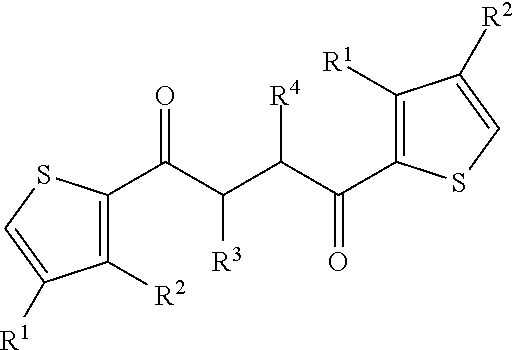
with a cyanoaniline

to obtain a second intermediate


to obtain the compound of Formula I


reacts with the optionally substituted succinyl chloride

in the presence of aluminium trichloride. In some embodiments, the optionally substituted thiophene

reacts with the succinyl chloride

in the presence of at least one organic solvent. Examples of the organic solvent include, but not limited to, dichloromethane, n-hexane, n-heptane, carbon tetrachloride, and a mixture thereof.

reacts with the cyanoaniline

in the presence of an acid catalyst. The acid catalyst can be organic acid, inorganic acid, or a mixture thereof. Examples of the acid catalyst include, but not limited to, p-toluenesulfonic acid and naphthalene sulfonic acid.

by alkaline hydrolysis. The alkaline hydrolysis can, for example, carried out in a mixture of potassium hydroxide aqueous solution and an organic solvent under reflux.
Compositions Including Dithienylpyrrole Polymers

Z, R1, R2, R3, R4, R5, R6, R7, and R8 are as defined above.

wherein Z, R1, R2, R3, R4, R5, R6, R7, and R8 are as defined above.

wherein X is a C6-C10 alkyl. Non-limiting examples of the amine compound include oleylamine, 7-tetradecenylamine, 8-hexadecenylamine, and 11-docosenylamine. In some embodiments, the at least one amine compound is oleylamine.

wherein Z, R1, R2, R3, R4, R5, R6, R7, and R8 are as defined above.

wherein Z, R1, R2, R3, R4, R5, R6, R7, and R8 are as defined above.

Claims (22)


Applications Claiming Priority (1)
| Application Number | Priority Date | Filing Date | Title |
|---|---|---|---|
| PCT/CN2012/088063 WO2014101193A1 (en) | 2012-12-31 | 2012-12-31 | Dithienylpyrrole-based biosensors and methods for their preparation and use |
Publications (2)
| Publication Number | Publication Date |
|---|---|
| US20150346134A1 US20150346134A1 (en) | 2015-12-03 |
| US9891184B2 true US9891184B2 (en) | 2018-02-13 |
Family
ID=51019794
Family Applications (1)
| Application Number | Title | Priority Date | Filing Date |
|---|---|---|---|
| US14/758,421 Expired - Fee Related US9891184B2 (en) | 2012-12-31 | 2012-12-31 | Dithienylpyrrole-based biosensors and methods for their preparation and use |
Country Status (2)
| Country | Link |
|---|---|
| US (1) | US9891184B2 (en) |
| WO (1) | WO2014101193A1 (en) |
Families Citing this family (3)
| Publication number | Priority date | Publication date | Assignee | Title |
|---|---|---|---|---|
| US20190194386A1 (en) * | 2016-09-09 | 2019-06-27 | Auckland Uniservices Limited | Conducting Polymers and Uses Thereof |
| CN111171356B (en) | 2018-10-24 | 2021-06-22 | 电子科技大学 | A kind of method for preparing composite conductive polymer |
| CN121410086A (en) * | 2025-12-01 | 2026-01-27 | 中国人民解放军总医院第六医学中心 | A highly sensitive fungal detection material, its preparation method, and its application in detection. |
Citations (4)
| Publication number | Priority date | Publication date | Assignee | Title |
|---|---|---|---|---|
| US4886625A (en) | 1987-10-29 | 1989-12-12 | Miles Inc. | Functionalized conducting polymers and their use in diagnostic devices |
| US5210217A (en) | 1987-10-29 | 1993-05-11 | Miles Inc. | Substituted bithiophenes and dithienylpyrroles |
| US20110162870A1 (en) | 2008-09-02 | 2011-07-07 | Ramot At Tel-Aviv University Ltd | Metal nanowire thin-films |
| CN102520038A (en) | 2011-12-16 | 2012-06-27 | 江南大学 | Method for preparing graphene biosensor |
-
2012
- 2012-12-31 WO PCT/CN2012/088063 patent/WO2014101193A1/en not_active Ceased
- 2012-12-31 US US14/758,421 patent/US9891184B2/en not_active Expired - Fee Related
Patent Citations (4)
| Publication number | Priority date | Publication date | Assignee | Title |
|---|---|---|---|---|
| US4886625A (en) | 1987-10-29 | 1989-12-12 | Miles Inc. | Functionalized conducting polymers and their use in diagnostic devices |
| US5210217A (en) | 1987-10-29 | 1993-05-11 | Miles Inc. | Substituted bithiophenes and dithienylpyrroles |
| US20110162870A1 (en) | 2008-09-02 | 2011-07-07 | Ramot At Tel-Aviv University Ltd | Metal nanowire thin-films |
| CN102520038A (en) | 2011-12-16 | 2012-06-27 | 江南大学 | Method for preparing graphene biosensor |
Non-Patent Citations (3)
| Title |
|---|
| Cihaner et al., Processable electrochromic and fluorescent polymers based on N-substituted thienylpyrrole. Electrochimica Acta 54:665-670 (2008). |
| International Search Report and Written Opinion dated Sep. 18, 2013 for PCT Application No. PCT/CN2012/088063 dated Dec. 31, 2012. |
| Kim et al., Synthesis, electrochemical, and spectroelectrochemical properties of conductive poly-[2,5-di-(2-thienyl)-1H-pyrrole-1-(p-benzoic acid)], Synthetic Metals 160:413-418 (2010). |
Also Published As
| Publication number | Publication date |
|---|---|
| US20150346134A1 (en) | 2015-12-03 |
| WO2014101193A1 (en) | 2014-07-03 |
Similar Documents
| Publication | Publication Date | Title |
|---|---|---|
| Qiu et al. | A label-free amperometric immunosensor based on biocompatible conductive redox chitosan-ferrocene/gold nanoparticles matrix | |
| Ma et al. | Direct electrodeposition of gold nanoparticles on indium tin oxide surface and its application | |
| Li et al. | The construction of electrochemical aptasensor based on coral-like poly-aniline and Au nano-particles for the sensitive detection of prostate specific antigen | |
| Castillo et al. | Detection of cancer cells using a peptide nanotube–folic acid modified graphene electrode | |
| CN102460139B (en) | An electrochemical method and apparatus of identifying the presence of a target | |
| Zhang et al. | Electrochemical immunosensor for interferon-γ based on disposable ITO detector and HRP-antibody-conjugated nano gold as signal tag | |
| Ensafi et al. | Aptamer@ Au-o-phenylenediamine modified pencil graphite electrode: A new selective electrochemical impedance biosensor for the determination of insulin | |
| Ma et al. | A glassy carbon electrode modified with graphene nanoplatelets, gold nanoparticles and chitosan, and coated with a molecularly imprinted polymer for highly sensitive determination of prostate specific antigen | |
| Li et al. | Gold nanoparticles modified electrode via a mercapto-diazoaminobenzene monolayer and its development in DNA electrochemical biosensor | |
| CN108344787B (en) | Preparation method of label-free portable aptamer sensor for detecting AFB1 | |
| AU2004284367A1 (en) | Method for detecting analytes by means of an analyte/polymeric activator bilayer arrangement | |
| Guo et al. | A label-free electrochemical aptasensor based on electrodeposited gold nanoparticles and methylene blue for tetracycline detection | |
| Bakshi et al. | Rapid fabrication of homogeneously distributed hyper-branched gold nanostructured electrode based electrochemical immunosensor for detection of protein biomarkers | |
| Muthusankar et al. | Chitosan based nanocomposite biosensors: A recent review | |
| Zhou et al. | Poly 3, 4-ethylenedioxythiophene and zirconia nanoparticles composite modified sensor for methyl parathion determination | |
| Xu et al. | Self-assembling gold nanoparticles on thiol-functionalized poly (styrene-co-acrylic acid) nanospheres for fabrication of a mediatorless biosensor | |
| Abdelwahab et al. | Direct electrochemistry of cholesterol oxidase immobilized on a conducting polymer: Application for a cholesterol biosensor | |
| WO2020113361A1 (en) | Functionalized black phosphorus/gold composite material and application thereof | |
| Hasanzadeh et al. | Non-enzymatic determination of L-Proline amino acid in unprocessed human plasma sample using hybrid of graphene quantum dots decorated with gold nanoparticles and poly cysteine: a novel signal amplification strategy | |
| Saputra et al. | Chitosan-based electrochemical biosensors for lung cancer detection: a mini-review | |
| Fu et al. | Novel polymeric bionanocomposites with catalytic Pt nanoparticles label immobilized for high performance amperometric immunoassay | |
| Qiu et al. | Biocompatible and label-free amperometric immunosensor for hepatitis B surface antigen using a sensing film composed of poly (allylamine)-branched ferrocene and gold nanoparticles | |
| Chen et al. | Amperometric hydrogen peroxide biosensor based on the immobilization of horseradish peroxidase on core–shell organosilica@ chitosan nanospheres and multiwall carbon nanotubes composite | |
| CN109085222B (en) | Ionic liquid functionalized graphene vibrio DNA electrochemical sensor and preparation method and application thereof | |
| US20150346134A1 (en) | Dithienylpyrrole-based biosensors and methods for their preparation and use |
Legal Events
| Date | Code | Title | Description |
|---|---|---|---|
| STCF | Information on status: patent grant |
Free format text: PATENTED CASE |
|
| CC | Certificate of correction | ||
| AS | Assignment |
Owner name: CRESTLINE DIRECT FINANCE, L.P., TEXAS Free format text: SECURITY INTEREST;ASSIGNOR:EMPIRE TECHNOLOGY DEVELOPMENT LLC;REEL/FRAME:048373/0217 Effective date: 20181228 |
|
| AS | Assignment |
Owner name: EMPIRE TECHNOLOGY DEVELOPMENT LLC, WASHINGTON Free format text: RELEASE BY SECURED PARTY;ASSIGNOR:CRESTLINE DIRECT FINANCE, L.P.;REEL/FRAME:049924/0794 Effective date: 20190501 |
|
| FEPP | Fee payment procedure |
Free format text: MAINTENANCE FEE REMINDER MAILED (ORIGINAL EVENT CODE: REM.); ENTITY STATUS OF PATENT OWNER: LARGE ENTITY |
|
| LAPS | Lapse for failure to pay maintenance fees |
Free format text: PATENT EXPIRED FOR FAILURE TO PAY MAINTENANCE FEES (ORIGINAL EVENT CODE: EXP.); ENTITY STATUS OF PATENT OWNER: LARGE ENTITY |
|
| STCH | Information on status: patent discontinuation |
Free format text: PATENT EXPIRED DUE TO NONPAYMENT OF MAINTENANCE FEES UNDER 37 CFR 1.362 |
|
| FP | Lapsed due to failure to pay maintenance fee |
Effective date: 20220213 |