US9885409B1 - Bicycle sprocket and bicycle rear sprocket assembly - Google Patents

Bicycle sprocket and bicycle rear sprocket assembly Download PDF

Info

Publication number
US9885409B1
US9885409B1 US15/263,263 US201615263263A US9885409B1 US 9885409 B1 US9885409 B1 US 9885409B1 US 201615263263 A US201615263263 A US 201615263263A US 9885409 B1 US9885409 B1 US 9885409B1
Authority
US
United States
Prior art keywords
bicycle
axial
sprocket
circumferential surface
chain
Prior art date
Legal status (The legal status is an assumption and is not a legal conclusion. Google has not performed a legal analysis and makes no representation as to the accuracy of the status listed.)
Active
Application number
US15/263,263
Inventor
Yasufumi FUKUNAGA
Current Assignee (The listed assignees may be inaccurate. Google has not performed a legal analysis and makes no representation or warranty as to the accuracy of the list.)
Shimano Inc
Original Assignee
Shimano Inc
Priority date (The priority date is an assumption and is not a legal conclusion. Google has not performed a legal analysis and makes no representation as to the accuracy of the date listed.)
Filing date
Publication date
Application filed by Shimano Inc filed Critical Shimano Inc
Priority to US15/263,263 priority Critical patent/US9885409B1/en
Assigned to SHIMANO INC. reassignment SHIMANO INC. ASSIGNMENT OF ASSIGNORS INTEREST (SEE DOCUMENT FOR DETAILS). Assignors: FUKUNAGA, YASUFUMI
Priority to TW106127706A priority patent/TWI704085B/en
Priority to DE102017007712.6A priority patent/DE102017007712A1/en
Priority to CN201710812592.0A priority patent/CN107813901B/en
Application granted granted Critical
Publication of US9885409B1 publication Critical patent/US9885409B1/en
Active legal-status Critical Current
Anticipated expiration legal-status Critical

Links

Images

Classifications

    • BPERFORMING OPERATIONS; TRANSPORTING
    • B62LAND VEHICLES FOR TRAVELLING OTHERWISE THAN ON RAILS
    • B62MRIDER PROPULSION OF WHEELED VEHICLES OR SLEDGES; POWERED PROPULSION OF SLEDGES OR SINGLE-TRACK CYCLES; TRANSMISSIONS SPECIALLY ADAPTED FOR SUCH VEHICLES
    • B62M9/00Transmissions characterised by use of an endless chain, belt, or the like
    • B62M9/04Transmissions characterised by use of an endless chain, belt, or the like of changeable ratio
    • B62M9/06Transmissions characterised by use of an endless chain, belt, or the like of changeable ratio using a single chain, belt, or the like
    • B62M9/10Transmissions characterised by use of an endless chain, belt, or the like of changeable ratio using a single chain, belt, or the like involving different-sized wheels, e.g. rear sprocket chain wheels selectively engaged by the chain, belt, or the like
    • B62M9/12Transmissions characterised by use of an endless chain, belt, or the like of changeable ratio using a single chain, belt, or the like involving different-sized wheels, e.g. rear sprocket chain wheels selectively engaged by the chain, belt, or the like the chain, belt, or the like being laterally shiftable, e.g. using a rear derailleur
    • FMECHANICAL ENGINEERING; LIGHTING; HEATING; WEAPONS; BLASTING
    • F16ENGINEERING ELEMENTS AND UNITS; GENERAL MEASURES FOR PRODUCING AND MAINTAINING EFFECTIVE FUNCTIONING OF MACHINES OR INSTALLATIONS; THERMAL INSULATION IN GENERAL
    • F16HGEARING
    • F16H55/00Elements with teeth or friction surfaces for conveying motion; Worms, pulleys or sheaves for gearing mechanisms
    • F16H55/02Toothed members; Worms
    • F16H55/30Chain-wheels
    • BPERFORMING OPERATIONS; TRANSPORTING
    • B62LAND VEHICLES FOR TRAVELLING OTHERWISE THAN ON RAILS
    • B62MRIDER PROPULSION OF WHEELED VEHICLES OR SLEDGES; POWERED PROPULSION OF SLEDGES OR SINGLE-TRACK CYCLES; TRANSMISSIONS SPECIALLY ADAPTED FOR SUCH VEHICLES
    • B62M9/00Transmissions characterised by use of an endless chain, belt, or the like
    • B62M9/04Transmissions characterised by use of an endless chain, belt, or the like of changeable ratio
    • B62M9/06Transmissions characterised by use of an endless chain, belt, or the like of changeable ratio using a single chain, belt, or the like
    • B62M9/10Transmissions characterised by use of an endless chain, belt, or the like of changeable ratio using a single chain, belt, or the like involving different-sized wheels, e.g. rear sprocket chain wheels selectively engaged by the chain, belt, or the like
    • FMECHANICAL ENGINEERING; LIGHTING; HEATING; WEAPONS; BLASTING
    • F16ENGINEERING ELEMENTS AND UNITS; GENERAL MEASURES FOR PRODUCING AND MAINTAINING EFFECTIVE FUNCTIONING OF MACHINES OR INSTALLATIONS; THERMAL INSULATION IN GENERAL
    • F16HGEARING
    • F16H57/00General details of gearing
    • F16H57/0006Vibration-damping or noise reducing means specially adapted for gearings

Definitions

  • the present invention relates to a bicycle sprocket and a bicycle rear sprocket assembly.
  • Bicycling is becoming an increasingly more popular form of recreation as well as a means of transportation. Moreover, bicycling has become a very popular competitive sport for both amateurs and professionals. Whether the bicycle is used for recreation, transportation or competition, the bicycle industry is constantly improving the various components of the bicycle.
  • One bicycle component that has been extensively redesigned is a sprocket.
  • a bicycle sprocket comprises a sprocket body and a plurality of chain-driving teeth.
  • the sprocket body includes a radially outer periphery and an axial center plane.
  • the radially outer periphery is provided about a rotational center axis of the bicycle sprocket.
  • the axial center plane is perpendicular to the rotational center axis.
  • the plurality of chain-driving teeth are provided on the radially outer periphery to engage with a bicycle chain.
  • the plurality of chain-driving teeth include at least one noise-reduction tooth.
  • the at least one noise-reduction tooth comprises a downstream circumferential surface, an upstream circumferential surface, and a first axial surface.
  • the downstream circumferential surface faces in a driving rotational direction in which the bicycle sprocket is rotated about the rotational center axis during pedaling.
  • the upstream circumferential surface faces in a reversing rotational direction opposite to the driving rotational direction.
  • the first axial surface is provided between the downstream circumferential surface and the upstream circumferential surface to face in an axial direction parallel to the rotational center axis.
  • the first axial surface includes an inclined surface inclined relative to the axial center plane so that an axial width of the at least one noise-reduction tooth decreases from one of the upstream circumferential surface and the downstream circumferential surface to the other of the upstream circumferential surface and the downstream circumferential surface.
  • the bicycle sprocket according to the first aspect it is possible to reduce noise caused by contact between the plurality of chain-driving teeth and the bicycle chain even if the bicycle chain is inclined relative to the bicycle sprocket when viewed from a radial direction perpendicular to the rotational center axis.
  • the bicycle sprocket according to the first aspect is configured so that the at least one noise reduction tooth has a chain engaging portion engageable with the bicycle chain.
  • the inclined surface is provided in the chain engaging portion.
  • the bicycle sprocket according to the first or second aspect is configured so that the at least one noise-reduction tooth comprises a second axial surface provided between the downstream circumferential surface and the upstream circumferential surface to face in the axial direction.
  • the second axial surface is opposite to the first axial surface in the axial direction.
  • the axial width of the at least one noise-reduction tooth is defined between the inclined surface of the first axial surface and the second axial surface in the axial direction.
  • the bicycle sprocket according to the third aspect further comprises a plurality of tooth bottoms respectively provided between adjacent two teeth of the plurality of chain-driving teeth in the driving rotational direction.
  • Each of the plurality of tooth bottoms includes a bottom axial width defined in the axial direction.
  • a downstream axial width is defined as the axial width at a position closest to the downstream circumferential surface in the inclined surface and is defined between the inclined surface of the first axial surface and the second axial surface in the axial direction. The downstream axial width is smaller than the bottom axial width.
  • the bicycle sprocket according to any one of the first to fifth aspects further comprises a plurality of tooth bottoms respectively provided between adjacent two teeth of the plurality of chain-driving teeth in the driving rotational direction.
  • the plurality of tooth bottoms define a root circle.
  • the at least one noise-reduction tooth comprises a radially outermost end farther from the root circle than the inclined surface when viewed from the axial direction.
  • the bicycle sprocket according to the fifth aspect is configured so that the root circle is closer to the inclined surface than the radially outermost end.
  • the bicycle sprocket according to any one of the first to sixth aspects is configured so that the inclined surface has a maximum circumferential length and a maximum radial length.
  • the maximum circumferential length is defined in the driving rotational direction.
  • the maximum radial length is defined in a radial direction perpendicular to the rotational center axis.
  • the maximum circumferential length is longer than the maximum radial length.
  • the bicycle sprocket according to any one of the first to seventh aspects is configured so that the inclined surface is continuously coupled to the downstream circumferential surface.
  • the bicycle sprocket according to any one of the first to eighth aspects is configured so that the first axial surface includes an intermediate surface provided between the inclined surface and the upstream circumferential surface.
  • the intermediate surface extends along the axial center plane to make the axial width constant between the inclined surface and the upstream circumferential surface.
  • the bicycle sprocket according to any one of the first to ninth aspects further comprises a hub engagement part coupled to the sprocket body to engage with a bicycle hub assembly.
  • the bicycle sprocket according to the tenth aspect it is possible to provide a rear sprocket that can reduce noise caused by contact between the plurality of chain-driving teeth and the bicycle chain even if the bicycle chain is inclined relative to the bicycle sprocket when viewed from the radial direction.
  • the bicycle sprocket according to any one of the first to tenth aspects is configured so that the inclined surface is inclined relative to the axial center plane so that the axial width of the at least one noise-reduction tooth decreases from the upstream circumferential surface to the downstream circumferential surface.
  • a bicycle rear sprocket assembly comprises at least three bicycle sprockets according to the eleventh aspect and at least six additional bicycle sprockets.
  • the at least three bicycle sprockets are positioned closer to an axial hub-center plane of a bicycle rear hub assembly than the at least six additional bicycle sprockets in a state where the bicycle rear sprocket assembly is mounted to the bicycle rear hub assembly.
  • the bicycle rear sprocket assembly is configured so that the at least three bicycle sprockets includes a first bicycle sprocket, a second bicycle sprocket, and a third bicycle sprocket.
  • the first bicycle sprocket has a first diameter defined by the plurality of chain-driving teeth of the first bicycle sprocket.
  • the second bicycle sprocket has a second diameter defined by the plurality of chain-driving teeth of the second bicycle sprocket.
  • the third bicycle sprocket has a third diameter defined by the plurality of chain-driving teeth of the third bicycle sprocket.
  • the first diameter is larger than the second diameter.
  • the second diameter is larger than the third diameter.
  • the bicycle rear sprocket assembly according to the thirteenth aspect is configured so that the inclined surface of the first bicycle sprocket has a first inclined angle with respect to a first axial center plane perpendicular to the rotational center axis.
  • the inclined surface of the second bicycle sprocket has a second inclined angle with respect to a second axial center plane perpendicular to the rotational center axis.
  • the inclined surface of the third bicycle sprocket has a third inclined angle with respect to a third axial center plane perpendicular to the rotational center axis.
  • the first inclined angle is larger than the second inclined angle.
  • the second inclined angle is larger than the third inclined angle.
  • a bicycle sprocket comprises a sprocket body and a plurality of chain-driving teeth.
  • the sprocket body includes a radially outer periphery, a first side surface, and a second side surface.
  • the radially outer periphery is provided about a rotational center axis of the bicycle sprocket.
  • the first side surface faces in an axial direction parallel to the rotational center axis.
  • the second side surface faces in the axial direction and is provided on a reverse side of the first side surface in the axial direction.
  • the plurality of chain-driving teeth are provided on the radially outer periphery to engage with a bicycle chain.
  • the plurality of chain-driving teeth include at least one noise-reduction tooth.
  • the at least one noise-reduction tooth comprises a downstream circumferential surface, an upstream circumferential surface, and a first axial surface.
  • the downstream circumferential surface faces in a driving rotational direction in which the bicycle sprocket is rotated about the rotational center axis during pedaling.
  • the upstream circumferential surface faces in a reversing rotational direction opposite to the driving rotational direction.
  • the first axial surface is provided between the downstream circumferential surface and the upstream circumferential surface to face in the axial direction.
  • the first side surface is closer to the first axial surface than the second side surface in the axial direction.
  • the first axial surface includes an inclined surface inclined relative to the second side surface so that an axial distance defined between the second side surface and the inclined surface in the axial direction decreases from one of the upstream circumferential surface and the downstream circumferential surface to the other of the upstream circumferential surface and the downstream circumferential surface.
  • the bicycle sprocket according to the fifteenth aspect it is possible to reduce noise caused by contact between the plurality of chain-driving teeth and the bicycle chain even if the bicycle chain is inclined relative to the bicycle sprocket when viewed from a radial direction perpendicular to the rotational center axis.
  • FIG. 1 is a perspective view of a bicycle rear sprocket assembly in accordance with a first embodiment.
  • FIG. 2 is a front elevational view of the bicycle rear sprocket assembly.
  • FIG. 3 is a side elevational view of a first sprocket of the bicycle rear sprocket assembly.
  • FIG. 4 is another side elevational view of the first sprocket.
  • FIG. 5 is a partial side elevational view of the first sprocket.
  • FIG. 6 is a cross-sectional view of the first sprocket taken along with line VI-VI of FIG. 5 .
  • FIG. 7 is a partial perspective view of the first sprocket.
  • FIG. 8 is a partial enlarged perspective view of the first sprocket.
  • FIG. 9 is another partial perspective view of the first sprocket.
  • FIG. 10 is a partial enlarged side elevational view of the first sprocket.
  • FIG. 11 is a side elevational view of a second sprocket of the bicycle rear sprocket assembly.
  • FIG. 12 is another side elevational view of the second sprocket.
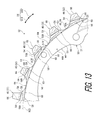
  • FIG. 13 is a partial side elevational view of the second sprocket.
  • FIG. 14 is a cross-sectional view of the second sprocket taken along with line XIV-XIV of FIG. 13 .
  • FIG. 15 is a side elevational view of a third sprocket of the bicycle rear sprocket assembly.
  • FIG. 16 is another side elevational view of the third sprocket.
  • FIG. 17 is a partial side elevational view of the third sprocket.
  • FIG. 18 is a cross-sectional view of the third sprocket taken along with line XVIII-XVIII of FIG. 17 .
  • FIG. 19 is a schematic diagram showing a positional relationship among the bicycle rear sprocket assembly, a front sprocket, and a bicycle chain.
  • FIG. 20 is a cross-sectional view of the first sprocket with an inclined surface omitted (comparative example).
  • FIG. 21 is a cross-sectional view of the first sprocket with the bicycle chain inclined relative to the first sprocket.
  • FIG. 22 is a cross-sectional view of another sprocket with the inclined surface.
  • a bicycle rear sprocket assembly 10 including a bicycle sprocket in accordance with a first embodiment is illustrated.
  • the bicycle rear sprocket assembly 10 is configured to engage with a bicycle chain C.
  • the bicycle rear sprocket assembly 10 comprises at least three bicycle sprockets and at least six additional bicycle sprockets.
  • the bicycle rear sprocket assembly 10 comprises three bicycle sprockets S 1 to S 3 and eight additional bicycle sprockets S 4 to S 11 .
  • the bicycle rear sprocket assembly 10 has a rotational center axis A 1 .
  • the bicycle rear sprocket assembly 10 is rotatable about the rotational center axis A 1 in a driving rotational direction D 11 during the pedaling.
  • the driving rotational direction D 11 is defined along a circumferential direction D 1 of the bicycle rear sprocket assembly 10 .
  • a reversing rotational direction D 12 is a reverse direction of the driving rotational direction D 11 and is defined along the circumferential direction D 1 .
  • the bicycle rear sprocket assembly 10 further comprises a hub engagement structure 12 configured to engage with a bicycle hub assembly 2 ( FIG. 2 ).
  • the bicycle hub assembly 2 can also be referred to as a bicycle rear hub assembly 2 .
  • the structures of the bicycle rear sprocket assembly 10 can be applied to a front sprocket assembly if needed and/or desired.
  • the following directional terms “front”, “rear”, “forward”, “rearward”, “left”, “right”, “transverse”, “upward” and “downward” as well as any other similar directional terms refer to those directions which are determined on the basis of a user (e.g., a rider) who sits on a saddle (not shown) of a bicycle with facing a handlebar (not shown). Accordingly, these terms, as utilized to describe the bicycle rear sprocket assembly 10 or the bicycle sprockets S 1 to S 11 , should be interpreted relative to the bicycle equipped with the bicycle rear sprocket assembly 10 or the bicycle sprockets S 1 to S 11 as used in an upright riding position on a horizontal surface.
  • the bicycle sprockets S 1 to S 11 are arranged in an axial direction D 2 parallel to the rotational center axis A 1 .
  • the bicycle sprockets S 1 to S 11 are spaced apart from each other in the axial direction D 2 .
  • the bicycle rear sprocket assembly 10 includes spacers P 1 to P 10 .
  • Each of the spacers P 1 to P 10 is arranged between adjacent two sprockets of the bicycle sprockets S 1 to S 11 .
  • a sprocket support member to which a plurality of bicycle sprockets are mounted can also be used.
  • the bicycle sprocket S 1 is closer to a bicycle center plane CP 1 of a bicycle frame (not shown) than the bicycle sprocket S 11 in a state where the bicycle rear sprocket assembly 10 is mounted to the bicycle rear hub assembly 2 .
  • upshifting occurs when the bicycle chain C is shifted by a rear derailleur RD from a larger sprocket to a neighboring smaller sprocket in an upshifting direction D 31 .
  • Downshifting occurs when the bicycle chain C is shifted by the rear derailleur RD from a small sprocket to a neighboring larger sprocket in a downshifting direction D 32 .
  • the at least three bicycle sprockets are positioned closer to an axial hub-center plane CP 2 of the bicycle rear hub assembly 2 than the at least six additional bicycle sprockets in a state where the bicycle rear sprocket assembly 10 is mounted to the bicycle rear hub assembly 2 .
  • the bicycle sprockets S 1 to S 3 are positioned closer to the axial hub-center plane CP 2 of the bicycle rear hub assembly 2 than the additional bicycle sprockets S 4 to S 11 in the state where the bicycle rear sprocket assembly 10 is mounted to the bicycle rear hub assembly 2 .
  • the axial hub-center plane CP 2 of the bicycle rear hub assembly 2 is defined at substantially the same position as the position of the bicycle center plane CP 1 of the bicycle frame (not shown).
  • the bicycle sprockets S 4 to S 11 have substantially the same structures as those of the bicycle sprockets S 1 to S 3 except for at least one noise-reduction tooth.
  • the bicycle sprockets S 1 to S 3 will be described in detail below, and other bicycle sprockets S 4 to S 11 will not be described in detail here for the sake of brevity.
  • the bicycle sprocket S 1 can also be referred to as a first bicycle sprocket S 1 .
  • the bicycle sprocket S 2 can also be referred to as a second bicycle sprocket S 2 .
  • the bicycle sprocket S 3 can also be referred to as a third bicycle sprocket S 3 .
  • the at least three bicycle sprockets include the first bicycle sprocket S 1 , the second bicycle sprocket S 2 , and the third bicycle sprocket S 3 .
  • the first bicycle sprocket S 1 is adjacent to the second bicycle sprocket S 2 in the axial direction D 2 parallel to the rotational center axis A 1 without another sprocket between the first bicycle sprocket S 1 and the second bicycle sprocket S 2 .
  • the second bicycle sprocket S 2 is adjacent to the third bicycle sprocket S 3 in the axial direction D 2 without another sprocket between the second bicycle sprocket S 2 and the third bicycle sprocket S 3 .
  • the second bicycle sprocket S 2 is provided between the first bicycle sprocket S 1 and the third bicycle sprocket S 3 in the axial direction D 2 .
  • the bicycle sprocket S 1 comprises a sprocket body 14 and a plurality of chain-driving teeth 16 .
  • the sprocket body 14 includes a radially outer periphery 18 provided about the rotational center axis A 1 of the bicycle sprocket S 1 .
  • the plurality of chain-driving teeth 16 are provided on the radially outer periphery 18 to engage with the bicycle chain C.
  • the sprocket body 14 is configured to be rotatable about the rotational center axis A 1 .
  • the sprocket body 14 has an annular shape.
  • the plurality of chain-driving teeth 16 extend radially outward from the radially outer periphery 18 of the sprocket body 14 .
  • the first bicycle sprocket S 1 has a first diameter L 1 defined by the plurality of chain-driving teeth 16 of the first bicycle sprocket S 1 .
  • the first diameter L 1 is defined as a maximum outer diameter of the first bicycle sprocket S 1 .
  • a total number of the plurality of chain-driving teeth 16 is twenty-eight. However, the total number of the plurality of chain-driving teeth 16 is not limited to this embodiment.
  • the bicycle sprocket S 1 further comprises a hub engagement part 20 coupled to the sprocket body 14 to engage with the bicycle hub assembly 2 .
  • the hub engagement part 20 includes securing portions 21 extending radially inward from an inner periphery of the sprocket body 14 .
  • the securing portions 21 are spaced apart from each other in the circumferential direction D 1 .
  • the first bicycle sprocket S 1 is secured to a sprocket support member (not shown) via the securing portions 21 .
  • the plurality of chain-driving teeth 16 include at least one noise-reduction tooth 22 .
  • the plurality of chain-driving teeth 16 include a plurality of noise-reduction teeth 22 .
  • a total number of the noise-reduction teeth 22 is not limited to this embodiment.
  • the at least one noise-reduction tooth 22 comprises a downstream circumferential surface 24 and an upstream circumferential surface 26 .
  • the downstream circumferential surface 24 faces in the driving rotational direction D 11 in which the bicycle sprocket S 1 is rotated about the rotational center axis A 1 during pedaling.
  • the upstream circumferential surface 26 faces in the reversing rotational direction D 12 opposite to the driving rotational direction D 11 .
  • the downstream circumferential surface 24 is provided on a reverse side of the upstream circumferential surface 26 in the circumferential direction D 1 .
  • the upstream circumferential surface 26 is contactable with a roller C 2 ( FIG. 6 ) of the bicycle chain C during pedaling to receive a pedaling force from the bicycle chain C.
  • the at least one noise-reduction tooth 22 comprises a first axial surface 28 provided between the downstream circumferential surface 24 and the upstream circumferential surface 26 to face in the axial direction D 2 parallel to the rotational center axis A 1 .
  • the sprocket body 14 includes an axial center plane AP 1 perpendicular to the rotational center axis A 1 .
  • the axial center plane AP 1 can also be referred to as a first axial center plane AP 1 .
  • the sprocket body 14 includes a first side surface 14 A and a second side surface 14 B.
  • the first side surface 14 A faces in the axial direction D 2 parallel to the rotational center axis A 1 .
  • the second side surface 14 B faces in the axial direction D 2 and provided on a reverse side of the first side surface 14 A in the axial direction D 2 .
  • the first side surface 14 A is closer to the first axial surface 28 than the second side surface 14 B in the axial direction D 2 .
  • the first side surface 14 A and the first axial surface 28 face in a first axial direction D 21 defined along the axial direction D 2 .
  • the second side surface 14 B faces in a second axial direction D 22 defined along the axial direction D 2 .
  • the second axial direction D 22 is a reverse direction of the first axial direction D 21 .
  • the axial center plane AP 1 is defined at an axial center between the first side surface 14 A and the second side surface 14 B in the axial direction D 2 .
  • the first axial surface 28 faces toward the axial hub-center plane CP 2 of the bicycle hub assembly 2 in the axial direction D 2 in the state where the bicycle sprocket S 1 is mounted to the bicycle hub assembly 2 ( FIG. 2 ).
  • the first axial surface 28 can be disposed to face toward an opposite side of the bicycle center plane CP 1 relative to the bicycle sprocket S 1 in the axial direction D 2 in the state where the bicycle sprocket S 1 is mounted to the bicycle hub assembly 2 ( FIG. 2 ).
  • the first axial surface 28 includes an inclined surface 28 A.
  • the inclined surface 28 A has a curved shape.
  • the inclined surface 28 A has a concave shape.
  • the inclined surface 28 A has a concave curved shape.
  • the shape of the inclined surface 28 A is not limited to this embodiment.
  • the inclined surface 28 A can have another shape such as a flat shape or a convex curved shape.
  • the inclined surface 28 A is inclined relative to the axial center plane AP 1 so that an axial width W 1 of the at least one noise-reduction tooth 22 decreases from one of the upstream circumferential surface 26 and the downstream circumferential surface 24 to the other of the upstream circumferential surface 26 and the downstream circumferential surface 24 .
  • the inclined surface 28 A is inclined relative to the axial center plane AP 1 so that the axial width W 1 gradually decreases from one of the upstream circumferential surface 26 and the downstream circumferential surface 24 to the other of the upstream circumferential surface 26 and the downstream circumferential surface 24 .
  • the inclined surface 28 A is engageable with an inner link plate C 1 and an outer link plate (not shown) of the bicycle chain C.
  • the inclined surface 28 A is inclined relative to the axial center plane AP 1 so that the axial width W 1 of the at least one noise-reduction tooth 22 decreases from the upstream circumferential surface 26 to the downstream circumferential surface 24 .
  • the inclined surface 28 A is inclined relative to the axial center plane AP 1 so that the axial width W 1 gradually decreases from the upstream circumferential surface 26 to the downstream circumferential surface 24 .
  • the inclined surface 28 A can be inclined relative to the axial center plane AP 1 so that the axial width W 1 decreases from the downstream circumferential surface 24 to the upstream circumferential surface 26 .
  • the inclined surface 28 A is continuously coupled to the downstream circumferential surface 24 .
  • the first axial surface 28 includes an intermediate surface 29 provided between the inclined surface 28 A and the upstream circumferential surface 26 .
  • the inclined surface 28 A is separately provided from the upstream circumferential surface 26 .
  • the inclined surface 28 A can be separately provided from the downstream circumferential surface 24 .
  • the inclined surface 28 A can be continuously coupled to the upstream circumferential surface 26 .
  • the intermediate surface 29 extends along the axial center plane AP 1 to make the axial width W 1 constant between the inclined surface 28 A and the upstream circumferential surface 26 .
  • the intermediate surface 29 faces in the first axial direction D 21 and is parallel to the axial center plane AP 1 .
  • the intermediate surface 29 can extend along the axial center plane AP 1 to make the axial width W 1 substantially constant between the inclined surface 28 A and the upstream circumferential surface 26 .
  • the inclined surface 28 A is continuously coupled to the intermediate surface 29 .
  • the intermediate surface 29 is continuously coupled to the upstream circumferential surface 26 .
  • the intermediate surface 29 is provided at an axial position equal to an axial position of the first side surface 14 A of the sprocket body 14 in the first axial direction D 21 . As seen in FIG. 7 , the intermediate surface 29 is continuously coupled to the first side surface 14 A of the sprocket body 14 .
  • the at least one noise-reduction tooth 22 comprises a second axial surface 30 provided between the downstream circumferential surface 24 and the upstream circumferential surface 26 to face in the axial direction D 2 .
  • the second axial surface 30 faces in the second axial direction D 22 .
  • the second axial surface 30 is opposite to the first axial surface 28 in the axial direction D 2 .
  • the second axial surface 30 is provided on a reverse side of the first axial surface 28 in the axial direction D 2 .
  • the axial width W 1 of the at least one noise-reduction tooth 22 is defined between the inclined surface 28 A of the first axial surface 28 and the second axial surface 30 in the axial direction D 2 .
  • a downstream axial width W 11 is defined as the axial width W 1 at a position closest to the downstream circumferential surface 24 in the inclined surface 28 A.
  • the downstream axial width W 11 is defined between the inclined surface 28 A of the first axial surface 28 and the second axial surface 30 in the axial direction D 2 .
  • the downstream axial width W 11 is defined as the axial width W 1 on the downstream circumferential surface 24 since the inclined surface 28 A is continuously coupled to the downstream circumferential surface 24 .
  • the downstream axial width W 11 can be defined as the axial width W 1 at a position other than the downstream circumferential surface 24 .
  • An upstream axial width W 12 is defined as the axial width W 1 at a position closest to the upstream circumferential surface 26 in the inclined surface 28 A.
  • the upstream axial width W 12 is defined between the inclined surface 28 A of the first axial surface 28 and the second axial surface 30 in the axial direction D 2 .
  • the upstream axial width W 12 can be defined as the axial width W 1 on the upstream circumferential surface 26 in a case where the inclined surface 28 A is continuously coupled to the upstream circumferential surface 26 .
  • the inclined surface 28 A includes a downstream edge 28 A 1 and an upstream edge 28 A 2 .
  • the downstream axial width W 11 is defined between the downstream edge 28 A 1 and the second axial surface 30 in the axial direction D 2 .
  • the upstream axial width W 12 is defined between the upstream edge 28 A 2 and the second axial surface 30 in the axial direction D 2 .
  • the downstream edge 28 A 1 is closer to the axial center plane AP 1 than the upstream edge 28 A 2 .
  • the second side surface 14 B can be a standard for the inclination of the inclined surface 28 A.
  • the inclined surface 28 A is inclined relative to the second side surface 14 B so that an axial distance AD 1 defined between the second side surface 14 B and the inclined surface 28 A in the axial direction D 2 decreases from one of the upstream circumferential surface 26 and the downstream circumferential surface 24 to the other of the upstream circumferential surface 26 and the downstream circumferential surface 24 .
  • the inclined surface 28 A is inclined relative to the second side surface 14 B so that an axial distance AD 1 gradually decreases from one of the upstream circumferential surface 26 and the downstream circumferential surface 24 to the other of the upstream circumferential surface 26 and the downstream circumferential surface 24 .
  • the inclined surface 28 A is inclined relative to the second side surface 14 B so that the axial distance AD 1 (e.g., gradually) decreases from the upstream circumferential surface 26 to the downstream circumferential surface 24 .
  • the inclined surface 28 A can be inclined relative to the second side surface 14 B so that the axial distance AD 1 (e.g., gradually) decreases from the downstream circumferential surface 24 to the upstream circumferential surface 26 .
  • a downstream axial distance AD 11 is defined as the axial distance AD 1 at a position closest to the downstream circumferential surface 24 in the inclined surface 28 A.
  • the downstream axial distance AD 11 is defined between the second side surface 14 B and the inclined surface 28 A in the axial direction D 2 .
  • the downstream axial distance AD 11 is defined as the axial distance AD 1 on the downstream circumferential surface 24 since the inclined surface 28 A is continuously coupled to the downstream circumferential surface 24 .
  • the downstream axial distance AD 11 can be defined as the axial distance AD 1 at a position other than the downstream circumferential surface 24 .
  • An upstream axial distance AD 12 is defined as the axial distance AD 1 at a position closest to the upstream circumferential surface 26 in the inclined surface 28 A.
  • the upstream axial distance AD 12 is defined between the second side surface 14 B and the inclined surface 28 A in the axial direction D 2 .
  • the upstream axial distance AD 12 can be defined as the axial distance AD 1 on the upstream circumferential surface 26 in a case where the inclined surface 28 A is continuously coupled to the upstream circumferential surface 26 .
  • downstream axial distance AD 11 is defined between the downstream edge 28 A 1 and the second side surface 14 B in the axial direction D 2 .
  • the upstream axial distance AD 12 is defined between the upstream edge 28 A 2 and the second side surface 14 B in the axial direction D 2 .
  • the axial center plane AP 1 can be a standard for the inclination of the inclined surface 28 A.
  • the inclined surface 28 A is inclined relative to the axial center plane AP 1 so that an axial distance AD 1 A defined between the axial center plane AP 1 and the inclined surface 28 A in the axial direction D 2 (e.g., gradually) decreases from one of the upstream circumferential surface 26 and the downstream circumferential surface 24 to the other of the upstream circumferential surface 26 and the downstream circumferential surface 24 .
  • the inclined surface 28 A is inclined relative to the axial center plane AP 1 so that the axial distance AD 1 A (e.g., gradually) decreases from the upstream circumferential surface 26 to the downstream circumferential surface 24 .
  • the inclined surface 28 A can be inclined relative to the axial center plane AP 1 so that the axial distance AD 1 A decreases from the downstream circumferential surface 24 to the upstream circumferential surface 26 .
  • a downstream axial distance AD 11 A is defined as the axial distance AD 1 A at a position closest to the downstream circumferential surface 24 in the inclined surface 28 A.
  • the downstream axial distance AD 11 A is defined between the inclined surface 28 A of the first axial surface 28 and the axial center plane AP 1 in the axial direction D 2 .
  • the downstream axial distance AD 11 A is defined as the axial distance AD 1 A on the downstream circumferential surface 24 since the inclined surface 28 A is continuously coupled to the downstream circumferential surface 24 .
  • the downstream axial distance AD 11 A can be defined as the axial distance AD 1 A at a position other than the downstream circumferential surface 24 .
  • An upstream axial distance AD 12 A is defined as the axial distance AD 1 A at a position closest to the upstream circumferential surface 26 in the inclined surface 28 A.
  • the upstream axial distance AD 12 A is defined between the inclined surface 28 A of the first axial surface 28 and the axial center plane AP 1 in the axial direction D 2 .
  • the upstream axial distance AD 12 A can be defined as the axial distance AD 1 A on the upstream circumferential surface 26 in a case where the inclined surface 28 A is continuously coupled to the upstream circumferential surface 26 .
  • downstream axial distance AD 11 A is defined between the downstream edge 28 A 1 and the axial center plane AP 1 in the axial direction D 2 .
  • the upstream axial distance AD 12 A is defined between the upstream edge 28 A 2 and the axial center plane AP 1 in the axial direction D 2 .
  • the inclined surface 28 A of the first bicycle sprocket S 1 has a first inclined angle AG 1 with respect to a first axial center plane AP 1 perpendicular to the rotational center axis A 1 .
  • the first inclined angle AG 1 is a smaller inclined angle defined between the first axial center plane AP 1 and the inclined surface 28 A.
  • the first inclined angle AG 1 is defined between the first axial center plane AP 1 and a first inclined reference line RL 1 extending between the downstream edge 28 A 1 and the upstream edge 28 A 2 .
  • the bicycle sprocket S 1 further comprises a plurality of tooth bottoms 34 respectively provided between adjacent two teeth of the plurality of chain-driving teeth 16 in the driving rotational direction D 11 .
  • the plurality of tooth bottoms 34 define a root circle RC 1 .
  • the root circle RC 1 coincides with the radially outer periphery 18 of the sprocket body 14 .
  • each of the plurality of tooth bottoms 34 includes a bottom axial width W 13 defined in the axial direction D 2 .
  • the downstream axial width W 11 is smaller than the bottom axial width W 13 .
  • the upstream axial width W 12 is equal to the bottom axial width W 13 .
  • the downstream axial width W 11 can be equal to the bottom axial width W 13
  • the upstream axial width W 12 can be smaller than the bottom axial width W 13 .
  • the bottom axial width W 13 is defined between the first side surface 14 A and the second side surface 14 B in the axial direction D 2 .
  • the at least one noise-reduction tooth 22 comprises a radially outermost end 36 farther from the root circle RC 1 than the inclined surface 28 A when viewed from the axial direction D 2 .
  • the root circle RC 1 is closer to the inclined surface 28 A than the radially outermost end 36 .
  • the radially outermost end 36 is radially farthest from the root circle RC 1 in the noise-reduction tooth 22 .
  • the positional relationship among the root circle RC 1 , the radially outermost end 36 , and the inclined surface 28 A is not limited to this embodiment.
  • the at least one noise-reduction tooth 22 has a chain engaging portion 38 engageable with the bicycle chain C.
  • the inclined surface 28 A is provided in the chain engaging portion 38 .
  • the chain engaging portion 38 is engageable with the inner link plate C 1 of the bicycle chain C.
  • the chain engaging portion 38 is provided on the first axial surface 28 .
  • the chain engaging portion 38 includes the intermediate surface 29 engageable with the inner link plate C 1 of the bicycle chain C.
  • the inclined surface 28 A has a maximum circumferential length ML 1 and a maximum radial length ML 2 .
  • the maximum circumferential length ML 1 is defined in the driving rotational direction D 11 .
  • the maximum radial length ML 2 is defined in a radial direction perpendicular to the rotational center axis A 1 .
  • the maximum circumferential length ML 1 is longer than the maximum radial length ML 2 .
  • the maximum circumferential length ML 1 can be equal to or shorter than the maximum radial length ML 2 .
  • the bicycle sprocket S 2 comprises a sprocket body 44 and a plurality of chain-driving teeth 46 .
  • the sprocket body 44 includes a radially outer periphery 48 , a first side surface 44 A, and a second side surface 44 B.
  • the bicycle sprocket S 2 further comprises a hub engagement part 50 .
  • the hub engagement part 50 includes securing portions 51 .
  • the second bicycle sprocket S 2 has a second diameter L 2 defined by the plurality of chain-driving teeth 46 of the second bicycle sprocket S 2 .
  • the first diameter L 1 is larger than the second diameter L 2 .
  • the plurality of chain-driving teeth 46 includes at least one noise-reduction tooth 52 .
  • the at least one noise-reduction tooth 52 comprises a downstream circumferential surface 54 , an upstream circumferential surface 56 , and a first axial surface 58 .
  • the at least one noise-reduction tooth 52 further comprises a second axial surface 60 ( FIG. 14 ) and a plurality of tooth bottoms 64 .
  • the plurality of tooth bottoms 64 define a root circle RC 2 .
  • the at least one noise-reduction tooth 52 comprises a radially outer end 66 .
  • the sprocket body 44 includes an axial center plane AP 2 .
  • the axial center plane AP 2 can also be referred to as a second axial center plane AP 2 .
  • the first axial surface 58 includes an inclined surface 58 A inclined relative to the axial center plane AP 2 so that an axial width W 2 of the at least one noise-reduction tooth 52 decreases from one of the upstream circumferential surface 56 and the downstream circumferential surface 54 to the other of the upstream circumferential surface 56 and the downstream circumferential surface 54 .
  • the bicycle sprocket S 2 has substantially the same structure as that of the bicycle sprocket S 1 .
  • the elements 44 , 44 A, 44 B, 46 , 48 , 50 , 51 , 52 , 54 , 56 , 58 , 58 A, 60 , 64 , 66 , RC 2 , and AP 2 have substantially the same structure as those of the elements 14 , 14 A, 14 B, 16 , 18 , 20 , 21 , 22 , 24 , 26 , 28 , 28 A, 30 , 34 , 36 , RC 1 , and AP 1 of the bicycle sprocket S 1 .
  • they will not be described in detail here for the sake of brevity.
  • the noise-reduction tooth 52 has a downstream axial width W 21 , an upstream axial width W 22 , a bottom axial width W 23 , an axial distance AD 2 (AD 2 A), a downstream axial distance AD 21 (AD 21 A), an upstream axial distance AD 22 (AD 22 A), a downstream edge 58 A 1 , an upstream edge 58 A 2 , intermediate surface 59 , and a chain engaging portion 68 .
  • the elements W 21 , W 22 , W 23 , AD 2 , AD 21 , AD 22 , AD 2 A, AD 21 A, AD 22 A, 58 A 1 , 58 A 2 , 59 , and 68 have substantially the same structure as those of the elements W 11 , W 12 , W 13 , AD 1 , AD 11 , AD 12 , AD 1 A, AD 11 A, AD 12 A, 28 A 1 , 28 A 2 , 29 , and 38 of the noise-reduction tooth 22 . Thus, they will not be described in detail here for the sake of brevity.
  • the inclined surface 58 A of the second bicycle sprocket S 2 has a second inclined angle AG 2 with respect to the second axial center plane AP 2 perpendicular to the rotational center axis A 1 .
  • the second inclined angle AG 2 is a smaller inclined angle defined between the second axial center plane AP 2 and the inclined surface 58 A.
  • the second inclined angle AG 2 is defined between the second axial center plane AP 2 and a second inclined reference line RL 2 extending between the downstream edge 58 A 1 and the upstream edge 58 A 2 .
  • the bicycle sprocket S 3 comprises a sprocket body 74 and a plurality of chain-driving teeth 76 .
  • the sprocket body 74 includes a radially outer periphery 78 , a first side surface 74 A, and a second side surface 74 B.
  • the bicycle sprocket S 3 further comprises a hub engagement part 80 .
  • the hub engagement part 80 includes securing portions 81 .
  • the third bicycle sprocket S 3 has a third diameter L 3 defined by the plurality of chain-driving teeth 76 of the third bicycle sprocket. As seen in FIG. 2 , the second diameter L 2 is larger than the third diameter L 3 .
  • the plurality of chain-driving teeth 76 includes at least one noise-reduction tooth 82 .
  • the at least one noise-reduction tooth 82 comprises a downstream circumferential surface 84 , an upstream circumferential surface 86 , and a first axial surface 88 .
  • the at least one noise-reduction tooth 82 further comprises a second axial surface 90 ( FIG. 18 ) and a plurality of tooth bottoms 94 .
  • the plurality of tooth bottoms 94 define a root circle RC 3 .
  • the at least one noise-reduction tooth 82 comprises a radially outer end 96 .
  • the sprocket body 74 includes an axial center plane AP 3 .
  • the axial center plane AP 3 can also be referred to as a third axial center plane AP 3 .
  • the first axial surface 88 includes an inclined surface 88 A inclined relative to the axial center plane AP 3 so that an axial width W 3 of the at least one noise-reduction tooth 82 decreases from one of the upstream circumferential surface 86 and the downstream circumferential surface 84 to the other of the upstream circumferential surface 86 and the downstream circumferential surface 84 .
  • the bicycle sprocket S 3 has substantially the same structure as that of the bicycle sprocket S 1 .
  • the elements 74 , 74 A, 74 B, 76 , 78 , 80 , 81 , 82 , 84 , 86 , 88 , 88 A, 90 , 94 , 96 , RC 3 , and AP 3 have substantially the same structure as those of the elements 14 , 14 A, 14 B, 16 , 18 , 20 , 21 , 22 , 24 , 26 , 28 , 28 A, 30 , 34 , 36 , RC 1 , and AP 1 of the bicycle sprocket S 1 .
  • they will not be described in detail here for the sake of brevity.
  • the noise-reduction tooth 82 has a downstream axial width W 31 , an upstream axial width W 32 , a bottom axial width W 33 , an axial distance AD 3 (AD 3 A), a downstream axial distance AD 31 (AD 31 A), an upstream axial distance AD 32 (AD 32 A), a downstream edge 88 A 1 , an upstream edge 88 A 2 , intermediate surface 89 , a radially outer end 96 , and a chain engaging portion 98 .
  • the elements W 31 , W 32 , W 33 , AD 3 , AD 31 , AD 32 , AD 3 A, AD 31 A, AD 32 A, 88 A 1 , 88 A 2 , 89 , and 98 have substantially the same structure as those of the elements W 11 , W 12 , W 13 , AD 1 , AD 11 , AD 12 , AD 1 A, AD 11 A, AD 12 A, 28 A 1 , 28 A 2 , 29 , and 38 of the noise-reduction tooth 22 . Thus, they will not be described in detail here for the sake of brevity.
  • the inclined surface 88 A of the third bicycle sprocket S 3 has a third inclined angle AG 3 with respect to the third axial center plane AP 3 perpendicular to the rotational center axis A 1 .
  • the third inclined angle AG 3 is a smaller inclined angle defined between the third axial center plane AP 3 and the inclined surface 88 A.
  • the third inclined angle AG 3 is defined between the third axial center plane AP 3 and a third inclined reference line RL 3 extending between the downstream edge 88 A 1 and the upstream edge 88 A 2 .
  • the first inclined angle AG 1 is larger than the second inclined angle AG 2 .
  • the second inclined angle AG 2 is larger than the third inclined angle AG 3 .
  • the first inclined angle AG 1 can be equal to or smaller than the second inclined angle AG 2 .
  • the second inclined angle AG 2 can be equal to or smaller than the third inclined angle AG 3 .
  • the bicycle chain C extends between a front sprocket FS and the bicycle rear sprocket assembly 10 in a state where the bicycle chain C is engaged with the front sprocket FS and the bicycle rear sprocket assembly 10 .
  • the bicycle sprocket S 1 is offset from the front sprocket FS in the axial direction D 2 .
  • the bicycle chain C is inclined relative to the bicycle sprocket S 1 when viewed from a radial direction perpendicular to the rotational center axis A 1 in a state where the bicycle chain C is engaged with the bicycle sprocket S 1 .
  • the inclination of the bicycle chain C relative to the bicycle sprocket S 1 increases noise when the chain-driving tooth 16 comes into engagement with and/or is disengaged from the inner link plates C 1 of the bicycle chain C.
  • the inclined surface 28 A of the first axial surface 28 can follow the inclination of the bicycle chain C. This can smoothen engagement and/or disengagement between the noise-reduction tooth 22 and the inner link plates C 1 of the bicycle chain C even if the bicycle chain C is inclined relative to the bicycle sprocket S 1 . Accordingly, with the bicycle sprocket S 1 , it is possible to reduce noise caused by contact between the plurality of chain-driving teeth 16 and the bicycle chain C even if the bicycle chain C is inclined relative to the bicycle sprocket S 1 when viewed from the radial direction perpendicular to the rotational center axis A 1 . With the bicycle sprockets S 2 and S 3 , it is possible to obtain substantially the same effect as that of the bicycle sprocket S 1 .
  • the structure of the bicycle sprockets S 1 to S 3 can be applied to the front sprocket FS instead of or in addition to the bicycle rear sprocket assembly 10 . Furthermore, the structure of the bicycle sprockets S 1 to S 3 can be applied to at least one of the bicycle sprockets S 4 to S 11 . As seen in FIG. 22 , in a case where the bicycle sprocket S 11 comprises the noise-reduction tooth 22 , the first axial surface 28 faces toward an opposite side of the bicycle center plane CP 1 relative to the bicycle sprocket S 11 .
  • first and second recited in the present application are merely identifiers, but do not have any other meanings, for example, a particular order and the like. Moreover, for example, the term “first element” itself does not imply an existence of “second element”, and the term “second element” itself does not imply an existence of “first element.”
  • pair of can encompass the configuration in which the pair of elements have different shapes or structures from each other in addition to the configuration in which the pair of elements have the same shapes or structures as each other.

Landscapes

  • Engineering & Computer Science (AREA)
  • General Engineering & Computer Science (AREA)
  • Mechanical Engineering (AREA)
  • Chemical & Material Sciences (AREA)
  • Combustion & Propulsion (AREA)
  • Transportation (AREA)
  • Gears, Cams (AREA)
  • Devices For Conveying Motion By Means Of Endless Flexible Members (AREA)

Abstract

A bicycle sprocket comprises a sprocket body and a plurality of chain-driving teeth. The sprocket body includes a radially outer periphery and an axial center plane. The plurality of chain-driving teeth include at least one noise-reduction tooth. The at least one noise-reduction tooth comprises a downstream circumferential surface, an upstream circumferential surface, and a first axial surface. The first axial surface is provided between the downstream circumferential surface and the upstream circumferential surface to face in an axial direction parallel to a rotational center axis. The first axial surface includes an inclined surface inclined relative to an axial center plane so that an axial width of the at least one noise-reduction tooth decreases from one of the upstream circumferential surface and the downstream circumferential surface to the other of the upstream circumferential surface and the downstream circumferential surface.

Description

BACKGROUND OF THE INVENTION Field of the Invention
The present invention relates to a bicycle sprocket and a bicycle rear sprocket assembly.
Discussion of the Background
Bicycling is becoming an increasingly more popular form of recreation as well as a means of transportation. Moreover, bicycling has become a very popular competitive sport for both amateurs and professionals. Whether the bicycle is used for recreation, transportation or competition, the bicycle industry is constantly improving the various components of the bicycle. One bicycle component that has been extensively redesigned is a sprocket.
SUMMARY OF THE INVENTION
In accordance with a first aspect of the present invention, a bicycle sprocket comprises a sprocket body and a plurality of chain-driving teeth. The sprocket body includes a radially outer periphery and an axial center plane. The radially outer periphery is provided about a rotational center axis of the bicycle sprocket. The axial center plane is perpendicular to the rotational center axis. The plurality of chain-driving teeth are provided on the radially outer periphery to engage with a bicycle chain. The plurality of chain-driving teeth include at least one noise-reduction tooth. The at least one noise-reduction tooth comprises a downstream circumferential surface, an upstream circumferential surface, and a first axial surface. The downstream circumferential surface faces in a driving rotational direction in which the bicycle sprocket is rotated about the rotational center axis during pedaling. The upstream circumferential surface faces in a reversing rotational direction opposite to the driving rotational direction. The first axial surface is provided between the downstream circumferential surface and the upstream circumferential surface to face in an axial direction parallel to the rotational center axis. The first axial surface includes an inclined surface inclined relative to the axial center plane so that an axial width of the at least one noise-reduction tooth decreases from one of the upstream circumferential surface and the downstream circumferential surface to the other of the upstream circumferential surface and the downstream circumferential surface.
With the bicycle sprocket according to the first aspect, it is possible to reduce noise caused by contact between the plurality of chain-driving teeth and the bicycle chain even if the bicycle chain is inclined relative to the bicycle sprocket when viewed from a radial direction perpendicular to the rotational center axis.
In accordance with a second aspect of the present invention, the bicycle sprocket according to the first aspect is configured so that the at least one noise reduction tooth has a chain engaging portion engageable with the bicycle chain. The inclined surface is provided in the chain engaging portion.
With the bicycle sprocket according to the second aspect, it is possible to effectively reduce noise caused by contact between the plurality of chain-driving teeth and the bicycle chain even if the bicycle chain is inclined relative to the bicycle sprocket when viewed from the radial direction.
In accordance with a third aspect of the present invention, the bicycle sprocket according to the first or second aspect is configured so that the at least one noise-reduction tooth comprises a second axial surface provided between the downstream circumferential surface and the upstream circumferential surface to face in the axial direction. The second axial surface is opposite to the first axial surface in the axial direction. The axial width of the at least one noise-reduction tooth is defined between the inclined surface of the first axial surface and the second axial surface in the axial direction.
With the bicycle sprocket according to the third aspect, it is possible to reduce noise caused by contact between the plurality of chain-driving teeth and the bicycle chain even if the bicycle chain is inclined relative to the bicycle sprocket when viewed from the radial direction.
In accordance with a fourth aspect of the present invention, the bicycle sprocket according to the third aspect further comprises a plurality of tooth bottoms respectively provided between adjacent two teeth of the plurality of chain-driving teeth in the driving rotational direction. Each of the plurality of tooth bottoms includes a bottom axial width defined in the axial direction. A downstream axial width is defined as the axial width at a position closest to the downstream circumferential surface in the inclined surface and is defined between the inclined surface of the first axial surface and the second axial surface in the axial direction. The downstream axial width is smaller than the bottom axial width.
With the bicycle sprocket according to the fourth aspect, it is possible to effectively reduce noise caused by contact between the plurality of chain-driving teeth and the bicycle chain even if the bicycle chain is inclined relative to the bicycle sprocket when viewed from the radial direction.
In accordance with a fifth aspect of the present invention, the bicycle sprocket according to any one of the first to fifth aspects further comprises a plurality of tooth bottoms respectively provided between adjacent two teeth of the plurality of chain-driving teeth in the driving rotational direction. The plurality of tooth bottoms define a root circle. The at least one noise-reduction tooth comprises a radially outermost end farther from the root circle than the inclined surface when viewed from the axial direction.
With the bicycle sprocket according to the fifth aspect, it is possible to reduce noise caused by contact between the plurality of chain-driving teeth and the bicycle chain with maintaining strength of the bicycle sprocket.
In accordance with a sixth aspect of the present invention, the bicycle sprocket according to the fifth aspect is configured so that the root circle is closer to the inclined surface than the radially outermost end.
With the bicycle sprocket according to the sixth aspect, it is possible to reduce noise caused by contact between the plurality of chain-driving teeth and the bicycle chain with maintaining strength of the bicycle sprocket.
In accordance with a seventh aspect of the present invention, the bicycle sprocket according to any one of the first to sixth aspects is configured so that the inclined surface has a maximum circumferential length and a maximum radial length. The maximum circumferential length is defined in the driving rotational direction. The maximum radial length is defined in a radial direction perpendicular to the rotational center axis. The maximum circumferential length is longer than the maximum radial length.
With the bicycle sprocket according to the seventh aspect, it is possible to reduce noise caused by contact between the plurality of chain-driving teeth and the bicycle chain with maintaining chain-holding performance of the bicycle sprocket.
In accordance with an eighth aspect of the present invention, the bicycle sprocket according to any one of the first to seventh aspects is configured so that the inclined surface is continuously coupled to the downstream circumferential surface.
With the bicycle sprocket according to the eighth aspect, it is possible to effectively reduce noise caused by contact between the plurality of chain-driving teeth and the bicycle chain even if the bicycle chain is inclined relative to the bicycle sprocket when viewed from the radial direction.
In accordance with a ninth aspect of the present invention, the bicycle sprocket according to any one of the first to eighth aspects is configured so that the first axial surface includes an intermediate surface provided between the inclined surface and the upstream circumferential surface. The intermediate surface extends along the axial center plane to make the axial width constant between the inclined surface and the upstream circumferential surface.
With the bicycle sprocket according to the ninth aspect, it is possible to reduce noise caused by contact between the plurality of chain-driving teeth and the bicycle chain with maintaining chain-holding performance of the bicycle sprocket.
In accordance with a tenth aspect of the present invention, the bicycle sprocket according to any one of the first to ninth aspects further comprises a hub engagement part coupled to the sprocket body to engage with a bicycle hub assembly.
With the bicycle sprocket according to the tenth aspect, it is possible to provide a rear sprocket that can reduce noise caused by contact between the plurality of chain-driving teeth and the bicycle chain even if the bicycle chain is inclined relative to the bicycle sprocket when viewed from the radial direction.
In accordance with an eleventh aspect of the present invention, the bicycle sprocket according to any one of the first to tenth aspects is configured so that the inclined surface is inclined relative to the axial center plane so that the axial width of the at least one noise-reduction tooth decreases from the upstream circumferential surface to the downstream circumferential surface.
With the bicycle sprocket according to the eleventh aspect, it is possible to effectively reduce noise caused by contact between the plurality of chain-driving teeth and the bicycle chain even if the bicycle chain is inclined relative to the bicycle sprocket when viewed from the radial direction.
In accordance with a twelfth aspect of the present invention, a bicycle rear sprocket assembly comprises at least three bicycle sprockets according to the eleventh aspect and at least six additional bicycle sprockets. The at least three bicycle sprockets are positioned closer to an axial hub-center plane of a bicycle rear hub assembly than the at least six additional bicycle sprockets in a state where the bicycle rear sprocket assembly is mounted to the bicycle rear hub assembly.
With the bicycle rear sprocket assembly according to the twelfth aspect, it is possible to provide a rear sprocket assembly that can reduce noise caused by contact between the plurality of chain-driving teeth and the bicycle chain even if the bicycle chain is inclined relative to the bicycle sprocket when viewed from the radial direction.
In accordance with a thirteenth aspect of the present invention, the bicycle rear sprocket assembly according to the twelfth aspect is configured so that the at least three bicycle sprockets includes a first bicycle sprocket, a second bicycle sprocket, and a third bicycle sprocket. The first bicycle sprocket has a first diameter defined by the plurality of chain-driving teeth of the first bicycle sprocket. The second bicycle sprocket has a second diameter defined by the plurality of chain-driving teeth of the second bicycle sprocket. The third bicycle sprocket has a third diameter defined by the plurality of chain-driving teeth of the third bicycle sprocket. The first diameter is larger than the second diameter. The second diameter is larger than the third diameter.
With the bicycle rear sprocket assembly according to the thirteenth aspect, it is possible to provide a rear sprocket assembly that can reduce noise caused by contact between the plurality of chain-driving teeth and the bicycle chain even if the bicycle chain is inclined relative to the bicycle sprocket when viewed from the radial direction.
In accordance with a fourteenth aspect of the present invention, the bicycle rear sprocket assembly according to the thirteenth aspect is configured so that the inclined surface of the first bicycle sprocket has a first inclined angle with respect to a first axial center plane perpendicular to the rotational center axis. The inclined surface of the second bicycle sprocket has a second inclined angle with respect to a second axial center plane perpendicular to the rotational center axis. The inclined surface of the third bicycle sprocket has a third inclined angle with respect to a third axial center plane perpendicular to the rotational center axis. The first inclined angle is larger than the second inclined angle. The second inclined angle is larger than the third inclined angle.
With the bicycle rear sprocket assembly according to the fourteenth aspect, it is possible to provide a rear sprocket assembly that can effectively reduce noise caused by contact between the plurality of chain-driving teeth and the bicycle chain even if the bicycle chain is inclined relative to the bicycle sprocket when viewed from the radial direction.
In accordance with a fifteenth aspect of the present invention, a bicycle sprocket comprises a sprocket body and a plurality of chain-driving teeth. The sprocket body includes a radially outer periphery, a first side surface, and a second side surface. The radially outer periphery is provided about a rotational center axis of the bicycle sprocket. The first side surface faces in an axial direction parallel to the rotational center axis. The second side surface faces in the axial direction and is provided on a reverse side of the first side surface in the axial direction. The plurality of chain-driving teeth are provided on the radially outer periphery to engage with a bicycle chain. The plurality of chain-driving teeth include at least one noise-reduction tooth. The at least one noise-reduction tooth comprises a downstream circumferential surface, an upstream circumferential surface, and a first axial surface. The downstream circumferential surface faces in a driving rotational direction in which the bicycle sprocket is rotated about the rotational center axis during pedaling. The upstream circumferential surface faces in a reversing rotational direction opposite to the driving rotational direction. The first axial surface is provided between the downstream circumferential surface and the upstream circumferential surface to face in the axial direction. The first side surface is closer to the first axial surface than the second side surface in the axial direction. The first axial surface includes an inclined surface inclined relative to the second side surface so that an axial distance defined between the second side surface and the inclined surface in the axial direction decreases from one of the upstream circumferential surface and the downstream circumferential surface to the other of the upstream circumferential surface and the downstream circumferential surface.
With the bicycle sprocket according to the fifteenth aspect, it is possible to reduce noise caused by contact between the plurality of chain-driving teeth and the bicycle chain even if the bicycle chain is inclined relative to the bicycle sprocket when viewed from a radial direction perpendicular to the rotational center axis.
BRIEF DESCRIPTION OF THE DRAWINGS
A more complete appreciation of the invention and many of the attendant advantages thereof will be readily obtained as the same becomes better understood by reference to the following detailed description when considered in connection with the accompanying drawings.
FIG. 1 is a perspective view of a bicycle rear sprocket assembly in accordance with a first embodiment.
FIG. 2 is a front elevational view of the bicycle rear sprocket assembly.
FIG. 3 is a side elevational view of a first sprocket of the bicycle rear sprocket assembly.
FIG. 4 is another side elevational view of the first sprocket.
FIG. 5 is a partial side elevational view of the first sprocket.
FIG. 6 is a cross-sectional view of the first sprocket taken along with line VI-VI of FIG. 5.
FIG. 7 is a partial perspective view of the first sprocket.
FIG. 8 is a partial enlarged perspective view of the first sprocket.
FIG. 9 is another partial perspective view of the first sprocket.
FIG. 10 is a partial enlarged side elevational view of the first sprocket.
FIG. 11 is a side elevational view of a second sprocket of the bicycle rear sprocket assembly.
FIG. 12 is another side elevational view of the second sprocket.
FIG. 13 is a partial side elevational view of the second sprocket.
FIG. 14 is a cross-sectional view of the second sprocket taken along with line XIV-XIV of FIG. 13.
FIG. 15 is a side elevational view of a third sprocket of the bicycle rear sprocket assembly.
FIG. 16 is another side elevational view of the third sprocket.
FIG. 17 is a partial side elevational view of the third sprocket.
FIG. 18 is a cross-sectional view of the third sprocket taken along with line XVIII-XVIII of FIG. 17.
FIG. 19 is a schematic diagram showing a positional relationship among the bicycle rear sprocket assembly, a front sprocket, and a bicycle chain.
FIG. 20 is a cross-sectional view of the first sprocket with an inclined surface omitted (comparative example).
FIG. 21 is a cross-sectional view of the first sprocket with the bicycle chain inclined relative to the first sprocket.
FIG. 22 is a cross-sectional view of another sprocket with the inclined surface.
DESCRIPTION OF THE EMBODIMENTS
The embodiment(s) will now be described with reference to the accompanying drawings, wherein like reference numerals designate corresponding or identical elements throughout the various drawings.
First Embodiment
Referring initially to FIG. 1, a bicycle rear sprocket assembly 10 including a bicycle sprocket in accordance with a first embodiment is illustrated. The bicycle rear sprocket assembly 10 is configured to engage with a bicycle chain C. The bicycle rear sprocket assembly 10 comprises at least three bicycle sprockets and at least six additional bicycle sprockets. In this embodiment, the bicycle rear sprocket assembly 10 comprises three bicycle sprockets S1 to S3 and eight additional bicycle sprockets S4 to S11. The bicycle rear sprocket assembly 10 has a rotational center axis A1. The bicycle rear sprocket assembly 10 is rotatable about the rotational center axis A1 in a driving rotational direction D11 during the pedaling. The driving rotational direction D11 is defined along a circumferential direction D1 of the bicycle rear sprocket assembly 10. A reversing rotational direction D12 is a reverse direction of the driving rotational direction D11 and is defined along the circumferential direction D1.
As seen in FIG. 1, the bicycle rear sprocket assembly 10 further comprises a hub engagement structure 12 configured to engage with a bicycle hub assembly 2 (FIG. 2). The bicycle hub assembly 2 can also be referred to as a bicycle rear hub assembly 2. The structures of the bicycle rear sprocket assembly 10 can be applied to a front sprocket assembly if needed and/or desired.
In the present application, the following directional terms “front”, “rear”, “forward”, “rearward”, “left”, “right”, “transverse”, “upward” and “downward” as well as any other similar directional terms refer to those directions which are determined on the basis of a user (e.g., a rider) who sits on a saddle (not shown) of a bicycle with facing a handlebar (not shown). Accordingly, these terms, as utilized to describe the bicycle rear sprocket assembly 10 or the bicycle sprockets S1 to S11, should be interpreted relative to the bicycle equipped with the bicycle rear sprocket assembly 10 or the bicycle sprockets S1 to S11 as used in an upright riding position on a horizontal surface.
As seen in FIG. 2, the bicycle sprockets S1 to S11 are arranged in an axial direction D2 parallel to the rotational center axis A1. The bicycle sprockets S1 to S11 are spaced apart from each other in the axial direction D2. The bicycle rear sprocket assembly 10 includes spacers P1 to P10. Each of the spacers P1 to P10 is arranged between adjacent two sprockets of the bicycle sprockets S1 to S11. Instead of such spacers, a sprocket support member to which a plurality of bicycle sprockets are mounted can also be used.
The bicycle sprocket S1 is closer to a bicycle center plane CP1 of a bicycle frame (not shown) than the bicycle sprocket S11 in a state where the bicycle rear sprocket assembly 10 is mounted to the bicycle rear hub assembly 2. In the bicycle rear sprocket assembly 10, for example, upshifting occurs when the bicycle chain C is shifted by a rear derailleur RD from a larger sprocket to a neighboring smaller sprocket in an upshifting direction D31. Downshifting occurs when the bicycle chain C is shifted by the rear derailleur RD from a small sprocket to a neighboring larger sprocket in a downshifting direction D32.
The at least three bicycle sprockets are positioned closer to an axial hub-center plane CP2 of the bicycle rear hub assembly 2 than the at least six additional bicycle sprockets in a state where the bicycle rear sprocket assembly 10 is mounted to the bicycle rear hub assembly 2. In this embodiment, the bicycle sprockets S1 to S3 are positioned closer to the axial hub-center plane CP2 of the bicycle rear hub assembly 2 than the additional bicycle sprockets S4 to S11 in the state where the bicycle rear sprocket assembly 10 is mounted to the bicycle rear hub assembly 2. The axial hub-center plane CP2 of the bicycle rear hub assembly 2 is defined at substantially the same position as the position of the bicycle center plane CP1 of the bicycle frame (not shown).
The bicycle sprockets S4 to S11 have substantially the same structures as those of the bicycle sprockets S1 to S3 except for at least one noise-reduction tooth. Thus, the bicycle sprockets S1 to S3 will be described in detail below, and other bicycle sprockets S4 to S11 will not be described in detail here for the sake of brevity. In this embodiment, the bicycle sprocket S1 can also be referred to as a first bicycle sprocket S1. The bicycle sprocket S2 can also be referred to as a second bicycle sprocket S2. The bicycle sprocket S3 can also be referred to as a third bicycle sprocket S3. Namely, the at least three bicycle sprockets include the first bicycle sprocket S1, the second bicycle sprocket S2, and the third bicycle sprocket S3.
As seen in FIG. 2, the first bicycle sprocket S1 is adjacent to the second bicycle sprocket S2 in the axial direction D2 parallel to the rotational center axis A1 without another sprocket between the first bicycle sprocket S1 and the second bicycle sprocket S2. The second bicycle sprocket S2 is adjacent to the third bicycle sprocket S3 in the axial direction D2 without another sprocket between the second bicycle sprocket S2 and the third bicycle sprocket S3. The second bicycle sprocket S2 is provided between the first bicycle sprocket S1 and the third bicycle sprocket S3 in the axial direction D2.
As seen in FIGS. 3 and 4, the bicycle sprocket S1 comprises a sprocket body 14 and a plurality of chain-driving teeth 16. The sprocket body 14 includes a radially outer periphery 18 provided about the rotational center axis A1 of the bicycle sprocket S1. The plurality of chain-driving teeth 16 are provided on the radially outer periphery 18 to engage with the bicycle chain C. The sprocket body 14 is configured to be rotatable about the rotational center axis A1. The sprocket body 14 has an annular shape. The plurality of chain-driving teeth 16 extend radially outward from the radially outer periphery 18 of the sprocket body 14. As seen in FIG. 4, the first bicycle sprocket S1 has a first diameter L1 defined by the plurality of chain-driving teeth 16 of the first bicycle sprocket S1. In this embodiment, the first diameter L1 is defined as a maximum outer diameter of the first bicycle sprocket S1. A total number of the plurality of chain-driving teeth 16 is twenty-eight. However, the total number of the plurality of chain-driving teeth 16 is not limited to this embodiment.
As seen in FIGS. 3 and 4, the bicycle sprocket S1 further comprises a hub engagement part 20 coupled to the sprocket body 14 to engage with the bicycle hub assembly 2. The hub engagement part 20 includes securing portions 21 extending radially inward from an inner periphery of the sprocket body 14. The securing portions 21 are spaced apart from each other in the circumferential direction D1. The first bicycle sprocket S1 is secured to a sprocket support member (not shown) via the securing portions 21.
The plurality of chain-driving teeth 16 include at least one noise-reduction tooth 22. In this embodiment, the plurality of chain-driving teeth 16 include a plurality of noise-reduction teeth 22. However, a total number of the noise-reduction teeth 22 is not limited to this embodiment.
As seen in FIG. 5, the at least one noise-reduction tooth 22 comprises a downstream circumferential surface 24 and an upstream circumferential surface 26. The downstream circumferential surface 24 faces in the driving rotational direction D11 in which the bicycle sprocket S1 is rotated about the rotational center axis A1 during pedaling. The upstream circumferential surface 26 faces in the reversing rotational direction D12 opposite to the driving rotational direction D11. In the noise-reduction tooth 22, the downstream circumferential surface 24 is provided on a reverse side of the upstream circumferential surface 26 in the circumferential direction D1. The upstream circumferential surface 26 is contactable with a roller C2 (FIG. 6) of the bicycle chain C during pedaling to receive a pedaling force from the bicycle chain C.
As seen in FIG. 6, the at least one noise-reduction tooth 22 comprises a first axial surface 28 provided between the downstream circumferential surface 24 and the upstream circumferential surface 26 to face in the axial direction D2 parallel to the rotational center axis A1. The sprocket body 14 includes an axial center plane AP1 perpendicular to the rotational center axis A1. The axial center plane AP1 can also be referred to as a first axial center plane AP1. In this embodiment, the sprocket body 14 includes a first side surface 14A and a second side surface 14B. The first side surface 14A faces in the axial direction D2 parallel to the rotational center axis A1. The second side surface 14B faces in the axial direction D2 and provided on a reverse side of the first side surface 14A in the axial direction D2. The first side surface 14A is closer to the first axial surface 28 than the second side surface 14B in the axial direction D2.
The first side surface 14A and the first axial surface 28 face in a first axial direction D21 defined along the axial direction D2. The second side surface 14B faces in a second axial direction D22 defined along the axial direction D2. The second axial direction D22 is a reverse direction of the first axial direction D21. The axial center plane AP1 is defined at an axial center between the first side surface 14A and the second side surface 14B in the axial direction D2.
In this embodiment, the first axial surface 28 faces toward the axial hub-center plane CP2 of the bicycle hub assembly 2 in the axial direction D2 in the state where the bicycle sprocket S1 is mounted to the bicycle hub assembly 2 (FIG. 2). However, the first axial surface 28 can be disposed to face toward an opposite side of the bicycle center plane CP1 relative to the bicycle sprocket S1 in the axial direction D2 in the state where the bicycle sprocket S1 is mounted to the bicycle hub assembly 2 (FIG. 2).
As seen in FIGS. 6 and 7, the first axial surface 28 includes an inclined surface 28A. In this embodiment, the inclined surface 28A has a curved shape. The inclined surface 28A has a concave shape. The inclined surface 28A has a concave curved shape. However, the shape of the inclined surface 28A is not limited to this embodiment. The inclined surface 28A can have another shape such as a flat shape or a convex curved shape.
As seen in FIG. 6, the inclined surface 28A is inclined relative to the axial center plane AP1 so that an axial width W1 of the at least one noise-reduction tooth 22 decreases from one of the upstream circumferential surface 26 and the downstream circumferential surface 24 to the other of the upstream circumferential surface 26 and the downstream circumferential surface 24. In this embodiment, the inclined surface 28A is inclined relative to the axial center plane AP1 so that the axial width W1 gradually decreases from one of the upstream circumferential surface 26 and the downstream circumferential surface 24 to the other of the upstream circumferential surface 26 and the downstream circumferential surface 24. The inclined surface 28A is engageable with an inner link plate C1 and an outer link plate (not shown) of the bicycle chain C.
As seen in FIG. 6, the inclined surface 28A is inclined relative to the axial center plane AP1 so that the axial width W1 of the at least one noise-reduction tooth 22 decreases from the upstream circumferential surface 26 to the downstream circumferential surface 24. The inclined surface 28A is inclined relative to the axial center plane AP1 so that the axial width W1 gradually decreases from the upstream circumferential surface 26 to the downstream circumferential surface 24. However, the inclined surface 28A can be inclined relative to the axial center plane AP1 so that the axial width W1 decreases from the downstream circumferential surface 24 to the upstream circumferential surface 26.
As seen in FIG. 8, the inclined surface 28A is continuously coupled to the downstream circumferential surface 24. The first axial surface 28 includes an intermediate surface 29 provided between the inclined surface 28A and the upstream circumferential surface 26. The inclined surface 28A is separately provided from the upstream circumferential surface 26. However, the inclined surface 28A can be separately provided from the downstream circumferential surface 24. The inclined surface 28A can be continuously coupled to the upstream circumferential surface 26.
As seen in FIG. 6, the intermediate surface 29 extends along the axial center plane AP1 to make the axial width W1 constant between the inclined surface 28A and the upstream circumferential surface 26. The intermediate surface 29 faces in the first axial direction D21 and is parallel to the axial center plane AP1. The intermediate surface 29 can extend along the axial center plane AP1 to make the axial width W1 substantially constant between the inclined surface 28A and the upstream circumferential surface 26. The inclined surface 28A is continuously coupled to the intermediate surface 29. The intermediate surface 29 is continuously coupled to the upstream circumferential surface 26. The intermediate surface 29 is provided at an axial position equal to an axial position of the first side surface 14A of the sprocket body 14 in the first axial direction D21. As seen in FIG. 7, the intermediate surface 29 is continuously coupled to the first side surface 14A of the sprocket body 14.
As seen in FIG. 9, the at least one noise-reduction tooth 22 comprises a second axial surface 30 provided between the downstream circumferential surface 24 and the upstream circumferential surface 26 to face in the axial direction D2. The second axial surface 30 faces in the second axial direction D22.
As seen in FIG. 6, the second axial surface 30 is opposite to the first axial surface 28 in the axial direction D2. The second axial surface 30 is provided on a reverse side of the first axial surface 28 in the axial direction D2. The axial width W1 of the at least one noise-reduction tooth 22 is defined between the inclined surface 28A of the first axial surface 28 and the second axial surface 30 in the axial direction D2.
A downstream axial width W11 is defined as the axial width W1 at a position closest to the downstream circumferential surface 24 in the inclined surface 28A. The downstream axial width W11 is defined between the inclined surface 28A of the first axial surface 28 and the second axial surface 30 in the axial direction D2. In this embodiment, the downstream axial width W11 is defined as the axial width W1 on the downstream circumferential surface 24 since the inclined surface 28A is continuously coupled to the downstream circumferential surface 24. However, the downstream axial width W11 can be defined as the axial width W1 at a position other than the downstream circumferential surface 24.
An upstream axial width W12 is defined as the axial width W1 at a position closest to the upstream circumferential surface 26 in the inclined surface 28A. The upstream axial width W12 is defined between the inclined surface 28A of the first axial surface 28 and the second axial surface 30 in the axial direction D2. However, the upstream axial width W12 can be defined as the axial width W1 on the upstream circumferential surface 26 in a case where the inclined surface 28A is continuously coupled to the upstream circumferential surface 26.
The inclined surface 28A includes a downstream edge 28A1 and an upstream edge 28A2. In this embodiment, the downstream axial width W11 is defined between the downstream edge 28A1 and the second axial surface 30 in the axial direction D2. The upstream axial width W12 is defined between the upstream edge 28A2 and the second axial surface 30 in the axial direction D2. The downstream edge 28A1 is closer to the axial center plane AP1 than the upstream edge 28A2.
The second side surface 14B can be a standard for the inclination of the inclined surface 28A. As seen in FIG. 6, the inclined surface 28A is inclined relative to the second side surface 14B so that an axial distance AD1 defined between the second side surface 14B and the inclined surface 28A in the axial direction D2 decreases from one of the upstream circumferential surface 26 and the downstream circumferential surface 24 to the other of the upstream circumferential surface 26 and the downstream circumferential surface 24. In this embodiment, the inclined surface 28A is inclined relative to the second side surface 14B so that an axial distance AD1 gradually decreases from one of the upstream circumferential surface 26 and the downstream circumferential surface 24 to the other of the upstream circumferential surface 26 and the downstream circumferential surface 24.
In this embodiment, the inclined surface 28A is inclined relative to the second side surface 14B so that the axial distance AD1 (e.g., gradually) decreases from the upstream circumferential surface 26 to the downstream circumferential surface 24. However, the inclined surface 28A can be inclined relative to the second side surface 14B so that the axial distance AD1 (e.g., gradually) decreases from the downstream circumferential surface 24 to the upstream circumferential surface 26.
As seen in FIG. 6, a downstream axial distance AD11 is defined as the axial distance AD1 at a position closest to the downstream circumferential surface 24 in the inclined surface 28A. The downstream axial distance AD11 is defined between the second side surface 14B and the inclined surface 28A in the axial direction D2. In this embodiment, the downstream axial distance AD11 is defined as the axial distance AD1 on the downstream circumferential surface 24 since the inclined surface 28A is continuously coupled to the downstream circumferential surface 24. However, the downstream axial distance AD11 can be defined as the axial distance AD1 at a position other than the downstream circumferential surface 24.
An upstream axial distance AD12 is defined as the axial distance AD1 at a position closest to the upstream circumferential surface 26 in the inclined surface 28A. The upstream axial distance AD12 is defined between the second side surface 14B and the inclined surface 28A in the axial direction D2. However, the upstream axial distance AD12 can be defined as the axial distance AD1 on the upstream circumferential surface 26 in a case where the inclined surface 28A is continuously coupled to the upstream circumferential surface 26.
In this embodiment, the downstream axial distance AD11 is defined between the downstream edge 28A1 and the second side surface 14B in the axial direction D2. The upstream axial distance AD12 is defined between the upstream edge 28A2 and the second side surface 14B in the axial direction D2.
Furthermore, the axial center plane AP1 can be a standard for the inclination of the inclined surface 28A. As seen in FIG. 6, the inclined surface 28A is inclined relative to the axial center plane AP1 so that an axial distance AD1A defined between the axial center plane AP1 and the inclined surface 28A in the axial direction D2 (e.g., gradually) decreases from one of the upstream circumferential surface 26 and the downstream circumferential surface 24 to the other of the upstream circumferential surface 26 and the downstream circumferential surface 24. In this embodiment, the inclined surface 28A is inclined relative to the axial center plane AP1 so that the axial distance AD1A (e.g., gradually) decreases from the upstream circumferential surface 26 to the downstream circumferential surface 24. However, the inclined surface 28A can be inclined relative to the axial center plane AP1 so that the axial distance AD1A decreases from the downstream circumferential surface 24 to the upstream circumferential surface 26.
As seen in FIG. 6, a downstream axial distance AD11A is defined as the axial distance AD1A at a position closest to the downstream circumferential surface 24 in the inclined surface 28A. The downstream axial distance AD11A is defined between the inclined surface 28A of the first axial surface 28 and the axial center plane AP1 in the axial direction D2. In this embodiment, the downstream axial distance AD11A is defined as the axial distance AD1A on the downstream circumferential surface 24 since the inclined surface 28A is continuously coupled to the downstream circumferential surface 24. However, the downstream axial distance AD11A can be defined as the axial distance AD1A at a position other than the downstream circumferential surface 24.
An upstream axial distance AD12A is defined as the axial distance AD1A at a position closest to the upstream circumferential surface 26 in the inclined surface 28A. The upstream axial distance AD12A is defined between the inclined surface 28A of the first axial surface 28 and the axial center plane AP1 in the axial direction D2. However, the upstream axial distance AD12A can be defined as the axial distance AD1A on the upstream circumferential surface 26 in a case where the inclined surface 28A is continuously coupled to the upstream circumferential surface 26.
In this embodiment, the downstream axial distance AD11A is defined between the downstream edge 28A1 and the axial center plane AP1 in the axial direction D2. The upstream axial distance AD12A is defined between the upstream edge 28A2 and the axial center plane AP1 in the axial direction D2.
As seen in FIG. 6, the inclined surface 28A of the first bicycle sprocket S1 has a first inclined angle AG1 with respect to a first axial center plane AP1 perpendicular to the rotational center axis A1. The first inclined angle AG1 is a smaller inclined angle defined between the first axial center plane AP1 and the inclined surface 28A. In this embodiment, the first inclined angle AG1 is defined between the first axial center plane AP1 and a first inclined reference line RL1 extending between the downstream edge 28A1 and the upstream edge 28A2.
As seen in FIG. 5, the bicycle sprocket S1 further comprises a plurality of tooth bottoms 34 respectively provided between adjacent two teeth of the plurality of chain-driving teeth 16 in the driving rotational direction D11. The plurality of tooth bottoms 34 define a root circle RC1. In this embodiment, the root circle RC1 coincides with the radially outer periphery 18 of the sprocket body 14.
As seen in FIG. 6, each of the plurality of tooth bottoms 34 includes a bottom axial width W13 defined in the axial direction D2. The downstream axial width W11 is smaller than the bottom axial width W13. The upstream axial width W12 is equal to the bottom axial width W13. However, the downstream axial width W11 can be equal to the bottom axial width W13, and the upstream axial width W12 can be smaller than the bottom axial width W13. In this embodiment, the bottom axial width W13 is defined between the first side surface 14A and the second side surface 14B in the axial direction D2.
As seen in FIG. 5, the at least one noise-reduction tooth 22 comprises a radially outermost end 36 farther from the root circle RC1 than the inclined surface 28A when viewed from the axial direction D2. The root circle RC1 is closer to the inclined surface 28A than the radially outermost end 36. In this embodiment, the radially outermost end 36 is radially farthest from the root circle RC1 in the noise-reduction tooth 22. However, the positional relationship among the root circle RC1, the radially outermost end 36, and the inclined surface 28A is not limited to this embodiment.
As seen in FIG. 6, the at least one noise-reduction tooth 22 has a chain engaging portion 38 engageable with the bicycle chain C. The inclined surface 28A is provided in the chain engaging portion 38. The chain engaging portion 38 is engageable with the inner link plate C1 of the bicycle chain C. The chain engaging portion 38 is provided on the first axial surface 28. The chain engaging portion 38 includes the intermediate surface 29 engageable with the inner link plate C1 of the bicycle chain C.
As seen in FIG. 10, the inclined surface 28A has a maximum circumferential length ML1 and a maximum radial length ML2. The maximum circumferential length ML1 is defined in the driving rotational direction D11. The maximum radial length ML2 is defined in a radial direction perpendicular to the rotational center axis A1. The maximum circumferential length ML1 is longer than the maximum radial length ML2. However, the maximum circumferential length ML1 can be equal to or shorter than the maximum radial length ML2.
As seen in FIGS. 11 to 13, the bicycle sprocket S2 comprises a sprocket body 44 and a plurality of chain-driving teeth 46. The sprocket body 44 includes a radially outer periphery 48, a first side surface 44A, and a second side surface 44B. The bicycle sprocket S2 further comprises a hub engagement part 50. The hub engagement part 50 includes securing portions 51. As seen in FIG. 12, the second bicycle sprocket S2 has a second diameter L2 defined by the plurality of chain-driving teeth 46 of the second bicycle sprocket S2. As seen in FIG. 2, the first diameter L1 is larger than the second diameter L2.
As seen in FIG. 13, the plurality of chain-driving teeth 46 includes at least one noise-reduction tooth 52. The at least one noise-reduction tooth 52 comprises a downstream circumferential surface 54, an upstream circumferential surface 56, and a first axial surface 58. The at least one noise-reduction tooth 52 further comprises a second axial surface 60 (FIG. 14) and a plurality of tooth bottoms 64. The plurality of tooth bottoms 64 define a root circle RC2. The at least one noise-reduction tooth 52 comprises a radially outer end 66.
As seen in FIG. 14, the sprocket body 44 includes an axial center plane AP2. The axial center plane AP2 can also be referred to as a second axial center plane AP2. The first axial surface 58 includes an inclined surface 58A inclined relative to the axial center plane AP2 so that an axial width W2 of the at least one noise-reduction tooth 52 decreases from one of the upstream circumferential surface 56 and the downstream circumferential surface 54 to the other of the upstream circumferential surface 56 and the downstream circumferential surface 54.
The bicycle sprocket S2 has substantially the same structure as that of the bicycle sprocket S1. For example, the elements 44, 44A, 44B, 46, 48, 50, 51, 52, 54, 56, 58, 58A, 60, 64, 66, RC2, and AP2 have substantially the same structure as those of the elements 14, 14A, 14B, 16, 18, 20, 21, 22, 24, 26, 28, 28A, 30, 34, 36, RC1, and AP1 of the bicycle sprocket S1. Thus, they will not be described in detail here for the sake of brevity.
As seen in FIG. 14, the noise-reduction tooth 52 has a downstream axial width W21, an upstream axial width W22, a bottom axial width W23, an axial distance AD2 (AD2A), a downstream axial distance AD21 (AD21A), an upstream axial distance AD22 (AD22A), a downstream edge 58A1, an upstream edge 58A2, intermediate surface 59, and a chain engaging portion 68. The elements W21, W22, W23, AD2, AD21, AD22, AD2A, AD21A, AD22A, 58A1, 58A2, 59, and 68 have substantially the same structure as those of the elements W11, W12, W13, AD1, AD11, AD12, AD1A, AD11A, AD12A, 28A1, 28A2, 29, and 38 of the noise-reduction tooth 22. Thus, they will not be described in detail here for the sake of brevity.
As seen in FIG. 14, the inclined surface 58A of the second bicycle sprocket S2 has a second inclined angle AG2 with respect to the second axial center plane AP2 perpendicular to the rotational center axis A1. The second inclined angle AG2 is a smaller inclined angle defined between the second axial center plane AP2 and the inclined surface 58A. In this embodiment, the second inclined angle AG2 is defined between the second axial center plane AP2 and a second inclined reference line RL2 extending between the downstream edge 58A1 and the upstream edge 58A2.
As seen in FIGS. 15 to 17, the bicycle sprocket S3 comprises a sprocket body 74 and a plurality of chain-driving teeth 76. The sprocket body 74 includes a radially outer periphery 78, a first side surface 74A, and a second side surface 74B. The bicycle sprocket S3 further comprises a hub engagement part 80. The hub engagement part 80 includes securing portions 81. As seen in FIG. 16, the third bicycle sprocket S3 has a third diameter L3 defined by the plurality of chain-driving teeth 76 of the third bicycle sprocket. As seen in FIG. 2, the second diameter L2 is larger than the third diameter L3.
As seen in FIG. 17, the plurality of chain-driving teeth 76 includes at least one noise-reduction tooth 82. The at least one noise-reduction tooth 82 comprises a downstream circumferential surface 84, an upstream circumferential surface 86, and a first axial surface 88. The at least one noise-reduction tooth 82 further comprises a second axial surface 90 (FIG. 18) and a plurality of tooth bottoms 94. The plurality of tooth bottoms 94 define a root circle RC3. The at least one noise-reduction tooth 82 comprises a radially outer end 96.
As seen in FIG. 18, the sprocket body 74 includes an axial center plane AP3. The axial center plane AP3 can also be referred to as a third axial center plane AP3. The first axial surface 88 includes an inclined surface 88A inclined relative to the axial center plane AP3 so that an axial width W3 of the at least one noise-reduction tooth 82 decreases from one of the upstream circumferential surface 86 and the downstream circumferential surface 84 to the other of the upstream circumferential surface 86 and the downstream circumferential surface 84.
The bicycle sprocket S3 has substantially the same structure as that of the bicycle sprocket S1. For example, the elements 74, 74A, 74B, 76, 78, 80, 81, 82, 84, 86, 88, 88A, 90, 94, 96, RC3, and AP3 have substantially the same structure as those of the elements 14, 14A, 14B, 16, 18, 20, 21, 22, 24, 26, 28, 28A, 30, 34, 36, RC1, and AP1 of the bicycle sprocket S1. Thus, they will not be described in detail here for the sake of brevity.
As seen in FIG. 18, the noise-reduction tooth 82 has a downstream axial width W31, an upstream axial width W32, a bottom axial width W33, an axial distance AD3 (AD3A), a downstream axial distance AD31 (AD31A), an upstream axial distance AD32 (AD32A), a downstream edge 88A1, an upstream edge 88A2, intermediate surface 89, a radially outer end 96, and a chain engaging portion 98. The elements W31, W32, W33, AD3, AD31, AD32, AD3A, AD31A, AD32A, 88A1, 88A2, 89, and 98 have substantially the same structure as those of the elements W11, W12, W13, AD1, AD11, AD12, AD1A, AD11A, AD12A, 28A1, 28A2, 29, and 38 of the noise-reduction tooth 22. Thus, they will not be described in detail here for the sake of brevity.
As seen in FIG. 18, the inclined surface 88A of the third bicycle sprocket S3 has a third inclined angle AG3 with respect to the third axial center plane AP3 perpendicular to the rotational center axis A1. The third inclined angle AG3 is a smaller inclined angle defined between the third axial center plane AP3 and the inclined surface 88A. In this embodiment, the third inclined angle AG3 is defined between the third axial center plane AP3 and a third inclined reference line RL3 extending between the downstream edge 88A1 and the upstream edge 88A2.
As seen in FIGS. 6, 14, and 18, the first inclined angle AG1 is larger than the second inclined angle AG2. The second inclined angle AG2 is larger than the third inclined angle AG3. However, the first inclined angle AG1 can be equal to or smaller than the second inclined angle AG2. The second inclined angle AG2 can be equal to or smaller than the third inclined angle AG3.
As seen in FIG. 19, the bicycle chain C extends between a front sprocket FS and the bicycle rear sprocket assembly 10 in a state where the bicycle chain C is engaged with the front sprocket FS and the bicycle rear sprocket assembly 10. The bicycle sprocket S1 is offset from the front sprocket FS in the axial direction D2. Thus, the bicycle chain C is inclined relative to the bicycle sprocket S1 when viewed from a radial direction perpendicular to the rotational center axis A1 in a state where the bicycle chain C is engaged with the bicycle sprocket S1.
As seen in FIG. 20, in a case where the bicycle sprocket S1 does not comprises the noise-reduction tooth 22, the inclination of the bicycle chain C relative to the bicycle sprocket S1 increases noise when the chain-driving tooth 16 comes into engagement with and/or is disengaged from the inner link plates C1 of the bicycle chain C.
As seen in FIG. 21, however, the inclined surface 28A of the first axial surface 28 can follow the inclination of the bicycle chain C. This can smoothen engagement and/or disengagement between the noise-reduction tooth 22 and the inner link plates C1 of the bicycle chain C even if the bicycle chain C is inclined relative to the bicycle sprocket S1. Accordingly, with the bicycle sprocket S1, it is possible to reduce noise caused by contact between the plurality of chain-driving teeth 16 and the bicycle chain C even if the bicycle chain C is inclined relative to the bicycle sprocket S1 when viewed from the radial direction perpendicular to the rotational center axis A1. With the bicycle sprockets S2 and S3, it is possible to obtain substantially the same effect as that of the bicycle sprocket S1.
The structure of the bicycle sprockets S1 to S3 can be applied to the front sprocket FS instead of or in addition to the bicycle rear sprocket assembly 10. Furthermore, the structure of the bicycle sprockets S1 to S3 can be applied to at least one of the bicycle sprockets S4 to S11. As seen in FIG. 22, in a case where the bicycle sprocket S11 comprises the noise-reduction tooth 22, the first axial surface 28 faces toward an opposite side of the bicycle center plane CP1 relative to the bicycle sprocket S11.
The term “comprising” and its derivatives, as used herein, are intended to be open ended terms that specify the presence of the stated features, elements, components, groups, integers, and/or steps, but do not exclude the presence of other unstated features, elements, components, groups, integers and/or steps. This concept also applies to words of similar meaning, for example, the terms “have”, “include” and their derivatives.
The terms “member”, “section”, “portion”, “part”, “element”, “body” and “structure” when used in the singular can have the dual meaning of a single part or a plurality of parts.
The ordinal numbers such as “first” and “second” recited in the present application are merely identifiers, but do not have any other meanings, for example, a particular order and the like. Moreover, for example, the term “first element” itself does not imply an existence of “second element”, and the term “second element” itself does not imply an existence of “first element.”
The term “pair of”, as used herein, can encompass the configuration in which the pair of elements have different shapes or structures from each other in addition to the configuration in which the pair of elements have the same shapes or structures as each other.
Finally, terms of degree such as “substantially”, “about” and “approximately” as used herein mean a reasonable amount of deviation of the modified term such that the end result is not significantly changed.
Obviously, numerous modifications and variations of the present invention are possible in light of the above teachings. It is therefore to be understood that within the scope of the appended claims, the invention may be practiced otherwise than as specifically described herein.

Claims (18)

What is claimed is:
1. A bicycle sprocket comprising:
a sprocket body including
a radially outer periphery provided about a rotational center axis of the bicycle sprocket, and
an axial center plane perpendicular to the rotational center axis; and
a plurality of chain-driving teeth provided on the radially outer periphery to engage with a bicycle chain, the plurality of chain-driving teeth including at least one noise-reduction tooth, the at least one noise-reduction tooth comprising:
a downstream circumferential surface facing in a driving rotational direction in which the bicycle sprocket is rotated about the rotational center axis during pedaling;
an upstream circumferential surface facing in a reversing rotational direction opposite to the driving rotational direction; and
a first axial surface provided between the downstream circumferential surface and the upstream circumferential surface to face in an axial direction parallel to the rotational center axis, the first axial surface including an inclined surface inclined relative to the axial center plane so that an axial width of the at least one noise-reduction tooth decreases from one of the upstream circumferential surface and the downstream circumferential surface to the other of the upstream circumferential surface and the downstream circumferential surface, wherein
the inclined surface has
a maximum circumferential length defined in the driving rotational direction, and
a maximum radial length defined in a radial direction perpendicular to the rotational center axis, and
the maximum circumferential length is longer than the maximum radial length.
2. The bicycle sprocket according to claim 1, wherein
the at least one noise reduction tooth has a chain engaging portion engageable with the bicycle chain, and
the inclined surface is provided in the chain engaging portion.
3. The bicycle sprocket according to claim 1, wherein
the at least one noise-reduction tooth comprises a second axial surface provided between the downstream circumferential surface and the upstream circumferential surface to face in the axial direction,
the second axial surface is opposite to the first axial surface in the axial direction, and
the axial width of the at least one noise-reduction tooth is defined between the inclined surface of the first axial surface and the second axial surface in the axial direction.
4. The bicycle sprocket according to claim 3, further comprising
a plurality of tooth bottoms respectively provided between adjacent two teeth of the plurality of chain-driving teeth in the driving rotational direction, wherein
each of the plurality of tooth bottoms includes a bottom axial width defined in the axial direction,
a downstream axial width is defined as the axial width at a position closest to the downstream circumferential surface in the inclined surface and is defined between the inclined surface of the first axial surface and the second axial surface in the axial direction, and
the downstream axial width is smaller than the bottom axial width.
5. The bicycle sprocket according to claim 1, further comprising
a plurality of tooth bottoms respectively provided between adjacent two teeth of the plurality of chain-driving teeth in the driving rotational direction, wherein
the plurality of tooth bottoms define a root circle, and
the at least one noise-reduction tooth comprises a radially outermost end farther from the root circle than the inclined surface when viewed from the axial direction.
6. The bicycle sprocket according to claim 5, wherein
the root circle is closer to the inclined surface than the radially outermost end.
7. The bicycle sprocket according to claim 1, wherein
the inclined surface is continuously coupled to the downstream circumferential surface.
8. The bicycle sprocket according to claim 1, wherein
the first axial surface includes an intermediate surface provided between the inclined surface and the upstream circumferential surface, and
the intermediate surface extends along the axial center plane to make the axial width constant between the inclined surface and the upstream circumferential surface.
9. The bicycle sprocket according to claim 1, further comprising
a hub engagement part coupled to the sprocket body to engage with a bicycle hub assembly.
10. The bicycle sprocket according to claim 1, wherein
the inclined surface is inclined relative to the axial center plane so that the axial width of the at least one noise-reduction tooth decreases from the upstream circumferential surface to the downstream circumferential surface.
11. A bicycle rear sprocket assembly comprising:
at least three bicycle sprockets according to claim 10; and
at least six additional bicycle sprockets, the at least three bicycle sprockets being positioned closer to an axial hub-center plane of a bicycle rear hub assembly than the at least six additional bicycle sprockets in a state where the bicycle rear sprocket assembly is mounted to the bicycle rear hub assembly.
12. The bicycle rear sprocket assembly according to claim 11, wherein
the at least three bicycle sprockets includes
a first bicycle sprocket having a first diameter defined by the plurality of chain-driving teeth of the first bicycle sprocket,
a second bicycle sprocket having a second diameter defined by the plurality of chain-driving teeth of the second bicycle sprocket, and
a third bicycle sprocket having a third diameter defined by the plurality of chain-driving teeth of the third bicycle sprocket,
the first diameter is larger than the second diameter, and
the second diameter is larger than the third diameter.
13. The bicycle sprocket according to claim 1, wherein
the maximum radial length is measured from a top radial edge of the inclined surface to a bottom radial edge of the inclined surface and the maximum circumferential length is measured from a downstream circumferential edge of the inclined surface to an upstream circumferential edge of the inclined surface.
14. The bicycle sprocket according to claim 1, wherein
the inclined surface is disposed on a portion of the at least one noise-reduction tooth that protrudes in the axial direction as compared to a radially outer end portion of the at least one noise-reduction tooth.
15. A bicycle rear sprocket assembly comprising:
at least three bicycle sprockets comprising:
a sprocket body including
a radially outer periphery provided about a rotational center axis of the bicycle sprocket, and
an axial center plane perpendicular to the rotational center axis; and
a plurality of chain-driving teeth provided on the radially outer periphery to engage with a bicycle chain, the plurality of chain-driving teeth including at least one noise-reduction tooth, the at least one noise-reduction tooth comprising:
a downstream circumferential surface facing in a driving rotational direction in which the bicycle sprocket is rotated about the rotational center axis during pedaling;
an upstream circumferential surface facing in a reversing rotational direction opposite to the driving rotational direction; and
a first axial surface provided between the downstream circumferential surface and the upstream circumferential surface to face in an axial direction parallel to the rotational center axis, the first axial surface including an inclined surface inclined relative to the axial center plane so that an axial width of the at least one noise-reduction tooth decreases from one of the upstream circumferential surface and the downstream circumferential surface to the other of the upstream circumferential surface and the downstream circumferential surface; and
at least six additional bicycle sprockets, the at least three bicycle sprockets being positioned closer to an axial hub-center plane of a bicycle rear hub assembly than the at least six additional bicycle sprockets in a state where the bicycle rear sprocket assembly is mounted to the bicycle rear hub assembly, wherein
the inclined surface is inclined relative to the axial center plane so that the axial width of the at least one noise-reduction tooth decreases from the upstream circumferential surface to the downstream circumferential surface,
the at least three bicycle sprockets includes
a first bicycle sprocket having a first diameter defined by the plurality of chain-driving teeth of the first bicycle sprocket,
a second bicycle sprocket having a second diameter defined by the plurality of chain-driving teeth of the second bicycle sprocket, and
a third bicycle sprocket having a third diameter defined by the plurality of chain-driving teeth of the third bicycle sprocket,
the first diameter is larger than the second diameter,
the second diameter is larger than the third diameter,
the inclined surface of the first bicycle sprocket has a first inclined angle with respect to a first axial center plane perpendicular to the rotational center axis,
the inclined surface of the second bicycle sprocket has a second inclined angle with respect to a second axial center plane perpendicular to the rotational center axis,
the inclined surface of the third bicycle sprocket has a third inclined angle with respect to a third axial center plane perpendicular to the rotational center axis,
the first inclined angle is larger than the second inclined angle, and
the second inclined angle is larger than the third inclined angle.
16. A bicycle sprocket comprising:
a sprocket body including
a radially outer periphery provided about a rotational center axis of the bicycle sprocket,
a first side surface facing in an axial direction parallel to the rotational center axis, and
a second side surface facing in the axial direction and provided on a reverse side of the first side surface in the axial direction; and
a plurality of chain-driving teeth provided on the radially outer periphery to engage with a bicycle chain, the plurality of chain-driving teeth including at least one noise-reduction tooth, the at least one noise-reduction tooth comprising:
a downstream circumferential surface facing in a driving rotational direction in which the bicycle sprocket is rotated about the rotational center axis during pedaling;
an upstream circumferential surface facing in a reversing rotational direction opposite to the driving rotational direction; and
a first axial surface provided between the downstream circumferential surface and the upstream circumferential surface to face in the axial direction, the first side surface being closer to the first axial surface than the second side surface in the axial direction, the first axial surface including an inclined surface inclined relative to the second side surface so that an axial distance defined between the second side surface and the inclined surface in the axial direction decreases from one of the upstream circumferential surface and the downstream circumferential surface to the other of the upstream circumferential surface and the downstream circumferential surface, wherein
the inclined surface has
a maximum circumferential length defined in the driving rotational direction, and
a maximum radial length defined in a radial direction perpendicular to the rotational center axis, and
the maximum circumferential length is longer than the maximum radial length.
17. The bicycle sprocket according to claim 16, wherein
the maximum radial length is measured from a top radial edge of the inclined surface to a bottom radial edge of the inclined surface and the maximum circumferential length is measured from a downstream circumferential edge of the inclined surface to an upstream circumferential edge of the inclined surface.
18. The bicycle sprocket according to claim 16, wherein
the inclined surface is disposed on a portion of the at least one noise-reduction tooth that protrudes in the axial direction as compared to a radially outer end portion of the at least one noise-reduction tooth.
US15/263,263 2016-09-12 2016-09-12 Bicycle sprocket and bicycle rear sprocket assembly Active US9885409B1 (en)

Priority Applications (4)

Application Number Priority Date Filing Date Title
US15/263,263 US9885409B1 (en) 2016-09-12 2016-09-12 Bicycle sprocket and bicycle rear sprocket assembly
TW106127706A TWI704085B (en) 2016-09-12 2017-08-16 Bicycle sprocket and bicycle rear sprocket assembly
DE102017007712.6A DE102017007712A1 (en) 2016-09-12 2017-08-16 Bicycle sprocket and bicycle rear sprocket assembly
CN201710812592.0A CN107813901B (en) 2016-09-12 2017-09-11 Bicycle sprocket and bicycle rear sprocket assembly

Applications Claiming Priority (1)

Application Number Priority Date Filing Date Title
US15/263,263 US9885409B1 (en) 2016-09-12 2016-09-12 Bicycle sprocket and bicycle rear sprocket assembly

Publications (1)

Publication Number Publication Date
US9885409B1 true US9885409B1 (en) 2018-02-06

Family

ID=61027041

Family Applications (1)

Application Number Title Priority Date Filing Date
US15/263,263 Active US9885409B1 (en) 2016-09-12 2016-09-12 Bicycle sprocket and bicycle rear sprocket assembly

Country Status (4)

Country Link
US (1) US9885409B1 (en)
CN (1) CN107813901B (en)
DE (1) DE102017007712A1 (en)
TW (1) TWI704085B (en)

Cited By (8)

* Cited by examiner, † Cited by third party
Publication number Priority date Publication date Assignee Title
US20180178882A1 (en) * 2016-12-23 2018-06-28 Sram Deutschland Gmbh Multi-pinion arrangement and bicycle drive having a multi-pinion arrangement of said type
US10138991B2 (en) * 2016-09-14 2018-11-27 Shimano Inc. Bicycle sprocket
US10295041B2 (en) * 2016-12-26 2019-05-21 Shimano Inc. Bicycle sprocket and bicycle sprocket assembly
US11028916B2 (en) * 2017-10-03 2021-06-08 Shimano Inc. Bicycle sprocket
US11414157B2 (en) * 2018-03-30 2022-08-16 Shimano Inc. Bicycle rear sprocket assembly
US11518474B2 (en) * 2019-01-24 2022-12-06 Shimano Inc. Bicycle sprocket arrangement
TWI821494B (en) * 2019-02-21 2023-11-11 日商島野股份有限公司 Bicycle rear sprocket
US20250003476A1 (en) * 2023-06-28 2025-01-02 Sunstar Singapore Pte. Ltd. Sprocket

Citations (43)

* Cited by examiner, † Cited by third party
Publication number Priority date Publication date Assignee Title
DE2758416A1 (en) 1976-12-28 1978-06-29 Shimano Industrial Co SPROCKET FOR A BICYCLE
US4268259A (en) * 1977-08-25 1981-05-19 Shimano Industrial Company Limited Multi-speed sprockets for a bicycle and the like
EP0047927A2 (en) 1980-09-17 1982-03-24 Jiri Krampera Bicycle with derailleur
US4596539A (en) * 1985-05-07 1986-06-24 Maeda Industries, Ltd. Bicycle drive chain
JPS6223187U (en) 1985-07-29 1987-02-12
JPS6265387U (en) 1985-10-15 1987-04-23
US4889521A (en) * 1987-10-21 1989-12-26 Shimano Industrial Company Limited Multistage sprocket assembly for a bicycle
US5085620A (en) 1989-09-12 1992-02-04 Shimano Corporation Multi-gear cluster for bicycle
US5192250A (en) 1991-04-23 1993-03-09 Maeda Industries, Ltd. Multiple sprocket assembly for bicycle
US5192249A (en) * 1990-02-28 1993-03-09 Shimano, Inc. Multi-stage sprocket assembly for bicycle
US5299925A (en) * 1991-11-21 1994-04-05 Taiwan Bicycle Industrial Development Co., Ltd. Bicycle rear-wheel hub assembly
US5503598A (en) * 1993-09-13 1996-04-02 Fichtel & Sachs Ag Derailleur arrangement, in particular for bicycles
US5716297A (en) * 1993-09-13 1998-02-10 Fichtel & Sachs Ag Derailleur arrangement for bicycles
US5738603A (en) * 1994-12-16 1998-04-14 Fichtel & Sachs Ag Derailleur
US5782712A (en) * 1996-06-25 1998-07-21 Campagnolo S.R.L. Bicycle chain sprocket
US5876159A (en) * 1997-04-23 1999-03-02 Industrial Technology Research Institute Sprocket trimming method for the multi-stage sprocket assembly
US5876296A (en) * 1997-04-16 1999-03-02 Industrial Technology Research Institute Gear shifting sprocket set for bicycle chain wheel
US5921878A (en) * 1996-07-03 1999-07-13 Cloyes Gear And Products, Inc. Roller chain drive system having improved noise characteristics
US5976045A (en) * 1996-07-25 1999-11-02 Cloyes Gear And Products, Inc. Random engagement roller chain sprocket having improved noise characteristics
US6045472A (en) * 1997-12-30 2000-04-04 National Science Council Integrated up-and downshifting configuration of a multistage sprocket assembly for a bicycle
US6139456A (en) * 1999-01-13 2000-10-31 Lii; Jia-Miin Bicycle sprocket
US6340338B1 (en) * 2000-09-13 2002-01-22 Shimano Inc. Bicycle sprocket
US6371875B2 (en) * 1998-08-25 2002-04-16 Cloyes Gear & Products, Inc. Random engagement roller chain sprocket with cushion rings and root relief for improved noise characteristics
US20020086753A1 (en) * 2000-12-29 2002-07-04 Shimano Inc. Chamfered sprocket assembly
US20030186766A1 (en) * 2002-03-27 2003-10-02 Wang Yu Yong Sprocket tooth profile
US20040043855A1 (en) * 2002-08-30 2004-03-04 Shimano Inc. Top sprocket for a rear sprocket assembly and rear sprocket assembly for a bicycle
US20040142782A1 (en) * 2003-01-17 2004-07-22 Shimano, Inc. Multiple level sprocket support for a bicycle
US20050079940A1 (en) * 2003-10-10 2005-04-14 Sram Corporation Low-noise chainwheel
US20050119079A1 (en) * 2003-11-28 2005-06-02 Isamu Okabe Roller chain transmission device
US20060240925A1 (en) * 2001-11-06 2006-10-26 Borgwarner Inc. Tension-Reducing Random Sprocket
US20070049437A1 (en) * 2005-09-27 2007-03-01 Wickliffe Christopher A Bicycle chain rings
US20070054768A1 (en) 2005-09-07 2007-03-08 Tsubakimoto Chain Co. Sintered sprocket with protrusions
US20080020880A1 (en) * 2002-04-30 2008-01-24 Campagnolo S.R.L. Sprocket of a chain transmission for a bicycle
US20100004081A1 (en) 2008-07-03 2010-01-07 Sram Deutschland Gmbh Multiple Sprocket Assembly
US8092329B2 (en) * 2005-08-31 2012-01-10 Wick Werks, LLC Bicycle chain rings with ramps
US8096908B2 (en) * 2004-12-14 2012-01-17 Shimano, Inc. Bicycle sprocket with a laterally projecting gear change tooth
US8226511B2 (en) * 2005-01-08 2012-07-24 Shimano, Inc. Bicycle sprocket tooth with a shift assist radius greater than a reference tooth radius
US20130139642A1 (en) 2011-12-06 2013-06-06 Sram, Llc Chainring
US20140179474A1 (en) * 2012-10-12 2014-06-26 Sram Deutschland Gmbh Sprocket Assembly
US8882619B2 (en) * 2011-03-11 2014-11-11 Sram Deutschland Gmbh Sprocket for rear wheel of a bicycle
US20160059931A1 (en) * 2014-09-01 2016-03-03 Shimano Inc. Bicycle sprocket and bicycle sprocket assembly
US9297450B2 (en) * 2014-04-02 2016-03-29 Shimano Inc. Bicycle rear sprocket
US9701364B2 (en) * 2013-05-17 2017-07-11 Shimano Inc. Bicycle sprocket and bicycle crank assembly

Family Cites Families (5)

* Cited by examiner, † Cited by third party
Publication number Priority date Publication date Assignee Title
CN2183329Y (en) * 1994-02-22 1994-11-23 上海万国车辆配件有限公司 External speed-changing free wheel for bicycle
US6860171B1 (en) * 1999-12-29 2005-03-01 Shimano, Inc. Drive mechanism for a bicycle transmission assist mechanism
US7942771B2 (en) * 2005-12-13 2011-05-17 Shimano, Inc. Bicycle sprocket apparatus with a shift inhibiting structure
US9376165B2 (en) * 2009-10-16 2016-06-28 Shimano Inc. Bicycle sprocket
US10000256B2 (en) * 2014-01-23 2018-06-19 Shimano Inc. Bicycle sprocket

Patent Citations (60)

* Cited by examiner, † Cited by third party
Publication number Priority date Publication date Assignee Title
DE2758416A1 (en) 1976-12-28 1978-06-29 Shimano Industrial Co SPROCKET FOR A BICYCLE
US4181033A (en) * 1976-12-28 1980-01-01 Shimano Industrial Company Limited Sprocket for bicycles
US4268259A (en) * 1977-08-25 1981-05-19 Shimano Industrial Company Limited Multi-speed sprockets for a bicycle and the like
EP0047927A2 (en) 1980-09-17 1982-03-24 Jiri Krampera Bicycle with derailleur
US4596539A (en) * 1985-05-07 1986-06-24 Maeda Industries, Ltd. Bicycle drive chain
JPS6223187U (en) 1985-07-29 1987-02-12
JPS6265387U (en) 1985-10-15 1987-04-23
US4889521A (en) * 1987-10-21 1989-12-26 Shimano Industrial Company Limited Multistage sprocket assembly for a bicycle
US4889521B1 (en) * 1987-10-21 1995-05-09 Shimano Industrial Co Multistage sprocket assembly for a bicycle
US5085620A (en) 1989-09-12 1992-02-04 Shimano Corporation Multi-gear cluster for bicycle
DE69016320T2 (en) 1989-09-12 1995-05-18 Shimano Kk Sprocket set for bicycle.
US5192249A (en) * 1990-02-28 1993-03-09 Shimano, Inc. Multi-stage sprocket assembly for bicycle
US5192250A (en) 1991-04-23 1993-03-09 Maeda Industries, Ltd. Multiple sprocket assembly for bicycle
DE69205719T2 (en) 1991-04-23 1996-05-30 Mory Suntour Inc Assembling a multi-stage sprocket for a bicycle.
US5299925A (en) * 1991-11-21 1994-04-05 Taiwan Bicycle Industrial Development Co., Ltd. Bicycle rear-wheel hub assembly
US5503598A (en) * 1993-09-13 1996-04-02 Fichtel & Sachs Ag Derailleur arrangement, in particular for bicycles
US5716297A (en) * 1993-09-13 1998-02-10 Fichtel & Sachs Ag Derailleur arrangement for bicycles
US5738603A (en) * 1994-12-16 1998-04-14 Fichtel & Sachs Ag Derailleur
US5782712A (en) * 1996-06-25 1998-07-21 Campagnolo S.R.L. Bicycle chain sprocket
US5993344A (en) * 1996-07-03 1999-11-30 Cloyes Gear And Products, Inc. Roller chain drive system having improved noise characteristics
US5921878A (en) * 1996-07-03 1999-07-13 Cloyes Gear And Products, Inc. Roller chain drive system having improved noise characteristics
US5976045A (en) * 1996-07-25 1999-11-02 Cloyes Gear And Products, Inc. Random engagement roller chain sprocket having improved noise characteristics
US5876296A (en) * 1997-04-16 1999-03-02 Industrial Technology Research Institute Gear shifting sprocket set for bicycle chain wheel
US5876159A (en) * 1997-04-23 1999-03-02 Industrial Technology Research Institute Sprocket trimming method for the multi-stage sprocket assembly
US6045472A (en) * 1997-12-30 2000-04-04 National Science Council Integrated up-and downshifting configuration of a multistage sprocket assembly for a bicycle
US6371875B2 (en) * 1998-08-25 2002-04-16 Cloyes Gear & Products, Inc. Random engagement roller chain sprocket with cushion rings and root relief for improved noise characteristics
US6139456A (en) * 1999-01-13 2000-10-31 Lii; Jia-Miin Bicycle sprocket
US6340338B1 (en) * 2000-09-13 2002-01-22 Shimano Inc. Bicycle sprocket
US20020086753A1 (en) * 2000-12-29 2002-07-04 Shimano Inc. Chamfered sprocket assembly
US6666786B2 (en) * 2000-12-29 2003-12-23 Shimano Inc. Chamfered sprocket assembly
US20060240925A1 (en) * 2001-11-06 2006-10-26 Borgwarner Inc. Tension-Reducing Random Sprocket
US20030186766A1 (en) * 2002-03-27 2003-10-02 Wang Yu Yong Sprocket tooth profile
US7491143B2 (en) * 2002-04-30 2009-02-17 Campagnolo S.R.L. Sprocket of a chain transmission for a bicycle
US20080020880A1 (en) * 2002-04-30 2008-01-24 Campagnolo S.R.L. Sprocket of a chain transmission for a bicycle
US6923741B2 (en) * 2002-08-30 2005-08-02 Shimano Inc. Top sprocket for a rear sprocket assembly and rear sprocket assembly for a bicycle
US20040043855A1 (en) * 2002-08-30 2004-03-04 Shimano Inc. Top sprocket for a rear sprocket assembly and rear sprocket assembly for a bicycle
US20040142782A1 (en) * 2003-01-17 2004-07-22 Shimano, Inc. Multiple level sprocket support for a bicycle
US9528588B2 (en) * 2003-10-10 2016-12-27 Sram Deutschland Gmbh Low-noise sprocket
US20050079940A1 (en) * 2003-10-10 2005-04-14 Sram Corporation Low-noise chainwheel
US8517874B2 (en) * 2003-10-10 2013-08-27 Sram Deutschland Gmbh Low-noise chainwheel
US20130316863A1 (en) * 2003-10-10 2013-11-28 Sram Deutschland Gmbh Low-noise sprocket
US20050119079A1 (en) * 2003-11-28 2005-06-02 Isamu Okabe Roller chain transmission device
US8096908B2 (en) * 2004-12-14 2012-01-17 Shimano, Inc. Bicycle sprocket with a laterally projecting gear change tooth
US8226511B2 (en) * 2005-01-08 2012-07-24 Shimano, Inc. Bicycle sprocket tooth with a shift assist radius greater than a reference tooth radius
US8092329B2 (en) * 2005-08-31 2012-01-10 Wick Werks, LLC Bicycle chain rings with ramps
US20070054768A1 (en) 2005-09-07 2007-03-08 Tsubakimoto Chain Co. Sintered sprocket with protrusions
US20070049437A1 (en) * 2005-09-27 2007-03-01 Wickliffe Christopher A Bicycle chain rings
US8506436B2 (en) * 2005-09-27 2013-08-13 Wick Werks, LLC Bicycle chain rings with ramps
US9677658B2 (en) * 2005-09-27 2017-06-13 Wick Werks, LLC Bicycle chain rings
US20120202633A1 (en) * 2005-09-27 2012-08-09 Wick Werks, LLC Bicycle chain rings with ramps
US8617015B2 (en) * 2005-09-27 2013-12-31 Wick Werks, LLC Bicycle chain rings
US20140113757A1 (en) * 2005-09-27 2014-04-24 Christopher A. Wickliffe Bicycle Chain Rings
US20100004081A1 (en) 2008-07-03 2010-01-07 Sram Deutschland Gmbh Multiple Sprocket Assembly
US8882619B2 (en) * 2011-03-11 2014-11-11 Sram Deutschland Gmbh Sprocket for rear wheel of a bicycle
US20130139642A1 (en) 2011-12-06 2013-06-06 Sram, Llc Chainring
US20140179474A1 (en) * 2012-10-12 2014-06-26 Sram Deutschland Gmbh Sprocket Assembly
US9701364B2 (en) * 2013-05-17 2017-07-11 Shimano Inc. Bicycle sprocket and bicycle crank assembly
US9297450B2 (en) * 2014-04-02 2016-03-29 Shimano Inc. Bicycle rear sprocket
US20160059931A1 (en) * 2014-09-01 2016-03-03 Shimano Inc. Bicycle sprocket and bicycle sprocket assembly
US9463844B2 (en) * 2014-09-01 2016-10-11 Shimano Inc. Bicycle sprocket and bicycle sprocket assembly

Cited By (11)

* Cited by examiner, † Cited by third party
Publication number Priority date Publication date Assignee Title
US10138991B2 (en) * 2016-09-14 2018-11-27 Shimano Inc. Bicycle sprocket
US20180178882A1 (en) * 2016-12-23 2018-06-28 Sram Deutschland Gmbh Multi-pinion arrangement and bicycle drive having a multi-pinion arrangement of said type
US11186343B2 (en) * 2016-12-23 2021-11-30 Sram Deutschland Gmbh Multi-pinion arrangement and bicycle drive having a multi-pinion arrangement of said type
US10295041B2 (en) * 2016-12-26 2019-05-21 Shimano Inc. Bicycle sprocket and bicycle sprocket assembly
US11028916B2 (en) * 2017-10-03 2021-06-08 Shimano Inc. Bicycle sprocket
US11414157B2 (en) * 2018-03-30 2022-08-16 Shimano Inc. Bicycle rear sprocket assembly
US11518474B2 (en) * 2019-01-24 2022-12-06 Shimano Inc. Bicycle sprocket arrangement
US11718369B2 (en) 2019-01-24 2023-08-08 Shimano Inc. Bicycle sprocket
TWI821494B (en) * 2019-02-21 2023-11-11 日商島野股份有限公司 Bicycle rear sprocket
US20250003476A1 (en) * 2023-06-28 2025-01-02 Sunstar Singapore Pte. Ltd. Sprocket
US12379023B2 (en) * 2023-06-28 2025-08-05 Sunstar Singapore Pte. Ltd. Sprocket

Also Published As

Publication number Publication date
CN107813901B (en) 2020-11-03
TW201811610A (en) 2018-04-01
DE102017007712A1 (en) 2018-03-15
TWI704085B (en) 2020-09-11
CN107813901A (en) 2018-03-20

Similar Documents

Publication Publication Date Title
US9885409B1 (en) Bicycle sprocket and bicycle rear sprocket assembly
US9915336B1 (en) Bicycle sprocket assembly
US9334014B2 (en) Bicycle sprocket and bicycle sprocket assembly
US10359106B2 (en) Bicycle sprocket and bicycle sprocket assembly
US9540070B2 (en) Bicycle sprocket and bicycle crank assembly
US10703439B2 (en) Bicycle sprocket
US10507888B2 (en) Bicycle crank assembly and bicycle sprocket assembly
US12429111B2 (en) Bicycle chain
US10247291B2 (en) Bicycle sprocket and bicycle sprocket assembly
US10309515B2 (en) Bicycle rear sprocket
US10865870B2 (en) Bicycle sprocket
US10138991B2 (en) Bicycle sprocket
US10480617B2 (en) Bicycle chain
US20190359284A1 (en) Bicycle multiple sprocket and bicycle sprocket
US10618598B2 (en) Bicycle chain
US10107377B2 (en) Bicycle sprocket
US11338887B2 (en) Bicycle rear sprocket
US10689067B2 (en) Bicycle sprocket assembly and bicycle drive train
US10717495B2 (en) Bicycle sprocket
US20180178880A1 (en) Bicycle sprocket
US11718369B2 (en) Bicycle sprocket
US10577051B2 (en) Bicycle sprocket
US10604211B2 (en) Bicycle rear sprocket and bicycle rear sprocket assembly
US10926836B2 (en) Bicycle rear sprocket assembly
US10933947B2 (en) Bicycle sprocket

Legal Events

Date Code Title Description
AS Assignment

Owner name: SHIMANO INC., JAPAN

Free format text: ASSIGNMENT OF ASSIGNORS INTEREST;ASSIGNOR:FUKUNAGA, YASUFUMI;REEL/FRAME:039926/0670

Effective date: 20160926

STCF Information on status: patent grant

Free format text: PATENTED CASE

MAFP Maintenance fee payment

Free format text: PAYMENT OF MAINTENANCE FEE, 4TH YEAR, LARGE ENTITY (ORIGINAL EVENT CODE: M1551); ENTITY STATUS OF PATENT OWNER: LARGE ENTITY

Year of fee payment: 4

MAFP Maintenance fee payment

Free format text: PAYMENT OF MAINTENANCE FEE, 8TH YEAR, LARGE ENTITY (ORIGINAL EVENT CODE: M1552); ENTITY STATUS OF PATENT OWNER: LARGE ENTITY

Year of fee payment: 8