US9882134B2 - Polymer compound, material for organic electroluminescence element using same, and organic electroluminescence element - Google Patents
Polymer compound, material for organic electroluminescence element using same, and organic electroluminescence element Download PDFInfo
- Publication number
- US9882134B2 US9882134B2 US14/891,812 US201414891812A US9882134B2 US 9882134 B2 US9882134 B2 US 9882134B2 US 201414891812 A US201414891812 A US 201414891812A US 9882134 B2 US9882134 B2 US 9882134B2
- Authority
- US
- United States
- Prior art keywords
- group
- carbon atoms
- polymer compound
- linear
- ring
- Prior art date
- Legal status (The legal status is an assumption and is not a legal conclusion. Google has not performed a legal analysis and makes no representation as to the accuracy of the status listed.)
- Active, expires
Links
- 0 CC.CC.CC.CC.CC.CC.CC.CC.CN([Ar])C1=CC=C(C2=CC=C(N3C4=C(C=CC=C4)C4=C3/C=C\C=C/4)C=C2)C=C1.[5*]C1([6*])C2=CC(N(C)[Ar])=CC=C2C2=CC=C(N3C4=C(C=CC=C4)C4=C3/C=C\C=C/4)C=C21.[Ar].[Ar].[Ar].[Ar] Chemical compound CC.CC.CC.CC.CC.CC.CC.CC.CN([Ar])C1=CC=C(C2=CC=C(N3C4=C(C=CC=C4)C4=C3/C=C\C=C/4)C=C2)C=C1.[5*]C1([6*])C2=CC(N(C)[Ar])=CC=C2C2=CC=C(N3C4=C(C=CC=C4)C4=C3/C=C\C=C/4)C=C21.[Ar].[Ar].[Ar].[Ar] 0.000 description 17
- YXYCDKGZPZFVEZ-UHFFFAOYSA-N C1=CC2CCC1C2.CCC Chemical compound C1=CC2CCC1C2.CCC YXYCDKGZPZFVEZ-UHFFFAOYSA-N 0.000 description 3
- DSVRMGTXHCVXLN-UHFFFAOYSA-N C1=CC=C2CCC2=C1.CCC Chemical compound C1=CC=C2CCC2=C1.CCC DSVRMGTXHCVXLN-UHFFFAOYSA-N 0.000 description 3
- HDFGOPSGAURCEO-UHFFFAOYSA-N CCN1C(=O)C=CC1=O Chemical compound CCN1C(=O)C=CC1=O HDFGOPSGAURCEO-UHFFFAOYSA-N 0.000 description 3
- AKQSUHAXEINFGS-UHFFFAOYSA-N CC1=CC2=C(C=C1)N(C1=CC=C3C4=CC=C(N(C5=CC=C(C6=CC=CC=C6)C=C5)C5=CC=C(C6=CC=CC=C6)C=C5)C=C4C(C)(C)C3=C1)C1=C2/C=C(C2=C/C3=C(\C=C/2)C2=C(C=C(C)C=C2)C3(C2=CC=C3CCC3=C2)C2=CC3=C(C=C2)CC3)\C=C/1.CCCCCCCCC1(CCCCCCCC)C2=C(C=CC(C)=C2)C2=C1/C=C(C1=C/C3=C(\C=C/1)N(C1=CC=C4C5=CC=C(N(C6=CC=C(C7=CC=CC=C7)C=C6)C6=CC=C(C7=CC=CC=C7)C=C6)C=C5C(C)(C)C4=C1)C1=C3C=C(C)C=C1)\C=C/2 Chemical compound CC1=CC2=C(C=C1)N(C1=CC=C3C4=CC=C(N(C5=CC=C(C6=CC=CC=C6)C=C5)C5=CC=C(C6=CC=CC=C6)C=C5)C=C4C(C)(C)C3=C1)C1=C2/C=C(C2=C/C3=C(\C=C/2)C2=C(C=C(C)C=C2)C3(C2=CC=C3CCC3=C2)C2=CC3=C(C=C2)CC3)\C=C/1.CCCCCCCCC1(CCCCCCCC)C2=C(C=CC(C)=C2)C2=C1/C=C(C1=C/C3=C(\C=C/1)N(C1=CC=C4C5=CC=C(N(C6=CC=C(C7=CC=CC=C7)C=C6)C6=CC=C(C7=CC=CC=C7)C=C6)C=C5C(C)(C)C4=C1)C1=C3C=C(C)C=C1)\C=C/2 AKQSUHAXEINFGS-UHFFFAOYSA-N 0.000 description 2
- CNIINWLUHWPXGI-UHFFFAOYSA-N BrC1=CC2=C(C=C1)C1=C(/C=C(Br)\C=C/1)C2(C1=CC=C2CCC2=C1)C1=CC2=C(C=C1)CC2.CCCCCCCCC1(CCCCCCCC)C2=C(C=CC(Br)=C2)C2=C1/C=C(Br)\C=C/2 Chemical compound BrC1=CC2=C(C=C1)C1=C(/C=C(Br)\C=C/1)C2(C1=CC=C2CCC2=C1)C1=CC2=C(C=C1)CC2.CCCCCCCCC1(CCCCCCCC)C2=C(C=CC(Br)=C2)C2=C1/C=C(Br)\C=C/2 CNIINWLUHWPXGI-UHFFFAOYSA-N 0.000 description 1
- QBYPRRFSRAIUCK-UHFFFAOYSA-K C1=CC2=CC=C(N(C3=CC=C(C=CC4=CC=C(N(C5=CC=C6C=CC=CC6=C5)C5=CC6=C(C=CC=C6)C=C5)C=C4)C=C3)C3=CC4=C(C=CC=C4)C=C3)C=C2C=C1.C1=CC2=CC=CC(C3=CC=C(C4=C5C=CC=CC5=C(C5=CC6=C(C=CC=C6)C=C5)C5=C4C=CC=C5)C=C3)=C2C=C1.C1=CC2=CC=CN3=C2C(=C1)O[Al]312(OC3=CC=CC4=C3N1=CC=C4)OC1=CC=CC3=C1N2=CC=C3 Chemical compound C1=CC2=CC=C(N(C3=CC=C(C=CC4=CC=C(N(C5=CC=C6C=CC=CC6=C5)C5=CC6=C(C=CC=C6)C=C5)C=C4)C=C3)C3=CC4=C(C=CC=C4)C=C3)C=C2C=C1.C1=CC2=CC=CC(C3=CC=C(C4=C5C=CC=CC5=C(C5=CC6=C(C=CC=C6)C=C5)C5=C4C=CC=C5)C=C3)=C2C=C1.C1=CC2=CC=CN3=C2C(=C1)O[Al]312(OC3=CC=CC4=C3N1=CC=C4)OC1=CC=CC3=C1N2=CC=C3 QBYPRRFSRAIUCK-UHFFFAOYSA-K 0.000 description 1
- YIWFPGKYPLASFA-UHFFFAOYSA-N C=CC1=CC=C(CC2(CC3=CC=C(C=C)C=C3)C3=C(C=CC(C)=C3)C3=C/C=C(C4=C/C5=C(\C=C/4)N(C4=CC=C6C7=CC=C(N(C8=CC=C(CCCC)C=C8)C8=CC=C(CCCC)C=C8)C=C7C(C)(C)C6=C4)C4=C5C=C(C)C=C4)\C=C\32)C=C1.CCCCC1=CC=C(N(C2=CC=C(CCCC)C=C2)C2=CC=C3C4=CC=C(N5C6=C(C=C(C)C=C6)C6=C5/C=C\C(C5=C(OC)C=C(C)C(OC)=C5)=C/6)C=C4C(C)(C)C3=C2)C=C1 Chemical compound C=CC1=CC=C(CC2(CC3=CC=C(C=C)C=C3)C3=C(C=CC(C)=C3)C3=C/C=C(C4=C/C5=C(\C=C/4)N(C4=CC=C6C7=CC=C(N(C8=CC=C(CCCC)C=C8)C8=CC=C(CCCC)C=C8)C=C7C(C)(C)C6=C4)C4=C5C=C(C)C=C4)\C=C\32)C=C1.CCCCC1=CC=C(N(C2=CC=C(CCCC)C=C2)C2=CC=C3C4=CC=C(N5C6=C(C=C(C)C=C6)C6=C5/C=C\C(C5=C(OC)C=C(C)C(OC)=C5)=C/6)C=C4C(C)(C)C3=C2)C=C1 YIWFPGKYPLASFA-UHFFFAOYSA-N 0.000 description 1
- HMBWBIGUWZWNAE-UHFFFAOYSA-N C=CC1=CC=C(CC2(CC3=CC=C(C=C)C=C3)C3=C(C=CC(C)=C3)C3=C2/C=C(C2=C/C4=C(\C=C/2)N(C2=CC=C5C6=CC=C(N(C7=CC=C(CCCC)C=C7)C7=CC=C(CCCC)C=C7)C=C6C(C6=CC=CC=C6)(C6=CC=CC=C6)C5=C2)C2=C4C=C(C)C=C2)\C=C/3)C=C1.CCCCC1=CC=C(N(C2=CC=C(CCCC)C=C2)C2=CC=C3C4=CC=C(N5C6=C(C=C(C)C=C6)C6=C5/C=C\C(C5=C(OC)C=C(C)C(OC)=C5)=C/6)C=C4C(C4=CC=CC=C4)(C4=CC=CC=C4)C3=C2)C=C1 Chemical compound C=CC1=CC=C(CC2(CC3=CC=C(C=C)C=C3)C3=C(C=CC(C)=C3)C3=C2/C=C(C2=C/C4=C(\C=C/2)N(C2=CC=C5C6=CC=C(N(C7=CC=C(CCCC)C=C7)C7=CC=C(CCCC)C=C7)C=C6C(C6=CC=CC=C6)(C6=CC=CC=C6)C5=C2)C2=C4C=C(C)C=C2)\C=C/3)C=C1.CCCCC1=CC=C(N(C2=CC=C(CCCC)C=C2)C2=CC=C3C4=CC=C(N5C6=C(C=C(C)C=C6)C6=C5/C=C\C(C5=C(OC)C=C(C)C(OC)=C5)=C/6)C=C4C(C4=CC=CC=C4)(C4=CC=CC=C4)C3=C2)C=C1 HMBWBIGUWZWNAE-UHFFFAOYSA-N 0.000 description 1
- FLLHGAWGFVUVCO-UHFFFAOYSA-N CC1(C)C2=CC(N(C3=CC=C(C4=CC=CC=C4)C=C3)C3=CC=C(C4=CC=CC=C4)C=C3)=CC=C2C2=CC=C(N3C4=C(C=C(B5OC(C)(C)C(C)(C)O5)C=C4)C4=C3/C=C\C(B3OC(C)(C)C(C)(C)O3)=C/4)C=C21.CC1(C)C2=CC(N(C3=CC=C(C4=CC=CC=C4)C=C3)C3=CC=C(C4=CC=CC=C4)C=C3)=CC=C2C2=CC=C(N3C4=C(C=C(Br)C=C4)C4=C3/C=C\C(Br)=C/4)C=C21.CC1(C)C2=CC(N(C3=CC=C(C4=CC=CC=C4)C=C3)C3=CC=C(C4=CC=CC=C4)C=C3)=CC=C2C2=CC=C(N3C4=C(C=CC=C4)C4=C3/C=C\C=C/4)C=C21 Chemical compound CC1(C)C2=CC(N(C3=CC=C(C4=CC=CC=C4)C=C3)C3=CC=C(C4=CC=CC=C4)C=C3)=CC=C2C2=CC=C(N3C4=C(C=C(B5OC(C)(C)C(C)(C)O5)C=C4)C4=C3/C=C\C(B3OC(C)(C)C(C)(C)O3)=C/4)C=C21.CC1(C)C2=CC(N(C3=CC=C(C4=CC=CC=C4)C=C3)C3=CC=C(C4=CC=CC=C4)C=C3)=CC=C2C2=CC=C(N3C4=C(C=C(Br)C=C4)C4=C3/C=C\C(Br)=C/4)C=C21.CC1(C)C2=CC(N(C3=CC=C(C4=CC=CC=C4)C=C3)C3=CC=C(C4=CC=CC=C4)C=C3)=CC=C2C2=CC=C(N3C4=C(C=CC=C4)C4=C3/C=C\C=C/4)C=C21 FLLHGAWGFVUVCO-UHFFFAOYSA-N 0.000 description 1
- QCZJHGOUDUQKFK-UHFFFAOYSA-N CC1=CC2=C(C=C1)C1=C(/C=C(C)\C=C/1)N2C1=CC=C(C2=CC=C(N(C3=CC=C(C4CCCCC4)C=C3)C3=CC=C(C4CCCCC4)C=C3)C=C2)C=C1.CC1=CC2=C(C=C1)N(C1=CC=C3C4=CC=C(N(C5=CC=C(C6=CC=CC=C6)C=C5)C5=CC=C(C6=CC=CC=C6)C=C5)C=C4C(C)(C)C3=C1)C1=C2/C=C(C)\C=C/1.CC1=CC=C(N(C2=CC=C(C)C=C2)C2=CC=C(C3=CC=C(N4C5=C(C=C(C)C=C5)C5=C4/C=C\C(C4=C\C6=C(/C=C\4)N(C4=CC=C7C8=CC=C(N(C9=CC=C(C%10=CC=CC=C%10)C=C9)C9=CC=C(C%10=CC=CC=C%10)C=C9)C=C8C(C)(C)C7=C4)C4=C6C=C(C)C=C4)=C/5)C=C3)C=C2)C=C1.CC1=CC=C(N(C2=CC=C3C4=CC=C(N5C6=C(C=C(C)C=C6)C6=C5/C=C\C(C)=C/6)C=C4C(C)(C)C3=C2)C2=CC=CC3=C2C=CC=C3)C=C1.CC1=CC=CC(N(C2=CC=C(C3=CC=C(N4C5=C(C=CC(C)=C5)C5=C4/C=C(C)\C=C/5)C=C3)C=C2)C2=CC=CC(C)=C2)=C1.CCCCC1(CCCC)C2=CC(N(C3=CC=CC=C3)C3=CC=CC=C3)=CC=C2C2=CC=C(N3C4=C(C=CC(C)=C4)C4=C3/C=C(C)\C=C/4)C=C21 Chemical compound CC1=CC2=C(C=C1)C1=C(/C=C(C)\C=C/1)N2C1=CC=C(C2=CC=C(N(C3=CC=C(C4CCCCC4)C=C3)C3=CC=C(C4CCCCC4)C=C3)C=C2)C=C1.CC1=CC2=C(C=C1)N(C1=CC=C3C4=CC=C(N(C5=CC=C(C6=CC=CC=C6)C=C5)C5=CC=C(C6=CC=CC=C6)C=C5)C=C4C(C)(C)C3=C1)C1=C2/C=C(C)\C=C/1.CC1=CC=C(N(C2=CC=C(C)C=C2)C2=CC=C(C3=CC=C(N4C5=C(C=C(C)C=C5)C5=C4/C=C\C(C4=C\C6=C(/C=C\4)N(C4=CC=C7C8=CC=C(N(C9=CC=C(C%10=CC=CC=C%10)C=C9)C9=CC=C(C%10=CC=CC=C%10)C=C9)C=C8C(C)(C)C7=C4)C4=C6C=C(C)C=C4)=C/5)C=C3)C=C2)C=C1.CC1=CC=C(N(C2=CC=C3C4=CC=C(N5C6=C(C=C(C)C=C6)C6=C5/C=C\C(C)=C/6)C=C4C(C)(C)C3=C2)C2=CC=CC3=C2C=CC=C3)C=C1.CC1=CC=CC(N(C2=CC=C(C3=CC=C(N4C5=C(C=CC(C)=C5)C5=C4/C=C(C)\C=C/5)C=C3)C=C2)C2=CC=CC(C)=C2)=C1.CCCCC1(CCCC)C2=CC(N(C3=CC=CC=C3)C3=CC=CC=C3)=CC=C2C2=CC=C(N3C4=C(C=CC(C)=C4)C4=C3/C=C(C)\C=C/4)C=C21 QCZJHGOUDUQKFK-UHFFFAOYSA-N 0.000 description 1
- ROTXNTDUJMEGIG-UHFFFAOYSA-N CC1=CC2=C(C=C1)C1=C(/C=C(C)\C=C/1)N2C1=CC=C(C2=CC=C(N(C3=CC=CC=C3)C3=CC=C(C4=CC=CC=C4)C=C3)C=C2)C=C1.CC1=CC2=C(C=C1)C1=C(/C=C(C)\C=C/1)N2C1=CC=C2C3=CC=C(N(C4=CC=C(C5=CC=CC=C5)C=C4)C4=CC=C(C5=CC=CC=C5)C=C4)C=C3C(C)(C)C2=C1.CC1=CC2=C(C=C1)C1=C(/C=C(C)\C=C/1)N2C1=CC=C2C3=CC=C(N(C4=CC=CC5=C4C=CC=C5)C4=C5C=CC=CC5=CC=C4)C=C3C(C)(C)C2=C1.CC1=CC=C(N(C2=CC=C3C4=CC=C(N5C6=C(C=CC(C)=C6)C6=C5/C=C(C)\C=C/6)C=C4C(C)(C)C3=C2)C2=C(C)C=C(C)C=C2)C(C)=C1.CCCCCCC1(CCCCCC)C2=CC(N(C3=CC=C(C)C=C3)C3=CC=C(C)C=C3)=CC=C2C2=CC=C(N3C4=C(C=CC(C)=C4)C4=C3/C=C(C3=C/C5=C(\C=C/3)C3=C(C=C(C)C=C3)N5C3=CC=C(C5=CC=C(N(C6=CC=C(C)C=C6)C6=CC=C(C)C=C6)C=C5)C=C3)\C=C/4)C=C21 Chemical compound CC1=CC2=C(C=C1)C1=C(/C=C(C)\C=C/1)N2C1=CC=C(C2=CC=C(N(C3=CC=CC=C3)C3=CC=C(C4=CC=CC=C4)C=C3)C=C2)C=C1.CC1=CC2=C(C=C1)C1=C(/C=C(C)\C=C/1)N2C1=CC=C2C3=CC=C(N(C4=CC=C(C5=CC=CC=C5)C=C4)C4=CC=C(C5=CC=CC=C5)C=C4)C=C3C(C)(C)C2=C1.CC1=CC2=C(C=C1)C1=C(/C=C(C)\C=C/1)N2C1=CC=C2C3=CC=C(N(C4=CC=CC5=C4C=CC=C5)C4=C5C=CC=CC5=CC=C4)C=C3C(C)(C)C2=C1.CC1=CC=C(N(C2=CC=C3C4=CC=C(N5C6=C(C=CC(C)=C6)C6=C5/C=C(C)\C=C/6)C=C4C(C)(C)C3=C2)C2=C(C)C=C(C)C=C2)C(C)=C1.CCCCCCC1(CCCCCC)C2=CC(N(C3=CC=C(C)C=C3)C3=CC=C(C)C=C3)=CC=C2C2=CC=C(N3C4=C(C=CC(C)=C4)C4=C3/C=C(C3=C/C5=C(\C=C/3)C3=C(C=C(C)C=C3)N5C3=CC=C(C5=CC=C(N(C6=CC=C(C)C=C6)C6=CC=C(C)C=C6)C=C5)C=C3)\C=C/4)C=C21 ROTXNTDUJMEGIG-UHFFFAOYSA-N 0.000 description 1
- YEENOSKXWMYNKS-UHFFFAOYSA-N CC1=CC2=C(C=C1)C1=C(/C=C(C)\C=C/1)N2C1=CC=C2C3=CC=C(N(C4=C5C=CC=CC5=CC=C4)C4=C5C=CC=CC5=CC=C4)C=C3C(C3=CC=CC=C3)(C3=CC=CC=C3)C2=C1.CC1=CC2=C(C=C1)C1=C(/C=C(C)\C=C/1)N2C1=CC=C2C3=CC=C(N(C4=CC=C(C5=CC=CC=C5)C=C4)C4=CC=C(C5=CC=CC=C5)C=C4)C=C3C(C3=CC=CC=C3)(C3=CC=CC=C3)C2=C1.CC1=CC=C(N(C2=CC=C(C)C=C2)C2=CC=C(C3=CC=C(N4C5=C(C=CC(C)=C5)C5=C4/C=C(C4=C/C6=C(\C=C/4)C4=C(C=C(C)C=C4)N6C4=CC=C6C7=CC=C(N(C8=CC=C(C)C=C8)C8=CC=C(C)C=C8)C=C7C(C7=CC=CC=C7)(C7=CC=CC=C7)C6=C4)\C=C/5)C=C3)C=C2)C=C1.CCCCC1(CCCC)C2=C(C=CC(C)=C2)C2=C1/C=C(C1=C/C3=C(\C=C/1)N(C1=CC=C4C5=CC=C(N(C6=CC=C(C)C=C6)C6=CC=C(C)C=C6)C=C5C(C5=CC=CC=C5)(C5=CC=CC=C5)C4=C1)C1=C3C=C(C)C=C1)\C=C/2.CCCCC1=CC=C(N(C2=CC=C(CCCC)C=C2)C2=CC=C3C4=CC=C(N5C6=C(C=C(C)C=C6)C6=C5/C=C\C(C5=CC(C)=CC=C5)=C/6)C=C4C(C4=CC=CC=C4)(C4=CC=CC=C4)C3=C2)C=C1 Chemical compound CC1=CC2=C(C=C1)C1=C(/C=C(C)\C=C/1)N2C1=CC=C2C3=CC=C(N(C4=C5C=CC=CC5=CC=C4)C4=C5C=CC=CC5=CC=C4)C=C3C(C3=CC=CC=C3)(C3=CC=CC=C3)C2=C1.CC1=CC2=C(C=C1)C1=C(/C=C(C)\C=C/1)N2C1=CC=C2C3=CC=C(N(C4=CC=C(C5=CC=CC=C5)C=C4)C4=CC=C(C5=CC=CC=C5)C=C4)C=C3C(C3=CC=CC=C3)(C3=CC=CC=C3)C2=C1.CC1=CC=C(N(C2=CC=C(C)C=C2)C2=CC=C(C3=CC=C(N4C5=C(C=CC(C)=C5)C5=C4/C=C(C4=C/C6=C(\C=C/4)C4=C(C=C(C)C=C4)N6C4=CC=C6C7=CC=C(N(C8=CC=C(C)C=C8)C8=CC=C(C)C=C8)C=C7C(C7=CC=CC=C7)(C7=CC=CC=C7)C6=C4)\C=C/5)C=C3)C=C2)C=C1.CCCCC1(CCCC)C2=C(C=CC(C)=C2)C2=C1/C=C(C1=C/C3=C(\C=C/1)N(C1=CC=C4C5=CC=C(N(C6=CC=C(C)C=C6)C6=CC=C(C)C=C6)C=C5C(C5=CC=CC=C5)(C5=CC=CC=C5)C4=C1)C1=C3C=C(C)C=C1)\C=C/2.CCCCC1=CC=C(N(C2=CC=C(CCCC)C=C2)C2=CC=C3C4=CC=C(N5C6=C(C=C(C)C=C6)C6=C5/C=C\C(C5=CC(C)=CC=C5)=C/6)C=C4C(C4=CC=CC=C4)(C4=CC=CC=C4)C3=C2)C=C1 YEENOSKXWMYNKS-UHFFFAOYSA-N 0.000 description 1
- BAIKMSKRCQJSMT-UHFFFAOYSA-N CC1=CC2=C(C=C1)C1=C(/C=C(C)\C=C/1)N2C1=CC=C2C3=CC=C(N(C4=CC=C(C5CCCCC5)C=C4)C4=CC=C(C5CCCCC5)C=C4)C=C3C(C3=CC=CC=C3)(C3=CC=CC=C3)C2=C1.CC1=CC2=C(C=C1)C1=C(/C=C(C)\C=C/1)N2C1=CC=C2C3=CC=C(N(C4=CC=CC=C4)C4=CC=C(C5=CC=CC=C5)C=C4)C=C3C(C3=CC=CC=C3)(C3=CC=CC=C3)C2=C1.CC1=CC2=C(C=C1)C1=C(/C=C(C)\C=C/1)N2C1=CC=C2C3=CC=C(N(C4=CC=CC=C4)C4=CC=CC=C4)C=C3C(C3=CC=CC=C3)(C3=CC=CC=C3)C2=C1.CC1=CC=C(N(C2=CC=C(C)C=C2)C2=CC=C3C4=CC=C(N5C6=C(C=C(C)C=C6)C6=C5/C=C\C(C5=C\C7=C(/C=C\5)N(C5=CC=C8C9=CC=C(N(C%10=CC=C(C%11=CC=CC=C%11)C=C%10)C%10=CC=C(C%11=CC=CC=C%11)C=C%10)C=C9C(C9=CC=CC=C9)(C9=CC=CC=C9)C8=C5)C5=C7C=C(C)C=C5)=C/6)C=C4C(C4=CC=CC=C4)(C4=CC=CC=C4)C3=C2)C=C1.CC1=CC=C(N(C2=CC=C3C4=CC=C(N5C6=C(C=CC(C)=C6)C6=C5/C=C(C)\C=C/6)C=C4C(C4=CC=CC=C4)(C4=CC=CC=C4)C3=C2)C2=C(C)C=C(C)C=C2)C(C)=C1.CC1=CC=CC(N(C2=CC=CC(C)=C2)C2=CC=C3C4=CC=C(N5C6=C(C=CC(C)=C6)C6=C5/C=C(C)\C=C/6)C=C4C(C4=CC=CC=C4)(C4=CC=CC=C4)C3=C2)=C1 Chemical compound CC1=CC2=C(C=C1)C1=C(/C=C(C)\C=C/1)N2C1=CC=C2C3=CC=C(N(C4=CC=C(C5CCCCC5)C=C4)C4=CC=C(C5CCCCC5)C=C4)C=C3C(C3=CC=CC=C3)(C3=CC=CC=C3)C2=C1.CC1=CC2=C(C=C1)C1=C(/C=C(C)\C=C/1)N2C1=CC=C2C3=CC=C(N(C4=CC=CC=C4)C4=CC=C(C5=CC=CC=C5)C=C4)C=C3C(C3=CC=CC=C3)(C3=CC=CC=C3)C2=C1.CC1=CC2=C(C=C1)C1=C(/C=C(C)\C=C/1)N2C1=CC=C2C3=CC=C(N(C4=CC=CC=C4)C4=CC=CC=C4)C=C3C(C3=CC=CC=C3)(C3=CC=CC=C3)C2=C1.CC1=CC=C(N(C2=CC=C(C)C=C2)C2=CC=C3C4=CC=C(N5C6=C(C=C(C)C=C6)C6=C5/C=C\C(C5=C\C7=C(/C=C\5)N(C5=CC=C8C9=CC=C(N(C%10=CC=C(C%11=CC=CC=C%11)C=C%10)C%10=CC=C(C%11=CC=CC=C%11)C=C%10)C=C9C(C9=CC=CC=C9)(C9=CC=CC=C9)C8=C5)C5=C7C=C(C)C=C5)=C/6)C=C4C(C4=CC=CC=C4)(C4=CC=CC=C4)C3=C2)C=C1.CC1=CC=C(N(C2=CC=C3C4=CC=C(N5C6=C(C=CC(C)=C6)C6=C5/C=C(C)\C=C/6)C=C4C(C4=CC=CC=C4)(C4=CC=CC=C4)C3=C2)C2=C(C)C=C(C)C=C2)C(C)=C1.CC1=CC=CC(N(C2=CC=CC(C)=C2)C2=CC=C3C4=CC=C(N5C6=C(C=CC(C)=C6)C6=C5/C=C(C)\C=C/6)C=C4C(C4=CC=CC=C4)(C4=CC=CC=C4)C3=C2)=C1 BAIKMSKRCQJSMT-UHFFFAOYSA-N 0.000 description 1
- JUDNXLJPZBYRFM-UHFFFAOYSA-N CC1=CC2=C(C=C1)N(C1=CC=C(C3=CC=C(N(C4=CC=C(C5=CC=CC=C5)C=C4)C4=CC=C(C5=CC=CC=C5)C=C4)C=C3)C=C1)C1=C2/C=C(C)\C=C/1.CC1=CC2=C(C=C1)N(C1=CC=C(C3=CC=C(N(C4=CC=CC=C4)C4=CC=CC=C4)C=C3)C=C1)C1=C2/C=C(C)\C=C/1.CC1=CC2=C(C=C1)N(C1=CC=C3C4=CC=C(N(C5=CC=CC=C5)C5=CC=CC=C5)C=C4C(C)(C)C3=C1)C1=C2/C=C(C)\C=C/1.CC1=CC=C(N(C2=CC=C(C)C=C2)C2=CC=C(C3=CC=C(N4C5=C(C=C(C)C=C5)C5=C4/C=C\C(C)=C/5)C=C3)C=C2)C=C1.CC1=CC=C(N(C2=CC=C(C3=CC=C(C4=CC=CC=C4)C=C3)C=C2)C2=CC=C(C3=CC=C(N4C5=C(C=C(C)C=C5)C5=C4/C=C\C(C)=C/5)C=C3)C=C2)C=C1 Chemical compound CC1=CC2=C(C=C1)N(C1=CC=C(C3=CC=C(N(C4=CC=C(C5=CC=CC=C5)C=C4)C4=CC=C(C5=CC=CC=C5)C=C4)C=C3)C=C1)C1=C2/C=C(C)\C=C/1.CC1=CC2=C(C=C1)N(C1=CC=C(C3=CC=C(N(C4=CC=CC=C4)C4=CC=CC=C4)C=C3)C=C1)C1=C2/C=C(C)\C=C/1.CC1=CC2=C(C=C1)N(C1=CC=C3C4=CC=C(N(C5=CC=CC=C5)C5=CC=CC=C5)C=C4C(C)(C)C3=C1)C1=C2/C=C(C)\C=C/1.CC1=CC=C(N(C2=CC=C(C)C=C2)C2=CC=C(C3=CC=C(N4C5=C(C=C(C)C=C5)C5=C4/C=C\C(C)=C/5)C=C3)C=C2)C=C1.CC1=CC=C(N(C2=CC=C(C3=CC=C(C4=CC=CC=C4)C=C3)C=C2)C2=CC=C(C3=CC=C(N4C5=C(C=C(C)C=C5)C5=C4/C=C\C(C)=C/5)C=C3)C=C2)C=C1 JUDNXLJPZBYRFM-UHFFFAOYSA-N 0.000 description 1
- ZYBSYGAKTDTLKL-UHFFFAOYSA-N CC1=CC2=C(C=C1)N(C1=CC=C(C3=CC=C(N(C4=CC=C(C5=CC=CC=C5)C=C4)C4=CC=C(C5=CC=CC=C5)C=C4)C=C3)C=C1)C1=C2/C=C(C2=C/C3=C(\C=C/2)C2=C(C=C(C)C=C2)C3(OCCCCOCCC2(C)COC2)OCCCCOCCC2(C)COC2)\C=C/1.CC1=CC=CC(C2=C/C3=C(\C=C/2)N(C2=CC=C(C4=CC=C(N(C5=CC=C(C6=CC=CC=C6)C=C5)C5=CC=C(C6=CC=CC=C6)C=C5)C=C4)C=C2)C2=C3C=C(C)C=C2)=C1 Chemical compound CC1=CC2=C(C=C1)N(C1=CC=C(C3=CC=C(N(C4=CC=C(C5=CC=CC=C5)C=C4)C4=CC=C(C5=CC=CC=C5)C=C4)C=C3)C=C1)C1=C2/C=C(C2=C/C3=C(\C=C/2)C2=C(C=C(C)C=C2)C3(OCCCCOCCC2(C)COC2)OCCCCOCCC2(C)COC2)\C=C/1.CC1=CC=CC(C2=C/C3=C(\C=C/2)N(C2=CC=C(C4=CC=C(N(C5=CC=C(C6=CC=CC=C6)C=C5)C5=CC=C(C6=CC=CC=C6)C=C5)C=C4)C=C2)C2=C3C=C(C)C=C2)=C1 ZYBSYGAKTDTLKL-UHFFFAOYSA-N 0.000 description 1
- KWFVSCFKHYZHMF-UHFFFAOYSA-N CC1=CC2=C(C=C1)N(C1=CC=C3C4=CC=C(N(C5=CC=C(C6=CC=CC=C6)C=C5)C5=CC=C(C6=CC=CC=C6)C=C5)C=C4C(C)(C)C3=C1)C1=C2/C=C(C)\C=C/1 Chemical compound CC1=CC2=C(C=C1)N(C1=CC=C3C4=CC=C(N(C5=CC=C(C6=CC=CC=C6)C=C5)C5=CC=C(C6=CC=CC=C6)C=C5)C=C4C(C)(C)C3=C1)C1=C2/C=C(C)\C=C/1 KWFVSCFKHYZHMF-UHFFFAOYSA-N 0.000 description 1
- DMBSCNPEXGRMNI-UHFFFAOYSA-N CC1=CC2=C(C=C1)N(C1=CC=C3C4=CC=C(N(C5=CC=C(C6=CC=CC=C6)C=C5)C5=CC=C(C6=CC=CC=C6)C=C5)C=C4C(C)(C)C3=C1)C1=C2/C=C(C2=C/C3=C(\C=C/2)C2=C(C=C(C)C=C2)C3(C2=CC=C3CCC3=C2)C2=CC3=C(C=C2)CC3)\C=C/1.CC1=CC2=C(C=C1)OC1=C2/C=C(C2=C/C3=C(\C=C/2)N(C2=CC=C4C5=CC=C(N(C6=CC=C(C7=CC=CC=C7)C=C6)C6=CC=C(C7=CC=CC=C7)C=C6)C=C5C(C)(C)C4=C2)C2=C3C=C(C)C=C2)\C=C/1.CC1=CC=C(N(C2=CC=C(C)C=C2)C2=CC=C(C3=CC=C(N4C5=C(C=C(C)C=C5)C5=C4/C=C\C(C4=C\C6=C(/C=C\4)C4=C(C=C(C)C=C4)C6(C4=CC=C6CCC6=C4)C4=CC6=C(C=C4)CC6)=C/5)C=C3)C=C2)C=C1.CCCCC1(CCCC)C2=C(C=CC(C)=C2)C2=C1/C=C(C1=C/C3=C(\C=C/1)N(C1=CC=C(C4=CC=C(N(C5=CC=C(C)C=C5)C5=CC=C(C)C=C5)C=C4)C=C1)C1=C3C=C(C)C=C1)\C=C/2 Chemical compound CC1=CC2=C(C=C1)N(C1=CC=C3C4=CC=C(N(C5=CC=C(C6=CC=CC=C6)C=C5)C5=CC=C(C6=CC=CC=C6)C=C5)C=C4C(C)(C)C3=C1)C1=C2/C=C(C2=C/C3=C(\C=C/2)C2=C(C=C(C)C=C2)C3(C2=CC=C3CCC3=C2)C2=CC3=C(C=C2)CC3)\C=C/1.CC1=CC2=C(C=C1)OC1=C2/C=C(C2=C/C3=C(\C=C/2)N(C2=CC=C4C5=CC=C(N(C6=CC=C(C7=CC=CC=C7)C=C6)C6=CC=C(C7=CC=CC=C7)C=C6)C=C5C(C)(C)C4=C2)C2=C3C=C(C)C=C2)\C=C/1.CC1=CC=C(N(C2=CC=C(C)C=C2)C2=CC=C(C3=CC=C(N4C5=C(C=C(C)C=C5)C5=C4/C=C\C(C4=C\C6=C(/C=C\4)C4=C(C=C(C)C=C4)C6(C4=CC=C6CCC6=C4)C4=CC6=C(C=C4)CC6)=C/5)C=C3)C=C2)C=C1.CCCCC1(CCCC)C2=C(C=CC(C)=C2)C2=C1/C=C(C1=C/C3=C(\C=C/1)N(C1=CC=C(C4=CC=C(N(C5=CC=C(C)C=C5)C5=CC=C(C)C=C5)C=C4)C=C1)C1=C3C=C(C)C=C1)\C=C/2 DMBSCNPEXGRMNI-UHFFFAOYSA-N 0.000 description 1
- ZMTHHALLGBCJLS-UHFFFAOYSA-N CC1=CC2=C(C=C1)N(C1=CC=C3C4=CC=C(N(C5=CC=C(C6=CC=CC=C6)C=C5)C5=CC=C(C6=CC=CC=C6)C=C5)C=C4C(C4=CC=CC=C4)(C4=CC=CC=C4)C3=C1)C1=C2/C=C(C)\C=C/1.CC1=CC2=C(C=C1)N(C1=CC=C3C4=CC=C(N(C5=CC=CC=C5)C5=CC=CC=C5)C=C4C(C4=CC=CC=C4)(C4=CC=CC=C4)C3=C1)C1=C2/C=C(C)\C=C/1.CC1=CC=C(N(C2=CC=C(C)C=C2)C2=CC=C3C4=CC=C(N5C6=C(C=C(C)C=C6)C6=C5/C=C\C(C)=C/6)C=C4C(C4=CC=CC=C4)(C4=CC=CC=C4)C3=C2)C=C1.CC1=CC=C(N(C2=CC=C(C3=CC=C(C4=CC=CC=C4)C=C3)C=C2)C2=CC=C3C4=CC=C(N5C6=C(C=C(C)C=C6)C6=C5/C=C\C(C)=C/6)C=C4C(C4=CC=CC=C4)(C4=CC=CC=C4)C3=C2)C=C1 Chemical compound CC1=CC2=C(C=C1)N(C1=CC=C3C4=CC=C(N(C5=CC=C(C6=CC=CC=C6)C=C5)C5=CC=C(C6=CC=CC=C6)C=C5)C=C4C(C4=CC=CC=C4)(C4=CC=CC=C4)C3=C1)C1=C2/C=C(C)\C=C/1.CC1=CC2=C(C=C1)N(C1=CC=C3C4=CC=C(N(C5=CC=CC=C5)C5=CC=CC=C5)C=C4C(C4=CC=CC=C4)(C4=CC=CC=C4)C3=C1)C1=C2/C=C(C)\C=C/1.CC1=CC=C(N(C2=CC=C(C)C=C2)C2=CC=C3C4=CC=C(N5C6=C(C=C(C)C=C6)C6=C5/C=C\C(C)=C/6)C=C4C(C4=CC=CC=C4)(C4=CC=CC=C4)C3=C2)C=C1.CC1=CC=C(N(C2=CC=C(C3=CC=C(C4=CC=CC=C4)C=C3)C=C2)C2=CC=C3C4=CC=C(N5C6=C(C=C(C)C=C6)C6=C5/C=C\C(C)=C/6)C=C4C(C4=CC=CC=C4)(C4=CC=CC=C4)C3=C2)C=C1 ZMTHHALLGBCJLS-UHFFFAOYSA-N 0.000 description 1
- FAKSANDKNAHYOR-UHFFFAOYSA-N CC1=CC2=C(C=C1)N(C1=CC=C3C4=CC=C(N(C5=CC=C(C6=CC=CC=C6)C=C5)C5=CC=C(C6=CC=CC=C6)C=C5)C=C4C(C4=CC=CC=C4)(C4=CC=CC=C4)C3=C1)C1=C2/C=C(C2=C/C3=C(\C=C/2)C2=C(C=C(C)C=C2)C3(C2=CC=C3CCC3=C2)C2=CC3=C(C=C2)CC3)\C=C/1.CC1=CC2=C(C=C1)OC1=C2/C=C(C2=C/C3=C(\C=C/2)N(C2=CC=C4C5=CC=C(N(C6=CC=C(C7=CC=CC=C7)C=C6)C6=CC=C(C7=CC=CC=C7)C=C6)C=C5C(C5=CC=CC=C5)(C5=CC=CC=C5)C4=C2)C2=C3C=C(C)C=C2)\C=C/1.CC1=CC=C(N(C2=CC=C(C)C=C2)C2=CC=C(C3=CC=C(N4C5=C(C=C(C)C=C5)C5=C4/C=C\C(C4=C\C6=C(/C=C\4)C4=C(C=C(C)C=C4)C6(C4=CC=C6CCC6=C4)C4=CC6=C(C=C4)CC6)=C/5)C=C3)C=C2)C=C1.CCCCC1(CCCC)C2=C(C=CC(C)=C2)C2=C1/C=C(C1=C/C3=C(\C=C/1)N(C1=CC=C4C5=CC=C(N(C6=CC=C(C)C=C6)C6=CC=C(C)C=C6)C=C5C(C5=CC=CC=C5)(C5=CC=CC=C5)C4=C1)C1=C3C=C(C)C=C1)\C=C/2 Chemical compound CC1=CC2=C(C=C1)N(C1=CC=C3C4=CC=C(N(C5=CC=C(C6=CC=CC=C6)C=C5)C5=CC=C(C6=CC=CC=C6)C=C5)C=C4C(C4=CC=CC=C4)(C4=CC=CC=C4)C3=C1)C1=C2/C=C(C2=C/C3=C(\C=C/2)C2=C(C=C(C)C=C2)C3(C2=CC=C3CCC3=C2)C2=CC3=C(C=C2)CC3)\C=C/1.CC1=CC2=C(C=C1)OC1=C2/C=C(C2=C/C3=C(\C=C/2)N(C2=CC=C4C5=CC=C(N(C6=CC=C(C7=CC=CC=C7)C=C6)C6=CC=C(C7=CC=CC=C7)C=C6)C=C5C(C5=CC=CC=C5)(C5=CC=CC=C5)C4=C2)C2=C3C=C(C)C=C2)\C=C/1.CC1=CC=C(N(C2=CC=C(C)C=C2)C2=CC=C(C3=CC=C(N4C5=C(C=C(C)C=C5)C5=C4/C=C\C(C4=C\C6=C(/C=C\4)C4=C(C=C(C)C=C4)C6(C4=CC=C6CCC6=C4)C4=CC6=C(C=C4)CC6)=C/5)C=C3)C=C2)C=C1.CCCCC1(CCCC)C2=C(C=CC(C)=C2)C2=C1/C=C(C1=C/C3=C(\C=C/1)N(C1=CC=C4C5=CC=C(N(C6=CC=C(C)C=C6)C6=CC=C(C)C=C6)C=C5C(C5=CC=CC=C5)(C5=CC=CC=C5)C4=C1)C1=C3C=C(C)C=C1)\C=C/2 FAKSANDKNAHYOR-UHFFFAOYSA-N 0.000 description 1
- PIDJUWPRTNKATP-UHFFFAOYSA-N CC1=CC2=C(C=C1)N(C1=CC=C3C4=CC=C(N(C5=CC=C(C6=CC=CC=C6)C=C5)C5=CC=C(C6=CC=CC=C6)C=C5)C=C4C(C4=CC=CC=C4)(C4=CC=CC=C4)C3=C1)C1=C2/C=C(C2=C/C3=C(\C=C/2)C2=C(C=C(C)C=C2)C3(C2=CC=C3CCC3=C2)C2=CC3=C(C=C2)CC3)\C=C/1.CCCCCCCCC1(CCCCCCCC)C2=C(C=CC(C)=C2)C2=C1/C=C(C1=C/C3=C(\C=C/1)N(C1=CC=C(C4=CC=C(N(C5=CC=C(C6=CC=CC=C6)C=C5)C5=CC=C(C6=CC=CC=C6)C=C5)C=C4)C=C1)C1=C3C=C(C)C=C1)\C=C/2 Chemical compound CC1=CC2=C(C=C1)N(C1=CC=C3C4=CC=C(N(C5=CC=C(C6=CC=CC=C6)C=C5)C5=CC=C(C6=CC=CC=C6)C=C5)C=C4C(C4=CC=CC=C4)(C4=CC=CC=C4)C3=C1)C1=C2/C=C(C2=C/C3=C(\C=C/2)C2=C(C=C(C)C=C2)C3(C2=CC=C3CCC3=C2)C2=CC3=C(C=C2)CC3)\C=C/1.CCCCCCCCC1(CCCCCCCC)C2=C(C=CC(C)=C2)C2=C1/C=C(C1=C/C3=C(\C=C/1)N(C1=CC=C(C4=CC=C(N(C5=CC=C(C6=CC=CC=C6)C=C5)C5=CC=C(C6=CC=CC=C6)C=C5)C=C4)C=C1)C1=C3C=C(C)C=C1)\C=C/2 PIDJUWPRTNKATP-UHFFFAOYSA-N 0.000 description 1
- WTUORIODGXYZOF-UHFFFAOYSA-N CC1=CC2=C(C=C1)N(C1=CC=C3C4=CC=C(N(C5=CC=C(C6=CC=CC=C6)C=C5)C5=CC=C(C6=CC=CC=C6)C=C5)C=C4C(C4=CC=CC=C4)(C4=CC=CC=C4)C3=C1)C1=C2/C=C(C2=C/C3=C(\C=C/2)C2=C(C=C(C)C=C2)C3(C2=CC=C3CCC3=C2)C2=CC3=C(C=C2)CC3)\C=C/1.CCCCCCCCC1(CCCCCCCC)C2=C(C=CC(C)=C2)C2=C1/C=C(C1=C/C3=C(\C=C/1)N(C1=CC=C4C5=CC=C(N(C6=CC=C(C7=CC=CC=C7)C=C6)C6=CC=C(C7=CC=CC=C7)C=C6)C=C5C(C)(C)C4=C1)C1=C3C=C(C)C=C1)\C=C/2 Chemical compound CC1=CC2=C(C=C1)N(C1=CC=C3C4=CC=C(N(C5=CC=C(C6=CC=CC=C6)C=C5)C5=CC=C(C6=CC=CC=C6)C=C5)C=C4C(C4=CC=CC=C4)(C4=CC=CC=C4)C3=C1)C1=C2/C=C(C2=C/C3=C(\C=C/2)C2=C(C=C(C)C=C2)C3(C2=CC=C3CCC3=C2)C2=CC3=C(C=C2)CC3)\C=C/1.CCCCCCCCC1(CCCCCCCC)C2=C(C=CC(C)=C2)C2=C1/C=C(C1=C/C3=C(\C=C/1)N(C1=CC=C4C5=CC=C(N(C6=CC=C(C7=CC=CC=C7)C=C6)C6=CC=C(C7=CC=CC=C7)C=C6)C=C5C(C)(C)C4=C1)C1=C3C=C(C)C=C1)\C=C/2 WTUORIODGXYZOF-UHFFFAOYSA-N 0.000 description 1
- JDPKIECHVJHBGD-UHFFFAOYSA-N CC1=CC2=C(C=C1)N(C1=CC=C3C4=CC=C(N(C5=CC=C(C6=CC=CC=C6)C=C5)C5=CC=C(C6=CC=CC=C6)C=C5)C=C4C(C4=CC=CC=C4)(C4=CC=CC=C4)C3=C1)C1=C2/C=C(C2=C/C3=C(\C=C/2)C2=C(C=C(C)C=C2)C3(OCCCCOCCC2(C)COC2)OCCCCOCCC2(C)COC2)\C=C/1.CC1=CC=CC(C2=C/C3=C(\C=C/2)N(C2=CC=C(C4=CC=C(N(C5=CC=C(C6=CC=CC=C6)C=C5)C5=CC=C(C6=CC=CC=C6)C=C5)C=C4)C=C2)C2=C3C=C(C)C=C2)=C1 Chemical compound CC1=CC2=C(C=C1)N(C1=CC=C3C4=CC=C(N(C5=CC=C(C6=CC=CC=C6)C=C5)C5=CC=C(C6=CC=CC=C6)C=C5)C=C4C(C4=CC=CC=C4)(C4=CC=CC=C4)C3=C1)C1=C2/C=C(C2=C/C3=C(\C=C/2)C2=C(C=C(C)C=C2)C3(OCCCCOCCC2(C)COC2)OCCCCOCCC2(C)COC2)\C=C/1.CC1=CC=CC(C2=C/C3=C(\C=C/2)N(C2=CC=C(C4=CC=C(N(C5=CC=C(C6=CC=CC=C6)C=C5)C5=CC=C(C6=CC=CC=C6)C=C5)C=C4)C=C2)C2=C3C=C(C)C=C2)=C1 JDPKIECHVJHBGD-UHFFFAOYSA-N 0.000 description 1
- MRBCPFFEEKXKSG-UHFFFAOYSA-N CC1=CC2=C(C=C1)N(C1=CC=C3C4=CC=C(N(C5=CC=CC=C5)C5=C6C=CC=CC6=CC=C5)C=C4C(C4=CC=CC=C4)(C4=CC=CC=C4)C3=C1)C1=C2/C=C(C)\C=C/1.CC1=CC=C(N(C2=CC=C(C)C=C2)C2=CC=C(C3=CC=C(N4C5=C(C=C(C)C=C5)C5=C4/C=C\C(C4=C\C6=C(/C=C\4)N(C4=CC=C7C8=CC=C(N(C9=CC=C(C%10=CC=CC=C%10)C=C9)C9=CC=C(C%10=CC=CC=C%10)C=C9)C=C8C(C8=CC=CC=C8)(C8=CC=CC=C8)C7=C4)C4=C6C=C(C)C=C4)=C/5)C=C3)C=C2)C=C1.CC1=CC=C(N(C2=CC=C3C4=CC=C(N5C6=C(C=C(C)C=C6)C6=C5/C=C\C(C)=C/6)C=C4C(C4=CC=CC=C4)(C4=CC=CC=C4)C3=C2)C2=C3C=CC=CC3=CC=C2)C=C1 Chemical compound CC1=CC2=C(C=C1)N(C1=CC=C3C4=CC=C(N(C5=CC=CC=C5)C5=C6C=CC=CC6=CC=C5)C=C4C(C4=CC=CC=C4)(C4=CC=CC=C4)C3=C1)C1=C2/C=C(C)\C=C/1.CC1=CC=C(N(C2=CC=C(C)C=C2)C2=CC=C(C3=CC=C(N4C5=C(C=C(C)C=C5)C5=C4/C=C\C(C4=C\C6=C(/C=C\4)N(C4=CC=C7C8=CC=C(N(C9=CC=C(C%10=CC=CC=C%10)C=C9)C9=CC=C(C%10=CC=CC=C%10)C=C9)C=C8C(C8=CC=CC=C8)(C8=CC=CC=C8)C7=C4)C4=C6C=C(C)C=C4)=C/5)C=C3)C=C2)C=C1.CC1=CC=C(N(C2=CC=C3C4=CC=C(N5C6=C(C=C(C)C=C6)C6=C5/C=C\C(C)=C/6)C=C4C(C4=CC=CC=C4)(C4=CC=CC=C4)C3=C2)C2=C3C=CC=CC3=CC=C2)C=C1 MRBCPFFEEKXKSG-UHFFFAOYSA-N 0.000 description 1
- QORIOQSXEPEOFF-UHFFFAOYSA-N CC1=CC=C(N(C2=CC=C(C)C=C2)C2=CC=C(C3=CC=C(N4C5=C(C=C(B6OC(C)(C)C(C)(C)O6)C=C5)C5=C4/C=C\C(B4OC(C)(C)C(C)(C)O4)=C/5)C=C3)C=C2)C=C1.CC1=CC=C(N(C2=CC=C(C)C=C2)C2=CC=C(C3=CC=C(N4C5=C(C=C(Br)C=C5)C5=C4/C=C\C(Br)=C/5)C=C3)C=C2)C=C1.CC1=CC=C(N(C2=CC=C(C)C=C2)C2=CC=C(C3=CC=C(N4C5=C(C=CC=C5)C5=C4/C=C\C=C/5)C=C3)C=C2)C=C1 Chemical compound CC1=CC=C(N(C2=CC=C(C)C=C2)C2=CC=C(C3=CC=C(N4C5=C(C=C(B6OC(C)(C)C(C)(C)O6)C=C5)C5=C4/C=C\C(B4OC(C)(C)C(C)(C)O4)=C/5)C=C3)C=C2)C=C1.CC1=CC=C(N(C2=CC=C(C)C=C2)C2=CC=C(C3=CC=C(N4C5=C(C=C(Br)C=C5)C5=C4/C=C\C(Br)=C/5)C=C3)C=C2)C=C1.CC1=CC=C(N(C2=CC=C(C)C=C2)C2=CC=C(C3=CC=C(N4C5=C(C=CC=C5)C5=C4/C=C\C=C/5)C=C3)C=C2)C=C1 QORIOQSXEPEOFF-UHFFFAOYSA-N 0.000 description 1
- CLTCPESAEFEZBC-UHFFFAOYSA-N CC1=CC=C(N(C2=CC=C(C)C=C2)C2=CC=C(C3=CC=C(N4C5=C(C=C(C)C=C5)C5=C4/C=C\C(C4=C\C6=C(/C=C\4)C4=C(C=C(C)C=C4)C6(C4=CC=C6CCC6=C4)C4=CC6=C(C=C4)CC6)=C/5)C=C3)C=C2)C=C1.CCCCC1(CCCC)C2=C(C=CC(C)=C2)C2=C1/C=C(C1=C/C3=C(\C=C/1)N(C1=CC=C(C4=CC=C(N(C5=CC=C(C)C=C5)C5=CC=C(C)C=C5)C=C4)C=C1)C1=C3C=C(C)C=C1)\C=C/2.CCCCCCC1(CCCCCC)C2=C(C=CC(C)=C2)C2=C1/C=C(C1=C/C3=C(\C=C/1)N(C1=CC=C(C4=CC=C(N(C5=CC=C(C)C=C5)C5=CC=C(C)C=C5)C=C4)C=C1)C1=C3C=C(C)C=C1)\C=C/2.CCCCCCC1(CCCCCC)C2=C(C=CC(C)=C2)C2=C1/C=C(C1=C/C3=C(\C=C/1)N(C1=CC=C4C5=CC=C(N(C6=CC=C(C7=CC=CC=C7)C=C6)C6=CC=C(C7=CC=CC=C7)C=C6)C=C5C(C)(C)C4=C1)C1=C3C=C(C)C=C1)\C=C/2 Chemical compound CC1=CC=C(N(C2=CC=C(C)C=C2)C2=CC=C(C3=CC=C(N4C5=C(C=C(C)C=C5)C5=C4/C=C\C(C4=C\C6=C(/C=C\4)C4=C(C=C(C)C=C4)C6(C4=CC=C6CCC6=C4)C4=CC6=C(C=C4)CC6)=C/5)C=C3)C=C2)C=C1.CCCCC1(CCCC)C2=C(C=CC(C)=C2)C2=C1/C=C(C1=C/C3=C(\C=C/1)N(C1=CC=C(C4=CC=C(N(C5=CC=C(C)C=C5)C5=CC=C(C)C=C5)C=C4)C=C1)C1=C3C=C(C)C=C1)\C=C/2.CCCCCCC1(CCCCCC)C2=C(C=CC(C)=C2)C2=C1/C=C(C1=C/C3=C(\C=C/1)N(C1=CC=C(C4=CC=C(N(C5=CC=C(C)C=C5)C5=CC=C(C)C=C5)C=C4)C=C1)C1=C3C=C(C)C=C1)\C=C/2.CCCCCCC1(CCCCCC)C2=C(C=CC(C)=C2)C2=C1/C=C(C1=C/C3=C(\C=C/1)N(C1=CC=C4C5=CC=C(N(C6=CC=C(C7=CC=CC=C7)C=C6)C6=CC=C(C7=CC=CC=C7)C=C6)C=C5C(C)(C)C4=C1)C1=C3C=C(C)C=C1)\C=C/2 CLTCPESAEFEZBC-UHFFFAOYSA-N 0.000 description 1
- OCNBMEYBNZZKMS-UHFFFAOYSA-N CC1=CC=C(N(C2=CC=C(C)C=C2)C2=CC=C3C4=CC=C(N5C6=C(C=C(C)C=C6)C6=C5/C=C\C(C5=C\C7=C(/C=C\5)C5=C(C=C(C)C=C5)C7(C5=CC=C7CCC7=C5)C5=CC7=C(C=C5)CC7)=C/6)C=C4C(C4=CC=CC=C4)(C4=CC=CC=C4)C3=C2)C=C1.CCCCC1(CCCC)C2=C(C=CC(C)=C2)C2=C1/C=C(C1=C/C3=C(\C=C/1)N(C1=CC=C(C4=CC=C(N(C5=CC=C(C)C=C5)C5=CC=C(C)C=C5)C=C4)C=C1)C1=C3C=C(C)C=C1)\C=C/2 Chemical compound CC1=CC=C(N(C2=CC=C(C)C=C2)C2=CC=C3C4=CC=C(N5C6=C(C=C(C)C=C6)C6=C5/C=C\C(C5=C\C7=C(/C=C\5)C5=C(C=C(C)C=C5)C7(C5=CC=C7CCC7=C5)C5=CC7=C(C=C5)CC7)=C/6)C=C4C(C4=CC=CC=C4)(C4=CC=CC=C4)C3=C2)C=C1.CCCCC1(CCCC)C2=C(C=CC(C)=C2)C2=C1/C=C(C1=C/C3=C(\C=C/1)N(C1=CC=C(C4=CC=C(N(C5=CC=C(C)C=C5)C5=CC=C(C)C=C5)C=C4)C=C1)C1=C3C=C(C)C=C1)\C=C/2 OCNBMEYBNZZKMS-UHFFFAOYSA-N 0.000 description 1
- RFIWJYXLRPUWPS-UHFFFAOYSA-N CCCCC1(CCCC)C2=C(C=CC(C)=C2)C2=C1/C=C(C1=C/C3=C(\C=C/1)N(C1=CC=C(C4=CC=C(N(C5=CC=C(C)C=C5)C5=CC=C(C)C=C5)C=C4)C=C1)C1=C3C=C(C)C=C1)\C=C/2.CCCCC1=CC=C(N(C2=CC=C(CCCC)C=C2)C2=CC=C(C3=CC=C(N4C5=C(C=C(C)C=C5)C5=C4/C=C\C(C4=CC(C)=CC=C4)=C/5)C=C3)C=C2)C=C1.CCCCCCCCC1(CCCCCCCC)C2=C(C=CC(C)=C2)C2=C1/C=C(C1=C/C3=C(\C=C/1)N(C1=CC=C4C5=CC=C(N(C6=CC=C(C7=CC=CC=C7)C=C6)C6=CC=C(C7=CC=CC=C7)C=C6)C=C5C(C)(C)C4=C1)C1=C3C=C(C)C=C1)\C=C/2.CCCCOC1=CC(C2=C/C3=C(\C=C/2)N(C2=CC=C4C5=CC=C(N(C6=CC=C(C7=CC=CC=C7)C=C6)C6=CC=C(C7=CC=CC=C7)C=C6)C=C5C(C)(C)C4=C2)C2=C3C=C(C)C=C2)=C(OCCCC)C=C1C Chemical compound CCCCC1(CCCC)C2=C(C=CC(C)=C2)C2=C1/C=C(C1=C/C3=C(\C=C/1)N(C1=CC=C(C4=CC=C(N(C5=CC=C(C)C=C5)C5=CC=C(C)C=C5)C=C4)C=C1)C1=C3C=C(C)C=C1)\C=C/2.CCCCC1=CC=C(N(C2=CC=C(CCCC)C=C2)C2=CC=C(C3=CC=C(N4C5=C(C=C(C)C=C5)C5=C4/C=C\C(C4=CC(C)=CC=C4)=C/5)C=C3)C=C2)C=C1.CCCCCCCCC1(CCCCCCCC)C2=C(C=CC(C)=C2)C2=C1/C=C(C1=C/C3=C(\C=C/1)N(C1=CC=C4C5=CC=C(N(C6=CC=C(C7=CC=CC=C7)C=C6)C6=CC=C(C7=CC=CC=C7)C=C6)C=C5C(C)(C)C4=C1)C1=C3C=C(C)C=C1)\C=C/2.CCCCOC1=CC(C2=C/C3=C(\C=C/2)N(C2=CC=C4C5=CC=C(N(C6=CC=C(C7=CC=CC=C7)C=C6)C6=CC=C(C7=CC=CC=C7)C=C6)C=C5C(C)(C)C4=C2)C2=C3C=C(C)C=C2)=C(OCCCC)C=C1C RFIWJYXLRPUWPS-UHFFFAOYSA-N 0.000 description 1
- LFUXDUYURAASOR-UHFFFAOYSA-N CCCCCCC1(CCCCCC)C2=C(C=CC(C)=C2)C2=C1/C=C(C1=C/C3=C(\C=C/1)N(C1=CC=C(C4=CC=C(N(C5=CC=C(C)C=C5)C5=CC=C(C)C=C5)C=C4)C=C1)C1=C3C=C(C)C=C1)\C=C/2.CCCCCCC1(CCCCCC)C2=C(C=CC(C)=C2)C2=C1/C=C(C1=C/C3=C(\C=C/1)N(C1=CC=C4C5=CC=C(N(C6=CC=C(C7=CC=CC=C7)C=C6)C6=CC=C(C7=CC=CC=C7)C=C6)C=C5C(C5=CC=CC=C5)(C5=CC=CC=C5)C4=C1)C1=C3C=C(C)C=C1)\C=C/2.CCCCCCCCC1(CCCCCCCC)C2=C(C=CC(C)=C2)C2=C1/C=C(C1=C/C3=C(\C=C/1)N(C1=CC=C4C5=CC=C(N(C6=CC=C(C7=CC=CC=C7)C=C6)C6=CC=C(C7=CC=CC=C7)C=C6)C=C5C(C5=CC=CC=C5)(C5=CC=CC=C5)C4=C1)C1=C3C=C(C)C=C1)\C=C/2.CCCCOC1=CC(C2=C/C3=C(\C=C/2)N(C2=CC=C4C5=CC=C(N(C6=CC=C(C7=CC=CC=C7)C=C6)C6=CC=C(C7=CC=CC=C7)C=C6)C=C5C(C5=CC=CC=C5)(C5=CC=CC=C5)C4=C2)C2=C3C=C(C)C=C2)=C(OCCCC)C=C1C Chemical compound CCCCCCC1(CCCCCC)C2=C(C=CC(C)=C2)C2=C1/C=C(C1=C/C3=C(\C=C/1)N(C1=CC=C(C4=CC=C(N(C5=CC=C(C)C=C5)C5=CC=C(C)C=C5)C=C4)C=C1)C1=C3C=C(C)C=C1)\C=C/2.CCCCCCC1(CCCCCC)C2=C(C=CC(C)=C2)C2=C1/C=C(C1=C/C3=C(\C=C/1)N(C1=CC=C4C5=CC=C(N(C6=CC=C(C7=CC=CC=C7)C=C6)C6=CC=C(C7=CC=CC=C7)C=C6)C=C5C(C5=CC=CC=C5)(C5=CC=CC=C5)C4=C1)C1=C3C=C(C)C=C1)\C=C/2.CCCCCCCCC1(CCCCCCCC)C2=C(C=CC(C)=C2)C2=C1/C=C(C1=C/C3=C(\C=C/1)N(C1=CC=C4C5=CC=C(N(C6=CC=C(C7=CC=CC=C7)C=C6)C6=CC=C(C7=CC=CC=C7)C=C6)C=C5C(C5=CC=CC=C5)(C5=CC=CC=C5)C4=C1)C1=C3C=C(C)C=C1)\C=C/2.CCCCOC1=CC(C2=C/C3=C(\C=C/2)N(C2=CC=C4C5=CC=C(N(C6=CC=C(C7=CC=CC=C7)C=C6)C6=CC=C(C7=CC=CC=C7)C=C6)C=C5C(C5=CC=CC=C5)(C5=CC=CC=C5)C4=C2)C2=C3C=C(C)C=C2)=C(OCCCC)C=C1C LFUXDUYURAASOR-UHFFFAOYSA-N 0.000 description 1
- CYKLQIOPIMZZBZ-UHFFFAOYSA-N CCCCCCCCC1(CCCCCCCC)C2=C(C=CC(Br)=C2)C2=C1/C=C(Br)\C=C/2 Chemical compound CCCCCCCCC1(CCCCCCCC)C2=C(C=CC(Br)=C2)C2=C1/C=C(Br)\C=C/2 CYKLQIOPIMZZBZ-UHFFFAOYSA-N 0.000 description 1
- LIVDVQXOELBXBP-UHFFFAOYSA-N CCCCCCCCC1(CCCCCCCC)C2=C(C=CC(C)=C2)C2=C1/C=C(C1=C/C3=C(\C=C/1)N(C1=CC=C(C4=CC=C(N(C5=CC=C(C)C=C5)C5=CC=C(C)C=C5)C=C4)C=C1)C1=C3C=C(C)C=C1)\C=C/2 Chemical compound CCCCCCCCC1(CCCCCCCC)C2=C(C=CC(C)=C2)C2=C1/C=C(C1=C/C3=C(\C=C/1)N(C1=CC=C(C4=CC=C(N(C5=CC=C(C)C=C5)C5=CC=C(C)C=C5)C=C4)C=C1)C1=C3C=C(C)C=C1)\C=C/2 LIVDVQXOELBXBP-UHFFFAOYSA-N 0.000 description 1
- LKPBNRPLBWZFOA-UHFFFAOYSA-N CCCCCCCCC1(CCCCCCCC)C2=C(C=CC(C)=C2)C2=C1/C=C(C1=C/C3=C(\C=C/1)N(C1=CC=C4C5=CC=C(N(C6=CC=C(C7=CC=CC=C7)C=C6)C6=CC=C(C7=CC=CC=C7)C=C6)C=C5C(C)(C)C4=C1)C1=C3C=C(C)C=C1)\C=C/2 Chemical compound CCCCCCCCC1(CCCCCCCC)C2=C(C=CC(C)=C2)C2=C1/C=C(C1=C/C3=C(\C=C/1)N(C1=CC=C4C5=CC=C(N(C6=CC=C(C7=CC=CC=C7)C=C6)C6=CC=C(C7=CC=CC=C7)C=C6)C=C5C(C)(C)C4=C1)C1=C3C=C(C)C=C1)\C=C/2 LKPBNRPLBWZFOA-UHFFFAOYSA-N 0.000 description 1
Classifications
-
- H01L51/0035—
-
- C—CHEMISTRY; METALLURGY
- C08—ORGANIC MACROMOLECULAR COMPOUNDS; THEIR PREPARATION OR CHEMICAL WORKING-UP; COMPOSITIONS BASED THEREON
- C08G—MACROMOLECULAR COMPOUNDS OBTAINED OTHERWISE THAN BY REACTIONS ONLY INVOLVING UNSATURATED CARBON-TO-CARBON BONDS
- C08G61/00—Macromolecular compounds obtained by reactions forming a carbon-to-carbon link in the main chain of the macromolecule
- C08G61/12—Macromolecular compounds containing atoms other than carbon in the main chain of the macromolecule
- C08G61/122—Macromolecular compounds containing atoms other than carbon in the main chain of the macromolecule derived from five- or six-membered heterocyclic compounds, other than imides
- C08G61/123—Macromolecular compounds containing atoms other than carbon in the main chain of the macromolecule derived from five- or six-membered heterocyclic compounds, other than imides derived from five-membered heterocyclic compounds
- C08G61/124—Macromolecular compounds containing atoms other than carbon in the main chain of the macromolecule derived from five- or six-membered heterocyclic compounds, other than imides derived from five-membered heterocyclic compounds with a five-membered ring containing one nitrogen atom in the ring
-
- C—CHEMISTRY; METALLURGY
- C08—ORGANIC MACROMOLECULAR COMPOUNDS; THEIR PREPARATION OR CHEMICAL WORKING-UP; COMPOSITIONS BASED THEREON
- C08G—MACROMOLECULAR COMPOUNDS OBTAINED OTHERWISE THAN BY REACTIONS ONLY INVOLVING UNSATURATED CARBON-TO-CARBON BONDS
- C08G73/00—Macromolecular compounds obtained by reactions forming a linkage containing nitrogen with or without oxygen or carbon in the main chain of the macromolecule, not provided for in groups C08G12/00 - C08G71/00
- C08G73/06—Polycondensates having nitrogen-containing heterocyclic rings in the main chain of the macromolecule
- C08G73/0666—Polycondensates containing five-membered rings, condensed with other rings, with nitrogen atoms as the only ring hetero atoms
- C08G73/0672—Polycondensates containing five-membered rings, condensed with other rings, with nitrogen atoms as the only ring hetero atoms with only one nitrogen atom in the ring
-
- H01L51/0039—
-
- H01L51/0043—
-
- H01L51/006—
-
- H01L51/0081—
-
- H—ELECTRICITY
- H05—ELECTRIC TECHNIQUES NOT OTHERWISE PROVIDED FOR
- H05B—ELECTRIC HEATING; ELECTRIC LIGHT SOURCES NOT OTHERWISE PROVIDED FOR; CIRCUIT ARRANGEMENTS FOR ELECTRIC LIGHT SOURCES, IN GENERAL
- H05B33/00—Electroluminescent light sources
- H05B33/12—Light sources with substantially two-dimensional radiating surfaces
- H05B33/22—Light sources with substantially two-dimensional radiating surfaces characterised by the chemical or physical composition or the arrangement of auxiliary dielectric or reflective layers
-
- H—ELECTRICITY
- H10—SEMICONDUCTOR DEVICES; ELECTRIC SOLID-STATE DEVICES NOT OTHERWISE PROVIDED FOR
- H10K—ORGANIC ELECTRIC SOLID-STATE DEVICES
- H10K85/00—Organic materials used in the body or electrodes of devices covered by this subclass
- H10K85/10—Organic polymers or oligomers
- H10K85/111—Organic polymers or oligomers comprising aromatic, heteroaromatic, or aryl chains, e.g. polyaniline, polyphenylene or polyphenylene vinylene
-
- H—ELECTRICITY
- H10—SEMICONDUCTOR DEVICES; ELECTRIC SOLID-STATE DEVICES NOT OTHERWISE PROVIDED FOR
- H10K—ORGANIC ELECTRIC SOLID-STATE DEVICES
- H10K85/00—Organic materials used in the body or electrodes of devices covered by this subclass
- H10K85/10—Organic polymers or oligomers
- H10K85/111—Organic polymers or oligomers comprising aromatic, heteroaromatic, or aryl chains, e.g. polyaniline, polyphenylene or polyphenylene vinylene
- H10K85/113—Heteroaromatic compounds comprising sulfur or selene, e.g. polythiophene
- H10K85/1135—Polyethylene dioxythiophene [PEDOT]; Derivatives thereof
-
- H—ELECTRICITY
- H10—SEMICONDUCTOR DEVICES; ELECTRIC SOLID-STATE DEVICES NOT OTHERWISE PROVIDED FOR
- H10K—ORGANIC ELECTRIC SOLID-STATE DEVICES
- H10K85/00—Organic materials used in the body or electrodes of devices covered by this subclass
- H10K85/10—Organic polymers or oligomers
- H10K85/111—Organic polymers or oligomers comprising aromatic, heteroaromatic, or aryl chains, e.g. polyaniline, polyphenylene or polyphenylene vinylene
- H10K85/115—Polyfluorene; Derivatives thereof
-
- H—ELECTRICITY
- H10—SEMICONDUCTOR DEVICES; ELECTRIC SOLID-STATE DEVICES NOT OTHERWISE PROVIDED FOR
- H10K—ORGANIC ELECTRIC SOLID-STATE DEVICES
- H10K85/00—Organic materials used in the body or electrodes of devices covered by this subclass
- H10K85/10—Organic polymers or oligomers
- H10K85/151—Copolymers
-
- H—ELECTRICITY
- H10—SEMICONDUCTOR DEVICES; ELECTRIC SOLID-STATE DEVICES NOT OTHERWISE PROVIDED FOR
- H10K—ORGANIC ELECTRIC SOLID-STATE DEVICES
- H10K85/00—Organic materials used in the body or electrodes of devices covered by this subclass
- H10K85/30—Coordination compounds
- H10K85/321—Metal complexes comprising a group IIIA element, e.g. Tris (8-hydroxyquinoline) gallium [Gaq3]
- H10K85/324—Metal complexes comprising a group IIIA element, e.g. Tris (8-hydroxyquinoline) gallium [Gaq3] comprising aluminium, e.g. Alq3
-
- H—ELECTRICITY
- H10—SEMICONDUCTOR DEVICES; ELECTRIC SOLID-STATE DEVICES NOT OTHERWISE PROVIDED FOR
- H10K—ORGANIC ELECTRIC SOLID-STATE DEVICES
- H10K85/00—Organic materials used in the body or electrodes of devices covered by this subclass
- H10K85/60—Organic compounds having low molecular weight
- H10K85/615—Polycyclic condensed aromatic hydrocarbons, e.g. anthracene
- H10K85/626—Polycyclic condensed aromatic hydrocarbons, e.g. anthracene containing more than one polycyclic condensed aromatic rings, e.g. bis-anthracene
-
- H—ELECTRICITY
- H10—SEMICONDUCTOR DEVICES; ELECTRIC SOLID-STATE DEVICES NOT OTHERWISE PROVIDED FOR
- H10K—ORGANIC ELECTRIC SOLID-STATE DEVICES
- H10K85/00—Organic materials used in the body or electrodes of devices covered by this subclass
- H10K85/60—Organic compounds having low molecular weight
- H10K85/631—Amine compounds having at least two aryl rest on at least one amine-nitrogen atom, e.g. triphenylamine
- H10K85/633—Amine compounds having at least two aryl rest on at least one amine-nitrogen atom, e.g. triphenylamine comprising polycyclic condensed aromatic hydrocarbons as substituents on the nitrogen atom
-
- C—CHEMISTRY; METALLURGY
- C08—ORGANIC MACROMOLECULAR COMPOUNDS; THEIR PREPARATION OR CHEMICAL WORKING-UP; COMPOSITIONS BASED THEREON
- C08G—MACROMOLECULAR COMPOUNDS OBTAINED OTHERWISE THAN BY REACTIONS ONLY INVOLVING UNSATURATED CARBON-TO-CARBON BONDS
- C08G2261/00—Macromolecular compounds obtained by reactions forming a carbon-to-carbon link in the main chain of the macromolecule
- C08G2261/10—Definition of the polymer structure
- C08G2261/14—Side-groups
- C08G2261/143—Side-chains containing nitrogen
-
- C—CHEMISTRY; METALLURGY
- C08—ORGANIC MACROMOLECULAR COMPOUNDS; THEIR PREPARATION OR CHEMICAL WORKING-UP; COMPOSITIONS BASED THEREON
- C08G—MACROMOLECULAR COMPOUNDS OBTAINED OTHERWISE THAN BY REACTIONS ONLY INVOLVING UNSATURATED CARBON-TO-CARBON BONDS
- C08G2261/00—Macromolecular compounds obtained by reactions forming a carbon-to-carbon link in the main chain of the macromolecule
- C08G2261/10—Definition of the polymer structure
- C08G2261/14—Side-groups
- C08G2261/148—Side-chains having aromatic units
-
- C—CHEMISTRY; METALLURGY
- C08—ORGANIC MACROMOLECULAR COMPOUNDS; THEIR PREPARATION OR CHEMICAL WORKING-UP; COMPOSITIONS BASED THEREON
- C08G—MACROMOLECULAR COMPOUNDS OBTAINED OTHERWISE THAN BY REACTIONS ONLY INVOLVING UNSATURATED CARBON-TO-CARBON BONDS
- C08G2261/00—Macromolecular compounds obtained by reactions forming a carbon-to-carbon link in the main chain of the macromolecule
- C08G2261/30—Monomer units or repeat units incorporating structural elements in the main chain
- C08G2261/32—Monomer units or repeat units incorporating structural elements in the main chain incorporating heteroaromatic structural elements in the main chain
- C08G2261/324—Monomer units or repeat units incorporating structural elements in the main chain incorporating heteroaromatic structural elements in the main chain condensed
- C08G2261/3241—Monomer units or repeat units incorporating structural elements in the main chain incorporating heteroaromatic structural elements in the main chain condensed containing one or more nitrogen atoms as the only heteroatom, e.g. carbazole
-
- C—CHEMISTRY; METALLURGY
- C09—DYES; PAINTS; POLISHES; NATURAL RESINS; ADHESIVES; COMPOSITIONS NOT OTHERWISE PROVIDED FOR; APPLICATIONS OF MATERIALS NOT OTHERWISE PROVIDED FOR
- C09K—MATERIALS FOR MISCELLANEOUS APPLICATIONS, NOT PROVIDED FOR ELSEWHERE
- C09K11/00—Luminescent, e.g. electroluminescent, chemiluminescent materials
- C09K11/06—Luminescent, e.g. electroluminescent, chemiluminescent materials containing organic luminescent materials
-
- C—CHEMISTRY; METALLURGY
- C09—DYES; PAINTS; POLISHES; NATURAL RESINS; ADHESIVES; COMPOSITIONS NOT OTHERWISE PROVIDED FOR; APPLICATIONS OF MATERIALS NOT OTHERWISE PROVIDED FOR
- C09K—MATERIALS FOR MISCELLANEOUS APPLICATIONS, NOT PROVIDED FOR ELSEWHERE
- C09K2211/00—Chemical nature of organic luminescent or tenebrescent compounds
- C09K2211/10—Non-macromolecular compounds
- C09K2211/1003—Carbocyclic compounds
- C09K2211/1007—Non-condensed systems
-
- C—CHEMISTRY; METALLURGY
- C09—DYES; PAINTS; POLISHES; NATURAL RESINS; ADHESIVES; COMPOSITIONS NOT OTHERWISE PROVIDED FOR; APPLICATIONS OF MATERIALS NOT OTHERWISE PROVIDED FOR
- C09K—MATERIALS FOR MISCELLANEOUS APPLICATIONS, NOT PROVIDED FOR ELSEWHERE
- C09K2211/00—Chemical nature of organic luminescent or tenebrescent compounds
- C09K2211/10—Non-macromolecular compounds
- C09K2211/1003—Carbocyclic compounds
- C09K2211/1011—Condensed systems
-
- C—CHEMISTRY; METALLURGY
- C09—DYES; PAINTS; POLISHES; NATURAL RESINS; ADHESIVES; COMPOSITIONS NOT OTHERWISE PROVIDED FOR; APPLICATIONS OF MATERIALS NOT OTHERWISE PROVIDED FOR
- C09K—MATERIALS FOR MISCELLANEOUS APPLICATIONS, NOT PROVIDED FOR ELSEWHERE
- C09K2211/00—Chemical nature of organic luminescent or tenebrescent compounds
- C09K2211/10—Non-macromolecular compounds
- C09K2211/1003—Carbocyclic compounds
- C09K2211/1014—Carbocyclic compounds bridged by heteroatoms, e.g. N, P, Si or B
-
- H01L51/0052—
-
- H01L51/0058—
-
- H01L51/0059—
-
- H01L51/5012—
-
- H01L51/5056—
-
- H01L51/5088—
-
- H—ELECTRICITY
- H10—SEMICONDUCTOR DEVICES; ELECTRIC SOLID-STATE DEVICES NOT OTHERWISE PROVIDED FOR
- H10K—ORGANIC ELECTRIC SOLID-STATE DEVICES
- H10K50/00—Organic light-emitting devices
- H10K50/10—OLEDs or polymer light-emitting diodes [PLED]
- H10K50/11—OLEDs or polymer light-emitting diodes [PLED] characterised by the electroluminescent [EL] layers
-
- H—ELECTRICITY
- H10—SEMICONDUCTOR DEVICES; ELECTRIC SOLID-STATE DEVICES NOT OTHERWISE PROVIDED FOR
- H10K—ORGANIC ELECTRIC SOLID-STATE DEVICES
- H10K50/00—Organic light-emitting devices
- H10K50/10—OLEDs or polymer light-emitting diodes [PLED]
- H10K50/14—Carrier transporting layers
- H10K50/15—Hole transporting layers
-
- H—ELECTRICITY
- H10—SEMICONDUCTOR DEVICES; ELECTRIC SOLID-STATE DEVICES NOT OTHERWISE PROVIDED FOR
- H10K—ORGANIC ELECTRIC SOLID-STATE DEVICES
- H10K50/00—Organic light-emitting devices
- H10K50/10—OLEDs or polymer light-emitting diodes [PLED]
- H10K50/17—Carrier injection layers
-
- H—ELECTRICITY
- H10—SEMICONDUCTOR DEVICES; ELECTRIC SOLID-STATE DEVICES NOT OTHERWISE PROVIDED FOR
- H10K—ORGANIC ELECTRIC SOLID-STATE DEVICES
- H10K50/00—Organic light-emitting devices
- H10K50/10—OLEDs or polymer light-emitting diodes [PLED]
- H10K50/17—Carrier injection layers
- H10K50/171—Electron injection layers
-
- H—ELECTRICITY
- H10—SEMICONDUCTOR DEVICES; ELECTRIC SOLID-STATE DEVICES NOT OTHERWISE PROVIDED FOR
- H10K—ORGANIC ELECTRIC SOLID-STATE DEVICES
- H10K85/00—Organic materials used in the body or electrodes of devices covered by this subclass
- H10K85/60—Organic compounds having low molecular weight
- H10K85/615—Polycyclic condensed aromatic hydrocarbons, e.g. anthracene
-
- H—ELECTRICITY
- H10—SEMICONDUCTOR DEVICES; ELECTRIC SOLID-STATE DEVICES NOT OTHERWISE PROVIDED FOR
- H10K—ORGANIC ELECTRIC SOLID-STATE DEVICES
- H10K85/00—Organic materials used in the body or electrodes of devices covered by this subclass
- H10K85/60—Organic compounds having low molecular weight
- H10K85/631—Amine compounds having at least two aryl rest on at least one amine-nitrogen atom, e.g. triphenylamine
Definitions
- the present invention relates to polymer compounds, materials for organic electroluminescence devices comprising the polymer compounds, and organic electroluminescence devices employing the polymer compounds.
- organic electroluminescence device organic EL device
- An organic electroluminescence device has a structure wherein a thin film comprising a light emitting organic compound is interposed between an anode and a cathode. The electrons and the holes each injected into the thin film recombine to generate excitons. The organic electroluminescence device emits light which is released from the excitons when deactivated.
- An organic electroluminescence device is capable of emitting light in response to a direct current at a voltage as low as about several volts to tens of volts and emitting light with various colors, for example, red, blue and green, by changing the kind of light emitting organic compound to be used. With these characteristics, an organic electroluminescence device is expected to be applied to various light emitting devices, display devices, etc.
- the thin film with a thickness of 1 ⁇ m or less which includes a low molecular weight compound as a light emitting organic compound is generally formed by a vacuum vapor deposition method.
- a vacuum vapor deposition method requires an expensive vapor deposition apparatus, in addition, its production efficiency is not high and a large-sized substrate is difficult to use in some cases.
- An organic electroluminescence device employing only a low molecular weight compound may be poor in the mechanical strength and the heat stability of the thin film.
- organic electroluminescence device employing a light emitting conjugated polymer as the light emitting organic compound (polymer organic electroluminescence device) has been actively promoted, because a polymer enables the patterning by a printing method and is advantageous as a material for producing a large-sized TV panel and a flexible sheet display.
- Patent Document 1 The inventors have developed and proposed a new polymer compound having a thiophene derivative in the polymer backbone (for example, Patent Document 1). Many studies have been made on polymer organic electroluminescence devices because of their advantages of capable of forming films by a coating or printing method (Patent Documents 2 to 4). However, as compared with an organic electroluminescence device employing a low molecular weight compound, the emission efficiency of a polymer organic electroluminescence device is low. In addition, it has been required to further improve the efficiency and lifetime of an organic electroluminescence device employing a polymer.
- Patent Document 1 JP 2006-316224A
- Patent Document 2 JP 2011-174061A
- Patent Document 3 JP 2012-214732A
- Patent Document 4 JP 2012-236970A
- An object of the invention is to provide a new polymer compound suitable for an organic electroluminescence device and an organic electroluminescence device employing such a polymer compound.
- the inventors have found a polymer compound which has a high charge transporting ability and is capable of forming a uniform thin film. It has been further found that a high efficiency and a long lifetime can be obtained by using such a polymer compound in an organic electroluminescence device.
- the present invention is based on these findings.
- the present invention provides the following items (1) to (10).
- a polymer compound comprising repeating units represented by formula (1-1) or (1-2);
- each of R 1 to R 6 independently represents a linear or branched alkyl group having 1 to 20 carbon atoms, a linear or branched alkoxy group having 1 to 20 carbon atoms, a linear or branched alkylthio group having 1 to 20 carbon atoms, a linear or branched alkenyl group having 2 to 20 carbon atoms, a cycloalkyl group having 3 to 20 carbon atoms, an aryl group having 6 to 30 ring carbon atoms, or a heteroaryl group having 5 to 30 ring atoms; each of a and b represents an integer of 0 to 4; each of c and d represents an integer of 0 to 3; and each of Ar 1 to Ar 4 independently represents a substituted or unsubstituted aryl group having 6 to 30 ring carbon atoms or a substituted or unsubstituted heteroaryl group having 5 to 30 ring atoms.
- each of R 1 to R 3 represents a linear or branched alkyl group having 1 to 20 carbon atoms, a linear or branched alkenyl group having 2 to 20 carbon atoms, a cycloalkyl group having 3 to 20 carbon atoms, an aryl group having 6 to 30 ring carbon atoms, or a heteroaryl group having 5 to 30 ring atoms.
- each of R 1 to R 6 represents a linear or branched alkyl group having 1 to 20 carbon atoms, a linear or branched alkoxy group having 1 to 20 carbon atoms, a linear or branched alkylthio group having 1 to 20 carbon atoms, a linear or branched alkenyl group having 2 to 20 carbon atoms, a cycloalkyl group having 3 to 20 carbon atoms, an aryl group having 6 to 24 ring carbon atoms, or a heteroaryl group having 5 to 24 ring atoms.
- each of R 1 to R 6 represents a linear or branched alkyl group having 1 to 20 carbon atoms, a linear or branched alkenyl group having 2 to 20 carbon atoms, a cycloalkyl group having 3 to 20 carbon atoms, an aryl group having 6 to 24 ring carbon atoms, or a heteroaryl group having 5 to 24 ring atoms.
- each of R 7 , R 8 , R 9 , and R 10 independently represents a linear or branched alkyl group having 1 to 20 carbon atoms, a linear or branched alkenyl group having 2 to 20 carbon atoms, a cycloalkyl group having 3 to 20 carbon atoms, an aryl group having 6 to 30 ring carbon atoms, or a heteroaryl group having 5 to 30 ring atoms;
- R 9 and R 10 may be bonded to each other to form a hydrocarbon ring;
- each of e and f represents an integer of 0 to 3; when e or f is 2, adjacent groups R 9 or adjacent groups R 10 may be bonded to each other to form a hydrocarbon ring; and at least one selected from the group consisting of R 7 , R 8 , R 9 , and R 10 has a substituent comprising a polymerizable functional group.
- each of R 11 , R 12 and R 13 independently represents a hydrogen atom, a fluorine atom, a linear or branched alkyl group having 1 to 20 carbon atoms, or a substituted or unsubstituted aryl group having 6 to 30 ring carbon atoms;
- L 11 represents a divalent linking group; and
- n represents 0 or 1, provided that when n is 0, L 11 is a single bond;
- L 12 represents a divalent linking group and n represents 0 or 1, provided that when n is 0, L 12 is a single bond;
- L 13 represents a divalent linking group and n represents 0 or 1, provided that when n is 0, L 13 is a single bond;
- L 14 represents a divalent linking group and n represents 0 or 1, provided that when n is 0, L 14 is a single bond;
- R 14 represents a hydrogen atom, a substituted or unsubstituted linear or branched alkyl group having 1 to 20 carbon atoms, or a substituted or unsubstituted aryl group having 6 to 24 ring carbon atoms;
- L 15 represents a divalent linking group, and n represents 0 or 1, provided that when n is 0, L 15 is a single bond;
- a material for organic electroluminescence devices comprising the polymer compound of any one of items (1) to (8).
- An organic electroluminescence device which comprises at least one layer between a pair of electrodes and the at least one layer comprises at least one polymer compound according to any one of items (1) to (8).
- the organic electroluminescence device comprises an electron injection transport layer between the pair of electrodes, and the electron injection transport layer comprises an electron injecting compound other than the polymer compound.
- An organic electroluminescence device which comprises the material for organic electroluminescence devices comprising the polymer compound of the invention exhibits a high emission efficiency and a long lifetime.
- the polymer compound of the invention comprises repeating units represented by formula (1-1) or (1-2).
- the polymer compound may comprise a single kind or two or more kinds of the repeating units represented by formula (1-1) or (1-2).
- different repeating units may be bonded to each other alternately or randomly, or the same units are bonded sequentially and then different units are bonded sequentially.
- each of R 1 to R 6 independently represents a linear or branched alkyl group having 1 to 20 carbon atoms, a linear or branched alkoxy group having 1 to 20 carbon atoms, a linear or branched alkylthio group having 1 to 20 carbon atoms, a linear or branched alkenyl group having 2 to 20 carbon atoms, a cycloalkyl group having 3 to 20 carbon atoms, an aryl group having 6 to 30 ring carbon atoms, or a heteroaryl group having 5 to 30 ring atoms.
- each of R 1 to R 6 in formula (1-1) or (1-2) independently represents a linear or branched alkyl group having 1 to 20 carbon atoms, a linear or branched alkenyl group having 2 to 20 carbon atoms, a cycloalkyl group having 3 to 20 carbon atoms, an aryl group having 6 to 30 ring carbon atoms, or a heteroaryl group having 5 to 30 ring atoms.
- each of R 1 to R 3 in formula (1-1) or (1-2) independently represents a linear or branched alkyl group having 1 to 20 carbon atoms, a linear or branched alkoxy group having 1 to 20 carbon atoms, a linear or branched alkylthio group having 1 to 20 carbon atoms, a linear or branched alkenyl group having 2 to 20 carbon atoms, a cycloalkyl group having 3 to 20 carbon atoms, an aryl group having 6 to 24 ring carbon atoms, or a heteroaryl group having 5 to 24 ring atoms
- each of R 1 to R 3 in formula (1-1) or (1-2) independently represents a linear or branched alkyl group having 1 to 20 carbon atoms, a linear or branched alkenyl group having 2 to 20 carbon atoms, a cycloalkyl group having 3 to 20 carbon atoms, an aryl group having 6 to 24 ring carbon atoms, or a heteroaryl group having 5 to 24 ring atoms.
- Each of a and b represents an integer of 0 to 4, and each of c and d represents an integer of 0 to 3.
- Each of Ar 1 to Ar 4 independently represents a substituted or unsubstituted aryl group having 6 to 30 ring carbon atoms or a substituted or unsubstituted heteroaryl group having 5 to 30 ring atoms, with a substituted or unsubstituted aryl group having 6 to 24 ring carbon atoms or a substituted or unsubstituted heteroaryl group having 5 to 24 ring atoms being preferred.
- Examples of the linear or branched alkyl group having 1 to 20 carbon atoms include a methyl group, an ethyl group, a propyl group, an isopropyl group, a butyl group, an isobutyl group, a t-butyl group, a pentyl group, a hexyl group, a heptyl group, an octyl group, a 2-ethylhexyl group, a nonyl group, a decyl group, a 3,7-dimethyloctyl group, and a lauryl group.
- a pentyl group In view of the solubility of the polymer compound to an organic solvent, the device properties, and the production thereof, preferred are a pentyl group, a hexyl group, an octyl group, a 2-ethylhexyl group, a decyl group, and a 3,7-dimethyloctyl group.
- Examples of the linear or branched alkoxy group having 1 to 20 carbon atoms include a methoxy group, an ethoxy group, a propyloxy group, an isopropyloxy group, a butoxy group, an isobutoxy group, a t-butoxy group, a pentyloxy group, a hexyloxy group, a cyclohexyloxy group, a heptyloxy group, an octyloxy group, a 2-ethylhexyloxy group, a nonyloxy group, a decyloxy group, a 3,7-dimethyloctyloxy group, and a lauryloxy group.
- a pentyloxy group In view of the solubility of the polymer compound to an organic solvent, the device properties, and the production thereof, preferred are a pentyloxy group, a hexyloxy group, an octyloxy group, a 2-ethylhexyloxy group, a decyloxy group, and a 3,7-dimethyloctyloxy group.
- Examples of the linear or branched alkylthio group having 1 to 20 carbon atoms include a methylthio group, an ethylthio group, a propylthio group, an isopropylthio group, a butylthio group, an isobutylthio group, a t-butylthio group, a pentylthio group, a hexylthio group, a heptylthio group, an octylthio group, a 2-ethylhexylthio group, a nonylthio group, a decylthio group, a 3,7-dimethyloctylthio group, and a laurylthio group.
- a pentylthio group In view of the solubility of the polymer compound to an organic solvent, the device properties, and the production thereof, preferred are a pentylthio group, a hexylthio group, an octylthio group, a 2-ethylhexylthio group, a decylthio group, and a 3,7-dimethyloctylthio group.
- Examples of the linear or branched alkenyl group having 2 to 20 carbon atoms include a vinyl group, allyl group, a 1-butenyl group, a 2-butenyl group, a 3-butenyl group, a 1,3-butanedienyl group, a 1-methylvinyl group, a styryl group, a 2,2-diphenylvinyl group, a 1,2-diphenylvinyl group, a 1-methylaryl group, a 1,1-dimethylallyl group, a 2-methylallyl group, a 1-phenylallyl group, a 2-phenylallyl group, a 3-phenylallyl group, a 3,3-diphenylallyl group, a 1,2-dimethylallyl group, a 1-phenyl-1-butenyl group, and a 3-phenyl-1-butenyl group.
- styryl group a 2,2-diphenylvinyl group, and a 1,2-diphenylvinyl group.
- Examples of the cycloalkyl group having 3 to 20 carbon atoms include a cyclopropyl group, a cyclobutyl group, a cyclopentyl group, and a cyclohexyl group, with a cyclopentyl group and a cyclohexyl group being preferred.
- the aryl group is a group of atoms which is derived from an aromatic hydrocarbon by removing one hydrogen atom and may include an aryl group comprising a fused ring and an aryl group comprising a structure in which two or more benzene rings or fused rings are bonded to each other directly or via a group, such as a vinylene linker.
- Examples of the aryl group having 6 to 30 ring carbon atoms include a phenyl group, a 1-naphthyl group, a 2-naphthyl group, a 1-anthracenyl group, a 2-anthracenyl group, a 9-anthracenyl group, a 1-phenanthryl group, a 2-phenanthryl group, a 3-phenanthryl group, a 4-phenanthryl group, a 9-phenanthryl group, a 1-naphthacenyl group, a 2-naphthacenyl group, a 9-naphthacenyl group, a 1-pyrenyl group, a 2-pyrenyl group, a 4-pyrenyl group, a fluorenyl group, a 2-biphenylyl group, a 3-biphenylyl group, a 4-biphenylyl group, a p-terphenyl-4-y
- the heteroaryl group is a group of atoms which is derived from a heterocyclic compound by removing one hydrogen atom.
- Examples of the heteroaryl group having 5 to 30 ring atoms include a 1-pyrrolyl group, a 2-pyrrolyl group, a 3-pyrrolyl group, a 2-furyl group, a 3-furyl group, a 2-thienyl group, a 3-thienyl group, a 3-pyridinyl group, a 3-pyridinyl group, a 4-pyridinyl group, a pyridazinyl group, a pyrimidinyl group, a pyrazinyl group, a triazinyl group, an imidazolyl group, a thiazolyl group, a pyrazolyl group, an isoxazolyl group, an isothiazolyl group, an oxadiazolyl group, a thiadiazolyl group, a triazolyl group
- the polymer compound of the invention may further comprise the repeating units represented by formula (2): Ar 5 (2) wherein Ar 5 represents an arylene group having 6 to 24 ring carbon atoms or a heteroarylene group having 5 to 24 ring atoms.
- the arylene group is selected from the divalent groups which are derived from the aryl groups mentioned above by removing one hydrogen atom.
- the arylene group include a phenylene group, a biphenylene group, a terphenylene group, a quarterphenylene group, a naphthylene group, an anthracenylene group, a phenanthrylene group, a chrysenylene group, a pyrenylene group, a perylenylene group, and a fluorenylene group, with a phenylene group, a biphenylene group, a terphenylene group, a fluorenylene group, a naphthylene group, and a phenanthrylene group being preferred, and a phenylene group, a biphenylene group, a terphenylene group, a naphthylene group, a phenanthrylene group, and a fluorenylene group being more preferred
- the heteroarylene group is selected from the divalent groups which are derived from the heteroaryl groups mentioned above by removing one hydrogen atom.
- the heteroarylene group include a pyridine-diyl, a pyrazine-diyl, a quinoline-diyl, an isoquinoline-diyl, an acridine-diyl, a phenanthroline-diyl, a furan-diyl, a pyrrole-diyl, a thiophene-diyl, an oxazole-diyl, an oxadiazole-diyl, a thiadiazole-diyl, a triazole-diyl, a benzoxazole-diyl, a benzoxadiazole-diyl, a benzothiadiazole-diyl, a benzotriazole-diyl, a benzothi
- the polymer compound of the invention may further comprise the repeating units represented by formula (3):
- each of R 7 , R 8 , R 9 , and R 10 independently represents a linear or branched alkyl group having 1 to 20 carbon atoms, a linear or branched alkenyl group having 2 to 20 carbon atoms, a cycloalkyl group having 3 to 20 carbon atoms, an aryl group having 6 to 30 ring carbon atoms, or a heteroaryl group having 5 to 30 ring atoms.
- each of R 7 , R 8 , R 9 , and R 10 independently represents a linear or branched alkyl group having 1 to 20 carbon atoms, a linear or branched alkenyl group having 2 to 20 carbon atoms, a cycloalkyl group having 3 to 20 carbon atoms, an aryl group having 6 to 24 ring carbon atoms, or a heteroaryl group having 5 to 24 ring atoms.
- Examples of the alkyl group, the alkenyl group, the cycloalkyl group, the aryl group, and the heteroaryl group for each of R 7 , R 8 , R 9 , and R 10 are the same as those of the alkyl group, the alkenyl group, the cycloalkyl group, the aryl group, and the heteroaryl group for each of R 1 to R 6 of formula (1-1) or (1-2).
- R 9 and R 10 may be bonded to each other to form a hydrocarbon ring. Examples of such a ring to be formed by R 9 and R 10 bonded to each other are shown below.
- Each of e and f independently represents an integer of 0 to 3.
- adjacent groups R 9 or adjacent groups R 10 may be bonded to each other to form a hydrocarbon ring. Examples of the hydrocarbon ring to be formed by the adjacent groups R 9 or the adjacent groups R 10 are shown below.
- At least one selected from the group consisting of R 7 , R 8 , R 9 and R 10 has a substituent comprising a polymerizable functional group.
- the polymerizable functional group is a group which forms a new chemical bond together with a neighboring molecule by a reaction when irradiated with heat and/or active energy ray or when receiving energy from another molecule, such as a sensitizer.
- the polymerizable functional group is preferably a group comprising an unsaturated double bond, a cyclic ether, a benzocyclobutane ring, etc., although not particularly limited thereto.
- the polymerizable functional group is preferably
- each of R 11 , R 12 and R 13 independently represents a hydrogen atom, a fluorine atom, a linear or branched alkyl group having 1 to 20 carbon atoms, or a substituted or unsubstituted aryl group having 6 to 30 ring carbon atoms;
- L 11 represents a divalent linking group; and
- n represents 0 or 1, provided that when n is 0, L 11 is a single bond;
- L 12 represents a divalent linking group and n represents 0 or 1, provided that when n is 0, L 12 is a single bond;
- L 13 represents a divalent linking group and n represents 0 or 1, provided that when n is 0, L 13 is a single bond;
- L 14 represents a divalent linking group and n represents 0 or 1, provided that when n is 0, L 14 is a single bond;
- R 14 represents a hydrogen atom, a substituted or unsubstituted linear or branched alkyl group having 1 to 20 carbon atoms, or a substituted or unsubstituted aryl group having 6 to 30 ring carbon atoms;
- L 15 represents a divalent linking group, and n represents 0 or 1, provided that when n is 0, L 15 is a single bond; or
- Examples of the alkyl group and the aryl group represented by R 11 , R 12 and R 13 of formula (i) and R 14 of formula (v) are the same as those of the alkyl group and the aryl group for R 1 to R 6 of formula (1-1) or (1-2).
- the aryl group represented by R 11 , R 12 and R 13 of formula (i) and R 14 of formula (v) is preferably a substituted or unsubstituted aryl group having 6 to 24 ring carbon atoms.
- Examples of the divalent linking group represented by L 11 to L 15 of formulae (i) to (v) include a group comprising any one of -L 21 -, —O—, —C( ⁇ O)—, —C( ⁇ O)O—, —OC( ⁇ O)—, —C( ⁇ O)NR 15 —, —NR 16 C( ⁇ O)—, —NR 17 —, —S—, and —C( ⁇ S)—, and a group wherein two or more of these linking groups are bonded to each other in an arbitrary order.
- L 21 represents a linking group selected from the group consisting of a substituted or unsubstituted arylene group having 6 to 24 ring carbon atoms, a substituted or unsubstituted divalent heterocyclic group having 3 to 24 ring atoms, a substituted or unsubstituted, linear or branched alkylene group having 1 to 20 carbon atoms, a substituted or unsubstituted vinylene group, a substituted or unsubstituted vinylidene group, and an ethynylene group, or a linking group wherein two or more groups selected from the above groups are bonded to each other in an arbitrary order.
- L 21 is preferably a linking group comprising a substituted or unsubstituted, linear or branched alkylene group having 3 to 12 carbon atom, because such a linking group L 21 increases the solubility of the polymer compound of the invention to a solvent for coating.
- Each of R 15 to R 17 is independently selected from the group consisting of a hydrogen atom, a substituted or unsubstituted, linear or branched alkyl group having 1 to 20 carbon atoms, and a substituted or unsubstituted aryl group having 6 to 30 ring carbon atoms.
- each of R 15 to R 17 is independently selected from the group consisting of a hydrogen atom, a substituted or unsubstituted, linear or branched alkyl group having 1 to 20 carbon atoms, and a substituted or unsubstituted aryl group having 6 to 24 ring carbon atoms.
- the number average molecular weight (Mn) of the polymer compound of the invention which is determined by using a polystyrene calibration is generally 1 ⁇ 10 3 to 1 ⁇ 10 8 and preferably 1 ⁇ 10 3 to 1 ⁇ 10 6 .
- the weight average molecular weight (Mw) is generally 1 ⁇ 10 3 to 1 ⁇ 10 8 and preferably 1 ⁇ 10 3 to 1 ⁇ 10 6 .
- the molecular weight distribution represented by Mw/Mn is preferably 10 or less and more preferably 5 or less, although not particularly limited thereto. If the number average molecular weight (Mn) determined by using a polystyrene calibration is less than 1 ⁇ 10 3 , the thin film formed is brittle. On the other hand, if exceeding 1 ⁇ 10 8 , the solubility is decreased.
- the polymer compound of the invention may be made into an organic thin film by using a solvent.
- a solvent include a chlorine-containing solvent, such as chloroform, methylene chloride, and 1,2-dichloroethane; an ether solvent, such as dibutyl ether, tetrahydrofuran, and dioxane; an aromatic solvent, such as toluene, xylene, mesitylene, tetralin, and n-butylbenzene.
- a chlorine-containing solvent such as chloroform, methylene chloride, and 1,2-dichloroethane
- an ether solvent such as dibutyl ether, tetrahydrofuran, and dioxane
- an aromatic solvent such as toluene, xylene, mesitylene, tetralin, and n-butylbenzene.
- the polymer compound of the invention can be dissolved in these solvents in a concentration of 0.1% by weight or more
- the polymer compound of the invention may be produced, for example, by an oxidation polymerization in the presence of FeCl 3 , the Yamamoto reaction in which an aromatic dihalogenated compound and a nickel(0) catalyst are stoichiometrically used, or the Suzuki reaction in which an aromatic dihalogenated compound and a compound having two boronic acid groups are polymerized in the presence of a palladium(0) catalyst.
- the oxidation polymerization may cause a problem in some cases, for example, the bonding positions of the polymer backbone are difficult to control thereby likely to cause a structural defect, and the molecular weight is also difficult to control.
- the reaction is allowed to proceed in the presence of a catalyst, for example, palladium [tetrakis(triphenylphosphine)], palladium acetate, dichlorobis(triphenylphosphine) palladium(II) together with an inorganic base, such as potassium carbonate, sodium carbonate and barium hydroxide; an organic base, such as triethylamine; or a inorganic salt, such as cesium fluoride.
- a catalyst for example, palladium [tetrakis(triphenylphosphine)], palladium acetate, dichlorobis(triphenylphosphine) palladium(II) together with an inorganic base, such as potassium carbonate, sodium carbonate and barium hydroxide; an organic base, such as triethylamine; or a inorganic salt, such as cesium fluoride.
- the inorganic base, organic base or inorganic salt is added in one equivalent or more, preferably 1 to
- reaction solvent examples include N,N-dimethylformamide, toluene, dimethoxyethane, and tetrahydrofuran.
- An aqueous solution of the base may be added so as to carry out the reaction in a two-phase solvent.
- a phase transfer catalyst such as a quaternary ammonium salt, may be added, if necessary.
- the reaction is preferably carried out at about 50 to 160° C., although depending upon the solvent to be used.
- the reaction may be carried out under refluxing while heating the reaction system to near the boiling point of the solvent.
- the reaction time is about 0.5 to 200 h. It is recommended to carry out the reaction in an inert atmosphere, such as argon gas and nitrogen gas, under the condition not to deactivate the catalyst.
- Examples of the palladium catalyst for the Suzuki reaction include palladium [tetrakis(triphenylphosphine)], palladium acetate, and dichlorobis(triphenylphosphine) palladium(II).
- the amount of the palladium catalyst to be added in the Suzuki reaction is not particularly limited and may be a catalytically effective amount, generally 0.0001 to 0.5 mol and preferably 0.0003 to 0.1 mol, each based on one mole of the compound to be used.
- a phosphorus compound for example, triphenylphosphine, tri(o-tolyl)phosphine, and tri(o-methoxyphenyl)phosphine, may be added as a ligand.
- the amount of the ligand to be added is generally 0.5 to 100 mol, preferably 0.9 to 20 mol, and more preferably 1 to 10 mol, each based on one mole of the palladium catalyst.
- the base for use in the Suzuki reaction may be an inorganic base, an organic base and an inorganic salt.
- the inorganic base include potassium carbonate, sodium carbonate and barium hydroxide.
- the organic base include triethylamine and tributylamine.
- Example of the inorganic salt includes cesium fluoride.
- the amount of the base to be used in the Suzuki reaction is generally 0.5 to 100 mol, preferably 0.9 to 30 mol, and more preferably 1 to 20 mol, each based on one mole of the compound to be used.
- the Suzuki reaction is generally carried out in a solvent.
- the polymerization solvent include, but not limited, an aromatic hydrocarbon solvent, such as toluene, xylene and chlorobenzene; a halogenated hydrocarbon solvent, such as methylene chloride, dichloroethane and chloroform; an ether solvent, such as tetrahydrofuran and dioxane; an amide solvent, such as N,N-dimethylformamide; an alcohol solvent, such as methanol; an ester solvent, such as ethyl acetate; and a ketone solvent, such as acetone.
- an aromatic hydrocarbon solvent such as toluene, xylene and chlorobenzene
- a halogenated hydrocarbon solvent such as methylene chloride, dichloroethane and chloroform
- an ether solvent such as tetrahydrofuran and dioxane
- an amide solvent such as N,N-dimethylformamide
- the Suzuki reaction is carried out generally at about 0 to 200° C. and preferably at 40 to 120° C. in view of increasing the molecular weight of the polymer compound, although depending upon the solvent to be used.
- the reaction is generally terminated when the degree of polymerization reaches the intended level, and the reaction time is preferably one hour or more and more preferably 2 to 200 h.
- the Suzuki reaction is preferably carried out under an inert atmosphere, for example, under an atmosphere fully deaerated by argon gas or nitrogen gas.
- the reaction is carried out by fully replacing the inner atmosphere of a polymerization vessel (reaction system) with nitrogen gas for deaeration; charging the compounds to be reacted and tetrakis(triphenylphosphine) palladium(0) into the polymerization vessel; again, fully replacing the inner atmosphere of the polymerization vessel with nitrogen gas for deaeration; adding a solvent, for example, toluene, which is deaerated in advance by bubbling with nitrogen gas; adding dropwise an aqueous solution of a base, for example, sodium carbonate which is deaerated in advance by bubbling nitrogen gas into the solution at 60° C.; and then, allowing the polymerization to proceed, for example, at a refluxing temperature for 30 h while keeping the inert atmosphere.
- a solvent for example, toluene, which is deaerated in advance by
- the polymer compound of the invention can be used as a material for organic EL devices.
- the polymer compound can be used in a hole transporting layer or a hole injecting layer of a polymer organic electroluminescence device as a hole transporting material.
- the polymer organic electroluminescence device of the invention will be described below.
- the polymer organic electroluminescence device of the invention includes electrodes comprising an anode and a cathode.
- One or more organic thin film layers which comprise a light emitting layer are disposed between the electrodes.
- At least one organic thin film layer comprises at least one polymer compound of the invention alone or in combination with another material.
- the organic thin film layer of the polymer organic electroluminescence device of the invention comprises a charge transporting layer and/or a charge injecting layer (the charge transporting layer and the charge injecting layer are also collectively called “charge injection transport layer”) and the charge injection transport layer comprises the polymer compound of the invention.
- the charge transporting layer or the charge injecting layer preferably comprises the polymer compound of the invention as a main component.
- the organic thin film layer of the polymer organic electroluminescence device of the invention comprises a hole transporting layer and/or a hole injecting layer (the hole transporting layer and the hole injecting layer are also collectively called “hole injection transport layer”) as the charge injection transport layer, and these layers comprise the polymer compound of the invention.
- the hole transporting layer or the hole injecting layer preferably comprises the polymer compound of the invention.
- the organic thin film layer of the polymer organic electroluminescence device of the invention may comprise an electron transporting layer and/or an electron injecting layer (the electron transporting layer and the electron injecting layer are also collectively called “electron injection transport layer”) as the charge injection transport layer.
- the electron injection transport layer may be a layer comprising the polymer compound of the invention or may be a layer comprising an electron injecting compound other than the polymer compound of the invention.
- the polymer compound of the invention is preferably included in the electron transporting layer or the electron injecting layer as a main component.
- the light emitting layer in the polymer organic electroluminescence device of the invention may comprise a light emitting compound other than the polymer compound of the invention.
- the device structure of the polymer organic electroluminescence device of the invention will be described below.
- the device structures (a) to (e) are shown below as representative structures of the organic electroluminescence device of the invention:
- the structure (e) is preferably used, although not limited thereto.
- “/” means that the layers of both sides are adjacently laminated.
- the organic thin film layer may be formed by any of known methods, for example, formed by using a solution.
- the film-forming method using a solution include a spin coating method, a casting method, a microgravure coating method, a gravure coating method, a bar coating method, a roll coating method, a wire bar coating method, a dip coating method, a spray coating method, a nozzle coating method, a capillary coating method, a screen printing method, a flexo printing method, an offset printing method, and an inkjet printing method.
- a screen printing method, a flexo printing method, an offset printing method, and an inkjet printing method are preferably used.
- the optimum thickness of the organic thin film layer depends upon the material to be used and may be selected so as to obtain an appropriate driving voltage and an appropriate emission efficiency.
- the thickness is 1 nm to 1 ⁇ m, preferably 2 to 500 nm, and more preferably 5 to 200 nm.
- the solvent for use in forming the film by using a solution is not particularly limited as long as the solvent dissolves the organic material for constituting the organic thin film layer.
- examples thereof include a chlorine-containing solvent, such as chloroform, methylene chloride and dichloroethane; an ether solvent, such as tetrahydrofuran; an aromatic hydrocarbon solvent, such as toluene and xylene; a ketone solvent, such as acetone and methyl ethyl ketone, and an ester solvent, such as ethyl acetate, butyl acetate and ethyl cellosolve acetate.
- a chlorine-containing solvent such as chloroform, methylene chloride and dichloroethane
- an ether solvent such as tetrahydrofuran
- an aromatic hydrocarbon solvent such as toluene and xylene
- ketone solvent such as acetone and methyl ethyl ketone
- an ester solvent such
- At least one electrode selected from the anode and the cathode is transparent or semi-transparent, with the anode being preferably transparent or semi-transparent.
- the material for the anode is preferably selected from an electroconductive metal oxide film and a semi-transparent metal thin film.
- examples thereof include indium oxide, zinc oxide, tin oxide, an electroconductive inorganic compound comprising a composite of these oxides, such as indium-tin-oxide (ITO) and indium-zinc-oxide, gold, platinum, silver, and copper, with ITO, indium-zinc-oxide, and tin oxide being preferred.
- An organic material such as polyaniline, its derivative, polythiophene, and its derivative, is also usable as the material for the anode.
- the anode may be formed, for example, by a vacuum vapor deposition method, a sputtering method, an ion plating method, and a plating method.
- the thickness of the anode is suitably selected by taking the light transparency and the electroconductivity into consideration, for example, 10 nm to 10 ⁇ m, preferably 20 nm to 1 ⁇ m, and more preferably 50 to 500 nm.
- a layer comprising a phthalocyanine derivative, an electroconductive polymer, or carbon or a layer comprising a metal oxide, a metal fluoride, or an organic insulating material may be disposed on the anode.
- the material for the cathode is preferably a material having a small work function.
- a metal such as lithium, sodium, potassium, rubidium, cesium, beryllium, magnesium, calcium, strontium, barium, aluminum, scandium, vanadium, zinc, yttrium, indium, cerium, samarium, europium, terbium, and ytterbium; an alloy of two or more metals selected from the above metals; an alloy of at least one metal selected from the above metals and at least one metal selected from gold, silver, platinum, copper, manganese, titanium, cobalt, nickel, tungsten, and tin; and graphite or a graphite intercalation compound.
- the alloy examples include a magnesium-silver alloy, a magnesium-indium alloy, a magnesium-aluminum alloy, an indium-silver alloy, a lithium-aluminum alloy, a lithium-magnesium alloy, a lithium-indium alloy, and a calcium-aluminum alloy.
- the cathode may be formed into a two or more layered structure.
- the thickness of the cathode is suitably selected by taking the electroconductivity and the durability into consideration, for example, 10 nm to 10 ⁇ m, preferably 20 nm to 1 ⁇ m, and more preferably 50 to 500 nm.
- the cathode may be formed, for example, by a vacuum vapor deposition method, a sputtering method, or a laminating method in which a metal thin film is press-bonded under heating.
- a layer comprising an electroconductive polymer or a layer comprising a metal oxide, a metal fluoride or an organic insulating material may be disposed between the cathode and the organic layer.
- a protecting member may be provided to protect a polymer luminescent device.
- a polymer luminescent device stably for a long time, it is recommended to protect the device from outside influences by providing a protecting layer and/or a protecting cover.
- the protecting layer is made of a resin, a metal oxide, a metal fluoride, a metal boride, etc.
- the protecting cover may be a glass plate or a plastic plate having its surface subjected to a water impervious treatment.
- a protecting cover is preferably adhered to a substrate of device via a thermoset resin or a photo-set resin for sealing.
- an inert gas such as nitrogen and argon
- the oxidation of the cathode can be prevented.
- a drying agent such as barium oxide
- the present invention will be described in more detail with reference to the examples. It should be noted that the scope of the invention is not limited thereto.
- the weight average molecular weight and the number average molecular weight referred herein were determined by a gel permeation chromatography (GPC) with a polystyrene calibration, using tetrahydrofuran as a solvent for GPC.
- the intermediate 1 (67.8 g) which was synthesized in reference to the method described in JP 2000-302756A was added to tetrahydrofuran (1500 ml), and the resultant mixture was cooled to 20° C. in an ice path. Then, a tetrahydrofuran solution of N-bromosuccinimide (NBS, 42.7 g) was added dropwise to the mixture. After the dropwise addition, the reaction was allowed to proceed at room temperature for 20 h. Then, distilled water (800 ml) was added to the mixture to precipitate the crystal. Methanol (300 ml) was added to the crystal separated by filtration. The resultant mixture was stirred at 60° C. for one hour, cooled, filtrated, and then dried. The obtained residue was recrystallized from chlorobenzene to obtain 51.1 g of a white solid, which was identified as the intermediate 2 by an FD-MS analysis.
- the intermediate 2 (monomer, 4.49 g), the intermediate 3 (monomer, 5.00 g), toluene (60 ml), tetrabutylammonium bromide (0.19 g), and an aqueous solution (30 ml) of sodium carbonate (1.51 g) were charged, and the inner atmosphere was purged with nitrogen. Thereafter, tetrakis(triphenylphosphine) palladium(0) (0.12 g) was added and the reaction was allowed to proceed in a nitrogen gas atmosphere under refluxing for 40 h.
- reaction solution was cooled to around room temperature.
- Phenylboronic acid (0.0646 g) was added to the cooled reaction solution, and the reaction was further allowed to proceed under refluxing for 2 h.
- the reaction solution was cooled to around room temperature and washed with water (150 ml) three times.
- the toluene solution was passed through a layered column (400 ml silica gel/50 ml alumina) to remove the catalyst, concentrated under reduced pressure, and then washed with a methanol/acetone solution, thereby obtaining a polymer compound (2.72 g).
- the weight average molecular weight was 2.71 ⁇ 10 4
- the number average molecular weight was 1.05 ⁇ 10 4 , each determined by using a polystyrene calibration.
- the intermediate 3 (monomer, 3.35 g), a dibromide (2.00 g, manufactured by Aldrich) represented by the following formula, toluene (50 ml), tetrabutylammonium chloride (0.28 g), and an aqueous solution (25 ml) of sodium carbonate (2.24 g) were charged, and the inner atmosphere was purged with nitrogen. Thereafter, tetrakis(triphenylphosphine) palladium(0) (0.028 g) was added and the reaction was allowed to proceed in a nitrogen gas atmosphere under refluxing for 48 h.
- reaction solution was cooled to around room temperature.
- Phenylboronic acid 1.0 g was added to the cooled reaction solution, and the reaction was further allowed to proceed under refluxing for 2 h. After the reaction, the reaction solution was cooled to around room temperature and washed with water (150 ml) three times.
- the toluene solution was passed through a layered column (100 ml silica gel/50 ml alumina) to remove the catalyst and concentrated under reduced pressure. Then, methanol (25 ml) was added to precipitate a solid. The solid was dissolved in 20 nil of toluene and reprecipitated in a methanol/acetone solution to obtain a polymer compound (2.6 g).
- the weight average molecular weight was 1.87 ⁇ 10 5
- the number average molecular weight was 1.78 ⁇ 10 4 , each determined by using a polystyrene calibration.
- Example 2 In the same manner as in Example 2 except for using 4.00 g of the intermediate 6 in place of the intermediate 3, 2.4 g of a polymer compound was obtained.
- the weight average molecular weight was 2.87 ⁇ 10 4
- the number average molecular weight was 1.18 ⁇ 10 4 , each determined by using a polystyrene calibration.
- the intermediate 3 (monomer, 5.00 g, 0.0054 mol), a dibromide represented by the left formula below (2.24 g, 0.0041 mol, manufactured by Aldrich), a dibromide represented by the right formula below (0.54 g, 0.0010 mol), toluene (60 tetrabutylammonium bromide (0.19 g), and an aqueous solution (30 ml) of sodium carbonate (1.51 g) were charged, and the inner atmosphere was purged with nitrogen. Thereafter, tetrakis(triphenylphosphine) palladium(0) (0.12 g) was added and the reaction was allowed to proceed in a nitrogen gas atmosphere under refluxing for 40 h.
- reaction solution was cooled to around room temperature.
- Phenylboronic acid (0.0646 g) was added to the cooled reaction solution, and the reaction was further allowed to proceed under refluxing for 2 h. After the reaction, the reaction solution was cooled to around room temperature and washed with water (150 ml) three times.
- the toluene solution was passed through a layered column (400 ml silica gel/50 ml alumina) to remove the catalyst, concentrated under reduced pressure, and then washed with a methanol/acetone solution, thereby obtaining a polymer compound (2.72 g).
- the weight average molecular weight was 2.71 ⁇ 10 4
- the number average molecular weight was 1.05 ⁇ 10 4 , each determined by using a polystyrene calibration.
- a glass substrate of 25 mm ⁇ 75 mm ⁇ 1.1 mm thickness having an ITO transparent electrode line (product of Geomatec Company) was cleaned by ultrasonic cleaning in isopropyl alcohol for 5 min and then UV ozone cleaning for 30 min.
- the cleaned glass substrate having a transparent electrode line was mounted to a substrate holder of a vacuum vapor deposition apparatus.
- a hole injecting layer including polyethylenedioxythiophene-polystyrenesulfonic acid (PEDOT-PSS) was formed by a spin coating method on the surface of the glass substrate having the transparent electrode line so as to cover the transparent electrode.
- PEDOT-PSS polyethylenedioxythiophene-polystyrenesulfonic acid
- a toluene solution (1.0% by weight) of the polymer compound 1 obtained in Example 1 was spin-coated on the hole injecting layer and dried under reduced pressure at 120° C. for one hour to form a uniform hole transporting layer (thickness: 20 nm).
- Li reactive dopant
- Alq Alq:Li film
- cathode an electron injecting layer
- metallic Al was vapor-deposited to form a metal cathode.
- the organic electroluminescence device thus produced was measured for the emission color, the emission efficiency and the lifetime under the conditions of an initial luminance of 5000 cd/m 2 and a constant DC drive at room temperature. The results are shown in Table 1.
- Example 5 In the same manner as in Example 5 except for using the polymer compound 3 obtained in Example 3 in place of the polymer compound obtained in Example 1, an organic electroluminescence device was produced. The results of the evaluation are shown in Table 1.
- a glass substrate of 25 mm ⁇ 75 mm ⁇ 1.1 mm thickness having an ITO transparent electrode (product of Geomatec Company) was cleaned by ultrasonic cleaning in isopropyl alcohol for 5 min and then UV ozone cleaning for 30 min.
- the cleaned glass substrate having a transparent electrode line was mounted to a substrate holder of a vacuum vapor deposition apparatus.
- a hole injecting layer including polyethyleneclioxythiophene-polystyrenesulfonic acid (PEDOT-PSS) was formed by a spin coating method on the surface of the glass substrate having the transparent electrode line so as to cover the transparent electrode.
- PEDOT-PSS polyethyleneclioxythiophene-polystyrenesulfonic acid
- a toluene solution (1.0% by weight) of the polymer compound 4 obtained in Example 4 was spin-coated on the hole injecting layer and then dried and heat-cured at 250° C. for 60 min to form a uniform hole transporting layer (thickness: 20 nm).
- Alq film with a thickness of 10 nm was formed on the light emitting layer. This film functions as an electron injecting layer. Thereafter, Li (reductive dopant) (Li source: manufactured by SAES Getters) and Alq were binary-deposited to form an Alq:Li film (thickness: 10 nm) as an electron injecting layer (cathode). On the Alq:Li film, metallic Al was vapor-deposited to form a metal cathode, thereby producing an organic electroluminescence device.
- Li reactive dopant
- Alq Li source: manufactured by SAES Getters
- Alq binary-deposited to form an Alq:Li film (thickness: 10 nm) as an electron injecting layer (cathode).
- metallic Al was vapor-deposited to form a metal cathode, thereby producing an organic electroluminescence device.
- the organic electroluminescence device thus produced was measured for the emission color, the emission efficiency and the lifetime under the conditions of an initial luminance of 5000 cd/m 2 and a constant DC drive at room temperature. The results are shown in Table 1.
- Example 5 In the same manner as in Example 5 except for forming a hole transporting layer with a thickness of 60 nm by spin-coating a 1.0% by weight toluene solution of poly(N-vinylcarbazole) (PVCz) in place of using the polymer compound 1 as the hole transporting material, an organic electroluminescence device was produced. The results of the same evaluation as in Example 5 are shown in Table 1.
- Example 5 In the same manner as in Example 5 except for forming a hole transporting layer with a thickness of 60 nm by spin-coating a 1.0% by weight toluene solution of a polyfluorene derivative (TFB) in place of using the polymer compound 1 as the hole transporting material, an organic electroluminescence device was produced. The results of the same evaluation as in Example 5 are shown in Table 1.
- the organic electroluminescence devices of the examples each having a hole transporting layer including the polymer compound of the invention are excellent in the emission efficiency and the lifetime.
- the devices of the comparative examples are poor in the emission efficiency and the lifetime.
- the polymer compound of the invention is useful as an organic material for organic electroluminescence device, particularly as a charge transporting material.
- the organic electroluminescence device of the invention is a highly efficient device with a long lifetime.
Landscapes
- Chemical & Material Sciences (AREA)
- Engineering & Computer Science (AREA)
- Materials Engineering (AREA)
- Organic Chemistry (AREA)
- Polymers & Plastics (AREA)
- Medicinal Chemistry (AREA)
- Chemical Kinetics & Catalysis (AREA)
- Health & Medical Sciences (AREA)
- Physics & Mathematics (AREA)
- Spectroscopy & Molecular Physics (AREA)
- Inorganic Chemistry (AREA)
- Electroluminescent Light Sources (AREA)
- Polyoxymethylene Polymers And Polymers With Carbon-To-Carbon Bonds (AREA)
Abstract

wherein each of R1 to R6 independently represents a linear or branched alkyl group having 1 to 20 carbon atoms, a linear or branched alkoxy group having 1 to 20 carbon atoms, a linear or branched alkylthio group having 1 to 20 carbon atoms, a linear or branched alkenyl group having 2 to 20 carbon atoms, a cycloalkyl group having 3 to 20 carbon atoms, an aryl group having 6 to 30 ring carbon atoms, or a heteroaryl group having 5 to 30 ring atoms; each of a and b independently represents an integer of 0 to 4; each of c and d independently represents an integer of 0 to 3; and each of Ar1, Ar2, Ar3, and Ar4 independently represents a substituted or unsubstituted aryl group having 6 to 30 ring carbon atoms or a substituted or unsubstituted heteroaryl group having 5 to 30 ring atoms.
Description

wherein each of R1 to R6 independently represents a linear or branched alkyl group having 1 to 20 carbon atoms, a linear or branched alkoxy group having 1 to 20 carbon atoms, a linear or branched alkylthio group having 1 to 20 carbon atoms, a linear or branched alkenyl group having 2 to 20 carbon atoms, a cycloalkyl group having 3 to 20 carbon atoms, an aryl group having 6 to 30 ring carbon atoms, or a heteroaryl group having 5 to 30 ring atoms; each of a and b represents an integer of 0 to 4; each of c and d represents an integer of 0 to 3; and each of Ar1 to Ar4 independently represents a substituted or unsubstituted aryl group having 6 to 30 ring carbon atoms or a substituted or unsubstituted heteroaryl group having 5 to 30 ring atoms.
(2) The polymer compound of item (1), wherein each of R1 to R3 represents a linear or branched alkyl group having 1 to 20 carbon atoms, a linear or branched alkenyl group having 2 to 20 carbon atoms, a cycloalkyl group having 3 to 20 carbon atoms, an aryl group having 6 to 30 ring carbon atoms, or a heteroaryl group having 5 to 30 ring atoms.
(3) The polymer compound of item (1), wherein each of R1 to R6 represents a linear or branched alkyl group having 1 to 20 carbon atoms, a linear or branched alkoxy group having 1 to 20 carbon atoms, a linear or branched alkylthio group having 1 to 20 carbon atoms, a linear or branched alkenyl group having 2 to 20 carbon atoms, a cycloalkyl group having 3 to 20 carbon atoms, an aryl group having 6 to 24 ring carbon atoms, or a heteroaryl group having 5 to 24 ring atoms.
(4) The polymer compound of item (1), wherein each of R1 to R6 represents a linear or branched alkyl group having 1 to 20 carbon atoms, a linear or branched alkenyl group having 2 to 20 carbon atoms, a cycloalkyl group having 3 to 20 carbon atoms, an aryl group having 6 to 24 ring carbon atoms, or a heteroaryl group having 5 to 24 ring atoms.
(5) The polymer compound of any one of items (2) to (4), wherein each of Ar1, Ar2, Ar3, and Ar4 independently represents a substituted or unsubstituted aryl group having 6 to 24 ring carbon atoms or a substituted or unsubstituted heteroaryl group having 5 to 24 ring atoms.
(6) The polymer compound of any one of items (1) to (5), wherein the polymer compound further comprises repeating units represented by formula (2):


wherein Ar5 represents an arylene group having 6 to 24 ring carbon atoms or a heteroarylene group having 5 to 24 ring atoms.
(7) The polymer compound of any one of items (1) to (6), wherein the polymer compound further comprises repeating units represented by formula (3):

wherein each of R7, R8, R9, and R10 independently represents a linear or branched alkyl group having 1 to 20 carbon atoms, a linear or branched alkenyl group having 2 to 20 carbon atoms, a cycloalkyl group having 3 to 20 carbon atoms, an aryl group having 6 to 30 ring carbon atoms, or a heteroaryl group having 5 to 30 ring atoms; R9 and R10 may be bonded to each other to form a hydrocarbon ring; each of e and f represents an integer of 0 to 3; when e or f is 2, adjacent groups R9 or adjacent groups R10 may be bonded to each other to form a hydrocarbon ring; and at least one selected from the group consisting of R7, R8, R9, and R10 has a substituent comprising a polymerizable functional group.
(8) The polymer compound of item (7), wherein the group comprising a polymerizable functional group is selected from the group consisting of;

wherein each of R11, R12 and R13 independently represents a hydrogen atom, a fluorine atom, a linear or branched alkyl group having 1 to 20 carbon atoms, or a substituted or unsubstituted aryl group having 6 to 30 ring carbon atoms; L11 represents a divalent linking group; and n represents 0 or 1, provided that when n is 0, L11 is a single bond;

wherein L12 represents a divalent linking group and n represents 0 or 1, provided that when n is 0, L12 is a single bond;

wherein L13 represents a divalent linking group and n represents 0 or 1, provided that when n is 0, L13 is a single bond;
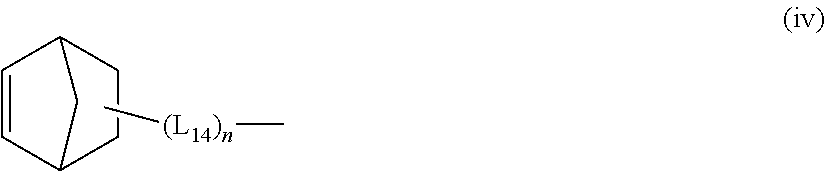
wherein L14 represents a divalent linking group and n represents 0 or 1, provided that when n is 0, L14 is a single bond;

wherein R14 represents a hydrogen atom, a substituted or unsubstituted linear or branched alkyl group having 1 to 20 carbon atoms, or a substituted or unsubstituted aryl group having 6 to 24 ring carbon atoms; L15 represents a divalent linking group, and n represents 0 or 1, provided that when n is 0, L15 is a single bond; and
(14) The organic electroluminescence device of any one of items (10) to (13), wherein the organic electroluminescence device comprises an electron injection transport layer between the pair of electrodes, and the electron injection transport layer comprises an electron injecting compound other than the polymer compound.

wherein Ar5 represents an arylene group having 6 to 24 ring carbon atoms or a heteroarylene group having 5 to 24 ring atoms.

wherein each of R7, R8, R9, and R10 independently represents a linear or branched alkyl group having 1 to 20 carbon atoms, a linear or branched alkenyl group having 2 to 20 carbon atoms, a cycloalkyl group having 3 to 20 carbon atoms, an aryl group having 6 to 30 ring carbon atoms, or a heteroaryl group having 5 to 30 ring atoms.


wherein each of R11, R12 and R13 independently represents a hydrogen atom, a fluorine atom, a linear or branched alkyl group having 1 to 20 carbon atoms, or a substituted or unsubstituted aryl group having 6 to 30 ring carbon atoms; L11 represents a divalent linking group; and n represents 0 or 1, provided that when n is 0, L11 is a single bond;

wherein L12 represents a divalent linking group and n represents 0 or 1, provided that when n is 0, L12 is a single bond;

wherein L13 represents a divalent linking group and n represents 0 or 1, provided that when n is 0, L13 is a single bond;

wherein L14 represents a divalent linking group and n represents 0 or 1, provided that when n is 0, L14 is a single bond;

wherein R14 represents a hydrogen atom, a substituted or unsubstituted linear or branched alkyl group having 1 to 20 carbon atoms, or a substituted or unsubstituted aryl group having 6 to 30 ring carbon atoms; L15 represents a divalent linking group, and n represents 0 or 1, provided that when n is 0, L15 is a single bond; or


Intermediate Synthesis 1 (Synthesis of Intermediate 2)

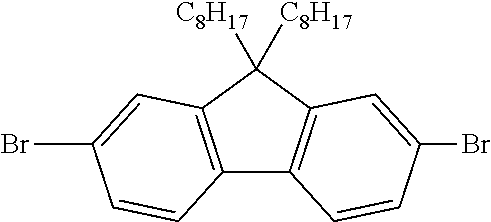


| TABLE 1 | ||||
| Hole transporting | Emission efficiency | Half lifetime | ||
| material | (cd/A) | (h) | ||
| Example 5 | polymer compound 1 | 6.5 | 900 |
| Example 6 | polymer compound 2 | 6.0 | 850 |
| Example 7 | polymer compound 3 | 5.4 | 800 |
| Example 8 | polymer compound 4 | 5.8 | 870 |
| Comparative | PVCz | 3.5 | 350 |
| example 1 | |||
| Comparative | TFB | 3.8 | 380 |
| example 2 | |||
Claims (13)


Applications Claiming Priority (3)
| Application Number | Priority Date | Filing Date | Title |
|---|---|---|---|
| JP2013-105083 | 2013-05-17 | ||
| JP2013105083 | 2013-05-17 | ||
| PCT/JP2014/002576 WO2014185079A1 (en) | 2013-05-17 | 2014-05-16 | Polymer compound, material for organic electroluminescence element using same, and organic electroluminescence element |
Publications (2)
| Publication Number | Publication Date |
|---|---|
| US20160133842A1 US20160133842A1 (en) | 2016-05-12 |
| US9882134B2 true US9882134B2 (en) | 2018-01-30 |
Family
ID=51898067
Family Applications (1)
| Application Number | Title | Priority Date | Filing Date |
|---|---|---|---|
| US14/891,812 Active 2034-08-17 US9882134B2 (en) | 2013-05-17 | 2014-05-16 | Polymer compound, material for organic electroluminescence element using same, and organic electroluminescence element |
Country Status (5)
| Country | Link |
|---|---|
| US (1) | US9882134B2 (en) |
| JP (1) | JP6055913B2 (en) |
| KR (1) | KR20160009562A (en) |
| CN (1) | CN105452326B (en) |
| WO (1) | WO2014185079A1 (en) |
Cited By (3)
| Publication number | Priority date | Publication date | Assignee | Title |
|---|---|---|---|---|
| US11758800B2 (en) | 2019-06-10 | 2023-09-12 | Samsung Electronics Co., Ltd. | Polymer material, material for electroluminescence device, liquid composition, thin film, and electroluminescence device |
| US11910697B2 (en) | 2020-09-09 | 2024-02-20 | Samsung Electronics Co., Ltd. | Copolymer, electroluminescence device material including copolymer, and electroluminescence device |
| US12466947B2 (en) | 2020-12-07 | 2025-11-11 | Samsung Electronics Co., Ltd. | Copolymer, electroluminescence device material including copolymer, and electroluminescence device |
Families Citing this family (9)
| Publication number | Priority date | Publication date | Assignee | Title |
|---|---|---|---|---|
| JP6995563B2 (en) * | 2016-12-27 | 2022-01-14 | 三星電子株式会社 | Polymer compounds, compositions, liquid compositions, thin films, and materials for electroluminescence devices, and electroluminescence devices. |
| JP7044515B2 (en) * | 2016-12-27 | 2022-03-30 | 三星電子株式会社 | Polymer compounds, compositions, liquid compositions, thin films, materials for electroluminescence devices and electroluminescence devices |
| EP3636690A4 (en) * | 2017-06-07 | 2021-03-24 | Sumitomo Chemical Company, Limited | POLYMER COMPOUND MANUFACTURING PROCESS |
| JP7104518B2 (en) * | 2018-01-10 | 2022-07-21 | 三星電子株式会社 | Polymer materials, materials for electroluminescence devices, liquid compositions, thin films and electroluminescence devices |
| EP3512307B1 (en) * | 2018-01-10 | 2021-04-21 | Samsung Electronics Co., Ltd. | Polymer material, material for electroluminescence device, composition, thin film, and electroluminescence device comprising the same |
| KR102861232B1 (en) * | 2018-03-16 | 2025-09-18 | 미쯔비시 케미컬 주식회사 | Polymer, composition for organic electroluminescent element, organic electroluminescent element, organic el display device, organic el lighting, and manufacturing method for organic electroluminescent element |
| KR102153086B1 (en) | 2018-07-31 | 2020-09-07 | 주식회사 엘지화학 | Novel polymer and organic light emitting device comprising the same |
| JP2021138915A (en) * | 2020-03-05 | 2021-09-16 | 三星電子株式会社Samsung Electronics Co., Ltd. | Arylamine-fluorene alternating copolymer, and electroluminescence device material and electroluminescence device which employ that copolymer |
| US11912816B2 (en) | 2021-04-28 | 2024-02-27 | Industrial Technology Research Institute | Polymer and light-emitting device |
Citations (15)
| Publication number | Priority date | Publication date | Assignee | Title |
|---|---|---|---|---|
| JP2003226744A (en) | 2001-11-09 | 2003-08-12 | Sumitomo Chem Co Ltd | Polymer compound and polymer light emitting device using the same |
| US20030165713A1 (en) | 2001-11-09 | 2003-09-04 | Sumitomo Chemical Company, Limited | Polymer compound and polymer light-emitting device using the same |
| JP2006316224A (en) | 2005-05-16 | 2006-11-24 | Mitsui Chemicals Inc | Macromolecular compound comprising thiophene in main chain and organic electroluminescent element comprising the same |
| US20070079701A1 (en) | 2005-10-06 | 2007-04-12 | Sayers T M | Powered air purifying respirator with battery passivation sensing/correction and method therefor |
| JP2008174661A (en) | 2007-01-19 | 2008-07-31 | Tsujiden Co Ltd | Carbazole-based random copolymer |
| US20080315757A1 (en) * | 2005-12-22 | 2008-12-25 | Cambridge Display Technology Limited | Electronic Device |
| WO2009123269A1 (en) | 2008-04-02 | 2009-10-08 | 三菱化学株式会社 | Polymer compound, reticulated polymer compound produced by crosslinking the polymer compound, composition for organic electroluminescent element, organic electroluminescent element, organic el display, and organic el lighting |
| JP2009283509A (en) | 2008-05-19 | 2009-12-03 | Nippon Hoso Kyokai <Nhk> | Organic el element and organic el display |
| JP2010062442A (en) | 2008-09-05 | 2010-03-18 | Canon Inc | Organic light emitting element |
| WO2010140553A1 (en) | 2009-06-01 | 2010-12-09 | 日立化成工業株式会社 | Organic electronic material, ink composition containing same, and organic thin film, organic electronic element, organic electroluminescent element, lighting device, and display device formed therewith |
| JP2011105842A (en) | 2009-11-17 | 2011-06-02 | Nippon Hoso Kyokai <Nhk> | Compound, composition, and organic electroluminescent element |
| JP2011174061A (en) | 2010-01-28 | 2011-09-08 | Sumitomo Chemical Co Ltd | Polymer compound and light emitting element using the same |
| JP2012092181A (en) | 2010-10-25 | 2012-05-17 | Tosoh Corp | Random copolymer |
| JP2012214732A (en) | 2011-03-25 | 2012-11-08 | Sumitomo Chemical Co Ltd | Polymer compound, and light-emitting element using the same |
| JP2012236970A (en) | 2010-12-21 | 2012-12-06 | Sumitomo Chemical Co Ltd | High-molecular compound and light-emitting element using the same |
-
2014
- 2014-05-16 JP JP2015516923A patent/JP6055913B2/en not_active Expired - Fee Related
- 2014-05-16 WO PCT/JP2014/002576 patent/WO2014185079A1/en not_active Ceased
- 2014-05-16 CN CN201480028646.9A patent/CN105452326B/en not_active Expired - Fee Related
- 2014-05-16 KR KR1020157032688A patent/KR20160009562A/en not_active Ceased
- 2014-05-16 US US14/891,812 patent/US9882134B2/en active Active
Patent Citations (22)
| Publication number | Priority date | Publication date | Assignee | Title |
|---|---|---|---|---|
| US20030165713A1 (en) | 2001-11-09 | 2003-09-04 | Sumitomo Chemical Company, Limited | Polymer compound and polymer light-emitting device using the same |
| JP2003226744A (en) | 2001-11-09 | 2003-08-12 | Sumitomo Chem Co Ltd | Polymer compound and polymer light emitting device using the same |
| JP2006316224A (en) | 2005-05-16 | 2006-11-24 | Mitsui Chemicals Inc | Macromolecular compound comprising thiophene in main chain and organic electroluminescent element comprising the same |
| US20070079701A1 (en) | 2005-10-06 | 2007-04-12 | Sayers T M | Powered air purifying respirator with battery passivation sensing/correction and method therefor |
| US20080315757A1 (en) * | 2005-12-22 | 2008-12-25 | Cambridge Display Technology Limited | Electronic Device |
| CN101371376A (en) | 2005-12-22 | 2009-02-18 | 剑桥显示技术有限公司 | Electronic devices with aryl amine polymers |
| JP2009521118A (en) | 2005-12-22 | 2009-05-28 | ケンブリッジ ディスプレイ テクノロジー リミテッド | Electronic equipment |
| JP2008174661A (en) | 2007-01-19 | 2008-07-31 | Tsujiden Co Ltd | Carbazole-based random copolymer |
| CN101981086A (en) | 2008-04-02 | 2011-02-23 | 三菱化学株式会社 | High molecular compound, network high molecular compound obtained by crosslinking the high molecular compound, composition for organic electroluminescent element, organic electroluminescent element, organic EL display and organic EL lighting |
| WO2009123269A1 (en) | 2008-04-02 | 2009-10-08 | 三菱化学株式会社 | Polymer compound, reticulated polymer compound produced by crosslinking the polymer compound, composition for organic electroluminescent element, organic electroluminescent element, organic el display, and organic el lighting |
| US20110108814A1 (en) | 2008-04-02 | 2011-05-12 | Mitsubishi Chemical Corporation | Polymer compound, net-like polymer compound produced by crosslinking the polymer compound, composition for organic electroluminescence element, organic electroluminescence element, organic el display, and organic el lighting |
| JP2009283509A (en) | 2008-05-19 | 2009-12-03 | Nippon Hoso Kyokai <Nhk> | Organic el element and organic el display |
| JP2010062442A (en) | 2008-09-05 | 2010-03-18 | Canon Inc | Organic light emitting element |
| WO2010140553A1 (en) | 2009-06-01 | 2010-12-09 | 日立化成工業株式会社 | Organic electronic material, ink composition containing same, and organic thin film, organic electronic element, organic electroluminescent element, lighting device, and display device formed therewith |
| US20120074360A1 (en) | 2009-06-01 | 2012-03-29 | Hitachi Chemical Company | Organic Electronic Material, Ink Composition Containing Same, and Organic Thin Film, Organic Electronic Element, Organic Electroluminescent Element, Lighting Device, and Display Device Formed Therewith |
| CN102449799A (en) | 2009-06-01 | 2012-05-09 | 日立化成工业株式会社 | Organic electronic material, ink composition containing same, organic thin film formed using them, organic electronic element, organic electroluminescent element, lighting device, and display device |
| JP2011105842A (en) | 2009-11-17 | 2011-06-02 | Nippon Hoso Kyokai <Nhk> | Compound, composition, and organic electroluminescent element |
| JP2011174061A (en) | 2010-01-28 | 2011-09-08 | Sumitomo Chemical Co Ltd | Polymer compound and light emitting element using the same |
| JP2012092181A (en) | 2010-10-25 | 2012-05-17 | Tosoh Corp | Random copolymer |
| JP5549879B2 (en) | 2010-10-25 | 2014-07-16 | 東ソー株式会社 | Random copolymer |
| JP2012236970A (en) | 2010-12-21 | 2012-12-06 | Sumitomo Chemical Co Ltd | High-molecular compound and light-emitting element using the same |
| JP2012214732A (en) | 2011-03-25 | 2012-11-08 | Sumitomo Chemical Co Ltd | Polymer compound, and light-emitting element using the same |
Non-Patent Citations (3)
| Title |
|---|
| Chen et al., "High Triplet Energy Polymer as Host for Electrophosphorescence with High Efficiency," Journal of the American Chemical Society, vol. 128, (2006), pp. 8549-8558. |
| Combined Chinese Office Action and Search Report dated Sep. 2, 2016 in Patent Application No. 201480028646.9. |
| International Search Report dated Aug. 19, 2014 in PCT/JP14/002576 Filed May 16, 2014. |
Cited By (3)
| Publication number | Priority date | Publication date | Assignee | Title |
|---|---|---|---|---|
| US11758800B2 (en) | 2019-06-10 | 2023-09-12 | Samsung Electronics Co., Ltd. | Polymer material, material for electroluminescence device, liquid composition, thin film, and electroluminescence device |
| US11910697B2 (en) | 2020-09-09 | 2024-02-20 | Samsung Electronics Co., Ltd. | Copolymer, electroluminescence device material including copolymer, and electroluminescence device |
| US12466947B2 (en) | 2020-12-07 | 2025-11-11 | Samsung Electronics Co., Ltd. | Copolymer, electroluminescence device material including copolymer, and electroluminescence device |
Also Published As
| Publication number | Publication date |
|---|---|
| KR20160009562A (en) | 2016-01-26 |
| JP6055913B2 (en) | 2016-12-27 |
| WO2014185079A1 (en) | 2014-11-20 |
| CN105452326B (en) | 2017-11-24 |
| CN105452326A (en) | 2016-03-30 |
| US20160133842A1 (en) | 2016-05-12 |
| JPWO2014185079A1 (en) | 2017-02-23 |
Similar Documents
| Publication | Publication Date | Title |
|---|---|---|
| US9882134B2 (en) | Polymer compound, material for organic electroluminescence element using same, and organic electroluminescence element | |
| US8795849B2 (en) | Polymers containing thermally dissociable and soluble groups and the use of such polymers as organic electroluminescent materials | |
| EP2695882B1 (en) | Organic compound, charge transport material, composition containing said compound, organic electroluminescent element, display device, and lighting device | |
| JP5088097B2 (en) | Organic electroluminescent material, organic electroluminescent device composition, organic electroluminescent device, organic EL display and color display device | |
| EP2352801B1 (en) | Electroactive materials | |
| US9527814B2 (en) | Aromatic amine derivative, organic device material and hole-injection/transport material and organic electroluminescent element material each comprising the derivative, and organic electroluminescent element | |
| US9837616B2 (en) | Aromatic amine derivative, and organic electroluminescent element containing same | |
| JP2012062450A (en) | Novel polymerizable monomer and polymer compound, and material for organic device, material for organic electroluminescence, organic device, and organic electroluminescent element using the same | |
| US20100259163A1 (en) | Polymer compound and organic electroluminescent device using the same | |
| EP2495229B1 (en) | Low-molecular compound, polymer, material for electronic devices, composition for electronic devices, organic electroluminescent element, organic solar cell element, display and lighting equipment | |
| JP2012111719A (en) | Polymerizable monomer, material for organic device containing polymer thereof, hole injection and transporting material, material for organic electroluminescent element, and organic electroluminescent element | |
| JP2011068638A (en) | Metal complex composition and complex polymer | |
| JP6307565B2 (en) | Carbazole polymer and organic electroluminescence device using the same | |
| US9650519B2 (en) | Ink composition, organic electroluminescence element, and electronic apparatus | |
| KR20120052940A (en) | Monoamine compound, charge-transporting material, composition for charge-transporting film, organic electroluminescent element, organic el display device and organic el lighting | |
| WO2014132636A1 (en) | Polymerizable monomer, organic-device material including polymer thereof, hole injection/transport material, organic-electroluminescent-element material, and organic electroluminescent element | |
| CN107614510A (en) | Iridium complex compound, organic electroluminescent element containing the compound, display device and lighting device | |
| WO2013057908A1 (en) | Cross-linking polymer and organic electroluminescent element using same | |
| WO2010098023A1 (en) | Novel polymerizable monomer and polymer of the polymerizable monomer, and material for organic device, hole injection/transport material and organic electroluminescent element each comprising the polymer | |
| US20090230848A1 (en) | Organic electroluminescent element using polyarylamine | |
| JP2010034316A (en) | Ink and organic electroluminescent element made using the same | |
| JP2013087217A (en) | Crosslinked type polymer, and organic electroluminescent element using the same | |
| US20150263298A1 (en) | Silane compound and organic electroluminescence device` | |
| JP2013087216A (en) | Crosslinked type polymer, and organic electroluminescent element using the same |
Legal Events
| Date | Code | Title | Description |
|---|---|---|---|
| AS | Assignment |
Owner name: IDEMITSU KOSAN CO., LTD., JAPAN Free format text: ASSIGNMENT OF ASSIGNORS INTEREST;ASSIGNORS:FUJIYAMA, TAKAHIRO;KATO, TOMOKI;FUNAHASHI, MASAKAZU;REEL/FRAME:037289/0433 Effective date: 20151111 |
|
| STCF | Information on status: patent grant |
Free format text: PATENTED CASE |
|
| MAFP | Maintenance fee payment |
Free format text: PAYMENT OF MAINTENANCE FEE, 4TH YEAR, LARGE ENTITY (ORIGINAL EVENT CODE: M1551); ENTITY STATUS OF PATENT OWNER: LARGE ENTITY Year of fee payment: 4 |
|
| MAFP | Maintenance fee payment |
Free format text: PAYMENT OF MAINTENANCE FEE, 8TH YEAR, LARGE ENTITY (ORIGINAL EVENT CODE: M1552); ENTITY STATUS OF PATENT OWNER: LARGE ENTITY Year of fee payment: 8 |