US9868628B2 - Method and structure for CMOS-MEMS thin film encapsulation - Google Patents

Method and structure for CMOS-MEMS thin film encapsulation Download PDF

Info

Publication number
US9868628B2
US9868628B2 US15/066,799 US201615066799A US9868628B2 US 9868628 B2 US9868628 B2 US 9868628B2 US 201615066799 A US201615066799 A US 201615066799A US 9868628 B2 US9868628 B2 US 9868628B2
Authority
US
United States
Prior art keywords
metal
layers
layer
forming
over
Prior art date
Legal status (The legal status is an assumption and is not a legal conclusion. Google has not performed a legal analysis and makes no representation as to the accuracy of the status listed.)
Expired - Fee Related
Application number
US15/066,799
Other versions
US20170260042A1 (en
Inventor
Yu-Chia Liu
Chia-Hua Chu
Chun-Wen Cheng
Current Assignee (The listed assignees may be inaccurate. Google has not performed a legal analysis and makes no representation or warranty as to the accuracy of the list.)
Taiwan Semiconductor Manufacturing Co TSMC Ltd
Original Assignee
Taiwan Semiconductor Manufacturing Co TSMC Ltd
Priority date (The priority date is an assumption and is not a legal conclusion. Google has not performed a legal analysis and makes no representation as to the accuracy of the date listed.)
Filing date
Publication date
Priority to US15/066,799 priority Critical patent/US9868628B2/en
Application filed by Taiwan Semiconductor Manufacturing Co TSMC Ltd filed Critical Taiwan Semiconductor Manufacturing Co TSMC Ltd
Assigned to TAIWAN SEMICONDUCTOR MANUFACTURING COMPANY LTD. reassignment TAIWAN SEMICONDUCTOR MANUFACTURING COMPANY LTD. ASSIGNMENT OF ASSIGNORS INTEREST (SEE DOCUMENT FOR DETAILS). Assignors: CHENG, CHUN-WEN, CHU, CHIA-HUA, LIU, YU-CHIA
Priority to TW105135351A priority patent/TWI694966B/en
Priority to CN201611039292.5A priority patent/CN107176587B/en
Publication of US20170260042A1 publication Critical patent/US20170260042A1/en
Priority to US15/860,357 priority patent/US10689247B2/en
Publication of US9868628B2 publication Critical patent/US9868628B2/en
Application granted granted Critical
Priority to US16/908,243 priority patent/US11667517B2/en
Priority to US18/315,799 priority patent/US12134555B2/en
Expired - Fee Related legal-status Critical Current
Anticipated expiration legal-status Critical

Links

Images

Classifications

    • BPERFORMING OPERATIONS; TRANSPORTING
    • B81MICROSTRUCTURAL TECHNOLOGY
    • B81BMICROSTRUCTURAL DEVICES OR SYSTEMS, e.g. MICROMECHANICAL DEVICES
    • B81B7/00Microstructural systems; Auxiliary parts of microstructural devices or systems
    • B81B7/0006Interconnects
    • BPERFORMING OPERATIONS; TRANSPORTING
    • B81MICROSTRUCTURAL TECHNOLOGY
    • B81BMICROSTRUCTURAL DEVICES OR SYSTEMS, e.g. MICROMECHANICAL DEVICES
    • B81B7/00Microstructural systems; Auxiliary parts of microstructural devices or systems
    • B81B7/0032Packages or encapsulation
    • B81B7/0045Packages or encapsulation for reducing stress inside of the package structure
    • B81B7/0051Packages or encapsulation for reducing stress inside of the package structure between the package lid and the substrate
    • BPERFORMING OPERATIONS; TRANSPORTING
    • B81MICROSTRUCTURAL TECHNOLOGY
    • B81CPROCESSES OR APPARATUS SPECIALLY ADAPTED FOR THE MANUFACTURE OR TREATMENT OF MICROSTRUCTURAL DEVICES OR SYSTEMS
    • B81C1/00Manufacture or treatment of devices or systems in or on a substrate
    • B81C1/00015Manufacture or treatment of devices or systems in or on a substrate for manufacturing microsystems
    • B81C1/00261Processes for packaging MEMS devices
    • BPERFORMING OPERATIONS; TRANSPORTING
    • B81MICROSTRUCTURAL TECHNOLOGY
    • B81CPROCESSES OR APPARATUS SPECIALLY ADAPTED FOR THE MANUFACTURE OR TREATMENT OF MICROSTRUCTURAL DEVICES OR SYSTEMS
    • B81C1/00Manufacture or treatment of devices or systems in or on a substrate
    • B81C1/00015Manufacture or treatment of devices or systems in or on a substrate for manufacturing microsystems
    • B81C1/00222Integrating an electronic processing unit with a micromechanical structure
    • B81C1/00246Monolithic integration, i.e. micromechanical structure and electronic processing unit are integrated on the same substrate
    • BPERFORMING OPERATIONS; TRANSPORTING
    • B81MICROSTRUCTURAL TECHNOLOGY
    • B81BMICROSTRUCTURAL DEVICES OR SYSTEMS, e.g. MICROMECHANICAL DEVICES
    • B81B2201/00Specific applications of microelectromechanical systems
    • B81B2201/02Sensors
    • B81B2201/0257Microphones or microspeakers
    • BPERFORMING OPERATIONS; TRANSPORTING
    • B81MICROSTRUCTURAL TECHNOLOGY
    • B81BMICROSTRUCTURAL DEVICES OR SYSTEMS, e.g. MICROMECHANICAL DEVICES
    • B81B2201/00Specific applications of microelectromechanical systems
    • B81B2201/02Sensors
    • B81B2201/0264Pressure sensors
    • BPERFORMING OPERATIONS; TRANSPORTING
    • B81MICROSTRUCTURAL TECHNOLOGY
    • B81BMICROSTRUCTURAL DEVICES OR SYSTEMS, e.g. MICROMECHANICAL DEVICES
    • B81B2201/00Specific applications of microelectromechanical systems
    • B81B2201/02Sensors
    • B81B2201/0271Resonators; ultrasonic resonators
    • BPERFORMING OPERATIONS; TRANSPORTING
    • B81MICROSTRUCTURAL TECHNOLOGY
    • B81CPROCESSES OR APPARATUS SPECIALLY ADAPTED FOR THE MANUFACTURE OR TREATMENT OF MICROSTRUCTURAL DEVICES OR SYSTEMS
    • B81C2201/00Manufacture or treatment of microstructural devices or systems
    • B81C2201/01Manufacture or treatment of microstructural devices or systems in or on a substrate
    • B81C2201/0101Shaping material; Structuring the bulk substrate or layers on the substrate; Film patterning
    • B81C2201/0128Processes for removing material
    • B81C2201/013Etching
    • B81C2201/0132Dry etching, i.e. plasma etching, barrel etching, reactive ion etching [RIE], sputter etching or ion milling
    • BPERFORMING OPERATIONS; TRANSPORTING
    • B81MICROSTRUCTURAL TECHNOLOGY
    • B81CPROCESSES OR APPARATUS SPECIALLY ADAPTED FOR THE MANUFACTURE OR TREATMENT OF MICROSTRUCTURAL DEVICES OR SYSTEMS
    • B81C2201/00Manufacture or treatment of microstructural devices or systems
    • B81C2201/01Manufacture or treatment of microstructural devices or systems in or on a substrate
    • B81C2201/0101Shaping material; Structuring the bulk substrate or layers on the substrate; Film patterning
    • B81C2201/0128Processes for removing material
    • B81C2201/013Etching
    • B81C2201/0133Wet etching
    • BPERFORMING OPERATIONS; TRANSPORTING
    • B81MICROSTRUCTURAL TECHNOLOGY
    • B81CPROCESSES OR APPARATUS SPECIALLY ADAPTED FOR THE MANUFACTURE OR TREATMENT OF MICROSTRUCTURAL DEVICES OR SYSTEMS
    • B81C2201/00Manufacture or treatment of microstructural devices or systems
    • B81C2201/01Manufacture or treatment of microstructural devices or systems in or on a substrate
    • B81C2201/0174Manufacture or treatment of microstructural devices or systems in or on a substrate for making multi-layered devices, film deposition or growing
    • B81C2201/0176Chemical vapour Deposition
    • BPERFORMING OPERATIONS; TRANSPORTING
    • B81MICROSTRUCTURAL TECHNOLOGY
    • B81CPROCESSES OR APPARATUS SPECIALLY ADAPTED FOR THE MANUFACTURE OR TREATMENT OF MICROSTRUCTURAL DEVICES OR SYSTEMS
    • B81C2201/00Manufacture or treatment of microstructural devices or systems
    • B81C2201/01Manufacture or treatment of microstructural devices or systems in or on a substrate
    • B81C2201/0174Manufacture or treatment of microstructural devices or systems in or on a substrate for making multi-layered devices, film deposition or growing
    • B81C2201/0181Physical Vapour Deposition [PVD], i.e. evaporation, sputtering, ion plating or plasma assisted deposition, ion cluster beam technology
    • BPERFORMING OPERATIONS; TRANSPORTING
    • B81MICROSTRUCTURAL TECHNOLOGY
    • B81CPROCESSES OR APPARATUS SPECIALLY ADAPTED FOR THE MANUFACTURE OR TREATMENT OF MICROSTRUCTURAL DEVICES OR SYSTEMS
    • B81C2201/00Manufacture or treatment of microstructural devices or systems
    • B81C2201/11Treatments for avoiding stiction of elastic or moving parts of MEMS
    • B81C2201/112Depositing an anti-stiction or passivation coating, e.g. on the elastic or moving parts
    • BPERFORMING OPERATIONS; TRANSPORTING
    • B81MICROSTRUCTURAL TECHNOLOGY
    • B81CPROCESSES OR APPARATUS SPECIALLY ADAPTED FOR THE MANUFACTURE OR TREATMENT OF MICROSTRUCTURAL DEVICES OR SYSTEMS
    • B81C2203/00Forming microstructural systems
    • B81C2203/07Integrating an electronic processing unit with a micromechanical structure
    • B81C2203/0707Monolithic integration, i.e. the electronic processing unit is formed on or in the same substrate as the micromechanical structure
    • B81C2203/0714Forming the micromechanical structure with a CMOS process
    • BPERFORMING OPERATIONS; TRANSPORTING
    • B81MICROSTRUCTURAL TECHNOLOGY
    • B81CPROCESSES OR APPARATUS SPECIALLY ADAPTED FOR THE MANUFACTURE OR TREATMENT OF MICROSTRUCTURAL DEVICES OR SYSTEMS
    • B81C2203/00Forming microstructural systems
    • B81C2203/07Integrating an electronic processing unit with a micromechanical structure
    • B81C2203/0707Monolithic integration, i.e. the electronic processing unit is formed on or in the same substrate as the micromechanical structure
    • B81C2203/0735Post-CMOS, i.e. forming the micromechanical structure after the CMOS circuit

Definitions

  • MEMS devices include structures produced using semiconductor technology to form electrical and mechanical features.
  • MEMS fabrication processes generally involve deposition of thin films of materials on a substrate, application of a patterned mask over the films with photolithographic imaging, and selective etching of the films to the mask.
  • a typical MEMS manufacturing process includes a structured sequence of these operations.
  • MEMS technologies are implemented in a variety of applications, including: accelerometers, acoustic sensors, actuators, gyroscopes, heaters, microfluidic devices, motion sensors, movable mirrors, pressure sensors, printer nozzles, resonators, and RF switches.
  • FIGS. 1A, 1B, 2A, 2B, and 3-7 are isometric cross-section views illustrating various stages in the manufacture of micro-electromechanical system (MEMS) devices in accordance with representative embodiments, wherein:
  • FIG. 1A is a cross-sectional side view of a MEMS device at an early stage of fabrication where via features (formed in a plurality of via layers V 1 -V 6 ) are interleaved with metal features (formed in a plurality of metal layers M 1 -M 6 ).
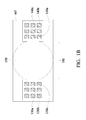
  • FIG. 1B is a cross-sectional top view of a first MEMS device region 180 representatively illustrated in FIG. 1A .
  • FIG. 2A is a cross-sectional side view of a MEMS fabrication stage after etching to form void regions, in accordance with a representative embodiment.
  • FIG. 2B is a cross-sectional top view of the first MEMS device region representatively illustrated in FIG. 2A .
  • FIG. 3 is a cross-sectional side view of a fabrication stage after depositing a sealing material over void regions, in accordance with a representative embodiment.
  • FIG. 4 is a cross-sectional side view of a fabrication stage after depositing and patterning photoresist over sealing material, in accordance with a representative embodiment.
  • FIG. 5 is a cross-sectional side view of a fabrication stage after etching to remove exposed portions of sealing material, in accordance with a representative embodiment.
  • FIG. 6 is a cross-sectional side view of a fabrication stage after etching to remove dummy insulating layer portions, in accordance with a representative embodiment.
  • FIG. 7 is a cross-sectional side view of a fabrication stage after removal of photoresist, in accordance with a representative embodiment.
  • FIG. 8 is a cross-sectional side view illustrating discrete MEMS devices (e.g., a first MEMS device 810 , a second MEMS device 820 , and a third MEMS device 830 ) formed in accordance with a representative embodiment.
  • discrete MEMS devices e.g., a first MEMS device 810 , a second MEMS device 820 , and a third MEMS device 830 .
  • FIG. 9 is a flowchart of a method for manufacturing and sealing void regions of a MEMS device in accordance with a representative embodiment.
  • first and second features are formed, e.g., in direct contact
  • additional features may be formed, e.g., between the first and second features, such that the first and second features may not be in direct contact
  • present disclosure may repeat reference numerals and/or letters in various examples. Such repetition is for the purpose of simplicity and clarity, and does not in itself dictate a relationship between the various embodiments and/or configurations described.
  • MEMS micro-electromechanical system
  • Membrane-based MEMS sensor elements are particularly vulnerable to stress.
  • stress resulting from sealing material being directly deposited on MEMS device structures may prevent a membrane element from achieving an intended mode of operation, or otherwise impair the membrane from movement in one or more vibrational or translational degrees of freedom.
  • an asymmetric layer may result.
  • an asymmetric configuration may be understood as corresponding to some of the MEMS devices having overlying insulating material exposed to the operating environment while other MEMS devices have overlying metal portions exposed to the operating environment.
  • CMOS complementary metal oxide semiconductor
  • FIG. 1A representatively illustrates a cross-sectional side view of a MEMS device at an early stage of fabrication.
  • Transistor structures 110 a / 112 a / 115 a , 110 b / 112 b / 115 b , and 110 c / 112 c / 115 c may be formed in a layer s 0 corresponding to an interface region between substrate 170 and insulating layer 150 .
  • Source/drain (S/D) regions 110 a / 115 a , 110 b / 115 b , and 110 c / 115 c may be formed in substrate 170 by ion-implantation with p-type or n-type dopants.
  • Insulating material of insulating layer 150 may be deposited over substrate 170 .
  • Insulating material may be deposited using any suitable method, such as, atomic layer deposition (ALD), chemical vapor deposition (CVD), HDP-CVD, physical vapor deposition (PVD), and/or the like.
  • Transistor gate structures 112 a , 112 b , 112 c may be formed in the insulating material. Processes for forming CMOS transistor devices are known, and will not be described in detail herein for brevity and clarity of description.
  • Substrate 170 may comprise any type of semiconductor material, such as an elementary semiconductor material; e.g., silicon, germanium, or the like.
  • substrate 170 may comprise a compound semiconductor, such as silicon carbide, gallium arsenide, gallium phosphide, indium phosphide, indium arsenide, and/or the like, or combinations thereof.
  • substrate 170 may comprise an alloy semiconductor, such as SiGe, or GaAsP, and/or the like, or combinations thereof.
  • Insulating material may comprise, e.g., silicon oxide, silicon nitride, low-k dielectrics such as carbon doped oxides, extremely low-k dielectrics such as porous carbon doped silicon dioxide, a polymer such as polyimide, and/or any other suitable dielectric or insulating compound, or combinations thereof.
  • Transistor gate structures 112 a , 112 b , 112 c may comprise, e.g., polysilicon or other suitable materials.
  • Via layers V 1 -V 6 and metal layers M 1 -M 6 may be formed by sequentially depositing insulating material over substrate 170 , patterning the insulating material using lithography and etching to form openings therein, and filling the openings with conductive material to form alternating layers of via features and metal features.
  • a first via layer V 1 may be formed over transistor gate structures 112 a , 112 b , 112 c such that each gate structure is in physical contact with, or otherwise electrically coupled to, a conductive via.
  • another layer of insulating material may be deposited over the first via layer V 1 and patterned, etched, and filled to form metal features therein.
  • Representative metal features may comprise lines, wires, pads, membranes, or the like.
  • metal features so formed may be suitably configured to be in contact with, or otherwise electrically coupled to, one or more immediately underlying conductive vias; e.g., metal feature 190 in contact with underlying via feature 192 .
  • metal features may be suitably configured not to be in contact with, or otherwise not electrically coupled to, underlying conductive vias; e.g., metal feature 195 not in contact with underlying via features.
  • Vias of via layers V 1 -V 6 may comprise a metal (e.g., tungsten), a metal alloy (e.g., CuW), an electrically conductive compound, and/or the like, or combinations thereof.
  • Metal features of metal layers M 1 -M 6 may comprise a metal (e.g., copper), a metal alloy (e.g., AlCu), an electrically conductive compound, and/or the like, or combinations thereof.
  • the above-described process may be iteratively performed to produce a series of via layers V 1 , V 2 , V 3 , V 4 , V 5 , V 6 and a series of metal layers M 1 , M 2 , M 3 , M 4 , M 5 , M 6 interleaved with each other; e.g., in order, from bottom to top: V 1 , M 1 , V 2 , M 2 , V 3 , M 3 , V 4 , M 4 , V 5 , M 5 , V 6 , M 6 .
  • a portion of material 120 forming the upper-most metal layer M 6 may comprise a metal cap 165 .
  • Metal cap 165 may be suitably configured to provide mechanical strength or stiffness to a region of a MEMS device that would otherwise not meet quality, performance, or other device specifications if metal cap 165 were otherwise absent.
  • Metal cap 165 may comprise a relatively thick (e.g., about 20 k ⁇ to about 40 k ⁇ ) deposition of material.
  • Metal cap 165 may be formed with known processes (e.g., lithographic imaging, masking, etching, and/or the like) that are not described in detail herein for concision and clarity.
  • a passivation layer 160 may be formed over metal cap 165 to protect metal cap 165 during subsequent processing. Methods for forming passivation layers are known, and also are not described in detail herein for brevity and clarity of description.
  • Insulating layer 150 may be formed by sequential stacking of insulating material deposited during successive fabrication of alternating via layers V 1 -V 6 and metal layers M 1 -M 6 . Notwithstanding sequential build-up of insulating material to form discrete via and metal layers, the nomenclature “insulating layer” will generally be understood as referring to an accumulated deposition of one or more insulating material layers to form a substantially unitary layer (e.g., “insulating layer 150 ”) for purposes of describing various embodiments and features herein.
  • FIG. 1B illustrates a cross-sectional top view of a MEMS device at an interface between upper-most via layer V 6 and underlying metal layer M 5 , in accordance with an embodiment for a first MEMS device region 180 representatively illustrated in FIG. 1A .
  • Via features 130 a , 130 b , 130 c , 140 a , 140 b , 140 c are disposed within insulating layer 150 .
  • Dummy insulation feature 100 comprises a portion of insulating layer 150 disposed at layer V 6 between via features 130 c and 140 a .
  • layer V 6 may be variously regarded as an upper-most via layer, a dummy insulation layer, a dummy dielectric layer, or a dummy oxide layer.
  • a maskless wet etching may be performed to remove metal features and via features that are successively exposed to produce void regions 810 ′, 820 ′, 830 ′.
  • a wet etch may be performed with sulfuric acid and peroxide, although other suitable etch chemistries may be alternatively or conjunctively used. Etch chemistries for removing via and metal feature materials are known, and will not be described in detail herein for brevity and clarity of description.
  • interconnect regions 210 , 215 , 220 are configured with overlying insulating material at V 6 , and are accordingly not exposed to etching chemistry.
  • the etch chemistry initially etches and penetrates exposed metal layer M 6 , then proceeds to underlying via layer V 6 (removing via features 130 a , 130 b , 130 c , 140 a , 140 b , 140 c to produce corresponding via openings 230 a , 230 b , 230 c , 240 a , 240 b , 240 c ). Thereafter, underlying metal layer M 5 is etched (e.g., forming void region portions 250 , 255 , 260 ). Thereafter, underlying via layer V 5 is etched, and so forth, until void regions 810 ′, 820 ′, 830 ′ have been substantially formed. In a representative embodiment, void region 810 ′ corresponds to a first MEMS device region, void region 820 ′ corresponds to a second MEMS device region, and void region 830 ′ corresponds to a third MEMS device region.
  • Etching leaves dummy insulation features 100 , 100 ′ and insulation feature 100 ′′ of insulating layer 150 remaining over void region portions 250 , 255 , 260 .
  • etching also leaves other underlying metal features remaining that comprise components of MEMS devices.
  • active membrane 812 and reference membrane 814 may comprise device features of a MEMS pressure sensor ( FIG. 8 , first MEMS device 810 ), and active membrane 822 and reference membrane 824 may comprise device features of a MEMS acoustic sensor ( FIG. 8 , second MEMS device 820 ).
  • a second MEMS device 820 may be configured to operate as a microphone for converting sound impulses into electrical signals, although other applications are also possible.
  • sound in the form of a time-varying pressure wave may interact with active membrane 822 by causing vibrational or translational displacement of active membrane 822 relative to reference membrane 824 .
  • a CMOS circuit measures the capacitance between active membrane 822 and reference membrane 824 .
  • the CMOS circuit may supply a predetermined charge to active membrane 822 and reference membrane 824 , and monitor a voltage change between active membrane 822 and reference membrane 824 as a function of charge. By polling current and voltage measurements over time, the CMOS circuit may be suitably configured to calculate perturbations in capacitance in accordance with the following:
  • CMOS circuit can provide an electrical signal representative of sound impinging on active membrane 822 .
  • substantially similar structures may be employed to produce a variety of other types of MEMS devices; e.g., an active membrane 812 and a reference membrane 814 may be suitably configured or otherwise adapted to provide similar functionality for a MEMS pressure sensor ( FIG. 8 , first MEMS device 810 ).
  • interconnect region 210 comprises a set of metal features in metal layers M 1 -M 5 and a set via features in via layers V 1 -V 5 .
  • Via feature via is coupled to metal feature m 1 a , which is coupled to via feature v 2 a , which is coupled to metal feature m 2 a , and so on.
  • the composite structure of v 1 a , m 1 a , v 2 a , m 2 a , v 3 a , m 3 a , v 4 a , m 4 a , v 5 a , and m 5 a comprises an interconnect for a MEMS device ( FIG. 8 , first MEMS device 810 ).
  • Via features v 1 a , v 2 a , v 3 a , v 4 a , v 5 a are interleaved in alternation with metal features m 1 a , m 2 a , m 3 a , m 4 a , m 5 a .
  • Similar interconnect structures are illustrated in interconnect region 215 for another MEMS device ( FIG. 8 , second MEMS device 820 ) and in interconnect region 220 for yet another MEMS device ( FIG. 8 , third MEMS device 830 ).
  • FIG. 2B illustrates a cross-sectional top view of a MEMS device at an interface between upper-most via layer V 6 and underlying metal layer M 5 , in accordance with an embodiment for a first MEMS device region ( FIG. 1A , first MEMS device region 180 ) representatively illustrated in FIG. 2A , after etching to produce void regions 810 ′, 820 ′, 830 ′.
  • sealing material 300 is deposited over top surfaces of void regions 810 ′, 820 ′, 830 ′ and laterally adjacent portions there between.
  • Sealing material 300 may be deposited using any suitable process, such as, ALD, CVD, HDP-CVD, PVD, spin-on coating (e.g., for polymers), and/or the like.
  • Sealing material 300 may comprise AlCu, titanium, titanium nitride, silicon nitride, silane oxide, polymer materials, polydimethylsiloxane, poly(p-xylylene) polymers (e.g., parylene-C), and/or any other suitable compounds, or combinations thereof.
  • sealing material 300 may be deposited with a thickness of between about 2 k ⁇ and 4 k ⁇ to seal one or more cavities of one or more MEMS devices.
  • sealing material 300 may be disposed over insulating layer 150 and in via openings 230 a , 230 b , 230 c , 240 a , 240 b , 240 c of first void region 810 ′ to form sealing structures 300 a , 300 b (see FIG. 5 ). Sealing material 300 may also be disposed in corresponding via layer V 6 openings of second void region 820 ′ and third void region 830 ′ to form sealing structures 300 c , 300 d , 300 e , 300 f (see FIG. 5 ). Sealing material 300 may also be disposed in metal layer portions of M 5 substantially underlying via layer V 6 openings.
  • Sealing material 300 may also be disposed above, over, or on passivation layer 160 . Sealing material may be disposed over interconnect regions 210 , 215 , 220 . Sealing material 300 may comprise a substantially contiguous layer disposed over or above a plurality of via features in a plurality of via layers V 1 -V 5 . Sealing material 300 may comprise a substantially contiguous layer disposed above or over a plurality of metal features in a plurality of metal layers M 1 -M 6 . Sealing material 300 may comprise a substantially continuous layer of material that is at least partially disposed in void region portions of one or more via layers (e.g., V 6 ). Sealing material 300 may comprise a substantially uninterrupted layer of material that is disposed in void region portions of one or more metal layers (e.g., M 5 and M 6 ).
  • sealing material 300 may be deposited in substantially direct physical contact with dummy insulation features 100 , 100 ′.
  • additional material layers may be employed above or below dummy insulation features 100 , 100 ′.
  • additional material layers perform substantially the same function (e.g., are at least partially disposable), achieve substantially the same result (e.g., prevent or otherwise lessen stress induced on or in one or more MEMS device structures), or are intended for similar initial disposition (e.g., disposed above one or more MEMS device structures) and subsequent disposition (e.g., at least partially removed from being above one or more MEMS device structures)
  • such additional material layers will be understood as being equivalent to or otherwise finding correspondence with a “dummy insulation” feature (even if such additional material layers do not comprise insulating material), or a “dummy dielectric” feature (even where such additional material layers do not comprise dielectric material), or a “dummy oxide” feature (even where such additional material layers do not comprise oxide material).
  • sealing material 300 does not physically contact a subsequently exposed MEMS device surface. Accordingly, there will be no stress induced attendant to sealing material 300 being directly deposited on MEMS device surfaces themselves; rather, sealing material 300 is deposited on dummy insulation features 100 , 100 ′, which are removed at a later stage of MEMS device fabrication.
  • the combination of dummy insulating features 100 , 100 ′ and void region portions 250 , 255 disposed in immediately underlying metal layer M 5 are configured to prevent or otherwise lessen stress induced on or in one or more underlying MEMS device structures, elements, components, or features.
  • Void region portions 250 , 255 may correspond to a gap region between dummy insulating features 100 , 100 ′ and underlying MEMS device surfaces that are exposed in subsequent processing. Accordingly, void region portions 250 , 255 may be suitably configured to provide further protection from stress being induced in or otherwise imparted to subsequently exposed MEMS device surfaces.
  • Sealing material 300 seals, encapsulates, closes off, or otherwise forms a substantially non-permeable barrier between void regions 810 ′, 820 ′, 830 ′ and an external environment.
  • void regions 810 ′, 820 ′, 830 ′ may be exposed to vacuum to at least partially remove ambient gas from void regions 810 ′, 820 ′, 830 ′ prior to sealing or encapsulation with sealing material 300 .
  • void regions 810 ′, 820 ′, 830 ′ may be purged with a gas (e.g., an inert gas, such as dry nitrogen) prior to sealing or encapsulation with sealing material 300 .
  • a gas e.g., an inert gas, such as dry nitrogen
  • void regions 810 ′, 820 ′, 830 ′ may be sealed without pulling vacuum or gas purging. Processes for preparing MEMS device cavities are known, and will not be described in detail herein for brevity and clarity of description.
  • a photoresist layer may be deposited and patterned after deposition of sealing material 300 .
  • patterned photoresist 400 a , 400 b , 400 c , 400 d , 400 e , 400 f provides protection for portions ( FIG. 5 , sealing structures 300 a , 300 b , 300 c , 300 d , 300 e , 300 f ) of sealing material 300 that seal, encapsulate, or close off void regions 810 ′, 820 ′, 830 ′.
  • a single mask may be used to form patterned photoresist 400 a , 400 b , 400 c , 400 d , 400 e , 400 f .
  • Processes for depositing and patterning photoresist are known, and will not be described in detail herein for brevity and clarity of description.
  • an etch may be performed to remove portions of sealing material 300 not covered by patterned photoresist 400 a , 400 b , 400 c , 400 d , 400 e , 400 f to expose underlying dummy insulation features 100 , 100 ′ and passivation layer 160 for subsequent processing. Removal of unprotected portions of sealing material 300 also exposes material of insulating layer 150 overlying contact pads m 5 a , m 5 b , m 5 c for subsequent processing.
  • an etch to remove portions of sealing material 300 may comprise a dry etch or a wet etch. Etching processes for removing sealant materials are known, and will not be described in detail herein for brevity and clarity of description.
  • insulating layer 150 As representatively illustrated in FIG. 6 , material of insulating layer 150 corresponding to dummy insulation features 100 , 100 ′, and other exposed portions of insulating layer 150 at V 6 , are removed with etching.
  • a reactive ion etch RIE
  • RIE reactive ion etch
  • At least partial removal of dummy insulation features 100 , 100 ′ exposes sensing membrane 600 a of, e.g., a pressure sensor ( FIG. 8 , first MEMS device 810 ), and sensing membrane 600 b of, e.g., an acoustic sensor ( FIG.
  • Second MEMS device 820 At least partial removal of exposed insulating layer 150 at V 6 in interconnect regions 210 , 215 , 220 exposes top surfaces of contact pads m 5 a , m 5 b , m 5 c for subsequent MEMS device testing.
  • Sealing structures 300 a , 300 b , 300 c , 300 d , 300 e , 300 f have portions that are disposed above top surfaces of contact pads m 5 a , m 5 b , m 5 c .
  • Metal cap 165 remains, owing to etch protection afforded by passivation layer 160 .
  • patterned photoresist 400 a , 400 b , 400 c , 400 d , 400 e , 400 f may be removed.
  • a MEMS device comprises a plurality of vias in a plurality of via layers (V 1 -V 6 ) and a plurality of metal features in a plurality of metal layers (M 1 -M 6 ).
  • the plurality of via layers (V 1 -V 6 ) are interleaved in alternation with the plurality of metal layers (M 1 -M 6 ).
  • the plurality of via layers (V 1 -V 6 ) and the plurality of metal layers (M 1 -M 6 ) are disposed in an insulating layer 150 . Void regions are disposed in the insulating layer 150 .
  • Contact pads m 5 a , m 5 b , m 5 c are disposed in the insulating layer 150 at a top surface of the insulating layer 150 .
  • Sealing structures 300 a , 300 b , 300 c , 300 d , 300 e , 300 f are over the void regions.
  • the sealing structures 300 a , 300 b , 300 c , 300 d , 300 e , 300 f substantially seal the void regions.
  • At least a portion of each sealing structure 300 a , 300 b , 300 c , 300 d , 300 e , 300 f is disposed above top surfaces of contact pads m 5 a , m 5 b , m 5 c.
  • a first MEMS device 810 (e.g., corresponding to a MEMS pressure sensor) comprises an active membrane 812 separated from a reference membrane 814 by a portion of void region 810 ′ sealed with sealing structures 300 a , 300 b .
  • Active membrane 812 and reference membrane 814 are electrically coupled to a first interconnect structure underlying and in connection with contact pad m 5 a .
  • the first interconnect structure couples contact pad m 5 a with the gate structure 112 a of an underlying first transistor device 110 a / 112 a / 115 a .
  • the gate structure 112 a of the first transistor device comprises polysilicon disposed in a bottom portion of insulating layer 150 .
  • the S/D regions 110 a , 115 a of the first transistor device comprise ion implantation regions disposed in substrate 170 .
  • a second MEMS device 820 (e.g., corresponding to a MEMS acoustic sensor) comprises an active membrane 822 separated from a reference membrane 824 by a portion of void region 820 ′ sealed with sealing structures 300 c , 300 d .
  • Active membrane 822 and reference membrane 824 are electrically coupled to a second interconnect structure underlying and in connection with contact pad m 5 b .
  • the second interconnect structure couples contact pad m 5 b with the gate structure 112 b of an underlying second transistor device 110 b / 112 b / 115 b .
  • the gate structure 112 b of the second transistor device comprises polysilicon disposed in a bottom portion of insulating layer 150 .
  • the S/D regions 110 b , 115 b of the second transistor device comprise implantation regions disposed in substrate 170 .
  • a third MEMS device 830 (e.g., corresponding to a MEMS thermal conductivity gauge and resonator) comprises a metal cap 165 overlying via features and metal features disposed in insulating layer 150 .
  • Metal cap 165 provides mechanical support over a lateral region of third MEMS device 830 .
  • Void region 830 ′ is sealed with sealing structures 300 e , 300 f .
  • Passivation layer 160 is over and on metal cap 165 .
  • Via and/or metal features of third MEMS device 830 are coupled to a third interconnect structure underlying and in connection with contact pad m 5 c .
  • the third interconnect structure couples contact pad m 5 c with the gate structure 112 c of an underlying third transistor device 110 c / 112 c / 115 c .
  • the gate structure 112 c of the third transistor device comprises polysilicon disposed in a bottom portion of insulating layer 150 .
  • S/D regions 110 c , 115 c of the third transistor device are implanted in substrate 170 .
  • FIG. 9 representatively illustrates a MEMS device fabrication method 900 in accordance with a representative embodiment.
  • Layer V 1 is formed by depositing dielectric material over layer s 0 and patterning the dielectric material with lithographic imaging, etching, and fill to form via features therein.
  • metal features are formed in a metal layer M i .
  • the M 1 layer is formed over the V 1 layer.
  • Layer M 1 is formed by depositing dielectric material over layer V 1 and patterning the dielectric material with lithographic imaging, etching, and fill to form metal features therein.
  • another plurality of via features are formed in a via layer V i .
  • the V 2 layer is formed on the M 1 layer (M i ⁇ 1 ).
  • Layer V 2 is formed by depositing dielectric material over layer M 1 and patterning the dielectric material with lithographic imaging, etching, and fill to form via features therein.
  • a next step 920 second sweep
  • another set of metal features are formed in a metal layer M i .
  • the M 2 layer is formed over the V 2 layer.
  • Layer M 2 is formed by depositing dielectric material over layer V 2 and patterning the dielectric material with lithographic imaging, etching, and fill to form via features therein.
  • Steps 925 , 915 , and 920 may be iterated to build up a plurality of via layers V 1 -V i and a plurality of metal layers M 1 -M i .
  • there may be six (i 6) via layers (V 1 -V 6 ) and metal layers (M 1 -M 6 ).
  • a passivation layer may be formed on or over at least a portion of metal layer M 6 (M i ).
  • portions of via and metal feature material may be removed with etching to form MEMS device void regions, with at least a portion of the dielectric material on the upper-most via layer V i remaining as a dummy dielectric layer.
  • a sealing material may be deposited to seal the MEMS device void regions under vacuum.
  • photoresist may be deposited over the sealing material and patterned to provide protection for underlying portions of sealing material during subsequent etching.
  • a first etch may be performed to remove portions of sealing material not protected by overlying photoresist.
  • a second etch may be performed to remove dummy dielectric layer portions and to expose electrical contacts to underlying transistor devices.
  • photoresist is removed.
  • an existing oxide layer may be used as a dummy layer to prevent or otherwise reduce stress from being induced on or in a MEMS device.
  • the dummy layer provides a symmetric structure for MEMS devices with regard to disposition of overlying oxide material after removal of dummy layer portions. For example, substantially all MEMS devices so formed will have an oxide layer portion overlying a highest-lying MEMS device metal feature (e.g., active membranes 812 , 822 ).
  • the dummy layer can also prevent or otherwise reduce defects associated with residue that would otherwise be formed when sealing material is directly deposited on a MEMS device surface. Additionally, forming the dummy layer with oxide material of the MEMS device structure allows standard CMOS and CMOS-compatible processes to be used without the need for an additional mask to protect overlying oxide layers.
  • a method for manufacturing a MEMS device includes: depositing an insulating layer over a substrate; forming a plurality of conductive vias in a plurality of first layers of the insulating layer; forming a plurality of metal structures in a plurality of second layers of the insulating layer, the plurality of first layers interleaved or otherwise alternating with the plurality of second layers; etching a first set of one or more of the plurality of conductive vias and a second set of one or more of the plurality of metal structures to form a void region in the insulating layer; forming a conductive pad on, and within a top surface of the insulating layer; and sealing the void region with an encapsulating structure, with at least a portion of the encapsulating structure being disposed above a top surface of the conductive pad.
  • a transistor structure may be formed below the plurality of first layers and the plurality of second layers.
  • a conductive interconnect structure may be formed between a top surface of a gate of the transistor structure and a bottom surface of the conductive pad, the conductive interconnect structure comprising a first set of the plurality of metal structures and a second set of the plurality of conductive vias. At least a portion of the transistor structure may be formed in the substrate.
  • a passivation layer may be formed over or above at least one of the plurality of metal structures.
  • a method for manufacturing a CMOS-MEMS device includes: depositing a dielectric layer over a substrate; forming a transistor device in at least one of the substrate and the dielectric layer; forming a plurality of via layers in the dielectric layer, the plurality of via layers comprising a plurality of via structures; forming a plurality of metal layers in the dielectric layer, the plurality of metal layers comprising a plurality of metal structures, the plurality of metal layers alternating with the plurality of via layers; etching to remove at least a portion of via structure material and at least a portion of metal structure material to form a void region; depositing a sealant material over the void region; depositing a photoresist over the sealant material; patterning the photoresist to expose a portion of the sealant material; performing a first etch to remove exposed portions of the sealant material; and performing a second etch to remove at least a portion of a dummy dielectric layer adjacent a remaining portion of
  • the method may also include removing the photoresist.
  • the dummy dielectric layer may comprise an upper-most via layer of the plurality of via layers.
  • a passivation layer may be formed over an upper-most metal layer of the plurality of metal layers.
  • a conductive pad may be formed on and within a top surface of the dielectric layer.
  • An interconnect structure may be formed between a top surface of a gate of the transistor device and a bottom surface of the conductive pad, the interconnect structure comprising a first set of the plurality of metal structures interleaved with a second set of the plurality of via structures. The first etch and the second etch may be the same etch.
  • a MEMS device comprises: a plurality of vias in a plurality of via layers; a plurality of metal features in a plurality of metal layers; the plurality of via layers interleaved with the plurality of metal layers, the plurality of via layers and the plurality of metal layers disposed in an insulating layer; a void region disposed in the insulating layer; a contact pad disposed in the insulating layer at a top surface of the insulating layer; and a sealing structure over the void region, the sealing structure substantially sealing the void region, wherein at least a portion of the sealing structure is above a top surface of the contact pad.
  • a first set of one or more volume portions of the void region may be disposed in one or more of the via layers, and a second set of one or more volume portions of the void region may be disposed in one or more of the metal layers.
  • the MEMS device may have a transistor below the plurality of via layers and the plurality of metal layers.
  • a first set of metal features and a second set of vias may form an interconnect structure between a top surface of a gate of the transistor and a bottom surface of the contact pad. At least a portion of the transistor may be formed in a substrate.
  • the substrate may be disposed below the insulating layer.
  • a passivation layer may be disposed over a metal feature of the upper-most metal layer.
  • a first metal feature may comprise an active membrane.
  • a second metal feature may comprise a reference membrane.
  • the active membrane and the reference membrane may comprise elements of a pressure sensor, an acoustic sensor, and/or a resonator.
  • the terms “comprises,” “comprising,” “includes,” “including,” “has,” “having,” or any contextual variant thereof, are intended to cover a non-exclusive inclusion.
  • a process, product, article, or apparatus that comprises a list of elements is not necessarily limited to only those elements, but may include other elements not expressly listed or inherent to such process, product, article, or apparatus.
  • “or” refers to an inclusive or and not an exclusive or. That is, the term “or” as used herein is generally intended to mean “and/or” unless otherwise indicated.
  • a condition A or B is satisfied by any one of the following: A is true (or present) and B is false (or not present), A is false (or not present) and B is true (or present), and both A and B are true (or present).
  • a term preceded by “a” or “an” includes both singular and plural of such term, unless the context clearly indicates otherwise.
  • the meaning of “in” includes “in” and “on,” unless the context clearly indicates otherwise.
  • Language designating such non-limiting examples and illustrations includes, but is not limited to: “for example,” “for instance,” “e.g.,” “in a representative embodiment,” or “in one embodiment.”
  • Reference throughout this specification to “one embodiment,” “an embodiment,” “a representative embodiment,” “a particular embodiment,” or “a specific embodiment,” or contextually similar terminology means that a particular feature, structure, property, or characteristic described in connection with the embodiment is included in at least one embodiment and may not necessarily be present in all embodiments.
  • respective appearances of the phrases “in one embodiment,” “in an embodiment,” or “in a specific embodiment,” or similar terminology in various places throughout this specification are not necessarily referring to the same embodiment.
  • particular features, structures, properties, or characteristics of any specific embodiment may be combined in any suitable manner with one or more other embodiments.
  • Spatially relative terms such as “under,” “below,” “lower,” “upper,” “above,” “higher,” “adjacent,” “interadjacent,” “interposed,” “between,” or the like, may be used herein for ease of description to representatively describe one or more elements or features in relation to other elements or features as representatively illustrated in the Figures. Spatially relative terms are intended to encompass different orientations of the device in use or operation, in addition to orientations illustrated in the Figures. An apparatus or device may be otherwise spatially transformed (e.g., rotated by 90 degrees) and the spatially relative descriptors used herein may likewise be transformed accordingly.

Landscapes

  • Engineering & Computer Science (AREA)
  • Microelectronics & Electronic Packaging (AREA)
  • Manufacturing & Machinery (AREA)
  • Computer Hardware Design (AREA)
  • Micromachines (AREA)

Abstract

Representative methods for sealing MEMS devices include depositing insulating material over a substrate, forming conductive vias in a first set of layers of the insulating material, and forming metal structures in a second set of layers of the insulating material. The first and second sets of layers are interleaved in alternation. A dummy insulating layer is provided as an upper-most layer of the first set of layers. Portions of the first and second set of layers are etched to form void regions in the insulating material. A conductive pad is formed on and in a top surface of the insulating material. The void regions are sealed with an encapsulating structure. At least a portion of the encapsulating structure is laterally adjacent the dummy insulating layer, and above a top surface of the conductive pad. An etch is performed to remove at least a portion of the dummy insulating layer.

Description

BACKGROUND
Advances in integrated circuit (IC) materials and processes have produced ICs with each technological cycle achieving smaller and more complex circuit designs than preceding cycles. In the course of IC development, functional density (i.e., the number of interconnected devices per unit chip area) has generally increased, while discrete size (i.e., the smallest dimensions of individual components that can be manufactured with a given process) has generally decreased.
MEMS devices include structures produced using semiconductor technology to form electrical and mechanical features. MEMS fabrication processes generally involve deposition of thin films of materials on a substrate, application of a patterned mask over the films with photolithographic imaging, and selective etching of the films to the mask. A typical MEMS manufacturing process includes a structured sequence of these operations. MEMS technologies are implemented in a variety of applications, including: accelerometers, acoustic sensors, actuators, gyroscopes, heaters, microfluidic devices, motion sensors, movable mirrors, pressure sensors, printer nozzles, resonators, and RF switches.
BRIEF DESCRIPTION OF THE DRAWINGS
For a more complete understanding of representative embodiments, and advantages thereof, reference is made to the following descriptions taken in conjunction with the accompanying drawings, in which:
FIGS. 1A, 1B, 2A, 2B, and 3-7 are isometric cross-section views illustrating various stages in the manufacture of micro-electromechanical system (MEMS) devices in accordance with representative embodiments, wherein:
FIG. 1A is a cross-sectional side view of a MEMS device at an early stage of fabrication where via features (formed in a plurality of via layers V1-V6) are interleaved with metal features (formed in a plurality of metal layers M1-M6).
FIG. 1B is a cross-sectional top view of a first MEMS device region 180 representatively illustrated in FIG. 1A.
FIG. 2A is a cross-sectional side view of a MEMS fabrication stage after etching to form void regions, in accordance with a representative embodiment.
FIG. 2B is a cross-sectional top view of the first MEMS device region representatively illustrated in FIG. 2A.
FIG. 3 is a cross-sectional side view of a fabrication stage after depositing a sealing material over void regions, in accordance with a representative embodiment.
FIG. 4 is a cross-sectional side view of a fabrication stage after depositing and patterning photoresist over sealing material, in accordance with a representative embodiment.
FIG. 5 is a cross-sectional side view of a fabrication stage after etching to remove exposed portions of sealing material, in accordance with a representative embodiment.
FIG. 6 is a cross-sectional side view of a fabrication stage after etching to remove dummy insulating layer portions, in accordance with a representative embodiment.
FIG. 7 is a cross-sectional side view of a fabrication stage after removal of photoresist, in accordance with a representative embodiment.
FIG. 8 is a cross-sectional side view illustrating discrete MEMS devices (e.g., a first MEMS device 810, a second MEMS device 820, and a third MEMS device 830) formed in accordance with a representative embodiment.
FIG. 9 is a flowchart of a method for manufacturing and sealing void regions of a MEMS device in accordance with a representative embodiment.
The drawings accompanying and forming part of this specification are included to representatively illustrate certain aspects of the disclosure. It is noted that features illustrated in the drawings are not necessarily drawn to scale.
DETAILED DESCRIPTION OF ILLUSTRATIVE EMBODIMENTS
The following disclosure describes various embodiments and representative examples. Specific examples of components and arrangements of components are discussed below to simplify the description. These are merely examples and are not intended to limit the disclosure. For example, the formation of a first feature “over” or “on” a second feature may include embodiments in which the first and second features are formed, e.g., in direct contact, and may also include embodiments in which additional features may be formed, e.g., between the first and second features, such that the first and second features may not be in direct contact. The present disclosure may repeat reference numerals and/or letters in various examples. Such repetition is for the purpose of simplicity and clarity, and does not in itself dictate a relationship between the various embodiments and/or configurations described.
Conventional approaches for sealing micro-electromechanical system (MEMS) devices typically involve depositing sealant material directly on a surface of a MEMS device to seal void regions of the device, usually under vacuum. Depending on the sealing material used, this can cause deleterious stress on underlying device elements. This stress can be a result of lattice mismatch at a contact interface between the sealing material and dielectric material of the MEMS device. Stress may also be induced from a difference in thermal expansion coefficients when sealing material and dielectric material are brought into contact with each other and subsequently heated or cooled.
Membrane-based MEMS sensor elements are particularly vulnerable to stress. For example, in the case of MEMS-based pressure sensors, acoustic sensors, or the like, stress resulting from sealing material being directly deposited on MEMS device structures may prevent a membrane element from achieving an intended mode of operation, or otherwise impair the membrane from movement in one or more vibrational or translational degrees of freedom.
In order to prepare a finished MEMS device for electrical testing, portions of sealing material are removed. If a dry etch is used to remove sealing material in accordance with conventional approaches, an asymmetric layer may result. In this context, an asymmetric configuration may be understood as corresponding to some of the MEMS devices having overlying insulating material exposed to the operating environment while other MEMS devices have overlying metal portions exposed to the operating environment.
If a symmetric layer is desired, conventional techniques generally require an additional mask to protect overlying dielectric layers from etching; thereby increasing costs associated with performing additional processes to provide the protective mask. Consequently, symmetric layers are not easily or inexpensively implemented for conventionally manufactured complementary metal oxide semiconductor (CMOS) MEMS devices where sealing material and dielectric material are removed substantially simultaneously. Additionally, conventional methods for removing sealing material from regions of a MEMS device can produce excess residue—also deleteriously affecting MEMS device performance. Accordingly, conventional approaches for sealing CMOS-MEMS devices have been associated with poor sensor sensitivity, reduced signal-to-noise ratio (SNR), and increased total harmonic distortion (THD).
Embodiments described herein generally provide thin-film MEMS encapsulation methods and structures with improved device performance and lower manufacturing cost. FIG. 1A representatively illustrates a cross-sectional side view of a MEMS device at an early stage of fabrication. Transistor structures 110 a/112 a/115 a, 110 b/112 b/115 b, and 110 c/112 c/115 c may be formed in a layer s0 corresponding to an interface region between substrate 170 and insulating layer 150. Source/drain (S/D) regions 110 a/115 a, 110 b/115 b, and 110 c/115 c may be formed in substrate 170 by ion-implantation with p-type or n-type dopants. Insulating material of insulating layer 150 may be deposited over substrate 170. Insulating material may be deposited using any suitable method, such as, atomic layer deposition (ALD), chemical vapor deposition (CVD), HDP-CVD, physical vapor deposition (PVD), and/or the like. Transistor gate structures 112 a, 112 b, 112 c may be formed in the insulating material. Processes for forming CMOS transistor devices are known, and will not be described in detail herein for brevity and clarity of description.
Substrate 170 may comprise any type of semiconductor material, such as an elementary semiconductor material; e.g., silicon, germanium, or the like. In some embodiments, substrate 170 may comprise a compound semiconductor, such as silicon carbide, gallium arsenide, gallium phosphide, indium phosphide, indium arsenide, and/or the like, or combinations thereof. In other embodiments, substrate 170 may comprise an alloy semiconductor, such as SiGe, or GaAsP, and/or the like, or combinations thereof. Insulating material may comprise, e.g., silicon oxide, silicon nitride, low-k dielectrics such as carbon doped oxides, extremely low-k dielectrics such as porous carbon doped silicon dioxide, a polymer such as polyimide, and/or any other suitable dielectric or insulating compound, or combinations thereof. Transistor gate structures 112 a, 112 b, 112 c may comprise, e.g., polysilicon or other suitable materials.
Via layers V1-V6 and metal layers M1-M6 may be formed by sequentially depositing insulating material over substrate 170, patterning the insulating material using lithography and etching to form openings therein, and filling the openings with conductive material to form alternating layers of via features and metal features. In accordance with a representative embodiment, a first via layer V1 may be formed over transistor gate structures 112 a, 112 b, 112 c such that each gate structure is in physical contact with, or otherwise electrically coupled to, a conductive via. Thereafter, another layer of insulating material may be deposited over the first via layer V1 and patterned, etched, and filled to form metal features therein. Representative metal features may comprise lines, wires, pads, membranes, or the like. In accordance with a representative aspect, metal features so formed may be suitably configured to be in contact with, or otherwise electrically coupled to, one or more immediately underlying conductive vias; e.g., metal feature 190 in contact with underlying via feature 192. In accordance with another representative aspect, metal features may be suitably configured not to be in contact with, or otherwise not electrically coupled to, underlying conductive vias; e.g., metal feature 195 not in contact with underlying via features. Vias of via layers V1-V6 may comprise a metal (e.g., tungsten), a metal alloy (e.g., CuW), an electrically conductive compound, and/or the like, or combinations thereof. Metal features of metal layers M1-M6 may comprise a metal (e.g., copper), a metal alloy (e.g., AlCu), an electrically conductive compound, and/or the like, or combinations thereof.
In a representative embodiment, the above-described process may be iteratively performed to produce a series of via layers V1, V2, V3, V4, V5, V6 and a series of metal layers M1, M2, M3, M4, M5, M6 interleaved with each other; e.g., in order, from bottom to top: V1, M1, V2, M2, V3, M3, V4, M4, V5, M5, V6, M6. Optionally, a portion of material 120 forming the upper-most metal layer M6 may comprise a metal cap 165. Metal cap 165 may be suitably configured to provide mechanical strength or stiffness to a region of a MEMS device that would otherwise not meet quality, performance, or other device specifications if metal cap 165 were otherwise absent. Metal cap 165 may comprise a relatively thick (e.g., about 20 kÅ to about 40 kÅ) deposition of material. Metal cap 165 may be formed with known processes (e.g., lithographic imaging, masking, etching, and/or the like) that are not described in detail herein for concision and clarity. A passivation layer 160 may be formed over metal cap 165 to protect metal cap 165 during subsequent processing. Methods for forming passivation layers are known, and also are not described in detail herein for brevity and clarity of description.
Insulating layer 150 may be formed by sequential stacking of insulating material deposited during successive fabrication of alternating via layers V1-V6 and metal layers M1-M6. Notwithstanding sequential build-up of insulating material to form discrete via and metal layers, the nomenclature “insulating layer” will generally be understood as referring to an accumulated deposition of one or more insulating material layers to form a substantially unitary layer (e.g., “insulating layer 150”) for purposes of describing various embodiments and features herein.
FIG. 1B illustrates a cross-sectional top view of a MEMS device at an interface between upper-most via layer V6 and underlying metal layer M5, in accordance with an embodiment for a first MEMS device region 180 representatively illustrated in FIG. 1A. Via features 130 a, 130 b, 130 c, 140 a, 140 b, 140 c are disposed within insulating layer 150. Dummy insulation feature 100 comprises a portion of insulating layer 150 disposed at layer V6 between via features 130 c and 140 a. As representatively illustrated, layer V6 may be variously regarded as an upper-most via layer, a dummy insulation layer, a dummy dielectric layer, or a dummy oxide layer.
As representatively illustrated in FIG. 2A, a maskless wet etching may be performed to remove metal features and via features that are successively exposed to produce void regions 810′, 820′, 830′. In an embodiment, a wet etch may be performed with sulfuric acid and peroxide, although other suitable etch chemistries may be alternatively or conjunctively used. Etch chemistries for removing via and metal feature materials are known, and will not be described in detail herein for brevity and clarity of description.
Wet etching removes metal features not protected by overlying material of insulating layer 150 or passivation layer 160, as representatively illustrated in FIG. 1A. For example, interconnect regions 210, 215, 220 are configured with overlying insulating material at V6, and are accordingly not exposed to etching chemistry. In a representative embodiment, the etch chemistry initially etches and penetrates exposed metal layer M6, then proceeds to underlying via layer V6 (removing via features 130 a, 130 b, 130 c, 140 a, 140 b, 140 c to produce corresponding via openings 230 a, 230 b, 230 c, 240 a, 240 b, 240 c). Thereafter, underlying metal layer M5 is etched (e.g., forming void region portions 250, 255, 260). Thereafter, underlying via layer V5 is etched, and so forth, until void regions 810′, 820′, 830′ have been substantially formed. In a representative embodiment, void region 810′ corresponds to a first MEMS device region, void region 820′ corresponds to a second MEMS device region, and void region 830′ corresponds to a third MEMS device region.
Etching leaves dummy insulation features 100, 100′ and insulation feature 100″ of insulating layer 150 remaining over void region portions 250, 255, 260. In a representative embodiment, etching also leaves other underlying metal features remaining that comprise components of MEMS devices. For example, active membrane 812 and reference membrane 814 may comprise device features of a MEMS pressure sensor (FIG. 8, first MEMS device 810), and active membrane 822 and reference membrane 824 may comprise device features of a MEMS acoustic sensor (FIG. 8, second MEMS device 820).
In some embodiments, a second MEMS device 820 may be configured to operate as a microphone for converting sound impulses into electrical signals, although other applications are also possible. During microphone operation, sound in the form of a time-varying pressure wave may interact with active membrane 822 by causing vibrational or translational displacement of active membrane 822 relative to reference membrane 824. To convert the displacements into electrical signals, a CMOS circuit (not shown) measures the capacitance between active membrane 822 and reference membrane 824. For example, the CMOS circuit may supply a predetermined charge to active membrane 822 and reference membrane 824, and monitor a voltage change between active membrane 822 and reference membrane 824 as a function of charge. By polling current and voltage measurements over time, the CMOS circuit may be suitably configured to calculate perturbations in capacitance in accordance with the following:
I ( t ) = d dt CV ( t )
where time-varying current I(t) is expressed as a time-rated change of the product of capacitance C and time-varying voltage V(t). Because capacitance reflects the distance between active membrane 822 and reference membrane 824, and this distance changes over time in correspondence to impinging sound, the CMOS circuit can provide an electrical signal representative of sound impinging on active membrane 822. It will be appreciated that substantially similar structures may be employed to produce a variety of other types of MEMS devices; e.g., an active membrane 812 and a reference membrane 814 may be suitably configured or otherwise adapted to provide similar functionality for a MEMS pressure sensor (FIG. 8, first MEMS device 810).
In a representative embodiment, interconnect region 210 comprises a set of metal features in metal layers M1-M5 and a set via features in via layers V1-V5. Via feature via is coupled to metal feature m1 a, which is coupled to via feature v2 a, which is coupled to metal feature m2 a, and so on. In an embodiment, the composite structure of v1 a, m1 a, v2 a, m2 a, v3 a, m3 a, v4 a, m4 a, v5 a, and m5 a comprises an interconnect for a MEMS device (FIG. 8, first MEMS device 810). Via features v1 a, v2 a, v3 a, v4 a, v5 a are interleaved in alternation with metal features m1 a, m2 a, m3 a, m4 a, m5 a. Similar interconnect structures are illustrated in interconnect region 215 for another MEMS device (FIG. 8, second MEMS device 820) and in interconnect region 220 for yet another MEMS device (FIG. 8, third MEMS device 830).
FIG. 2B illustrates a cross-sectional top view of a MEMS device at an interface between upper-most via layer V6 and underlying metal layer M5, in accordance with an embodiment for a first MEMS device region (FIG. 1A, first MEMS device region 180) representatively illustrated in FIG. 2A, after etching to produce void regions 810′, 820′, 830′.
As representatively illustrated in FIG. 3, sealing material 300 is deposited over top surfaces of void regions 810′, 820′, 830′ and laterally adjacent portions there between. Sealing material 300 may be deposited using any suitable process, such as, ALD, CVD, HDP-CVD, PVD, spin-on coating (e.g., for polymers), and/or the like. Sealing material 300 may comprise AlCu, titanium, titanium nitride, silicon nitride, silane oxide, polymer materials, polydimethylsiloxane, poly(p-xylylene) polymers (e.g., parylene-C), and/or any other suitable compounds, or combinations thereof. In a representative embodiment, sealing material 300 may be deposited with a thickness of between about 2 kÅ and 4 kÅ to seal one or more cavities of one or more MEMS devices.
In an embodiment, sealing material 300 may be disposed over insulating layer 150 and in via openings 230 a, 230 b, 230 c, 240 a, 240 b, 240 c of first void region 810′ to form sealing structures 300 a, 300 b (see FIG. 5). Sealing material 300 may also be disposed in corresponding via layer V6 openings of second void region 820′ and third void region 830′ to form sealing structures 300 c, 300 d, 300 e, 300 f (see FIG. 5). Sealing material 300 may also be disposed in metal layer portions of M5 substantially underlying via layer V6 openings. Sealing material 300 may also be disposed above, over, or on passivation layer 160. Sealing material may be disposed over interconnect regions 210, 215, 220. Sealing material 300 may comprise a substantially contiguous layer disposed over or above a plurality of via features in a plurality of via layers V1-V5. Sealing material 300 may comprise a substantially contiguous layer disposed above or over a plurality of metal features in a plurality of metal layers M1-M6. Sealing material 300 may comprise a substantially continuous layer of material that is at least partially disposed in void region portions of one or more via layers (e.g., V6). Sealing material 300 may comprise a substantially uninterrupted layer of material that is disposed in void region portions of one or more metal layers (e.g., M5 and M6).
In accordance with a representative embodiment, sealing material 300 may be deposited in substantially direct physical contact with dummy insulation features 100, 100′. It will be appreciated that other embodiments may employ additional material layers above or below dummy insulation features 100, 100′. To the extent that such additional material layers perform substantially the same function (e.g., are at least partially disposable), achieve substantially the same result (e.g., prevent or otherwise lessen stress induced on or in one or more MEMS device structures), or are intended for similar initial disposition (e.g., disposed above one or more MEMS device structures) and subsequent disposition (e.g., at least partially removed from being above one or more MEMS device structures), such additional material layers will be understood as being equivalent to or otherwise finding correspondence with a “dummy insulation” feature (even if such additional material layers do not comprise insulating material), or a “dummy dielectric” feature (even where such additional material layers do not comprise dielectric material), or a “dummy oxide” feature (even where such additional material layers do not comprise oxide material).
As will be described later with reference to further processing, sealing material 300 does not physically contact a subsequently exposed MEMS device surface. Accordingly, there will be no stress induced attendant to sealing material 300 being directly deposited on MEMS device surfaces themselves; rather, sealing material 300 is deposited on dummy insulation features 100, 100′, which are removed at a later stage of MEMS device fabrication. In a representative embodiment, the combination of dummy insulating features 100, 100′ and void region portions 250, 255 disposed in immediately underlying metal layer M5 are configured to prevent or otherwise lessen stress induced on or in one or more underlying MEMS device structures, elements, components, or features. Void region portions 250, 255 may correspond to a gap region between dummy insulating features 100, 100′ and underlying MEMS device surfaces that are exposed in subsequent processing. Accordingly, void region portions 250, 255 may be suitably configured to provide further protection from stress being induced in or otherwise imparted to subsequently exposed MEMS device surfaces.
Sealing material 300 seals, encapsulates, closes off, or otherwise forms a substantially non-permeable barrier between void regions 810′, 820′, 830′ and an external environment. In representative embodiments, void regions 810′, 820′, 830′ may be exposed to vacuum to at least partially remove ambient gas from void regions 810′, 820′, 830′ prior to sealing or encapsulation with sealing material 300. In another representative embodiment, void regions 810′, 820′, 830′ may be purged with a gas (e.g., an inert gas, such as dry nitrogen) prior to sealing or encapsulation with sealing material 300. In yet another representative embodiment, void regions 810′, 820′, 830′ may be sealed without pulling vacuum or gas purging. Processes for preparing MEMS device cavities are known, and will not be described in detail herein for brevity and clarity of description.
As representatively illustrated in FIG. 4, a photoresist layer may be deposited and patterned after deposition of sealing material 300. In an embodiment, patterned photoresist 400 a, 400 b, 400 c, 400 d, 400 e, 400 f provides protection for portions (FIG. 5, sealing structures 300 a, 300 b, 300 c, 300 d, 300 e, 300 f) of sealing material 300 that seal, encapsulate, or close off void regions 810′, 820′, 830′. In a representatively beneficial aspect, a single mask may be used to form patterned photoresist 400 a, 400 b, 400 c, 400 d, 400 e, 400 f. Processes for depositing and patterning photoresist are known, and will not be described in detail herein for brevity and clarity of description.
As representatively illustrated in FIG. 5, an etch may be performed to remove portions of sealing material 300 not covered by patterned photoresist 400 a, 400 b, 400 c, 400 d, 400 e, 400 f to expose underlying dummy insulation features 100, 100′ and passivation layer 160 for subsequent processing. Removal of unprotected portions of sealing material 300 also exposes material of insulating layer 150 overlying contact pads m5 a, m5 b, m5 c for subsequent processing. Removal of unprotected sealing material 300 portions forms discrete sealing structures 300 a, 300 b (sealing void region 810′), sealing structures 300 c, 300 d (sealing void region 820′), and sealing structures 300 e, 3004 (sealing void region 830′). In accordance with representative embodiments, an etch to remove portions of sealing material 300 may comprise a dry etch or a wet etch. Etching processes for removing sealant materials are known, and will not be described in detail herein for brevity and clarity of description.
As representatively illustrated in FIG. 6, material of insulating layer 150 corresponding to dummy insulation features 100, 100′, and other exposed portions of insulating layer 150 at V6, are removed with etching. In accordance with a representative embodiment where insulating layer 150 comprises SiO2, a reactive ion etch (RIE) may be performed to remove at least substantial portions of dummy insulation features 100, 100′. At least partial removal of dummy insulation features 100, 100′ exposes sensing membrane 600 a of, e.g., a pressure sensor (FIG. 8, first MEMS device 810), and sensing membrane 600 b of, e.g., an acoustic sensor (FIG. 8, second MEMS device 820). At least partial removal of exposed insulating layer 150 at V6 in interconnect regions 210, 215, 220 exposes top surfaces of contact pads m5 a, m5 b, m5 c for subsequent MEMS device testing. Sealing structures 300 a, 300 b, 300 c, 300 d, 300 e, 300 f have portions that are disposed above top surfaces of contact pads m5 a, m5 b, m5 c. Metal cap 165 remains, owing to etch protection afforded by passivation layer 160. Thereafter, as representatively illustrated in FIG. 7, patterned photoresist 400 a, 400 b, 400 c, 400 d, 400 e, 400 f may be removed.
As representatively illustrated in FIG. 8, a MEMS device comprises a plurality of vias in a plurality of via layers (V1-V6) and a plurality of metal features in a plurality of metal layers (M1-M6). The plurality of via layers (V1-V6) are interleaved in alternation with the plurality of metal layers (M1-M6). The plurality of via layers (V1-V6) and the plurality of metal layers (M1-M6) are disposed in an insulating layer 150. Void regions are disposed in the insulating layer 150. Contact pads m5 a, m5 b, m5 c are disposed in the insulating layer 150 at a top surface of the insulating layer 150. Sealing structures 300 a, 300 b, 300 c, 300 d, 300 e, 300 f are over the void regions. The sealing structures 300 a, 300 b, 300 c, 300 d, 300 e, 300 f substantially seal the void regions. At least a portion of each sealing structure 300 a, 300 b, 300 c, 300 d, 300 e, 300 f is disposed above top surfaces of contact pads m5 a, m5 b, m5 c.
A first MEMS device 810 (e.g., corresponding to a MEMS pressure sensor) comprises an active membrane 812 separated from a reference membrane 814 by a portion of void region 810′ sealed with sealing structures 300 a, 300 b. Active membrane 812 and reference membrane 814 are electrically coupled to a first interconnect structure underlying and in connection with contact pad m5 a. The first interconnect structure couples contact pad m5 a with the gate structure 112 a of an underlying first transistor device 110 a/112 a/115 a. The gate structure 112 a of the first transistor device comprises polysilicon disposed in a bottom portion of insulating layer 150. The S/ D regions 110 a, 115 a of the first transistor device comprise ion implantation regions disposed in substrate 170.
A second MEMS device 820 (e.g., corresponding to a MEMS acoustic sensor) comprises an active membrane 822 separated from a reference membrane 824 by a portion of void region 820′ sealed with sealing structures 300 c, 300 d. Active membrane 822 and reference membrane 824 are electrically coupled to a second interconnect structure underlying and in connection with contact pad m5 b. The second interconnect structure couples contact pad m5 b with the gate structure 112 b of an underlying second transistor device 110 b/112 b/115 b. The gate structure 112 b of the second transistor device comprises polysilicon disposed in a bottom portion of insulating layer 150. The S/ D regions 110 b, 115 b of the second transistor device comprise implantation regions disposed in substrate 170.
A third MEMS device 830 (e.g., corresponding to a MEMS thermal conductivity gauge and resonator) comprises a metal cap 165 overlying via features and metal features disposed in insulating layer 150. Metal cap 165 provides mechanical support over a lateral region of third MEMS device 830. Void region 830′ is sealed with sealing structures 300 e, 300 f. Passivation layer 160 is over and on metal cap 165. Via and/or metal features of third MEMS device 830 are coupled to a third interconnect structure underlying and in connection with contact pad m5 c. The third interconnect structure couples contact pad m5 c with the gate structure 112 c of an underlying third transistor device 110 c/112 c/115 c. The gate structure 112 c of the third transistor device comprises polysilicon disposed in a bottom portion of insulating layer 150. S/ D regions 110 c, 115 c of the third transistor device are implanted in substrate 170.
FIG. 9 representatively illustrates a MEMS device fabrication method 900 in accordance with a representative embodiment. Fabrication method 900 begins with a step 905 of initializing a layer-count index variable i to one (i=1), and forming a transistor device in a substrate and/or dielectric layer s0 (e.g., FIG. 1A, transistor device 110 a/112 a/115 a formed in layer s0 comprising an interface region between substrate 170 and insulating layer 150). In a next step 915, a plurality of via features are formed in a via layer Vi. For i=1, the V1 layer is formed over layer s0. Layer V1 is formed by depositing dielectric material over layer s0 and patterning the dielectric material with lithographic imaging, etching, and fill to form via features therein. In a next step 920, metal features are formed in a metal layer Mi. For i=1, the M1 layer is formed over the V1 layer. Layer M1 is formed by depositing dielectric material over layer V1 and patterning the dielectric material with lithographic imaging, etching, and fill to form metal features therein. In a next step 925, layer-count index i is incremented (i=i+1). In a next step 915 (second sweep), another plurality of via features are formed in a via layer Vi. For i=2, the V2 layer is formed on the M1 layer (Mi−1). Layer V2 is formed by depositing dielectric material over layer M1 and patterning the dielectric material with lithographic imaging, etching, and fill to form via features therein. In a next step 920 (second sweep), another set of metal features are formed in a metal layer Mi. For i=2, the M2 layer is formed over the V2 layer. Layer M2 is formed by depositing dielectric material over layer V2 and patterning the dielectric material with lithographic imaging, etching, and fill to form via features therein. Steps 925, 915, and 920 may be iterated to build up a plurality of via layers V1-Vi and a plurality of metal layers M1-Mi. In a representative embodiment, there may be six (i=6) via layers (V1-V6) and metal layers (M1-M6). After the via and metal layers have been formed, in an optional next step 930, a passivation layer may be formed on or over at least a portion of metal layer M6 (Mi). In a next step 935, portions of via and metal feature material may be removed with etching to form MEMS device void regions, with at least a portion of the dielectric material on the upper-most via layer Vi remaining as a dummy dielectric layer. In a next step 940, a sealing material may be deposited to seal the MEMS device void regions under vacuum. In a next step 945, photoresist may be deposited over the sealing material and patterned to provide protection for underlying portions of sealing material during subsequent etching. In a next step 950, a first etch may be performed to remove portions of sealing material not protected by overlying photoresist. In the next step 955, a second etch may be performed to remove dummy dielectric layer portions and to expose electrical contacts to underlying transistor devices. In a next step 960, photoresist is removed.
In accordance with a representative embodiment where insulating layer 150 comprises an oxide material, an existing oxide layer may be used as a dummy layer to prevent or otherwise reduce stress from being induced on or in a MEMS device. The dummy layer provides a symmetric structure for MEMS devices with regard to disposition of overlying oxide material after removal of dummy layer portions. For example, substantially all MEMS devices so formed will have an oxide layer portion overlying a highest-lying MEMS device metal feature (e.g., active membranes 812, 822). The dummy layer can also prevent or otherwise reduce defects associated with residue that would otherwise be formed when sealing material is directly deposited on a MEMS device surface. Additionally, forming the dummy layer with oxide material of the MEMS device structure allows standard CMOS and CMOS-compatible processes to be used without the need for an additional mask to protect overlying oxide layers.
In accordance with a representative embodiment, a method for manufacturing a MEMS device includes: depositing an insulating layer over a substrate; forming a plurality of conductive vias in a plurality of first layers of the insulating layer; forming a plurality of metal structures in a plurality of second layers of the insulating layer, the plurality of first layers interleaved or otherwise alternating with the plurality of second layers; etching a first set of one or more of the plurality of conductive vias and a second set of one or more of the plurality of metal structures to form a void region in the insulating layer; forming a conductive pad on, and within a top surface of the insulating layer; and sealing the void region with an encapsulating structure, with at least a portion of the encapsulating structure being disposed above a top surface of the conductive pad. A transistor structure may be formed below the plurality of first layers and the plurality of second layers. A conductive interconnect structure may be formed between a top surface of a gate of the transistor structure and a bottom surface of the conductive pad, the conductive interconnect structure comprising a first set of the plurality of metal structures and a second set of the plurality of conductive vias. At least a portion of the transistor structure may be formed in the substrate. A passivation layer may be formed over or above at least one of the plurality of metal structures.
In accordance with another representative embodiment, a method for manufacturing a CMOS-MEMS device includes: depositing a dielectric layer over a substrate; forming a transistor device in at least one of the substrate and the dielectric layer; forming a plurality of via layers in the dielectric layer, the plurality of via layers comprising a plurality of via structures; forming a plurality of metal layers in the dielectric layer, the plurality of metal layers comprising a plurality of metal structures, the plurality of metal layers alternating with the plurality of via layers; etching to remove at least a portion of via structure material and at least a portion of metal structure material to form a void region; depositing a sealant material over the void region; depositing a photoresist over the sealant material; patterning the photoresist to expose a portion of the sealant material; performing a first etch to remove exposed portions of the sealant material; and performing a second etch to remove at least a portion of a dummy dielectric layer adjacent a remaining portion of sealant material. The method may also include removing the photoresist. The dummy dielectric layer may comprise an upper-most via layer of the plurality of via layers. A passivation layer may be formed over an upper-most metal layer of the plurality of metal layers. A conductive pad may be formed on and within a top surface of the dielectric layer. An interconnect structure may be formed between a top surface of a gate of the transistor device and a bottom surface of the conductive pad, the interconnect structure comprising a first set of the plurality of metal structures interleaved with a second set of the plurality of via structures. The first etch and the second etch may be the same etch.
In accordance with yet another representative embodiment, a MEMS device comprises: a plurality of vias in a plurality of via layers; a plurality of metal features in a plurality of metal layers; the plurality of via layers interleaved with the plurality of metal layers, the plurality of via layers and the plurality of metal layers disposed in an insulating layer; a void region disposed in the insulating layer; a contact pad disposed in the insulating layer at a top surface of the insulating layer; and a sealing structure over the void region, the sealing structure substantially sealing the void region, wherein at least a portion of the sealing structure is above a top surface of the contact pad. A first set of one or more volume portions of the void region may be disposed in one or more of the via layers, and a second set of one or more volume portions of the void region may be disposed in one or more of the metal layers. The MEMS device may have a transistor below the plurality of via layers and the plurality of metal layers. A first set of metal features and a second set of vias may form an interconnect structure between a top surface of a gate of the transistor and a bottom surface of the contact pad. At least a portion of the transistor may be formed in a substrate. The substrate may be disposed below the insulating layer. A passivation layer may be disposed over a metal feature of the upper-most metal layer. A first metal feature may comprise an active membrane. A second metal feature may comprise a reference membrane. The active membrane and the reference membrane may comprise elements of a pressure sensor, an acoustic sensor, and/or a resonator.
Benefits, other advantages, and solutions to problems have been described with regard to specific embodiments; however, benefits, advantages, solutions to problems, and any component(s) that may cause any benefit, advantage, or solution to occur or become more pronounced are not to be construed as a critical, required, or essential feature or component.
As used herein, the terms “comprises,” “comprising,” “includes,” “including,” “has,” “having,” or any contextual variant thereof, are intended to cover a non-exclusive inclusion. For example, a process, product, article, or apparatus that comprises a list of elements is not necessarily limited to only those elements, but may include other elements not expressly listed or inherent to such process, product, article, or apparatus. Furthermore, unless expressly stated to the contrary, “or” refers to an inclusive or and not an exclusive or. That is, the term “or” as used herein is generally intended to mean “and/or” unless otherwise indicated. For example, a condition A or B is satisfied by any one of the following: A is true (or present) and B is false (or not present), A is false (or not present) and B is true (or present), and both A and B are true (or present). As used herein, a term preceded by “a” or “an” (and “the” when antecedent basis is “a” or “an”) includes both singular and plural of such term, unless the context clearly indicates otherwise. Also, as used in the description herein, the meaning of “in” includes “in” and “on,” unless the context clearly indicates otherwise.
Examples or illustrations provided herein are not to be regarded in any way as restrictions on, limits to, or express definitions of any term or terms with which they are associated. Instead, these examples or illustrations are to be regarded as being described with respect to one particular embodiment and as merely illustrative. Those skilled in the art will appreciate that any term or terms with which these examples or illustrations are associated will encompass other embodiments that may or may not be given therewith or elsewhere in the specification, and all such embodiments are intended to be included within the scope of that term or terms. Language designating such non-limiting examples and illustrations includes, but is not limited to: “for example,” “for instance,” “e.g.,” “in a representative embodiment,” or “in one embodiment.” Reference throughout this specification to “one embodiment,” “an embodiment,” “a representative embodiment,” “a particular embodiment,” or “a specific embodiment,” or contextually similar terminology, means that a particular feature, structure, property, or characteristic described in connection with the embodiment is included in at least one embodiment and may not necessarily be present in all embodiments. Thus, respective appearances of the phrases “in one embodiment,” “in an embodiment,” or “in a specific embodiment,” or similar terminology in various places throughout this specification are not necessarily referring to the same embodiment. Furthermore, particular features, structures, properties, or characteristics of any specific embodiment may be combined in any suitable manner with one or more other embodiments.
Spatially relative terms, such as “under,” “below,” “lower,” “upper,” “above,” “higher,” “adjacent,” “interadjacent,” “interposed,” “between,” or the like, may be used herein for ease of description to representatively describe one or more elements or features in relation to other elements or features as representatively illustrated in the Figures. Spatially relative terms are intended to encompass different orientations of the device in use or operation, in addition to orientations illustrated in the Figures. An apparatus or device may be otherwise spatially transformed (e.g., rotated by 90 degrees) and the spatially relative descriptors used herein may likewise be transformed accordingly.
Although steps, operations, or procedures are presented in a specific order, this order may be changed in different embodiments. In some embodiments, to the extent multiple steps are shown as sequential in the specification or claims, some combination of such steps in alternative embodiments may be performed at the same time or in a different order. The sequence of operations described herein may be interrupted, suspended, or otherwise controlled by another process.
Although representative embodiments and their advantages have been described in detail, it should be understood that various changes, substitutions, and alterations may be made herein without departing from the spirit and scope of the disclosure as included by the appended claims. Moreover, the scope of the present disclosure is not intended to be limited to the particular embodiments of any process, product, machine, manufacture, assembly, apparatus, composition of matter, means, methods, or steps described in the specification. As one skilled in the art will readily appreciate from the disclosure, various processes, products, machines, manufacture, assemblies, apparatuses, compositions of matter, means, methods, or steps, whether presently existing or later developed, that perform substantially the same function or achieve substantially the same result as the corresponding representative embodiments described herein may be utilized according to the disclosure herein. The appended claims are intended to include within their scope such processes, products, machines, manufacture, assemblies, apparatuses, compositions of matter, means, methods, or steps.

Claims (20)

What is claimed is:
1. A method of manufacturing a micro-electromechanical system (MEMS) device, the method comprising:
depositing an insulating layer over a substrate;
forming a plurality of conductive vias in a plurality of first layers of the insulating layer;
forming a plurality of metal structures in a plurality of second layers of the insulating layer, wherein the plurality of first layers are interleaved with the plurality of second layers;
etching a first set of the plurality of conductive vias and a first set of the plurality of metal structures to form a void region in the insulating layer, wherein the etching removes the first set of the plurality of conductive vias and the first set of the plurality of metal structures;
forming a conductive pad on and within a top surface of the insulating layer; and
sealing the void region with an encapsulating structure, wherein at least a portion of the encapsulating structure is above a top surface of the conductive pad.
2. The method of claim 1, further comprising forming a transistor below the plurality of first layers and the plurality of second layers.
3. The method of claim 2, further comprising forming a conductive interconnect structure between a top surface of a gate of the transistor and a bottom surface of the conductive pad, the conductive interconnect structure comprising a second set of the plurality of metal structures and a second set of the plurality of conductive vias.
4. The method of claim 1, further comprising forming a passivation layer over at least one of the plurality of metal structures.
5. A method of manufacturing a complementary metal oxide semiconductor (CMOS) micro-electromechanical system (MEMS) device, the method comprising:
depositing a dielectric layer over a substrate;
forming a plurality of via layers in the dielectric layer, the plurality of via layers comprising a plurality of via structures;
forming a plurality of metal layers in the dielectric layer, the plurality of metal layers comprising a plurality of metal structures, the plurality of metal layers alternating with the plurality of via layers;
etching to remove at least a portion of via structure material and at least a portion of metal structure material to form a void region;
depositing a sealant material on an upper-most via layer of the plurality of via layers, the sealant material sealing the void region, the upper-most via layer comprising a dummy dielectric layer;
depositing a photoresist over the sealant material;
patterning the photoresist to expose a portion of the sealant material;
first etching to remove exposed portions of the sealant material; and
second etching to remove at least a portion of the dummy dielectric layer.
6. The method of claim 5, further comprising removing photoresist.
7. The method of claim 5, further comprising forming a passivation layer over an upper-most metal layer of the plurality of metal layers.
8. The method of claim 5, further comprising forming a conductive pad on and within a top surface of the dielectric layer.
9. The method of claim 8, further comprising forming a transistor device in at least one of the substrate and the dielectric layer.
10. The method of claim 9, further comprising forming an interconnect structure between a top surface of a gate of the transistor device and a bottom surface of the conductive pad, the interconnect structure comprising a first set of the plurality of metal structures interleaved with a second set of the plurality of via structures.
11. The method of claim 5, wherein the first etching and the second etching comprise a same etching.
12. A method of manufacturing a micro-electromechanical system (MEMS) device, the method comprising:
forming a dielectric layer over a substrate;
forming a plurality of via layers and a plurality of metal layers in the dielectric layer by alternately forming a via layer and a metal layers over the substrate, the plurality of via layers having a plurality of vias, and the plurality of metal layers having a plurality of metal features;
forming a metal cap in a top-most metal layer;
forming a passivation layer over the metal cap;
removing a set of vias and a set of metal features to form a void region;
depositing a sealing material over the void region and the metal cap, the sealing material sealing the void region;
depositing a photoresist over the sealing material;
patterning the photoresist to expose a portion of the sealing material;
removing the exposed portion of the sealing material, wherein a dummy insulation structure in a top-most via layer is exposed as a result of removing the exposed portion of the sealing material; and
removing the exposed dummy insulation structure in the top-most via layer.
13. The method of claim 12, wherein a top-most metal layer is disposed over a top-most via layer after forming the plurality of via layers and the plurality of metal layers.
14. The method of claim 12, wherein removing the set of vias and the set of metal features is performed using a maskless wet etching.
15. The method of claim 12, wherein before depositing the sealing material, the void region is purged with an inert gas.
16. The method of claim 12, further comprising removing at least partially an ambient gas from the void region using a vacuum before depositing the sealing material.
17. The method of claim 12, wherein the metal cap is formed to have a thickness between about 20 kilo-angstrom and about 40 kilo-angstrom.
18. The method of claim 12, wherein patterning the photoresist exposes a portion of the sealing material over the passivation layer, wherein the passivation layer remains after removing the exposed portion of the sealing material.
19. The method of claim 12, wherein after removing the exposed dummy insulation structure, a remaining metal feature in the void region forms an active membrane of the MEMS device, and a metal feature under the void region forms a reference membrane of the MEMS device, wherein the active membrane and the reference membrane are separated by the void region.
20. The method of claim 1, further comprising:
forming a patterned mask layer over the encapsulating structure;
removing portions of the encapsulating structure exposed by the patterned mask layer, wherein removing portions of the encapsulating structure exposes a dummy dielectric structure in a top-most layer of the plurality of first layers; and
removing the exposed dummy dielectric structure.
US15/066,799 2016-03-10 2016-03-10 Method and structure for CMOS-MEMS thin film encapsulation Expired - Fee Related US9868628B2 (en)

Priority Applications (6)

Application Number Priority Date Filing Date Title
US15/066,799 US9868628B2 (en) 2016-03-10 2016-03-10 Method and structure for CMOS-MEMS thin film encapsulation
TW105135351A TWI694966B (en) 2016-03-10 2016-11-01 Method and structure for cmos-mems thin film encapsulation
CN201611039292.5A CN107176587B (en) 2016-03-10 2016-11-21 Method of manufacturing a microelectromechanical systems MEMS device
US15/860,357 US10689247B2 (en) 2016-03-10 2018-01-02 Method and structure for CMOS-MEMS thin film encapsulation
US16/908,243 US11667517B2 (en) 2016-03-10 2020-06-22 Method and structure for CMOS-MEMS thin film encapsulation
US18/315,799 US12134555B2 (en) 2016-03-10 2023-05-11 Method and structure for CMOS-MEMS thin film encapsulation

Applications Claiming Priority (1)

Application Number Priority Date Filing Date Title
US15/066,799 US9868628B2 (en) 2016-03-10 2016-03-10 Method and structure for CMOS-MEMS thin film encapsulation

Related Child Applications (1)

Application Number Title Priority Date Filing Date
US15/860,357 Division US10689247B2 (en) 2016-03-10 2018-01-02 Method and structure for CMOS-MEMS thin film encapsulation

Publications (2)

Publication Number Publication Date
US20170260042A1 US20170260042A1 (en) 2017-09-14
US9868628B2 true US9868628B2 (en) 2018-01-16

Family

ID=59788478

Family Applications (4)

Application Number Title Priority Date Filing Date
US15/066,799 Expired - Fee Related US9868628B2 (en) 2016-03-10 2016-03-10 Method and structure for CMOS-MEMS thin film encapsulation
US15/860,357 Active US10689247B2 (en) 2016-03-10 2018-01-02 Method and structure for CMOS-MEMS thin film encapsulation
US16/908,243 Active 2036-05-02 US11667517B2 (en) 2016-03-10 2020-06-22 Method and structure for CMOS-MEMS thin film encapsulation
US18/315,799 Active US12134555B2 (en) 2016-03-10 2023-05-11 Method and structure for CMOS-MEMS thin film encapsulation

Family Applications After (3)

Application Number Title Priority Date Filing Date
US15/860,357 Active US10689247B2 (en) 2016-03-10 2018-01-02 Method and structure for CMOS-MEMS thin film encapsulation
US16/908,243 Active 2036-05-02 US11667517B2 (en) 2016-03-10 2020-06-22 Method and structure for CMOS-MEMS thin film encapsulation
US18/315,799 Active US12134555B2 (en) 2016-03-10 2023-05-11 Method and structure for CMOS-MEMS thin film encapsulation

Country Status (3)

Country Link
US (4) US9868628B2 (en)
CN (1) CN107176587B (en)
TW (1) TWI694966B (en)

Families Citing this family (4)

* Cited by examiner, † Cited by third party
Publication number Priority date Publication date Assignee Title
US10065855B2 (en) * 2015-04-21 2018-09-04 Univeristat Politecnica De Catalunya Integrated circuit comprising multi-layer micromechanical structures with improved mass and reliability by using modified vias and method for forming the same
US9656855B1 (en) * 2016-02-26 2017-05-23 Taiwan Semiconductor Manufacturing Company, Ltd. Semiconductor structure and manufacturing method thereof
US9868628B2 (en) 2016-03-10 2018-01-16 Taiwan Semiconductor Manufacturing Company, Ltd. Method and structure for CMOS-MEMS thin film encapsulation
CN112334867B (en) 2018-05-24 2025-11-11 纽约州立大学研究基金会 Capacitive sensor

Citations (8)

* Cited by examiner, † Cited by third party
Publication number Priority date Publication date Assignee Title
US20040147056A1 (en) * 2003-01-29 2004-07-29 Mckinnell James C. Micro-fabricated device and method of making
US20080237823A1 (en) * 2007-01-11 2008-10-02 Analog Devices, Inc. Aluminum Based Bonding of Semiconductor Wafers
US20120038372A1 (en) * 2010-08-13 2012-02-16 Jochen Reinmuth Micromechanical component and manufacturing method for a micromechanical component
US20130161702A1 (en) * 2011-12-25 2013-06-27 Kun-Lung Chen Integrated mems device
US20160107881A1 (en) * 2013-01-30 2016-04-21 Invensense, Inc. Internal electrical contact for enclosed mems devices
US20160332865A1 (en) * 2015-05-15 2016-11-17 Foresee Technology Corp. Support pillar
US9527721B2 (en) * 2015-05-15 2016-12-27 Taiwan Semiconductor Manufacturing Co., Ltd. Movement microelectromechanical systems (MEMS) package
US9634243B1 (en) * 2015-11-27 2017-04-25 Taiwan Semiconductor Manufacturing Company Ltd. Semiconductor structure and method of forming the same

Family Cites Families (21)

* Cited by examiner, † Cited by third party
Publication number Priority date Publication date Assignee Title
US7265019B2 (en) * 2004-06-30 2007-09-04 International Business Machines Corporation Elastomeric CMOS based micro electromechanical varactor
US8476735B2 (en) 2007-05-29 2013-07-02 Taiwan Semiconductor Manufacturing Company, Ltd. Programmable semiconductor interposer for electronic package and method of forming
CN101468784B (en) * 2007-12-25 2011-07-27 微智半导体股份有限公司 Semiconductor micro suspension structure and manufacturing method thereof
US20100075481A1 (en) * 2008-07-08 2010-03-25 Xiao (Charles) Yang Method and structure of monolithically integrated ic-mems oscillator using ic foundry-compatible processes
US8897470B2 (en) * 2009-07-31 2014-11-25 Macronix International Co., Ltd. Method of fabricating integrated semiconductor device with MOS, NPN BJT, LDMOS, pre-amplifier and MEMS unit
EP2368837B1 (en) * 2010-03-22 2015-08-05 Werner Waser Circuit board sensor and method for manufacturing the same
TWI395707B (en) * 2010-04-12 2013-05-11 Memsor Corp Method for manufacturing a micro-electromechanical structure
US8471304B2 (en) * 2010-06-04 2013-06-25 Carnegie Mellon University Method, apparatus, and system for micromechanical gas chemical sensing capacitor
CN102530832B (en) * 2010-12-27 2014-06-18 上海丽恒光微电子科技有限公司 Inertia MEMS (micro-electro-mechanical system) sensor and making method thereof
CN102695115B (en) * 2011-03-25 2014-11-05 原相科技股份有限公司 Sound pressure sensing element for micro electro mechanical system (MEMS) and manufacturing method thereof
DE102012213313B4 (en) * 2012-07-30 2020-11-12 Robert Bosch Gmbh Micromechanical structure
DE102012221509A1 (en) * 2012-11-23 2014-05-28 Robert Bosch Gmbh Integrated device of microphone device, has function layer which is patterned from micro-mechanical functional element, so that function elements are arranged one above other and spaced from each other
JP2016515210A (en) * 2013-03-15 2016-05-26 ローベルト ボツシユ ゲゼルシヤフト ミツト ベシユレンクテル ハフツングRobert Bosch Gmbh Distributed barometer network for indoor navigation support
US9233839B2 (en) 2013-08-01 2016-01-12 Taiwan Semiconductor Manufacturing Company Limited MEMS device and method of forming the same
US9199840B2 (en) * 2013-11-01 2015-12-01 Freescale Semiconductor, Inc. Sensor protective coating
WO2015114553A1 (en) * 2014-01-31 2015-08-06 Nanotech Analysis S.R.L.S. Electro-mechanical miniaturized device for pressure measurements
US9309105B2 (en) * 2014-03-06 2016-04-12 Infineon Technologies Ag Sensor structure for sensing pressure waves and ambient pressure
JP2015182158A (en) * 2014-03-24 2015-10-22 セイコーエプソン株式会社 MEMS device
CN106716636B (en) * 2014-09-17 2021-05-28 英特尔公司 Die with integrated microphone device using through silicon vias (TSVs)
US9868628B2 (en) 2016-03-10 2018-01-16 Taiwan Semiconductor Manufacturing Company, Ltd. Method and structure for CMOS-MEMS thin film encapsulation
ITUA20163571A1 (en) * 2016-05-18 2017-11-18 St Microelectronics Srl MEMS ACOUSTIC TRANSDUCER WITH INTERDIGATED ELECTRODES AND ITS MANUFACTURING PROCEDURE

Patent Citations (8)

* Cited by examiner, † Cited by third party
Publication number Priority date Publication date Assignee Title
US20040147056A1 (en) * 2003-01-29 2004-07-29 Mckinnell James C. Micro-fabricated device and method of making
US20080237823A1 (en) * 2007-01-11 2008-10-02 Analog Devices, Inc. Aluminum Based Bonding of Semiconductor Wafers
US20120038372A1 (en) * 2010-08-13 2012-02-16 Jochen Reinmuth Micromechanical component and manufacturing method for a micromechanical component
US20130161702A1 (en) * 2011-12-25 2013-06-27 Kun-Lung Chen Integrated mems device
US20160107881A1 (en) * 2013-01-30 2016-04-21 Invensense, Inc. Internal electrical contact for enclosed mems devices
US20160332865A1 (en) * 2015-05-15 2016-11-17 Foresee Technology Corp. Support pillar
US9527721B2 (en) * 2015-05-15 2016-12-27 Taiwan Semiconductor Manufacturing Co., Ltd. Movement microelectromechanical systems (MEMS) package
US9634243B1 (en) * 2015-11-27 2017-04-25 Taiwan Semiconductor Manufacturing Company Ltd. Semiconductor structure and method of forming the same

Also Published As

Publication number Publication date
US20200317506A1 (en) 2020-10-08
US20180118560A1 (en) 2018-05-03
US10689247B2 (en) 2020-06-23
US20170260042A1 (en) 2017-09-14
TWI694966B (en) 2020-06-01
US20230278856A1 (en) 2023-09-07
TW201800328A (en) 2018-01-01
CN107176587B (en) 2022-01-07
CN107176587A (en) 2017-09-19
US11667517B2 (en) 2023-06-06
US12134555B2 (en) 2024-11-05

Similar Documents

Publication Publication Date Title
US12134555B2 (en) Method and structure for CMOS-MEMS thin film encapsulation
JP5143426B2 (en) Anti-stiction technology for encapsulated micro-electromechanical systems combining thin films and wafers
US7863072B2 (en) Micromechanical diaphragm sensor having a double diaphragm
US8481400B2 (en) Semiconductor manufacturing and semiconductor device with semiconductor structure
JP4544880B2 (en) Method for sealing micro electromechanical device
US9708177B2 (en) MEMS device anchoring
US20120049390A1 (en) Electrical component and method of manufacturing the same
CN104093662A (en) Packaging compatible wafer level capping of mems devices
US20150158716A1 (en) Mechanism for forming mems device
CN102257609A (en) Microelectromechanical device with isolated microstructures and method of producing same
US8952467B2 (en) Electronic device and its manufacturing method
US8836055B2 (en) MEMS structures and methods for forming the same
US7816165B2 (en) Method of forming a device by removing a conductive layer of a wafer
CN103663359A (en) Microelectronic component and corresponding manufacturing method
CN113336187A (en) MEMS device packaging method and packaging structure
CN106976836A (en) Semiconductor structure and its manufacture method
CN103063352B (en) Pressure sensor for micro electro-mechanical system and preparation method thereof, MEMS (micro electro mechanical system)
CN108117043B (en) Semiconductor device, preparation method and electronic device
US8460960B2 (en) Method for fabricating integrated circuit
CN119667199B (en) Capacitive acceleration sensor and preparation method thereof
JP2010123679A (en) Hollow seal and method of manufacturing hollow seal
JP4857718B2 (en) Micromachine mixed electronic circuit device and method for manufacturing micromachine mixed electronic circuit device
JP2009178815A (en) Micromachine device and method of manufacturing micromachine device
CN112041688A (en) Manufacturing method of semiconductor device
KR20230063840A (en) Through Silicon Via suitable for MEMS manufacturing process including high temperature process and manufacturing method thereof

Legal Events

Date Code Title Description
AS Assignment

Owner name: TAIWAN SEMICONDUCTOR MANUFACTURING COMPANY LTD., T

Free format text: ASSIGNMENT OF ASSIGNORS INTEREST;ASSIGNORS:LIU, YU-CHIA;CHU, CHIA-HUA;CHENG, CHUN-WEN;REEL/FRAME:037963/0998

Effective date: 20160307

STCF Information on status: patent grant

Free format text: PATENTED CASE

MAFP Maintenance fee payment

Free format text: PAYMENT OF MAINTENANCE FEE, 4TH YEAR, LARGE ENTITY (ORIGINAL EVENT CODE: M1551); ENTITY STATUS OF PATENT OWNER: LARGE ENTITY

Year of fee payment: 4

FEPP Fee payment procedure

Free format text: MAINTENANCE FEE REMINDER MAILED (ORIGINAL EVENT CODE: REM.); ENTITY STATUS OF PATENT OWNER: LARGE ENTITY