US9856388B2 - Titanium dioxide nano particle modified by surface stabilizer, titanium dioxide nano ink comprising the same, solar cell employing the same, and producing method of the same - Google Patents
Titanium dioxide nano particle modified by surface stabilizer, titanium dioxide nano ink comprising the same, solar cell employing the same, and producing method of the same Download PDFInfo
- Publication number
- US9856388B2 US9856388B2 US14/520,833 US201414520833A US9856388B2 US 9856388 B2 US9856388 B2 US 9856388B2 US 201414520833 A US201414520833 A US 201414520833A US 9856388 B2 US9856388 B2 US 9856388B2
- Authority
- US
- United States
- Prior art keywords
- titanium dioxide
- dioxide nano
- same
- surface stabilizer
- nano particle
- Prior art date
- Legal status (The legal status is an assumption and is not a legal conclusion. Google has not performed a legal analysis and makes no representation as to the accuracy of the status listed.)
- Expired - Fee Related
Links
- 0 [1*]C1=CC=C(P(=O)(O)O)C=C1.[2*]C1=CC=C(CC(=O)O)C=C1.[3*]C1=CC=C(S(=O)(=O)O)C=C1 Chemical compound [1*]C1=CC=C(P(=O)(O)O)C=C1.[2*]C1=CC=C(CC(=O)O)C=C1.[3*]C1=CC=C(S(=O)(=O)O)C=C1 0.000 description 4
- XHGNPWFATAYYOB-UHFFFAOYSA-N C.C.C.C.C.C.C=C.CCCOC(C)COC.COOC(=O)C(C)(C)CC(C)C1=CC=CC=C1 Chemical compound C.C.C.C.C.C.C=C.CCCOC(C)COC.COOC(=O)C(C)(C)CC(C)C1=CC=CC=C1 XHGNPWFATAYYOB-UHFFFAOYSA-N 0.000 description 1
- PVOFNFVSCFAYGE-UHFFFAOYSA-N C.C.CCCOOC(=O)C(C)(C)CC(C)C1=CC=CC=C1 Chemical compound C.C.CCCOOC(=O)C(C)(C)CC(C)C1=CC=CC=C1 PVOFNFVSCFAYGE-UHFFFAOYSA-N 0.000 description 1
Images

Classifications
-
- C—CHEMISTRY; METALLURGY
- C09—DYES; PAINTS; POLISHES; NATURAL RESINS; ADHESIVES; COMPOSITIONS NOT OTHERWISE PROVIDED FOR; APPLICATIONS OF MATERIALS NOT OTHERWISE PROVIDED FOR
- C09D—COATING COMPOSITIONS, e.g. PAINTS, VARNISHES OR LACQUERS; FILLING PASTES; CHEMICAL PAINT OR INK REMOVERS; INKS; CORRECTING FLUIDS; WOODSTAINS; PASTES OR SOLIDS FOR COLOURING OR PRINTING; USE OF MATERIALS THEREFOR
- C09D17/00—Pigment pastes, e.g. for mixing in paints
- C09D17/004—Pigment pastes, e.g. for mixing in paints containing an inorganic pigment
- C09D17/007—Metal oxide
- C09D17/008—Titanium dioxide
-
- B—PERFORMING OPERATIONS; TRANSPORTING
- B82—NANOTECHNOLOGY
- B82Y—SPECIFIC USES OR APPLICATIONS OF NANOSTRUCTURES; MEASUREMENT OR ANALYSIS OF NANOSTRUCTURES; MANUFACTURE OR TREATMENT OF NANOSTRUCTURES
- B82Y30/00—Nanotechnology for materials or surface science, e.g. nanocomposites
-
- C—CHEMISTRY; METALLURGY
- C09—DYES; PAINTS; POLISHES; NATURAL RESINS; ADHESIVES; COMPOSITIONS NOT OTHERWISE PROVIDED FOR; APPLICATIONS OF MATERIALS NOT OTHERWISE PROVIDED FOR
- C09C—TREATMENT OF INORGANIC MATERIALS, OTHER THAN FIBROUS FILLERS, TO ENHANCE THEIR PIGMENTING OR FILLING PROPERTIES ; PREPARATION OF CARBON BLACK ; PREPARATION OF INORGANIC MATERIALS WHICH ARE NO SINGLE CHEMICAL COMPOUNDS AND WHICH ARE MAINLY USED AS PIGMENTS OR FILLERS
- C09C1/00—Treatment of specific inorganic materials other than fibrous fillers; Preparation of carbon black
- C09C1/36—Compounds of titanium
- C09C1/3607—Titanium dioxide
- C09C1/3669—Treatment with low-molecular organic compounds
-
- C—CHEMISTRY; METALLURGY
- C09—DYES; PAINTS; POLISHES; NATURAL RESINS; ADHESIVES; COMPOSITIONS NOT OTHERWISE PROVIDED FOR; APPLICATIONS OF MATERIALS NOT OTHERWISE PROVIDED FOR
- C09D—COATING COMPOSITIONS, e.g. PAINTS, VARNISHES OR LACQUERS; FILLING PASTES; CHEMICAL PAINT OR INK REMOVERS; INKS; CORRECTING FLUIDS; WOODSTAINS; PASTES OR SOLIDS FOR COLOURING OR PRINTING; USE OF MATERIALS THEREFOR
- C09D11/00—Inks
- C09D11/02—Printing inks
- C09D11/03—Printing inks characterised by features other than the chemical nature of the binder
- C09D11/037—Printing inks characterised by features other than the chemical nature of the binder characterised by the pigment
-
- C—CHEMISTRY; METALLURGY
- C09—DYES; PAINTS; POLISHES; NATURAL RESINS; ADHESIVES; COMPOSITIONS NOT OTHERWISE PROVIDED FOR; APPLICATIONS OF MATERIALS NOT OTHERWISE PROVIDED FOR
- C09D—COATING COMPOSITIONS, e.g. PAINTS, VARNISHES OR LACQUERS; FILLING PASTES; CHEMICAL PAINT OR INK REMOVERS; INKS; CORRECTING FLUIDS; WOODSTAINS; PASTES OR SOLIDS FOR COLOURING OR PRINTING; USE OF MATERIALS THEREFOR
- C09D11/00—Inks
- C09D11/30—Inkjet printing inks
- C09D11/32—Inkjet printing inks characterised by colouring agents
- C09D11/322—Pigment inks
-
- C—CHEMISTRY; METALLURGY
- C09—DYES; PAINTS; POLISHES; NATURAL RESINS; ADHESIVES; COMPOSITIONS NOT OTHERWISE PROVIDED FOR; APPLICATIONS OF MATERIALS NOT OTHERWISE PROVIDED FOR
- C09D—COATING COMPOSITIONS, e.g. PAINTS, VARNISHES OR LACQUERS; FILLING PASTES; CHEMICAL PAINT OR INK REMOVERS; INKS; CORRECTING FLUIDS; WOODSTAINS; PASTES OR SOLIDS FOR COLOURING OR PRINTING; USE OF MATERIALS THEREFOR
- C09D11/00—Inks
- C09D11/52—Electrically conductive inks
-
- H01L31/022425—
-
- H—ELECTRICITY
- H01—ELECTRIC ELEMENTS
- H01M—PROCESSES OR MEANS, e.g. BATTERIES, FOR THE DIRECT CONVERSION OF CHEMICAL ENERGY INTO ELECTRICAL ENERGY
- H01M14/00—Electrochemical current or voltage generators not provided for in groups H01M6/00 - H01M12/00; Manufacture thereof
- H01M14/005—Photoelectrochemical storage cells
-
- H—ELECTRICITY
- H01—ELECTRIC ELEMENTS
- H01M—PROCESSES OR MEANS, e.g. BATTERIES, FOR THE DIRECT CONVERSION OF CHEMICAL ENERGY INTO ELECTRICAL ENERGY
- H01M4/00—Electrodes
- H01M4/02—Electrodes composed of, or comprising, active material
- H01M4/04—Processes of manufacture in general
- H01M4/0402—Methods of deposition of the material
- H01M4/0404—Methods of deposition of the material by coating on electrode collectors
-
- H—ELECTRICITY
- H01—ELECTRIC ELEMENTS
- H01M—PROCESSES OR MEANS, e.g. BATTERIES, FOR THE DIRECT CONVERSION OF CHEMICAL ENERGY INTO ELECTRICAL ENERGY
- H01M4/00—Electrodes
- H01M4/02—Electrodes composed of, or comprising, active material
- H01M4/04—Processes of manufacture in general
- H01M4/0402—Methods of deposition of the material
- H01M4/0414—Methods of deposition of the material by screen printing
-
- H—ELECTRICITY
- H10—SEMICONDUCTOR DEVICES; ELECTRIC SOLID-STATE DEVICES NOT OTHERWISE PROVIDED FOR
- H10F—INORGANIC SEMICONDUCTOR DEVICES SENSITIVE TO INFRARED RADIATION, LIGHT, ELECTROMAGNETIC RADIATION OF SHORTER WAVELENGTH OR CORPUSCULAR RADIATION
- H10F77/00—Constructional details of devices covered by this subclass
- H10F77/20—Electrodes
- H10F77/206—Electrodes for devices having potential barriers
- H10F77/211—Electrodes for devices having potential barriers for photovoltaic cells
-
- C—CHEMISTRY; METALLURGY
- C01—INORGANIC CHEMISTRY
- C01P—INDEXING SCHEME RELATING TO STRUCTURAL AND PHYSICAL ASPECTS OF SOLID INORGANIC COMPOUNDS
- C01P2004/00—Particle morphology
- C01P2004/60—Particles characterised by their size
- C01P2004/64—Nanometer sized, i.e. from 1-100 nanometer
-
- Y—GENERAL TAGGING OF NEW TECHNOLOGICAL DEVELOPMENTS; GENERAL TAGGING OF CROSS-SECTIONAL TECHNOLOGIES SPANNING OVER SEVERAL SECTIONS OF THE IPC; TECHNICAL SUBJECTS COVERED BY FORMER USPC CROSS-REFERENCE ART COLLECTIONS [XRACs] AND DIGESTS
- Y02—TECHNOLOGIES OR APPLICATIONS FOR MITIGATION OR ADAPTATION AGAINST CLIMATE CHANGE
- Y02E—REDUCTION OF GREENHOUSE GAS [GHG] EMISSIONS, RELATED TO ENERGY GENERATION, TRANSMISSION OR DISTRIBUTION
- Y02E10/00—Energy generation through renewable energy sources
- Y02E10/50—Photovoltaic [PV] energy
- Y02E10/542—Dye sensitized solar cells
-
- Y—GENERAL TAGGING OF NEW TECHNOLOGICAL DEVELOPMENTS; GENERAL TAGGING OF CROSS-SECTIONAL TECHNOLOGIES SPANNING OVER SEVERAL SECTIONS OF THE IPC; TECHNICAL SUBJECTS COVERED BY FORMER USPC CROSS-REFERENCE ART COLLECTIONS [XRACs] AND DIGESTS
- Y02—TECHNOLOGIES OR APPLICATIONS FOR MITIGATION OR ADAPTATION AGAINST CLIMATE CHANGE
- Y02E—REDUCTION OF GREENHOUSE GAS [GHG] EMISSIONS, RELATED TO ENERGY GENERATION, TRANSMISSION OR DISTRIBUTION
- Y02E60/00—Enabling technologies; Technologies with a potential or indirect contribution to GHG emissions mitigation
- Y02E60/10—Energy storage using batteries
-
- Y—GENERAL TAGGING OF NEW TECHNOLOGICAL DEVELOPMENTS; GENERAL TAGGING OF CROSS-SECTIONAL TECHNOLOGIES SPANNING OVER SEVERAL SECTIONS OF THE IPC; TECHNICAL SUBJECTS COVERED BY FORMER USPC CROSS-REFERENCE ART COLLECTIONS [XRACs] AND DIGESTS
- Y02—TECHNOLOGIES OR APPLICATIONS FOR MITIGATION OR ADAPTATION AGAINST CLIMATE CHANGE
- Y02P—CLIMATE CHANGE MITIGATION TECHNOLOGIES IN THE PRODUCTION OR PROCESSING OF GOODS
- Y02P70/00—Climate change mitigation technologies in the production process for final industrial or consumer products
- Y02P70/50—Manufacturing or production processes characterised by the final manufactured product
-
- Y02P70/521—
-
- Y—GENERAL TAGGING OF NEW TECHNOLOGICAL DEVELOPMENTS; GENERAL TAGGING OF CROSS-SECTIONAL TECHNOLOGIES SPANNING OVER SEVERAL SECTIONS OF THE IPC; TECHNICAL SUBJECTS COVERED BY FORMER USPC CROSS-REFERENCE ART COLLECTIONS [XRACs] AND DIGESTS
- Y10—TECHNICAL SUBJECTS COVERED BY FORMER USPC
- Y10S—TECHNICAL SUBJECTS COVERED BY FORMER USPC CROSS-REFERENCE ART COLLECTIONS [XRACs] AND DIGESTS
- Y10S977/00—Nanotechnology
- Y10S977/70—Nanostructure
- Y10S977/773—Nanoparticle, i.e. structure having three dimensions of 100 nm or less
-
- Y—GENERAL TAGGING OF NEW TECHNOLOGICAL DEVELOPMENTS; GENERAL TAGGING OF CROSS-SECTIONAL TECHNOLOGIES SPANNING OVER SEVERAL SECTIONS OF THE IPC; TECHNICAL SUBJECTS COVERED BY FORMER USPC CROSS-REFERENCE ART COLLECTIONS [XRACs] AND DIGESTS
- Y10—TECHNICAL SUBJECTS COVERED BY FORMER USPC
- Y10T—TECHNICAL SUBJECTS COVERED BY FORMER US CLASSIFICATION
- Y10T428/00—Stock material or miscellaneous articles
- Y10T428/24—Structurally defined web or sheet [e.g., overall dimension, etc.]
- Y10T428/24802—Discontinuous or differential coating, impregnation or bond [e.g., artwork, printing, retouched photograph, etc.]
Definitions
- the present disclosure relates to a nano particle used to coat an electrode of a dye-sensitized solar cell.
- the dye-sensitized solar cell absorbs visible light and produces electricity through a photoelectric conversion mechanism.
- patterning of the titanium dioxide working electrode used in the dye-sensitized solar cell is prepared by a screen printing process.
- Screen printing is a printing technique in which a screen is placed on a work table and a paste is applied on a substrate as it is being passed through a patterned mesh using a rubber blade called the squeegee.
- the screen printing process is, however, disadvantageous in that it requires a great amount of expensive paste and it is applicable only to a flat substrate.
- the control of pattern intervals is important since the efficiency of the solar cell increases in proportion to the light receiving area.
- the limitation in the control of linewidth between electrodes has been pointed out as the shortcoming of the screen printing technique.
- the inkjet process is advantageous in that, since a wanted pattern can be directly formed on a substrate using an inkjet head having small nozzles, the number of processes and material consumption decrease as compared to the screen printing technique and a desired pattern can be created using a simple computer software. However, because a highly viscous paste cannot be used in the inkjet method, printing has to be performed several times to accomplish an electrode coating with a predetermined thickness.
- the present invention relates to a titanium dioxide nano particle modified by a surface stabilizer, a nano ink comprising the same, and a dye-sensitized solar cell produced using the same.
- An object of the present invention is to make ink-jetting in an inkjet printing procedure easy by capping the surface of a titanium dioxide nano particle with a surface stabilizer.
- Another object of the present invention is to provide a titanium dioxide nano ink comprising the titanium dioxide nano particle modified by a surface stabilizer, as well as additives such as an interfacial dispersant and a solvent, a substrate patterned using the titanium dioxide nano ink, and a dye-sensitized solar cell produced using the titanium dioxide nano ink.
- the present invention provides a titanium dioxide nano particle coated with a surface stabilizer by chemical bonding so as to provide good compatibility with an ink composition, and a method for preparing the same.
- the surface stabilizer may be represented by any one of Chemical Formulae 1 to 3.
- the surface stabilizer has an acid functional group and also has a hydrophobic moiety capable of providing stable dispersion in other materials.
- R 1 , R 2 and R 3 independently represent hydrogen, C 1 -C 20 alkyl, C 2 -C 20 alkenyl, C 2 -C 20 alkynyl or C 6 -C 30 aryl.
- the present invention also provides a nano ink comprising the titanium dioxide nano particle capped with the surface stabilizer, a dispersant and a solvent.
- the present invention further provides a substrate coated with the nano ink by inkjet printing, and a solar cell with an electrode layer printed using the nano ink.
- the substrate or the electrode is free from the clogging problem because of minimized cohesion and minimized surface tension on the nozzle, conferred by the surface stabilizer capped on the nano particle surface.
- pattern cracking during sintering may be minimized because the particles are uniformly distributed, which leads to maximized diffusion and transition of electrons and improved efficiency of a solar cell. Further, it is advantageous in that it is applicable to a curved substrate since the inkjet process can be used.
- the titanium dioxide nano particle of the present invention resolves the clogging problem since the capped surface stabilizer minimizes cohesion and minimized surface tension on the nozzle.
- the nano ink comprising the titanium dioxide nano particle of the present invention may improve efficiency of a solar cell since occurrence of pattern cracking during sintering is minimized and diffusion and transition of electrons produced by a photoelectric conversion are maximized. Further, it is applicable to a curved substrate since the inkjet process can be employed.
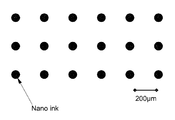
- FIG. 1 shows a image of a nano ink comprising the titanium dioxide prepared in accordance with the present invention printed by ink-jetting.
- the present invention provides a titanium dioxide nano particle coated with a surface stabilizer by chemical bonding so as to provide good compatibility with an ink composition.
- the surface stabilizer may be represented by any one of Chemical Formulae 1 to 3.
- the surface stabilizer has an acid functional group and also has a hydrophobic moiety capable of providing stable dispersion in other materials.
- R 1 , R 2 and R 3 independently represent hydrogen, C 1 -C 20 alkyl, C 2 -C 20 alkenyl, C 2 -C 20 alkynyl or C 6 -C 30 aryl.
- the titanium dioxide nano particle capped with the surface stabilizer may be obtained by reacting the surface stabilizer with titanium isopropoxide, a precursor used to prepare a titanium dioxide nano particle.
- the solvent may be an alcohol, glycol, polyol, glycol ether, or the like.
- titanium dioxide colloid solution has a titanium dioxide content from 10 to 15 vol %.
- a titanium dioxide nano particle having a size of about from 3 to 30 nm may be obtained.
- the present invention further provides a nano ink comprising the titanium dioxide nano particle capped with the surface stabilizer, a dispersant and a solvent.
- the dispersant is compatible with the surface structure of the nano particle and makes the nano particle disperse well in the solvent without precipitating easily.
- the dispersant may be a non-ionic surfactant. More specifically, it may be a polyethylene oxide-polypropylene oxide block copolymer or a polyethylene oxide-polystyrene block copolymer represented by Chemical Formula 4 or 5.
- n and m independently represent an integer from 1 to 30.
- the copolymer represented by Chemical Formula 4 or 5 provides improved lubrication at the interface with the titanium dioxide nano particle and thus is effective in improving dispersibility when it has a polyethylene oxide (CH 2 CH 2 O) content from 30 to 80 wt % based on the total weight of the copolymer.
- a polyethylene oxide (CH 2 CH 2 O) content from 30 to 80 wt % based on the total weight of the copolymer.
- the solvent for the titanium dioxide nano ink may be an alcohol, glycol, polyol, glycol ether, etc. More specifically, it may be methanol, ethanol, propanol, isopropanol, butanol, pentanol, haxanol, dimethyl sulfoxide (DMSO), dimethylformamide (DMF), glycerol, ethylene glycol, ethylene glycol monomethyl ether, ethylene glycol monoethyl ether, ethylene glycol dimethyl ether, ethylene glycol diethyl ether, propylene glycol, propylene glycol propylene glycol propyl ether, or a mixture thereof.
- DMSO dimethyl sulfoxide
- DMF dimethylformamide
- glycerol ethylene glycol, ethylene glycol monomethyl ether, ethylene glycol monoethyl ether, ethylene glycol dimethyl ether, ethylene glycol diethyl ether, propylene glycol, propylene glycol prop
- the proportion of the titanium dioxide nano particle, the dispersant and the solvent may be about 10 to 70 parts by weight, about 0.1 to 10 parts by weight and about 20 to 82 parts by weight. If the content of the titanium dioxide nano particle is less than 10 parts by weight, the number of inkjet printing has to be increased. Meanwhile, if it exceeds 70 parts by weight, the ink may be inappropriate for inkjet printing because of too high viscosity. If the content of the dispersant is less than 0.1 part by weight, a desired effect may not be attained. Meanwhile, if it exceeds 10 parts by weight, the ink may be inappropriate for inkjet printing because of too high viscosity.
- the titanium dioxide nano ink of the present invention may have a viscosity from about 1 to 50 cps at room temperature. If necessary, the ink of the present invention may be heated to about 80° C. or below during application to reduce viscosity. By heating to 80° C. or below, the viscosity may be reduced to about 1 to 20 cps.
- the nano ink of the present invention may further comprise a viscosity modifier. The viscosity modifier serves to modify the viscosity of the nano ink to be appropriate for printing.
- the present invention further provides a solar cell with an electrode layer printed using the titanium dioxide nano ink.
- the substrate After applying the titanium dioxide nano ink on a substrate, the substrate may be sintered to form an electrode pattern.
- the electrode pattern may be formed by inkjet printing.
- the inkjet printing method is advantageous in less material loss, easier control of narrow linewidths, a simpler process, or the like.
- Non-limiting examples of the substrate include a glass substrate, a transparent polymer substrate and a flexible substrate.
- the sintering may be performed at about 300 to 500° C. for several minutes to several hours. During the sintering process, organic compounds included in the titanium dioxide nano ink such as the dispersant and the solvent are decomposed and destroyed, and the remaining titanium dioxide nano particles form a porous electrode.
- Toluenesulfonic acid (1.72 mL) was dissolved in butanol (25 mL). After mixing butanol (150 mL) with Millipore water (5 mL) and adding titanium isopropoxide (12 mL), the resultant mixture was added to the toluenesulfonic acid solution. The mixture was reacted at room temperature for 1 hour and then at 110° C. for 6 hours. The reaction was proceeded further by adding phenylsulfonic acid.
- the solvent was evaporated from the resultant titanium dioxide colloid solution to adjust the volume to about 120 mL.
- FIG. 1 shows an image of thus prepared titanium dioxide nano ink printed by ink-jetting. It can be seen that the titanium dioxide nano particles are dispersed well with an interval of 200 ⁇ m.
- the prepared nano ink was injected into a printer head and an electrode was applied on a glass substrate. After heating at 300° C. for 1 hour, the substrate was sintered at 500° C. for 3 hours. After adsorbing a dye (N3, Solaronix) on thus prepared electrode for 24 hours at room temperature, it was bonded with a platinum counter electrode substrate (Surlyn, DuPont) at 120° C. After injecting an electrolyte through a previously prepared hole, a dye-sensitized solar cell was completed by blocking the injection hole with Surlyn.
- a dye-sensitized solar cell was prepared according to a commonly employed method.
- a titanium dioxide paste (Solaronix) for screen printing was coated on a fluorine-doped tin oxide (FTO)-coated glass substrate using a screen printing apparatus. After heating at 300° C. for 1 hour, the substrate was sintered at 500° C. for 3 hours. After adsorbing a dye (N3, Solaronix) on thus prepared electrode for 24 hours at room temperature, it was bonded with a platinum counter electrode substrate (Surlyn, DuPont) at 120° C. After injecting an electrolyte through a previously prepared hole, a dye-sensitized solar cell was completed by blocking the injection hole with Surlyn.
Landscapes
- Chemical & Material Sciences (AREA)
- Engineering & Computer Science (AREA)
- General Chemical & Material Sciences (AREA)
- Chemical Kinetics & Catalysis (AREA)
- Organic Chemistry (AREA)
- Materials Engineering (AREA)
- Electrochemistry (AREA)
- Life Sciences & Earth Sciences (AREA)
- Wood Science & Technology (AREA)
- Manufacturing & Machinery (AREA)
- Nanotechnology (AREA)
- Crystallography & Structural Chemistry (AREA)
- General Physics & Mathematics (AREA)
- Condensed Matter Physics & Semiconductors (AREA)
- Composite Materials (AREA)
- Physics & Mathematics (AREA)
- Inorganic Chemistry (AREA)
- Inks, Pencil-Leads, Or Crayons (AREA)
- Inorganic Compounds Of Heavy Metals (AREA)
- Sustainable Development (AREA)
- Sustainable Energy (AREA)
- Hybrid Cells (AREA)
Abstract
Description


| TABLE 1 | ||||
| Energy | ||||
| Current | Fill factor | conversion | ||
| Samples | density (Jsc) | Voltage (Voc) | (FF) | efficiency (%) |
| Example | 4.09 | 0.623 | 0.679 | 1.73 |
| Comparative | 3.95 | 0.622 | 0.655 | 1.61 |
| Example | ||||
Claims (4)


Priority Applications (1)
| Application Number | Priority Date | Filing Date | Title |
|---|---|---|---|
| US14/520,833 US9856388B2 (en) | 2010-03-18 | 2014-10-22 | Titanium dioxide nano particle modified by surface stabilizer, titanium dioxide nano ink comprising the same, solar cell employing the same, and producing method of the same |
Applications Claiming Priority (4)
| Application Number | Priority Date | Filing Date | Title |
|---|---|---|---|
| KR1020100024306A KR101113658B1 (en) | 2010-03-18 | 2010-03-18 | Titanium dioxide nanoparticles modified with a surface stabilizer, titanium dioxide nano ink comprising the same, a solar cell produced using the same, and a manufacturing method thereof |
| KR10-2010-0024306 | 2010-03-18 | ||
| US12/831,542 US8894890B2 (en) | 2010-03-18 | 2010-07-07 | Titanium dioxide nano particle modified by surface stabilizer, titanium dioxide nano ink comprising the same, solar cell employing the same, and producing method of the same |
| US14/520,833 US9856388B2 (en) | 2010-03-18 | 2014-10-22 | Titanium dioxide nano particle modified by surface stabilizer, titanium dioxide nano ink comprising the same, solar cell employing the same, and producing method of the same |
Related Parent Applications (1)
| Application Number | Title | Priority Date | Filing Date |
|---|---|---|---|
| US12/831,542 Division US8894890B2 (en) | 2010-03-18 | 2010-07-07 | Titanium dioxide nano particle modified by surface stabilizer, titanium dioxide nano ink comprising the same, solar cell employing the same, and producing method of the same |
Publications (2)
| Publication Number | Publication Date |
|---|---|
| US20150056745A1 US20150056745A1 (en) | 2015-02-26 |
| US9856388B2 true US9856388B2 (en) | 2018-01-02 |
Family
ID=44646246
Family Applications (2)
| Application Number | Title | Priority Date | Filing Date |
|---|---|---|---|
| US12/831,542 Active 2033-03-08 US8894890B2 (en) | 2010-03-18 | 2010-07-07 | Titanium dioxide nano particle modified by surface stabilizer, titanium dioxide nano ink comprising the same, solar cell employing the same, and producing method of the same |
| US14/520,833 Expired - Fee Related US9856388B2 (en) | 2010-03-18 | 2014-10-22 | Titanium dioxide nano particle modified by surface stabilizer, titanium dioxide nano ink comprising the same, solar cell employing the same, and producing method of the same |
Family Applications Before (1)
| Application Number | Title | Priority Date | Filing Date |
|---|---|---|---|
| US12/831,542 Active 2033-03-08 US8894890B2 (en) | 2010-03-18 | 2010-07-07 | Titanium dioxide nano particle modified by surface stabilizer, titanium dioxide nano ink comprising the same, solar cell employing the same, and producing method of the same |
Country Status (2)
| Country | Link |
|---|---|
| US (2) | US8894890B2 (en) |
| KR (1) | KR101113658B1 (en) |
Families Citing this family (10)
| Publication number | Priority date | Publication date | Assignee | Title |
|---|---|---|---|---|
| KR101305119B1 (en) * | 2010-11-05 | 2013-09-12 | 현대자동차주식회사 | Oxide semiconductor ink For Ink-Jet Printing and manufacturing method thereof, manufacturing method of photovoltaics using thereof |
| KR20130043709A (en) | 2011-10-20 | 2013-05-02 | 현대자동차주식회사 | Electrode composite ink for ink-jet printing and manufacturing method of electrode for dye-sensitized solar cell using thereof |
| CN104151936A (en) * | 2013-05-13 | 2014-11-19 | 中原工学院 | Fluorine modified polyurethane resin based inkjet printer ink and preparation method thereof |
| KR101565687B1 (en) * | 2014-03-28 | 2015-11-05 | 한양대학교 에리카산학협력단 | Titanium oxide having Hexagonal column shape, method of fabricating the same, solar cell comprising the same, and method of fabricating solar cell comprising the same |
| PL3037248T3 (en) | 2014-12-22 | 2018-10-31 | Magna Steyr Fahrzeugtechnik Ag & Co Kg | Method for producing a sandwich component |
| CN110945084B (en) | 2017-07-20 | 2022-05-10 | 巴斯夫欧洲公司 | Phosphonate Surface Functionalized Titanium Dioxide Nanoparticles |
| EP4031496A1 (en) | 2019-09-17 | 2022-07-27 | Basf Se | Metal oxide nanoparticles |
| CN115867614A (en) | 2020-08-21 | 2023-03-28 | 巴斯夫欧洲公司 | UV-curable coating with high refractive index |
| CN112462572B (en) * | 2020-12-09 | 2022-08-16 | 清华大学 | Photoresist, patterning method of photoresist and method of generating printed circuit board |
| WO2022190869A1 (en) * | 2021-03-10 | 2022-09-15 | 株式会社ダイセル | Particle immobilizing substrate, method for producing particle immobilizing substrate, method for producing diamond film immobilizing substrate, and method for producing diamond |
Citations (21)
| Publication number | Priority date | Publication date | Assignee | Title |
|---|---|---|---|---|
| US6329058B1 (en) * | 1998-07-30 | 2001-12-11 | 3M Innovative Properties Company | Nanosize metal oxide particles for producing transparent metal oxide colloids and ceramers |
| US20030089271A1 (en) | 2000-09-05 | 2003-05-15 | Norihiro Hirano | Water-based ink composition |
| US20060104894A1 (en) * | 2004-11-16 | 2006-05-18 | Daoud Walid A | Method for making single-phase anatase titanium oxide |
| US7125536B2 (en) * | 2004-02-06 | 2006-10-24 | Millennium Inorganic Chemicals, Inc. | Nano-structured particles with high thermal stability |
| KR100656365B1 (en) | 2005-11-18 | 2006-12-13 | 한국전자통신연구원 | Non-aqueous paste composition for semiconductor electrode of dye-sensitized solar cell, preparation method thereof and dye-sensitized solar cell using same |
| KR20070048996A (en) | 2005-11-07 | 2007-05-10 | 삼성전자주식회사 | Metal oxide paste composition and manufacturing method of semiconductor electrode using the same |
| KR100783766B1 (en) | 2006-07-21 | 2007-12-07 | 한국전기연구원 | Carbon nanotube electrode and manufacturing method thereof and dye-sensitized solar cell |
| KR100786868B1 (en) | 2005-11-03 | 2007-12-20 | 삼성에스디아이 주식회사 | Solar cell and manufacturing method thereof |
| KR20080001654A (en) | 2006-06-29 | 2008-01-03 | 주식회사 엘지화학 | Metal nano ink for circuit wiring containing polyethylenimine compound |
| KR100830871B1 (en) | 2006-10-11 | 2008-05-21 | 삼성전기주식회사 | Method of surface modification of non-dispersible metal nanoparticles and thereby surface modified metal nanoparticles for inkjet |
| KR100836659B1 (en) | 2006-07-06 | 2008-06-10 | 삼성전기주식회사 | Method for producing metal and metal oxide nanoparticles |
| WO2008074869A1 (en) | 2006-12-20 | 2008-06-26 | Centrum Für Angewandte Nanotechnologie (Can) Gmbh | Surface treatment method for nanoparticles |
| KR20090019781A (en) | 2006-04-12 | 2009-02-25 | 나노마스 테크놀러지스, 인코포레이티드 | Nanoparticles, Manufacturing Methods and Uses |
| WO2009101640A1 (en) * | 2008-02-11 | 2009-08-20 | Daunia Wind Srl | Process for the preparation of titanium dioxide with nanometric dimensions and controlled shape |
| US20090247652A1 (en) * | 2008-03-27 | 2009-10-01 | Headwaters Technology Innovation, Llc | Metal colloids and methods for making the same |
| US20090258145A1 (en) | 2007-05-25 | 2009-10-15 | Canon Kabushiki Kaisha | Ink jet ink, ink jet recording method, ink cartridge, recording unit and ink jet recording apparatus |
| US20090297626A1 (en) * | 2006-11-03 | 2009-12-03 | The Trustees Of Columbia University In The City Of New York | Methods for preparing metal oxides |
| US20100117503A1 (en) * | 2005-09-22 | 2010-05-13 | Sony Corporation | Metal oxide nanoparticles, production method thereof, light-emitting element assembly, and optical material |
| US7785496B1 (en) * | 2007-01-26 | 2010-08-31 | Clemson University Research Foundation | Electrochromic inks including conducting polymer colloidal nanocomposites, devices including the electrochromic inks and methods of forming same |
| US20120111409A1 (en) * | 2010-11-05 | 2012-05-10 | Hyundai Motor Company | Semiconductor oxide ink composition for inkjet printing, method of manufacturing the same, and method of manufacturing photoelectric conversion element using the same |
| US20120275119A1 (en) * | 2009-11-13 | 2012-11-01 | Teknologian Tutkimuskeskus Vtt | Method and products related to deposited particles |
-
2010
- 2010-03-18 KR KR1020100024306A patent/KR101113658B1/en not_active Expired - Fee Related
- 2010-07-07 US US12/831,542 patent/US8894890B2/en active Active
-
2014
- 2014-10-22 US US14/520,833 patent/US9856388B2/en not_active Expired - Fee Related
Patent Citations (21)
| Publication number | Priority date | Publication date | Assignee | Title |
|---|---|---|---|---|
| US6329058B1 (en) * | 1998-07-30 | 2001-12-11 | 3M Innovative Properties Company | Nanosize metal oxide particles for producing transparent metal oxide colloids and ceramers |
| US20030089271A1 (en) | 2000-09-05 | 2003-05-15 | Norihiro Hirano | Water-based ink composition |
| US7125536B2 (en) * | 2004-02-06 | 2006-10-24 | Millennium Inorganic Chemicals, Inc. | Nano-structured particles with high thermal stability |
| US20060104894A1 (en) * | 2004-11-16 | 2006-05-18 | Daoud Walid A | Method for making single-phase anatase titanium oxide |
| US20100117503A1 (en) * | 2005-09-22 | 2010-05-13 | Sony Corporation | Metal oxide nanoparticles, production method thereof, light-emitting element assembly, and optical material |
| KR100786868B1 (en) | 2005-11-03 | 2007-12-20 | 삼성에스디아이 주식회사 | Solar cell and manufacturing method thereof |
| KR20070048996A (en) | 2005-11-07 | 2007-05-10 | 삼성전자주식회사 | Metal oxide paste composition and manufacturing method of semiconductor electrode using the same |
| KR100656365B1 (en) | 2005-11-18 | 2006-12-13 | 한국전자통신연구원 | Non-aqueous paste composition for semiconductor electrode of dye-sensitized solar cell, preparation method thereof and dye-sensitized solar cell using same |
| KR20090019781A (en) | 2006-04-12 | 2009-02-25 | 나노마스 테크놀러지스, 인코포레이티드 | Nanoparticles, Manufacturing Methods and Uses |
| KR20080001654A (en) | 2006-06-29 | 2008-01-03 | 주식회사 엘지화학 | Metal nano ink for circuit wiring containing polyethylenimine compound |
| KR100836659B1 (en) | 2006-07-06 | 2008-06-10 | 삼성전기주식회사 | Method for producing metal and metal oxide nanoparticles |
| KR100783766B1 (en) | 2006-07-21 | 2007-12-07 | 한국전기연구원 | Carbon nanotube electrode and manufacturing method thereof and dye-sensitized solar cell |
| KR100830871B1 (en) | 2006-10-11 | 2008-05-21 | 삼성전기주식회사 | Method of surface modification of non-dispersible metal nanoparticles and thereby surface modified metal nanoparticles for inkjet |
| US20090297626A1 (en) * | 2006-11-03 | 2009-12-03 | The Trustees Of Columbia University In The City Of New York | Methods for preparing metal oxides |
| WO2008074869A1 (en) | 2006-12-20 | 2008-06-26 | Centrum Für Angewandte Nanotechnologie (Can) Gmbh | Surface treatment method for nanoparticles |
| US7785496B1 (en) * | 2007-01-26 | 2010-08-31 | Clemson University Research Foundation | Electrochromic inks including conducting polymer colloidal nanocomposites, devices including the electrochromic inks and methods of forming same |
| US20090258145A1 (en) | 2007-05-25 | 2009-10-15 | Canon Kabushiki Kaisha | Ink jet ink, ink jet recording method, ink cartridge, recording unit and ink jet recording apparatus |
| WO2009101640A1 (en) * | 2008-02-11 | 2009-08-20 | Daunia Wind Srl | Process for the preparation of titanium dioxide with nanometric dimensions and controlled shape |
| US20090247652A1 (en) * | 2008-03-27 | 2009-10-01 | Headwaters Technology Innovation, Llc | Metal colloids and methods for making the same |
| US20120275119A1 (en) * | 2009-11-13 | 2012-11-01 | Teknologian Tutkimuskeskus Vtt | Method and products related to deposited particles |
| US20120111409A1 (en) * | 2010-11-05 | 2012-05-10 | Hyundai Motor Company | Semiconductor oxide ink composition for inkjet printing, method of manufacturing the same, and method of manufacturing photoelectric conversion element using the same |
Non-Patent Citations (3)
| Title |
|---|
| Hester, (2007). Nanotechnology-Consequences for Human Health and the Environment. (pp. 1-18, section titled "Current and Future Applications of Nanotechnology" written by Barry Patk). Royal Society of Chemistry. Online version available at : http://app.knovel.com/hotlink/toc/id:kpNCHHE001/nanotechnology-consequences. |
| Hester, (2007). Nanotechnology—Consequences for Human Health and the Environment. (pp. 1-18, section titled "Current and Future Applications of Nanotechnology" written by Barry Patk). Royal Society of Chemistry. Online version available at : http://app.knovel.com/hotlink/toc/id:kpNCHHE001/nanotechnology-consequences. |
| Ramakrishna, G. et al., "Optical and Photochemical Properties of Sodium Dodecylbenzenesulfonate (DBS)-Capped TiO2 Nanoparticles Dispersed in Nonaqueous Solvents," Langmuir, vol. 19, No. 3,2003, pp. 505-508. |
Also Published As
| Publication number | Publication date |
|---|---|
| US8894890B2 (en) | 2014-11-25 |
| US20110226321A1 (en) | 2011-09-22 |
| KR101113658B1 (en) | 2012-02-14 |
| KR20110105191A (en) | 2011-09-26 |
| US20150056745A1 (en) | 2015-02-26 |
Similar Documents
| Publication | Publication Date | Title |
|---|---|---|
| US9856388B2 (en) | Titanium dioxide nano particle modified by surface stabilizer, titanium dioxide nano ink comprising the same, solar cell employing the same, and producing method of the same | |
| Zhang et al. | Materials and methods for cost-effective fabrication of perovskite photovoltaic devices | |
| CN100587971C (en) | Dye-sensitized solar cell and manufacturing method thereof | |
| Ouedraogo et al. | Printing perovskite solar cells in ambient air: a review | |
| TWI301000B (en) | Counter electrode for photoelectric conversion element and photoelectric conversion element | |
| US7691295B2 (en) | Metal oxide paste composition and method of manufacturing semiconductor electrode using the same | |
| CN113122251B (en) | Direct synthesis method for preparing size-tunable lead chalcogenide quantum dots and its application | |
| Zhu et al. | Eliminating voids and residual PbI2 beneath a perovskite film via buried interface modification for efficient solar cells | |
| Tang et al. | A review on recent advances in flexible perovskite solar cells | |
| KR20130086934A (en) | Photoelectric conversion element using thermosetting sealing agent for photoelectric conversion element | |
| CN113831786A (en) | Metal oxide ink modified with silane coupling agent and preparation method and application thereof | |
| Zhu et al. | Indium-doped CsPbI2. 5Br0. 5 with a tunable band structure and improved crystallinity for thermo-stable all-inorganic perovskite solar cells | |
| Liu et al. | Hydrophilic ligand exchange induces improved upconversion nanoparticle incorporation in dye-sensitized solar cells with efficiency exceeding 8% in a low-temperature fabrication process | |
| CN108314927A (en) | Buffer layer ink and preparation method thereof | |
| Sharma et al. | Development of dye-sensitized solar cells based on gold/gelatin gel electrolyte: Effect of different aspect ratio of gold nanocrystals | |
| CN101777574B (en) | Laminated composite solar battery | |
| CN113025124B (en) | Organic semiconductor ink and method for full-ink-jet printing of organic electrochemical transistor device | |
| US20130099176A1 (en) | Electrode compostion for inkjet printing and method for manufacturing electrode for dye-sensitized solar cell using the same | |
| KR101166515B1 (en) | Photoelectrode for dye-sensitized solar cell, preparing method of the same, and dye-sensitized solar cell having the same | |
| Zhang et al. | Chemical decoration of perovskites by nickel oxide doping for efficient and stable perovskite solar cells | |
| CN116598042A (en) | Inorganic functional paste, front silver-aluminum paste of N-type TOPCon solar cell and preparation method thereof | |
| JP2017147315A (en) | Method for manufacturing photoelectric conversion element and photoelectric conversion element | |
| JP2021095307A (en) | Anatase-type titanium oxide nanoparticles and method for producing the same, and photoelectric conversion element using anatase-type titanium oxide nanoparticles and method for producing the same | |
| CN113903863B (en) | A low-dimensional perovskite film based on <110> orientation and a method for preparing a solar cell thereof | |
| KR101220454B1 (en) | Non-aqueous Paste Composition for Semiconductor Electrode of Dye-Sensitized Solar Cells, Method for Preparing the Composition and Dye-Sensitized Solar Cells Using the Same |
Legal Events
| Date | Code | Title | Description |
|---|---|---|---|
| AS | Assignment |
Owner name: HYUNDAI MOTOR COMPANY, KOREA, REPUBLIC OF Free format text: ASSIGNMENT OF ASSIGNORS INTEREST;ASSIGNORS:LEE, KI CHUN;JANG, YONG JUN;REEL/FRAME:035023/0500 Effective date: 20150217 |
|
| STCF | Information on status: patent grant |
Free format text: PATENTED CASE |
|
| MAFP | Maintenance fee payment |
Free format text: PAYMENT OF MAINTENANCE FEE, 4TH YEAR, LARGE ENTITY (ORIGINAL EVENT CODE: M1551); ENTITY STATUS OF PATENT OWNER: LARGE ENTITY Year of fee payment: 4 |
|
| FEPP | Fee payment procedure |
Free format text: MAINTENANCE FEE REMINDER MAILED (ORIGINAL EVENT CODE: REM.); ENTITY STATUS OF PATENT OWNER: LARGE ENTITY |
|
| LAPS | Lapse for failure to pay maintenance fees |
Free format text: PATENT EXPIRED FOR FAILURE TO PAY MAINTENANCE FEES (ORIGINAL EVENT CODE: EXP.); ENTITY STATUS OF PATENT OWNER: LARGE ENTITY |
|
| STCH | Information on status: patent discontinuation |
Free format text: PATENT EXPIRED DUE TO NONPAYMENT OF MAINTENANCE FEES UNDER 37 CFR 1.362 |
|
| FP | Lapsed due to failure to pay maintenance fee |
Effective date: 20260102 |