US9856335B2 - Production of highly reactive low molecular weight PIB oligomers - Google Patents
Production of highly reactive low molecular weight PIB oligomers Download PDFInfo
- Publication number
- US9856335B2 US9856335B2 US15/238,092 US201615238092A US9856335B2 US 9856335 B2 US9856335 B2 US 9856335B2 US 201615238092 A US201615238092 A US 201615238092A US 9856335 B2 US9856335 B2 US 9856335B2
- Authority
- US
- United States
- Prior art keywords
- molecular weight
- composition
- polyisobutylene
- low molecular
- daltons
- Prior art date
- Legal status (The legal status is an assumption and is not a legal conclusion. Google has not performed a legal analysis and makes no representation as to the accuracy of the status listed.)
- Active
Links
- ZMRCFZFFKWFWSK-UHFFFAOYSA-N C=CC1=CC(C(C)(C)C)=C(O)C(C(C)(C)C)=C1 Chemical compound C=CC1=CC(C(C)(C)C)=C(O)C(C(C)(C)C)=C1 ZMRCFZFFKWFWSK-UHFFFAOYSA-N 0.000 description 2
- CXJHFTHOTONLCZ-UHFFFAOYSA-N C.C=CC1=CC(C(C)(C)C)=C(O)C(C(C)(C)C)=C1.CC1=CC(C(C)(C)C)=C(O)C(C(C)(C)C)=C1 Chemical compound C.C=CC1=CC(C(C)(C)C)=C(O)C(C(C)(C)C)=C1.CC1=CC(C(C)(C)C)=C(O)C(C(C)(C)C)=C1 CXJHFTHOTONLCZ-UHFFFAOYSA-N 0.000 description 1
- PLDHEBCNXQYBTK-NHJWRDTRSA-N C/C=C(\C)CC(C)(C)CCC.C=C(C)CC(C)(C)CC(C)(C)CC.CC/C(C)=C(\C)C(C)C.CCC(C)(C)CC(C)(C)C=C(C)C.CCC(C)C(C)=C(C)C.CCCC(C)(C)/C=C(\C)CC Chemical compound C/C=C(\C)CC(C)(C)CCC.C=C(C)CC(C)(C)CC(C)(C)CC.CC/C(C)=C(\C)C(C)C.CCC(C)(C)CC(C)(C)C=C(C)C.CCC(C)C(C)=C(C)C.CCCC(C)(C)/C=C(\C)CC PLDHEBCNXQYBTK-NHJWRDTRSA-N 0.000 description 1
- NLSAKPCSTDDPAH-UHFFFAOYSA-N C=C(C)=CC(C)(C)C.C=C(C)CC(C)(C)C Chemical compound C=C(C)=CC(C)(C)C.C=C(C)CC(C)(C)C NLSAKPCSTDDPAH-UHFFFAOYSA-N 0.000 description 1
- VQTUBCCKSQIDNK-UHFFFAOYSA-N C=C(C)C Chemical compound C=C(C)C VQTUBCCKSQIDNK-UHFFFAOYSA-N 0.000 description 1
- ZZBYUJLKFQXHHJ-UHFFFAOYSA-N C=C(C)CC(C)(C)C.CC(C)=CC(C)(C)C Chemical compound C=C(C)CC(C)(C)C.CC(C)=CC(C)(C)C ZZBYUJLKFQXHHJ-UHFFFAOYSA-N 0.000 description 1
- MAKZUCXUISYVIE-UHFFFAOYSA-N CC(C)(C)C1=CC=CC(C(C)(C)C)=C1O.CC1=CC(C(C)(C)C)=C(O)C(C(C)(C)C)=C1 Chemical compound CC(C)(C)C1=CC=CC(C(C)(C)C)=C1O.CC1=CC(C(C)(C)C)=C(O)C(C(C)(C)C)=C1 MAKZUCXUISYVIE-UHFFFAOYSA-N 0.000 description 1
- NLZUEZXRPGMBCV-UHFFFAOYSA-N CC1=CC(C(C)(C)C)=C(O)C(C(C)(C)C)=C1 Chemical compound CC1=CC(C(C)(C)C)=C(O)C(C(C)(C)C)=C1 NLZUEZXRPGMBCV-UHFFFAOYSA-N 0.000 description 1
Images


Classifications
-
- C—CHEMISTRY; METALLURGY
- C07—ORGANIC CHEMISTRY
- C07C—ACYCLIC OR CARBOCYCLIC COMPOUNDS
- C07C2/00—Preparation of hydrocarbons from hydrocarbons containing a smaller number of carbon atoms
- C07C2/02—Preparation of hydrocarbons from hydrocarbons containing a smaller number of carbon atoms by addition between unsaturated hydrocarbons
- C07C2/04—Preparation of hydrocarbons from hydrocarbons containing a smaller number of carbon atoms by addition between unsaturated hydrocarbons by oligomerisation of well-defined unsaturated hydrocarbons without ring formation
- C07C2/06—Preparation of hydrocarbons from hydrocarbons containing a smaller number of carbon atoms by addition between unsaturated hydrocarbons by oligomerisation of well-defined unsaturated hydrocarbons without ring formation of alkenes, i.e. acyclic hydrocarbons having only one carbon-to-carbon double bond
- C07C2/08—Catalytic processes
- C07C2/14—Catalytic processes with inorganic acids; with salts or anhydrides of acids
- C07C2/20—Acids of halogen; Salts thereof ; Complexes thereof with organic compounds
-
- C—CHEMISTRY; METALLURGY
- C07—ORGANIC CHEMISTRY
- C07C—ACYCLIC OR CARBOCYCLIC COMPOUNDS
- C07C9/00—Aliphatic saturated hydrocarbons
- C07C9/22—Aliphatic saturated hydrocarbons with more than fifteen carbon atoms
-
- C—CHEMISTRY; METALLURGY
- C08—ORGANIC MACROMOLECULAR COMPOUNDS; THEIR PREPARATION OR CHEMICAL WORKING-UP; COMPOSITIONS BASED THEREON
- C08F—MACROMOLECULAR COMPOUNDS OBTAINED BY REACTIONS ONLY INVOLVING CARBON-TO-CARBON UNSATURATED BONDS
- C08F110/00—Homopolymers of unsaturated aliphatic hydrocarbons having only one carbon-to-carbon double bond
- C08F110/04—Monomers containing three or four carbon atoms
- C08F110/08—Butenes
- C08F110/10—Isobutene
-
- C—CHEMISTRY; METALLURGY
- C08—ORGANIC MACROMOLECULAR COMPOUNDS; THEIR PREPARATION OR CHEMICAL WORKING-UP; COMPOSITIONS BASED THEREON
- C08F—MACROMOLECULAR COMPOUNDS OBTAINED BY REACTIONS ONLY INVOLVING CARBON-TO-CARBON UNSATURATED BONDS
- C08F4/00—Polymerisation catalysts
- C08F4/005—Friedel-Crafts catalysts in general
-
- C—CHEMISTRY; METALLURGY
- C08—ORGANIC MACROMOLECULAR COMPOUNDS; THEIR PREPARATION OR CHEMICAL WORKING-UP; COMPOSITIONS BASED THEREON
- C08K—Use of inorganic or non-macromolecular organic substances as compounding ingredients
- C08K5/00—Use of organic ingredients
- C08K5/04—Oxygen-containing compounds
- C08K5/13—Phenols; Phenolates
-
- C—CHEMISTRY; METALLURGY
- C07—ORGANIC CHEMISTRY
- C07C—ACYCLIC OR CARBOCYCLIC COMPOUNDS
- C07C2527/00—Catalysts comprising the elements or compounds of halogens, sulfur, selenium, tellurium, phosphorus or nitrogen; Catalysts comprising carbon compounds
- C07C2527/06—Halogens; Compounds thereof
- C07C2527/08—Halides
- C07C2527/12—Fluorides
- C07C2527/1213—Boron fluoride
Definitions
- the present invention relates to the preparation of polyisobutylene (PIB).
- PIB polyisobutylene
- the present invention relates to the preparation of highly reactive, low molecular weight PIB oligomers having a relatively high degree of terminal (or alpha) unsaturation.
- PIB may be manufactured in at least two different grades—regular and high vinylidene.
- Regular grade PIB may range in molecular weight from 500 to 1,000,000 or higher, and is generally prepared in a batch process at low temperature, sometimes as low as ⁇ 50 to ⁇ 70° C.
- AlCl 3 or modified AlCl 3 is used as catalyst. The catalyst is not totally removed from the final PIB product.
- Molecular weight may be controlled by temperature since the molecular weight of the product varies inversely with temperature. Higher temperatures lead to lower molecular weights. Reaction times are often in the order of hours.
- the desired polymeric product has a single double bond per molecule, and the double bonds are mostly internal.
- Regular PIB may be used as a viscosity modifier, particularly in lube oils, as a thickener, and as a tackifier for plastic films and adhesives. PIB can also be functionalized to produce intermediates for the manufacture of detergents and dispersants for fuels and lube oils.
- High vinylidene PIB is characterized by a large percentage of terminal double bonds, typically greater than 70% and preferentially greater than 80%. This provides a more reactive product, compared to regular PIB, and hence this product is also referred to as highly reactive PIB.
- the terms highly reactive (HR-PIB) and high vinylidene (HV-PIB) are synonymous.
- the basic processes for producing HV-PIB include a reactor system, employing BF 3 and/or modified BF 3 catalysts, such that the reaction time can be closely controlled and the catalyst can be immediately neutralized once the desired product has been formed.
- U.S. Pat. No. 5,068,490 describes a process for preparing highly reactive polyisobutylene using BF 3 etherate complex as the catalyst.
- the usual method for controlling the molecular weight involves increasing the temperature of the reactor to a certain set point, and maintaining a constant chiller temperature. As reactor temperature increases, the ⁇ T between the reactor and the chiller temperature increases causing the conversion to increase. The higher the reactor temperature, the lower will be the molecular weight.
- the decrease in molecular weight can usually be attributed to a combination of chain transfer to monomer and termination reactions. A linear relationship is usually obtained when log Mn is plotted against the reciprocal of temperature (Arrhenius plot). At a constant chiller temperature, the following relationship holds:
- temperature is the most important parameter in controlling molecular weight.
- the reactor temperature is controlled to the set point by employing feedback control i.e. by sensing the reactor temperature and then controlling the initiator feed rate to the reactors.
- feedback control i.e. by sensing the reactor temperature and then controlling the initiator feed rate to the reactors.
- the reactor temperature set-points need to be set very high.
- the higher reactor temperatures result in conversions reaching 100% because of the large difference between reactor and chiller temperatures.
- the usual feedback control logic of manipulating the initiator flow rate to control temperature does not hold. This results in a loss of control of the reaction making it very difficult to consistently produce low molecular weight PIB polymers within the desired specifications (Mn, PDI and viscosity and flash point).
- U.S. Pat. No. 5,962,604 describes a process for preparing low molecular weight, highly reactive polyisobutylene using BF 3 as the catalyst. The process is conducted in at least two stages.
- U.S. Pat. No. 5,556,932 describes a process for preparing chlorine-free, non-drying isobutene-diene copolymers using BF 3 as the catalyst.
- EP 0154164 describes a process for preparing polyisobutylene using BF 3 as the catalyst, ethylene as solvent and 2,4,4-trimethyl-1-pentene containing less than 1% by weight foreign constituents.
- Highly reactive PIB oligomers with Mn under 1000 are useful as, for example, drilling fluid additives, precursors for specialty surfactants, viscosity modifiers and the like. It is, therefore, useful to find a manufacturing process to consistently obtain such oligomers without significant loss of control or economics.
- the present invention is the discovery of a liquid phase polymerization process for isobutylene to manufacture highly reactive PIB oligomers having Mn under 1000, preferably under 800, more preferably under 500 and still more preferably under 300, using a catalyst composition comprising a Friedel-Crafts catalyst and a complexing agent, in the presence of a chain transfer agent (“CTA”).
- CTA chain transfer agent
- the process advantageously uses short residence times, for example, under 4 minutes, for the isobutylene in the polymerization reaction zone.
- PDI values for the inventive products are preferably less than 2, most preferably from 1.1 to 1.5.
- a polyisobutylene composition having Mn under 1000 exhibiting a multimodal molecular weight distribution, at least 70% terminal double bonds and a polydispersity under 2.0 prepared using a low molecular weight chain transfer agent, characterized in that the composition exhibits a low molecular weight relative maximum in its molecular weight distribution corresponding to the presence of said chain transfer agent.
- a reactive low molecular weight polyisobutylene composition comprising at least 50 mol percent alpha vinylidene terminated polyisobutylene molecules, the composition having a polydispersity of no more than 1.5 and a number average molecular weight of at least 500 Daltons and no more than 1000 Daltons.
- a liquid phase polymerization process to manufacture polyisobutylene (PIB) having a number average molecular weight, Mn, of 1000 Daltons or less and at least 50 mol % percent alpha vinylidene terminated polyisobutylene molecules, the process including: a) providing a feedstock comprising isobutylene; b) providing a catalyst composition comprising a Friedel-Crafts catalyst and a complexing agent therefor; c) providing a suitable chain transfer agent (“CTA”); d) providing a polymerization-retarding agent; e) introducing said feedstock, said catalyst composition, said chain transfer agent and said polymerization-retarding agent into a reaction zone to form a reaction mixture; f) intimately intermixing the reaction mixture in said reaction zone; g) optionally adding a modifier; h) maintaining the reaction mixture in its intimately intermixed condition to thereby cause the isobutylene therein to undergo polymerization to form polyis
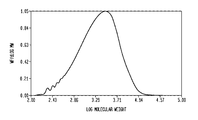
- FIG. 1 and FIG. 2 show differential molecular weight distribution curves for the product PIB produced by the inventive reaction.
- FIGS. 3 and 4 indicate GC-MS spectra for the polyisobutylene sample of example A and a BHT standard.
- the BHT concentration was measured at 8.56 ppm in the final PIB product and at 6 ppm in the standard.
- the GC-MS spectra were obtained by a GC-MS instrument using a high polarity DB-WAX GC column.
- molecular weight herein is reported as number average molecular weight, in Daltons, and is measured by gel permeation chromatography (GPC). GPC measurements may be carried out using a Viscotek GPCmax® instrument (Malvern instruments, Worcestershire, UK) employing a 3-column set-up (5 ⁇ m (particle size) 100 Angstrom (pore size), 5 ⁇ m 500 Angstrom, 5 ⁇ m 10 4 Angstrom) and a Refractive Index (RI) detector. Polyisobutylene standards are used to construct the calibration curve using this technique.
- Polydispersity or PDI is defined as the ratio of the weight average molecular weight divided by the number average molecular weight of the polymer.
- Polyisobutylene, “PIB” and like terminology refers to polymers made up of repeat units derived from isobutene, also referred to as isobutylene.
- Such polymers are derived from feedstocks made up of purified isobutenes and hydrocarbon diluents, from isobutene concentrate, dehydro effluent, or from raffinate streams.
- the PIB polymer consists essentially of repeat units derived from isobutylene, but may contain minor amounts of material derived from 1-butenes, butadiene or other C 4 olefins, 2-butenes (cis and/or trans) depending on the feedstock composition. Typically, the polymer is more than 99% by weight derived from isobutylene monomer.
- the feedstock may need to be purified to remove water and oxygenates such as alcohols, ethers and so forth to avoid adverse effects on the catalyst.
- Typical media for removal of impurities from hydrocarbon feed streams use molecular sieves, activated alumina and other hybrid adsorbents.
- a suitable absorbent to reduce water and oxygenate levels to desired limits is UOP AZ 300 (Des Plaines, Ill., USA).
- Post treatment, prior to feeding to the reactor the feed stream preferably has less than 3 ppm of oxygenates and less than 1 ppm of water. Structures of Double Bonds in Olefinic Polyisobutylenes
- the numbers in Table 2 in this Description indicate a certain type of end-group as a percentage of the sum of all the PIB end-groups (aliphatic and olefinic) of the composition.
- the end-groups not identified as any of the above, are summed up as ‘other’ in Table 2.
- endgroup percentages all PIB molecules found in the PIB compositions having a significant presence (more than half a percent or so) are included in endgroup calculations.
- the end group content is determined by nuclear magnetic resonance 13 C NMR as is well known in the art.
- a polyisobutylene composition as that term is used herein includes dimers as well as any residual chain transfer agent(s) such as ⁇ -DIB and ⁇ -DIB and mixtures thereof as described hereinafter.
- the present invention is the discovery of a liquid phase polymerization process for isobutylene to manufacture highly reactive PIB oligomers having Mn under 1000, preferably under 800, more preferably under 500 and still more preferably under 300.
- this invention provides a liquid phase polymerization process for isobutylene to manufacture highly reactive PIB oligomers having Mn under 1000, preferably under 800, more preferably under 500 and still more preferably under 300, using a catalyst composition comprising a Friedel-Crafts catalyst and a complexing agent, in the presence of a chain transfer agent (“CTA”).
- CTA chain transfer agent
- the process advantageously uses short residence times, for example, under 4 minutes, for the isobutylene in the polymerization reaction zone.
- the present invention provides an improved liquid phase process for the efficient and economical production of PIB.
- an isobutylene-containing feedstock stream is contacted in a reaction zone with a catalyst composition which facilitates the polymerization reaction.
- a CTA is provided which facilitates in producing low molecular weight oligomers of PIB.
- Appropriate reaction conditions are provided in the reaction zone.
- a PIB containing product stream is withdrawn from the reaction zone.
- the addition of a CTA results in lower molecular weights—it is usually considered a disadvantage in producing higher molecular weight polymers.
- the inventors have advantageously used CTAs to reduce conversion (thus helping with control) as well as the molecular weight, while at the same time maximizing the alpha vinylidene content in the polymer produced.
- the present invention provides an improved and surprisingly advantageous process to produce PIB of low molecular weight and high reactivity.
- Applicants have also found that the use of a CTA surprisingly facilitates the production of low molecular weight, highly reactive PIB in the polymerization reaction and that a polymerization-retarding agent used with the chain transfer agent greatly reduces polydispersity, leading to much better molecular uniformity.
- the improved process of the present invention features the use of a Friedel-Crafts catalyst which is complexed with a complexing agent which appropriately alters the performance of the catalyst.
- a Friedel-Crafts catalyst which is complexed with a complexing agent which appropriately alters the performance of the catalyst.
- Many useful Friedel-Crafts catalysts are known to those of ordinary skill in the related art field. In particular, many useful catalysts are described in the prior patents referenced above.
- Useful Friedel-Crafts catalysts include, for example, BF 3 , AlCl 3 , TiCl 4 , BCl 3 , SnCl 4 and FeCl 3 and the like.
- the complexing agent for the catalyst may be any compound containing a lone pair of electrons, such as, for example, an alcohol, an ester or an amine.
- the complexing agent may be an alcohol, desirably a primary alcohol, preferably a C1-C8 primary alcohol (such as, for example, methanol, ethanol, propanol, isopropanol, hexyl alcohol and the like) and ideally methanol.
- the molar ratio of BF 3 to complexing agent in the catalyst composition is generally in the range of from approximately 0.5:1 to approximately 5:1 respectively, desirably within the range of from approximately 0.5:1 to approximately 2:1, and preferably within the range of from approximately 0.5:1 to approximately 1:1.
- the catalyst composition may simply be a 1:1 complex of BF 3 and methanol.
- the molar ratio of BF 3 to complexing agent in said complex may be approximately 0.75:1.
- the temperature in the reaction zone may generally and preferably be in the range 20-110° F., preferably in the range 40-100° F. and still more preferably in the range 70-100° F.
- the reactor residence time may generally be less than 4 minutes, preferably less than 3 minutes and more preferably under 2 minutes.
- the amount of the BF 3 catalyst introduced into the reaction zone is within the range of from about 0.1 to about 10 millimoles for each mole of isobutylene introduced into the reaction zone.
- the BF 3 catalyst may be introduced at a rate of about 0.5 to about 5 millimoles per mole of isobutylene introduced in the feedstock. More preferably, the BF 3 catalyst may be introduced at a rate of about 0.5 to about 5 millimoles per mole of isobutylene introduced in the feedstock.
- ⁇ -DIB 2,4,4-Trimethyl-1-pentene
- ⁇ -DIB 2,4,4-Trimethyl-1-pentene
- ⁇ -DIB 2-ethyl-1-hexene
- 2-methyl-1-pentene 2-methyl-1-pentene and mixtures thereof.
- ⁇ -DIB 2,4,4-Trimethyl-1-pentene
- ⁇ -DIB 2-ethyl-1-hexene
- a “low molecular weight chain transfer agent” refers to a chain transfer agent having a molecular weight lower than M n of a polyisobutylene composition in which it resides. Typically, such transfer agents have M n of 100 to 150 Daltons and exhibit a peak corresponding to their molecular weight.
- inventive polymerization can advantageously be performed using convention equipment such as, for example, a loop reactor.
- convention equipment such as, for example, a loop reactor.
- Such equipment is used in conventional processes for the production of polyisobutylene.
- the present invention can be practiced with practically no change in the equipment used.
- Yet another advantage of the present invention is the absence of inert diluents in the process.
- inert diluents such as an alkane (e.g., isobutane, n-butane and the like) are used.
- the inert diluent has to be separately removed at the end of the polymerization reaction.
- the absence of inert diluents in the process makes the additional separation step easier thus significantly improving the economics.
- the CTA in the process is generally used in excess amounts thereby functioning as a reactive diluent in those cases.
- the catalyst modifier may be any compound containing a lone pair of electrons such as, for example, an alcohol, ester, amine and the like.
- Suitable modifiers in the present invention are alcohols, preferably a C1-C8 primary alcohol, more preferably methanol.
- PIB polystyrene-butadiene-styrene-styrene-styrene-styrene-styrene-styrene-styrene-styrene-styrene-styrene-styrene-styrene-styrene-styrene-styrene-styrene-sulfene-180° F.
- PMCC Pensky-Martens Closed Cup test
- COC Cleveland Open Cup test
- the present invention discloses PIB with low molecular weight (Mn under 1000), low viscosity and PDI under 2, over 80% alpha vinylidene content with multimodal distribution, prepared by the presently described process.
- a reactive low molecular weight polyisobutylene composition comprising at least 50 mol percent alpha vinylidene terminated polyisobutylene molecules, the composition having a polydispersity of no more than 1.5 and a number average molecular weight of at least 500 Daltons and no more than 1000 Daltons prepared with both a CTA and a polymerization-retarding reagent.
- ED Electron donor
- DMA dimethyl acetamide
- DMSO dimethysulfoxide
- pyridines are also added to reduce the iconicity (positive charge) of the active species and thus eliminate or reduce side reactions such as transfer to monomer.
- DMA dimethyl acetamide
- DMSO dimethysulfoxide
- pyridines are also added to reduce the iconicity (positive charge) of the active species and thus eliminate or reduce side reactions such as transfer to monomer.
- EDs are also known to form complexes with the active species and these can precipitate out of the polymerization system resulting in undesirable impurities.
- the polymerization-retarding agent is carefully selected and/or controlled via appropriate concentration levels, the products of the invention are produced as described herein.
- Desired particularly in continuous polymerization systems will be mildly basic compounds which could be used as controlled polymerization rate retarders which benefit polydispersity but at the same time do not precipitate out of the polymerization system or greatly effect reaction rate. Retarding agents are effectively used especially when the goal is to make low molecular weight polymers.
- Electron Pair Donors in Carbocationic Polymerization Kaszas et al., Polymer Bulletin 20, pp. 413-419 (1988); and U.S. Pat. No. 6,852,808, issued Feb. 8, 2005, entitled “Method for Producing Homopolymers and Copolymers of Isobutene”, to Hüffer; the entire disclosures of which are incorporated herein by reference disclose compounds which are optionally used in connection with the present invention.
- Suitable polymerization electron donors, retarding and chain transfer agents for use with the invention are also described in Kennedy, J. P.
- Polymerization retarding agents are used together with chain transfer agents to produce products of low polydispersity (polydispersity or PDI is the ratio of the weight average molecular weight divided by the number average molecular weight of the polymer).
- Suitable polymerization-retarding agents are compounds that have mild basicity, especially phenolic compound and hindered phenols where the retarding effect can be controlled either by the type of phenol molecule selected or its concentration in the polymerization system. ( Rates of Initiation of the Cationic Polymerization of Isobutene , Russel et al., J. Polymer Science, Symposium No. 56, pp. 183-189 (1976);)
- various hindered phenolic structures could be used as mild rate retarders, strong rate retarders or copolymers depending on the functionality of the phenyl ring.
- Some preferred polymerization-retarding agents include:
- a vinyl functional hindered phenol may be used such as:
- Hindered phenol polymerization-retarding agents remain in the composition, whether or not copolymerized into the polymer backbone and are operative as antioxidants such that they stabilize the polymer in use. See Functional Polymers, XLIII. Olefin Copolymers of 2,6- Di - t - butyl -4- vinyl ( or 4- isopropenyl ) phenol , Paul Grosso and Otto Vogl, J. Macromol. Sci.-Chem., A23(11), pp. 1299-1313 (1986) as well as U.S. Pat. No. 4,097,464, issued Jun.
- Ethyl benzoate and other compounds may also be employed as polymerization-retarding agents to control polydispersity, such as the compounds disclosed in the following reference:
- PIB polystyrene-butadiene-styrene-styrene-styrene-styrene-styrene-styrene-styrene-styrene-styrene-styrene-styrene-styrene-styrene-styrene-styrene-styrene-sulfene-180° F.
- PMCC Pensky-Martens Closed Cup test
- COC Cleveland Open Cup test
- the products of the invention may be made in a loop reactor. Further details relating to the operation of such reactors are provided in PCT/US2102/040897 as well as European Patent 1 242 464, the disclosures of which are incorporated by reference.
- Run 1 was a comparative experiment using the conventional solvent isobutane as the diluent with no chain transfer agent.
- Run 2 used chain transfer agent DIB and no isobutane (diluent). The results are as shown in Table 1.
- the poly(isobutylene) product in Run 1 had a Mn of 1505 and a viscosity of 480 cP.
- Comparative run 2 with DIB instead of Isobutane had a much lower Mn and viscosity.
- the addition of a chain transfer agent leads to greatly reduced molecular weight without manipulating temperature.
- the alpha vinylidene of the product synthesized using DIB is about 54% which is approximately in the range of product synthesized using isobutane as a diluent.
- the flash temperatures in Runs 1 and 2 were also in the range of products synthesized using isobutane as a diluent.
- the PIB exhibited flash temperatures in the range 115-180° F. as measured by the Pensky-Martens Closed Cup test (PMCC).
- the flash temperatures as measured by the Cleveland Open Cup test (COC) were in the range 90-130° F.
- Mn ranged from 300 to 600. The flash temperatures showed a linear relationship with Mn.
- the PIB product was analyzed by 13 C NMR for the alpha vinylidene content as well as olefin distribution (i.e. relative amounts of trisubstituted, tetrasubstituted and other double bonds).
- the results for Runs 1 (Isobutane diluent), 2 (i DIB for comparison) and runs 3, 4, 5 and 6 (DIB+methanol) are shown in Table 2 for comparison.
- the PIB produced by the present process using a chain transfer agent and modifier exhibits multimodal distribution (versus unimodal distribution from the polymer produced by the comparative, conventional process using isobutane).
- methanol to BF 3 ratio i.e. regulating methanol flow
- alpha vinylidene content of greater than 80% can be obtained.
- tetramer content was less than 3%.
- FIGS. 1 and 2 indicate differential molecular weight distribution curves.
- the frequency of the weight fraction is plotted along the y-axis with the log (molecular weight) plotted along the x-axis.
- FIG. 1 shows a unimodal distribution whereas FIG. 2 shows a multimodal distribution.
- a prominent low molecular weight shoulder (relative maximum) corresponding to the added dimer (molecular weight of approximately 112) can be seen.
- the area of this peak varies depending on the added amount of dimer (CTA) and can range from 2 to 20% or in a narrower range from 4 to 10% of the polyisobutylene composition.
- a typical set of process conditions for the synthesis of a PIB product in the 600 and 450 Mn range is as shown in Table 3. Properties of the products appear in Table 4.
- FIG. 3 and FIG. 4 indicate GC-MS spectra for the polyisobutylene sample of example 7 and a BHT standard.
- the BHT concentration was measured at 8.56 ppm in the final PIB product and at 6 ppm in the standard.
- the GC-MS spectra were obtained by a by a GC-MS instrument using a high polarity DB-WAX GC column.
- the invention material prepared with a BHT polymerization-retarding agent was prepared and compared with a like material prepared without BHT in the reaction medium. Samples were tested on a BYK Gardner instrument in accordance with ASTM 1209 for color before and after thermal aging in an oven under nitrogen for 2 weeks at 120° C. Results were as follows:
- a liquid phase polymerization process of isobutylene to manufacture highly reactive polyisobutylene (PIB) having Mn under 1000 and at least 70% terminal double bonds said process includes: a) providing a feedstock comprising isobutylene; b) providing a catalyst composition comprising a Friedel-Crafts catalyst and a complexing agent therefor; c) providing a suitable chain transfer agent (“CTA”); d) introducing said feedstock, said catalyst composition and said chain transfer agent into a reaction zone to form a reaction mixture; e) intimately intermixing the reaction mixture in said reaction zone; f) optionally adding a modifier; g) maintaining the reaction mixture in its intimately intermixed condition and keeping it at a temperature of about 20-110° F.
- CTA chain transfer agent
- the PIB has molecular weight under 800, under 500 or under 300.
- the Friedel-Crafts catalyst is selected from the group consisting of BF 3 , AlCl 3 , TiCl 4 , BCl 3 , SnCl 4 and FeCl 3 , and the complexing agent is typically an alcohol such as a primary alcohol, notably methanol.
- the modifier is optionally present and is typically an alcohol and may be methanol as well.
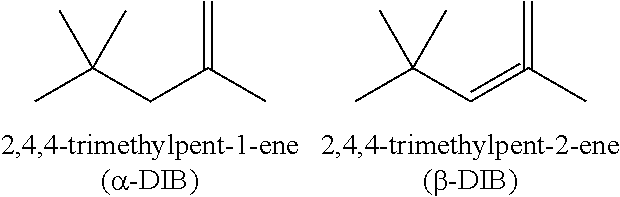
- the CTA may be selected from the group consisting of 2,4,4-Trimethyl-1-pentene (“ ⁇ -DIB”), 2.4.4.-Trimethyl-2-pentene (“ ⁇ -DIB”), 2-ethyl-1-hexene, 2-methyl-1-pentene and mixtures thereof.
- ⁇ -DIB 2,4,4-Trimethyl-1-pentene
- ⁇ -DIB 2.4.4.-Trimethyl-2-pentene
- 2-ethyl-1-hexene 2-methyl-1-pentene and mixtures thereof.
- One preferred embodiment is wherein said CTA is a mixture of ⁇ -DIB and ⁇ -DIB in an 80:20 molar ratio.
- the PIB produced may have at least 75% terminal double bonds or at least 80% terminal double bonds.
- One preferred embodiment is wherein the PIB has Mn under 1000 and at least 75% terminal double bonds and another is wherein the PIB has Mn under 500 and at least 75% terminal double bonds. Still yet another embodiment is wherein the PIB has Mn under 300 and at least 75% terminal double bonds.
- the catalyst and complexing agent may be present in a molar ratio of about 0.3:1 to about 5:1 or the catalyst and complexing agent are present in a molar ratio of about 0.5:1 to about 2:1.
- a preferred mixture is wherein the catalyst and complexing agent are present in a molar ratio of about 0.5:1 to about 1:1.
- from about 0.1 to about 10 millimoles of BF 3 are used in the catalyst composition for each mole of isobutylene introduced into the reaction.
- BF 3 from about 0.5 to about 5 millimoles of BF 3 are used in the catalyst composition for each mole of isobutylene introduced into the reaction and in others about 0.5 to about 2 millimoles of BF 3 are used in the catalyst composition for each mole of isobutylene introduced into said reaction.
- the polydispersity of the polyisobutylene is no more than about 2.0 in most embodiments and typically between 1 and 2; preferably, the polydispersity of said polyisobutylene no more than about 1.65 and in preferred cases from 1.1 to 1.5 or from 1.1 to 1.4.
- the polymerization is preferably conducted in a loop reactor in accordance with the present invention.
- One preferred product has Mn under 800 and at least 70% terminal double bonds.
- Another preferred product has Mn under 500 and at least 70% terminal double bonds.
- Still another preferred product has Mn under 300 and at least 70% terminal double bonds.
- Still yet another preferred product has Mn under 1000 and exhibits a multimodal molecular weight distribution, at least 70% terminal double bonds and a polydispersity under 2.0.
- the present invention is thus generally directed to a continuous reaction in a loop reactor preferably operated at recirculation to feed ratios of from 20 to 100 or so, typically from 25 to 80 and in some cases from 25 to 50.
- a polyisobutylene composition having Mn under 1000 exhibiting multimodal distribution, at least 70% terminal double bonds and a polydispersity under 2.0 prepared using a low molecular weight chain transfer agent, characterized in that the composition exhibits a low molecular weight relative maximum in its molecular weight distribution corresponding to the presence of said chain transfer agent, preferably the chain transfer agent is present at a content of from 2 weight percent to 20 weight percent of the composition.
- the composition may be characterized in some cases in that the composition exhibits a low molecular weight relative maximum in its molecular weight distribution corresponding to the presence of said chain transfer agent at a content of from 4 weight percent to 10 weight percent of the composition.
- such transfer agents have a molecular weight of 100 to 150 Daltons and exhibit a peak corresponding to their molecular weight.
- the polydispersity of the composition is no more than about 1.65 and most preferably the polydispersity of the composition is from 1.1 to 1.5 or from 1.1 to 1.4.
- Another embodiment provides a reactive low molecular weight polyisobutylene composition
- a reactive low molecular weight polyisobutylene composition comprising at least 50 mol percent alpha vinylidene terminated polyisobutylene molecules, the composition having a polydispersity of no more than 1.5 and a number average molecular weight of at least 500 Daltons and no more than 1000 Daltons.
- the reactive low molecular weight polyisobutylene composition comprises at least 60 mol percent alpha vinylidene terminated polyisobutylene molecules and in others at least 70 mol percent alpha vinylidene terminated polyisobutylene molecules. In most cases, the reactive low molecular weight polyisobutylene composition comprises from 50 to 99 mol percent alpha vinylidene terminated polyisobutylene molecules and the compositions are characterized in that no more than 10 mole % of the PIB molecules of the composition have tetra-substituted double bonds, more preferably wherein no more than 5 mole % of the PIB molecules of the composition have tetra-substituted double bonds.
- the reactive low molecular weight polyisobutylene compositions preferably have a polydispersity of no more than 1.4, more preferably no more than 1.3 and suitably from 1.2 to 1.5. In some cases, from 500 Daltons to 900 Daltons and in others a number average molecular weight of from 500 Daltons to 750 Daltons and in others a number average molecular weight of from 550 Daltons to 675 Daltons.
- the composition optionally further includes a polymerization-retarding agent such as a phenolic compound which may be a hindered phenol such as
- a reactive low molecular weight polyisobutylene composition includes a polymerization-retarding agent copolymerized with isobutylene.
- the polymerization-retarding agent copolymerized with isobutylene in the polyisobutylene composition may be operative as an antioxidant.
- the reactive low molecular weight polyisobutylene composition may include a polymerization-retarding agent copolymerized with isobutylene in the polyisobutylene composition which is a hindered phenol compound such as a vinyl functional hindered phenol compound.
- the reactive low molecular weight polyisobutylene composition includes a polymerization-retarding agent copolymerized with isobutylene in the polyisobutylene composition which is a vinyl hindered phenol compound of the formula:
- the polymerization-retarding agent may be present in an amount of from 1 to 3000 ppm by weight of the polyisobutylene composition, suitably the polymerization-retarding agent is present in an amount of from 1 to 1000 ppm by weight of the polyisobutylene composition and preferably the polymerization-retarding agent is present in an amount of from 5 to 500 ppm by weight of the polyisobutylene composition; and even more preferably the polymerization-retarding agent is present in an amount of from 10 to 100 ppm by weight of the polyisobutylene composition.
- Still another embodiment is directed to a liquid phase polymerization process to manufacture polyisobutylene (PIB) having a number average molecular weight, Mn, of 1000 Daltons or less and at least 60 mol % percent alpha vinylidene terminated polyisobutylene molecules, said process comprising: a) providing a feedstock comprising isobutylene; b) providing a catalyst composition comprising a Friedel-Crafts catalyst and a complexing agent therefor; c) providing a suitable chain transfer agent (“CTA”); d) providing a polymerization-retarding agent; e) introducing said feedstock, said catalyst composition, said chain transfer agent and said polymerization-retarding agent into a reaction zone to form a reaction mixture; f) intimately intermixing the reaction mixture in said reaction zone; g) optionally adding a modifier; h) maintaining the reaction mixture in its intimately intermixed condition to thereby cause the isobutylene therein to undergo polymerization to form polyis
- the PIB suitably has a number average molecular weight, Mn, under 800 Daltons, under 700 Daltons; suitably from 300 Daltons to 1000 Daltons.
- the Friedel-Crafts catalyst may be selected from the group consisting of BF 3 , AlCl 3 , TiCl 4 , BCl 3 , SnCl 4 and FeCl 3 and the complexing agent may be an alcohol such as a primary alcohol and preferably methanol. That is, preferably the modifier is present and is an alcohol, most preferably methanol.
- the CTA may be selected from the group consisting of 2,4,4-Trimethyl-1-pentene (“ ⁇ -DIB”), 2.4.4.-Trimethyl-2-pentene (“ ⁇ -DIB”), 2-ethyl-1-hexene, 2-methyl-1-pentene and mixtures thereof.
- ⁇ -DIB 2,4,4-Trimethyl-1-pentene
- ⁇ -DIB 2.4.4.-Trimethyl-2-pentene
- 2-ethyl-1-hexene 2-methyl-1-pentene and mixtures thereof.
- the CTA is a mixture of ⁇ -DIB and ⁇ -DIB in an 80:20 molar ratio.
Landscapes
- Chemical & Material Sciences (AREA)
- Organic Chemistry (AREA)
- Chemical Kinetics & Catalysis (AREA)
- Health & Medical Sciences (AREA)
- Medicinal Chemistry (AREA)
- Polymers & Plastics (AREA)
- Inorganic Chemistry (AREA)
- Addition Polymer Or Copolymer, Post-Treatments, Or Chemical Modifications (AREA)
- Engineering & Computer Science (AREA)
- Polymerisation Methods In General (AREA)
- Oil, Petroleum & Natural Gas (AREA)
- Materials Engineering (AREA)
Abstract

Description
Therefore temperature is the most important parameter in controlling molecular weight. The reactor temperature is controlled to the set point by employing feedback control i.e. by sensing the reactor temperature and then controlling the initiator feed rate to the reactors. For producing certain very low molecular weights (typically below 700 to 800 Mn), the reactor temperature set-points need to be set very high. The higher reactor temperatures result in conversions reaching 100% because of the large difference between reactor and chiller temperatures. At such a stage the usual feedback control logic of manipulating the initiator flow rate to control temperature does not hold. This results in a loss of control of the reaction making it very difficult to consistently produce low molecular weight PIB polymers within the desired specifications (Mn, PDI and viscosity and flash point).

Such polymers are derived from feedstocks made up of purified isobutenes and hydrocarbon diluents, from isobutene concentrate, dehydro effluent, or from raffinate streams. The PIB polymer consists essentially of repeat units derived from isobutylene, but may contain minor amounts of material derived from 1-butenes, butadiene or other C4 olefins, 2-butenes (cis and/or trans) depending on the feedstock composition. Typically, the polymer is more than 99% by weight derived from isobutylene monomer. One of skill in the art will appreciate that the feedstock may need to be purified to remove water and oxygenates such as alcohols, ethers and so forth to avoid adverse effects on the catalyst. Typical media for removal of impurities from hydrocarbon feed streams use molecular sieves, activated alumina and other hybrid adsorbents. A suitable absorbent to reduce water and oxygenate levels to desired limits is UOP AZ 300 (Des Plaines, Ill., USA). Post treatment, prior to feeding to the reactor, the feed stream preferably has less than 3 ppm of oxygenates and less than 1 ppm of water.
Structures of Double Bonds in Olefinic Polyisobutylenes


A “low molecular weight chain transfer agent” refers to a chain transfer agent having a molecular weight lower than Mn of a polyisobutylene composition in which it resides. Typically, such transfer agents have Mn of 100 to 150 Daltons and exhibit a peak corresponding to their molecular weight.

or, if a polymerizable compound is preferred, a vinyl functional hindered phenol may be used such as:

Hindered phenol polymerization-retarding agents remain in the composition, whether or not copolymerized into the polymer backbone and are operative as antioxidants such that they stabilize the polymer in use. See Functional Polymers, XLIII. Olefin Copolymers of 2,6-Di-t-butyl-4-vinyl (or 4-isopropenyl) phenol, Paul Grosso and Otto Vogl, J. Macromol. Sci.-Chem., A23(11), pp. 1299-1313 (1986) as well as U.S. Pat. No. 4,097,464, issued Jun. 27, 1978, entitled 2,6-Di-Tert-Alkyl-4-Vinylphenols as Polymerizable Antioxidants”, to Kline and U.S. Pat. No. 5,157,164, issued Oct. 20, 1992, entitled “Polymerizable Antioxidant Composition”, to Olivier. Ethyl benzoate and other compounds may also be employed as polymerization-retarding agents to control polydispersity, such as the compounds disclosed in the following reference:
- Cationic Polymerization of Isobutylene Coinitiated by AlC13 in the Presence of Ethyl Benzoate, Li et al., Chinese Journal of Polymer Science, Vol. 28, No. 1 (2010), pp 55-62.
| TABLE 1 | ||||||||
| Reactor | Chiller | Flash | ||||||
| Temp | Temp | Solvent | BF3:MeOH | Viscosity | (F) | |||
| Run | (F) | (F) | (wt %) | Ratio | Mn | PDI | (cP) | PMCC/ |
| 1 | 90 | 40 | 7 | 1:1 | 1505 | 2.02 | 480.3 | 234/158 |
| 2 | 90 | 20 | 6 | 1:1 | 1056 | 1.76 | 262.5 | 232/164 |
| 3 | 83 | 40 | 6 | 0.6:1 | 600 | 1.73 | 28.2 | 156/134 |
| 4 | 85 | 40 | 6 | 0.56:1 | 448 | 1.35 | 9.15 | 134/110 |
| 5 | 90 | 40 | 6 | 0.56:1 | 315 | 1.16 | 2.94 | 110/94 |
| 6 | 95 | 40 | 6 | 0.56:1 | 305 | 1.10 | — | 104/86 |
| TABLE 2 |
| 13C NMR Results and distribution type |
| Run | Alpha | Beta | trisub | tetrasub | | Distribution | |
| 1 | 64.3 | 23.3 | 1.4 | 4.2 | 6.8 | Unimodal |
| 2 | 62.8 | 15.7 | 3.9 | 5.6 | 12 | Unimodal |
| 3 | 80.7 | 9.4 | 0.7 | 2.7 | 6.5 | Multimodal |
| 4 | 81 | 8.6 | 0.4 | 2.2 | 7.8 | Multimodal |
| 5 | 85 | 8.1 | 0.8 | 1.7 | 4.4 | Multimodal |
| 6 | 84.6 | 7.4 | 2.2 | 1 | 4.8 | Multimodal |
| TABLE 3 |
| Reactor conditions for the synthesis of low molecular weight |
| PIB with added inhibitor |
| Example 7 | Example 8 | ||
| DESCRIPTION | 600 Mn | 450 Mn | UNITS |
| PIB REACTOR FEED | 24 | 38 | GPM |
| DIB CONCENTRATION | 15 | 12 | WT % |
| INHIBITOR (BHT) IN DIB | 75 | 75 | PPM |
| |
45 | 64 | DEG F. |
| TEMP | |||
| PIB REACT | 520 | 600 | GPM |
| RECIRCULATION | |||
| REACTOR TEMP | 91 | 91 | DEG F. |
| INITIATOR FLOW | 43 | 85 | ML/MIN |
| MODIFIER FLOW | 14 | 39 | ML/ |
| CHILLER TEMPERATURE | |||
| 45 | 65 | DEG F. | |
| CRUDE FLASH | 405 | 395 | DEG F. |
| PREHEATER TEMP | |||
| VACUUM FLASH | 3.8 | 4.2 | PSIA |
| PRESSURE | |||
| VACUUM FLASH TEMP | 405 | 400 | DEG F. |
| REACTOR CONVERSION | 96 | 85 | % |
| TABLE 4 |
| Product properties of polyisobutylene as synthesized according |
| to reaction conditions in Table 3. |
| Parameter | Example 7 | Example 8 | Unit | ASTM |
| MOLECULAR | 609 | 428 | Mn | |
| WEIGHT | ||||
| POLYDISPERSITY | 1.43 | 1.40 | — | |
| KINEMATIC | 30.41 @ | 67.35 @ | | ASTM |
| VISCOSITY | ||||
| 100° C. | 40° C. | D-445 | ||
| FLASH POINT, COC | 155 | 120 | ° C. | ASTM |
| D-92 | ||||
| SPECIFIC GRAVITY | 0.8747 | 0.8567 | — | ASTM |
| @ 15.6° C./15.6° C. | D-4052 | |||
| COLOR | 8 | 7 | Pt—Co | ASTM |
| D-1209 | ||||
| HAZE, | 0.319 | 0.258 | NTU | ASTM |
| PHOTOMETRIC | D-6181 | |||
| ALPHA VINYLIDENE | 67.78 | 70 | % | |
| APPEARANCE | CLEAR | CLEAR | ||
| AND | AND | |||
| BRIGHT | BRIGHT | |||
| TABLE 5 |
| Heat Aging Results |
| Color # before Heat | Color # after Heat | |
| Sample | Aging | Aging |
| PIB with BHT retarding | 8 (Mn 609, PDI 1.43) | 30 (Mn 634, 1.41) |
| agent | ||
| PIB without BHT | 14 (Mn 637, PDI 1.59) | 50 (Mn 674, 1.57) |
| retarding agent | ||
As can be seen in Table 5, the compositions prepared with polymerization-retarding agent exhibited unexpectedly superior color both before and after heat aging.


The polymerization-retarding agent may be present in an amount of from 1 to 3000 ppm by weight of the polyisobutylene composition, suitably the polymerization-retarding agent is present in an amount of from 1 to 1000 ppm by weight of the polyisobutylene composition and preferably the polymerization-retarding agent is present in an amount of from 5 to 500 ppm by weight of the polyisobutylene composition; and even more preferably the polymerization-retarding agent is present in an amount of from 10 to 100 ppm by weight of the polyisobutylene composition.
Claims (20)
Priority Applications (1)
| Application Number | Priority Date | Filing Date | Title |
|---|---|---|---|
| US15/238,092 US9856335B2 (en) | 2011-06-08 | 2016-08-16 | Production of highly reactive low molecular weight PIB oligomers |
Applications Claiming Priority (5)
| Application Number | Priority Date | Filing Date | Title |
|---|---|---|---|
| US201161520328P | 2011-06-08 | 2011-06-08 | |
| US201261586206P | 2012-01-13 | 2012-01-13 | |
| PCT/US2012/040897 WO2012170411A2 (en) | 2011-06-08 | 2012-06-05 | Production of highly reactive low molecular weight pib oligomers |
| US201414118254A | 2014-04-30 | 2014-04-30 | |
| US15/238,092 US9856335B2 (en) | 2011-06-08 | 2016-08-16 | Production of highly reactive low molecular weight PIB oligomers |
Related Parent Applications (2)
| Application Number | Title | Priority Date | Filing Date |
|---|---|---|---|
| PCT/US2012/040897 Division WO2012170411A2 (en) | 2011-06-08 | 2012-06-05 | Production of highly reactive low molecular weight pib oligomers |
| US14/118,254 Division US9453089B2 (en) | 2011-06-08 | 2012-06-05 | Production of highly reactive low molecular weight PIB oligomers |
Publications (2)
| Publication Number | Publication Date |
|---|---|
| US20160355620A1 US20160355620A1 (en) | 2016-12-08 |
| US9856335B2 true US9856335B2 (en) | 2018-01-02 |
Family
ID=47296697
Family Applications (2)
| Application Number | Title | Priority Date | Filing Date |
|---|---|---|---|
| US14/118,254 Active 2033-05-24 US9453089B2 (en) | 2011-06-08 | 2012-06-05 | Production of highly reactive low molecular weight PIB oligomers |
| US15/238,092 Active US9856335B2 (en) | 2011-06-08 | 2016-08-16 | Production of highly reactive low molecular weight PIB oligomers |
Family Applications Before (1)
| Application Number | Title | Priority Date | Filing Date |
|---|---|---|---|
| US14/118,254 Active 2033-05-24 US9453089B2 (en) | 2011-06-08 | 2012-06-05 | Production of highly reactive low molecular weight PIB oligomers |
Country Status (7)
| Country | Link |
|---|---|
| US (2) | US9453089B2 (en) |
| EP (1) | EP2718337B1 (en) |
| BR (1) | BR112013031532B1 (en) |
| CA (1) | CA2838235A1 (en) |
| MX (1) | MX360891B (en) |
| SG (1) | SG194908A1 (en) |
| WO (1) | WO2012170411A2 (en) |
Families Citing this family (5)
| Publication number | Priority date | Publication date | Assignee | Title |
|---|---|---|---|---|
| CN107108804B (en) * | 2014-12-31 | 2020-07-24 | 陶氏环球技术有限责任公司 | Polyolefin composition and process for producing the same |
| WO2017151341A1 (en) | 2016-03-03 | 2017-09-08 | Tpc Group Llc | Low-fluoride, reactive polyisobutylene |
| US11572523B1 (en) | 2022-01-26 | 2023-02-07 | Afton Chemical Corporation | Sulfurized additives with low levels of alkyl phenols |
| WO2023159095A1 (en) | 2022-02-21 | 2023-08-24 | Afton Chemical Corporation | Polyalphaolefin phenols with high para-position selectivity |
| KR20250005355A (en) | 2022-04-27 | 2025-01-09 | 에프톤 케미칼 코포레이션 | High-sulfur additives for lubricating oil compositions |
Citations (24)
| Publication number | Priority date | Publication date | Assignee | Title |
|---|---|---|---|---|
| DE2118869A1 (en) | 1971-04-19 | 1972-10-26 | Badische Anilin & Soda Fabrik AG, 6700 Ludwigshafen | Polyisobutylene - by low temp polymerisation in diluent contg friedel crafts catalyst alcohol and aldehyde |
| US3721661A (en) | 1966-01-25 | 1973-03-20 | E Susa | Process for producing polyisobutene |
| US3808187A (en) | 1970-12-12 | 1974-04-30 | Basf Ag | Polymerization of isobutylene |
| US4097464A (en) | 1975-11-03 | 1978-06-27 | The Goodyear Tire & Rubber Company | 2,6-Di-tert-alkyl-4-vinylphenols as polymerizable antioxidants |
| SU1016304A1 (en) | 1981-01-06 | 1983-05-07 | Институт Химии Башкирского Филиала Ан Ссср | Process for producing polyisobutylene |
| EP0154164A2 (en) | 1984-02-10 | 1985-09-11 | BASF Aktiengesellschaft | Process for the polymerisation of isobutylene |
| JPS63205305A (en) | 1987-02-20 | 1988-08-24 | Kanegafuchi Chem Ind Co Ltd | Manufacture of isobutylene polymer with functional terminal |
| SU1659424A1 (en) | 1988-08-28 | 1991-06-30 | Казанский Химико-Технологический Институт Им.С.М.Кирова | Method for obtaining polyisobutylene |
| EP0452875A1 (en) | 1990-04-16 | 1991-10-23 | Kanegafuchi Chemical Industry Co., Ltd. | Isobutylene polymer having unsaturated group and preparation thereof |
| US5157164A (en) | 1990-07-10 | 1992-10-20 | Copolymer Rubber & Chemical Corp. | Polymerizable antioxidant composition |
| JPH05186513A (en) | 1992-01-13 | 1993-07-27 | Kanegafuchi Chem Ind Co Ltd | Isobutylene-based polymer having vinyl group at terminal and method for producing the same |
| DE4231748A1 (en) | 1992-09-23 | 1994-03-24 | Basf Ag | Process for regulating the reaction in the production of polyisobutylene |
| JPH06345821A (en) | 1993-04-12 | 1994-12-20 | Kanegafuchi Chem Ind Co Ltd | Method for producing isobutylene-based polymer having unsaturated group |
| US5556932A (en) | 1993-03-02 | 1996-09-17 | Basf Aktiengesellschaft | Chlorine-free, non-drying isobutene/diene copolymers and process for their preparation |
| US5883196A (en) | 1995-05-24 | 1999-03-16 | Basf Aktiengesellschaft | Preparation of polyalkenylsuccinic acid derivatives and their use as fuel and lubricant additives |
| US5962604A (en) | 1995-06-07 | 1999-10-05 | Basf Aktiengesellschaft | Process for preparing low molecular weight, highly reactive polyisobutylene |
| WO2002038630A1 (en) | 2000-11-13 | 2002-05-16 | Daelim Industrial Co., Ltd | Method for producing polybutene |
| MXPA03001130A (en) | 2000-08-16 | 2003-06-30 | Basf Ag | Method for producing polyisobutenes. |
| US20030187173A1 (en) | 2000-08-24 | 2003-10-02 | Gabor Kaszas | Processability butyl rubber and process for production thereof |
| US6683138B2 (en) | 1999-09-16 | 2004-01-27 | Texas Petrochemicals Lp | Process for producing high vinylidene polyisobutylene |
| US6852808B2 (en) | 2001-05-25 | 2005-02-08 | Basf Aktiengesellschaft | Method for producing homopolymers and copolymers of isobutene |
| WO2005066222A1 (en) | 2003-12-30 | 2005-07-21 | Basf Aktiengesellschaft | Production of highly reactive polyisobutenes with a low fluorine content by means of a moderator |
| US8016898B1 (en) | 1999-10-06 | 2011-09-13 | Basf Aktiengesellschaft | Method for producing Mannich adducts that contain polyisobutylene phenol |
| US20130324665A1 (en) | 2011-06-08 | 2013-12-05 | Tpc Group Llc | Adducts of Low Molecular Weight PIB With Low Polydispersity and High Vinylidene Content |
Family Cites Families (2)
| Publication number | Priority date | Publication date | Assignee | Title |
|---|---|---|---|---|
| JP2003514928A (en) * | 1999-11-15 | 2003-04-22 | エクソンモービル・ケミカル・パテンツ・インク | Production of isobutylene copolymer |
| US20100298507A1 (en) * | 2009-05-19 | 2010-11-25 | Menschig Klaus R | Polyisobutylene Production Process With Improved Efficiencies And/Or For Forming Products Having Improved Characteristics And Polyisobutylene Products Produced Thereby |
-
2012
- 2012-06-05 US US14/118,254 patent/US9453089B2/en active Active
- 2012-06-05 EP EP12796381.7A patent/EP2718337B1/en active Active
- 2012-06-05 BR BR112013031532-6A patent/BR112013031532B1/en active IP Right Grant
- 2012-06-05 WO PCT/US2012/040897 patent/WO2012170411A2/en not_active Ceased
- 2012-06-05 MX MX2013014411A patent/MX360891B/en active IP Right Grant
- 2012-06-05 SG SG2013083571A patent/SG194908A1/en unknown
- 2012-06-05 CA CA2838235A patent/CA2838235A1/en not_active Abandoned
-
2016
- 2016-08-16 US US15/238,092 patent/US9856335B2/en active Active
Patent Citations (27)
| Publication number | Priority date | Publication date | Assignee | Title |
|---|---|---|---|---|
| US3721661A (en) | 1966-01-25 | 1973-03-20 | E Susa | Process for producing polyisobutene |
| US3808187A (en) | 1970-12-12 | 1974-04-30 | Basf Ag | Polymerization of isobutylene |
| DE2118869A1 (en) | 1971-04-19 | 1972-10-26 | Badische Anilin & Soda Fabrik AG, 6700 Ludwigshafen | Polyisobutylene - by low temp polymerisation in diluent contg friedel crafts catalyst alcohol and aldehyde |
| US4097464A (en) | 1975-11-03 | 1978-06-27 | The Goodyear Tire & Rubber Company | 2,6-Di-tert-alkyl-4-vinylphenols as polymerizable antioxidants |
| SU1016304A1 (en) | 1981-01-06 | 1983-05-07 | Институт Химии Башкирского Филиала Ан Ссср | Process for producing polyisobutylene |
| EP0154164A2 (en) | 1984-02-10 | 1985-09-11 | BASF Aktiengesellschaft | Process for the polymerisation of isobutylene |
| JPS63205305A (en) | 1987-02-20 | 1988-08-24 | Kanegafuchi Chem Ind Co Ltd | Manufacture of isobutylene polymer with functional terminal |
| SU1659424A1 (en) | 1988-08-28 | 1991-06-30 | Казанский Химико-Технологический Институт Им.С.М.Кирова | Method for obtaining polyisobutylene |
| EP0452875A1 (en) | 1990-04-16 | 1991-10-23 | Kanegafuchi Chemical Industry Co., Ltd. | Isobutylene polymer having unsaturated group and preparation thereof |
| US5157164A (en) | 1990-07-10 | 1992-10-20 | Copolymer Rubber & Chemical Corp. | Polymerizable antioxidant composition |
| JPH05186513A (en) | 1992-01-13 | 1993-07-27 | Kanegafuchi Chem Ind Co Ltd | Isobutylene-based polymer having vinyl group at terminal and method for producing the same |
| DE4231748A1 (en) | 1992-09-23 | 1994-03-24 | Basf Ag | Process for regulating the reaction in the production of polyisobutylene |
| US5378779A (en) | 1992-09-23 | 1995-01-03 | Basf Aktiengesellschaft | Regulating the reaction in the preparation of polyisobutylene |
| US5556932A (en) | 1993-03-02 | 1996-09-17 | Basf Aktiengesellschaft | Chlorine-free, non-drying isobutene/diene copolymers and process for their preparation |
| JPH06345821A (en) | 1993-04-12 | 1994-12-20 | Kanegafuchi Chem Ind Co Ltd | Method for producing isobutylene-based polymer having unsaturated group |
| US5883196A (en) | 1995-05-24 | 1999-03-16 | Basf Aktiengesellschaft | Preparation of polyalkenylsuccinic acid derivatives and their use as fuel and lubricant additives |
| US5962604A (en) | 1995-06-07 | 1999-10-05 | Basf Aktiengesellschaft | Process for preparing low molecular weight, highly reactive polyisobutylene |
| US6683138B2 (en) | 1999-09-16 | 2004-01-27 | Texas Petrochemicals Lp | Process for producing high vinylidene polyisobutylene |
| US8016898B1 (en) | 1999-10-06 | 2011-09-13 | Basf Aktiengesellschaft | Method for producing Mannich adducts that contain polyisobutylene phenol |
| MXPA03001130A (en) | 2000-08-16 | 2003-06-30 | Basf Ag | Method for producing polyisobutenes. |
| US20030162918A1 (en) | 2000-08-16 | 2003-08-28 | Thomas Wettling | Method for producing polyisobutenes |
| US6710140B2 (en) | 2000-08-16 | 2004-03-23 | Basf Aktiengesellschaft | Method for producing polyisobutenes |
| US20030187173A1 (en) | 2000-08-24 | 2003-10-02 | Gabor Kaszas | Processability butyl rubber and process for production thereof |
| WO2002038630A1 (en) | 2000-11-13 | 2002-05-16 | Daelim Industrial Co., Ltd | Method for producing polybutene |
| US6852808B2 (en) | 2001-05-25 | 2005-02-08 | Basf Aktiengesellschaft | Method for producing homopolymers and copolymers of isobutene |
| WO2005066222A1 (en) | 2003-12-30 | 2005-07-21 | Basf Aktiengesellschaft | Production of highly reactive polyisobutenes with a low fluorine content by means of a moderator |
| US20130324665A1 (en) | 2011-06-08 | 2013-12-05 | Tpc Group Llc | Adducts of Low Molecular Weight PIB With Low Polydispersity and High Vinylidene Content |
Non-Patent Citations (20)
| Title |
|---|
| Byrikhin et al, "Termination reactions in polymerization of isobutylene in . . . ", Lomonosova (1975) 107-112, vol. 5(2). |
| English language translation of Mexican Office Action in foreign counterpart U.S. Appl. No. 14/118,254, the parent application, dated Jun. 6, 2017. |
| International Preliminary Report on Patentability dated Oct. 15, 2013 from the parent application, i.e., U.S. Appl. No. 14/118,254. |
| J. P. Kennedy et al, Carbocationic Polymerization (1982), p. 229, John Wiley & Sons, New York. |
| J. Spevacek et al, "13C NMR characterization of unsaturated terminal structures in oligoisobutylenes", Polymer Bulletin (1995), pp. 461-467, vol. 34, Springer-Verlag. |
| J.P. Kennedy et al.,"Cationic Polymerization with Boron Halides. III. BCl3 Coinitiator for Olefin Polymerization", Journal of Polymer Science: Polymer Chemistry Edition (1977) pp. 2801-2819, vol. 15, John Wiley & Sons, Inc. |
| Kaszas et al., "Electron Pair Donors in Carbocationic Polymerization", Polymer Bulletin (1988), pp. 413-419, vol. 20, Issue 5, Springer-Verlag. |
| Kennedy, et al., High Polymers, vol. XXIV (1971), pp. 692-693 and 712-719, J. Wiley & Sons, Inc., New York. |
| Kennedy, J.P. and Ivan, B., Designed Polymers by Carbocationic Macromolecular Engineering: Theory and Practice (1991), pp. 86-90 and 136-137, Hanser. |
| Li et al., "Cationic Polymerization of Isobutylene Coinitiated by AlCl3 in the Presence of Ethyl Benzoate", Chinese Journal of Polymer Science (2010), pp. 55-62, vol. 28, No. 1, Chinese Chemical Society. |
| Paul Grosso and Otto Vogl, "Functional Polymers. XLIII. Olefin Copolymers of 2,6-Di-t-butyl-4-vinyl (or 4-isopropenyl) phenol", Journal of Macromolecular Science: Part A-Chemistry: Pure and Applied Chemistry (1986), pp. 1299-1313, A23(11), Marcel Dekker, Inc. |
| Paul Grosso and Otto Vogl, "Functional Polymers. XLIII. Olefin Copolymers of 2,6-Di-t-butyl-4-vinyl (or 4-isopropenyl) phenol", Journal of Macromolecular Science: Part A—Chemistry: Pure and Applied Chemistry (1986), pp. 1299-1313, A23(11), Marcel Dekker, Inc. |
| Penfold et al, "Chain-transfer by Anisole in the Cationic Polymerisation of Isobutene", Proc. of the Chem. Soc. (London) (1961) 311-312. |
| Priola, "Relative Reactivity of cis- and trans-1,3-Pentadiene in the Cationic Copolymerization with Isobutene", Die Makromolekulare Chemie (1975) 1969-1981, vol. 176(7). |
| Prokofev et al, "The synthesis of high-molecular weight polyisobutylene in methyl chloride", Promyshlennost Sinteticheskogo Kauchuka (1982), 12-15, vol. 7 (Abstract, only). |
| Rooney, "Synthesis of Phenol-Terminated Polyisobutylene: Competitive Chain Transfer Reactions", Journal of Applied Polymer Science (1980) 1365-1372, vol. 25(7), John Wiley & Sons, Inc. |
| Russell et al., "Rates of Initiation of the Cationic Polymerization of Isobutene", Journal of Polymer Science (1976) pp. 183-189, Symposium No. 56, Issue 1, John Wiley & Sons, Inc. |
| Supplementary European search report and European search opinion, dated Oct. 24, 2014, disclosed in the parent application, i.e., U.S. Appl. No. 14/118,254. |
| W. Gunther et al, "Structural investigations on low-molecular-weight polyisobutylenes", Die Angewandte Makromoleculare Chemie (1996), pp. 71-90, vol. 234, Nr. 4084, Huthig & Wepf Verlag, Zug. |
| Written Opinion of the International Searching Authority dated Jan. 31, 2013 from the parent application, i.e., U.S. Appl. No. 14/118,254. |
Also Published As
| Publication number | Publication date |
|---|---|
| US20160355620A1 (en) | 2016-12-08 |
| US9453089B2 (en) | 2016-09-27 |
| US20140309381A1 (en) | 2014-10-16 |
| MX360891B (en) | 2018-11-20 |
| EP2718337B1 (en) | 2021-08-04 |
| WO2012170411A3 (en) | 2013-04-04 |
| EP2718337A4 (en) | 2014-11-26 |
| BR112013031532A2 (en) | 2016-12-13 |
| SG194908A1 (en) | 2013-12-30 |
| CA2838235A1 (en) | 2012-12-13 |
| BR112013031532B1 (en) | 2021-05-04 |
| WO2012170411A2 (en) | 2012-12-13 |
| MX2013014411A (en) | 2014-01-23 |
| EP2718337A2 (en) | 2014-04-16 |
Similar Documents
| Publication | Publication Date | Title |
|---|---|---|
| US9856335B2 (en) | Production of highly reactive low molecular weight PIB oligomers | |
| Kukhta et al. | Room temperature cationic polymerization of β-pinene using modified AlCl 3 catalyst: toward sustainable plastics from renewable biomass resources | |
| US9598655B2 (en) | Adducts of low molecular weight PIB with low polydispersity and high vinylidene content | |
| CN1142198C (en) | Method for continuous production of polyisobutene | |
| US8946361B2 (en) | Polyisobutylene prepared at high velocity and circulation rate | |
| US8524843B2 (en) | Production of highly reactive low molecular weight PIB oligomers | |
| KR102294441B1 (en) | Polymerization initiating system and method to produce highly reactive olefin functional polymers | |
| US9074026B2 (en) | Polyisobutylene prepared with low diluent content reaction medium | |
| Kahkeshi et al. | An environmentally benign approach for the synthesis of low molar mass polybutenes from mixed C4 monomers using AlCl3/ionic-liquid initiating systems | |
| CN104203997B (en) | Boron trifluoride catalyst complex and the method preparing highly reactive isobutylene homo | |
| EP2771375B1 (en) | Mid-range vinylidene content, high viscosity polyisobutylene polymers | |
| CN1681847A (en) | Production of polyisobutene | |
| US8980810B2 (en) | Vinyl ether polymer fluids made using controlled living cationic polymerization and their use as synthetic lubricant basestocks | |
| WO2017151339A1 (en) | Low-fluoride, reactive polyisobutylene |
Legal Events
| Date | Code | Title | Description |
|---|---|---|---|
| STCF | Information on status: patent grant |
Free format text: PATENTED CASE |
|
| AS | Assignment |
Owner name: BANK OF AMERICA, N.A., TEXAS Free format text: SECURITY INTEREST;ASSIGNOR:TPC GROUP LLC;REEL/FRAME:049942/0467 Effective date: 20190802 Owner name: U.S. BANK NATIONAL ASSOCIATION, AS COLLATERAL AGEN Free format text: SECURITY AGREEMENT;ASSIGNOR:TPC GROUP LLC;REEL/FRAME:049949/0024 Effective date: 20190802 Owner name: U.S. BANK NATIONAL ASSOCIATION, AS COLLATERAL AGENT, MINNESOTA Free format text: SECURITY AGREEMENT;ASSIGNOR:TPC GROUP LLC;REEL/FRAME:049949/0024 Effective date: 20190802 |
|
| AS | Assignment |
Owner name: U.S. BANK NATIONAL ASSOCIATION, AS AGENT, TEXAS Free format text: SECURITY INTEREST;ASSIGNOR:TPC GROUP LLC;REEL/FRAME:055119/0158 Effective date: 20210202 |
|
| MAFP | Maintenance fee payment |
Free format text: PAYMENT OF MAINTENANCE FEE, 4TH YEAR, LARGE ENTITY (ORIGINAL EVENT CODE: M1551); ENTITY STATUS OF PATENT OWNER: LARGE ENTITY Year of fee payment: 4 |
|
| AS | Assignment |
Owner name: GLAS AMERICAS LLC, AS COLLATERAL AGENT, NEW JERSEY Free format text: GRANT OF SECURITY INTEREST IN UNITED STATES PATENTS;ASSIGNOR:TPC GROUP LLC;REEL/FRAME:060287/0820 Effective date: 20220606 Owner name: ECLIPSE BUSINESS CAPITAL LLC, AS AGENT, ILLINOIS Free format text: SECURITY INTEREST;ASSIGNOR:TPC GROUP LLC;REEL/FRAME:060113/0169 Effective date: 20220606 |
|
| AS | Assignment |
Owner name: TPC GROUP LLC, TEXAS Free format text: RELEASE OF SECURITY INTEREST AT REEL/FRAME 49942/0467;ASSIGNOR:BANK OF AMERICA, N.A., AS AGENT;REEL/FRAME:060392/0673 Effective date: 20220606 |
|
| AS | Assignment |
Owner name: GLAS TRUST COMPANY LLC, AS COLLATERAL AGENT, NEW JERSEY Free format text: SECURITY INTEREST;ASSIGNOR:TPC GROUP LLC;REEL/FRAME:062130/0137 Effective date: 20221216 Owner name: ECLIPSE BUSINESS CAPITAL LLC, AS COLLATERAL AGENT, ILLINOIS Free format text: SECURITY INTEREST;ASSIGNOR:TPC GROUP LLC;REEL/FRAME:062130/0001 Effective date: 20221216 Owner name: TPC GROUP LLC, TEXAS Free format text: RELEASE OF SECURITY INTEREST AT REEL/FRAME 60113/0169;ASSIGNOR:ECLIPSE BUSINESS CAPITAL LLC, AS AGENT;REEL/FRAME:062142/0523 Effective date: 20221216 |
|
| AS | Assignment |
Owner name: TPC GROUP LLC, TEXAS Free format text: TERMINATION AND RELEASE OF GRANT OF SECURITY INTEREST IN UNITED STATES PATENTS AT REEL/FRAME 060287/0820;ASSIGNOR:GLAS AMERICAS LLC, AS COLLATERAL AGENT;REEL/FRAME:062171/0674 Effective date: 20221216 Owner name: TPC GROUP LLC, TEXAS Free format text: TERMINATION AND RELEASE OF SUPPLEMENTAL GRANT OF SECURITY INTEREST IN UNITED STATES PATENTS AT REEL/FRAME 055119/0158;ASSIGNOR:U.S. BANK TRUST COMPANY, NATIONAL ASSOCIATION, AS SUCCESSOR COLLATERAL AGENT TO U.S. BANK NATIONAL ASSOCIATION;REEL/FRAME:062171/0666 Effective date: 20221216 Owner name: TPC GROUP LLC, TEXAS Free format text: TERMINATION AND RELEASE OF SUPPLEMENTAL GRANT OF SECURITY INTEREST IN UNITED STATES PATENTS AT REEL/FRAME 049949/0024;ASSIGNOR:U.S. BANK TRUST COMPANY, NATIONAL ASSOCIATION, AS SUCCESSOR COLLATERAL AGENT TO U.S. BANK NATIONAL ASSOCIATION;REEL/FRAME:062171/0658 Effective date: 20221216 |
|
| AS | Assignment |
Owner name: TPC GROUP LLC, TEXAS Free format text: RELEASE BY SECURED PARTY;ASSIGNOR:GLAS TRUST COMPANY LLC;REEL/FRAME:069602/0182 Effective date: 20241216 Owner name: JEFFERIES FINANCE LLC, AS AGENT, NEW YORK Free format text: SECURITY INTEREST;ASSIGNOR:TPC GROUP LLC;REEL/FRAME:069594/0055 Effective date: 20241216 |
|
| MAFP | Maintenance fee payment |
Free format text: PAYMENT OF MAINTENANCE FEE, 8TH YEAR, LARGE ENTITY (ORIGINAL EVENT CODE: M1552); ENTITY STATUS OF PATENT OWNER: LARGE ENTITY Year of fee payment: 8 |